Lesson 3 of 14 · about 60 minutes
World Communism, 1945 to 1991: From Yalta to the Soviet Collapse
Updated November 6, 2026
You'll be able to
- You'll be able to place the main events of 1945 to 1991 in order and date each one from a primary or official source.
- You'll be able to explain what the Yalta declaration promised Eastern Europe and how the Soviet Union and local communist parties turned occupation into one-party rule.
- You'll be able to describe the Western policy of containment through its documents: Kennan's X article, the Truman Doctrine, the Marshall Plan and the North Atlantic Treaty.
- You'll be able to state the main death-toll estimates for the Great Leap famine, the Khmer Rouge years, Hungary 1956 and Tiananmen, with who made each estimate and why they differ.
- You'll be able to rate common claims about the period, from Yalta to the end of the Cold War, against the documentary record.
- You'll be able to connect the world events in this lesson to the American story told in lesson 05 and module 81.
Start here: the short version
In February 1945 the leaders of the United States, Britain and the Soviet Union signed a declaration at Yalta promising the liberated nations of Europe "free elections of Governments responsive to the will of the people."1 Within three years the Red Army and the national communist parties it backed had made Poland, Romania, Bulgaria, Hungary, Czechoslovakia and the Soviet zone of Germany into one-party states tied to Moscow. The West answered with containment: the Truman Doctrine, the Marshall Plan, the Berlin Airlift and NATO. Communism then spread far beyond Europe, to China in 1949, North Korea's invasion of the South in 1950, Cuba in 1959, all of Vietnam in 1975 and Cambodia under the Khmer Rouge. The same decades brought the largest famine in recorded history in Mao's China, the Cultural Revolution, the killing of about a fifth of Cambodia's people, and Soviet tanks in East Berlin (1953), Budapest (1956) and Prague (1968). The system began to break in Poland in 1980, and between 1989 and December 1991 the European communist states and then the Soviet Union itself came apart.
This lesson is the reference timeline for those 46 years. Each entry gives the date, what happened, the main documents, and a footnote. Where numbers are disputed (death tolls above all) the lesson gives the range and names who produced each figure. The American side of the same years, from the loyalty program to the censure of Joseph McCarthy, is in lesson 05 and in module 81. Two required infographics follow: a timeline of 1945 to 1991 and a map-like diagram of the Iron Curtain and the Soviet satellite states.
How to use this lesson
This is the third of four world-history lessons in the companion. Lesson 01 runs from the Communist Manifesto to Lenin's return to Russia in 1917, lesson 02 covers the Russian Revolution, the Comintern, Stalin's terror and the Second World War, and lesson 04 covers the five states still ruled by communist parties, the opening of the archives and the count of the dead. This lesson takes the story from the Yalta conference to the end of the Soviet Union.
Module 81 already tells the part of this story that shaped American opinion between 1945 and 1950: Gouzenko, the Fulton speech, the Truman Doctrine, Prague, Berlin, the Soviet bomb, China and Korea, all in 81 lesson 01, Why the Fear Was Real. Those events appear here too, because a world timeline would be incomplete without them, but the entries here add the European and Asian side: what happened inside the countries, what the communist documents said, and how the record looks from 2026. Readers who want the economics of communism (planning, collectivization, prices) should go to Module 51, lesson 07: Communism. The framework of ordered liberty that this site uses to judge governments is set out in Module 52.
People named here have their own entries in the people lessons: Stalin, Truman and Tito in lesson 09, Khrushchev, Kim Il-sung and Ho Chi Minh in lesson 07, and Mao Zedong, George Marshall and Vyacheslav Molotov in lesson 08. The Cominform and the Warsaw Pact have entries in lesson 10. Terms such as "satellite state," "containment," "Brezhnev Doctrine" and "glasnost" are defined in the glossary.
Yalta and the postwar settlement, 1945
What Yalta promised
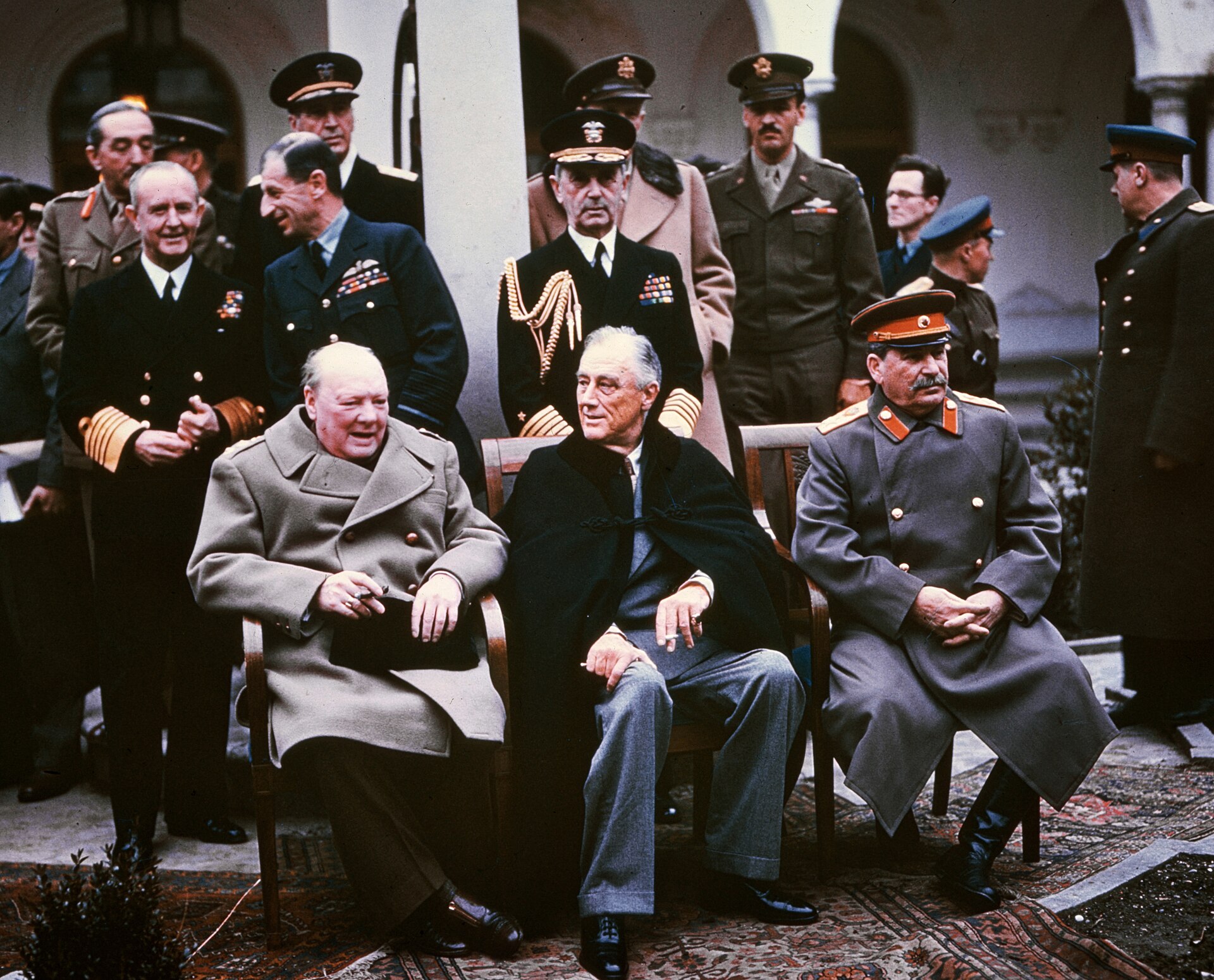
Franklin Roosevelt, Winston Churchill and Joseph Stalin met at Yalta, in the Crimea, in February 1945, with the Red Army already across most of Poland and into Hungary and eastern Germany. The protocol of the conference was signed by the three foreign secretaries on February 11, 1945.1 Its Declaration on Liberated Europe committed the three powers to help the peoples of liberated Europe form interim governments "broadly representative of all democratic elements" and to the "earliest possible establishment through free elections of Governments responsive to the will of the people."1 On Poland, where a communist-led Provisional Government installed with Soviet support already held power in Lublin and then Warsaw, the protocol said that government "should therefore be reorganized on a broader democratic basis" with the inclusion of democratic leaders from Poland itself and from Poles abroad. The new Polish government, in the protocol's words, "shall be pledged to the holding of free and unfettered elections as soon as possible on the basis of universal suffrage."1
The weakness of the bargain was visible on the page. The protocol gave no mechanism for enforcing the promises, and the Red Army was the only force on the ground in the countries concerned. The entry on Yalta in lesson 02 covers the conference itself, including the Far East agreement. What matters for this lesson is what came after: in every country of Eastern Europe the Red Army occupied, Austria excepted, a communist government took power within about three years.

The Red Army and the new governments
How the Soviet Union turned occupation into control is the subject of Anne Applebaum's Iron Curtain: The Crushing of Eastern Europe, 1944 to 1956 (2012), which drew on archives opened after 1989 in Poland, Hungary and East Germany. Applebaum's argument is that the pattern was set from the first months: Soviet officers and local communists trained in Moscow took control of the secret police and the radio at once, while allowing some political parties, churches and private businesses to survive for a time and then destroying them step by step.2 Her account is one historian's reading, built on documents, and it is broadly shared by historians who have worked in the opened archives of the region. (The summary of her argument here is a paraphrase and was not checked page by page against the book.)
The sequence differed from country to country but ran in the same direction:
- Poland. The Soviet-backed government from Lublin became the core of the postwar government. The "reorganization" promised at Yalta brought in a few non-communist leaders, but the security police, the army command and the key ministries stayed in communist hands.2
- Romania and Bulgaria. Governments dominated by communists were in place by 1945 and 1946, with the opposition parties suppressed in the following years.2
- Hungary. A free election in November 1945 gave the Smallholders' Party a majority, and the communists then broke the other parties apart, a method a Hungarian communist leader, Matyas Rakosi, later called "salami tactics" (the phrase is widely attributed to him; the attribution was not checked in a primary source for this lesson).2
- The Soviet zone of Germany. The Soviet occupation authorities forced the merger of the Communist and Social Democratic parties into the Socialist Unity Party in 1946, the party that would rule East Germany until 1989.2
- Czechoslovakia. A coalition government survived until February 1948, the subject of its own entry below.
Yugoslavia and Albania were different cases. Their communist parties had led wartime resistance movements and took power largely with their own forces, which is one reason Josip Broz Tito could defy Stalin in 1948 and survive.
The iron curtain and containment, 1946 to 1947
Fulton, Missouri, March 5, 1946
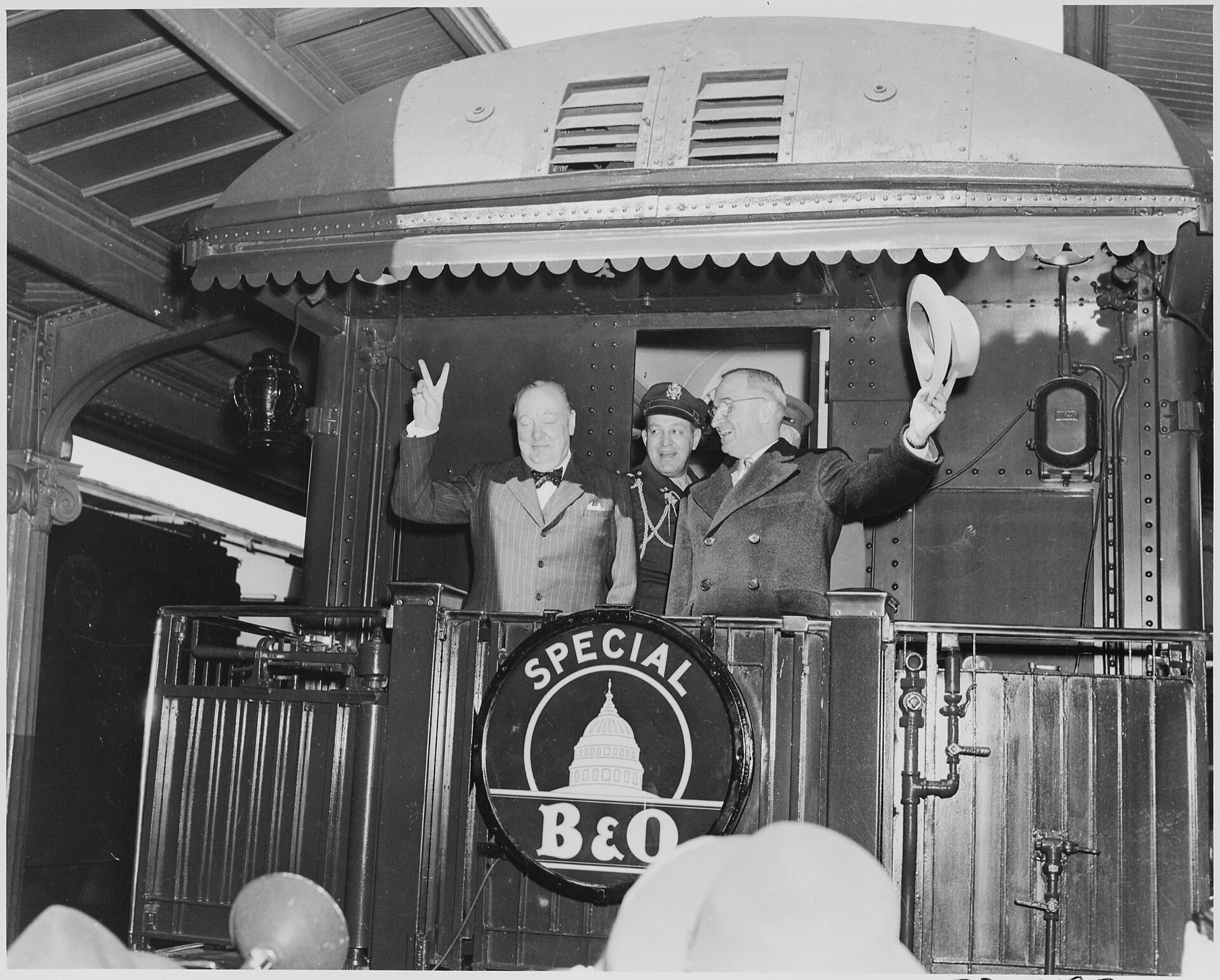
Churchill, out of office since July 1945, spoke at Westminster College in Fulton, Missouri, on March 5, 1946, with President Truman on the platform; both received honorary degrees.3 He called the address "The Sinews of Peace." Its central passage named the line and the cities behind it: "From Stettin in the Baltic to Trieste in the Adriatic, an iron curtain has descended across the Continent. Behind that line lie all the capitals of the ancient states of Central and Eastern Europe." He listed them, "Warsaw, Berlin, Prague, Vienna, Budapest, Belgrade, Bucharest and Sofia," and said that "all these famous cities and the populations around them lie in what I must call the Soviet sphere."4
Two other passages matter for this companion. Churchill warned that in many countries "Communist fifth columns are established and work in complete unity and absolute obedience" to directions from the communist center, a charge that 81 lesson 01 places in its American setting.4 And he gave his reading of the Soviet leaders: "there is nothing they admire so much as strength, and there is nothing for which they have less respect than for weakness."4 The speech was not popular at first in Britain or the United States, where many still thought of the Soviet Union as a wartime ally, but within two years its picture of Europe had become the common view in Western governments.

Kennan and containment
The American policy that answered Soviet expansion took its name from George F. Kennan, a Foreign Service officer who had served in Moscow. His "long telegram" from the Moscow embassy in February 1946 argued that Soviet hostility came from the regime's own nature and could not be talked away. His ideas reached the public in July 1947 in an anonymous article in Foreign Affairs, signed "X." The State Department's historians quote its central sentence: "The main element of any United States policy toward the Soviet Union must be that of a long-term, patient but firm and vigilant containment of Russian expansive tendencies."5 Kennan predicted that such a policy would "promote tendencies which must eventually find their outlet in either the break-up or the gradual mellowing of Soviet power."5 (The dates of the long telegram and of the article are standard and are given here without a separate check.) The prediction came true forty-four years later, by break-up.
Containment drew attack from two directions from the start. The columnist Walter Lippmann argued that it failed to separate vital interests from peripheral ones, and John Foster Dulles, in the 1952 campaign, said American policy should aim at liberation of the captive nations rather than containment.5 The same State Department history notes that Kennan himself wanted above all to defend the main centers of industrial power: Western Europe, Japan and the United States.5
The Truman Doctrine, March 12, 1947
Britain told Washington in February 1947 that it could no longer afford to support Greece, where the government was fighting a communist insurgency, or Turkey, under Soviet pressure over the Straits. On March 12, 1947, Truman asked a joint session of Congress for aid "in the amount of $400,000,000 for the period ending June 30, 1948."6 He put the request in global terms: "The peoples of a number of countries of the world have recently had totalitarian regimes forced upon them against their will," and "I believe that it must be the policy of the United States to support free peoples who are resisting attempted subjugation by armed minorities or by outside pressures."6 Nine days later he signed Executive Order 9835, the federal loyalty program, which is covered in 81 lesson 03 and lesson 05.
The Marshall Plan, 1947 to 1951
Secretary of State George C. Marshall proposed a program of European recovery in a speech to the graduating class at Harvard on June 5, 1947. Congress passed the Economic Cooperation Act in March 1948, and the aid that followed would "eventually rise to over $12 billion" for Western Europe, in the State Department historians' figure.7 The offer was open in principle to the Soviet Union and the Eastern European states. Moscow refused and kept its satellites out, because, the same history says, it feared American economic influence over the satellite states and Stalin would not open his country to Westerners.7 Czechoslovakia and Poland had at first shown interest and then withdrew under Soviet pressure (a widely reported detail that this lesson did not check in a primary document). The Soviet answer to the Marshall Plan was the Council for Mutual Economic Assistance, Comecon, founded in January 1949 (date not checked for this lesson; see lesson 10).
The Cominform, September 1947
In late September 1947 delegates of the Soviet party, the ruling or leading parties of Eastern Europe, and the French and Italian parties met in Poland and created the Communist Information Bureau, the Cominform. An American diplomat in Moscow, Elbridge Durbrow, cabled Washington on October 6, 1947 that the meeting included "Soviet and satellite CPs plus French and Italian"; the State Department's documentary history notes that the text of the declaration of its founding was published in Pravda for October 5, 1947.8 The meeting was held at the Polish resort of Szklarska Poreba and opened with Zhdanov's speech on September 22; Belgrade became the home of the editorial offices of the bureau's new publication.52
The keynote came from Andrei Zhdanov, Stalin's ideology secretary. His report of September 22, 1947 divided the world into "the imperialist and anti-democratic camp, on the one hand, and the anti-imperialist and democratic camp, on the other."9 An English translation of the report was printed in the Congressional Record in 1948, so American legislators had the Soviet statement of the "two camps" before them during the debates over the Marshall Plan and the loyalty program.9 The Cominform was a smaller body than the Comintern that Stalin had dissolved in 1943 (lesson 02), but it served the same purpose of keeping national parties on the Moscow line. Its structure and its end are in lesson 10.
The bloc closes, 1948 to 1949
Prague, February 1948
Czechoslovakia was the last country in the Soviet zone with a functioning multiparty government. In February 1948 the non-communist ministers resigned in protest at communist control of the police, expecting to force new elections. Instead the communist party, with the police, armed workers' militias and the trade unions behind it, pressed President Edvard Benes, who accepted the resignations and appointed a government on communist terms in late February. Foreign Minister Jan Masaryk, son of the republic's founder and a non-communist, was found dead below his window on March 10, 1948; whether he jumped or was thrown has never been settled (the date and the open question are standard in the literature and were not checked in a primary source for this lesson). On March 17, 1948, Truman told Congress: "The tragic death of the Republic of Czechoslovakia has sent a shock throughout the civilized world." He said that "the Soviet Union and its agents have destroyed the independence and democratic character of a whole series of nations in Eastern and Central Europe."10
The Tito-Stalin split, 1948
Josip Broz Tito's Yugoslav party had been the most loyal of Stalin's followers in 1945 to 1947, and Belgrade was chosen for the Cominform's editorial offices.52 By the spring of 1948 the two leaderships were quarreling over Yugoslav ambitions in the Balkans, Soviet advisers in Yugoslavia, and Tito's refusal to accept Moscow's direction. At a meeting in Bucharest in June 1948 the Cominform adopted a resolution, dated June 28, 1948, that condemned the Yugoslav leaders.11 It charged that the Yugoslav leadership "is pursuing an unfriendly policy toward the Soviet Union and the CPSU (B)" and concluded that the Yugoslav Central Committee "has placed itself and the Yugoslav Party outside the family of the fraternal Communist Parties," and "outside the ranks of the Information Bureau."12
Yugoslavia stayed a communist one-party state under Tito until his death in 1980, but outside the Soviet bloc. It accepted American aid and later helped lead the Non-Aligned Movement. In the satellites the split set off a hunt for "Titoists": show trials of communist leaders accused of being Tito's agents, among them Laszlo Rajk in Hungary (1949) and Rudolf Slansky in Czechoslovakia (1952) (names and years standard; not separately checked for this lesson). Tito proved that a communist state could survive outside Moscow's control, a fact that later shaped American policy toward China.
Berlin: the blockade and the airlift, June 1948 to May 1949
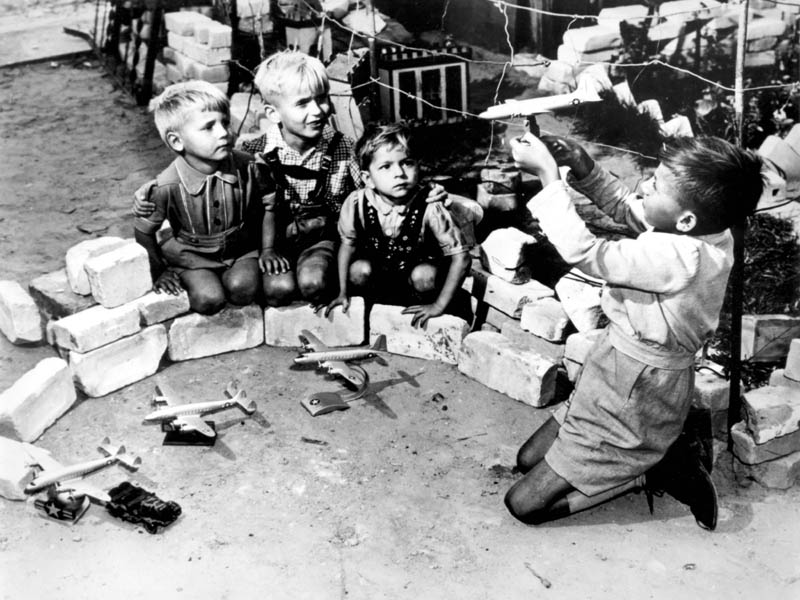
On June 24, 1948, Soviet forces cut rail, road and water access to the American, British and French sectors of Berlin, which lay deep inside the Soviet zone. The United States launched "Operation Vittles" on June 26, and the British "Operation Plainfare" two days later. At the height of the airlift a plane landed at Tempelhof airport about every 45 seconds.13 The State Department's own history gives the end of the blockade as May 12, 1949 in one place and May 11 in another; this lesson uses May 1949.13 The immediate Soviet complaint was the new West German currency introduced in the Western zones that June; the larger aim was to force the Western powers out of the city or to stop the creation of a West German state. Both failed. The Federal Republic of Germany was founded in the Western zones in 1949, and the Soviet zone became the German Democratic Republic later the same year.

NATO, April 4, 1949
The North Atlantic Treaty was signed in Washington on April 4, 1949.14 Its twelve founding members were the United States, Canada, Belgium, Denmark, France, Iceland, Italy, Luxembourg, the Netherlands, Norway, Portugal and the United Kingdom.15 Article 5 is the heart of it: "The Parties agree that an armed attack against one or more of them in Europe or North America shall be considered an attack against them all."14 In the State Department historians' words, NATO was "the first peacetime military alliance the United States entered into outside of the Western Hemisphere."15 Greece and Turkey joined in 1952 and West Germany in May 1955, the last of which the Soviet Union answered with the Warsaw Pact (the 1952 date is standard and was not separately checked).16
The Soviet bomb, August 29, 1949
The Soviet Union tested its first atomic device, called RDS-1 in the Soviet program and "Joe-1" by the Americans, at Semipalatinsk in Kazakhstan on August 29, 1949.17 On September 23 Truman announced: "We have evidence that within recent weeks an atomic explosion occurred in the U.S.S.R."18 The Atomic Heritage Foundation summarizes the scholarship as holding that espionage probably let the Soviet Union build its bomb roughly six months to two years sooner than it otherwise would have.17 The spies who passed the secrets, Klaus Fuchs, Theodore Hall and the Rosenberg network, are in lesson 12 and in 81 lesson 02.
The People's Republic of China, October 1, 1949
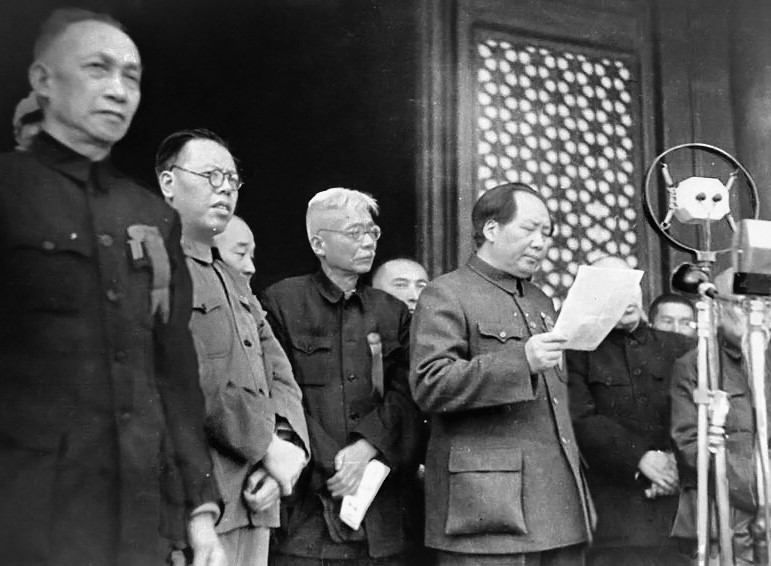
Mao Zedong proclaimed the People's Republic of China in Beijing on October 1, 1949, after the Chinese Communist Party's armies defeated the Nationalist government of Chiang Kai-shek, which retreated to Taiwan.19 The Truman administration had published the "China White Paper" in August 1949, arguing that the outcome had been beyond American control; the State Department's historians note that it did not stop the charge that the administration had "lost" China.19 In February 1950 Mao and Stalin signed a treaty of alliance in Moscow (date standard; not separately checked). The domestic consequences of the "loss of China" charge, including the cases of Owen Lattimore and John Stewart Service, are covered in 81 lesson 07.

The iron curtain in one picture
The diagram below is a schematic map, not drawn to scale, of Europe after the bloc closed. It shows the line Churchill named in 1946, the twelve founding members of NATO, the eight signatories of the Warsaw Pact of 1955, and Yugoslavia, which was communist but outside the bloc after 1948. Berlin, divided into four sectors and lying inside East Germany, is marked as a dot.
Korea and Stalin's last years, 1950 to 1953
The Korean War, June 25, 1950 to July 27, 1953
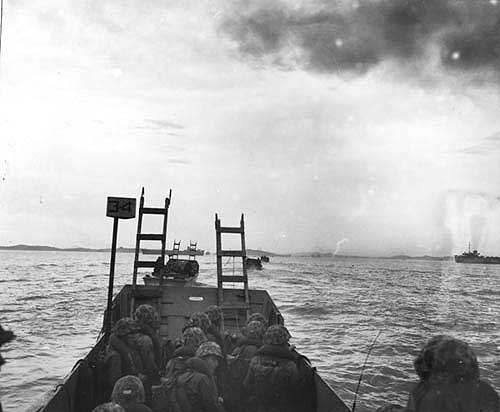
Korea had been divided at the 38th parallel in 1945 to manage the Japanese surrender, with the Soviets backing Kim Il-sung in the north and the United States backing Syngman Rhee in the south.20 North Korean forces invaded the South on June 25, 1950. Two days later Truman said, "In these circumstances I have ordered United States air and sea forces to give the Korean Government troops cover and support," and that "The attack upon Korea makes it plain beyond all doubt that communism has passed beyond the use of subversion to conquer independent nations and will now use armed invasion and war."21 (The same wording appears in the text quoted in 81 lesson 01.) A United Nations force under American command pushed the North Korean army back past the 38th parallel; Chinese forces entered the war in late 1950; and the fighting settled near the original line.20
Soviet documents opened after 1991 and published by the Wilson Center include notes of a March 5, 1949 meeting between Stalin and a North Korean government delegation led by Kim Il-sung, and a March 17, 1949 agreement on a Soviet loan for military equipment and property.22 The Wilson Center's separate collection on the war itself, 1950 to 1953, holds the later exchanges in which Kim sought and gained Stalin's approval for the attack; the scholarly consensus since the 1990s is that Stalin approved the invasion in early 1950 and that Mao agreed to it (a summary of the literature, not checked document by document for this lesson). The old claim, made by communist governments for decades, that South Korea started the war, has not survived the opening of the archives.
The armistice was signed at Panmunjom at 10 a.m. on July 27, 1953, by Lieutenant General William K. Harrison Jr. for the United Nations Command and General Nam Il for the Korean People's Army and the Chinese People's Volunteers, after 158 meetings spread over two years and seventeen days. The National Archives gives 36,576 American deaths and says the war "claimed the lives of millions of soldiers and civilians."23 No peace treaty followed. North Korea is still ruled by Kim Il-sung's family; its present is in lesson 04.

Stalin's death, March 5, 1953
The official Soviet announcement, printed in Pravda on March 6, 1953, said Stalin had died "at 9:50 p.m. 5 March" after a serious illness.24 His successors first ruled as a group: Georgi Malenkov, Lavrenti Beria, Vyacheslav Molotov and Nikita Khrushchev. The others arranged Beria's arrest and execution in 1953, and by 1955 Khrushchev had pushed Malenkov out as premier and emerged as the leading figure.25 (The State Department's history calls Beria "head of the KGB" at the time; the KGB was not created until March 1954, and in 1953 Beria headed the Ministry of Internal Affairs, the MVD. See lesson 10.) Within weeks of the funeral, the new leadership released some prisoners and dropped the "Doctors' Plot" case against Kremlin physicians (standard facts; not separately checked for this lesson).
East Berlin, June 1953
The first uprising against a Soviet satellite government began in East Berlin on June 16, 1953, when workers protested against government orders to raise production quotas. The next day demonstrations and rioting spread across East Germany; within days, by the State Department's count, nearly a million people joined in hundreds of cities and towns. Soviet occupation forces declared martial law and used massive military force to put the rising down.26 The causes were the "Constructing Socialism" program of Walter Ulbricht's government: forced collectivization of farms, a campaign against private trade, heavy industry first, food shortages, the suppression of churches and mass emigration to the West through West Berlin.26 The Eisenhower administration answered with a food program: about $15 million worth of food from 35 distribution centers in West Berlin, more than 5 million packages to more than a million East Germans who crossed in to collect them.26 The United States did not intervene militarily, and the pattern held for the rest of the Cold War: in the Soviet sphere, Washington would protest and help refugees, but would not fight.
The Khrushchev years, 1953 to 1964
The Warsaw Pact, May 14, 1955
The Treaty of Friendship, Co-operation and Mutual Assistance was signed in Warsaw on May 14, 1955, by Albania, Bulgaria, Hungary, the German Democratic Republic, Poland, Romania, the Soviet Union and Czechoslovakia.27 Its Article 4 pledged that "In the event of armed attack in Europe on one or more of the Parties to the Treaty by any state or group of states," each member would come to the aid of the state attacked, by armed force if it judged necessary.27 The State Department's historians describe it as the Soviet answer to West Germany's entry into NATO in early May 1955, adding a multilateral alliance to the bilateral treaties Moscow already had with each Eastern European state except East Germany.16 In practice the Pact's only military operations were against its own members: Hungary in 1956 (Soviet forces) and Czechoslovakia in 1968 (Soviet and allied forces).
The secret speech, February 25, 1956
The Twentieth Congress of the Communist Party of the Soviet Union opened in Moscow on February 14, 1956.25 On February 25, in a closed session from which foreign delegations were excluded, Khrushchev delivered the report known as the secret speech, "On the Cult of Personality and Its Consequences."28 He spoke of "this cult which is so alien to the spirit of Marxism-Leninism," read from Lenin's testament of 1922 to 1923, in which Lenin wrote that "Stalin is excessively rude," and gave the numbers that shocked the hall: of the 139 members and candidates of the Central Committee elected at the Seventeenth Congress in 1934, "98 persons, that is, 70 percent, were arrested and shot (mostly in 1937-38)," and of the 1,966 delegates to that congress, 1,108 were arrested on charges of counter-revolutionary crimes.28 (The figure 139 is the standard count from the speech; the Wilson Center text was checked for the 98, the 70 percent and the 1,108 of 1,966.)
The speech was a partial accounting. It condemned the killing of loyal communists and Stalin's personal rule, and it blamed Stalin and Beria for the terror, but it defended the party, collectivization and the defeat of Trotsky and Bukharin, and it said little about the millions of peasants, deported nations and ordinary prisoners who were the great majority of Stalin's victims (lesson 02 gives those numbers). Khrushchev was aware, the State Department's history says, that too sharp an attack could give "international anti-communists ammunition" against the movement.25 The text leaked. The United States obtained a copy and the State Department released it in June 1956 (a standard account; the date was not separately checked here), and in the West the speech destroyed what remained of many communists' faith. In the United States it began the collapse of the CPUSA described in lesson 05 and lesson 11.

Poland and Hungary, 1956
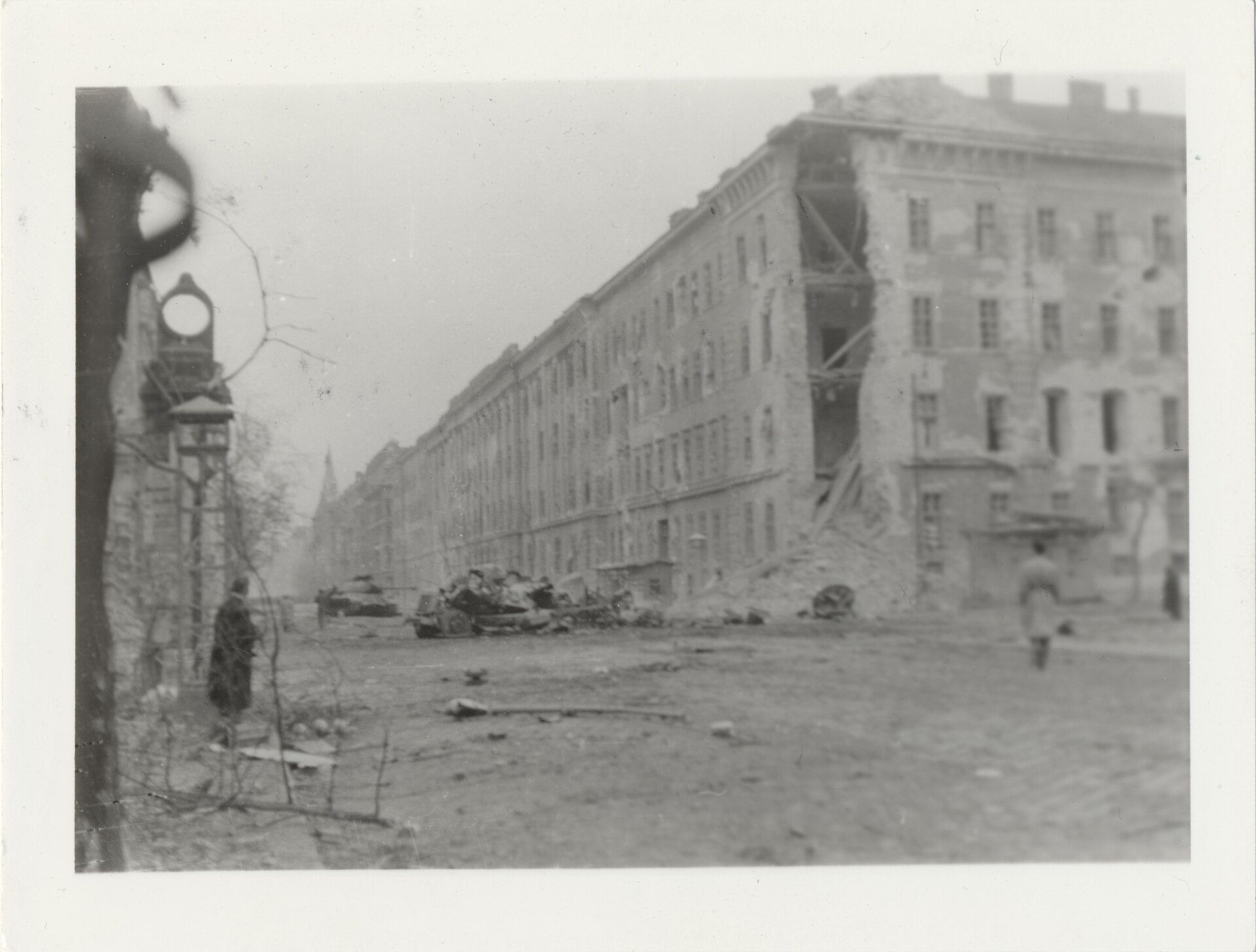
The speech loosened the satellites. In Poland, worker protests in Poznan in June 1956 and a party crisis in October brought Wladyslaw Gomulka, a communist once jailed as a "nationalist," back to power; Khrushchev flew to Warsaw, threatened, and in the end accepted him (standard account; not separately checked for this lesson). Hungary went further. The revolution began on October 23, 1956, with student demonstrations in Budapest. Imre Nagy, a reform communist, became prime minister, and on November 1 he formally declared Hungary's withdrawal from the Warsaw Pact.29 On November 4 Soviet tanks entered Budapest in "Operation Whirlwind," commanded by Marshal Ivan Konev.29
The European Network Remembrance and Solidarity, a body set up by several Central European governments to study the period, gives at least 2,500 insurgents killed and 20,000 wounded, 1,569 civilians killed in Budapest, and 699 Soviet soldiers killed and 1,450 wounded; about 200,000 people fled the country.29 Other published counts differ, and the categories in this one may overlap, so the figures are best read as an order of magnitude: thousands of Hungarians dead. Nagy took refuge in the Yugoslav embassy, was seized after leaving it under a promise of safe conduct, tried in secret and executed in 1958.29 (The execution date usually given is June 16, 1958; ENRS gives only the year.) Hungary's party leader Janos Kadar ruled until 1988.
The rising also had an American side. Radio Free Europe's Hungarian broadcasts were accused afterward of encouraging the fighters to expect Western help that never came; the station's own internal review and later studies found some broadcasts had gone beyond policy (a summary of the literature; not checked against the documents for this lesson). For the policy of "liberation" that Dulles had promised in 1952, Hungary was the test, and the answer was the same as in East Berlin.5

The Berlin crisis and the wall, 1958 to 1961
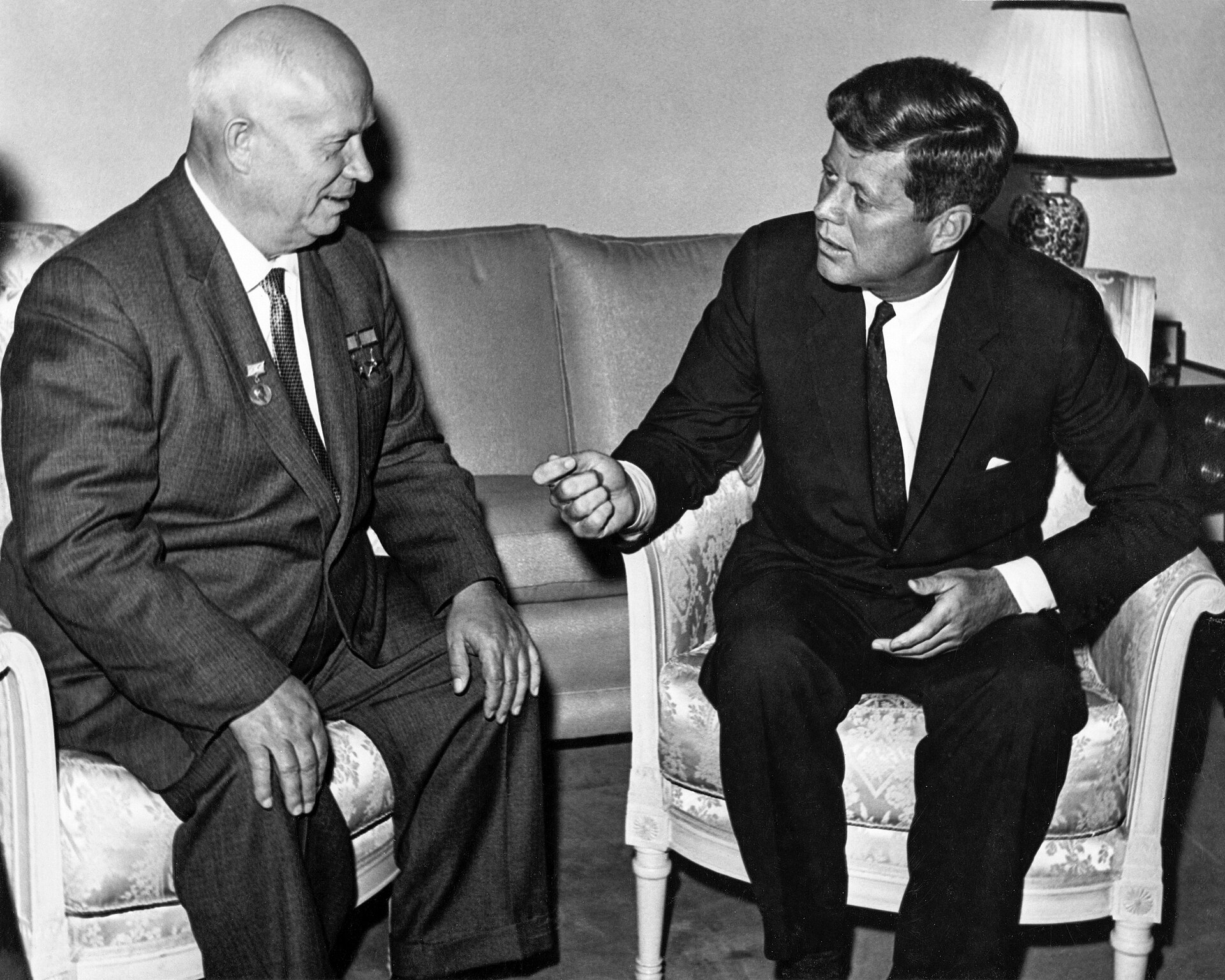
On November 10, 1958, Khrushchev demanded that the United States, Britain and France withdraw their forces from West Berlin within six months, the start of a three-year crisis.30 The reason, in the State Department historians' words, was that freedom of movement between the sectors "had resulted in a mass exodus from the eastern side."30 (Roughly 2.5 to 3 million East Germans left between 1949 and 1961; the figure is widely cited and was not checked in a primary source for this lesson.) Kennedy and Khrushchev met in Vienna in June 1961 and found no solution; Khrushchev renewed his six-month deadline, and Kennedy called up 150,000 reservists and raised defense spending.30
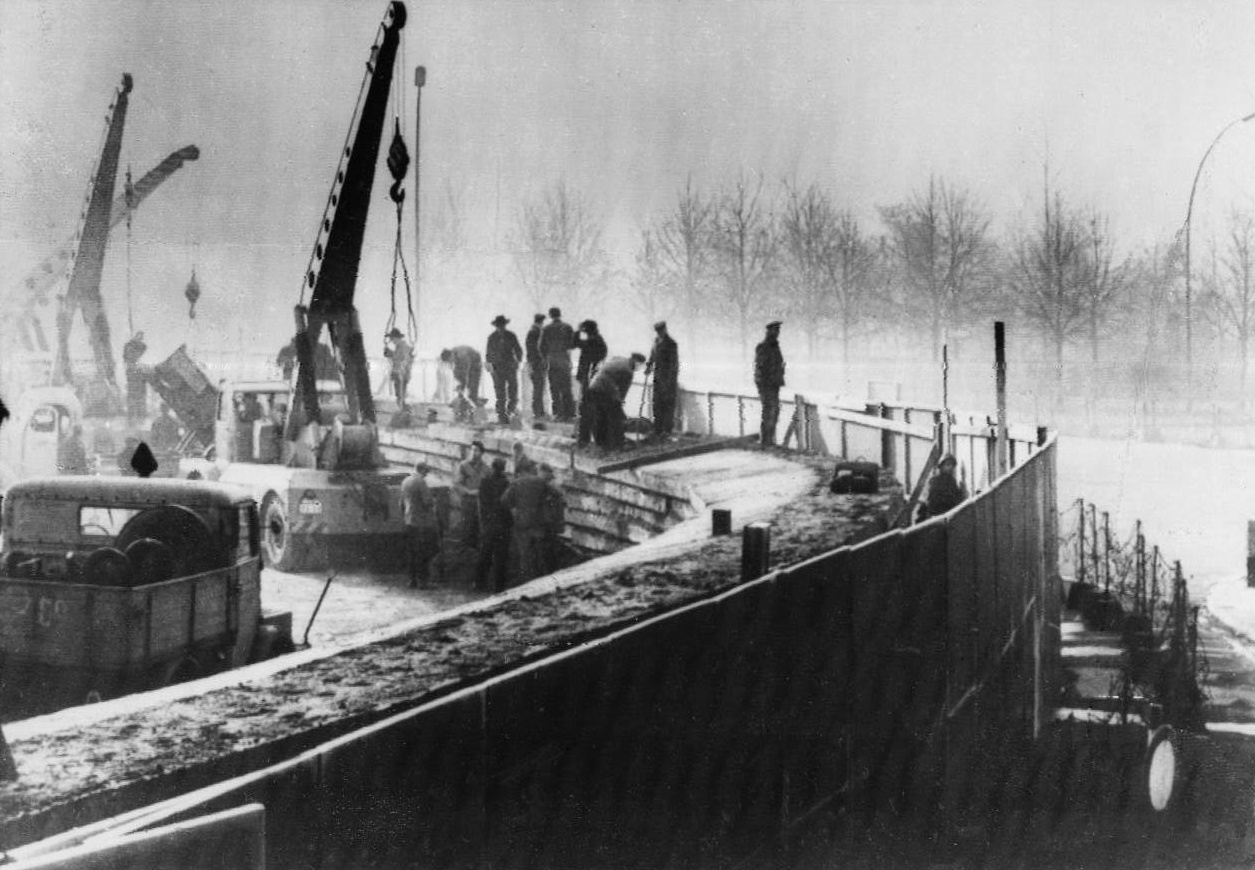
On the morning of August 13, 1961, Berliners woke to find that, on the orders of the East German leader Walter Ulbricht, a barbed-wire fence had gone up overnight between East and West Berlin. It was soon rebuilt as concrete walls with guard towers.30 In October 1961 American and Soviet tanks faced each other at the Checkpoint Charlie crossing over the right of Allied officials to pass without showing documents to East German guards.30 The East German government presented the wall as a defense against the West (its official name for it, the "anti-fascist protection rampart," is standard but was not checked in a primary source here). The State Department's historians give its purposes as keeping out Western influence and stopping "the flow of migrants out of the communist sector." In plain terms, the wall kept East Germany's own people in.30 The number of people killed at the Berlin Wall from 1961 to 1989 is put at 140 by a joint research project of the Berlin Wall Foundation and the Center for Contemporary History in Potsdam (the figure is widely reported and was not checked in the project's own publication for this lesson).

Cuba, 1959 to 1961
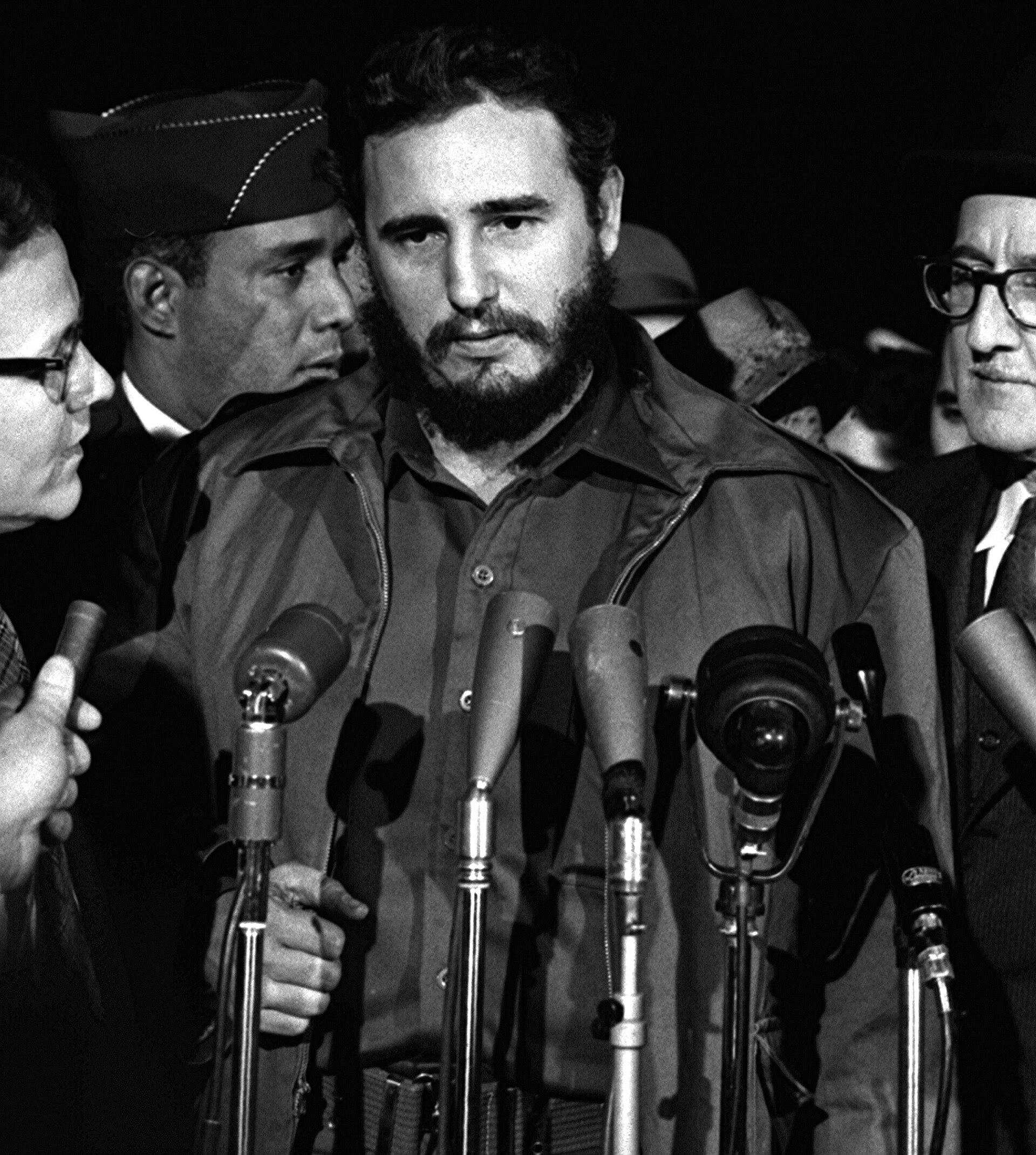
The revolution led by Fidel Castro ended in 1959 with the flight of President Fulgencio Batista and a new government under Castro. The Castro government expropriated American economic assets and built close links with the Soviet Union.31 Castro said at first that he was no communist; in April 1961, on the eve of the Bay of Pigs landing, he declared the revolution socialist, and in December 1961 he announced that he was a Marxist-Leninist (both dates are standard and were not checked against primary texts here). In March 1960 President Eisenhower directed the CIA to plan an invasion by Cuban exiles. Kennedy let it go ahead, and the landing by Brigade 2506 in April 1961 failed almost at once.31 The Communist Party of Cuba, formally founded under that name in 1965, still rules the island; see lesson 04.

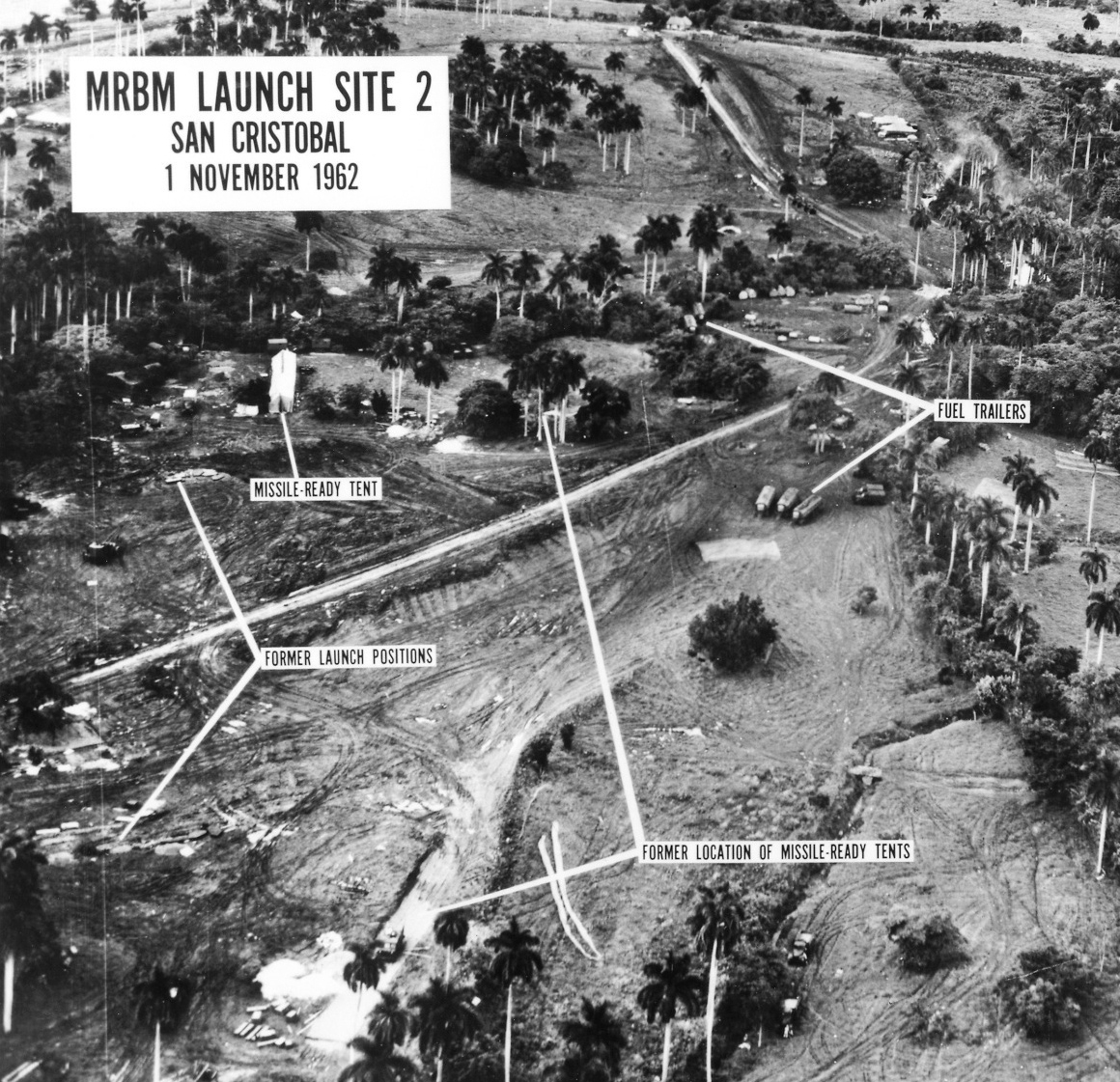
The Cuban Missile Crisis, October 1962
On October 14, 1962, an American U-2 photographed Soviet missile sites under construction in Cuba; the photographs reached the White House the next day.32 On October 22 Kennedy ordered a naval "quarantine" of Cuba, wrote to Khrushchev demanding that the missiles be removed, and spoke to the nation. Some Soviet ships turned back on October 24 and 25, and American forces went to DEFCON 2. On October 26 Khrushchev sent a long private message urging the leaders to "take measures to untie that knot"; on October 27 a second message added the removal of American Jupiter missiles from Turkey, a U-2 was shot down over Cuba, and Kennedy answered the first message and set the second aside. On October 28 Khrushchev announced that the missiles would be dismantled and removed.32
The terms were not all public. The United States pledged not to invade Cuba, and Attorney General Robert Kennedy privately told the Soviet ambassador, Anatoly Dobrynin, that the Jupiters in Turkey would be removed soon, on the condition that this could not be part of any public agreement. The quarantine ended on November 20, after the Soviets agreed to remove their IL-28 bombers as well, and the Jupiters left Turkey in April 1963.32 The crisis is the closest the two powers came to nuclear war.

Mao's China, 1949 to 1976
The Great Leap Forward and the famine, 1958 to 1962
In 1958 Mao launched the Great Leap Forward, a campaign to overtake the industrial powers within a few years by mass mobilization: peasants were herded into giant people's communes, private plots and household kitchens were abolished in favor of communal mess halls, millions were taken from the fields to make iron in backyard furnaces, and local officials, under pressure to report record harvests, sent grain quotas to the state based on invented figures. When the harvests failed, the state kept taking grain. The result was the deadliest famine in recorded history (a general description of the campaign drawn from the works cited below).33
The death toll can only be estimated, from population statistics and from provincial party archives that some Chinese and foreign historians were able to read in the 1990s and 2000s before access tightened again. Three figures anchor the debate. The Chinese journalist Yang Jisheng, a party member who worked from provincial records, dedicated his book Tombstone (Chinese edition 2008, English 2012) to "the 36 million Chinese who died of starvation."3435 The historian Frank Dikotter, in Mao's Great Famine (2010), put the number of premature deaths from 1958 to 1962 at about 45 million, including people beaten or worked to death as well as those who starved.33 Reviewing both books in the London Review of Books, the political scientist James C. Scott called 30 million the "more cautious figure" and 45 million the "higher one," and noted that Dikotter's figure was "larger by 10 million than the estimates of most experts."34 Some demographers have published lower estimates, from about 15 to 20 million (these lower figures are reported in the literature and were not checked in their original publications for this lesson). The Chinese Communist Party has never published a death toll. For decades it called the period the "three years of natural disasters" (the official term is widely reported but does not appear in the sources opened for this lesson); its 1981 resolution on party history admitted that the Great Leap Forward's errors meant the economy "encountered serious difficulties between 1959 and 1961, which caused serious losses to our country and people."36
The Cultural Revolution, 1966 to 1976
In May 1966 Mao opened the Great Proletarian Cultural Revolution, a campaign against "bourgeois" and "revisionist" elements that he said had taken over the party. Red Guards, mostly students, attacked teachers, officials, intellectuals and religious believers; senior leaders including President Liu Shaoqi and Deng Xiaoping were purged, and Liu died in detention in 1969; millions of young people were sent to the countryside; and factional fighting killed many in the provinces (a summary; dates for Liu's fall and death are standard and were not separately checked). The movement ended only with Mao's death in September 1976 and the arrest of the "Gang of Four" in October.
The party's own verdict, adopted in June 1981 at the Sixth Plenary Session of its Eleventh Central Committee, was that the Cultural Revolution, from May 1966 to October 1976, "was responsible for the most severe setback and the heaviest losses suffered by the Party, the state and the people."36 It also judged that in Mao's career as a whole "his merits are primary and his errors secondary," a formula that still governs official history in China.36 Estimates of the dead from the Cultural Revolution vary widely, from several hundred thousand to over a million and more, and depend on whether deaths in the factional wars and the rural massacres are counted (this range is reported in the scholarly literature and was not checked in a specific study for this lesson). The Sino-Soviet split, which broke into the open around 1960 and led to border fighting on the Ussuri River in March 1969, is mentioned in lesson 07 (dates standard; not separately checked here).
The Brezhnev years and the wider world, 1964 to 1982
Khrushchev was removed by his colleagues in October 1964 and replaced as party leader by Leonid Brezhnev, who held the post until his death in November 1982 (standard dates; not separately checked for this lesson). The Brezhnev years brought arms-control agreements with the United States and a large Soviet military buildup at the same time, a stagnant economy at home, and the spread of communist and Soviet-aligned governments in Asia, Africa and Latin America.
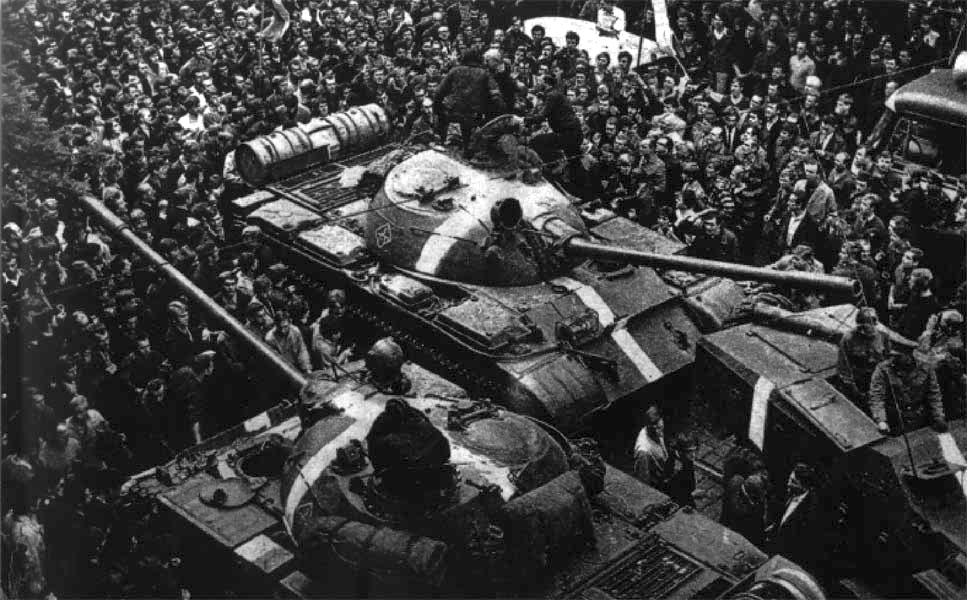
Prague Spring and the invasion of 1968
In early 1968 Alexander Dubcek replaced Antonin Novotny as head of the Communist Party of Czechoslovakia and began the reforms known as the Prague Spring: a loosening of censorship, talk of "socialism with a human face," and plans for economic reform (the slogan is standard; not checked in a primary text here).37 Moscow judged that the party was losing control. On the night of August 20 to 21, 1968, Soviet troops, with limited numbers of troops from Hungary, Poland, East Germany and Bulgaria, invaded the country.37 Dubcek was taken to Moscow, forced to sign away most of his program, and replaced the next year by Gustav Husak, whose "normalization" purged the party of reformers (standard account; not separately checked).
The invasion gave its name to the Brezhnev Doctrine: the Soviet claim of a right to intervene in any country where a communist government was threatened. The State Department's historians note that the same doctrine was later used to justify the invasion of Afghanistan in 1979.37 Communist parties in Western Europe, the Italian above all, condemned the invasion, a step toward the "Eurocommunism" of the 1970s (a summary; not separately checked).

Vietnam, from Dien Bien Phu to Saigon, 1954 to 1975
Ho Chi Minh, a Comintern-trained communist who had helped found the French Communist Party in 1920 (biographical details standard; see his entry in lesson 07), declared Vietnam's independence in September 1945 and led the Viet Minh war against French rule. On May 7, 1954, the French garrison at Dien Bien Phu fell after what the State Department's history calls a four month siege, and France withdrew from Indochina.38 The Geneva conference that year divided Vietnam at the 17th parallel pending elections that were never held, leaving a communist North under Ho and a non-communist South backed by the United States (Geneva terms standard; not separately checked for this lesson). The State Department's history records that the United States became steadily more committed in Indochina and "would not pull out of Vietnam for another twenty years."38
The American war in Vietnam is a subject of its own and is not retold here. Its end in the record: the Paris Peace Accords were initialed on January 23, 1973 and signed on January 27, allowing the United States to withdraw and its prisoners of war to come home; neither Vietnamese side kept the agreement; and on April 30, 1975, North Vietnamese tanks drove through the gate of the Presidential Palace in Saigon, "effectively ending the war."39 In the years that followed, the new government sent hundreds of thousands of former South Vietnamese officials and soldiers to "re-education" camps, and more than a million people fled by sea and land, many of them dying on the way (orders of magnitude standard in the literature; not checked against a specific source here). Laos came under the Pathet Lao, a communist movement allied with Hanoi, in December 1975 (date standard; not separately checked). Vietnam and Laos remain communist one-party states; see lesson 04.
Cambodia under the Khmer Rouge, 1975 to 1979
The Communist Party of Kampuchea, known as the Khmer Rouge and led by Pol Pot, took Phnom Penh on April 17, 1975 (date standard; not checked in a primary source here). It emptied the cities, abolished money, markets, schools and religion, and drove the population into forced labor on rural cooperatives. It killed former officials, soldiers, teachers, monks, ethnic Vietnamese and Cham Muslims, and finally its own cadres, many of them after torture at the Tuol Sleng prison in Phnom Penh, designated S-21 (an account drawn from the Yale program's work and the later tribunal; specific details were not each checked for this lesson). Yale University's Cambodian Genocide Program estimates that "approximately 1.7 million people" died, about 21 percent of the country's population.40 Other estimates run from about 1.5 to over 2 million. The regime fell in January 1979 to an invasion by communist Vietnam, which installed a government of Khmer Rouge defectors; China, which had backed Pol Pot, attacked Vietnam's northern border in February 1979 (dates standard; not separately checked). The communist states were by then fighting each other.
Helsinki, 1975
The Helsinki Final Act, signed by 35 nations in 1975, concluded the Conference on Security and Cooperation in Europe. The Soviet Union had sought such a conference since 1954, hoping it would bring formal recognition of the postwar boundaries in Eastern Europe.41 It got that recognition, but the Act also contained commitments on human rights, and dissident groups in the Soviet bloc, the Moscow Helsinki Group of 1976 and Charter 77 in Czechoslovakia among them, used those commitments to hold their governments to account (a standard account; the human rights provisions and the founding dates of these groups were not checked in the sources opened for this lesson).
Afghanistan, 1979 to 1989
A communist party, the People's Democratic Party of Afghanistan, seized power in Kabul in April 1978 and soon faced a rural rebellion (standard; not separately checked). The Soviet Union invaded at the end of December 1979, beginning on Christmas Eve, with thousands of troops.42 President Carter answered with a letter to Brezhnev, economic sanctions and trade embargoes, a doctrine announced in his State of the Union address pledging to protect Middle Eastern oil from Soviet expansion, a boycott of the 1980 Moscow Olympics, and more aid to the Afghan insurgents.42 Carter also withdrew the SALT II treaty from the Senate and banned grain sales to Moscow.43 The Soviets withdrew only after "ten years of grinding insurgency," the last troops leaving in February 1989 (the date February 15, 1989 is standard; not separately checked).42
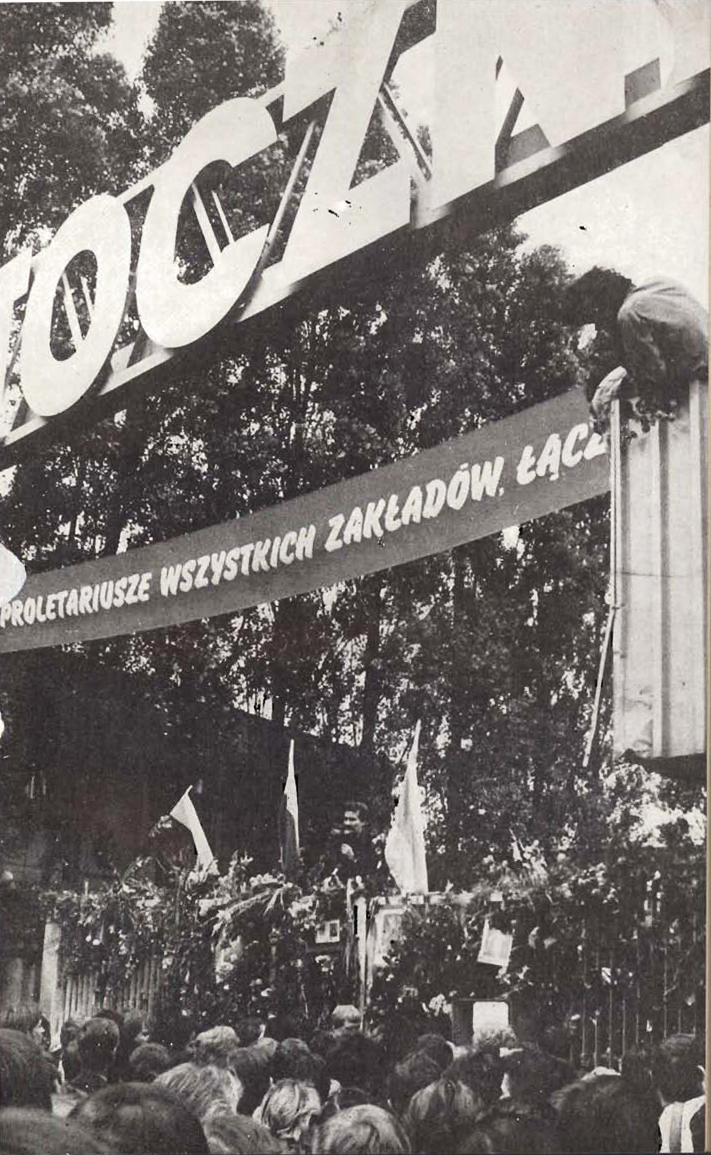
Solidarity and martial law in Poland, 1980 to 1981
A strike broke out at the Lenin Shipyard in Gdansk on August 14, 1980. The strikers drew up twenty-one demands, among them free trade unions independent of the party, the right to strike, an end to censorship and the release of political prisoners, and on August 31, 1980 the government signed the Gdansk Agreements and Lech Walesa announced the strikers' victory.44 The union that grew from it, Solidarity, had 10 million members by the count in the Gdansk city history, which describes that as almost all of Poland's adult citizens.44 It was the first independent mass organization inside the Soviet bloc.
At 6:00 a.m. on December 13, 1981, General Wojciech Jaruzelski, the party leader and prime minister, declared martial law on television.45 Thousands of Solidarity activists were interned and the union was banned, and it survived underground with help from abroad.46 Documents assembled by the National Security Archive show that senior American officials had expected a Soviet invasion rather than an internal crackdown, and that shortly before martial law Jaruzelski asked Moscow to be ready to send troops; whether he imposed martial law to forestall a Soviet invasion, as he later claimed, or to save his own regime remains disputed.45 Reagan responded with economic sanctions against Moscow and curbs on exchanges.43

Gorbachev and the end, 1985 to 1991
Gorbachev, perestroika and glasnost
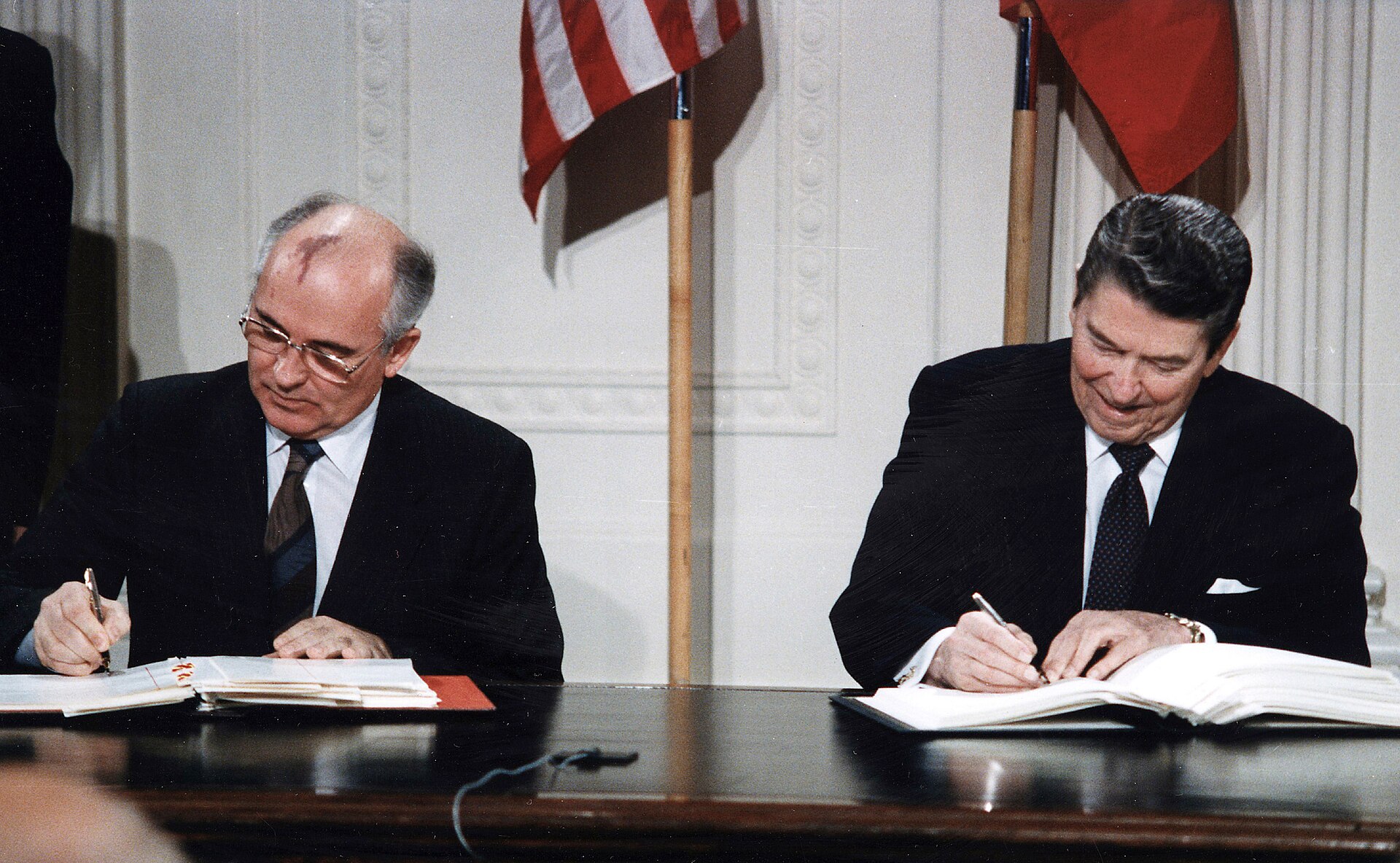
Brezhnev's two successors, Yuri Andropov and Konstantin Chernenko, each died after little more than a year in office. In March 1985 the Politburo chose Mikhail Gorbachev as General Secretary of the Communist Party of the Soviet Union, and in the State Department historians' words his appointment "provided Reagan with a viable negotiating partner."43 Reagan had spent his first term on a military buildup and sharp words: he spoke of leaving "Marxism-Leninism on the ash-heap of history" and called the Soviet Union an "evil empire."43 In the second term the two leaders met at Geneva (1985), Reykjavik (October 1986), Washington (December 1987, where they signed the Intermediate-Range Nuclear Forces Treaty, which eliminated a whole class of missiles) and Moscow (May 1988, where Reagan said the "evil empire" belonged to "another era").43
At home Gorbachev launched perestroika (restructuring) and glasnost (openness). He meant to save the system by reforming it. Glasnost let Soviet citizens read, for the first time in their own press, about the famine, the Terror, the secret protocol of 1939 and Katyn. The political reforms opened Soviet politics to contested elections; after what the State Department's history calls "the May 1990 elections," Gorbachev was caught between Boris Yeltsin's movement for rapid reform and the party's hard-liners.47 The economy did not recover, and the nationalities of the Union, starting with the Baltic republics, used the new freedom to demand independence.

The year 1989
The communist governments of Eastern Europe fell in a single year, one after another:46
- Poland. Round Table talks between the government and Solidarity opened on February 6, 1989; the agreement signed on April 4 legalized Solidarity and allowed partly free elections; on June 4 Solidarity won a decisive victory; and on August 24 Tadeusz Mazowiecki became the first non-communist prime minister in Eastern Europe since the 1940s.46
- Hungary. The government opened its border with the West, which gave East Germans a route out, and on October 23 adopted a new constitution allowing a multiparty system.46 In June 1989 Imre Nagy was reburied in Budapest before a vast crowd (standard; not separately checked).
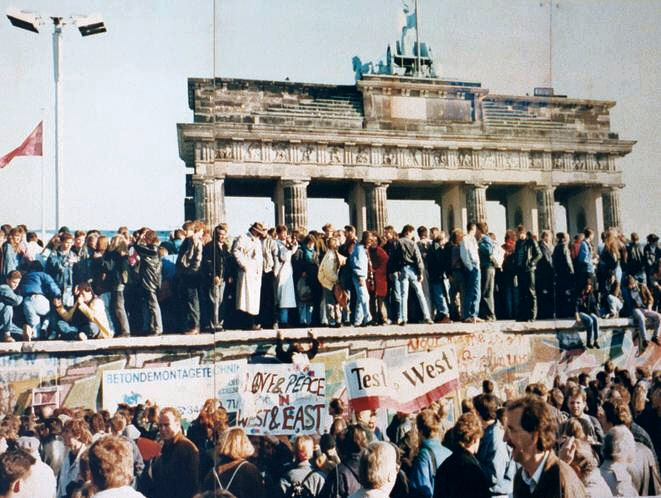
- East Germany. On November 9, 1989, the government announced new travel rules, and the wall was opened after a poorly briefed spokesman said they applied to Berlin as well.46 Gorbachev's adviser Anatoly Chernyaev wrote that the fall of the wall marked "a shift in the world balance of forces."46 Germany was reunified on October 3, 1990, inside NATO (the date is standard; the State Department page confirms the reunification within NATO).43
- Bulgaria. Protests forced out the longtime leader Todor Zhivkov, and his reform communist successor, Petar Mladenov, promised free elections in 1990.46
- Czechoslovakia. After mass demonstrations beginning in November, a non-communist government took office on December 5, and Vaclav Havel, the playwright and Charter 77 dissident, was elected president on December 29.46
- Romania. Army and police fired on protesters in Timisoara on December 17. Nicolae Ceausescu ordered further repression on December 21 and fled the next day; he and his wife Elena were executed on December 25, 1989, after a quick mock trial.46 Romania's was the only violent overthrow of 1989 in Eastern Europe.
Gorbachev did not send the tanks. After the Malta summit with President George H. W. Bush in early December 1989, Gorbachev's spokesman said, "We buried the Cold War at the bottom of the Mediterranean Sea."43

Tiananmen Square, June 4, 1989
China went the other way. Students gathered in Tiananmen Square on April 15, 1989 to mourn the reform-minded leader Hu Yaobang, and the gathering became a protest against corruption and inflation and for political reform. On April 26 the party newspaper People's Daily called the protesters "counter-revolutionary." The crowds reportedly grew beyond a million, students began hunger strikes during Gorbachev's state visit of May 15 to 18, and party leader Zhao Ziyang made an emotional appeal to them on May 19. Martial law was declared in Beijing on May 20.48 On the night of June 3 to 4 the People's Liberation Army cleared the square and the approaches with tanks and gunfire. The Chinese government said over 200 people, including 36 university students, were killed and more than 3,000 injured; Western sources are skeptical of the official figure and most often give hundreds or thousands killed.48 Zhao was removed and spent the rest of his life under house arrest (standard; not separately checked). The party that ordered the crackdown still rules; see lesson 04.
The end of the Soviet Union, 1991
In January 1991 Soviet forces intervened in Lithuania and Latvia. In July, Bush and Gorbachev signed the START treaty in Moscow. In August a group of hard-line communist officials tried to seize power from Gorbachev; the coup failed within days, and Bush called it "extra-constitutional."47 Boris Yeltsin, elected president of the Russian republic in June 1991, led the resistance from the Russian parliament building (standard; not separately checked). After the coup the republics broke away. In early December 1991 the leaders of Russia, Ukraine and Belarus met near Brest and formed the Commonwealth of Independent States.47 On December 25, 1991, Gorbachev resigned and the Soviet flag was lowered over the Kremlin for the last time.47 The next day, December 26, the Council of Republics of the Supreme Soviet of the USSR adopted Declaration No. 142-N, which stated (in translation) that with the creation of the Commonwealth of Independent States, the USSR as a state and a subject of international law ceased to exist.49 The Soviet Union had lasted sixty-nine years from its founding treaty of December 30, 1922 (lesson 02).
What the record shows and what it does not
Documented fact. The texts are public: the Yalta protocol's promise of free elections, the Truman Doctrine, the North Atlantic Treaty, the Warsaw Pact, the Cominform's resolution against Tito, the Korean armistice, Khrushchev's secret speech and the Chinese party's 1981 resolution. The dates of the main events in this lesson, from the Berlin blockade to the end of the Soviet Union, are recorded in government documents on both sides.12836
The communists' own words. Zhdanov's "two camps," the Cominform's charge that Tito was "outside the family" of fraternal parties, Khrushchev's count of the 98 Central Committee members shot, and the Chinese party's admission of "the most severe setback and the heaviest losses" are statements by the parties themselves.9122836
The accusations of the time. Western leaders said in 1946 to 1950 that the Soviet Union was imposing governments by force and directing communist parties abroad. The opened archives of Eastern Europe and the Soviet Union have confirmed that charge in its essentials (Applebaum's account of the satellites; the Wilson Center's Korean War documents).222
The archive evidence. Soviet and Eastern European records opened after 1989 show Stalin's role in planning the Korean War, the Soviet decisions on Hungary and Czechoslovakia, and the scale of the famines and purges. Chinese records were partly open for a time and are now largely closed again.
Scholarly reading. Historians agree on the sequence and broadly on Soviet responsibility for the division of Europe. They still differ on how much each side's moves were reactions to the other, on how much credit for the end of the Cold War belongs to Western pressure and how much to Gorbachev's choices, and on the death tolls in China.
Open questions. The death toll of the Great Leap famine (30 to 45 million in the most cited range, with lower estimates by some demographers), the true number killed at Tiananmen, the full story of Jaruzelski's decision in 1981, and what Chinese archives would show about Korea and the Cultural Revolution if they were opened.
Claims checked
"At Yalta, Roosevelt and Churchill handed Eastern Europe to Stalin."
Rating: Partly supported. The claim was a staple of American anti-communist writing from the late 1940s on and figured in the attacks on Alger Hiss, who attended Yalta as a State Department official (see lesson 07). The text of the agreement promised the opposite of a handover: free elections and governments "broadly representative of all democratic elements."1 What decided the outcome was the presence of the Red Army, which was already in the countries concerned before the conference met. The part of the claim that holds up is narrower: the Western leaders accepted the Soviet-backed Polish government as the basis of the new one, with a vague promise of reorganization, and the protocol contained no means of enforcement. They chose to rely on Stalin's word in a region where they had no troops, and the word was broken.
"The Soviets got the bomb only because spies gave it to them."
Rating: Partly supported. Espionage was real and important: Klaus Fuchs and Theodore Hall passed detailed design information from Los Alamos, and the first Soviet device closely followed the American plutonium design. The scholarly summary used by the Atomic Heritage Foundation is that espionage probably shortened the Soviet program by about six months to two years.17 The Soviet Union had its own physicists, uranium and a crash program under Beria, and would have built a bomb without the spies, later. The fuller account is in 81 lesson 01 ("the bomb problem") and lesson 12. (The statement that the first device copied the American design is standard in the literature and was not checked in a primary source for this lesson.)
"South Korea attacked first in June 1950."
Rating: Refuted. North Korea, the Soviet Union and China said so for decades. The Soviet records published by the Wilson Center record Stalin's meeting with Kim Il-sung's delegation in March 1949 and a Soviet military loan agreement that month; the Wilson Center's separate collection for 1950 to 1953 holds the later exchanges on Stalin's approval of the attack (that collection was not read document by document for this lesson).22 The State Department's history describes a North Korean attack on the South.20
"China's famine of 1959 to 1961 was caused by natural disasters."
Rating: Refuted. The official name for the period in China was long the "three years of natural disasters." Bad weather played a part in some provinces, but the historians who worked in the provincial archives, Yang Jisheng and Frank Dikotter among them, show that the famine was driven by policy: the communes, inflated harvest reports, grain procurement that continued while people starved, and the punishment of officials who reported the truth.3433 The party's own 1981 resolution blamed the Great Leap Forward's errors for the "serious losses" of 1959 to 1961, while avoiding any figure.36
"Khrushchev's secret speech told the whole truth about Stalin."
Rating: Partly supported. The speech was true in what it said: the Wilson Center text documents the shooting of 98 of the Central Committee elected in 1934 and the arrest of 1,108 of the 1,966 delegates.28 It was selective in what it left out: the victims of collectivization and the famine, the deported nations and the millions of ordinary prisoners of the Gulag (lesson 02), and Khrushchev's own part in the purges in Moscow and Ukraine. It condemned the cult of Stalin while defending the party and its system.
"In October 1962 Khrushchev backed down and got nothing."
Rating: Refuted. This was the public version at the time. The State Department's own history records the American pledge not to invade Cuba and Robert Kennedy's private assurance to Ambassador Dobrynin that the Jupiter missiles in Turkey would be removed, on condition that this stay out of any public agreement; the Jupiters were removed in April 1963.32 The Soviets removed far more, and on a public timetable, but the bargain had two sides.
"Communism in Eastern Europe fell without bloodshed in 1989."
Rating: Partly supported. In Poland, Hungary, East Germany, Czechoslovakia and Bulgaria the transfers of power were peaceful. Romania was the exception: troops and police fired on crowds in Timisoara on December 17, and the Ceausescus were executed on December 25.46 In the same year China crushed its own movement by force at Tiananmen.48
"Reagan's pressure alone won the Cold War" or, from the other side, "Gorbachev alone ended it."
Rating: Unresolved. Each version leaves out half the record. The State Department's historians describe a Reagan first term of rearmament and confrontation followed, after Gorbachev's appointment, by negotiation, summits and the INF Treaty, and they credit Gorbachev's decision to accommodate the revolutions of 1989 rather than crush them.43 Historians still weigh the relative force of Western military and economic pressure, the Soviet economy's own failures, the Afghan war, the Polish opposition, and Gorbachev's choices. The documentary record supports the conclusion that all of these mattered; it does not settle their proportions.
Hard questions and answers
Were the Eastern European communist governments imposed from outside, or did they have real local support?
Both, in different proportions. Every one of these parties had local members, some with long histories, and in a few countries (Czechoslovakia above all) the communists won a large share of the vote in the first postwar elections (the Czechoslovak figure of about 38 percent in 1946 is standard and was not checked in a primary source here). But nowhere in the Soviet zone did a communist party win power in a free election and keep it by free elections. The archive-based account in Applebaum's Iron Curtain shows the secret police and the radio under communist control from the first months, with Soviet officers behind them.2 The proof came in 1953, 1956, 1968 and 1981: when the people of these countries had the chance to choose, they moved against the system, and in 1989, once Moscow stopped guaranteeing it, every one of the regimes fell within months.46
An anti-communist asks: did these events abroad justify the fear of communism in the United States?
They justified the fear of Soviet power and of Soviet espionage, and they explain why reasonable Americans in 1950 thought the country was losing: in the five years after the war they saw Eastern Europe, then China, fall to communist parties, and then an invasion in Korea backed by Moscow.1921 They do not by themselves show that any particular American official was disloyal. That question has to be answered person by person from evidence such as Venona and the FBI files, which is what the people lessons (06 to 09) and 81 lesson 11 do. John Earl Haynes and Harvey Klehr, in In Denial (2003), argue that historians who played down Soviet espionage often played down the nature of the Soviet regime as well; Ellen Schrecker, in Many Are the Crimes (1998), argues that the domestic campaign against communism did far more damage to American life than the communists ever did. Both positions are paraphrased here from the books' main arguments.5051
A skeptic asks: why give ranges instead of one number for the dead?
Because no one counted at the time, and the governments responsible hid what records they kept. A famine death toll has to be estimated from the gap between the deaths that would have been expected and those that occurred, using censuses that may be flawed, or from local party reports that may be incomplete. Different methods and different counting rules (only starvation, or every premature death) give different answers. The honest practice is to give the range, name each estimate's author and method, and say which figure is most often accepted. For China that range runs from about 30 to 45 million in the most cited work, and the State Department's own history of Tiananmen does the same for 1989: the official "over 200" against Western estimates of hundreds or thousands.3448 Lesson 04 sets out the overall count of the dead and the arguments over The Black Book of Communism.
A civil liberties advocate asks: if the West was fighting for freedom, why did it stand by in 1953, 1956 and 1968?
Because the alternative was a war with a nuclear power inside its own sphere. The pattern was set in East Berlin in 1953, when the Eisenhower administration answered with food parcels and propaganda rather than force.26 The "liberation" that John Foster Dulles promised in 1952 was never a policy anyone was prepared to carry out by arms.5 The record shows that containment, the more modest policy, was the one actually followed: defend the free part of Europe, wait for the Soviet system to change, and help those who fled. The same record shows the costs of that choice for the people who rose up and were left alone.
A historian asks: was world communism a single movement directed from Moscow in these years?
Until 1948 it largely was, and the Cominform existed to keep it so.8 After that it split. Tito defied Stalin in 1948 and survived.12 China broke with the Soviet Union around 1960 and fought it on the border in 1969. Vietnam, backed by Moscow, invaded Pol Pot's Cambodia, backed by Beijing, in 1979. Western European parties condemned the invasion of Czechoslovakia. The "monolith" that American policy assumed in 1950 was real in Eastern Europe, where Soviet troops enforced it, and much less real elsewhere, a point 81 lesson 01 makes about the American debate over China.
Where this connects
- The American events of the same decades, year by year: lesson 05.
- How the postwar events shaped American opinion in 1945 to 1950: 81 lesson 01; the loyalty program and HUAC: 81 lesson 03; Wheeling and the State Department charges: 81 lesson 05; the China cases: 81 lesson 07.
- The spies behind the Soviet bomb: lesson 12 and 81 lesson 02.
- The Cominform, the Warsaw Pact, the KGB and Comecon: lesson 10.
- After 1991, the remaining communist states and the opened archives: lesson 04; espionage and influence today: 81 lesson 13.
- The economics of communism: Module 51, lesson 07. Idaho in the same years: Module 74, lesson 06.
Still open
These items could not be confirmed against a primary source before publication. The lesson states them as open, and they stay on the fact-check list.
- Anne Applebaum's argument in Iron Curtain (2012) is paraphrased from the book's main thesis; it was not checked page by page, and the country details attributed to that note (Hungary's November 1945 election, the 1946 forced merger in the Soviet zone of Germany, the Romanian and Bulgarian timelines, Rakosi's 'salami tactics') were not checked in a primary source.
- The dates of Kennan's long telegram (February 1946) and the X article (July 1947) are standard but were not separately checked.
- Czechoslovak and Polish interest in the Marshall Plan and withdrawal under Soviet pressure; Comecon's founding in January 1949.
- Jan Masaryk's death on March 10, 1948, and the show trials of Rajk (1949) and Slansky (1952).
- Greek and Turkish entry into NATO in 1952.
- The founding of the Federal Republic and the German Democratic Republic in 1949; Austria's four-power occupation to 1955 and later neutrality; Albania's withdrawal from the Warsaw Pact in the 1960s; the Baltic annexation of 1940 shown on the map.
- Stalin's approval of the June 1950 attack is stated from the scholarly consensus; the Wilson Center's 1950 to 1953 collection was not read document by document.
- Release of prisoners and the end of the Doctors' Plot case after Stalin's death; the State Department's June 1956 release of the secret speech; the figure 139 for the 1934 Central Committee.
- Gomulka's return in Poland in October 1956; Nagy's execution date of June 16, 1958 (ENRS gives only the year); the Radio Free Europe controversy over Hungary.
- About 2.5 to 3 million East Germans leaving 1949 to 1961; 140 deaths at the Berlin Wall (Berlin Wall Foundation and ZZF Potsdam project); the term 'anti-fascist protection rampart'.
- Castro's declarations of April 1961 (socialist) and December 1961 (Marxist-Leninist); the Communist Party of Cuba's founding under that name in 1965.
- The statement that the first Soviet bomb closely followed the American plutonium design.
- Lower estimates of the Great Leap famine of about 15 to 20 million by some demographers; Liu Shaoqi's death in 1969; the range of Cultural Revolution deaths; Sino-Soviet split dates (about 1960; Ussuri clashes March 1969). The 1981 CPC resolution's exact adoption date: the session ran June 27 to 29, 1981.
- Khrushchev's removal in October 1964 and Brezhnev's death in November 1982; Husak's normalization; the slogan 'socialism with a human face'; Western European parties' condemnation of the 1968 invasion.
- Ho Chi Minh's role in founding the French Communist Party in 1920; the Geneva division at the 17th parallel; re-education camps and refugee numbers after 1975; the Pathet Lao takeover of December 1975.
- The Khmer Rouge capture of Phnom Penh on April 17, 1975, details of Tuol Sleng (S-21) and the victim groups; the January 1979 Vietnamese invasion and the February 1979 Chinese attack; other Cambodia estimates of 1.5 to over 2 million.
- Helsinki Final Act human rights provisions; the founding of the Moscow Helsinki Group (1976) and Charter 77.
- The April 1978 communist coup in Afghanistan; the final Soviet withdrawal date of February 15, 1989.
- Thousands of Solidarity activists interned under martial law (the sources opened say the union was forced underground).
- The Geneva summit of 1985; the reburial of Imre Nagy in June 1989; German reunification on October 3, 1990; Yeltsin's June 1991 election; Zhao Ziyang's house arrest; glasnost-era publication of the famine, Terror, secret protocol and Katyn records (stated from general knowledge, not a source opened here).
- The Czechoslovak communist vote of about 38 percent in 1946.
- The commons file for the Mao proclamation photograph is described as prepared from the original monochrome photograph; whether it is colorized was not checked.
- Dien Bien Phu: the State Department's history calls it a four month siege; the length depends on whether the siege is dated from the French airborne landing of late 1953 or the Viet Minh assault of March 1954, and neither date was checked in a source for this lesson.
- The official Chinese term "three years of natural disasters" for 1959 to 1961 is widely reported but was not found in the sources opened (it is not in the 1981 resolution).
Learn more
- Wilson Center Digital Archive: Translated Soviet, Eastern European and Chinese documents on every crisis in this lesson, from Korea to 1989.
- Office of the Historian, Milestones 1945 to 1952: Short State Department histories of each early Cold War event, with links into Foreign Relations of the United States.
- National Security Archive, Solidarity and Martial Law in Poland: Declassified American, Polish and Soviet documents on the decision of December 1981.
- Khrushchev's secret speech, full text: Read the speech itself to see both what it admitted and what it left out.
- Seventeen Moments in Soviet History: Michigan State University's collection of translated Soviet texts, including Zhdanov's 'two camps' report and the announcement of Stalin's death.
- Module 81, lesson 01: Why the Fear Was Real: How the events of 1945 to 1950 looked from the United States.
Notes
- Protocol of Proceedings of the Crimea Conference (Yalta), signed by the three foreign secretaries February 11, 1945, including the Declaration on Liberated Europe (Section II) and the Poland section (Section VII); Avalon Project, Yale Law School (retrieved Nov. 5, 2026). Read it online. ↩
- Anne Applebaum, Iron Curtain: The Crushing of Eastern Europe, 1944 to 1956 (New York: Doubleday, 2012), on the secret police, radio and political parties in Poland, Hungary and East Germany after 1944 and on country chronologies; argument paraphrased, not checked page by page for this lesson. ↩
- National Churchill Museum, "Sinews of Peace: History" (Truman's attendance and the honorary degrees at Westminster College, Fulton, Missouri, March 5, 1946) (retrieved Nov. 5, 2026). Read it online. ↩
- Winston S. Churchill, "The Sinews of Peace," address at Westminster College, Fulton, Missouri, March 5, 1946; text at the National Churchill Museum (retrieved Nov. 5, 2026). Read it online. ↩
- Office of the Historian, U.S. Department of State, "Kennan and Containment, 1947," Milestones in the History of U.S. Foreign Relations (quotations from the X article; Lippmann's and Dulles's criticisms; Kennan's priority on industrial centers) (retrieved Nov. 5, 2026). Read it online. ↩
- Harry S. Truman, address before a joint session of Congress, March 12, 1947 (the Truman Doctrine); National Archives, Milestone Documents (retrieved Nov. 5, 2026). Read it online. ↩
- Office of the Historian, U.S. Department of State, "Marshall Plan, 1948," Milestones in the History of U.S. Foreign Relations (Harvard speech June 5, 1947; Economic Cooperation Act, March 1948; aid "over $12 billion"; Soviet refusal) (retrieved Nov. 5, 2026). Read it online. ↩
- Elbridge Durbrow, Charge in the Soviet Union, to the Secretary of State, telegram 2993, Moscow, October 6, 1947, Foreign Relations of the United States, 1947, vol. IV, Eastern Europe; the Soviet Union, document 412, with editorial notes (Cominform meeting in Poland; text of the founding declaration published in Pravda for October 5, 1947) (retrieved Nov. 5, 2026). Read it online. ↩
- Andrei Zhdanov, "Report on the International Situation to the Cominform," September 22, 1947; English text from the Congressional Record, 80th Congress, vol. 94, part 9 (1948), p. A-1288; Michigan State University, Seventeen Moments in Soviet History (retrieved Nov. 5, 2026). Read it online. ↩
- Harry S. Truman, "Special Message to the Congress on the Threat to the Freedom of Europe," March 17, 1948, Public Papers of the Presidents, no. 52; Harry S. Truman Library (retrieved Nov. 5, 2026). Read it online. ↩
- Foreign Relations of the United States, 1948, vol. IV, Eastern Europe; the Soviet Union, document 697, editorial note (Cominform meeting in Bucharest, Rumania; resolution of June 28, 1948 on the Yugoslav party) (retrieved Nov. 5, 2026). Read it online. ↩
- Communist Information Bureau, "Resolution of the Information Bureau Concerning the Communist Party of Yugoslavia," June 28, 1948; Fordham University, Internet Modern History Sourcebook (retrieved Nov. 5, 2026). Read it online. ↩
- Office of the Historian, U.S. Department of State, "The Berlin Airlift, 1948 to 1949," Milestones in the History of U.S. Foreign Relations (blockade from June 24, 1948; Operation Vittles from June 26; a landing every 45 seconds; end dated May 12 and May 11, 1949 in different places on the page) (retrieved Nov. 5, 2026). Read it online. ↩
- North Atlantic Treaty, Washington, D.C., April 4, 1949, Article 5; Avalon Project, Yale Law School (retrieved Nov. 5, 2026). Read it online. ↩
- Office of the Historian, U.S. Department of State, "North Atlantic Treaty Organization (NATO), 1949," Milestones in the History of U.S. Foreign Relations (twelve founding members; "the first peacetime military alliance the United States entered into outside of the Western Hemisphere") (retrieved Nov. 5, 2026). Read it online. ↩
- Office of the Historian, U.S. Department of State, "The Warsaw Treaty Organization, 1955," Milestones in the History of U.S. Foreign Relations (founded May 14, 1955; West German entry into NATO in early May 1955; prior bilateral treaties) (retrieved Nov. 5, 2026). Read it online. ↩
- Atomic Heritage Foundation (National Museum of Nuclear Science and History), "Soviet Atomic Program, 1946" (RDS-1 test at Semipalatinsk, August 29, 1949; espionage estimated to have saved six months to two years) (retrieved Nov. 5, 2026). Read it online. ↩
- Harry S. Truman, "Statement by the President Announcing the First Atomic Explosion in the U.S.S.R.," September 23, 1949, Public Papers of the Presidents, no. 216; Harry S. Truman Library (retrieved Nov. 5, 2026). Read it online. ↩
- Office of the Historian, U.S. Department of State, "The Chinese Revolution of 1949," Milestones in the History of U.S. Foreign Relations (proclamation October 1, 1949; retreat to Taiwan; China White Paper, August 1949) (retrieved Nov. 5, 2026). Read it online. ↩
- Office of the Historian, U.S. Department of State, "Korean War and Japan's Recovery," Milestones in the History of U.S. Foreign Relations (division at the 38th parallel; Kim's attack of June 1950; Chinese entry late 1950; 1953 truce) (retrieved Nov. 5, 2026). Read it online. ↩
- Harry S. Truman, "Statement by the President on the Situation in Korea," June 27, 1950, Public Papers of the Presidents, no. 173; Harry S. Truman Library (retrieved Nov. 5, 2026). Read it online. ↩
- Digital Archive (formerly the Wilson Center Digital Archive, now maintained by the University of Maryland), Cold War International History Project, collection "Korean War Origins, 1945 to 1950" (notes of the March 5, 1949 Stalin conversation with the DPRK delegation headed by Kim Il Sung; March 17, 1949 Soviet loan agreement); the separate collection "Korean War, 1950 to 1953" was not opened for this lesson (retrieved Nov. 5, 2026). Read it online. ↩
- National Archives, Milestone Documents, "Armistice Agreement for the Restoration of the South Korean State (1953)" (signed at Panmunjom 10 a.m. July 27, 1953 by Harrison and Nam Il; 158 meetings; 36,576 American deaths) (retrieved Nov. 5, 2026). Read it online. ↩
- "Announcement of Stalin's Death," Pravda, March 6, 1953, translated in Current Digest of the Soviet Press 5, no. 6 (1953), p. 5; Michigan State University, Seventeen Moments in Soviet History (retrieved Nov. 5, 2026). Read it online. ↩
- Office of the Historian, U.S. Department of State, "Khrushchev and the Twentieth Congress of the Communist Party, 1956," Milestones in the History of U.S. Foreign Relations (collective leadership after Stalin; Beria's execution; Malenkov's resignation by 1955; congress opened February 14, 1956; closed session). The page calls Beria "head of the KGB" in 1953, which is an anachronism (retrieved Nov. 5, 2026). Read it online. ↩
- Office of the Historian, U.S. Department of State, "The East German Uprising, 1953," Milestones in the History of U.S. Foreign Relations (June 16 to 17, 1953; nearly a million protesters; Soviet martial law; $15 million food program, 35 centers, over 5 million packages) (retrieved Nov. 5, 2026). Read it online. ↩
- Treaty of Friendship, Co-operation and Mutual Assistance (Warsaw Pact), Warsaw, May 14, 1955, Article 4; Avalon Project, Yale Law School (retrieved Nov. 5, 2026). Read it online. ↩
- Nikita S. Khrushchev, "On the Cult of Personality and Its Consequences" (the secret speech), Twentieth Congress of the Communist Party of the Soviet Union, February 25, 1956; Digital Archive (formerly the Wilson Center Digital Archive, now maintained by the University of Maryland), History and Public Policy Program, document 115995 (retrieved Nov. 6, 2026); quotations also checked against the Marxists Internet Archive translation. Read it online. ↩
- Katarzyna Scieranska, "The Hungarian Revolution 1956," European Network Remembrance and Solidarity, August 21, 2015 (dates; casualty figures; about 200,000 refugees; Nagy executed 1958) (retrieved Nov. 5, 2026). Read it online. ↩
- Office of the Historian, U.S. Department of State, "The Berlin Crisis, 1958 to 1961," Milestones in the History of U.S. Foreign Relations (Khrushchev's ultimatum of November 10, 1958; Vienna 1961; 150,000 reservists; August 13, 1961; Checkpoint Charlie standoff) (retrieved Nov. 5, 2026). Read it online. ↩
- Office of the Historian, U.S. Department of State, "The Bay of Pigs Invasion and its Aftermath, April 1961 to October 1962," Milestones in the History of U.S. Foreign Relations (Castro government from 1959; Eisenhower's March 1960 directive; Brigade 2506) (retrieved Nov. 5, 2026). Read it online. ↩
- Office of the Historian, U.S. Department of State, "The Cuban Missile Crisis, October 1962," Milestones in the History of U.S. Foreign Relations (U-2 photographs of October 14; quarantine of October 22; messages of October 26 and 27; announcement of October 28; Robert Kennedy and Dobrynin; Jupiters removed April 1963) (retrieved Nov. 5, 2026). Read it online. ↩
- Frank Dikotter, Mao's Great Famine: The History of China's Most Devastating Catastrophe, 1958 to 1962 (London: Bloomsbury; New York: Walker, 2010); estimate of about 45 million premature deaths as reported in the review cited in note 34. ↩
- James C. Scott, "Tyranny of the Ladle," review of Yang Jisheng, Tombstone, and Frank Dikotter, Mao's Great Famine, London Review of Books 34, no. 23 (2012) (retrieved Nov. 5, 2026). Read it online. ↩
- Yang Jisheng, Tombstone: The Great Chinese Famine, 1958 to 1962, trans. Stacy Mosher and Guo Jian (New York: Farrar, Straus and Giroux, 2012; Chinese edition Hong Kong, 2008); dedication quoted from the review cited in note 34. ↩
- Communist Party of China, Eleventh Central Committee, Sixth Plenary Session, "Resolution on Certain Questions in the History of Our Party since the Founding of the People's Republic of China," adopted at the session of June 27 to 29, 1981, paragraphs 17, 19 and 27; Marxists Internet Archive (retrieved Nov. 5, 2026). Read it online. ↩
- Office of the Historian, U.S. Department of State, "Soviet Invasion of Czechoslovakia, 1968," Milestones in the History of U.S. Foreign Relations (Dubcek in early 1968; invasion of August 20 to 21; participating states; the Brezhnev Doctrine and Afghanistan) (retrieved Nov. 5, 2026). Read it online. ↩
- Office of the Historian, U.S. Department of State, "Dien Bien Phu and the Fall of French Indochina, 1954," Milestones in the History of U.S. Foreign Relations (fall of the garrison May 7, 1954, after a four-month siege) (retrieved Nov. 5, 2026). Read it online. ↩
- Office of the Historian, U.S. Department of State, "Ending the Vietnam War, 1969 to 1973," Milestones in the History of U.S. Foreign Relations (Paris agreement initialed January 23 and signed January 27, 1973; Saigon, April 30, 1975) (retrieved Nov. 5, 2026). Read it online. ↩
- Yale University, MacMillan Center, Genocide Studies Program, "Cambodian Genocide Program" ("approximately 1.7 million people," about 21 percent of the population, 1975 to 1979) (retrieved Nov. 5, 2026). Read it online. ↩
- Office of the Historian, U.S. Department of State, "Helsinki Final Act, 1975," Milestones in the History of U.S. Foreign Relations (35 signatory nations; Soviet aim of recognition of postwar boundaries) (retrieved Nov. 5, 2026). Read it online. ↩
- Office of the Historian, U.S. Department of State, "The Soviet Invasion of Afghanistan and the U.S. Response, 1978 to 1980," Milestones in the History of U.S. Foreign Relations (invasion beginning December 24, 1979; Carter's responses; withdrawal after "ten years of grinding insurgency") (retrieved Nov. 5, 2026). Read it online. ↩
- Office of the Historian, U.S. Department of State, "U.S.-Soviet Relations, 1981 to 1991," Milestones in the History of U.S. Foreign Relations (SALT II withdrawal and grain ban; sanctions after martial law; "evil empire"; Gorbachev's March 1985 appointment; Reykjavik, INF Treaty, Moscow 1988; Malta; German reunification within NATO) (retrieved Nov. 5, 2026). Read it online. ↩
- Gdansk City Office, Department for City Promotion, On the Road to Freedom: The European Solidarity Centre in Gdansk (2006) (strike from August 14, 1980; twenty-one demands; Gdansk Agreements of August 31, 1980; 10 million members) (retrieved Nov. 5, 2026). Read it online. ↩
- National Security Archive, George Washington University, "Solidarity and Martial Law in Poland: 25 Years Later," Electronic Briefing Book No. 211, December 11, 2006 (martial law declared at 6:00 a.m. December 13, 1981; U.S. expectation of invasion; Jaruzelski's request to Moscow) (retrieved Nov. 5, 2026). Read it online. ↩
- Office of the Historian, U.S. Department of State, "The Collapse of Communism in Eastern Europe, 1989," Milestones in the History of U.S. Foreign Relations (Solidarity's founding and survival; Round Table; June 4 elections; Mazowiecki; Hungary; November 9; Bulgaria; Havel; Romania; Chernyaev quotation) (retrieved Nov. 5, 2026). Read it online. ↩
- Office of the Historian, U.S. Department of State, "The Collapse of the Soviet Union," Milestones in the History of U.S. Foreign Relations ("the May 1990 elections" and the pressures that followed; January 1991 interventions; START; August 1991 coup; CIS formed near Brest; Gorbachev's resignation December 25, 1991) (retrieved Nov. 5, 2026). Read it online. ↩
- Office of the Historian, U.S. Department of State, "Tiananmen Square, 1989," Milestones in the History of U.S. Foreign Relations (April 15 start; April 26 editorial; martial law May 20; June 3 to 4; official and Western casualty figures) (retrieved Nov. 5, 2026). Read it online. ↩
- Council of Republics of the Supreme Soviet of the USSR, Declaration No. 142-N, "Declaration in connection with the creation of the Commonwealth of Independent States," December 26, 1991; Russian text at Wikisource, translated for this lesson (retrieved Nov. 5, 2026). Read it online. ↩
- John Earl Haynes and Harvey Klehr, In Denial: Historians, Communism and Espionage (San Francisco: Encounter Books, 2003); main argument paraphrased. ↩
- Ellen Schrecker, Many Are the Crimes: McCarthyism in America (Boston: Little, Brown, 1998); main argument paraphrased. ↩
- Gale Stokes, "Communist Information Bureau," Encyclopedia of Russian History (Macmillan Reference USA, 2004), via Encyclopedia.com (founding meeting at Szklarska Poreba; Zhdanov's speech of September 22, 1947; editorial offices of the Cominform publication in Belgrade) (retrieved Nov. 6, 2026). Read it online. ↩
Check yourself
1. What did the Yalta Declaration on Liberated Europe (February 1945) promise the liberated nations?
The declaration pledged the earliest possible establishment through free elections of governments responsive to the will of the people. The Red Army's presence, not the text, decided what happened.
2. Which line did Churchill describe in his Fulton speech of March 5, 1946?
Churchill said an iron curtain had descended 'From Stettin in the Baltic to Trieste in the Adriatic.'
3. What did the Cominform resolution of June 28, 1948 say about the Yugoslav party?
The resolution charged an 'unfriendly policy' toward the USSR and said the Yugoslav leadership had placed the party outside the family of fraternal parties and outside the Information Bureau.
4. According to the National Archives, how many Americans died in the Korean War?
The National Archives' milestone page on the armistice gives 36,576 American deaths.
5. In the secret speech of February 25, 1956, what did Khrushchev say happened to the Central Committee elected at the Seventeenth Congress?
Khrushchev said 98 persons, that is 70 percent, were arrested and shot, mostly in 1937 to 1938.
6. Which range for the Great Chinese Famine of 1958 to 1962 does James C. Scott give in his review of Yang Jisheng and Frank Dikotter?
Scott called 30 million the 'more cautious figure' and 45 million the 'higher one'; Yang gives 36 million and Dikotter about 45 million.
7. What was the Brezhnev Doctrine?
Named after the 1968 invasion of Czechoslovakia, it was later used to justify the 1979 invasion of Afghanistan.
8. Which country's communist ruler was executed after a quick trial in December 1989?
Nicolae and Elena Ceausescu were executed on December 25, 1989, after a quick mock trial; Romania's was the only violent overthrow of 1989 in Eastern Europe.
Terms in this lesson
- Iron curtain
- Churchill's image, in his Fulton speech of March 5, 1946, for the line from Stettin to Trieste dividing Soviet-controlled Europe from the West.
- Containment
- The American strategy, set out by George Kennan in 1947, of long-term, patient but firm resistance to Soviet expansion until Soviet power broke up or mellowed.
- Truman Doctrine
- Truman's policy, announced March 12, 1947, of supporting free peoples resisting subjugation by armed minorities or outside pressures, starting with aid to Greece and Turkey.
- Marshall Plan
- The European Recovery Program proposed by George Marshall on June 5, 1947; it sent over $12 billion to Western Europe after the Soviet Union kept its satellites out.
- Cominform
- The Communist Information Bureau, founded in Poland in September 1947 by the Soviet, Eastern European, French and Italian parties to coordinate the line; it condemned Tito in June 1948.
- Satellite state
- A nominally independent country whose government was installed and controlled by the Soviet Union, as in Poland, Hungary, Czechoslovakia, Romania, Bulgaria and East Germany after 1945.
- Warsaw Pact
- The Soviet-led military alliance founded May 14, 1955 by eight states; its only military actions were against its own members.
- Secret speech
- Khrushchev's report 'On the Cult of Personality and Its Consequences,' delivered to a closed session of the Twentieth Party Congress on February 25, 1956.
- Great Leap Forward
- Mao's 1958 campaign of communes and mass mobilization that produced the famine of 1958 to 1962, estimated at 30 to 45 million deaths in the most cited works.
- Cultural Revolution
- Mao's campaign of May 1966 to October 1976 against alleged bourgeois and revisionist elements; the Chinese party in 1981 called it 'the most severe setback' in its history.
- Brezhnev Doctrine
- The Soviet claim, named after the 1968 invasion of Czechoslovakia, of a right to intervene wherever a communist government was threatened.
- Solidarity
- The independent trade union born of the Gdansk strike and agreements of August 1980; banned under martial law in December 1981, it won Poland's election of June 4, 1989.
- Perestroika and glasnost
- Gorbachev's programs of 'restructuring' and 'openness' after 1985, meant to reform the Soviet system, which instead loosened it until it fell.
Sources
- Protocol of Proceedings of the Crimea (Yalta) Conference (1945-02-11) checked 2026-10
- Churchill, The Sinews of Peace (text), National Churchill Museum (1946-03-05) checked 2026-10
- National Churchill Museum, Sinews of Peace: History checked 2026-10
- Truman Doctrine, National Archives Milestone Documents (1947-03-12) checked 2026-10
- Office of the Historian, Kennan and Containment, 1947 checked 2026-10
- Office of the Historian, Marshall Plan, 1948 checked 2026-10
- Zhdanov, Report on the International Situation to the Cominform (Seventeen Moments in Soviet History) (1947-09-22) checked 2026-10
- FRUS 1947 vol. IV, document 412 (Durbrow telegram on the Cominform) (1947-10-06) checked 2026-10
- Truman, Special Message to the Congress on the Threat to the Freedom of Europe (1948-03-17) checked 2026-10
- Cominform Resolution Concerning the Communist Party of Yugoslavia (Fordham Sourcebook) (1948-06-28) checked 2026-10
- FRUS 1948 vol. IV, document 697 (editorial note on the Cominform resolution) (1948) checked 2026-10
- Office of the Historian, The Berlin Airlift, 1948 to 1949 checked 2026-10
- North Atlantic Treaty (Avalon Project) (1949-04-04) checked 2026-10
- Office of the Historian, North Atlantic Treaty Organization (NATO), 1949 checked 2026-10
- Atomic Heritage Foundation, Soviet Atomic Program, 1946 checked 2026-10
- Truman, Statement Announcing the First Atomic Explosion in the U.S.S.R. (1949-09-23) checked 2026-10
- Office of the Historian, The Chinese Revolution of 1949 checked 2026-10
- Office of the Historian, Korean War and Japan's Recovery checked 2026-10
- Truman, Statement on the Situation in Korea (1950-06-27) checked 2026-10
- Wilson Center Digital Archive, Korean War Origins, 1945 to 1950 (1945-1950) checked 2026-10
- National Archives, Armistice Agreement for the Restoration of the South Korean State (1953-07-27) checked 2026-10
- Announcement of Stalin's Death (Seventeen Moments in Soviet History) (1953-03-06) checked 2026-10
- Office of the Historian, Khrushchev and the Twentieth Congress, 1956 checked 2026-10
- Office of the Historian, The East German Uprising, 1953 checked 2026-10
- Warsaw Security Pact (Avalon Project) (1955-05-14) checked 2026-10
- Office of the Historian, The Warsaw Treaty Organization, 1955 checked 2026-10
- Khrushchev's Secret Speech, Wilson Center Digital Archive document 115995 (1956-02-25) checked 2026-10
- ENRS, The Hungarian Revolution 1956 (2015-08-21) checked 2026-10
- Office of the Historian, The Berlin Crisis, 1958 to 1961 checked 2026-10
- Office of the Historian, The Bay of Pigs Invasion and its Aftermath checked 2026-10
- Office of the Historian, The Cuban Missile Crisis, October 1962 checked 2026-10
- James C. Scott, Tyranny of the Ladle, London Review of Books 34, no. 23 (2012) checked 2026-10
- Frank Dikotter, Mao's Great Famine (2010) (2010) checked 2026-10
- Yang Jisheng, Tombstone (English edition 2012) (2012) checked 2026-10
- CPC, Resolution on Certain Questions in the History of Our Party (1981), Marxists Internet Archive (1981-06) checked 2026-10
- Office of the Historian, Soviet Invasion of Czechoslovakia, 1968 checked 2026-10
- Office of the Historian, Dien Bien Phu and the Fall of French Indochina, 1954 checked 2026-10
- Office of the Historian, Ending the Vietnam War, 1969 to 1973 checked 2026-10
- Yale Genocide Studies Program, Cambodian Genocide Program checked 2026-10
- Office of the Historian, Helsinki Final Act, 1975 checked 2026-10
- Office of the Historian, The Soviet Invasion of Afghanistan and the U.S. Response checked 2026-10
- Office of the Historian, U.S.-Soviet Relations, 1981 to 1991 checked 2026-10
- Gdansk City Office, On the Road to Freedom: The European Solidarity Centre in Gdansk (2006) checked 2026-10
- National Security Archive, Solidarity and Martial Law in Poland: 25 Years Later (EBB 211) (2006-12-11) checked 2026-10
- Office of the Historian, The Collapse of Communism in Eastern Europe, 1989 checked 2026-10
- Office of the Historian, The Collapse of the Soviet Union checked 2026-10
- Office of the Historian, Tiananmen Square, 1989 checked 2026-10
- Declaration No. 142-N of the Council of Republics of the USSR Supreme Soviet (Russian text, Wikisource) (1991-12-26) checked 2026-10
- Anne Applebaum, Iron Curtain (2012) (2012) checked 2026-10
- John Earl Haynes and Harvey Klehr, In Denial (2003) (2003) checked 2026-10
- Ellen Schrecker, Many Are the Crimes (1998) (1998) checked 2026-10
- Encyclopedia of Russian History, "Communist Information Bureau" (Gale Stokes), via Encyclopedia.com (2004) checked 2026-10