Lesson 4 of 14 · about 50 minutes
World Communism, 1991 to 2026: The Five Remaining States, the Opened Archives and the Count of the Dead
Updated November 6, 2026
You'll be able to
- Name the five states still ruled by a communist party, their ruling parties and their leaders as of November 2026, and quote the constitutional clause that gives each party its role.
- Explain how China, Vietnam and Laos combined market reforms with one-party rule, and how Cuba and North Korea differ.
- Describe the four main archive openings after 1991 (the Russian Central Committee archives, the Mitrokhin notes, Venona and the Vassiliev notebooks) and the 2021 liquidation of Memorial.
- Give death-toll figures for the Soviet Terror, the Ukrainian famine, the Chinese famine and Cambodia as ranges, with who estimated them and by what method.
- Evaluate the Black Book of Communism's total of about 100 million, including the objections of its own co-authors.
- Compare communist parties that compete in elections (the CPUSA, the CPRF in Russia, the CPI(M) in Kerala) with those that rule under one-party constitutions.
Start here: the short version
The Soviet Union ended on December 25, 1991, when Mikhail Gorbachev resigned and the hammer and sickle came down over the Kremlin.1 Communist rule did not end with it. In November 2026 five states are still governed by a communist party whose leading role is written into the constitution: the People's Republic of China (Xi Jinping), Vietnam (To Lam), Laos (Thongloun Sisoulith), Cuba (Miguel Diaz-Canel) and North Korea (Kim Jong Un). Together they hold about 1.55 billion people, nine in ten of them in China.2 Four of the five opened their economies to markets while keeping one-party rule. North Korea opened least.
The years after 1991 also opened the files. Russian archivists showed secret Central Committee records in Washington in 1992, a KGB archivist named Vasili Mitrokhin defected with his notes the same year,3 the American government released the Venona decrypts beginning July 11, 1995, and a former KGB officer, Alexander Vassiliev, put 1,115 pages of notes from KGB files online in 2009.456 Some of that openness has since been reversed: Russia's courts ordered the Memorial society, the country's main archive of Soviet repression, liquidated in December 2021.7
The count of the dead is a range, and the method matters as much as the total. The Black Book of Communism (1997) gave a figure that "approaches 100 million," built from what its editor, Stephane Courtois, called "unofficial estimates," and two of his own co-authors publicly rejected that total.89 Archive-based counts for particular episodes are firmer and smaller in scope: 681,692 executions recorded for 1937 and 1938 in the Soviet Union, about 3.9 million excess deaths in the Ukrainian famine of 1932 and 1933, about 1.7 million dead in Cambodia from 1975 to 1979.101112 This lesson gives each figure with the person who made it and how.
How this lesson fits the companion
Lessons 01 to 03 of this companion carry world communism from the Communist Manifesto of 1848 to the dissolution of the Soviet Union (lesson 01, lesson 02, lesson 03). This lesson takes the story from 1991 to November 2026. It has four jobs. It describes the five states that are still ruled by a communist party, with the party, the constitutional wording that gives the party its power, the leader as of November 2026 and the economic course each has taken. It explains how the archives opened after 1991, what came out of them, and where they have closed again. It sets out the count of the dead, with every number tied to its source and method. And it surveys the communist parties that still compete in elections, from the Communist Party USA to the Communist Party of the Russian Federation and the Communist Party of India (Marxist) in the Indian state of Kerala.
Two subjects are deliberately left to module 81. The way the Venona decrypts and the Moscow files changed the American spy cases is told in full in module 81, lesson 02, Venona and the Archives. Espionage and foreign influence cases of 2022 to 2026, including those tied to the People's Republic of China, are covered in module 81, lesson 13, Foreign Influence and Espionage in 2026. This lesson links to both instead of retelling them. The economics of communist planning, and why reformers in Beijing and Hanoi moved away from it, is treated in module 51, lesson 07, Communism.
The stance is the same as in module 81. Communist governments killed very large numbers of their own people, the threat they posed was real, and the documents opened after 1991 confirmed much of what anti-communists had said during the Cold War. Every specific number and claim is still tested against the evidence and rated.
1991: the end of the Soviet Union and what survived it
The State Department's Office of the Historian describes the final weeks this way. In early December 1991 Boris Yeltsin and the leaders of Ukraine and Belarus met and formed the Commonwealth of Independent States, "effectively declaring the demise of the Soviet Union." Then: "On December 25, 1991, the Soviet hammer and sickle flag lowered for the last time over the Kremlin, thereafter replaced by the Russian tricolor. Earlier in the day, Mikhail Gorbachev resigned his post as president of the Soviet Union, leaving Boris Yeltsin as president of the newly independent Russian state."1 President George H. W. Bush recognized all twelve newly independent republics and established diplomatic relations with them over the following months.1 The events of 1989 that led to this, from Tiananmen Square to the opening of the Berlin Wall, are told in lesson 03.
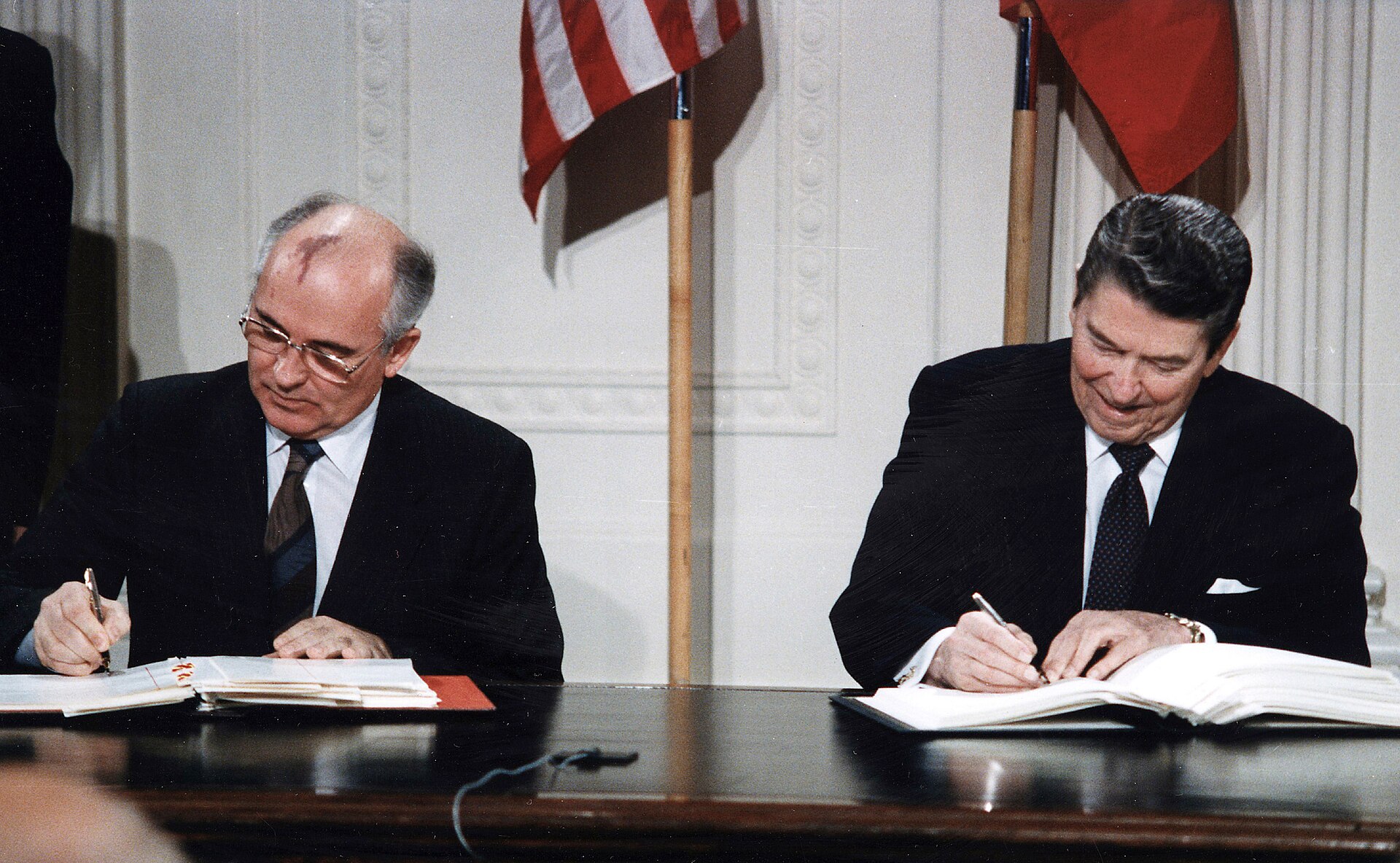

The collapse of the Soviet Union removed the center of the world movement but not the movement's other states. In Asia, the communist parties of China, Vietnam, Laos and North Korea had come to power on their own armies and their own revolutions, and none of them fell. Cuba lost its Soviet patron but kept its party in power. Today those five governments rule about 1.55 billion people.2 Their survival is the first fact of the period. The second is that four of them abandoned the planned economy that Marx's heirs had treated as the heart of socialism, and kept the one-party state that Lenin built.
The Communist Party of the Soviet Union itself did not survive in power. Its successor in Russia, the Communist Party of the Russian Federation, still holds seats in the State Duma, as described below.
A timeline, 1991 to 2026
The timeline below sets the main events of the period in order: the fall of the Soviet Union, the opening of the archives, the publication of the death-toll studies, the closing of Memorial, and the party congresses of 2026 that confirmed the current leaders of four of the five states.
The five states still ruled by a communist party
A state counts here when a single communist party holds power and the constitution says so. By that test there are five, and the test is not a matter of interpretation: each constitution names the party and gives it the leading role. Communist parties also take part in coalition governments or win regional elections in other countries (Kerala is an example below), but in those places the party competes and can lose. In the five states it cannot be voted out.
Two features recur. Each party holds a congress about every five years, elects a central committee, and the central committee elects the leader, so the party leader's title (general secretary, or first secretary in Cuba) is the real seat of power. And in each state the same person, or a close colleague, also holds the top state office, so the party leader is usually also president or head of state. The 2026 congresses in Laos, Vietnam and North Korea confirmed sitting leaders. Cuba postponed its congress.
China: the Communist Party of China
The party. The Communist Party of China (CPC; CCP in most American usage) dates its founding to July 1, 1921, the date the party itself uses.13 On June 30, 2026, ahead of its 105th anniversary, the party's Organization Department reported that the CPC "had nearly 101.29 million members as of the end of 2025," an increase of more than 1.01 million, or 1 percent, over the end of 2024, organized in more than 5.43 million primary-level organizations.13 (Figures of about 99 million, often quoted, refer to earlier years.) That makes it the largest political party in the world by membership, with about one in fourteen Chinese a member.
The constitution. Article 1 of the constitution of the People's Republic, as amended in 2018, reads: "The People's Republic of China is a socialist state under the people's democratic dictatorship led by the working class and based on the alliance of workers and peasants. The socialist system is the basic system of the People's Republic of China. The leadership of the Communist Party of China is the defining feature of socialism with Chinese characteristics. Sabotage of the socialist system by any organization or individual is prohibited."14
The leader. On October 23, 2022, the first plenary session of the 20th Central Committee elected Xi Jinping general secretary for a third term and named him chairman of the Central Military Commission. The same session named the seven-member Standing Committee of the Political Bureau: Xi, Li Qiang, Zhao Leji, Wang Huning, Cai Qi, Ding Xuexiang and Li Xi.15 Xi also holds the state office of president. In September 2026 Reuters reported that President Xi chaired a Political Bureau meeting that set the fifth plenary session of the Central Committee for October 26 to 29, 2026, devoted to "several major issues concerning the sustained advancement of full and rigorous party self-governance."16 The plenum met as scheduled. Its communique, adopted on October 29, 2026, named Xi Jinping as general secretary, recorded that he presented the Political Bureau's work report, elected Zhang Shengmin to the Political Bureau, and confirmed earlier decisions to expel 33 people from the party, among them Zhang Youxia and Ma Xingrui.51 As of November 2026 Xi Jinping remains general secretary, president and chairman of the military commission.
Markets. The break with the Soviet model came in 1978, when the leadership around Deng Xiaoping launched what the party calls reform and opening up. The World Bank summarizes the result: "Since 1978, the beginning of China's reform and opening up period, GDP growth has averaged over 9 percent a year, lifting almost 800 million people out of extreme poverty and transforming China from a low-income to upper-middle-income country."17 The reforms let private firms, foreign investment and market prices back in. They did not let in rival parties, a free press or independent courts. That combination is what the party means by "socialism with Chinese characteristics," and it is the model that Vietnam and Laos followed.

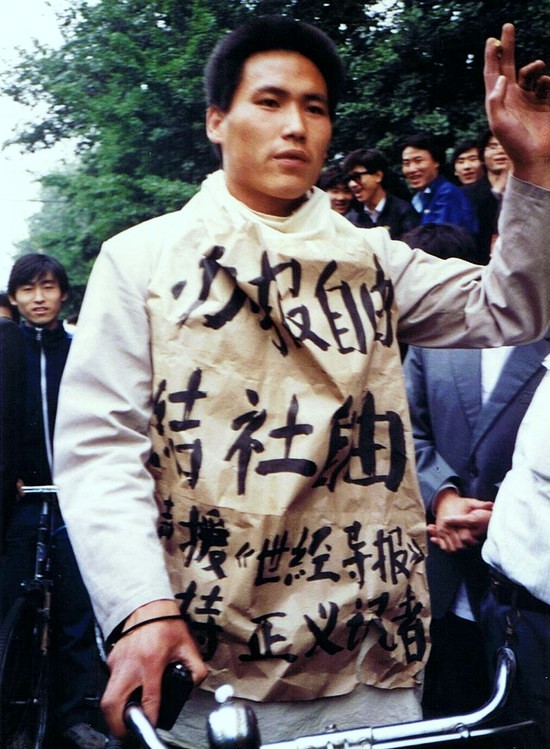
The limits, 1989 and after. The demonstrations in Beijing in the spring of 1989 tested where the line lay. They ended with the army's assault on June 4, 1989, told in lesson 03. The photograph below, from the weeks before the crackdown, shows one of the marchers, Pu Zhiqiang, in Beijing on May 10, 1989.

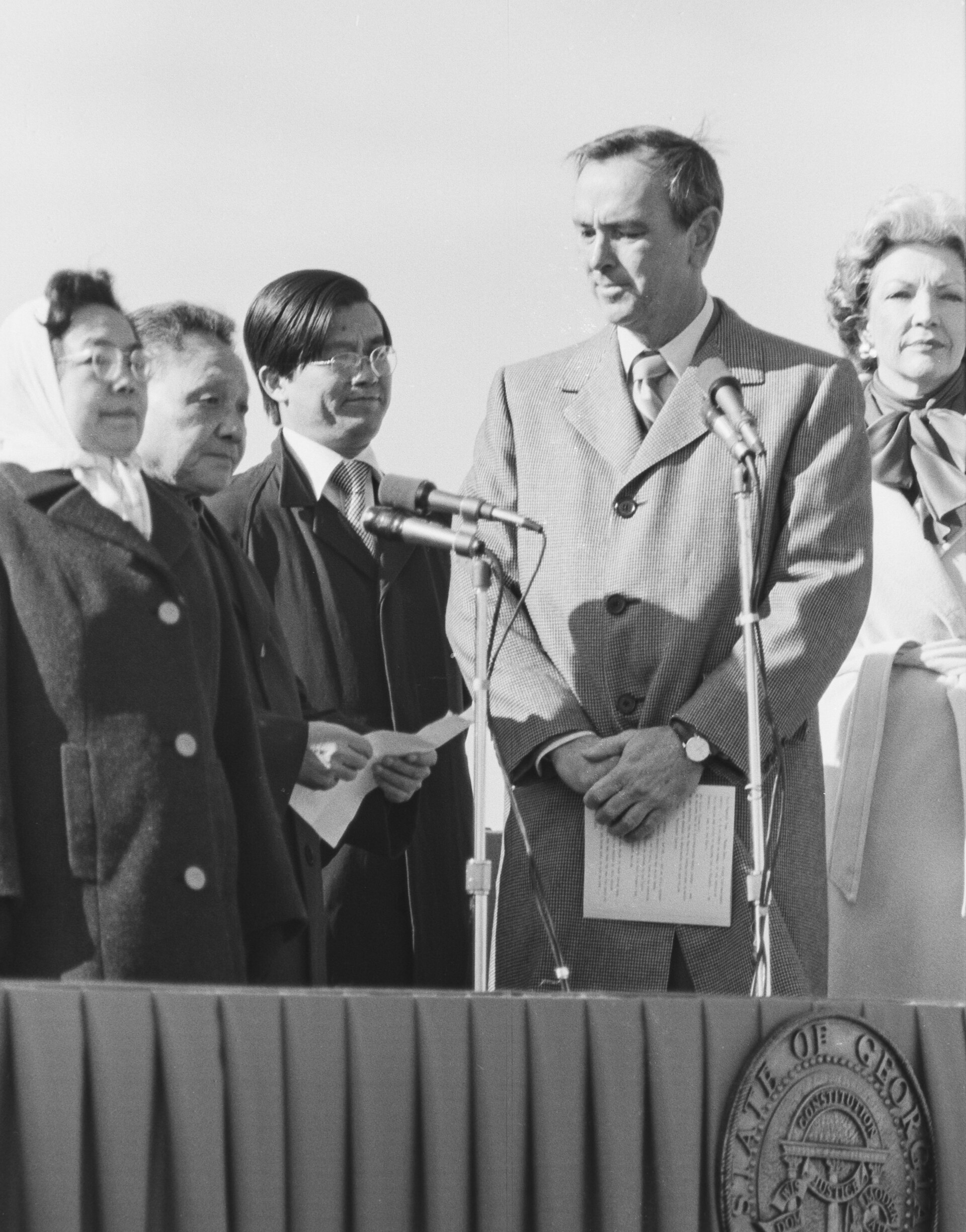
The United Front Work Department. The party runs a department whose job is to manage groups outside the party. A staff research report of the U.S.-China Economic and Security Review Commission, a body created by Congress, published August 24, 2018, describes it: "China uses 'United Front' work to co-opt and neutralize sources of potential opposition to the policies and authority of its ruling Chinese Communist Party (CCP). The CCP's United Front Work Department (UFWD), the agency responsible for coordinating these kinds of influence operations, mostly focuses on the management of potential opposition groups inside China, but it also has an important foreign influence mission."18 (The commission's original sets the agency clause off with dashes, replaced here with commas.) The same report notes that Xi "has also called United Front work a 'magic weapon'" and that in 2015 the party held its first Central Committee Conference on United Front Work, with Xi at the head of a leading small group on the subject.18 The phrase and the method come from the Comintern's own united front tactic of the 1920s and 1930s, defined in lesson 13 and traced in lesson 10. American prosecutions tied to this work since 2022 are in module 81, lesson 13.
Hong Kong. On June 30, 2020, the Standing Committee of the National People's Congress in Beijing approved a national security law for Hong Kong, and Chief Executive Carrie Lam announced that it would "come into effect later today."19 Among the offenses it created is collusion with foreign forces. Its most prominent defendant, the newspaper publisher Jimmy Lai, was arrested in 2020, weeks after the law was imposed, convicted late in 2025 of sedition and collusion with foreign forces, and on February 9, 2026, at the age of 78, sentenced to 20 years in prison.20
Vietnam: the Communist Party of Vietnam
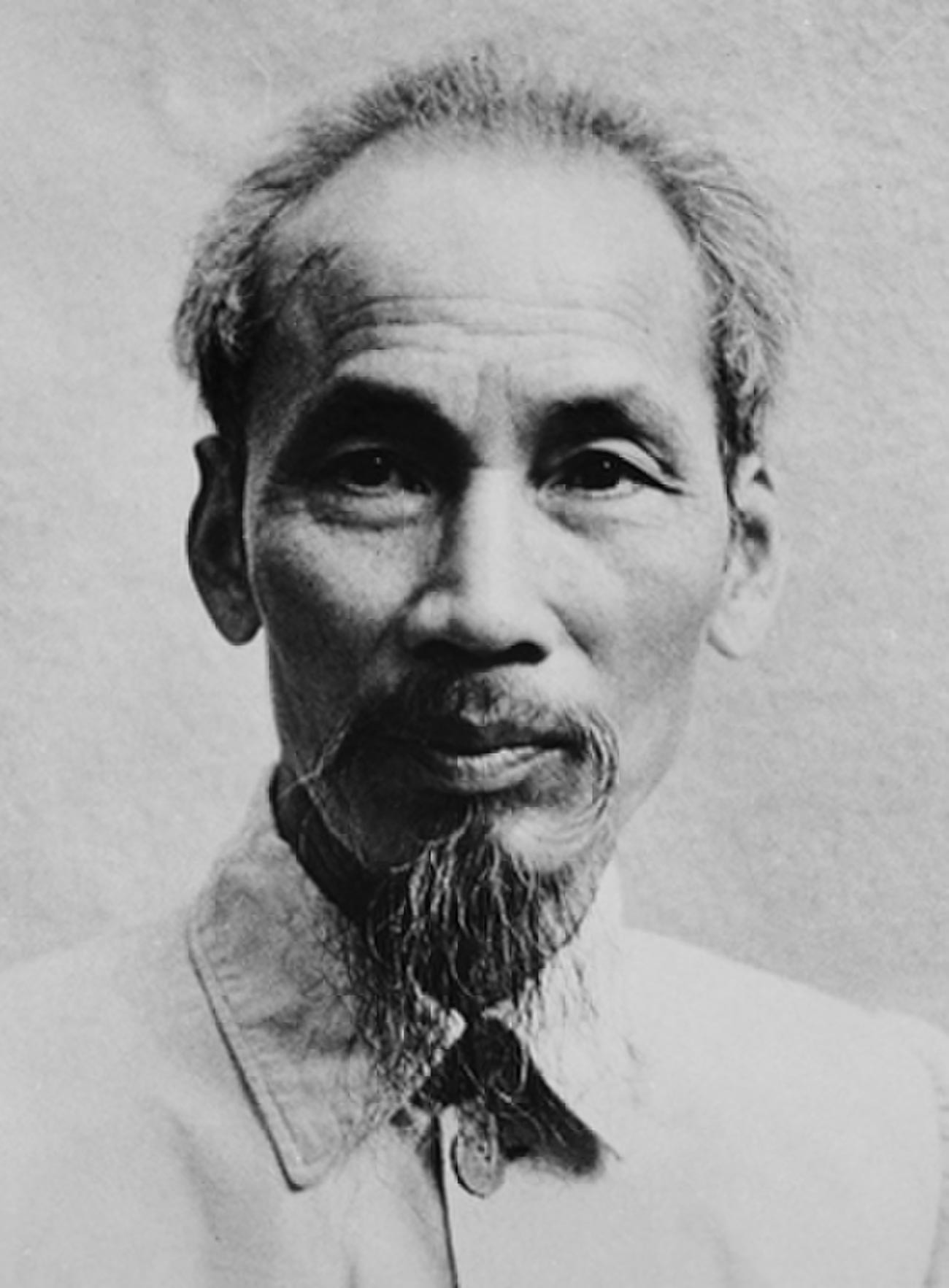
The party. The Communist Party of Vietnam dates its founding to February 3, 1930; Vietnam's Foreign Ministry marked the 96th anniversary on that date in 2026.21 Its founder was Ho Chi Minh, whose life is outlined in lesson 07.
The constitution. Article 4 of the 2013 constitution, in the English translation of the Constitute Project, reads: "The Communist Party of Vietnam, the vanguard of the Vietnamese working class, simultaneously the vanguard of the toiling people and of the Vietnamese nation, the faithful representative of the interests of the working class, the toiling people, and the whole nation, acting upon the Marxist-Leninist doctrine and Ho Chi Minh's thought, is the leading force of the State and society."22 The same article adds that the party "maintains intimate contact with the people, serves the people, submits to people's supervision, and is accountable to the people in its decisions."22 No mechanism outside the party enforces that promise.

The leader. To Lam, born July 10, 1957, was elected general secretary by the 13th Central Committee on August 3, 2024. The 14th National Party Congress returned him to the Central Committee on January 22, 2026, and the new Central Committee re-elected him general secretary at its first session on January 23, 2026.23 On April 7, 2026, at the first session of the 16th National Assembly, he was elected state president for the 2026 to 2031 term, with 495 votes in favor of 495 cast.24 He thus holds both the party's top post and the state's.
Markets. Vietnam's version of the Chinese turn came in 1986 under the name Doi Moi (renovation). The World Bank records that "In July 2026, the World Bank Group reclassified Viet Nam as an upper-middle-income country," a milestone "in four decades of rapid growth that began with economic reforms launched under Doi Moi in 1986." Infant mortality fell from 32.6 per 1,000 live births in 1993 to 11.3 in 2024.25 As in China, the reforms were economic only. The Vietnamese state, which fought the United States from 1965 to 1973 and took Saigon in April 1975 (lesson 03), is now a major American trading partner and remains a one-party state.
Laos: the Lao People's Revolutionary Party
The party. The Lao People's Revolutionary Party dates its founding to March 22, 1955; its leaders laid wreaths for the 71st anniversary on March 22, 2026.26 It took power in 1975, the year of the communist victories in Vietnam and Cambodia told in lesson 03.
The constitution. Article 3 of the Lao constitution, as amended in 2015, reads: "The rights of the multi-ethnic people to be the masters of the country are exercised and ensured through the functioning of the political system with the Lao People's Revolutionary Party as its leading nucleus."27
The leader. Thongloun Sisoulith began his first term as general secretary in 2021. The 12th National Party Congress, a three-day meeting that ended on January 8, 2026, elected a 73-member Central Committee on January 7, and on January 8 the new Central Committee re-elected Thongloun general secretary for a second term.28 On March 23, 2026, at the inaugural session of the 10th National Assembly, he was re-elected president of Laos, and Sonexay Siphandone, a member of the Political Bureau, was elected prime minister.29 Laos is the smallest of the five by population, with about 7.9 million people in 2025.2 Its economic opening has followed Vietnam's, and the party's hold on politics has not loosened.
Cuba: the Communist Party of Cuba
The party. Fidel Castro's revolutionary government took power on January 1, 1959 (lesson 03). The party in its present form dates from October 3, 1965, when its first Central Committee was constituted at a ceremony in Havana's Chaplin Theater. At that ceremony Castro read Ernesto "Che" Guevara's farewell letter and announced that the newspapers Revolucion and Hoy would merge into a single official party organ, Granma.30
The constitution. The constitution of 2019 begins, in Article 1: "Cuba is a democratic, independent and sovereign socialist State of law and social justice." Article 5 then sets out the party's role: "The Communist Party of Cuba, unique, Martiano, Fidelista, and Marxist-Leninist, the organized vanguard of the Cuban nation, sustained in its democratic character as well as its permanent linkage to the people, is the superior driving force of the society and the State. It organizes and orients the communal forces towards the construction of socialism and its progress toward a communist society."31 ("Martiano" refers to Jose Marti, the hero of Cuba's independence war. The quoted English is the Constitute Project translation.) Cuba's is the only one of the five constitutions that names the goal of a communist society in so many words.
The leader. Miguel Diaz-Canel succeeded Raul Castro as president in 2018 and, on April 19, 2021, at the close of the party's eighth congress, as first secretary of the party, the post Reuters called "the most powerful position in the country."32 The ninth congress was scheduled for April 2026. In December 2025, at a plenary session of the Central Committee, Diaz-Canel read a letter from Raul Castro: "I consider it advisable to postpone the 9th Congress to a later date." No new date was given.33 (The report comes from CiberCuba, an outlet strongly opposed to the government; the quoted letter was read in public.) On November 5, 2026, the state news agency Prensa Latina still described Diaz-Canel as Cuba's president and head of the National Defense Council, speaking at a provincial meeting on the "Moncada 2026" strategic defense exercise.34 An Associated Press report of June 17, 2026, on an unscheduled session called by the party, identified him as the party's first secretary as well as president.50 As of November 2026 he remains first secretary and president, with Raul Castro, whose letter postponed the congress, still a figure of authority behind him.33
Markets and crisis. Cuba has gone less far toward markets than China or Vietnam, and its economy is in crisis: the CiberCuba report on the postponed congress describes blackouts, shortages and mass emigration.33 Cuba's own statistics office (ONEI) reported that the population at the end of 2024 was 9,748,007, which was 307,961 fewer than a year earlier, a fall driven by emigration and low births.35 The World Bank's series, which has not caught up with that decline, still shows about 10.9 million for 2025.2 The two numbers differ by more than a million people, and neither has been checked by an independent census. In January 2026 the United States raised its pressure: Executive Order 14380, signed January 29, 2026, declared a national emergency with respect to the Cuban government and provided that "an additional ad valorem rate of duty may be imposed on goods imported into the United States" from countries found to supply oil to Cuba.36
North Korea: the Workers' Party of Korea
The party. The Workers' Party of Korea dates its founding to October 10, 1945. On October 10, 2026, it marked its 81st anniversary with a performance at the Pyongyang Indoor Stadium attended by Kim Jong Un, his wife Ri Sol Ju and his daughter Kim Ju Ae; South Korean reports noted that the event was modest and that Kim issued no statement.37
The constitution. Article 11 of the constitution of the Democratic People's Republic of Korea, in the 1998 text published by the Constitute Project, reads in full: "The DPRK shall conduct all activities under the leadership of the Workers' Party of Korea." Article 12 follows: "The State shall adhere to the class line, strengthen the dictatorship of people's democracy and firmly defend the people's power and socialist system against all subversive acts of hostile elements at home and abroad."38 The constitution has been revised several times since 1998; the party-leadership article is not known to have been removed, but the later texts were not checked for this lesson.
The leader. Kim Jong Un has led the party and the state since his father, Kim Jong Il, died in 2011. The Ninth Congress of the Workers' Party re-elected him general secretary on February 22, 2026, the fourth day of the congress. Constitutional changes in 2019 formally established him as head of state.39 He is the third generation of one family to rule, after his grandfather Kim Il Sung (lesson 07) and his father.
Markets. North Korea is the exception among the five. It has made no economic reform comparable to China's or Vietnam's. At the 2026 congress Kim spoke, in the state news agency's account, of the "heavy and urgent historic tasks of boosting economic construction and the people's standard of living."39 With about 26.6 million people in 2025, by the World Bank's estimate, it is the third largest of the five.2

The five states compared
The chart puts the five side by side: the ruling party and the date it gives for its founding, the leader as of November 2026 and the date of his latest confirmation, and the population. The bar at the bottom shows each state's share of the roughly 1.55 billion people the five governments rule.
What the five share and where they differ
All five constitutions give one party the leading role, and none provides a legal way to replace it by election. In each, the party's central committee chooses the party leader and the state bodies follow; in 2026 Vietnam's National Assembly elected the general secretary president by 495 votes of 495.24 All five call themselves Marxist-Leninist; Vietnam adds "Ho Chi Minh's thought," and Cuba's constitution calls its party "Martiano" and "Fidelista."2231
They differ most in economics. China and Vietnam run large market economies with state-owned firms at the top and a private sector that produces much of the output and employment; the World Bank counts both as upper-middle-income countries.1725 Laos follows the same path at a lower level of income. Cuba keeps most of the economy in state hands, and its population is falling.35 North Korea keeps a command economy and a cult of the ruling family. The comparison matters for a reader of module 81: the communist movement that Americans of 1950 feared was a single movement directed from Moscow. In 2026 there is no center, and the five parties cooperate with one another (Xi Jinping congratulated Thongloun on his re-election as president of Laos in March 2026)29 without any of them directing the others.
The opened archives, 1991 to 2009
For most of the Cold War the argument about communism in the West was conducted without the documents of the communist side. Defectors such as Walter Krivitsky, Igor Gouzenko and Elizabeth Bentley described what they had seen (their entries are in lessons 06 and 07), and their accounts were disputed for decades because the records that could confirm or refute them were locked in Moscow and in the files of American codebreakers. Between 1991 and 2009 four bodies of evidence came out. Each checks the others, which is why historians on both sides of the old argument now agree on more than they did in 1990.
The Russian archives, 1991 and 1992
The first opening came from Russia itself. The Library of Congress exhibition "Revelations from the Russian Archives," shown in Washington from June 15 to July 16, 1992, explained how it happened: "Shortly after defeating the attempted coup of August 1991, a group from the victorious democratic resistance led by the chief archivist of Russia, Rudolph Pikhoia, took over the previously top secret archives of the Central Committee of the Communist Party and began the process of both consolidating democratic control over all archives in Russia and attempting to make them available for the first time for public study."4 The exhibition called itself "the first public display of the hitherto highly secret internal record of Soviet Communist rule" and noted that "The legendary secretiveness and general inaccessibility of the entire Soviet archival system was maintained throughout the Gorbachev era."4 The opening came under Yeltsin; under Gorbachev the archives had stayed shut.
The records of the Communist International and of the Communist Party USA held in Moscow were among those opened. John Earl Haynes and Harvey Klehr worked in them in the early 1990s, and what they found there (Moscow subsidies to the American party, the party's secret apparatus, its links to Soviet intelligence) changed their own conclusions; module 81, lesson 02 quotes their before-and-after statements.40 The documents became the basis of The Secret World of American Communism (1995) and later books by Haynes and Klehr. The American groups those files describe are in lesson 11.
The Mitrokhin archive, 1992
Vasili Mitrokhin was an archivist of the KGB's foreign intelligence directorate who made notes from the directorate's files. He defected to the West in 1992. The Churchill Archives Centre at Cambridge University now holds and "preserves the full collection" of his notes, the Mitrokhin Papers.3 The papers revealed operations that had stayed hidden; the Centre's own account of one example, the Soviet illegal Iosif Grigulevich, notes that the scale of his career became known only from these files, four years after his death in 1988.3 The British historian Christopher Andrew and Mitrokhin published The Sword and the Shield (1999) from the notes. As module 81 lesson 02 advises, any specific claim drawn from the Mitrokhin material should be checked against that book and the papers themselves.
Venona released, 1995 and 1996
The second great opening was American. On July 11, 1995, at a ceremony at CIA headquarters, Director of Central Intelligence John Deutch released the first batch of Venona translations. The CIA's press release said: "The 49 messages being released today reveal extensive Soviet espionage activities directed at the US atomic bomb program," and called the batch "the first of several releases of over 2200 translations from the VENONA project."5 Five more releases followed through 1996, and the six releases together made public about 3,000 translations, more than the press release first announced (the totals are set out in module 81, lesson 02).40 What Venona was, how it was broken, and what it showed about Julius Rosenberg, Theodore Hall, Harry Dexter White and the others are told in module 81, lesson 02, and the cover names are tabulated in lesson 12 of this companion. The figure most often quoted from the Venona literature, Haynes and Klehr's count of 349 Americans and residents with a covert relationship to Soviet intelligence in the decrypts, of whom fewer than half could be identified by name, is given there as well.40
The Vassiliev notebooks, 2009
The fourth body of evidence came from a former KGB officer and journalist, Alexander Vassiliev, who took notes during two years of research in the KGB archive in the 1990s for an authorized book project. On April 20, 2009, the Cold War International History Project at the Woodrow Wilson Center announced that it had published his notebooks online: 1,115 pages of handwritten notes on Soviet intelligence activities in the United States from 1930 to 1950, in the original and in translation, in their entirety. The notes were the main basis for Spies: The Rise and Fall of the KGB in America (Yale University Press, 2009) by Haynes, Klehr and Vassiliev. Vassiliev donated the originals to the Library of Congress, where the Manuscript Division made them available with "no restrictions on access."6 The Project said it did not endorse any one interpretation of the materials.6
The online collection, long hosted as the Wilson Center Digital Archive, is now maintained by the University of Maryland School of Public Policy in partnership with the National Cold War Center, at digitalarchive.umd.edu, with scans, Russian transcriptions and English translations.41 The notebooks matter because they are independent of Venona: they came from KGB file rooms, not from intercepted cables. Haynes and Klehr's check of Venona identifications against them is summarized in module 81, lesson 02.40
What came out, and what did not
Together, the four sources settled the main questions of fact that divided Americans in 1950. The Communist Party USA was funded and directed from Moscow. Soviet intelligence recruited Americans inside the federal government, many of them secret party members, and some of them passed atomic and diplomatic secrets. Those findings belong to the documents. The same documents also set limits: they do not confirm most of the specific accusations Joseph McCarthy made. Haynes's 2007 check of 159 people connected to McCarthy's lists found substantial evidence of Soviet espionage for nine.40 Both results are part of the record, and module 81 lessons 02 and 11 set them out in full.
The opening was also partial. The archives of the four Asian communist parties and of the Cuban party have not been opened in any comparable way, and nothing like Venona or the Vassiliev notebooks exists for them.
Memorial closed, December 2021
The clearest reversal came in December 2021. Memorial was founded in 1987, in the last years of the Soviet Union, by human rights activists "who wanted to ensure that the victims of the communist regime's oppression would never be forgotten," in the words of the Norwegian Nobel Committee; the physicist Andrei Sakharov was among its founders. It built a documentation center on the victims of the Stalin era and became Russia's largest human rights organization.42 The Russian government labeled it a "foreign agent." On December 28, 2021, the Supreme Court of the Russian Federation ordered International Memorial liquidated for alleged violations of the foreign agent law, and on December 29, 2021, the Moscow City Court ordered the dissolution of the Human Rights Center Memorial on the same grounds. The formal ground was the absence of "foreign agent" labels on some materials the groups had posted online; the prosecutors also accused the Human Rights Center of "justification of terrorism and extremism."7 The European Court of Human Rights asked Russia on December 29 to suspend both decisions.7 In 2022 the Nobel Committee awarded Memorial a share of the Nobel Peace Prize, noting that "In December 2021, the authorities decided that Memorial was to be forcibly liquidated and the documentation centre was to be closed permanently."42

The diagram below shows the four openings and the reversal on a single line.
The count of the dead
No one knows how many people communist governments killed, and the honest answer is a range with a method attached. The disagreements are mostly about three things. First, what counts: executions only, or also deaths in camps, deportations, and famines caused by policy. Second, the base: an archive record of deaths, or a demographer's estimate of "excess deaths" against what the population would have been. Third, whose estimate: a government that hid the numbers, a scholar with archive access, or an author combining other people's estimates. The figures below are given with all three.
The Black Book of Communism, 1997
The most quoted total comes from The Black Book of Communism, a collective work edited by the French historian Stephane Courtois, published in Paris in 1997 and in English by Harvard University Press in 1999, with chapters by Nicolas Werth (the Soviet Union), Jean-Louis Margolin (Asia), Jean-Louis Panne, Andrzej Paczkowski, Karel Bartosek and others. In his introduction Courtois offered what he called "The following rough approximation, based on unofficial estimates," and listed:
U.S.S.R.: 20 million deaths. China: 65 million deaths. Vietnam: 1 million deaths. North Korea: 2 million deaths. Cambodia: 2 million deaths. Eastern Europe: 1 million deaths. Latin America: 150,000 deaths. Africa: 1.7 million deaths. Afghanistan: 1.5 million deaths. The international Communist movement and Communist parties not in power: about 10,000 deaths. The total approaches 100 million people killed.
That is the book's text, with its list set as running prose.8 Courtois counted killings by firing squad, hanging and other means, "destruction of the population by starvation, through man-made famine," and deaths in deportation and forced labor, and he acknowledged that periods of civil war were hard to separate from massacres of civilians.8 The figures were his own rounding of other estimates. They were not drawn from the chapters, which in Werth's case rested on newly opened Soviet archives.
The objection came from inside the book. Werth and Margolin publicly rejected Courtois's introduction, including its comparison of communism with Nazism and its total of "a hundred million deaths." The historian Shane J. Maddock, reviewing the English edition, wrote that only Werth's chapter relied on archival sources, that the North Korea chapter was thinly documented, and that the book "sheds more heat than light" on why the regimes were so violent.9 The dispute is about the method of the total. Werth's own Soviet chapter, the one Maddock singled out as resting on archival sources, documents mass executions, deportations and famine.
The Soviet Union: archive counts and estimates
The Soviet secret police kept records, and when the archives opened, historians could count. For the peak of the Great Terror, the archival figure most often cited is that 1,372,382 people were arrested for "counter-revolutionary" crimes in 1937 and 1938 and 681,692 of them were executed. The historian Peter Letkemann, writing in the Journal of Mennonite Studies in 1998, gives those numbers from materials in the Russian State Archives as presented by Robert Thurston, and quotes the archive-based conclusion of J. Arch Getty, Gabor Rittersporn and Viktor Zemskov that "it seems difficult to arrive at an estimate as high as 2.5 million arrests on all charges in 1937-1938."10 Robert Conquest, writing before the archives opened (The Great Terror, 1968), had estimated far higher arrest figures, and Letkemann noted that Conquest's ratio of about 7 million arrests was several times the archival one.10
The archive counts are a floor. They record the people the police chose to record, and they leave out deaths in transit and from the conditions of exile. The Terror numbers, the Gulag death records and the gap between them and the wider estimates are charted in lesson 02.
The famine in Soviet Ukraine in 1932 and 1933, the Holodomor, is counted by demographers. A team of Ukrainian and North American demographers (Omelian Rudnytskyi, Nataliia Levchuk, Oleh Wolowyna, Pavlo Shevchuk and Alla Kovbasiuk) estimated "3.9 million excess deaths" in Ukraine, in a study published in Canadian Studies in Population.11 Other published estimates are commonly given as about 3.5 to 5 million, depending on the borders, the years and the base population used; that range was not checked source by source for this lesson. Robert Conquest's The Harvest of Sorrow (1986) told the story in English before the archives opened.
China: the famine and the campaigns
For China the largest single cause of death was the famine of the Great Leap Forward, 1958 to 1962 (lesson 03). The Chinese government has not published a full count. Estimates by scholars run from about 15 million to 45 million and higher, depending on the method. The highest widely cited figure comes from the historian Frank Dikotter, who used provincial party archives for Mao's Great Famine (2010) and concluded that "at least 45 million people were worked, starved or beaten to death."43 Courtois's 65 million for China (1997) is a total for the whole period of communist rule, not for the famine alone.8 Because no full official count has been published, none of these figures can be checked against a government record.
Cambodia, 1975 to 1979
In proportion to population the Khmer Rouge regime of Pol Pot was the deadliest. Yale University's Cambodian Genocide Program, which documented the period from 1994 to 2019, puts the toll at "approximately 1.7 million people," or 21 percent of the population.12 The United States Holocaust Memorial Museum says "Almost two million people," which it describes as approximately one third of the population.44 The percentages imply different estimates of Cambodia's population in 1975: about 8 million behind Yale's figure, about 6 million behind the museum's. Courtois used 2 million.8 On July 18, 2007, the Cambodian and international co-prosecutors of the UN-backed tribunal in Phnom Penh found evidence of "crimes against humanity, genocide, grave breaches of the Geneva Convention" and other crimes, in the Yale program's summary.12

The ranges side by side
The chart sets the main figures in one place. Each bar runs from the lowest to the highest estimate cited in this lesson, with the name of the estimator. The numbers measure different things (executions, excess deaths, all deaths from all causes), so the bars should be read one at a time.
The Victims of Communism Memorial, 2007
On June 12, 2007, President George W. Bush dedicated the Victims of Communism Memorial in Washington. Bush credited two men with the decade of work it took: Lev Dobriansky and Lee Edwards.45 In his remarks Bush said that "until now, our Nation's Capital had no monument to the victims of imperial Communism, an ideology that took the lives of an estimated 100 million innocent men, women and children." He went on: "The sheer numbers of those killed in Communism's name are staggering, so large that a precise count is impossible. According to the best scholarly estimate, Communism took the lives of tens of millions of people in China and the Soviet Union, and millions more in North Korea, Cambodia, Africa, Afghanistan, Vietnam, Eastern Europe, and other parts of the globe."45 He described the statue as "a woman holding a lamp of liberty."45 The 100 million figure in the speech is the Black Book's, and the speech itself names both the total and its uncertainty.
Communist parties in elections
Outside the five states, communist parties survive as competitors in elections, where they can win and lose. Three cases show the range in 2026.
The Communist Party USA
The party whose secret apparatus and Moscow funding are documented in lessons 05 and 11 still exists. Its own website says: "Founded in 1919, the Communist Party USA has championed the struggles for democracy, labor rights, women's equality, racial justice and peace for 100 years."46 (The "100 years" was written for the 2019 centennial and has not been updated.) Its site lists local clubs, education classes and a party program. The end of Soviet subsidies in 1989 is covered in lesson 05.
The Communist Party of the Russian Federation
The Communist Party of the Russian Federation (CPRF, KPRF in Russian), led by Gennady Zyuganov, is the largest successor of the Soviet party and the second party in the State Duma. In the State Duma election of September 2026, preliminary results from the Central Election Commission with about 90 percent of protocols counted gave United Russia 57.86 percent and the CPRF 13.84 percent, in second place.47 On September 25, 2026, the commission's chair, Ella Pamfilova, announced the seats: United Russia 349, the CPRF 37 (32 from the party list and 5 from single-member districts), the Liberal Democratic Party of Russia 23, New People 19, A Just Russia 17, the Rodina party 1, and self-nominated candidates 4.48 Those are the commission's official figures; there is no independent count.
Kerala: the Communist Party of India (Marxist)
In India's state of Kerala the Left Democratic Front, led by the Communist Party of India (Marxist), governed for the ten years before 2026 under Chief Minister Pinarayi Vijayan. In the assembly election counted on May 4, 2026, the front lost heavily. The Congress-led United Democratic Front won 102 seats, the Left Democratic Front 35, and the CPI(M) alone 26, its lowest number since 2001.49 Vijayan left office as the outgoing chief minister. Kerala is the case that shows the difference between a communist party in a democracy and one in power under a one-party constitution: in Kerala the voters removed it.
What the record shows and what it does not
Documented fact. Five states are ruled by a communist party under a constitution that gives it the leading role: China (Article 1), Vietnam (Article 4), Laos (Article 3), Cuba (Article 5) and North Korea (Article 11).1422273138 In November 2026 their leaders are Xi Jinping, To Lam, Thongloun Sisoulith, Miguel Diaz-Canel and Kim Jong Un. The Chinese party reported 101.29 million members at the end of 2025.13
Their own words. Cuba's constitution states the aim of "progress toward a communist society."31 China's says "The leadership of the Communist Party of China is the defining feature of socialism with Chinese characteristics."14 Raul Castro, postponing the Cuban congress: "I consider it advisable to postpone the 9th Congress to a later date."33
The archive evidence. The Central Committee archives (opened 1991 to 1992), the Mitrokhin notes (1992), Venona (1995 to 1996) and the Vassiliev notebooks (2009) confirm that Soviet intelligence ran American sources and that Moscow funded and directed the CPUSA.456340 The NKVD recorded 681,692 executions in 1937 and 1938.10
The accusation and the estimate. The figure of about 100 million dead is Courtois's rough total from "unofficial estimates," rejected by two of his co-authors, and repeated by President Bush in 2007 as "an estimated 100 million."8945
Scholarly reading. Historians who disagree about the total agree that the toll in the Soviet Union, China and Cambodia ran to millions in each, and the archive-based and demographic figures (3.9 million for the Ukrainian famine, at least 45 million in Dikotter's count for the Chinese famine, about 1.7 million in Cambodia) are each larger than any political massacre in American history by orders of magnitude.114312
Open questions. The Chinese famine toll; the full Gulag death toll beyond the camp records; how far Russia's archives remain open after Memorial's closing; the true population of Cuba; and whether the party-leadership clause has been changed in later North Korean constitutional texts.
Claims checked
"Communism killed 100 million people."
Rating: Partly supported. The number comes from Stephane Courtois's introduction to The Black Book of Communism (1997), where he presented it as a "rough approximation, based on unofficial estimates" whose total "approaches 100 million."8 It was repeated in President Bush's 2007 dedication speech.45 The order of magnitude, tens of millions, is supported by the archive and demographic studies for particular countries. The precise figure is an estimate built by adding other estimates, two of the book's own authors rejected it, and it depends on counting famines caused by policy as killings.9 The statement "tens of millions" is Supported; "100 million" as a measured fact is not.
"Communism ended in 1991."
Rating: Refuted. The Soviet Union ended in December 1991.1 Five states with about 1.55 billion people are still ruled by communist parties whose leading role is written into their constitutions, and three of the five re-elected their party leaders at congresses in 2026.214232839
"China is communist in name only; it is just a capitalist country now."
Rating: Partly supported. In economics the claim has force: since 1978 markets, private firms and foreign investment have driven growth that the World Bank credits with lifting almost 800 million people out of extreme poverty.17 In politics it is wrong. The constitution makes party leadership "the defining feature" of the system and prohibits "sabotage of the socialist system," the party has more than 101 million members organized in 5.43 million units, and its United Front Work Department manages potential opposition at home and abroad.141318 The 20-year sentence of Jimmy Lai in 2026 shows the Leninist side of the system at work.20
"The opened archives proved McCarthy right."
Rating: Partly supported. The archives proved that the threat McCarthy talked about was real: Soviet espionage inside the government and a Moscow-directed party. They did not confirm most of his specific accusations; Haynes found substantial evidence of espionage for nine of 159 people connected to his lists.40 The full assessment is in module 81, lesson 11.
"The opened archives proved that the accused were innocent victims of hysteria."
Rating: Refuted. For the central cases (Julius Rosenberg, Theodore Hall, Harry Dexter White, Alger Hiss in most scholars' reading, and others) Venona and the Vassiliev notebooks added independent evidence of work for Soviet intelligence.40 Many accused people were innocent of espionage, and the record says so name by name in lessons 06 to 09 of this companion. The general claim of innocence does not survive the documents.
"The Black Book's historians all stood behind the 100 million total."
Rating: Refuted. Nicolas Werth and Jean-Louis Margolin, authors of the book's Soviet and Asian chapters, publicly rejected Courtois's introduction and its total.9 Their chapters still document mass killing; the dispute was about the total and the comparison with Nazism.
"Russia opened its Soviet archives after 1991 and they remain open."
Rating: Unsupported. The 1991 to 1992 opening was real and documented.4 The forced liquidation of Memorial and the closing of its documentation center in December 2021 show that the trend has run the other way.742
"The Chinese Communist Party is losing members."
Rating: Refuted. The party's own figures show growth of more than 1.01 million, about 1 percent, in 2025, to about 101.29 million.13 Party figures are the only count available, and they cannot be checked independently.
Hard questions and answers
Why did these five survive when the Soviet bloc fell?
The governments of Eastern Europe had been installed and held up by the Soviet army (lesson 03), and when Moscow stopped holding them up they fell within months. The five survivors had made their own revolutions with their own armies, so their power did not depend on Moscow. China, Vietnam and Laos then bought time and loyalty with economic growth. Cuba and North Korea survived on control and, in North Korea's case, on isolation. The common factor is that each party kept its army and police and was willing to use them, as China showed in June 1989.
A civil liberties advocate asks: is it fair to set communist death tolls against the treatment of American communists?
The two are different questions, and the evidence keeps them apart. The American cases in module 81 concern lost jobs, blacklists, prison terms under the Smith Act and two executions after a jury trial, and some of them were unjust. The communist states recorded hundreds of thousands of executions in two years in one country.10 A reader can hold that the American response sometimes punished the innocent, as module 81, lesson 10 documents, and also that the movement those Americans served, knowingly or not, was responsible for killing on that scale.
Why trust numbers from the killers' own archives?
Because they are the lowest figures, and the perpetrators had no reason to inflate them. A police record of 681,692 executions is a confession by the institution that carried them out. Its weakness is that it leaves things out: deaths in transit, deaths of exiles, people killed without paperwork. That is why historians treat archive figures as a floor and use demographic methods (counting excess deaths against expected population) to estimate the rest.1011
A skeptic asks: should famine deaths count as killings?
That is the largest single source of difference among the totals. Courtois counted "destruction of the population by starvation, through man-made famine, the withholding of food, or both."8 The case for counting them rests on evidence that policy caused the famines and that the governments continued the policies, exported grain or blocked relief while people starved; the Ukrainian and Chinese cases are treated in lessons 02 and 03. A reader who counts only executions and camp deaths will reach a lower number, still in the millions. Either way, the method should be stated with the number.
Why does it matter that Cuba's population figures disagree?
Because the number measures the regime's failure. Cuba's own statistics office reported a fall of 307,961 people in 2024 alone, to 9,748,007.35 International series still show more than 10.9 million.2 A government that loses about 3 percent of its people in a year, mostly to emigration, is losing the people most able to leave. The gap is also a lesson in sources: when an international series and a national office disagree, the reader should ask which is newer and which has an interest in the result.
Where to go next
For the history before 1991, read lessons 02 and 03. For the Soviet organizations behind the archives (the Comintern, the Cheka to the KGB and its successors), read lesson 10. For what Venona and the archives showed about American cases, read module 81, lesson 02; for present-day espionage and influence cases, module 81, lesson 13. For the economics of communism, module 51, lesson 07; for the framework of ordered liberty against which one-party rule can be measured, module 52. Idaho's part in the American story is in module 74, lesson 04. The numbers gathered here are collected with the rest of the companion's figures in lesson 14.
Still open
These items could not be confirmed against a primary source before publication. The lesson states them as open, and they stay on the fact-check list.
- Leaders as of November 2026 rest on reports dated January to November 2026 (Vietnam Law Magazine, VTV, The Star, Al Jazeera, the CGTN communique of October 29, 2026, Prensa Latina of November 5, 2026). No report of a change was found.
- Miguel Diaz-Canel's title of party first secretary is confirmed by an Associated Press report of June 17, 2026; the Prensa Latina report of November 5, 2026 names him only as president and head of the National Defense Council, and no later report of a change was found.
- North Korea's constitution was checked only in the 1998 text published by the Constitute Project; whether later revisions changed Articles 11 and 12 was not checked.
- The Holodomor range of about 3.5 to 5 million and the lower bound of about 15 million for the Great Chinese Famine are commonly cited ranges that were not checked source by source for this lesson.
- The Black Book passage was checked against a full-text copy of the 1999 English edition; the page number was not recorded. Werth and Margolin's objection is reported here through Shane Maddock's review, not from their own 1997 statement.
- The publication year and volume of the Rudnytskyi and others article in Canadian Studies in Population were not confirmed (the article page carries a 2019 copyright line).
- The statement that the Kerala Left Democratic Front governed for the ten years before 2026 comes from 2026 news headlines; the News Minute article itself calls Pinarayi Vijayan the outgoing chief minister.
- Cuba's population: the World Bank series (about 10.9 million for 2025) and ONEI's figure (9,748,007 at the end of 2024) disagree; neither has been checked by an independent census.
- The date on which the Wilson Center Digital Archive moved to the University of Maryland was not confirmed.
- The CPRF's 13.84 percent is a preliminary share with 90.43 percent of protocols processed; the final official vote share was not checked. Seat totals are the CEC chair's announcement of September 25, 2026.
- The quotation of Kim Jong Un on the 'heavy and urgent historic tasks' is as reported by Al Jazeera from KCNA; the KCNA original was not opened.
- The attribution of China's 1978 turn to the leadership around Deng Xiaoping and the date of the Lao party's taking power (1975) are standard history but were not separately sourced in this lesson; the World Bank source gives the year 1978.
- The Haynes figures (349 covert relationships; nine of 159) are taken from module 81 lesson 02, which quotes the books; they were not re-checked against the books for this lesson.
- The brief's figure of about 99 million Chinese party members is out of date; the party reported nearly 101.29 million at the end of 2025.
- The USCC report's 'magic weapon' quotation and its account of the 2015 Central Conference on United Front Work are in the full report PDF; only the summary page was re-opened in the fact check.
Learn more
- Revelations from the Russian Archives (Library of Congress): The 1992 exhibition that first showed secret Central Committee documents in the West, with translated documents on Soviet internal workings and on the United States.
- The Vassiliev Notebooks (Digital Archive): Scans, transcriptions and translations of Vassiliev's notes from KGB files, the independent check on Venona.
- CIA press release on the first Venona release, July 11, 1995: The government's own announcement of what the first 49 messages showed.
- China's Overseas United Front Work (USCC staff report, 2018): A congressional commission's account of the United Front Work Department and its foreign influence mission.
- Bush remarks at the Victims of Communism Memorial, June 12, 2007: The full dedication speech, with its account of the victims country by country.
- Yale Cambodian Genocide Program: The documentation program behind the figure of about 1.7 million dead in Cambodia.
- Module 81, lesson 02: Venona and the Archives: What the opened archives showed about the American spy cases, told in full.
- Module 81, lesson 13: Foreign Influence and Espionage in 2026: Current cases involving the People's Republic of China, Russia and others.
Notes
- Office of the Historian, U.S. Department of State, "The Collapse of the Soviet Union," Milestones in the History of U.S. Foreign Relations, 1989 to 1992 (retrieved Nov. 6, 2026). Read it online. ↩
- World Bank, World Development Indicators, "Population, total" (SP.POP.TOTL), 2024 and 2025 values for China (1,406,585,000 in 2025), Vietnam (101,598,527), Laos (7,873,046), Cuba (10,937,203) and North Korea (26,571,036), read through the World Bank data API (retrieved Nov. 6, 2026). The 2025 total of the five is about 1,553.6 million. Read it online. ↩
- Churchill Archives Centre, University of Cambridge, "A spy turned academic: tracing the hidden footprints of Iosif Grigulevich inside the Mitrokhin Papers" (retrieved Nov. 6, 2026). Read it online. ↩
- Library of Congress, "Revelations from the Russian Archives," exhibition shown June 15 to July 16, 1992, introductory essay (retrieved Nov. 6, 2026). Read it online. ↩
- Central Intelligence Agency, press release on the first release of VENONA translations, July 11, 1995, as preserved by the Federation of American Scientists (retrieved Nov. 6, 2026). Read it online. ↩
- Cold War International History Project, Woodrow Wilson International Center for Scholars, "CWIHP Publishes The Vassiliev Notebooks Online," April 20, 2009 (retrieved Nov. 6, 2026). Read it online. ↩
- FIDH and the Observatory for the Protection of Human Rights Defenders, "Russian Federation: Liquidation of International Memorial and the Human Rights Center 'Memorial'," urgent appeal, December 30, 2021 (retrieved Nov. 6, 2026). Read it online. ↩
- Stephane Courtois, "Introduction: The Crimes of Communism," in Stephane Courtois, Nicolas Werth, Jean-Louis Panne, Andrzej Paczkowski, Karel Bartosek and Jean-Louis Margolin, The Black Book of Communism: Crimes, Terror, Repression, translated by Jonathan Murphy and Mark Kramer (Cambridge, Mass.: Harvard University Press, 1999; first published in French, 1997), the passage giving the "rough approximation, based on unofficial estimates." Wording checked against a full-text copy of the 1999 English edition. ↩
- Shane J. Maddock, review of The Black Book of Communism (Harvard University Press, 1999), History Cooperative (retrieved Nov. 6, 2026). Maddock reports that Werth and Margolin publicly rejected Courtois's introduction and its total of "a hundred million deaths." Read it online. ↩
- Peter Letkemann, "Mennonite Victims of 'The Great Terror,' 1936-1938," Journal of Mennonite Studies 16 (1998): 33 to 58, giving the Russian State Archives figures of 1,372,382 arrests and 681,692 executions for 1937 and 1938 as presented by Robert Thurston, quoting the archive-based conclusion of J. Arch Getty, Gabor Rittersporn and Viktor Zemskov, and comparing Robert Conquest's estimate (retrieved Nov. 6, 2026). Read it online. ↩
- Omelian Rudnytskyi, Nataliia Levchuk, Oleh Wolowyna, Pavlo Shevchuk and Alla Kovbasiuk (Savchuk), "Demography of a man-made human catastrophe: The case of massive famine in Ukraine 1932-1933," Canadian Studies in Population, article page and abstract (retrieved Nov. 6, 2026). Read it online. ↩
- Genocide Studies Program, MacMillan Center for International and Area Studies, Yale University, "Cambodian Genocide Program" (the program's work of 1994 to 2019) ("approximately 1.7 million people"; the co-prosecutors' finding of July 18, 2007, quoted as "grave breaches of the Geneva Convention") (retrieved Nov. 6, 2026). Read it online. ↩
- CGTN, "CPC membership reaches 101.286 mln," June 30, 2026, reporting the statistical report of the Organization Department of the CPC Central Committee (retrieved Nov. 6, 2026). Read it online. ↩
- Constitution of the People's Republic of China (1982, as amended through 2018), Article 1, English translation, Constitute Project (retrieved Nov. 6, 2026). Read it online. ↩
- PTV News (Philippines), "Xi Jinping elected general secretary of CPC Central Committee: communique," October 23, 2022, reporting the communique of the first plenary session of the 20th Central Committee (retrieved Nov. 6, 2026). Read it online. ↩
- Reuters, "China's Xi chairs Politburo; Central Committee plenum set for October 26-29," September 21, 2026, as published by Internazionale (retrieved Nov. 6, 2026). Read it online. ↩
- World Bank, "The World Bank in China: Overview" (retrieved Nov. 6, 2026). Read it online. ↩
- Alexander Bowe, "China's Overseas United Front Work: Background and Implications for the United States," staff research report, U.S.-China Economic and Security Review Commission, August 24, 2018, summary page and report (retrieved Nov. 6, 2026). Read it online. ↩
- Hong Kong SAR Government, news.gov.hk, "Security law's passage welcomed," June 30, 2020 (retrieved Nov. 6, 2026). Read it online. ↩
- NPR, "Hong Kong media tycoon Jimmy Lai sentenced to 20 years in prison," February 9, 2026, as published by WLRN (retrieved Nov. 6, 2026). Read it online. ↩
- Ministry of Foreign Affairs of Viet Nam, "Congratulations to Vietnam on Communist Party of Vietnam's 96th founding anniversary," February 2, 2026 (retrieved Nov. 6, 2026). Read it online. ↩
- Constitution of the Socialist Republic of Vietnam (2013), Article 4, English translation, Constitute Project (retrieved Nov. 6, 2026). Read it online. ↩
- Vietnam Law Magazine, "Brief biography of Party General Secretary and State President To Lam," 2026 (retrieved Nov. 6, 2026). Read it online. ↩
- Vietnam Television (VTV), "Party General Secretary To Lam elected as State President for 2026 to 2031 term," April 2026, reporting the vote of April 7, 2026 (retrieved Nov. 6, 2026). Read it online. ↩
- World Bank, "The World Bank in Viet Nam: Overview" (retrieved Nov. 6, 2026). Read it online. ↩
- KPL Lao News Agency, "Party and State Leaders Mark 71st Anniversary of LPRP with Wreath-Laying Ceremony," March 22, 2026 (retrieved Nov. 6, 2026). Read it online. ↩
- Constitution of the Lao People's Democratic Republic (1991, as amended 2015), Article 3, English translation, Constitute Project (retrieved Nov. 6, 2026). Read it online. ↩
- The Star (Malaysia), "The 12th National Party Congress re-elects Party Secretary General Thongloun Sisoulith for a second term," January 11, 2026 (retrieved Nov. 6, 2026). Read it online. ↩
- The Star (Malaysia), "First session of new parliament opens in Laos; Thongloun re-elected as president," March 23, 2026 (retrieved Nov. 6, 2026). Read it online. ↩
- Radio Rebelde, "Cuba commemorates the creation of the Central Committee of the Communist Party," October 2024 (retrieved Nov. 6, 2026). Read it online. ↩
- Constitution of the Republic of Cuba (2019), Articles 1 and 5, English translation, Constitute Project (retrieved Nov. 6, 2026). Read it online. ↩
- Reuters, report of April 19, 2021, on the Communist Party of Cuba's election of Miguel Diaz-Canel as first secretary, as published by the Oman Observer under the headline "Cuba's Communist Party appoints President Diaz-Canel as leader" (retrieved Nov. 6, 2026). Read it online. ↩
- CiberCuba, "Raul Castro orders Diaz-Canel to postpone the Party Congress due to the economic and social collapse in Cuba," December 14, 2025 (an outlet critical of the government) (retrieved Nov. 6, 2026). Read it online. ↩
- Prensa Latina, "Cuban President calls for continued preparation for defense," November 5, 2026 (retrieved Nov. 6, 2026). Read it online. ↩
- Radio Grito de Baire, "Cuba's population decreased by 307 961 inhabitants in 2024," citing figures of the Oficina Nacional de Estadistica e Informacion (ONEI) via Cubadebate, undated (retrieved Nov. 6, 2026). Read it online. ↩
- The White House, Executive Order 14380, "Addressing Threats to the United States by the Government of Cuba," January 29, 2026 (retrieved Nov. 6, 2026). Read it online. ↩
- The Korea Times (Yonhap), "N. Korea marks party anniversary on modest scale," October 11, 2026 (retrieved Nov. 6, 2026). Read it online. ↩
- Constitution of the Democratic People's Republic of Korea (1972, as revised 1998), Articles 11 and 12, English translation, Constitute Project (retrieved Nov. 6, 2026). Later revisions were not checked. Read it online. ↩
- Al Jazeera, "North Korea's Kim Jong Un re-elected as chief of Workers' Party," February 22, 2026, reporting KCNA (retrieved Nov. 6, 2026). Read it online. ↩
- Module 81, lesson 02, "Venona and the Archives: What We Know Now," Learning Tools, jeffapierson.com, which quotes and cites John Earl Haynes and Harvey Klehr, Venona: Decoding Soviet Espionage in America (Yale University Press, 1999), their statements on the Moscow Comintern and CPUSA files, their audit of Venona identifications against the Vassiliev notebooks, and Haynes's 2007 study of the 159 names connected to McCarthy's lists. Read it online. ↩
- Digital Archive, University of Maryland School of Public Policy in partnership with the National Cold War Center, record "Vassiliev Odd Pages" (2009), Alexander Vassiliev Papers, Library of Congress (retrieved Nov. 6, 2026). Read it online. ↩
- Norwegian Nobel Committee, "The Nobel Peace Prize 2022," press release, 2022 (retrieved Nov. 6, 2026). Read it online. ↩
- Frank Dikotter, Mao's Great Famine (London: Bloomsbury, 2010), as described on the author's website (retrieved Nov. 6, 2026). Read it online. ↩
- United States Holocaust Memorial Museum, "Cambodia," Country Case Studies, Simon-Skjodt Center for the Prevention of Genocide (retrieved Nov. 6, 2026). Read it online. ↩
- George W. Bush, remarks at the dedication of the Victims of Communism Memorial, Washington, D.C., June 12, 2007, White House press release (George W. Bush White House archives) (retrieved Nov. 6, 2026); wording also checked against Public Papers of the Presidents, George W. Bush, 2007, book I, at govinfo.gov, which differs only in capitalization and punctuation. Read it online. ↩
- Communist Party USA, "About Us," cpusa.org (retrieved Nov. 6, 2026). Read it online. ↩
- Caliber.az, "United Russia leads Russian State Duma vote with 57.86%," September 21, 2026, citing preliminary Central Election Commission results with 90.43 percent of protocols processed (retrieved Nov. 6, 2026). Read it online. ↩
- Interfax, "United Russia gets 349 State Duma seats, 46 participants in special military operation elected to parliament first time, CEC chair," September 25, 2026 (full list: United Russia 349, CPRF 37, LDPR 23, New People 19, A Just Russia 17, Rodina 1, self-nominees 4) (retrieved Nov. 6, 2026). Read it online. ↩
- The News Minute, "Kerala election results: CPI(M) gets lowest number of seats since 2001," May 5, 2026 (retrieved Nov. 6, 2026). Read it online. ↩
- Associated Press, "Cuba's Communist Party convening unscheduled session," June 17, 2026, as published by The Washington Times (identifies Diaz-Canel as president and as the party's first secretary) (retrieved Nov. 6, 2026). Read it online. ↩
- CGTN, "Communique of the Fifth Plenary Session of 20th CPC Central Committee," October 29, 2026 (session of October 26 to 29, 2026; Xi Jinping as general secretary; Zhang Shengmin elected to the Political Bureau; expulsions of 33 people confirmed) (retrieved Nov. 6, 2026). Read it online. ↩
Check yourself
1. Which five states were ruled by a communist party with a constitutionally guaranteed leading role in November 2026?
China (Article 1), Vietnam (Article 4), Laos (Article 3), Cuba (Article 5) and North Korea (Article 11) each give one party the leading role. Russia's communist party competes in elections and holds 37 Duma seats.
2. Who was elected Vietnam's state president on April 7, 2026, while also serving as party general secretary?
To Lam, general secretary since August 3, 2024 and re-elected January 23, 2026, was elected state president by the 16th National Assembly with 495 of 495 votes.
3. What membership did the Communist Party of China report for the end of 2025?
The Organization Department reported nearly 101.29 million members at the end of 2025, up more than 1.01 million from a year earlier. Figures near 99 million refer to earlier years.
4. What did the CIA say about the first Venona release on July 11, 1995?
The CIA press release said the 49 messages revealed extensive Soviet espionage against the atomic bomb program and called the batch the first of several releases of over 2,200 translations.
5. How did Stephane Courtois describe the basis of his figures in The Black Book of Communism?
Courtois called his country-by-country list a rough approximation based on unofficial estimates, with a total that approaches 100 million. Werth and Margolin publicly rejected the total.
6. What archival figure is given for executions in the Soviet Union in 1937 and 1938?
Russian State Archives figures, as presented by Robert Thurston and cited by Peter Letkemann, record 1,372,382 arrests for counter-revolutionary crimes and 681,692 executions in those two years.
7. What happened to the Memorial society in December 2021?
The Supreme Court ordered International Memorial liquidated on December 28, 2021, and the Moscow City Court dissolved the Human Rights Center on December 29, citing the foreign agent law.
8. What happened in Kerala's assembly election counted on May 4, 2026?
The United Democratic Front won 102 seats, the Left Democratic Front 35, and the CPI(M) 26. In a democracy the voters removed a communist-led government.
Terms in this lesson
- Leading role (of the party)
- The constitutional clause in each of the five communist-party states that places one party above the state and society, for example Article 4 of Vietnam's constitution.
- General secretary
- The top post in most communist parties, elected by the central committee; in Cuba the title is first secretary.
- Reform and opening up
- China's policy from 1978 of admitting markets, private firms and foreign investment while keeping one-party rule.
- Doi Moi
- Vietnam's economic renovation launched in 1986, the start of its move to a market economy under the Communist Party.
- United Front Work Department
- The Chinese Communist Party department that manages groups outside the party and conducts influence work abroad; Xi Jinping has called united front work a "magic weapon."
- Hong Kong National Security Law
- The law approved in Beijing that took effect in Hong Kong on June 30, 2020, under which Jimmy Lai was sentenced to 20 years in 2026.
- Venona release
- The public release of decrypted Soviet intelligence cables, beginning with 49 messages on July 11, 1995, and continuing in six releases through 1996.
- Mitrokhin archive
- Notes from KGB foreign intelligence files made by the archivist Vasili Mitrokhin, who defected in 1992; held at the Churchill Archives Centre, Cambridge.
- Vassiliev notebooks
- 1,115 pages of notes from KGB files on Soviet intelligence in the United States, 1930 to 1950, published online in 2009; the originals are at the Library of Congress.
- Memorial
- The society founded in 1987 to document victims of Soviet repression, ordered liquidated by Russian courts in December 2021 and awarded a share of the 2022 Nobel Peace Prize.
- Excess deaths
- A demographer's estimate of deaths above what the population would have suffered in normal conditions, used for famines such as the Holodomor.
- The Black Book of Communism
- A 1997 collective history edited by Stephane Courtois whose introduction gave a total approaching 100 million dead, a figure two of its co-authors rejected.
Sources
- Office of the Historian, U.S. Department of State, "The Collapse of the Soviet Union," Milestones in the History of U.S. Foreign Relations, 1989 to 1992 (1991) checked 2026-10
- World Bank, World Development Indicators, "Population, total" (SP.POP.TOTL), 2024 and 2025 values for China (1,406,585,000 in 2025), Vietnam (101,598,527), Laos (7,873,046), Cuba (10,937,203) and North Korea (26,571,036), read through the World Bank data API (2026) checked 2026-10
- Churchill Archives Centre, University of Cambridge, "A spy turned academic: tracing the hidden footprints of Iosif Grigulevich inside the Mitrokhin Papers" (1992-06-15) checked 2026-10
- Library of Congress, "Revelations from the Russian Archives," exhibition shown June 15 to July 16, 1992, introductory essay (1995-07-11) checked 2026-10
- Central Intelligence Agency, press release on the first release of VENONA translations, July 11, 1995, as preserved by the Federation of American Scientists (2009-04-20) checked 2026-10
- Cold War International History Project, Woodrow Wilson International Center for Scholars, "CWIHP Publishes The Vassiliev Notebooks Online," April 20, 2009 (2021-12-30) checked 2026-10
- FIDH and the Observatory for the Protection of Human Rights Defenders, "Russian Federation: Liquidation of International Memorial and the Human Rights Center 'Memorial'," urgent appeal, December 30, 2021 (1999) checked 2026-10
- Stephane Courtois, "Introduction: The Crimes of Communism," in Stephane Courtois, Nicolas Werth, Jean-Louis Panne, Andrzej Paczkowski, Karel Bartosek and Jean-Louis Margolin, The Black Book of Communism: Crimes, Terror, Repression, translated by Jonathan Murphy and Mark Kramer (Cambridge, Mass.: Harvard University Press, 1999; first published in French, 1997), the passage giving the "rough approximation, based on unofficial estimates." Wording checked against a full-text copy of the 1999 English edition. (1999) checked 2026-10
- Shane J. Maddock, review of The Black Book of Communism (Harvard University Press, 1999), History Cooperative (1998) checked 2026-10
- Peter Letkemann, "Mennonite Victims of 'The Great Terror,' 1936-1938," Journal of Mennonite Studies 16 (1998): 33 to 58, giving the Russian State Archives figures of 1,372,382 arrests and 681,692 executions for 1937 and 1938 as presented by Robert Thurston, quoting the archive-based conclusion of J. Arch Getty, Gabor Rittersporn and Viktor Zemskov, and comparing Robert Conquest's estimate (1936) checked 2026-10
- Omelian Rudnytskyi, Nataliia Levchuk, Oleh Wolowyna, Pavlo Shevchuk and Alla Kovbasiuk (Savchuk), "Demography of a man-made human catastrophe: The case of massive famine in Ukraine 1932-1933," Canadian Studies in Population, article page and abstract (1932) checked 2026-10
- Genocide Studies Program, MacMillan Center for International and Area Studies, Yale University, "Cambodian Genocide Program" (the program's work of 1994 to 2019) (2020-06-30) checked 2026-10
- CGTN, "CPC membership reaches 101.286 mln," June 30, 2026, reporting the statistical report of the Organization Department of the CPC Central Committee (June 30, 2026) checked 2026-10
- Constitution of the People's Republic of China (1982, as amended through 2018), Article 1, English translation, Constitute Project (1982) checked 2026-10
- PTV News (Philippines), "Xi Jinping elected general secretary of CPC Central Committee: communique," October 23, 2022, reporting the communique of the first plenary session of the 20th Central Committee (October 23, 2022) checked 2026-10
- Reuters, "China's Xi chairs Politburo; Central Committee plenum set for October 26-29," September 21, 2026, as published by Internazionale (September 21, 2026) checked 2026-10
- World Bank, "The World Bank in China: Overview" (2026) checked 2026-10
- Alexander Bowe, "China's Overseas United Front Work: Background and Implications for the United States," staff research report, U.S.-China Economic and Security Review Commission, August 24, 2018, summary page and report (August 24, 2018) checked 2026-10
- Hong Kong SAR Government, news.gov.hk, "Security law's passage welcomed," June 30, 2020 (June 30, 2020) checked 2026-10
- NPR, "Hong Kong media tycoon Jimmy Lai sentenced to 20 years in prison," February 9, 2026, as published by WLRN (February 9, 2026) checked 2026-10
- Ministry of Foreign Affairs of Viet Nam, "Congratulations to Vietnam on Communist Party of Vietnam's 96th founding anniversary," February 2, 2026 (February 2, 2026) checked 2026-10
- Constitution of the Socialist Republic of Vietnam (2013), Article 4, English translation, Constitute Project (2013) checked 2026-10
- Vietnam Law Magazine, "Brief biography of Party General Secretary and State President To Lam," 2026 (2026) checked 2026-10
- Vietnam Television (VTV), "Party General Secretary To Lam elected as State President for 2026 to 2031 term," April 2026, reporting the vote of April 7, 2026 (April 7, 2026) checked 2026-10
- World Bank, "The World Bank in Viet Nam: Overview" (2026) checked 2026-10
- KPL Lao News Agency, "Party and State Leaders Mark 71st Anniversary of LPRP with Wreath-Laying Ceremony," March 22, 2026 (March 22, 2026) checked 2026-10
- Constitution of the Lao People's Democratic Republic (1991, as amended 2015), Article 3, English translation, Constitute Project (1991) checked 2026-10
- The Star (Malaysia), "The 12th National Party Congress re-elects Party Secretary General Thongloun Sisoulith for a second term," January 11, 2026 (January 11, 2026) checked 2026-10
- The Star (Malaysia), "First session of new parliament opens in Laos; Thongloun re-elected as president," March 23, 2026 (March 23, 2026) checked 2026-10
- Radio Rebelde, "Cuba commemorates the creation of the Central Committee of the Communist Party," October 2024 (2024) checked 2026-10
- Constitution of the Republic of Cuba (2019), Articles 1 and 5, English translation, Constitute Project (2019) checked 2026-10
- Reuters, report of April 19, 2021, on the Communist Party of Cuba's election of Miguel Diaz-Canel as first secretary, as published by the Oman Observer under the headline "Cuba's Communist Party appoints President Diaz-Canel as leader" (April 19, 2021) checked 2026-10
- CiberCuba, "Raul Castro orders Diaz-Canel to postpone the Party Congress due to the economic and social collapse in Cuba," December 14, 2025 (an outlet critical of the government) (December 14, 2025) checked 2026-10
- Prensa Latina, "Cuban President calls for continued preparation for defense," November 5, 2026 (November 5, 2026) checked 2026-10
- Radio Grito de Baire, "Cuba's population decreased by 307 961 inhabitants in 2024," citing figures of the Oficina Nacional de Estadistica e Informacion (ONEI) via Cubadebate, undated (2024) checked 2026-10
- The White House, Executive Order 14380, "Addressing Threats to the United States by the Government of Cuba," January 29, 2026 (January 29, 2026) checked 2026-10
- The Korea Times (Yonhap), "N. Korea marks party anniversary on modest scale," October 11, 2026 (October 11, 2026) checked 2026-10
- Constitution of the Democratic People's Republic of Korea (1972, as revised 1998), Articles 11 and 12, English translation, Constitute Project (1972) checked 2026-10
- Al Jazeera, "North Korea's Kim Jong Un re-elected as chief of Workers' Party," February 22, 2026, reporting KCNA (February 22, 2026) checked 2026-10
- Module 81, lesson 02, "Venona and the Archives: What We Know Now," Learning Tools, jeffapierson.com, which quotes and cites John Earl Haynes and Harvey Klehr, Venona: Decoding Soviet Espionage in America (Yale University Press, 1999), their statements on the Moscow Comintern and CPUSA files, their audit of Venona identifications against the Vassiliev notebooks, and Haynes's 2007 study of the 159 names connected to McCarthy's lists. (1999) checked 2026-10
- Digital Archive, University of Maryland School of Public Policy in partnership with the National Cold War Center, record "Vassiliev Odd Pages" (2009), Alexander Vassiliev Papers, Library of Congress (2009) checked 2026-10
- Norwegian Nobel Committee, "The Nobel Peace Prize 2022," press release, 2022 (2022) checked 2026-10
- Frank Dikotter, Mao's Great Famine (London: Bloomsbury, 2010), as described on the author's website (2010) checked 2026-10
- United States Holocaust Memorial Museum, "Cambodia," Country Case Studies, Simon-Skjodt Center for the Prevention of Genocide (2026) checked 2026-10
- George W. Bush, remarks at the dedication of the Victims of Communism Memorial, Washington, D.C., June 12, 2007, White House press release (George W. Bush White House archives) (June 12, 2007) checked 2026-10
- Communist Party USA, "About Us," cpusa.org (2026) checked 2026-10
- Caliber.az, "United Russia leads Russian State Duma vote with 57.86%," September 21, 2026, citing preliminary Central Election Commission results with 90.43 percent of protocols processed (September 21, 2026) checked 2026-10
- Interfax, "United Russia gets 349 State Duma seats, 46 participants in special military operation elected to parliament first time, CEC chair," September 25, 2026 (September 25, 2026) checked 2026-10
- The News Minute, "Kerala election results: CPI(M) gets lowest number of seats since 2001," May 5, 2026 (May 5, 2026) checked 2026-10
- Associated Press, Cuba's Communist Party convening unscheduled session (The Washington Times) (2026-06-17) checked 2026-10
- CGTN, Communique of the Fifth Plenary Session of the 20th CPC Central Committee (2026-10-29) checked 2026-10
- Public Papers of the Presidents: George W. Bush (2007, Book I), remarks at the Victims of Communism Memorial dedication (2007-06-12) checked 2026-10