Lesson 1 of 23 · about 40 minutes
Emergency Power in 2020: The Orders, Who Signed Them, and How People Pushed Back
Updated November 7, 2026
You'll be able to
- Name who signed the major 2020 emergency orders in Idaho and elsewhere, and the statute each relied on.
- Quote the key limits Idaho Code 46-1008 now places on a governor in an emergency, and explain how they came to be.
- Describe the four lawful channels of pushback and give an example of each from this module.
- Summarize the major rulings of 2020 to 2023, including Diocese of Brooklyn, Tandon, the Wisconsin and Michigan cases, and the OSHA and eviction cases.
- State what the officials who signed the orders argued, in their own words.
- Locate each profile in this module on a map by lesson number.
Start here: the short version
In March 2020 the President declared a national emergency, every governor declared a state emergency, and orders followed that closed churches, shops, gyms, playgrounds and schools and told whole states to stay home.123 In Idaho, Gov. Brad Little declared an emergency on March 13, 2020 and issued a statewide stay-home order on March 25.45 Most of those orders rested on one official's signature, under disaster statutes written decades earlier (Idaho's in 1975, Michigan's in 1945), and some ran for months.67 People pushed back in four ways: they sued, they defended themselves when charged, they went to their legislatures, and they spoke at public meetings and voted. Some won in the highest courts in the land. This lesson lays out the orders, names who signed them, and shows the legal paths the people in lessons 02 to 21 took. Their courage lay in standing up when standing up was costly: they faced arrest, fines, lost licenses, lost jobs and public scorn, for the principle that an emergency does not suspend the Constitution.
Who signed the orders
An emergency order is only as lawful as the statute or constitutional clause behind it. In 2020 three levels of government acted at once, each under its own law.
The federal declarations
The federal Secretary of Health and Human Services first determined that the new coronavirus was a public health emergency; the determination was published in the Federal Register on February 7, 2020 (85 Fed. Reg. 7316).8 On March 13, 2020, President Donald J. Trump signed Proclamation 9994 under the National Emergencies Act, finding that "the COVID-19 outbreak in the United States constitutes a national emergency," effective from March 1, 2020.1 Neither declaration closed a single church or shop by itself. Federal declarations opened federal money and loosened federal rules; the closures came from governors, state health directors, counties and cities. The two federal emergencies outlived most state orders. Congress ended the national emergency by joint resolution (H.J.Res. 7), which President Joe Biden signed on April 10, 2023, and the federal public health emergency expired on May 11, 2023.98
Federal agencies did issue binding rules of their own later in the pandemic: the CDC's eviction moratorium, the CDC's mask rule for planes, trains and buses, and OSHA's vaccine-or-test rule for large employers. Each was challenged, and each is told in this module (lessons 05 and 20).
The governors
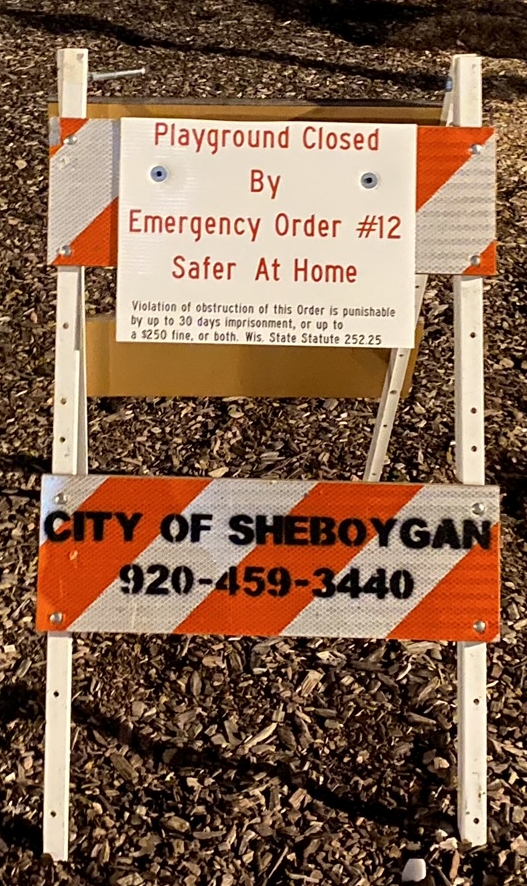
All 50 governors declared states of emergency in the spring of 2020.2 On March 19, 2020, California Gov. Gavin Newsom signed Executive Order N-33-20, which adopted his State Public Health Officer's order directing "all individuals living in the State of California to stay home or at their place of residence except as needed to maintain continuity of operations of the federal critical infrastructure sectors," in effect "until further notice."10 In Wisconsin, the Department of Health Services Secretary-designee, Andrea Palm, issued Emergency Order 12 on March 24, 2020 and Emergency Order 28, also titled "Safer at Home," on April 16, 2020, at the direction of Gov. Tony Evers.11 In Michigan, Gov. Gretchen Whitmer declared a state of emergency on March 10, 2020 and kept issuing orders under a 1945 statute after the Legislature declined to extend her declaration past April 30.7 The Wisconsin playground sign pictured below cited the governor's stay-at-home order to keep children off the equipment.

The orders Idahoans faced
On Friday, March 13, 2020, Gov. Little signed what his office called a "proactive emergency declaration." It activated the Idaho Emergency Operations Plan, opened the Emergency Disaster Fund, sped contracts and purchases, and let retired nurses renew their licenses quickly. "We need to slow down the spread of coronavirus," Little said.4
Twelve days later, on March 25, 2020, he signed an extreme emergency declaration and announced a statewide stay-home order "effective immediately." His words: "I am following the guidance of our public health experts and issuing a statewide stay-home order effective immediately."5 The order ran 21 days at first. Residents were to stay home unless sick or doing essential work; non-essential businesses had to close their physical locations; restaurants could serve only drive-through, pickup and delivery; and people were to limit discretionary travel and keep six feet apart outdoors.5
The governor did not sign the operative order himself. It came from the Director of the Idaho Department of Health and Welfare, Dave Jeppesen. The renewed order of April 10, 2020 states the chain plainly: "On March 25, 2020, pursuant to Sections 46-601 and 46-1008, Idaho Code, the Governor ordered the Director of the Idaho Department of Health and Welfare ("the Director") to issue an initial Order for the residents of the state of Idaho to Self-Isolate." It cites the director's own power under Idaho Code 56-1003(7) "to impose and enforce orders of isolation and quarantine to protect the public from the spread of infectious or communicable diseases." Its headline read: "THIS ORDER DIRECTS ALL INDIVIDUALS LIVING IN THE STATE OF IDAHO TO SELF-ISOLATE." And it warned: "Violation of or failure to comply with this Order could constitute an infraction, punishable by a fine. Idaho Code § 18-111."12 That April order ran to 11:59 p.m. on April 30, 2020, and any business found out of compliance "may be ordered closed."12
The statute behind the orders
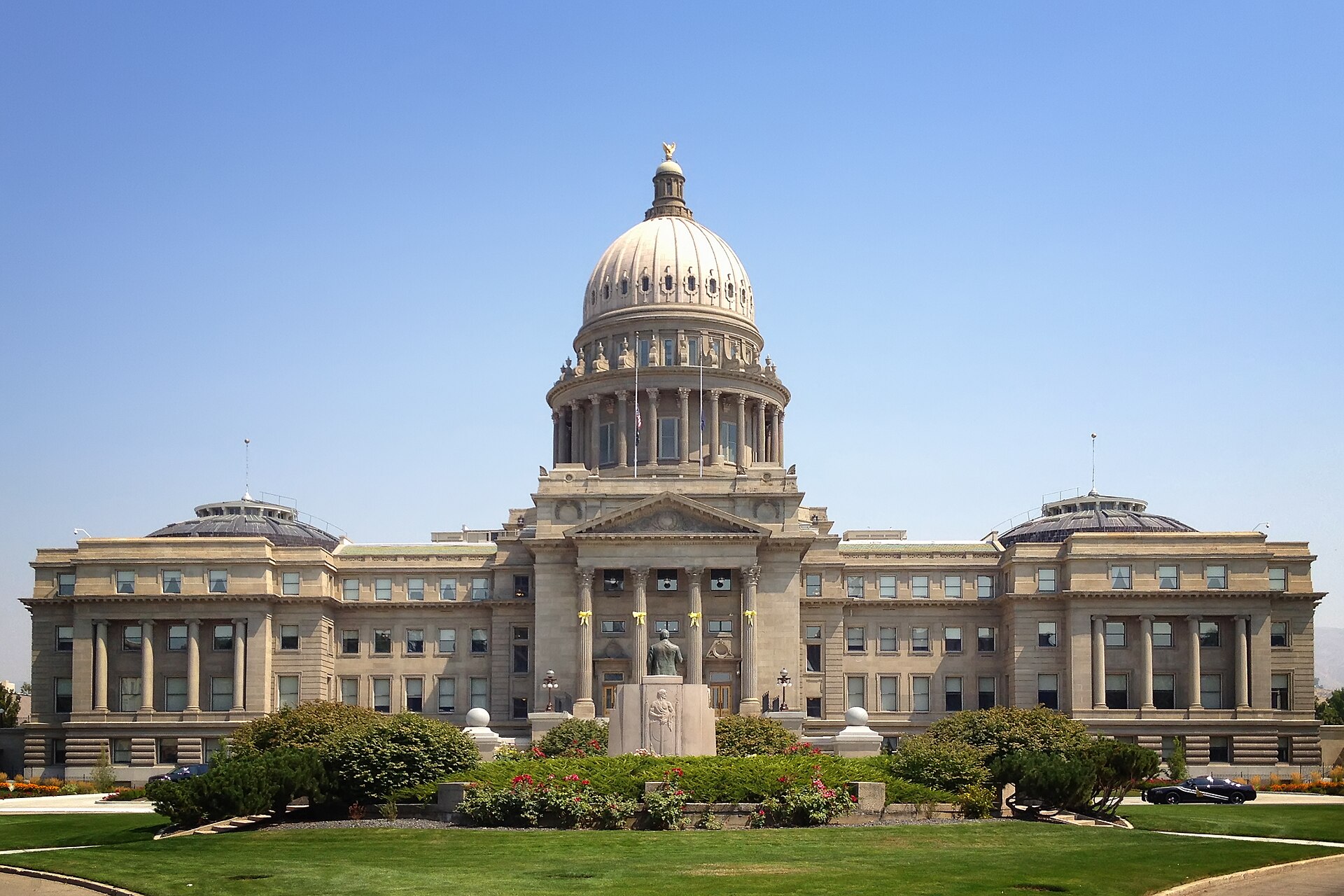
Idaho's governor acts in a disaster under the State Disaster Preparedness Act, Idaho Code 46-1008. Its first sentence gives the power: "Under this act, the governor may issue executive orders and proclamations and may amend or rescind them. Executive orders and proclamations have the force and effect of law."6 The same section has always held a check that mattered in 2020 and 2021: "The legislature by concurrent resolution may terminate a state of disaster emergency at any time."6 The current text also limits a disaster emergency to thirty days unless the governor renews it for another thirty.6
The statute today reads differently from the one Idahoans lived under in 2020. Its history line lists three amendments made in 2021 and one in 2022.6 The current text requires that emergency orders "be narrowly tailored to effectively protect life or property without placing unnecessary restrictions on the ability for a person or persons, regardless of job type or classification, to work, provide for their families, or otherwise contribute to the economy of the state of Idaho." It forbids any official, during an emergency, to "otherwise limit or suspend any rights guaranteed by the United States constitution or the constitution of the state of Idaho, including but not limited to the right to peaceable assembly or free exercise of religion." And it adds: "During any state of disaster emergency, the governor may not alter, adjust, or create any provision of the Idaho Code."6 Those sentences are the Legislature's written answer to 2020. Lesson 04 tells how they were won.
Idaho Rebounds, and the return to Stage 2
Idaho reopened in stages under a plan called Idaho Rebounds. Stage 1 began May 1, 2020, Stage 3 on May 30, and Stage 4 on June 13.13 In the fall the state moved back: to Stage 3 on October 26, 2020, and on November 13, 2020 Little returned Idaho to a modified Stage 2 that prohibited gatherings of more than 10 people without "appropriate social distancing and other precautions," while calling mask wearing a matter of personal responsibility and mobilizing the Idaho National Guard to help hospitals.1314 Idaho never issued a statewide mask requirement.13 Stage 3 returned on February 2, 2021 and Stage 4 on May 11, 2021.13 The disaster emergency itself lasted more than two years; Little announced on March 8, 2022 that it would end April 15, 2022.15
Local orders filled the gaps. Idaho's public health districts are run by district boards of health whose members are appointed by county commissioners and confirmed by a majority of all the commissioners in the district; one member, if available, must be a licensed physician.16 The Central District Health board in Boise weighed orders for its district. On December 8, 2020 a special CDH board meeting held online was cut short when Boise Mayor Lauren McLean and the Boise Police Department asked officials to end it because of protests outside the health building and at some board members' homes; Ada County Commissioner Diana Lachiondo left to be with her son.17 Lesson 03 tells how that board's physician seat changed hands in 2021, and lesson 49 of the Issues family teaches how to testify at such boards in person and in writing.

How people pushed back
The people profiled in this module used four lawful channels. Ordered Liberty teaches the principles behind them in Forms of Lawful Resistance; this section shows what each channel did in 2020 to 2022.
They sued
Citizens, churches, businesses, doctors, service members and states filed suits. The early ones mostly lost. On May 29, 2020, the Supreme Court refused to block California's limits on worship in South Bay United Pentecostal Church v. Newsom. Chief Justice John Roberts wrote that the question of when to lift restrictions "is a dynamic and fact-intensive matter subject to reasonable disagreement," and that officials acting "in areas fraught with medical and scientific uncertainties" deserve latitude that "must be especially broad."18
Within six months the Court's view had moved. On November 25, 2020, in Roman Catholic Diocese of Brooklyn v. Cuomo, it blocked New York's caps on worship. The unsigned opinion said: "Members of this Court are not public health experts, and we should respect the judgment of those with special expertise and responsibility in this area. But even in a pandemic, the Constitution cannot be put away and forgotten."19 Justice Neil Gorsuch, concurring, wrote that "there is no world in which the Constitution tolerates color-coded executive edicts that reopen liquor stores and bike shops but shutter churches, synagogues, and mosques."19 On April 9, 2021, in Tandon v. Newsom, a case about Bible study in private homes, the Court set the rule that now governs: government regulations "trigger strict scrutiny under the Free Exercise Clause, whenever they treat any comparable secular activity more favorably than religious exercise."20 Lesson 09 tells those cases in full.
State courts checked governors under state constitutions. On May 13, 2020, the Wisconsin Supreme Court, 4-3, opened its opinion with a sentence that set the terms of the case: "This case is about the assertion of power by one unelected official, Andrea Palm, and her order to all people within Wisconsin to remain in their homes, not to travel and to close all businesses that she declares are not 'essential' in Emergency Order 28." The court held the order was a rule that had to go through the Legislature's emergency rulemaking process, and "Because they were not, Emergency Order 28 is unenforceable."11 On October 2, 2020, the Michigan Supreme Court unanimously held that Gov. Whitmer had no authority under the Emergency Management Act after April 30, 2020, and a majority held the 1945 Emergency Powers of the Governor Act unconstitutional. Justice Stephen Markman wrote: "we conclude that the EPGA is in violation of the Constitution of our state because it purports to delegate to the executive branch the legislative powers of state government-- including its plenary police powers-- and to allow the exercise of such powers indefinitely."7 Lesson 12 tells how that ruling ended the case against a 77-year-old barber.
Federal agencies lost when they stretched old statutes. On August 26, 2021 the Supreme Court ended the CDC's nationwide eviction moratorium, saying "our system does not permit agencies to act unlawfully even in pursuit of desirable ends."21 On January 13, 2022, it stayed OSHA's rule requiring workers at large employers to be vaccinated or tested weekly: "Administrative agencies are creatures of statute. They accordingly possess only the authority that Congress has provided."22 Lesson 20 names the landlords and business owners who brought those cases.
They stood their ground when charged
Some did not sue first. They opened their doors, held services or let their children play, and then defended themselves when the state charged them. That path carries the most personal risk: a person who loses a criminal case has a record, and a person who refuses a court's order can be jailed. It also produced some of the clearest wins. On May 13, 2022, the Louisiana Supreme Court held that the governor's gathering limits and stay-at-home mandate violated Pastor Tony Spell's free exercise of religion as applied to him; its decree read "TRIAL COURT JUDGMENT REVERSED; MOTION TO QUASH GRANTED."23 In Alberta, after a separate court found that some provincial health orders had been made improperly, prosecutors dropped the case and Pastor James Coates and GraceLife Church were acquitted of Public Health Act charges in August 2023.2425 Lessons 02, 06, 07, 10, 11, 12 and 13 follow people who took this path.
They went to the legislature
Emergency statutes are written by legislatures, and legislatures can rewrite them. In 2021 lawmakers filed more than 300 bills in 47 states to rein in emergency powers, according to the National Conference of State Legislatures, and by June 2021 such laws had been enacted in 12 states.2 A later NCSL brief, written before the 2022 ballot votes, counted at least nine states that gave the legislature power to end an emergency or order, at least seven that limited renewals, and at least ten more that added legislative review.26 In Idaho, the Senate fell one vote short, 23-12, of overriding Little's veto of Senate Bill 1136 on April 19, 2021, and short again, 21-12, on House Bill 135 on May 4, 2021; Little called the vetoed bills "an emotional, kneejerk reaction because of anger about the pandemic."2728 Lawmakers then passed narrower bills, and Little signed four of them in May 2021: House Bills 391, 392 and 393 and Senate Bill 1217.29 Idaho voters approved SJR 102, letting the Legislature call itself into special session, in November 2022, 287,194 to 267,623.30 Lesson 04 tells that story; lesson 22 counts what changed across the states.
They spoke and voted
Public comment, letters, recall petitions and elections reached the officials who made local orders. Health board seats are filled by elected county commissioners, so a county election can change a health board.16 Lesson 03 shows that path at Central District Health. The Issues family's Testifying and Public Comment and Recalls and the Initiative Process teach the mechanics.
What resistance cost
The orders rested on penalties, and the penalties were real. Idaho's April order warned of a fine.12 Under Wisconsin's Emergency Order 28, the state's supreme court noted, Palm said that failure to obey subjected a person to "imprisonment for 30 days, a $250 fine or both."11 Justice Gorsuch later catalogued what officials across the country did: "They closed churches even as they allowed casinos and other favored businesses to carry on. They threatened violators not just with civil penalties but with criminal sanctions too."3 The people in lessons 02 to 21 paid in arrest, jail, fines, suspended licenses, lost jobs, lost careers and years of litigation. Some paid in reputation, called reckless or worse by officials and neighbors. Some never won at all: the Houston Methodist workers lost, and the Fifth Circuit affirmed the dismissal of their suit on June 13, 2022.31
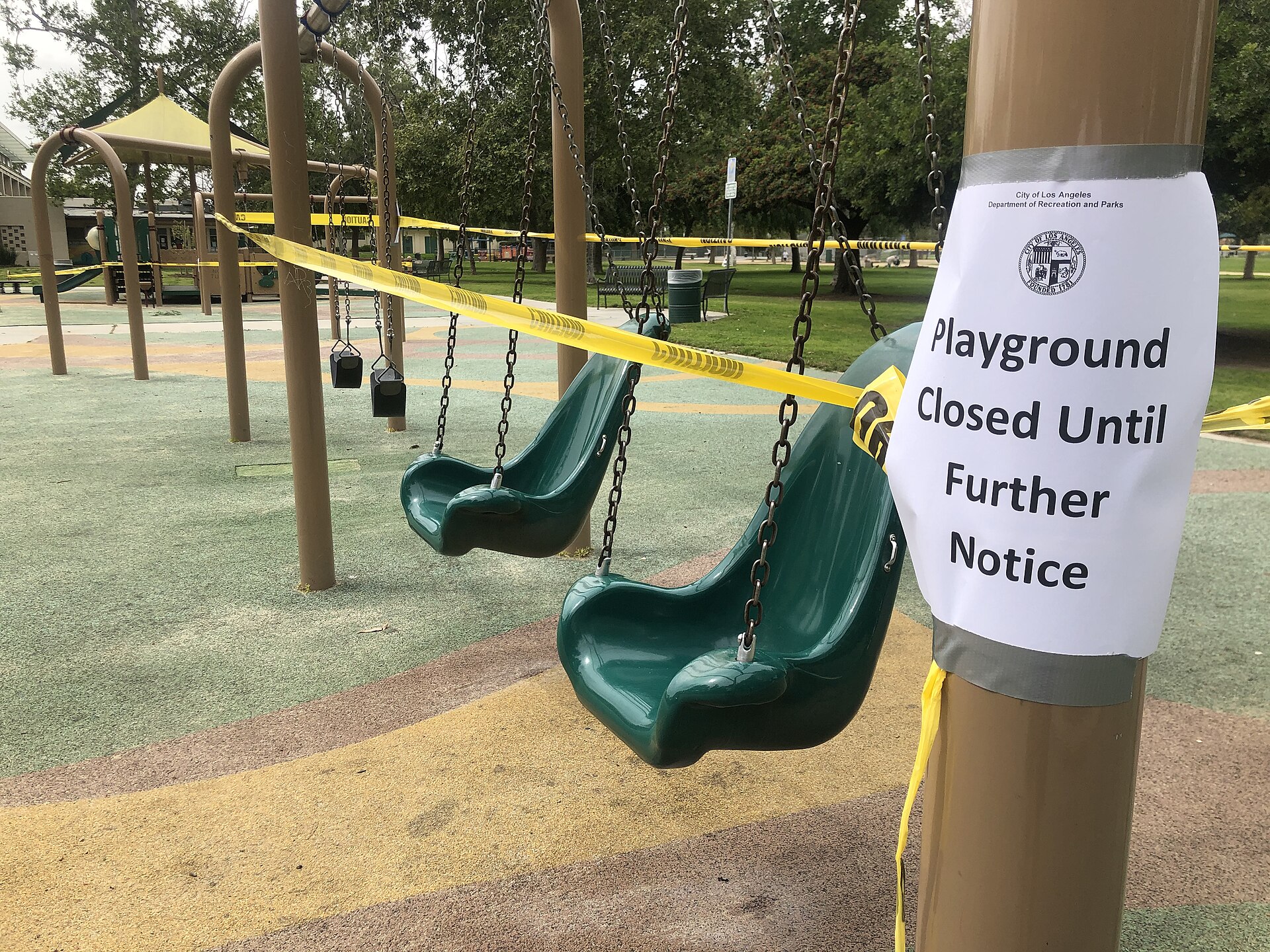
Costs fell on those who obeyed, too, and the record should say so plainly. Closed playgrounds, like the one pictured below in Los Angeles in March 2020, kept children from the simplest public goods. Shuttered streets and businesses cost wages and savings. Lesson 14 tells of a wife who could not see her husband in his care home for months and took a job washing dishes there to be near him.

How it ended
The emergencies ended on calendars, not in a single ruling. Idaho's public health disaster emergency ended April 15, 2022; Little said the date "provides an important bridge for hospitals."15 The national emergency ended April 10, 2023 when President Biden signed H.J.Res. 7, and the federal public health emergency expired May 11, 2023.98 By then the courts had already settled much of the law, the legislatures had rewritten their statutes, and the people in this module had won, settled, lost or were still waiting.
The clearest summary of what the period meant for liberty came from the Supreme Court bench after it was over. On May 18, 2023, in a statement in Arizona v. Mayorkas, Justice Gorsuch wrote: "Since March 2020, we may have experienced the greatest intrusions on civil liberties in the peacetime history of this country. Executive officials across the country issued emergency decrees on a breathtaking scale."3 He described officials who "surveilled church parking lots, recorded license plates, and issued notices warning that attendance at even outdoor services satisfying all state social-distancing and hygiene requirements could amount to criminal conduct," and who "divided cities and neighborhoods into color-coded zones, forced individuals to fight for their freedoms in court on emergency timetables, and then changed their color-coded schemes when defeat in court seemed imminent."3 He warned of how easily free people give up self-government: "Fear and the desire for safety are powerful forces." And: "We do not need to confront a bayonet, we need only a nudge, before we willingly abandon the nicety of requiring laws to be adopted by our legislative representatives and accept rule by decree."3 The statement spoke for Justice Gorsuch alone, but it set down in an official record what many of the people in this module had said in 2020 and been scorned for saying.
A public health worker's view in 2021
Objections to the orders did not come only from outside public health. Jeff A. Pierson, the author of this site, wrote an essay in August 2021 titled "Understanding Risk," from his years in public health; by his account he worked in public health for about 12 years.32 He wrote as a supporter of vaccination: "I am not anti-vax and I have promoted vaccination programs."32 His objection was to how authority was used. "Every step of the way, civil rights and reason have been trampled by bastardized understanding of risk and responsibility," he wrote. And from inside the field: "Keep in mind, public health authorities tend to dismiss civil rights and reason almost as if it is part of their nature."32
The essay's sharpest lines concern employer and government mandates. "Employers mandating vaccines must ignore rational risk assessments, ignore basic moral obligations, and think very little of their employees," he wrote, and he closed with a question he left to readers, quoted here with his spelling: "Are mandate the type of corporate and government policies that should be forced on individuals?"32 The essay also stated his medical views of that summer; those are set out, as his, in the medical note below. Lessons 15, 16 and 19 follow people who answered his question with their careers.
Timeline
| Date | Event |
|---|---|
| Feb. 7, 2020 | HHS public health emergency determination published (85 Fed. Reg. 7316).8 |
| Mar. 13, 2020 | President Trump signs Proclamation 9994, a national emergency effective March 1. Gov. Little signs Idaho's emergency declaration the same day.14 |
| Mar. 19, 2020 | California Gov. Newsom signs Executive Order N-33-20, a statewide stay-home order.10 |
| Mar. 24, 2020 | Wisconsin's Andrea Palm issues Emergency Order 12.11 |
| Mar. 25, 2020 | Gov. Little signs an extreme emergency declaration and issues a statewide stay-home order for 21 days.5 |
| Apr. 10, 2020 | Idaho Health and Welfare Director signs a renewed Order to Self-Isolate, effective April 16 to April 30.12 |
| May 1, 2020 | Idaho enters Stage 1 of Idaho Rebounds.13 |
| May 13, 2020 | Wisconsin Supreme Court holds Emergency Order 28 unenforceable.11 |
| May 29, 2020 | U.S. Supreme Court denies relief in South Bay United Pentecostal Church v. Newsom.18 |
| Oct. 2, 2020 | Michigan Supreme Court rules against Gov. Whitmer's continued emergency orders.7 |
| Nov. 13, 2020 | Idaho returns to a modified Stage 2, barring gatherings over 10 without precautions.14 |
| Nov. 25, 2020 | U.S. Supreme Court decides Roman Catholic Diocese of Brooklyn v. Cuomo.19 |
| Dec. 8, 2020 | Central District Health board meeting ends early amid protests.17 |
| Apr. 9, 2021 | U.S. Supreme Court decides Tandon v. Newsom.20 |
| Apr. 19, 2021 | Idaho Senate falls one vote short of overriding the veto of S 1136.27 |
| May 2021 | Gov. Little signs H 391, H 392, H 393 and S 1217, limiting emergency powers.29 |
| Aug. 26, 2021 | U.S. Supreme Court ends the CDC eviction moratorium.21 |
| Jan. 13, 2022 | U.S. Supreme Court stays OSHA's vaccine-or-test rule.22 |
| Apr. 15, 2022 | Idaho's public health disaster emergency ends.15 |
| May 13, 2022 | Louisiana Supreme Court rules for Pastor Tony Spell.23 |
| Nov. 8, 2022 | Idaho voters approve SJR 102, 287,194 to 267,623.30 |
| Apr. 10, 2023 | President Biden signs H.J.Res. 7, ending the national emergency.9 |
| May 11, 2023 | The federal public health emergency expires.8 |
| May 18, 2023 | Justice Gorsuch's statement in Arizona v. Mayorkas.3 |
Why it took courage
In the spring of 2020 the orders came with the full weight of government, the news, employers and neighbors behind them. Objecting carried a price before any court had ruled. A pastor who held services faced charges with no assurance a court would ever agree with him. A barber who reopened risked his license, his livelihood of decades, before the Michigan Supreme Court had said a word. A hospital worker who refused a mandate put her job on the line. In each case the person acted without knowing how it would end, and vindication, when it came, often took two years and more.
What they defended was older than the pandemic. The American constitutions divide power so that no single official can make, enforce and judge the law at once; Ordered Liberty teaches why in Legitimate Authority and Its Limits. An emergency can justify fast action. It cannot turn one person's signature into lasting law, and it cannot rank a liquor store above a church. The Michigan court said the 1945 statute was void because it allowed emergency powers "indefinitely."7 The Supreme Court said the Constitution "cannot be put away and forgotten."19 Those holdings exist because ordinary people were willing to be defendants and plaintiffs. Free exercise of religion, the right to earn a living, the right to assemble and speak, due process before a penalty, and the duty of the legislature to make the law: each was defended in 2020 to 2022 by someone who had more to lose than to gain. That is courage, and this module honors it.


What the other side said
The officials who signed the orders said they were saving lives on expert advice. Gov. Little, announcing Idaho's stay-home order, said: "From the get-go, our focus has been to slow the spread of coronavirus to protect our most vulnerable citizens."5 Vetoing the 2021 bills, he called them "just plain irresponsible."29 Chief Justice Roberts, in South Bay, wrote that the Constitution "principally entrusts '[t]he safety and the health of the people' to the politically accountable officials of the States," and that their decisions should not be "subject to second-guessing" by unelected judges.18 Justices Breyer, Sotomayor and Kagan, dissenting from the OSHA ruling, wrote: "When we are wise, we know not to displace the judgments of experts, acting within the sphere Congress marked out and under Presidential control, to deal with emergency conditions. Today, we are not wise."33 In Michigan, dissenting from an October 12, 2020 order that refused to delay the ruling, Justice Richard Bernstein warned that ending the governor's orders at once could cut off benefits for "up to 830,000 active claimants," as the governor put it, "a significant potential disruption to the livelihoods of the people of Michigan in a time of great public crisis."34
Still disputed: whether the 2020 closures and stay-home orders saved enough lives to justify their costs is still argued by researchers and officials, and this lesson does not decide that medical and statistical question. Also disputed is whether the new legislative limits on emergency powers will slow the response to a future emergency; governors such as Idaho's Little said so in 2021, and the Indiana Supreme Court in 2022 struck down that state's law letting the Legislature call itself into session.2735
Medical note: In his August 2021 essay, Pierson argued, as his own view at the time, that the new mRNA vaccines lacked long-term studies, that informed consent called for "extreme skepticism," and that the vaccines should be reserved for those most at risk.32 On August 23, 2021 the U.S. Food and Drug Administration granted full approval to the Pfizer-BioNTech vaccine, marketed as Comirnaty, for people 16 and older.36 This lesson takes no position on those medical questions.
Hard questions and answers
Hasn't the Constitution always allowed quarantine and health orders?
Yes, within limits. The Supreme Court upheld a smallpox vaccination law in Jacobson v. Massachusetts in 1905, and Chief Justice Roberts relied on it in 2020.18 The 2020 to 2021 cases did not overrule Jacobson. They held that health orders still have to treat worship as well as comparable secular activity (Diocese of Brooklyn, Tandon), still need a valid statute behind them (Wisconsin, Michigan, the eviction and OSHA cases), and cannot last indefinitely on one official's word (Michigan).19201172122
If the orders were presumed lawful when signed, why praise people who defied them?
Because several of the orders turned out not to be lawful, and the only way to prove it was for someone to challenge them. The Louisiana Supreme Court quashed the charges against Pastor Spell because the orders violated his free exercise as applied to him.23 The Wisconsin order was held unenforceable.11 A citizen who accepts the legal consequences of an open, peaceful refusal and then asks a court to decide is using the system as it was built. Ordered Liberty's Forms of Lawful Resistance draws the line between that and lawlessness.
Were the officials acting in bad faith?
The record does not show that, and this module does not claim it. Little said he was "following the guidance of our public health experts."5 The liberty question is about who decides, by what law, for how long, and with what check. Good intentions do not answer it; the Supreme Court said agencies may not "act unlawfully even in pursuit of desirable ends."21
Does legislative oversight make the next emergency harder to handle?
It can slow some decisions, which is why Little vetoed the broadest Idaho bills.27 But Idaho's law always let the Legislature end an emergency by concurrent resolution; the trouble in 2020 was that only the governor could call the Legislature into session to do it.626 The laws passed in 2021 and SJR 102 keep the governor's power to act first and add a way for the people's representatives to review the action later.2930
What should a public health officer take from 2020?
Publish the legal basis of every order, set an end date, treat worship as well as the most-favored secular activity, give people a way to be heard before a business is closed, and expect the order to be tested in court. Pierson's 2021 warning, written from inside the field, was that authorities "tend to dismiss civil rights and reason."32 Lesson 22 turns these into a checklist for local officials.
Why does a module about American liberty include Canada?
Because the same questions arose under a different constitution, and the answers there are instructive. In January 2024 Canada's Federal Court found the federal invocation of the Emergencies Act unreasonable, and on January 16, 2026 the Federal Court of Appeal dismissed the government's appeals.3738 Lessons 10 and 21 tell those stories.
Related lessons
- 02 Sara Walton Brady and the Closed Playground
- 03 Dr. Ryan Cole: The Pathologist Who Took the Seat and Kept It
- 04 Idaho Takes Back the Special Session: SJR 102
- 09 The Worship Cases at the Supreme Court
- 12 Karl Manke, the Barber of Owosso
- 20 Small Businesses and Landlords at the Supreme Court
- 22 What the Stands Won
- 23 Timeline, Glossary, Sources and the Record of Every Ruling
- Ordered Liberty, especially Legitimate Authority and Its Limits
- The First Amendment, the Tenth Amendment, the Fourteenth Amendment and the Idaho Constitution
- Testifying and Public Comment
Still open
These items could not be confirmed against a primary source before publication. The lesson states them as open, and they stay on the fact-check list.
- The original March 25, 2020 Idaho Order to Self-Isolate was not checked; the quotations come from the renewed order of April 10, 2020, from a copy posted by the Idaho Freedom Foundation rather than an Idaho government page.
- The SJR 102 vote totals are as reported by Ballotpedia; the Idaho Secretary of State's certified canvass was not checked for this lesson.
Learn more
- Justice Gorsuch's statement in Arizona v. Mayorkas (2023): A short, readable account from the bench of what emergency decrees did to civil liberty from 2020 on.
- Wisconsin Legislature v. Palm, 2020 WI 42: The first state supreme court ruling against a statewide stay-home order, with full dissents.
- Idaho Code 46-1008: Read the governor's emergency powers as Idaho law states them today, including the 2021 limits.
- NCSL, Legislative Actions in Oversight of Executive Emergency Powers: The legislatures' response across the states, with counts.
Notes
- President Donald J. Trump, Proclamation 9994, "Declaring a National Emergency Concerning the Novel Coronavirus Disease (COVID-19) Outbreak," March 13, 2020, 85 Fed. Reg. 15337 (Mar. 18, 2020), Federal Register (retrieved Nov. 7, 2026). Read it online. ↩
- Stateline (The Pew Charitable Trusts), "More States Rein in Governors' Emergency Powers," June 17, 2021, citing the National Conference of State Legislatures (retrieved Nov. 7, 2026). Read it online. ↩
- Arizona v. Mayorkas, No. 22-592, 598 U.S. ___ (May 18, 2023), statement of Gorsuch, J., Supreme Court of the United States, slip op. at 4 to 9 (retrieved Nov. 7, 2026). Read it online. ↩
- Office of the Governor of Idaho, "Governor signs proactive emergency declaration to further prevent coronavirus spread in Idaho," press release, March 13, 2020 (retrieved Nov. 7, 2026). Read it online. ↩
- Office of the Governor of Idaho, "Governor Little issues statewide stay-home order, signs extreme emergency declaration," press release, March 25, 2020 (retrieved Nov. 7, 2026). Read it online. ↩
- Idaho Code section 46-1008, "The governor and disaster emergencies," State Disaster Preparedness Act, current text with history line (1975 to 2022), Idaho Legislature (retrieved Nov. 7, 2026). Read it online. ↩
- In re Certified Questions from the United States District Court, Western District of Michigan (Midwest Institute of Health, PLLC v. Governor), Michigan Supreme Court No. 161492, decided Oct. 2, 2020, 958 N.W.2d 1, syllabus and opinion of Markman, J., Part V (copy hosted by the Civil Rights Litigation Clearinghouse) (retrieved Nov. 7, 2026). Read it online. ↩
- Health Freedom Defense Fund, Inc. v. President of the United States, No. 22-11287 (11th Cir. June 22, 2023) (published opinion of Wilson, J.), slip op. at 2 to 3 and 5 to 6 (retrieved Nov. 7, 2026). Read it online. ↩
- The White House (archived), "Bill Signed: H.J.Res. 7," April 10, 2023 (retrieved Nov. 7, 2026). Read it online. ↩
- Gov. Gavin Newsom, Executive Order N-33-20 and Order of the State Public Health Officer, March 19, 2020, State of California (retrieved Nov. 7, 2026). Read it online. ↩
- Wisconsin Legislature v. Palm, 2020 WI 42, No. 2020AP765-OA (Wis. May 13, 2020), paragraphs 1 to 3 and 6 to 7, Supreme Court of Wisconsin (retrieved Nov. 7, 2026). Read it online. ↩
- Idaho Department of Health and Welfare, Order of the Director, "Order to Self-Isolate," April 10, 2020 (copy posted by the Idaho Freedom Foundation) (retrieved Nov. 7, 2026). Read it online. ↩
- Ballotpedia, "Documenting Idaho's reopening and path to recovery from the coronavirus (COVID-19) pandemic, 2020-2021" (used for dates of the governor's stage orders; the Oct. 26, 2020 return to Stage 3, the Nov. 13, 2020 return to modified Stage 2 and the Feb. 2, 2021 advance to Stage 3 were checked against the Office of the Governor's press releases of those dates, "Idaho moves back to Stage 3 amid healthcare capacity constraints statewide," "Gov. Little calls on National Guard to help in pandemic response as Idaho rolls back to modified Stage 2" and "Idaho advances to Stage 3 as COVID-19 case counts, hospitalizations decline") (retrieved Nov. 7, 2026). Read it online. ↩
- Lex Miller, "Gatherings of over 10 people prohibited as Idaho returns to stage two of Idaho Rebounds," The Argonaut (University of Idaho), Nov. 13, 2020 (retrieved Nov. 7, 2026). Read it online. ↩
- Idaho Capital Sun, "Idaho Gov. Brad Little will end public health emergency on April 15," March 8, 2022 (retrieved Nov. 7, 2026). Read it online. ↩
- Idaho Code section 39-411, "Composition of district board," Idaho Legislature (retrieved Nov. 7, 2026). Read it online. ↩
- Associated Press, "Idaho health board meeting halted after intense protests," Dec. 8, 2020, as published by The Columbian (Vancouver, Wash.) (retrieved Nov. 7, 2026). Read it online. ↩
- South Bay United Pentecostal Church v. Newsom, No. 19A1044, 590 U.S. ___ (May 29, 2020) (Roberts, C.J., concurring in denial of application for injunctive relief), Supreme Court of the United States (retrieved Nov. 7, 2026). Read it online. ↩
- Roman Catholic Diocese of Brooklyn v. Cuomo, No. 20A87, 592 U.S. 14 (Nov. 25, 2020) (per curiam; Gorsuch, J., concurring), Supreme Court of the United States (retrieved Nov. 7, 2026). Read it online. ↩
- Tandon v. Newsom, No. 20A151, 593 U.S. 61 (Apr. 9, 2021) (per curiam), Supreme Court of the United States (retrieved Nov. 7, 2026). Read it online. ↩
- Alabama Association of Realtors v. Department of Health and Human Services, No. 21A23, 594 U.S. 758 (Aug. 26, 2021) (per curiam), Supreme Court of the United States (retrieved Nov. 7, 2026). Read it online. ↩
- National Federation of Independent Business v. Department of Labor, OSHA, No. 21A244, 595 U.S. 109 (Jan. 13, 2022) (per curiam), Supreme Court of the United States (retrieved Nov. 7, 2026). Read it online. ↩
- State of Louisiana v. Mark Anthony Spell, No. 2021-KK-00876 (La. May 13, 2022) (opinion of Crain, J.; Weimer, C.J., and Griffin, J., dissenting), Supreme Court of Louisiana (retrieved Nov. 7, 2026). Read it online. ↩
- CTV News Edmonton, "Edmonton-area pastor, church acquitted in Alberta COVID-19 rules case," August 2023 (retrieved Nov. 7, 2026). Read it online. ↩
- The Canadian Press, with files from Karen Bartko, Global News, report on the end of the Public Health Act charges against Pastor James Coates and GraceLife Church, Global News, Aug. 31, 2023 (retrieved Nov. 7, 2026). Read it online. ↩
- National Conference of State Legislatures, "Legislative Actions in Oversight of Executive Emergency Powers," web brief, undated on the page (written before the 2022 ballot votes) (retrieved Nov. 7, 2026). Read it online. ↩
- Clark Corbin, "Idaho Senate fails to override Gov. Little's veto by one vote," Idaho Capital Sun, April 19, 2021 (retrieved Nov. 7, 2026). Read it online. ↩
- Idaho Press, Eye on Boise, "Senate fails to override veto of HB 135aa by one vote," May 4, 2021 (retrieved Nov. 7, 2026). Read it online. ↩
- Idaho Capital Sun, "Gov. Little signs four bills dealing with emergency orders into Idaho law," May 11, 2021 (retrieved Nov. 7, 2026). Read it online. ↩
- Ballotpedia, "Idaho elections, 2022," statewide ballot measure results for SJR 102 (retrieved Nov. 7, 2026). The certified canvass is kept by the Idaho Secretary of State. Read it online. ↩
- Bridges v. Methodist Hospital, No. 21-20311 (5th Cir. June 13, 2022), via Justia (retrieved Nov. 7, 2026). Read it online. ↩
- Jeff A. Pierson, "Understanding Risk," essay, August 2021 (written from his years in public health), unpublished manuscript last saved Aug. 28, 2021; quotations approved for this lesson from the author's file. ↩
- National Federation of Independent Business v. Department of Labor, OSHA, No. 21A244 (Jan. 13, 2022) (Breyer, Sotomayor and Kagan, JJ., dissenting), Supreme Court of the United States (retrieved Nov. 7, 2026). Read it online. ↩
- In re Certified Questions (Midwest Institute of Health v. Governor), Michigan Supreme Court No. 161492, order of Oct. 12, 2020 denying the motion to stay precedential effect (Bernstein, J., dissenting) (retrieved Nov. 7, 2026). Read it online. ↩
- Brandon Smith, "Holcomb wins lawsuit against legislators over emergency powers law," WFYI Public Media, June 3, 2022 (retrieved Nov. 7, 2026). Read it online. ↩
- U.S. Food and Drug Administration, "FDA Approves First COVID-19 Vaccine," news release, Aug. 23, 2021 (retrieved Nov. 7, 2026). Read it online. ↩
- Jim Bronskill, The Canadian Press, "Appeal court finds federal use of Emergencies Act during Freedom Convoy protests unreasonable," CP24, Jan. 16, 2026 (retrieved Nov. 7, 2026). Read it online. ↩
- Federal Court of Appeal, plain-language decision summary, Canada (Attorney General) v. Canadian Civil Liberties Association, 2026 FCA 6 (Jan. 16, 2026) (retrieved Nov. 7, 2026). Read it online. ↩
Check yourself
1. Who signed the operative statewide Order to Self-Isolate in Idaho in spring 2020?
The April 10, 2020 order states that the governor ordered the Director of Health and Welfare to issue the order, under Idaho Code 56-1003(7).
2. Under Idaho Code 46-1008, how can the Legislature end a state of disaster emergency?
The statute says: 'The legislature by concurrent resolution may terminate a state of disaster emergency at any time.'
3. What rule did Tandon v. Newsom (April 9, 2021) set?
The per curiam opinion held regulations are not neutral and generally applicable whenever they treat any comparable secular activity more favorably than religious exercise.
4. Why did the Wisconsin Supreme Court hold Emergency Order 28 unenforceable in May 2020?
The court held Order 28 was a rule under Wis. Stat. 227.01(13), so section 227.24 procedures applied; because they were not followed, the order was unenforceable.
5. What did the Michigan Supreme Court decide on October 2, 2020?
All justices agreed on the EMA question; a majority held the EPGA unconstitutional because it delegated legislative power to be exercised indefinitely.
6. How did Idaho voters decide SJR 102 in November 2022?
Reported results show 287,194 yes and 267,623 no, about 52 percent.
7. Which Supreme Court quotation comes from the per curiam opinion in Roman Catholic Diocese of Brooklyn v. Cuomo?
The other three come from the OSHA dissent, the OSHA per curiam, and Justice Gorsuch's 2023 statement.
8. When did the national emergency and the federal public health emergency end?
President Biden signed H.J.Res. 7 on April 10, 2023, and the public health emergency expired May 11, 2023. April 15, 2022 is when Idaho's state emergency ended.
Terms in this lesson
- State of disaster emergency
- A declaration by Idaho's governor under Idaho Code 46-1008 that activates emergency plans and powers; limited to 30 days unless renewed, and ended by the governor or by legislative concurrent resolution.
- Extreme emergency
- The heightened declaration Gov. Little signed on March 25, 2020, alongside the statewide stay-home order.
- Order to Self-Isolate
- The Idaho Department of Health and Welfare director's 2020 order directing all individuals in Idaho to self-isolate, issued under Idaho Code 56-1003(7).
- Concurrent resolution
- A measure passed by both houses of a legislature that does not need the governor's signature; under Idaho law it can end a disaster emergency.
- National emergency
- A presidential declaration under the National Emergencies Act; Proclamation 9994 declared one for COVID-19 on March 13, 2020.
- Public health emergency
- A determination by the federal Health and Human Services Secretary under section 319 of the Public Health Service Act; the COVID-19 determination expired May 11, 2023.
- Strict scrutiny
- The most demanding test in constitutional law: the government must show its rule serves a compelling interest and is narrowly tailored to it.
- Most-favored-nation rule
- The rule of Tandon v. Newsom: a regulation is not neutral and generally applicable if it treats any comparable secular activity more favorably than religious exercise.
- Nondelegation
- The principle that a legislature may not hand its lawmaking power to the executive without adequate standards and limits; the ground of the Michigan ruling.
- Per curiam
- An opinion issued in the name of the court as a whole rather than a named justice.
- Major questions
- The principle, applied in the OSHA and eviction cases, that Congress must speak clearly when it gives an agency powers of vast economic and political significance.
- Public health district board
- In Idaho, the board governing a regional health district, appointed by county commissioners and confirmed by a majority of all commissioners in the district.
Sources
- Proclamation 9994, Declaring a National Emergency Concerning the Novel Coronavirus Disease (COVID-19) Outbreak (2020-03-13) checked 2026-11-07
- Gov. Little: proactive emergency declaration (press release) (2020-03-13) checked 2026-11-07
- Gov. Little: statewide stay-home order and extreme emergency declaration (press release) (2020-03-25) checked 2026-11-07
- IDHW Order to Self-Isolate, April 10, 2020 (copy) (2020-04-10) checked 2026-11-07
- Idaho Code 46-1008 (current) checked 2026-11-07
- Idaho Code 39-411 (current) checked 2026-11-07
- California Executive Order N-33-20 (2020-03-19) checked 2026-11-07
- Wisconsin Legislature v. Palm, 2020 WI 42 (2020-05-13) checked 2026-11-07
- In re Certified Questions (Midwest Institute of Health v. Governor), Mich. Sup. Ct. No. 161492 (2020-10-02) checked 2026-11-07
- Michigan Supreme Court order denying stay, No. 161492 (2020-10-12) checked 2026-11-07
- South Bay United Pentecostal Church v. Newsom (Roberts, C.J., concurring) (2020-05-29) checked 2026-11-07
- Roman Catholic Diocese of Brooklyn v. Cuomo (2020-11-25) checked 2026-11-07
- Tandon v. Newsom (2021-04-09) checked 2026-11-07
- Alabama Association of Realtors v. HHS (2021-08-26) checked 2026-11-07
- NFIB v. Department of Labor, OSHA (2022-01-13) checked 2026-11-07
- Arizona v. Mayorkas (statement of Gorsuch, J.) (2023-05-18) checked 2026-11-07
- State v. Spell, La. No. 2021-KK-00876 (2022-05-13) checked 2026-11-07
- Health Freedom Defense Fund v. President of the United States, 11th Cir. No. 22-11287 (2023-06-22) checked 2026-11-07
- Bridges v. Methodist Hospital, 5th Cir. No. 21-20311 (2022-06-13) checked 2026-11-07
- Bill Signed: H.J.Res. 7 (2023-04-10) checked 2026-11-07
- FDA Approves First COVID-19 Vaccine (2021-08-23) checked 2026-11-07
- NCSL, Legislative Actions in Oversight of Executive Emergency Powers (undated (before Nov. 2022)) checked 2026-11-07
- Stateline, More States Rein in Governors' Emergency Powers (2021-06-17) checked 2026-11-07
- Ballotpedia, Documenting Idaho's reopening (2021) checked 2026-11-07
- The Argonaut, Idaho returns to stage two (2020-11-13) checked 2026-11-07
- Idaho Capital Sun, Little will end public health emergency April 15 (2022-03-08) checked 2026-11-07
- AP via The Columbian, Idaho health board meeting halted (2020-12-08) checked 2026-11-07
- Idaho Capital Sun, Senate fails to override veto by one vote (2021-04-19) checked 2026-11-07
- Idaho Press, Senate fails to override veto of HB 135aa (2021-05-04) checked 2026-11-07
- Idaho Capital Sun, Little signs four emergency bills (2021-05-11) checked 2026-11-07
- Ballotpedia, Idaho elections 2022 (SJR 102) (2022-11-08) checked 2026-11-07
- CTV News, Edmonton-area pastor, church acquitted (2023-08) checked 2026-11-07
- Global News, charges dismissed against James Coates (2023-08-31) checked 2026-11-07
- WFYI, Holcomb wins lawsuit over emergency powers law (2022-06-03) checked 2026-11-07
- CP24, Appeal court finds Emergencies Act use unreasonable (2026-01-16) checked 2026-11-07
- Federal Court of Appeal, 2026 FCA 6 plain-language summary (2026-01-16) checked 2026-11-07
- Jeff A. Pierson, Understanding Risk (essay, August 2021) (2021-08-28) checked 2026-11-07
- Office of the Governor of Idaho, "Idaho moves back to Stage 3 amid healthcare capacity constraints statewide" (press release) (2020-10-26) checked 2026-11-07