Lesson 9 of 14 · about 55 minutes · Updated November 12, 2026
Women and Missions: Amy Carmichael, Gladys Aylward, Mary Slessor and the Women's Boards
You'll be able to
- Explain how and why women came to outnumber men in the Protestant missionary force by about 1900, with the sources for the numbers.
- Name the main women's mission boards, when and where they were founded, and how they raised money.
- Describe the work of the first women medical missionaries, Clara Swain and Ida Scudder, from their own letters and institutional records.
- Separate what Amy Carmichael and Gladys Aylward did, according to their own writings and archives, from what later books, sermons and a Hollywood film added.
- Assess Pandita Ramabai's place as an Indian woman who founded her own mission, and the part local Bible women played in the work.
- Weigh the arguments over the mergers of the women's boards into general boards and what women lost by them.
Start here: the short version
For most of the 19th century, mission boards in Britain and America sent married men, and their wives went with them as unpaid helpers. Beginning in London in 1834 and in New York in 1861, women formed their own societies to send unmarried women as teachers, doctors and evangelists to women in Asia and Africa. By 1910 there were 44 such women's societies in the United States alone, with, by their own count, at least two million supporters and four million dollars raised in a year, and 4,710 unmarried women missionaries were in the field worldwide.1 The historian Dana L. Robert writes that in the late 19th century "female missionaries began to outnumber males."2 This lesson follows the women's boards from their founding to their merger into the general boards in the 1910s to 1960s, and then six women whose names readers meet most often: the physicians Clara Swain and Ida Scudder, the writer and organizer Helen Barrett Montgomery, Amy Carmichael of Dohnavur in South India, Gladys Aylward of Yangcheng in North China, Mary Slessor of Calabar, and the Indian reformer Pandita Ramabai, who founded her own mission. Each story is told from the women's own words where they survive, with the later films and sermons checked against the record.
Lesson 05 told the story of Ann Hasseltine Judson, who sailed in 1812 as a wife and whose letters made her the best-known American missionary woman of her generation (see lesson 05). Lesson 06 told the story of Lottie Moon, the single Southern Baptist teacher in China whose 1887 letter led to the Christmas offering that still carries her name (see lesson 06). Lesson 07 followed Mary Slessor to Calabar (see lesson 07). This lesson stands back from single lives and asks how women came to make up most of the Protestant missionary force, who paid for them, what they did, and what happened when their separate boards were folded into the general boards. Then it turns to the women whose stories are told most often and checks those stories against the sources.
How women became most of the missionary force
The count in 1909 and 1910
The best single source for the size of the women's missionary movement at its height is a book written by one of its leaders for its fiftieth anniversary. Helen Barrett Montgomery's Western Women in Eastern Lands: An Outline Study of Fifty Years of Woman's Work in Foreign Missions was published by Macmillan in April 1910 for the Central Committee on the United Study of Missions and was reprinted in October of the same year.3 In its chapter on problems and policies she set the beginning beside the jubilee year in plain numbers:
"In 1861 there was a single missionary in the field, Miss Marston, in Burma; in 1909, there were 4710 unmarried women in the field, 1948 of them from the United States. In 1861 there was one organized woman's society in our country; in 1910 there were forty-four. Then the supporters numbered a few hundreds; to-day there are at least two millions. Then the amount contributed was $2000; last year four million dollars was raised."1
She went on to list the work those societies paid for at the opening of the jubilee year: "800 teachers, 140 physicians, 380 evangelists, 79 trained nurses, 5783 Bible women and native helpers," 2,100 schools (260 of them boarding and high schools), 75 hospitals and 78 dispensaries.1 These are the movement's own figures, compiled from the reports of the boards, and Montgomery warned in the note to her statistical table that "it has been very difficult to compile this table," that some boards did not report the women's money separately, and that asterisks marked estimates.4 They are the figures of an organization describing itself, which is the best evidence there is for the size of a movement that kept its own books, and they should be read as such.
Two things stand out in her list. The first is that the largest single group of workers, 5,783, were "Bible women and native helpers," that is, local Christian women hired to read and teach in homes. The second is that the 4,710 unmarried women do not include missionary wives. When wives are added, women made up most of the Protestant missionary force. Dana L. Robert, the Boston University historian whose American Women in Mission: A Social History of Their Thought and Practice (1997) is the standard study, puts it this way in her article on foreign missions for the Dictionary of American History: in the late 19th century "women founded over forty denominational societies to send unmarried women as teachers, doctors, and evangelists," and "female missionaries began to outnumber males."2 The exact share of women in the whole Protestant force in 1900, as Robert calculates it in her book, could not be checked against her page for this lesson, so no percentage is given here; it is listed among the unverified points.
Who volunteered
The student movement that sent many of the men tells a different story about who signed up. Johanna M. Selles, writing on women in the founding of the World Student Christian Federation, reports that "in the first twenty years of the SVM [Student Volunteer Movement], 2,953 volunteers emerged; notably, 30 percent of them were women."5 The women who reached the field in larger numbers came in through other doors: the women's colleges and seminaries, the women's boards themselves, the Keswick holiness conventions in England, and the faith missions that took single women from the start (lesson 06 tells how Hudson Taylor's China Inland Mission sent women inland).
Wives who worked without a title
Before the women's boards, the usual way for a woman to become a missionary was to marry one. The general boards paid the husband, and the wife's work in the household, the school and the mission went unpaid. Montgomery, describing the case that the American missionary David Abeel put to women in London in 1834, wrote that "the missionary wife at best could give only a fragment of her strength and time to the work."6 She quoted the letters of Mrs. Carpenter of Bassein in Burma, which in 1871 moved Baptist women in Boston to organize, as giving "a vivid picture of the missionary's wife sinking under the heavy burden of insupportable responsibilities that were continually pressing upon her from without, until health gave way, and life itself was in danger."7
The wives' work was real and was counted in their own letters and memoirs. Ann Judson's letters, quoted in lesson 05, show a wife teaching, translating and keeping her imprisoned husband alive at Ava. What the wives lacked was a salary, a vote in the mission, and a place in the boards' reports. That is the gap the women's boards were formed to fill: they sent women in their own right and they paid them.
The women's boards: from London in 1834 to Richmond in 1888
David Abeel and the London society of 1834
Montgomery traced the movement to one man's appeal. David Abeel, an American Dutch Reformed missionary returning from China, stopped in England in 1834 and spoke to women there. He had come, she wrote, "to hold the then revolutionary doctrine that it was absolutely necessary to bring into the field unmarried women to reach and teach the women and children," because men "were shut out from ministry by the iron bars of custom that imprisoned women in zenanas." He carried, in her words, "the message of some Chinese women, 'Are there no female men who can come to teach us?'"6 A group of women of several denominations formed "The Society for promoting Female Education in the East," which began with schools for orphans and abandoned girls because house visiting was not yet possible.6
The idea met resistance. Montgomery recorded that "men and women doubted the practicability and agreed as to the impropriety of sending out 'unmarried females,'" and that "one of the leading missionaries in India said that to attempt female education in that country was as hopeless as to try to scale a wall five hundred yards high."6
Sarah Doremus and the Woman's Union Missionary Society of 1861
Abeel also spoke in New York in 1834, and a group of women there, led by Sarah Platt Doremus, wanted to form a society. Montgomery wrote that "the innovation was so stoutly resisted by the denominational Boards that at their urgent request the new organization was given up and woman's work for woman in heathen lands postponed for thirty years and more."8 Dana Robert's entry on Doremus in the Biographical Dictionary of Christian Missions names the man who stopped it: "Rufus Anderson of the American Board of Commissioners for Foreign Missions opposed the idea of a women's organization and the women deferred to his authority."9
Doremus (1802 to 1877) was the wife of a New York merchant and the mother of nine children, a member of the Dutch Reformed Church who had organized a relief society for Greek women in 1828 and helped found the Women's Prison Association, the Nursery and Child's Hospital and the Woman's Hospital in New York.9 In 1860 the wife of a Baptist missionary in Burma, home on furlough, made the same case Abeel had made. This time the women went ahead. Montgomery: "The society was incorporated in February, 1861, with Mrs. Doremus as its first president. The membership included women of many denominations."8 Robert describes the Woman's Union Missionary Society (WUMS) as "the first American non-denominational women's missionary society, whose object was to send single women as teachers and missionaries to Asia," run from Doremus's own home until her death.9 The Civil War broke out in its first months, and Montgomery called it "the inspiration and pattern of the denominational Boards which began to be organized soon after the close of the war."8
Montgomery's book quotes Isabel Hart's list of reasons for the Union Society, among them that "it was commended and has been carried on by voluntary workers and unsalaried officers," which Hart called a free-will offering of love.10 The unpaid officers at home and the paid women in the field became the pattern of the whole movement.
The denominational boards, 1868 to 1888
Once one society existed, the denominations formed their own. Montgomery set them out in order.
- Congregational, 1868. "Seven years after the organization of the Union Missionary Society, the first of the great denominational Women's Boards was organized by the Congregationalists in 1868." After eight months of preparation a meeting was called in the Old South Church in Boston; the moving spirit was Mrs. Albert Bowker, later its president, and "forty women responded to the call." A letter from N. G. Clark, secretary of the American Board, told them "that several well-educated women were ready to go to the foreign field if their support were assured." Women of the interior organized at Chicago a few months later as the Woman's Board of the Interior.11
- Methodist Episcopal, 1869. Notice went to the Methodist churches of Boston of a meeting "on Tuesday afternoon, March 23, 1869" in the Tremont Street Church. A storm kept most women home; Mrs. Parker, a returned missionary, went anyway, and found "Mrs. William Butler and six other ladies who had braved the storm." A week later a constitution was adopted.12 This Woman's Foreign Missionary Society was, Montgomery noted, "a new type among Women's Missionary Societies in that it was distinctly understood from the beginning that it was not auxiliary to the general Board." At its first public meeting in May "only twenty ladies were present; less than three hundred dollars were in the treasury."12 The society sent Isabella Thoburn and Dr. Clara Swain to India that fall (below).
- Presbyterian, 1870. "The year 1870 saw the organization of three societies among Presbyterian women in New York, in Philadelphia, and in Chicago."13
- Canadian Baptist, 1870. Hannah Norris, refused by the Missionary Union for lack of money, organized women's mission aid societies herself: "The first was organized June 18, 1870, and an initial subscription of $108 made. In two months she had visited forty-one churches, organized thirty-two societies, and in September sailed with her first year's support assured."13
- Baptist (Northern), 1871. Women's societies auxiliary to the American Baptist Missionary Union were formed in Boston and Chicago; at the Boston meeting in the Clarendon Street church "two hundred women met and formally organized the society."7
- Protestant Episcopal, 1872. The Woman's Auxiliary to the Board of Missions was formed in 1872 on a plan suggested by Mary A. Emery.13
- Southern Baptist, 1888. The Woman's Missionary Union, auxiliary to the Southern Baptist Convention, was organized in Richmond in May 1888; the International Mission Board's anniversary history gives the date as May 11, 1888, and says the first Christmas offering that year was "initially collected to send missionaries to join Lottie Moon in China."14 Annie Armstrong of Baltimore became its first executive leader, and the Christmas offering it promoted raised, by one count, "more than $2.3 billion from 1888 to 2005."15 The Lottie Moon offering's history is told in lesson 06, and the Southern Baptist story in module 80, lesson 06.
The boards differed in their ties to the men's boards. Montgomery: "The Methodists and Quakers were quite independent of the parent Boards, the Baptists loosely, the Episcopalians closely, auxiliary." Some combined home and foreign work. "The Methodist women send out only unmarried women," she wrote, while other boards also paid missionary wives able to do organized work.16
Opposition at home
Montgomery did not hide the opposition. She quoted "one noted divine" in an editorial note in the Advocate: "Some of the most thoughtful minds are beginning to ask what is to become of this Woman movement in the Church," which then advised, "Let them alone . . . Do not oppose them, and it will die out." And she told of a pastor who "always attended the women's missionary prayer-meetings because, he said, 'You never could tell what those women might take to praying for if left alone.'"17
The men's boards feared the women's societies would draw money away from them. Montgomery answered that fear with the findings of a committee of the American Board's secretaries, which she summarized as showing that the women's giving had not come "at the expense of the general missionary treasuries."18 Whether that held for every denomination is not something her book can settle; it is the women's own advocate reporting a committee friendly to her case.
Doctors and teachers: Isabella Thoburn, Clara Swain and Ida Scudder
Thoburn and Swain sail in 1869
The Methodist women's first appointment shows how small the beginning was. At the first public meeting in May 1869, with less than three hundred dollars in hand, a Mrs. Porter rose to move the appointment of Isabella Thoburn, saying, as Montgomery recorded it, "Shall we lose her because we have not the money in our hands? No, rather let us walk the streets of Boston in calico dresses and save the expense of more costly apparel. Mrs. President, I move the appointment of Miss Isabella Thoburn as our missionary to India." Montgomery continued: "Soon after, Clara Swain was appointed, the first woman physician to be sent to the foreign field, and in the fall the two women sailed together."12
Gerald Anderson's entry on Thoburn in the Biographical Dictionary of Christian Missions supplies the dates: "The two single women sailed from Boston on Nov. 3, 1869, and arrived in Bombay on January 7, 1870." Thoburn (1840 to 1901), whose brother James was a Methodist missionary in India, had been waiting since 1866 because "the Missionary Society of the church was unwilling to send unmarried women." She began a school at Lucknow "with six girls in one room in the bazaar in April 1870"; it grew into a boarding school, a high school, and in 1886 a college, later named Isabella Thoburn College. She died of cholera at Lucknow in 1901.19
Montgomery's chapter on medical work adds how Swain was chosen. Inquiries were made at the Woman's Medical College for a graduate ready to go to India as a medical missionary, and "the name of Clara Swain of Castile, New York, was given." Meanwhile the Methodist women organized, and "the Union Missionary Society most generously surrendered all claim to Miss Swain (who was herself a Methodist), and relinquished the honor of sending the first woman physician to the women of non-Christian lands."20
Clara Swain in Bareilly, in her own letters
Swain's letters home were printed in 1909 as A Glimpse of India. Her first letter from Bareilly is dated January 25, 1870, a few days after her arrival for the mission conference.21 By April she was asking for a hospital:
"We greatly need a hospital and I scarcely know how to get along without one. If our work continues to increase we could care for many more if we had a suitable place for patients to remain with us, and it would also save much of our time and strength. Hospitals, especially for women and children, are much needed in India, and if properly conducted might do much for their social and religious improvement as well as for the relief of their physical suffering."21
In the same letter she recorded what an Indian man told her: "Native ladies would not hesitate to go to a hospital superintended by a lady physician, and I am anxious that the first one should be in Bareilly."21 She also trained a class of Indian women in medicine; the list of pictures in her book includes a "Medical Class, 1870."21
The land for the hospital came from a Muslim ruler. In a letter written in October of the following year (the surrounding letters are dated September 20 and December 22, and the next dated letter is March 1872), Swain described a visit with the missionary Mr. Thomas to the Nawab of Rampur to ask for part of an estate next to the mission at Bareilly. "Before he had time to finish his speech the Nawab said, 'Take it, take it. I give it with pleasure for such a purpose.'" She called it "so generous a gift," and the gift was "forty acres and a house."21 Swain's letters show the pattern that the women's medical missions would follow for decades: a woman doctor, a dispensary, an appeal for a hospital, help from local rulers and families, and Indian women trained as assistants.
Others followed. Montgomery listed the Presbyterian pioneer Sara C. Seward, who went to Allahabad in 1871 and died there of cholera in 1891, and whose memorial hospital treated "24,145 patients" in 1909; and Dr. Sarah F. Norris, sent to Bombay by the Congregational women in 1873, who "in less than three months ... had prescribed for four hundred patients."20
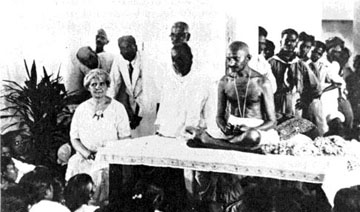

Ida Scudder and Vellore
Ida Sophia Scudder (1870 to 1960) was born in South India into a family of American missionaries; her grandfather John Scudder was, in Dorothy Clarke Wilson's words, "the first American medical missionary," and "with his seven sons all became missionaries."22 Wilson writes that Ida was "determined never to become one of 'those missionary Scudders'" until, on a visit to her parents in 1894, "she received her call, that famous 'three knocks in the night,' when three young women died in childbirth because there had been no woman doctor to treat them."22 The Christian Medical College at Vellore tells the same story on its own history page: three men came in one night asking her to help their wives, social and religious custom kept her father, a male doctor, from attending them, and Ida took their deaths as a sign to help the women and children of India.23 The college does not give a year; Wilson gives 1894.
Scudder graduated from Cornell University Medical College in 1899 and began work at Vellore in 1900, using "one room in her parents' bungalow as a one-bedded clinic-cum-dispensary," as the college puts it; in 1902 she opened the 40-bed Mary Taber Schell Memorial Hospital, "built using funds donated in the USA."23 Wilson adds that she did her first operation "with no helper but the butler's wife," that by 1906 she was treating 40,000 patients a year, that in 1909 she began roadside dispensaries in the villages, and that "in 1918, with the help of women of many denominations, she founded a college to train women doctors. Beginning with seventeen girls, all taught by herself."22 The historian Ruth Compton Brouwer, in a study of Scudder's successor Hilda Lazarus, describes the same steps: "Beginning her celebrated medical work for women in 1900 in her missionary parents' bungalow, Dr. Scudder went on to establish a women's hospital and, in 1918, the Missionary Medical School for Women, the foundation on which CMC was built." She retired from Vellore in 1946 and died nearby in 1960.24
The Vellore story also shows the limits of a mission school under a nationalist government. Brouwer explains that the school offered only licentiate-level training, and that from the late 1930s new standards in the Madras Presidency required degree-level teaching or closure. Scudder raised money in the United States, and the college brought in Hilda Lazarus (1890 to 1978), an Indian Christian physician from Visakhapatnam with a career in the government's Women's Medical Service, as its first Indian head.24 The college says the MBBS degree course began in 1942 and that "male students were accepted for the first time" in 1947.23 A school founded by women for women became one of India's best-known coeducational medical colleges, led by Indian physicians.
Helen Barrett Montgomery and the jubilee of 1910
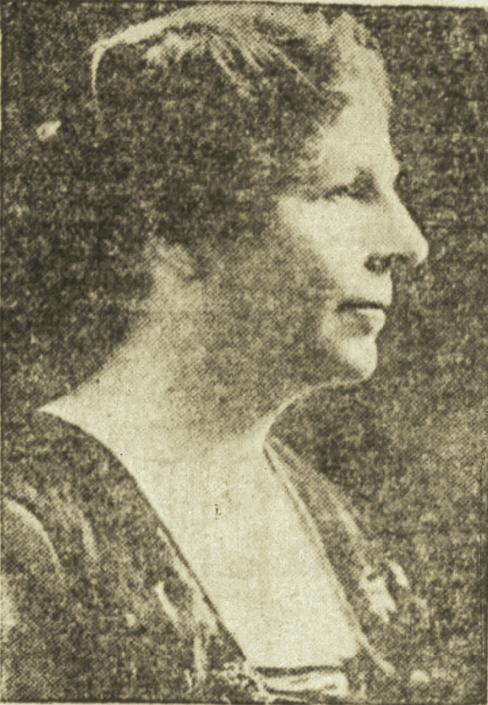

The author of the book this lesson quotes most was herself a leader of the movement. William H. Brackney's entry in the Biographical Dictionary of Christian Missions gives her life: born in Kingsville, Ohio, in 1861, a graduate of Wellesley, married in 1887 to William A. Montgomery, a Rochester industrialist, and the first woman elected to the Rochester school board.25 Brackney writes that Western Women in Eastern Lands "sold over 100,000 copies," and that in 1910 she "toured the United States on behalf of the International Jubilee of Women's Missions, delivering almost 200 speeches." In 1914 she became the first president of the national Woman's American Baptist Foreign Mission Society, and in 1920 she "was elected the first woman president of an American denomination, the Northern Baptist Convention." Her translation of the New Testament, the Centenary Translation, appeared in 1924.25 With her friend Lucy W. Peabody she toured Asia in 1913 and proposed an annual day of prayer for women, which the Federation of Woman's Boards adopted and which became the World Day of Prayer.25
The book's title page carries a motto: "The women that publish the tidings are a great host."3 It is Psalm 68:11 in the wording of the English Revised Version: "The Lord giveth the word: the women that publish the tidings are a great host." The King James Version, the translation this course quotes, reads the verse differently: "The Lord gave the word: great was the company of those that published it."26 By choosing the Revised Version wording for a motto, Montgomery made the verse speak of women.
The book is frank about the attitudes of its time. Its chapter titles include "Ladies Last" and "The New Woman of the Orient," and its first chapter speaks of "heathen lands" and of "the degradation of women," the standard language of mission writing in 1910.8 It also gives Indian and Chinese Christian women their own sketches, among them Pandita Ramabai, whose words it quotes at length.27
Amy Carmichael of Dohnavur
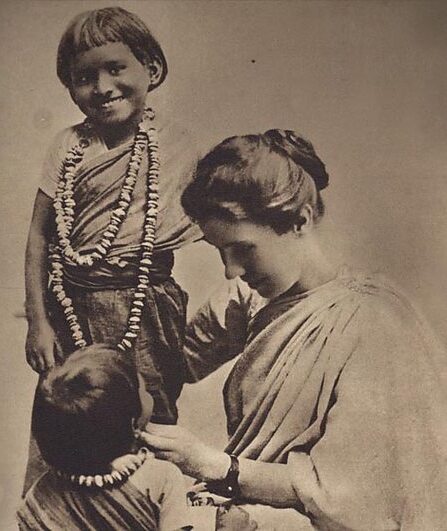

From Ulster to Keswick to Tinnevelly
Amy Beatrice Carmichael was born on December 16, 1867. The Dohnavur Fellowship, the body she founded, gives her birthplace as Millisle in what is now Northern Ireland; Jocelyn Murray's entry in the Biographical Dictionary of Christian Missions says Belfast.2829 The Dictionary of Ulster Biography also gives "Millisle," and Millisle is the birthplace followed here.47 After her father's death she lived with the family of Robert Wilson, "the much-respected chairman of the Keswick Convention," the annual holiness convention held at Keswick in England.30 Murray notes that "while never officially adopted, she used the hyphenated name Wilson-Carmichael as late as 1912."28 Keswick holiness teaching runs through her books; on the holiness movement and its roots in Pietism, see module 77, lesson 01.
Her path to India ran through a rejection. Murray: "In 1892 she volunteered to the China Inland Mission but was refused on health grounds. However, in 1893 she sailed for Japan as the first Keswick missionary." After less than two years in Japan and Ceylon she was back in England, and in 1895 she joined the Church of England Zenana Missionary Society, "and in November 1895 she arrived in South India, never to leave."28 The Fellowship's page says she stayed 56 years "until her death" and never went home to Ireland.29
In Tinnevelly District (now Tirunelveli, Tamil Nadu) she worked with the Church Missionary Society missionary Thomas Walker and his wife, and led a "Band" of Indian Christian women who travelled from village to village. Murray: "While still learning the difficult Tamil language, she commenced itinerant evangelism with a band of Indian Christian women ... and in 1901, she, the Walkers, and their Indian colleagues settled in Dohnavur."28
Things as They Are (1903)
Her first India book, Things as They Are: Mission Work in Southern India, came out in April 1903 and was reprinted that August.30 Her foreword explains it was made from letters at the urging of two visiting friends, and says: "This, the book, has tried to tell the Truth. That is all it has to say about itself."30 The preface, signed by Eugene Stock of the Church Missionary Society, called it "not a book to be read with a lazy kind of sentimental 'interest,'" and said that one of his own aims had long been "to correct the curious general impression among people at home" that Indian Christians as a body were all earnest and consistent; reports that told only of successes had left that impression.30
The book was doubted at home. In a note to the fourth edition Carmichael wrote that letters had come from missionaries across India "confirming its truth. But some in England doubt it," and so she appended "a few confirmatory notes, written by experienced South Indian missionaries, other than those of the district described."30 One of the notes was from Pandita Ramabai (below): "While I was reading Things as They Are, I fancied I was living my old life among Hindus over again. I can honestly corroborate everything said in regard to the religious and social life of the Hindus. I came from that part of the country, and I am very glad that the book has succeeded in bringing the truth to light."30 Another came from Krishna Ran, editor of the Christian Patriot of Madras and "himself a convert," on what a high-caste convert lost: "parents and their tender affection; of brothers and sisters, relatives and friends; of wife and children, if he has any; of his birthright, social position, means of livelihood, reputation."30 The witnesses are all Christians, most of them missionaries; the book contains no answering voice from the Hindu families it describes, and readers should weigh it as advocacy from inside the mission, which is what it says it is.
"Married to the god": the chapter on temple dedication
The chapter that shows what drew her into her life's work is the 24th, "Married to the God." It opens with a warning to the reader: "LEAVE this chapter if you want 'something interesting to read'; hold your finger in the flame of a candle if you want to know what it is like to write it."31 She describes meeting two men with a little girl she knew from a high-caste village:
"Then a sudden fear shot through me, and I looked at the men, and they laughed. 'We are taking her to the temple there,' and they pointed across through the trees, 'to marry her to the god.'"31
She learned later that the girl "was an orphan, as we afterwards heard, living in charge of an old aunt, who had some connection with the temple."31 In another chapter she counted the temples near one town two hours from Dohnavur: "thirty-eight stone temples and shrines in and around it, and five hundred altars," where "each of the larger temples has its attendant temple-women; there are two hundred recognised Servants of the gods, and two hundred annual festivals."32
The first child, March 1901
Carmichael's later book Lotus Buds (London: Morgan and Scott, first edition November 1909) dates the start of the work exactly. "When the Elf came to us on March 6, 1901, and we began to know some of the secrets of the Temple, we tried to save several little children, but we failed."33 The Elf was the nickname of Preena, a girl who had lived in a temple house and who later became one of the teachers of the younger children. In a later chapter Carmichael wrote: "WHEN first, upon March 7, 1901, we heard from the lips of a little child the story of her life in a Temple house, we were startled and distressed, and penetrated with the conviction that such a story ought to be impossible in a land ruled by a Christian Power." She added that the subject was new to her, and that "we did not appreciate, as we do now, the delicacy and difficulty of the position from a Government point of view."33 (The two dates, March 6 for her arrival and March 7 for the first telling of her story, are both Carmichael's.)
Carmichael wrote that the first rescues failed because "we had not the workers then to help us to take care of them," and that the Indian convert-women who later did most of the nursing were not yet with her: "These convert-girls, who now help us so much, were in Hindu homes; some of them had not even heard of Christ."33 The Dohnavur work, like the women's boards' work, rested on Indian women whose names appear in the books only by translated nicknames.
What the government records said
Carmichael knew her readers would doubt her, so Lotus Buds included a chapter titled "Blue Book Evidence," quoting the Census Report of 1901 for the Madras Presidency. The extract she printed is fuller than her own chapter and gives a more complicated picture. It says the temple women "subsist by dancing and music and the practice of 'the oldest profession in the world,'" that "the rise of the Caste and its euphemistic name seem to date from the ninth and tenth centuries," and that "inscriptions show that in A.D. 1004 the great Temple of the Chola king at Tanjore had attached to it four hundred women of the Temple." It also says that the temple women and temple musicians were "now practically the sole repository of Indian music, the system of which is probably one of the oldest in the world."33 The government source, quoted by the missionary herself, records both the sexual exploitation she fought and a musical and religious tradition with a thousand years of history.
The practice was outlawed in the Madras Presidency the year India became independent. The Madras Devadasis (Prevention of Dedication) Act, 1947 (Act XXXI of 1947), which received the Governor-General's assent in January 1948, begins by reciting that the practice "still prevails in certain parts" of the province "of dedicating women as 'devadasis' to Hindu deities, idols, objects of worship, temples and other religious institutions," and that "such practice, however ancient and pure in its origin, leads many of the women so dedicated to a life of prostitution." It declared every such dedication "unlawful and void."34 The act was passed in 1947 and received assent after independence, as a law of the Indian province of Madras; its words "however ancient and pure in its origin" record that its makers saw the tradition as more than its abuse.
The Dohnavur Fellowship
From one child the household grew. Murray summarizes: "It became her mission to rescue and raise these children, and so the Dohnavur Fellowship came into being (registered 1927). Known at Dohnavur as Amma (Mother), Carmichael was the leader, and the work became well known through her writing. Workers volunteered and financial support was received, though money was never solicited."28 The rule against asking for money was the faith-mission principle Hudson Taylor had made famous (lesson 06). The Fellowship's own page adds that the community came to include "a hospital to cater to the sick from the surrounding villages."29
"In 1931 she had a serious fall," Murray writes, "and this, with arthritis, kept her an invalid for the rest of her life. She continued to write, and identified leaders, missionary and Indian, to take her place."28 She died at Dohnavur in 1951, after 56 years in India; the Dictionary of Ulster Biography says she "died 18 January 1951 and is buried at Dohnavur," although its summary table gives January 19, and January 18 is the date usually given.282947 The Fellowship continues, run from India, with a children's home, care for young and elderly women, schools and a hospital listed on its site.29
Carmichael was a writer from the start. A second sketch on the Boston University missiology site notes that her letters home from Japan "became the basis for her first book, From Sunrise Land."28 Things as They Are and Lotus Buds were followed by many more books and poems, and her influence on later evangelical missionaries came mostly through them. Sayings attributed to her in sermons should be checked against those books, as with every famous missionary saying in this module.
Gladys Aylward: the housemaid who went alone
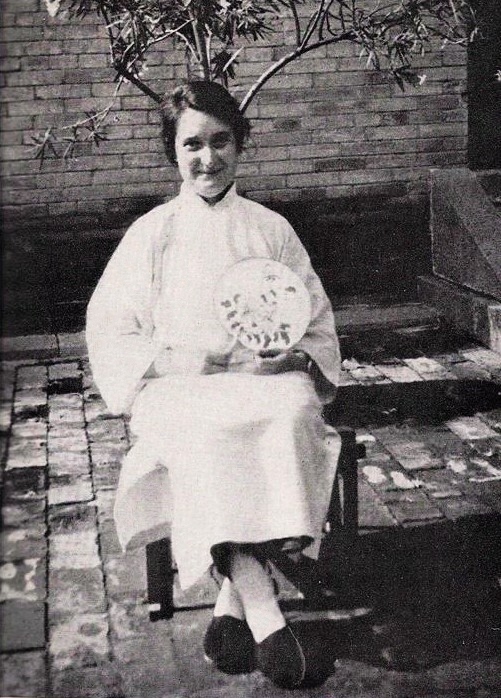

Refused by the China Inland Mission
Gladys May Aylward was born on February 24, 1902, in Edmonton, North London, according to the catalogue of her papers at the library of the School of Oriental and African Studies (SOAS), University of London, which describes its collection as possibly the only Gladys Aylward collection in the United Kingdom.35 The catalogue sums up her early life in one sentence: service as a housemaid, rejection by the China Inland Mission, and departure for China as an independent missionary.35 The SOAS library's own archive blog says she was refused "for failing their examinations."36 Ralph R. Covell's entry in the Biographical Dictionary of Christian Missions is gentler: "With little educational background, no specific abilities to commend her for missionary work, and unable to do well in some introductory mission studies, Gladys was turned down by the China Inland Mission."37 She is the second woman in this lesson whom the China Inland Mission turned away; Amy Carmichael had been refused on health grounds in 1892.
The journey and the inn
The sources do not agree on the year she left. Covell writes that "in 1930 she headed for China on the Trans-Siberian railway"; the SOAS blog post of 2017 says "in October 1930"; the SOAS catalogue gives 1932 with a question mark.373635 Two other accounts split the same way: Francesca Baines, in Women in World History, writes that "on October 18, 1930, Aylward finally set out from Liverpool Street Station," while Christian History magazine (1988) says "she left Liverpool on Oct. 15, 1932."4849 All agree on the route: by train across Russia, where she was nearly detained, to Tientsin (Tianjin), and then overland to Shansi (Shanxi) province in North China.37 There she joined, in the SOAS blog's words, "an elderly missionary, Mrs. Jeannie Lawson."36 The Biographical Dictionary of Chinese Christianity calls Lawson "a remarkable woman in her seventies" with fifty years in China, and says that Lawson, with Aylward and their Christian cook Yang, "opened the Inn of Eight Happinesses as a means of reaching people with the Gospel," offering travelers "clean lodgings, good food, and Bible stories."38
Covell records two things that set her apart from most missionaries of her day. She became a Chinese citizen: "she identified herself with China and its people and became a Chinese citizen in 1936." And she worked for the local government: the mandarin of the city "appointed her an inspector to help enforce the local government's edict against binding the feet of young girls."37 The post made use of the same fact the women's boards had argued from since 1834: a woman could go where a man was not admitted, into the women's part of a house.
The children and the march to Sian
Covell describes the late 1930s as "days of strife, as government forces fought against the Japanese and Communists."37 Aylward had taken in orphans. Covell continues: "In this chaotic context Aylward gathered many orphans into a home and in 1940 led them on a perilous journey to safety in Sian (Xian), capital of the neighboring province of Shensi (Shaanxi), 240 miles west-southwest of Yangcheng."37 The SOAS catalogue also gives 1940.35 The SOAS blog, however, dates the journey "during the Spring of 1938."36 The number of children is given as 94 in the Biographical Dictionary of Chinese Christianity, which calls it "the epic journey to Xian leading 94 children."38 Baines puts the journey in 1940 with "about 100 orphans," and Christian History writes of "100 children."4849 The neutral summary is that the journey was made between 1938 and 1940 (most sources say 1940) with close to a hundred children (one detailed source says 94).
She was ill for years afterward. The Biographical Dictionary of Chinese Christianity says "poor health and headaches plagued her for the last thirty years of her life," and records that she had been wounded in an air attack and struck with a rifle butt.38 She returned to Britain during or soon after the Second World War (SOAS says during the war; the Chinese Christianity dictionary says 1947).3538 Covell says she "went back to China in the late 1940s," and then worked with children in Taiwan, at what became the Gladys Aylward Children's Home, until shortly before her death on January 3, 1970, as both the SOAS catalogue and the SOAS blog record.36
The book, the film and her objections
Her story reached the wider public through Alan Burgess's book The Small Woman (1957) and the film made from it, The Inn of the Sixth Happiness, "starring Ingrid Bergman," as the SOAS blog puts it.36 The SOAS catalogue and the Chinese Christianity dictionary date the film 1959; film reference works date its London premiere to November 1958, a date that could not be checked against a primary record here.3538 Covell's bibliography lists, besides Burgess, an as-told-to account published in 1950, Gladys Aylward, One of the Undefeated: The Story of Gladys Aylward as Told by Her to R. O. Latham, and later biographies by Phyllis Thompson (London Sparrow, 1971) and Catherine Swift (1989).37
The film changed the story. The Chinese Christianity dictionary says that "this and other liberties with the truth deeply troubled Aylward." The liberty it names is the film's romance between Aylward and a Chinese officer, Colonel Lin Nan; it also notes that the film has her cheering the children on the march with light songs, where in fact they sang hymns. The inn itself was renamed: the real one was the Inn of Eight Happinesses.38 Sam Wellman's biography (1998) reports that she resented the invented love scenes because she had never kissed any man, and that the film ended with her leaving the orphans, the opposite of what she did; that report is known here only through a secondary summary and is listed as unverified.39 Aylward's papers at SOAS include press cuttings from 1936 onward, recorded memories of her by others, her publications, and Chinese costume, and are the place where her own reactions are preserved.35
Mary Slessor: a woman alone in Okoyong
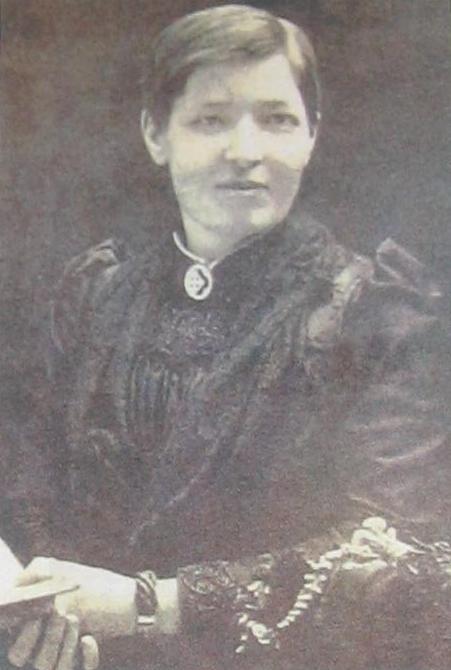

Mary Slessor's life is told in lesson 07. Here the question is narrower: what her career shows about a single woman's place in a mission. Her first biographer, W. P. Livingstone, whose Mary Slessor of Calabar: Pioneer Missionary appeared in 1915, records that she was born on December 2, 1848, in Gilcomston, Aberdeen, worked in Dundee as a weaver, a "factory girl" in the local usage rather than a "mill-girl," offered herself to the Foreign Mission Board in May 1875, and sailed on August 5, 1876.40 She was not the first woman sent to Calabar. Livingstone wrote that "women agents had long been engaged in Calabar. The first, Miss Miller, had gone out with Mr. Waddell in 1849," and that the women "were stated to be both 'economical and effective.'"40
What set Slessor apart was that she went inland and lived alone among the Okoyong people from 1888, at first in the people's own houses. The traveller Mary Kingsley, who in Livingstone's words "wrote strongly against Protestant missionary aims and methods in West Africa," wrote of her in Travels in West Africa (1897), as Livingstone quotes it: "This very wonderful lady has been eighteen years in Calabar; for the last six or seven living entirely alone, as far as white folks go, in a clearing in the forest near to one of the principal villages of the Okoyong district, and ruling as a veritable white chief over the entire district."40 When the Niger Coast Protectorate was set up and Sir Claude Macdonald became consul-general in 1891, he planned to send officials to the districts, but Slessor argued that Okoyong was not ready. Livingstone: "Sir Claude took her point of view, and recognising her unique position and influence, empowered her to do all that was necessary, and to organise and supervise a native court. ... Her position was akin to that of a consular agent, and she conducted all the public affairs of the tribe. She presided at the native court."40 Popular accounts call her the first woman vice-consul in the British Empire; Livingstone's own wording, "akin to that of a consular agent," is more careful, and he adds that "it was a work she did not like."40
Slessor pressed the mission to send more women, and the people she worked among asked for them too. Livingstone records her agreeing with "the old chief who remarked that 'them women be the best man for the Mission,'" and, from the Creek stations later in her life, that "the cry from all the districts was for women and not men."40 On the question of women's rights at home she was, in her own words, "for votes for women, but I would prove my right to it by keeping law and helping others to keep it. God-like motherhood is the finest sphere for women, and the way to the redemption of the world."40 She died before dawn on January 13, 1915, at her station at Use, attended by the girls of her household and a fellow missionary, Miss Peacock.40
The twin killings that made her name in Scotland were real; Livingstone describes the belief that "the father of one of the infants was an evil spirit, and that the mother had been guilty of a great sin," and the killing of the infants. He also writes that the missionaries as a group took in twins, that "some of the Mission compounds were alive with babies," and that even after the chiefs agreed to treaties, "no treaty, no Egbo proclamation could root out the customs of centuries, and they continued to be followed, in secret in the towns and openly in the country districts."40 The claim that she alone ended the practice is checked below.
Pandita Ramabai: an Indian woman founds her own mission
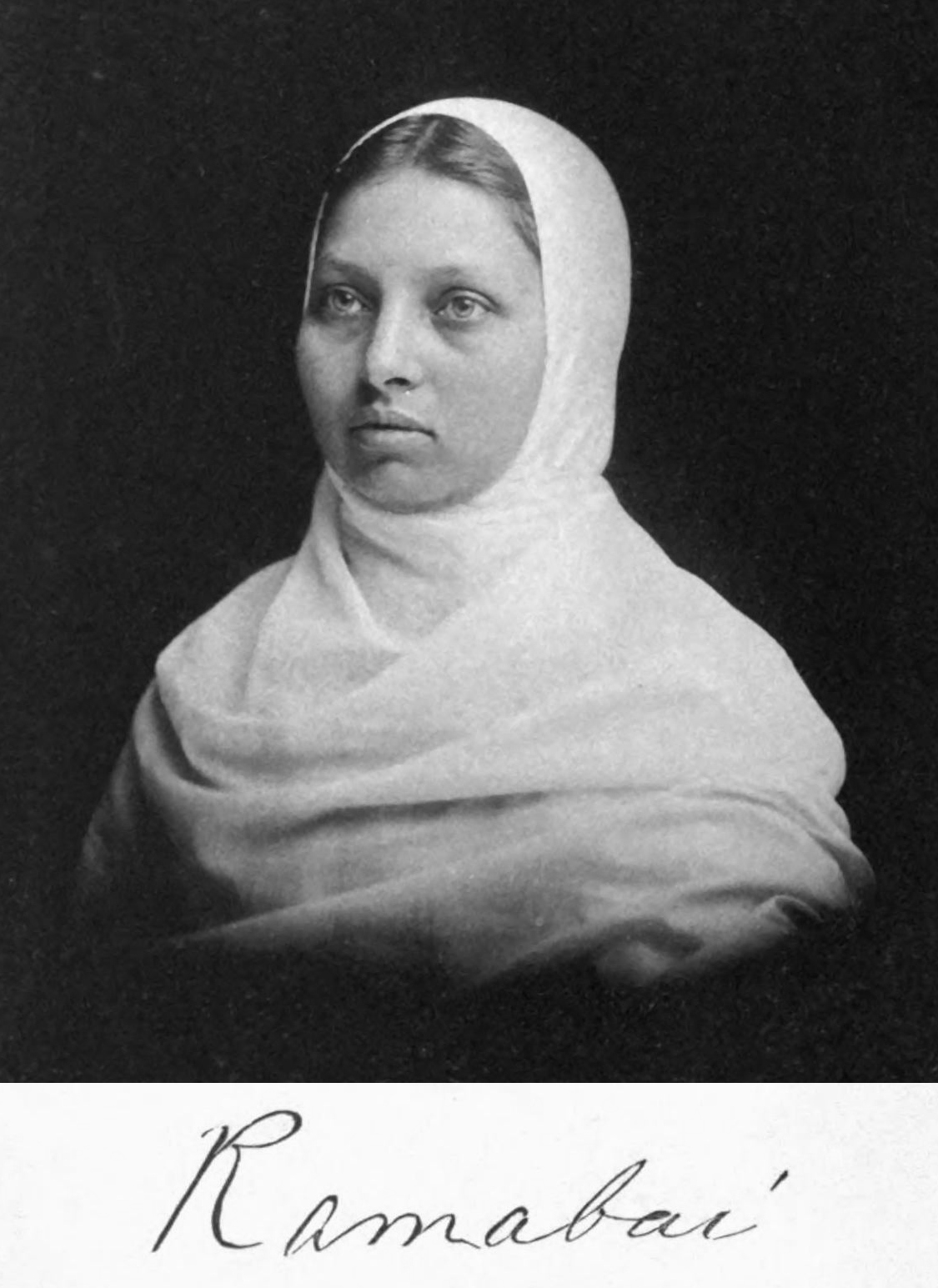

Not every woman who founded a mission in India came from the West. Ramabai Dongre was born in 1858 into a Brahmin family; her father, in Eric J. Sharpe's words, was "a wandering professional reciter of Hindu epic and mythological texts." Her parents died in the famine of 1874. In Calcutta in 1878 the titles "Pandita" and "Sarasvati" were given to her "as an acknowledgement of her learning." She married in 1880 a man of lower caste, had one daughter, Manorama, and was widowed in less than two years.41 In 1883, in England to study medicine, she was baptized in the Anglican chapel of the Community of St. Mary the Virgin at Wantage.41
In 1887, in Philadelphia, she published The High-Caste Hindu Woman, with an introduction by Rachel L. Bodley, dean of the Woman's Medical College of Pennsylvania.42 In it she set out what she believed Indian women most needed:
"After many years of careful observation and thought, I have come to the conclusion that the chief needs of high-caste Hindu women are: 1st, Self-Reliance; 2nd, Education; 3rd, Native Women Teachers."42
She explained the first: "The state of complete dependence in which men are required by the law-giver to keep women from birth to the end of their lives makes it impossible for them to have self-reliance, without which a human being becomes a pitiful parasite." She noted that "women of the working classes are better off than their sisters of high castes in India, for in many cases they are obliged to depend upon themselves," and closed with an appeal: "is it not the duty of our Western sisters to teach them how they may become self-reliant?"42 Her third need, "Native Women Teachers," is the point the Western boards came to slowly.
With American support she opened, in 1889, a school for young high-caste widows in Bombay, the Sharada Sadan, which Sharpe translates "Abode of wisdom"; it soon moved to Poona (Pune). Sharpe describes it as "a non-proselytizing institute," and writes that "the more famous orphanage, Mukti (Salvation) opened at Kedgaon in 1898." Between the two, Ramabai passed through "a second conversion, this time an evangelical one," after which "her Christianity was close to the Keswick 'holiness' pattern."41 Sharpe also records a Pentecostal-style revival at Mukti; the Pentecostal movement is the subject of module 77, lesson 02.41
Montgomery's 1910 book described Mukti at its height: "At Mukti she has a village community of seventeen hundred famine waifs, child widows, and rescued women." Half the day they worked and half the day they studied, and Ramabai "acquired the land, dug the wells, built the buildings, in absolute reliance on God's bounty." She was, Montgomery wrote, "making a translation of the Bible into the simplest woman's talk, a language that any man or boy would scorn to speak, that she may put the Gospel within reach" of the poorest women of India.27 Ramabai's daughter Manorama died in 1921 and Ramabai in 1922.41
Ramabai fits poorly into either of the usual stories about missions. She was a convert who criticized Hindu law from inside: "Throughout India, widowhood is regarded as the punishment for a horrible crime or crimes committed by the woman in her former existence upon earth."42 Montgomery quoted that passage in 1910 to Western readers.27 She was also, in Montgomery's words, a woman with "a profound knowledge of Sanskrit," who ran her own institutions with American support, chose her own theology, and kept her widows' school open to Hindu girls without requiring conversion.2741 She endorsed Amy Carmichael's book, as noted above, from her own experience.30
What happened to the women's boards
Cooperation: the Federation of 1915
The jubilee of 1910 was the movement's high point. In 1915 the American boards formed the Federation of Woman's Boards of Foreign Missions of North America, which, in the words of the Presbyterian Historical Society's description of its records, was formed "to afford Christian women of America an opportunity to do cooperative work in foreign mission fields." The Federation merged with the general Foreign Missions Conference in 1933.43 The World Day of Prayer, which Montgomery and Lucy Peabody proposed after their 1913 tour, grew out of this cooperation.25
The mergers, 1910s to 1960s
Over the next decades most denominational women's boards were merged into the general mission boards of their churches. The pattern can be seen most clearly among Presbyterians in the United States. In 1923 the Presbyterian Church in the U.S.A. merged its women's missionary organizations, "which women had founded and directed," into two new denominational boards, the Board of Foreign Missions and the Board of National Missions; the quoted words are from the historian Bradley Longfield as given in a secondary summary that also records the church's own 1926 study naming "lack of representation of women in the Church" as a cause of conflict.44 Other denominations made similar changes at different dates, and the details (which board, which year, on what terms) belong to each church's own history; the dates for the Methodist, Baptist and Congregational mergers could not be checked against the boards' own records for this lesson and are listed as unverified.
Dana Robert's view of what was lost is summarized in a 2000 Christianity Today cover story by Wendy Murray Zoba. Zoba wrote that the women's network "helped develop over 45 women's mission agencies (both independent and denominational)," and that in the 20th century the churches' "national bureaucracies took over the agencies previously staffed and funded by the women's missionary movement." She quoted Robert directly: "women fought and resisted the mergers."45 The point of dispute is simple to state: the women's boards had raised their own money, chosen their own missionaries and run their own magazines, and after the mergers those decisions were made inside general boards. The case the denominations made for the mergers at the time is not quoted here, because their own statements were not among the sources read for this lesson; that gap is listed among the unverified points.
Montgomery herself had written in 1910, about her own Union Society, words that read differently after the mergers: "relatively it must decrease, they must increase." She meant that the interdenominational society would give way to the denominational women's boards, and she hoped "the Christian union in which the work began may be again realized in some wider federation of effort than is yet dreamed possible."8
Women in the Catholic missions
This module follows mostly Protestant missions, but Catholic women have taken part in missions above all through vowed religious life in orders of sisters. Dana Robert, writing in 2006 on world Christianity as a women's movement, points to the growth of those orders in the Global South: "Even as the number of nuns is dropping in the West, the number of women religious increased by 56 percent from 1975 to 2000 in Africa, and by 83 percent in Asia." She adds that "in Africa there are one-third fewer Catholic priests and brothers than there are religious sisters."46 Her broader finding, from a survey of regional and church studies, is that women made up "roughly a two-thirds majority of practicing Christians in the growing world church in the late twentieth and early twenty-first centuries."46 The women's boards of the 19th century and the women's religious orders of today fit the pattern Robert describes, in which women make up most of the church's active membership.
After the boards
The 20th-century women in the next lessons went out under general boards and faith missions. Elisabeth Elliot and Rachel Saint, who lived among the Waorani of Ecuador, appear in lesson 10; missionary women killed in the field, among them Betty Stam in China, are in module 102, lesson 09; and the funding models of today's agencies are in lesson 12. Montgomery named that method as the women's chief contribution to mission finance: "Perhaps the most distinctive contribution of the Women's Societies to missionary administration has been their demonstration of the power of small offerings frequently collected from large numbers of contributors."16
What the record shows and what it does not
- Documented fact. The founding dates of the women's societies (1834 London, 1861 New York, 1868 to 1872 for the main denominational boards, 1888 for the Woman's Missionary Union) are recorded in the societies' own histories as summarized by Montgomery in 1910 and by the IMB. The 1947 Madras act against the dedication of devadasis is a published statute. Aylward's Chinese citizenship (1936) and her death (January 3, 1970) are in the SOAS catalogue.
- The women's own words. Swain's letters (A Glimpse of India, 1909), Carmichael's Things as They Are (1903) and Lotus Buds (1909), Ramabai's The High-Caste Hindu Woman (1887), and Montgomery's Western Women in Eastern Lands (1910) are all public domain and were read for this lesson. Aylward's own account exists in an as-told-to book of 1950 and in her papers at SOAS, which were not read here.
- The people the missionaries came to. Indian voices in this lesson are mostly Christian: Ramabai, the editor Krishna Ran, and the Indian men quoted in Swain's letters. The Census of 1901, quoted by Carmichael, and the 1947 act are the nearest thing here to the record of the Hindu society the missionaries described; histories written by descendants of the temple women's communities were not consulted for this lesson.
- Later biography, sermon and film. The Inn of the Sixth Happiness (1958 or 1959) invented a romance and changed the inn's name; Aylward objected. Sermons on Slessor often credit her alone with ending twin killing; her own biographer does not.
- Scholarly reading. Dana Robert reads the late 19th century as the time when women came to outnumber men in the missionary force, and, as Zoba reports her, sees the mergers as something women "fought and resisted." The denominations' own case for the mergers was not read for this lesson.
- Open questions. The exact share of women in the Protestant missionary force in 1900; the year Aylward left for China (1930 or 1932) and of the march (1938 or 1940); the exact number of children (94 in one source); the dates of several denominational mergers.
Pictures, Numbers and Infographics
The table gathers the lesson's main numbers, each with its source. Figures from the women's boards are their own count, as Montgomery compiled it in 1910.
| What | Number or date | Source |
|---|---|---|
| Abeel's appeal and the London Society for Promoting Female Education in the East | 1834 | Montgomery 19106 |
| Woman's Union Missionary Society incorporated (New York) | February 1861 | Montgomery 19108 |
| Women at the Congregational founding meeting, Old South Church, Boston | 40 (1868) | Montgomery 191011 |
| Women at the Methodist founding meeting, Tremont Street, March 23, 1869 | 8 | Montgomery 191012 |
| Thoburn and Swain sail from Boston; arrive Bombay | Nov. 3, 1869; Jan. 7, 1870 | Anderson, BDCM19 |
| Land given by the Nawab of Rampur for Swain's hospital at Bareilly | 40 acres and a house (1871) | Swain's letters21 |
| Woman's Missionary Union (Southern Baptist) organized, Richmond | May 1888 (IMB: May 11) | IMB14 |
| Christmas offering total, 1888 to 2005 | more than $2.3 billion | Tew, Encyclopedia of Alabama15 |
| Women's societies in the United States | 1 (1861); 44 (1910) | Montgomery 19101 |
| Supporters of the women's societies | a few hundred (1861); at least 2,000,000 (1910) | Montgomery 19101 |
| Money raised in a year | $2,000 (1861); $4,000,000 (1909) | Montgomery 19101 |
| Unmarried women missionaries in the field worldwide | 4,710 in 1909 (1,948 from the U.S.) | Montgomery 19101 |
| Bible women and native helpers paid by the women's boards | 5,783 (1909 to 1910) | Montgomery 19101 |
| Student Volunteer Movement volunteers in its first 20 years, and share who were women | 2,953; 30 percent | Selles, IBMR 20065 |
| Copies of Western Women in Eastern Lands sold | over 100,000 | Brackney, BDCM25 |
| Scudder's patients a year by 1906; first class of the women's medical school, 1918 | 40,000; 17 students | Wilson, BDCM22 |
| Schell hospital at Vellore, 1902 | 40 beds | CMC Vellore23 |
| Temples and shrines near one town by Dohnavur, as Carmichael counted them | 38 temples and shrines, 500 altars, 200 temple women | Things as They Are32 |
| Women of the temple at Tanjore in A.D. 1004, per inscriptions cited by the 1901 Census | 400 | Census quoted in Lotus Buds33 |
| Dohnavur Fellowship registered | 1927 | Murray, BDCM28 |
| Residents of Ramabai's Mukti community, 1910 | about 1,700 | Montgomery 191027 |
| Aylward's march to Sian: distance and children | 240 miles; 94 children (one source) | Covell, BDCM; BDCC3738 |
| Federation of Woman's Boards of Foreign Missions founded; merged with Foreign Missions Conference | 1915; 1933 | Presbyterian Historical Society43 |
| Growth of Catholic women religious, 1975 to 2000 | Africa +56 percent; Asia +83 percent | Robert, IBMR 200646 |
Claims checked
"By 1900 women were the majority of Protestant missionaries"
Supported, with the exact share unresolved. Dana Robert writes that in the late 19th century "female missionaries began to outnumber males."2 Montgomery's own count of 4,710 unmarried women in the field in 1909 does not include wives, who were also counted as missionaries by many boards.1 The precise percentage for 1900 given in Robert's American Women in Mission was not checked against her page for this lesson.
"Clara Swain was the first woman physician sent to the mission field"
Partly supported. Montgomery, writing for the women's boards in 1910, says Swain was "the first woman physician to be sent to the foreign field," and that the Union Society "relinquished the honor of sending the first woman physician to the women of non-Christian lands."1220 That is the movement's own claim. It is widely repeated, and no earlier woman physician sent by a mission board turned up in the sources read here, but the claim was not tested against British and continental records, so the safer wording is "the first woman physician sent by an American women's mission board."
"Ida Scudder was called by three knocks in one night"
Partly supported. The story comes from Scudder's own telling as reported by her biographers and by the college she founded. Dorothy Clarke Wilson dates it to 1894 and calls it "that famous 'three knocks in the night'"; the college's history page tells the same story without a year.2223 No contemporary record of the three deaths was found. The story fits the documented need: male doctors could not attend high-caste women, which is the reason the women's boards gave for sending women doctors from 1869 on.
"Amy Carmichael rescued temple children"
Supported, with limits. Carmichael's own books date the first child's arrival to March 6, 1901, and describe children received from temple households and from families intending to dedicate them; the Dohnavur Fellowship was registered in 1927 and still runs a children's home.332829 Her account of the practice was doubted in England in 1903 and defended by other missionaries and by Pandita Ramabai.30 The Census of 1901, as she quoted it, and the 1947 Madras act confirm that girls were dedicated to temples and that many were drawn into prostitution, while also recording the tradition's role in temple music and ritual.3334 A count of how many children came from temple households, as distinct from other children taken in, was not found.
"Gladys Aylward's story is told accurately in The Inn of the Sixth Happiness"
Refuted in its particulars. The film keeps the outline (a London housemaid, an inn at Yangcheng, a march with children to safety) but invents a romance with a Chinese officer, changes the songs of the march, and renames the inn; the Biographical Dictionary of Chinese Christianity says "this and other liberties with the truth deeply troubled Aylward."38 The real inn was the Inn of Eight Happinesses.38
"Aylward led about a hundred children across the mountains in 1938"
Partly supported. One source gives 94 children; others say only "orphans" or "many orphans."3837 The year is 1940 in Covell's entry and in the SOAS catalogue and spring 1938 in the SOAS blog.373536 The journey itself, to Sian in Shensi province, is not in doubt.
"The China Inland Mission rejected Gladys Aylward"
Supported. The SOAS catalogue, the SOAS archive blog and Covell all say so; the blog says it was "for failing their examinations."353637
"Mary Slessor stopped the killing of twins"
Partly supported. Slessor rescued and raised twins and fought the practice for decades, and in Okoyong she presided over the native court under the consul-general's authority.40 Her own biographer writes that the missionaries as a group took in twins and that even after treaties and proclamations the customs "continued to be followed, in secret in the towns and openly in the country districts."40 The end of the practice came through many hands: the chiefs who issued the Egbo proclamations, the mission as a whole, the colonial courts, and converts. See also lesson 07.
"Mary Slessor was the British Empire's first woman vice-consul"
Unresolved. Her 1915 biographer says the consul-general "empowered her to do all that was necessary, and to organise and supervise a native court," and that "her position was akin to that of a consular agent."40 The formal title and the claim to be the first woman to hold it were not found in a primary record here.
"Pandita Ramabai founded the Mukti Mission in 1889"
Partly supported. In 1889 Ramabai opened the Sharada Sadan, a school for high-caste widows in Bombay, which moved to Poona. Mukti, at Kedgaon, came later; Eric Sharpe dates it to 1898.41 The 1889 date belongs to her first school.
"The women's boards drained money from the general mission boards"
Unresolved. The fear was voiced at the time. Montgomery answered it with an American Board committee's finding that the women's giving had not come "at the expense of the general missionary treasuries."18 She was the women's advocate and the figures she cited are a single board's; no independent study across denominations was consulted here.
"Helen Barrett Montgomery was the first woman to lead an American denomination"
Supported as stated by her biographer. Brackney writes that in 1920 she "was elected the first woman president of an American denomination, the Northern Baptist Convention."25 The claim depends on how "denomination" and "president" are defined, and smaller bodies founded or led by women were not surveyed here.
Hard questions and answers
Were the women's boards a women's rights movement?
Their founders did not usually call it that, and their arguments were about reaching women in Asia. Montgomery's 1910 book links the founding of the Congregational board in 1868 with "the same year in which Sorosis and the New England Woman's Club were organized," and Slessor wrote that she was "for votes for women," on her own terms.1140 In practice, as Montgomery listed it, the women "maintained offices, state and national organizations, yearly and triennial conventions" and "developed a fine network of unpaid helpers with which to cover the entire country," and they sent thousands of single women abroad as teachers and doctors.1 The opposition they met, from the editorial that predicted the movement would "die out" to the mergers they "fought and resisted," shows that men in the churches saw them as a change in women's place.1745
Did missionaries misrepresent the lives of Hindu women?
The missionary books were written to win prayer and money, and they dwelt on suffering. Carmichael's title promised "things as they are," and Eugene Stock's preface said that what she said was "the truth, and nothing but the truth; but it is not the whole truth," meaning that worse things could not be printed.30 At the same time, Indian women such as Ramabai described the treatment of high-caste widows in terms as severe as any missionary's, and the Madras legislature in 1947 described the dedication of girls to temples much as Carmichael had.4234 What the missionary books mostly lack is the voice of Hindu women who saw their own religion differently; the Census Carmichael quoted, with its notice of the temple women as keepers of an ancient music, is a reminder that her picture was partial.33 A fair reader can accept the documented abuses and still notice whose voices are missing.
Who did most of the work in the field?
By the boards' own count, local women did. In 1909 to 1910 the women's boards supported 5,783 "Bible women and native helpers" against 800 teachers, 380 evangelists, 140 physicians and 79 trained nurses.1 Carmichael wrote that the Indian convert-women who "now help us so much" made the Dohnavur nurseries possible, and Vellore's survival as a degree-granting college depended on Hilda Lazarus and Indian physicians.3324 Ramabai's Mukti was founded and led by an Indian woman.27 The famous Western names sit on top of a much larger Asian and African workforce whose members are rarely named.
Why did the China Inland Mission turn away both Carmichael and Aylward, and does it matter?
The reasons recorded are ordinary: health for Carmichael in 1892, and failing the mission's examinations for Aylward.2836 Both went anyway, one through another society and one alone. Their stories are told in sermons as proof that God overrules institutions, and a skeptic might read them as proof that mission boards sometimes misjudge people. Both readings rest on the same facts. What the record shows is that independent and faith-mission routes let women go who did not fit the boards' requirements, and that those routes left them to find their own support: Aylward paid for her journey by working nights and weekends as a housemaid.38
If the outline of Aylward's story is true, does it matter what the film changed?
It mattered to Aylward. The changes the film made (a romance, cheerful songs in place of hymns, a new name for the inn) turned a missionary's story into a love story, and she objected.38 For a reader the lesson is method: the film is evidence of how her story was told in 1958, and her papers, the 1950 as-told-to account and the archive catalogue are the evidence of what happened.3537
What was lost when the women's boards merged into the general boards?
The women lost control of the money they raised and of the choice of missionaries and projects, which had been theirs since 1861. Robert, as Zoba reports, says women "fought and resisted the mergers," and the Presbyterian church's own 1926 study named the lack of women's representation as a cause of conflict.4544 The churches' own case for the mergers is not documented in the sources read here. Whether the trade was worth it is a judgment readers make from their own convictions about church order.
Related lessons
- Lesson 05: Adoniram and Ann Judson, for the missionary wife before the women's boards.
- Lesson 06: Hudson Taylor, the China Inland Mission and Lottie Moon, for the faith mission and the Woman's Missionary Union's offering.
- Lesson 07: Africa, for Mary Slessor's full story.
- Lesson 10: the 20th century, for Elisabeth Elliot and Rachel Saint.
- Lesson 12: the large mission agencies and lesson 13: missions today.
- Lesson 14: review, reading list, timeline and glossary.
- Module 80: Baptists, Methodists and the holiness lines, Reformed and Presbyterian.
- Module 77: Holiness and Pietism (Keswick) and Pentecostal and charismatic.
- Module 102: The missionary martyrs.
Learn more
- Western Women in Eastern Lands (1910), full text at HathiTrust: The movement's own history and statistics at its jubilee, by one of its leaders.
- Things as They Are (1903), Project Gutenberg: Carmichael's own account of village work and temple dedication, with the confirmatory notes.
- Lotus Buds (1909), Project Gutenberg: The beginning of the Dohnavur children's work and the Census evidence she quoted.
- The High-Caste Hindu Woman (1887), Internet Archive: Pandita Ramabai's own book, written from inside Hindu society.
- A Glimpse of India (1909), Internet Archive: Clara Swain's letters from Bareilly, the earliest years of women's medical missions in India.
- Mary Slessor of Calabar (1915), Project Gutenberg: The first full biography, with her letters and Mary Kingsley's testimony.
- SOAS Library: the Gladys Aylward papers: What survives of Aylward's own correspondence and memorabilia.
- Dana L. Robert, "World Christianity as a Women's Movement" (IBMR, 2006): A historian's case that most Christians, and most mission workers, have been women.
Still being checked (14 items)
These points could not be confirmed against a primary source when this lesson was written and fact checked in October 2026. The text above states each one as uncertain.
- The exact percentage of women in the Protestant missionary force in 1900 as given in Dana Robert's American Women in Mission (1997) was not checked against the book; only her statement that women began to outnumber men is quoted.
- The date of the Woman's Missionary Union's founding: the IMB gives May 11, 1888; other accounts commonly give May 14, 1888. The first Christmas offering amount ($3,315) is left to lesson 06.
- Amy Carmichael's death day: the Dictionary of Ulster Biography gives January 18, 1951 in its text and January 19 in its summary table; no death record was opened. Her birthplace is now settled as Millisle (Dohnavur Fellowship and Dictionary of Ulster Biography; the BDCM page says Belfast).
- Gladys Aylward's departure for China: 1930 (Covell; SOAS blog, October 1930; Baines, October 18, 1930) or 1932 (SOAS catalogue, with a question mark; Christian History 1988, October 15, 1932). The march to Sian: 1940 (Covell; SOAS catalogue; Baines) or spring 1938 (SOAS blog). The number of children: 94 (BDCC) or about 100 (Baines; Christian History). Her death: January 3, 1970 (SOAS blog) or January 2, 1970 (Baines).
- The release date of The Inn of the Sixth Happiness: November 1958 (London premiere, per film reference works via Wikipedia) or 1959 (SOAS; BDCC). Sam Wellman's report (1998) of Aylward's objections to the love scenes and the ending is known here only through a Wikipedia summary.
- The dates of the Methodist, Northern Baptist and Congregational women's board mergers were not checked; only the Presbyterian 1923 merger (via a secondary summary of Bradley Longfield) and the 1933 merger of the Federation of Woman's Boards are given. The denominations' own stated reasons for the mergers were not read.
- Mary Slessor's formal title as vice-consul and the claim that she was the first woman to hold such a post were not found in a primary record; Livingstone (1915) says only that her position was akin to a consular agent's.
- Clara Swain's birth and death years (commonly 1834 and 1910) were not confirmed and are omitted. The date of the Nawab of Rampur's gift (October 1871) is inferred from the order and dates of her printed letters.
- The year of Ida Scudder's 'three knocks' (1894) rests on Dorothy Clarke Wilson's entry; the CMC history gives no year.
- Brackney's statements that Montgomery's Centenary Translation (1924) was the first New Testament translation by a woman scholar and that she was the first woman president of an American denomination were not tested against other cases.
- The ABCFM income figures in Montgomery's chapter VI were unreadable in the OCR text and are not used.
- The SOAS catalogue entry for MS 291571 loads by script and was read only through an automated page extract; its details are paraphrased, not quoted. The short quotations from the Presbyterian Historical Society summary, Zoba's Christianity Today article and the Ulster Worldly page were taken from automated page extracts rather than a full reading. On November 12, 2026 the SOAS catalogue page could not be reached (connection error), so its statements remain as the writer reported them. The old Presbyterian Historical Society print URL (history.pcusa.org/print/8174) now returns 'Page not found' and was replaced by the NCC RG 27 guide, which carries the same wording.
- Montgomery's note to her statistical table ('it has been very difficult to compile this table') is in a folded table not included in the two Internet Archive OCR texts checked; the quotation was not re-verified.
- Ida Scudder photograph (1928): the person seated in the centre of the picture is not identified on the Commons file page, so the caption leaves the other people unnamed.
Notes
- Helen Barrett Montgomery, Western Women in Eastern Lands: An Outline Study of Fifty Years of Woman's Work in Foreign Missions (New York: Macmillan, for the Central Committee on the United Study of Missions, 1910), chapter VI, pp. 243 to 244 (jubilee figures: 1861 and 1909 to 1910; the page reads "5783 Bible women and native helpers," checked against the page image of the Cornell University Library copy at the Internet Archive and the OCR of a second copy). Read it online. ↩
- Dana L. Robert, "Missions, Foreign," in Dictionary of American History, via Encyclopedia.com (retrieved Nov. 12, 2026). Read it online. ↩
- Helen Barrett Montgomery, Western Women in Eastern Lands: An Outline Study of Fifty Years of Woman's Work in Foreign Missions (New York: Macmillan, for the Central Committee on the United Study of Missions, 1910), title page, motto and imprint (published April 1910, reprinted October 1910). Read it online. ↩
- Helen Barrett Montgomery, Western Women in Eastern Lands: An Outline Study of Fifty Years of Woman's Work in Foreign Missions (New York: Macmillan, for the Central Committee on the United Study of Missions, 1910), notes to the statistical table (folder at the end of the book). Read it online. ↩
- Johanna M. Selles, "The Role of Women in the Formation of the World Student Christian Federation," International Bulletin of Missionary Research 30, no. 4 (October 2006), pp. 188 to 194. Read it online. ↩
- Helen Barrett Montgomery, Western Women in Eastern Lands: An Outline Study of Fifty Years of Woman's Work in Foreign Missions (New York: Macmillan, for the Central Committee on the United Study of Missions, 1910), chapter I, pp. 21 to 23 (David Abeel, 1834, and the Society for Promoting Female Education in the East). Read it online. ↩
- Helen Barrett Montgomery, Western Women in Eastern Lands: An Outline Study of Fifty Years of Woman's Work in Foreign Missions (New York: Macmillan, for the Central Committee on the United Study of Missions, 1910), chapter I, pp. 35 to 37 (Canadian and American Baptist women's societies, 1870 and 1871; the letters of Mrs. Carpenter of Bassein). Read it online. ↩
- Helen Barrett Montgomery, Western Women in Eastern Lands: An Outline Study of Fifty Years of Woman's Work in Foreign Missions (New York: Macmillan, for the Central Committee on the United Study of Missions, 1910), chapter I, pp. 23 to 25 (the Woman's Union Missionary Society, 1861). Read it online. ↩
- Dana L. Robert, "Doremus, Sarah Platt (Haines)," in Biographical Dictionary of Christian Missions, ed. Gerald H. Anderson (New York: Macmillan Reference USA, 1998), reprinted at the Boston University School of Theology History of Missiology site (retrieved Nov. 12, 2026). Read it online. ↩
- Helen Barrett Montgomery, Western Women in Eastern Lands: An Outline Study of Fifty Years of Woman's Work in Foreign Missions (New York: Macmillan, for the Central Committee on the United Study of Missions, 1910), chapter I, pp. 25 to 26 (Isabel Hart's reasons for the Union Society). Read it online. ↩
- Helen Barrett Montgomery, Western Women in Eastern Lands: An Outline Study of Fifty Years of Woman's Work in Foreign Missions (New York: Macmillan, for the Central Committee on the United Study of Missions, 1910), chapter I, pp. 26 to 28 (Woman's Board of Missions, Congregational, 1868). Read it online. ↩
- Helen Barrett Montgomery, Western Women in Eastern Lands: An Outline Study of Fifty Years of Woman's Work in Foreign Missions (New York: Macmillan, for the Central Committee on the United Study of Missions, 1910), chapter I, pp. 30 to 33 (Woman's Foreign Missionary Society of the Methodist Episcopal Church, March 23, 1869; Isabella Thoburn and Clara Swain). Read it online. ↩
- Helen Barrett Montgomery, Western Women in Eastern Lands: An Outline Study of Fifty Years of Woman's Work in Foreign Missions (New York: Macmillan, for the Central Committee on the United Study of Missions, 1910), chapter I, pp. 33 to 36 (Presbyterian societies, 1870; Episcopal Woman's Auxiliary, 1872; Canadian Baptist societies, 1870). Read it online. ↩
- International Mission Board (Southern Baptist Convention), "175 Years: 1880s" (retrieved Nov. 12, 2026). Read it online. ↩
- C. Delane Tew, "Woman's Missionary Union," Encyclopedia of Alabama (retrieved Nov. 12, 2026). Read it online. ↩
- Helen Barrett Montgomery, Western Women in Eastern Lands: An Outline Study of Fifty Years of Woman's Work in Foreign Missions (New York: Macmillan, for the Central Committee on the United Study of Missions, 1910), chapter I, pp. 37 to 38 (differences among the boards; small offerings). Read it online. ↩
- Helen Barrett Montgomery, Western Women in Eastern Lands: An Outline Study of Fifty Years of Woman's Work in Foreign Missions (New York: Macmillan, for the Central Committee on the United Study of Missions, 1910), chapter I, pp. 30 to 31 (the Advocate editorial and the pastor at the prayer meetings). Read it online. ↩
- Helen Barrett Montgomery, Western Women in Eastern Lands: An Outline Study of Fifty Years of Woman's Work in Foreign Missions (New York: Macmillan, for the Central Committee on the United Study of Missions, 1910), chapter VI, pp. 264 to 265 (whether women's gifts came at the expense of the general boards). Read it online. ↩
- Gerald H. Anderson, "Thoburn, Isabella," in Biographical Dictionary of Christian Missions, ed. Gerald H. Anderson (New York: Macmillan Reference USA, 1998), reprinted at the Boston University School of Theology History of Missiology site (retrieved Nov. 12, 2026). Read it online. ↩
- Helen Barrett Montgomery, Western Women in Eastern Lands: An Outline Study of Fifty Years of Woman's Work in Foreign Missions (New York: Macmillan, for the Central Committee on the United Study of Missions, 1910), chapter III, pp. 128 to 129 (Clara Swain; Sara Seward; Sarah F. Norris). Read it online. ↩
- Clara A. Swain, A Glimpse of India: Being a Collection of Extracts from the Letters of Dr. Clara A. Swain (New York: James Pott and Company, 1909), letters from Bareilly of January 25, 1870, April 25, 1870, and October 8 and December 22 [1871], and list of illustrations; Internet Archive scan (retrieved Nov. 12, 2026). Read it online. ↩
- Dorothy Clarke Wilson, "Scudder, Ida Sophia," in Biographical Dictionary of Christian Missions, ed. Gerald H. Anderson (New York: Macmillan Reference USA, 1998), reprinted at the Boston University School of Theology History of Missiology site (retrieved Nov. 12, 2026). Original pp. 609 to 610. Read it online. ↩
- Christian Medical College Vellore, "How It All Began" (retrieved Nov. 12, 2026). Read it online. ↩
- Ruth Compton Brouwer, "The Legacy of Hilda Lazarus," International Bulletin of Missionary Research 30, no. 4 (October 2006), pp. 201 to 204. Read it online. ↩
- William H. Brackney, "Montgomery, Helen Barrett," in Biographical Dictionary of Christian Missions, ed. Gerald H. Anderson (New York: Macmillan Reference USA, 1998), reprinted at the Boston University School of Theology History of Missiology site (retrieved Nov. 12, 2026). Original pp. 469 to 470. Read it online. ↩
- Psalm 68:11, King James Version (1611) and English Revised Version (1885), as given in the parallel text at Bible Hub (retrieved Nov. 12, 2026). Read it online. ↩
- Helen Barrett Montgomery, Western Women in Eastern Lands: An Outline Study of Fifty Years of Woman's Work in Foreign Missions (New York: Macmillan, for the Central Committee on the United Study of Missions, 1910), chapter V, pp. 224 to 226 (Pandita Ramabai and Mukti), and chapter II, pp. 61 to 62 (Ramabai on widowhood). Read it online. ↩
- Jocelyn Murray, "Carmichael, Amy Beatrice," in Biographical Dictionary of Christian Missions, ed. Gerald H. Anderson (New York: Macmillan Reference USA, 1998), reprinted at the Boston University School of Theology History of Missiology site (retrieved Nov. 12, 2026). Original p. 116; the same page carries a second, unsigned sketch. Read it online. ↩
- The Dohnavur Fellowship, "Amy Carmichael" (retrieved Nov. 12, 2026). Read it online. ↩
- Amy Wilson-Carmichael, Things as They Are: Mission Work in Southern India (London: Morgan and Scott; first edition April 1903, reprinted August 1903; later edition with Note and Confirmatory Notes), Note, Confirmatory Notes (Pandita Ramabai; Krishna Ran), Preface by Eugene Stock, and Foreword; Project Gutenberg eBook 29426. Read it online. ↩
- Amy Wilson-Carmichael, Things as They Are (1903), chapter XXIV, "Married to the God"; Project Gutenberg eBook 29426. Read it online. ↩
- Amy Wilson-Carmichael, Things as They Are (1903), passage on the temples of a town two hours from Dohnavur; Project Gutenberg eBook 29426. Read it online. ↩
- Amy Wilson-Carmichael, Lotus Buds (London: Morgan and Scott, 1909; octavo edition 1912), chapters on the Elf (March 6, 1901), the Secret Traffic (March 7, 1901) and "Blue Book Evidence" quoting the Census Report of 1901 for Madras; Project Gutenberg eBook 29427. Read it online. ↩
- The Madras (now Tamil Nadu) Devadasis (Prevention of Dedication) Act, 1947 (Act XXXI of 1947), preamble and sections 2 and 3, as reprinted in the Tamil Nadu code; Internet Archive text (retrieved Nov. 12, 2026). Read it online. ↩
- SOAS Library, University of London, Special Collections, catalogue entry for the Gladys Aylward papers, MS 291571 (biographical history and scope) (retrieved Nov. 12, 2026). Read it online. ↩
- SOAS Library Special Collections, "Gladys Aylward," SOAS Archives blog, September 10, 2017 (retrieved Nov. 12, 2026). Read it online. ↩
- Ralph R. Covell, "Aylward, Gladys," in Biographical Dictionary of Christian Missions, ed. Gerald H. Anderson (New York: Macmillan Reference USA, 1998), reprinted at the Boston University School of Theology History of Missiology site (retrieved Nov. 12, 2026). Read it online. ↩
- "Aylward, Gladys May (1902 to 1970)," Biographical Dictionary of Chinese Christianity (unsigned on the page) (retrieved Nov. 12, 2026). Read it online. ↩
- Sam Wellman, Gladys Aylward: Missionary to China (Uhrichsville, Ohio: Barbour Publishing, 1998), pp. 197 to 198, as summarized in the Wikipedia article "The Inn of the Sixth Happiness" (used only to locate the book; not checked against the book) (retrieved Nov. 12, 2026). Read it online. ↩
- W. P. Livingstone, Mary Slessor of Calabar: Pioneer Missionary (London: Hodder and Stoughton, 1915), chapters on her early life, the Calabar women agents, twin killing, the Okoyong court, Mary Kingsley's testimony (from Travels in West Africa, 1897), her views on women, and her death; Project Gutenberg eBook 8906. Read it online. ↩
- Eric J. Sharpe, "Ramabai, Dongre Medhavi," in Biographical Dictionary of Christian Missions, ed. Gerald H. Anderson (New York: Macmillan Reference USA, 1998), reprinted at the Boston University School of Theology History of Missiology site (retrieved Nov. 12, 2026). Original p. 557. Read it online. ↩
- Pundita Ramabai Sarasvati, The High-Caste Hindu Woman, with an introduction by Rachel L. Bodley (Philadelphia: Jas. B. Rodgers Printing Co., 1887), chapter on widowhood (p. 69) and chapter on the condition of women (pp. 100 to 101); Internet Archive scan (retrieved Nov. 12, 2026). Read it online. ↩
- Presbyterian Historical Society, "Guide to the Foreign Missions Conference of North America Records" (NCC RG 27), scope note on the files of the Federation of Woman's Boards of Foreign Missions of North America, formed in 1915 and merged with the Conference in 1933 (retrieved Nov. 12, 2026). Read it online. ↩
- Tim Hopper, "Causes of Unrest Among Women of the Church," Ulster Worldly (blog), quoting Bradley J. Longfield on the 1923 Presbyterian merger and summarizing the church's 1926 study (retrieved Nov. 12, 2026). Secondary summary; Longfield's article was not read directly. Read it online. ↩
- Wendy Murray Zoba, "A Woman's Place," Christianity Today, August 2000, cover story quoting Dana L. Robert (retrieved Nov. 12, 2026). Read it online. ↩
- Dana L. Robert, "World Christianity as a Women's Movement," International Bulletin of Missionary Research 30, no. 4 (October 2006), pp. 180 to 188. Read it online. ↩
- Dictionary of Ulster Biography, "Carmichael, Amy" (born 16 December 1867 in Millisle; the text says she died 18 January 1951, the summary table says 19 January 1951) (retrieved Nov. 12, 2026). Read it online. ↩
- Francesca Baines, "Aylward, Gladys (1902 to 1970)," in Women in World History: A Biographical Encyclopedia, via Encyclopedia.com (retrieved Nov. 12, 2026). Read it online. ↩
- "We're Sorry Gladys . . . But God Can't Use You in China," Christian History 19 (1988), Christian History Institute (retrieved Nov. 12, 2026). Read it online. ↩
Check yourself
1. According to Helen Barrett Montgomery's 1910 count, how many unmarried women missionaries were in the field worldwide in 1909?
Montgomery gives 4,710 unmarried women in the field in 1909, 1,948 of them from the United States.
2. Who led the women who founded the Woman's Union Missionary Society in New York in 1861?
Doremus was its first president; Dana Robert notes that Rufus Anderson of the American Board had blocked an earlier attempt in 1834.
3. Which two women did the Methodist Woman's Foreign Missionary Society send to India in 1869?
Thoburn, a teacher, and Swain, a physician, sailed from Boston on November 3, 1869.
4. What did the Nawab of Rampur give for Clara Swain's hospital at Bareilly, according to her letters?
Swain wrote that the Nawab said "Take it, take it" and that the gift was forty acres and a house.
5. On what date does Amy Carmichael say the first child, the Elf (Preena), came to her?
Lotus Buds dates the Elf's arrival to March 6, 1901; the story of temple life was first heard on March 7, 1901.
6. Which statement about Gladys Aylward is best supported by the sources?
The SOAS catalogue and Covell both say she became a Chinese citizen in 1936; the CIM had turned her down, and she objected to the film's liberties.
7. What were the three chief needs of high-caste Hindu women, according to Pandita Ramabai in 1887?
The High-Caste Hindu Woman lists "1st, Self-Reliance; 2nd, Education; 3rd, Native Women Teachers."
8. In 1909 to 1910, which group was the largest among the workers paid by the American women's boards?
Montgomery counts 5,783 Bible women and native helpers, against 800 teachers, 380 evangelists, 140 physicians and 79 nurses.
Terms in this lesson
- Women's board
- A missionary society run by women, usually within one denomination, that raised its own money and sent and paid women missionaries; the first American denominational one was the Congregational Woman's Board of Missions (1868).
- Woman's Union Missionary Society (WUMS)
- The first American women's missionary society open to all denominations, incorporated in New York in February 1861 with Sarah Doremus as president, to send single women to Asia.
- "Woman's work for woman"
- The movement's own phrase for its purpose: Western women sent to reach Asian and African women who could not be reached by male missionaries.
- Zenana
- The women's quarters of a household in India, closed to men outside the family; zenana visiting by women missionaries was a main reason the women's boards gave for sending women.
- Bible woman
- A local Christian woman hired by a mission to read and teach the Bible in homes; in 1909 to 1910 the women's boards supported 5,783 Bible women and native helpers.
- Medical missionary
- A missionary trained as a physician or nurse; Clara Swain (1869) and Ida Scudder (Vellore, 1900) were early American women in this role.
- Keswick Convention
- An annual holiness convention at Keswick in England that sent missionaries of its own; Amy Carmichael was the first Keswick missionary.
- Devadasi
- A girl or woman dedicated to the service of a Hindu temple deity in South India; the Madras act of 1947 declared such dedication unlawful and void.
- The community Amy Carmichael founded at Dohnavur in Tamil Nadu after 1901 to raise children taken from or at risk of temple dedication; registered in 1927 and still active.
- Faith mission
- A mission that does not appeal for money but relies on prayer and unsolicited gifts, on the pattern of Hudson Taylor's China Inland Mission; the Dohnavur Fellowship followed this rule.
- Mukti
- "Salvation": Pandita Ramabai's community for widows, orphans and famine children at Kedgaon near Poona, opened in 1898 by Sharpe's dating, with about 1,700 residents by 1910.
- Jubilee of 1910
- The fiftieth-anniversary celebration of American women's foreign mission work, for which Montgomery wrote Western Women in Eastern Lands and toured the country.
- Merger of the women's boards
- The folding of the denominational women's boards into general church mission boards from the 1910s on (for example the Presbyterian merger of 1923), which women in the movement resisted.
Sources
- Helen Barrett Montgomery, Western Women in Eastern Lands (1910) (1910) checked 2026-10
- Clara A. Swain, A Glimpse of India (1909) (1909) checked 2026-10
- Amy Wilson-Carmichael, Things as They Are (1903) (1903) checked 2026-10
- Amy Wilson-Carmichael, Lotus Buds (1909) (1909) checked 2026-10
- Pundita Ramabai Sarasvati, The High-Caste Hindu Woman (1887) (1887) checked 2026-10
- W. P. Livingstone, Mary Slessor of Calabar: Pioneer Missionary (1915) (1915) checked 2026-10
- Madras Devadasis (Prevention of Dedication) Act, 1947 (1947) checked 2026-10
- Psalm 68:11, KJV and ERV parallel (Bible Hub) (1611; 1885) checked 2026-10
- SOAS Library: Gladys Aylward papers, MS 291571 (catalogue, consulted 2026) checked 2026-10
- SOAS Archives blog: Gladys Aylward (2017) (2017-09-10) checked 2026-10
- Biographical Dictionary of Christian Missions entries (Robert, Anderson, Wilson, Brackney, Murray, Covell, Sharpe) at Boston University (1998) checked 2026-10
- Biographical Dictionary of Chinese Christianity: Aylward, Gladys May (n.d.) checked 2026-10
- Dana L. Robert, "Missions, Foreign," Dictionary of American History (2003) checked 2026-10
- International Bulletin of Missionary Research 30:4 (Oct. 2006): Robert; Selles; Brouwer (2006-10) checked 2026-10
- Christian Medical College Vellore: How It All Began (n.d.) checked 2026-10
- The Dohnavur Fellowship: Amy Carmichael (n.d.) checked 2026-10
- International Mission Board: 175 Years, 1880s (2020) checked 2026-10
- C. Delane Tew, "Woman's Missionary Union," Encyclopedia of Alabama (n.d.) checked 2026-10
- Presbyterian Historical Society: Foreign Missions Conference of North America records (NCC RG 27), with the Federation of Woman's Boards files (n.d.) checked 2026-10
- Wendy Murray Zoba, "A Woman's Place," Christianity Today (2000) (2000-08) checked 2026-10
- Tim Hopper, "Causes of Unrest Among Women of the Church" (Ulster Worldly) (n.d.) checked 2026-10
- Wikipedia: The Inn of the Sixth Happiness (used only to locate Wellman's biography and release records) (consulted 2026) checked 2026-10
- Dictionary of Ulster Biography: Amy Carmichael (n.d.) checked 2026-10
- Francesca Baines, Aylward, Gladys, Women in World History (Encyclopedia.com) (n.d.) checked 2026-10
- Christian History 19 (1988): We're Sorry Gladys (1988) checked 2026-10