Lesson 13 of 14 · about 50 minutes · Updated November 12, 2026
Missions Today: the Global South, Short-Term Trips and the Law
You'll be able to
- You'll be able to state, with source and year, how the regional distribution of Christians changed between 1910 and 2020.
- You'll be able to explain why Pew and the CSGC give different totals and how to cite each.
- You'll be able to describe Edinburgh 1910 and the Lausanne Covenant in their own words and say what each left out or changed.
- You'll be able to read the CSGC table of missionaries sent and received and explain the imbalance it found.
- You'll be able to define unreached people groups and the 10/40 Window under each counting system.
- You'll be able to summarize the conversion laws, visa rules and U.S. law that govern missionaries today, and the documented cases of Gospel for Asia, John Allen Chau and the Haiti kidnapping.
Start here: the short version
In 1910 about two-thirds of the world's Christians lived in Europe. By 2020 the largest single share lived in sub-Saharan Africa, and Europe held about a fifth.12 The missionary movement that earlier lessons of this module followed from Carey to Townsend helped make that change, and the change in turn has altered the movement itself. Missionaries are now sent from Brazil, South Korea, India, Nigeria and the Philippines as well as from the United States and Europe, though the United States still sent by far the most in the last full count (about 127,000 of roughly 400,000 international missionaries in 2010).3
This lesson covers five things. First, the numbers on where Christians live, from the Pew Research Center and the Center for the Study of Global Christianity (CSGC) at Gordon-Conwell Theological Seminary, and why those two bodies do not always agree. Second, the great conferences that tried to plan world mission: Edinburgh 1910, Lausanne 1974 and its successors in Manila (1989), Cape Town (2010) and Seoul-Incheon (2024). Third, the sending countries and the newer mission agencies of Asia, Africa and Latin America, including the case of Gospel for Asia, which paid $37 million in 2019 to settle a donor class action while denying fraud.4 Fourth, the strategy ideas that shaped the last fifty years: unreached people groups, the 10/40 Window and the short-term mission trip. Fifth, the law and ethics: conversion laws in India and Nepal, visas, the U.S. International Religious Freedom Act of 1998, the death of John Allen Chau on North Sentinel Island in 2018, and the kidnapping of 17 Christian Aid Ministries workers in Haiti in 2021.567
Every number below carries its source and year. Where sources disagree, both are given.
Where Christians live now: the move to the Global South
Pew's 2011 report defined the Global North as "North America, Europe, Australia, Japan and New Zealand" and the Global South as "the rest of the world," that is, roughly Africa, Asia apart from Japan, Latin America and Oceania outside Australia and New Zealand.1 The terms are about geography and history, and they are rough. Australia sits in the southern hemisphere and is counted as "North"; much of Asia sits north of the equator and is counted as "South". The two research bodies whose numbers fill this lesson both use the terms, and both say plainly that they are approximations.
The 1910 picture
The Pew Research Center's 2011 report on global Christianity, using what it called "historical estimates by the Center for the Study of Global Christianity," put the matter in one sentence: "In 1910, about two-thirds of the world's Christians lived in Europe."1 The same report gave the Americas 27 percent of the world's Christians in 1910. Sub-Saharan Africa then had "fewer than 9 million" Christians and the Asia-Pacific region "about 28 million," out of a world total of about 600 million.1 Divided out, that is about 1.5 percent of the world's Christians in sub-Saharan Africa and under 5 percent in Asia and the Pacific. In 1910, Pew wrote, the Global North "contained more than four times as many Christians as the Global South."1
The CSGC's own 2013 report, Christianity in its Global Context, 1970 to 2020, written by Todd M. Johnson, Gina A. Bellofatto and colleagues, gives a slightly different figure for the same year: "In 1910, over 80% of the world's Christians lived in the global North."3 The two statements fit together: two-thirds in Europe plus the large Christian population of North America comes to more than four-fifths.
The year 1910 matters because of the conference held that June in Edinburgh, described below. The delegates at Edinburgh were planning the evangelization of the world from a church that was, by their own numbers, overwhelmingly European and North American.
The picture in 2010 and 2020
By 2010, in Pew's 2011 count, "only about a quarter of all Christians live in Europe (26%)." The Americas had 37 percent, sub-Saharan Africa 24 percent and Asia and the Pacific 13 percent. Sub-Saharan Africa's Christians had grown "from fewer than 9 million in 1910 to more than 516 million in 2010."1 Pew counted "more than 1.3 billion Christians" in the Global South in 2010, 61 percent of the total.1
Pew's June 2025 report on religious change from 2010 to 2020 revised the 2010 baseline and carried the count forward. Its main finding for Christians: "Sub-Saharan Africa is now home to the largest number of Christians, surpassing Europe." In its words, "As of 2020, 30.7% of the world's Christians live in sub-Saharan Africa, compared with 22.3% in Europe."8 The chapter on Christians gives the counts: 697 million Christians in sub-Saharan Africa, which "was home to 31% of all the Christians in the world (up 6 points since 2010)," and 505 million in Europe, which "held 22% of the global Christian population (down 4 points)." Latin America and the Caribbean held 24 percent, and North America held 10 percent ("down 2 points"), with 238 million.2 The remaining 13 percent or so lived in Asia and the Pacific and in the Middle East and North Africa; the chapter does not break that remainder out in the passages consulted for this lesson.
World totals in the same report: the number of Christians "rose by 122 million, reaching 2.3 billion," while their share of the world's population fell 1.8 points, to 28.8 percent.8 Pew explained Africa's rise past Europe partly by births and partly by "widespread Christian disaffiliation in Western Europe," and, from surveys of adults aged 18 to 54 in 117 countries and territories, found that "Christians have experienced the biggest net losses from switching (3.1 have left for every 1.0 who has joined)."8
The CSGC's 2013 report, using its own data, put the trend this way: "The global South was home to 76% of the world's total population in 1970 but only 43% of all Christians. By 2010 the figure for each had risen, but the gap between them had narrowed: 84% of all people, and 59% of all Christians, lived in the global South."3
Why the counts differ
Readers who compare figures will notice that Pew and the CSGC do not always agree. The CSGC's own published answers to common questions put the world's Christians in 2010 at "2.3 billion Christians (32.8% of the world's population)," a higher figure than Pew gave for the same year.9 The CSGC explains the difference by method. Both bodies rely on government censuses and surveys, but "the CSGC also collects data from religious communities themselves, such as denominational statistics and missionary data from Christian churches and parachurch organizations," and gives more weight to "ethnographic and anthropological data, particularly for smaller, lesser-known groups."9 The CSGC counts as Christian anyone who calls himself or herself Christian; it states that it "utilizes a strict methodology of self-identification."9 The two bodies have worked together since 2008 on the World Religion Database, and the CSGC notes that "Pew relies on the CSGC to provide data on smaller countries and religious traditions where no survey data are available."9
The practical point for a reader is simple. A figure for "Christians in Africa" or "missionaries sent from Korea" is an estimate made by a named body using a stated method in a stated year, and it should be quoted that way. This lesson does so throughout.
What the scholars make of it
Three scholars have shaped how the shift is discussed in English. Andrew Walls, a Scottish historian who taught in Sierra Leone and later founded the Centre for the Study of Christianity in the Non-Western World at Edinburgh, argued in The Missionary Movement in Christian History (1996) that Christianity has repeatedly moved its center from one culture to another, and that the twentieth-century move south fits that long pattern.10 Lamin Sanneh, a Gambian-born historian at Yale, argued in Whose Religion Is Christianity? (2003) that translation of the Bible into local languages gave African and Asian believers the means to make the faith their own, often in ways the missionaries did not plan.11 Philip Jenkins, then at Penn State, brought the subject to a wide American readership in The Next Christendom: The Coming of Global Christianity (2002), stressing that the growing churches of the South are often more theologically conservative, more supernatural in outlook and more Pentecostal than the churches of the North.12 Each of these is an interpretation, and each has been debated; the numbers above are the shared ground.
Much of the growth Jenkins described came through Pentecostal and charismatic churches, a story told in module 77 (Pentecostal and Charismatic) and module 80 (Pentecostal, Orthodox and Catholic Bodies). It is not retold here.

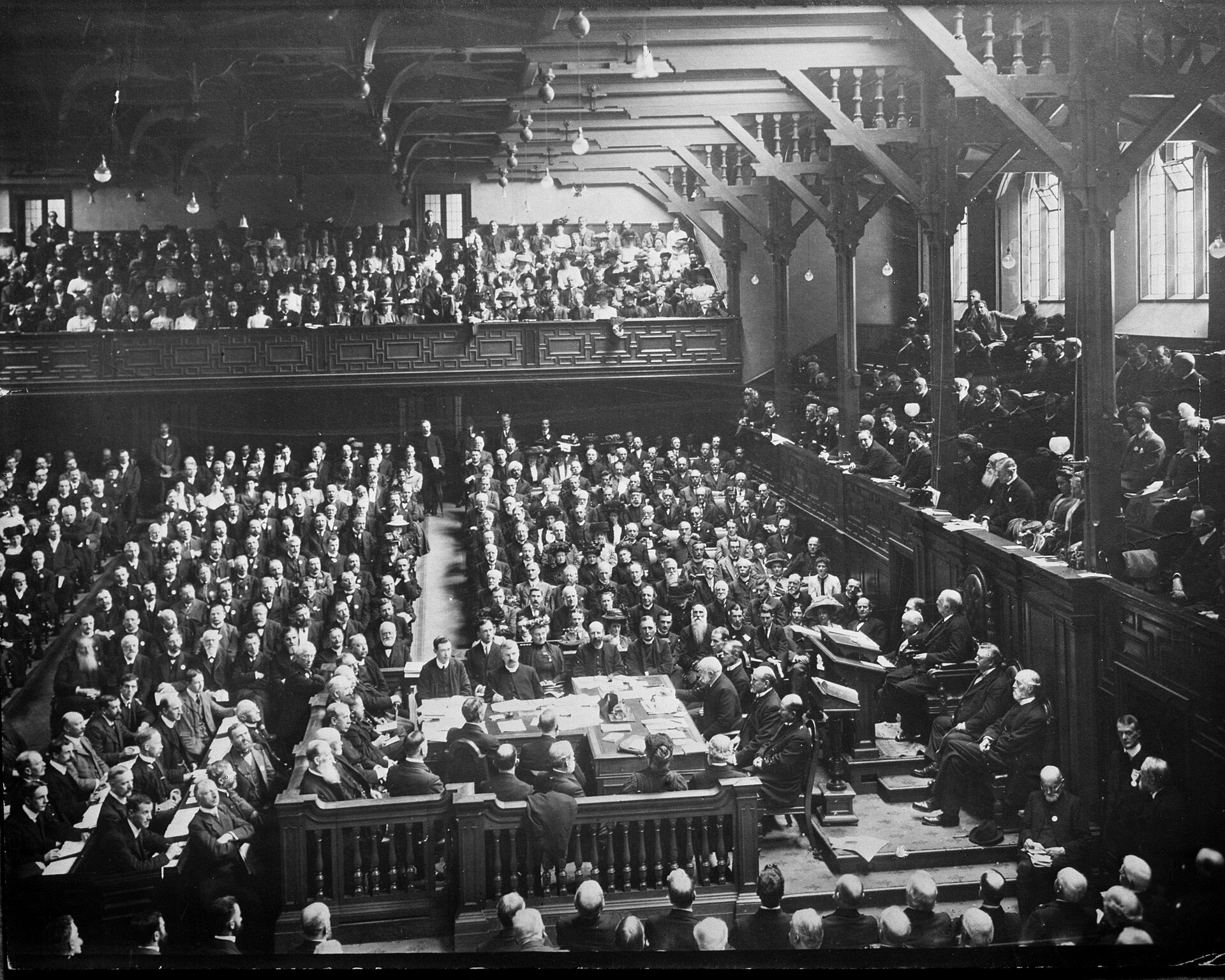
Edinburgh 1910: the World Missionary Conference
The World Missionary Conference met in Edinburgh, Scotland, in the Assembly Hall at New College, "from June 14 to 23, 1910," as the International Bulletin of Missionary Research put it when it marked the coming centenary in 2006.13 It was the high point of the Protestant missionary movement whose beginnings this module traced in lesson 03 and lesson 04.

An eyewitness account
Charles Clayton Morrison, editor of the American Protestant weekly The Christian Century, wrote from Edinburgh on June 20, 1910, while the conference was in session. He described "the entire body of 1,200 delegates" and called the American Methodist layman John R. Mott, who had been elected chairman, "the real executive chairman of the gathering." Mott held speakers to a seven-minute limit and was, Morrison wrote, "inexorable in enforcing the rule." Morrison noticed Japanese, Chinese, Indian and African participants, who, he said, "mingle together in an easy equality" with the Europeans and Americans.14 The conference worked through eight commissions, each of which had prepared a printed report and was given a day of debate. Mott himself chaired Commission I, on carrying the gospel to all the world.1413
Morrison's phrase "easy equality" is his own impression. The numbers tell a more limited story. The delegates were appointed by mission societies in proportion to their spending, and the societies were almost all in Britain, continental Europe and North America. The number of delegates from the churches of Asia was small, and historians give slightly different counts (often given as 17 to 19, with no delegate from a sub-Saharan African church). This lesson could not confirm an exact count from a primary list and records it as unverified.

What Edinburgh left out
The British historian Brian Stanley, who later wrote the standard history of the conference, described in a 2006 article how its boundaries were drawn. Representation was limited to societies working "among non-Christian peoples." Protestant work among Roman Catholic, Orthodox or other older Christian populations was left out of the conference statistics. In Latin America, Protestant work was excluded except among aboriginal peoples and "non-Christian immigrants." The Anglo-Catholic bishops of the Church of England had pressed for that rule as the price of their taking part, and the British executive committee accepted it in March 1909.13 The effect was that Latin America, then largely Catholic, was treated as already Christian territory, a decision that angered many American missionaries working there (a separate Protestant congress on Latin America followed at Panama in 1916, a date given here from standard histories).
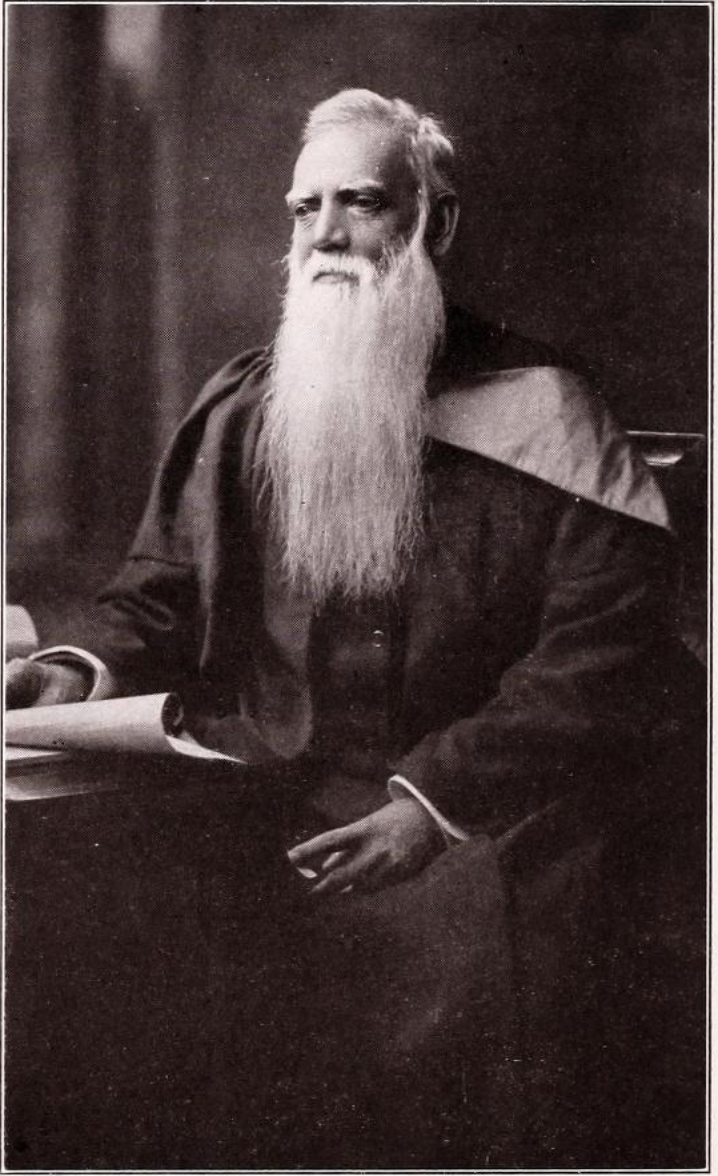
The best-remembered speech at Edinburgh came from one of the few Asian delegates. V. S. Azariah, a young Indian clergyman then working with the Indian Missionary Society at Dornakal and later, by standard accounts, the first Indian bishop of the Anglican Church in India, spoke on cooperation between foreign and Indian Christians. He told the hall that missionaries had been generous but distant, and closed: "You have given your bodies to be burned. We also ask for love. Give us FRIENDS."13 Azariah's appeal is often quoted today as an early statement of what churches of the South would ask of missionaries for the rest of the century.
What Edinburgh led to
The conference appointed a Continuation Committee under Mott, which led in time to the International Missionary Council (1921) and, through other streams, to the World Council of Churches (1948). Those later bodies drew most of the older Protestant denominations. Many evangelical bodies later stood apart from them, which is part of the reason a separate evangelical gathering was called in 1974. The Edinburgh centenary in 2010 was marked by a gathering in Edinburgh itself and, in a different form, by the Lausanne Movement's congress in Cape Town. These later links are stated here in outline from standard histories; the dates 1921 and 1948 are widely recorded but were not checked against a primary document for this lesson.
Lausanne 1974 and after
The congress at Lausanne
The International Congress on World Evangelization met at Lausanne, Switzerland, in July 1974. Standard histories credit the American evangelist Billy Graham with calling it and the English Anglican minister John Stott with leading the drafting of its best-known document, the Lausanne Covenant. The Lausanne Movement's own pages give two slightly different attendance figures: "2,400 mission-minded participants from 150 nations" on one page and about 2,300 from 150 nations in a 2023 article by Sara Kyoungah White.1516 Some popular accounts give 2,700. The lesson uses the movement's own range of 2,300 to 2,400 and lists the higher figure as unconfirmed.
The Covenant opens: "We, members of the Church of Jesus Christ, from more than 150 nations, participants in the International Congress on World Evangelization at Lausanne, praise God for his great salvation and rejoice in the fellowship he has given us with himself and with each other. We are deeply stirred by what God is doing in our day, moved to penitence by our failures and challenged by the unfinished task of evangelization."17
Several of its fifteen sections speak directly to the subjects of this lesson.
On social action, Section 5 says: "We affirm that God is both the Creator and the Judge of all men. We therefore should share his concern for justice and reconciliation throughout human society and for the liberation of men and women from every kind of oppression." It then draws a line: "Although reconciliation with other people is not reconciliation with God, nor is social action evangelism, nor is political liberation salvation, nevertheless we affirm that evangelism and socio-political involvement are both part of our Christian duty."17 Section 6 adds the sentence that has been argued over ever since: "In the Church's mission of sacrificial service, evangelism is primary."17
On the end of Western control, Section 8 says: "We rejoice that a new missionary era has dawned. The dominant role of western missions is fast disappearing."17 Section 9 reads: "Missionaries should flow ever more freely from and to all six continents in a spirit of humble service." The same section allows that "A reduction of foreign missionaries and money in an evangelized country may sometimes be necessary to facilitate the national church's growth in self-reliance and to release resources for unevangelized areas."17 That sentence answered, in a measured way, calls made in the early 1970s by some African and Asian church leaders for a moratorium on foreign missionaries and money; the moratorium debate is recorded in the mission journals of the time and is given here in outline only.
On numbers and urgency, Section 9 states: "More than 2,700 million people, which is more than two-thirds of all humanity, have yet to be evangelized." Its goal: "The goal should be, by all available means and at the earliest possible time, that every person will have the opportunity to hear, to understand, and to receive the good news."17 The Lausanne Movement's current online text adds an endnote saying that the 2,700 million figure reflects July 1974 and that, as of July 2024, researchers believe more than 3.4 billion people remain unreached.17
On culture, Section 10 contains a confession that critics of missions have often quoted back to missionaries: "Missions have, all too frequently, exported with the gospel an alien culture, and churches have sometimes been in bondage to culture rather than to Scripture."17
On the law, Section 13, "Freedom and Persecution," states: "It is the God-appointed duty of every government to secure conditions of peace, justice and liberty in which the Church may obey God, serve the Lord Jesus Christ, and preach the gospel without interference." It continues: "We therefore pray for the leaders of nations and call upon them to guarantee freedom of thought and conscience, and freedom to practise and propagate religion in accordance with the will of God and as set out in The Universal Declaration of Human Rights."17 That claim, that freedom to "propagate" religion is a human right, is the point at which the Covenant meets the conversion laws discussed later in this lesson.
Ralph Winter and the "hidden peoples"
The paper at Lausanne with the longest strategic reach was given by Ralph D. Winter, an American missiologist who later founded the U.S. Center for World Mission in Pasadena. The CSGC summarized its effect this way: "The concept of unreached people groups burst onto the missions scene when Ralph Winter spoke about them at the 1974 Lausanne Congress."3 Winter argued that most non-Christians lived in ethnic and language groups with no church of their own, so that ordinary evangelism by local Christians could not reach them; only "cross-cultural" mission could. The idea is followed below under unreached people groups.
Manila 1989, Cape Town 2010 and Seoul-Incheon 2024
The second congress met in Manila in 1989 and issued the Manila Manifesto.1518 The third met in Cape Town, South Africa, in October 2010, with "4,000 leaders from 198 countries" by the movement's count, and produced the Cape Town Commitment.15 The CSGC recorded that a list of "unengaged" people groups distributed at Cape Town was criticized: "the list of UUPGs that was distributed in Cape Town included some 110 peoples that participants reported were in fact engaged."3
The fourth congress met in Incheon, beside Seoul, South Korea, from September 22 to 28, 2024, the movement's fiftieth anniversary. The evangelical news service Evangelical Focus reported more than 5,200 participants from 202 nationalities; the movement's own page says "over 5,000 leaders from more than 200 countries."1815 A Seoul Statement, drafted by a 33-member Theology Commission, was released on the first day; Evangelical Focus reported that participants said they had little chance to discuss it before release. Participants were invited to sign a "Collaborative Action Commitment" on the final Saturday.18 Holding the congress in Korea was itself a sign of the change this lesson describes: a country that had once received missionaries was hosting the world gathering as one of the largest sending nations.3
Who sends missionaries now, and where they go
The CSGC count for 2010
The most widely cited country-by-country count of international missionaries is the CSGC's for 2010, published in June 2013 and drawn from the Atlas of Global Christianity (Edinburgh University Press, 2009), edited by Todd M. Johnson and Kenneth R. Ross. Its summary: "In 2010, Christians from all traditions sent out approximately 400,000 international missionaries; this figure does not include missionaries who were at work in their home countries."3 The phrase "all traditions" matters. The count includes Catholic priests, sisters and brothers, Orthodox and Protestant workers, and members of independent churches, which is why Catholic countries such as France, Spain and Italy appear high on the list.
The ten largest senders in 2010, by the CSGC's count, were: the United States (127,000), Brazil (34,000), France (21,000), Spain (21,000), Italy (20,000), South Korea (20,000), the United Kingdom (15,000), Germany (14,000), India (10,000) and Canada (8,500). The ten largest receivers were: the United States (32,400), Brazil (20,000), Russia (20,000), the Democratic Republic of the Congo (15,000), South Africa (12,000), France (10,000), the United Kingdom (10,000), Argentina (10,000), Chile (8,500) and India (8,000).3
Measured against the number of church members at home, the order changes. The CSGC's list of most missionaries sent per million church members (for countries over 100,000 people) is led by Palestine (3,401), Ireland (2,131), Malta (1,994) and Samoa (1,802), with South Korea fifth (1,014) and the United States ninth (614).3
The imbalance the counters found
The CSGC drew two conclusions from its own table. The first was that the sending base was moving south: "of the ten countries sending the most missionaries in 2010, three were in the global South: Brazil, South Korea, and India. The 'second top ten' included six Southern countries: South Africa, the Philippines, Mexico, China, Colombia, and Nigeria." It added: "Southern missionaries go not only to other Southern countries but also to Northern countries, in a reverse of the pattern seen over much of the twentieth century."3
The second was that most missionaries were not going where Christians are few. The ten countries that received the most missionaries "were home to 29% of the world's non-Christians but also 37% of the world's Christians. When India (ranked tenth) is left off the list, however, the 'top nine' receiving countries were home to only 3.5% of the world's non-Christians but received more than 34% of all international missionaries!" By contrast, "the ten countries with the most non-Christians in 2010 were home to 73% of all non-Christians globally. Because many of them restrict or deny missionary access, however, they received only 9% of all international missionaries."3 Measured per person, the report found the heaviest concentrations in small Christian-majority islands: "Samoa, at the top of the list, received more than one missionary for every three non-Christians," while North Korea received "one for every 1.2 million non-Christians."3
The report gives part of the reason in the same pages: many of these workers serve existing churches (as pastors, teachers, doctors and administrators), many Southern missionaries "work among their own peoples in diaspora," and many countries with large non-Christian populations restrict missionary entry.3 Its forecast for the decade to 2020 was that "the shift from North to South in mission-sending will likely continue," while "the imbalances described above are not expected to change significantly."3 A newer country-by-country count of the same kind was not found in a form that could be checked for this lesson.
The CSGC also measured money. "Sixty percent of all Christians live in the global South, but they hold only 17% of all Christian financial resources."3 That fact shapes everything that follows in this lesson: Southern missionaries are many and Northern money is still large, and the two meet in partnerships, sponsorship programs and short-term trips, each with its own risks.
The newer sending countries and agencies
Three countries stand out in the 2010 count. Brazil's 34,000 missionaries, Catholic and Protestant together, were second only to the United States.3 South Korea sent 20,000, a very high number for a country of its size. India sent 10,000 international missionaries and, as the CSGC noted, "In these three countries [China, India and Nigeria], large numbers of home missionaries also work among non-Christians."3 (The CSGC sentence reads "In these three countries"; the bracketed names are added from the sentence before it.)
Home missionaries, meaning missionaries working in their own country but across a language or caste line, are a large part of the story in India and Nigeria and are not counted in the 400,000 international figure. In India, mission agencies run by Indians cooperate through the India Missions Association, which describes itself in one line: "India Missions Association assists and trains missions and churches for ministry."19 Nigeria has its own national mission agencies and an evangelical missions association. The founding dates and staff counts these bodies publish could not be checked against independent sources for this lesson and are not given here.

A case on the record: Gospel for Asia
Sponsoring "native missionaries" became a common fundraising model: Western donors give monthly to support an Asian or African evangelist, on the reasoning that a local worker costs far less than a foreign one and already speaks the language. One agency of this kind whose finances were tested in court was Gospel for Asia (GFA), founded by the Indian-born evangelist K. P. Yohannan and headquartered in Texas.4
In 2015 the Evangelical Council for Financial Accountability (ECFA), the main accrediting body for evangelical charities in the United States, removed GFA from membership. Christianity Today reported that ECFA had concluded GFA misled donors, mismanaged resources, had an ineffective board and violated most of ECFA's core standards.4 Donors then sued in federal court in Arkansas. The case became a class action covering about 200,000 donors who gave between January 2009 and September 2018, and the complaint alleged that only 13 percent of donations reached the field, against a promise of 100 percent.420
In 2019 GFA agreed to pay $37 million, about 10 percent of the $376 million originally sought, and to give a board seat to a plaintiff. The settlement contained no admission of wrongdoing. A GFA spokesman, Johnnie Moore, said: "Gospel for Asia did not act fraudulently, and all the donations they received made it to the field."4 Yohannan called the period "three long years" of uncertainty.4 Both sides' words are given here; the court did not try the fraud claims, so neither the accusation nor the denial was tested at trial. How mission agencies are held to financial account is the subject of lesson 12.
Unreached people groups and the 10/40 Window
What a "people group" is
After Winter's 1974 paper, mission strategists needed working definitions. The CSGC records that "In 1982 the Lausanne Strategy Working Group defined a people group, for evangelistic purposes, as 'the largest group within which the Gospel can spread without encountering barriers of understanding or acceptance.'" A people group was considered unreached "if there was no indigenous Christian community within it capable of carrying on the task of evangelization and church planting without outside assistance."3
Three bodies now publish counts, and each draws the lines differently. The CSGC's 2013 report set them side by side:
- The CSGC's World Christian Database divides each country into ethnic and language groups and measures twenty kinds of evangelizing activity. "By this model there were 13,461 people groups in 2010. Of those, 4,402 (32.7%) were classified as least-evangelized (less than 50% evangelized) peoples."3
- The Southern Baptist International Mission Board (IMB) "considers a people group unreached if less than 2% of its population is evangelical Christian," and at the time of the report identified "11,294 total people groups, with 6,388 (56.6%) of them being UPGs."3
- The Joshua Project (JP), unlike the IMB, "includes caste considerations in identifying peoples," which raises its total. At the time of the report its total was 16,585, with 7,165 unreached (43.2 percent). For JP, a group must be "both less than 2% evangelical and less than 5% Christian adherents" to count as unreached.3
The Joshua Project's own definitions page, consulted in November 2026, states its threshold as "Less than or equal to 5% Christian Adherent AND less than or equal to 2% Evangelical," and defines an unreached people group as "a people group among which there is no indigenous community of believing Christians with adequate numbers and resources to evangelize this people group without outside assistance." It adds that "the status of people groups is found on a spectrum, rather than an on/off toggle."21 It also explains that its main count is by "Peoples-by-Country," which "counts a people group for each country it lives in," so a group living in 21 countries is counted 21 times.21 A narrower category, the "Frontier People Group," is approximated as "0.1% or fewer Christian Adherents and no confirmed, sustained movement."21
The Joshua Project's global progress page in November 2026 showed 16,419 people groups (counted by country), of which 7,163, or 43.6 percent, were unreached, with an unreached population of about 3.64 billion out of 8.24 billion, or 44.2 percent of the world.22 The page gives no date for the data beyond its 2026 copyright line.
The 10/40 Window
The "10/40 Window" is a rectangle on the map running from West Africa across the Middle East to East Asia, between 10 and 40 degrees north latitude. The Argentine-born mission strategist Luis Bush made it famous through the AD2000 and Beyond Movement, which he directed. In a 1996 paper he described it as "the area of ten to forty degrees North of the equator from West Africa to East Asia."23 The term is usually dated to Bush's presentation at the Manila congress of 1989 and his writing of 1990; this lesson could not confirm the first use from a primary document and lists the exact date as unverified.
The Joshua Project now uses a "revised window" described as lying "approximately between 10 degrees north and 40 degrees north latitude." By its count about 5.49 billion people live there in 8,572 distinct people groups, of which 5,905 (68.9 percent) are unreached, with an unreached population of 3.52 billion, about 64 percent of the window's population.24 The point of the map was to move prayer and money toward the countries where most Muslims, Hindus and Buddhists live and where, as the CSGC table above shows, few missionaries were going.
The arguments about people groups
The CSGC report was frank about the disputes. "Despite almost 40 years of emphasis on unreached people groups, however, many still have no church-planting work of any kind among them."3 It noted that "Missiologists currently wrestle with the issue of whether caste differences pose sufficient barriers of acceptance to merit classifying different castes as different people groups." And it added that "Some people even wonder whether 'people-group thinking' has run its course," given how many people now live in mixed cities.3 Outside the evangelical world, anthropologists and some Indian and African Christians have raised a further objection: that sorting humanity into targets with progress bars treats peoples as objects of a campaign. Supporters answer that the lists only make visible who has no church and no Bible in their language, which is a matter of fact. Both views are held by people inside mission agencies as well as outside them.
Short-term missions
How many go
The short-term mission trip, from a week to a few months, grew in large part out of movements such as Youth With A Mission (see lesson 11). By the early 2000s it had become the most common way American church members took part in missions. In a 2006 article in Missiology, the anthropologist Robert J. Priest of Trinity Evangelical Divinity School and three co-authors wrote that "there is good reason to believe that more than one and a half million U.S. Christians travel abroad each year" on such trips.25 The Princeton sociologist Robert Wuthnow reached a similar figure from survey data, about 1.6 million in 2005, as reported by The Christian Science Monitor in May 2006.2625 One estimate cited in a 2017 survey article by Gary L. Green, attributed to Gilles Gravelle, was that "US protestant churches now spend as much as $3.4 billion on STMs every year."25 No body publishes an audited total, so these are estimates.
What researchers, defenders and critics have found
The Monitor's 2006 report gathered the main positions in the voices of those who held them. David Livermore of Grand Rapids Theological Seminary, who studied whether trips changed participants' giving and lives afterward, said: "the research has demonstrated it's not happening." Todd Johnson of the CSGC warned about the effect on hosts: "The danger is that they make [foreigners] into Americans without even realizing it." Dana Robert of Boston University, the historian of women in missions met in lesson 09, said: "The jury is still out." Seth Barnes of Adventures in Missions, which runs such trips, defended them: "That's how Jesus intended it to be when he sent people out to minister in his name." One former participant said that, in hindsight, his trip "sort of felt like tourism."26
The most influential book on the subject among American evangelicals has been When Helping Hurts (Moody Publishers, 2009) by Steve Corbett and Brian Fikkert. They argued that much short-term relief work treats poverty as a lack of material things, does for poor people what they could do for themselves, and can harm both the givers and the receivers; they urged churches to separate emergency relief from long-term development and to let local leaders direct the work.27 The book is summarized here in paraphrase.
Orphanage tourism
The sharpest criticism has fallen on visits to orphanages. Researchers and governments found that the money brought by volunteers and visitors created an incentive to recruit children from poor families into institutions.2829 Kate van Doore, a law scholar at Griffith University in Australia, wrote in 2018 that there are up to 8 million children in orphanages worldwide and estimated that 80 percent of them have biological family they could live with if given support.28
Australia acted first among governments. A parliamentary inquiry report, Hidden in Plain Sight, released in November 2017, gave a full chapter to orphanage trafficking.28 On March 1, 2018, the foreign minister launched a campaign discouraging Australians from short-term, unskilled volunteering in overseas orphanages; the official advice was: "Avoid any activity where children are promoted as tourist attractions."29 The Modern Slavery Bill introduced in June 2018 required large companies to report on slavery risks in their supply chains, and its Explanatory Memorandum included the trafficking or exploitation of children in orphanages in its definition.28 How far mission agencies and churches have changed their trips since then is reported by the agencies themselves and was not surveyed for this lesson.
Defenders of short-term missions do not deny the problems; they argue that well-run trips, under local church leadership, with preparation and follow-up, build lasting partnerships and recruit long-term missionaries. Critics answer that the same money sent directly would do more. The research to settle the question, comparing outcomes for host communities, is thin, which is why Dana Robert's "The jury is still out" is still a fair summary of the evidence.
The ethics and the law
Missionaries have always worked under someone's law: Roman governors, Chinese emperors, the East India Company (lesson 04), colonial administrators and the treaty ports (lesson 06). Today the law that matters most is the law of independent states, many of which regulate religious conversion. The facts below come from the governments' own laws as summarized by the U.S. State Department and from court and police records reported in the press.
Conversion laws in India
India's constitution protects religious freedom, and several of its states have passed laws on conversion. The State Department's report on religious freedom in India for 2023 counted: "Ten of the country's 28 states" have laws restricting religious conversion: Chhattisgarh, Gujarat, Haryana, Himachal Pradesh, Karnataka, Jharkhand, Madhya Pradesh, Odisha, Uttarakhand and Uttar Pradesh.30 The laws generally forbid conversion by force, fraud or inducement and require converts and the clergy who receive them to give formal notice to state officials.30 Gujarat requires "prior permission from the district magistrate for any form of conversion."30
The penalties listed in the report vary by state. In Karnataka they run from three to five years and a fine of up to 25,000 rupees in general cases, and from three to ten years for converting children, women, or members of Scheduled Castes or Scheduled Tribes by force. In Haryana conversion through marriage carries three to ten years. In Uttarakhand mass conversions carry up to ten years.30 The report recorded that Karnataka's new state cabinet planned to repeal its law, and that a 2022 High Court decision had suspended Madhya Pradesh's 60-day prior-notice rule, with the state's appeal pending in the Supreme Court.30
The same report collected figures from Christian groups on enforcement in Uttar Pradesh: one group reported that "398 Christians had been arrested under the state's anticonversion law since its inception," and media reported 855 total arrests under the law by May 2023 without a religious breakdown. The United Christian Forum, an ecumenical Indian body, reported "731 attacks on Christians in the year, compared with 599 such incidents in 2022."30 Supporters of the laws, including the state governments that passed them, say they protect poor and low-caste people from conversion bought with money, jobs or schooling. Christian bodies answer that the laws are used against ordinary worship and that "inducement" is defined so widely that schools and hospitals become evidence. Both claims are made by the parties themselves; the State Department report records incidents without ruling on them.
Foreigners face a separate rule. "The government requires foreign missionaries to obtain a missionary visa," the report states, and Indian charities that receive foreign money must be licensed under the Foreign Contribution (Regulation) Act and renew the license every five years. The government cancelled 1,828 such registrations between 2018 and 2022, and in December 2023 revoked the license of the Church of North India.30
Nepal
Nepal's constitution forbids converting "another person from one religion to another or any act or conduct that may jeopardize others' religion," and the State Department reports that violations are punishable by law.31 The criminal code that followed sets a penalty of five years in prison and a fine of up to 50,000 rupees for "converting, or encouraging the conversion of, another person via coercion or inducement," and the same penalty for "any act, including the propagating of religion, that undermines the religion, faith, or belief" of a caste or ethnic group. "Foreign nationals convicted of these crimes may be deported."31 In 2023 Nepal's Supreme Court upheld the conviction of the Christian preacher Keshav Raj Acharya, sentenced to one year and a fine of 10,000 rupees.31 The code is the Muluki Criminal Code of 2017, in force from 2018; the section number commonly cited for the conversion clause (158) was not confirmed from the code's text for this lesson.
Restrictions worldwide
The Pew Research Center tracks government restrictions on religion in 198 countries. Its December 2024 report, covering 2022, found 59 countries (30 percent) with "high" or "very high" government restrictions, up from 55 in 2021, and 45 countries (23 percent) with high or very high social hostilities involving religion. The median score on its Government Restrictions Index was 3.0 out of 10, unchanged from 2021 and at its highest level since Pew began measuring. Government harassment of religious groups was recorded in 186 of the 198 countries.32 The index counts laws that prohibit conversion and limit preaching among its measures, but the report does not give a separate count of countries that ban proselytism.32
Visas, and working under another label
Visas run both ways. A foreign pastor or missionary coming to work in the United States does so on the R-1 religious worker classification. Federal rules allow a stay "for a period not to exceed five years" and require that the worker "Be a member of a religious denomination having a bona fide non-profit religious organization in the United States for at least two years immediately preceding the time of application," "work at least in a part time position (average of at least 20 hours per week)," and "Not work in the United States in any other capacity."33
Going out, an American missionary must meet the entry rules of the receiving country. Where a country issues missionary visas, as India does, it can refuse them; where it issues none, workers often enter as teachers, students, business owners or aid workers. Mission writers call these "creative access" or "business as mission" arrangements. They are legal when the person actually does the work the visa states and keeps within the host country's law on religious activity. They expose the worker to deportation, and local Christians to suspicion, when the visa is a cover for activity the host country forbids. Mission agencies differ on where the line is, and the ethics are argued inside the agencies themselves. No neutral count of missionaries working on non-religious visas exists.
The International Religious Freedom Act of 1998
The U.S. Congress passed the International Religious Freedom Act as Public Law 105-292, signed on October 27, 1998. Its first finding reads: "The right to freedom of religion undergirds the very origin and existence of the United States." Its first stated policy is "To condemn violations of religious freedom, and to promote, and to assist other governments in the promotion of, the fundamental right to freedom of religion."5 The act created an Office on International Religious Freedom in the State Department headed by an Ambassador at Large (section 101), an annual report on international religious freedom (section 102(b)), the independent U.S. Commission on International Religious Freedom (Title II, beginning at section 201), and a procedure for designating "Countries of Particular Concern" (section 402(b)).5 The annual reports cited in this lesson for India and Nepal are produced under that act. The act covers people of every religion and of none; it is not a law about missions.
John Allen Chau and North Sentinel Island (2018)
North Sentinel Island, in India's Andaman Islands, is home to the Sentinelese, a people who have refused contact with outsiders, and contact with the tribe is prohibited by Indian law.634 In November 2018 John Allen Chau, a 26-year-old American from Washington State and a graduate of Oral Roberts University, paid local fishermen to take him near the island. He was sent by All Nations, a U.S.-based missions agency.6 The fishermen told police that Chau landed on November 16 and was attacked, and that they later saw islanders dragging his body on the beach; Christianity Today gave the date of death as November 17.356 Police arrested seven fishermen.35 His body was not recovered.
Chau's own words survive in notes his family shared. Describing an earlier approach he wrote: "I hollered, 'My name is John, I love you and Jesus loves you.'" In his last note he wrote: "God, I don't want to die."34 His last letter to his parents has been printed in two slightly different wordings. Christianity Today gave it as "You guys might think I'm crazy in all this but I think it's worth it to declare Jesus to these people."6 Al Jazeera, citing The Washington Post, printed it as "You guys might think I'm crazy in all this but I think its worthwhile to declare Jesus to these people."34 The original has not been published in facsimile, so the exact wording is unresolved.
The responses divided sharply. Mary Ho, the international executive leader of All Nations, called Chau "a gracious and sensitive ambassador of Jesus Christ" and asked for prayer for those who killed him.6 The police chief of the Andaman and Nicobar Islands called the trip a "misplaced adventure."6 Stephen Corry, director of Survival International, which campaigns for the rights of tribal peoples, said: "This tragedy should never have been allowed to happen," and called the Sentinelese fear of outsiders "very understandable" given the islands' colonial history.34 Some writers compared him to Jim Elliot and the Ecuador five (lesson 10; their deaths are told in module 102, lesson 09), a comparison that Christianity Today put to a biographer of Elisabeth Elliot.6 The Joshua Project asked supporters to pray that India would permit Christians to build trust with the Sentinelese.6
The Haiti kidnapping (2021)
On the afternoon of October 16, 2021, 17 people working with Christian Aid Ministries (CAM), an aid and mission agency based in Berlin, Ohio, and supported by conservative Anabaptists (Amish and Mennonite), were seized by the 400 Mawozo gang after visiting an orphanage in Ganthier, near Croix-des-Bouquets, Haiti. The group was 12 adults and five minors: 16 Americans and one Canadian, the driver. The gang demanded "millions of dollars."7 Five were freed earlier in the captivity; whether any ransom was paid is unclear. On the night of December 15, the remaining 12, carrying an infant and a three-year-old, "found a way to open the door that was closed and blocked," walked for miles at night, found help, and were flown to Florida by the U.S. Coast Guard.7 "They were finally free," said Weston Showalter, CAM's spokesman.7 The case was widely cited in debates about whether mission and aid agencies should keep sending families into places of known danger.
The deaths of missionaries since 1950 are covered in module 102, lesson 10 and are not retold here.
A timeline, 1910 to 2024
The events of this lesson in one line. Each date is footnoted in the sections above.
What the record shows and what it does not
- Documented fact: the shift in the share of Christians from Europe to the Global South between 1910 and 2020, in the published estimates of Pew and the CSGC; the CSGC's 2010 counts of missionaries sent and received; the text of the Lausanne Covenant; the text of the International Religious Freedom Act; the conversion laws of Indian states and of Nepal as summarized by the State Department; the R-1 visa rules; the dates of the Chau death and the Haiti kidnapping as reported by police and the Associated Press.123175303133357
- The missionaries' and agencies' own words: the Covenant's confession that missions "exported with the gospel an alien culture"; Mary Ho on Chau; Johnnie Moore for Gospel for Asia; Weston Showalter for CAM; Chau's own notes, whose exact wording differs between printings.1764734
- What the people missionaries came to, and their churches, record: Azariah's "Give us FRIENDS" at Edinburgh; the Indian and Nepali governments' laws, which state their own reasons; the United Christian Forum's count of attacks on Indian Christians; Survival International's response for tribal peoples. The Sentinelese have left no record of their own.13303134
- Later legend and popular retelling: round numbers such as "2,700 at Lausanne" that the movement's own pages do not confirm; the date and author of the "10/40 Window" given with more confidence than the sources allow.151623
- Scholarly reading: Walls, Sanneh and Jenkins on the meaning of the shift south; Priest, Wuthnow, Livermore and Robert on short-term missions; Corbett and Fikkert on poverty relief. These are interpretations and are attributed.101112252627
- Open questions: current country-by-country missionary counts after 2010; whether short-term trips help host communities on balance; whether "people group" lists describe reality or impose a grid on it; how often visa rules are broken by missionaries; the exact number of non-Western delegates at Edinburgh in 1910.
Pictures, Numbers and Infographics
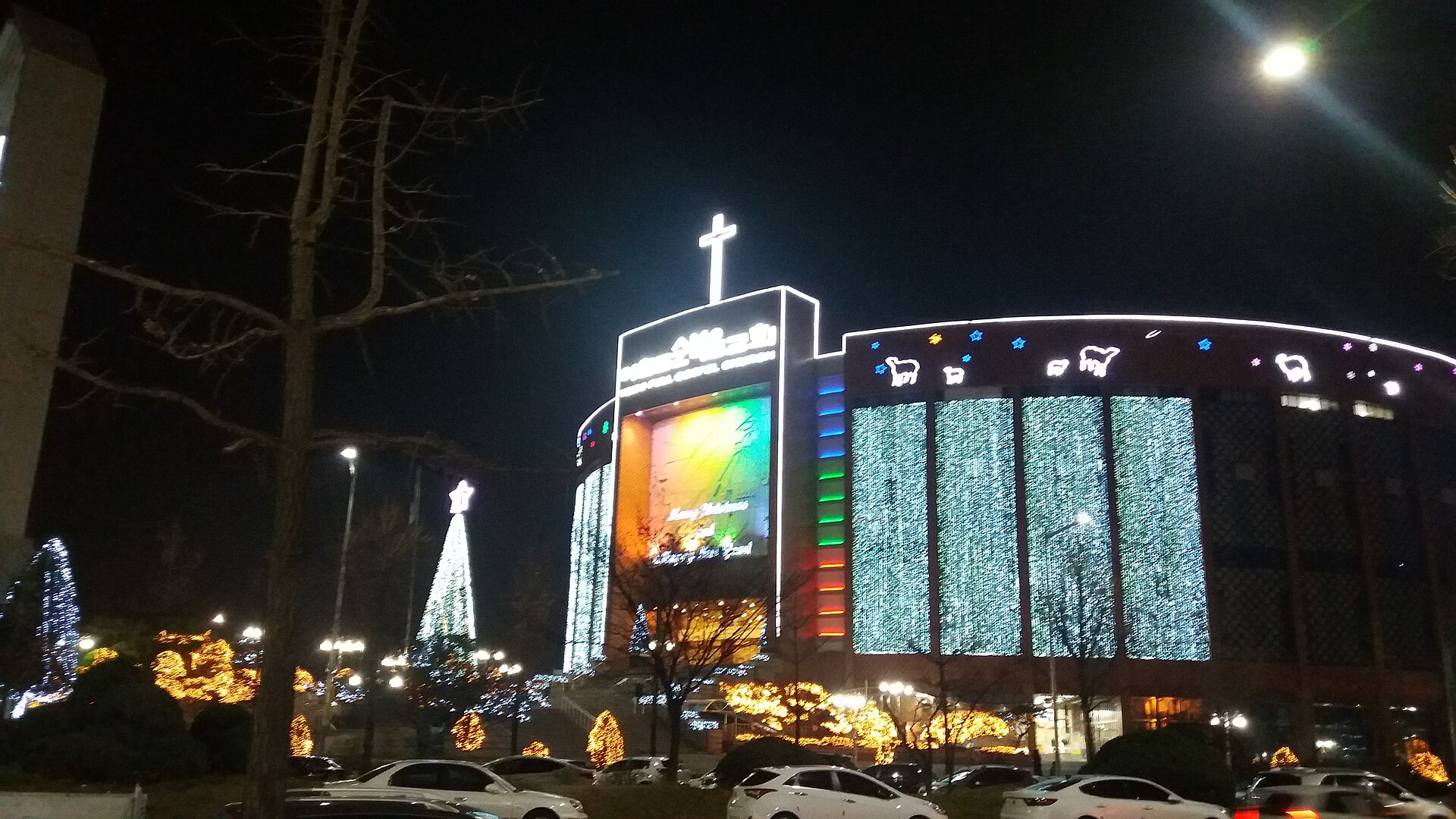
The lesson's main figures in one table, each with its source and year. The photographs above show the Edinburgh conference hall of 1910, an Indian delegate's portrait from the same summer, and two churches of the present Global South, in Seoul and Abuja.
| What | Figure | Year of the figure | Source |
|---|---|---|---|
| Share of world's Christians living in Europe | about two-thirds | 1910 | Pew 2011, from CSGC estimates1 |
| Share of world's Christians in the Global North | over 80% | 1910 | CSGC 20133 |
| Christians in sub-Saharan Africa | fewer than 9 million | 1910 | Pew 20111 |
| Christians in sub-Saharan Africa | more than 516 million (24%) | 2010 | Pew 20111 |
| Christians in sub-Saharan Africa | 697 million (30.7%) | 2020 | Pew 202582 |
| Christians in Europe | 505 million (22.3%) | 2020 | Pew 202582 |
| Latin America and the Caribbean; North America | 24%; 10% (238 million) | 2020 | Pew 20252 |
| World Christians | 2.3 billion, 28.8% of the world | 2020 | Pew 20258 |
| World Christians (CSGC method) | 2.3 billion, 32.8% of the world | 2010 | CSGC9 |
| Global South share of all Christians | 43% (1970); 59% (2010) | 1970, 2010 | CSGC 20133 |
| Delegates at Edinburgh | about 1,200 | 1910 | Morrison14 |
| Participants at Lausanne | 2,300 to 2,400, from 150 nations | 1974 | Lausanne Movement1516 |
| Participants at Cape Town | 4,000 from 198 countries | 2010 | Lausanne Movement15 |
| Participants at Seoul-Incheon | more than 5,200, 202 nationalities | 2024 | Evangelical Focus18 |
| International missionaries, all traditions | about 400,000 | 2010 | CSGC 20133 |
| Sent by the United States; Brazil; South Korea | 127,000; 34,000; 20,000 | 2010 | CSGC 20133 |
| Received by the United States | 32,400 | 2010 | CSGC 20133 |
| Share of missionaries going to the ten countries with most non-Christians | 9% | 2010 | CSGC 20133 |
| Global South share of Christian financial resources | 17% | about 2010 | CSGC 20133 |
| Unreached people groups (Joshua Project, by country) | 7,163 of 16,419 (43.6%); 3.64 billion people | 2026 page | Joshua Project22 |
| Unreached groups in the 10/40 Window | 5,905 of 8,572 (68.9%) | 2026 page | Joshua Project24 |
| U.S. short-term mission travelers | more than 1.5 million a year | 2006 estimate | Priest and others, cited by Green25 |
| Gospel for Asia settlement | $37 million; about 200,000 donors in the class | 2019 | Christianity Today4 |
| Indian states with conversion laws | 10 of 28 | 2023 | State Department30 |
| Nepal penalty for conversion by coercion or inducement | 5 years and up to 50,000 rupees | 2023 report | State Department31 |
| Countries with high or very high government restrictions on religion | 59 of 198 | 2022 | Pew 202432 |
| Haiti kidnapping | 17 taken (16 Americans, 1 Canadian; 5 minors) | 2021 | Associated Press7 |
Claims checked
"Most Christians now live in the Global South." Supported.
Pew counted 61 percent of Christians in the Global South in 2010, and the CSGC counted 59 percent the same year.13 By Pew's 2020 figures, sub-Saharan Africa (31 percent), Latin America and the Caribbean (24 percent) and the Asia-Pacific and Middle East-North Africa remainder (about 13 percent) together hold about two-thirds of the world's Christians.2 The two bodies' totals differ by method, but both agree on the direction and rough size of the shift.
"Africa is now the center of world Christianity." Partly supported.
Measured by numbers, sub-Saharan Africa became the region with the largest share of Christians by 2020: "30.7% of the world's Christians live in sub-Saharan Africa, compared with 22.3% in Europe."8 But 31 percent is not a majority, the Americas together still hold about a third, and "center" can also mean money, institutions, scholarship and sending power, where the CSGC found the South held only 17 percent of Christian financial resources.23 The claim is true of headcount and open to dispute on other measures.
"The United States sends the most missionaries." Supported, for the last full count.
The CSGC's 2010 table puts the United States first with 127,000 of about 400,000, nearly four times Brazil's 34,000.3 Per million church members the United States ranked ninth.3 No newer country-by-country table of the same scope was found for this lesson.
"Most missionaries go to people who have never heard the gospel." Refuted by the counts.
The CSGC found that the ten countries with the most non-Christians "received only 9% of all international missionaries," while the nine Christian-majority countries at the top of the receiving list took "more than 34%."3 Many missionaries serve existing churches, and many countries with large non-Christian populations restrict entry.3
"Edinburgh 1910 had no delegates from the non-Western churches." Refuted.
A small number of Asian delegates attended, among them V. S. Azariah of India, whose "Give us FRIENDS" speech is the most quoted of the conference, and Morrison noticed Japanese, Chinese, Indian and African participants.1314 The number was small against about 1,200 delegates, and the exact count is given differently by historians.
"Lausanne 1974 drew 2,700 participants." Unresolved.
The Lausanne Movement's own pages give "2,400 mission-minded participants from 150 nations" and, in a 2023 article, about 2,300.1516 The figure 2,700 appears in popular accounts and may include observers or staff; it was not found in a source the movement publishes. (The Covenant's own number, "More than 2,700 million people," refers to the unevangelized, not to participants, and may be the origin of the confusion.)17
"Luis Bush coined the 10/40 Window in 1990." Partly supported.
Bush used and promoted the term through the AD2000 and Beyond Movement, and defined it in his own 1996 paper as "the area of ten to forty degrees North of the equator from West Africa to East Asia."23 The first use, usually placed at the Manila congress of 1989 or in a 1990 paper, was not confirmed from a primary document for this lesson.
"Gospel for Asia admitted fraud." Refuted.
GFA paid $37 million to settle the donor class action in 2019 without admitting wrongdoing; its spokesman said it "did not act fraudulently."4 The fraud claims were never tried. ECFA's 2015 findings that GFA misled donors and violated most of its standards are a finding by an accrediting body, not a court.4
"India has banned conversion to Christianity." Refuted as stated.
No national law bans conversion. Ten of India's 28 states, as of the State Department's 2023 report, have laws that restrict conversion by force, fraud or inducement, require notice to officials, and in Gujarat require prior permission from the district magistrate.30 The laws are enforced, sometimes heavily (the report cites hundreds of arrests in Uttar Pradesh), and Christian bodies say they are misused, but conversion itself remains lawful when the procedures are followed.30
"Short-term mission trips do more harm than good." Unresolved.
Researchers found little lasting change in participants' giving and habits (Livermore, as quoted in 2006), and orphanage visits in particular were linked by the Australian government's inquiry to trafficking.2628 Defenders point to well-run trips under local leadership. No large study measures outcomes for host communities, and Dana Robert's "The jury is still out" remains a fair summary.26
"Chau's last letter said: I think it's worth it to declare Jesus to these people." Partly supported.
The sentiment is documented, but two printings differ: "I think it's worth it" (Christianity Today) and "I think its worthwhile" (Al Jazeera, citing The Washington Post).634 Without a published facsimile, the exact wording is unresolved.
Hard questions and answers
If most Christians now live in the South, why does the North still send so many missionaries?
Because missionaries follow money and institutions as well as believers. The CSGC found the Global South held 60 percent of Christians but only 17 percent of Christian financial resources, and the old sending countries still have the agencies, training schools and support networks built over two centuries.3 The sending base is moving, as the CSGC's top-twenty list shows, but more slowly than the population of the church.3
Does a law against conversion by "inducement" violate religious freedom?
The answer depends on whose definition of freedom is used, and the parties state theirs plainly. The Lausanne Covenant claims "freedom to practise and propagate religion" as a right "as set out in The Universal Declaration of Human Rights."17 The U.S. Congress, in the 1998 act, calls freedom of religion "the fundamental right" and set up reporting on foreign laws.5 The Indian states and Nepal, in their laws, treat conversion by money or benefits as a wrong done to poor and low-caste people and to communities; Nepal's code also punishes acts that undermine "the religion, faith, or belief" of a caste or ethnic group.31 Both sides agree that force and bribery are wrong. They disagree over whether schools, hospitals and aid offered by missions count as inducement, and who decides.
Was John Allen Chau a martyr or a trespasser?
The facts are agreed: he went to an island where Indian law forbids contact, paid fishermen to take him, and was killed by people who have refused outsiders for generations.635 His sending agency called him "a gracious and sensitive ambassador of Jesus Christ"; India's local police chief called the trip a "misplaced adventure"; Survival International said the tragedy "should never have been allowed to happen."634 Whether to call him a martyr is a theological judgment that depends on how a reader weighs motive, method and law. The Sentinelese, who have not spoken to the outside world, are the one party whose view no one can report.
What should a donor ask before sponsoring a "native missionary"?
The Gospel for Asia case shows the questions: whether the agency publishes audited financial statements, whether it is accredited by a body such as ECFA and has stayed accredited, whether its board is independent of the founder, and whether money sent abroad can be traced to the field.4 Lesson 12 of this module covers Form 990 filings and accreditation in more detail; lesson 14 gathers these questions into a checklist.
Is the growth of Christianity in Africa and Asia the fruit of Western missions, or did it happen in spite of them?
Historians answer this differently. Sanneh argued that translation into local languages let Africans take hold of the faith on their own terms, often beyond missionary control; Walls stressed that African and Asian evangelists and catechists did most of the work; Jenkins stressed the indigenous and Pentecostal character of much of the growth, which accelerated after colonial rule ended.111012 The numbers support a both-and reading: Africa's Christians rose from under 9 million in 1910, when missions were at their height, to more than 516 million in 2010, most of the growth coming after the missionaries had handed churches to local leaders.1 Readers whose families were on the receiving end of missions, and descendants of missionaries, can both find support in that record.
Why trust any of these numbers?
Trust them as estimates with stated methods. Pew relies mainly on censuses and surveys; the CSGC adds church and mission statistics and counts by self-identification; the Joshua Project counts castes as separate peoples and posts its definitions.921 When their figures differ, as they do for the world's Christian total, the difference is explained by method, not by error alone. The safest practice, followed in this lesson, is to name the body and the year every time.
Learn more
- Lausanne Covenant (full text): The 1974 statement in fifteen sections; short enough to read in one sitting, and the base text for later evangelical mission statements.
- Christianity in its Global Context, 1970 to 2020 (CSGC, 2013): The source of the missionary sending and receiving tables and the unreached-peoples comparison; free PDF with maps and charts.
- Pew Research Center, Global Christianity (2011): The clearest short account of the 1910 to 2010 shift, with regional charts.
- Pew Research Center, Christian population change 2010 to 2020 (2025): The latest regional counts, including Africa passing Europe.
- Joshua Project definitions: How one of the main people-group lists defines its terms; useful for reading any mission statistic critically.
- U.S. State Department, 2023 Report on International Religious Freedom: India: State-by-state summary of conversion laws, cases and the rules for foreign missionaries and foreign funding.
- Module 102, lesson 09: The Missionary Martyrs: The deaths of missionaries told in full, which this lesson only mentions.
Still being checked (17 items)
These points could not be confirmed against a primary source when this lesson was written and fact checked in October 2026. The text above states each one as uncertain.
- Exact number of Asian (non-Western) delegates at Edinburgh 1910: often given as 17 to 19 with no sub-Saharan African church delegate; no primary delegate list was checked.
- Lausanne 1974 attendance: the Lausanne Movement gives 2,400 (legacy page) and about 2,300 (2023 article); the popular figure 2,700 was not found in a Lausanne source.
- Billy Graham's role in calling Lausanne 1974 and John Stott's role in drafting the Covenant are stated from standard histories, not checked against a primary document here.
- Dates of later bodies from Edinburgh (International Missionary Council 1921, World Council of Churches 1948) and the Panama Congress of 1916: from standard histories, not checked against primary documents.
- V. S. Azariah as the first Indian Anglican bishop (consecrated 1912 by standard accounts): not checked against a primary source.
- Ralph Winter's founding of the U.S. Center for World Mission (usually dated 1976): from standard accounts.
- Origin of the term 10/40 Window (usually dated to Luis Bush at Manila 1989 or a 1990 paper): first use not confirmed from a primary document; only Bush's 1996 paper was opened.
- Manila 1989 congress details (dates, attendance) were not checked; only the year and the Manila Manifesto are sourced.
- ECFA's removal of Gospel for Asia is dated to 2015 by Christianity Today; the exact day (reported in October 2015 by WORLD) was not confirmed.
- The court in the Gospel for Asia class action is identified only from an Arkansas federal (Western District) docket link in press coverage; the case caption and number were not checked on the docket.
- Nepal criminal code section number (commonly cited as section 158 of the Muluki Criminal Code 2017, in force August 2018) and the 2015 date of the constitution were not confirmed from the code or constitution text.
- Wuthnow's figure of about 1.6 million U.S. short-term travelers is reported secondhand by The Christian Science Monitor (2006); Wuthnow's own publication was not opened.
- The summaries of Walls (1996), Sanneh (2003), Jenkins (2002) and Corbett and Fikkert (2009) are paraphrased from general knowledge of these books; the books were not reopened for this lesson.
- Chau's last letter exists in two printed wordings ("it's worth it" in Christianity Today; "its worthwhile" in Al Jazeera citing The Washington Post); no facsimile was found. Date of death given as November 16 (fishermen to police) or November 17 (Christianity Today).
- The 1910 shares for sub-Saharan Africa (about 1.5 percent) and Asia-Pacific plus Middle East (about 5.5 percent), and the 2020 remainder (about 13 percent), were computed for the chart from Pew's stated counts and shares; Pew's own chart values were not available as text.
- No country-by-country count of international missionaries newer than the CSGC 2010 table was found in checkable form; founding dates and staff counts of Indian and Nigerian mission agencies were not confirmed and are not given.
- The Joshua Project figures (16,419 groups; 7,163 unreached) are from its live page in November 2026, which carries no data date.
Notes
- Pew Research Center, Global Christianity: A Report on the Size and Distribution of the World's Christian Population, executive summary, December 19, 2011 (including its definition of the Global North and South); 1910 figures from historical estimates by the Center for the Study of Global Christianity (retrieved Nov. 12, 2026). Read it online. ↩
- Pew Research Center, report on global religious change 2010 to 2020, chapter 2, "Christian population change," June 9, 2025 (retrieved Nov. 12, 2026). Read it online. ↩
- Todd M. Johnson, Gina A. Bellofatto, Albert W. Hickman, Bradley A. Coon, Mary E. Krause and Sujin Park, Christianity in its Global Context, 1970 to 2020: Society, Religion, and Mission (South Hamilton, Mass.: Center for the Study of Global Christianity, Gordon-Conwell Theological Seminary, June 2013), pp. 14, 76 to 77, 80 to 81 and 85; the 2010 missionary table draws on Todd M. Johnson and Kenneth R. Ross, eds., Atlas of Global Christianity (Edinburgh University Press, 2009) (retrieved Nov. 12, 2026). Read it online. ↩
- Sarah Eekhoff Zylstra, "Gospel for Asia Settles Lawsuit with $37 Million Refund to Donors," Christianity Today, March 1, 2019 (retrieved Nov. 12, 2026). Read it online. ↩
- International Religious Freedom Act of 1998, Public Law 105-292, 112 Stat. 2787, October 27, 1998, sections 1, 2, 101, 102(b), 201 and 402(b), U.S. Government Publishing Office (retrieved Nov. 12, 2026). Read it online. ↩
- "Missionary Killed by Isolated Tribe on Indian Island," Christianity Today, November 21, 2018 (statements of All Nations, Oral Roberts University and the Andaman and Nicobar police; Chau's letter as printed there) (retrieved Nov. 12, 2026). Read it online. ↩
- Associated Press, "Missionaries Who Were Kidnapped in Haiti Escaped from Their Abductors, Aid Group Says," December 20, 2021, as published by WUSF Public Media (retrieved Nov. 12, 2026). Read it online. ↩
- Pew Research Center, report on how the world's religious composition changed from 2010 to 2020, overview, June 9, 2025 (cited by URL because its title contains a word this site does not use) (retrieved Nov. 12, 2026). Read it online. ↩
- Center for the Study of Global Christianity, "Quick Facts About Global Christianity" (frequently asked questions), Gordon-Conwell Theological Seminary, undated web page (retrieved Nov. 12, 2026). Read it online. ↩
- Andrew F. Walls, The Missionary Movement in Christian History: Studies in the Transmission of Faith (Maryknoll, N.Y.: Orbis Books, 1996); interpretation summarized and attributed, not quoted. ↩
- Lamin Sanneh, Whose Religion Is Christianity? The Gospel beyond the West (Grand Rapids: Eerdmans, 2003); interpretation summarized and attributed, not quoted. ↩
- Philip Jenkins, The Next Christendom: The Coming of Global Christianity (New York: Oxford University Press, 2002); interpretation summarized and attributed, not quoted. ↩
- International Bulletin of Missionary Research 30, no. 4 (October 2006): editor's introduction, p. 170 (conference dates; V. S. Azariah's appeal), and Brian Stanley, "Defining the Boundaries of Christendom: The Two Worlds of the World Missionary Conference, 1910," pp. 171 to 176 (retrieved Nov. 12, 2026). Read it online. ↩
- Charles Clayton Morrison, "The World Missionary Conference," The Christian Century, July 7, 1910 (dateline Edinburgh, June 20, 1910), as reprinted at Religion Online (retrieved Nov. 12, 2026). Read it online. ↩
- Lausanne Movement, "The Lausanne Story" (our legacy), web page (retrieved Nov. 12, 2026). Read it online. ↩
- Sara Kyoungah White, "The Impact of Lausanne Congresses," Lausanne Movement blog, March 28, 2023 (retrieved Nov. 12, 2026). Read it online. ↩
- The Lausanne Covenant (International Congress on World Evangelization, Lausanne, July 1974), introduction and sections 5, 6, 8, 9, 10 and 13, with the Lausanne Movement's 2024 endnote to section 9 (retrieved Nov. 12, 2026). Read it online. ↩
- "Lausanne 4 Concludes with Call to 'Accelerate Mission through Collaboration'," Evangelical Focus, September 30, 2024 (retrieved Nov. 12, 2026). Read it online. ↩
- India Missions Association, home page (self-description), Hyderabad (retrieved Nov. 12, 2026). Read it online. ↩
- Stephanie Martin, "Gospel for Asia Settles for $37 Million Over Fraud Charges," ChurchLeaders, August 1, 2019 (on the Murphy suit and the Arkansas federal docket) (retrieved Nov. 12, 2026). Read it online. ↩
- Joshua Project, "Definitions" (unreached or least-reached, people group, frontier people group, peoples-by-country) (retrieved Nov. 12, 2026). Read it online. ↩
- Joshua Project, "Global Progress" summary table (people groups by country; data undated, page copyright 2026) (retrieved Nov. 12, 2026). Read it online. ↩
- Luis Bush, "A Brief Historical Overview of the AD2000 and Beyond Movement and Joshua Project 2000," paper presented at the North East Asia AD2000/Joshua Project 2000 Consultation, Seoul, May 27 to 30, 1996 (retrieved Nov. 12, 2026). Read it online. ↩
- Joshua Project, "The 10/40 Window" (revised window statistics; page copyright 2026) (retrieved Nov. 12, 2026). Read it online. ↩
- Gary L. Green, "Short-Term Missions among Churches of Christ: A National Survey," Missio Dei Journal 8, no. 1 (Winter to Spring 2017), citing Robert J. Priest, Terry Dischinger, Steve Rasmussen and C. M. Brown, "Researching the Short-Term Mission Movement," Missiology 34, no. 4 (October 2006): 432, and Gilles Gravelle, "Short-Term Missions and Money" (retrieved Nov. 12, 2026). Read it online. ↩
- G. Jeffrey MacDonald, "Rise of Sunshine Samaritans: On a Mission or Holiday?" The Christian Science Monitor, May 25, 2006 (retrieved Nov. 12, 2026). Read it online. ↩
- Steve Corbett and Brian Fikkert, When Helping Hurts: How to Alleviate Poverty without Hurting the Poor and Yourself (Chicago: Moody Publishers, 2009); argument summarized in paraphrase, not quoted. ↩
- Kate van Doore, "Australian Law Set to Tackle Orphanage Trafficking in Travel Company Supply Chains," Griffith University News, June 29, 2018 (on the Modern Slavery Bill and its Explanatory Memorandum, and the November 2017 inquiry report Hidden in Plain Sight) (retrieved Nov. 12, 2026). Read it online. ↩
- Australian Minister for Foreign Affairs, "New Campaign to Tackle Orphanage Tourism," media release, March 1, 2018 (retrieved Nov. 12, 2026). Read it online. ↩
- U.S. Department of State, Office of International Religious Freedom, 2023 Report on International Religious Freedom: India (2024) (retrieved Nov. 12, 2026). Read it online. ↩
- U.S. Department of State, Office of International Religious Freedom, 2023 Report on International Religious Freedom: Nepal (2024) (retrieved Nov. 12, 2026). Read it online. ↩
- Samirah Majumdar, "Government Restrictions on Religion Stayed at Peak Levels Globally in 2022," Pew Research Center, December 18, 2024 (retrieved Nov. 12, 2026). Read it online. ↩
- Code of Federal Regulations, title 8, section 214.2(r)(1), "Religious workers," as published by the Legal Information Institute, Cornell Law School (retrieved Nov. 12, 2026). Read it online. ↩
- "US Missionary Killed by Endangered Andaman Island Tribesmen," Al Jazeera, November 22, 2018 (quoting Chau's notes as reported by The Washington Post, and Stephen Corry of Survival International) (retrieved Nov. 12, 2026). Read it online. ↩
- "Andaman: Seven Fishermen Arrested in Connection with Murder of American Allegedly by Protected Tribe," Scroll.in, November 21, 2018 (retrieved Nov. 12, 2026). Read it online. ↩
Check yourself
1. By the Pew Research Center's count, about what share of the world's Christians lived in Europe in 1910?
Pew's 2011 report, using CSGC historical estimates, says "In 1910, about two-thirds of the world's Christians lived in Europe."
2. Which region held the largest share of the world's Christians in 2020, according to Pew's 2025 report?
Pew found 30.7 percent of Christians in sub-Saharan Africa and 22.3 percent in Europe in 2020.
3. In the CSGC's count for 2010, which country sent the most international missionaries?
The United States sent about 127,000 of roughly 400,000 international missionaries; Brazil was second with 34,000.
4. What share of international missionaries went to the ten countries with the most non-Christians in 2010, by the CSGC's count?
Those ten countries held 73 percent of non-Christians but, since many restrict access, received only 9 percent of international missionaries.
5. Which document said missions had "all too frequently, exported with the gospel an alien culture"?
Section 10 of the Lausanne Covenant, "Evangelism and Culture," contains that confession.
6. How does the Joshua Project define an unreached people group?
Its definitions page gives "Less than or equal to 5% Christian Adherent AND less than or equal to 2% Evangelical." The 50 percent test is the CSGC's different "least-evangelized" measure.
7. What did the 2019 Gospel for Asia settlement include?
Christianity Today reported a $37 million settlement and a board seat; GFA denied acting fraudulently and the claims were never tried.
8. As of the State Department's 2023 report, how many of India's 28 states had laws restricting religious conversion?
The report lists ten: Chhattisgarh, Gujarat, Haryana, Himachal Pradesh, Karnataka, Jharkhand, Madhya Pradesh, Odisha, Uttarakhand and Uttar Pradesh.
Terms in this lesson
- Global South
- In religious statistics, roughly Africa, Asia, Latin America and Oceania outside Australia and New Zealand; contrasted with the Global North of Europe and North America. A rough, historical grouping, not a strict line of latitude.
- Center for the Study of Global Christianity (CSGC)
- A research center at Gordon-Conwell Theological Seminary that keeps the World Christian Database and counts Christians and missionaries partly from church and mission statistics, using self-identification.
- World Missionary Conference (Edinburgh 1910)
- The gathering of about 1,200 Protestant mission delegates in Edinburgh in June 1910, chaired by John R. Mott, often taken as the start of the modern ecumenical movement.
- Lausanne Covenant
- The statement adopted at the International Congress on World Evangelization at Lausanne in July 1974, on evangelism, social responsibility, culture, partnership and religious freedom.
- Unreached people group (UPG)
- A people group without an indigenous church able to evangelize it without outside help; the Joshua Project uses at or under 5 percent Christian and at or under 2 percent evangelical, the IMB under 2 percent evangelical.
- People group
- For mission planning, "the largest group within which the Gospel can spread without encountering barriers of understanding or acceptance" (Lausanne Strategy Working Group, 1982, as quoted by the CSGC).
- 10/40 Window
- The band of the map between 10 and 40 degrees north latitude from West Africa to East Asia, promoted by Luis Bush and the AD2000 and Beyond Movement as the priority region for missions.
- Short-term mission (STM)
- A mission trip of a week to a few months, usually by church members or students; estimated at more than 1.5 million U.S. travelers a year in 2006.
- Orphanage tourism
- Visits and volunteering at overseas orphanages, which Australian authorities and researchers linked to the recruitment and trafficking of children from families; Australia's Modern Slavery Bill of 2018 included orphanage trafficking.
- Anti-conversion law
- A law restricting conversion by force, fraud or inducement and requiring notice to officials, found in ten Indian states as of 2023 and in Nepal's constitution and criminal code.
- R-1 visa
- The U.S. nonimmigrant classification for religious workers: at least two years' prior membership in the denomination, an average of at least 20 hours of work a week, and a stay not to exceed five years.
- International Religious Freedom Act (IRFA)
- The U.S. law of October 27, 1998 (Pub. L. 105-292) that created the Ambassador at Large for International Religious Freedom, the annual reports, USCIRF and the Countries of Particular Concern designation.
- ECFA
- The Evangelical Council for Financial Accountability, a U.S. accrediting body for Christian charities, which removed Gospel for Asia from membership in 2015.
- Native missionary sponsorship
- A fundraising model in which donors in rich countries support local evangelists in Asia or Africa, on the reasoning that local workers cost less and already know the language.
Sources
- Pew Research Center, Global Christianity: A Report on the Size and Distribution of the World's Christian Population, executive summary, December 19, 2011; 1910 figures from historical estimates by the Center for the Study of Global Christianity (2011-12-19) checked 2026-10
- Pew Research Center, report on global religious change 2010 to 2020, chapter 2, "Christian population change," June 9, 2025 (2025-06-09) checked 2026-10
- Todd M. Johnson, Gina A. Bellofatto, Albert W. Hickman, Bradley A. Coon, Mary E. Krause and Sujin Park, Christianity in its Global Context, 1970 to 2020: Society, Religion, and Mission (South Hamilton, Mass.: Center for the Study of Global Christianity, Gordon-Conwell Theological Seminary, June 2013), pp. 14, 76 to 77, 80 to 81 and 85; the 2010 missionary table draws on Todd M. Johnson and Kenneth R. Ross, eds., Atlas of Global Christianity (Edinburgh University Press, 2009) (2013-06) checked 2026-10
- "Gospel for Asia Settles Class Action, Will Refund Donors $37 Million," Christianity Today, March 1, 2019 (2019-03-01) checked 2026-10
- International Religious Freedom Act of 1998, Public Law 105-292, 112 Stat. 2787, October 27, 1998, sections 1, 2, 101, 102(b), 201 and 402(b), U.S. Government Publishing Office (1998-10-27) checked 2026-10
- "Missionary Killed by Isolated Tribe on Indian Island," Christianity Today, November 21, 2018 (statements of All Nations, Oral Roberts University and the Andaman and Nicobar police; Chau's letter as printed there) (2018-11-21) checked 2026-10
- Associated Press, "Missionaries Who Were Kidnapped in Haiti Escaped from Their Abductors, Aid Group Says," December 20, 2021, as published by WUSF Public Media (2021-12-20) checked 2026-10
- Pew Research Center, report on how the world's religious composition changed from 2010 to 2020, overview, June 9, 2025 (cited by URL because its title contains a word this site does not use) (2025-06-09) checked 2026-10
- Center for the Study of Global Christianity, "Quick Facts About Global Christianity" (frequently asked questions), Gordon-Conwell Theological Seminary, undated web page (undated) checked 2026-10
- Andrew F. Walls, The Missionary Movement in Christian History: Studies in the Transmission of Faith (Maryknoll, N.Y.: Orbis Books, 1996); interpretation summarized and attributed, not quoted. (1996) checked 2026-10
- Lamin Sanneh, Whose Religion Is Christianity? The Gospel beyond the West (Grand Rapids: Eerdmans, 2003); interpretation summarized and attributed, not quoted. (2003) checked 2026-10
- Philip Jenkins, The Next Christendom: The Coming of Global Christianity (New York: Oxford University Press, 2002); interpretation summarized and attributed, not quoted. (2002) checked 2026-10
- International Bulletin of Missionary Research 30, no. 4 (October 2006): editor's introduction, p. 170 (conference dates; V. S. Azariah's appeal), and Brian Stanley, "Defining the Boundaries of Christendom: The Two Worlds of the World Missionary Conference, 1910," pp. 171 to 176 (2006-10) checked 2026-10
- Charles Clayton Morrison, "The World Missionary Conference," The Christian Century, July 7, 1910 (dateline Edinburgh, June 20, 1910), as reprinted at Religion Online (1910-07-07) checked 2026-10
- Lausanne Movement, "The Lausanne Story" (our legacy), web page (undated) checked 2026-10
- Sara Kyoungah White, "The Impact of Lausanne Congresses," Lausanne Movement blog, March 28, 2023 (2023-03-28) checked 2026-10
- The Lausanne Covenant (International Congress on World Evangelization, Lausanne, July 1974), introduction and sections 5, 6, 8, 9, 10 and 13, with the Lausanne Movement's 2024 endnote to section 9 (1974-07) checked 2026-10
- "Lausanne 4 Concludes with Call to 'Accelerate Mission through Collaboration'," Evangelical Focus, September 30, 2024 (2024-09-30) checked 2026-10
- India Missions Association, home page (self-description), Hyderabad (2025) checked 2026-10
- Stephanie Martin, "Gospel for Asia Settles for $37 Million Over Fraud Charges," ChurchLeaders, August 1, 2019 (on the Murphy suit and the Arkansas federal docket) (2019-08-01) checked 2026-10
- Joshua Project, "Definitions" (unreached or least-reached, people group, frontier people group, peoples-by-country) (2026) checked 2026-10
- Joshua Project, "Global Progress" summary table (people groups by country; data undated, page copyright 2026) (2026) checked 2026-10
- Luis Bush, "A Brief Historical Overview of the AD2000 and Beyond Movement and Joshua Project 2000," paper presented at the North East Asia AD2000/Joshua Project 2000 Consultation, Seoul, May 27 to 30, 1996 (1996-05) checked 2026-10
- Joshua Project, "The 10/40 Window" (revised window statistics; page copyright 2026) (2026) checked 2026-10
- Gary L. Green, "Short-Term Missions among Churches of Christ: A National Survey," Missio Dei Journal 8, no. 1 (Winter to Spring 2017), citing Robert J. Priest, Terry Dischinger, Steve Rasmussen and C. M. Brown, "Researching the Short-Term Mission Movement," Missiology 34, no. 4 (October 2006): 432, and Gilles Gravelle, "Short-Term Missions and Money" (2017) checked 2026-10
- G. Jeffrey MacDonald, "Rise of Sunshine Samaritans: On a Mission or Holiday?" The Christian Science Monitor, May 25, 2006 (2006-05-25) checked 2026-10
- Steve Corbett and Brian Fikkert, When Helping Hurts: How to Alleviate Poverty without Hurting the Poor and Yourself (Chicago: Moody Publishers, 2009); argument summarized in paraphrase, not quoted. (2009) checked 2026-10
- Kate van Doore, "Australian Law Set to Tackle Orphanage Trafficking in Travel Company Supply Chains," Griffith University News, June 29, 2018 (on the Modern Slavery Bill and its Explanatory Memorandum, and the November 2017 inquiry report Hidden in Plain Sight) (2018-06-29) checked 2026-10
- Australian Minister for Foreign Affairs, "New Campaign to Tackle Orphanage Tourism," media release, March 1, 2018 (2018-03-01) checked 2026-10
- U.S. Department of State, Office of International Religious Freedom, 2023 Report on International Religious Freedom: India (2024) (2024) checked 2026-10
- U.S. Department of State, Office of International Religious Freedom, 2023 Report on International Religious Freedom: Nepal (2024) (2024) checked 2026-10
- Samirah Majumdar, "Government Restrictions on Religion Stayed at Peak Levels Globally in 2022," Pew Research Center, December 18, 2024 (2024-12-18) checked 2026-10
- Code of Federal Regulations, title 8, section 214.2(r)(1), "Religious workers," as published by the Legal Information Institute, Cornell Law School (current) checked 2026-10
- "US Missionary Killed by Endangered Andaman Island Tribesmen," Al Jazeera, November 22, 2018 (quoting Chau's notes as reported by The Washington Post, and Stephen Corry of Survival International) (2018-11-22) checked 2026-10
- "Andaman: Seven Fishermen Arrested in Connection with Murder of American Allegedly by Protected Tribe," Scroll.in, November 21, 2018 (2018-11-21) checked 2026-10