Lesson 3 of 14 · about 55 minutes · Updated November 12, 2026
The Great Awakening and the First Mission Societies
You'll be able to
- Trace the written chain from the Scottish prayer memorial of 1744 and Edwards's Humble Attempt (1747) to the Baptist prayer call of 1784 and the Baptist Missionary Society of 1792.
- Describe the missions at Stockbridge, Lebanon, Montauk and Oneida from the missionaries' own writings and from the published histories of the Mohican and Oneida nations.
- Explain, in Samson Occom's and Eleazar Wheelock's own words, the dispute over Occom's pay and over the purpose of Dartmouth College.
- Name the founding date, place and church tradition of each society from the SPCK (1698/9) to the Methodist Episcopal society (1819).
- Explain how the societies raised money (subscriptions, auxiliaries, women's and cent societies, magazines, legacies) and read a sample year of the American Board's accounts.
- Weigh competing readings of the societies: as obedience to a command, as a new church form, and as part of the colonial record of land and power.
Start here: the short version
The revivals of the 1730s and 1740s in Britain and its American colonies (the First Great Awakening, taught in module 105) did not by themselves send missionaries overseas. What they did was produce three things that later made the modern mission society possible: a habit of praying together across distances for the spread of the gospel (Jonathan Edwards's Humble Attempt of 1747 and the "Concert of Prayer"), a set of missions to Native nations in New England and New York (Edwards at Stockbridge, Eleazar Wheelock's school, Samson Occom, Samuel Kirkland), and a generation of ministers who read those stories. Between 1792 and 1819 those ministers founded the voluntary societies that ran Protestant missions for the next century: the Baptist Missionary Society (1792), the London Missionary Society (1795), the Church Missionary Society (1799), the British and Foreign Bible Society (1804), the American Board of Commissioners for Foreign Missions (1810), the Baptist Triennial Convention (1814), the American Bible Society (1816) and the Methodist Episcopal Church's missionary society (1819). They were paid for by subscriptions, local auxiliaries, women's "cent societies", legacies and magazines. The record also contains a sharp complaint from inside the system: Samson Occom, a Mohegan minister, wrote that the same Boston commissioners who paid a young missionary 180 pounds for one year paid him 180 pounds for twelve years, and that he could find no reason "but I must say, I believe, it is, because I am poor Indian."1 This lesson lays out the societies, their money and that complaint side by side.
Where this lesson fits
Lesson 01 of this module (What Missions Are) followed missions from Paul to the Moravians at Herrnhut. Lesson 02 (Early America) covered John Eliot, the Mayhews and David Brainerd. This lesson picks up the American story where Brainerd's death left it, then crosses to Britain to show how the first large mission societies were organized and funded. Lesson 04 (William Carey) tells the life of Carey and the Baptist mission in India, and lesson 05 (Adoniram and Ann Judson) tells the Haystack prayer meeting and the first American missionaries, so both are only sketched here.
The revivals themselves are taught in module 105: The First Great Awakening, George Whitefield and Jonathan Edwards the Thinker. The Second Great Awakening, out of which the American Board grew, is in module 105, lesson 08. This lesson does not retell those revivals. It asks a narrower question: how did revival turn into organized, paid, long-distance mission work, and who paid for it and who did it?

The Awakening turns outward
What the revival looked like from Mohegan
One of the most direct accounts of what the Awakening meant for Native New England comes from a man it reached. Samson Occom, a Mohegan born near New London, Connecticut, wrote a short autobiography usually dated 1768. The manuscript itself is undated, and Dartmouth's digital edition, the Occom Circle, catalogues it that way; its opening refers to what he had heard "in England and Scotland," so it was written after his return from Britain in 1768.1 Occom described his childhood plainly: "I was Born a Heathen and Brought up In Heathenism 'til I was between 16 and 17 years of age, at a Place called Mohegan in New London Connecticut, in New England." His parents "lived a wandering life, as did all the Indians at Mohegan; they chiefly Depended upon Hunting, Fishing, and Fowling for their Living." He was candid about why his people came to hear the New London minister who preached to them every two weeks in summer: "not that they regarded the Christian Religion, But they had Blankets given to them every Fall of the year and for these things they would attend."1
Then the revival arrived. "When I was 16 years of age," Occom wrote, "we heard a Strange Rumor among the English, that there were Extraordinary Ministers Preaching from Place to Place and a Strange Concern among the white People." Ministers and lay people came out to Mohegan to preach and exhort. After about six months of "Trouble of Mind," Occom began to learn his letters from a primer, going to "my English Neighbours frequently for Assistance in Reading, but went to no School." At seventeen he "had as I trust, a Discovery of the way of Salvation through Jesus." From that point he wanted one thing above others: "I use to think if I could once Learn to Read I would Instruct poor Children in Reading."1 That wish, recorded by Occom himself, is the beginning of the story this lesson follows into the founding of Dartmouth College.
The Concert of Prayer and Edwards's Humble Attempt (1747)
The second outward turn was a prayer movement. In October 1744 a group of ministers in Scotland agreed to pray together, and to invite others to pray, for a general revival of religion and the spread of Christ's kingdom. They later sent a printed "Memorial" across the Atlantic asking churches in America to join. Jonathan Edwards, then minister at Northampton, Massachusetts, answered with a book published in Boston in 1747 under a long title that states its whole argument: An Humble Attempt to Promote Explicit Agreement and Visible Union of God's People in Extraordinary Prayer for the Revival of Religion and the Advancement of Christ's Kingdom on Earth, Pursuant to Scripture-Promises and Prophecies Concerning the Last Time.2
Edwards reprinted the Scottish plan. The ministers had agreed, for two years, "To set apart some Time on Saturday-Evening and Sabbath-Morning, every Week, for the Purpose aforesaid, as other Duties would allow to every one respectively; and more solemnly, the first Tuesday of each Quarter (beginning with the first Tuesday of November then next ensuing) either the whole Day, or Part of the Day, as Persons find themselves disposed." The prayers could be offered "either in private praying Societies, or in publick Meetings, or alone in secret," and no one was to be under "strict Bonds" to keep every day.2 (The quotation follows the 1747 Boston printing, with the old long s printed as a modern s.)
The book had a long second life. In 1784 the Northamptonshire Association of Particular Baptists in England, meeting at Nottingham, resolved at John Sutcliff's suggestion to set apart an hour on the first Monday evening of every month "for extraordinary prayer for the revival of religion, and for the extending of Christ's kingdom in the world," according to the 1842 history of the Baptist Missionary Society by F. A. Cox.3 Sutcliff then reprinted Edwards's Humble Attempt in England. William Carey's Enquiry of 1792 points readers to it in a footnote: "See Edwards on Prayer, on this subject, lately re-printed by Mr. Sutcliffe." Carey also credited the monthly meetings: "I trust our monthly prayer-meetings for the success of the gospel have not been in vain."4 The line from a Scottish memorial of 1744, through a Northampton pastor's book of 1747, to an English Baptist prayer call of 1784 and Carey's society of 1792, is one of the few connections in this history that every link of the written record supports.
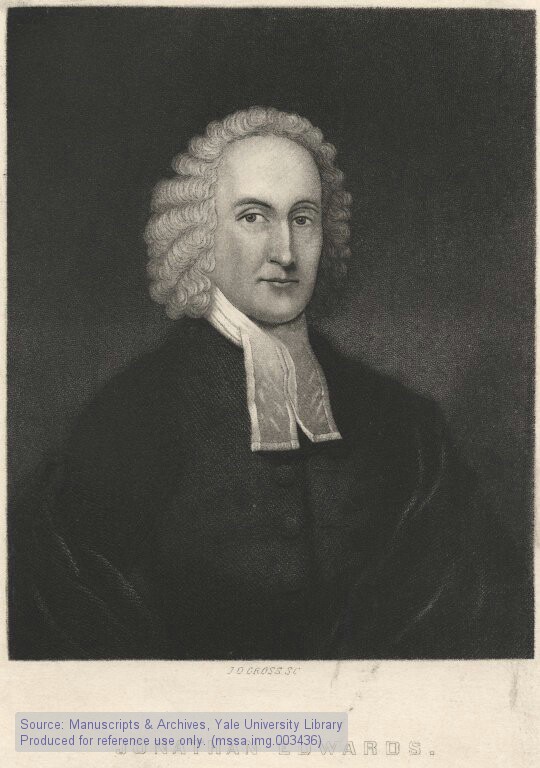

Jonathan Edwards at Stockbridge (1751 to 1758)
The Mohican town and its first missionary
Stockbridge, in the Berkshire hills of western Massachusetts, was a Mohican town before it was a mission. The Stockbridge-Munsee Community, the Mohican nation's present government (now in Wisconsin), gives its own name as Muh-he-con-ne-ok, "The People of the Waters that Are Never Still." Its published history states: "In 1734, a missionary named John Sergeant came to live with the Mohicans in their village of Wnahktukuk," and "In 1738, the Mohicans gave John Sergeant permission to start a mission in the village." Europeans then named the place Stockbridge, after a village in England.5 After Sergeant's death the mission needed a new minister.6
Edwards arrives
Edwards had been dismissed by his Northampton congregation (module 105, lesson 05, covers his life and thought). The commissioners in Boston who managed Indian missions for the London-based Society for the Propagation of the Gospel in New England asked him to take Stockbridge. His friend and first biographer Samuel Hopkins, writing in 1765, recorded that Edwards was invited by the commissioners and by the inhabitants, and "was introduced and fixed as missionary to the Indians there by an ecclesiastical council called for that purpose, August 8. 1751."6
Hopkins described a large plan. Some Mohawk families of the Six Nations were coming to settle at Stockbridge. A boarding school, first projected by Sergeant, was built on land the Stockbridge Indians set aside for it, "where the Indian Children, male and female were to be educated, by being cloathed and fed, and instructed by proper persons in useful learning. And the boys to be learned husbandry or mechanic trades, and the girls all sorts of women's work." The Massachusetts General Court provided land for Mohawk settlers, a London benefactor, "the generous Mr. Hollis" in Hopkins's words, "ordered twenty four Indian Children to be educated on the same footing, wholly at his cost," and the London society's Boston commissioners contributed.6
Hopkins was frank about the outcome: "partly by reason of some unhappy differences that took place among those who had the chief management of this affair at Stockbridge, ... and partly by the war's breaking out between England and France, which is generally very fatal to such affairs among Indians, this hopeful prospect came to nothing." He added: "Mr. Edwards's labours were attended with no remarkable visible success while at Stockbridge: tho' he performed the business of his mission to the good acceptance of the Inhabitants in general, both English and Indians, and of the Commissioners, who supported him honorably."6 Hopkins declined to give "a particular account" of the "unhappy differences."
Stockbridge also gave Edwards time to write. Hopkins called it "a more quiet, and, on many accounts, a much more comfortable situation" than Northampton, and wrote that there "he followed his beloved study more closely." In January 1758 he left for Princeton to become president of the College of New Jersey. He was inoculated against smallpox on February 13 and died of the infection at Princeton on March 22, 1758, "in the 55th Year of his Age," as the title page of Hopkins's book records.6
Stockbridge in Mohican memory
The Stockbridge-Munsee history tells what followed for the town's first people. Its account says that the Mohicans "discovered that their lands were lost through mortgage and debt, and often fraudulent means," that "the tribe began to see its reservation land disappear," and that, after the Oneida offered them land, "The Stockbridge Mohican accepted the invitation and moved to New Stockbridge, near Oneida Lake, in the mid-1780's." Mohican men also fought for the American side in the Revolution; the tribal history records that "In one battle, the Battle of Van Cortlandt's Woods, a number of Stockbridge Mohicans lost their lives." Later removals took the Stockbridge and the Brotherton people to the east shore of Lake Winnebago in Wisconsin in 1834.5
The mission also left a record of the Mohican language. Edwards's son, Jonathan Edwards Jr., who was a boy in the Stockbridge household, later wrote Observations on the Language of the Muhhekaneew Indians, communicated to the Connecticut Society of Arts and Sciences. It was printed at New Haven in 1788 together with a sermon by Samson Occom and reprinted in London the same year, which joins two strands of this lesson in one small book.7
Eleazar Wheelock, Samson Occom and the school that became Dartmouth
Occom at Wheelock's house
Eleazar Wheelock was a Congregational minister at Lebanon, Connecticut, who took in students. In Occom's nineteenth year his mother, on a trip to Lebanon, asked Wheelock whether he would teach her son to read. Occom expected to stay a week or two: "when I got up there, he received me with kindness and Compassion and instead of Staying a Fortnight or 3 weeks, I Spent 4 years with him." Wheelock's friends gave clothes, and "the Honorable Commissioners at Boston, who were Commissioned by the Honorable Society in London for Propagating the gospel among the Indians in New England and parts adjacent" allowed Wheelock "60 £: per annum: both in old tenor, which was about 6 £: Sterling" for two or three years. Occom's health and eyes failed, and after four years, "out of these 4 years, I Lost Just about one Year," he had to stop studying.1 Dartmouth's Native American Program summarizes his background this way: Occom was "a member of the Mohegan tribe and believed to be a direct descendant of its great chief Uncas," born near New London in 1723.8
Wheelock's plan: Native missionaries for Native nations
Occom's progress gave Wheelock an idea that he set out in print in 1763, in A Plain and Faithful Narrative of the Original Design, Rise, Progress and Present State of the Indian Charity-School at Lebanon, in Connecticut. He wanted to train Native boys as missionaries and schoolmasters to their own and neighbouring nations, with some English boys trained beside them who, he wrote, "may learn of them" the Native languages. His reasons were partly practical and partly financial: "An Indian Missionary may be supported with less than half the Expence, that will be necessary to support an Englishman, who can't conform to their Manner of Living, and who will have no Dependance upon them for any Part of it. And an Indian who speaks their Language, it may reasonably be supposed, will be at least four Times as serviceable among them." He also argued that boys from different nations would "easily learn one another's Language" at the school, "and so save the vast Expence and Trouble of Interpreters."9
The first two pupils came from the mission David Brainerd had left in New Jersey, which his brother John Brainerd now ran (lesson 02 tells David Brainerd's work there). Wheelock wrote that John Brainerd sent him "John Pumshire in the 14th, and Jacob Woolley in the 11th Years of their Age; they arrived here December 18th. 1754." The school took its name from Joshua Moor of Mansfield, who gave "a small Tenement in this Place, for the Foundation, Use and Support of a Charity-School, for the Education of Indian Youth."9 Wheelock's printed narratives were themselves part of the fundraising: they printed recommendations of the work and accounts of expenses down to the cost of a boy's journey home of more than 200 miles.

Twelve years at Montauk, and the pay
Occom went to the Montaukett people on the eastern tip of Long Island, at first as a schoolmaster paid in food by the families. "I had near 30 Scholars this winter," he wrote, "I had evening School too for those that could not attend Day School." The Montaukett had a minister, "one Mr. Horton, the Scotch Society's Missionary," who spent about two thirds of his time at Shinnecock, thirty miles away. Occom led worship three times every Sabbath and on Wednesday evenings: "I read the Scriptures to them and used to expound upon Some particular passages in my own tongue."1 He married among the Montaukett, his family grew, and the Boston commissioners granted him "£15 per annum: Sterling." Dartmouth's program notes that he was ordained a Presbyterian minister in 1759.8
His account of his teaching method is one of the earliest descriptions of classroom practice by a Native American teacher. For children who could not tell letters apart, he made "an Alphabet on Small bits of paper, and glued them on Small Chips of Cedar," set them on a bench, and had each child fetch the letter he pointed to, "and it is a pleasure to them; and they Soon learn their letters this way." He catechized "3 or 4 Times a week according to the Assembly's Shorter Catechism, and many Times proposed questions of my own, and in my own tongue."1
He supported his family by farming, fishing, hunting fowl, binding books, making wooden spoons and ladles, stocking guns and making pails and churns. He lost five horses in succession and fell into debt. When friends asked the Boston commissioners for help, they voted him fifteen pounds, withdrew the vote, and then paid it, and he heard "that they blamed me for being Extravagant." Then comes the passage that later readers have quoted more than any other part of the narrative:
"I believe it Can be proved to the world, that these Same Gentlemen, gave a young Missionary, a Single man, one Hundred Pounds for one year, and fifty Pounds for an Interpreter, and thirty Pounds for an Introducer, So it Cost them one Hundred and Eighty Pounds in one Single year, and they Sent too where there was no Need of a Missionary, Now you See what difference they made between me and other missionaries, they gave me 180 Pounds for 12 years Service, which they gave for one years Service in another Mission."1
Occom added that he had been "my own Interpreter," "both a schoolmaster, and minister to the Indians, yea I was their Ear, Eye and Hand, as well Mouth." He closed with the story of "a poor Indian Boy" bound out to an English family, who said of the young man who beat him, "I believe he Beats for the most of the Time, because I am an Indian," and drew his own conclusion: "I Can assure them I have endeavoured to teach them as well as I [know] how; but I must Say, I believe, it is, because I am poor Indian, I Cant help that God has made me So; I did not make my Self So."1 (The bracketed word supplies one the manuscript omits.)
Set beside Wheelock's 1763 argument that a Native missionary cost "less than half the Expence" of an English one, Occom's numbers show the same arithmetic from the other side. Wheelock presented the lower cost as an advantage for donors. Occom, who lived on it, counted it as a wrong. Both statements are in the missionaries' own published or manuscript words, and neither man's account disputes the figures.

The British tour of 1766 to 1768
By the 1760s Wheelock wanted more money than the colonies would give. The Dartmouth College charter itself tells what happened next. It recites that "the said Eleazar Wheelock thought it expedient that endeavours should be used to raise Contributions from well disposed Persons in England," and that he asked "the Reverend Nathaniel Whitaker now Doctor in Divinity to go over to England for that purpose, and sent over with him the Reverend Samson Occom an Indian Minister who had been educated by the said Wheelock." The contributions were placed with trustees headed by William, Earl of Dartmouth, together with John Thornton of Clapham and others named in the charter.10
The charter names Whitaker as the holder of the power of attorney. The crowds came for Occom. Dartmouth's Native American Program states that Occom traveled "across England and Scotland from 1766-68, preaching to rapt audiences, meeting leading figures, and raising money for the school," and that "he raised more than £12,000 (about $2.4 million today), including support through the Society in Scotland for Propagating Christian Knowledge."8 The publisher's advertisement to a later London printing of Occom's sermon, signed by the Baptist minister John Rippon, says simply that he "was in England, collecting with Dr. Whitaker, for Mr. Wheelock's Indian charity schools, and preached in most of the great towns." (The same book's title page misprints the years of the tour as 1776 and 1777, a small reminder to check even old title pages.)7
Dartmouth, 1769: whose college?
On Occom's return, the school was moved to a royal grant in western New Hampshire, along the Connecticut River, as Dartmouth's program describes it.8 Governor John Wentworth granted a royal charter on December 13, 1769, "in the Tenth year of our Reign," as it states on behalf of George III.10 The charter's purpose clause reads that the college is "for the education & instruction of Youth of the Indian Tribes in this Land in reading, writing & all parts of Learning which shall appear necessary and expedient for civilizing & christianizing Children of Pagans as well as in all liberal Arts and Sciences; and also of English Youth and any others."10 Read literally, the clause puts Native students first and English students second. In practice the college soon taught mostly English colonists' sons. Dartmouth's own Native American Program states that "Occom never set foot at the school that became Dartmouth College, and between 1769 and 1970 Dartmouth graduated only 20 Native students."8
Occom's letter of July 24, 1771
Occom put his objection in writing to Wheelock. The letter survives in Dartmouth's library and is published in the Occom Circle edition. It is the most quoted document in the history of the college's founding:
"I am very Jealous that instead of Your seminary Becoming alma Mater, She will be too alba mater to Suckle the Tawnies, for She is already adorned up too much like the popish Virgin Mary She'll be Naturally ashamed to Suckle the Tawnies for She is already equal in Power Honor and Authority to any College in Europe, I think your College has too much worldly grandeur for the Poor Indians they'll never have much benefit of it."11
The pun is deliberate: alma mater is Latin for "nourishing mother," alba mater for "white mother." Occom continued: "Your having So many white Scholars and So few or no Indian Scholars, gives me great discouragement. I verily thought once that your institution was Intended Purely for the poor Indians with this thought I cheerfully ventured my Body and Soul, left my Country my poor Young Family all my Friends and Relations, to Sail over the boisterous Seas to England, to help forward your School." He reported what George Whitefield had told him in England "in the hearing of Some gentlemen": "You have been a fine Tool to get Money for them, but when you get home, they won't Regard you." And he passed on what English donors had said: "if you had not this Indian Bait, you would not Collected a quarter of the Money you did."11
Two notes keyed into the letter, which the Occom Circle edition prints with it and whose manuscript description states that the text added in the left margin is in Wheelock's hand, answer two of the charges. Against the complaint about white students he wrote, "I have no white Charity Scholars but such as are fitting for a mission," and against the complaint that teachers were leaving him, "none have left me since I got a Charter."11 Wheelock's position, in his own words, was that the English students on charity were themselves being trained as missionaries to Native nations. Occom's position, in his own words, was that the donors had given "for poor miserable Indians" and that a college with "no Indians" was not what had been promised in Britain. The documents give both men's views. They do not settle which one the British donors would have agreed with, since the donors' own views are recorded here only through Occom's report of them.
Occom after the break
Occom's later work was among Native people and on his own terms. He preached at the execution of Moses Paul, a Native man convicted of murder, at New Haven in September 1772, and the sermon, which the Occom Circle editors note went into four printings before the end of that year, was reprinted for years afterward (a London reprint of 1788, bound with a New Haven printing of the same year, is among the editions).11 In the preface he explained why he let it be published: the sermons delivered every Sabbath were, in his words, "very high and lofty," but his own was in "plain, every day talk," so that "little children may understand me. And poor Negroes may plainly and fully understand my meaning," and "as it comes from an uncommon quarter, it may induce people to read it, because it is from an Indian."7 He supported the Mohegan in their long land suit against the colony of Connecticut, and he helped found Brothertown, a community formed from members of several tribes, which settled in Oneida country in New York. Dartmouth's program records that he moved there with his family in 1789 and died in 1792 at New Stockbridge, and it quotes the Mohegan Tribe's own judgment: "His legacy for the Mohegan people who remained in Connecticut was a reputation for being Christianized, which helped them avoid later relocation."8 Dartmouth formally repatriated Occom's papers to the Mohegan Tribe in 2022, as the program's page notes.8
Samuel Kirkland among the Oneida
Wheelock's school also trained English missionaries. The best known was Samuel Kirkland, born at Norwich, Connecticut, on December 1, 1741, the son of a minister.12 After study with Wheelock and at the College of New Jersey, Kirkland went first to the Seneca, the westernmost of the Six Nations. His journal of that mission begins with his arrival at Sir William Johnson's house, Johnson Hall, on November 16, 1764, accompanied by Joseph Woolley, a Delaware pupil of Wheelock's. On June 19, 1766, a month after his return from the Seneca, he was ordained at Lebanon, and Wheelock wrote to George Whitefield that "a solemn assembly we had on that occasion." The same day he received a commission as an Indian missionary from the Connecticut Board of Correspondents of the Society in Scotland for Propagating Christian Knowledge, the Scottish body that had earlier paid David Brainerd.12
Kirkland settled among the Oneida. A National Park Service article on the Oneida Nation in the Revolution, compiled by park ranger William Sawyer, states that "Kirkland became the Oneida's missionary in 1766, and spent much of the rest of his life with them," serving also as a counselor, arranging schooling and supplying carpentry and farm tools. In 1770, the article says, he aligned his ministry with a Boston-based religious commission, which drew the Oneida closer to Boston's political leaders.13
The Oneida in the Revolution
When war came, most of the Six Nations sided with Britain. Most Oneida, and some Tuscarora, sided with the Americans. Kirkland's 1847 biographer, Samuel Kirkland Lothrop, gave Kirkland the main credit: "During the first year or two of the war, these two nations, owing mainly to the influence and exertions of Mr. Kirkland, remained neutral," and afterward, "to the number of about two hundred and fifty warriors, under the command of a celebrated Oneida chief, Skenando, rendered important services to the cause."12 The National Park Service account gives a more mixed picture. It counts Kirkland's influence as only a partial reason, and it points to the 1768 boundary treaty at Fort Stanwix, negotiated by Sir William Johnson, at which, the article says, Johnson "overstepped his authority" and wore the Oneida down until they agreed "to push the boundary line deep into Oneida land," a loss of sovereignty that weakened Oneida trust in the British.13
The war cost the Oneida heavily. The NPS article records Oneida scouts fighting at Oriskany on August 6, 1777, the destruction of a principal Oneida village in 1780, and a payment of 5,000 dollars by the United States in 1794 to Oneida and Tuscarora who had lost homes and property. The 1784 Treaty of Fort Stanwix guaranteed the Oneida their lands, but the article states that the new government never enforced the guarantee. New York began buying Oneida land from 1785, and over the following decades the nation's holdings shrank until a 32-acre reservation near present Sherrill, New York, was all that remained there; by 1820 a large number had moved west to Wisconsin, and two more groups moved to Ontario in 1840 and 1845.13
Kirkland's own words about the people he served were not always kind. The NPS article quotes a 1785 description in which he called the Oneida "filthy, dirty, nasty creatures, a few families excepted."13 (The article's original punctuation uses a dash before "a few families excepted," and the article cites the words to Barbara Graymont, The Iroquois in the American Revolution, 1972, p. 286, not to Kirkland's own papers.) His biographer, from the other side, reports Oneida who remembered his last years with gratitude.12 Both records exist, and a reader has to weigh both.
In 1793 Kirkland obtained a charter from the New York regents for a school near the Oneida, incorporated as Hamilton Oneida Academy, and gave it land. Lothrop records that Kirkland met President Washington in Philadelphia, who "expressed a warm interest in the institution," and that Alexander Hamilton agreed to be named a trustee.12 Kirkland died of pleurisy on February 28, 1808, and was buried near his house at Clinton, New York.12
The older societies: 1649, 1698, 1701 and 1709
The societies founded after 1792 are often called the first Protestant mission societies. They had predecessors, and the money that paid Edwards and Occom came from one of them.
The Society for the Propagation of the Gospel in New England (1649)
In 1649 the English Parliament passed an ordinance creating "A Corporation for the Promoting and Propagating the Gospel of Jesus Christ in New England," to be called "the President and Society for the Propagation of the Gospel in New England." According to C. F. Pascoe's official history of the later Anglican society (1901), a general collection through England and Wales "produced nearly £12,000, of which £11,000 was invested in landed property in England," and the income paid missionaries among the Native peoples of New England and New York. After the restoration of the monarchy the corporation lapsed, and Charles II revived it by charter in 1662 as "the Company for the Propagation of the Gospel in New England and the parts adjacent in America," with Robert Boyle as its first governor. Its work in New England continued until 1775.14 This is the body whose Boston commissioners paid John Eliot (lesson 02), Edwards at Stockbridge and Occom's fifteen pounds a year. Its method, an endowment invested in English land and spent by commissioners in America, is the oldest of the funding models in this lesson.
The SPCK (1698)
The Society for Promoting Christian Knowledge began, in W. K. Lowther Clarke's 1919 history, "On March 8, 1698, or, in accordance with modern reckoning, 1699 (New Year's Day at that period being on March 25)," when five men met at the London house of Mr. Justice Hooke: Lord Guilford, Colonel Colchester, Sir Humphrey Mackworth, Hooke, and the clergyman Thomas Bray, who had been named the Bishop of London's commissary for Maryland. Bray's draft plan was in two parts, "First. As to the Plantations abroad. ... Secondly. As to the Propagation of Christian Knowledge at home."15 The SPCK printed books and founded schools and libraries. It also became the first English body to pay for a mission outside the English colonies. When the Danish-Halle missionaries Ziegenbalg and Plutschau, who sailed for India in 1705 and landed at the Danish settlement of Tranquebar, asked English help, the SPG declined because its charter confined it to English colonies, and the SPCK agreed, appealing for subscriptions and sending books in Portuguese and a printing press.15
The SPG (1701)
The Society for the Propagation of the Gospel in Foreign Parts received a royal charter from William III dated June 16, 1701. Pascoe's edition, which follows the original spelling, opens the charter this way:
"Wee are credibly informed that in many of our Plantacons, Colonies, and Factories beyond the Seas, belonging to Our Kingdome of England, the Provision for Ministers is very mean. And many others of Our said Plantacons, Colonies, and Factories are wholy destitute, and unprovided of a Mainteynance for Ministers, and the Publick Worshipp of God; and for Lack of Support and Mainteynance for such, many of our Loveing Subjects doe want the Administration of God's Word and Sacraments, and seem to be abandoned to Atheism and Infidelity."16
The charter's next clause gives a second reason that Catholic readers will notice: "for Want of Learned and Orthodox Ministers to instruct Our said Loveing Subjects in the Principles of true Religion, divers Romish Preists and Jesuits are the more incouraged to pervert and draw over Our said Loving Subjects to Popish Superstition and Idolatry."16 The SPG was, by its charter, a church for English colonists first and a mission to Native and African peoples second, and it was founded partly in rivalry with Catholic missions. Its founder had borrowed from the Catholic model even so: Clarke notes that in his original plan for the earlier society, the SPCK ("A General Plan of the Constitution of a Protestant Congregation or Society for Propagating Christian Knowledge"), Bray called the proposed body a "Congregation pro Propaganda Fide," echoing the name of the Roman congregation for missions, and that Bray at first intended that society to take up foreign missions.15 Pascoe records that the charter was laid before the SPCK by Bray on June 23, 1701, and that the SPCK then dropped its own subscriptions for the plantations because that branch of its work was now "determined" by the new society, which "included most of the members of the S.P.C.K."14
The Scottish SPCK (1709)
The Society in Scotland for Propagating Christian Knowledge was founded in 1709. Eugene Stock's history of the Church Missionary Society (1899) describes its primary object as "home missions in the Highlands," but notes that it gave the Presbyterians of New York and New Jersey a grant to maintain two missionaries to the Indians, and that "In 1744 Brainerd was chosen as one of these two."17 The same society's missionary at Montauk, Mr. Horton, appears in Occom's narrative, its Connecticut board commissioned Kirkland in 1766, and Dartmouth's program says it supported Occom's fundraising.8 By 1790, then, Protestants in Britain had three standing societies with some missionary purpose. What changed after 1792 was the form: small voluntary bodies of ordinary subscribers, organized for missions to non-Christian peoples outside the empire's settler churches, and raising money year by year from the public.
The voluntary societies, 1792 to 1819
The diagram below sets the societies of this lesson in order, from the Parliament ordinance of 1649 to the Methodist society of 1819, with the church tradition behind each one. The sections after it take them one at a time.
The Baptist Missionary Society (Kettering, October 2, 1792)
William Carey's Enquiry of 1792 ended with a practical proposal. "Suppose a company of serious Christians, ministers and private persons, were to form themselves into a society, and make a number of rules respecting the regulation of the plan, and the persons who are to be employed as missionaries, the means of defraying the expence, &c. &c." A committee would "procure all the information they could upon the subject, to receive contributions, to enquire into the characters, tempers, abilities and religious views of the missionaries, and also to provide them with necessaries for their undertakings." He proposed that it be formed among "the particular baptist denomination," with an explanation: "in the present divided state of Christendom, it would be more likely for good to be done by each denomination engaging separately in the work, than if they were to embark in it conjointly. There is room enough for us all."4
At the Northamptonshire Association's meeting at Nottingham in May 1792 Carey preached on Isaiah 54:2 and 3, "Enlarge the place of thy tent, and let them stretch forth the curtains of thine habitations: spare not, lengthen thy cords, and strengthen thy stakes; For thou shalt break forth on the right hand and on the left" (King James Version).18 Cox's history records that the ministers then resolved that "against the next minister's meeting at Kettering, a plan should be prepared for the purpose of forming a society for propagating the gospel among the heathen."3 On October 2, 1792, at Kettering, they resolved "to act together in society for the purpose of propagating the gospel among the heathen," and, echoing Carey's own reasoning, named it "The particular Baptist Society for propagating the gospel among the heathen." John Ryland, Reynold Hogg, William Carey, John Sutcliff and Andrew Fuller formed the committee, with Hogg as treasurer and Fuller as secretary. The first subscription, "made on the spot, amounted to £13. 2s. 6d." At the second meeting, at Northampton on October 31, Samuel Pearce of Birmingham brought seventy pounds from friends who had "formed an auxiliary society."3 Lesson 04 of this module tells what the society did with Carey.
The London Missionary Society (1795)
The next society deliberately crossed denominational lines. Richard Lovett's centenary history (1899) describes meetings in London from September 22 to 25, 1795. On the morning of the 22nd, "a large congregation assembled in the old Spa Fields Chapel belonging to the Countess of Huntingdon's Connexion. More than two hundred ministers were present." Dr. Haweis preached on Mark 16:15, "Go ye into all the world, and preach the gospel to every creature" (King James Version).1918 At the closing business meeting on Friday evening, September 25, at the Castle and Falcon inn, Joseph Hardcastle was elected treasurer and the first directors were chosen. The body called itself simply "the Missionary Society"; the name London Missionary Society came later.19
On May 9, 1796, the directors adopted what the society ever after called its "fundamental principle." The minute reads:
"As the union of God's People of various Denominations, in carrying on this great Work, is a most desirable Object, so, to prevent, if possible, any cause of future dissention, it is declared to be a fundamental principle of the Missionary Society, that our design is not to send Presbyterianism, Independency, Episcopacy, or any other form of Church Order and Government (about which there may be differences of opinion among serious Persons), but the Glorious Gospel of the blessed God to the Heathen; and that it shall be left (as it ought to be left) to the minds of the persons whom God may call into the fellowship of His Son from among them to assume for themselves such form of Church Government, as to them shall appear most agreeable to the Word of God."19
The rule left the form of the new churches to the converts. That was a new idea in writing, though the captain of the society's first ship described the society, according to Lovett, as "quite Calvinistical."19 The society's first ship, the Duff, sailed from the Thames on August 10, 1796, under a mission flag of "three doves argent, on a purple field, bearing olive branches in their bills." By the time she sailed "the list of accepted missionaries comprised thirty names, exclusive of wives and children. Four only were ordained ministers." The other twenty-six were tradesmen: carpenters, a shoemaker, a tailor, a gardener, a surgeon, a blacksmith, a cooper, a butcher, a weaver and others.19 Most were set down at Tahiti. Lovett does not hide what followed: the directors later learned "that eleven of their missionaries had left Tahiti under circumstances which did them little credit."19

The Church Missionary Society (1799)
Evangelicals in the Church of England could have joined the London society. They chose to form their own. Eugene Stock's three-volume history (1899) explains why with a saying of John Venn: the projected missions must be based on "the Church-principle." At the decisive meeting, in Stock's account, Charles Simeon put three questions, "What can we do? When shall we do it? How shall we do it?" and his answers included "Not a moment to be lost. We have been dreaming these four years, while all Europe is awake" and "Hopeless to wait for missionaries; send out catechists." On April 1, 1799, a meeting prepared rules, "and on Friday, April 12th, 1799, the public meeting took place which established the Church Missionary Society."17
The name came slowly. A second general meeting six weeks later settled on "The Society for Missions to Africa and the East," but, Stock writes, "this title never came into practical use," and "not until 1812 was the present full title formally adopted, 'The Church Missionary Society for Africa and the East.'" The rules made "every subscriber of a guinea (or, if a clergyman, half a guinea) a member."17 Few English clergy volunteered at first, so the society's first missionaries were Germans trained at a Berlin seminary, Melchior Renner and a colleague named Hartwig; the society's accounts record the cost of their board, lodging, clothing and training in England and their travel to Germany for ordination.17 Renner served seventeen years in West Africa.
The British and Foreign Bible Society (1804)
The Bible Society came out of the same London circles. William Canton's official history (1904) records that about "three hundred persons of various religious denominations" assembled "in the Pillar Room of the London Tavern on the 7th March 1804." The idea had begun as a plan for Welsh Bibles. Charles of Bala first raised it with Joseph Tarn of the Religious Tract Society, and at Old Swan Stairs Joseph Hughes asked the question that widened it: "Why not for the whole world?"20 Eleven years later the American Board's report, looking across the Atlantic, said that the British and Foreign Bible Society "issues annually more than two hundred thousand Bibles and Testaments in various languages, and expends annually more than two hundred thousand dollars in promoting its great object in the four quarters of the globe."21 The Bible societies did not send missionaries. They paid for translation and printing and sold or gave away Bibles, and their reports counted copies issued.
The American Board of Commissioners for Foreign Missions (1810)
In June 1810 four students at Andover Theological Seminary, Adoniram Judson Jr., Samuel Nott Jr., Samuel J. Mills and Samuel Newell, presented a paper to the General Association of Massachusetts Proper, meeting at Bradford. The American Board's first published report prints it. "They beg leave to state, that their minds have been long impressed with the duty and importance of personally attempting a mission to the heathen," and they asked "whether they may expect patronage and support from a Missionary Society in this country, or must commit themselves to the direction of a European society."22
The committee's report quoted the same verse Haweis had preached on, the "special direction, 'Go ye into all the world, and preach the gospel to every creature,'" and the Association voted "That there be instituted by this General Association, a Board of Commissioners for Foreign Missions, for the purpose of devising ways and means, and adopting and prosecuting measures, for promoting the spread of the gospel in heathen lands." The Board was to have nine members, all chosen at first by the Massachusetts body and afterward five by it and four by the General Association of Connecticut. It met first at Farmington, Connecticut, on September 5, 1810. The report gives the Bradford session date as June 27, 1810.22 Massachusetts incorporated the Board by an act of June 20, 1812.22 The story of the Haystack prayer meeting of 1806 that preceded the petition, and of the Judsons' sailing in February 1812, is in lesson 05.
The Baptist Triennial Convention (1814)
On the voyage to India, Adoniram and Ann Judson and their colleague Luther Rice changed their views on baptism and became Baptists, which cut them off from the Congregational board that had sent them (lesson 05 gives the details). Rice returned to America to raise Baptist support. William Gammell's History of American Baptist Missions (1849) records that "On the 18th of May, 1814, there assembled in Philadelphia a general meeting of delegates from missionary societies and other religious bodies of the Baptist persuasion in various parts of the United States," and the constitution it adopted stated that the delegates had met "for the purpose of carrying into effect the benevolent intentions of our constituents, by organizing a plan for eliciting, combining, and directing the energies of the whole denomination in one sacred effort for sending the glad tidings of Salvation to the heathen, and to nations destitute of pure Gospel light."23 Because it met every three years, it became known as the Triennial Convention. Module 80, lesson 06 (Baptists) follows the Baptist story further.
The American Bible Society (1816)
The Manual of the American Bible Society (1871) records that a national society was proposed in 1815 by the New Jersey Bible Society, headed by Elias Boudinot, and that "on the second Wednesday (the 8th) of May, 1816," a convention met in the consistory room of the Reformed Dutch Church in Garden Street, New York. "Delegates from thirty-five local Bible societies were present at the convention, besides four representatives of the Society of Friends, making sixty in all."24 Like its British model it printed and distributed Scripture and worked with all the mission bodies.
The Methodist Episcopal missionary society (1819)
American Methodists organized last among the large bodies in this lesson. Nathan Bangs, who wrote its constitution, recorded in 1832 that a meeting was called "in the Forsyth-street church of all the members and friends to the missionary cause on the evening of April 5, 1819," and that the constitution adopted there began: "This association shall be denominated The Missionary and Bible Society of the Methodist Episcopal Church in America; the object of which is, to supply the destitute with Bibles gratuitously, to afford a cheap supply to those who may have the means of purchasing, and to enable the several annual conferences more effectually to extend their missionary labours throughout the United States, and elsewhere." Its 32 managers all had to be members of the church.25 The first mission Bangs describes at length was already under way among the Wyandot of Upper Sandusky, Ohio, begun by "John Steward, a coloured free man," a Black Methodist convert who, by his own manuscript account as Bangs summarizes it, felt called to go to the Wyandot, and who was directed at Upper Sandusky to the house of another man of color, Jonathan Pointer.25 (Most later writers spell his name John Stewart.) The new Methodist society, in other words, took up a mission that a Black lay preacher had already begun among a Native nation.
How the societies raised money
The new societies had no endowments of English land and no tax money. They lived on what members and the public gave each year. Their own documents show five main sources.
Subscriptions and membership
The first source was the annual subscription, which also made the giver a member. The Church Missionary Society's rules made "every subscriber of a guinea (or, if a clergyman, half a guinea) a member."17 The Baptists began with the 13 pounds 2 shillings 6 pence collected at Kettering.3 Carey had argued in the Enquiry that the money need not come only from the rich: "if persons in more moderate circumstances were to devote a portion, suppose a tenth, of their annual increase to the Lord," there would be enough for missions at home and abroad, and "If congregations were to open subscriptions of one penny, or more per week, according to their circumstances, and deposit it as a fund for the propogation of the gospel, much might be raised in this way." He tied missions to the boycott of slave-grown sugar: "Many persons have of late left off the use of West-India sugar on account of the iniquitous manner in which it is obtained," saving "some of six pence, and some of a shilling a week. If this, or a part of this were appropriated to the uses before-mentioned, it would abundantly suffice."4
Auxiliaries
The second source was the local auxiliary society, a town or church group that collected money and sent it to the parent body. The word appears in the Baptist society's first weeks, when Pearce brought seventy pounds from friends who had "formed an auxiliary society."3 The American Board built its income the same way. Its report for 1815 states that "Hitherto the annual subscriptions and occasional benefactions have exceeded our expenditures. There are at present, in the different parts of our country, more than thirty Auxiliary Societies, whose annual contributions have amounted on an average for four years past, to about five thousand dollars. Besides these there are about fifty female associations, formed under different names, for the same purpose of supplying funds for this Board."21
Women's societies and the "cent societies"
The third source was women. In 1800 Mary Webb, a 21-year-old Baptist of Boston who had been confined to a wheelchair since an illness at the age of five, organized "a group of thirteen women who founded the Boston Female Society for Missionary Purposes," according to Joan R. Duffy's entry in the Biographical Dictionary of Christian Missions (1998). Webb served as its secretary and treasurer for 56 years and encouraged women to give two dollars a year.26 The American Baptist Historical Society dates the founding to November 9, 1800.27 Women's groups of this kind spread quickly, many of them called cent societies. By 1817 the American Board could count them. Its report for that year states that "Within the past year donations have been received from forty-seven Foreign Mission Societies, one hundred and sixteen other Societies, under different names, principally, however, denominated Cent Societies, and one hundred and thirty-six associations for the education of heathen children and youth; making about three hundred in the whole. Of these societies eighty-one consist of males only, one hundred and seventy-three of females only, twenty of persons of both sexes."28 Women made up the membership of more than half of the societies that funded the first American foreign mission board, decades before the women's boards described in lesson 09 (Women and Missions).
Magazines and published accounts
The fourth source was print. The American Board's treasurer, Jeremiah Evarts, reported donations "as particularly published in the Panoplist," the religious magazine whose editor offered the Board the magazine's profits after a reasonable allowance for his own services.2229 Printing every gift with the giver's name and town was itself a fundraising method: it thanked donors in public and showed others what neighbours gave. The Board's magazine continued from 1821 as the Missionary Herald.30 In Britain the societies printed annual reports, sermons and periodical accounts in the same way.
Legacies and invested funds
The fifth source was the large gift. The 1815 report records "The legacy of thirty thousand dollars, bequeathed by our benefactress of grateful memory, the late Mrs. Mary Norris, and held so long under perplexing and expensive litigation," now adjudged to the Board's trustees, and "the proceeds of our funds at interest to about $560."21 At Stockbridge a generation earlier, a single London donor, Mr. Hollis, paid for the education of twenty-four Native children.6
How the societies spent money
The first accounts, 1812 to 1813
The American Board's early accounts show how small it began. Treasurer Evarts's account for September 1, 1812 to August 31, 1813 shows cash paid out "for expenses incurred in the prosecution of the objects of the Board" of $8,603.05, plus eight dollars lost on counterfeit bills received in donations. On the other side, donations from October 1812 to September 1813, as published in the Panoplist, came to $11,284.90, with a balance of $5,252.46 carried from the year before and $150.34 in interest.29 (The account even records 94 cents recovered from a dollar first thought counterfeit and later found good.)
The 1820 budget: a sample year
Seven years later the Board was spending almost seven times as much. Its 1820 report gives a full picture of one year. During the year the Board sent out 23 men and 13 women: ten men and seven women to the Sandwich Islands (Hawaii), one man to Ceylon, two to western Asia, eight men and six women to the Choctaw nation, and two men to the Cherokee of the Arkansas. "Within the year the Treasury has disbursed for the Bombay mission, $7,221; for the Ceylon, $7,135; for the Cherokee, $9,967; for the Choctaw, $10,414; for the Arkansas, $1,150; for the Palestine, $2,348; for the Foreign Mission School, $3,350; and for all the objects and purposes of the Board, $57,420."31 (The report separates the items with dashes, given here as semicolons.)
The same report breaks down the cost of sending the Sandwich Islands party. The total, paid from the treasury, was "somewhat more than $10,000," besides goods given directly by supporters: $224 for the members' travel, $275 to carry baggage to Boston, $2,500 for passage to the islands, almost $2,000 for stores, almost $1,000 for furniture, clothing and tools, $775 for a printing press and apparatus, and $866 for "mathematical, philosophical, and surgical instruments." The report anticipated objections: "To persons not conversant with these matters, these items and the total amount might appear extravagant. And yet in proportion to the magnitude of the mission the expenditure was small."31
Income did not keep up. "The donations, contributions, and benefactions, from societies, churches, congregations, and individuals, received at the treasury, within the year ending with the last month, amounted to $36,500; and the income from the permanent fund, and other sources, to $2,600, making in the total sum $39,000." That was short of expenditure "by $18,000," which the Board covered from reserves built up in earlier years. The report blamed a scarcity of money in the country and argued that $36,000 given in such a year was "equal to $50,000 in times as they were in preceding years." It also noted that donations still "exceeded those of any preceding year by $2,600."31 The chart in the Pictures, Numbers and Infographics section below draws these figures.
Native missions in the budget
Two points in the 1820 figures connect back to the first half of this lesson. The Board's largest single items were missions to Native nations in the United States, the Choctaw and the Cherokee, which together took $20,381, more than either Asian mission. And the "Foreign Mission School" was the Board's school at Cornwall, Connecticut, which its 1817 report describes as "a school for the education of heathen youth in this country." It opened about the first of May 1817 with twelve pupils, and the Board authorized a "Narrative of five youth from the Sandwich Islands" to win support for it.28 That was Wheelock's plan of 1763 in a new form, two generations after Occom.
What the societies meant: readings of the record
Historians and the communities involved read these same documents differently. Several readings are set out here in their holders' own terms.
A new kind of church body
The societies were not churches. The CMS made any guinea subscriber a member, while the American Board was a board of commissioners chosen by church associations.1722 Stock's history of the CMS presents the society's insistence on "the Church-principle" as its answer to the question of why Anglicans did not simply join the London society.17 Lovett's history of the LMS presents the "fundamental principle" as its glory.19 Carey, from the start, argued the opposite of the LMS: that "each denomination engaging separately" would do more good.4 All three positions are in print in their founders' words, and all three kinds of society lasted.
The view from the receiving communities
For the Mohegan, Montaukett, Mohican and Oneida, the record of this period is a record of missionaries and of land. The Stockbridge-Munsee Community's history speaks of land "lost through mortgage and debt, and often fraudulent means."5 The National Park Service account of the Oneida records the unenforced 1784 guarantee and the sales that followed.13 Occom's own writings, which are the fullest Native voice in this lesson, combine sincere faith (his narrative of conversion) with sharp criticism of how missionary bodies treated Native ministers and spent money raised in Native names ("this Indian Bait").111 Dartmouth's present Native American Program describes the college's relations with the Mohegan as "long and complicated," and says that a hand-beaded wampum belt, which the Mohegan Tribe gave Dartmouth in 2022 when the college repatriated Occom's papers, "signifies a promise to honor our commitment to the Tribe and the Indigenous peoples of this land."8
The missionaries' view
The missionaries and their boards saw their work as obedience to a command and as an act of charity, and they saw themselves as living in the last age before a general spread of the gospel. The American Board's 1813 report put that view plainly: "That the heathen world is to be converted to Christ is as certain, as that the word of God is true: that this is to be effected by the instrumentality of Christians is as evident, as the Divine institution of the Christian ministry is unquestionable: that the time for its accomplishment is near, both the word and the providence of God unequivocally declare."29 Edwards's Humble Attempt had argued the same from prophecy in 1747.2 The Board's men also described their purpose in words that later readers find hard: the 1820 report calls the work "evangelizing and civilizing pagan and uncultured people."31 In the boards' own language the two aims, Christianity and English or American ways of life, were usually joined, as they are in the Dartmouth charter's phrase "civilizing & christianizing Children of Pagans."10
What the record shows and what it does not
- Documented fact: the founding dates and places of the societies (SPCK March 8, 1698/9; SPG charter June 16, 1701; BMS October 2, 1792; LMS September 22 to 25, 1795; CMS April 12, 1799; BFBS March 7, 1804; American Board June 1810, incorporated June 20, 1812; Triennial Convention May 18, 1814; American Bible Society May 8, 1816; Methodist society April 5, 1819) are in their own minutes, charters and official histories.1516319172022232425 The Dartmouth charter's date and purpose clause are in the charter.10 The American Board's receipts and spending are in its printed reports.2931
- The missionaries' own words: Occom's narrative and his 1771 letter; Wheelock's 1763 narrative; Carey's Enquiry; the Andover students' 1810 petition; the LMS "fundamental principle."111942219
- What the receiving peoples and their descendants record: the Stockbridge-Munsee Community's history of land loss and removal; the Mohegan Tribe's judgment of Occom's legacy as Dartmouth quotes it; Occom's own complaints.581 Montaukett and Oneida accounts in their own published words were not opened for this lesson; the Oneida story here comes from a National Park Service article.13
- Later biography and sermon: Lothrop's 1847 life of Kirkland gives Kirkland most of the credit for the Oneida alliance; the NPS account gives other reasons too.1213 Denominational histories (Cox, Lovett, Stock, Canton, Pascoe) were written by supporters of the societies they describe.
- Scholarly reading: whether the voluntary society was a new church form, a colonial instrument, or both, is a matter of interpretation; the societies' founders themselves disagreed on whether to organize by denomination.41917
- Open questions: the exact year Occom wrote his narrative; the exact daily dates of the Bradford session (the Board's report says June 27, 1810); how much of the Occom tour money reached Native students.1228
Pictures, Numbers and Infographics
The table gathers the lesson's main numbers, each with its source. The chart after it draws the American Board's 1820 income and spending, the sample year described above.
| Item | Figure | Source |
|---|---|---|
| Funds raised in England and Wales for the 1649 New England corporation | nearly 12,000 pounds, of which 11,000 pounds invested in land | 14 |
| SPCK founding meeting | March 8, 1698/9, five members | 15 |
| SPG royal charter | June 16, 1701 | 16 |
| Edwards installed as Stockbridge missionary | August 8, 1751 | 6 |
| Native children Hollis paid to educate at Stockbridge | 24 | 6 |
| First pupils at Wheelock's school | 2 (Pumshire, about 13, and Woolley, about 10), arrived December 18, 1754 | 9 |
| Wheelock's estimate of a Native missionary's cost | "less than half" an English missionary's | 9 |
| Occom's years at Wheelock's | 4 (about 1 lost to illness) | 1 |
| Occom's pay from the Boston commissioners | 15 pounds a year; 180 pounds for 12 years in all | 1 |
| Cost of one young missionary, interpreter and introducer, as Occom reported | 180 pounds in one year | 1 |
| Occom's British tour | 1766 to 1768; more than 12,000 pounds raised | 8 |
| Dartmouth charter | December 13, 1769 | 10 |
| Native graduates of Dartmouth, 1769 to 1970 | 20 | 8 |
| Kirkland's ordination and death | June 19, 1766; February 28, 1808 | 12 |
| Oneida warriors with the Americans, per Lothrop | about 250 | 12 |
| U.S. restitution to Oneida and Tuscarora, 1794 | 5,000 dollars | 13 |
| BMS first subscription, October 2, 1792 | 13 pounds 2 shillings 6 pence | 3 |
| Birmingham auxiliary's first gift, October 31, 1792 | 70 pounds | 3 |
| Ministers at the LMS opening service, September 22, 1795 | more than 200 | 19 |
| Missionaries on the Duff, 1796 | 30 (4 ordained), not counting wives and children | 19 |
| CMS membership subscription | 1 guinea (half a guinea for clergy) | 17 |
| People at the BFBS founding meeting, March 7, 1804 | about 300 | 20 |
| American Board members under the 1810 vote | 9 | 22 |
| Local Bible societies at the ABS convention, May 8, 1816 | 35 (60 delegates in all) | 24 |
| Managers of the Methodist society, 1819 | 32 | 25 |
| American Board donations, October 1812 to September 1813 | $11,284.90 (spending $8,603.05) | 29 |
| Auxiliary societies of the American Board, 1815 | more than 30, about $5,000 a year; about 50 female associations | 21 |
| Mary Norris legacy to the American Board | $30,000 | 21 |
| Societies giving to the American Board, 1817 | about 300 (173 of women only, 81 of men only, 20 mixed) | 28 |
| American Board spending, 1820 | $57,420 | 31 |
| American Board income, 1820 | $39,000 ($36,500 in gifts, $2,600 other); shortfall about $18,000 | 31 |
| Cost of sending the Sandwich Islands mission, 1819 to 1820 | somewhat more than $10,000 (passage $2,500; press $775) | 31 |
| Missionaries and wives sent by the Board in the 1820 report year | 23 men and 13 women | 31 |
Claims checked
"Protestant missions began with William Carey in 1792."
Rating: Partly supported. Carey's society was the first of the new voluntary societies that sent missionaries beyond the British colonies with money raised year by year from ordinary subscribers, and it set the pattern copied in 1795, 1799 and 1810.3 But a Parliament-chartered Protestant mission corporation existed from 1649, the SPCK from 1698/9, the SPG from 1701 and the Scottish SPCK from 1709, and the SPCK paid toward the Danish-Halle mission in India from the 1700s.141517 The Moravians had sent missionaries overseas since 1732 (lesson 01). Carey himself named earlier missionaries in the Enquiry, praising "PAUL, and ELLIOT, and BRAINERD, and others, who have given themselves wholly to the work of the Lord."4
"Carey's sermon said: Expect great things from God; attempt great things for God."
Rating: Supported as to substance; the wording varies. Cox's 1842 history, citing John Ryland's life of Andrew Fuller, prints the two "hortatory divisions" of the May 1792 Nottingham sermon as "1, 'Expect great things from God; 2, Attempt great things for God.'" The wording comes from Cox's report of the sermon's divisions. Lesson 04 traces the earliest printed forms in detail.3
"Dartmouth College was founded to educate Native Americans."
Rating: Partly supported. The charter names "Youth of the Indian Tribes in this Land" first among the students to be taught, and Native education was the purpose for which much of the money was raised.108 The same clause adds "English Youth and any others," and Dartmouth's own program states that only 20 Native students graduated between 1769 and 1970.108 Occom wrote in 1771 that the college had "So many white Scholars and So few or no Indian Scholars."11
"Samson Occom raised the money that founded Dartmouth."
Rating: Supported. The charter itself names Occom as sent to England with Whitaker to raise the contributions, and Dartmouth's Native American Program states that he raised more than 12,000 pounds and that the funds "helped to establish" the college. Dartmouth now calls him "one of Dartmouth's founders."108 The money was formally collected under Whitaker's power of attorney and held by English trustees, so Occom did not control how it was spent, as his 1771 letter makes clear.1011
"Edwards's Stockbridge years were a failed exile."
Rating: Partly supported. Hopkins, his friend and biographer, wrote that the large plan for Mohawk students "came to nothing" and that Edwards's labours there "were attended with no remarkable visible success." Hopkins also wrote that Edwards served "to the good acceptance of the Inhabitants in general, both English and Indians," and that Stockbridge gave him the quiet in which "he followed his beloved study more closely."6 Whether the years were a failure depends on whether one counts the mission, the books or both.
"Samuel Kirkland brought the Oneida into the Revolution on the American side."
Rating: Partly supported. Lothrop's 1847 biography says the Oneida and Tuscarora stayed neutral at first "owing mainly to the influence and exertions of Mr. Kirkland," and that about 250 warriors later served the American cause.12 The National Park Service account treats Kirkland's influence as one reason among others and gives weight to the 1768 Fort Stanwix boundary, which pushed into Oneida land and turned the Oneida against British policy.13 The Oneida decision was the Oneida's own; the documents disagree on how much a missionary shaped it.
"The Haystack Prayer Meeting founded the American Board."
Rating: Partly supported. The Board was created by a vote of the General Association of Massachusetts Proper at Bradford in June 1810, in answer to a written petition signed by Judson, Nott, Mills and Newell.22 The Board's 1834 editor notes that the history of "the missionary spirit" behind the petition is told in the life of Mills.22 The meeting was a cause; the petition and the vote were the founding. Lesson 05 covers the Haystack story and its 1867 monument.
"A Welsh girl's walk for a Bible led to the founding of the British and Foreign Bible Society."
Rating: Unresolved. The official history by Canton records that the society began from Charles of Bala's plan for Welsh Bibles and Joseph Hughes's question "Why not for the whole world?"20 The popular story of Mary Jones, who walked to Bala to obtain a Bible, was spread by a little book, The Story of Mary Jones and Her Bible, which Canton says was published in December 1882, about 78 years after the founding.20 This lesson did not find the story in the society's founding records opened for it, and it is rated unresolved, not refuted.
"The mission societies were funded by wealthy patrons."
Rating: Partly supported. Large gifts mattered: the 1649 corporation's land endowment, Hollis's support for 24 children at Stockbridge, and the $30,000 Norris legacy to the American Board.14621 But the new societies were built on small, regular gifts: Carey's "one penny, or more per week," the Kettering subscription of 13 pounds 2 shillings 6 pence, the CMS guinea, and the roughly 300 local societies, most of them women's societies, that gave to the American Board in 1817.431728
"The London Missionary Society was nondenominational."
Rating: Supported, with a qualification. Its "fundamental principle" of May 9, 1796 renounced sending "Presbyterianism, Independency, Episcopacy, or any other form of Church Order."19 Lovett also records that on the Duff two missionaries were excommunicated by the ship's company after a doctrinal dispute in which Captain Wilson stated as a matter "freely admitted on all hands, that the Missionary Society was quite Calvinistical." They were readmitted ten days later.19 The society was open across church governments, but not across every theology.
Hard questions and answers
Was Occom paid less because he was Native?
Occom believed so and said so: he could find no other reason "but I must Say, I believe, it is, because I am poor Indian."1 The figures he gives are 15 pounds a year for himself and, by his report, 180 pounds in one year for a young single missionary with an interpreter and an introducer.1 Wheelock's 1763 narrative, written to persuade donors, openly counted the lower cost of Native missionaries as an advantage: "less than half the Expence."9 The commissioners' own reasons for each grant are not in the documents opened for this lesson, so the record shows the gap and Occom's explanation of it. It does not include the commissioners' answer.
Were these missions instruments of land loss?
The documents show missions and land loss happening in the same places and years, and sometimes through the same people. The Stockbridge-Munsee history speaks of land lost "through mortgage and debt, and often fraudulent means."5 The Oneida, who sided with the Americans partly through their missionary's influence, lost nearly all their New York land after a federal treaty guarantee that, by the NPS account, was never enforced.13 On the other side, the missionaries in these documents did not buy the land themselves, and Occom, a minister trained in the mission system, supported Mohegan land claims and founded Brothertown as a refuge.8 A reader can see the connection in the record. Whether it amounts to intent depends on which people and which years are in question.
Why did Protestants wait until the 1790s to organize foreign missions?
The premise is only partly true, as the claims section shows: Protestant mission bodies existed from 1649. But Carey's Enquiry opens with a section titled "An Enquiry whether the Commission given by our Lord to his Disciples be not still binding on us," written against the view that "the commission was sufficiently put in execution by what the apostles and others have done."4 Cox's history records that at ministers' meetings between 1787 and 1790 "some imputed to him an absolute infatuation, denouncing his project as wild and hopeless."3 The change in the 1790s came from that argument, from the prayer meetings Carey credited, and from news of the wider world; the sources in this lesson do not allow a single cause to be singled out.
How should a Catholic reader take the SPG charter's language about "Popish Superstition"?
As a statement of what the founders believed in 1701, in their own words. The charter names the activity of "Romish Preists and Jesuits" among English colonists as one reason for the society.16 At the same time, Bray's own plan for the SPCK, the sister society out of which the SPG grew, called the proposed body a "Congregation pro Propaganda Fide," borrowing the Catholic name for an organized mission office.15 Both facts are in the Anglican society's own histories. Catholic missions of the same period are described in lesson 01.
Is "Indian Bait" fundraising different from fundraising today?
Occom reported donors in England saying that without "this Indian Bait" Wheelock would not have "Collected a quarter of the Money."11 The method he objected to, raising money by showing donors the people to be helped, runs through every society in this lesson, from Wheelock's printed narratives to the American Board's "Narrative of five youth from the Sandwich Islands."928 Lesson 12 (The Large Mission Agencies and How They Are Funded) takes up how present-day agencies report what they raise and spend. Occom's question was the one a donor can still ask: did the money go to the people in whose name it was given?
Did the Concert of Prayer actually lead to the mission societies?
The written chain is unusually clear: the Scottish memorial of 1744, Edwards's Humble Attempt of 1747, the Northamptonshire prayer call of 1784, Sutcliff's reprint of Edwards, Carey's footnote to "Edwards on Prayer" and his credit to "our monthly prayer-meetings," and the society founded by the same Northamptonshire ministers in 1792.234 A believer reads that chain as answered prayer. A skeptic reads it as a network of ministers who met monthly and read one another's books. The documents support the chain itself on either reading.
Learn more
- The Occom Circle (Dartmouth College Library): Occom's letters, journals and narrative, and letters to and from Wheelock, in diplomatic and normalized transcriptions with page images.
- Stockbridge-Munsee Community, Brief History: The Mohican nation's own account of Stockbridge, the removals and the move to Wisconsin.
- National Park Service, The Oneida in the American Revolution: The Oneida alliance, Kirkland's part in it, and the land losses after the war.
- William Carey, An Enquiry (1792), full text: Section V lays out the plan for a mission society and how to pay for it; lesson 04 reads the rest.
- ABCFM, First Ten Annual Reports (1834): The American Board's own minutes, reports and treasurer's accounts from 1810 to 1820, including the Bradford petition.
- Richard Lovett, History of the London Missionary Society, vol. 1 (1899): The society's founding meetings, the fundamental principle and the voyage of the Duff, from the society's own records.
- Dartmouth Native American Program, Dartmouth's Founding and Charter: The college's present account of Occom's role, the charter and its relations with the Mohegan Tribe.
Still being checked (14 items)
These points could not be confirmed against a primary source when this lesson was written and fact checked in October 2026. The text above states each one as uncertain.
- Occom's narrative manuscript is undated; the 1768 date commonly given is inferred from its text (it refers to what he heard in England and Scotland), not from a dated copy.
- The date of the Bradford vote creating the American Board: the Board's own 1834 printing gives the Association's session as June 27, 1810; the vote is often dated June 29, 1810. The Association's own minutes were not opened.
- The founding date of Mary Webb's Boston Female Society for Missionary Purposes: the American Baptist Historical Society gives November 9, 1800; other accounts give October 9, 1800. Only the ABHS date and the year 1800 (Duffy) were checked.
- The common statement that cent societies collected 'a cent a week' was not found in a primary source opened for this lesson, and the lesson does not state it.
- The figure of more than 12,000 pounds raised by Occom and Whitaker, and its modern equivalent, are Dartmouth's published figures; Whitaker's own accounts were not checked.
- The year John Stewart began his mission to the Wyandot (often given as 1816) was not confirmed in Bangs and is not stated.
- The year the name 'London Missionary Society' came into general use was not checked; the lesson says only that it came later.
- The identification of the 'Divinity College' in the 1810 petition with Andover Theological Seminary follows the standard histories; the petition itself says only 'Divinity College.'
- Whether the Mary Jones story appeared in print before the 1882 book was not checked; the claim is rated Unresolved.
- The Missionary Herald's starting year (1821) is taken from the Internet Archive catalogue, not from a title page.
- The first name of the Stockbridge benefactor Hollis (often given as Isaac Hollis) was not confirmed in Hopkins and is not used.
- Hamilton Oneida Academy is commonly said to have become Hamilton College; Lothrop's text was not found to state this, and the lesson omits it.
- Page numbers for some Internet Archive scans (Stock, Lovett, Wheelock) were read from OCR page headers and may be off by a page.
- Kirkland's 1785 words about the Oneida are known here only through the National Park Service article, which takes them from Barbara Graymont (1972), p. 286; Kirkland's original was not opened.
Notes
- Samson Occom, autobiographical narrative ("A Short Narrative of My Life"), manuscript 768517, undated (usually dated 1768), normalized transcription in The Occom Circle, Dartmouth College Library (retrieved Nov. 12, 2026). Read it online. ↩
- Jonathan Edwards, An Humble Attempt to Promote Explicit Agreement and Visible Union of God's People in Extraordinary Prayer for the Revival of Religion and the Advancement of Christ's Kingdom on Earth (Boston: D. Henchman, 1747), Part I, the historical account of the Concert and the text of the Scottish proposal, pp. 13 to 16; scan at the Internet Archive (retrieved Nov. 12, 2026). Read it online. ↩
- F. A. Cox, History of the Baptist Missionary Society, from 1792 to 1842, vol. 1 (London, 1842), pp. 2 to 4 (Kettering resolutions), 10 to 12 (the 1784 prayer call and the ministers' meetings of 1787 to 1790), 17 to 18 (Nottingham sermon, first subscription, Pearce's auxiliary); scan at the Internet Archive (retrieved Nov. 12, 2026). Read it online. ↩
- William Carey, An Enquiry into the Obligations of Christians, to Use Means for the Conversion of the Heathens (Leicester, 1792), Introduction (footnote on Edwards), Sect. I, and Sect. V; Project Gutenberg eBook 11449 (retrieved Nov. 12, 2026). Read it online. ↩
- Stockbridge-Munsee Community, Band of Mohican Indians, "Brief History," mohican.com (Internet Archive copy of July 13, 2025; the page no longer loads at mohican.com) (retrieved Nov. 12, 2026). Read it online. ↩
- Samuel Hopkins, The Life and Character of the Late Reverend Mr. Jonathan Edwards, President of the College at New-Jersey (Boston, 1765), title page and pp. 72 to 74 (Stockbridge), with the account of his removal to Princeton, inoculation and death; scan at the Internet Archive (retrieved Nov. 12, 2026). Read it online. ↩
- Samson Occom, A Sermon at the Execution of Moses Paul, an Indian; Who Had Been Guilty of Murder, Preached at New Haven in America ... Also Observations on the Language of the Muhhekaneew Indians ... by Jonathan Edwards, D.D. (New Haven, printed 1788; London, reprinted 1788), title page, publisher's advertisement and Occom's preface; scan at the Internet Archive (retrieved Nov. 12, 2026). Read it online. ↩
- Dartmouth College, Native American Program, "Dartmouth's Founding and Charter," including "The Legacy of Samson Occom" (originally published by the Dartmouth Library with the repatriation of Occom's papers to the Mohegan Tribe) (retrieved Nov. 12, 2026). Read it online. ↩
- Eleazar Wheelock, A Plain and Faithful Narrative of the Original Design, Rise, Progress and Present State of the Indian Charity-School at Lebanon, in Connecticut (Boston, 1763), pp. 16 to 18 (reasons for Native missionaries) and pp. 24 to 30 (Joshua Moor's gift; the first pupils), with the later continuations bound in the same Internet Archive scan (retrieved Nov. 12, 2026). Read it online. ↩
- The Charter of Dartmouth College, granted in the name of George III by Governor John Wentworth, December 13, 1769, sections 1 to 3, 11 and 35, transcription by Scott Meacham at dartmo.com (retrieved Nov. 12, 2026). Read it online. ↩
- Samson Occom to Eleazar Wheelock, July 24, 1771, manuscript 771424, normalized transcription in The Occom Circle, Dartmouth College Library, with the two keyed notes printed in the edition, the manuscript description ("The trailer and text added to the left margin of one verso are in Wheelock's hand") and the edition's biographical note on Occom (the Moses Paul sermon of September 1772 and its four printings that year) (retrieved Nov. 12, 2026). Read it online. ↩
- Samuel Kirkland Lothrop, Life of Samuel Kirkland, Missionary to the Indians (Boston, 1847): birth (ch. 1), the Seneca journey and ordination of June 19, 1766, the Revolution (Oneida neutrality and service), Hamilton Oneida Academy (pp. 342 to 343) and death; scan at the Internet Archive (retrieved Nov. 12, 2026). Read it online. ↩
- William Sawyer, park ranger (compiler), "The Oneida in the American Revolution," National Park Service article, Fort Stanwix National Monument (retrieved Nov. 12, 2026). The article cites Kirkland's 1785 words to Barbara Graymont, The Iroquois in the American Revolution (Syracuse, 1972), p. 286. Read it online. ↩
- C. F. Pascoe, Two Hundred Years of the S.P.G.: An Historical Account of the Society for the Propagation of the Gospel in Foreign Parts, 1701 to 1900, vol. 1 (London, 1901), ch. 1, pp. 1 to 8 (the 1649 corporation, Bray, the passing of the charter); scan at the Internet Archive (retrieved Nov. 12, 2026). Read it online. ↩
- W. K. Lowther Clarke, A Short History of S.P.C.K. (London: SPCK, 1919), ch. 2, "Early Days," pp. 16 to 17, and the chapter on foreign missions (Tranquebar), pp. 26 to 30; scan at the Internet Archive (retrieved Nov. 12, 2026). Read it online. ↩
- C. F. Pascoe, Two Hundred Years of the S.P.G., vol. 2 (London, 1901), appendix, "Charter of the Society, June 16, 1701," pp. 932 to 935, printed in the original spelling; scan at the Internet Archive (retrieved Nov. 12, 2026). Read it online. ↩
- Eugene Stock, The History of the Church Missionary Society, vol. 1 (London: Church Missionary Society, 1899), the survey of eighteenth-century missions (the Scottish society and Brainerd), pp. 64 to 72 (founding, name, rules) and pp. 87 to 88 (the first missionaries' accounts); scan at the Internet Archive (retrieved Nov. 12, 2026). Read it online. ↩
- The Holy Bible, King James Version (1611 text as commonly printed), Isaiah 54:2 to 3 and Mark 16:15; Project Gutenberg eBook 10 (retrieved Nov. 12, 2026). Read it online. ↩
- Richard Lovett, The History of the London Missionary Society, 1795 to 1895, vol. 1 (London, 1899), pp. 25 to 52 (the meetings of September 1795; the fundamental principle of May 9, 1796; the dispute on the Duff) and pp. 126 to 137 (the sailing and company of the Duff; later departures); appendix in vol. 2 for the rule as later printed; scans at the Internet Archive (retrieved Nov. 12, 2026). Read it online. ↩
- William Canton, A History of the British and Foreign Bible Society, vol. 3 (London, 1904), pp. 28 to 29 (note on Tarn, Charles of Bala and Joseph Hughes) and p. 64 (the London Tavern meeting of March 7, 1804; the Mary Jones book); scan at the Internet Archive (retrieved Nov. 12, 2026). Read it online. ↩
- Same volume, Report of the Prudential Committee, 1815, pp. 125 to 126. Read it online. ↩
- American Board of Commissioners for Foreign Missions, First Ten Annual Reports of the American Board of Commissioners for Foreign Missions, with Other Documents of the Board (Boston, 1834), pp. 9 to 11 (the Bradford petition and vote, 1810) and pp. 43 to 44 (Act of Incorporation, June 20, 1812); scan at the Internet Archive (retrieved Nov. 12, 2026). Read it online. ↩
- William Gammell, A History of American Baptist Missions in Asia, Africa, Europe and North America (Boston, 1849), pp. 17 to 18; scan at the Internet Archive (retrieved Nov. 12, 2026). Read it online. ↩
- American Bible Society, The Manual of the American Bible Society (New York, 1871), pp. 14 to 15; scan at the Internet Archive (retrieved Nov. 12, 2026). Read it online. ↩
- Nathan Bangs, An Authentic History of the Missions under the Care of the Missionary Society of the Methodist Episcopal Church (New York, 1832), pp. 26 to 28 (the meeting of April 5, 1819 and the constitution) and the chapter on the Wyandot mission; scan at the Internet Archive (retrieved Nov. 12, 2026). Read it online. ↩
- Joan R. Duffy, "Webb, Mary (1779-1861)," in Gerald H. Anderson, ed., Biographical Dictionary of Christian Missions (New York: Macmillan Reference USA, 1998), p. 720, online at the Boston University School of Theology History of Missiology site (retrieved Nov. 12, 2026). Read it online. ↩
- American Baptist Historical Society, "Women Enter Mission Work" (retrieved Nov. 12, 2026). Read it online. ↩
- Same volume, Report of 1817, pp. 158 to 162 (Foreign Mission School; agents; donations from about 300 societies). Read it online. ↩
- Same volume, Report of 1813 and Treasurer Jeremiah Evarts's account for September 1, 1812 to August 31, 1813, pp. 65 to 67; on the Panoplist, minutes of 1811 to 1812. Read it online. ↩
- The Missionary Herald (Boston), serial volumes at the Internet Archive, catalogued from 1821; the 1821 starting date was not checked against a title page for this lesson (retrieved Nov. 12, 2026). Read it online. ↩
- Same volume, Report presented at the annual meeting of 1820, "Expenditures and Receipts," pp. 307 to 309. Read it online. ↩
Check yourself
1. What did the Northamptonshire Baptist Association resolve at Nottingham in 1784, at John Sutcliff's suggestion?
Cox's history records the monthly prayer call; Sutcliff also reprinted Edwards's Humble Attempt, and Carey credited 'our monthly prayer-meetings' in 1792.
2. According to Samson Occom's own narrative, how much did the Boston commissioners give him for twelve years of service?
Occom wrote that they gave him 180 pounds for 12 years, the same sum he said they spent on one young missionary, an interpreter and an introducer in a single year.
3. In his 1763 Plain and Faithful Narrative, what did Eleazar Wheelock say about the cost of a Native missionary?
Wheelock argued that 'An Indian Missionary may be supported with less than half the Expence' of an Englishman and would be 'at least four Times as serviceable.'
4. Whom does the Dartmouth charter of December 13, 1769 name first among the students the college was to teach?
The charter's purpose clause names 'Youth of the Indian Tribes in this Land' first, then 'English Youth and any others.'
5. What did the London Missionary Society's 'fundamental principle' of May 9, 1796 declare?
The minute renounced sending Presbyterianism, Independency, Episcopacy or any other form of church order, leaving that to those converted.
6. What led directly to the creation of the American Board of Commissioners for Foreign Missions in June 1810?
Judson, Nott, Mills and Newell presented their paper, and the Association voted to institute the Board.
7. Of the roughly 300 societies that gave to the American Board in the year reported in 1817, how many were made up of women only?
The report counts 81 of men only, 173 of women only and 20 mixed, many of them called Cent Societies.
8. In the year reported to the American Board in 1820, which single mission received the largest sum?
The Choctaw mission received $10,414, the Cherokee $9,967, Bombay $7,221 and Ceylon $7,135, out of $57,420 in all.
Terms in this lesson
- Concert of Prayer
- An agreement, begun by Scottish ministers in 1744 and promoted by Jonathan Edwards's Humble Attempt (1747), to pray at set times for revival and the spread of the gospel; revived by English Baptists in 1784 as a monthly prayer meeting.
- Humble Attempt
- Jonathan Edwards's 1747 book urging Christians to join the Concert of Prayer; reprinted in England by John Sutcliff and cited by William Carey in 1792.
- Moor's Charity School
- Eleazar Wheelock's school at Lebanon, Connecticut, which received its first Native pupils in December 1754 and was named for the donor Joshua Moor; it preceded Dartmouth College.
- Boston commissioners
- The board in Boston that spent the money of the London-based Society (later Company) for the Propagation of the Gospel in New England, paying missionaries such as Edwards at Stockbridge and Samson Occom.
- SPCK
- The Society for Promoting Christian Knowledge, founded in London on March 8, 1698/9 by Thomas Bray and four laymen; it published books and helped pay for the Danish-Halle mission at Tranquebar in India.
- SPG
- The Society for the Propagation of the Gospel in Foreign Parts, chartered by William III on June 16, 1701, to provide ministers for the English colonies and to evangelize their non-Christian peoples.
- SSPCK
- The Society in Scotland for Propagating Christian Knowledge (1709), which paid David Brainerd, employed Mr. Horton at Montauk and commissioned Samuel Kirkland.
- Voluntary society
- A mission or Bible society run by its subscribing members and elected officers, separate from the governing bodies of a church; the form used by the BMS, LMS, CMS and the Bible societies.
- Auxiliary society
- A local society that collected money and sent it to a parent mission or Bible society; the American Board counted more than thirty by 1815.
- Cent society
- A local society, most often of women, that collected small regular gifts for missions; the American Board's 1817 report says most of its 116 'other Societies' were so named.
- Fundamental principle
- The London Missionary Society's rule of May 9, 1796 that it would send the gospel and not any particular form of church government, leaving that choice to converts.
- Triennial Convention
- The Baptist missionary convention organized at Philadelphia on May 18, 1814, after Adoniram and Ann Judson and Luther Rice became Baptists; named for its meetings every three years.
- Panoplist
- The religious magazine in which the American Board's early donations were published by name; its editor offered the Board the magazine's profits.
- Brothertown
- A community formed from members of several New England and Long Island tribes, with Samson Occom among its founders, that settled in Oneida country in New York in the 1780s.
Sources
- Samson Occom, autobiographical narrative (manuscript 768517), The Occom Circle (undated, usually dated 1768) checked 2026-10
- Samson Occom to Eleazar Wheelock, July 24, 1771 (manuscript 771424), The Occom Circle (1771-07-24) checked 2026-10
- Jonathan Edwards, An Humble Attempt (Boston, 1747) (1747) checked 2026-10
- Samuel Hopkins, The Life and Character of the Late Reverend Mr. Jonathan Edwards (Boston, 1765) (1765) checked 2026-10
- Eleazar Wheelock, A Plain and Faithful Narrative of the ... Indian Charity-School at Lebanon (Boston, 1763) (1763) checked 2026-10
- Samson Occom, A Sermon at the Execution of Moses Paul, with Jonathan Edwards Jr., Observations on the Language of the Muhhekaneew Indians (New Haven and London, 1788) (1788) checked 2026-10
- The Charter of Dartmouth College (December 13, 1769), transcription (1769-12-13) checked 2026-10
- Dartmouth College Native American Program, Dartmouth's Founding and Charter (accessed 2026-11-12) checked 2026-10
- Stockbridge-Munsee Community, Brief History (accessed 2026-11-12) checked 2026-10
- Samuel Kirkland Lothrop, Life of Samuel Kirkland, Missionary to the Indians (Boston, 1847) (1847) checked 2026-10
- National Park Service, The Oneida in the American Revolution (accessed 2026-11-12) checked 2026-10
- William Carey, An Enquiry into the Obligations of Christians (Leicester, 1792), Project Gutenberg (1792) checked 2026-10
- F. A. Cox, History of the Baptist Missionary Society, from 1792 to 1842, vol. 1 (London, 1842) (1842) checked 2026-10
- W. K. Lowther Clarke, A Short History of S.P.C.K. (London, 1919) (1919) checked 2026-10
- C. F. Pascoe, Two Hundred Years of the S.P.G., vol. 1 (London, 1901) (1901) checked 2026-10
- C. F. Pascoe, Two Hundred Years of the S.P.G., vol. 2, with the Charter of June 16, 1701 (London, 1901) (1901 (charter 1701)) checked 2026-10
- Eugene Stock, The History of the Church Missionary Society, vol. 1 (London, 1899) (1899) checked 2026-10
- Richard Lovett, The History of the London Missionary Society, 1795 to 1895, vol. 1 (London, 1899) (1899) checked 2026-10
- Richard Lovett, The History of the London Missionary Society, vol. 2 (appendix with the society's rules) (1899) checked 2026-10
- William Canton, A History of the British and Foreign Bible Society, vol. 3 (London, 1904) (1904) checked 2026-10
- American Board of Commissioners for Foreign Missions, First Ten Annual Reports, with Other Documents (Boston, 1834) (1834 (reports of 1810 to 1820)) checked 2026-10
- William Gammell, A History of American Baptist Missions (Boston, 1849) (1849) checked 2026-10
- The Manual of the American Bible Society (New York, 1871) (1871) checked 2026-10
- Nathan Bangs, An Authentic History of the Missions under the Care of the Missionary Society of the Methodist Episcopal Church (New York, 1832) (1832) checked 2026-10
- The Holy Bible, King James Version, Project Gutenberg eBook 10 (1611 text) checked 2026-10
- Joan R. Duffy, Webb, Mary (1779-1861), Biographical Dictionary of Christian Missions (1998), online (1998) checked 2026-10
- American Baptist Historical Society, Women Enter Mission Work (accessed 2026-11-12) checked 2026-10
- The Missionary Herald (Boston), serial volumes at the Internet Archive (from 1821 (catalogue date)) checked 2026-10