Lesson 2 of 14 · about 55 minutes · Updated November 12, 2026
Early America: John Eliot and the Praying Towns, the Mayhews and David Brainerd
You'll be able to
- You'll be able to quote what the 1629 charter and the colony seal said about converting the Native peoples, and compare it with when organized missions actually began.
- You'll be able to describe how John Eliot, his Native interpreters and translators, and the Cambridge press produced the Massachusett Bible of 1661 and 1663.
- You'll be able to explain what a Praying Town was and give Gookin's 1674 figures for the fourteen towns.
- You'll be able to describe the work of the Mayhews and Hiacoomes on Martha's Vineyard from Experience Mayhew's Indian Converts (1727).
- You'll be able to set out what Gookin and the National Park Service record about the Deer Island internment of 1675 to 1676, and what is still unknown.
- You'll be able to separate what Brainerd's diary shows from later legend, and explain why Edwards's book of 1749 mattered to later missionaries and how Wampanoag people use Eliot's Bible today.
Start here: the short version
The charter that King Charles I granted the Massachusetts Bay Company in 1629 named the conversion of the "Natives of Country" as "the principall Ende of this Plantacion," and the colony's first seal showed a Native man with the words "Come over and help us."12 Organized preaching in a Native language did not begin until 1646, when John Eliot, minister at Roxbury, preached at Nonantum, near present Newton, on October 28 of that year.3 Over the next three decades Eliot and his Native helpers built a network of "Praying Towns," fourteen of them by 1674 by Daniel Gookin's count, with about 1,100 people.4 Eliot, Native translators and printers, and the Cambridge press produced the first complete Bible printed in the Western Hemisphere: the Massachusett-language Bible of 1663.5 On Martha's Vineyard the Mayhew family worked with Wampanoag preachers such as Hiacoomes, whose lives Experience Mayhew wrote down in 1727.6
King Philip's War (1675 to 1676) broke that world apart. The Massachusetts General Court ordered the Christian Indians of Natick removed to Deer Island in Boston Harbor; they were shipped there on the night of October 30, 1675, and by late December about 500 people were held on the island, living largely on clams.78 Seventy years later David Brainerd (1718 to 1747), expelled from Yale and sent by a Scottish society, preached to Mahican and Lenape (Delaware) communities in New York, Pennsylvania and New Jersey, died of tuberculosis in Jonathan Edwards's house on October 9, 1747, and became through Edwards's edition of his diary (1749) one of the most read figures in Protestant missions.910 This lesson sets out what the colonists and missionaries wrote, what the Native nations and their historians record, and what the numbers show. The church that sent Eliot and the Mayhews is covered in Module 80, lesson 05; the revival that formed Brainerd is in Module 105, lesson 02, and Edwards himself in Module 105, lesson 05.
The charter, the seal and the stated purpose
The charter of the Governor and Company of the Massachusetts Bay in New England passed the seal at Westminster on March 4, 1629. It is mostly a business document: it creates a corporation, sets out how officers are elected, and grants land between the Charles and Merrimack rivers. Near the end, in a long sentence about how the colonists were to be governed, it states a religious aim. The settlers were to be "soe religiously, peaceablie, and civilly governed, as their good Life and orderlie Conversacon, maie wynn and incite the Natives of Country, to the KnowIedg and Obedience of the onlie true God and Saulor of Mankinde, and the Christian Fayth, which in our Royall Intencon, and the Adventurers free Profession, is the principall Ende of this Plantacion."1 (The spelling, including the misprint "KnowIedg" and "Saulor" for "Saviour," follows the Avalon Project transcription.)
The method named in that sentence is example: the Native people were to be won by the "good Life and orderlie Conversacon" of the settlers. The charter does not mention preachers sent to Native towns, translation, or schools. It also gives the company the right to "have forever one comon Seale" and to alter it as it pleased.1
The seal the company used put the missionary aim into a picture. The office of the Massachusetts Secretary of the Commonwealth describes it this way: the colony seal "featured an Indian holding an arrow pointed down in a gesture of peace," with the words "Come over and help us" coming from his mouth, and "This seal was used until 1686, shortly after the charter was annulled, and again from 1689-1692."2 The words are taken from the vision of Paul at Troas in Acts 16:9, which the King James Version renders: "And a vision appeared to Paul in the night; There stood a man of Macedonia, and prayed him, saying, Come over into Macedonia, and help us."11 The seal moved the Macedonian's plea into the mouth of a Native American. No Native person is recorded as having asked the company to come. Historians of every school have read the image as a statement of how the founders wished to see their venture, and later Native writers have treated it as a symbol of the gap between that wish and what followed (see the section on the record of harm below).
For the first seventeen years the stated aim produced little organized work. The Massachusetts ministers were occupied with their own churches and with the controversies of the 1630s, and the company's charter itself said nothing about how conversion was to be paid for. When William Carey surveyed the history of missions in 1792, he dated Eliot's start to 1632, writing "In 1632, Mr. Elliot, of New-England, a very pious and zealous minister, began to preach to the Indians."12 The record puts the start fourteen years later.
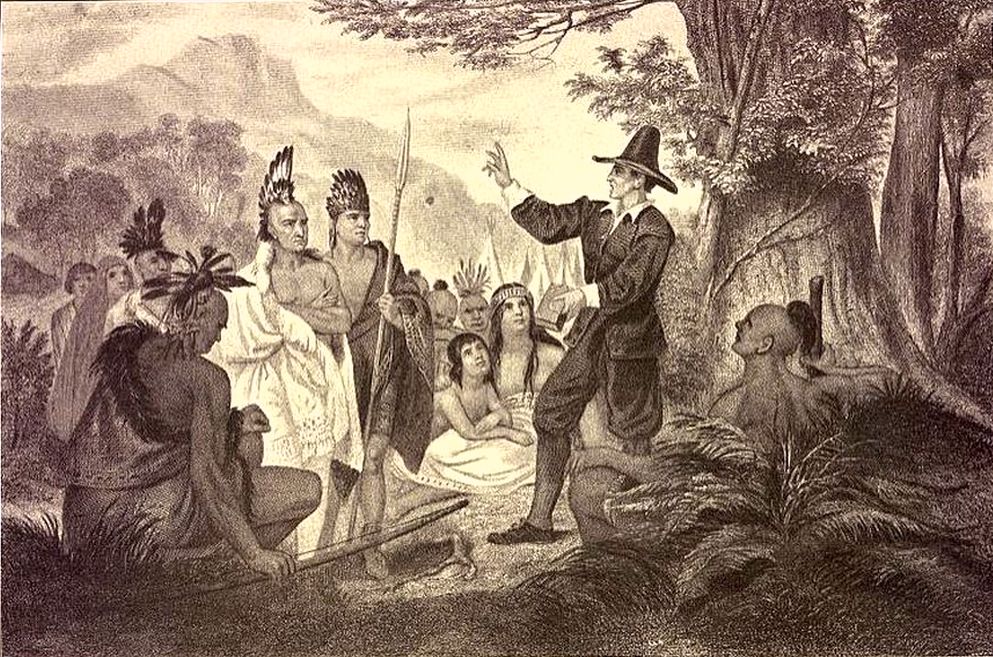

John Eliot learns Massachusett
John Eliot (1604 to 1690), an English-born minister, was teacher of the church at Roxbury in the Massachusetts Bay Colony.5 Daniel Gookin, a Massachusetts magistrate who worked beside him for decades and was put in charge of the colony's government of the Christian Indians, wrote in 1674 that Eliot was then "the only teacher of the church of Christ at Roxbury in New-England" and that "in the year of our Lord 1646, as I take it, and about the forty second year of his age, did intensely set upon the work of preaching Christ to the Indians in New-England."13
The interpreter and the grammar
Eliot did not learn the language alone, and he said so. In the postscript to The Indian Grammar Begun (Cambridge, Massachusetts, 1666), he explained how he had worked it out: "God first put into my heart a compassion over their poor Souls, and a desire to teach them to know Christ, and to bring them into his Kingdome. Then presently I found out (by Gods wise providence) a pregnant witted young man, who had been a Servant in an English house, who pretty well understood our Language, better then he could speak it, and well understood his own Language, and hath a clear pronunciation; Him I made my Interpreter. By his help I translated the Commandments, the Lords Prayer, and many Texts of Scripture: also I compiled both Exhortations and Prayers by his help."14 (The long s of the 1666 printing is given here as a modern s; the scan's text is otherwise followed.) He described his method as a grammarian's: "I diligently marked the difference of their Grammar from ours: when I found the way of them, I would pursue a Word, a Noun, a Verb, through all variations I could think of." And he closed with a sentence later quoted in many missionary sermons: "Prayer and Pains, through Faith in Christ Jesus, will do any thing."14
Eliot did not name the young man. Later scholars, beginning with the Long Island antiquarian William Wallace Tooker in 1896, identified him as Cockenoe, a Montaukett man taken captive in the Pequot War of 1637 and placed as a servant in an English household.15 The identification rests on records outside Eliot's grammar and is accepted by most historians, but the grammar itself does not give the name. Other Native men did later stages of the work. The American Antiquarian Society's catalogue of the Bible says that "John Eliot and his native translators, including Job Nesuton, labored for more than a decade to complete the work."16 John Sassamon (Wussausmon), a Massachusett man who served as an interpreter and teacher and later as a scribe for the Wampanoag sachem Metacom, also worked with Eliot; his death in 1675 is part of the story of the war below.
Nonantum, October 28, 1646
The first account of the preaching was printed in London in 1647 as The Day-Breaking, if not the Sun-Rising of the Gospell with the Indians in New-England, an anonymous pamphlet written from reports by Eliot's party. It opens: "Upon October 28, 1646. four of us (having sought God) went unto the Indians inhabiting within our bounds, with desire to make known the things of their peace to them." Five or six of the chief men met them "with English salutations, bidding us much welcome," and led them into the wigwam of Waban (spelled "Waaubon" in the pamphlet), where "many more Indians, men, women, children" had gathered "according to appointment."3
The pamphlet says the opening prayer was in English, "being not so far acquainted with the Indian language as to express our hearts herein before God or them," and that the visitors then answered questions for hours. One question recorded that day was "whether Jesus Christ did understand, or God did understand Indian prayers," because a listener supposed Christ had only ever heard English prayers. After "three hours' time thus spent with them," the pamphlet says, the Native hosts "desired some more ground to build a Town together," and the visitors promised "to speak for them to the general Court."3 The first prayer in the people's own language came at the second meeting, in the same wigwam on November 11, 1646: at the end of that afternoon, "considering that the Indians formerly desired to know how to pray, and did think that Jesus Christ did not understand Indian language, one of us therefore prepared to pray in their own language, and did so for above a quarter of an hour together."3
Gookin's later summary adds the place: "The first place he began to preach at, was Nonantum, near Watertown mill, upon the south side of Charles river, about four or five miles from his own house; where lived at that time Waban, one of their principal men, and some Indians with him." Eliot soon set up a second lecture at Neponset, in Dorchester, among the people of the sachem Kuchamakin, and preached "these two lectures at Nonantum and Neponsitt, for several years with good success."13 Gookin also recorded the format: Eliot would "begin with prayer, and then to preach briefly upon a suitable portion of scripture; afterwards to admit the Indians to propound questions," and "divers of them had a faculty to frame hard and difficult questions."13
The pamphlet is promotional literature. It was printed in London to raise money and support, and it reports Native questions and tears through English eyes. Historians use it because it is the earliest account, while reading its descriptions of Native feeling as the authors' interpretation. The request for land "to build a Town together" is a fact the pamphlet records, and it pointed toward the Praying Towns.
The Society of 1649 and the money from England
The pamphlets did their work. On July 27, 1649, the English Parliament passed "An Act for the promoting and propagating the Gospel of Jesus Christ in New England." Its preamble says Parliament had "received certain intelligence" that "divers the Heathen Natives of that Countrey" were turning to Christianity, and it created a corporation called "The President and Society for propagation of the Gospel in New-England." To fund it, the act ordered "a general Collection be made for the purposes aforesaid" "in and through all the Counties, Cities, Towns and Parishes of England and Wales," with ministers "required to read this Act or a Copy thereof" "in the presence of their several Congregations."17
It was a corporation for missions created by act of Parliament, a century and a half before the voluntary societies of the 1790s, and it set a pattern they later followed: money gathered in Britain, invested, and spent through agents in the field. In New England the money was spent through the Commissioners of the United Colonies (Massachusetts, Plymouth, Connecticut and New Haven). Because the act had been passed by the Commonwealth Parliament, the Restoration of 1660 put the corporation's legal standing in doubt; the Commissioners' dedication of the New Testament to Charles II asked that the work "may suffer no disappointment through any legal defect," and the corporation was rechartered under the Crown as the Company for Propagation of the Gospel in New England, usually called the New England Company.18 Gookin wrote that the corporation "did greatly encourage" the Bible translation and "out of the revenues belonging to that stock, which then was more considerable than now it is, did pay for the printing thereof," and that Eliot's catechisms, grammar, primer, psalms and translations of devotional books were "all which are printed at the charge of the Corporation stock."18 The later mission societies, their auxiliaries and their annual budgets are the subject of lesson 03.
Natick and the Praying Towns
The request made at Nonantum in 1646 for "ground to build a Town together" became policy. Eliot's plan was to gather Christian Indians into settled towns with a meeting house, a school, English-style fields and orchards, and a written civil order, so that a congregation could form and be taught. The first and largest was Natick, on the Charles River about eighteen miles southwest of Boston. Gookin wrote that "The land was granted to the Indians, at the motion of Mr. Eliot, by the general court of Massachusetts; and in the year 1651, a number of them combined together" to build the town (a leaf of his manuscript is missing at this point, so the rest of the sentence is lost).19 He gave Natick about six thousand acres and, in 1674, about 145 people.19
How a Praying Town worked
Gookin's descriptions show the same pattern in town after town: a Native ruler (often a sachem or his kin), a Native teacher who preached, a meeting house, a constable, and English-style farming beside Native hunting and fishing. Of Hassanamesit (present Grafton), "the third town of praying Indians," he wrote that it had "not above twelve families; and so, according to our computation, about sixty souls," on land "four miles square; and so about eight thousand acres," with "several good orchards." Its ruler was Anaweakin and its teacher Tackuppawillin, his brother. Gookin added a detail that ties the town to the Bible: "They have a brother that lives in the town, called James, that was bred among the English, and employed as a press man in printing the Indian bible; who can read well, and, as I take it, write also." He judged that they kept cattle and swine "as well, or rather better, than any other Indians, but yet are very far short of the English both in diligence and providence."4 The same paragraph says the people of Hassanamesit had English-style houses "but they fancy not greatly to live in them."4
Two features of this system matter for the later record. First, the towns were Native towns on land the colony recognized as theirs, governed by Native officers under Gookin's supervision. Second, the price of that recognition was a deep change in daily life, dress, law and worship, judged by English standards, as Gookin's own comparison of "diligence and providence" shows. Native historians and colonial historians read those two features differently, and both readings are taken up in the section on harm below.
Gookin's count of 1674
Daniel Gookin finished his Historical Collections of the Indians in New England in 1674; it was not printed until the Massachusetts Historical Society published it from his manuscript in 1792. In chapter VII he described each Christian town within Massachusetts and ended with a total: "Thus I have endeavoured particularly to describe these Indian praying villages within the jurisdiction of Massachusetts; which are Towns 14, Souls yielding obedience to the gospel about 1100, Churches 2." He added, "The harvest is ripe for many more, if God please to thrust forth labourers."4 The two churches (gathered congregations with full membership and sacraments) were at Natick and Hassanamesit; the other places were towns with preaching and schooling where no church had yet been formally gathered.
The fourteen were seven older towns in the Massachusett and Pawtucket country near Boston and seven "new praying towns" in the Nipmuc country to the west, several of them only a year or two old in 1674. The 1792 editors printed a table of Gookin's figures, which add up to his total of 1,100: Natick 145, Punkapaug 60, Hassanamesit 60, Okommakamesit 50, Wamesit 75, Nashobah 50, Magunkaquog 55, Manchage 60, Chabanakongkomun 45, Maanexit 100, Quantisset 100, Wabquissit 150, Packachoog 100 and Waeuntug 50.4 Gookin himself called several figures "supposed," meaning estimated, and said the Nipmuc towns were "not fully settled." His count is the only one that survives from before the war, and every later estimate starts from it. The numbers appear as a chart in the "Pictures, Numbers and Infographics" section.
The Praying Towns of Massachusetts were part of a wider Christian Native population. On Martha's Vineyard and Nantucket and among the Wampanoag of Cape Cod (at Mashpee and elsewhere, where the missionary Richard Bourne worked) there were more Christian Indians than in the Massachusetts towns; Gookin, writing in 1677, spoke of "many hundreds of them" on the two islands.20 The Mayhews' work is described below.
The Eliot Indian Bible
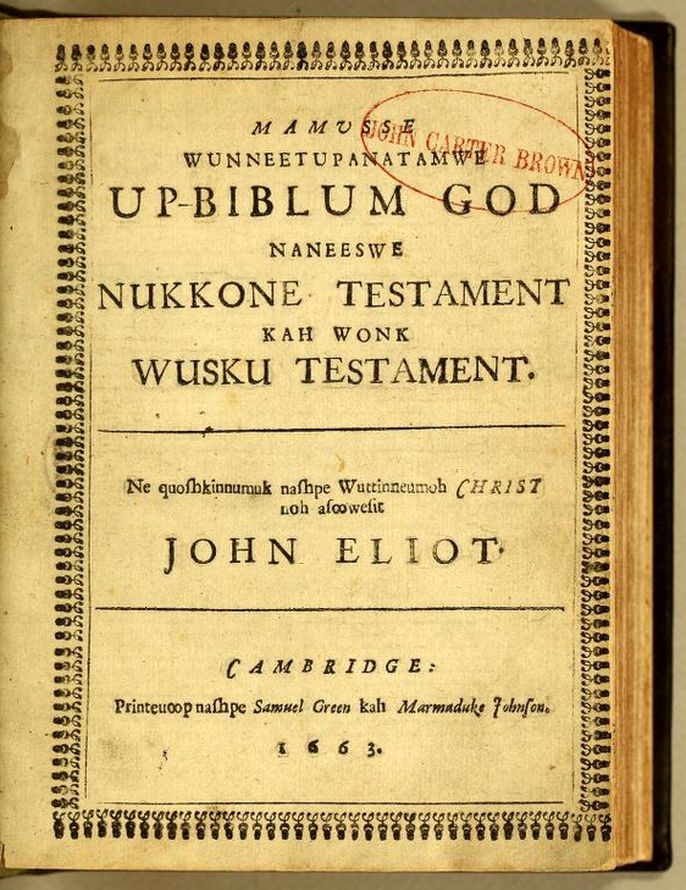
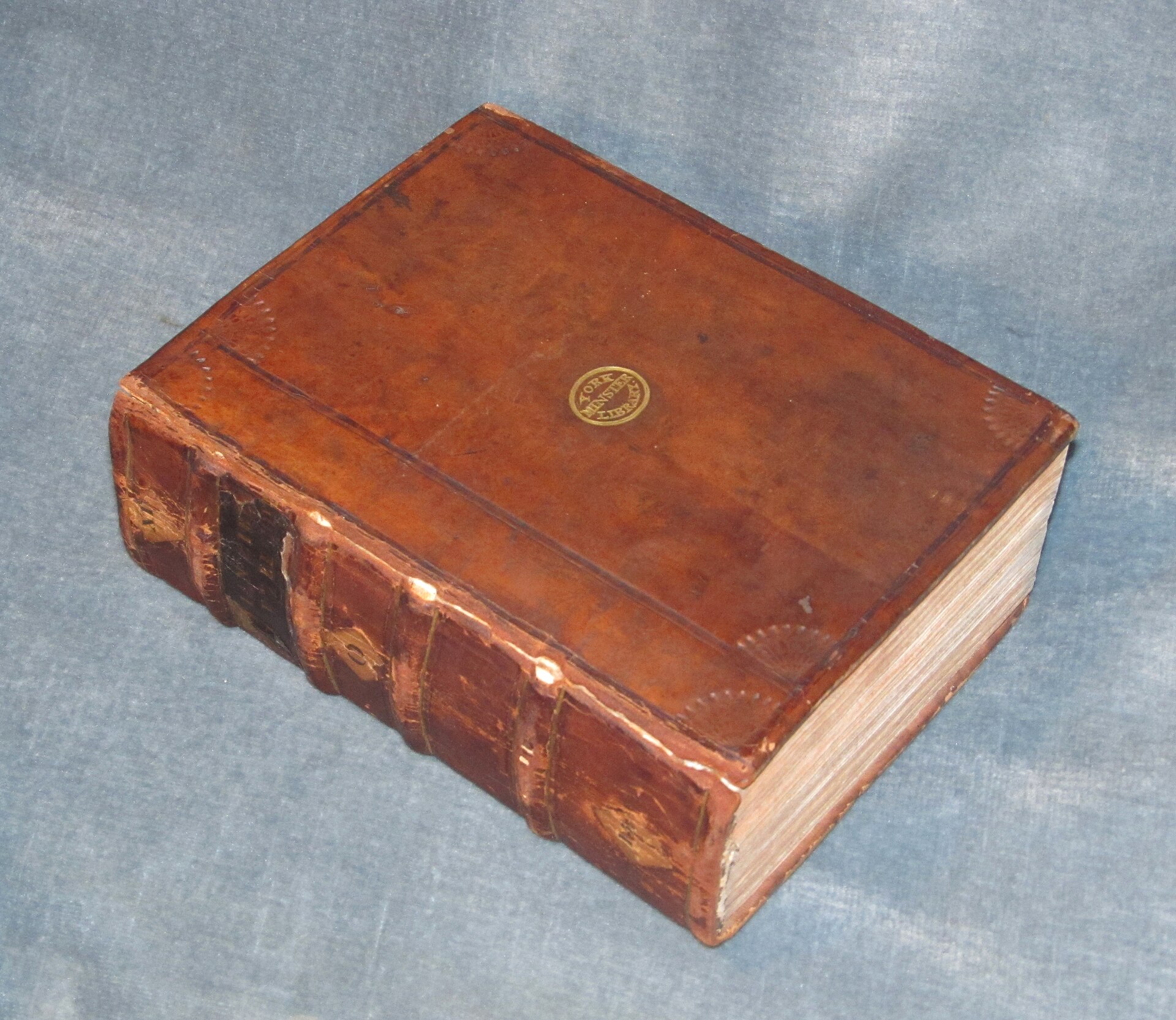
The largest single product of the mission was a book. Its Massachusett title begins Mamusse Wunneetupanatamwe Up-Biblum God, and its imprint names its printers in the same language: "Printeuoop nashpe Samuel Green kah Marmaduke Johnson" ("printed by Samuel Green and Marmaduke Johnson").22 The New Testament came off the Cambridge press in 1661 and the whole Bible, with the Old Testament, in 1663; copies of the complete Bible often carry both dates, as the Rosenbach copy's catalogue entry ("1663-1661") shows.22
Three modern institutions describe its place in printing history in slightly different words. The Morgan Library and Museum calls it "The first complete Bible printed in the Western Hemisphere."5 The Library of Congress says "It was the first Bible printed in North America in any language," and that it was "Printed in Cambridge between 1660 and 1663."23 The American Antiquarian Society says "Printers Samuel Green, Marmaduke Johnson, and James Printer spent nearly three years at the press" and that "Only a few of the original 1,000 or more printed copies remain."16 No complete Bible in English was printed in the English colonies until after American independence, so the first Bible printed in what became the United States was in a Native language.
The book was a joint work. Eliot directed the translation and is the only name on the title page as translator, but he had depended on an interpreter from the start (as his own grammar says), and the American Antiquarian Society credits "his native translators, including Job Nesuton."16 The Library of Congress names "James Printer and John Nesutan" among the Native people who gave "significant help."23 James Printer, the Nipmuc man whom Gookin describes as "employed as a press man in printing the Indian bible," came from Hassanamesit and had been trained at the Cambridge press; his English surname came from the trade.4 The work was paid for by the corporation in London: when the New Testament was finished, the Commissioners of the United Colonies sent it to King Charles II with an address calling it "the first fruit and accomplishment of the pious design of your royal ancestors," adding that "The old testament is now under the press, wanting and craving your royal favour and assistance for the perfecting thereof."18
The Commissioners' dedication, which Gookin reprinted, explained why the whole Bible was undertaken: Native students "can and do read some parts of the scripture, and some catechisms which formerly have been translated into their own language: which hath occasioned the undertaking of a great work, viz. the printing the whole bible."18 Eliot and his collaborators also put into Massachusett a catechism, a primer, the grammar of 1666, the metrical psalms, Lewis Bayly's Practice of Piety and Richard Baxter's Call to the Unconverted, "all which are printed at the charge of the Corporation stock," in Gookin's words.18
The war of 1675 and 1676 destroyed most copies. The Library of Congress notes that "most copies of his Bible were destroyed during King Philip's War (1675-1676)."23 A revised second edition appeared in 1685, again with Native help at the press. In the twentieth century the surviving copies, together with the deeds, wills, petitions and letters that Native people wrote in their own language in the colonial period, became the core of the Wampanoag language reclamation described at the end of this lesson.


The Mayhews on Martha's Vineyard
Preaching to the Wampanoag of Martha's Vineyard (Noepe) began before Eliot's work and lasted longer. Thomas Mayhew Sr. had acquired rights to the island and settled English families at Great Harbour, now Edgartown, and his son Thomas Mayhew Jr. was minister to that small English settlement. The fullest record comes from the family's later missionary, Experience Mayhew, whose Indian Converts: or, Some Account of the Lives and Dying Speeches of a considerable Number of the Christianized Indians of Martha's Vineyard, in New-England was printed in London in 1727. It is arranged in four parts, "I. Of Godly Ministers. II. Of other Good Men. III. Of Religious Women. IV. Of Pious young Persons," and its title page quotes Acts 10:34 to 35: "I perceive that God is no Respecter of Persons: but in every Nation he that feareth him, and worketh Righteousness, is accepted with him."6
Hiacoomes
The book opens with "Hiacoomes the first Christian Indian, and Minister on the Island of Martha's Vineyard." He "was an Indian of Great Harbour, now Edgartown, where a few English Families first settled in the Year 1642." Mayhew described him without flattery: "His Descent was but mean, his Speech but slow, and his Countenance not very promising. He was therefore by the Indian Sachims, and others of their principal Men, looked on as but a mean Person, scarce worthy of their Notice or Regard." Hiacoomes visited English homes and "went also to the English Meeting, and observed what was done there." Thomas Mayhew Jr., seeing in him "a Disposition to hear and receive Instruction," invited him "to come to his House every Lords-day Evening."6 (Quotations are from the 1727 London printing, with the long s given as a modern s.) Mayhew dated Hiacoomes's turn to Christianity to 1643, three years before Nonantum.6
Hiacoomes became a preacher to his own people and outlived his teacher by decades. Experience Mayhew wrote that Hiacoomes kept on with his work "till, to his great Grief, he lost Mr. Mayhew in the Year 1657; which was indeed a very heavy Stroke on these poor Indians, and exceedingly lamented by them." Thomas Mayhew Jr. had sailed for England and his ship was lost at sea.6 His father, Thomas Mayhew Sr., took up the preaching himself, and the work passed through his grandson John and great-grandson Experience. Experience Mayhew, "born January 27. 1672-3," "began to preach to the Indians on the Vineyard in March 1693-4, when he was a little above twenty one Years of his Age," according to the account of the Mayhew ministers by Thomas Prince printed with Indian Converts.6 (The double years reflect the old English calendar, in which the year began on March 25.)
The Vineyard pattern
Three features set the Vineyard apart from the mainland towns. The Mayhews worked within existing Wampanoag communities and sachemships rather than moving converts into new towns; Native preachers such as Hiacoomes carried most of the teaching; and the islands stayed at peace in 1675 and 1676. Gookin wrote in 1677 that on "the Islands of Nantucket and Martha's Vineyard, in which two Islands there inhabit many hundreds of them," the Christian Indians "have held a good correspondency" with the English through the war.20 Indian Converts preserves Native speech and Native lives in more detail than any other colonial source of its kind, including the lives of women and children, though always through an English minister's selection and in English translation. Modern editors and historians (for example Laura Arnold Leibman's 2008 edition) use it as a source for Wampanoag family and community history as well as for the history of the mission.
King Philip's War, 1675 to 1676
The war that the English named for Metacom (called Philip by the English), sachem of the Pokanoket Wampanoag at Mount Hope (Montaup), began in June 1675 and ended in southern New England after Metacom was killed in August 1676. Mike Messina of the Connecticut Historical Society writes that "the immediate cause for its outbreak was the trial and execution of three of Metacom's men by the colonists," that "Captain Benjamin Church pursued Metacom to a hiding place in Mount Hope, Rhode Island, where he was killed on August 12," and that "One in 10 soldiers on both sides was killed, 1,200 colonists' homes were burned, and vast stores of foodstuffs destroyed." He also records that captured Native people were transported out of New England and sold as slaves.24 The Mashpee Wampanoag Tribe's own published timeline states for 1675: "King Phillips War. Over forty percent of the Wampanoag tribal population is killed" "and large number of healthy males sold off as slaves."25 Figures for Native deaths in the war are estimates; no colonial count of Native dead exists.
The fuller history of the war belongs to general American history. This lesson follows what the war did to the Christian Indians and to the mission.
John Sassamon's death
John Sassamon, the Christian Massachusett man who had worked with Eliot and served Metacom as a scribe and interpreter, was found dead under the ice of Assawompset Pond in Plymouth Colony early in 1675. Gookin's account, written in 1677, says "Philip was vehemently suspected to be the contriver of this murder, though executed by others," and gives his own judgment: "this John Sasamand was the first Christian martyr of the Indians; for it is evident he suffered death upon the account of his Christian profession, and fidelity to the English."26 Plymouth Colony tried three Wampanoag men for the killing before a jury that included Native members, and hanged them in June 1675; this is the trial and execution Messina names as the immediate cause of the war.24
Gookin's phrase "first Christian martyr" is a claim, and it is disputed. Sassamon had warned Plymouth's governor that Metacom was preparing for war, and many historians read his death as the killing of an informer, whatever his faith. Lisa Brooks, in Our Beloved Kin: A New History of King Philip's War (Yale University Press, 2018), places Sassamon in the network of Native kin and political relations of the region and treats the evidence of the trial (which rested largely on one Native witness) as uncertain.27 The record shows that he died, that three men were hanged, and that the colonists and the Wampanoag drew opposite conclusions; it does not settle who killed him or why.
Deer Island
When the war began, Christian Indians served the colonies as scouts and soldiers, and some had warned of Metacom's plans. As Native attacks on English towns spread in the summer and autumn of 1675, colonists turned against all Native people, including the Praying Indians. Gookin, who defended them, described what followed. "This contrivance against the Natick Indians obtained that which it was designed for, viz. the passing an order in the General Court, forthwith to remove them from their place unto Deer Island," an island in Boston Harbor then owned by Samuel Shrimpton, who consented on condition that "they should not cut down any growing wood, nor do any damage to his sheep kept there."7
Captain Thomas Prentiss, "a person civil and friendly to those Indians," went to Natick with carts. The people of Natick "quietly and readily submitted, and came down with him at an hour or two warning, about two hundred souls of all sorts," to a landing called the Pines on the Charles River above Cambridge. Eliot met them there, "and comforted and encouraged and instructed and prayed with them." English witnesses told Gookin that the Natick people were "encouraging and exhorting one another with prayers and tears at the time of the embarkment, being, as they told some, in fear that they should never return more to their habitations, but be transported out of the country." Gookin dated the departure: "In the night, about midnight, the tide serving, being the 30th of October, 1675, those poor creatures were shipped in three vessels and carried away to Deer Island."7
Other Christian Indians followed. Gookin wrote that "About the latter end of Dec." 1675 he went with Eliot "to visit and comfort the poor Christian Indians confined to Deer Island, who were (a little before) increased to be about five hundred souls, by addition of the Punkapog Indians, sent thither upon as little cause as the Naticks were." He described their condition: "they lived chiefly upon clams and shell-fish, that they digged out of the sand, at low water; the Island was bleak and cold, their wigwams poor and mean, their clothes few and thin." Some of their own corn was fetched from their abandoned fields by the Council's order.8
Gookin's own reading of the internment shows how a defender of the Christian Indians could still justify it. "The enmity, jealousy, and clamors of some people against them put the magistracy upon a kind of necessity to send them all to the Island; and although it was a great suffering to the Indians to live there, yet God brought forth this good by it; first, their preservation from the fury of the people, secondly, the humbling and bettering the Indians by this sore affliction." He added that the internees "carried themselves patiently, humbly, and piously, without murmuring or complaining against the English for their sufferings, (which were not few,)."8
The National Park Service, which manages the Boston Harbor Islands national recreation area with partners, now describes the episode in these words: "Deer Island became a place of internment in the winter of 1675-76 for approximately 500 Indigenous peoples," "whom Europeans had removed from their homes and villages," and "Many of those imprisoned died that winter without access to adequate food or shelter."28 No reliable count of the dead survives. Gookin gives no total. Modern estimates of how many were held at one time or another run from about 500 to over 1,000, and estimates of deaths range from dozens to about half of those interned; these figures come from historians' reconstructions, not from a colonial register, and they are listed as unverified in this lesson.
Christian Indians in the colonial army
The internment did not end the colonists' use of Christian Indian soldiers. In February 1676, Gookin recorded, the General Court voted to raise an army of six hundred men under Major Thomas Savage, "but the Major was not willing to undertake the charge, unless he might have some of the Christian Indians upon Deer Island to go with him for guides." The Court agreed and sent John Curtis of Roxbury "down to Deer Island" to choose them.20 Gookin's whole book, An Historical Account of the Doings and Sufferings of the Christian Indians in New England, in the Years 1675, 1676, 1677, was written to prove the loyalty and service of these men to an English public that distrusted them. He wrote that the Christian Indians "made discovery of what they knew of the plottings and conspiracy of the enemy, before the war began" and "most readily and cheerfully joined with, and assisted the English in the war."20 The manuscript was not printed until 1836.
Some Christian Indians, among them people from the Nipmuc towns, joined Metacom's side or were taken by his forces. James Printer was one: he went with the Nipmuc in 1675, returned under an amnesty in 1676, and later went back to work at the Cambridge press. Lisa Brooks and other historians have argued that the note left at Medfield after its burning in February 1676, warning the English that the Native side had nothing to lose, was written by James Printer; this attribution rests on handwriting and circumstance and is not certain.27
After the war
The Praying Towns never recovered their numbers. The editors of the 1792 printing of Gookin's Historical Collections summarized the later record in a note: "The war with Philip greatly interrupted the progress of Christianity among the Indians. Many praying towns in Massachusetts were broken up. Mr. Eliot says, that in the year 1684, they were reduced to four." They traced Natick through the eighteenth century: twenty-five families in 1753; twenty-three deaths in 1759 from a disease soldiers brought home from the French war; "thirty-seven Indians only in Natick" in the census of 1764. By 1792 "The Indians in Natick are now reduced to one family of five persons, and two single women," with ten other adults who "lead a wandering life."29 Another note in the same edition records that "Natick was incorporated into an English district in the year 1761; and into a town, in the year 1781."19
The 1792 note ends with the editors' judgment that these few people "are, we believe, all the remains of the numerous tribes who formerly inhabited the old colony of Massachusetts."29 That judgment was wrong. Wampanoag, Nipmuc and Massachusett communities survived on the Cape, on the islands, at Ponkapoag, at Hassanamisco (Grafton) and elsewhere, as the next section shows.
Eliot kept working. He supervised the revised Bible of 1685 and continued to visit the surviving towns until near his death in 1690. Gookin died in 1687. Neither man saw the Praying Towns return to their size of 1674.
David Brainerd, 1718 to 1747
Seventy years after Deer Island, the most famous missionary of colonial America worked for less than five years and left only a few small congregations. His fame came from a book. Jonathan Edwards published An Account of the Life of the Late Reverend Mr. David Brainerd at Boston in 1749, built largely from Brainerd's private diary, and it has been reprinted, abridged and translated ever since.10 Quotations below are from the American Tract Society's abridged edition of Edwards's book (New York, nineteenth century), which keeps Edwards's text and Brainerd's dated entries while omitting, as its preface says, "many passages thus inserted by Edwards, especially such as much resembled those preceding or following."30
Yale and the expulsion
"David Brainerd was born April 20, 1718, at Haddam, Connecticut," Edwards's account begins.30 He entered Yale College in September 1739 and was caught up in the revival that followed George Whitefield's preaching tour of 1740 (see Module 105, lesson 03). Edwards tells the story of his expulsion carefully. Brainerd was in the hall with two or three friends after a tutor, Chauncey Whittelsey, had prayed with the students; asked what he thought of the tutor, Brainerd answered, "He has no more grace than this chair." A freshman outside the room overheard, told a woman in town, and she told the Rector, who made Brainerd's friends repeat what he had said and demanded that Brainerd "make a public confession, and to humble himself before the whole College in the hall."30
Edwards gives three grounds for the expulsion: Brainerd's refusal to make that public confession; his having "gone once to the Separate meeting at New-Haven, when forbidden by the Rector"; and an accusation (which Brainerd denied remembering) that he had said he "wondered he did not expect to drop down dead for fining the scholars who followed Mr. Tennent to Milford." "For these things he was expelled the college." Edwards placed the expulsion "in the winter, 1742, while in his third year at college," and took no side on the college's right to act: "How far the circumstances and exigencies of that day might justify such great severity in the governors of the college, I will not undertake to determine."30 Yale did not readmit him, and he never received a degree.
The Scottish society and Kaunaumeek
Brainerd studied with ministers in Connecticut, was licensed to preach in 1742, and was examined in New York by the "correspondents in New-York, New-Jersey, and Pennsylvania, of the Society in Scotland for propagating Christian knowledge" (the SSPCK, a Presbyterian body based in Edinburgh, which paid missionaries in the colonies through boards of local ministers).21 The correspondents first meant to send him to the Delaware River, but news of "some contention between the white people and the Indians on the Delaware, concerning their lands" led them to send him instead to "a number of Indians at Kaunaumeek; a place in New-York, in the woods between Stockbridge and Albany."21 The people there were Mahican, kin of the Mahican congregation at Stockbridge, Massachusetts, where John Sergeant was missionary (Edwards himself would later serve at Stockbridge; see lesson 03).
His first entry from the field: "April 1, 1743. I rode to Kaunaumeek, in the wilderness, near twenty miles from Stockbridge, and about an equal distance from Albany, where the Indians live with whom I am concerned; and lodged with a poor Scotchman, about a mile and a half distant from them, on a little heap of straw, in a log room without any floor. I was greatly exercised with inward trials, and seemed to have no God to go to. O that God would help me!"21 A week later: "Appeared to myself exceedingly ignorant, weak, helpless, unworthy, and altogether unequal to my work. It seemed to me that I should never do any service, or have any success among the Indians. My soul was weary of my life; I longed for death, beyond measure."21
Entries like these, recording depression, illness and spiritual struggle day by day, are the main reason the book was read. Brainerd worked at Kaunaumeek with an interpreter, translated prayers with his help, and kept a school. After about a year, Edwards writes, the people of Kaunaumeek, "being but few in number," agreed "to leave Kaunaumeek, and remove to Stockbridge, to live constantly under Mr. Sergeant's ministry," and the commissioners sent Brainerd to "the Delaware Indians."21
The Forks of the Delaware and the Susquehanna
The Presbytery met at Newark, New Jersey, on June 11, 1744, to examine him, and on June 12 he was ordained. His diary for that day reads: "I hope that then, as many times before, I gave myself up to God, to be for him, and not for another."31 He settled near the Forks of the Delaware, where the Lehigh River meets the Delaware at present Easton, Pennsylvania, among Lenape (Delaware) people whose land claims had been reduced by the Walking Purchase of 1737. From there he made two journeys to the Susquehanna River to preach. He later summed up that year: "I had spent most of my time for more than a year past among the Indians at the Forks of Delaware, in Pennsylvania. During that time I made two journies to the Susquehanna, to treat with the Indians on that river respecting Christianity; and not having had any considerable appearance of special success in either of those places, my spirits were depressed, and I was not a little discouraged."32
His interpreter at the Forks was a Lenape man whom other records name as Moses Tinda Tatamy (Tunda Tattamy). Brainerd's journal for July 21, 1745, says: "On this day my interpreter and his wife publicly professed their faith in Christ, being the first hopeful converts among the Indians."33 Brainerd then wrote out a long account of the interpreter's spiritual experience, one of the longest descriptions of a Native convert's inner life in the colonial record, though in Brainerd's words.
Crossweeksung, 1745 to 1746
Brainerd's journal from June 1745 to June 1746 was printed during his lifetime by the Scottish society's correspondents, as Mirabilia Dei inter Indicos (1746) and a second part, and Edwards folded it into his book. "Hearing that there were a number of Indians at a place called Crossweeksung, in New-Jersey, nearly eighty miles south east from the Forks of Delaware, I determined to make them a visit, and see what might be done toward christianizing them; and accordingly arrived among them this day," he wrote on June 19, 1745. He found "very few persons at the place," "not more than two or three families in a place," and preached to a few women and children, who then traveled "ten or fifteen miles, in order to give notice to some of their friends."32
The entry most often quoted from the whole book is August 8, 1745: "In the afternoon I preached to the Indians, their number was now about sixty-five persons; men, women, and children. I discoursed upon Luke 14:16-23, and was favored with uncommon freedom. There was much visible concern among them while I was discoursing publicly; but afterward, when I spoke to one and another more particularly, whom I perceived under much concern, the power of God seemed to descend upon the assembly 'like a mighty rushing wind,' and with an astonishing energy bore down all before it." He went on: "Old men and women who had been drunken wretches for many years, and some little children not more than six or seven years of age, appeared in distress for their souls, as well as persons of middle age."32
Brainerd gave his own numbers, and they are small. Later in the journal he reported that "Fifteen individuals, since the conclusion of my last Journal, have made a public profession of their faith, making thirty-eight within the space of eleven months."34 He also recorded a decline: the Spirit had "seemed, in a considerable measure, withdrawn," and newcomers were "not seized with concern as formerly."34
Land and debt at Crossweeksung
Brainerd's journal also records the pressure on the Lenape's land. On January 28, 1746, he wrote: "The Indians in these parts have, in times past, run themselves in debt by their excessive drinking; and some have taken the advantage of them, and put them to trouble and charge, by arresting some of them; whereby it was supposed their hunting lands in great part were much endangered, and might speedily be taken from them." Because "they could not subsist together in these parts, in order to their being a Christian congregation, if these lands should be taken," the society's local board spent mission money to pay the debts: "I answered in behalf of the Indians, eighty-two pounds, five shillings, New-Jersey currency."35 In the spring of 1746 he moved the congregation to land near Cranbury, New Jersey, where they built houses and cleared fields; his entry for May 4, 1746, begins "My people being now removed to their lands."35
The passage shows the mission acting as a buffer against debt-driven land loss, and it shows the missionary deciding where his "people" would live. Both readings are in the text. After Brainerd's death his brother John Brainerd, already sent by the correspondents to care for the congregation, "was soon after ordained his successor in his mission."9 In 1758 the colony of New Jersey set aside the Brotherton tract in Burlington County for Lenape people, where John Brainerd later served; the Brotherton Lenape sold that land in 1801 and moved to join the Stockbridge Mahican at New Stockbridge in New York, and later went west to Wisconsin. Those later dates are outside the Edwards text and are listed as unverified in this lesson.
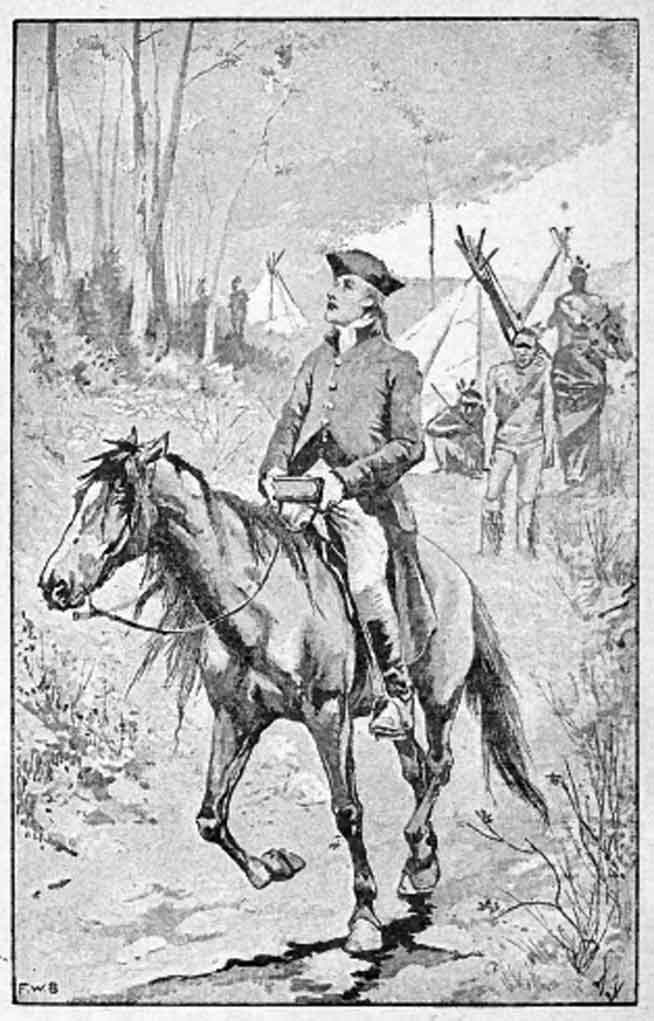

Death in Edwards's house
By 1747 Brainerd was, in Edwards's words, "in a confirmed, incurable consumption" (tuberculosis).9 He came to Edwards's house at Northampton, Massachusetts, on May 28, 1747, traveled to Boston and back, and spent his last months there, nursed by Edwards's daughter Jerusha. His last diary entry, October 2, 1747, ends: "O come, Lord Jesus, come quickly! Amen." Edwards wrote, "Here ends his diary." He died, Edwards recorded, "about six o'clock on Friday, Oct. 9, 1747."9 Jerusha Edwards died the following February 14, "after a short illness of five days, in the eighteenth year of her age," Edwards wrote in a footnote, adding that she had "constantly taken care of, and attended him in his sickness, for nineteen weeks before his death."9
Edwards's book and its readers
Edwards published the Account in 1749 as an example of true religious experience in the debates that followed the Awakening, and as a model of missionary self-denial. Its influence on the founders of the modern missions movement is documented in their own words. William Carey's Enquiry of 1792 wrote that "About the year 1743, Mr. David Brainerd was sent a missionary to some more Indians, where he preached, and prayed, and after some time an extraordinary work of conversion was wrought, and wonderful success attended his ministry," and twice paired him with Eliot as proof that missionaries could survive among peoples the English called savage: "It was no objection to an ELLIOT, or a BRAINERD, in later times."12 Carey's own story is lesson 04.
Henry Martyn, the Cambridge scholar who went to India as a chaplain in 1805, read the book while deciding his course. His biographer John Sargent wrote that Martyn, "perusing the life of David Brainerd, who preached with apostolical zeal and success to the North American Indians," was "filled with a holy emulation of that extraordinary man," and quoted Martyn's journal: "Read Brainerd. I feel my heart knit to this dear man, and really rejoice to think of meeting him in heaven."36 Biographies and sermons also name Adoniram Judson and, in the twentieth century, Jim Elliot among Brainerd's readers; those links are reported in later books and are taken up in lesson 05 and lesson 10.
The book's power came partly from its darkness. Brainerd recorded despair, longing for death, and harsh judgments of himself on page after page. Later readers have read the diary in sharply different ways: as a model of devotion, as a record of depression, as evidence of a spirituality too severe to imitate, and, among Native readers, as a document about Lenape and Mahican people whose own voices appear only through Brainerd's reports.
The record on harm, and the people who remain
The missions of Eliot, the Mayhews and Brainerd are remembered in very different ways by the churches that sent them and by the nations they came to. Both memories rest on documents, and both are stated here in the words of those who hold them.
The missionaries' own account
The missionaries and their supporters believed they were offering eternal life and a better earthly life, and they recorded Native people who said they agreed. The Nonantum pamphlet records Native questions and requests; Indian Converts records the "Dying Speeches" of Wampanoag men, women and children who died as Christians; Gookin describes Native teachers, rulers and deacons by name; Brainerd records the profession of faith of his interpreter and dozens of others. In the colonists' view the Praying Towns protected Native land: Natick's six thousand acres and Hassanamesit's eight thousand were recognized by the General Court, and Brainerd's board paid debts so that the Crossweeksung people would not lose their hunting land.19435 Gookin defended the Christian Indians against his own neighbors at real cost to his standing in the colony, and Eliot went to the Pines at midnight to pray with the people being shipped to Deer Island.7
The documented losses
The same documents record loss. The Praying Towns were built on the premise that Native people should give up much of their own way of life; Gookin measured them against English "diligence and providence."4 When war came, Christian profession did not protect the Natick and Punkapaug people from removal to Deer Island, and the Park Service records that many died there.28 Of fourteen towns in 1674, Eliot counted four in 1684; Natick had thirty-seven Native residents in 1764 and was incorporated as an English district in 1761 and a town in 1781.2919 The Mashpee Wampanoag Tribe's timeline records that a twenty-five-square-mile tract was reserved by deed in 1665 and confirmed by Plymouth in 1685, that "Plymouth Colony appoints three guardians over Mashpee tribe to limit the Tribe's independence" in 1746, and that the "Tribe protests repeatedly, to no avail."25 (The tribe's timeline uses "Plymouth Colony" for these eighteenth-century acts; Plymouth had been merged into Massachusetts in 1691, so the acting government was the Province of Massachusetts Bay.) At Crossweeksung, Brainerd's own entry shows debt, arrest and the threat of land seizure as ordinary conditions of Lenape life in New Jersey.35
Native historians and descendants
Native scholars and tribal communities have written their own histories of this period. Lisa Brooks (Abenaki), a professor at Amherst College, rebuilt the history of King Philip's War from Native places, kinship ties and Native-authored documents in Our Beloved Kin (2018), with a digital companion that maps the network of relations she traces. The project takes its key term from the Abenaki word awikhigan, which, its site explains, "originally referred to birchbark maps and scrolls, but came to encompass letters, petitions, maps, books and works of art."27 Brooks's approach treats Native writing, including writing done by Christian Indians such as James Printer, as a tool Native people used for their own purposes, in addition to being evidence of English influence.
The Mashpee Wampanoag Tribe's timeline does not mention missionaries at all for the seventeenth century; it records the war, the enslavement of captives, the 1665 deed, the guardianship of 1746, the tribe's petitions to the king in 1760, and its recognition as "a self-governing Indian district" in 1763, and it ends the long struggle with the entry: "Mashpee Tribe becomes a federally recognized tribe, authorizing tribe to acquire land and re-establish its Indian Reservation" (2007).25 In that telling, the main story of the colonial centuries is survival on the land and self-government, with the churches (including Native-led congregations such as the Old Indian Meeting House at Mashpee) one part of community life within it.
Descendants of the Praying Town communities also remain. Nipmuc people at Hassanamisco (the Grafton reservation Gookin called Hassanamesit) have kept a small land base there since the colonial period, and Massachusett descendants of Natick and Ponkapoag organize today as the Massachusett Tribe at Ponkapoag and the Natick Praying Indians, holding public remembrances of the Deer Island internment. These communities are named here from their own public statements reported in the press, and the details are listed as unverified in this lesson.
The language returns
The most unexpected legacy of Eliot's Bible is a living language. By the nineteenth century Wampanoag (Wôpanâak) had no fluent speakers. In 1993 Jessie Little Doe Baird, "a citizen of the Mashpee Wampanoag tribe," founded the Wôpanâak Language Reclamation Project; she earned a master's degree in linguistics at the Massachusetts Institute of Technology in 2000, working with the linguist Kenneth Hale, and received a MacArthur Fellowship in 2010.37 The project's history page names the sources that made reclamation possible: the "Eliot Indian Bible," which it calls "the first full translation of the Christian Bible into a Native American language," and "many handwritten deeds, wills, petitions to the Massachusett Bay Colony and Plymouth Colony," including "the original deed to the town of Eastham."37 The language, the project says, had at one point "absolutely no speakers"; Baird's daughter Mae became "the first native speaker of the new generation."37 The project's home page describes it as "the joint collaborative efforts of the Mashpee, Aquinnah, Assonet & Herring Pond Wampanoag communities" and as "bringing back to life the tribes' sacred privilege" "after more than 150 years of dormancy."38 The Library of Congress names Baird as founder "in 1993" in its 2024 account of the Bible.23
The same book that colonists printed to replace Native religion became a record that Native people now use to restore their own language. Readers from different traditions draw different meanings from that fact; the documents establish only that both things happened.

What the record shows and what it does not
- Documented fact: the 1629 charter's statement that converting the Natives was "the principall Ende of this Plantacion"; the 1649 Act of Parliament and its national collection; Gookin's count of 14 towns and about 1,100 people in 1674; the printing of the Massachusett New Testament (1661) and Bible (1663) at Cambridge; the removal of the Natick people to Deer Island on October 30, 1675; Brainerd's ordination (June 12, 1744) and death (October 9, 1747); Edwards's publication of 1749.1174167319
- The missionaries' own words: Eliot's 1666 account of learning the language through an unnamed interpreter; the Nonantum pamphlet of 1647; Gookin's descriptions of the towns and of Deer Island; Experience Mayhew's lives of Wampanoag Christians; Brainerd's diary and journal as Edwards printed them. These are first-hand but written for supporters and readers in England and New England.
- What the Native nations and their descendants record: the Mashpee Wampanoag Tribe's timeline of war deaths, slavery, land deeds and guardianship; the Wôpanâak Language Reclamation Project's use of the Bible and Native-written deeds; Native scholarship such as Lisa Brooks's Our Beloved Kin. Native voices from the seventeenth and eighteenth centuries reach us mostly through English writers or through Native documents written for colonial courts.
- Later legend: Carey's date of 1632 for Eliot's start; the image of Brainerd as a solitary hero converting crowds; the story that Brainerd and Jerusha Edwards were engaged (no document says so).
- Scholarly reading: historians disagree over whether the Praying Towns mainly protected Native land and people or mainly served English expansion, and over how to weigh Gookin's defense of the internment as "preservation."
- Open questions: how many people died on Deer Island; who killed John Sassamon and why; whether James Printer wrote the Medfield note; the identity of Eliot's first interpreter, which rests on later research.
Pictures, Numbers and Infographics
The key dates and figures of this lesson, each with its source. Figures marked "about" are the source's own estimates.
| Item | Figure | Source |
|---|---|---|
| Massachusetts Bay charter sealed | March 4, 1629 (fourth year of Charles I) | Charter text1 |
| Colony seal "Come over and help us" in use | to 1686, and 1689 to 1692 | Mass. Secretary of the Commonwealth2 |
| Hiacoomes becomes a Christian | 1643 | Experience Mayhew, 17276 |
| Eliot preaches at Nonantum | October 28, 1646; about three hours | The Day-Breaking, 16473 |
| Act creating the Society for propagation of the Gospel in New England | July 27, 1649 | Acts and Ordinances of the Interregnum17 |
| Natick founded | 1651; about 6,000 acres | Gookin, 167419 |
| Thomas Mayhew Jr. lost at sea | 1657 | Experience Mayhew, 17276 |
| Massachusett New Testament and complete Bible | 1661 and 1663; "1,000 or more" copies | American Antiquarian Society; Morgan Library165 |
| Praying Towns in Massachusetts, 1674 | 14 towns, about 1,100 people, 2 churches | Gookin, 16744 |
| Natick people shipped to Deer Island | night of October 30, 1675; about 200 people | Gookin, 16777 |
| People held on Deer Island, late December 1675 | about 500 | Gookin, 1677; National Park Service828 |
| Deaths on Deer Island | no count survives; "Many" | National Park Service28 |
| Metacom killed | August 12, 1676 | Connecticut Historical Society24 |
| Wampanoag killed in the war | "Over forty percent" of the population | Mashpee Wampanoag Tribe25 |
| Praying Towns remaining | 4 in 1684 (Eliot's figure) | 1792 editors' note to Gookin29 |
| Native residents of Natick | 37 in 1764 | 1792 editors' note to Gookin29 |
| Brainerd born; expelled from Yale | April 20, 1718; winter 1742 | Edwards30 |
| Brainerd at Kaunaumeek; ordained at Newark | April 1, 1743; June 12, 1744 | Edwards2131 |
| Crossweeksung congregation, August 8, 1745 | about 65 people | Brainerd's journal32 |
| Public professions of faith at Crossweeksung | 38 in eleven months | Brainerd's journal34 |
| Debts paid to protect Lenape land | 82 pounds, 5 shillings, New Jersey currency (January 1746) | Brainerd's journal35 |
| Brainerd dies at Northampton | October 9, 1747, age 29 | Edwards9 |
| Edwards's Account published | 1749, Boston | First edition10 |
| Wôpanâak Language Reclamation Project founded | 1993 | WLRP37 |
| Mashpee Wampanoag federal recognition | 2007 | Mashpee Wampanoag Tribe25 |
Claims checked
Common statements about early American missions, from sermons, textbooks, websites and tribal and activist writing, rated against the sources.
"Converting the Native people was the main purpose of the Massachusetts Bay Colony"
Rating: Partly supported. The charter does call conversion "the principall Ende of this Plantacion," and the seal said "Come over and help us."12 The same charter is mostly about trade, land and government, it names no means of conversion beyond the settlers' good example, and no organized preaching in a Native language began for seventeen years. The Commissioners of the United Colonies, in their dedication of the New Testament to Charles II, gave two aims, liberty "to worship God" and spreading "the light of the gospel" to "the poor, barbarous heathen," noting that the latter was declared in "some of our patents" to be "the principal aim."18 The stated purpose is real; whether it was the colony's main purpose in practice is a matter of interpretation.
"Eliot began preaching to the Indians in 1632" (Carey, 1792)
Rating: Refuted. Carey's Enquiry gives 1632.12 The 1647 pamphlet dates the first meeting at Nonantum to October 28, 1646, and Gookin, who knew Eliot, gives 1646.313 Carey may have confused Eliot's arrival in New England with the start of his Native mission.
"The Eliot Indian Bible was the first Bible printed in America"
Rating: Supported, with wording. The Morgan Library calls it "The first complete Bible printed in the Western Hemisphere" and the Library of Congress "the first Bible printed in North America in any language."523 Spanish presses in Mexico had printed religious books in Native languages earlier, but not a complete Bible. The careful form is "the first complete Bible printed in the Western Hemisphere," and it was in Massachusett, not English.
"John Eliot translated the Bible by himself"
Rating: Refuted. Eliot's own grammar says he learned the language and made his first translations through a Native interpreter: "By his help I translated the Commandments, the Lords Prayer, and many Texts of Scripture."14 The American Antiquarian Society names "native translators, including Job Nesuton," and the Library of Congress names James Printer and Nesutan; James Printer worked the press.16234 Eliot led the work and bore responsibility for it; it was a team's work.
"The Praying Towns kept Christian Indians safe"
Rating: Refuted for 1675 to 1676. Before the war the towns gave legal recognition to Native land. In the war, Christian profession did not prevent the removal of the Natick and Punkapaug people to Deer Island, and Gookin wrote that it was the "enmity, jealousy, and clamors of some people" that forced the move.78 Gookin argued that the island preserved them "from the fury of the people"; the Park Service records that "Many of those imprisoned died that winter."28
"About half of those held on Deer Island died"
Rating: Unresolved. The figure appears in modern popular and activist writing. Gookin gives "about five hundred souls" in late December 1675 and no death count; the Park Service says "Many" died.828 No colonial register of deaths survives, so the proportion cannot be established from the record.
"John Sassamon was the first Native Christian martyr"
Rating: Unresolved. This is Gookin's judgment in 1677: "it is evident he suffered death upon the account of his Christian profession, and fidelity to the English."26 Gookin himself links two motives, faith and loyalty to the English, and Sassamon had just warned Plymouth of Metacom's plans. Who killed him and why is still argued.
"Brainerd was expelled from Yale for saying a tutor had no more grace than a chair"
Rating: Partly supported. Edwards records the remark and the demand for a public confession, but he names three grounds: refusing to confess publicly, attending a forbidden Separate meeting, and an alleged remark about the Rector, which Brainerd said he did not remember.30
"Brainerd converted great numbers of Indians"
Rating: Refuted as usually told. Brainerd's own count was thirty-eight public professions of faith in eleven months at Crossweeksung, with a congregation of about sixty-five on August 8, 1745.3432 He reported "no considerable appearance of special success" at the Forks or on the Susquehanna.32 His influence came through Edwards's book, which shaped later missionaries such as Henry Martyn.36
"Brainerd and Jerusha Edwards were engaged to be married"
Rating: Unsupported. Edwards's account shows that Jerusha nursed Brainerd for nineteen weeks, that he spoke tenderly to her before his death, and that she died four months after him; it does not say they were engaged.9 The engagement appears in later sermons and popular biographies without a document behind it.
"Wampanoag is a dead language"
Rating: Refuted. The language had no speakers for generations, but the Wôpanâak Language Reclamation Project, founded in 1993, has produced a new generation of speakers, using Eliot's Bible and Native-written colonial documents.37
Hard questions and answers
Did the Praying Towns protect Native people or help take their land?
The documents support both answers at different times. In 1674 the General Court recognized thousands of acres as Native town land: Natick about 6,000 acres, Hassanamesit about 8,000.194 The towns also brought Native people under English law and English supervision, and after the war most of that land passed to English owners; by 1781 Natick was an English town.19 A reader from the sending churches can point to Gookin's defense and the land grants; a reader from the Native nations can point to Deer Island and to the guardianship of Mashpee in 1746, which the tribe "protests repeatedly, to no avail."25 The record does not let either reading erase the other.
Were the Christian Indians sincere, or did they convert under pressure?
Both kinds of evidence exist. Native Christians such as Hiacoomes preached for decades, wrote and printed books, and kept their faith through war and flight; Gookin recorded that the Wamesit teacher Symon Beckom, hiding in the woods with his people in 1675, "kept three Sabbaths in the woods" and taught from Psalms 35, 46 and 118.68 Native congregations at Mashpee and on Martha's Vineyard continued long after the missionaries. At the same time, joining a Praying Town brought recognized land and English protection at a time when disease and settlement had shattered Native communities, and the English set the terms. Historians generally treat Native Christianity in New England as a real faith practiced under heavy pressure, which Native people shaped to their own needs; the sources do not let anyone measure sincerity from outside.
Why did Eliot and Gookin not stop the Deer Island removal?
They lacked the power. Gookin was a magistrate and one of the few public defenders of the Christian Indians, and his book answers soldiers and colonists who called the Christian Indian soldiers "cowards" and worse.20 The General Court ordered the removal, and Gookin wrote that "the magistracy" acted under "a kind of necessity" because of public anger.8 Eliot met the Natick people at the landing and prayed with them; Gookin visited the island with him in December.78 Gookin also accepted the removal as providential "preservation" and "humbling," a judgment that many modern readers, Native and non-Native, reject.
Why is Brainerd so famous if he had few converts?
Because of Edwards's book and the kind of book it is. Edwards published the diary as a model of self-giving devotion, and its daily record of struggle, illness and prayer spoke to readers who would never meet a Lenape congregation. Carey cited Brainerd in 1792 and Henry Martyn wrote of feeling his "heart knit to this dear man."1236 The book recruited missionaries for a century and more; the Lenape congregation itself is known almost only through Brainerd's reports.
Is it right to call the 1663 Bible a Native achievement?
In part. The translation could not have been made without Native speakers and was printed with a Native pressman, but it was directed and published by English missionaries with English money for the purpose of converting Native people.1618 Today the Wampanoag language project, led by Wampanoag people, treats the Bible and Native-written deeds and petitions as sources for its own language.37 Both descriptions fit the evidence.
How should a modern reader use these sources?
As testimony from people with purposes. The 1647 pamphlet was written to raise money; Gookin's Doings and Sufferings was written to defend the Christian Indians; Mayhew's Indian Converts to show that God accepted Native believers; Edwards's Life of Brainerd to model true religion. The tribal timelines and Native scholarship were written to tell the nations' own history. Each is reliable for what its writers saw and believed, and each has to be weighed against the others. The next lesson, lesson 03, follows the same questions into the Great Awakening, Samson Occom and the first mission societies; the Puritan church background is in Module 80, lesson 05, and the wider early American religious conflicts in Module 102, lesson 08.
Learn more
- Gookin's Historical Collections (1674), full scan: Read chapter VII for the town-by-town description of every Praying Town in 1674.
- Gookin's Doings and Sufferings of the Christian Indians (1677): The only contemporary account written to defend the Christian Indians in King Philip's War, including Deer Island.
- Experience Mayhew, Indian Converts (1727): Lives of Wampanoag Christian men, women and children of Martha's Vineyard, in their own recorded words.
- Edwards's Life of David Brainerd (Project Gutenberg): Brainerd's diary and journal; read the entries of April 1743 and August 1745 for the two sides of the book.
- Wopanaak Language Reclamation Project: How Wampanoag communities are bringing their language back, using the Eliot Bible and Native-written colonial documents.
- Our Beloved Kin digital companion (Lisa Brooks): A Native scholar's mapped history of King Philip's War and the people in it.
- Module 80, lesson 05: Congregationalists and Puritans: The churches that sent Eliot and the Mayhews.
- Module 105, lesson 05: Jonathan Edwards the thinker: The editor of Brainerd's diary and later missionary at Stockbridge.
Still being checked (15 items)
These points could not be confirmed against a primary source when this lesson was written and fact checked in October 2026. The text above states each one as uncertain.
- Identification of Eliot's unnamed first interpreter as Cockenoe (Montaukett, captured 1637): attributed to William Wallace Tooker (1896), whose text was not opened for this lesson.
- John Sassamon's role as Metacom's scribe, the discovery of his body under the ice of Assawompset Pond early in 1675, the mixed jury and the hanging of three Wampanoag men in June 1675: from general historical accounts; the sources opened confirm only his death (Gookin) and the trial and execution of three of Metacom's men (Messina).
- Number of people held on Deer Island over the whole internment (estimates about 500 to over 1,000) and number of deaths (estimates from dozens to about half): no colonial count survives; the National Park Service says only "Many" died.
- James Printer's flight with the Nipmuc in 1675, his return under amnesty in 1676, his authorship of the Medfield note of February 1676, his training at the Cambridge press and the origin of his surname: attributed to Lisa Brooks and other historians, not checked against a primary source here.
- The Native help at the press for the revised second edition of the Eliot Bible (1685); the 1685 date itself is confirmed by the Library of Congress (2024).
- That no complete English Bible was printed in the English colonies before American independence (the Aitken Bible of 1782), and that Spanish presses in Mexico printed religious books in Native languages earlier: not checked against a source this session.
- Rechartering of the 1649 corporation after 1660 as the Company for Propagation of the Gospel in New England (the New England Company): the dedication confirms the concern about a "legal defect" but the charter itself was not opened.
- The SSPCK described as Presbyterian and based in Edinburgh; the Kaunaumeek people described as Mahican; the Forks of the Delaware people as Lenape affected by the Walking Purchase of 1737; Brainerd's interpreter identified as Moses Tinda Tatamy: from general histories, not the Edwards text.
- The publication of Brainerd's journal as Mirabilia Dei inter Indicos (1746) and its second part.
- The Brotherton tract (1758), its sale in 1801 and the removal of its Lenape people to New Stockbridge and later Wisconsin.
- Henry Martyn's departure for India as a chaplain in 1805; and reports that Adoniram Judson and Jim Elliot read Brainerd (later biographies, not checked here).
- Lisa Brooks's affiliation (Amherst College) and Abenaki identity, and the summaries of her arguments on Sassamon and James Printer, are from general knowledge of the book, not quotations from it.
- The present-day communities named (Hassanamisco Nipmuc land base at Grafton, the Massachusett Tribe at Ponkapoag, the Natick Praying Indians and their Deer Island remembrances, the Old Indian Meeting House at Mashpee): named from general press reports, not opened this session.
- That Plymouth Colony was merged into the Province of Massachusetts Bay in 1691.
- Thomas Mayhew Sr.'s acquisition of rights to Martha's Vineyard; Laura Arnold Leibman's 2008 edition of Indian Converts.
Notes
- The Charter of Massachusetts Bay, 1629 (sealed at Westminster, March 4, in the fourth year of Charles I), transcription in the Avalon Project, Lillian Goldman Law Library, Yale Law School (retrieved Nov. 12, 2026). Read it online. ↩
- Secretary of the Commonwealth of Massachusetts, "The History of the Arms and Great Seal of the Commonwealth of Massachusetts" (retrieved Nov. 12, 2026). Read it online. ↩
- [Anonymous, from reports of John Eliot's party], The Day-Breaking, if not the Sun-Rising of the Gospell with the Indians in New-England (London, 1647), opening account of October 28, 1646, and the account of the second meeting, November 11, 1646 (the first prayer in Massachusett). EarlyPrint/EEBO-TCP text A59662 via distantreader.org (retrieved Nov. 12, 2026). Read it online. ↩
- Gookin, Historical Collections (1674; Massachusetts Historical Society, 1792), chapter VII, section 7 (Hassanamesit), p. 185, and the closing summary and editors' table of towns, p. 195. Read it online. ↩
- The Morgan Library and Museum, "A 1663 Bible in the Wampanoag (Massachusett) Language," online exhibition A Bookman's Paradise (retrieved Nov. 12, 2026). Read it online. ↩
- Experience Mayhew, Indian Converts: or, Some Account of the Lives and Dying Speeches of a considerable Number of the Christianized Indians of Martha's Vineyard, in New-England (London: for Samuel Gerrish, 1727), title page; chapter I, example I (Hiacoomes); and Thomas Prince's appended account of the English ministers. Internet Archive scan indianconvertsor00mayh; long s modernized (retrieved Nov. 12, 2026). Read it online. ↩
- Gookin, Doings and Sufferings (1677; Archaeologia Americana 2, 1836), pp. 473 to 474 (removal of the Natick people to Deer Island, October 30, 1675). Read it online. ↩
- Gookin, Doings and Sufferings (1677; 1836), pp. 485 to 486 (the Wamesit teacher's Sabbaths in the woods; the visit with Eliot to Deer Island, late December 1675). Read it online. ↩
- Edwards, Life of Brainerd (American Tract Society edition), chapters IX to X: John Brainerd as successor, the consumption, the last diary entry of October 2, 1747, the death on October 9, 1747, and Edwards's footnote on Jerusha Edwards. Read it online. ↩
- Jonathan Edwards, An Account of the Life of the Late Reverend Mr. David Brainerd (Boston, 1749), first edition, Internet Archive scan (retrieved Nov. 12, 2026). Read it online. ↩
- Acts 16:9, King James Version (1611; public domain), text as served by bible-api.com (retrieved Nov. 12, 2026). Read it online. ↩
- William Carey, An Enquiry into the Obligations of Christians to Use Means for the Conversion of the Heathens (Leicester, 1792), section II and section IV. Project Gutenberg eBook 11449 (retrieved Nov. 12, 2026). Read it online. ↩
- Daniel Gookin, Historical Collections of the Indians in New England (written 1674; first printed in Collections of the Massachusetts Historical Society, series 1, vol. 1, Boston, 1792), chapter V, sections 2 and 3, pp. 168 to 169. Internet Archive scan collectionsofmas11mass (retrieved Nov. 12, 2026). Read it online. ↩
- John Eliot, The Indian Grammar Begun: or, An Essay to Bring the Indian Language into Rules (Cambridge, Mass.: Marmaduke Johnson, 1666), postscript. Internet Archive scan indiangrammarbeg00elio; long s modernized (retrieved Nov. 12, 2026). Read it online. ↩
- William Wallace Tooker, John Eliot's First Indian Teacher and Interpreter, Cockenoe-de-Long Island, and the Story of His Career from the Early Records (New York: Francis P. Harper, 1896). Cited for the identification only; the text was not opened for this lesson. Read it online. ↩
- American Antiquarian Society, "English to Algonquian" digital exhibition, item: The Holy Bible: containing the Old Testament and the New (Cambridge, Mass.: Samuel Green and Marmaduke Johnson, 1663) (retrieved Nov. 12, 2026). Read it online. ↩
- "An Act for the promoting and propagating the Gospel of Jesus Christ in New England," July 27, 1649, in C. H. Firth and R. S. Rait, eds., Acts and Ordinances of the Interregnum, 1642 to 1660 (London: HMSO, 1911), pp. 197 to 200, British History Online (retrieved Nov. 12, 2026). Read it online. ↩
- Gookin, Historical Collections (1674; 1792), chapter V, on Eliot's translations and the Corporation's payment for printing, and section 7, reprinting the Epistle Dedicatory of the New Testament from the Commissioners of the United Colonies to Charles II, pp. 172 to 176. Read it online. ↩
- Gookin, Historical Collections (1674; 1792), chapter VII, section on Natick, with the 1792 editors' footnote on Natick's incorporation (1761 and 1781). Read it online. ↩
- Gookin, Doings and Sufferings (1677; 1836), passages on the Christian Indians of Nantucket and Martha's Vineyard, on the soldiers' reproaches, on the covenant of the Christian Indians, and on Major Thomas Savage's army of February 1676. Read it online. ↩
- Edwards, Life of Brainerd (American Tract Society edition), chapters III to V: examination by the correspondents of the Society in Scotland, the posting to Kaunaumeek, entries of April 1 and 7, 1743, and the move of the Kaunaumeek people to Stockbridge. Read it online. ↩
- Rosenbach Museum and Library catalogue description of its copy (A 663m), "[The Eliot Indian Bible]. Mamusse wunneetupanatamwe up-biblum God... Cambridge, Mass.: Printeuoop nashpe Samuel Green kah Marmaduke Johnson, 1663-1661," as given on the Wikimedia Commons file page (retrieved Nov. 12, 2026). Read it online. ↩
- Library of Congress, "Eliot's Bible" (guest post by Maria Pena), Timeless: Stories from the Library of Congress blog, August 6, 2024 (retrieved Nov. 12, 2026). Read it online. ↩
- Mike Messina (Connecticut Historical Society), "America's Most Devastating Conflict: King Philip's War," ConnecticutHistory.org, August 12, 2014 (retrieved Nov. 12, 2026). Read it online. ↩
- Mashpee Wampanoag Tribe, "Timeline" (official tribal website) (retrieved Nov. 12, 2026). Read it online. ↩
- Daniel Gookin, An Historical Account of the Doings and Sufferings of the Christian Indians in New England, in the Years 1675, 1676, 1677 (written 1677), first printed in Archaeologia Americana: Transactions and Collections of the American Antiquarian Society, vol. 2 (Cambridge, 1836), pp. 423 and following; passage on John Sassamon, about p. 440. Internet Archive scan archaeologiaame02amer (retrieved Nov. 12, 2026). Read it online. ↩
- Lisa Brooks, Our Beloved Kin: A New History of King Philip's War (New Haven: Yale University Press, 2018), and its digital companion "Our Beloved Kin: Remapping a New History of King Philip's War," About page (retrieved Nov. 12, 2026). Characterizations of the book's arguments are summaries, not quotations. Read it online. ↩
- National Park Service, Boston Harbor Islands National and State Park, "Deer Island" (retrieved Nov. 12, 2026). Read it online. ↩
- Editors' note in Gookin, Historical Collections (Massachusetts Historical Society, 1792), pp. 195 to 196, citing Eliot's 1684 count and the Natick census of 1764. Read it online. ↩
- Jonathan Edwards, The Life of Rev. David Brainerd, Chiefly Extracted from His Diary, "somewhat abridged" (New York: American Tract Society, 19th century), preface and chapters I to II (birth, Yale, expulsion). Project Gutenberg eBook 65066 (retrieved Nov. 12, 2026). Read it online. ↩
- Edwards, Life of Brainerd (American Tract Society edition), chapter V, entries of June 11 and 12, 1744 (ordination at Newark). Read it online. ↩
- Brainerd's public journal as included in Edwards, Life of Brainerd (American Tract Society edition), entries of June 19 and August 8, 1745. Read it online. ↩
- Brainerd's journal in Edwards, Life of Brainerd (American Tract Society edition), entry of Lord's day, July 21, 1745. Read it online. ↩
- Brainerd's journal in Edwards, Life of Brainerd (American Tract Society edition), concluding remarks of the second part of the journal (thirty-eight professions in eleven months; the decline of the awakening). Read it online. ↩
- Brainerd's journal in Edwards, Life of Brainerd (American Tract Society edition), entries of January 28, 1746 (debts and land) and May 4, 1746 (removal to Cranbury). Read it online. ↩
- John Sargent, Memoir of the Rev. Henry Martyn (first published 1819; American edition, Internet Archive scan memoirrevhenryma00sarg), chapter I and Martyn's journal for May 30 (retrieved Nov. 12, 2026). Read it online. ↩
- Wopanaak Language Reclamation Project, "Project History" (retrieved Nov. 12, 2026). Read it online. ↩
- Wopanaak Language Reclamation Project, home page (retrieved Nov. 12, 2026). Read it online. ↩
Check yourself
1. What did the 1629 Massachusetts Bay charter call "the principall Ende of this Plantacion"?
The charter says the settlers' good conduct should "wynn and incite the Natives of Country" to the Christian faith, "which... is the principall Ende of this Plantacion."
2. On what date did John Eliot's party first preach at Nonantum, in the wigwam of Waban?
The Day-Breaking (1647) opens: "Upon October 28, 1646. four of us (having sought God) went unto the Indians."
3. How many Praying Towns, and about how many people, did Daniel Gookin count in Massachusetts in 1674?
Gookin's summary reads "Towns 14, Souls yielding obedience to the gospel about 1100, Churches 2."
4. Which Native man does Gookin describe as "employed as a press man in printing the Indian bible"?
Gookin's account of Hassanamesit names their brother James, "employed as a press man in printing the Indian bible." He is known as James Printer.
5. Who was Hiacoomes?
Experience Mayhew's Indian Converts (1727) opens with "Hiacoomes the first Christian Indian, and Minister on the Island of Martha's Vineyard."
6. According to Gookin, about how many Christian Indians were held on Deer Island by late December 1675?
Gookin wrote that they were "increased to be about five hundred souls, by addition of the Punkapog Indians." The National Park Service also gives approximately 500.
7. What does Brainerd's own journal give as the number of public professions of faith at Crossweeksung in eleven months?
He wrote of fifteen new professions "making thirty-eight within the space of eleven months."
8. How is Eliot's 1663 Bible used by Wampanoag people today?
The project's history names the Eliot Bible, along with Native-written deeds, wills and petitions, among the sources used to bring the language back.
Terms in this lesson
- Praying Town
- A town of Christian Indians in colonial New England, organized under John Eliot and Daniel Gookin with Native rulers and teachers, a meeting house and English-style farming. Gookin counted fourteen in Massachusetts in 1674.
- Massachusett (Wampanoag, Wopanaak)
- The Algonquian language of eastern Massachusetts and the Wampanoag, into which Eliot and Native translators put the Bible (1661 and 1663). It is being reclaimed today by the Wopanaak Language Reclamation Project.
- Society for propagation of the Gospel in New England
- A corporation created by act of Parliament on July 27, 1649, funded by collections in parishes across England and Wales, which paid for Eliot's printing; later the New England Company.
- Eliot Indian Bible
- Mamusse Wunneetupanatamwe Up-Biblum God, the Massachusett-language Bible printed at Cambridge, Massachusetts (New Testament 1661, whole Bible 1663), the first complete Bible printed in the Western Hemisphere.
- Nonantum
- The place near present Newton, Massachusetts, where Eliot's party first preached to Waban's people on October 28, 1646.
- Natick
- The first and largest Praying Town, founded in 1651 on about 6,000 acres; its people were removed to Deer Island in October 1675. It became an English district in 1761 and a town in 1781.
- Indian Converts (1727)
- Experience Mayhew's collection of short lives of Wampanoag Christians of Martha's Vineyard, arranged as ministers, other men, women and young people.
- King Philip's War
- The war of 1675 to 1676 between the New England colonies and a Native alliance led by the Wampanoag sachem Metacom (Philip), which broke up most of the Praying Towns.
- Deer Island internment
- The confinement of Christian Indians from Natick, Punkapaug and other towns on Deer Island in Boston Harbor from October 1675 into 1676; about 500 people were there by late December, and many died.
- SSPCK
- The Society in Scotland for Propagating Christian Knowledge, a Presbyterian society that employed David Brainerd through its correspondents in New York, New Jersey and Pennsylvania.
- Crossweeksung
- A Lenape (Delaware) settlement in New Jersey where Brainerd preached from June 1745 and recorded the revival of August 8, 1745; the congregation moved near Cranbury in 1746.
- Account of the Life of Brainerd (1749)
- Jonathan Edwards's edition of Brainerd's diary and journal, published at Boston in 1749, which shaped later missionaries such as William Carey and Henry Martyn.
Sources
- The Charter of Massachusetts Bay, 1629 (Avalon Project) (1629-03-04) checked 2026-10
- The History of the Arms and Great Seal of the Commonwealth of Massachusetts (undated web page) checked 2026-10
- Daniel Gookin, Historical Collections of the Indians in New England (1674; MHS Collections ser. 1 vol. 1, 1792) (1674 (printed 1792)) checked 2026-10
- Daniel Gookin, Doings and Sufferings of the Christian Indians (1677; Archaeologia Americana vol. 2, 1836) (1677 (printed 1836)) checked 2026-10
- The Day-Breaking, if not the Sun-Rising of the Gospell with the Indians in New-England (1647) (1647) checked 2026-10
- John Eliot, The Indian Grammar Begun (1666) (1666) checked 2026-10
- Act for the promoting and propagating the Gospel of Jesus Christ in New England (July 27, 1649) (1649-07-27) checked 2026-10
- Experience Mayhew, Indian Converts (1727) (1727) checked 2026-10
- Jonathan Edwards, An Account of the Life of the Late Reverend Mr. David Brainerd (Boston, 1749) (1749) checked 2026-10
- Edwards, The Life of Rev. David Brainerd (American Tract Society abridged edition; Project Gutenberg 65066) (19th century) checked 2026-10
- William Carey, An Enquiry into the Obligations of Christians (1792; Project Gutenberg 11449) (1792) checked 2026-10
- John Sargent, Memoir of the Rev. Henry Martyn (1819 (later edition)) checked 2026-10
- American Antiquarian Society, English to Algonquian: The Holy Bible (1663) (undated web page) checked 2026-10
- Morgan Library and Museum, A 1663 Bible in the Wampanoag (Massachusett) Language (undated web page) checked 2026-10
- Library of Congress blog, Eliot's Bible (2024-08-06) checked 2026-10
- National Park Service, Boston Harbor Islands: Deer Island (undated web page) checked 2026-10
- Mike Messina, America's Most Devastating Conflict: King Philip's War (ConnecticutHistory.org) (2014-08-12) checked 2026-10
- Mashpee Wampanoag Tribe, Timeline (undated web page) checked 2026-10
- Wopanaak Language Reclamation Project, Project History and home page (undated web page) checked 2026-10
- Lisa Brooks, Our Beloved Kin (Yale University Press, 2018) and digital companion (2018) checked 2026-10
- William Wallace Tooker, John Eliot's First Indian Teacher and Interpreter, Cockenoe-de-Long Island (1896), not opened (1896) checked 2026-10
- Acts 16:9, King James Version (1611) checked 2026-10
- Wikimedia Commons image pages for the figures (Eliot preaching, 1913; Eliot Bible 1663; Rosenbach Eliot Bible; Nonantum memorial; Brainerd on horseback, 1891) (various) checked 2026-10