Lesson 12 of 14 · about 50 minutes · Updated November 12, 2026
The Large Mission Agencies and How They Are Funded
You'll be able to
- Explain the three main ways missionaries are funded (personal support raising, denominational pooled giving and the faith mission) and how relief agencies differ.
- Read a Form 990 summary and an audited statement for revenue, expenses, net assets, program share and officer pay, noting the fiscal year.
- Describe the federal filing exceptions for churches, religious orders and foreign mission societies, and name the agencies that use them.
- Give the founding, founders, size and latest published money figures for Wycliffe, SIL, Cru, OM, SIM, Samaritan's Purse, World Vision, the IMB and AGWM.
- Connect William Carey's 1792 funding plan and Hudson Taylor's faith principle to the present agencies.
- Use ProPublica and ECFA to check a mission agency's public record.
Start here: the short version
Modern Protestant missions began as a money plan. In 1792 William Carey proposed that "a company of serious Christians" form a society with a committee "to receive contributions" and send missionaries, and he suggested families give a tenth of their income or a penny a week.1 More than two centuries later the largest American mission and relief bodies take in hundreds of millions of dollars a year. Samaritan's Purse reported revenue of $1,615,288,885 on its Form 990 for the year ending December 2025,2 World Vision reported $1,423,305,144 for the year ending September 2025,3 and Cru reported worldwide revenues of $881,388,000 for the year ended August 31, 2025.4
The agencies pay their missionaries in three main ways. In personal support raising (Wycliffe, Cru, OM, the Assemblies of God) each missionary gathers a team of donors and churches. In denominational pooled giving (the Southern Baptist International Mission Board) churches send money to a common fund and the board pays its missionaries in full. In the older faith mission pattern (Hudson Taylor's China Inland Mission) workers made needs known to God in prayer and took no fixed salary. Relief bodies such as Samaritan's Purse and World Vision work a fourth way: donors give to the organization, which pays salaried staff.
How much the public can learn depends on the tax law. Most charities must file a Form 990 each year, but federal law excuses "churches, their integrated auxiliaries, and conventions or associations of churches" and "the exclusively religious activities of any religious order."5 The IRS list of exceptions also names "Church-affiliated mission societies if more than half of their activities are conducted in, or are directed at persons in, foreign countries."6 Wycliffe Bible Translators, Cru, Operation Mobilization and SIM USA file no Form 990 with the IRS that shows their finances; some of them publish audited statements instead, and Wycliffe also posts a Form 990 that it completes voluntarily. This lesson gives each agency's founding, purpose, size and money with the source and fiscal year for every figure, and says plainly where a figure is not published.
Why money belongs in a history of missions
Every lesson of this module so far has had a money story under it. The Society for the Propagation of the Gospel in New England paid John Eliot's helpers and printers from 1649 (lesson 02). The first mission societies of the 1790s and 1810s raised money by subscription lists, auxiliaries and women's cent societies (lesson 03). Lottie Moon's 1887 letter asking Southern Baptist women for a Christmas offering became the largest single source of money for Southern Baptist foreign missions (lesson 06). Youth With A Mission built a movement in which each base pays its own way and each worker raises support (lesson 11). This lesson turns from the founders to the institutions they left and asks three plain questions: who gives, who decides how the money is spent, and what the public can check.
Carey's own proposal is the best starting point, because the structure he sketched in 1792 is still visible in the large agencies. In the fifth and last section of his Enquiry into the Obligations of Christians to Use Means for the Conversion of the Heathens (Leicester, 1792), he wrote:
"Suppose a company of serious Christians, ministers and private persons, were to form themselves into a society, and make a number of rules respecting the regulation of the plan, and the persons who are to be employed as missionaries, the means of defraying the expence, &c. &c. This society must consist of persons whose hearts are in the work, men of serious religion, and possessing a spirit of perseverance; there must be a determination not to admit any person who is not of this description, or to retain him longer than he answers to it."1
He went on to describe the committee that every modern agency still has, a body "whose business it should be to procure all the information they could upon the subject, to receive contributions, to enquire into the characters, tempers, abilities and religious views of the missionaries, and also to provide them with necessaries for their undertakings."1 He also warned about money as a motive. The Dutch East India Company's missions to the Spice Islands, he wrote, "were soon corrupted, many going more for the sake of settling in a place where temporal gain invited them, than of preaching to the poor Indians."1
On giving, Carey proposed a tithe and a weekly penny:
"Nor ought it to be confined to the rich; if persons in more moderate circumstances were to devote a portion, suppose a tenth, of their annual increase to the Lord, it would not only correspond with the practice of the Israelites ... but of the patriarchs Abraham, Isaac, and Jacob, before that dispensation commenced. ... If congregations were to open subscriptions of one penny, or more per week, according to their circumstances, and deposit it as a fund for the propogation of the gospel, much might be raised in this way."1
He even pointed to the families who had stopped buying "West-India sugar on account of the iniquitous manner in which it is obtained," that is, sugar grown by enslaved people, and suggested that the six pence or shilling a week they saved could fund missions.1 The spelling "propogation" and "expence" are Carey's own as printed. The full story of Carey and the Baptist Missionary Society is in lesson 04, and the Baptist side of it in module 80 (Baptists).
How to read the numbers in this lesson
Readers who want to check a mission agency's money have four kinds of public record. Each has limits, and the figures in this lesson are labeled by which record they came from.
The Form 990
The Form 990 is the annual information return that most tax-exempt organizations file with the Internal Revenue Service. It reports revenue, expenses, net assets, the pay of officers, directors and the highest-paid employees, and grants. ProPublica's Nonprofit Explorer posts the filings and extracts the main numbers, and its pages state: "All Form 990 data is from the IRS."2 A Form 990 covers a fiscal year, which for many agencies does not match the calendar year. Samaritan's Purse closes its year on December 31, World Vision and SIL on September 30, and Cru on August 31.234 A filing appears months after the year closes. For example, the Samaritan's Purse return for the year ending December 2025 is shown as filed on September 2, 2026.2
Who does not have to file
Section 6033 of the Internal Revenue Code sets out the filing duty and its "mandatory exceptions." The return requirement "shall not apply to" three groups: "(i) churches, their integrated auxiliaries, and conventions or associations of churches, (ii) any organization ... the gross receipts of which in each taxable year are normally not more than $5,000, or (iii) the exclusively religious activities of any religious order."5 Congress added the church and religious order exceptions in the Tax Reform Act of 1969 (Pub. L. 91-172), according to the statutory notes printed with the section.5 The IRS's own list of organizations that need not file adds categories set by regulation, including "Church-affiliated mission societies if more than half of their activities are conducted in, or are directed at persons in, foreign countries" and "An exclusively religious activity of any religious order."6
Several of the agencies in this lesson fall into these classes. ProPublica's page for Wycliffe Bible Translators Inc. of Orlando (EIN 95-1831097) states: "This organization is not required to submit tax filings because the IRS designates it as a church."7 The same sentence appears on its pages for Operation Mobilization of Tyrone, Georgia (EIN 22-2513811) and SIM USA Incorporated of Charlotte (EIN 22-1936391).89 For Campus Crusade for Christ Inc. (EIN 95-6006173) the page states that "the IRS designates it as a religious organization," and the only documents listed are Forms 990-T, the return for unrelated business income.10 The designation does not stop an organization from filing a full Form 990 if it chooses. ProPublica shows the church designation on its pages for Samaritan's Purse and World Vision as well, and both still file full returns each year.23
Audited statements and annual reports
An agency that files no Form 990 may still publish audited financial statements prepared by an outside accounting firm. Cru publishes an annual report with its audited consolidated statements; the 2025 report carries a "Report of Independent Auditors."4 Wycliffe Bible Translators posts consolidated financial statements for fiscal 2021 through 2025 on its financial accountability page, along with copies of a Form 990 for fiscal 2022 through 2025 that, it says, it "voluntarily completes" each year "even though it is not required to file the form with the IRS."1141 Audited statements give totals and categories of expense but usually do not name the pay of individual officers, which a Form 990 must do.
ECFA and charity raters
The Evangelical Council for Financial Accountability (ECFA) is a membership body that accredits ministries that meet its standards. MinistryWatch, an independent evangelical watchdog, describes ECFA's founding in 1979 as "an attempt to ward off government regulation of Christian ministries" and reported in 2020 that it had more than 2,430 members.12 ECFA calls its rules the "Seven Standards of Responsible Stewardship." Member profiles on its site list a founding year, leader and fiscal year for each member; Wycliffe Bible Translators' profile gives "Founded: 1942," membership since July 1, 1980, and data "for year ended September 30, 2025."13 The best-known independent charity raters build their scores from Form 990 data, so they cannot rate organizations that do not file. Cru's own page on charity raters makes this point, saying that the group lists on two of the largest rating and database sites "do not account for organizations like ours."14
One more caution applies to every comparison in this lesson. A relief agency that ships food, medicine and building materials will show far larger revenue than a Bible translation agency of similar staff size, because goods given in kind and disaster grants pass through its books. Revenue measures money handled, not the number of missionaries or the amount of preaching or translation done.
Three ways to pay a missionary
Historians and mission leaders use different labels, but the large Protestant agencies in the United States fall into three funding patterns, with relief charities as a fourth group that works like any other large nonprofit. The diagram below shows where the money goes in each.
Personal support raising
In the support-raising model the agency recruits, trains, sends and supervises the missionary, but the missionary is responsible for finding the money that pays his or her own salary, housing, travel, insurance and ministry costs. Cru's audited statements say this directly: "Staff members with Campus Crusade for Christ, Inc. are responsible for securing contributions to the Ministry."4 The same report says of the ministry's president: "David Robbins, like all other supported staff members, raises his own ministry funds."4 Cru's report also publishes what that system pays. For fiscal 2025 it gives "Average Staff Family's Monthly Compensation" of $7,549 and "Average Staff Single's Monthly Compensation" of $3,618.4
The Assemblies of God calls the fund-raising period "itineration," because the missionary family travels from church to church. Its supporter brochure explains why it asks churches to commit for five years: "Since missionaries need support while on itineration, the commitment should be for no less than five years. This will allow the missionary to complete his or her itineration, serve a four-year term overseas, and return to the United States for further itineration."15 The same brochure says the agency "receives thousands of responses that generate approximately 50,000 certificates annually," the pledge forms by which churches and individuals commit to a missionary.15 Older books call the same process "deputation," the term used in many Baptist and nondenominational agencies. Wycliffe's web site offers donors a button to "Give to a Specific Missionary" beside its general fund, which is how the model looks to a donor.16
The AGWM brochure shows both the strength and the strain of the model as the agency itself describes them. Churches are asked to commit for a full cycle so that the missionary can serve a four-year term overseas, and a missionary whose support drops while overseas may not recover lost funds "until they come home for itineration."15 How long missionaries wait to reach a full budget, and how this differs between richer and poorer sending churches, was not measured in the sources used for this lesson.
Denominational pooled giving
The second model pays missionaries from a pooled denominational fund, so that the missionary does not raise personal support. The Southern Baptist International Mission Board (IMB) is the largest American example. Its money comes from two streams. The first is the Cooperative Program, created by the Southern Baptist Convention in 1925 to fund all of its agencies; the IMB's own milestone list says the Foreign Mission Board "was designated to receive 50% of total receipts."17 The second is the Lottie Moon Christmas Offering, which began in December 1888 when Annie Armstrong and the Woman's Missionary Union collected the first Christmas offering for foreign missions; it "became an annual event and the Foreign Mission Board's primary source of funding," and was renamed for Lottie Moon in 1918.17 The IMB tells donors: "100% of every gift directly supports overseas missionaries."17 The IMB trustees' report of September 2025 described new appointees as "54 fully funded missionaries."18 Module 80 (Mainline and Evangelical) gives the background on the denominations that sent missionaries through their own boards.
The faith mission
The third model is the "faith mission" associated with Hudson Taylor and the China Inland Mission, founded in 1865 (lesson 06). Taylor's workers had no guaranteed salary; gifts came to the mission's general fund and were shared out. In the 1887 seventh edition of China's Spiritual Need and Claims Taylor answered the charge that this was reckless:
"Those who have never been called to prove the faithfulness of the covenant-keeping God, in supplying, in answer to prayer, the pecuniary need of His servants, might deem it a hazardous experiment to send evangelists to a distant heathen land, with "only God to look to." But in one whose privilege it has been for many years past to prove the faithfulness of God, in various circumstances, at home and abroad, by land and by sea, in sickness and in health, in necessities, in dangers, and at the gates of death, such apprehensions would be wholly inexcusable."19
He added that "For more than twenty-seven years he has proved the faithfulness of God in supplying the pecuniary means for his own temporal wants, and for the need of the work he has been engaged in."19 (The printed text sets off two phrases in that passage with long dashes; they are replaced here with commas under this site's style rules, and the words are unchanged.) The same edition prints Taylor's letter of 1857 describing the two scrolls over his mantelpiece, "'Ebenezer' (Hitherto hath the Lord helped us), and 'Jehovah Jireh' (The Lord will provide)."19
Whether and how far later agencies kept Taylor's rule is a question this lesson does not settle. The agencies described below that rely on personal support (Cru, Wycliffe, OM and AGWM) now invite donors, in their own published materials, to give toward named workers.
Relief agencies: a fourth pattern
Samaritan's Purse and World Vision are Christian relief and development organizations rather than sending agencies in the older sense. Their staff are paid salaries from the organization's general revenue, as at any large charity. The Form 990s show the scale: Samaritan's Purse reported "Other Salaries and Wages" of $212,284,676 for the year ending December 2025, and World Vision $100,073,353 for the year ending September 2025.23 Both raise most of their money from contributions: 94.1 percent of Samaritan's Purse revenue and 98.5 percent of World Vision revenue in those years, by ProPublica's breakdown of the returns.23
The agencies one by one
The agencies below were chosen because they are the largest or best known American bodies in each funding model, and because Americans who support missions are likely to have met their missionaries, their films or their shoebox drives. Each entry gives founding, founder, purpose, size and money, with the year of every figure.
Wycliffe Bible Translators and SIL


Founding and founder. Wycliffe Bible Translators grew out of the work of William Cameron Townsend, whose story is told in lesson 10. Wycliffe USA's own telling begins: "When 20-year-old William Cameron Townsend went to Guatemala to sell Spanish Bibles, he was surprised when he met a man who didn't understand the language."16 ECFA's member profile gives the American corporation's founding year as 1942, and so does the Form 990 that Wycliffe completes.1341 The organization is two bodies with linked histories: Wycliffe, which recruits and funds, and SIL (first the Summer Institute of Linguistics), which does the linguistic and translation work in the field. Both trace their start to Townsend's training camp of the 1930s and the incorporations of 1942; lesson 10 gives those dates and sources.
Purpose. Wycliffe USA states its mission as: "Serve with the global body of Christ to advance Bible translation so people can encounter God through His Word."16 Its audited statements describe it as "an interdenominational missionary organization with the goal of serving with the body of Christ," a "Florida nonprofit corporation headquartered in Orlando, Florida," and a member of the Wycliffe Global Alliance.11
Size and progress. The fiscal 2023 statements say the work is carried out by "over 2,900 members and volunteers," and the fiscal 2025 statements by "over 2,400 members."1140 The Form 990 that Wycliffe completed for fiscal 2025 reports 2,401 individuals employed in calendar year 2024.41 The Wycliffe Global Alliance's 2025 report, drawing on the August 2025 snapshot from ProgressBible, says that "As of 1 August, 2025, just 544 of the world's 7,396 living languages remain on the waiting list for Bible translation to begin," down from 985 a year earlier, "more than 2,000" in 2020 and "more than 5,000" in 1999, when Wycliffe and SIL adopted Vision 2025.20 Those 544 languages, the report adds, "represent 36.8 million people."20 The fuller translation statistics belong to lesson 10 and to module 103 (The NIV and Dynamic Equivalence, on Eugene Nida and translation theory).
Money. Wycliffe Bible Translators, Inc. files no Form 990 with the IRS; ProPublica lists only Forms 990-T for unrelated business income (fiscal 2010 through 2018, without 2016) and the note that the IRS designates it as a church.7 Its consolidated financial statements for the year ended September 30, 2022 report total operating support and revenue of $321,080,000 (against $237,866,000 in fiscal 2021) and total operating expenses of $240,073,000.11 Of those expenses, $195,060,000 went to "Bible translation and related programs," $24,139,000 to general and administrative costs and $20,874,000 to fund-raising, so that program spending was about 81 percent of the total.11 The same statements describe the corporation as exempt under section 501(c)(3) and as a publicly supported organization under section 509(a)(1).11 Total operating support and revenue then fell to $278,470,000 in fiscal 2023 and $210,022,000 in fiscal 2024.1140 For the year ended September 30, 2025, the audited statements report total public support and revenue of $198,622,000 and total expenses of $248,929,000, of which $207,261,000 went to "Bible translation and related programs," $24,135,000 to general and administrative costs and $17,533,000 to fund-raising, so that program spending was about 83 percent; management describes the resulting $35 million decrease in net assets as "an intentional investment in accelerating Bible translation."40 The Form 990 that Wycliffe completed for the same year (October 1, 2024 to September 30, 2025, signed May 26, 2026) reports total revenue of $200,727,633, total expenses of $243,340,775 and grants of $92,353,595, and gives the year of formation as 1942. It lists the president and chief executive officer, John Chesnut, with $42,683 in reportable compensation and $49,413 in other compensation; the highest reportable figure on the list is $211,811, for vice president Vicky Mixson.41 The same page links a letter on the corporation's fiscal 2021 Form 990-T.11 MinistryWatch's ranking of the fifty largest missions and Bible translation organizations, using 2019 or nearby figures, placed Wycliffe Bible Translators first, at $208,569,000 in revenue.21
SIL's American corporation does file. The return of Summer Institute of Linguistics, Inc. of Dallas (EIN 75-1840827), listed on ProPublica as doing business as SIL International, reports revenue of $53,997,913 and expenses of $61,657,727 for the year ending September 2025, with contributions of $42,625,545 and program service revenue of $9,297,786.22 Its highest-paid listed officer that year was the outgoing executive director, Michel Kenmogne, at $157,865 in reportable pay plus $23,902 in other compensation; the incoming executive director, Johnstone Ndunde, is listed at $97,723 for the part of the year he served.22 The Dallas corporation is only one part of SIL's worldwide work, so its Form 990 is far smaller than the whole.
A third, separate body shares the Wycliffe name. MinistryWatch reported that Wycliffe Associates, founded in 1967 in association with Wycliffe Bible Translators, received its own tax exemption in 1995, is "a completely separate organization," and withdrew from the Wycliffe Global Alliance about 2016.12 Its story is part of the accountability section below.
Cru (Campus Crusade for Christ)
Founding and founder. Cru's historical fact sheet begins: "1951 | Campus Crusade for Christ is founded by Bill and Vonette Bright on the UCLA campus."23 The same fact sheet records that in 1965 Bill Bright wrote the booklet known as the Four Spiritual Laws, which the fact sheet calls "likely the most widely distributed religious booklet in history," with "more than 2.5 billion printed to date"; that the JESUS film opened in 250 American theaters in 1979, when the ministry worked in 71 countries; that the headquarters moved from Arrowhead Springs, California, to Orlando in 1991; that Bright died in 2003; and that "The U.S. organization renames itself Cru" in 2012.23 (The name change is often dated to 2011, when it was announced; the fact sheet gives 2012.) In 2020, the fact sheet says, Steve Sellers became Cru's third president, over a staff of more than 16,000 in more than 190 countries.23 Cru later announced that David Robbins, most recently chief executive of FamilyLife, would succeed Sellers as president starting in July 2024; his commissioning took place on July 18, 2024, in Orlando.42
Purpose. Cru began as a campus evangelism ministry and grew into a family of ministries: the 2025 annual report divides its ministry expenses into Campus, Community, Coverage and International ministries.4
Money. Cru's 2025 annual report gives total worldwide revenues of $881,388,000 for the year ended August 31, 2025, of which $704,352,000 was in the United States and $177,036,000 international; contributions were $617,720,000.4 Expenses in the audited statements totaled $717,418,000: Campus $200,947,000, Community $163,096,000, Coverage $80,354,000, International ministries $146,337,000, grants from donor-advised funds $17,369,000, general and administrative $62,529,000 and fund-raising $46,786,000.4 The report states fund-raising expenses as 7.0 percent and general and administrative as 8.7 percent for 2025 (7.9 and 9.3 percent in 2024).4 Salaries and staff expenses were $413,483,000. The average gift was $170 and the most frequent gift $50.4
Tax status. The brief for this lesson asked whether Cru "stopped filing as a church." The record is more exact than the question. Cru's own page on charity raters says: "Cru is classified by the IRS as a "Religious Order" (RO)," and "Under the Internal Revenue Code, an RO is not required to file Form 990."14 ProPublica shows no Form 990 data for Campus Crusade for Christ Inc. and describes it as designated "a religious organization."10 MinistryWatch's 2019 article "When a Church Is Not a Church," by Warren Cole Smith, listed "Cru (formerly Campus Crusade for Christ)" among ministries that had claimed church-type exemption from filing and said that "Many of these organizations have made this change in the past five years."24 Cru publishes its audited statements and is an ECFA member; its page calls itself "a chartered member of the ECFA."14 The year in which Cru stopped filing a full Form 990 was not found in the sources opened for this lesson.
Operation Mobilisation (OM)


Founding and founder. OM dates its beginning to a student trip. Its international history page records for 1957: "Dale Rhoton, Walter Borchard and George Verwer leave for Mexico with 15,000 Gospels of John in Spanish."25 OM's British office says the three friends "sold some of their possessions to raise money" for that trip, that work in Spain began in 1960 under the name "SEND THE LIGHT," and calls George Verwer "the founder and former International Director of Operation Mobilisation."26 The international page dates the name to 1961: "Operation Mobilisation is born, with a vision to distribute gospel tracts in major cities around Europe."25 OM's British milestone list gives a later date for the name: "1981 - Name changed to OPERATION MOBILISATION."26
The ships. OM is best known for its ocean-going book fairs. OM's British milestones list: "1970 - M.V. Logos ship is purchased"; "1977 - M.V. Doulos ship is purchased"; "1988 - M.V. Logos shipwrecked in S. America; M.V. Logos II purchased"; and "2004 - M.V. Logos Hope purchased."26 The international page dates the Doulos's first service to 1978, along the Latin American coast.25
Size. OM's own pages do not agree with each other. The international history page says in its introduction that "Today 3,200 people from 113 nations are serving with Operation Mobilisation," and further down that "OM now has 3311 workers, representing more than 110 nationalities."25 OM's British page says "Today over 4,500 workers in OM's family of ministries, representing over 115 nationalities," working "in around 150 countries."26 The pages carry no date for the counts, so the difference may reflect different years or a different definition of a worker; the lesson reports all three.
Money. OM workers raise their own support; OM's British site invites donors to "Support OM Workers Around the World."26 ProPublica has "no Form 990 data" for Operation Mobilization of Tyrone, Georgia, and shows the church designation.8 MinistryWatch's 2021 ranking, using the most recent figures then available (2019 for most ministries), listed Operation Mobilization at $29,372,403.21 OM is an international family of national bodies; no consolidated worldwide figure was found for this lesson.
SIM (Serving In Mission)
Founding and founders. SIM's history page says "The Sudan Interior Mission began in 1893," when two Canadians, Walter Gowans and Rowland Bingham, and an American, Thomas Kent, went to West Africa. "Gowans and Kent died in 1894." "Bingham returned to Canada," and after malaria ended his second attempt he sent a third party.27
Mergers. SIM grew by joining older missions. The British office's history says that "In the 1982, SIM merged with the Andes Evangelical Mission," whose roots went back to 1889; that the International Christian Fellowship, itself formed in 1968, joined in 1989; that the Africa Evangelical Fellowship joined in 1998; and that the British and Irish branches of Middle East Christian Outreach joined in 2016.28 The organization now uses the name "Serving In Mission (SIM)."28
Size and money. SIM's international history page gives no worker or country count.27 ProPublica shows the church designation for SIM USA Incorporated of Charlotte, North Carolina, with Form 990 records through fiscal 2013 that show zero figures and Forms 990-T for fiscal 2021 and 2022.9 MinistryWatch's 2021 ranking listed SIM USA at $51,241,973 in revenue (2019 or nearby year).21
Samaritan's Purse
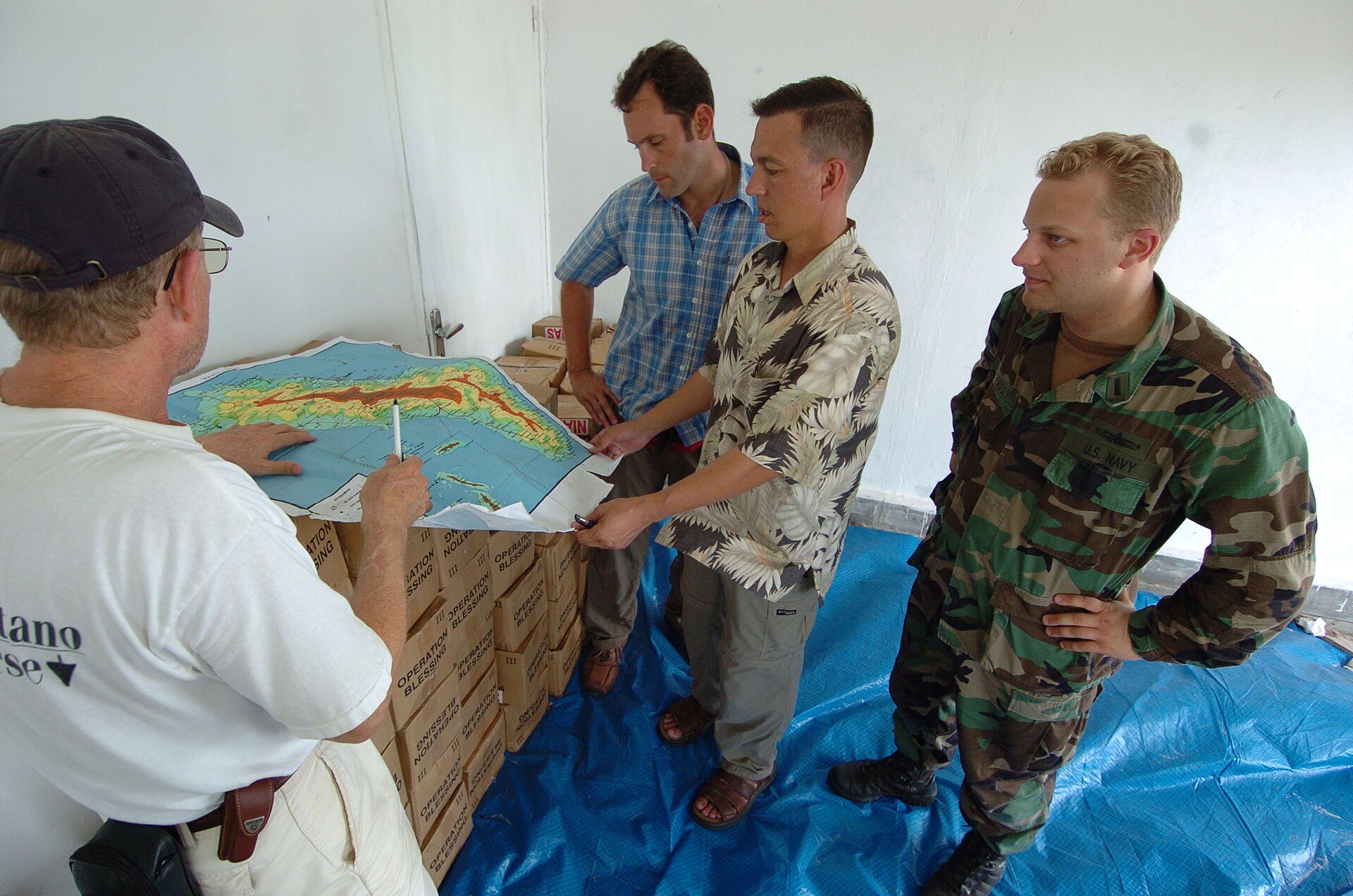

Founding and founders. The Philanthropy Roundtable's almanac of American giving records that Bob Pierce, moved by missionaries he met who cared for people with leprosy, acted: "In 1970, their devotion inspired him to create a new nondenominational ministry." It adds that "after Pierce died of leukemia, Graham became president of Samaritan's Purse in 1979," meaning Franklin Graham, son of the evangelist Billy Graham, and that Pierce "had previously founded the Christian overseas charity World Vision."29 The organization's headquarters is in Boone, North Carolina.2
Purpose and Operation Christmas Child. Samaritan's Purse works in disaster relief, medical missions and evangelism. Its best-known program is Operation Christmas Child, the shoebox drive. The program's own history says that in the summer of 1993 "Samaritan's Purse President Franklin Graham received a call from a man in England" asking for help filling shoeboxes for children in Eastern Europe; the program's stated mission is "to demonstrate God's love in a tangible way to children in need around the world." Since 1993, it says, "more than 244 million children in more than 175 countries and territories have received" a shoebox gift. A follow-up course for children, The Greatest Journey, has enrolled 52 million children since 2009, by the program's count, and "More than 27 million of these boys and girls have made a decision to accept Jesus as their Savior."30 These are the organization's own figures and were not independently checked.
Money. Samaritan's Purse (EIN 58-1437002) files a full Form 990 even though, as noted above, ProPublica shows it with a church designation. For the year ending December 2025 it reported revenue of $1,615,288,885, expenses of $1,319,588,593 and net assets of $2,761,987,081; contributions were $1,520,743,356, or 94.1 percent of revenue, and investment income $84,644,785.2 The previous year, ending December 2024, revenue was $1,839,497,527 against expenses of $1,093,195,701.2 Ten years earlier, for 2015, revenue had been $593,789,192.2
Pay. The return for the year ending December 2025 lists William Franklin Graham III, as board member, chairman and president, with reportable compensation of $551,873 from the organization and $72,890 in other compensation; Edward Graham, a board member, with $418,373 and $57,541.2 ProPublica's summary of the same return records that the organization "Provided first-class or charter travel" to key employees or officers, which is reported on Schedule J, and "Reported conflict of interest transactions," which are reported on Schedule L.2 Executive compensation as a whole was $4,062,631, or 0.3 percent of expenses.2 Franklin Graham also leads the Billy Graham Evangelistic Association (BGEA), founded by his father. A 2017 article on StartChurch, a church administration firm, reported that the IRS had approved BGEA's change to church status as "an association of churches," so that it "will no longer have to annually file with the IRS Form 990."31 Whatever BGEA pays its president is therefore not shown in a public return.


World Vision
Founding. Bob Pierce founded World Vision in 1950, two decades before Samaritan's Purse.29 The American organization (World Vision, Federal Way, Washington, EIN 95-1922279) is listed by ProPublica in the category of international relief.3
Money and pay. For the year ending September 2025 World Vision reported revenue of $1,423,305,144, expenses of $1,423,738,245 and net assets of $432,274,133; contributions made up 98.5 percent of revenue, and professional fund-raising fees were $7,163,180.3 Revenue had been $1,583,717,582 the year before and $1,005,144,556 in fiscal 2015.3 The 2025 return lists Edgar Sandoval, president and chief executive officer, with $573,543 in reportable compensation and $74,387 in other compensation.3 ProPublica notes that the organization "Operated a donor-advised fund."3
The Southern Baptist International Mission Board


Founding. The Southern Baptist Convention set up its Foreign Mission Board in 1845, with headquarters in Richmond, Virginia; the IMB dates the board's formation to May 10, 1845.17 Why the convention was formed that year, and the part slavery played in the split among American Baptists, is told in module 80 (Baptists). In 1997 the convention voted that the board "change its name to the International Mission Board."17 The IMB's milestone list names John Day, already a free man living in Liberia, as "Southern Baptists' first African American missionary," appointed in 1846, and Lula Whilden, appointed to China in 1871, as the appointment that revived the sending of single women.17
Money. The IMB is an entity of the Southern Baptist Convention; ProPublica has no Form 990 data for it and shows the church designation.32 The Lottie Moon Christmas Offering for the convention's 2024-25 fiscal year, which closed September 30, 2025, "totaled $207.2 million," above the goal of $205 million.33 The offering first passed $1 million in 1945, according to the IMB.17 The Cooperative Program sends the IMB a share of the convention's pooled receipts. At the September 2025 trustee meeting the IMB estimated 2025 Cooperative Program receipts at "approximately $93 million," down from almost $99 million in 2016, and said that adjusted for inflation the receipts "have declined almost $40 million." Messengers voted in 2010 to raise the IMB's share to 51 percent, but the report said it "has not gone above 50.41%." The trustees approved "a total balanced budget for 2025-26 of $314,066,700." IMB president Paul Chitwood told them that "Lottie must grow faster."18
Size and the 2015 to 2016 reduction. The IMB report of September 2025 spoke of "the nearly 3,600 missionaries and 3,000 missionary kids" in the IMB family.18 A decade earlier the board had cut its force sharply to close a gap between spending and income. The Baptist Standard reported on February 24, 2016, that over the previous six months 983 missionaries and 149 stateside staff, 1,132 people in all, had left through the board's voluntary retirement and resignation programs, leaving about 3,800 missionaries on the field. IMB president David Platt said: "The IMB is now in a much healthier financial position," and "Cooperative Program and Lottie Moon Christmas Offering giving are trending upward."34 The departures were voluntary offers rather than dismissals, and the figure of "about 1,100 missionaries" sometimes repeated combines missionaries and home-office staff.
Assemblies of God World Missions
Founding and size. AGWM's own page speaks of ministry "over these past 109 years" and says its partner churches number "nearly 370,000 churches worldwide" with "almost 54 million adherents," figures that count national churches the American missionaries work with, not American missionaries.35 At the 2025 General Council in Orlando, Assemblies of God World Missions (AGWM) announced a plan to grow its missionary force "from 2,569 to 4,000" by 2033, which the article called the largest missionary effort in 72 years.36 The Pentecostal background is in module 80 (Pentecostal, Orthodox and Catholic Bodies).
Money. AGWM missionaries are funded by support raising through itineration, as described above.15 The General Council of the Assemblies of God, as a church body, files no Form 990; ProPublica shows the church designation for the General Council in Springfield, Missouri,37 and no AGWM revenue total was found for this lesson.
Catholic mission bodies
This lesson treats two Catholic mission bodies briefly. Maryknoll, formally the Catholic Foreign Mission Society of America, was founded by Fathers James Anthony Walsh and Thomas Frederick Price; its history page says that on June 29, 1911, Pope Pius X blessed their plan, and "That date became the founding day of the Catholic Foreign Mission Society of America." In 1918 Price led the society's first three priests to China as their superior.38
The Pontifical Mission Societies are the Pope's own channel for mission funding. Their Vatican site explains that "There are four Pontifical Mission Societies." The Society of the Propagation of the Faith, the Society of the Holy Childhood and the Society of St. Peter the Apostle "were born in France in the 19th century," and "Pauline Jaricot, the founder of the 1st Society in 1822, expressed the fundamental principle: to pray and offer for the work of evangelization of the Church." A fourth, the Pontifical Missionary Union, came in the early 1900s, and "In 1922 Pope Pius XI gave the Societies the title of "Pontifical"."39 Catholic religious orders, as noted above, fall under the federal exception for "the exclusively religious activities of any religious order."5 More on the Catholic bodies is in module 80 (Pentecostal, Orthodox and Catholic Bodies).
The agencies side by side
The chart below puts the agencies in one table. It mixes kinds of figures on purpose, because that is what the public record allows: a Form 990 total for the relief bodies and SIL, an audited total for Wycliffe and Cru, a budget and offering total for the IMB, an outside estimate for OM and SIM, and nothing at all for some. Comparing them line by line would mislead; the chart is a guide to what each body reports and when.
Overhead, pay and accountability
What "overhead" means and why it is argued over
Donors often ask what share of a gift reaches "the field." The Form 990 sorts expenses into three columns: program services, management and general, and fund-raising. Audited statements use the same three. On those terms Wycliffe spent about 83 percent on programs in fiscal 2025, with about 10 percent on general and administrative costs and about 7 percent on fund-raising (about 81, 10 and 9 percent in fiscal 2022).4011 Cru reported fund-raising at 7.0 percent and general and administrative at 8.7 percent for fiscal 2025.4 The IMB tells donors that "100% of every gift directly supports overseas missionaries,"17 but how the board divides its home-office costs between the Cooperative Program and the offering was not checked against an audited IMB statement for this lesson, since the IMB files no Form 990.32
Two cautions apply. First, the categories depend on how an agency allocates shared costs, such as a translator who also writes donor newsletters. Second, a low overhead figure says nothing about whether the program does what it claims. Both points are matters of accounting judgment; this lesson reports the agencies' own figures as filed and does not rank them.
Executive pay
Only organizations that file a Form 990 must name the pay of their officers. In the returns for 2025, the top listed figures were $551,873 in reportable compensation for Franklin Graham at Samaritan's Purse (year ending December 2025), $573,543 for Edgar Sandoval at World Vision (year ending September 2025), and $157,865 for Michel Kenmogne at SIL's Dallas corporation (year ending September 2025), each with additional "other compensation" listed beside it.2322 For agencies that file no Form 990 and publish none, officer pay is not public. Wycliffe, which completes a Form 990 without filing it, lists its president and chief executive officer, John Chesnut, at $42,683 in reportable compensation and $49,413 in other compensation for fiscal 2025.41 Cru's annual report gives average staff compensation rather than officer pay.4
The two relief organizations each reported more than $1.4 billion in revenue for their 2025 fiscal years.23 Readers weigh pay at that scale differently; the Form 990 lets each reader see the figures and decide, and this lesson takes no side.
The church-status question
The legal exception for churches, associations of churches, religious orders and foreign mission societies is where the sharpest disagreement lies. Organizations that use it give their reasons. Cru's page says that charity rating lists "do not account for organizations like ours" because they depend on the Form 990, and stresses Cru's ECFA membership and outside transparency certification.14 The StartChurch article on BGEA presents the change as a lawful reclassification as "an association of churches."31 Watchdogs see it differently. Warren Cole Smith's MinistryWatch article "When a Church Is Not a Church" (2019) listed Cru, the Billy Graham Evangelistic Association and mission agencies including Ethnos360 (formerly New Tribes Mission), Frontiers, TransWorld Radio and Voice of the Martyrs among ministries that had claimed the exemption, and noted that "Many of these organizations have made this change in the past five years."24 The legal facts are not in dispute: the statute grants the exception, the IRS lists foreign mission societies in its own guidance, and a group that qualifies may still file voluntarily, as Samaritan's Purse and World Vision do.5623
ECFA and the Wycliffe Associates case
ECFA is the main private accountability body for evangelical ministries, and its process can be seen in one documented case. MinistryWatch reported on March 7, 2020, that Wycliffe Associates, one of about 150 charter members of ECFA, had resigned its membership voluntarily on February 21, 2020, "while under review of compliance with Standards 7.1 and 7.2," the standards that cover truthful statements in fund-raising and the use of gifts as donors intended.12 The article said that the organization's claims about its MAST translation method were among the matters under review.12 The article as opened for this lesson did not carry a statement from Wycliffe Associates explaining the resignation, and no finding by ECFA was reported, since the review ended with the resignation. The case is given here as an example of how the accreditation process works, not as a finding about the organization.
What the record shows and what it does not
- Documented fact (public filings): the revenue, expenses, net assets and officer pay of Samaritan's Purse, World Vision and SIL's Dallas corporation, from their Forms 990 for fiscal 2025; the federal filing exceptions in 26 U.S.C. 6033 and the IRS list of organizations that need not file.232256
- The agencies' own published accounts: Cru's audited figures for fiscal 2025, Wycliffe's audited figures for fiscal 2022 to 2025 and the Form 990 it completes voluntarily, the IMB's offering totals, budget and missionary count, AGWM's missionary count, OM's worker counts (which differ between its own pages), and Operation Christmas Child's shoebox totals. These are the organizations' own numbers.4111836252630
- The founders' own words: Carey's 1792 plan for a society funded by tithes and penny subscriptions, and Hudson Taylor's 1887 defense of sending workers with "only God to look to."119
- Independent and press reports: MinistryWatch's rankings and its reports on church-status claims and on Wycliffe Associates; the Baptist Standard on the IMB's 2015 to 2016 reduction; StartChurch on BGEA's reclassification.2124123431
- Not public: current revenue and officer pay for OM, SIM USA, the IMB as a separate return, AGWM and BGEA; worldwide consolidated totals for OM, SIM and SIL.
- What the people served record: the filings and reports used here count dollars, shoeboxes, missionaries and languages. They do not record how the churches and communities on the receiving end judge the agencies. Those voices appear in lessons 10 and 13.
- Open questions: the year Cru stopped filing a full Form 990; the reason for the differing OM worker counts; how the IMB divides home-office costs between the Cooperative Program and the Lottie Moon offering.
Pictures, Numbers and Infographics
The table gathers the lesson's key numbers. Every figure carries its fiscal year and its source, and the kind of source (Form 990, audited statement, agency report or press) is named in the note.
| Item | Figure | Year | Source |
|---|---|---|---|
| Carey's proposed giving | A tenth of annual income, or one penny a week | 1792 | Carey, Enquiry1 |
| Samaritan's Purse revenue | $1,615,288,885 | FY ending Dec. 2025 | Form 9902 |
| Samaritan's Purse revenue | $1,839,497,527 | FY ending Dec. 2024 | Form 9902 |
| Samaritan's Purse net assets | $2,761,987,081 | Dec. 2025 | Form 9902 |
| Franklin Graham, Samaritan's Purse pay | $551,873 reportable, $72,890 other | FY ending Dec. 2025 | Form 9902 |
| Operation Christmas Child reach | More than 244 million children, 175+ countries and territories | 1993 to present | Samaritan's Purse30 |
| World Vision (U.S.) revenue | $1,423,305,144 | FY ending Sept. 2025 | Form 9903 |
| Edgar Sandoval, World Vision pay | $573,543 reportable, $74,387 other | FY ending Sept. 2025 | Form 9903 |
| Cru worldwide revenues | $881,388,000 | FY ended Aug. 31, 2025 | Audited annual report4 |
| Cru contributions | $617,720,000 | FY 2025 | Audited annual report4 |
| Cru average monthly staff pay | $7,549 family, $3,618 single | FY 2025 | Audited annual report4 |
| Cru staff and countries | More than 16,000 staff, more than 190 countries | 2020 | Cru fact sheet23 |
| Wycliffe Bible Translators support and revenue | $321,080,000 | FY ended Sept. 30, 2022 | Audited statements11 |
| Wycliffe program share of expenses | $195,060,000 of $240,073,000 (about 81 percent) | FY 2022 | Audited statements11 |
| Wycliffe Bible Translators support and revenue | $198,622,000 | FY ended Sept. 30, 2025 | Audited statements40 |
| Wycliffe program share of expenses | $207,261,000 of $248,929,000 (about 83 percent) | FY 2025 | Audited statements40 |
| John Chesnut, Wycliffe pay | $42,683 reportable, $49,413 other | FY ending Sept. 2025 | Form 990 completed voluntarily, not filed41 |
| SIL (Dallas corporation) revenue | $53,997,913 | FY ending Sept. 2025 | Form 99022 |
| Languages still waiting for translation to begin | 544 of 7,396 | Aug. 1, 2025 | Wycliffe Global Alliance and ProgressBible20 |
| OM workers | 3,200; 3,311; "over 4,500" (OM pages differ) | undated | OM international and British pages2526 |
| OM USA revenue | $29,372,403 | 2019 or nearby | MinistryWatch ranking21 |
| SIM USA revenue | $51,241,973 | 2019 or nearby | MinistryWatch ranking21 |
| Lottie Moon Christmas Offering | $207.2 million (goal $205 million) | SBC FY 2024-25 | IMB report33 |
| IMB budget | $314,066,700 | 2025-26 | IMB trustee report18 |
| Cooperative Program receipts (estimate) | About $93 million | 2025 | IMB trustee report18 |
| IMB missionaries | Nearly 3,600 | 2025 | IMB trustee report18 |
| IMB departures | 983 missionaries and 149 staff (1,132) | Aug. 2015 to Feb. 2016 | Baptist Standard34 |
| AGWM missionaries | 2,569, with a goal of 4,000 by 2033 | 2025 | AG News36 |
| ECFA members | More than 2,430 | 2020 | MinistryWatch12 |
Claims checked
"Cru stopped filing a Form 990 because it became a church"
Rating: Partly supported. Cru does not file a Form 990 showing its finances; ProPublica lists only Forms 990-T for it.10 MinistryWatch counted Cru among ministries claiming church-type exemption.24 But Cru's own statement is that the IRS classifies it as a "Religious Order," and its audited statements describe it as a California nonprofit religious corporation exempt under section 501(c)(3).144 "Became a church" is therefore not Cru's own description, and the year of the change was not found.
"Southern Baptist missionaries have to raise their own support like everyone else"
Rating: Refuted. IMB missionaries are appointed "fully funded" from the board's budget, which comes from the Cooperative Program and the Lottie Moon Christmas Offering.1817 The salary model differs from support raising.
"The IMB fired more than 1,100 missionaries in 2015"
Rating: Partly supported. The total of 1,132 is correct, but it includes 149 stateside staff alongside 983 missionaries, and the departures came through voluntary retirement and resignation programs over six months ending in February 2016, not dismissals.34
"Franklin Graham is paid more than half a million dollars by Samaritan's Purse"
Rating: Supported for the year ending December 2025, when the Form 990 shows $551,873 in reportable compensation and $72,890 in other compensation.2 Pay from other organizations that file no Form 990 is not public, so no total of all his compensation can be given from the record.31
"The same man founded World Vision and Samaritan's Purse"
Rating: Supported. Bob Pierce founded World Vision in 1950 and Samaritan's Purse in 1970; Franklin Graham became president of Samaritan's Purse in 1979 after Pierce's death.29
"A ministry that does not file a Form 990 is hiding something"
Rating: Unresolved. The exception is lawful and written into the statute and the IRS's own guidance.56 Some of the non-filers publish audited statements (Cru and Wycliffe for 2025), Wycliffe also posts a Form 990 it completes voluntarily, and both belong to ECFA.4404113 Others publish little. Watchdogs such as MinistryWatch treat the trend as a loss of transparency; the organizations present it as a lawful classification with other forms of accountability.2414 What is hidden, if anything, cannot be shown from records that do not exist.
"100% of every gift to the IMB goes overseas"
Rating: Unresolved. The IMB makes this statement about gifts.17 The IMB files no Form 990, and its audited breakdown was not checked for this lesson, so the claim rests on the board's word.32
"OM has more than 4,500 workers"
Rating: Unresolved. OM's British page says "over 4,500 workers"; its international history page gives 3,200 and 3,311 in two places. None of the counts is dated.2625
"Bible translation has started in almost every language"
Rating: Supported, with the organizations' own definitions. As of August 1, 2025, ProgressBible counted 544 of 7,396 living languages still waiting for translation to begin, representing 36.8 million people.20 "Started" is not "finished"; lesson 10 gives the counts of full Bibles and New Testaments.
"Hudson Taylor never asked anyone for money"
Rating: Partly supported. Taylor's own 1887 account describes money supplied "in answer to prayer," and when he wanted more workers in 1865 he "did not hesitate to ask the great Lord of the harvest to call forth, to thrust forth, twenty-four European, and twenty-four native evangelists."19 The same book, though, sets out China's need at length, with tables of provinces and population, and it was printed in edition after edition for readers who could answer with gifts or with their own lives.19 Lesson 06 covers the CIM's principles.
Hard questions and answers
Is personal support raising fair to missionaries from poorer churches and countries?
The record in this lesson shows how the model works rather than settling the question. Cru's statements make each staff member "responsible for securing contributions," and AGWM asks churches to commit for five years because missionaries depend on itineration.415 A missionary whose home churches have less to give must find more of them. Pooled models such as the IMB's pay all appointed missionaries from one budget, which removes that difference but ties the number of missionaries to the denomination's total giving, as the 2015 to 2016 reduction showed.34 Lesson 13 takes up missionaries sent from the Global South, where the question is sharpest.
Are Samaritan's Purse and World Vision mission agencies at all?
Both describe Christian purposes. Operation Christmas Child states that its mission is "to demonstrate God's love in a tangible way to children in need," and its own count of children who "made a decision to accept Jesus" through its follow-up course is more than 27 million.30 Both also work as large relief bodies with paid staff and file Forms 990 like secular charities.23 Whether that makes them "mission agencies" depends on the reader's definition of mission, a question lesson 01 opens.
Why does a lesson on American agencies spend so little on Catholic missions?
Because the American public record is thin for them. The Pontifical Mission Societies operate as the Pope's channel for mission support, and religious orders such as Maryknoll fall under the federal exception for the religious activities of religious orders.395 Pauline Jaricot's society dates from 1822, twenty-three years before the Southern Baptist Foreign Mission Board.3917
Would William Carey recognize the system he proposed?
In outline, yes. He asked for "a society" with a "committee" to "receive contributions" and to examine the "characters, tempers, abilities and religious views of the missionaries."1 Every agency in this lesson has those parts. He also proposed giving by many people of "moderate circumstances," not only the rich, which is how Cru describes its typical donor: an average gift of $170 and a most frequent gift of $50.14 The scale would be new to him: a single relief agency now reports net assets of more than $2.7 billion.2
How can a donor check an agency before giving?
The tools named in this lesson are public. ProPublica's Nonprofit Explorer has IRS digitized Form 990 data for filings processed in 2012 and later, and shows when an organization is designated as a church.2 ECFA's member search shows whether an agency is accredited and its fiscal year.13 An agency's own web site should link audited statements; the date of the most recent statement is itself information. Wycliffe's page, for example, links audited statements through fiscal 2025 and a Form 990 it completes voluntarily, which ProPublica does not show because it is not filed with the IRS.1141 Lesson 14 gathers these tools into a checklist.
Learn more
- ProPublica Nonprofit Explorer: Search any U.S. nonprofit's Form 990 filings, revenue history and officer pay, and see whether it is designated as a church.
- IRS: Annual Exempt Organization Return, Who Must File: The official list of organizations, including churches and certain foreign mission societies, that need not file a Form 990.
- William Carey's Enquiry (1792), full text: Read section V for Carey's own plan for a mission society, its committee and its funding.
- Hudson Taylor, China's Spiritual Need and Claims (1887 edition): Taylor's own case for the faith mission and his account of how the China Inland Mission was supplied.
- Cru 2025 Annual Report: An example of a large ministry that files no Form 990 publishing audited statements and average staff pay.
- Wycliffe Global Alliance: Global Scripture Access: The yearly summary of Bible translation progress drawn from ProgressBible.
- IMB: Milestones from the Past 175 Years: The Southern Baptist board's own timeline of its founding, the Christmas offering and the Cooperative Program.
Still being checked (18 items)
These points could not be confirmed against a primary source when this lesson was written and fact checked in October 2026. The text above states each one as uncertain.
- The year in which Cru stopped filing a full Form 990 was not found; Cru describes itself as classified by the IRS as a Religious Order, while its audited statements describe a California nonprofit religious corporation exempt under section 501(c)(3).
- Cru's name change: the Cru fact sheet dates it to 2012; the often-cited 2011 announcement date was not checked against a primary source.
- SIL's present public name (SIL Global) and the date it was adopted were not checked; sil.org returned errors on Nov. 12, 2026. The lesson uses SIL and the name on the Form 990.
- Wycliffe and SIL founding dates (Camp Wycliffe in the 1930s, incorporation in 1942) rest on lesson 10, ECFA's profile ("Founded: 1942") and the "Year of formation: 1942" on the Form 990 Wycliffe completes voluntarily, not on incorporation records.
- OM's worker counts differ between its own pages (3,200; 3,311; over 4,500) and are undated.
- Logos Hope's entry into service after its 2004 purchase, and George Verwer's later life, were not checked and are not stated.
- Franklin Graham's leadership of the Billy Graham Evangelistic Association is stated from general knowledge and was not checked against a primary source in this lesson; his BGEA compensation, if any, is not public.
- The Assemblies of God founding year (1914) in the comparison chart was not checked against a primary source in this lesson; AGWM's page speaks only of "109 years."
- The IMB's statement that "100% of every gift directly supports overseas missionaries" was not checked against audited IMB statements.
- ECFA's Seven Standards were not read in full (the page renders by script); the description of Standards 7.1 and 7.2 comes from MinistryWatch.
- OM USA ($29,372,403) and SIM USA ($51,241,973) revenue figures are MinistryWatch's 2021 compilation of 2019 or nearby data; no newer figures are public.
- Operation Christmas Child, Greatest Journey and IMB missionary counts are the organizations' own figures and were not independently checked.
- The Taylor quotation was checked against the archive.org OCR text of the 1887 edition, not the page image; long dashes in the printed text were replaced by commas.
- The administrative share that support-raising agencies keep from missionary support gifts was not checked for any agency.
- Wycliffe's fiscal 2021 total ($237,866,000) comes from the fiscal 2022 statements, whose link returned 404 on Nov. 12, 2026; the fiscal 2022 figures were confirmed from the comparative columns of the fiscal 2023 statements.
- The Wycliffe Form 990 for fiscal 2025 is a scanned copy read by OCR and page image; it is completed voluntarily and is not filed with the IRS, so ProPublica does not carry it.
- AGWM's "About Us" page (footnote 35: "109 years," "nearly 370,000 churches," "almost 54 million adherents") returned "Page Not Found" on Nov. 12, 2026; the figures were not rechecked.
- ECFA's Wycliffe member profile (footnote 13) returned a 404 page on Nov. 12, 2026; its "member since July 1, 1980" and fiscal-year data were not rechecked.
Notes
- William Carey, An Enquiry into the Obligations of Christians, to Use Means for the Conversion of the Heathens (Leicester: Ann Ireland, 1792), section V; Project Gutenberg eBook #11449 (2004), text as printed, archive.org copy (retrieved Nov. 12, 2026). Read it online. ↩
- ProPublica Nonprofit Explorer, "Samaritans Purse," Boone, N.C., EIN 58-1437002: Form 990 extracted data for fiscal years ending Dec. 2011 to Dec. 2025 and compensation of key employees from the return for the year ending Dec. 2025 (filed Sept. 2, 2026) (retrieved Nov. 12, 2026). Read it online. ↩
- ProPublica Nonprofit Explorer, "World Vision," Federal Way, Wash., EIN 95-1922279: Form 990 extracted data for fiscal years ending Sept. 2011 to Sept. 2025 and compensation from the return for the year ending Sept. 2025 (filed April 30, 2026) (retrieved Nov. 12, 2026). Read it online. ↩
- Cru (Campus Crusade for Christ, Inc.), 2025 Annual Report, with consolidated financial statements for the year ended Aug. 31, 2025 and the Report of Independent Auditors dated Dec. 10, 2025 (retrieved Nov. 12, 2026). Read it online. ↩
- 26 U.S. Code section 6033(a)(3)(A), "Mandatory exceptions," with the statutory notes on Pub. L. 91-172 (Tax Reform Act of 1969), Legal Information Institute, Cornell Law School (retrieved Nov. 12, 2026). Read it online. ↩
- Internal Revenue Service, "Annual Exempt Organization Return: Who Must File," page last reviewed June 27, 2026 (retrieved Nov. 12, 2026). Read it online. ↩
- ProPublica Nonprofit Explorer, "Wycliffe Bible Translators Inc," Orlando, Fla., EIN 95-1831097 (church designation; Forms 990-T only, for fiscal years ending Sept. 2010 to 2015, 2017 and 2018) (retrieved Nov. 12, 2026). Read it online. ↩
- ProPublica Nonprofit Explorer, "Operation Mobilization," Tyrone, Ga., EIN 22-2513811 (church designation; no Form 990 data) (retrieved Nov. 12, 2026). Read it online. ↩
- ProPublica Nonprofit Explorer, "Sim Usa Incorporated," Charlotte, N.C., EIN 22-1936391 (church designation; Form 990 records through fiscal 2013 showing zero figures; Forms 990-T for fiscal 2021 and 2022) (retrieved Nov. 12, 2026). Read it online. ↩
- ProPublica Nonprofit Explorer, "Campus Crusade For Christ Inc," Orlando, Fla., EIN 95-6006173 (designated a religious organization; Form 990-T only, fiscal year ending Aug. 2018) (retrieved Nov. 12, 2026). Read it online. ↩
- Wycliffe Bible Translators USA, "Financial Accountability" page, linking consolidated financial statements for fiscal 2021 to 2025, Forms 990 completed voluntarily for fiscal 2022 to 2025 and a FY2021 Form 990-T letter; Wycliffe Bible Translators, Inc. and Affiliates, Consolidated Financial Statements, years ended Sept. 30, 2023 and 2022 (Note A and statements of activities, with fiscal 2022 comparatives), and years ended Sept. 30, 2024 and 2023. The fiscal 2022 statements first used for this lesson (which also gave the fiscal 2021 figure) were at https://wycliffe.org/Resources/Financial/Financial%20Statement/2022-Wycliffe-Consolidated-Financial-Statements.pdf, which returned "404 Not Found" on Nov. 12, 2026 (retrieved Nov. 12, 2026). Read it online. ↩
- Warren Cole Smith, "ECFA Charter Member Wycliffe Associates Resigns Membership While Under Review," MinistryWatch, March 7, 2020 (retrieved Nov. 12, 2026). Read it online. ↩
- Evangelical Council for Financial Accountability, member profile "Wycliffe Bible Translators" (member since July 1, 1980; data for year ended Sept. 30, 2025), and the ECFA page "Seven Standards of Responsible Stewardship" (https://www.ecfa.org/Content/Standards) (profile link is the Internet Archive copy of June 17, 2026, because the profile URL now returns an ECFA "404" page) (retrieved Nov. 12, 2026). Read it online. ↩
- Jesus Film Project (a ministry of Cru), "What Are Charity Observers Saying About Cru?" page updated Oct. 27, 2026 (retrieved Nov. 12, 2026). Read it online. ↩
- Assemblies of God World Missions, "Frequently Asked Questions" supporter brochure (undated PDF) (retrieved Nov. 12, 2026). Read it online. ↩
- Wycliffe Bible Translators USA, "Learn About Wycliffe USA: Mission, Vision and Work" (About page) (retrieved Nov. 12, 2026). Read it online. ↩
- International Mission Board, "Milestones from the Past 175 Years," Dec. 29, 2020 (entries for 1845, 1846, 1871, 1888, 1918, 1925, 1945 and 1997) (retrieved Nov. 12, 2026). Read it online. ↩
- International Mission Board, "IMB trustees appoint 54 missionaries, fueling Great Commission task," Sept. 25, 2025 (retrieved Nov. 12, 2026). Read it online. ↩
- J. Hudson Taylor, China's Spiritual Need and Claims, 7th ed. (London: Morgan & Scott, 1887), section headed "God is Faithful," p. 49 and following, including the letter dated 1857; prefatory note on earlier editions (1865 to 1887). Cornell University Library copy, archive.org full text (retrieved Nov. 12, 2026). Read it online. ↩
- Wycliffe Global Alliance, "2025 Global Scripture Access," drawing on the ProgressBible snapshot of August 2025 (retrieved Nov. 12, 2026). Read it online. ↩
- The Editors, "50 Largest Missions and Bible Translation Organizations," MinistryWatch, April 1, 2021, last modified Sept. 3, 2024 (figures from the most recent Form 990 or audited statements then available, 2019 for most) (retrieved Nov. 12, 2026). Read it online. ↩
- ProPublica Nonprofit Explorer, "Summer Institute Of Linguistics Inc" (SIL International), Dallas, Tex., EIN 75-1840827: Form 990 extracted data for fiscal years ending Sept. 2011 to Sept. 2025 and compensation from the return for the year ending Sept. 2025 (filed Aug. 17, 2026) (retrieved Nov. 12, 2026). Read it online. ↩
- Cru, "Cru Historical Fact Sheet" (entries for 1951, 1962, 1965, 1979, 1991, 2003, 2012 and 2020) (retrieved Nov. 12, 2026). Read it online. ↩
- Warren Cole Smith, "When a Church Is Not a Church," MinistryWatch, Dec. 19, 2019 (retrieved Nov. 12, 2026). Read it online. ↩
- OM International, "History" (timeline entries for 1957, 1961, 1970, 1978 and 1988; worker counts) (retrieved Nov. 12, 2026). Read it online. ↩
- OM United Kingdom, "History and Vision" (milestones 1960 to 2004; worker and country counts) (retrieved Nov. 12, 2026). Read it online. ↩
- SIM International, "Our History" (retrieved Nov. 12, 2026). Read it online. ↩
- SIM UK and Ireland (Serving In Mission), "History" (mergers of 1982, 1989, 1998 and 2016) (retrieved Nov. 12, 2026). Read it online. ↩
- Philanthropy Roundtable, Almanac of American Philanthropy, "Samaritan's Purse" (retrieved Nov. 12, 2026). Read it online. ↩
- Samaritan's Purse, "Operation Christmas Child: Mission and History" (retrieved Nov. 12, 2026). Read it online. ↩
- Raul Rivera, "Billy Graham Evangelistic Association Changes Its Tax Status," StartChurch blog, March 12, 2017 (retrieved Nov. 12, 2026). Read it online. ↩
- ProPublica Nonprofit Explorer, "International Mission Board Of The Southern Baptist Convention," Richmond, Va., EIN 54-0213930 (church designation; no Form 990 data) (retrieved Nov. 12, 2026). Read it online. ↩
- International Mission Board and North American Mission Board, "Continued faithfulness: Giving to Lottie Moon, Annie Armstrong surpasses $278 million," published in The Alabama Baptist, Oct. 14, 2025 (retrieved Nov. 12, 2026). Read it online. ↩
- Ken Camp, "IMB announces 1,132 missionaries and staff retired or resigned," Baptist Standard, Feb. 24, 2016 (retrieved Nov. 12, 2026). Read it online. ↩
- Assemblies of God World Missions, "About Us" (Internet Archive copy of July 12, 2025; the agwm.org page no longer loads at this address) (retrieved Nov. 12, 2026). Read it online. ↩
- Joy Myers, "AGWM Launches Largest Missionary Effort in 72 Years," AG News (Assemblies of God), 2025 (retrieved Nov. 12, 2026). Read it online. ↩
- ProPublica Nonprofit Explorer, "General Council Of The Assemblies Of God," Springfield, Mo., EIN 44-0577787 (church designation; Form 990-T only) (retrieved Nov. 12, 2026). Read it online. ↩
- Maryknoll Society, "A providential meeting" (Meet Our Founders) (retrieved Nov. 12, 2026). Read it online. ↩
- Pontifical Mission Societies (Vatican), "Who we are" (retrieved Nov. 12, 2026). Read it online. ↩
- Wycliffe Bible Translators, Inc., Consolidated Financial Statements, year ended Sept. 30, 2025, with Management Discussion and Analysis and the independent auditors' report of Batts Morrison Wales & Lee, P.A., dated Feb. 16, 2026 (Note A; consolidated statement of activities), linked as "FY 2025 Financial Statement" from the Wycliffe USA financial accountability page; the "FY 2024 Financial Statement" (years ended Sept. 30, 2024 and 2023) is linked from the same page (retrieved Nov. 12, 2026). Read it online. ↩
- Wycliffe Bible Translators, Inc., EIN 95-1831097, Form 990 for the tax year Oct. 1, 2024 to Sept. 30, 2025, signed May 26, 2026, with a cover statement that the IRS "recognizes Wycliffe Bible Translators as a 501(c)(3) organization and a church" and that Wycliffe "voluntarily completes the main Form 990 each year, even though it is not required to file the form with the IRS" (Part I summary; Part VII, Section A), linked as "FY 2025 Form 990" from the Wycliffe USA financial accountability page (retrieved Nov. 12, 2026). Read it online. ↩
- Cru, "Cru Names David Robbins New President," Cru press release (2024), with a photo caption dating his commissioning to July 18, 2024, in Orlando (retrieved Nov. 12, 2026). Read it online. ↩
Check yourself
1. In his 1792 Enquiry, what did William Carey suggest Christians of "moderate circumstances" give to fund missions?
Carey proposed a tithe, "a tenth, of their annual increase," and congregational subscriptions "of one penny, or more per week."
2. Which federal law sets out the exceptions that let churches, associations of churches and the religious activities of religious orders skip the Form 990?
Section 6033(a)(3)(A) lists the mandatory exceptions; the statutory notes credit Pub. L. 91-172 (1969) with adding them.
3. According to the Form 990 for the year ending December 2025, what was Samaritan's Purse's total revenue?
ProPublica's extract of the return shows $1,615,288,885 (2024: $1,839,497,527). $881.4 million is Cru's fiscal 2025 worldwide revenue.
4. How does Cru describe its own federal tax classification?
Cru's page says "Cru is classified by the IRS as a "Religious Order" (RO)" and that an RO is not required to file Form 990.
5. How are Southern Baptist International Mission Board missionaries paid?
The IMB's September 2025 report speaks of "54 fully funded missionaries" and a balanced 2025-26 budget of $314,066,700.
6. What did the Baptist Standard report about the IMB reduction announced in February 2016?
Ken Camp reported 983 missionaries and 149 stateside staff, 1,132 in all, left through voluntary retirement and resignation programs, leaving about 3,800 missionaries.
7. Which statement about Operation Mobilisation's size is accurate?
OM's international history page gives 3,200 and 3,311; its British page says over 4,500. None is dated.
8. What happened with Wycliffe Associates and ECFA in 2020, according to MinistryWatch?
MinistryWatch reported the voluntary resignation during the review; the review ended without a reported ECFA finding.
Terms in this lesson
- Form 990
- The annual information return most U.S. tax-exempt organizations file with the IRS, reporting revenue, expenses, assets and the pay of officers and top employees.
- Form 990-T
- The return for unrelated business income. Some organizations that are excused from the Form 990, such as Wycliffe and Cru, still file it.
- Church designation (filing exception)
- The classes in 26 U.S.C. 6033(a)(3)(A) and IRS guidance (churches, integrated auxiliaries, conventions or associations of churches, religious activities of religious orders, and certain foreign mission societies) that need not file a Form 990.
- Integrated auxiliary
- An organization closely tied to a church that shares the church's exception from filing a Form 990.
- ECFA
- The Evangelical Council for Financial Accountability, founded in 1979, which accredits member ministries that meet its Seven Standards of Responsible Stewardship.
- Personal support raising (deputation)
- The model in which each missionary gathers pledges from individuals and churches to fund his or her own salary and ministry costs through the agency.
- Itineration
- The Assemblies of God term for the period when a missionary travels among churches to raise support before and between terms overseas.
- Cooperative Program
- The Southern Baptist Convention's pooled giving plan, created in 1925, which funds the convention's agencies, including the IMB.
- Lottie Moon Christmas Offering
- The yearly Southern Baptist offering for international missions, begun in 1888 and named for Lottie Moon in 1918; it totaled $207.2 million in fiscal 2024-25.
- Faith mission
- The pattern associated with Hudson Taylor's China Inland Mission (1865), in which workers had no guaranteed salary and needs were brought to God in prayer rather than by public appeal.
- Program services
- The Form 990 and audit category for spending on an organization's purpose, as opposed to management and general costs and fund-raising.
- Fiscal year
- An organization's twelve-month accounting year, which may end on a date other than December 31 (August 31 for Cru, September 30 for World Vision, SIL and Wycliffe).
- Pontifical Mission Societies
- Four Catholic societies, the first founded by Pauline Jaricot in 1822, given the title "Pontifical" by Pope Pius XI in 1922 to support missions with prayer and charity.
- Operation Christmas Child
- The Samaritan's Purse shoebox program begun in 1993, which reports more than 244 million children reached in more than 175 countries and territories.
Sources
- William Carey, An Enquiry into the Obligations of Christians to Use Means for the Conversion of the Heathens (1792), Project Gutenberg #11449 (1792) checked 2026-10
- J. Hudson Taylor, China's Spiritual Need and Claims, 7th ed. (1887) (1887) checked 2026-10
- 26 U.S. Code section 6033 (Cornell LII) (current) checked 2026-10
- IRS, Annual Exempt Organization Return: Who Must File (2026-06-27) checked 2026-10
- ProPublica Nonprofit Explorer: Samaritan's Purse (FY Dec. 2025) checked 2026-10
- ProPublica Nonprofit Explorer: World Vision (FY Sept. 2025) checked 2026-10
- ProPublica Nonprofit Explorer: Summer Institute of Linguistics (SIL International) (FY Sept. 2025) checked 2026-10
- ProPublica Nonprofit Explorer: Wycliffe Bible Translators Inc (2018) checked 2026-10
- ProPublica Nonprofit Explorer: Campus Crusade for Christ Inc (2018) checked 2026-10
- ProPublica Nonprofit Explorer: Operation Mobilization (n.d.) checked 2026-10
- ProPublica Nonprofit Explorer: SIM USA Incorporated (2013) checked 2026-10
- ProPublica Nonprofit Explorer: International Mission Board of the SBC (n.d.) checked 2026-10
- ProPublica Nonprofit Explorer: General Council of the Assemblies of God (2025) checked 2026-10
- Cru, 2025 Annual Report (2025-12-10) checked 2026-10
- Cru, Cru Historical Fact Sheet (n.d.) checked 2026-10
- Jesus Film Project, What Are Charity Observers Saying About Cru? (2026-10-27) checked 2026-10
- Wycliffe Bible Translators, Consolidated Financial Statements FY2022 (2022) checked 2026-10
- Wycliffe USA, About (n.d.) checked 2026-10
- Wycliffe Global Alliance, 2025 Global Scripture Access (2025) checked 2026-10
- ECFA member profile: Wycliffe Bible Translators (2025) checked 2026-10
- ECFA, Seven Standards of Responsible Stewardship (n.d.) checked 2026-10
- MinistryWatch, 50 Largest Missions and Bible Translation Organizations (2021-04-01) checked 2026-10
- Warren Cole Smith, When a Church Is Not a Church (MinistryWatch) (2019-12-19) checked 2026-10
- Warren Cole Smith, ECFA Charter Member Wycliffe Associates Resigns Membership While Under Review (MinistryWatch) (2020-03-07) checked 2026-10
- OM International, History (n.d.) checked 2026-10
- OM UK, History and Vision (n.d.) checked 2026-10
- SIM International, Our History (n.d.) checked 2026-10
- SIM UK and Ireland, History (n.d.) checked 2026-10
- Philanthropy Roundtable, Samaritan's Purse (n.d.) checked 2026-10
- Samaritan's Purse, Operation Christmas Child: Mission and History (n.d.) checked 2026-10
- Raul Rivera, Billy Graham Evangelistic Association Changes Its Tax Status (StartChurch) (2017-03-12) checked 2026-10
- IMB, Milestones from the Past 175 Years (2020-12-29) checked 2026-10
- IMB, IMB trustees appoint 54 missionaries, fueling Great Commission task (2025-09-25) checked 2026-10
- IMB and NAMB, Giving to Lottie Moon, Annie Armstrong surpasses $278 million (The Alabama Baptist) (2025-10-14) checked 2026-10
- Ken Camp, IMB announces 1,132 missionaries and staff retired or resigned (Baptist Standard) (2016-02-24) checked 2026-10
- AGWM, Frequently Asked Questions brochure (n.d.) checked 2026-10
- AGWM, About Us (n.d.) checked 2026-10
- Joy Myers, AGWM Launches Largest Missionary Effort in 72 Years (AG News) (2025) checked 2026-10
- Maryknoll Society, Meet Our Founders (n.d.) checked 2026-10
- Pontifical Mission Societies, Who we are (n.d.) checked 2026-10