Lesson 6 of 14 · about 55 minutes · Updated October 28, 2026
Baptists: English and American Roots and the Many Kinds of Baptists
You'll be able to
- You'll be able to explain how the first Baptist churches arose from English Separatism in Amsterdam and London between 1609 and 1644.
- You'll be able to tell General Baptists from Particular Baptists and trace each line to bodies that exist today.
- You'll be able to describe the Baptist case for religious liberty in the words of Helwys, Williams, Backus and Leland.
- You'll be able to explain why the Southern Baptist Convention formed in 1845, using the founders' own documents and the 1995 resolution.
- You'll be able to define Landmarkism, the conservative resurgence and the Baptist Faith and Message, and state each side's view of them.
- You'll be able to name the main Baptist bodies in the United States, say what makes each distinct and give their reported size with source and year.
Start here: the short version
Baptists began among English Separatists who had fled to the Netherlands. In 1609 John Smyth baptized himself and his Amsterdam congregation on a confession of faith, and in 1612 Thomas Helwys brought a small group back to Spitalfields, outside London, where he published a plea telling King James I that the king "is a mortall man and not God" and has no power over the souls of his subjects. Two streams grew from those beginnings: General Baptists, who held that Christ died for all people, and Particular Baptists, who held the Calvinist view of election and wrote the confessions of 1644 and 1677 (adopted in London in 1689). In America, Roger Williams and Ezekiel Holliman began a Baptist church at Providence in 1638 or 1639, and later Baptists such as Isaac Backus and John Leland argued for religious liberty in the new republic.
American Baptists formed their first national body, the Triennial Convention, at Philadelphia in May 1814. In May 1845 the Southern Baptist Convention organized at Augusta, Georgia, after the Boston board said it could not appoint a slaveholder as a missionary. In 1995 the SBC formally repented of "the role that slavery played" in its founding. Since then the family has divided many more times: Landmark Baptists (who teach that only Baptist churches are true churches), Primitive Baptists (who refused mission societies and seminaries), Free Will Baptists, Old Regular Baptists, Seventh Day Baptists, the National Baptist conventions, Independent fundamental Baptists, Reformed Baptists who hold the 1689 Confession, the moderates of the Cooperative Baptist Fellowship (1991) and the American Baptist Churches USA. In 2025 the SBC reported 12,331,954 members in 46,608 churches, the nineteenth year of decline in a row, and in June 2026 its messengers gave a first approval to a constitutional amendment limiting the pastoral office to men.
Where the Baptist story begins
The sixteenth century background is taught in module 79. Lesson 12 of that module covers Zwingli, Calvin, the first Anabaptists in Zurich (1525) and the Schleitheim Confession (1527): see Zwingli, Calvin and the Wider Reformation. The same lesson covers Henry VIII, Cranmer and the English prayer books, which explain why English Protestants who wanted a fuller reform of the national church ended up as Puritans inside it or Separatists outside it. The Puritans and Separatists themselves are the subject of lesson 05, and the continental Anabaptist bodies that survive today (Mennonites, Amish, Hutterites, Brethren) are the subject of lesson 08.
Baptists share with the Reformed churches most doctrines about God, Christ and salvation, and share with the Congregationalists the conviction that each local church governs itself. They differ from both on who should be baptized and how. Philip Schaff, writing in The Creeds of Christendom (first published 1877), summarized the difference this way: Baptists "teach that believers only ought to be baptized, that is, dipped or immersed, on a voluntary confession of their faith," and they "reject infant baptism as an unscriptural innovation." Schaff added that in Baptist teaching baptism "has no regenerative and saving efficacy: it is simply an outward sign of grace already bestowed."1 He also noted the second mark that runs through Baptist history: Baptists "opposed from the start national church establishments, and the union of Church and State."1
Those two convictions, a church of baptized believers and a church free of the state, explain most of what follows: the persecution of early Baptists in England and New England, their alliance with Jefferson and Madison in Virginia, the long Baptist suspicion of creeds, and many of the later splits, which turned on how far a convention of free churches may go in telling its member churches what to believe.
John Smyth, Thomas Helwys and the first English Baptists
The Amsterdam congregation, 1608 to 1609
John Smyth was a Cambridge graduate (a fellow of Christ's College, 1594 to 1598, according to the title page of his collected works) and a Church of England clergyman who became a Separatist. About 1608 he led a congregation of Separatists from the English Midlands, Thomas Helwys among them, to Amsterdam, where English dissenters could worship without arrest. There, in 1609, Smyth concluded that infant baptism was no baptism at all, and that a true church must be gathered by the baptism of believers. His tract The Character of the Beast (1609), a written exchange with the Separatist Richard Clifton, set out two propositions on its title page: "1. That infants are not to bee Baptized. 2. That Antichristians converted are to bee admitted into the true Church by baptisme."2
Because Smyth knew of no church he could accept as true, he baptized himself and then the others. He later explained his reasoning in writing: "seeing ther was no church to whome wee could Joyne with a Good conscience to haue baptisme from them, therfor wee might baptize our selues."2 The same passage shows that Smyth came to regret the step once he had met the Waterlander Mennonites in Amsterdam, whom he judged to be a true church already baptizing believers. He wrote that it "is not the truth that two or three priuate persons may baptize," when a true church and ministers already exist.2 Smyth and most of his followers applied to join the Mennonites. Smyth died in Amsterdam in 1612, and his group was later absorbed into the Mennonite congregation there.
Helwys and the first Baptist church in England, 1611 to 1612
Helwys and a minority refused to join the Mennonites. In 1611 they published A Declaration of Faith of English People Remaining at Amsterdam in Holland, which Schaff calls "the first Confession of Arminian Baptists."1 The text, as printed in the New Orleans Baptist Theological Seminary compilation of General Baptist confessions (spelling modernized there), says that the church receives members "by baptism, upon their confession of their faith and sins," and that baptism "in nowise appertains to infants."3 It also says "That magistracy is the holy ordinance of God," so the first English Baptists, unlike the Swiss Brethren of Schleitheim, allowed Christians to serve as magistrates.3
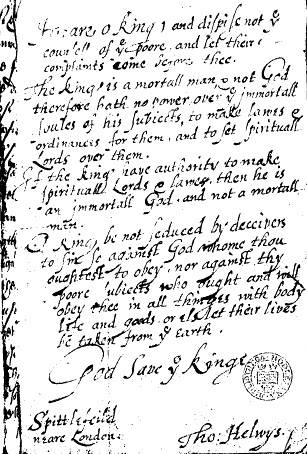
In 1612 Helwys returned to England with a small group and gathered a congregation at Spitalfields, just outside the City of London. It is usually counted as the first Baptist church on English soil. The same year he published A Short Declaration of the Mistery of Iniquity, and in a copy for King James I he wrote a personal message on the flyleaf. That inscription survives and is reproduced below. Its central sentence reads: "The king is a mortall man and not God, therefore hath no power over the immortall soules of his subjects."4 Helwys signed it "Tho: Helwys, Spittlefeild neare London."4 The book argued that the king's authority extended to earthly matters only, and it asked liberty of conscience for every person, including those the author believed to be wrong. Helwys was imprisoned in Newgate and had died by about 1616. The exact date and circumstances of his death are not recorded in any document opened for this lesson.

General Baptists and Particular Baptists
The Helwys line became the General Baptists, so called because they taught a general atonement: Christ died for all people, and any person may believe. The Standard Confession of 1660, the main General Baptist statement after the Restoration, says in its third article that Christ "freely gave himself a ransom for all," "tasting death for every man." An earlier General Baptist statement, The Faith and Practise of Thirty Congregations (1651), puts it more bluntly in its seventeenth article: "That Jesus Christ, through (or by) the grace of God, suffered death for all mankind, or every man."3 General Baptists were organized into associations and held three church offices, which Schaff lists as "bishops or messengers, pastors or elders, and deacons."1
A second line arose separately in London in the 1630s, among members of an Independent (Congregational) church who came to reject infant baptism. Schaff dates the beginning of separate congregations to 1633.1 These were the Particular Baptists, so called because they taught a particular or definite atonement, as in the Calvinism described in lesson 03. By the early 1640s they practiced baptism by immersion. In 1644 seven London congregations published A Confession of Faith of Seven Congregations or Churches of Christ in London, which are commonly (but unjustly) called Anabaptists. Schaff notes that the Confession appeared "three years before the Westminster Confession" and that it shows that "in all important doctrines and principles, except on the sacraments and Church government, the Baptists agreed with the orthodox Reformed Churches."1 Its closing paragraph declared the signers' readiness "to die a thousand deaths rather than do any thing against the least tittle of the truth of God, or against the light of our own consciences."1
Schaff records that by 1644 the Baptists "numbered seven congregations in London, and forty-seven in the country," and that after the Restoration of 1660 "They suffered more severely than any other Non-conformists, except the Quakers." The best known of the Baptist prisoners was John Bunyan, the author of The Pilgrim's Progress. The Act of Toleration of 1689 "brought relief to the Baptists, and enabled them to build chapels."1

The Second London Confession of 1677 and 1689
The Baptist confession with the longest and widest use in the English speaking world is the one Particular Baptists first printed in 1677 and approved at a general assembly in London in 1689. Schaff describes its history precisely: it "appeared first in 1677, at London, under the title, 'A Confession of Faith put forth by the Elders and Brethren of many congregations of Christians baptized upon profession of their faith,'" and was reprinted "and approved and recommended by the ministers and messengers of above a hundred congregations met in London, July 3-11, 1689."1 Schaff called it "simply the Baptist recension of the Westminster Confession," following Westminster "in sentiment and language, with very few verbal alterations, except in the doctrine of the Church and the Sacraments."1 (The Westminster Confession is treated in lesson 02.)
The differences are exactly where a reader would expect them. Chapter 29, "Of Baptism," says that "Those who do actually profess repentance towards God, faith in, and obedience to, our Lord Jesus Christ" are the proper subjects of baptism, and that "Immersion, or dipping of the person in water, is necessary to the due administration of this ordinance."5 Where Westminster speaks of sacraments, the 1689 Confession speaks of ordinances. Where Westminster provides for synods and a civil magistrate who may call them, the 1689 text describes local churches with elders and deacons, associating freely.
In America the Philadelphia Baptist Association adopted the Confession on September 25, 1742, "and hence," Schaff writes, "is known also by the name of the Philadelphia Confession."1 The 1689 Confession is the standard of most Reformed Baptist churches today (see the section on Reformed Baptists below). A shorter American statement, the New Hampshire Confession, was prepared "about 1833 or 1834, by the Rev. J. Newton Brown," according to Schaff, and "presents the Calvinistic system in a milder form." By Schaff's time it was "the most popular creed among American Baptists."1 It later became the base text of the Southern Baptist Convention's Baptist Faith and Message in 1925.
Baptists in colonial America
Roger Williams and Providence
Roger Williams arrived in Massachusetts in February 1631 as a Church of England clergyman who had become a strict Separatist. He served at Plymouth and Salem and was banished by the Massachusetts General Court in October 1635. Among the charges Schaff lists was the opinion "that the magistrate ought not to punish offenses against the first table" (the commandments about God), which, Schaff observes, implied the whole question of toleration.1 In June 1636 Williams founded Providence with a few families, buying the land from the Narragansett.1
The record of the first Baptist church in Providence comes from a hostile but contemporary witness, Governor John Winthrop of Massachusetts. In an entry for March 1639 Winthrop wrote that a sister of Anne Hutchinson, "the wife of one Scott, being infected with Anabaptistry," had moved to Providence, and that Williams was "emboldened" by her "to make open profession thereof, and accordingly was rebaptized by one Holyman, a poor man late of Salem. Then Mr. Williams rebaptized him and some ten more. They also denied the baptizing of infants, and would have no magistrates."6 (The last clause is Winthrop's charge. Williams in fact served as a magistrate of the colony.) A few months later Winthrop recorded that Williams "was come to question his second baptism, not being able to derive the authority of it from the apostles."6
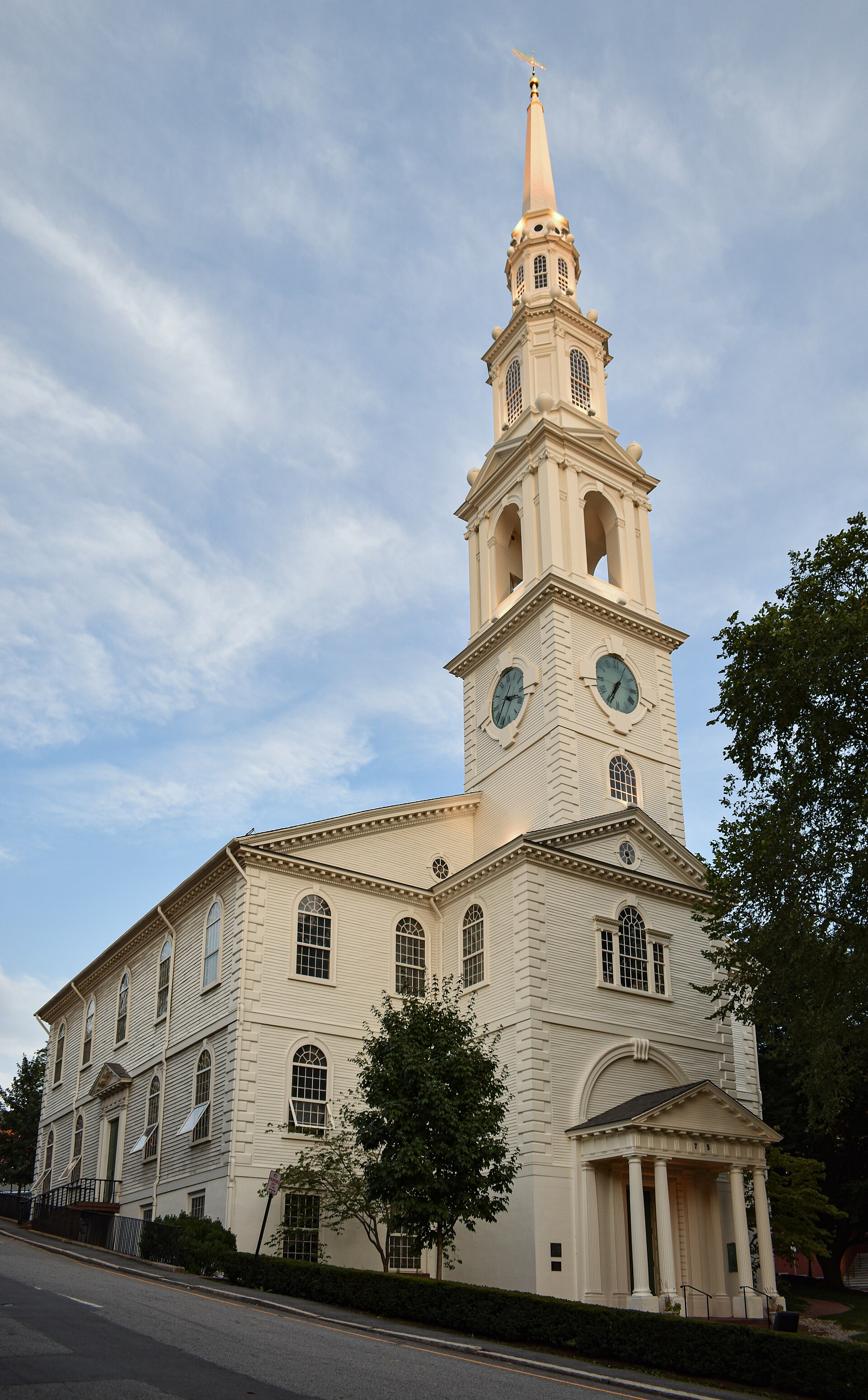
Williams left the congregation and, in Schaff's words, "remained for the rest of his life a 'Seeker,'" waiting for a restored apostolic church.1 The congregation continued without him. The First Baptist Church in America in Providence states on its own website that "Roger Williams gathered the First Baptist Church in America in 1638."7 Winthrop's entry, dated in the spring of 1639 and describing events of the previous months, fits either year, which is why histories give "1638 or 1639." Williams went on to defend liberty of conscience in The Bloudy Tenent of Persecution for Cause of Conscience (1644), written against John Cotton of Boston, and to secure a charter for Rhode Island. Schaff's judgment is careful: he says that the historian George Bancroft "goes too far" in calling Williams the first person in modern Christendom to assert full liberty of conscience, since "The Anabaptists and Mennonites had done the same a hundred years before," but that "Williams planted the first civil government on the principle of universal 'soul-liberty.'"1

Persecution and growth in the colonies
Outside Rhode Island and, later, Pennsylvania, Baptists were a dissenting minority. Schaff summarizes: "In the other colonies the Baptists were more or less persecuted till the time of the Revolution, but after that they spread with great rapidity."1 In Massachusetts and Connecticut the problem was the tax that supported the established Congregational churches (see lesson 05 for disestablishment in 1818 and 1833). In Virginia, where the Church of England was established, Baptist preachers were jailed in the 1760s and 1770s for preaching without a license.
The First Great Awakening of the 1740s added a new kind of Baptist. Many converts of the revivals in New England left the established churches to form "Separate" congregations, and a number of these Separates became Baptists. In the South, Separate Baptist preachers from New England settled at Sandy Creek, North Carolina, in the 1750s and spread a fervent, revival style of Baptist life across the Carolinas and Virginia. The older, more confessional Baptists of the Philadelphia Association were called "Regular" Baptists. The Regular and Separate Baptists of Virginia and Kentucky united around the end of the eighteenth century, and some of the merged associations took the name "United Baptists." (The Great Awakening itself will be the subject of a later module; here it matters only as the source of these Baptist lines. The dates for Sandy Creek and the Regular and Separate unions come from standard histories and were not checked against primary documents for this lesson.)
Isaac Backus and the two kinds of government
Isaac Backus (1724 to 1806), a Separate who became a Baptist pastor at Middleborough, Massachusetts, was the leading New England Baptist writer on religious liberty. His An Appeal to the Public for Religious Liberty (Boston, 1773) states the Baptist case in the vocabulary of the Puritans: "God has appointed two kinds of government in the world, which are distinct in their nature, and ought never to be confounded together; one of which is called civil, the other ecclesiastical government."8 (The original prints the long s, "diftinct"; the spelling is modernized here.) Backus argued that a tax to support ministers mixed the two, and that it made Baptists pay for a church whose ministry their consciences rejected.
John Leland in Virginia and New England
John Leland (1754 to 1841) was a Massachusetts born Baptist preacher who spent about fifteen years in Virginia, from the late 1770s to 1791, during the years when Virginia disestablished the Church of England and adopted Jefferson's Statute for Religious Freedom (1786). His 1790 pamphlet The Virginia Chronicle gives the Baptist reasons for dissent, starting with "No national church, can, in its organization, be the Gospel Church," and continuing, "The notion of a Christian commonwealth, should be exploded forever, without there was a commonwealth of real Christians."9 After returning to New England he published The Rights of Conscience Inalienable (1791), which contains the most quoted Baptist sentence on the subject: "Government has no more to do with the religious opinions of men, than it has with the principles of mathematics. Let every man speak freely without fear, maintain the principles that he believes, worship according to his own faith, either one God, three Gods, no God, or twenty Gods; and let government protect him in so doing."9
Leland's autobiographical sketch records a famous episode in plain words: "In November, 1801, I journeyed to the south, as far as Washington, in charge of a cheese, sent to President Jefferson." Leland preached along the road, drawing crowds "led in part by curiosity to hear the Mammoth Priest, as I was called."9 The cheese was a gift from the Baptists of Cheshire, Massachusetts. Jefferson's letter of January 1, 1802, to the Danbury Baptist Association of Connecticut, the letter that speaks of "a wall of separation between Church & State," was written in the same weeks. The connection between Baptist dissenters and the founders' religious clauses is taught in the Liberty modules: see Culture and Law in American History.

The Triennial Convention of 1814
American Baptists organized nationally for the sake of foreign missions. In 1812 Adoniram Judson and Luther Rice sailed for Asia as Congregational missionaries, became convinced of believer's baptism on the voyage and were immersed in India. Rice returned to raise Baptist support. Delegates "convened at Philadelphia on Wednesday the 18th of May, 1814," according to the printed minutes, with Richard Furman of Charleston, South Carolina, in the chair and Thomas Baldwin of Boston as secretary.10 The constitution they adopted named the body "The General Missionary Convention of the Baptist Denomination in the United States of America, for Foreign Missions," and provided that "a triennial Convention shall, hereafter, be held," which is why it was called the Triennial Convention.10 The preamble described the delegates' purpose as "organizing a plan for eliciting, combining, and directing the Energies of the whole Denomination in one sacred effort, for sending the glad tidings of Salvation to the Heathen."10 The convention then resolved "That the Rev. Adoniram Judson, now in India, be considered as a Missionary, under the care and direction of this Board."10 Among the delegates listed for Georgia was "Rev'd. W. B. Johnson," the same William B. Johnson who would preside over the founding of the Southern Baptist Convention thirty one years later.10
American Baptists, the American Baptist Churches USA says today, regard the Triennial Convention as "the first unified national missionary-sending effort formed in the U.S."11 Home missions, publication and education were soon organized in separate societies (the American Baptist Home Mission Society dates from 1832), each with its own membership. That "society" pattern is one reason the 1845 division happened as it did: there was no single denominational authority to decide the slavery question, only boards answering to their contributors.
The 1845 division and the Southern Baptist Convention
The slavery question in the boards
By the 1840s Baptists in the North were increasingly opposed to slavery, and Baptists in the South included many slaveholders, among them ministers. The Triennial Convention of 1844 tried to keep the peace. The Southern founders later quoted its resolution: "we disclaim all sanction, either expressed or implied, whether of slavery or anti-slavery."12 Georgia Baptists then tested the policy by nominating a slaveholder, James E. Reeve, to the Home Mission Society (the name comes from standard histories and was not checked in a primary source for this lesson), and Alabama Baptists asked the foreign mission board directly whether it would appoint a slaveholder. The Southern founders' account of the reply reads: "In December last, the acting Board of the Convention, at Boston, adopted a new qualification," namely that "If any one who shall offer himself for a missionary, having slaves, should insist on retaining them as his property," then "they could not appoint him."12
Augusta, May 1845
Delegates from the Southern states met, in the words of the proceedings, in "the meeting-house of the Baptist Church in Augusta" (the congregation known today as the First Baptist Church of Augusta), Georgia. The title page of their printed proceedings gives the dates as "AUGUSTA, GEORGIA, MAY, 8TH, 9TH, 10TH, 11TH, AND 12TH, 1845."12 The proceedings record that the opening session drew "a large number of delegates" but do not give a total, and one of the secretaries admitted in a note that he was "still uncertain as to the entire correctness of the names of churches and individuals" in the list.12 Article I of the constitution says: "This body shall be styled the Southern Baptist Convention." Article II says: "It shall be the design of this Convention to promote Foreign and Domestic Missions." William B. Johnson of South Carolina was elected president.12
The convention's "Address to the public" opens, "A painful division has taken place in the missionary operations of the American Baptists," and insists on continuity with the older body: "We have constructed for our basis no new creed," and "The Constitution we adopt is precisely that of the original union."12 The founders described themselves as separating over the boards' new qualification for missionaries, which they held to be a violation of the 1814 constitution and of the equal standing of Southern contributors. They did not describe themselves as founding a convention to defend slavery as such. The historical record, read by later Southern Baptists themselves, is more direct, as the next section shows.
The Northern societies continued. The American Baptist Churches USA describes the event from its side: "The issue of slavery reached a peak in 1845," when the foreign mission society determined that it could not appoint a slaveholding candidate and the Home Mission Society "decided separate northern and southern conventions were necessary."11
The 1995 resolution on racial reconciliation
At its 150th anniversary meeting the Southern Baptist Convention adopted a "Resolution on Racial Reconciliation on the 150th Anniversary of the Southern Baptist Convention." The text says the messengers were "assembled in Atlanta, Georgia, June 20-22, 1995."13 It names "the role that slavery played in the formation of the Southern Baptist Convention," states that "we lament and repudiate historic acts of evil such as slavery from which we continue to reap a bitter harvest," and declares that "we apologize to all African-Americans for condoning and/or perpetuating individual and systemic racism in our lifetime."13 The resolution is the SBC's own official reading of its founding. (The page on sbc.net lists the date as June 1, 1995, which conflicts with the meeting dates printed in the resolution itself; the meeting dates in the text are used here.)
The question of how Southern Baptist institutions should tell their founding story did not end in 1995. In December 2018 the Southern Baptist Theological Seminary in Louisville published a report on its founders' ties to slavery. That report and later debates are beyond what was verified for this lesson and are mentioned only so that readers know the documents exist.

Northern Baptists to American Baptist Churches USA
For sixty years after 1845 the Northern Baptist work went on through the separate societies. American Baptist Churches USA gives its own chronology: in 1907 the Northern Baptist Convention formed "to structure coordination of the societies' work while maintaining the autonomy of constituent churches"; in 1950 the name became the American Baptist Convention, because American Baptist life "transcends any set geographical area"; and in 1972 the name changed again to American Baptist Churches USA in a reorganization that "reemphasized the congregation-centered mission of the denomination."11 The denomination lists among its distinctives believers' baptism, the competency of every believer to interpret Scripture, and "the need for autonomous congregations free from government interference or hierarchical polity."11
The same history page reports that the body includes "approximately 5,000 congregations and 1.3-million members," about one tenth the size of the SBC; the page does not state the year of that count.11 The 2020 U.S. Religion Census, as presented by the Association of Religion Data Archives (ARDA), gives American Baptist Churches USA an adherence rate of 3.80 per 1,000 residents of the United States.14 The ABCUSA headquarters, the Mission Center at Valley Forge, Pennsylvania, served "from 1962-2019" and the property was sold in 2018 and 2019.11
The fundamentalist and modernist controversy among Northern Baptists
The Northern Baptist Convention was one of the two main fields of the fundamentalist and modernist controversy of the 1920s (the Presbyterian side is in lesson 02, and the theology of the liberal church is in Liberty 58, lesson 14). The best known modernist preacher of the period, Harry Emerson Fosdick, was a Baptist minister; his 1922 sermon "Shall the Fundamentalists Win?" was preached while he served a Presbyterian pulpit in New York, and he later became pastor of Park Avenue Baptist Church and then of the Riverside Church. Northern Baptist conservatives formed the Baptist Bible Union in 1922. ARDA's profile states that "In 1932, the Baptist Bible Union gave way to the General Association of Regular Baptist Churches."15 A second, larger departure followed: the Conservative Baptist Association of America "was founded in 1947 by former ministers and members of the Northern (American) Baptist Convention," and in 2019 it changed its name to Venture Church Network.16

Landmarkism: J. R. Graves and the true church
Cotton Grove, 1851, and "An Old Landmark Re-set"
The most influential internal movement among nineteenth century Southern Baptists was Landmarkism, named for Proverbs 22:28, "Remove not the ancient landmark, which thy fathers have set" (KJV). Its leader, James Robinson Graves (1820 to 1893), edited The Tennessee Baptist in Nashville and later Memphis. In his own account, Old Landmarkism: What Is It? (Memphis, 1880), Graves wrote that after he took charge of the paper in 1846 he "soon commenced agitating the question of the validity of alien immersions, and the propriety of Baptists recognizing, by any act, ecclesiastical or ministerial, Pedobaptist societies or preachers as churches and ministers of Christ."17 ("Alien immersion" means an immersion performed by a non-Baptist church; "Pedobaptist" means a church that baptizes infants.)
Graves continued: "This agitation gave rise to the convention, which met at Cotton Grove, W. T., June 24, 1851," where a set of queries he offered were "unanimously answered in the negative." The queries asked, among other things, whether Baptists could consistently recognize as churches or ministers those who did not practice believers' immersion.17 Graves then explained where the name came from: "In 1854 J. M. Pendleton, of Kentucky, wrote an essay upon this question at my special request, viz: 'Ought Baptists to recognize Pedobaptist preachers as gospel ministers?' which I brought out in tract form, and gave it the title, 'An Old Landmark Reset.'" Opponents, he wrote, "by way of reproach, called all Baptists 'Old Landmarkers' who accepted his conclusions."17
What Landmark Baptists teach
Graves's book lists the "marks" of the true church. The first is that "The Church and Kingdom of Christ is a Divine Institution," which Graves called "the embodiment of the divine authority on earth."17 In Landmark teaching the church is always a local, visible congregation (there is no universal invisible church in the Landmark sense), only a church of immersed believers is a true church, baptism is valid only when a true church authorizes it, and the Lord's Supper belongs to the members of the local congregation celebrating it. Most Landmark writers also held that true churches of this kind have existed in an unbroken succession since the time of Christ, under other names (Montanists, Novatians, Donatists, Paulicians, Waldenses and Anabaptists are the groups usually listed). Graves claimed in January 1880 that only one of the sixteen Southern Baptist weekly papers still approved "of alien immersion and pulpit affiliation."17 That is his claim about the papers, not a count of church members.
The Landmark bodies today
Many Landmark Baptists stayed in the Southern Baptist Convention, and Landmark convictions about closed communion and the rejection of alien immersion shaped Southern Baptist practice for generations. Others organized separately. ARDA's profile of the American Baptist Association says the movement "remained unorganized until 1905, when some churches from the Southern Baptist Convention (SBC) and churches outside of the SBC formed a landmark denomination, called the General Association," and that "A merger of two landmark associations in 1924 created the American Baptist Association."18 (This American Baptist Association, with headquarters in Texarkana, is a different body from American Baptist Churches USA.) A further division produced the Baptist Missionary Association of America, which ARDA says "was founded in 1950 by former members of the American Baptist Association" and "was originally called the North American Baptist Association until it took the present name in 1968."19 ARDA's 2020 figures give the American Baptist Association an adherence rate of 0.44 per 1,000 residents.14
The National Baptist conventions
Black Baptist churches grew rapidly after emancipation, when freed people left white controlled congregations and formed their own. Several regional and national bodies merged in 1895. ARDA states that the National Baptist Convention, USA, Inc., "the largest predominantly black denomination in America, was founded in 1895 when the Foreign Mission Baptist Convention of the U.S.A., the American National Baptist Convention, and the Baptist National Educational Convention merged."20 The 1895 meeting was held in Atlanta (a detail from standard histories, not checked in a primary source here).
The family then divided three times. A dispute over control of the convention's publishing house led to the first: ARDA says the National Baptist Convention of America "was founded in 1915 by the Rev. R. H. Boyd and his supporters within the National Baptist Convention," was incorporated in Shreveport, Louisiana, in 1987, and "has since added 'International' to its name."21 The second followed a contest over the convention presidency and over how actively to support the civil rights movement. ARDA's profile states that the Progressive National Baptist Convention "was founded in 1961 by former members of the National Baptist Convention who supported the Civil Rights Movement under the leadership of Dr. Martin Luther King, Jr.," and adds its own judgment that "The National Baptists had refused to support the Movement actively."22 That judgment is ARDA's; supporters of the National Baptist president of the time, Joseph H. Jackson, defended his approach as a different strategy (Jackson's own writings were not opened for this lesson). The third division, in 1988, produced the National Missionary Baptist Convention of America "as the result of a schism in the National Baptist Convention of America."23
Membership counts for these conventions are hard to pin down. The conventions do not publish an annual statistical report of the Lifeway kind, the figures cited in reference books are usually the conventions' own round claims, and the 2020 U.S. Religion Census relied on estimates for historically Black denominations. ARDA presents the 2020 adherence rates as 4.73 per 1,000 residents for the National Baptist Convention, USA, 0.68 for the National Baptist Convention of America International, 7.33 for the National Missionary Baptist Convention of America and 0.77 for the Progressive National Baptist Convention.14 These are rates drawn from a census that used estimation for these bodies; they are not head counts, and they should not be multiplied out and quoted as memberships. The conventions' own current membership figures could not be retrieved for this lesson (the National Baptist Convention, USA website did not permit automated retrieval).
The Southern Baptist Convention in the twentieth century
The Baptist Faith and Message: 1925, 1963 and 2000
The SBC adopted its first convention wide confession in 1925. The preamble of the 2000 revision says the 1925 Convention adopted "the New Hampshire Confession of Faith, revised at certain points and with some additional articles growing out of certain needs . . . ."24 The 1963 revision followed a controversy over a seminary professor's book on Genesis; the 1962 motion that created the committee asked that its statement be presented "to the Convention in Kansas City."24 The 1963 preamble insisted that such statements "have never been regarded as complete, infallible statements of faith," nor "as official creeds carrying mandatory authority."24 Its article on Scripture added a sentence that became a point of conflict: "The criterion by which the Bible is to be interpreted is Jesus Christ."24
In 1998 the convention "added an article on 'The Family,'" and a committee chaired by Adrian Rogers brought a full revision to the June 2000 meeting in Orlando.24 The 2000 text keeps the opening sentence of the article on Scripture, "The Holy Bible was written by men divinely inspired and is God's revelation of Himself to man," calls Scripture "the supreme standard by which all human conduct, creeds, and religious opinions should be tried," and drops the 1963 sentence about Christ as the criterion of interpretation.25 Its preamble describes confessions as "instruments of doctrinal accountability," a phrase that marks the change in how the convention uses the document.24 Article VII defines baptism as "the immersion of a believer in water in the name of the Father, the Son, and the Holy Spirit."25 The family article says "A wife is to submit herself graciously to the servant leadership of her husband."24 The 2000 article on the church limited the pastoral office to men, and the convention amended that article on June 14, 2023, so that it now reads, in part, "the office of pastor/elder/overseer is limited to men as qualified by Scripture."25 The article on religious liberty keeps the historic Baptist language: "God alone is Lord of the conscience," and "Church and state should be separate."25
The conservative resurgence, 1979 onward
The decisive struggle in modern Southern Baptist history began at the June 1979 annual meeting in Houston, when messengers elected Adrian Rogers, pastor of Bellevue Baptist Church in Memphis, as president. An Associated Press review written twenty five years later by Bobby Ross Jr. describes the plan behind it: Paul Pressler, a Houston appeals judge, and Paige Patterson, then president of Criswell College in Dallas, held pre-convention strategy sessions and recruited messengers to vote for presidential candidates committed to biblical inerrancy.26 The SBC president appoints the Committee on Committees, which nominates the Committee on Nominations, which in turn nominates the trustees of the seminaries and agencies. Electing a series of presidents committed to inerrancy therefore changed the trustee boards over roughly a decade, and the trustees changed the faculties and leadership of the institutions.
Each side named the movement in its own terms. Supporters call it the "conservative resurgence," a return of the institutions to the convictions of the churches that paid for them. Opponents called it a "fundamentalist takeover." The same AP article records the words of participants on both sides. Rogers said after his election that he had come "with love in my heart." Pressler said: "I had a very good, easy life and I forewent some other opportunities in order to be involved in the fight." Jimmy Allen, the SBC president in 1979, said years later: "Now, we are at a time when the word Baptist means squabbling and judgmentalism." Charles Wade, executive director of the Baptist General Convention of Texas, said: "I realized that the pendulum was not going to swing because the fundamentalists had nailed it to the wall."26 The dispute centered on Scripture, and also on the ordination of women, the seminaries, and the relationship between the convention and the state conventions. Historians writing from different sides (for example, Jerry Sutton's The Baptist Reformation, 2000, written in support, and Bill J. Leonard's and Nancy Ammerman's studies, written by scholars sympathetic to the moderates) have described the same events in opposite moral terms. Those books were not opened for this lesson and are named only as places to read further.
The Cooperative Baptist Fellowship, 1991
Moderates who lost the presidential elections through the 1980s eventually organized separately. The New Georgia Encyclopedia states that moderate Baptists met in Atlanta in 1990 and that the Cooperative Baptist Fellowship was "formed in Atlanta in 1991 in response to the growing fundamentalism" of the SBC, with a committee headed by Daniel Vestal proposing the new body.27 (The phrase "growing fundamentalism" is the encyclopedia's description from the moderate point of view; Southern Baptist leaders described the same events as a return to inerrancy.) Its first leaders included Vestal, Cecil Sherman and R. Keith Parks, and it joined the Baptist World Alliance in 2003.27
The CBF describes itself as "a network of over 1,800 congregations."28 It states four freedoms: soul freedom, Bible freedom, church freedom (Baptist churches are free "to ordain whomever they perceive as gifted for ministry") and religious freedom, which it describes as "freedom of religion, freedom for religion, and freedom from religion." It affirms "the participation of women and men in all aspects of church leadership and Christian ministry."28 Many CBF congregations kept a dual relationship with the SBC and their state convention for years. Some state conventions (notably Texas and Virginia) also formed separate conservative conventions during the same decades. The details of those state level divisions are not covered here.
Women as pastors: the votes of 2023 to 2026
Since 2000 the convention's confession has said the pastoral office is for men, and in 2023 it began removing churches that did not follow it. MinistryWatch's report on the 2026 meeting summarizes the background: Saddleback Church in California, which ordained several women on its staff as pastors in 2021, and "In 2023, Saddleback was expelled from the SBC." The same report counts ten churches found not in "friendly cooperation" over women pastors, according to the credentials committee report.29 A proposed amendment to the SBC constitution, which would have written the same rule into the list of what makes a church "in friendly cooperation," passed a first vote in 2023, failed to reach the required two thirds on its second vote at Indianapolis in 2024 (61 percent in favor, as the Associated Press reported it), and failed again in a new form at Dallas in 2025 with 60.74 percent in favor.294546
At Orlando in June 2026 the messengers approved a new text, the "Truth and Unity Amendment," written by R. Albert Mohler Jr., president of the Southern Baptist Theological Seminary. The Illinois Baptist State Association's report gives the result as 74.60 percent in favor and 25.09 percent against (MinistryWatch gives 74.6 percent; Baptist Press reported the count as 6,028 for and 2,026 against, of 8,074 ballots cast, 20 of them disallowed), and explains that the amendment limits the office of pastor to men and makes preaching the Word to the gathered assembly a function limited to men.30 Mohler told the messengers: "It speaks specifically in terms of function to a woman preaching to the gathered assembly."30 The Associated Press reported the ballot count as 6,028 to 2,026, and recorded the objection of South Carolina pastor Doug Mize (of First Baptist Church in Greer, according to Baptist Press)47, that the amendment was unnecessary because the convention already can expel churches with women in senior pastoral roles and "it's done so multiple times."31 Because constitutional amendments require two thirds at two consecutive annual meetings, the amendment returns for a second vote at Indianapolis in 2027.30 At the same meeting Willy Rice of Clearwater, Florida, was elected president, defeating Josh Powell 57.56 percent to 42.16 percent.30
The Southern Baptist Convention by its own numbers
Southern Baptist statistics come from the Annual Church Profile, which each church submits through its state convention and which Lifeway Research compiles. The report released on May 5, 2026, covering 2025, gives these figures:32
| Measure (2025, Annual Church Profile) | Figure | Change reported |
|---|---|---|
| Members | 12,331,954 | down more than 3 percent; nineteenth consecutive year of decline; lowest since 1973 |
| Cooperating churches | 46,608 | 268 fewer than in 2024 |
| Average weekly worship attendance | 4,460,910 | up 156,285 (3.63 percent); still almost 800,000 below 2019 |
| Baptisms | 263,075 | up 4.96 percent; fifth consecutive annual increase |
| Small group and Sunday School participants | 2,650,291 | up 3.24 percent |
The gap between members (12.3 million) and attenders (4.5 million) is itself a subject of comment inside the convention. Scott McConnell of Lifeway Research is quoted in the report as saying that "Churches with more than four times as many members as their average attendance are either unhealthy," a sentence the report completes with a second possibility about the accuracy of church rolls.32 The 2020 U.S. Religion Census, as presented by ARDA, gives the SBC an adherence rate of 53.25 per 1,000 residents, far above any other Baptist body.14
The many kinds of Baptists
Because Baptist churches are self governing, a congregation that disagrees with its association or convention can simply leave, and like minded churches can form a new fellowship without asking anyone's permission. That freedom is the main structural reason there are so many Baptist bodies. ARDA's Baptist family page lists more than fifty separate Baptist groups in the United States.14 The sections below describe the largest and the most distinctive, each first in its own words where its own documents could be opened.
Independent fundamental Baptists
"Independent Baptist" usually means a church that belongs to no convention at all, though many such churches join a fellowship for missions and pastoral training. The movement grew from the fundamentalist side of the 1920s controversy in both the Northern and Southern conventions. The Texas pastor J. Frank Norris was expelled from Southern Baptist bodies in Texas in the 1920s and built an independent network; the Baptist Bible Fellowship International was formed in 1950 by pastors who broke with Norris, with its college at Springfield, Missouri. (These Norris and BBFI details come from standard histories; the BBFI's own website states only that the fellowship "exists to serve Baptist pastors and their churches as they fulfill the Great Commission.")33 ARDA lists other fellowships: the Southwide Baptist Fellowship, "founded in 1956 at a conference at Dr. Lee Roberson's church in Chattanooga, Tennessee," which "follows the beliefs in premillennialism and demands separation from all forms of modernism, especially the National Council of Churches";34 and the Independent Baptist Fellowship International, "founded in 1984 by various independent Baptist congregations and their clergy."35 The General Association of Regular Baptist Churches (1932) also belongs to this family of separatist fundamentalist Baptists, although its churches are formally associated.15
Common marks of the independent fundamental churches, as their own statements describe them, include the autonomy of the local church, a premillennial (usually dispensational) reading of prophecy, separation from churches and organizations judged to have compromised on doctrine, soul winning and bus ministries in the mid twentieth century, and, in many churches, the exclusive use of the King James Version. Positions on the King James Version range from a preference to the claim that it is the only reliable English Bible. These are general descriptions of a decentralized movement and do not describe every church. No combined membership count exists, because there is no central body to report one.
Free Will Baptists
Free Will Baptists continue the General Baptist conviction that Christ died for all. The National Association of Free Will Baptists traces two lines. The southern "Palmer" line began when Paul Palmer "organized a church" at Chowan, North Carolina, in 1727. The northern "Randall" line began with a congregation "organized by Benjamin Randall June 30, 1780, in New Durham, New Hampshire."36 Much of the northern movement merged with the Northern Baptists in 1910 and 1911, "taking along more than half its 1,100 churches and all denominational property." The remaining northern churches reorganized at Pattonsburg, Missouri, on December 28, 1916, as the Cooperative General Association of Free Will Baptists, and the southern churches had formed a General Conference by 1921. Representatives of the two met at Nashville on November 5, 1935, and formed the National Association of Free Will Baptists.36 The association now reports "more than 2,400 churches in 42 states and 14 foreign countries" (no year given on the page).36
The Treatise of the Faith and Practices of the National Association of Free Will Baptists (2026 edition) states its distinctives plainly. On the atonement: "Christ gave Himself a sacrifice for the sins of the world." On the ordinances it names three, and of the third it says: "FEET WASHING, an ordinance teaching humility, is of universal obligation." An appendix adopted in 1969 says that a believer "may, in freedom of will, cease to trust in Christ for salvation," and so be lost. An appendix adopted in 1979 states: "We believe the Scriptures are infallible and inerrant."37 A separate North Carolina body, the Convention of Original Free Will Baptists, continues apart from the National Association; ARDA lists it with an adherence rate of 0.07 per 1,000 residents in 2020, against 0.47 for the National Association.14 The General Association of General Baptists, centered in the Midwest, is a related Arminian Baptist body (ARDA rate 0.10).14
Primitive Baptists
The missions movement that produced the Triennial Convention also produced Baptists who refused it. ARDA's profile summarizes their view: "a minority of members is this group viewed the missionary movement, as well as other initiatives like Bible societies and theological seminaries, as unnecessary innovations and inventions of men (and thus not warranted from the word of God)."38 The founding document of the "Old School" or Primitive Baptists is the Black Rock Address, adopted at the Black Rock meeting house near Baltimore, Maryland, on September 28, 1832. In the transcription published by the Primitive Baptist site March to Zion, the address says: "We therefore cannot fellowship the plans for spreading the gospel, generally adopted at this day, under the name of Missions," calling them "a subversion of the order marked out in the New Testament." It rejects tract societies, and it rejects Sunday schools on the ground that "such schools were never established by the apostles, nor commanded by Christ," while allowing schools that teach poor children to read. It rejects theological schools because "they are a reflection upon the faithfulness of the Holy Ghost," and of protracted revival meetings it says: "The principle of these meetings we cannot fellowship," because "Regeneration, we believe, is exclusively the work of the Holy Ghost."39
Primitive Baptists are strict Calvinists, and some hold to an absolute predestination of all events. Their churches typically sing without instruments, practice foot washing with the Lord's Supper, and are led by elders who are not seminary trained and are often unsalaried. ARDA notes that they "have a strong congregational form of government and generally have no organization above the loose associations that typically cover several counties."38 There is, accordingly, no denominational count. ARDA lists several Primitive Baptist groups, including associations with a combined 2020 adherence rate of 0.13 per 1,000 residents and the National Primitive Baptist Convention, a historically Black body, at 0.11.14


Old Regular Baptists
Old Regular Baptists are found mainly in the mountains of eastern Kentucky, southwestern Virginia and southern West Virginia. ARDA's profile gives their history this way: "Many Baptists in the older tradition came together as 'United' Baptists, with the New Salem Association of United Baptists being organized in 1825. In 1854, the word 'Regular' replaced 'United' in the name, and in 1892, 'Old' was added before 'Regular.'" It adds that "Today, there are about 16 associations, 300 churches, and 10,000 members in the denomination" (the profile gives no year for the figure).40 ARDA's 1990 map of the group shows its highest adherence rates in Kentucky (3.29 per 1,000) and West Virginia (1.24).40 (ARDA's same paragraph says "The new doctrine leaned toward Calvinism, so use of the word 'Regular' indicated that a group identified with the older doctrine." Historically, "Regular" Baptists were the more confessional and Calvinist party, so that sentence should be read with caution.)
Old Regular worship is known to folklorists and musicologists for its "lined out" hymn singing, in which a leader chants a line and the congregation sings it back slowly without instruments or printed music, and for long, chanted sermons by unpaid elders. Old Regular churches practice foot washing and hold annual memorial meetings. These descriptions come from the work of the folklorist Howard Dorgan (The Old Regular Baptists of Central Appalachia, 1989) and others, which was not opened for this lesson.
Seventh Day Baptists
Seventh Day Baptists are Baptists who keep the seventh day, Saturday, as the Sabbath. Their General Conference in the United States says: "We lovingly observe the 7th Day Sabbath. It is a blessing, not an obligation."41 ARDA states that "The Seventh Day Baptist General Conference was organized in 1802 and continues the practice of sabbatarianism among English-speaking Baptists."42 The conference's own site claims "Over 350 Years In America"; its first American church is usually dated to Newport, Rhode Island, in 1671, a date from standard histories not checked in a primary source here.41 The body is small: ARDA's 2020 adherence rate is 0.01 per 1,000 residents.14
Reformed Baptists and the 1689 Confession
From the 1950s onward a revival of interest in the Puritans and in the 1689 Confession produced churches that call themselves Reformed Baptists. Spurgeon is one of their heroes. ARDA's profile of the Association of Reformed Baptist Churches of America says it "was formed in 1997 by 24 different churches, all of which ascribed to the Baptist Association of London's 1689 London Baptist Confession of Faith."43 In March 2022, according to the association's own site, "messengers of the member churches of ARBCA voted unanimously to change the name." It is now the Confessional Baptist Association, "A national association of churches who subscribe the Second London Baptist Confession of Faith."44 The association does not publish a membership total on its home page. The assignment for this lesson asked about a "1689 Federation"; no body by that exact name was found in the sources opened, and the Confessional Baptist Association is the largest organized American body of this kind that was verified. Other Reformed Baptist churches belong to smaller networks or to none, and a Calvinist movement inside the SBC (sometimes associated with Founders Ministries) holds the 1689 Confession or the Abstract of Principles without leaving the convention.
How others have seen the Baptists
Outsiders' judgments of Baptists have changed with the centuries. Seventeenth century opponents called them "Anabaptists" to tie them to the Münster rising of 1534 and 1535; the 1644 confession's title protests that they were "commonly (but unjustly) called Anabaptists."1 Winthrop treated Williams's rebaptism as a sign of Providence growing "still worse."6 Philip Schaff, a German Reformed church historian writing in the 1870s, was respectful but critical: he called Roger Williams "a pious, zealous, unselfish, kind-hearted, but eccentric" man "who could not get along with any body but himself," while crediting him with planting the first civil government on "soul-liberty."1 Schaff also judged that, despite the "entire absence of centralization in their government, and the unrestrained freedom of private judgment, the Calvinistic Baptists have maintained as great a degree of essential harmony of faith as they themselves deem desirable."1
Schaff quoted two Baptist witnesses on the status of confessions. The English Baptist Joseph Angus wrote that Baptist creeds "were never imposed on ministers and members of the churches" and "have never been accepted as tests."1 The American Baptist Francis Wayland, quoted through Howard Osgood, wrote: "No church has any power over any other church," and "It is hence evident that we can have no standards which claim to be of any authority over us."1 Those nineteenth century statements are the background to the twentieth century debate over whether the Baptist Faith and Message is a confession, a creed, or "instruments of doctrinal accountability," a debate described in the hard questions below.
Sociologists of religion have often used Baptists as a test case. Roger Finke and Rodney Stark, in The Churching of America, 1776 to 1990 (1992), argue that Baptists and Methodists grew fastest in the early republic because their unpaid or low paid preachers, local control and demanding standards fit a free religious market; that interpretation is theirs, and the book was not opened for this lesson. Readers who want the wider pattern of growth and decline among the denominations will find it in lesson 11, and the meaning of "evangelical" is taught in module 77, lesson 03.
What the record shows and what it does not
- Documented fact: John Smyth baptized himself and his congregation in Amsterdam in 1609 and later wrote that he did so because there was "no church to whome wee could Joyne." Helwys's group returned to England in 1612 and Helwys told James I in writing that the king "is a mortall man and not God."
- Documented fact: Winthrop recorded the Providence rebaptisms by Holliman and Williams in an entry of March 1639, and soon after recorded that Williams questioned his second baptism.
- Documented fact: The Triennial Convention met at Philadelphia on May 18, 1814; the Southern Baptist Convention organized at Augusta on May 8 to 12, 1845, after the Boston board said it "could not appoint" a slaveholder who insisted on keeping slaves.
- Documented fact: In 1995 the SBC named "the role that slavery played" in its formation and apologized to African Americans; in 2025 it reported 12,331,954 members; in June 2026 its messengers voted 74.60 percent for a first approval of the Truth and Unity Amendment.
- A church's own claim or tradition: that Baptist churches have existed in unbroken succession since the apostles (the Landmark and "Trail of Blood" view); that the First Baptist Church in America dates from 1638 (the congregation's date, consistent with Winthrop but not proved to the year).
- Scholarly reading: Schaff's judgment that Baptist succession claims cannot be traced; Finke and Stark's market explanation of Baptist growth; competing histories of the conservative resurgence by its supporters and opponents.
- Open question: the exact date and place of Helwys's death; whether a congregation at Newport, Rhode Island, is as old as the Providence church; how many members the National Baptist conventions have today, since no published annual count could be checked.
Claims checked
"Baptist churches go back in an unbroken line to John the Baptist and the apostles."
Unsupported. This claim, popularized in Landmark writing and in J. M. Carroll's booklet The Trail of Blood (1931), links Baptists to a chain of earlier dissenting groups. Schaff answered it in a note: Baptists' "older scholars claim an origin earlier than the Continental or the English Reformation, going back to the Waldenses and Albigenses," but "these points are disputed, and no historical connection can be traced."1 The surviving documents show the first Baptist congregation forming among English Separatists in Amsterdam in 1609, and Smyth's own writing says he baptized himself because he knew of no true church to receive baptism from.2 Some of the groups on succession lists (Montanists, Paulicians, Albigenses) held doctrines Baptists reject. Similar convictions at different times are documented; an organizational line of descent is not.
"Roger Williams founded the first Baptist church in America and was a Baptist leader all his life."
Partly supported. Williams and Ezekiel Holliman did begin the Providence church in 1638 or 1639, as Winthrop records.6 But within months Williams "was come to question his second baptism," and he spent the rest of his life as a Seeker, outside any church.61 His lasting influence on Baptists came through his writing on liberty of conscience and the Rhode Island charter, not through leadership of the congregation.
"The Southern Baptist Convention was founded over slavery."
Supported, with the founders' own framing noted. The 1845 proceedings state that the division followed the Boston board's ruling that it "could not appoint" a missionary who insisted on keeping slaves, and the founders presented their action as a defense of the 1814 constitution and of equal standing for Southern contributors.12 In 1995 the convention itself acknowledged "the role that slavery played in the formation of the Southern Baptist Convention."13 The claim is accurate about the cause of the separation; it does not mean the 1845 documents contain a doctrinal defense of slavery, and the Address says the founders "constructed for our basis no new creed."12
"Baptists were Calvinists from the beginning" (or "Baptists were always Arminian").
Refuted in both forms. The first Baptist confession (1611) was Arminian: Schaff notes that in it "Election is conditioned by foreknown faith, reprobation by foreknown unbelief, and the perseverance of saints is denied."1 The Particular Baptist confessions of 1644 and 1677/1689 were Calvinist.1 Both lines have continued to the present, in the Free Will and General Baptists on one side and the Primitive and Reformed Baptists on the other, with most Southern Baptists holding positions in between. Lesson 03 sets out the two systems in detail.
"Baptists invented religious liberty."
Partly supported. Helwys's 1612 demand that the king leave the soul to God is one of the earliest English pleas for liberty of conscience for all, and Backus and Leland were leading American advocates.489 But Schaff points out that "The Anabaptists and Mennonites had done the same a hundred years before," and religious liberty in America was also the work of Quakers (see lesson 09), Enlightenment statesmen and others.1 Baptists were early, persistent and influential advocates among several groups that made the case.
"Thomas Helwys died in prison because of his letter to King James."
Partly supported. The inscription and the book are documented, and Helwys was imprisoned and died within a few years.4 The Wikimedia Commons description of the inscription states that the book "resulted in Helwys's imprisonment and death." No court record of the charge, and no record of the date or cause of death, was found among the sources opened for this lesson, so the direct link remains a probable inference.
"Primitive Baptists are against preaching the gospel to the lost."
Refuted as stated. The Black Rock Address rejects the methods of the missions movement (mission societies, tract societies, Sunday school unions, seminaries, protracted meetings) because it found no command for them in the New Testament and because "Regeneration, we believe, is exclusively the work of the Holy Ghost."39 Primitive Baptist elders preach and itinerate. The disagreement concerns human means and organizations. Both sides hold that the gospel should be preached.
"The conservative resurgence was mainly about women pastors."
Unsupported as a description of 1979. Contemporary and retrospective accounts on both sides put the inerrancy of Scripture at the center of the 1979 to 1990 contest.26 The role of women became a confessional issue in the 2000 revision and a constitutional one only from 2023.2529 The two questions are connected, since both turn on how the convention reads Scripture, but they belong to different decades.
"A Baptist preacher delivered a giant cheese to Thomas Jefferson."
Supported. Leland's own account: "In November, 1801, I journeyed to the south, as far as Washington, in charge of a cheese, sent to President Jefferson."9 Its size and weight, often given as more than 1,200 pounds, were not confirmed in the sources opened here.
Hard questions and answers
Are Baptists Protestants at all?
Most Baptists answer yes, and most historians agree: Baptists arose inside English Puritanism and Separatism, their Particular Baptist confessions follow the Westminster Confession almost word for word outside the articles on the church and baptism, and they hold the Reformation principles of Scripture as the supreme authority and justification by faith.1 Landmark Baptists and some independent Baptists answer no. In their view true Baptist churches existed before the Reformation and were never part of the Roman Catholic Church, so they did not "protest" out of it. A Catholic or Orthodox reader would add a third observation: the Baptist rejection of infant baptism breaks with the practice of every ancient church, which is why Baptists, more than other Protestants, have had to explain where the church was between the apostles and 1609. The documented record supports the first answer on origins; the second is a theological claim about the nature of the true church, which history can test only so far.
If Baptists reject creeds, how can a convention enforce the Baptist Faith and Message?
Each side states its case in the convention's own documents. The 1963 preamble said such statements "have never been regarded as complete, infallible statements of faith" nor "as official creeds carrying mandatory authority."24 The 2000 preamble kept a disclaimer of that kind and also called confessions "instruments of doctrinal accountability."24 Supporters of the 2000 approach argue that a voluntary convention has the same right as a local church to decide whom it will cooperate with, and that agency employees and seminary professors paid by the churches may fairly be asked to teach within the confession. Moderates argue that requiring signatures turns a confession into a creed, which earlier Baptists such as Wayland ("we can have no standards which claim to be of any authority over us") rejected.1 The record shows that the convention requires its seminary and mission employees to affirm the 2000 text, and that it removes churches only for a short list of reasons in its constitution, now including women serving as pastors. Churches remain free to leave, and many have.
Was the conservative resurgence a takeover or a restoration?
The answer depends on what a reader takes the convention to be. If the convention belongs to the churches that send messengers, then a majority of messengers voting year after year for inerrantist presidents was the churches reclaiming their institutions: the supporters' view. If the institutions held a trust for a broader Baptist tradition of soul freedom and diversity, then the systematic use of appointive power to remove dissenting trustees and faculty was a takeover: the moderates' view, expressed in Charles Wade's line that "the fundamentalists had nailed it to the wall."26 The record shows the votes were won in open elections under the convention's rules, that the change in the institutions was deliberate and announced in advance, and that a large group of churches eventually left to form the CBF. Each side's moral description fits its own premise about whose convention it was.
Why are there so many kinds of Baptists?
Three causes run through the record. The first is polity: a self governing congregation can leave without anyone's permission, and the Baptist theology of the church makes leaving a matter of conscience.11 The second is that Baptists divide on the questions other Protestants divide on (Calvinism and Arminianism, missions and revival methods, Scripture, race, the roles of women), and they lack a bishop or synod to settle them. The third is history in particular regions: the Primitive and Old Regular Baptists preserve the worship of the early nineteenth century frontier, the National Baptist bodies grew from churches founded by freed people after emancipation, and the Free Will Baptists preserve the General Baptist line. Schaff's remark that Baptists have kept "as great a degree of essential harmony of faith as they themselves deem desirable" fits the pattern: most Baptist bodies agree on believer's baptism by immersion, local church autonomy and religious liberty, and differ on nearly everything else.1
Did the 1995 resolution settle the question of the SBC's founding?
It settled the convention's official position. The resolution names slavery's role in the founding, repudiates "historic acts of evil such as slavery," and apologizes for racism.13 It did not settle every related question. Some Black Baptists and others asked what repentance requires beyond a resolution, and some Southern Baptists asked how far a resolution about the past binds churches today. Southern Seminary's 2018 report on its founders was a later step in the same discussion. A reader should note what kind of document a resolution is: in SBC practice it expresses the opinion of the messengers present at one meeting and does not bind any church.
Do Baptists believe baptism saves?
No Baptist confession examined here teaches that baptism saves. The 2000 Baptist Faith and Message calls baptism "the immersion of a believer in water," an act of obedience symbolizing the believer's faith; the 1689 Confession limits it to those who "profess repentance towards God, faith in, and obedience to, our Lord Jesus Christ"; and Schaff summarized the Baptist view as "simply an outward sign of grace already bestowed."2551 Lutherans, Catholics and the Orthodox teach that baptism is a means by which God gives grace, and the Restoration Movement (taught in lesson 10), which began partly among Baptists in the 1810s and 1820s, teaches that baptism is for the remission of sins. Schaff noted that disagreement in his day: he said the Disciples "differ from the other Baptists by identifying baptismal immersion with regeneration, or teaching a concurrence of both acts."1
Where to read the documents
- The Baptist Faith and Message (1925, 1963, 2000) with the comparison chart: bfm.sbc.net.
- The 1677/1689 Second London Confession: reformedreader.org and ccel.org.
- General Baptist confessions of 1610 to 1660: the New Orleans Baptist Theological Seminary compilation.
- Smyth's works (Whitley edition, 1915), Winthrop's Journal (Hosmer edition, 1908), Backus's Appeal (1773), Leland's Writings (1845), the 1814 and 1845 proceedings and Graves's Old Landmarkism (1880): all on archive.org or the Southern Baptist Historical Library and Archives.
- Bodies' own sites: sbc.net, abc-usa.org, cbf.net, nafwb.org, cba1689.com, seventhdaybaptist.org; group profiles at thearda.com.
Related lessons: lesson 03 (the Calvinist and Arminian systems behind the Particular and General lines), lesson 05 (the Puritans and the New England establishment Backus fought), lesson 07 (the other great frontier church), lesson 08 (the continental believers' baptism churches), lesson 11 (membership trends across the denominations) and the module review. For the sixteenth century background see module 79; for evangelicalism and non-denominational churches see module 77.
Learn more
- Winthrop's Journal, vol. 1 (Hosmer ed., 1908): The contemporary record of the first Baptist church in Providence, in the words of its opponent.
- The Writings of the Late Elder John Leland (1845): Leland's own arguments for religious liberty and his account of the cheese for Jefferson.
- Proceedings of the Southern Baptist Convention, 1845: The founders' own constitution and Address explaining the 1845 division.
- Baptist Faith and Message comparison chart: The 1925, 1963 and 2000 texts side by side, with preambles.
- J. R. Graves, Old Landmarkism: What Is It? (1880): Landmarkism in its founder's words.
- Schaff, Creeds of Christendom, vol. 1, on the Baptists: A nineteenth century Reformed historian's careful account of Baptist origins and confessions.
Still being checked (30 items)
These points could not be confirmed against a primary source when this lesson was written and fact checked in October 2026. The text above states each one as uncertain.
- Smyth's death in Amsterdam in 1612 and the absorption of his group into the Mennonites are from standard histories; Smyth's own words on the self-baptism were checked, these later details were not.
- Helwys's imprisonment in Newgate and death by about 1616: no primary record of the charge, date or cause of death was opened.
- The 1689 Confession's chapter on the church (elders, deacons, free association) was summarized from general knowledge of the text; only chapter 29 was opened.
- Separate Baptists at Sandy Creek, North Carolina (1750s), and the Regular and Separate unions of the late 1700s were not checked in primary documents.
- Dates of Isaac Backus (1724 to 1806) and John Leland (1754 to 1841), Leland's years in Virginia, the Cheshire origin and weight of the cheese, and the wording of Jefferson's Danbury letter of January 1, 1802, were not opened in primary sources for this lesson.
- That the Providence meetinghouse hosted commencements of the college that became Brown University rests on the congregation's history page heading, not a Brown source.
- Southern Baptist Theological Seminary's December 2018 report on slavery was not opened.
- Fosdick's 1922 sermon 'Shall the Fundamentalists Win?' and his pastorates were not checked in primary sources; the Baptist Bible Union's founding year (1922) is from the ARDA profile only.
- The National Baptist Convention, USA's 1895 meeting place (Atlanta) and Joseph H. Jackson's position were not checked in primary sources; the conventions' own current membership counts could not be retrieved (the NBC USA site blocked automated access).
- The statement that the 2020 U.S. Religion Census relied on estimates for historically Black denominations is based on ARDA's 'Black Baptists Estimate' entry and was not confirmed in the census methodology.
- J. R. Graves's dates (1820 to 1893) and the American Baptist Association's Texarkana headquarters were not checked in a primary source.
- The 1963 revision's background (a controversy over a seminary professor's book on Genesis, usually identified as Ralph Elliott's The Message of Genesis, 1961) was not checked in a primary source; the place of the 1925 adoption was not confirmed on the BF&M site.
- Adrian Rogers's church (Bellevue Baptist, Memphis), Paul Pressler's office as an appeals judge, the SBC appointment chain (president, Committee on Committees, Committee on Nominations, trustees), and the books by Jerry Sutton, Bill J. Leonard and Nancy Tatom Ammerman were not opened.
- Statements that SBC entities require employees to affirm the BF&M 2000, that resolutions do not bind churches, and the details of state convention divisions in Texas and Virginia were not checked in primary documents.
- The CBF's August 1990 consultation date and attendance were not confirmed; the New Georgia Encyclopedia gives only '1990'.
- J. Frank Norris's expulsion and the Baptist Bible Fellowship International's founding in 1950 with its college at Springfield, Missouri, are from standard histories; the BBFI site did not state them. General marks of independent fundamental Baptists (KJV use, dispensationalism) are general descriptions.
- Primitive Baptist practices (no instruments, foot washing, unsalaried elders, absolute predestination among some) and Old Regular practices (lined out singing, memorial meetings) and geography are from general and folklorist sources (Howard Dorgan, 1989) that were not opened.
- The first Seventh Day Baptist church in America at Newport, Rhode Island, 1671, was not checked in a primary source.
- No body named the '1689 Federation' was found; the Confessional Baptist Association (formerly ARBCA) was used instead. The 1950s revival of Reformed Baptist interest and the Founders Ministries description were not checked.
- The General Association of General Baptists' Midwestern center was not checked.
- J. M. Carroll's The Trail of Blood (1931) was not opened.
- Finke and Stark, The Churching of America (1992), was not opened; their argument is summarized from general knowledge and attributed.
- The Restoration Movement's beginnings partly among Baptists in the 1810s and 1820s are from general knowledge; see lesson 10.
- The ARDA Old Regular profile's sentence that 'The new doctrine leaned toward Calvinism' appears to reverse the usual history; it is quoted with a caution.
- Judson and Rice's baptism in India (1812) was not checked in a primary source; the founding of the American Baptist Home Mission Society in 1832 is stated on the ABCUSA history page.
- The name of the Georgia nominee James E. Reeve (1844) was not checked in a primary source. The 1845 proceedings place the meeting in 'the meeting-house of the Baptist Church in Augusta'; its identity with today's First Baptist Church of Augusta rests on standard histories.
- The 2026 vote percentages differ slightly by source: IBSA 74.60 percent for and 25.09 percent against, MinistryWatch 74.6 percent; Baptist Press's raw count (6,028 for, 2,026 against, of 8,074 cast with 20 disallowed) works out to about 74.66 percent for. The official convention journal for 2026 was not opened.
- The date of the Black Rock meeting (September 28, 1832) does not appear on the March to Zion transcription page and rests on standard histories.
- The text of the Helwys inscription is quoted from the transcription on its Wikimedia Commons page, which regularizes some letters; the manuscript image itself was not transcribed afresh for this lesson.
- The 2023 first vote on the women pastor amendment (about 80 percent in New Orleans, per Christian Post) was not checked in Baptist Press, whose site blocks automated retrieval.
Notes
- Philip Schaff, The Creeds of Christendom, with a History and Critical Notes, vol. 1, The History of Creeds (6th ed., Harper and Brothers, 1931; first published 1877), sections on the Baptists, Roger Williams and the Baptist Confessions, with notes 1620 to 1644; public domain text at the Christian Classics Ethereal Library (retrieved Oct. 28, 2026). Read it online. ↩
- W. T. Whitley, ed., The Works of John Smyth, Fellow of Christ's College, 1594 to 8, vol. 2 (Cambridge University Press, 1915), including The Character of the Beast (1609) and Smyth's late writings on his self-baptism; scan at archive.org (retrieved Oct. 28, 2026). Read it online. ↩
- Baptist Center for Theology and Ministry, New Orleans Baptist Theological Seminary, General Baptist Statements of Faith (compilation including Smyth's Short Confession, 1610; Helwys's Declaration of Faith of English People Remaining at Amsterdam, 1611; The Faith and Practise of Thirty Congregations, 1651, article 17; and the Standard Confession, 1660, article 3), PDF (retrieved Oct. 28, 2026). Read it online. ↩
- Thomas Helwys, handwritten inscription to King James I in A Short Declaration of the Mistery of Iniquity (1612); reproduction and transcription on the Wikimedia Commons file page 'Helwys to King James I.jpg' (mirror consulted at download.osmand.net) (retrieved Oct. 28, 2026). Read it online. ↩
- Second London Baptist Confession of Faith (1677, approved 1689), chapter 29, 'Of Baptism,' paragraphs 2 and 4, text at The Reformed Reader (retrieved Oct. 28, 2026). Read it online. ↩
- John Winthrop, Winthrop's Journal, 'History of New England,' 1630 to 1649, ed. James Kendall Hosmer, vol. 1 (Original Narratives of Early American History, Charles Scribner's Sons, 1908), entries for March 1639 (p. 297) and later in 1639; scan at archive.org (retrieved Oct. 28, 2026). Read it online. ↩
- First Baptist Church in America, Providence, Rhode Island, home page and History page (retrieved Oct. 28, 2026). Read it online. ↩
- Isaac Backus, An Appeal to the Public for Religious Liberty, Against the Oppressions of the Present Day (Boston: John Boyle, 1773); Google scan at archive.org (retrieved Oct. 28, 2026). Read it online. ↩
- L. F. Greene, ed., The Writings of the Late Elder John Leland, Including Some Events in His Life, Written by Himself (New York: G. W. Wood, 1845), including The Virginia Chronicle (1790), The Rights of Conscience Inalienable (1791) and Leland's autobiographical sketch; scan at archive.org (retrieved Oct. 28, 2026). Read it online. ↩
- Proceedings of the Baptist Convention for Missionary Purposes, Held in Philadelphia, in May, 1814 (Philadelphia: Anne Coles, 1814), constitution and minutes; scan at archive.org (retrieved Oct. 28, 2026). Read it online. ↩
- American Baptist Churches USA, 'Our History' (retrieved Oct. 28, 2026). Read it online. ↩
- Proceedings of the Southern Baptist Convention, Held in Augusta, Georgia, May 8th, 9th, 10th, 11th, and 12th, 1845 (constitution and 'Address to the public'), PDF from the Southern Baptist Historical Library and Archives (retrieved Oct. 28, 2026). Read it online. ↩
- Southern Baptist Convention, 'Resolution on Racial Reconciliation on the 150th Anniversary of the Southern Baptist Convention,' Atlanta, Georgia, June 20 to 22, 1995 (retrieved Oct. 28, 2026). Read it online. ↩
- Association of Religion Data Archives (ARDA), US Religion Group Profiles, Baptist family page, adherence rates per 1,000 population, 1980 to 2020 (2020 figures from the U.S. Religion Census: Religious Congregations and Membership Study, Association of Statisticians of American Religious Bodies) (retrieved Oct. 28, 2026). Read it online. ↩
- Association of Religion Data Archives (ARDA), US Religion Group Profiles, 'General Association of Regular Baptist Churches (1932 to Present)' (retrieved Oct. 28, 2026). Read it online. ↩
- Association of Religion Data Archives (ARDA), US Religion Group Profiles, 'Conservative Baptist Association of America (CBAmerica) (1947 to 2019)' (retrieved Oct. 28, 2026). Read it online. ↩
- J. R. Graves, Old Landmarkism: What Is It? (Memphis: Baptist Book House, Graves, Mahaffy and Co., 1880), preface and chapters 1 to 2; scan at archive.org (retrieved Oct. 28, 2026). Read it online. ↩
- Association of Religion Data Archives (ARDA), US Religion Group Profiles, 'American Baptist Association (1905 to Present)' (retrieved Oct. 28, 2026). Read it online. ↩
- Association of Religion Data Archives (ARDA), US Religion Group Profiles, 'Baptist Missionary Association of America' (retrieved Oct. 28, 2026). Read it online. ↩
- Association of Religion Data Archives (ARDA), US Religion Group Profiles, 'National Baptist Convention, USA, Inc. (1895 to Present)' (retrieved Oct. 28, 2026). Read it online. ↩
- Association of Religion Data Archives (ARDA), US Religion Group Profiles, 'National Baptist Convention of America International, Inc. (1915 to Present)' (retrieved Oct. 28, 2026). Read it online. ↩
- Association of Religion Data Archives (ARDA), US Religion Group Profiles, 'Progressive National Baptist Convention, Inc. (1961 to Present)' (retrieved Oct. 28, 2026). Read it online. ↩
- Association of Religion Data Archives (ARDA), US Religion Group Profiles, 'National Missionary Baptist Convention of America (1988 to Present)' (retrieved Oct. 28, 2026). Read it online. ↩
- Southern Baptist Convention, 'Comparison of 1925, 1963 and 2000 Baptist Faith and Message,' including the 1963 and 2000 preambles and committee motions (retrieved Oct. 28, 2026). Read it online. ↩
- Southern Baptist Convention, The Baptist Faith and Message 2000, Articles I, VI (as amended June 14, 2023), VII and XVII (retrieved Oct. 28, 2026). Read it online. ↩
- Bobby Ross Jr., '25 years later, passions still strong on Southern Baptists' conservative takeover,' Associated Press, June 5, 2004, reprinted at bobbyrossjr.com (retrieved Oct. 28, 2026). Read it online. ↩
- 'Cooperative Baptist Fellowship,' New Georgia Encyclopedia (Georgia Humanities) (retrieved Oct. 28, 2026). Read it online. ↩
- Cooperative Baptist Fellowship, 'About' (retrieved Oct. 28, 2026). Read it online. ↩
- Bob Smietana, 'Southern Baptists pass a ban on women pastors, again,' MinistryWatch, June 10, 2026 (retrieved Oct. 28, 2026). Read it online. ↩
- Eric Reed, 'SBC: Three takeaways from Orlando,' IBSA News (Illinois Baptist State Association), June 10, 2026 (retrieved Oct. 28, 2026). Read it online. ↩
- Associated Press, 'Southern Baptists vote to advance a formal ban on churches with women pastors,' as republished by The Express (Lock Haven, Pa.), June 13, 2026 (retrieved Oct. 28, 2026). Read it online. ↩
- Aaron Earls, 'Southern Baptists see attendance and baptism gains amid membership declines,' Lifeway Newsroom, May 5, 2026 (2025 Annual Church Profile) (retrieved Oct. 28, 2026). Read it online. ↩
- Baptist Bible Fellowship International, home page (retrieved Oct. 28, 2026). Read it online. ↩
- Association of Religion Data Archives (ARDA), US Religion Group Profiles, 'Southwide Baptist Fellowship (1956 to Present)' (retrieved Oct. 28, 2026). Read it online. ↩
- Association of Religion Data Archives (ARDA), US Religion Group Profiles, 'Independent Baptist Fellowship International (1984 to Present)' (retrieved Oct. 28, 2026). Read it online. ↩
- National Association of Free Will Baptists, 'History' (retrieved Oct. 28, 2026). Read it online. ↩
- National Association of Free Will Baptists, Treatise of the Faith and Practices of the National Association of Free Will Baptists, 2026 edition, chapter VI, chapter XIII appendix (1969), Part III article 13 and chapter I appendix (1979), PDF (retrieved Oct. 28, 2026). Read it online. ↩
- Association of Religion Data Archives (ARDA), US Religion Group Profiles, 'Primitive Baptists (1827 to Unknown)' (retrieved Oct. 28, 2026). Read it online. ↩
- 'Black Rock Address (1832),' Old School Baptist address adopted at the Black Rock meeting house, Baltimore, Maryland, September 28, 1832; transcription at March to Zion (retrieved Oct. 28, 2026). Read it online. ↩
- Association of Religion Data Archives (ARDA), US Religion Group Profiles, 'Old Regular Baptists (1825 to Present),' with 1990 adherence map (retrieved Oct. 28, 2026). Read it online. ↩
- Seventh Day Baptist General Conference, home page (retrieved Oct. 28, 2026). Read it online. ↩
- Association of Religion Data Archives (ARDA), US Religion Group Profiles, 'Seventh Day Baptist General Conference of the United States and Canada (1802 to Present)' (retrieved Oct. 28, 2026). Read it online. ↩
- Association of Religion Data Archives (ARDA), US Religion Group Profiles, 'Association of Reformed Baptist Churches of America (1997 to Present)' (retrieved Oct. 28, 2026). Read it online. ↩
- Confessional Baptist Association (formerly the Association of Reformed Baptist Churches of America), home page (retrieved Oct. 28, 2026). Read it online. ↩
- Associated Press, 'Southern Baptists narrowly reject formal ban on churches with female pastors,' June 12, 2024 (Indianapolis annual meeting; Law amendment, 61 percent in favor), as republished by GV Wire (retrieved Oct. 28, 2026). Read it online. ↩
- Religion News Service, 'Vote to bar churches with women pastors fails again at SBC meeting,' June 11, 2025 (Dallas annual meeting; amendment brought by Juan Sanchez; 60.74 percent in favor) (retrieved Oct. 28, 2026). Read it online. ↩
- Scott Barkley, 'Truth and Unity Amendment receives initial two-thirds approval,' Baptist Press, June 10, 2026, as republished by The Baptist Courier (South Carolina Baptist Convention) (retrieved Oct. 28, 2026). Read it online. ↩
Check yourself
1. Where did John Smyth baptize himself and his congregation in 1609?
Smyth led English Separatists to Amsterdam about 1608 and there, in 1609, baptized himself and the others because he knew of no true church to receive baptism from.
2. What did Thomas Helwys tell King James I in his 1612 inscription?
Helwys wrote: 'The king is a mortall man and not God, therefore hath no power over the immortall soules of his subjects.'
3. What separated General Baptists from Particular Baptists?
The Standard Confession (1660) says Christ 'gave himself a ransom for all,' 'tasting death for every man'; the Particular Baptist confessions of 1644 and 1677/1689 were Calvinist.
4. Who recorded the 1639 rebaptisms of Roger Williams and Ezekiel Holliman in Providence?
Winthrop's Journal records that Williams 'was rebaptized by one Holyman' and then 'rebaptized him and some ten more.'
5. What immediate decision led to the founding of the Southern Baptist Convention in May 1845?
The 1845 Address quotes the Boston board's new qualification: if a missionary candidate insisted on retaining slaves, 'they could not appoint him.'
6. What does Landmarkism teach about 'alien immersion'?
J. R. Graves agitated 'the question of the validity of alien immersions' and Landmarkers rejected immersions not authorized by a true (Baptist) church.
7. What did the Black Rock Address of 1832 reject?
The Old School Baptists said they could not fellowship the plans 'under the name of Missions' and called theological schools 'a reflection upon the faithfulness of the Holy Ghost.'
8. What did the Southern Baptist Convention's 2025 Annual Church Profile report, released May 5, 2026?
Lifeway reported 12,331,954 members and 46,608 churches; membership fell more than 3 percent while attendance and baptisms rose.
Terms in this lesson
- Believer's baptism
- Baptism given only to those who personally profess repentance and faith, as opposed to infant baptism. Baptists practice it by immersion.
- General Baptists
- The Arminian Baptist line from Thomas Helwys (1612), teaching a general atonement: Christ died for all people.
- Particular Baptists
- The Calvinist Baptist line that arose in London in the 1630s, teaching a particular atonement; authors of the 1644 and 1677/1689 London confessions.
- Second London Confession
- The Particular Baptist confession printed in 1677 and approved by messengers of more than a hundred churches in London in July 1689; adopted by the Philadelphia Association in 1742.
- Soul liberty
- The Baptist conviction that each person answers directly to God in matters of faith and that government has no authority over conscience.
- Triennial Convention
- The General Missionary Convention of the Baptist Denomination in the United States of America, for Foreign Missions, organized at Philadelphia in May 1814 and meeting every three years.
- Messenger
- A church member sent by a congregation to an association or convention meeting; Southern Baptists call their annual meeting voters messengers, not delegates.
- Landmarkism
- The movement led by J. R. Graves from 1851 holding that only local Baptist churches are true churches, rejecting 'alien immersion' and pulpit exchange with non-Baptists, and often claiming an unbroken succession of Baptist churches.
- Alien immersion
- An immersion performed by a church that Landmark Baptists do not recognize as a true church; Landmarkers require rebaptism.
- Primitive Baptists
- Old School Baptists who, from the Black Rock Address of 1832, rejected mission societies, Sunday school unions and seminaries as without New Testament warrant.
- Baptist Faith and Message
- The Southern Baptist Convention's confession of faith, adopted in 1925 and revised in 1963 and 2000 (with an article on the family added in 1998 and Article VI amended in 2023).
- Conservative resurgence
- The supporters' name for the effort from 1979 onward to elect SBC presidents committed to biblical inerrancy and so change the trustees of convention institutions; opponents called it a fundamentalist takeover.
- Feet washing
- A rite practiced as an ordinance by Free Will, Primitive and Old Regular Baptists, following John 13; the Free Will Baptist Treatise calls it 'an ordinance teaching humility.'
Sources
- Schaff, The Creeds of Christendom, vol. 1 (1877 (6th ed. 1931)) checked 2026-10
- The Works of John Smyth, vol. 2 (Whitley ed.) (1915) checked 2026-10
- General Baptist Statements of Faith (NOBTS compilation) (1610 to 1660) checked 2026-10
- Helwys inscription to James I (Commons file page) (1612) checked 2026-10
- Second London Baptist Confession, chapter 29 (1677/1689) checked 2026-10
- Winthrop's Journal, vol. 1 (Hosmer ed.) (1908 (entries of 1639)) checked 2026-10
- First Baptist Church in America, History (2026) checked 2026-10
- Backus, An Appeal to the Public for Religious Liberty (1773) checked 2026-10
- The Writings of the Late Elder John Leland (1845) checked 2026-10
- Proceedings of the Baptist Convention for Missionary Purposes (May 1814) checked 2026-10
- Proceedings of the Southern Baptist Convention, 1845 (May 1845) checked 2026-10
- ABCUSA, Our History (2026) checked 2026-10
- SBC Resolution on Racial Reconciliation (June 1995) checked 2026-10
- Graves, Old Landmarkism: What Is It? (1880) checked 2026-10
- Baptist Faith and Message comparison chart (1925, 1963, 2000) checked 2026-10
- Baptist Faith and Message 2000 (2000 (amended 2023)) checked 2026-10
- Bobby Ross Jr., AP, on the conservative resurgence (June 5, 2004) checked 2026-10
- New Georgia Encyclopedia, Cooperative Baptist Fellowship (n.d.) checked 2026-10
- CBF, About (2026) checked 2026-10
- Lifeway, 2025 Annual Church Profile report (May 5, 2026) checked 2026-10
- MinistryWatch, Southern Baptists pass a ban on women pastors, again (June 10, 2026) checked 2026-10
- IBSA, SBC: Three takeaways from Orlando (June 10, 2026) checked 2026-10
- AP via The Express, Southern Baptists vote to advance a formal ban (June 13, 2026) checked 2026-10
- NAFWB, History (2026) checked 2026-10
- NAFWB Treatise, 2026 edition (2026) checked 2026-10
- Black Rock Address (March to Zion transcription) (September 28, 1832) checked 2026-10
- Confessional Baptist Association (2026) checked 2026-10
- Seventh Day Baptist General Conference (2026) checked 2026-10
- Baptist Bible Fellowship International (2026) checked 2026-10
- ARDA Baptist family page and group profiles (D=23, 89, 100, 245, 362, 416, 559, 560, 566, 610, 658, 664, 741, 772) (2020 data) checked 2026-10
- Associated Press (via GV Wire), Southern Baptists narrowly reject formal ban on churches with female pastors (June 12, 2024) checked 2026-10
- Religion News Service, Vote to bar churches with women pastors fails again at SBC meeting (June 11, 2025) checked 2026-10
- Baptist Press (via The Baptist Courier), Truth and Unity Amendment receives initial two-thirds approval (June 10, 2026) checked 2026-10