Lesson 7 of 14 · about 55 minutes · Updated October 28, 2026
Methodists and the Holiness Lines: From the Christmas Conference to the 2022 Split
You'll be able to
- Explain why American Methodists formed a separate church in 1784 and what the Christmas Conference adopted.
- Describe, from their founders' own accounts, why the AME, AME Zion and CME churches were formed.
- Trace the splits and reunions from 1828 to 1968 that made The United Methodist Church, including the Central Jurisdiction.
- Name the main Holiness bodies, when and why each formed, and how they relate to Pentecostals.
- Explain the 2019 Traditional Plan, Paragraph 2553, the Global Methodist Church and the 2024 General Conference, and read the disaffiliation counts correctly.
- Give current membership figures for these bodies with the year and the source, and say where the numbers conflict.
Start here: the short version
Methodism began as a renewal society inside the Church of England. In America it became a church of its own at the Christmas Conference in Baltimore, which opened in late December 1784 and organized the Methodist Episcopal Church with Thomas Coke and Francis Asbury as its superintendents.1 From that one body came almost every Methodist and Holiness denomination in the United States. Black Methodists who were pushed out of white congregations founded the African Methodist Episcopal Church (1816) and the African Methodist Episcopal Zion Church (organized as a conference in 1821), and after the Civil War the Colored (now Christian) Methodist Episcopal Church (1870).234 Lay representation split off the Methodist Protestants (1828 to 1830), slavery split North from South (1844 to 1845), and the three bodies reunited in 1939 as The Methodist Church, which joined the Evangelical United Brethren in 1968 to form The United Methodist Church.56 Along the way, Methodists who held to Wesley's teaching on entire sanctification, or who left over slavery and church discipline, formed the Wesleyan Methodists (1843), the Free Methodists (1860), the Church of the Nazarene (1907 to 1908) and other Holiness bodies. The latest split came over sexuality and the authority of Scripture: a 2019 special General Conference opened a temporary exit door, the Global Methodist Church launched on May 1, 2022, and about a quarter of United Methodist congregations in the United States, roughly 7,600, left by the end of 2023.78 In 2024 the United Methodist General Conference removed its bans on gay clergy and same-sex weddings. This lesson gives each body's own account first, then the record, then the numbers each body reports, with the year.
Where this lesson begins
John Wesley's life, his Aldersgate experience of May 1738, the German Pietists who shaped him, and the nineteenth century Holiness revival are taught in Module 77, lesson 01, Holiness and Pietism. That lesson is the place for Wesley the man, the class meeting, field preaching and the doctrine of Christian perfection as he taught it. This lesson begins where Wesley's story becomes a story about churches: the American decision to ordain, the conference that created a denomination, the splits over race, slavery, bishops and lay rights, the mergers that made the largest Methodist body in the world, and the Holiness denominations that formed when some Methodists believed the parent church had let go of Wesley's teaching. The sixteenth century background (Henry VIII, Cranmer and the English prayer books that Wesley later revised) is in Module 79, Zwingli, Calvin and the Wider Reformation, and the Church of England's own later history is in this module's lesson 04, Anglicans and Episcopalians. The Calvinist and Arminian debate that set Methodists apart from their Reformed neighbours is in lesson 03, Calvinism in Detail.
A word on what Methodists say about themselves. The Global Methodist Church's 2024 Book of Doctrines and Discipline opens with a short history that the church treats as its heritage. It says the early Methodists "created structures and communities alongside the established church to facilitate the mission 'to reform the nation, particularly the church, and to spread scriptural holiness over the land.'"7 The United Methodist Church tells the same early story on its own website, with the Wesley brothers arriving in Georgia in March 1736, the Methodist Episcopal Church organized in 1784, and the later splits and unions listed as milestones.5 Both bodies claim the same founders and the same doctrinal standards. Much of what follows is the story of how people who agreed on those standards still divided, and why.
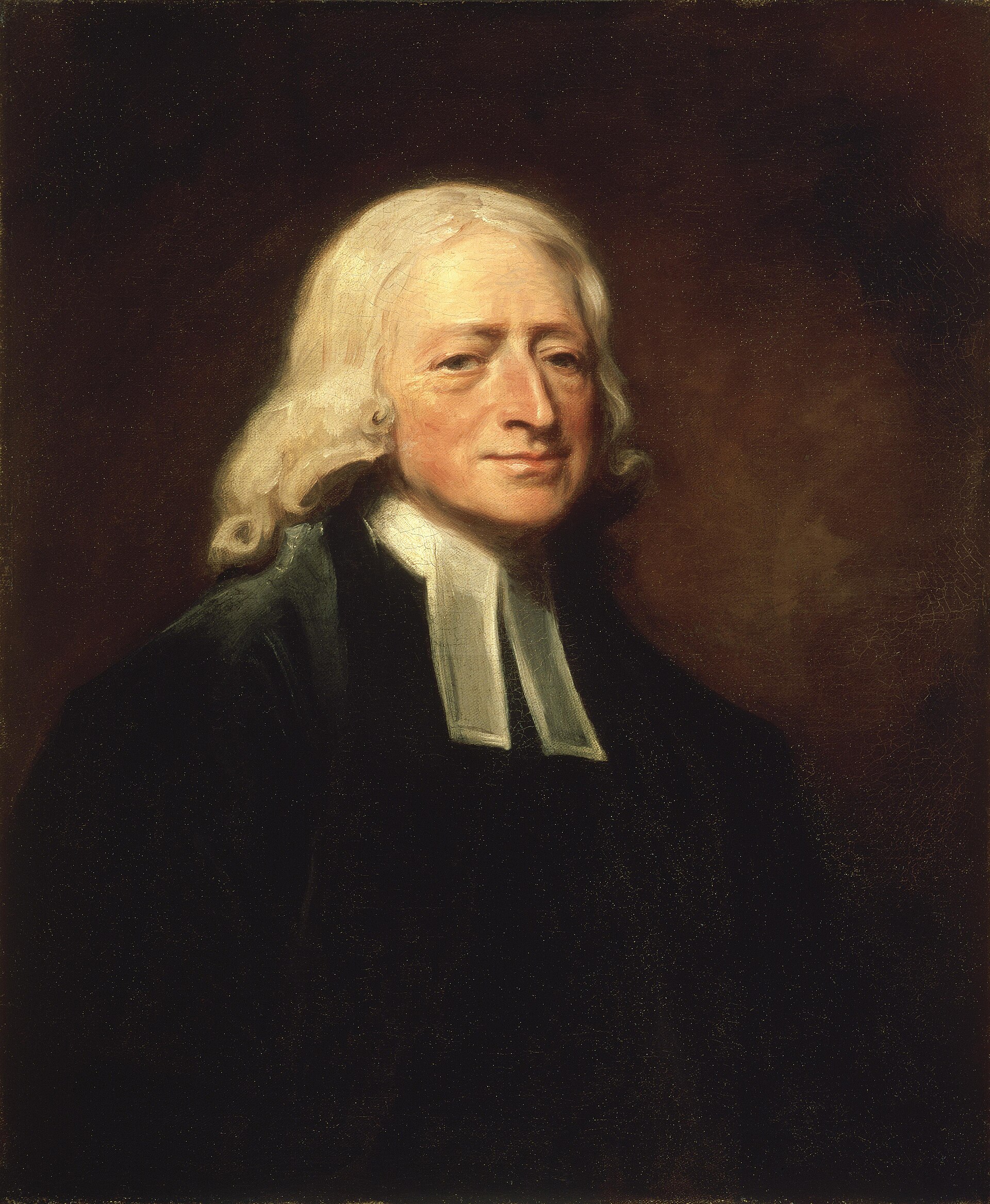

The Christmas Conference of 1784
Why American Methodists needed a church
Before the American Revolution, Methodists in the colonies were members of Wesley's societies, and Wesley expected them to receive baptism and the Lord's Supper from priests of the Church of England. The Revolution broke that arrangement. Many Anglican clergy were loyal to the Crown and left, and after 1783 there was no English bishop with authority in the new republic. American Methodist preachers, most of them lay men who had never been ordained, had thousands of members and few ministers who could give the sacraments. The Global Methodist Church's history puts it plainly: "the American revolution led to the formation of a new church, independent of the Church of England."7
Wesley, still a priest of the Church of England, decided in 1784 to act. In Bristol he ordained Richard Whatcoat and Thomas Vasey as presbyters (elders) for America, and he set apart Thomas Coke, already an Anglican priest, as a superintendent.1 He then wrote a letter to the American Methodists, which Coke carried across the Atlantic. Nathan Bangs, the first major historian of American Methodism, printed the letter in his History of the Methodist Episcopal Church. In it Wesley wrote: "I have accordingly appointed Dr. Coke and Mr. Francis Asbury, to be joint superintendents over our brethren in North America." He added that Whatcoat and Vasey were "to act as elders among them, by baptizing and ministering the Lord's supper." The letter ends with the sentence that American Methodists have quoted ever since: "They are now at full liberty simply to follow the Scriptures and the primitive church."1
Wesley's right to ordain was disputed from the start, and the dispute is still alive between Methodists and Anglicans. Wesley held that in the early church a presbyter and a bishop were one order, so that a presbyter could ordain in an emergency. Anglican bishops did not accept that reading, and his brother Charles Wesley opposed the ordinations. The lesson on Anglicans and Episcopalians, lesson 04, gives the Anglican side and the story of Samuel Seabury, consecrated as the first American Episcopal bishop in Scotland the same year.
Ten days in Baltimore
Coke, Whatcoat and Vasey landed in New York in November 1784 and met Francis Asbury at Barratt's Chapel in Delaware on November 15, where, Bangs records, Whatcoat helped give the sacrament.1 Asbury refused to accept Wesley's appointment by letter alone. He asked that the American preachers be called together to decide. The meeting gathered in Baltimore, at the Lovely Lane meetinghouse, at Christmas.
The exact opening date is reported two ways. Bangs wrote that "December 25th, sixty out of the eighty-three preachers then in the traveling connection, assembled in the city of Baltimore for the conference."1 The United Methodist Church's official website, in an article by Joe Iovino, says the preachers "would meet at Lovely Lane Chapel beginning December 24, 1784, to found and organize a new church," and calls it ten days that started a church.9 Christmas Eve 1784 fell on a Friday, and most modern accounts give December 24, 1784, to early January 1785. The closing date is not stated in either source, so this lesson treats the conference as running about ten days from December 24 or 25.
Coke described the business afterward: "We spent the whole week in conference, debating freely, and determining all things by a majority of votes."9 According to Bangs, "the first act of the conference was, by a unanimous vote, to elect Dr. Coke and Francis Asbury as general superintendents."1 The vote mattered to Asbury: he would lead with the American preachers' consent as well as Wesley's appointment. Coke then ordained Asbury on three successive days. Coke's own certificate, which Bangs printed, says that he "did on the twenty-fifth day of this month, December, set apart Francis Asbury for the office of a deacon," that on the twenty-sixth he set him apart "for the office of elder in the said Methodist Episcopal Church," and that on the twenty-seventh, "being assisted by the said elders," he set him apart "for the office of a superintendent in the said Methodist Episcopal Church." The certificate is dated "this 27th day of December, in the year of our Lord 1784."1 Iovino's article adds that Philip William Otterbein, a German Reformed pastor in Baltimore who later helped found the United Brethren in Christ, took part in Asbury's ordination.9
What the new church adopted
The conference adopted a name, the Methodist Episcopal Church, which appears in Coke's certificate.1 It accepted the order of worship Wesley had sent, The Sunday Service of the Methodists in North America, a shortened form of the Book of Common Prayer.9 And it accepted Wesley's revision of the Thirty-nine Articles of the Church of England. The Global Methodist Church's Book of Doctrines and Discipline, which still prints these articles as a doctrinal standard, explains: "Wesley revised the Articles in 1784 for the Methodist work in America. His twenty-four Articles reflect both his theological commitments and his desire for doctrinal clarity, shortening some articles and deleting others if they could be easily misread." It continues: "The Methodist Episcopal Church added an additional article dealing with the duty of Christians to civil authority. The Twenty-Five Articles were officially adopted by the General Conference of 1808, when the first Restrictive Rule was also implemented."7
The added article, numbered XXIII, is a statement of loyalty to the new nation. In the text the Global Methodist Church prints today it reads: "The President, the Congress, the general assemblies, the governors, and the councils of state, as the delegates of the people, are the rulers of the United States of America, according to the division of power made to them by the Constitution of the United States and by the constitutions of their respective states."7 (The wording was revised after the Constitution was adopted in 1787 to 1789; the 1784 form is older.) Wesley dropped the articles on predestination and on the authority of church councils, among others, which is one reason the Methodist articles have no place for the Calvinist doctrine of unconditional election. Lesson 03, Calvinism in Detail, sets the two systems side by side.
Two other sources of doctrine came with the articles. The Global Methodist history says that besides the articles, the General Rules and the liturgy, "Two other sources of authority were identified: the four volumes of sermons," which it says included fifty-three sermons, "as well as his Explanatory Notes Upon the New Testament." It adds that "When a constitution was adopted in 1808, the Restrictive Rules protected the Articles and General Rules from revocation or change."7 Whether the sermons and Notes were legally part of the protected standards in America has been argued by Methodist historians for decades, and the bodies that descend from 1784 still word the question differently.
The Global Methodist history also records that "When the General Rules were officially adopted in 1789, a new rule was added in the American context" against slaveholding, and that "due to the corrupting influences of American culture at the time, this rule was eventually ignored in those areas in which slavery was declared legal."7 That gap between the rule and practice is the root of the first great splits.
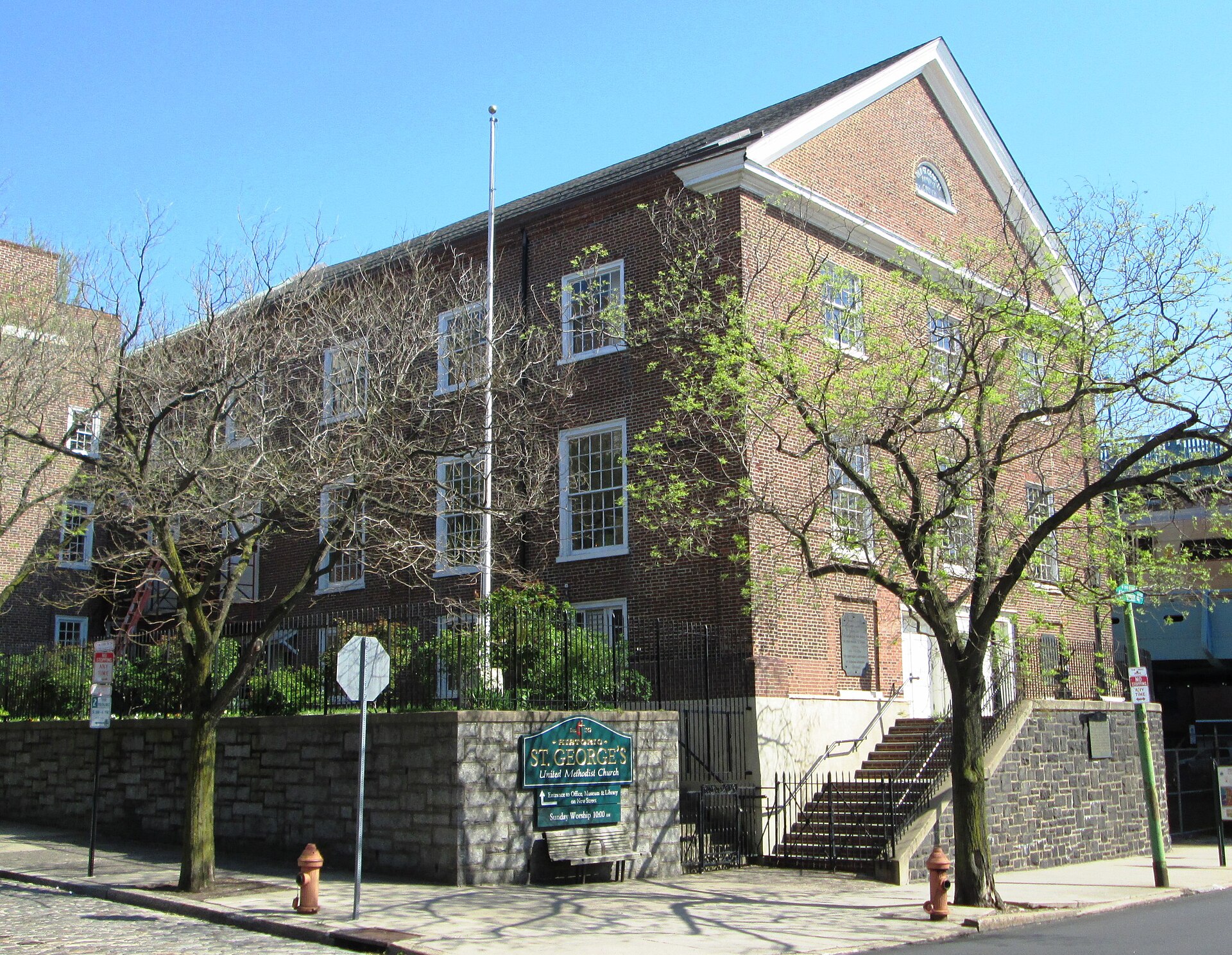

Asbury, the circuit and the growth
The Methodist Episcopal Church organized its preachers by circuits. A traveling preacher, often young and unmarried, rode a set route of preaching places, met the local classes and moved to a new circuit at the bishop's appointment, usually every year or two. Annual conferences gathered the preachers of a region, and a General Conference, first held in 1792, made law for the whole church. Asbury traveled for more than forty years and never had a settled home. Coke spent much of his time in Britain and in overseas missions, so in practice Asbury governed American Methodism until his death in 1816.
The growth that followed is the most striking fact in early American church history. Roger Finke and Rodney Stark, in The Churching of America, estimated the share of religious adherents in each denomination. Their table, as reproduced in teaching materials by David Bromley of Virginia Commonwealth University, gives Methodists 2.5 percent of American adherents in 1776 and 34.2 percent in 1850, the largest single family in the country, ahead of the Baptists (20.5 percent) and far ahead of the Congregationalists, who fell from 20.4 percent to 4.0 percent over the same years.10 Finke and Stark explained the growth by the Methodists' use of unpaid or poorly paid lay preachers drawn from the people they served, their system of camp meetings and classes, and their direct, emotional preaching. Nathan Hatch's The Democratization of American Christianity (1989) made a related argument: that Methodists and Baptists grew because they gave ordinary people religious authority. Both are interpretations; the percentages themselves are estimates built from church records, as Finke and Stark explain in their book.
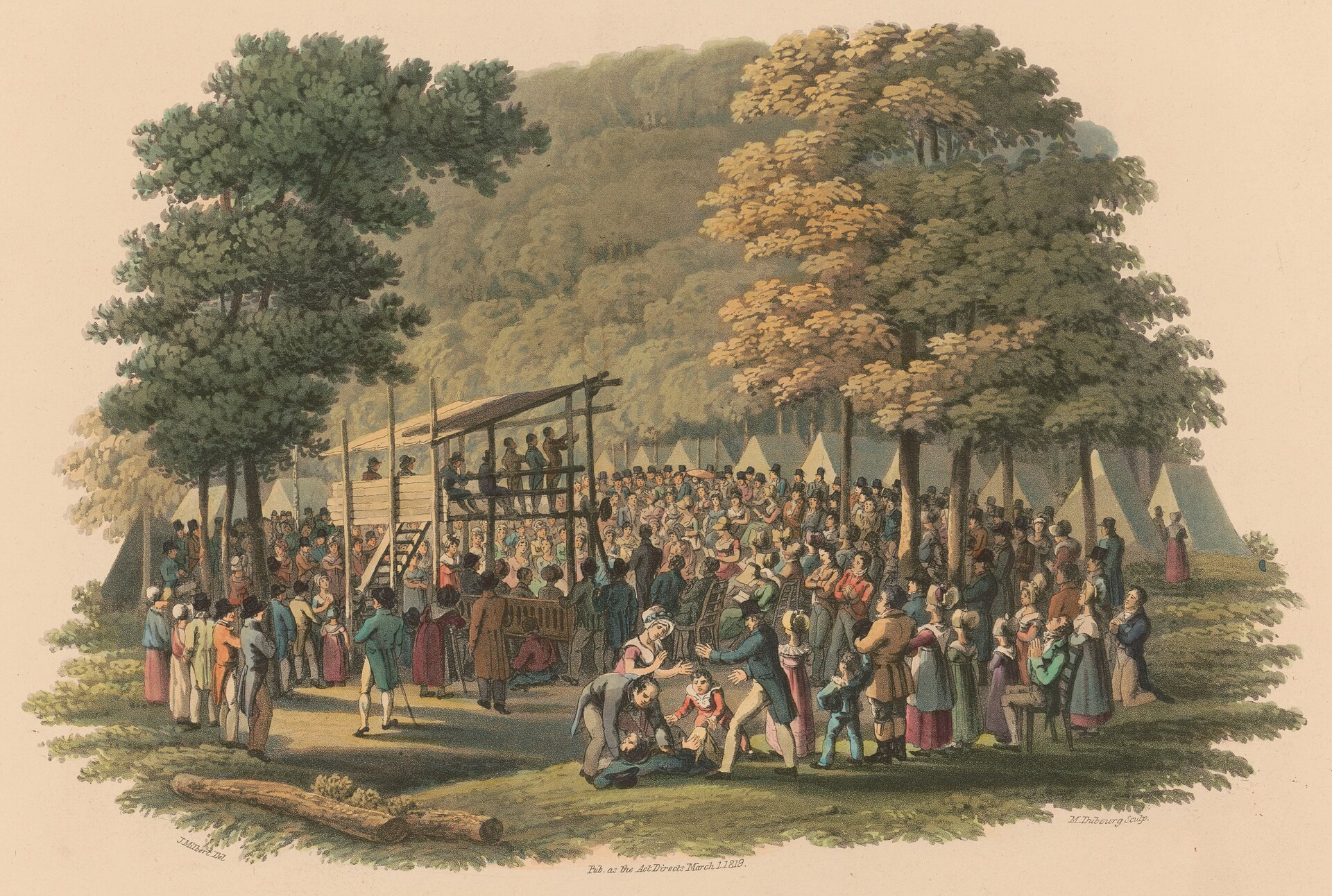

The African American Methodist churches
The walkout at St. George's
Early Methodism drew large numbers of Black members, enslaved and free, and the 1780s rules against slaveholding gave many of them hope. Within a decade the white leadership of city congregations was segregating them. Richard Allen, born enslaved in 1760, bought his freedom, became a licensed Methodist preacher and worked in Philadelphia. His autobiography, The Life, Experience, and Gospel Labours of the Rt. Rev. Richard Allen, published after his death, gives his own account of what happened at St. George's Church on Fourth Street.2
Allen wrote that the Black worshippers were moved from their usual seats "and placed us around the wall," and that one Sunday the sexton sent them to the new gallery. They sat where they thought they had been told to sit. "We had not been long upon our knees before I heard considerable scuffling and low talking. I raised my head up and saw one of the trustees, H-- M--, having hold of the Rev. Absalom Jones, pulling him up off of his knees, and saying, 'You must get up--you must not kneel here.'" Jones asked to be allowed to finish the prayer. Allen's account ends: "By this time prayer was over, and we all went out of the church in a body, and they were no more plagued with us in the church."2 (The double hyphens are in the printed text.)
The African Methodist Episcopal Church's own history describes the same event: "When officials at St. George's MEC pulled blacks off their knees while praying," it says, the incident showed "just how far American Methodists would go to enforce racial discrimination." The church traces its beginning to the Free African Society, which "Richard Allen, Absalom Jones, and others established in Philadelphia in 1787."11 The date of the walkout itself is not settled. Allen gives no year in the passage, church tradition places it in 1787, and several historians, reasoning from the date the gallery was built, place it in about 1792 or 1793. The Claims checked section below rates the question.
Absalom Jones led one part of the group into the Episcopal Church, where St. Thomas African Episcopal Church was founded and Jones became the first Black priest in the Episcopal Church. Allen stayed Methodist. The AME history says that "In 1794 Bethel AME was dedicated with Allen as pastor," and that Allen "successfully sued in the Pennsylvania courts in 1807 and 1815" for the congregation's right to exist as an independent institution.11 Allen's own account says the lawsuit ended "in our favor," settled by the state Supreme Court.2
The African Methodist Episcopal Church, 1816
Allen's narrative continues: "Many of the colored people in other places were in a situation nearly like those of Philadelphia and Baltimore, which induced us in April 1816 to call a general meeting, by way of Conference." Delegates from Baltimore and other places met those of Philadelphia, and, he wrote, "it was resolved, 'That the people of Philadelphia, Baltimore, &c. &c., should become one body, under the name of the African Methodist Episcopal Church.'" Allen explained why they kept Methodist discipline while leaving the Methodist Episcopal Church: to "preserve us from that spiritual despotism which we have so recently experienced."2 Allen was consecrated as the new church's first bishop at that meeting; the usual date given is April 11, 1816. The AME Church kept the Methodist Articles of Religion and the episcopal form of government and changed nothing in doctrine. It separated over race and the control of property; its doctrine stayed the same.
The AME Church spread through the free states before the Civil War and into the South after it. Its own history reports that "in 1880 AME membership reached 400,000," and that today it has "membership in twenty Episcopal Districts in thirty-nine countries on five continents."11 The page does not give a current total membership. Figures of two to three million members appear in reference books and news reports, but this lesson could not find a recent count published by the church itself, so none is given here as a count.
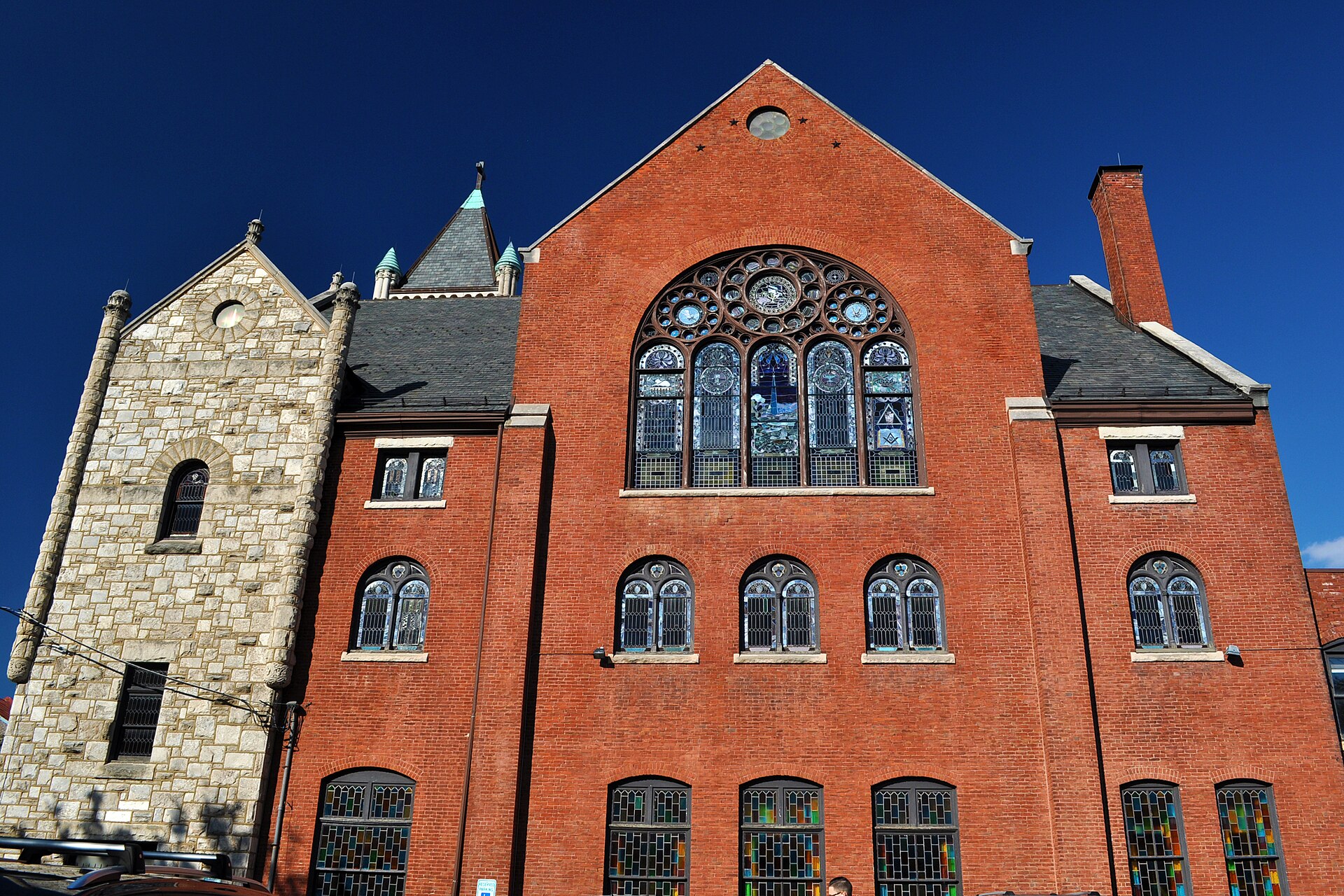

The African Methodist Episcopal Zion Church
New York had its own story. Christopher Rush, the second bishop of the AME Zion Church, published A Short Account of the Rise and Progress of the African Methodist Episcopal Church in America in 1843. He begins: "In the year 1796, when the Colored members of the Methodist Episcopal Church in the City of New York became increased, and feeling a desire for the privilege of holding meetings of their own, where they might have an opportunity to exercise their spiritual gifts among themselves," they obtained permission from Bishop Asbury to meet separately between the regular services.3 Among the men he names is James Varick. The group met first in a rented former stable on Cross Street and later built Zion Church.
For two decades Zion stayed under the Methodist Episcopal Church's white preachers. Rush records the long negotiation of 1820 and 1821, including an address signed "at a meeting called especially for that purpose, March 23d, 1821, in the City of New York. JAMES VARICK, President."3 After the New York Annual Conference declined their terms, the official members met "On the 12th of June, 1821," and resolved to proceed on their own. Rush gives the returns of the first yearly conference: Zion Church, 763 members; Asbury Church, 150; New Haven, 24; Long Island, 155; the Wesleyan Church in Philadelphia, 300; Easton, Pennsylvania, 18; "Total, 1,426."3 At that conference Varick was made district chairman; he became the connection's first superintendent (the title the church then used for bishop) in 1822. The AME Zion Church added "Zion" to its name to tell it apart from Allen's church. It is often called the Freedom Church, because Harriet Tubman, Sojourner Truth and Frederick Douglass were associated with it. This lesson could not open the AME Zion Church's own website (the site refused automated access), so its current self-description and membership are not quoted here.
The Christian Methodist Episcopal Church
The third of the large Black Methodist bodies came out of the Methodist Episcopal Church, South, after emancipation. Black membership in the Southern church fell sharply after 1865 as freed people joined the AME and AME Zion churches. The remaining Black members asked for a church of their own, and the Southern church agreed. Charles Henry Phillips, a CME bishop, published The History of the Colored Methodist Episcopal Church in America (third edition 1925). He records that the first General Conference "had been called to meet at Jackson, Tenn., in December, 1870," with eight conferences represented and bishops of the Southern church presiding.4 The church traditionally dates its founding to December 16, 1870.
Phillips prints the resolution on the name. The delegates said they were part of the original church, "never having seceded or separated from the Church; but in the division of the Church by the General Conference in 1844 we naturally belonged to the South," and continued: "now, as we belong to the colored race, we simply prefix the word 'colored' to the name." The resolution reads: "That our name be the 'Colored Methodist Episcopal Church in America.'"4 William H. Miles and Richard H. Vanderhorst were elected the first bishops. In 1954 the church changed "Colored" to "Christian," keeping the initials CME.
The three bodies, AME, AME Zion and CME, kept nearly identical doctrine and discipline to the parent church. Their separation shows a pattern that runs through this lesson: Methodists rarely split over the Articles of Religion. They split over who governs, who is welcome, and who holds the property.
Splits and reunions in the Methodist Episcopal Church
The Methodist Protestant Church, 1828 to 1830
The first large split among white Methodists was over power. In the Methodist Episcopal Church, bishops appointed preachers and presiding elders, and only traveling preachers sat in the conferences. Reformers asked for lay delegates and for the election of presiding elders. When the General Conference of 1828 refused, reformers were expelled or withdrew. The United Methodist Church's own summary says that "A split in 1828 formed the Methodist Protestant Church."5 The Global Methodist history says the Methodist Protestant Church "had organized earlier in 1830 along congregational lines," with no bishops and with laity represented equally with clergy.7 Phillips, writing about the CME Church a century later, recalled that the elective system for presiding elders "hung as the sword of Damocles over the head of the General Conferences of 1820, 1824, and 1828."4
The 1844 split over slavery
The second split was over slavery, and it divided the largest church in the country in two. By 1844 the Methodist Episcopal Church had made peace with slaveholding in the South while its northern conferences were turning against it. At the General Conference of 1844 in New York, the case before the delegates was Bishop James Osgood Andrew of Georgia. The New Georgia Encyclopedia notes that most published accounts say Andrew "never bought or sold an enslaved person" and became an owner "through his wives," though some evidence suggests he held enslaved people earlier.12 Northern delegates moved that Andrew "desist" from exercising his office while he remained a slaveholder. According to the encyclopedia, the resolution passed by a vote of 110 to 69; other accounts give 111 to 69.12
Each side gave its reasons. Northern delegates said a slaveholding bishop could not be appointed across the whole church and that the General Conference could set conditions for a bishop's service. Southern delegates said the General Conference had no constitutional power to suspend a bishop who had broken no rule of the Discipline, and that the church had long accepted slaveholding by members in states where the law forbade emancipation. The Global Methodist history names both issues, saying that "Other tensions at the time included the respective powers of the episcopacy as well as those of the General Conference, due to the holding of slaves by clergy as well as by a prominent bishop."7
The conference adopted a Plan of Separation that allowed the southern conferences to organize separately. The following year, in the Global Methodist history's words, "the Methodist Episcopal Church was rent asunder as delegates from the southern states met in Louisville, Kentucky, to organize the Methodist Episcopal Church, South."7 The two churches then fought in civil court over the Book Concern (the publishing house) and its profits; the Supreme Court of the United States ruled for the Southern church in 1854 in Smith v. Swormstedt. The Baptists divided in the same years and for the same reason, and the Presbyterians in 1861; lesson 06, Baptists, and lesson 02, The Reformed and Presbyterians, give those stories.
The 1939 reunion and the Central Jurisdiction
After the Civil War, the northern and southern churches spent seventy years drifting back together. A plan of union failed in the 1920s when the Southern church did not approve it. A new plan in the 1930s took in the Methodist Protestants as well. The Uniting Conference met in Kansas City, Missouri, from April 26 to May 10, 1939, and the union took effect on May 10.13 The Global Methodist history describes the result: the two bodies "came together once more, along with the Methodist Protestant Church," and "The uniting of these three bodies was simply known as The Methodist Church."7 One summary gives the new church about 8 million members; this lesson did not find a body-published total for 1939.13
The price of union was segregation written into the constitution. The Methodist Church was divided into five regional jurisdictions and a sixth, the Central Jurisdiction, that held the Black annual conferences wherever they were located. Southern delegates required it as a condition of union; many Black delegates voted against the plan or abstained. The Central Jurisdiction lasted until the 1968 merger. The United Methodist Church's own history says that its creation in 1968 "ended the segregation of African American congregations into a separate Central Jurisdiction."6 Not every southern Methodist accepted the union of 1939. A small group formed the Southern Methodist Church in 1940, and other small bodies of the period were organized by people who opposed what they called the liberal teaching of the mainline church.
The German-speaking cousins: United Brethren and Evangelicals
German-speaking Americans built two churches very much like the Methodists. The Global Methodist history names their founders: "The work of Phillip William Otterbein, Martin Boehm, and Jacob Albright established the United Brethren in Christ and the Evangelical Association," and says these bodies had "doctrine and discipline nearly identical to the English-speaking Methodist Episcopal Church."7 Otterbein was the Reformed pastor who had helped ordain Asbury. Albright, a Pennsylvania Lutheran converted under Methodist preaching, gathered German-speaking converts whom English Methodists did not serve in their own language. Both bodies divided and reunited in the nineteenth and early twentieth centuries. The United Methodist timeline records that the Evangelical United Brethren Church was "established" in 1946, when the Evangelical Church and the Church of the United Brethren in Christ merged.5 The EUB brought its own Confession of Faith, which became the second doctrinal standard of the United Methodist Church and is still printed by the Global Methodist Church.
The United Methodist Church, 1968
The United Methodist Church was formed on April 23, 1968, at a uniting General Conference in Dallas, Texas. The church's own history gives the sizes of the two partners: The Methodist Church with 10.3 million members and the Evangelical United Brethren Church with 750,000.6 The Global Methodist history says that "both the Methodist Articles of Religion and the Evangelical United Brethren Confession of Faith were accepted as doctrinal standards and deemed 'congruent' articulations of this faith."7 The new church kept bishops elected for life by jurisdictional conferences, an appointive system for clergy, a General Conference meeting every four years, and a trust clause under which local church property is held in trust for the denomination. That trust clause became the central legal question of the 2019 to 2023 disaffiliations.
The 1968 church was the second largest Protestant body in the United States, behind the Southern Baptist Convention, and it began to lose members almost at once. The decline is part of the story of the mainline churches in lesson 11, Mainline and Evangelical. In 1968 a group of Evangelical United Brethren conferences in the Pacific Northwest declined to join and formed the Evangelical Church of North America. Some Wesleyan Methodist congregations likewise stayed out of their own church's 1968 merger, described below.
The Holiness lines
Wesley taught that a believer could, by grace, be made perfect in love in this life, and he called this entire sanctification or Christian perfection. Module 77, lesson 01, explains the doctrine as Wesley preached it and tells the story of the nineteenth century Holiness revival: Phoebe Palmer's Tuesday Meetings in New York, the "shorter way" to sanctification, and the national camp meetings that followed the Civil War. Here the question is institutional. Which bodies came out of that revival, why did they leave the Methodist churches, and what do they teach now?
The doctrine itself is still written into the shared standards. The Evangelical United Brethren Confession of Faith, Article XI, printed today by the Global Methodist Church, says: "Entire sanctification is a state of perfect love, righteousness and true holiness which every regenerate believer may obtain by being delivered from the power of sin, by loving God with all the heart, soul, mind and strength, and by loving one's neighbor as one's self."7 The Holiness bodies would say the doctrine was kept on paper while it faded from preaching in the large Methodist churches after the Civil War. Methodist leaders of the 1880s and 1890s, for their part, objected to independent Holiness associations that held their own meetings, ran their own papers and judged pastors by whether they preached a second, instantaneous blessing. Both sides of that quarrel are in the record; which side was right is a theological judgment this lesson leaves to the reader.
The Wesleyan Methodists, 1843
The oldest of the Holiness bodies began over slavery before it became a Holiness church. The Wesleyan Church's own history says that on November 8, 1842, Orange Scott, LaRoy Sunderland and Jotham Horton announced their withdrawal from the Methodist Episcopal Church, and that Luther Lee and Lucius Matlack joined them within weeks. On May 31, 1843, delegates met in Utica, New York, "for the express purpose of establishing a new church." The call for that meeting said the new church would be "free from Episcopacy and Slavery."14 In the first issue of their paper, The True Wesleyan (January 7, 1843), Scott wrote a motto that the church still quotes, pairing duty with leaving the consequences to God.14
The Wesleyan Methodist Connection, as it was called, had no bishops, gave laity a share in conference and barred slaveholders from membership. Later in the century it took up the Holiness emphasis on entire sanctification. In 1968 it merged with the Pilgrim Holiness Church to form The Wesleyan Church; a Wesleyan school history on the church's site speaks of the time "after the merger of the Wesleyan Methodist and Pilgrim Holiness Churches."14 Some congregations that declined the merger formed the Allegheny Wesleyan Methodist Connection. The Wesleyan Church's About page says its Global Partners ministry works in 96 countries; this lesson could not find a membership total on the church's site.
The Free Methodists, 1860
The Free Methodist Church grew out of a fight inside the Genesee Conference of western New York in the 1850s. Benjamin Titus Roberts and his allies accused the conference's leaders of worldliness and of drifting from Wesley's teaching; the leaders accused Roberts of insubordination. The Free Methodist Church's history says simply that "church leaders became so upset with B.T. that they kicked him out," and its timeline says he was stripped of his ordination credentials in 1858 (the Methodist Church restored them in 1910). The new church was formed in 1860 at "an apple orchard in Pekin, New York," where Roberts met with 15 preachers and 45 lay persons, and its timeline lists him as the church's first bishop, elected in 1860.15
The word "Free" had several meanings. The church's history names "free seats in every house of worship" (the Methodist Episcopal Church in the region rented pews, which kept the poor at the back), freedom from slavery, "freedom for the Holy Spirit to move in public worship," and freedom for women to serve in church roles including pastoral ministry.15 Other accounts add a rule against membership in secret societies such as the Freemasons; the church's history page does not mention it. Today the Free Methodist Church USA says it is "active in over 830 churches in the United States," and it claims a "global reach of over 1,500,000 people," adding that "For every four Free Methodists in the United States, there are 96 in the rest of the world." No year is given for those figures, and the page does not say whether the global figure counts members or a wider group.16
The Church of the Nazarene, 1907 to 1908
The largest Holiness denomination formed by a series of mergers rather than one split. The Church of the Nazarene's history says: "In October 1907, the Association of Pentecostal Churches of America and the Church of the Nazarene merged in Chicago," taking the name Pentecostal Church of the Nazarene, and that Phineas F. Bresee, the former Methodist minister who had led the Los Angeles church, "was the first general superintendent elected." A congregation organized in Peniel, Texas, in April 1908; the Pennsylvania Conference of the Holiness Christian Church joined in September 1908; and "In October 1908, the Second General Assembly was held at Pilot Point, Texas," where the Holiness Church of Christ united with the others.17 The church treats Pilot Point as its official founding; the date most often given for the vote there is October 13, 1908. The word "Pentecostal" was dropped from the name in 1919, after it had come to mean the tongues-speaking movement described in Module 77, lesson 02. The Nazarenes taught then and teach now that speaking in tongues is not the sign of sanctification.
The church is international. Its history page says that by the 2001 General Assembly, "42 percent of delegates spoke English as their second language," and that 65 percent of Nazarenes now live outside the United States. The church's general secretary reported in January 2026: "Global reports show total current membership for the Church of the Nazarene at 2,764,205," a net decrease of 0.62 percent from 2024, with "nearly 30,000 local churches."1718
The Salvation Army
The Salvation Army is English in origin and Methodist by descent. William Booth was a Methodist New Connexion minister before he left to evangelize independently. The Salvation Army's United States history says that he and Catherine Booth "returned to the East End of London in 1865," where their work began under the name The Christian Mission. Within ten years it had more than 1,000 volunteers and evangelists. In 1878, the account continues, Booth reworked the annual report, which said "The Christian Mission is a volunteer army," crossing out "volunteer army" and writing in "Salvation Army." George Scott Railton and seven women officers, the "Hallelujah Lassies," formally "opened fire" in the United States on March 10, 1880, though the history credits a seventeen-year-old officer, Eliza Shirley, with pioneering the work in America.19
The Army describes itself as "an evangelical part of the universal Christian Church."19 Its eleven doctrines follow the Wesleyan Holiness pattern, including a doctrine that it is the privilege of all believers to be wholly sanctified. It differs from every other body in this lesson in one large way: it does not observe baptism or the Lord's Supper as rites, holding that the inward grace they signify can be received without the outward forms. That position, taken under Booth in the early 1880s, is the Army's own; Methodist, Anglican and other churches have answered that Christ commanded both sacraments. The Army treats its ranks, uniforms and military language as methods of mission. This lesson could not open the Army's international site to quote the doctrines word for word, so they are paraphrased here.
The Church of God (Anderson, Indiana)
Some Holiness people believed that denominations themselves were the problem. Daniel Sidney Warner, a preacher of the Churches of God in North America (Winebrenner), came to teach that true Christians should "come out" of all sects and gather simply as the Church of God. The movement's own history says it "began in 1881 as a movement waving the banner of salvation in Christ alone," and that its early leaders sought to leave denominational hierarchies and formal creeds: "Their aim was not to establish another denomination."20 The movement settled its offices in Anderson, Indiana, and in 1996 to 1997 its General Assembly restructured its national ministries as Church of God Ministries, Inc.
Because the movement does not keep formal membership rolls in the way other bodies do, its numbers are given as attendance and congregations. The movement's history page reports about 230,000 average weekend attendance in about 2,100 congregations in the United States and Canada, and work in 89 countries and territories with more than 7,800 churches and 887,000 believers worldwide. No year is given.20 This body is different from the Church of God (Cleveland, Tennessee), a Pentecostal body treated in lesson 13, Pentecostal, Orthodox and Catholic Bodies.
How the Holiness bodies relate to Pentecostals
Pentecostalism grew out of the Holiness movement. Charles Parham and William Seymour were both shaped by Holiness teaching, and the first Pentecostals described the baptism of the Holy Spirit with tongues as a third blessing after conversion and sanctification. Some Holiness churches, such as the Pentecostal Holiness Church and the Church of God (Cleveland), accepted the new teaching; others, including the Nazarenes, the Wesleyans, the Free Methodists and the Salvation Army, rejected it. The Pentecostal story is told in Module 77, Pentecostal and Charismatic, and the Pentecostal denominations in this module's lesson 13.
The United Methodist conflict, 1972 to 2024
The language of 1972
The split of 2022 has a long background. The 1972 General Conference added to the church's Social Principles the statement that "the practice of homosexuality is incompatible with Christian teaching," and later General Conferences added rules barring "self-avowed practicing homosexuals" from ordination and forbidding clergy to officiate at same-sex unions or churches to host them.21 Every four years from 1976 onward, motions to remove or soften the language failed. The votes grew closer in the United States, while the growing African, Filipino and European delegations, along with traditionalists in the American South, kept the rules. Some American conferences and bishops stopped enforcing them. Traditionalist groups (Good News, the Confessing Movement, the Institute on Religion and Democracy's UMAction, and from 2016 the Wesleyan Covenant Association) organized to keep the rules and to enforce them; groups such as the Reconciling Ministries Network organized to change them.
Each side described the issue in its own terms. Traditionalists said that Scripture and the church's own standards teach marriage as the union of one man and one woman, that the Articles of Religion make Scripture the rule of faith, and that bishops and conferences who refused to enforce the Discipline were breaking their vows. Progressives and many centrists said that the church's historic opposition to slavery and its acceptance of women's ordination showed that it could read Scripture afresh, that the rules harmed gay and lesbian members, and that a global church could allow different practice in different places. Both sides used Wesley's quadrilateral of Scripture, tradition, reason and experience (a later summary of his method, named by the theologian Albert Outler) and both claimed Wesley.
The 2019 special General Conference
The bishops called a special General Conference to settle the question. It met in St. Louis, Missouri, from February 23 to 26, 2019. The bishops recommended a One Church Plan that would have let each conference and congregation decide. The delegates instead adopted the Traditional Plan, which kept the bans and strengthened their enforcement. The UMC's official summary gives the vote as 438 yes (53 percent) and 384 no (47 percent).22 United Methodist News reported that a last attempt to substitute the One Church Plan was "defeated by a vote of 449-374."23 A motion to send the Traditional Plan to the Judicial Council for a ruling on its constitutionality passed 405 to 395.22
The same conference passed a petition on disaffiliation, which became Paragraph 2553 of the Book of Discipline. The UMC's own text of the paragraph, now marked as expired, opens: "Because of the current deep conflict within The United Methodist Church around issues of human sexuality," and gives a local church a limited right to leave for reasons of conscience. A departure required a "two-thirds (2/3) majority vote of the professing members of the local church present at the church conference." The church had to pay its unpaid apportionments for the prior twelve months plus twelve more, and a "withdrawal liability in an amount equal to its pro rata share of any aggregate unfunded pension obligations." The paragraph's provisions would "expire on December 31, 2023."24 Departing churches kept their buildings, which the trust clause would otherwise have kept for the denomination.
The Protocol and the delays
The 2019 result did not end the conflict. Many American conferences voted their disagreement. In January 2020, a group of sixteen bishops and leaders from each side, working with the mediator Kenneth R. Feinberg,33 announced a Protocol of Reconciliation and Grace through Separation. The Global Methodist Church's history describes it: "an impromptu group of sixteen individuals, including bishops, traditionalists, and progressives, led by a well-respected outside mediator, produced a 'Protocol for Reconciliation and Grace Through Separation' in January 2020." It "would have provided for an organized, amicable separation of the UM Church, with those maintaining the traditional perspective allowed to leave the church with their property and assets."7
The 2020 General Conference was postponed by the COVID-19 pandemic, then postponed again in 2021 and 2022. The Global Methodist account says that when it was cancelled again, "a point of no return was finally reached for many," and that "Some of the Protocol participants who favored changing the church's traditional stance moved away from their initial pledged support."7 United Methodist leaders who withdrew support for the Protocol said in public statements that the church's situation had changed and that a separation plan written for 2020 no longer fit; this lesson did not find a single official statement from all of them to quote.
The Global Methodist Church launches
The Wesleyan Covenant Association, led by Keith Boyette, had been preparing a new denomination since 2016. The Global Methodist history says the WCA "made the decision not to wait any longer and became the midwife of sorts for that expression. It officially launched the Global Methodist Church on May 1, 2022, as a new and independent Wesleyan denomination." In its statement of heritage, the church says it "was launched by necessity on May 1, 2022, not only to preserve doctrinal integrity, especially in terms of the authority of Scripture, but also to provide a faithful and lively witness to the apostolic faith."7 Its launch page describes the body as "formed by faithful Christians seeking to preserve the doctrinal integrity of the historic Christian faith," and says that from its inception it "operated in a transitional season," preparing for its first Convening General Conference, "held in September 2024."25 The church's 2024 Book of Doctrines and Discipline places that conference in Costa Rica.7
The Global Methodist Church kept the Methodist doctrinal standards and changed the structure. Its 2024 Book of Doctrines and Discipline, in effect from January 1, 2025, makes these choices in its own words:
- On property: "There is no trust clause for property held by local churches, annual conferences, connectional commissions, or any other entities of the Global Methodist Church" (paragraph 1002), and "The right of a local church to be free from a forced closure or trust clause shall not be abrogated" (paragraph 206.2).7
- On bishops: "A bishop may serve a maximum of two six-year terms," replacing the United Methodist practice of election for life (paragraph on the episcopacy).7
- On sexuality: "We believe that human sexuality is a gift of God that is to be affirmed as it is exercised within the legal and spiritual covenant of a loving and monogamous marriage between one man and one woman."7
- On Scripture: "The canonical books of the Old and New Testaments (as specified in the Articles of Religion) are the primary rule and authority for faith, morals, and service, against which all other authorities must be measured" (paragraph 104).7
- On leaving: a congregation may itself disaffiliate from the Global Methodist Church after "at least a 90-day period of discernment and prayer" (paragraph 1003).7
The book also prints the Apostles' Creed, the Nicene Creed, the Definition of Chalcedon, the Methodist Articles of Religion and the EUB Confession of Faith as "normative" documents, explaining that "Normative teaching is binding and obligatory."7 The 2026 General Conference in Johannesburg adopted preliminary new Articles of Faith, which the church's site says are "not the official published version" until a new edition appears.26
The disaffiliations counted
Congregations began using Paragraph 2553 in 2019, and the pace rose sharply in 2022 and 2023 as the deadline approached. The Global Methodist history notes that the first annual conference to leave was in Bulgaria.7 Several counts exist, and they measure different things:
- The Lewis Center for Church Leadership at Wesley Theological Seminary (a United Methodist school), in a report by Lovett H. Weems Jr. published January 16, 2024, counted 7,631 United States churches "approved by annual conferences for disaffiliation by December 31, 2023," which it reckoned as 25 percent of churches, holding 24 percent of members.8
- United Methodist News, reporting the tally of the General Council on Finance and Administration (GCFA), the denomination's statistics agency, gave "a total of 9,252 disaffiliations and other closures between 2019 and last year," a figure that includes closed churches that did not disaffiliate, and said the church "had 22,096 U.S. churches at the end of 2023."27
- Christianity Today, reporting in May 2024, summarized the result as about 7,600 traditionalist United States churches, roughly 25 percent.28
The commonly quoted figure of about 7,600 is therefore a count of approved disaffiliations under Paragraph 2553 and a related paragraph, not of all closures, and it counts congregations, not members. Not every departing church joined the Global Methodist Church: some became independent, and others joined the Free Methodist Church, the Wesleyan Church, the Church of the Nazarene or other bodies. Some disaffiliations were fought in civil court, especially in conferences that set extra conditions on leaving, and some churches that voted to leave did not complete the process.27
The 2024 General Conference
The postponed General Conference finally met at the Charlotte Convention Center in Charlotte, North Carolina, in late April and early May 2024. With most traditionalist American churches gone, the votes ran the other way. On May 1, 2024, the ban on ordaining "self-avowed practicing homosexuals" was removed without debate as part of a consent calendar. Christianity Today reported: "The vote on the calendar items was 692-51, or about 93 percent in favor."28 The delegates also removed the bans on clergy officiating at same-sex weddings and on churches hosting them, while leaving pastors and congregations free to decline, and they adopted revised Social Principles that dropped the 1972 statement that "the practice of homosexuality is incompatible with Christian teaching."21
The new Social Principles define marriage in two ways at once. An amendment by Molly Hlekani Mwayera, a delegate from the Zimbabwe East Conference, described marriage as a union "between a man and a woman of consenting age or two persons of consenting age," and Baptist News Global reported that this made the revised Social Principles acceptable to most delegates, who adopted them "by a wide margin."21 The same conference deleted Paragraph 2553.24
Some reactions came quickly. United Methodist News reported in May 2024 that the Côte d'Ivoire Annual Conference, with more than a million members, voted in a special session to leave. Its Bishop Benjamin Boni was quoted by the French Catholic paper La Croix as saying that "the United Methodist Church now rests on socio-cultural values that have consumed its doctrinal and disciplinary integrity." In Dallas, the large Highland Park United Methodist Church said it would stay but would not host same-sex weddings; its pastor, Paul Rasmussen, said the change "is neither an invitation nor a mandate for us to change from the church that we have always been."21
Regionalization and the 2025 amendments
The 2024 General Conference also sent four constitutional amendments to the annual conferences around the world. The most important, regionalization, creates regional conferences with equal power to adapt parts of the Book of Discipline for their own areas, so that the American church and the African, Filipino and European churches can keep different rules on marriage and ordination inside one denomination. The others added "gender" and "ability" to the constitution's inclusiveness article, strengthened its racial justice article, and changed clergy voting requirements.29 Constitutional amendments need two-thirds of the aggregate votes of the annual conference members. The Council of Bishops announced in November 2025 that all four were ratified. The tally released on November 5, 2025, gave regionalization 34,148 yes and 3,124 no, or 91.6 percent.30 The Council's president, Bishop Tracy S. Malone, said the amendments "mark a defining moment in the continuing renewal and unity of The United Methodist Church."29
The Global Methodist Church since 2024
The Global Methodist Church held its convening General Conference in San Jose, Costa Rica, in September 2024, and its second in Johannesburg, South Africa, from August 30 to September 5, 2026. The Christian Post, reporting on September 9, 2026, said the church had about 4,700 member churches in 2024 and about 7,250 by the week before the article, and that its annual conferences had grown from 36 in 2024 to 50 regional bodies. A church official, Mike Schafer, said in a statement: "We left Costa Rica 707 days ago a bunch of former United Methodists. Today, we are the Global Methodist Church."31 The church's 2024 Book of Doctrines and Discipline, finished in January 2025, said the church then included "more than 5,000 congregations in 15 countries around the world."7 The church has not, in the sources this lesson opened, published a total count of individual members.
What each body says it believes
The Methodist and Holiness bodies agree on far more than divides them. All of them hold the Arminian teaching that Christ died for all people and that grace makes every person able to respond. The Global Methodist Church's statement on the Wesleyan way of salvation puts it this way: "The Wesleyan tradition celebrates the universal love of God in affirming that Christ died for all people with the result that the gift of salvation is available to all persons through the ministrations of the Holy Spirit."7 All of them teach that believers can be assured of salvation and that holiness of heart and life is the goal of the Christian life, and all except the Salvation Army baptize infants as well as adults and give the Lord's Supper to all baptized believers who come in faith (Methodists call this an open table). The differences are in four places: government (bishops for life, bishops for terms, or general superintendents), property (a trust clause or none), the teaching on sexuality and marriage, and how strongly entire sanctification is preached as a distinct second work of grace.
The numbers, with their years
Every figure below is the body's own report unless marked otherwise, with the year it describes. Where two official sources disagree, both are given.
| Body | Figure | Year described | Source |
|---|---|---|---|
| Methodist Episcopal Church | 83 traveling preachers, 60 at the Christmas Conference | 1784 | Bangs, History, vol. 11 |
| AME Zion (first conference) | 1,426 members | 1821 | Rush, A Short Account3 |
| AME Church | 400,000 members | 1880 | AME Church history page11 |
| The Methodist Church and the EUB at merger | 10.3 million and 750,000 members | 1968 | UMC.org, Uniting Conference of 19686 |
| United Methodist Church, United States | just under 6.7 million members | end of 2018 | UM News, GCFA data32 |
| United Methodist Church, United States | 5,424,043 members; 29,746 active churches | 2022 | UMC.org, At-A-Glance5 |
| United Methodist Church, United States | about 5.7 million members | end of 2022 | UM News, GCFA data27 |
| United Methodist Church, United States | 22,096 churches | end of 2023 | UM News, GCFA data27 |
| United Methodist Church, worldwide | about 11,299,000 members | GCFA report, Nov. 2025 | UMC.org, At-A-Glance5 |
| United Methodist disaffiliations | 7,631 churches (25 percent) | 2019 to 2023 | Lewis Center (Weems)8 |
| Global Methodist Church | about 4,700 churches; about 7,250 churches | 2024; Sept. 2026 | Christian Post, citing the GMC31 |
| Church of the Nazarene, worldwide | 2,764,205 members; nearly 30,000 churches | 2025 | General Secretary's report18 |
| Free Methodist Church | over 830 U.S. churches; "global reach" over 1,500,000 | no year stated | FMCUSA About page16 |
| Church of God (Anderson) | about 2,100 congregations and 230,000 weekend attendance (U.S. and Canada); 887,000 believers worldwide | no year stated | Church of God Ministries20 |
The two 2022 United Methodist membership figures differ by about 300,000. The denomination's At-A-Glance page gives 5,424,043 as "the most recent data submitted to GCFA," and the UM News report gives "about 5.7 million"; the difference may come from later corrections or from whether some reports were carried over, and neither source explains it. The membership counts of the AME, AME Zion, CME and Wesleyan churches are left out of the table because this lesson could not find a current figure published by the church itself.
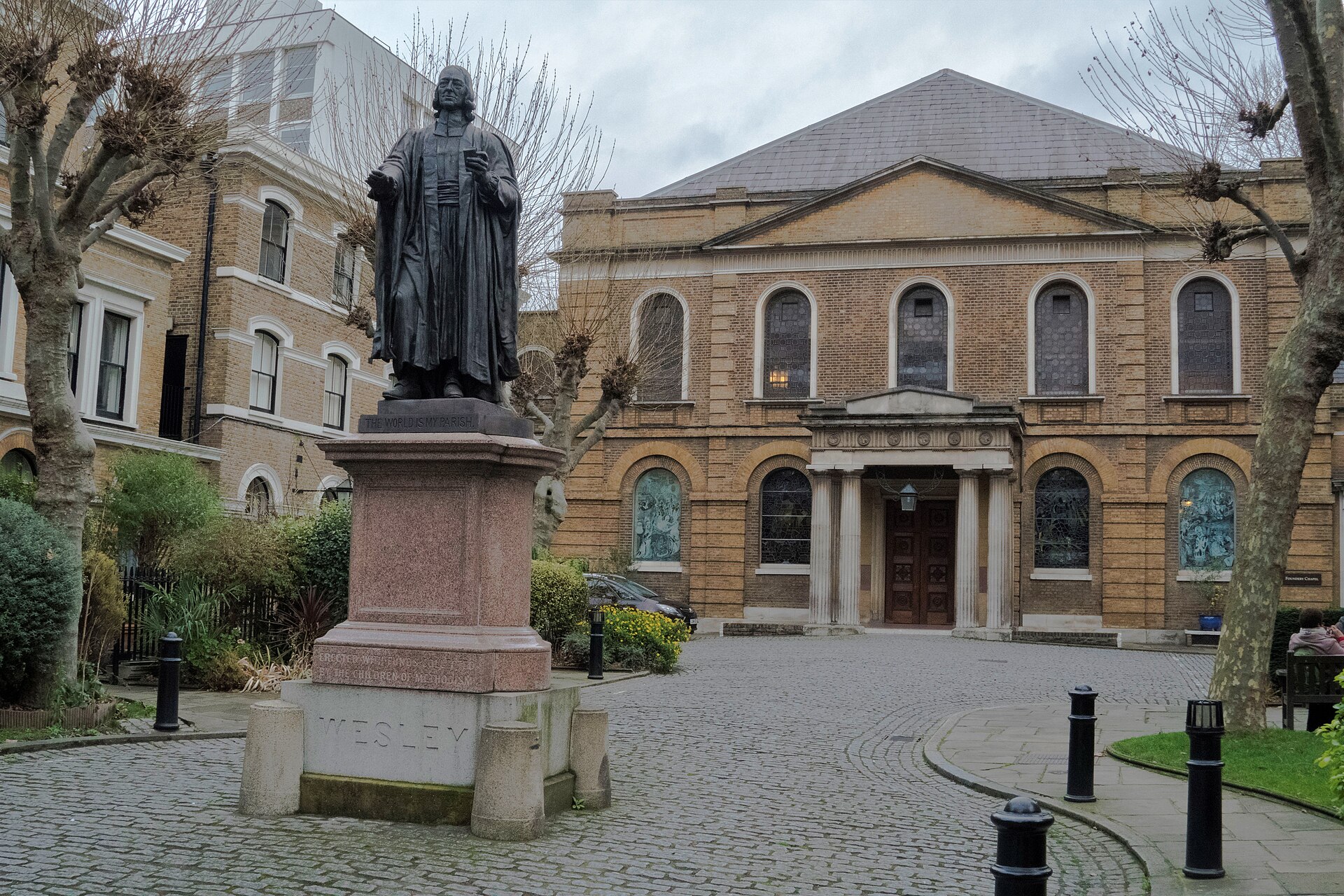

What the record shows and what it does not
- Documented fact: Coke's certificate dates Asbury's ordinations to December 25, 26 and 27, 1784, in the Methodist Episcopal Church.1 Allen's narrative records the April 1816 resolution creating the African Methodist Episcopal Church.2 The 2019 Traditional Plan passed 438 to 384.22 Paragraph 2553 required a two-thirds vote and expired December 31, 2023.24 The Global Methodist Church launched May 1, 2022.7 The 2025 regionalization amendment received 91.6 percent of the votes counted.30
- A church's own claim or tradition: that the St. George's walkout took place in 1787; that Pilot Point on October 13, 1908, is the Nazarene founding date; that the Global Methodist Church was "launched by necessity"; that the United Methodist amendments mark the church's "renewal and unity." Each is the body's own framing and is quoted as such.
- Scholarly reading: Finke and Stark's estimate that Methodists rose from 2.5 percent to 34.2 percent of American adherents between 1776 and 1850, and their explanation of why;10 Nathan Hatch's argument that Methodism grew because it put religious authority in ordinary hands; historians' redating of the St. George's walkout to about 1792.
- Open question: the closing day of the Christmas Conference; the exact count of members (not churches) lost to disaffiliation, which GCFA had not published in the sources opened; the total membership of the Global Methodist Church, the AME, AME Zion and CME churches; and whether regionalization will hold the United Methodist Church together outside the United States.
Claims checked
| Claim | Rating | Evidence |
|---|---|---|
| "Wesley never meant to start a new church." | Partly supported | In England Wesley remained a Church of England priest and urged his people to stay in it. For America he ordained ministers, sent a superintendent, a liturgy and articles, and wrote that the Americans were "at full liberty simply to follow the Scriptures and the primitive church."1 He objected later to the American use of the title bishop, but the separate American church was his act. |
| "The Christmas Conference began on Christmas Eve, December 24, 1784." | Partly supported | The UMC's official article says December 24; Bangs says the preachers assembled December 25.19 Coke's certificate shows business was under way by December 25. |
| "Asbury became a bishop by Wesley's appointment." | Partly supported | Wesley appointed him superintendent by letter, but Asbury accepted only after the conference elected him unanimously; Coke then ordained him over three days.1 |
| "Richard Allen walked out of St. George's in 1787." | Unresolved | Allen describes the walkout without giving a year.2 The AME Church's history connects the Free African Society to 1787.11 Several historians date the event to about 1792 or 1793, when the gallery was finished. The event is not in doubt; its year is. |
| "The AME Church split from the Methodists over doctrine." | Refuted | Allen's narrative gives the reasons as discrimination and the "spiritual despotism" of white trustees and preachers; the new church kept Methodist doctrine and discipline.27 |
| "The 1844 split was only about slavery." | Partly supported | Slavery was the cause of the Andrew case, but the debate also turned on whether the General Conference could suspend a bishop, a point both sides argued as a constitutional question. The Global Methodist history names both.712 |
| "The 1939 reunion healed the racial division in Methodism." | Refuted | The union created the segregated Central Jurisdiction, which the UMC says was ended only in 1968.6 |
| "More than 7,000 churches left the United Methodist Church." | Supported | The Lewis Center counted 7,631 approved disaffiliations from 2019 through 2023.8 GCFA's larger figure of 9,252 includes closures that were not disaffiliations.27 |
| "All the churches that left joined the Global Methodist Church." | Refuted | The GMC's own history says many joined it "while others remained independent or formed other connections."7 |
| "The 2024 General Conference required churches to host same-sex weddings." | Refuted | The changes removed bans; pastors and congregations may decline, as Highland Park UMC announced it would.21 |
| "The Holiness churches are Pentecostal." | Refuted for most | Pentecostalism grew out of the Holiness movement, but the Nazarenes dropped "Pentecostal" from their name to avoid that meaning, and the Wesleyans, Free Methodists, Salvation Army and Church of God (Anderson) are not Pentecostal bodies.17 |
| "Methodists were the largest American denomination by 1850." | Supported, as an estimate | Finke and Stark's estimates give Methodists 34.2 percent of adherents in 1850, the largest share.10 These are scholarly estimates, not a census count. |
Hard questions and answers
Did Wesley have the right to ordain ministers for America?
By the law of the Church of England, no: only bishops ordained, and Wesley was a presbyter. Wesley's own answer was that presbyters and bishops had been one order in the early church and that the American situation was an emergency without bishops. Anglicans and Episcopalians have generally not recognized Methodist orders as standing in the historic episcopate, which is one reason later talks between the churches took so long. Catholics and Orthodox, who hold that a valid bishop is required for valid ordination, would add that the question had already been answered for all Protestant orders. Methodists reply that the conference elected Asbury and that their orders rest on the call of the church and the practice of the early church. The record shows what happened; whether it was valid depends on the theology of ministry the reader holds.
Why did Black Methodists leave instead of reforming the church from inside?
Because the white church controlled the property, the appointments and the conferences, and Black members had no vote in any of them. Allen's narrative is plain that the issue was control: the lawsuits of 1807 and 1815 were over whether Bethel's own members or the white elder governed the congregation.11 Rush's account of Zion shows the same pattern in New York: twenty years of asking to be served on fair terms before the connection organized itself.3 Many Black Methodists did stay in the Methodist Episcopal Church and later in the Central Jurisdiction, and their story is part of the United Methodist Church's history. Both paths are in the record.
Did the Traditional Plan cause the split, or the refusal to enforce it?
Each side tells the story differently. Traditionalists say the split came from bishops and conferences that refused to keep the Discipline adopted in 2019 and before; the Global Methodist history says that "significant portions of the United Methodist Church elected to disregard the church's official traditional stance for the sake of conscience."7 Progressives and many centrists say the Traditional Plan itself forced the issue by tightening penalties the American church no longer accepted. The record shows both: the plan passed by 54 votes, many American conferences declared they would not follow it, and the Protocol that would have managed a separation was never voted on.
Is the United Methodist Church still a global church after 2024?
By its own count, yes: the UMC reported about 11,299,000 members worldwide in its November 2025 GCFA report, and its 2022 figures showed 4,560,882 members in the central conferences of Africa, Asia and Europe beside 5,424,043 in the United States.5 Regionalization, ratified in 2025, is designed to let those regions keep different rules.30 At the same time, the Côte d'Ivoire conference, with more than a million members, voted to leave in 2024.21 The Global Methodist Church chose Johannesburg for its 2026 General Conference.31 Whether the regional plan will hold is a question for the coming decade.
What does entire sanctification mean, and who still teaches it?
In the shared Methodist standards it is "a state of perfect love, righteousness and true holiness which every regenerate believer may obtain."7 Every body in this lesson still has the doctrine in its standards. The Holiness bodies (Wesleyan, Free Methodist, Nazarene, Salvation Army, Church of God) teach it as a distinct experience after conversion and build their preaching around it; the large Methodist bodies keep it in their articles and ordination questions but preach it less. Reformed and Lutheran Christians reject the idea that a believer can be free of sin in this life, citing Romans 7 and the Lutheran teaching that the Christian is at once righteous and a sinner; lessons 01 and 03 give those views in their own words.
Is the Global Methodist Church a new denomination or the old one continued?
Legally it is a new body, launched in 2022, which its own Discipline calls "a new and independent Wesleyan denomination."7 Theologically it claims continuity: it keeps the Articles of Religion, the EUB Confession, Wesley's sermons and Notes and the General Rules, and it presents itself as preserving what the parent church had. The United Methodist Church makes the same claim to continuity through its unbroken institutional line from 1784. Both claims are claims; a reader can judge them by comparing the standards each body prints with what it now permits.
Related lessons and modules
- Module 77, Holiness and Pietism: Wesley's life, Aldersgate, the class meeting and the Holiness revival.
- Module 77, Pentecostal and Charismatic: how the Holiness movement led to Azusa Street.
- Module 79, Zwingli, Calvin and the Wider Reformation: the English Reformation and the prayer books Wesley revised.
- This module: lesson 03, Calvinism in Detail; lesson 04, Anglicans and Episcopalians; lesson 06, Baptists (the 1845 Baptist split); lesson 11, Mainline and Evangelical (Methodist decline in the mainline numbers); lesson 13, Pentecostal, Orthodox and Catholic Bodies; lesson 14, Review. Module page: Church History, Part B.
Learn more
- Module 77, lesson 01: Holiness and Pietism: Wesley's life, Aldersgate and the Holiness revival, which this lesson does not reteach.
- Richard Allen, The Life, Experience, and Gospel Labours (1833): The AME founder's own account of St. George's, Bethel and 1816, short and readable.
- Global Methodist Church, 2024 Book of Doctrines and Discipline: Prints the Articles of Religion and the EUB Confession, with the GMC's own account of the split.
- UMC, Paragraph 2553 (expired): The exact rule under which about a quarter of U.S. United Methodist churches left.
- Christopher Rush, A Short Account of the AME Zion Church (1843): The early history of Zion Church in New York, with its first membership returns.
- Nathan Bangs, History of the Methodist Episcopal Church: Prints Wesley's 1784 letter and Coke's certificate for Asbury.
Still being checked (27 items)
These points could not be confirmed against a primary source when this lesson was written and fact checked in October 2026. The text above states each one as uncertain.
- The opening and closing dates of the Christmas Conference: Iovino (UMC.org) gives a Dec. 24, 1784, start and ten days; Bangs gives Dec. 25; neither gives an end date (often given as Jan. 2, 1785).
- The year of the St. George's walkout (tradition 1787; several historians about 1792 or 1793): Allen gives no year; the redating is stated from general knowledge of the scholarship, not from a historian's text opened for this lesson.
- Richard Allen's consecration as bishop on April 11, 1816 (the usual date; the passage of Allen's narrative read did not give it).
- James Varick's becoming the AME Zion connection's first superintendent in 1822; the 'Freedom Church' name and the Tubman, Truth and Douglass associations. AME Zion's website could not be opened.
- CME founding day Dec. 16, 1870 (Phillips confirms only that the first General Conference was called for Jackson, Tenn., in December 1870); Miles and Vanderhorst as the first bishops (named in Phillips's contents; the election passage was not read); the 1954 renaming to Christian Methodist Episcopal. The CME website could not be opened.
- Absalom Jones as founder of St. Thomas African Episcopal Church and first Black Episcopal priest (not checked in a source for this lesson).
- The 1844 vote on Bishop Andrew: the New Georgia Encyclopedia gives 110 to 69; other accounts give 111 to 69. Smith v. Swormstedt (1854) and the Presbyterian division of 1861 were not checked.
- The Central Jurisdiction details (five regional jurisdictions plus one racial; Southern insistence; Black delegates' votes) are stated from general historical knowledge; the UMC source confirms only that 1968 ended it.
- The Southern Methodist Church (1940), the Evangelical Church of North America (1968) and the Allegheny Wesleyan Methodist Connection (1968) were not checked in their own sources.
- Total membership of The Methodist Church in 1939 (about 8 million per the unsigned EBSCO summary, whose figure of 460,000 for the Southern church is clearly wrong).
- The first General Conference in 1792; Asbury's death in 1816; the landing of Coke, Whatcoat and Vasey in New York in November 1784; the revision of Article XXIII after the Constitution was adopted; the 1788 Wesley letter objecting to the title 'bishop' (none checked).
- Albright's Lutheran background and Otterbein's role beyond what the UMC article and the GMC history state.
- No Wesleyan Church membership total was found on the church's site (the 1968 merger year is confirmed by the wesleyan.org history page: 'In 1968, after the merger of the Wesleyan Methodist and Pilgrim Holiness Churches').
- Free Methodist details not on the church's page: the Aug. 23, 1860, date, the rule on secret societies, the Genesee Conference by name, and pew rental as the meaning of 'free seats'.
- Pilot Point date of Oct. 13, 1908 (the church page gives only 'October 1908'); the 1919 removal of 'Pentecostal' from the Nazarene name. The Nazarene Articles of Faith could not be opened (script-rendered page) and are not quoted.
- Salvation Army: Booth's Methodist New Connexion background, the eleven doctrines and the wording of the doctrine on being wholly sanctified, and the early 1880s decision on sacraments were not checked in the Army's own texts (its international site refused automated access).
- Church of God (Anderson): Warner's Winebrenner background and the 'come out' teaching are from general knowledge; the movement's figures carry no year.
- The 1972 date for the 'incompatible with Christian teaching' language and the later dates of the ordination and officiating bans; the roles of Good News, the Confessing Movement, UMAction and Reconciling Ministries; Albert Outler's naming of the quadrilateral.
- The statements of the Protocol signers who later withdrew support were not opened (Feinberg's role as mediator and the sixteen signers are confirmed by the UM News Protocol FAQ).
- The related paragraph under which some churches also left (Paragraph 2548.2) and the civil lawsuits over disaffiliation were not checked in a source opened for this lesson; the Lewis Center's location at Wesley Theological Seminary was not checked.
- The exact dates of the 2024 General Conference (stated as late April and early May 2024); the separate vote counts on the Social Principles and the officiating ban were not given in the sources opened. The Christian Post gives the 2026 Global Methodist General Conference in Johannesburg as Aug. 30 to Sept. 5, 2026; San Jose as the city of the 2024 Costa Rica conference was not confirmed in a source opened.
- The UMC trust clause (Book of Discipline Paragraph 2501) and lifetime election of UMC bishops are stated from general knowledge, not quoted.
- Nathan Hatch's argument in The Democratization of American Christianity (1989) and Finke and Stark's explanation of Methodist growth are summarized from general knowledge of the books, not from copies opened; the Finke and Stark percentages come from a VCU page that does not cite its table.
- The 2022 UMC U.S. membership: 5,424,043 (At-A-Glance) versus about 5.7 million (UM News); neither source explains the difference. The GMC has not published an individual membership total in the sources opened; AME, AME Zion, CME and Wesleyan current totals were not found from the bodies themselves.
- The Cote d'Ivoire departure and Bishop Boni's words are taken from Baptist News Global's report citing UM News and La Croix, not from those outlets directly.
- British Methodism after 1791 is mentioned only in a caption; no British Methodist source was opened.
- The Salvation Army USA history gives the March 10, 1880, 'opened fire' date and the 'seven Hallelujah Lassies' only in a photo caption; the women's status as officers was not stated there.
Notes
- Nathan Bangs, A History of the Methodist Episcopal Church, vol. 1, book 2, chapter 3, including Wesley's 1784 letter to the American Methodists and Coke's certificate for Asbury dated Dec. 27, 1784; online text in the Holiness classics collection (retrieved Oct. 28, 2026). Read it online. ↩
- Richard Allen, The Life, Experience, and Gospel Labours of the Rt. Rev. Richard Allen (Philadelphia, 1833), electronic edition, Documenting the American South, University of North Carolina at Chapel Hill (retrieved Oct. 28, 2026). Read it online. ↩
- Christopher Rush, A Short Account of the Rise and Progress of the African Methodist Episcopal Church in America (New York, 1843), chapter 1 and the chapters on 1820 to 1821, electronic edition, Documenting the American South (retrieved Oct. 28, 2026). Read it online. ↩
- C. H. Phillips, The History of the Colored Methodist Episcopal Church in America, 3rd ed. (Jackson, Tenn.: Publishing House C.M.E. Church, 1925), chapters 2 and 3 and the introductory chapter on Methodist government, electronic edition, Documenting the American South (retrieved Oct. 28, 2026). Read it online. ↩
- United Methodist Communications, "United Methodists At-A-Glance" (first published May 26, 2019; last updated April 16, 2024; current membership from a GCFA report of November 2025; U.S. and central conference data for 2022), umc.org (retrieved Oct. 28, 2026). Read it online. ↩
- United Methodist Communications and the General Commission on Archives and History, "Methodist History: The Uniting Conference of 1968," umc.org (retrieved Oct. 28, 2026). Read it online. ↩
- Global Methodist Church, 2024 Book of Doctrines and Discipline (final text dated Jan. 15, 2025; provisions in effect Jan. 1, 2025): paragraph 101 (Our Heritage of Faith), paragraphs 102, 104 and 105 with the Articles of Religion (Article XXIII) and the EUB Confession of Faith (Article XI), paragraphs 206.2, 1002 and 1003, the episcopacy paragraph on bishops' terms, the Social Witness article on human sexuality, and the historical appendix on the church's formation (retrieved Oct. 28, 2026). Read it online. ↩
- Lovett H. Weems Jr., Lewis Center for Church Leadership, report of Jan. 16, 2024, as published in UM Insight, Jan. 17, 2024, "Twenty-five percent of churches disaffiliated from The United Methodist Church" (retrieved Oct. 28, 2026). Read it online. ↩
- Joe Iovino, "The Christmas Conference: 10 days that started a church," umc.org, Dec. 12, 2017 (retrieved Oct. 28, 2026). Read it online. ↩
- Roger Finke and Rodney Stark, The Churching of America, 1776 to 2005 (Rutgers University Press, 2005), denominational shares of religious adherents for 1776 and 1850, as reproduced in David G. Bromley's course page at Virginia Commonwealth University; the page does not itself name its source for this table, and the figures were not checked against the book (retrieved Oct. 28, 2026). Read it online. ↩
- African Methodist Episcopal Church, "Our History," ame-church.com (retrieved Oct. 28, 2026). Read it online. ↩
- "James Osgood Andrew (1794 to 1871)," New Georgia Encyclopedia (unsigned in the copy read) (retrieved Oct. 28, 2026). Read it online. ↩
- "Methodist Church Merger Becomes Effective," EBSCO Research Starters (unsigned) (retrieved Oct. 28, 2026). Used for the dates and place of the 1939 Uniting Conference and its approximate total; its figure for the Southern church was not used. Read it online. ↩
- The Wesleyan Church, "Antislavery Roots," wesleyan.org; also the church's history page (wesleyan.org/about/history) for the reference to the merger of the Wesleyan Methodist and Pilgrim Holiness churches, and its About page (wesleyan.org/about) for the 96 countries (retrieved Oct. 28, 2026). Read it online. ↩
- Free Methodist Church USA, "History," fmcusa.org, narrative and timeline (retrieved Oct. 28, 2026). Read it online. ↩
- Free Methodist Church USA, "About," fmcusa.org (no date given for the figures; page last modified Nov. 15, 2023) (retrieved Oct. 28, 2026). Read it online. ↩
- Church of the Nazarene, "Our History," nazarene.org (retrieved Oct. 28, 2026). Read it online. ↩
- Church of the Nazarene, "General Secretary releases 2025 statistics," Jan. 17, 2026, as posted by the Church of the Nazarene Mesoamerica Region (retrieved Oct. 28, 2026). Read it online. ↩
- The Salvation Army USA, "History of The Salvation Army," salvationarmyusa.org (retrieved Oct. 28, 2026). Read it online. ↩
- Church of God Ministries (Anderson, Indiana), "Our History," jesusisthesubject.org (figures undated) (retrieved Oct. 28, 2026). Read it online. ↩
- Baptist News Global, "UMC faces turbulence after removing LGBTQ bans," May 2024, citing UM News and La Croix (retrieved Oct. 28, 2026). Read it online. ↩
- United Methodist Communications, "What happened and what didn't at General Conference 2019," umc.org (retrieved Oct. 28, 2026). Read it online. ↩
- Kathy L. Gilbert, Heather Hahn and Joey Butler, "2019 General Conference passes Traditional Plan," United Methodist News Service, St. Louis, Feb. 26, 2019 (retrieved Oct. 28, 2026). Read it online. ↩
- The United Methodist Church, Book of Discipline, Paragraph 2553, "Disaffiliation of a Local Church Over Issues Related to Human Sexuality" (marked expired; deleted by the 2024 General Conference), umc.org (retrieved Oct. 28, 2026). Read it online. ↩
- Global Methodist Church, "Our Formation" (launch information page), globalmethodist.org (retrieved Oct. 28, 2026). Read it online. ↩
- Global Methodist Church, "Our Beliefs and Governance," globalmethodist.org, on the 2024 Book of Doctrines and Discipline and the preliminary Articles of Faith adopted at the 2026 General Conference (retrieved Oct. 28, 2026). Read it online. ↩
- Heather Hahn, "Tracking the official disaffiliation data," UM News, reporting GCFA tallies (byline date shown as Jan. 18, 2023, though the text reports end-of-2023 data, so the page appears to have been updated in 2024) (retrieved Oct. 28, 2026). Read it online. ↩
- Christianity Today, report on the 2024 General Conference's removal of the ban on LGBTQ clergy, May 1, 2024 (retrieved Oct. 28, 2026). Read it online. ↩
- Council of Bishops of The United Methodist Church, "Council of Bishops Announce Ratification of Constitutional Amendments," ResourceUMC, Nov. 7, 2025 (retrieved Oct. 28, 2026). Read it online. ↩
- Arkansas Conference of The United Methodist Church, "UMC Bishops Finish Canvassing of Amendments: All Four Ratified," Nov. 5, 2025, with the vote table (retrieved Oct. 28, 2026). Read it online. ↩
- Michael Gryboski, "Global Methodist Church reports growth in congregations, conferences, holds General Conference in Africa," The Christian Post, Sept. 9, 2026 (retrieved Oct. 28, 2026). Read it online. ↩
- Heather Hahn, "U.S. dips below majority of membership," UM News, Nashville, Nov. 25, 2019, reporting GCFA data for 2018 (retrieved Oct. 28, 2026). Read it online. ↩
- UM News, 'Protocol of Reconciliation and Grace through Separation: FAQ' (with the text of the Protocol, the list of its sixteen signers and the account of the mediation with Kenneth R. Feinberg; agreement reached Dec. 17, 2019), umnews.org (retrieved Oct. 28, 2026). Read it online. ↩
Check yourself
1. Where and when was the Methodist Episcopal Church organized?
The Christmas Conference met at Lovely Lane in Baltimore beginning December 24 or 25, 1784, and organized the Methodist Episcopal Church; Coke's certificate dated Dec. 27, 1784, uses the name.
2. On what three days did Thomas Coke ordain Francis Asbury deacon, elder and superintendent?
Coke's own certificate, printed by Nathan Bangs, gives December 25 (deacon), December 26 (elder) and December 27 (superintendent), 1784.
3. According to Richard Allen's own narrative, what was decided at the general meeting of April 1816?
Allen quotes the resolution that the people of Philadelphia, Baltimore and other places 'should become one body, under the name of the African Methodist Episcopal Church.'
4. Which case brought the Methodist Episcopal Church to divide in 1844 to 1845?
The General Conference voted (110 to 69 by the New Georgia Encyclopedia's count) that Andrew 'desist' while a slaveholder; the Plan of Separation followed and the Methodist Episcopal Church, South, organized in Louisville in 1845.
5. What was the Central Jurisdiction?
The 1939 Methodist Church placed Black annual conferences in a separate Central Jurisdiction; the UMC says its 1968 formation ended that segregation.
6. Which pair of churches merged on April 23, 1968, in Dallas to form The United Methodist Church?
The Methodist Church (10.3 million members) and the EUB (750,000) united in Dallas on April 23, 1968, according to UMC.org.
7. What did Paragraph 2553 of the United Methodist Book of Discipline require for a church to disaffiliate?
The paragraph required a 'two-thirds (2/3) majority vote of the professing members of the local church present at the church conference,' set payments, and expired on December 31, 2023.
8. Which statement about the Global Methodist Church's 2024 Book of Doctrines and Discipline is correct?
Paragraph 1002 says 'There is no trust clause for property held by local churches,' and the episcopacy paragraph says 'A bishop may serve a maximum of two six-year terms.' It keeps the Articles of Religion as normative.
Terms in this lesson
- Christmas Conference
- The gathering of American Methodist preachers in Baltimore beginning December 24 or 25, 1784, that organized the Methodist Episcopal Church and elected Coke and Asbury superintendents.
- Superintendent
- Wesley's title for the leaders he appointed for America; the Methodist Episcopal Church soon used the title bishop for the same office.
- Articles of Religion
- Wesley's 1784 abridgment of the Thirty-nine Articles to 24 articles, with one American article added to make 25; adopted as a protected standard in 1808.
- General Rules
- Wesley's rules for the Methodist societies, adopted in America in 1789 with a rule against slaveholding, and protected by the Restrictive Rules.
- Restrictive Rules
- Limits placed on the General Conference by the 1808 constitution, protecting the Articles of Religion and General Rules from being revoked or changed.
- Circuit
- A route of preaching places served by a traveling preacher under the bishop's appointment.
- Plan of Separation
- The 1844 plan under which the southern conferences of the Methodist Episcopal Church organized separately as the Methodist Episcopal Church, South, in 1845.
- Central Jurisdiction
- The racially defined jurisdiction of The Methodist Church (1939 to 1968) that held the Black annual conferences.
- Entire sanctification
- The Wesleyan teaching that a believer may, by grace, be made perfect in love in this life; central to the Holiness bodies.
- Trust clause
- A rule that local church property is held in trust for the denomination; the Global Methodist Church's Discipline says it has none.
- Paragraph 2553
- The 2019 United Methodist provision that let churches disaffiliate over human sexuality with a two-thirds vote and payments, expiring December 31, 2023.
- Regionalization
- A 2024 United Methodist constitutional amendment, ratified in 2025, creating regional conferences with equal power to adapt the Book of Discipline.
- Disaffiliation
- A local church's formal departure from its denomination with its property, under the conditions the denomination sets.
Sources
- Nathan Bangs, A History of the Methodist Episcopal Church, vol. 1 (19th century) checked 2026-10
- Richard Allen, The Life, Experience, and Gospel Labours (1833) (1833) checked 2026-10
- Christopher Rush, A Short Account of the Rise and Progress of the African Methodist Episcopal Church in America (1843) (1843) checked 2026-10
- C. H. Phillips, The History of the Colored Methodist Episcopal Church in America (3rd ed., 1925) (1925) checked 2026-10
- UMC, United Methodists At-A-Glance (2019 to 2025) checked 2026-10
- UMC, Methodist History: The Uniting Conference of 1968 (n.d.) checked 2026-10
- Global Methodist Church, 2024 Book of Doctrines and Discipline (Jan. 15, 2025) checked 2026-10
- Lewis Center (Weems), Twenty-five percent of churches disaffiliated (Jan. 16, 2024) checked 2026-10
- Joe Iovino, The Christmas Conference: 10 days that started a church (Dec. 12, 2017) checked 2026-10
- Finke and Stark adherent shares, VCU course page (2005) checked 2026-10
- AME Church, Our History (n.d.) checked 2026-10
- New Georgia Encyclopedia, James Osgood Andrew (n.d.) checked 2026-10
- EBSCO Research Starters, Methodist Church Merger Becomes Effective (n.d.) checked 2026-10
- The Wesleyan Church, Antislavery Roots (n.d.) checked 2026-10
- Free Methodist Church USA, History (n.d.) checked 2026-10
- Free Methodist Church USA, About (n.d. (modified Nov. 15, 2023)) checked 2026-10
- Church of the Nazarene, Our History (n.d.) checked 2026-10
- Church of the Nazarene, General Secretary releases 2025 statistics (Jan. 17, 2026) checked 2026-10
- The Salvation Army USA, History (n.d.) checked 2026-10
- Church of God Ministries, Our History (n.d.) checked 2026-10
- Baptist News Global, UMC faces turbulence after removing LGBTQ bans (May 2024) checked 2026-10
- UMC, What happened and what didn't at General Conference 2019 (Feb. 2019) checked 2026-10
- UM News, 2019 General Conference passes Traditional Plan (Feb. 26, 2019) checked 2026-10
- UMC Book of Discipline, Paragraph 2553 (expired) (2019 (expired Dec. 31, 2023)) checked 2026-10
- Global Methodist Church, Our Formation (2022 to 2026) checked 2026-10
- Global Methodist Church, Our Beliefs and Governance (2025 to 2026) checked 2026-10
- UM News, Tracking the official disaffiliation data (2024) checked 2026-10
- Christianity Today, 2024 General Conference report (May 1, 2024) checked 2026-10
- Council of Bishops, Announce Ratification of Constitutional Amendments (Nov. 7, 2025) checked 2026-10
- Arkansas Conference UMC, All Four Amendments Ratified (Nov. 5, 2025) checked 2026-10
- Christian Post, Global Methodist Church reports growth (Sept. 9, 2026) checked 2026-10
- UM News, U.S. dips below majority of membership (Nov. 25, 2019) checked 2026-10
- UM News, Protocol of Reconciliation and Grace through Separation: FAQ (Jan. 2020) checked 2026-10