Lesson 4 of 14 · about 70 minutes · Updated October 28, 2026
Anglicans and Episcopalians: The Elizabethan Settlement, the Prayer Book and the Modern Splits
You'll be able to
- You'll be able to explain what the Acts of Supremacy and Uniformity of 1559 required, in their own words.
- You'll be able to quote and explain the main doctrinal points of the Thirty-nine Articles and Hooker's ranking of Scripture, reason and the Church.
- You'll be able to tell how the Episcopal Church obtained bishops from Scotland (1784) and England (1787) and organized in 1789.
- You'll be able to describe the Oxford Movement, the Lambeth Conference and the Chicago-Lambeth Quadrilateral.
- You'll be able to trace the modern splits (1976, 1998, 2003, 2008, 2009, 2015, 2026) giving each side's stated reasons.
- You'll be able to read the Episcopal Church, Church of England and ACNA membership figures with their years and limits.
Start here: the short version
Anglicans are the churches that descend from the Church of England. Henry VIII broke with the pope in the 1530s, Edward VI's ministers gave England Protestant prayer books in 1549 and 1552, and Mary I restored Catholic worship from 1553 to 1558 (all taught in Part A). The lasting shape of the English church was set after Elizabeth I came to the throne: two Acts of Parliament in April 1559 (the Act of Supremacy and the Act of Uniformity, together called the Elizabethan Settlement) made the queen "supreme governor" of the church and imposed a lightly revised 1552 prayer book on every parish. The Thirty-nine Articles of Religion (Latin 1563, English 1571) stated the church's doctrine, which is Protestant on Scripture, justification by faith and the two sacraments. Richard Hooker's Laws of Ecclesiastical Polity (1590s) defended the settlement against Puritans who wanted a Presbyterian church. After the civil wars, the 1662 Book of Common Prayer became the standard that most Anglicans still cite. When the American colonies won independence, Episcopalians had no bishop: Samuel Seabury of Connecticut was consecrated by Scottish bishops in Aberdeen on November 14, 1784, William White and Samuel Provoost by English bishops at Lambeth on February 4, 1787, and the Protestant Episcopal Church adopted its own prayer book on October 16, 1789. The Oxford Movement (from 1833) revived Catholic teaching and worship inside Anglicanism, and the first Lambeth Conference of bishops (1867) began the worldwide Anglican Communion, which now counts 42 member churches. In the twentieth century the Episcopal Church authorized women priests and bishops (1976) and a new prayer book (1979). The consecration of an openly gay bishop in New Hampshire (November 2, 2003) brought the Communion's long argument over sexuality to a split: conservative primates formed GAFCON (Jerusalem, June 2008), the Anglican Church in North America was organized in June 2009, in October 2025 GAFCON declared that it was "now the Global Anglican Communion," and in March 2026 at Abuja it constituted that body and called for "principled disengagement" from the Archbishop of Canterbury, just as Sarah Mullally was installed as the first woman to hold that office (March 25, 2026). Counts from the bodies' own reports: the Episcopal Church, 1,547,779 active baptized members (2023) and 413,034 average Sunday attendance (2024); the Church of England, a Worshipping Community of 1,009,000 (2024); the ACNA, 130,111 members (2024).
Where this lesson begins
The sixteenth century origins are taught in Part A. Henry VIII's break with Rome, Thomas Cranmer, and the prayer books of 1549 and 1552 are in Part A, lesson 12, alongside Zwingli, Calvin and the wider Reformed movement that shaped the English reformers. Luther, whose writings reached England in the 1520s, is in Part A, lesson 11. In brief: Henry's Act of Supremacy (1534) declared the king supreme head of the Church of England, but Henry kept most Catholic doctrine. Under his son Edward VI (1547 to 1553) Archbishop Cranmer gave the church an English liturgy, first in a cautious form (1549) and then in a plainly Reformed form (1552). Under Mary I (1553 to 1558) Parliament repealed that legislation, the realm was reconciled to Rome, and Cranmer was burned at Oxford in 1556. This lesson begins when Mary died on November 17, 1558, and her half-sister Elizabeth succeeded her.
Anglicans describe their church in terms that the rest of this lesson tests against the record. The Anglican Church in North America, for example, tells inquirers that Anglicans are "the third largest body of Christians in the world (around 80 million members)" and that "the Anglican ethos holds together three streams of the Christian Church," which it names as Protestant, Holiness and Anglo-Catholic.1 The Episcopal Church defines the Anglican Communion as "a global fellowship of autonomous yet interrelated regional and national churches" marked by communion with the Archbishop of Canterbury.2 Both definitions are now in dispute, which is why this lesson ends with the events of 2025 and 2026.
The Elizabethan Settlement of 1559
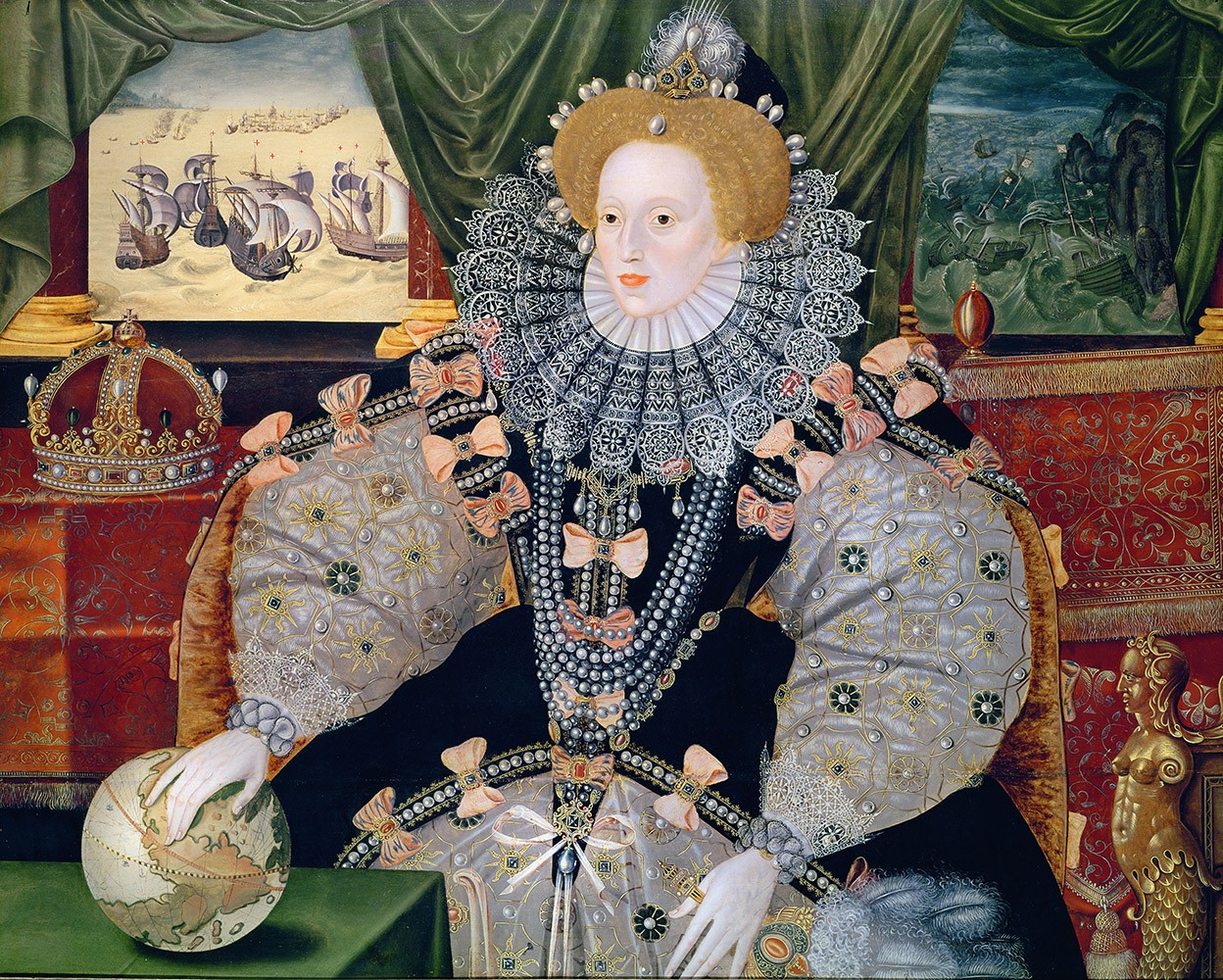

Elizabeth's first Parliament passed two statutes in April 1559 that became the legal foundation of the Church of England. The Act of Supremacy (1 Elizabeth, chapter 1) restored the crown's authority over the church that Mary had surrendered and repealed Mary's heresy laws. It required every clergyman, judge and royal officer to swear an oath that "the queen's highness is the only supreme governor of this realm, and of all other her highness's dominions and countries, as well in all spiritual or ecclesiastical things or causes, as temporal, and that no foreign prince, person, prelate, state or potentate, has, or ought to have, any jurisdiction, power, superiority, preeminence, or authority ecclesiastical or spiritual, within this realm."3 The text is quoted here from the edition of Henry Gee and William John Hardy, Documents Illustrative of English Church History (1896), as posted by the Hanover Historical Texts Project. The word "governor" replaced Henry's "supreme head," a change usually explained as a concession to those who thought no layperson, and especially no woman, could be head of the church. The statute itself gives no reason, so the explanation is a reading of the evidence.
The Act of Uniformity (1 Elizabeth, chapter 2) restored Edward's second prayer book with three stated changes: "one alteration or addition of certain lessons to be used on every Sunday in the year, and the form of the Litany altered and corrected, and two sentences only added in the delivery of the sacrament to the communicants, and none other or otherwise."4 The two added sentences were the words of administration from the 1549 book ("The body of our Lord Jesus Christ, which was given for thee..."), joined to the 1552 words ("Take and eat this in remembrance that Christ died for thee..."). The combined formula allowed a worshipper to hear either a real presence or a memorial in the same rite, and historians of every school have treated it as a fair sign of the settlement's intent. The act also required every person to attend the parish church "upon every Sunday and other days ordained and used to be kept as holy days," on pain of a fine of "twelve pence" for each absence, paid to the poor of the parish.4 Clergy who used any other rite faced loss of income, prison and, on a third offence, imprisonment for life.
Royal Injunctions, ready by June 1559 for commissioners to carry round the dioceses, applied the settlement parish by parish. Gee and Hardy note that they were modelled on Edward VI's injunctions of 1547 and "would appear to have been drawn up by Cecil and his advisers," that is, by the queen's secretary William Cecil.5 Nearly all of Mary's bishops refused the oath and were deprived. Matthew Parker, who had been chaplain to Elizabeth's mother Anne Boleyn, was consecrated Archbishop of Canterbury in December 1559. The validity of his consecration became a point of controversy with Rome for the next four centuries (see the section on how others have judged Anglicanism).
Rome's formal answer came eleven years later. Pope Pius V's bull Regnans in excelsis, given at St. Peter's on "25 February1570" (so the online text prints the date), called the queen "Elizabeth, the pretended queen of England and the servant of crime," declared her excommunicated, and declared her subjects "to be forever absolved from such an oath and from any duty arising from lordship, fealty and obedience."6 The bull made loyalty to the pope and loyalty to the queen hard to hold together. Parliament answered over the following decades with statutes that included an Act against Jesuits and seminary priests (1585) and an Act against recusants (1593), both printed by Gee and Hardy. English Catholics who kept their faith became a separate, persecuted community, and the Church of England became, in law and in practice, a Protestant national church.
What kind of church was it?
The settlement kept bishops, cathedrals, a set liturgy, clerical vestments and the church year, and it kept the parish system intact. Its doctrine, set out in the Articles of 1563 and 1571, was Protestant. That combination produced the long argument over what the Church of England "really" was. Puritans (lesson 05) saw a church only half reformed, with ceremonies they called popish left in place. High churchmen from the 1620s onward, and the Oxford Movement after 1833, saw a Catholic church reformed of medieval abuses. The Cambridge historian Diarmaid MacCulloch, in The Later Reformation in England, 1547 to 1603 (1990) and later books, has argued that Elizabeth's church was in doctrine part of the Reformed Protestant family and that "Anglicanism" as a self-conscious middle way is largely a later construction; that reading is given here as MacCulloch's, paraphrased and not rechecked against his text for this lesson.7 Each of these readings has evidence on its side, which is why the question is still argued.
The Thirty-nine Articles of Religion
The Convocations of Canterbury and York, the clergy assemblies of the two English provinces, approved a set of Articles in Latin in January 1563 (dated 1562 in the old English calendar, in which the year began on March 25). They were a revision of Cranmer's Forty-two Articles of 1553. Philip Schaff, whose Creeds of Christendom (1877) prints the Latin of 1563, the English of 1571 and the American revision of 1801 side by side, explains that the Articles were "passed, recorded, and ratified" in "1562 (1563), in Latin only," then revised and translated by the Convocation of 1571, and published in both languages that year by royal authority, and that the Latin and English texts are of equal authority (the Latin settling doubtful cases).8 The title as the Church of England still prints it reads: "Articles Agreed upon by the Archbishops and Bishops of both Provinces and the whole clergy in the Convocation holden at London in the year 1562 for the avoiding of diversities of opinions and for the establishing of consent touching true religion."9
Parliament's Subscription Act of 1571 (13 Elizabeth, chapter 12), passed "in spite of the queen's well-known objection to such legislation" according to Gee and Hardy, required every minister to "declare his assent, and subscribe to all the articles of religion, which only concern the confession of the true Christian faith and the doctrine of the sacraments."10 The qualifying phrase "which only concern" was later read by Puritans as leaving them free not to subscribe the articles on ceremonies and church government; their opponents read it differently.
What the Articles say, in their own words
The text quoted below is the one printed with the Book of Common Prayer on the Church of England's website (modern spelling of the 1571 English).9
- Scripture (Article VI). "Holy Scripture containeth all things necessary to salvation: so that whatsoever is not read therein, nor may be proved thereby, is not to be required of any man, that it should be believed as an article of the Faith, or be thought requisite or necessary to salvation." The Apocrypha may be read "for example of life and instruction of manners" but not to establish doctrine.
- Justification (Article XI). "We are accounted righteous before God, only for the merit of our Lord and Saviour Jesus Christ by Faith, and not for our own works or deservings: Wherefore, that we are justified by Faith only is a most wholesome Doctrine, and very full of comfort."
- Predestination (Article XVII). "Predestination to Life is the everlasting purpose of God, whereby (before the foundations of the world were laid) he hath constantly decreed by his counsel secret to us, to deliver from curse and damnation those whom he hath chosen in Christ out of mankind." The article says nothing of a decree of reprobation, and it warns against "curious and carnal persons" dwelling on the subject. (Lesson 03 sets this beside Dort and Westminster.)
- The Church (Article XIX). "The visible Church of Christ is a congregation of faithful men, in the which the pure Word of God is preached, and the Sacraments be duly ministered according to Christ's ordinance." The same article adds that "the Church of Rome hath erred, not only in their living and manner of Ceremonies, but also in matters of Faith."
- Authority of the Church (Article XX). "The Church hath power to decree Rites or Ceremonies, and authority in Controversies of Faith: And yet it is not lawful for the Church to ordain any thing that is contrary to God's Word written."
- General Councils (Article XXI). Councils "may err, and sometimes have erred, even in things pertaining unto God."
- Sacraments (Article XXV). "There are two Sacraments ordained of Christ our Lord in the Gospel, that is to say, Baptism, and the Supper of the Lord." Confirmation, penance, orders, matrimony and extreme unction "are not to be counted for Sacraments of the Gospel."
- The Lord's Supper (Article XXVIII). "Transubstantiation (or the change of the substance of Bread and Wine) in the Supper of the Lord, cannot be proved by holy Writ; but is repugnant to the plain words of Scripture." And: "The Body of Christ is given, taken, and eaten, in the Supper, only after an heavenly and spiritual manner."
- Ordinations (Article XXXVI). The Edwardian ordinal "doth contain all things necessary to such Consecration and Ordering: neither hath it any thing, that of itself is superstitious and ungodly."
- The crown and Rome (Article XXXVII). "The Bishop of Rome hath no jurisdiction in this Realm of England."
These texts place the Church of England with the Reformation churches on authority, grace and the sacraments, while Article XXXVI defends a threefold ministry of bishops, priests and deacons ordained by its own rite. Article XVII is a moderate statement of predestination, and that moderation allowed both Calvinists and their later Arminian opponents to subscribe it.
English Calvinists tried to tighten it. On November 20, 1595, Archbishop John Whitgift of Canterbury and Archbishop Matthew Hutton of York approved nine "Lambeth Articles" composed by the Cambridge professor William Whitaker, which taught a fixed number of the elect and of the reprobate. Schaff records that they were "not sanctioned by Queen Elizabeth (who was rather displeased with the convening of a synod without her royal permission)," that they "met with considerable opposition," and that they were accepted by the Dublin Convocation of 1615 and "engrafted on the Irish Articles," but that "during the Arminian reaction under the Stuarts they lost their authority."11
Richard Hooker and the Laws of Ecclesiastical Polity
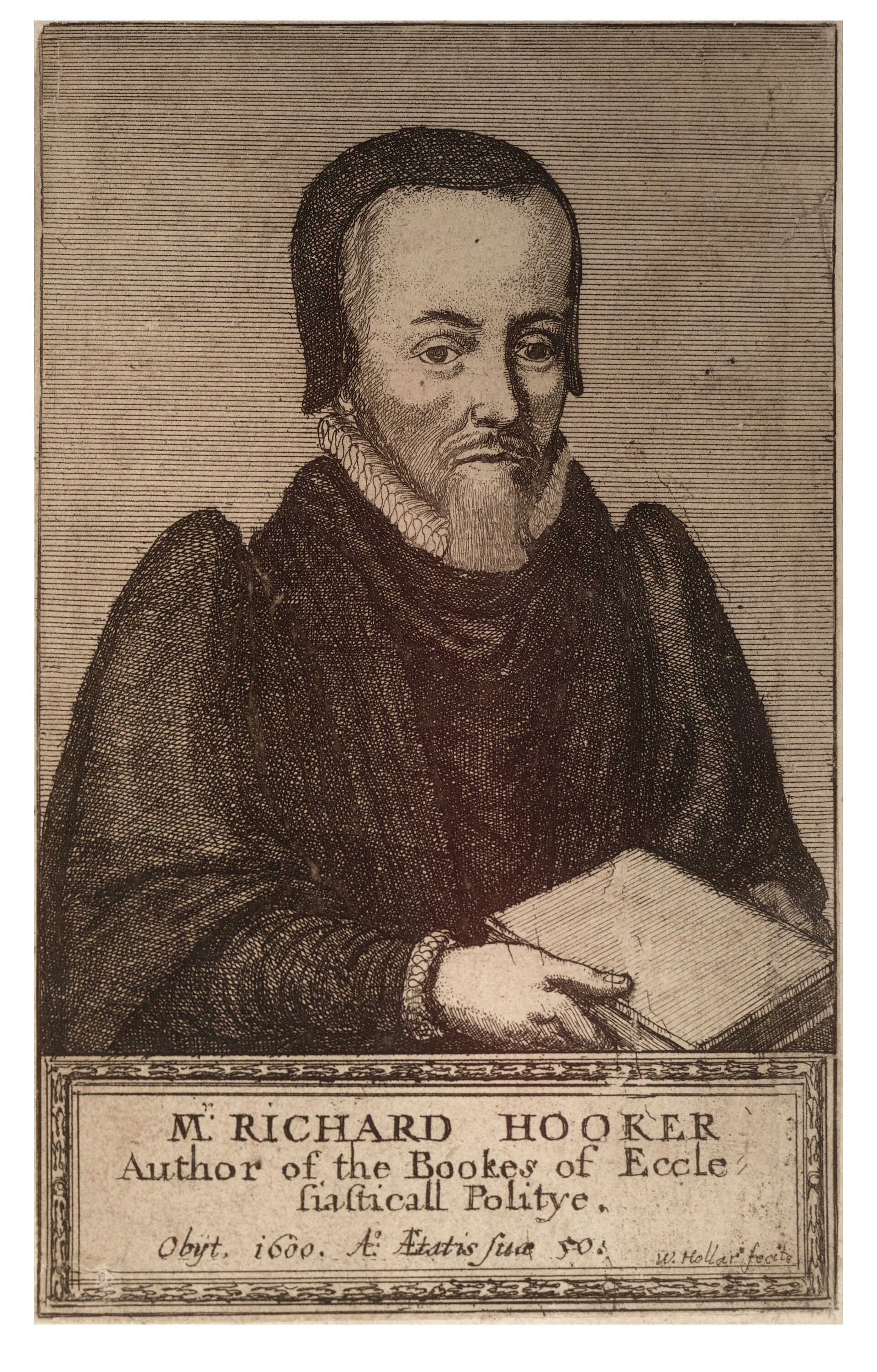

The most influential defence of the Elizabethan church came from a clergyman who never became a bishop. Ronald Bayne's introduction to the Everyman edition (1907) gives the outline of his life: Richard Hooker was born at Exeter "probably in the beginning of the year 1554," studied and taught at Corpus Christi College, Oxford, and in 1584 or 1585 was made Master of the Temple in London, the church of the lawyers' Inns of Court.12 The afternoon lecturer there was Walter Travers, whose views Bayne calls "definitely Presbyterian"; Lord Burghley had wanted Travers as Master, and Archbishop Whitgift had blocked him "as a man from whom no loyalty to the Prayer Book could be expected."12 Hooker preached in the morning and Travers answered him in the afternoon, a contest a later writer summed up with the saying that the pulpit spoke pure Canterbury in the morning and Geneva in the afternoon (a saying, not a record).
From that dispute came Of the Laws of Ecclesiastical Polity. Bayne records that the first four books were printed by John Windet without date (he suggests 1593 or 1594), that Book V followed in 1597 with a dedication to Whitgift, and that Books VI and VIII appeared only in 1648 and 1651 and Book VII in 1662; Hooker died on November 2, 1600.12 The argument is that God governs the world by several kinds of law (eternal, natural, revealed in Scripture and human), that Scripture is perfect for its purpose, which is salvation, and that it does not prescribe one form of church government for every age. Where Scripture is silent, a Christian commonwealth may order its church by reason and long custom, and the Puritan demand for a single scriptural discipline asks Scripture to do something it never claims to do.
The passage most often quoted as the classic Anglican statement of authority comes from Book V, chapter 8. In the 1907 Everyman text: "what Scripture doth plainly deliver, to that the first place both of credit and obedience is due; the next whereunto is whatsoever any man can necessarily conclude by force of reason; after these the voice of the Church succeedeth."13 The modern image of a "three-legged stool" of Scripture, reason and tradition is often attached to Hooker. The passage itself sets the three in order of rank, with Scripture first, and does not use the image of a stool. (See Claims checked.)
Hooker's influence grew after his death. The Stuart high churchmen read him as an ally against the Puritans, the Restoration church printed his works (Izaak Walton's Life was attached to the editions of 1666 and later, Bayne notes), and nineteenth century Anglicans of every party claimed him.12 William White, the first bishop of Pennsylvania, put a sentence of Hooker on the title page of his 1782 pamphlet on how the American church should organize (quoted below).
Puritans, the Stuarts and the 1662 Prayer Book
The Elizabethan church held, but it never satisfied its Puritan members. Their history (the vestments controversy of the 1560s, the classis movement of the 1580s, the Millenary Petition presented to James I in 1603, and the Separatists who left for Holland and then Plymouth) belongs to lesson 05, and the Presbyterian side, including the Westminster Assembly, to lesson 02. For the Church of England the decisive events were these. Under Charles I, Archbishop William Laud (Canterbury from 1633) enforced ceremonial order, railed altars and a high doctrine of the sacraments, and was accused by his opponents of steering the church toward Rome. The Long Parliament impeached him, the civil wars began in 1642, Parliament abolished episcopacy and in 1645 replaced the prayer book with the Westminster Assembly's Directory for the Public Worship of God, and Laud was beheaded in January 1645. For fifteen years the Book of Common Prayer was illegal, though it was used in private households.
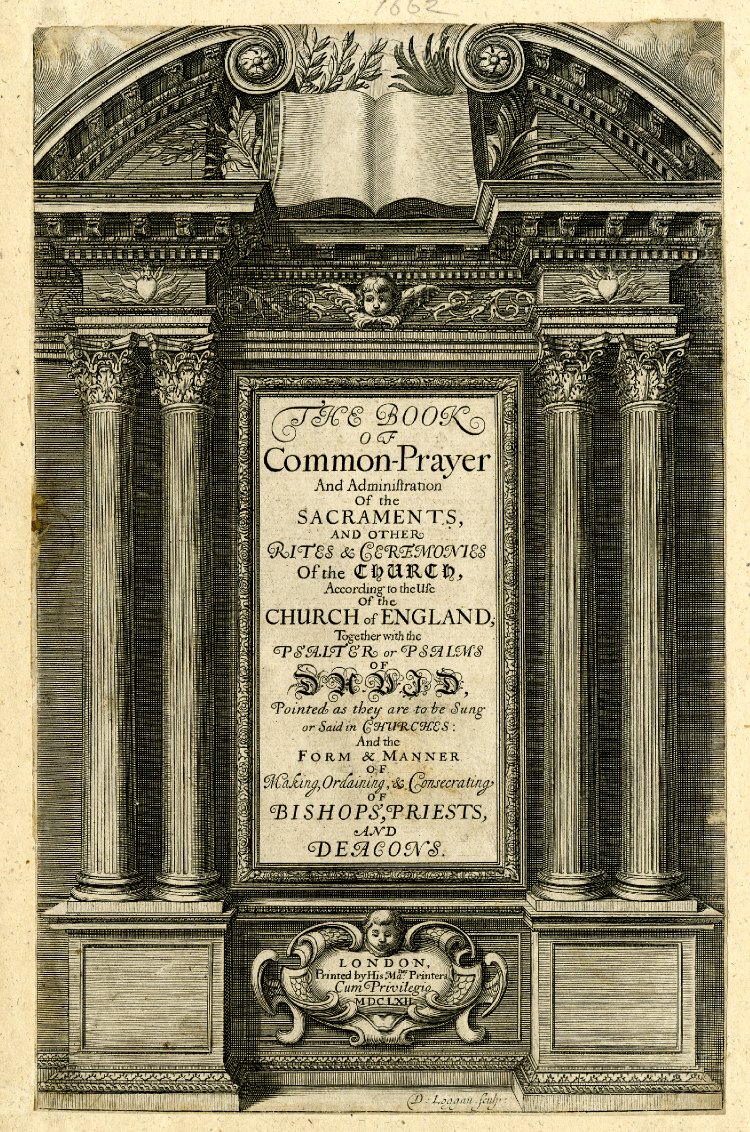

When Charles II returned in 1660, bishops and Puritan leaders met at the Savoy in 1661 to discuss revising the book. The Puritan proposals were almost all rejected. The revised Book of Common Prayer that came out of Convocation was annexed to a new Act of Uniformity (14 Charles II, chapter 4), which, Gee and Hardy note, "received the royal assent May 19, 1662."14 The book's new preface states the principle on which it was made: "It hath been the wisdom of the Church of England, ever since the first compiling of her Publick Liturgy, to keep the mean between the two extremes, of too much stiffness in refusing, and of too much easiness in admitting any variation from it."15
The act required every parish minister, before the feast of St. Bartholomew (August 24) 1662, to read the services publicly from the new book and to declare before the congregation, in the words of the statute (spelling modernized here from the Statutes of the Realm text): "I, A. B., do here declare my unfeigned assent and consent to all and every thing contained and prescribed in and by the book intituled, The Book of Common Prayer."1472 It also required that any incumbent not already ordained by a bishop receive episcopal ordination. Ministers who refused were removed from their livings on that day, an event remembered by Nonconformists as the Great Ejection. The number usually given, about two thousand ministers, rests on the later compilation of the Nonconformist historian Edmund Calamy and is an estimate, not a count from the act or the bishops' registers. Further statutes (the "Clarendon Code," including the Conventicle Acts and the Five Mile Act of 1665) restricted the worship of those outside the church until the Toleration Act of 1689 allowed Protestant dissenters who took the required oaths to worship in licensed meeting houses.14
The 1662 book is still the legal standard of the Church of England, and its language shaped English prose for three centuries: the marriage service ("to have and to hold from this day forward"), the burial service ("earth to earth, ashes to ashes, dust to dust"), the Psalter in Miles Coverdale's translation, and the collects that Cranmer translated or composed in the 1540s. Anglican bodies that separated from the Episcopal Church in 2009 still name it as their standard of worship (see below).
The Nonjurors and the Scottish bishops
A second break came with the revolution of 1688. When James II fled and William III and Mary II took the throne, Archbishop William Sancroft of Canterbury and several other bishops, along with some four hundred clergy by common estimate, held that their oaths to James still bound them and refused to swear allegiance to the new sovereigns. They were deprived in 1690. These "Nonjurors" kept a separate succession of bishops in England for about a century, dwindling to a handful of congregations. In Scotland, where the established church became Presbyterian after 1689 (see lesson 02), the bishops of the old Scottish establishment would not recognize William, and the Episcopal Church in Scotland that continued under them lived for a century under penal laws and outside the state's favour. Both of these small, poor, nonjuring bodies mattered greatly to the American church. A correspondent of the London Colonial Church Chronicle in December 1849 printed letters showing that in 1783 an approach on behalf of Samuel Seabury was made not only to the Scottish bishops but also to the two surviving English nonjuring bishops, "Mr. Price of Manchester, and Mr. Cartwright of Shrewsbury," the first of whom, owing to "the decline of his party and of his fortunes, was following the trade of a grocer."16
The Church of England in the American colonies
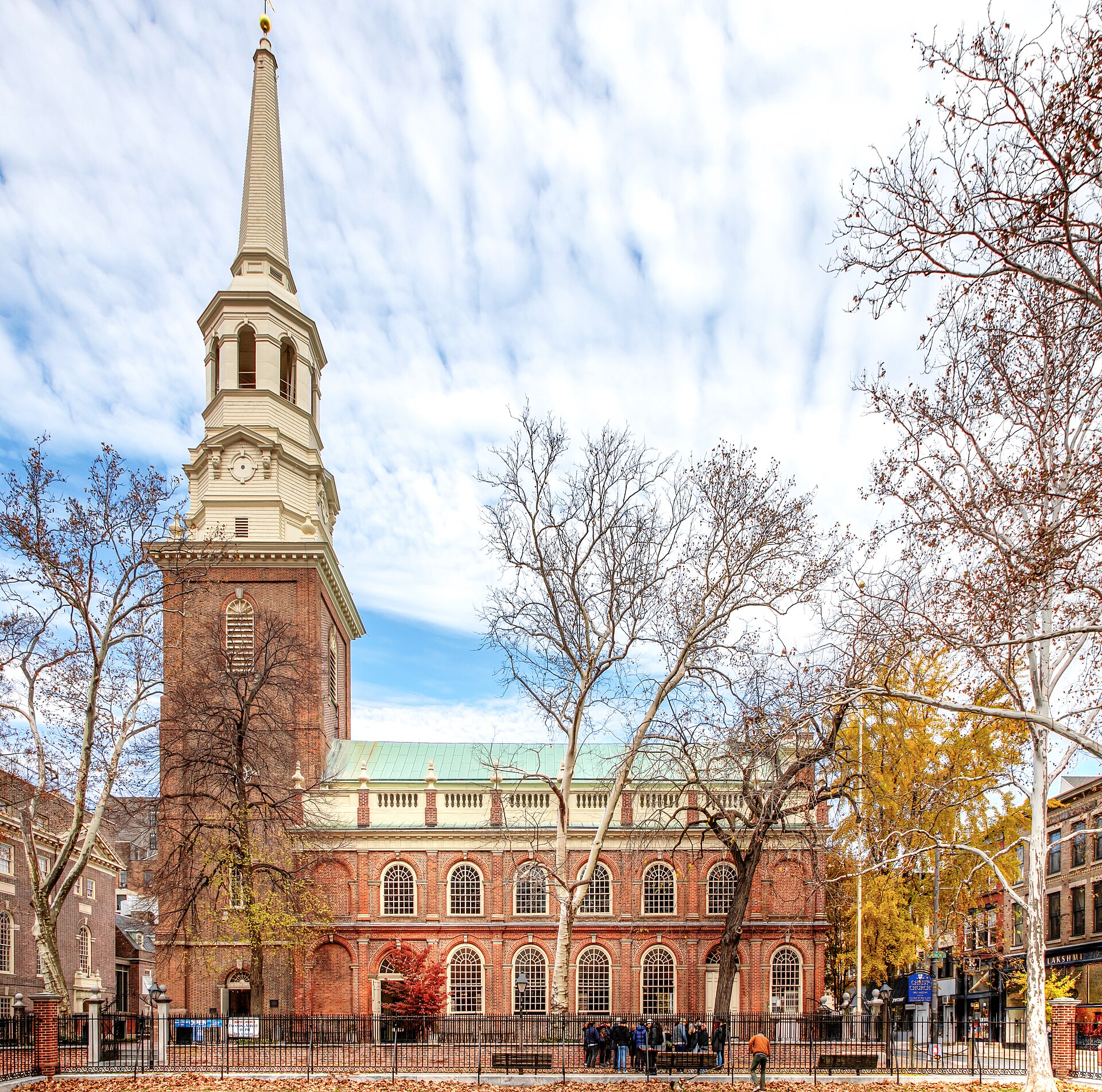

The Church of England crossed the Atlantic with the first English settlements. It was established by law in Virginia and, later and less firmly, in Maryland, the Carolinas, Georgia and parts of New York, while New England's established churches were Congregational (lesson 05). Throughout the colonial period no bishop ever lived in America. The colonial clergy were supervised from a distance by the Bishop of London, confirmation was almost unknown, and every candidate for orders had to make the dangerous voyage to England to be ordained. Proposals to send a bishop to America were opposed by colonists of other churches, who feared that bishops would bring church courts and tithes. Many clergy, especially in the northern colonies, were missionaries of the Society for the Propagation of the Gospel in Foreign Parts, founded in London in 1701.
The Revolution divided the church. Clergy had sworn oaths to the king, and the prayer book prayed for him by name. Many northern clergy were Loyalists and left for Canada or England. In the South, where the church was strongest, many lay Anglicans supported independence: George Washington was a vestryman in Virginia, and two thirds of the signers of the Declaration of Independence are often said to have been Anglicans (an approximate figure from later church historians, not a contemporary count). After the war the church had lost its establishment, its English support and many of its ministers, and it had no bishop to ordain new ones.
After the Revolution: Seabury, White and the Convention of 1789
Two plans competed. William White, rector of Christ Church in Philadelphia, published The Case of the Episcopal Churches in the United States Considered in 1782, before the peace was signed. On the title page he placed a sentence from Hooker: "To make new articles of faith and doctrine, no man thinketh it lawful; new laws of government, what commonwealth or church is there which maketh not at one time or another?"17 White proposed that the churches of each state organize with elected clergy and lay deputies and, since English bishops could not then consecrate Americans, proceed for a time without bishops. He argued "that a temporary departure from episcopacy in the present instance would be warranted by her doctrines, by her practice, and by the principles on which episcopal government is asserted," and that if the succession were "afterwards obtained," any doubt about the interim ordinations could be met by conditional ordination.17 He also warned that dependence on the Bishop of London "would be liable to the reproach of foreign influence."17
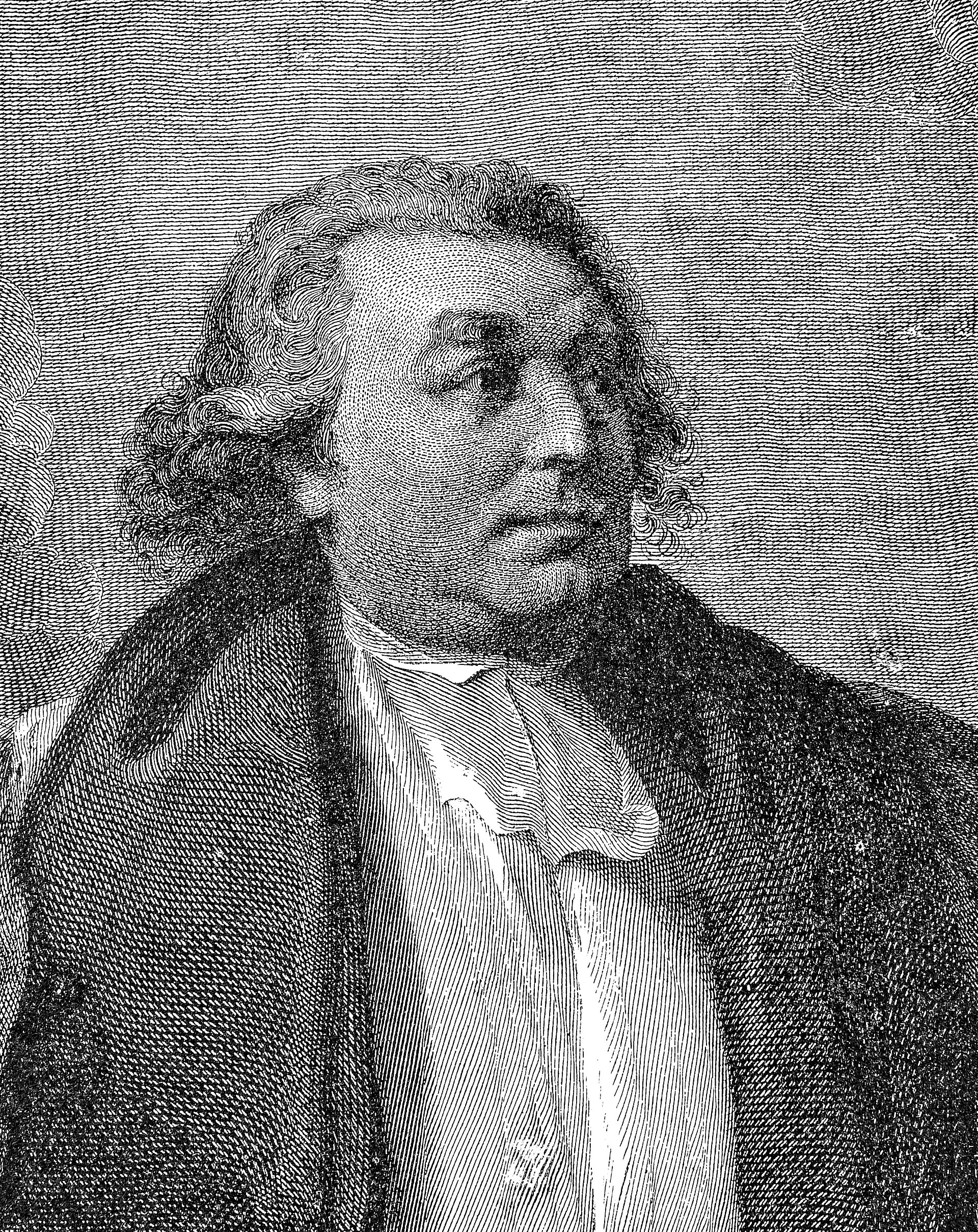

The Connecticut clergy, who had been Loyalist missionaries in a state where their church was a minority, took the opposite view: a church without a bishop was no true episcopal church, and a bishop must come first. They met in March 1783 and chose Samuel Seabury, a former missionary of the Society for the Propagation of the Gospel. A centenary address of 1883 dates the election to March 25, 1783, and an account by the Episcopal historian S. C. Hughson, posted by Project Canterbury, records that he was born at North Groton (now Ledyard), Connecticut, on November 30, 1729, and that Connecticut wanted "a free, valid and purely ecclesiastical Episcopacy."18 In England, the archbishops could not consecrate a man who would not take the oaths of allegiance to the king, and Parliament was slow to change the law. Hughson quotes Seabury's frustration: "Nobody here," he wrote, "will risk anything for the sake of the Church."18
Seabury turned to Scotland. On Sunday, November 14, 1784, in Bishop John Skinner's private chapel at Aberdeen, he was consecrated by Robert Kilgour, Bishop of Aberdeen and Primus of the Scottish Episcopal Church, Arthur Petrie, Bishop of Ross and Moray, and John Skinner, coadjutor bishop of Aberdeen; a fourth bishop, Rose of Dunblane, was too ill to attend but recorded his consent.18 The Episcopal Church today keeps November 14 as his feast and notes, in its own glossary, that Seabury was "a slaveholder and former loyalist to the British Crown" who was consecrated in Scotland because he would not take an oath of allegiance to the king.19 The Scottish bishops asked in return that the American church consider the Scottish form of the communion prayer, and the Prayer of Consecration of the 1789 American book does follow the Scottish order in placing the oblation and the invocation of the Holy Spirit after the words of institution.
The southern and middle states followed White's plan. Clerical and lay deputies met in a General Convention at Philadelphia in 1785, and in October 1785, the 1887 centennial discourse records, they sent an address to the Archbishop of Canterbury and the other English bishops asking them "to confer the episcopal character on such persons as shall be recommended by the Episcopal Church in the several States."20 Parliament passed an enabling act in 1786. On Sunday, February 4, 1787, in the chapel of Lambeth Palace, William White (for Pennsylvania) and Samuel Provoost (for New York) were consecrated by Archbishop John Moore of Canterbury. White's own account, quoted in the centennial volume, names the other consecrators: "the Archbishop of York, who presented; and the Bishop of Bath and Wells, and the Bishop of Peterborough, who joined with the two Archbishops in the laying on of hands."20 James Madison, cousin of the future president, was consecrated for Virginia in England in 1790. With three bishops of the English line and one of the Scottish, the American church could consecrate its own bishops, which it did in 1792 for Thomas Claggett of Maryland, the first bishop consecrated in America.20
The two parties united at the General Convention of 1789 in Philadelphia, with Seabury presiding over the new House of Bishops as its senior member.18 The Convention adopted a constitution, canons and the first American Book of Common Prayer, ratified "this Sixteenth Day of October, in the Year of Our Lord one thousand seven hundred and eighty-nine."21 Its preface explains that when "these American States became independent with respect to civil government," the church's "ecclesiastical independence was necessarily included," and it promises that "this Church is far from intending to depart from the Church of England in any essential point of doctrine," adding "discipline, or worship; or further than local circumstances require."21 The name "Protestant Episcopal Church in the United States of America" described a church that was Protestant (not Roman) and episcopal (governed by bishops). The General Convention of 1801, meeting at Trenton, New Jersey, adopted the Thirty-nine Articles with American changes: Schaff notes that it dropped the Athanasian Creed from Article VIII, omitted Article XXI on General Councils, and substantially rewrote Article XXXVII on the civil magistrate.8
The constitution of 1789 created the government the Episcopal Church still has: a General Convention of two houses, a House of Bishops and a House of Deputies made up of clergy and lay deputies from each diocese. The church today describes General Convention as "the bicameral legislature and chief policy-making body of The Episcopal Church," meeting every three years.22 Laymen had a vote in the church's highest council from the start, a feature the English church did not have until the twentieth century, and one that shaped every later dispute: in the Episcopal Church, doctrine and worship are changed by majority votes of bishops, clergy and laity together.
The Oxford Movement and the Anglo-Catholic revival

By the early nineteenth century the Church of England contained an Evangelical party, heirs of the eighteenth century revival who stayed in the church when the Methodists left it (lesson 07; the Wesleys themselves are in Part C, lesson 01), and a broad body of clergy who valued the establishment, the prayer book and a reasonable piety. In 1828 to 1829 Parliament repealed the Test and Corporation Acts and admitted Catholics to Parliament, and in 1833 it began to reorganize the Church of Ireland, suppressing ten of its bishoprics. A group of Oxford clergy saw in these acts a Parliament no longer made up of churchmen claiming to govern the church.
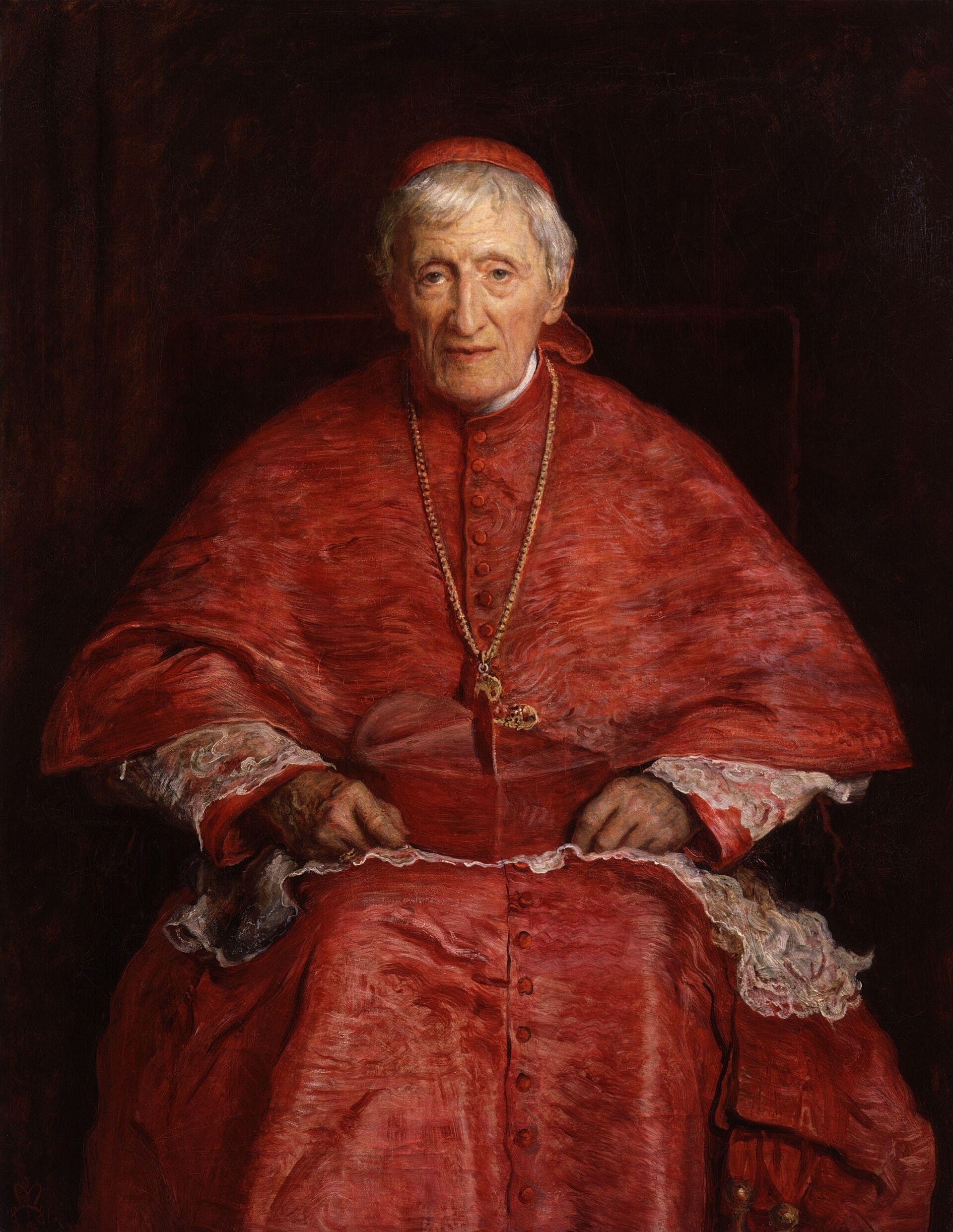
John Henry Newman, then vicar of the University Church, later dated the beginning precisely. In his Apologia pro Vita Sua (1864, revised 1865) he wrote: "The following Sunday, July 14th, Mr. Keble preached the Assize Sermon in the University Pulpit. It was published under the title of 'National Apostasy.' I have ever considered and kept the day, as the start of the religious movement of 1833."23 In September 1833 Newman issued the first of the Tracts for the Times, addressed to the clergy. Tract 1 asks on what the clergy will rest their authority if the state abandons the church, and answers with the apostolic succession: "we encroach not upon the rights of the SUCCESSORS OF THE APOSTLES."24 The movement, also called Tractarian after the tracts, taught that the Church of England was a branch of the one Catholic Church, with bishops in succession from the apostles, real sacramental grace, and the authority of the early Fathers.
The phrase "via media," often used to describe Anglicanism as a middle way between Rome and Protestantism, belongs to this movement. Tracts 38 and 41 (1834) are each titled "Via Media," and in them a clergyman answers a layman who reports that "the world accuses you of Popery."25 Newman's last tract, Tract 90 (February 1841), argued that the Thirty-nine Articles could be read in a Catholic sense. Its introduction says that "there are real difficulties to a Catholic Christian in the Ecclesiastical position of our Church at this day," but that "the statements of the Articles are not in the number."26 The heads of the Oxford colleges censured the tract, the Bishop of Oxford asked that the series stop, and Newman withdrew to Littlemore outside the city. In October 1845 he was received into the Roman Catholic Church there by the Passionist Father Dominic Barberi, as the Apologia recounts.27 Others followed, among them Henry Manning in 1851, but John Keble and Edward Bouverie Pusey remained Anglicans and led the movement in its second generation.
The Tractarians' successors, called ritualists or Anglo-Catholics, carried the doctrine into worship: eucharistic vestments, candles, incense, the reserved sacrament, sacramental confession, religious orders of sisters and brothers, and the restoration of medieval churches. In England this provoked riots, prosecutions under the Public Worship Regulation Act of 1874 and the imprisonment of several priests. In the United States it divided dioceses and gave rise to the Reformed Episcopal Church (below). The Episcopal Church's glossary now describes the Oxford Movement simply as "a 19th-century movement which reasserted the apostolic and catholic heritage of Anglicanism."28 By 1900 the Anglican world had three recognizable parties, often called high church (or Anglo-Catholic), low church (or Evangelical) and broad church (the liberal or latitudinarian tradition), the same three that the ACNA's "three streams" language and the twenty-first century disputes still assume.
Lambeth, the Quadrilateral and the Anglican Communion
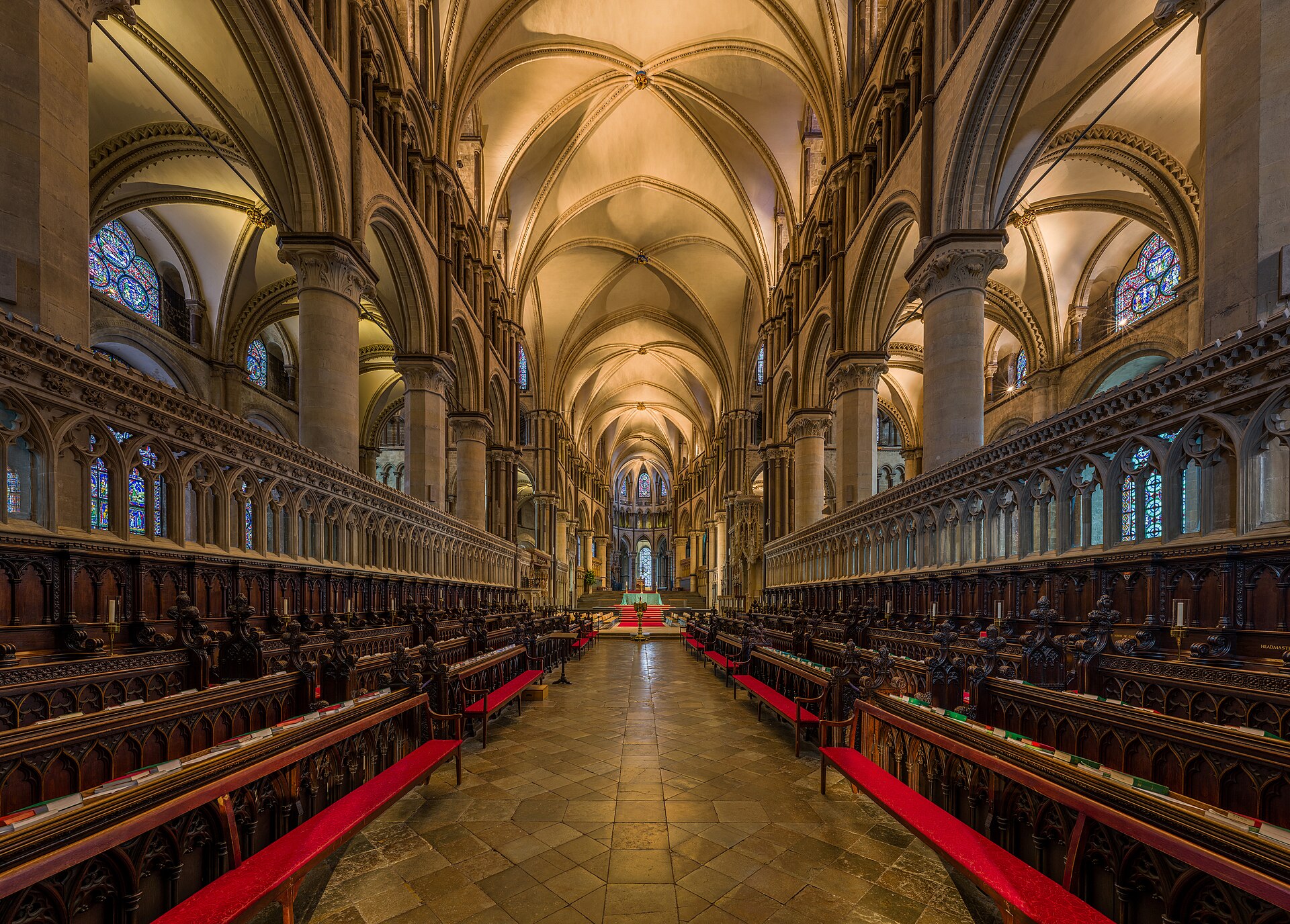

As British settlers and missionaries carried the church around the world, colonial and missionary dioceses multiplied, and their bishops looked to Canterbury. A dispute in South Africa in the 1860s over the teaching of Bishop John William Colenso of Natal, whose writings questioned the historical accuracy of the Pentateuch, led colonial bishops to ask for a council. Archbishop Charles Longley invited the bishops of the Anglican churches to Lambeth Palace in 1867. The Anglican Communion's own history says the conference has met "around every ten years since 1867."29 The Episcopal Church calls it "a nonlegislative gathering of bishops from throughout the Anglican Communion, normally held every 10 years at the invitation of the archbishop of Canterbury."30 Its resolutions bind no member church unless that church adopts them, a point that every later dispute turned on.
The best known Lambeth text began in the United States. The Episcopal Church's House of Bishops, meeting in Chicago in 1886, set out four points as the basis on which it would seek reunion with other churches, adapting a proposal of the Episcopal priest William Reed Huntington. The Lambeth Conference of 1888 adopted them in its Resolution 11, and they are known together as the Chicago-Lambeth Quadrilateral. In the conference's text: (a) "The Holy Scriptures of the Old and New Testaments," as containing all things necessary to salvation and the rule and standard of faith; (b) "The Apostles' Creed, as the baptismal symbol," and the Nicene Creed as the sufficient statement of faith; (c) "The two sacraments ordained by Christ himself - Baptism and the Supper of the Lord," ministered with Christ's words of institution and the elements he ordained; and (d) the historic episcopate, locally adapted in the methods of its administration to the needs of different nations and peoples.31 (Points (a) to (c) are quoted at their beginnings and the rest paraphrased.) The Quadrilateral is still the Episcopal Church's standard for ecumenical agreements, including its full communion with the Evangelical Lutheran Church in America (lesson 01), and the General Convention of 2003 restated it as "the principles of the Chicago-Lambeth Quadrilateral: Holy Scripture, the historic Creeds of the Church, the two dominical Sacraments, and the Historic Episcopate."32
The Communion has no central government. Its four "Instruments of Communion" are the Archbishop of Canterbury, the Lambeth Conference, the Anglican Consultative Council (from 1968) and the Primates' Meeting (from 1979). The Anglican Communion's website lists 42 autonomous member churches, or provinces, and speaks of "tens of millions of people across more than 165 countries."33 It gives no exact total. The figure of 85 million quoted in many news reports, and the ACNA's "around 80 million," are estimates; most of that total lives in Africa, with the Church of Nigeria and the Church of Uganda claiming the largest memberships, figures that come from those churches and are not audited counts.
The Episcopal Church in the twentieth century: women's ordination and the 1979 Prayer Book
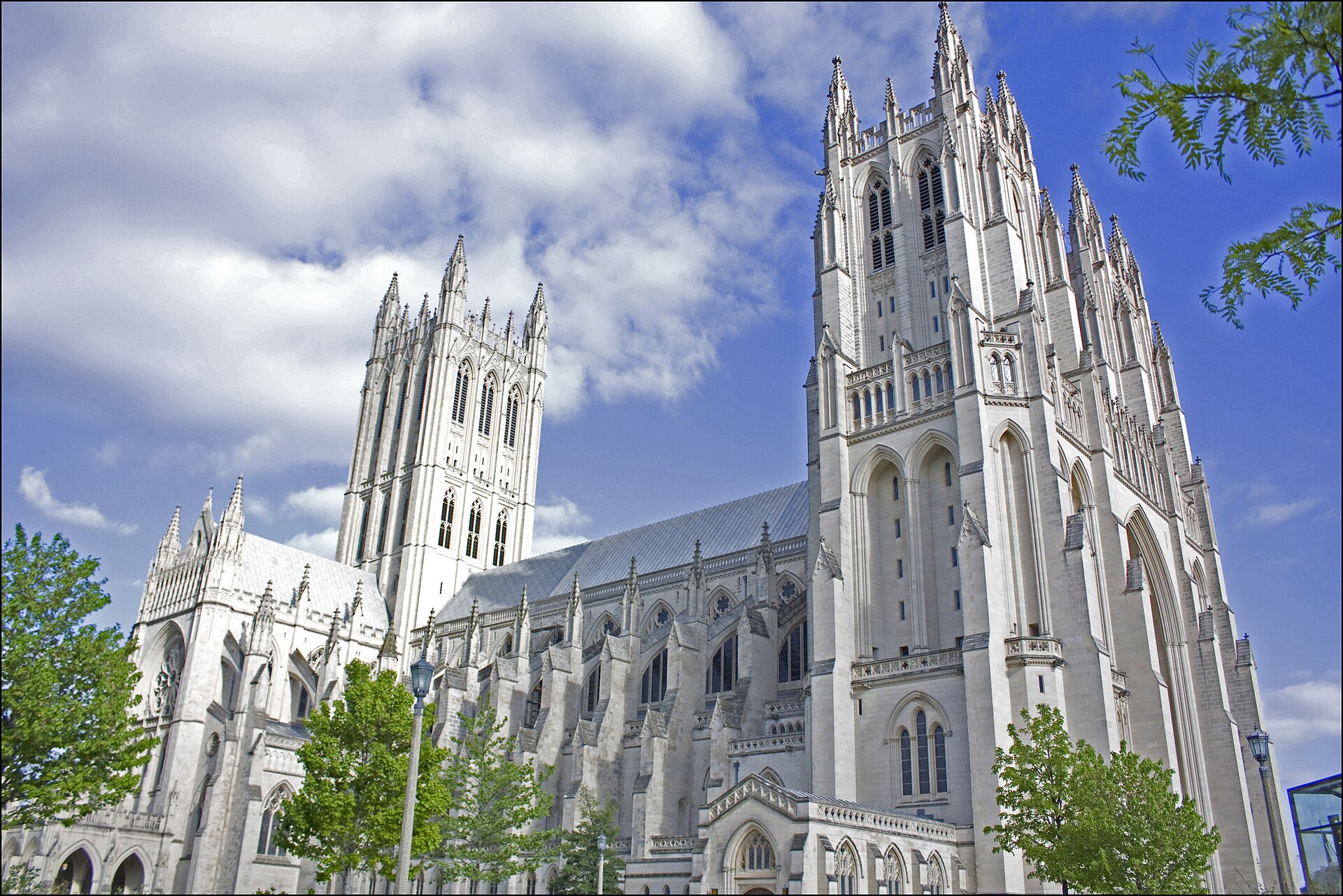

The Protestant Episcopal Church grew with the country. It was never the largest American church, but its members were prominent in national life far beyond their numbers, and its cathedrals in New York and Washington became civic landmarks. In 1967 the General Convention authorized "The Episcopal Church" as an alternative name, which is now the common one. Two decisions of the 1970s set the pattern for the disputes that followed.
The ordination of women
On July 29, 1974, in Philadelphia, three retired or resigned bishops ordained eleven women deacons to the priesthood without the authorization of the church's canons. The Episcopal Church remembers them as the Philadelphia Eleven, "the 11 women who were ordained as priests July 29, 1974, before the 1976 General Convention authorized the ordination of women as priests and bishops," and keeps July 29 as their feast.34 The General Convention meeting in Minneapolis in 1976 adopted a new canon whose text reads: "The provisions of these canons for the admission of Candidates, and for the Ordination to the three Orders: Bishops, Priests and Deacons shall be equally applicable to men and women."35 In 1988 the Convention, anticipating the election of a woman bishop, created "Episcopal Visitors" so that congregations and bishops who could not accept women bishops could receive pastoral care from another bishop, noting that the 1976 decision had brought "joy in many quarters of the Church" but also "awkwardness, both for its advocates and its opponents."36 In 1989 Barbara Clementine Harris was consecrated bishop suffragan of Massachusetts; the church's glossary says she "became the first female bishop in the Anglican Communion."37
The 1979 Book of Common Prayer
The American prayer book had been revised in 1892 and 1928. The revision approved on first reading in 1976 and finally in 1979 was far more extensive: it made the Eucharist (called the Holy Eucharist) the principal Sunday service, offered contemporary language alongside traditional "Rite One" services, restored the Easter Vigil, recast baptism as full initiation into the church, and added a Baptismal Covenant with promises to "seek and serve Christ in all persons" and to "strive for justice and peace among all people." The Thirty-nine Articles were moved to a section of "Historical Documents" at the back of the book, a placement that critics of the revision took as a demotion and its defenders as a recognition of their historical status. The General Convention of 1979 declared that "the Book of Common Prayer of 1979, having been adopted in accordance with Article X of the Constitution of this Church, has thus become the official liturgy of this Church," while permitting texts from the 1928 book under a bishop's authority and declaring that this "in no way sanctions the existence of two authorized Books of Common Prayer."38 The quoted Baptismal Covenant phrases are given from the familiar text and were not reopened in the book for this lesson.
The first departures
Some clergy and laity concluded that the 1976 decisions had broken the church's continuity with the Catholic ministry and the historic prayer book. At a Congress of St. Louis in 1977 they adopted a statement called the Affirmation of St. Louis and began the "Continuing Anglican" churches, which soon divided among several jurisdictions. An earlier departure had come from the other wing of the church: in December 1873 Bishop George David Cummins, an assistant bishop who objected to the spread of ritualism and to what he saw as Catholic teaching on baptismal regeneration and the priesthood in the prayer book, organized the Reformed Episcopal Church in New York; Project Canterbury holds sermons from its first months, including one preached in Chicago on December 7, 1873.39 The Reformed Episcopal Church later became one of the founding bodies of the Anglican Church in North America.
The Dennis Canon and church property
The General Convention of 1979 also adopted a canon, named for its drafter, Walter Dennis, that later mattered in the courts: "All real and personal property held by or for the benefit of any Parish, Mission or Congregation is held in trust for this Church and the Diocese thereof in which such Parish, Mission or Congregation is located."40 The trust, the canon adds, does not limit the parish's authority over its property "so long as the particular Parish, Mission or Congregation remains a part of, and subject to, this Church."40 When congregations and whole dioceses left after 2003, the Episcopal Church and its dioceses sued under this canon, and state courts reached different results according to each state's property and trust law. The details of each case are outside this lesson's scope.
The modern splits, 1998 to 2015
Lambeth 1998, Resolution I.10
The Lambeth Conference of 1998 met as the member churches were moving apart on sexuality. Bishops from Africa and Asia, now a large share of the conference, pressed for a clear statement. The conference's Resolution I.10, on human sexuality, called for pastoral care of all people regardless of sexual orientation "while rejecting homosexual practice as incompatible with Scripture," and stated that the conference "cannot advise the legitimising or blessing of same sex unions nor ordaining those involved in same gender unions."41 The resolution passed by a large majority (the vote usually reported is 526 to 70, with 45 abstentions; that tally was not found in the conference document opened for this lesson). Like all Lambeth resolutions, it bound no member church by itself, a point the Episcopal Church's leaders made and its critics answered by calling the resolution the mind of the Communion.
New Hampshire, 2003
In June 2003 the Diocese of New Hampshire elected Canon V. Gene Robinson, a priest living in a same-sex partnership, as bishop coadjutor. Under the church's canons the election needed the consent of the General Convention, meeting that summer in Minneapolis. The House of Deputies adopted Resolution C045: "the House of Deputies consents to the ordination and consecration of the Rev. Canon V. Gene Robinson as Bishop Coadjutor of the Diocese of New Hampshire."42 On August 5, 2003, the Anglican Communion News Service reported that 62 of the 107 bishops with jurisdiction voting had consented, with 2 abstaining, and quoted Robinson: "The only thing that causes difficulty for me is that not everyone agrees with this decision."43 He was consecrated at Durham, New Hampshire, on November 2, 2003, before thousands of people, with opponents present to register their objections.44 The same Convention adopted Resolution C051, which reaffirmed the 1976 statement that "homosexual persons are children of God who have a full and equal claim with all other persons upon the love, acceptance, and pastoral concern and care of the Church," and recognized "that local faith communities are operating within the bounds of our common life as they explore and experience liturgies celebrating and blessing same-sex unions."32
The primates of many provinces declared themselves in impaired or broken communion with the Episcopal Church. A commission appointed by the Archbishop of Canterbury issued the Windsor Report in October 2004, asking the Episcopal Church for a moratorium on consecrating partnered gay bishops and on authorizing same-sex blessings, and asking bishops of other provinces to stop intervening in American dioceses. Archbishop Rowan Williams then proposed an Anglican Covenant (2009) to bind the provinces more closely; several provinces adopted it, but the Church of England's dioceses rejected it in 2012, and it never took effect for the Communion as a whole. These steps are stated from the general record and their documents were not reopened for this lesson.
GAFCON and the Jerusalem Declaration, 2008
In June 2008, a month before that summer's Lambeth Conference, which many of them boycotted, primates, bishops, clergy and lay leaders from Africa, Asia, South America, Australia and North America met in Jerusalem as the Global Anglican Future Conference (GAFCON). The ACNA's constitution records that "Primates of the worldwide Anglican Communion who gathered at Jerusalem in June 2008" called on North American Anglicans "to establish a new Province in North America," and it affirms "the Global Anglican Future Conference (GAFCON) Statement and Jerusalem Declaration issued 29 June 2008."45 The Jerusalem Declaration is a fourteen-point confession. In its own words it holds "the Holy Scriptures of the Old and New Testaments to be the Word of God written," upholds the Thirty-nine Articles "as containing the true doctrine of the Church," and upholds the 1662 Book of Common Prayer as "a true and authoritative standard of worship and prayer," and it affirms "the unchangeable standard of Christian marriage between one man and one woman."46 Its importance for Anglican history is that it located Anglican identity in a written confession held in common, where the older pattern had located it in communion with the see of Canterbury.
The Anglican Church in North America, 2009
Through the 2000s, congregations and four whole dioceses (Pittsburgh, San Joaquin, Quincy and Fort Worth) voted to leave the Episcopal Church, many placing themselves under Anglican provinces overseas, such as Rwanda, Nigeria, Uganda, Kenya and the Southern Cone of South America. These groups, together with older bodies such as the Reformed Episcopal Church, formed the Common Cause Partnership and then the Anglican Church in North America. Its Constitution and Canons were "ratified by the Inaugural Provincial Assembly, June 2009," and the first archbishop was Robert Duncan, formerly the Episcopal bishop of Pittsburgh.45 The preamble states the reason for the new body in its own words: "We are grieved by the current state of brokenness within the Anglican Communion prompted by those who have embraced erroneous teaching and who have rejected a repeated call to repentance."45
The ACNA names seven marks as "essential for membership," among them the canonical Scriptures as "the final authority and unchangeable standard for Christian faith and life," the two sacraments, "the godly historic Episcopate as an inherent part of the apostolic faith and practice," the three creeds, the 1662 prayer book "as a standard for Anglican doctrine and discipline," and "the Thirty-Nine Articles of Religion of 1571, taken in their literal and grammatical sense."1 On marriage its canons state that "this Church upholds faithfulness in marriage between a man and a woman in lifelong union" and "cannot legitimize or bless same sex unions."45 On the ordination of women, the ACNA came together with differing convictions. It describes "the two integrities concerning Holy Orders": each diocese decides whether to ordain women as deacons and priests, while a candidate for bishop must "be a male Presbyter at least 35 years old."1 In 2019 it issued its own Book of Common Prayer.
The Episcopal Church did not recognize the new body. Its General Convention of 2009 reaffirmed "the continued participation of The Episcopal Church as a constituent member of the Anglican Communion" and its commitment "to live into the highest degree of communion possible."47 The ACNA is not a member church of the Anglican Communion as the Communion's own list defines membership, but the GAFCON primates and several other provinces recognize it as a province and its archbishop sits with them.
Marriage, 2012 to 2018
The Episcopal Church moved in stages. In 2012 the General Convention commended "Liturgical Resources I: I Will Bless You and You Will Be a Blessing" for the blessing of same-sex relationships.48 In 2015, at Salt Lake City, days after the United States Supreme Court's decision in Obergefell v. Hodges, it rewrote its marriage canon (Canon I.18, retitled "Of the Celebration and Blessing of Marriage"), removing the earlier canonical language that Holy Matrimony is "a physical and spiritual union of a man and a woman," and authorized trial marriage rites for use by any couple.4950 In 2018 it extended trial use of the marriage liturgies until the next full revision of the Book of Common Prayer is completed, and directed that where a diocesan bishop "holds a theological position that does not embrace marriage for same-sex couples," he or she "shall invite, as necessary, another bishop of this Church" to provide pastoral support, so "that all couples have convenient and reasonable local congregational access to these rites." The same resolution kept the clergy's canonical right "to decline to solemnize or bless any marriage."51 In January 2016 the Primates' Meeting at Canterbury responded by asking that for three years the Episcopal Church not represent the Communion on ecumenical bodies or vote on matters of doctrine within its standing committees (a step stated here from the general record, not reopened for this lesson).
The Church of England since 1992
The mother church changed on the same questions, more slowly and by its own synodical process. The General Synod passed the final legislation for women priests on November 11, 1992, and, the Church of England recalls, "the first group of women were ordained priests on Saturday 12 March 1994, in Bristol Cathedral," where Angela Berners-Wilson, presented first in alphabetical order, became "by a few seconds" the first.52 Parishes and clergy who could not accept the change were given legal and pastoral provision, and several hundred clergy, and some bishops, became Roman Catholics in the following years. After a failed vote in 2012, the Synod approved women bishops in 2014, and on January 26, 2015, at York Minster, Libby Lane "has been consecrated as the first female bishop in the Church of England," the church announced that day.53 A House of Bishops' declaration promised continued provision, under the principle of "mutual flourishing," for those who for theological reasons cannot receive the ministry of women as priests or bishops.
On sexuality, the Church of England's official teaching on marriage as between a man and a woman remained in place, but after a multi-year study called Living in Love and Faith the bishops brought proposals to the General Synod in February 2023, and Prayers of Love and Faith, prayers of blessing that may be used for same-sex couples within ordinary services, were commended for use from December 2023. Conservative bishops in England and the GAFCON and Global South primates abroad called this a departure from the church's doctrine; supporters called it pastoral care that did not change the doctrine of marriage. Proposals for standalone services of blessing were still under discussion in 2025 and 2026. (These steps are given from the general record; the Synod papers were not reopened for this lesson.)
In 2024 the Archbishop of Canterbury, Justin Welby, became the first holder of the office to resign over a safeguarding failure. After an independent review led by Keith Makin into the abuse committed by John Smyth, a barrister who abused boys and young men at Christian holiday camps in Britain, Zimbabwe and South Africa, Welby announced on Tuesday, November 12, 2024: "Having sought the gracious permission of His Majesty The King, I have decided to resign as Archbishop of Canterbury."54 The review had found that he was told of the abuse in 2013 and assumed, wrongly, that proper action would follow.
The Church of England's own statistics show a church much smaller than its legal position. Its report Statistics for Mission 2024 gives a Worshipping Community (people who attend once a month or more, in person or "at home") of "1,009,000 people in 2024," an all-age average weekly attendance of "702,000 people in 2024 - 608,000 adults and 94,000 children aged under 16," and states that adult average weekly attendance in 2024 was "18% lower than in 2019, and 1.8% higher than in 2023."55 (The report prints a dash between the totals; it is shown here as a hyphen.)
The Communion in 2025 and 2026
On October 3, 2025, the Church of England announced that Sarah Mullally, Bishop of London since 2018 and formerly a nurse, would be the next Archbishop of Canterbury, the first woman named to the office. GAFCON answered the same day. In a statement signed by its chairman, Archbishop Laurent Mbanda of Rwanda, it said that the appointment "abandons global Anglicans," that GAFCON could "no longer recognise the Archbishop of Canterbury as an Instrument of Communion" (citing its Kigali Commitment of 2023), and that "the majority of the Anglican Communion still believes that the Bible requires a male-only episcopacy." It also said: "She also voted in favour of introducing blessings of same-sex marriage into the Church of England."56
Thirteen days later GAFCON went further. Its Primates' Council chairman issued a communique titled "The Future Has Arrived," dated October 16, 2025, which declared: "we are now the Global Anglican Communion." It rejected "the so-called Instruments of Communion" (the Lambeth Conference, the Anglican Consultative Council and the Primates' Meeting) on the ground that "they have failed to uphold the doctrine and discipline of the Anglican Communion," said that its provinces "shall not make any monetary contribution to the ACC, nor receive any monetary contribution from it or its networks," encouraged provinces to "remove any reference to being in communion with the See of Canterbury and the Church of England," and insisted: "we have not left the Anglican Communion; we are the Anglican Communion." It also announced the G26 bishops' conference "in Abuja, Nigeria from 3 to 6 March 2026."73
Mullally's election was legally confirmed at St. Paul's Cathedral on Wednesday, January 28, 2026, the ceremony at which, St. Paul's announced, she "became the 106th Archbishop of Canterbury."57 Five weeks later GAFCON's leaders met at Abuja, Nigeria. Religion News Service, as republished by MinistryWatch on March 9, 2026, reported that the meeting (called G26) ended on Friday, March 6, that it was attended by 347 bishops and 121 clerical and lay leaders from 27 provinces, that it renamed its body the Global Anglican Communion and constituted a Global Anglican Council, and that its leaders called for "principled disengagement" from the Archbishop of Canterbury and Canterbury-led structures.58 The ACNA's summary of the Abuja Affirmation, issued by Mbanda, says in its own words: "Our unity is found in our shared confession, the Jerusalem Declaration, rather than in institutional ties to the See of Canterbury," and it records the election of Mbanda as chair, Archbishop Miguel Uchoa of Brazil as deputy chair and the ACNA's Bishop Paul Donison as general secretary.59
Mullally was installed at Canterbury Cathedral on March 25, 2026, the feast of the Annunciation. The Episcopal News Service account, reposted by the Anglican-Roman Catholic commission IARCCUM, reported that 26 primates attended, along with Presiding Bishop Sean Rowe and Coptic Orthodox, Assyrian, Roman Catholic and other guests, and quoted the cathedral's dean, David Monteith: "This is a truly global gathering."60 The same report describes the Communion as 42 provinces in more than 165 countries. As of this writing (October 2026) the Communion therefore has two rival centres of loyalty. The provinces that attended the installation and the Lambeth structures treat Canterbury as the focus of unity. The GAFCON provinces, whose leaders say they speak for a majority of practising Anglicans worldwide, treat the Jerusalem Declaration as their bond and decline the invitations of Canterbury. The numbers on each side depend on whose membership figures are accepted, and no audited count of the provinces' members exists.
The ACNA in 2025 and 2026
The ACNA spent the same months in a discipline case against its own archbishop. A presentment (formal charges) against Archbishop Stephen Wood, elected in 2024, was submitted in October 2025 by a group of his former colleagues and resubmitted with further claims in November. He announced a leave of absence on November 3, 2025, and was inhibited (suspended from ministry) in mid-November 2025 (the court's docket dates Bishop Julian Dobbs's inhibition to November 16; the Religion News Service report gives November 17); the Board of Inquiry's final decision of December 12, 2025, found probable cause for trial on charges that RNS summarizes as "violation of ordination vows, abuse of church power and sexual immorality."6162 Wood has denied all but one of the allegations, according to the RNS report.62 Bishop Julian Dobbs, as Dean of the Province, exercised the archbishop's canonical duties; on September 1, 2026, he wrote that "for almost a year, Archbishop Stephen Wood has been inhibited from his position as our ecclesiastical leader."63 The ACNA's Court for the Trial of a Bishop reports that the trial, held in Charleston, South Carolina, "concluded September 11, 2026, following five days of testimony from 38 witnesses," with an opinion due "no later than December 21, 2026."61 No verdict had been published when this lesson was written. In a separate case the same court announced on August 19, 2026: "This Court unanimously finds Bishop Derek Jones guilty of each of the four canonical offenses brought against him," in a matter arising from the ACNA's jurisdiction for armed forces and chaplaincy.61 The ACNA itself remains in the GAFCON network.
The Episcopal Church's leadership changed in 2024. Its site states that Sean W. Rowe "was elected 28th presiding bishop and primate of The Episcopal Church in June 2024 and took office on Nov. 1 for a nine-year term."64 He succeeded Michael Curry (2015 to 2024), the first African American to hold the office.
Membership, from the bodies' own reports
Each body counts differently, so the figures below should not be added together or compared as if they measured the same thing. The Episcopal Church counts "active baptized members" and average Sunday attendance from the annual parochial reports that every congregation files. The Church of England counts a "Worshipping Community," weekly attendance in October and the electoral roll. The ACNA counts members and attendance from its congregational reports.
| Body | Measure | Figure | Year described | Source |
|---|---|---|---|---|
| The Episcopal Church | Active baptized members | 1,584,785 | 2022 | Hartford Institute analysis for the church65 |
| The Episcopal Church | Active baptized members | 1,547,779 | 2023 | Episcopal Church Office of Public Affairs; Hartford analysis6667 |
| The Episcopal Church | Active baptized members | Not published | 2024 | The 2024 report omitted a total6869 |
| The Episcopal Church | Average Sunday attendance, in person | 372,952 | 2022 | Hartford analysis65 |
| The Episcopal Church | Average Sunday attendance, in person | 410,912 | 2023 | Office of Public Affairs66 |
| The Episcopal Church | Average Sunday attendance, in person | 413,034 | 2024 | Hartford analysis of the 2024 parochial report68 |
| The Episcopal Church | Parishes and missions | 6,754 (2023); 6,707 (2024) | 2023, 2024 | Office of Public Affairs; press report of the 2024 figures6669 |
| Church of England | Worshipping Community | 1,009,000 | 2024 | Statistics for Mission 202455 |
| Church of England | All-age average weekly attendance (October) | 702,000 | 2024 | Statistics for Mission 202455 |
| Anglican Church in North America | Members | 130,111 | 2024 | Figures released at the Provincial Council, June 2025, as reported70 |
| Anglican Church in North America | Attendance | 96,148 | 2024 | Same70 |
| Anglican Church in North America | Congregations | 1,027 | 2024 | Same70 |
| Anglican Communion | Member churches (provinces) | 42 | 2026 | Anglican Communion website33 |
Three cautions apply. First, the Episcopal Church's 2024 parochial report changed its questions, and its official analysis warns that "certain data points collected in previous years may not be directly comparable to this year's findings"; the church's Office of Public Affairs explained the missing membership total by saying the new questions revealed "confusion in how churches understood and reported this topline number," as quoted in the Christian Post on October 30, 2025.6869 Second, the analysts note that the in-person attendance figure leaves out online worshippers, which the church does not measure in a standard way.67 Third, the ACNA figures for 2024 come from a news report of the June 2025 Provincial Council in which the author noted that the full statistical report had not yet been posted online.70 The Episcopal Church's analysts describe a decline in active baptized members every year of the decade to 2023, steepest during the pandemic years and returning to "around 2% annually" by 2022 to 2023.67 The longer decline of the mainline churches since the 1960s, and the explanations scholars give for it, are the subject of lesson 11.
Three bodies compared, in their own documents
How Rome and others have judged Anglicanism
The sharpest outside judgment came from Rome. In the apostolic letter Apostolicae curae, dated "on the Ides of September" 1896, Pope Leo XIII ruled on the validity of Anglican orders after a commission's study of the Edwardian ordinal: "we pronounce and declare that ordinations carried out according to the Anglican rite have been, and are, absolutely null and utterly void."71 The letter rested the judgment on defects of form and intention in the rite of 1550 and 1552, the same ordinal that Article XXXVI defends. The Archbishops of Canterbury and York replied in 1897 with the letter Saepius officio, defending the orders. Later ecumenical dialogue between the two churches (ARCIC, from 1970) produced agreed statements on the Eucharist, ministry and authority, but the 1896 judgment has not been withdrawn, and Anglican clergy who become Catholic priests are ordained, not received in their orders. Since 2009 Anglicans who join the Catholic Church as groups may do so through personal ordinariates, which keep elements of Anglican worship. (The 1897 reply, ARCIC and the ordinariates are stated from the general record.)
Protestant judgments have run the other way. Puritans and later Nonconformists objected to bishops, prescribed liturgy, the sign of the cross in baptism, kneeling at communion and the surplice as remnants of Rome; the Ejection of 1662 made those objections the founding grievance of English Nonconformity (lesson 05). The Methodists began as a society inside the Church of England and became separate churches only after John Wesley's death in 1791 (in America, at the Christmas Conference of 1784; lesson 07). Lutherans have found in the Articles a doctrine of justification close to their own, and the Episcopal Church and the ELCA approved the full communion agreement Called to Common Mission (the ELCA in 1999, the Episcopal Church in 2000) (lesson 01).
Anglicans themselves have stated the claim modestly. The ACNA quotes Archbishop Geoffrey Fisher of Canterbury: "The Anglican Communion has no peculiar thought, practice, creed or confession of its own. It has only the Catholic Faith of the ancient Catholic Church, as preserved in the Catholic Creeds and maintained in the Catholic and Apostolic constitution of Christ's Church from the beginning."1 Which body today best keeps that inheritance is the question on which the Episcopal Church, the Church of England, the ACNA and the GAFCON provinces disagree, and the record does not settle it for them.
What the record shows and what it does not
- Documented fact: the Acts of Supremacy and Uniformity of April 1559 and their texts; the Articles of 1563 and 1571 and the Subscription Act; the 1662 Act of Uniformity (royal assent May 19, 1662) and its required declaration; Seabury's consecration at Aberdeen on November 14, 1784, and White's and Provoost's at Lambeth on February 4, 1787; the 1789 ratification of the American prayer book on October 16; the 1976 ordination canon; Lambeth Resolution I.10 (1998); the 2003 consent resolution; the June 29, 2008 Jerusalem Declaration; the ACNA's June 2009 constitution; the 2015 marriage canon; Welby's resignation statement (November 12, 2024); Mullally's confirmation (January 28, 2026) and installation (March 25, 2026); the G26 decisions at Abuja (March 2026).
- A church's own claim: that Anglicanism holds "three streams" together (ACNA); that the Communion has no confession of its own (Fisher, as quoted by the ACNA); that the majority of the Communion holds to a male-only episcopate (GAFCON); that the Episcopal Church remains "a constituent member of the Anglican Communion" (General Convention 2009).
- Scholarly reading: whether the Elizabethan church was a Reformed Protestant church that later imagined itself a "middle way" (MacCulloch and others) or a reformed Catholic church from the start (the Tractarian reading).
- Open question: the true total of Anglicans worldwide; the outcome of the Wood trial (opinion due by December 21, 2026); whether the Communion's two centres of loyalty become two communions in law.
Claims checked
| Claim | Rating | Evidence |
|---|---|---|
| "Henry VIII founded the Church of England so that he could divorce." | Partly supported | Henry's annulment case was the occasion of the break with Rome in the 1530s (Part A, lesson 12), but the church that lasted was shaped by Edward's prayer books and the Elizabethan statutes of 1559 and Articles of 1563 and 1571, decades after the divorce. Henry himself kept most Catholic doctrine.38 |
| "Elizabeth designed Anglicanism as a via media between Rome and Geneva." | Partly supported | The 1662 preface speaks of keeping "the mean between the two extremes," but that sentence concerns how far to revise the liturgy.15 The phrase "via media" as a name for Anglicanism comes from Newman's Tracts 38 and 41 (1834).25 The Articles' doctrine of Scripture, justification and the sacraments places the Elizabethan church with the Reformation churches.9 |
| "Hooker taught that Scripture, reason and tradition are a three-legged stool of equal legs." | Unsupported | The classic passage ranks them: Scripture has "the first place both of credit and obedience," reason comes next, "after these the voice of the Church succeedeth." No stool appears in it.13 |
| "The Thirty-nine Articles are a Calvinist confession." | Partly supported | Article XVII teaches predestination to life in moderate terms and says nothing of reprobation; when Whitgift and Hutton approved the strongly Calvinist Lambeth Articles in 1595, they were, in Schaff's words, "not sanctioned by Queen Elizabeth."911 Calvinists and Arminians both subscribed the Articles in the following century. |
| "Elizabeth was excommunicated simply for being Protestant." | Partly supported | Regnans in excelsis charges her with embracing "the errors of the heretics," but also with having "monstrously usurped the place of supreme head of the Church in all England," oppressing Catholics and abolishing the Mass, and it releases her subjects from obedience.6 |
| "The first American bishop was consecrated by the Church of England." | Refuted | Seabury was consecrated at Aberdeen on November 14, 1784, by three bishops of the Scottish Episcopal Church; the English consecrations of White and Provoost followed on February 4, 1787.1820 |
| "The Roman Catholic Church recognizes Anglican orders." | Refuted | Leo XIII's Apostolicae curae (1896) declared ordinations by the Anglican rite "absolutely null and utterly void," and that judgment has not been withdrawn.71 |
| "There are 85 million Anglicans." | Unresolved | The figure is widely repeated in news reports (for example, the RNS report of March 2026), and the ACNA says "around 80 million."581 The Anglican Communion's own website says only "tens of millions of people across more than 165 countries."33 No audited total exists. |
| "Sarah Mullally is the first woman bishop in the Anglican Communion." | Refuted | She is the first woman Archbishop of Canterbury. The Episcopal Church's Barbara Harris was consecrated in 1989, and Libby Lane was the Church of England's first woman bishop in 2015.3753 |
| "GAFCON left the Anglican Communion in 2026." | Partly supported | GAFCON's communique of October 16, 2025, rejected the Instruments of Communion and said its provinces would neither attend Canterbury's meetings nor fund the Anglican Consultative Council, and at Abuja in March 2026 it constituted the Global Anglican Communion and called for "principled disengagement" from Canterbury and Canterbury-led structures.735859 But the communique itself says "we have not left the Anglican Communion; we are the Anglican Communion," and no GAFCON province had been removed from the Communion's list of 42 churches, which is kept by the Anglican Communion Office. The break began in 2025, and GAFCON describes it as a claim to be the Communion, not a departure from it. |
| "The Episcopal Church's losses all came after the 2003 consecration." | Refuted | The decline of the mainline churches began in the 1960s (lesson 11). The church's own analysts describe a steady fall in members through the decade to 2023 and a rebound in attendance after the pandemic years; the ACNA's growth is real but small in absolute numbers (130,111 members in 2024).6770 |
| "The Episcopal Church was the church of the founding fathers." | Partly supported | Many leaders of the Revolution, including Washington, belonged to the Church of England in the colonies, and the 1789 preface links the church's independence to the nation's. But other founders were Congregationalists, Presbyterians, Quakers or deists, and the share of Anglicans among the signers is an estimate by later historians, not a contemporary count.21 |
Hard questions and answers
A Catholic asks: how can a church whose supreme governor was a queen call itself Catholic?
Anglicans answer that the royal supremacy, as Article XXXVII explains it, never gave the sovereign the ministry of word or sacrament, only the government of the church as a part of the realm, and that the same was claimed by Christian emperors in the age of the councils. They also point to the threefold ministry, the creeds and the sacraments as marks of continuity. Rome's answer is that communion with the Bishop of Rome is part of what Catholic means, and that the ordinal of 1550 and 1552 broke the succession of valid orders, the judgment of Apostolicae curae.71 The record shows a real legal subordination of the Church of England to Parliament: the prayer books of 1559 and 1662 were enacted by statute, and in 1927 and 1928 Parliament rejected a revised prayer book that the church's own assembly had approved.414 (The 1927 to 1928 votes are stated from the general record.)
A Reformed Protestant asks: if the Articles teach Reformation doctrine, why do so many Anglicans not hold it?
Because the bodies treat the Articles differently. The ACNA receives them "in their literal and grammatical sense, as expressing the Anglican response to certain doctrinal issues controverted at that time."1 The Church of England still prints them with the 1662 book as part of its doctrinal inheritance.9 The Episcopal Church adopted an American text in 1801 and since 1979 has printed them among historical documents.8 Newman's Tract 90 began the argument that the Articles could be read in a Catholic sense, and that argument has never been closed.26 Anglicanism has generally enforced its liturgy more strictly than any single reading of its confession.
A conservative Anglican and an Episcopalian disagree: who left whom?
Each side's own words: the ACNA's constitution speaks of "brokenness within the Anglican Communion prompted by those who have embraced erroneous teaching."45 The Episcopal Church's General Convention reaffirmed in 2009 its "continued participation" as "a constituent member of the Anglican Communion."47 GAFCON's chairman wrote in 2025 that it could "no longer recognise the Archbishop of Canterbury as an Instrument of Communion."56 The record: the Episcopal Church acted on its own canons and has not been removed from the Communion's list; the ACNA was formed by people who left the Episcopal Church and is recognized by GAFCON but is not on that list; GAFCON has disengaged from Canterbury without a formal schism in law. Which of these is a departure from Anglicanism depends on whether Anglican identity is defined by communion with Canterbury or by confession of the Jerusalem Declaration, and the parties define it differently.
A skeptic asks: if the Communion cannot agree on doctrine, what holds it together?
Historically, three things: a shared liturgical inheritance from the prayer book, bishops in succession, and communion with Canterbury, given form by the Lambeth Conference from 1867 and the Quadrilateral of 1888.2931 None of these was ever a legal bond: the Lambeth Conference is "nonlegislative."30 The GAFCON movement's answer since 2008 has been to add a fourth, a written confession, and in 2026 to make it the primary bond.59 Whether a communion without a central authority can hold churches that differ on marriage and ordination is the question the next Lambeth Conference will face.
A student asks: why did the first American bishop have to go to Scotland?
Because English law required a bishop consecrated by the archbishops to swear allegiance to the king, which an American citizen could not do, and Parliament had not yet changed the law; the Scottish bishops, outside the establishment since 1689, were bound by no such oath.1820 Parliament passed the enabling act in 1786, and the English consecrations followed in February 1787. The Scottish link still shows in the American eucharistic prayer and in the Episcopal Church's keeping of Seabury's feast on November 14.19
Further in this module and the site
- The sixteenth century background: Part A, lesson 12 (Henry VIII, Cranmer, the 1549 and 1552 prayer books) and Part A, lesson 11; the module page Church History, Part A.
- The Puritans and Congregationalists who came out of the Church of England: lesson 05. The Presbyterians and the Westminster Assembly: lesson 02. Article XVII beside Dort and Westminster: lesson 03.
- The Methodists, who began inside the Church of England: lesson 07, with the Wesleys in Part C, lesson 01.
- The Episcopal Church's full communion with the ELCA: lesson 01. Mainline decline and the membership numbers over time: lesson 11. Liberal theology and the mainline churches: Liberty 58, lesson 14.
- The chart of all the families: lesson 14.
Learn more
- Project Canterbury (anglicanhistory.org): The largest free archive of Anglican primary texts, including the Tracts for the Times, Seabury, White and the Reformed Episcopal Church.
- Church of England, Book of Common Prayer texts: The 1662 book and the Articles, as the church itself prints them.
- Acts of Convention, Archives of the Episcopal Church: Every General Convention resolution since 1976 with its final text and citation.
- Gee and Hardy, Documents Illustrative of English Church History (1896): The Tudor and Stuart statutes in full, public domain.
- Schaff, Creeds of Christendom, vol. 3: The Articles in Latin, English and the American revision, side by side.
- Newman, Apologia pro Vita Sua: The leader of the Oxford Movement's own account of it.
Still being checked (21 items)
These points could not be confirmed against a primary source when this lesson was written and fact checked in October 2026. The text above states each one as uncertain.
- Stated from standard histories without a source opened for this lesson: Mary I's death on Nov. 17, 1558; Matthew Parker's consecration in December 1559; Laud's archbishopric (1633) and execution (January 1645); the 1645 Directory replacing the prayer book; the Savoy Conference of 1661; the 'Clarendon Code' as a term.
- The figure of about two thousand ministers ejected in 1662 is the traditional estimate based on Edmund Calamy; not checked against a primary list.
- The Nonjurors: Sancroft and other bishops deprived in 1690 and the estimate of about four hundred clergy; the Scottish bishops' refusal to recognize William after 1689 and the penal laws; not checked against a primary source.
- Colonial details: Anglican establishment in Virginia and other colonies, the founding of the SPG in 1701, Washington as a Virginia vestryman, and the share of Anglicans among the signers of the Declaration (an approximate figure); not checked against primary sources.
- Madison's consecration (1790), Thomas Claggett's consecration in 1792 (the centennial volume names him as the first bishop consecrated in America but the year was not confirmed), the 1785 Philadelphia convention as the first General Convention, the 1786 enabling act's date, and the influence of the Scottish communion rite on the 1789 prayer of consecration.
- The saying that the Temple pulpit spoke 'Canterbury in the morning and Geneva in the afternoon' is a later saying, not a record.
- Newman's reception: the Apologia (chapter 4, part 2) names "Father Dominic," superior of the Passionists, and the beginning of October 1845; the usual date Oct. 9, 1845 and the surname Barberi are not in that text.
- Not reopened: the repeal of the Test Acts and Catholic emancipation (1828 to 1829), the Irish bishoprics act of 1833, the censure of Tract 90, Manning's conversion (1851), the Public Worship Regulation Act (1874), the Colenso case, Longley's invitation of 1867, Huntington's authorship of the Quadrilateral, the House of Bishops' Chicago meeting of 1886, and the founding dates of the Anglican Consultative Council (1968) and Primates' Meeting (1979).
- The claim that Nigeria and Uganda report the largest Anglican memberships is from general knowledge, not from those churches' reports.
- 1967 authorization of 'The Episcopal Church' as an alternative name; the three bishops who ordained the Philadelphia Eleven; the 1892 and 1928 revisions; the 1979 Baptismal Covenant wording and the placement of the Articles among 'Historical Documents' in the 1979 BCP; not reopened in the book.
- The Congress of St. Louis (1977) and the Affirmation of St. Louis; George David Cummins's office and the date of the Reformed Episcopal Church's founding (December 1873, inferred from sermons of Dec. 7, 1873 and the Second General Council of May 1874); the REC's role as a founding body of the ACNA.
- The Windsor Report (October 2004), the Anglican Covenant (2009) and its rejection by Church of England dioceses (2012), and the Primates' Meeting decision of January 2016 were not reopened.
- The four dioceses that left (Pittsburgh, San Joaquin, Quincy, Fort Worth) and Robert Duncan as first ACNA archbishop are stated from the general record; the ACNA's 2019 prayer book is named on its site but its date was not checked.
- Church of England: the failed 2012 vote on women bishops, the 2014 approval, 'mutual flourishing,' the number of clergy who became Catholics after 1992, the Living in Love and Faith timetable and the December 2023 commendation of Prayers of Love and Faith were not reopened in Synod papers.
- Stephen Wood's election as ACNA archbishop in 2024 and Michael Curry's term (2015 to 2024) as first African American presiding bishop were not checked against primary sources. No verdict in the Wood trial had been published by Oct. 28, 2026.
- Saepius officio (1897), ARCIC (from 1970), the personal ordinariates (2009), the 1927 to 1928 Commons votes on the revised prayer book, and the dates of Called to Common Mission (ELCA 1999, Episcopal Church 2000) were stated from the general record.
- The Episcopal Church's 2010 membership (about 1.96 million) appears only in a press report and is not used in the lesson's table.
- MacCulloch's interpretation is paraphrased from memory of his published work, not rechecked.
- The Lambeth 1998 vote tally (526 to 70 with 45 abstentions) is not printed in the Lambeth 1998 resolutions document (checked by the fact checker); it remains a press figure.
- Ronald Bayne's introduction to the 1907 Everyman Hooker (quotations on Hooker's birth, Travers and Whitgift, and the printing dates of the Laws) could not be rechecked by the fact checker: the Internet Archive text of the volume cited does not contain the introduction in its OCR. Hooker's death is given as Nov. 2, 1600 here; some references give Nov. 3.
- Wood case: the date Oct. 20, 2025 for the presentment was not found in the court docket or the RNS report and was removed; the exact wording of the three charges is given as RNS summarized them.
Notes
- Anglican Church in North America, "About the ACNA: What Is Anglicanism? Beliefs, FAQs," including the seven elements "essential for membership," the quotation of Archbishop Geoffrey Fisher and the FAQ on women's ordination (retrieved Oct. 28, 2026). Read it online. ↩
- The Episcopal Church, glossary ("The Undercroft"), "Anglican Communion" (retrieved Oct. 28, 2026). Read it online. ↩
- Act of Supremacy, 1 Elizabeth, cap. 1 (1559), in Henry Gee and William John Hardy, eds., Documents Illustrative of English Church History (New York: Macmillan, 1896), pp. 442 to 458, Hanover Historical Texts Project (retrieved Oct. 28, 2026). Read it online. ↩
- Act of Uniformity, 1 Elizabeth, cap. 2 (1559), in Gee and Hardy, Documents (1896), pp. 458 to 467, Hanover Historical Texts Project (retrieved Oct. 28, 2026). Read it online. ↩
- The Injunctions of 1559, in Gee and Hardy, Documents (1896), with the editors' introduction, Hanover Historical Texts Project (retrieved Oct. 28, 2026). Read it online. ↩
- Pius V, bull Regnans in excelsis (Feb. 25, 1570), English translation at Papal Encyclicals Online (retrieved Oct. 28, 2026). Read it online. ↩
- Diarmaid MacCulloch, The Later Reformation in England, 1547 to 1603 (London: Macmillan, 1990; 2nd ed. 2001). His reading is paraphrased here and was not rechecked against the text for this lesson; link is a library catalogue search. Read it online. ↩
- Philip Schaff, The Creeds of Christendom, vol. 3, The Creeds of the Evangelical Protestant Churches (New York: Harper, 1877; 6th ed. 1931), "The Thirty-Nine Articles of the Church of England," pp. 486 to 516, with editorial notes on the Latin of 1563, the English of 1571 and the American revision of Sept. 12, 1801, Christian Classics Ethereal Library (retrieved Oct. 28, 2026). Read it online. ↩
- Church of England, Book of Common Prayer, "Articles of Religion" (text with His Majesty's Declaration) (retrieved Oct. 28, 2026). Read it online. ↩
- Subscription (Thirty-Nine Articles) Act, 13 Elizabeth, cap. 12 (1571), in Gee and Hardy, Documents (1896), pp. 477 to 480, Hanover Historical Texts Project (retrieved Oct. 28, 2026). Read it online. ↩
- Schaff, Creeds of Christendom, vol. 3, "The Lambeth Articles, A.D. 1595," pp. 523 to 525, Christian Classics Ethereal Library (retrieved Oct. 28, 2026). Read it online. ↩
- Ronald Bayne, introduction to Richard Hooker, Of the Laws of Ecclesiastical Polity, Books I to IV, Everyman's Library (London: J. M. Dent, 1907), Internet Archive (retrieved Oct. 28, 2026). Read it online. ↩
- Richard Hooker, Of the Laws of Ecclesiastical Polity, Book V, chapter 8, section 2, in the Everyman's Library edition, vol. 2 (London: J. M. Dent, 1907), p. 31, Internet Archive (retrieved Oct. 28, 2026). Read it online. ↩
- Gee and Hardy, Documents Illustrative of English Church History (1896): No. CXVII, the Uniformity Act of 1662 (14 Charles II, cap. 4), with the editors' note on the royal assent of May 19, 1662; the Five Mile Act (1665); No. CXXIII, the Toleration Act (1689), Internet Archive (retrieved Oct. 28, 2026). Read it online. ↩
- Church of England, Book of Common Prayer (1662), "The Preface" (retrieved Oct. 28, 2026). Read it online. ↩
- "Bishop Seabury and the Non-juring Bishops," The Colonial Church Chronicle and Missionary Journal 3, no. 30 (December 1849), pp. 217 to 221, transcribed by Terry Brown, Project Canterbury (retrieved Oct. 28, 2026). Read it online. ↩
- William White, The Case of the Episcopal Churches in the United States Considered (Philadelphia: David C. Claypoole, 1782), Project Canterbury (retrieved Oct. 28, 2026). Read it online. ↩
- S. C. Hughson, "Samuel Seabury, the First American Bishop," Project Canterbury (retrieved Oct. 28, 2026). Read it online. ↩
- The Episcopal Church, glossary, "Seabury, Samuel" (retrieved Oct. 28, 2026). Read it online. ↩
- Centennial Commemorations of the Consecration of Bishop White and Bishop Provoost, 1787 to 1887, with the discourse of William Bacon Stevens (Philadelphia, 1887), including White's own account of Feb. 4, 1787, Project Canterbury (retrieved Oct. 28, 2026). Read it online. ↩
- The Book of Common Prayer (Philadelphia, 1789), front matter: ratification of Oct. 16, 1789, and Preface, transcribed by the Society of Archbishop Justus (retrieved Oct. 28, 2026). Read it online. ↩
- The Episcopal Church, glossary, "General Convention" (retrieved Oct. 28, 2026). Read it online. ↩
- John Henry Newman, Apologia pro Vita Sua (1865 ed.), chapter 1, Newman Reader, National Institute for Newman Studies (retrieved Oct. 28, 2026). Read it online. ↩
- [J. H. Newman], Tracts for the Times, No. 1, "Thoughts on the Ministerial Commission" (1833), Project Canterbury (retrieved Oct. 28, 2026). Read it online. ↩
- Tracts for the Times, No. 38, "Via Media. No. I" (1834); No. 41 is "Via Media. No. II," both listed in the Project Canterbury index of the Tracts (retrieved Oct. 28, 2026). Read it online. ↩
- John Henry Newman, Tracts for the Times, No. 90, "Remarks on Certain Passages in the Thirty-Nine Articles" (1841), Introduction, Project Canterbury (retrieved Oct. 28, 2026). Read it online. ↩
- Newman, Apologia pro Vita Sua (1865 ed.), chapter 4, part 2 (Father Dominic and the reception at Littlemore), Newman Reader (retrieved Oct. 28, 2026). Read it online. ↩
- The Episcopal Church, glossary, "Oxford Movement" (retrieved Oct. 28, 2026). Read it online. ↩
- Anglican Communion, "Lambeth Conference" (Instruments of Communion) (retrieved Oct. 28, 2026). Read it online. ↩
- The Episcopal Church, glossary, "Lambeth Conference" (retrieved Oct. 28, 2026). Read it online. ↩
- Lambeth Conference 1888, Resolutions, Resolution 11 (the Chicago-Lambeth Quadrilateral), Aug. 12, 1888, text as posted by IARCCUM (the Anglican Communion Office PDF no longer loads) (retrieved Oct. 28, 2026). Read it online. ↩
- General Convention 2003, Resolution C051, "Consider Blessing Committed, Same-Gender Relationships," Acts of Convention, Archives of the Episcopal Church; Journal (2004), p. 615f. (retrieved Oct. 28, 2026). Read it online. ↩
- Anglican Communion, "Member Churches" (retrieved Oct. 28, 2026). Read it online. ↩
- The Episcopal Church, glossary, "Philadelphia Eleven" (retrieved Oct. 28, 2026). Read it online. ↩
- General Convention 1976, Resolution B005, "Amend Canon III.9," Acts of Convention; Journal, Minneapolis 1976 (New York, 1977), p. C-52 (retrieved Oct. 28, 2026). Read it online. ↩
- General Convention 1988, Resolution B022, "Establish Temporary Provision for Episcopal Visitors," Acts of Convention (retrieved Oct. 28, 2026). Read it online. ↩
- The Episcopal Church, glossary, "Harris, Barbara Clementine" (retrieved Oct. 28, 2026). Read it online. ↩
- General Convention 1979, Resolution A121, "Declare Guidelines for Worship From the 1928 Prayer Book," Acts of Convention (retrieved Oct. 28, 2026). Read it online. ↩
- Project Canterbury, "The Reformed Episcopal Church: Documents by and about George David Cummins," including Charles Edward Cheney's sermon of Dec. 7, 1873, and the Second General Council (May 1874) (retrieved Oct. 28, 2026). Read it online. ↩
- General Convention 1979, Resolution D024, "Amend Canon I.6 and Canon II.7 [Of Church Property]," Acts of Convention (retrieved Oct. 28, 2026). Read it online. ↩
- Lambeth Conference 1998, Resolutions, Resolution I.10, "Human Sexuality," Anglican Communion Office (retrieved Oct. 28, 2026). Read here in the copy posted by IARCCUM, since the Anglican Communion Office PDF no longer loads. Read it online. ↩
- General Convention 2003, Resolution C045, "Consent to the Election of the Bishop Coadjutor-elect of New Hampshire," Acts of Convention; Journal (2004), p. 222 (retrieved Oct. 28, 2026). Read it online. ↩
- Anglican Communion News Service, "Episcopal bishops give consent to consecration of Canon Gene Robinson" (Aug. 5, 2003) (retrieved Oct. 28, 2026). Read it online. ↩
- NPR, "Openly Gay Bishop Consecrated by Episcopal Church" (Nov. 2, 2003) (retrieved Oct. 28, 2026). Read it online. ↩
- Anglican Church in North America, Constitution and Canons, as ratified by the Inaugural Provincial Assembly, June 2009, amended by the seventh Provincial Assembly, June 2026 (Preamble; Title II, Canon 8) (retrieved Oct. 28, 2026). Read it online. ↩
- GAFCON, "The Jerusalem Declaration" (June 29, 2008) (retrieved Oct. 28, 2026). Read it online. ↩
- General Convention 2009, Resolution D025, "Reaffirm Participation in the Anglican Communion and Acknowledge Differences," Acts of Convention (retrieved Oct. 28, 2026). Read it online. ↩
- General Convention 2012, Resolution A049, "Authorize Liturgical Resources for Blessing Same-Sex Relationships," Acts of Convention (retrieved Oct. 28, 2026). Read it online. ↩
- General Convention 2015, Resolution A036, "Amend Canon I.18 [Of the Solemnization of Holy Matrimony]," Acts of Convention (struck and added text) (retrieved Oct. 28, 2026). Read it online. ↩
- General Convention 2015, Resolution A054, "Authorize Trial Use of Marriage and Blessing Rites in 'Liturgical Resources I'," Acts of Convention (retrieved Oct. 28, 2026). Read it online. ↩
- General Convention 2018, Resolution B012, "Authorize Trial Liturgies for Same-Sex Marriage," Acts of Convention (retrieved Oct. 28, 2026). Read it online. ↩
- Church of England, press release, "Celebrations mark 25 years of women's ordination to the priesthood" (Mar. 11, 2019) (retrieved Oct. 28, 2026). Read it online. ↩
- Church of England, press release, "Rt Revd Libby Lane consecrated at York Minster" (Jan. 26, 2015) (retrieved Oct. 28, 2026). Read it online. ↩
- Vatican News, "Archbishop Justin Welby resigns" (Nov. 12, 2024), quoting Welby's statement and describing the Makin Review (retrieved Oct. 28, 2026). Read it online. ↩
- Ken Eames, Statistics for Mission 2024 (London: Church of England Data Services, 2025; amended June 2026), pp. 5 and 6 (retrieved Oct. 28, 2026). Read it online. ↩
- Laurent Mbanda, Chairman of the Gafcon Primates Council, "Canterbury Appointment Abandons Anglicans" (Oct. 3, 2025), as posted by Anglican Ink (retrieved Oct. 28, 2026). Read it online. ↩
- St Paul's Cathedral, "Bishop Sarah Mullally confirmed as 106th Archbishop of Canterbury" (Jan. 28, 2026) (retrieved Oct. 28, 2026). Read it online. ↩
- Religion News Service, "GAFCON renames its group, elects leaders," republished by MinistryWatch (Mar. 9, 2026) (retrieved Oct. 28, 2026). Read it online. ↩
- Anglican Church in North America, "GAFCON" (summary of Archbishop Laurent Mbanda's "Abuja Affirmation") (retrieved Oct. 28, 2026). Read it online. ↩
- Episcopal News Service report of the installation of Sarah Mullally at Canterbury Cathedral (Mar. 25, 2026), reposted by IARCCUM (retrieved Oct. 28, 2026). Read it online. ↩
- Anglican Church in North America, "Court for the Trial of a Bishop" (procedural docket in the Wood and Jones matters, through September 2026, including the inhibition of Nov. 16, 2025, and the Board of Inquiry's final decision of Dec. 12, 2025), and "Update from the Court for a Trial of a Bishop" (Apr. 21, 2026) (retrieved Oct. 28, 2026). Read it online. ↩
- Kathryn Post, Religion News Service, "Church trial of Anglican Archbishop Steve Wood, accused of sexual misconduct, begins Monday" (Sept. 3, 2026), as reposted by BishopAccountability.org (Sept. 4, 2026) (retrieved Oct. 28, 2026). Read it online. ↩
- Julian M. Dobbs, Dean of the Province, letter on the Wood trial (Sept. 1, 2026), as posted by Anglican Ink (retrieved Oct. 28, 2026). Read it online. ↩
- The Episcopal Church, "Presiding Bishop" (retrieved Oct. 28, 2026). Read it online. ↩
- Hartford Institute for Religion Research, Analysis of the 2022 Parochial Report Data, prepared for the Episcopal Church (2023) (retrieved Oct. 28, 2026). Read it online. ↩
- The Episcopal Church, Office of Public Affairs, "Episcopal Church 2023 Parochial Report data now available" (Nov. 8, 2024) (retrieved Oct. 28, 2026). Read it online. ↩
- Charissa Mikoski and B. Clarvon Watts, Analysis of the 2023 Parochial Report Data, prepared for the Executive Officer of the Episcopal Church by the Hartford Institute for Religion Research (2024), pp. 4 to 9 (retrieved Oct. 28, 2026). Read it online. ↩
- Hartford Institute for Religion Research, The Episcopal Church by the Numbers: Analysis of the 2024 Parochial Report Data (2025), Foreword and "Limited Trend Data," p. 24 (retrieved Oct. 28, 2026). Read it online. ↩
- "Episcopal Church omits membership total in annual report; baptisms fell considerably in the past decade," Christian Post (Oct. 30, 2025), quoting the Office of Public Affairs (retrieved Oct. 28, 2026). Read it online. ↩
- "Anglicans See Multi-Year Growth," Juicy Ecumenism (Institute on Religion and Democracy, June 23, 2025), reporting figures released at the ACNA Provincial Council, June 19, 2025 (retrieved Oct. 28, 2026). Read it online. ↩
- Leo XIII, apostolic letter Apostolicae curae (Sept. 13, 1896), section 36, Papal Encyclicals Online (retrieved Oct. 28, 2026). Read it online. ↩
- Act of Uniformity, 14 Charles II, cap. 4 (1662), section on the form of assent, in The Statutes of the Realm, vol. 5, 1628 to 1680, ed. John Raithby (1819), pp. 364 to 370, British History Online (retrieved Oct. 28, 2026). Read it online. ↩
- Gafcon Primates' Council (Laurent Mbanda, chairman), "Communique: The Future Has Arrived" (Oct. 16, 2025), as reproduced and discussed by Law and Religion UK (Oct. 17, 2025); the same text is reproduced by Evangelical Focus (Oct. 17, 2025) (retrieved Oct. 28, 2026). Read it online. ↩
Check yourself
1. What title did Elizabeth I's Act of Supremacy (1559) give the sovereign in the oath it required?
The 1559 oath declares the queen "the only supreme governor of this realm" in all spiritual or ecclesiastical things as well as temporal, replacing Henry VIII's "supreme head."
2. In what years were the Thirty-nine Articles approved in Latin and then issued in English with Parliament's Subscription Act?
Convocation approved the Latin text in January 1563 (1562 Old Style); the revised English text and the Subscription Act came in 1571.
3. According to Hooker's Laws, Book V, chapter 8, in what order do Scripture, reason and the Church stand?
Hooker gives Scripture "the first place both of credit and obedience," then reason, and "after these the voice of the Church succeedeth."
4. Who consecrated Samuel Seabury, and where?
Kilgour, Petrie and Skinner consecrated him in Skinner's chapel at Aberdeen on Nov. 14, 1784. White and Provoost were consecrated at Lambeth in 1787.
5. What date did Newman say he had "ever considered and kept" as the start of the Oxford Movement?
In the Apologia Newman wrote that Keble preached the Assize Sermon, published as "National Apostasy," on Sunday, July 14, and that he kept that day as the start of the movement of 1833.
6. Which is NOT one of the four points of the Chicago-Lambeth Quadrilateral (1886, 1888)?
The four points are the Scriptures, the Apostles' and Nicene Creeds, the two sacraments and the historic episcopate. The Articles are not among them.
7. What did the Episcopal Church's General Convention adopt in 1976?
Resolution 1976-B005 added that sentence to Canon III.9. Robinson's consent came in 2003 and the marriage canon change in 2015.
8. What did GAFCON's G26 meeting at Abuja in March 2026 do?
RNS reported that G26 renamed the body the Global Anglican Communion, constituted a Global Anglican Council with Laurent Mbanda as chair, and called for principled disengagement from Canterbury-led structures.
Terms in this lesson
- Elizabethan Settlement
- The Acts of Supremacy and Uniformity of April 1559, with the Injunctions of that year, which re-established a Protestant Church of England under the queen as supreme governor.
- Supreme governor
- Elizabeth's title over the church in the 1559 oath, used in place of Henry VIII's "supreme head."
- Thirty-nine Articles
- The Church of England's doctrinal statement, approved in Latin in 1563 and in English in 1571; revised for the American church in 1801.
- Book of Common Prayer
- The English prayer book first issued in 1549; the 1662 revision is still the Church of England's legal standard, and the Episcopal Church's own editions date from 1789, 1892, 1928 and 1979.
- Great Ejection
- The removal, on St. Bartholomew's Day (Aug. 24) 1662, of ministers who would not declare their assent to the 1662 prayer book or accept episcopal ordination.
- Nonjurors
- Bishops and clergy who refused the oaths to William and Mary after 1688 and were deprived; the Scottish Episcopal bishops stood in a similar position.
- General Convention
- The Episcopal Church's two-house legislature of bishops and of clerical and lay deputies, created in 1789 and meeting every three years.
- Oxford Movement (Tractarians)
- The movement begun in 1833 by Keble, Newman and Pusey that reasserted apostolic succession and Catholic teaching within Anglicanism; its heirs are called Anglo-Catholics.
- Via media
- "Middle way," the Tractarians' name (Tracts 38 and 41, 1834) for Anglicanism as standing between Rome and popular Protestantism.
- Lambeth Conference
- The gathering of Anglican bishops called by the Archbishop of Canterbury about every ten years since 1867; its resolutions are advisory.
- Chicago-Lambeth Quadrilateral
- Four points (Scripture, the creeds, the two sacraments, the historic episcopate) adopted by the Episcopal bishops at Chicago in 1886 and the Lambeth Conference in 1888 as a basis for reunion.
- Instruments of Communion
- The Archbishop of Canterbury, the Lambeth Conference, the Anglican Consultative Council and the Primates' Meeting.
- GAFCON
- The Global Anglican Future Conference, first held in Jerusalem in June 2008, which issued the Jerusalem Declaration; in 2026 its network renamed itself the Global Anglican Communion.
- Dennis Canon
- The 1979 Episcopal canon declaring that parish property is held in trust for the Episcopal Church and the diocese.
Sources
- Anglican Church in North America, "About the ACNA: What Is Anglicanism? Beliefs, FAQs," including the seven elements "essential for membership," the quotation of Archbishop Geoffrey Fisher and the FAQ on women's ordination (2026) checked 2026-10
- The Episcopal Church, glossary ("The Undercroft"), "Anglican Communion" (2026) checked 2026-10
- Act of Supremacy, 1 Elizabeth, cap. 1 (1559), in Henry Gee and William John Hardy, eds., Documents Illustrative of English Church History (New York: Macmillan, 1896), pp. 442 to 458, Hanover Historical Texts Project (1559) checked 2026-10
- Act of Uniformity, 1 Elizabeth, cap. 2 (1559), in Gee and Hardy, Documents (1896), pp. 458 to 467, Hanover Historical Texts Project (1559) checked 2026-10
- The Injunctions of 1559, in Gee and Hardy, Documents (1896), with the editors' introduction, Hanover Historical Texts Project (1559) checked 2026-10
- Pius V, bull Regnans in excelsis (Feb. 25, 1570), English translation at Papal Encyclicals Online (1570) checked 2026-10
- Diarmaid MacCulloch, The Later Reformation in England, 1547 to 1603 (London: Macmillan, 1990; 2nd ed. 2001). His reading is paraphrased here and was not rechecked against the text for this lesson; link is a library catalogue search. (1990) checked 2026-10
- Philip Schaff, The Creeds of Christendom, vol. 3, The Creeds of the Evangelical Protestant Churches (New York: Harper, 1877; 6th ed. 1931), "The Thirty-Nine Articles of the Church of England," pp. 486 to 516, with editorial notes on the Latin of 1563, the English of 1571 and the American revision of Sept. 12, 1801, Christian Classics Ethereal Library (1877) checked 2026-10
- Church of England, Book of Common Prayer, "Articles of Religion" (text with His Majesty's Declaration) (1563, 1571) checked 2026-10
- Subscription (Thirty-Nine Articles) Act, 13 Elizabeth, cap. 12 (1571), in Gee and Hardy, Documents (1896), pp. 477 to 480, Hanover Historical Texts Project (1571) checked 2026-10
- Schaff, Creeds of Christendom, vol. 3, "The Lambeth Articles, A.D. 1595," pp. 523 to 525, Christian Classics Ethereal Library (1595 (ed. 1877)) checked 2026-10
- Ronald Bayne, introduction to Richard Hooker, Of the Laws of Ecclesiastical Polity, Books I to IV, Everyman's Library (London: J. M. Dent, 1907), Internet Archive (1907) checked 2026-10
- Richard Hooker, Of the Laws of Ecclesiastical Polity, Book V, chapter 8, section 2, in the Everyman's Library edition, vol. 2 (London: J. M. Dent, 1907), p. 31, Internet Archive (1597 (ed. 1907)) checked 2026-10
- Gee and Hardy, Documents Illustrative of English Church History (1896): No. CXVII, the Uniformity Act of 1662 (14 Charles II, cap. 4), with the editors' note on the royal assent of May 19, 1662; the Five Mile Act (1665); No. CXXIII, the Toleration Act (1689), Internet Archive (1662 to 1689 (ed. 1896)) checked 2026-10
- Church of England, Book of Common Prayer (1662), "The Preface" (1662) checked 2026-10
- "Bishop Seabury and the Non-juring Bishops," The Colonial Church Chronicle and Missionary Journal 3, no. 30 (December 1849), pp. 217 to 221, transcribed by Terry Brown, Project Canterbury (1849) checked 2026-10
- William White, The Case of the Episcopal Churches in the United States Considered (Philadelphia: David C. Claypoole, 1782), Project Canterbury (1782) checked 2026-10
- S. C. Hughson, "Samuel Seabury, the First American Bishop," Project Canterbury checked 2026-10
- The Episcopal Church, glossary, "Seabury, Samuel" (2026) checked 2026-10
- Centennial Commemorations of the Consecration of Bishop White and Bishop Provoost, 1787 to 1887, with the discourse of William Bacon Stevens (Philadelphia, 1887), including White's own account of Feb. 4, 1787, Project Canterbury (1887) checked 2026-10
- The Book of Common Prayer (Philadelphia, 1789), front matter: ratification of Oct. 16, 1789, and Preface, transcribed by the Society of Archbishop Justus (1789) checked 2026-10
- The Episcopal Church, glossary, "General Convention" (2026) checked 2026-10
- John Henry Newman, Apologia pro Vita Sua (1865 ed.), chapter 1, Newman Reader, National Institute for Newman Studies (1865) checked 2026-10
- [J. H. Newman], Tracts for the Times, No. 1, "Thoughts on the Ministerial Commission" (1833), Project Canterbury (1833) checked 2026-10
- Tracts for the Times, No. 38, "Via Media. No. I" (1834); No. 41 is "Via Media. No. II," both listed in the Project Canterbury index of the Tracts (1834) checked 2026-10
- John Henry Newman, Tracts for the Times, No. 90, "Remarks on Certain Passages in the Thirty-Nine Articles" (1841), Introduction, Project Canterbury (1841) checked 2026-10
- Newman, Apologia pro Vita Sua (1865 ed.), chapter 4, part 1, Newman Reader (1865) checked 2026-10
- The Episcopal Church, glossary, "Oxford Movement" (2026) checked 2026-10
- Anglican Communion, "Lambeth Conference" (Instruments of Communion) (2026) checked 2026-10
- The Episcopal Church, glossary, "Lambeth Conference" (2026) checked 2026-10
- Lambeth Conference 1888, Resolutions, Resolution 11 (the Chicago-Lambeth Quadrilateral), Anglican Communion Office document library (1888) checked 2026-10
- General Convention 2003, Resolution C051, "Consider Blessing Committed, Same-Gender Relationships," Acts of Convention, Archives of the Episcopal Church; Journal (2004), p. 615f. (2003) checked 2026-10
- Anglican Communion, "Member Churches" (2026) checked 2026-10
- The Episcopal Church, glossary, "Philadelphia Eleven" (2026) checked 2026-10
- General Convention 1976, Resolution B005, "Amend Canon III.9," Acts of Convention; Journal, Minneapolis 1976 (New York, 1977), p. C-52 (1976) checked 2026-10
- General Convention 1988, Resolution B022, "Establish Temporary Provision for Episcopal Visitors," Acts of Convention (1988) checked 2026-10
- The Episcopal Church, glossary, "Harris, Barbara Clementine" (2026) checked 2026-10
- General Convention 1979, Resolution A121, "Declare Guidelines for Worship From the 1928 Prayer Book," Acts of Convention (1979) checked 2026-10
- Project Canterbury, "The Reformed Episcopal Church: Documents by and about George David Cummins," including Charles Edward Cheney's sermon of Dec. 7, 1873, and the Second General Council (May 1874) (1873 to 1874) checked 2026-10
- General Convention 1979, Resolution D024, "Amend Canon I.6 and Canon II.7 [Of Church Property]," Acts of Convention (1979) checked 2026-10
- Lambeth Conference 1998, Resolutions, Resolution I.10, "Human Sexuality," Anglican Communion Office (1998) checked 2026-10
- General Convention 2003, Resolution C045, "Consent to the Election of the Bishop Coadjutor-elect of New Hampshire," Acts of Convention; Journal (2004), p. 222 (2003) checked 2026-10
- Anglican Communion News Service, "Episcopal bishops give consent to consecration of Canon Gene Robinson" (Aug. 5, 2003) (2003) checked 2026-10
- NPR, "Openly Gay Bishop Consecrated by Episcopal Church" (Nov. 2, 2003) (2003) checked 2026-10
- Anglican Church in North America, Constitution and Canons, as ratified by the Inaugural Provincial Assembly, June 2009, amended by the seventh Provincial Assembly, June 2026 (Preamble; Title II, Canon 8) (2009, amended 2026) checked 2026-10
- GAFCON, "The Jerusalem Declaration" (June 29, 2008) (2008) checked 2026-10
- General Convention 2009, Resolution D025, "Reaffirm Participation in the Anglican Communion and Acknowledge Differences," Acts of Convention (2009) checked 2026-10
- General Convention 2012, Resolution A049, "Authorize Liturgical Resources for Blessing Same-Sex Relationships," Acts of Convention (2012) checked 2026-10
- General Convention 2015, Resolution A036, "Amend Canon I.18 [Of the Solemnization of Holy Matrimony]," Acts of Convention (struck and added text) (2015) checked 2026-10
- General Convention 2015, Resolution A054, "Authorize Trial Use of Marriage and Blessing Rites in 'Liturgical Resources I'," Acts of Convention (2015) checked 2026-10
- General Convention 2018, Resolution B012, "Authorize Trial Liturgies for Same-Sex Marriage," Acts of Convention (2018) checked 2026-10
- Church of England, press release, "Celebrations mark 25 years of women's ordination to the priesthood" (Mar. 11, 2019) (2019) checked 2026-10
- Church of England, press release, "Rt Revd Libby Lane consecrated at York Minster" (Jan. 26, 2015) (2015) checked 2026-10
- Vatican News, "Archbishop Justin Welby resigns" (Nov. 12, 2024), quoting Welby's statement and describing the Makin Review (2024) checked 2026-10
- Ken Eames, Statistics for Mission 2024 (London: Church of England Data Services, 2025; amended June 2026), pp. 5 and 6 (2025) checked 2026-10
- Laurent Mbanda, Chairman of the Gafcon Primates Council, "Canterbury Appointment Abandons Anglicans" (Oct. 3, 2025), as posted by Anglican Ink (2025) checked 2026-10
- St Paul's Cathedral, "Bishop Sarah Mullally confirmed as 106th Archbishop of Canterbury" (Jan. 28, 2026) (2026) checked 2026-10
- Religion News Service, "GAFCON renames its group, elects leaders," republished by MinistryWatch (Mar. 9, 2026) (2026) checked 2026-10
- Anglican Church in North America, "GAFCON" (summary of Archbishop Laurent Mbanda's "Abuja Affirmation") (2026) checked 2026-10
- Episcopal News Service report of the installation of Sarah Mullally at Canterbury Cathedral (Mar. 25, 2026), reposted by IARCCUM (2026) checked 2026-10
- Anglican Church in North America, "Court for the Trial of a Bishop" (procedural updates in the Wood and Jones matters, through September 2026), and "Update from the Court for a Trial of a Bishop" (Apr. 21, 2026) (2026) checked 2026-10
- "Church trial of Anglican Archbishop Steve Wood, accused of sexual misconduct, begins Monday" (Sept. 3, 2026), as reposted by BishopAccountability.org from The Roys Report (2026) checked 2026-10
- Julian M. Dobbs, Dean of the Province, letter on the Wood trial (Sept. 1, 2026), as posted by Anglican Ink (2026) checked 2026-10
- The Episcopal Church, "Presiding Bishop" (2026) checked 2026-10
- Hartford Institute for Religion Research, Analysis of the 2022 Parochial Report Data, prepared for the Episcopal Church (2023) (2023) checked 2026-10
- The Episcopal Church, Office of Public Affairs, "Episcopal Church 2023 Parochial Report data now available" (Nov. 8, 2024) (2024) checked 2026-10
- Charissa Mikoski and B. Clarvon Watts, Analysis of the 2023 Parochial Report Data, prepared for the Executive Officer of the Episcopal Church by the Hartford Institute for Religion Research (2024), pp. 4 to 9 (2024) checked 2026-10
- Hartford Institute for Religion Research, The Episcopal Church by the Numbers: Analysis of the 2024 Parochial Report Data (2025), Foreword and "Limited Trend Data," p. 24 (2025) checked 2026-10
- "Episcopal Church omits membership total in annual report; baptisms fell considerably in the past decade," Christian Post (Oct. 30, 2025), quoting the Office of Public Affairs (2025) checked 2026-10
- "Anglicans See Multi-Year Growth," Juicy Ecumenism (Institute on Religion and Democracy, June 23, 2025), reporting figures released at the ACNA Provincial Council, June 19, 2025 (2025) checked 2026-10
- Leo XIII, apostolic letter Apostolicae curae (Sept. 13, 1896), section 36, Papal Encyclicals Online (1896) checked 2026-10
- Gafcon, "Communique: The Future Has Arrived" (via Law and Religion UK) (2025-10-16) checked 2026-10
- Evangelical Focus, "'The future has arrived': GAFCON announces a new Global Anglican Communion" (2025-10-17) checked 2026-10
- Act of Uniformity 1662, Statutes of the Realm vol. 5 (British History Online) (1662) checked 2026-10