Lesson 11 of 12 · about 55 minutes · Updated October 28, 2026
Luther and the Reformation: The 95 Theses, Worms and the German Princes
You'll be able to
- You'll be able to explain what an indulgence was in Catholic teaching and why the St. Peter's indulgence of 1517 provoked Luther's letter and the 95 Theses.
- You'll be able to separate what is documented about Oct. 31, 1517, from the posting story, and explain the evidence of Melanchthon, Iserloh and Georg Rorer's note.
- You'll be able to trace the steps from the theses to the break with Rome: Heidelberg, Cajetan, Leipzig, the three treatises of 1520, Exsurge Domine, the excommunication and Worms.
- You'll be able to explain how printing, the protection of Frederick the Wise and the decisions of the princes (Speyer 1529, Augsburg 1530, the Schmalkaldic League, the Peace of 1555) let Luther's movement survive.
- You'll be able to state accurately what Luther wrote against the peasants in 1525 and against the Jews in 1543, and how Lutheran churches have answered those writings.
- You'll be able to compare Lutheran, Catholic and scholarly readings of Luther, including the 1999 Joint Declaration on the Doctrine of Justification.
Start here: the short version
Martin Luther (born Nov. 10, 1483, at Eisleben in Saxony; died there Feb. 18, 1546) was an Augustinian friar and professor of Bible at the small new University of Wittenberg. On Oct. 31, 1517, he sent Archbishop Albert of Mainz a letter protesting the way a papal indulgence for the rebuilding of St. Peter's in Rome was being preached, and enclosed 95 Latin propositions for academic debate. Within weeks printers had spread them across Germany. Over the next four years the quarrel about indulgences grew into a quarrel about the authority of the pope, the councils and the Bible, and about how a sinner is made right with God. Pope Leo X condemned 41 propositions from Luther's writings in the bull Exsurge Domine (June 15, 1520), Luther burned the bull (Dec. 10, 1520), the pope excommunicated him (Jan. 3, 1521), and at the Diet of Worms (April 17 and 18, 1521) he refused before the Emperor Charles V to recant unless he was refuted from Scripture or clear reason.
What made Luther different from the reformers of lesson 10 (the Waldensians, Wycliffe and Hus) was survival. His own prince, Elector Frederick the Wise of Saxony, protected him, and the printing press carried his German pamphlets faster than anyone could suppress them. German princes and cities who took up his teaching protested at Speyer in 1529 (the origin of the word "Protestant"), presented the Augsburg Confession to the emperor in 1530, formed a defensive league, lost a war in 1547, and won legal recognition in the Peace of Augsburg in 1555.
This lesson tells the story from Luther's own writings, in the public domain translation of Henry Wace and C. A. Buchheim (1883) where possible, sets out the record and the disputed points (Did he nail the theses to a door? Did he say "Here I stand"?), states plainly what he wrote about the peasants in 1525 and about the Jews in 1543 and how Lutheran churches have answered those writings, and gives Catholic, Lutheran and scholarly readings of the man and his movement. It leads into lesson 12 on Zwingli, Calvin and the wider Reformation.
A miner's son from Eisleben
Luther was born on Nov. 10, 1483, late in the evening, at Eisleben in the county of Mansfeld, and was baptized the next day, the feast of St. Martin of Tours, whose name he received.1 His father, Hans Luder (the son later settled on the spelling "Luther"), was a peasant's son who went into copper mining and smelting and rose to be a leaseholder of smelting works and a member of the town council in Mansfeld, where the family moved when Martin was an infant. His mother, Margarethe (born Lindemann), came from a town family in Eisenach. Luther's later memories of a hard childhood (beatings at home and at school, poverty, fear of witches and demons) come from the Table Talk and from sermons decades later, and Philip Schaff, writing in his History of the Christian Church (volume 7, 1888, revised 1910), treated them as true to the strictness of the age without making the family poor in any modern sense.1
He went to school at Mansfeld, then for a year at Magdeburg with the Brethren of the Common Life, then at Eisenach. In 1501 he entered the University of Erfurt, one of the largest in Germany, took the bachelor's degree in 1502 and the master's degree early in 1505. His father wanted a lawyer who would make a good marriage and support his parents in old age. In May 1505 Martin began the study of law.1
The thunderstorm at Stotternheim
Weeks later he made the decision that changed his life. On July 2, 1505, returning to Erfurt from a visit to his parents, he was caught in a violent thunderstorm near the village of Stotternheim. Schaff gives the story as Luther told it later: he was so frightened that he fell to the ground and cried, "Help, beloved Saint Anna! I will become a monk."1 St. Anne, the mother of the Virgin Mary, was the patron saint of miners. On July 17 he entered the house of the Augustinian Hermits (the Observant, or strict, branch of the Order of Augustinian friars) at Erfurt. His father was furious. Luther said in later years that his vow had been forced out of him by terror of death and judgment, and yet he never doubted that God's hand was in it.1
The date of the storm rests on Luther's own later recollection and on the record of the Erfurt house, and the outline of the story (a storm, a vow to St. Anne, entry into the friary two weeks later) is accepted by biographers of every confession. The details (whether a friend was killed near him at about the same time, as Schaff mentions, and how close the lightning came) vary in the reports and cannot be checked.
The friar and his conscience
As a novice and then a professed friar, Luther kept the rule with a severity that he described for the rest of his life: fasting, long prayers, cold cells, frequent confession. He was ordained a priest in 1507 and said his first Mass that spring, an occasion his father attended.2 The fear that drove him into the friary did not leave him there. He confessed for hours and still found no peace, because he could never be sure that he had confessed every sin or that his sorrow came from love of God rather than fear of punishment. His superior and confessor, Johann von Staupitz, vicar-general of the German Observant Augustinians, told him to look at the wounds of Christ instead of at his own sins, and pushed him toward the study and teaching of the Bible.2
Roland Bainton's biography Here I Stand: A Life of Martin Luther (1950), still the most widely read life in English, built its whole account on these struggles (Luther's German word was Anfechtungen, assaults of doubt and despair): for Bainton the Reformation began in a troubled conscience before it became a public cause.3 Heiko Oberman, in Luther: Man between God and the Devil (German 1982, English 1989), added that Luther's world was full of the devil as a real enemy, and that a modern reader who removes the devil from Luther's story removes the stakes as Luther felt them.4
Rome and Wittenberg
Luther went to Rome on business for his order, on foot, in the winter of 1510 to 1511 (Schaff dates the journey from the autumn of 1510; the German scholar Hans Schneider has argued since 2011 for the winter of 1511 to 1512, and the date is still disputed).2 He did what pilgrims did: he visited the churches, said Masses, and climbed the Scala Sancta (the stairs at the Lateran said to be those of Pilate's palace) on his knees, praying the Our Father on each step for the release of a soul from purgatory. Bainton tells the story, from a sermon Luther preached decades later, that at the top he wondered, "Who knows whether it is so?"3 Like many of the late memories it may be sharpened by hindsight. At the time he seems to have come home a loyal son of the church who had been shocked by the careless and hurried way some Roman priests said Mass.2
He had already taught briefly at Wittenberg in 1508 to 1509, and he moved there for good in 1511. The university had been founded in 1502 by Frederick III, Elector of Saxony, called the Wise, as the pride of his small capital on the Elbe. On Oct. 18 and 19, 1512, Luther received the degree of doctor of theology, his expenses paid by the Elector, and took up the chair of Bible that Staupitz gave up. His oath as doctor bound him to teach the Scriptures faithfully, and he later appealed to it when he was told that a friar had no right to challenge the pope.2 He lectured on the Psalms (1513 to 1515), Romans (1515 to 1516), Galatians (1516 to 1517) and Hebrews (1517 to 1518), and he preached in the town church. From 1515 he was also a district vicar of his order, responsible for a group of its houses in Saxony and Thuringia.
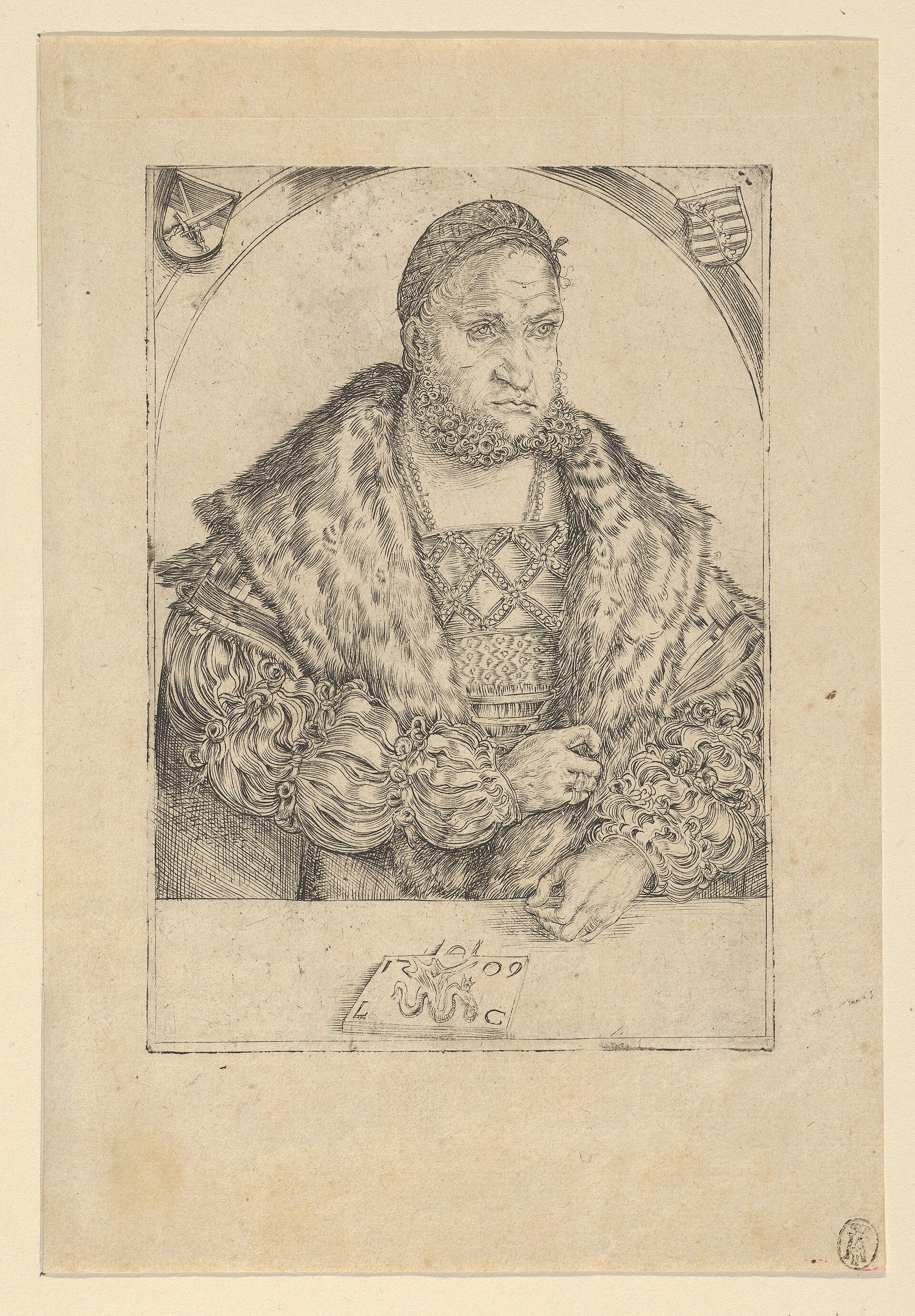

The righteousness of God: the tower experience
Luther's own account of the turn in his theology comes from the preface he wrote in March 1545, a year before his death, for the first volume of his collected Latin works. In it he describes a hatred of the phrase "the justice of God" in Romans 1:17, which his teachers had taught him to read as the justice by which God punishes sinners. The translation below is by Andrew Thornton, OSB (1983), published by Project Wittenberg with permission for free use with attribution:
"I meditated night and day on those words until at last, by the mercy of God, I paid attention to their context: 'The justice of God is revealed in it, as it is written: "The just person lives by faith."' I began to understand that in this verse the justice of God is that by which the just person lives by a gift of God, that is by faith. ... All at once I felt that I had been born again and entered into paradise itself through open gates."5
He adds that afterward he read Augustine's On the Spirit and the Letter and found that Augustine too understood the justice of God as that with which God clothes us when he justifies us, though Augustine "had said it imperfectly and did not explain in detail how God imputes justice to us."5 (Augustine and his quarrel with Pelagius are the subject of lesson 06.) Because Luther said in the Table Talk that the insight came to him in the tower of the Wittenberg friary, where his study was, the moment is called the tower experience (Turmerlebnis).
When did it happen?
The date is one of the longest arguments in Reformation history. The preface itself seems to place the breakthrough in 1518 or 1519: Luther writes that "in that same year, 1519, I had begun interpreting the Psalms once again" and tells the Romans story as if it came just before.5 Many historians, reading his lectures on the Psalms and on Romans, find the new understanding of grace already present between 1513 and 1516, before the indulgence quarrel, and conclude that the old man compressed his memories. Others, following the German scholar Ernst Bizer (Fides ex auditu, 1958), argue for a late date, 1518 or so, and hold that the 95 Theses were written by a Catholic reformer who had not yet reached his mature doctrine. A third group treats the breakthrough as a process over several years. Oberman thought the search for one day misleading.4 What the record does show is that the 95 Theses do not use the language of justification by faith alone: they are an attack on the preaching of indulgences by a man who still assumed purgatory, the papacy and the sacrament of penance. Whatever happened in the tower, the public quarrel began with indulgences.
Indulgences and the St. Peter's campaign
What the church taught
The Catholic Church's own definition is the place to start. The Catechism of the Catholic Church (1992), quoting Pope Paul VI's apostolic constitution Indulgentiarum doctrina (1967), states: "An indulgence is a remission before God of the temporal punishment due to sins whose guilt has already been forgiven, which the faithful Christian who is duly disposed gains under certain prescribed conditions through the action of the Church which, as the minister of redemption, dispenses and applies with authority the treasury of the satisfactions of Christ and the saints." It adds that an indulgence is partial or plenary, and that "Indulgences may be applied to the living or the dead."6
In the teaching Luther inherited, the guilt of a sin and the eternal punishment it deserved were forgiven in the sacrament of penance through Christ. A temporal penalty remained, to be paid by works of satisfaction in this life or by purification in purgatory. In the early church, penances imposed by bishops had been long and public; by the Middle Ages they could be commuted into prayers, pilgrimages, alms or a crusade vow, and the papacy granted plenary indulgences, first for crusaders (Urban II at Clermont in 1095, lesson 09) and then for jubilee pilgrims to Rome. Pope Clement VI's bull Unigenitus (1343) defined the treasury of merits on which the pope drew, and Pope Sixtus IV declared in 1476 that indulgences could be applied to souls in purgatory by way of suffrage (intercession). Popes had long used indulgences to raise money for churches, bridges, hospitals and wars against the Ottomans. None of this was new in 1517, and theologians still disagreed about exactly what an indulgence for the dead could do.7
Albert of Mainz and the Fuggers
The indulgence that set off the quarrel had two purposes, one public and one private. In 1506 Pope Julius II had begun to rebuild St. Peter's Basilica in Rome, and in 1507 and again in 1515 the papacy proclaimed plenary indulgences to pay for it. Pope Leo X (Giovanni de' Medici, pope 1513 to 1521) granted the preaching of this indulgence in the provinces of Mainz and Magdeburg to Albert of Brandenburg (1490 to 1545), the younger brother of the Elector Joachim of Brandenburg. Albert was already archbishop of Magdeburg and administrator of Halberstadt when he was elected archbishop of Mainz in 1514, which made him, at 24, the senior churchman and an elector of the Empire. Holding three sees at once was against church law and needed a papal dispensation, and the new archbishop also had to pay the fees for his pallium. Schaff reports that Albert borrowed thirty thousand florins in gold from the Augsburg banking house of Fugger and that, by agreement with the pope, he was allowed to keep half of the proceeds of the indulgence to repay it, with the Fuggers' agents present to collect their share.7 (Modern historians give different figures for the loan and the fees; all agree on the arrangement itself, which neither Luther nor the ordinary buyer knew about in 1517.)
Albert issued an Instructio summaria, a handbook for his preachers, describing four "principal graces" of the indulgence: plenary remission of sins, a confessional letter allowing the buyer to choose his confessor, participation in the merits of the saints, and remission for souls in purgatory, for which, the handbook said, the contributors did not need to be contrite. Luther's letter to Albert singles out that last point.8
Johann Tetzel
Albert's chief preacher was the Dominican friar Johann Tetzel (about 1465 to 1519), a preacher of indulgences since 1501 (Schaff's date) and a papal inquisitor. Schaff describes the processions that met him in each town, the papal bull carried on a velvet cushion, the red cross with the papal arms set up before the altar, and the iron chest beneath it for the money.7 Frederick the Wise did not let the St. Peter's indulgence be preached in electoral Saxony (he did not want his subjects' money leaving for Mainz and Rome, and he had his own great relic collection at Wittenberg, whose display on All Saints' Day carried indulgences of its own). So Tetzel preached just over the border at Jüterbog and Zerbst, and people from Wittenberg went to buy letters there and brought them back to their confessor, Dr. Luther.7
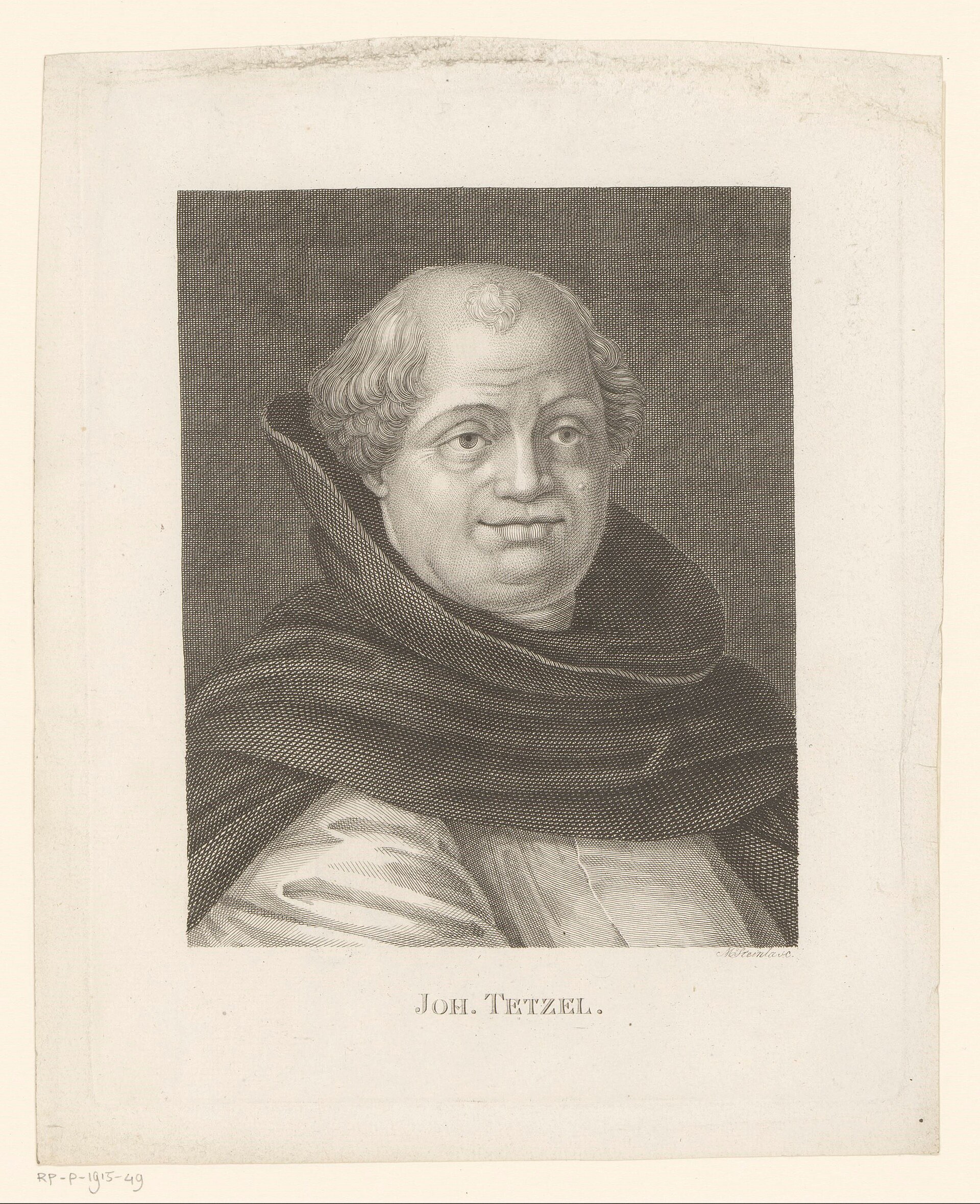

The rhyme everyone knows, "As soon as the coin in the coffer rings, the soul from purgatory springs" (in German, Sobald der Pfennig im Kasten klingt, die Seel' aus dem Fegfeuer springt), is usually put in Tetzel's mouth. The record is more limited. Schaff notes that two contemporaries, Johann Mathesius (Luther's student and early biographer) and Johann Hess, ascribe the sentence to Tetzel "with slight verbal modifications," and that Luther alludes to it in theses 27 and 28 and quotes it in his 1541 pamphlet Against Hanswurst.7 No sermon by Tetzel containing the rhyme survives. Tetzel's own printed theses against Luther (1518), defended for his doctorate at Frankfurt an der Oder (Schaff notes that many scholars ascribe their drafting to the Frankfurt professor Konrad Wimpina), teach that a soul purified in purgatory flies to God without hindrance; Schaff, a Protestant historian, judged that Tetzel's published writings taught "neither more nor less than the usual scholastic doctrine of indulgences" and that he did not deny the need for repentance, while adding that he probably gave rise to "damaging stories" by unguarded speech.7 Tetzel also denied, as slander, the charge that he had said an indulgence could forgive even the violation of the Mother of God.7 The rhyme is rated in Claims checked below. Tetzel died at Leipzig in 1519 (Schaff puts it during the Leipzig debate in July; other accounts give August), after the papal envoy Karl von Miltitz had reported harshly on his conduct.7
October 31, 1517: the letter and the theses
The letter to Albert
The firmest fact of the day is a letter. On the eve of All Saints, Oct. 31, 1517, Luther wrote to Archbishop Albert. Wace and Buchheim's translation (in First Principles of the Reformation, 1883) begins with a humble address and then states the complaint:
"Papal indulgences are being carried about, under your most distinguished authority, for the building of St. Peter's. In respect of these I do not so much accuse the extravagant sayings of the preachers, which I have not heard, but I grieve at the very false ideas which the people conceive from them, and which are spread abroad in common talk on every side--namely, that unhappy souls believe that, if they buy letters of indulgences, they are sure of their salvation; also, that, as soon as they have thrown their contribution into the chest, souls forthwith fly out of purgatory."8
He asks Albert to withdraw the instruction to the preachers and closes: "From Wittemberg, on the eve of All Saints, in the year 1517." A postscript adds: "If it so please your most reverend Fatherhood, you may look at these Disputations, that you may perceive how dubious a matter is that opinion about indulgences, which they disseminate as if it were most certain."8 Luther sent the theses to the bishop of his own diocese, Brandenburg, at about the same time.
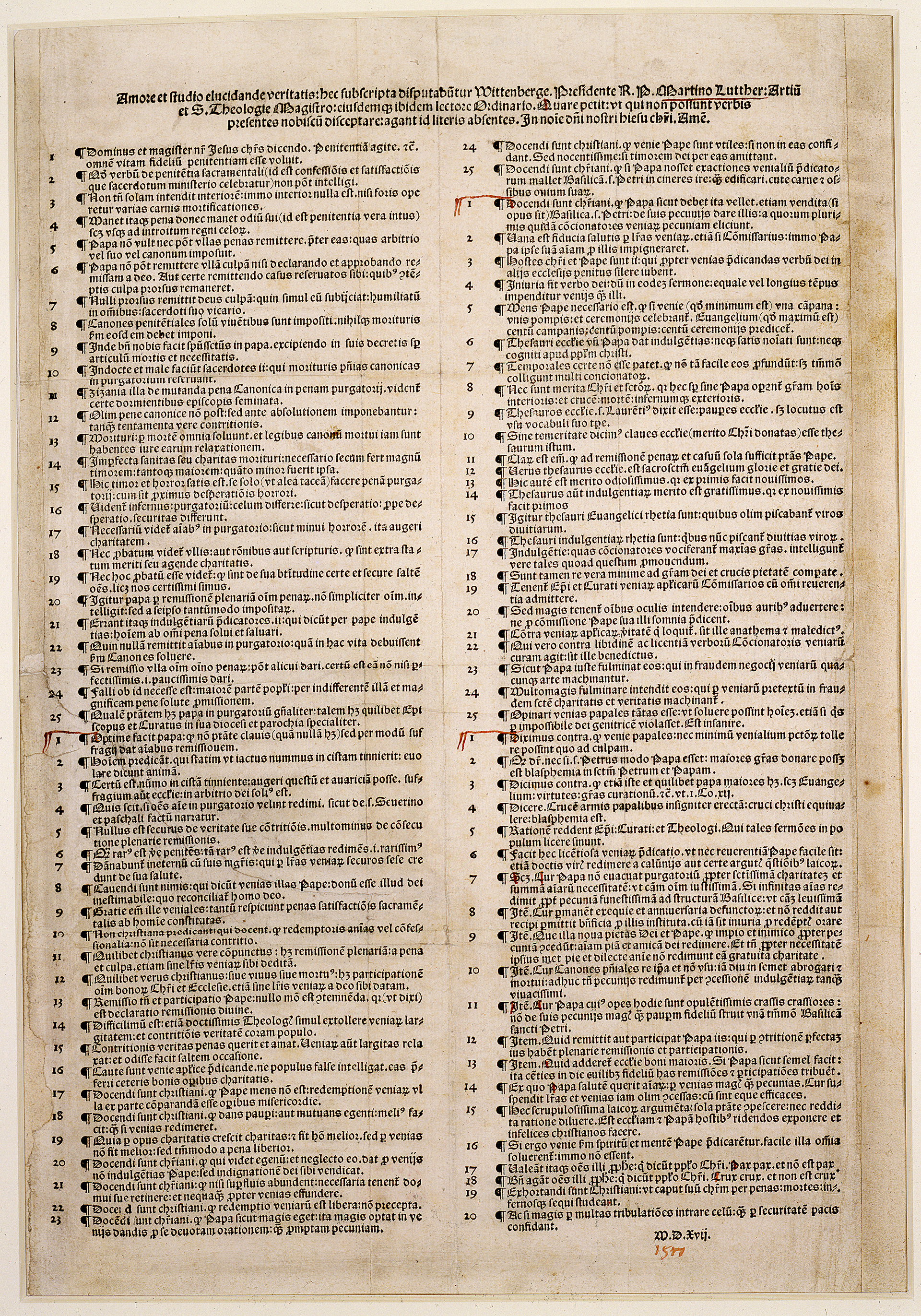
What the 95 Theses say
The theses were written in Latin, for scholars, under the heading (in Wace and Buchheim's translation) "Disputation of Dr. Martin Luther concerning Penitence and Indulgences," and they open with an invitation: "a disputation will be held on the underwritten propositions at Wittemberg, under the presidency of the Reverend Father Martin Luther, Monk of the Order of St. Augustine." Those who could not attend were asked to write.9 No such debate is known to have taken place. The first thesis sets the theme:
"1. Our Lord and Master Jesus Christ in saying: 'Repent ye,' etc., intended that the whole life of believers should be penitence.
2. This word cannot be understood of sacramental penance, that is, of the confession and satisfaction which are performed under the ministry of priests."9
The 95 propositions fall into a few groups. Theses 1 to 7 define repentance as a lifelong inward turning that shows itself outwardly. Theses 5 to 29 limit the pope's power over penalties to those he himself imposed, and they deny that he can release souls from purgatory by the power of the keys, granting only that he may intercede "by the way of suffrage" (thesis 26). Thesis 27 strikes at the preachers: "They preach man, who say that the soul flies out of purgatory as soon as the money thrown into the chest rattles." Theses 30 to 55 set charity above pardons: "Christians should be taught that he who gives to a poor man, or lends to a needy man, does better than if he bought pardons" (thesis 43).9
Theses 56 to 68 deal with the treasury of the church. Thesis 62 is the one Lutherans quote most: "The true treasure of the Church is the Holy Gospel of the glory and grace of God."9 Theses 81 to 91 put into the mouths of laymen the "keen questionings" that the preachers had made it hard to answer, such as thesis 86: "why does not the Pope, whose riches are at this day more ample than those of the wealthiest of the wealthy, build the one Basilica of St. Peter with his own money, rather than with that of poor believers?" The last two theses end with the cross:
"94. Christians should be exhorted to strive to follow Christ their head through pains, deaths, and hells.
95. And thus trust to enter heaven through many tribulations, rather than in the security of peace."9
Three things about the text are easy to miss. First, it defends the pope more than it attacks him: again and again it says that the pope, if he knew what the preachers were doing, would agree (theses 48 to 51), and thesis 71 curses anyone "who speaks against the truth of apostolical pardons." Second, it assumes purgatory throughout. Third, it never mentions justification by faith alone. The theses are the work of a Catholic theologian testing the limits of a practice, written in the form of an academic disputation, and that is how Luther described them to Albert.

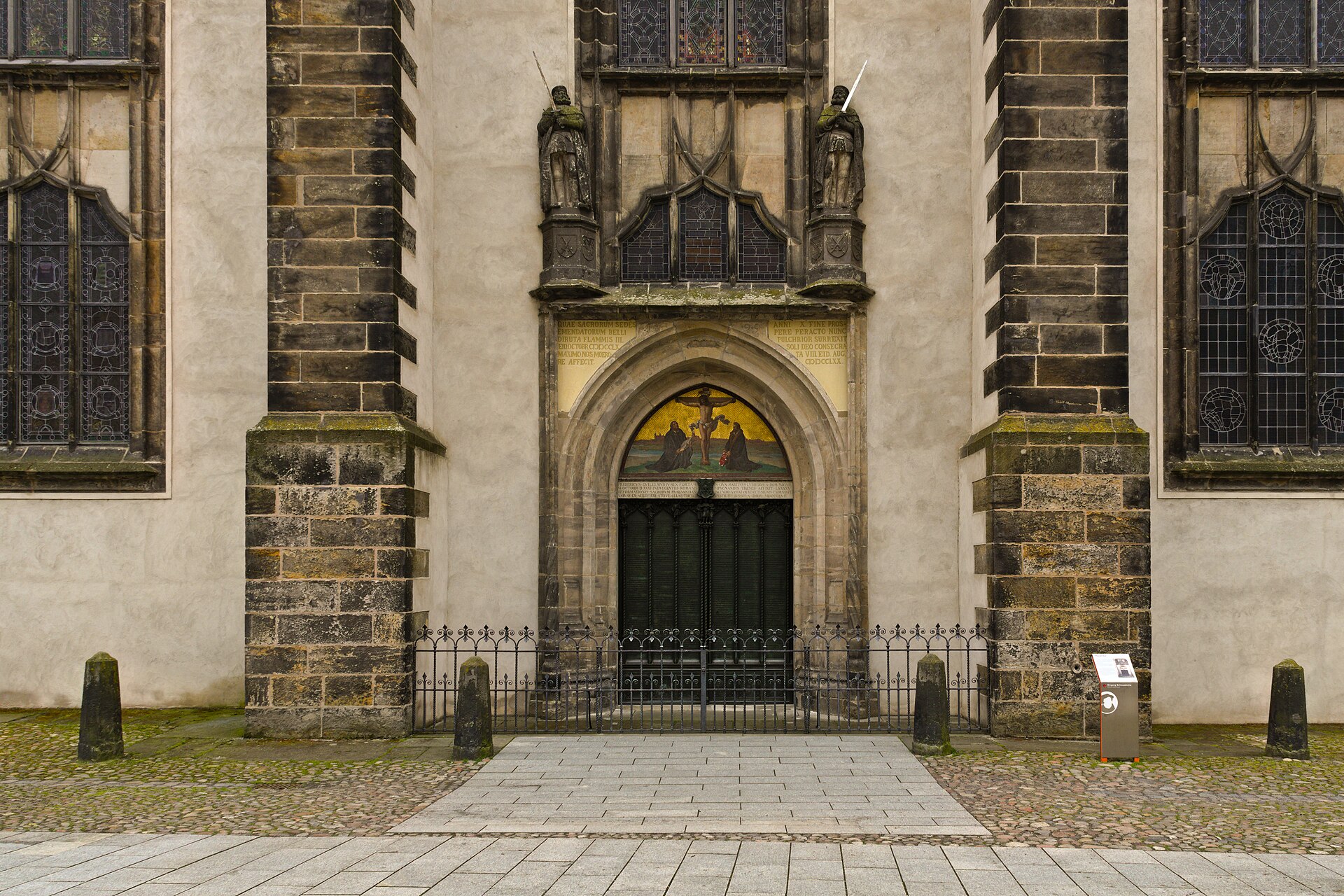
The door of the Castle Church
Every school child learns that Luther nailed the theses to the door of the Castle Church in Wittenberg. The story has a precise source, and it is not Luther. On June 1, 1546, less than four months after Luther's death, Philip Melanchthon wrote a preface for the second volume of Luther's collected Latin works. In it he says that Luther "edidit Propositiones de Indulgentiis" (published propositions on indulgences) and "affixit pridie festi omnium Sanctorum anno 1517" (affixed them on the eve of the feast of All Saints in the year 1517) to the church next to the Wittenberg castle (the text is in the Corpus Reformatorum, volume 6, columns 161 and 162).10 Melanchthon did not arrive in Wittenberg until August 1518, so he was not a witness. Luther himself, in his many later descriptions of 1517, speaks of writing to the bishops and of the theses spreading, and never in surviving writings describes posting them.10 The word "nailed" is later still: Melanchthon says "affixed," which could mean glue, wax or tacks, and the castle church door served as the university's notice board for disputations.
In a lecture at the University of Mainz on Nov. 8, 1961, titled "Luthers Thesenanschlag: Tatsache oder Legende?" (Luther's posting of the theses: fact or legend?), the Catholic church historian Erwin Iserloh (1915 to 1996) argued that the posting never happened.11 His case, set out in Luther zwischen Reform und Reformation (1966; in English as The Theses Were Not Posted, 1968), was that apart from Melanchthon's late report there was no reliable source for the event, "least of all from Luther himself," and that Luther's letters show him waiting for the bishops to answer before making the theses public.1012 The argument ran in journals and newspapers for more than a decade.11 It mattered to Iserloh for a reason beyond the door: if Luther first went privately to his bishops, then the bishops, and not a rebellious friar, bore the blame for what followed.
Then came a find. In the Thuringian University and State Library at Jena, in a 1540 copy of the New Testament that Luther's secretary Georg Rorer (Rörer, 1492 to 1557) used for the work of Bible revision, the historian Martin Treu of the Luther Memorials Foundation of Saxony-Anhalt identified a handwritten Latin note by Rorer. It begins "Anno domini 1517 in profesto omnium Sanctorum" (In the year of the Lord 1517, on the eve of All Saints' Day) and says that propositions on indulgences by Doctor Martin Luther were "propositae" (put up or set forth) at Wittenberg on the doors of the churches.1310 The note was found in 2006 and became public in 2007 (the dates come from press reports of the find; the Jena library's own description gives the text but not the year).13 The note itself is undated. Those who think it independent of Melanchthon date it to the early 1540s, when Rorer was working on the Bible revision, and they point out that Rorer was one of Luther's closest helpers from the 1520s on. It speaks of church doors in the plural, which some historians connect with the university's practice of announcing disputations on the doors of the town's churches.
The note did not end the argument. Volker Leppin, writing at Tübingen, has pointed out that a second note by Rorer, written later, already uses Melanchthon's wording, which shows that a single story was forming in Luther's circle in the 1540s, and he concludes that Luther's own letters remain the earliest evidence and do not mention a posting.10 Others, Martin Treu among them, read Rorer's first note as independent evidence that the theses were put up on the church doors, probably on Oct. 31 or soon after. The original doors burned in 1760 during the Seven Years' War; the bronze doors bearing the Latin text of the theses were the gift of King Frederick William IV of Prussia and were installed in 1858.14

The theses spread
Whether or not they were posted, the theses escaped Luther's control. By December 1517 printers had produced Latin editions at Nuremberg, Leipzig and Basel, and a German translation followed in Nuremberg. Luther told friends that he had not meant them for the public and was surprised. Early in 1518 he published a German sermon, Eyn Sermon von dem Ablasz und gnade (A Sermon on Indulgence and Grace), short and plain, which went through many editions in its first years and did more than the Latin theses to bring the argument to ordinary readers.15 Albert of Mainz forwarded the theses to Rome in December 1517 with a request that action be taken. Tetzel answered with counter-theses in January 1518, and the Dominican Sylvester Prierias, the pope's theologian (Master of the Sacred Palace), wrote a reply that defended indulgences on the ground that the Roman church and the pope cannot err in faith and morals and that whoever disputes what the Roman church does about indulgences is a heretic.16 Prierias moved the debate, almost at once, from the preaching of indulgences to the authority of the pope.
From indulgences to authority, 1518 to 1519
Heidelberg, April 1518
The Augustinian order held its regular chapter at Heidelberg in April 1518, and Staupitz asked Luther to preside over a disputation there on April 26. Luther chose to argue a theology of the cross against a theology of glory: theses on the bondage of the will after the fall, on works that look good and are deadly sins, and on the love of God that does not find but creates what is lovable in its object. Indulgences did not come up. The audience included young Dominicans and humanists, among them Martin Bucer, later the reformer of Strasbourg, who wrote an enthusiastic report.16 The older professors were not persuaded, but the Augustinians did not discipline their brother.
Cajetan at Augsburg, October 1518
In August 1518 Luther was summoned to Rome to answer charges of heresy within sixty days. Frederick the Wise had the case moved to Germany, where the papal legate Tommaso de Vio, Cardinal Cajetan, a leading Dominican theologian and commentator on Thomas Aquinas, was attending the imperial diet at Augsburg. Luther received a safe-conduct on Oct. 11 and met Cajetan on Oct. 12, 13 and 14.16 Cajetan had instructions to receive a recantation, not to debate. He pressed two points: thesis 58, against Clement VI's bull Unigenitus on the treasury of merits, and Luther's teaching that a person receiving the sacrament must believe with certainty that he is forgiven. Luther would not recant without being shown from Scripture where he was wrong. He appealed "from the pope badly informed to the pope better informed," left Augsburg secretly by night, and on Nov. 28 appealed from the pope to a general council. In November Leo X issued the decree Cum postquam, defining the church's teaching on indulgences, which settled the doctrinal point Luther had raised but did not name him.16
Politics then slowed Rome down. The Emperor Maximilian I died in January 1519, and Frederick the Wise became one of the seven electors whose votes the pope needed in the contest for the imperial crown. In January 1519 the papal chamberlain Karl von Miltitz met Luther at Altenburg and got him to agree to keep silent if his opponents did.16 On June 28, 1519, the electors chose Charles of Habsburg, King of Spain, as Emperor Charles V.
Leipzig and Johann Eck, summer 1519
The truce with Miltitz did not hold. Johann Eck (1486 to 1543), professor at Ingolstadt and the ablest Catholic debater in Germany, challenged Luther's Wittenberg colleague Andreas Bodenstein von Karlstadt to a disputation and aimed his theses at Luther. The debate was held in the great hall of the Pleissenburg castle at Leipzig, in the lands of Duke George of Saxony (Frederick's cousin and a firm Catholic), from June 27 to July 15, 1519. Eck debated Karlstadt on grace and free will, and then Luther from July 4 on the primacy of the pope.16 Luther argued that the pope's supremacy was a matter of human law and history, not divine law, and that the Greek church, which had never been under Rome, was still part of the church of Christ. Eck pressed him on Hus, whom the Council of Constance had condemned and burned in 1415 (lesson 10). Luther said that some of the articles of Hus condemned at Constance were thoroughly Christian and evangelical, and when pressed, that a general council could err. For Eck, that was enough: Luther had sided with a condemned heretic and denied the authority of councils.16 Eck went to Rome to work for a bull against him.
In August 1518 a 21-year-old humanist from Bretten, Philip Melanchthon (1497 to 1560), great-nephew of the Hebrew scholar Johann Reuchlin, had come to Wittenberg as professor of Greek. Luther later wrote in the 1545 preface that God had sent Melanchthon "to teach Greek, doubtless so that I might have a colleague in my labors of teaching theology."5 Melanchthon was at Leipzig, passing notes to Karlstadt, and for the rest of Luther's life he was the movement's systematic theologian, the author of its first textbook of doctrine (the Loci communes of 1521) and of the Augsburg Confession.
The three treatises of 1520
In 1520 Luther wrote the three books that Wace and Buchheim, in 1883, called his "primary works," and they translated all three.
To the Christian Nobility of the German Nation (August 1520), in German, called on the emperor, princes and nobles to reform the church because the clergy would not. It opens with an image of fortifications: "The Romanists have, with great adroitness, drawn three walls round themselves, with which they have hitherto protected themselves, so that no one could reform them." The first wall was the claim that the spiritual power is above the temporal; the second, "that no one may interpret the Scriptures but the Pope"; the third, "that no one may call a Council but the Pope."17 Against the first wall Luther set the priesthood of all the baptized: every Christian, he argued, is of the spiritual estate, and the difference between clergy and laity is one of office, not of standing before God. The book went on to list practical reforms, from the end of annates and Roman appeals to the marriage of priests and the reform of the universities.
On the Babylonish Captivity of the Church (October 1520), in Latin, for theologians, attacked the sacramental system. "To begin. I must deny that there are seven Sacraments, and must lay it down, for the time being, that there are only three, baptism, penance, and the bread, and that by the Court of Rome all these have been brought into miserable bondage."18 He rejected the withholding of the cup from the laity, the doctrine of transubstantiation as a philosophical explanation (while insisting that Christ's body and blood are truly present), and above all the teaching that the Mass is a sacrifice offered to God. This was the book that turned the humanist Erasmus and many moderate readers against him, and King Henry VIII of England answered it in 1521 with Defense of the Seven Sacraments, which earned him the papal title Defender of the Faith.
On Christian Liberty (also called The Freedom of a Christian, November 1520), in German and Latin, sent to Leo X with a respectful covering letter, set out his teaching in two sentences that look like a contradiction: "A Christian man is the most free lord of all, and subject to none; a Christian man is the most dutiful servant of all, and subject to every one."19 Faith alone, he argued, joins the soul to Christ as a bride to her bridegroom, so that Christ's righteousness becomes hers and her sin his; works do not make a person good, but a good person, freed by faith, does good works for the neighbor's sake.
Exsurge Domine and the break with Rome
The bull Exsurge Domine, dated June 15, 1520, opens with the words of Psalm 74 (73) in the English translation published by Papal Encyclicals Online: "Arise, O Lord, and judge your own cause. Remember your reproaches to those who are filled with foolishness all through the day. Listen to our prayers, for foxes have arisen seeking to destroy the vineyard." A few lines later: "The wild boar from the forest seeks to destroy it and every wild beast feeds upon it."20 It lists 41 propositions drawn from Luther's writings and condemns them "as either heretical, scandalous, false, offensive to pious ears or seductive of simple minds, and against Catholic truth," without saying which label fits which proposition. Among them are the claim that the treasures of the church from which the pope grants indulgences are not the merits of Christ and the saints, and proposition 33: "That heretics be burned is against the will of the Spirit."20 The bull ordered Luther's books burned and gave him sixty days from its posting on the doors of the cathedrals of Brandenburg, Meissen and Merseburg (named in the Latin text that Schaff prints) to recant, "which we wish to have divided into three times twenty days."20
Eck and the papal envoy Girolamo Aleandro carried the bull into Germany in the autumn of 1520. In some places Luther's books were burned; in others, students and townspeople tore the posted bull down. At Wittenberg, on the morning of Dec. 10, 1520, when the sixty days had run out, Luther, his colleagues and students lit a fire outside the Elster Gate, near the town's hospital, and burned volumes of canon law and scholastic theology. Luther threw a copy of the bull into the fire.21 The bull of excommunication, Decet Romanum Pontificem, followed on Jan. 3, 1521.21
Worms, April 1521
The summons
Under the law of the Empire an excommunicated heretic was to be outlawed by the emperor as well. But Charles V had promised in his election agreement that no German would be outlawed without a hearing, and Frederick the Wise insisted on that promise. Charles summoned Luther to the imperial diet at Worms with a safe-conduct. Luther traveled from Wittenberg in early April through Leipzig, Erfurt (where he preached to great crowds) and Frankfurt, and entered Worms on April 16.22 His friends remembered Hus, who also had a safe-conduct.
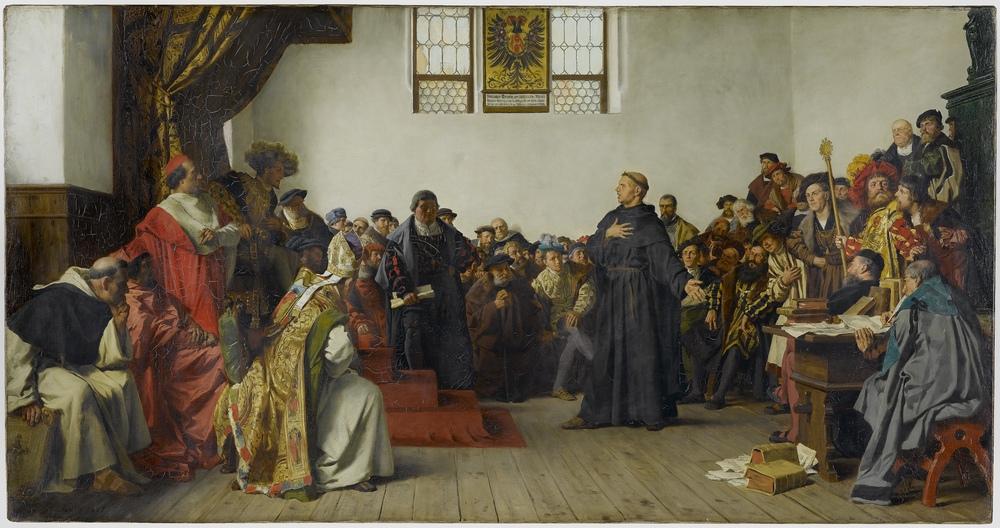
On the afternoon of April 17 he was brought before the emperor and the estates in the bishop's palace. Johann von der Ecken, an official of the archbishop of Trier (not the Johann Eck of Leipzig), pointed to a pile of books on a table and asked two questions: were these his, and would he retract what was in them? Luther acknowledged the books and asked for time to consider the second question. He was given a day.22
The answer of April 18
The next evening, in a larger hall, crowded and hot, Luther gave his answer in German and then repeated it in Latin. He divided his books into three kinds: books of Christian faith and morals that even his enemies admitted were useful, which he could not in conscience retract; books against the papacy and its abuses, which he would not retract because that would strengthen tyranny; and books against individual opponents, in which he admitted he had been harsher than fitting for a monk, but which he could not retract without defending what they attacked. The official told him he had not answered the question and demanded a plain reply, "without horns." Schaff's English, from the contemporary records, gives Luther's reply:
"Unless I am refuted and convicted by testimonies of the Scriptures or by clear arguments (since I believe neither the Pope nor the Councils alone; it being evident that they have often erred and contradicted themselves), I am conquered by the Holy Scriptures quoted by me, and my conscience is bound in the word of God: I can not and will not recant any thing, since it is unsafe and dangerous to do any thing against the conscience."22
Then, according to the most famous version, he added in German: "Here I stand. I can do no other. God help me. Amen." Whether he said those words is a question the record cannot settle, and it is rated in Claims checked below. The short version: his own notes and the official record give only "God help me"; the words "Here I stand" appear in reports printed soon after, in more than one order; and the familiar form was fixed in the edition of his works printed in 1546.22
The Emperor answered the next day, in a statement in French written in his own hand: a single friar who set his own opinion against the whole of Christendom for a thousand years must be wrong, and Charles would stake on the old faith his dominions, his friends, his body, his blood and his soul. Schaff reports that the papal envoys described Luther raising his arms like a German soldier after a good stroke, and that the Elector Frederick said that evening, "How excellently did Father Martin speak both in Latin and German before the Emperor and the Estates! He was bold enough, if not too much so."22 Several days of private talks with a committee of the estates produced nothing. Luther left Worms on April 26.

The Edict of Worms
The Edict of Worms, dated May 8 but signed by the emperor on May 26, 1521, after many of the estates had already gone home, placed Luther under the imperial ban: no one was to shelter him, feed him or give him drink; he was to be seized and handed over; his books were to be burned; his followers were outlaws too.23 The papal envoy Aleandro had a large hand in drafting it. It was the law of the Empire for the rest of Luther's life, but outside the lands of committed Catholic rulers it was not enforced. Frederick the Wise never published it in electoral Saxony.
The Wartburg and the German Bible
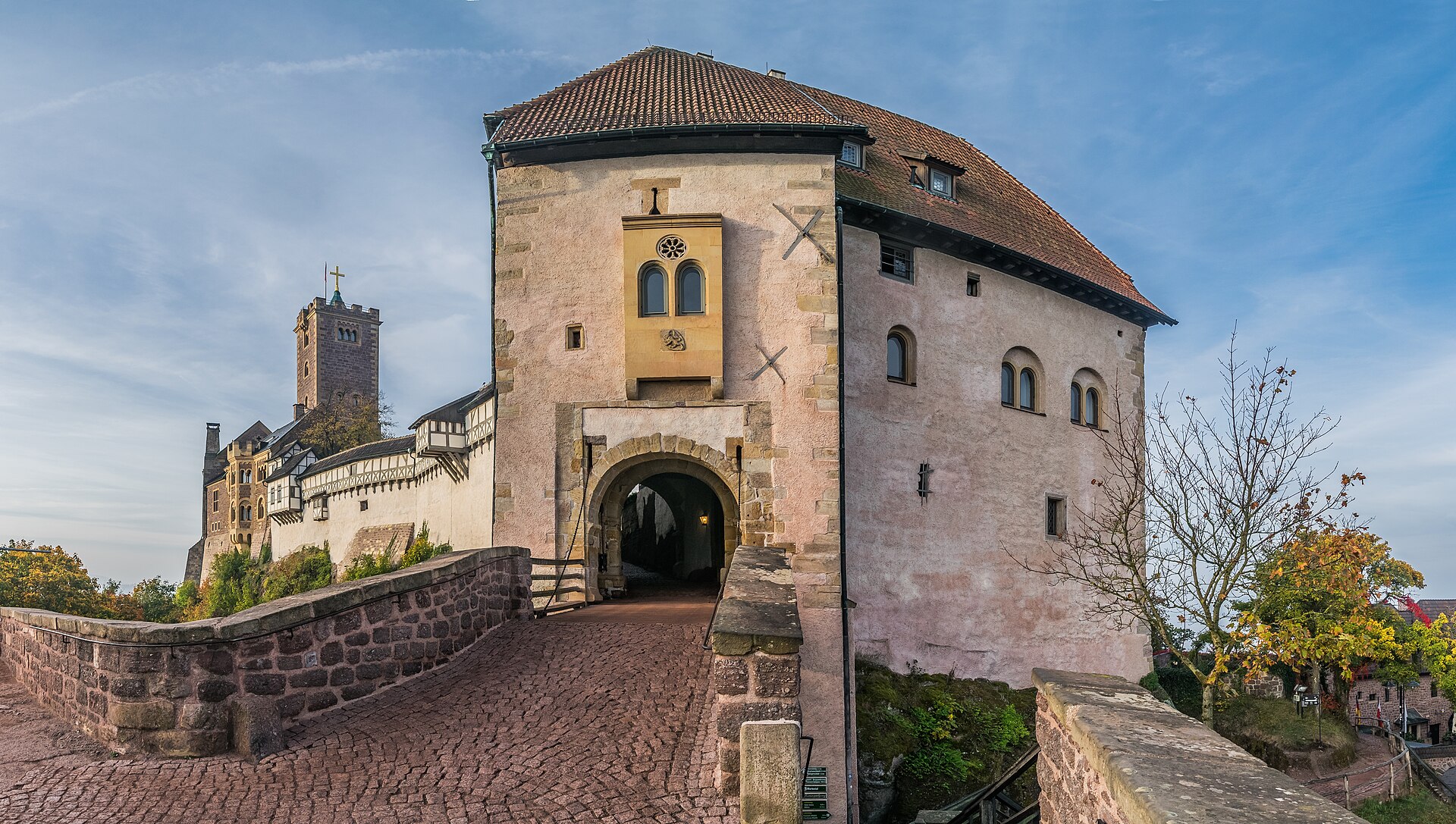
On the road home, on May 4, 1521, horsemen stopped Luther's wagon in the Thuringian forest and carried him off. The "kidnapping" was arranged by Frederick the Wise's officials, and Frederick took care not to know the details, so that he could say honestly that he did not know where Luther was. Luther was taken to the Wartburg, a castle above Eisenach, where he lived for ten months as "Junker Jörg" (Squire George), with a beard and a knight's clothes.23 He suffered from insomnia, constipation and what he described as assaults of the devil, and he wrote steadily: a treatise against private Masses, one against monastic vows (which led many friars and nuns to leave their houses), sermons for the church year, and his translation of the New Testament.

The September Testament
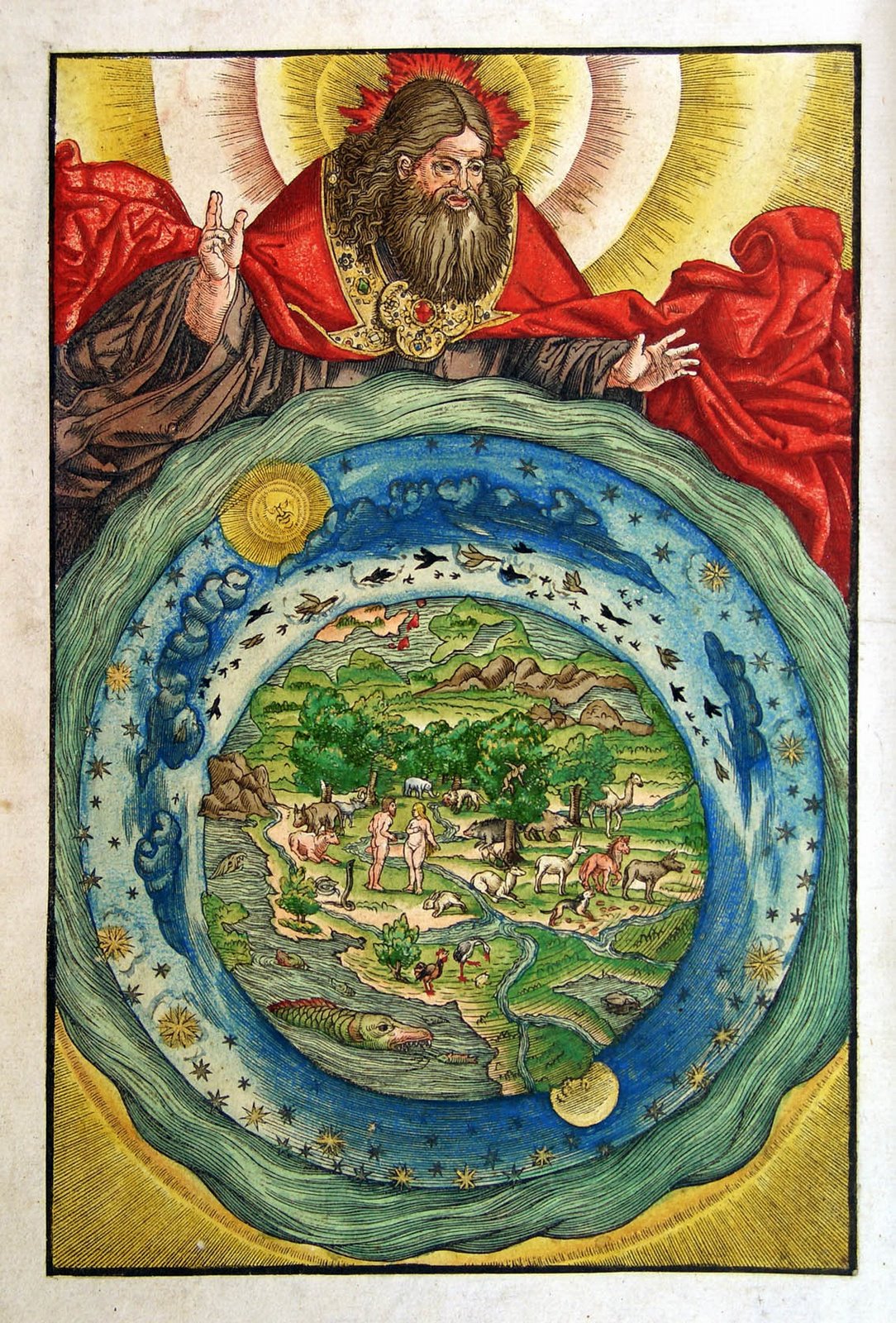
Luther began the New Testament in November or December 1521, working from the Greek text that Erasmus had edited (in its second edition of 1519), and finished a draft in about eleven weeks.23 Melanchthon helped revise it after his return to Wittenberg. It was printed by Melchior Lotther with woodcuts from Lucas Cranach's workshop (the illustrations of Revelation showed the beast of Babylon wearing the papal triple crown) and went on sale in September 1522, without the translator's name on the title page; it is called the September Testament. A corrected second printing, the December Testament, followed within three months.2324 The Old Testament followed in parts, with a team of Wittenberg scholars, and the complete German Bible appeared in 1534.
Luther's was not the first German Bible. Schaff counts fourteen or more printed High German editions and several Low German ones before 1518, all made from the Latin.24 What was new was a translation from the Greek and Hebrew into the living speech of the market and the household. Luther wrote in his 1530 Open Letter on Translating that he had asked the mother in the house, the children in the street and the common man in the market how they spoke, and translated by watching their mouths. His German, built on the chancery language of Saxony, became a model for written German across the language area.
How many copies of the September Testament were printed is uncertain. Schaff says five thousand copies of the first edition were printed and sold before December 1522, at the high price of one and a half guilders a copy.24 Many recent historians, including Andrew Pettegree in Brand Luther (2015), give a lower figure of about three thousand; the printers' records do not survive, and the range is stated here with both sources.15

The printing press and "Brand Luther"
Hus had preached to crowds in Prague's Bethlehem Chapel; Luther preached to all of Germany through Wittenberg's print shops. The numbers are the strongest single explanation historians give for why his movement survived when earlier ones were crushed.
Schaff, using the bibliographical counts available in his day, gives the annual number of prints in German: 90 in 1513, 106 in 1514, 145 in 1515, 105 in 1516 and 81 in 1517; then 146 in 1518, 252 in 1519, 571 in 1520, 523 in 1521, 677 in 1522 and 944 in 1523, a total of 527 in the five years before the Reformation and 3,113 in the six after it. Of the works printed from 1518 to 1523, he says, no fewer than six hundred came from Wittenberg.24 (These are counts of editions, not of copies, and later bibliography has revised the totals upward for every year; the shape of the curve has held.)
Mark U. Edwards Jr., in Printing, Propaganda, and Martin Luther (University of California Press, 1994), counted 3,183 printings and editions of Luther's works (Latin and German, Bibles excluded) from 1516 to 1546, of which 2,645 were in German. He reports Hans-Joachim Köhler's calculation that Luther's works made up 20 percent of all the pamphlets published in the period 1500 to 1530, and he found that during Luther's lifetime the presses produced "nearly five times as many German works by Luther as by all the Catholic controversialists put together"; for 1518 to 1544 he counted 514 printings by the Catholic writers (542 with undated ones).25 Edwards also reports that German pamphlet production in 1520 to 1526 reached more than 6,000 editions, "representing conservatively over 6.6 million copies."25
Andrew Pettegree's Brand Luther: 1517, Printing, and the Rise of Protestantism (2015) tells the story from the side of the printers. Wittenberg had a single modest press in 1517. Summaries of Pettegree's figures report that Wittenberg's presses averaged about eight publications a year from 1502 to 1516, and that between 1517 and 1546 six printing houses there produced 2,721 titles, about a third of them by Luther.15 Pettegree's argument is that Luther was a writer of genius in a new form: the short German pamphlet of eight or sixteen pages, cheap, quick to print and quick to sell, carrying his name and, from 1520, a recognizable title-page design by Cranach's workshop. The "brand," in Pettegree's sense, was the combination of an author's name, a look and a place, Wittenberg, that buyers learned to trust.
Wittenberg without Luther: Karlstadt and the disturbances
While Luther was in hiding, the reform in Wittenberg moved faster than he had planned. Friars left the Augustinian house; students and townspeople disrupted Masses. On Christmas Day 1521, Andreas Bodenstein von Karlstadt (1486 to 1541), archdeacon of the Castle Church and senior professor, celebrated communion in ordinary clothes, said the words of institution in German, left out the parts of the Mass that spoke of sacrifice, and gave the people both the bread and the cup in their own hands. Soon afterward he married. In January 1522 the town council adopted an ordinance for the church and the common chest for the poor, and images were removed from the town church, in some places by force.26 Three men from Zwickau, known as the Zwickau prophets, arrived at the end of December 1521 claiming direct revelations from the Spirit and questioning infant baptism. Melanchthon did not know how to answer them.
Against the Elector's wishes, Luther left the Wartburg and was back in Wittenberg on March 6, 1522. On Sunday, March 9 (Invocavit Sunday, the first Sunday in Lent), he began a series of eight sermons on eight days, the Invocavit Sermons, in which he argued that the changes were right in substance but wrong in method: faith could not be forced, the weak in conscience had to be taught before they were made to change, and the Word, not force, would do the work.26 Some old practices returned for a time. Karlstadt was pushed out of the university's leadership, moved to the village of Orlamünde, where he preached in peasant clothes and called himself "brother Andrew," and was expelled from electoral Saxony in 1524 after a bitter exchange with Luther over images and the Lord's Supper.26 The quarrel taught Luther a lasting lesson: there were reformers more radical than he was, and he would oppose them as fiercely as he opposed Rome. That is the other side of the Reformation, traced in lesson 12 (the Anabaptists and the radicals).
The Peasants' War, 1524 to 1525
The peasants' case in their own words
In the summer of 1524, peasants in the Black Forest and around Lake Constance began to refuse labor services and rents. By the spring of 1525 armed bands covered much of southern and central Germany, Swabia, Franconia, Thuringia, Alsace and the Tyrol. The best known statement of their demands, the Twelve Articles drafted at Memmingen in March 1525 (Schaff names the Memmingen preacher Christoph Schappeler as a possible author, though the authorship is uncertain), asked for the right of each community to choose its pastor, the use of the "great tithe" for the pastor and the poor, an end to serfdom (on the ground that Christ had redeemed all people with his blood), and the return of common woods, waters and meadows, and it closed by offering to withdraw any article that could be shown to be against the Word of God.27 The peasants appealed to the gospel as Luther preached it. Thomas Müntzer (about 1489 to 1525), a former follower of Luther who had become his enemy, preached a coming judgment in which the godly would take the sword against the godless, and he joined the rising in Thuringia at Mühlhausen.
Luther's two tracts
Luther wrote twice, and both must be read. In April 1525 his Admonition to Peace, answering the Twelve Articles, blamed the princes and lords first: their oppression, he wrote, had brought this on them, and many of the peasants' demands were just. But he told the peasants that no grievance gave Christians the right to take up arms against their rulers (citing Romans 13:1 and "they that take the sword shall perish with the sword," Matthew 26:52), and he urged both sides to submit the quarrel to arbitration.27
Then, after he had traveled through Thuringia and seen the rising for himself, he wrote Against the Robbing and Murdering Hordes of Peasants (in May 1525; in some printings it was attached to the Admonition). In Schaff's summary, he charged them with doing the devil's work under pretense of the gospel and called on the rulers to "stab, kill, and strangle" them like mad dogs; whoever died fighting for the government died a blessed death, a true martyr before God.27 The German original that Schaff prints from the Erlangen edition reads, in part: "steche, schlage, würge hie wer da kann. Bleibst du darüber todt: wohl dir, seliglicheren Tod kannst du nimmermehr überkommen" (stab, strike, strangle here whoever can; if you die in it, good for you, a more blessed death you can never find).27 The pamphlet urged mercy for those who had been forced to join the bands, and Schaff's bracket notes that "the poor people" Luther asked rulers to rescue were those deluded or coerced by the rebels.
The tract appeared as the armies of the princes, Catholic and Lutheran together, were already crushing the peasants. At Frankenhausen in Thuringia on May 15, 1525, the army of Landgrave Philip of Hesse and Duke George of Saxony destroyed Müntzer's force (Schaff dates the battle May 25; the Catholic Encyclopedia's article on the Peasants' War gives May 15, the date in modern accounts)44; Schaff reports five thousand dead on the field. Müntzer was captured, tortured and beheaded.27 The number killed in the whole war is not known. Schaff gives two contemporary estimates: Luther's own figure, in a letter of Aug. 16, 1525, of about a hundred thousand slain, and the Bishop of Speyer's of a hundred and fifty thousand.27 Modern historians generally give a figure in the range of 70,000 to 100,000; the sources are partisan and partial on both sides.
Many readers were shocked even at the time. In a public letter to the Mansfeld chancellor Caspar Müller later in 1525 Luther refused to take anything back: "My little book," he said in Schaff's rendering, "shall stand, though the whole world should stumble at it."27 Schaff, sympathetic to Luther on most things, wrote that his conduct seemed cruel to "every friend of the poor peasants," but judged that it came from a sincere conviction of duty to the magistrate and not from flattery of the princes.27 Lyndal Roper, in Martin Luther: Renegade and Prophet (2016), reads the tract as a turning point in Luther's relation to ordinary people: after 1525 his reform was carried out by princes and town councils, with less room for the community's own voice that the Twelve Articles had asked for.28 Lutheran writers have long answered that Luther never changed his first principle, stated in 1523 in On Temporal Authority: rulers must not force consciences, and subjects must not take the sword. Catholic polemicists of the 1520s, as Edwards shows in his last chapter, blamed Luther for the whole war.25
Katharina von Bora and the parsonage
In the middle of the war Luther married. In April 1523, at Easter, nine nuns escaped from the Cistercian convent of Marienthron at Nimbschen near Grimma (Schaff spells it Nimptsch), hidden, the story goes, on the wagon of the Torgau merchant Leonhard Koppe, and fled to Wittenberg to ask Luther for protection and help.29 Luther found husbands or homes for most. One, Katharina von Bora (born 1499), of a poor noble family, refused the match he arranged and let it be known that she would marry Nikolaus von Amsdorf or Luther himself. On the evening of June 13, 1525, in the presence of a few friends, Johannes Bugenhagen married them in Luther's house; Lucas Cranach and his wife were witnesses. A public church ceremony and wedding feast followed on June 27.29 Luther was 41; she was 26. Melanchthon, in a private letter in Greek, thought the timing unwise.
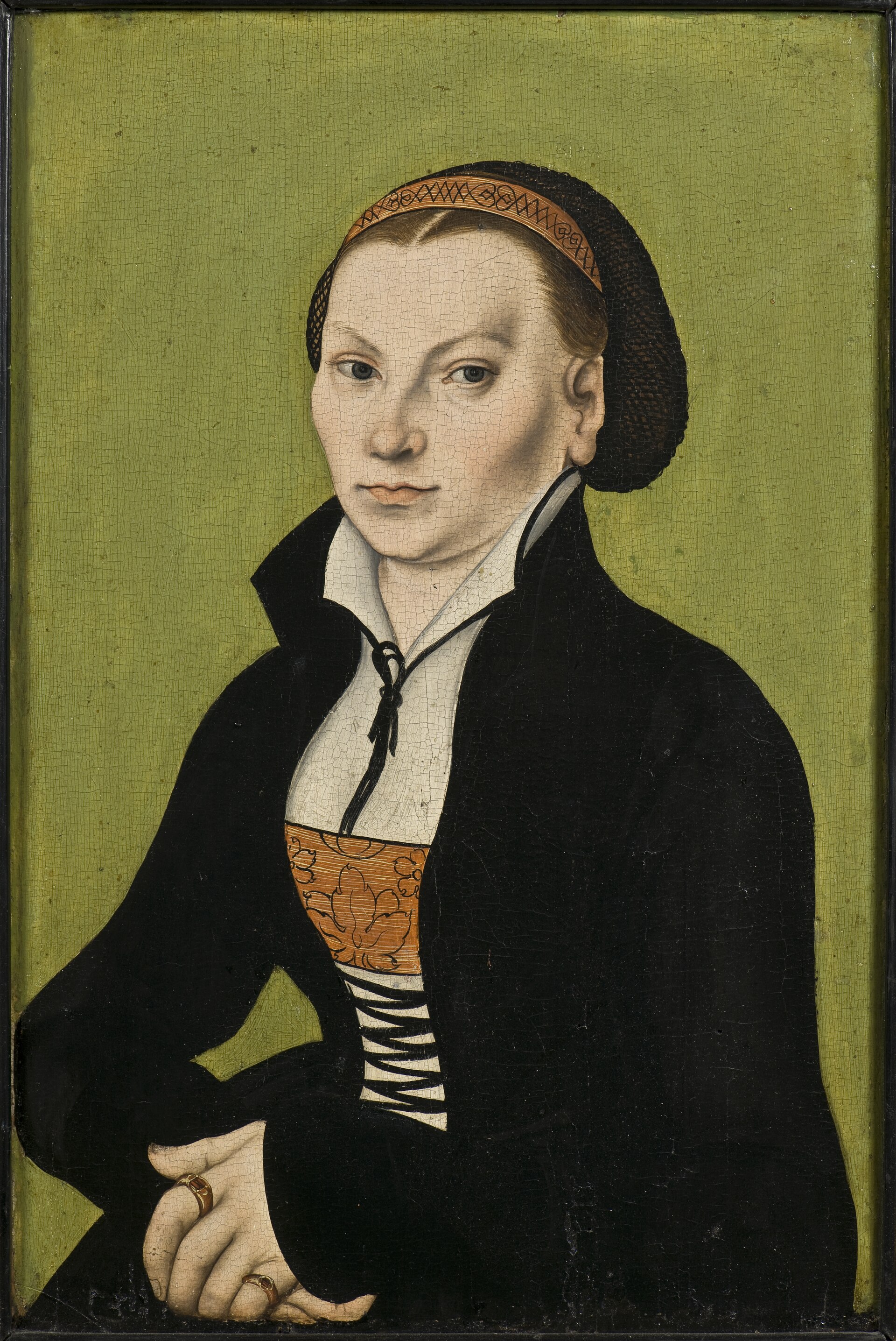
The Elector gave the couple the empty Augustinian friary, the Black Cloister, as their home. Katharina ran it as a farm, brewery, boarding house for students and guest house, bought land, kept livestock and managed the accounts; Luther called her "my lord Katie." They had six children, of whom four lived to adulthood; their daughter Magdalena died in his arms at thirteen in 1542. The Table Talk, notes of his conversation at meals taken down by students, comes from this household. The married parsonage, with the pastor's wife as a public figure, became one of the most lasting social results of the Reformation. Katharina died at Torgau on Dec. 20, 1552, after an accident while fleeing the plague.29
Erasmus and The Bondage of the Will
Desiderius Erasmus of Rotterdam (about 1466 to 1536), the greatest scholar of the age and editor of the Greek New Testament Luther used, had defended Luther's right to a hearing and refused to write against him for years. Under pressure from Henry VIII, the pope and his own friends he finally did, choosing the deepest question: in De libero arbitrio (On Free Will, September 1524), he argued from Scripture and the fathers that the human will, aided by grace, has some power to turn toward or away from salvation, and that on obscure questions Christians should prefer peace to assertions.
Luther answered in December 1525 with De servo arbitrio (The Bondage of the Will), one of his longest and most uncompromising books: the will after the fall is bound to sin and can do nothing toward salvation, God foreknows and wills all things, and Christian faith needs firm assertions, not skepticism. Yet Luther thanked Erasmus for going to the real issue. In Henry Cole's English translation (1823), published by the Christian Classics Ethereal Library: "You, and you alone saw, what was the grand hinge upon which the whole turned, and therefore you attacked the vital part at once."30 Erasmus replied in the two volumes of Hyperaspistes (1526 and 1527). The exchange marked the parting of the Reformation from much of Christian humanism, though Melanchthon himself later softened Luther's position on the will.
The princes take up the cause
Speyer 1526 and the protest of 1529
Frederick the Wise died on May 5, 1525, receiving communion in both kinds on his deathbed. His brother and successor, John the Steadfast (Elector 1525 to 1532), openly adopted the Reformation, as did Landgrave Philip of Hesse. The first Diet of Speyer, in 1526, with the emperor at war with France and the pope and the Ottoman Turks advancing in Hungary, left each estate free, until a general council met, to live in matters of the Edict of Worms as it could answer to God and the emperor. Lutheran princes read that recess as permission to reorganize the churches in their own lands, and church visitations in Saxony from 1527 began building territorial Lutheran churches.31 For the visitations Luther wrote the Small Catechism and the Large Catechism (1529).
The second Diet of Speyer, in the spring of 1529, reversed course. The Catholic majority neutralized the recess of 1526, forbade any further reformation on pain of the imperial ban until a council met, and excluded the followers of Zwingli from toleration and the Anabaptists from life itself. On April 19 the Lutheran estates read a protestation against the decision, and on April 25 they entered it in legal form as an appeal, in Schaff's summary, "for themselves, their subjects and for all who now or shall hereafter believe in the Word of God," against all measures of the diet contrary to the Word of God, their conscience and the decision of 1526.31 It was signed by the Elector John of Saxony, Margrave George of Brandenburg-Ansbach, Dukes Ernest and Francis of Braunschweig-Lüneburg, Landgrave Philip of Hesse, Prince Wolfgang of Anhalt and fourteen imperial cities, among them Strasbourg and St. Gallen, which were closer to Zwingli. Schaff: "From this protest and appeal the Lutherans were called Protestants."31 The Lutherans' own preferred name was "evangelical."
Marburg, October 1529
Philip of Hesse wanted a political alliance of all the Protestant estates, Lutheran and Swiss, and for that he needed the theologians to agree. He brought Luther and Melanchthon from Wittenberg and Huldrych Zwingli and Johannes Oecolampadius from Zurich and Basel to his castle at Marburg on Oct. 1 to 4, 1529. They agreed on fourteen of fifteen articles and on part of the fifteenth: on the Trinity, Christ, justification by faith, baptism and the rejection of the sacrifice of the Mass. They could not agree on whether Christ's body and blood are truly present in the bread and wine. Luther chalked on the table the words "Hoc est corpus meum" (This is my body) and would not move from them; Zwingli read "is" as "signifies."32 Schaff's phrase is that Luther and Zwingli "agreed in fourteen and a half out of fifteen articles of faith" and that Luther refused any compromise.32 Zwingli, his theology and the Swiss side of the story are the subject of lesson 12.
The Augsburg Confession, June 25, 1530
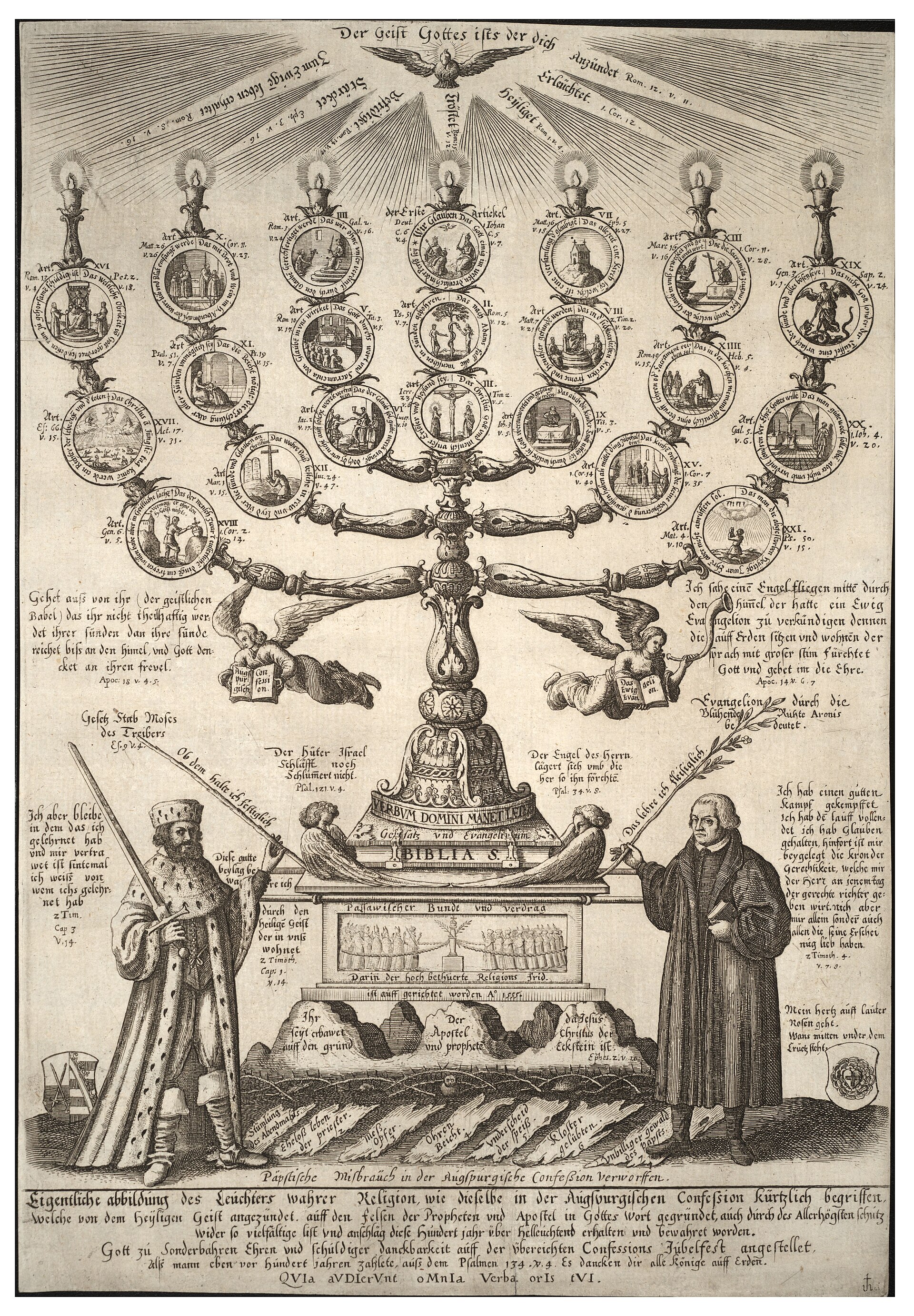
In 1530 Charles V, at peace with the pope and France for the moment, came to Germany for the first time in nine years and called a diet at Augsburg to settle religion. Luther, still under the ban, could not attend; he waited at the fortress of Coburg, on the southern edge of electoral Saxony, and sent letters. Melanchthon drafted the statement of faith of the Lutheran estates, revising it again and again in Augsburg to make it as conciliatory as conscience allowed. On June 25, 1530, the Saxon chancellor Christian Beyer read the German text aloud before the emperor and the estates in the private chapel of the bishop's palace (Schaff's description; Schaff spells the chancellor's name Baier), and the German and Latin copies were handed to the emperor.3334 It was signed by seven princes and two cities (Nuremberg and Reutlingen).
The Confession has 28 articles: 21 on doctrine, meant to show that the Lutherans held nothing contrary to Scripture or to the Catholic Church as known from the fathers, and seven on abuses that had been corrected (communion in one kind, the celibacy of priests, private Masses, compulsory confession, fasts, monastic vows and the power of bishops). Article IV, on justification, in the English of Philip Schaff's The Creeds of Christendom (volume 3, 1877), reads:
"Also they teach that men can not be justified [obtain forgiveness of sins and righteousness] before God by their own powers, merits, or works; but are justified freely [of grace] for Christ's sake through faith, when they believe that they are received into favor, and their sins forgiven for Christ's sake, who by his death hath satisfied for our sins. This faith doth God impute for righteousness before him. Rom. iii. and iv."33
(The words in brackets are Schaff's renderings of phrases found only in the German text.) Catholic theologians at Augsburg, among them Eck, answered with the Confutation, which the emperor accepted on Aug. 3; Melanchthon replied with the Apology of the Augsburg Confession (1531). The diet's recess gave the Protestants until April 1531 to submit and renewed the Edict of Worms.34 The Augsburg Confession, unaltered (the Invariata of 1530, as distinct from Melanchthon's revised Variata of 1540), became the defining confession of the Lutheran churches and is one of the documents in the Book of Concord (1580).

The Schmalkaldic League and the Schmalkaldic War
Faced with the deadline, the Protestant princes and cities met at Schmalkalden in Thuringia in December 1530 and formed a defensive alliance, the Schmalkaldic League, concluded in February 1531, led by Saxony and Hesse. Luther, who had long taught that subjects must not resist their rulers, was persuaded by the lawyers that the princes of the Empire were not simple subjects of the emperor and could resist him under imperial law.35 The Ottoman threat kept Charles from acting for most of the next fifteen years, and he granted truces (the Peace of Nuremberg, 1532) in exchange for help against the Turks. In those years Lutheran reform spread to Württemberg (1534), ducal Saxony and Brandenburg (1539) and many cities; Denmark and Sweden also adopted Lutheran church orders.
The war came in the summer of 1546, a few months after Luther's death. The emperor, with Duke Moritz of Saxony (a Lutheran who changed sides in hope of his cousin's electoral title), defeated the League at Mühlberg on the Elbe on April 24, 1547, and took Elector John Frederick of Saxony and Philip of Hesse prisoner. The Augsburg Interim of 1548 imposed a temporary religious settlement close to Catholic practice, allowing only married clergy and the cup for the laity. Resistance to it, and Moritz's second change of sides in 1552, forced Charles to accept the Treaty of Passau (1552).35
The Peace of Augsburg, Sept. 25, 1555
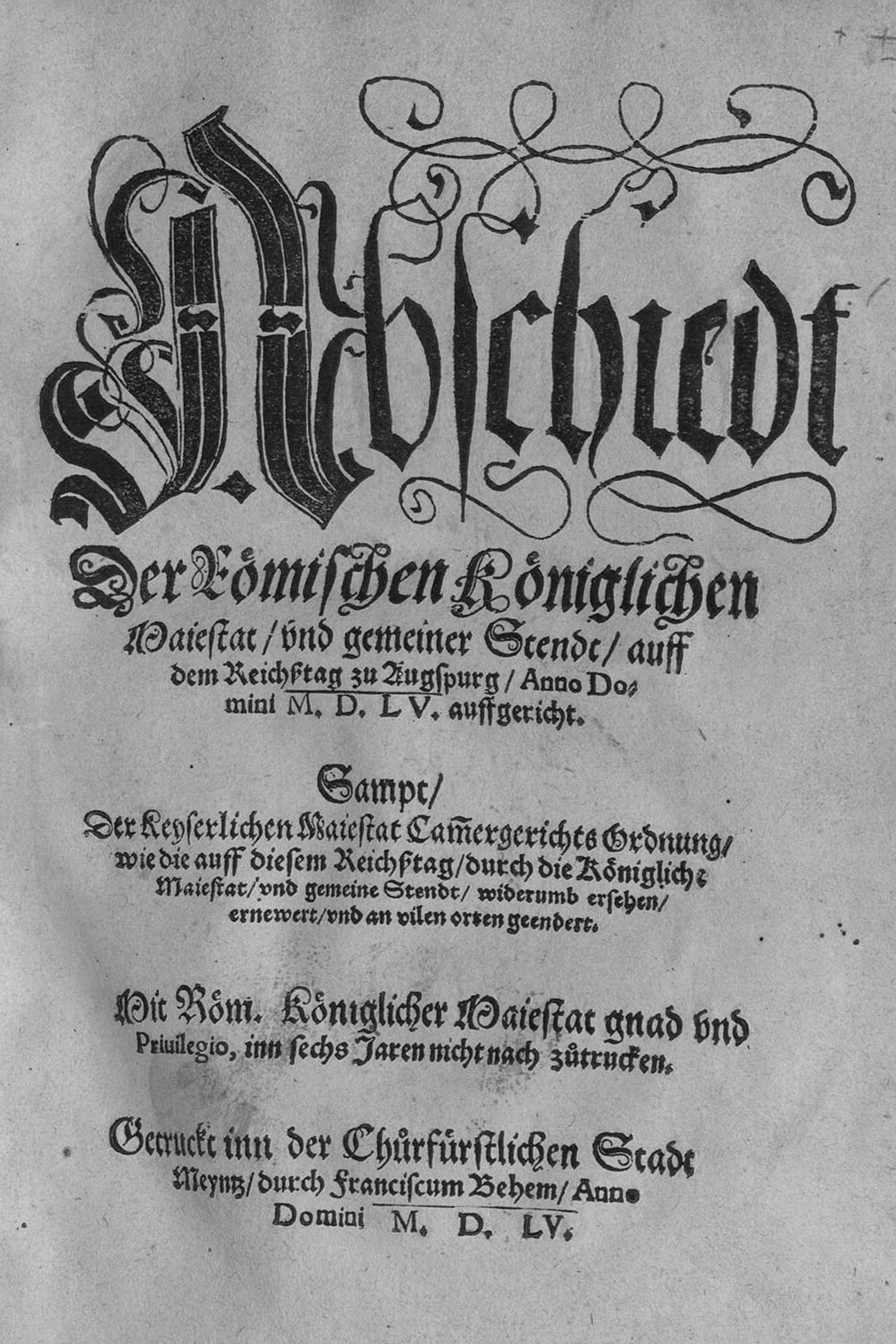
The Religious Peace of Augsburg, concluded on Sept. 25, 1555, by the diet under Charles's brother Ferdinand, made the Lutheran faith legal in the Empire. In the translation of Emil Reich's Select Documents (1905), article 15 bars the emperor and the estates from doing "any violence or harm to any estate of the empire on the account of the Augsburg Confession," and article 16 binds the estates "espousing the Augsburg Confession" to leave "all the Estates and Princes who cling to the old religion" in peace. Article 17 adds: "all such as do not belong to the two above named religions shall not be included in the present peace but be totally excluded from it."36 That excluded the Reformed (Calvinist) churches and the Anabaptists.
The Peace gave the right to choose religion to the rulers of the estates, not to their subjects. A subject who would not accept the ruler's religion had, by article 24, the right to emigrate with family and property after paying local taxes, without injury to his honor.36 Article 18, the "ecclesiastical reservation," provided that a Catholic archbishop, bishop or prelate who became a Protestant must give up his see and its income.36 The famous summary of the principle, cuius regio, eius religio ("whose the region, his the religion"), is not in the text of 1555. It is a later lawyers' formula, usually credited to the Greifswald jurist Joachim Stephani around 1600. The Peace held, with growing strain, until the Thirty Years' War (1618 to 1648), and the Peace of Westphalia (1648) finally added the Reformed churches to the settlement.

The last years and death of Luther
Luther's later years were spent building what he had begun: preaching several times a week, lecturing (his great lectures on Genesis ran from 1535 to 1545), revising the Bible, writing hymns (among them "A Mighty Fortress Is Our God," Ein feste Burg ist unser Gott, probably from 1527 or 1528), ordaining pastors and answering a stream of letters. He was often ill, with kidney stones, heart trouble, headaches and depression. He grew harsher in controversy, against the pope, against the Swiss, against the Anabaptists, against the Jews, and against Duke Henry of Brunswick in Against Hanswurst (1541). In 1537 he wrote the Smalcald Articles, a statement of what he would not concede at a council. When Pope Paul III finally summoned a general council to Trent, it opened in December 1545, two months before Luther's death (the Council of Trent is the subject of lesson 12).
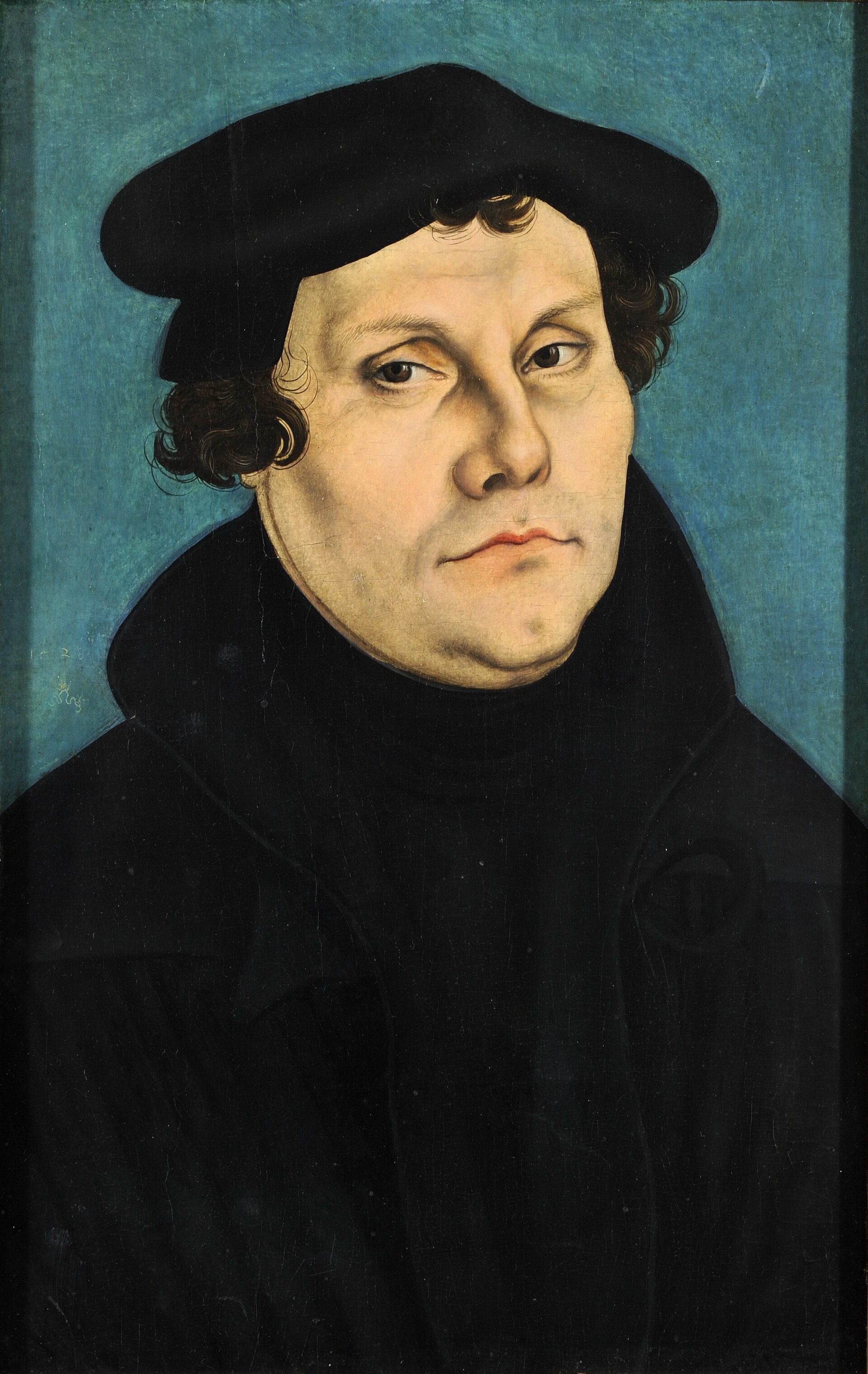

In January 1546, in winter weather, he traveled to Eisleben, his birthplace, to settle a dispute between the counts of Mansfeld. He succeeded, preached four times, and fell ill. He died there in the early morning of Feb. 18, 1546, aged 62.1 His friend Justus Jonas, who was with him, reported that when asked whether he would stand firm in the teaching he had preached, Luther answered "Yes." A slip of paper found after his death, in his hand, ended "Wir sind Bettler. Hoc est verum" (We are beggars. That is true). His body was carried to Wittenberg and buried in the Castle Church, beneath the pulpit, on Feb. 22.
Luther and the Jews
This part of the record has to be stated plainly. Luther's writings on the Jews changed over his life, and the last ones are among the most violent things he wrote.
From 1523 to 1543
In 1523 he published That Jesus Christ Was Born a Jew, which blamed the papal church's contempt and cruelty for driving Jews away from Christianity, said that in their place he would rather have stayed a Jew than become such a Christian, and urged Christians to deal with Jews kindly, let them work and live among Christians, and teach them from Scripture in the hope that they would believe. The hope behind the kindness was conversion. By the late 1530s, disappointed that Jews had not converted, alarmed by reports of Christians in Moravia adopting Jewish practices, and convinced that Jewish teaching blasphemed Christ, he turned. In 1543 he published On the Jews and Their Lies (Von den Juden und ihren Lügen), followed the same year by On the Ineffable Name and the Generations of Christ and On the Last Words of David.
On the Jews and Their Lies gives the rulers "sincere advice" in seven points. In the English translation of Martin H. Bertram (Luther's Works, volume 47, Fortress Press, 1971), as excerpted by the Jewish Virtual Library, the first reads: "First to set fire to their synagogues or schools and to bury and cover with dirt whatever will not burn, so that no man will ever again see a stone or cinder of them." The second: "I advise that their houses also be razed and destroyed." The third, that "all their prayer books and Talmudic writings" be taken from them; the fourth, "that their rabbis be forbidden to teach henceforth on pain of loss of life and limb"; the fifth, "that safe-conduct on the highways be abolished completely for the Jews"; the sixth, "that usury be prohibited to them, and that all cash and treasure of silver and gold be taken from them."37 The seventh puts young Jews to forced manual labor, and the book goes on to urge, as the best course, that rulers expel the Jews from their lands. The tract calls this a "sharp mercy" meant to save "at least a few from the glowing flames," and it adds, "We dare not avenge ourselves."37 In his last sermon at Eisleben, days before his death, he appended an "admonition" against the Jews that repeated the call to expel them if they would not convert, and also said that Christians should deal with them in Christian love and pray for them.
The tracts had some effect in Luther's lifetime (several Protestant rulers tightened restrictions on Jews; the Jewish leader Josel of Rosheim protested, and some Protestant theologians, among them the Zurich reformer Heinrich Bullinger, objected to their tone), and they were largely neglected for long periods afterward. In the twentieth century they were reprinted and quoted by Nazi propagandists. Historians disagree about how to describe Luther's position: some call it anti-Judaism, a religious hostility aimed at Judaism as a faith and open to converts; others, including Heiko Oberman in The Roots of Anti-Semitism in the Age of Renaissance and Reformation (1981; English 1984), argue that the line between that and racial hatred was already thin in the sixteenth century and that the violence of the proposals cannot be explained away.4 No historian of any confession defends the content of the 1543 recommendations.
What Lutheran churches have said
The two largest Lutheran church bodies in the United States have both spoken to these writings in their own words.
The Church Council of the Evangelical Lutheran Church in America adopted a Declaration to the Jewish Community on April 18, 1994. It says: "In the spirit of that truth-telling, we who bear his name and heritage must with pain acknowledge also Luther's anti-Judaic diatribes and the violent recommendations of his later writings against the Jews. As did many of Luther's own companions in the sixteenth century, we reject this violent invective, and yet more do we express our deep and abiding sorrow over its tragic effects on subsequent generations." It goes on to "deplore the appropriation of Luther's words by modern anti-Semites for the teaching of hatred toward Judaism or toward the Jewish people in our day."38 (That is the text as adopted in 1994. The Church Council adopted a revised version in 2021 as a reaffirmation, and the ELCA's current printing reads at this point "the appropriation in our day of Luther's words by modern anti-Semites for the teaching of hatred and incitement to violence toward Judaism and the Jewish people.")38
The Lutheran Church Missouri Synod adopted a resolution at its 1983 convention. After noting that "It is widely but falsely assumed that Luther's personal writings and opinions have some official status among us," it resolved "That we condemn any and all discrimination against others on account of race or religion or any coercion on that account," "That we reaffirm that the bases of our doctrine and practice are the Scriptures and the Lutheran Confessions and not Luther, as such," and "That while, on the one hand, we are deeply indebted to Luther for his rediscovery and enunciation of the Gospel, on the other hand, we deplore and disassociate ourselves from Luther's negative statements about the Jewish people, and, by the same token, we deplore the use today of such sentiments by Luther to incite anti-Christian and/or anti-Lutheran sentiment." The resolution ends by commending Luther's words from his last sermon: "We want to treat them with Christian love and to pray for them, so that they might become converted and would receive the Lord."39 The Missouri Synod's present web page adds that the synod "does not seek to 'excuse' these statements of Luther, but denounces them (without denouncing Luther's theology)," and argues that it would be unfair to call Luther "a rabid anti-Semite" on the basis of these writings alone, a judgment many historians do not share.39 The ELCA declaration says it speaks "in concert with the Lutheran World Federation," which had issued its own statement on the subject in 1983.38
The two statements differ in emphasis. The ELCA speaks of "tragic effects on subsequent generations" and of its own tradition's "complicity"; the LCMS stresses that Luther's personal writings carry no doctrinal authority and that the gospel must be preached to Jews as to everyone. Both reject what Luther wrote in 1543.
How Luther has been read
Lutheran readings
The Lutheran churches describe themselves as heirs of a reform of the one church, and the Augsburg Confession claims that its doctrine departs neither from Scripture nor from the Catholic Church as known from its writers. In their own words, their authority is the Bible as read in the Book of Concord (1580), which includes the Augsburg Confession and its Apology, the Smalcald Articles, Luther's two catechisms and the Formula of Concord, and not Luther's person or private writings: the LCMS resolution of 1983 says so in as many words.39 Lutheran writers have honored Luther as the man who recovered the gospel of free grace, and have also been his sharpest critics on the peasants and the Jews. From Lutheranism came the later movements told in Part C of this series: German Pietism, Philipp Jakob Spener and the Moravians, who drew on Luther's devotional writings against what they saw as a cold orthodoxy (see Part C, lesson 01: Holiness and Pietism). The Lutheran churches as they exist today, from the German territorial churches to the American synods, are the subject of Part B of this series (module 80).
Catholic readings
For four centuries Catholic writing about Luther was mostly hostile. Johannes Cochlaeus, a Catholic controversialist who had met Luther at Worms, published his Commentaria de actis et scriptis Martini Lutheri in 1549, portraying him as a proud and lawless apostate, and that portrait shaped Catholic biography until the twentieth century. In 1904 the Dominican historian Heinrich Denifle and in 1911 and 1912 the Jesuit Hartmann Grisar published large learned studies that attacked Luther's character and theology. A turn came with Joseph Lortz's Die Reformation in Deutschland (1939 to 1940), which treated Luther as a deeply religious man reacting against a late medieval church that had lost hold of its own Catholic tradition, and with Erwin Iserloh, whose argument about the theses (above) was meant to place Luther, until 1517, as a loyal reformer whom the bishops failed.
The official Catholic reading changed most in the Joint Declaration on the Doctrine of Justification, signed at Augsburg on Oct. 31, 1999, by the Lutheran World Federation and the Pontifical Council for Promoting Christian Unity. Its central sentence, paragraph 15, reads: "Together we confess: By grace alone, in faith in Christ's saving work and not because of any merit on our part, we are accepted by God and receive the Holy Spirit, who renews our hearts while equipping and calling us to good works."40 Paragraph 13 states that "the corresponding doctrinal condemnations of the 16th century do not apply to today's partner," and paragraph 41 says that those condemnations, "insofar as they relate to the doctrine of justification, appear in a new light."40 The Declaration speaks of a consensus on basic truths of the doctrine and lists remaining differences of language and emphasis. It does not address Luther's excommunication, indulgences, the papacy or the sacraments, and some Lutheran theologians, especially in Germany, and some Catholic theologians objected that it papered over real differences; the Missouri Synod did not sign it. The World Methodist Council associated itself with the Declaration in 2006, and Anglican and Reformed bodies later did the same.
On Oct. 31, 2016, Pope Francis took part in a joint Catholic and Lutheran commemoration of the Reformation's five hundredth anniversary at Lund Cathedral in Sweden with the leaders of the Lutheran World Federation. Catholic teaching on indulgences, as quoted from the Catechism at the beginning of this lesson, remains in force, and the Council of Trent (lesson 12) remains the church's answer to the doctrinal questions Luther raised.
An Orthodox footnote
The Orthodox churches, which had never been under the papacy, watched the Western quarrel from outside. In 1573 to 1581 Lutheran theologians from Tübingen sent a Greek translation of the Augsburg Confession to Patriarch Jeremias II of Constantinople, hoping for recognition. Jeremias answered with three courteous but firm letters rejecting justification by faith alone, the reduction of the sacraments and the Lutheran view of tradition, and finally asked that the correspondence end. (For the Orthodox churches themselves, see lesson 08.)
Scholars' readings
Philip Schaff, the Swiss-born American Reformed church historian whose History of the Christian Church is used throughout this lesson, wrote of the three treatises of 1520 that "Luther was the most conservative of radicals, and the most radical of conservatives," and admired him as the founder of the Protestant conscience while reporting his violence at full length.41 Roland Bainton's Here I Stand (1950) presents Luther as a man of faith whose struggle of conscience before God explains everything else; Bainton taught church history at Yale for more than forty years, and his book is warm toward its subject but candid about the peasants and the Jews.3 Heiko Oberman, a Dutch historian who taught at Harvard, Tübingen and Arizona, placed Luther in the late medieval world of nominalist theology and apocalyptic expectation, a man who expected the Last Day soon and saw the devil at work everywhere; for Oberman, Luther was a medieval man before he was a modern one.4 Lyndal Roper, Regius Professor of History at Oxford, in Martin Luther: Renegade and Prophet (2016), reads him through his body, his family, his friendships and his hatreds, and argues that his anger, his earthiness and his conviction cannot be separated.28 Diarmaid MacCulloch, in The Reformation: A History (2003), sets Luther as one actor in a Europe-wide upheaval whose outcome depended on princes, printers, cities and the Ottoman threat as much as on theology.35
One reading of the Reformation's place in the history of Western culture, Francis Schaeffer's in How Should We Then Live? (1976), is set out in the Liberty series: Liberty 56, lesson 03: How Should We Then Live.
What the record shows and what it does not
- Documented fact: Luther's letter to Albert of Mainz is dated Oct. 31, 1517, and mentions the enclosed disputations. The 95 Theses were printed in several cities by the end of 1517. Exsurge Domine is dated June 15, 1520; Decet Romanum Pontificem, Jan. 3, 1521. Luther appeared at Worms on April 17 and 18, 1521, and refused to recant. The Augsburg Confession was read on June 25, 1530. The Peace of Augsburg was concluded on Sept. 25, 1555, and recognized only the Catholic faith and the Augsburg Confession. Luther wrote Against the Robbing and Murdering Hordes of Peasants in 1525 and On the Jews and Their Lies in 1543, and the texts say what is quoted above.
- A church's own claim or tradition: that Luther nailed the theses to the door on Oct. 31 (Lutheran tradition, from Melanchthon's account of 1546); that he said "Here I stand, I can do no other" (in the form fixed in 1546); that the Lutheran Reformation restored the gospel (Lutheran); that Luther broke the unity of the church by refusing the judgment of the pope and the councils (Catholic); that the sixteenth-century condemnations on justification do not apply to today's partner (the Joint Declaration, 1999).
- Scholarly reading: that print made the Reformation possible (Edwards, Pettegree); that Luther was more medieval than modern (Oberman); that his reform became a princes' reform after 1525 (Roper and many others); that the tower experience came early or late (still argued).
- Open questions: whether, when and on which doors the theses were posted; the exact words at Worms; the year of the Rome journey; how many died in the Peasants' War; how many copies of the September Testament were printed.
Claims checked
"Luther nailed the 95 Theses to the door of the Castle Church on Oct. 31, 1517." Rating: Unresolved
Documented: Luther's letter to Archbishop Albert, enclosing the disputations, is dated "on the eve of All Saints, in the year 1517."8 The posting rests on Melanchthon's preface of June 1, 1546, written by a man who was not in Wittenberg in 1517, and on a note by Georg Rorer, found in Jena in 2006, that says the propositions were "propositae" on the doors of the Wittenberg churches on the eve of All Saints.1013 Luther's own surviving writings do not describe a posting. Erwin Iserloh argued in 1961 that it never happened; Volker Leppin still doubts it; others take Rorer's note as good evidence that it did.1011 The detail of a hammer and nails is not in any sixteenth-century source used here: Melanchthon's word is affixit, "affixed." Whether the theses went up on Oct. 31, some days later, or not at all is an open question. That Luther made his protest public in some form in the autumn of 1517, and that it spread by print, is certain.
"Tetzel preached: 'As soon as the coin in the coffer rings, the soul from purgatory springs.'" Rating: Partly supported
Two contemporaries, Mathesius and Johann Hess, attribute the rhyme to Tetzel in slightly different words, and Luther refers to the idea in theses 27 and 28 and quotes it in 1541.7 No text by Tetzel contains it, and his printed theses of 1518 state the teaching in academic form (a soul purified in purgatory flies to God).7 The rhyme fairly sums up what Luther's letter says people believed, "that, as soon as they have thrown their contribution into the chest, souls forthwith fly out of purgatory."8 That Tetzel himself used these exact words is not proved.
"At Worms Luther said: 'Here I stand. I can do no other. God help me. Amen.'" Rating: Partly supported
The refusal to recant "unless I am refuted and convicted by testimonies of the Scriptures or by clear arguments" is in all the reports and is documented.22 The famous closing sentence is not. Schaff, summarizing the nineteenth-century investigation by C. A. H. Burkhardt (1869) and Julius Köstlin (1874), reports that Luther's own Latin notes for Spalatin, Spalatin's notes and annals, and the original edition of the Acta printed right after the diet give only "God help me, Amen." Other contemporary reports, including a German print, give the whole sentence but in different orders (one has "God come to my help! Amen. Here I am"; another, "I cannot do otherwise; here I stand; God help me"), and the familiar order was fixed in the edition of Luther's works printed in 1546.22 Burkhardt rejected all but the last three words; Köstlin and Ranke defended the whole sentence; Schaff concluded it was spoken "at least in substance" in the confusion just after the formal answer. The words "Here I stand" therefore appear in early printed versions, but they are not in the most official record, and the exact form cannot be fixed.
"The church sold forgiveness of sins, even for sins not yet committed." Rating: Partly supported
The church's teaching was that an indulgence remits temporal punishment "due to sins whose guilt has already been forgiven," and no official document of the period offered forgiveness for future sins.6 But the line was blurred in practice. Albert's instruction to his preachers presented the indulgence as the gift "by which man is reconciled to God" and said that contrition was not needed for those who bought release for souls in purgatory, which is what Luther complained of to Albert, and the money changed hands at the same moment as the grace was proclaimed.8 Luther's letter says that people believed "if they buy letters of indulgences, they are sure of their salvation."8 The charge that buyers could purchase permission to sin in advance comes from later polemic and is not supported by the documents.
"The 95 Theses announced justification by faith alone." Rating: Refuted
The text does not contain the doctrine. It assumes purgatory, defends the pope's good intentions, and blesses those who speak against the preachers' abuses while cursing those who deny "the truth of apostolical pardons" (thesis 71).9 The language of justification by faith appears in Luther's lectures and later writings, and in the Augsburg Confession, Article IV.33
"Luther gave the Germans their first Bible in their own language." Rating: Refuted
Schaff counts fourteen or more printed High German Bibles before 1518, translated from the Latin, and Low German editions as well.24 What was new was a translation from the Greek and Hebrew in vivid everyday German, and its very wide circulation.
"At the Wartburg Luther threw an inkpot at the devil." Rating: Unsupported
Schaff, who visited the Wartburg in 1886, reports that "the famous ink-spot is seen no more, and the story is not authentic," and quotes Köstlin: "No old reporter ... knows any thing about the spot of the inkstand on the wall."23 Luther did describe many encounters with the devil, and Schaff's comment is that he threw the inkstand at him "not literally, but spiritually," above all by translating the New Testament.23
"The name 'Protestant' comes from the protest at Speyer in 1529." Rating: Supported
The Lutheran princes and fourteen cities protested on April 19, 1529, and entered a formal appeal on April 25 against the diet's decision; Schaff: "From this protest and appeal the Lutherans were called Protestants."31
"The Peace of Augsburg declared cuius regio, eius religio." Rating: Partly supported
The principle is there: rulers of the estates chose between the Catholic faith and the Augsburg Confession, and subjects who disagreed could emigrate (articles 15, 16, 17 and 24).36 The Latin phrase is not in the text of 1555. It is a later jurists' formula, and the ecclesiastical reservation (article 18) and later side agreements meant that the rule did not apply evenly to church territories.
"Luther told the princes to kill the rebellious peasants." Rating: Supported
The tract of May 1525 calls on rulers to "stab, kill, and strangle" the armed rebels, in Schaff's English, and promises that a ruler's soldier who dies in the fight dies a blessed death.27 The full record also includes his earlier Admonition to Peace, which blamed the lords and called many demands just, and the plea in the same tract to spare those forced to join the bands.27
"Modern anti-Semites, including the Nazis, used Luther's 1543 writings." Rating: Supported
The ELCA's declaration of 1994 deplores "the appropriation of Luther's words by modern anti-Semites for the teaching of hatred toward Judaism or toward the Jewish people in our day," and the LCMS resolution of 1983 deplores their use to incite hatred.3839 Whether Luther's writings were a cause of the Holocaust, as distinct from a source that its propagandists exploited, is a question historians answer differently; the record shows that his tracts were reprinted and quoted in Nazi Germany, and that racial anti-Semitism of the nineteenth and twentieth centuries had many other sources.
Hard questions and answers
Was Luther a heretic by his own church's standards, whatever one thinks of his theology?
By the canon law of 1520, yes, and the bull says so: Exsurge Domine condemned 41 propositions, and Decet Romanum Pontificem excommunicated him when he did not recant. The decisive moment was not the 95 Theses, which many Catholic historians now treat as a legitimate academic protest, but his statements at Leipzig in 1519 and at Worms in 1521 that popes and councils could err and had erred. Schaff, a Protestant, agreed that "by denying the infallibility of a council, he openly declared himself a heretic" in the eyes of an age that treated general councils as the final judge.22 Luther's answer was that the church is bound by Scripture, and that a council contradicting Scripture is no true judge. The disagreement is about authority, and the documents show both sides stating it plainly.
If Catholics and Lutherans now agree on justification, was the split unnecessary?
The Joint Declaration says that the sixteenth-century condemnations on justification "do not apply to today's partner" and that they "appear in a new light."40 It does not say they were wrong when made, and it does not touch the other causes of division: the papacy, the councils, the Mass as sacrifice, the number of sacraments, indulgences, the ordination of ministers. In 1517 to 1521 the conflict was about justification and also about who has the authority to judge doctrine. That second question is the one that broke the church at Worms, and the Declaration leaves it where it was. Many on both sides see the Declaration as proof that the theologians of 1530 were closer than they knew; others think it papers over real differences.
Did the princes back Luther for faith or for church property?
Both motives appear in the record, often in the same ruler. Frederick the Wise protected Luther while keeping his relics and never openly converting, for reasons that mixed piety, pride in his university and resistance to outside interference. Later princes took over monastic lands, church revenues and the appointment of clergy. Schaff, admiring the Reformation, still wrote that it was "shamefully perverted and abused by the secular rulers who seized the control of religion, made themselves bishops and popes in their dominion, robbed the churches and convents."42 On the other side, rulers like John the Steadfast and John Frederick risked their lands and freedom for the Confession: John Frederick lost his electoral title and spent five years as the emperor's prisoner after Mühlberg rather than accept the Interim. Catholic princes also profited from church control. Money and faith were tangled on every side.
Did Luther add the word "alone" to Romans 3:28?
Yes. His German New Testament reads "allein durch den Glauben" (by faith alone), though the Greek has no word for "alone." Schaff calls it "the famous interpolation" and says Luther defended it on the ground that German idiom required it for clearness; in the Open Letter on Translating (1530) Luther also defended it by claiming the translator's right in deliberately mocking terms.43 Catholic critics from the 1520s on objected that he had bent the text to his doctrine. Lutheran defenders reply that the sense of the passage ("without the deeds of the law," in the KJV) already excludes works, and that the phrase "faith alone" (sola fide) had been used by Christian writers before him. Schaff adds that the word sharpened the apparent conflict with James 2:24, "by works a man is justified, and not by faith only," which Luther in his early prefaces called "an epistle of straw" compared with the main books of the New Testament.43
Should a church carry the name of the man who wrote On the Jews and Their Lies?
Luther himself objected to the name "Lutheran." In a tract of 1522 (A Sincere Admonition to All Christians to Guard against Insurrection) he asked his followers to call themselves Christians and not by his name. Schaff gives the passage in English (without naming the tract): "I pray you, leave my name alone, and do not call yourselves Lutherans, but Christians. Who is Luther? My doctrine is not mine. I have not been crucified for any one."29 The churches that bear the name have answered the question in their own documents: the LCMS says its doctrine rests on Scripture and the Confessions "and not Luther, as such," and the ELCA rejects his "violent invective" and grieves its effects.3938 Neither statement treats the 1543 writings as a minor blemish. Whether the name should be kept is a judgment for those churches; the record shows that they have stopped defending the writings themselves.
Was Luther responsible for the Peasants' War?
Catholic writers at the time said so, and Erasmus agreed; Edwards devotes his last chapter to that charge.25 The Twelve Articles quote the gospel as Luther preached it, and his attacks on church authority encouraged ordinary people to question lords as well as bishops. But peasant risings were older than the Reformation (the Bundschuh conspiracies date from 1493 to 1517), the grievances in the articles were mostly economic and legal, Luther told the peasants not to rebel before the fighting spread, and Müntzer, not Luther, preached holy war. The fairest summary from the record is that Luther's message was one of the things the peasants carried into the war, that he repudiated their use of it, and that his call to the princes to strike them down was obeyed with great cruelty by Catholic and Lutheran princes alike.27
Learn more
- Project Wittenberg (Luther's works in English): The largest free online collection of Luther's writings in English, including the 1545 preface used in this lesson.
- Wace and Buchheim, First Principles of the Reformation (CCEL): The 95 Theses, the letter to Albert and the three treatises of 1520 in a complete public domain translation.
- Schaff, History of the Christian Church, vol. 7 (CCEL): A full narrative of the German Reformation to 1530, with long notes quoting the sources in German and Latin.
- Edwards, Printing, Propaganda, and Martin Luther (free e-book): The standard count of Luther's printed editions and of the Catholic replies.
- Joint Declaration on the Doctrine of Justification: Read the whole 1999 text to see what Catholics and Lutherans said they agree on and what they left open.
Still being checked (16 items)
These points could not be confirmed against a primary source when this lesson was written and fact checked in October 2026. The text above states each one as uncertain.
- The year of Luther's journey to Rome: Schaff gives the autumn of 1510 to early 1511; some recent scholars (Hans Schneider) argue for 1511 to 1512. Not settled.
- The story that Luther, at the top of the Scala Sancta, wondered "Who knows whether it is so?" is given from Bainton's biography from memory of its text and was not re-opened for this lesson.
- The year Georg Rorer's note was found (2006) and made public (2007) comes from the brief and press reports; the Jena library page opened gives the note's text but not the year, and the evangelisch.de article of 2010 says only "three years ago." The dating of the note itself (early 1540s) is the view of those who think it independent of Melanchthon.
- The details of Albert of Mainz's loan (Schaff: thirty thousand florins in gold from the Fuggers) differ in modern accounts; Schaff's figure is given.
- Tetzel's date of death: Schaff says July 1519, other accounts Aug. 11, 1519.
- The print run of the September Testament: Schaff says 5,000 copies; the figure of about 3,000 attributed to Pettegree and other recent historians was not checked against Brand Luther itself.
- Pettegree's Wittenberg output figures (about 8 publications a year 1502 to 1516; 2,721 titles from six printing houses 1517 to 1546, about a third by Luther) were taken from a published summary, not from the book.
- The modern estimate of 70,000 to 100,000 deaths in the Peasants' War is a commonly given range and was not checked against a specific modern study; Schaff's two contemporary figures (about 100,000 and 150,000) are documented.
- The formula cuius regio, eius religio is credited to the jurist Joachim Stephani around 1600; this attribution was not checked against a source opened for this lesson.
- The translation edition of the Augsburg Confession at bookofconcord.org is not stated on the page fetched; the lesson quotes Schaff's Creeds of Christendom instead.
- Details of the Schmalkaldic League, the Schmalkaldic War, the Interim and Passau are cited to MacCulloch's The Reformation, which was not opened during this task; the dates are standard.
- Details of Catholic historiography (Cochlaeus 1549, Denifle 1904, Grisar 1911 to 1912, Lortz 1939 to 1940), the correspondence of Patriarch Jeremias II with the Tuebingen theologians (1573 to 1581), and the Lund commemoration of Oct. 31, 2016, are from general knowledge and were not checked against sources opened for this lesson.
- Ernst Bizer's late dating of the tower experience (Fides ex auditu, 1958) is from general knowledge and was not re-checked.
- The objections of Josel of Rosheim and Heinrich Bullinger to Luther's 1543 writings, and the content of Luther's last-sermon admonition beyond the LCMS quotation (in particular that it repeated the call to expel Jews who would not convert), are from general knowledge and were not checked against sources opened for this lesson. (The seventh recommendation and the call to expel the Jews in On the Jews and Their Lies were checked against the Jewish Virtual Library excerpts.)
- Schaff's English of Luther's plea "leave my name alone" (History, vol. 7, section 78) does not name its source; the attribution to A Sincere Admonition (1522) is the usual one and was not checked against a German edition.
- The Lutheran World Federation statement of 1983 on Luther and the Jews, mentioned beside the ELCA declaration, was not opened for this lesson.
Notes
- Philip Schaff, History of the Christian Church, vol. 7, Modern Christianity: The German Reformation (2nd ed., revised, New York: Charles Scribner's Sons, 1910; public domain), Christian Classics Ethereal Library text, sections 18 to 21 (Luther's youth and training; the University of Erfurt; Luther's conversion; Luther as a monk) (retrieved Oct. 28, 2026). Read it online. ↩
- Philip Schaff, History of the Christian Church, vol. 7, Modern Christianity: The German Reformation (2nd ed., revised, New York: Charles Scribner's Sons, 1910; public domain), Christian Classics Ethereal Library text, sections 22 to 27 (Staupitz; ordination; Luther in Rome, with note 142 on the date; the University of Wittenberg; Luther as professor, doctorate of Oct. 18 and 19, 1512) (retrieved Oct. 28, 2026). Read it online. ↩
- Roland H. Bainton, Here I Stand: A Life of Martin Luther (New York and Nashville: Abingdon-Cokesbury Press, 1950). Read it online. ↩
- Heiko A. Oberman, Luther: Man between God and the Devil, trans. Eileen Walliser-Schwarzbart (New Haven: Yale University Press, 1989; German original 1982); and The Roots of Anti-Semitism in the Age of Renaissance and Reformation, trans. James I. Porter (Philadelphia: Fortress Press, 1984; German original 1981). Read it online. ↩
- Martin Luther, Preface to the Complete Edition of Luther's Latin Works (Wittenberg, 1545), trans. Andrew Thornton, OSB (Saint Anselm Abbey, 1983), from Luthers Werke in Auswahl, ed. Otto Clemen, vol. 4; Project Wittenberg, free use with attribution (retrieved Oct. 28, 2026). Read it online. ↩
- Catechism of the Catholic Church (2nd ed., Libreria Editrice Vaticana), nos. 1471 and following, quoting Paul VI, apostolic constitution Indulgentiarum doctrina (Jan. 1, 1967), norms 1 and 2; Vatican website (retrieved Oct. 28, 2026). Read it online. ↩
- Philip Schaff, History of the Christian Church, vol. 7, Modern Christianity: The German Reformation (2nd ed., revised, New York: Charles Scribner's Sons, 1910; public domain), Christian Classics Ethereal Library text, sections 30 and 31 (The Sale of Indulgences; Luther and Tetzel), with notes 180 to 186, including note 185 on the rhyme attributed to Tetzel by Mathesius and Hess (retrieved Oct. 28, 2026). Read it online. ↩
- Martin Luther, letter to Albert, Archbishop of Mainz and Magdeburg, Oct. 31, 1517 ("Introductory Letter"), in Henry Wace and C. A. Buchheim, eds. and trans., First Principles of the Reformation, or the Ninety-five Theses and the Three Primary Works of Dr. Martin Luther (London: John Murray, 1883; public domain), Christian Classics Ethereal Library text, (retrieved Oct. 28, 2026). Read it online. ↩
- Martin Luther, "Disputation of Dr. Martin Luther concerning Penitence and Indulgences" (the Ninety-five Theses, 1517), in Henry Wace and C. A. Buchheim, eds. and trans., First Principles of the Reformation, or the Ninety-five Theses and the Three Primary Works of Dr. Martin Luther (London: John Murray, 1883; public domain), Christian Classics Ethereal Library text, (retrieved Oct. 28, 2026). Read it online. ↩
- Volker Leppin, essay on the posting of the Ninety-five Theses, University of Tuebingen publication repository (Leppin_306.pdf), discussing Melanchthon's preface of June 1, 1546 (Corpus Reformatorum 6:161 to 162), Georg Rorer's two notes, and Erwin Iserloh's argument (retrieved Oct. 28, 2026). Read it online. ↩
- Catholic Theological Faculty, Johannes Gutenberg University Mainz, "Reformation ohne Hammer" (2017), on Erwin Iserloh's lecture "Luthers Thesenanschlag: Tatsache oder Legende?" of Nov. 8, 1961, at Mainz (retrieved Oct. 28, 2026). Iserloh's dates (born May 15, 1915, at Duisburg-Beeck; died April 14, 1996, at Muenster) are from the Catholic Theological Faculty of the University of Muenster's page on its emeriti (https://www.uni-muenster.de/FB2/fakultaet/emeriti/iserloh.html); the Mainz paper gives his death year as 1990, in error. Read it online. ↩
- Erwin Iserloh, Luther zwischen Reform und Reformation: Der Thesenanschlag fand nicht statt (Muenster: Aschendorff, 1966); English trans., The Theses Were Not Posted: Luther between Reform and Reformation (Boston: Beacon Press, 1968). Bibliographic details as cited by Leppin (note 10). Read it online. ↩
- Thuringian University and State Library Jena, Lichtgedanken 02 (English edition), page on Georg Rorer's handwritten note in the 1540 New Testament (retrieved Oct. 28, 2026); with evangelisch.de, "Beweist eine 'Sauklaue' Luthers Thesenanschlag?" (Feb. 16, 2010), on Martin Treu's identification of the note. Read it online. ↩
- Philip Schaff, History of the Christian Church, vol. 7, Modern Christianity: The German Reformation (2nd ed., revised, New York: Charles Scribner's Sons, 1910; public domain), Christian Classics Ethereal Library text, section 32 (The Ninety-five Theses, Oct. 31, 1517), note 187 on the doors of the Castle Church (burned 1760; bronze doors of 1858) (retrieved Oct. 28, 2026). Read it online. ↩
- Andrew Pettegree, Brand Luther: 1517, Printing, and the Rise of Protestantism (New York: Penguin Press, 2015). The Wittenberg output figures given in this lesson are taken from a published summary of the book (Books at a Glance) and were not checked against the book's own pages. Read it online. ↩
- Philip Schaff, History of the Christian Church, vol. 7, Modern Christianity: The German Reformation (2nd ed., revised, New York: Charles Scribner's Sons, 1910; public domain), Christian Classics Ethereal Library text, sections 33 to 37 (the theses controversy of 1518; Prierias; Luther and Cajetan, Oct. 12 to 14, 1518; Luther and Miltitz, January 1519; the Leipzig Disputation, June 27 to July 15, 1519) (retrieved Oct. 28, 2026). Read it online. ↩
- Martin Luther, To the Christian Nobility of the German Nation (August 1520), part I, "The Three Walls of the Romanists," in Henry Wace and C. A. Buchheim, eds. and trans., First Principles of the Reformation, or the Ninety-five Theses and the Three Primary Works of Dr. Martin Luther (London: John Murray, 1883; public domain), Christian Classics Ethereal Library text, (retrieved Oct. 28, 2026). Read it online. ↩
- Martin Luther, On the Babylonish Captivity of the Church (October 1520), in Henry Wace and C. A. Buchheim, eds. and trans., First Principles of the Reformation, or the Ninety-five Theses and the Three Primary Works of Dr. Martin Luther (London: John Murray, 1883; public domain), Christian Classics Ethereal Library text, (retrieved Oct. 28, 2026). Read it online. ↩
- Martin Luther, Concerning Christian Liberty (November 1520), in Henry Wace and C. A. Buchheim, eds. and trans., First Principles of the Reformation, or the Ninety-five Theses and the Three Primary Works of Dr. Martin Luther (London: John Murray, 1883; public domain), Christian Classics Ethereal Library text, (retrieved Oct. 28, 2026). Read it online. ↩
- Pope Leo X, bull Exsurge Domine (June 15, 1520), English translation, Papal Encyclicals Online (retrieved Oct. 28, 2026). Read it online. ↩
- Philip Schaff, History of the Christian Church, vol. 7, Modern Christianity: The German Reformation (2nd ed., revised, New York: Charles Scribner's Sons, 1910; public domain), Christian Classics Ethereal Library text, sections 47 and 48 (the bull of excommunication, June 15, 1520; Luther burns the pope's bull, Dec. 10, 1520), with the bull Decet Romanum Pontificem of Jan. 3, 1521 (retrieved Oct. 28, 2026). Read it online. ↩
- Philip Schaff, History of the Christian Church, vol. 7, Modern Christianity: The German Reformation (2nd ed., revised, New York: Charles Scribner's Sons, 1910; public domain), Christian Classics Ethereal Library text, sections 53 to 56 (the Diet of Worms, 1521; Luther's journey; Luther's testimony before the Diet; reflections), including the "Note on Luther's sentence: 'Here I stand,' etc.," which summarizes Burkhardt (1869), Koestlin (1874) and the contemporary reports (retrieved Oct. 28, 2026). Read it online. ↩
- Philip Schaff, History of the Christian Church, vol. 7, Modern Christianity: The German Reformation (2nd ed., revised, New York: Charles Scribner's Sons, 1910; public domain), Christian Classics Ethereal Library text, sections 58, 61 and 62 (the Ban of the Empire, May 8 and 26, 1521; Luther at the Wartburg, 1521 to 1522, with note 408 on the ink spot; Luther's translation of the Bible) (retrieved Oct. 28, 2026). Read it online. ↩
- Philip Schaff, History of the Christian Church, vol. 7, Modern Christianity: The German Reformation (2nd ed., revised, New York: Charles Scribner's Sons, 1910; public domain), Christian Classics Ethereal Library text, section 92 (The Printing-Press and the Reformation: annual counts of German prints 1513 to 1523; the September Testament of Sept. 22, 1522) and section 62 (earlier German Bibles) (retrieved Oct. 28, 2026). Read it online. ↩
- Mark U. Edwards Jr., Printing, Propaganda, and Martin Luther (Berkeley: University of California Press, 1994), open-access UC Press e-book, introduction, chapter 1 and tables 1 and 2 (3,183 printings of Luther's works, 1516 to 1546; Koehler's 20 percent figure; Catholic printings 1518 to 1544), and chapter 7 (Catholics on Luther's responsibility for the Peasants' War) (retrieved Oct. 28, 2026). Read it online. ↩
- Philip Schaff, History of the Christian Church, vol. 7, Modern Christianity: The German Reformation (2nd ed., revised, New York: Charles Scribner's Sons, 1910; public domain), Christian Classics Ethereal Library text, sections 65 to 68 (Protestant radicalism; the revolution at Wittenberg, Carlstadt and the new prophets; Luther returns to Wittenberg; Luther restores order, the end of Carlstadt) (retrieved Oct. 28, 2026). Read it online. ↩
- Philip Schaff, History of the Christian Church, vol. 7, Modern Christianity: The German Reformation (2nd ed., revised, New York: Charles Scribner's Sons, 1910; public domain), Christian Classics Ethereal Library text, section 75 (The Peasants' War, 1523 to 1525), with notes 557 to 565: the German text of Luther's tract against the peasants (Erlangen edition, vol. 24), Luther's letter of Aug. 16, 1525, and the Bishop of Speyer's estimate (retrieved Oct. 28, 2026). Read it online. ↩
- Lyndal Roper, Martin Luther: Renegade and Prophet (London: Bodley Head; New York: Random House, 2016). Read it online. ↩
- Philip Schaff, History of the Christian Church, vol. 7, Modern Christianity: The German Reformation (2nd ed., revised, New York: Charles Scribner's Sons, 1910; public domain), Christian Classics Ethereal Library text, sections 77 and 78 (Luther's marriage, 1525; Luther's home life, including Luther's plea "leave my name alone") (retrieved Oct. 28, 2026). Read it online. ↩
- Martin Luther, The Bondage of the Will (De servo arbitrio, December 1525), trans. Henry Cole (1823), revised by Henry Atherton, Christian Classics Ethereal Library text (retrieved Oct. 28, 2026). Read it online. ↩
- Philip Schaff, History of the Christian Church, vol. 7, Modern Christianity: The German Reformation (2nd ed., revised, New York: Charles Scribner's Sons, 1910; public domain), Christian Classics Ethereal Library text, sections 112 and 115 (the first Diet of Speyer, 1526; the second Diet of Speyer and the protest of 1529) (retrieved Oct. 28, 2026). Read it online. ↩
- Philip Schaff, History of the Christian Church, vol. 7, Modern Christianity: The German Reformation (2nd ed., revised, New York: Charles Scribner's Sons, 1910; public domain), Christian Classics Ethereal Library text, sections 107 and 108 (the Marburg Conference, 1529) and section 10 (on the fifteen articles) (retrieved Oct. 28, 2026). Read it online. ↩
- The Augsburg Confession (1530), article IV, "Of Justification," Latin and English, in Philip Schaff, The Creeds of Christendom, vol. 3, The Evangelical Protestant Creeds (New York: Harper and Brothers, 1877; public domain), Christian Classics Ethereal Library text (retrieved Oct. 28, 2026). Read it online. ↩
- Philip Schaff, History of the Christian Church, vol. 7, Modern Christianity: The German Reformation (2nd ed., revised, New York: Charles Scribner's Sons, 1910; public domain), Christian Classics Ethereal Library text, sections 117 to 120 (the Diet of Augsburg; the Augsburg Confession, June 25, 1530; the Roman Confutation and the Protestant Apology) (retrieved Oct. 28, 2026). Read it online. ↩
- Diarmaid MacCulloch, The Reformation: A History (New York: Viking, 2003; published in Britain as Reformation: Europe's House Divided, 1490 to 1700). Read it online. ↩
- The Religious Peace of Augsburg (Sept. 25, 1555), articles 15 to 24, in Emil Reich, ed., Select Documents Illustrating Mediaeval and Modern History (London: P. S. King and Son, 1905), 230 to 232, as given on a University of Oregon course page (retrieved Oct. 28, 2026). Read it online. ↩
- Martin Luther, On the Jews and Their Lies (1543), trans. Martin H. Bertram, in Luther's Works, vol. 47 (Philadelphia: Fortress Press, 1971), excerpts as published by the Jewish Virtual Library (retrieved Oct. 28, 2026). Read it online. ↩
- Evangelical Lutheran Church in America, "Declaration of the Evangelical Lutheran Church in America to the Jewish Community," adopted by the Church Council, April 18, 1994; 1994 text at the Jewish Virtual Library (retrieved Oct. 28, 2026); the ELCA's own PDF (resources.elca.org) prints the revised version adopted by the Church Council in 2021 as a reaffirmation. Read it online. ↩
- Lutheran Church Missouri Synod, "Luther and the Jews" (LCMS Frequently Asked Questions), with the text of the 1983 convention resolution (retrieved Oct. 28, 2026). Read it online. ↩
- Lutheran World Federation and the Catholic Church (Pontifical Council for Promoting Christian Unity), Joint Declaration on the Doctrine of Justification (signed at Augsburg, Oct. 31, 1999), paragraphs 13, 15, 40 and 41; text as published by Catholic Culture (the official text is on the Vatican website) (retrieved Oct. 28, 2026). Read it online. ↩
- Philip Schaff, History of the Christian Church, vol. 7, Modern Christianity: The German Reformation (2nd ed., revised, New York: Charles Scribner's Sons, 1910; public domain), Christian Classics Ethereal Library text, section 43 (Luther's Crusade against Popery, 1520) (retrieved Oct. 28, 2026). Read it online. ↩
- Philip Schaff, History of the Christian Church, vol. 7, Modern Christianity: The German Reformation (2nd ed., revised, New York: Charles Scribner's Sons, 1910; public domain), Christian Classics Ethereal Library text, section 8 (The Priesthood of the Laity) (retrieved Oct. 28, 2026). Read it online. ↩
- Philip Schaff, History of the Christian Church, vol. 7, Modern Christianity: The German Reformation (2nd ed., revised, New York: Charles Scribner's Sons, 1910; public domain), Christian Classics Ethereal Library text, section 63 (A Critical Estimate of Luther's Version), with notes 457 and 458 on "allein" in Romans 3:28 (retrieved Oct. 28, 2026). Read it online. ↩
- "Peasants, War of the (1524-25)," Catholic Encyclopedia, vol. 11 (New York: Robert Appleton, 1911), at newadvent.org: "The hordes commanded by Muenzer were defeated on 15 May, 1525, near Frankenhausen by the confederated princes of Saxony, Brunswick, Hesse, and Mansfeld" (retrieved Oct. 28, 2026). Read it online. ↩
Check yourself
1. What document is firmly dated Oct. 31, 1517?
The letter to Albert closes "From Wittemberg, on the eve of All Saints, in the year 1517." Melanchthon wrote in 1546, Exsurge Domine is dated June 15, 1520, and Rorer's note is undated.
2. According to Catholic teaching as stated in the Catechism, what does an indulgence remit?
Catechism 1471, quoting Paul VI, defines an indulgence as a remission before God of the temporal punishment due to sins whose guilt has already been forgiven.
3. Which statement about the 95 Theses is accurate?
The theses were a Latin disputation; they assume purgatory, repeatedly say the pope would agree if he knew of the abuses, and never mention faith alone.
4. Who argued in a lecture at Mainz in 1961 that Luther never posted the theses?
The Catholic church historian Erwin Iserloh gave the lecture "Luthers Thesenanschlag: Tatsache oder Legende?" on Nov. 8, 1961.
5. What did Luther say at Leipzig in 1519 that his opponent Eck treated as decisive?
Pressed by Eck, Luther defended some of Hus's condemned articles and said a council could err, which Eck took as proof of heresy.
6. What is the best rating for the claim that Luther said "Here I stand. I can do no other" at Worms?
Luther's own notes and the official Acta give only "God help me"; other contemporary reports and the 1546 edition give the fuller sentence in varying forms.
7. From what event does the name "Protestant" come?
Schaff: "From this protest and appeal the Lutherans were called Protestants."
8. Which bodies did the Peace of Augsburg (1555) recognize?
Article 17 excludes all who do not belong to the two named religions; the Reformed were added only at Westphalia in 1648.
Terms in this lesson
- Indulgence
- In Catholic teaching, a remission before God of the temporal punishment due to sins already forgiven, granted by the church from the treasury of the merits of Christ and the saints; partial or plenary, for the living or the dead.
- Ninety-five Theses
- Luther's Latin propositions for a disputation on penitence and indulgences, sent to Archbishop Albert with a letter dated Oct. 31, 1517, and reprinted across Germany within weeks.
- Tower experience (Turmerlebnis)
- Luther's discovery, described in his 1545 preface, that the righteousness of God in Romans 1:17 is the righteousness God gives by faith; its date (1513 to 1519) is disputed.
- Exsurge Domine
- The bull of Pope Leo X dated June 15, 1520, condemning 41 propositions from Luther's writings and giving him sixty days to recant.
- Decet Romanum Pontificem
- The bull of Jan. 3, 1521, that excommunicated Luther.
- Diet of Worms
- The imperial assembly of 1521 before which Luther refused to recant on April 17 and 18; the Edict of Worms (May 8, signed May 26) outlawed him.
- September Testament
- Luther's German New Testament, translated from the Greek at the Wartburg and published at Wittenberg in September 1522.
- Invocavit Sermons
- Eight sermons Luther preached in Wittenberg from March 9, 1522, arguing that reform must come by the Word and not by force, against the pace set by Karlstadt.
- Twelve Articles
- The best known statement of the peasants' demands in the Peasants' War, drafted at Memmingen in March 1525.
- Protestation of Speyer
- The protest and appeal of six Lutheran princes and fourteen imperial cities against the decision of the Diet of Speyer, April 19 and 25, 1529; the origin of the name Protestant.
- Augsburg Confession
- The Lutheran statement of faith drafted by Melanchthon and read to Charles V on June 25, 1530; 21 doctrinal articles and 7 on abuses.
- Schmalkaldic League
- The defensive alliance of Protestant princes and cities formed at Schmalkalden in 1530 and 1531, defeated by Charles V at Muehlberg in 1547.
- Peace of Augsburg
- The imperial settlement of Sept. 25, 1555, that let rulers choose between the Catholic faith and the Augsburg Confession; summed up later in the formula cuius regio, eius religio.
- Joint Declaration on the Doctrine of Justification
- The statement signed at Augsburg on Oct. 31, 1999, by the Lutheran World Federation and the Catholic Church, declaring a consensus on basic truths of justification and that the sixteenth-century condemnations on that doctrine do not apply to today's partner.
Sources
- Wace and Buchheim, First Principles of the Reformation (1883): the 95 Theses, the letter to Albert and the three treatises of 1520 (1517 to 1520 (translation 1883)) checked 2026-10
- Luther, Preface to the Complete Edition of the Latin Works (1545), trans. Andrew Thornton (1545 (translation 1983)) checked 2026-10
- Luther, The Bondage of the Will, trans. Henry Cole (1525 (translation 1823)) checked 2026-10
- Luther, On the Jews and Their Lies, trans. Martin H. Bertram (Luther's Works 47), excerpts (1543 (translation 1971)) checked 2026-10
- Leo X, Exsurge Domine (1520-06-15) checked 2026-10
- The Augsburg Confession, in Schaff, The Creeds of Christendom, vol. 3 (1530-06-25 (edition 1877)) checked 2026-10
- The Religious Peace of Augsburg, in Reich, Select Documents (1905) (1555-09-25 (translation 1905)) checked 2026-10
- Catechism of the Catholic Church, nos. 1471 and following (indulgences) (1992 (2nd ed. 1997)) checked 2026-10
- Joint Declaration on the Doctrine of Justification (1999-10-31) checked 2026-10
- ELCA, Declaration to the Jewish Community (1994-04-18) checked 2026-10
- ELCA, Declaration to the Jewish Community (PDF) (1994 (reaffirmed 2021)) checked 2026-10
- LCMS, Luther and the Jews (with the 1983 convention resolution) (1983 resolution; page 2017, updated 2023) checked 2026-10
- Philip Schaff, History of the Christian Church, vol. 7: The German Reformation (1888, revised 1910) checked 2026-10
- Mark U. Edwards Jr., Printing, Propaganda, and Martin Luther (UC Press open access) (1994) checked 2026-10
- Volker Leppin, essay on the posting of the 95 Theses (Tuebingen repository) (undated in repository) checked 2026-10
- University of Mainz Catholic Faculty, Reformation ohne Hammer (on Iserloh's 1961 lecture) (2017) checked 2026-10
- ThULB Jena, Lichtgedanken 02: Georg Rorer's note (undated web edition) checked 2026-10
- evangelisch.de, Beweist eine 'Sauklaue' Luthers Thesenanschlag? (2010-02-16) checked 2026-10
- Books at a Glance summary of Pettegree, Brand Luther (undated) checked 2026-10
- Roland H. Bainton, Here I Stand: A Life of Martin Luther (1950) checked 2026-10
- Heiko A. Oberman, Luther: Man between God and the Devil (1982 (English 1989)) checked 2026-10
- Lyndal Roper, Martin Luther: Renegade and Prophet (2016) checked 2026-10
- Andrew Pettegree, Brand Luther (2015) checked 2026-10
- Diarmaid MacCulloch, The Reformation: A History (2003) checked 2026-10
- Erwin Iserloh, The Theses Were Not Posted (1966 (English 1968)) checked 2026-10
- Catholic Encyclopedia, "Peasants, War of the (1524-25)" (1911) (1911) checked 2026-10
- ELCA, Declaration to the Jewish Community (revised 2021 printing, PDF) (1994, revised 2021) checked 2026-10