Lesson 6 of 12 · about 60 minutes · Updated October 28, 2026
Augustine and the Pelagian Dispute
You'll be able to
- Tell the main events of Augustine's life with their dates and sources, including the garden scene of Confessions 8.12, his baptism at Easter 387 and his death on Aug. 28, 430.
- State Pelagius's position in his own words from the Letter to Demetrias and the fragment Augustine quoted, and say how it differed from Augustine's teaching on grace.
- List the councils of the dispute (Diospolis 415, Carthage 418, Ephesus 431, Orange 529) and what each decreed.
- Explain original sin, prevenient grace, predestination and perseverance as Augustine taught them, and how semi-Pelagianism and the Council of Orange responded.
- Describe Augustine's use of 'compel them to come in' against the Donatists, and its limits, from his own letters.
- Compare how Catholic, Lutheran, Reformed and Orthodox Christians read Augustine, naming the scholars and documents behind each reading.
Start here: the short version
Augustine of Hippo (354 to 430) was a North African teacher of rhetoric who spent nine years among the Manichees, turned to the Catholic Church in a garden in Milan in 386, was baptized by Ambrose at Easter 387, and served as priest and then bishop of the small port city of Hippo Regius until he died there on Aug. 28, 430, while a Vandal army besieged the walls. He wrote more than any other Latin Christian of antiquity whose works survive, and two of his books, the Confessions and The City of God, are still read by people who share none of his beliefs.
In the last twenty years of his life he fought a long argument with the British monk Pelagius, the Roman lawyer Caelestius and the Italian bishop Julian of Eclanum about what a human being can do without God's help. Pelagius taught that God gave people a nature able to keep his commands and would not order the impossible. Augustine taught that Adam's sin passed to all his descendants, that the human will is bound until grace frees it, and that God chooses whom he will save and keeps them to the end. African councils (Carthage, 418), a pope (Zosimus, 418), an emperor (Honorius, 418) and the Council of Ephesus (431) condemned the Pelagian side. A softer middle position in southern Gaul, later called semi-Pelagianism, was rejected at the Council of Orange in 529, which kept Augustine's teaching on grace but refused any teaching that God predestines people to evil.
This lesson tells Augustine's life from his own pages, lets Pelagius speak from his own surviving letter, lays out the councils and their canons in their own words, and shows how Catholic, Protestant and Orthodox Christians have read Augustine since. It follows lesson 05 (the later councils) and leads into lesson 07 (the monks).
A boy from Thagaste
Aurelius Augustinus was born on Nov. 13, 354, at Thagaste (also spelled Tagaste), a small market town in the Roman province of Numidia, at the site of modern Souk Ahras in eastern Algeria.1 The day comes from Augustine himself: in an early dialogue, On the Happy Life, written at Cassiciacum in 386, he says the conversation took place on the Ides of November, his birthday. The year follows from his statement in the Confessions that his mother died when he was in his thirty-third year, in 387, and from his biographer Possidius, who says he died in his seventy-sixth year.23
His father, Patricius, was a member of the town council of modest means and a pagan who was baptized shortly before his death in about 371 (Augustine says his father had been dead two years when he was nineteen). His mother, Monica, was a devout Catholic Christian whose prayers and tears for her son fill the Confessions.1 The family was Roman in speech and law. Augustine spoke and wrote Latin, learned Greek badly as a schoolboy (he says he hated it), and never read the Greek theologians with ease. Scholars still argue about how much Punic or Berber background his family had. His mother's name may be Berber, but the evidence is thin, and Peter Brown, in Augustine of Hippo: A Biography (1967, new edition 2000), treats the family as provincial Romans of a thoroughly Latin culture.4
He went to school in Thagaste and then in nearby Madauros, and in about 370 his parents, with help from a wealthy patron named Romanianus, sent him to Carthage, the second city of the Latin West, to study rhetoric.1 Rhetoric was the training for public life in the late empire: the art of speaking well, built on close reading of Virgil and Cicero. Augustine was very good at it.
Carthage and Cicero
Book 3 of the Confessions opens with one of the most quoted sentences in Latin prose. In Albert C. Outler's translation (1955, which the Christian Classics Ethereal Library publishes as a public domain text): "I came to Carthage, where a caldron of unholy loves was seething and bubbling all around me."5 The Latin plays on the sound of the city's name, Carthago, and sartago, a frying pan. In Carthage he took a concubine, a woman he never names, and lived with her faithfully for about fifteen years. Their son, Adeodatus ("given by God"), was born around 372.1
At nineteen, in the normal course of study, he read Cicero's Hortensius, a dialogue (now lost except for fragments) that urged readers to love wisdom itself. Augustine writes that "it was this book which quite definitely changed my whole attitude and turned my prayers toward thee, O Lord, and gave me new hope and new desires." He adds that his father had been dead two years by then and that his mother was paying for his studies. The only thing that cooled him, he says, was that the name of Christ was not in it.5 He tried the Latin Bible next and found its style crude beside Cicero's. The Bible he would have picked up was one of the Old Latin versions in use in Africa before the Latin Vulgate (translated about 382 to 405 at the request of Pope Damasus) spread; these early translations were literal and rough.
Nine years with the Manichees
What drew the young Augustine next was Manichaeism, a religion founded by the Persian prophet Mani (died about 276). The Manichees taught that two eternal powers, Light and Darkness, were locked in conflict; that particles of Light were trapped in matter, including human bodies; and that the true self was a fragment of the good God that did not sin, while evil came from the alien nature of darkness. They claimed to be the true Christians, rejected the Old Testament, and offered a rational religion without the demand for simple faith that put Augustine off the Catholic Church. Their followers were divided into the Elect, who kept a strict diet and celibacy, and the Hearers, who served them. Augustine was a Hearer.
He gives the span himself: "During this period of nine years, from my nineteenth year to my twenty-eighth, I went astray and led others astray."6 That is about 373 to 382. The Manichee teaching on evil mattered for everything he later wrote. It offered him a way to say that the sin in him was not really his. When he left it, he went to the opposite pole: evil is not a substance at all but a lack of good, and sin belongs entirely to the will that chooses it. Pelagius would later hear echoes of Manichaeism in Augustine's teaching on inherited sin, and Julian of Eclanum said so openly. Augustine, who knew the Manichees from the inside, always denied it.
Augustine waited years to meet Faustus, a famous Manichee bishop, who arrived in Carthage in about 382. Augustine found him charming and honest but unable to answer his questions about astronomy and the contradictions he saw in Mani's books. From then on he stayed with the Manichees more from habit and friendship than conviction.7
Rome, Milan and Ambrose
In 383 Augustine left Carthage for Rome, partly because he had heard the students there were better behaved. He slipped away at night while his mother prayed at a shrine by the harbor; the story is in Book 5. The Roman students turned out to skip out on their fees. In 384 the city of Milan asked the prefect of Rome, Quintus Aurelius Symmachus, a leading pagan senator, to find them a public teacher of rhetoric, and Symmachus chose Augustine after a trial speech.7 Milan was then the seat of the Western emperor, Valentinian II, and the post made Augustine a public orator for the court.
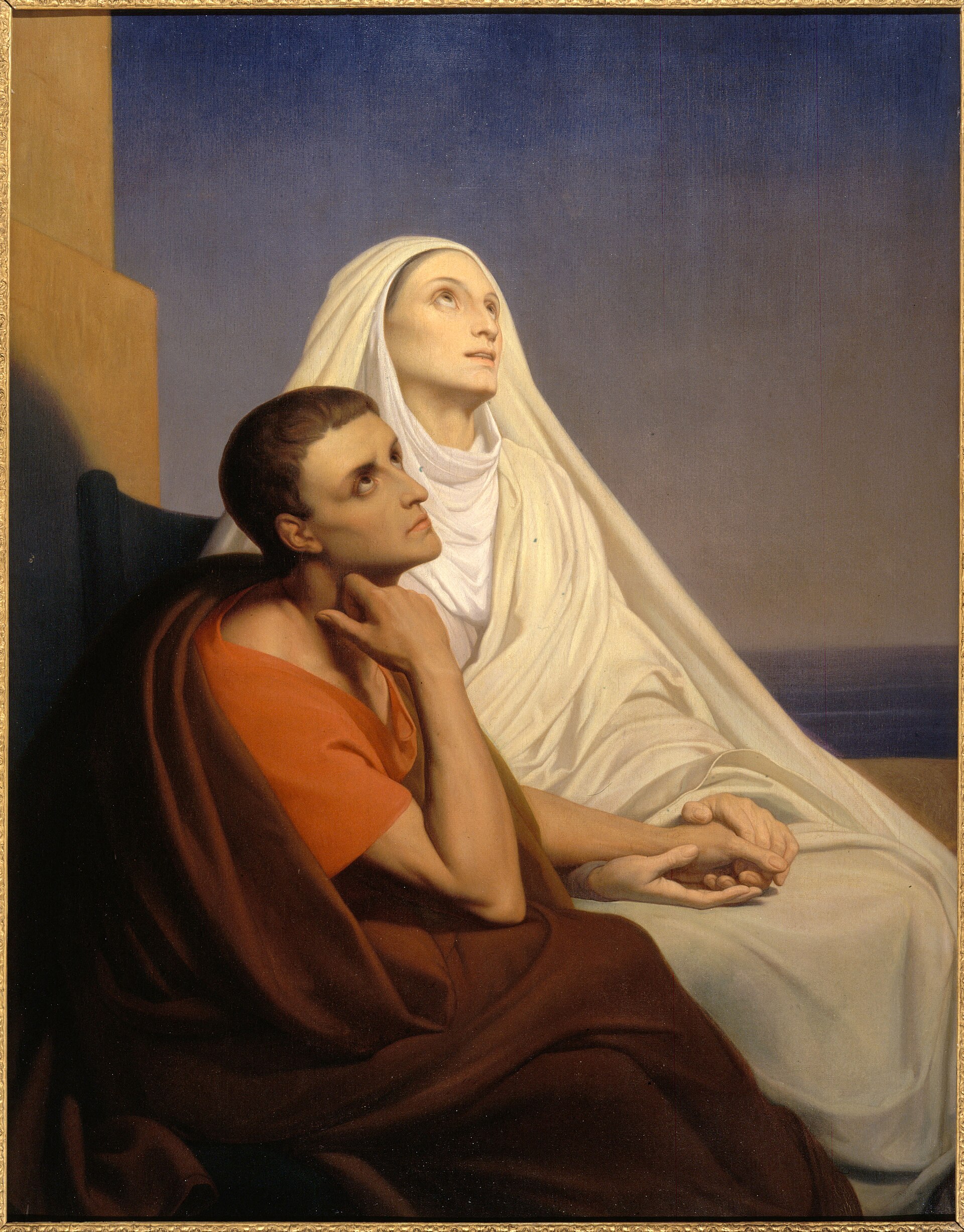
Augustine's own words: "And to Milan I came, to Ambrose the bishop, famed through the whole world as one of the best of men, thy devoted servant."7 Ambrose (bishop of Milan 374 to 397) was a former Roman governor, a preacher trained in the same rhetoric Augustine taught, and a reader of Greek Christian writers such as Origen and Basil. Augustine went to hear him at first to judge his style. What changed him was the content: Ambrose read the hard passages of the Old Testament spiritually (allegorically), which answered the Manichee objections Augustine had accepted for a decade. He also gave Augustine, through Neoplatonist books that Christians in Milan were reading, a way to think of God as spirit and of evil as the absence of good.
Monica followed him to Milan. She arranged a respectable marriage for him with a girl who was not yet of legal age, and the mother of Adeodatus was sent back to Africa. Augustine records her vow never to know another man and his own misery at the parting. He took another mistress while he waited for the wedding.1 Modern readers often fasten on this episode. Brown notes that the arrangement was normal for an ambitious provincial in the 380s and that Augustine's own account is the only source; the woman herself left no words.4

"Grant me chastity, but not yet"
By 386 Augustine believed that the Catholic Church taught the truth. What held him back, he says, was habit, above all sexual habit, and ambition. He looked back on his younger self with a sharp line: "I had entreated chastity of thee and had prayed, 'Grant me chastity and continence, but not yet.' For I was afraid lest thou shouldst hear me too soon."8 Book 8 describes a will divided against itself: he could move his limbs at a command, but his will could not command itself to will fully. This experience, a will that knows the good and does not do it, is the seed of everything he later said against Pelagius.
Two stories pushed him. An old priest, Simplicianus, told him how the famous rhetorician Marius Victorinus had made a public profession of faith at Rome. Then an African court official named Ponticianus visited and told him and his friend Alypius about Antony of Egypt, the desert monk whose Life by Athanasius was circulating in Latin, and about two imperial agents at Trier who read that Life and gave up their careers on the spot. (Antony and the monks are the subject of lesson 07.)
The garden in Milan: "Pick it up, read it"
After Ponticianus left, Augustine went out into the garden of the house where he was staying, with Alypius following. What happened next is Confessions 8.12, quoted here at length in Outler's translation:
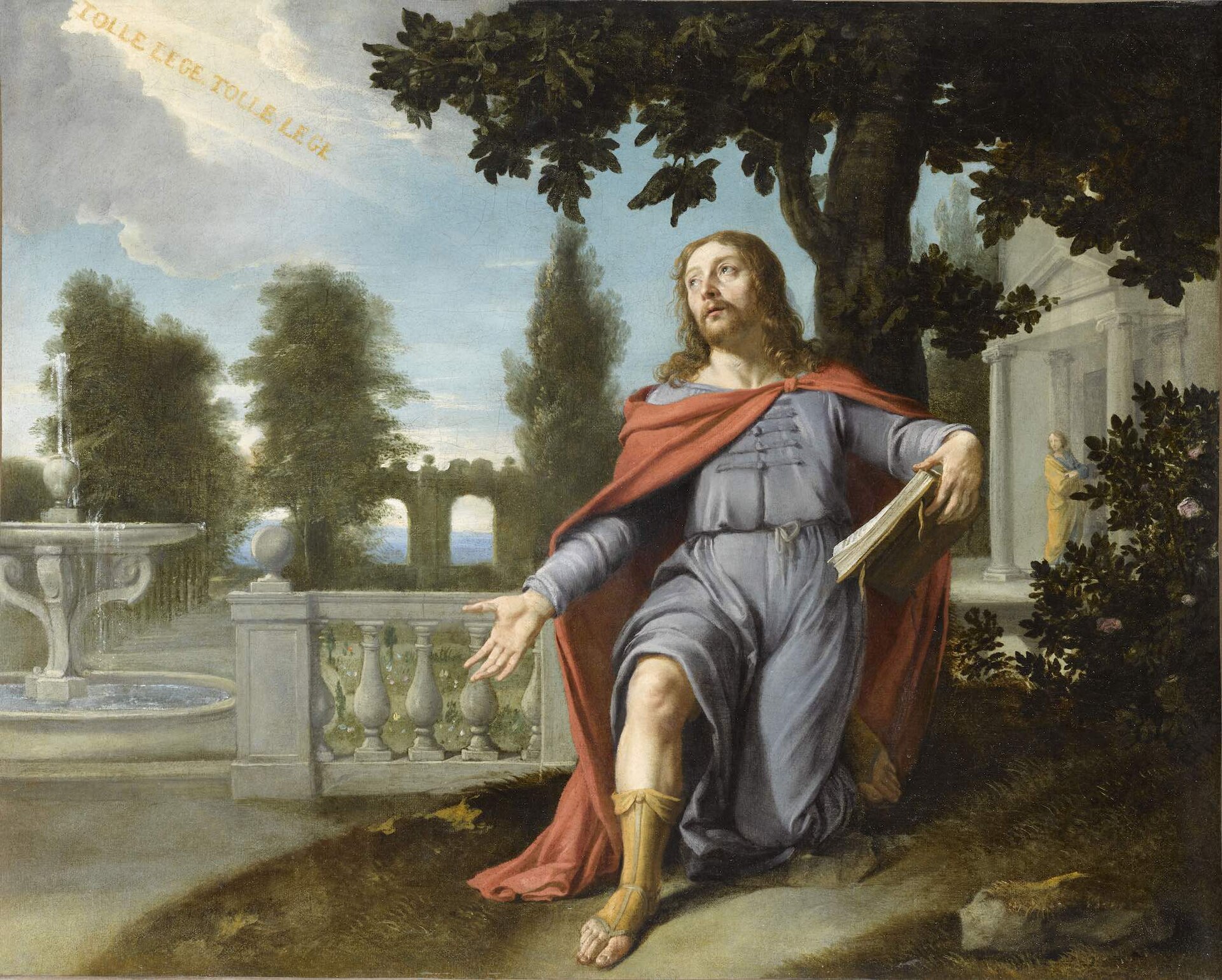
"I flung myself down under a fig tree--how I know not--and gave free course to my tears. The streams of my eyes gushed out an acceptable sacrifice to thee. ... I was saying these things and weeping in the most bitter contrition of my heart, when suddenly I heard the voice of a boy or a girl I know not which--coming from the neighboring house, chanting over and over again, 'Pick it up, read it; pick it up, read it.' Immediately I ceased weeping and began most earnestly to think whether it was usual for children in some kind of game to sing such a song, but I could not remember ever having heard the like. So, damming the torrent of my tears, I got to my feet, for I could not but think that this was a divine command to open the Bible and read the first passage I should light upon."
He went back to the bench where he had left a book of Paul's letters:
"I snatched it up, opened it, and in silence read the paragraph on which my eyes first fell: 'Not in rioting and drunkenness, not in chambering and wantonness, not in strife and envying, but put on the Lord Jesus Christ, and make no provision for the flesh to fulfill the lusts thereof.' I wanted to read no further, nor did I need to. For instantly, as the sentence ended, there was infused in my heart something like the light of full certainty and all the gloom of doubt vanished away."8
(The double hyphens are Outler's punctuation as printed. The Latin words the child chanted are tolle lege, tolle lege. The verse is Romans 13:13 to 14.) Alypius read the next verse, "Him that is weak in the faith, receive," applied it to himself, and joined him. They went in and told Monica, who, Augustine says, rejoiced. The scene took place in late summer 386; Portalie's article in the Catholic Encyclopedia dates it to September 386.1

Did it happen as told?
Since the nineteenth century some scholars have asked whether the garden scene is a literary composition. The French scholar Pierre Courcelle argued in 1950 that the fig tree and the child's voice were symbolic (the fig tree recalls Nathanael under the fig tree in John 1:48, and the reading at random recalls Antony hearing the Gospel in church). The dialogues Augustine wrote at Cassiciacum in the months after, which say little about a dramatic moment and much about philosophy, were cited as evidence that the conversion was more gradual and more Neoplatonist than the Confessions tell it. Other scholars answer that the Confessions were written about eleven years later by a bishop interpreting his own life, that literary shaping does not make an event invented, and that the Cassiciacum dialogues were set pieces in a classical genre. Brown accepts the scene as an event while reading it as Augustine's later interpretation.4 The record shows only Augustine's account; no other witness wrote about it, though Alypius was alive and a bishop when the book appeared.
Baptism, Ostia and the return to Africa
Augustine resigned his post at the end of the vintage holidays in 386, citing chest trouble, and spent the winter with his mother, his son, his brother, Alypius and a few students at a borrowed country house at Cassiciacum near Milan. He enrolled as a candidate for baptism and was baptized by Ambrose at the Easter vigil of 387, together with Adeodatus and Alypius.21 The sources name the feast and not a calendar date.
The family set out for Africa and waited at Ostia, the port of Rome, for a ship. There, Augustine says, he and his mother stood at a window looking onto a garden and talked of eternal life until they seemed to touch it (9.10). A few days later Monica fell ill with a fever. When someone worried about her being buried far from home, she answered: "Nothing is far from God." Her last request: "Lay this body anywhere, and do not let the care of it be a trouble to you at all. Only this I ask: that you will remember me at the Lord's altar, wherever you are." She died "on the ninth day of her sickness, in the fifty-sixth year of her life and the thirty-third of mine," in the autumn of 387.2 In 1945 a fragment of her verse epitaph, known before only from manuscript copies, was found at Ostia, which supports the tradition of her burial there.444
Augustine stayed in Rome for about a year, writing against the Manichees, and crossed to Africa after the usurper Maximus was killed in August 388.1 At Thagaste he set up a small community of friends who lived in prayer and study. Adeodatus, whom he describes as brilliant, died there at about seventeen, around 389 or 390.
Hippo: priest and bishop
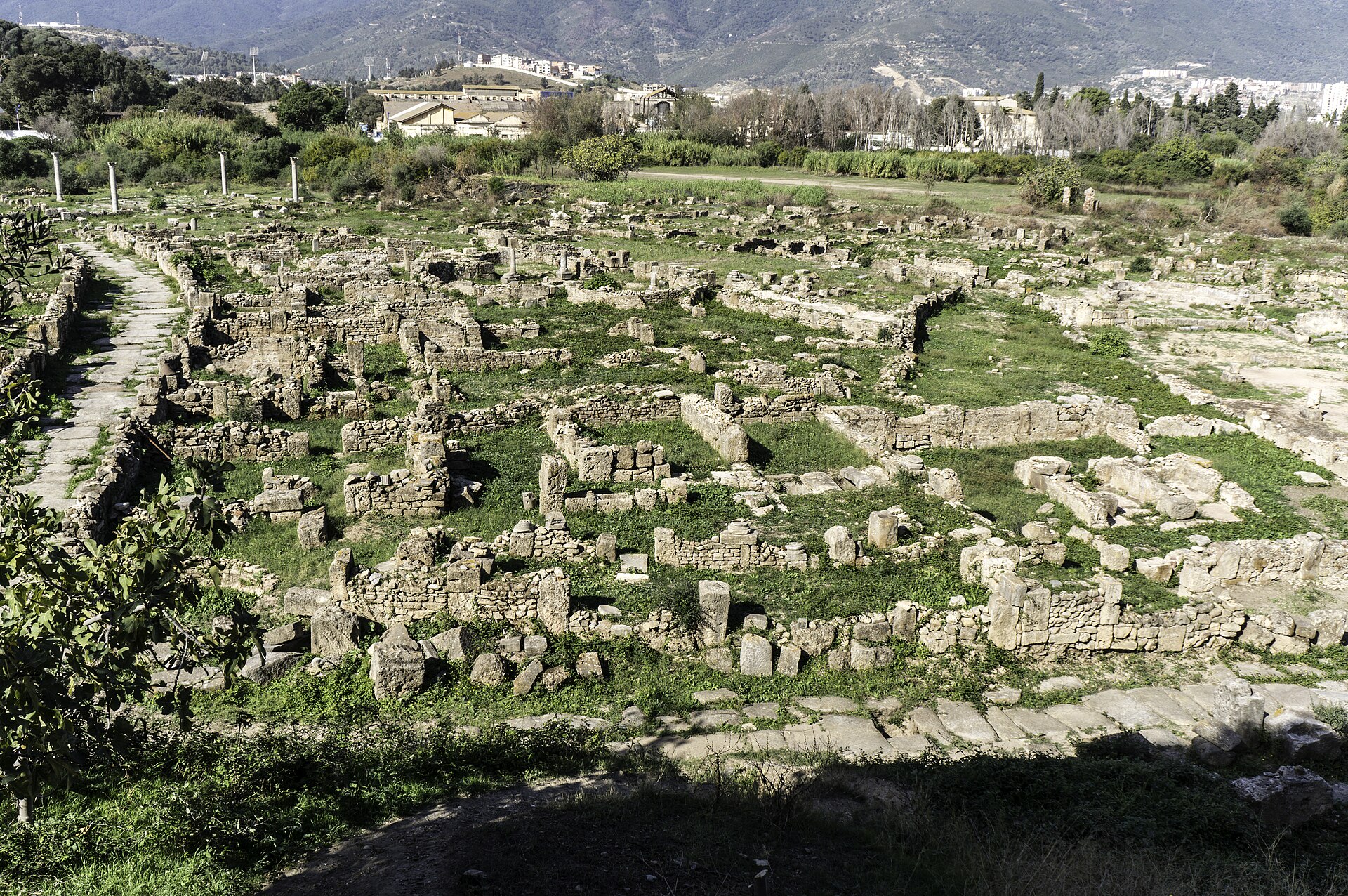
Hippo Regius was a port on the Numidian coast, the second city of Roman Africa after Carthage, at the site of modern Annaba in Algeria. In 391 Augustine visited it, he later said, to talk with a man he hoped would join his community, and he chose Hippo because it already had a bishop and he did not want to be made one. The plan failed. The old bishop, Valerius, a Greek speaker who preached poorly in Latin, told his congregation he needed a priest, and the people took hold of Augustine in church and presented him for ordination. Possidius, who knew him for nearly forty years, tells the story in chapter 4 of his Life of Augustine: Augustine wept, and the people thought he was weeping because he was not being made a bishop at once.3
Valerius let him preach, which was unusual for a priest in Africa at the time, and gave him a garden near the church for a monastery. Then, fearing that another church would take him, Valerius had him consecrated as co-bishop while Valerius was still alive. Possidius says the primate of Numidia, Megalius of Calama, performed the ordination; Augustine later learned that this violated the eighth canon of Nicaea, which forbade two bishops in one city.3 The date is given as 395 or 396. The Catholic Encyclopedia heads its section "As bishop of Hippo (396-430)" and says he held the see for thirty-four years; other scholars prefer 395, and the exact year cannot be fixed from the sources.1
As bishop he preached most Sundays and often daily, judged disputes among his people in the bishop's court that Roman law allowed (he complained in letters that it ate his mornings), cared for the poor, freed slaves and ransomed captives, and wrote. He never left Africa again. The size of what survives is unmatched for any ancient Latin author: more than a hundred books and treatises, more than two hundred and fifty letters and several hundred sermons. Discoveries continue. In 1975 Johannes Divjak found 29 unknown letters of Augustine in manuscripts at Marseille and Paris, and in 1990 Francois Dolbeau found 26 unknown sermons in a manuscript at Mainz. Brown used both in the epilogue to the 2000 edition of his biography, where he revised his earlier picture of an aging, harsh Augustine toward a more pastoral one.4

The Confessions
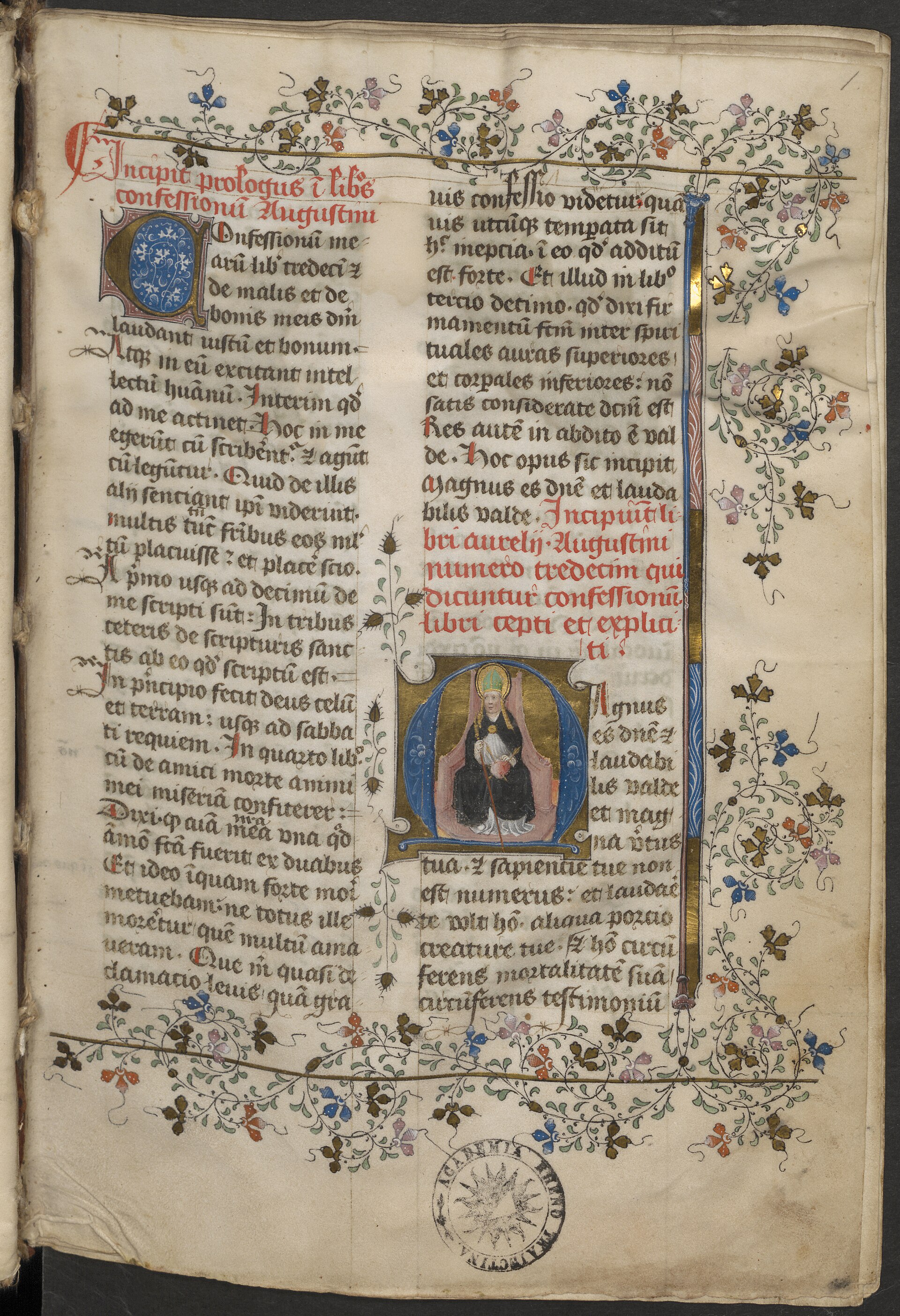
The Confessions, in thirteen books, are usually dated about 397 to 400, in the first years of his time as bishop.4 They are addressed to God from the first line, with readers allowed to overhear. The Latin word confessio meant both the admission of sin and the praise of God, and the book is both. Books 1 to 9 tell his life to his mother's death in 387. Book 10 examines his present state as a bishop: memory, the senses and the temptations he still felt. Books 11 to 13 turn to time, creation and the first chapter of Genesis. Readers who stop at Book 9 miss half the work.
The opening paragraph gives the theme in one phrase, in Outler's translation: "thou hast made us for thyself and restless is our heart until it comes to rest in thee."9 In Book 10 comes the prayer that would start the Pelagian quarrel: "My whole hope is in thy exceeding great mercy and that alone. Give what thou commandest and command what thou wilt."10 In Latin it is four words, da quod iubes et iube quod vis. The prayer says that God commands continence and that continence is itself a gift. A reader like Pelagius heard a dangerous idea in it: that people could excuse their failures by saying God had not yet given them the power to obey.
The book was unusual. Ancient autobiography existed, but nothing before it lays out the inner life of a person, his memories of infancy, a theft of pears from a neighbor's tree at sixteen (Book 2), his grief at a friend's death (Book 4), his confusion and his will at war with itself, in this way. Historians of literature treat it as the first great example of the genre. Its purpose was theological: to show, from one life, how grace works on a will that cannot heal itself.

The City of God
On Aug. 24, 410, Visigothic troops under Alaric entered Rome and plundered it for three days. It was the first time in about eight hundred years that a foreign army had taken the city. Refugees reached Africa, among them wealthy pagans who said the disaster had come because Rome had abandoned its gods for Christ. Augustine answered them in sermons and then in a book he began in 413 and finished about 426: twenty-two books, On the City of God against the Pagans.4 He wrote it in installments over thirteen years while also fighting the Donatists and the Pelagians.
The preface states the plan, in Marcus Dods's translation for the Nicene and Post-Nicene Fathers (1887): "The glorious city of God is my theme in this work, which you, my dearest son Marcellinus, suggested, and which is due to you by my promise. I have undertaken its defense against those who prefer their own gods to the Founder of this city."11 Marcellinus was the imperial commissioner who presided over the conference with the Donatists in 411; he was executed in 413 after being caught up in a political purge, despite Augustine's efforts to save him.
Books 1 to 10 argue that the old gods never protected Rome and cannot give eternal life. Books 11 to 22 tell the story of two cities from creation to the end. The central sentence is in Book 14, chapter 28: "Accordingly, two cities have been formed by two loves: the earthly by the love of self, even to the contempt of God; the heavenly by the love of God, even to the contempt of self."12 The two cities are not the Church and the state. They are two communities defined by what they love, mixed together in this world until the last judgment. The Church on earth contains members of both, and a Roman official could belong to the heavenly one.
Augustine's account of earthly rule is unsentimental. Book 4, chapter 4: "Justice being taken away, then, what are kingdoms but great robberies? For what are robberies themselves, but little kingdoms?"13 In Book 19 he takes up Cicero's definition of a republic, a people bound together by a common sense of right, and argues that on those terms there never was a Roman republic, because there was never true justice in it.14 He then offers his own definition (19.24): a people is a gathering of rational beings united by agreement about the things they love. The earthly peace, the order that even a bad state keeps, is still a good, and the heavenly city "makes use of" it during its pilgrimage (19.17).14 His ideas about law, eternal law and the law of nature are taught in the Liberty module lesson Natural Law from Cicero to Aquinas, and are not repeated here. For church history the point is that the City of God gave the medieval West its main framework for thinking about the Church, rulers and history.
The Donatists and "compel them to come in"
When Augustine became bishop, the Catholic Church in Africa was probably the smaller of two rival churches. The other was the church of the Donatists, named after Donatus, its bishop at Carthage from about 313. The split began after the Great Persecution (see lesson 03). In 311 or 312 a bishop of Carthage, Caecilian, was consecrated by a bishop accused of having handed over Scriptures to the persecutors. Those who refused him said that a sacrament given by a bishop who had betrayed the faith was invalid, and that the true Church was the pure Church of the martyrs. They rebaptized Catholics who joined them. Constantine's courts and a council at Arles (314) ruled against them, and they refused the rulings.
Augustine argued against them for twenty years. His theological answer became Western doctrine: the sacraments belong to Christ, so a valid baptism given by an unworthy minister is still baptism and should not be repeated; and the Church on earth is a mixed field of wheat and weeds that only God will separate. At the same time violence ran on both sides. Bands of rural Donatist militants called Circumcellions beat Catholic clergy, and in 412 Augustine wrote to Marcellinus about Donatists who had killed one of his priests, Restitutus, and blinded another, Innocentius, in one eye and cut off his finger.15
Augustine's position on force changed, and he said so. In Letter 93, written in 408 to the Rogatist bishop Vincentius, he explained: "For originally my opinion was, that no one should be coerced into the unity of Christ, that we must act only by words, fight only by arguments, and prevail by force of reason, lest we should have those whom we knew as avowed heretics feigning themselves to be Catholics. But this opinion of mine was overcome not by the words of those who controverted it, but by the conclusive instances to which they could point." His first example was "my own town" (usually taken to mean Thagaste), which had been Donatist and was brought into Catholic unity "by fear of the imperial edicts," and which was now, he said, glad of it.16
In 405 the emperor Honorius issued an edict of unity that treated Donatists as heretics, and after a large conference at Carthage in June 411, presided over by Marcellinus, the Donatist church was outlawed. Around 417, in a long letter to the military commander Boniface (Letter 185, also called On the Correction of the Donatists), Augustine read the parable of the great supper in Luke 14 as a warrant for that policy. The master first says "Bring in" and then "Go out into the highways and hedges, and compel them to come in" (Luke 14:23). Augustine wrote: "In those, therefore, who were first brought in with gentleness, the former obedience is fulfilled; but in those who were compelled, the disobedience is avenged."17
Stated fairly, Augustine's position had limits that later users ignored. He supported fines, loss of property and exile, and the closing of Donatist churches; he repeatedly begged officials not to execute Donatists or torture them, even those who had committed murder. In Letter 133 he asked Marcellinus not to punish the killers of Restitutus with the same injuries they had inflicted, and he praised the commissioner for getting confessions "not by stretching them on the rack, not by furrowing their flesh with iron claws, not by scorching them with flames, but by beating them with rods."15 He argued that coercion was correction of the kind a father gives a son, aimed at bringing people to hear the truth, and he pointed to former Donatists who thanked him. Brown's chapter on the subject, "Disciplina," treats these letters as the fullest justification of religious coercion written by any early Christian, the work of a man who believed he was acting from love.4
The phrase had a long afterlife. Medieval canon lawyers and the defenders of inquisitions cited "compel them to come in" and Augustine's letters. In 1686 the French Protestant philosopher Pierre Bayle, writing after Louis XIV revoked the Edict of Nantes and began forcing Huguenots into the Catholic Church, published a whole treatise against the literal reading of those words. Both the defenders of coercion and its critics have treated Augustine's Letter 93 and Letter 185 as the starting point.
Pelagius in his own words
Pelagius is one of the few people condemned as a heretic in the early Church whose own words survive in quantity. Augustine, Orosius, Prosper of Aquitaine and Marius Mercator all say he came from Britain, and he was known by the surname Brito or Britannicus.18 He was born around the middle of the fourth century, came to Rome probably in the 380s or 390s, and lived there for many years as a lay ascetic, a man under religious vows who was not ordained. Contemporaries called him a monk. He became a spiritual adviser to wealthy Roman Christian families, the same circles that read Origen and admired the desert monks. Joseph Pohle's article in the Catholic Encyclopedia (1911) notes that almost nothing is known of his early life.18
His surviving writings include a Commentary on the Thirteen Epistles of Paul, written in Rome before 410, which survived through the Middle Ages because it circulated under the names of other authors; the Cambridge scholar Alexander Souter recovered the original text in an edition of 1922 to 1931. There are also letters, among them the long Letter to Demetrias of 413, a statement of faith he sent to Pope Innocent I in 417 (the Libellus fidei), and fragments of lost books (On Nature, On Free Will) that survive only because Augustine quoted them in order to refute them. B. R. Rees translated the letters in The Letters of Pelagius and His Followers (1991) and wrote the sympathetic study Pelagius: A Reluctant Heretic (1988). Rees's title states his reading: a moral reformer pulled into a doctrinal fight he did not seek.19
The Letter to Demetrias (413)
Demetrias was a young woman of the Anicii, one of the richest families in Rome, who had fled to Africa with her mother and grandmother after the sack of 410. In 413, at Carthage, she gave up a planned marriage and took the veil as a consecrated virgin. Her family's decision was news across the Christian world, and several famous churchmen wrote to her. Pelagius's letter is a manual for a holy life. Its argument is that God made human nature good and capable, and that the commands of Scripture show what that nature can do. In chapter 16, in B. J. Kidd's translation (Documents Illustrative of the History of the Church, vol. 2, 1923), he pictures Christians complaining about God's commands:
"we shout in God's face and say, 'It's hard! It's difficult! We can't! We are but men, encompassed by the frailty of the flesh!' What blind folly! What rash profanity! We make the God of knowledge guilty of twofold ignorance: of not knowing what He has made, and of not knowing what He has commanded."
And he closes the chapter with the sentences that carry his whole position:
"No one knows better the measure of our strength than He who gave us our strength; and no one has a better understanding of what is within our power than He who endowed us with the very resources of our power. He has not willed to command anything impossible, for He is righteous; and He will not condemn a man for what he could not help, for He is Holy."20
Read in its own terms, this is an argument about the justice of God and the seriousness of the moral life. Pelagius was alarmed by Christians in Rome who were baptized, comfortable and morally slack, and who excused themselves by pointing to human weakness. If God commands holiness, Pelagius reasoned, holiness must be possible; to say otherwise accuses God of cruelty. He did use the word grace. For him grace included the gift of a free nature at creation, the law, the teaching and example of Christ, and the forgiveness of sins in baptism. What he denied was that the will after Adam is bound so that it needs an inner gift of God before it can will the good.
Ability, will and act
Augustine quoted the clearest statement of Pelagius's view, from his lost book On Free Will, in On the Grace of Christ (418), and asked his readers to "consider his own actual words":
"We distinguish, says he, three things, arranging them in a certain graduated order. We put in the first place 'ability;' in the second, 'volition;' and in the third, 'actuality.' The 'ability' we place in our nature, the 'volition' in our will, and the 'actuality' in the effect. The first, that is, the 'ability,' properly belongs to God, who has bestowed it on His creature; the other two, that is, the 'volition' and the 'actuality,' must be referred to man, because they flow forth from the fountain of the will."21
(Translation by Peter Holmes and Robert Ernest Wallis, revised by Benjamin B. Warfield, Nicene and Post-Nicene Fathers, first series, vol. 5, 1887. The Latin terms are posse, velle and esse.) On this scheme God gives the capacity, and the person supplies the willing and the doing. Augustine's whole reply was that God gives the willing too.
The Commentary on Romans
At Romans 5:12 ("by one man sin entered into the world, and death by sin; and so death passed upon all men, for that all have sinned," in the King James wording), Pelagius read Paul as saying that Adam's sin spread by example and imitation. He also recorded arguments used by people who denied that sin is passed down by birth. Augustine read the commentary in 412 and answered it in the third book of On the Merits and Forgiveness of Sins. He introduced the author as "a holy man, as I am told, who has made no small progress in the Christian life," and he was careful to note that Pelagius "has not advanced this argument against the natural transmission of sin in his own person, but has reproduced what is alleged by those persons who disapprove of the doctrine." The argument as Pelagius reported it: "If (say they) Adam's sin injured even those who do not sin, therefore Christ's righteousness also profits even those who do not believe."22 In 412 Augustine was still writing about Pelagius with respect. Within three years they were open enemies.
"Give what thou commandest" in Rome
The first clash was personal. Writing in 428 or 429, Augustine recalled that when a fellow bishop quoted the prayer from the Confessions, "Give what You command, and command what You will," in Pelagius's presence at Rome, Pelagius "could not bear" it, "and contradicting somewhat too excitedly, nearly came to a quarrel with him who had mentioned them."23 The bishop is not named, and the date is uncertain; scholars place it around 405. The story is told only by Augustine.
Caelestius and Julian of Eclanum
Two other men made the Pelagian position sharper than Pelagius usually stated it. Caelestius, a man of good family and a trained lawyer, became Pelagius's disciple in Rome and went with him to Africa after the sack. In 411 a council at Carthage under Bishop Aurelius heard charges against him brought by the deacon Paulinus of Milan (a former secretary of Ambrose), and condemned propositions taken from his writings.18 Caelestius refused to retract and went east, where he was ordained a priest at Ephesus. Augustine's report of the later hearing at Diospolis lists the propositions attributed to Caelestius and his circle: "that Adam was made mortal" and "would have died whether he had sinned or not sinned; that his sin injured only himself and not the human race; that the law, no less than the gospel, leads us to the kingdom of heaven; that new born infants are in the same condition that Adam was before the fall," and that unbaptized infants have eternal life.24
Julian, bishop of Eclanum in southern Italy, was the son of a bishop and a married man who had once been on friendly terms with Augustine's circle. He refused to sign Pope Zosimus's condemnation of 418, was deposed and exiled, and spent the next twelve years writing against Augustine with a skill that Augustine took seriously enough to answer book by book. Julian's long works survive mainly in Augustine's replies, especially the Unfinished Work against Julian that Augustine was still dictating when he died. Julian argued that Augustine's inherited sin made God unjust, condemned marriage and sexual desire as evil, and brought back the Manichee doctrine of an evil nature, the faith Augustine had left. Peter Brown calls Julian the most formidable opponent Augustine faced and the one who forced him to state his doctrine in its hardest form.4 Julian found refuge in Cilicia with Theodore of Mopsuestia and then in Constantinople, was expelled again around 430, and died, probably in Italy, in the 440s or 450s; the date is not known.18
The councils: Diospolis to Ephesus
The dispute moved across the Mediterranean through a series of local councils, papal letters and imperial orders. The order of events matters, because each side later pointed to a different stage.
Jerusalem and Diospolis (415)
Pelagius had moved to Palestine. In 415 Augustine sent the young Spanish priest Orosius there with letters warning against him. In July 415 Bishop John of Jerusalem held a meeting to hear the charges. It went badly for the accusers: Orosius spoke no Greek, the interpreter was poor, and John was friendly to Pelagius.18 In December 415 a synod of fourteen bishops under Eulogius of Caesarea met at Diospolis (ancient Lydda) to hear a written complaint from two exiled Gallic bishops, Heros and Lazarus, who were not present. Augustine's own later summary, in his Retractations, reports that Pelagius "was heard on his trial by fourteen prelates, in the absence of his accusers," and that "on his condemning the very dogmas which were read from the indictment against him, as assailing the grace of Christ, they pronounced him to be a Catholic."24
At Diospolis Pelagius disowned several statements attributed to him. Asked whether he condemned those who held one of them, he answered, by Augustine's account of the minutes: "I anathematize them as fools, not as heretics, for there is no dogma."24 His supporters treated Diospolis as an acquittal by an Eastern council. Augustine obtained a copy of the minutes and wrote On the Proceedings of Pelagius (early 417) to argue that the bishops had acquitted a Pelagius who condemned Pelagianism, and that the doctrines themselves had been condemned there.
Africa appeals to Rome (416 to 417)
In 416 two African councils, one at Carthage for the province of Proconsular Africa (about 67 bishops) and one at Milevis for Numidia (about 59 bishops), condemned the Pelagian teaching and wrote to Pope Innocent I asking him to confirm their judgment.18 Innocent answered in three letters dated Jan. 27, 417, agreeing with them and declaring Pelagius and Caelestius out of communion until they repented. On Sept. 23 of the same year Augustine told his congregation at Carthage: "For already have two councils on this question been sent to the Apostolic see; and rescripts also have come from thence. The question has been brought to an issue; would that their error may sometime be brought to an issue too!"25 (Sermon 131 in the Benedictine numbering, NPNF translation by R. G. MacMullen. The Latin phrase is causa finita est. The claims section below takes up the famous version of this sentence.)
Innocent died on March 12, 417. His successor, Zosimus, a Greek, received a confession of faith from Caelestius in person and a letter and creed from Pelagius, was impressed by both, and wrote to the Africans rebuking them for haste and suggesting the accusers were not reliable.18 For a few months the case was open again.
Carthage, May 1, 418, and its canons
The African bishops responded by working on two fronts. On April 30, 418, the emperor Honorius, at Ravenna, issued a rescript ordering Pelagius and Caelestius and their followers driven out of Rome and the cities of Italy. The next day, May 1, 418, a general council of the African church met at Carthage under Aurelius. Pohle gives the attendance as about 200 bishops.18 Its canons survive in the collection known as the Code of Canons of the African Church, where they are canons 109 to 116 (Greek numbering 112 to 117), under the heading "Synod against the heresy of Pelagius and Celestius," dated "on the Calends of May" in the consulship of Honorius for the twelfth time and Theodosius for the eighth.26 In the translation of Henry Percival (NPNF, second series, vol. 14, 1900):
- Canon 109 (Adam not created mortal): "whosoever says that Adam, the first man, was created mortal, so that whether he had sinned or not, he would have died in body ... not because his sin merited this, but by natural necessity, let him be anathema."
- Canon 110 (infant baptism): anathema on anyone who says infants "derive from Adam no original sin, which needs to be removed by the laver of regeneration." The canon quotes Romans 5:12 and says the Catholic Church "everywhere diffused has always understood it" this way. One very old manuscript adds a further canon rejecting any "middle place" of happiness for unbaptized infants; it is missing from the Greek text and from Dionysius Exiguus's collection.
- Canon 111: grace does not only forgive past sins but gives "assistance against committing sins in the future."
- Canon 112: grace does not only reveal what is commanded; it makes us able to do it, since "in each case it is the gift of God, both to know what we ought to do, and to love to do it."
- Canon 113: anathema on anyone who says grace only makes obedience easier, "as if though grace was not given, although not easily, yet nevertheless we could even without grace fulfil the divine commandments." The canon cites John 15:5: "Without me you can do nothing," and adds "and not Without me you could do it but with difficulty."
- Canons 114 to 116: the saints really are sinners when they say "If we say that we have no sin we deceive ourselves" (1 John 1:8) and when they pray "Forgive us our trespasses"; they do not say it only out of humility or on behalf of others.26
Within weeks Zosimus reversed course and issued a circular letter, the Epistula tractoria, condemning Pelagius and Caelestius and requiring bishops to sign it. Only fragments of the Tractoria survive. Eighteen Italian bishops, Julian among them, refused and were deposed.18 Pelagius himself disappears from the record after 418; where and when he died is unknown.
Ephesus (431)
The condemnation reached the East through the Council of Ephesus in 431, the council that deposed Nestorius (see lesson 05). Julian and other exiled Pelagian bishops had found shelter in Constantinople under Nestorius, which tied the two causes together. Canon 1 of Ephesus deprives any metropolitan who "has adopted, or shall hereafter adopt, the doctrines of Celestius" of power over his bishops, and Canon 4 rules that clergy who "publicly or privately presume to maintain the doctrines of Nestorius or Celestius" are to be deposed. The council's letter about the rival assembly of John of Antioch complains that "Pelagians and the followers of Celestius" sat in it.27 (Translation by Henry Percival, NPNF second series, vol. 14.) Ephesus did not adopt the African canons or discuss original sin in detail; it condemned a party by name. That is one reason Eastern churches later felt free to teach their own account of the fall.
Augustine's doctrines of grace
Augustine did not write one systematic book on grace. His teaching developed across some fifteen treatises against the Pelagians, written between 412 and 430, and it hardened as the opponents changed from Pelagius to Julian and then to the monks of Africa and Gaul. Gerald Bonner, in St Augustine of Hippo: Life and Controversies (1963, third edition 2002), traces the main lines back before the controversy, to Augustine's answers in 396 to questions from Simplician, the successor of Ambrose at Milan, on Romans 9. Augustine himself, quoting his Retractations in On the Predestination of the Saints (428 or 429), said of that answer: "In the solution of this question I laboured indeed on behalf of the free choice of the human will, but God's grace overcame."2829 The main teachings can be stated in his own words.
Original sin
For Augustine, the whole human race was present in Adam when he sinned. In the City of God 13.14: "For God, the author of natures, not of vices, created man upright; but man, being of his own will corrupted, and justly condemned, begot corrupted and condemned children. For we all were in that one man, since we all were that one man, who fell into sin by the woman who was made from him before the sin."30 What passes to each person is both a wounded nature (death, ignorance, and a disordered desire that he called concupiscence) and a share in the guilt of the first sin. Infants therefore need baptism for the forgiveness of sin, and the Church's long practice of baptizing infants "for the remission of sins" was one of his strongest arguments. The Old Latin text of Romans 5:12 that he read said that in Adam (in quo, "in whom") all sinned; the Greek eph' ho is more often read today as "because" all sinned. Augustine knew the phrase could be taken more than one way, but the reading "in whom" fit and strengthened his teaching.
He left one question open all his life: how the soul of each child comes to exist, whether passed from the parents with the body (traducianism) or created new by God for each person. The second view made it harder to explain how a newly created soul inherits guilt. Augustine admitted, in letters and in the Retractations, that he did not know.
Four states of freedom
Augustine explained what was lost in the fall with a set of Latin contrasts in On Rebuke and Grace (426 or 427), chapter 33: "to be able not to sin, and not to be able to sin; to be able not to die, and not to be able to die; to be able not to forsake good, and not to be able to forsake good. For the first man was able not to sin, was able not to die, was able not to forsake good."31 Later teachers set these out as four states: Adam before the fall was able not to sin (posse non peccare); fallen humanity is not able not to sin (non posse non peccare); the redeemed are again able not to sin, by grace; and the saints in heaven will not be able to sin (non posse peccare), a freedom greater than Adam's. For Augustine, freedom at its highest is the inability to choose evil, the freedom God himself has.
Grace that goes first
Grace for Augustine is not mainly the law, teaching or example, which Pelagius accepted, but an inner act of God on the will, which he described with the image of delight: God makes the good attractive, and the will freely loves what it was unable to love before. The will is not destroyed; it is healed and turned. Grace goes before the will (later theologians called this prevenient grace) and goes with it as it acts (cooperating grace). In On Rebuke and Grace, chapter 38, Augustine says that help is given to the weak human will "so that it might be unchangeably and invincibly influenced by divine grace; and thus, although weak, it still might not fail, nor be overcome by any adversity" (the Latin adverbs are indeclinabiliter et insuperabiliter).31 Later Reformed theologians would call this irresistible grace; Catholic theologians argued for centuries (in the Dominican and Jesuit dispute of the 1590s and 1600s) over how such grace leaves the will free.
Predestination and perseverance
If faith itself is a gift and not everyone receives it, then God gives it to some and not to others. Augustine accepted the conclusion. In On the Gift of Perseverance (428 or 429), chapter 35: "This is the predestination of the saints--nothing else; to wit, the foreknowledge and the preparation of God's kindnesses, whereby they are most certainly delivered, whoever they are that are delivered. But where are the rest left by the righteous divine judgment except in the mass of ruin, where the Tyrians and the Sidonians were left?"23 The "mass of ruin" (massa perditionis or massa damnata) is the whole human race after Adam, justly condemned. God's choice to rescue some is mercy; leaving others is justice; nobody is wronged. Augustine did not teach that God predestines anyone to sin. He held that the lost are left in a ruin they share by their own nature and add to by their own sins.
He read 1 Timothy 2:4, "who will have all men to be saved," to fit this. In the Enchiridion, chapter 103, he says the verse means "that no man is saved unless God wills his salvation: not that there is no man whose salvation He does not will, but that no man is saved apart from His will." He also offered a second reading: "all men" means people of every kind and class.32
Perseverance to the end, he taught, is also a gift, and a gift only the elect receive. Some people are truly baptized, live as Christians for years and then fall away; they were never among the predestined. No one in this life can know for certain that he will persevere, so believers should pray for it and live in humility. This made predestination a pastoral teaching for Augustine, a ground for gratitude and dependence. His critics in Gaul read it as a teaching that made preaching, warning and effort pointless.
The last years and the Vandal siege
In 429 the Vandals, a Germanic people who had crossed from Spain under their king Gaiseric, invaded Roman Africa and moved east, taking towns and burning churches. In 430 they reached Hippo and laid siege to it. Possidius, who had fled there from his own city of Calama, was with Augustine. He reports that Augustine prayed that God would free the city, or give his servants strength to bear his will, or take him from the world, and that "in the third month of the siege he succumbed to fever and began to suffer in his last illness."3
Possidius describes the death in chapter 31. Augustine, he says, "lived seventy-six years, almost forty of which he spent as a priest or bishop," and taught that even exemplary Christians and priests should not die without fitting repentance. He had the shortest penitential psalms copied and placed on the wall, read them from his bed and wept, and asked to be left alone for his last ten days except when the doctors came or his meals were brought.3 "He made no will," Possidius says, "because as a poor man of God he had nothing from which to make it. He repeatedly ordered that the library of the church and all the books should be carefully preserved for future generations."3 He died on Aug. 28, 430.1 (Pohle's article on semi-Pelagianism gives Aug. 29; the Catholic calendar and most sources keep Aug. 28.)33 The siege lasted more than a year after his death. Hippo was abandoned and later partly burned, but the library survived, and with it the manuscripts from which nearly all his works descend.
Augustine had spent his last years putting his books in order. His Retractations (426 to 427) review ninety-three works in the order he wrote them and correct what he had come to think was wrong. Possidius added a catalogue (the Indiculum) of all the works, letters and sermons in the library at Hippo.
Semi-Pelagianism: Cassian and Vincent
The word "semi-Pelagianism" is anachronistic. Pohle's article explains that the term was coined between 1590 and 1600, in the Catholic disputes over the theology of Luis de Molina; in the fifth century the Gallic monks who held the position were called by Augustine's friends "relics of the Pelagians" (reliquiae Pelagianorum).33 They were not followers of Pelagius. They accepted original sin, condemned Pelagius and believed that grace was necessary for salvation. What they could not accept was Augustine's teaching that the first turning of the will toward God is wholly God's gift and that God's choice of the elect does not depend on anything foreseen in them.
The objections came first from a monastery at Hadrumetum in Africa, where some monks read Augustine's letter on grace and asked why their abbot should rebuke them if they could do nothing good without a grace they had not been given; Augustine answered with On Grace and Free Will and On Rebuke and Grace (426 to 427). Then two laymen of southern Gaul, Prosper of Aquitaine and Hilary, wrote to Augustine that the monks of Marseilles and Lerins rejected his teaching on predestination. Augustine answered them in 428 or 429 with On the Predestination of the Saints and On the Gift of Perseverance, his last finished works on the subject.33
John Cassian
The most respected voice in Marseilles was John Cassian (about 360 to about 435), a monk who had lived in Bethlehem and in the Egyptian desert, had been ordained deacon by John Chrysostom at Constantinople and had founded two monasteries at Marseilles. His Conferences, conversations he reports with the Egyptian desert fathers, became the basic reading of Western monks (see lesson 07). In the thirteenth conference, attributed to Abba Chaeremon, Cassian wrote, in C. S. Gibson's translation (NPNF second series, vol. 11, 1894): "And when He sees in us some beginnings of a good will, He at once enlightens it and strengthens it and urges it on towards salvation, increasing that which He Himself implanted or which He sees to have arisen from our own efforts."34 The phrase "or which He sees to have arisen from our own efforts" is the heart of the dispute. Cassian also wrote, in the same conference, that God's providence "not only accompanies" the will "but actually constantly precedes it," and he closed by saying that how "God works all things in us and yet everything can be ascribed to free will, cannot be fully grasped by the mind and reason of man."34 Read in his own terms, Cassian was a monastic teacher defending the meaning of effort, and he refused to choose between two truths he held together. Prosper attacked the conference in a book Against the Conferencer (about 433).
Vincent of Lerins
Vincent, a monk of the island monastery of Lerins off the coast of Provence, published his Commonitorium in 434 under the name "Peregrinus," three years after Augustine's death.33 The book offers a rule for telling true doctrine from new error. In C. A. Heurtley's translation (NPNF second series, vol. 11): "in the Catholic Church itself, all possible care must be taken, that we hold that faith which has been believed everywhere, always, by all. For that is truly and in the strictest sense Catholic."35 (The Latin is quod ubique, quod semper, quod ab omnibus creditum est.) The book names no living opponent. Many scholars, following Prosper's suspicions, read it as a quiet challenge to Augustine's predestination as a novelty that the earlier fathers had not taught; others think the link is overstated. The text itself does not name Augustine, so the question is one of reading.
The Council of Orange (529)
The debate in Gaul went on for a century. Faustus, bishop of Riez (died about 490), wrote On Grace defending the Gallic position, and a priest named Lucidus was made to retract a strict predestinarian view at synods of Arles (473) and Lyon (474).33 The matter was settled for the Western Church by a small council at Orange (Arausio) in southern Gaul, called by Caesarius, bishop of Arles, a former monk of Lerins and a devoted reader of Augustine. Pohle dates it to July 3, 529. The surviving text carries the signatures of fourteen bishops and several lay nobles, and much of its wording repeats propositions drawn from Augustine and Prosper; scholars connect it with a set of such propositions sent from Rome. Pope Boniface II approved the decrees; Pohle places his letter in the following year, and other scholars date it to January 531.33
The council issued 25 canons and a concluding statement. In the translation hosted by the Internet Medieval Sourcebook at Fordham University:
- Canon 1: anyone who denies that "it is the whole man, that is, both body and soul, that was 'changed for the worse' through the offense of Adam's sin, but believes that the freedom of the soul remains unimpaired and that only the body is subject to corruption, he is deceived by the error of Pelagius."
- Canon 4: "If anyone maintains that God awaits our will to be cleansed from sin, but does not confess that even our will to be cleansed comes to us through the infusion and working of the Holy Spirit, he resists the Holy Spirit himself."
- Canon 5: anyone who says that "not only the increase of faith but also its beginning and the very desire for faith ... belongs to us by nature and not by a gift of grace" is "opposed to the teaching of the Apostles."36
The conclusion states the council's teaching on the fall: "The sin of the first man has so impaired and weakened free will that no one thereafter can either love God as he ought or believe in God or do good for God's sake, unless the grace of divine mercy has preceded him." It adds that "all baptized persons have the ability and responsibility, if they desire to labor faithfully, to perform with the aid and cooperation of Christ what is of essential importance in regard to the salvation of their soul." And it ends with a sharp line: "We not only do not believe that any are foreordained to evil by the power of God, but even state with utter abhorrence that if there are those who want to believe so evil a thing, they are anathema."36
Orange therefore adopted Augustine's teaching that grace goes before every good movement of the will, including the beginning of faith, and rejected the Marseilles position on that point. It said nothing about the predestination of the elect, the number of the saved, or grace that cannot fail of its purpose, and it condemned predestination to evil, which Augustine never taught but some of his readers did. Historians often call the result a moderate Augustinianism. The canons of Orange were little cited in the high Middle Ages; they came back into wide use after they were printed in the sixteenth century, when Catholics and Protestants both appealed to them.
How Augustine shaped later Christianity
No writer after the New Testament has been quoted more often by Western Christians. Medieval theologians cited him as the authority of authorities; the Protestant Reformers claimed him; the Council of Trent answered them in language taken from the African councils he guided. The Eastern churches honor him as a saint and read him differently. Each tradition's reading is given here in its own terms.

The medieval West and Aquinas
Medieval readers learned Augustine through collections of extracts, through Gregory the Great (see lesson 09), through the Rule that bore his name and was followed by many orders of canons and friars, and through Peter Lombard's Sentences (about 1150), the standard theology textbook, which quotes him on almost every page. Thomas Aquinas (died 1274) built a different philosophical frame, drawing on Aristotle, but on grace he followed Augustine closely. In the Summa Theologiae, first part of the second part, question 109, article 2, Aquinas answers whether a person can will or do good without grace by citing Romans 9:16 and then Augustine: "And Augustine says (De Corrept. et Gratia ii) that 'without grace men do nothing good when they either think or wish or love or act.'"37 (English Dominican Fathers translation, 1920.) Aquinas held, with Augustine, that God predestines the elect and that grace is needed even to prepare for grace (article 6). Debates in the fourteenth century turned on whether later theologians had drifted back toward Pelagius. The English theologian Thomas Bradwardine wrote a large book On the Cause of God against the Pelagians (about 1344) aimed at writers of his own day.
Luther, the Augustinian friar
Martin Luther entered the friary of the Order of Hermits of Saint Augustine at Erfurt in July 1505 and remained an Augustinian friar until he laid aside the habit in 1524 (see lesson 11). His order took its rule and its name from Augustine, and his superior and mentor, Johann von Staupitz, was a theologian of grace in the Augustinian tradition. In September 1517, weeks before the 95 Theses, Luther wrote a Disputation against Scholastic Theology whose first theses read, in Harold Grimm's translation as printed in Martin Luther's Basic Theological Writings (ed. Timothy Lull and William Russell): "1. To say that Augustine exaggerates in speaking against heretics is to say that Augustine tells lies almost everywhere. This is contrary to common knowledge. 2. This is the same as permitting Pelagians and all heretics to triumph."38 Luther's teaching that the will is bound, set out against Erasmus in The Bondage of the Will (1525), drew on Augustine's anti-Pelagian writings. Luther also differed from Augustine on a central point. Augustine described justification as God making a person righteous by pouring love into the heart; Luther described it as God declaring the sinner righteous for Christ's sake, received by faith. Catholic and Lutheran scholars have argued ever since whether Luther's reading was faithful to Augustine or a new departure.
Calvin
John Calvin (see lesson 12) quoted Augustine more than any other ancient writer. In Book 2, chapter 2, of the Institutes of the Christian Religion, on the bondage of the will, the summary at the head of the chapter in Henry Beveridge's translation (1845) reads: "The language of the ancient writers on the subject of Free Will is, with the exception of that of Augustine, almost unintelligible."39 Calvin used Augustine's writings on predestination to argue for God's eternal election, and he went beyond Augustine in teaching explicitly that God also decrees the reprobation of the lost, which the Council of Orange had not discussed and which Augustine had generally described as God leaving the lost in the ruin they deserved. Calvinists claimed to be the true heirs of Augustine; their Catholic and Lutheran critics answered that they had hardened him.
Trent and the Catholic answer
The Council of Trent (1545 to 1563) answered the Reformers with canons that reach back to Carthage. Its decree on original sin (fifth session, June 17, 1546) repeated the African teaching that Adam's sin passes to all by propagation and that infants are baptized for its remission. Its decree on justification (sixth session, Jan. 13, 1547) opens its canons with two anathemas aimed at the Pelagian position, in J. Waterworth's translation (1848): "CANON I.-If any one saith, that man may be justified before God by his own works, whether done through the teaching of human nature, or that of the law, without the grace of God through Jesus Christ; let him be anathema. CANON II.-If any one saith, that the grace of God, through Jesus Christ, is given only for this, that man may be able more easily to live justly, and to merit eternal life, as if, by free will without grace, he were able to do both, though hardly indeed and with difficulty; let him be anathema."40 The second canon follows canon 113 of Carthage, "not Without me you could do it but with difficulty," almost word for word. Trent then went on to condemn the Reformers' teaching on justification by faith alone. Both sides of the sixteenth century claimed Augustine and condemned Pelagius.
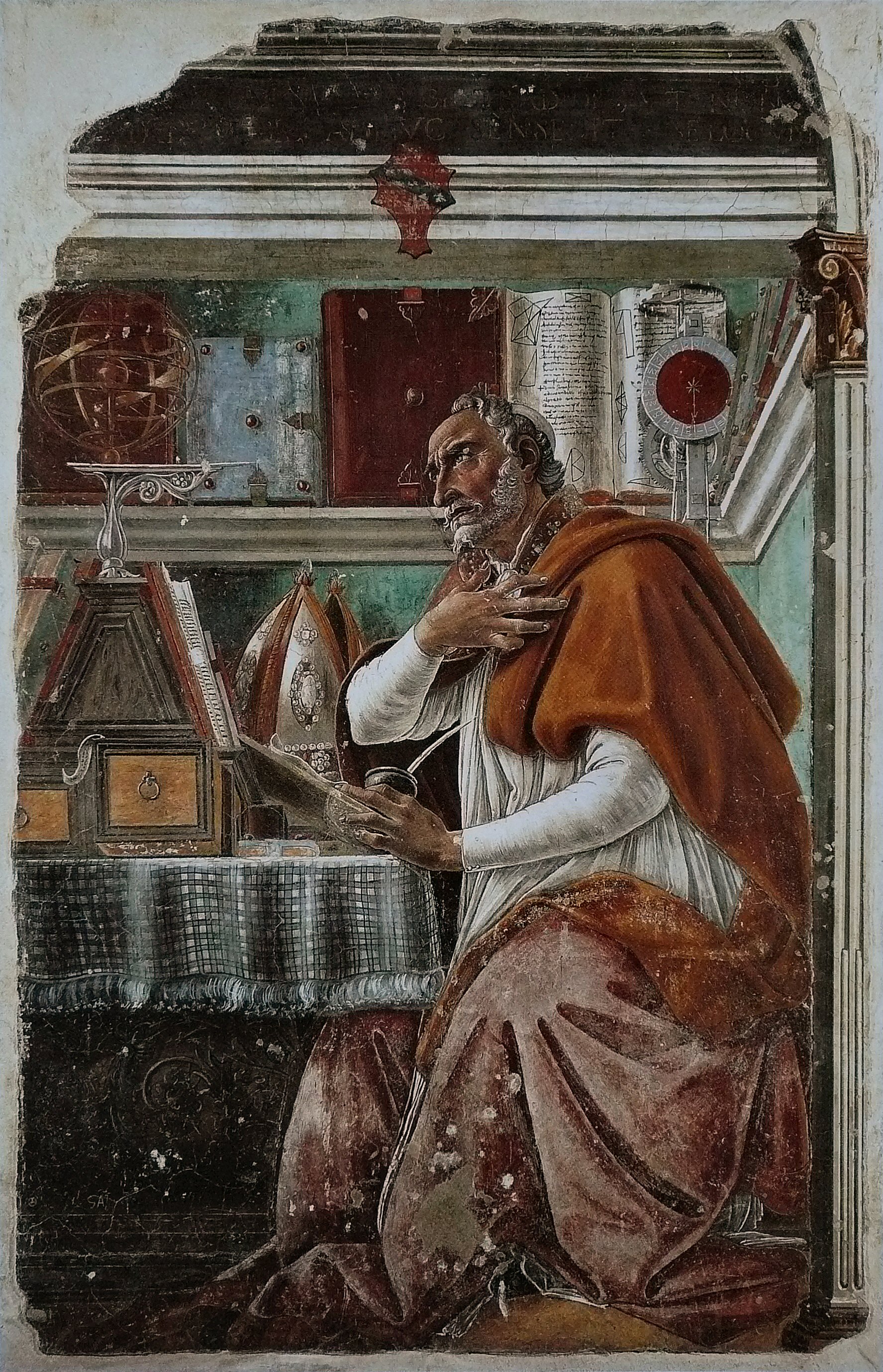
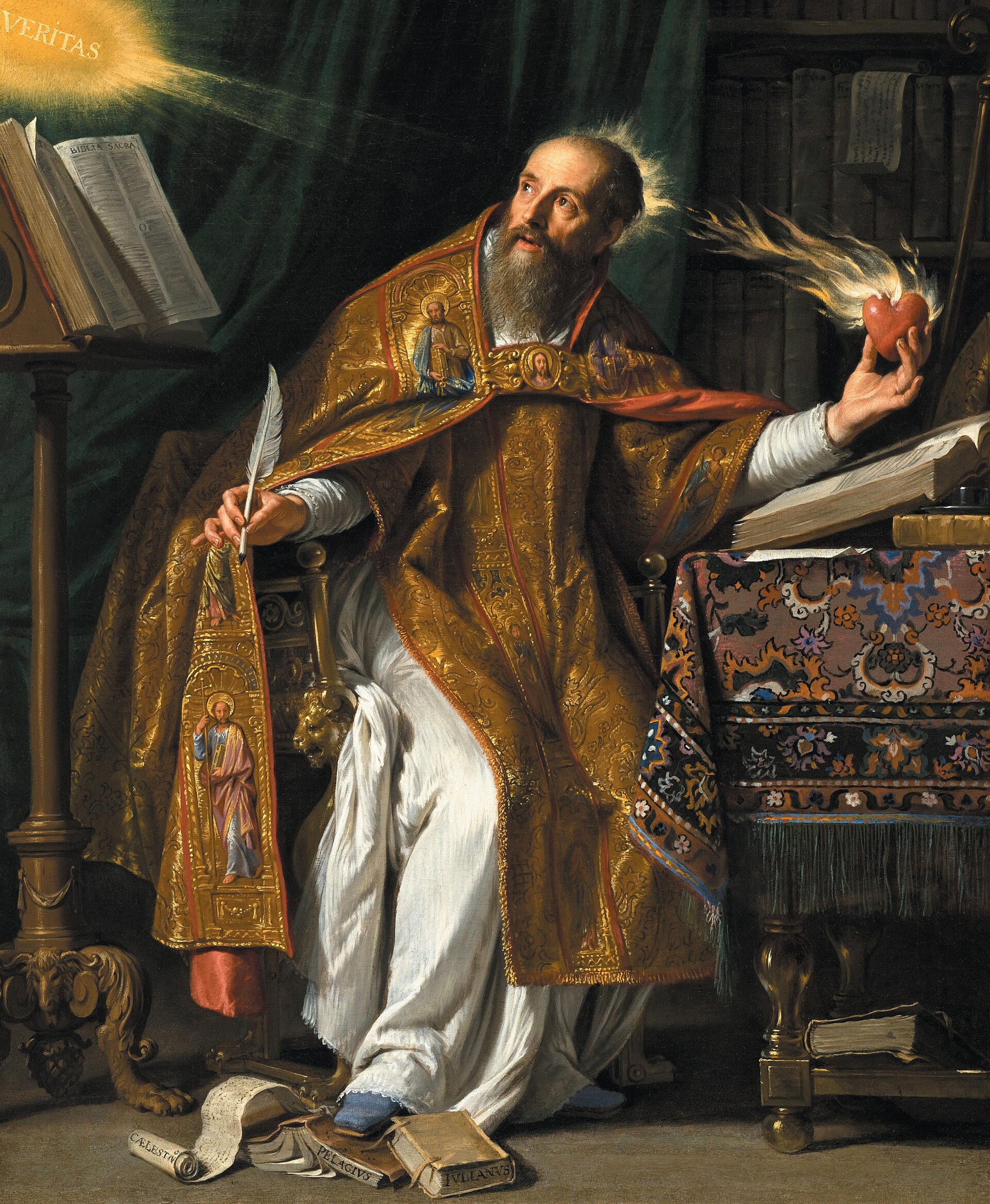
The quarrel did not end within Catholicism. Cornelius Jansen, bishop of Ypres, wrote a long study called Augustinus (published 1640) arguing for a strict reading of Augustine's grace; the movement it started, centered on the convent of Port-Royal near Paris, was condemned by Pope Innocent X in 1653. Philippe de Champaigne, whose paintings of Augustine appear in this lesson, was closely tied to Port-Royal.

The Eastern Orthodox reading
The Orthodox Church counts Augustine among the saints, often as "Blessed Augustine," but his works were little known in Greek for most of Byzantine history; the first Greek translation of his On the Trinity was made in the late thirteenth century. Orthodox theology developed its account of the fall from the Greek fathers. Timothy Ware (Metropolitan Kallistos of Diokleia), in The Orthodox Church (1963, revised editions to 2015), explains that Orthodox Christians teach that humanity inherits from Adam mortality and a corrupted, weakened nature inclined to sin, but that most Orthodox theologians do not accept the Augustinian idea of inherited guilt, that is, that children are born guilty of Adam's sin itself. He also notes that Orthodoxy has a more positive view of human freedom after the fall than Augustine's later writings allow, and that the Orthodox describe salvation as cooperation (synergeia) between God's grace and the human will.41 John Meyendorff, in Byzantine Theology (1974), argued that the Greek fathers read Romans 5:12 as saying that death spread to all, and that because of mortality all sin; the inheritance is death, and sin follows from it. That reading depends partly on the Greek eph' ho that Augustine's Latin rendered "in whom."42
Some Western writers have called the Orthodox position semi-Pelagian. Orthodox theologians reject the label as a Western category: they affirm, with the councils, that no one is saved without grace, and they accept the condemnation of Pelagius at Ephesus. They did not receive the canons of Carthage or Orange as statements of their faith, since those were Western councils. The difference is real, documented, and centuries old, and each side describes it in its own terms.
How scholars read the dispute
Peter Brown's Augustine of Hippo (1967) changed the study of Augustine by reading his ideas through his life and his African setting. Brown presents the Pelagian dispute as a clash between two ideals of the Church: Pelagius's call for a church of morally serious, perfected Christians, and Augustine's church of sinners always in need of healing. In his essay "Pelagius and His Supporters" (1968), he showed that Pelagius's message appealed above all to wealthy Roman households that wanted a demanding religion. In the 2000 epilogue Brown wrote that the new letters and sermons showed a more patient, pastoral bishop than he had described.4 Gerald Bonner's St Augustine of Hippo: Life and Controversies remains the standard narrative of the three great controversies (Manichee, Donatist and Pelagian) and treats Augustine's teaching as developing steadily from 396.28 B. R. Rees argues that Pelagius was condemned in part for positions stated more sharply by Caelestius and Julian, and that his own writings show a moralist with little interest in speculative theology.19 Writers from every side agree on the record: what the councils decreed, when, and in what words. They still disagree about whether Augustine read Paul rightly.
What the record shows and what it does not
- Documented fact: Augustine was born Nov. 13, 354, at Thagaste, was baptized at Easter 387 in Milan, became priest at Hippo in 391 and bishop about 395 to 396, and died there on Aug. 28, 430, in the third month of the Vandal siege (his own writings, Possidius). The African council of May 1, 418, issued canons against Pelagian teaching that survive in the Code of Canons of the African Church. Ephesus (431) named the "doctrines of Celestius" in canons 1 and 4. Orange (529) issued 25 canons and a conclusion that rejected predestination to evil.
- Documented fact, from the condemned side: Pelagius's Letter to Demetrias (413) and Commentary on Paul survive in his own words. His statements at Diospolis survive only in Augustine's report of the minutes, and his lost books survive only as quoted by Augustine. Julian's works survive mainly in Augustine's replies.
- Augustine's own account: the garden scene, the child's voice and the conversion experience are known only from the Confessions, written about eleven years later.
- Church teaching and tradition: the Catholic Church treats the African canons and Orange, as received by popes, as binding teaching on grace; Lutheran and Reformed confessions cite Augustine as a witness to their doctrines; the Orthodox Church honors Augustine as a saint without receiving the Western councils on original guilt.
- Scholarly reading: whether Pelagius was a heretic or a moralist condemned for his followers' sharper claims (Rees), how much Augustine's teaching changed after 396 (Bonner, Brown), and whether Vincent of Lerins aimed his rule at Augustine.
- Open questions: the exact year Augustine became bishop; the date of Pelagius's clash in Rome over "Give what thou commandest"; where and when Pelagius died; the exact form and date of Boniface II's approval of Orange.
Claims checked
Common statements about Augustine and the Pelagian dispute, from sermons, textbooks, websites and polemics on every side, rated against the record.
"Rome has spoken; the case is closed" (Roma locuta est, causa finita est): Partly supported
The famous Latin sentence does not appear in Augustine's works. What he said, in Sermon 131 on Sept. 23, 417, was that two African councils had sent their decisions to the Apostolic See, that rescripts had come back, and "The question has been brought to an issue [causa finita est]; would that their error may sometime be brought to an issue too!"25 He did treat the pope's reply as settling the matter, which supports the Catholic use of the phrase. But the sentence also credits the two African councils, and within months Pope Zosimus reopened the case and the Africans resisted him until he changed course. The short slogan compresses a longer and more complicated story.
"Pelagius taught that people save themselves without God's grace": Partly supported
Pelagius used the word grace and thanked God for it. In his own words, God bestowed the "ability" on his creature and assists it "by the help of His grace."21 What he denied was the Augustinian claim that the will after the fall needs an inner gift before it can will the good. The councils of 418 condemned the view that grace only reveals what to do or only makes obedience easier (canons 112 and 113).26 Saying Pelagius denied all grace overstates his position; saying his grace was something less than what the councils required is accurate.
"Augustine invented original sin": Partly supported
Earlier Christian writers taught that Adam's sin affected all his descendants. About 253, Cyprian of Carthage wrote that an infant "has not sinned, except in that, being born after the flesh according to Adam, he has contracted the contagion of the ancient death at its earliest birth," and that in baptism "are remitted, not his own sins" but another's.43 Tertullian and Ambrose wrote along similar lines. Augustine gave the doctrine its developed form, especially the claim that all humanity shares Adam's guilt, and the term "original sin" (peccatum originale) became standard through him. The Eastern churches did not follow him in the part about inherited guilt.
"Augustine's doctrine of sin was Manichaeism in Christian dress": Unsupported
Julian of Eclanum made this charge in the 420s. Augustine's answer is in the record: he held that every nature God made is good, that evil is not a substance but the absence of good, and that sin arises from the will's misuse of a good creation (City of God 13.14: "God, the author of natures, not of vices, created man upright").30 These are anti-Manichee positions. Scholars such as Brown discuss whether his early experience shaped his sense of the power of sin, but that is a reading of his psychology, not evidence that he kept Mani's dualism.4
"Augustine taught that heretics should be put to death": Refuted
Augustine did defend state coercion of the Donatists, including fines, confiscation and exile, and read Luke 14:23 to justify it (Letter 185).17 He repeatedly opposed the death penalty and torture for them, even for Donatists who had committed murder (Letter 133).15 Later writers who used his letters to justify executions went beyond what he wrote. His case for coercion is documented; a case for killing is not.
"The Council of Orange taught double predestination": Refuted
The conclusion of Orange says: "We not only do not believe that any are foreordained to evil by the power of God, but even state with utter abhorrence that if there are those who want to believe so evil a thing, they are anathema."36 The council said nothing about the predestination of the elect. Teachers who later held that God decrees reprobation, among them some Reformed theologians, did not get that teaching from Orange.
"The voice in the garden was children playing a game": Unresolved
Augustine himself raised the question. He says he "began most earnestly to think whether it was usual for children in some kind of game to sing such a song," and "could not remember ever having heard the like."8 Scholars have proposed a children's game, a slave's work song, a misheard phrase, or a literary invention. No independent evidence exists, and the text records only what Augustine heard and how he understood it.
"The Confessions is the first autobiography": Partly supported
Earlier writers left accounts of their own lives, including Cicero's letters, Marcus Aurelius's private notebook (the Meditations) and short autobiographical sections in Christian authors. The Confessions is the first surviving book to examine a whole inner life, from infancy, as a story of a person's relation to God. Historians of literature commonly call it the first great Western autobiography, which is a fair judgment if "first" is taken in that sense.
"Pelagius was Irish": Unresolved
Augustine, Orosius, Prosper and Marius Mercator call him a Briton.18 One hostile contemporary mocked him as a "Scot," a word that then meant someone from Ireland, and in 1901 the German scholar Heinrich Zimmer argued for an Irish origin. "Born in the British Isles" is supported; a firm answer between Britain and Ireland is not.
"Augustine died while the barbarians besieged his city": Supported
Possidius, an eyewitness, says the fever began "in the third month of the siege" by the Vandals and that Augustine died during it.3 The city held out for more than a year afterward.
Hard questions and answers
Was Pelagius treated fairly?
The record cuts both ways. Two Eastern hearings (Jerusalem and Diospolis, 415) found him orthodox after he disowned statements attributed to him, and Pope Zosimus first sided with him. He was condemned in 418 largely in his absence, after the African bishops lobbied both the pope and the emperor, and after an imperial rescript preceded the council by one day. On the other hand, Augustine quoted Pelagius's own books at length, and the doctrines condemned at Carthage are recognizably those of Pelagius's circle, especially Caelestius. Rees argues that Pelagius was condemned for positions stated more sharply by others; Augustine argued that at Diospolis Pelagius disowned only words, not his real teaching.1924 Readers can compare his letter to Demetrias with the canons and judge.
Can Augustine's predestination fit "God will have all men to be saved"?
Augustine's own answer in the Enchiridion is that the verse means no one is saved unless God wills it, or that God wills the salvation of people of every kind.32 Many Catholic, Orthodox and Arminian Protestant readers find these readings strained and hold that God sincerely wills every person's salvation. Calvinist readers accept Augustine's reading. The Council of Orange avoided the question of the elect entirely. The dispute is about interpretation, and the documents show each side's reading rather than settling it.
If Ephesus condemned Pelagianism, why does the Orthodox Church reject inherited guilt?
Ephesus condemned "the doctrines of Celestius" as a party label in canons 1 and 4 and did not adopt the African canons on original sin.27 The Greek fathers had already developed an account of the fall in which humanity inherits death and corruption, and Augustine's Latin works were little read in the East for centuries. Orthodox theologians therefore hold, without contradiction in their own view, that Pelagius was rightly condemned for denying the need for grace and that Augustine was right about grace while overstating inherited guilt.4142
Was Augustine a Protestant or a Catholic?
Both sides of the sixteenth century claimed him, and both have documents to point to. Protestants cite his anti-Pelagian writings on the bound will, grace and election, and Luther's 1517 theses invoked him by name.38 Catholics cite his teaching on the authority of the Catholic Church, the sacraments, the eucharist as sacrifice, prayer for the dead (his mother's request at Ostia, which he honored), religious life and the pope's role in the Pelagian case, and they note that Trent's canons on grace repeat the African councils he guided.240 He was a Catholic bishop of the fifth century who could not have taken sides in a sixteenth-century split, and each later tradition draws on a different part of his work.
Did Augustine give the West its obsession with sex and guilt?
Critics from Julian of Eclanum to modern historians have argued that Augustine's link between original sin and sexual desire darkened Western attitudes to the body. The record shows that he did teach that the disordered desire (concupiscence) experienced in sexual union is a result of the fall and is the channel through which original sin is passed on, and that Julian attacked him for it. It also shows that Augustine defended marriage as good against those who scorned it, wrote On the Good of Marriage (about 401) for that purpose, and insisted that the body and sex were created good. Brown's later book The Body and Society (1988) placed Augustine as a moderate among ascetic writers of his time. How much of later Western culture is his doing is a historian's judgment, not something the documents settle.
Did Pelagius have a point?
His readers in Rome were real: wealthy baptized Christians who lived comfortably and excused themselves by human weakness, and his letter to Demetrias calls them to a serious life with real eloquence.20 All the churches agree with him that God does not command in order to condemn and that Christians must strive. The councils judged that his explanation of how that striving is possible left out the inner work of grace. The Council of Orange's conclusion, which says that the baptized "have the ability and responsibility" to labor faithfully "with the aid and cooperation of Christ," can be read as keeping Pelagius's moral seriousness while rejecting his account of nature.36
Next: lesson 07, Monks and the Desert Fathers, which takes up Antony, whose story moved Augustine in the garden, the monasteries of Egypt, and John Cassian and Benedict in the West. Back: lesson 05, The Later Councils, for Ephesus and Chalcedon. For Augustine's place in the history of law and natural law, see the Liberty lesson Natural Law from Cicero to Aquinas.
Learn more
- Augustine, Confessions (Outler translation, CCEL): The whole book in a readable public domain translation; Books 8 and 9 hold the garden scene and Ostia, and Book 10 the prayer Pelagius objected to.
- Possidius, Life of Saint Augustine: The only biography by someone who knew him, including the eyewitness account of his last illness during the Vandal siege.
- Augustine, On the Proceedings of Pelagius: Augustine's commentary on the minutes of Diospolis, which preserves Pelagius's answers to the charges.
- Code of Canons of the African Church, canons 108 to 116: The full text of the 418 canons on sin and grace in Percival's translation.
- Council of Orange (529), Internet Medieval Sourcebook: All 25 canons and the conclusion, short enough to read in one sitting.
- Liberty 50, lesson 02: Natural Law from Cicero to Aquinas: Augustine's place in the history of law and natural law, which this lesson does not reteach.
Still being checked (14 items)
These points could not be confirmed against a primary source when this lesson was written and fact checked in October 2026. The text above states each one as uncertain.
- Exact year Augustine became bishop: the Catholic Encyclopedia implies 396; other scholars give 395. Not settled by the sources.
- Dates of the Confessions (about 397 to 400) and the City of God (413 to about 426) follow common scholarly chronology attributed to Brown; Brown's own chronological table was not opened.
- Pierre Courcelle's 1950 argument about the garden scene and the Divjak (1975) and Dolbeau (1990) discoveries are stated from standard scholarship; the publications were not opened in this task.
- The date of Pelagius's objection at Rome to 'Give what thou commandest' (about 405) is a scholarly estimate; Augustine gives no date.
- Julian of Eclanum's date of death is unknown; Pohle's range was not checked word for word.
- Council of Orange: the number of signatories (fourteen bishops and lay nobles), the Roman source of its propositions and the date of Boniface II's approval (Pohle says the following year; others say January 531) were not checked in a primary text. July 3, 529, is Pohle's date.
- The Orange translation at the Fordham Sourcebook is unattributed in the file (posted 1994 from the Catholic Resource Network); its copyright status is unclear, so it is marked link only.
- Luther's Disputation theses are quoted from World History Encyclopedia's reproduction of the Grimm translation in Lull and Russell; the printed book was not opened.
- Ware's and Meyendorff's views on original sin are paraphrased from the books' known arguments; no page was checked.
- The late-thirteenth-century Greek translation of Augustine's On the Trinity (by Maximos Planoudes) is stated from standard scholarship and not checked.
- Statements that Augustine opposed torture and executions for Donatists rest on Letter 133; other letters with the same plea were not opened.
- Philippe de Champaigne's ties to Port-Royal and the dates of Jansen's Augustinus (1640) and Innocent X's condemnation (1653) were not checked in a source during this task.
- The alt text for the two Champaigne paintings and the Botticelli fresco describes the well-known compositions; the image files themselves were not viewed.
- The bishop counts for the African councils of 416 (about 67 at Carthage, about 59 at Milevis) come from the subscription lists of Augustine's Letters 175 and 176 as usually counted; Pohle's article does not give them and the lists were not counted for this check.
Notes
- E. Portalie, 'Life of St. Augustine of Hippo,' The Catholic Encyclopedia, vol. 2 (New York: Robert Appleton Company, 1907), transcribed for New Advent (retrieved Oct. 28, 2026). Read it online. ↩
- Augustine, Confessions, Book 9 (chapters 2, 6, 10 and 11), trans. Albert C. Outler (1955), Christian Classics Ethereal Library (retrieved Oct. 28, 2026). Read it online. ↩
- Possidius, Life of Saint Augustine, chapters 4, 8, 28 to 31, trans. Herbert T. Weiskotten (Princeton, 1919), text at tertullian.org (retrieved Oct. 28, 2026). Read it online. ↩
- Peter Brown, Augustine of Hippo: A Biography (Berkeley: University of California Press, 1967; new edition with an epilogue, 2000), esp. the chapters on Milan, 'Disciplina' and Julian of Eclanum, and the epilogue on the Divjak letters and Dolbeau sermons. Read it online. ↩
- Augustine, Confessions, Book 3 (chapters 1 and 4), trans. Albert C. Outler, Confessions and Enchiridion (1955), Christian Classics Ethereal Library edition (retrieved Oct. 28, 2026). Read it online. ↩
- Augustine, Confessions, Book 4, chapter 1, trans. Albert C. Outler (1955), Christian Classics Ethereal Library (retrieved Oct. 28, 2026). Read it online. ↩
- Augustine, Confessions, Book 5 (chapters 6 to 14, esp. 13.23), trans. Albert C. Outler (1955), Christian Classics Ethereal Library (retrieved Oct. 28, 2026). Read it online. ↩
- Augustine, Confessions, Book 8 (chapters 7 and 12, sections 17 and 28 to 30), trans. Albert C. Outler (1955), Christian Classics Ethereal Library (retrieved Oct. 28, 2026). Read it online. ↩
- Augustine, Confessions, Book 1, chapter 1, trans. Albert C. Outler (1955), Christian Classics Ethereal Library (retrieved Oct. 28, 2026). Read it online. ↩
- Augustine, Confessions, Book 10, chapter 29, section 40, trans. Albert C. Outler (1955), Christian Classics Ethereal Library (retrieved Oct. 28, 2026). Read it online. ↩
- Augustine, The City of God, Book 1, Preface, trans. Marcus Dods, Nicene and Post-Nicene Fathers, first series, vol. 2, ed. Philip Schaff (Buffalo: Christian Literature Publishing Co., 1887), New Advent edition (retrieved Oct. 28, 2026). Read it online. ↩
- Augustine, The City of God, Book 14, chapter 28, trans. Marcus Dods, NPNF first series, vol. 2 (1887), New Advent (retrieved Oct. 28, 2026). Read it online. ↩
- Augustine, The City of God, Book 4, chapter 4, trans. Marcus Dods, NPNF first series, vol. 2 (1887), New Advent (retrieved Oct. 28, 2026). Read it online. ↩
- Augustine, The City of God, Book 19, chapters 17, 21 and 24, trans. Marcus Dods, NPNF first series, vol. 2 (1887), New Advent (retrieved Oct. 28, 2026). Read it online. ↩
- Augustine, Letter 133 (A.D. 412), to Marcellinus, sections 1 and 2, trans. J. G. Cunningham, NPNF first series, vol. 1 (1886), New Advent (retrieved Oct. 28, 2026). Read it online. ↩
- Augustine, Letter 93 (A.D. 408), to Vincentius, section 17, trans. J. G. Cunningham, NPNF first series, vol. 1 (1886), New Advent (retrieved Oct. 28, 2026). Read it online. ↩
- Augustine, Letter 185, to Boniface (On the Correction of the Donatists, about 417), chapter 6, section 24, trans. J. R. King, NPNF first series, vol. 4 (1887), New Advent (retrieved Oct. 28, 2026). Read it online. ↩
- Joseph Pohle, 'Pelagius and Pelagianism,' The Catholic Encyclopedia, vol. 11 (New York: Robert Appleton Company, 1911), New Advent (retrieved Oct. 28, 2026). Read it online. ↩
- B. R. Rees, Pelagius: A Reluctant Heretic (Woodbridge: Boydell Press, 1988), and The Letters of Pelagius and His Followers (Woodbridge: Boydell Press, 1991). Read it online. ↩
- Pelagius, Letter to Demetrias (413), chapter 16, trans. B. J. Kidd, Documents Illustrative of the History of the Church, vol. 2 (London: SPCK, 1923), as given at earlychurchtexts.com (retrieved Oct. 28, 2026). Read it online. ↩
- Augustine, On the Grace of Christ, and on Original Sin (418), Book 1, chapters 4 and 5, quoting Pelagius, On Free Will, trans. Peter Holmes and Robert Ernest Wallis, rev. Benjamin B. Warfield, NPNF first series, vol. 5 (1887), New Advent (retrieved Oct. 28, 2026). Read it online. ↩
- Augustine, On the Merits and Remission of Sins, Book 3, chapters 1 to 5 (412), trans. Holmes and Wallis, rev. Warfield, NPNF first series, vol. 5 (1887), New Advent (retrieved Oct. 28, 2026). Read it online. ↩
- Augustine, On the Gift of Perseverance (428 or 429), chapters 35 and 53, printed by New Advent as On the Predestination of the Saints, Book II, trans. Holmes and Wallis, rev. Warfield, NPNF first series, vol. 5 (1887) (retrieved Oct. 28, 2026). Read it online. ↩
- Augustine, On the Proceedings of Pelagius (early 417), with the extract from his Retractations 2.47 printed at its head, chapters 6, 16 and 24, trans. Holmes and Wallis, rev. Warfield, NPNF first series, vol. 5 (1887), New Advent (retrieved Oct. 28, 2026). Read it online. ↩
- Augustine, Sermon 131 (Benedictine numbering; NPNF Sermon 81), section 10, preached Sept. 23 (417), trans. R. G. MacMullen, NPNF first series, vol. 6 (1888), New Advent (retrieved Oct. 28, 2026). Read it online. ↩
- Code of Canons of the African Church, canons 108 to 116 (Council of Carthage, May 1, 418), trans. Henry R. Percival, NPNF second series, vol. 14, The Seven Ecumenical Councils (1900), New Advent (retrieved Oct. 28, 2026); checked against the 1900 printing in the CCEL full text of the volume, which reads "Without me ye can do nothing" and "Without me ye could do it but with difficulty" where New Advent modernizes "ye" to "you"; heading canon 108 is Greek 112, and the doctrinal canons 109 to 116 are Greek 112 (continued) to 117. Read it online. ↩
- Council of Ephesus (431), canons 1 and 4 and the decree against the assembly of John of Antioch, trans. Henry R. Percival, NPNF second series, vol. 14 (1900), New Advent (retrieved Oct. 28, 2026). Read it online. ↩
- Gerald Bonner, St Augustine of Hippo: Life and Controversies (London: SCM Press, 1963; 3rd ed., Norwich: Canterbury Press, 2002). Read it online. ↩
- Augustine, On the Predestination of the Saints (428 or 429), chapter 8, quoting his Retractations 2.1, trans. Holmes and Wallis, rev. Warfield, NPNF first series, vol. 5 (1887), New Advent (retrieved Oct. 28, 2026). Read it online. ↩
- Augustine, The City of God, Book 13, chapter 14, trans. Marcus Dods, NPNF first series, vol. 2 (1887), New Advent (retrieved Oct. 28, 2026). Read it online. ↩
- Augustine, On Rebuke and Grace (426 or 427), chapters 33 and 38, trans. Holmes and Wallis, rev. Warfield, NPNF first series, vol. 5 (1887), New Advent (retrieved Oct. 28, 2026). Read it online. ↩
- Augustine, Enchiridion, chapter 103, trans. J. F. Shaw, NPNF first series, vol. 3 (1887), New Advent (retrieved Oct. 28, 2026). Read it online. ↩
- Joseph Pohle, 'Semipelagianism,' The Catholic Encyclopedia, vol. 13 (New York: Robert Appleton Company, 1912), New Advent (retrieved Oct. 28, 2026). Read it online. ↩
- John Cassian, Conferences 13 (Abba Chaeremon), chapters 8, 9 and 18, trans. C. S. Gibson, NPNF second series, vol. 11 (1894), New Advent (retrieved Oct. 28, 2026). Read it online. ↩
- Vincent of Lerins, Commonitorium (434), chapter 2, section 6, trans. C. A. Heurtley, NPNF second series, vol. 11 (1894), New Advent (retrieved Oct. 28, 2026). Read it online. ↩
- Council of Orange (529), canons 1, 4 and 5 and the conclusion, English translation in the Internet Medieval Sourcebook, Fordham University (text from the Catholic Resource Network, 1994) (retrieved Oct. 28, 2026). Read it online. ↩
- Thomas Aquinas, Summa Theologiae I-II, question 109, articles 2 and 6, trans. Fathers of the English Dominican Province (2nd rev. ed., 1920), New Advent (retrieved Oct. 28, 2026). Read it online. ↩
- Martin Luther, Disputation against Scholastic Theology (September 1517), theses 1 and 2, trans. Harold J. Grimm, in Martin Luther's Basic Theological Writings, ed. Timothy F. Lull and William R. Russell (Minneapolis: Fortress Press), as quoted by World History Encyclopedia (retrieved Oct. 28, 2026). Read it online. ↩
- John Calvin, Institutes of the Christian Religion, Book 2, chapter 2 (summary of sections 8 and 9), trans. Henry Beveridge (1845), Christian Classics Ethereal Library (retrieved Oct. 28, 2026). Read it online. ↩
- Council of Trent, Sixth Session (Jan. 13, 1547), Decree on Justification, canons 1 and 2, trans. J. Waterworth (London, 1848), Hanover Historical Texts Project (retrieved Oct. 28, 2026). Read it online. ↩
- Timothy Ware (Metropolitan Kallistos of Diokleia), The Orthodox Church (Harmondsworth: Penguin, 1963; new edition 2015), chapter on God and man (the fall, original sin and grace); paraphrased, page not checked. Read it online. ↩
- John Meyendorff, Byzantine Theology: Historical Trends and Doctrinal Themes (New York: Fordham University Press, 1974), chapter on creation and the fall (Romans 5:12 and eph' ho); paraphrased, page not checked. Read it online. ↩
- Cyprian of Carthage, Epistle 58 (Letter 64 in modern numbering), to Fidus, on infant baptism, section 5, trans. Robert Ernest Wallis, Ante-Nicene Fathers, vol. 5 (1886), New Advent (retrieved Oct. 28, 2026). Read it online. ↩
- 'Church of Sant'Aurea,' Ostia Antica website (ostia-antica.org), on the fragment of Monica's verse epitaph, composed by Anicius Bassus, found near the church of Sant'Aurea at Ostia in 1945; the text was already known from medieval manuscripts (retrieved Oct. 28, 2026). Read it online. ↩
Check yourself
1. According to Confessions 8.12, what did Augustine read when he picked up the book in the garden at Milan?
Augustine says he read the first paragraph his eyes fell on, Romans 13:13 to 14. Matthew 19:21 was the verse that had converted Antony in the story Ponticianus told.
2. Which statement from Pelagius's Letter to Demetrias (413) sums up his position?
Pelagius argued that God's commands show what human nature can do. The other lines are Augustine's (Confessions 10.29 and City of God 13.14) or Augustine quoted by Aquinas.
3. What did the synod of fourteen bishops at Diospolis decide in December 415?
Augustine's Retractations report that the bishops 'pronounced him to be a Catholic.' Augustine then wrote On the Proceedings of Pelagius to argue that the doctrines themselves had been condemned.
4. Canon 113 of the Council of Carthage (May 1, 418) condemned which teaching?
Canon 113 cites John 15:5, 'Without me you can do nothing,' and adds 'not Without me you could do it but with difficulty.' Trent's canon 2 on justification (1547) repeats the idea.
5. How did the Council of Ephesus (431) deal with the Pelagian question?
Ephesus condemned the party by name in canons 1 and 4 but did not adopt the African canons on original sin.
6. John Cassian's Conference 13 says God strengthens a good will that He 'Himself implanted or which He sees to have arisen from' what?
The phrase 'or which He sees to have arisen from our own efforts' is the point on which Prosper and later the Council of Orange disagreed with the monks of Marseilles.
7. What does the conclusion of the Council of Orange (529) say about predestination?
Orange said nothing about the election of the saints and condemned predestination to evil 'with utter abhorrence.'
8. In Letter 93 (408), how did Augustine describe his earlier view on coercing the Donatists?
Augustine wrote that 'originally my opinion was, that no one should be coerced into the unity of Christ,' and that he yielded to the examples of towns brought into unity. He continued to oppose executions (Letter 133).
Terms in this lesson
- Manichaeism
- A religion founded by the Persian prophet Mani (died about 276) that taught two eternal powers of Light and Darkness. Augustine was a Hearer for nine years, about 373 to 382.
- Tolle lege
- Latin for 'pick it up, read it,' the words Augustine heard a child chant in the garden at Milan in 386 (Confessions 8.12).
- Original sin
- In Augustine's teaching, the sin of Adam passed to all his descendants by birth, bringing both a wounded nature and a share in guilt. The term peccatum originale became standard through him.
- Concupiscence
- Disordered desire, which Augustine held to be a result of the fall and the channel through which original sin is passed on.
- Prevenient grace
- Grace that goes before any good movement of the will, including the first turning toward faith. Augustine taught it and the Council of Orange (529) affirmed it.
- Predestination
- God's choice of those he will save. Augustine defined the predestination of the saints as the foreknowledge and preparation of God's kindnesses by which they are certainly delivered.
- Perseverance
- Continuing in faith and grace to the end of life. Augustine taught that it is a gift God gives only to the elect, and that no one can be certain of it in this life.
- Pelagianism
- The teaching associated with Pelagius, Caelestius and Julian of Eclanum that human nature can will and do the good without an inner gift of grace, and that Adam's sin harmed others by example rather than by birth. Condemned at Carthage (418) and Ephesus (431).
- Semi-Pelagianism
- A term coined between 1590 and 1600 for the view of John Cassian and the monks of southern Gaul that the will can sometimes make the first move toward God, which grace then strengthens. Rejected at the Council of Orange (529).
- Donatists
- A rival church in Roman Africa from about 311 to 312 that held that sacraments given by unworthy clergy were invalid and rebaptized converts. Outlawed after the conference at Carthage in 411.
- Epistula tractoria
- Pope Zosimus's circular letter of 418 condemning Pelagius and Caelestius, which bishops were required to sign. Only fragments survive.
- Two cities
- Augustine's image in the City of God for two communities formed by two loves, the love of self to the contempt of God and the love of God to the contempt of self, mixed together until the last judgment.
- Vincentian canon
- Vincent of Lerins's rule (434) that the Catholic faith is what has been believed everywhere, always and by all.
Sources
- Augustine, Confessions, trans. Albert C. Outler (1955) (about 397 to 400) checked 2026-10
- Possidius, Life of Saint Augustine, trans. H. T. Weiskotten (1919) (about 432 to 437) checked 2026-10
- Augustine, The City of God, trans. Marcus Dods (NPNF 1.2) (413 to 426) checked 2026-10
- Augustine, Letters 93, 133 and 185 (NPNF 1.1 and 1.4) (408, 412, about 417) checked 2026-10
- Augustine, anti-Pelagian writings (NPNF 1.5): On the Merits and Remission of Sins; On the Proceedings of Pelagius; On the Grace of Christ; On Rebuke and Grace; On the Predestination of the Saints; On the Gift of Perseverance (412 to 429) checked 2026-10
- Augustine, Enchiridion, trans. J. F. Shaw (NPNF 1.3) (about 421) checked 2026-10
- Augustine, Sermon 131 (NPNF Sermon 81) (Sept. 23, 417) checked 2026-10
- Pelagius, Letter to Demetrias, chapter 16, trans. B. J. Kidd (1923) (413) checked 2026-10
- Code of Canons of the African Church, canons 108 to 116 (Carthage 418), NPNF 2.14 (May 1, 418) checked 2026-10
- Council of Ephesus, canons (NPNF 2.14) (431) checked 2026-10
- Council of Orange, canons and conclusion (Internet Medieval Sourcebook) (July 529) checked 2026-10
- John Cassian, Conference 13 (NPNF 2.11) (about 426 to 429) checked 2026-10
- Vincent of Lerins, Commonitorium (NPNF 2.11) (434) checked 2026-10
- Cyprian, Epistle 58 to Fidus (ANF 5) (about 253) checked 2026-10
- Thomas Aquinas, Summa Theologiae I-II, q. 109 (about 1271) checked 2026-10
- Martin Luther, Disputation against Scholastic Theology (theses as quoted by World History Encyclopedia) (September 1517) checked 2026-10
- John Calvin, Institutes of the Christian Religion, Book 2, chapter 2, trans. Henry Beveridge (1559 (trans. 1845)) checked 2026-10
- Council of Trent, Sixth Session, Decree on Justification, trans. J. Waterworth (Jan. 13, 1547) checked 2026-10
- E. Portalie, 'Life of St. Augustine of Hippo,' Catholic Encyclopedia (1907) checked 2026-10
- J. Pohle, 'Pelagius and Pelagianism,' Catholic Encyclopedia (1911) checked 2026-10
- J. Pohle, 'Semipelagianism,' Catholic Encyclopedia (1912) checked 2026-10
- Peter Brown, Augustine of Hippo: A Biography (1967; new ed. 2000) checked 2026-10
- Gerald Bonner, St Augustine of Hippo: Life and Controversies (1963; 3rd ed. 2002) checked 2026-10
- B. R. Rees, Pelagius: A Reluctant Heretic; The Letters of Pelagius and His Followers (1988; 1991) checked 2026-10
- Timothy Ware, The Orthodox Church (1963; new ed. 2015) checked 2026-10
- John Meyendorff, Byzantine Theology (1974) checked 2026-10
- Church of Sant'Aurea (Monica's epitaph), Ostia Antica (web page) checked 2026-10
- Council of Orange (529), canons and conclusion, EWTN Library (second copy used to check the Fordham text) (529) checked 2026-10