Lesson 4 of 12 · about 65 minutes · Updated October 28, 2026
Constantine and Nicaea: The Trinity, Arius and Athanasius
You'll be able to
- Compare the accounts of Constantine's sign by Lactantius and Eusebius and say what each can and cannot prove.
- Describe what the so-called Edict of Milan actually was and list what changed for the church under Constantine, and what did not.
- State in Arius's own words what he taught, and explain why Alexander and Athanasius rejected it.
- Read the creed of 325 and its anathemas, explain homoousios, and summarize the 20 canons and the Easter decision.
- Explain why the claims that Nicaea chose the books of the Bible or voted Jesus divine by a close vote are false.
- Trace Athanasius's five exiles and the Homoian creeds under Constantius II up to the bridge to 381.
Start here: the short version
In 312 a Roman general named Constantine won a battle outside Rome at the Milvian Bridge and credited the God of the Christians. Two Christian writers who knew the period tell the story of a sign from heaven, and they tell it differently. In 313 Constantine and his fellow emperor Licinius ordered that Christians and everyone else could worship as they chose and that seized church property be returned. Within a few years the church had money, buildings, legal privileges for its clergy and an emperor who wanted it united.
Unity did not come easily. About 318 a priest of Alexandria named Arius taught that the Son of God had a beginning: "there was when he was not." His bishop, Alexander, condemned him. In 325 Constantine called the bishops to Nicaea, in what is now northwest Turkey. The council wrote a creed saying the Son is "of one substance" (in Greek, homoousios) with the Father, condemned Arius's phrases by name, issued 20 canons on church order and settled a common date for Easter. It did not choose the books of the Bible.
The quarrel went on for another half century. Athanasius, who had attended Nicaea as a young deacon, became bishop of Alexandria in 328 and was driven from his see five times. Constantine himself was baptized on his deathbed in 337 by a bishop who had sided with Arius, and his son Constantius II backed creeds that dropped the word "substance" altogether. This lesson follows the documents from 306 to the eve of the Council of Constantinople in 381, which lesson 05 takes up.
Constantine's rise: from York to the walls of Rome (306 to 312)
Constantine was born in the Balkans, at Naissus (modern Nis in Serbia), to the officer Constantius and a woman of humble birth named Helena. His birth year is disputed: modern estimates run from about 272 to the early 280s, because the ancient writers who give his age at death do not agree with one another.1 He grew up inside the system that the emperor Diocletian built in the 290s, the "tetrarchy," in which two senior emperors (each called Augustus) and two junior emperors (each called Caesar) shared the empire. His father was one of the Caesars, which made the young Constantine both a likely heir and a valuable hostage. He spent his youth at the eastern court, where he saw the start of the Great Persecution of 303 that lesson 03 describes.
When Diocletian and his colleague Maximian retired in 305, Constantine was passed over. The Christian rhetorician Lactantius, who was teaching at the eastern capital Nicomedia when the persecution began and later tutored Constantine's eldest son, says that Constantine slipped away from the court of the senior emperor Galerius at night, before Galerius could find "some pretext for detaining" him, and rode west to his father.2 Constantius died at York in Britain in the summer of 306, and the army there proclaimed his son emperor. Eusebius of Caesarea, the bishop and historian who later wrote Constantine's biography, puts it in his own idiom: Constantine "invested himself with his father's purple" and the soldiers and his father's friends "hastened at once to hail their new" ruler.3 The usual date given for the proclamation is July 25, 306, the day his later anniversaries were kept.
The six years that followed were a civil war among as many as six men who claimed the title of emperor at one time or another. In Rome, Maxentius, son of the retired Maximian, seized power in October 306. By 312 the board had cleared to four: Constantine in Gaul and Britain, Maxentius in Italy and Africa, Licinius in the Balkans, and Maximinus Daia in the East. In the spring of 312 Constantine crossed the Alps with an army that ancient and modern writers agree was smaller than his rival's, took the cities of northern Italy, and marched on Rome. Lactantius says plainly that Maxentius "exceeded his adversary" in forces; the pagan historian Zosimus, writing about 500, gives Constantine 90,000 infantry and 8,000 cavalry and Maxentius a much larger army, figures that cannot be checked.4
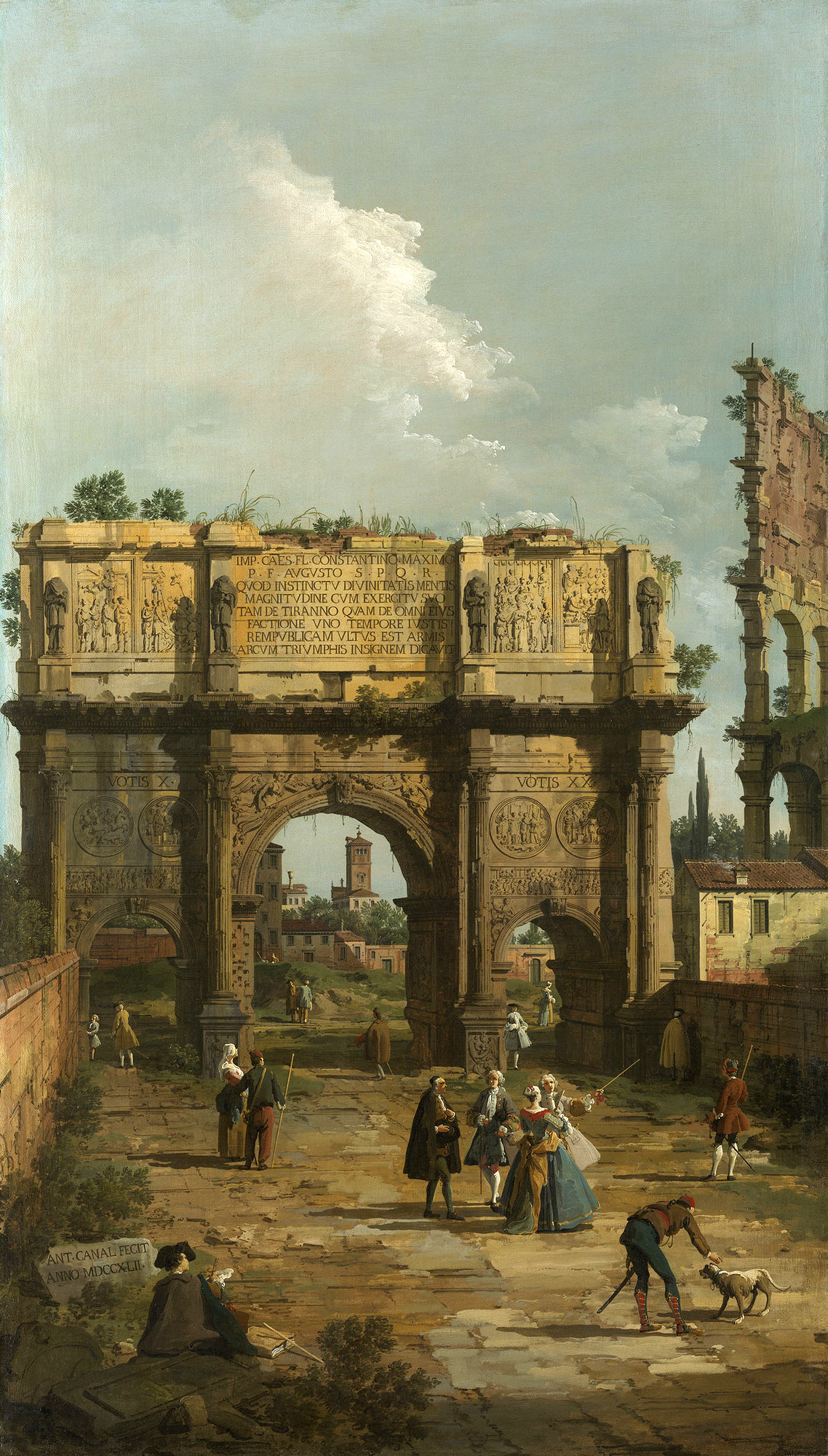

The Milvian Bridge, Oct. 28, 312
Maxentius had held Rome for six years. He had walls, a larger army and the city's grain. He chose to fight outside the walls anyway, at the Milvian Bridge, where the Via Flaminia crosses the Tiber north of the city. The battle is dated Oct. 28, 312, by the Roman calendar tradition, the anniversary of the day Maxentius had taken power. His army was routed, a temporary bridge of boats behind it gave way, and Maxentius drowned in the Tiber. The next day Constantine entered Rome.
That much every source agrees on. What happened before the battle is the most famous religious story of the fourth century, and the two Christian authors who tell it were both in a position to know something. They tell it in two different ways.
Lactantius: a dream and a sign on the shields
Lactantius wrote Of the Manner in Which the Persecutors Died (De Mortibus Persecutorum) within a few years of the battle, most likely between 313 and 315. His book is an argument that God punishes persecuting emperors, and Constantine is its hero. Here is his whole account of the sign, in William Fletcher's translation for the Ante-Nicene Fathers (1886):
"Constantine was directed in a dream to cause the heavenly sign to be delineated on the shields of his soldiers, and so to proceed to battle. He did as he had been commanded, and he marked on their shields the letter Χ, with a perpendicular line drawn through it and turned round thus at the top, being the cipher of Christ. Having this sign (ΧΡ), his troops stood to arms."5
Lactantius goes on to say that Maxentius, stung by a crowd in the Circus shouting "Constantine cannot be overcome!", consulted the Sibylline books, read that "on the same day the enemy of the Romans should perish," took the oracle as a promise of his own victory, and went out to fight. "The hand of the Lord prevailed," Lactantius writes, "and the forces of Maxentius were routed."5 He dates the battle by Maxentius's anniversary, which he gives as "the sixth of the kalends of November." By strict Roman reckoning that phrase means Oct. 27, one day earlier than the date in the city's calendar tradition; most historians keep Oct. 28 and treat the gap as a small puzzle in the sources.
Notice what Lactantius does not say. There is no vision in the sky, no army that sees it, no words written in light, and no standard. There is a dream, a command, and a mark on shields. His description of the mark is itself hard to read: "the letter Χ, with a perpendicular line drawn through it and turned round thus at the top" can describe either the Chi-Rho (the Greek letters X and P, the first two letters of Christos, laid over each other) or a cross-shaped staurogram. Scholars still argue over which he meant.
Eusebius: a cross of light, an oath and a standard
Eusebius, bishop of Caesarea in Palestine, wrote the Life of Constantine after the emperor died in 337 and before his own death about 339. He had already written about the battle in his Church History (Book 9) without any vision at all. In the Life, a quarter century after the event, he tells a much larger story and says where it came from. In Ernest Cushing Richardson's translation for the Nicene and Post-Nicene Fathers (1890), Constantine prayed to "his father's God" for help, and then:
"a most marvelous sign appeared to him from heaven, the account of which it might have been hard to believe had it been related by any other person. But since the victorious emperor himself long afterwards declared it to the writer of this history, when he was honored with his acquaintance and society, and confirmed his statement by an oath, who could hesitate to accredit the relation, especially since the testimony of after-time has established its truth? He said that about noon, when the day was already beginning to decline, he saw with his own eyes the trophy of a cross of light in the heavens, above the sun, and bearing the inscription, Conquer by this. At this sight he himself was struck with amazement, and his whole army also, which followed him on this expedition, and witnessed the miracle."6
That night, Eusebius continues, "the Christ of God appeared to him with the same sign which he had seen in the heavens, and commanded him to make a likeness of that sign" for use "as a safeguard in all engagements with his enemies." At dawn Constantine called in goldsmiths and jewelers and described the sign, "And this representation I myself have had an opportunity of seeing," Eusebius adds. He then describes the standard that the Romans "now call the Labarum": a gilded spear with a crossbar, a wreath of gold and gems at the top enclosing "the letter P being intersected by X in its centre," a square embroidered banner hanging from the crossbar, and portraits of the emperor and his children on the staff.6 Only after the vision, in Eusebius's telling, did Constantine send for Christian teachers to ask "who that God was," and resolve to read the Scriptures.
The famous Latin form of the words, in hoc signo vinces ("in this sign you will conquer"), is a later Latin rendering. Eusebius wrote in Greek, and his phrase is usually translated "Conquer by this" (touto nika).
How the two accounts differ, and a third that came first
Set side by side, the two accounts agree that Constantine received a divine instruction before the battle and that it involved the sign of Christ. They disagree on nearly everything else: when (Lactantius places it on the eve of the battle, while Eusebius places the daytime vision during the march, with no place or date), how (a dream against a vision in the sky followed by a dream), who saw it (Constantine alone against the whole army), what was made (marks on shields against a jeweled standard) and how anyone knew (Lactantius gives no source, while Eusebius cites the emperor's sworn word, given years later). The infographic below lays the differences out.
A third text complicates the picture further. A pagan orator speaking before Constantine in Gaul in 310, two years before the Milvian Bridge, praised the emperor for having seen the god Apollo, with Victory, offering him laurel wreaths at a temple of Apollo. The speech survives among the Latin panegyrics (Panegyrici Latini 6 [7].21). The historian Peter Weiss argued in 1993 that Constantine really did see something in the sky in 310, most likely a solar halo, a ring of light with crossing arcs that ice crystals in the air sometimes produce around the sun, and that Christian advisers later reinterpreted it for him. Timothy Barnes accepted a version of this reading in his later work.7 It cannot be proved. What the record does show is that Constantine's public religion moved over time: the coins of the years after 312 still carry the Unconquered Sun (Sol Invictus) as his companion, and the Senate's arch of 315 thanks the "prompting of the divinity" (instinctu divinitatis) without naming Christ.8
The so-called Edict of Milan (313)
In February 313 Constantine met Licinius at Milan. Licinius married Constantine's half sister Constantia, and the two emperors agreed on a religious policy. Then Licinius went east and defeated Maximinus Daia, the last persecuting emperor. On June 13, 313, at Nicomedia, Licinius had the agreement posted as a letter to the governor of the province. This is the document that later writers called the "Edict of Milan." The name is a modern convenience. The text that survives is a letter of Licinius, issued at Nicomedia, preserved in Latin by Lactantius and in a Greek translation by Eusebius.9 No edict issued at Milan has come down to us.
The letter is worth reading in its own words, because it says more than "Christianity became legal." In Fletcher's translation of Lactantius:
"When we, Constantine and Licinius, emperors, had an interview at Milan, and conferred together with respect to the good and security of the commonweal, it seemed to us that, among those things that are profitable to mankind in general, the reverence paid to the Divinity merited our first and chief attention, and that it was proper that the Christians and all others should have liberty to follow that mode of religion which to each of them appeared best; so that that God, who is seated in heaven, might be benign and propitious to us, and to every one under our government."9
Three points stand out. First, the grant is general: "the open and free exercise of their respective religions is granted to all others, as well as to the Christians," because "it befits the well-ordered state and the tranquillity of our times that each individual be allowed, according to his own choice, to worship the Divinity." Second, the reason given is the old Roman one: the gods (here "the supreme Divinity") must be kept favorable to the state, and the emperors want every kind of worship working in their favor. Third, the letter orders property back. Meeting places seized during the persecution, whether sold by the treasury or given away, are to be returned "without money demanded or price claimed," and the buyers may apply to the emperors for compensation. Property held by the churches as bodies, "which belonged not to individuals, but to their society in general," is also to be restored.9 Eusebius's Greek version adds that an earlier rescript had attached "many and various conditions," and that these are now dropped.10
So the document was a grant of religious freedom to all, written by two emperors who still spoke of "the Divinity" in general terms, plus an order of restitution to one group. It made no religion the religion of the state. That step came with Theodosius I in 380, which lesson 05 covers.
What changed for the church
The change of the 310s and 320s was large, fast and expensive, and most of it is documented in Constantine's own letters, which Eusebius copied into his books.
Money, property and clergy privileges
Even before the Licinius letter, Constantine wrote to his proconsul in Africa, Anulinus, ordering that property of "the Catholic Church of the Christians" be restored "immediately," "whether gardens or buildings or whatever they may be." He wrote to Caecilian, bishop of Carthage, that he had ordered his finance minister to pay "three thousand folles" for distribution to the clergy of the provinces of Africa, Numidia and Mauritania, and that more could be had from the treasurer on request. And he ordered that clergy "in the catholic Church, over which Caecilianus presides," be "entirely exempted from all public duties," the costly civic offices and services that wealthy Romans were required to perform.11 The exemption was so attractive that later laws had to restrict who could be ordained, to keep the well-to-do from escaping their duties by joining the clergy.
Two features of these letters matter for what came next. The money and privileges went to "the catholic Church," which in Africa meant Caecilian's side of a quarrel (see the Donatist dispute below). And the emperor now had reasons to decide which group was the real church, because public money followed the answer.
Basilicas
Constantine paid for church buildings on a scale no Christian community had seen. In Rome the great hall at the Lateran (the cathedral of the bishop of Rome to this day) and the first Saint Peter's on the Vatican hill were begun under him. In the Holy Land, Eusebius copies the emperor's letter to Macarius, bishop of Jerusalem, ordering a church at the tomb of Christ that would "surpass all the Churches in the World," and describes the churches at Bethlehem and the Mount of Olives associated with his mother, Helena.12 The style chosen was the basilica, the long columned hall used for Roman law courts and markets. It gave Christian worship a public, imperial architecture, and much of later church building follows from it.
The Sunday law of 321
On March 7, 321, Constantine issued a law that survives in the sixth century Code of Justinian (Book 3, title 12). Philip Schaff, in his History of the Christian Church (vol. 3), quotes the Latin and sums it up: Constantine "forbade the sitting of courts and all secular labor in towns on 'the venerable day of the sun,'" but "distinctly permitted the culture of farms and vineyards in the country, because frequently this could be attended to on no other day so well." The Latin begins Omnes judices, urbanaeque plebes, et cunctarum artium officia venerabili die Solis quiescant ("let all judges, the people of the cities and the workshops of all trades rest on the venerable day of the Sun").13 A second law of that year allowed slaves to be freed on the day. Eusebius presents the same policy in Christian terms: the emperor "enjoined on all the subjects of the Roman empire to observe the Lord's day, as a day of rest."14
The law did not create Christian Sunday worship. Justin Martyr, writing in Rome about 150 to 155, already describes it: "on the day called Sunday, all who live in cities or in the country gather together to one place, and the memoirs of the apostles or the writings of the prophets are read."15 What Constantine added was a civil day of rest, worded in language a sun-worshiping subject could also accept.
Bishops in public life
Bishops gained a public role. Constantine let them hear civil cases when the parties chose a bishop's court, and he treated their councils as something close to imperial business: Eusebius says he "affirms the Validity of the Decisions of Councils" and records him telling a dinner of bishops, "You are bishops whose jurisdiction is within the Church: I also am a bishop, ordained by God to overlook whatever is external to the Church."16 Bishops traveled to councils on the imperial post, the government's own transport service. After Constantine defeated Licinius in 324 and ruled the whole empire, he founded a new capital on the site of Byzantium, dedicated as Constantinople in 330, with churches built from the start.
What did not change
A great deal stayed as it was, and readers of later histories are often surprised by how much.
- Paganism stayed legal. Temples stayed open in most places, and Constantine kept the old title of chief priest of the Roman state religion, pontifex maximus, as did his successors until Gratian gave it up around 379 or 382. Eusebius reports laws against sacrifice and the closing or destruction of a few temples (at Aphaca in Phoenicia, Aegae in Cilicia and Heliopolis), but historians disagree on whether a general ban on sacrifice was ever enforced under Constantine.12
- Constantine said he would compel no one. In his letter to the eastern provinces after 324 he wrote, "Let no one molest another, but let every one do as his soul desires," and in the same letter spoke of those who stayed aloof having "their temples of lies."17 Toleration and contempt sat side by side.
- The emperor was not baptized until the last weeks of his life in 337. For 25 years he was, in church terms, an unbaptized supporter who attended councils and preached sermons to his court.
- Roman politics kept its habits. In 326 Constantine had his eldest son Crispus executed, and soon after his wife Fausta died. Eusebius says nothing about either death. The pagan historian Zosimus, writing about 500 and hostile to Constantine, says the emperor killed Crispus "on suspicion of debauching his mother-in-law Fausta" and then had Fausta shut in an overheated bath.18 The cause of both deaths remains unknown.
- Christians were still a minority. No census of religion exists. Modern estimates, which are guesses built on models, commonly put Christians at around one in ten of the empire's people about 300; the sociologist Rodney Stark's widely cited model gives roughly 10 percent for that year.19
The Donatist dispute, briefly
The first church quarrel Constantine was asked to settle came from North Africa, and it set the pattern for Nicaea. During the persecution some clergy had handed over copies of the Scriptures to the authorities. Their opponents called them traditores ("handers-over"). When Caecilian was made bishop of Carthage about 311, a party of Numidian bishops said one of the bishops who consecrated him had been a traditor, declared the consecration invalid and elected a rival, Majorinus, who was soon followed by Donatus, from whom the movement takes its name. The issue was whether a sacrament performed by a cleric who had sinned gravely is valid, and whether the church must be a community of the pure.
Both sides appealed to the emperor. Constantine's letters, copied by Eusebius, show him ordering Caecilian and ten of his accusers to Rome in 313 to be heard before Miltiades, bishop of Rome, and three bishops from Gaul, and then, when the losers complained that the judges "were few" and "had been too hasty," calling a larger council at Arles in Gaul for August 314, with travel paid by the state.20 Both rulings went against the Donatists. Constantine tried force against them from 317 to 321 and then gave up the attempt. The Donatist church survived in Africa for centuries, and Augustine's long fight with it belongs to lesson 06. The pattern was set: a church quarrel, an appeal to the emperor, a council called by the emperor, and the state's power behind the council's verdict.
Arius and Alexander of Alexandria (about 318 to 325)
Who Arius was
Arius was a priest (presbyter) of Alexandria, the great Greek city of Egypt, in charge of one of its district churches. Later writers say he came from Libya, was older than his bishop and was a popular, ascetic preacher; he had studied, by his own account, in the circle of Lucian of Antioch, a teacher martyred in 312, since he closes his letter to Eusebius of Nicomedia by calling him "my fellow-Lucianist."21 The dispute with his bishop, Alexander, broke out in the years around 318. The exact start is uncertain: older handbooks give 318 or 319, and some modern scholars, Rowan Williams among them, argue for a date a few years later.22
The church historian Socrates of Constantinople (writing about 439) gives the version of the spark that became standard. Alexander, preaching before his clergy on "the Unity of the Holy Trinity," spoke, Socrates says, "with perhaps too philosophical minuteness." Arius suspected him of the old error of Sabellius (who taught that Father, Son and Spirit are only three names or modes of one person) and answered with a short argument:
"'If,' said he, 'the Father begot the Son, he that was begotten had a beginning of existence: and from this it is evident, that there was a time when the Son was not. It therefore necessarily follows, that he had his substance from nothing.'"23
Socrates was writing more than a century later and was firmly on Alexander's side, so the exact words are his. Theodoret of Cyrrhus, writing at about the same time, goes further and blames the devil and Arius's "jealousy" at Alexander's election.24 Both are hostile witnesses. For what Arius actually taught, the fairer course is to read his own words, and a few of them survive.
Arius in his own words
Almost everything Arius wrote was destroyed after his condemnation; a law of Constantine ordered his books burned. What survives comes to us inside the books of his opponents, chiefly Athanasius, and in letters copied by the church historians. Three texts matter most.
His letter to Eusebius of Nicomedia (about 318 to 322), preserved by Theodoret, is the clearest statement of his position in his own voice. In Blomfield Jackson's translation (NPNF2 3, 1892), Arius complains that the bishop "greatly wastes and persecutes us" and has "driven us out of the city as atheists," because Arius and his friends reject what Alexander "publicly preaches, namely, God always, the Son always; as the Father so the Son; the Son co-exists unbegotten with God." Then he states his own faith:
"But we say and believe, and have taught, and do teach, that the Son is not unbegotten, nor in any way part of the unbegotten; and that He does not derive His subsistence from any matter; but that by His own will and counsel He has subsisted before time, and before ages, as perfect God, only begotten and unchangeable, and that before He was begotten, or created, or purposed, or established, He was not. For He was not unbegotten. We are persecuted, because we say that the Son has a beginning, but that God is without beginning."21
Two things in this letter are easy to miss. Arius calls the Son "perfect God" and says he existed "before time, and before ages." He did not teach that Jesus was merely a man, or that the Son came into being at Bethlehem. His claim was narrower and sharper: the Son, however exalted, had a beginning, and only the Father is "without beginning." He also names allies: Eusebius of Caesarea, the bishops of Laodicea, Tyre, Anazarbus, Berytus and Lydda, "and all the bishops of the East," condemned, he says, "because they say that God had an existence prior to that of His Son."
His letter to Alexander, signed by Arius and the priests and deacons who sided with him and preserved by Athanasius in On the Councils of Ariminum and Seleucia (De Synodis) 16, is a creed in its own right and the most careful statement his party made. In the translation of John Henry Newman and Archibald Robertson (NPNF2 4, 1892), it confesses "One God, alone Ingenerate, alone Everlasting, alone Unbegun, alone True, alone having Immortality," who "begot an Only-begotten Son before eternal times," a "perfect creature of God, but not as one of the creatures; offspring, but not as one of things begotten," made to subsist "at His own will, unalterable and unchangeable."25 The letter carefully rejects other views as well: that the Son is an "issue" of the Father (which it attributes to the Gnostic Valentinus), a "portion" of the Father (attributed to Mani), or a Son-and-Father in one (Sabellius).
The Thalia ("Banquet"), a work partly in verse that Arius wrote after his expulsion, survives only in quotations by Athanasius, who mocks its meter as fit for drinking songs. In his first Oration against the Arians, Athanasius quotes its opening, in which Arius calls himself one who learned from "the partakers of wisdom," and then strings together phrases he says come from it: "'God was not always a Father,'" "'once God was alone, and not yet a Father, but afterwards He became a Father,'" "'The Son was not always,'" and the Word was "'made out of nothing.'"26 In De Synodis 15 Athanasius gives a longer, continuous extract that reads like the poem itself:
"God Himself then, in His own nature, is ineffable by all men. Equal or like Himself He alone has none, or one in glory. And Ingenerate we call Him, because of Him who is generate by nature. We praise Him as without beginning because of Him who has a beginning. And adore Him as everlasting, because of Him who in time has come to be. The Unbegun made the Son a beginning of things originated; and advanced Him as a Son to Himself by adoption. ... Thus there is a Triad, not in equal glories. ... Understand that the Monad was; but the Dyad was not, before it was in existence."25
Scholars treat the two sets of Thalia quotations differently. The continuous extract in De Synodis 15 is usually taken as close to Arius's own text. The catalogue of phrases in the Orations is Athanasius's selection and paraphrase, made to show Arius at his worst, and it cannot be checked against a full copy because none exists. Rowan Williams's study of Arius (1987, revised 2001) argues that the poem's main concern was God's utter uniqueness and unknowability, so that even the Son "does not know His own essence" and sees the Father only "in His own measure."22
Alexander's answer
Alexander's case survives in two letters. In his circular letter to the bishops of the church, copied by Socrates, he says he assembled "with the bishops of Egypt and Libya, being assembled together to the number of nearly a hundred," and "anathematized Arius." His argument is scriptural: "Who that hears John saying, 'In the beginning was the Word,' does not condemn those that say, 'There was a period when the Word was not'?" And: "How can he be one of the things which were made by himself?" He also reports that when someone asked the Arians whether the Word could change "as the devil has," they answered, "'Yes, he could; for being begotten, he is susceptible of change.'"27 Alexander's worry was salvation as much as logic. If the Son is a creature who could change, the one who saves is no more secure than those he saves.
The quarrel spread quickly. Eusebius of Nicomedia, bishop of the city where the eastern emperor lived and one of the best-connected churchmen in the empire, took up Arius's cause and wrote letters on his behalf. Socrates reports that the dispute became "a subject of popular ridicule, even in the very theatres."27
Constantine's letter: "small and very insignificant questions"
Constantine became master of the East in September 324 by defeating Licinius at Chrysopolis, across the strait from Byzantium. He learned of the Alexandrian dispute almost at once, and he sent Hosius (Ossius), bishop of Cordoba in Spain, his religious adviser since the 310s, to Alexandria with a letter to both men. Eusebius copies the letter in the Life. The emperor tells Alexander and Arius that the question was one that "ought never to have been conceived at all, or if conceived, should have been buried in profound silence," and that "the cause of your difference has not been any of the leading doctrines or precepts of the Divine law." He asks whether it is right that "on the ground of some trifling and foolish verbal difference between ourselves, brethren should assume towards each other the attitude of enemies," over "points so trivial and altogether unessential."28
The letter shows what Constantine wanted: peace in the church he was paying for. It also shows that he did not at first grasp what the bishops thought was at stake. The mission failed. A synod at Antioch early in 325, known from a Syriac letter that most scholars now accept as genuine, condemned Arius's views and provisionally excommunicated three bishops, Eusebius of Caesarea among them, pending a larger council.29 Constantine then summoned that larger council, first to Ancyra, and then moved it to Nicaea, closer to his own residence at Nicomedia.
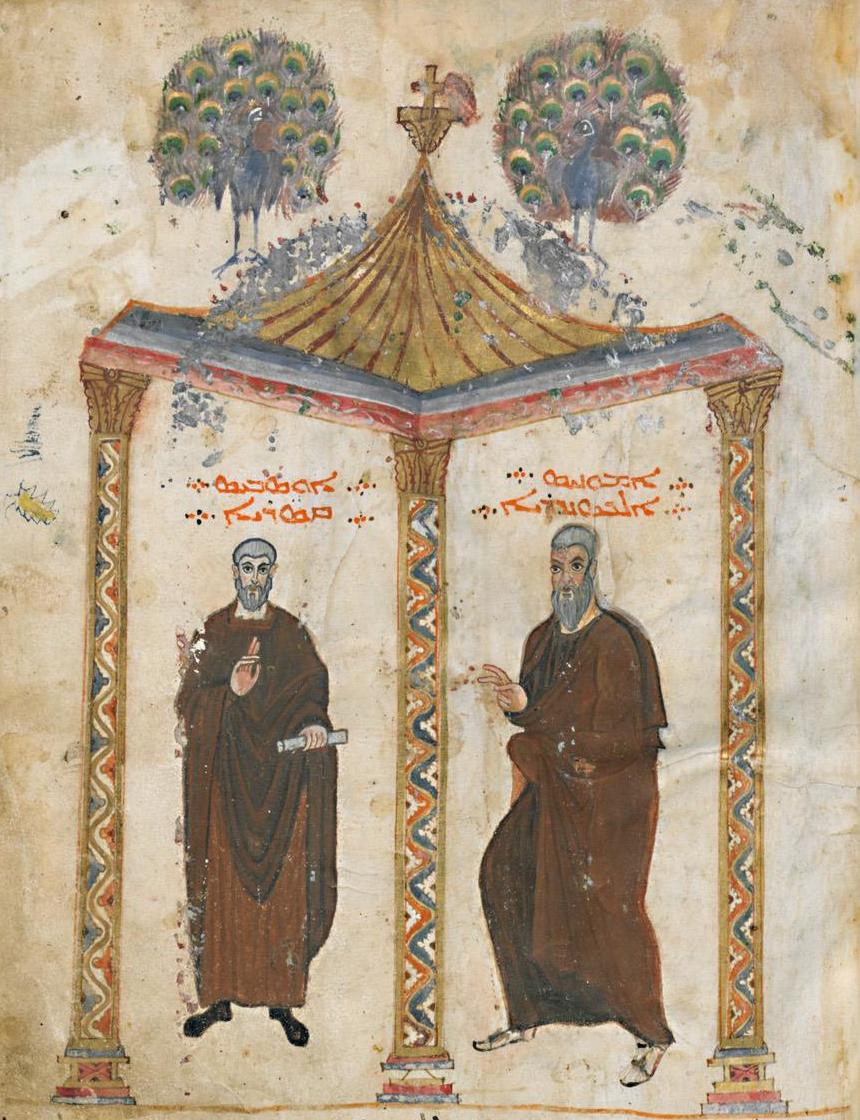

The Council of Nicaea (325)
Who called it, and where
The emperor called it. Eusebius says Constantine "convoked a general council, and invited the speedy attendance of bishops from all quarters," letting some use "the public means of conveyance" and giving others "an ample supply of horses," and that "for the maintenance of all ample provision was daily furnished by the emperor's command."30 The bishops' own synodal letter says the same thing in church language: the council was assembled at Nicaea "through the grace of Christ and our most religious Sovereign Constantine, who brought us together from our several provinces and cities."31 No bishop of Rome called it, presided over it or attended it; the bishop of Rome, Eusebius says, "was prevented from attending by extreme old age; but his presbyters were present, and supplied his place." Theodoret names that bishop as Silvester and says he sent two presbyters.30 This is the plain record. How the churches later understood the council's authority is a separate question, taken up below.
Nicaea (modern Iznik in Turkey) sat on a lake in the province of Bithynia, a short ride from the imperial residence at Nicomedia. Eusebius notes that its name comes from nike, "victory." The council met in the early summer of 325; the opening date is not recorded in the eyewitness sources, and the later traditional dates (May 20, or June 19 for the adoption of the creed) come from sources of the fifth century and after. The bishops were still there on July 25, 325, when Constantine celebrated the twentieth anniversary of his reign with a banquet for them, which Eusebius describes with wonder: soldiers with drawn swords stood guard at the palace entrance, and "the men of God proceeded without fear into the innermost of the imperial apartments."32 Eusebius places the sessions in "the central building of the palace," not in a church.32
Who came? Eusebius lists the regions: "Syrians and Cilicians, Phœnicians and Arabians, delegates from Palestine, and others from Egypt; Thebans and Libyans, with those who came from the region of Mesopotamia. A Persian bishop too was present at this conference, nor was even a Scythian found wanting." From the West came very few: "Even from Spain itself, one whose fame was widely spread took his seat as an individual in the great assembly," which is taken to mean Hosius of Cordoba.30 The council was overwhelmingly Greek-speaking and eastern. Among those present were Alexander of Alexandria, with his young deacon Athanasius; Eustathius of Antioch; Macarius of Jerusalem; Marcellus of Ancyra; Eusebius of Caesarea; Eusebius of Nicomedia; and Arius himself, who appeared before the council.
How many bishops?
The number most people know is 318. It is not the number the eyewitnesses gave. Eusebius, who was there, says "the number of bishops exceeded two hundred and fifty."30 Athanasius, who was also there, wrote in the 350s that the bishops were "three hundred more or less," and in his History of the Arians (about 357) that "three hundred of them, more or less, met together and condemned the Arian heresy."33 The figure 318 is in writing by about 359, when Hilary of Poitiers, defending the word homoousios in his book On the Councils, wrote: "Eighty bishops once rejected it; but three hundred and eighteen recently accepted it. And for my own part I think the number sacred, for with such a number Abraham overcame the wicked kings."60 About 369 a letter from Athanasius and the Egyptian bishops to the bishops of Africa speaks of "318 bishops assembling to discuss the faith on account of the Arian heresy."34 About 378 Ambrose of Milan drew out the same meaning: it matched the 318 servants with whom Abraham defeated the kings in Genesis 14:14, so that the council's bishops were "appointed, as it were, after the judgment of Abraham."35 By the fifth century Socrates and Theodoret both give 318 as a plain fact.36 The lists of signatures that survive in Latin, Greek, Syriac and Coptic copies are incomplete and do not agree, and they contain roughly 200 to 220 names. Most historians conclude that something between 250 and 300 bishops attended, and that 318 is a number of symbolic meaning that grew out of the eyewitnesses' "about 300."
What happened in the hall
No minutes of Nicaea survive, and there is no reason to think any were kept in the way later councils kept them. What we have is the creed, the canons, the synodal letter, a few letters written just afterward and the later accounts. Eusebius describes the opening: the bishops seated in rows, silence, the entry of members of the imperial family and "friends in the faith," and then Constantine himself "like some heavenly messenger of God," who took his seat only after the bishops signaled him to sit. A bishop "who occupied the chief place in the right division of the assembly" gave a speech of thanks; Eusebius does not name him, and later writers guessed Eustathius of Antioch or Eusebius himself. The emperor then spoke in Latin, "which another interpreted," and called intestine strife within the church "far more evil and dangerous than any kind of war or conflict."37
Then the arguing began. "Some began to accuse their neighbors, who defended themselves, and recriminated in their turn," Eusebius writes, and the emperor "gave patient audience to all alike," speaking Greek, "with which he was not altogether unacquainted," until he brought them "to one mind and judgment respecting every disputed question."37 Socrates adds that many bishops had handed the emperor written petitions accusing one another, and that Constantine ordered the petitions burnt.36 Theodoret says that the bishops who sided with Arius drew up "a formulary of their faith" and presented it, and "as soon as it was read it was torn to pieces, and was declared to be spurious and false."38
The most revealing document is a letter Eusebius of Caesarea sent home to his own church as soon as the council ended, explaining why he had signed. Eusebius had arrived under a cloud, having been provisionally condemned at Antioch that spring. He says he read out a statement of faith based on the creed of his church at Caesarea, and that "our most pious emperor himself was the first to admit that they were perfectly correct," but urged all to sign it "with the insertion, however, of that single word homoousios (consubstantial), an expression which the emperor himself explained, as not indicating corporeal affections or properties." Eusebius then reports the discussion of the phrases "of the substance of the Father" and "consubstantial with the Father," and his conclusion: "nor do we cavil at the word homoousios having regard to peace," since it meant that the Son "is of the Father indeed, but does not subsist as a part of the Father."36 Eusebius's letter is a defense of his own conduct and gives his own reading of the words. Athanasius later claimed the bishops chose "of the substance" and homoousios precisely because the Arian party could twist every scriptural phrase to its own meaning. The two accounts agree that the key word came late in the debate and that it was chosen to exclude Arius.
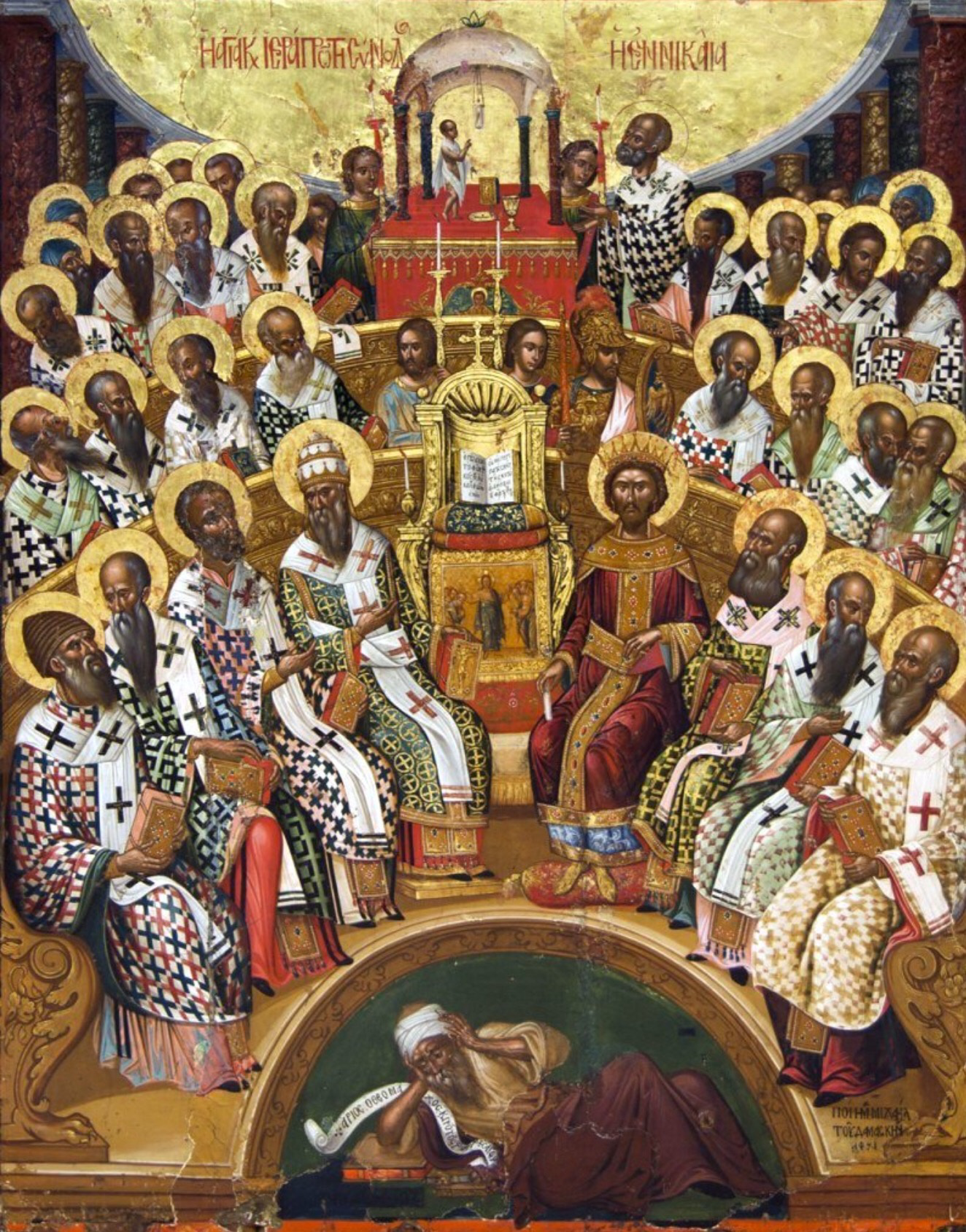

The creed of 325, word for word
Here is the creed as adopted at Nicaea, with its closing condemnations (anathemas), in Henry Percival's translation from The Seven Ecumenical Councils, volume 14 of the Nicene and Post-Nicene Fathers, Second Series, edited by Philip Schaff and Henry Wace (1900). The bracketed words and the Greek and Latin in parentheses are Percival's. Where his printed text uses a dash before the final clause, it is given here as a comma, following this site's style.
"We believe in one God, the Father Almighty, maker of all things visible and invisible; and in one Lord Jesus Christ, the Son of God, the only-begotten of his Father, of the substance of the Father, God of God, Light of Light, very God of very God, begotten (γεννηθέντα), not made, being of one substance (ὁμοούσιον, consubstantialem) with the Father. By whom all things were made, both which be in heaven and in earth. Who for us men and for our salvation came down [from heaven] and was incarnate and was made man. He suffered and the third day he rose again, and ascended into heaven. And he shall come again to judge both the quick and the dead. And [we believe] in the Holy Ghost. And whosoever shall say that there was a time when the Son of God was not (ἤν ποτε ὅτε οὐκ ἦν), or that before he was begotten he was not, or that he was made of things that were not, or that he is of a different substance or essence [from the Father] or that he is a creature, or subject to change or conversion [τρεπτὸν in Greek; convertibilem in Latin], all that so say, the Catholic and Apostolic Church anathematizes them."31
Three things about this text are often confused.
It is shorter than the creed most churches recite. The "Nicene Creed" said in Catholic, Orthodox, Anglican, Lutheran and many other services today is the longer creed associated with the Council of Constantinople in 381. That text adds, among much else, a long section on the Holy Spirit ("the Lord and Giver of Life"), the church, baptism and "the life of the world to come," and it drops the anathemas. The creed of 325 ends abruptly with "And [we believe] in the Holy Ghost," because the Spirit was not yet the subject of dispute. Lesson 05 sets the two texts side by side.
Every key phrase answers Arius. "Begotten, not made" rejects his "perfect creature." "Of the substance of the Father" rejects his "from things that were not." "Very God of very God" rejects the claim that the Son is God only "by participation" or "in name." The anathemas quote his own slogans almost word for word: "there was a time when the Son of God was not," "before he was begotten he was not," "made of things that were not," "subject to change."
The famous word is not in the Bible. Homoousios (from homos, "same," and ousia, "being" or "substance") was a philosophical term, and that was the main objection to it. Socrates reports that five bishops at first refused it, among them Eusebius of Nicomedia, Theognis of Nicaea and Maris of Chalcedon, on the grounds that "that is consubstantial which is from another either by partition, derivation or germination," as a shoot from a root or a vessel from a mass of gold, and the Son came from the Father by none of these.36 Others feared the word blurred the Father and Son into one, the error of Sabellius. And it carried baggage: opponents of Nicaea pointed out that the bishops who condemned Paul of Samosata at Antioch about 268 had rejected the term, a claim Athanasius discusses (while saying he had not seen the letter in question) in De Synodis 43 to 45.25 These doubts explain much of the next 50 years.
In the end all but two signed. The synodal letter reports that Arius was anathematized, "together with the blasphemous words and speculations in which he indulged," and that two Libyan bishops, "Theonas of Marmorica and Secundes of Ptolemais," received "the same sentence."31 Constantine exiled Arius and the two bishops, and a few months later Eusebius of Nicomedia and Theognis as well. He then wrote a letter ordering that Arius's followers be called "Porphyrians" (after the pagan writer Porphyry, who had attacked Christianity) and that "if any treatise composed by Arius should be discovered, let it be consigned to the flames," adding that anyone caught "concealing a book compiled by Arius" faced death.39 This is the first imperial law against a Christian teaching, and it is why so little of Arius survives.
The twenty canons
Besides the creed, the council issued 20 canons, short rules of church order. They are less famous than the creed and in some ways tell more about the church of 325: a church that had just come out of persecution, was growing fast, and was arguing about who held authority where. The table summarizes each canon from Percival's translation; two are quoted in full below it.31
| Canon | Subject (summary) |
|---|---|
| 1 | Men who castrated themselves may not be clergy; those castrated by surgeons or by "barbarians" may. |
| 2 | New converts are not to be made bishops or presbyters right after baptism ("Not a novice"). |
| 3 | Clergy may not keep a subintroducta (an unrelated woman living in the house) except a mother, sister, aunt or a person "beyond all suspicion." |
| 4 | A bishop is to be appointed by all the bishops of the province, or at least three with the written consent of the rest, ratified by the metropolitan (the bishop of the provincial capital). |
| 5 | A person excommunicated in one province is not to be received in another; provincial synods are to meet twice a year, before Lent and in the autumn. |
| 6 | The "ancient customs" giving the bishop of Alexandria authority over Egypt, Libya and Pentapolis are confirmed, "since the like is customary for the Bishop of Rome also"; Antioch and other churches keep their privileges. |
| 7 | The bishop of Aelia (Jerusalem) is to have "the next place of honour," saving the rights of the metropolis (Caesarea). |
| 8 | Clergy of the Cathari (the Novatians, a rigorist group) may be received if they accept the church's teaching on the twice married and on penitent lapsed Christians; there must not be two bishops in one city. |
| 9 | Presbyters ordained without examination, or despite confessed crimes, are not recognized. |
| 10 | Clergy found to have lapsed in persecution before ordination are to be deposed. |
| 11 | Those who denied the faith without compulsion "during the tyranny of Licinius" are to do penance for twelve years in stages. |
| 12 | Christian soldiers who left the army for their faith and then bribed their way back are to do long penance. |
| 13 | The dying are not to be denied communion (the Viaticum). |
| 14 | Catechumens (people preparing for baptism) who lapsed are to spend three years as "hearers." |
| 15 | Bishops, presbyters and deacons may not move from city to city; such moves are "utterly void." |
| 16 | Clergy who desert their church are to be sent back, and ordaining another bishop's cleric without consent is void. |
| 17 | Clergy who lend at interest are to be deposed. |
| 18 | Deacons are not to give the Eucharist to presbyters or sit among them; they rank below presbyters. |
| 19 | Followers of Paul of Samosata ("Paulianists") must be rebaptized; their deaconesses, "since they have no imposition of hands," count as laity. |
| 20 | Because some kneel on Sundays and in the days of Pentecost, all are to pray standing on those days. |
Canon 6, in full, reads:
"Let the ancient customs in Egypt, Libya and Pentapolis prevail, that the Bishop of Alexandria have jurisdiction in all these, since the like is customary for the Bishop of Rome also. Likewise in Antioch and the other provinces, let the Churches retain their privileges. And this is to be universally understood, that if any one be made bishop without the consent of the Metropolitan, the great Synod has declared that such a man ought not to be a bishop. If, however, two or three bishops shall from natural love of contradiction, oppose the common suffrage of the rest, it being reasonable and in accordance with the ecclesiastical law, then let the choice of the majority prevail."31
Canon 6 is the oldest conciliar text that names Alexandria, Rome and Antioch together as churches with authority beyond their own province, the start of what later became the system of patriarchates. It has been read in different ways ever since. Orthodox and many Protestant historians read it as treating Rome as one great regional church among several, its authority cited as a precedent for Alexandria's. Catholic writers point out that the canon appeals to Rome's custom as the model, and several Latin manuscripts open the canon with the words "The Church of Rome hath always had a primacy (primatum)," a reading the papal legate Paschasinus quoted at the Council of Chalcedon in 451, though the phrase is not in the Greek (Percival's notes give both readings).31 The canon itself settles a practical dispute in Egypt (see the Meletians, below) and says nothing about doctrine or appeals.
Canon 20 is a reminder of how ordinary much of this was:
"Forasmuch as there are certain persons who kneel on the Lord's Day and in the days of Pentecost, therefore, to the intent that all things may be uniformly observed everywhere (in every parish), it seems good to the holy Synod that prayer be made to God standing."31
Easter, the Meletians and the synodal letter
The second great item of business was the date of Easter, and it is not in the canons. Some churches in the East (chiefly in Syria and Mesopotamia) fixed Easter by the Jewish calculation of Passover, so that their feast could fall on a different day from the one kept in Rome and Alexandria. The synodal letter announced "the good news of the agreement concerning the holy Easter," by which "all our brethren in the East who formerly followed the custom of the Jews are henceforth to celebrate the said most sacred feast of Easter at the same time with the Romans and yourselves and all those who have observed Easter from the beginning."31 Neither the letter nor any other document from 325 states a rule for computing the date. The formula often credited to Nicaea, "the first Sunday after the first full moon after the spring equinox," is a later summary of the Alexandrian practice, and the churches continued to disagree about the calculation for centuries.
Constantine's own letter to the churches after the council, copied by Eusebius, gives his reasons, and they must be quoted as they stand. He calls it "an unworthy thing that in the celebration of this most holy feast we should follow the practice of the Jews, who have impiously defiled their hands with enormous sin, and are, therefore, deservedly afflicted with blindness of soul," and urges: "Let us then have nothing in common with the detestable Jewish crowd; for we have received from our Saviour a different way."40 This hostile language is the emperor's, written in his own letter; the bishops' synodal letter states the decision without it. Historians of Jewish and Christian relations cite the letter as an early instance of anti-Jewish rhetoric entering imperial law and policy.
The synodal letter also settled the Meletian schism in Egypt. Meletius, bishop of Lycopolis, had ordained clergy in other bishops' territories during the persecution and formed a separate church. The council let him keep "the bare title of his rank" in his own city, without power to ordain, and admitted his clergy "after they have been confirmed by a more sacred laying on of hands," ranked below Alexander's clergy.31 Canon 6's confirmation of Alexandria's authority over all Egypt belongs to the same settlement.
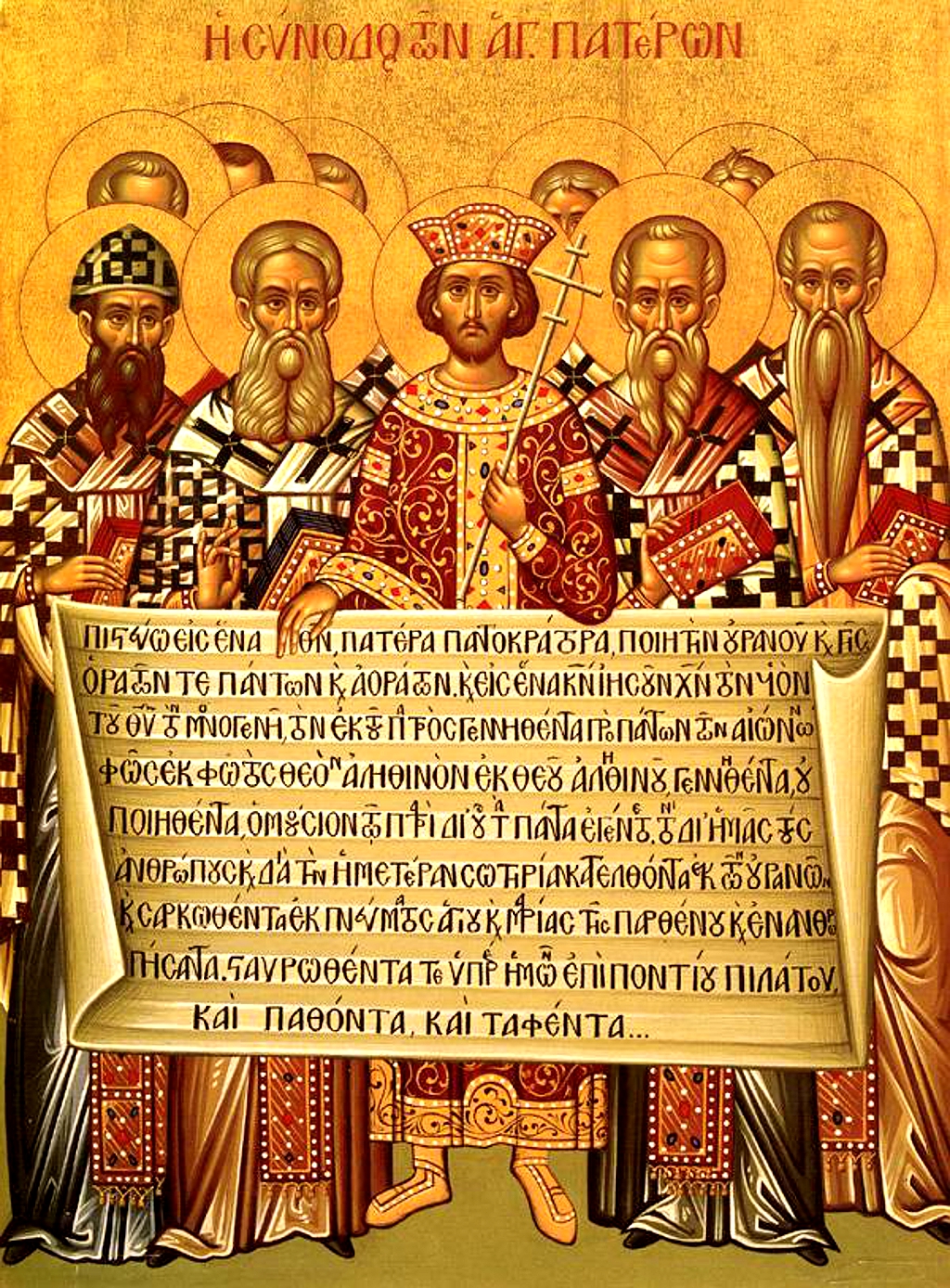

What Nicaea did not do: the books of the Bible
One of the most widely repeated claims about Nicaea is that the council, or Constantine, chose which books went into the Bible and suppressed the rest. Dan Brown's 2003 novel The Da Vinci Code gave the claim its largest audience: a character in the novel says, in substance, that Constantine commissioned and paid for a new Bible that dropped the gospels presenting Jesus as human, and that the council voted Jesus divine by a close vote.41 The record on each point:
- The canons, the creed and the synodal letter contain no list of books and no discussion of which books are Scripture. All three are given above. Eusebius's account of the council and his letter to his church say nothing about the canon either.31
- The divinity of Christ was not put to a close vote. The question at Nicaea was how the Son is divine, whether he is eternal and "of the substance of the Father" or a divine creature with a beginning. Arius himself called the Son "perfect God." At the end two bishops out of roughly 250 to 300 refused to sign.
- Constantine did order Bibles, years later. About 331 he wrote to Eusebius asking for "fifty copies of the sacred Scriptures" written "on prepared parchment in a legible manner, and in a convenient, portable form," for the growing number of churches in Constantinople, and Eusebius says they were sent "in magnificent and elaborately bound volumes."42 The letter does not say which books they contained, and it does not mention the council.
- The core of the New Testament was in use long before 325. The four Gospels and the letters of Paul were read in the churches in the second century, as Irenaeus and Justin show (see lesson 02). The edges of the canon, books such as Hebrews, James, 2 Peter, 2 and 3 John, Jude and Revelation, were still debated in the fourth century, and Eusebius himself, in his Church History (3.25), sorted the books in use into those everyone accepted, those some disputed and those he counted spurious.
The first surviving list that names exactly the 27 books of today's New Testament comes from Athanasius, in his Easter letter of 367, more than 40 years after Nicaea (see below). A medieval Greek summary of councils from about the ninth century, the Synodicon Vetus, tells a legend that the bishops at Nicaea placed all the books on an altar and the false ones fell to the floor; the story has no support in any fourth century source.
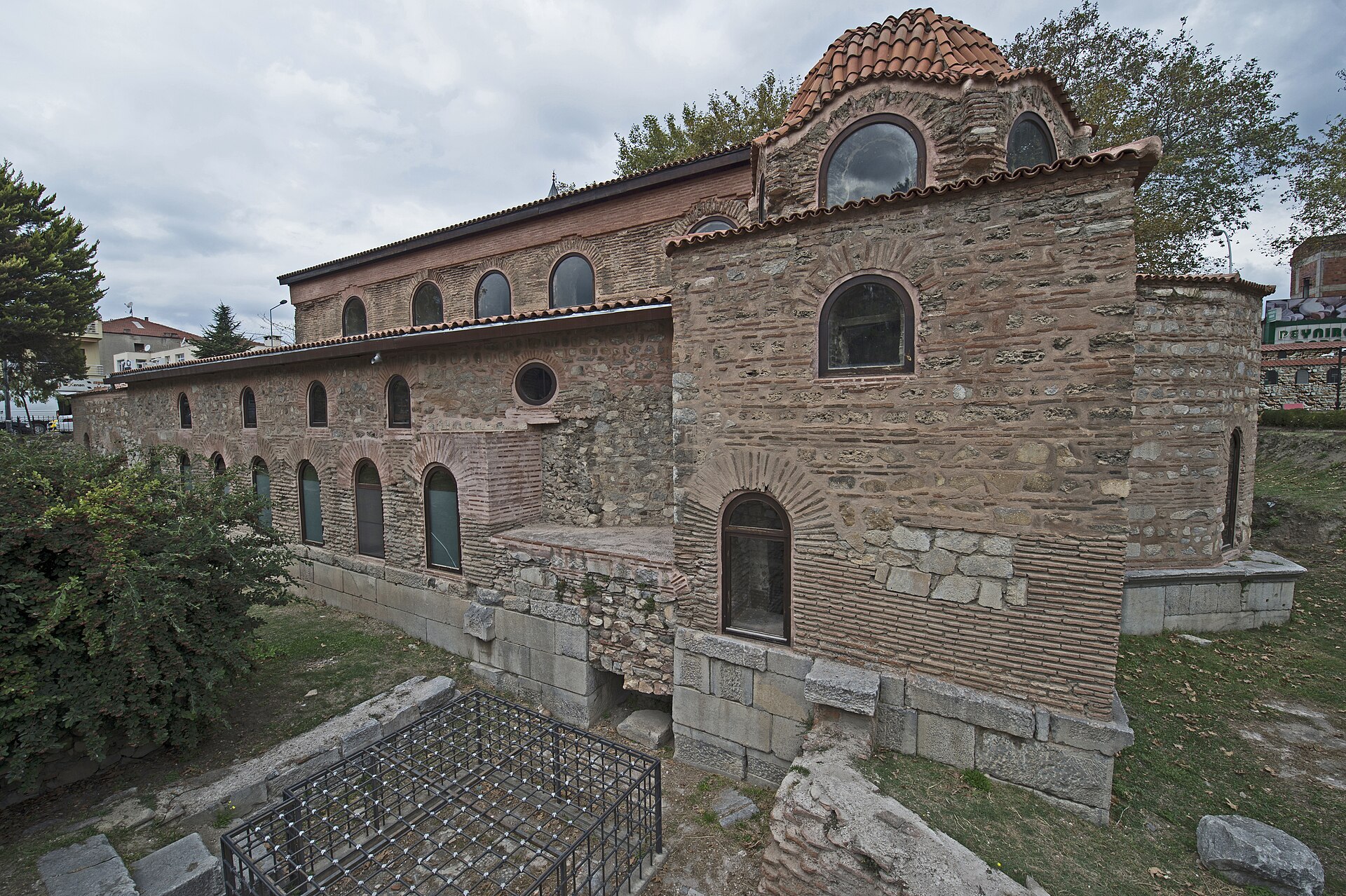

Athanasius of Alexandria
From deacon at Nicaea to bishop of Alexandria (328)
Athanasius was born in Egypt about 295 to 299 and came to Nicaea as a deacon and secretary to Bishop Alexander. Socrates names him as the leading opponent there of Eusebius of Nicomedia and his allies, "a deacon of the Alexandrian church, who was highly esteemed by Alexander his bishop, and on that account was much envied."36 When Alexander died in 328, Athanasius succeeded him. The index to his Easter letters, compiled in Alexandria soon after his death, dates his consecration to June 8, 328, and records that he was summoned to the emperor in 331 on his enemies' charge "that he had been appointed when too young."43 He held the see for 45 years, until his death in May 373, and spent about 17 of them in exile.
Athanasius was a fighter and his enemies were organized. In 335 a council at Tyre, led by bishops friendly to Eusebius of Nicomedia, heard charges against him: that he had used violence against Meletian clergy, that one of his priests had broken a chalice, and that he had murdered a Meletian bishop named Arsenius and kept his severed hand for magic. Socrates tells how Athanasius produced Arsenius at the hearing, alive, with both hands.44 The council deposed him anyway, and when he went to Constantinople to appeal in person, his opponents accused him of threatening to stop the grain ships from Alexandria to the capital. Constantine sent him to Trier on the Rhine frontier. It was the first of five exiles under four emperors.
The later exiles followed the politics of Constantine's sons. In 339, under Constantius II, a rival bishop, Gregory of Cappadocia, was installed in Alexandria by force and Athanasius fled to Rome, where Bishop Julius and a Roman synod received him as the rightful bishop. He returned in 346. In February 356 soldiers burst into his church during a night service; he escaped and spent six years hidden among the monks of the Egyptian desert, writing some of his most important works. Julian, the emperor who returned to the old gods, let exiled bishops come home in 362 and then expelled Athanasius again within months. Valens, who favored the anti-Nicene party, exiled him briefly in 365 and 366. He died in his own city in May 373.45
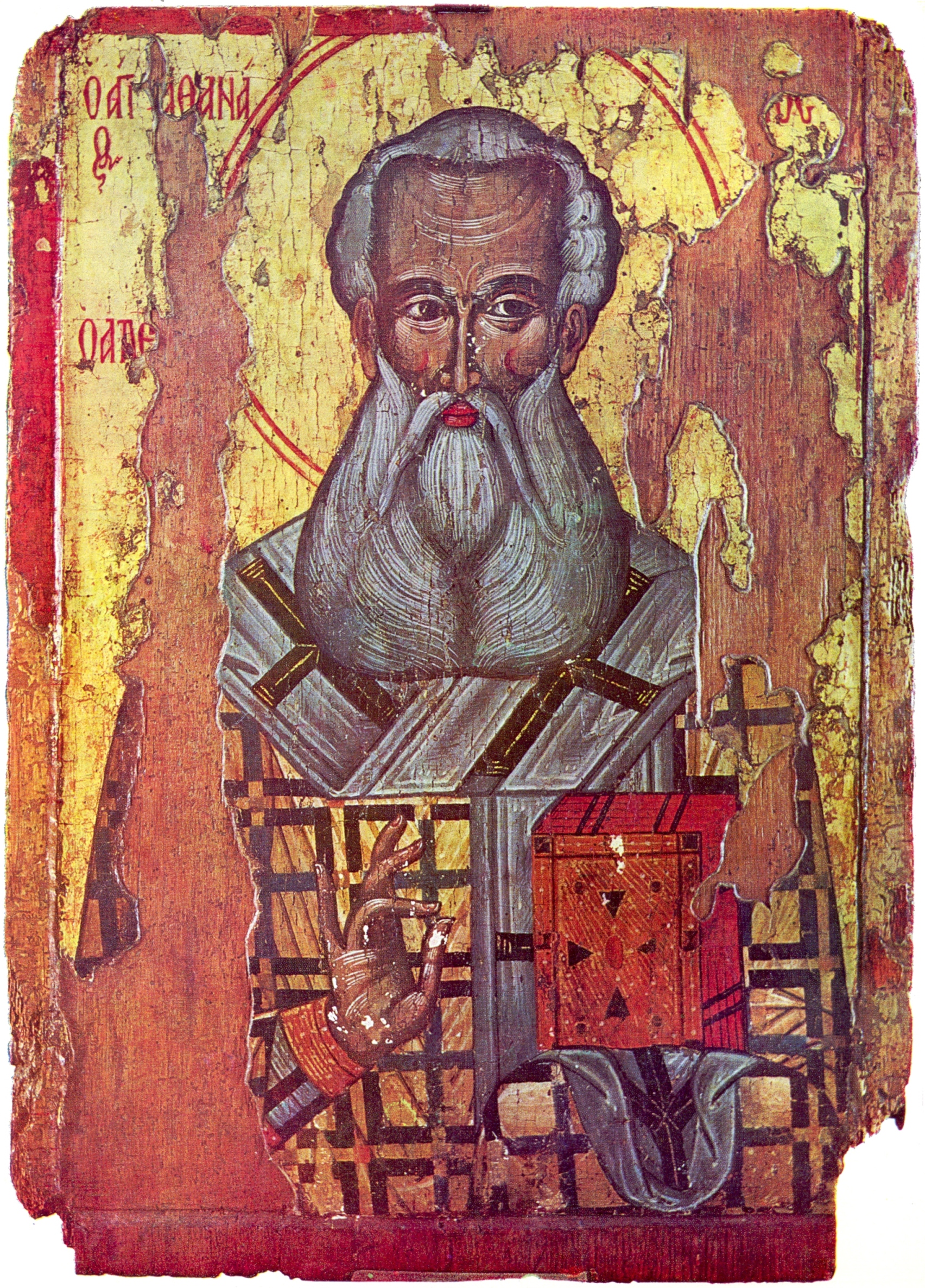

On the Incarnation
Athanasius's short book On the Incarnation of the Word (De Incarnatione) is the best place to see why the Nicene side cared so much about one word. Its date is disputed: some scholars place it before the Arian controversy, about 318, and others in his first exile, about 335 to 337. The book never mentions Arius. Its argument is about salvation. Humanity, made in God's image, was sliding back into the nothing it came from, and only the Creator could remake what he had made. The Word took a human body so that death could be overcome from within human nature. Its best-known sentence, in Archibald Robertson's translation (NPNF2 4, 1892), is this:
"For He was made man that we might be made God; and He manifested Himself by a body that we might receive the idea of the unseen Father; and He endured the insolence of men that we might inherit immortality."46
"Made God" here translates the Greek idea later called theosis or deification, the sharing of creatures in God's life by grace, which remains central to Orthodox theology. The logic explains the dispute. If the Son is a creature, however great, then what he shares with us is a creature's life, and he cannot give what he does not have. That is why Athanasius would not accept any formula that made the Son less than the Father in being. His Life of Antony, the founding biography of Christian monasticism, belongs to lesson 07.
Festal Letter 39 (367), in brief
Each year the bishop of Alexandria wrote a letter to the churches of Egypt announcing the date of Easter, and Athanasius used these "festal letters" to teach. In his letter for 367 he set out "the particular books and their number, which are accepted by the Church," because some had begun "to mix them up with the divinely inspired Scripture." For the New Testament, in R. Payne-Smith's translation (NPNF2 4), he lists:
"the four Gospels, according to Matthew, Mark, Luke, and John. Afterwards, the Acts of the Apostles and Epistles (called Catholic), seven, viz. of James, one; of Peter, two; of John, three; after these, one of Jude. In addition, there are fourteen Epistles of Paul, written in this order. ... And besides, the Revelation of John."47
Those are the 27 books of the New Testament used by Catholic, Orthodox and Protestant churches today, the earliest surviving list to name exactly those books and no others. "These are fountains of salvation," he writes. "Let no man add to these, neither let him take ought from these." His Old Testament list of "twenty-two books" follows the Hebrew count, includes Baruch and the Letter of Jeremiah with Jeremiah and leaves out Esther. He then names other books "not indeed included in the Canon, but appointed by the Fathers to be read by those who newly join us": the Wisdom of Solomon, Sirach, Esther, Judith, Tobit, the Didache ("the Teaching of the Apostles") and the Shepherd of Hermas.47 The letter was the judgment of one bishop for his own churches. It shows where the canon stood in Egypt in 367, and it shows that no council had settled it at Nicaea.
Arianism after Nicaea (325 to 380)
The return of Arius and his death (327 to 336)
Nicaea did not end the dispute, because the emperor's support could move. Within a few years Eusebius of Nicomedia and Theognis were back in their sees, and Constantine was persuaded that Arius could be readmitted. Arius and his companion Euzoius presented the emperor with a short creed, preserved by Socrates. It confesses "the Lord Jesus Christ his Son, who was begotten of him before all ages, God the Word through whom all things were made," and asks to be reunited to "our mother, the Church, all superfluous questions and disputings being avoided."48 It does not use the word homoousios, and it does not deny anything Arius had taught. Athanasius refused to readmit him in Alexandria. In 336, on the eve of his reception into communion at Constantinople, Arius died suddenly in a public latrine near the Forum of Constantine. Socrates describes the death in graphic detail and calls it "divine retribution"; Athanasius, writing to a fellow bishop, treated it as God's judgment. Athanasius was not in Constantinople at the time and says he learned the details from a presbyter named Macarius. Both writers were Arius's opponents, and they are the only sources for the scene.48
Constantine's baptism (337)
Early in 337 Constantine fell ill. Eusebius writes that at Helenopolis he "felt the time had come at which he should seek purification from sins of his past career," and that he "now for the first time received the imposition of hands with prayer," the rite that made him a catechumen. In the suburbs of Nicomedia he asked the bishops for baptism, saying he had hoped to receive it "in the waters of the river Jordan," and "the prelates performed the sacred ceremonies in the usual manner." He refused to wear the imperial purple again and died "about mid-day" on the feast of Pentecost, May 22, 337.49
Eusebius does not name the bishop who baptized him. The Latin continuation of Eusebius's Chronicle, made about 380, does, in its entry for the year 337: "Constantine, baptized by Eusebius of Nicomedia at the very end of his life, falls into the dogma of Arius."50 Eusebius of Nicomedia was the bishop of the city where the emperor lay dying, which makes the report likely, and most historians accept it. The chronicler's comment that Constantine "falls into the dogma of Arius" is a later judgment by an opponent of Arius. Delaying baptism until death was common at the time, especially among men whose work involved shedding blood, because baptism was believed to wash away all past sins.
Constantius II and the Homoians (337 to 361)
Constantine's three surviving sons divided the empire. In the East, Constantius II favored the bishops who had opposed Athanasius, and after 350, when he became sole emperor, he pressed the West to fall in line. Councils at Arles (353) and Milan (355) were made to condemn Athanasius; bishops who refused, among them Liberius of Rome, were exiled. The aged Hosius of Cordoba, who had stood beside Constantine at Nicaea, wrote to Constantius in words Athanasius preserved:
"Intrude not yourself into Ecclesiastical matters, neither give commands unto us concerning them; but learn them from us. God has put into your hands the kingdom; to us He has entrusted the affairs of His Church."51
Constantius, Athanasius writes, "detained him a whole year in Sirmium," though "he was now a hundred years old," and there, under pressure, Hosius signed a statement in 357 that forbade the use of "substance" in speaking of God. Athanasius reports the lapse and blames the emperor's threats, as he does for the lapse of Liberius of Rome, who "after he had been in banishment two years gave way, and from fear of threatened death subscribed."51
By the late 350s the opponents of Nicaea had split. One group, led by Basil of Ancyra, proposed that the Son is homoiousios, "like in substance" to the Father; Athanasius answered them gently in De Synodis, arguing that their meaning was close to Nicaea's.25 A second group, led by Aetius and Eunomius, taught that the Son is "unlike" (anomoios) the Father in substance. The party the emperor finally backed, called Homoians, avoided substance language entirely and said only that the Son is "like" (homoios) the Father. Twin councils met in 359, at Ariminum (Rimini) in Italy for the West and at Seleucia in Asia Minor for the East, and under heavy imperial pressure both accepted Homoian statements. A council at Constantinople in January 360 confirmed the result in a creed that Socrates preserves. Its key lines, in A. C. Zenos's translation (NPNF2 2, 1890), read:
"But since the term ousia [substance or essence], which was used by the fathers in a very simple and intelligible sense, but not being understood by the people, has been a cause of offense, we have thought proper to reject it, as it is not contained even in the sacred writings; and that no mention of it should be made in future, inasmuch as the holy Scriptures have nowhere mentioned the substance of the Father and of the Son. ... But we affirm that the Son is like the Father, in such a manner as the sacred Scriptures declare and teach."52
For a time, this was the official faith of the empire. Socrates, counting all the creeds produced since Nicaea, gives a long list and remarks that he had "wound our way through the labyrinth of all the various forms of faith."52 Constantius died in 361. Julian, his cousin and successor, abandoned Christianity, recalled the exiled bishops of every party (some historians think in hope that they would weaken one another) and died in 363. Valens, emperor in the East from 364 to 378, again backed the Homoians. The Nicene party regrouped in the 360s and 370s around Athanasius and a new generation in Cappadocia (Basil of Caesarea, Gregory of Nazianzus and Gregory of Nyssa), whose work leads to 381 and lesson 05.
Ulfilas and the Goths
The most lasting effect of the Homoian decades came beyond the frontier. Ulfilas (Wulfila, "little wolf"), a Goth descended from Christian captives taken from Cappadocia, was consecrated "bishop of the Christians among the Goths" by Eusebius of Nicomedia and other bishops, according to the anti-Nicene historian Philostorgius, whose history survives in a summary by the ninth century patriarch Photius. Philostorgius says Ulfilas "reduced their language to a written form, and translated into their vulgar tongue all the books of holy Scripture, with the exception of the Books of Kings, which he omitted, because they are a mere narrative of military exploits, and the Gothic tribes were especially fond of war."53 The date of his consecration is usually put about 341, possibly earlier. Socrates, a Nicene, credits him with inventing "the Gothic letters" and translating the Scriptures, and says that the Goths who crossed into the empire under Valens became Christians in the emperor's form, "therefore it is that so many of the Goths are even to the present time infected with the errors of Arianism."54 Socrates also records that Ulfilas signed the Homoian creed of Constantinople in 360, "although he had previously adhered to that of Nicæa."52
The result was that the Goths, and later the Vandals, Burgundians and Lombards, entered the western provinces as Homoian Christians, with their own bishops and their own Bible in their own language. Their faith (which their Nicene neighbors called "Arian") lasted in the kingdoms they founded into the sixth century and, among the Visigoths of Spain, until their king Reccared accepted the Nicene faith in 587 and the Third Council of Toledo confirmed it in 589. A splendid sixth century copy of Ulfilas's Gothic Gospels, the Codex Argenteus ("Silver Book"), written in silver ink on purple parchment, survives at Uppsala in Sweden.
How scholars read Constantine and Nicaea
Four modern studies, read together, show how much the story has been revised since the nineteenth century.
Timothy D. Barnes, in Constantine and Eusebius (1981), argued that Constantine was a committed Christian from 312 on, that he pursued a Christian policy more vigorously than earlier historians allowed, and that Eusebius, for all his flattery, is a usable witness. In Athanasius and Constantius (1993) Barnes turned a hard eye on Athanasius, showing how the bishop's own writings shaped the later picture of a lone hero against a heretical court, and arguing that the charges of violence against Athanasius's supporters in Alexandria were not all invented.55
Rowan Williams, in Arius: Heresy and Tradition (1987, revised 2001), read Arius as a serious, scriptural and conservative theologian of the Alexandrian tradition, concerned above all to protect the uniqueness of the one God, rather than as a rationalist or a schemer.22
R. P. C. Hanson, in The Search for the Christian Doctrine of God: The Arian Controversy 318 to 381 (1988), argued that "Arian controversy" is a misleading name, because most of the bishops who opposed Nicaea were not followers of Arius and rarely quoted him. In his reading, the whole church was searching for an answer that did not yet exist in 318, and the doctrine of the Trinity that emerged by 381 was the result of that search more than the defense of a settled position.29
Lewis Ayres, in Nicaea and Its Legacy (2004), went further. He argues that the creed of 325 did not become the fixed point of orthodoxy until Athanasius and others made it one in the 350s, that the label "Arianism" was largely Athanasius's polemical creation, and that the theology the councils of the 380s called Nicene ("pro-Nicene," in his term) was a new synthesis built on the old creed.56
Older and general accounts remain useful. Henry Chadwick's The Early Church (1967) gives a balanced short narrative. Jaroslav Pelikan's The Emergence of the Catholic Tradition (1971), volume 1 of The Christian Tradition, stresses that the dispute was driven by worship and salvation: Christians prayed to Christ and were baptized in the name of Father, Son and Spirit, and any account of God had to make sense of that practice.57 Philip Schaff's History of the Christian Church, volume 3 (1867, revised 1884), is the older Protestant standard and is in the public domain.
How the churches read Nicaea
The Orthodox Church counts Nicaea as the first of seven ecumenical councils and honors Constantine and Helena as saints, "equal to the apostles," on May 21. Timothy Ware (Metropolitan Kallistos), in The Orthodox Church, describes the councils as the voice of the whole church, received by the faithful, with the emperor as convener and protector.58
The Catholic Church also counts Nicaea as the first ecumenical council. Catholic historians stress that the bishop of Rome was represented by his legates, that Rome consistently supported Athanasius (Bishop Julius received him in 339 and a Roman synod cleared him in 341), and that the authority of a general council depends on its acceptance by the successor of Peter. Constantine is not on the general Roman calendar of saints.
Protestant churches in the Lutheran, Reformed and Anglican traditions confess the Nicene faith. The Augsburg Confession of 1530 opens: "Our Churches, with common consent, do teach that the decree of the Council of Nicaea concerning the Unity of the Divine Essence and concerning the Three Persons, is true and to be believed without any doubting."59 They hold that a council's authority rests on its agreement with Scripture. Some Protestant writers in the Anabaptist tradition, John Howard Yoder among them, have used the phrase "Constantinian shift" for what they see as the church's loss of its separate identity once it became the emperor's partner. Groups that reject the doctrine of the Trinity, such as Unitarians and Jehovah's Witnesses, regard Nicaea as a departure from the faith of the apostles; the documents above let a reader compare their claims with what Arius and Alexander actually wrote.
What the record shows and what it does not
- Documented fact: Constantine defeated Maxentius at the Milvian Bridge in October 312. Licinius posted the letter granting religious freedom to all and restoring church property at Nicomedia on June 13, 313. Constantine funded churches, exempted clergy from civic duties and made Sunday a legal day of rest in 321. He called the Council of Nicaea in 325, attended it and enforced its decisions. The creed of 325, its anathemas, the 20 canons and the synodal letter survive and are quoted above. Athanasius became bishop of Alexandria on June 8, 328, and was exiled five times. Constantine was baptized shortly before his death on May 22, 337. A council at Constantinople in 360 banned the word "substance" with Constantius II's backing.
- A church's own claim or tradition: that 318 bishops attended; that the council's creed is the faith of the apostles stated without change (the claim of the Nicene churches); that a council's authority depends on the bishop of Rome (Catholic), on its reception by the whole church (Orthodox) or on its agreement with Scripture (Protestant); that Constantine is a saint equal to the apostles (Orthodox).
- Scholarly reading: how sincere and how early Constantine's conversion was (Barnes: early and real; others: gradual and political); whether "Arianism" is a fair name for the anti-Nicene parties (Hanson and Ayres: largely no); how far Athanasius's own accounts can be trusted (Barnes: with caution).
- Open questions: what Constantine saw, if anything, in 310 or 312; the exact date the Arian dispute began; the exact number of bishops at Nicaea; the opening date of the council; who presided over its sessions; and who wrote the first draft of the creed.
Claims checked
"The Council of Nicaea (or Constantine) chose the books of the Bible."
Refuted. None of the council's surviving documents (creed, canons, synodal letter) mentions the canon, and neither do the eyewitness accounts of Eusebius and Athanasius. Constantine ordered 50 copies of the Scriptures about 331, years after the council, and the letter does not list books. The first list of exactly the 27 New Testament books is Athanasius's Festal Letter 39 of 367.314247
"Nicaea made Jesus divine by a close vote."
Refuted. Both sides already worshiped Christ as divine; Arius called the Son "perfect God." The question was whether the Son is eternal and of the Father's own being. Only two bishops refused to sign at the end, out of some 250 to 300.2131
"Constantine made Christianity the official religion of the empire."
Refuted. The letter of 313 gave freedom of worship to all, and Constantine kept the pagan title pontifex maximus. The law making Nicene Christianity the required faith of the empire's subjects was issued by Theodosius I in 380 (lesson 05).9
"The Edict of Milan was an edict issued at Milan in 313."
Partly supported. The policy was agreed at Milan early in 313, but the surviving text is a letter of Licinius to a provincial governor, posted at Nicomedia on June 13, 313, and preserved by Lactantius and Eusebius.910
"Constantine and his whole army saw a cross in the sky."
Unresolved. The only source is Eusebius's Life of Constantine, written after 337, on the emperor's word given "long afterwards." Lactantius, writing within about three years, reports only a dream, and Eusebius's own earlier Church History has no vision at all. No soldier's account survives.56
"Exactly 318 bishops attended Nicaea."
Unsupported as a count. The two eyewitnesses say "more than 250" (Eusebius) and "three hundred more or less" (Athanasius). The number 318 is in writing by about 359, when Hilary of Poitiers already tied it to Abraham's 318 servants in Genesis 14:14, and Athanasius uses it about 369. It is a tradition with a symbolic meaning.3033603435
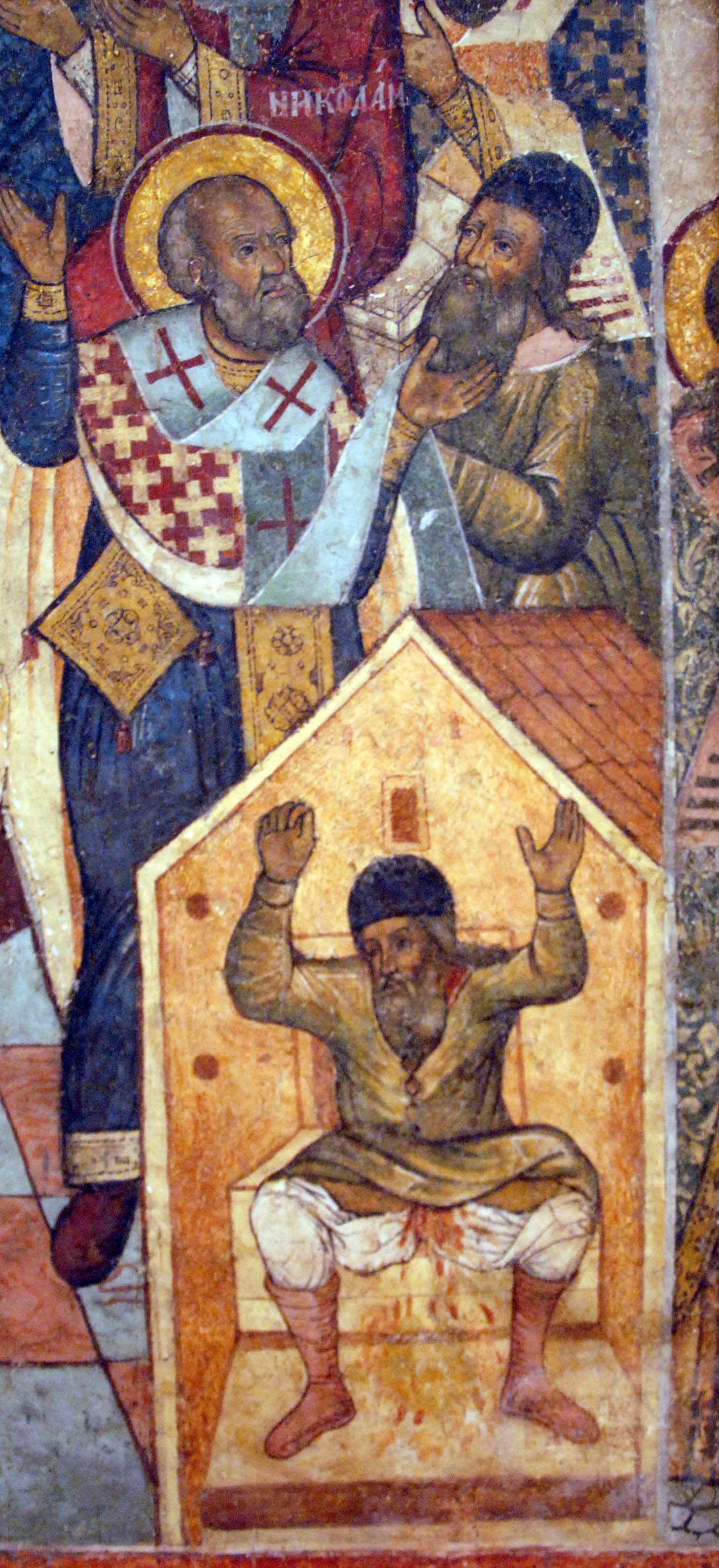

"Saint Nicholas slapped Arius at the council."
Unsupported. The story is not in Eusebius, Athanasius, Socrates, Sozomen or Theodoret, and Nicholas's name is missing from many of the surviving lists of signers. It appears in much later lives of Nicholas and in icons like the one above. It is a pious legend.
"Constantine invented Sunday worship" or "changed the Sabbath to Sunday."
Refuted. Justin Martyr describes Christians gathering "on the day called Sunday" about 150 to 155, 170 years before Constantine. Constantine's law of 321 created a civil day of rest on "the venerable day of the Sun"; it did not create the Christian practice, and it said nothing about the Sabbath.1315
"The Nicene Creed said in church today is the creed of 325."
Refuted, with a qualification. The creed recited today is the longer text associated with Constantinople in 381, which keeps the core of 325 (including homoousios), adds a section on the Holy Spirit and the church, and drops the anathemas. Western churches also add the words "and the Son" (the filioque), a later addition discussed in lesson 08.31
"Arius taught that Jesus was only a man."
Refuted. In his own letter Arius calls the Son "perfect God, only begotten and unchangeable," existing "before time, and before ages." His claim was that the Son had a beginning and was created by the Father's will.21
"Constantine was baptized by an Arian."
Partly supported. Eusebius names no baptizer. A Latin chronicle of about 380 names Eusebius of Nicomedia, who had defended Arius and been exiled after Nicaea, and most historians accept it. Eusebius of Nicomedia had signed the creed of 325, so "Arian" is his opponents' label.4950
"Nicaea fixed Easter as the first Sunday after the first full moon after the spring equinox."
Partly supported. The council agreed that all churches should keep Easter on the same day as Rome and Alexandria and stop following the Jewish calendar. No surviving document of 325 states a formula; the familiar rule is a later summary of Alexandrian practice.3140
Hard questions and answers
Did Constantine really convert, or did he use the church?
The evidence fits both, which is why historians still disagree. On one side: from 312 he funded the church on a vast scale, wrote letters full of Christian theology, preached to his court, attended a council of bishops, built the Holy Sepulchre and was baptized. On the other: he kept the title of chief pagan priest, his coins carried the Sun god for years, he had his son and wife killed, and he delayed baptism until he was dying. Barnes reads him as a sincere convert from 312; others see a gradual move from a general devotion to "the supreme Divinity" toward Christianity. Delaying baptism was common practice and does not by itself show insincerity. Motive cannot be read from documents with certainty; actions can, and his actions favored the church consistently from 312.55
Did the emperor impose the creed?
He shaped it and enforced it, and the bishops wrote it. Eusebius of Caesarea says the emperor proposed adding homoousios and explained it; Constantine then exiled the bishops who refused to sign and ordered Arius's books burned on pain of death. On the other hand, the key terms answered a dispute among bishops that began years before Constantine took notice, and the emperor's first letter called the whole question "trifling." Within ten years the same emperor recalled Arius and exiled Athanasius, and his son backed a creed that banned the word. If the creed had depended on imperial will alone, it would have died in 360.283639
Was the whole fight about one letter, the iota in homoousios and homoiousios?
The single letter is a famous jibe; the eighteenth century historian Edward Gibbon mocked the quarrel along these lines in The Decline and Fall of the Roman Empire. The difference in meaning was real: "same in being" says the Son is God in the full sense the Father is; "like in being" leaves room for a lesser, derived divinity. The participants tied this to salvation (Athanasius: only God can make us sharers in God) and to worship (whether Christians may pray to a creature). The two words also did not define the main battle lines in 325, when homoiousios was not yet in use; it was proposed in 358, and many who held it later accepted Nicaea.46
Where was the bishop of Rome in all this?
Absent in person and present by legates. Silvester sent two presbyters, the council was overwhelmingly eastern, and canon 6 cites Rome's customary authority as a model for Alexandria's. In the following decades Rome was the steadiest supporter of Athanasius and Nicaea: Bishop Julius received him in 339, and a Roman synod cleared him in 341. Liberius, exiled for refusing to condemn Athanasius, later signed a compromise statement under pressure, as Athanasius himself reports.51 Catholic readers see in this a pattern of Roman fidelity; Orthodox and Protestant readers see a respected senior church that could also bend.303143
If Nicaea was the church's settled judgment, why did its opponents hold power for decades?
Because in 325 the creed was not yet a settled judgment for most eastern bishops. Many had signed for peace, as Eusebius of Caesarea's letter shows, and remained uneasy with "substance" language. Imperial favor then moved toward their side. The Nicene position recovered through the long resistance of Athanasius, the support of Rome and the West, the rapprochement with the "like in substance" party, the theology of the Cappadocians and the accession in 379 of Theodosius I, a Nicene westerner. Ayres's argument is that "Nicene orthodoxy" in the sense later churches mean it was achieved in those decades, with the creed of 325 as its starting point.56
Was Athanasius a persecuted saint or a party boss?
Both pictures have evidence. He was exiled five times by four emperors, kept the loyalty of the Egyptian monks and people for 45 years and wrote theology still read by every major church. His enemies charged him with violence against Meletian clergy, and Barnes concluded that some charges had substance even though others, such as the murder of Arsenius, were plainly false. Almost all the narrative of these years comes from Athanasius's own pen, which is why careful historians test it against other sources.4455
Bridge to 381
When Valens died fighting the Goths at Adrianople in August 378, the eastern church was still divided among Homoians, Nicenes and those in between, and the question of the Holy Spirit had been added to the question of the Son. Theodosius I, proclaimed emperor in 379, ordered in February 380 that all his subjects follow the faith of Damasus of Rome and Peter of Alexandria, and in 381 he called a council to Constantinople that confirmed Nicaea, condemned the Homoians and the Anomoians, and issued the expanded creed most churches still recite. That council, with Ephesus (431) and Chalcedon (451), is the subject of lesson 05. The persecutions that came before Constantine are in lesson 03.
Learn more
- The Seven Ecumenical Councils (NPNF2 14), Nicaea section: The creed, all 20 canons and the synodal letter in one public domain page.
- Eusebius, Life of Constantine, Book 3: The eyewitness account of the council, with Constantine's speech and his Easter letter.
- Athanasius, On the Incarnation: A short classic that shows why the Nicene side thought salvation depended on the Son's full divinity.
- Socrates, Church History, Book 1: Arius's argument, Alexander's letter, Eusebius's letter to Caesarea and the aftermath of Nicaea, as a fifth century historian assembled them.
- Athanasius, De Synodis: The longest surviving extract of Arius's Thalia and Athanasius's case for homoousios after 359.
Still being checked (21 items)
These points could not be confirmed against a primary source when this lesson was written and fact checked in October 2026. The text above states each one as uncertain.
- Constantine's birth year (estimates from about 272 to the early 280s) and the traditional proclamation date of July 25, 306, were not checked against a primary source.
- The battle date Oct. 28, 312, rests on the Roman calendar tradition (the Calendar of 354, not opened); Lactantius's 'sixth of the kalends of November' works out to Oct. 27.
- The Latin Panegyric of 310 was not opened; Peter Weiss's solar halo argument and Barnes's acceptance of it are cited from the scholarly literature, not rechecked.
- The Arch of Constantine inscription was taken from the World History Encyclopedia transcription; CIL VI 1139 itself was not opened. The Sol Invictus coinage is stated from general scholarship.
- The exact date of the Sunday law (March 7, 321) comes from the law's subscription as commonly cited; Schaff gives only the year.
- The year Gratian gave up the title pontifex maximus is given as 379 or 382 because sources differ.
- The figure of about 10 percent Christians around 300 is Rodney Stark's model estimate, cited from memory of the book.
- Constantine's use of force against the Donatists from 317 to 321 is stated from secondary knowledge; the documents in the appendix to Optatus were not opened.
- The start date of the Arian dispute (318 or later) and Rowan Williams's preference for a later date are stated from the scholarly literature, not rechecked.
- The council of Antioch early in 325 (known from a Syriac letter) and the move of the great council from Ancyra to Nicaea were not checked in a primary source.
- The traditional opening dates of Nicaea (May 20, June 19) and the count of about 200 to 220 names in the signature lists were not checked.
- Athanasius's account in De Decretis of why the bishops chose 'of the substance' is paraphrased; the relevant chapters were not opened (the New Advent page used holds only chapters 1 to 17).
- The beginnings of the Lateran basilica and Old Saint Peter's under Constantine are stated without a primary source footnote.
- The Da Vinci Code is paraphrased; its exact wording and chapter were not rechecked.
- The Synodicon Vetus legend of the books on the altar, the lateness of the Saint Nicholas slap story and Nicholas's absence from many signature lists are stated from secondary knowledge.
- The date of Ulfilas's consecration (about 341), Reccared's conversion (587), the Third Council of Toledo (589) and the Codex Argenteus details are stated without primary footnotes.
- Athanasius's birth (about 295 to 299) and the dating of On the Incarnation (about 318, or 335 to 337) are scholarly estimates.
- The bishops' civil jurisdiction (episcopal courts) under Constantine is stated without a footnote to the Theodosian Code.
- Hosius of Cordoba's role at Nicaea is inferred from Eusebius's unnamed 'one from Spain'; who presided at Nicaea is left open.
- The Nicaea icon (04-nicaea-icon.jpg) has no date or artist on Wikimedia Commons; the Arius and Saint Nicholas icon is described as Greek Orthodox on Commons though its lettering is Cyrillic.
- Timothy Ware's and John Howard Yoder's views are paraphrased, not quoted from their books. (Gibbon's 'single diphthong' remark was checked: Decline and Fall, ch. 21.)
Notes
- Timothy D. Barnes, Constantine and Eusebius (Cambridge, Mass.: Harvard University Press, 1981), ch. 1, on the disputed birth date; Eusebius, Life of Constantine 4.53, says he reigned about 32 years and lived "about twice that period"; Eusebius of Caesarea, Life of Constantine, trans. Ernest Cushing Richardson, Nicene and Post-Nicene Fathers, Second Series (NPNF2), vol. 1 (Buffalo: Christian Literature Publishing Co., 1890), rev. Kevin Knight, New Advent, Book 4 (retrieved Oct. 28, 2026). Read it online. ↩
- Lactantius, Of the Manner in Which the Persecutors Died, trans. William Fletcher, Ante-Nicene Fathers, vol. 7 (Buffalo: Christian Literature Publishing Co., 1886), New Advent, ch. 24 to 25 (Constantine's flight from Galerius and his proclamation) (retrieved Oct. 28, 2026). Read it online. ↩
- Eusebius of Caesarea, Life of Constantine, trans. Ernest Cushing Richardson, Nicene and Post-Nicene Fathers, Second Series (NPNF2), vol. 1 (Buffalo: Christian Literature Publishing Co., 1890), rev. Kevin Knight, New Advent, Book 1, ch. 21 to 22 (retrieved Oct. 28, 2026). Read it online. ↩
- Lactantius, Of the Manner in Which the Persecutors Died, trans. William Fletcher, Ante-Nicene Fathers, vol. 7 (Buffalo: Christian Literature Publishing Co., 1886), New Advent, ch. 43 to 44; and Zosimus, New History 2.15, trans. Green and Chaplin (London, 1814), Tertullian Project, for the army figures (retrieved Oct. 28, 2026). Read it online. ↩
- Lactantius, Of the Manner in Which the Persecutors Died, trans. William Fletcher, Ante-Nicene Fathers, vol. 7 (Buffalo: Christian Literature Publishing Co., 1886), New Advent, ch. 44 (the dream, the sign on the shields, the Sibylline books and the battle) (retrieved Oct. 28, 2026). Read it online. ↩
- Eusebius of Caesarea, Life of Constantine, trans. Ernest Cushing Richardson, Nicene and Post-Nicene Fathers, Second Series (NPNF2), vol. 1 (Buffalo: Christian Literature Publishing Co., 1890), rev. Kevin Knight, New Advent, Book 1, ch. 27 to 32 (the prayer, the vision, the dream, the labarum) (retrieved Oct. 28, 2026). Read it online. ↩
- Latin Panegyric of 310, Panegyrici Latini 6 [7].21 (the vision of Apollo; text not opened for this lesson); Peter Weiss, "The Vision of Constantine," Journal of Roman Archaeology 16 (2003), English version of a 1993 German article; Timothy D. Barnes, Constantine: Dynasty, Religion and Power in the Later Roman Empire (Chichester: Wiley-Blackwell, 2011) (retrieved Oct. 28, 2026). Read it online. ↩
- Dedicatory inscription of the Arch of Constantine (CIL VI 1139), Latin text and translation as given in Mark Cartwright, "The Arch of Constantine, Rome," World History Encyclopedia; on the Sol coinage see Barnes, Constantine and Eusebius (1981) (retrieved Oct. 28, 2026). Read it online. ↩
- Lactantius, Of the Manner in Which the Persecutors Died, trans. William Fletcher, Ante-Nicene Fathers, vol. 7 (Buffalo: Christian Literature Publishing Co., 1886), New Advent, ch. 48 (the letter of Licinius, posted at Nicomedia on the ides of June, 313) (retrieved Oct. 28, 2026). Read it online. ↩
- Eusebius of Caesarea, Church History, trans. Arthur Cushman McGiffert, NPNF2 vol. 1 (1890), New Advent, Book 10, ch. 5.1 to 14 (Greek version of the same letter) (retrieved Oct. 28, 2026). Read it online. ↩
- Eusebius of Caesarea, Church History, trans. Arthur Cushman McGiffert, NPNF2 vol. 1 (1890), New Advent, Book 10, ch. 5.15 to 17, ch. 6 (3,000 folles to Caecilian) and ch. 7 (exemption of the clergy) (retrieved Oct. 28, 2026). Read it online. ↩
- Eusebius of Caesarea, Life of Constantine, trans. Ernest Cushing Richardson, Nicene and Post-Nicene Fathers, Second Series (NPNF2), vol. 1 (Buffalo: Christian Literature Publishing Co., 1890), rev. Kevin Knight, New Advent, Book 3, ch. 25 to 58 (the Holy Sepulchre, Bethlehem, the Mount of Olives, churches elsewhere and the destruction of temples at Aphaca, Aegae and Heliopolis) (retrieved Oct. 28, 2026). Read it online. ↩
- Philip Schaff, History of the Christian Church, vol. 3, Nicene and Post-Nicene Christianity, section 17 on the legal sanction of Sunday, quoting the law of 321 from the Code of Justinian 3.12 (Schaff numbers it law 3; modern editions 3.12.2), Christian Classics Ethereal Library (retrieved Oct. 28, 2026). Read it online. ↩
- Eusebius of Caesarea, Life of Constantine, trans. Ernest Cushing Richardson, Nicene and Post-Nicene Fathers, Second Series (NPNF2), vol. 1 (Buffalo: Christian Literature Publishing Co., 1890), rev. Kevin Knight, New Advent, Book 4, ch. 18 (retrieved Oct. 28, 2026). Read it online. ↩
- Justin Martyr, First Apology 67, trans. Marcus Dods and George Reith, Ante-Nicene Fathers, vol. 1 (1885), New Advent (retrieved Oct. 28, 2026). Read it online. ↩
- Eusebius of Caesarea, Life of Constantine, trans. Ernest Cushing Richardson, Nicene and Post-Nicene Fathers, Second Series (NPNF2), vol. 1 (Buffalo: Christian Literature Publishing Co., 1890), rev. Kevin Knight, New Advent, Book 4, ch. 24 and 27 (retrieved Oct. 28, 2026). Read it online. ↩
- Eusebius of Caesarea, Life of Constantine, trans. Ernest Cushing Richardson, Nicene and Post-Nicene Fathers, Second Series (NPNF2), vol. 1 (Buffalo: Christian Literature Publishing Co., 1890), rev. Kevin Knight, New Advent, Book 2, ch. 56 and 60 (Constantine's letter to the eastern provinces) (retrieved Oct. 28, 2026). Read it online. ↩
- Zosimus, New History 2.29, trans. W. Green and T. Chaplin (London, 1814), Tertullian Project (retrieved Oct. 28, 2026). Read it online. ↩
- Rodney Stark, The Rise of Christianity (Princeton: Princeton University Press, 1996), ch. 1, growth model (estimate cited from the book; a modeled estimate, not a census) (retrieved Oct. 28, 2026). Read it online. ↩
- Eusebius of Caesarea, Church History, trans. Arthur Cushman McGiffert, NPNF2 vol. 1 (1890), New Advent, Book 10, ch. 5.18 to 24 (letters to Miltiades and to Chrestus of Syracuse summoning the councils of Rome, 313, and Arles, 314) (retrieved Oct. 28, 2026). Read it online. ↩
- Theodoret of Cyrrhus, Ecclesiastical History, trans. Blomfield Jackson, NPNF2 vol. 3 (1892), New Advent, Book 1, ch. 4 (letter of Arius to Eusebius of Nicomedia) (retrieved Oct. 28, 2026). Read it online. ↩
- Rowan Williams, Arius: Heresy and Tradition (London: Darton, Longman and Todd, 1987; rev. ed. Grand Rapids: Eerdmans, 2002), on chronology and on the Thalia (retrieved Oct. 28, 2026). Read it online. ↩
- Socrates Scholasticus, Church History, trans. A. C. Zenos, NPNF2 vol. 2 (1890), New Advent, Book 1, ch. 5 (retrieved Oct. 28, 2026). Read it online. ↩
- Theodoret of Cyrrhus, Ecclesiastical History, trans. Blomfield Jackson, NPNF2 vol. 3 (1892), New Advent, Book 1, ch. 1 (retrieved Oct. 28, 2026). Read it online. ↩
- Athanasius, De Synodis (On the Councils of Ariminum and Seleucia), ch. 15 (Thalia extract), 16 (letter of Arius and his clergy to Alexander), 41 to 45, trans. John Henry Newman and Archibald Robertson, NPNF2 vol. 4, Athanasius: Select Works and Letters, ed. Archibald Robertson (1892), New Advent (retrieved Oct. 28, 2026). Read it online. ↩
- Athanasius, Discourse I Against the Arians 1.2.5 to 6, trans. John Henry Newman and Archibald Robertson, NPNF2 vol. 4, Athanasius: Select Works and Letters, ed. Archibald Robertson (1892), New Advent (retrieved Oct. 28, 2026). Read it online. ↩
- Socrates Scholasticus, Church History, trans. A. C. Zenos, NPNF2 vol. 2 (1890), New Advent, Book 1, ch. 6 (Alexander's circular letter) (retrieved Oct. 28, 2026). Read it online. ↩
- Eusebius of Caesarea, Life of Constantine, trans. Ernest Cushing Richardson, Nicene and Post-Nicene Fathers, Second Series (NPNF2), vol. 1 (Buffalo: Christian Literature Publishing Co., 1890), rev. Kevin Knight, New Advent, Book 2, ch. 64 to 72 (Constantine's letter to Alexander and Arius) (retrieved Oct. 28, 2026). Read it online. ↩
- R. P. C. Hanson, The Search for the Christian Doctrine of God: The Arian Controversy 318 to 381 (Edinburgh: T. and T. Clark, 1988), on the council of Antioch of 325 and on the name "Arian controversy" (retrieved Oct. 28, 2026). Read it online. ↩
- Eusebius of Caesarea, Life of Constantine, trans. Ernest Cushing Richardson, Nicene and Post-Nicene Fathers, Second Series (NPNF2), vol. 1 (Buffalo: Christian Literature Publishing Co., 1890), rev. Kevin Knight, New Advent, Book 3, ch. 6 to 9; also Theodoret, Ecclesiastical History 1.2 (Silvester bishop of Rome) and 1.6 (the two Roman presbyters) (retrieved Oct. 28, 2026). Read it online. ↩
- First Council of Nicaea (325): the Creed, the Canons and the Synodal Letter, trans. Henry Percival, NPNF2 vol. 14, The Seven Ecumenical Councils, ed. Philip Schaff and Henry Wace (Buffalo: Christian Literature Publishing Co., 1900), with Percival's notes on canon 6, New Advent (retrieved Oct. 28, 2026). Read it online. ↩
- Eusebius of Caesarea, Life of Constantine, trans. Ernest Cushing Richardson, Nicene and Post-Nicene Fathers, Second Series (NPNF2), vol. 1 (Buffalo: Christian Literature Publishing Co., 1890), rev. Kevin Knight, New Advent, Book 3, ch. 10 and 15 (retrieved Oct. 28, 2026). Read it online. ↩
- Athanasius, De Decretis (Defence of the Nicene Definition) 3, and History of the Arians 66, NPNF2 vol. 4, Athanasius: Select Works and Letters, ed. Archibald Robertson (1892), New Advent, (De Decretis at 2809.htm; History of the Arians at 28158.htm) (retrieved Oct. 28, 2026). Read it online. ↩
- Athanasius, Ad Afros (Synodal Letter to the Bishops of Africa) 2, NPNF2 vol. 4, Athanasius: Select Works and Letters, ed. Archibald Robertson (1892), New Advent (retrieved Oct. 28, 2026). Read it online. ↩
- Ambrose of Milan, On the Christian Faith, Book 1, prologue 3 and 5, trans. H. de Romestin, E. de Romestin and H. T. F. Duckworth, NPNF2 vol. 10 (1896), New Advent (retrieved Oct. 28, 2026). Read it online. ↩
- Socrates Scholasticus, Church History, trans. A. C. Zenos, NPNF2 vol. 2 (1890), New Advent, Book 1, ch. 8 (the council, the five who objected, and the letter of Eusebius of Caesarea to his church); see also Theodoret 1.6 for the figure 318 (retrieved Oct. 28, 2026). Read it online. ↩
- Eusebius of Caesarea, Life of Constantine, trans. Ernest Cushing Richardson, Nicene and Post-Nicene Fathers, Second Series (NPNF2), vol. 1 (Buffalo: Christian Literature Publishing Co., 1890), rev. Kevin Knight, New Advent, Book 3, ch. 10 to 13 (retrieved Oct. 28, 2026). Read it online. ↩
- Theodoret of Cyrrhus, Ecclesiastical History, trans. Blomfield Jackson, NPNF2 vol. 3 (1892), New Advent, Book 1, ch. 6 (retrieved Oct. 28, 2026). Read it online. ↩
- Socrates Scholasticus, Church History, trans. A. C. Zenos, NPNF2 vol. 2 (1890), New Advent, Book 1, ch. 9 (Constantine's letter against Arius) (retrieved Oct. 28, 2026). Read it online. ↩
- Eusebius of Caesarea, Life of Constantine, trans. Ernest Cushing Richardson, Nicene and Post-Nicene Fathers, Second Series (NPNF2), vol. 1 (Buffalo: Christian Literature Publishing Co., 1890), rev. Kevin Knight, New Advent, Book 3, ch. 17 to 20 (Constantine's letter on Easter) (retrieved Oct. 28, 2026). Read it online. ↩
- Dan Brown, The Da Vinci Code (New York: Doubleday, 2003), the conversation between Leigh Teabing and Sophie Neveu on Constantine and Nicaea (paraphrased here; exact wording and chapter not rechecked for this lesson) (retrieved Oct. 28, 2026). Read it online. ↩
- Eusebius of Caesarea, Life of Constantine, trans. Ernest Cushing Richardson, Nicene and Post-Nicene Fathers, Second Series (NPNF2), vol. 1 (Buffalo: Christian Literature Publishing Co., 1890), rev. Kevin Knight, New Advent, Book 4, ch. 36 to 37 (the fifty copies of the Scriptures) (retrieved Oct. 28, 2026). Read it online. ↩
- Index to the Festal Letters of Athanasius, NPNF2 vol. 4 (1892), entries for 328 (Alexander's death on April 17 and Athanasius's succession on 14 Pauni, June 8), 331 (the charge that he was appointed "when too young"), 335 to 337 and 339, Christian Classics Ethereal Library; and Cornelius Clifford, "St. Athanasius," Catholic Encyclopedia, vol. 2 (New York: Robert Appleton, 1907) (retrieved Oct. 28, 2026). Read it online. ↩
- Socrates Scholasticus, Church History, trans. A. C. Zenos, NPNF2 vol. 2 (1890), New Advent, Book 1, ch. 27 to 35 (the charges, Arsenius, the Council of Tyre and the first exile) (retrieved Oct. 28, 2026). Read it online. ↩
- Historia Acephala and the Index to the Festal Letters, NPNF2 vol. 4, Athanasius: Select Works and Letters, ed. Archibald Robertson (1892), New Advent, and Cornelius Clifford, "St. Athanasius," Catholic Encyclopedia (1907), for the dates of the exiles and of his death (retrieved Oct. 28, 2026). Read it online. ↩
- Athanasius, On the Incarnation of the Word 54, trans. Archibald Robertson, NPNF2 vol. 4, Athanasius: Select Works and Letters, ed. Archibald Robertson (1892), New Advent (retrieved Oct. 28, 2026). Read it online. ↩
- Athanasius, Festal Letter 39 (for 367), trans. R. Payne-Smith, NPNF2 vol. 4, Athanasius: Select Works and Letters, ed. Archibald Robertson (1892), New Advent (retrieved Oct. 28, 2026). Read it online. ↩
- Socrates Scholasticus, Church History, trans. A. C. Zenos, NPNF2 vol. 2 (1890), New Advent, Book 1, ch. 26 (the creed of Arius and Euzoius) and ch. 37 to 38 (the death of Arius); Theodoret, Ecclesiastical History 1.13 (extract from Athanasius's letter on the death of Arius) (retrieved Oct. 28, 2026). Read it online. ↩
- Eusebius of Caesarea, Life of Constantine, trans. Ernest Cushing Richardson, Nicene and Post-Nicene Fathers, Second Series (NPNF2), vol. 1 (Buffalo: Christian Literature Publishing Co., 1890), rev. Kevin Knight, New Advent, Book 4, ch. 61 to 64; the date May 22, 337, from the Index to the Festal Letters (NPNF2 vol. 4) (retrieved Oct. 28, 2026). Read it online. ↩
- Latin translation and continuation of Eusebius's Chronicle (about 380), entry for 337 (279th Olympiad), English translation (2005) with the Latin text, published in the Early Church Fathers collection of the Tertullian Project, tertullian.org (the translator of the Latin continuation is deliberately not named here, under this site's naming rule, and the page address is omitted because it contains that name) (retrieved Oct. 28, 2026). ↩
- Athanasius, History of the Arians 41 to 45 (Liberius and Hosius; the letter of Hosius to Constantius at 44), trans. M. Atkinson and Archibald Robertson, NPNF2 vol. 4, Athanasius: Select Works and Letters, ed. Archibald Robertson (1892), New Advent (retrieved Oct. 28, 2026). Read it online. ↩
- Socrates Scholasticus, Church History, trans. A. C. Zenos, NPNF2 vol. 2 (1890), New Advent, Book 2, ch. 41 (the creed of Constantinople, 360, and the signature of Ulfilas) (retrieved Oct. 28, 2026). Read it online. ↩
- Philostorgius, Ecclesiastical History, epitome by Photius, Book 2, ch. 5, trans. Edward Walford (London: Henry G. Bohn, 1855), Tertullian Project (retrieved Oct. 28, 2026). Read it online. ↩
- Socrates Scholasticus, Church History, trans. A. C. Zenos, NPNF2 vol. 2 (1890), New Advent, Book 4, ch. 33 (retrieved Oct. 28, 2026). Read it online. ↩
- Timothy D. Barnes, Constantine and Eusebius (Harvard University Press, 1981) and Athanasius and Constantius: Theology and Politics in the Constantinian Empire (Harvard University Press, 1993) (retrieved Oct. 28, 2026). Read it online. ↩
- Lewis Ayres, Nicaea and Its Legacy: An Approach to Fourth-Century Trinitarian Theology (Oxford: Oxford University Press, 2004) (retrieved Oct. 28, 2026). Read it online. ↩
- Henry Chadwick, The Early Church (Harmondsworth: Penguin, 1967); Jaroslav Pelikan, The Christian Tradition, vol. 1, The Emergence of the Catholic Tradition (100 to 600) (Chicago: University of Chicago Press, 1971) (retrieved Oct. 28, 2026). Read it online. ↩
- Timothy Ware (Metropolitan Kallistos), The Orthodox Church (Harmondsworth: Penguin, 1963; rev. ed. 1993), part 1, on the councils (paraphrased) (retrieved Oct. 28, 2026). Read it online. ↩
- Augsburg Confession (1530), Article 1, "Of God," Triglot Concordia translation (1921), Book of Concord (retrieved Oct. 28, 2026). Read it online. ↩
- Hilary of Poitiers, On the Councils (De Synodis) 86 (written about 358 to 359), trans. E. W. Watson, L. Pullan and others, NPNF2 vol. 9 (Buffalo: Christian Literature Publishing Co., 1899), New Advent (retrieved Oct. 28, 2026). Read it online. ↩
Check yourself
1. Which early source says Constantine was told in a dream to mark the sign of Christ on his soldiers' shields before the Milvian Bridge?
Lactantius (chapter 44), writing about 313 to 315, reports a dream and the sign on the shields. Eusebius's Life, written after 337, adds the cross of light seen by the whole army.
2. What is the surviving text usually called the Edict of Milan?
The emperors agreed the policy at Milan, but the text that survives is Licinius's letter posted at Nicomedia, preserved by Lactantius and, in Greek, by Eusebius.
3. How many bishops did Eusebius of Caesarea, an eyewitness, say were at Nicaea?
Eusebius (Life of Constantine 3.8) says the bishops exceeded 250. Athanasius said about 300; the figure 318 is in writing by about 359 (Hilary of Poitiers) and in Athanasius about 369.
4. Which Greek word did the creed of 325 use for the Son's relation to the Father?
The creed says the Son is "of one substance (homoousion) with the Father." The other terms belong to later parties.
5. What does canon 6 of Nicaea do?
Canon 6 confirms the "ancient customs" of Alexandria "since the like is customary for the Bishop of Rome also," and protects Antioch's privileges. Kneeling is canon 20; Easter is in the synodal letter.
6. Which document is the earliest surviving list naming exactly the 27 books of today's New Testament?
Athanasius's Easter letter for 367 lists the 27 books. Nicaea's documents contain no list of books.
7. According to the Latin continuation of Eusebius's Chronicle, who baptized Constantine in 337?
Eusebius's Life names no baptizer; the Latin chronicle of about 380 names Eusebius of Nicomedia, bishop of the city near where Constantine died.
8. What did the creed of the Council of Constantinople in 360, backed by Constantius II, do?
The Homoian creed of 360, preserved by Socrates (2.41), rejected ousia because it is not in Scripture and affirmed only that the Son is "like the Father."
Terms in this lesson
- Homoousios
- Greek for "of one (the same) substance." The creed of 325 uses it to say the Son shares the Father's own being.
- Homoiousios
- "Of like substance." The position of Basil of Ancyra and others from 358, opposed to Arius but wary of homoousios.
- Homoians
- The party, backed by Constantius II and Valens, whose creeds said only that the Son is "like" the Father according to the Scriptures and banned substance language in 360.
- Anomoians
- Followers of Aetius and Eunomius in the 350s and after, who taught that the Son is unlike the Father in substance.
- Anathema
- A formal curse or exclusion from the church's communion. The creed of 325 ends with anathemas against Arius's key phrases.
- Canon
- A rule of church order issued by a council; Nicaea issued 20. The same word also means the list of books accepted as Scripture.
- Thalia
- "Banquet," a work partly in verse by Arius, known only from quotations by Athanasius.
- Labarum
- Constantine's military standard as described by Eusebius: a gilded spear with a crossbar, a jeweled wreath enclosing the Chi-Rho and a square banner.
- Chi-Rho
- The monogram formed by laying the Greek letters X (chi) and P (rho), the first letters of Christos, over each other.
- Tetrarchy
- Diocletian's system of rule by four emperors, two senior (Augusti) and two junior (Caesars), set up in the 290s.
- Metropolitan
- The bishop of a province's capital city, who under canons 4 and 6 of Nicaea ratified the appointment of the province's bishops.
- Donatists
- The North African church party that rejected Caecilian of Carthage because a traditor had consecrated him; condemned at Rome (313) and Arles (314).
- Traditor
- "Hander-over": a Christian who surrendered Scriptures or church property to the authorities during persecution.
- Festal letter
- The yearly letter of the bishop of Alexandria announcing the date of Easter; Athanasius's 39th (367) lists the books of Scripture.
Sources
- First Council of Nicaea: Creed, Canons, Synodal Letter (NPNF2 14, trans. Percival) (325) checked 2026-10
- Lactantius, Of the Manner in Which the Persecutors Died (ANF 7) (about 313 to 315) checked 2026-10
- Eusebius, Life of Constantine, Book 1 (NPNF2 1) (about 337 to 339) checked 2026-10
- Eusebius, Life of Constantine, Book 2 (NPNF2 1) (about 337 to 339) checked 2026-10
- Eusebius, Life of Constantine, Book 3 (NPNF2 1) (about 337 to 339) checked 2026-10
- Eusebius, Life of Constantine, Book 4 (NPNF2 1) (about 337 to 339) checked 2026-10
- Eusebius, Church History, Book 10 (NPNF2 1) (about 313 to 325) checked 2026-10
- Socrates Scholasticus, Church History, Book 1 (NPNF2 2) (about 439) checked 2026-10
- Socrates Scholasticus, Church History, Book 2 (NPNF2 2) (about 439) checked 2026-10
- Socrates Scholasticus, Church History, Book 4 (NPNF2 2) (about 439) checked 2026-10
- Theodoret, Ecclesiastical History, Book 1 (NPNF2 3) (about 449 to 450) checked 2026-10
- Athanasius, De Synodis (NPNF2 4) (359 to 361) checked 2026-10
- Athanasius, Discourse I Against the Arians (NPNF2 4) (about 339 to 345) checked 2026-10
- Athanasius, De Decretis (NPNF2 4) (350s) checked 2026-10
- Athanasius, History of the Arians, Part 6 (NPNF2 4) (about 357) checked 2026-10
- Athanasius, History of the Arians, Part 8 (NPNF2 4) (about 357) checked 2026-10
- Athanasius, Ad Afros (NPNF2 4) (about 369) checked 2026-10
- Athanasius, On the Incarnation (NPNF2 4) (about 318, or 335 to 337) checked 2026-10
- Athanasius, Festal Letter 39 (NPNF2 4) (367) checked 2026-10
- Index to the Festal Letters (NPNF2 4) (late 4th century) checked 2026-10
- Historia Acephala (NPNF2 4) (late 4th century) checked 2026-10
- Ambrose, On the Christian Faith, Book 1 (NPNF2 10) (about 378) checked 2026-10
- Justin Martyr, First Apology (ANF 1) (about 150 to 155) checked 2026-10
- Philostorgius, Ecclesiastical History, epitome by Photius (trans. Walford, 1855) (about 425 to 433) checked 2026-10
- Zosimus, New History, Book 2 (trans. Green and Chaplin, 1814) (about 500) checked 2026-10
- Latin continuation of Eusebius's Chronicle, entries to 378 (English and Latin in the Early Church Fathers collection of the Tertullian Project, tertullian.org; address omitted under the site's naming rule) (about 380) checked 2026-10
- Philip Schaff, History of the Christian Church, vol. 3, section 17 (1884) checked 2026-10
- Catholic Encyclopedia (1907), St. Athanasius (1907) checked 2026-10
- Augsburg Confession, Article 1 (Triglot translation) (1530) checked 2026-10
- World History Encyclopedia, The Arch of Constantine, Rome (inscription text) (accessed Oct. 28, 2026) checked 2026-10
- Timothy D. Barnes, Constantine and Eusebius (1981); Athanasius and Constantius (1993) (1981, 1993) checked 2026-10
- Lewis Ayres, Nicaea and Its Legacy (2004) (2004) checked 2026-10
- Rowan Williams, Arius: Heresy and Tradition (1987; rev. 2002) (1987) checked 2026-10
- R. P. C. Hanson, The Search for the Christian Doctrine of God (1988) (1988) checked 2026-10
- Henry Chadwick, The Early Church (1967); Jaroslav Pelikan, The Christian Tradition, vol. 1 (1971) (1967, 1971) checked 2026-10
- Timothy Ware, The Orthodox Church (1963; rev. 1993) (1993) checked 2026-10
- Rodney Stark, The Rise of Christianity (1996) (1996) checked 2026-10
- Dan Brown, The Da Vinci Code (2003) (2003) checked 2026-10
- Hilary of Poitiers, On the Councils (NPNF2 9) (about 359) checked 2026-10
- The Seven Ecumenical Councils, NPNF2 vol. 14, plain text edition (Christian Classics Ethereal Library), second copy of the creed of 325 used for checking (325; edition 1900) checked 2026-10