Lesson 8 of 12 · about 60 minutes · Updated October 28, 2026
Rome and the East: The Great Schism of 1054 and Orthodoxy in Plain Terms
You'll be able to
- Name the five great sees of the pentarchy and explain how canon 28 of Chalcedon and Pope Leo I read the rank of Rome and Constantinople differently.
- Trace the filioque from Toledo (589) through Charlemagne's court and Pope Leo III's silver tablets to Rome's use of it around 1014.
- Describe the events of July 16, 1054, who excommunicated whom, and why most historians treat 1054 as a symptom of a long estrangement.
- Explain why the sack of Constantinople in 1204 did more lasting damage than 1054, and why the unions of Lyon (1274) and Florence (1439) failed.
- Quote what the 1965 Joint Catholic-Orthodox Declaration did and did not do.
- Describe the Divine Liturgy, icons, theosis, autocephalous churches, married priests, fasting and the calendar in the Orthodox Church's own words, and state the Catholic and Orthodox positions on papal primacy, the filioque, purgatory, leavened bread and the Immaculate Conception.
Start here: the short version
For its first thousand years the church of the old Roman world was one communion spread across two halves: a Greek-speaking East centered on Constantinople, Alexandria, Antioch and Jerusalem, and a Latin-speaking West centered on Rome. The halves drifted apart over language, politics, the authority of the pope, and an added word in the Nicene Creed, the Latin filioque ("and from the Son"). On July 16, 1054, papal legates led by Cardinal Humbert of Silva Candida laid a bull of excommunication on the altar of Hagia Sophia in Constantinople against Patriarch Michael Cerularius, and the patriarch's synod answered with its own sentence against the legates.1 Pope Leo IX, who had sent them, had already died that April.23 Most historians now treat 1054 as one hard moment in a long estrangement. The deeper wound came in April 1204, when the knights of the Fourth Crusade sacked Constantinople.4 Councils at Lyon (1274) and Florence (1438 to 1439) signed unions that the Eastern clergy and people would not receive. In 1965 Pope Paul VI and Ecumenical Patriarch Athenagoras I committed the excommunications of 1054 "to oblivion," while saying that the gesture did not end the differences.5 The second half of this lesson describes the Orthodox Church in its own words (its worship, icons, the goal it calls theosis, its self-governing churches, married priests, fasting and calendars) and then sets the points where Catholic and Orthodox teaching agree and differ side by side, each in its own official language.
This lesson follows lesson 05, The Later Councils, which ended with Chalcedon in 451, and it runs alongside lesson 09, The Medieval Church, which tells the Western story of Gregory the Great, Charlemagne and the Crusades. Here the camera stays on the relationship between the two halves of Christendom and on the Eastern church that came out of it.
East and West before the break
One church, five great sees
The early councils did not create a single world government for the church. They recognized that certain bishops, in the largest cities, had a wider responsibility than others. The Council of Nicaea in 325, in its sixth canon, wrote: "Let the ancient customs in Egypt, Libya and Pentapolis prevail, that the Bishop of Alexandria have jurisdiction in all these, since the like is customary for the Bishop of Rome also. Likewise in Antioch and the other provinces, let the Churches retain their privileges." Its seventh canon gave the bishop of Jerusalem (then called Aelia) "the next place of honour," while keeping the rights of the regional capital, Caesarea.6 That is three great sees named outright (Rome, Alexandria, Antioch) and a fourth honored for its history.
The fifth was new. Constantine had refounded the town of Byzantium as his capital, Constantinople, "New Rome." The Council of Constantinople in 381 gave its bishop a rank of honor after Rome, and the Council of Chalcedon in 451, in the canon later numbered 28, confirmed and widened that rank. The canon gives its reason in plain words: "For the Fathers rightly granted privileges to the throne of old Rome, because it was the royal city. And the One Hundred and Fifty most religious Bishops, actuated by the same consideration, gave equal privileges to the most holy throne of New Rome, justly judging that the city which is honoured with the Sovereignty and the Senate, and enjoys equal privileges with the old imperial Rome, should in ecclesiastical matters also be magnified as she is, and rank next after her."7 The same canon gave the bishop of Constantinople the right to ordain the metropolitans of the Pontic, Asian and Thracian dioceses.
By the sixth century five sees stood above the rest in the eyes of the imperial church: Rome, Constantinople, Alexandria, Antioch and Jerusalem. Later writers called the arrangement the pentarchy, the "rule of five." The ranking was still being repeated nine centuries later. The decree of union at Florence in 1439 says that "the patriarch of Constantinople should be second after the most holy Roman pontiff, third should be the patriarch of Alexandria, fourth the patriarch of Antioch, and fifth the patriarch of Jerusalem, without prejudice to all their privileges and rights."8
What the five agreed on was the order. What they did not agree on was what the first place meant. In the East the common reading was that Rome held first place among equals, as the canon of Chalcedon put it, because of its history and its standing as the old capital. In the West, as the next sections show, the popes held that the first place came from Peter himself and carried authority over the whole church.
Two languages, two halves of an empire
The split had causes that no council decreed. The Roman Empire was divided for administration into eastern and western halves, and after 476 there was no emperor in the West at all. The East kept a Roman emperor in Constantinople for almost another thousand years. The Orthodox Church in America's church-history handbook names the language gap and the political gap as two of the deepest causes: "The two different languages, Greek in the East and Latin in the West, reflected differences in basic worldview, which contributed to different approaches in theology," and "the loss of the political unity of the Empire was a huge factor in disrupting communication between East and West."2 (The OCA text sets off the phrase about the languages with dashes; they are rendered here as commas.) The practical result was that fewer churchmen in each half could read the other's language, so that each side often met the other's theology in translation, or through hostile summaries. One small sign appears in the record of 1054 itself. The Greek letter of Archbishop Leo of Ochrid that set off the final quarrel reached the pope only after Cardinal Humbert "translated it and showed it to the pope," in the words of the Catholic Encyclopedia of 1911.9 Philip Schaff, the nineteenth-century Protestant church historian, went further: "This letter is only extant in the Latin translation of Cardinal Humbert."1 (The Catholic Encyclopedia cites a printed edition of the letter in Cornelius Will's Acta et scripta, so Schaff's statement may be out of date.)
Politics deepened the drift. When the popes, pressed by the Lombards in Italy, turned to the Frankish kings for protection, and when Pope Leo III crowned Charlemagne emperor on Christmas Day 800 (the subject of lesson 09), the West had an emperor of its own whom Constantinople did not recognize as Roman. The OCA history adds that "the rivalry between the Holy Roman Empire in the West and the Byzantine Empire in the East exacerbated the rift."2
The papal claims from Leo I onward
The question that the Orthodox name as the largest is authority. The OCA history says: "From the Eastern Orthodox perspective, however, the biggest single reason for the Great Schism was the reassertion of Papal claims to have jurisdictional authority over all the Churches of Christendom."2 Catholic teaching, set out below in its own words, holds that this authority was given by Christ to Peter and passes to Peter's successors in Rome.
The claims took a clear shape under Pope Leo I (pope 440 to 461), whose doctrinal letter to Constantinople, the Tome, was read at Chalcedon (see lesson 05). Writing to Bishop Anastasius of Thessalonica, Leo described the church as a pyramid of responsibility, in which bishops of the greater cities "should undertake a fuller responsibility, through whom the care of the universal Church should converge towards Peter's one seat, and nothing anywhere should be separated from its Head."10 At Chalcedon in 451, when Leo's Tome was read aloud, the acts record that the bishops cried out: "This is the faith of the fathers, this is the faith of the Apostles.... Peter has spoken thus through Leo. So taught the Apostles. Piously and truly did Leo teach, so taught Cyril."11 Catholic writers read the acclamation as recognition of Peter's authority speaking through his successor. Orthodox writers point out that the same bishops placed Leo beside Cyril of Alexandria, and judged his letter by whether it agreed with the faith they already held.
Canon 28 and the quarrel over New Rome
Canon 28 itself became the first open clash over what Rome's first place meant. Leo's legates at Chalcedon objected to it, and Leo refused to accept it. His letter to Anatolius, bishop of Constantinople, accuses him of trying "to break down the most sacred constitutions of the Nicene canons," so that "the See of Alexandria" might "lose its privilege of second place, and the church of Antioch to forego its right to being third in dignity." He warned: "Let no synodal councils flatter themselves upon the size of their assemblies," since nothing could overrule what the Holy Spirit had ordained at Nicaea.12
The two sides read the same event differently. For Leo, the rank of a church came from its apostolic founding (Rome from Peter and Paul, Alexandria from Mark, Peter's disciple, Antioch from Peter) and could not be shifted because an emperor moved his capital. For the bishops who passed canon 28, the rank of a church followed the standing of its city in the empire, which is the reason the canon itself gives. The canon stayed in force in the East. Rome did not formally accept the rank of Constantinople as second until the Fourth Lateran Council in 1215, eleven years after the Latins had taken the city and installed a Latin patriarch there. Its fifth constitution decreed "that after the Roman church, which through the Lord's disposition has a primacy of ordinary power over all other churches inasmuch as it is the mother and mistress of all Christ's faithful, the church of Constantinople shall have the first place, the church of Alexandria the second place, the church of Antioch the third place, and the church of Jerusalem the fourth place."13 By then the ranking was granted on Rome's terms, inside a Latin-ruled East.
The icon controversy, 726 to 843
Before the quarrel between Rome and Constantinople came to a head, the East went through a long war over images inside its own house. Schaff divides it into three stages: the attack on images "and the abolition of image-worship by the Council of Constantinople, a.d. 726 to 754"; the reaction in their favor, sealed by the Second Council of Nicaea in 787; and "the renewed conflict of the two parties and the final triumph" in the 840s.14 (Schaff writes the first range with a dash; it is given here with "to.") Emperor Leo III, in Schaff's account, "in the tenth year (726)... began his war upon the images," first forbidding their veneration and then, by a second edict in 730, ordering their removal; Schaff adds in a note that "there is considerable confusion about the beginning of the conflict and the precise order of events."14
The Second Council of Nicaea, counted by both Catholics and Orthodox as the seventh ecumenical council, restored the images and drew the line that both churches still teach. It decreed that "the venerable and holy images" of Christ, of "our spotless Lady, the Mother of God," of the angels and the saints, "should be set forth in the holy churches of God," and that "to these should be given due salutation and honourable reverence, not indeed that true worship of faith which pertains alone to the divine nature." The council's reason is short: "For the honour which is paid to the image passes on to that which the image represents, and he who reveres the image reveres in it the subject represented."15 The Greek words behind the English are proskynesis (veneration, bowing) for the honor given to icons and latreia (worship) for the honor due to God alone.
A second wave of iconoclasm began under Emperor Leo V in 815. It ended when the widowed Empress Theodora, ruling for her young son Michael III, restored the icons. The OCA history says that a local council in Constantinople restored them and that "a huge, triumphant procession with the holy images took place on the first Sunday of Great Lent in that year, March 11, 843. This great event, known as the Triumph of Orthodoxy, has been celebrated ever since in the Orthodox Church on the first Sunday of Great Lent, known as the Sunday of Orthodoxy."16 (The OCA text sets off the date and the name with dashes, rendered here as commas.) Schaff, writing a century and more earlier, gave February 19, 842; modern accounts, including the Orthodox ones, give 843.17
Why does an internal Eastern fight belong in a lesson on the schism? First, the popes of the eighth century sided with the defenders of icons against the iconoclast emperors, which loosened Rome's ties to Constantinople at the same time that Rome was turning to the Franks. Second, Charlemagne's theologians attacked Nicaea II in the work known as the Caroline Books, and a Frankish synod at Frankfurt rejected the council. Schaff explains that the Latin version of the acts that the pope sent to Charlemagne "rendered προσκύνησις uniformly by adoratio," so that the Franks read the Greek word for veneration as the Latin word for adoration, a sign of how badly translation now served the two halves.18 Third, the victory of 843 gave the Orthodox Church one of its defining feasts and one of its most visible marks: the icon.
The filioque: three Latin words and a creed
What the word means
The creed of Nicaea, as expanded at Constantinople in 381, confesses faith in the Holy Spirit "who proceeds from the Father." In the West the phrase grew to "who proceeds from the Father and the Son," in Latin qui ex Patre Filioque procedit. The single added word, filioque, became the chief doctrinal dispute between the churches. Schaff called it "the chief and almost the only important dogmatic difference between the Greek and Latin churches," and added that "the single word Filioque keeps the oldest, largest, and most nearly related churches divided since the ninth century."19
There were two questions tangled together. One was doctrine: does the Spirit take his eternal origin from the Father alone, or from the Father and the Son together? The other was authority: could any church, even Rome, add a word to a creed that an ecumenical council had issued, without another ecumenical council? Schaff, a Protestant who held the Western doctrine, still quoted with approval the Anglican scholar John Mason Neale, who called the insertion "an act utterly unjustifiable" because it was done "in the teeth of the veto passed in the sixth session of the Council of Ephesus" and later councils.19 Both views of the doctrine are given below, in each church's words.
From Toledo to Charlemagne's chapel
The word entered the creed in Spain. Schaff's account: the third Council of Toledo, "a.d. 589, held after the conversion of King Reccared to the Catholic faith, in its zeal for the deity of Christ against the Arian heresy which lingered longest in that country, and without intending the least disrespect to the Eastern church, first inserted the clause Filioque in the Latin version of the Nicene Creed."19 The Visigothic kings had been Arians (see lesson 04), and saying that the Spirit proceeds from the Son as well as the Father was a way of insisting that the Son is fully equal to the Father.
From Spain the clause passed to the Franks. Charlemagne's court theologians defended it, and it was sung in his chapel. Schaff records that Charlemagne "brought the matter before the Council of Aix-la-Chapelle in 809, which decided in favor of the double procession," and then asked Pope Leo III to approve putting it into the creed. The pope's answer is one of the most striking facts in the whole story: he "decided in favor of the doctrine of the double procession, but protested against the alteration of the creed, and caused the Nicene Creed, in its original Greek text and the Latin version, to be engraved on two tablets and suspended in the Basilica of St. Peter, as a perpetual testimony against the innovation."19 Schaff adds that the story of the silver tablets is told by the papal biographer Anastasius and by Photius himself.
Rome adopts it, about 1014
Rome held out for two centuries. Schaff wrote that "it is not quite certain when the Roman church adopted the Filioque in her editions of the Nicene Creed. Some date it from Pope Nicolas, others from Pope Christophorus (903), still others from Sergius III. (904 to 911), but most writers from Benedict VIII. (1014 to 1015)."19 (Schaff's ranges use dashes, given here with "to.") The OCA history tells the Orthodox version of the same events: "In 1009 Pope Sergius of Rome wrote a confession of faith which included the filioque in the Nicene Creed. Because of this, the Church of Constantinople removed his name and that of the Roman Church from the diptychs." It continues: "Then in 1014, the Roman Church, after resisting for over 200 years Germanic pressure to adopt the filioque, finally used this addition to the Creed in public worship for the first time," at the coronation of Henry II as emperor.2 The diptychs are the lists of bishops prayed for by name in the liturgy; dropping a name was the formal sign that communion was broken. The OCA's claim about 1009 rests on Eastern sources and is not universally accepted; it is listed in this lesson's unverified items. The 1014 date is widely given by both sides.
Photius and Pope Nicholas, 858 to 880
The first great collision came a century and a half before 1054. In 858 the emperor's government deposed Patriarch Ignatius of Constantinople and put in his place Photius, at the time a layman, whom Schaff judged "superior in learning" to his rival, Pope Nicholas I. Schaff, who was no admirer of papal power, still judged that the deposition of Ignatius and the election of Photius "were arbitrary and uncanonical acts which created a temporary schism in the East."20 Both parties appealed to Pope Nicholas I. Schaff's portrait of the pair is balanced to the point of epigram: "Photius is one of the greatest of patriarchs, as Nicolas is one of the greatest of popes.... Photius would tolerate no superior, Nicolas no equal."20
The quarrel became a quarrel over Bulgaria. King Boris of Bulgaria (Schaff calls him Bogoris) had been converted by missionaries from Constantinople (Schaff dates it to 861; other accounts give a later year) and soon afterward asked Rome for teachers. A Roman synod in 863 declared for Ignatius and pronounced Photius deposed. In 867 Photius answered with a council that deposed the pope in turn, and with his Encyclical Letter to the Eastern patriarchs, which, in Schaff's summary, charged the Western church with heresy for "interfering with the jurisdiction over the Bulgarians, for fasting on Saturday,... for enforcing clerical celibacy,... and, most of all, for corrupting the Nicene Creed by the insertion of the Filioque, and thereby introducing two principles into the Holy Trinity."20 Schaff judged that "this letter clearly indicates all the doctrinal and ritual differences which caused and perpetuated the schism to this day."
The see changed hands twice more. A new emperor removed Photius in 867 and restored Ignatius. A council in Constantinople in 869 to 870, attended at first by only eighteen bishops according to Schaff, condemned Photius; the Latin church later counted it as the Eighth Ecumenical Council. After Ignatius died in 877, Photius returned, reconciled with Rome, and held a much larger council in 879 to 880 that annulled the council of 869 and reaffirmed the creed without the filioque. Some Orthodox count that council as the eighth ecumenical council; Schaff noted that "strictly speaking, however, the Orthodox Eastern Church counts only seven."20 Photius was removed again in 886 and died about 891. The Orthodox venerate him as St. Photius the Great. The point to keep is that by the 860s every charge that would be made in 1054 had already been made, and both sides had already excommunicated each other once and then restored communion.
The events of 1054

The quarrel begins in southern Italy
The crisis of 1054 grew out of a contest for southern Italy, where Greek and Latin Christians lived side by side and where the Normans were carving out lands at the expense of both the pope and the Byzantine emperor. The OCA history gives the Orthodox account: the "showdown" came "as a result of the Norman invasion of southern Italy beginning in 1016, and the subsequent suppression of Greek practices in the churches in this region where there was strong Byzantine influence. Patriarch Michael retaliated by trying to force the Latin churches in Constantinople to use Greek practices, especially leavened instead of unleavened bread (azymes) in the Eucharist."2 (A dash in the OCA text is rendered here as a comma.)
The Catholic Encyclopedia of 1911, in an article written from the Roman side by the English Catholic scholar Adrian Fortescue, tells it as an unprovoked attack. It says that Cerularius, "suddenly, after no kind of provocation," had his agent, Archbishop Leo of Ochrid in Bulgaria, write in 1053 to Bishop John of Trani in Apulia "complaining of certain Latin customs, especially fasting on Saturday and the use of azyme (unleavened) bread for the Holy Eucharist," and that the patriarch then "closed all the Latin churches at Constantinople."9 Schaff, writing a generation earlier, lists the charges in Leo of Ochrid's letter: that the Latins, "following the practice of the Jews, and contrary to the usage of Christ, they employ in the eucharist unleavened bread; that they fast on Saturday in Lent; that they eat blood and things strangled... and that during the fast they do not sing the hallelujah." Schaff observes that in this first letter "nothing was said about the procession of the Spirit."1
The issue of bread, which sounds small, carried a great deal of weight for both sides. The Greek word for bread in the Gospels' account of the Last Supper is artos, which Greeks took to mean ordinary leavened bread, a sign of new life. Latins used unleavened wafers, pointing out that the Last Supper was held at Passover, when only unleavened bread was eaten. Schaff explains that the Greeks coined the name "Azymites" (from azyma, unleavened) for the Latins, and the Latins called the Greeks "Fermentarei" in reply.1
Leo IX sends his legates
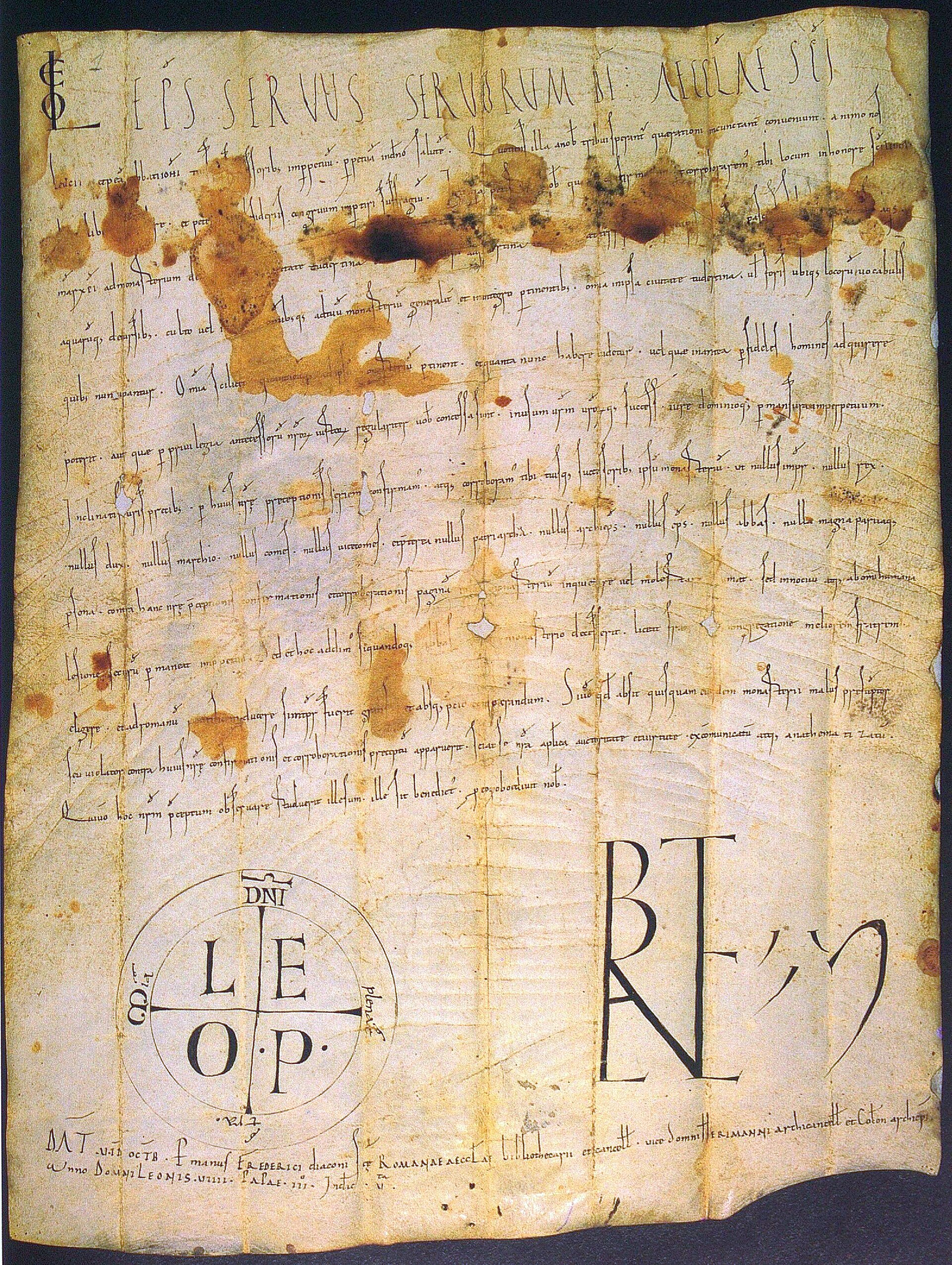

Pope Leo IX (pope 1049 to 1054, a German named Bruno who had been bishop of Toul) was the first of the great reforming popes of the eleventh century.3 The OCA history places him in the reform movement that "accomplished a dramatic centralization and expansion of the power of the Papacy," and adds that "it's not surprising that this particularly strong pope would also have been interested in extending Papal influence in the East."2 In 1053 the pope's army was beaten by the Normans; the Columbia Encyclopedia notes that he "fought the Normans of S Italy, but was defeated (1053) at Civitella" (the battle is more often called Civitate). The Catholic Encyclopedia says that after the battle (June 1053) "Leo gave himself up to his conquerors, who treated him with the utmost respect and consideration," and that he then went to Benevento; whether his long stay there amounted to Norman captivity, as many modern accounts put it, the sources opened for this lesson do not say.359
From there he answered the attack on Latin customs and sent three legates to Constantinople with letters for the emperor and the patriarch. The Catholic Encyclopedia names them: "Cardinal Humbert, Cardinal Frederick (his own cousin and Chancellor of the Roman Church, afterwards Stephen IX, 1057 to 1058), and Archbishop Peter of Amalfi."9 Schaff lists the counter-charges Humbert carried: that Cerularius "arrogated to himself the title of 'oecumenical' patriarch; that he wished to subject the patriarchs of Alexandria and of Antioch; that the Greeks rebaptized the Latins; that, like the Nicolaitans, they permitted their priests to live in wedlock;... that, like the Pneumatomachi or Theomachi, they cut out of the symbol the Procession of the Spirit from the Son."1
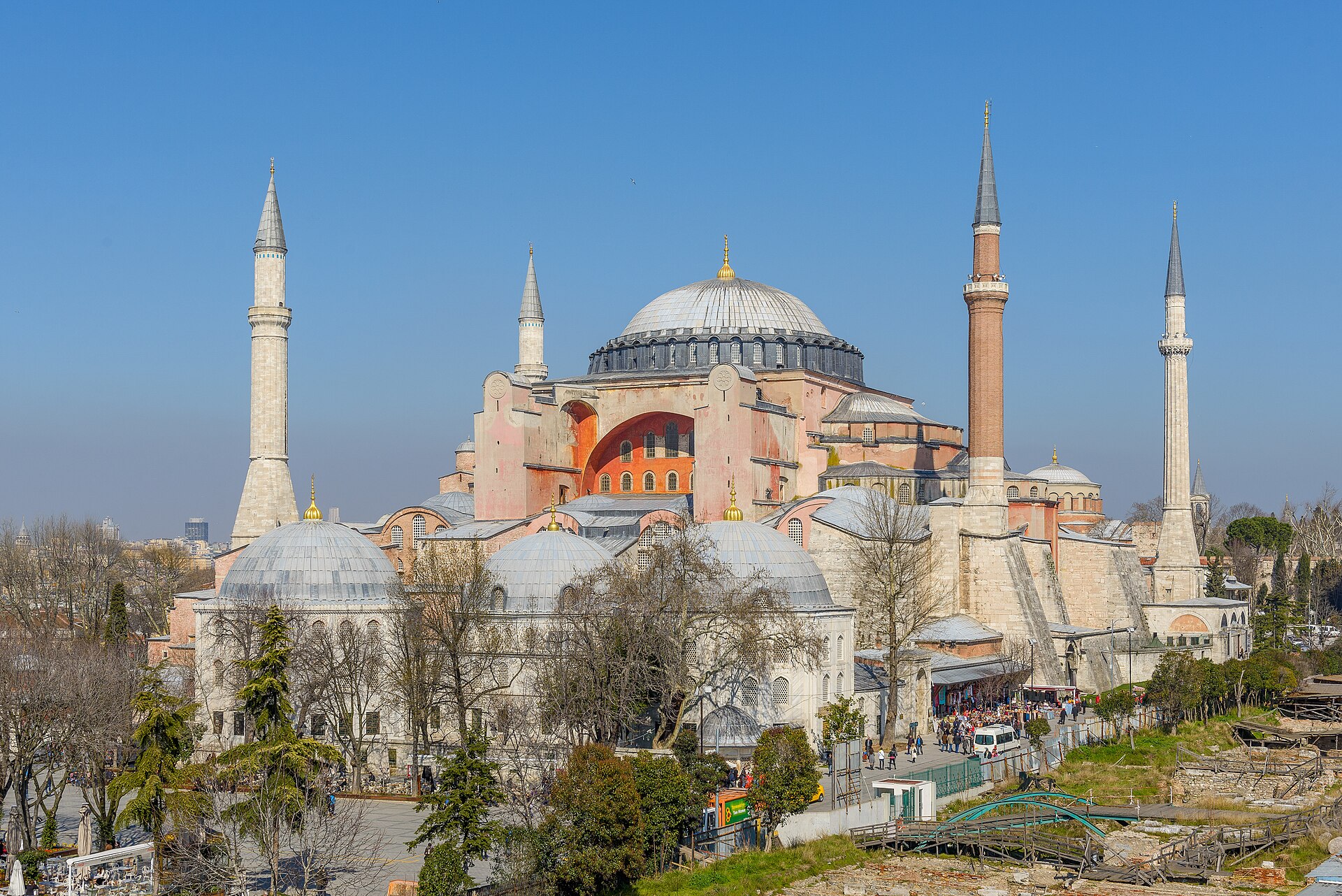
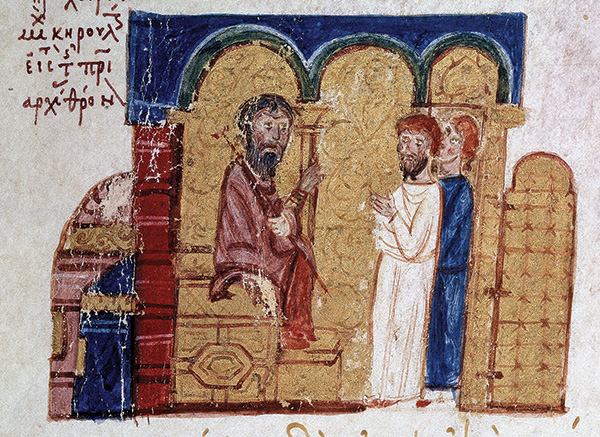
The emperor, Constantine IX Monomachos, wanted an alliance with the pope against the Normans and lodged the legates in his palace. The patriarch refused to deal with them. The two sides tell the cause differently. In the Catholic Encyclopedia's account, Cerularius "was very indignant that the legates did not give him precedence," and "refused to see the legates or to hold any communication with them: he struck the pope's name from his diptychs, and so declared open schism."9 In the OCA's account, Humbert was "a fiery and fiercely anti-Byzantine personality who tried to press Roman claims to their fullest extent," and "after a cold initial reception, at which Humbert refused to greet the Patriarch with the customary protocol, Michael refused to deal with him any longer."2 Both accounts agree on the facts that matter: weeks passed, no meeting took place, and neither man would yield on rank.

July 16, 1054: the bull on the altar
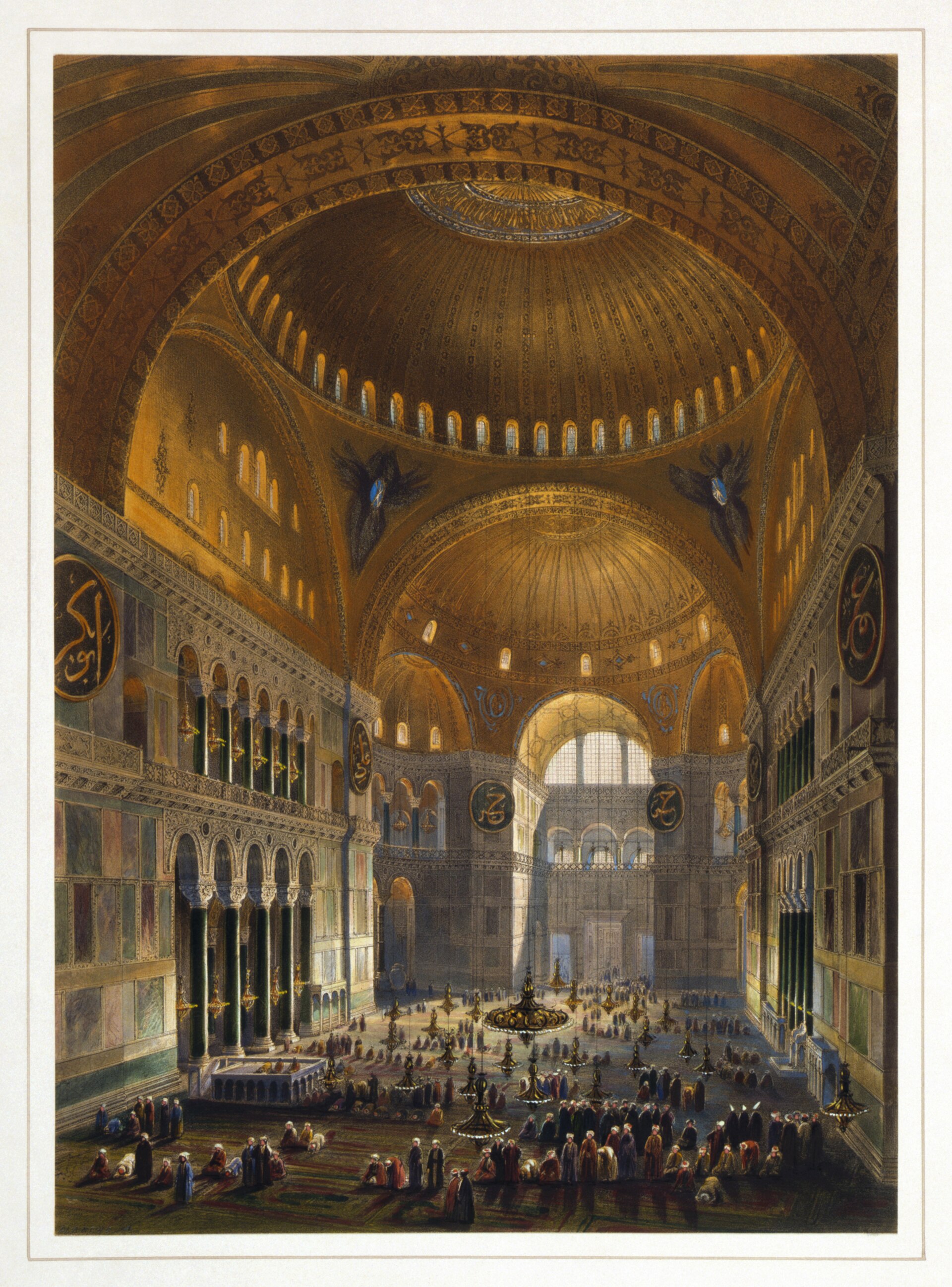
On Saturday, July 16, 1054, as the afternoon service was about to begin in Hagia Sophia, the legates walked into the church and laid a written sentence of excommunication on the altar. All three accounts used in this lesson agree on the date and the place. Schaff: "Finally, on the 16th of July, 1054, they excommunicated the patriarch and all those who should persistently censure the faith of the church of Rome or its mode of offering the holy sacrifice. They placed the writ on the altar of the church of Hagia Sophia with the words: 'Videat Deus et judicet.'"1 The Latin means "Let God see and judge." The Catholic Encyclopedia: the legates "prepared the Bull of excommunication against him, Leo of Achrida, and their adherents, which they laid on the altar of Sancta Sophia on 16 July, 1054. Two days later they set out for Rome."9 The OCA: "on July 16, 1054, Humbert strode into the great cathedral of Hagia Sophia during a service and placed on the altar a bull of excommunication against 'Patriarch Michael and all his followers.' In a day or two, he and his fellow legates left for home."2 July 16, 1054, fell on a Saturday in the Julian calendar then in use (a calendar calculation, not a statement in the sources); that the legates came in as the afternoon service was beginning is the usual detail in modern accounts, but it is not in the three sources quoted, and it is listed among the unverified items.
The text of the bull survives in Latin. An English version reproduced by the historian Martha Carlin of the University of Wisconsin-Milwaukee (taken from a modern handout translation, not a public domain one, so it is quoted only briefly here) shows its tone. It calls the patriarch "Michael, who has improperly been given the title patriarch," says that he and his supporters "sow an abundance of heresies each day," and lays out the charges by comparing the Greeks with ancient sects: "Like the Simonians, they sell the gift of God.... Like the Nicolaitans, they allow ministers of the holy altar to be contracted in marriage.... Like the Pneumatomachi (those who fought against the Spirit) they have suppressed the procession of the Holy Spirit a filio ['from the Son'] in the creed. Like the Manichaeans, they declare that fermented bread is alive." It ends: "May Michael, the neophyte, who improperly bears the title of patriarch... and all those who follow him in the above mentioned errors, may they all fall under the anathema, Maranatha... unless they return to their senses."21
Two features of the document matter for judging it. First, it is aimed at named persons and their followers. It does not name the Church of Constantinople or the Eastern churches as such, and it praises the emperor and the people of the city as orthodox (a point made in modern scholarship; the short extract opened for this lesson does not include that passage). Second, its charge on the creed is backward. It accuses the Greeks of having "suppressed" the filioque, when in fact the Latins had added it. The OCA history notes the irony: "Ironically, forty years later the Latin Christians would accuse the Greek Christians of being heretical for not using the filioque."2
The patriarch's counter-anathema
Cerularius answered within days. Schaff: "Cerularius, supported by his clergy and the people, immediately answered by a synodical counter-anathema on the papal legates, and accused them of fraud."1 The OCA: "Michael, in his turn, excommunicated Humbert 'and all those responsible' for the bull of excommunication against him."2 The Catholic-Orthodox declaration of 1965 describes the same pair of acts in its own careful words: the sentence of excommunication was "leveled against the Patriarch Michael Cerularius and two other persons by the legate of the Roman See under the leadership of Cardinal Humbertus, legates who then became the object of a similar sentence pronounced by the patriarch and the Synod of Constantinople."5 The patriarch's side treated the legates as men acting on their own, perhaps not truly representing the pope; the Catholic Encyclopedia reports a further charge, that Cerularius called the legates back meaning to have them killed, citing Fortescue's own book for the evidence; that charge rests on a single hostile account and is not adopted here.9
In a letter to Patriarch Peter III of Antioch, who at first tried to mediate, Cerularius added further complaints about Latin customs. Schaff lists them: "that two brothers were allowed to espouse two sisters; that bishops wore rings and engaged in warfare; that baptism was administered by a single immersion; that salt was put in the mouth of the baptized;... and that Gregory the Theologian, Basil, and Chrysostom were not numbered among the saints. The Filioque was also mentioned."1
A dead pope's legates
The legates acted in the name of a pope who was no longer alive. Leo IX died in Rome on April 19, 1054, three months before the scene in Hagia Sophia. The Catholic Encyclopedia's article on him gives "d. 19 April, 1054" and says that he had himself carried back to Rome in March 1054, "where he died a most edifying death"; the Columbia Encyclopedia gives his dates as 1002 to 1054 and his feast as April 19.359 The OCA history draws the conclusion that matters to the Orthodox side: "Very interestingly, Pope Leo IX died soon after Humbert left Rome for Constantinople, but before Humbert issued the bull of excommunication. And Leo's successor was not elected until near the end of the year. So it would seem that the next pope, Victor II... could easily have revoked Humbert's action, but he did not choose to do so."2 (The OCA text gives Victor's reign in parentheses with a dash; it is omitted here.) A common argument, repeated on the Christian History Institute's popular page for July 16, is that Leo's death "invalidat[ed] Humbert's credentials," on the principle that a legate's commission lapses when the pope who gave it dies.22 The answer from the other side is that no one in Rome ever disowned the bull. The sources used here do not settle the canon-law question, and it is listed as open.
The aftermath shows how little was settled in 1054. Cerularius was for a time the strongest man in Constantinople. In 1058 Emperor Isaac Komnenos had him arrested and sent into exile, where he died. The sources differ on the year: the Catholic Encyclopedia heads its article "d. 1058" but later says he died in 1059, Schaff gives 1059, and the OCA gives his reign as 1043 to 1058.912 Schaff wrote that afterward "the patriarchs of Alexandria, Antioch, and Jerusalem adhered to the see of Constantinople. Thus the schism between the Christian East and West was completed. The number of episcopal sees at that time was nearly equal on both sides."1
A symptom more than a clean break
Schaff, in the 1880s, still wrote of 1054 as the moment when "the churches excommunicated each other." Most twentieth-century historians, Catholic, Orthodox and Protestant, have stepped back from that view. Their reasons can be checked against the documents already quoted.
- The sentences named persons. The bull named Cerularius and his followers; the counter-sentence named the legates. The 1965 declaration states this outright: "They had directed their censures against the persons concerned and not the Churches. These censures were not intended to break ecclesiastical communion between the Sees of Rome and Constantinople."5
- The other Eastern patriarchs were not party to the exchange, and communion between Latins and Greeks continued in many places for generations. The OCA history says that "relations between some of the Eastern Churches with Rome continued to be relatively friendly for quite some time," while "the reality and extent of the schism gradually deepened and spread."2
- The causes were old. Every charge on the bull and the counter-charge, from bread to beards to the creed, was already in Photius's encyclical of 867.20
Among the named scholars, the British Byzantinist Steven Runciman, in The Eastern Schism (1955), argued that 1054 was far less decisive at the time than it became in later memory, and that the Crusades did more to divide the churches.23 Henry Chadwick, in East and West: The Making of a Rift in the Church (2003), traced the rift as a slow process running from the fourth century to the Council of Florence.24 Timothy Ware (Metropolitan Kallistos), the leading English-language Orthodox writer of the last century, in The Orthodox Church describes the separation as a gradual estrangement with no single date at which it can be said to have begun, and treats 1054 as a convenient marker more than a cause.25 (These three books were not opened during the writing of this lesson; their positions are summarized, not quoted, and are listed among the unverified items.) The documents support the general verdict: 1054 was a symptom and a hardening, real and bitter, but it did not by itself end communion between the churches.
The deeper wound: the sack of Constantinople, April 1204
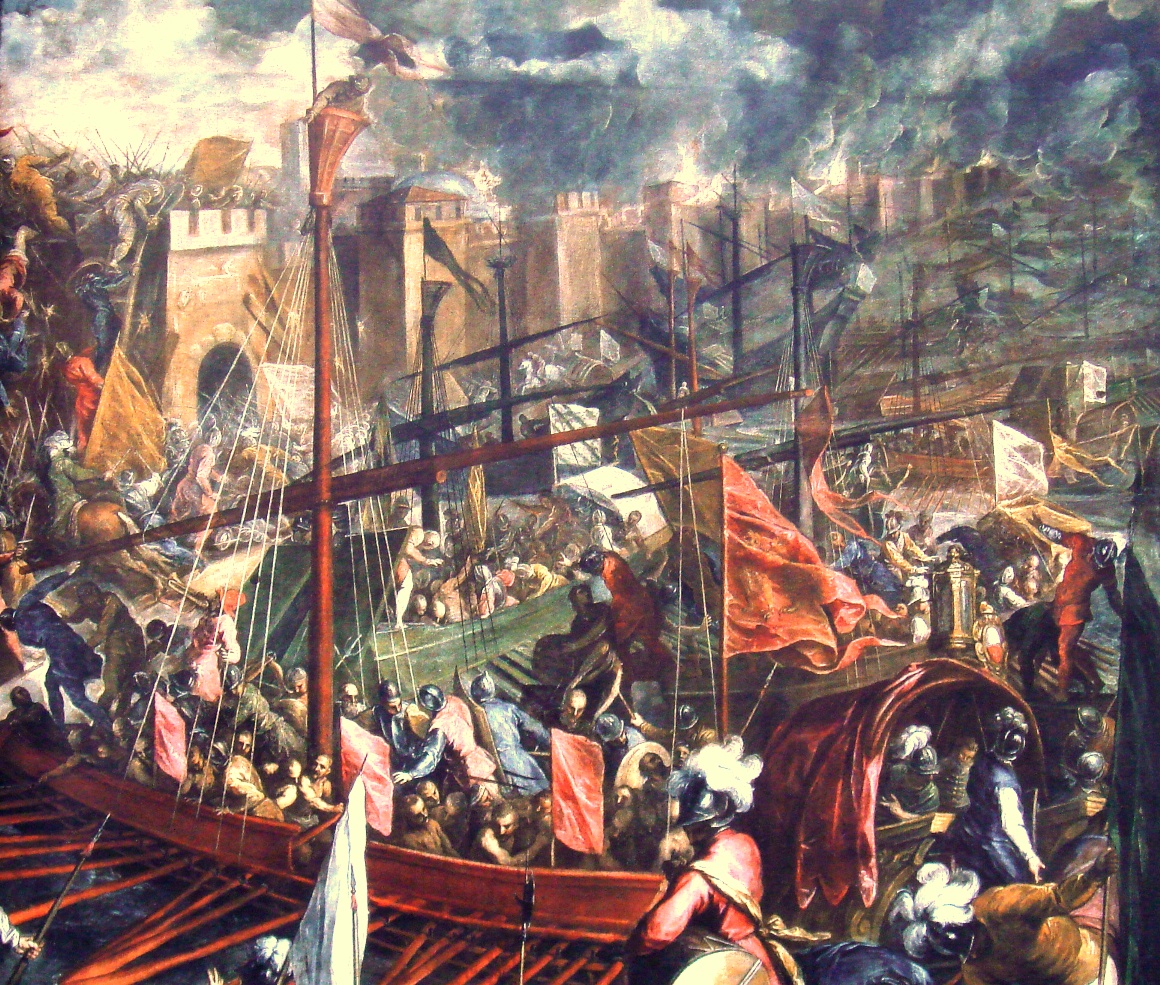
What 1054 left half done, 1204 finished in the hearts of ordinary Greeks. The Fourth Crusade was called by Pope Innocent III to recover Jerusalem (the Western story of the Crusades is in lesson 09). Deep in debt to Venice for its fleet, and drawn into a Byzantine succession quarrel by a pretender who promised money and help, the crusading army turned aside to Constantinople in 1203 and, after the bargain collapsed, stormed the city in April 1204.
The fullest Western eyewitness is Geoffrey of Villehardouin, marshal of Champagne and one of the crusade's leaders. In Frank Marzials's public domain translation (1908) he dates the capture: "Constantinople taken on the Monday after Palm Sunday (12th April 1204)," with the last resistance gone the next morning, "a Tuesday morning (13th April 1204)." He describes the plunder with open pride: "The booty gained was so great that none could tell you the end of it: gold and silver, and vessels and precious stones, and samite, and cloth of silk, and robes vair and grey, and ermine, and every choicest thing found upon the earth. And well does Geoffry of Villehardouin the Marshal of Champagne, bear witness, that never, since the world was created, had so much booty been won in any city."4 He estimates the total at "at least four hundred thousand marks of silver and at least ten thousand horses," and claims the crusaders, "no more than twenty thousand armed men," had "conquered four hundred thousand men, or more."4 The last figure is a boast; no other source supports a defending force of that size, and it is rated in the claims section below.
Villehardouin says little about what was done to churches and people. Other sources say much. Schaff, summarizing the Byzantine historian Niketas Choniates (an eyewitness) and Western records, wrote that "churches and monasteries were robbed and desecrated, the Greek service mocked, the clergy persecuted," and quoted Gibbon's report that in Hagia Sophia "a prostitute was seated on the throne of the patriarch." He added that Pope Innocent III himself accused the crusaders of having spared "neither age nor sex, nor religious profession," and that "yet this great pope insulted the Eastern church by the establishment of a Latin hierarchy on the ruins of the Byzantine empire."1 The OCA history gives the Orthodox memory: the knights "brutally sacked Constantinople during the first three days of Holy Week in 1204. They pillaged Hagia Sophia and other churches, desecrating the altars and stealing countless relics and other holy objects.... A Latin, Thomas Morosini, was named Patriarch of Constantinople.... Now, for the first time, the entire Latin West became a deeply hated enemy in the minds of the Greek people."26
The Latin Empire of Constantinople lasted until 1261, when Emperor Michael VIII Palaiologos retook the city. The OCA judges that the empire "never fully recovered from the devastation of the Fourth Crusade and the 57 years of Latin rule in her capital city."26 The Fourth Lateran Council of 1215, meeting while the Latins held the city, complained of the Greeks' hostility to Latin clergy: "when Latin priests celebrated on their altars they would not offer sacrifice on them until they had washed them, as if the altars had been defiled thereby. The Greeks even had the temerity to rebaptize those baptized by the Latins."13 The council treated these as Greek offenses to be stopped; read beside the sack, they show how deep the bitterness now ran on both sides.
Eight centuries later a pope spoke to the matter directly. In Athens on May 4, 2001, Pope John Paul II told Archbishop Christodoulos of Athens: "I am thinking of the disastrous sack of the imperial city of Constantinople, which was for so long the bastion of Christianity in the East. It is tragic that the assailants, who had set out to secure free access for Christians to the Holy Land, turned against their own brothers in the faith. The fact that they were Latin Christians fills Catholics with deep regret."27 In the same speech he asked forgiveness "for the occasions past and present, when sons and daughters of the Catholic Church have sinned by action or omission against their Orthodox brothers and sisters."27

Two attempts at union: Lyon and Florence
The Second Council of Lyon, 1274
Michael VIII had won back his capital, but he faced a new threat: Charles of Anjou, the French king of Sicily, who planned to restore a Latin empire in the East. Union with Rome was Michael's best defense, since a pope could forbid a crusade against fellow Catholics. The introduction to the council's decrees in Norman Tanner's edition (a modern Catholic scholarly edition, reproduced at papalencyclicals.net) sets out the plan of Pope Gregory X: "union with the Greeks, the crusade, and the reform of the church." It reports that the council opened on May 7, 1274, with "probably... about 300 bishops," that "the Greeks arrived late, on 24 June, since they had been shipwrecked," and that "in the fourth session the union of the Greek church with the Latin church was decreed and defined, this union being based on the consent which the Greeks had given to the claims of the Roman church."28 The council's constitution on the Trinity professed "that the holy Spirit proceeds eternally from the Father and the Son, not as from two principles, but as from one principle; not by two spirations, but by one single spiration."28
The same Catholic introduction is frank about the result: "The union however appears to have been imposed, on the Greek side by the emperor Michael VIII. He wanted the support of the pope in order to deter Charles of Anjou from an attack on the Byzantine empire, while the majority of the Greek clergy opposed the union. The union was therefore fleeting."28 Michael's successor repudiated it after his death in 1282.
The Council of Ferrara-Florence, 1438 to 1439
By the 1430s the Ottoman Turks had reduced the Byzantine Empire to little more than Constantinople and a few scraps of land. Emperor John VIII Palaiologos came west with Patriarch Joseph II and a large delegation. The OCA history says the pope "received there the Greek delegation of about 700 people" at Ferrara, and that the council moved to Florence early in 1439 "since the merchants there offered to pay its expenses."29 Tanner's introduction gives the dates: the council reopened at Ferrara on January 8, 1438; "the Greek bishops and theologians attended the council of Ferrara from 9 April 1438. The council was transferred to Florence on 10 January 1439. There, in the session on 6 July 1439, the decree of union with the Greek church was approved."8
The decree, known by its first words Laetentur caeli, opens: "Let the heavens be glad and let the earth rejoice. For, the wall that divided the western and the eastern church has been removed, peace and harmony have returned."8 It settled each disputed point in Rome's favor while giving room to Greek custom:
- On the Spirit: "the holy Spirit is eternally from the Father and the Son, and has his essence and his subsistent being from the Father together with the Son, and proceeds from both eternally as from one principle and a single spiration." It added that when the Fathers say the Spirit proceeds "from the Father through the Son," this means the same thing, and that the words "and from the Son" were "licitly and reasonably added to the creed."8
- On bread: "the body of Christ is truly confected in both unleavened and leavened wheat bread, and priests should confect the body of Christ in either, that is, each priest according to the custom of his western or eastern church."8
- On purgatory: the souls of the truly penitent who die before making satisfaction "are cleansed after death by cleansing pains; and the suffrages of the living faithful avail them."8
- On the pope: "the holy apostolic see and the Roman pontiff holds the primacy over the whole world and the Roman pontiff is the successor of blessed Peter prince of the apostles, and that he is the true vicar of Christ, the head of the whole church and the father and teacher of all Christians."8
Why the unions failed
Every Greek bishop present signed the decree of Florence except one. The OCA history: "Under severe pressure from the Emperor and the Patriarch, every bishop in the Greek delegation signed this so-called 'Decree for the Greeks' promulgated at the Council of Florence, all except Saint Mark, Bishop of Ephesus. When told that Mark had refused to sign, Pope Eugenius is reputed to have said, 'Then we have accomplished nothing.'"29 (A dash in the OCA text is rendered as a comma; the OCA itself marks the pope's saying as "reputed.") The Orthodox venerate Mark of Ephesus, with Photius and Gregory Palamas, as one of the "Three Pillars of Orthodoxy."29
At home the union met refusal. In Moscow, the OCA says, Metropolitan Isidore of Kiev, "one of the major architects of the Union of Florence," was "run out of the city, barely escaping with his life." In Constantinople the union "was not publicly proclaimed in the Eastern Church until December 12, 1452, in the Cathedral of Hagia Sophia," with the Turks already gathering, and the monk George Scholarios (later Patriarch Gennadios) led the opposition. The OCA quotes the words attributed to the grand duke Loukas Notaras: "We would prefer to see the Turkish turban in our City than the Latin tiara."29 Tanner's Catholic introduction reaches the same practical verdict about Florence's many unions: "Almost all the decrees of re-union were of little effect," though it adds that "there was agreement on the principal dogmatic and disciplinary questions which had divided the two churches for many centuries."8
The record suggests three reasons both unions failed. They were negotiated by emperors under military threat, and the clergy and people saw them as a price paid for help that did not come in time. They were framed as Greek acceptance of Latin positions, the "claims of the Roman church" in Tanner's phrase for Lyon, which left the Greek side feeling it had surrendered more than it had agreed. And the Orthodox understanding of how a council is received weighed against them: the 1848 Encyclical of the Eastern Patriarchs, discussed below, says that among the Orthodox "neither Patriarchs nor Councils could then have introduced novelties amongst us, because the protector of religion is the very body of the Church, even the people themselves."30 By that standard a council's signature is not enough until the whole church receives it.
The fall of Constantinople, May 29, 1453
Five months after the union was proclaimed in Hagia Sophia, the city fell. The OCA history: "On May 29, 1453, the Ottoman Turks, under their sultan Mohammed II (or Mehmet...), captured the city of Constantinople after a furious siege of six weeks. Hagia Sophia was turned into a mosque, and the city eventually became known as Istanbul. This marked the tragic end of the Roman/Byzantine Empire, an empire that had lasted almost 1500 years."31 (A dash before the last clause is rendered as a comma.) Within decades the Ottomans ruled almost every Orthodox land except Russia. The sultan chose the leader of the anti-union party, George Scholarios, as the new patriarch; the OCA history says Mehmet "personally invested him with the patriarchal office on the Day of Theophany, January 6, 1454," and made the patriarch of Constantinople head of the whole Christian "nation within a nation," the Rum milet, the "Roman" people.32 The union of Florence, which Scholarios had fought, was dead in the East. A synod in Constantinople is usually said to have repudiated it formally in 1484; the synod's acts were not opened for this lesson.
Moscow drew its own lesson. Having driven out Isidore, the Russian church chose its own metropolitan in 1448 without Constantinople's consent (a standard date not checked here against a primary source). In 1472 Grand Prince Ivan III married Sophia Palaiologina, niece of the last Byzantine emperor, and took the Byzantine double-headed eagle as his arms.33 In January 1589 Patriarch Jeremias II of Constantinople, visiting Moscow in search of aid, "recognized Job, the Metropolitan of Moscow, as the first Patriarch of All Russia," in the OCA's words, and the installation document echoed the idea of Moscow as the "Third Rome."34 The center of gravity of the Orthodox world began to move north.

The 1965 Joint Catholic-Orthodox Declaration
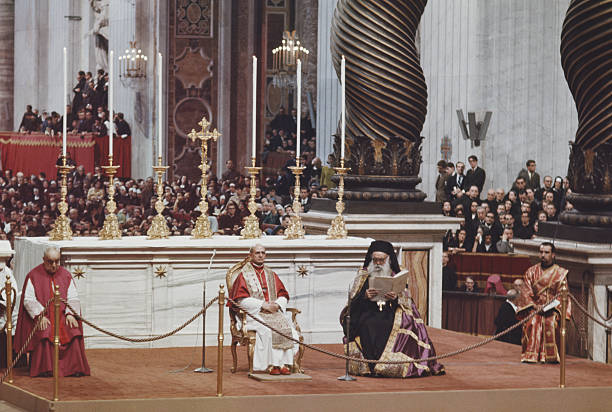
For nine centuries the sentences of 1054 stood. They were lifted on December 7, 1965, the day before the Second Vatican Council closed. The declaration begins by recalling that Pope Paul VI and Ecumenical Patriarch Athenagoras I had already met "at those holy places where the mystery of salvation was accomplished," that is, in the Holy Land (the meeting took place in Jerusalem in January 1964, a date the declaration itself does not state). The declaration, in the Vatican's English text, was "read simultaneously (Dec. 7) at a public meeting of the ecumenical council in Rome and at a special ceremony in Istanbul."5 The core of it reads, word for word:
"3. One cannot pretend that these events were not what they were during this very troubled period of history. Today, however, they have been judged more fairly and serenely. Thus it is important to recognize the excesses which accompanied them and later led to consequences which, insofar as we can judge, went much further than their authors had intended and foreseen. They had directed their censures against the persons concerned and not the Churches. These censures were not intended to break ecclesiastical communion between the Sees of Rome and Constantinople.
"4.... Pope Paul VI and Patriarch Athenagoras I with his synod, in common agreement, declare that:
"A. They regret the offensive words, the reproaches without foundation, and the reprehensible gestures which, on both sides, have marked or accompanied the sad events of this period.
"B. They likewise regret and remove both from memory and from the midst of the Church the sentences of excommunication which followed these events, the memory of which has influenced actions up to our day and has hindered closer relations in charity; and they commit these excommunications to oblivion."5
Point C deplores "the preceding and later vexing events" which, under several factors, including a "lack of understanding and mutual trust," "eventually led to the effective rupture of ecclesiastical communion." (The Vatican text sets the factors off with dashes; the passage is condensed here for that reason.) The declaration then states its own limits: "Pope Paul VI and Patriarch Athenagoras I with his synod realize that this gesture of justice and mutual pardon is not sufficient to end both old and more recent differences between the Roman Catholic Church and the Orthodox Church." Its stated hope is a dialogue leading to "that full communion of faith, fraternal accord and sacramental life which existed among them during the first thousand years of the life of the Church."5
Three things follow from the text. The declaration lifted the sentences of 1054; it did not restore communion, and the two churches still do not share the Eucharist as a matter of course. It accepts the historians' view that the 1054 censures were aimed at persons. And it places the real rupture later, in "the preceding and later vexing events," which is as close as an official text comes to naming 1204. The OCA history, writing from the Orthodox side, says the same: "the Roman Catholic Church is still not in communion with the Orthodox Churches, even though in 1965 Pope Paul VI and Ecumenical Patriarch Athenagoras I lifted the mutual anathemas of 1054."2
The Second Vatican Council, in its decree on ecumenism a year earlier, had already said of the Eastern churches: "These Churches, although separated from us, possess true sacraments, above all by apostolic succession, the priesthood and the Eucharist, whereby they are linked with us in closest intimacy." It also "solemnly declares that the Churches of the East, while remembering the necessary unity of the whole Church, have the power to govern themselves according to the disciplines proper to them."35

Orthodoxy in plain terms, in its own words
The Orthodox Church today is a family of self-governing churches in communion with one another, sharing one faith and one form of worship, descended from the Greek-speaking churches of the old empire and the peoples they evangelized (Slavs, Romanians, Georgians and others). This section lets the church describe itself, mainly through the Orthodox Church in America's four-volume handbook The Orthodox Faith, the Greek Orthodox Archdiocese of America and the Antiochian Archdiocese. The standard English introduction by an Orthodox author is Timothy Ware's The Orthodox Church (Penguin, first published 1963 and revised several times); Ware, a convert from Anglicanism who became Metropolitan Kallistos of Diokleia, taught at Oxford for many years.25 His book was not opened for this lesson, so it is recommended below rather than quoted.
The Divine Liturgy
The center of Orthodox life is the Sunday Eucharist, called the Divine Liturgy. The OCA handbook explains: "The word liturgy means common work or common action. The Divine Liturgy is the common work of the Orthodox Church. It is the official action of the Church formally gathered together as the chosen People of God."36 It is "always done by Orthodox Christians on the Lord's Day which is Sunday," the day of the resurrection, which Orthodox tradition calls "the eighth day" of the Kingdom of God.36
The handbook stresses that the liturgy belongs to the whole people together. "As the common action of the People of God, the Divine Liturgy may be celebrated only once on any given day in an Orthodox Christian community. All of the members of the Church must be gathered together with their pastor in one place at one time. This includes even small children and infants who participate fully in the communion of the liturgy from the day of their entrance into the Church through baptism and chrismation. Always everyone, always together."36 Two practical differences from Western custom follow: Orthodox infants receive communion from their baptism, and a priest may not celebrate the liturgy alone. The usual form, the handbook says, "is called the Liturgy of Saint John Chrysostom. It is a shorter liturgy than the so-called Liturgy of Saint Basil the Great that is used only ten times during the Church Year," and it adds with care that the two liturgies "probably received their present form after the ninth century," though their eucharistic prayers go back to the fourth and fifth centuries.36 At communion, "the faithful people receive Holy Communion on a spoon. They are given both the consecrated bread... and the sanctified wine," and "Holy Communion is never taken from any 'reserve.'"37
Icons and the iconostasis
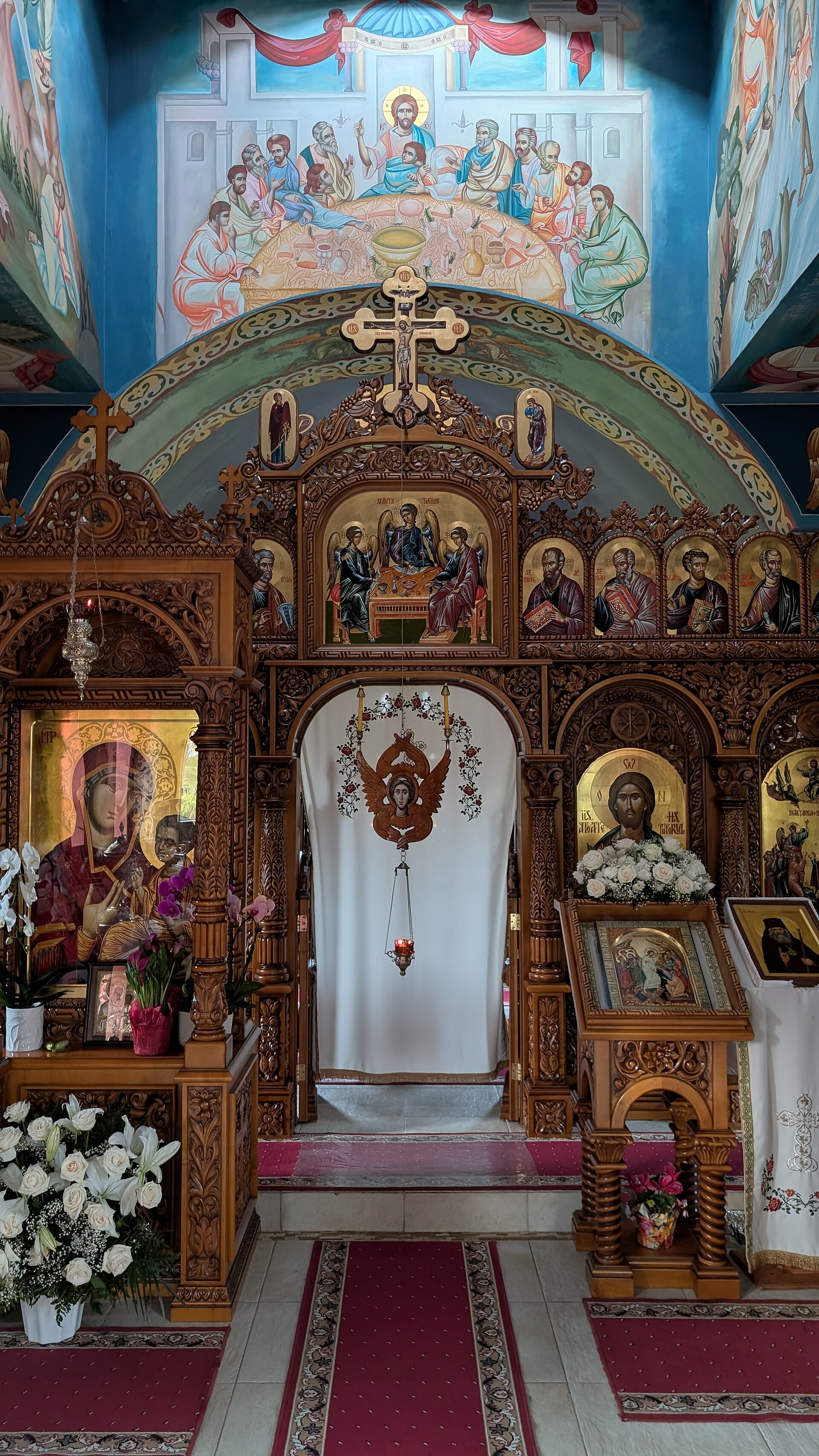
Walk into an Orthodox church and the first thing seen is a wall or screen of icons between the nave and the altar: the iconostasis. The OCA handbook explains what icons are meant to be: "In the Orthodox Church the icons bear witness to the reality of God's presence with us in the mystery of faith. The icons are not just human pictures or visual aids to contemplation and prayer." It grounds them in the incarnation: "It is the Orthodox faith that icons are not only permissible, but are spiritually necessary because 'the Word became flesh and dwelt among us' (Jn 1.14)."38 This is the teaching of Nicaea II, quoted above, that honor given to the image passes to the one it shows.
The handbook walks through the screen itself. The altar table stands behind the central "royal gates," between an icon of the Theotokos (the Mother of God) with the Christ Child and an icon of Christ in glory, "showing that everything which happens to us in the Church happens in history between those 'two comings' of Christ." The royal gates carry the four evangelists and often the Annunciation; over them is the Mystical Supper; the side doors used by deacons carry deacons or angels; higher rows, in larger churches, hold the apostles, the great feasts and the prophets, "all crowned on the top by the cross of Christ."38 The same handbook is candid that the screen changed over time: "In recent centuries the iconostasis in most Orthodox churches became very ornate and developed into a virtual wall, dividing the faithful from the holy altar rather than uniting them with it. In recent years this development has happily been altered in many places."38

Theosis: becoming by grace what God is by nature
The Orthodox describe the goal of the Christian life with a word that surprises many Western readers: theosis, deification. A teaching text published on parish sites of the Greek Orthodox Archdiocese of America puts it this way: "The fundamental vocation and goal of each and every person is to share in the life of God.... Orthodoxy believes that each Christian is involved in a movement toward God which is known as theosis or deification. Theosis describes the spiritual pilgrimage in which each person becomes ever more perfect, ever more holy, ever more united with God. It is not a static relationship, nor does it take place only after death. On the contrary, theosis is a movement of love toward God which begins for each Christian with the rites of Baptism and which continues throughout this life, as well as the life which is to come."39 The same text roots the idea in Scripture, in 2 Peter 1:4, where believers are called "to become partakers of the Divine nature," and says that "in Orthodoxy, both salvation and redemption are within the context of theosis."39
The text sums up the Fathers' teaching as the conviction "that God had become what we are in order that we could become what He is."39 The classic line is from Athanasius of Alexandria, whose On the Incarnation, in the public domain translation of the Nicene and Post-Nicene Fathers, says of the Word: "For He was made man that we might be made God."40 Orthodox writers stress that this never means that a human being becomes a fourth person of the Trinity or loses his own nature. The distinction Orthodox theology draws, especially since Gregory Palamas in the fourteenth century, is between God's essence, which no creature can share, and God's energies, his life and grace, in which the saints truly participate. Catholic theology has its own language for the same hope (sanctifying grace, the beatific vision), and the Catholic Catechism itself quotes Athanasius's line; the difference lies more in emphasis and vocabulary than in a flat contradiction. (The Palamite distinction and the Catechism's use of Athanasius are stated here from general knowledge and are listed among the unverified items.)
The councils and Holy Tradition
The Orthodox accept seven ecumenical councils, from Nicaea in 325 to Nicaea II in 787. The OCA handbook explains why the number stops there and what makes a council binding: "In the Orthodox Church only seven such councils, some of which were actually quite small in terms of the number of bishops attending, have received the universal approval of the entire Church in all times and places." Not all councils called as general councils "were automatically approved and accepted by the Church in its Holy Tradition."41 That principle, that a council is proved by its reception, explains why Lyon and Florence could be signed by Greek bishops and still count for nothing in the Orthodox Church.
The councils sit inside a wider whole that the Orthodox call Holy Tradition. The OCA handbook: "Holy Tradition is, therefore, that which is passed on and given over within the Church from the time of Christ's apostles right down to the present day. Although containing many written documents, Holy Tradition is not at all limited to what is written; it is not merely a body of literature. It is, on the contrary, the total life and experience of the entire Church transferred from place to place and from generation to generation."42 Scripture is "the central written part of this tradition," and the handbook lists alongside it the liturgy, the councils, the Fathers, the saints, the canons and church art as sources of doctrine.42 The handbook also warns that "not everything in the Church belongs to its Holy Tradition," since "some things in the Church are just temporal and temporary things."42 Catholic teaching also speaks of Scripture and Tradition together; the difference is mainly in who has the final word in defining them, the subject of the papacy section below.
Autocephalous churches: one faith, many self-headed churches
The Orthodox Church has no single earthly head with jurisdiction over all. It is made up of autocephalous (literally "self-headed") churches, each electing its own primate, and autonomous churches, which govern themselves but whose primate is confirmed by a mother church. The Ecumenical Patriarch of Constantinople holds a primacy of honor and is "first among equals," but he cannot rule in another church's territory. Which churches count as autocephalous is itself disputed. The list below follows the directory of world Orthodox churches on the website of the Orthodox Church in America, as it stood in October 2026, in its own order:43
- The Church of Constantinople (the Ecumenical Patriarchate; Patriarch Bartholomew I)
- The Church of Alexandria
- The Church of Antioch (seated in Damascus)
- The Church of Jerusalem
- The Church of Russia (the Moscow Patriarchate)
- The Church of Georgia
- The Church of Serbia
- The Church of Romania
- The Church of Bulgaria
- The Church of Cyprus
- The Church of Greece
- The Church of Albania
- The Church of Poland
- The Church of the Czech Lands and Slovakia
- The Orthodox Church in America
- The Macedonian Orthodox Church-Ohrid Archbishopric
The same directory lists as autonomous the Church of Sinai, the Church of Finland, the Church of Japan, and "The Church of Ukraine," headed by "His Beatitude Metropolitan Onufry Metropolitan of Kyiv and All Ukraine."43 Two entries on that list are disputed by others. The OCA's own autocephaly, which its website says was "Granted... in 1970" (by the Moscow Patriarchate), is not recognized by Constantinople and several other churches, according to standard accounts not checked here against their documents.43 And the list does not include the Orthodox Church of Ukraine, the church to which Constantinople granted autocephaly in 2019, which shows how the Ukrainian dispute stands in practice.
The Ukrainian dispute, 2018 to 2019, in each side's words
Kyiv was the cradle of Russian Christianity, and the church in Ukraine had been under the Moscow Patriarchate for centuries. After Ukrainian independence in 1991, rival Ukrainian churches formed outside Moscow's authority, and the main Orthodox world regarded them as schismatic. In 2018 the Ecumenical Patriarchate acted.
Constantinople's statement. After its synod met from October 9 to 11, 2018, the Ecumenical Patriarchate announced that it had decided "to renew the decision already made that the Ecumenical Patriarchate proceed to the granting of Autocephaly to the Church of Ukraine"; to reestablish its own stavropegion (a church directly under the patriarch) in Kyiv; to accept the appeals of "Filaret Denisenko, Makariy Maletych and their followers, who found themselves in schism not for dogmatic reasons," who "have been canonically reinstated to their hierarchical or priestly rank"; and "to revoke the legal binding of the Synodal Letter of the year 1686," which had allowed the patriarch of Moscow to ordain the metropolitan of Kyiv. It appealed "to all sides involved that they avoid appropriation of Churches, Monasteries and other properties, as well as every other act of violence and retaliation."44
Moscow's statement. The Holy Synod of the Russian Orthodox Church met in Minsk on October 15, 2018. Its statement, as published by the Moscow Patriarchate's parishes in the United States, declared that "to admit in communion the schismatics and a person anathematized by another Local Church together with all the 'bishops' and 'clergy' ordained by them, the encroachment upon somebody else's canonical parts, the attempt to reject one's own historical decisions and commitments, all this places the Patriarchate of Constantinople outside the canonical space and, to our great sorrow, makes it impossible for us to continue the Eucharistic communion with its hierarchy, clergy and laity." It added that until Constantinople "abandons its anti-canonical decisions, it is impossible for all the clergy of the Russian Orthodox Church to concelebrate with the clergy of the Church of Constantinople, and for the laity to participate in sacraments administered in its churches."45 (A dash before "all this" in the published English is rendered as a comma.)
The tomos. The Ecumenical Patriarchate's delegation to the World Council of Churches reported that "on Saturday, January 5, 2019, His All-Holiness Ecumenical Patriarch Bartholomew signed the Tomos of Autocephaly, thereby officially granting autocephaly to the Orthodox Church in Ukraine," in the presence of Metropolitan Epiphanios of Kyiv and Ukraine's president, Petro Poroshenko, and that the next day, the feast of Theophany, the patriarch "officially presented His Beatitude with the Tomos of Autocephaly."46
What the record shows is a dispute about the very thing that divided Rome and Constantinople nine centuries earlier: who may decide for the whole church, and on what grounds. Constantinople acts on its claimed canonical right to hear appeals and grant autocephaly; Moscow answers that Constantinople has invaded another church's territory. Each statement is quoted above in its own words; this lesson does not judge the canon law between them. Both statements, notably, end in a break of eucharistic communion between Orthodox churches that share every doctrine.
Married parish priests
Most Orthodox parish priests are married men. The rule goes back to the Council in Trullo of 692 (the Quinisext Council), which the Orthodox receive as completing the fifth and sixth ecumenical councils. Its thirteenth canon answered the Roman rule directly: "Since we know it to be handed down as a rule of the Roman Church that those who are deemed worthy to be advanced to the diaconate or presbyterate should promise no longer to cohabit with their wives, we, preserving the ancient rule and apostolic perfection and order, will that the lawful marriages of men who are in holy orders be from this time forward firm, by no means dissolving their union with their wives."47 Two limits stand beside it. Marriage must come before ordination: the sixth canon decrees that "it is in nowise lawful for any subdeacon, deacon or presbyter after his ordination to contract matrimony." And bishops do not live with wives: the twelfth canon forbids the custom by which bishops "in Africa and Libya and in other places... do not refuse to live with their wives, even after consecration."47 In practice Orthodox bishops are chosen from the celibate clergy, usually monks. Humbert's bull of 1054 counted the Greek practice a heresy, "like the Nicolaitans"; the Catholic Church today has married priests in its own Eastern Catholic churches, and the Second Vatican Council's decree on ecumenism affirmed the Eastern churches' right to their own disciplines.2135
Fasting
Orthodox fasting is stricter on paper than modern Western fasting. The OCA handbook states the Lenten rule plainly: "The Orthodox rules for lenten fasting are the monastic rules. No meat is allowed after Meatfare Sunday, and no eggs or dairy products after Cheesefare Sunday. These rules exist not as a Pharisaic 'burden too hard to bear' (Lk 11.46), but as an ideal to be striven for; not as an end in themselves, but as a means to spiritual perfection crowned in love."48 It adds a fast the West does not keep: "During the week days of Great Lent the regular eucharistic Divine Liturgy is not celebrated in Orthodox churches since the Divine Liturgy is always a paschal celebration."48
The handbook's volume on spirituality explains what fasting is for, and in doing so answers a common Protestant objection: "Neither do men fast with the idea that their hunger and thirst can somehow serve as a 'reparation' for their sins. Such an understanding is never given in the scriptures or the writings of the saints which claim that there is no 'reparation' for man's sin but the crucifixion of Christ. Salvation is a 'free gift of God' which no 'works' of man can accomplish of merit."49 The purpose, it says, "is to gain mastery over oneself and to conquer the passions of the flesh."49 Besides Great Lent, the Orthodox calendar keeps fasting seasons before Christmas, before the feast of Saints Peter and Paul and before the Dormition of the Theotokos, and most Wednesdays and Fridays of the year (a standard summary not quoted from the pages opened here).
The calendar
Some Orthodox churches celebrate Christmas on January 7. The OCA priest and writer Fr. Lawrence Farley explains why: those churches keep the old Julian calendar for church feasts, so that "even those Orthodox who use the Julian calendar also celebrate Christmas on December 25 but just don't get around to that date until January 7."50 Pope Gregory XIII "mandated the new corrected calendar and system for use in the Roman Church in 1582," and the civil world adopted it country by country, Greece in 1923.50 Some Orthodox churches (including the OCA and the Ecumenical Patriarchate) then adopted a revised calendar for fixed feasts such as Christmas, while Russia, Serbia, Jerusalem, Georgia and others kept the Julian. Almost all Orthodox still reckon Easter (Pascha) by the Julian calendar, so Orthodox and Western Easter usually fall on different Sundays. (The list of which churches use which calendar is standard but was not drawn from a single official source for this lesson.) Farley's own view, as a priest of a church that uses the revised calendar, is that calling it "the papal calendar" is "neither sensible nor helpful," since "the issue is not, and never has been, the provenance of the calendar, but its intrinsic merits and accuracy." He grants that defenders of the Julian calendar see it as "a symbolic bulwark against an ecumenism which would dissolve Orthodoxy's purity," and says "its value should not be dismissed out of hand."50
Orthodox churches in Idaho: two examples of affiliation
Orthodoxy in America is organized largely by ethnic origin, with several jurisdictions overlapping in the same towns. Two Idaho examples, named here only to show what affiliation means and described only from their own or their church's directory pages, make the point. Holy Myrrhbearers Antiochian Orthodox Church in Naples, in the Idaho Panhandle, states on its website: "The Church of Holy Myrrhbearers is a Parish of the Antiochian Orthodox Christian Archdiocese of North America. Holy Myrrhbearers is part of the ancient Patriarchate of Antioch, headquartered in Damascus, Syria, under the leadership of His Beatitude Patriarch JOHN X."51 So a small parish in North Idaho belongs, through its archdiocese, to one of the five sees of the ancient pentarchy. The Orthodox Church in America's parish directory lists The Meeting of Our Lord Mission in Kuna, in the Pacific Northwest Deanery of its Diocese of the West.52 The two parishes belong to different autocephalous churches (Antioch and the OCA) but share one faith, one liturgy and one communion.
Where Catholic and Orthodox teaching agree and differ
The two churches are closer to each other than either is to most Protestant bodies, and both say so. This section sets out first what they share and then the five points most often named as dividing them, each in the official words of each side. It does not decide between them.
What the two churches share
Both churches receive the seven ecumenical councils from Nicaea I to Nicaea II as binding (the Catholic Church counts further councils as ecumenical as well; the Orthodox do not).41 Both venerate icons on the terms Nicaea II defined.15 Both hold that their bishops stand in apostolic succession and that their sacraments are real; the Second Vatican Council said of the Orthodox churches that they "possess true sacraments, above all by apostolic succession, the priesthood and the Eucharist, whereby they are linked with us in closest intimacy."35 Both honor Mary as Theotokos, Mother of God, the title defended at Ephesus in 431 (see lesson 05), and both pray to the saints and for the dead. Both have monasticism at the heart of their spiritual life (see lesson 07). The 1965 declaration speaks of "the faith of the Apostles" that both hope to express in common.5
Papal primacy and the First Vatican Council
Catholic teaching in its own words. The First Vatican Council, in its constitution Pastor aeternus of July 18, 1870, defined two things. On jurisdiction: "if anyone says that the Roman pontiff has merely an office of supervision and guidance, and not the full and supreme power of jurisdiction over the whole church, and this not only in matters of faith and morals, but also in those which concern the discipline and government of the church dispersed throughout the whole world... or that this power of his is not ordinary and immediate both over all and each of the churches and over all and each of the pastors and faithful: let him be anathema." On infallibility: "when the Roman pontiff speaks EX CATHEDRA, that is, when, in the exercise of his office as shepherd and teacher of all Christians, in virtue of his supreme apostolic authority, he defines a doctrine concerning faith or morals to be held by the whole church, he possesses, by the divine assistance promised to him in blessed Peter, that infallibility which the divine Redeemer willed his church to enjoy.... Therefore, such definitions of the Roman pontiff are of themselves, and not by the consent of the church, irreformable."53 The council of Florence had already called the pope "the true vicar of Christ, the head of the whole church."8
Orthodox teaching in its own words. The Orthodox reject both definitions. In 1848, answering an appeal from Pope Pius IX, four Eastern patriarchs (Anthimos of Constantinople among them) issued an encyclical that called the papacy a heresy of the present age: "Of these heresies diffused, with what sufferings the LORD hath known, over a great part of the world, was formerly Arianism, and at present is the Papacy."30 Its positive principle is that no single office guards the faith: "the protector of religion is the very body of the Church, even the people themselves, who desire their religious worship to be ever unchanged."30 The OCA history, in a gentler voice, names "the reassertion of Papal claims to have jurisdictional authority over all the Churches of Christendom" as the largest single cause of the schism, and argues that it violated "the original pattern of each bishop having jurisdictional authority over his own geographic territory, a pattern clearly affirmed in the canons of the first four Ecumenical Councils."2 (A dash in the OCA text is rendered as a comma.) Many Orthodox writers accept that Rome held first place in the first millennium and debate what kind of primacy that was; the dispute is over its content, not its existence.
The filioque today
Catholic teaching in its own words. The Catechism of the Catholic Church (1992, English 1994) quotes Florence and then frames the two traditions as complementary. "At the outset the Eastern tradition expresses the Father's character as first origin of the Spirit. By confessing the Spirit as he 'who proceeds from the Father', it affirms that he comes from the Father through the Son. The Western tradition expresses first the consubstantial communion between Father and Son, by saying that the Spirit proceeds from the Father and the Son (filioque). It says this, 'legitimately and with good reason'.... This legitimate complementarity, provided it does not become rigid, does not affect the identity of faith in the reality of the same mystery confessed."54 The Catechism concedes that "the affirmation of the filioque does not appear in the Creed confessed in 381 at Constantinople," and that its use in the creed "was gradually admitted into the Latin liturgy (between the eighth and eleventh centuries)."54
Orthodox teaching in its own words. The 1848 encyclical calls the double procession "the new doctrine" and says it "is contrary to the memorable declaration of our LORD," John 15:26, "who proceedeth from the Father."30 For Photius and his heirs, the doctrine introduces "two principles into the Holy Trinity," in Schaff's summary.20 Orthodox writers also hold to the older objection on authority: no single church may add to an ecumenical creed. In practice the creed is said in Orthodox churches without the filioque, and Catholic churches of the Eastern rites often say it without the filioque too (a practice noted here from general knowledge).
Purgatory and prayer for the dead
Catholic teaching in its own words. "All who die in God's grace and friendship, but still imperfectly purified, are indeed assured of their eternal salvation; but after death they undergo purification, so as to achieve the holiness necessary to enter the joy of heaven. The Church gives the name Purgatory to this final purification of the elect, which is entirely different from the punishment of the damned. The Church formulated her doctrine of faith on Purgatory especially at the Councils of Florence and Trent."55
Orthodox teaching in its own words. An answer on the OCA's question-and-answer pages states the Orthodox position in a bracket: "the Orthodox Church does not believe in purgatory as a 'third' or 'alternate' state to heaven and hell." The same answer adds that "there is no similar concept of indulgences within Orthodox Christianity."56 The Orthodox nonetheless pray for the dead constantly, in memorial services, and believe those prayers help the departed. The OCA history credits Mark of Ephesus with an "eloquent defense of Orthodoxy over against the errors of Latin Scholastic theology," naming "their positions on the filioque and purgatory."29 Here, as on the filioque, the two sides agree on more of the practice (prayer for the dead) than on the doctrinal explanation of it.
Leavened and unleavened bread
This is the one point on which an official settlement exists and both sides keep their custom. Florence decreed that "the body of Christ is truly confected in both unleavened and leavened wheat bread, and priests should confect the body of Christ in either, that is, each priest according to the custom of his western or eastern church."8 The Latin Church still uses unleavened bread and the Orthodox leavened; the OCA handbook calls leavened bread "the Orthodox custom."29 The argument that led Leo of Ochrid in 1053 to call the Latin practice Jewish and the Latins to call the Greeks "Fermentarei" is no longer pressed as heresy by either church's official teaching, though some Orthodox writers still treat it as a serious matter.
The Immaculate Conception
Catholic teaching in its own words. Pope Pius IX, in the bull Ineffabilis Deus of December 8, 1854, defined "that the most Blessed Virgin Mary, in the first instance of her conception, by a singular grace and privilege granted by Almighty God, in view of the merits of Jesus Christ, the Savior of the human race, was preserved free from all stain of original sin," and declared it "a doctrine revealed by God and therefore to be believed firmly and constantly by all the faithful."57
Orthodox teaching in its own words. The Orthodox honor Mary as "all-holy" and sinless, but do not accept the dogma, mainly because they understand original sin differently. An answer on the OCA's question-and-answer pages says: "the Orthodox Church believes that Mary, as a human being, could indeed have sinned, but chose not to," and notes that "the Orthodox do not accept that humans share the guilt of the first sin but, rather, only the consequences."58 The dispute is less about Mary's holiness than about what she would have needed to be preserved from. The Orthodox also object that the dogma was defined by a pope alone, sixteen years before Vatican I defined that he could do so.
What the record shows and what it does not
- Documented fact. On July 16, 1054, papal legates led by Humbert laid a bull of excommunication on the altar of Hagia Sophia against Patriarch Michael Cerularius and his supporters; the patriarch and his synod answered with a sentence against the legates. Pope Leo IX had died in April. Crusaders took and sacked Constantinople on April 12 to 13, 1204. The union decree of Florence was approved on July 6, 1439. Constantinople fell on May 29, 1453. The 1054 sentences were lifted by a joint declaration read on December 7, 1965.
- Church claims and traditions. That Rome's first place comes from Peter and carries universal jurisdiction is Catholic teaching (Florence, Vatican I). That the papacy is a heresy and the filioque an unlawful addition is Orthodox teaching (the 1848 encyclical). That Pope Eugenius said "then we have accomplished nothing" is a tradition the OCA itself calls "reputed."
- Scholarly reading. That 1054 was a symptom of a long estrangement more than a clean break is the common view of modern historians (Runciman, Chadwick, Ware) and is accepted by the 1965 declaration, which says the censures were directed "against the persons concerned and not the Churches."
- Open questions. Whether the legates' powers lapsed when Leo IX died; exactly when Rome first sang the creed with the filioque (1014 is the common date, earlier popes are proposed); whether the Triumph of Orthodoxy fell in 842 or 843 (modern accounts say 843); whether Cerularius died in 1058 or 1059; and how the dispute over Ukraine will end.
Claims checked
"In 1054 the Catholic and Orthodox Churches excommunicated each other." Partly supported
The bull named Michael Cerularius and his followers, and the counter-sentence named the legates. Neither named a church. The 1965 declaration says the censures were "against the persons concerned and not the Churches" and "were not intended to break ecclesiastical communion."5 The other Eastern patriarchs were not party to the exchange, though Schaff records that they afterward "adhered to the see of Constantinople."1 As shorthand for the start of the schism the claim is common; as a description of what the documents did, it overstates them.
"The pope who sent Humbert was already dead." Supported
Leo IX died in April 1054 (his feast is April 19); the bull was laid on July 16, 1054.32 What follows from that in canon law is disputed; the fact itself is not.
"The Greeks cut the filioque out of the creed." Refuted
Humbert's bull accused the Greeks of having "suppressed the procession of the Holy Spirit a filio" in the creed.21 The record runs the other way. The creed of 381 does not contain the word, as the Catholic Catechism itself states; the Latin churches added it, beginning at Toledo in 589, and Pope Leo III in the ninth century had the unaltered creed engraved in St. Peter's "as a perpetual testimony against the innovation."5419
"The 1965 declaration ended the schism." Refuted
The declaration lifted the excommunications and committed them "to oblivion," but says in its own text that "this gesture of justice and mutual pardon is not sufficient to end both old and more recent differences."5 The churches remain out of full communion, as the OCA history states.2
"The pope ordered the crusaders to sack Constantinople." Refuted
Innocent III called the crusade for the Holy Land. Schaff, no friend of papal power, records that the pope himself accused the crusaders of having spared "neither age nor sex, nor religious profession." Schaff also records that the same pope then set up "a Latin hierarchy on the ruins of the Byzantine empire," so the papacy did profit from the conquest.1 John Paul II in 2001 expressed Catholic "deep regret" that the assailants "were Latin Christians."27 The record supports blame for what followed; it does not support the claim that the sack was ordered from Rome.
"Twenty thousand crusaders beat four hundred thousand defenders." Unsupported
The figures come from Villehardouin, a crusade leader writing to glorify the victory: "no more than twenty thousand armed men... had conquered four hundred thousand men, or more."4 No source supports a defending army of that size, and the second number reads as a boast. His estimate of the booty, "at least four hundred thousand marks of silver," is his own count from the division of the spoils and is likewise unchecked by any independent source.
"The Orthodox worship icons." Refuted
The council that both Catholics and Orthodox accept as defining the matter said icons receive "due salutation and honourable reverence, not indeed that true worship of faith which pertains alone to the divine nature," because "the honour which is paid to the image passes on to that which the image represents."15 The OCA handbook says icons "bear witness to the reality of God's presence."38 Whether every believer keeps the distinction in practice is a different question; the church's teaching distinguishes veneration from worship.
"A Byzantine noble said he would rather see the Turkish turban than the Latin tiara." Unresolved
The OCA history quotes the saying and assigns it to the grand duke Loukas Notaras in 1452.29 It is reported by a Byzantine historian writing after the fall (Doukas, by the usual attribution, which was not checked against his text for this lesson). The words fit the mood the sources describe, but whether Notaras said them as reported cannot be confirmed here.
Hard questions and answers
Did the East not accept Roman primacy in the first thousand years?
It accepted a Roman first place, plainly. Nicaea treated Rome's custom as the model for Alexandria's; the bishops of Chalcedon cried "Peter has spoken thus through Leo"; the canons ranked Rome first.6117 What the record does not show is Eastern acceptance of the full jurisdiction Vatican I defined. The same council of Chalcedon passed canon 28 over Leo's objection, grounding rank in a city's civil standing, and kept it in force after he rejected it.12 A Catholic reads the acclamations as the voice of the East recognizing Peter in Leo; an Orthodox reader points to canon 28 and to the bishops' judging Leo's letter by its agreement with Cyril. Both are reading real documents.
Is the filioque a real difference in belief, or only in words?
The official texts give different answers. The Catholic Catechism treats the Greek "through the Son" and the Latin "and the Son" as a "legitimate complementarity" that "does not affect the identity of faith."54 Florence said much the same in 1439.8 The 1848 encyclical calls the Latin doctrine "new" and "contrary" to Christ's words.30 On the narrower question of whether Rome could add the word to the creed, a ninth-century pope, Leo III, sided with the East.19 A reader can say with confidence that the addition was made in the West without an ecumenical council; whether the doctrine itself differs is still argued by theologians on both sides.
Why should a Protestant care about a quarrel between Rome and Constantinople?
Because Protestants inherited one side of it without choosing. Schaff, a Reformed theologian, pointed out that "the Protestant Confessions agree with the Latin dogma" on the filioque, "while on the much more vital question of the papacy they agree with the Eastern church, though from a different point of view."19 He added that the filioque "was not a controverted question in the time of the Reformation, and was received from the mediaeval church without investigation."19 The Reformation, the subject of lesson 11, was a division inside the Western half of a church that had already split.
Was the schism really about politics, with theology as cover?
Politics shaped every stage: the move of the capital, the fall of the Western empire, the Frankish alliance, the Normans in Italy, the Venetian debt in 1204, the Turkish threat behind Lyon and Florence. But the theological disputes were real to the people who fought over them, and they have outlived every one of those political settings. The filioque, the papacy and purgatory were argued at Florence by theologians on both sides for months, and they are still the points named in official texts in the twenty-first century.854 The fairest reading of the record is that politics turned disagreements that might have been lived with into a break.
Can the schism be healed, and what stands in the way now?
The 1965 declaration hoped for "full communion of faith, fraternal accord and sacramental life" like that of "the first thousand years."5 The Catholic Church already recognizes Orthodox sacraments, and its Catechism describes the filioque in terms that leave room for the Eastern formula.3554 The hardest question remains the one the OCA history calls the biggest: papal jurisdiction as defined in 1870.253 A newer obstacle is the division among the Orthodox themselves since 2018, when Moscow broke eucharistic communion with Constantinople over Ukraine; a union with Rome would require Orthodox churches that are not in communion with each other to act together.45
Where to go next
- Lesson 05, The Later Councils: Constantinople, Ephesus and Chalcedon, the councils whose canons first ranked the great sees.
- Lesson 09, The Medieval Church: Gregory the Great, Charlemagne, the Crusades and the scholastics, the Western side of the same centuries.
- Lesson 04, Constantine and Nicaea: the creed whose wording the filioque changed.
- Lesson 07, Monks and the Desert Fathers: the monastic tradition that both churches share and from which Orthodox bishops are chosen.
Learn more
- Timothy Ware (Metropolitan Kallistos), The Orthodox Church: The standard English introduction to Orthodoxy by an Orthodox bishop and Oxford scholar; chapters on the schism and on Orthodox faith and worship.
- OCA, The Orthodox Faith (four volumes online): The Orthodox Church in America's handbook on doctrine, worship, church history and spirituality, quoted throughout this lesson.
- Joint Catholic-Orthodox Declaration, December 7, 1965: Short enough to read in five minutes; the official text that lifted the 1054 sentences.
- Schaff, History of the Christian Church, vol. 4, chapter on the separation of East and West: A detailed public domain account from a nineteenth-century Protestant historian, with the documents in its notes.
- Villehardouin, Chronicle of the Fourth Crusade: The eyewitness account of 1204 by one of the crusade's leaders, free to read.
- Steven Runciman, The Eastern Schism: The classic study arguing that 1054 mattered less at the time than the Crusades.
Still being checked (19 items)
These points could not be confirmed against a primary source when this lesson was written and fact checked in October 2026. The text above states each one as uncertain.
- That the bull was laid as the afternoon service began is a standard detail in modern accounts but is not in the sources quoted (Schaff, Catholic Encyclopedia, OCA). That July 16, 1054, was a Saturday is confirmed only by calendar calculation (Julian calendar).
- That Humbert's bull praised the emperor and the people of Constantinople as orthodox comes from modern scholarship; the short English extract opened (Martha Carlin's page, from a modern handout translation) does not include that passage. No public domain English translation of the bull was found; the Fordham Medieval Sourcebook page could not be fetched (blocked to automated access).
- Whether the legates' powers lapsed with Leo IX's death is a canon-law question the sources do not settle; the 'invalidated credentials' view is cited only from the Christian History Institute's popular page.
- The OCA's statement that Pope Sergius IV's confession of faith in 1009 contained the filioque and led Constantinople to drop him from the diptychs rests on Eastern sources and is not universally accepted.
- Michael Cerularius's death year differs among the sources: 1058 (OCA; Catholic Encyclopedia heading) and 1059 (Schaff; Catholic Encyclopedia text).
- The Triumph of Orthodoxy: OCA gives March 11, 843; Schaff gives February 19, 842. The lesson follows the modern date and notes Schaff's.
- Schaff's statement that Leo of Ochrid's letter survives only in Humbert's Latin translation may be out of date; the Catholic Encyclopedia cites an edition in Will, Acta et scripta (1861).
- The positions of Runciman (The Eastern Schism, 1955), Chadwick (East and West, 2003) and Ware (The Orthodox Church) are summarized from general knowledge; the books were not opened and are not quoted.
- The Jerusalem meeting of Paul VI and Athenagoras in January 1964 is a standard date; the 1965 declaration refers to the meeting 'at those holy places' without giving the date.
- The formal Orthodox repudiation of Florence by a synod in Constantinople in 1484, and the Russian church's election of its own metropolitan in 1448, are standard dates not checked against primary sources.
- That the Ecumenical Patriarchate and several other churches do not recognize the OCA's 1970 autocephaly is stated from standard accounts, not from their own documents.
- The list of churches using the Julian versus the revised Julian calendar, the Orthodox fasting seasons (Nativity, Apostles, Dormition, Wednesdays and Fridays), and the statement that Eastern Catholic churches have married priests and often omit the filioque are standard summaries not drawn from a single official source opened for this lesson.
- Gregory Palamas's essence-energies distinction and the Catechism of the Catholic Church's quotation of Athanasius on deification are stated from general knowledge; the pages were not opened.
- The attribution of the 'turban rather than tiara' saying to the historian Doukas was not checked against his text.
- Villehardouin's figures (20,000 crusaders against 400,000 defenders; booty of 400,000 marks) are his own and are not confirmed by any independent source.
- The source of the medieval picture of Michael Cerularius (08-humbert-cerularius.jpg) is not identified in its Commons description; the Commons page files it under the Madrid Skylitzes, which was not confirmed.
- That the five-see ranking (pentarchy) was fixed by the sixth century, in Justinians legislation, is a standard summary; Justinians Novels were not opened. The lesson documents the ranking from the canons of Nicaea, Chalcedon and Florence.
- Whether Leo IX's stay at Benevento after Civitella (June 1053 to March 1054) was Norman captivity: the Catholic Encyclopedia says only that he gave himself up to the Normans, who treated him with respect, and then went to Benevento.
- The date of Palma il Giovane's painting of the taking of Constantinople and the place it was painted for are not given in its Commons record.
Notes
- Philip Schaff, History of the Christian Church, vol. 4, Mediaeval Christianity, A.D. 590-1073 (New York: Charles Scribner's Sons, 1885), at the Christian Classics Ethereal Library, section 71, "Progress and Completion of the Schism. Cerularius," with notes 313 to 319, (retrieved Oct. 28, 2026). Read it online. ↩
- Orthodox Church in America, The Orthodox Faith, vol. 3, Church History, "Eleventh Century: The Great Schism," oca.org, (retrieved Oct. 28, 2026). Read it online. ↩
- "Leo IX, Saint (pope)," The Columbia Encyclopedia, 6th ed., at Encyclopedia.com, (retrieved Oct. 28, 2026). Read it online. ↩
- Geoffrey of Villehardouin, Chronicle of the Fourth Crusade and the Conquest of Constantinople, trans. Frank T. Marzials (London: J. M. Dent, 1908), Project Gutenberg ebook 6032, sections on the taking of the city and the division of the spoil, (retrieved Oct. 28, 2026). Read it online. ↩
- Joint Catholic-Orthodox Declaration of His Holiness Pope Paul VI and the Ecumenical Patriarch Athenagoras I, December 7, 1965, English text, vatican.va, (retrieved Oct. 28, 2026). Read it online. ↩
- Council of Nicaea (325), canons 6 and 7, in Nicene and Post-Nicene Fathers, Second Series, vol. 14, ed. Philip Schaff and Henry Wace, trans. Henry R. Percival (Buffalo: Christian Literature Publishing Co., 1900), at New Advent, (retrieved Oct. 28, 2026). Read it online. ↩
- Council of Chalcedon (451), canon 28, in Nicene and Post-Nicene Fathers, Second Series, vol. 14, ed. Philip Schaff and Henry Wace, trans. Henry R. Percival (Buffalo: Christian Literature Publishing Co., 1900), at New Advent, (retrieved Oct. 28, 2026). Read it online. ↩
- Council of Basel-Ferrara-Florence (1431 to 1445), introduction and Session 6, July 6, 1439, bull of union with the Greeks Laetentur caeli, in Norman P. Tanner, ed., Decrees of the Ecumenical Councils (1990), at papalencyclicals.net, (retrieved Oct. 28, 2026). Read it online. ↩
- Adrian Fortescue, "Michael Caerularius," The Catholic Encyclopedia, vol. 10 (New York: Robert Appleton, 1911), at New Advent, (retrieved Oct. 28, 2026). A Catholic account of the events of 1053 to 1059. Read it online. ↩
- Leo I, Letter 14, to Anastasius, bishop of Thessalonica, trans. Charles Lett Feltoe, Nicene and Post-Nicene Fathers, Second Series, vol. 12 (1895), at New Advent, (retrieved Oct. 28, 2026). Read it online. ↩
- Acts of the Council of Chalcedon, Session II (continued), acclamations after the reading of Leo's Tome, extracts in Nicene and Post-Nicene Fathers, Second Series, vol. 14, ed. Philip Schaff and Henry Wace, trans. Henry R. Percival (Buffalo: Christian Literature Publishing Co., 1900), at New Advent, (retrieved Oct. 28, 2026). Read it online. ↩
- Leo I, Letter 106, to Anatolius, bishop of Constantinople (452), chs. 2 and 3, trans. Charles Lett Feltoe, Nicene and Post-Nicene Fathers, Second Series, vol. 12 (1895), at New Advent, (retrieved Oct. 28, 2026). Read it online. ↩
- Fourth Lateran Council (1215), constitutions 4 ("On the pride of the Greeks towards the Latins") and 5 ("The dignity of the patriarchal sees"), trans. in Norman P. Tanner, ed., Decrees of the Ecumenical Councils (1990), at papalencyclicals.net, (retrieved Oct. 28, 2026). Read it online. ↩
- Philip Schaff, History of the Christian Church, vol. 4, Mediaeval Christianity, A.D. 590-1073 (New York: Charles Scribner's Sons, 1885), at the Christian Classics Ethereal Library, section 101, "The Iconoclastic War, and the Synod of 754," with note 537, (retrieved Oct. 28, 2026). Read it online. ↩
- Second Council of Nicaea (787), Decree of the Holy, Great, Ecumenical Synod, the Second of Nice, in Nicene and Post-Nicene Fathers, Second Series, vol. 14, ed. Philip Schaff and Henry Wace, trans. Henry R. Percival (Buffalo: Christian Literature Publishing Co., 1900), at New Advent, (retrieved Oct. 28, 2026). Read it online. ↩
- Orthodox Church in America, The Orthodox Faith, vol. 3, Church History, "Ninth Century: The End of Iconoclasm," oca.org, (retrieved Oct. 28, 2026). Read it online. ↩
- Philip Schaff, History of the Christian Church, vol. 4, Mediaeval Christianity, A.D. 590-1073 (New York: Charles Scribner's Sons, 1885), at the Christian Classics Ethereal Library, section 103, "Iconoclastic Reaction, and Final Triumph of Image-Worship, a.d. 842," (retrieved Oct. 28, 2026). Read it online. ↩
- Philip Schaff, History of the Christian Church, vol. 4, Mediaeval Christianity, A.D. 590-1073 (New York: Charles Scribner's Sons, 1885), at the Christian Classics Ethereal Library, section 104, "The Caroline Books and the Frankish Church on Image-Worship," (retrieved Oct. 28, 2026). Read it online. ↩
- Philip Schaff, History of the Christian Church, vol. 4, Mediaeval Christianity, A.D. 590-1073 (New York: Charles Scribner's Sons, 1885), at the Christian Classics Ethereal Library, section 107, "The Controversy on the Procession of the Holy Spirit," with notes 581 to 590, (retrieved Oct. 28, 2026). Read it online. ↩
- Philip Schaff, History of the Christian Church, vol. 4, Mediaeval Christianity, A.D. 590-1073 (New York: Charles Scribner's Sons, 1885), at the Christian Classics Ethereal Library, section 70, "The Patriarch and the Pope. Photius and Nicolas," with note 309, (retrieved Oct. 28, 2026). Read it online. ↩
- Cardinal Humbert of Silva Candida, sentence of excommunication against Michael Cerularius, July 16, 1054, English extracts reproduced by Martha Carlin, "The Papacy in the Mid-Eleventh Century," University of Wisconsin-Milwaukee course page, from handouts by Fr. Terry (frterry.org); modern translation, quoted briefly, (retrieved Oct. 28, 2026). Read it online. ↩
- Christian History Institute, "Schism in the Church, 1054," Quote of the Day for July 16, christianhistoryinstitute.org, (retrieved Oct. 28, 2026). A popular summary, cited only for the claim it states. Read it online. ↩
- Steven Runciman, The Eastern Schism: A Study of the Papacy and the Eastern Churches during the XIth and XIIth Centuries (Oxford: Clarendon Press, 1955). Not opened for this lesson; position summarized, not quoted. Read it online. ↩
- Henry Chadwick, East and West: The Making of a Rift in the Church, from Apostolic Times until the Council of Florence (Oxford: Oxford University Press, 2003). Not opened for this lesson; position summarized, not quoted. Read it online. ↩
- Timothy (Kallistos) Ware, The Orthodox Church (Harmondsworth: Penguin, 1963; revised editions 1993 and 2015). Not opened for this lesson; position summarized, not quoted. Read it online. ↩
- Orthodox Church in America, The Orthodox Faith, vol. 3, Church History, "Thirteenth Century: The Fourth Crusade," oca.org, (retrieved Oct. 28, 2026). Read it online. ↩
- John Paul II, Address to His Beatitude Christodoulos, Archbishop of Athens and Primate of Greece, Athens, May 4, 2001, vatican.va, (retrieved Oct. 28, 2026). Read it online. ↩
- Second Council of Lyons (1274), introduction and constitution 1, "On the supreme Trinity and the catholic faith," in Norman P. Tanner, ed., Decrees of the Ecumenical Councils (1990), at papalencyclicals.net, (retrieved Oct. 28, 2026). Read it online. ↩
- Orthodox Church in America, The Orthodox Faith, vol. 3, Church History, "Fifteenth Century: The Great Schism in the Papacy, and the Conciliar Movement" (sections on the Council of Florence and St. Mark of Ephesus), oca.org, (retrieved Oct. 28, 2026). Read it online. ↩
- Encyclical of the Eastern Patriarchs, 1848: A Reply to the Epistle of Pope Pius IX, "to the Easterns," May 1848, signed by Anthimos of Constantinople, Hierotheos of Alexandria, Methodios of Antioch and Cyril of Jerusalem with their synods, English text at OrthoChristian.com, sections 4, 5 and 17, (retrieved Oct. 28, 2026). Read it online. ↩
- Orthodox Church in America, The Orthodox Faith, vol. 3, Church History, "Fifteenth Century: The Fall of Byzantium," oca.org, (retrieved Oct. 28, 2026). Read it online. ↩
- Orthodox Church in America, The Orthodox Faith, vol. 3, Church History, "Fifteenth Century: The Establishment of the Rum Milet," oca.org, (retrieved Oct. 28, 2026). Read it online. ↩
- Orthodox Church in America, The Orthodox Faith, vol. 3, Church History, "Fifteenth Century: Russia," oca.org, (retrieved Oct. 28, 2026). Read it online. ↩
- Orthodox Church in America, The Orthodox Faith, vol. 3, Church History, "Sixteenth Century: Russia," oca.org, (retrieved Oct. 28, 2026). Read it online. ↩
- Second Vatican Council, Decree on Ecumenism Unitatis redintegratio, November 21, 1964, sections 15 to 17, vatican.va, (retrieved Oct. 28, 2026). Read it online. ↩
- Orthodox Church in America, The Orthodox Faith, vol. 2, Worship, "The Divine Liturgy," oca.org, (retrieved Oct. 28, 2026). Read it online. ↩
- Orthodox Church in America, The Orthodox Faith, vol. 2, Worship, "The Divine Liturgy: Communion," oca.org, (retrieved Oct. 28, 2026). Read it online. ↩
- Orthodox Church in America, The Orthodox Faith, vol. 2, Worship, "The Church Building: Icons," oca.org, (retrieved Oct. 28, 2026). Read it online. ↩
- "Spirituality" (section "Theosis"), Our Faith pages, St. Athanasios Greek Orthodox Church, Greek Orthodox Archdiocese of America parish website (the archdiocese's standard introductory text on the Orthodox faith), (retrieved Oct. 28, 2026). Read it online. ↩
- Athanasius, On the Incarnation of the Word, ch. 54.3, trans. Archibald Robertson, Nicene and Post-Nicene Fathers, Second Series, vol. 4 (1892), at New Advent, (retrieved Oct. 28, 2026). Read it online. ↩
- Orthodox Church in America, The Orthodox Faith, vol. 1, Doctrine and Scripture, "Sources of Christian Doctrine: The Councils," oca.org, (retrieved Oct. 28, 2026). Read it online. ↩
- Orthodox Church in America, The Orthodox Faith, vol. 1, Doctrine and Scripture, "Sources of Christian Doctrine: Tradition," oca.org, (retrieved Oct. 28, 2026). Read it online. ↩
- Orthodox Church in America, Directories, "World Churches" (autocephalous and autonomous churches), oca.org, (retrieved Oct. 28, 2026). Read it online. ↩
- Ecumenical Patriarchate, Chief Secretariat of the Holy and Sacred Synod, announcement of October 11, 2018, English and Ukrainian text as published by the Ukrainian Orthodox Church of the USA, (retrieved Oct. 28, 2026). Read it online. ↩
- Holy Synod of the Russian Orthodox Church, statement adopted in Minsk, October 15, 2018, as published by the Patriarchal Parishes of the Russian Orthodox Church in the USA (from patriarchia.ru and the Department for External Church Relations), (retrieved Oct. 28, 2026). Read it online. ↩
- Ecumenical Patriarchate Permanent Delegation to the World Council of Churches, "Autocephaly of the Orthodox Church in Ukraine," January 14, 2019, (retrieved Oct. 28, 2026). Read it online. ↩
- Council in Trullo (Quinisext Council, 692), canons 6, 12 and 13, in Nicene and Post-Nicene Fathers, Second Series, vol. 14, ed. Philip Schaff and Henry Wace, trans. Henry R. Percival (Buffalo: Christian Literature Publishing Co., 1900), at New Advent, (retrieved Oct. 28, 2026). Read it online. ↩
- Orthodox Church in America, The Orthodox Faith, vol. 2, Worship, "The Church Year: Lenten Fasting," oca.org, (retrieved Oct. 28, 2026). Read it online. ↩
- Orthodox Church in America, The Orthodox Faith, vol. 4, Spirituality, "Prayer, Fasting, and Almsgiving: Fasting," oca.org, (retrieved Oct. 28, 2026). Read it online. ↩
- Fr. Lawrence Farley, "A Papal Calendar?" Reflections in Christ, Orthodox Church in America, January 3, 2017, (retrieved Oct. 28, 2026). Read it online. ↩
- Holy Myrrhbearers Antiochian Orthodox Church, Naples, Idaho, "Who Are We: Church Affiliation," parish website, (retrieved Oct. 28, 2026). Read it online. ↩
- Orthodox Church in America, parish directory, search results for Idaho (The Meeting of Our Lord Mission, Kuna, Idaho, Diocese of the West, Pacific Northwest Deanery), oca.org, (retrieved Oct. 28, 2026). Read it online. ↩
- First Vatican Council, Session 4, July 18, 1870, First Dogmatic Constitution on the Church of Christ (Pastor aeternus), chs. 3 and 4, in Norman P. Tanner, ed., Decrees of the Ecumenical Councils (1990), at papalencyclicals.net, (retrieved Oct. 28, 2026). Read it online. ↩
- Catechism of the Catholic Church, paragraphs 246 to 248, English translation (1994), vatican.va, (retrieved Oct. 28, 2026). Read it online. ↩
- Catechism of the Catholic Church, paragraphs 1030 and 1031, English translation (1994), vatican.va, (retrieved Oct. 28, 2026). Read it online. ↩
- Orthodox Church in America, Questions and Answers, "Indulgences" (Roman Catholicism), oca.org, (retrieved Oct. 28, 2026). Read it online. ↩
- Pius IX, apostolic constitution Ineffabilis Deus, December 8, 1854, at papalencyclicals.net, (retrieved Oct. 28, 2026). Read it online. ↩
- Orthodox Church in America, Questions and Answers, "Sinlessness of Mary" (Saints), oca.org, (retrieved Oct. 28, 2026). Read it online. ↩
- Horace K. Mann, "Pope St. Leo IX," The Catholic Encyclopedia, vol. 9 (New York: Robert Appleton, 1910), at New Advent (birth June 21, 1002; defeat at Civitella, June 1053; return to Rome, March 1054; death April 19, 1054), (retrieved Oct. 28, 2026). Read it online. ↩
Check yourself
1. Which council's canon ranked the bishop of Constantinople next after Rome because Constantinople was "New Rome," the seat of the emperor and the Senate?
Canon 28 of Chalcedon confirmed and widened the rank given at Constantinople in 381, grounding it in the city's civil standing. Pope Leo I refused to accept it.
2. Where did the filioque first enter the Latin text of the Nicene Creed, according to Schaff?
Schaff says the third Council of Toledo, after King Reccared's conversion from Arianism, 'first inserted the clause Filioque in the Latin version of the Nicene Creed.' Leo III later refused to add it at Rome and had the unaltered creed engraved on silver tablets.
3. What did the papal legates lay on the altar of Hagia Sophia on July 16, 1054?
Schaff, the Catholic Encyclopedia and the OCA all agree: the legates under Cardinal Humbert placed a sentence of excommunication against Cerularius and his adherents on the altar. It named persons, not the Eastern churches.
4. Why do many historians call 1054 a symptom more than a clean break?
The bull and counter-sentence targeted individuals, the other Eastern patriarchs were not party to them, and every charge had been made two centuries earlier. The 1965 declaration says the censures were 'against the persons concerned and not the Churches.'
5. What event does the OCA history call 'the final sealing of the schism between East and West'?
The OCA says the 13th century began 'with what is generally considered to be the final sealing of the schism,' when the knights of the Fourth Crusade sacked the city in Holy Week 1204 and installed a Latin patriarch.
6. Which Greek bishop refused to sign the decree of union at Florence in 1439?
The OCA records that every bishop of the Greek delegation signed except St. Mark of Ephesus, whom the Orthodox venerate as one of the 'Three Pillars of Orthodoxy.' Isidore of Kiev was one of the union's architects.
7. What did the Joint Catholic-Orthodox Declaration of December 7, 1965, do?
The declaration regrets the offensive words of the period and commits the excommunications to oblivion, but says the gesture 'is not sufficient to end both old and more recent differences.'
8. In the OCA handbook's words, what does the Orthodox Church teach about icons?
The OCA handbook grounds icons in the incarnation, and Nicaea II (787) distinguished the honor given to icons from the worship (latreia) due to God alone.
Terms in this lesson
- Pentarchy
- The five great sees of the imperial church, ranked Rome, Constantinople, Alexandria, Antioch and Jerusalem; the order is restated in the decree of Florence (1439).
- Canon 28 of Chalcedon
- The canon of 451 that confirmed Constantinople's rank next after Rome because it was 'New Rome,' the imperial city. Pope Leo I rejected it; Rome accepted Constantinople's rank only at Lateran IV in 1215.
- Filioque
- Latin for 'and from the Son,' the phrase added in the West to the creed's statement that the Holy Spirit 'proceeds from the Father.' It first appears in the creed at Toledo in 589.
- Diptychs
- The lists of bishops and churches commemorated by name in the liturgy. Removing a name from the diptychs was the formal sign that communion was broken.
- Azymes
- Unleavened bread, used for the Eucharist in the Latin West. Greeks called the Latins 'Azymites'; Latins called the Greeks 'Fermentarei.' Florence (1439) declared both kinds valid.
- Iconoclasm
- The movement, backed by Byzantine emperors from 726 to 843 with an interval after 787, to remove and destroy religious images. It ended with the Triumph of Orthodoxy.
- Triumph of Orthodoxy
- The restoration of icons in Constantinople, celebrated on the first Sunday of Great Lent (the Sunday of Orthodoxy); the OCA dates the first celebration to March 11, 843, Schaff to February 19, 842.
- Divine Liturgy
- The Orthodox name for the Eucharist; in the OCA handbook's words, 'the common work of the Orthodox Church,' celebrated on the Lord's Day and at feasts.
- Iconostasis
- The screen of icons between the nave and the altar in an Orthodox church, with the royal gates at its center.
- Theosis
- Deification: the Orthodox name for the goal of Christian life, a lifelong movement toward union with God, rooted in 2 Peter 1:4 and in Athanasius's line 'He was made man that we might be made God.'
- Autocephalous
- Literally 'self-headed': an Orthodox church that elects its own primate and governs itself while remaining in communion with the other Orthodox churches.
- Tomos
- A formal decree of a patriarch and synod; in 2019 the Ecumenical Patriarchate issued a tomos granting autocephaly to the Orthodox Church of Ukraine.
- Ex cathedra
- Latin for 'from the chair': the conditions under which, according to Vatican I (1870), the pope defines a doctrine with infallibility.
- Rum milet
- The 'Roman nation' of Orthodox Christians in the Ottoman Empire, headed by the patriarch of Constantinople after 1453.
Sources
- Council of Nicaea, canons (NPNF 2/14) (325) checked 2026-10
- Council of Chalcedon, canons and acts extracts (NPNF 2/14) (451) checked 2026-10
- Second Council of Nicaea, decree on images (NPNF 2/14) (787) checked 2026-10
- Council in Trullo, canons (NPNF 2/14) (692) checked 2026-10
- Leo I, Letter 106 to Anatolius (NPNF 2/12) (452) checked 2026-10
- Leo I, Letter 14 to Anastasius (NPNF 2/12) (about 446) checked 2026-10
- Athanasius, On the Incarnation (NPNF 2/4) (about 318) checked 2026-10
- Philip Schaff, History of the Christian Church, vol. 4, sections 70, 71, 101, 103, 104, 107 (1885) checked 2026-10
- Villehardouin, Chronicle of the Fourth Crusade, trans. Marzials (Project Gutenberg 6032) (about 1207; trans. 1908) checked 2026-10
- Catholic Encyclopedia, "Michael Caerularius" (Fortescue) (1911) checked 2026-10
- Humbert's sentence of excommunication, English extracts (Martha Carlin, UWM) (July 16, 1054) checked 2026-10
- Fourth Lateran Council, constitutions (Tanner trans.) (1215) checked 2026-10
- Second Council of Lyons (Tanner trans.) (1274) checked 2026-10
- Council of Basel-Ferrara-Florence, Laetentur caeli (Tanner trans.) (July 6, 1439) checked 2026-10
- First Vatican Council, Pastor aeternus (Tanner trans.) (July 18, 1870) checked 2026-10
- Pius IX, Ineffabilis Deus (Dec. 8, 1854) checked 2026-10
- Joint Catholic-Orthodox Declaration of Paul VI and Athenagoras I (Dec. 7, 1965) checked 2026-10
- Vatican II, Unitatis redintegratio (Nov. 21, 1964) checked 2026-10
- John Paul II, address to Archbishop Christodoulos of Athens (May 4, 2001) checked 2026-10
- Catechism of the Catholic Church, 246 to 248 (1992 (English 1994)) checked 2026-10
- Catechism of the Catholic Church, 1030 to 1031 (1992 (English 1994)) checked 2026-10
- Encyclical of the Eastern Patriarchs, 1848 (May 1848) checked 2026-10
- OCA, The Orthodox Faith, vol. 3: The Great Schism (undated web text) checked 2026-10
- OCA, The Orthodox Faith, vol. 3: The End of Iconoclasm (undated web text) checked 2026-10
- OCA, The Orthodox Faith, vol. 3: The Fourth Crusade (undated web text) checked 2026-10
- OCA, The Orthodox Faith, vol. 3: Council of Florence and St. Mark of Ephesus (undated web text) checked 2026-10
- OCA, The Orthodox Faith, vol. 3: The Fall of Byzantium; The Rum Milet; Russia (15th and 16th centuries) (undated web text) checked 2026-10
- OCA, The Orthodox Faith, vol. 2: The Divine Liturgy; Communion; Icons; Lenten Fasting (undated web text) checked 2026-10
- OCA, The Orthodox Faith, vol. 1: Tradition; The Councils (undated web text) checked 2026-10
- OCA, The Orthodox Faith, vol. 4: Fasting (undated web text) checked 2026-10
- OCA, Questions and Answers: Indulgences; Sinlessness of Mary (undated web text) checked 2026-10
- OCA, World Orthodox Churches directory (as of Oct. 2026) checked 2026-10
- Fr. Lawrence Farley, "A Papal Calendar?" (OCA) (Jan. 3, 2017) checked 2026-10
- GOARCH parish text "Spirituality: Theosis" (St. Athanasios) (undated web text) checked 2026-10
- Ecumenical Patriarchate synod announcement on Ukraine (Oct. 11, 2018) checked 2026-10
- Holy Synod of the Russian Orthodox Church, Minsk statement (Oct. 15, 2018) checked 2026-10
- Ecumenical Patriarchate delegation to the WCC, Autocephaly of the Orthodox Church in Ukraine (Jan. 14, 2019) checked 2026-10
- Holy Myrrhbearers Antiochian Orthodox Church, Naples, Idaho: Who Are We (undated web text) checked 2026-10
- OCA parish directory, Idaho (as of Oct. 2026) checked 2026-10
- Columbia Encyclopedia, "Leo IX, Saint (pope)" (6th ed.) checked 2026-10
- Christian History Institute, Schism in the Church, 1054 (undated web text) checked 2026-10
- Timothy (Kallistos) Ware, The Orthodox Church (1963; rev. 1993, 2015) checked 2026-10
- Henry Chadwick, East and West: The Making of a Rift in the Church (2003) checked 2026-10
- Steven Runciman, The Eastern Schism (1955) checked 2026-10
- Horace K. Mann, "Pope St. Leo IX," Catholic Encyclopedia (1910), New Advent (1910) checked 2026-10