Lesson 10 of 12 · about 50 minutes · Updated October 28, 2026
Reform Before Luther: The Waldensians, Wycliffe and Hus
You'll be able to
- You'll be able to tell the story of Valdes of Lyon and explain why the Waldensians were condemned in 1184, using their own surviving texts and the council records.
- You'll be able to explain why the Cathars were dualists and why the claim that they were early Protestants fails.
- You'll be able to describe Wycliffe's teaching on lordship, the Eucharist and Scripture, the making of the Wycliffite Bible and the laws used against the Lollards.
- You'll be able to follow Jan Hus from the Bethlehem Chapel to Constance, including the safe conduct, the sentence of July 6, 1415, and the Hussite churches that followed.
- You'll be able to explain what Haec sancta and the councils of Constance and Basel claimed and how Catholics read those claims today.
- You'll be able to weigh the "forerunners of the Reformation" reading against Catholic and specialist historians, citing Luther's 1520 remark about Hus.
Start here: the short version
Between about 1170 and 1520 several movements tried to call the Western church back to what they read in the Gospels. A Lyon merchant called Valdes (later "Peter Waldo") gave away his fortune about 1173 to 1176, had the Gospels translated into the speech of the Rhone valley and sent lay men and women out to preach. The church refused his followers a license to preach, and the Council of Verona condemned them in 1184. Their descendants survived in the Alpine valleys, joined the Reformed churches in 1532 and still exist as the Waldensian Evangelical Church of Italy. In England the Oxford theologian John Wycliffe (died Dec. 31, 1384) attacked the wealth and the claims of the papacy, denied transubstantiation and inspired the first complete Bible in English. His followers, the Lollards, were hunted under a 1401 statute that ordered relapsed heretics burned. In Bohemia the Prague preacher Jan Hus took up Wycliffe's idea of the church, went to the Council of Constance under an imperial safe conduct and was burned there on July 6, 1415. His death started a national revolt whose heirs include the Utraquist church, the Unity of the Brethren and, by a long line, the later Moravians. Alongside these movements the councils of Constance and Basel claimed authority over popes, and humanists such as Erasmus printed the Greek New Testament in 1516. Protestants have long called these people "forerunners of the Reformation." That is one reading. This lesson gives each movement's own words first, then the record, then how Catholic, Protestant and secular historians read it. It follows lesson 09, The Medieval Church and leads into lesson 11, Luther and the Reformation.
What "reform" meant before 1517
Medieval Christians did not wait for Luther to talk about reform. The word itself (Latin reformatio, a forming again) runs through papal letters, monastic rules and council decrees for centuries. The Gregorian reform of the eleventh century, covered in lesson 09, was led by popes and monks. It fought the buying and selling of church offices, demanded that priests stay unmarried and insisted that kings had no right to appoint bishops. That reform came from the top and strengthened the papacy. The movements in this lesson borrowed some of its language (poverty, purity of the clergy, obedience to the Gospel) but turned it in another direction. Several of them asked whether a wealthy, armed and politically powerful church could still be the church of the poor Christ, and some of them answered no.
It helps to sort the reformers of the later Middle Ages into three rough groups, a division used in Philip Schaff's History of the Christian Church (its volumes on the Middle Ages were written by his son, David S. Schaff, and are cited here simply as Schaff). Some reformers stayed inside the church's law and worked on its administration and morals: the conciliar theologians Pierre d'Ailly and Jean Gerson are the best known. Some sought a quieter purification of personal life, like the German and Dutch mystics and the Brethren of the Common Life. A third group openly disputed the church's doctrine and worship. Schaff wrote that the title "Reformers before the Reformation" had been "aptly given" to men of the fourteenth and fifteenth centuries "who anticipated many of the teachings of Luther and the Protestant Reformers," naming Wycliffe in England, Hus in Bohemia and Savonarola in Florence.1 The historian Heiko Oberman later collected the late medieval documents themselves under the title Forerunners of the Reformation (1966), and argued that the period has to be read in its own terms as well as for what came after.2 Catholic historians, from the Catholic Encyclopedia of 1907 to 1914 to the popes of recent decades, have answered that some of these men were sincere critics of real abuses who nevertheless broke with the faith. This lesson keeps the label "forerunners" in quotation marks: it is a reading, and the last part of the lesson weighs it.
Valdes of Lyon and the Poor of Christ
The conversion of a merchant
The earliest narrative of the founder's conversion comes from an anonymous chronicle written at Laon about 1218. In J. H. Robinson's 1905 translation it opens: "And during the same year, that is the 1173d since Lord's Incarnation, there was at Lyons in France a certain citizen, Waldo by name, who had made himself much money by wicked usury." One Sunday he heard a street singer (a joculator, a professional entertainer) reciting the life of Saint Alexis, the rich man's son who gave up everything and died unrecognized as a beggar in his father's house. The next morning he went to the schools of theology and asked which way to God was "more certain and more perfect than all others." The master answered with Christ's words to the rich young man: "If thou wilt be perfect, go and sell all that thou hast."3
The chronicle says he let his wife choose between his movable goods and his real estate (she kept the land: "ponds, groves and fields, houses, rents, vineyards, mills, and fishing rights"), repaid those he had cheated, placed his two little daughters in the abbey of Fontevraud and fed the poor during a famine three days a week "from Pentecost to the feast of St. Peter's bonds." On the feast of the Assumption he threw money among the poor of the town and cried, "No man can serve two masters, God and mammon." To the townspeople who thought he had lost his mind he said, "I am avenging myself on my enemies, who made me a slave, so that I was always more careful of money than of God." When he later begged a meal from a friend, his wife ran to the archbishop, and from then on, the chronicler says, "he was not allowed to take food from any one in that city except from his wife."3
The Catholic Encyclopedia article "Waldenses" (Nicholas Weber, 1912) sets the Laon story beside a second early account, by the Dominican inquisitor Stephen of Bourbon (died about 1261). Stephen says Valdes first paid two priests to translate the Gospels and other books for him, and that the reading came before the renunciation. Weber reconstructs the order this way and dates the final giving-away to the feast of the Assumption (Aug. 15) of 1176.4 The translators are named in the sources as Bernard Ydros and Stephen of Ansa (Etienne d'Anse).5 The first name "Peter" does not appear in the earliest documents. Weber notes that it is attached to him only from 1368, probably by his followers, and modern historians usually call him Valdes or Waldes. So the record gives a range: the conversion began about 1173 and was complete by 1176.
The Third Lateran Council (1179) and Verona (1184)
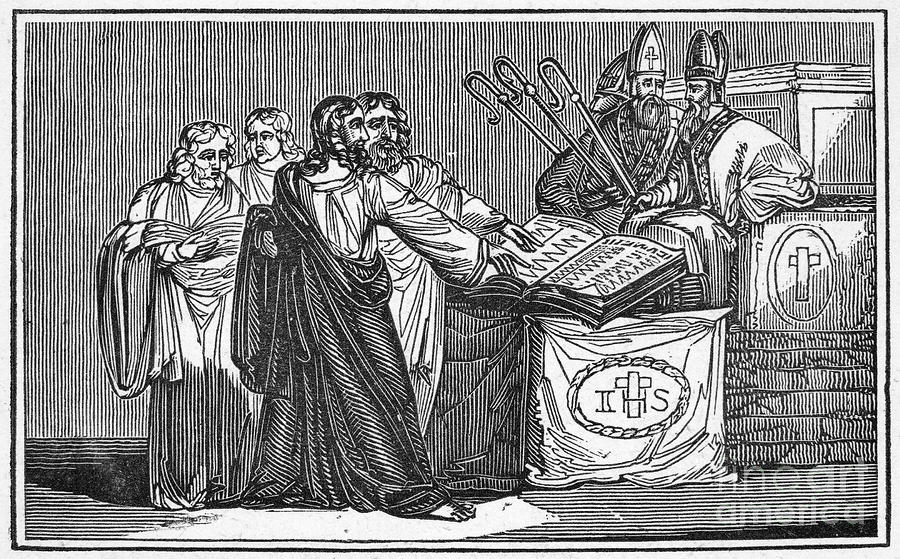
Valdes and his companions preached in the streets and squares of Lyon, two by two, and soon had followers of both sexes. When the archbishop told them to stop, they answered with the apostles' words in Acts 5:29, that they "ought to obey God, rather than men."5 In 1179 some of them went to Rome, where Pope Alexander III was holding the Third Lateran Council. The council's own canons do not mention them by name. Tanner's introduction to the council's decrees, as given at papalencyclicals.net, puts it this way: "it was also decided not to pass judgment about the preaching of the Waldensians."6 The fullest account comes from the royal clerk Walter Map, an Englishman of Welsh descent, who sat on the commission that examined them and wrote it up in his book of court gossip, De nugis curialium. As Schaff translates him, Map asked whether they believed in the persons of the Trinity ("Yes") and "in the Mother of Christ?" ("Yes"), and the commission burst out laughing, because in the schools one believed "in" God but only "on" Mary. Map described them as going about barefoot, holding all things in common and "nudi nudum Christum sequentes," naked following the naked Christ, and he warned that "if we admit them, we ourselves ought to be turned out."5 Accounts written after the council report that Alexander III approved Valdes's vow of poverty but allowed the group to preach only with the permission of the local clergy. The canons themselves are silent.
That permission did not come. The Waldensians kept preaching, were expelled from Lyon, and in 1184 Pope Lucius III, meeting the emperor Frederick Barbarossa at Verona, issued the decree usually cited by its first words, Ad abolendam. It named several groups for anathema, among them the Cathars and the Patarenes, and it designated the Waldensians, in Schaff's rendering, as "Humiliati, or Poor Men of Lyons." Their offense, in Schaff's summary, was "preaching without the consent of the bishops."5 Weber's Catholic account gives the same sequence and the same charge.4 On the evidence, the Waldensians were condemned first for disobedience, for lay preaching without a license, and only later for doctrines.
The Waldensians in their own words
Unlike many medieval groups condemned as heretics, the Waldensians left writings of their own, most of them in the Occitan dialects of the Alps and copied in the fourteenth and fifteenth centuries. The surviving manuscripts are now in Cambridge, Dublin (Trinity College), Geneva, Grenoble, Lyon and Paris.5 The best known is a poem of 479 lines (Schaff's count), La nobla leyczon, "The Noble Lesson." Its date is disputed: a line refers to 1,100 years since it was written "It is the last time," which older Protestant writers took to mean about 1100, while most scholars now date the poem to the fifteenth century. In the English translation reprinted by Christian History magazine it begins:
O Brethren give ear to a noble lesson,
We ought always to watch and pray,
For we see this world to be near a conclusion,
We ought to strive to do good works,
For we see the end of this world to approach.
The poem retells sacred history from Adam to Christ and the apostles and then describes the poem's own community. It says that after the apostles there were teachers who "taught the way of Jesus Christ our Saviour," that "these are found even at this present day, But they are known to very few," and that "they are so persecuted, that they are able to do but little." Its definition of the persecuted man is moral: one who "will neither curse, swear, nor lie, He will neither commit adultery, nor kill." Then comes the bitter line: "Now such an one is termed a Waldensian, and worthy to be punished."7 The poem invokes the Trinity and calls Christ "the Son of Saint Mary." Nothing in it is dualist, and nothing in it denies the creeds.
A second document, a letter of the "Poor Lombards" written after a meeting at Bergamo in May 1218 with "our brethren in France, companions of Valdes," shows the movement already dividing. The two branches agreed that community leaders and ministers "should be elected" by the community, and on a hard question: if the church should require practices "which, according to your judgment and belief, you believe one cannot clearly justify on the basis of Scripture, are you obliged to obey?" Both answered that they were not. They disagreed on the Eucharist. Some of the French companions of Valdes held that "the substance of the bread and wine is transformed into the body and blood of Christ by the Word of God" and that "the sacrament cannot be performed by women or laymen, but only by the priest," while the Lombards rejected that view.8 So at least some of the early Waldensians of France still accepted transubstantiation and priestly consecration, a point often missed by later admirers.
Most of what is known about Waldensian belief in the thirteenth and fourteenth centuries comes from their opponents, above all from inquisitors' handbooks and polemical treatises. A list attributed to the inquisitor Rainerius Sacconi (1254) but probably drawn in part from the so-called Anonymous of Passau, translated by S. R. Maitland in 1832, says they hold "that the Romish Church, is not the Church of Jesus Christ," that it "apostatized under Sylvester, when the poison of temporalities was infused," that "we are not to obey Prelates; but only God," that "every good layman is a priest," that "every layman, and even woman ought to preach," and that "whatever is preached which cannot be proved by the text of Scripture they consider as fabulous."9 The Anonymous of Passau, Schaff notes, praised the honesty and sobriety of the Austrian Waldensians and said he had met laymen who knew most of the Gospels of Matthew and Luke by heart.5 Read together, the friendly poem and the hostile lists agree on the main points: the authority of Scripture over church custom, preaching by lay people (women included), refusal of oaths and of killing, rejection of purgatory and prayers for the dead, and a church of the poor set against a church of property.

Persecution and the Alpine valleys
Condemned at Verona, the Waldensians scattered. Schaff traces three main branches: the Poor of Lyon in southern France, the Poor Lombards in northern Italy and a large German and Austrian movement that reached as far as Bohemia, Poland and the Baltic.5 Their traveling preachers were later called barbes (from a late Latin word for "uncle," a term of respect), and the Waldensian church's own history says they "knew large parts of the Scriptures by heart."10 In most places the believers attended the parish church, kept their convictions quiet and received the barbes in secret for preaching and confession. Inquisitors pursued them through the thirteenth and fourteenth centuries. Schaff, following the Bernard Gui records, says the persecution in southern France was lighter for the Waldensians than for the Cathars: Gui opened his trials in 1308, and the first Waldensian sentenced to death by fire in his court came only in 1316. In Austria, according to Schaff, Neumeister, a bishop of the Austrian heretics who was put to death with many others in 1315, testified that the sect had over eighty thousand adherents in the diocese of Passau alone, a number that cannot be checked.5
The Cottian Alps west of Turin became their refuge. Pope Innocent VIII proclaimed a crusade against the Waldensians of Dauphine and Piedmont in 1487. Schaff says the crusading armies "may have numbered 18,000 men," a figure that should be treated as a round estimate.48
Chanforan, 1532: joining the Reformed
When the Reformation broke out, the barbes sent two of their number, Georges Morel and Pierre Masson, to consult the reformers Johannes Oecolampadius in Basel and Martin Bucer in Strasbourg in 1530. One of them was arrested on the way home and executed (Schaff names Morel; other accounts name Masson, at Dijon). In 1532 the Waldensian leaders met near Angrogna in the Piedmont valleys, in a meeting traditionally said to have been attended by the French reformer Guillaume Farel. The Waldensian Evangelical Church's own history counts the "Synod of Chanforan" in 1532 as the first of two decisive steps toward the Reformation, the meeting "during which they decided to fund a new translation of the Bible" (the French Bible of Pierre Robert Olivetan, printed at Neuchatel in 1535), and the second the organization, some twenty years later, of a Reformed church "with meetings and public worship places, pastors who preached, taught and administered sacraments in vernacular."10
The text adopted there survives. Its heading says it was "Made with general consent by the ministers and heads of Families of the Churches of the Valleys of the Piedmont, assembled in Angrogna the 12th of September of the Year 1532." Its articles show how far the old movement moved. Article 2 says, "All those that have been, and shall be saved, have been elected of God, before the foundation of the world," and article 4 that "Whosoever upholds free-Will denieth absolutely Predestination, and the Grace of God." Article 6 reverses the old Waldensian refusal of oaths: "A Christian may swear by the Name of God without contravention of what is written, Matt. 5." Article 7 keeps an old conviction: "Auricular confession is not commanded of God." Article 12 says that "Marriage is not forbidden to any."11
Historians disagree about what happened at Chanforan. The Christian History editors who reprinted the articles note that the traditional account (one great synod that voted to join Farel's reform) has been questioned by the Oxford-trained historian Euan Cameron, who argued that the evidence shows several meetings in different places and that the tidy story "was a later imposition on the facts." Whether there was one meeting or several, the editors conclude, "the Waldensians did become a part of the Calvinistic Reformed tradition."11
The "Piedmont Easter" of 1655
Under the dukes of Savoy the Reformed Waldensians alternated between war and grudging toleration. The church's own history says that after armed resistance they won a convention in 1561 allowing Protestant worship inside the valleys, while the Waldensian colonies in Calabria were destroyed in the same years.10 In April 1655, around Easter, ducal troops and their auxiliaries carried out the massacre the Waldensians remember as the Pasque piemontesi, the "Piedmont Easter." The church's history says it "led to vocal protests by other European Protestant countries and a severe diplomatic crisis between Piedmont and Cromwell's England."10 Death tolls in the contemporary Protestant accounts run into the thousands. They were compiled by the victims' side and the totals vary, so this lesson gives no single number. John Milton, then Cromwell's Latin secretary, wrote the sonnet "On the Late Massacher in Piemont." In H. C. Beeching's edition it opens:
Avenge O lord thy slaughter'd Saints, whose bones
Lie scatter'd on the Alpine mountains cold,
Ev'n them who kept thy truth so pure of old
When all our Fathers worship't Stocks and Stones,
Forget not: in thy book record their groanes
Who were thy Sheep and in their antient Fold
Slayn by the bloody Piemontese that roll'd
Mother with Infant down the Rocks.12
Milton's third line repeats the Protestant belief of his day that the Waldensians had kept the faith pure since before the medieval church went wrong. That belief is examined in the claims section below. In 1686 to 1687 the Waldensians were driven from Piedmont altogether. A few thousand survivors went into exile in Switzerland and returned by force in 1689 in the "Glorious Return" led by the pastor Henri Arnaud.10 Full civil and political rights came only with the Letters Patent of King Charles Albert on Feb. 17, 1848, which the Waldensians still celebrate with bonfires every year.10

The Waldensian church today
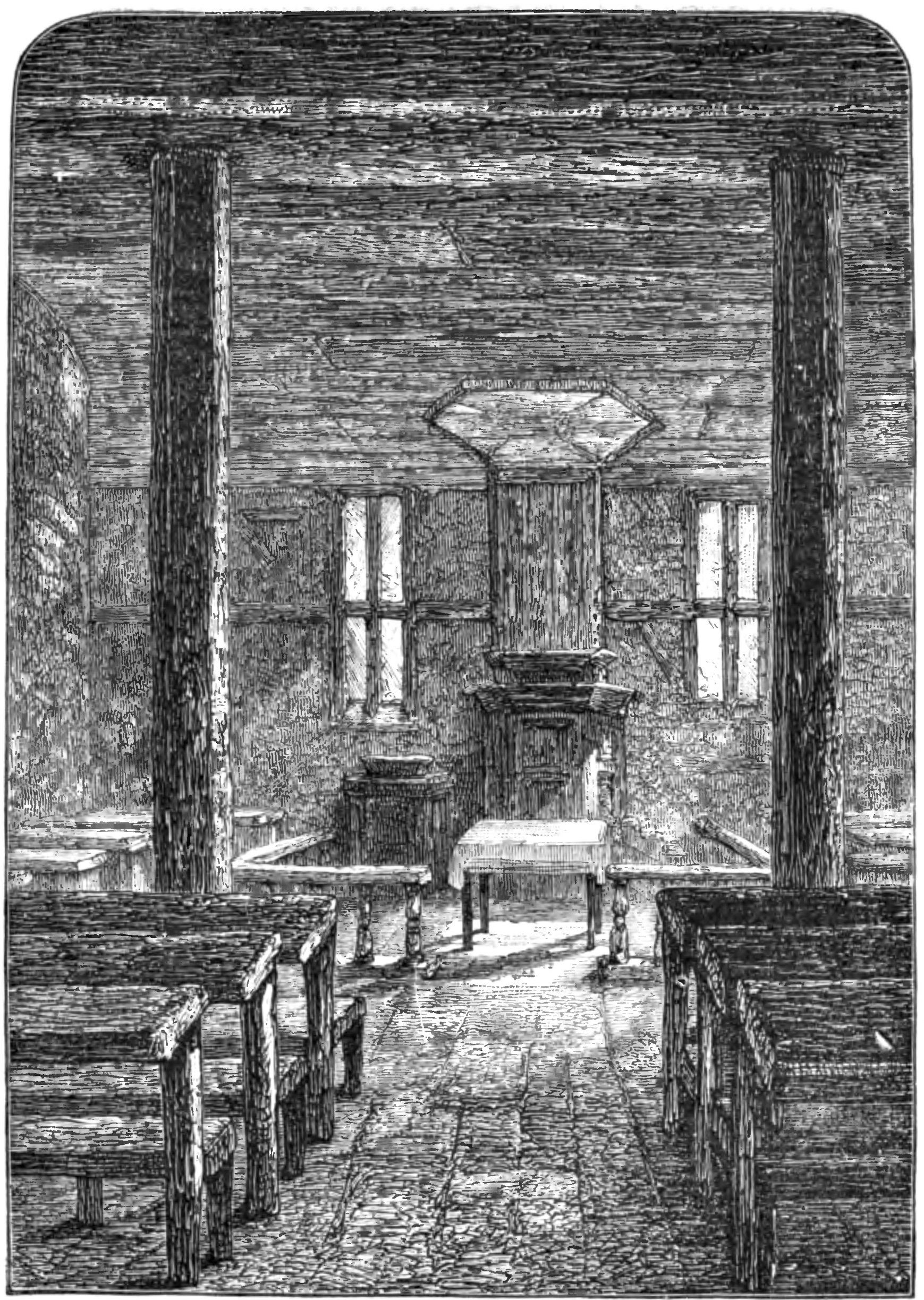
The church describes itself on its own site in plain terms: "We are a Christian church, a community of believers in Jesus Christ, united in listening to the Gospel and sharing in the sacraments." Its short history continues: "The Waldensians originated in the Middle Ages as a movement calling the entire Church to the simplicity of the Gospel and allowing lay people to preach," and "In the 16th century, the Waldensians joined the Reformation." Since 1975 the Waldensian and Methodist churches of Italy have been joined in "a pact of communion, collaboration, and sharing," and a large part of the world's Waldensians live in Argentina and Uruguay, where emigrants from the valleys settled after 1858.13 The church ordains women as pastors (since the 1960s), was a founding member of the World Council of Churches and since 1984 has had a formal agreement (intesa) with the Italian state.10 The church's own account also places Valdes inside the reforming current of his time: he and his followers began to preach "not to form a new church but to renew the Catholic Church inspired by Pope Gregory VII's reforms."10
On June 22, 2015, Pope Francis visited the Waldensian temple in Turin. Speaking of "the disputes and acts of violence committed in the name of our faith," he said: "On behalf of the Catholic Church I ask your forgiveness. I ask your forgiveness for unchristian-like and even inhuman attitudes and conduct which, historically, we have had against you. In the name of the Lord Jesus Christ, forgive us!"14
The Cathars: a different movement
The Waldensians were condemned at Verona alongside the Cathars, and medieval writers, Catholic polemicists and many later Protestant historians often lumped the two together under the name "Albigensians" (from Albi in Languedoc). They were very different. The Third Lateran Council's canon 27 had already named "the loathsome heresy of those whom some call the Cathars, others the Patarenes, others the Publicani," anathematized them and their protectors, and, in a step Tanner's introduction calls an innovation, called for arms to be taken up against them (and against the bands of mercenaries named in the same canon), granting a remission of two years of penance to those who took up arms "to drive them out."6
The Cathars' own surviving writings are few, but one of them states the core belief. A text the inquisitors at Carcassonne labeled "the secret book of the heretics of Concoreze, brought from Bulgaria by their bishop Nazarius," known as the Interrogatio Johannis or "Book of John the Evangelist," has Christ tell John that Satan, after his fall, "made man in his likeness, and commanded the (or an) angel of the third heaven to enter into the body of clay." When John asks how men can say that Adam and Eve were created by God, the Lord answers that "foolish men say thus in their deceitfulness that my Father made bodies of clay."15 That is dualism: the visible, material world and the human body are the work of an evil power, and the soul is a fallen spirit imprisoned in flesh. The inquisitor Bernard Gui (died 1331), in the manual translated by Robinson, says the Cathars called themselves "good Christians, who do not swear, or lie, or speak evil of others" and that they taught that the water of baptism "is material and corruptible and is therefore the creation of the evil power."16 Their ritual life centered on the consolamentum, a laying-on of hands that made a believer one of the "Perfect," who then renounced meat, sex and property.17
None of this is found in the Waldensian texts above. The Noble Lesson praises the Creator, the Poor Lombards' letter argues about transubstantiation as Catholics did, and even the hostile Rainerius list charges the Waldensians with disobedience and lay preaching, never with two gods. Schaff, who admired the Waldensians, put it directly: they "never adopted Manichaean elements."5 The Catholic Weber, on the other hand, thought certain Waldensian practices (refusal of oaths, the division into "perfect" and "friends") so close to Catharism that borrowing was "a certainty."4 The record supports the overlap in ethics and organization and does not support any shared doctrine of creation.
After the murder of the papal legate Peter of Castelnau in 1208, Pope Innocent III called the crusade against the lords of Languedoc that began in 1209 and dragged on for twenty years, and the papal inquisition grew out of the effort to root out what was left.17 Some recent historians, notably R. I. Moore in The War on Heresy (2012), argue that the organized "Cathar church" of the textbooks was in part created by the inquisitors' categories and that many of the "good men" of Languedoc were local holy men rather than members of an international dualist church. Other specialists answer that texts like the Interrogatio and the rituals preserved in Occitan show a real dualist tradition with roots among the Bogomils of the Balkans. The debate is live.18
The Spiritual Franciscans
The ideal of apostolic poverty that moved Valdes also moved Francis of Assisi a generation later, and Francis's order split over it. The strict party, the "Spirituals," insisted that friars should have only the poorest "use" of goods (usus pauper) and owned nothing at all, individually or in common. Some of them, following the friar Peter John Olivi (died 1298), read the twelfth-century prophet Joachim of Fiore as foretelling a new age of the Spirit led by the poor. Pope Clement V's bull Exivi de paradiso (1312), issued at the Council of Vienne, leaned toward the Spirituals' strictness. His successor John XXII reversed course: in the decretal Quorumdam exigit and the bull Sancta Romana of Dec. 30, 1317, he ordered the Spirituals to submit. Twenty-five who refused were handed to the inquisition, and four were burned at Marseille on May 7, 1318. In Cum inter nonnullos (1323) John declared it heresy to say that Christ and the apostles owned nothing.19 The Spirituals' successors, the Fraticelli, survived in Italy into the fifteenth century. Their story shows that the question "must the church be poor?" divided the church's own most loyal religious order, and that the papacy answered it with the same tools it used against outsiders.
John Wycliffe of Oxford
The schoolman and the king's servant
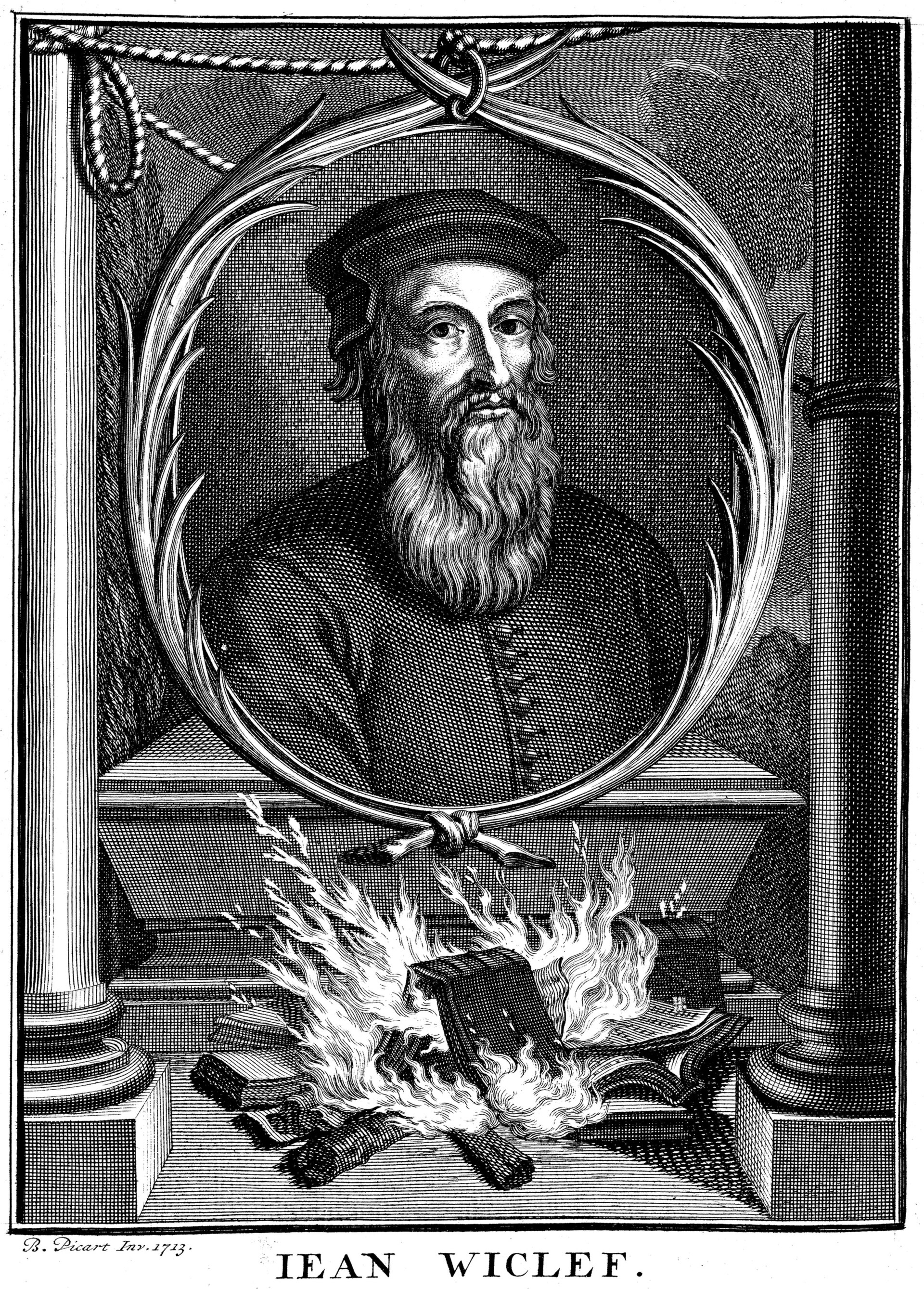
John Wycliffe (the name is spelled more than twenty ways, Wyclif being common in scholarship) was born in Yorkshire, probably in the later 1320s, though the year is not recorded. The traditional date is 1324, and many modern works give about 1328 or about 1330.1 He spent most of his life at Oxford, where he was master of Balliol about 1360 to 1361, took his doctorate in theology about 1372 and became the most eminent philosopher of the university, a "realist" in the medieval debate over universals. The church paid him as it paid many scholars, with parish livings he served through deputies: Fillingham, Ludgershall and, from 1374, Lutterworth in Leicestershire.20
Wycliffe entered public life as a servant of the crown. In 1374 he sat second on a royal commission sent to Bruges to negotiate with papal envoys about taxes and appointments, and there he came under the protection of John of Gaunt, duke of Lancaster, the king's son.1 The Catholic historian F. F. Urquhart, writing the "Wyclif" article for the Catholic Encyclopedia (1912), saw this as the start of "the alliance between Wyclif and the anti-clerical oligarchic party headed by John of Gaunt," which "found in the Oxford doctor, with his theories of the subjection of church property to the civil prince, a useful ally in their attacks on the Church."20 In 1377 the bishop of London tried him at St. Paul's, and the hearing broke up in a quarrel between the bishop and the duke.1
That spring Pope Gregory XI issued five bulls against him, dated May 22, 1377, to the archbishop of Canterbury, the bishop of London, the king and the University of Oxford.21 The letter to Oxford, in Oliver Thatcher's 1907 translation, says the pope had learned "that John de Wycliffe, rector of the church of Lutterworth, in the diocese of Lincoln, Professor of the Sacred Scriptures (would that he were not also Master of Errors), has fallen into such a detestable madness that he does not hesitate to dogmatize and publicly preach, or rather vomit forth from the recesses of his breast, certain propositions and conclusions which are erroneous and false," and orders the university "to arrest the said John, or cause him to be arrested."22 (Thatcher's text dates the letter "the 31st of May, the sixth year of our pontificate"; Gee and Hardy's collection gives the series as May 22, 1377.) Oxford's masters of theology judged that the condemned propositions, eighteen or nineteen depending on the list, were true though they "sounded badly to the ear," and nothing came of the summons.1 Gregory XI died in March 1378, and the Great Western Schism began, with rival popes in Rome and Avignon excommunicating each other.
On Civil Dominion: lordship and grace
The ideas that alarmed Gregory came mainly from Wycliffe's treatises De dominio divino (On Divine Lordship) and De civili dominio (On Civil Lordship), written about 1375 to 1376. Schaff's summary of the second: it "opens by declaring that no one in mortal sin has a right to lordship, and that every one in the state of grace has a real lordship over the whole universe." Ownership is stewardship held from God, and a church that abuses the property committed to it "may be deprived of it by the state."23 The idea was dangerous in two directions at once. It invited kings and lords to take church land, which suited John of Gaunt. It could also be turned against kings and lords themselves, since a sinful secular lord had no better title than a sinful bishop. One of Gregory's charges, that Wycliffe taught that "God ought to obey the devil," came from this argument. Schaff explains that Wycliffe meant only that the jurisdiction of every lawful holder must be recognized, even an evil one, until God removes him.23
The Eucharist and the break with the friars
From 1378 Wycliffe's writing grew sharper: On the Truth of Holy Scripture, On the Church (which defined the true church as the whole body of the predestined, known only to God), On the Power of the Pope and, about 1379 to 1380, On the Eucharist. In the last he rejected the doctrine of transubstantiation, defined by the Fourth Lateran Council in 1215, that the substance of the bread and wine is changed into the body and blood of Christ while the "accidents" (appearance, taste) remain. Wycliffe argued as a philosopher that accidents cannot exist without their substance. In his dialogue Trialogus, translated by Robert Vaughan in 1845, the character Phronesis says: "For if A is identical with B, then both of them remain; since a thing which is destroyed is not made identical, but is annihilated, or ceases to be."24 Wycliffe held that Christ is truly present in the sacrament "sacramentally, spiritually, efficiently," while the bread remains bread. The friars, until then partly on his side against the wealthy monks and bishops, turned against him, and he against them.23
Urquhart's Catholic article judged this the decisive step: "In 1380 Wyclif took the momentous step of beginning to attack Transubstantiation," calling the Host merely "an effectual sign," and "this open denial of a doctrine which came home to every Christian, and the reaction which followed the Peasant Revolt, lost Wyclif much of his popularity."20 The Peasants' Revolt of June 1381 (in which rebels murdered Archbishop Simon Sudbury) was blamed by his enemies on his teaching. Schaff, sympathetic to Wycliffe, found "no evidence that Wyclif had any more sympathy with the movement than Luther had with the Peasants' Rising of 1525."1
The Blackfriars council of 1382
Sudbury's successor, William Courtenay, called a council of bishops and theologians to the Dominican house in London (Blackfriars) in May 1382. An earth tremor shook the meeting, which gave it the name "Earthquake Synod." Courtenay called it a good omen and Wycliffe called it God's judgment on the friars.1 The council condemned twenty-four propositions, ten as heretical and fourteen as erroneous, without naming their author in the sentence. The list, in Thatcher's translation, begins: "1. That the material substance of bread and of wine remains, after the consecration, in the sacrament of the altar." Others include "That if a man has been truly repentant, all external confession is superfluous to him or useless," "That since Urban VI, no one is to be acknowledged as pope; but all are to live, in the way of the Greeks, under their own laws," and "That friars should be required to gain their living by the labor of their hands and not by mendicancy."22 Wycliffe's Oxford supporters (Philip Repingdon, Nicholas Hereford, John Aston) were forced to recant or fled, and Wycliffe withdrew to Lutterworth. He was not himself tried again.
Partly paralyzed by a stroke, he kept writing in Latin and English. A letter in English answering a summons to Rome, preserved in the Thatcher collection, puts his program in his own words: "I suppose over this that the gospel of Christ be [the] heart of the corpus of God's law," and "I take it as believe, that no man should sue the pope, nor no saint that now is in heaven, but in as much as he sues Christ" (to "sue" here means to follow). He adds, "this I take as wholesome counsel, that the pope leave his worldly lordship to worldly lords."22 In the last days of December 1384, while hearing Mass in his church at Lutterworth, he suffered a second stroke, and he died on Dec. 31, 1384. The St. Albans chronicler Thomas Walsingham, who hated him, says he was struck on the feast of Thomas Becket (Dec. 29) and died on "St. Sylvester's Day" (Dec. 31); Schaff gives Dec. 29 for the death, a slip against his own quoted source.1

The Wycliffite Bible
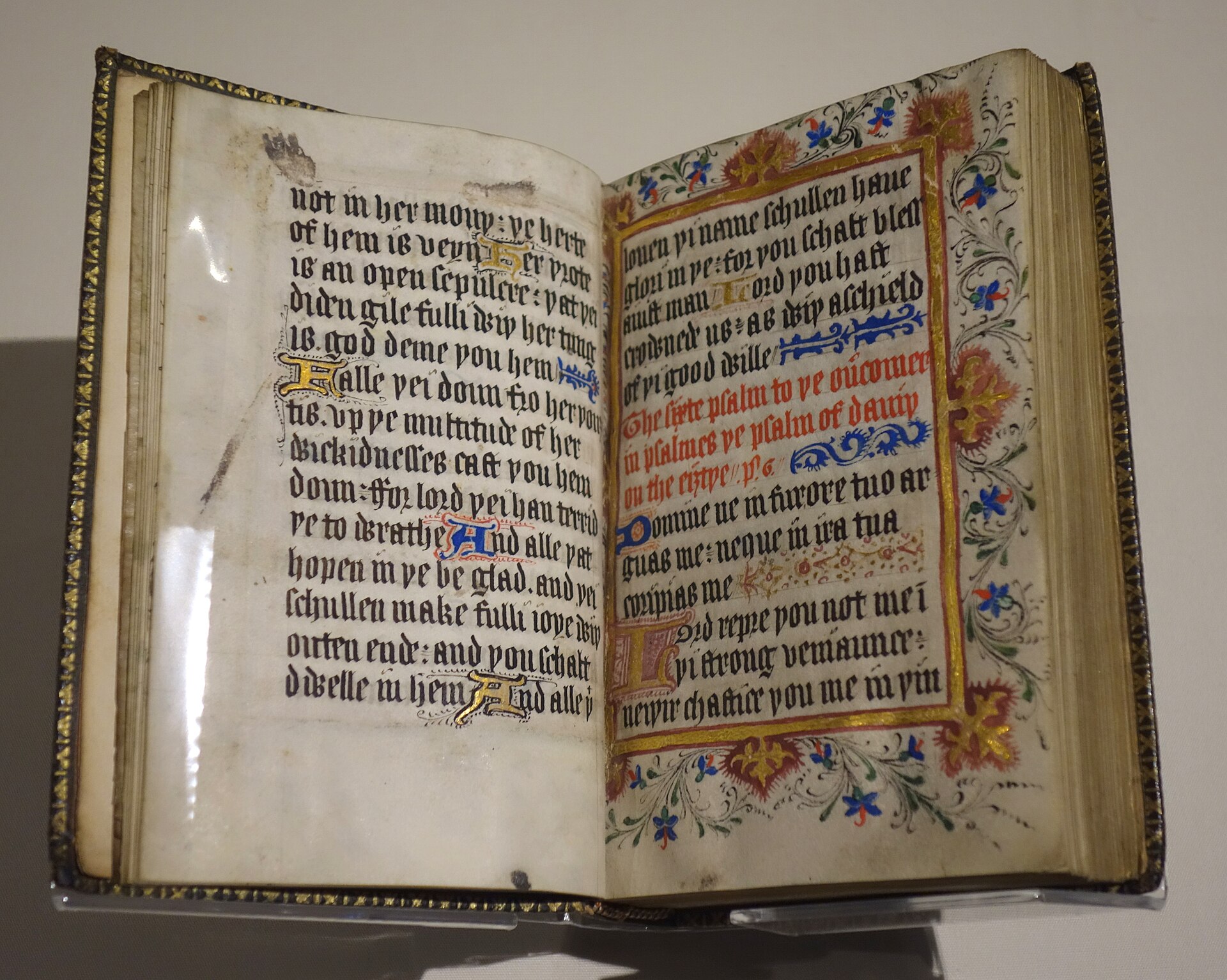
Wycliffe taught that Scripture was "the law of Christ" and that every Christian, lay or cleric, man or woman, should be able to read it. In an English tract Schaff quotes, "Christen men and women, olde and young, shulden study fast in the New Testament," because "the New Testament is of ful autorite and open to understonding of simple men, as to the pynts that ben most needful to salvation."25 Around him at Oxford a group produced the first complete translation of the Bible into English, from the Latin Vulgate (translated about 382 to 405 at the request of Pope Damasus), since none of them worked from Hebrew or Greek. It exists in two forms. The "Early Version," usually dated to the early 1380s, follows the Latin word order so closely that it is often hard to read. The "Later Version," finished in the 1390s, is freer and more natural English. Forshall and Madden, who first printed both in 1850, dated them to about 1382 and 1388.25
Who did the work is debated. Schaff, following Forshall and Madden, says Nicholas Hereford translated the Old Testament as far as Baruch 3:20, and the editors took one Bodleian manuscript of the Early Version to be Hereford's own copy. The Later Version, with its long General Prologue, was traditionally credited to John Purvey, who had lived with Wycliffe at Lutterworth.25 Modern scholars, among them Anne Hudson and Mary Dove (The First English Bible, 2007)26, treat both attributions as uncertain and see a team effort over many years. Whether Wycliffe himself translated any of it is also unknown, though contemporaries credited him with it. The hostile chronicler Henry Knighton, writing about twenty years after his death, said that "this Master John Wyclif translated" the Gospel "out of the Latin into the Anglican tongue, not the Angelic tongue," so that it became "more open to the lay folk and to women, knowing how to read, than it used to be to clerics," and that "the Gospel pearl is cast forth and trodden under foot of swine."25 Jan Hus wrote in 1411 that Wycliffe had translated the whole Bible into English.25
Modern surveys count about 250 surviving manuscripts of the Wycliffite Bible, more than for any other medieval English text. Schaff, writing before those surveys, counted 170. Some were owned by kings and great houses: Henry VI gave one to the London Carthusians.25 The late-nineteenth-century Catholic scholar Francis Aidan Gasquet argued that the surviving texts were orthodox Catholic translations later falsely attached to Wycliffe. Most scholars, Catholic and Protestant, now reject that argument, though Urquhart's article accepted part of it, writing that "portions of the Scriptures were called Wyclifite in the fifteenth century, and sometimes condemned as such, because a Wyclifite preface had been added to a perfectly orthodox translation."20

The Lollards
Wycliffe's followers were called Lollards, a Dutch word already used on the Continent for pious lay people and heretics, probably from a verb meaning to mumble or sing softly, and contemporaries punned on the Latin lolium, "tares," the weeds in the wheat.27 They were never a single organized church. In the 1380s and 1390s the movement had friends among knights of the royal household and some Oxford scholars. In 1395 (Gee and Hardy say "about the year 1394") a group posted a manifesto, the Twelve Conclusions of the Lollards, on the doors of Westminster Hall and St. Paul's during a session of Parliament. Gee and Hardy's 1896 translation begins: "That when the Church of England began to go mad after temporalities, like its great step-mother the Roman Church, and churches were authorized by appropriation in divers places, faith, hope, and charity began to flee from our Church." The fourth conclusion calls "the pretended miracle of the sacrament of bread" a cause of idolatry and cites "the evangelical doctor" (Wycliffe) and his Trialogus. The eighth calls pilgrimages and offerings "to blind crosses or roods, and to deaf images of wood or stone" "pretty well akin to idolatry."28 Other conclusions attack clerical celibacy, prayers for the dead, exorcisms and blessings of objects, the holding of secular office by clergy and war.
The new Lancastrian king Henry IV, who took the throne in 1399 with the support of Archbishop Thomas Arundel, answered with the statute of 1401 known by its Latin title De heretico comburendo ("on the burning of a heretic"). It forbade anyone to "preach, hold, teach, or instruct anything, openly or privily, or make or write any book contrary to the Catholic faith," ordered such books handed to the bishop within forty days, and provided that anyone who refused to abjure, or relapsed after abjuring, should be handed to the sheriff or mayor, who "shall receive the same persons ... and them, before the people, in a high place cause to be burnt, that such punishment may strike fear to the minds of others."29 The first Lollard burned, the priest William Sawtry, died in March 1401, while the statute was still before Parliament.27 The tailor John Badby followed in 1410. In 1414 the knight Sir John Oldcastle led a failed rising against Henry V, and Lollardy became treason as well as heresy. Oldcastle was hanged and burned in December 1417.27
Arundel's Constitutions, drafted at a council at Oxford in 1407 and issued in 1409, aimed at the Bible itself. In Schaff's summary, they provided that "upon pain of greater excommunication, no man, by his own authority, should translate into English or any other tongue, until such translation were approved by the bishop, or, if necessary, by the provincial council," and they named the translation "set forth in the time of John Wyclif."25 The Constitutions also limited preaching to licensed men and ordered a search of Oxford for Wycliffite opinions. Owning an unapproved English Scripture became evidence of heresy in the church courts for more than a century.
Lollardy survived underground among artisans and small farmers in places such as the Chilterns, Coventry, Kent and London. Groups met to read the English Scriptures and Wycliffite tracts aloud. A bishop of Chichester, Reginald Pecock, wrote a long treatise against them in about 1455, calling them "Known Men" and "Bible Men," and was himself forced to recant for arguing that they should be won by reason before force was used.27 Trials continued into the 1520s. Writing in 1523, Bishop Cuthbert Tunstall of London told Erasmus that Lutheranism was "not a question of some pernicious novelty, but only that new arms were being added to the great band of Wycliffite heretics."27
Constance and the exhumation of 1428
Thirty years after his death Wycliffe was condemned by a general council. At its eighth session, on May 4, 1415, the Council of Constance listed forty-five articles taken from his writings and called him "that pseudo-christian John Wyclif," and it declared "that the said John Wyclif was a notorious and obstinate heretic who died in heresy," anathematized his memory and ordered "that his body and bones are to be exhumed, if they can be identified among the corpses of the faithful, and to be scattered far from a burial place of the church."30 At the fifteenth session, on July 6, 1415 (the day Hus died), it condemned another 260 articles collected at Oxford. The order to dig up the body was carried out in 1428 by Richard Fleming, bishop of Lincoln, at the command of Pope Martin V. The Catholic Encyclopedia gives 1428, Schaff 1429.20 The bones were burned and the ashes thrown into the little river Swift at Lutterworth. The seventeenth-century church historian Thomas Fuller drew the moral that has been quoted ever since: "Thus this brook hath conveyed his ashes into Avon, Avon into Severn, Severn into the narrow seas, they into the main ocean. And thus the ashes of Wicliffe are the emblem of his doctrine, which now is dispersed the world over."1
How historians read Wycliffe and the Lollards
Protestant tradition, from John Bale and John Foxe in the sixteenth century to Schaff, called Wycliffe "the Morning Star of the Reformation." Schaff concluded that "in almost every doctrinal particular did this man anticipate the Reformers," with one large exception: "The doctrine of justification by faith Wyclif did not state." He added that "the Englishman never ceased to be a Schoolman."25 Philip Melanchthon, Luther's colleague, was less impressed: according to Schaff, he wrote that Wycliffe was ignorant of justification and had "foolishly mixed up the Gospel and politics."25
The Catholic Encyclopedia article treats Wycliffe as a learned man whose speculation was at first tolerated in the schools, "a time of much uncertainty in matters of faith," and who became a heretic in the full sense when he denied transubstantiation, after which his followers "tend to become a people apart."20 The secular and academic study of the last sixty years has moved the question from Wycliffe's person to the movement. Gordon Leff, in Heresy in the Later Middle Ages (1967), traced Wycliffe's doctrines of the church and the Eucharist to his realist metaphysics and argued that his heresy grew out of his philosophy.31 Anne Hudson's The Premature Reformation: Wycliffite Texts and Lollard History (1988) showed, from the surviving English sermons, tracts and Bible manuscripts, that Lollardy produced a large vernacular literature and a coherent set of beliefs, and its title states her reading: a reformation that came too early to win.32 Other historians have stressed how small and scattered the later Lollard groups were and doubt that they did much to cause the English Reformation of the 1530s, which began with a king's marriage and a statute. That debate continues in lesson 12.
Jan Hus of Prague
Prague and the Bethlehem Chapel
Bohemia under the emperor Charles IV (king 1346 to 1378) was one of the richest realms of Europe, and Prague had the first university in central Europe (founded 1348; Schaff gives 1347). Before Hus, Czech preachers such as Jan Milic of Kromeriz (died 1374) and Matthias of Janov (died 1394) had already called for moral reform and frequent communion.33 The marriage of the Bohemian princess Anne to Richard II of England in 1382 opened a road for students and books between Oxford and Prague, and Wycliffe's philosophical and theological works were copied in Prague in the 1390s. Copies of five of Wycliffe's treatises in Hus's own hand, dated 1398, survive in Stockholm, carried off as loot in the Thirty Years' War.33
Jan Hus was born at Husinec in southern Bohemia about 1370 (Schaff gives 1369, and the traditional birthday of July 6 has, in Schaff's words, "insufficient authority"). His name means "goose," and he often punned on it in his letters. He was poor, supported himself as a student by singing in churches, took his master's degree at Prague in 1396, was ordained priest in 1400 and served as rector of the university in 1402 to 1403.34 In 1402 he became preacher of the Bethlehem Chapel in Prague's Old Town, founded in 1391 by two laymen on the condition that its preacher should preach in Czech every Sunday and feast day.33 From its pulpit Hus attacked simony, the wealth and the morals of the clergy and, increasingly, the authority of popes who did not live as Christ lived.
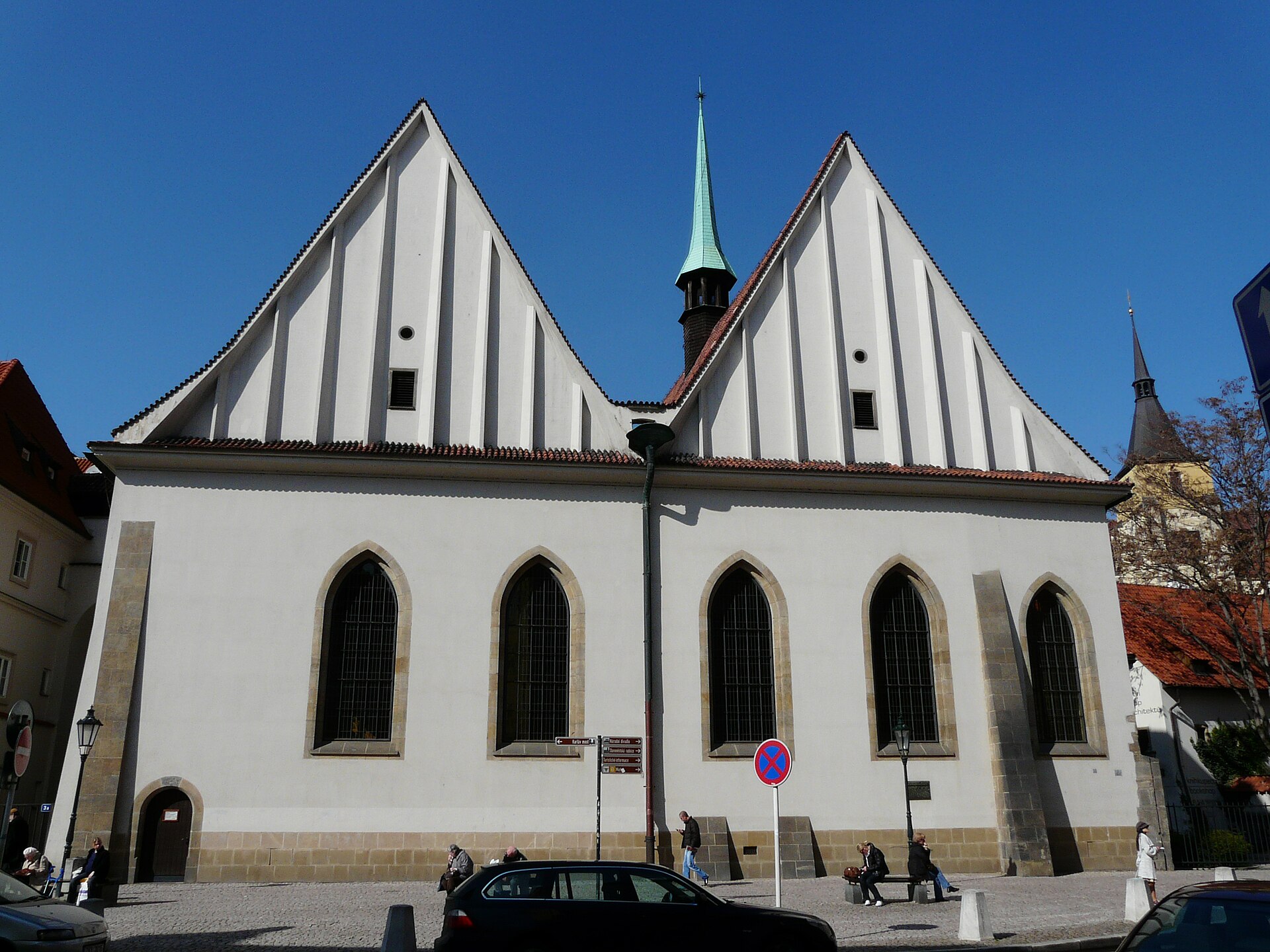

The conflict that followed was tangled in Bohemian politics and the papal schism. In 1403 the university masters condemned forty-five articles of Wycliffe (the twenty-four of Blackfriars plus twenty-one more). In 1409 King Wenceslas IV, seeking support for his policy in the schism, issued the Decree of Kutna Hora, giving the Czech "nation" of the university three votes and the three foreign nations one. Thousands of German masters and students left for Leipzig. The numbers given in the sources range from about 2,000 (Schaff, following a fifteenth-century chronicler) to between 5,000 and 20,000 (the Catholic Encyclopedia), and the 602 matriculations at Leipzig in its first year suggest the lower figure is nearer the truth.33 In 1410, on the authority of a bull of the Pisan pope Alexander V, Archbishop Zbynek burned about two hundred manuscripts of Wycliffe's works in the courtyard of his palace and restricted preaching to cathedral, parish and monastic churches, which would have closed the Bethlehem Chapel. Hus refused, kept preaching and was excommunicated.34
In 1411 the Pisan pope John XXIII proclaimed a crusade, with indulgences for those who paid, against King Ladislas of Naples, the protector of his Roman rival. When the sale reached Prague in 1412, Hus denounced it. He argued in a public disputation that forgiveness comes through repentance and that the pope had no right to take up the sword. Three men of humble position (Schaff names them Martin, John and Stanislaus) who shouted in church that the indulgence bulls were lies were executed, and Hus's party buried them as martyrs in the Bethlehem Chapel.33 The curia renewed his excommunication and laid Prague under interdict while he remained there, and Hus left the city late in 1412 for the castles of noble supporters in southern Bohemia, where he preached in fields and market places and wrote his chief work.
De ecclesia: the church of the predestined
De ecclesia (On the Church), finished in 1413, opens with Wycliffe's definition. The Latin, quoted by Schaff, reads ecclesia est omnium praedestinatorum universitas: the holy catholic church is "the totality of all the predestinate," the dead, the living and those yet to come.33 From that definition followed the points that would condemn him. Since no one knows who is predestined, a pope or cardinal may be one of the "foreknown" (damned) and so no true member of the church at all. Christ, not Peter, is the rock on which the church is built, and, in Schaff's English, "Peter never was the head of the Holy Catholic Church." A Christian who disobeys an erring pope obeys Christ. Hus did not deny the papacy outright. He denied that the pope and cardinals are the church, and he denied that a papal command must be obeyed when it contradicts Scripture. Schaff, comparing the texts, judged that "the first three chapters of De ecclesia are little more than a series of extracts from Wyclif's treatise on the Church," while adding that Hus made the ideas "thoroughly his own."33 On the Eucharist Hus never followed Wycliffe. He held to transubstantiation to the end, and the council's final articles against him do not charge him with denying it.
Constance and the safe conduct
The Council of Constance opened on Nov. 5, 1414 (Tanner gives the opening in the cathedral on that day), called by John XXIII under pressure from Sigismund, king of the Romans and of Hungary and heir to his half-brother Wenceslas's Bohemian crown. It had three tasks: to end the schism, to root out heresy, and to reform the church "in head and members."30 Sigismund invited Hus to come and clear himself, and promised him protection. On Sept. 1, 1414, Hus wrote to Sigismund that he would come "under safe-conduct of your protection, the Lord Most High being my defender."35 He set out on Oct. 11, 1414, with the Bohemian lords John of Chlum, Wenceslas of Duba and Henry Lacembok, and reached Constance on Nov. 3. The letter of safe conduct, issued on Oct. 18, was addressed to all princes and subjects of the empire and told them to let Hus "pass, remain and return" freely.35
Within weeks the cardinals had him arrested (Nov. 28, 1414) and confined in the Dominican friary, in a cell next to the latrines, where he fell ill. On Dec. 24, the day before Sigismund reached Constance, John of Chlum posted a notice on the cathedral saying the king's word had been defied, and the king professed to be angry. The cardinals and theologians, Pierre d'Ailly among them, persuaded Sigismund that a promise given to a man accused of heresy could not bind the church's judges and that the council's work on the schism mattered more.35 In March 1415 John XXIII fled Constance, and Hus was moved to the bishop of Constance's castle at Gottlieben, chained by day and fastened to the wall at night, and kept there until June 5. At its nineteenth session, on Sept. 23, 1415, after his death, the council formally decreed that "notwithstanding safe conducts of emperors and kings and others, a competent judge can inquire into heresy."30 Hus's own verdict, written from prison and quoted by Schaff: "Christ deceives no man by a safe-conduct. What he pledges he fulfils. Sigismund has acted deceitfully throughout."35
The trial and the burning, July 6, 1415
Hus came to Constance hoping to preach and debate before the whole council. He got three public hearings, on June 5, 7 and 8, 1415, in the refectory of the Franciscan friary, before a commission headed by d'Ailly. He was not given an advocate. Articles drawn from his books and from witnesses' testimony were read, and he answered that some were not his teaching and that others he would recant if shown from Scripture to be wrong. On June 7, when Hus appealed to his conscience, d'Ailly replied, in Schaff's rendering, "we cannot go by your conscience when we have other evidence."35 Repeated deputations urged him to abjure. On July 1 he gave his written answer, which survives in the 1904 translation of Herbert Workman and R. Martin Pope:
I, Jan Hus, in hope a priest of Jesus Christ, fearing to offend God, and fearing to fall into perjury, do hereby profess my unwillingness to abjure all or any of the articles produced against me by false witnesses. For God is my witness that I neither preached, affirmed, nor defended them, though they say that I did. ... But inasmuch as I fear to offend against the truth, or to gainsay the opinion of the doctors of the Church, I cannot abjure any one of them.36
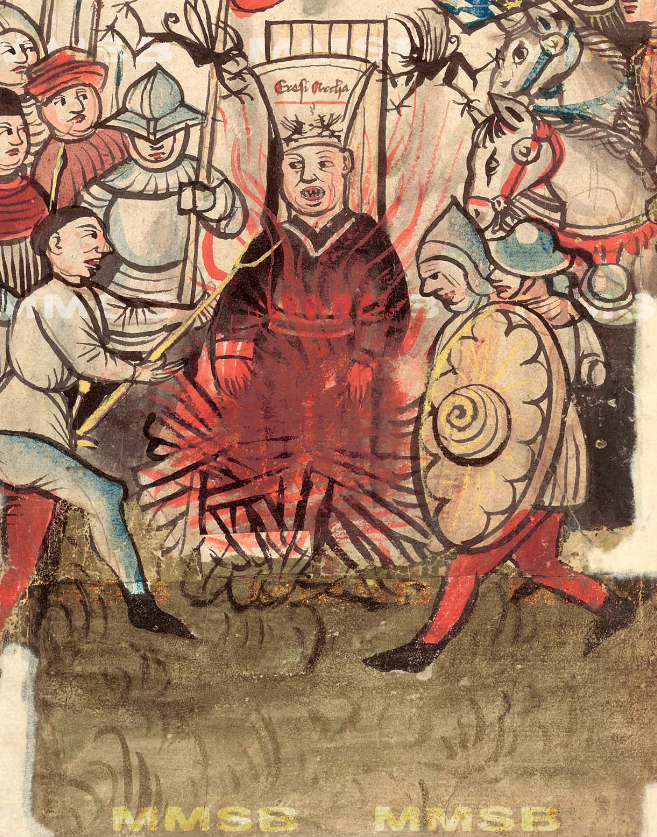
On Saturday, July 6, 1415, at the council's fifteenth session in the cathedral, a bishop preached on Romans 6:6, "that the body of sin might be destroyed" (KJV), thirty articles were read, and the sentence was given. In Tanner's translation the council declared that Hus "was and is a true and manifest heretic," that "he has even despised the keys of the church and ecclesiastical censures," and that he had offended by appealing over the church "directly to our lord Jesus Christ, as to the supreme judge." It ordered him degraded from the priesthood and, "seeing that God's church has nothing more that it can do, relinquishes John Hus to the judgment of the secular authority."30 Six bishops stripped him of his vestments and put on his head a paper crown painted with devils and the word "heresiarch." He was led out of the city past a bonfire of his books and burned at a field outside the walls. According to the accounts Schaff follows (including that of the Constance chronicler Ulrich Richental, who stood nearby), he refused a last offer to recant, sang "Christ, thou Son of the living God, have mercy upon me" as the fire rose, and died praying. His ashes were thrown into the Rhine so that no relics could be kept.35

A companion of Hus, the Prague master who had studied at Oxford and spread Wycliffe's works in Bohemia, was tried by the same council, recanted in September 1415, withdrew the recantation and was burned on the same spot on May 30, 1416.34
The Czech nobles' protest of 1415
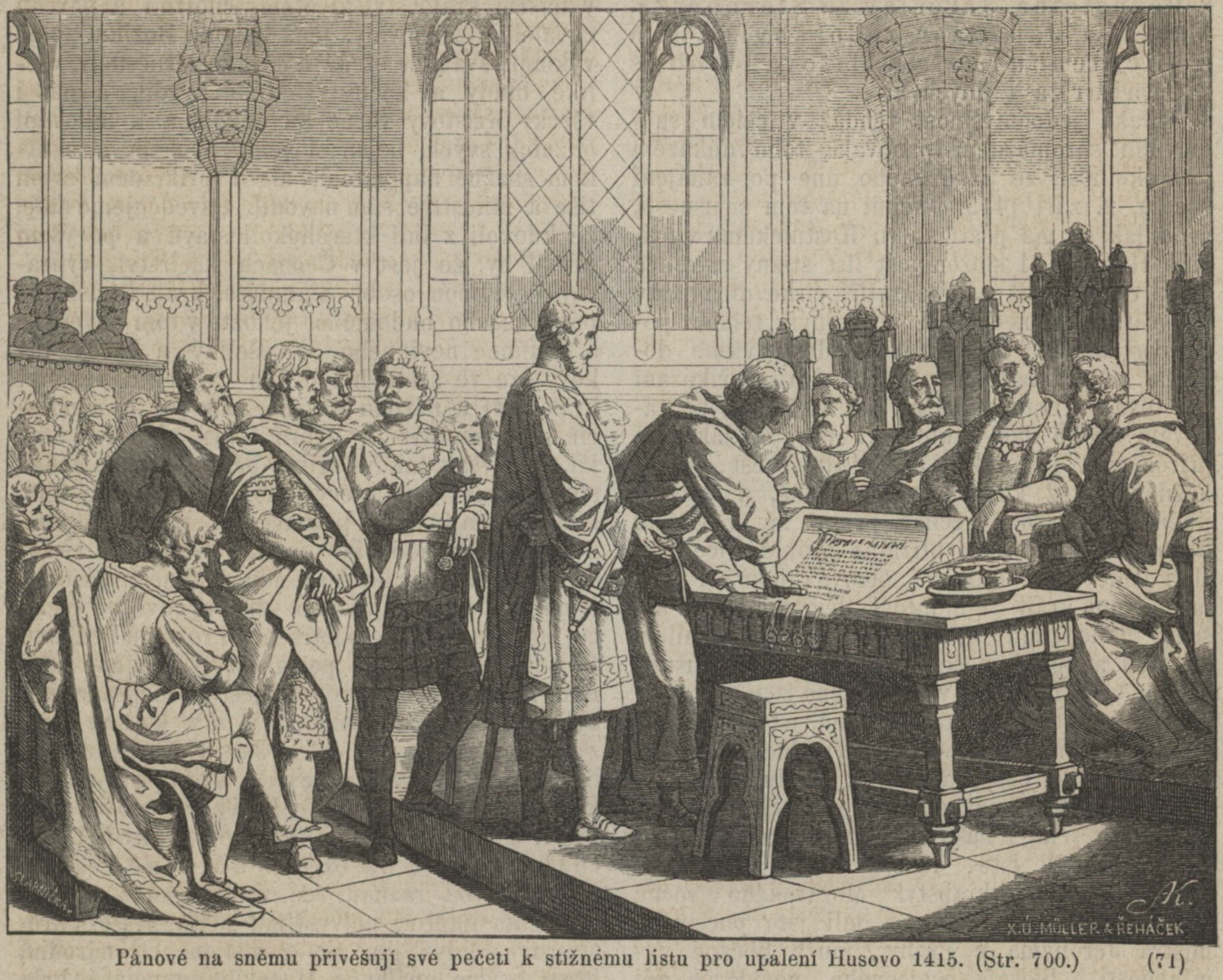
Bohemia answered at once. Even before the sentence, on May 13, 1415, some 250 Bohemian and Moravian lords had sent Sigismund a remonstrance asking that Hus be given a public hearing and allowed to go home.35 On Sept. 2, 1415, at a diet in Prague, 452 nobles set their seals to a letter to the council protesting the death of their "most beloved brother," whom they called a righteous and catholic man known for years in Bohemia for his good life and his honest preaching of "the law of the Gospel." They closed by declaring that they would defend the law of Christ and its faithful preachers even to the shedding of blood. Three days later many of them formed a league for six years, pledging to protect free preaching on their estates and to obey bishops only so far as they taught according to Scripture.37 The council summoned the signers to appear and answer within fifty days (Feb. 20, 1416). They did not come. The University of Prague, for its part, issued a letter on May 23, 1416, praising Hus as "in all things a master whose life was without an equal."37

Hussites, Utraquists and Taborites
The cup became the movement's sign. In the last months of Hus's life his followers in Prague, led by the master Jakoubek of Stribro, began giving communion to the laity "under both kinds," bread and wine, as had been done in the early church. On June 15, 1415, the council forbade it. Its decree admitted that "Christ instituted this venerable sacrament after a meal and ministered it to his apostles under the forms of both bread and wine," and that "this sacrament was received by the faithful under both kinds in the early church," but held that the later custom of giving the laity only the bread "should be held as a law which nobody may repudiate or alter at will without the church's permission," since "the whole body and blood of Christ are truly contained under both the form of bread and the form of wine."30 Hus, from prison, urged his followers not to give up the cup. The chalice became the banner of the Hussites. Its defenders were called Utraquists (from sub utraque specie, "under each kind") or Calixtines (from calix, cup).
In 1418 the new pope Martin V, in the bull Inter cunctas (Feb. 22, 1418), ordered the bishops and inquisitors to question suspects on the forty-five articles of Wycliffe and the thirty of Hus.30 On July 30, 1419, a Hussite crowd threw Catholic councillors out of the windows of Prague's New Town hall, the first "defenestration of Prague." King Wenceslas died weeks later, and Sigismund, the man of the broken safe conduct, claimed the crown. The Prague parties agreed in 1420 on the Four Articles of Prague: free preaching of the word of God, communion in both kinds, the end of the clergy's worldly lordship and wealth, and public punishment of mortal sins by the proper authorities, clergy included.37 Martin V proclaimed a crusade, and between 1420 and 1431 five crusading armies invaded Bohemia and were defeated, the first ones by the blind-in-one-eye general Jan Zizka, who used armored wagons as moving forts.37
The Hussites themselves split. The moderates, centered on the university and the nobility of Prague, kept most of the old liturgy, vestments and the doctrine of the real presence, and wanted the cup and reform within a Catholic framework. The radicals, called Taborites after the hill town of Tabor they founded in southern Bohemia in 1420, rejected purgatory, the cult of saints and much of the traditional ritual, used Czech for the whole service, held goods in common at first and expected Christ's return. Schaff's summary: they "rejected transubstantiation, the worship of saints, prayers for the dead, indulgences and priestly confession," and "admitted laymen, including women, to the office of preaching."37 Howard Kaminsky's A History of the Hussite Revolution (1967) treats Tabor as a genuine social and religious revolution, the most radical of the Middle Ages, and the moderates as reformers who used it and then turned on it.38
The Compacts of Basel (1436)
After the crusaders' rout at Domazlice (Taus) on Aug. 14, 1431, the Council of Basel did what no medieval council had done before: it invited condemned heretics to negotiate. It promised the Bohemian delegates a safe conduct that would hold, in Schaff's paraphrase, without "guile nor deceit" on any ground, "whether it be of authority or the privileges of canon law or of the decisions of the Councils of Constance and Siena."37 The Bohemians arrived on Jan. 4, 1433, led by the Utraquist Jan Rokycana and the Taborite priest Prokop the Great, with the English Lollard exile Peter Payne among their speakers. The result was the Compacts (Compactata), which granted the cup to the laity of Bohemia and Moravia who asked for it, on condition that they be taught that "the whole Christ is contained in each of the elements," together with limited versions of the other three Prague articles. The Utraquists and the Catholic nobles defeated the Taborites at Lipany on May 30, 1434, and the Compacts were proclaimed at the diet of Jihlava (Iglau) on July 5, 1436.37 For a time Bohemia had two recognized churches, Catholic and Utraquist, side by side. Pope Pius II declared the Compacts void in 1462, but the Utraquists survived, and by the Peace of Kutna Hora of 1485 Catholics and Utraquists agreed to tolerate each other. Utraquism lasted until the Habsburg emperor Ferdinand II, after his victory at the White Mountain in 1620, withdrew communion in both kinds in 1629.37
The Unity of the Brethren and the line to the Moravians
A third stream came from neither Prague nor Tabor. The lay writer Petr Chelcicky (about 1390 to about 1460) taught that a Christian must refuse violence, oaths and state office and live by the Sermon on the Mount. About 1457 a group inspired by his writings, which included Gregory, a nephew of the Utraquist leader Rokycana, settled at Kunvald in northeast Bohemia with the permission of George of Podebrady and formed the Unitas Fratrum, the Unity of the Brethren. In 1467 they chose their own ministers by lot and, to secure ordination they could trust, had one of their chosen ministers consecrated by a Waldensian elder named Stephen, which joins the two medieval movements in one act.37 By 1500, by Schaff's count, the Brethren had some 200,000 members in three to four hundred congregations in Bohemia and Moravia, with their own catechism and hymnbook, and Luther owned their catechism by 1521.37 Persecuted under the Habsburgs and driven into exile after 1620 (their leaders in exile included the educator Jan Amos Komensky, Comenius), the Unity survived in scattered families. In 1722 some of those families, led by Christian David, settled on the estate of Count Nikolaus von Zinzendorf in Saxony and founded Herrnhut, the center of the renewed Moravian Church.37 The story of Herrnhut and its missions belongs to the Pietist movement, told in Church History, Part C.

How historians and churches read Hus
For Czech Protestants and for the Moravians, Hus is a martyr and a reformer, and the Czech state keeps July 6 as a public holiday. For Catholic historians of the early twentieth century he was a heretic condemned by due process. The Catholic Encyclopedia article "Jan Hus" (Joseph Wilhelm, 1910) gives the narrative of his conflicts with the archbishop and the curia and states simply, "At Constance he was tried, condemned, and burnt at the stake, 6 July, 1415."34 Schaff, the Protestant, answered that "all that can be said is that a king did not keep his word."35
The academic debate has moved to the trial. Howard Kaminsky wrote in 1967 that "what the historian wants is not a careful demonstration that Hus should not have been burned, but a reasonable explanation, in a sense even a justification, of why he was." Thomas A. Fudge quotes those words at the opening of The Trial of Jan Hus: Medieval Heresy and Criminal Procedure (Oxford University Press, 2013), which sets out to judge the whole legal process from 1410 to 1415 "against prevailing canonical legislation and procedural law in the later Middle Ages" and to ask two questions: "Was his trial legal?" and "Was Hus guilty of heresy?"39 Fudge's answer, in brief, is that the proceedings were largely regular by the canon law of the time, and that Hus was condemned above all for contumacy (refusing the church's judgment and appealing over it to Christ) and for his doctrine of the church. That fits the sentence itself, which singles out his contempt of "the keys" and his appeal to Christ.
The modern papacy has spoken twice. On Dec. 17, 1999, Pope John Paul II told an ecumenical symposium on Hus: "I feel the need to express deep regret for the cruel death inflicted on John Hus, and for the consequent wound of conflict and division which was thus imposed on the minds and hearts of the Bohemian people."40 On June 15, 2015, on the occasion of the 600th anniversary (which fell on July 6, 2015), Pope Francis received representatives of the Czechoslovak Hussite Church and the Evangelical Church of Czech Brethren and recalled that his predecessor had "numbered him among the Reformers of the Church."41 Neither statement revoked the council's doctrinal judgment. Both expressed regret for the manner of his death and its results.
Savonarola in Florence
Girolamo Savonarola (born at Ferrara on Sept. 21, 1452) was a Dominican friar who preached in Florence from 1490 and became, after the Medici were driven out in 1494, the moral leader of the city. Schaff reports estimates of 10,000 to 12,000 people at his sermons in the cathedral. He preached repentance, prophesied a scourge upon Italy and a renewed church, organized bands of boys to collect alms and, at the carnivals of 1497 and 1498, held the "burning of the vanities," in which Florentines gave up mirrors, cosmetics, dice, masks and books judged immoral to be burned in the public square.42 His conflict with Pope Alexander VI (Rodrigo Borgia) began in July 1495, when the pope summoned him to Rome. It led to a ban on his preaching, his excommunication in 1497 and, after an ordeal by fire planned for April 1498 collapsed into a riot, his arrest by the city. Tortured, tried by papal commissioners as a heretic and schismatic, he was hanged and burned with two fellow friars, Domenico da Pescia and Silvestro, in the Piazza della Signoria on May 23, 1498.42
Savonarola fits the "forerunner" label badly. He defended the sacraments, the Mass and the Catholic faith in full, and his quarrel was with the pope's morals and authority. Schaff himself conceded that "he was no heretic" and that "the most that can be said is, that he was a rebel against the pope's authority," while noting that Luther and later Protestants revered him and that the Catholic historians Hefele and Knopfler called his death "a judicial murder."42 At the command of Pope Julius II, Raphael placed him among the saints in the Disputa fresco in the Vatican some twelve years after his death, and since the nineteenth century Catholic admirers, especially Dominicans, have worked toward his canonization.
The conciliar movement: Constance and Basel
The same Council of Constance that burned Hus also claimed authority over the papacy. By 1414 three men claimed to be pope: Gregory XII (the Roman line), Benedict XIII (the Avignon line) and John XXIII (elected by the Pisan line after a council at Pisa in 1409 had tried and failed to end the schism). When John XXIII fled the council in March 1415, hoping to break it up, the remaining fathers passed the decree known by its opening words in some texts, Haec sancta. At its fifth session on April 6, 1415, in Tanner's translation, the council declared "that, legitimately assembled in the holy Spirit, constituting a general council and representing the catholic church militant, it has power immediately from Christ; and that everyone of whatever state or dignity, even papal, is bound to obey it in those matters which pertain to the faith, the eradication of the said schism and the general reform of the said church of God in head and members."30 The council then deposed John XXIII and Benedict XIII, received the resignation of Gregory XII and elected Martin V on Nov. 11, 1417. In the decree Frequens of Oct. 9, 1417, it ordered general councils to meet in five years, then seven, and then every ten years forever.30
Whether Haec sancta binds the church is one of the most argued questions in Catholic theology. The e-text editor of the papalencyclicals.net edition states one Catholic position plainly: the sessions held before the council was convoked by Gregory XII's envoys on July 4, 1415 were not those of a true ecumenical council, and Martin V's later approval covered only what was decided "in a conciliar way" by the council so convoked, so that Haec sancta does not contradict the First Vatican Council's teaching on papal primacy. Tanner's own introduction is more cautious and says only that "there is dispute" about the sessions held before the election of Martin V.30 Conciliarists in the fifteenth century, and Gallican Catholics in France for centuries after, read the decree as a lasting limit on papal power.
The Council of Basel, opened in 1431 under Frequens, pushed the claim further. It negotiated the Compacts with the Hussites, quarreled with Pope Eugenius IV, declared him deposed in 1439 and elected the duke of Savoy as Felix V, starting a small new schism. The council lost support, moved to Lausanne and dissolved itself in 1449.43 In 1460 Pope Pius II, who as a young humanist had served the council, forbade any appeal from a pope to a future council in the bull Execrabilis.43 Luther would make exactly such an appeal in 1518 and again in 1520.
The New Devotion and the humanists
The Brethren of the Common Life and Thomas a Kempis
In the Netherlands a quieter reform began with Geert Groote of Deventer (1340 to 1384), a canon who gave up his church livings after a conversion, preached repentance through the towns of the Low Countries and gathered disciples. The communities that grew from his circle, the Brothers and Sisters of the Common Life, lived together without lifelong vows, copied books, taught and cared for students, and a related branch became the Augustinian canons of Windesheim (house dedicated 1387). The movement called itself the devotio moderna, the New Devotion.44 Its most famous book, The Imitation of Christ, is usually credited to Thomas a Kempis (1380 to 1471), who was schooled at Deventer and spent most of his life at the house of Mount St. Agnes near Zwolle. Schaff ranked it with Augustine's Confessions and Bunyan's Pilgrim's Progress as one of the most widely read Christian books, while noting that it plainly teaches "the merit of good works, transubstantiation," purgatory and the honoring of saints.44 The New Devotion stayed inside the church. Erasmus and, briefly, Luther both passed through schools influenced by it.
Erasmus and the Greek New Testament of 1516
The humanists' cry was ad fontes, "back to the sources." Applied to the Bible, it meant going behind the Latin Vulgate to the Hebrew and Greek. In 1516 the Dutch scholar Desiderius Erasmus published at Basel, with the printer Johann Froben, the first printed Greek New Testament to be put on sale, with his own new Latin translation beside it and notes, dedicated to Pope Leo X. Schaff records that the work was "hurried through the press in order to anticipate the publication of the New Testament of the Complutensian Polyglot," printed in Spain in 1514 but not issued until 1520, and that Erasmus worked from a few twelfth-century manuscripts at Basel.45 In the preface (the Paraclesis) he hoped, in Schaff's summary, that the Scriptures might be "translated into every tongue and put into the hands of every reader, to give strength and comfort to the husbandman at his plough, to the weaver at his shuttle, to the traveller on his journey and to the woman at her distaff."45 The wish echoed what the Waldensians and the Lollards had been condemned for. Luther used the second edition (1519) for his German New Testament of 1522, and Tyndale used Erasmus for his English New Testament of 1526. A saying current in Erasmus's own lifetime, which he himself mentioned, held that "Erasmus laid the egg which Luther hatched."45 Erasmus never joined the Reformation. He wanted reform by education and persuasion inside the old church, and his break with Luther over free will in 1524 to 1525 belongs to the story of lesson 11.
"We are all Hussites": Luther finds Hus
At the Leipzig Disputation in July 1519, John Eck pressed Luther until he admitted that some of Hus's articles condemned at Constance were Christian and that a general council could err, as Schaff records.35 After the debate Utraquist preachers in Prague wrote to Luther and sent him a copy of Hus's De ecclesia, and the editors of Luther's Works say he received it on Oct. 3, 1519.46 Reading it changed his mind about Hus. In a Latin letter to George Spalatin written at Wittenberg about Feb. 14, 1520 (Weimar edition, Briefe 2, 41 to 42, no. 254), he wrote, in Gottfried Krodel's translation:
I have taught and held all the teachings of John Huss, but thus far did not know it. John Staupitz has taught it in the same unintentional way. In short we all are Hussites and did not know it. Even Paul and Augustine are in reality Hussites.46
He added that "the most evident evangelical truth was burned in public and was already considered condemned more than one hundred years ago." The context matters for reading the remark. Duke George of Saxony had just accused Luther of being a Bohemian heretic, and Luther was discovering that his own teaching on the church and on grace overlapped with what Hus had written. In his Address to the Christian Nobility later in 1520 he called on the Roman church to admit it had done wrong in burning Hus, and in 1537 he published an edition of Hus's letters with a preface praising his patience.35 Luther's own teaching on justification came from his study of Paul and Augustine, and he arrived at it before he had read Hus. What he took from Hus was confirmation, and a precedent for defying a council.
The movements at a glance
"Forerunners of the Reformation": weighing a reading
The Protestant reading
The idea that the Reformation had ancestors began with the Reformers themselves. Luther claimed Hus. The Waldensians, once they adopted Reformed articles, were welcomed by Calvinist historians as proof that the true church had never died out, and older Waldensian writers claimed an origin in the apostles' time or in the age of Constantine. Foxe's Acts and Monuments (1563) made the Lollards and Hus part of an English Protestant martyrology. A Prague hymnbook of 1572, as Schaff describes it, showed three medallions: Wycliffe striking sparks from a stone, Hus kindling a fire from them, and Luther holding up the burning torch.35 Schaff himself, writing at the start of the twentieth century, called Hus "in a real sense" the "precursor of the Reformation" and said of Wycliffe that "in almost every doctrinal particular" he anticipated the Reformers.25 The Protestant case rests on real overlaps: Scripture placed above church law, preaching in the common tongue, criticism of indulgences, a church defined by God's choosing rather than by the hierarchy, and the cup for the laity.
The Catholic reading
The Catholic case in its classic form, as in the Catholic Encyclopedia, grants that many of these critics saw real abuses: Weber calls the Waldensian movement "a practical protest against the worldly lives of some contemporary churchmen."4 It holds that the church acted within its rights when it refused unlicensed preachers and condemned doctrines that denied the sacraments or the authority of bishops, and it stresses that the medieval reformers who succeeded were those who stayed inside: the friars, the conciliar theologians, the New Devotion. Modern Catholic statements have changed the tone without retracting the doctrine. John Paul II and Francis expressed "deep regret" and asked "forgiveness" for the violence used, and Francis repeated that John Paul II had "numbered" Hus "among the Reformers of the Church."4041
The secular and specialist reading
Most specialists now resist the "forerunner" scheme from a third direction: it reads the Middle Ages backward from 1517. Euan Cameron's Waldenses: Rejections of Holy Church in Medieval Europe (2000) treats the medieval Waldensians as a set of local communities that mostly conformed outwardly to the Catholic parish while privately rejecting parts of its teaching, and argues that their passage into the Reformed church after 1530 was slow, uneven and in some ways a break with their own past.47 Anne Hudson shows a real Lollard literature and continuity into the 1520s but does not claim that Lollards caused the English Reformation.32 Gordon Leff and Howard Kaminsky place Wycliffe and the Hussites in the intellectual and social world of the fourteenth and fifteenth centuries: Oxford realism, Bohemian national politics, the papal schism.3138 Thomas Fudge judges Hus by the law of 1415 before asking whether that law was just.39 Heiko Oberman's collection of "forerunner" documents itself argued that the late Middle Ages were not simply a run-up to Luther and should be read for their own questions.2
Two plain observations keep the label honest. None of these movements taught justification by faith alone in Luther's sense, as Schaff says of Wycliffe and of the Waldensians.255 And the line of descent is real in two places and thin elsewhere: the Waldensians did join the Reformed churches, and the Unity of the Brethren did pass its memory to the Moravians, while the Lollards' influence on Tudor England and Wycliffe's influence on Luther are matters of argument. For the cultural history of the period as one twentieth-century Protestant writer read it, see Francis Schaeffer's account summarized in How Should We Then Live?, one named reading among several.
What the record shows and what it does not
- Documented fact: Valdes of Lyon renounced his wealth about 1173 to 1176 and had parts of the Bible translated; the Waldensians were examined in 1179 and condemned at Verona in 1184; Waldensian leaders adopted Reformed articles at Angrogna on Sept. 12, 1532; the Waldensian church exists today and the pope asked its forgiveness in 2015.
- Documented fact: Wycliffe's propositions were condemned by Gregory XI (1377), the Blackfriars council (1382) and the Council of Constance (1415); he died on Dec. 31, 1384, and his remains were dug up and burned in 1428 (or 1429). The 1401 statute ordered relapsed heretics burned "in a high place" so that the punishment would "strike fear."
- Documented fact: Hus traveled to Constance under Sigismund's safe conduct, was arrested within weeks, condemned at the fifteenth session on July 6, 1415, and burned that day; 452 Czech nobles protested on Sept. 2, 1415; the council decreed on Sept. 23, 1415 that a safe conduct did not stop a judge from trying heresy.
- A church's own claim or tradition: that the Waldensians descend from the apostles or from Christians who resisted Pope Sylvester's endowment (no evidence before the thirteenth century; now abandoned by the Waldensian church itself); that Hus at his trial looked at Sigismund and the king blushed (reported later, not by a contemporary); that Hus prophesied a "swan" to come after the "goose" (first found after Luther's rise).
- Scholarly reading: whether Lollardy prepared England for the Reformation; whether Hus's trial was lawful by the standards of 1415; whether the Cathar "church" was as organized as the inquisitors described; how far the Unity of the Brethren drew on Waldensian ideas.
- Open question: who translated the Wycliffite Bible, and whether Wycliffe translated any of it; the exact date of the Noble Lesson; how many died in the Piedmont massacre of 1655; whether a single "synod of Chanforan" took place or several meetings.
Claims checked
"The Waldensians go back to the apostles, or kept the pure faith from before Waldo."
Refuted. The claim appears in older Waldensian writings, in some seventeenth-century Protestant histories and in Milton's line about those "who kept thy truth so pure of old." The earliest sources, friendly and hostile, all derive the movement from Valdes of Lyon in the 1170s, and the name itself comes from him. Weber's Catholic article says the Waldensian documents used to support the older claim "had been tampered with," and Schaff, a Protestant, records that the Waldensian historian Emilio Comba gave up the theory of ancient origin.45 The church's own site today says simply that the Waldensians "originated in the Middle Ages."13
"The Cathars were early Protestants, Bible Christians persecuted by Rome."
Refuted. The Cathars did read the Gospels in the vernacular, reject the Roman hierarchy and suffer terrible persecution. Their own surviving text, the Interrogatio Johannis, teaches that Satan made the human body and that "foolish men" say God made "bodies of clay," and their rite of the consolamentum replaced baptism and the Eucharist.1517 Dualism of that kind is rejected by every Protestant confession, and no Reformer claimed the Cathars as ancestors on doctrine. The sympathy is a matter of shared enemies and shared suffering.
"Wycliffe translated the first English Bible himself."
Partly supported. The first complete Bible in English was produced by Wycliffe's circle in the 1380s and 1390s, and contemporaries, including the hostile Knighton and the friendly Hus, credited Wycliffe with it.25 Parts of the Bible had been put into English before (Anglo-Saxon gospels, Richard Rolle's psalter), so "first" applies to the complete Bible. No manuscript can be shown to be in Wycliffe's hand or wording, and the names of Hereford and Purvey are attached to the two versions on uncertain evidence. "Wycliffite Bible" is the safer term.
"The medieval church banned the laity from reading the Bible."
Partly supported. No general ban covered all Christendom. Local councils did restrict it: Schaff cites the Council of Toulouse (1229) as having "forbidden the use of the Bible to laymen," and Arundel's Constitutions of 1407 to 1409 forbade any unapproved English translation in the province of Canterbury, under which owning a Wycliffite Bible could count as evidence of heresy.25 At the same time, kings and religious houses owned Wycliffite Bibles, and Urquhart's Catholic article insists that "the Bible was familiar even to laymen in the fourteenth century."20 The record shows control and licensing of translations, enforced hardest where translation was tied to heresy. It does not show a single universal prohibition.
"The Council of Constance tricked Hus with a safe conduct and then broke it."
Supported, with qualifications. Hus went to Constance on the strength of Sigismund's letter, which promised that he could "pass, remain and return," and Hus himself wrote that Sigismund "has acted deceitfully throughout."35 The council's own decree of Sept. 23, 1415 shows that it did not regard such a pledge as binding on church judges in a heresy case.30 The qualifications: the arrest was the cardinals' doing before Sigismund arrived, Sigismund protested and then gave way, and the document guaranteed travel and said nothing about the outcome of a trial. Whether it was meant to protect him from a verdict is exactly what the two sides argued then and since.
"Hus prophesied at the stake: 'Today you roast a goose, but in a hundred years a swan will arise.'"
Unsupported. Schaff, who admired Hus, says the saying was "wrongly ascribed to him," was "unknown to contemporary writers" and "probably originated after Luther had fairly entered upon his work."35 Hus did pun on his name (goose) in genuine letters, which may be where the legend took root.
"Luther said, 'We are all Hussites.'"
Supported. The words come from his Latin letter to George Spalatin of about Feb. 14, 1520 (Weimar edition, Briefe 2, 41 to 42), in Krodel's translation "In short we all are Hussites and did not know it. Even Paul and Augustine are in reality Hussites."46 The context is a private letter written after he had read De ecclesia and while he was being accused of Bohemian heresy. It concerns Hus's doctrine of grace and the church. Luther did not claim in it that he had learned his theology from Hus.
"The Lollards prepared England for the Reformation."
Unresolved. Lollard groups survived to the 1520s, owned English Scriptures and were quickly connected with the new Lutheran books by bishops such as Tunstall, who called Lutheranism new arms added "to the great band of Wycliffite heretics."27 Hudson argues for real continuity.32 Other historians point out how few and how scattered the Lollards were by 1500 and that the English break with Rome came from Henry VIII's government. The evidence supports some influence on readers and on the market for English Bibles. It does not settle how much.
"Wycliffe's bones were dug up and thrown in a river."
Supported. The Council of Constance ordered the exhumation on May 4, 1415, and the order was carried out at Lutterworth by Bishop Richard Fleming in 1428 (Schaff gives 1429). The bones were burned and the ashes thrown into the river Swift.3020 Thomas Fuller's famous image of the ashes flowing to the ocean is a seventeenth-century reflection on the record.
Hard questions and answers
If the Waldensians only wanted to live poor and preach the Gospel, why were they condemned when Francis of Assisi was approved?
The record points to obedience. Francis and his brothers accepted the pope's rule and the bishops' license to preach and became an order of the church. Valdes's followers asked for the same license in 1179, were given a limited permission and kept preaching when it was withheld, answering that they must obey God rather than men. Verona condemned them in 1184 for preaching without the bishops' consent, before any doctrinal list had been drawn up.5 Doctrinal differences (on purgatory, oaths and the priesthood of good laymen) grew later, partly because the movement now existed outside the church's structures. A Catholic reader can say that the church rightly guarded the office of preaching, and a Protestant reader can say that the refusal drove sincere believers out. Both readings start from the same facts.
Was Hus a heretic?
It depends on whose definition is applied, and the sentence itself shows which definition the council used. It did not charge him chiefly with denying transubstantiation, which he affirmed. It condemned him for teaching that the church is the body of the predestined, for denying that a sinful pope is head of the church, for despising "the keys of the church and ecclesiastical censures," and for appealing over the council "directly to our lord Jesus Christ, as to the supreme judge."30 By the canon law of 1415, refusal to submit to the church's judgment after warning was itself the mark of a heretic, and Fudge's study treats the case in those terms.39 By the standard of Scripture as Hus read it, he was not. The Catholic Church has since regretted his "cruel death" without reversing the council's doctrinal judgment.40
Did the Council of Constance really put councils above popes?
Haec sancta says that a general council "has power immediately from Christ" and that everyone "even papal" must obey it in matters of faith, the schism and reform.30 That is what it says. How much authority it has is another question. The council's decree solved a real emergency: three rival popes, one of whom had fled. Later popes (Pius II in Execrabilis, 1460, and the First Vatican Council in 1870) taught that no appeal lies from a pope to a council, and Catholic theologians generally hold that Haec sancta was either an emergency measure or not the act of a fully ecumenical council at the time it passed. Conciliarists and Gallicans read it as permanent. The text is clear, and its standing is disputed.
Didn't the Hussites' own violence undercut their claim to be the true church?
The Hussites threw councillors from windows in 1419, sacked churches and monasteries and fought a long war, and the Taborites killed their enemies and were killed in turn. The Utraquists themselves crushed the Taborites at Lipany in 1434.37 Their defenders note that they fought five crusades sent against them by popes and that the first blood shed was Hus's. Within the movement, the Unity of the Brethren drew exactly this lesson and renounced the sword altogether, following Chelcicky. The question divided the Hussites themselves, which is part of why the Unity came into being.
Isn't "forerunners of the Reformation" just Protestant storytelling?
Partly. The phrase reads history backward, and specialists such as Cameron, Leff and Kaminsky have shown how much these movements belong to their own centuries.473138 But some connections are documented: Luther read Hus and said so in writing; the Alpine Waldensians formally adopted Reformed articles in 1532; Bohemian Brethren visited Luther and sent him their catechism; Tunstall linked Lutherans to Wycliffites in 1523.46113727 The fair statement is that these movements raised many of the questions the Reformation would answer, and that the sixteenth-century Reformers knew some of them and claimed them, while their own beliefs often differed from what Luther and Calvin taught.
What is the most useful way to read this period?
Start with each movement's own words: the Noble Lesson, the Poor Lombards' letter, Wycliffe's letter to the pope, the Twelve Conclusions, Hus's declaration of July 1, 1415, the Angrogna articles. Then read the documents that condemned them: Lateran III's canon 27, the Blackfriars list, the 1401 statute, the Constance sentences. Keep the two sets side by side. The questions they argued over (who may preach, what the church is, whether conscience can stand against a council, whether the church should be rich) did not end in 1517, and lesson 11 follows them into Luther's Germany.
Learn more
- Schaff, History of the Christian Church, vol. 6, sections 40 to 47: The fullest free narrative of Wycliffe, the Lollards, Hus, Constance and the Hussites, written from a Protestant view with full references to the documents.
- Internet Medieval Sourcebook: Medieval Church: Short public domain translations of the Waldo, Cathar, Wycliffe and Hus documents used in this lesson.
- Council of Constance, decrees in Tanner's translation: Read Haec sancta, the cup decree and the sentences against Wycliffe and Hus in full, with a Catholic editor's note on their standing.
- Chiesa Evangelica Valdese: Storia: The Waldensian church's own short history, in Italian and English.
- John Paul II on Jan Hus, 1999: The papal statement of regret for Hus's death, in full.
- Catholic Encyclopedia: Waldenses: An early twentieth-century Catholic account, useful to read beside Schaff's Protestant one.
Still being checked (28 items)
These points could not be confirmed against a primary source when this lesson was written and fact checked in October 2026. The text above states each one as uncertain.
- Ad abolendam (1184) was opened in an English text of unnamed translation (professor-moriarty.com, cited in lesson 09): it anathematizes the 'Cathari, Paterines, and those who call themselves the Humbled, or Poor of Lyons'; the lesson keeps Schaff's rendering 'Humiliati, or Poor Men of Lyons.'
- That Alexander III approved Valdes's vow of poverty but allowed preaching only with local clergy permission comes from later accounts (the fuller Laon chronicle) that were not opened; the Fordham excerpt ends before the council.
- The date and the translator of the English version of the Noble Lesson are not confirmed; Christian History labels the poem fifteenth century.
- Which Waldensian envoy was executed on the way home in 1530 (Schaff says Morel; other accounts say Masson, at Dijon) is unresolved.
- Farel's presence at the Angrogna meeting and the printing of Olivetan's French Bible at Neuchatel (Serrieres) in 1535 were not checked in a source opened for this lesson.
- The exact date of the 1655 Piedmont massacre (traditionally April 24, 1655) and its death toll were not verified; the lesson gives no number.
- The location of the church in the 1850 print (Schonberg in Wurttemberg, where Arnaud served) rests on the Commons description and general knowledge.
- Summaries of the arguments of R. I. Moore, Anne Hudson, Gordon Leff, Howard Kaminsky, Mary Dove and Euan Cameron are general and were not checked against the books; only Fudge's abstract (with the Kaminsky quotation) was opened.
- Fudge's conclusion that Hus's trial was largely regular by the canon law of 1415 is summarized from general knowledge of the book, not from the text.
- Wycliffe's birth year is unknown (1324 traditional; about 1328 or 1330 in modern works). His death on Dec. 31, 1384, is confirmed by the Catholic Encyclopedia and by Walsingham's 'St. Sylvester's Day' as quoted by Schaff; Schaff's own text gives Dec. 29.
- The exhumation is dated 1428 by the Catholic Encyclopedia and 1429 by Schaff.
- The Twelve Conclusions are dated 1395 and said to have been posted on the doors of Westminster Hall and St. Paul's; Gee and Hardy say only that they were presented in Parliament about 1394.
- Arundel's Constitutions are dated 1407 (drafted at Oxford) and 1409 (issued) from general knowledge; Schaff says an Oxford synod of 1408. The text of the constitution on translation was not opened, and the detail about searches at Oxford is from general knowledge.
- The figure of about 250 surviving Wycliffite Bible manuscripts is the usual modern count and was not checked in a source opened for this lesson (Schaff gives 170).
- The founding year of the University of Prague (1348) is from general knowledge; Schaff gives 1347.
- The name Decree of Kutna Hora, the date of the 1419 defenestration (July 30), the founding of Tabor in 1420, Zizka's wagon forts, Chelcicky's dates, Comenius's role in exile and the Czech public holiday on July 6 are from general knowledge.
- Savonarola's excommunication in 1497, the planned ordeal of April 1498 and the place of execution (Piazza della Signoria) are from general knowledge; Schaff confirms the excommunication decree, the ordeal and the date of death.
- Luther's appeals to a general council in 1518 and 1520, his rejection of purgatory by 1530 (comparison chart) and the First Vatican Council's teaching on appeals from a pope to a council were not checked in sources opened for this lesson.
- The comparison chart's entry for Hus on purgatory ("Not rejected") is a simplification not drawn from a specific source.
- That the present Bethlehem Chapel is a twentieth-century reconstruction is from general knowledge.
- The Luther's Works page range (151 to 153) is read from an OCR text and may be off by a page or two.
- The date of Foxe's Acts and Monuments (first English edition 1563) is from general knowledge.
- The date and artist of the Waldensians-at-Lateran illustration are not recorded on its Commons page.
- That Erasmus (at Deventer) and Luther (at Magdeburg) attended schools connected with the Brethren of the Common Life, and the expulsion of the Medici from Florence in 1494, are from general knowledge.
- Body length is about 15,000 words, above the 6,000 to 9,000 target; nothing was cut, following the rule not to cut true content for length.
- The figure of 'about two hundred manuscripts' of Wycliffe burned by Archbishop Zbynek in 1410 is the usual count in modern histories but is not stated in Schaff or the Catholic Encyclopedia, which say only that Wycliffe's writings were burned.
- Henri Arnaud's leadership of the Glorious Return (1689) is standard history but is not named on the Waldensian church's history page cited.
- The second Schaff passage on the 1487 crusade is in vol. 6, sec. 58 (located by a full-text search of the CCEL text); the section number was read from the nearest preceding heading.
Notes
- Philip Schaff, History of the Christian Church, vol. 6, The Middle Ages, 1294 to 1517, by David S. Schaff (New York: Charles Scribner's Sons, 1910), sec. 40, "John Wyclif", Christian Classics Ethereal Library text (retrieved Oct. 28, 2026). Read it online. ↩
- Heiko A. Oberman, Forerunners of the Reformation: The Shape of Late Medieval Thought Illustrated by Key Documents (New York: Holt, Rinehart and Winston, 1966). Cited for its title and general argument. Read it online. ↩
- Anonymous chronicle of Laon (written about 1218), "The Conversion of Peter Waldo," trans. J. H. Robinson, Readings in European History (Boston: Ginn, 1905), pp. 381 to 383; Internet Medieval Sourcebook, Fordham University (retrieved Oct. 28, 2026). Read it online. ↩
- Nicholas Weber, "Waldenses," The Catholic Encyclopedia, vol. 15 (New York: Robert Appleton Company, 1912); New Advent text (retrieved Oct. 28, 2026). Read it online. ↩
- Philip Schaff, History of the Christian Church, vol. 5, The Middle Ages, 1049 to 1294, by David S. Schaff (New York: Charles Scribner's Sons, 1907), sec. 84, "The Waldenses" (quoting Walter Map, De nugis curialium, Wright's ed., p. 64, and the Anonymous of Passau), Christian Classics Ethereal Library text (retrieved Oct. 28, 2026). Read it online. ↩
- Third Lateran Council (1179), introduction and canon 27, in Norman P. Tanner, ed., Decrees of the Ecumenical Councils, as given at papalencyclicals.net (retrieved Oct. 28, 2026). Read it online. ↩
- La nobla leyczon (The Noble Lesson), English translation as reprinted in "From the Archives: La Nobla Leyczon (The Noble Lesson)," Christian History 22 (1989), Christianity Today (retrieved Oct. 28, 2026). Read it online. ↩
- "A Letter From the Poor Lombards to the Poor of Lyons Who Are in Germany (1218)," Christian History 22 (1989), translation taken from Giorgio Tourn, You Are My Witnesses; Christian History Institute (retrieved Oct. 28, 2026). Read it online. ↩
- Reinerius Saccho [Rainerius Sacconi], "Of the Sects of Modern Heretics" (1254), trans. S. R. Maitland, History of the Albigenses and Waldenses (London: C. J. G. and F. Rivington, 1832), pp. 407 to 413; Internet Medieval Sourcebook (retrieved Oct. 28, 2026). Read it online. ↩
- Chiesa Evangelica Valdese (Waldensian Evangelical Church), "Storia: Valdesi" (history page, Italian and English), chiesavaldese.org (retrieved Oct. 28, 2026). Read it online. ↩
- "From the Archives: Subjects Discussed at the Meeting at Angrogna" (articles dated Sept. 12, 1532, with the editors' note on Euan Cameron's view of Chanforan), Christian History 22 (1989); Christian History Institute (retrieved Oct. 28, 2026). Read it online. ↩
- John Milton, Sonnet XV, "On the Late Massacher in Piemont" (1655), in The Poetical Works of John Milton, ed. H. C. Beeching (Oxford); Project Gutenberg eBook no. 1745 (retrieved Oct. 28, 2026). Read it online. ↩
- Chiesa Evangelica Valdese, "Chi siamo" (Who we are), chiesavaldese.org (retrieved Oct. 28, 2026). Read it online. ↩
- Pope Francis, Address at the Waldensian Temple, Turin, June 22, 2015, vatican.va (retrieved Oct. 28, 2026). Read it online. ↩
- Interrogatio Johannis ("The Book of John the Evangelist"), Cathar text from the inquisition archives of Carcassonne, trans. M. R. James, The Apocryphal New Testament (Oxford: Clarendon Press, 1924); Internet Medieval Sourcebook (retrieved Oct. 28, 2026). Read it online. ↩
- Bernard Gui, inquisitor's manual (early fourteenth century), passage on the Albigensians, trans. J. H. Robinson, Readings in European History (Boston: Ginn, 1905); Internet Medieval Sourcebook (retrieved Oct. 28, 2026). Read it online. ↩
- Philip Schaff, History of the Christian Church, vol. 5, The Middle Ages, 1049 to 1294, by David S. Schaff (New York: Charles Scribner's Sons, 1907), sec. 80, "The Cathari," and sec. 85, "The Crusades against the Albigenses", Christian Classics Ethereal Library text (retrieved Oct. 28, 2026). Read it online. ↩
- R. I. Moore, The War on Heresy: Faith and Power in Medieval Europe (London: Profile Books, 2012). The summary of his argument and of the replies to it is general, not quoted. Read it online. ↩
- Philip Schaff, History of the Christian Church, vol. 6, The Middle Ages, 1294 to 1517, by David S. Schaff (New York: Charles Scribner's Sons, 1910), sec. 7, "The Pontificate of John XXII" (on Exivi de paradiso, Quorumdam exigit, Cum inter nonnullos and the burnings at Marseille on May 7, 1318), Christian Classics Ethereal Library text (retrieved Oct. 28, 2026). Read it online. ↩
- Francis Urquhart, "John Wyclif," The Catholic Encyclopedia, vol. 15 (New York: Robert Appleton Company, 1912); New Advent text (retrieved Oct. 28, 2026). Read it online. ↩
- Henry Gee and William John Hardy, eds., Documents Illustrative of English Church History (London: Macmillan, 1896), no. 36, "Letter of Pope Gregory XI to Archbishop Sudbury, and the Bishop of London, directing proceedings against Wycliffe, A.D. 1377," p. 105 (the editors date the five bulls May 22, 1377); Internet Archive (retrieved Oct. 28, 2026). Read it online. ↩
- Pope Gregory XI, letter to the University of Oxford against John Wycliffe (1377); the twenty-four conclusions condemned at Blackfriars (1382); and Wycliffe's reply to his summons to Rome (1384), trans. in Oliver J. Thatcher, ed., The Library of Original Sources, vol. 5 (Milwaukee: University Research Extension Co., 1907); Internet Medieval Sourcebook, "The Condemnation of Wycliffe, 1382 and Wycliffe's Reply, 1384" (retrieved Oct. 28, 2026). Read it online. ↩
- Philip Schaff, History of the Christian Church, vol. 6, The Middle Ages, 1294 to 1517, by David S. Schaff (New York: Charles Scribner's Sons, 1910), sec. 41, "Wyclif's Teachings", Christian Classics Ethereal Library text (retrieved Oct. 28, 2026). Read it online. ↩
- John Wycliffe, Trialogus, passage on the Eucharist, in Tracts and Treatises of John de Wycliffe, ed. Robert Vaughan (London: Blackburn and Pardon, 1845), pp. 150, 152; Internet Medieval Sourcebook (retrieved Oct. 28, 2026). Read it online. ↩
- Philip Schaff, History of the Christian Church, vol. 6, The Middle Ages, 1294 to 1517, by David S. Schaff (New York: Charles Scribner's Sons, 1910), sec. 42, "Wyclif and the Scriptures" (quoting Henry Knighton's chronicle, Wycliffe's English works and Archbishop Arundel's constitution on translation), with the note on Melanchthon in sec. 42, Christian Classics Ethereal Library text (retrieved Oct. 28, 2026). Read it online. ↩
- Mary Dove, The First English Bible: The Text and Context of the Wycliffite Versions (Cambridge: Cambridge University Press, 2007). Cited for its general position on authorship, not quoted. Read it online. ↩
- Philip Schaff, History of the Christian Church, vol. 6, The Middle Ages, 1294 to 1517, by David S. Schaff (New York: Charles Scribner's Sons, 1910), sec. 43, "The Lollards" (including Bishop Tunstall's letter to Erasmus of 1523, after Trevelyan), Christian Classics Ethereal Library text (retrieved Oct. 28, 2026). Read it online. ↩
- Henry Gee and William John Hardy, eds., Documents Illustrative of English Church History (London: Macmillan, 1896), no. 41, "The Lollard Conclusions, A.D. 1394," pp. 126 to 132; Internet Archive (retrieved Oct. 28, 2026). Read it online. ↩
- Henry Gee and William John Hardy, eds., Documents Illustrative of English Church History (London: Macmillan, 1896), no. 42, the statute 2 Henry IV, c. 15, De heretico comburendo (1401), pp. 133 to 137; Internet Archive (retrieved Oct. 28, 2026). Read it online. ↩
- Council of Constance (1414 to 1418), decrees of session 5 (April 6, 1415), session 8 (May 4, 1415), session 13 (June 15, 1415), session 15 (July 6, 1415), session 19 (Sept. 23, 1415, summary) and session 39 (Oct. 9, 1417), with Tanner's introduction, the e-text editor's second introduction and the note on Martin V's bull Inter cunctas (Feb. 22, 1418), in Norman P. Tanner, ed., Decrees of the Ecumenical Councils, as given at papalencyclicals.net (retrieved Oct. 28, 2026). Read it online. ↩
- Gordon Leff, Heresy in the Later Middle Ages: The Relation of Heterodoxy to Dissent, c. 1250 to c. 1450, 2 vols. (Manchester: Manchester University Press, 1967). The summary of his argument is general, not quoted. Read it online. ↩
- Anne Hudson, The Premature Reformation: Wycliffite Texts and Lollard History (Oxford: Clarendon Press, 1988). The summary of her argument is general, not quoted. Read it online. ↩
- Philip Schaff, History of the Christian Church, vol. 6, The Middle Ages, 1294 to 1517, by David S. Schaff (New York: Charles Scribner's Sons, 1910), sec. 44, "John Huss of Bohemia", Christian Classics Ethereal Library text (retrieved Oct. 28, 2026). Read it online. ↩
- Joseph Wilhelm, "Jan Hus," The Catholic Encyclopedia, vol. 7 (New York: Robert Appleton Company, 1910); New Advent text (retrieved Oct. 28, 2026). Read it online. ↩
- Philip Schaff, History of the Christian Church, vol. 6, The Middle Ages, 1294 to 1517, by David S. Schaff (New York: Charles Scribner's Sons, 1910), sec. 45, "Huss at Constance" (drawing on Workman and Pope's Letters of John Hus, the narrative of Peter of Mladonovice and the chronicle of Ulrich Richental), Christian Classics Ethereal Library text (retrieved Oct. 28, 2026). Read it online. ↩
- Jan Hus, final declaration, July 1, 1415, in Herbert B. Workman and R. Martin Pope, eds., The Letters of John Hus (London: Hodder and Stoughton, 1904), pp. 275 to 276; Internet Modern History Sourcebook, Fordham University (retrieved Oct. 28, 2026). Read it online. ↩
- Philip Schaff, History of the Christian Church, vol. 6, The Middle Ages, 1294 to 1517, by David S. Schaff (New York: Charles Scribner's Sons, 1910), sec. 47, "The Hussites" (citing Mansi for the nobles' letter of Sept. 2, 1415, and the Compacts), Christian Classics Ethereal Library text (retrieved Oct. 28, 2026). Read it online. ↩
- Howard Kaminsky, A History of the Hussite Revolution (Berkeley: University of California Press, 1967). The summary of his argument is general, not quoted. Read it online. ↩
- Thomas A. Fudge, The Trial of Jan Hus: Medieval Heresy and Criminal Procedure (New York: Oxford University Press, 2013), abstract as given in the Research UNE repository record, which quotes Howard Kaminsky (1967) (retrieved Oct. 28, 2026). The summary of Fudge's conclusions beyond the abstract is general. Read it online. ↩
- Pope John Paul II, Address to the participants in the International Symposium on John Hus, Dec. 17, 1999, vatican.va (retrieved Oct. 28, 2026). Read it online. ↩
- Pope Francis, Address to a delegation from the Czech Republic on the 600th anniversary of the death of Jan Hus, June 15, 2015, press.vatican.va (retrieved Oct. 28, 2026). Read it online. ↩
- Philip Schaff, History of the Christian Church, vol. 6, The Middle Ages, 1294 to 1517, by David S. Schaff (New York: Charles Scribner's Sons, 1910), sec. 76, "Girolamo Savonarola", Christian Classics Ethereal Library text (retrieved Oct. 28, 2026). Read it online. ↩
- Philip Schaff, History of the Christian Church, vol. 6, The Middle Ages, 1294 to 1517, by David S. Schaff (New York: Charles Scribner's Sons, 1910), sec. 16, "The Council of Constance," sec. 17, "The Council of Basel, 1431 to 1449," and sec. 50 on Pius II and Execrabilis, Christian Classics Ethereal Library text (retrieved Oct. 28, 2026). Read it online. ↩
- Philip Schaff, History of the Christian Church, vol. 6, The Middle Ages, 1294 to 1517, by David S. Schaff (New York: Charles Scribner's Sons, 1910), sec. 34, "Gerrit de Groote and the Brothers of the Common Life," and sec. 35, "The Imitation of Christ. Thomas a Kempis", Christian Classics Ethereal Library text (retrieved Oct. 28, 2026). Read it online. ↩
- Philip Schaff, History of the Christian Church, vol. 6, The Middle Ages, 1294 to 1517, by David S. Schaff (New York: Charles Scribner's Sons, 1910), sec. 69, "Reuchlin and Erasmus" (on the Greek New Testament of 1516 and the Paraclesis), Christian Classics Ethereal Library text (retrieved Oct. 28, 2026). Read it online. ↩
- Martin Luther to George Spalatin, Wittenberg, about Feb. 14, 1520, Latin text in D. Martin Luthers Werke, Weimar edition, Briefwechsel 2, 41 to 42 (no. 254); English in Luther's Works, vol. 48, Letters I, ed. and trans. Gottfried G. Krodel (Philadelphia: Fortress Press, 1963), pp. 151 to 153, with the editors' notes (including Luther's receipt of De ecclesia on Oct. 3, 1519); Internet Archive text (retrieved Oct. 28, 2026). Read it online. ↩
- Euan Cameron, Waldenses: Rejections of Holy Church in Medieval Europe (Oxford: Blackwell, 2000). The summary of his argument is general, not quoted; his view of Chanforan is as reported by the Christian History editors. Read it online. ↩
- Philip Schaff, History of the Christian Church, vol. 6, The Middle Ages, 1294 to 1517, by David S. Schaff (New York: Charles Scribner's Sons, 1910), sec. 58, "Heretical and Unchurchly Movements" (Innocent VIII's bull of May 5, 1487, against the Waldensians and the estimate that the crusading armies 'may have numbered 18,000 men'), Christian Classics Ethereal Library text (retrieved Oct. 28, 2026). Read it online. ↩
Check yourself
1. In what year did Pope Lucius III, meeting the emperor at Verona, condemn the Poor of Lyon along with the Cathars?
The Third Lateran Council of 1179 examined the Waldensians and did not condemn them by name; the decree issued at Verona in 1184 anathematized them for preaching without the bishops' consent.
2. What did the English statute of 1401 known as De heretico comburendo order?
In Gee and Hardy's translation, such persons were to be burned "before the people, in a high place" so that the punishment might "strike fear to the minds of others."
3. Which belief separated the Cathars from the Waldensians?
The Cathar Interrogatio Johannis has Satan make the human body; the Waldensian texts praise God as Creator. The other three positions were held in some form by both.
4. What did the decree Haec sancta of April 6, 1415 declare?
The fifth session of Constance claimed that authority while three rival popes divided the church; its later standing is disputed among Catholic theologians.
5. On what chief grounds did the sentence of July 6, 1415 condemn Hus?
Hus affirmed transubstantiation; the sentence condemned his articles (mostly from De ecclesia), his contempt of the keys and his appeal "directly to our lord Jesus Christ." The Taborites arose only after his death.
6. What did the Compacts negotiated with the Council of Basel, proclaimed at Jihlava in 1436, grant?
The cup was allowed on condition that the people be taught that the whole Christ is present in each element.
7. Where do Luther's words "we all are Hussites and did not know it" come from?
The Latin letter (Weimar edition, Briefe 2, 41 to 42) was written after Luther read Hus's De ecclesia, which reached him in October 1519.
8. What happened at Angrogna (Chanforan) in September 1532?
The articles dated Sept. 12, 1532 teach election and allow oaths. The massacre came in 1655 and the papal request for forgiveness in 2015.
Terms in this lesson
- Waldensians
- Followers of Valdes of Lyon (1170s), first called the Poor of Lyon; condemned in 1184 for unlicensed lay preaching, they survived in the Alps and joined the Reformed churches in 1532.
- Barbe
- A traveling Waldensian preacher of the later Middle Ages, from a late Latin word for "uncle." Barbes knew much of Scripture by heart and visited believers in secret.
- Cathars
- Dualist Christians of the twelfth and thirteenth centuries, strongest in Languedoc and northern Italy, who taught that the material world was the work of an evil power.
- Consolamentum
- The Cathar rite of laying on of hands that made a believer one of the "Perfect"; it took the place of baptism and was often received near death.
- Spiritual Franciscans
- The strict party of the Franciscan order who held to absolute poverty and the poorest use of goods; condemned by John XXII from 1317.
- Dominion (lordship) by grace
- Wycliffe's teaching, in De civili dominio, that all rightful lordship is held from God as stewardship and that one in mortal sin has no true title to it.
- Transubstantiation
- The doctrine, defined at the Fourth Lateran Council in 1215, that the substance of the bread and wine becomes the body and blood of Christ while the appearances remain. Wycliffe denied it; Hus affirmed it.
- Lollards
- English followers of Wycliffe's teaching from the 1380s to the 1520s, known for English Scriptures, the Twelve Conclusions and opposition to images, pilgrimages and clerical wealth.
- De heretico comburendo
- The English statute of 1401 that had church courts hand over unrepentant or relapsed heretics to the sheriffs to be burned publicly.
- Safe conduct
- A ruler's letter guaranteeing a traveler free passage. Sigismund's safe conduct for Hus (Oct. 18, 1414) did not prevent his arrest and trial.
- Utraquists
- Moderate Hussites who insisted on communion "under both kinds" (sub utraque specie) for the laity; recognized by the Compacts of 1436.
- Taborites
- Radical Hussites named for their town of Tabor (1420), who rejected purgatory, saints' cults and most traditional rites; defeated at Lipany in 1434.
- Unity of the Brethren
- The Unitas Fratrum, a Hussite-descended church formed about 1457 at Kunvald; its exiled heirs helped found the renewed Moravian Church at Herrnhut in 1722.
- Conciliarism
- The view, expressed in the Council of Constance's decree Haec sancta (1415), that a general council holds authority directly from Christ that even a pope must obey.
Sources
- Anonymous of Laon, The Conversion of Peter Waldo (Robinson trans.) (about 1218) checked 2026-10
- Reinerius Saccho, Of the Sects of Modern Heretics (Maitland trans.) (1254) checked 2026-10
- Third Lateran Council, introduction and canons (Tanner) (1179) checked 2026-10
- La nobla leyczon (Christian History archives) (15th century (poem); 1989 (reprint)) checked 2026-10
- Letter of the Poor Lombards, 1218 (Christian History Institute) (1218) checked 2026-10
- Subjects Discussed at the Meeting at Angrogna, 1532 (Christian History Institute) (Sept. 12, 1532) checked 2026-10
- Chiesa Evangelica Valdese, Storia: Valdesi (2024) checked 2026-10
- Chiesa Evangelica Valdese, Chi siamo (2024) checked 2026-10
- John Milton, Poetical Works, ed. Beeching (Project Gutenberg 1745) (1655 (sonnet)) checked 2026-10
- Pope Francis, Address at the Waldensian Temple, Turin (June 22, 2015) checked 2026-10
- Interrogatio Johannis (M. R. James trans.) (12th century or earlier) checked 2026-10
- Bernard Gui, Inquisitor's Manual, on the Albigensians (Robinson trans.) (early 14th century) checked 2026-10
- Gregory XI against Wycliffe; Blackfriars conclusions; Wycliffe's reply (Thatcher trans.) (1377, 1382, 1384) checked 2026-10
- Wycliffe, Trialogus, on the Eucharist (Vaughan trans.) (about 1382 to 1383) checked 2026-10
- Gee and Hardy, Documents Illustrative of English Church History (1896) checked 2026-10
- Council of Constance, decrees (Tanner) (1414 to 1418) checked 2026-10
- Jan Hus, Final Declaration, July 1, 1415 (Workman and Pope trans.) (July 1, 1415) checked 2026-10
- Luther's Works, vol. 48, Letters I (Internet Archive text) (about Feb. 14, 1520 (letter); 1963 (translation)) checked 2026-10
- Pope John Paul II, Address to the Symposium on John Hus (Dec. 17, 1999) checked 2026-10
- Pope Francis, Address on the 600th anniversary of Jan Hus's death (June 15, 2015) checked 2026-10
- Philip Schaff, History of the Christian Church, vol. 5 (1907) checked 2026-10
- Philip Schaff, History of the Christian Church, vol. 6 (1910) checked 2026-10
- Catholic Encyclopedia, Waldenses (Weber) (1912) checked 2026-10
- Catholic Encyclopedia, John Wyclif (Urquhart) (1912) checked 2026-10
- Catholic Encyclopedia, Jan Hus (Wilhelm) (1910) checked 2026-10
- Thomas A. Fudge, The Trial of Jan Hus (record and abstract) (2013) checked 2026-10
- Heiko A. Oberman, Forerunners of the Reformation (1966) checked 2026-10
- Anne Hudson, The Premature Reformation (1988) checked 2026-10
- Gordon Leff, Heresy in the Later Middle Ages (1967) checked 2026-10
- Howard Kaminsky, A History of the Hussite Revolution (1967) checked 2026-10
- Euan Cameron, Waldenses: Rejections of Holy Church in Medieval Europe (2000) checked 2026-10
- Mary Dove, The First English Bible (2007) checked 2026-10
- R. I. Moore, The War on Heresy (2012) checked 2026-10