Lesson 7 of 12 · about 55 minutes · Updated October 28, 2026
Monks and the Desert Fathers: Antony, Pachomius, Benedict and the Rise of the Monasteries
You'll be able to
- Trace Christian asceticism from New Testament virgins and widows to the fourth-century desert movement.
- Describe Antony, Pachomius, Evagrius, Basil, Simeon Stylites, Cassian and Martin from the primary sources, and say what each added.
- Explain the main provisions of the Rule of Benedict (the abbot, stability, poverty, the Hours, work, guests) in its own words.
- Weigh the evidence for Benedict's life in Gregory's Dialogues, including the authorship debate.
- Explain what Cluny (910) and Citeaux (1098) set out to reform, with the numbers their sources give.
- Rate common claims, such as "monks saved civilization" and "Antony was the first monk," against the evidence.
Start here: the short version
Christian monks are men and women who leave ordinary household life to pray, work and fight their own faults under a rule. The habit is older than the word: the New Testament already speaks of widows "taken into the number" and of unmarried daughters who prophesied, and second-century writers boasted of Christians who stayed celibate for life. What changed in the late third and fourth centuries is that thousands of people moved out to the Egyptian and Syrian desert to do it. Athanasius's Life of Antony (written soon after Antony died in 356) made a single Egyptian farmer's son the model for the whole movement. Pachomius at Tabennisi organized monks into walled communities with a written rule; Basil of Caesarea joined the hermit and the community and put the monastery to work for the poor; John Cassian carried the desert teaching to Gaul; Irish monks built cells on rocks in the Atlantic and sent missionaries across Europe; and Benedict of Nursia, known almost entirely from Book 2 of the Dialogues attributed to Pope Gregory the Great, wrote the short Rule that most Western monasteries came to follow. Cluny (910) and Citeaux (1098) were later attempts to reform Benedictine life by going back to the Rule. This lesson quotes the sources themselves (Athanasius, the Sayings of the Desert Fathers, Palladius, the Rule of Benedict, Gregory, the Cluny charter) in named public domain translations, then gives the scholarly debates: how much of the Life of Antony is Athanasius's own theology, whether Gregory wrote the Dialogues, and whether monks "saved civilization."
Lesson 06 ended with Augustine in a garden in Milan. One of the stories that pushed him to decide in 386 was a story about monks: a visitor told him how two officials at the imperial court at Trier had found a copy of the Life of Antony in a cottage and decided on the spot to give up their careers.1 That small scene shows how fast the monastic idea traveled. A book written in Greek in Alexandria in the late 350s was being read by imperial officials in the Rhineland within a generation and was shaking a professor of rhetoric in Italy. This lesson follows the idea from the Egyptian villages where it began to the great abbeys of Burgundy seven centuries later. Lesson 09 takes up what the monasteries meant for the medieval papacy, Gregory the Great's reign as pope and the reform of the eleventh century.
The roots of Christian asceticism
What the words mean
The vocabulary is Greek and tells the story by itself. Askesis means training or exercise, the word used for an athlete's discipline; an ascetic is a person in training. Monachos, the source of "monk," means a single or solitary person. An anchorite is one who has "withdrawn" (anachoresis). A cenobite lives the koinos bios, the common life, in a community. An abba (Aramaic and Coptic for "father") or an amma ("mother") is an experienced ascetic whom younger people ask for a "word." These terms are still used in the Orthodox, Catholic and Coptic churches, and the Rule of Benedict itself opens its first chapter by sorting monks into four kinds with these very names (see below).
Virgins, widows and the Gospel call
Every monastic founder in this lesson pointed to the same Gospel verse. In the King James Version, Jesus tells the rich young man: "If thou wilt be perfect, go and sell that thou hast, and give to the poor, and thou shalt have treasure in heaven: and come and follow me" (Matthew 19:21).2 The New Testament also describes people who already lived something like a dedicated life. Luke's Anna was "a widow of about fourscore and four years, which departed not from the temple, but served God with fastings and prayers night and day" (Luke 2:37). Philip the evangelist "had four daughters, virgins, which did prophesy" (Acts 21:9). Paul wrote, "I say therefore to the unmarried and widows, It is good for them if they abide even as I" (1 Corinthians 7:8), and the First Letter to Timothy sets rules for an enrolled order of widows: "Let not a widow be taken into the number under threescore years old, having been the wife of one man" (1 Timothy 5:9).3
By the middle of the second century, celibacy was a point of Christian pride. Justin Martyr told the emperor about 150 that "many, both men and women, who have been Christ's disciples from childhood, remain pure at the age of sixty or seventy years" (First Apology 15, translated by Marcus Dods and George Reith in the Ante-Nicene Fathers).4 Through the third century, North African and Syrian writers addressed treatises to consecrated virgins who still lived in their parents' homes. These were the "known and faithful virgins" to whom, as the next section shows, the young Antony entrusted his sister. The new thing in the fourth century was distance: leaving the village altogether.
Why the fourth century
Historians give several overlapping reasons, and no single one is proven to be the cause. The persecutions of Decius (250) and Diocletian (303 to 311) produced martyrs, and once Constantine ended persecution (lesson 04), the ascetic became, in the eyes of many Christians, the new hero who gave up everything without being forced to. A church that was now crowded, rich and favored by emperors seemed to some believers too comfortable. Egypt had a long tradition of withdrawal into the desert edge, which was close at hand along the Nile. Derwas Chitty's classic study took its title from a line in the Life of Antony, The Desert a City (1966), and argued that the movement was a mass lay movement before it was a clerical one.5 Peter Brown's work on late antique holy men (discussed under Simeon below) added a social reading: villagers needed a trusted outsider, and the ascetic filled the role.
Antony and the Life of Antony
The call in church
Nearly everything known about Antony comes from one book, Athanasius of Alexandria's Life of Antony, written in Greek for monks "in foreign parts" who had asked about him. The quotations here are from the English translation by H. Ellershaw in the Nicene and Post-Nicene Fathers, Second Series, volume 4 (1892), as given at New Advent. Athanasius says that Antony was born to Christian parents of "considerable wealth" in an Egyptian village and that as a child "he could not endure to learn letters." His parents died when he was "about eighteen or twenty," leaving him with a younger sister. Six months later, walking to church, he was thinking about the apostles who left everything, and when he entered, "it happened the Gospel was being read, and he heard the Lord saying to the rich man, 'If you would be perfect, go and sell that you have and give to the poor; and come follow Me and you shall have treasure in heaven.'"6
He gave the family land to the villagers (Athanasius says it was three hundred acres, "productive and very fair") and sold the rest, keeping a little for his sister. When he heard another reading, "be not anxious for the morrow," he gave that away too. Then, "having committed his sister to known and faithful virgins, and put her into a convent to be brought up, he henceforth devoted himself outside his house to discipline." Athanasius adds a sentence that historians quote constantly because it dates the beginning: "For there were not yet so many monasteries in Egypt, and no monk at all knew of the distant desert; but all who wished to give heed to themselves practised the discipline in solitude near their own village."6 Antony did not invent the ascetic life. He learned it from "an old man who had lived the life of a hermit from his youth up" in the next village.
The tombs, the fort and the inner mountain
The Life moves Antony farther out in stages. First he lived on the edge of his village. His rule of life was severe but simple: "He ate once a day, after sunset, sometimes once in two days, and often even in four. His food was bread and salt, his drink, water only."7 Next he shut himself in a tomb some distance from the village, where Athanasius describes him beaten by demons. Then he crossed the Nile to a ruined fort in the mountains and stayed there, by Athanasius's count, about twenty years, with friends passing bread to him over the wall. When people forced the door, he came out calm and healthy, and many decided to copy him: "And thus it happened in the end that cells arose even in the mountains, and the desert was colonised by monks, who came forth from their own people, and enrolled themselves for the citizenship in the heavens."7 (Other translations render the last part as "the desert was made a city," the phrase Chitty used for his title.)
Twice the Life brings him back to Alexandria. During the persecution under Maximinus (about 311) "he longed to suffer martyrdom" and went to the city to serve confessors "in the mines and in the prisons." Later, when Arians claimed that Antony shared their views, "he descended from the mountain, and having entered Alexandria, he denounced the Arians, saying that their heresy was the last of all and a forerunner of Antichrist," and taught that the Son "was not a created being."8 When the crowds grew too large he traveled "three days and three nights" with a band of Saracen (Arab) travelers to "a very lofty mountain" with a spring at its foot, his "inner mountain," where he grew a small garden and received visitors. Athanasius also tells of Greek philosophers who came "to mock him because he had not learned letters." Antony asked which comes first, mind or letters, and when they said mind, he answered, "Whoever, therefore, has a sound mind has not need of letters."9
The death of Antony
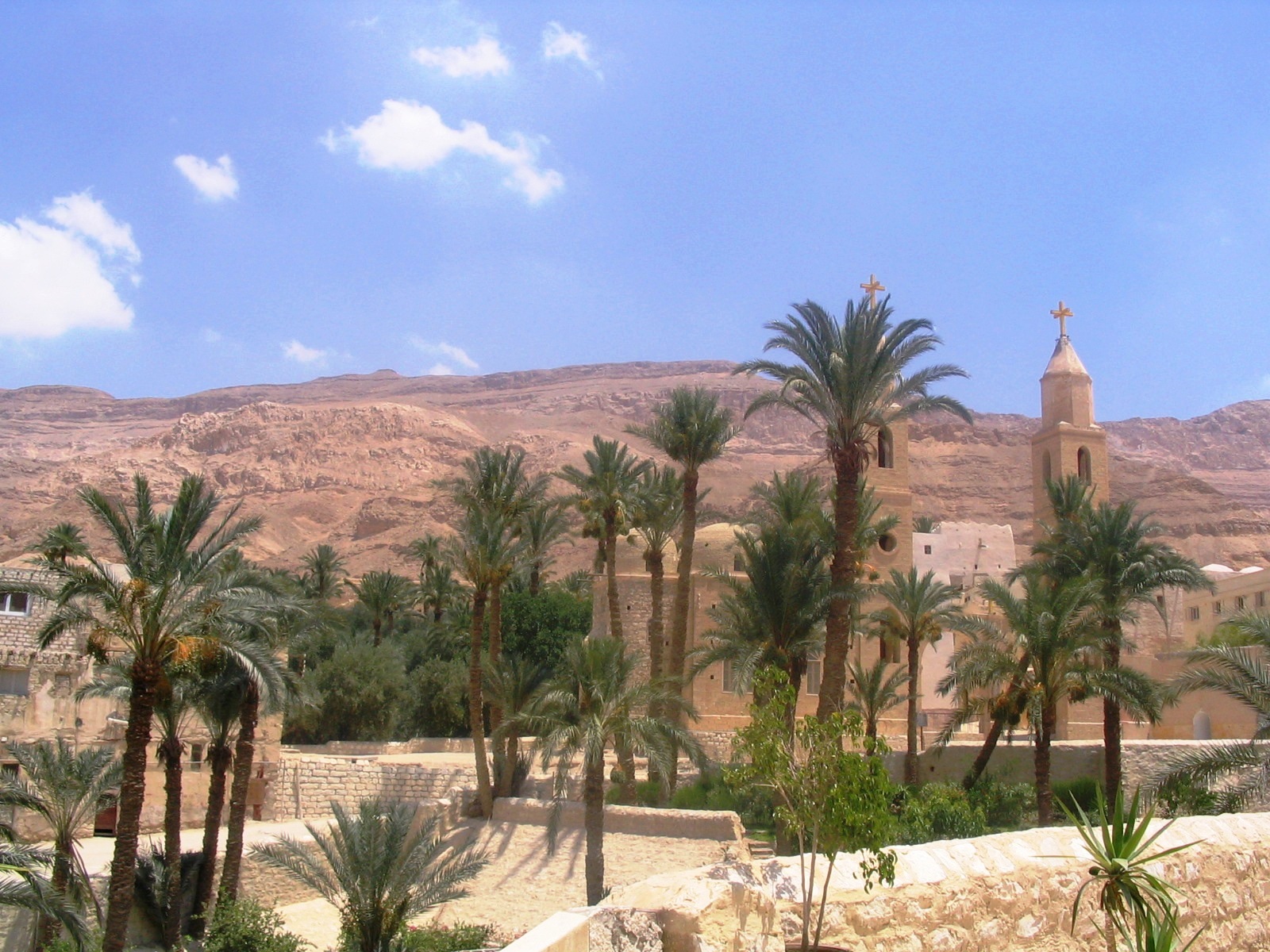
Near the end Antony told the monks of the outer mountain, "I am near a hundred and five years old." The death is dated by historians to 356, which puts his birth at about 251 if the age is taken at face value. He ordered two disciples to bury him secretly so that no one could make a cult of his body, and to divide his few clothes: "To Athanasius the bishop give one sheepskin and the garment whereon I am laid, which he himself gave me new, but which with me has grown old. To Serapion the bishop give the other sheepskin, and keep the hair garment yourselves." Athanasius ends: "And no one knows to this day where it was buried, save those two only."10 Philip Schaff, a nineteenth-century Protestant historian, read the secret burial as Antony's "dying protest" against the veneration of relics.11 Coptic tradition, for its part, venerates Antony as "the father of monks," and the Coptic Monastery of St. Antony near the Red Sea claims continuity with his disciples.

A book with a purpose
Athanasius said why he wrote: "for monks the life of Antony is a sufficient pattern of discipline."12 The book is a model and an argument as well as a biography. Antony in its pages is loyal to the bishop of Alexandria, hostile to the Arians and to the Meletian schismatics ("he never held communion with the Meletian schismatics," chapter 68), and a living proof that the Son is truly God, since only a divine Christ could give a peasant such power over demons. Most scholars date it to about 356 to 362, when Athanasius was in hiding from the imperial government during his third exile and needed the monks of Egypt on his side. David Brakke, Athanasius and the Politics of Asceticism (Oxford, 1995), argues that the Life was part of a deliberate campaign to tie the independent ascetics of Egypt to the episcopal church of Alexandria.13
There is a second, surprising piece of evidence. Seven letters attributed to Antony survive (in Coptic, Syriac, Georgian, Arabic and Latin versions). Samuel Rubenson, The Letters of St. Antony: Monasticism and the Making of a Saint (Lund, 1990; Fortress, 1995), argued that they are genuine and that they show a man familiar with the philosophical ideas of the Alexandrian teacher Origen, a long way from the unlettered peasant of the Life.14 If Rubenson is right, Athanasius simplified Antony to make a point. Others accept the letters but read them as consistent with a self-taught monk who absorbed ideas orally. The question remains open, and the reader should hold the Life as Athanasius's portrait, written with an aim, of a real person.
The book worked. Augustine's Confessions (book 8, chapter 6, in J. G. Pilkington's translation) records Ponticianus (Pilkington spells the name Pontitianus) telling how at Trier two of his colleagues "came upon a certain cottage inhabited by some of Your servants... where they found a book in which was written the life of Antony," and how one "began to read, marvel at, and be inflamed by it." In chapter 12, when Augustine hears a child's voice chanting "Take up and read," he says he remembered Antony: "for I had heard of Antony, that, accidentally coming in while the gospel was being read, he received the admonition as if what was read were addressed to him."1 The Life was soon translated into Latin, and through it the Egyptian desert became a place every Western reader could picture.
The Sayings of the Desert Fathers and Mothers
What the Apophthegmata are
The second great source is a different kind of book. The Apophthegmata Patrum ("Sayings of the Fathers") is a collection of short sayings and stories, a few lines each, told about the monks of Lower Egypt: Scetis (the Wadi Natrun), Nitria and Kellia ("the Cells") west of the Nile delta. The sayings circulated orally among monks for generations and were written down in Greek, most scholars think, in the late fifth century, partly by monks who had left Scetis after barbarian raids. They survive in two arrangements, an alphabetical one (by the name of the abba or amma) and a systematic one (by subject), and in Latin, Syriac, Coptic, Armenian and Ethiopic versions. No one author can be named for the collection as a whole.
The quotations below are from the public domain English translation of the Syriac version by E. A. Wallis Budge, The Paradise or Garden of the Holy Fathers, volume 2 (London: Chatto and Windus, 1907), read in the scan held by the Internet Archive. Budge translated the seventh-century Syriac compilation of the monk Anan Isho, which arranges the sayings by subject; the wording therefore differs from translations made directly from the Greek. (Helen Waddell's well-known 1936 selections and Benedicta Ward's 1975 translation of the alphabetical Greek collection are still under copyright and are not quoted here.)15
Arsenius and Macarius: flee, keep silence
Arsenius was a Roman of high rank who, according to the tradition, had tutored the sons of the emperor Theodosius before he fled to Scetis. Budge's collection opens its first book, "Of Flight from Men," with him: "When Abba Arsenius was in the palace, he prayed to God, and said, 'O Lord, direct me how to live'; and a voice came to him, saying, 'Arsenius, flee from men, and thou shalt live.'" Later, in the monastery, he prayed again and heard: "Arsenius, flee, keep silence, and lead a life of silent contemplation, for these are the fundamental causes which prevent a man from committing sin."15
Macarius the Egyptian, one of the founders of Scetis, gives the same advice with a gesture. After a church service he told the brothers, "Flee ye, O brethren." An old man asked where they could flee farther than this desert. "Then Macarius laid his hand upon his mouth, saying, 'Flee in this manner,' and straightway he went to his cell and, shutting the door, sat down."15 In another story a brother asked Macarius for "a word whereby I may live." Macarius sent him to the cemetery to insult the dead and then to praise them. The dead answered neither, and Macarius drew the lesson: "If thou wishest to live, become dead, so that thou mayest care neither for the reviling of men nor for [their] praise, for the dead care for nothing; in this wise thou wilt be able to live."16
Poemen, Antony and Amma Sarah
Abba Poemen ("the shepherd") is the most quoted of all the desert fathers, which suggests that his disciples did much of the collecting. Several of his sayings in Budge's version are about self-knowledge: "The rule of the monk is this, to bear at all times his own blame." "If thou holdest thyself in thine own sight to be of no account, thou mayest dwell where thou pleasest, and find rest." And, on comfort: "As smoke driveth away bees, and men take the sweetness of their labour, even so also doth ease of the body drive away the fear of God from the heart."16 (Budge prints a dash after "this" in the first saying; it is given here with a comma.)
Antony appears in the Sayings too, in a voice that matches the Life: "He who liveth in the desert is free from three kinds of spiritual attacks, that is to say, those which arise through the ears, speech, and sight; he hath only one kind to fight, namely, that of the heart."16 The desert removed distractions and left the monk alone with what the Greek sources call logismoi, "thoughts," the inner pressures toward gluttony, lust, anger and pride that Evagrius later sorted into a list (below).
Women are in the collection as teachers, a point modern readers sometimes miss. Budge's version gives several sayings of "Mother Sarah," who is said in the Greek tradition to have lived for decades beside the Nile. One reads: "Whensoever I put my foot on the ladder to go up, before I ascend it I set my death before mine eyes."16 Amma Syncletica of Alexandria, whose sayings fill a section of the Greek alphabetical collection and whose fifth-century Life was attributed (probably wrongly) to Athanasius, does not appear by that name in Budge's Syriac text, so no saying of hers is quoted here; readers can find her in Ward's translation. Amma Theodora is a third named mother. The Sayings do not make the desert a male preserve, though men far outnumber women in them.
How to read the sayings
The Sayings are not eyewitness biography. Many stories are told in several versions with different names attached, and a saying credited to one abba in the Greek appears under another in the Syriac. What they preserve reliably is the teaching of a culture: humility over feats of fasting, refusal to judge others, hospitality that breaks a fast for a guest, manual work (rope and basket weaving were the standard trades), and the conviction that the cell teaches everything. The Coptic and Orthodox churches still read them as spiritual instruction; modern historians read them as evidence of how monks of the fifth and sixth centuries remembered their founders. Both readings use the same text.
Pachomius and the first communities
Tabennisi
Antony lived alone with disciples nearby. Pachomius, a younger Egyptian from the south, built something new: a walled village of monks under one superior and one rule. Pachomius had been a conscript soldier, according to the Coptic and Greek Lives written by his followers, and was baptized after Christians fed his unit; he then trained under a hermit named Palemon. Around the 320s he settled at a deserted village called Tabennisi in the Thebaid (Upper Egypt), near the Nile. The Catholic Encyclopedia article (Francis Joseph Bacchus, 1911) gives his death as "about 346."17
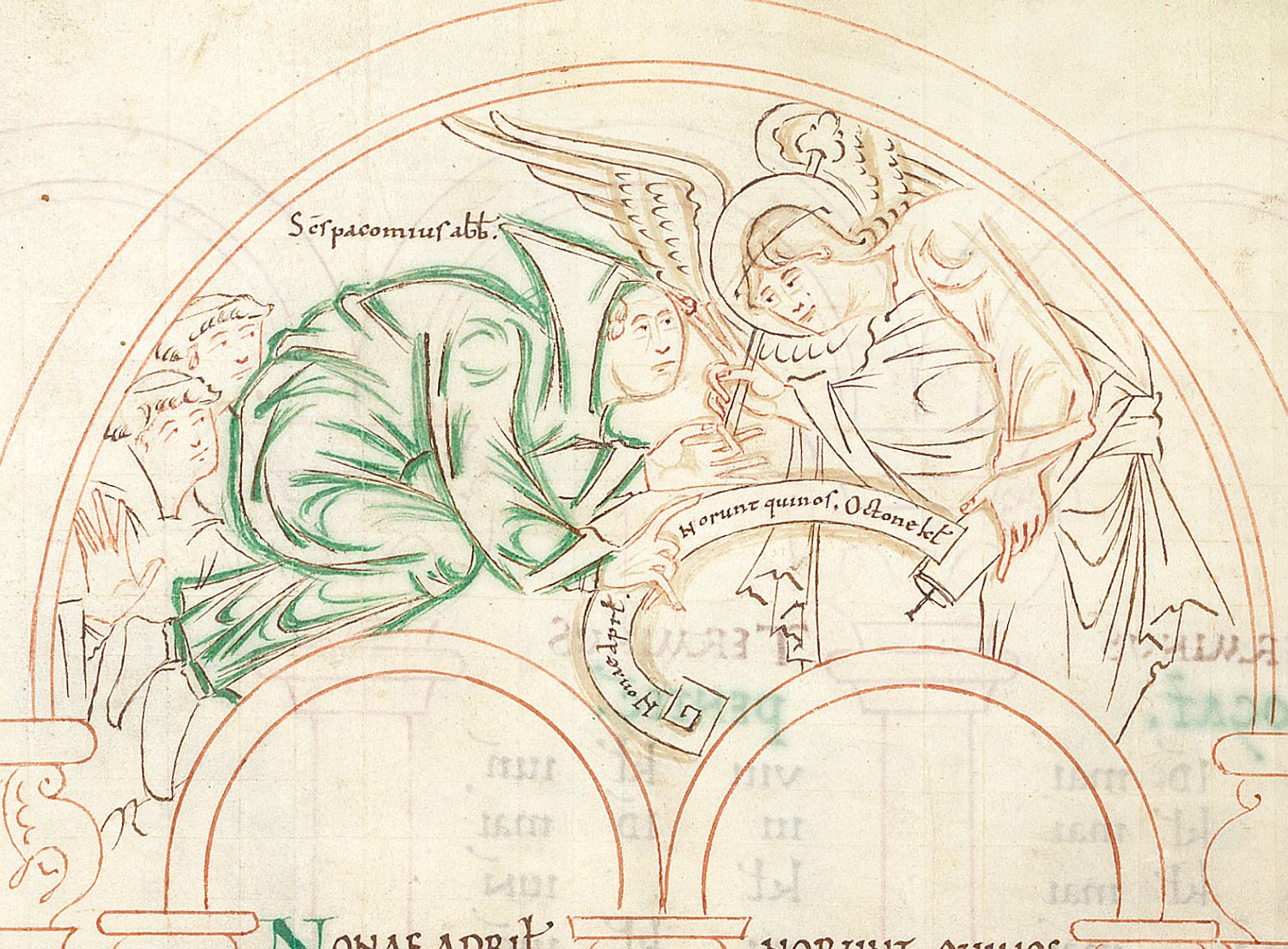
Two fifth-century writers tell the founding story with the same miracle. Palladius, in the Lausiac History (about 419 to 420, translated by W. K. Lowther Clarke, 1918), writes that an angel appeared to Pachomius in his cave and said, "You have successfully ordered your own life. So it is superfluous to remain sitting in your cave. Up! go out and collect all the young monks and dwell with them," and "he gave him a brass tablet on which this was inscribed." The first rule on the tablet: "Thou shalt allow each man to eat and drink according to his strength; and proportionately to the strength of the eaters appoint to them their labours." The tablet goes on to arrange cells for three monks each, a common dining hall, sleeping sitting up in "sloping chairs," and a goatskin cloak.18 The church historian Sozomen (about 440s, translated by Chester Hartranft in the Nicene and Post-Nicene Fathers) tells the same story and says that the tablet "is still carefully preserved." He adds the details of a three-year probation for newcomers, meals "in silence," prayers "twelve times every day," and a division of the community into twenty-four classes named for the letters of the Greek alphabet.19

How big were the Pachomian monasteries?
Numbers matter here because popular histories inflate them. Palladius says that "a number of these monasteries which have observed this rule" amounted to "7000 men," and that "the first and great monastery," where Pachomius himself lived (Pbow, in most modern accounts), "has 1300 members."18 Palladius was writing about seventy years after Pachomius died, describing a federation of several houses, and he reports the figures as he heard them. Palladius is not consistent even with himself: in his chapter on Macarius of Alexandria (chapter 18) he gives "the total number (of the occupants) of the first monastery" as "1,400 men." Other ancient sources give different totals, and modern historians such as Philip Rousseau (Pachomius: The Making of a Community in Fourth-Century Egypt, 1985) treat all of them as rough.20 What is solid is the scale of the idea: a single rule governing thousands of people in several houses, with a superior general and regular meetings of the houses. Palladius also describes a Pachomian women's monastery "with some 400 members," on the other side of the river, with "the same constitution and the same manner of life."18 The Pachomian Lives say Pachomius founded it for his own sister, Mary; that detail rests on his followers' tradition.
The Pachomian system was a working economy. The monks farmed, made mats and baskets, sailed their own boats on the Nile to sell their goods, and gave surplus to the poor. Obedience, the shared table and the bell replaced the hermit's private struggle. Benedict, two centuries later in Italy, would make the same choice for the community over the solitary, and Cassian, who carried Egyptian teaching west, called the community the "school" in which one learns before trying the desert alone.
Evagrius Ponticus and the eight thoughts
Evagrius came from Pontus on the Black Sea, was ordained a deacon by Gregory of Nazianzus, and was a rising preacher in Constantinople when, according to Palladius, a mutual attraction to a married woman "of the highest rank," followed by a frightening dream of arrest, drove him out of the city. After a stay in Jerusalem with the Roman ascetic Melania the Elder, he went to Nitria and then to Kellia, where Palladius says he lived fourteen years and "used to eat a pound of bread." Palladius, who knew him, says that he "died in the desert at the age of fifty-four" (the usual modern dates are about 345 to 399).21
The church historian Socrates (writing about 439, translated by A. C. Zenos) lists Evagrius's books: "one of which is entitled The Monk, or, On Active Virtue; another The Gnostic... A third is designated Antirrheticus, and contains selections from the Holy Scriptures against tempting spirits, distributed into eight parts, according to the number of the arguments." Socrates quotes one of the sayings Evagrius collected from the old monks: "a drier and not irregular diet combined with love, would quickly conduct a monk into the haven of tranquillity."22
The "eight parts" are Evagrius's lasting contribution: a list of eight evil thoughts (gluttony, fornication, love of money, sadness, anger, acedia or listless boredom, vainglory and pride) with the remedy for each. John Cassian took the list into Latin almost unchanged. His Institutes announce "the struggle against the eight principal faults, i.e. first, Gluttony or the pleasures of the palate; secondly, Fornication; thirdly, Covetousness... fourthly, Anger; fifthly, Dejection; sixthly, Accidie, which is heaviness or weariness of heart; seventhly, [vainglory]... eighthly, pride" (book 5, chapter 1, translated by Edgar C. S. Gibson).23 Historians of the idea trace the medieval list of seven deadly sins to Gregory the Great's reworking of this eight-part list in his Moralia on Job; that link is the standard scholarly account and is noted here as such.
Evagrius was also a speculative theologian in the tradition of Origen, and that brought him posthumous trouble. In the sixth century, Origenist ideas about the preexistence of souls were condemned in the reign of Justinian, and later Greek sources say that the Council of Constantinople in 553 condemned Evagrius along with Origen and Didymus. Scholars still debate exactly what that council itself enacted. As a result many of his works survived only under other names or in Syriac and Armenian translation. The Orthodox monastic tradition kept reading his practical teaching anyway, often attributed to "Nilus."
Basil and Eastern monasticism
A quiet mind
Basil of Caesarea (born probably 329, died 1 January 379, by the dates in the Catholic Encyclopedia; some scholars now prefer 378) was one of the three "Cappadocian Fathers" whose theology shaped the Council of Constantinople in 381 (lesson 05). Before he was a bishop he was a monk. The Catholic Encyclopedia article by Joseph McSorley (1907) summarizes his own letters: he "visited the monasteries of Egypt, Palestine, Coele-Syria, and Mesopotamia," returned "filled with admiration for the austerity and piety of the monks," and "founded a monastery in his native Pontus, on the banks of the Iris, nearly opposite Annesi," the family estate.24 His older sister Macrina had already turned the family household at Annesi into an ascetic community, according to the Life of Macrina written by their brother Gregory of Nyssa; historians often credit her with turning Basil toward the ascetic life.
Basil's Letter 2, written to his friend Gregory of Nazianzus to invite him to the retreat in Pontus, is a short manifesto (translated by Blomfield Jackson in the Nicene and Post-Nicene Fathers, Second Series, volume 8): "We must strive after a quiet mind. As well might the eye ascertain an object put before it while it is wandering restless up and down and sideways, without fixing a steady gaze upon it, as a mind, distracted by a thousand worldly cares, be able clearly to apprehend the truth."25
The Rules and the "new city"
Basil's ascetic writings survive as two sets of questions and answers, known as the Longer Rules (55 answers) and the Shorter Rules (313), which the Catholic Encyclopedia lists among his "probably authentic" works while noting "a good deal of discussion" about them.24 They are less a constitution than a set of answers to monks' questions, and their governing idea is love of neighbor: the solitary life, Basil argued, gives no one to serve, wash or correct, so a Christian needs a community. Gregory of Nazianzus, in his funeral oration for Basil (Oration 43, translated by Charles Gordon Browne and James Edward Swallow), says Basil "reconciled most excellently and united the solitary and the community life," founding "cells for ascetics and hermits, but at no great distance from his cenobitic communities."26
The same oration describes the complex Basil built outside Caesarea for the sick and poor, later called the Basileias: "Go forth a little way from the city, and behold the new city, the storehouse of piety, the common treasury of the wealthy... where disease is regarded in a religious light, and disaster is thought a blessing, and sympathy is put to the test."26 Historians of medicine often name it as one of the first Christian hospitals. Basil's model, with the monastery near the city and serving it, became the norm of Greek monasticism, and the Orthodox churches still call him the father of their monastic life. The Rule of Benedict itself ends by commending "the Rule of our holy Father Basil" to anyone who wants more than its own minimum.27 Lesson 08 follows Eastern monasticism into the Byzantine centuries.

Simeon Stylites and the holy man
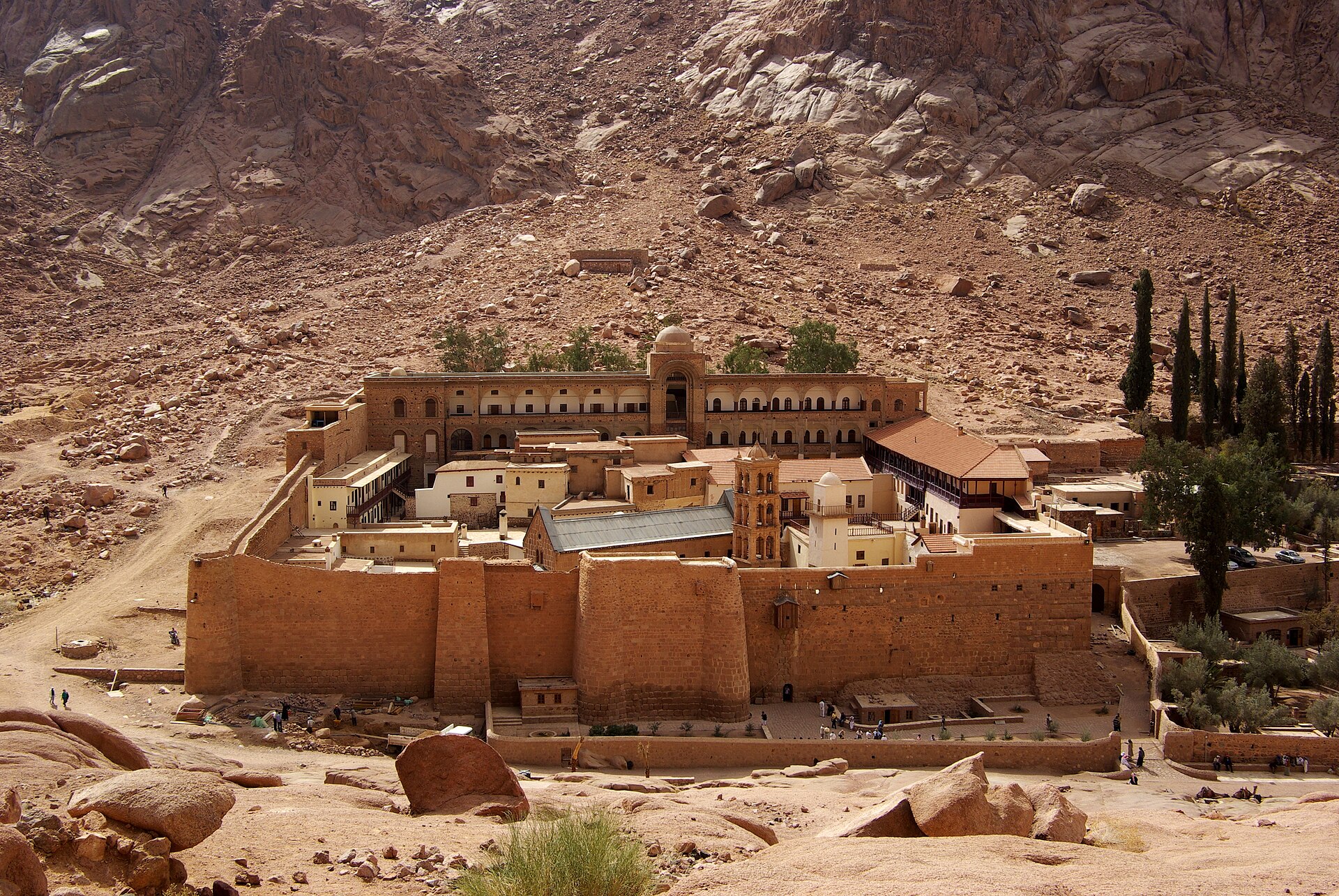
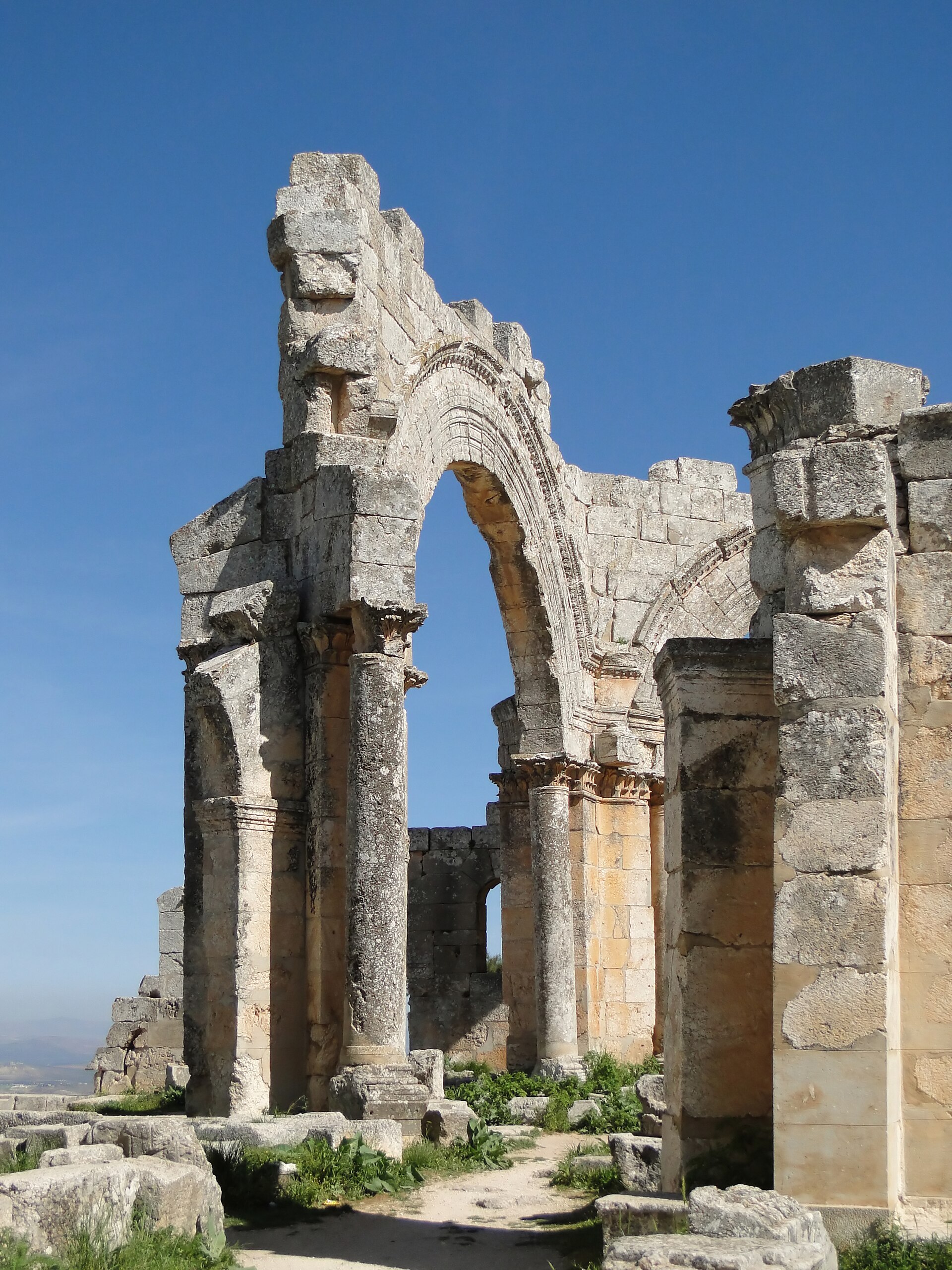
Syrian asceticism took more dramatic forms than Egyptian. Simeon (about 389 to 459) was a shepherd's son who, after years of extreme fasting in a monastery, climbed a column near Antioch and stayed there for the rest of his life. Evagrius Scholasticus, writing his Church History in the 590s (translated by Edward Walford, 1846), calls him the man "who originated the contrivance of stationing himself on the top of a column, thereby occupying a spot of scarce two cubits in circumference," and gives the count of his years: fifty-six in all, "nine of which he spent in the first monastery... and forty-seven in the Mandra, as it is termed; namely, ten in a certain nook; on shorter columns, seven; and thirty upon one of forty cubits."28 Forty cubits is roughly sixty feet. The Catholic Encyclopedia (Herbert Thurston, 1912) says Simeon "died on Friday, 2 Sept., 459," after "thirty-six years on his pillar," and that Antioch and Constantinople quarreled over his body.29
Simeon was no recluse. Crowds came to him every day; he preached twice daily, settled disputes, wrote to emperors and bishops (including a letter in support of the Council of Chalcedon, according to Thurston), and converted Arab tribesmen. Theodoret of Cyrrhus, who knew him, described him in his Religious History while Simeon was still alive; Schaff notes that Theodoret wrote "sixteen years before the death of the saint."11 Peter Brown's essay "The Rise and Function of the Holy Man in Late Antiquity" (Journal of Roman Studies 61, 1971) made Simeon the example of a social type: the holy man as a professional outsider, a "patron" whom villagers trusted because he had no stake in their quarrels.30 Brown later qualified parts of the thesis, but it changed how historians read the ascetics, as public figures whose withdrawal gave them authority.
Not everyone admired the pillar saints. Schaff, writing as a Protestant historian, judged that the whole medieval view of the Christian life "pays the highest admiration to the voluntary celibacy, poverty, absolute obedience, and excessive self-punishments of the pillar-saints and the martyrs of the desert; while in the same degree the modest virtues of every-day household and social life are looked upon as an inferior degree of morality."11 The Orthodox and Catholic churches venerate Simeon as a saint and read his life as heroic penance; Schaff's sentence is one church tradition's criticism, given here as his reading.

John Cassian brings the desert to Gaul
John Cassian (about 360 to about 435) is the main bridge between the Egyptian desert and the Latin West. As a young man he and his friend Germanus joined a monastery in Bethlehem, then spent years among the monks of Scetis and Lower Egypt. After stays in Constantinople and Rome, "about 415 he was at Marseilles where he founded two monasteries, one for men, over the tomb of St. Victor... and the other for women," according to the Catholic Encyclopedia (Maurice Hassett, 1908).31 At the request of Castor, bishop of Apt (Apta Julia) in Provence, he wrote two books in Latin; the preface of the Institutes is addressed to Castor, and the translator's note identifies his see.54 The Institutes (twelve books) describe the dress, prayer and customs of Egyptian monks and then the eight principal faults with their remedies. The Conferences (twenty-four) present conversations Cassian and Germanus said they had with the great abbas, on prayer, discernment, chastity and friendship. The Benedictine Rule tells monks to read "the Conferences or the Lives of the Fathers" aloud after supper (chapter 42), and names "the Conferences and the Institutes" among the "tools of virtue" for monks (chapter 73).27
Cassian is also a link to lesson 06. His thirteenth Conference argued that the first movement of the will toward God can come from human free will, which God's grace then assists. Prosper of Aquitaine, a defender of Augustine, wrote against it; the Catholic Encyclopedia notes that Prosper, "without naming him, alludes to him with great respect," and that the position later called "Semipelagianism was finally condemned by the Council of Orange in 529."31 The label "Semipelagian" was coined more than a thousand years later, in the Catholic controversies over grace of the late sixteenth century, and modern scholars such as Columba Stewart (Cassian the Monk, Oxford, 1998) read Conference 13 as a monk's pastoral teaching rather than a theory set against Augustine.32 The Eastern churches venerate Cassian as a saint; in the West he is honored locally at Marseille.
Martin of Tours
Before Cassian, Gaul already had a famous monk-bishop. Martin was a soldier from Pannonia (modern Hungary) whose life Sulpicius Severus wrote while Martin was still living or just after his death in 397 (the Life of St. Martin, translated by Alexander Roberts in the Nicene and Post-Nicene Fathers, Second Series, volume 11). Its best-known scene took place in a hard winter "at the gate of the city of Amiens," where Martin met a poor man without clothes whom everyone else passed by. "Taking, therefore, his sword with which he was girt, he divided his cloak into two equal parts, and gave one part to the poor man, while he again clothed himself with the remainder."33
After leaving the army Martin became a disciple of Bishop Hilary of Poitiers and founded a community of hermits near Poitiers (at the place tradition identifies as Ligugé). Made bishop of Tours against his will around 371, he kept living as a monk. Sulpicius describes the monastery he founded "about two miles outside the city" (Marmoutier), on a bank of the Loire under a cliff: "There were altogether eighty disciples... No one there had anything which was called his own; all things were possessed in common... No art was practiced there, except that of transcribers, and even this was assigned to the brethren of younger years, while the elders spent their time in prayer."33 That sentence is one of the earliest Western records of monks copying books. Martin's shrine at Tours became the most visited in Gaul, and the half of his cloak (cappa) kept by the Frankish kings gave later Europe the words "chapel" and "chaplain," a derivation given in the standard dictionaries.
Irish monasticism
Patrick and the "monks and virgins of Christ"
Ireland was never part of the Roman Empire, and its church developed around monasteries more than around city bishops. Patrick, a Briton who had been carried to Ireland as a slave and returned as a missionary bishop in the fifth century (his own dates are disputed), wrote in his Confession about the converts who chose the dedicated life. In the English translation published by the Royal Irish Academy's Saint Patrick's Confessio project, chapter 41 reads: "The sons and daughters of the leaders of the Irish are seen to be monks and virgins of Christ!"34 Over the next century, great monasteries such as Clonard, Clonmacnoise and Bangor became the centers of Irish Christian life, ruled by abbots who were often kinsmen of local kings.
Columba and Iona
Columba (Irish Colum Cille, "dove of the church") was a nobleman of the northern Ui Neill. The Annals of Ulster, in the English edition published by the CELT project at University College Cork, record under the year numbered 563: "The voyage of Colum Cille to the island of I in the 42nd year of his age."35 Bede, writing in Northumbria in 731, gives a different year: "In the year of our Lord 565... there came into Britain a famous priest and abbot, a monk by habit and life, whose name was Columba, to preach the word of God to the provinces of the northern Picts," and says that the Pictish king gave him "the aforesaid island for a monastery" (Ecclesiastical History 3.4, in the translation reproduced by the Internet Medieval Sourcebook).36 Most historians follow the Irish annals and put the voyage in 563. The annals record his death "on the fifth of the Ides of June" (June 9) "in the 76th year of his age," under the year numbered 595; the date usually given is 597. The annals also record two different birth years for him, a reminder that early Irish chronology is approximate.35
Iona became the head of a family of monasteries in Ireland and Scotland. From Iona, Bede says, "was Aidan sent to instruct the English nation in Christ," founding the see and monastery of Lindisfarne in 635, and Aidan "was wont to traverse both town and country on foot, never on horseback."36 Irish monks also crossed to the Continent. The best known, Columbanus, founded Luxeuil in Burgundy about 590 and Bobbio in northern Italy shortly before his death in 615, according to his seventh-century biographer Jonas; his strict rule and his Irish system of private penance, with set penances for each sin, spread across Frankish Gaul.
Skellig Michael
The most striking physical remains of Irish monasticism sit on a rock in the Atlantic almost 12 kilometers (about 7.5 miles) west of the Iveragh Peninsula in County Kerry. According to the Irish government's World Heritage site for Sceilg Mhichil, which gives that distance, "Sometime between the sixth and eight[h] centuries, a monastery was founded on this precipitous rock"; the monastic buildings sit on terraces near the summit, and the site "was inscribed on the World Heritage List in 1996." The community "appears to have moved to the mainland by the thirteenth century."37 The isolated monasteries were not safe from the Vikings. The Annals of Inisfallen record for 824: "Scelec was plundered by the heathens and Etgal was carried off into captivity, and he died of hunger on their hands."38 Iona suffered worse: "The community of I, to the number of sixty-eight, was killed by the heathens," the Annals of Ulster record under the year numbered 806.35
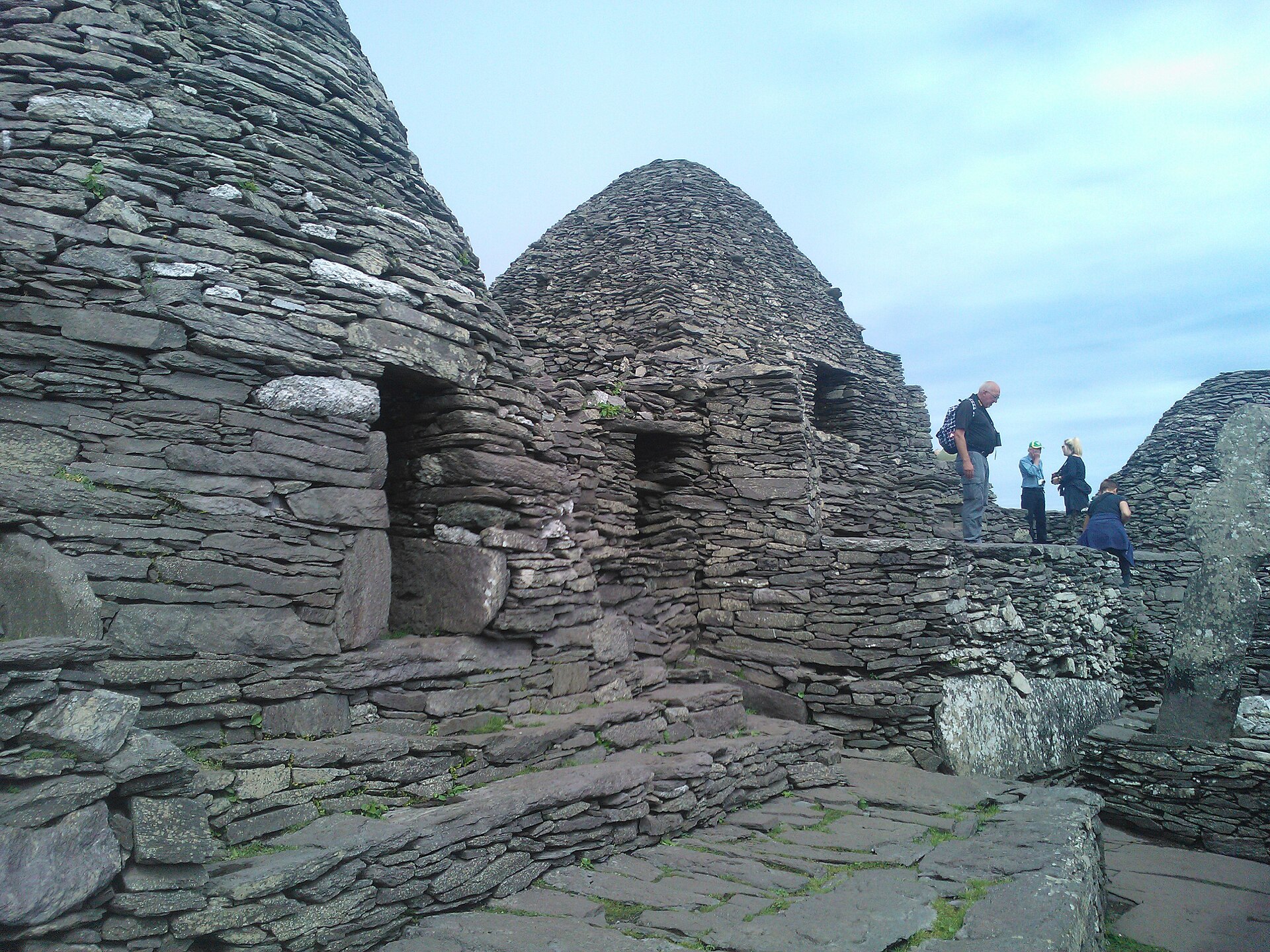

Benedict of Nursia
The only source: Gregory's Dialogues
For Benedict there is no Athanasius. Everything told about his life comes from the second book of the Dialogues, a four-book collection of Italian miracle stories in the form of a conversation between Pope Gregory the Great (pope 590 to 604, lesson 09) and his deacon Peter, usually dated about 593 to 594. The Catholic Encyclopedia article on Benedict (Hugh Ford, 1907) states the problem plainly: "The only authentic life of Benedict of Nursia is that contained in the second book of St. Gregory's 'Dialogues'. It is rather a character sketch than a biography and consists, for the most part, of a number of miraculous incidents."39 The quotations here come from the English translation printed in 1608 (by a translator who signed himself "P. W.") and reissued by Edmund G. Gardner in 1911, as transcribed at tertullian.org.40
Gregory names his informants: "those few, which I mind now to report, I had by the relation of four of his disciples: to wit, of Constantinus, a most rare and reverent man, who was next Abbot after him; of Valentinianus, who many years had the charge of the Lateran Abbey; of Simplicius, who was the third General of his order; and lastly of Honoratus, who is now Abbot of that monastery in which he first began his holy life."40 The story he tells runs as follows. Benedict "was born in the province of Nursia, of honourable parentage, and brought up at Rome in the study of humanity," but, seeing other students "fall to dissolute and lewd life," left his studies and "departed, instructed with learned ignorance, and furnished with unlearned wisdom." He lived three years as a hermit in a cave at Subiaco ("a desert place called Sublacum, distant almost forty miles from Rome"), helped by a monk named Romanus. When disciples gathered, "he built there twelve Abbeys; over which he appointed governors, and in each of them placed twelve monks."40 After local hostility, he moved south to the hill above Cassino, where, Gregory says, "there was an ancient chapel in which the foolish and simple country people, according to the custom of the old gentiles, worshipped the god Apollo." Benedict "beat in pieces the idol, overthrew the altar, set fire to the woods, and in the temple of Apollo, he built the oratory of St. Martin."40 The dedication to Martin of Tours shows how far the Gallic saint's fame had spread.
The date of the move to Monte Cassino is traditionally given as about 529, a year the Catholic Encyclopedia reports as Abbot Tosti's conjecture. The same article gives Benedict's birth as "c. 480" and his death at Monte Cassino as 543; the traditional date of death is 547, and neither is firm.39 Gregory describes the death itself: six days before, Benedict had his grave opened, fell into a fever, and on the sixth day had himself carried into the oratory, received Communion, "and having his weak body holden up betwixt the hands of his disciples, he stood with his own lifted up to heaven, and as he was in that manner praying, he gave up the ghost."40
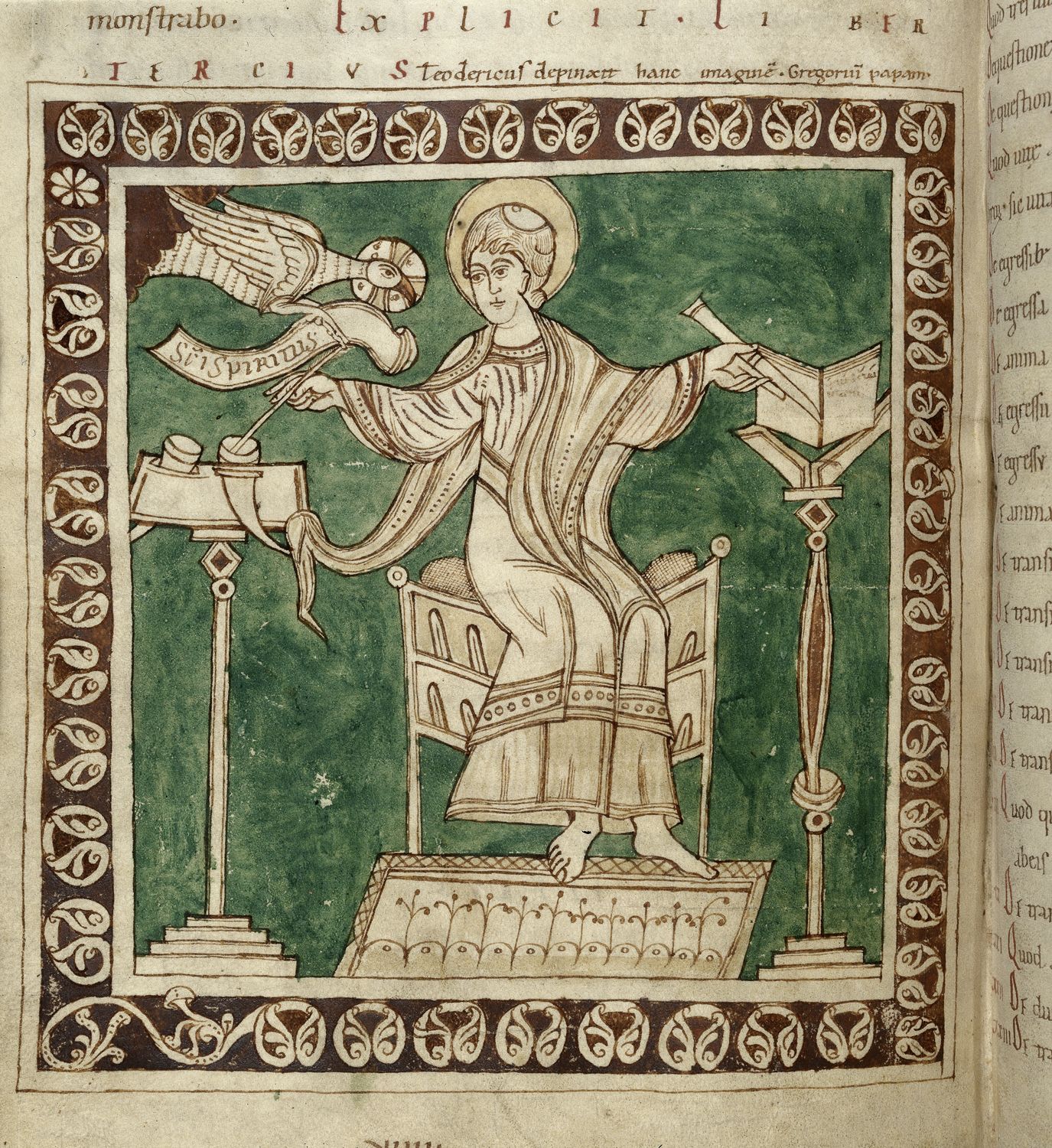

Scholastica
Gregory's best-known story is about Benedict's sister. "His sister called Scholastica, dedicated from her infancy to our Lord, used once a year to come and visit her brother," meeting him at a house belonging to the abbey. At their last meeting she asked him to stay the night talking; he refused, since the Rule forbade a monk to spend the night outside the monastery. She bowed her head on the table and prayed, "and lifting her head from the table, there fell suddenly such a tempest of lightning and thundering, and such abundance of rain, that neither venerable Benedict, nor his monks that were with him, could put their head out of door." Three days later, Gregory says, Benedict saw "the soul of his sister... in the likeness of a dove to ascend into heaven," and had her buried in the grave he had prepared for himself.40 Gregory's own moral is that "of right she did more which loved more." The story is the only early source for Scholastica, who is venerated as the patron of Benedictine nuns. Gregory calls her "the Nun" and mentions her "Nunnery," but does not say where it was.
The Rule of Benedict
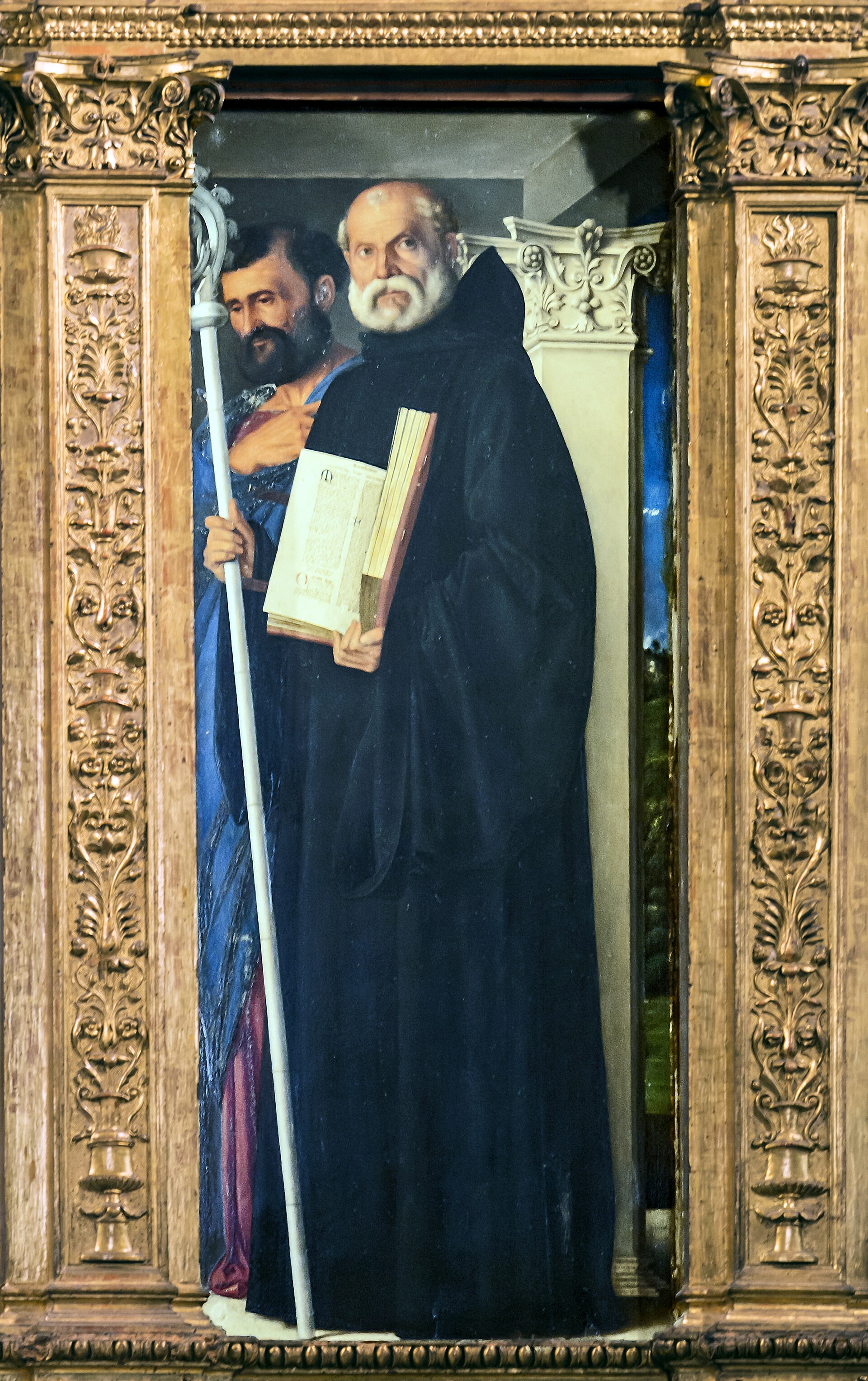
Gregory adds, almost in passing, that Benedict "wrote a rule for his monks, both excellent for discretion and also eloquent for the style," and that anyone who wants to know his life "may in the institution of that rule understand all his manner of life and discipline: for the holy man could not otherwise teach, than himself lived."40 That Rule survives. It is usually dated about 530 to 540, has seventy-three short chapters, and is the single most influential document in Western monastic history. The quotations here are from the English translation by Leonard J. Doyle, St. Benedict's Rule for Monasteries (Collegeville: The Liturgical Press, 1948), as distributed by Project Gutenberg, whose catalog page lists it as "Public domain in the USA." The book itself carries a 1948 copyright notice of the Order of St. Benedict and is still sold by the Liturgical Press; the reason for Project Gutenberg's listing (presumably that the American copyright was not renewed) was not confirmed in the copyright renewal records for this lesson, and its status outside the United States may differ. Doyle's curly quotation marks are given as straight ones and his dashes as commas.27
A school, with nothing harsh. The Prologue says: "And so we are going to establish a school for the service of the Lord. In founding it we hope to introduce nothing harsh or burdensome." The last chapter calls the whole text "this minimum Rule which we have written for beginners."27 Compared with the Egyptian sources, Benedict's food and sleep rules are moderate. Chapter 39 allows "two cooked dishes" at the main meal, a third of fruit or vegetables when available, and "a good pound weight of bread" a day; chapter 40, "with some misgiving," allows "a hemina of wine a day," while praising those who abstain.27
Four kinds of monks. Chapter 1 sorts monks: "The first kind are the Cenobites: those who live in monasteries and serve under a rule and an Abbot. The second kind are the Anchorites or Hermits," who go out to "the solitary combat of the desert" only "after long probation in a monastery." The third, "a detestable kind," are the Sarabaites, who live "in twos or threes" by their own rules, and the fourth the Gyrovagues, who "spend their whole lives tramping from province to province... Always on the move, with no stability." The Rule is written "for the strongest kind of monks, the Cenobites."27
The abbot. "For he is believed to hold the place of Christ in the monastery, being called by a name of His" (chapter 2). The abbot's power is great but bounded: he "ought not to teach or ordain or command anything which is against the Lord's precepts." For important business he must call the whole community, since, the Rule explains, "the Lord often reveals to the younger what is best" (chapter 3), though the decision remains his.27
Stability, conversion of life, obedience. A newcomer is tested for about a year and then "shall make a promise before all in the oratory of his stability and of the reformation of his life and of obedience" (chapter 58). "Stability" binds a monk to one community for life, the Rule's answer to the wandering Gyrovagues. The Latin conversatio morum, here "reformation of his life," means a lifelong turning toward God by living the monastic way.27
Poverty. Private ownership "especially is to be cut out of the monastery by the roots. Let no one presume to give or receive anything without the Abbot's leave, or to have anything as his own, anything whatever, whether book or tablets or pen" (chapter 33).27
Prayer and work. Chapter 16 sets the day Hours by Psalm 119: "'Seven times in the day,' says the Prophet, 'I have rendered praise to You.' Now that sacred number of seven will be fulfilled by us if we perform the Offices of our service at the time of the Morning Office, of Prime, of Terce, of Sext, of None, of Vespers and of Compline," with the Night Office besides. Chapter 48 begins: "Idleness is the enemy of the soul. Therefore the brethren should be occupied at certain times in manual labor, and again at fixed hours in sacred reading," and adds, "for then are they truly monks when they live by the labor of their hands, as did our Fathers and the Apostles." In Lent each monk is to "receive a book from the library, which they shall read straight through."27 The famous motto ora et labora ("pray and work") is a later summary; the phrase itself does not appear in the Rule.
Guests. "Let all guests who arrive be received like Christ, for He is going to say, 'I came as a guest, and you received Me'" (chapter 53), with special honor "to the domestics of the faith and to pilgrims."27
What the Rule borrowed
Benedict did not write from nothing, and he said so: chapter 73 sends readers to Scripture, the Fathers, "the Conferences and the Institutes and the Lives of the Fathers, as also the Rule of our holy Father Basil."27 In the twentieth century scholars found a closer source. An anonymous Italian text called the Rule of the Master (Regula Magistri), about three times as long, shares much of Benedict's Prologue and early chapters nearly word for word. After a long debate in the 1930s and 1940s, most scholars, led by the French Benedictine Adalbert de Vogue in his edition of the Rule of the Master (Sources Chretiennes, 1964), concluded that the Master's text came first and that Benedict abridged and softened it.41 Benedict's distinct contribution, on this reading, lies in what he cut and what he added: more room for the abbot's discretion, more attention to the weak, and a warmer chapter on "the good zeal which monks ought to have" (chapter 72). Gregory's word for the Rule, "discretion," fits that finding.
Did Gregory write the Dialogues?
Since everything about Benedict's life depends on Dialogues 2, the authorship and reliability of the work matter. Two separate questions are involved.
The first is authorship. In 1987 the Jesuit scholar Francis Clark published The Pseudo-Gregorian Dialogues (Leiden: Brill), arguing that the work was written decades after Gregory's death by a forger, a "Dialogist" who used genuine Gregorian fragments, and he restated the case in The "Gregorian" Dialogues and the Origins of Benedictine Monasticism (Brill, 2003).42 Paul Meyvaert replied in "The Enigma of Gregory the Great's Dialogues: A Response to Francis Clark," Journal of Ecclesiastical History 39 (1988), pages 335 to 381, arguing that the manuscript and stylistic evidence supports Gregory and that the first denials of his authorship came from sixteenth-century religious polemics.43 Adalbert de Vogue also rejected Clark's thesis. Most historians today accept Gregory as the author; Clark's position is a minority view, but it is a serious one and has never been formally withdrawn.
The second question is genre. Even if Gregory wrote it, Book 2 is a series of miracle stories (a sieve mended by prayer, a poisoned loaf carried off by a crow, a monk walking on water) arranged to show that Italy had holy men equal to the Egyptian fathers and to teach lessons about obedience and grace. Gregory names his four witnesses, which gives the book a historical anchor, and the outline (Nursia, Rome, Subiaco, Monte Cassino, a sister named Scholastica, a written Rule) is accepted by most historians. The individual miracles are matters of faith or of hagiographic convention, depending on the reader. Benedictine historians tend to read the book as a reliable spiritual portrait; skeptical historians treat everything beyond the outline as unprovable.
Monte Cassino, destroyed and rebuilt
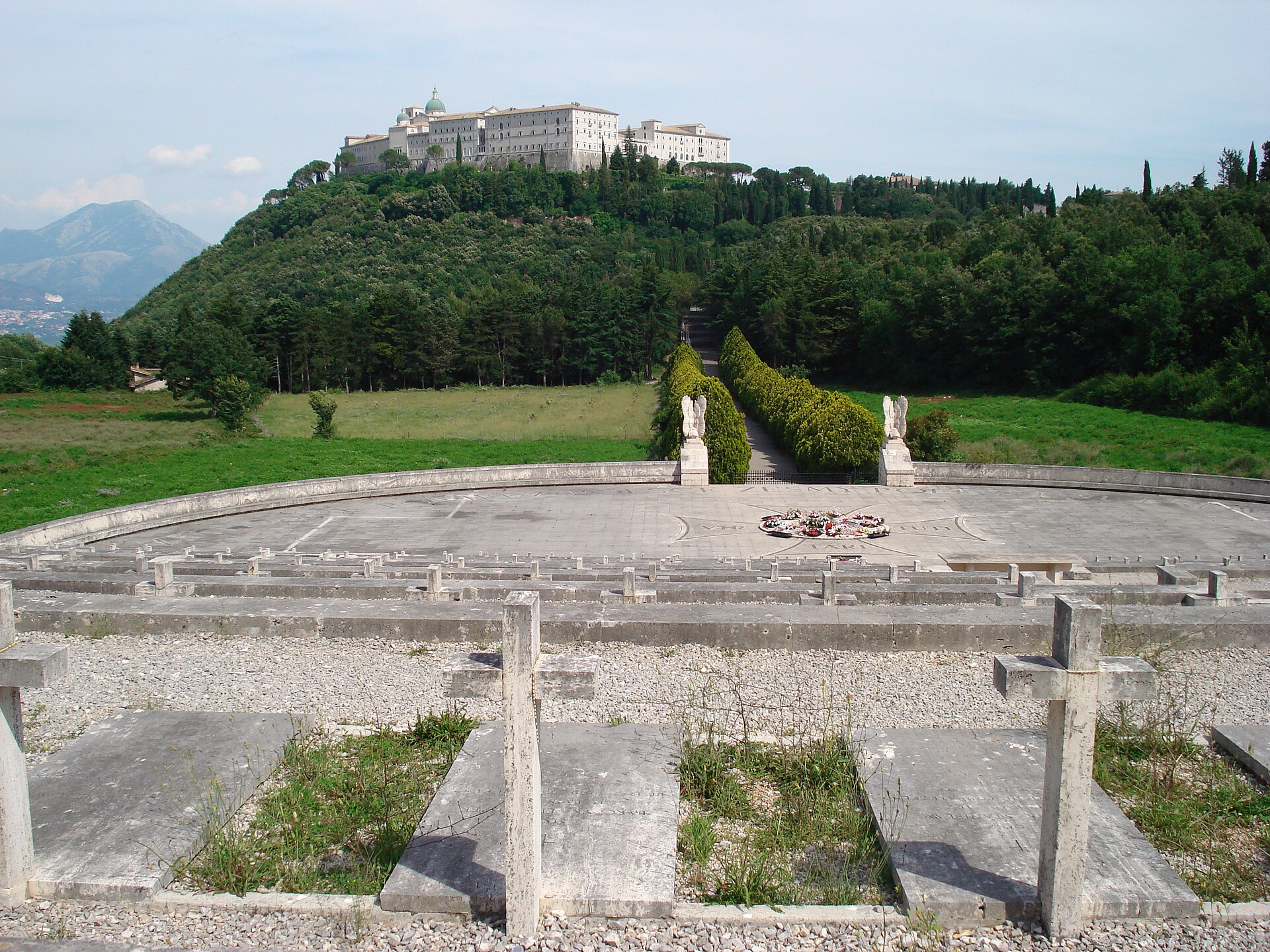
Gregory reports that Benedict wept over a vision that "all this Abbey which I have built... are by the judgment of almighty God delivered to the gentiles, to be spoiled and overthrown," and adds that he and his readers "know that very Abbey to be now suppressed by the Lombards," who came by night but took none of the monks (Dialogues 2.17).40 The Lombard sack happened in the late sixth century; modern accounts date it anywhere from about 570 to 589. The abbey was refounded in the eighth century, sacked by Saracen raiders in 883, damaged by an earthquake in 1349, and rebuilt each time.44 On February 15, 1944, during the Allied attempt to break the German defensive line across Italy, Allied bombers destroyed the abbey; most historians conclude that German troops had not been using the building itself. Accounts of the dead differ: many histories report that civilian refugees in the abbey were killed, while the abbot of Monte Cassino, interviewed for the article cited here, said that the oldest part of the monastery was spared, so that "neither the monks nor the civilians who took refuge there died," though, the article adds, hundreds of civilians died in the battle as a whole.44 German paratroopers then fortified the ruins. The abbey was rebuilt on the old plan, and on October 24, 1964, Pope Paul VI consecrated the new abbey church. On the same day his apostolic letter Pacis nuntius named Benedict principal patron of Europe.45


What monasteries did
Books and copying
Monks prayed with books, so monasteries needed books. The Rule of Benedict assumes a library (every monk receives a book in Lent), forbids private ownership of "book or tablets or pen," and fills hours each day with reading.27 Sulpicius Severus says the only craft allowed at Martin's Marmoutier was "that of transcribers."33 In Italy the retired Roman statesman Cassiodorus founded the monastery of Vivarium on his family estate in Calabria; the Catholic Encyclopedia (Paul Lejay and Joseph Otten, 1908) says he did so "in imitation of Benedict's institution" and was still writing at ninety-three.46 His Institutions urged monks to copy both sacred and secular texts carefully, and that program became a model for later scriptoria.
The classical survival story is real but needs precision. L. D. Reynolds and N. G. Wilson's standard history, Scribes and Scholars: A Guide to the Transmission of Greek and Latin Literature (Oxford, 1968; fourth edition 2013), shows that most Latin classical authors survive because their texts were copied in the monastic and cathedral scriptoria of the Carolingian age, in the late eighth and ninth centuries; for many authors the oldest surviving manuscript is Carolingian.47 Greek literature, by contrast, survived mainly in Byzantium, where monks were only one part of a literate society that still had lay teachers, officials and libraries. Monks also lost and erased books: many ancient texts survive only as palimpsests, scraped and written over with Christian works.
Schools, farms, hospitality and missions
Schools. Children were given to monasteries as oblates (the Rule of Benedict has a chapter "On the Sons of Nobles and of the Poor Who Are Offered," chapter 59), and Hildegard of Bingen entered her community this way at eight. Monasteries therefore had to teach reading, Latin and chant. In the Carolingian period, royal capitularies ordered monasteries and cathedrals to keep schools; lesson 09 covers Charlemagne's reforms.
Farming and land. Pachomian monks farmed and traded along the Nile; Benedict's monks gathered their own harvest when needed (chapter 48). Over the centuries, gifts of land made many abbeys great landowners with tenants and serfs; the Cluny charter itself hands over "the serfs of both sexes, the vines, the fields, the meadows, the woods, the waters."48 The Cistercians later became known for draining and clearing marginal land with the help of lay brothers, though modern studies show that they also took over already-cultivated estates.
Hospitality and the poor. Basil's "new city" for the sick, the Pachomian rule receiving travelers, Benedict's chapter 53 and the Cluny charter's command that "there shall daily, with the greatest zeal be performed there works of mercy towards the poor, the needy, strangers and pilgrims" all point the same way.48 For many medieval travelers the abbey guesthouse was the only inn.
Missions. Irish monks from Iona evangelized the Picts and the Northumbrian English; Columbanus and his followers founded houses in Gaul and Italy; and Pope Gregory the Great, who had turned his family house in Rome into a monastery, sent a party of monks led by Augustine (later of Canterbury) to the English in 596 to 597 (lesson 09). In the eighth century the English monk Boniface carried the mission to Germany. Monastic missionaries were often the first literate residents of a region, and their houses became the first towns in parts of Ireland, Scotland and Germany.
Did monks "save civilization"?
The phrase has a long life in popular history. The nineteenth-century French Catholic historian Charles de Montalembert wrote a multivolume Monks of the West (1860 to 1877) praising them as the builders of Christian Europe. Thomas Cahill's best seller How the Irish Saved Civilization (1995) argued that Irish monks preserved Latin learning while the Continent fell to barbarian kingdoms and then brought it back.49 The claim is rated in "Claims checked" below. In brief: monasteries did preserve and copy much of what survives of Latin literature, did keep schools, and did carry literacy to Ireland's and Germany's new churches; but "civilization" did not depend on them alone. Byzantium kept Greek learning without a Western-style monastic copying system, the Islamic world translated and studied Greek science and philosophy, and Italian cities, bishops' households and royal courts also kept learning alive. Historians such as Diarmaid MacCulloch (Christianity: The First Three Thousand Years, 2009) give monasteries a large place in the making of Latin Christian culture while treating "saved civilization" as a slogan.50
Cluny and the reform of 910
By the ninth and tenth centuries many Western monasteries were controlled by the families that had endowed them. Lay "abbots" took the income, local bishops interfered, and Viking, Saracen and Magyar raids destroyed houses. The Carolingian reformer Benedict of Aniane had put forward his reforms at "the first great meeting of the abbots of the order held at Aachen (Aix-la-Chapelle) in 817," in the Catholic Encyclopedia's words; standard accounts add that this imperial program, meant to bring all the monasteries of the Frankish empire under one observance of the Rule, faded as the empire divided.51
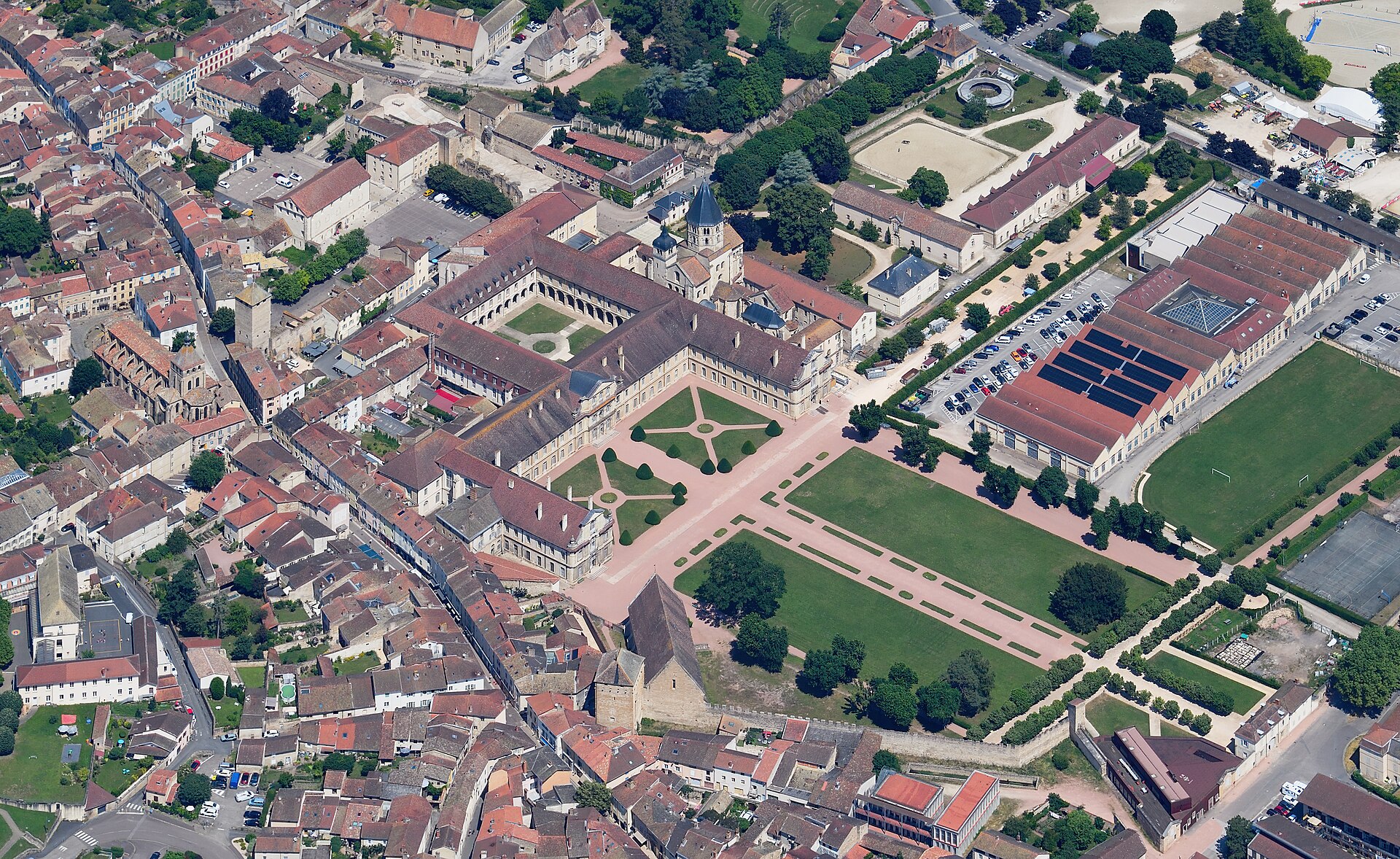
The new start came in Burgundy. In 910 William, duke of Aquitaine, founded an abbey at Cluny and wrote its legal independence into the foundation charter (translated in Ernest F. Henderson, Select Historical Documents of the Middle Ages, London, 1910, and given in the Internet Medieval Sourcebook). He hands "to the holy apostles, Peter, namely, and Paul, the possessions over which I hold sway, the town of Cluny." The monks are to be "under the power and dominion of the abbot Berno," and after Berno's death they may "elect any one of their order whom they please as abbot and rector, following the will of God and the rule promulgated by St. Benedict." "Every five years... the aforesaid monks shall pay to the church of the apostles at Rome ten shillings to supply them with lights; and they shall have the protection of those same apostles and the defence of the Roman pontiff." The key clause: "those same monks there congregated shall be subject neither to our yoke, nor to that of our relatives, nor to the sway of the royal might, nor to that of any earthly power." William even forbids "the pontiff of the aforesaid Roman see" to seize the property.48
Cluny's reform had two features. One was liturgy: Cluniac monks spent most of the day in elaborate sung prayer, especially prayer for the dead, which made the abbey a favorite of donors who wanted their souls remembered. The other was organization. Instead of independent abbeys, as the Rule assumed, Cluny gathered daughter houses (priories) under the one abbot of Cluny. The Catholic Encyclopedia (G. Cyprian Alston, 1908) calls this "a highly centralized form of government entirely foreign to Benedictine tradition" and gives the numbers with their sources: "by the twelfth century Cluny was at the head of an order consisting of some 314 monasteries"; according to the Bibliotheca Cluniacensis (Paris, 1614), "825 houses owed allegiance to the Abbot of Cluny in the fifteenth century"; and "some writers have given the number as 2000, but there is little doubt that this is an exaggeration."51 A series of long-lived abbots, among them Odo, Odilo and Hugh, made Cluny one of the great powers of Europe, and Cluniac monks became bishops and popes. Historians debate how directly Cluny inspired the eleventh-century papal reform (lesson 09); older accounts made the link strong, and many recent ones treat it as indirect.

The Cistercians and Bernard of Clairvaux
Success brought wealth, and wealth brought the next reform. In 1098 Robert, abbot of Molesme, left with a group of monks for a marshy site at Citeaux (Latin Cistercium) south of Dijon. The Catholic Encyclopedia article (Marie Gildas, 1908) states the aim: "for the purpose of restoring as far as possible the literal observance of the Rule of St. Benedict."52 The Cistercians wore undyed wool (hence "white monks," against the black Benedictines), simplified the liturgy, refused tithes and rents from churches, built plain churches without sculpture, and returned to manual labor, using lay brothers (conversi) for much of the farm work.
The young nobleman Bernard joined in 1112 (the date in the Catholic Encyclopedia; some modern accounts give 1113): "Thirty young noblemen of Burgundy followed him, among them four of his brothers." Citeaux then founded La Ferte (1113), Pontigny (1114), and Clairvaux and Morimond (1115), with Bernard as the first abbot of Clairvaux; Clairvaux alone became "mother of sixty-eight monasteries even in the lifetime of St. Bernard." The order's constitution, the Charter of Charity, linked the houses by annual general chapters and visitations, and at the death of Abbot Stephen Harding in 1134 the order "counted 70 monasteries, of which 55 were in France."52 Bernard became the most influential churchman of his age, a mystical writer, a critic of Cluniac luxury, and the preacher of the Second Crusade; those roles belong to lesson 09.
Women and monasticism
Women were present from the beginning, and the sources say so when read closely. Antony's sister lived with "known and faithful virgins" before Antony himself left home. Palladius describes a Pachomian women's monastery of "some 400 members."18 Basil's sister Macrina led the community at Annesi. Melania the Elder, a wealthy Roman widow, founded a monastery on the Mount of Olives and sheltered Evagrius on his way to Egypt.21 Cassian's Marseille foundation had a house for women beside the one for men.31 Patrick rejoiced at Irish "virgins of Christ."34 The desert sayings preserve the words of Amma Sarah, Amma Syncletica and Amma Theodora, and Gregory's Scholastica outprays her brother.
Women's communities generally lived under stricter enclosure than men's, depended on male priests for the sacraments, and were more often founded by and for aristocratic families. Within those limits they produced some of the most original people of the Middle Ages. Hildegard of Bingen is the best documented. The apostolic letter by which Pope Benedict XVI named her a Doctor of the Church records that "Hildegard was born in 1098 at Bermersheim," that "at the age of eight she was received as an oblate at the Benedictine Abbey of Disibodenberg," that "upon the death of Jutta of Sponheim, around the year 1136, Hildegard was called to succeed her as magistra," that "around 1150 she founded a monastery on the hill of Rupertsberg, near Bingen," and that she died "on 17 September 1179." The letter, dated 7 October 2012, declared "Saint Hildegard of Bingen, professed nun of the Order of Saint Benedict," a Doctor of the Universal Church.53 She wrote visionary theology, natural science and medicine, letters to popes and emperors, and music still performed today.
A pointer to the friars
In the early thirteenth century a new kind of religious life appeared: the mendicant ("begging") orders, above all the Franciscans, founded by Francis of Assisi, and the Dominicans, or Order of Preachers, founded by Dominic of Caleruega. Friars were not monks in the Benedictine sense. They took vows of poverty and obedience but not stability, lived in towns rather than in rural enclosures, supported themselves by preaching and begging, and belonged to an international order instead of a single house. They came out of the same Gospel verse that sent Antony out of church, Matthew 19:21, but they turned the ascetic life outward to the city streets and the new universities. Their story belongs to a later module on Francis, Aquinas and the medieval church; lesson 09 touches on the scholastics, and lesson 10 on the poverty movements of Waldo and others that grew up beside them.
What the record shows and what it does not
- Documented fact: ascetic virgins and widows are attested in the New Testament and second-century sources (Acts 21:9, 1 Timothy 5:9, Justin's First Apology 15). Antony's Life was written by Athanasius soon after Antony's death and was being read in the West by the 380s (Augustine, Confessions 8.6). The Pachomian rule, the writings of Basil, Evagrius and Cassian, the Rule of Benedict and the Cluny charter of 910 survive and can be read.
- Numbers with sources: Pachomian monks "7000" with "1300" in the main house and a women's house of "some 400" (Palladius, reporting); Simeon's fifty-six years of asceticism with thirty on a forty-cubit column (Evagrius Scholasticus); eighty disciples at Marmoutier (Sulpicius); 314 Cluniac houses in the twelfth century and 825 in the fifteenth, with 2,000 rejected as an exaggeration (Catholic Encyclopedia); 70 Cistercian houses by 1134 (Catholic Encyclopedia).
- Church tradition: Antony as "father of monks" (Coptic and Orthodox); Benedict as "patriarch of Western monks" and patron of Europe (Catholic, 1964); the angel's tablet given to Pachomius (Palladius and Sozomen, reporting what monks told them); the miracles of Dialogues 2.
- Scholarly reading: the Life of Antony as Athanasius's tool in church politics (Brakke); Antony as more educated than the Life admits (Rubenson); the holy man as social patron (Brown); the Rule of the Master as Benedict's source (de Vogue); monastic scriptoria as the channel of Latin classical survival (Reynolds and Wilson).
- Open questions: whether Gregory wrote the Dialogues (most say yes; Clark said no); the exact dates of Benedict's life and of the Rule; the date of the first written Sayings; what the Council of Constantinople in 553 itself said about Evagrius; how much Cluny shaped the Gregorian reform.
Claims checked
"Antony was the first Christian monk."
Refuted as stated. The Life of Antony itself says Antony learned from "an old man who had lived the life of a hermit from his youth up" in the next village and placed his sister with an existing group of "known and faithful virgins."6 Dedicated virgins and widows go back to the New Testament. What is supported is that Antony was among the first to move into the "distant desert" and that Athanasius's book made him the model for everyone after.
"Pachomius ruled seven thousand monks."
Partly supported. Palladius reports "7000 men" in the monasteries following the Pachomian rule, with "1300" in the chief house, but he wrote about seventy years after Pachomius's death and counted the whole federation as it stood in his own day.18 Other ancient sources give other figures, and modern historians treat all of them as estimates. That the Pachomian houses were large and numerous is well supported; the precise number in Pachomius's lifetime is not known.
"Simeon Stylites lived more than thirty years on top of a pillar."
Supported. Evagrius Scholasticus gives seven years "on shorter columns" and "thirty upon one of forty cubits," and Thurston's Catholic Encyclopedia article gives "thirty-six years on his pillar."2829 Theodoret, who visited him while he was alive, confirms the practice. Details of the height grow in later retellings; forty cubits (roughly sixty feet) is the figure in Evagrius.
"Benedict founded the Benedictine Order."
Unsupported in the modern sense. Benedict founded monasteries at Subiaco and Monte Cassino and wrote a Rule. Each monastery that later adopted the Rule was independent under its own abbot, as the Rule assumes. The first large network of houses under one head was Cluny's, which the Catholic Encyclopedia calls "entirely foreign to Benedictine tradition."51 The Benedictine Confederation that loosely links Benedictine congregations today was created in 1893. (Gregory does call Simplicius "the third General of his order," but that is the vocabulary of a translator writing in 1608, when religious orders existed; the context shows a successor abbot of Benedict's own monasteries.)40
"Ora et labora ('pray and work') is the motto of the Rule of Benedict."
Refuted as a quotation. The phrase does not occur in the Rule. It is a later summary of the balance the Rule sets between the eight daily offices (chapter 16) and manual labor and reading (chapter 48: "Idleness is the enemy of the soul").27 As a summary it is fair.
"Benedict's life story is a later forgery: Gregory never wrote the Dialogues."
Unresolved, with the weight of scholarship against it. Francis Clark argued the case in 1987 and 2003; Paul Meyvaert (1988), Adalbert de Vogue and most historians since have defended Gregory's authorship.4243 Even on Clark's view, the Rule itself is genuine and early, and the outline of Benedict's life is not contradicted by any other source. The miracles are a separate question of faith and genre.
"The monks (or the Irish) saved Western civilization."
Partly supported. Monastic copying (with cathedral and court scriptoria, especially in the Carolingian age) is the main channel through which Latin classical literature survives, as Reynolds and Wilson document, and monks did carry literacy and schools to Ireland, Britain and Germany.47 But Greek learning survived chiefly in Byzantium, the Islamic world preserved and developed Greek science, and non-monastic clergy and lay courts mattered too. Cahill's thesis about the Irish is a popular argument, generous to Irish monks and contested by specialists who stress the Continental and Anglo-Saxon contributions.49
"Early monasticism was a men's movement; women had no part in it."
Refuted. Women's ascetic communities are older than the desert movement (Antony's sister), the Pachomian federation had a women's house of "some 400," Cassian founded a women's monastery at Marseille, the Sayings include ammas, and Benedict's sister Scholastica led a community.1831 Women's houses lived under tighter enclosure and depended on male clergy, which is a real limit, but women were present from the start.
"Columba came to Iona in 563."
Supported, with a conflicting source. The Annals of Ulster record "the voyage of Colum Cille to the island of I in the 42nd year of his age" under the year numbered 563; Bede gives 565.3536 Most historians prefer the Irish annals, which are closer to Iona's own records.
"The Life of Antony is a plain eyewitness biography."
Partly supported. Athanasius claims personal acquaintance (Antony left him a sheepskin), and the outline of an Egyptian hermit's life is credible. But Athanasius says he wrote it as "a sufficient pattern of discipline" for monks, and it plainly serves his anti-Arian and church-unity aims; scholars such as Brakke and Rubenson show where the portrait was shaped.121314
Hard questions and answers
A Protestant asks: is monasticism biblical, or an invention of the fourth century?
Both sides can point to texts. Monastic writers rested their case on Matthew 19:21, on Paul's preference for celibacy in 1 Corinthians 7, on the Jerusalem church holding goods in common (Acts 4:32 to 35, which Athanasius cites in Antony's call), and on enrolled widows in 1 Timothy 5. No New Testament text describes withdrawal to the desert under a rule with lifelong vows, and the Reformers later argued that vows binding for life and the idea of a higher way of "perfection" for some Christians have no warrant in Scripture (lesson 11 covers Luther's arguments). The historical record shows a practice that grew from scriptural roots into an institution the New Testament does not describe; whether that growth was faithful or not is the theological question the churches still answer differently.
A skeptic asks: weren't the desert fathers simply extreme, even self-destructive?
Some practices were extreme by any measure: Simeon's decades on a column, the stories of monks who ate grass or never lay down. But the sources themselves push back against extremity. Pachomius's angelic rule begins by letting each man eat "according to his strength," Evagrius's saying recommends a "not irregular diet combined with love," and Benedict's Rule calls itself a "minimum" with "nothing harsh or burdensome."182227 The Sayings repeatedly rank humility above fasting feats. The literature contains its own internal criticism of excess, which suggests the excess was real and the corrective was valued.
A Catholic asks: was John Cassian a heretic?
No council condemned Cassian by name. The Council of Orange (529) rejected the view that the beginning of faith comes from human free will apart from grace, a view close to Conference 13 (lesson 06). The Catholic Encyclopedia judged that Cassian's "error" was treating a "purely natural act" of the will as the first step to salvation, yet noted that his first opponent, Prosper, spoke of him "with great respect."31 The Rule of Benedict names Cassian's Conferences first among the books to be read aloud before Compline (chapter 42) and commends his Institutes in its last chapter.27 The Orthodox Church, which never adopted the Augustinian framework of the debate, venerates him as a saint.
An Orthodox reader asks: why does Western monasticism have "orders" and Eastern monasticism does not?
Eastern monasticism followed Basil's model of individual houses, each with its own founder's rule (a typikon), loosely tied by the Basilian ascetic writings and by the authority of bishops. The West began the same way: Benedict's Rule assumes autonomous abbeys. The Western "order" was a later development, first in Cluny's chain of priories (tenth to twelfth centuries) and then in the Cistercian Charter of Charity with its general chapters.5152 Both traditions trace themselves to the same Egyptian sources; the organizational difference grew out of the Western reform movements.
A reader asks: if monks renounced property, how did monasteries become so rich?
The renunciation was individual: chapter 33 of the Rule forbids a monk to own even a pen, but the community could own land, and donors gave land in exchange for prayers. The Cluny charter shows the bargain openly: William gives villages, serfs, vineyards and mills "for the love of God," and he says plainly that he gives "some little portion for the gain of my soul."48 Each wave of reform (Cluny in 910, Citeaux in 1098, the friars in the thirteenth century) began as a reaction to the wealth of the last one, and each in turn attracted donations. Historians call this the recurring cycle of monastic reform.
A reader asks: what did all this prayer do for ordinary people?
The sources point to concrete services: Basil's hospital, the Pachomian care for travelers, Benedict's guesthouse with "all guests... received like Christ," the Cluny charter's "works of mercy towards the poor, the needy, strangers and pilgrims," schools for oblates, and missionaries who were often the first literate people in a region.262748 Monks would add that prayer for the world was itself their main service. A historian can measure the hospitals and schools; the value of the prayer is a matter of faith.
Where this lesson connects
Lesson 06 covers Augustine's conversion, in which the Life of Antony played its part, and the grace debate that drew in Cassian. Lesson 08 follows Eastern monasticism and the Orthodox churches after the schism of 1054. Lesson 09 picks up Gregory the Great as pope, the monk-missionaries to England, Charlemagne's schools, the reform papacy and Bernard's crusade preaching. Lesson 10 takes up the poverty movements of the twelfth century, and lesson 11 follows a former Augustinian friar, Martin Luther, who wrote against monastic vows. Lesson 05 covers the councils that Basil and Simeon took part in from a distance.
Learn more
- Athanasius, Life of Antony (full text, New Advent): Short and readable; the book that launched the monastic movement in the West.
- The Rule of St. Benedict, Doyle translation (Project Gutenberg): Seventy-three short chapters; chapters 1 to 7, 33, 48, 53 and 58 give the heart of it.
- Gregory the Great, Dialogues, book 2 (tertullian.org): The only early life of Benedict, including the Scholastica story.
- Palladius, The Lausiac History (tertullian.org): Portraits of Pachomius, Evagrius, Melania and dozens of desert monks and nuns by a man who knew many of them.
- Budge, The Paradise or Garden of the Holy Fathers, vol. 2 (Internet Archive): A public domain translation of the Sayings from the Syriac.
- Foundation Charter of Cluny (Internet Medieval Sourcebook): A short legal text that shows how a tenth-century reform was built into property law.
Still being checked (24 items)
These points could not be confirmed against a primary source when this lesson was written and fact checked in October 2026. The text above states each one as uncertain.
- Antony's birth year (about 251) is computed from the age of 105 in Life of Antony 89 and the conventional death date of 356; the death year was not checked against a separate primary chronicle.
- The dating of the Life of Antony to about 356 to 362, during Athanasius's third exile, is the scholarly convention, not stated in the Life itself.
- That the Life of Antony was soon translated into Latin (by Evagrius of Antioch, in most accounts) was not checked against a primary source; the translator is not named in the lesson.
- The written collection of the Apophthegmata is dated to the late fifth century and Anan Isho's Syriac compilation to the seventh century from general scholarly accounts, not opened sources.
- Arsenius as tutor to the sons of Theodosius, Amma Sarah's decades by the Nile, Amma Syncletica's Life (pseudo-Athanasian) and Amma Theodora are given from the general tradition; no saying of Syncletica or Theodora is quoted because none was found in Budge's text.
- Pachomius's army service, baptism and the founding of the women's house for his sister Mary come from the Pachomian Lives, which were not opened; they are attributed to his followers' tradition in the text.
- Palladius's date (about 419 to 420), Sozomen's (440s) and Socrates's (about 439) are conventional dates, not checked against a single source.
- Evagrius's dates of about 345 to 399 are conventional; Palladius gives only his age at death (54). The claim that the Council of Constantinople (553) condemned Evagrius rests on later Greek sources, and the lesson says scholars debate what the council itself enacted.
- The derivation of the seven deadly sins from Evagrius and Cassian through Gregory the Great's Moralia is given as the standard scholarly account; the Moralia passage was not opened.
- The counts of Basil's Longer Rules (55) and Shorter Rules (313), Macrina's role at Annesi (Gregory of Nyssa's Life of Macrina, not opened), and the alternative death year 378 for Basil are from general scholarship.
- Simeon's birth year (about 389), his preaching twice daily and his converting Arab tribesmen are from general accounts of Theodoret's Religious History, which was not opened; Qal'at Sim'an's construction after his death is likewise from general knowledge.
- Martin of Tours: Pannonian birth, Ligugé as the site near Poitiers, consecration as bishop about 371, death in 397, and the cappa / chapel / chaplain derivation are from general reference knowledge, not from opened sources.
- Columbanus's foundations (Luxeuil about 590, Bobbio, death 615) are given from Jonas's Life as reported in general accounts; Jonas was not opened.
- The date of Gregory the Great's Dialogues (about 593 to 594), the dating of the Rule of Benedict (about 530 to 540) and Benedict's death (543 in the Catholic Encyclopedia; 547 traditional) are conventions.
- Monte Cassino: the Lombard sack date (about 570 to 589 in different sources; the Abouna article gives 570), the refounding in the eighth century, the view that German troops were not using the abbey before the February 15, 1944 bombing, and the number of civilian dead inside the abbey (many histories report refugees killed; the abbot quoted by Abouna says those in the oldest part survived) are from general historical accounts and one news article, not primary military records.
- The Benedictine Confederation's creation in 1893 was not checked against a primary document.
- Adalbert de Vogue's 1964 edition and his role in the Rule of the Master debate, and the date of Clark's first book (1987, two volumes), are stated from reference knowledge; only the 2003 book and Meyvaert's 1988 reply were seen online.
- Reynolds and Wilson's point about Carolingian manuscripts is summarized from the book's well-known argument; the book was not opened during this task.
- Cluny details not in the charter or the Catholic Encyclopedia (prayer for the dead as the chief Cluniac emphasis, the abbots Odo, Odilo and Hugh, Cluniac popes, how far Cluny shaped the Gregorian reform) and Cistercian customs (white habit, lay brothers, plain churches) are from general scholarship.
- Bernard's entry into Citeaux is dated 1112 by the Catholic Encyclopedia; many modern accounts give 1113.
- The Monastery of St. Antony's claim of continuity with Antony's disciples and its location below the inner mountain are Coptic tradition.
- Augustine of Canterbury's mission (596 to 597) and Boniface's eighth-century mission are given from general knowledge; both are treated in lesson 09.
- Leonard Doyle's 1948 translation of the Rule: Project Gutenberg lists it as public domain in the USA, but the copyright renewal records were not searched successfully (the Stanford renewal database blocked automated access), so the reason (presumably non-renewal) is not confirmed; the book is still sold by the Liturgical Press.
- That Benedict of Aniane's Aachen program of 817 aimed at one observance of the Rule for all Frankish monasteries and faded as the empire divided is a standard account; the Catholic Encyclopedia's Cluny article (the source opened) says only that he put forward his ideas at the Aachen meeting of 817.
Notes
- Augustine, Confessions, book 8, chapters 6 (sections 14 to 15) and 12 (section 29), translated by J. G. Pilkington, Nicene and Post-Nicene Fathers, First Series, vol. 1, ed. Philip Schaff (Buffalo: Christian Literature Publishing Co., 1886), New Advent (retrieved Oct. 28, 2026). Read it online. ↩
- Matthew 19:21, King James Version (1611), text via bible-api.com (retrieved Oct. 28, 2026). Read it online. ↩
- Luke 2:37; Acts 21:9; 1 Corinthians 7:8; 1 Timothy 5:9, King James Version (1611), text via bible-api.com (retrieved Oct. 28, 2026). Read it online. ↩
- Justin Martyr, First Apology 15, translated by Marcus Dods and George Reith, Ante-Nicene Fathers, vol. 1, ed. Alexander Roberts, James Donaldson and A. Cleveland Coxe (Buffalo: Christian Literature Publishing Co., 1885), New Advent (retrieved Oct. 28, 2026). Read it online. ↩
- Derwas J. Chitty, The Desert a City: An Introduction to the Study of Egyptian and Palestinian Monasticism under the Christian Empire (Oxford: Blackwell, 1966). Cited for its interpretation; link only. Read it online. ↩
- Athanasius, Life of Antony, chapters 1 to 3, translated by H. Ellershaw, Nicene and Post-Nicene Fathers, Second Series, vol. 4, ed. Philip Schaff and Henry Wace (Buffalo: Christian Literature Publishing Co., 1892), New Advent (retrieved Oct. 28, 2026). Read it online. ↩
- Athanasius, Life of Antony, chapters 7 to 14 (food, the tombs, the ruined fort, the desert colonised by monks), Ellershaw translation, NPNF2 vol. 4, New Advent (retrieved Oct. 28, 2026). Read it online. ↩
- Athanasius, Life of Antony, chapters 46 (persecution under Maximinus) and 68 to 70 (the Meletians and Arians; visit to Alexandria), Ellershaw translation, NPNF2 vol. 4, New Advent (retrieved Oct. 28, 2026). Read it online. ↩
- Athanasius, Life of Antony, chapters 49 to 50 (the inner mountain) and 72 to 73 (the philosophers and letters), Ellershaw translation, NPNF2 vol. 4, New Advent (retrieved Oct. 28, 2026). Read it online. ↩
- Athanasius, Life of Antony, chapters 89 to 92 (age, burial, the sheepskins), Ellershaw translation, NPNF2 vol. 4, New Advent (retrieved Oct. 28, 2026). Read it online. ↩
- Philip Schaff, History of the Christian Church, vol. 3, Nicene and Post-Nicene Christianity, A.D. 311 to 600 (New York: Scribner, 1884 and later editions), chapter 4 on monasticism, including section 37 on Symeon and the pillar saints, and the chapter on the worship of saints and relics (Antony's burial), text at the Christian Classics Ethereal Library (retrieved Oct. 28, 2026). Read it online. ↩
- Athanasius, Life of Antony, introduction ("for monks the life of Antony is a sufficient pattern of discipline"), Ellershaw translation, NPNF2 vol. 4, New Advent (retrieved Oct. 28, 2026). Read it online. ↩
- David Brakke, Athanasius and the Politics of Asceticism (Oxford: Clarendon Press, 1995; reissued as Athanasius and Asceticism, Johns Hopkins, 1998). Cited for interpretation; link only. Read it online. ↩
- Samuel Rubenson, The Letters of St. Antony: Origenist Theology, Monastic Tradition and the Making of a Saint (Lund: Lund University Press, 1990; Minneapolis: Fortress, 1995, as The Letters of St. Antony: Monasticism and the Making of a Saint). Cited for interpretation; link only. Read it online. ↩
- E. A. Wallis Budge, trans., The Paradise or Garden of the Holy Fathers, vol. 2 (London: Chatto and Windus, 1907), translated from the Syriac compilation of Anan Isho; Sayings, Book 1, chapter 1 ("Of Flight from Men"): Arsenius, sayings 1 and 2, and Macarius ("Flee in this manner"). Scan at the Internet Archive (retrieved Oct. 28, 2026). Read it online. ↩
- Budge, The Paradise or Garden of the Holy Fathers, vol. 2 (1907), Sayings: Poemen (sayings 41, 42, 95 in Budge's numbering of the relevant book, and others), Antony (saying 46), Mother Sarah (saying 268), Macarius and the dead (saying 446). Scan at the Internet Archive; quotations normalized from the OCR text (straight quotes, broken words rejoined) (retrieved Oct. 28, 2026). Read it online. ↩
- Francis Joseph Bacchus, "St. Pachomius," The Catholic Encyclopedia, vol. 11 (New York: Robert Appleton, 1911), New Advent (retrieved Oct. 28, 2026). Read it online. ↩
- Palladius, The Lausiac History, chapters 18 ("Macarius of Alexandria," the figure of 1,400), 32 ("Pachomius and the Tabennesiots") and 33 ("The Tabennesiot Nuns"), translated by W. K. Lowther Clarke (London: SPCK, 1918), pp. 112 to 117 for chapters 32 and 33, text at tertullian.org (retrieved Oct. 28, 2026). Read it online. ↩
- Sozomen, Ecclesiastical History, book 3, chapter 14, translated by Chester D. Hartranft, Nicene and Post-Nicene Fathers, Second Series, vol. 2 (Buffalo: Christian Literature Publishing Co., 1890), New Advent (retrieved Oct. 28, 2026). Read it online. ↩
- Philip Rousseau, Pachomius: The Making of a Community in Fourth-Century Egypt (Berkeley: University of California Press, 1985; updated 1999). Cited for interpretation; link only. Read it online. ↩
- Palladius, The Lausiac History, chapter 38 ("Evagrius Ponticus") and chapters on Melania, translated by W. K. Lowther Clarke (1918), text at tertullian.org (retrieved Oct. 28, 2026). Read it online. ↩
- Socrates Scholasticus, Ecclesiastical History, book 4, chapter 23, translated by A. C. Zenos, Nicene and Post-Nicene Fathers, Second Series, vol. 2 (Buffalo: Christian Literature Publishing Co., 1890), New Advent (retrieved Oct. 28, 2026). Read it online. ↩
- John Cassian, Institutes, book 5, chapter 1, translated by Edgar C. S. Gibson, Nicene and Post-Nicene Fathers, Second Series, vol. 11 (Buffalo: Christian Literature Publishing Co., 1894), New Advent (retrieved Oct. 28, 2026). Read it online. ↩
- Joseph McSorley, "St. Basil the Great," The Catholic Encyclopedia, vol. 2 (New York: Robert Appleton, 1907), New Advent (retrieved Oct. 28, 2026). Read it online. ↩
- Basil of Caesarea, Letter 2 (to Gregory of Nazianzus), section 2, translated by Blomfield Jackson, Nicene and Post-Nicene Fathers, Second Series, vol. 8 (Buffalo: Christian Literature Publishing Co., 1895), New Advent (retrieved Oct. 28, 2026). Read it online. ↩
- Gregory of Nazianzus, Oration 43 (Funeral Oration on Basil the Great), sections 62 and 63, translated by Charles Gordon Browne and James Edward Swallow, Nicene and Post-Nicene Fathers, Second Series, vol. 7 (Buffalo: Christian Literature Publishing Co., 1894), New Advent (retrieved Oct. 28, 2026). Read it online. ↩
- The Rule of St. Benedict (about 530 to 540), translated by Leonard J. Doyle, St. Benedict's Rule for Monasteries (Collegeville: The Liturgical Press, 1948), Project Gutenberg eBook 50040 (listed by Project Gutenberg as "Public domain in the USA"; the printed book carries a 1948 copyright notice of the Order of St. Benedict, and the renewal status was not confirmed): Prologue and chapters 1, 2, 3, 8, 16, 33, 39, 40, 42, 48, 53, 58, 59, 72, 73 (retrieved Oct. 28, 2026). Read it online. ↩
- Evagrius Scholasticus, Ecclesiastical History, book 1, chapter 13 ("Simeon the Stylite"), translated by Edward Walford (London: Bohn, 1846), text at tertullian.org (retrieved Oct. 28, 2026). Read it online. ↩
- Herbert Thurston, "St. Simeon Stylites the Elder," The Catholic Encyclopedia, vol. 13 (New York: Robert Appleton, 1912), New Advent (retrieved Oct. 28, 2026). Read it online. ↩
- Peter Brown, "The Rise and Function of the Holy Man in Late Antiquity," Journal of Roman Studies 61 (1971): 80 to 101. Cited for interpretation; link only. Read it online. ↩
- Maurice Hassett, "John Cassian," The Catholic Encyclopedia, vol. 3 (New York: Robert Appleton, 1908), New Advent (retrieved Oct. 28, 2026). Read it online. ↩
- Columba Stewart, Cassian the Monk (New York: Oxford University Press, 1998). Cited for interpretation; link only. Read it online. ↩
- Sulpicius Severus, Life of St. Martin, chapters 3 (Amiens) and 10 (Marmoutier), translated by Alexander Roberts, Nicene and Post-Nicene Fathers, Second Series, vol. 11 (Buffalo: Christian Literature Publishing Co., 1894), New Advent (retrieved Oct. 28, 2026). Read it online. ↩
- Patrick, Confessio, chapter 41, English translation on the Royal Irish Academy's Saint Patrick's Confessio site. Short quotation; the translation is not public domain (retrieved Oct. 28, 2026). Read it online. ↩
- The Annals of Ulster, entries U519.1, U523.3, U563.4, U595.1 and U806.8, English translation, CELT: Corpus of Electronic Texts, University College Cork (text T100001A) (retrieved Oct. 28, 2026). Read it online. ↩
- Bede, Ecclesiastical History of the English Nation (731), book 3, chapters 4 and 5, translation reproduced in the Internet Medieval Sourcebook (the Sourcebook identifies it as probably L. C. Jane's 1903 translation, in the Everyman edition of 1910), Fordham University (retrieved Oct. 28, 2026). Read it online. ↩
- World Heritage Ireland, "Sceilg Mhichil" (Skellig Michael), official site of Ireland's World Heritage properties (retrieved Oct. 28, 2026). Read it online. ↩
- The Annals of Inisfallen, entries AI824.3 and AI882.2, English translation, CELT: Corpus of Electronic Texts, University College Cork (text T100004) (retrieved Oct. 28, 2026). Read it online. ↩
- Hugh Ford, "St. Benedict of Nursia," The Catholic Encyclopedia, vol. 2 (New York: Robert Appleton, 1907), New Advent (retrieved Oct. 28, 2026). Read it online. ↩
- Gregory the Great, Dialogues, book 2 (Life of Benedict), prologue and chapters 1, 3, 8, 17, 33, 34, 36, 37; English translation of 1608 by "P. W.," edited by Edmund G. Gardner (London: Philip Lee Warner, 1911), pp. 51 to 101, text at tertullian.org (retrieved Oct. 28, 2026). Read it online. ↩
- Adalbert de Vogue, ed., La Regle du Maitre, Sources Chretiennes 105 to 107 (Paris: Cerf, 1964), and his later studies of the Rule of Benedict. Cited for the scholarly consensus on the Master's priority; link only. Read it online. ↩
- Francis Clark, The Pseudo-Gregorian Dialogues, 2 vols. (Leiden: Brill, 1987), and The "Gregorian" Dialogues and the Origins of Benedictine Monasticism (Leiden: Brill, 2003). Link only. Read it online. ↩
- Paul Meyvaert, "The Enigma of Gregory the Great's Dialogues: A Response to Francis Clark," Journal of Ecclesiastical History 39, no. 3 (July 1988): 335 to 381, abstract at Cambridge Core (retrieved Oct. 28, 2026). Read it online. ↩
- "Rising from the Ashes: The Legacy of the First Benedictine Monastery," Abouna (Catholic Center for Studies and Media, Jordan), news article on the history of Monte Cassino (dates of the Lombard, Saracen, earthquake and 1944 destructions and the 1964 reconsecration; the abbot on the monks and civilians in the oldest part of the abbey) (retrieved Oct. 28, 2026). Read it online. ↩
- Holy See, "Visit to Montecassino: Consecration of the Abbey Church of the Monastery of Montecassino," Paul VI, October 24, 1964; and Paul VI, apostolic letter Pacis nuntius, October 24, 1964 (Spanish PDF at vatican.va) (retrieved Oct. 28, 2026). Read it online. ↩
- Paul Lejay and Joseph Otten, "Cassiodorus," The Catholic Encyclopedia, vol. 3 (New York: Robert Appleton, 1908), New Advent (retrieved Oct. 28, 2026). Read it online. ↩
- L. D. Reynolds and N. G. Wilson, Scribes and Scholars: A Guide to the Transmission of Greek and Latin Literature (Oxford: Clarendon Press, 1968; 4th ed., Oxford University Press, 2013), chapters 2 and 3. Cited for interpretation; link only. Read it online. ↩
- Foundation Charter of Cluny (910), from A. Bruel, Recueil des chartes de l'abbaye de Cluny (Paris, 1876), translated in Ernest F. Henderson, Select Historical Documents of the Middle Ages (London: George Bell and Sons, 1910), pp. 329 to 333, Internet Medieval Sourcebook, Fordham University (retrieved Oct. 28, 2026). Read it online. ↩
- Thomas Cahill, How the Irish Saved Civilization: The Untold Story of Ireland's Heroic Role from the Fall of Rome to the Rise of Medieval Europe (New York: Doubleday, 1995); Charles de Montalembert, Les Moines d'Occident (Paris, 1860 to 1877), English translation The Monks of the West. Link only. Read it online. ↩
- Diarmaid MacCulloch, Christianity: The First Three Thousand Years (New York: Viking, 2009; UK title A History of Christianity), chapters on monasticism and the Latin West. Cited for interpretation; link only. Read it online. ↩
- George Cyprian Alston, "Congregation of Cluny," The Catholic Encyclopedia, vol. 4 (New York: Robert Appleton, 1908), New Advent (retrieved Oct. 28, 2026). Cited also for Benedict of Aniane at Aachen in 817. Read it online. ↩
- Marie Gildas, "Cistercians," The Catholic Encyclopedia, vol. 3 (New York: Robert Appleton, 1908), New Advent (retrieved Oct. 28, 2026). Read it online. ↩
- Benedict XVI, Apostolic Letter proclaiming Saint Hildegard of Bingen, professed nun of the Order of Saint Benedict, a Doctor of the Universal Church, October 7, 2012, vatican.va (retrieved Oct. 28, 2026). Read it online. ↩
- John Cassian, Institutes, Preface (addressed to Castor), with the translator's note identifying Castor as bishop of Apta Julia in Gallia Narbonensis, translated by Edgar C. S. Gibson, Nicene and Post-Nicene Fathers, Second Series, vol. 11 (Buffalo: Christian Literature Publishing Co., 1894), Christian Classics Ethereal Library (retrieved Oct. 28, 2026). Read it online. ↩
Check yourself
1. Which Gospel verse did Athanasius say Antony heard read in church before giving away his land?
Life of Antony 2 quotes Matthew 19:21; Augustine recalls the same scene in Confessions 8.12.
2. What does the Life of Antony itself say about monks before Antony?
Chapter 3 mentions "known and faithful virgins" and an old man who "had lived the life of a hermit from his youth up."
3. According to Palladius, how many men followed the Pachomian rule, and how many lived in the chief monastery?
Lausiac History 32 reports "7000 men" and "1300 members" in the first and great monastery, figures he heard about seventy years after Pachomius died.
4. Which writer carried Evagrius's list of eight principal faults into Latin for the monks of Gaul?
Cassian's Institutes, books 5 to 12, treat the eight principal faults, from gluttony to pride.
5. What is the only early source for the life of Benedict of Nursia?
The Catholic Encyclopedia calls Dialogues 2 "the only authentic life"; Gregory names four disciples as his informants.
6. Which promise does the Rule of Benedict (chapter 58) require of a monk at profession?
Chapter 58: "a promise before all in the oratory of his stability and of the reformation of his life and of obedience."
7. What did the Cluny foundation charter of 910 do that made Cluny unusual?
Duke William hands Cluny to the apostles, provides free election of the abbot under the Rule of Benedict, and says the monks shall be subject "neither to our yoke... nor to that of any earthly power."
8. Which statement about the phrase ora et labora is accurate?
The Rule sets prayer (chapter 16) and work and reading (chapter 48) side by side, but the two-word motto is later.
Terms in this lesson
- Asceticism
- From Greek askesis, "training": disciplined self-denial (fasting, celibacy, vigils, poverty) undertaken for spiritual growth.
- Anchorite
- A hermit who has "withdrawn" (anachoresis) to live alone, like Antony; the Rule of Benedict allows it only after long training in a community.
- Cenobite
- A monk who lives the common life (koinos bios) in a community under a rule and a superior, as at Tabennisi or Monte Cassino.
- Abba / Amma
- "Father" and "mother": titles for experienced desert ascetics whom others asked for a "word." The word abbot comes from abba.
- Apophthegmata Patrum
- The Sayings of the Desert Fathers, short sayings and stories of the monks of Lower Egypt, arranged alphabetically or by subject; quoted here from Budge's 1907 translation of the Syriac version.
- Lausiac History
- Palladius's account (about 419 to 420) of the monks and nuns he had met or heard of in Egypt and Palestine, dedicated to the chamberlain Lausus.
- Logismoi (eight thoughts)
- Evagrius's list of eight evil thoughts that tempt a monk: gluttony, fornication, love of money, sadness, anger, acedia, vainglory and pride; Cassian's "eight principal faults."
- Acedia
- Listless boredom or "weariness of heart" (Cassian), the restlessness that makes a monk want to leave his cell; later counted under sloth.
- Stylite
- From Greek stylos, "pillar": an ascetic who lived on top of a column, like Simeon (died 459).
- Stability
- The Benedictine promise to remain for life in one community, the Rule's remedy for wandering "Gyrovagues."
- Divine Office (the Hours)
- The fixed times of communal prayer in the Rule of Benedict: the Night Office and seven day Hours (Morning Office, Prime, Terce, Sext, None, Vespers, Compline).
- Oblate
- A person, often a child, "offered" to a monastery (Rule chapter 59); Hildegard of Bingen entered Disibodenberg as an oblate at eight.
- Rule of the Master
- An anonymous, longer Italian monastic rule that shares much text with the Rule of Benedict; most scholars hold that it came first and that Benedict abridged it.
- Cistercians
- The reform order founded at Citeaux in 1098 to restore "the literal observance of the Rule of St. Benedict"; Bernard of Clairvaux was its most famous member.
Sources
- Athanasius, Life of Antony (Ellershaw, NPNF2 vol. 4) (about 356 to 362) checked 2026-10
- Augustine, Confessions, book 8 (Pilkington, NPNF1 vol. 1) (about 397 to 400) checked 2026-10
- King James Version: Matthew 19:21, Luke 2:37, Acts 21:9, 1 Corinthians 7:8, 1 Timothy 5:9 (1611) checked 2026-10
- Justin Martyr, First Apology (ANF vol. 1) (about 150) checked 2026-10
- E. A. Wallis Budge, The Paradise or Garden of the Holy Fathers, vol. 2 (1907) (1907 (sayings of the 4th to 5th centuries)) checked 2026-10
- Palladius, The Lausiac History (Lowther Clarke, 1918) (about 419 to 420) checked 2026-10
- Sozomen, Ecclesiastical History, book 3 (NPNF2 vol. 2) (about 440s) checked 2026-10
- Socrates Scholasticus, Ecclesiastical History, book 4 (NPNF2 vol. 2) (about 439) checked 2026-10
- John Cassian, Institutes (Gibson, NPNF2 vol. 11) (about 420s) checked 2026-10
- Basil of Caesarea, Letter 2 (NPNF2 vol. 8) (about 358) checked 2026-10
- Gregory of Nazianzus, Oration 43 on Basil (NPNF2 vol. 7) (about 381) checked 2026-10
- Evagrius Scholasticus, Ecclesiastical History, book 1 (Walford, 1846) (590s) checked 2026-10
- Sulpicius Severus, Life of St. Martin (NPNF2 vol. 11) (about 396 to 397) checked 2026-10
- Patrick, Confessio (Royal Irish Academy English translation) (5th century) checked 2026-10
- The Annals of Ulster (CELT, University College Cork) (compiled 15th century from earlier records) checked 2026-10
- The Annals of Inisfallen (CELT, University College Cork) (compiled 11th century and later) checked 2026-10
- Bede, Ecclesiastical History, book 3 (Internet Medieval Sourcebook) (731) checked 2026-10
- Gregory the Great, Dialogues, book 2 (1608 translation, ed. Gardner 1911) (about 593 to 594) checked 2026-10
- The Rule of St. Benedict, trans. Leonard J. Doyle (1948), Project Gutenberg 50040 (about 530 to 540) checked 2026-10
- Foundation Charter of Cluny (Henderson, 1910), Internet Medieval Sourcebook (910) checked 2026-10
- Paul VI, Visit to Montecassino and consecration of the abbey church (1964-10-24) checked 2026-10
- Paul VI, Apostolic Letter Pacis nuntius (Spanish PDF) (1964-10-24) checked 2026-10
- Benedict XVI, Apostolic Letter proclaiming Hildegard of Bingen a Doctor of the Church (2012-10-07) checked 2026-10
- World Heritage Ireland: Sceilg Mhichil (current) checked 2026-10
- Philip Schaff, History of the Christian Church, vol. 3 (CCEL) (1884) checked 2026-10
- Catholic Encyclopedia: St. Pachomius (1911) (1911) checked 2026-10
- Catholic Encyclopedia: St. Basil the Great (1907) (1907) checked 2026-10
- Catholic Encyclopedia: St. Simeon Stylites the Elder (1912) (1912) checked 2026-10
- Catholic Encyclopedia: John Cassian (1908) (1908) checked 2026-10
- Catholic Encyclopedia: St. Benedict of Nursia (1907) (1907) checked 2026-10
- Catholic Encyclopedia: Cassiodorus (1908) (1908) checked 2026-10
- Catholic Encyclopedia: Congregation of Cluny (1908) (1908) checked 2026-10
- Catholic Encyclopedia: Cistercians (1908) (1908) checked 2026-10
- Paul Meyvaert, The Enigma of Gregory the Great's Dialogues (JEH 1988) (1988) checked 2026-10
- Francis Clark, The Gregorian Dialogues and the Origins of Benedictine Monasticism (Brill, 2003) (2003) checked 2026-10
- Abouna: Rising from the ashes, the legacy of the first Benedictine monastery (accessed 2026) checked 2026-10
- Peter Brown, The Rise and Function of the Holy Man in Late Antiquity (JRS 1971) (1971) checked 2026-10
- Derwas Chitty, The Desert a City (1966) (1966) checked 2026-10
- David Brakke, Athanasius and the Politics of Asceticism (1995) (1995) checked 2026-10
- Samuel Rubenson, The Letters of St. Antony (1990, 1995) (1990) checked 2026-10
- Philip Rousseau, Pachomius (1985) (1985) checked 2026-10
- Columba Stewart, Cassian the Monk (1998) (1998) checked 2026-10
- Adalbert de Vogue, La Regle du Maitre (Sources Chretiennes, 1964) (1964) checked 2026-10
- L. D. Reynolds and N. G. Wilson, Scribes and Scholars (1968; 4th ed. 2013) checked 2026-10
- Thomas Cahill, How the Irish Saved Civilization (1995); Montalembert, The Monks of the West (1995; 1860 to 1877) checked 2026-10
- Diarmaid MacCulloch, Christianity: The First Three Thousand Years (2009) (2009) checked 2026-10
- John Cassian, Institutes, Preface (to Castor), trans. Edgar C. S. Gibson, NPNF2 vol. 11, CCEL (about 420) checked 2026-10