Lesson 3 of 12 · about 50 minutes · Updated October 28, 2026
Persecution and the Apologists: Nero to Diocletian, Justin, Tertullian and the Martyrs
You'll be able to
- Explain the charges Romans brought against Christians (atheism, refusal of sacrifice, secret crimes, the name itself) and the debate over their legal basis.
- Describe what Tacitus, Pliny and Trajan actually wrote about Christians, and what the Decian libelli prove.
- Distinguish local persecution from the three empire-wide campaigns under Decius, Valerian and Diocletian and his colleagues, and date the edict of Galerius (April 30, 311).
- Summarize the arguments of the apologists Aristides, Justin, Athenagoras, the Epistle to Diognetus, Minucius Felix, Tertullian and Origen.
- Quote Tertullian's actual words on the blood of Christians and explain how the popular paraphrase differs.
- Weigh the estimates of the number of martyrs and rate popular claims about the Colosseum and the catacombs from the evidence.
Start here: the short version
For about 250 years, from Nero's punishment of Christians at Rome in 64 to Galerius's edict of toleration in 311, the Christian church lived under a law, or a habit of law, that could cost a believer his life. The danger was real and it was uneven. Most of the time it came from local crowds and from governors acting on accusations brought before them, and only three times did emperors order action across the whole empire: under Decius in 250, under Valerian in 257 and 258, and in the Great Persecution that began in 303. The best evidence comes from the persecutors' side as well as the church's: the Roman historian Tacitus, the governor Pliny and the emperor Trajan, papyrus certificates of sacrifice from Egypt with the officials' signatures still on them, and the edict of Galerius quoted word for word by Lactantius.
While the courts and crowds pressed, a group of Christian writers called the apologists (from the Greek apologia, a speech in defense) answered the charges in writing: Aristides, Justin Martyr, Athenagoras, the unknown author of the Epistle to Diognetus, Minucius Felix, Tertullian and Origen. This lesson reads what Rome charged, what the Christians answered, what the surviving documents prove, and how historians from Edward Gibbon and Philip Schaff to W. H. C. Frend and Candida Moss have estimated the number of the dead. It ends by rating popular claims, among them the Colosseum, the catacombs and the famous line about the blood of martyrs.
The lesson before this one, The Apostolic Fathers and the Early Heresies, followed the church's inner life in the generations after the apostles: Clement, Ignatius and Polycarp, and the Gnostic, Marcionite and Montanist movements. This lesson turns outward, to the church's dealings with the Roman state and Roman neighbors. The next lesson, Constantine and Nicaea, begins where this one ends, with Constantine's victory in 312, the letter of Licinius in 313 and the Council of Nicaea in 325. The lives of individual martyrs are treated briefly here; a later module on the martyrs will tell those stories at length.
Why Rome persecuted
The Roman Empire was not hostile to foreign gods as such. It absorbed the gods of the peoples it conquered, built temples to Egyptian Isis and Persian Mithras, and let the Jews keep their ancestral law. The trouble with the Christians was different, and the ancient sources on both sides name it clearly. Four charges recur in the pagan writers and in the Christian replies: that Christians were atheists, that they refused the sacrifices on which the safety of the city and the emperor depended, that they did monstrous things in secret, and that the very name of Christian was a crime.
The charge of atheism
To a Roman, piety meant honoring the gods of the city with the customary rites. A group that denied all those gods and offered no sacrifice looked like a group with no religion at all. The Christian writers report the charge in the word their accusers used. Justin Martyr, writing at Rome in the 150s, answered it directly: "Hence are we called atheists. And we confess that we are atheists, so far as gods of this sort are concerned, but not with respect to the most true God."1 Athenagoras of Athens, addressing the emperors Marcus Aurelius and Commodus around 177, listed the charges in one line: "Three things are alleged against us: atheism, Thyestean feasts, Œdipodean intercourse."2 At Smyrna the crowd in the stadium shouted "Away with the Atheists" against the Christians, and the old bishop Polycarp, told to say the same words as a sign that he renounced his faith, turned the phrase back on the pagan crowd.3
The charge was not reserved for Christians. The Roman historian Cassius Dio, writing in the early third century, says that the emperor Domitian put to death his own cousin, the consul Flavius Clemens, and banished Clemens's wife Flavia Domitilla, on "the charge ... of atheism, a charge on which many others who drifted into Jewish ways were condemned."4 Whether Clemens and Domitilla were Christians, Jewish sympathizers, or simply rivals Domitian wanted removed is one of the open questions of the period, taken up below.
Refusal of sacrifice and the gods of the city
Roman religion was public. The gods protected the city, and the city kept their favor by sacrifice. When a river flooded or the crops failed, it was natural to ask which group had offended the gods, and the Christians, who openly refused the rites, were an obvious answer. Tertullian of Carthage gave the scene its most famous description around 197: "If the Tiber rises as high as the city walls, if the Nile does not send its waters up over the fields, if the heavens give no rain, if there is an earthquake, if there is famine or pestilence, straightway the cry is, Away with the Christians to the lion!" (In his Latin, "Christianos ad leonem!", in the singular.)56
Tertullian also named what he saw as the real legal center of the case. In chapter 10 of his Apology he puts the accusation in the accusers' mouth: "You do not worship the gods, you say; and you do not offer sacrifices for the emperors." He then adds: "So we are accused of sacrilege and treason. This is the chief ground of charge against us."5 The two went together. The emperor's safety was bound up with the gods, so a refusal to sacrifice for him could be read as disloyalty. This is why the test in the courts was so simple. A suspect was not examined on doctrine. He was asked to offer incense or wine to the gods and to the emperor's image, and to curse Christ. Pliny's letter of about 112, read in full below, shows this test already in use; the papyrus certificates of 250 show it on a mass scale.
Rumors of cannibalism and incest
The Christians met before dawn or at night, admitted only the baptized to the Lord's Supper, ate what they called the body and blood of their Lord, and called each other brother and sister. From the outside this was easy to misread. The rumors took two set forms, named after Greek myths: "Thyestean feasts" (after Thyestes, who was tricked into eating his own sons) and "Oedipodean intercourse" (after Oedipus, who married his mother). Athenagoras names both, in the line quoted above.2 The letter of the churches of Lyon and Vienne, preserved by Eusebius, says that in 177 pagan household slaves, frightened by the tortures they had seen, "accused us falsely of Thyestean banquets and Œdipodean intercourse."7
Tertullian gave the rumor in its full form so that he could mock it: "Monsters of wickedness, we are accused of observing a holy rite in which we kill a little child and then eat it; in which, after the feast, we practise incest." In the same chapter he asks why, if the stories were true, no magistrate had ever bothered to prove them, and he points out that the torturers worked to make Christians deny their name, never to make them confess the supposed crimes.5 The Octavius of Minucius Felix, a Latin dialogue in which a pagan named Caecilius argues with a Christian named Octavius, puts the same story in the pagan's mouth in more detail: "An infant covered over with meal, that it may deceive the unwary, is placed before him who is to be stained with their rites."8 The Christian writers record these accusations so fully because they were answering them; there is no independent evidence that any such rite ever took place, and the accusers never produced any.
The legal basis debate: was there a law against Christians?
For two centuries no surviving Roman statute names the Christians. That gap has produced a long scholarly argument about what law, if any, the courts applied before Decius. Three main answers have been given.
- A specific law from Nero's time. Tertullian, in his Apology, says Nero "was the first who assailed with the imperial sword the Christian sect," and in his earlier work To the Nations he writes, in Latin, that "of all [Nero's acts] erased, this Neronian institution alone remained" (permansit erasis omnibus hoc solum institutum Neronianum).59 Some older scholars took the phrase as evidence of a standing law against Christians from Nero's time. The Latin is ambiguous: Peter Holmes's translation in the Ante-Nicene Fathers reads it as the Christian community itself, "this of ours," which survived while Nero's other works were destroyed. No text of any such law survives, and many modern historians treat the passage as a rhetorical point about precedent.
- The governor's general police power. A Roman governor had broad authority, called coercitio, to keep order and punish what he judged dangerous without a specific statute. On this view Christians were punished as a disturbance, and the "obstinacy" Pliny says he punished was itself the offense.
- The name itself. G. E. M. de Ste. Croix argued in his 1963 article "Why Were the Early Christians Persecuted?" (in the journal Past and Present) that from Trajan onward the name of Christian was in practice treated as a capital charge, and that the real cause was the refusal to worship the gods, which pagans believed endangered everyone. A. N. Sherwin-White replied in the same journal, stressing the governor's discretion and the charge of contumacy (defiance of the court). The exchange is still the starting point for the question.10
The primary sources support parts of each view. Pliny asked Trajan "whether the very profession of Christianity, unattended with any criminal act, or only the crimes themselves inherent in the profession are punishable" (in Melmoth's old translation), which shows that a careful governor in 112 did not know of a clear statute.11 Trajan's answer settled practice for a century without settling the theory: Christians were not to be hunted, but if accused and proved to be Christians they were to be punished unless they sacrificed. Justin and Tertullian both protested that Christians were condemned for a name alone. Justin's First Apology asks the emperors to judge each accused man "by his own life," and Tertullian complains that the torturer is told "not to make them confess what they do, but to make them deny what they are."15 Philip Schaff, writing in the 1880s, summed up the older view: as soon as Christianity "was understood as a new religion ... it was set down as unlawful and treasonable, a religio illicita."12 The phrase religio illicita ("unlawful religion") is a later scholarly label built on Tertullian's language. In Apology 4 he quotes the judges' sentence, "It is not lawful for you to exist" (Non licet esse vos), and in chapter 21 he contrasts the Christians with the Jews, whose religion he calls "certainly lawful" (certe licitae).56 The phrase is not found as a legal category in any surviving Roman statute, which is one reason modern historians use it with care.
Nero in 64: the first imperial persecution
In July 64 a fire broke out in Rome and burned for days. Tacitus, writing about fifty years later in his Annals, notes that some people observed it began "on the 19th of July, the day on which the Senones captured and fired Rome" centuries before.13 Much of the city was destroyed, and a rumor spread that Nero had ordered the fire. Tacitus then gives the passage that is the earliest pagan account of Christians in Rome and one of the most quoted texts in ancient history.
What Tacitus says, word for word
In the translation of Alfred John Church and William Jackson Brodribb (1876), as given by the Perseus Digital Library, Annals 15.44 reads in part:
"Consequently, to get rid of the report, Nero fastened the guilt and inflicted the most exquisite tortures on a class hated for their abominations, called Christians by the populace. Christus, from whom the name had its origin, suffered the extreme penalty during the reign of Tiberius at the hands of one of our procurators, Pontius Pilatus, and a most mischievous superstition, thus checked for the moment, again broke out not only in Judæa, the first source of the evil, but even in Rome, where all things hideous and shameful from every part of the world find their centre and become popular. Accordingly, an arrest was first made of all who pleaded guilty; then, upon their information, an immense multitude was convicted, not so much of the crime of firing the city, as of hatred against mankind. Mockery of every sort was added to their deaths. Covered with the skins of beasts, they were torn by dogs and perished, or were nailed to crosses, or were doomed to the flames and burnt ..."13
The translation goes on to say that the burned victims served as lamps "when daylight had expired" (the Latin is in usum nocturni luminis urerentur, "were burned for use as night lighting"), and then: "Nero offered his gardens for the spectacle, and was exhibiting a show in the circus, while he mingled with the people in the dress of a charioteer or stood aloft on a car."1314
Several points in this passage are worth reading closely, because popular retellings often change them.
- Tacitus does not say the Christians set the fire. He says Nero "fastened the guilt" on them to end the rumor about himself. The Latin subdidit reos means he substituted defendants.14
- The conviction was for "hatred against mankind." The Latin is odio humani generis, hatred of the human race. Tacitus says the multitude was convicted "not so much of the crime of firing the city" as of this hatred. The phrase shows how a Roman of the senatorial class saw the Christians: as a closed group hostile to ordinary society.
- Tacitus despised the Christians and still disliked what Nero did. He calls their faith "a most mischievous superstition" (exitiabilis superstitio) and the Christians a class "hated for their abominations." Yet he ends the chapter by saying that "even for criminals who deserved extreme and exemplary punishment, there arose a feeling of compassion; for it was not, as it seemed, for the public good, but to glut one man's cruelty, that they were being destroyed."13 That a hostile witness records the pity of the crowd is one reason historians trust the account.
- The setting was Nero's gardens and a circus show. Tacitus names Nero's gardens and a show in the circus. He does not mention the Colosseum, which had not yet been built: the Flavian Amphitheatre was begun by Vespasian in 72 and dedicated by Titus in 80, after Nero's death.15
- The name. The Latin of the standard Oxford text edited by Charles Dennis Fisher (1906) reads Christianos.14 Scholars who have examined the main manuscript (the second Medicean, in Florence) report that the word was first written Chrestianos and later corrected; this lesson reports that finding from the secondary literature without having seen the manuscript.
Suetonius, Clement and Eusebius
The biographer Suetonius, writing in the early second century, lists the punishment of Christians among Nero's public measures, without linking it to the fire: "Punishment was inflicted on the Christians, a class of men given to a new and mischievous superstition."16 In his Life of Claudius he reports that Claudius expelled the Jews from Rome because they "constantly made disturbances at the instigation of Chrestus," a sentence many scholars connect with early disputes about Jesus among the Jews of Rome, though the identification is debated.16
The Christian side adds two pieces. The letter of the Roman church to Corinth known as 1 Clement, usually dated to the 90s, speaks of the deaths of Peter and Paul and adds that "there is to be added a great multitude of the elect, who, having through envy endured many indignities and tortures, furnished us with a most excellent example."17 Eusebius of Caesarea, writing his Church History in the early fourth century, says that Nero "was the first of the emperors who showed himself an enemy of the divine religion," and records the tradition "that Paul was beheaded in Rome itself, and that Peter likewise was crucified under Nero."18 The deaths of the two apostles at Rome rest on early church tradition (Clement, the Roman presbyter Gaius quoted by Eusebius, and Dionysius of Corinth); Tacitus does not name them. Their lives belong to lesson 01 and to the later module on the martyrs.
How far Nero's action reached beyond Rome is unknown. No source before Tertullian describes a Neronian persecution in the provinces, and most historians treat the event of 64 as a punishment confined to the city.
Domitian: how much is known
Christian tradition names Domitian (emperor 81 to 96) as the second persecutor. Tertullian calls him "a man of Nero's type in cruelty," but adds that he "tried his hand at persecution; but as he had something of the human in him, he soon put an end to what he had begun, even restoring again those whom he had banished."5 Eusebius calls him "the second that stirred up a persecution against us," and repeats the tradition that the apostle John was banished to Patmos in his reign.19
The hard evidence is thin. Cassius Dio, the pagan historian, reports that in 95 Domitian executed the consul Flavius Clemens and banished his wife Flavia Domitilla to the island of Pandateria on a charge of "atheism," the charge "on which many others who drifted into Jewish ways were condemned."4 Dio does not say "Christian." Eusebius, citing pagan historians he does not name, places Domitilla's exile on the island of Pontia "in consequence of testimony borne to Christ," and makes her the niece of Clemens rather than his wife.19 Later Roman tradition connected the name Domitilla with one of the great catacombs on the Via Ardeatina.20 Eusebius also quotes the second-century writer Hegesippus on the grandsons of Jude, brought before Domitian as descendants of David and released when he saw their calloused farmers' hands.19
Many readers have also seen Domitian's reign behind the Book of Revelation, with its martyrs "under the altar" and its picture of a beast demanding worship. The date and setting of Revelation are themselves argued over. The honest summary is that some Christians and Jewish sympathizers in Rome suffered under Domitian, that a broad persecution is not documented by any contemporary source, and that the size of the episode is an open question.
Pliny and Trajan: the governor's letter of about 112
The single most informative Roman document on early Christianity is a pair of letters in the tenth book of the correspondence of Pliny the Younger. Pliny was the emperor Trajan's special governor of Bithynia and Pontus (northern Turkey today) in about 110 to 112, and he wrote to the emperor on everything from aqueducts to fire brigades. Letter 10.96 asks what to do about the Christians; letter 10.97 is Trajan's answer. The translation quoted here is William Melmoth's (1746), revised by F. C. T. Bosanquet, as printed by Project Gutenberg, where the letters are numbered 97 and 98; the Latin is the text given by the Perseus Digital Library.1121
What Pliny did
Pliny admits he had "never been present at any trials concerning those who profess Christianity," and so did not know what was usually punished or how far to inquire. He describes his procedure:
"I asked them whether they were Christians; if they admitted it, I repeated the question twice, and threatened them with punishment; if they persisted, I ordered them to be at once punished: for I was persuaded, whatever the nature of their opinions might be, a contumacious and inflexible obstinacy certainly deserved correction."11
The Latin is blunter than Melmoth's "punished": perseverantes duci iussi, "those who persisted I ordered to be led away," a Roman expression for execution.21 Roman citizens among the accused were sent to Rome for trial. Then an anonymous list of names appeared. Those who denied being Christians "repeated after me an invocation to the gods, and offered religious rites with wine and incense before your statue (which for that purpose I had ordered to be brought, together with those of the gods), and even reviled the name of Christ: whereas there is no forcing, it is said, those who are really Christians into any of these compliances." Others said they had been Christians but had left, "some above three, others more, and a few above twenty years ago."11 A Christian community therefore existed in Bithynia by about 90 at the latest.
What the former Christians said they did
Pliny's report of what these former Christians told him is the earliest outside description of Christian worship:
"They affirmed the whole of their guilt, or their error, was, that they met on a stated day before it was light, and addressed a form of prayer to Christ, as to a divinity, binding themselves by a solemn oath, not for the purposes of any wicked design, but never to commit any fraud, theft, or adultery, never to falsify their word, nor deny a trust when they should be called upon to deliver it up; after which it was their custom to separate, and then reassemble, to eat in common a harmless meal."11
The Latin phrase behind "addressed a form of prayer to Christ, as to a divinity" is carmenque Christo quasi deo dicere secum invicem, literally "to say a song (or chant) to Christ as to a god, among themselves in turn," which many translators render as singing a hymn antiphonally.21 The "harmless meal" (cibum ... promiscuum tamen et innoxium, ordinary and innocent food) answers the cannibalism rumor before Tertullian ever wrote. Pliny then tortured "two female slaves ... who were said to officiate in their religious rites" (the Latin ministrae may mean deaconesses) and found "evidence of an absurd and extravagant superstition," nothing more.1121
Pliny closes with two facts a historian prizes. The accused came from "all ranks and ages, and even of both sexes," and the "contagious superstition" had spread to villages and the countryside. And since his crackdown the temples, "which were once almost deserted, begin now to be frequented," and the sacrificial meat that had found "very few purchasers" was selling again.11 The second point shows the economic side of the conflict: Christian refusal to buy temple meat affected the livelihoods of priests, butchers and graziers.
Trajan's answer
Trajan approved Pliny's course and set out what became the working rule for over a century:
"It is not possible to lay down any general rule for all such cases. Do not go out of your way to look for them. If indeed they should be brought before you, and the crime is proved, they must be punished; with the restriction, however, that where the party denies he is a Christian, and shall make it evident that he is not, by invoking our gods, let him (notwithstanding any former suspicion) be pardoned upon his repentance. Anonymous informations ought not to be received in any sort of prosecution. It is introducing a very dangerous precedent, and is quite foreign to the spirit of our age."11
Tertullian saw the illogic at once and mocked it in his Apology: if the Christians are guilty, why not seek them out; if they are innocent, why punish them when found? The rule explains the pattern of the second century. Persecution depended on an accuser. Where neighbors were content to leave Christians alone, nothing happened; where a crowd, a rival or an informer brought charges, a governor had to act, and a Christian who would not sacrifice could die.
Eusebius preserves a later rescript said to be from the emperor Hadrian to Minucius Fundanus, proconsul of Asia, about 125, ordering him "to condemn no one without an indictment and a well-grounded accusation"; Justin appended the same letter to his First Apology.221 Its authenticity has been questioned by some scholars, but its content fits Trajan's rule: no mob justice, but formal accusations were still allowed.
The second century: Smyrna, Rome and Lyon
Under Trajan's rule the second century produced the first martyr accounts written by Christians close to the events. They are brief here; a later module on the martyrs will give the full stories.
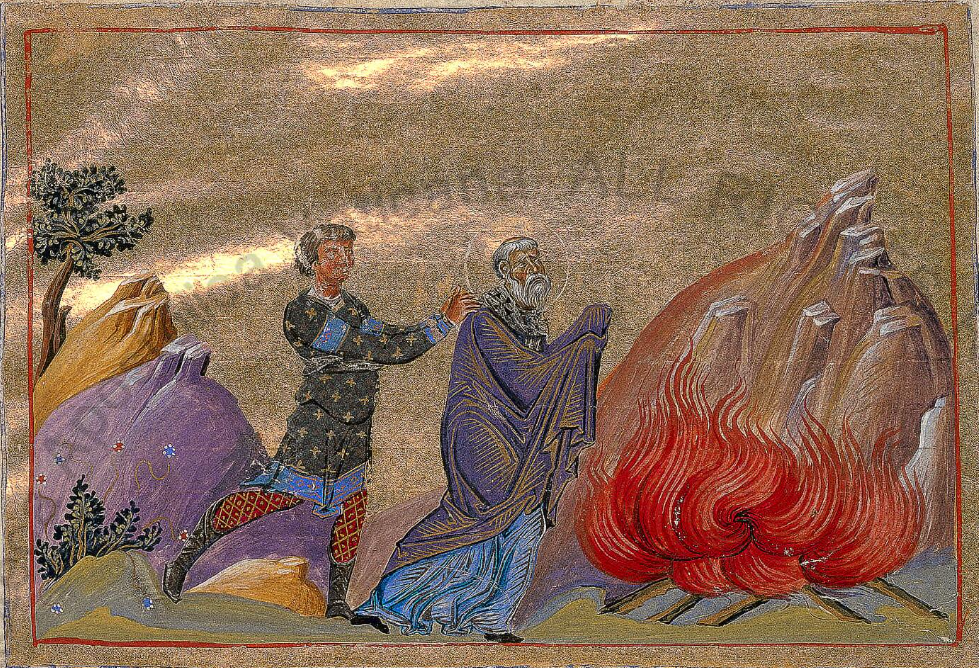

Polycarp of Smyrna
The Martyrdom of Polycarp is a letter from the church of Smyrna to the church of Philomelium and "to all the congregations of the holy and catholic Church in every place." It tells how the aged bishop was hunted down, brought to the stadium and urged by the proconsul to "Swear by the fortune of Cæsar; repent, and say, Away with the Atheists." His answer is one of the most quoted lines in early Christian writing: "Eighty and six years have I served Him, and He never did me any injury: how then can I blaspheme my King and my Saviour?" Pressed again, he said: "hear me declare with boldness, I am a Christian."3 He was burned, and the letter calls him "the twelfth that was martyred in Smyrna (reckoning those also of Philadelphia)," a detail that shows how small the numbers in a single outbreak could be.3
The date is disputed. Chapter 21 of the letter gives the day as "the second day of the month Xanthicus just begun," a "great Sabbath," with Statius Quadratus as proconsul. The Roberts and Donaldson translation printed at New Advent reads "the seventh day before the Kalends of May," but the translations made from the Greek by J. B. Lightfoot (1891) and Kirsopp Lake (Loeb Classical Library, 1912) read "the seventh before the calends of March" and "the seventh day before the kalends of March," which gives February 23.347 Working from the proconsul's term, many scholars place the death in 155 or 156; Eusebius placed it later, under Marcus Aurelius, which would put it in the 160s.22 A range of about 155 to 160 is the cautious summary, with 167 as Eusebius's alternative. The letter also says something about Christian practice: it criticizes a Phrygian named Quintus who "forced himself and some others to come forward voluntarily" and then lost his nerve, adding, "we do not commend those who give themselves up [to suffering], seeing the Gospel does not teach so to do."3 The church did not, in its own account, seek out death.
Justin and his companions at Rome
Justin, the philosopher-apologist discussed below, was tried at Rome with six companions before the city prefect Rusticus, usually dated about 165. The short Acts of Justin preserve what reads like a court record. The prefect asks where the Christians meet; Justin answers, "Where each one chooses and can," and gives his own lodging, "above one Martinus, at the Timiotinian Bath." Each companion is asked in turn whether he is a Christian. Euelpistus, "a servant of Cæsar," answers, "I too am a Christian, having been freed by Christ." The prefect's sentence reads: "Let those who have refused to sacrifice to the gods and to yield to the command of the emperor be scourged, and led away to suffer the punishment of decapitation, according to the laws."23 Eusebius says the charge was brought through the hostility of a Cynic philosopher named Crescens, whom Justin had beaten in public debate.22
Lyon and Vienne in 177
The longest and most harrowing second-century account is the letter of "the servants of Christ residing at Vienne and Lyons, in Gaul, to the brethren through out Asia and Phrygia," which Eusebius copied into book 5 of his Church History. Eusebius dates the events to "the seventeenth year of the Emperor Antoninus Verus," that is, Marcus Aurelius, which is 177.7 The letter describes Christians first shut out of "houses and baths and markets," then attacked by crowds, then arrested and tried. The aged bishop Pothinus, "more than ninety years of age," died in prison after his interrogation. A slave woman named Blandina was tortured "from morning till evening," and her only reply was, "I am a Christian, and there is nothing vile done by us." The deacon Sanctus would not even give his name or city, and answered every question, "I am a Christian."7
The letter is also a precise legal document. The governor wrote to the emperor, and "Cæsar commanded that they should be put to death, but that any who might deny should be set free." At the public festival that followed, the governor "beheaded those who appeared to possess Roman citizenship, but he sent the others to the wild beasts."7 This is Trajan's rule applied seventy years later, with the difference between citizen and non-citizen punishments laid out exactly. The letter does not give a total number of dead. Eusebius says, in his introduction, that "judging by the number in a single nation, myriads suffered martyrdom throughout the world," a large figure he infers from one region, which shows his habit of rounding up.7
Perpetua and Felicity at Carthage, 203
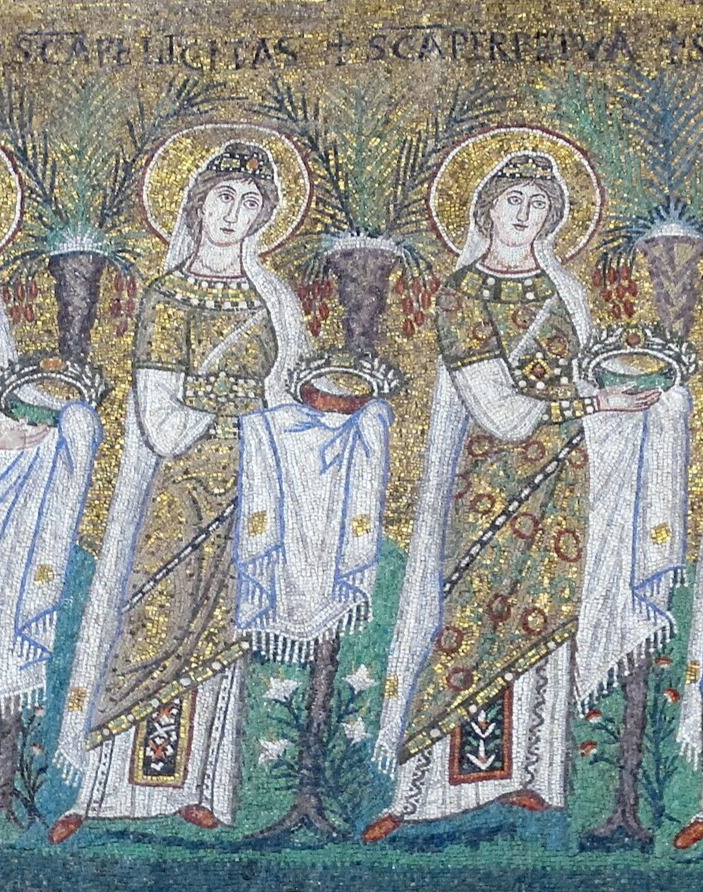

The Passion of Perpetua and Felicity is one of the most remarkable texts of the ancient world, because much of it claims to be in a young woman's own words. The editor's introduction describes Vivia Perpetua as "respectably born, liberally educated, a married matron," about twenty-two years old, with an infant son, and says that "from this point onward she shall herself narrate the whole course of her martyrdom, as she left it described by her own hand."24 She was a catechumen (a Christian under instruction, not yet baptized) when arrested at Carthage with others, including the slave woman Felicitas.
Her account of her father's pleas is famous. She pointed to a water pitcher and asked if it could be called by any other name than what it was. "And he said, 'No.' 'Neither can I call myself anything else than what I am, a Christian.'" At the hearing the procurator Hilarianus, who had "just received the power of life and death in the place of the proconsul Minucius Timinianus, who was deceased," urged her: "Spare the grey hairs of your father, spare the infancy of your boy, offer sacrifice for the well-being of the emperors." She answered, "I will not do so," and to his question, "Are you a Christian?" she said, "I am a Christian."24 Felicitas, who had been pregnant when she was arrested and was eight months along as the day of the games drew near, gave birth in prison to a girl, "which a certain sister brought up as her daughter."24
The date of 203 comes from details inside the text: the games were held for "the birthday of Geta Cæsar," the younger son of the emperor Septimius Severus, and the names of Hilarianus and of the dead proconsul fit that year.24 The editor who framed Perpetua's diary is unknown. The New Advent edition files the text under Tertullian, and older scholars often proposed him as the editor, but that remains a guess. The work shows a church that valued visions and the Spirit's present activity; its preface argues that "new virtues also may testify that one and the same Holy Spirit is always operating even until now," which has led some readers to link it with the New Prophecy (Montanist) movement discussed in lesson 02.
Decius and the certificates of sacrifice, 250
For most of the first half of the third century the church grew in relative quiet, with sharp local exceptions. Then came the first persecution ordered by an emperor for the whole empire. Decius took power in 249 after defeating Philip the Arab, and in late 249 or early 250 he issued an edict ordering the inhabitants of the empire to sacrifice to the gods. The text of the edict does not survive.25 Its effects do, in two kinds of sources that confirm each other: Christian letters written in the middle of the crisis, and the certificates themselves.
The libelli: certificates on papyrus
Between the late nineteenth and early twentieth centuries, excavators and dealers in Egypt turned up papyrus certificates, called libelli (singular libellus, "little book" or petition), in which a person declared that he had always sacrificed and had now done so before the commissioners, and the commissioners signed that they had seen it. John R. Knipfing published 41 of them in the Harvard Theological Review in 1923. A 2025 review in the Bryn Mawr Classical Review, by Arne Jönsson of Lund University, of Reinhard Selinger's book on Decius (2024) counts 47 now known, most from the village of Theadelphia in the Fayum.25 The papyrologist Jennifer Cromwell's published list of all the certificates dates them between late May and July 250.26
One of them, held by the University of Michigan (P.Mich. inv. 262), reads in the university's translation:
"To the Superintendents of Sacrifices, from Inarous, son of Akis, from the village of Theoxenis, with his children Aian and Heras, all being of the Village of Theadelphia: It was always our practice to sacrifice to the gods, and now, in your presence, in accordance with the order, we have sacrificed, have made libations, and have tasted the offerings; and we request you to certify this. Farewell." [In a second hand:] "We, Aurelius Serenus and Hermas, saw you sacrificing." [First hand:] "The first year of the Emperor Caesar Gaius Messius Quintus Trajanus Decius Pius Felix Augustus, Pauni 23."27
Pauni 23 in the Egyptian calendar falls in June 250. Three things about the certificates matter for the history. First, the formula ("we have sacrificed, have made libations, and have tasted the offerings") repeats from certificate to certificate, which suggests it quotes the edict's requirement. Second, the certificates do not mention Christians at all, and at least one was issued to a pagan priestess of the crocodile god Petesouchos. Jönsson's review notes that, since the edict is lost, "it cannot be determined whether the edict targeted a specific group of people."25 Selinger argues that the order was a general loyalty sacrifice marking the new emperor's accession; the older view, which follows the Christian writers, sees it as aimed at the church. Third, whatever Decius intended, the effect on Christians was devastating, because a universal test of sacrifice was exactly the test they could not pass.
The church in the crisis
Fabian, bishop of Rome, was among the first to die; Eusebius says Decius "commenced a persecution of the churches, in which Fabianus suffered martyrdom at Rome." Alexander of Jerusalem and Babylas of Antioch died in prison.28 Origen, the great Alexandrian teacher, was imprisoned and tortured and died some years later. Dionysius of Alexandria, quoted by Eusebius, describes the arrival of the decree in his city with unusual frankness: "All truly were affrighted. And many of the more eminent in their fear came forward immediately ... And as their names were called they approached the impure and impious sacrifices. Some of them were pale and trembled as if they were not about to sacrifice, but to be themselves sacrifices and offerings to the idols."28
Cyprian and the lapsed
At Carthage the bishop Cyprian withdrew into hiding and governed his church by letter, a choice some critics held against him. When the persecution eased in 251, he wrote On the Lapsed, the main source for the crisis the persecution left behind. Some Christians, he writes, "did not wait to be apprehended ere they ascended, or to be interrogated ere they denied. ... They ran to the market-place of their own accord."29 Others had not sacrificed but had obtained certificates, by bribery or through a friend, saying they had. Cyprian refused to treat them lightly: those "who, although they have not polluted their hands with abominable sacrifices, yet have defiled their conscience with certificates" had still, in his words, "served an earthly master in that he has obeyed his edict."29 Later writers called the two groups the sacrificati (those who sacrificed) and the libellatici (those who held certificates).
The question of how to readmit the lapsed split the church. Some confessors (Christians who had suffered without denying) issued letters of peace restoring the lapsed on their own authority; Cyprian insisted that the bishops in council must decide, with penance. At Rome a rigorist party gathered around the presbyter Novatian (Eusebius calls him Novatus), who held that the church could not restore those who had sacrificed; his followers, Eusebius says, called themselves Cathari, "the pure," and a separate Novatianist church lasted for centuries.28 The dispute over who may forgive and readmit, and whether the church is a society of the pure or a hospital for sinners, came back with the Donatists after the Great Persecution and is treated in later lessons. Decius himself was killed fighting the Goths at Abrittus in 251.25 Lactantius, writing about sixty years later, saw his death as judgment: "he lay to be devoured by wild beasts and birds, a fit end for the enemy of God" (the comma replaces a dash in the translation).30
Valerian, 257 to 258
The emperor Valerian (253 to 260) aimed his measures at the church's leaders and property. A first edict in 257 ordered clergy to sacrifice and forbade Christian meetings and visits to the cemeteries. Dionysius of Alexandria records the words of the prefect Aemilianus banishing him: "it shall by no means be permitted you or any others, either to hold assemblies, or to enter into the so called cemeteries."31 A second rescript in 258 went further. Cyprian, writing from Carthage to a fellow bishop named Successus, reports its terms as his messengers brought them from Rome:
"Valerian had sent a rescript to the Senate, to the effect that bishops and presbyters and deacons should immediately be punished; but that senators, and men of importance, and Roman knights, should lose their dignity, and ... be deprived of their property; and if, when their means were taken away, they should persist in being Christians, then they should also lose their heads; but that matrons should be deprived of their property, and sent into banishment."32
In the same letter Cyprian reports that "Xistus was martyred in the cemetery on the eighth day of the Ides of August, and with him four deacons," that is, Sixtus II, bishop of Rome, on August 6, 258.32 Cyprian himself was tried before the proconsul Galerius Maximus and beheaded outside Carthage. The Proconsular Acts of his martyrdom give the date as September 14 and record that when the sentence was read, "It is decided that Thascius Cyprian should die by the sword," he answered, "Thanks be to God!" (Latin Deo gratias).33 Valerian was captured by the Persian king Shapur I (Lactantius's "Sapores") in 260 and died in captivity.30 His son Gallienus at once issued a rescript to the bishops allowing them to recover their "places of religious worship," which Eusebius quotes in a Greek translation.31
The forty years' peace, 260 to 303
From Gallienus's rescript to the Great Persecution, the church had more than forty years without imperial action against it. In this time Christians built large churches in public view. Lactantius says the great church at Nicomedia stood "on rising ground" within sight of the imperial palace.30 The house church at Dura-Europos on the Euphrates, adapted from a private house in the third century and shown in lesson 01, is the oldest Christian building known to archaeology and was in use before this peace began. Christians served in the army and in the imperial household. When persecution returned, it struck a church that was larger, more visible and more property-owning than any before.
The Great Persecution, 303 to 311
The last and largest persecution began under the four-emperor system (the Tetrarchy) of Diocletian. The two main witnesses are Christians who lived through it. Lactantius, a teacher of Latin rhetoric at Nicomedia, wrote On the Deaths of the Persecutors soon after the events, probably about 315, addressing it to a confessor named Donatus who had spent six years in prison, a short and angry book arguing that every persecuting emperor died a bad death. Eusebius, at Caesarea in Palestine, covered the persecution in book 8 of his Church History and in a separate work, The Martyrs of Palestine, describing what he saw. Both are partisan; both are also contemporary, and they agree on the main events.
The four edicts
Lactantius says Diocletian, pressed by his junior emperor Galerius, chose "the festival of the god Terminus, celebrated on the sevens of the kalends of March," that is, February 23, 303, "to terminate, as it were, the Christian religion." At dawn officers broke into the church at Nicomedia; "the books of the Holy Scriptures were found, and they were committed to the flames," and the Praetorian Guards "in a few hours levelled that very lofty edifice with the ground." The next day an edict was published "depriving the Christians of all honours and dignities," exposing them to torture regardless of rank, allowing every lawsuit against them and barring them from bringing suits themselves.30
Eusebius gives the same first edict from the Palestinian side, dated "in the nineteenth year of the reign of Diocletian, in the month Dystrus, called March by the Romans": royal edicts "commanding that the churches be leveled to the ground and the Scriptures be destroyed by fire, and ordering that those who held places of honor be degraded, and that the household servants, if they persisted in the profession of Christianity, be deprived of freedom." Then "other decrees were issued, commanding that all the rulers of the churches in every place be first thrown into prison, and afterwards by every artifice be compelled to sacrifice."34 (The edict reached Palestine weeks after its publication at Nicomedia, which explains the month.) Eusebius adds that "other decrees followed the first, directing that those in prison if they would sacrifice should be permitted to depart in freedom, but that those who refused should be harassed with many tortures."34 Historians therefore usually count four edicts: the first (303) against churches, books and Christian status; the second and third (303) against the clergy, with release for those who sacrificed; and the fourth (304), which ordered the general population to sacrifice, as Decius had. Lactantius describes altars placed "in the courts of justice, hard by the tribunal, that every litigant might offer incense before his cause could be heard."30
The persecution was uneven by region. In the West, Constantius (father of Constantine), who ruled Gaul and Britain, did little. Lactantius says that, "lest he should have seemed to dissent from the injunctions of his superiors," he "permitted the demolition of churches," but spared the people; Eusebius goes further and says Constantius "took not the smallest part in the war against us."3034 In Italy, Lactantius says, Maximian "enforced the edicts throughout his dominions," and in the West the measures faded after Diocletian and Maximian stepped down in 305.30 In the East, under Galerius and his nephew Maximinus Daia, they lasted with breaks until 311, and in Maximinus's lands they flared again until 313. The demand to hand over Scripture produced its own crisis: in Africa clergy who surrendered books were called traditores ("handers-over," the source of the word traitor), and the quarrel over them produced the Donatist schism, which Schaff lists with the Meletian schism in Egypt as a direct result of the persecution's "hatred towards apostates."12
What Lactantius and Eusebius saw
Both witnesses describe the persecution's violence in detail, and their accounts should be read for what they are: testimony from survivors writing for fellow Christians soon after the events. Lactantius says that at Nicomedia, after fires broke out in the palace, "Presbyters and other officers of the Church were seized, without evidence by witnesses or confession, condemned, and together with their families led to execution. In burning alive, no distinction of sex or age was regarded."30 Eusebius describes the prisons "filled with bishops, presbyters and deacons, readers and exorcists, so that room was no longer left in them for those condemned for crimes," and he names the members of the imperial household at Nicomedia, led by Dorotheus, who died for their faith.34 He also admits, as Cyprian had in the Decian crisis, that many gave way: "a multitude of others, benumbed in spirit by fear, were easily weakened at the first onset."34
Galerius and the edict of toleration, 311
Galerius, the emperor Lactantius blames most for the persecution, fell gravely ill in 310 and 311. Lactantius describes the disease in grim detail and says that "when he was near his end, he published an edict." The edict, as Lactantius quotes it in the translation of William Fletcher, is an admission that the policy had failed:
"After the publication of our edict, ordaining the Christians to betake themselves to the observance of the ancient institutions, many of them were subdued through the fear of danger, and ... many of them were exposed to jeopardy; nevertheless, because great numbers still persist in their opinions, and because we have perceived that at present they neither pay reverence and due adoration to the gods, nor yet worship their own God, therefore we, from our wonted clemency in bestowing pardon on all, have judged it fit to extend our indulgence to those men, and to permit them again to be Christians, and to establish the places of their religious assemblies; yet so as that they offend not against good order. ... Wherefore it will be the duty of the Christians, in consequence of this our toleration, to pray to their God for our welfare, and for that of the public, and for their own."30
Lactantius dates it exactly: "This edict was promulgated at Nicomedia on the day preceding the kalends of May, in the eighth consulship of Galerius, and the second of Maximin Daia," that is, April 30, 311. He adds that the prison gates were opened and that his friend Donatus walked free after six years, and that Galerius died within days.30 Eusebius gives a Greek version of the same decree in book 8 of the Church History, issued in the names of the ruling emperors.34
The edict of 311 is often confused with the so-called Edict of Milan of 313, which was in fact a letter of the emperor Licinius issued after his agreement with Constantine, preserved by Lactantius and Eusebius. The 311 edict permitted Christians to exist and meet; the 313 letter went further and ordered confiscated church property returned. Maximinus Daia renewed persecution in his eastern lands until his defeat in 313. That story, with Constantine's victory at the Milvian Bridge on October 28, 312, belongs to lesson 04, Constantine and Nicaea.
The apologists: answering Rome in writing
The apologists were Christian writers who addressed emperors, governors or the educated public to defend the faith and to ask for fair treatment. Their works are the first Christian attempts to explain the faith to outsiders in the outsiders' own terms, often the terms of Greek philosophy. They share a set of arguments that recur from writer to writer: Christians are law-abiding and pray for the emperor; the rumors of crimes are false and have never been proved; Christians are punished for a name, which no just court does; the pagan gods are either false or demons; and Christianity is the true philosophy, older than the Greeks because rooted in Moses and the prophets.
Quadratus and Aristides
The earliest apologists known by name addressed the emperor Hadrian (117 to 138). Of Quadratus only a fragment survives, quoted by Eusebius. Eusebius says that "Aristides also, a believer earnestly devoted to our religion, left, like Quadratus, an apology for the faith, addressed to Adrian."22 For centuries the Apology of Aristides was thought lost; in 1889 J. Rendel Harris found a Syriac version of the whole work at the monastery of Saint Catherine on Mount Sinai, and J. A. Robinson then recognized the Greek text embedded in a medieval Christian romance, the Life of Barlaam and Josaphat.48 The Syriac heading, in D. M. Kay's translation for the Ante-Nicene Fathers, addresses "Cæsar Titus Hadrianus Antoninus," a name that fits Antoninus Pius (138 to 161) better than Hadrian, so the date is disputed.35
Aristides compares the "races" of humankind by what they worship (barbarians, Greeks, Jews and Christians) and ends with a portrait of Christian life: "their oppressors they appease (lit: comfort) and make them their friends; they do good to their enemies; ... if one or other of them have bondmen and bondwomen or children, through love towards them they persuade them to become Christians, and when they have done so, they call them brethren without distinction."35
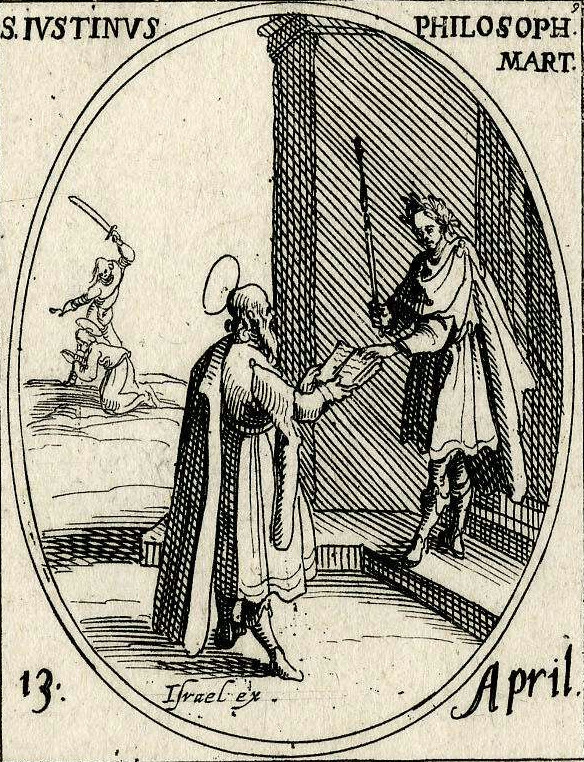

Justin Martyr
Justin is the most important of the second-century apologists. He opens his First Apology with an address to the emperor Antoninus Pius, his adopted sons, the Senate and the Roman people, identifying himself as "Justin, the son of Priscus and grandson of Bacchius, natives of Flavia Neapolis in Palestine" (Nablus today), and presenting "this address and petition on behalf of those of all nations who are unjustly hated and wantonly abused, myself being one of them."1 The work is usually dated to the early 150s. It is translated in the Ante-Nicene Fathers by Marcus Dods and George Reith.
Justin's case rests on reason and fairness. He asks that charges be investigated and that Christians who are guilty of real crimes be punished, but that no one be condemned "for the sake of a wicked rumour." He puts the Christian position on the judges' power plainly: "you can kill, but not hurt us."1 He argues that Christ is the divine Word (the Logos) "of whom every race of men were partakers; and those who lived reasonably are Christians, even though they have been thought atheists; as, among the Greeks, Socrates and Heraclitus, and men like them."1 The idea made his apology a bridge to educated pagans, and it has been argued over ever since. And he gives the earliest full description of Sunday worship outside the New Testament:
"And on the day called Sunday, all who live in cities or in the country gather together to one place, and the memoirs of the apostles or the writings of the prophets are read, as long as time permits; then, when the reader has ceased, the president verbally instructs, and exhorts to the imitation of these good things. Then we all rise together and pray, and, as we before said, when our prayer is ended, bread and wine and water are brought, and the president in like manner offers prayers and thanksgivings, according to his ability, and the people assent, saying Amen."1
This passage was written in part to answer the rumors: it tells the emperors exactly what happened at a Christian meeting, down to the collection for "the orphans and widows." Catholic, Orthodox and Protestant writers have all quoted it in later arguments over the shape of the liturgy and the meaning of the Eucharist. Justin also wrote a Second Apology and a long Dialogue with Trypho, a debate with a Jewish teacher. His trial and death about 165, recorded in the Acts of Justin, are described above.
Athenagoras of Athens
Athenagoras, a Christian philosopher of Athens, addressed his Plea for the Christians to Marcus Aurelius and his son Commodus, usually dated about 177, the same year as the martyrdoms at Lyon. His Plea answers the three charges point by point: "Three things are alleged against us: atheism, Thyestean feasts, Œdipodean intercourse."2 He argues that Christians cannot be atheists since they worship one God, and contains one of the earliest attempts to explain the relation of Father, Son and Spirit in philosophical language. His challenge to the emperors is direct: "if these charges are true, spare no class: proceed at once against our crimes; destroy us root and branch, with our wives and children, if any Christian is found to live like the brutes."2 The translation is by B. P. Pratten in the Ante-Nicene Fathers.
The Epistle to Diognetus
The Epistle to Diognetus is an anonymous letter to an inquirer of that name, of uncertain date (most scholars place it in the second or early third century). It survived in a single medieval manuscript, which perished in the siege of Strasbourg in 1870.49 Its fifth chapter is the best-known description of Christians as resident aliens in the world:
"For the Christians are distinguished from other men neither by country, nor language, nor the customs which they observe. ... They dwell in their own countries, but simply as sojourners. As citizens, they share in all things with others, and yet endure all things as if foreigners. Every foreign land is to them as their native country, and every land of their birth as a land of strangers. They marry, as do all [others]; they beget children; but they do not destroy their offspring. They have a common table, but not a common bed."36
The line about not destroying offspring refers to the Roman practice of exposing unwanted infants, and "a common table, but not a common bed" answers the rumor of incest. The translation is by Alexander Roberts and James Donaldson in the Ante-Nicene Fathers.
Minucius Felix and the Octavius
The Octavius of Minucius Felix is a Latin dialogue set on the beach at Ostia, in which a pagan, Caecilius, attacks Christianity and a Christian, Octavius, answers him, with the author as judge. Its date relative to Tertullian's Apology, which it closely resembles in places, is disputed; most place it in the late second or early third century. Caecilius's speech is valuable because it gathers the pagan charges in one place, including the infant-killing story quoted above, and the charge that Christians worshipped the head of an ass, a charge the Alexamenos graffito also reflects.8 At the end Caecilius is persuaded, and the narrator reports that they "departed, glad and cheerful."8
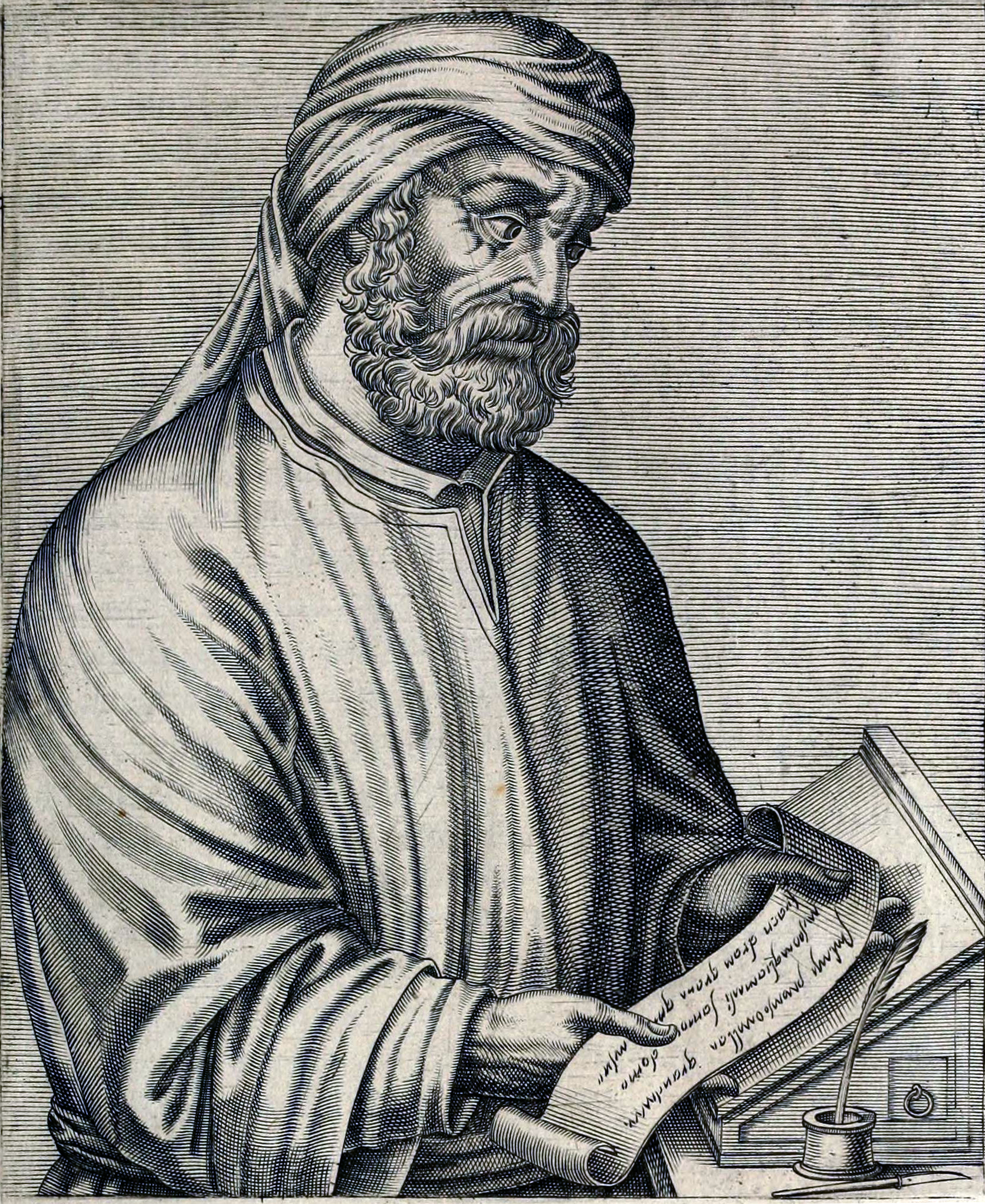

Tertullian's Apology, about 197
Tertullian, a native of Carthage and the first major Christian author to write in Latin, addressed his Apology (Apologeticum) to the provincial governors of the Roman Empire, usually dated 197. It is the most forceful of the apologies, written by a man trained in rhetoric and probably in law. He attacks the procedure first: in ordinary trials the torturer extracts confessions, but with Christians "he is not to make them confess what they do, but to make them deny what they are."5 He answers the charge of disloyalty by describing Christian prayer for the emperors, and he answers the rumors by challenging the governors to prove them. He mocks the habit of blaming Christians for every disaster (the Tiber and Nile passage quoted at the start of this lesson). And he uses history: "Consult your histories; you will there find that Nero was the first who assailed with the imperial sword the Christian sect."5
In a later short work, To Scapula, addressed to the proconsul of Africa about 212, Tertullian made an argument that would echo for centuries: "it is a fundamental human right, a privilege of nature, that every man should worship according to his own convictions: one man's religion neither harms nor helps another man. It is assuredly no part of religion to compel religion."37 (The translation is S. Thelwall's, and "a fundamental human right" is his nineteenth-century wording; the Latin speaks of what belongs to human law and natural power.) Tertullian later broke with the Catholic church at Carthage and joined the New Prophecy; that side of his life belongs to lesson 02.
"The blood of Christians is seed": what Tertullian actually wrote
The most famous sentence of any apologist comes near the end of Tertullian's Apology, in chapter 50. The usual English form, "The blood of the martyrs is the seed of the church," is a paraphrase. Here is what Tertullian wrote, in the Latin text as given by The Latin Library:
"Plures efficimur, quotiens metimur a vobis: semen est sanguis Christianorum."6
Thelwall's Ante-Nicene translation renders it: "The oftener we are mown down by you, the more in number we grow; the blood of Christians is seed."5 Three differences from the popular version are plain. Tertullian wrote "Christians," not "martyrs." He did not write "of the church." And the sentence is part of a harvest image: metimur means "we are reaped" or "mown," so the blood is seed sown by the very reaping. The fuller paraphrase became a motto in later church history; Philip Schaff printed "The blood of martyrs is the seed of the church" on the title page of the second volume of his History of the Christian Church.12
The surrounding lines matter as much as the slogan. Tertullian continues that Roman writers praised endurance of pain and death, "and yet their words do not find so many disciples as Christians do, teachers not by words, but by their deeds. That very obstinacy you rail against is the preceptress. For who that contemplates it, is not excited to inquire what is at the bottom of it?"5 His point is that the steadiness of Christians under trial made people curious, and curiosity made converts. Whether persecution in fact grew the church is a separate historical question: in the Decian and Diocletianic crises many Christians lapsed, and the church's fastest growth may have come in the long periods of peace.
Origen, Against Celsus
The fullest pagan attack on Christianity from the second century, The True Word (or True Discourse) of the philosopher Celsus, written about 170 to 180, survives only because Origen quoted it at length in his reply. Eusebius says Origen wrote the eight books of Against Celsus when he was "over sixty years old," in the reign of Philip (244 to 249), which gives a date of about 248.28 Celsus mocked Christianity as a religion of the uneducated. Origen quotes him: "We see, indeed, in private houses workers in wool and leather, and fullers, and persons of the most uninstructed and rustic character, not venturing to utter a word in the presence of their elders and wiser masters; but when they get hold of the children privately, and certain women as ignorant as themselves, they pour forth wonderful statements."38
Origen's answer contains a sentence that is central to the question of numbers. Writing just before the Decian persecution, he says that God allowed "some, on special occasions, and these individuals who can be easily numbered," to die for the faith, "God not permitting the whole nation to be exterminated."38 A Christian scholar who had lost his own father in persecution, and who would himself be tortured under Decius, thought the martyrs up to his time were few enough to count. The translation is Frederick Crombie's in the Ante-Nicene Fathers.
The Alexamenos graffito: a pagan joke on a wall
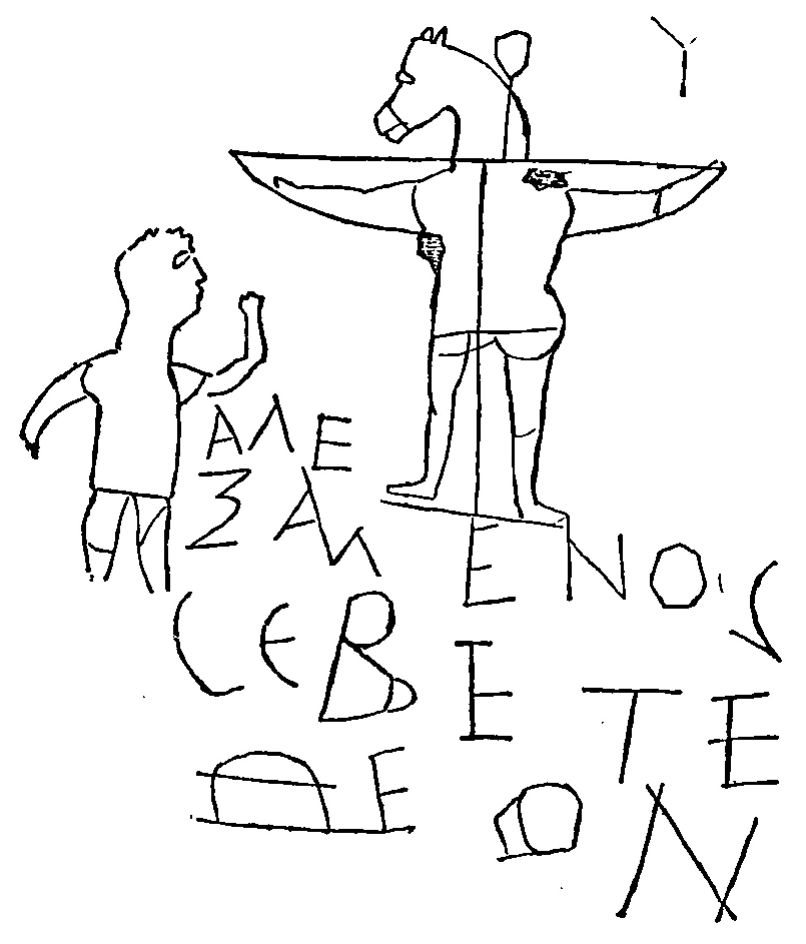

Among the most striking pieces of physical evidence for how pagans saw Christians is a crude drawing scratched into the plaster of a room in the Paedagogium, a building on the Palatine Hill in Rome connected with the imperial household. It shows a man with the head of a donkey, fastened to a cross, and a second figure lifting a hand toward him. The Greek letters below read ALEXAMENOS SEBETE THEON, which Orazio Marucchi in the Catholic Encyclopedia (1908) renders "Alexamenos adores God" and Philip Schaff renders "Alexamenos worships his God." Schaff says it was discovered in 1857; Marucchi calls it "an impious caricature in mockery of the Christian Alexamenos, drawn by one of his pagan comrades."3912
The donkey's head connects the drawing to a charge the apologists answered in writing. Tertullian wrote, "you have dreamed that our God is an ass's head" (somniastis caput asininum esse Deum nostrum, Apology 16), and Minucius Felix's pagan speaker repeats the same rumor; Tertullian traced it to Tacitus, who had told a similar story about the Jews.128 The graffito is usually dated to around 200, the period of Tertullian, though proposed dates range from the late first to the third century. Its importance is double: it is among the oldest surviving images of the crucifixion of Jesus, and it was drawn by an enemy. It shows that by about 200 a Christian in the imperial household could be known as one and mocked for it, and that the cross, a shameful death, was what outsiders thought of first.
The catacombs: what they were and were not
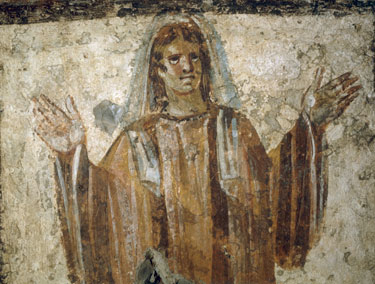

Popular books and films often show early Christians living in the catacombs, worshipping there in secret and hiding from soldiers in the tunnels. The record supports a narrower picture.
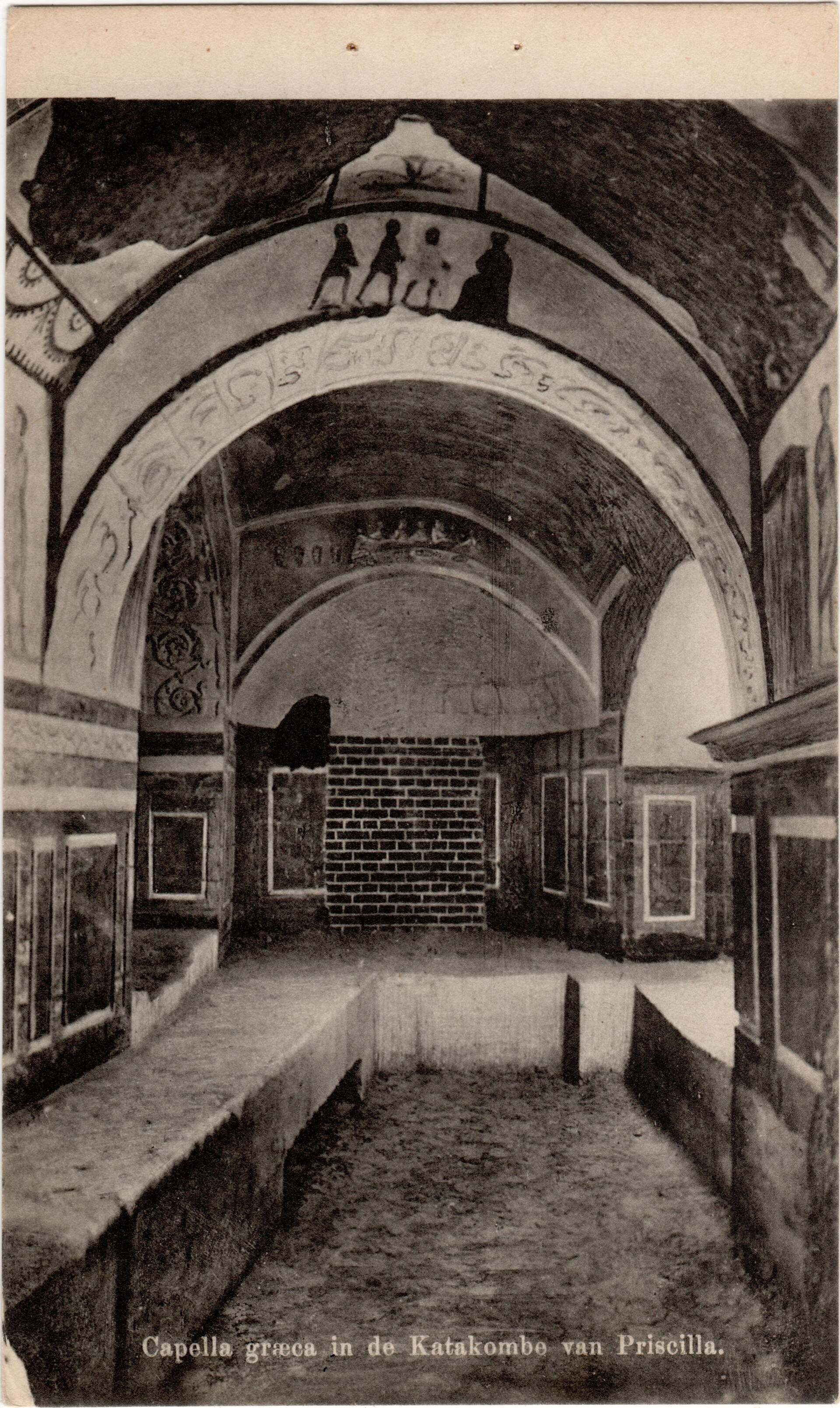
What they were. The catacombs of Rome are underground cemeteries cut into the soft volcanic rock (tufa) outside the city. Anton de Waal's article "Roman Catacombs" in the Catholic Encyclopedia (1908), written by a priest-archaeologist who worked in them, explains that the Romans usually cremated their dead, while the Jews of Rome "retained their native method of burial" and laid out Jewish catacombs "before Christianity appeared in Rome." Christians, who buried rather than cremated, followed the same method, often beginning from a family tomb on land owned by a wealthy believer. "Thus in the course of three hundred years some fifty catacombs, large and small, formed a wide circle around the city, the majority being about half an hour's walk from the city gate." The article estimates "the number of graves in the Roman catacombs ... at two millions," a figure for all burials over several centuries, of ordinary Christians as well as martyrs.20
Why they were not hiding places. De Waal notes that "the Romans had knowledge of the spots where the Christians buried their dead; but according to old laws every spot where a body lay was under the protection of Roman law and custom that guaranteed the inviolability of burial places."20 A place the authorities knew about, owned by the church or its members and open to funeral processions, was a poor hideout. The narrow galleries and the "odour of decay" that de Waal describes made them unfit to live in.20 Christians gathered at the tombs for funerals and for meals on the anniversaries of martyrs, as the Smyrna letter promises to do for Polycarp, but their regular Sunday worship took place in houses and, later, in church buildings above ground.3
Where the cemeteries did enter the persecutions. Because the cemeteries were known and church-held, emperors could target them. Valerian's prefect in Egypt forbade Christians "to enter into the so called cemeteries" in 257, and Sixtus II of Rome was killed "in the cemetery" in 258 with four deacons.3132 De Waal says Decius and Diocletian declared the catacomb grounds state property; the contemporary letters cited here describe the cemetery ban under Valerian. Either way, the catacombs were a target of persecution because they were known, which is the opposite of a secret refuge. Candida Moss, quoted in a 2013 review of her book, puts the point for the later third century in one line: "Christians weren't hiding in catacombs; they were out in the open."40
What happened afterward. After the persecutions the martyrs' tombs drew pilgrims, and bishops of Rome decorated them. When the city declined, popes from Paul I (757 to 767) onward moved martyrs' remains into the churches inside the walls, and de Waal says that "by the twelfth century they were completely forgotten." A catacomb on the Via Salaria was found by accident in 1578, and Antonio Bosio's Roma Sotterranea, published in 1632, began their modern study.20 The romantic picture of a hidden church underground grew partly from that rediscovery, long after the events.

How many died? The numbers and who gives them
No ancient writer counted the martyrs, and every modern number is an estimate built on partial lists. The estimates can be grouped by what they rest on.
What the ancient writers said
The ancient Christian writers give impressions without counts, and they point in different directions. Tacitus speaks of "an immense multitude" (multitudo ingens) in Rome in 64, a phrase from a hostile witness who had no reason to inflate Christian suffering.1314 1 Clement speaks of "a great multitude of the elect."17 The Smyrna letter counts Polycarp as only "the twelfth" martyr of his city's outbreak.3 Origen, about 248, says the martyrs to his time could "be easily numbered."38 Eusebius, reporting Lyon in 177, infers that "myriads suffered martyrdom throughout the world" from the numbers in "a single nation."7
Gibbon's calculation and Schaff's reply
The first modern attempt at a count was Edward Gibbon's, in chapter 16 of The History of the Decline and Fall of the Roman Empire (1776). He started from Eusebius's Martyrs of Palestine, which names the martyrs of that province, and found "that no more than ninety-two Christians were entitled to that honorable appellation." Treating Palestine as about one sixteenth of the eastern empire, he multiplied: "the whole might consequently amount to about fifteen hundred" in the East, and adding the West, "the multitude of Christians in the Roman empire, on whom a capital punishment was inflicted by a judicial sentence, will be reduced to somewhat less than two thousand persons" for the Great Persecution.41 Gibbon's wording limits the figure to those executed "by a judicial sentence," which leaves out those who died in prison, in the mines or at the hands of crowds.
Philip Schaff answered in his History of the Christian Church that the Palestinian martyrs of Eusebius "are only a select list bearing a similar relation to the whole number of victims as the military lists of distinguished fallen officers to the large mass of common soldiers, and form therefore no fair basis for the calculation of Gibbon." He also wrote that "the number of martyrs cannot be estimated with any degree of certainty," and that "Dodwell and Gibbon have certainly underrated it, as far as Eusebius, the popular tradition since Constantine, and the legendary poesy of the middle age, have erred the other way."12
Frend and the modern estimates
W. H. C. Frend, whose Martyrdom and Persecution in the Early Church (1965) remains the standard large study, estimated that between 3,000 and 3,500 Christians were killed in the Great Persecution of 303 to 311 (the figure is regularly cited to pages 393 to 394 of that book).42 G. E. M. de Ste. Croix, in a long 1954 study of the Great Persecution and in his 1963 article, argued that Christian tradition had exaggerated its scale even beyond what Gibbon allowed, while stressing that the refusal to sacrifice made Christians genuinely odious to pagans.10 No reliable figure exists for the two centuries before Decius; the documented cases are local and small, from a dozen at Smyrna to the several dozen implied at Lyon, with the exception of Nero's Rome.
Candida Moss and her critics
In 2013 Candida Moss, then a professor of New Testament and early Christianity at the University of Notre Dame, published The Myth of Persecution: How Early Christians Invented a Story of Martyrdom (HarperOne). Her argument, as her reviewers summarize it, has several parts. Deliberate, empire-wide persecution ordered by emperors occupied only about a decade of the first three centuries (summaries of the book give figures from fewer than ten to at most twelve years). Most martyr stories are later inventions, and even the earliest were edited; Publishers Weekly's review reports her conclusion that "only six accounts of martyrdom from these years," including Perpetua's and Justin's, "can be considered reliable," and even those "were significantly modified over time."43 Romans, she argues, punished Christian refusal to sacrifice as a threat to political and social order. And the idea of a church always under attack, shaped by Eusebius, has been used since to justify hostility to opponents.
Moss does not deny that Christians died. Mary Ann Donovan's review in the Jesuit magazine America quotes her: "the dislike of Christians was fairly widespread, and some Christians were in fact put to death by Romans merely for being Christians."40 The dispute is over scale, frequency and the reliability of the stories, and over the modern lessons she draws.
Responses divided sharply. Some historians said her core historical claims, that persecution was sporadic and that many martyr acts are late legends, were already the scholarly consensus; Greg Carey wrote in The Christian Century that her basic position would surprise few historians. Critics objected to the framing and the title. Collin Garbarino's review in Themelios charged that Moss built "a straw man" by deriding "the Sunday-school story" of ceaseless persecution, a view he said no one familiar with church history holds.44 N. Clayton Croy, in the Review of Biblical Literature, called it a deeply flawed work of revisionist history; Ephraim Radner in First Things, Michael Haykin and Paul L. Maier also wrote sharply critical reviews, and Paul Hartog took a middle position, agreeing that persecution was generally sporadic while insisting that real and serious maltreatment occurred.45 The fair summary of the record is that both the "constant persecution" picture and the "myth" label overstate. The sources show long stretches of peace, sharp local violence, three empire-wide campaigns, and a total number of dead in the thousands rather than the millions, with real uncertainty about the size of the thousands.
What the record shows and what it does not
- Documented fact: Nero punished Christians at Rome in 64 with burning, crucifixion and exposure to dogs (Tacitus, a hostile witness). Pliny executed Christians in Bithynia about 112 and Trajan approved, forbidding searches and anonymous accusations. Decius required a sacrifice in 250 and certificates survive on papyrus. Valerian's rescripts of 257 to 258 targeted clergy, upper-class Christians and cemeteries; Sixtus II and Cyprian were executed in 258. Diocletian's edicts began on February 23 and 24, 303, and Galerius's edict of toleration was issued on April 30, 311.
- Church tradition, early and widely held: Peter was crucified and Paul beheaded at Rome under Nero; John was exiled under Domitian. These rest on Christian writers from Clement to Eusebius; no Roman source names them.
- Christian accounts close to the events: the Martyrdom of Polycarp, the Acts of Justin, the letter from Lyon and Vienne, the Passion of Perpetua, Cyprian's letters, Lactantius and Eusebius. They are partisan and in places edited, but they agree with Roman sources and with each other on procedure (the sacrifice test, the citizen's right to beheading, the release of those who denied).
- Scholarly reading: the legal basis before 250 (a statute, the governor's police power, or the name itself) is debated (de Ste. Croix, Sherwin-White). Totals of the dead are estimates: Gibbon under 2,000 by judicial sentence in 303 to 311; Frend 3,000 to 3,500.
- Open questions: whether Domitian persecuted Christians as such; whether Decius's edict aimed at Christians or was a general loyalty sacrifice; the exact year of Polycarp's death; how many died in the second century; whether any martyr died in the Colosseum.
Claims checked

"Millions of Christians were thrown to the lions in the Colosseum."
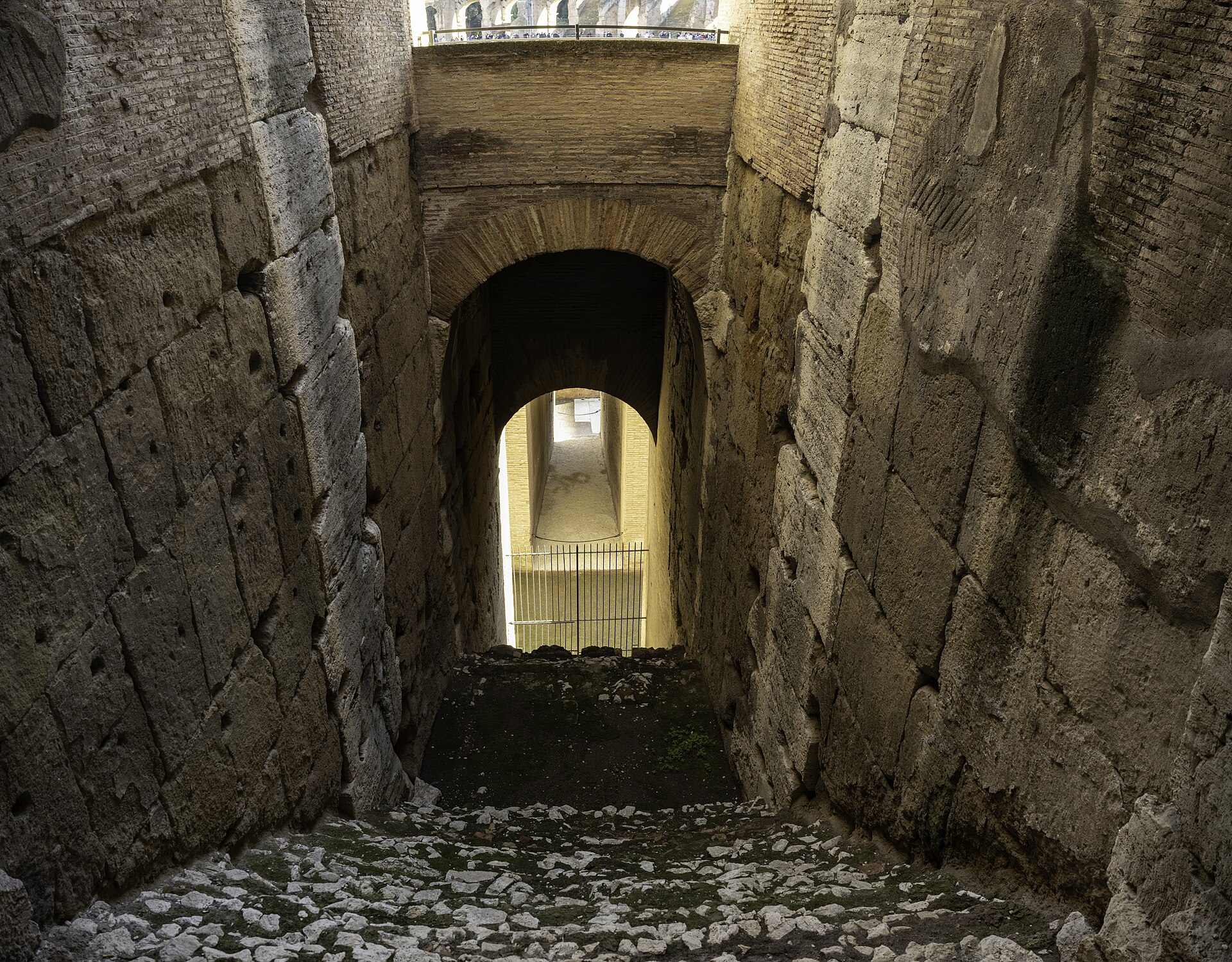
Rating: Refuted (the millions); Unresolved (any martyrdom in the Colosseum at all). No ancient source gives a total, and the modern estimates for the worst persecution run in the low thousands for the whole empire (Gibbon under 2,000 executed by sentence; Frend 3,000 to 3,500).4142 As for the building, Maurice Hassett's article "The Coliseum" in the Catholic Encyclopedia (1908) reports the judgment of the Bollandist scholar Hippolyte Delehaye that the acts placing martyrs there are late and unreliable, and quotes him: "I do not wish to deny that there were martyrs of the Flavian amphitheatre; but neither do we know whether there were, and in any case their names are unknown to us" (translated here from his French). The article adds that Christians condemned to the beasts could as easily have died in Rome's other arenas, that even the tradition placing Ignatius of Antioch there is "far from decisive," and that the Colosseum's reputation as a martyrs' shrine grew in the sixteenth and seventeenth centuries, with Pope Pius V's reported recommendation of its sand as relics, the protest pamphlet of Carlo Tomassi after a cardinal licensed bullfights there in 1671, the closing of its arcades in the jubilee year 1675, and the Stations of the Cross set up under Benedict XIV.15 Nero's victims of 64 died before the Colosseum existed; Tacitus places them in Nero's gardens and a circus.13 That some Christians died in the Colosseum is possible and even likely; it is not documented.
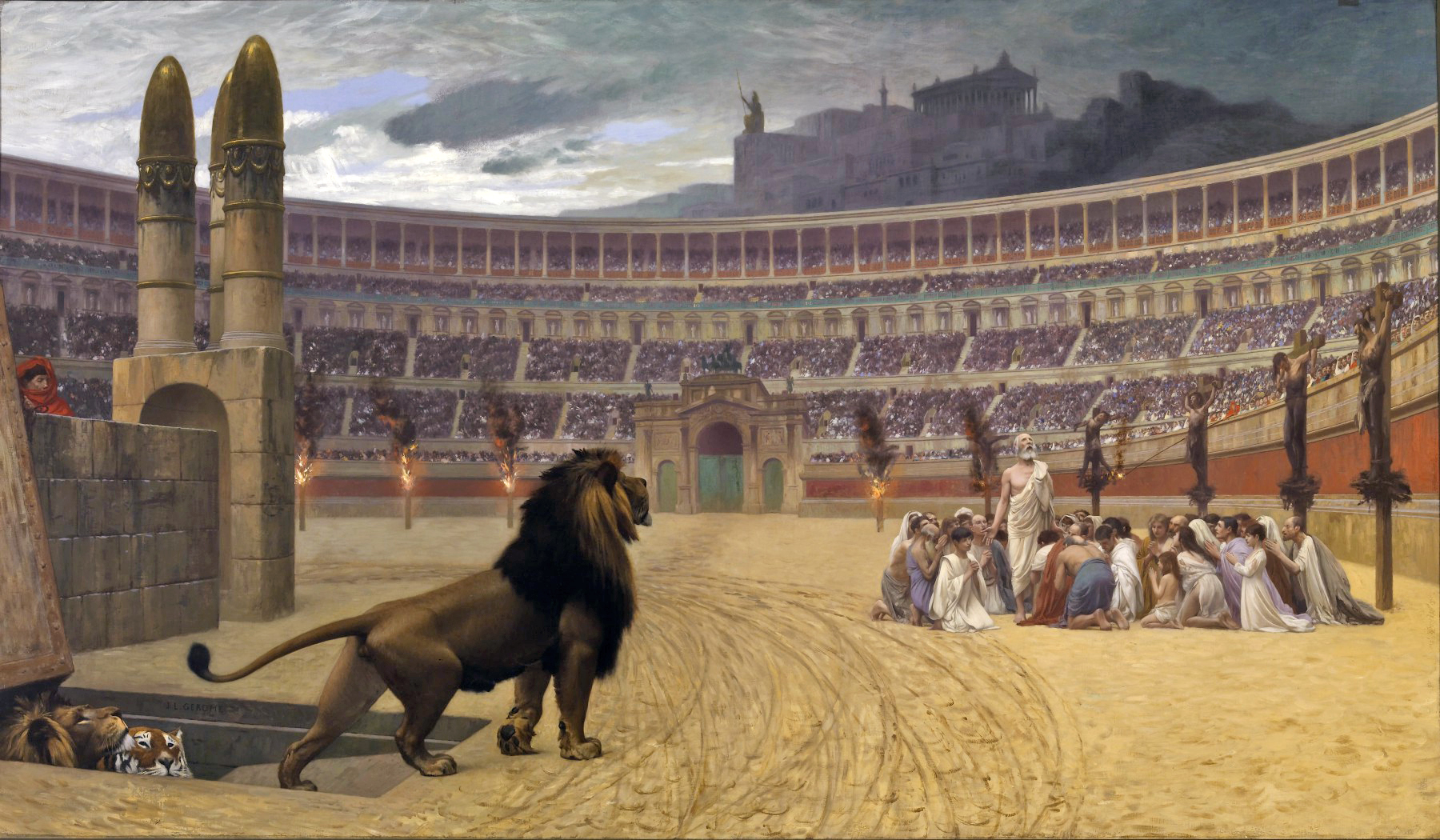

"The famous painting of martyrs facing a lion shows the Colosseum."
Rating: Refuted. The Walters Art Museum's description of Gérôme's painting, reproduced on its Wikimedia Commons page, says that in a letter to William T. Walters the artist identified the setting as "ancient Rome's racecourse, the Circus Maximus," pointing to the turning posts and chariot tracks he painted.46 The same description adds that the seating "more closely resembles that of the Colosseum," so the picture itself mixes the two buildings; the setting the painter named is the circus. The painting is often reproduced as a picture of the Colosseum, which helps keep that claim alive.
"The early Christians lived and hid in the catacombs."
Rating: Refuted. The catacombs were cemeteries, known to the authorities and protected by Roman law on burial places, with galleries too narrow and foul for living.20 Christians met there for funerals and martyrs' anniversaries; Valerian's officials banned access to the cemeteries precisely because they knew where they were, and Sixtus II was arrested and killed in one.3132 Ordinary worship was in houses and, by the later third century, in large public church buildings like the one Diocletian's guards tore down at Nicomedia.30
"Nero blamed the Christians for the fire of Rome and burned some as living torches."
Rating: Supported. Tacitus, Annals 15.44, says Nero "fastened the guilt" on the Christians to end the rumor against himself, and that some were burned "when daylight had expired" to light the night (in usum nocturni luminis).1314 Suetonius confirms that Nero punished Christians, without connecting it to the fire.16 A few scholars have questioned whether the passage was altered by later Christian copyists, but its hostile tone toward Christians argues against a Christian forgery, and most historians accept it.
"The Christians really did start the fire of 64."
Rating: Unsupported. Tacitus says Nero substituted the Christians as culprits to end the rumor about himself, and that they were convicted less for arson than for "hatred against mankind."13 No ancient source accuses them of setting it as a matter of fact. Whether Nero himself ordered the fire is also unresolved; Tacitus reports both versions and does not decide.
"For three hundred years Christians were constantly hunted by Rome."
Rating: Refuted. Trajan's rule of about 112 forbade seeking Christians out.11 Persecution before 250 depended on local accusers and was sporadic. Empire-wide action came only under Decius (250 to 251), Valerian (257 to 260) and in the Great Persecution (303 to 311, longer in the East), with forty years of peace after 260. Origen, about 248, thought the martyrs could "be easily numbered."38
"The persecution of early Christians is a myth."
Rating: Refuted. The persecutions are documented by Roman as well as Christian sources: Tacitus on Nero, Pliny and Trajan, Cassius Dio on Domitian's "atheism" trials, the Decian papyri, and Galerius's own edict, which admits that "many of them were exposed to jeopardy" under his earlier edict.13112730 Candida Moss, whose book title prompted the claim, herself writes that "some Christians were in fact put to death by Romans merely for being Christians."40 What is disputed is the scale and the reliability of many later stories, which is a different claim.
"Tertullian wrote, 'The blood of the martyrs is the seed of the church.'"
Rating: Partly supported. The idea is his and the core words are his, but the familiar sentence is a later paraphrase. His Latin is semen est sanguis Christianorum, "the blood of Christians is seed," following "the oftener we are mown down by you, the more in number we grow" (Apology 50).65
"Christianity was a banned religion by Roman law from the beginning."
Rating: Partly supported. From at least Trajan's time, being a Christian who refused to sacrifice could be punished with death, so in practice the faith was illegal.11 But no general statute against Christians survives before Decius, Pliny did not know of one, and the label "religio illicita" is a later summary of Tertullian's complaint ("It is not lawful for you to exist") that appears in no surviving Roman law. Scholars still debate the legal basis.10
"Domitian launched an empire-wide persecution of the church."
Rating: Unsupported. Tertullian and Eusebius call Domitian a persecutor, but the only pagan evidence, Cassius Dio, describes trials for "atheism" and "Jewish ways" among the Roman elite in 95, without the word Christian.419 Tertullian himself says Domitian "soon put an end to what he had begun."5
"Decius ordered only the Christians to sacrifice."
Rating: Unresolved, leaning against. The surviving certificates are issued to people in general, including a pagan priestess, and never mention Christians; the edict's text is lost.25 The Christian writers saw it as aimed at them, and its effect fell hardest on them.
"The Alexamenos graffito is the earliest picture of the crucifixion."
Rating: Partly supported. It is among the oldest surviving depictions of the crucified Jesus, usually dated around 200, but its date is not fixed and it is a pagan mockery.3912
"Galerius's edict of 311 is the Edict of Milan."
Rating: Refuted. Galerius's edict was issued at Nicomedia on April 30, 311, and granted toleration.30 The so-called Edict of Milan (313) is a later letter of Licinius after his meeting with Constantine, treated in lesson 04.
"Polycarp died on February 23, 155."
Rating: Unresolved. The day comes from chapter 21 of the Martyrdom (the New Advent translation reads "Kalends of May," the Lightfoot and Lake translations "of March," which gives February 23), and the year from the proconsul's term; Eusebius placed the death under Marcus Aurelius, in the 160s.34722 A range of about 155 to 160, with 167 as Eusebius's date, is the honest statement.
Hard questions and answers
If Rome tolerated so many religions, why did it persecute this one?
Rome tolerated gods; it did not tolerate a refusal to honor them. A Jew's refusal to sacrifice was protected by the age of his people's law, and the Romans respected ancestral custom. Christians were seen as people who had abandoned the customs of their own ancestors, as Galerius's edict says outright: they "had abandoned the religion of their forefathers."30 Their refusal to sacrifice for the emperor looked like disloyalty, their closed meetings bred rumor, and their success drew converts out of every family and trade. Tertullian put the official charge in two words: "sacrilege and treason."5
The martyr stories were written by Christians. Why trust them?
Critically, and in layers. The earliest accounts (Polycarp, Justin, Lyon, Perpetua) are close to the events and agree with Roman documents on procedure: the sacrifice test, the oath by the "fortune of Cæsar," beheading for citizens and the beasts for others, release for those who denied.117 Later acts, many written centuries afterward, are less reliable, and Catholic scholars like the Bollandists, as well as Protestant and skeptical ones, have sifted them for generations.15 The Christian writers also record their own failures, the lapsed of 250 and 303, which is not what an invented heroic story would include.2934
Did Christians seek martyrdom?
Some did, and the church's leaders discouraged it. The Smyrna letter says of Quintus, who came forward of his own accord and then sacrificed, "we do not commend those who give themselves up [to suffering], seeing the Gospel does not teach so to do."3 Cyprian hid during the Decian persecution and was executed only in 258, after a trial.33 Polycarp himself, the letter says, "was persuaded" by his people to leave the city for "a country house not far distant" before he was found.3 The ideal held up in these texts is steadiness when brought to trial; volunteering is discouraged.
How do Catholic, Orthodox and Protestant Christians use this history?
The Smyrna letter already shows a church gathering Polycarp's bones "as being more precious than the most exquisite jewels" and planning to "celebrate the anniversary of his martyrdom."3 Catholic and Orthodox churches continue that practice in feast days, relics and the naming of churches, and see in it continuity with the early church. Protestant churches generally honor the martyrs as witnesses and examples without the veneration of relics; John Foxe's book of martyrs (1563) set the early martyrs beside the Protestant martyrs of his own century. All three traditions claim the apologists, and all three have used Justin's account of Sunday worship in their arguments about the liturgy. The documents here do not settle those later disputes; they show what the second- and third-century churches did.
Did persecution make the church grow, as Tertullian said?
Tertullian's claim was that Christian steadiness made outsiders ask "what is at the bottom of it."5 There is evidence on both sides. Pliny's letter shows a church spreading into villages and farms even under pressure, and the letter from Lyon says that some who had denied the faith were moved by the confessors to confess again.711 But the Decian and Diocletianic persecutions caused mass apostasy and long schisms, and the church built its largest public presence in the peace after 260. A cautious reading is that the memory of the martyrs strengthened the church's identity more than the persecutions themselves increased its numbers.
Why does it matter whether 2,000 or 20,000 died?
Because numbers are often used in arguments the ancient sources do not make. A large number can be used to claim a permanent state of siege; a small one to dismiss the persecutions altogether. The sources support neither use. Even Gibbon's low estimate counts only those executed "by a judicial sentence," leaving out those who died in prison and the mines; and even Frend's estimate concerns one eight-year campaign.4142 For a small minority in a city like Smyrna, the death of twelve people, including the bishop, was a catastrophe.
Related lessons and modules
- Lesson 01, The First Century: the Jerusalem church, Paul, and the house church at Dura-Europos.
- Lesson 02, The Apostolic Fathers and the Early Heresies: Clement, Ignatius and Polycarp's letters, Marcion, the Gnostics and the New Prophecy that Tertullian joined.
- Lesson 04, Constantine and Nicaea: the Milvian Bridge (312), the letter of Licinius (313) and the Council of Nicaea (325), where this lesson's story ends.
- Module 79 overview: all twelve lessons of Church History, Part A.
Learn more
- Tertullian, Apology, full text (ANF): The fullest and most forceful of the apologies; read chapters 1 to 10 and 37 to 50.
- The Martyrdom of Polycarp: The oldest martyr account outside the New Testament, short enough to read in one sitting.
- Eusebius, Church History, book 5, chapter 1 (Lyon and Vienne): An eyewitness letter of 177 that shows Roman procedure step by step.
- Lactantius, On the Deaths of the Persecutors: A contemporary, partisan account of the Great Persecution, with Galerius's edict in full.
- Pliny's letter on the Christians (Internet Medieval Sourcebook): A second English version of Letters 10.96 and 10.97 to compare with Melmoth's.
- Jennifer Cromwell on the Decian libelli: A papyrologist's introduction with a list of every published certificate.
Still being checked (9 items)
These points could not be confirmed against a primary source when this lesson was written and fact checked in October 2026. The text above states each one as uncertain.
- The year of Polycarp's death (155 or 156 from the proconsul's term, or the 160s with Eusebius) remains disputed. The month reading in ch. 21 was checked in three translations (New Advent's 'May'; Lightfoot's and Lake's 'March'); the Greek text itself was not opened.
- That the main manuscript of Tacitus first read 'Chrestianos' is reported from the secondary literature; the manuscript was not examined.
- Frend's estimate of 3,000 to 3,500 deaths (Martyrdom and Persecution, 1965, pp. 393 to 394) is taken from citations of the book; the book was not opened.
- The articles of de Ste. Croix (1954, 1963) and Sherwin-White (1964) are summarized from standard bibliographies and secondary descriptions; they were not opened.
- The reviews of Moss by Greg Carey, N. Clayton Croy, Ephraim Radner, Michael Haykin, Paul L. Maier and Paul Hartog are summarized from the Wikipedia article on the book (used as a finding aid); only the reviews by Collin Garbarino, Mary Ann Donovan and Publishers Weekly were opened. The figure for years of empire-wide persecution in Moss's book (fewer than ten or at most twelve) comes from summaries, not from the book.
- The Proconsular Acts of Cyprian were read in a modern liturgical translation, not a public domain one; only the short phrase 'Thanks be to God' and the sentence are quoted.
- The dates of Hadrian's rescript to Minucius Fundanus (about 125), of Celsus's True Word (about 170 to 180), of Aristides, Diognetus and Minucius Felix, and of Lactantius's book (about 315) are the usual scholarly ranges, not fixed by the sources opened.
- The usual date of the Alexamenos graffito (about 200, with proposals from the late first to the third century) rests on the Catholic Encyclopedia and Schaff; no modern epigraphic study was opened.
- That Candida Moss was a professor at the University of Notre Dame when the book appeared (2013) rests on press coverage seen in search results; her current post (the University of Birmingham) is from the Publishers Weekly page.
Notes
- Justin Martyr, First Apology, chs. 1 to 7, 46, 67 and 68, trans. Marcus Dods and George Reith, Ante-Nicene Fathers, vol. 1, ed. Alexander Roberts, James Donaldson and A. Cleveland Coxe (Buffalo: Christian Literature Publishing Co., 1885), revised for New Advent by Kevin Knight (retrieved Oct. 28, 2026). Read it online. ↩
- Athenagoras, A Plea for the Christians, ch. 3, trans. B. P. Pratten, Ante-Nicene Fathers, vol. 2 (Buffalo, 1885), New Advent (retrieved Oct. 28, 2026). Read it online. ↩
- The Martyrdom of Polycarp (Letter of the Church of Smyrna), chs. 3 to 5, 9 to 10, 18, 19 and 21, trans. Alexander Roberts and James Donaldson, Ante-Nicene Fathers, vol. 1 (Buffalo, 1885), New Advent (retrieved Oct. 28, 2026). The New Advent text reads 'the seventh day before the Kalends of May' in ch. 21. Read it online. ↩
- Cassius Dio, Roman History, Epitome of Book 67, ch. 14, trans. Earnest Cary, Loeb Classical Library, vol. 8 (1925), public domain text at LacusCurtius, ed. Bill Thayer (retrieved Oct. 28, 2026). Read it online. ↩
- Tertullian, Apology, chs. 2, 4, 5, 7, 10, 21, 40 and 50, trans. S. Thelwall, Ante-Nicene Fathers, vol. 3 (Buffalo, 1885), New Advent (retrieved Oct. 28, 2026). Read it online. ↩
- Tertullian, Apologeticum, chs. 4, 7, 21, 40 and 50.13 (Latin text), The Latin Library (retrieved Oct. 28, 2026). Read it online. ↩
- Eusebius, Church History, book 5, introduction and ch. 1 (the letter of the churches of Vienne and Lyon), trans. Arthur Cushman McGiffert, Nicene and Post-Nicene Fathers, Second Series, vol. 1, ed. Philip Schaff and Henry Wace (Buffalo, 1890), New Advent (retrieved Oct. 28, 2026). Read it online. ↩
- Minucius Felix, Octavius, chs. 9 and 40, trans. Robert Ernest Wallis, Ante-Nicene Fathers, vol. 4 (Buffalo, 1885), New Advent (retrieved Oct. 28, 2026). Read it online. ↩
- Tertullian, Ad Nationes (To the Nations), book 1, ch. 7, trans. Peter Holmes, Ante-Nicene Fathers, vol. 3 (Buffalo, 1885), New Advent; Latin text at The Latin Library, tertullian.nationes1.shtml (retrieved Oct. 28, 2026). Read it online. ↩
- G. E. M. de Ste. Croix, 'Why Were the Early Christians Persecuted?', Past and Present 26 (1963), pp. 6 to 38; A. N. Sherwin-White, 'Why Were the Early Christians Persecuted? An Amendment', Past and Present 27 (1964), pp. 23 to 27; and de Ste. Croix, 'Aspects of the Great Persecution', Harvard Theological Review 47 (1954). Cited from standard bibliographies; not opened for this lesson. ↩
- Pliny the Younger, Letters 10.96 and 10.97 (numbered 97 and 98 in this edition), trans. William Melmoth, rev. F. C. T. Bosanquet, Project Gutenberg eBook 2811 (retrieved Oct. 28, 2026). Read it online. ↩
- Philip Schaff, History of the Christian Church, vol. 2, Ante-Nicene Christianity, A.D. 100 to 325, third edition, revised, as given by the Christian Classics Ethereal Library: title page, sections 15, 24, 26 and 77 (retrieved Oct. 28, 2026). Read it online. ↩
- Tacitus, Annals 15.41 and 15.44, trans. Alfred John Church and William Jackson Brodribb (1876; Random House reprint 1942), Perseus Digital Library, Tufts University (retrieved Oct. 28, 2026). Read it online. ↩
- Tacitus, Annales 15.44 (Latin), ed. Charles Dennis Fisher (Oxford: Clarendon Press, 1906), Perseus Digital Library (retrieved Oct. 28, 2026). Read it online. ↩
- Maurice M. Hassett, 'The Coliseum', The Catholic Encyclopedia, vol. 4 (New York: Robert Appleton Company, 1908), quoting Hippolyte Delehaye; New Advent (retrieved Oct. 28, 2026). Read it online. ↩
- Suetonius, Lives of the Caesars, Nero 16 and Claudius 25, trans. J. C. Rolfe, Loeb Classical Library (1914), public domain text at LacusCurtius (retrieved Oct. 28, 2026). Read it online. ↩
- 1 Clement (Letter of the Church of Rome to the Church of Corinth), chs. 5 and 6, trans. John Keith, Ante-Nicene Fathers, vol. 9, ed. Allan Menzies (Buffalo, 1896), New Advent (retrieved Oct. 28, 2026). Read it online. ↩
- Eusebius, Church History, book 2, ch. 25, trans. A. C. McGiffert, NPNF2 vol. 1 (Buffalo, 1890), New Advent (retrieved Oct. 28, 2026). Read it online. ↩
- Eusebius, Church History, book 3, chs. 17 to 20, trans. A. C. McGiffert, NPNF2 vol. 1 (Buffalo, 1890), New Advent (retrieved Oct. 28, 2026). Read it online. ↩
- Anton de Waal, 'Roman Catacombs', The Catholic Encyclopedia, vol. 3 (New York: Robert Appleton Company, 1908), New Advent (retrieved Oct. 28, 2026). Read it online. ↩
- Pliny the Younger, Epistulae 10.96 (Latin text), Perseus Digital Library (retrieved Oct. 28, 2026). Read it online. ↩
- Eusebius, Church History, book 4, chs. 3, 9, 15 and 16, trans. A. C. McGiffert, NPNF2 vol. 1 (Buffalo, 1890), New Advent (retrieved Oct. 28, 2026). Read it online. ↩
- The Martyrdom of the Holy Martyrs Justin, Chariton, Charites, Pæon and Liberianus (the Acts of Justin), chs. 1 to 5, trans. Marcus Dods, Ante-Nicene Fathers, vol. 1 (Buffalo, 1885), New Advent (retrieved Oct. 28, 2026). Read it online. ↩
- The Passion of the Holy Martyrs Perpetua and Felicity, preface and chs. 1 to 3, 5 and 7 (the New Advent division), trans. R. E. Wallis, Ante-Nicene Fathers, vol. 3 (Buffalo, 1885), New Advent (retrieved Oct. 28, 2026). Read it online. ↩
- Arne Jönsson, review of Reinhard Selinger, Decius. Ein römischer Kaiser zwischen Tradition und Restauration (Frankfurt: Peter Lang, 2024), Bryn Mawr Classical Review 2025.10.27; the review cites John R. Knipfing, 'Libelli of the Decian Persecution', Harvard Theological Review 16 (1923), pp. 363 to 390 (retrieved Oct. 28, 2026). Read it online. ↩
- Jennifer Cromwell, 'Imperial Decrees, Animal Sacrifices, and Christian Persecution', Papyrus Stories, Oct. 30, 2019, with a table of all published Decian libelli (retrieved Oct. 28, 2026). Read it online. ↩
- University of Michigan Papyrus Collection, P.Mich. inv. 262, 'Certificate of Religious Conformity in the Persecution under Decius: 250 AD', translation page (2004) (retrieved Oct. 28, 2026). Read it online. ↩
- Eusebius, Church History, book 6, chs. 36, 39, 41 and 43, trans. A. C. McGiffert, NPNF2 vol. 1 (Buffalo, 1890), New Advent (retrieved Oct. 28, 2026). Read it online. ↩
- Cyprian of Carthage, On the Lapsed, chs. 8, 27 and 28, trans. Robert Ernest Wallis, Ante-Nicene Fathers, vol. 5 (Buffalo, 1886), New Advent (retrieved Oct. 28, 2026). Read it online. ↩
- Lactantius, Of the Manner in Which the Persecutors Died (On the Deaths of the Persecutors), chs. 4 to 5, 12 to 19 and 33 to 35, trans. William Fletcher, Ante-Nicene Fathers, vol. 7 (Buffalo, 1886), New Advent (retrieved Oct. 28, 2026). Read it online. ↩
- Eusebius, Church History, book 7, chs. 10, 11 and 13 (including Dionysius of Alexandria's account and the rescript of Gallienus), trans. A. C. McGiffert, NPNF2 vol. 1 (Buffalo, 1890), New Advent (retrieved Oct. 28, 2026). Read it online. ↩
- Cyprian of Carthage, Epistle 81 (80 in some editions), To Successus, trans. Robert Ernest Wallis, Ante-Nicene Fathers, vol. 5 (Buffalo, 1886), New Advent (retrieved Oct. 28, 2026). Read it online. ↩
- Proconsular Acts of the Martyrdom of Saint Cyprian, chs. 3 to 6 (Latin in CSEL 3, pp. 112 to 114), as given in the Office of Readings for Sept. 16 in a modern liturgical translation, reproduced at liturgies.net (retrieved Oct. 28, 2026). Read it online. ↩
- Eusebius, Church History, book 8, chs. 2, 3, 6, 13, 16 and 17, trans. A. C. McGiffert, NPNF2 vol. 1 (Buffalo, 1890), New Advent (retrieved Oct. 28, 2026). Read it online. ↩
- The Apology of Aristides the Philosopher (Syriac version), heading and ch. 15, trans. D. M. Kay, Ante-Nicene Fathers, vol. 9, ed. Allan Menzies (Buffalo, 1896), New Advent (retrieved Oct. 28, 2026). Read it online. ↩
- The Epistle to Diognetus, ch. 5, trans. Alexander Roberts and James Donaldson, Ante-Nicene Fathers, vol. 1 (Buffalo, 1885), New Advent (retrieved Oct. 28, 2026). Read it online. ↩
- Tertullian, To Scapula, ch. 2, trans. S. Thelwall, Ante-Nicene Fathers, vol. 3 (Buffalo, 1885), New Advent (retrieved Oct. 28, 2026). Read it online. ↩
- Origen, Against Celsus, book 3, chs. 8 and 55, trans. Frederick Crombie, Ante-Nicene Fathers, vol. 4 (Buffalo, 1885), New Advent (retrieved Oct. 28, 2026). Read it online. ↩
- Orazio Marucchi, 'Archæology of the Cross and Crucifix', The Catholic Encyclopedia, vol. 4 (New York: Robert Appleton Company, 1908), New Advent (retrieved Oct. 28, 2026). Read it online. ↩
- Mary Ann Donovan, S.C., 'Us Against Them', review of Candida Moss, The Myth of Persecution, America, Feb. 20, 2013, quoting the book (retrieved Oct. 28, 2026). Read it online. ↩
- Edward Gibbon, The History of the Decline and Fall of the Roman Empire, ch. 16 (first published 1776), Project Gutenberg eBook 732 (Volume 2 of that edition) (retrieved Oct. 28, 2026). Read it online. ↩
- W. H. C. Frend, Martyrdom and Persecution in the Early Church (Oxford: Blackwell, 1965), pp. 393 to 394, as regularly cited for the estimate of 3,000 to 3,500 deaths; the book itself was not opened for this lesson. ↩
- Publishers Weekly, review of Candida Moss, The Myth of Persecution: How Early Christians Invented a Story of Martyrdom (New York: HarperOne, 2013), reviewed Jan. 14, 2013 (retrieved Oct. 28, 2026). Read it online. ↩
- Collin Garbarino, review of Candida Moss, The Myth of Persecution, Themelios 38, no. 2 (2013), The Gospel Coalition (retrieved Oct. 28, 2026). Read it online. ↩
- Reviews of The Myth of Persecution by Greg Carey (The Christian Century, 2013), N. Clayton Croy (Review of Biblical Literature), Ephraim Radner (First Things), Michael Haykin, Paul L. Maier (Christian Research Journal) and Paul Hartog (Southern Baptist Journal of Theology), as listed and summarized in the reception section of the Wikipedia article on the book, used only as a finding aid; these reviews were not opened for this lesson. Read it online. ↩
- Walters Art Museum, description of Jean-Léon Gérôme, The Christian Martyrs' Last Prayer (accession 37.113), as reproduced on the Wikimedia Commons file page (retrieved Oct. 28, 2026). Read it online. ↩
- The Martyrdom of Polycarp, ch. 21, in the translations of J. B. Lightfoot, The Apostolic Fathers (London, 1891), and Kirsopp Lake, The Apostolic Fathers, Loeb Classical Library (1912 to 1913), both made from the Greek and both as given at Early Christian Writings (retrieved Oct. 28, 2026). Lake's version reads "the seventh day before the kalends of March." Read it online. ↩
- Edward Pace, "Aristides," The Catholic Encyclopedia, vol. 1 (New York: Robert Appleton Company, 1907), on the Armenian fragment (1878), the Syriac version found by J. R. Harris in 1889 and J. A. Robinson's identification of the Greek in the Life of Barlaam and Josaphat; New Advent (retrieved Oct. 28, 2026). Read it online. ↩
- John Chapman, "Epistle to Diognetus," The Catholic Encyclopedia, vol. 5 (New York: Robert Appleton Company, 1909), New Advent: the work "came down to us in a single manuscript which perished in the siege of Strasburg (1870)" (retrieved Oct. 28, 2026). Read it online. ↩
Check yourself
1. According to Tacitus, Annals 15.44, on what were Nero's Christian victims chiefly convicted?
Tacitus says Nero 'fastened the guilt' on them to end the rumor about himself, and that the multitude was convicted 'not so much of the crime of firing the city, as of hatred against mankind.'
2. What rule did Trajan give Pliny about Christians in Letter 10.97?
Trajan wrote: 'Do not go out of your way to look for them,' but those accused and proved guilty must be punished, with pardon for anyone who invoked the gods, and anonymous accusations were not to be received.
3. What do the surviving Decian libelli from Egypt record?
Certificates such as P.Mich. inv. 262 (June 250) say 'we have sacrificed, have made libations, and have tasted the offerings,' with the commissioners' signatures. They do not mention Christians.
4. What is the exact wording of Tertullian's famous line in Apology 50?
The Latin is 'Plures efficimur, quotiens metimur a vobis: semen est sanguis Christianorum' ('The oftener we are mown down by you, the more in number we grow; the blood of Christians is seed'). The common version is a later paraphrase.
5. When and where did Galerius issue his edict of toleration, according to Lactantius?
Lactantius says it 'was promulgated at Nicomedia on the day preceding the kalends of May' in the eighth consulship of Galerius, that is, April 30, 311.
6. Which statement about the Roman catacombs fits the evidence?
Anton de Waal's Catholic Encyclopedia article explains they were cemeteries whose locations Romans knew; Valerian's officials even banned Christians from entering them in 257.
7. What did Origen write, about 248, about the number of martyrs up to his time?
Against Celsus 3.8 says some 'on special occasions, and these individuals who can be easily numbered, have endured death for the sake of Christianity.'
8. What estimate did W. H. C. Frend give for Christians killed in the Great Persecution of 303 to 311?
Frend's Martyrdom and Persecution in the Early Church (1965) is cited for 3,000 to 3,500. Gibbon (1776) estimated somewhat less than 2,000 executed by judicial sentence; 92 is the number of named Palestinian martyrs Gibbon took from Eusebius.
Terms in this lesson
- Apologist
- A Christian writer of the second and third centuries who wrote a defense (Greek apologia) of the faith addressed to emperors, governors or educated pagans.
- Libellus (plural libelli)
- A certificate of sacrifice issued during the Decian persecution of 250, in which a person declared that he had sacrificed and officials signed as witnesses. Forty-seven are now known, all from Egypt and most of them from the village of Theadelphia in the Fayum.
- Lapsed (lapsi)
- Christians who gave way under persecution, by sacrificing (sacrificati) or by obtaining a certificate saying they had (libellatici). How to readmit them divided the church after 251.
- Confessor
- A Christian who confessed the faith before a court and suffered imprisonment, torture or exile but was not killed.
- Martyr
- From the Greek for witness: a Christian who died rather than deny Christ or sacrifice to the gods.
- Odium humani generis
- Latin for 'hatred of the human race,' the charge on which Tacitus says Nero's Christian victims were convicted.
- Thyestean feasts and Oedipodean intercourse
- The standard pagan rumors that Christians practiced cannibalism and incest at their meetings, named after figures of Greek myth and answered by Athenagoras, Tertullian and Minucius Felix.
- Coercitio
- The general police power of a Roman magistrate to punish disorder and defiance without a specific statute, one proposed legal basis for the trials of Christians.
- Traditores
- Latin for 'handers-over': clergy who surrendered the Scriptures to the authorities in the Great Persecution. The dispute over them produced the Donatist schism in Africa.
- Catacomb
- An underground cemetery cut into the tufa rock outside Rome, used by Jews and Christians for burial. They were burial grounds, not hiding places or homes.
- Alexamenos graffito
- A pagan caricature scratched on plaster on the Palatine Hill, Rome, usually dated about 200, showing a crucified figure with a donkey's head and the words 'Alexamenos worships [his] god.'
- Edict of toleration (311)
- Galerius's decree issued at Nicomedia on April 30, 311, permitting Christians 'again to be Christians' and to rebuild their meeting places. It is distinct from the letter of Licinius of 313.
- Tetrarchy
- The system of four emperors (two senior Augusti and two junior Caesars) set up by Diocletian, under which the Great Persecution began in 303.
Sources
- Tacitus, Annals 15.44 (Church and Brodribb translation) (about 116) checked 2026-10
- Tacitus, Annales 15.44 (Latin, ed. Fisher) (about 116; edition 1906) checked 2026-10
- Suetonius, Life of Nero (Loeb 1914) (about 121) checked 2026-10
- Cassius Dio, Roman History, Epitome of Book 67 (Loeb 1925) (early 3rd century) checked 2026-10
- Letters of Pliny, trans. Melmoth, rev. Bosanquet (Project Gutenberg 2811) (about 112) checked 2026-10
- Pliny, Epistulae 10.96 (Latin) (about 112) checked 2026-10
- Internet Medieval Sourcebook: Pliny on the Christians (about 112) checked 2026-10
- 1 Clement (ANF 9) (about 96) checked 2026-10
- The Martyrdom of Polycarp (ANF 1) (about 155 to 160) checked 2026-10
- Justin Martyr, First Apology (ANF 1) (about 150 to 155) checked 2026-10
- The Martyrdom of Justin and his companions (ANF 1) (about 165) checked 2026-10
- Aristides, Apology (ANF 9) (about 125 to 145) checked 2026-10
- Athenagoras, A Plea for the Christians (ANF 2) (about 177) checked 2026-10
- Epistle to Diognetus (ANF 1) (2nd or early 3rd century) checked 2026-10
- Minucius Felix, Octavius (ANF 4) (late 2nd or early 3rd century) checked 2026-10
- Tertullian, Apology (ANF 3) (about 197) checked 2026-10
- Tertullian, Apologeticum (Latin), The Latin Library (about 197) checked 2026-10
- Tertullian, Ad Nationes book 1 (ANF 3) (about 197) checked 2026-10
- Tertullian, To Scapula (ANF 3) (about 212) checked 2026-10
- The Passion of Perpetua and Felicity (ANF 3) (203) checked 2026-10
- Origen, Against Celsus, book 3 (ANF 4) (about 248) checked 2026-10
- Cyprian, On the Lapsed (ANF 5) (251) checked 2026-10
- Cyprian, Epistle 81, To Successus (ANF 5) (258) checked 2026-10
- Proconsular Acts of Cyprian (Office of Readings, Sept. 16), liturgies.net (258) checked 2026-10
- University of Michigan, P.Mich. inv. 262, Decian certificate (June 250) checked 2026-10
- Lactantius, On the Deaths of the Persecutors (ANF 7) (about 315) checked 2026-10
- Eusebius, Church History, books 2 to 8 (NPNF2 1) (about 313 to 325) checked 2026-10
- Philip Schaff, History of the Christian Church, vol. 2 (1883 and later editions) checked 2026-10
- Edward Gibbon, Decline and Fall of the Roman Empire, ch. 16 (Project Gutenberg 732) (1776) checked 2026-10
- Catholic Encyclopedia: The Coliseum (Hassett) (1908) checked 2026-10
- Catholic Encyclopedia: Roman Catacombs (de Waal) (1908) checked 2026-10
- Catholic Encyclopedia: Archaeology of the Cross and Crucifix (Marucchi) (1908) checked 2026-10
- Arne Jönsson, review of Selinger, Decius, Bryn Mawr Classical Review 2025.10.27 (2025) checked 2026-10
- Jennifer Cromwell, Imperial Decrees, Animal Sacrifices, and Christian Persecution (Papyrus Stories) (2019) checked 2026-10
- W. H. C. Frend, Martyrdom and Persecution in the Early Church (1965) checked 2026-10
- G. E. M. de Ste. Croix, Why Were the Early Christians Persecuted? (Past and Present 26) (1963) checked 2026-10
- Candida Moss, The Myth of Persecution (HarperOne) (2013) checked 2026-10
- Mary Ann Donovan, Us Against Them (America) (2013) checked 2026-10
- Collin Garbarino, review of The Myth of Persecution (Themelios 38.2) (2013) checked 2026-10
- Walters Art Museum description of Gerome, The Christian Martyrs' Last Prayer (Wikimedia Commons page) (painting 1863 to 1883) checked 2026-10
- The Martyrdom of Polycarp, trans. Kirsopp Lake (Loeb, 1912 to 1913), Early Christian Writings (about 155 to 160) checked 2026-10
- The Martyrdom of Polycarp, trans. J. B. Lightfoot (1891), Early Christian Writings (about 155 to 160) checked 2026-10
- Catholic Encyclopedia: Aristides (Pace) (1907) checked 2026-10
- Catholic Encyclopedia: Epistle to Diognetus (Chapman) (1909) checked 2026-10