Lesson 2 of 12 · about 55 minutes · Updated October 28, 2026
The Apostolic Fathers and the Early Heresies: Gnostics, Marcion and the Montanists
You'll be able to
- Name the Apostolic Fathers, give their probable dates, and explain why several of those dates are disputed
- Describe what 1 Clement, the Didache and Ignatius show about bishops, presbyters and deacons, and how Catholic, Orthodox and Protestant readers interpret it
- Summarize the Didache's instructions on baptism, fasting and the Eucharist in its own words
- Explain what the Gnostics, Marcion and the Montanists taught, using the Nag Hammadi texts where they survive and saying where a group is known only from opponents
- Describe the rule of faith, the Muratorian Fragment and its dating debate, and the early growth of a recognized New Testament
- State Walter Bauer's thesis and the main replies of his critics
Start here: the short version
Between about AD 95 and 160 the generation after the apostles left a small shelf of writings that later scholars named the "Apostolic Fathers": a letter from the church at Rome to the church at Corinth (1 Clement), seven letters by Ignatius of Antioch written on his way to death in Rome, a letter of Polycarp of Smyrna and the account of his martyrdom, a church manual called the Didache, the Epistle of Barnabas, the Shepherd of Hermas, fragments of Papias, and the anonymous Epistle to Diognetus. They show churches led by bishops, elders (presbyters) and deacons, with the single bishop over each city church appearing clearly first in Ignatius. They show baptism in "living water," fasting on Wednesdays and Fridays, and a Sunday Eucharist.
In the same decades other teachers offered very different accounts of the faith. The Gnostic teachers (Basilides, Valentinus and the writers of books found at Nag Hammadi in Egypt in 1945) taught that salvation comes by knowledge (Greek gnosis) and that the world was made by a lesser power. Marcion of Pontus taught two gods, a just creator and a good Father of Jesus, and published a scripture of one edited Gospel (Luke) and ten letters of Paul. The Montanists (Montanus, Priscilla and Maximilla, the "New Prophecy") claimed fresh revelation from the Holy Spirit and stricter discipline. Their opponents (Irenaeus of Lyon about 180, Tertullian, Hippolytus, the writers quoted by Eusebius) answered with the "rule of faith," the succession of bishops, and a growing list of books read in church. This lesson gives each side in its own surviving words, then the record, then how named scholars read it, including Walter Bauer's 1934 thesis that "heresy" often came first and the scholars who tested it.
Lesson 01 ended with the death of the apostles and the fall of Jerusalem in AD 70. This lesson covers roughly the next ninety years, from about 95 to about 180, the period when the churches had to decide who spoke for them once the eyewitnesses were gone. Lesson 03 takes up the same years from another side, the persecutions and the apologists who wrote to the emperors, so the martyrdoms of Ignatius and Polycarp are told here only as far as they bear on church order and the writings themselves.
Almost everything in this period was written in Greek, even at Rome. Readers who want to follow the key words (episkopos, "overseer" or bishop; presbyteros, elder; diakonos, servant or deacon; gnosis, knowledge; kanon, measuring rod or rule) in the original can use the site's Introduction to Classical Greek; this lesson does not teach the grammar.
Who the Apostolic Fathers are
The label "Apostolic Fathers" is modern. No ancient writer used it for a collection. It grew out of seventeenth-century editions that gathered the earliest Christian writings outside the New Testament, the authors of which were believed to have known the apostles or their immediate disciples. Philip Schaff's History of the Christian Church (volume 2, revised 1884) lists the printed editions from Cotelier's Paris edition of 1672 to J. B. Lightfoot's critical editions of 1869 to 1885, which Schaff judged "upon the whole the best edition as far as it goes."1 The contents of the shelf have varied by editor. The usual modern list follows.
1 Clement: Rome writes to Corinth
The oldest is a long letter that opens, in the Ante-Nicene Fathers translation by John Keith: "The church of God which sojourns at Rome, to the church of God sojourning at Corinth."2 The letter itself names no author. It speaks for a church, and it ends by naming its three messengers: "Claudius Ephebus and Valerius Bito, with Fortunatus."2 Later writers attached it to Clement, whom Irenaeus (about 180) lists as the third bishop of Rome after Linus and Anacletus, and of whom Irenaeus says "the Church in Rome dispatched a most powerful letter to the Corinthians, exhorting them to peace."3
The occasion was a revolt at Corinth. The letter calls it "that shameful and detestable sedition, utterly abhorrent to the elect of God, which a few rash and self-confident persons have kindled."2 Some younger members had removed the church's elders from office. Rome's answer is the first Christian text outside the New Testament to argue from an orderly sending: "Christ therefore was sent forth by God, and the apostles by Christ. Both these appointments, then, were made in an orderly way, according to the will of God."2 The apostles, it says, "appointed the first fruits [of their labours], having first proved them by the Spirit, to be bishops and deacons of those who should afterwards believe," and later "gave instructions, that when these should fall asleep, other approved men should succeed them in their ministry."2 Chapter 5 is also one of the earliest witnesses to the deaths of Peter and Paul: Peter "when he had at length suffered martyrdom, departed to the place of glory due to him," and Paul was "seven times thrown into captivity, compelled to flee, and stoned."2
The date most often given is about 95 to 97, near the end of the reign of Domitian, because the letter's opening apologizes for delay "owing ... to the sudden and successive calamitous events which have happened to ourselves," which older scholars read as a persecution under Domitian.2 That reading is an inference. The letter names no emperor. Some scholars place it earlier (around 70) and others later (as late as 120 or so), and the "calamities" need not be a state persecution at all. The traditional date remains the most common, but it rests on Eusebius and on that inference, since the text itself states no date.
One detail of vocabulary matters for later arguments. In 1 Clement the same men are called both "bishops" and "presbyters." Chapter 44 moves from "the episcopate" to "Blessed are those presbyters who, having finished their course before now..." without a change of subject.2 The letter knows two offices, bishops (or presbyters) and deacons, and speaks of the Corinthian leaders in the plural. It does not mention a single bishop of Rome, or of Corinth.
The seven letters of Ignatius of Antioch
Ignatius was bishop of Antioch in Syria. Eusebius, writing about 300 to 325, places him in the reign of Trajan (98 to 117), calls him "second in succession to Peter" at Antioch, and says: "Report says that he was sent from Syria to Rome, and became food for wild beasts on account of his testimony to Christ."4 On the journey, under guard, he wrote seven letters: four from Smyrna (to the Ephesians, the Magnesians, the Trallians and the Romans) and three from Troas (to the Philadelphians, the Smyrnaeans, and Polycarp, bishop of Smyrna).4
The text has a tangled history that Schaff called the most discussed problem among the Apostolic Fathers. The letters survive in three forms: a "long recension" of the seven letters with interpolations plus six more forged letters (printed from 1495), a "middle recension" of the seven letters in Greek (published by Ussher and Isaac Vossius in the 1640s), and a short Syriac abridgment of three letters published by William Cureton in 1845.1 After the work of Theodor Zahn (1873) and Lightfoot (1885), most scholars accepted the middle recension of seven letters as genuine, and that is the text translated in the Ante-Nicene Fathers and quoted here.1 A minority has argued that even these are later forgeries.
The date is also argued. The customary date is about 107 to 117, following Eusebius. In 2008 Timothy D. Barnes argued in The Expository Times that Ignatius knew the teaching of the Valentinian teacher Ptolemaeus, that Eusebius's placement under Trajan is not authoritative, and that the letters most likely belong to the 140s.5 Others hold to the early date. The debate matters because the letters are the first clear evidence for a single bishop leading each city church, and a forty-year shift moves that evidence from the edge of the apostolic age into the middle of the second century.
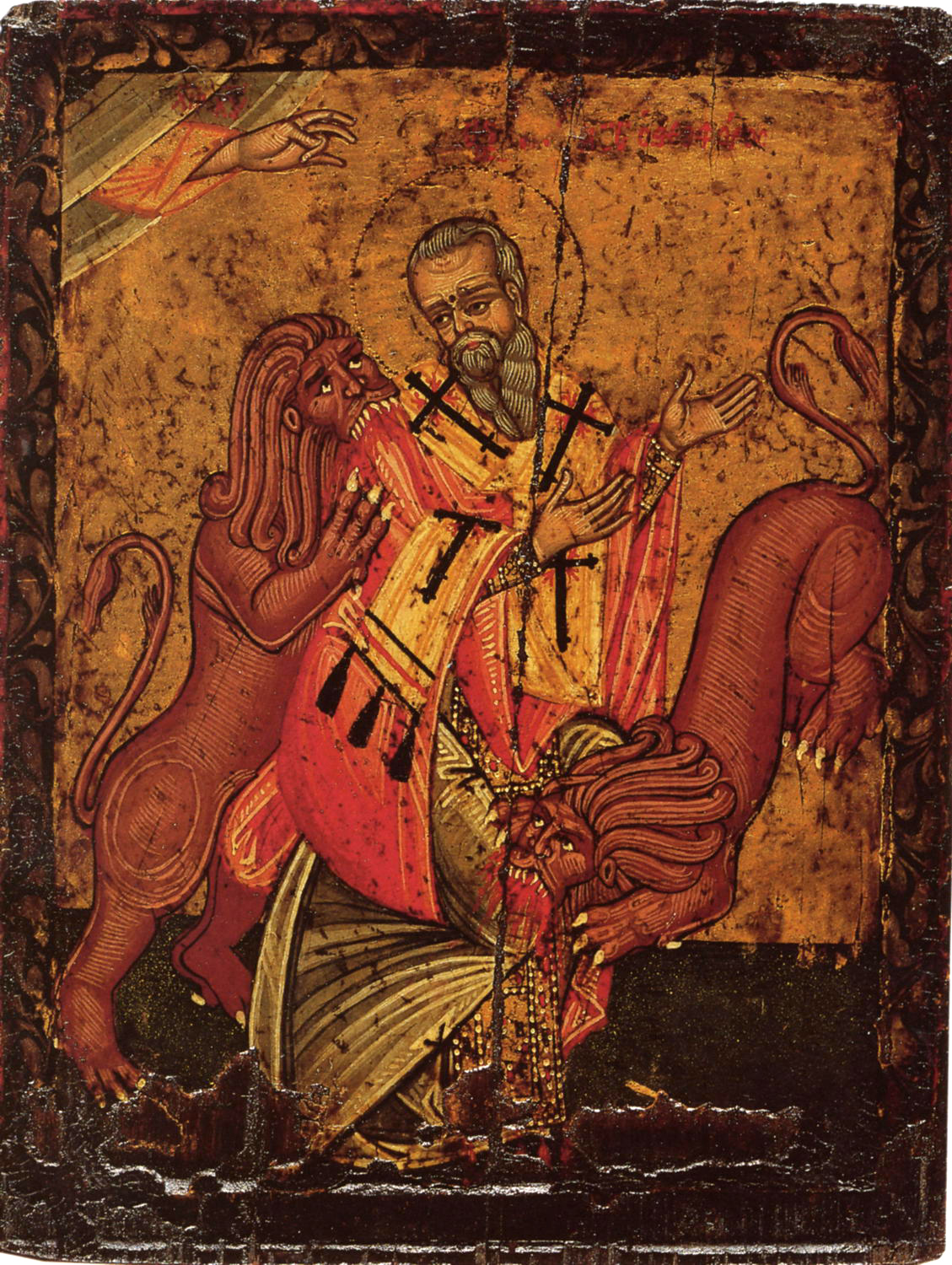

In his own words, Ignatius returns again and again to three themes: unity under the bishop, the reality of Christ's flesh, and his own wish to die. To the Magnesians he writes: "I exhort you to study to do all things with a divine harmony, while your bishop presides in the place of God, and your presbyters in the place of the assembly of the apostles, along with your deacons."6 To the Smyrnaeans, in the passage that contains the first surviving use of the phrase "Catholic Church":
"See that you all follow the bishop, even as Jesus Christ does the Father, and the presbytery as you would the apostles; and reverence the deacons, as being the institution of God. Let no man do anything connected with the Church without the bishop. Let that be deemed a proper Eucharist, which is [administered] either by the bishop, or by one to whom he has entrusted it. Wherever the bishop shall appear, there let the multitude [of the people] also be; even as, wherever Jesus Christ is, there is the Catholic Church."7
The Greek katholike means "whole" or "universal." In Ignatius it describes the whole church as against a local congregation, and it carries no reference yet to a later denomination; Catholic, Orthodox and many Protestant writers all claim it in that first sense.
Ignatius's second theme is aimed at people he calls "unbelievers" who taught that Christ "only seemed to suffer." This view is called Docetism, from the Greek dokein, "to seem." Ignatius answers: "And He suffered truly, even as also He truly raised up Himself, not, as certain unbelievers maintain, that He only seemed to suffer."7 To the Trallians he ties the point to his own coming death: "But if, as some that are without God, that is, the unbelieving, say, that He only seemed to suffer (they themselves only seeming to exist), then why am I in bonds? Why do I long to be exposed to the wild beasts? Do I therefore die in vain?"8 He links the same reality to the Eucharist. The people he opposes, he says, "abstain from the Eucharist and from prayer, because they confess not the Eucharist to be the flesh of our Saviour Jesus Christ."7 To the Ephesians he calls the one bread "the medicine of immortality, and the antidote to prevent us from dying."9
His third theme is the most famous. He begs the Roman Christians not to use their influence to save him: "I am the wheat of God, and let me be ground by the teeth of the wild beasts, that I may be found the pure bread of Christ."10 He also warns against a second group, Christians who kept Jewish practice: "It is absurd to profess Christ Jesus, and to Judaize."6 In the same passage he uses the word "Christianity" (Christianismos), one of its earliest surviving uses.
Bishops, elders and deacons: what the texts say
The structure of church leadership is the most argued subject in these writings, because Catholic, Orthodox, Anglican, Presbyterian, Baptist and other churches each read their own order of ministry back into this period. The texts themselves, read in order, show a change.
In Paul's letters and Acts (covered in lesson 01), "overseers" (episkopoi) and "elders" (presbyteroi) often appear to be the same people (Acts 20:17 and 20:28, Titus 1:5 to 7). In 1 Clement, as noted above, the terms are still used together for a group of leaders at Corinth.2 The Didache, discussed below, tells each community: "appoint for yourselves bishops and deacons worthy of the Lord," with no mention of presbyters and no single head.11 The Shepherd of Hermas, written at Rome, speaks of "the presbyters who preside over the Church" in the plural.12
Ignatius is different. In his letters each city church in Asia has one bishop, named in several letters (Onesimus at Ephesus, Damas at Magnesia, Polybius at Tralles, Polycarp at Smyrna), with a council of presbyters and a group of deacons under him.4 Schaff counted the word "bishop" thirteen times in the 21 chapters of the Greek letter to the Ephesians and nine times in the letter to the Trallians.1 Yet Ignatius's letter to the Romans names no bishop of Rome at all, and addresses the Roman church as a body.10
How the churches read the evidence
The Catholic reading. The Second Vatican Council's constitution Lumen Gentium (Nov. 21, 1964), section 20, states: "the Sacred Council teaches that bishops by divine institution have succeeded to the place of the apostles, as shepherds of the Church, and he who hears them, hears Christ."13 In this reading 1 Clement's chain of sending (God, Christ, apostles, appointed successors) and Irenaeus's list of Roman bishops are early witnesses to apostolic succession, and the differences in vocabulary between Clement and Ignatius are differences in naming; the substance, a ministry handed on from the apostles, is the same. Catholic writers also point to 1 Clement as Rome intervening in another church's affairs before the end of the first century.
The Orthodox reading. Orthodox theologians also hold to apostolic succession, and they stress Ignatius's link between bishop and Eucharist: the church is fully present where the local bishop gathers the people at the one altar. Twentieth-century Orthodox writers such as Nicholas Afanasiev and John Zizioulas built a "eucharistic ecclesiology" largely on Ignatius's letters, and Timothy Ware (Metropolitan Kallistos) in The Orthodox Church presents Ignatius as a witness to the Orthodox view that each local church gathered around its bishop is the whole Church in that place.
Protestant readings. Many Protestant historians read the same evidence as development. The Anglican scholar J. B. Lightfoot, in his essay "The Christian Ministry" (1868), argued from the shared names in the New Testament and 1 Clement that "the episcopate was formed not out of the apostolic order by localisation but out of the presbyteral by elevation: and the title, which originally was common to all, came at length to be appropriated to the chief among them."14 Lightfoot, who later became bishop of Durham (1879), held that this development was early, widespread and legitimate. Philip Schaff, a Reformed and later Presbyterian church historian, put it more sharply: "The Ignatian episcopacy, in short, is congregational, not diocesan; a new and growing institution, not a settled policy of apostolic origin."1 Presbyterian and Congregational writers have long cited 1 Clement and the Didache for government by a body of elders, and Baptist and other free-church writers for the authority of the local congregation, which in 1 Clement had to consent to its leaders' appointment ("with the consent of the whole church").2
What the documents show. The documents show plural "bishop-presbyters" and deacons at Corinth and Rome around 95; bishops and deacons in the Didache; one bishop over each church in Ignatius's Asia Minor and Syria, whether in the 110s or the 140s; and, by Irenaeus around 180, a list of single bishops of Rome running back to the apostles.3 Whether the earlier plural leadership at Rome included a presiding figure (such as Clement) who was later remembered as "the bishop" is not stated in any first-century text. That question is open, and each tradition answers it from its own theology of the church.
Polycarp of Smyrna: a letter and a martyrdom
Polycarp is the bridge figure of the period. Irenaeus, who grew up in Asia Minor, wrote about 180 that Polycarp was "by apostles in Asia, appointed bishop of the Church in Smyrna, whom I also saw in my early youth, for he tarried [on earth] a very long time."3 Eusebius says he was "entrusted with the episcopate of the church of Smyrna by those who had seen and heard the Lord."4 Ignatius addressed one of his seven letters to him.
Polycarp's letter to the Philippians
Polycarp's own surviving work is a short letter to the church at Philippi. It is full of quotations and echoes of the New Testament letters, especially 1 Peter and the Pastoral Letters, which makes it an early witness to their use. Against the same Docetic teaching that Ignatius opposed, it says: "For whosoever does not confess that Jesus Christ has come in the flesh, is antichrist; and whosoever does not confess the testimony of the cross, is of the devil; and whosoever perverts the oracles of the Lord to his own lusts, and says that there is neither a resurrection nor a judgment, he is the first-born of Satan."15 Chapter 13 is the earliest evidence for the gathering of Ignatius's letters into a collection: "The Epistles of Ignatius written by him to us, and all the rest [of his Epistles] which we have by us, we have sent to you, as you requested."15 P. N. Harrison argued in Polycarp's Two Epistles to the Philippians (1936) that the surviving text joins two letters of Polycarp (chapters 13 to 14 written soon after Ignatius passed through, the rest years later), a theory many scholars accept and others reject.

The Martyrdom of Polycarp
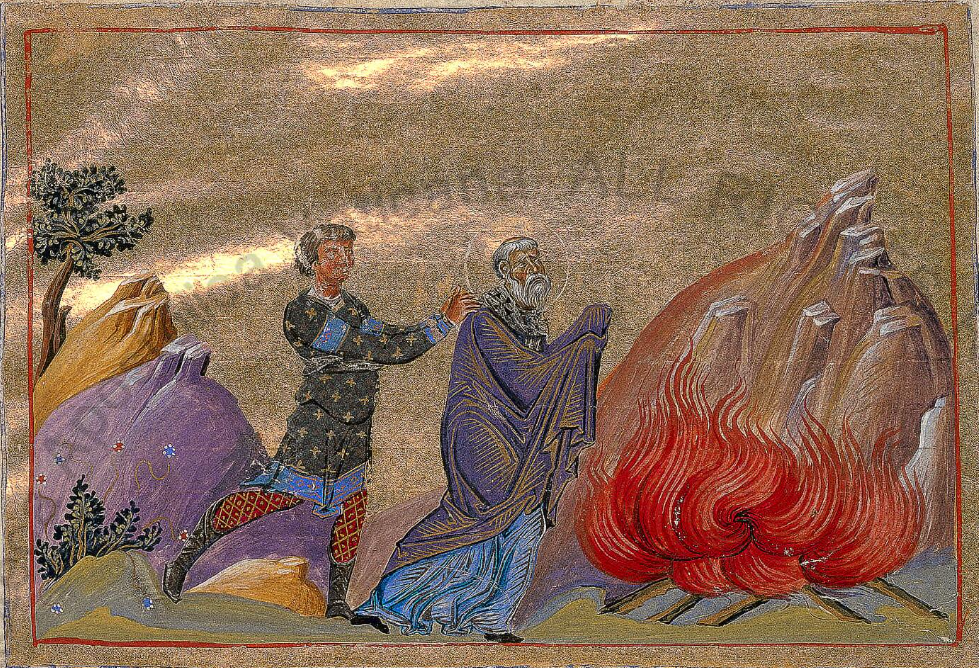
The Martyrdom of Polycarp is a letter from "the church of God which sojourns at Smyrna" to the church at Philomelium, describing his arrest and death. It is the oldest surviving Christian account of a martyrdom outside the New Testament. When the proconsul urged him to swear by the emperor's genius and curse Christ, Polycarp answered, in the Roberts and Donaldson translation: "Eighty and six years have I served Him, and He never did me any injury: how then can I blaspheme my King and my Saviour?"16 The crowd's cry, "Away with the Atheists," shows how pagans saw Christians who refused the gods.16 After his body was burned, the church "took up his bones, as being more precious than the most exquisite jewels," and planned to keep "the anniversary of his martyrdom," the earliest evidence for the yearly remembrance of a martyr at his grave.16 The fuller story of persecution and its legal setting belongs to lesson 03.
The date is disputed. Chapter 21 gives it as "the second day of the month Xanthicus just begun, the seventh day before the Kalends of May, on the great Sabbath," with "Statius Quadratus being proconsul."16 The "seventh day before the Kalends of May" would be April 25, but most scholars equate the second of Xanthicus with February 23. Eusebius placed the death under Marcus Aurelius (about 166 to 167). In the nineteenth century W. H. Waddington worked out from inscriptions the years of the proconsul Statius Quadratus and dated the death to Feb. 23, 155; Schaff records that Lightfoot and most scholars of his day followed Waddington.1 Later scholars have argued for 156 or for dates up to about 160 (the brief span usually given is 155 to 160), and a few still defend Eusebius's later date. If Polycarp had "served" Christ 86 years, he was born no later than about 70 and probably baptized as a child.
Irenaeus also preserves two stories about Polycarp. He visited Rome in the time of Bishop Anicetus (about 155 to 166) and disagreed with him over the date of Easter, Polycarp keeping the custom he had "always observed with John the disciple of our Lord," while Anicetus followed "the customs of the presbyters that had preceded him." They did not settle it, but "they communed together, and Anicetus conceded the administration of the eucharist in the church to Polycarp."17 And when Marcion met him and asked, "Do you know me?", Polycarp replied, "I do know you, the first-born of Satan."3 The story comes from Irenaeus, who heard it in Asia, a generation or so later. It is not confirmed elsewhere.
The Didache: a church manual
The Didache ("Teaching"), whose fuller title is "The Teaching of the Lord to the Gentiles through the Twelve Apostles," was known by name from ancient lists but was lost until Philotheos Bryennios, the Greek Orthodox Metropolitan of Nicomedia, found it in a manuscript in the library of the Jerusalem monastery of the Holy Sepulchre at Constantinople and published it in 1883. Philip Schaff reported that the find "surprised the world" and wrote a separate book about it.1 The manuscript (now in Jerusalem and often called Codex Hierosolymitanus) was copied in 1056; Bryennios had found it in 1873, ten years before he published.
The Didache has four parts: a moral teaching called "the Two Ways," instructions on worship, rules for receiving traveling apostles and prophets, and a closing warning about the last days. It opens: "There are two ways, one of life and one of death; but a great difference between the two ways."11 The same Two Ways teaching appears in the Epistle of Barnabas (chapters 18 to 20), which suggests both used an older source, possibly Jewish in origin.18
Baptism
Chapter 7 is the oldest surviving set of instructions for baptism outside the New Testament. In M. B. Riddle's translation (Ante-Nicene Fathers, vol. 7, 1886):
"And concerning baptism, baptize this way: Having first said all these things, baptize into the name of the Father, and of the Son, and of the Holy Spirit, in living water. But if you have not living water, baptize into other water; and if you can not in cold, in warm. But if you have not either, pour out water thrice upon the head into the name of Father and Son and Holy Spirit. But before the baptism let the baptizer fast, and the baptized, and whatever others can; but you shall order the baptized to fast one or two days before."11
"Living water" means running water, as in a stream. The passage matters in later debates in three ways. It uses the threefold name of Matthew 28:19. It prefers immersion in running water but allows pouring as a fallback, so churches that baptize by immersion and churches that pour both cite it. And "having first said all these things" refers back to the moral teaching of chapters 1 to 6, which implies that the person baptized had been taught first, a point Baptist and other believer's-baptism writers stress. The Didache does not mention infants either way; churches that baptize infants and churches that do not both read its silence in their own favor.
Fasting and prayer
Chapter 8 sets the weekly fasts against those of other Jews, whom it calls "the hypocrites": "for they fast on the second and fifth day of the week; but fast on the fourth day and the Preparation (Friday)."11 That is, Christians fasted on Wednesday and Friday rather than Monday and Thursday. The chapter then gives the Lord's Prayer in a form close to Matthew 6, ending with a doxology ("for Yours is the power and the glory forever"), and adds: "Thrice in the day thus pray."11 The Wednesday and Friday fasts are still kept in the Orthodox churches today.
The Eucharist
Chapters 9 and 10 give prayers for "the Thanksgiving (Eucharist)." The cup comes first: "We thank you, our Father, for the holy vine of David Your servant, which You made known to us through Jesus Your Servant." Then the bread: "Even as this broken bread was scattered over the hills, and was gathered together and became one, so let Your Church be gathered together from the ends of the earth into Your kingdom." Admission is limited: "But let no one eat or drink of your Thanksgiving (Eucharist), but they who have been baptized into the name of the Lord."11 Chapter 14 adds the weekly gathering: "But every Lord's day gather yourselves together, and break bread, and give thanksgiving after having confessed your transgressions, that your sacrifice may be pure."11
These prayers contain no words of institution ("This is my body"), and the order of cup then bread differs from Paul's account in 1 Corinthians 11. Scholars divide over whether chapters 9 and 10 describe the Eucharist proper, a community meal (the "love-feast") that preceded it, or an early stage before the two were separated. The word "sacrifice" in chapter 14 is cited by Catholic and Orthodox writers for the sacrificial understanding of the Eucharist; many Protestant writers read it as a sacrifice of praise and prayer, as in Hebrews 13:15. The text supports the word; it does not define it.
Prophets, teachers and the date
The Didache gives a church in transition. Traveling apostles and prophets are still honored, but chapter 11 gives tests for frauds: an apostle who stays three days, or a prophet who asks for money, is a false prophet. Chapter 15 then tells the community to appoint resident leaders: "Therefore, appoint for yourselves bishops and deacons worthy of the Lord, men meek, and not lovers of money, and truthful and proven; for they also render to you the service of prophets and teachers."11 The settled offices are taking over the work of the wandering charismatic ones.
The date is uncertain. Scholars place it anywhere from about 50 to about 150, with many settling on a date between about 70 and 120, and many treat it as a compiled text with layers from different times. The location is usually given as Syria or Palestine, because of its closeness to Matthew's Gospel and its rural setting ("scattered over the hills"). No ancient writer says who wrote it.
Barnabas, Hermas, Papias and the Epistle to Diognetus
The Epistle of Barnabas
The Epistle of Barnabas is an anonymous treatise later credited to Paul's companion Barnabas; the attribution is rejected by nearly all modern scholars. Clement of Alexandria (about 200) quoted it as Barnabas's, and it was copied at the end of the New Testament in the fourth-century Codex Sinaiticus. Eusebius listed "the extant epistle of Barnabas" among the "rejected writings."4 Its main argument is that the Jewish people misread their own Scriptures and lost the covenant, and it warns readers against "saying, The covenant is both theirs and ours. But they thus finally lost it, after Moses had already received it."18 It reads the Law as allegory (the food laws are about moral habits; the 318 servants Abraham circumcised are read as a sign of the cross and the name of Jesus) and explains Sunday worship: "Wherefore, also, we keep the eighth day with joyfulness, the day also on which Jesus rose again from the dead."18 Chapter 16 says of the Jerusalem temple: "For through their going to war, it was destroyed by their enemies; and now: they, as the servants of their enemies, shall rebuild it."18 That points to a date after 70, and many read it as written before the Bar Kokhba war (132 to 135), when Hadrian's plans for a pagan temple in Jerusalem were known. Its sharp anti-Jewish argument is one of the earliest of its kind and is a subject of study in its own right.
The Shepherd of Hermas
The Shepherd is the longest of the Apostolic Fathers, a book of five Visions, twelve Mandates (commandments) and ten Similitudes (parables) given to a Roman Christian named Hermas, a former slave. It opens: "He who had brought me up, sold me to one Rhode in Rome."12 An old woman, who turns out to be the Church, and an angel dressed as a shepherd give him revelations about sin and repentance. Hermas is told to read the book "in this city, along with the presbyters who preside over the Church," which again shows plural leadership at Rome.12 Its best-known teaching is that serious sin after baptism can be forgiven once: "For there is but one repentance to the servants of God" (Mandate 4.1).12 That answer stood between two positions, those who held there was no repentance after baptism and those who allowed it freely, and it fed the later arguments over the lapsed in lesson 03.
The Shepherd was read as Scripture in some churches. It is copied in Codex Sinaiticus after Barnabas, and Irenaeus and Clement of Alexandria quote it with respect. The Muratorian Fragment (discussed below) says it was written "very recently in our times in the city of Rome, while his brother bishop Pius sat in the chair of the Church of Rome," and concludes: "therefore it also ought to be read; but it cannot be made public in the Church to the people, nor placed among the prophets, as their number is complete, nor among the apostles."19 Pius is usually dated about 140 to 155. Many scholars think the book grew in stages from late in the first century to the middle of the second.
Papias of Hierapolis
Papias was bishop of Hierapolis in Phrygia and, according to Irenaeus, "a hearer of John and a companion of Polycarp." He wrote five books, Expositions of the Sayings of the Lord, which are lost except for quotations in later writers, chiefly Eusebius. His preface describes his method: he questioned anyone who had followed "the elders" about "what Andrew or what Peter said, or what was said by Philip, or by Thomas, or by James, or by John, or by Matthew, or by any other of the disciples of the Lord, and what things Aristion and the presbyter John, the disciples of the Lord, say. For I did not think that what was to be gotten from the books would profit me as much as what came from the living and abiding voice."4
Papias gives the oldest statements about the origin of two Gospels. "Mark, having become the interpreter of Peter, wrote down accurately, though not in order, whatsoever he remembered of the things said or done by Christ." And: "Matthew wrote the oracles in the Hebrew language, and every one interpreted them as he was able."4 Eusebius disliked Papias's belief in a thousand-year earthly kingdom after the resurrection, and wrote that he "appears to have been of very limited understanding, as one can see from his discourses."4 Scholars still argue over whether Papias's "presbyter John" is the apostle John or a second John, over what "the oracles" of Matthew were, and over the date of his work, usually placed about 110 to 130, though some argue for about 100.
The Epistle to Diognetus
The Epistle to Diognetus is an anonymous defense of Christianity addressed to an inquiring pagan. No ancient writer mentions it. It survived in a single late medieval manuscript that was "destroyed in the accidental fire at Strassburg during the siege of 1870," in Schaff's words, so all editions now rest on copies made before the fire.1 Its date is guessed at anywhere from about 130 to 200 or later, and it is an apology more than a pastoral letter, which is why some editors place it with the apologists of lesson 03. Its fifth chapter is the most quoted description of early Christians: "For the Christians are distinguished from other men neither by country, nor language, nor the customs which they observe. ... They dwell in their own countries, but simply as sojourners." And in chapter 6: "what the soul is in the body, Christians are in the world."20
The Gnostics in their own words
"Gnostic" comes from the Greek gnosis, knowledge. Irenaeus of Lyon used the term for teachers who claimed a secret saving knowledge, and he gave his five-book work, written about 180, the title Refutation and Overthrow of the Knowledge Falsely So-called (from 1 Timothy 6:20), according to Eusebius; it is now usually called Against Heresies.17 For eighteen centuries the Gnostics were known almost entirely from such opponents: Irenaeus, Hippolytus of Rome, Tertullian, Clement of Alexandria, and later Epiphanius. That changed in 1945.
The Nag Hammadi discovery, 1945
In December 1945, two brothers of the al-Samman clan, Muhammad and Khalifah Ali, were digging for fertilizer at the foot of the cliff called Jabal al-Tarif, about 11 kilometers northeast of the town of Nag Hammadi in Upper Egypt, when they found a sealed jar. Inside were leather-bound papyrus books. The account of the find comes mostly from interviews that the American scholar James M. Robinson conducted with the finders in the 1960s and 1970s, in what Roger Pearse, summarizing Robinson, calls "plainly a wearisome and lengthy process of cross-examination." Parts of the story (some books burned in an oven, a blood feud in the family) are treated with suspicion by later scholars such as Nicola Denzey Lewis and Justine Ariel Blount, who note that the chief witness changed his account.2156 The books passed through dealers and seizures and are now in the Coptic Museum in Cairo.21
The collection is usually counted as thirteen codices (twelve books and eight leaves from a thirteenth) holding fifty-two texts, about forty-five of them distinct works.2155 They are in Coptic, the late form of the Egyptian language written in Greek letters, translated from Greek originals. The codices were made in the fourth century; papyrus scraps glued into the bindings as stiffening include dated documents from the 340s, according to Robinson's account. The works inside are older, some from the second century. A facsimile edition was published from 1972 to 1984 and the first full English translation, The Nag Hammadi Library in English, edited by Robinson, in 1977.2155 The Gnostic Society Library at gnosis.org makes many of those translations available online, and they are quoted below with their translators named.22

The Gospel of Thomas
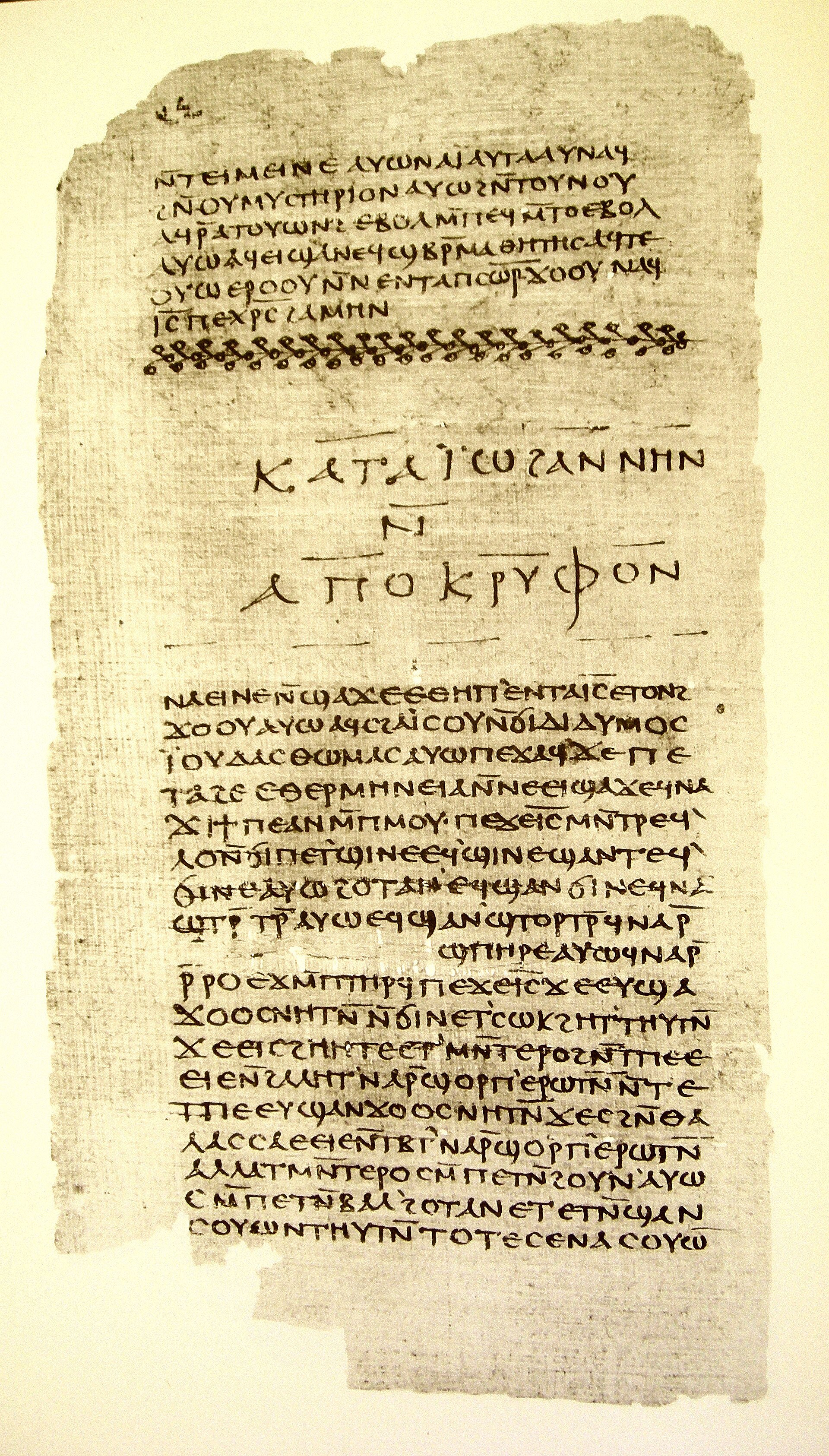
The best known Nag Hammadi text is the Gospel of Thomas, a list of 114 sayings of Jesus with almost no narrative. It opens, in Thomas O. Lambdin's translation: "These are the secret sayings which the living Jesus spoke and which Didymos Judas Thomas wrote down. (1) And he said, 'Whoever finds the interpretation of these sayings will not experience death.'"23 Some sayings are close to sayings in Matthew, Mark and Luke. Others are found nowhere else, such as saying 77: "It is I who am the light which is above them all. It is I who am the all. ... Split a piece of wood, and I am there. Lift up the stone, and you will find me there."23 Saying 3 places the kingdom within: "the kingdom is inside of you, and it is outside of you. When you come to know yourselves, then you will become known."23
Thomas was not new to scholars in 1945. Three Greek papyrus fragments found at Oxyrhynchus in Egypt and published by Bernard Grenfell and Arthur Hunt in 1897 and 1904 (P. Oxy. 1, 654 and 655) turned out to be parts of the same work in Greek, copied around the third century. That proved the Coptic text was a translation and that the work circulated in Greek well before the Nag Hammadi books were made.
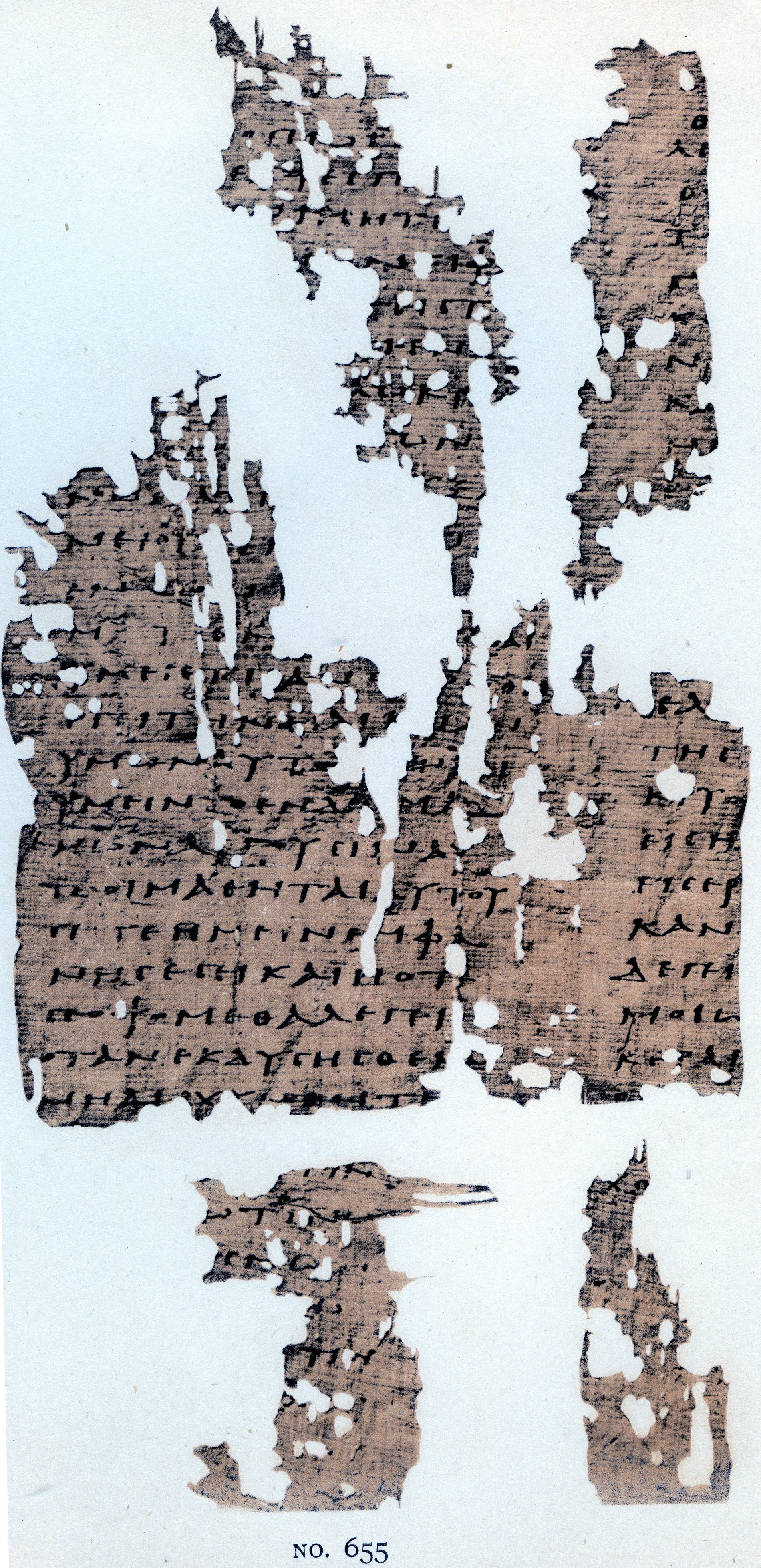

Whether Thomas is "Gnostic" and how early it is are both disputed. Helmut Koester, Stephen Patterson and others have argued that its core goes back to the first century and preserves sayings independent of the canonical Gospels. Simon Gathercole and Mark Goodacre have argued that it depends on the Synoptic Gospels and dates to about the middle of the second century.24 Many scholars describe its outlook as close to Gnostic themes (salvation by knowing oneself, the light within) without the full Gnostic myth of a flawed creator.
The Gospel of Truth
Irenaeus complained that "those who are from Valentinus ... have arrived at such a pitch of audacity, as to entitle their comparatively recent writing the Gospel of Truth, though it agrees in nothing with the Gospels of the Apostles."25 A work that begins with those words was found in Nag Hammadi Codex I (the "Jung Codex") and Codex XII. Many scholars think it is the work Irenaeus meant, and some, following its first editors, think Valentinus himself wrote it; both are judgments, not proven. It is a meditation more than a narrative. In Robert M. Grant's translation it opens: "The gospel of truth is joy to those who have received from the Father of truth the gift of knowing him by the power of the Logos, who has come from the Pleroma."26 Its account of the crucifixion uses the image of Genesis: "He was nailed to a cross. He became a fruit of the knowledge of the Father. He did not, however, destroy them because they ate of it. He rather caused those who ate of it to be joyful because of this discovery."26 The problem of the human race in this text is "forgetfulness" and "ignorance of the Father," and salvation is coming to know him: "if they then come to know the Father, from that moment on forgetfulness will cease to exist."26
The Apocryphon of John
The Apocryphon (Secret Book) of John survives in four copies, three at Nag Hammadi (Codices II, III and IV) and one in the Berlin Codex, which shows it was widely read. It is the fullest statement of the myth that scholars call "Sethian" Gnosticism, and it matches closely the system Irenaeus describes in Against Heresies 1.29.27 The risen Savior appears to John the son of Zebedee and explains that beyond the world is a perfect, unknowable God surrounded by a heavenly realm of "aeons." One aeon, Sophia (Wisdom), acted without her partner and brought forth a flawed being, Yaltabaoth, "the first archon," who made the material world. In Frederik Wisse's translation, Yaltabaoth "said to them, 'I am a jealous God, and there is no other God beside me.' But by announcing this he indicated to the angels who attended him that there exists another God."28 In this myth the God of Genesis is the lesser maker, and eating from the tree of knowledge becomes an awakening; the Savior says of Adam and Eve, "But it was I who brought about that they ate."28
Valentinus and Basilides: the teachers
Two second-century teachers stand out by name. Basilides taught at Alexandria in the reign of Hadrian (117 to 138). Valentinus, born in Egypt, taught at Rome; Irenaeus says he "came to Rome in the time of Hyginus, flourished under Pius, and remained until Anicetus," that is, roughly from the late 130s to the 160s.29 Tertullian adds a story: "Valentinus had expected to become a bishop, because he was an able man both in genius and eloquence. Being indignant, however, that another obtained the dignity by reason of a claim which confessorship had given him, he broke with the church of the true faith."30 Tertullian wrote this some fifty years later and was hostile, so the motive he gives is his own reading. What the sources agree on is that Valentinus taught for years inside the Roman church before he was separated from it.
Very little of either man's own writing survives: a few fragments of Valentinus quoted by Clement of Alexandria, and fragments of Basilides. Their systems are known mainly from their opponents. Irenaeus says Valentinus "adapted the principles of the heresy called Gnostic to the peculiar character of his own school," and taught a series of paired heavenly beings beginning with an unnameable Dyad, "Arrhetus (unspeakable)" and "Sige (silence)."31 Of Basilides, Irenaeus reports 365 heavens (the reason, he says, "the year contains the same number of days") and a striking account of the crucifixion: Christ "did not himself suffer death, but Simon, a certain man of Cyrene, being compelled, bore the cross in his stead; so that this latter being transfigured by him, that he might be thought to be Jesus, was crucified, through ignorance and error, while Jesus himself received the form of Simon, and, standing by, laughed at them."32 Hippolytus of Rome, writing a generation later, gives a quite different account of Basilides' teaching, and scholars still argue over which (if either) is accurate. This is a plain case of a group known mostly from its opponents, whose reports do not always agree with each other.
Irenaeus's Against Heresies
Irenaeus was a native of Asia Minor who had heard Polycarp as a boy and became bishop of Lyon in Gaul after the persecution of 177. His five books, written about 180, are the main ancient source on the Gnostics and the first full answer to them. Book 1 describes the systems, Book 2 argues against them from reason, and Books 3 to 5 argue from the apostles' tradition and the Scriptures. Irenaeus's method was to trace each school back to Simon Magus (Acts 8) and to argue that the true teaching was public, not secret: "if the apostles had known hidden mysteries, which they were in the habit of imparting to the perfect apart and privily from the rest, they would have delivered them especially to those to whom they were also committing the Churches themselves."3 He then gives the list of bishops of Rome from Linus to Eleutherus, his own contemporary, and says that the Roman church was "founded and organized at Rome by the two most glorious apostles, Peter and Paul."3
The same chapter contains a sentence that Catholic and Protestant readers have argued over for five hundred years. The Latin translation (the Greek original of this passage is lost) says it is necessary "that every Church should agree with this Church, on account of its preeminent authority [potiorem principalitatem]," in the Ante-Nicene Fathers rendering.3 Catholic readers take this as an early witness to the primacy of the Roman see. Many Protestant and some Orthodox readers translate the Latin differently (as "must resort to" or "must meet with" this church, because believers from everywhere come to Rome) and read the "preeminent authority" as the city's or the church's antiquity rather than a jurisdiction. The grammar of the Latin allows more than one reading, and the Greek behind it is unknown.
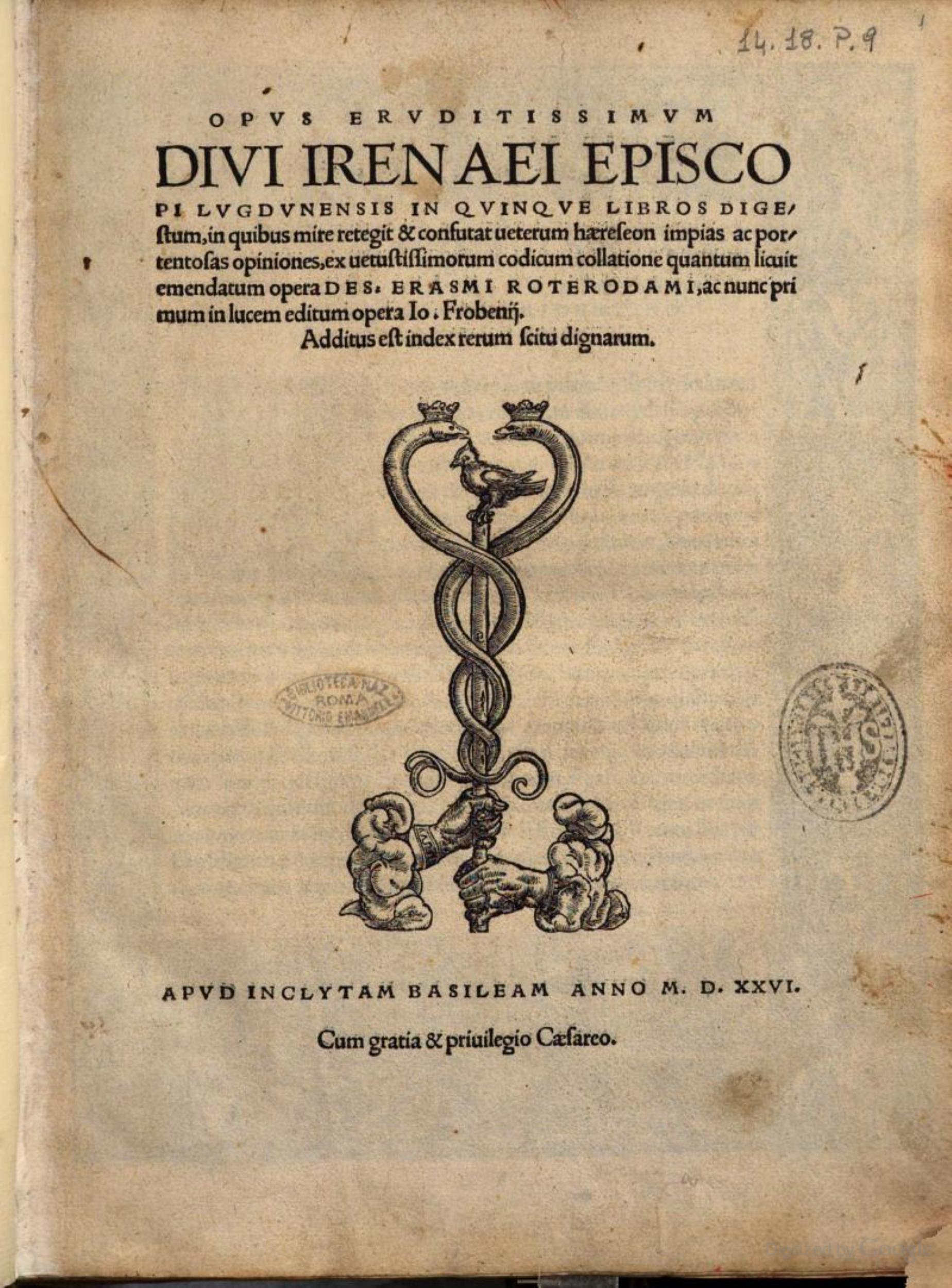

Irenaeus also gives the earliest argument that there are exactly four Gospels: "It is not possible that the Gospels can be either more or fewer in number than they are. For, since there are four zones of the world in which we live, and four principal winds ... it is fitting that she should have four pillars."25 The argument from the winds is offered as a fitting symbol, and Irenaeus does not rest his case on it; the point he cares about is that the four were already received in the churches he knew, against Marcion's one Gospel and the Valentinians' additional ones.
The Gospel of Judas and Codex Tchacos
Irenaeus reports a group later called the Cainites who honored biblical villains, and says: "They declare that Judas the traitor was thoroughly acquainted with these things, and that he alone, knowing the truth as no others did, accomplished the mystery of the betrayal ... They produce a fictitious history of this kind, which they style the Gospel of Judas."33 For eighteen centuries that sentence was all that was known of the book.
A Coptic copy surfaced in a papyrus book now called Codex Tchacos, found by farmers in a tomb in Middle Egypt in the 1970s and passed through dealers for decades, during which it was badly damaged (at one point it was kept in a bank safe-deposit box in New York). The Maecenas Foundation in Basel acquired it in 2001, and on April 6, 2006, the National Geographic Society announced its restoration and translation by Rodolphe Kasser, Marvin Meyer and Gregor Wurst. The Society reported radiocarbon tests by the University of Arizona dating the codex to about AD 220 to 340.34 The text begins: "The secret account of the revelation that Jesus spoke in conversation with Judas Iscariot."34
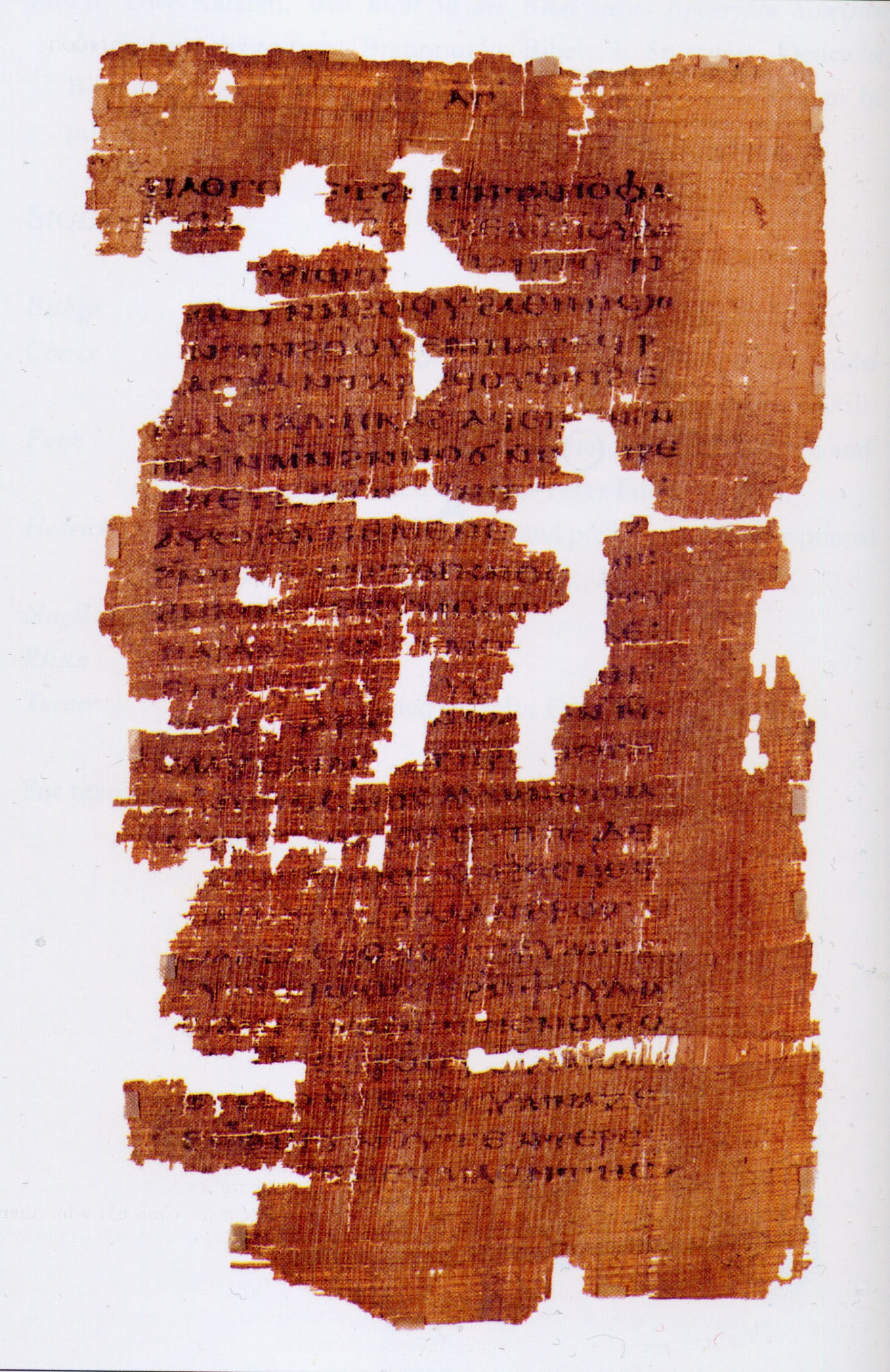

The first translation presented Judas as a hero who obeyed Jesus's request to betray him so that his spirit could be freed from his body; the key line was Jesus telling Judas, "you will exceed all of them. For you will sacrifice the man that clothes me." Other Coptic scholars soon disputed that reading. April DeConick of Rice University argued in The Thirteenth Apostle (2007) and in a New York Times essay ("Gospel Truth," Dec. 1, 2007) that the translators had rendered the Coptic word daimon as "spirit" when it should be "demon," and had made other choices that turned a text mocking Judas, and the apostles' church, into one honoring him.35 The translators revised some readings in a later critical edition. The present scholarly picture is that the Gospel of Judas is a second-century Sethian Gnostic text (consistent with Irenaeus's mention about 180), that it tells nothing reliable about the historical Judas, and that whether its Judas is a hero, a tragic figure or a demon remains debated.
How scholars read the Gnostics
For Irenaeus and those who followed him, the Gnostics were corruptors of an apostolic faith that came first. Philip Schaff, writing in the 1880s from the patristic sources alone, treated Gnosticism as the attempt to fold Christianity into pagan philosophy and Eastern myth. Adolf von Harnack (1851 to 1930), in his History of Dogma, wrote that "the Gnostic systems represent the acute secularising or hellenising of Christianity, with the rejection of the Old Testament," while the Catholic system "represents a gradual process of the same kind with the conservation of the Old Testament."54
The Nag Hammadi texts changed the questions. Elaine Pagels, in The Gnostic Gospels (1979), presented the Gnostics sympathetically as Christians whose emphasis on inner experience lost out to a church organized around bishops, creeds and canon, partly for political reasons. Her critics replied that the texts themselves show a dualism and an elitism (the "perfect" or "spiritual" set apart from ordinary believers) that are far from modern ideas of spiritual freedom, and that the Nag Hammadi books show no sign of having been a large or popular movement. Michael A. Williams, in Rethinking "Gnosticism" (1996), and Karen L. King, in What Is Gnosticism? (2003), went further and argued that "Gnosticism" is a modern category that lumps together very different groups; Williams proposed "biblical demiurgical traditions" in its place.24 Other scholars, such as Bentley Layton and David Brakke, keep the term for the specific group that called itself "Gnostics," roughly the "Sethian" texts such as the Apocryphon of John. The debate over the label does not change what the texts say; it changes how many groups are counted as one.
What both the Nag Hammadi texts and Irenaeus agree on: these groups made a sharp distinction between the highest God and the maker of the material world; they read Genesis against the grain; they taught that salvation is the awakening of a spiritual element in some human beings through knowledge; and many of them denied or reinterpreted Christ's physical suffering. They differed among themselves on almost everything else, including whether the body should be disciplined or ignored, which is one reason Irenaeus's charges of immorality against some groups and the ascetic tone of many Nag Hammadi texts do not match.
Marcion of Pontus: two gods and the first fixed canon
Marcion was a shipowner from Sinope on the Black Sea coast of Pontus who came to Rome in the late 130s or early 140s. None of his writings survives intact. His teaching is known from his opponents, above all Tertullian's five books Against Marcion (the final edition written about 207 to 208, since Tertullian dates a passage to "the fifteenth of the Emperor Severus"), Irenaeus, and later Epiphanius.36 Because Tertullian and Epiphanius quote and discuss Marcion's Gospel and letters passage by passage, scholars since Adolf von Harnack (Marcion: Das Evangelium vom fremden Gott, "the Gospel of the alien God," 1921) have reconstructed much of Marcion's scripture from their quotations.37
What Marcion taught
Irenaeus's summary, in the Ante-Nicene Fathers translation by Roberts and Rambaut, begins with Marcion's predecessor Cerdo, who "taught that the God proclaimed by the law and the prophets was not the Father of our Lord Jesus Christ. For the former was known, but the latter unknown; while the one also was righteous, but the other benevolent." Marcion, he continues, "succeeded him, and developed his doctrine," declaring the creator God "to be the author of evils, to take delight in war, to be infirm of purpose, and even to be contrary to Himself." Jesus came from "that father who is above the God that made the world," appearing in Judea under Pontius Pilate "in the form of a man ... abolishing the prophets and the law."38 Marcion taught that salvation was for the soul only, "while the body, as having been taken from the earth, is incapable of sharing in salvation."38
Marcion set out his case in a work called the Antitheses, placing sayings of the Law beside sayings of the Gospel to show they could not come from the same God. Tertullian describes it: "These are Marcion's Antitheses, or contradictory propositions, which aim at committing the gospel to a variance with the law, in order that from the diversity of the two documents which contain them, they may contend for a diversity of gods also."36 He was not a Gnostic in the full sense: he had no myth of aeons and no secret knowledge, and his good God was simply a stranger to this world who saved out of pure mercy. Harnack, who admired him, saw in Marcion a radical reader of Paul's contrast between law and grace. His opponents saw a man who cut the Christian God off from the creation and from Israel's Scriptures.
Marcion's canon: one Gospel and ten letters
Marcion is the first person known to have published a closed list of Christian Scriptures. It had two parts. The "Gospel" was a shorter form of Luke without the birth stories; Irenaeus says Marcion "mutilates the Gospel which is according to Luke, removing all that is written respecting the generation of the Lord."38 The "Apostle" (Tertullian calls it the "Apostolicon") was ten letters of Paul, without the Pastoral Letters: Tertullian wonders why Marcion accepted Philemon, "written but to one man," when "he rejected the two epistles to Timothy and the one to Titus."39 Marcion put Galatians first, and his list called the letter we know as Ephesians the letter "to the Laodiceans," which Tertullian disputed: "We have it on the true tradition of the Church, that this epistle was sent to the Ephesians, not to the Laodiceans."39 Marcion had no Old Testament at all.
Whether Marcion cut down Luke, as his opponents said, or used an earlier gospel that Luke expanded, is a live question. Most scholars follow the ancient view that he edited Luke. Some recent scholars (Matthias Klinghardt and Markus Vinzent among them) have argued that Marcion's Gospel came first, a view others, including Judith Lieu in Marcion and the Making of a Heretic (2015), treat with caution.37
The break with Rome, traditionally 144
Tertullian says Marcion arrived with a large gift: he "[went] with the two hundred sesterces which he had brought into the church" when he was finally expelled, the money having been returned.40 (The Latin amount is usually understood as 200,000 sesterces, a large fortune; the 1885 translation reads it as "two hundred.") Irenaeus says Marcion "flourished under Anicetus, who held the tenth place of the episcopate."29 The usual date of 144 for his separation comes from Tertullian's arithmetic: "from Tiberius to Antoninus Pius, there are about 115 years and 6-1/2 months. Just such an interval do they place between Christ and Marcion."36 Counting from the fifteenth year of Tiberius (about 28 to 29) gives about 144. The date is a reconstruction from that passage, and the Marcionites themselves seem to have counted their founding from it; no Roman record of an excommunication survives.
After the break Marcion organized his own churches, with bishops, presbyters and martyrs, which spread widely in the East. Justin Martyr wrote in his First Apology (about 150 to 155) that Marcion, "a man of Pontus, who is even at this day alive," had "caused many of every nation to speak blasphemies" (see lesson 03).41 Marcionite congregations still existed in Syria in the fifth century. Tertullian, writing sixty years after the break, opened his reply with a burst of invective: "Nothing, however, in Pontus is so barbarous and sad as the fact that Marcion was born there, fouler than any Scythian."36 That is polemic, and it tells more about Tertullian's style than about Marcion.
The Muratorian Fragment, discussed below, knows of letters "to the Laodiceans, and another to the Alexandrians, forged under the name of Paul, and addressed against the heresy of Marcion," and rejects them.19 Many historians, following Harnack, have argued that Marcion's short canon pushed the larger church to define its own list. Others (such as John Barton and Everett Ferguson) answer that the four Gospels and Paul's letters were already being read together before Marcion and that his challenge sped up a process already under way.
The Montanists and the New Prophecy
The third movement of the period arose in Phrygia, in the interior of Asia Minor. Its followers called it "the New Prophecy"; opponents called them "the Phrygians" or "Cataphrygians," and later writers "Montanists," after its founder. Unlike the Gnostics and Marcion, the Montanists held the same doctrine of God and Christ as the larger church. The argument was over prophecy, discipline and authority.
Montanus, Priscilla and Maximilla
The fullest early account is a hostile one, by an anonymous writer quoted by Eusebius. He says that at "a certain village called Ardabau in that part of Mysia, which borders upon Phrygia ... when Gratus was proconsul of Asia, a recent convert, Montanus by name, through his unquenchable desire for leadership, gave the adversary opportunity against him. And he became beside himself, and being suddenly in a sort of frenzy and ecstasy, he raved, and began to babble and utter strange things, prophesying in a manner contrary to the constant custom of the Church handed down by tradition from the beginning."17 Two women joined him, Priscilla (also called Prisca) and Maximilla, and spoke in the same way.17 The writer reports that bishops tried to refute "the spirit in Maximilla, but were prevented by others who plainly co-operated with the spirit," and that she prophesied wars which, "more than thirteen years since the woman died," had not come.17 He also passes on a rumor that Montanus and Maximilla hanged themselves, adding that this was only "the report."17
The prophets' own words survive only as short oracles quoted by opponents and by Tertullian. Eusebius preserves one from Maximilla: "I am driven away from the sheep like a wolf. I am not a wolf. I am word and spirit and power."17 Tertullian quotes Priscilla on those who deny the resurrection of the body: "It is a shrewd saying which the Paraclete utters concerning these persons by the mouth of the prophetess Prisca: They are carnal, and yet they hate the flesh."42 Other oracles in which Montanus seems to speak as God in the first person are known from Epiphanius, writing about 375, two centuries later; whether Montanus claimed to be the Paraclete himself or to be speaking for the Paraclete, as prophets of Israel spoke for God, is debated. Eusebius himself writes that the followers were "boasting that Montanus was the Paraclete."17
The date is uncertain. Eusebius's Chronicle places the start in 172; Epiphanius points to about 157. Schaff, surveying the scholarship of his day, found estimates from 126 to 180 and judged Eusebius's year "certainly too late."1 Most modern accounts give a range of about 156 to 172.
What the New Prophecy taught and practiced
Hippolytus of Rome, an opponent writing about 225, grants the main point of doctrine: "These acknowledge God to be the Father of the universe, and Creator of all things, similarly with the Church, and (receive) as many things as the Gospel testifies concerning Christ. They introduce, however, the novelties of fasts, and feasts, and meals of parched food, and repasts of radishes, alleging that they have been instructed by women."43 A critic named Apollonius, also quoted by Eusebius, lists the charges: Montanus "taught the dissolution of marriage," "made laws for fasting," and "named Pepuza and Tymion, small towns in Phrygia, Jerusalem, wishing to gather people to them from all directions," and paid salaries to preachers.17 The prophets expected the heavenly Jerusalem to come down at Pepuza. Pepuza itself was lost for centuries; William Tabbernee and Peter Lampe identified its probable site near the village of Karayakuplu in western Turkey and published their findings in 2008.44
Prophecy was not new. Paul lists it among the gifts (1 Corinthians 12 to 14), the Didache gives rules for traveling prophets, and Montanist writers appealed to earlier prophets in Asia, such as Quadratus and Ammia of Philadelphia.17 What their opponents rejected was the ecstatic manner, the claim of new commands binding on the whole church, and the prophets' authority over the bishops. Irenaeus, writing about the same time, attacked people who rejected John's Gospel and its promise of the Paraclete and so "set aside the gift of prophecy from the Church," reminding them that Paul "recognises men and women prophesying in the Church." The 1885 translators inserted "(the Montanists)" into this passage, but many scholars think Irenaeus meant the Montanists' opponents. Either way, the larger church did not reject prophecy as such.25
Tertullian's later sympathy
Tertullian of Carthage, the first major Christian writer in Latin, came to accept the New Prophecy around 207. He did not travel to Phrygia; he read its oracles and approved its discipline. In works written after that date he calls the Paraclete's revelations "the new prophecy, which descends in copious streams from the Paraclete," and calls those who reject them "Psychics" (merely natural, unspiritual people), as in the opening of On Fasting: "I should wonder at the Psychics, if they were enthralled to voluptuousness alone, which leads them to repeated marriages, if they were not likewise bursting with gluttony, which leads them to hate fasts."4245 In Against Praxeas he says a bishop of Rome "had acknowledged the prophetic gifts of Montanus, Prisca, and Maximilla, and, in consequence of the acknowledgment, had bestowed his peace on the churches of Asia and Phrygia," until Praxeas persuaded him to withdraw it: "he drove away prophecy, and he brought in heresy; he put to flight the Paraclete, and he crucified the Father."46 The bishop is unnamed (Eleutherus or Victor are the usual guesses).
Whether Tertullian formally left the catholic church at Carthage is debated. The older view (repeated in many textbooks) is that he became a Montanist schismatic. Since the work of David Rankin (Tertullian and the Church, 1995) and others, many scholars hold that he stayed within the Carthaginian church as a member of a prophetic party, and that a separate group of "Tertullianists" is a later development.47 His writings on persecution and the martyrs are covered in lesson 03.
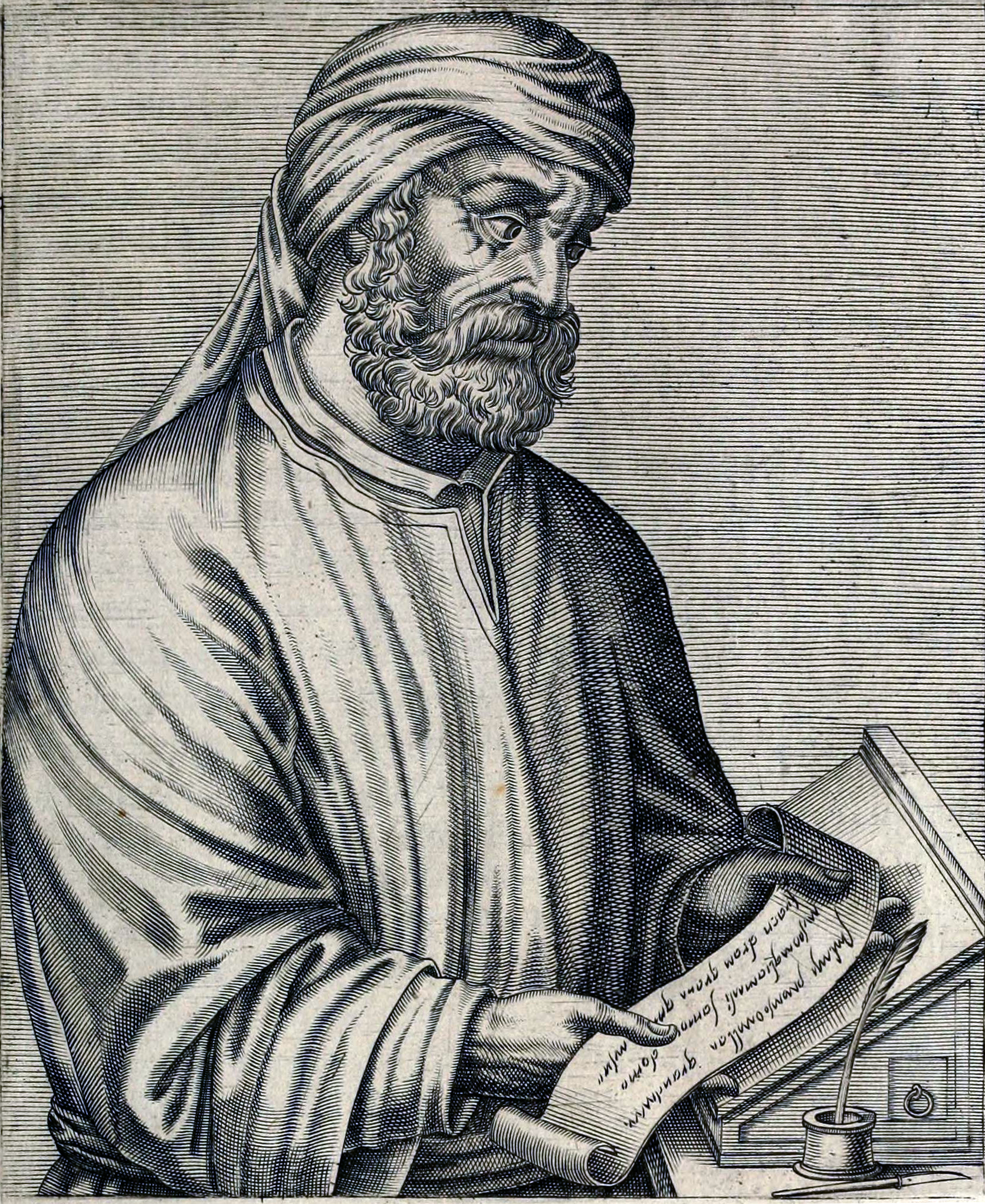

Synods of bishops in Asia Minor met to examine the New Prophecy, and Eusebius reports that "the faithful in Asia met often in many places throughout Asia to consider this matter," and that "these persons were expelled from the Church and debarred from communion."17 These are among the first recorded church synods. The movement nonetheless lasted for centuries, with its own clergy and women in office, and was finally suppressed by imperial laws in the sixth century.
The rule of faith and the growing New Testament
Against these challenges the writers who became the standard of orthodoxy offered three tests: the public teaching of the churches founded by apostles, checked by the succession of their bishops; a short summary of belief they called the "rule of faith" (Greek kanon tes aletheias, "rule of truth"; Latin regula fidei); and the books read in the churches. The later creeds, Nicaea and its successors, are the subject of lesson 04.
The rule of faith
Irenaeus gives the rule in a form that already has the three-part shape of later creeds: "The Church, though dispersed throughout the whole world, even to the ends of the earth, has received from the apostles and their disciples this faith: [She believes] in one God, the Father Almighty, Maker of heaven, and earth, and the sea, and all things that are in them; and in one Christ Jesus, the Son of God, who became incarnate for our salvation; and in the Holy Spirit, who proclaimed through the prophets the dispensations of God."48 He stresses that the same faith is taught everywhere: "the Churches which have been planted in Germany do not believe or hand down anything different, nor do those in Spain, nor those in Gaul, nor those in the East, nor those in Egypt, nor those in Libya."48 Each clause answers a rival: one God who is Maker (against the Gnostics and Marcion), a Christ who "became incarnate" (against the Docetists), the Spirit who spoke "through the prophets" of Israel (against Marcion's rejection of the Old Testament).
Tertullian made the same argument in Latin in The Prescription Against Heretics (about 200). Heretics, he argued, have no right even to argue from Scripture, because the Scriptures belong to the churches that hold the apostolic rule. In the same work he asks: "What indeed has Athens to do with Jerusalem? What concord is there between the Academy and the Church? What between heretics and Christians?"40 He blamed philosophy for the speculations of the Gnostics.
The Muratorian Fragment and its date
The oldest surviving list of New Testament books is a damaged Latin text of 85 lines found by Ludovico Antonio Muratori in the Ambrosian Library in Milan and published in 1740. It survives in an eighth-century manuscript from the monastery of Bobbio, copied from a damaged older exemplar in poor Latin, probably translated from Greek.49 The beginning is lost. The surviving text accepts four Gospels (Luke is "the third book of the Gospel"), Acts, thirteen letters of Paul, Jude, two letters of John, the Revelation of John and the Apocalypse of Peter ("though some of us are not willing that the latter be read in church"), and the Wisdom of Solomon; it does not mention Hebrews, James or 1 and 2 Peter; it allows the Shepherd to be read privately; it rejects the Marcionite letters and the books of Valentinus and others.19
Its date is argued. Because it says the Shepherd was written "very recently in our times" while Pius was bishop, it has traditionally been dated to about 170 to 200, at Rome. In 1973 Albert C. Sundberg Jr. argued in the Harvard Theological Review that it is a fourth-century list from the Greek East, and Geoffrey Hahneman extended the case in The Muratorian Fragment and the Development of the Canon (Oxford, 1992).49 Everett Ferguson (1982) and Charles E. Hill (in a 1995 review of Hahneman in the Westminster Theological Journal) defended the traditional date, which remains the majority view, though the question is open.50
A few paragraphs on the canon
The full story of how the New Testament list was settled belongs to a later Bible and History module on the history of the Bible. For church history in this period, four points from the documents are enough. First, the churches already read the Jewish Scriptures (in Greek) as Scripture, which is why Marcion's rejection of them was so sharply opposed. Second, by about 180 Irenaeus treats exactly four Gospels as fixed and quotes most of Paul's letters, Acts, 1 Peter, 1 John and Revelation as Scripture.25 Third, the edges were still open: the Shepherd, Barnabas and the Apocalypse of Peter were read in some churches, and several of the shorter letters were doubted. Fourth, more than a century later Eusebius still sorted the books into "accepted," "disputed" (James, Jude, 2 Peter, 2 and 3 John) and "rejected" writings, and set apart as "fictions of heretics" the "Gospels of Peter, of Thomas, of Matthias" and others.4 No council in this period voted on a list.
Walter Bauer's thesis and its critics
The traditional account of this period goes back to Hegesippus and Irenaeus and was written down by Eusebius: the apostles taught one faith; heresies arose later, after the apostles died, as departures from it. Eusebius, quoting Hegesippus, says that "when the sacred college of apostles had suffered death in various forms ... then the league of godless error took its rise as a result of the folly of heretical teachers."4 On this view orthodoxy came first and was always the majority.
In 1934 the German New Testament scholar Walter Bauer (1877 to 1960), best known for his Greek lexicon of the New Testament, challenged that account in Rechtgläubigkeit und Ketzerei im ältesten Christentum, translated in 1971 as Orthodoxy and Heresy in Earliest Christianity. Bauer set the New Testament aside and studied the second-century evidence region by region: Edessa in Syria, Egypt, Antioch, Asia Minor and Rome. He argued that in several regions the forms of Christianity later called heresy were the earliest or the strongest, and that in some places they were the only form; that only Rome had an orthodox majority from the start; and that "orthodoxy" was the form of faith held at Rome, which won out through Rome's organization, money and influence.51 In Egypt, for example, he noted that the sources say almost nothing about the church before Bishop Demetrius (from about 189), and that the earliest named Egyptian Christian teachers are Basilides and Valentinus.
Bauer's thesis shaped a generation of scholarship. Helmut Koester extended it, and Elaine Pagels and Bart Ehrman (in Lost Christianities, 2003, and The Orthodox Corruption of Scripture, 1993) brought versions of it to a wide public, with Ehrman describing the winning party as "proto-orthodox."52 The critics answered on the evidence region by region. H. E. W. Turner, in his 1954 Bampton Lectures, The Pattern of Christian Truth, gave the first full reply, arguing that the shared core of belief was present from the start even when its expression varied.51 Thomas A. Robinson, in The Bauer Thesis Examined (1988), argued that the evidence for most regions is too thin to support Bauer's conclusions, and that the best-attested region, Ephesus and western Asia Minor, tells against them.51 Paul Trebilco, in a 2006 article, used Ignatius as a test case and concluded that Ignatius is "a witness against Bauer, on four significant points": he faced two separate groups (Judaizers and Docetists), not one Gnostic movement; Bauer's claim that churches Ignatius did not write to were heretical is an argument from silence; some of the conflicts with bishops were about church order, not doctrine; and Paul's influence in Ephesus had not been lost.52 Andreas Köstenberger and Michael Kruger made the case for a popular audience in The Heresy of Orthodoxy (2010).
Where the debate stands, in plain terms: few scholars now accept Bauer's region-by-region reconstruction as he gave it, especially for Asia Minor; most accept his broader point that the second century was more varied than Eusebius's account allows, and that the sources were mostly preserved by the side that won. The disagreement that remains is over whether that variety was variety around a recognizable core of apostolic teaching (Turner, Robinson, Trebilco) or variety without a center until one party defined one (Bauer, Koester, Ehrman). The Nag Hammadi books confirm that the Gnostic groups were real, literate and varied; they do not by themselves show how large those groups were.
What the record shows and what it does not
- Documented fact: 1 Clement, the Didache, the seven letters of Ignatius (middle recension), Polycarp's letter, the Martyrdom of Polycarp, Barnabas, the Shepherd, Papias's fragments and Diognetus all survive and can be read in public domain translations. The Nag Hammadi codices were found in December 1945 and date to the fourth century. Codex Tchacos was announced in April 2006. Irenaeus wrote Against Heresies about 180; Tertullian wrote Against Marcion in its final form about 207 to 208.
- Documented fact: plural "bishops" or "presbyters" appear in 1 Clement, Hermas and the Didache; one bishop per city church appears in Ignatius; Irenaeus gives a list of single bishops of Rome.
- A church's own claim or tradition: that Clement was the third bishop of Rome; that Polycarp was appointed by apostles; that bishops succeed the apostles by divine institution (Catholic and Orthodox teaching); that the four Gospels alone were apostolic (Irenaeus).
- Reconstruction from a hostile source: nearly everything about Basilides, Marcion and the Montanist prophets comes from their opponents, who sometimes disagree with each other (Irenaeus and Hippolytus on Basilides).
- Scholarly reading: the development of the single bishop out of a council of presbyters (Lightfoot, Schaff); the Gnostic label as too broad (Williams, King); Bauer's thesis and its critics.
- Open questions: the exact dates of 1 Clement, Ignatius (110s or 140s), the Didache, the Martyrdom of Polycarp (155 to 160), Montanus (about 156 to 172) and the Muratorian Fragment (second or fourth century); whether Marcion edited Luke or used an earlier gospel; the early date of the Gospel of Thomas.
Claims checked
"The church banned the Gnostic gospels at the Council of Nicaea and burned them"
Refuted as stated. The canons of Nicaea (325) and the eyewitness accounts (Eusebius, Athanasius) say nothing about the Gnostic gospels or a list of books; the council dealt with Arius, the date of Easter and church discipline (lesson 04). Irenaeus had already rejected the Valentinian "Gospel of Truth" and the "Gospel of Judas" around 180, nearly 150 years earlier, by argument.25 Later, in 367, Bishop Athanasius of Alexandria's Easter letter (Letter 39) listed the 27 books and warned against books "called apocryphal,"53 and one theory holds that the monks of a nearby Pachomian monastery hid the Nag Hammadi books after that letter. That theory is plausible but unproven, and Denzey Lewis and Blount reject it, arguing that the books were more likely buried as grave goods;56 who buried the jar, and why, is not known.
"The Gnostic gospels are as old as, or older than, the four Gospels"
Unsupported as a general claim (the Gospel of Thomas is the one contested case). The Nag Hammadi copies are fourth-century, and the Greek fragments of Thomas third-century. Irenaeus calls the Gospel of Truth "comparatively recent" around 180, and the Gospel of Judas is placed by its own editors in the second century.2534 Only the Gospel of Thomas has serious scholarly defenders of a first-century core, and that claim is contested.
"Ignatius invented the office of bishop"
Refuted. The word episkopos is used for church leaders in Paul's letters, Acts, 1 Clement and the Didache before or around Ignatius.211 What appears first clearly in Ignatius is one bishop over each city church with presbyters and deacons under him, and Ignatius argues for it as an existing order he wants obeyed. Whether that order was already old in his day or newly established is the real question, and it is open.
"The early church had no organized leadership until Constantine"
Refuted. Bishops, presbyters and deacons, appointment of leaders, lists of bishops and synods of bishops are all documented in the second century, long before Constantine (lesson 04). The Asian synods against the Montanists are recorded by Eusebius's source.17
"The Gospel of Judas proves Judas was a hero who obeyed Jesus"
Refuted as a claim about the historical Judas (how the text itself presents Judas is unresolved). The work dates from the second century and tells nothing reliable about the historical Judas. Whether the text itself presents Judas favorably is disputed between the National Geographic translators and scholars such as April DeConick.3435
"Marcion created the first New Testament, and the church copied him"
Partly supported. Marcion's Gospel and Apostle is the first closed list of Christian Scriptures known by name, and Harnack and others argued that it pushed the larger church to define its own.38 But the churches were already reading the Gospels and Paul's letters (Polycarp's letter is full of Paul and 1 Peter), and their eventual list kept the Old Testament and four Gospels Marcion rejected. "Copied" overstates the case; "provoked" or "sped up" fits the evidence better.
"The Montanists were heretics with a different God"
Refuted. Their opponent Hippolytus grants that they "acknowledge God to be the Father of the universe, and Creator of all things, similarly with the Church."43 They were condemned over prophecy, discipline and authority. Some later Montanists were accused of the views of Noetus on the Trinity, which is a separate and later question.
"Polycarp was a disciple of the apostle John"
Partly supported. Irenaeus, who knew Polycarp as a boy, says he was "instructed by apostles" and appointed by "apostles in Asia," and links him with "John, the disciple of the Lord."317 That is early and first-hand testimony about Polycarp, but scholars debate whether Irenaeus's "John" was the apostle or another John (compare Papias's "presbyter John"), and Polycarp's own letter does not mention John.
Hard questions and answers
If the winners wrote the sources, how can any account of the heretics be trusted?
Two ways. First, by checking opponents against the groups' own texts where any survive: the Apocryphon of John matches Irenaeus's account of one Gnostic system closely, while the Gospel of Truth is gentler than Irenaeus's description of Valentinians suggests, and the ascetic tone of many Nag Hammadi texts does not fit his charges of immorality.2826 Second, by checking opponents against each other, as with Irenaeus and Hippolytus on Basilides. Where neither check is possible (Marcion, the Montanist prophets), honest accounts say so, as this lesson does.
A Catholic reader asks: doesn't Irenaeus 3.3 show that all churches had to agree with Rome?
The Latin says that every church must agree with (or "resort to") the Roman church "on account of its preeminent authority," and Irenaeus then lists the Roman bishops from Linus.3 Catholic theology reads this as primacy. The same chapter grounds Rome's standing in its founding by Peter and Paul and its fidelity to their teaching, and the same Irenaeus, according to Eusebius, rebuked Bishop Victor of Rome for excommunicating the Asian churches over the date of Easter, citing the peace between Polycarp and Anicetus.17 The text shows Rome's high standing by 180. How much jurisdiction that standing carried is the disputed point.
A Protestant reader asks: if the Apostolic Fathers appeal to bishops and tradition, where is "Scripture alone"?
The Apostolic Fathers quote the Jewish Scriptures constantly and the apostles' letters often, and Irenaeus argues from the Scriptures at length in Books 3 to 5. They also appeal to the bishops and the public tradition, because their opponents claimed secret traditions and rival scriptures. The texts do not frame the question as later Reformation debates did (lessons 11 and 12). What they show is Scripture, rule of faith and the public teaching of the churches used together against teachers who rejected all three.
An Orthodox reader asks: why does Ignatius tie the church so closely to the Eucharist?
Because for Ignatius the Docetists' error showed up at the altar: those who denied Christ's real flesh stayed away from the Eucharist, which he calls "the flesh of our Saviour Jesus Christ."7 One bishop, one altar and one bread were for him the visible form of one faith in a Christ who truly suffered. That is the basis of the Orthodox "eucharistic" reading of the church, and Catholic and many Protestant readers accept the historical point while differing on what follows from it.
A skeptic asks: weren't the "orthodox" simply the party that won?
They were the party that won, and they wrote most of the surviving history. The question Bauer raised is whether they were also the earliest. The evidence for some regions (Asia Minor, Rome) shows communities from the start that taught one God who is Creator, a Christ of real flesh, and the Jewish Scriptures, which are the positions Irenaeus defends.52 For other regions (Egypt, Edessa) the early evidence is too thin to say. The Gnostic texts themselves present their teaching as a higher, secret knowledge for a few, beyond the faith of ordinary believers, which implies that the ordinary believers were already there.
Why were 1 Clement, Hermas and Barnabas left out of the New Testament when some churches read them?
The surviving discussions give reasons: the Muratorian Fragment rejects the Shepherd for public reading because it was written "very recently in our times," after the apostles, and its author was not an apostle or prophet.19 Eusebius classes Barnabas, the Shepherd and the Didache as "rejected" (that is, not canonical though known and valued) rather than heretical.4 Apostolic origin, use across the churches, and agreement with the rule of faith were the tests applied. The Apostolic Fathers were kept and copied as respected early writings, which is why they survive.
The next lesson, Persecution and the Apologists, follows the same churches as they faced the Roman state from Nero to Diocletian, and the writers (Justin, Tertullian and others) who defended the faith to emperors and philosophers.
Learn more
- Early Christian Writings: Links to translations and introductions for every text in this lesson, arranged by date.
- The Gnostic Society Library: Nag Hammadi Library: Translations of the Nag Hammadi texts, including Thomas, Truth and the Apocryphon of John.
- Schaff, History of the Christian Church, vol. 2 (CCEL): A full public domain survey of the Apostolic Fathers, Gnosticism, Marcion and Montanism, with the 19th-century debates.
- Paul Trebilco on Ignatius and Bauer (JETS, 2006): A careful test of the Bauer thesis against the evidence for Asia Minor.
- Introduction to Classical Greek (module 78): The language in which nearly all of these texts were written.
Still being checked (13 items)
These points could not be confirmed against a primary source when this lesson was written and fact checked in October 2026. The text above states each one as uncertain.
- The date of 1 Clement (about 95 to 97) is traditional and rests on inference; the letter names no emperor.
- The date of Ignatius (about 107 to 117 by Eusebius, or the 140s by T. D. Barnes) is disputed; only Barnes's abstract was consulted.
- The year of Polycarp's death (155 to 160) is disputed; the Feb. 23, 155 date is Waddington's as reported by Schaff.
- The Didache manuscript: Schaff (vol. 2, section 161 and preface) confirms the date 1056 and the discovery by Bryennios in the library of the Jerusalem monastery at Constantinople; the year of discovery (1873) and the manuscript's present home in Jerusalem are stated from standard reference knowledge.
- The dating of the Nag Hammadi bindings (cartonnage) to the 340s is given as Robinson's account and was not checked against Robinson's own publication.
- Grenfell and Hunt's publication years for P. Oxy. 1, 654 and 655 (1897 and 1904) and the third-century dating of the fragments are stated from standard reference knowledge.
- Positions attributed to Pagels, Williams, King, Layton, Brakke, Gathercole, Goodacre, Koester, Patterson, Lieu, Vinzent, Klinghardt, Rankin, Ferguson, Barton, Hahneman, Afanasiev, Zizioulas, Timothy Ware, Kostenberger and Kruger are summarized from standard accounts; their books were not opened.
- P. N. Harrison's two-letter theory of Polycarp's Philippians (1936) is stated from standard reference knowledge.
- The reading of Tertullian's "two hundred sesterces" (Prescription 30) as 200,000 sesterces is the usual interpretation of the Latin; the Latin text was not opened.
- The identification of Pepuza near Karayakuplu by Tabbernee and Lampe is from reference summaries of their 2008 book; the book and the Heidelberg project page were not opened (the archived page was blocked).
- The suppression of the Montanists by imperial laws in the sixth century is stated from standard accounts.
- The view that Irenaeus 3.11.9 refers to the Montanists' opponents (despite the 1885 translators' insertion "(the Montanists)") is a scholarly reading not checked against a specific study.
- Image captions follow IMAGES.md; the Commons pages were not reopened (P. Oxy. 655 as Greek fragments of the Gospel of Thomas; Codex Tchacos page 33 as the opening page of the Gospel of Judas; the Ignatius icon attribution to Ioann Apakass is marked as possible).
Notes
- Philip Schaff, History of the Christian Church, vol. 2, Ante-Nicene Christianity, A.D. 100 to 325 (New York: Scribner, rev. ed. 1884), preface to the third edition (Bryennios and the Didache); section 19, note 34 (Waddington's date of Feb. 23, 155 for Polycarp); section 45 (development of the episcopate, Ignatius) with notes 188 and 189; section 110, note 760 (dates of Montanism); section 161 (editions of the Apostolic Fathers); section 165 (the Ignatian controversy); section 170 (Epistle to Diognetus, manuscript destroyed at Strasbourg, 1870). Public domain; text at Christian Classics Ethereal Library (retrieved Oct. 28, 2026). Read it online. ↩
- 1 Clement (Letter of the Romans to the Corinthians), chapters 1, 5, 42, 44 and 65, trans. John Keith, in Ante-Nicene Fathers, vol. 9, ed. Allan Menzies (Buffalo, NY: Christian Literature Publishing Co., 1896); revised and edited for New Advent by Kevin Knight (retrieved Oct. 28, 2026). Read it online. ↩
- Irenaeus, Against Heresies 3.3.1 to 3.3.4, trans. Alexander Roberts and William Rambaut, in Ante-Nicene Fathers, vol. 1, ed. Alexander Roberts, James Donaldson and A. Cleveland Coxe (Buffalo, NY: Christian Literature Publishing Co., 1885); New Advent edition (retrieved Oct. 28, 2026). Read it online. ↩
- Eusebius, Church History 3.25 (accepted, disputed and rejected books), 3.32 (Hegesippus on the rise of heresy), 3.36 (Ignatius, Polycarp, Papias) and 3.39 (Papias), trans. Arthur Cushman McGiffert, in Nicene and Post-Nicene Fathers, Second Series, vol. 1, ed. Philip Schaff and Henry Wace (Buffalo, NY: Christian Literature Publishing Co., 1890); New Advent edition (retrieved Oct. 28, 2026). Read it online. ↩
- Timothy D. Barnes, "The Date of Ignatius," The Expository Times 120, no. 3 (2008): 119 to 130, doi:10.1177/0014524608098730 (abstract consulted) (retrieved Oct. 28, 2026). Read it online. ↩
- Ignatius, To the Magnesians 6 and 10, trans. Alexander Roberts and James Donaldson, in Ante-Nicene Fathers, vol. 1 (Buffalo, NY: Christian Literature Publishing Co., 1885); New Advent edition (retrieved Oct. 28, 2026). Read it online. ↩
- Ignatius, To the Smyrnaeans 2, 7 and 8, trans. Alexander Roberts and James Donaldson, in Ante-Nicene Fathers, vol. 1 (Buffalo, NY: Christian Literature Publishing Co., 1885); New Advent edition (retrieved Oct. 28, 2026). Read it online. ↩
- Ignatius, To the Trallians 10, trans. Alexander Roberts and James Donaldson, in Ante-Nicene Fathers, vol. 1 (Buffalo, NY: Christian Literature Publishing Co., 1885); New Advent edition (retrieved Oct. 28, 2026). Read it online. ↩
- Ignatius, To the Ephesians 20, trans. Alexander Roberts and James Donaldson, in Ante-Nicene Fathers, vol. 1 (Buffalo, NY: Christian Literature Publishing Co., 1885); New Advent edition (retrieved Oct. 28, 2026). Read it online. ↩
- Ignatius, To the Romans 4 (and salutation), trans. Alexander Roberts and James Donaldson, in Ante-Nicene Fathers, vol. 1 (Buffalo, NY: Christian Literature Publishing Co., 1885); New Advent edition (retrieved Oct. 28, 2026). Read it online. ↩
- The Didache (Teaching of the Twelve Apostles) 1, 7, 8, 9, 14 and 15, trans. M. B. Riddle, in Ante-Nicene Fathers, vol. 7 (Buffalo, NY: Christian Literature Publishing Co., 1886); New Advent edition (retrieved Oct. 28, 2026). Read it online. ↩
- The Shepherd of Hermas, Vision 1.1 and 2.4 (Book I) and Mandate 4.1 (Book II, https://www.newadvent.org/fathers/02012.htm), trans. F. Crombie, in Ante-Nicene Fathers, vol. 2 (Buffalo, NY: Christian Literature Publishing Co., 1885); New Advent edition (retrieved Oct. 28, 2026). Read it online. ↩
- Second Vatican Council, Lumen Gentium (Dogmatic Constitution on the Church), Nov. 21, 1964, section 20, official English translation, vatican.va (retrieved Oct. 28, 2026). Read it online. ↩
- J. B. Lightfoot, "The Christian Ministry," dissertation in Saint Paul's Epistle to the Philippians (London: Macmillan, 1868); public domain text consulted in a PDF reprint (retrieved Oct. 28, 2026). Read it online. ↩
- Polycarp, To the Philippians 7 and 13, trans. Alexander Roberts and James Donaldson, in Ante-Nicene Fathers, vol. 1 (Buffalo, NY: Christian Literature Publishing Co., 1885); New Advent edition (retrieved Oct. 28, 2026). Read it online. ↩
- The Martyrdom of Polycarp, salutation and chapters 3, 9, 18 and 21, trans. Alexander Roberts and James Donaldson, in Ante-Nicene Fathers, vol. 1 (Buffalo, NY: Christian Literature Publishing Co., 1885); New Advent edition (retrieved Oct. 28, 2026). Read it online. ↩
- Eusebius, Church History 5.7 (title of Irenaeus's work), 5.14 to 5.18 (the Montanists, from an anonymous writer and Apollonius), 5.22 (Demetrius of Alexandria) and 5.24 (Irenaeus to Victor on Polycarp and Anicetus), trans. Arthur Cushman McGiffert, Nicene and Post-Nicene Fathers, Second Series, vol. 1 (1890); New Advent edition (retrieved Oct. 28, 2026). Read it online. ↩
- The Epistle of Barnabas 4, 9, 15, 16 and 18 to 20, trans. Alexander Roberts and James Donaldson, in Ante-Nicene Fathers, vol. 1 (Buffalo, NY: Christian Literature Publishing Co., 1885); New Advent edition (retrieved Oct. 28, 2026). Read it online. ↩
- The Muratorian Fragment (Canon Muratorianus), translation in Ante-Nicene Fathers, vol. 5 (1886), as given at Wikisource (retrieved Oct. 28, 2026). Shorter quotations (Luke as "the third book," the Apocalypse of Peter) are from the translation by Bruce M. Metzger, The Canon of the New Testament (Oxford: Clarendon, 1987), as given at https://www.earlychristianwritings.com/text/muratorian-metzger.html. Read it online. ↩
- The Epistle to Diognetus 5 and 6, trans. Alexander Roberts and James Donaldson, in Ante-Nicene Fathers, vol. 1 (Buffalo, NY: Christian Literature Publishing Co., 1885); New Advent edition (retrieved Oct. 28, 2026). Read it online. ↩
- Roger Pearse, "The Nag Hammadi discovery of manuscripts," summarizing James M. Robinson's accounts of the 1945 find (including Robinson in Biblical Archaeologist, 1979, and The Secrets of Judas, 2006), tertullian.org (retrieved Oct. 28, 2026). Read it online. ↩
- The Gnostic Society Library, "The Nag Hammadi Library" (introduction and index of translations), gnosis.org (retrieved Oct. 28, 2026). Read it online. ↩
- The Gospel of Thomas, prologue and sayings 1, 3 and 77, trans. Thomas O. Lambdin, in The Nag Hammadi Library in English, ed. James M. Robinson; as given by the Gnostic Society Library, gnosis.org (retrieved Oct. 28, 2026). Read it online. ↩
- Scholarly works named: Elaine Pagels, The Gnostic Gospels (New York: Random House, 1979); Michael A. Williams, Rethinking "Gnosticism": An Argument for Dismantling a Dubious Category (Princeton University Press, 1996); Karen L. King, What Is Gnosticism? (Harvard University Press, 2003); Bentley Layton, The Gnostic Scriptures (1987); David Brakke, The Gnostics (2010); Simon Gathercole, The Gospel of Thomas: Introduction and Commentary (Brill, 2014); Mark Goodacre, Thomas and the Gospels (Eerdmans, 2012). Cited for the authors' positions as summarized; these books were not opened for this lesson. ↩
- Irenaeus, Against Heresies 3.11.7 to 3.11.9 (the four Gospels, Marcion, the rejection of prophecy, the Valentinian "Gospel of Truth"), trans. Alexander Roberts and William Rambaut, in Ante-Nicene Fathers, vol. 1 (Buffalo, NY: Christian Literature Publishing Co., 1885); New Advent edition (retrieved Oct. 28, 2026). Read it online. ↩
- The Gospel of Truth, trans. Robert M. Grant, as given by the Gnostic Society Library, gnosis.org (retrieved Oct. 28, 2026). Read it online. ↩
- Irenaeus, Against Heresies 1.29 (the system of the Barbelo-Gnostics), trans. Alexander Roberts and William Rambaut, in Ante-Nicene Fathers, vol. 1 (Buffalo, NY: Christian Literature Publishing Co., 1885); New Advent edition (retrieved Oct. 28, 2026). Read it online. ↩
- The Apocryphon of John, trans. Frederik Wisse, in The Nag Hammadi Library in English, ed. James M. Robinson; as given by the Gnostic Society Library, gnosis.org (retrieved Oct. 28, 2026). Read it online. ↩
- Irenaeus, Against Heresies 3.4.3 (Valentinus, Cerdo and Marcion at Rome), trans. Alexander Roberts and William Rambaut, in Ante-Nicene Fathers, vol. 1 (Buffalo, NY: Christian Literature Publishing Co., 1885); New Advent edition (retrieved Oct. 28, 2026). Read it online. ↩
- Tertullian, Against the Valentinians 4, trans. Alexander Roberts, in Ante-Nicene Fathers, vol. 3 (Buffalo, NY: Christian Literature Publishing Co., 1885); New Advent edition (retrieved Oct. 28, 2026). Read it online. ↩
- Irenaeus, Against Heresies 1.11.1 (Valentinus), trans. Alexander Roberts and William Rambaut, in Ante-Nicene Fathers, vol. 1 (Buffalo, NY: Christian Literature Publishing Co., 1885); New Advent edition (retrieved Oct. 28, 2026). Read it online. ↩
- Irenaeus, Against Heresies 1.24.3 and 1.24.4 (Basilides), trans. Alexander Roberts and William Rambaut, in Ante-Nicene Fathers, vol. 1 (Buffalo, NY: Christian Literature Publishing Co., 1885); New Advent edition (retrieved Oct. 28, 2026). Read it online. ↩
- Irenaeus, Against Heresies 1.31.1 (the Cainites and the "Gospel of Judas"), trans. Alexander Roberts and William Rambaut, in Ante-Nicene Fathers, vol. 1 (Buffalo, NY: Christian Literature Publishing Co., 1885); New Advent edition (retrieved Oct. 28, 2026). Read it online. ↩
- National Geographic Society, press release, "Ancient Text Titled 'Gospel of Judas' Is Authenticated, Translated," April 6, 2006 (archived copy), on the restoration, the radiocarbon dating by the University of Arizona, and the translation by Rodolphe Kasser, Marvin Meyer and Gregor Wurst (retrieved Oct. 28, 2026). The release itself quotes the opening line and the "man that clothes me" line from the Kasser, Meyer and Wurst translation, and gives the codex's history (found in the 1970s near El Minya, kept 16 years in a safe-deposit box on Long Island, N.Y., transferred to the Maecenas Foundation in February 2001). Read it online. ↩
- April D. DeConick, "Gospel Truth," The New York Times, Dec. 1, 2007; DeConick, The Thirteenth Apostle: What the Gospel of Judas Really Says (London: Continuum, 2007); and Baptist Press, "Prof: Gnostics called Judas demon, not hero" (retrieved Oct. 28, 2026). Read it online. ↩
- Tertullian, Against Marcion 1.1, 1.15 and 1.19, trans. Peter Holmes, in Ante-Nicene Fathers, vol. 3 (Buffalo, NY: Christian Literature Publishing Co., 1885); New Advent edition (retrieved Oct. 28, 2026). Read it online. ↩
- Adolf von Harnack, Marcion: Das Evangelium vom fremden Gott (Leipzig: Hinrichs, 1921; 2nd ed. 1924); Judith M. Lieu, Marcion and the Making of a Heretic (Cambridge University Press, 2015); Markus Vinzent, Marcion and the Dating of the Synoptic Gospels (Peeters, 2014); Matthias Klinghardt, Das älteste Evangelium und die Entstehung der kanonischen Evangelien (Francke, 2015). Cited for the authors' positions as summarized; not opened for this lesson. ↩
- Irenaeus, Against Heresies 1.27.1 to 1.27.4 (Cerdo and Marcion), trans. Alexander Roberts and William Rambaut, in Ante-Nicene Fathers, vol. 1 (Buffalo, NY: Christian Literature Publishing Co., 1885); New Advent edition (retrieved Oct. 28, 2026). Read it online. ↩
- Tertullian, Against Marcion 5.17 (the letter "to the Laodiceans") and 5.21 (Philemon and the Pastoral Letters), trans. Peter Holmes, in Ante-Nicene Fathers, vol. 3 (Buffalo, NY: Christian Literature Publishing Co., 1885); New Advent edition (retrieved Oct. 28, 2026). Read it online. ↩
- Tertullian, The Prescription Against Heretics 7 and 30, trans. Peter Holmes, in Ante-Nicene Fathers, vol. 3 (Buffalo, NY: Christian Literature Publishing Co., 1885); New Advent edition (retrieved Oct. 28, 2026). Read it online. ↩
- Justin Martyr, First Apology 26, trans. Marcus Dods and George Reith, in Ante-Nicene Fathers, vol. 1 (Buffalo, NY: Christian Literature Publishing Co., 1885); New Advent edition (retrieved Oct. 28, 2026). Read it online. ↩
- Tertullian, On the Resurrection of the Flesh 11 and 63, trans. Peter Holmes, in Ante-Nicene Fathers, vol. 3 (Buffalo, NY: Christian Literature Publishing Co., 1885); New Advent edition (retrieved Oct. 28, 2026). Read it online. ↩
- Hippolytus, Refutation of All Heresies 8.12, trans. J. H. MacMahon, in Ante-Nicene Fathers, vol. 5 (Buffalo, NY: Christian Literature Publishing Co., 1886); New Advent edition (retrieved Oct. 28, 2026). Read it online. ↩
- William Tabbernee and Peter Lampe, Pepouza and Tymion: The Discovery and Archaeological Exploration of a Lost Ancient City and an Imperial Estate (Berlin and New York: de Gruyter, 2008); location near Karayakuplu, Usak Province, Turkey, as summarized in reference works; the book was not opened. ↩
- Tertullian, On Fasting, in Opposition to the Psychics 1, trans. S. Thelwall, in Ante-Nicene Fathers, vol. 4 (Buffalo, NY: Christian Literature Publishing Co., 1885); New Advent edition (retrieved Oct. 28, 2026). Read it online. ↩
- Tertullian, Against Praxeas 1, trans. Peter Holmes, in Ante-Nicene Fathers, vol. 3 (Buffalo, NY: Christian Literature Publishing Co., 1885); New Advent edition (retrieved Oct. 28, 2026). Read it online. ↩
- David Rankin, Tertullian and the Church (Cambridge University Press, 1995). Cited for the author's position as summarized; not opened for this lesson. ↩
- Irenaeus, Against Heresies 1.10.1 and 1.10.2 (the rule of faith), trans. Alexander Roberts and William Rambaut, in Ante-Nicene Fathers, vol. 1 (Buffalo, NY: Christian Literature Publishing Co., 1885); New Advent edition (retrieved Oct. 28, 2026). Read it online. ↩
- Albert C. Sundberg Jr., "Canon Muratori: A Fourth-Century List," Harvard Theological Review 66, no. 1 (1973): 1 to 41 (abstract consulted); Geoffrey Mark Hahneman, The Muratorian Fragment and the Development of the Canon (Oxford: Clarendon, 1992) (retrieved Oct. 28, 2026). Read it online. ↩
- C. E. Hill, "The Debate Over the Muratorian Fragment and the Development of the Canon," Westminster Theological Journal 57, no. 2 (1995): 437 and following; Everett Ferguson, "Canon Muratori: Date and Provenance," Studia Patristica 17 (1982) (retrieved Oct. 28, 2026). Read it online. ↩
- Frederick W. Norris, review of Thomas A. Robinson, The Bauer Thesis Examined: The Geography of Heresy in the Early Christian Church (1988), in Themelios, summarizing Walter Bauer, Rechtgläubigkeit und Ketzerei im ältesten Christentum (1934; 2nd ed. 1964; English trans. Orthodoxy and Heresy in Earliest Christianity, 1971) and H. E. W. Turner, The Pattern of Christian Truth (Bampton Lectures, 1954) (retrieved Oct. 28, 2026). Read it online. ↩
- Paul Trebilco, "Christian Communities in Western Asia Minor into the Early Second Century: Ignatius and Others as Witnesses against Bauer," Journal of the Evangelical Theological Society 49, no. 1 (March 2006): 17 to 44 (retrieved Oct. 28, 2026). Read it online. ↩
- Athanasius, Festal Letter 39 (Easter, 367), trans. R. Payne-Smith, in Nicene and Post-Nicene Fathers, Second Series, vol. 4, ed. Philip Schaff and Henry Wace (Buffalo, NY: Christian Literature Publishing Co., 1892); New Advent edition (retrieved Oct. 28, 2026). Read it online. ↩
- Adolf von Harnack, History of Dogma, vol. 1, trans. Neil Buchanan from the third German edition (Theological Translation Library), chapter 4, section 2, "The Nature of Gnosticism"; Project Gutenberg eBook no. 19612 (retrieved Oct. 28, 2026). Read it online. ↩
- The Gnostic Society Library, "An Introduction to Gnosticism and The Nag Hammadi Library," gnosis.org (retrieved Oct. 28, 2026): "thirteen papyrus codices containing fifty-two sacred texts"; The Nag Hammadi Library in English "First published in 1977." Read it online. ↩
- Nicola Denzey Lewis and Justine Ariel Blount, "Rethinking the Origins of the Nag Hammadi Codices," Journal of Biblical Literature 133, no. 2 (2014): 399 to 419, author PDF (retrieved Oct. 28, 2026). Read it online. ↩
Check yourself
1. Which of these writings is the earliest surviving text to use the phrase "Catholic Church"?
Ignatius writes in To the Smyrnaeans 8: "wherever Jesus Christ is, there is the Catholic Church," using catholic in the sense of "whole" or "universal."
2. What does the Didache say to do if no running ("living") water is available for baptism?
Didache 7 allows other water, warm water, and finally pouring water three times on the head in the threefold name.
3. On which days does the Didache tell Christians to fast?
Didache 8 contrasts the "hypocrites" who fast on the second and fifth days with Christians who fast on the fourth day and the Preparation (Friday).
4. Where and when were the Nag Hammadi codices found?
Farmers of the al-Samman clan found the jar of codices at the foot of Jabal al-Tarif near Nag Hammadi in December 1945, according to James M. Robinson's interviews.
5. What did Marcion's scripture contain?
Irenaeus and Tertullian report that Marcion used a shortened Luke and ten Pauline letters (without 1 and 2 Timothy and Titus) and rejected the Jewish Scriptures.
6. Where does the traditional date of 144 for Marcion's break with Rome come from?
Tertullian, Against Marcion 1.19, gives the interval from Tiberius to Antoninus Pius; counting from about 29 yields about 144. No Roman record survives.
7. According to their opponent Hippolytus, what did the Montanists believe about God?
Hippolytus, Refutation 8.12, concedes that they "acknowledge God to be the Father of the universe, and Creator of all things, similarly with the Church"; the dispute was over prophecy and discipline.
8. What was Walter Bauer's thesis in Orthodoxy and Heresy in Earliest Christianity (1934)?
Bauer argued region by region that "heresy" often came first; critics such as H. E. W. Turner, Thomas A. Robinson and Paul Trebilco challenged his reading, especially for Asia Minor.
Terms in this lesson
- Apostolic Fathers
- A modern name for the earliest Christian writings outside the New Testament (about 95 to 160), such as 1 Clement, Ignatius, Polycarp, the Didache, Barnabas, Hermas, Papias and Diognetus.
- Episkopos (bishop)
- Greek for "overseer." In the earliest texts used alongside presbyter for a group of leaders; in Ignatius, the single head of a city church.
- Presbyter
- Greek for "elder"; a member of the council of leaders of a church, later the order of priests.
- Deacon
- Greek diakonos, "servant"; the order of ministers who assisted bishops and presbyters, especially in care of the poor.
- Docetism
- From Greek dokein, "to seem": the teaching that Christ only seemed to have a body or to suffer. Opposed by Ignatius and Polycarp.
- Didache
- "The Teaching (of the Twelve Apostles)," an early church manual on morals, baptism, fasting, the Eucharist and church offices, rediscovered by Philotheos Bryennios and published in 1883.
- Gnosis, Gnostics
- Greek for "knowledge"; teachers and groups of the second century who taught salvation through secret knowledge and a maker of the world lower than the highest God. The scope of the label is debated.
- Demiurge
- Greek for "craftsman"; in Gnostic and some philosophical systems, the lesser maker of the material world (called Yaltabaoth in the Apocryphon of John).
- Nag Hammadi Library
- Fourth-century Coptic codices (counted as twelve books and part of a thirteenth) holding fifty-two texts, found in Upper Egypt in December 1945.
- Marcionites
- Followers of Marcion of Pontus (break with Rome traditionally 144), who taught a just creator and a separate good God and used an edited Luke and ten letters of Paul.
- Montanism (New Prophecy)
- A prophetic movement from Phrygia led by Montanus, Priscilla and Maximilla (about 156 to 172), claiming new revelation from the Paraclete and stricter discipline.
- Rule of faith
- Latin regula fidei: a short summary of the apostolic faith (one God the Creator, Christ incarnate, the Holy Spirit who spoke through the prophets) used by Irenaeus and Tertullian against rival teachings.
- Muratorian Fragment
- The oldest surviving list of New Testament books, an 85-line Latin text in an eighth-century manuscript published by L. A. Muratori in 1740; dated about 170 to 200 by most scholars, fourth century by some.
- Apostolic succession
- The belief that bishops succeed the apostles in an unbroken line of appointment; argued in 1 Clement 42 to 44 and Irenaeus 3.3, and taught by the Catholic and Orthodox churches.
Sources
- 1 Clement, trans. John Keith (ANF 9) (about 95 to 97 (traditional)) checked 2026-10
- Ignatius, To the Ephesians (ANF 1) (about 107 to 117, or 140s) checked 2026-10
- Ignatius, To the Magnesians (ANF 1) (about 107 to 117, or 140s) checked 2026-10
- Ignatius, To the Trallians (ANF 1) (about 107 to 117, or 140s) checked 2026-10
- Ignatius, To the Romans (ANF 1) (about 107 to 117, or 140s) checked 2026-10
- Ignatius, To the Smyrnaeans (ANF 1) (about 107 to 117, or 140s) checked 2026-10
- Polycarp, To the Philippians (ANF 1) (early 2nd century) checked 2026-10
- The Martyrdom of Polycarp (ANF 1) (about 155 to 160) checked 2026-10
- The Didache, trans. M. B. Riddle (ANF 7) (about 70 to 120 (disputed)) checked 2026-10
- The Epistle of Barnabas (ANF 1) (about 70 to 135) checked 2026-10
- The Shepherd of Hermas, Visions (ANF 2) (about 100 to 155) checked 2026-10
- The Shepherd of Hermas, Commandments (ANF 2) (about 100 to 155) checked 2026-10
- The Epistle to Diognetus (ANF 1) (2nd or 3rd century) checked 2026-10
- Eusebius, Church History, Book III (NPNF2 1) (about 313 to 325) checked 2026-10
- Eusebius, Church History, Book V (NPNF2 1) (about 313 to 325) checked 2026-10
- Irenaeus, Against Heresies 1.10 (ANF 1) (about 180) checked 2026-10
- Irenaeus, Against Heresies 1.11 (ANF 1) (about 180) checked 2026-10
- Irenaeus, Against Heresies 1.24 (ANF 1) (about 180) checked 2026-10
- Irenaeus, Against Heresies 1.27 (ANF 1) (about 180) checked 2026-10
- Irenaeus, Against Heresies 1.29 (ANF 1) (about 180) checked 2026-10
- Irenaeus, Against Heresies 1.31 (ANF 1) (about 180) checked 2026-10
- Irenaeus, Against Heresies 3.3 (ANF 1) (about 180) checked 2026-10
- Irenaeus, Against Heresies 3.4 (ANF 1) (about 180) checked 2026-10
- Irenaeus, Against Heresies 3.11 (ANF 1) (about 180) checked 2026-10
- Tertullian, Against Marcion, Book I (ANF 3) (about 207 to 208) checked 2026-10
- Tertullian, Against Marcion, Book V (ANF 3) (about 207 to 208) checked 2026-10
- Tertullian, The Prescription Against Heretics (ANF 3) (about 200) checked 2026-10
- Tertullian, Against the Valentinians (ANF 3) (early 3rd century) checked 2026-10
- Tertullian, On the Resurrection of the Flesh (ANF 3) (early 3rd century) checked 2026-10
- Tertullian, Against Praxeas (ANF 3) (after 207) checked 2026-10
- Tertullian, On Fasting (ANF 4) (after 207) checked 2026-10
- Hippolytus, Refutation of All Heresies, Book VIII (ANF 5) (about 225) checked 2026-10
- Justin Martyr, First Apology (ANF 1) (about 150 to 155) checked 2026-10
- Athanasius, Festal Letter 39 (NPNF2 4) (367) checked 2026-10
- Muratorian Fragment, ANF 5 translation (Wikisource) (about 170 to 200, or 4th century (disputed)) checked 2026-10
- Muratorian Fragment, trans. Bruce M. Metzger (1987 translation) checked 2026-10
- Gospel of Thomas, trans. Thomas O. Lambdin (Gnostic Society Library) (Coptic copy 4th century) checked 2026-10
- Gospel of Truth, trans. Robert M. Grant (Gnostic Society Library) (2nd century) checked 2026-10
- Apocryphon of John, trans. Frederik Wisse (Gnostic Society Library) (2nd century) checked 2026-10
- The Nag Hammadi Library, introduction (Gnostic Society Library) checked 2026-10
- Roger Pearse, The Nag Hammadi discovery of manuscripts checked 2026-10
- National Geographic, Gospel of Judas press release (archived) (April 6, 2006) checked 2026-10
- April D. DeConick, "Gospel Truth," New York Times (Dec. 1, 2007) checked 2026-10
- Baptist Press, "Prof: Gnostics called Judas demon, not hero" checked 2026-10
- Philip Schaff, History of the Christian Church, vol. 2 (1884) checked 2026-10
- J. B. Lightfoot, "The Christian Ministry" (1868) checked 2026-10
- Second Vatican Council, Lumen Gentium (Nov. 21, 1964) checked 2026-10
- T. D. Barnes, "The Date of Ignatius" (2008) checked 2026-10
- A. C. Sundberg Jr., "Canon Muratori: A Fourth-Century List" (1973) checked 2026-10
- C. E. Hill, "The Debate Over the Muratorian Fragment" (1995) checked 2026-10
- F. W. Norris, review of T. A. Robinson, The Bauer Thesis Examined checked 2026-10
- Paul Trebilco, "Ignatius and Others as Witnesses against Bauer" (March 2006) checked 2026-10
- Adolf von Harnack, History of Dogma, vol. 1, trans. Neil Buchanan (Project Gutenberg eBook 19612) (German 3rd ed. 1894; English trans.) checked 2026-10
- Gnostic Society Library, An Introduction to Gnosticism and The Nag Hammadi Library (accessed Oct. 28, 2026) checked 2026-10
- N. Denzey Lewis and J. A. Blount, Rethinking the Origins of the Nag Hammadi Codices (JBL 2014) (2014) checked 2026-10