Lesson 9 of 12 · about 75 minutes · Updated October 28, 2026
The Medieval Church: Gregory the Great, Charlemagne, the Crusades and the Scholastics
You'll be able to
- Explain who Gregory the Great was, what the title 'servant of the servants of God' meant, and how his letters in Bede document the mission to England of 596 to 597.
- Describe Charlemagne's coronation on December 25, 800 from Einhard's account and explain why historians still argue about it, and explain how Lorenzo Valla proved the Donation of Constantine a forgery in 1440.
- Summarize the Investiture Controversy from the documents: the Dictatus papae (1075), Henry IV's letter and deposition (1076), Canossa (January 1077) and the Concordat of Worms (1122).
- State what the Fourth Lateran Council (1215) decreed about the Eucharist, yearly confession, heretics and Jews, and quote Unam Sanctam (1302) accurately.
- Compare the five versions of Urban II's speech at Clermont, describe the capture of Jerusalem on July 15, 1099 from Christian and Muslim sources, and set out the readings of Runciman, Riley-Smith, Madden and Tyerman.
- Rate common claims about the medieval church (the flat earth, the Dark Ages, the Inquisition's death toll, the Crusades as unprovoked) from the evidence.
Start here: the short version
Between Gregory the Great (pope 590 to 604) and the Council of Constance (1414 to 1418), the Latin church of western Europe grew from a set of bishoprics surviving among the ruins of the western Roman Empire into the largest institution in Europe, with its own law, courts, taxes, universities and armies of preachers. This lesson follows that growth in order: Gregory and the mission to England; the conversion of the Franks and the work of Boniface; Charlemagne's coronation on Christmas Day 800; parish life, tithes and the sacraments; the fight between popes and emperors over who appointed bishops (Canossa, 1077, and the Concordat of Worms, 1122); Innocent III and the Fourth Lateran Council (1215); the Crusades, starting with Urban II's speech at Clermont in 1095 and the capture of Jerusalem on July 15, 1099; the medieval inquisitions; the scholars and universities; the claims of Boniface VIII in Unam Sanctam (1302); and the years when the popes lived at Avignon and then split into two and three rival lines (1378 to 1417). Each section gives the church's own words first, then the record, then how named historians read it. The lesson ends by checking popular claims, including the idea that medieval people thought the earth was flat and the label "the Dark Ages."
The previous lesson, Rome and the East, followed the slow parting of the Greek and Latin churches up to 1054 and beyond. This lesson stays mostly in the Latin West. It covers about eight hundred years, so it moves fast; the footnotes point to the documents themselves, most of them free to read in old public domain translations. The next lesson, Reform Before Luther, picks up the Waldensians, John Wycliffe and Jan Hus, who were reacting to the church described here.
One warning about words. Historians call this period "medieval" (from the Latin medium aevum, the middle age), a name invented later by people who thought of it as a gap between ancient Rome and their own revival of learning. The people who lived in it did not think of themselves as living in the middle of anything. They called their society Christendom (christianitas), and the church in it was the one church of the creed, "one, holy, catholic and apostolic." When this lesson says "the church" for the West after 1054, it means the Latin church in communion with the bishop of Rome, the body that Roman Catholics today regard as the same church continuing. Orthodox and Protestant readers describe that continuity differently, and the lesson notes where the readings divide.
Gregory the Great: the monk who became pope
Rome in ruins, and a prefect turned monk
Gregory was born in Rome about 540 into a wealthy senatorial family. Around 573, when he was a little over thirty, he held the office of prefect of the city, the highest civil post in Rome. About a year later he gave it up, turned his family's house on the Caelian Hill into a monastery and became a monk there.1 Rome at that time was a shrunken city. The emperor lived in Constantinople, the Lombards had invaded Italy in 568, and plague and floods came in waves. Pope Pelagius II used Gregory as his envoy to the imperial court in Constantinople, where he spent several years. When Pelagius died of plague in 590, the clergy and people of Rome chose Gregory, and after the emperor confirmed the election he was consecrated bishop of Rome on September 3, 590. He died on March 12, 604.1
For much of his time in office Gregory acted as the practical ruler of Rome. Imperial help against the Lombards was unreliable, so he negotiated with them largely on his own; King Agilulf lifted a siege of Rome in 593, and a peace was signed in 599, though fighting resumed in 601.1 He ran the large estates of the Roman church in Sicily and elsewhere, fed the city's poor from them and ransomed captives. Historians from every side point to these years as the moment the bishop of Rome began to fill the place the emperor had left empty in the West. Philip Schaff, writing as a Protestant church historian, began the medieval volume of his History of the Christian Church with Gregory, treating him as the first of the medieval popes.2

"Servant of the servants of God"
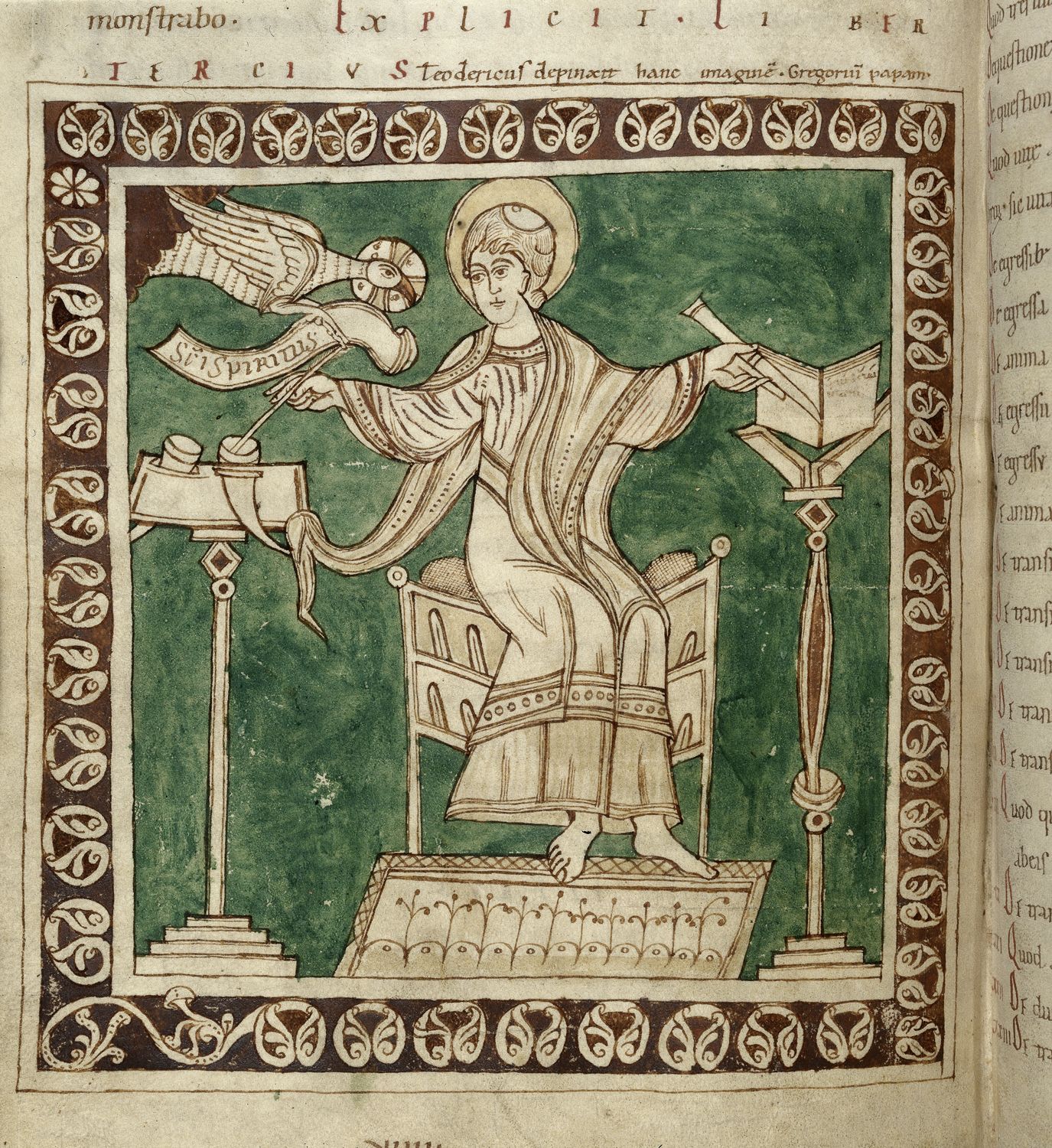
Gregory styled himself servus servorum Dei, "servant of the servants of God." The phrase appears at the head of the letter he sent to the discouraged missionaries on their way to England, preserved by the English monk Bede in his Ecclesiastical History of the English People (finished in 731): "Gregory, the servant of the servants of God, to the servants of our Lord."3 Later popes kept the title; Urban II opened his letter to the crusaders of Flanders in December 1095 with "Urban, bishop, servant of the servants of God," and Gregory VII used it on his letter about Canossa in 1077. It is still part of papal style.
The title has a context. In 588 Patriarch John the Faster of Constantinople took the title "Ecumenical" (universal) patriarch at a synod. Gregory protested this title, and the dispute was still open when he died.1 Catholic writers read Gregory's protest as a defense of the primacy of Peter's see, since the Catholic Encyclopedia's article argues that he regarded the Eastern patriarchs as subject to himself. Orthodox writers point out that Gregory objected to any bishop calling himself universal, Rome included, and read him as a witness for a church of several patriarchs in which Rome had honor but not rule. Protestant writers since the Reformation have quoted the same protest against later papal claims. The letters themselves survive in Gregory's register, and readers of each tradition quote different sentences from them; the dispute is about emphasis more than about the text.
The Pastoral Rule: a handbook for bishops
Early in his time as pope Gregory wrote the Book of Pastoral Rule (Liber regulae pastoralis, about 590 to 591), a manual on how a bishop should live, preach and correct his people. It opens with a warning against taking the office lightly:
"No one presumes to teach an art till he has first, with intent meditation, learned it. What rashness is it, then, for the unskilful to assume pastoral authority, since the government of souls is the art of arts!"4
The quotation is from James Barmby's translation in the Nicene and Post-Nicene Fathers, second series, volume 12 (1895). The third book is a long catalog of how to speak to different kinds of people: men and women, the young and the old, the poor and the rich, the cheerful and the sad, the humble and the proud. The book was copied all over the West. King Alfred of Wessex had it translated into Old English in the 890s, and Carolingian church councils told bishops to read it. More than any other single book it set the picture of what a medieval bishop was supposed to be: a shepherd and physician of souls first, an administrator second. Gregory also wrote the Dialogues (lives and miracles of Italian holy men, including the only early life of Benedict of Nursia, covered in lesson 07) and the Moralia, a vast commentary on the book of Job. Later tradition attached his name to "Gregorian" chant; the historical link between Gregory and the chant that bears his name is weak, and most music historians date that body of chant to Frankish lands in the eighth and ninth centuries.
The mission to England, 596 to 597
The story of the boys in the market
Bede tells a story about how the mission began. Before he became pope, Gregory saw boys for sale in the Roman market, "their bodies white, their countenances beautiful, and their hair very fine." He asked where they came from and was told Britain, and that their people were pagans. When he asked the name of the nation and heard "Angles," he answered, "Right, for they have an Angelic face, and it becomes such to be co-heirs with the Angels in heaven." The boys came from the province of Deira, and Gregory punned that they were rescued de ira, from wrath; their king was Aelle, and Gregory answered that "Hallelujah" must be sung there.5 Bede is careful to introduce the story as one "handed down to us by the tradition of our ancestors" and to say it is "reported." It is a tradition, written down more than a century later, and should be read as one. (An earlier Life of Gregory written at Whitby also tells it.)
Augustine lands in Kent
The record of the mission itself is firmer, because Bede copied Gregory's letters into his history. In 596 Gregory sent a monk named Augustine, prior of his own monastery in Rome (not the same man as Augustine of Hippo from lesson 06), with a group of monks. On the way through Gaul they lost heart and sent Augustine back to ask to be excused. Gregory answered with the letter quoted above, telling them that "it had been better not to begin a good work, than to think of desisting from that which has been begun."3 In 597 they landed on the Isle of Thanet in Kent, "being, as is reported, nearly forty men," with Frankish interpreters.6 King Ethelbert of Kent had a Christian Frankish wife, Bertha, who already worshiped at a small church in Canterbury. Ethelbert met the monks in the open air, let them preach, and within a few years was baptized. Augustine became the first archbishop of Canterbury, the see that still heads the Church of England (whose later history belongs to lesson 12 and the next module).
Gregory's instructions on how to treat the old religion are often quoted. In a letter of 601 to Abbot Mellitus, who was taking more monks to England, he changed an earlier, harsher plan:
"the temples of the idols in that nation ought not to be destroyed; but let the idols that are in them be destroyed; let holy water be made and sprinkled in the said temples, let altars be erected, and relics placed."7
The same letter suggested turning the old feasts with their animal sacrifices into Christian feast days. Readers take this in opposite directions. Catholic and many Protestant historians cite it as wise missionary practice: keep what is neutral (a building, a gathering day) and replace what is idolatrous. Some modern writers cite the same letter as proof that medieval Christianity simply absorbed paganism. The letter itself is narrower than either claim: it is about buildings and feast days, and it insists that the idols be destroyed and the people be taught that they now worship "the true God." Bede's translation used on the Fordham Medieval Sourcebook is the early 20th century Temple Classics translation, probably by L. C. Jane.
The English mission did not work alone. Irish monks had been preaching in Scotland and northern England since Columba founded Iona in 563, and the Roman and Irish traditions differed over the date of Easter and the shape of the monk's tonsure. At the Synod of Whitby in 664 King Oswiu of Northumbria chose the Roman reckoning, in Bede's account because Peter held the keys of heaven (Bede, book 3, chapter 25).2 English missionaries in turn went back to the continent, and the most important of them was Boniface.
The conversion of the Franks
Clovis: "worship what you burned"
The Franks were the Germanic people who took over most of Roman Gaul in the late fifth century. Most of the other Germanic kingdoms (Goths, Vandals, Burgundians) had become Christian in the Arian form condemned at Nicaea (see lesson 04). The Frankish king Clovis (reigned about 481 to 511) stayed pagan until he was baptized as a Catholic, and that choice tied the strongest kingdom in the West to the bishops of Gaul and to Rome.
The main source is Gregory of Tours, a bishop who wrote his History of the Franks in the 570s to 590s, about eighty years after the event. His account is a conversion story with clear models. Clovis's Christian wife Clotilda (a Burgundian princess) urges him to believe; he refuses; then in a battle against the Alamanni, with his army close to destruction, he prays: "Jesus Christ, whom Clotilda asserts to be the son of the living God ... if thou wilt grant me victory over these enemies ... I will believe in thee and be baptized in thy name."8 He wins, and Bishop Remigius (Remi) of Reims baptizes him. Gregory calls him "another Constantine" and gives Remigius the famous words at the font: "Gently bend your neck, Sigamber; worship what you burned; burn what you worshipped."8 The translation is Ernest Brehaut's (1916). Gregory adds that more than three thousand of his army were baptized with him.
The date is disputed. Gregory's own chronology points to about 496, the traditional date. A letter of Bishop Avitus of Vienne congratulating Clovis on his baptism, and other evidence, have led many historians to place it later, between about 503 and 508, and some argue that Clovis first leaned toward Arian Christianity before choosing the Catholic form. The date range in this lesson, about 496 to 508, reflects that open question. What is not in doubt is the result: the Frankish kings and the Catholic bishops of Gaul worked together from then on, and when Clovis fought the Arian Visigoths in 507, Gregory of Tours presented the war as a war against heresy.
Boniface and the oak at Geismar
Boniface (born Wynfrith in Wessex about 675, killed in 754; the Catholic Encyclopedia gives June 5, 755, with 754 as the alternative) is called the apostle of Germany. He reached Rome in the fall of 718, and on May 15, 719, Pope Gregory II, who gave him the name Boniface, commissioned him to preach to the pagans east of the Rhine.50 His first biographer, the priest Willibald, wrote within a few years of his death. Willibald's most famous scene is at Geismar in Hesse, where Boniface, "with the counsel and advice" of local Christians, began to cut down "a certain oak of extraordinary size called in the old tongue of the pagans the Oak of Jupiter," while "a great crowd of pagans stood by watching and bitterly cursing in their hearts." In Willibald's account a blast of wind finished the job and the tree split into four parts, and the watching pagans believed; Boniface built a chapel from the timber.9 (The translation is C. H. Talbot's, from The Anglo-Saxon Missionaries in Germany, 1954, as given on the Fordham Medieval Sourcebook.) The story shows the pattern of the age: missionaries who looked to Rome, and who worked under the protection of the Frankish rulers. Boniface reorganized the Frankish church in councils in the 740s and founded the monastery of Fulda. He was killed by a band of pagans in Frisia, near Dokkum, in 754.
Boniface's letters also show the link between the papacy and the family of Frankish leaders who would soon take the throne. In 751 Pepin the Short, the mayor of the palace (the real power behind the last Merovingian kings), was made king with papal approval, and in 754 Pope Stephen II crossed the Alps and anointed him.10 In return Pepin fought the Lombards and handed the conquered lands of central Italy to the pope, the start of the Papal States that would last until 1870. The alliance of the Frankish crown and the Roman see, sealed in these years, sets up the next scene.
Charlemagne and Christmas Day, 800
What Einhard wrote
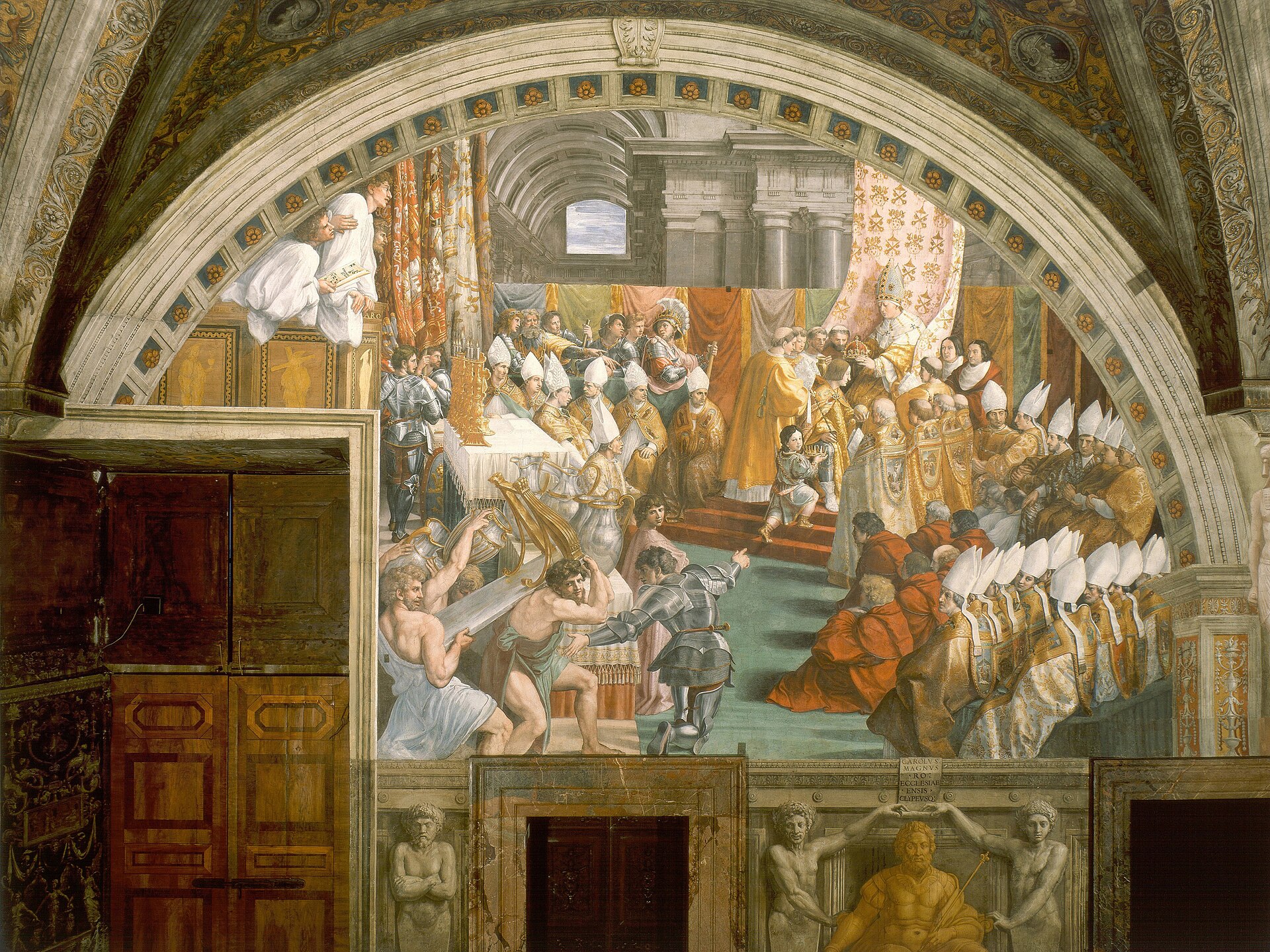
Pepin's son Charles, called Charles the Great (Carolus Magnus, Charlemagne), was king of the Franks from 768 to 814. He conquered the Lombard kingdom in 774, fought the pagan Saxons for some thirty years (forcing baptism on them at sword point, a policy his own adviser Alcuin criticized), and pushed into Spain, Bavaria and the lands of the Avars. In April 799 a faction in Rome attacked Pope Leo III in the street, and Leo fled to Charles. Charles came to Rome in late 800 to settle the matter. On Christmas Day 800, in St. Peter's Basilica, Leo crowned him and the people acclaimed him emperor.
The best known account is by Einhard, a scholar at Charles's court who wrote a Life of Charlemagne after the emperor's death, modeled on the Roman biographer Suetonius. In Samuel Epes Turner's translation (1880):
"It was then that he received the titles of Emperor and Augustus, to which he at first had such an aversion that he declared that he would not have set foot in the Church the day that they were conferred, although it was a great feast-day, if he could have foreseen the design of the Pope."11
Einhard says the Romans had injured Leo, "tearing out his eyes and cutting out his tongue" (other sources say the attackers tried to and that he recovered his sight and speech, which his supporters took as a miracle). He adds that Charles "bore very patiently with the jealousy which the Roman emperors showed upon his assuming these titles," meaning the emperors in Constantinople, who still regarded themselves as the only Roman emperors.11
Einhard's claim that Charles did not know what was coming is the most argued sentence in the account. Some historians take it at face value: Charles did not want to owe his crown to the pope, and the ceremony suggested that popes made emperors. Others think it is the polite modesty expected of a ruler in a classical biography, since Suetonius describes Augustus refusing honors in the same way, and they point out that the coronation needed planning. The Frankish royal annals present it as agreed in advance. The question cannot be settled from the sources, and it mattered later for exactly the reason the doubters give: popes from Gregory VII onward cited the coronation of 800 as proof that the imperial crown came through the church.

The Carolingian renewal
Charles wanted an educated clergy, correct books and a uniform liturgy. He gathered scholars from across Europe: Alcuin of York, Paul the Deacon from Lombard Italy, Theodulf from Visigothic Spain. Einhard says Alcuin, "the greatest scholar of the day," taught the king rhetoric, dialectic and astronomy, and that Charles himself "tried to write, and used to keep tablets and blanks in bed under his pillow, that at leisure hours he might accustom his hand to form the letters," but began too late in life to succeed.12 The general admonition (Admonitio generalis) of 789 ordered schools at monasteries and cathedrals where boys could learn the psalms, chant, arithmetic and grammar. Copyists in the monasteries developed a clear, rounded script, Carolingian minuscule, which Renaissance printers later copied as the basis of the lowercase letters on this page. A large share of the ancient Latin literature that survives today survives because Carolingian monks copied it.
The renewal had a theological side too. Frankish theologians objected to the Second Council of Nicaea (787) on icons, which they knew from a poor Latin translation, and a Frankish council at Frankfurt in 794 rejected what it thought that council had taught. Frankish churches also sang the creed with the word filioque ("and from the Son"), the addition that would become a lasting point of division with the Greek church, as lesson 08 explains. Charles's coronation gave the West an emperor of its own, and from then on the two halves of Christendom each had a Christian emperor who claimed to be the Roman one.
The Donation of Constantine and Lorenzo Valla
What the document claims
Sometime in the eighth or early ninth century someone in the papal orbit produced a document that claimed to be a decree of the emperor Constantine (died 337). In it Constantine tells how Pope Sylvester cured him of leprosy and baptized him, and then gives the pope imperial honors (the right to wear a tiara and imperial insignia), the Lateran palace, and "the city of Rome and all the provinces, districts and cities of Italy or of the western regions," while Constantine himself withdraws to Byzantium.10 The Fordham Medieval Sourcebook's introduction, using Ernest Henderson's translation (1910), suggests that a first draft was probably made shortly after the middle of the eighth century to help Pope Stephen II in his dealings with Pepin; other scholars date it to the ninth century. It was included in canon law collections, including Gratian's Decretum in the twelfth century, and cited by popes in disputes with emperors. Not everyone in the Middle Ages approved of it: the emperor Otto III's court called it a forgery in 1001, and Dante, who accepted it as genuine, lamented the gift as the root of the church's wealth and corruption. But it was almost universally accepted as authentic from the ninth to the fifteenth century.
How Valla proved it was a forgery, 1440
In 1440 the Italian humanist Lorenzo Valla, then secretary to King Alfonso of Aragon and Naples (who was at war with Pope Eugenius IV over territory in Italy), wrote On the Donation of Constantine, Falsely Believed and Forged. His translator Christopher B. Coleman (1922) dates it to 1440 from the events it mentions.13 Valla used three kinds of argument. The first was historical: no ancient historian mentions such a gift, and the coins and records show emperors ruling Rome after Constantine. The second was common sense: no ruler would give away his capital and half his empire. The third, and the one that made the treatise famous, was linguistic. The Latin of the document is not the Latin of the fourth century. Valla mocked its use of "satraps," a Persian title, for Roman officials: "What! How do you want to have satraps come in here? Numskull, blockhead! Do the Caesars speak thus; are Roman decrees usually drafted thus?"13 He noticed that the document calls Constantinople one of the patriarchal sees:
"How in the world ... could one speak of Constantinople as one of the patriarchal sees, when it was not yet a patriarchate, nor a see, nor a Christian city, nor named Constantinople, nor founded, nor planned!"13
Valla's treatise was first printed in 1517 by the German humanist Ulrich von Hutten, the year of Luther's theses, and Luther read it with fury in 1520. (The Englishman Reginald Pecock and the German cardinal Nicholas of Cusa reached similar conclusions independently in the same decades.) Catholic scholars, like everyone else, came to accept that the document is a forgery. The point to keep is narrow and important. The papacy's claims to spiritual authority did not rest on the Donation, which concerned lands and imperial honors, and Catholic theology rests the papacy on the texts about Peter in the Gospels and the tradition of Rome. But for centuries the Donation was used to support papal claims to rule territory, and its exposure became one of the founding examples of the historical criticism of documents.
Parishes, tithes and the sacraments in daily life
The parish and the tithe
Most medieval Christians never saw a pope, and many never saw their bishop more than a few times. Their church was the parish: a church, its priest and the people of a village or a town quarter, bound together by baptism, burial and the duty to pay the tithe. Over the early Middle Ages the countryside of western Europe was slowly divided into parishes, many founded by landlords who built a church on their estates and named its priest. That custom of private ownership of churches is one root of the later fight over investiture.
The tithe (a tenth of the produce of the land and of livestock) was a biblical idea that became a legal duty. Frankish councils and Charlemagne's capitularies made it compulsory across the Frankish kingdom in the late eighth century. By the time of Urban II the duty was taken for granted: in Fulcher of Chartres's account of the Council of Clermont the pope tells the bishops, "See that the tithes that belong to God are faithfully paid from all the produce of the land; let them not be sold or withheld."14 The Fourth Lateran Council in 1215 devoted several canons to it, with titles such as "Tithes should be paid before taxes" and "A parish priest shall not lose a tithe on account of some people making a pact."15 In practice a large share of the tithe often went to a monastery, a bishop or a lay lord rather than the parish priest, which was a constant complaint of reformers.
Seven sacraments, and what they meant at home
The number of sacraments was not fixed in the early church. Peter Lombard's Sentences (about 1150s) listed seven (baptism, confirmation, the Eucharist, penance, extreme unction, holy orders and marriage), and that list became standard in the West; the Council of Florence confirmed it in 1439. For an ordinary person these seven marked the whole of life. Infants were baptized within days of birth, because of high infant mortality and the teaching that baptism washes away original sin (see lesson 06). Marriage came more and more under church courts. Penance, the confession of sins to a priest with an assigned satisfaction, became the church's main tool of moral teaching. At the end came the last rites and burial in consecrated ground, which the church could refuse to the excommunicated.
The Mass was the center. Most lay people received communion rarely, often only at Easter, though they attended Mass on Sundays and feast days; the elevation of the consecrated host, a gesture that spread in the early thirteenth century so that the people could see it, became for many the high point of worship. The liturgy was in Latin, which few lay people understood, but preaching, plays, carvings, painted walls and windows, processions, guilds and saints' days carried the content of the faith. The feast of Corpus Christi, honoring the Eucharist, was approved for the whole church in 1264. The Fourth Lateran Council, discussed below, fixed the minimum: confession and communion at least once a year.
Popes against emperors: the Investiture Controversy
What "investiture" meant
By the eleventh century bishops and abbots in the German kingdom and Italy were also great landholders who owed the king soldiers and counsel. Kings chose them and "invested" them by handing over the ring and the pastoral staff, the signs of the spiritual office, as well as the lands. Reformers saw two evils in the system: simony (buying church offices, named after Simon Magus in Acts 8) and the control of spiritual offices by lay rulers. A reform movement, fed by monasteries such as Cluny (founded 910, see lesson 07) and by a series of reforming popes from the 1040s, demanded that clergy be celibate, that offices not be sold, and that the church choose its own leaders. In 1059 a papal decree gave the election of popes to the cardinals.
Gregory VII and the Dictatus papae, 1075
The monk Hildebrand, a leading reformer for twenty years, became Pope Gregory VII in 1073 and held the office until his death in 1085. Entered in his register in 1075 is a list of twenty-seven short statements known as the Dictatus papae ("the dictates of the pope"). Scholars disagree whether Gregory wrote it himself or whether it is a set of headings for a collection of canon law; the Fordham Medieval Sourcebook notes both views and adds that "there is little doubt" it expresses his principles. In Ernest Henderson's translation (1910) the statements include:
- "That the Roman church was founded by God alone."
- "That the Roman pontiff alone can with right be called universal."
- "That of the pope alone all princes shall kiss the feet."
- "That it may be permitted to him to depose emperors."
- "That he himself may be judged by no one."
- "That the Roman church has never erred; nor will it err to all eternity, the Scripture bearing witness."
- "That he may absolve subjects from their fealty to wicked men."16
Read against Gregory the Great's protest at the title "universal" five centuries earlier, the second item shows how far papal language had moved, and Orthodox and Protestant writers have long made exactly that comparison. Catholic historians answer that the substance of Roman primacy is older than the vocabulary and that Gregory VII was defending the church's freedom (libertas ecclesiae) against lay control at a time when kings sold bishoprics. Both readings agree on the record: the claims were new in their sweep and were made in a real power struggle.
Henry IV answers: "Descend, descend"
In 1075 Gregory forbade lay investiture and warned the young German king Henry IV (king from 1056, not yet crowned emperor) for appointing bishops in Milan and elsewhere. Henry's reply, written on January 24, 1076, after a synod of German bishops at Worms, is one of the most violent letters any king sent a pope. It is addressed:
"Henry, king not through usurpation but through the holy ordination of God, to Hildebrand, at present not pope but false monk."
It ends: "I Henry, king by the grace of God, do say unto thee, together with all our bishops: Descend, descend to be damned throughout the ages."17 On February 22, 1076, at a synod in Rome, Gregory excommunicated Henry, declared him deposed and released his subjects from their oaths of loyalty, applying the last item of the Dictatus.18 The German princes, many of whom had their own quarrels with Henry, met at Oppenheim in October 1076 and gave him a deadline: be absolved within a year or lose the crown. They invited Gregory to come to Germany to judge the case.
Canossa, January 1077
Henry crossed the Alps in midwinter to meet the pope before he reached Germany. Gregory, on his way north, took refuge at Canossa, a castle in the Apennines belonging to his ally Countess Matilda of Tuscany. Gregory's own report to the German princes, written in late January 1077 (it is often dated January 28), describes what happened:
"And there, having laid aside all the belongings of royalty, wretchedly, with bare feet and clad in wool, he continued for three days to stand before the gate of the castle. Nor did he desist from imploring with many tears the aid and consolation of the apostolic mercy until he had moved all of those who were present there ... to such pity and depth of compassion that, interceding for him with many prayers and tears, all wondered indeed at the unaccustomed hardness of our heart."19
Gregory then lifted the excommunication, with the abbot of Cluny, Matilda and Countess Adelaide among the witnesses.19 The scene became a symbol; in 1872 the German chancellor Otto von Bismarck, in a quarrel with the Catholic Church, told the Reichstag, "We will not go to Canossa." But the result in 1077 was not a clear win for either side. Henry, absolved, had defused the princes' plan, and a priest could hardly refuse a penitent. Gregory had shown that a king could be made to beg. The German princes elected a rival king anyway, Gregory excommunicated Henry again in 1080, Henry set up an antipope, and in 1084 Henry took Rome. Gregory's Norman allies rescued him and sacked the city in the process, and Gregory died in exile at Salerno in 1085.

The Concordat of Worms, 1122
The quarrel outlived both men. It was settled on September 23, 1122, between Pope Calixtus II and Henry IV's son, Emperor Henry V, in two short documents exchanged at Worms. The emperor gave up investiture "through ring and staff," the symbols of spiritual office, and granted "that in all the churches that are in my kingdom or empire there may be canonical election and free consecration." The pope granted that elections of bishops and abbots in the German kingdom "shall take place in thy presence, without simony and without any violence," and that the one elected "may receive the regalia from thee through the lance," meaning the lands and secular rights, symbolized by the lance.20 (The Avalon Project's heading labels the imperial edict "Henry IV"; the emperor in 1122 was Henry V.) England had reached a similar arrangement in 1107.
The compromise separated two things that had been fused: the spiritual office, which came from the church, and the lands and political duties, which came from the king. Some historians, among them the legal historian Harold Berman in Law and Revolution (1983), have called the whole struggle the "Papal Revolution" and traced to it the Western habit of distinguishing church and state as two jurisdictions, each with its own law. Others warn against reading modern ideas back into a fight both sides understood as a struggle over the right order of one Christian society. The Liberty module's lesson on natural law follows the political ideas that grew out of these debates: Natural Law from Cicero to Aquinas.
Innocent III and the Fourth Lateran Council, 1215
The most powerful medieval pope
Lothar of Segni, elected Pope Innocent III in 1198 at about thirty-seven, is often called the most powerful pope of the Middle Ages. He described the papacy and royal power with the image of the sun and the moon, the moon taking its light from the sun. He placed England under an interdict (a ban on most church services) from 1208 when King John refused his choice for archbishop of Canterbury, Stephen Langton, and excommunicated John in 1209; in 1213 John submitted and made England a fief of the papacy. Innocent called the Fourth Crusade, which went wrong and ended with the sack of Christian Constantinople in April 1204 (covered in lesson 08), and the Albigensian crusade of 1209 against heretics in southern France. He also approved the first rule of Francis of Assisi's brothers, about 1209 to 1210, and supported the new order of preachers that grew around Dominic.
Innocent's relationship to Magna Carta is a short story with a twist. The charter that King John sealed at Runnymede in June 1215 opens with the promise "that the English Church shall be free," the language of the investiture reformers, and Stephen Langton had a part in the negotiations. But Innocent, now John's feudal overlord, declared the charter null in August 1215 as extorted by force from a vassal of the Holy See. The charter survived in reissues after John's death. The Liberty module covers the charter itself, and this lesson does not repeat it: Magna Carta and the English Charters.
What the council decreed
Innocent summoned the council on April 19, 1213, to meet in November 1215, and invited not only bishops and abbots but heads of religious orders, cathedral chapters and lay rulers. Norman Tanner's introduction to the decrees calls it a council of reform and of crusade.15 Several of its seventy-one constitutions shaped ordinary church life for three centuries. In Tanner's translation (Decrees of the Ecumenical Councils, 1990, as given at papalencyclicals.net):
- Canon 1, the faith. "There is indeed one universal church of the faithful, outside of which nobody at all is saved, in which Jesus Christ is both priest and sacrifice. His body and blood are truly contained in the sacrament of the altar under the forms of bread and wine, the bread and wine having been changed in substance, by God's power, into his body and blood." The Latin participle behind "changed in substance" is transsubstantiatis, the first use of the language of transubstantiation in a conciliar decree. Theologians had used the word since the twelfth century; Aquinas later gave it its classic philosophical explanation.
- Canon 2 defended Peter Lombard against the abbot Joachim of Fiore, who had called Lombard a heretic for his teaching on the Trinity in the Sentences.
- Canon 3, on heretics. "Let those condemned be handed over to the secular authorities present, or to their bailiffs, for due punishment." It also required rulers to swear to expel heretics from their lands.
- Canon 21, on yearly confession. "All the faithful of either sex, after they have reached the age of discernment, should individually confess all their sins in a faithful manner to their own priest at least once a year," and receive the Eucharist "at least at Easter." Those who refused were to be barred from entering a church and denied Christian burial. The canon also bound the priest to secrecy about what he heard.
- Canon 68 ordered that Jews and Muslims "in every christian province and at all times, are to be distinguished in public from other people by the character of their dress," the origin of the badges and special clothing that many European rulers later imposed on Jews.
- Canon 71 proclaimed a new crusade, with crusaders to gather in Sicily on June 1, 1217.15
Catholic historians stress the council's pastoral side: an effort to give every parish a trained priest, regular preaching and confession, and clear teaching on the sacraments. Historians of heresy and of the Jews of Europe stress canons 3 and 68. The council did both. Its decrees on confession, communion and the Eucharist are the background to many of the disputes of the sixteenth century (see lesson 11).
The Crusades
Why a pope called for war in 1095
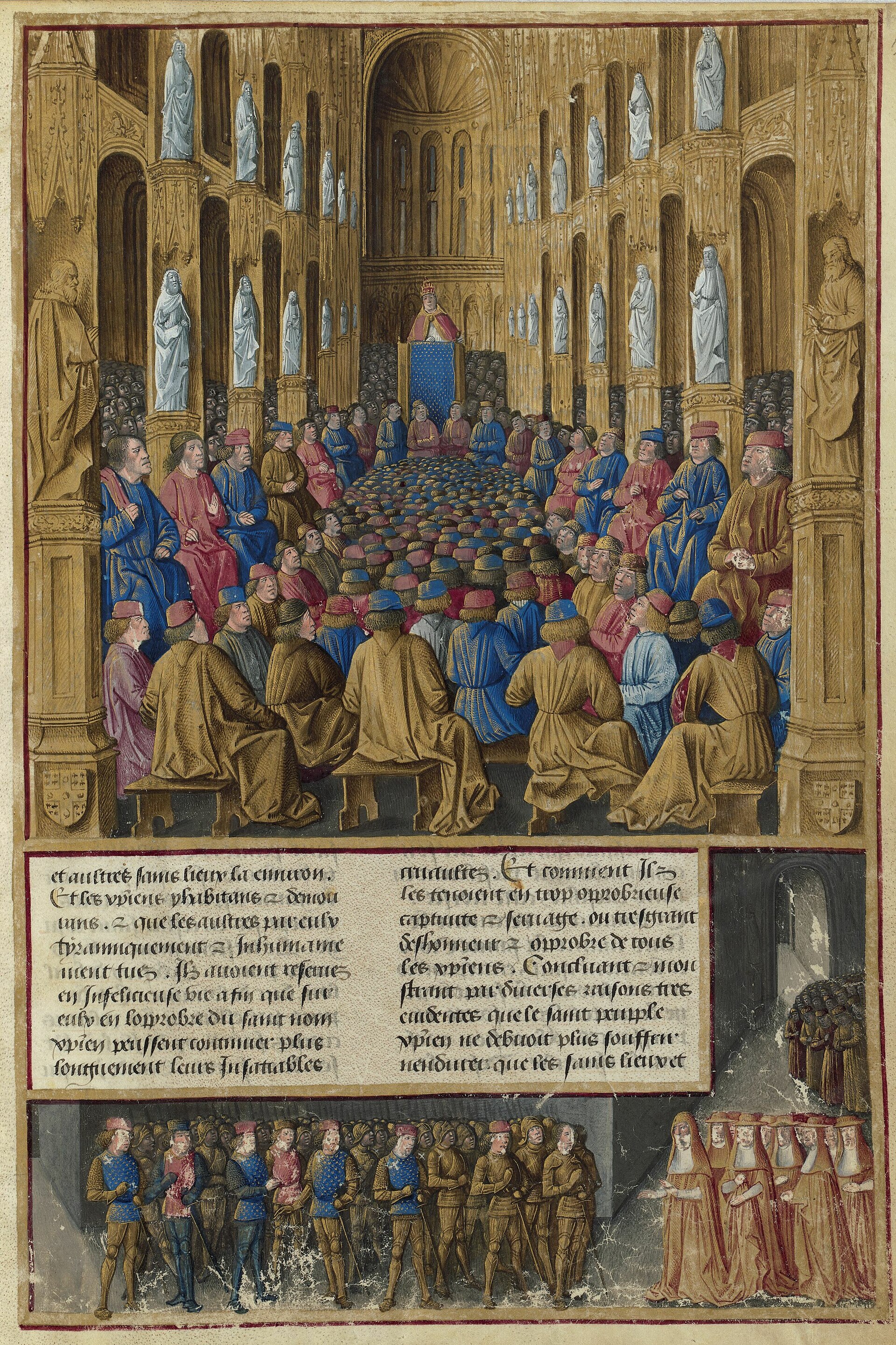
In 1071 the Seljuk Turks defeated the Byzantine army at Manzikert, and over the next decade they took most of Asia Minor; Jerusalem, held by Muslim rulers since 638, changed hands between Seljuk and Fatimid Egyptian rulers in these same years. The Fordham Medieval Sourcebook's introduction to the speech at Clermont summarizes the occasion: in 1094 or 1095 the Byzantine emperor Alexios I Komnenos sent to Pope Urban II "and asked for aid from the west against the Seljuq Turks, who taken nearly all of Asia Minor from him."21 Urban, a Frenchman and a former monk of Cluny, held a council at Clermont in central France in November 1095. On November 27, outside the city because the crowd was too large for a church, he preached to clergy, knights and common people.

Five versions of one speech
No official text of the speech survives; the acts of the council have not been preserved. What survives is five accounts written by chroniclers, at least some of them present, after the crusade had already succeeded, plus one letter from Urban himself. The differences between them are the first lesson in reading crusade sources.
Fulcher of Chartres, a priest who was probably at Clermont and went on the crusade, wrote his history in the early 1100s. His Urban spends most of the speech on reform at home (simony, the freedom of the church, tithes, the Truce of God) before turning east. He has the pope promise: "All who die by the way, whether by land or by sea, or in battle against the pagans, shall have immediate remission of sins. This I grant them through the power of God with which I am invested." He also has Urban urge that "those who have been accustomed unjustly to wage private warfare against the faithful now go against the infidels."14 (Translation adapted from Oliver Thatcher and Edgar McNeal, 1905.)
Robert the Monk wrote, in the Sourcebook's note, "perhaps 25 years after the speech," using the Gesta; he may have been present. His modern translator, Carol Sweetenham (2005), dates the work more precisely to 1106 to 1107, about eleven years after Clermont.49 His Urban gives a graphic list of atrocities said to be committed by "a race from the kingdom of the Persians, an accursed race," calls Jerusalem "the navel of the world," and ends with the crowd crying "It is the will of God! It is the will of God!" (Deus vult).22 (Translation by Dana C. Munro, 1895.)
The Gesta Francorum (Deeds of the Franks), written about 1100 to 1101 by an anonymous knight in the army of Bohemond of Antioch, gives only a short summary built around Christ's words, "If any man would come after me, let him deny himself and take up his cross and follow me," and describes the crusaders sewing crosses on their right shoulders.23
Baldric of Dol, an archbishop writing in the early twelfth century from the Gesta, gives Urban a long, mournful speech about "our Christian brothers, members in Christ" being "scourged, oppressed, and injured."24 Guibert of Nogent, an abbot who attended the council, wrote his version in about 1108, combining memory with the Gesta; his Urban dwells on the holiness of Jerusalem as the land where Christ "dwelt and suffered," which Guibert argues makes it holy above all other places.25 (Baldric and Guibert in August C. Krey's translation, 1921.)
Urban's own letter to the faithful of Flanders, written in December 1095, is shorter and plainer. It says that "a barbaric fury has deplorably afflicted" and "laid waste the churches of God in the regions of the Orient," and that it holds the churches and "the Holy City of Christ" in servitude (the online text reads "intolerabe servitude," a typing error for "intolerable"). It calls the undertaking "a preparation for the remission of all their sins," and it names Bishop Adhemar of Le Puy as leader, with a departure date of the feast of the Assumption (August 15, 1096).26 Taken together, the sources agree on a core (aid to the Eastern Christians, the liberation of Jerusalem, a journey undertaken as penance with a spiritual reward) and disagree on emphasis and detail. The cry Deus vult is in Robert, not in Fulcher. The graphic atrocity list is Robert's. Phrases quoted as "what Urban said" in popular books are usually one chronicler's version.
The First Crusade, 1096 to 1099
The response was far larger than anyone planned. Before the knights set out, crowds of poor people gathered around preachers such as Peter the Hermit and marched east in spring 1096; some bands, led by men such as Count Emicho, massacred Jewish communities in the Rhineland towns of Speyer, Worms and Mainz, despite the efforts of some bishops to protect them. The Hebrew chronicles of these massacres survive. Most of the popular bands were destroyed in Asia Minor in October 1096. The main armies of lords from France, Lorraine, Flanders and Norman southern Italy gathered at Constantinople in 1096 and 1097, took Nicaea (June 1097), survived a long, starving siege of Antioch (October 1097 to June 1098) and reached Jerusalem on June 7, 1099.
The city fell on Friday, July 15, 1099. Fulcher of Chartres dated it carefully: "It was the 15th day of July when the Franks in their might captured the city."27 The anonymous Gesta describes the knight Lethold scaling the wall and the army "killing and slaying even to the Temple of Solomon, where the slaughter was so great that our men waded in blood up to their ankles."28 Raymond of Aguilers, chaplain to Count Raymond of Toulouse, wrote that "in the Temple and porch of Solomon, men rode in blood up to their knees and bridle reins," and called it "a just and splendid judgment of God."29 Fulcher wrote that "in this temple almost ten thousand were killed" and "neither women nor children were spared."27 (All in August Krey's and Frederick Duncan and Krey's translations, 1912 and 1921.) The "Temple of Solomon" in these writers means the al-Aqsa mosque on the Temple Mount; the "Temple of the Lord" is the Dome of the Rock.
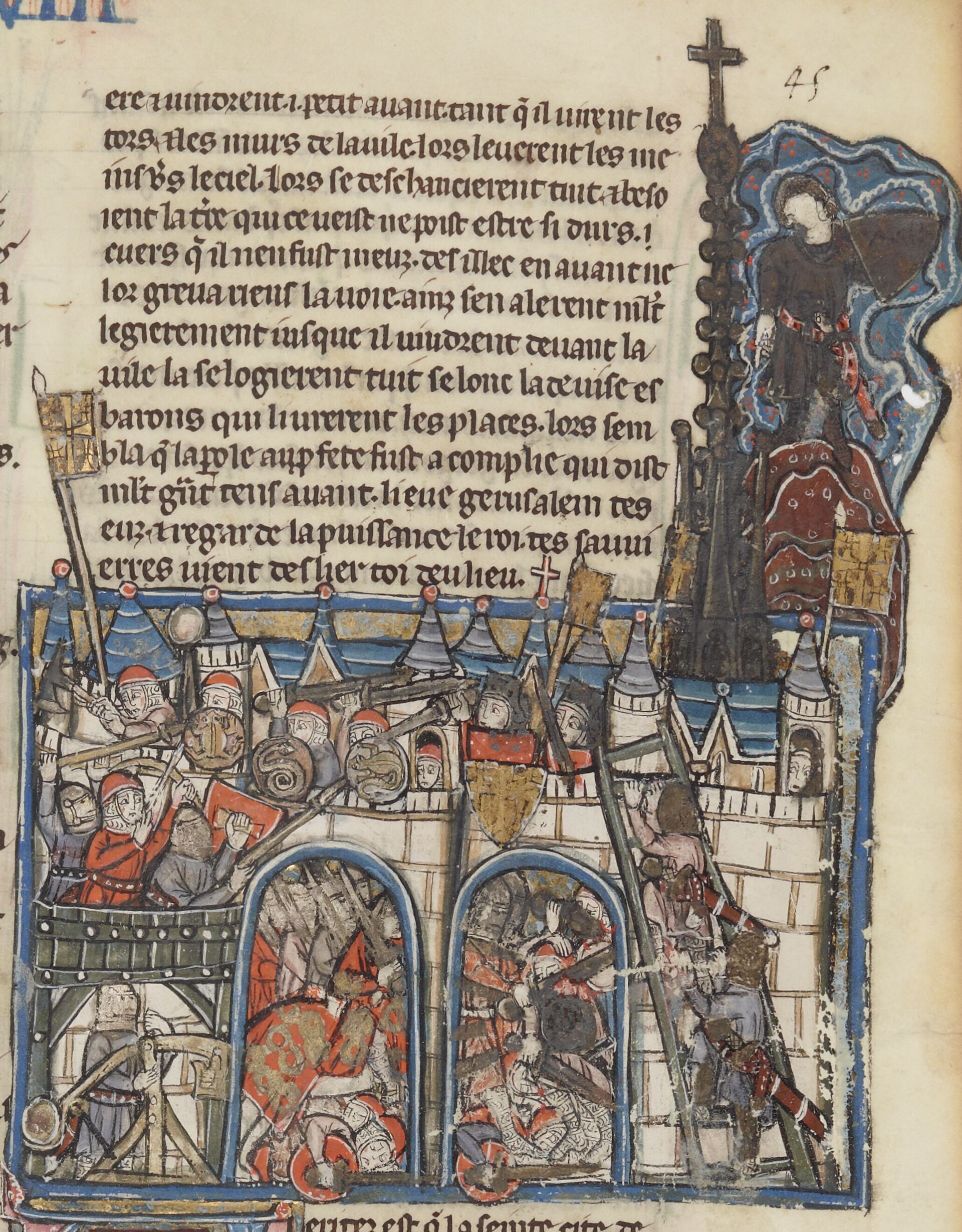

How many died at Jerusalem
The phrases about blood to the ankles or the bridles are biblical language (compare Revelation 14:20) and should not be read as measurements. Numbers vary widely. Fulcher's figure for the Temple is almost ten thousand. The Muslim historian Ibn al-Athir, writing in Mosul more than a century later (he died in 1233), wrote in his Complete History that "in the Masjid al-Aqsa the Franks slaughtered more than 70,000 people," in the translation of Francesco Gabrieli's Arab Historians of the Crusades.30 The earliest Muslim source, the Damascus chronicler Ibn al-Qalanisi, who lived through the events, gives no number, saying only that "a great host were killed." The historian Konrad Hirschler, studying the Arabic accounts in order of writing, found that the earliest ones show a massacre but "no evidence of large-scale carnage of the town's population that was any greater" than at other captured towns, and that the conquest "only started to be remembered on a significant level several decades after the event itself," when it came to be described as a full-scale massacre.31 Benjamin Kedar's study of the Western sources (2004) reached a similar view of how the story grew in later retelling. Letters from the Cairo Geniza show that some Jews and Muslims were ransomed or expelled rather than killed. The lowest honest summary is that the crusaders killed a large part of the city's Muslim and Jewish population in the hours after the walls fell, that the exact number is unknown, and that the largest figures come from writers far removed from the event. Holy war in the Old Testament sense, the killing of a whole city, was not allowed by any canon of the church; the eyewitness chroniclers still called it God's judgment.
The later crusades
The First Crusade founded four Latin states (Edessa, Antioch, Tripoli and the Kingdom of Jerusalem) and the military orders of the Templars and Hospitallers. The loss of Edessa in 1144 led to the Second Crusade (1147 to 1149), preached by Bernard of Clairvaux, which failed before Damascus. Saladin, the sultan of Egypt and Syria, destroyed the army of the kingdom at Hattin in July 1187 and took Jerusalem in October 1187, sparing most of its people for ransom, an event Christian and Muslim writers alike contrasted with 1099. The Third Crusade (1189 to 1192), led by Richard I of England, Philip II of France and Frederick Barbarossa (who drowned on the way), retook Acre and the coast but not Jerusalem. The Fourth Crusade (1202 to 1204) never reached the Holy Land; in debt to Venice, it was turned to Constantinople, which it sacked in April 1204, an event that still shapes Orthodox memory of the West (see lesson 08). Later expeditions went to Egypt (1217 to 1221, and Louis IX's crusade of 1248 to 1254) and Tunis (1270); Frederick II recovered Jerusalem by treaty in 1229, and it was lost for good in 1244. Acre, the last major crusader city, fell to the Mamluks in 1291.
Crusades were also preached against pagans in the Baltic, against the Muslim states of Spain, against heretics and against political enemies of the papacy in Italy. The most destructive of these at home was the Albigensian crusade (1209 to 1229) against the Cathars of southern France, who taught a dualist religion of two principles, good and evil, and rejected the Catholic sacraments; a few Cathar texts survive in their own words, including a ritual, but most of what is known comes from their opponents. At Beziers on July 22, 1209, the crusading army killed much of the population. The often quoted order "Kill them all, God will know his own," attributed to the papal legate Arnaud Amaury, appears in the Dialogue on Miracles of Caesarius of Heisterbach, a German monk writing more than a decade later; the legate's own report to Innocent III, as the historian Andrew Holt notes, does not contain the phrase.32
How historians read the Crusades
The Crusades are one of the most argued subjects in all of church history, and the arguments have changed over time. Four named readings cover most of what a reader will meet.
Steven Runciman, A History of the Crusades (three volumes, 1951 to 1954), wrote the most widely read English account of the twentieth century. His sympathies lay with Byzantium, and he presented the crusaders largely as rough Western invaders who damaged the civilized Greek and Muslim worlds; he closed the third volume with a moral judgment that the holy war was a long act of intolerance in the name of God and a sin against the Holy Spirit.33 His narrative style shaped popular histories and films for decades.
Jonathan Riley-Smith (1938 to 2016), in The First Crusade and the Idea of Crusading (1986) and The First Crusaders, 1095 to 1131 (1997), worked from charters in which crusaders mortgaged or sold land to pay for the journey. He argued that the expedition cost a knight several years' income and offered little prospect of profit, so that most crusaders went for religious reasons: penance, pilgrimage and the defense of fellow Christians. He defined a crusade broadly, as any war proclaimed by a pope as a penitential holy war, which brings in the Spanish, Baltic and Albigensian campaigns.34
Thomas F. Madden, The New Concise History of the Crusades (2005) and many popular essays, built on Riley-Smith. He argues that the crusades were, in their own terms, defensive wars responding to centuries of Muslim conquest of formerly Christian lands, that the crusaders were mostly pious rather than greedy, and that the modern picture of them as early colonialism is anachronistic. Madden does not excuse the massacres; he places them in the laws of siege warfare of the time, in which a city taken by storm could expect no mercy.35
Christopher Tyerman, God's War: A New History of the Crusades (2006) and The Invention of the Crusades (1998), accepts that religious belief was real but stresses the mixture of motives: family honor, lordship, land, debt, adventure and the politics of the papacy. He argues that "the crusades" as a clearly defined institution is partly a later construction; contemporaries spoke of pilgrimages, journeys and the taking of the cross.36
Muslim memory has its own history. Ibn al-Athir, quoted above, wrote in a period of renewed jihad under Saladin's successors and set the fall of Jerusalem in a story of Muslim division and recovery. Hirschler's work suggests that the memory of 1099 as a great massacre grew in the century after the event. In the modern Arab world, interest in the crusades grew again in the nineteenth and twentieth centuries, when they were read as a forerunner of European imperialism. Each of these readings uses the same core sources and disagrees mostly about motive and meaning, not about the events.
The medieval inquisitions: what the records show
A procedure, not yet an office
The historian David Burr's introduction on the Fordham Medieval Sourcebook makes a point that most popular accounts miss: "When medieval people used the word 'inquisition,' they were referring to a judicial technique, not an organization." There were "inquisitors of heretical depravity," individuals assigned by the pope to inquire into heresy in a region, who used the procedure of inquisitio, in which the judge himself gathered evidence rather than waiting for an accuser.37 The centralized Spanish Inquisition (founded 1478) and the Roman Inquisition (1542) belong to a later period and to lesson 12.
From Verona (1184) to the papal inquisitors (1231)
Two dates mark the origin. On November 4, 1184, at Verona, Pope Lucius III, with Emperor Frederick Barbarossa present, issued the decree Ad abolendam. It placed under "a perpetual anathema" the "Cathari, Paterines, and those who call themselves the Humbled, or Poor of Lyons" (the Waldensians of lesson 10) and others. It ordered every archbishop or bishop, in person or through an agent, to "once or twice in the year visit the parish in which it is reported that heretics dwell" and to make local men swear to report heretics. Clergy convicted and unrepentant were to be "delivered up to the secular power, to be punished according to demerit."38 This was an inquiry run by bishops.
The second stage came under Gregory IX. In 1231 imperial laws of Frederick II (1220 and 1224) prescribing death by burning for heretics were taken into church law, and in the same years Gregory began commissioning friars, mostly Dominicans and Franciscans, as inquisitors with papal authority. The Catholic Encyclopedia's article (by Joseph Blotzer, 1910) states plainly, "It was then that the Inquisition of the Middle Ages came into being."39 Pope Innocent IV allowed the use of torture under limits in the bull Ad extirpanda (1252), a step that Catholic and non-Catholic historians alike treat as a grave departure.
The numbers, and why they are disputed
Popular books and films speak of millions of victims; those figures have no basis for the medieval tribunals. Where registers survive, they allow some counts. Bernard Gui, the Dominican inquisitor at Toulouse from 1307 to 1324, passed sentence on "930 people that we know of," in Burr's summary.37 The Catholic Encyclopedia gives the breakdown: at Toulouse from 1308 to 1323, "only forty-two out of nine hundred and thirty" bear the note that they were handed to the secular arm (that is, burned), and at Pamiers from 1318 to 1324, five of twenty-four convicted.39 Burr's estimate is that "only around ten percent or less of the cases resulted in execution," and that most sentences were penances: "wearing a cross sewn on one's clothes, going on pilgrimage, etc." (in southern France the crosses were yellow), as well as fines or imprisonment, which could be for life (the Catholic Encyclopedia notes that inquisitors sometimes commuted life imprisonment to a fine).3739 Two cautions apply. Most registers are lost, so no total for the whole Middle Ages can be computed. And low ratios do not settle the moral question: the system assumed that the church could rightly hand dissenters to be burned, and it destroyed whole communities such as the Cathars. Both the defenders and the accusers of the medieval inquisitions are usually arguing from the same few registers.
The scholastics and the universities
Anselm: "I believe in order to understand"
Scholasticism is the name for the method of the medieval schools: reading authoritative texts, raising questions, setting authorities against each other and resolving the conflict by reason. Anselm (about 1033 to 1109), an Italian monk who became abbot of Bec in Normandy and then archbishop of Canterbury, set its tone. In the Proslogion (about 1077 to 1078) he wrote, in Sidney Norton Deane's translation (1903):
"For I do not seek to understand that I may believe, but I believe in order to understand. For this also I believe, that unless I believed, I should not understand."40
The same book contains his argument for God's existence, later called the ontological argument: God is "a being than which nothing greater can be conceived," and even the fool of Psalm 14 who says "there is no God" understands those words; but a being that exists in reality is greater than one that exists only in the mind; so God must exist in reality.40 A monk named Gaunilo answered at once (his reply and Anselm's response are printed with the Proslogion), and philosophers have argued about it ever since. Anselm's Cur Deus Homo (Why God Became Man, 1098) set out the satisfaction theory of the atonement, which shaped both Catholic and Protestant teaching.
Abelard and Sic et Non
Peter Abelard (1079 to 1142), the brilliant and quarrelsome teacher of Paris (and the lover of Heloise, whose letters with him survive), compiled Sic et Non (Yes and No), about 1120: 158 questions, each followed by quotations from Scripture and the Fathers that seem to say yes and others that seem to say no. He left the contradictions for students to resolve, and his prologue explains why. In W. J. Lewis's translation: "through doubting we come to questioning and through questions we perceive the truth."41 He called "assiduous or frequent questioning" the "first key of wisdom." Bernard of Clairvaux, the great Cistercian abbot, attacked Abelard's teaching, and Abelard was condemned at councils at Soissons (1121) and Sens (1141). He died at Cluny under the protection of its abbot, Peter the Venerable, reconciled to the church.
Peter Lombard's Sentences
Peter Lombard (about 1100 to 1160), a teacher in Paris and briefly its bishop, organized the whole of theology into four books of Sentences (opinions of the Fathers) in the 1150s: God and the Trinity; creation and sin; the Incarnation and the virtues; and the sacraments and the last things. The Fourth Lateran Council defended his teaching on the Trinity by name.15 For three hundred years every master of theology had to lecture on the Sentences; commentaries on it survive by Aquinas, Bonaventure, Duns Scotus, William of Ockham and the young Martin Luther, among many others.
Paris, Oxford and the new universities
Universities grew out of cathedral schools and groups of masters and students in the twelfth century; none of the oldest has a single founding date. Bologna became the center of law, Paris of theology and the arts, and Oxford grew rapidly after about 1167, when English scholars left Paris. A universitas was a guild, a sworn association of masters or students with its own rights. In 1231 Gregory IX issued a set of statutes for Paris, opening with praise of "Paris, the mother of the sciences ... a city of letters," that confirmed the masters' right to suspend lectures if their rights were violated.42 (The translation is Dana C. Munro's, 1897.) The new mendicant orders, Franciscans and Dominicans, sent their best men to the universities, and the recovery of Aristotle's works in Latin, much of it through Arabic and Jewish scholars in Spain and Sicily, set off the great debates of the thirteenth century about how faith and natural reason fit together.
Thomas Aquinas, briefly
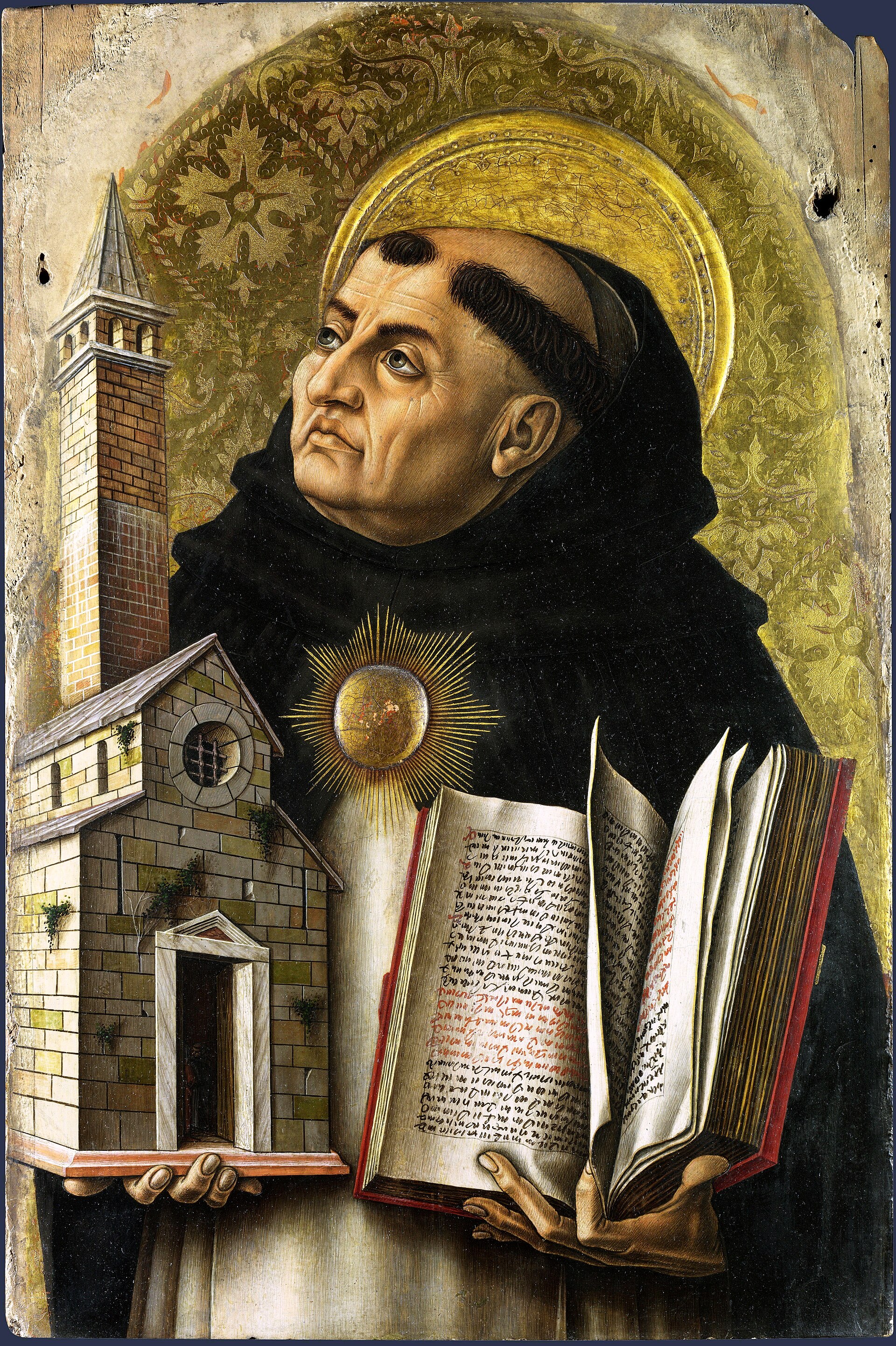
Thomas Aquinas (1225 to March 7, 1274), an Italian Dominican who taught at Paris and in Italy, wrote the Summa contra Gentiles and the unfinished Summa theologiae, the most influential attempt to join Aristotle's philosophy to Christian teaching. Some of his propositions were among those condemned by the bishop of Paris in 1277, three years after his death; he was canonized in 1323. A later Bible and History module is planned to treat the Summa in detail, and the Liberty module already covers his theory of natural law: Natural Law from Cicero to Aquinas.

The cathedrals
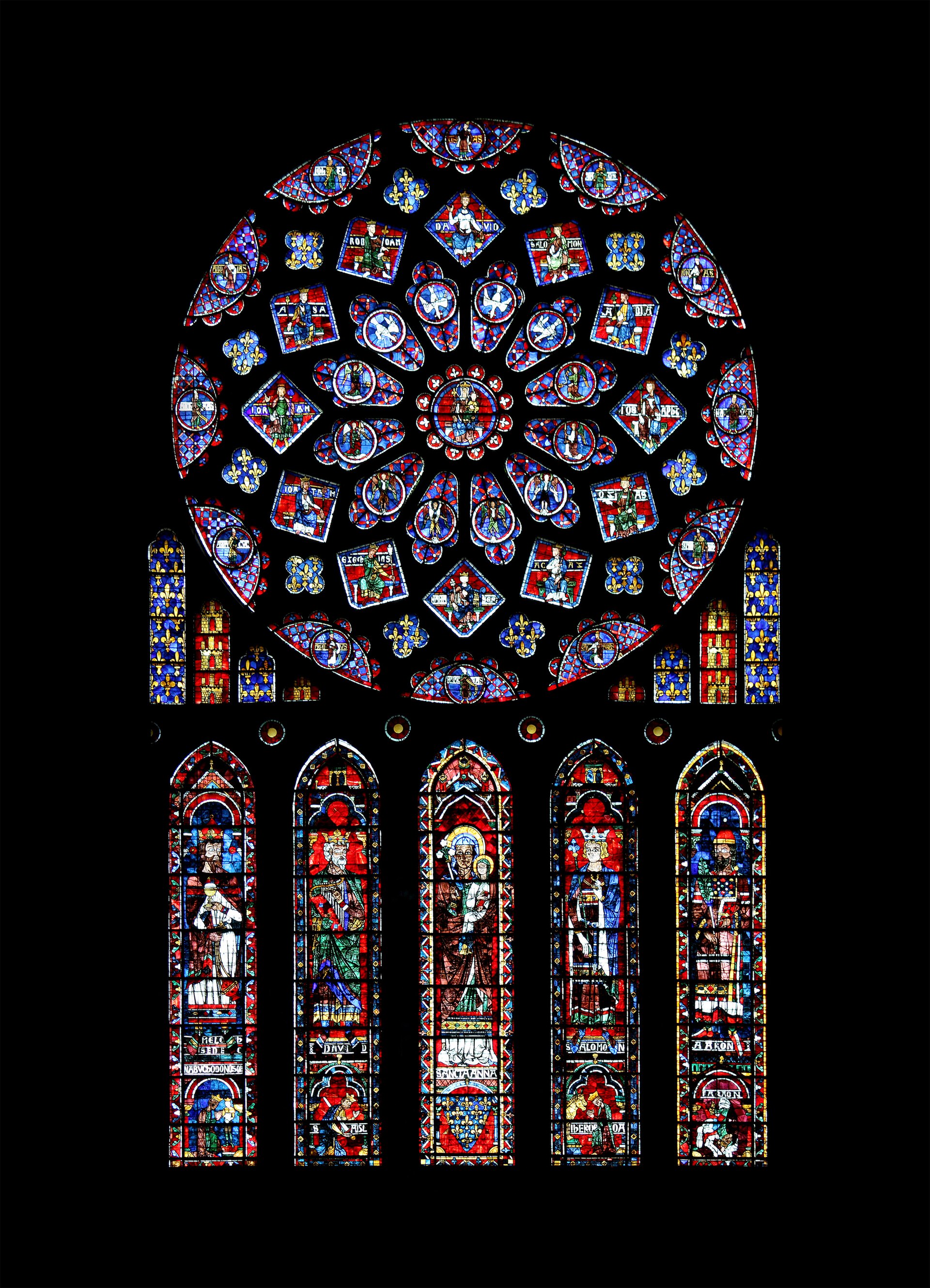
The same centuries built the great cathedrals. The style later called Gothic (pointed arches, ribbed vaults and flying buttresses that let walls open into windows) began with Abbot Suger's rebuilding of the choir of Saint-Denis near Paris, consecrated in 1144. Chartres, the best preserved, was partly built starting in 1145 and "reconstructed over a 26-year period after the fire of 1194," in UNESCO's description; most of its glass was made between about 1210 and 1250.43 A cathedral was a teaching program in stone and glass for people who mostly could not read: the windows set out the Bible, the lives of the saints and the order of the world. Building one took generations of local money, labor and indulgences offered to donors.

Boniface VIII and Unam Sanctam, 1302
The high claims of the papacy reached their most famous statement in a quarrel with King Philip IV of France over whether the king could tax the clergy and try a bishop in his own courts. On November 18, 1302, Pope Boniface VIII issued the bull Unam Sanctam. It opens with the unity of the church: "Urged by faith, we are obliged to believe and to maintain that the Church is one, holy, catholic, and also apostolic. We believe in her firmly and we confess with simplicity that outside of her there is neither salvation nor the remission of sins." It then takes up the two swords of Luke 22:38:
"We are informed by the texts of the gospels that in this Church and in its power are two swords; namely, the spiritual and the temporal ... the latter is to be exercised on behalf of the Church; and truly, the former is to be exercised by the Church. The former is of the priest; the latter is by the hand of kings and soldiers, but at the will and sufferance of the priest."
It ends with a solemn definition: "we declare, we proclaim, we define that it is absolutely necessary for salvation that every human creature be subject to the Roman Pontiff."44 (The translation is the one given at papalencyclicals.net.)
The answer came from soldiers. In September 1303 agents of Philip, with members of the Colonna family, seized the aged pope at his palace at Anagni; he was freed after a few days but died in Rome a month later, on October 11, 1303. Catholic theologians since then have distinguished the final sentence, which they read as a statement about the church's spiritual authority in line with earlier teaching, from the political argument about the two swords, which later popes did not repeat in that form. Protestant and Orthodox readers have treated the bull as the clearest example of what they reject in papal claims. The historical record is that the bull was issued in a power struggle, that the king won that struggle, and that within a few years the papacy moved to France.
Avignon and the Western Schism
The popes at Avignon, 1309 to 1377
Bertrand de Got, archbishop of Bordeaux, was elected pope as Clement V at Perugia on June 5, 1305, and crowned at Lyons on November 14, 1305. He never went to Rome. After living at several places in France from 1305 to 1309, he "finally took up his residence at Avignon," in the words of the Catholic Encyclopedia, a city then held by the Angevin kings of Naples and surrounded by papal territory.45 Seven popes in a row, all French, lived there. Under pressure from Philip IV, Clement suppressed the Templars at the Council of Vienne in 1312, after French trials that used torture. Avignon became an efficient center of papal finance and administration. To many Italians, following the poet Petrarch, it was the "Babylonian captivity" of the church, a phrase Luther would reuse in 1520 for a different purpose. Catherine of Siena and Bridget of Sweden urged the popes to return. Gregory XI went back to Rome in 1377 and died there on March 27, 1378.46
The Western Schism, 1378 to 1417
Under pressure from a Roman crowd that demanded an Italian, the cardinals elected the archbishop of Bari as Urban VI in April 1378. Within months most of them, offended by his harsh behavior, declared that the election had been made under fear and was invalid, and in September 1378 they elected Robert of Geneva as Clement VII, who settled at Avignon. Europe divided by politics: France, Scotland, Naples and parts of Spain followed Avignon; England, most of the Empire and northern Italy followed Rome. Saints stood on both sides. A council at Pisa in 1409 tried to end the division by deposing both popes and electing a third, Alexander V, but the other two refused to go, so for a few years there were three men each claiming to be pope.
The Council of Constance (1414 to 1418), called under pressure from Emperor Sigismund, ended it. In the Catholic Encyclopedia's summary, the council "deposed the suspicious John XXIII, received the abdication of the gentle and timid Gregory XII, and finally dismissed the obstinate Benedict XIII," and "on 11 November, 1417, the assembly elected Odo Colonna, who took the name of Martin V. Thus ended the great schism of the West."46 The Catholic Church today counts the Roman line (Urban VI to Gregory XII) as the legitimate popes. The same council, in its decree Haec sancta (1415), declared that a general council held its authority directly from Christ and that even a pope must obey it in matters of faith, the ending of the schism and the reform of the church. Whether that decree was a lasting rule (the conciliarist reading) or an emergency measure without force once a single pope was restored (the reading later popes adopted) was argued for the rest of the century. The same council burned Jan Hus on July 6, 1415, a story that belongs to lesson 10.
The philosopher and writer Francis Schaeffer offered one well known Protestant reading of these centuries in How Should We Then Live? (1976): that medieval thought, especially after Aquinas, separated nature from grace in a way that later let reason and nature run free of revelation. It is one named reading among many, and the Liberty module discusses it: How Should We Then Live?
What the record shows and what it does not
- Documented fact. Gregory I was consecrated September 3, 590, and died March 12, 604. His letters to the English mission survive in Bede. Einhard records the coronation of December 25, 800. The Dictatus papae stands in Gregory VII's register under 1075. Gregory VII's own letter describes Henry IV's three days at Canossa in January 1077. The Concordat of Worms is dated September 23, 1122. The canons of Lateran IV (1215) and the text of Unam Sanctam (November 18, 1302) survive. Jerusalem fell to the crusaders on July 15, 1099, and eyewitnesses describe a large massacre. Valla's treatise of 1440 proved the Donation of Constantine to be a forgery.
- A church's own claim or tradition. The story of Gregory and the Angle boys is a tradition Bede reports as such. The miracle at Geismar and Clovis's battlefield prayer come from admiring biographers and a bishop-historian writing decades later. Papal primacy in the form stated by the Dictatus and Unam Sanctam is Catholic teaching that Orthodox and Protestant churches reject.
- Scholarly reading. Whether Charlemagne was surprised by his crowning; whether the crusades were defensive wars (Madden), penitential pilgrimages (Riley-Smith), a mixture of motives (Tyerman) or barbarian aggression (Runciman); whether the Investiture Controversy began the Western separation of church and state (Berman).
- Open question. The exact year of Clovis's baptism; the authorship of the Dictatus papae; the number killed at Jerusalem in 1099; the total number executed by medieval inquisitors, which cannot be counted because most registers are lost.
Claims checked
"Medieval people, taught by the church, believed the earth was flat"
Refuted. Educated medieval writers, from Bede in the eighth century to Aquinas and the authors of the standard university astronomy textbook in the thirteenth, treated the earth as a sphere. The historian Jeffrey Burton Russell, in Inventing the Flat Earth (1991) and a 1997 summary, found that "tens of thousands of Christian theologians, poets, artists, and scientists took the spherical view throughout the early, medieval, and modern church." He traced the myth to the nineteenth century: Washington Irving's 1828 life of Columbus invented a scene of flat-earth churchmen at Salamanca, the French scholar Antoine-Jean Letronne in 1834 misrepresented the church fathers as flat-earthers, and the writers John Draper and Andrew Dickson White spread the story as part of a supposed war between science and religion.47 A very few early writers (Lactantius in the fourth century, Cosmas Indicopleustes in the sixth) did argue for a flat earth, and they were exceptions with little influence. The argument with Columbus was about the size of the globe, and his critics were right that it was larger than he claimed.
"The Middle Ages were the Dark Ages"
Partly supported, as a description of some regions in some centuries; unsupported as a description of the whole period. The phrase began with the fourteenth century poet Petrarch, who called the centuries after Rome's fall dark because they lacked the classical Latin literature he loved, as Theodor Mommsen showed in a classic article (1942).48 Enlightenment writers such as Voltaire and Gibbon turned it against the church. It is true that the population, cities, trade and literacy of the West fell sharply between about 500 and 750, and that fewer written records survive from those years, which is the narrow sense some historians still give the term. It is not true of the period as a whole, which produced the Carolingian renewal, the universities, Gothic architecture, the recovery of Aristotle, the mechanical clock, eyeglasses and a large share of the surviving copies of ancient literature. Most professional medievalists no longer use the label.
"The Crusades were unprovoked wars of conquest against peaceful Muslims"
Partly supported on the question of conquest; unsupported on "unprovoked." Urban's own letter and every version of the Clermont speech present the expedition as aid to Eastern Christians against the Turks, and the Byzantine emperor had asked for help after the Seljuk conquest of Asia Minor.21 Jerusalem and most of the Christian Near East had been taken by Muslim armies in the seventh century. To that extent "unprovoked" is wrong. But the crusaders did conquer and settle land, massacred the populations of Jerusalem and other cities, and attacked Jews in Europe and Christians in Constantinople. Historians disagree about how to weigh these facts (see Runciman, Riley-Smith, Madden and Tyerman above); none of them describes the crusades as either purely defensive or purely aggressive.
"Crusaders went east to get rich"
Mostly unsupported for the First Crusade. Riley-Smith's study of charters shows crusaders selling and mortgaging land to raise the large sums needed, and most who survived came home poorer.34 Some leaders, such as Bohemond at Antioch, plainly sought lordships, and plunder figures in every eyewitness account of Jerusalem. Motives were mixed, as Tyerman stresses, but the charge that greed explains the movement does not fit the evidence for 1096.
"Urban II told the crowd 'Deus vult' and promised that killing Muslims would forgive sins"
Partly supported. The cry "It is the will of God!" appears in Robert the Monk's version, written about 1106 to 1107, a decade or more later, not in Fulcher's.22 Fulcher's Urban promises "remission of sins" to those who die on the journey or in battle, and Urban's own letter calls the undertaking "a preparation for the remission of all their sins."26 In the theology of the time this was a remission of the penance due for confessed sins, granted for undertaking the journey with right intention; it was not taught as a reward for killing as such.
"At Beziers the papal legate said 'Kill them all, God will know his own'"
Unresolved. The phrase comes from Caesarius of Heisterbach, writing more than a decade later in Germany, who says only that the legate was reported to have said it; the legate's own report to the pope does not contain it.32 The massacre itself is well attested.
"The Inquisition killed millions"
Refuted for the medieval inquisitions. Surviving registers such as Bernard Gui's show execution in a small minority of cases (42 of 930 at Toulouse, 1308 to 1323), and Burr estimates ten percent or less overall.3937 No source supports figures in the millions. The total cannot be computed because most records are lost, and the deaths that did occur, together with the crusade against the Cathars, are a matter of record.
"The popes' power rested on a forged document"
Partly supported. The Donation of Constantine was a forgery, as Valla proved in 1440, and it was used for centuries to support papal claims to lands and imperial honors.13 But papal claims to spiritual authority were argued from the Gospels and the tradition of Peter's see long before the Donation existed, and continued after its exposure. The forgery mattered for the Papal States and for imperial politics more than for doctrine.
"Charlemagne could not read or write"
Partly supported. Einhard says Charles studied with Alcuin, learned to reckon and could follow Latin, but that his late attempts to learn to write "met with ill success."12 Reading and writing were separate skills in the period; he could probably read, and he could not write well.
Hard questions and answers
Did Gregory the Great reject the papacy as later popes understood it?
He rejected the title "ecumenical" or "universal" bishop when the patriarch of Constantinople claimed it, and the letters say so. He also acted as the chief bishop of the West, sent missions, gave orders to other bishops and treated Rome as the see of Peter. Catholic historians stress the second set of facts, Orthodox and Protestant historians the first. The record supports both: Gregory held a high view of Rome's authority and a strong dislike of grand titles, and the Dictatus papae five hundred years later claimed the very title he refused.
Were the Crusades just wars by the church's own standards?
The church's standard came from Augustine (see lesson 06): a just war needs legitimate authority, a just cause such as defense or the recovery of what was wrongly taken, and right intention. Urban claimed all three: papal authority, the defense of Eastern Christians and the recovery of Jerusalem, and the penitential intention of the crusader. The same standard condemns killing the defenseless, and eyewitnesses describe exactly that at Jerusalem in 1099 and at Beziers in 1209; contemporary churchmen also condemned the sack of Constantinople in 1204. The honest answer is that the stated cause fit the theory better than the conduct did.
Was transubstantiation invented in 1215?
No. The belief that the bread and wine become Christ's body and blood is much older, and the dispute between Berengar of Tours and his critics in the eleventh century had already forced the question of how. What was new in 1215 was a conciliar decree using the language of change "in substance" (transsubstantiatis), drawn from the philosophical vocabulary of the schools.15 The Orthodox Church affirms a real change but has generally declined to define how it happens; Protestant churches after 1517 divided over the question, as lesson 11 and 12 show.
Why did the church that taught "by persuasion, not by violence" hand heretics to be burned?
Bernard of Clairvaux had written that faith must be persuaded and not imposed, and the Catholic Encyclopedia quotes him to that effect.39 By the late twelfth century church leaders and rulers had come to treat obstinate heresy as a crime like treason, damaging to souls and to the social order. Roman law supplied the penalty; emperors such as Frederick II wrote it into their laws; the church took it into canon law in 1231. The medieval church did not itself carry out executions; it handed the condemned to the "secular arm," which everyone involved knew would burn them. Modern Catholic teaching rejects coercion in religion (the Second Vatican Council's declaration on religious freedom, 1965), and Pope John Paul II asked forgiveness in 2000 for the use of violence in the service of truth.
If the medieval church preserved learning, why did it also condemn thinkers like Abelard?
Both happened, often in the same places. The monasteries that copied Virgil and Cicero, the schools that taught Aristotle and the councils that condemned Abelard and later some propositions of Aquinas were all part of one church arguing about the limits of reason. Abelard was condemned for particular teachings about the Trinity, not for asking questions, and the method of Sic et Non became the standard method of the universities. Condemnation and growth of learning existed side by side for the whole period.
Learn more
- Internet Medieval Sourcebook: Crusades: The largest free collection of crusade chronicles and letters in translation, from Clermont to the fall of Acre.
- Avalon Project: Documents Relating to the War of the Investitures: All the main letters and decrees of the Gregory VII and Henry IV conflict, through the Concordat of Worms, in Henderson's translation.
- Valla's Treatise on the Donation of Constantine (Project Gutenberg): Latin and English side by side, with the text of the Donation itself; one of the founding works of document criticism.
- Fourth Lateran Council, all 71 constitutions: Read the canons on confession, preaching, tithes, heretics and Jews in full.
- Bede's Ecclesiastical History, Book 1: Gregory's own letters to Augustine and Mellitus, copied by Bede.
- Next lesson: Reform Before Luther: The Waldensians, Wycliffe and Hus, and the Council of Constance's judgment on Hus.
Still being checked (14 items)
These points could not be confirmed against a primary source when this lesson was written and fact checked in October 2026. The text above states each one as uncertain.
- The date of Clovis's baptism: Gregory of Tours points to about 496; other evidence (the letter of Avitus of Vienne) leads many historians to 503 to 508. Neither the Avitus letter nor the modern studies were opened for this lesson.
- Guibert's date (about 1108), whether Guibert was in fact present at Clermont (the Sourcebook says he attended), and whether Baldric was present are stated from the Sourcebook notes and standard scholarship, not from a modern study opened. Robert the Monk's date (1106 to 1107) is now confirmed from a review of Sweetenham's translation.
- The date of the speech, November 27, 1095, is the standard date in all modern histories but was not read in a primary text during this lesson.
- Ibn al-Athir's figure of more than 70,000 was read in an excerpt of Gabrieli's translation on a university course page, not in the book itself. Benjamin Kedar's 2004 article and the Cairo Geniza letters are mentioned from general knowledge and were not opened.
- Arnaud Amaury's report to Innocent III on Beziers was not opened; the statement that it lacks the phrase 'Kill them all' rests on Andrew Holt's summary. The number killed at Beziers is not given.
- Runciman, Riley-Smith, Madden, Tyerman and Berman are summarized from general knowledge of their books, not from pages opened for this lesson; no words are quoted from them.
- Not checked against a primary text: Otto III's court calling the Donation a forgery (1001); Dante's view; Reginald Pecock and Nicholas of Cusa; Luther reading Valla in 1520; the Admonitio generalis (789); the Council of Frankfurt (794); the capitularies making tithes compulsory; Synod of Whitby (664) beyond the Bede chapter citation; King Alfred's translation of the Pastoral Rule; the Whitby Life of Gregory.
- Not checked against a primary text: Innocent III's sun and moon image (1198), the interdict on England (1208), John's excommunication (1209) and submission (1213), Innocent's annulment of Magna Carta (August 1215), and Magna Carta clause 1 wording 'the English Church shall be free.'
- Not checked against a primary text: Bismarck's 'We will not go to Canossa' (1872); Gregory VII's death at Salerno (1085) and the Norman sack of Rome (1084); the 1059 papal election decree; the 1107 English settlement.
- Not checked against a primary text: the Spanish (1478) and Roman (1542) Inquisitions; Abelard's 158 questions, Soissons (1121) and Sens (1141); Oxford's growth after 1167; Suger's Saint-Denis choir (1144); the Paris condemnation of 1277; Aquinas's canonization (1323); Corpus Christi (1264); the Council of Florence on seven sacraments (1439).
- Not checked against a primary text: Philip IV's seizure of Boniface VIII at Anagni (September 1303); Boniface's death date (October 11, 1303, given on the papalencyclicals.net page header); the suppression of the Templars at Vienne (1312); the elections of Urban VI and Clement VII (April and September 1378); Vatican II's declaration on religious freedom (1965) and John Paul II's request for forgiveness (2000).
- Avignon dates: the Catholic Encyclopedia confirms Clement V lived at several places in France 1305 to 1309 before settling at Avignon and that Gregory XI died in Rome in March 1378; the return to Rome in January 1377 is stated from standard histories.
- The Gregorian chant attribution and the dating of that chant to Frankish lands are stated from general music history, not a source opened.
- Ad extirpanda is confirmed by the Catholic Encyclopedia ('Inquisition') as Innocent IV's bull of May 15, 1252; Haec sancta's wording was checked in Tanner's translation on two sites (lesson 10). Boniface's death year: 754 in most modern works, 755 (754) in the Catholic Encyclopedia.
Notes
- Catholic Encyclopedia (1909), 'Pope St. Gregory I ("the Great")', New Advent (retrieved Oct. 28, 2026): birth about 540, prefect about 573, consecration Sept. 3, 590, death March 12, 604, the Lombard negotiations of 593 to 601, and the dispute over the title 'Ecumenical' taken by John the Faster in 588. Read it online. ↩
- Philip Schaff, History of the Christian Church, vol. 4, Mediaeval Christianity, A.D. 590 to 1073 (New York: Scribner, 1885), which opens the medieval period with Gregory I and narrates the English mission and the Synod of Whitby (from Bede, Ecclesiastical History, book 3, chapter 25). Christian Classics Ethereal Library (retrieved Oct. 28, 2026). Read it online. ↩
- Bede, Ecclesiastical History of the English Nation, book 1, chapter 23 (Gregory's letter to the missionaries, 'Gregory, the servant of the servants of God, to the servants of our Lord'), translation probably L. C. Jane (Temple Classics, 1903; Everyman ed., London: J. M. Dent, 1910), Internet Medieval Sourcebook, Fordham University (retrieved Oct. 28, 2026). Read it online. ↩
- Gregory the Great, The Book of Pastoral Rule, part 1, chapter 1, trans. James Barmby, Nicene and Post-Nicene Fathers, second series, vol. 12, ed. Philip Schaff and Henry Wace (Buffalo: Christian Literature Publishing, 1895), New Advent (retrieved Oct. 28, 2026). Read it online. ↩
- Bede, Ecclesiastical History, book 2, chapter 1 (death of Gregory, dated by Bede to 605; the tradition of the Angle boys in the Roman market), same translation, Internet Medieval Sourcebook (retrieved Oct. 28, 2026). Read it online. ↩
- Bede, Ecclesiastical History, book 1, chapter 25 (landing on Thanet, 'nearly forty men', Frankish interpreters, meeting with Ethelbert), same translation, Internet Medieval Sourcebook (retrieved Oct. 28, 2026). Read it online. ↩
- Bede, Ecclesiastical History, book 1, chapter 30 (Gregory's letter to Abbot Mellitus, 601, on the temples of the English), same translation, Internet Medieval Sourcebook (retrieved Oct. 28, 2026). Read it online. ↩
- Gregory of Tours, History of the Franks, book 2, chapters 28 to 31 (the conversion and baptism of Clovis), trans. Ernest Brehaut, Records of Civilization 2 (New York: Columbia University Press, 1916), Internet Medieval Sourcebook (retrieved Oct. 28, 2026). Read it online. ↩
- Willibald, The Life of St. Boniface, chapter 6 (the Oak of Jupiter at Geismar), trans. C. H. Talbot, The Anglo-Saxon Missionaries in Germany (London: Sheed and Ward, 1954), Internet Medieval Sourcebook (retrieved Oct. 28, 2026). Read it online. ↩
- The Donation of Constantine, trans. Ernest F. Henderson, Select Historical Documents of the Middle Ages (London: George Bell, 1910), pp. 319 to 329, with the Sourcebook introduction dating a first draft to shortly after 750 and noting Pope Stephen II's anointing of Pepin in 754. Internet Medieval Sourcebook (retrieved Oct. 28, 2026). Read it online. ↩
- Einhard, The Life of Charlemagne, chapter 28 ('Charlemagne Crowned Emperor'), trans. Samuel Epes Turner (New York: Harper and Brothers, 1880), Internet Medieval Sourcebook (retrieved Oct. 28, 2026). Read it online. ↩
- Einhard, The Life of Charlemagne, chapter 25 ('Studies'; Alcuin, and the tablets under the pillow), trans. Turner (1880), Internet Medieval Sourcebook (retrieved Oct. 28, 2026). Read it online. ↩
- Lorenzo Valla, The Treatise of Lorenzo Valla on the Donation of Constantine, Latin text and trans. Christopher B. Coleman (New Haven: Yale University Press, 1922); the introduction dates the treatise to 1440 and notes Hutten's first printed edition of 1517. Project Gutenberg eBook 70092 (retrieved Oct. 28, 2026). Read it online. ↩
- Urban II's speech at Clermont, 1095, in the version of Fulcher of Chartres, trans. adapted from Oliver J. Thatcher and Edgar Holmes McNeal, A Source Book for Medieval History (New York: Scribner, 1905), pp. 513 to 517, in 'Urban II: Speech at Council of Clermont, 1095, Six Versions of the Speech', Internet Medieval Sourcebook (retrieved Oct. 28, 2026). Read it online. ↩
- Fourth Lateran Council (1215), introduction and constitutions 1, 2, 3, 21, 50, 53 to 56, 68 and 71, trans. from Norman P. Tanner, ed., Decrees of the Ecumenical Councils (1990), as given at Papal Encyclicals Online (retrieved Oct. 28, 2026). Read it online. ↩
- Dictatus Papae (Gregory VII's register, 1075), trans. Ernest F. Henderson, Select Historical Documents of the Middle Ages (London: George Bell, 1910), pp. 366 to 367, Internet Medieval Sourcebook, with the Sourcebook's note on the debate over authorship (retrieved Oct. 28, 2026). Read it online. ↩
- Henry IV's answer to Gregory VII, January 24, 1076, trans. Ernest F. Henderson, Select Historical Documents of the Middle Ages (London: George Bell, 1896, the edition named on the page), Avalon Project, Yale Law School, Documents Relating to the War of the Investitures (retrieved Oct. 28, 2026). Read it online. ↩
- First Deposition and Banning of Henry IV by Gregory VII, February 22, 1076, trans. Ernest F. Henderson, Select Historical Documents of the Middle Ages (London: George Bell, 1896, the edition named on the page), Avalon Project, Yale Law School (retrieved Oct. 28, 2026). Read it online. ↩
- Gregory VII's letter to the German princes concerning the penance of Henry IV at Canossa, late January 1077 (often dated January 28; the Avalon page gives only the year), trans. Ernest F. Henderson, Select Historical Documents of the Middle Ages (London: George Bell, 1896, the edition named on the page), Avalon Project, Yale Law School (retrieved Oct. 28, 2026). Read it online. ↩
- Concordat of Worms, September 23, 1122: privilege of Pope Calixtus II and edict of the emperor (Henry V, labeled Henry IV on the page), trans. Ernest F. Henderson, Select Historical Documents of the Middle Ages (London: George Bell, 1896, the edition named on the page), Avalon Project, Yale Law School (retrieved Oct. 28, 2026). Read it online. ↩
- Introduction to 'Urban II: Speech at Council of Clermont, 1095, Six Versions of the Speech' (Alexios I's request for aid in 1094 or 1095; the acts of the council not preserved), Internet Medieval Sourcebook, ed. Paul Halsall (retrieved Oct. 28, 2026). Read it online. ↩
- Robert the Monk, Historia Hierosolymitana, version of Urban's speech, trans. Dana C. Munro, 'Urban and the Crusaders', Translations and Reprints from the Original Sources of European History, vol. 1, no. 2 (Philadelphia: University of Pennsylvania, 1895), pp. 5 to 8, Internet Medieval Sourcebook (retrieved Oct. 28, 2026). Read it online. ↩
- Gesta Francorum, account of the preaching of the crusade, trans. August C. Krey, The First Crusade: The Accounts of Eyewitnesses and Participants (Princeton: Princeton University Press, 1921), pp. 28 to 30, Internet Medieval Sourcebook (retrieved Oct. 28, 2026). Read it online. ↩
- Baldric of Dol, version of Urban's speech, trans. Krey, The First Crusade (1921), pp. 33 to 36, Internet Medieval Sourcebook (retrieved Oct. 28, 2026). Read it online. ↩
- Guibert of Nogent, Historia quae dicitur Gesta Dei per Francos, version of Urban's speech, trans. Krey, The First Crusade (1921), pp. 36 to 40, Internet Medieval Sourcebook (retrieved Oct. 28, 2026). Read it online. ↩
- Urban II, Letter of Instruction to the Crusaders in Flanders, December 1095, trans. Krey, The First Crusade (1921), pp. 42 to 43, Internet Medieval Sourcebook (retrieved Oct. 28, 2026). Read it online. ↩
- Fulcher of Chartres, Gesta Francorum Jerusalem Expugnantium, chapters 27 to 28 (siege and capture of Jerusalem, July 15, 1099), in Frederick Duncan and August C. Krey, eds., Parallel Source Problems in Medieval History (New York: Harper and Brothers, 1912), pp. 109 to 115, in 'The Siege and Capture of Jerusalem: Collected Accounts', Internet Medieval Sourcebook (retrieved Oct. 28, 2026). Read it online. ↩
- Gesta Francorum, the fall of Jerusalem, trans. Krey, The First Crusade (1921), pp. 256 to 257, in 'The Siege and Capture of Jerusalem: Collected Accounts', Internet Medieval Sourcebook (retrieved Oct. 28, 2026). Read it online. ↩
- Raymond of Aguilers, the Frankish victory at Jerusalem, trans. Krey, The First Crusade (1921), pp. 257 to 262, in 'The Siege and Capture of Jerusalem: Collected Accounts', Internet Medieval Sourcebook (retrieved Oct. 28, 2026). Read it online. ↩
- Ibn al-Athir, al-Kamil fi'l-tarikh, and Ibn al-Qalanisi, Damascus Chronicle, on the fall of Jerusalem in 1099, in Francesco Gabrieli, Arab Historians of the Crusades, trans. E. J. Costello (Berkeley: University of California Press, 1984), as excerpted on Martha Carlin's course page 'Muslim Accounts of the Conquest of Jerusalem', University of Wisconsin-Milwaukee (retrieved Oct. 28, 2026). Read it online. ↩
- Konrad Hirschler, 'The Jerusalem Conquest of 492/1099 in the Medieval Arabic Historiography of the Crusades: From Regional Plurality to Islamic Narrative', Crusades 13 (2014), abstract as posted by Medievalists.net (retrieved Oct. 28, 2026). Read it online. ↩
- Andrew Holt, 'The Medieval Origins of a Modern Phrase: Kill 'em all. Let God sort 'em out', apholt.com, December 1, 2014, on Caesarius of Heisterbach's Dialogus miraculorum (about 1219 to 1223) and Arnaud Amaury's letter to Innocent III (retrieved Oct. 28, 2026). Read it online. ↩
- Steven Runciman, A History of the Crusades, 3 vols. (Cambridge: Cambridge University Press, 1951 to 1954), vol. 3, closing summary; paraphrased here, not quoted, because the book was not opened for this lesson. The wording is discussed in Thomas F. Madden, The New Concise History of the Crusades (2005). Read it online. ↩
- Jonathan Riley-Smith, The First Crusade and the Idea of Crusading (London: Athlone, 1986) and The First Crusaders, 1095 to 1131 (Cambridge: Cambridge University Press, 1997). Summary of the argument; not quoted. Read it online. ↩
- Thomas F. Madden, The New Concise History of the Crusades (Lanham, MD: Rowman and Littlefield, 2005). Summary of the argument; not quoted. Read it online. ↩
- Christopher Tyerman, God's War: A New History of the Crusades (Cambridge, MA: Belknap Press of Harvard University Press, 2006), and The Invention of the Crusades (Basingstoke: Macmillan, 1998). Summary of the argument; not quoted. Read it online. ↩
- David Burr, 'Inquisition: Introduction' (Bernard Gui's 930 sentences; executions 'around ten percent or less'), Internet Medieval Sourcebook (retrieved Oct. 28, 2026). Read it online. ↩
- Lucius III, Ad abolendam, Synod of Verona, November 4, 1184, English text (translator not named on the page), professor-moriarty.com (retrieved Oct. 28, 2026). Read it online. ↩
- Joseph Blotzer, 'Inquisition', Catholic Encyclopedia (1910), New Advent (retrieved Oct. 28, 2026): the 1184 situation, the adoption of imperial law in 1231, Bernard's 'fides suadenda, non imponenda', and the Toulouse (42 of 930, 1308 to 1323) and Pamiers (5 of 24) figures. Read it online. ↩
- Anselm of Canterbury, Proslogium, chapters 1 and 2, trans. Sidney Norton Deane, St. Anselm: Proslogium; Monologium; An Appendix in Behalf of the Fool by Gaunilo; and Cur Deus Homo (Chicago: Open Court, 1903, reprinted 1926), Internet Medieval Sourcebook (retrieved Oct. 28, 2026). Read it online. ↩
- Peter Abelard, Sic et Non, Prologue, trans. W. J. Lewis from the edition of Blanche B. Boyer and Richard McKeon (Chicago, 1976), Internet Medieval Sourcebook (retrieved Oct. 28, 2026). Read it online. ↩
- Statutes of Gregory IX for the University of Paris, 1231, trans. Dana C. Munro, University of Pennsylvania Translations and Reprints, vol. 2, no. 3 (Philadelphia, 1897), pp. 7 to 11, Internet Medieval Sourcebook (retrieved Oct. 28, 2026). Read it online. ↩
- UNESCO World Heritage Centre, 'Chartres Cathedral' (inscribed 1979): partly built from 1145, reconstructed over 26 years after the fire of 1194, glazing about 1210 to 1250 (retrieved Oct. 28, 2026). Read it online. ↩
- Boniface VIII, Unam Sanctam, bull promulgated November 18, 1302, English translation at Papal Encyclicals Online (retrieved Oct. 28, 2026). Read it online. ↩
- Catholic Encyclopedia (1908), 'Pope Clement V': elected at Perugia June 5, 1305, crowned at Lyons November 14, 1305, lived at several places in France 1305 to 1309 before taking up residence at Avignon. New Advent (retrieved Oct. 28, 2026). Read it online. ↩
- Catholic Encyclopedia (1912), 'Western Schism': Gregory XI's return to Rome and death on March 27, 1378; Pisa and Constance; election of Martin V on November 11, 1417. New Advent (retrieved Oct. 28, 2026). Read it online. ↩
- Jeffrey Burton Russell, 'The Myth of the Flat Earth', summary for the American Scientific Affiliation conference, Westmont College, August 4, 1997, archived copy (retrieved Oct. 28, 2026); see also his Inventing the Flat Earth: Columbus and Modern Historians (New York: Praeger, 1991). Read it online. ↩
- Theodor E. Mommsen, 'Petrarch's Conception of the Dark Ages', Speculum 17, no. 2 (April 1942), pp. 226 to 242. Cited from the bibliographic record; not quoted. Read it online. ↩
- Review of Carol Sweetenham, trans., Robert the Monk's History of the First Crusade: Historia Iherosolimitana (Aldershot: Ashgate, 2005), De Re Militari, which states that the Historia 'dates to 1106-7' (retrieved Oct. 28, 2026). Read it online. ↩
- Catholic Encyclopedia (1907), 'St. Boniface': arrival in Rome in the fall of 718, the papal commission of May 15, 719, to preach east of the Rhine, and the date of death given as June 5, 755 (754). New Advent (retrieved Oct. 28, 2026). Read it online. ↩
Check yourself
1. What title did Gregory the Great use for himself, which later popes kept?
Bede preserves Gregory's letter to the English mission opening 'Gregory, the servant of the servants of God.' Gregory objected when the patriarch of Constantinople took the title 'Ecumenical.'
2. According to Einhard, how did Charlemagne react to being crowned emperor on Christmas Day 800?
Einhard, chapter 28, says Charles at first had such an aversion to the titles that he would not have set foot in the church if he had foreseen the pope's design. Historians debate whether this is literal or conventional modesty.
3. Which argument did Lorenzo Valla use in 1440 to show the Donation of Constantine was forged?
Valla's case was historical and linguistic: no ancient source mentions the gift, and the document uses words and names impossible in Constantine's time.
4. What did Henry IV do at Canossa in January 1077, according to Gregory VII's own letter?
Gregory's letter of late January 1077 describes Henry standing for three days at the gate, after which the pope lifted the excommunication.
5. Which of these was decreed by the Fourth Lateran Council in 1215?
Canon 21 required yearly confession and Easter communion. Canon 1 used the language of the bread and wine 'changed in substance' into Christ's body and blood.
6. In which version of Urban II's Clermont speech does the crowd cry 'It is the will of God!'?
The cry appears in Robert the Monk's version, written about 1106 to 1107 (the Sourcebook says perhaps 25 years later). Fulcher's version, by a probable eyewitness, does not contain it.
7. What do the surviving registers of Bernard Gui's inquisition at Toulouse (1308 to 1323) show?
The Catholic Encyclopedia gives 42 of 930; most sentences were penances, fines, pilgrimages or prison. Most registers elsewhere are lost, so no overall total can be computed.
8. Who, according to Jeffrey Burton Russell, did most to create the myth that medieval people believed in a flat earth?
Russell traced the myth to Irving's 1828 life of Columbus, Letronne's 1834 study and the science-versus-religion histories of Draper and White. Medieval scholars, Bede and Aquinas among them, held a spherical earth.
Terms in this lesson
- Servus servorum Dei
- 'Servant of the servants of God,' the title Gregory the Great used for himself and that later popes kept as part of papal style.
- Investiture
- The ceremony of giving a bishop or abbot the symbols of office (ring and staff) and the lands attached to it. The fight over whether kings could do this is called the Investiture Controversy (about 1075 to 1122).
- Simony
- Buying or selling church offices or spiritual things, named after Simon Magus in Acts 8; a main target of the eleventh century reformers.
- Dictatus papae
- A list of twenty-seven statements about papal power entered in Gregory VII's register in 1075, including the claims that the pope may depose emperors and be judged by no one.
- Concordat of Worms
- The agreement of September 23, 1122, between Pope Calixtus II and Emperor Henry V that separated spiritual investiture (by the church) from the grant of lands and rights (by the emperor).
- Donation of Constantine
- A forged decree, probably of the eighth or ninth century, in which Constantine supposedly gave the pope imperial honors and rule over Rome and the West. Lorenzo Valla proved it a forgery in 1440.
- Tithe
- A tenth of the produce of land and livestock owed to the church, made a legal duty in the Frankish kingdom in the late eighth century.
- Transubstantiation
- The teaching that in the Eucharist the substance of bread and wine is changed into the body and blood of Christ while the appearances remain; the Fourth Lateran Council (1215) used the term 'changed in substance' (transsubstantiatis).
- Crusade
- A war proclaimed by the pope as a penitential holy war, whose participants took a vow, wore the cross and received spiritual privileges; the first was preached by Urban II at Clermont in 1095.
- Inquisition (medieval)
- A judicial procedure in which a judge gathered evidence himself, used from the 1230s by friars commissioned by the pope as inquisitors of heresy; not yet a single central institution.
- Scholasticism
- The method of the medieval schools and universities: reading authorities, posing questions, setting texts against each other and resolving the conflict by reason, as in Abelard's Sic et Non and Peter Lombard's Sentences.
- Unam Sanctam
- The bull of Boniface VIII (November 18, 1302) on the unity of the church and the two swords, ending with the definition that subjection to the Roman pontiff is necessary for salvation.
- Western Schism
- The division of 1378 to 1417 in which two and later three rival lines of popes claimed office, ended by the Council of Constance with the election of Martin V.
- Conciliarism
- The view, stated in the Council of Constance's decree Haec sancta (1415), that a general council holds its authority directly from Christ and can bind even a pope.
Sources
- Bede, Ecclesiastical History, Book 1 (L. C. Jane translation) (731) checked 2026-10
- Bede, Ecclesiastical History, Book 2 (731) checked 2026-10
- Gregory the Great, Book of Pastoral Rule (Barmby, NPNF 2.12) (about 590 to 591) checked 2026-10
- Catholic Encyclopedia: Pope St. Gregory I (1909) checked 2026-10
- Schaff, History of the Christian Church, vol. 4 (1885) checked 2026-10
- Gregory of Tours, The Conversion of Clovis (Brehaut) (about 575 to 594) checked 2026-10
- Willibald, The Life of St. Boniface (Talbot) (about 760s) checked 2026-10
- Einhard, The Life of Charlemagne (Turner) (about 817 to 830) checked 2026-10
- The Donation of Constantine (Henderson) (8th or 9th century) checked 2026-10
- Lorenzo Valla, Treatise on the Donation of Constantine (Coleman) (1440 (trans. 1922)) checked 2026-10
- Dictatus Papae (Henderson) (1075) checked 2026-10
- Avalon Project: Henry IV's answer to Gregory VII (January 24, 1076) checked 2026-10
- Avalon Project: First deposition of Henry IV (February 22, 1076) checked 2026-10
- Avalon Project: Gregory VII's letter on Canossa (January 28, 1077) checked 2026-10
- Avalon Project: Concordat of Worms (September 23, 1122) checked 2026-10
- Fourth Lateran Council, constitutions (Tanner translation) (November 1215) checked 2026-10
- Urban II: Speech at Council of Clermont, Six Versions (1095; accounts about 1100 to 1120) checked 2026-10
- The Siege and Capture of Jerusalem: Collected Accounts (1099) checked 2026-10
- Muslim Accounts of the Conquest of Jerusalem (Gabrieli excerpts) (12th to 13th century) checked 2026-10
- Hirschler, The Jerusalem Conquest of 492/1099 in Medieval Arabic Historiography (2014) checked 2026-10
- Holt, The Medieval Origins of a Modern Phrase (December 1, 2014) checked 2026-10
- Lucius III, Ad abolendam (November 4, 1184) checked 2026-10
- Burr, Inquisition: Introduction (undated) checked 2026-10
- Catholic Encyclopedia: Inquisition (1910) checked 2026-10
- Anselm, Proslogium (Deane) (about 1077 to 1078) checked 2026-10
- Abelard, Sic et Non, Prologue (Lewis) (about 1120) checked 2026-10
- Statutes of Gregory IX for the University of Paris (1231) checked 2026-10
- UNESCO: Chartres Cathedral (1979 inscription) checked 2026-10
- Boniface VIII, Unam Sanctam (November 18, 1302) checked 2026-10
- Catholic Encyclopedia: Pope Clement V (1908) checked 2026-10
- Catholic Encyclopedia: Western Schism (1912) checked 2026-10
- Russell, The Myth of the Flat Earth (1997) checked 2026-10
- Runciman, A History of the Crusades (1951 to 1954) checked 2026-10
- Riley-Smith, The First Crusaders, 1095 to 1131 (1997) checked 2026-10
- Madden, The New Concise History of the Crusades (2005) checked 2026-10
- Tyerman, God's War (2006) checked 2026-10
- Mommsen, Petrarch's Conception of the Dark Ages (1942) checked 2026-10