Lesson 1 of 10 · about 65 minutes · Updated October 28, 2026
Holiness and Pietism: Spener, Wesley, the Methodists, the Holiness Movement and Keswick
You'll be able to
- You'll be able to explain what Spener proposed in the Pia Desideria (1675) and how Pietism reached John Wesley through Halle and the Moravians.
- You'll be able to quote and date Wesley's Aldersgate entry and state what Wesley meant, and did not mean, by Christian perfection.
- You'll be able to describe how American Methodism organized in 1784 and grew, citing membership figures with their sources and noting where those sources disagree.
- You'll be able to explain Phoebe Palmer's "shorter way" and altar theology and how it changed the emphasis of Wesley's teaching.
- You'll be able to name the Holiness churches formed between 1843 and 1908, with dates and reasons from their own histories.
- You'll be able to distinguish Keswick "higher life" teaching from Wesleyan entire sanctification and trace how both fed the "baptism of the Holy Ghost" language Pentecostals inherited.
Start here: the short version
The Pentecostal movement that appeared in Topeka in 1901 and on Azusa Street in Los Angeles in 1906 did not come from nowhere. Its first preachers were Holiness people, and the Holiness movement was a child of Methodism, which was itself a child of a wider renewal that began in German Lutheran churches in the late 1600s. That earlier renewal is called Pietism. In 1675 a Frankfurt pastor, Philipp Jakob Spener, published a short program for reform, the Pia Desideria ("Pious Desires"), that called for small-group Bible study, an active laity and preaching aimed at the heart.1 His followers built the Pietist center at Halle, and his godson, Count Nicolaus Ludwig von Zinzendorf, sheltered the Moravian refugees who founded Herrnhut in 1722.23
Moravians taught John Wesley, an Anglican priest, to expect a felt assurance of salvation. On May 24, 1738, at a society meeting in Aldersgate Street, London, Wesley wrote that he "felt my heart strangely warmed."4 Wesley then taught that a believer could, in this life, be made perfect in love, a second change he called Christian perfection or entire sanctification.5 Methodism crossed to America, organized as the Methodist Episcopal Church at the Christmas Conference in Baltimore in December 1784, and grew from a few hundred members in 1771 to about a third of all American church adherents by 1850, by the estimate of the sociologists Roger Finke and Rodney Stark.67
In the 1830s and 1840s a New York Methodist, Phoebe Palmer, taught a "shorter way" to entire sanctification: lay everything on the "altar," which is Christ, and believe God's promise at once.8 After the Civil War the National Camp Meeting Association for the Promotion of Holiness (first camp meeting at Vineland, New Jersey, July 1867) spread that teaching across the country, and between 1843 and 1908 a series of Holiness churches formed outside Methodism.9 In England the Keswick Convention (1875) taught a related "higher life" of victory over sin that did not claim sin's root was removed.10 Both streams increasingly described the second blessing as "the baptism of the Holy Ghost" and as power for service. That phrase, and the habit of seeking a definite experience after conversion, is what the first Pentecostals inherited and then changed by joining it to speaking in tongues. This lesson traces the record, quotes each movement in its own words, and marks where sources disagree.
This is the first lesson of Module 77. Parts A and B of the church history series (modules 79 and 80) cover the church from its beginnings through about 1700, so this lesson begins with only a short bridge from the Reformation. The story continues in lesson 02 (Topeka, Azusa Street, the Assemblies of God, the Charismatic renewal and the Third Wave) and in lesson 03 (what "evangelical" means and how the movement organized in the twentieth century). The Calvary Chapel and Vineyard lessons (05 through 10) return again and again to questions first argued out in the period covered here: whether there is a second experience of the Holy Spirit after conversion, what it is for, and how a believer would know.
A short bridge from the Reformation
The Protestant Reformation of the 1500s produced state churches. In the Lutheran lands of Germany and Scandinavia, in Reformed (Calvinist) territories and in England, a prince or a parliament stood behind an established church, and nearly everyone was baptized into it as an infant. By the second half of the 1600s, after the Thirty Years' War (1618 to 1648), many Lutheran pastors and laypeople believed their church had become correct in doctrine and cold in practice. Sermons argued fine points against Catholics and Calvinists, the laity listened, and ordinary members were rarely asked about a personal faith.
The movements in this lesson all answered that complaint in a similar way. Each one said that right doctrine had to become a lived experience, that laypeople should meet in small groups to read the Bible and pray, and that a Christian could expect God to change the heart in ways that could be felt and described. Each one also produced a second question that later movements kept asking: after a person is converted, is there more? The answers given between 1675 and 1906 lead, step by step, to the Pentecostal answer.
Pietism: Spener and the Pia Desideria
Spener in Frankfurt
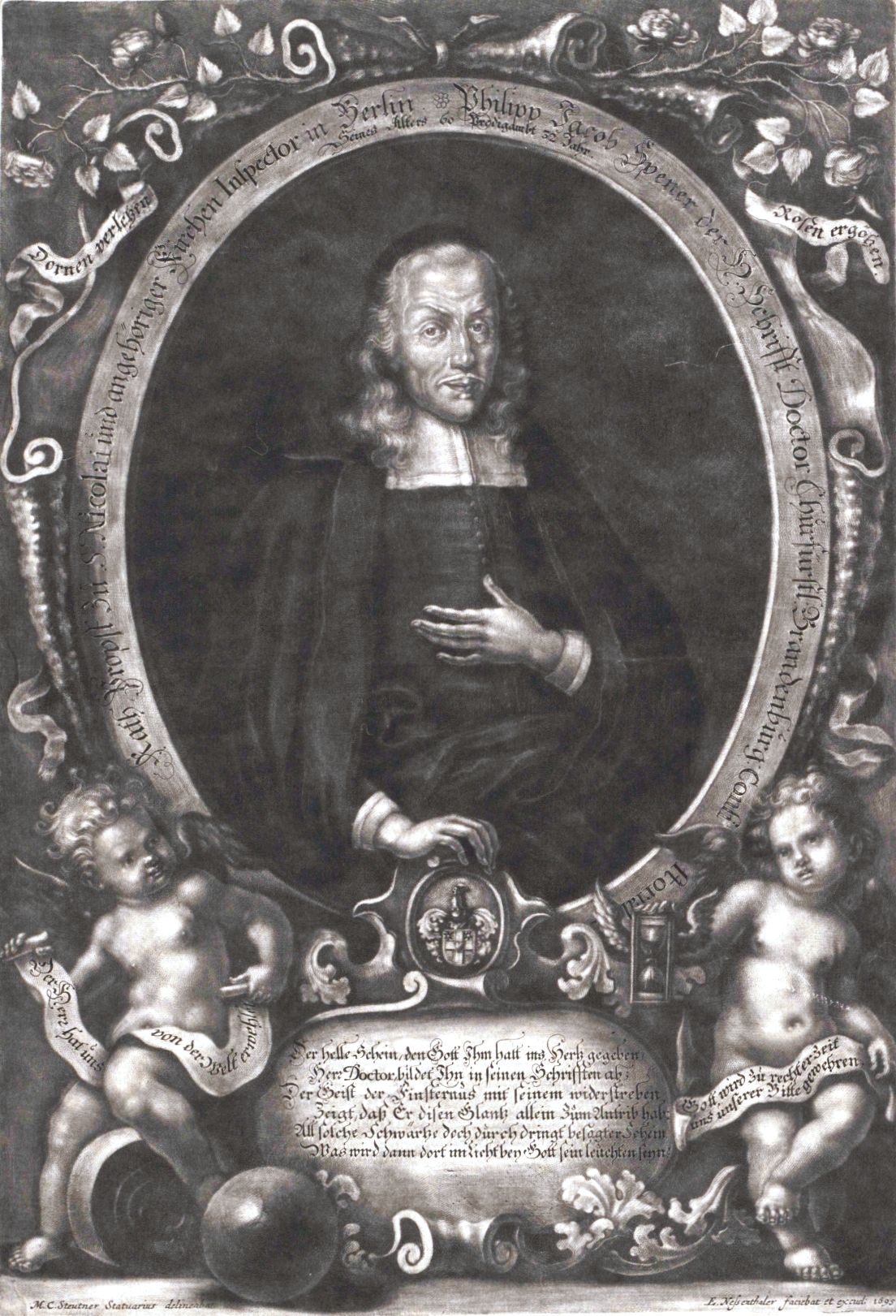
Philipp Jakob Spener was born in Alsace in 1635 and died in Berlin in 1705. In 1666, at age 31, he became the senior Lutheran minister in Frankfurt am Main, a city of about 15,000 people, with 11 other clergy under his oversight.2 In 1670, at the urging of a lawyer, Johann Jakob Schütz, he began meeting with laypeople in his home for Bible reading and devotion. These gatherings were called collegia pietatis ("assemblies of piety"), and by the account in Christian History they grew to about 100 people, including women, the poor and some who were not Lutheran.2

The six proposals
In 1675 Spener wrote a preface for a new edition of Johann Arndt's devotional book True Christianity. Within six months the preface was printed on its own under the title Pia Desideria.1 After a long description of what he saw as the corruption of every class in the church, Spener offered six remedies. As summarized by the editors of Christian History, they were:1
- "A more serious attempt to spread the Word of God," by reading whole books of the Bible in church and in small groups, not only the assigned short passages.
- "The Lutheran doctrine of the priesthood of all believers should receive a new emphasis," so that laypeople took a working part in the church.
- "More attention should be given to the cultivation of individual spiritual life," with love for God and neighbor placed above winning arguments.
- "Truth is not established in disputes but through repentance and a holy life."
- "Candidates for the ministry should be 'true Christians,'" trained in devotion as well as in learning.
- "Sermons should not show the preacher's erudition," and should instead build faith in the hearers.
Every item on that list reappears in the later movements in this lesson. Wesley's class meetings and bands were a version of the collegia pietatis. The Holiness camp meeting and Palmer's Tuesday Meeting gave laypeople, including women, a public voice. The Pentecostal and Charismatic movements, and later Calvary Chapel's verse-by-verse teaching and its home Bible studies (lesson 06), all claim some part of Spener's first and second proposals.
Halle and Francke
Spener's leading disciple was August Hermann Francke, who became a central figure at the new University of Halle. Francke built a school for the sons of nobles and became "the moving spirit in a network of orphanages, hospitals, and missions," in the words of the theologian Peter Heltzel's article in the Boston Collaborative Encyclopedia of Modern Western Theology.11 When the King of Denmark asked for missionaries for his colony at Tranquebar in India, Francke sent two Halle students (Heltzel dates the request to 1707; the Christian History timeline dates the missionaries' departure for Tranquebar to 1706).112 Halle became the training ground of German Pietism. Zinzendorf was educated at Francke's school, and the Pietist pattern of charity, education and missions passed from Halle to the Moravians and from them to Wesley.11
Heltzel's summary of the link to Wesley is direct: "That Wesley was a Pietist is beyond question," he writes, noting that Wesley's Christian Library reprinted extracts from more than a dozen Pietist authors and that Wesley "freely imitated Spener's 'program' of Christian philanthropy."11 (The sentence is quoted as printed, including its grammar.)
Herrnhut and the Moravians
Refugees on Zinzendorf's estate
The Moravian Church traces its origin to the Unitas Fratrum ("Unity of Brethren") of the fifteenth-century Hussite movement in Bohemia and Moravia, a church that was suppressed during the Counter-Reformation.12 Families who had kept its traditions in secret fled into Saxony in the early 1700s and settled on the estate of Count Nicolaus Ludwig von Zinzendorf, Spener's godson.2 The Moravian Church in America dates the founding of their village, Herrnhut ("the Lord's watch"), to June 17, 1722, when the carpenter Christian David cut the first tree.3
Herrnhut quickly filled with refugees and with other seekers, and by 1726 it was divided by quarrels. Zinzendorf quit his regular employment to take a stronger hand in the community, and in May 1727 he introduced a covenant called "The Brotherly Agreement."3
August 13, 1727
The Moravians date their spiritual rebirth to a Holy Communion service on August 13, 1727, at the Lutheran parish church in nearby Berthelsdorf. The church's own account says the members experienced renewal and reconciliation, likens the day to an outpouring of the Holy Spirit ("It was like an outpouring of the Holy Spirit") and quotes one participant: "we learned to love one another." It calls August 13 the spiritual "birthday" of the renewed Unity and notes that it is sometimes called the "Moravian Pentecost," while adding that there were no ecstatic manifestations.3 Groups stayed together afterward instead of going home, and Zinzendorf sent food from his manor house. The Moravian lovefeast, a simple shared meal with singing, grew from that day.3
That detail matters for this module, because the nickname "Moravian Pentecost" is easy to read as a claim of tongues or other ecstatic gifts. The Moravian account itself describes a communion service marked by repentance, reconciliation and love, with no tongues and no ecstatic signs.
The storm on the way to Georgia
In 1735 John Wesley, a priest of the Church of England, sailed for the new colony of Georgia as a missionary, with his brother Charles.13 A group of German Moravians was aboard. Wesley's Journal describes a violent Atlantic storm on Sunday, January 25, 1736, during the Moravians' evening service. When the sea broke over the ship and the English passengers screamed, "The Germans calmly sang on." Afterward Wesley asked one of them, "Were you not afraid?" The man answered, "I thank God, no." Wesley asked whether the women and children had been afraid, and he was told, "No; our women and children are not afraid to die."14
Wesley's ministry in Georgia went badly, and he returned to England in 1738 unsure of his own salvation. The chapter of his Journal covering that spring is titled in the standard abridged edition "Troubles in Georgia; Return to England; Peter Bohler; 'I Felt my Heart Strangely Warmed.'"4 Peter Bohler (Böhler in German) was a young Moravian minister in London who pressed Wesley to seek a faith that brought present assurance. Both Wesley brothers, in the words of the historian Roger J. Green, were influenced by Moravian friends who bore witness to salvation by grace through faith in Christ.15
The Wesleys and Aldersgate
The Holy Club
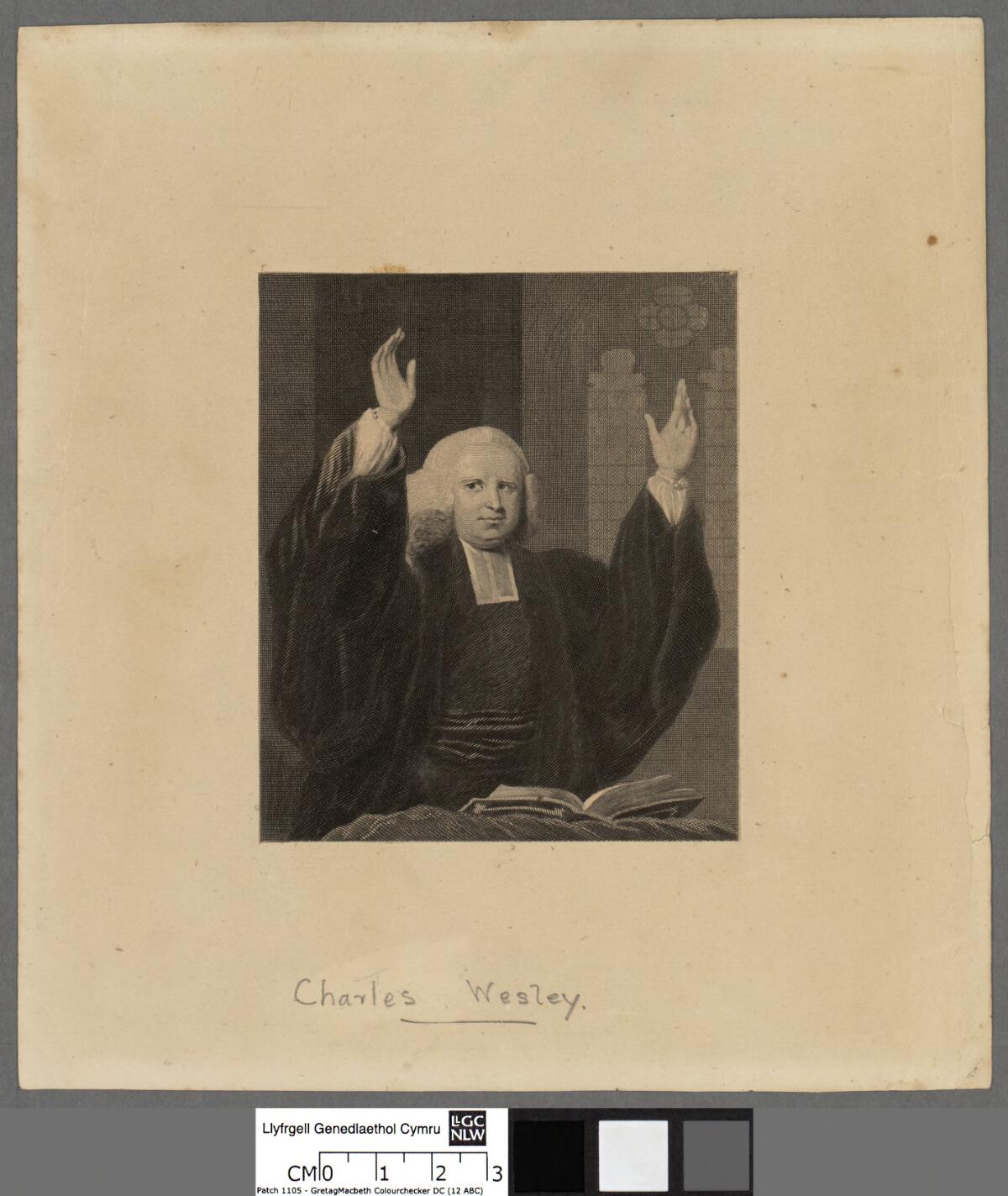
John Wesley was born in 1703 and Charles in 1707. At Oxford in 1729 a small group around them, the "Holy Club," met for prayer, study, frequent communion and visits to prisoners and the poor.13 The name was a joke at their expense: a member of Merton College reported being "rallied the day before for being a member of the Holy Club," which "was become a common topic of mirth at his college."16 The name "Methodist" stuck to the movement in the same way. They were serious, disciplined and, by their own later account, still without the inward assurance they read about in the New Testament and saw in the Moravians.
Charles Wesley, May 21, 1738
Charles came to that assurance first. On May 21, 1738, which was Whitsunday (Pentecost Sunday), he recorded that the Spirit of God "chased away the darkness of my unbelief."15 Charles wrote more than any other early Methodist about the inner life of the believer, and his hymns carried Wesleyan teaching on assurance and holiness into every later Holiness and Pentecostal hymnal. Historians are not agreed on which of his hymns he wrote to mark his conversion; Green names "And Can It Be" as one likely candidate.15

John Wesley, May 24, 1738
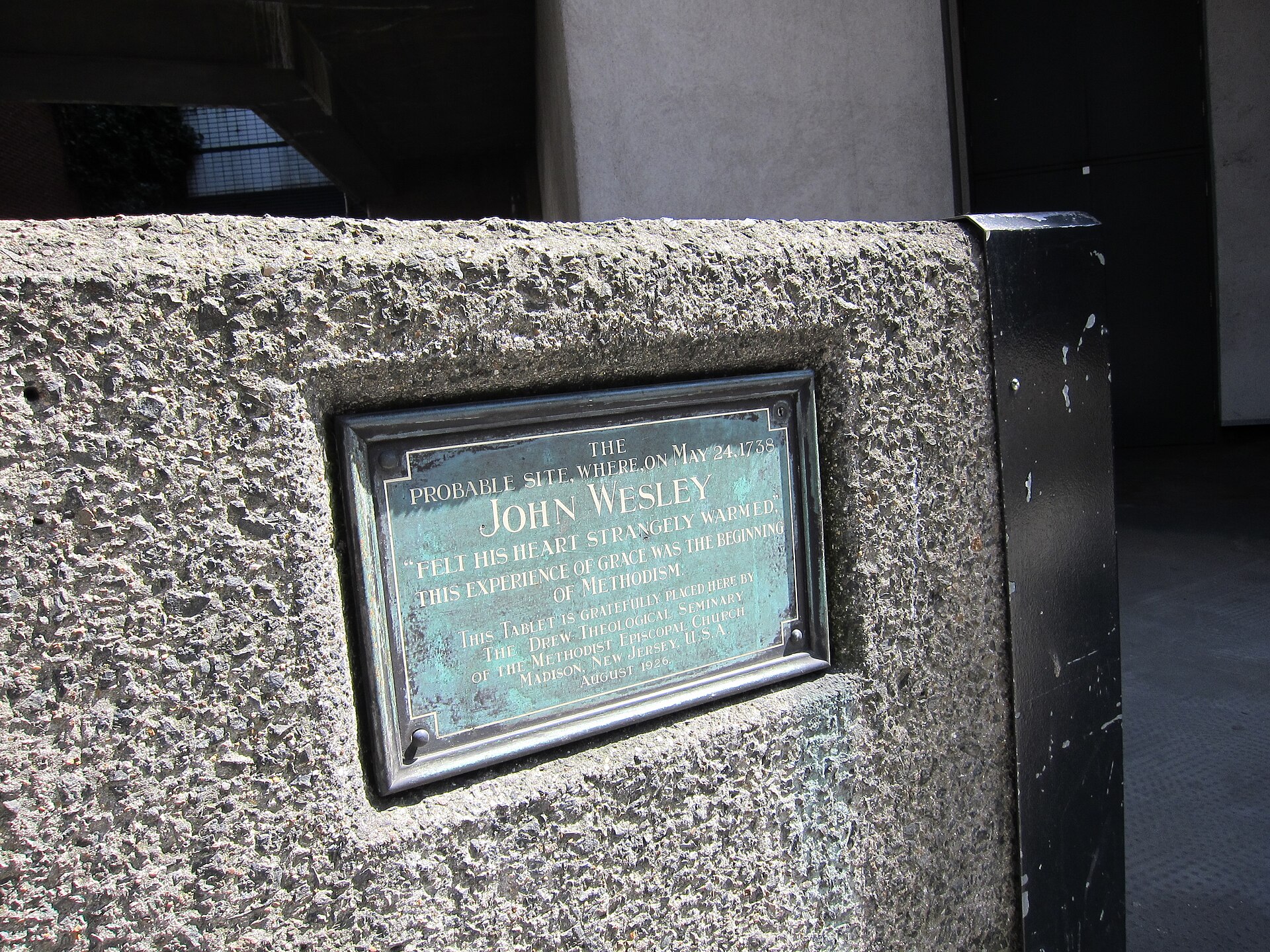
Three days later John Wesley went to a religious society that met in Aldersgate Street in the City of London. His Journal entry for Wednesday, May 24, 1738, is the most quoted paragraph in Methodist history:
"In the evening I went very unwillingly to a society in Aldersgate Street, where one was reading Luther's preface to the Epistle to the Romans. About a quarter before nine, while he was describing the change which God works in the heart through faith in Christ, I felt my heart strangely warmed. I felt I did trust in Christ, Christ alone, for salvation; and an assurance was given me that He had taken away my sins, even mine, and saved me from the law of sin and death."4
The United Methodist Church marks Aldersgate Day on May 24 "(or the Sunday closest)."17 Within weeks Wesley traveled to Germany, where, as the editors of the standard abridged Journal note, he spent the next three months in Germany visiting the Moravians.4 (The standard account adds that the visit included their settlement at Herrnhut; the editor's note does not name it.) He came back with admiration for their community life and with doubts about some of their teaching, and by 1740 he had separated from the Moravian-led society in Fetter Lane, London. (That last point is the common account in Methodist histories; this lesson did not locate the primary record and lists it as unverified.)

What Aldersgate meant, and what it did not
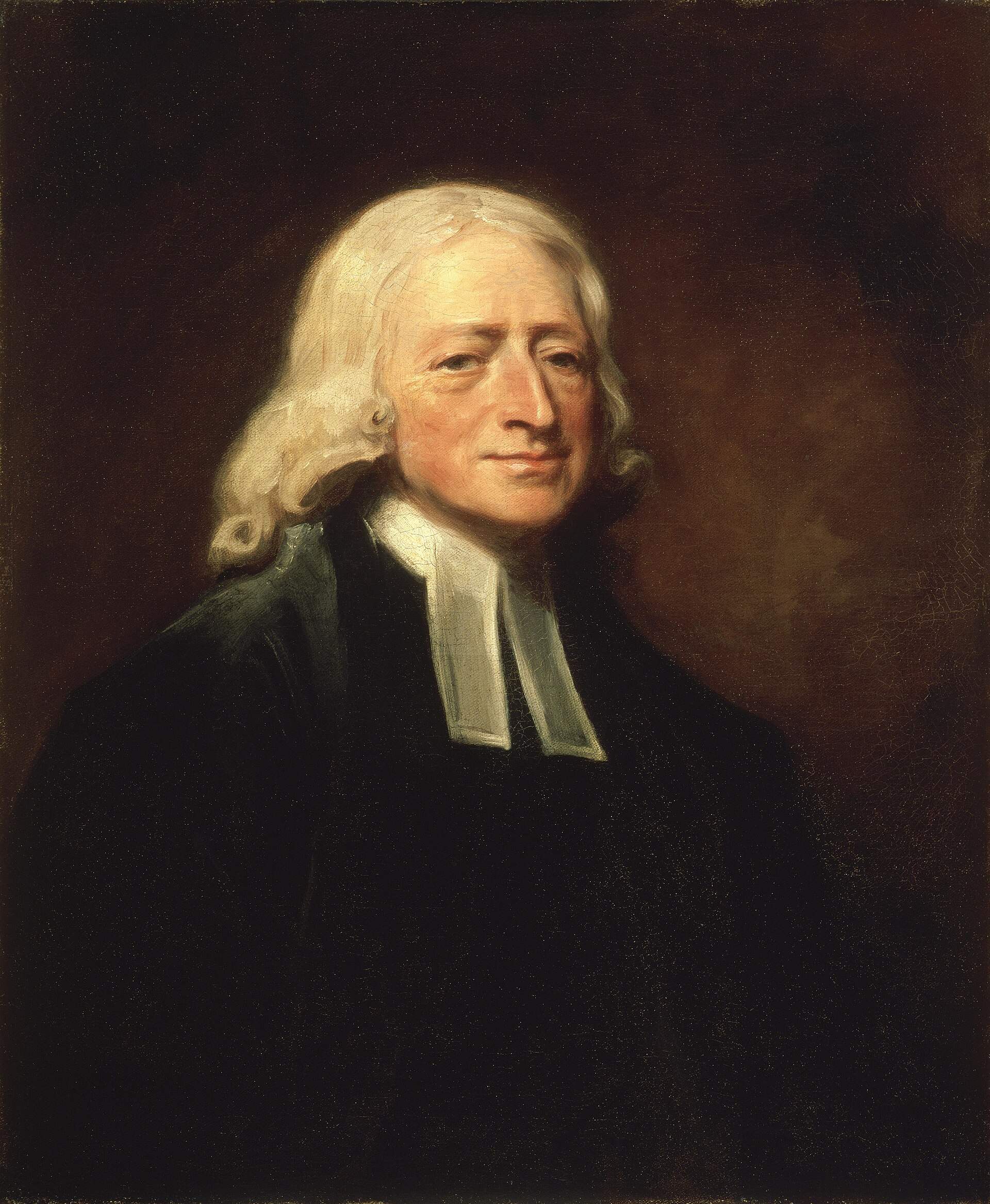
Two things about Aldersgate set up everything that follows. The first is that Wesley described a dated experience, at a known hour, that brought assurance. The idea that a Christian can point to a moment when God did something in the heart became normal in Methodism and then in all of American revivalism. The second is that Wesley's own later reading of the experience was cautious. He continued to have seasons of doubt in the months after May 1738, and he did not treat Aldersgate as the end of the Christian life. For Wesley, being justified (forgiven) was the beginning of a life that should go on to holiness. That further step is the doctrine that the Holiness movement made central.
Scholars still argue about whether Aldersgate was Wesley's conversion, his assurance of a faith he already had, or one step among several. Methodists in the nineteenth century tended to call it his conversion. Some twentieth-century Wesley scholars have treated it as less decisive than the popular story. This lesson does not settle that question; it notes only that Wesley's own words describe trust, assurance and freedom from "the law of sin and death," and that the date and wording are not in dispute.

Christian perfection: what Wesley taught
Wesley gathered his teaching on holiness in A Plain Account of Christian Perfection, whose title page describes it as the doctrine "as believed and taught by the Reverend Mr. John Wesley, from the year 1725, to the year 1777."5 The book quotes his earlier tracts, sermons and conference minutes and answers questions he had been asked for decades. Its key statements are short, and they are quoted here from the text as published on the Christian Classics Ethereal Library.
Wesley's definition
Asked what Christian perfection is, Wesley answered: "The loving God with all our heart, mind, soul, and strength." He added that in such a person "all the thoughts, words, and actions, are governed by pure love."5 Perfection in Wesley's sense was a quality of love, a heart with no rival to God in it. He also called it "entire sanctification," "perfect love" and "full salvation."
Instantaneous and gradual
Wesley taught that the change came by faith and could come in a moment. In the Plain Account he wrote "That this is received merely by faith" and "That it is given instantaneously, in one moment."5 He also taught growth before and after that moment: "There is indeed an instantaneous, as well as a gradual, work of God in his children," and from the time of justification "a believer gradually dies to sin, and grows in grace."5 Wesley held both sides together without fully resolving how they fit, and the Pentecostal scholar Peter Althouse, among others, argues that he never settled the tension.18 Later Holiness teachers would put the weight on the instantaneous side.
What perfection did not claim
Wesley insisted that the perfect were still human. "They are not free from ignorance, no, nor from mistake," he wrote, and when asked whether perfection excluded infirmities, ignorance and mistake, he answered, "I continually affirm quite the contrary, and always have done so."5 In his usage, sin "properly so called" meant a willful breaking of a known law of God. Christian perfection was freedom from that kind of sin and from the inward love of it, in a person who could still be wrong, sick, tempted and in need of Christ's atonement every day.
Why this doctrine is the seed
The Wesleyan pattern has two steps. First comes justification and the new birth, often marked by assurance. Then comes a second work of grace, entire sanctification, received by faith and sometimes in a moment. Early Pentecostals kept the two-step shape and, in many cases, added a third step, the baptism in the Holy Spirit with speaking in tongues. Others, after 1910, collapsed the first two steps into one and made Spirit baptism the second. In both cases the idea of a second, definite, datable experience after conversion comes straight from Wesley through the Holiness movement. Donald W. Dayton's Theological Roots of Pentecostalism (1987) traces this inheritance in detail.19
Whitefield and field preaching
George Whitefield, a younger member of the Oxford circle, was already a celebrated preacher in 1739. On February 17, 1739, he preached in the open air at Kingswood, near Bristol, to about two hundred coal miners (colliers); within three weeks, by the account of the Methodist historian Howard Snyder, the crowds had grown to about ten thousand.20 Whitefield asked Wesley to come to Bristol and take over the work. Charles advised against it. John put the question to the Fetter Lane Society, which cast lots, and the lot said go.20
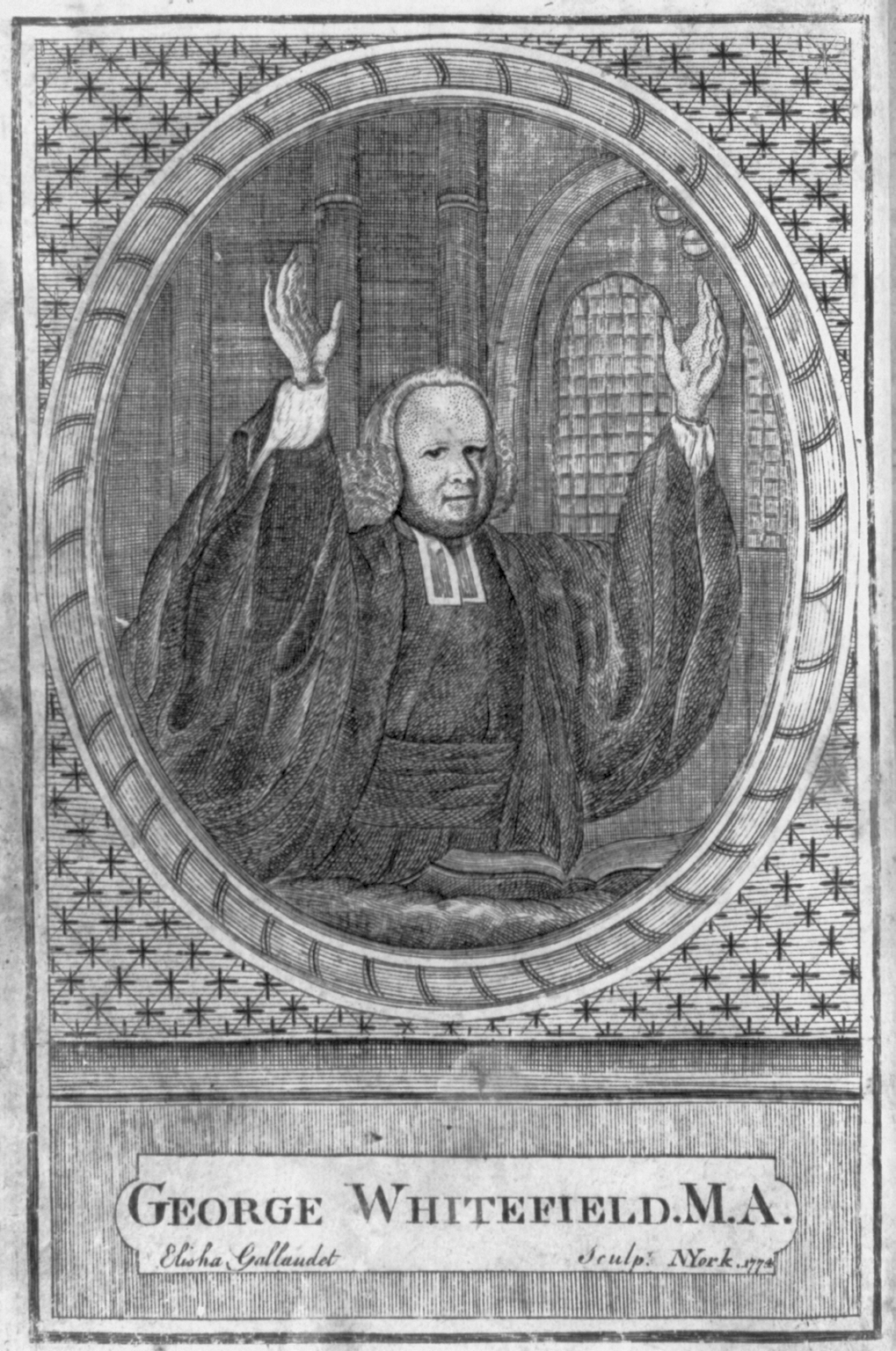

Wesley disliked the idea. His Journal for the end of March 1739 says he could at first scarcely reconcile himself to "this strange way of preaching in the fields," which Whitefield had demonstrated the Sunday before. On Monday, April 2, he gave in:
"At four in the afternoon, I submitted to be more vile and proclaimed in the highways the glad tidings of salvation, speaking from a little eminence in a ground adjoining to the city, to about three thousand people."21
His text was Isaiah 61:1 as quoted by Jesus in Luke 4:18: "The Spirit of the Lord is upon me, because he hath anointed me to preach the gospel to the poor" (KJV).21 Field preaching took the Methodist message to people who never entered a parish church, and it set a pattern later used by American camp meetings, Holiness tent revivals, Pentecostal tent evangelists and, in the 1970s, the Jesus People's beach baptisms (lesson 05). Whitefield and Wesley later divided over predestination: Whitefield held Calvinist views, Wesley held the Arminian view that grace is offered to all and can be resisted. The Wesleyan, Arminian side is the one that leads to the Holiness and Pentecostal movements.
Methodism in America
From lay preachers to a church
Methodism reached the American colonies with immigrants before any official preachers arrived. The Christian History timeline, adapted from one by the United Methodist General Commission on Archives and History, dates Robert Strawbridge's Methodist class in Maryland to 1763, the New York congregation of Barbara Heck and Philip Embury to 1766, Wesley's first official missionaries (Richard Boardman and Joseph Pilmore) to 1769, Francis Asbury's arrival to 1771 and the first conference of American preachers, led by Thomas Rankin, to 1773.13 The same timeline records Mary Evans Thorne as the first woman class leader in the colonies, in 1770.13
Until the Revolution the American Methodists were a society inside the Church of England, and they took communion from Anglican priests. When the war emptied many Anglican pulpits, the Methodists were left without the sacraments. In 1784 Wesley named Thomas Coke a superintendent for America and sent him with two ordained helpers, Richard Whatcoat and Thomas Vasey.6
The Christmas Conference, 1784
The preachers met at Lovely Lane Chapel in Baltimore beginning December 24, 1784, for about ten days. According to Coke, as quoted in United Methodist Communications' account by Joe Iovino, 81 people were present; Coke reported that "Nearly 60 of them" were American preachers, "most of them young." Only Coke, Whatcoat and Vasey were ordained clergy at the start.6 The conference organized the Methodist Episcopal Church, approved the Sunday Service that Wesley had sent, elected and ordained twelve lay preachers as elders and planned a college (Cokesbury). Asbury was elected superintendent by the preachers instead of serving on Wesley's appointment alone. He was then ordained a deacon, an elder and a general superintendent on three consecutive days beginning Christmas Day. Asbury's journal summed up the week: "We spent the whole week in conference, debating freely, and determining all things by a majority of votes."6 Britannica records that the title "bishop" came into use in 1785.22 The same 1784 timeline entry records that Richard Allen and Absalom Jones became the first African Americans licensed to preach by the new church.13
Asbury and the circuit riders
Francis Asbury was born on August 20, 1745, at Hamstead Bridge, Staffordshire, England, landed at Philadelphia in October 1771 and died on March 31, 1816, in Spotsylvania, Virginia.22 For 45 years he traveled the American frontier on horseback. His totals are famous and the published numbers do not agree. Britannica gives an average of about 5,000 miles a year.22 Christian History issue 114 (2015) says "over 130,000 miles" and that he was "probably delivering more than 10,000 sermons."23 Christian History issue 23 (1989) gave higher figures: 270,000 miles, more than 16,000 sermons, more than 4,000 ordinations and six horses worn out.24 Issue 114 says he ordained more than 2,000 preachers.23 The honest summary is that Asbury traveled somewhere between about 130,000 and 270,000 miles, depending on the estimate, and that no one has an exact count.
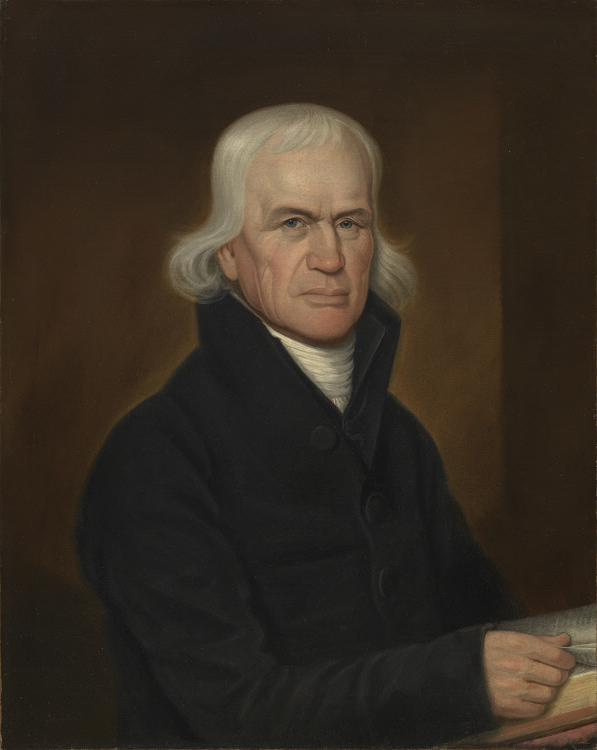

Asbury built a system that fit a thinly settled country. Each preacher was assigned to a "circuit" of preaching places that he rode in rotation. He preached, formed classes, appointed lay class leaders to watch over members between visits and moved on. Coke's description of the 1784 preachers as "most of them young" fits the whole system.6 The equipment of a traveling preacher, as Christian History lists it, was one suit of clothes, a horse, saddle and bridle, a watch, a Bible and a hymnal.23 The Anglican minister Devereux Jarratt, who cooperated with the early Methodists in Virginia, rode a circuit "over 500 miles long."24
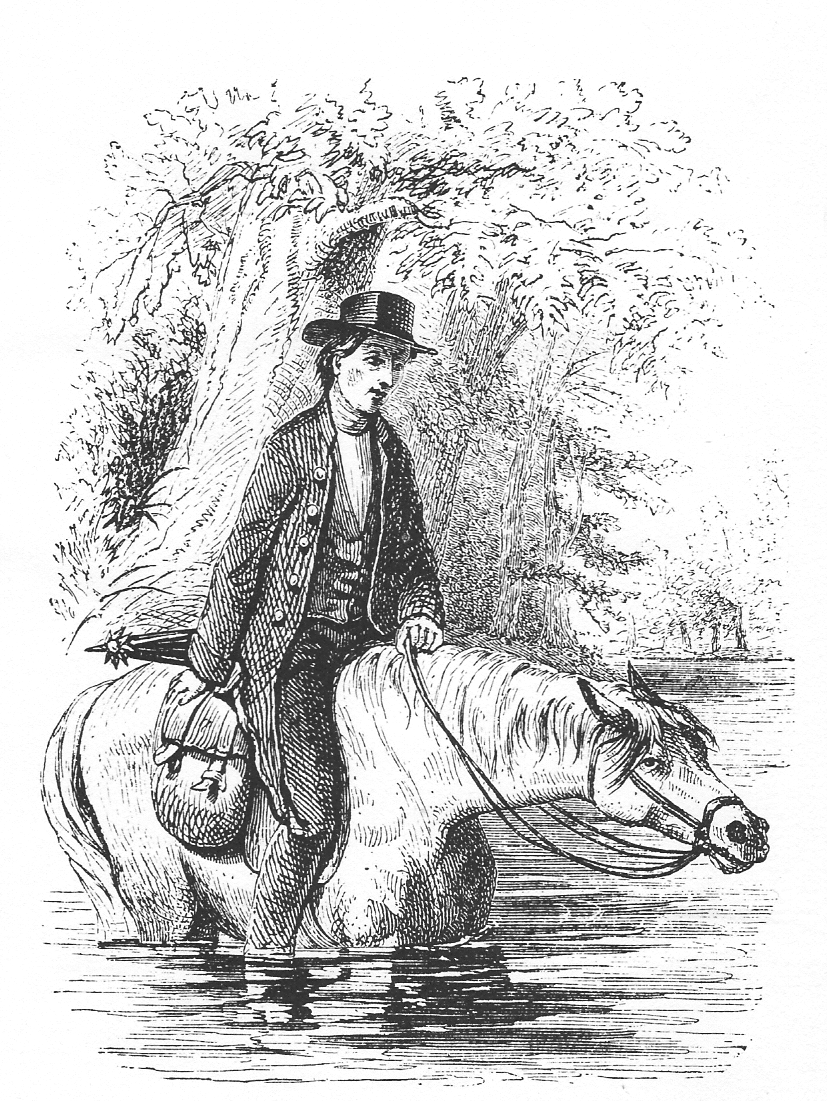

Camp meetings
The outdoor camp meeting began among Presbyterians and Methodists on the frontier around 1800 and was adopted by the Methodists as a regular tool. Christian History issue 23 describes a Tennessee camp meeting in October 1800 and notes that a camp meeting could reach "more than 20,000 people" at once.24 Families came in wagons, camped for several days around a cleared preaching ground and attended sermons, prayer meetings and hymn singing from morning to night. Asbury wanted as many as possible. He wrote that he prayed "that there may be a score of camp meetings a week," and in the same passage he rejoiced "to think there will be perhaps four or five hundred camp meetings this year."24 (The source does not give the date of that passage.)
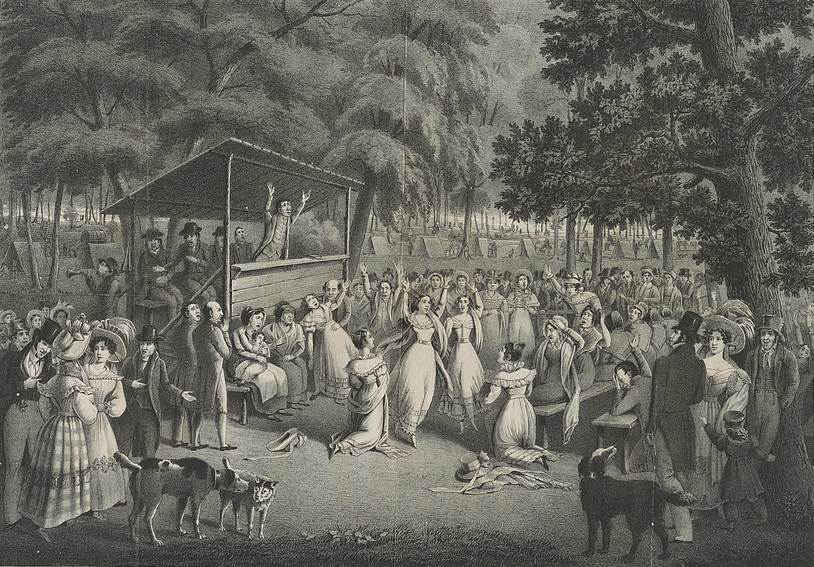

The camp meeting is the physical link between Wesley and Azusa Street. It was where Methodists expected visible responses to preaching, including weeping, shouting and falling, and where seekers "prayed through" to an experience they could describe. After the Civil War the Holiness movement used the same form, the same grounds and often the same tents. The Pentecostal revivals of 1901 to 1910 took the form over again.
The growth: numbers and their sources
American Methodism grew faster than any other religious body in the early republic. The numbers below come from different counts and are not strictly comparable; some count full members only, some include probationers, and some may include more than one Methodist body. They are given here with their sources.
- 1771: about 600 Methodists, fewer than 1 in 800 people (Christian History 114).23 Britannica gives three meetinghouses and about 300 communicants at Asbury's arrival.22
- 1780: 8,504 members and 42 preachers.24
- 1790: 45,949 white and 11,862 Black members (57,811 in all) and 227 preachers.24 The GCAH-based timeline gives 57,000 for 1791.13
- 1816 (Asbury's death): 412 societies with 214,235 members (Britannica); "over 200,000," or 1 of every 36 Americans (Christian History 114).2223
- 1820: 256,881 members and 904 preachers (Christian History 23); 500,000 (GCAH-based timeline, Christian History 114).2413 The two figures cannot both describe the same count. The larger one may include other Methodist bodies or adherents; the sources do not say.
- 1864: 1,800,000 American Methodists (GCAH-based timeline).13
The best-known way to put this growth in proportion comes from the sociologists Roger Finke and Rodney Stark. In an encyclopedia article summarizing their research, Finke and Philip Schwadel write that between 1776 and 1850 "The Methodists, in particular, sky rocketed from 2.5 percent to 34.2 percent" of all religious adherents in the United States.7 Their data for 1776 come from Stark and Finke (1988) and for 1850 from Finke and Stark (1986 and 1992).7 The circuit system described above, with its lay preachers and class leaders and its ability to follow settlers west, is the usual explanation offered for the growth.
Growth brought division. In 1844 the Methodist Episcopal Church split into northern and southern bodies over slavery and the powers of bishops.2513 The Methodist Episcopal Church, South, organized in 1845.13 Black Methodists had already formed their own churches: Richard Allen founded the African Methodist Episcopal Church in 1816, and James Varick founded what became the AME Zion church in 1820, according to the GCAH-based timeline.13 Several of the Holiness churches described below were born from the same arguments over slavery, church government and holiness.
Phoebe Palmer and the "shorter way"
By the 1830s many American Methodists still affirmed Wesley's doctrine of perfection on paper and rarely heard it preached. The person most responsible for reviving it was a layperson, a woman and a New Yorker: Phoebe Worrall Palmer, born in New York City in 1807 and died in 1874, the wife of a physician, Walter Palmer.2627 Christian History devoted its issue 82 (2004) to her under the title "Phoebe Palmer: Mother of the Holiness Movement."25
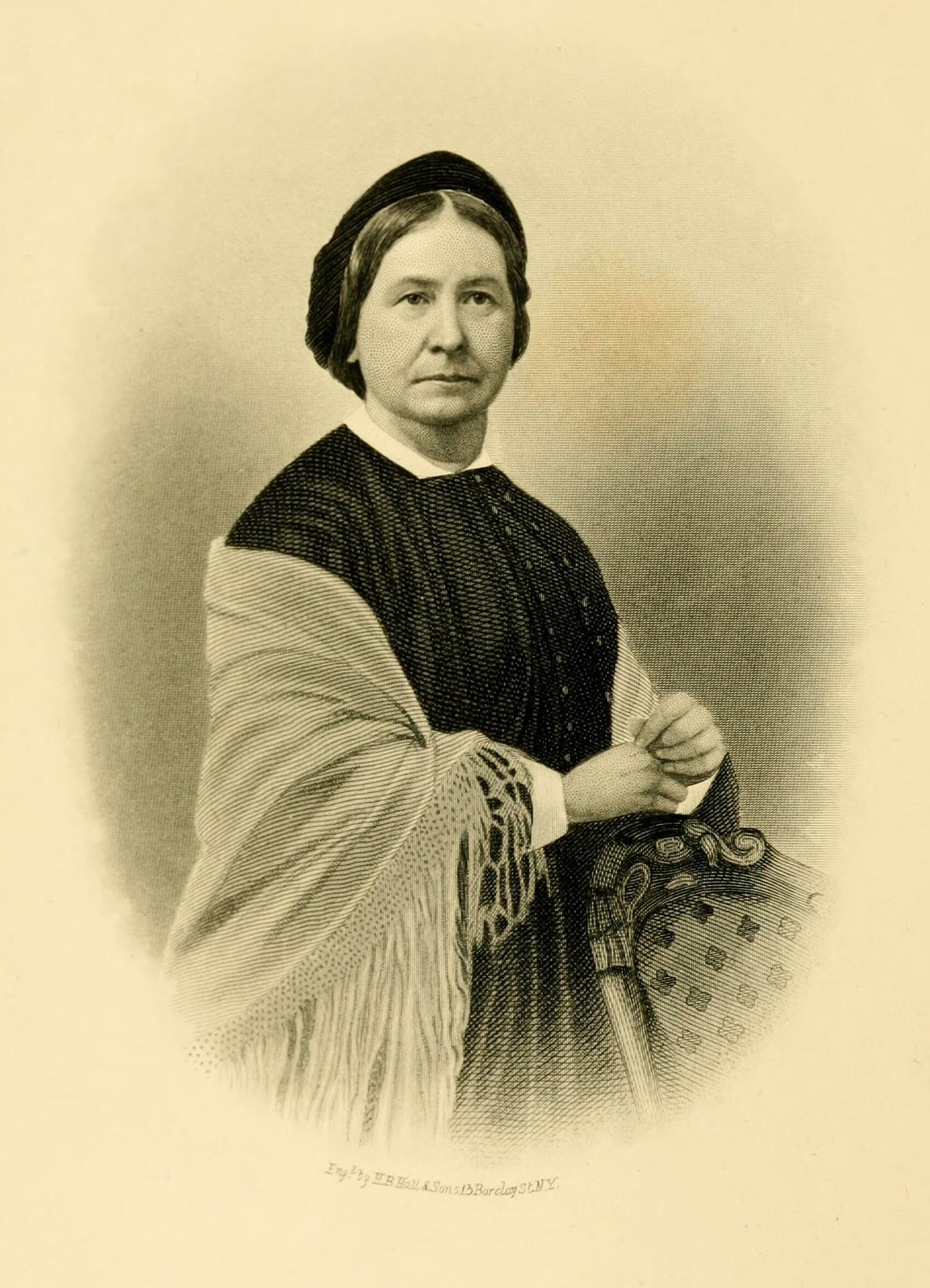

The Tuesday Meeting
The weekly "Tuesday Meeting for the Promotion of Holiness" met in the Palmer home in New York and became the center of a national network. Its founder was Phoebe's sister, Sarah Worrall Lankford (1806 to 1896), and Phoebe later took over its leadership.26 The sources disagree on the starting year:
- The Christian History Holiness timeline (issue 82) dates Sarah Lankford's founding of the Tuesday Meeting to 1836.25
- The GCAH-based Methodist timeline (issue 114) says that in 1835 Phoebe Palmer "institutes a weekly prayer meeting in her home."13
- Charles Edward White's article in issue 82 says that in 1840 Palmer "began presiding over" the Tuesday meetings that her sister had started in the parlor of her New York home; it gives 1840 as the year Palmer took charge, not the founding year.27
Read together, the sources point to a founding by Lankford in 1835 or 1836 and to Palmer's leadership from 1840. The one-year difference over the founding (1835 or 1836) was not settled from a primary record, and it is listed as unresolved. The Christian History timeline records that in 1866 the future temperance leader Frances Willard professed sanctification under the Palmers' ministry.25
Palmer's experience in 1837
Palmer's own path ran through grief. White's article records that her daughter Eliza, 11 months old, died on July 29, 1836, after a lamp fire, and that Eliza was the third of her children to die in infancy.27 She came to believe that she had loved her children more than God. A year later she entered into what she called entire sanctification. White quotes her entry of July 27, 1837: "Last evening, between the hours of eight and nine, my heart was emptied of self."27 The experience itself therefore took place on the evening of July 26, and the entry was written on July 27, which explains why both dates appear in other accounts.
The altar, in her own words
Palmer's most important book, The Way of Holiness, was first published in 1843 according to the Christian History timeline.25 Surviving printings include an 1845 New York edition from Palmer and Hughes, which carries a "Preface to the Second Edition," and an 1849 printing from the Methodist publishers Lane and Scott marked "18th Thousand."288 (The GCAH biography gives 1850 for the book, which appears to be a later printing.)26 The book is written in the third person about a woman seeking holiness. Its first chapter is titled "Is There Not a Shorter Way?" and the table of contents summarizes the third chapter as telling "How she was brought to exclaim, 'There Is a shorter way.'"8 The contents summary of the fifth chapter carries the heart of the method: "Faith is taking God at his word," and the seeker "Resolves to take God at his word at once and for ever." A later chapter is headed "Faith not feeling."8
Palmer's best-known image, the altar, comes from two verses in the King James Version. Jesus asks, "whether is greater, the gift, or the altar that sanctifieth the gift?" (Matthew 23:19), and the law of Moses says, "whatsoever toucheth the altar shall be holy" (Exodus 29:37).29 Palmer taught that Christ is the Christian's altar. In her letters collected as Faith and Its Effects, she quotes these verses ("The altar sanctifieth the gift") and describes believers who "most solemnly bound all upon the altar" and the conviction that "the offering was sanctified the moment it was laid upon the altar."30 The GCAH biography puts her formula in one line: she laid her "all" on God's altar, and because it was God's altar the offering was made holy; the believer claimed the promise by saying, "I surrender all, all to thee, my blessed Savior."26
White summarizes the "shorter way" as three steps: consecration (placing everything on the altar), faith (believing that God accepts and sanctifies what is placed there) and testimony (saying so publicly).27
How Palmer changed Wesley
Palmer considered herself a faithful Methodist, and she quoted Wesley often. Historians agree that she shifted the emphasis. Wesley had taught that perfection was received by faith and could come in a moment, and he also taught a gradual work before and after that moment. Palmer taught that any believer could receive it now, by a definite act of consecration and faith, and should then say so. Peter Althouse writes that the tension Wesley kept between instantaneous and gradual perfection "was to swing to an instantaneous experience of perfection in later Holiness articulations," which "defined Christian perfection as a 'second blessing' experience."18 The question this raised, debated by Methodists in her lifetime and by historians since, is whether a believer who has met the conditions may conclude from God's promise alone that the blessing has been given, or should wait for an inward witness. Wesley's text supports both emphases: perfection is received "merely by faith," and there is "a gradual, work of God" as well as an instantaneous one.5
The Promise of the Father
In 1859 (some timelines say 1860) Palmer published The Promise of the Father, a long defense of women's right to preach.2513 Its title comes from Acts 1, where Jesus tells the disciples to "wait for the promise of the Father" (Acts 1:4) and says, "ye shall be baptized with the Holy Ghost not many days hence" (Acts 1:5, KJV).29 White summarizes its argument this way: the baptism of the Spirit given at Pentecost was poured out on women as well as men, and so women who had received it were called to speak.27 The book is one of the clearest early examples of a holiness writer describing the second blessing in the language of Pentecost, a habit that grew stronger over the next forty years. The early Pentecostal movement's acceptance of women preachers, including at Azusa Street, also has this Holiness root.
Palmer's reach was enormous. White writes that she spoke at "more than 300 camp meetings or revival services" and to more than 100,000 people, that over 20,000 of the Palmers' hearers in Britain experienced salvation or sanctification, and that her revival brought "nearly a million people into the church."27 These are estimates from a sympathetic historian, and the last figure cannot be checked against any membership record. She edited the monthly Guide to Holiness for eleven years, and it had subscribers in Canada, Britain, Liberia, India and Australia.27 Its predecessor, the Guide to Christian Perfection, was founded by Timothy Merritt in 1837.25
The National Camp Meeting Association, Vineland, 1867
After the Civil War a group of Methodist ministers who taught entire sanctification decided to hold camp meetings devoted to that one subject. The fullest early account is the introduction to The Double Cure, or Echoes from National Camp-Meetings (Boston: Christian Witness Co., 1887), compiled by William McDonald, a leader of the association. It reports a call "to convene in the city of Philadelphia, June 13," with George M. C. Roberts of Baltimore presiding, at which Alfred Cookman moved the name "The National Camp Meeting for the Promotion of Holiness." "It was decided to hold the first meeting at Vineland, commencing July 17, 1867."9 The organization was known as the National Camp Meeting Association for the Promotion of Holiness.
John S. Inskip, a Methodist minister, became its president and the face of the movement. The Double Cure notes that he "presided at forty-nine national camp meetings and eleven tabernacle meetings."9 The Asbury Theological Seminary library guide to the association's leaders names John A. Wood, William B. Osborn and Inskip as founders, says Inskip was elected president at Vineland and estimates the attendance there at about 10,000.31 The same guide dates the organization to 1866, which does not match McDonald's account; the 1866 date may refer to the first discussions, and the point is listed as unresolved.31
The second national camp meeting, at Manheim, Pennsylvania, in 1868, was larger. The Christian History timeline says it drew "over 20,000"; White's article says over 25,000 on its opening Sunday.2527 A Western Holiness Association formed in Bloomington, Illinois, in 1871, and general holiness conventions met in Cincinnati and New York in 1877.25 In 1899 the national body took the name National Association for the Promotion of Holiness; its successor today is the Christian Holiness Partnership.31
At first the national camp meetings were a movement inside Methodism, led by Methodist ministers who had no wish to leave their church. Over the next thirty years, as Methodist bishops grew uneasy with independent holiness associations, holiness evangelists, faith healing and "come-outer" preachers who urged people to leave the old churches, many holiness people did leave. Their new churches are the direct parents of the earliest Pentecostal congregations. (That summary of the 1880s and 1890s follows the standard account in Vinson Synan's The Holiness-Pentecostal Tradition, 1997; this lesson did not open the book itself, and the specific phrasing is a paraphrase.)
The Holiness churches outside Methodism
Five bodies founded between 1843 and 1908 show the range of reasons holiness people organized outside the Methodist Episcopal Church: slavery, church government, the treatment of the poor, the rejection of denominations as such, and the wish to keep holiness at the center. Each is described first from its own published history.
The Wesleyan Methodist Connection, 1843
The Wesleyan Church today traces its founding to an antislavery protest. Its official history says Orange Scott, LaRoy Sunderland and Jotham Horton announced their withdrawal from the Methodist Episcopal Church on November 8, 1842, that Luther Lee and Lucius Matlack joined them within weeks, and that delegates met at Utica, New York, on May 31, 1843, to establish the new church.32 The call for the convention promised a church "free from Episcopacy and Slavery" that would "preserve and promote experimental and practical godliness."32 Scott described the old church as "a slave-holding but a slave-defending church."32
The Discipline of The Wesleyan Church, in its historical section, adds that "The earliest extensive withdrawal was in Michigan," in 1841, and describes the organizing convention for "the Wesleyan Methodist Connection of America" at Utica in late May and early June 1843. The new body rejected bishops, gave ministers and laypeople equal representation, and prohibited slaveholding and involvement with alcohol.33
The Free Methodist Church, 1860
The Free Methodist Church grew out of a conflict in the Genesee Conference of the Methodist Episcopal Church in western New York. The church's historical office says that a number of the leaders of a protest movement, among them Benjamin Titus Roberts, were expelled between 1858 and 1860, that appeals to the General Conference of May 1860 were denied, and that "a convention of lay members and ministers" met at Pekin, Niagara County, New York, on August 23, 1860, to organize the new church. It names the primary issue as the leaders' proclamation of "the doctrine and experience of entire sanctification."34 The Christian History timeline credits B. T. Roberts and John Wesley Redfield as founders.25
The Free Methodist Church in Canada explains the word "Free" with five meanings. The early members wanted "free seats" (no rented pews, so the poor could sit anywhere); they were "supporters of the anti-slavery movement"; they wanted "freedom of the Spirit" in worship; they wanted members "free" from secret societies; and they sought to renew Wesley's teaching that Christians could be "free from the domination of sin."35
The Church of God (Anderson, Indiana), 1881
The Church of God with offices in Anderson, Indiana, says it "began in 1881 as a movement," that its early leaders included Daniel S. Warner and Mary Cole, and that they championed "the holiness of God's people." They sought to "forsake denominational hierarchies and formal creeds" and did not intend to start another denomination; primary loyalty was to Christ and to the one church of all believers.36 Its own historians call it the Church of God reformation movement.25 Its founding combined holiness with a call to visible Christian unity. That combination, holiness plus a rejection of denominational labels, is an early form of the non-denominational instinct described in lesson 04.
The Salvation Army in the United States, 1879 and 1880
William and Catherine Booth organized the Salvation Army in England in 1878.25 The Army's own magazine, Caring, dates its American beginnings to a teenager, Eliza Shirley, whose family had moved to Philadelphia and who organized the first meeting in an "abandoned chair factory": "On Oct. 5, 1879, her prayers and efforts bore fruit when her vision became a reality in the United States." The official party, George Scott Railton and seven women officers, "arrived in New York City on March 10, 1880."37 The first Salvation Army home for "fallen women" in the United States opened in New York in 1886.25
The Church of the Nazarene, 1895 to 1908
The Church of the Nazarene tells its own origin in the "Historical Statement" of its Manual (2023 edition). In 1895 Phineas F. Bresee and Joseph P. Widney, with about 100 others, organized the Church of the Nazarene in Los Angeles. In Brooklyn in 1894 and 1895 William Howard Hoople organized congregations that formed the Association of Pentecostal Churches of America. In Texas several groups merged at Rising Star in 1904 to form the Holiness Church of Christ. In Chicago in October 1907 the eastern and western bodies united at a First General Assembly that adopted the name "Pentecostal Church of the Nazarene."38
The southern body joined at the Second General Assembly at Pilot Point, Texas. The Manual says R. B. Mitchum moved and C. W. Ruth seconded "That the union of the two churches be now consummated," and that the motion carried by a unanimous rising vote.38 Nazarene News adds that the assembly met October 8 to 14, 1908, and that the motion passed on Tuesday, October 13, at 10:40 a.m.39
The name tells part of this lesson's story. In 1907 and 1908 "Pentecostal" was still a common holiness word for the experience of entire sanctification, understood as the baptism with the Holy Spirit. After 1906 the word came to mean tongues-speaking churches. The Manual records that the Fifth General Assembly (1919) changed the name to Church of the Nazarene because new meanings had become associated with the word "Pentecostal."38 The Nazarenes kept the holiness doctrine and dropped the word.
Keswick and the "higher life"
From Broadlands to Keswick
The American holiness revival crossed the Atlantic in the 1870s. In 1874 two American evangelists, Robert Pearsall Smith and Hannah Whitall Smith, spoke at gatherings at Broadlands, near Romsey, and at Oxford.25 An earlier American book, the Presbyterian W. E. Boardman's The Higher Christian Life (1858), had popularized holiness teaching in non-Methodist terms and supplied its best-known phrase.25 The New Schaff-Herzog Encyclopedia of Religious Knowledge says the Keswick Convention "may be said to have had its origin in the general revival that swept over England in the early seventies," that the first meeting of the series was at Broadlands in 1874 and that at a later convention at Brighton, Canon Harford-Battersby, vicar of St. John's, Keswick, proposed a gathering in his town the next year.10 Keswick Ministries gives his name as Thomas Harford-Battersby.40
The first Keswick Convention met in 1875, in a tent on the lawn of St. John's vicarage, under a banner reading "All one in Christ Jesus" (Galatians 3:28), according to Keswick Ministries, which still runs the convention.40 The Christian History Institute's "It Happened Today" entry for June 29 records that the speakers were canceled and that the first Keswick "deeper walk" convention went on anyway.41 Harford-Battersby presided during his lifetime; the chairmanship then passed to Henry Bowker and afterward to Robert Wilson. By the early twentieth century the convention met "annually at Keswick, the last week in July."10
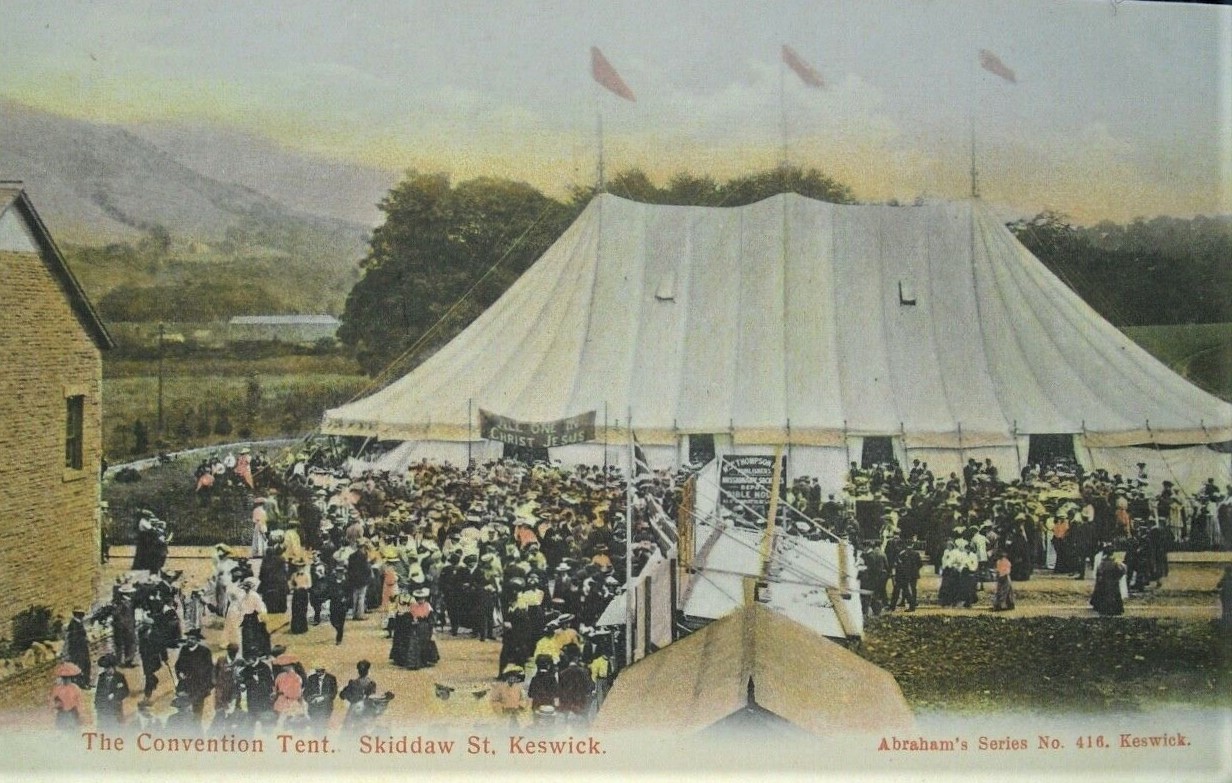

What Keswick taught
The Schaff-Herzog article describes Keswick as held chiefly "for the promotion of practical holiness." The Schaff-Herzog article says that in Keswick teaching "stress is laid upon the infilling of the Spirit," along with the power of faith to claim the blessings God has promised, and that Keswick "stands for no new school of theological thought."10 Peter Althouse describes its view of sin and sanctification as a modified "New School" Calvinism, distinct from Wesley's.18 Its teachers did not accept the Wesleyan claim that the sinful nature could be removed in this life. They taught instead that the believer, by a crisis of full surrender and faith, could enter a life of steady victory over known sin, in which the indwelling Christ and the Holy Spirit held the old nature in check day by day.
Scholars describe the difference with a pair of words. Peter Althouse, writing in Pneuma Review, cites the historian David Bundy's terms: Keswick's goal of "uniform sustained victory over known sin" was "suppressionist," and the Wesleyan holiness goal was "eradicationist."18 Althouse also quotes the historian Douglas Frank's summary of Keswick teaching: the "sinful nature [was] not removed, but its tendencies [were] counteracted by the indwelling life of Christ in the believer," and he cites John Pollock's history The Keswick Story for the convention's watchword that "the Blessing is not an attainment but an attitude."18 In Keswick's own vocabulary, the second experience was usually called full surrender, the rest of faith, the Spirit-filled life or the higher life.
Keswick and Wesleyan holiness compared
The two teachings shared a great deal. Both said ordinary Christian life was too low. Both called believers to a definite crisis of consecration after conversion. Both said the blessing was received by faith. Both spoke more and more of the Holy Spirit's filling or baptism. They differed on what happened to sin, on what the crisis achieved and on the words they used for it. The chart below sets the main points side by side, with the early Pentecostal position added for comparison with lesson 02.
"The baptism of the Holy Ghost": the language Pentecostals inherited
The texts in Acts
Everyone in this story read the same two verses. In Acts 1:5 the risen Jesus says, "For John truly baptized with water; but ye shall be baptized with the Holy Ghost not many days hence." In Acts 1:8 he says, "But ye shall receive power, after that the Holy Ghost is come upon you: and ye shall be witnesses unto me" (both KJV).29 Acts 2 then describes the day of Pentecost. For most of church history, Protestants read these verses as describing a once-for-all event that founded the church, or as describing what happens to every believer at conversion and baptism. The holiness writers of the nineteenth century increasingly read them as describing an experience every believer should seek after conversion.
Palmer and Mahan
Palmer's Promise of the Father (1859) took its title from Acts 1:4 and tied the Pentecostal baptism of the Spirit to women's preaching.27 Eleven years later Asa Mahan, the former president of Oberlin College and a colleague of the revivalist Charles G. Finney, published The Baptism of the Holy Ghost (New York: W. C. Palmer Jr., 1870). The publisher, W. C. Palmer Jr., shares the Palmer family name; whether the firm was run by Phoebe Palmer's family was not confirmed for this lesson.42 Mahan described the experience as "this baptism of power, this 'sealing and earnest of the Spirit,'" in which "'the promise of the Spirit' is fulfilled."43 In his account the Spirit first produces repentance and faith, and the baptism comes after a person has believed, as the believer is "endued with power from on high."43 Dayton, as quoted by Althouse, cites Mahan's later book Divine Life for the line that "purity [was] one thing, power [was] quite another."18 (Althouse describes Mahan as "a colleague of Finney's and a one time president of Oberlin.")18
That pairing, purity and power, is the hinge of the story. Wesley's second blessing was about purity. By the 1870s many holiness writers described the same experience as both purity and power, and they called it the baptism of the Holy Ghost. Some began to wonder whether purity and power were two separate experiences. Once that question was asked, a third blessing became thinkable.
Torrey and the Reformed wing
The language was not limited to Methodists. Reuben Archer Torrey, superintendent of the Moody Bible Institute in Chicago, published The Baptism with the Holy Spirit in 1895 (copyright Fleming H. Revell Company).44 Its first chapter lays out what the baptism is in numbered points. It is "a definite experience"; it is "a work of the Holy Spirit separate and distinct from His regenerating work"; it is "always connected with testimony and service"; and it is "primarily, for the purpose of empowering for service."45 His second chapter calls it "an absolutely necessary preparation" for Christian service, given "to impart power for witnessing."46 Torrey did not teach Wesleyan eradication, and he did not teach that tongues were the sign of Spirit baptism. He did teach, with great influence, that Spirit baptism was a second, definite, knowable experience for power. Althouse notes that D. L. Moody brought Keswick teaching to America through his Northfield conferences in the 1890s and that Torrey's reports were reprinted in a book that circulated at Azusa Street.18 (The 1895 edition's own advertising page lists Torrey as superintendent of "Mr. D. L. Moody's Bible Institute, Chicago.")44
What the Pentecostals did with it
By 1900 a large audience of holiness Methodists, Keswick-minded Baptists and Presbyterians and independent holiness groups expected a definite experience called the baptism of the Holy Spirit, for power, after conversion. What they did not have was agreement on how a person could know for sure that it had happened. Charles Fox Parham's answer at Topeka in January 1901, that speaking in tongues was the Bible evidence of Spirit baptism, and William J. Seymour's preaching of the same message at Azusa Street in 1906, gave that expectation a sign that could be seen and heard. That story belongs to lesson 02.
Historians disagree about how to describe this inheritance. Donald W. Dayton's Theological Roots of Pentecostalism (1987) argues that early Pentecostal teaching took its shape from the Methodist holiness tradition and from the "fourfold" or "full" gospel of Jesus as Savior, Baptizer with the Holy Spirit, Healer and coming King.19 Vinson Synan, as quoted by Althouse, argued that Pentecostalism's lineage is "to be found in the Wesleyan tradition." Robert Mapes Anderson's Vision of the Disinherited answered that Pentecostalism was "as much a departure from the Wesleyan tradition as a development from it."18 Both readings fit part of the record. The Wesleyan holiness churches supplied the people, the camp meetings and the two-step pattern. The Keswick and Reformed holiness teachers supplied much of the language of power and service, and the "Finished Work" Pentecostals, following William Durham, dropped the Wesleyan second blessing of cleansing altogether and made Spirit baptism the second work.18 Althouse notes that the Assemblies of God, organized at Hot Springs, Arkansas, in 1914, moved toward this two-step position.18
What the record shows and what it does not
- Documented fact: Spener published the Pia Desideria in 1675; Herrnhut was founded in 1722; the Moravian renewal is dated August 13, 1727; Wesley's Aldersgate entry is dated May 24, 1738; the Methodist Episcopal Church was organized at the Christmas Conference beginning December 24, 1784; the first national holiness camp meeting opened at Vineland on July 17, 1867; the Wesleyan Methodists organized at Utica in 1843, the Free Methodists at Pekin on August 23, 1860, and the Nazarene union passed at Pilot Point on October 13, 1908; the first Keswick Convention met in 1875; Mahan's book appeared in 1870 and Torrey's in 1895.
- The movements' own claims: the Moravians liken August 13, 1727, to an outpouring of the Holy Spirit; Wesley and Palmer describe their experiences as God's work; the Holiness churches describe their founding as faithfulness to Wesley's doctrine and, for the Wesleyans and Free Methodists, to the cause against slavery.
- Scholarly reading: Finke and Stark's estimate that Methodists rose from 2.5 percent to 34.2 percent of American church adherents between 1776 and 1850; Dayton's and Synan's case for Wesleyan roots and Anderson's case for a sharper break; Bundy's "eradicationist" and "suppressionist" labels for Wesleyan and Keswick teaching.
- Open questions: the founding year of the Tuesday Meeting (1835 or 1836; Palmer led it from 1840); whether the National Camp Meeting Association dates from 1866 or 1867; Asbury's total miles (130,000 to 270,000); the 1820 Methodist membership (256,881 or 500,000); and how much of the later Pentecostal theology came from the Wesleyan side and how much from the Keswick side.
Claims checked
The claims below appear in popular church histories, denominational websites, sermons and online articles about the roots of Pentecostalism. Each is rated against the sources used in this lesson.
| Claim | Rating | Evidence |
|---|---|---|
| "Wesley was converted at Aldersgate on May 24, 1738, when his heart was strangely warmed." | Partly supported | The date, place and words "I felt my heart strangely warmed" are in Wesley's Journal.4 Whether the event was his conversion or his assurance of a faith already held is argued by historians, and Wesley was already an ordained priest and a serious Christian by any outward measure. |
| "The Moravian revival of 1727 was an early Pentecost with spiritual gifts like those at Azusa Street." | Refuted (as to manifestations) | The Moravian Church's own account likens August 13, 1727, to an outpouring of the Holy Spirit and the "Moravian Pentecost," and it states there were no ecstatic manifestations. The day is remembered for reconciliation and love.3 |
| "Wesley taught sinless perfection." | Refuted (as usually meant) | Wesley defined perfection as love governing all thoughts, words and actions, and he said the perfect "are not free from ignorance, no, nor from mistake," and that he "continually" affirmed that perfection did not exclude infirmities.5 He did teach freedom from willful sin and from the love of sin, and that part of the doctrine is what the phrase "sinless perfection" usually misreads. |
| "Methodism was the largest religious body in America by 1850." | Partly supported | Finke and Schwadel, summarizing Finke and Stark, give Methodists 34.2 percent of all religious adherents in 1850, up from 2.5 percent in 1776, and call the rise a skyrocket.7 The comparison figures for other denominations are in the article's chart, which was not available in the text consulted for this lesson, and the numbers are scholarly estimates from historical church records. |
| "Francis Asbury rode 300,000 miles." | Unsupported | Published figures range from about 130,000 miles (Christian History 114) to 270,000 miles (Christian History 23); Britannica gives about 5,000 miles a year.232422 No source consulted gives 300,000. |
| "Phoebe Palmer founded the Tuesday Meeting." | Partly supported | The GCAH biography and the Christian History Holiness timeline name her sister, Sarah Lankford, as founder; Palmer later led it.2625 The GCAH-based Methodist timeline credits Palmer herself with starting a weekly meeting in 1835.13 |
| "The Holiness movement was a breakaway from Methodism." | Partly supported | The national holiness camp meetings began in 1867 as a movement led by Methodist ministers within the Methodist Episcopal Church.9 Separate churches formed in stages, some before the camp meeting movement (Wesleyan Methodists, 1843; Free Methodists, 1860) and some after (Church of God, 1881; Nazarenes, 1895 to 1908).32343638 Many holiness people stayed Methodist. |
| "The Church of the Nazarene was once a Pentecostal church." | Partly supported | Its name from 1907 to 1919 was "Pentecostal Church of the Nazarene," and the Manual says the word was dropped in 1919 because of new meanings attached to it.38 "Pentecostal" in its name referred to holiness teaching on the baptism with the Holy Spirit; the church did not teach speaking in tongues. |
| "The Free Methodists were named for free pews." | Partly supported | Free seats are one of five meanings the Free Methodist Church in Canada gives for "Free," alongside opposition to slavery, freedom in worship, freedom from secret societies and freedom from the domination of sin.35 |
| "Keswick taught the same thing as the Wesleyan holiness movement." | Refuted | Keswick teachers held that the sinful nature remained and was counteracted by the indwelling Christ; the Wesleyan holiness movement taught that sin's root was cleansed. Historians call the views "suppressionist" and "eradicationist."18 |
| "Pentecostals invented the term 'baptism of the Holy Ghost' for a second experience." | Refuted | Mahan's The Baptism of the Holy Ghost (1870) and Torrey's The Baptism with the Holy Spirit (1895) used it for a second, definite experience of power decades before Topeka and Azusa Street.4244 |
| "Pentecostalism is simply Wesleyan holiness plus tongues." | Unresolved | Dayton and Synan stress the Wesleyan roots; Anderson calls Pentecostalism "as much a departure from the Wesleyan tradition as a development from it"; the Finished Work Pentecostals dropped the Wesleyan cleansing experience.1918 |
Hard questions and answers
If Wesley was already a priest and a serious Christian, why did he need Aldersgate?
By his own account, Wesley believed the right things and lacked the assurance he saw in the Moravians. The storm at sea in January 1736 showed him people "not afraid to die," and he knew he was.14 His Aldersgate entry describes trust "in Christ, Christ alone, for salvation" and "an assurance" that his sins were taken away.4 What changed, on his own telling, was the ground of his confidence: from his disciplined effort to Christ's work. Readers who think assurance comes through the sacraments and the church's teaching will read the episode differently from readers who think it comes through a felt inward witness. The record shows what Wesley wrote; it cannot settle which reading is right.
Did Wesley himself claim to be perfect?
Wesley taught the doctrine for half a century and collected testimonies from others who claimed the experience, and he was careful about his own case. The Plain Account presents the doctrine as Scripture's teaching and the witness of others, and it stresses that the perfect are still subject to ignorance, mistake and infirmity.5 Wesley scholars have generally concluded that he never publicly claimed the experience for himself. (This last statement is the usual scholarly view; the lesson did not locate a primary statement by Wesley on the point.)
Was Palmer's "shorter way" faithful to Wesley?
Both sides have a strong case from the record. In favor: Wesley wrote that perfection is "received merely by faith" and "given instantaneously, in one moment," and Palmer's method, consecration plus faith in the promise, applies those sentences directly.5 Against: Wesley also stressed "a gradual, work of God" (the comma is in the original) and the inward witness of the Spirit, and Palmer's insistence on immediate claiming and public testimony made the experience faster, more uniform and easier to promote at a camp meeting.527 Althouse's description of a "swing to an instantaneous experience of perfection in later Holiness articulations" summarizes the scholarly consensus that she changed the emphasis, while leaving open whether the change was a faithful development.18
Why did holiness churches leave Methodism if Wesley taught holiness?
The reasons differed by church. The Wesleyan Methodists left in 1843 chiefly over slavery and bishops; their call promised a church "free from Episcopacy and Slavery."32 The Free Methodists were expelled ministers and laypeople of the Genesee Conference who said the issue was their preaching of entire sanctification, and who also stood for free seats, antislavery and simplicity.3435 The Church of God (Anderson) objected to denominations themselves.36 The Nazarenes gathered independent holiness congregations that had formed in several regions.38 The common element is that each believed it was keeping Wesley's doctrine, and each faced a Methodist church that was larger, wealthier and, in their judgment, less committed to it.
Does the Keswick and Wesleyan difference still matter today?
It does, in two places this module returns to. First, Pentecostal churches still divide along the old line: some Holiness Pentecostal bodies teach three experiences (conversion, sanctification, Spirit baptism), while the Assemblies of God and most later Pentecostal and Charismatic churches teach two (conversion including sanctification begun, then Spirit baptism).18 Second, the non-denominational churches of the late twentieth century, including Calvary Chapel (lessons 06 and 07), inherited much of the Keswick and Reformed holiness vocabulary of surrender, the Spirit-filled life and power for service, often without knowing where it came from.
How reliable are the revival numbers in this lesson?
Less reliable than the dates. Crowd counts at outdoor meetings (Wesley's "about three thousand," the 10,000 at Vineland, the 20,000 or 25,000 at Manheim) are estimates by participants or friendly reporters.21312527 Membership figures from the Methodist conference minutes are better, because they were counted every year by the preachers, though they still differ by source. Claims such as "nearly a million people" brought into the church through Palmer cannot be tested against any record.27 A careful reader should treat dated events as firm, membership counts as approximate and crowd and convert totals as estimates.
Where this lesson connects
- Lesson 02: Topeka, Azusa Street, the Assemblies of God, the Charismatic renewal and the Third Wave, where the "baptism of the Holy Ghost" gains tongues as its sign.
- Lesson 03: Bebbington's four marks of evangelicalism, which include the conversionism and activism traced here to Wesley and Whitefield.
- Lesson 04: non-denominational churches, whose rejection of denominational labels has an early parallel in the Church of God (Anderson).
- Lesson 08: the Vineyard and John Wimber, whose teaching on power for ministry revisits Mahan's and Torrey's "purity and power" question.
- Lesson 10: Calvary Chapel and the Vineyard compared, including how each describes the work of the Holy Spirit after conversion.
Learn more
- John Wesley, A Plain Account of Christian Perfection (full text, CCEL): Wesley's own collected statements on perfection; the best single primary source for what he did and did not claim.
- The Journal of John Wesley (CCEL): Read the Aldersgate entry in context, with the days before and after.
- Phoebe Palmer, The Way of Holiness (online text): Palmer's "shorter way" in her own words; short and readable.
- Christian History issue 82: Phoebe Palmer, Mother of the Holiness Movement: Readable articles and a timeline of the Holiness movement from 1836 to 1939.
- R. A. Torrey, The Baptism with the Holy Spirit (1895 scan): A short book showing the "power for service" language a decade before Azusa Street.
- Peter Althouse, Wesleyan and Reformed Impulses in the Keswick and Pentecostal Movements: A scholarly survey of how Wesleyan and Keswick ideas both shaped Pentecostal theology, with references to Dayton, Synan, Bundy and Anderson.
- Church of the Nazarene, Historical Statement: An official account of how three regional holiness churches united and why "Pentecostal" was dropped.
Still being checked (17 items)
These points could not be confirmed against a primary source when this lesson was written and fact checked in October 2026. The text above states each one as uncertain.
- The founding date of the University of Halle (commonly given as 1694) and of Francke's institutions (commonly 1698) were not confirmed from a source opened for this lesson; the text omits both dates.
- Wesley's separation from the Fetter Lane Society in 1740 is the common account; no primary record was opened.
- Whether the National Camp Meeting Association was organized in 1866 (Asbury Seminary guide) or 1867 (McDonald's account of the Philadelphia call and the Vineland meeting of July 17, 1867).
- Asbury's total miles: about 130,000 (Christian History 114), 270,000 (Christian History 23), or about 5,000 a year (Britannica). No exact figure exists.
- American Methodist membership in 1820: 256,881 (Christian History 23) or 500,000 (GCAH-based timeline in Christian History 114); the counting method behind the larger figure was not found.
- The year of Asbury's letter hoping for "four or five hundred camp meetings this year" was not given in the source consulted.
- The Promise of the Father is dated 1859 by Christian History 82 and White, and 1860 by the GCAH-based timeline.
- GCAH dates The Way of Holiness to 1850; Christian History 82 dates the first edition to 1843, and printings of 1845 and 1849 were seen. 1843 is used.
- The statement that Wesley never publicly claimed entire sanctification for himself is the usual scholarly view; no primary statement was located.
- Synan's and Anderson's words are quoted as Peter Althouse quotes them; the books themselves were not opened. The summary of the Methodist reaction to the independent holiness movement in the 1880s and 1890s is a paraphrase of the standard account and was not checked against Synan's book.
- The Wesley-Whitefield division over predestination and Whitefield's Calvinism are standard facts not checked against a primary source in this task.
- Two interpretive statements are given without a named source: that some twentieth-century Wesley scholars treat Aldersgate as less decisive than the popular story, and that some Holiness Pentecostal bodies still teach three experiences while the Assemblies of God and most later Pentecostals teach two (the second is supported in part by Althouse).
- The statement that Torrey did not teach Wesleyan eradication or tongues as the sign of Spirit baptism is drawn from his chapters 1 and 2 as read for this lesson, not from a secondary source.
- The web search budget for this task ran out before several of the items above could be checked further.
- The founding year of the Tuesday Meeting: 1835 (GCAH-based timeline, which credits Palmer) or 1836 (Christian History Holiness timeline, which credits Sarah Lankford). Fact check of Oct. 28, 2026: Charles Edward White's 1840 date is the year Palmer began presiding, not the founding year.
- R. A. Torrey's Moody Bible Institute role is now confirmed from the 1895 edition (note 44) and Mahan's Oberlin presidency from Althouse (note 18); Mahan's publisher W. C. Palmer Jr. is confirmed by the Princeton catalog record (note 42), but his relation to Phoebe Palmer was not confirmed.
- Wesley's visit to Herrnhut in 1738 is the standard account; the CCEL editor's note says only that he spent three months in Germany visiting the Moravians.
Notes
- Christian History Institute, "From the Archives: The Pia Desideria (Pious Desires)," Christian History magazine (originally published 1986), summary of Philipp Jakob Spener's six proposals (retrieved Oct. 28, 2026). Read it online. ↩
- Chris Gehrz, "Philipp Jakob Spener," Christianity Today / Christian History biography (April 26, 2019), including its timeline (retrieved Oct. 28, 2026). Read it online. ↩
- Moravian Church in America, "August 13th: The Spiritual Birthday of the Moravian Church" (Aug. 2020), adapted from Our Moravian Treasures and Customs and Practices of the Moravian Church (retrieved Oct. 28, 2026). Read it online. ↩
- John Wesley, The Journal of John Wesley (abridged edition), chapter 2, "Troubles in Georgia; Return to England; Peter Bohler; 'I Felt my Heart Strangely Warmed,'" entry for Wednesday, May 24, 1738, and editor's note on the visit to Germany, Christian Classics Ethereal Library (retrieved Oct. 28, 2026). Read it online. ↩
- John Wesley, A Plain Account of Christian Perfection, as Believed and Taught by the Reverend Mr. John Wesley, from the Year 1725, to the Year 1777, sections 12, 13, 17, 18 and 19, Christian Classics Ethereal Library (retrieved Oct. 28, 2026). Read it online. ↩
- Joe Iovino, "The Christmas Conference: 10 days that started a church," UMC.org, United Methodist Communications (Dec. 12, 2017), quoting Francis Asbury's journal and Thomas Coke (retrieved Oct. 28, 2026). Read it online. ↩
- Roger Finke and Philip Schwadel, "Religion and Religious Affiliation," Dictionary of American History, via Encyclopedia.com; data credited to Stark and Finke (1988) and Finke and Stark (1986, 1992) (retrieved Oct. 28, 2026). Read it online. ↩
- Phoebe Palmer, The Way of Holiness, with Notes by the Way (New York: Lane and Scott, 1849; title page "18th Thousand"), chapters 1, 3, 5 and 16, online text (retrieved Oct. 28, 2026). Read it online. ↩
- [William McDonald, comp.], The Double Cure, or Echoes from National Camp-Meetings (Boston and Chicago: Christian Witness Co., 1887), introduction; Wesleyan Heritage Publications reprint (1997 to 1998) (retrieved Oct. 28, 2026). Read it online. ↩
- "Keswick Convention," The New Schaff-Herzog Encyclopedia of Religious Knowledge, vol. 6, Christian Classics Ethereal Library (retrieved Oct. 28, 2026). Read it online. ↩
- Peter Heltzel, "Philipp Jakob Spener and the Rise of Pietism in Germany," Boston Collaborative Encyclopedia of Modern Western Theology (1998) (retrieved Oct. 28, 2026). Read it online. ↩
- Encyclopaedia Britannica, "Moravian church" (retrieved Oct. 28, 2026). Read it online. ↩
- "Christian History Timeline: Methodists on the move," Christian History issue 114, Francis Asbury: Pioneer of Methodism (2015), adapted from a timeline by the General Commission on Archives and History of The United Methodist Church (retrieved Oct. 28, 2026). Read it online. ↩
- John Wesley, The Journal of John Wesley (abridged edition), chapter 1, "Memorable Atlantic Storms," entry for Sunday, January 25, 1736, Christian Classics Ethereal Library (retrieved Oct. 28, 2026). Read it online. ↩
- Roger J. Green, "1738: John and Charles Wesley Experience Conversions," Christian History (1990), on ChristianityToday.com (retrieved Oct. 28, 2026). Read it online. ↩
- John Wesley, The Journal of John Wesley (abridged edition), chapter 1, "Origin of the Holy Club," Christian Classics Ethereal Library (retrieved Oct. 28, 2026). Read it online. ↩
- Ask The UMC (United Methodist Communications), "What is Aldersgate Day?" (Aug. 6, 2019) (retrieved Oct. 28, 2026). Read it online. ↩
- Peter Althouse, "Wesleyan and Reformed Impulses in the Keswick and Pentecostal Movements," Pneuma Review (Spring 2022 issue; originally published by the Pneuma Foundation), citing David Bundy, Douglas Frank, John Pollock, The Keswick Story, p. 55, Donald W. Dayton, Vinson Synan and Robert Mapes Anderson, Vision of the Disinherited (retrieved Oct. 28, 2026). Read it online. ↩
- Stephen Barkley, review of Donald W. Dayton, Theological Roots of Pentecostalism (Grand Rapids: Baker Academic, 1987), posted May 2, 2016 (retrieved Oct. 28, 2026). Read it online. ↩
- Howard Snyder, "When George Whitefield and John Wesley Met, Radical Things Started to Happen," Seedbed (June 27, 2017) (retrieved Oct. 28, 2026). Read it online. ↩
- John Wesley, The Journal of John Wesley (abridged edition), chapter 3, "Wesley Begins Field-preaching," entries for March 29 to 31 and Monday, April 2, 1739, Christian Classics Ethereal Library (retrieved Oct. 28, 2026). Read it online. ↩
- Encyclopaedia Britannica, "Francis Asbury" (retrieved Oct. 28, 2026). Read it online. ↩
- "Francis Asbury, Did you know?" Christian History issue 114 (2015) (retrieved Oct. 28, 2026). Read it online. ↩
- The Editors, "Apostles on Horseback," Christian History issue 23 (1989), quoting Francis Asbury's letters and journal (retrieved Oct. 28, 2026). Read it online. ↩
- "Christian History Timeline: The Holiness Movement," Christian History issue 82, Phoebe Palmer: Mother of the Holiness Movement (2004) (retrieved Oct. 28, 2026). Read it online. ↩
- General Commission on Archives and History, The United Methodist Church, "Phoebe Palmer" (biography) (retrieved Oct. 28, 2026). Read it online. ↩
- Charles Edward White, "Holiness Fire-Starter," Christian History issue 82 (2004) (retrieved Oct. 28, 2026). Read it online. ↩
- Phoebe Palmer, The Way of Holiness (New York: Palmer and Hughes, 1845), with the Preface to the Second Edition, in Uncle Tom's Cabin and American Culture, University of Virginia (retrieved Oct. 28, 2026). Read it online. ↩
- The Holy Bible, King James Version: Matthew 23:19; Exodus 29:37; Acts 1:4, 1:5 and 1:8; Galatians 3:28, BibleGateway (retrieved Oct. 28, 2026). Read it online. ↩
- Phoebe Palmer, Faith and Its Effects, Letters 27 to 37 (Letters XXVII and XXIX), online text (retrieved Oct. 28, 2026). Read it online. ↩
- B. L. Fisher Library, Asbury Theological Seminary, "Christian Holiness Association Leaders and Evangelists (late 19th cent.)" research guide (retrieved Oct. 28, 2026). Read it online. ↩
- The Wesleyan Church, "Antislavery Roots" (retrieved Oct. 28, 2026). Read it online. ↩
- The Discipline of The Wesleyan Church, historical section, paragraphs 6 to 8 (retrieved Oct. 28, 2026). Read it online. ↩
- Free Methodist Church USA, Historical Society, "Historical Heritage and Perspective" (retrieved Oct. 28, 2026). Read it online. ↩
- The Free Methodist Church in Canada, "Freedom Series" (what "Free" means) (retrieved Oct. 28, 2026). Read it online. ↩
- Church of God Ministries (Anderson, Indiana), "Our History" (retrieved Oct. 28, 2026). Read it online. ↩
- "Army celebrates 125 in USA," Caring magazine, The Salvation Army (March 28, 2005) (retrieved Oct. 28, 2026). Read it online. ↩
- Church of the Nazarene, "Historical Statement," from the Manual of the Church of the Nazarene (2023) (retrieved Oct. 28, 2026). Read it online. ↩
- Nazarene News, "Pilot Point's enduring significance," nazarene.org (retrieved Oct. 28, 2026). Read it online. ↩
- Keswick Ministries, "Our History" (History in Photos) (retrieved Oct. 28, 2026). Read it online. ↩
- Christian History Institute, "It Happened Today," June 29: "Speakers Canceled, but the First Keswick 'Deeper Walk' Convention Went On" (retrieved Oct. 28, 2026). Read it online. ↩
- Asa Mahan, The Baptism of the Holy Ghost (New York: W. C. Palmer Jr., 1870), catalog record, Theological Commons, Princeton Theological Seminary (retrieved Oct. 28, 2026). Read it online. ↩
- Asa Mahan, The Baptism of the Holy Ghost, chapter I, online reproduction, Bible Study Tools classics (retrieved Oct. 28, 2026). Read it online. ↩
- R. A. Torrey, The Baptism with the Holy Spirit (New York, Chicago and Toronto: Fleming H. Revell Company, copyright 1895), scanned copy, Internet Archive (retrieved Oct. 28, 2026). Read it online. ↩
- R. A. Torrey, The Baptism with the Holy Spirit, chapter 1, "The Baptism with the Holy Spirit: What it is and what it does," online text (retrieved Oct. 28, 2026). Read it online. ↩
- R. A. Torrey, The Baptism with the Holy Spirit, chapter 2, "The Necessity and Possibility of the Baptism with the Holy Spirit," online text (retrieved Oct. 28, 2026). Read it online. ↩
Check yourself
1. What did Spener's Pia Desideria (1675) propose about the Bible?
Spener's first proposal was "a more serious attempt to spread the Word of God," through fuller Bible reading and small groups.
2. According to the Moravian Church's own account, what marked the renewal of August 13, 1727?
The Moravian account likens it to an outpouring of the Holy Spirit at a Berthelsdorf communion and notes there were no ecstatic manifestations.
3. Where was Wesley on the evening of May 24, 1738, when he "felt my heart strangely warmed"?
Wesley's Journal places it at a society in Aldersgate Street during a reading of Luther's preface to Romans, about a quarter before nine.
4. How did Wesley define Christian perfection in the Plain Account?
Wesley defined it as loving God with all the heart, mind, soul and strength, and said the perfect are not free from ignorance or mistake.
5. Where and when was the Methodist Episcopal Church organized?
The Christmas Conference met at Lovely Lane Chapel in Baltimore from Dec. 24, 1784, and organized the Methodist Episcopal Church.
6. What was the core of Phoebe Palmer's "altar" teaching?
Palmer drew on Matthew 23:19 and Exodus 29:37: the altar sanctifies the gift, so a full consecration received by faith is sanctified at once.
7. Why did the Church of the Nazarene drop "Pentecostal" from its name in 1919?
The Nazarene Manual's historical statement says the name changed because new meanings had become attached to "Pentecostal" after the tongues movement.
8. How did Keswick teaching differ from Wesleyan entire sanctification?
Historians call Keswick "suppressionist" (counteraction) and Wesleyan holiness "eradicationist."
Terms in this lesson
- Pietism
- A renewal movement in German Lutheranism that began in the late 1600s with Spener, stressing Bible study in small groups, lay participation and a lived, felt faith.
- Collegia pietatis
- "Assemblies of piety": small groups of laypeople meeting for Bible reading and prayer, begun by Spener in Frankfurt in 1670.
- Herrnhut
- The village founded in 1722 by Moravian refugees on Count Zinzendorf's estate in Saxony, center of the renewed Moravian Church.
- Aldersgate
- The London street where John Wesley attended a society meeting on May 24, 1738, and recorded that his heart was "strangely warmed."
- Christian perfection (entire sanctification)
- Wesley's teaching that a believer can, in this life, be made perfect in love, received by faith, possibly in a moment, without freedom from ignorance, mistake or infirmity.
- Circuit rider
- A Methodist preacher assigned to ride a circuit of preaching places in rotation, forming classes and appointing lay leaders between visits.
- Christmas Conference
- The meeting of Methodist preachers at Lovely Lane Chapel, Baltimore, beginning Dec. 24, 1784, that organized the Methodist Episcopal Church.
- Camp meeting
- A multi-day outdoor revival meeting where families camped around a preaching ground; used by Methodists from about 1800 and by the Holiness movement after 1867.
- Shorter way
- Phoebe Palmer's method for receiving entire sanctification at once: full consecration, faith in God's promise and public testimony.
- Altar theology
- Palmer's teaching, from Matthew 23:19 and Exodus 29:37, that Christ is the altar and that whatever is wholly laid on it is sanctified.
- Second blessing
- A definite work of grace after conversion; in Wesleyan holiness, entire sanctification.
- Keswick (higher life)
- The teaching of the Keswick Convention (from 1875) that by full surrender and faith a believer can live in steady victory over known sin, the sinful nature being counteracted, not removed.
- Eradication and suppression
- Historians' labels for the Wesleyan view that sin's root is cleansed (eradication) and the Keswick view that the sinful nature is held in check (suppression).
- Baptism of (or with) the Holy Ghost
- Language from Acts 1:5 used by nineteenth-century holiness writers such as Palmer, Mahan and Torrey for a second experience of purity and power, later tied by Pentecostals to speaking in tongues.
Sources
- John Wesley, The Journal of John Wesley (abridged), CCEL (1735 to 1790 (journal); abridged edition) checked 2026-10
- John Wesley, A Plain Account of Christian Perfection, CCEL (1766, revised to 1777) checked 2026-10
- Phoebe Palmer, The Way of Holiness (1849 printing), online text (1843 (first ed.); 1849 printing) checked 2026-10
- Phoebe Palmer, The Way of Holiness (1845), University of Virginia (1845) checked 2026-10
- Phoebe Palmer, Faith and Its Effects, Letters 27 to 37 (1848 (date not confirmed on page)) checked 2026-10
- William McDonald, comp., The Double Cure, or Echoes from National Camp-Meetings (1887) checked 2026-10
- Asa Mahan, The Baptism of the Holy Ghost (catalog record) (1870) checked 2026-10
- Asa Mahan, The Baptism of the Holy Ghost, chapter I (online text) (1870) checked 2026-10
- R. A. Torrey, The Baptism with the Holy Spirit (scan) (1895) checked 2026-10
- R. A. Torrey, The Baptism with the Holy Spirit, chapters 1 and 2 (online text) (1895) checked 2026-10
- King James Version, Matthew 23:19, Exodus 29:37, Acts 1:4 to 8 (BibleGateway) (1611 text) checked 2026-10
- Moravian Church in North America, August 13th: The Spiritual Birthday of the Moravian Church (2020-08) checked 2026-10
- The Wesleyan Church, Antislavery Roots (undated) checked 2026-10
- The Discipline of The Wesleyan Church, paragraphs 6 to 8 (current edition) checked 2026-10
- Free Methodist Church USA, Historical Heritage and Perspective (undated) checked 2026-10
- Free Methodist Church in Canada, Freedom Series (2026 copyright) checked 2026-10
- Church of the Nazarene, Historical Statement (Manual 2023) (2023) checked 2026-10
- Nazarene News, Pilot Point's enduring significance (undated) checked 2026-10
- Church of God Ministries, Our History (undated) checked 2026-10
- Caring magazine (The Salvation Army), Army celebrates 125 in USA (2005-03-28) checked 2026-10
- Keswick Ministries, Our History (undated) checked 2026-10
- UMC.org, Holy Spirit moments: Learning from Wesley at Aldersgate (Joe Iovino) (2017-05-18) checked 2026-10
- UMC.org, The Christmas Conference: 10 days that started a church (Joe Iovino) (2017-12-12) checked 2026-10
- Ask The UMC, What is Aldersgate Day? (2019-08-06) checked 2026-10
- GCAH, Phoebe Palmer biography (undated) checked 2026-10
- Asbury Theological Seminary, Christian Holiness Association Leaders and Evangelists guide (undated) checked 2026-10
- New Schaff-Herzog Encyclopedia, Keswick Convention (CCEL) (1908 to 1914) checked 2026-10
- Peter Heltzel, Philipp Jakob Spener and the Rise of Pietism in Germany (1998) checked 2026-10
- Roger Finke and Philip Schwadel, Religion and Religious Affiliation (Dictionary of American History) (undated) checked 2026-10
- Peter Althouse, Wesleyan and Reformed Impulses in the Keswick and Pentecostal Movements (Pneuma Review) (2022 reprint) checked 2026-10
- Stephen Barkley, review of Donald W. Dayton, Theological Roots of Pentecostalism (1987) (2016-05-02) checked 2026-10
- Encyclopaedia Britannica, Francis Asbury (current) checked 2026-10
- Encyclopaedia Britannica, Moravian church (current) checked 2026-10
- Christian History, From the Archives: The Pia Desideria (1986) checked 2026-10
- Christianity Today / Christian History, Philipp Jakob Spener (2019-04) checked 2026-10
- Roger J. Green, 1738: John and Charles Wesley Experience Conversions (1990) checked 2026-10
- Christian History 114, Timeline: Methodists on the move (2015) checked 2026-10
- Christian History 114, Francis Asbury, Did you know? (2015) checked 2026-10
- Christian History 23, Apostles on Horseback (1989) checked 2026-10
- Christian History 82, Timeline: The Holiness Movement (2004) checked 2026-10
- Charles Edward White, Holiness Fire-Starter (Christian History 82) (2004) checked 2026-10
- Christian History Institute, It Happened Today, June 29 (Keswick) (undated) checked 2026-10
- Howard Snyder, When George Whitefield and John Wesley Met (Seedbed) (2017-06-27) checked 2026-10
- Wikimedia Commons image pages for the ten photographs and engravings used (see captions) (various) checked 2026-10