Lesson 3 of 10 · about 45 minutes · Updated October 28, 2026
Evangelicalism Defined: Bebbington's Four Marks, Billy Graham, Fuller, Wheaton, the NAE and the Southern Baptist Resurgence
You'll be able to
- Explain the three historic senses of "evangelical": Reformation, 18th-century revival and the American movement after 1942.
- Describe how the new evangelicals (the NAE, Henry, Fuller, Christianity Today, Wheaton and Graham) differed from separatist fundamentalists, and why the 1957 New York crusade divided them.
- State Bebbington's four marks and the four NAE and Lifeway belief statements, and explain why surveys by Gallup and Pew give different counts of evangelicals.
- Tell the Southern Baptist conservative resurgence from 1979 to 2000 in the words of both its leaders and the moderates who formed the Cooperative Baptist Fellowship.
- Read SBC Annual Church Profile figures for membership, attendance and baptisms and explain what each measures.
- Check common claims about evangelicals against the documented record.
Start here: the short version
"Evangelical" comes from the Greek euangelion, "good news," the word translated "gospel." In the 1500s it was a name for the followers of Martin Luther, and many Lutheran churches still carry it in their names.1 In the 1700s it became the name of a revival: the Pietist, Methodist and Great Awakening movements studied in lesson 01 were "generally referred to as the Evangelical revival."1 In the 1800s evangelical Protestants were confident enough to form a transatlantic Evangelical Alliance (London, August 19, 1846, about 800 leaders).2
The American story of the word in the twentieth century runs through a family quarrel. Between 1910 and 1915 two oil men, Lyman and Milton Stewart, paid for The Fundamentals, 90 essays in 12 volumes mailed free to pastors and church workers.3 By 1920 the people who defended those doctrines were calling themselves "fundamentalists."4 After the 1925 Scopes trial and the losses of the 1920s and 1930s, a younger group inside that movement wanted a fresh start without giving up the doctrines. They formed the National Association of Evangelicals (St. Louis, April 1942; constitution adopted in Chicago, May 1943), opened Fuller Theological Seminary (September 1947, 39 students), published Carl F. H. Henry's The Uneasy Conscience of Modern Fundamentalism (1947) and founded Christianity Today (first issue October 15, 1956).567 Billy Graham, a 1943 Wheaton College graduate, became the public face of the movement after his 1949 Los Angeles tent campaign. His 1957 New York crusade, sponsored with the city's council of churches, ended his partnership with the separatist fundamentalists.89
Defining an evangelical is still a contest. The British historian David Bebbington's 1989 "quadrilateral" (conversionism, activism, biblicism, crucicentrism) is the scholars' standard.10 In 2015 the NAE and Lifeway Research published a four-question belief test.11 Polls that simply ask people what they call themselves get very different numbers: Gallup's "born-again or evangelical" question drew 38 percent in 2018, while "an evangelical" alone drew 21 percent.12 Pew counts evangelical Protestants by denomination: 26 percent of adults in 2007, 25 percent in 2014 and 23 percent in 2023 to 2024.13 The lesson closes with the largest evangelical body in the United States, the Southern Baptist Convention: its "conservative resurgence," begun with Adrian Rogers's election in Houston in 1979, the departure of those who called themselves moderates into the Cooperative Baptist Fellowship (1991), the Baptist Faith and Message 2000, and membership that peaked in 2006 and stood at 12,331,954 in 2025.14151617
Where this lesson sits
Lesson 01 traced the revival line from Philipp Jakob Spener and German Pietism to John Wesley, the Methodists and the American Holiness movement. Lesson 02 followed one branch of that line into Pentecostalism and the charismatic renewal. This lesson takes up the largest umbrella term of all, "evangelical," which can include Methodists, Baptists, Presbyterians, Pentecostals and independent churches at once. The movement that formed under that name in the 1940s built the institutions (seminaries, colleges, magazines, mission agencies, radio and evangelistic associations) that the Jesus People, Calvary Chapel and the Vineyard later drew on. Chuck Smith was ordained in a Pentecostal denomination; John Wimber taught at Fuller Seminary, a school founded to be the flagship of the new evangelicals. Those stories begin in lesson 05 and lesson 08. Lesson 04 takes up the independent churches that today make up a large share of evangelical Protestants.
The fairness rule for this lesson is the same as the rest of the module. Each movement is described first in its own words, then by the documents and numbers, then by named scholars. The political involvement of evangelicals is described only by who founded what and when. Theological disputes, such as the Southern Baptist argument over the Bible, are given in the words of each side's own documents.
The word "evangelical" before the twentieth century
The Reformation sense: gospel people
The New Testament word euangelion means "good news," and the Latin evangelium carried it into the church's vocabulary; the four Gospels are the "evangels," and their writers the "evangelists." Encyclopaedia Britannica summarizes the early modern use: "In the 16th century Martin Luther and his followers, who stressed justification by faith" and the authority of Scripture alone, were called evangelicals, and "During the Reformation, the term distinguished the followers of Luther from those of John Calvin."1 In German the word is evangelisch, and in much of continental Europe it still means simply "Protestant," especially Lutheran. Many Lutheran churches in the United States carry it in their names to this day (the Evangelical Lutheran Church in America is the largest).1 Readers who meet a German "Evangelische Kirche" should not assume it is evangelical in the American sense of this lesson.
The Reformation history behind that first use (Luther, Calvin, the Anabaptists and the English Reformation) belongs to Parts A and B of this church history series, modules 79 and 80, which have not yet been built. For this lesson the point is the word's root idea: an evangelical is a person or church that puts the gospel message, the good news of salvation through Christ, at the center.
The eighteenth-century revivals
The second layer of meaning came from the revivals of the 1730s and 1740s. In Britain, John and Charles Wesley and George Whitefield preached in the open air to crowds that the parish churches had not reached. In the American colonies, Jonathan Edwards in Northampton, Massachusetts, and Whitefield on his preaching tours drew thousands in what was later named the Great Awakening. Britannica notes that the Pietist, Methodist and Great Awakening movements were "generally referred to as the Evangelical revival."1 Inside the Church of England, the clergy and laypeople touched by the revival who stayed in the established church were called "Evangelicals," a party name that lasted into the twentieth century. Lesson 01 tells that story in detail, with Wesley's Aldersgate experience of May 24, 1738, and the camp meetings of the American frontier.
What the revival added to the older Reformation meaning was an emphasis on personal conversion, a conscious turning to Christ that a believer could often date, and on spreading that message by preaching, hymn singing, small groups and itinerant ministers. Those emphases are exactly the ones David Bebbington would later name as the marks of evangelicalism (see below).
The nineteenth-century evangelical consensus
By the middle of the nineteenth century evangelical Protestantism was the largest religious force in the United States and a powerful one in Britain. Historians call this period the "evangelical consensus" or the age of the "evangelical empire": Methodists and Baptists grew from small sects into the two largest families of American churches, and a web of voluntary societies (Bible societies, tract societies, Sunday school unions, missionary boards and temperance and anti-slavery societies) drew members from many denominations. The Evangelical Alliance, organized in London on August 19, 1846, by about 800 evangelical leaders, took as its motto "We are one body in Christ."2 The Alliance was a sign of how evangelicals saw themselves: Protestants of different denominations who shared a gospel and could work together across church lines.
That consensus also divided. The American Methodist and Baptist churches split North and South over slavery in the 1840s; the Southern Baptist Convention itself was organized in 1845, an origin the Cooperative Baptist Fellowship later recalled when it named its own founding document after William B. Johnson's address that formed the Southern Baptist Convention "146 years earlier."18 Abolitionist evangelicals founded schools as well. Wheaton College, studied below, grew out of the Illinois Institute, which the Wesleyans founded in Wheaton, Illinois, in 1853, and its first president, Jonathan Blanchard, was described by the college as a "staunch abolitionist and crusader for social reform."19
Late in the century the revivalist Dwight L. Moody became the best-known evangelist in the English-speaking world, and in 1886 he founded the Chicago Evangelization Society, "Now known as Moody Bible Institute."20 Bible institutes like Moody, the Bible Institute of Los Angeles (Biola) and dozens of others trained Sunday school teachers, missionaries and pastors outside the older seminaries. They became the training network of the fundamentalist movement.

The fundamentalist-modernist controversy, briefly
The new evangelicals of the 1940s defined themselves against two things at once: the theological liberalism, or "modernism," that had won control of much of the older Protestant world, and the fundamentalist movement they had grown up in. Both need a short account. Liberty 58, lesson 14 covers the liberal theology and Karl Barth's answer to it, so this section gives only the American church events.
The Fundamentals, 1910 to 1915
Late nineteenth-century scholarship challenged traditional readings of the Bible: higher criticism questioned the authorship and dating of biblical books, and Darwin's theory of evolution challenged readings of Genesis. Some Protestant seminaries and pastors accepted these ideas and reinterpreted doctrines such as the virgin birth and the miracles. In 1910 the General Assembly of the Presbyterian Church in the U.S.A., responding to the licensing of candidates in New York who did not affirm the virgin birth, adopted five articles that ordination candidates had to accept: the inerrancy of the original manuscripts of Scripture, the virgin birth, the vicarious atonement, the bodily resurrection and the reality of the miracles in Scripture.21 The Presbyterian Historical Society notes that these were "not intended as a creed," yet, as George Marsden put it, they became the basis of what were long known as the "five points of fundamentalism."21
The same year, the first volume of The Fundamentals: A Testimony to the Truth was mailed, on March 19, 1910. Over five years the series published 90 essays, chosen from more than 500 commissioned manuscripts, in 12 volumes. "Over 3 million volumes were published," distributed free to several hundred thousand pastors, professors, students, missionaries and lay leaders in the English-speaking world.3 The money came from Lyman Stewart and his brother Milton, who stayed anonymous; the first volume's cover read "Compliments of Two Christian Laymen."3 The Presbyterian Historical Society reports that the Stewarts each gave $150,000 toward it.21 The editors, in succession, were A. C. Dixon, Louis Meyer and R. A. Torrey.3 The essays were mostly measured in tone and came from British and American scholars, pastors and Bible teachers; the series' later reputation for combativeness belongs more to the 1920s than to the essays themselves.
The word "fundamentalist," 1920
The World Christian Fundamentals Association formed in 1919 under the Minneapolis Baptist pastor William Bell Riley. In a July 1, 1920, editorial in the Baptist paper The Watchman-Examiner, its editor, Curtis Lee Laws, proposed the name "fundamentalists" for those ready to fight for the fundamentals, saying the label "conservatives" was "too closely allied with reactionary forces in all walks of life."4 The 1920s brought open battles for control of the Northern Baptist Convention and the northern Presbyterian church. On May 21, 1922, Harry Emerson Fosdick preached "Shall the Fundamentalists Win?" at First Presbyterian Church in New York.4 In 1929 J. Gresham Machen left Princeton Theological Seminary and founded Westminster Theological Seminary, and in 1936 he founded the church that became the Orthodox Presbyterian Church.4 In both northern denominations the fundamentalists lost the fight for control.
The Scopes trial, briefly
In July 1925 a Dayton, Tennessee, teacher, John T. Scopes, was tried for teaching evolution in violation of the state's Butler Act. The American Civil Liberties Union backed Scopes, Clarence Darrow defended him and William Jennings Bryan joined the prosecution.4 On July 21, 1925, the eighth day, the jury deliberated about nine minutes and found Scopes guilty; Judge John Raulston set the fine at $100, the minimum the law allowed. The Tennessee Supreme Court later overturned the conviction on a technicality, which let it avoid ruling on the law itself.22 Bryan died in Dayton days after the trial. The trial's lasting effect was on reputation: through H. L. Mencken's reporting and later retellings it came to stand for the charge that fundamentalists were hostile to learning.4 Historians have long pointed out that fundamentalism did not disappear after 1925; it built Bible institutes, radio programs, summer conferences and mission boards outside the older denominations, and those networks became the base of the new evangelical movement.
The new evangelicals: the NAE, Henry, Fuller, Christianity Today and Wheaton
The National Association of Evangelicals, 1942 to 1943
In 1941 a round table in Chicago that included Wheaton's president V. Raymond Edman, the Moody Church pastor Harry Ironside, the New England organizer J. Elwin Wright and the radio evangelist Charles E. Fuller planned a national conference. Wheaton College's archive, which holds the NAE's records, frames the question that conference took up: "Who should speak for evangelical Protestantism in America?"5 An invitation signed by 147 leaders called a National Conference for United Action Among Evangelicals; it said "the time is ripe for frank discussion and exploration" of a national organization.23 The conference opened in St. Louis on April 7, 1942.5
The opening address came from Harold John Ockenga, pastor of Park Street Church in Boston. The NAE's history calls the address "The Unvoiced Multitudes";23 Christian History magazine printed excerpts under the title "America's Hour Has Struck," giving the place as the Hotel Coronado in St. Louis.24 Ockenga told the delegates that "Evangelical Christianity has suffered nothing but a series of defeats for decades," asked "Are we in earnest?" and closed with a promise that if they were, "the day has dawned and the hour has struck inaugurating a new era in evangelical Christianity."24 The St. Louis meeting drafted a tentative statement of faith and elected Ockenga president of a temporary executive council, with Wright as program director.523
The constitutional convention met in Chicago in May 1943. It adopted the constitution and doctrinal statement and shortened the name to the National Association of Evangelicals; Ockenga was elected the first president, Bishop Leslie R. Marston vice president and Wright executive secretary.523 The two archival accounts give different attendance figures. Wheaton's archive says the convention was "attended by 600 delegates comprised of 65 denominations, independent churches, and other Christian organizations"; the NAE's own history says "more than one thousand" attended, not as official delegates, representing by some estimates nearly 50 denominations with a potential constituency of 15 million.523 The gap is likely a difference between delegates and total attendance, but the sources do not say so.
Actual membership grew slowly. By the NAE's own count, 15 relatively small denominations with fewer than 500,000 members had joined by 1945, and 32 denominations with nearly 1.5 million people by 1960.23 The largest evangelical body, the Southern Baptist Convention, never joined; it had its own agencies and did not need a national umbrella. The NAE was always as much a symbol and a network as a membership body: a place for Holiness churches, some Pentecostal denominations (the Assemblies of God among them), Reformed groups and independent churches to work together on missions, broadcasting rights, chaplaincies and relief. The willingness to include Pentecostals was itself a break with much of fundamentalism.
The NAE's present-day statement of who evangelicals are is given below in the section on definitions.
Carl F. H. Henry's Uneasy Conscience, 1947
In 1947 the Wm. B. Eerdmans company of Grand Rapids published a short book by a young theologian, Carl F. H. Henry, called The Uneasy Conscience of Modern Fundamentalism.4 Henry wrote as an insider. He argued that fundamentalists had withdrawn from the great social questions (war, race, labor, the treatment of the poor) and left them to the liberal "social gospel," and that a faith grounded in the Bible should address them from its own convictions. Richard J. Mouw, a later president of Fuller Seminary, quotes Henry's report that when he asked a gathering of pastors whether any had preached against social evils, "[n]ot a single hand was raised in response," and Henry's conclusion that "evangelical Christianity stands divorced from the great social reform movements."25 Henry did not call for a different gospel; he called for the same gospel to be applied to public life. The book became a manifesto for the generation that took the name "new evangelical."
Henry joined the founding faculty of Fuller Seminary in 1947 and in 1956 became the first editor of Christianity Today, a post he held through 1968.625
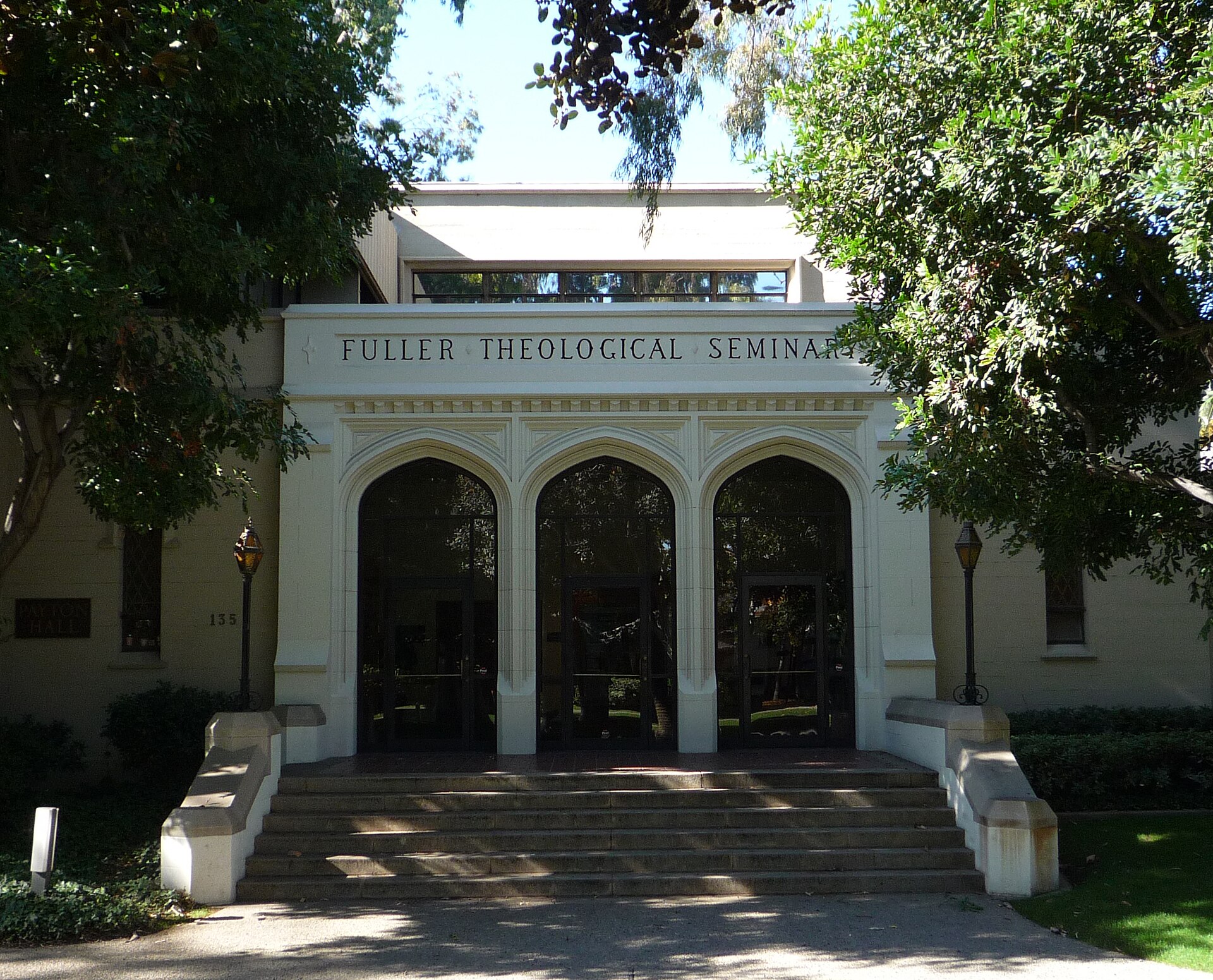
Fuller Theological Seminary, 1947
Charles E. Fuller's radio program, the Old Fashioned Revival Hour, was one of the most widely heard religious broadcasts in the country. With Ockenga he founded a seminary in Pasadena, California, named for Fuller's father, Henry Fuller. In the seminary's own words, Fuller Theological Seminary "is launched in September with 39 students," with Ockenga as the first president (he stayed in Boston and served from a distance) and a founding faculty of Everett F. Harrison, Carl F. H. Henry, Harold Lindsell and Wilbur M. Smith.6 The first graduating class, in 1950, had 20 students.6 The aim was a scholarly seminary that would hold the old doctrines and train ministers able to meet the universities on their own ground. Ockenga later said he had coined the phrase "the new evangelicalism" in a convocation address at Fuller; the exact date and wording of that address were not confirmed for this lesson.
Fuller's later history shows how the new evangelical coalition itself divided. Edward John Carnell became president in 1954, Ockenga returned for a second term in 1959, and David Allan Hubbard became president at 35 in 1963.6 At a faculty and trustee retreat on December 1, 1962, later called "Black Saturday," the views of Daniel P. Fuller (the founder's son) that Scripture contains errors in matters that do not touch revelation brought an argument over biblical inerrancy into the open; George Marsden's Reforming Fundamentalism (1987) gives the fullest account.4 Several faculty members left. Harold Lindsell, by then editor of Christianity Today, attacked the seminary's direction in The Battle for the Bible (1976). The historian Gary Land, reviewing Marsden's book, summarized Marsden's reading: inerrancy became "the testing issue" for evangelicals, "an effective tool for drawing a boundary for the movement," and Fuller weathered "a major attack" from "former faculty member Harold Lindsell."26 Fuller opened a School of Psychology and a School of World Mission and Institute of Church Growth in 1965, with Donald A. McGavran as the mission school's dean.6 That mission school is where John Wimber and C. Peter Wagner taught the course MC510, "Signs, Wonders and Church Growth," in the 1980s; see lesson 08.

Christianity Today, 1956
Billy Graham and his father-in-law, L. Nelson Bell, a surgeon who had been a missionary in China, began discussing a new magazine in 1954. The first issue of Christianity Today appeared on October 15, 1956, and its first printing was sent to more than 250,000 pastors, seminary students and evangelical leaders.7 Its editors wrote that "evangelical Christianity needs a clear voice" and that the magazine should state its "true position."7 Carl F. H. Henry was the first editor, and Harold Lindsell succeeded him in the late 1960s.725 The magazine was meant to give evangelical pastors a serious theological journal and an alternative to the mainline Protestant weekly The Christian Century.4 It remains the best-known evangelical magazine and is a news source used throughout this module.
Wheaton College
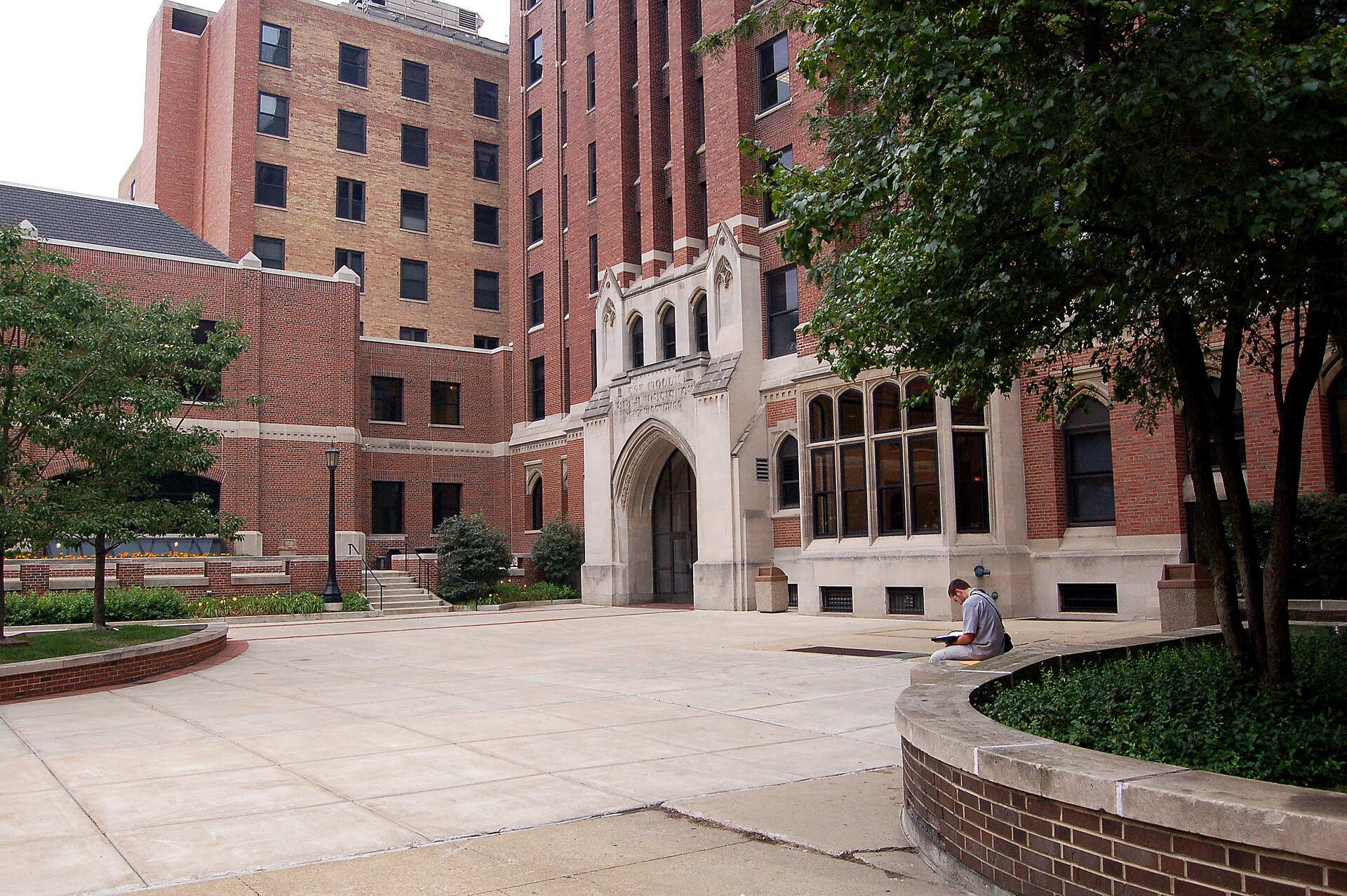
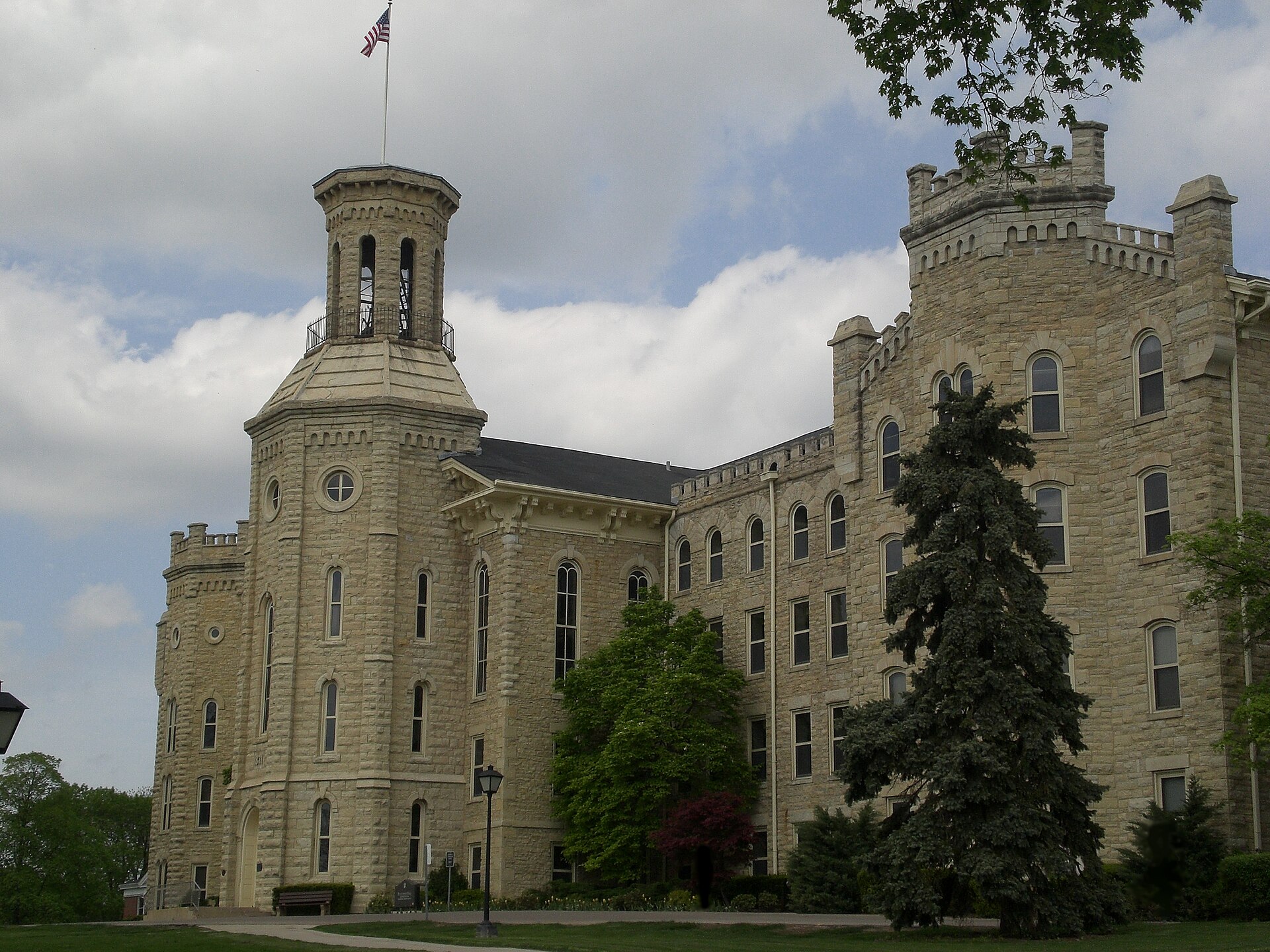
Wheaton College in Wheaton, Illinois, west of Chicago, is one of the best-known evangelical colleges. It grew out of the Illinois Institute, founded by the Wesleyans in 1853. Jonathan Blanchard arrived in 1859, proposed the name Wheaton College and served as president from 1860 to 1882; his son Charles Blanchard, class of 1870, succeeded him and served from 1882 to 1925.19 The college's main building, Blanchard Hall, was built in four sections between 1853 and 1927 of Illinois limestone, and the college says it served as a stop on the Underground Railroad.27 The college describes its mission in the phrase "For Christ and His Kingdom."19
Billy Graham took his first Wheaton classes around 1940 and graduated in 1943; while a student he pastored the United Gospel Tabernacle in Wheaton from September 1941 to June 1943 and met Ruth Bell, also class of 1943.28 He gave the dedication speech for the Billy Graham Center on the Wheaton campus on September 13, 1980.28 The Center's archives hold the records of the NAE, Christianity Today and many mission agencies, and several sources for this lesson come from its blog.57

Billy Graham
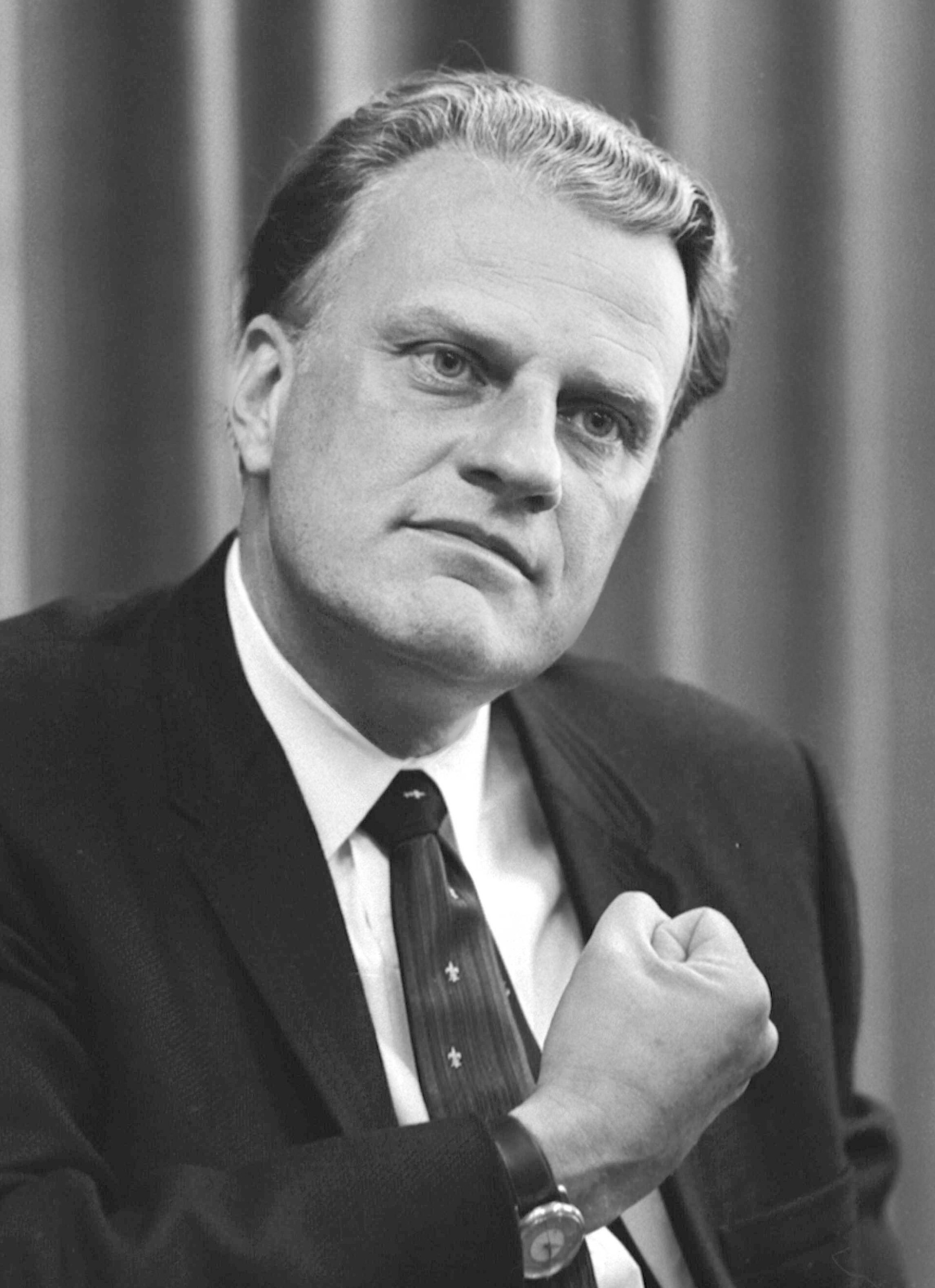
William Franklin Graham Jr. was born on November 7, 1918, in Charlotte, North Carolina. In the fall of 1934, at 15, he made a commitment to Christ at revival meetings held in Charlotte by the traveling evangelist Mordecai Ham. He was ordained in 1939 by Peniel Baptist Church in Palatka, Florida, a Southern Baptist church, and remained a Southern Baptist all his life.29 After Wheaton he worked as an evangelist for Youth for Christ. He founded the Billy Graham Evangelistic Association in Minneapolis in 1950 (it moved to Charlotte in 2003). By the association's count he preached in person to nearly 215 million people in more than 185 countries and territories. He died on February 21, 2018.29

Los Angeles, 1949: the Canvas Cathedral
The campaign that made Graham famous was a tent meeting at Washington Boulevard and Hill Street in downtown Los Angeles, sponsored by a group of local businessmen and pastors. PBS's American Experience describes a Ringling Brothers tent seating 6,000.30 Graham recalled his doubts in his autobiography, Just As I Am (1997): "If the amount of advance press coverage was any indication, the Los Angeles Campaign was going to be a failure."31 The meetings opened on September 25, 1949. Planned for three weeks, they were extended to eight, closing on November 20.32 The Billy Graham Library says "more than 350,000 attended" and "3,000 plus made decisions for Christ."32 PBS reports that the largest crowd, about 15,000, came on November 7, Graham's 31st birthday.30
Two parts of the story are told in many versions. The first is the role of the newspaper owner William Randolph Hearst. The Billy Graham Library's own account says some newspapers were directed by Hearst to "Puff Graham."33 PBS's account repeats an anecdote that a reporter told Graham he had "been kissed by William Randolph Hearst" and describes an earlier 1945 Hearst memo telling editors to promote Youth for Christ, but it cites no copy of a "Puff Graham" telegram.30 No copy of the telegram was found for this lesson, so the two-word order is best treated as a well-attested story without a located document. The second is the converts. A January 1950 Youth for Christ Magazine recap featured "the salvation stories of Stuart Hamblin, Jim Vaus, and Louis Zamperini": a cowboy singer and radio host, a wiretapper who had worked for the gangster Mickey Cohen, and the Olympic runner and former prisoner of war.31
After Los Angeles, Graham's campaigns (he and his team began calling them "crusades") filled stadiums in the United States and abroad. In June 1954 he preached in the Olympic Stadium in Amsterdam through an interpreter from the Salvation Army.
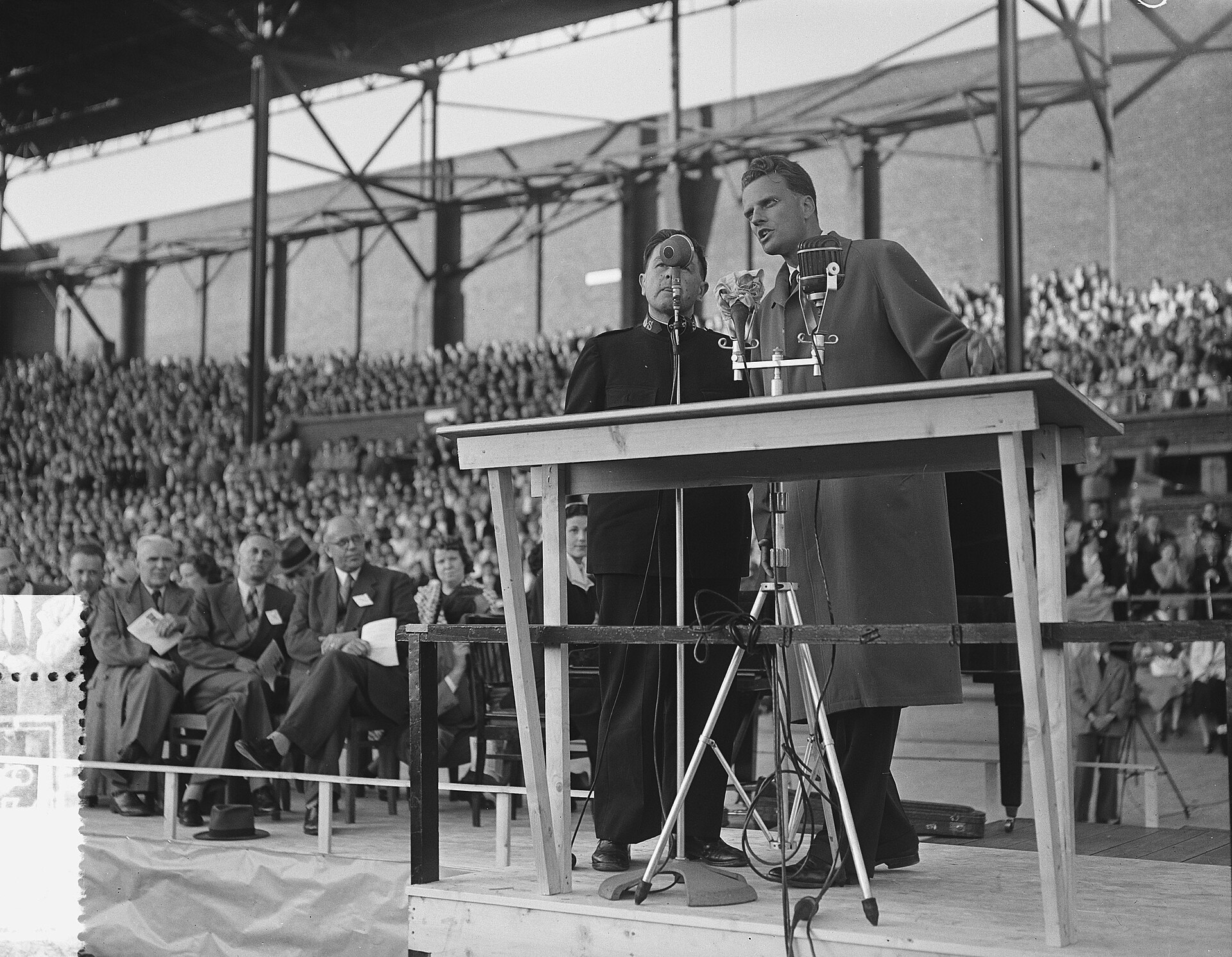

New York, 1957, and the break with separatist fundamentalists
The decisive event in the split between the new evangelicals and the fundamentalists was Graham's New York crusade of 1957. The invitation came from the city's council of churches, which represented more than 1,700 congregations in 31 denominations, mainline Protestant churches among them. The meetings in Madison Square Garden opened on May 15, 1957; planned for six weeks, they were extended three times and closed on September 1, nearly sixteen weeks later.8 In a 2017 interview the historian Grant Wacker, author of America's Pastor: Billy Graham and the Shaping of a Nation, gave the figures the crusade reported: 18,500 people and 704 decision cards on opening night; nearly 2 million at the regular meetings, 400,000 more at other and overflow meetings and more than 60,000 decision cards in all. Wacker noted that the attendance figures were probably inflated because repeat attenders could not be counted out.8 About 100,000 people filled Yankee Stadium on July 20, with another 20,000 outside, and Vice President Richard Nixon spoke; on the closing night about 125,000 people gathered in and around Times Square. From June 1 the Saturday night meetings were carried live on ABC television.8 On July 18 Graham invited Martin Luther King Jr. to offer a pastoral prayer at the Garden, and Graham drew harsh criticism from white segregationists for it.8
For the separatist fundamentalists, the sponsorship was the problem. Their doctrine of separation taught that faithful Christians must not share a platform with churches or leaders who denied the fundamentals, and the New York council included many such churches in their view. The Baptist historian Kevin T. Bauder, writing from inside the fundamentalist tradition, dates the real contest to 1956, as Graham prepared for New York. The debate, Bauder writes, was over Graham's use of people the fundamentalists regarded as non-Christians in leadership positions in his crusades, the policy known as "cooperative evangelism."9 Bob Jones Jr., president of Bob Jones University and backed by his father, said: "I am only saying that what he is doing is unscriptural; and, therefore, Bob Jones University cannot endorse it."9 The evangelist and editor John R. Rice, publisher of The Sword of the Lord, had been one of Graham's closest allies; Graham had served on Rice's board, and Bauder writes that Rice felt the 1956 rupture more deeply than anyone.9 The split gave rise to what fundamentalists call "secondary separation," separation from fellow believers who cooperate with those who deny the faith, a position especially strong in the South.4
Graham stated his own position in Just As I Am: "My own position was that we should be willing to work with all who were willing to work with us." He added, "I was not going to New York to speak against other traditions or to proselytize people away from them."34 Wacker described the fundamentalists' reaction as "the bitterness of disillusioned love," and Bauder, from the other side, writes that the fundamentalist leaders felt betrayed but "never stopped loving Billy Graham."89
After 1957, American conservative Protestants were in two camps that still exist. Those who followed Graham, the NAE, Fuller and Christianity Today called themselves evangelicals. Those who held to strict separation kept the name fundamentalist, with institutions such as Bob Jones University and many independent Baptist churches. George Marsden's well-known shorthand from this period (repeated in his writings, paraphrased here) was that an evangelical was anyone who liked Billy Graham.
Lausanne, 1974, and the Lausanne Covenant
Graham's other lasting institution was global. In November 1971 he convened a planning meeting in White Sulphur Springs, West Virginia, and in July 1974 the International Congress on World Evangelization met for ten days in Lausanne, Switzerland, funded by the Billy Graham Evangelistic Association and private donors. Graham served as honorary chairman and Bishop A. J. Dain as executive chairman.35 The planners aimed for half of the participants and speakers to come from outside the West. Counts of attendance vary by source: Wheaton's archive gives 2,500 leaders from 150 countries in one place and "more than two thousand participants" in another, and says about 2,300 signed the covenant; the covenant itself speaks of participants "from more than 150 nations."3536 Other published accounts give about 2,700; this lesson gives the range.
The Lausanne Covenant, with the English pastor John Stott described by the Lausanne Movement as its "Chief Architect," became the most widely used evangelical statement of the late twentieth century.36 Its fifth section joined social concern to evangelism in words that echoed Henry's Uneasy Conscience: "We affirm that God is both the Creator and the Judge of all men. We therefore should share his concern for justice and reconciliation throughout human society."36 Its sixth section kept the order of priority: "In the Church's mission of sacrificial service, evangelism is primary."36 The covenant was debated from both directions. The Ecuadorian theologian René Padilla, a plenary speaker, said it did not go far enough and recalled the response that he and others who shared his view drafted at the congress, titled "A Call to Radical Discipleship."35 The missiologist Ralph Winter's address on reaching "unreached people groups" set a mission agenda for decades.35
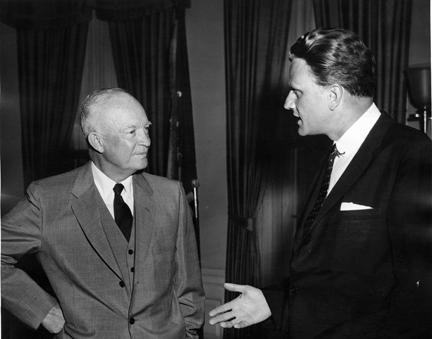
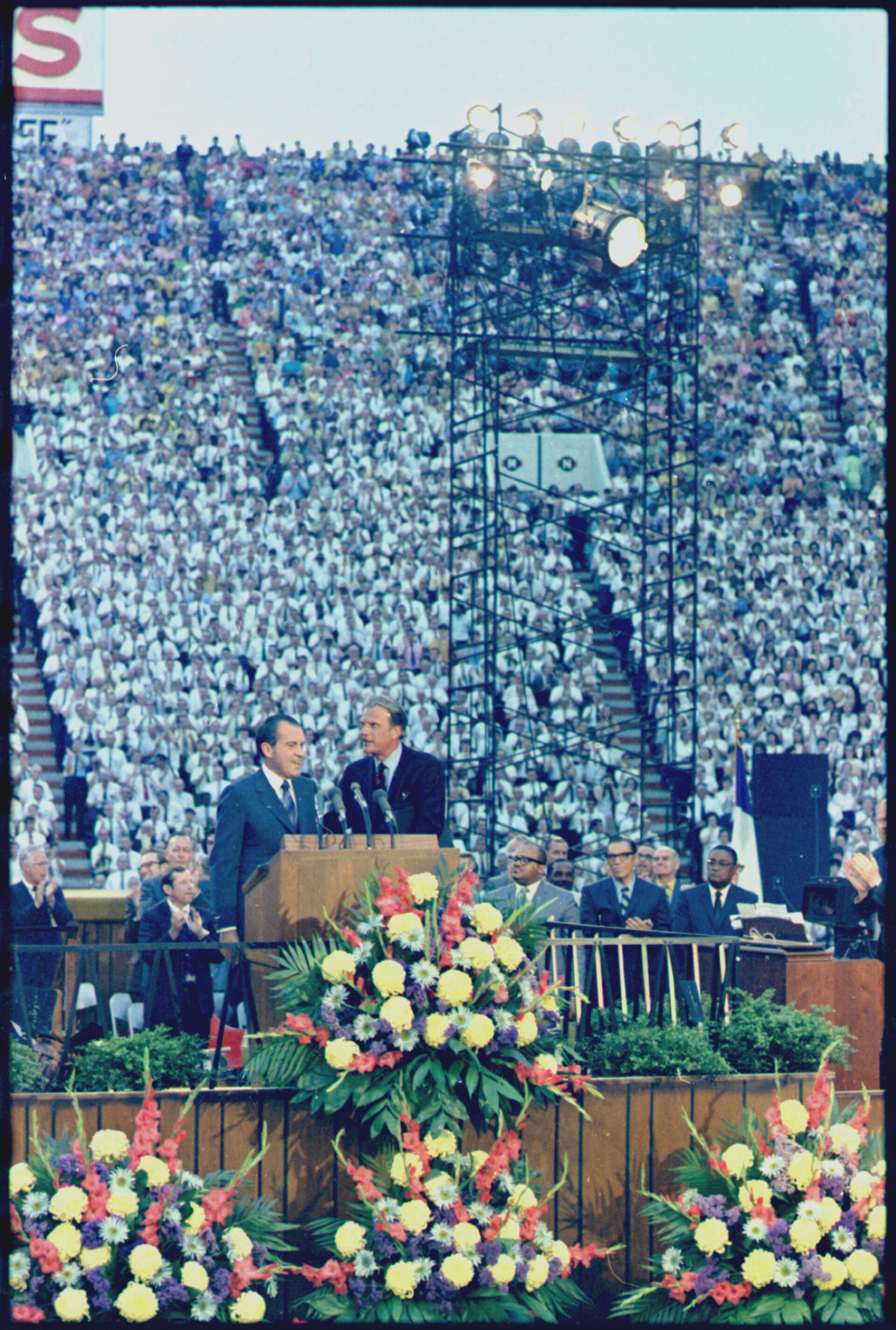
Graham and the presidents
Graham met a number of presidents. The photographs below are from the White House and National Archives collections; they record two of those meetings. Graham's ties to presidents of both parties are part of the record of his public ministry, and the lesson describes them only by what is documented in the photographs: who was present and when.

Defining an evangelical: marks, beliefs and labels
There are three common ways to say who is an evangelical, and they produce different answers. The first is a historian's list of characteristics. The second is a set of belief statements that can be asked in a survey. The third is to ask people what they call themselves, or which church they belong to. Each has strengths, and each has been criticized.
Bebbington's four marks, 1989
David W. Bebbington, a historian at the University of Stirling in Scotland, opened his 1989 book Evangelicalism in Modern Britain: A History from the 1730s to the 1980s with a definition that has been quoted in nearly every study since: "There are four qualities that have been the special marks of Evangelical religion: conversionism, the belief that lives need to be changed; activism, the expression of the gospel in effort; biblicism, a particular regard for the Bible; and what may be termed crucicentrism, a stress on the sacrifice of Christ on the cross. Together they form a quadrilateral of priorities that is the basis of Evangelicalism."10 (The wording is as quoted in Brian Harris's 2008 article in Churchman, citing pages 2 and 3 of the book.)
The National Association of Evangelicals now presents Bebbington's four marks on its own "What is an Evangelical?" page, in its own expanded wording:37
- Conversionism: "the belief that lives need to be transformed through a 'born-again' experience and a life long process of following Jesus"
- Activism: "the expression and demonstration of the gospel in missionary and social reform efforts"
- Biblicism: "a high regard for and obedience to the Bible as the ultimate authority"
- Crucicentrism: "a stress on the sacrifice of Jesus Christ on the cross as making possible the redemption of humanity"
The quadrilateral's strength is that it describes priorities, not denominations, so it can include Anglicans, Baptists, Methodists, Pentecostals and independents across three centuries. Its weakness, critics within the field have argued, is that it describes emphases many other Christians share and leaves out the networks and institutions (Graham, the NAE, Fuller, the magazines) that historians such as Marsden use to locate the American movement. Brian Harris's article, titled "Beyond Bebbington," is one example of that discussion.10
The NAE and Lifeway belief definition, 2015
On November 19, 2015, the National Association of Evangelicals and Lifeway Research (the research arm of the Southern Baptist publishing house) published a "research definition" meant for surveys.11 A respondent counts as an evangelical by belief if he or she strongly agrees with all four of these statements, quoted from the NAE's page:37
- "The Bible is the highest authority for what I believe."
- "It is very important for me personally to encourage non-Christians to trust Jesus Christ as their Savior."
- "Jesus Christ's death on the cross is the only sacrifice that could remove the penalty of my sin."
- "Only those who trust in Jesus Christ alone as their Savior receive God's free gift of eternal salvation."
The four statements map onto Bebbington's marks: the first is biblicism, the second activism, the third crucicentrism and the fourth conversionism. The NAE's president, Leith Anderson, said at the release: "Now we have a way to measure evangelical belief with confidence." Ed Stetzer, then Lifeway Research's executive director, said: "This simple set of four questions reliably discerns those who share evangelical beliefs from those who do not."11
The first results showed how far belief and label can drift apart. About 3 in 10 Americans fit the belief definition. Only 59 percent of Protestants who called themselves evangelical strongly agreed with all four statements. And the label mattered differently by race: among Americans who held evangelical beliefs, 25 percent of African Americans called themselves evangelical Christians, compared with 62 percent of whites and 79 percent of Hispanics.11 Many Black Protestants hold the beliefs and belong to churches with evangelical worship and preaching but do not use the label, in part because the historically Black denominations have their own history and in part, as Gallup's Frank Newport suggested, because some hear "evangelical" as a political label.12
Self-identification and denomination in surveys
The large national polls count evangelicals in two other ways.
Gallup: self-identification. Since the early 1990s Gallup has asked, "Would you describe yourself as 'born-again' or evangelical?" Gallup's averages for each period from 1991 to 1995 through 2016 to 2018 stayed between 41 and 43 percent, and in its May 2018 survey 38 percent said yes. In 2018 Gallup also tested the narrower question "Would you describe yourself as an evangelical?" on half its sample, and only 21 percent said yes.12 Newport wrote that there is "no universally agreed-on definition of exactly who or what an evangelical is" and that question wording matters a great deal: including "born-again" drew more yes answers, especially among non-white respondents.12
Pew Research Center: denomination. Pew's large national religion survey (the RLS) sorts Protestants by the denomination they name into evangelical, mainline and historically Black Protestant traditions. The evangelical tradition includes the Southern Baptist Convention, the Assemblies of God, the Churches of Christ, the Lutheran Church-Missouri Synod, the Presbyterian Church in America, other evangelical denominations and many nondenominational congregations.38 The 2014 study interviewed 35,071 adults by telephone between June 4 and September 30, 2014, and reported evangelical Protestants "ticking downward slightly from 26.3% to 25.4%" of the population since 2007.38 The 2023 to 2024 study found evangelical Protestants at 23 percent of U.S. adults, down from 26 percent in 2007 and 25 percent in 2014, while mainline Protestants fell to 11 percent.13 Pew's approach counts a person by church family regardless of what he or she believes or calls himself or herself.
Read side by side, the numbers say that about one American adult in four belongs to an evangelical denomination, a somewhat larger share holds the core evangelical beliefs, close to four in ten will accept "born-again or evangelical," and about one in five will accept "evangelical" alone. Any news story that reports "evangelicals" should say which of these it means.
How scholars read the definitions
George Marsden, whose Reforming Fundamentalism (1987) is the standard history of Fuller Seminary and whose Understanding Fundamentalism and Evangelicalism (1991) is a short survey, treats American evangelicalism as both a set of beliefs and a historical coalition built around particular leaders and institutions. In his published work (summarized here) the fundamentalists were evangelicals who were militantly opposed to modernism, and the new evangelicals of the 1940s were former fundamentalists who kept the doctrines while dropping the separatism. The historian Mark Noll has written widely on the evangelical intellectual tradition and is best known for The Scandal of the Evangelical Mind (1994), which argued that evangelicals had neglected serious thought. Thomas S. Kidd's Who Is an Evangelical? The History of a Movement in Crisis (Yale University Press, 2019) traces the word from the eighteenth-century revivals to the present and argues, in summary, that the term's popular meaning since the 1970s has become tied to voting patterns, a meaning that leaves out most of the world's evangelicals and many American believers who hold the beliefs. The works of Noll and Kidd are summarized here from their published descriptions and were not quoted, because the full texts were not opened for this lesson.
The fair summary is that the historians' marks, the belief test and the survey labels each measure something real. None of them settles who "counts," and all of them should be named when numbers are used.
The Southern Baptist Convention and the conservative resurgence
The Southern Baptist Convention (SBC) is the largest Protestant denomination in the United States and the largest single body in Pew's evangelical tradition.38 Its churches are self-governing congregations that cooperate in state conventions and a national convention, funding missions and seminaries through a shared budget called the Cooperative Program. The national convention meets once a year, in June, and the "messengers" sent by the churches elect a president and vote on resolutions, budgets and the denomination's confession of faith. That structure explains how a movement could change the denomination's direction: by winning a series of annual votes.
Each side named the events of 1979 to the early 1990s differently. The people who led the change called it the "conservative resurgence." Those who opposed it, who called themselves moderates, called it the "fundamentalist takeover." This lesson uses "conservative resurgence" as the movement's own name, in the theological sense, and gives each side's account.
The confession before 1979
Southern Baptists adopted their first confession, the Baptist Faith and Message, in 1925 and revised it in 1963 at the Kansas City convention.39 The 1963 article on the Scriptures ended with a sentence that became central to the later dispute: "The criterion by which the Bible is to be interpreted is Jesus Christ."39 Through the 1960s and 1970s some professors at the convention's seminaries taught historical-critical approaches to the Bible, and some pastors and laypeople came to believe that the seminaries and agencies no longer held the denomination's traditional view of Scripture.
Houston, 1979
Two Texans organized the effort. Paul Pressler (died June 7, 2024, at 94) was a Houston layman who served as a Texas judge; Paige Patterson was a pastor and theologian, later president of Southwestern Baptist Theological Seminary.4041 Several published accounts say the two met in New Orleans in 1967 and planned a strategy, though at least one gives 1976; the year was not settled for this lesson. The plan rested on the president's appointing power. The SBC president appoints the Committee on Committees, which names the Committee on Nominations, which in turn nominates trustees for the seminaries and agencies. Electing like-minded presidents for about ten consecutive years would, through ordinary procedures, change the trustee boards and then the institutions.
At the 1979 annual meeting in Houston, Texas, Adrian Rogers, a Tennessee pastor, was elected president. David R. Brumbelow, a Gulf Coast pastor who supported the resurgence, wrote: "On the first ballot, Adrian Rogers was elected the new president of the SBC."14 Rogers had been one of six nominees. According to Brumbelow, Pressler, Patterson and many pastors and laypeople had explained the issues to churches and urged messengers to attend and vote.14 Brumbelow lists the presidents who followed as Adrian Rogers, Bailey Smith, Jimmy Draper, Charles Stanley, Jerry Vines, Morris Chapman, Ed Young, Jim Henry, Tom Elliff and Paige Patterson, who was elected in 1998 and 1999.14
The resurgence in its own words
The resurgence's leaders said the issue was the Bible. Their argument was that a denomination whose churches held the Bible to be without error should not pay for seminaries whose professors taught otherwise, and that the people in the pews had the right under Baptist polity to elect trustees who would hold the institutions to the churches' beliefs. Their lasting statement of the result is the Baptist Faith and Message 2000. The committee that drafted it was chaired by Adrian Rogers, and it was presented at the June 2000 convention in Orlando.39 Its article on the Scriptures opens: "The Holy Bible was written by men divinely inspired and is God's revelation of Himself to man."16 It replaced the 1963 "criterion" sentence with: "All Scripture is a testimony to Christ, who is Himself the focus of divine revelation."39 Its article on the church states: "While both men and women are gifted for service in the church, the office of pastor is limited to men as qualified by Scripture."39 In 2023, at New Orleans, the convention amended that sentence to read "pastor/elder/overseer."3916 Article XVIII, on the family, says: "A wife is to submit herself graciously to the servant leadership of her husband even as the church willingly submits to the headship of Christ."16
By the resurgence leaders' measure, the movement succeeded: the six seminaries and the mission boards came under trustees who affirmed inerrancy, and the 2000 confession set the doctrinal standard for denominational employees.
The moderates and the Cooperative Baptist Fellowship
Those who opposed the resurgence called themselves moderates and appealed to historic Baptist principles: the freedom of each believer to read the Bible under the Holy Spirit, the autonomy of the local church, religious liberty and the separation of church and state. Walter Shurden, a Baptist historian, popularized the phrase "four fragile freedoms" (soul freedom, Bible freedom, church freedom and religious freedom) to state that tradition.18 They opposed what they saw as a creed being imposed on Baptists, who had historically treated confessions as descriptions of shared belief, and they opposed the restriction of the pastorate to men.
After the moderate candidate Daniel Vestal, an Atlanta pastor, lost the 1990 presidential election, the moderates stopped trying to win national control. About 6,000 met in Atlanta on May 9 to 11, 1991, and formed the Cooperative Baptist Fellowship as a new mission-funding body. John Hewett, 38, pastor of First Baptist Church in Asheville, North Carolina, was elected moderator and told the gathering: "Brothers and sisters, our long denominational exile is over." Vestal said of the SBC: "It's our spiritual home. It's not easy for us to walk off."15 The founding document, "An Address to the Public," written by Walter Shurden and Cecil Sherman, said: "Forming something as fragile as the Cooperative Baptist Fellowship is not a move we make lightly."18 Christianity Today reported a 1991 budget of about $320,000; a 2016 retrospective by Aaron Weaver gives $550,000, mostly to support SBC missionaries, along with a constitution, bylaws and a 79-member Coordinating Council.1518 The two figures may reflect different budgets (initial and adopted); the sources do not explain the difference. Sherman was named the first coordinator within a year.18 Today the CBF describes itself as "a network of churches, individuals and partners inviting each other into deeper community" with "over 1,800 congregations."42
SBC membership from the Annual Church Profile
Southern Baptist statistics come from the Annual Church Profile (ACP), which the churches report through their state conventions and which Lifeway Research compiles each spring. Membership counts people on church rolls, including many who no longer attend; attendance and baptisms are reported separately.
- Peak: Lifeway's May 2026 report called 2025 the 19th consecutive year of membership decline, which places the peak in 2006.17 The 2006 total is commonly given as about 16.3 million; that exact figure was not confirmed in an SBC document for this lesson.
- 2023: about 12,982,090 members, by subtracting the 259,824 decline reported for 2024 from the 2024 total, in 46,906 churches.43
- 2024: 12,722,266 members, a 2 percent decline, "smaller than it has been since 1974"; 46,876 churches; average weekly worship attendance 4,304,625 (up 6.27 percent); 250,643 baptisms, "the most since 2017."43
- 2025: 12,331,954 members, down 390,312 or 3.07 percent, at levels last seen in 1973; 46,608 churches (268 fewer); average weekly worship attendance 4,460,910 (up 3.63 percent); 263,075 baptisms (up 4.96 percent, the fifth straight yearly increase).1744
The pattern of the last two years is unusual: membership falling while attendance and baptisms rise. Lifeway's Scott McConnell addressed the gap between rolls and attendance in a sentence that begins, "Churches with more than four times as many members as their average attendance are either unhealthy," and the report gives the rest of his explanation.17
Later controversies touching resurgence leaders
Two of the resurgence's founders later faced public accusations, and the record is stated here as the named sources report it. In 2017 a man who had been in Paul Pressler's youth group filed a lawsuit accusing him of decades of rape; the Texas Tribune reported that at least six other men alleged Pressler had abused them or solicited sex from them in incidents dating from 1978 to 2016. Pressler denied the allegations and was never criminally charged, and he settled the lawsuit confidentially about six months before his death in June 2024.40 Paige Patterson was moved out of the presidency of Southwestern Baptist Theological Seminary by its trustees, who at a May 22 to 23, 2018, meeting made him president emeritus, and on May 30, 2018, the board's executive committee unanimously voted to "terminate Dr. Paige Patterson, effective immediately," citing new information about his handling of a sexual abuse allegation at Southeastern Baptist Theological Seminary and statements he had made to the board. The seminary said it "stands against all forms of abuse and grieves for individuals wounded by abuse." Before his firing Patterson had apologized "especially to women" for past remarks; Christianity Today reported that he did not respond to the claims about the Southeastern case.41 These events do not decide the theological questions of the resurgence, which the record shows were argued on their own terms; they are part of the public record of its leaders.
Evangelicals and public life, in brief
This module describes evangelical political involvement only by documented founding facts. Billy Graham met presidents of both parties, as the photographs above record. In June 1979, the same month as the Houston convention, the Baptist pastor and broadcaster Jerry Falwell and the activist Paul Weyrich founded the Moral Majority, which Falwell disbanded in 1989.45 The writer and speaker Francis Schaeffer, who founded the L'Abri community in Switzerland and whose books and films of the late 1970s and early 1980s influenced many evangelicals, is taught in Liberty 56, lesson 02, and his A Christian Manifesto in Liberty 56, lesson 05. The moral debates of the 1970s are covered in Liberty 58, lesson 16. The rules that limit what a tax-exempt church may do in elections are summarized in lesson 04, with links to the Issues modules on Idaho churches and nonprofits.
For Idaho readers: whether a particular congregation belongs to one of the denominations in this lesson is best learned from its own "about" or statement of faith page, as lesson 10 explains.
What the record shows and what it does not
- Documented fact: the NAE met in St. Louis in April 1942 and adopted its constitution in Chicago in May 1943 with Harold Ockenga as first president; Fuller Seminary opened in September 1947 with 39 students; Christianity Today first appeared October 15, 1956; Graham's Los Angeles meetings ran September 25 to November 20, 1949, and his New York crusade May 15 to September 1, 1957; the SBC adopted the Baptist Faith and Message 2000 and amended its pastor sentence in 2023; SBC membership was 12,331,954 in 2025.
- The movements' own claims: attendance and decision counts for Graham's crusades come from the crusades' own records (Wacker notes the New York figures were likely inflated by repeat attenders); the NAE's estimate of a "potential constituency of 15 million" in 1943 was its own projection; the resurgence's account that the dispute was about the Bible and the moderates' account that it was about Baptist freedom and control are each side's self-description.
- Scholarly reading: Bebbington's quadrilateral is a historian's working definition, widely used and also debated; Marsden's account of the fundamentalist-to-evangelical transition and Fuller's inerrancy dispute is the standard one, and Lindsell's opposing account is a participant's.
- Open questions: the exact 1943 attendance (600 delegates or more than 1,000 attendees); whether a written Hearst "Puff Graham" order exists; the exact 1974 Lausanne attendance; the year Pressler and Patterson first planned their strategy (1967 or 1976); the exact 2006 SBC membership total.
Claims checked
| Claim | Rating | Evidence |
|---|---|---|
| "Evangelical" is a recent American political term. | Refuted | The word was used of Luther's followers in the 1500s and of the 1700s revival, and the Evangelical Alliance was formed in 1846.12 Gallup's Newport notes some respondents now hear it as a political label, which is a separate point.12 |
| Evangelicals and fundamentalists are the same people. | Partly supported | They share doctrines and a common origin; the new evangelicals came out of fundamentalism. They divided over separation, most visibly over Graham's 1957 New York sponsorship, and separatist fundamentalists still reject the evangelical label.94 |
| Hearst ordered his papers to "Puff Graham" in 1949. | Unresolved | The Billy Graham Library repeats it; PBS reports a reporter's remark about Hearst and a 1945 Hearst memo about Youth for Christ but cites no 1949 telegram.3330 |
| Billy Graham's 1957 New York crusade drew about 2 million people. | Partly supported | The crusade reported nearly 2 million at regular meetings plus 400,000 at others; Wacker notes repeat attenders inflated the count, so the number of different people was smaller.8 |
| About a quarter of Americans are evangelicals. | Partly supported | True by Pew's denominational count (25 percent in 2014, 23 percent in 2023 to 2024); about 30 percent by the NAE/Lifeway belief test; 21 to 38 percent by Gallup self-identification depending on the wording.131112 |
| Everyone who calls himself an evangelical holds evangelical beliefs. | Refuted | Only 59 percent of self-identified evangelical Protestants strongly agreed with all four NAE/Lifeway statements in 2015.11 |
| The Southern Baptist Convention is shrinking. | Partly supported | Membership has declined 19 straight years to 12,331,954 in 2025, but worship attendance and baptisms rose in 2024 and 2025.1743 |
| The Baptist Faith and Message 2000 bars women from all church ministry. | Refuted | Article VI says "both men and women are gifted for service in the church" and limits the office of pastor (since 2023 "pastor/elder/overseer") to men.39 |
| The Fundamentals were a fringe pamphlet series. | Refuted | Over 3 million volumes went free to several hundred thousand church workers; the authors included established scholars and pastors.3 |
Hard questions and answers
If scholars cannot agree on a definition, is "evangelical" a useful word?
Yes, if the user says which definition is in play. The record shows a stable core: conversion, the Bible's authority, the cross and active witness appear in Bebbington's 1989 marks, in the NAE/Lifeway 2015 statements and in the Lausanne Covenant of 1974.103736 The disagreement is over borders and over who is counted. A reader of any poll or article should ask whether "evangelical" means a denomination, a belief test or a self-label, because the answer moves the number from about 21 to about 38 percent.12
Did Graham compromise in 1957, or did the separatists misread him?
Each side's best case is on the record. Graham's case: he preached the same message as before, did not ask converts to leave their churches or join new ones, and believed he should "work with all who were willing to work with us."34 The separatists' case: putting leaders they regarded as deniers of the faith on the sponsoring committee and sending converts back to those churches lent the gospel's credibility to error, which Bob Jones Jr. called "unscriptural."9 The site does not choose between them. What the record shows is that the decision divided conservative Protestants into two lasting camps.
Was the SBC conservative resurgence a theological reform or a takeover?
Both names describe the same documented process: a decade of presidential elections that changed trustee boards through the convention's own rules.14 The resurgence's leaders called it a return to the churches' belief in an inerrant Bible, carried out by majority vote of the messengers. Those who called themselves moderates saw a creed imposed on a noncreedal people, the loss of freedom for professors and churches, and a narrowing of roles for women, and in 1991 they left to form the CBF.1518 The confessional result, the 2000 text, is on the SBC's site for any reader to compare with the 1963 text.39
Do falling SBC membership numbers mean evangelicalism is declining?
Partly. Pew's denominational share fell from 26 percent in 2007 to 23 percent in 2023 to 2024, a modest decline, and its 2025 report described the overall decline of Christianity as having slowed.13 SBC membership fell for 19 straight years, but some of that loss is rolls catching up with people who had stopped attending, and attendance and baptisms rose in 2024 and 2025.17 Some of the movement's growth is in nondenominational churches, which are counted differently; see lesson 04.
Does the record about Pressler and Patterson discredit the resurgence?
The record about them is factual and sourced: a lawsuit and multiple allegations against Pressler, which he denied and which ended in a confidential settlement, and Patterson's 2018 firing by his seminary's trustees for his handling of an abuse allegation.4041 Whether the theology of the resurgence was right is a separate question that the convention's members answered by vote, and that each reader will weigh. In Patterson's case, the record shows a Southern Baptist board acting against one of the resurgence's own founders.
Where do Calvary Chapel and the Vineyard fit in this definition?
By Bebbington's marks and the NAE/Lifeway statements, both movements' statements of faith fit the evangelical pattern: conversion, the Bible's authority, the cross and active outreach. Both also accept the continuing gifts of the Spirit, which places them near the charismatic stream of lesson 02. The details are in lesson 06 and lesson 08.
Learn more
- The Lausanne Covenant (full text): The most widely used evangelical statement of the late 20th century; short enough to read in one sitting.
- NAE, What is an Evangelical?: The NAE's own presentation of Bebbington's marks and the 2015 belief definition.
- The Fundamentals, Biola University digital collection: Read the original essays and judge their tone for yourself.
- Baptist Faith and Message comparison chart: Side-by-side 1925, 1963 and 2000 texts, the documents at the center of the SBC dispute.
- Grant Wacker on Graham's 1957 New York crusade: A historian's account of the numbers, the television broadcasts and the fundamentalist split.
- Liberty 56, Francis Schaeffer and L'Abri: The evangelical writer whose work shaped many readers in the 1970s and 1980s.
Still being checked (12 items)
These points could not be confirmed against a primary source when this lesson was written and fact checked in October 2026. The text above states each one as uncertain.
- The exact 2006 SBC membership peak total (commonly given as about 16.3 million, 16,306,246 in some tables) was not confirmed in an SBC or Lifeway document; the peak year 2006 is derived from Lifeway's count of 19 straight years of decline through 2025.
- Whether Paul Pressler and Paige Patterson first met to plan their strategy in New Orleans in 1967 or 1976; published accounts differ.
- Attendance at the May 1943 NAE convention: Wheaton's archive says about 600 delegates, the NAE's own history says more than 1,000 attendees.
- Attendance at the 1974 Lausanne Congress: sources give 2,300 signers, 2,500 leaders, more than 2,000 participants, and about 2,700 in other accounts.
- No copy of a 1949 William Randolph Hearst "Puff Graham" telegram or order was located; the Billy Graham Library repeats the phrase.
- Harold Ockenga's claim to have coined "the new evangelicalism" in a Fuller convocation address: date and wording not confirmed.
- George Marsden's quip that an evangelical was "anyone who likes Billy Graham" is paraphrased, not quoted from his book.
- Thomas Kidd's and Mark Noll's arguments are summarized from published descriptions; their books were not opened.
- The Moral Majority's founding in June 1979 with Paul Weyrich's participation is cited from reference works citing Hudson (2008); Britannica confirms only the 1979 founding by Jerry Falwell and the 1989 dissolution.
- The CBF's 1991 budget: Christianity Today (1991) says about $320,000, Baptist News Global (2016) says $550,000.
- The Billy Graham Library's account of Graham's 1949 converts (Hamblin, Vaus, Zamperini) is cited; the descriptions of each (cowboy singer, wiretapper who worked for Mickey Cohen, Olympic runner and former prisoner of war) were not separately sourced.
- The Tennessee Supreme Court's reversal of Scopes's conviction is stated without its date (commonly January 1927), which was not confirmed for this lesson.
Notes
- Encyclopaedia Britannica, "Evangelical church" (print version of article 196819), sections on the term's origin and history (retrieved Oct. 28, 2026). Read it online. ↩
- Evangelical Alliance (UK), "History" (retrieved Oct. 28, 2026). Read it online. ↩
- Biola Magazine, "The Untold Story of The Fundamentals," Summer 2014, Biola University (retrieved Oct. 28, 2026). Read it online. ↩
- Justin Taylor, "10 Key Events: Fundamentalism and Evangelicalism in 20th Century America," The Gospel Coalition, April 9, 2014 (retrieved Oct. 28, 2026). Used for the Laws editorial of July 1, 1920, the Fosdick sermon, Machen, the Scopes trial participants, Henry's 1947 book, Christianity Today's founding, the 1957 separation and Fuller's "Black Saturday" (Dec. 1, 1962), which Taylor draws from George Marsden, Reforming Fundamentalism (Eerdmans, 1987). Read it online. ↩
- Wheaton College Archives and Special Collections, "A Call to United Action: Commemorating 80 Years of the National Association of Evangelicals," From the Vault, April 1, 2022 (retrieved Oct. 28, 2026). Read it online. ↩
- Fuller Theological Seminary, "Fuller Seminary Through the Years" (official timeline), entries for 1947, 1950, 1954, 1959, 1963 and 1965 (retrieved Oct. 28, 2026). Read it online. ↩
- Wheaton College Archives, "Finding 'A Clear Voice': 65 Years of Christianity Today," From the Vault, Oct. 15, 2021, quoting the editors of the first issue, Oct. 15, 1956 (retrieved Oct. 28, 2026). Read it online. ↩
- Justin Taylor, "Billy Graham's Madison Square Garden Campaign, 60 Years Later" (interview with historian Grant Wacker), The Gospel Coalition, May 15, 2017 (retrieved Oct. 28, 2026). Read it online. ↩
- Kevin T. Bauder, "The Fundamentalists and Billy Graham," Central Baptist Theological Seminary, March 2, 2018 (retrieved Oct. 28, 2026). Read it online. ↩
- Brian Harris, "Beyond Bebbington: The Quest for Evangelical Identity in a Postmodern Era," Churchman 122, no. 3 (2008): 201, quoting David W. Bebbington, Evangelicalism in Modern Britain: A History from the 1730s to the 1980s (London: Unwin Hyman, 1989), 2 to 3 (retrieved Oct. 28, 2026). Read it online. ↩
- Lifeway Research, "NAE, Lifeway Research Publish Evangelical Beliefs Research Definition," Nov. 19, 2015 (retrieved Oct. 28, 2026). Read it online. ↩
- Frank Newport, Polling Matters column on evangelicals in America, Gallup, May 31, 2018 (retrieved Oct. 28, 2026). Read it online. ↩
- Pew Research Center, "Decline of Christianity in the U.S. Has Slowed, May Have Leveled Off," Feb. 26, 2025, report on the 2023 to 2024 RLS (retrieved Oct. 28, 2026). Read it online. ↩
- David R. Brumbelow, account of the Southern Baptist conservative resurgence, Aug. 3, 2009, reproduced on the Baptist History Homepage (retrieved Oct. 28, 2026). Read it online. ↩
- Christianity Today, "Southern Baptists: Moderates Form Alternative Fellowship," June 24, 1991 (retrieved Oct. 28, 2026). Read it online. ↩
- Southern Baptist Convention, The Baptist Faith and Message 2000, Articles I, VI (as amended June 14, 2023) and XVIII (retrieved Oct. 28, 2026). Read it online. ↩
- Aaron Earls, "Southern Baptists See Attendance and Baptism Gains Amid Membership Declines," Lifeway Research, May 5, 2026, on the 2025 Annual Church Profile (retrieved Oct. 28, 2026). Read it online. ↩
- Aaron Weaver, "At 25, CBF Still Building Something New," Baptist News Global, June 23, 2016 (first published in Herald, Summer 2016) (retrieved Oct. 28, 2026). Read it online. ↩
- Wheaton College, "History" (retrieved Oct. 28, 2026). Read it online. ↩
- Moody Bible Institute, "Our History" (retrieved Oct. 28, 2026). Read it online. ↩
- Presbyterian Historical Society, "The Beginnings of Fundamentalism," Historical Society blog, Presbyterian Church (U.S.A.) (retrieved Oct. 28, 2026). Read it online. ↩
- University of Minnesota Law Library, Clarence Darrow Digital Collection, Scopes trial exhibit, "Trial Summary: Day Eight" (July 21, 1925) (retrieved Oct. 28, 2026). Read it online. ↩
- National Association of Evangelicals, "History Extended" (retrieved Oct. 28, 2026). Read it online. ↩
- Garth M. Rosell, "America's Hour Has Struck," Christian History, issue 92 (2006), with excerpts of Harold J. Ockenga's address of April 7, 1942 (retrieved Oct. 28, 2026). Read it online. ↩
- Richard J. Mouw, "Awakening the Evangelical Conscience," Christian History, issue 92 (2006), quoting Carl F. H. Henry, The Uneasy Conscience of Modern Fundamentalism (Grand Rapids: Eerdmans, 1947) (retrieved Oct. 28, 2026). Read it online. ↩
- Gary Land, review of George M. Marsden, Reforming Fundamentalism: Fuller Seminary and the New Evangelicalism (Eerdmans, 1987), Andrews University Seminary Studies 26, no. 3 (1988) (retrieved Oct. 28, 2026). Read it online. ↩
- Wheaton College, "Blanchard Hall" (retrieved Oct. 28, 2026). Read it online. ↩
- Wheaton Magazine, "Billy Graham's Wheaton: A Walking Tour," special issue (retrieved Oct. 28, 2026). Read it online. ↩
- Billy Graham Evangelistic Association, "Billy Graham" biography (retrieved Oct. 28, 2026). Read it online. ↩
- PBS, American Experience, "Billy Graham: Preacher in the City of Angels" (retrieved Oct. 28, 2026). Read it online. ↩
- Billy Graham Library, "70th Anniversary: Greater Los Angeles Billy Graham Crusade of 1949," 2019, quoting Billy Graham, Just As I Am (1997), and Youth for Christ Magazine, January 1950 (retrieved Oct. 28, 2026). Read it online. ↩
- Billy Graham Library, "The 1949 Los Angeles Crusade," The Archive Collection (retrieved Oct. 28, 2026). Read it online. ↩
- Billy Graham Library, "This Date in History: Monumental 1949 LA Crusade Begins" (2012) (retrieved Oct. 28, 2026). Read it online. ↩
- Billy Graham, Just As I Am (1997), passage on the 1957 New York crusade, as excerpted by Tyler Robbins, "Theology Thursday: Billy Graham on Ecumenical Evangelism," SharperIron, 2016 (retrieved Oct. 28, 2026). Read it online. ↩
- Wheaton College Archives, "'For the Evangelization of the Whole World': Looking Back at the 1974 Lausanne Congress," From the Vault, July 3, 2024 (retrieved Oct. 28, 2026). Read it online. ↩
- Lausanne Movement, The Lausanne Covenant (1974), introduction and sections 5 and 6 (retrieved Oct. 28, 2026). Read it online. ↩
- National Association of Evangelicals, "What is an Evangelical?" (retrieved Oct. 28, 2026). Read it online. ↩
- Pew Research Center, report on its 2014 RLS released May 12, 2015 (35,071 adults, June 4 to Sept. 30, 2014), sections on evangelical Protestants and Appendix B on classification; the link is Pew's permanent short link to the report (retrieved Oct. 28, 2026). Read it online. ↩
- Southern Baptist Convention, "Comparison of 1925, 1963 and 2000 Baptist Faith and Message," with the 2000 committee report naming Adrian Rogers chairman and the 2023 amendment to Article VI (retrieved Oct. 28, 2026). Read it online. ↩
- Robert Downen, report on the death of Paul Pressler, The Texas Tribune, June 15, 2024 (retrieved Oct. 28, 2026). Read it online. ↩
- Kate Shellnutt, "Paige Patterson Fired by Southwestern, Stripped of Retirement Benefits," Christianity Today, May 30, 2018, updated June 1, 2018 (retrieved Oct. 28, 2026). Read it online. ↩
- Cooperative Baptist Fellowship, "About" (retrieved Oct. 28, 2026). Read it online. ↩
- Lifeway Research, "Southern Baptists' Membership Decline Continues Amid Other Areas of Growth," April 30, 2025, on the 2024 Annual Church Profile (retrieved Oct. 28, 2026). Read it online. ↩
- Lifeway Research for the Southern Baptist Convention, 2025 Annual Church Profile statistical summary (PDF), May 2026 (retrieved Oct. 28, 2026). Read it online. ↩
- Encyclopaedia Britannica, "Moral Majority" (founded 1979 by Jerry Falwell; dissolved 1989) (retrieved Oct. 28, 2026). The June 1979 month and Paul Weyrich's role are from Deal W. Hudson, Onward, Christian Soldiers (New York: Threshold Editions, 2008), 15, and the dissolution also from Patrick Allitt, Religion in America Since 1945 (Columbia University Press, 2003), 198, both as cited in reference works; the books were not opened for this lesson. Read it online. ↩
Check yourself
1. In the 16th century, whom did the word "evangelical" usually describe?
Britannica notes that Luther and his followers were called evangelicals and that the term distinguished them from Calvin's followers; many Lutheran churches still use it.
2. Where and when did the conference that led to the National Association of Evangelicals meet?
The National Conference for United Action Among Evangelicals opened in St. Louis on April 7, 1942; the constitution was adopted in Chicago in May 1943.
3. Which of these is NOT one of Bebbington's four marks?
Bebbington's quadrilateral (1989) is conversionism, activism, biblicism and crucicentrism. Separatism marked the fundamentalists who broke with Graham.
4. What was the main reason separatist fundamentalists broke with Billy Graham over his 1957 New York crusade?
The objection was to "cooperative evangelism": the council of churches that invited Graham represented many mainline congregations, and Bob Jones Jr. called the arrangement "unscriptural."
5. In 2015, what share of self-identified evangelical Protestants strongly agreed with all four NAE and Lifeway belief statements?
Lifeway reported that 59 percent of self-identified evangelical Protestants met the belief definition, showing that label and belief diverge.
6. Why do Gallup and Pew give different counts of evangelicals?
Gallup's "born-again or evangelical" question measures self-description (38 percent in 2018); Pew's RLS counts evangelical Protestant denominations (23 percent in 2023 to 2024).
7. Who was elected president of the Southern Baptist Convention at Houston in 1979, beginning the conservative resurgence?
Adrian Rogers was elected on the first ballot in 1979; Patterson and Paul Pressler organized the effort, and Vestal was the moderate candidate defeated in 1990.
8. What did the 2025 Annual Church Profile show for the Southern Baptist Convention?
Lifeway reported 12,331,954 members (down 3.07 percent), average attendance of 4,460,910 (up 3.63 percent) and 263,075 baptisms, the fifth straight yearly increase.
Terms in this lesson
- Evangelical
- From the Greek euangelion, "good news." Used of Luther's followers in the 1500s, of the 18th-century revival, and since the 1940s of the American movement around the NAE, Fuller and Billy Graham.
- Bebbington quadrilateral
- David Bebbington's 1989 definition of evangelicalism by four marks: conversionism, activism, biblicism and crucicentrism.
- Conversionism
- The belief that lives need to be changed by a personal turning to Christ, often called being born again.
- Crucicentrism
- Bebbington's term for the evangelical stress on Christ's sacrifice on the cross.
- Fundamentalist
- A name proposed by Curtis Lee Laws in 1920 for Protestants ready to fight for the doctrines defended in The Fundamentals (1910 to 1915); after 1957 used mainly by those who practiced strict separation.
- Modernism
- The early 20th-century movement to reinterpret Christian doctrine in light of modern science and biblical criticism, opposed by the fundamentalists.
- New evangelicalism
- The movement of former fundamentalists in the 1940s and 1950s (Ockenga, Henry, Graham, Fuller Seminary) that kept the doctrines while seeking cooperation, scholarship and social engagement.
- Secondary separation
- The fundamentalist position that believers should separate from other believers who cooperate with those who deny the faith, sharpened by the 1957 break with Graham.
- Inerrancy
- The doctrine that the Bible in its original manuscripts is without error; the center of the Fuller dispute of 1962 and the Southern Baptist resurgence.
- Lausanne Covenant
- The 1974 statement of the International Congress on World Evangelization, drafted with John Stott as chief architect, which joined evangelism to social responsibility while calling evangelism primary.
- Annual Church Profile (ACP)
- The yearly statistical report of Southern Baptist churches on membership, attendance, baptisms and giving, compiled by Lifeway Research.
- Messenger
- A voting representative sent by a Southern Baptist church to the annual convention, where messengers elect officers and adopt confessions and resolutions.
- Cooperative Baptist Fellowship (CBF)
- A Baptist network formed in Atlanta in May 1991 by those who called themselves moderates after the SBC's conservative resurgence.
- Baptist Faith and Message
- The Southern Baptist confession of faith, adopted in 1925 and revised in 1963 and 2000, with an amendment in 2023.
Sources
- Encyclopaedia Britannica, Evangelical church (current) checked 2026-10
- Evangelical Alliance, History (current) checked 2026-10
- Biola Magazine, The Untold Story of The Fundamentals (2014) checked 2026-10
- The Fundamentals, digital collection, Biola University (1910 to 1915) checked 2026-10
- Presbyterian Historical Society, The Beginnings of Fundamentalism (current) checked 2026-10
- Justin Taylor, 10 Key Events: Fundamentalism and Evangelicalism in 20th Century America (2014-04-09) checked 2026-10
- University of Minnesota Law Library, Scopes trial summary, day eight (1925-07-21) checked 2026-10
- National Association of Evangelicals, History Extended (current) checked 2026-10
- National Association of Evangelicals, What is an Evangelical? (current) checked 2026-10
- Wheaton Archives, A Call to United Action: 80 Years of the NAE (2022-04-01) checked 2026-10
- Garth M. Rosell, America's Hour Has Struck (Ockenga's 1942 address), Christian History 92 (2006) checked 2026-10
- Richard J. Mouw, Awakening the Evangelical Conscience, Christian History 92 (2006) checked 2026-10
- Fuller Seminary Through the Years (current) checked 2026-10
- Gary Land, review of Marsden, Reforming Fundamentalism (1988) checked 2026-10
- Wheaton Archives, Finding A Clear Voice: 65 Years of Christianity Today (2021-10-15) checked 2026-10
- Wheaton College, History (current) checked 2026-10
- Wheaton College, Blanchard Hall (current) checked 2026-10
- Wheaton Magazine, Billy Graham's Wheaton: A Walking Tour (2018) checked 2026-10
- Moody Bible Institute, Our History (current) checked 2026-10
- Billy Graham Evangelistic Association, Billy Graham biography (current) checked 2026-10
- Billy Graham Library, The 1949 Los Angeles Crusade (current) checked 2026-10
- Billy Graham Library, 70th Anniversary: Greater Los Angeles Crusade of 1949 (2019) checked 2026-10
- Billy Graham Library, This Date in History: Monumental 1949 LA Crusade Begins (2012) checked 2026-10
- PBS American Experience, Billy Graham: Preacher in the City of Angels (current) checked 2026-10
- Justin Taylor and Grant Wacker, Billy Graham's Madison Square Garden Campaign, 60 Years Later (2017-05-15) checked 2026-10
- Kevin T. Bauder, The Fundamentalists and Billy Graham (2018-03-02) checked 2026-10
- SharperIron, Billy Graham on Ecumenical Evangelism (excerpt from Just As I Am) (2016) checked 2026-10
- Lausanne Movement, The Lausanne Covenant (1974) checked 2026-10
- Wheaton Archives, Looking Back at the 1974 Lausanne Congress (2024-07-03) checked 2026-10
- Brian Harris, Beyond Bebbington, Churchman 122/3 (2008) checked 2026-10
- Lifeway Research, NAE and Lifeway Research Publish Evangelical Beliefs Research Definition (2015-11-19) checked 2026-10
- Frank Newport, Polling Matters column on evangelicals in America, Gallup (2018-05-31) checked 2026-10
- Pew Research Center, report on the 2014 RLS (released May 12, 2015) (2015-05-12) checked 2026-10
- Pew Research Center, Decline of Christianity in the U.S. Has Slowed, May Have Leveled Off (2025-02-26) checked 2026-10
- Southern Baptist Convention, The Baptist Faith and Message 2000 (2000, amended 2023) checked 2026-10
- Southern Baptist Convention, Baptist Faith and Message comparison chart (1925, 1963, 2000) checked 2026-10
- David R. Brumbelow, account of the SBC conservative resurgence (2009-08-03) checked 2026-10
- Christianity Today, Southern Baptists: Moderates Form Alternative Fellowship (1991-06-24) checked 2026-10
- Aaron Weaver, At 25, CBF Still Building Something New, Baptist News Global (2016-06-23) checked 2026-10
- Cooperative Baptist Fellowship, About (current) checked 2026-10
- Lifeway Research, Southern Baptists' Membership Decline Continues Amid Other Areas of Growth (2024 ACP) (2025-04-30) checked 2026-10
- Lifeway Research, Southern Baptists See Attendance and Baptism Gains Amid Membership Declines (2025 ACP) (2026-05-05) checked 2026-10
- 2025 Annual Church Profile statistical summary (PDF) (2026-05) checked 2026-10
- The Texas Tribune, on Paul Pressler's death (2024-06-15) checked 2026-10
- Christianity Today, on Paige Patterson's firing (2018-05-30) checked 2026-10
- Deal W. Hudson, Onward, Christian Soldiers (2008) (2008) checked 2026-10