Lesson 2 of 10 · about 55 minutes · Updated October 28, 2026
Pentecostal and Charismatic: Topeka, Azusa Street, the Assemblies of God, the Charismatic Renewal and the Third Wave
You'll be able to
- Explain the initial evidence doctrine, where it came from (Parham, Topeka, Jan. 1, 1901) and how the Assemblies of God states it today.
- Tell the Azusa Street story from Bonnie Brae Street to 312 Azusa Street with dated sources, including the Los Angeles Daily Times article of April 18, 1906, and The Apostolic Faith newspaper.
- Describe the Parham and Seymour split and the later racial division of the movement, and say what the sources agree on and where they differ.
- Distinguish the Wesleyan, Finished Work and Oneness branches of classical Pentecostalism and name a denomination in each.
- Trace the second wave (Bennett 1960, Duquesne 1967, the Full Gospel Business Men from 1951) and the third wave (Wagner, early 1980s) and connect them to the Vineyard lessons.
- Read a global Pentecostal statistic critically: name its source, its year and its definition.
Start here: the short version
Pentecostalism is the family of Christian churches that teaches a second experience after conversion, the baptism in the Holy Spirit, and that this experience is normally shown by speaking in tongues (glossolalia). Its American story has two famous starting points. On January 1, 1901, a student named Agnes Ozman spoke in tongues at Charles Fox Parham's Bethel Bible School in Topeka, Kansas, and Parham built a doctrine around it: tongues are the "Bible evidence" of Spirit baptism.1 In April 1906 a Black Holiness preacher who had studied under Parham, William J. Seymour, led a prayer meeting on North Bonnie Brae Street in Los Angeles that moved into a rundown former church at 312 Azusa Street. The Azusa Street mission drew Black, white, Latino and immigrant worshipers to the same room, published a free newspaper called The Apostolic Faith, and sent preachers and missionaries around the world.2
Within twenty years the movement had split along the lines of doctrine (the Finished Work controversy over sanctification, and the Oneness controversy over the Trinity and baptism) and along the color line. Out of those years came the Church of God in Christ, the Church of God (Cleveland, Tennessee), the Assemblies of God (Hot Springs, Arkansas, April 1914), the Oneness churches, and Aimee Semple McPherson's Foursquare Church (Angelus Temple, January 1923). After World War II, healing evangelists filled tents, and Pentecostal businessmen organized. In 1960 an Episcopal priest in Van Nuys, California, Dennis Bennett, told his parish he spoke in tongues, and the experience began to spread inside older churches: the Charismatic Renewal. Catholic students followed in February 1967. In the early 1980s the Fuller Seminary professor C. Peter Wagner named a "third wave" of evangelicals who sought healing and spiritual gifts without taking the Pentecostal or charismatic label. That third wave is the bridge to the Vineyard, studied in lesson 08 and lesson 09.
Global counts are large and depend heavily on definitions. The Pew Research Center's 2011 report Global Christianity, drawing on estimates from the Center for the Study of Global Christianity at Gordon-Conwell Theological Seminary, counted about 279 million Pentecostals and 305 million charismatics, about 584 million in all, roughly 27 percent of Christians.3 Gordon-Conwell's own center put the combined figure at about 600 million for 2015.4 Change the definition and the number changes by hundreds of millions.
Where this lesson sits
Lesson 01 followed the line from German Pietism through John Wesley and the Methodists to the American Holiness movement and the Keswick conventions in England. That line matters here because nearly every early Pentecostal leader came out of it. The Holiness movement taught that after conversion a believer could receive a second, distinct work of grace, "entire sanctification," and many Holiness preachers had begun to call that second work "the baptism of the Holy Ghost." They also taught divine healing and expected the return of Christ soon. Pentecostalism took that whole package and added one claim: that the baptism in the Spirit comes with a sign that can be heard, speaking in tongues, as in Acts 2:4 (KJV): "And they were all filled with the Holy Ghost, and began to speak with other tongues, as the Spirit gave them utterance."
This lesson follows the movement in its own words first, then the record, then the scholars. The scholars most often cited here are Vinson Synan (The Holiness-Pentecostal Tradition, 1997), Cecil M. Robeck Jr. (The Azusa Street Mission and Revival, 2006), Grant Wacker (Heaven Below: Early Pentecostals and American Culture, 2001) and David Edwin Harrell Jr. (All Things Are Possible, 1975). Lesson 03 takes up the separate story of the evangelical coalition (the NAE, Fuller, Billy Graham), which Pentecostal denominations later joined.
Topeka, 1901: Charles Fox Parham and Bethel Bible School
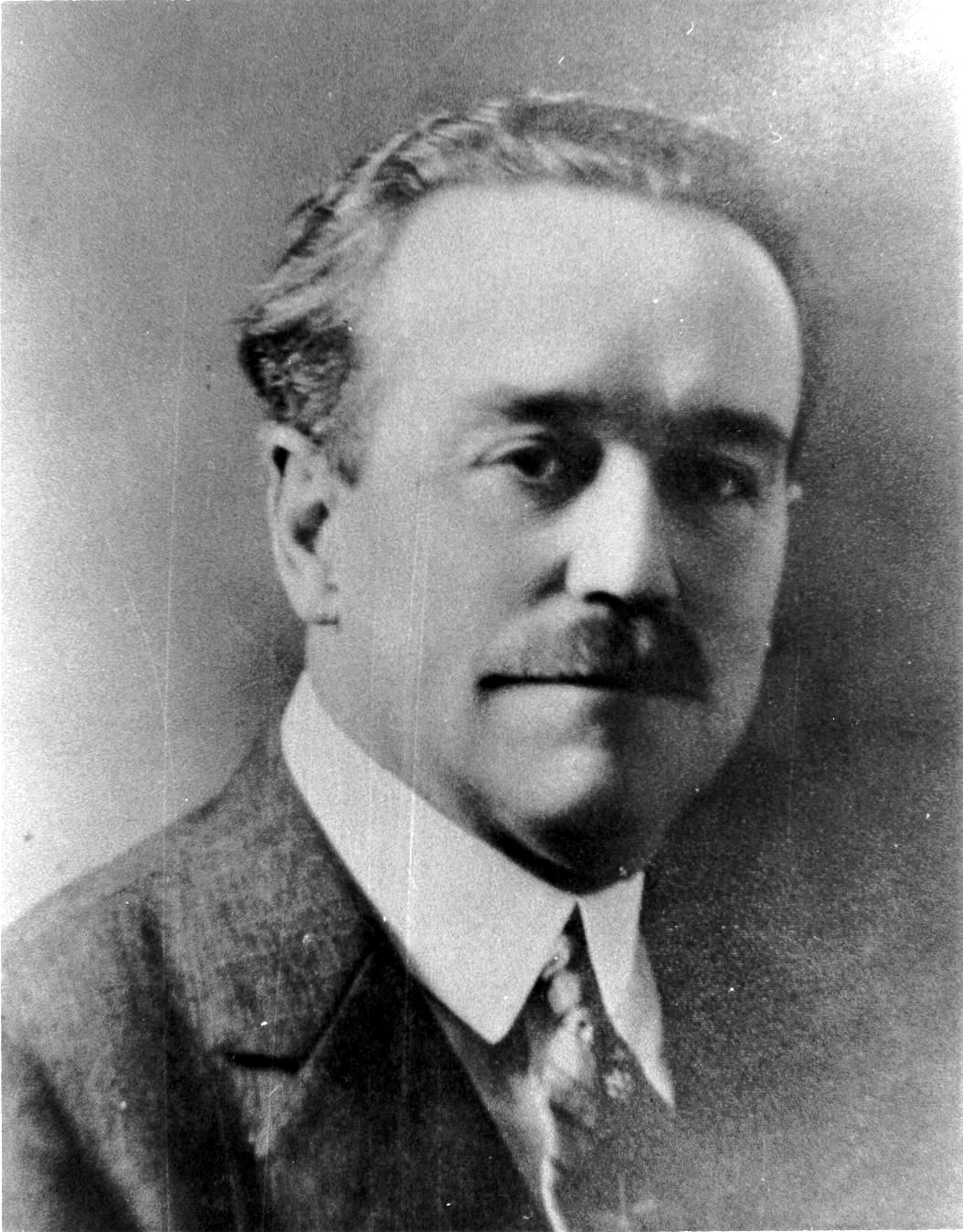

Who Parham was
Charles Fox Parham was born in Muscatine, Iowa, on June 4, 1873. He enrolled at Southwest Kansas College in 1890, left before graduating to preach, and in 1893 became pastor of a Methodist church in Linwood, Kansas. By 1895 he had left the Methodist Church to work as an independent Holiness evangelist and teacher, and he later rejected church organization of any kind. He taught divine healing and the premillennial return of Christ. Vinson Synan, writing in the Encyclopedia of the Great Plains, calls him the man "regarded as the founder and doctrinal father of the worldwide pentecostal movement."1
Parham opened a healing home in Topeka in 1898 and began publishing a paper called the Apostolic Faith in 1899 (a different paper from the Los Angeles Apostolic Faith of 1906, though it shared the name).1 In October 1900 he opened Bethel Bible School in a large unfinished mansion on the edge of Topeka that locals called "Stone's Folly." The Revival Library account says 40 students came, willing to "forsake all" for Bible study and prayer; Christian History's 1998 profile counts 34 members of the school.52 Sources differ on the founding year because the healing home (1898) and the Bible school (1900) are sometimes run together. Synan's encyclopedia entry dates "Bethel Bible School" to 1898, while the Revival Library account and most narrative histories give October 1900 for the school itself.15
The assignment and Agnes Ozman
The account Parham and his students later gave goes like this. In December 1900 Parham asked the students to search the Book of Acts for the biblical evidence of the baptism in the Holy Spirit while he was away. When he returned, they reported that in each account of Spirit baptism in Acts, the believers spoke in tongues.5 After a watch-night service on New Year's Eve, on January 1, 1901, a student named Agnes Ozman asked Parham to lay hands on her and pray. She spoke in tongues. Over the next days other students, and Parham himself, reported the same experience.56 The Assemblies of God, the largest Pentecostal denomination in the United States, tells the story the same way today: students at Bethel Bible School "began speaking in tongues at a prayer meeting on January 1, 1901."6
Ozman herself later wrote a testimony describing joy, a deep sense of the presence of God, and the feeling of "rivers of living waters" flowing from within, an image drawn from John 7:38.5 The event drew local newspaper coverage in Topeka.1 The school did not last: the building was sold in 1901 and the students had to leave, and Parham moved his work to other towns in Kansas, Missouri and Texas.5
Initial evidence: the doctrine that defined a movement
Speaking in tongues was not new in 1901. Scattered reports of tongues appear in the history of earlier revivals, and Holiness writers already spoke of the "baptism of the Holy Ghost." What Topeka added was a doctrine. Parham taught that tongues were the "Bible evidence" of the baptism in the Spirit, so that a believer who had not spoken in tongues had not yet received that baptism.1 Later Pentecostals called this teaching "initial evidence," and it became the clearest line between Pentecostals and their Holiness parents. The Assemblies of God's current Statement of Fundamental Truths keeps it in Paragraph 8: "The baptism of believers in the Holy Ghost is witnessed by the initial physical sign of speaking with other tongues."7
Parham also held a second view that his successors dropped. He believed the tongues were real human languages (xenolalia, sometimes spelled "zenolalia") given so that missionaries could preach abroad without language study. Synan notes that other Pentecostals abandoned this belief after failed attempts to preach in unknown languages in India and elsewhere.1 Most Pentecostal teaching since then treats tongues as prayer and praise in a language the speaker does not know, which may or may not be a human language.
Grant Wacker's Heaven Below (2001) reads the first generation as people who held two impulses together: a longing to return to the supernatural world of the New Testament church, and a practical, organizing streak that built schools, papers and mission boards. Wacker calls these impulses primitivism and pragmatism.8 The Topeka story shows both: a small group reading Acts as a manual for the present, then a leader who turned their experience into a teachable doctrine and a newspaper.
William J. Seymour: from Louisiana to Houston
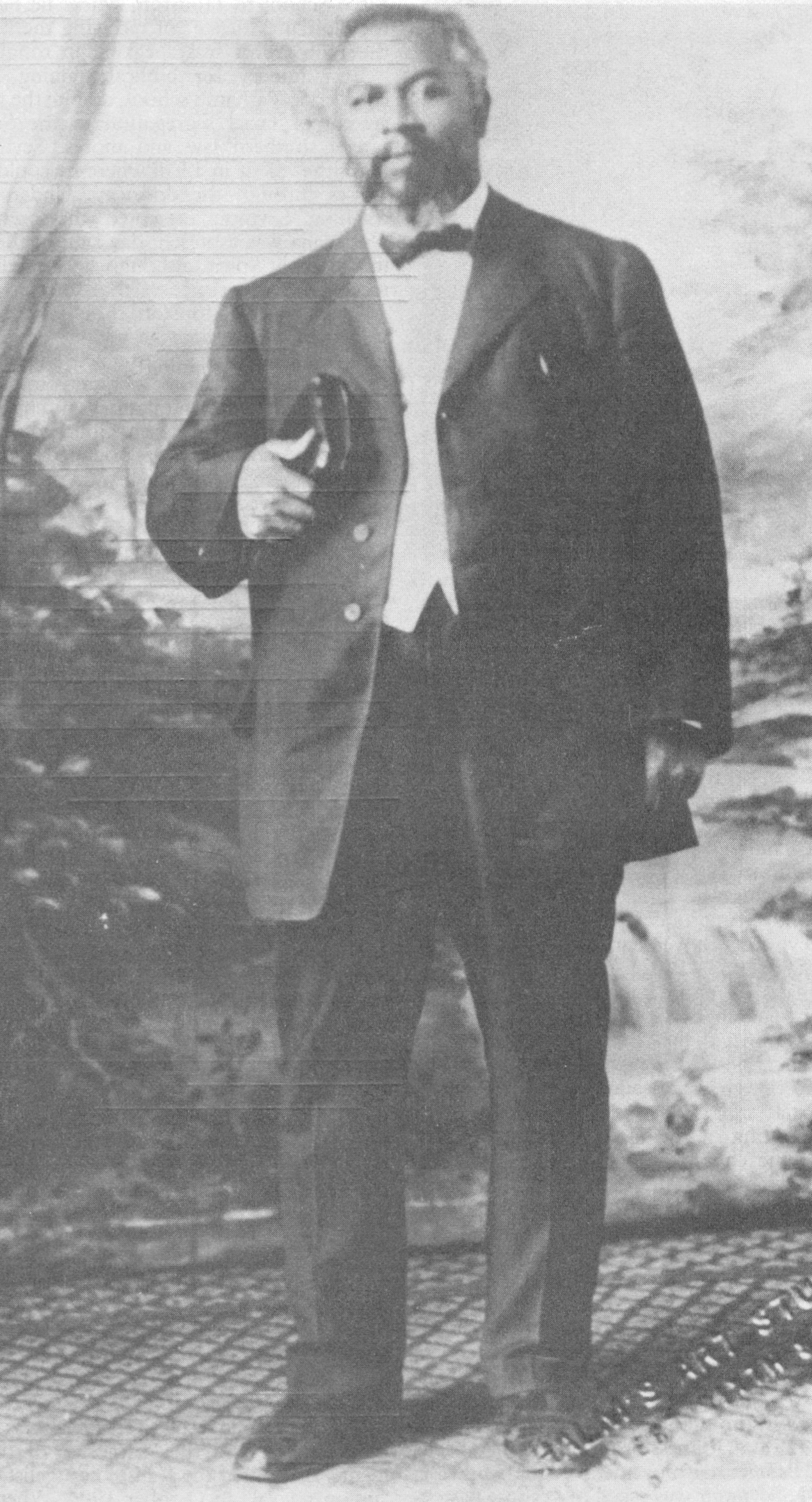

William Joseph Seymour was born May 2, 1870, in Louisiana, the son of formerly enslaved parents, and died September 28, 1922.9 Christian History magazine's 1998 profile, by its assistant editor Ted Olsen, describes him at the time of Azusa Street as a 35-year-old son of slaves, blind in one eye, with almost no formal education, a former waiter and a Southern Holiness preacher.2 In 1905 Parham opened a short-term Bible school in Houston, Texas, and Seymour attended it.2
How Seymour attended is disputed. A widely repeated account says that because of Texas segregation, Seymour sat in a hallway or adjoining room and listened through an open door. The historian Eddie Hyatt, writing in Pneuma Review in 2004, prints comments by Parham's daughter-in-law, Pauline Parham, who calls this "an undocumented account, repeated in many books," and says the account she heard from those present was that Seymour "was welcomed into the class along with everyone else."10 Hyatt's article defends Parham and relies on family testimony, so it is one side of the question. The record supports two facts: Seymour learned the initial evidence teaching from Parham in Houston, and he had not yet spoken in tongues himself when he left for Los Angeles.211
Los Angeles, 1906: Bonnie Brae Street
In February 1906 Seymour accepted an invitation to preach at a small Holiness mission in Los Angeles led by Julia Hutchins. Parham, reluctant to lose him, gave his blessing and paid for the trip. When Seymour preached that tongues were the evidence of Spirit baptism, the mission's leaders locked him out, in part because he had not received the experience he was preaching.11 A member of the congregation, Edward S. Lee, took him in, and Seymour began leading Bible study and prayer in homes. The meetings moved to the home of Richard and Ruth Asberry at 214 North Bonnie Brae Street (the address is now 216).211
On April 9, 1906, Lee spoke in tongues when Seymour prayed for him, and that evening, at the Bonnie Brae Street prayer meeting, others began speaking in tongues as well.211 Cecil M. Robeck Jr., the Fuller Theological Seminary historian whose 2006 book is the standard history of the mission, dates the start of the revival to that meeting.12 Seymour's own experience followed a few days later; the Religion in Kansas Project exhibit dates it April 12, 1906.11 The house filled, crowds gathered on the street, and the meetings needed a larger room.
312 Azusa Street
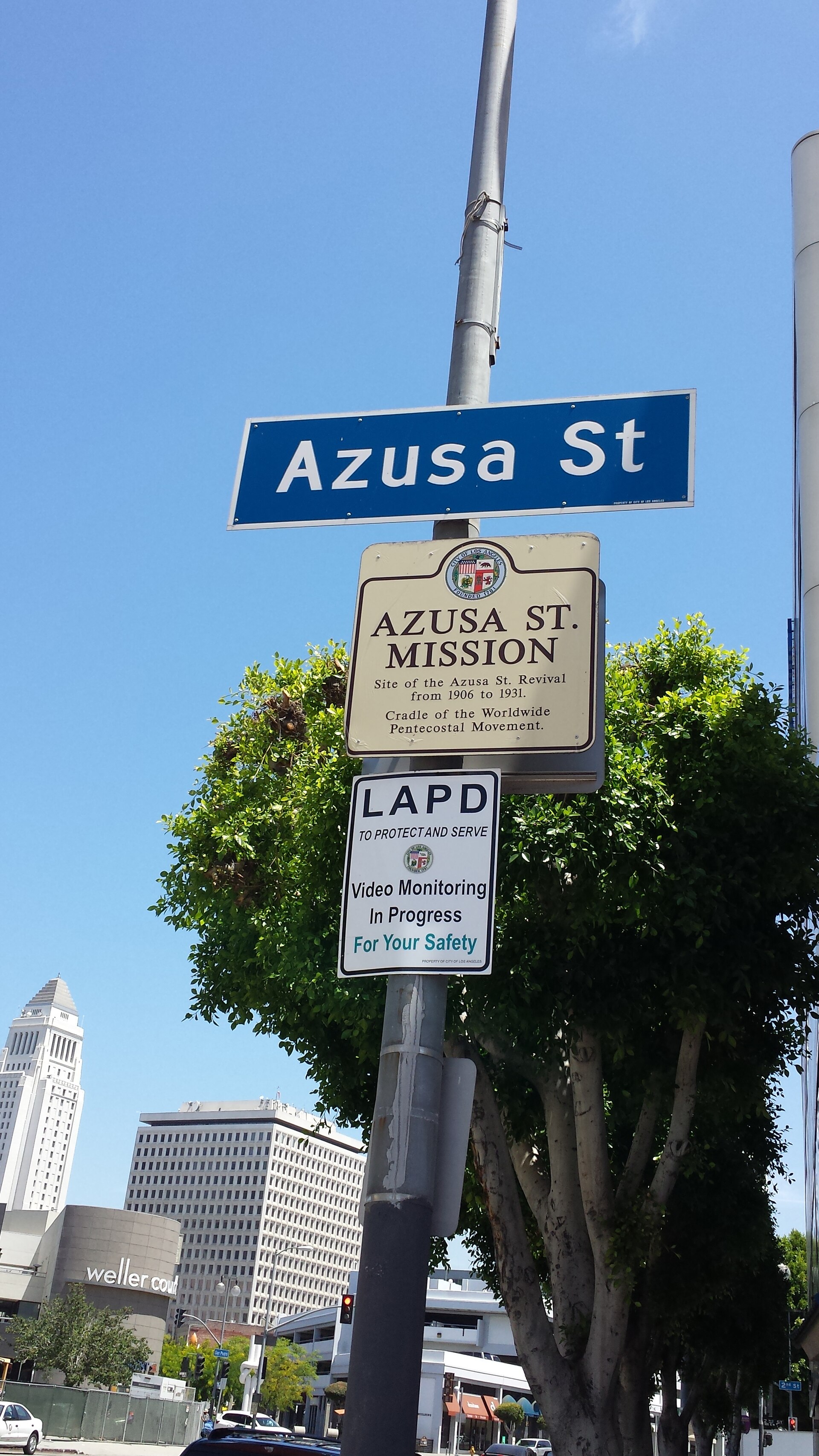

The group rented the old building at 312 Azusa Street, which the mission's own paper later described as "a two-story, white-washed old building" in "the vicinity of a tombstone shop, stables and lumber yard."13 It had been built as the Stevens African Methodist Episcopal Church, and its unfinished ground floor had most recently served as a stable and storage space.211 The congregation took the name Apostolic Faith Mission. Olsen describes debris on the floor, a makeshift pulpit, altar and benches, and meetings that began at 10 a.m. and "continued for at least 12 hours, often lasting until two or three the following morning."2 The mission's paper later stressed that "No collections are taken. No bills have been posted to advertise the meetings."13
The Los Angeles Daily Times, April 18, 1906
The first wide publicity was hostile. On April 18, 1906, the Los Angeles Daily Times ran a story headed "Weird Babel of Tongues." It opened: "Breathing strange utterances and mouthing a creed which it would seem no sane mortal could understand, the newest religious sect has started in Los Angeles."2 The same paper's coverage described a "tumble-down shack" where "colored people and a sprinkling of whites" gathered.2 The date mattered: early that same morning, the San Francisco earthquake struck. Olsen notes that interest grew after a speaker's prophecy of "awful destruction" was remembered in light of the earthquake, and that a gospel tract of the time "called the tragedy a judgment and a warning."2 Pentecostal histories still treat the hostile Times article as free advertising.
The Apostolic Faith newspaper
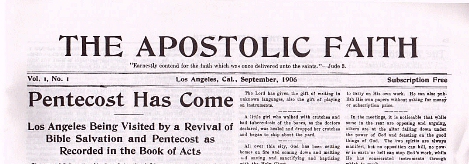

In September 1906 the mission published the first issue of The Apostolic Faith. The masthead read "Los Angeles, Cal., September, 1906. Subscription Free," under the verse "Earnestly Contend for the faith which was once delivered unto the saints" (Jude 3). The lead article, "Pentecost Has Come," carried the subtitle "Los Angeles Being Visited by a Revival of Bible Salvation and Pentecost as Recorded in the Book of Acts," and began: "The power of God now has this city agitated as never before. Pentecost has surely come and with it the Bible evidences are following."1415 Another column in that first issue shows that the mission still held Parham's view of missionary tongues: "Many are speaking in new tongues, and some are on their way to the foreign fields, with the gift of the language."13
The Apostolic Faith Church of Portland, Oregon, which descends from the mission's paper, says that five thousand copies of the first issue "were ready for distribution."16 Later issues reported much larger press runs. The Religion in Kansas Project exhibit says that at its height circulation "exceeded 50,000"; other secondary accounts give about 40,000 by 1907. These figures appear to rest on the paper's own reports and were not checked against them.11 The paper was the movement's main tool. It reported testimonies from across the country and abroad, printed the mission's teaching, and gave readers the addresses of new missions. The first issue also estimated that in the five years since Topeka "something like 13,000 people have received this gospel," a figure for the whole movement since 1901, not for Azusa Street alone or for readers of the paper, and the mission's own estimate.15
The Apostolic Faith Church today keeps scans and reproductions of the first issues online. It notes that by the fourteenth edition "printing operations had moved to Portland, Oregon."17 Robeck and other historians tie that move to Florence Crawford, a white leader at Azusa who started her own work in Portland, and to Clara Lum, an editor of the paper, who went with her. Their accounts say the mailing list went to Portland too, cutting Seymour off from most of his national readership in 1908. The Religion in Kansas Project exhibit says "It is believed by many" that the two took the mailing lists without permission, and McClymond's 2024 commentary in Christian History says one woman "absconded with the only copies of the mailing lists."1113 The year and the details were not checked against the original papers for this lesson.
Interracial worship and its later breakup
The most quoted line about Azusa Street is that "the color line was washed away in the blood." It is credited to the white eyewitness Frank Bartleman, whose How Pentecost Came to Los Angeles (1925) is the main firsthand chronicle; McClymond's 2024 commentary in Christian History quotes Bartleman as writing that "the color line was washed away in [Jesus's] blood."13 Olsen's Christian History profile calls the line "often-quoted" and adds that it was true in practice only for a short time.2 The record shows a mission led by a Black pastor, with Black and white members, Latino worshipers and "newly arrived European immigrants worshiping under the same roof," in a city and a decade when that was rare and in many places illegal.218
The breakup came in stages. David D. Daniels of McCormick Theological Seminary, writing in Christian History in 1998, traces it. Black congregations began to leave multiracial bodies as early as 1908, in part because some would not accept Black leaders. Jim Crow laws made interracial conventions hard to hold in the South. The Church of God in Christ's 1918 manual still said that "Its overseers, both colored and white, have equal power and authority in the church," and COGIC held interracial conventions in Memphis until the mid-1930s. In 1924 the majority of white congregations in the Oneness body, the Pentecostal Assemblies of the World, withdrew to form a predominantly white denomination eventually named the United Pentecostal Church. Daniels writes that most Black Pentecostals considered the division "sinful and embarrassing."18
The clearest single marker is the Pentecostal Fellowship of North America, formed in 1948. It was predominantly white and had no Black denominations among its members. On October 18, 1994, in Memphis, Tennessee, its member churches voted to dissolve it, and on October 19 Black and white leaders formed the Pentecostal and Charismatic Churches of North America. At that meeting an Assemblies of God pastor, Donald Evans, washed the feet of Bishop Ithiel Clemmons of the Church of God in Christ and asked forgiveness for the history of racial discrimination. The gathering was dubbed the "Memphis Miracle."19 The account here comes from Darrin J. Rodgers, director of the Assemblies of God's Flower Pentecostal Heritage Center, writing for the thirtieth anniversary in 2024.19
The Parham and Seymour split
Seymour had invited Parham to Los Angeles, and Parham arrived in October 1906 expecting to lead what he regarded as an extension of his own Apostolic Faith movement. After a few meetings he denounced what he saw. Synan's entry states that Parham "denounced the Los Angeles meetings" and was expelled by Seymour and the elders.1 Olsen reports that Parham, who objected to the manifestations, said he was told he was not wanted at the mission.2 Hyatt's account says that after Parham preached two or three times, "he was informed by two of the white elders that he was no longer welcome," and that Parham "was appalled at what he considered to be fleshly and demonic manifestations."10
Whether race drove the split is the contested question. The editors' introduction to Daniels's 1998 article in Christian History says Parham "caricatured Seymour's 'disgusting' Azusa Street revivals as 'Southern darkey camp meetings,'" and reads the short relationship between Parham and Seymour as a foreshadowing of Pentecostalism's failure to sustain racial unity.18 Hyatt argues that Parham was "neither a saintly crusader for racial equality nor a rabid racist," that the dispute was over order and the genuineness of manifestations, and that Parham's later praise of the Ku Klux Klan was "likely related to their championing of patriotism, marriage and family"; Hyatt adds that Parham "never belonged to the Klan."10 Both writers agree that Parham objected to the mixing of races at the altar and to the physical manifestations; they disagree about which objection weighed more.
Parham's standing collapsed soon after. Synan's entry records that in 1907 he was accused of sodomy in San Antonio, Texas, and that although he was acquitted, his leadership influence ended. Other accounts say the charge was dropped before trial; neither account records a conviction.1 Parham retired to Baxter Springs, Kansas, held annual camp meetings there, and died January 29, 1929.1 Seymour pastored the Azusa Street mission until his death on September 28, 1922. His wife, Jennie Evans Moore Seymour, one of the first to speak in tongues at Bonnie Brae Street (Olsen records that she "sat down at the piano and improvised a tune while singing what she thought was Hebrew"), led the congregation after him. Olsen writes that after Seymour's death in 1922 and hers in 1936, "the mission closed and was razed."29
The first denominations: Holiness churches that became Pentecostal
Azusa Street did not found a denomination. It sent its message into churches that already existed, and several of the oldest Pentecostal bodies in the United States are Holiness churches that accepted the Azusa experience and the initial evidence teaching between 1906 and 1909. Two were in the South, and both are among the largest Pentecostal churches in the country today.
The Church of God in Christ (Charles Harrison Mason)
Charles Harrison Mason, a Black Holiness preacher, met C. P. Jones and others in 1895, and in 1897 Mason, walking in Little Rock, Arkansas, came to believe the name "Church of God in Christ" had been given to him. In 1907 Mason, with Elders D. J. Young and J. A. Jeter, went to Los Angeles, attended the Azusa Street meetings, and came to believe in the baptism in the Holy Spirit with tongues as its evidence.20 Jones did not accept the new teaching, and the two men parted. Jones's followers became the Church of Christ (Holiness) U.S.A.; Mason's kept the COGIC name. The Tennessee Encyclopedia's entry, by Randolph Meade Walker, treats the first Pentecostal General Assembly in Memphis, in November 1907, with twelve churches represented, as the official founding.20
Walker writes that "Between 1907 and 1914 the Church of God in Christ was the only incorporated Pentecostal body in the nation," that Mason "ordained both white and black clergy, since both needed licenses of ordination," and that many of the white clergy he ordained helped form the Assemblies of God in 1914.20 Narrative histories add that the credentials also brought clergy railroad rates; that detail was not checked against primary records for this lesson. Daniels writes that COGIC "brought in two white fellowships in an attempt to become more integrated," and that one white fellowship associated with COGIC went on to help form the Assemblies of God in 1914.18 The church's world headquarters is in Memphis, where Mason Temple hosted the Rev. Martin Luther King Jr.'s "I've Been to the Mountaintop" sermon on April 3, 1968, the night before his assassination. Mason died in 1961.20 Walker describes COGIC as "Estimated to be the second largest black religious denomination in the United States"; the church's own membership claims are much larger than any independent count, and no independent count is given here.20
The Church of God (Cleveland, Tennessee)
The Church of God (Cleveland, Tennessee) dates itself to August 19, 1886, when R. G. Spurling, with the help of his father, Richard Spurling, set in order the Christian Union in Monroe County, Tennessee.21 The Tennessee Encyclopedia names the place as the Barney Creek Meeting House and the first pastor as Richard G. Spurling Sr., "an ordained Missionary Baptist preacher."22 A ten-day revival at the Shearer Schoolhouse in Cherokee County, North Carolina, in the summer of 1896 preached the necessity of holiness, and on May 15, 1902, Spurling and others set in order the Holiness Church at Camp Creek.21 The Tennessee Encyclopedia says the leaders of the four churches then in the group chose the name Church of God in 1906; the church's own history says delegates from five congregations met in the first General Assembly in January 1906 and that the second General Assembly, in 1907, adopted the name.2221 Ambrose J. Tomlinson, an Indiana native who came to the area as a Bible salesman and pastored the Cleveland church, became general overseer in 1907.2221 The church's own history records that Tomlinson received the baptism in the Holy Spirit in 1908, at the time of the third General Assembly.21 Narrative histories connect that experience to the preaching of G. B. Cashwell, a North Carolina Holiness minister who had been to Azusa Street; the church's brief history does not name him.
Under Tomlinson membership rose from about 1,000 to about 21,000. Charges were brought against him in 1922, and after bitter hearings he left; the congregations that followed him became the Church of God of Prophecy.22 The Church of God (Cleveland) reports ministry in 185 nations and territories, and the Tennessee Encyclopedia gives its worldwide membership as approaching three million.2122
The Finished Work controversy (William Durham)
The early Pentecostals inherited the Holiness order of salvation: first conversion, then entire sanctification as a second work of grace, then the baptism in the Spirit as a third experience. Seymour, Mason and the Church of God held this three-stage pattern. William H. Durham, pastor of the North Avenue Mission in Chicago, who had received the baptism in the Spirit at Azusa Street (Christian History dates his visit to 1906; many accounts give early 1907), challenged it in 1910. He taught that the cross of Christ, the "finished work at Calvary," provided both salvation and sanctification, so that sanctification was a lifelong growth from conversion and not a second crisis. In his own words: "I began to write against the doctrine that it takes two works of grace to save and cleanse a man."23
In 1911 Durham returned to Los Angeles and preached at the Azusa Street mission while Seymour was away. The preaching drew crowds and caused conflict. When Seymour returned, he padlocked the building to keep Durham out, and Durham moved to another mission and kept preaching.23 Durham died in Los Angeles in July 1912.24 His view spread anyway. Christian History reports that by 1915 roughly half of Pentecostals preferred his interpretation, and that it is now the view of most American Pentecostals; the Assemblies of God either left the question open or adopted the Finished Work position.23 The older Holiness Pentecostal churches (COGIC, the Church of God, the Pentecostal Holiness Church) kept the three-stage pattern, and the line between "Wesleyan" Pentecostals and "Finished Work" Pentecostals still runs through the movement.
The Oneness controversy, 1913 to 1916
The second great division came out of a camp meeting. In April 1913, at the Arroyo Seco camp meeting near Los Angeles, which drew 1,500 to 2,000 people a night, many of them pastors, the Canadian minister R. E. McAlister observed in a baptismal sermon that the apostles in Acts baptized "in the name of Jesus" rather than with the threefold formula of Matthew 28:19. One listener, Frank J. Ewart, later said: "The gun was fired from that platform which was destined to resound throughout all Christendom."25
Ewart and others concluded that Jesus is the one name of God, that Father, Son and Holy Spirit are modes or manifestations of one God (not three persons), and that believers baptized with the Trinitarian formula needed to be rebaptized in Jesus' name. Supporters called this the "New Issue"; it is now called Oneness Pentecostalism. By January 1915 the teaching had spread across the continent, and many Pentecostals, including some leaders of the young Assemblies of God, were rebaptized.25 Assemblies of God general superintendent George O. Wood, writing for the centennial in 2016, notes that many leaders sought rebaptism and that some later concluded they had been wrong.26
At its General Council in St. Louis on October 1, 1915, with 525 delegates, the Assemblies of God denounced rebaptism and other Oneness teachings but recognized both baptismal formulas as Christian. A year later the delegates returned to St. Louis (the council met October 1 to 7, 1916) and adopted a Statement of Fundamental Truths, nearly half of which addressed the Oneness position. After that vote, 156 ministers, more than a quarter of those present, left the Assemblies of God.2526 The Oneness churches that resulted include the Pentecostal Assemblies of the World and, through later mergers, the United Pentecostal Church International.25
Each side's case, in brief. Oneness Pentecostals argue from Acts 2:38 (KJV), "Repent, and be baptized every one of you in the name of Jesus Christ for the remission of sins," and from the apostles' practice, that the one saving name of God is Jesus and that baptism should use it. Trinitarian Pentecostals argue from Matthew 28:19 and from the historic creeds that God is one being in three persons, and they read "in the name of Jesus" in Acts as a description of the authority under which baptism was given, not a formula. The Assemblies of God's 1916 decision put it in the Trinitarian camp, and the Oneness bodies have remained separate since.
The Assemblies of God: Hot Springs, April 1914
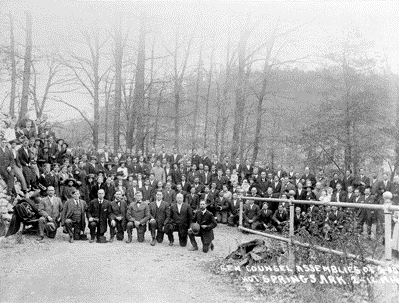

By 1913 hundreds of independent Pentecostal missions and preachers, many in the Finished Work stream, had no common structure. A call went out for a general council, and "the approximately 300 delegates to the first General Council" met in Hot Springs, Arkansas, on April 2 to 12, 1914, according to the Assemblies of God's official history.6 The founders formed a cooperative fellowship more than a centralized church. Wood writes that in 1914 the founders said they needed no "creed" beyond the Scriptures as "the all-sufficient rule for faith and practice."26 The Oneness crisis changed that, and in 1916 "the General Council approved a Statement of Fundamental Truths, which affirmed Trinitarian orthodoxy."6
The Statement, now Article V of the Assemblies of God Constitution and Bylaws, sets out sixteen truths. Two define the Pentecostal distinctive. Paragraph 7 opens: "All believers are entitled to and should ardently expect and earnestly seek the promise of the Father, the baptism in the Holy Ghost and fire," and describes that baptism as distinct from and after the new birth. Paragraph 8, quoted earlier, makes tongues the "initial physical sign," and adds that this speaking in tongues is the same in essence as the gift of tongues in 1 Corinthians 12 but different in purpose and use.7
The Assemblies of God's headquarters is in Springfield, Missouri.6 Its 2024 annual report, as presented by Ed Stetzer and Todd Korpi in June 2025, counted 3.05 million adherents in the United States, up 2.5 percent, and the World Assemblies of God Fellowship, a separate global body of national AG churches, reports more than 85 million adherents.27 The two figures should not be confused: the 3.05 million is a U.S. count, and the 85 million is a worldwide fellowship total gathered from national churches.
Aimee Semple McPherson and the Foursquare Church
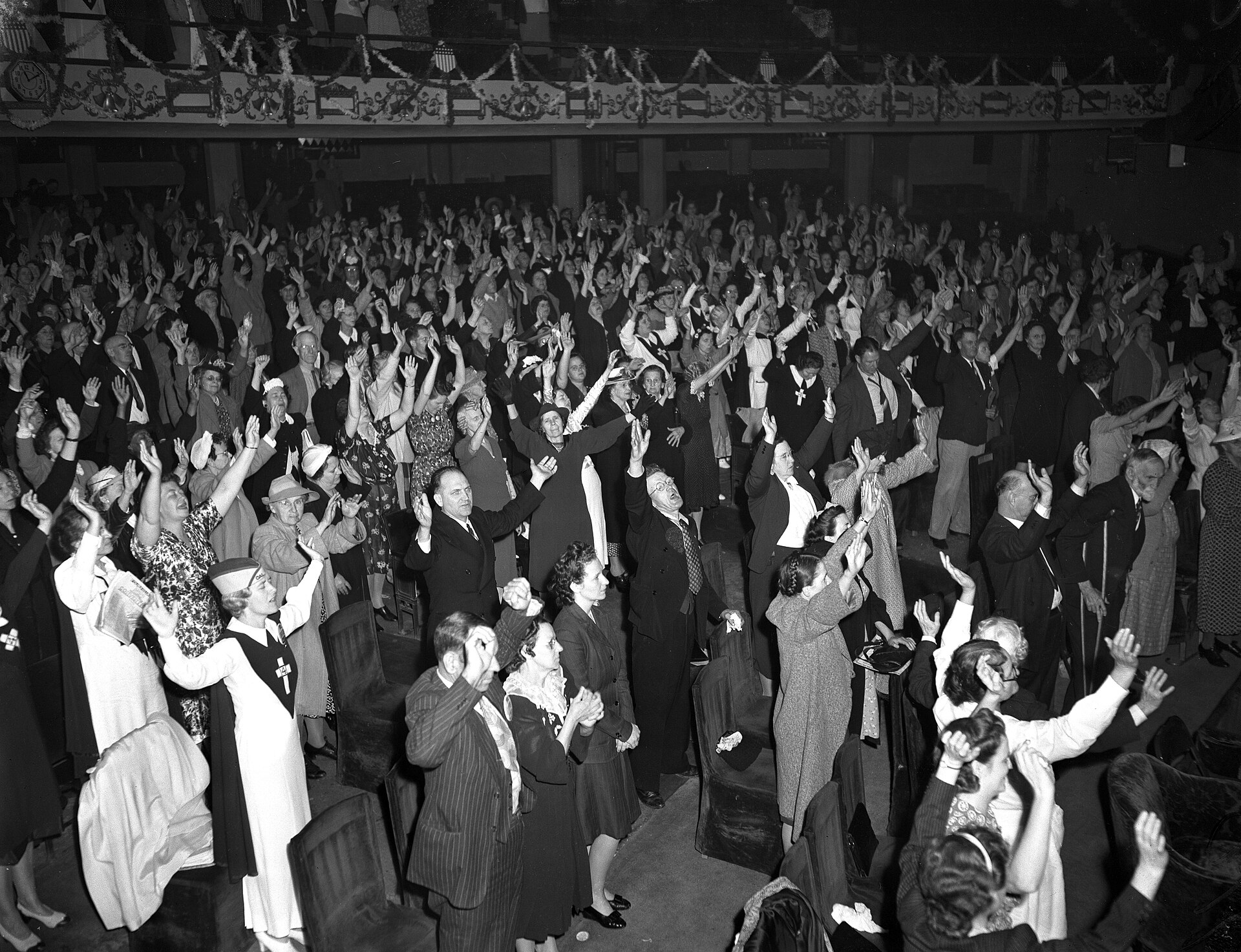

Aimee Semple McPherson was the most famous Pentecostal in America between the world wars. The Foursquare Church's own history says she returned from a mission in China in November 1910 as a 20-year-old widow and single mother.28 (The National Park Service nomination cited below records that her first husband, Robert Semple, with whom she had gone to China as a Pentecostal missionary, died there; it gives the year as 1909, while most accounts give 1910.)29 She became a traveling evangelist, and in Los Angeles she built Angelus Temple, which opened in January 1923 as the first Foursquare church.28 The National Park Service's National Historic Landmark nomination for the building records that it was completed in 1923, designed by Brook Hawkins, with 5,300 seats in the main auditorium. It calls the temple "historically significant as the base of operations for Aimee Semple McPherson, a pioneer in the field of radio evangelism," and says that "McPherson set a number of important precedents for women in religion in the early part of the 20th century."29
The Foursquare history lists the milestones: a Bible institute opened in February 1923 (today Life Pacific University); in February 1924 McPherson became the first woman to own a major radio station and used it to preach; and in December 1927, after the movement had planted about 100 churches, it began to incorporate as the International Church of the Foursquare Gospel.28 The nomination adds that the temple "provided over 1,500,000 meals to those in need" during the Great Depression.29 The name "Foursquare Gospel" refers to four roles of Christ that McPherson preached, which Encyclopaedia Britannica summarizes as the four themes of salvation, baptism with the Holy Spirit, healing and the Second Coming.30
McPherson's ministry is important to this module for two reasons. She showed that a Pentecostal church could be large, organized, media-driven and respectable in a big American city, and she ordained and sent out women as preachers in a period when most churches did not. The Foursquare Church reports more than 8.8 million members worldwide; Britannica gives 8.8 million members and 67,500 congregations as of 2021, while the church's own site speaks of more than 100,000 churches, so the count of congregations depends on how house churches and meeting points are counted.2830 Her career also included widely reported controversies, above all her disappearance in 1926 and the legal inquiry that followed. Those events belong to her biography more than to the movement's structure, and the primary records were not reviewed for this lesson, so they are not detailed here.
The healing revivalists, 1947 to 1958
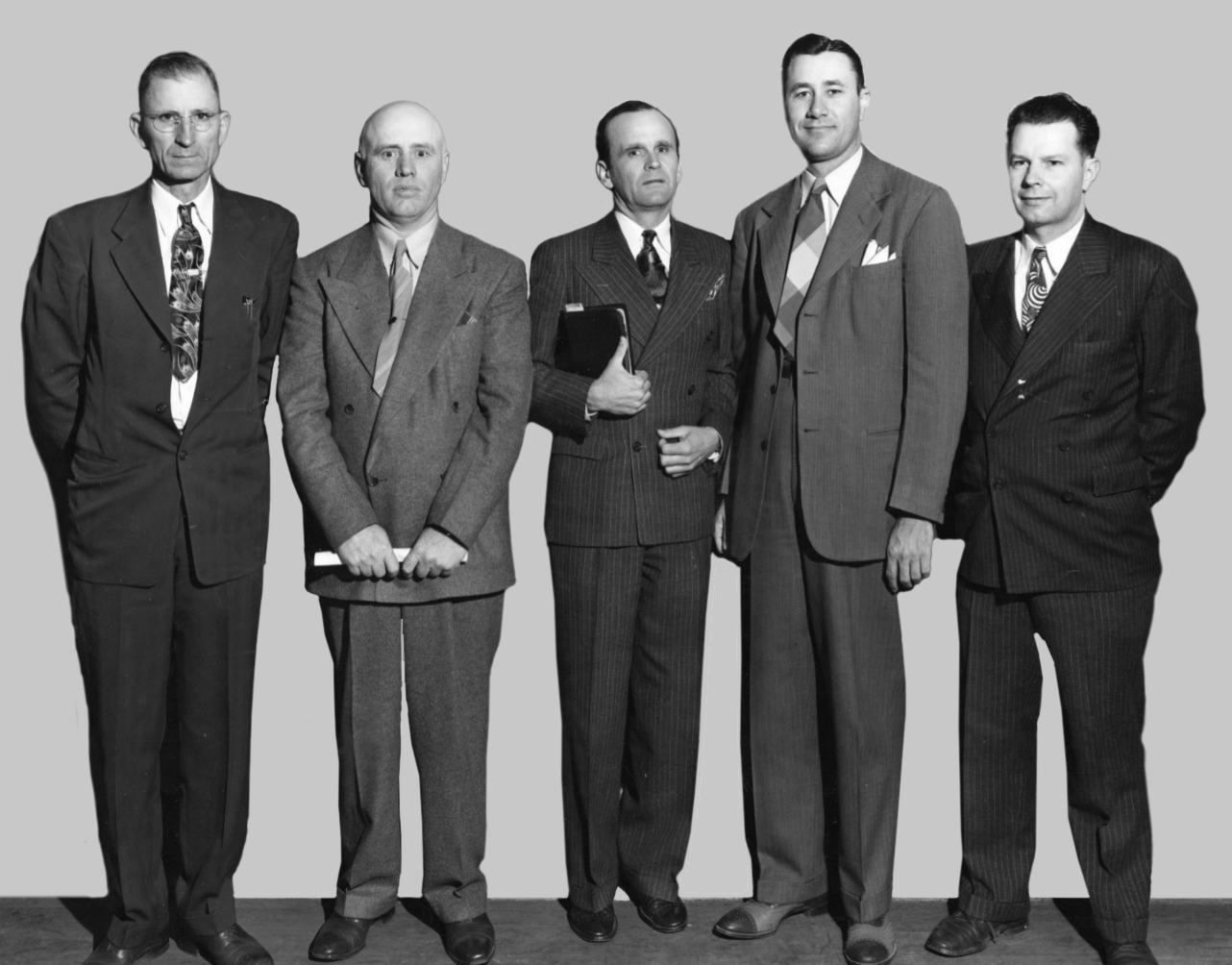

After World War II a wave of independent evangelists held tent campaigns built around prayer for the sick. The historian David Edwin Harrell Jr., in All Things Are Possible: The Healing and Charismatic Revivals in Modern America (Indiana University Press, 1975), dates this revival "roughly from 1947 to 1958" and calls it "preeminently a healing revival." Harrell opens with "Two Giants," William Branham and Oral Roberts.31 Branham, a Baptist-raised preacher from Indiana, drew crowds with reports of healings and words of knowledge; his later teachings moved far from the Pentecostal denominations. Roberts, a Pentecostal Holiness preacher from Oklahoma, took his campaigns onto television and later founded Oral Roberts University in Tulsa. Gordon Lindsay's magazine The Voice of Healing tied the evangelists together. Harrell writes that by 1958 most participants recognized the revival was over, and that independent ministries shifted toward a broader charismatic emphasis.31 The healing revival matters here mostly as a bridge: it carried Pentecostal practice out of the denominations and into a mass audience of Christians from other churches.
The Full Gospel Business Men's Fellowship, 1951
Demos Shakarian, an Armenian American dairy owner from a Pentecostal family in the Los Angeles area, organized an Oral Roberts crusade in Los Angeles in the fall of 1951. With Roberts's encouragement, he called the first meeting of the Full Gospel Business Men's Fellowship International in October 1951 in the upper room of Clifton's Cafeteria in Los Angeles. Shakarian wanted lay businessmen to tell other men their own experiences of God; the intended members, in his words, were "Just average business people who know the Lord and love Him."32 The fellowship's breakfast and banquet meetings in hotels, outside any church building, became a place where Episcopalians, Lutherans, Presbyterians and Catholics first heard Pentecostal testimony. In 1967, Catholic students from Notre Dame received the baptism in the Spirit at the South Bend home of Ray Ballard, a chapter president of the fellowship and an Assemblies of God deacon.33
The Charismatic Renewal: Van Nuys, 1960
The second wave began when the experience appeared inside the older churches and people stayed in them. The usual starting date is a sermon at St. Mark's Episcopal Church in Van Nuys, California. Dennis Joseph Bennett (born October 28, 1917, died November 1, 1991) had become rector of St. Mark's, and under him the parish grew from about 500 to 2,500 members by 1960. The Episcopal Church's own dictionary records: "On Apr. 3, 1960, Bennett preached a sermon" in which he told the congregation he had received the baptism in the Holy Spirit and spoke in tongues.34 April 3, 1960, was Passion Sunday, the fifth Sunday in Lent (Easter fell on April 17 that year), and Pentecostal histories call the event the "Passion Sunday" sermon.
Opposition followed at once. Time magazine reported on August 15, 1960, that about 700 of St. Mark's 2,000 members had taken a positive interest, that other members objected, and that in April the vestry asked Bennett to resign. Bishop Francis Eric Bloy of Los Angeles sent a new priest and a letter banning speaking in tongues under church auspices.35 The article opened by noting that the early Christians had been "much impressed by the phenomenon known as glossolalia," and it reported that "Now glossolalia seems to be on its way back in U.S. churches."3533 Newsweek covered the story under the headline "Rector and a Rumpus."33 Bennett went to St. Luke's Episcopal Church in Seattle, which the Episcopal dictionary says "was about to close," and built it into a congregation of more than 2,000 members.34 His 1970 book Nine O'Clock in the Morning sold widely.34
One detail is inconsistent in the sources: the Seattle Times obituary of November 3, 1991, says Bennett made his declaration in 1959.36 The Episcopal Church's dictionary and Time's 1960 report both place the sermon and the vestry's response in April 1960, which is the date this lesson uses.3435 The point of the Bennett story is what he did next: he stayed an Episcopal priest. Charismatics in Lutheran, Presbyterian, Methodist, Baptist and other churches followed the same pattern, seeking the baptism in the Spirit while remaining in their denominations, and many did not adopt the initial evidence doctrine.
The Catholic Charismatic Renewal, 1967
In February 1967 a group of about 25 students from Duquesne University and La Roche College went on a weekend retreat at The Ark and the Dove retreat house in Gibsonia, outside Pittsburgh. The weekend of February 17 to 19, 1967, was organized by Duquesne faculty members. De Arteaga writes that two lay theology instructors, Ralph Keifer and Patrick Bourgeois, had read David Wilkerson's The Cross and the Switchblade and John Sherrill's They Speak with Other Tongues and had received the baptism in the Spirit at a Protestant prayer group; Crux reports that the students were asked to read The Cross and the Switchblade and the first four chapters of Acts before the retreat. During the retreat most participants reported the baptism in the Holy Spirit and spoke in tongues.3733 Patti Gallagher Mansfield, then a 20-year-old Duquesne junior, later recalled feeling "like my body was on fire," and said, "I'm grateful I wrote everything down."37 The Duquesne Weekend "is acknowledged as the birth of the Catholic Charismatic Renewal movement in the United States," Crux reported at the fiftieth anniversary.37
The experience spread to Notre Dame within weeks. William De Arteaga's account in Pneuma Review traces the growth of the Notre Dame conferences: about 150 people in 1968, 450 in 1969, more than 5,000 in 1971, and 30,000 in 1976, after which the movement shifted to regional conferences.33 A retired Pentecostal missionary warned the students that if they stayed Catholic, "Then you will lose the Gift of the Spirit"; De Arteaga calls their decision to remain Spirit-filled Catholics "the defining moment in launching the Catholic Charismatic Renewal."33 Mansfield speaks of "over 120 million Catholics all over the world" touched by the renewal; that is a movement figure without published method.37 Crux reported in advance that Pope Francis would preside at a prayer service for the renewal's fiftieth anniversary at the Circus Maximus in Rome on June 3, 2017, the eve of Pentecost. Mansfield, who met him in 2014, recalled: "The Holy Father told us to remember that this grace was born ecumenical."37
The "Third Wave": C. Peter Wagner's term
C. Peter Wagner (1930 to 2016) was a former missionary to Bolivia and professor of church growth at Fuller Theological Seminary's School of World Mission in Pasadena. In the early 1980s he began to describe a third movement of the Holy Spirit in the twentieth century. The first wave was classical Pentecostalism, from Topeka and Azusa Street. The second wave was the Charismatic Renewal in the older churches, from 1960. The third wave, in his telling, was made up of evangelicals who believed in and practiced healing, prophecy and other gifts of the Spirit, but who did not call themselves Pentecostal or charismatic, did not require tongues, and did not adopt a two-stage doctrine of Spirit baptism.3839 Wagner set out the idea at length in The Third Wave of the Holy Spirit: Encountering the Power of Signs and Wonders Today (Servant Publications, 1988).39
In a 1986 Christianity Today report by Julia Duin, Wagner described the third wave's approach: "We teach how this kind of ministry can be carried out in a noncharismatic church without being divisive. And we don't stress tongues."38 The course he co-taught at Fuller beginning in 1982 with John Wimber, the pastor of the Vineyard Christian Fellowship in Anaheim, was listed as MC510, "Signs, Wonders and Church Growth." That course, its controversy at Fuller, and Wimber's movement are the subject of lesson 08. The Vineyard became the best-known third wave church, and its later history, including the Toronto Blessing of 1994, is in lesson 09.
Scholars and reference works now often use "neocharismatic" or "independent charismatic" for the very large number of churches, many in Africa, Asia and Latin America, that share Pentecostal practices but belong to neither the classical Pentecostal denominations nor the older churches. Gordon-Conwell's Center for the Study of Global Christianity calls this third type "Independent Charismatics," people who left Pentecostal or mainline denominations to form their own networks, plus similar movements that often predate the first two types.4 Wagner's "third wave" in the narrow sense was a smaller, mostly American and evangelical group; the larger "third type" in global counts is a much broader category.
A timeline, 1901 to 1994
How big is the movement? Counting depends on definitions
Nearly every account of Pentecostalism repeats a large global number. Those numbers are real estimates, made by careful researchers, but each one rests on choices about who counts.
Pew Research Center, Global Christianity (December 2011)
Pew's 2011 report, which estimated the world's Christian population as of 2010, found "about 279 million pentecostal Christians and 305 million charismatic Christians in the world," together "about 27% of all Christians" and "more than 8% of the world's total population."3 Pew's definitions: "Pentecostals are members of distinct Protestant denominations or independent churches" that teach the baptism of the Holy Spirit after conversion, while charismatics are members of non-Pentecostal churches (Catholic, Orthodox and Protestant) who hold some Pentecostal beliefs and practices.3 Three caveats appear in the report itself. The movement figures are Pew's analysis of estimates from the Center for the Study of Global Christianity at Gordon-Conwell, and they "are based primarily on numbers provided by Christian organizations," unlike the rest of the report, which rests on censuses and surveys. Using Gordon-Conwell's larger total for Christians, the combined share falls to 25.7 percent. And because many Pentecostals and charismatics are also evangelicals, "the number of evangelicals should not be added to the number of pentecostal and charismatic Christians."3
Gordon-Conwell Center for the Study of Global Christianity
The Gordon-Conwell center's own summary says: "We estimate around 600 million Pentecostal/charismatic Christians in the world in 2015." It divides them into three types: denominational Pentecostals, charismatics in non-Pentecostal churches, and independent charismatics.4 The third type is the largest swing factor. Many independent churches in Africa, Asia and Latin America practice healing, prophecy and exuberant worship without any tie to Topeka or Azusa Street, and some of them predate both. Whether they belong in a count of "Pentecostals" is a decision of the counter.
Pew Forum, Spirit and Power (October 2006)
Pew's earlier ten-country survey used "renewalist" as an umbrella term for "pentecostals and charismatics as a group," surveyed the United States, Brazil, Chile, Guatemala, Kenya, Nigeria, South Africa, India, the Philippines and South Korea, and cited the World Christian Database for the estimate that renewalists make up "at least a quarter of the world's 2 billion Christians."40
What the numbers do and do not show. They show that the Spirit-centered forms of Christianity are now a large share of world Christianity, and that most of their growth after 1960 took place outside North America. They do not show how many people speak in tongues, attend weekly, or hold the initial evidence doctrine. The Assemblies of God's own Paragraph 8 would exclude many people counted as "charismatic," and many independent churches counted in the third type have never heard of Parham or Seymour. When a sermon, website or news story gives a single global number, the questions to ask are: which year, whose estimate, and what definition.
What the record shows and what it does not
- Documented fact: Agnes Ozman spoke in tongues at Bethel Bible School in Topeka on January 1, 1901, and Parham taught tongues as the "Bible evidence" of Spirit baptism.16 The Bonnie Brae Street meeting began April 9, 1906; the mission moved to 312 Azusa Street; the Los Angeles Daily Times ran "Weird Babel of Tongues" on April 18, 1906; The Apostolic Faith began in September 1906 with 5,000 copies.21216 The Assemblies of God organized at Hot Springs on April 2 to 12, 1914, and adopted its Statement of Fundamental Truths in 1916, after which 156 ministers left.625 Bennett preached his sermon on April 3, 1960.34 The Duquesne Weekend was February 17 to 19, 1967.37
- The movement's own claim: that the experiences at Topeka and Azusa were a return of the Pentecost recorded in Acts 2 ("Pentecost has surely come," in the words of the first Apostolic Faith), and that tongues are the initial physical sign of Spirit baptism.147 These are theological claims; history can record that they were made and believed.
- Scholarly reading: Synan treats Parham as the doctrinal father; Robeck and many recent historians place the movement's real launch at Azusa Street under Seymour; Wacker reads the first generation as both primitivist and pragmatic; Harrell treats the healing revival as the bridge to the charismatic era; Daniels traces the loss of interracial fellowship.11283118
- Open questions: how Seymour was seated in Parham's Houston class; how much race, as against worship style, drove the Parham and Seymour split; the precise circulation of The Apostolic Faith after 1906; and how to define and count "charismatics" worldwide.103
Claims checked
"Pentecostalism began at Azusa Street in 1906." Partly supported
Azusa Street was the movement's great point of spread: its paper, its visitors and its missionaries carried the experience to the denominations and abroad.212 The doctrine that defines classical Pentecostalism, tongues as the evidence of Spirit baptism, was taught by Parham at Topeka in 1901, and Seymour learned it from Parham in Houston in 1905.12 The Assemblies of God's own history begins at Topeka and moves to Azusa.6 Global historians also point to revivals in Wales, India, Korea and elsewhere around the same years that were not started from Los Angeles. The fair statement is that Topeka gave the doctrine and Azusa gave the movement.
"Charles Parham founded Pentecostalism." Partly supported
Synan calls Parham the man "regarded as the founder and doctrinal father of the worldwide pentecostal movement."1 Parham formulated the initial evidence doctrine and led the first group that practiced it. He did not lead the revival that spread it, he denounced that revival when he saw it in October 1906, and his leadership ended after 1907.110 Many recent historians, including Robeck, give Seymour and the Azusa mission the larger role in the movement's formation.12
"At Azusa Street the color line was washed away in the blood." Partly supported
The mission was led by a Black pastor and drew Black, white, Latino and immigrant worshipers to the same services, which the hostile Los Angeles Daily Times itself noted.2 Christian History calls the line "often-quoted" and says it held in practice only for a short time.2 Within a few years Black congregations were leaving mixed bodies; in 1924 most white congregations left the Pentecostal Assemblies of the World; and the Pentecostal Fellowship of North America, formed in 1948, had no Black member denominations until its dissolution in 1994.1819
"Parham was expelled from Azusa Street because of his racism." Unresolved
Parham's recorded words about the meetings ("Southern darkey camp meetings," as quoted in Christian History 58) show racial contempt, and he objected to the mixing of races in worship.18 He also objected, in the accounts of both supporters and critics, to the physical manifestations, which he called fleshly. Synan records that Parham "denounced the Los Angeles meetings" as featuring "darkey camp meeting stunts" and was expelled by Seymour and the elders; Hyatt reports that two white elders told him he was not welcome.110 The sources do not settle which objection weighed more with Parham, or which weighed more with the elders who sent him away.
"Early Pentecostals spoke real foreign languages they could use on the mission field." Unsupported as a general rule
The belief was real: Parham taught it, and the first Apostolic Faith reported that some were "on their way to the foreign fields, with the gift of the language."113 The record of what happened is the test. Synan notes that Pentecostals dropped the teaching after failed attempts to preach in unknown languages in India and elsewhere.1 Later Pentecostal teaching, including the Assemblies of God's Statement, does not claim that tongues are a tool for preaching in foreign languages.7
"A quarter of the world's Christians are Pentecostal." Partly supported
Pew's 2011 analysis gave about 27 percent for Pentecostals and charismatics combined (25.7 percent on Gordon-Conwell's larger base), and Pew's 2006 survey cited the World Christian Database for "at least a quarter."340 Pentecostals in Pew's narrow sense, members of Pentecostal denominations and independent Pentecostal churches, were about 279 million, closer to an eighth of Christians. The figure also rests mainly on numbers supplied by Christian organizations.3
"The Charismatic Movement began with Dennis Bennett in 1960." Partly supported
Bennett's April 3, 1960, sermon and the Time and Newsweek coverage that followed made the experience inside an older denomination a national story.343533 The ground had been prepared by the healing revival from 1947 and by the Full Gospel Business Men's Fellowship from 1951, which brought Pentecostal testimony to members of other churches.3132 The date is a symbol for a process.
"The Assemblies of God was founded as a white denomination." Partly supported
Daniels writes that a white fellowship associated with COGIC formed the Assemblies of God in 1914 "as a predominately white fellowship."18 The Assemblies of God's own history stresses Seymour's role and says that he "preached racial reconciliation."6 Its pastor's act of foot washing in Memphis in 1994, asking forgiveness for discrimination, is the denomination's own public acknowledgment of the history.19 The founding call did not state a racial rule, and the record available here does not show one; the composition of the 1914 council and the later pattern of separate fellowships support "predominantly white."
Hard questions and answers
If tongues are the initial evidence, what about Christians who never speak in tongues?
Classical Pentecostal bodies such as the Assemblies of God answer that every believer is "entitled to" and should "earnestly seek" the baptism in the Spirit, and that tongues are its "initial physical sign"; a Christian who has not spoken in tongues is a saved Christian who has not yet received that baptism.7 Many charismatics in the older churches, and third wave leaders such as Wagner, accept the gifts but reject a required sign.38 Cessationists, a separate camp, argue from passages such as 1 Corinthians 13:8 to 10 and from church history that the miraculous gifts ended with the apostles; Pentecostals and charismatics answer from Acts 2:39 (KJV), "For the promise is unto you, and to your children, and to all that are afar off." The record cannot settle a theological question. It does show that the initial evidence doctrine was formulated in 1901, rejected by many charismatics from the 1960s on, and left out of Wagner's third wave definition. The cessationist and continuationist debate returns in lesson 06 and lesson 08.
Why did an interracial revival split along racial lines?
The sources point to several causes at once: the law and social pressure of Jim Crow, which made mixed conventions in the South difficult; leaders who would not accept Black authority over white ministers; personal and doctrinal disputes, from Parham's visit in 1906 to the Finished Work and Oneness controversies, that broke fellowships apart and often regrouped them by race; and the loss of the Azusa paper's mailing list to a white-led work in Portland.1817 The movement's own leaders later called the result sinful, as COGIC leaders said in Daniels's account and as Assemblies of God leaders acknowledged in Memphis in 1994.1819
Are the global numbers trustworthy?
They are honest estimates with stated limits. Pew itself notes that its movement figures, unlike the rest of its report, rest "primarily on numbers provided by Christian organizations."3 They are good enough to say the Spirit-centered movements are a large and growing part of world Christianity. They are not good enough to compare two numbers from different sources as if they measured the same thing, because Pew's 584 million (for 2010) and Gordon-Conwell's 600 million (for 2015) do not use identical categories or years.34
Does Parham's personal record discredit the doctrine he taught?
Pentecostal churches have answered by separating the teaching from the teacher. The Assemblies of God keeps Topeka and January 1, 1901, in its official history and keeps the initial evidence doctrine in its Statement, while giving Seymour and Azusa Street the central place in the story.67 Historians record Parham's racial views and the 1907 accusation (Synan records an acquittal) as part of the record, and most Pentecostals do not trace their teaching to his authority; they trace it to their reading of Acts.118 A reader may weigh the founder's character as evidence about a movement; the movement's own answer is that its doctrine stands or falls on Scripture.
Is the "third wave" a new movement or a new label for an old one?
Wagner presented it as new: evangelicals practicing healing and other gifts while rejecting both the Pentecostal doctrine of a second experience and the charismatic label.3839 Pentecostal observers often treated it as one more form of the charismatic movement, and cessationist critics treated it as the same claims in new language. The record supports a narrower statement: the third wave was a distinct network (Fuller's School of World Mission, the Vineyard and their allies) with its own theology of "power evangelism," and its practices overlapped heavily with charismatic ones. Lessons 08 and 09 test this against the Vineyard's own history.
How does this connect to Calvary Chapel and the Jesus People?
Chuck Smith came out of the Foursquare Church, McPherson's denomination, before he went to Calvary Chapel Costa Mesa, and the Jesus People revival of the late 1960s drew on both Pentecostal and evangelical streams. Calvary Chapel came to describe itself as standing between the Pentecostal and the non-charismatic churches, and the Vineyard began inside Calvary Chapel before parting with it. Those claims and their dates are tested in lesson 05, lesson 06 and lesson 10.
Related lessons
- Lesson 01: Holiness and Pietism, for the second blessing teaching that the first Pentecostals inherited.
- Lesson 03: Evangelicalism Defined, for the National Association of Evangelicals, which admitted Pentecostal denominations from its founding years, and for the evangelical coalition.
- Lesson 04: Non-Denominational Churches, for the independent churches that grew out of the charismatic and third wave streams.
- Lesson 08 and lesson 09, for John Wimber, MC510 and the third wave in practice.
- Liberty 58, lesson 14: The New Theology, Barth and the Liberal Church, for the theological climate in the mainline churches where the Charismatic Renewal appeared.
Learn more
- The Apostolic Faith, Azusa Street papers (scans and reproductions): Read the mission's own newspaper from 1906 on, in its original pages.
- Christian History 58: The Rise of Pentecostalism (1998): A readable issue with articles on Azusa Street, race, the Finished Work and Oneness controversies.
- Pew Research Center, Global Christianity (2011): The most cited global count, with its definitions and caveats stated.
- Assemblies of God, Statement of Fundamental Truths: The largest U.S. Pentecostal body's own statement on Spirit baptism and tongues.
- The Memphis Miracle at 30: The Assemblies of God archivist's account of the 1994 reconciliation meeting.
- Cecil M. Robeck Jr. interview on Azusa Street: The leading historian of the mission on what happened and why it spread.
Still being checked (24 items)
These points could not be confirmed against a primary source when this lesson was written and fact checked in October 2026. The text above states each one as uncertain.
- Wagner's first published use of the term "third wave" (often cited as a 1983 article in Pastoral Renewal) was not located; the lesson says only "early 1980s" and cites Theopedia for "about 1980" and Wagner's 1988 book.
- The MC510 course title ("Signs, Wonders and Church Growth"), its 1982 start and Wagner's earlier missionary service in Bolivia were not checked in this session; lesson 08 should verify them.
- Wagner's birth and death years (1930 to 2016) were confirmed only from Wikipedia's article and its citation of Ed Stetzer's 2016 Christianity Today obituary, which was not opened.
- Durham's death in July 1912 is cited to Riss's dictionary entry, which was not opened; Christian History's "Sanctification Scuffles" as summarized appeared to place his death in 1911. Christian History also dates Durham's Azusa visit to 1906, while many accounts give early 1907.
- Seymour's birth date (May 2, 1870) rests on the Wikimedia Commons description and standard accounts; no birth record was opened.
- The account that Florence Crawford and Clara Lum took The Apostolic Faith's mailing list to Portland in 1908 comes from secondary histories (Robeck and others) and was not checked against the papers; the Apostolic Faith Church's page says only that printing had moved to Portland by the fourteenth edition.
- Circulation figures for The Apostolic Faith above the first issue's 5,000 copies (40,000 to 50,000) come from secondary summaries of the paper's own claims.
- The Los Angeles Daily Times article of April 18, 1906, was quoted from Christian History 58, not from a scan of the newspaper; the page number was not confirmed.
- Parham's 1907 San Antonio case: Synan says he was acquitted; other accounts say the charge was dropped before trial. Neither court record was opened.
- G. B. Cashwell's role in A. J. Tomlinson's 1908 Spirit baptism comes from narrative histories; the Church of God's own brief history does not name him.
- The Seattle Times obituary (Nov. 3, 1991) dates Bennett's declaration to 1959; the Episcopal Church dictionary and Time (Aug. 15, 1960) support April 1960. De Arteaga's article gives "August 3, 1960," which conflicts with both and appears to be an error; Newsweek's "Rector and a Rumpus" date (given by De Arteaga as July 4, 1960) was not checked.
- Angelus Temple's exact opening day (commonly given as Jan. 1, 1923) was not confirmed; Foursquare says January 1923 and the NPS nomination says completed in 1923. Britannica's wording implies a later dedication.
- Foursquare congregation counts disagree: Britannica (2021) gives 67,500 congregations; the church's site says more than 100,000 churches.
- Background statements in the bridge answers (Chuck Smith's Foursquare background, Calvary Chapel's self-description, the NAE's admission of Pentecostal denominations, revivals in Wales, India and Korea) were not checked in this session and are left for lessons 03, 05 and 06 to source.
- Grant Wacker's primitivism and pragmatism thesis is summarized from general knowledge of Heaven Below; the book was not opened.
- COGIC's own membership claims and an independent count were not obtained.
- Fact check of Oct. 28, 2026: the Bartleman attribution of "the color line was washed away in the blood" is now supported by McClymond, Christian History 153 (note 13), which quotes it as "washed away in [Jesus's] blood"; Bartleman's book itself was not opened.
- Whether Seymour sat outside Parham's Houston classroom is disputed: Christian History 58 says he sat in the hallway; Pauline Parham, quoted by Hyatt, calls that "an undocumented account" (the words are hers, not Hyatt's).
- That white ministers sought COGIC credentials for clergy railroad rates is repeated in narrative histories and was not checked; the Tennessee Encyclopedia (note 20) supports the incorporation and the ordination of white clergy.
- Robert Semple's death year: the NPS nomination says 1909; most accounts give 1910. Branham's and Roberts's backgrounds, Oral Roberts University and Gordon Lindsay's Voice of Healing magazine are stated from standard accounts and were not separately checked. Shakarian's Armenian American background and dairy business are now supported by De Arteaga (note 32).
- "The Ark and the Dove" as the name of the Gibsonia retreat house is not in the two sources cited (Crux says only "the same retreat house chapel in Gibsonia").
- The Religion in Kansas Project exhibit dates the San Francisco earthquake to April 17, 1906; it struck early on April 18, 1906, the date used in this lesson (Christian History 58).
- Pope Francis's presence at the Circus Maximus on June 3, 2017, is cited from Crux's advance report of Feb. 18, 2017; no report of the event itself was opened.
- Christian History (Gill) counts "156 members" leaving the Assemblies of God in 1916; the lesson's "156 ministers" follows the usual reading that council members were ministers.
Notes
- Vinson Synan, "Parham, Charles Fox (1873-1929)," Encyclopedia of the Great Plains, ed. David J. Wishart, University of Nebraska-Lincoln (retrieved Oct. 28, 2026). Read it online. ↩
- Ted Olsen, "American Pentecost," Christian History 58, "The Rise of Pentecostalism" (1998), Christian History Institute (retrieved Oct. 28, 2026). Quotes the Los Angeles Daily Times, April 18, 1906. Read it online. ↩
- Pew Research Center, Forum on Religion and Public Life, "Global Christianity: A Report on the Size and Distribution of the World's Christian Population," Dec. 19, 2011, section "Christian Movements and Denominations" (retrieved Oct. 28, 2026). Read it online. ↩
- Center for the Study of Global Christianity, Gordon-Conwell Theological Seminary, "Quick Facts" (estimate for 2015 and the three types of Pentecostal/charismatic Christians) (retrieved Oct. 28, 2026). Read it online. ↩
- "1901 Topeka Outpouring," Revival Library (revival-library.org), undated narrative history quoting Agnes Ozman's later testimony (retrieved Oct. 28, 2026). Read it online. ↩
- General Council of the Assemblies of God (USA), "History," ag.org (retrieved Oct. 28, 2026). Read it online. ↩
- General Council of the Assemblies of God, Constitution and Bylaws, Article V, Statement of Fundamental Truths, paragraphs 7 and 8, as reproduced in "Speaking in Tongues," ag.org position resource (PDF) (retrieved Oct. 28, 2026). Read it online. ↩
- Grant Wacker, Heaven Below: Early Pentecostals and American Culture (Cambridge, Mass.: Harvard University Press, 2001). Thesis summarized, not quoted. Read it online. ↩
- Wikimedia Commons, file description for "William Joseph Seymour.jpg" (life dates May 2, 1870, to Sept. 28, 1922, as given with the public domain photograph) (retrieved Oct. 28, 2026). Read it online. ↩
- Eddie L. Hyatt, "Across the Lines: Charles Parham's Contribution to the Inter-Racial Character of Early Pentecostalism," Pneuma Review, Fall 2004, page 2 (retrieved Oct. 28, 2026). Read it online. ↩
- Religion in Kansas Project, University of Kansas Religious Studies Department, "Azusa Founding," in the online exhibit "The Roots of Pentecostalism in Kansas" (retrieved Oct. 28, 2026). Read it online. ↩
- "The Azusa Street Revival," Influence magazine, Aug. 7, 2017, summary of George P. Wood's podcast interview with Cecil M. Robeck Jr., Fuller Theological Seminary (retrieved Oct. 28, 2026). Read it online. ↩
- Michael J. McClymond, "Azusa Street commentary and excerpts," Christian History 153, "Global Outpouring" (2024), quoting The Apostolic Faith, September and November 1906 (retrieved Oct. 28, 2026). Read it online. ↩
- The Apostolic Faith (Los Angeles: Apostolic Faith Mission, 312 Azusa Street), vol. 1, no. 1, September 1906, p. 1, "Pentecost Has Come"; original and reproduction held online by the Apostolic Faith Church, Portland, Oregon (retrieved Oct. 28, 2026). Read it online. ↩
- Charles A. Sullivan, "The Apostolic Faith Newspaper on the Azusa Street Revival," transcription of vol. 1, no. 1 (September 1906), charlesasullivan.com (retrieved Oct. 28, 2026). Read it online. ↩
- Apostolic Faith Church, "Headquarters Office Publication Ministry: Roots," apostolicfaith.org (retrieved Oct. 28, 2026). Read it online. ↩
- Apostolic Faith Church, "Historical Materials: Azusa Papers," apostolicfaith.org (retrieved Oct. 28, 2026). Read it online. ↩
- David D. Daniels, "They Had a Dream" (now titled "Why Pentecostalism's Multiethnic Beginning Floundered"), Christian History 58 (1998), with the editors' introduction, quoting the Church of God in Christ manual of 1918 (retrieved Oct. 28, 2026). Read it online. ↩
- Darrin J. Rodgers, "Racial Reconciliation: The Memphis Miracle at 30," AG News, October 2024, from Influence, Summer 2024 (retrieved Oct. 28, 2026). Read it online. ↩
- Randolph Meade Walker, "Church of God in Christ (COGIC)," Tennessee Encyclopedia, Tennessee Historical Society, Oct. 8, 2017, updated Mar. 1, 2018 (retrieved Oct. 28, 2026). Read it online. ↩
- David G. Roebuck, "A Brief History," Church of God History and Heritage, cogheritage.org (retrieved Oct. 28, 2026). Read it online. ↩
- Charles A. Sherrill, "Church of God," Tennessee Encyclopedia, Tennessee Historical Society (retrieved Oct. 28, 2026). Read it online. ↩
- James R. Goff Jr., "Sanctification Scuffles," Christian History 58 (1998), quoting William H. Durham (retrieved Oct. 28, 2026). Read it online. ↩
- R. M. Riss, "Durham, William H.," in Stanley M. Burgess and Eduard M. van der Maas, eds., The New International Dictionary of Pentecostal and Charismatic Movements (Grand Rapids: Zondervan, 2002), 594 to 595. Cited for the July 1912 death date; this reference work was not opened for this lesson. ↩
- Kenneth Gill, "Dividing over Oneness," Christian History 58 (1998), quoting Frank J. Ewart (retrieved Oct. 28, 2026). Read it online. ↩
- George O. Wood, "Statement of Fundamental Truths Centennial," AG News, October 2016 (retrieved Oct. 28, 2026). Read it online. ↩
- Ed Stetzer and Todd Korpi, "Pentecostals Keep Growing: What the Assemblies of God's 2024 Report Shows About the Spirit-Filled Movement," ChurchLeaders, June 24, 2025, reporting the Assemblies of God annual statistical report for 2024 (retrieved Oct. 28, 2026). Read it online. ↩
- The Foursquare Church, "Our History," foursquare.org (retrieved Oct. 28, 2026). Read it online. ↩
- National Park Service, National Historic Landmark nomination form, "Angelus Temple," Los Angeles, California, NPGallery (retrieved Oct. 28, 2026). Read it online. ↩
- Encyclopaedia Britannica, "International Church of the Foursquare Gospel" (membership as of 2021) (retrieved Oct. 28, 2026). Read it online. ↩
- David Edwin Harrell Jr., All Things Are Possible: The Healing and Charismatic Revivals in Modern America (Bloomington: Indiana University Press, 1975), introduction and chapter 1, "Two Giants," as shown in the publisher's preview on Everand (retrieved Oct. 28, 2026). Read it online. ↩
- William L. De Arteaga, "Demos Shakarian and His Ecumenical Businessmen," Pneuma Review, Summer 2014 (Aug. 4, 2014), page 3, quoting Demos Shakarian (retrieved Oct. 28, 2026). Read it online. ↩
- William L. De Arteaga, "The Charismatic Renewal," Pneuma Review, 2016, page 2 (retrieved Oct. 28, 2026). Read it online. ↩
- The Episcopal Church, An Episcopal Dictionary of the Church, "Bennett, Dennis Joseph" (retrieved Oct. 28, 2026). Read it online. ↩
- "Religion: Speaking in Tongues," Time, Aug. 15, 1960 (retrieved Oct. 28, 2026). Read it online. ↩
- "Dennis Bennett Dies; Charismatic Pastor," Seattle Times, Nov. 3, 1991 (retrieved Oct. 28, 2026). Read it online. ↩
- Peter Finney Jr., "Charismatic Renewal marks 50th anniversary of founding," Crux, Feb. 18, 2017, from the Clarion Herald, Archdiocese of New Orleans (retrieved Oct. 28, 2026). Read it online. ↩
- Julia Duin, "What Does the Future Hold for the Charismatic Renewal?" Christianity Today, May 16, 1986, quoting C. Peter Wagner (retrieved Oct. 28, 2026). Read it online. ↩
- C. Peter Wagner, The Third Wave of the Holy Spirit: Encountering the Power of Signs and Wonders Today (Ann Arbor: Servant Publications, 1988); for the dating of the term to about 1980, Theopedia, "Third Wave" (retrieved Oct. 28, 2026). Wagner's first published use of the term was not located for this lesson. Read it online. ↩
- Pew Forum on Religion and Public Life, "Spirit and Power: A 10-Country Survey of Pentecostals," Oct. 5, 2006 (retrieved Oct. 28, 2026). Read it online. ↩
Check yourself
1. What did Charles Fox Parham add to Holiness teaching that defined classical Pentecostalism?
Healing, premillennialism and the second blessing were already Holiness teachings. Parham's distinctive claim, after the Topeka meetings of January 1901, was that tongues are the evidence of Spirit baptism.
2. Where did the Los Angeles revival of April 1906 begin before it moved to 312 Azusa Street?
Hutchins's mission locked Seymour out. The prayer meetings moved to the home of Richard and Ruth Asberry on North Bonnie Brae Street, where tongues began on April 9, 1906.
3. What else happened on April 18, 1906, the day the Los Angeles Daily Times ran "Weird Babel of Tongues"?
The hostile article appeared the morning of the San Francisco earthquake. The Apostolic Faith began in September 1906 and Parham came in October.
4. William Durham's Finished Work teaching (1910) rejected which belief?
Durham taught that the cross provided both salvation and sanctification. He kept the initial evidence teaching; the Oneness controversy over the Trinity came later.
5. What happened at the Assemblies of God General Council in St. Louis in October 1916?
The fellowship was organized at Hot Springs in April 1914. The 1916 council adopted a Trinitarian Statement of Fundamental Truths, and 156 ministers left.
6. According to Pew's 2011 report, about how many Pentecostal and charismatic Christians were there, and who produced the underlying estimates?
Pew reported about 279 million Pentecostals and 305 million charismatics (584 million) as its analysis of Gordon-Conwell estimates, based mainly on numbers from Christian organizations.
7. Why is Dennis Bennett's April 3, 1960, sermon treated as the start of the Charismatic Renewal?
Bennett remained in the Episcopal Church, moving to St. Luke's in Seattle, and Time and Newsweek covered the dispute. That pattern of receiving the experience and staying in an older church defines the second wave.
8. How did C. Peter Wagner describe the "third wave"?
Wagner's third wave followed the classical Pentecostal first wave and the charismatic second wave, and described evangelicals who sought signs and wonders without the label or the tongues requirement; the Vineyard became its best-known example.
Terms in this lesson
- Baptism in the Holy Spirit
- In Pentecostal teaching, an experience distinct from and after conversion that gives power for witness and service, based on Acts 1 and 2.
- Initial evidence
- The doctrine, first taught by Parham in 1901, that speaking in tongues is the first outward sign of the baptism in the Holy Spirit. The Assemblies of God calls it the "initial physical sign."
- Glossolalia
- Speaking in tongues: speech in a language unknown to the speaker, understood by Pentecostals and charismatics as a gift of the Spirit.
- Xenolalia
- Speaking a real human language the speaker never learned. Parham and the early Azusa paper expected it to equip missionaries; Pentecostals later dropped the expectation.
- Holiness movement
- The nineteenth century Methodist-rooted movement teaching entire sanctification as a second work of grace; most early Pentecostals came from it (see lesson 01).
- Finished Work
- William Durham's teaching (1910) that sanctification is provided by Christ's finished work at the cross and grows from conversion, not a second crisis experience.
- Oneness Pentecostalism
- The branch, begun in 1913 to 1916, that teaches one God revealed as Father, Son and Spirit without three persons, and baptism in the name of Jesus only.
- Classical Pentecostal
- A member of a denomination descended from the Topeka and Azusa Street revivals, such as the Assemblies of God, the Church of God in Christ or the Foursquare Church; Wagner's "first wave."
- Charismatic
- A Christian in a non-Pentecostal church (Catholic, Episcopal, Lutheran and others) who has received the baptism in the Spirit or practices spiritual gifts while staying in that church; the "second wave."
- Third wave
- C. Peter Wagner's early 1980s term for evangelicals who practice healing, prophecy and other gifts without the Pentecostal or charismatic label or a tongues requirement; the Vineyard is the best-known example.
- Renewalist
- An umbrella term used by the Pew Forum in 2006 for Pentecostals and charismatics counted together.
- Independent charismatics
- Gordon-Conwell's term for Spirit-centered churches and networks outside both the Pentecostal denominations and the older churches, many in the Global South; the largest swing factor in global counts.
- Memphis Miracle
- The October 18 to 19, 1994, meeting in Memphis at which the predominantly white Pentecostal Fellowship of North America (which had no Black member denominations) dissolved and the interracial Pentecostal and Charismatic Churches of North America formed.
Sources
- Vinson Synan, "Parham, Charles Fox (1873-1929)," Encyclopedia of the Great Plains, ed. David J. Wishart, University of Nebraska-Lincoln (2011) checked 2026-10
- Ted Olsen, "American Pentecost," Christian History 58, "The Rise of Pentecostalism" (1998), Christian History Institute (1998) checked 2026-10
- Pew Research Center, Forum on Religion and Public Life, "Global Christianity: A Report on the Size and Distribution of the World's Christian Population," Dec. 19, 2011, section "Christian Movements and Denominations" (2011-12-19) checked 2026-10
- Center for the Study of Global Christianity, Gordon-Conwell Theological Seminary, "Quick Facts" (estimate for 2015 and the three types of Pentecostal/charismatic Christians) (2015 estimate) checked 2026-10
- "1901 Topeka Outpouring," Revival Library (revival-library.org), undated narrative history quoting Agnes Ozman's later testimony (undated) checked 2026-10
- General Council of the Assemblies of God (USA), "History," ag.org (current) checked 2026-10
- General Council of the Assemblies of God, Constitution and Bylaws, Article V, Statement of Fundamental Truths, paragraphs 7 and 8, as reproduced in "Speaking in Tongues," ag.org position resource (PDF) (current (adopted 1916, as amended)) checked 2026-10
- Grant Wacker, Heaven Below: Early Pentecostals and American Culture (Cambridge, Mass.: Harvard University Press, 2001). Thesis summarized, not quoted. (2001) checked 2026-10
- Wikimedia Commons, file description for "William Joseph Seymour.jpg" (life dates May 2, 1870, to Sept. 28, 1922, as given with the public domain photograph) (1910s photograph) checked 2026-10
- Eddie L. Hyatt, "Across the Lines: Charles Parham's Contribution to the Inter-Racial Character of Early Pentecostalism," Pneuma Review, Fall 2004, page 2 (2004) checked 2026-10
- Religion in Kansas Project, University of Kansas Religious Studies Department, "Azusa Founding," in the online exhibit "The Roots of Pentecostalism in Kansas" (undated) checked 2026-10
- "The Azusa Street Revival," Influence magazine, Aug. 7, 2017, summary of George P. Wood's podcast interview with Cecil M. Robeck Jr., Fuller Theological Seminary (2017-08-07) checked 2026-10
- Michael J. McClymond, "Azusa Street commentary and excerpts," Christian History 153, "Global Outpouring" (2024), quoting The Apostolic Faith, September and November 1906 (2024) checked 2026-10
- The Apostolic Faith (Los Angeles: Apostolic Faith Mission, 312 Azusa Street), vol. 1, no. 1, September 1906, p. 1, "Pentecost Has Come"; original and reproduction held online by the Apostolic Faith Church, Portland, Oregon (1906-09) checked 2026-10
- Charles A. Sullivan, "The Apostolic Faith Newspaper on the Azusa Street Revival," transcription of vol. 1, no. 1 (September 1906), charlesasullivan.com (1906-09 (transcription)) checked 2026-10
- Apostolic Faith Church, "Headquarters Office Publication Ministry: Roots," apostolicfaith.org (current) checked 2026-10
- Apostolic Faith Church, "Historical Materials: Azusa Papers," apostolicfaith.org (current) checked 2026-10
- David D. Daniels, "They Had a Dream," Christian History 58 (1998), quoting the Church of God in Christ manual of 1918 (1998) checked 2026-10
- Darrin J. Rodgers, "Racial Reconciliation: The Memphis Miracle at 30," AG News, October 2024, from Influence, Summer 2024 (2024-10) checked 2026-10
- Randolph Meade Walker, "Church of God in Christ (COGIC)," Tennessee Encyclopedia, Tennessee Historical Society, Oct. 8, 2017, updated Mar. 1, 2018 (2017-10-08) checked 2026-10
- David G. Roebuck, "A Brief History," Church of God History and Heritage, cogheritage.org (current) checked 2026-10
- Charles A. Sherrill, "Church of God," Tennessee Encyclopedia, Tennessee Historical Society (undated) checked 2026-10
- "Sanctification Scuffles," Christian History 58 (1998), quoting William H. Durham (1998) checked 2026-10
- R. M. Riss, "Durham, William H.," in Stanley M. Burgess and Eduard M. van der Maas, eds., The New International Dictionary of Pentecostal and Charismatic Movements (Grand Rapids: Zondervan, 2002), 594 to 595. Cited for the July 1912 death date; this reference work was not opened for this lesson. (2002) checked 2026-10
- "Dividing over Oneness," Christian History 58 (1998), quoting Frank J. Ewart (1998) checked 2026-10
- George O. Wood, "Statement of Fundamental Truths Centennial," AG News, October 2016 (2016-10) checked 2026-10
- Ed Stetzer and Todd Korpi, "Pentecostals Keep Growing: What the Assemblies of God's 2024 Report Shows About the Spirit-Filled Movement," ChurchLeaders, June 24, 2025, reporting the Assemblies of God annual statistical report for 2024 (2025-06-24) checked 2026-10
- The Foursquare Church, "Our History," foursquare.org (current) checked 2026-10
- National Park Service, National Historic Landmark nomination form, "Angelus Temple," Los Angeles, California, NPGallery (nomination form (undated in text)) checked 2026-10
- Encyclopaedia Britannica, "International Church of the Foursquare Gospel" (membership as of 2021) (current) checked 2026-10
- David Edwin Harrell Jr., All Things Are Possible: The Healing and Charismatic Revivals in Modern America (Bloomington: Indiana University Press, 1975), introduction and chapter 1, "Two Giants," as shown in the publisher's preview on Everand (1975) checked 2026-10
- "Demos Shakarian and His Ecumenical Businessmen," Pneuma Review, page 3, quoting Demos Shakarian (undated) checked 2026-10
- William L. De Arteaga, "The Charismatic Renewal," Pneuma Review, 2016, page 2 (2016) checked 2026-10
- The Episcopal Church, An Episcopal Dictionary of the Church, "Bennett, Dennis Joseph" (current) checked 2026-10
- "Religion: Speaking in Tongues," Time, Aug. 15, 1960 (1960-08-15) checked 2026-10
- "Dennis Bennett Dies; Charismatic Pastor," Seattle Times, Nov. 3, 1991 (1991-11-03) checked 2026-10
- Peter Finney Jr., "Charismatic Renewal marks 50th anniversary of founding," Crux, Feb. 18, 2017, from the Clarion Herald, Archdiocese of New Orleans (2017-02-18) checked 2026-10
- Julia Duin, "What Does the Future Hold for the Charismatic Renewal?" Christianity Today, May 16, 1986, quoting C. Peter Wagner (1986-05-16) checked 2026-10
- C. Peter Wagner, The Third Wave of the Holy Spirit: Encountering the Power of Signs and Wonders Today (Ann Arbor: Servant Publications, 1988); for the dating of the term to about 1980, Theopedia, "Third Wave" (1988) checked 2026-10
- Pew Forum on Religion and Public Life, "Spirit and Power: A 10-Country Survey of Pentecostals," Oct. 5, 2006 (2006-10-05) checked 2026-10
- Cecil M. Robeck Jr., The Azusa Street Mission and Revival: The Birth of the Global Pentecostal Movement (Nashville: Thomas Nelson, 2006) (2006) checked 2026-10
- Vinson Synan, The Holiness-Pentecostal Tradition: Charismatic Movements in the Twentieth Century, 2nd ed. (Grand Rapids: Eerdmans, 1997) (1997) checked 2026-10
- Wikimedia Commons image pages for the seven photographs used (see captions) (various) checked 2026-10