Lesson 5 of 14 · about 60 minutes · Updated October 28, 2026
Congregationalists and the Puritans: From the Mayflower to the United Church of Christ
You'll be able to
- Explain the difference between Separatists and Non-Separatists and why it decided who settled Plymouth and who settled Boston.
- Quote and explain the Cambridge Platform's definition of a Congregational church and its teaching on the civil magistrate.
- Describe the Half-Way Covenant of 1662, why it was adopted, and why Jonathan Edwards rejected the looser practice that followed it.
- Trace disestablishment in Connecticut (1818) and Massachusetts (1833) and the Unitarian departure, including the Dedham case.
- Follow the mergers that produced the United Church of Christ in 1957 and state each side's reasons in the dispute over the union.
- Compare the UCC, the NACCC and the CCCC today, using each body's own statements and figures.
Start here: the short version
Congregationalism is the Protestant family that holds that each local church, gathered by a covenant among believers, is a complete church under Christ, with no bishop or presbytery above it. It grew out of the English Puritan movement in the late 1500s. Some Puritans (the Separatists) left the Church of England outright; others (the Non-Separatists) said they were reforming it from within. A Separatist congregation from Scrooby, by way of Leiden in the Netherlands, crossed on the Mayflower and signed the Mayflower Compact at Cape Cod on November 11, 1620 (Old Style), then settled Plymouth that December. A much larger Non-Separatist migration founded Massachusetts Bay in 1630 under John Winthrop. The New England churches set down their order in the Cambridge Platform (1648), loosened the terms of baptism with the Half-Way Covenant (1662), and were supported by taxes until Connecticut (1818) and Massachusetts (1833) ended the arrangement. In the early 1800s many of the oldest Massachusetts churches became Unitarian. The remaining Congregationalists united with the Christian Church in 1931 and with the Evangelical and Reformed Church on June 25, 1957, to form the United Church of Christ, which reported 666,073 members in 4,431 congregations for 2024. Churches that refused the 1957 merger formed the National Association of Congregational Christian Churches (1955) and joined the Conservative Congregational Christian Conference (founded 1948).
Where this lesson begins
The sixteenth century background is taught elsewhere on this site. Calvin's Geneva, the English break with Rome under Henry VIII, Cranmer and the 1549 and 1552 prayer books are in Church History, Part A, lesson 12, and Luther's own story is in lesson 11 of that module. The Elizabethan Settlement of 1559, the Thirty-nine Articles and the prayer book that the Puritans wanted to reform are in lesson 04 of this module, and the Calvinist doctrine that nearly every early Congregationalist held is set out in lesson 03. This lesson picks up the story with the English Protestants who thought the Elizabethan church had stopped halfway, follows them to New England, and traces their churches to 2026.
Congregationalists have always been hard to pin down with a single creed, and they say so themselves. Williston Walker, the Hartford Seminary historian whose 1893 collection of their documents is still the standard source, opened his preface with this sentence: "CONGREGATIONALISM has always accorded large liberty to local churches in their interpretation of doctrine and polity."1 The family is defined less by a confession than by a way of forming and governing a church. That is why the lesson spends as much time on covenants, platforms and votes as on doctrine.
Puritans, Separatists and Non-Separatists
What the word "Puritan" meant
"Puritan" began as a hostile nickname in Elizabethan England for Protestants who wanted the national church purified of what they saw as leftovers of Roman practice: the surplice, kneeling at communion, the sign of the cross in baptism, saints' days, and government by bishops. Most Puritans did not want to leave the Church of England. They wanted to change it, by Parliament, by preaching, or by quiet practice in their own parishes. They shared a Reformed theology (the Calvinism of lesson 03), a high regard for preaching, strict keeping of the Lord's Day, and a conviction that the church should be made up, as far as humans could judge, of people who showed real faith.
Within that movement there were two answers to a hard question: what does a believer do when the national church refuses to reform? One group, later called Presbyterians, wanted the Church of England governed by elders and synods on the Scottish and Genevan model (their story is lesson 02). A second group concluded that the true church in the New Testament was the local congregation, gathered by covenant, choosing its own officers. Of that second group, some separated from the parish churches completely. Others kept communion with the Church of England while organizing congregations of their own. Historians call these the Separatists and the Non-Separatists, and the difference between them decided who went to Plymouth and who went to Boston.
Robert Browne, Henry Barrow and John Greenwood
Robert Browne gathered a Separatist congregation in the early 1580s, took it into exile at Middelburg in the Netherlands, and published tracts arguing that Christians should reform the church without waiting for the magistrate. Walker records that when the tracts were smuggled into England and the queen forbade them, two of Browne's followers, John Coppin and Elias Thacker, "were condemned and hanged in the summer of 1583" for distributing them.2 Browne himself later returned to the Church of England and died, Walker writes, in Northampton jail "sometime between June, 1631, and November, 1633."2 His name survived as an insult: Separatists were "Brownists" in English pamphlets for decades.
Browne's ideas outlived his leadership. His writings already contain the main features of Congregational order, including election of officers by the congregation. Walker's account credits him with the rule that officers are chosen with the consent of the people, gathered by the elders and given by voice (a paraphrase: the exact wording could not be confirmed in the scanned copies of Walker checked for this lesson).2 In London, Henry Barrow and John Greenwood led a Separatist congregation in the 1580s and 1590s. Both spent years in prison, both wrote from their cells, and both were executed on April 6, 1593.2 Their congregation fled to Amsterdam, where it published a confession in 1596 that Walker also reprints.
Henry Jacob and the non-separating way
Henry Jacob took the other road. He held that a true church is a congregation joined by consent, yet he refused to call the parish churches of England false churches. Walker calls him "a Congregationalist of great desert, the friend of Robinson, who founded, in 1616, in Southwark, London, the first Congregational church to maintain a continuous existence on English soil."3 Jacob defined the church this way in a book printed at Leiden in 1610: "A true Visible & Ministeriall Church of Christ is a nomber of faithfull people joyned by their willing consent in a spirituall outward society."3 The same idea, a church formed by the willing consent of believers, is the center of every later Congregational document in this lesson. What divided Jacob from the Separatists was a judgment about other churches. The Non-Separatists who founded Massachusetts would take his side.
Scrooby and Leiden
The congregation that became the Plymouth church formed in the villages around Scrooby in Nottinghamshire in the first years of the 1600s. William Bradford, who joined as a young man and later served as governor of Plymouth, described its founding in his history. In the modernized text edited by Harold Paget (1909), Bradford writes that these reformers "shook off this yoke of anti-Christian bondage and as the Lord's free people joined themselves together by covenant as a church, in the fellowship of the gospel to walk in all His ways, made known, or to be made known to them, according to their best endeavours, whatever it should cost them, the Lord assisting them."4 The phrase "made known, or to be made known" mattered to later Congregationalists, who read it as a promise to keep learning from Scripture. The National Association of Congregational Christian Churches still quotes the pledge "to walk together in the ways of the Lord, made known or to be made known" to describe how members join a church.5
Harassed by church courts, the congregation escaped to Amsterdam in 1607 and 1608 and settled in Leiden in 1609 under the pastor John Robinson. Bradford gives the reasons they left Leiden about eleven years later, and he puts religion last. First, "the hardships of the country were such that comparatively few others would join them." Second, age and poverty were wearing them down. Third, their children were being worn out by labor or drawn into "the great licentiousness of the young people of the country," so that "their posterity would be in danger to degenerate and become corrupt." Last, "they cherished a great hope and inward zeal of laying good foundations" for "the propagation and advance of the gospel of the kingdom of Christ in the remote parts of the world."6 In Leiden they already had freedom of worship. They left to keep their community and their children English and Separatist, and to plant the gospel abroad. When the company left Leiden for the port of Delfshaven in the summer of 1620, Bradford wrote that "they knew they were pilgrims," and later generations took the name from that sentence.7
Plymouth, 1620
The Mayflower Compact
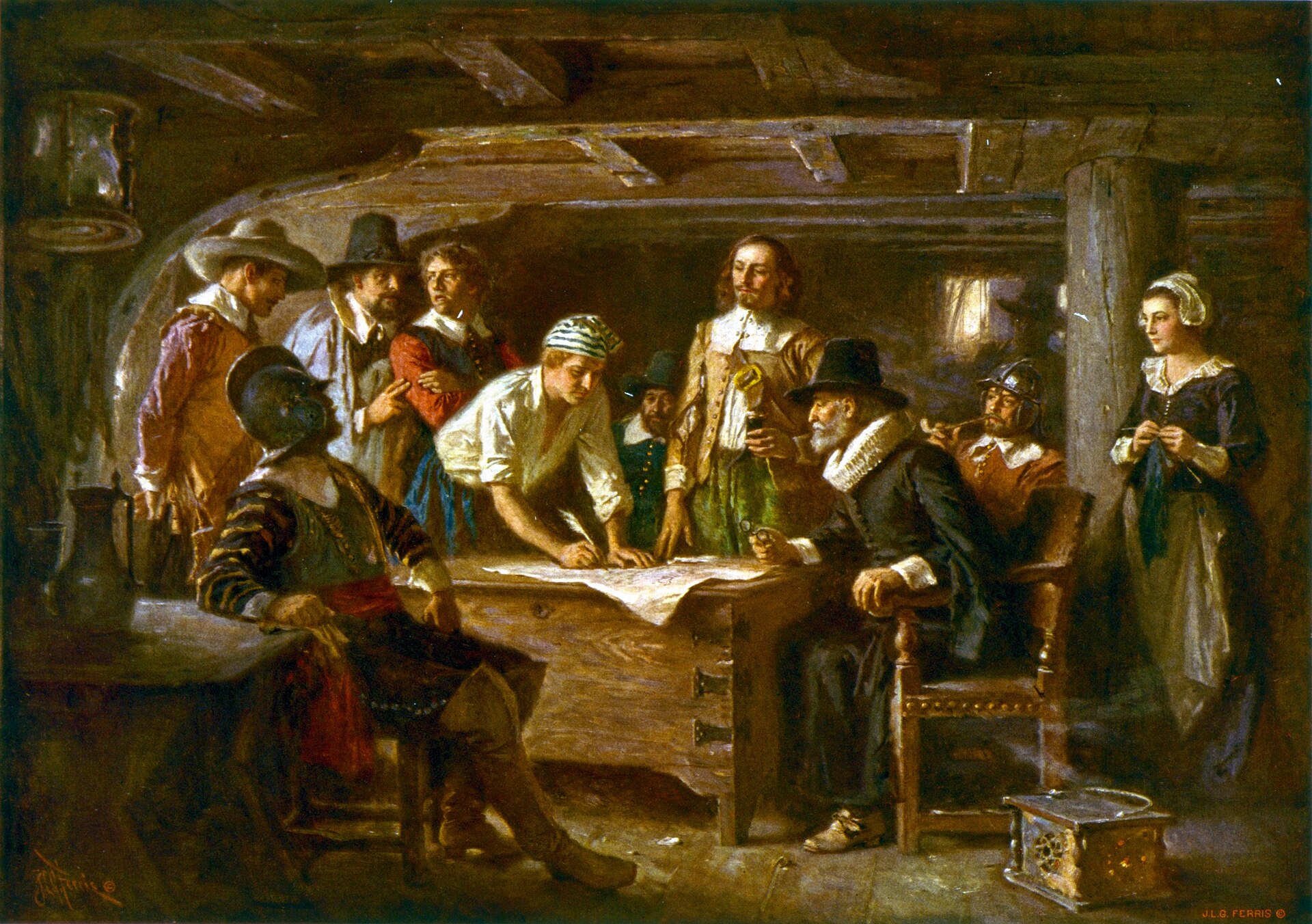
The Mayflower carried the Leiden Separatists together with passengers recruited in England who did not share their church. The ship reached Cape Cod in November 1620, north of the territory their patent covered. Walker explains the problem in his chapter on the Mayflower church: "they were outside the limits of their patent," and "there were others beside the Leyden Separatists on the ship, whose loyalty to the purposes of the colony was dubious."8 Before anyone went ashore, the men signed an agreement. The text, as printed in Francis Newton Thorpe's 1909 federal collection of colonial charters, reads in its central sentence that the signers "Do by these Presents, solemnly and mutually, in the Presence of God and one another, covenant and combine ourselves together into a civil Body Politick, for our better Ordering and Preservation, and Furtherance of the Ends aforesaid."9 It is dated "at Cape-Cod the eleventh of November" in the eighteenth year of King James, "Anno Domini; 1620," and the Thorpe text lists 41 names, beginning with John Carver, William Bradford, Edward Winslow and William Brewster.9
The date is Old Style (Julian calendar), which England still used. In the Gregorian calendar used today the same day is November 21, 1620. The Compact was a civil agreement and says nothing about church order. Its language, though, is the language of the church covenant: people binding themselves "in the Presence of God and one another." The men who wrote it had already formed a church that way in Scrooby. Here they used the same form to make a government.

Landing and the Plymouth church
Bradford describes the first sight of land: "they fell upon their knees and blessed the God of Heaven who had brought them over the vast and furious ocean."10 After weeks of exploring the coast, he writes, "On the 16th day the wind came fair, and they arrived safe in the harbour," and "on the 25th day they began to erect the first house for common use" (December, Old Style).10 Half of the company died that first winter, as Bradford's own chapter heading for 1620 to 1621 says.10
The church that landed had no ordained pastor. John Robinson stayed in Leiden with the part of the congregation that did not cross and died there in March 1625 without ever coming to America. William Brewster, who had been chosen elder of the congregation at Leiden, led the Plymouth church in worship.8 Plymouth stayed a small colony and later became part of Massachusetts. Its importance to the church story is out of proportion to its size: it was the first Separatist congregation in New England, and its example of a gathered church shaped the much larger colony that came ten years later.
Bradford also records how Plymouth kept the calendar. On Christmas Day 1621, he writes, "the Governor called the people out to work as usual; but most of the new company excused themselves, and said it went against their consciences to work on that day." When he found them playing games in the street at noon, he "took away their games" and told them that "If they made the keeping of the day a matter of devotion, let them remain in their houses; but there should be no gaming and revelling in the streets."11 The Separatists observed no holy days except the Lord's Day, and the episode shows how they handled newcomers who disagreed: private devotion was tolerated, public celebration was not.
Massachusetts Bay, 1630
The Great Migration and John Winthrop
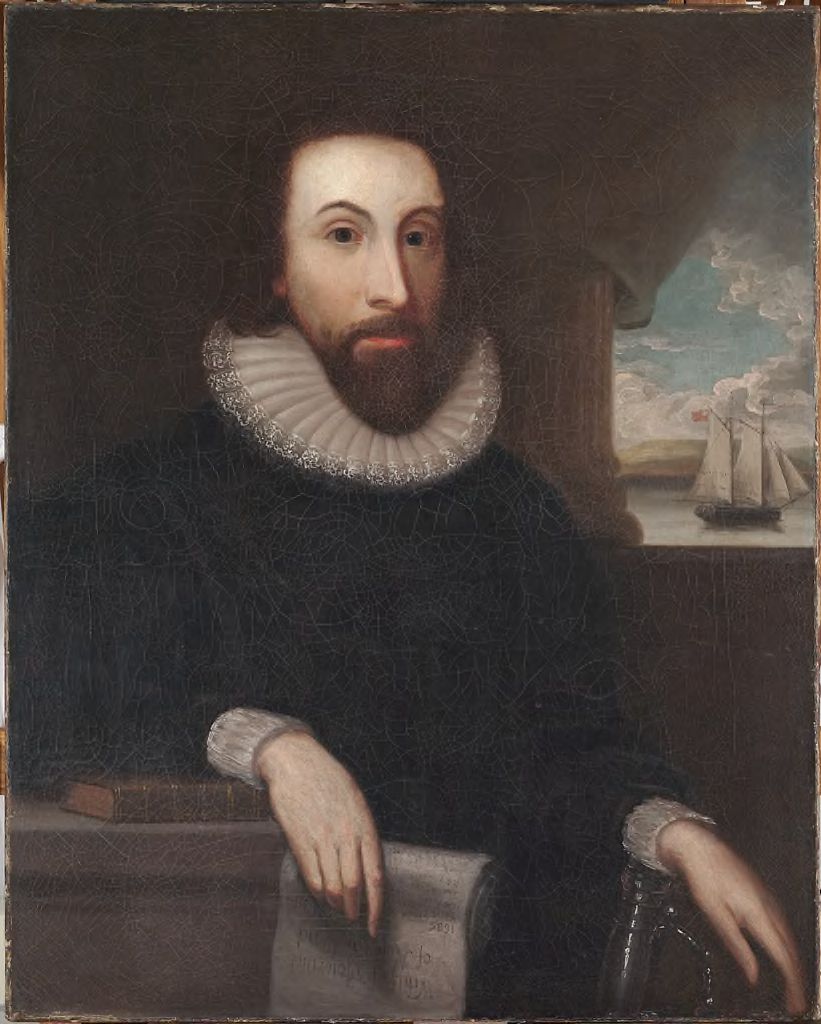
The Massachusetts Bay Company received a royal charter on March 4, 1629, which, as Walker summarizes it, gave it "power to admit freemen, elect officers, and make laws of local application."12 Its leaders were Puritans who had not separated from the Church of England. In 1630 a fleet led by the Arbella brought John Winthrop, the governor, and the first large company of settlers, and the migration continued through the 1630s.
Winthrop wrote a lay sermon, "A Modell of Christian Charity," which the 1838 printing by the Massachusetts Historical Society headed "Written on board the Arbella, on the Atlantic Ocean." Its best known passage reads: "For wee must consider that wee shall be as a citty upon a hill. The eies of all people are uppon us. Soe that if wee shall deale falsely with our God in this worke wee haue undertaken, and soe cause him to withdrawe his present help from us, wee shall be made a story and a by-word through the world."13 The image comes from Matthew 5:14. Winthrop's point was a warning as much as a boast: a community that claimed to live by covenant would be watched, and its failures would be public. The same sermon describes the colony as one body: "Wee must delight in eache other; make other's conditions our oune; rejoice together, mourne together, labour and suffer together."13

The first church covenants
The Salem church was gathered in 1629, before Winthrop arrived, and its covenant is a single sentence. Walker prints it: "We Covenant with the Lord and one with an other; and doe bynd our selves in the presence of God, to walke together in all his waies, according as he is pleased to reveale himself unto us in his Blessed word of truth."14 The church renewed and expanded it in 1636 after what the enlarged text calls "sad experience" of "looseing of our first aimes in entring into Church fellowship."14 In 1630 the Charlestown and Boston settlers formed their church with a covenant that Walker notes was "still in use by the First Church in Boston (now Unitarian)" when he wrote in 1893.15 That small note anticipates a large part of this lesson.
The Boston church was openly Non-Separatist, and some Separatists refused to treat it as fully reformed. Walker quotes a letter of Roger Williams explaining why, invited in 1631 to fill the Boston pulpit, he declined: he "durst not officiate to an unseparated people, as, upon examination and conference, I [he] found them to be."15 Williams went on to Salem, to banishment from the colony, and to the founding of Providence and the first Baptist church in America, which is told in lesson 06.
Churches multiplied quickly. Walker's list of organization dates gives Salem 1629, Boston 1630, Watertown 1630, Roxbury, Lynn and Charlestown 1632, Hingham 1635, Cambridge and Concord 1636, Dedham 1638, and dozens more in Massachusetts, Plymouth, Connecticut and New Haven by the 1640s.16 Thomas Hooker, minister at Newtowne (Cambridge), led a company overland to Hartford in 1636, and John Davenport founded the New Haven colony.17 The General Court founded a college at Newtowne on October 28, 1636; it took the name of its first major benefactor, John Harvard, and the university says plainly that John Harvard "did not found Harvard."18 Its first purpose was to keep a learned ministry in the churches.
Dissent inside the Bay
The colony punished dissent that threatened the churches' order. Anne Hutchinson arrived in 1634, held meetings in her home that discussed sermons, and criticized most of the colony's ministers.17 Walker records that the General Court ended the dispute "in banishing Wheelwright and Mrs. Hutchinson and some of their prominent supporters from the Massachusetts jurisdiction, by its sentence on November 2, 1637."12 Quakers who came to Massachusetts in the 1650s were whipped and banished, and some who returned were hanged on Boston Common, among them Mary Dyer in 1660 (her story is in lesson 09). The leaders of Massachusetts did not claim to be building a tolerant society. They claimed to be building a covenanted one, and they argued that people who disagreed were free to live elsewhere. How Puritan law shaped later American law is taken up in Liberty 56, lesson 08.
The New England Way
Gathered churches and visible saints
By the late 1630s the Massachusetts churches had settled into a pattern their defenders called the New England Way. A group of believers who wished to form a church met, often with ministers and messengers from neighboring churches present, examined one another, and signed or professed a covenant. The church then elected its own officers: a pastor (to exhort), a teacher (to teach doctrine), ruling elders and deacons. Ordination came from the congregation that called the minister. No bishop, presbytery or synod could place a minister in a church or remove one.
Membership was the hard part. The New England churches required more than baptism and a moral life. A candidate for full membership, which carried the right to receive the Lord's Supper and to have one's children baptized, was expected to give an account of how God's grace had worked in his or her soul, and the church judged whether the account was credible. In the Massachusetts colony the vote for colony officers was limited to freemen, and freemanship was tied to church membership, so the churches' judgment had civil weight. The historian Edmund S. Morgan, in Visible Saints: The History of a Puritan Idea (1963), argued that the requirement of a narrative of conversion for membership was a New England development of the 1630s that English Puritans had not practiced; his reading is now the common scholarly starting point, though later historians have qualified how uniform the practice was (this summary is a paraphrase, not a quotation).19
The Cambridge Synod and Platform, 1646 to 1648
Pressure from England in the 1640s pushed the churches to write down their order. The Westminster Assembly, then meeting in London, was drawing up a Presbyterian system for the whole of Britain, and some colonists petitioned to have the English Presbyterian order and English law extended to New England. Walker traces the response. The General Court called a synod that met at Cambridge in three sessions: "Two sessions of that assembly had already been held, in Sept., 1646, and in June, 1647," and the body went on "to put forth, in 1648, the Cambridge Platform."20 The synod accepted the doctrinal chapters of the Westminster Confession for the substance of them and wrote its own platform of church government. The General Court took up the platform again in May 1651, nearly three years after the synod's last session, and commended it to the churches.20
The Platform defines a church in chapter II. In Walker's reprint, keeping the original spelling: "A Congregational-church, is by the institution of Christ a part of the Militant-visible-church, consisting of a company of Saints by calling, united into one body, by a holy covenant, for the publick worship of God, & the mutuall edification one of another, in the Fellowship of the Lord Jesus."21 It rejects other forms of church government by name: since the coming of Christ, the church is "only congregational," and "Therfore neither national, provincial, nor classical" (that is, neither a national church, nor a province under an archbishop, nor a presbyterian classis). It even rejects the label its enemies used: "The term Independent, wee approve not."21 Chapter III states who may belong: "The matter of a visible church are Saints by calling," meaning people who "haue not only attained the knowledge of the principles of Religion, & are free from gros & open scandals, but also do together with the profession of their faith & Repentance, walk in blameles obedience to the word."21
The Platform is not a charter of religious liberty. Its seventeenth chapter, on the civil magistrate, says that "Idolatry, Blasphemy, Heresy, venting corrupt & pernicious opinions, that destroy the foundation, open contempt of the word preached, prophanation of the Lords day, disturbing the peaceable administration & exercise of the worship & holy things of God, & the like, are to be restrayned, & punished by civil authority." If a church "shall grow schismaticall," the next section says, "the Magistrate is to put forth his coercive powr."21 Each congregation was independent of other churches. None was independent of the colony's laws about religion.

Meetinghouse and worship
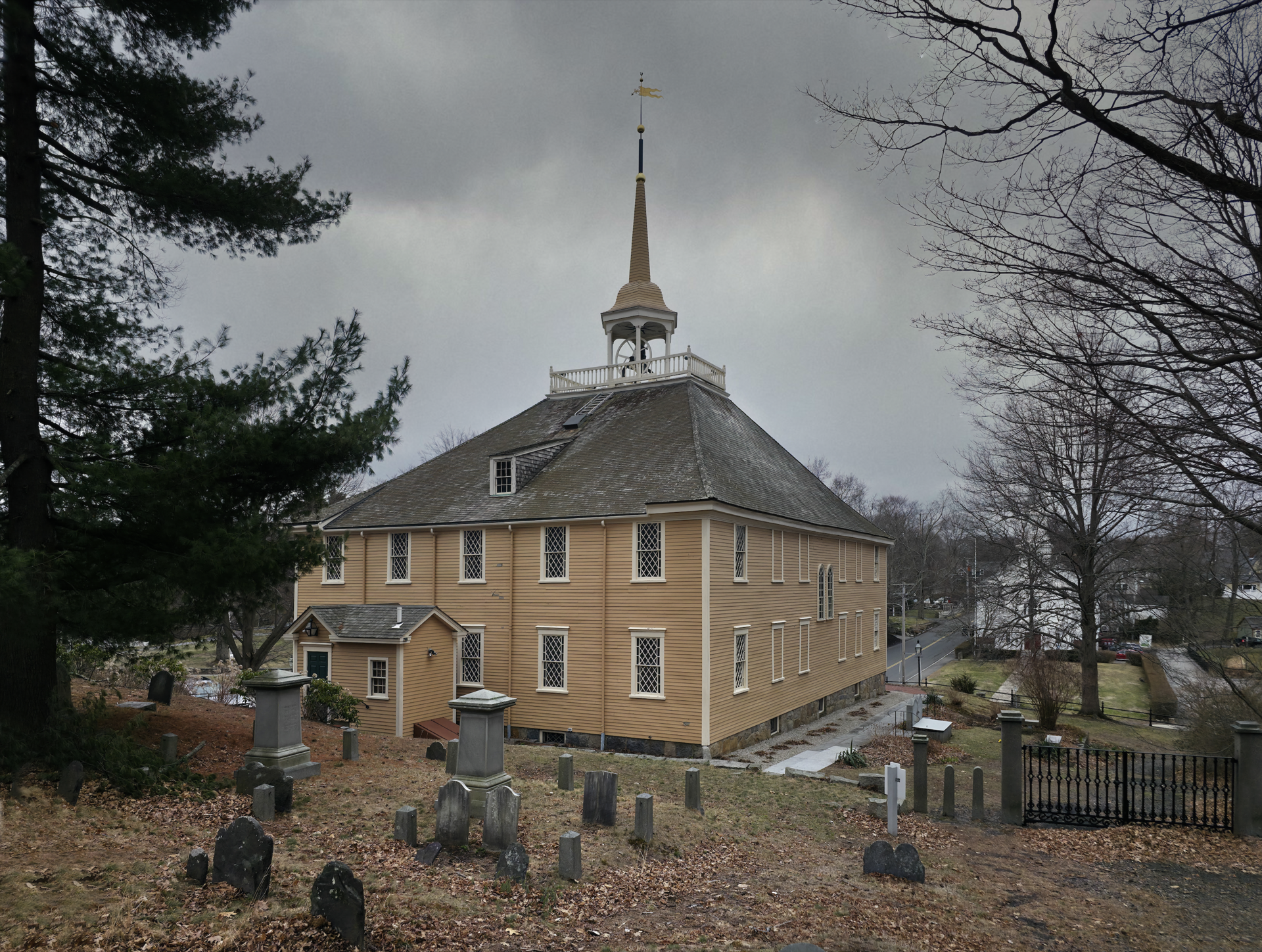
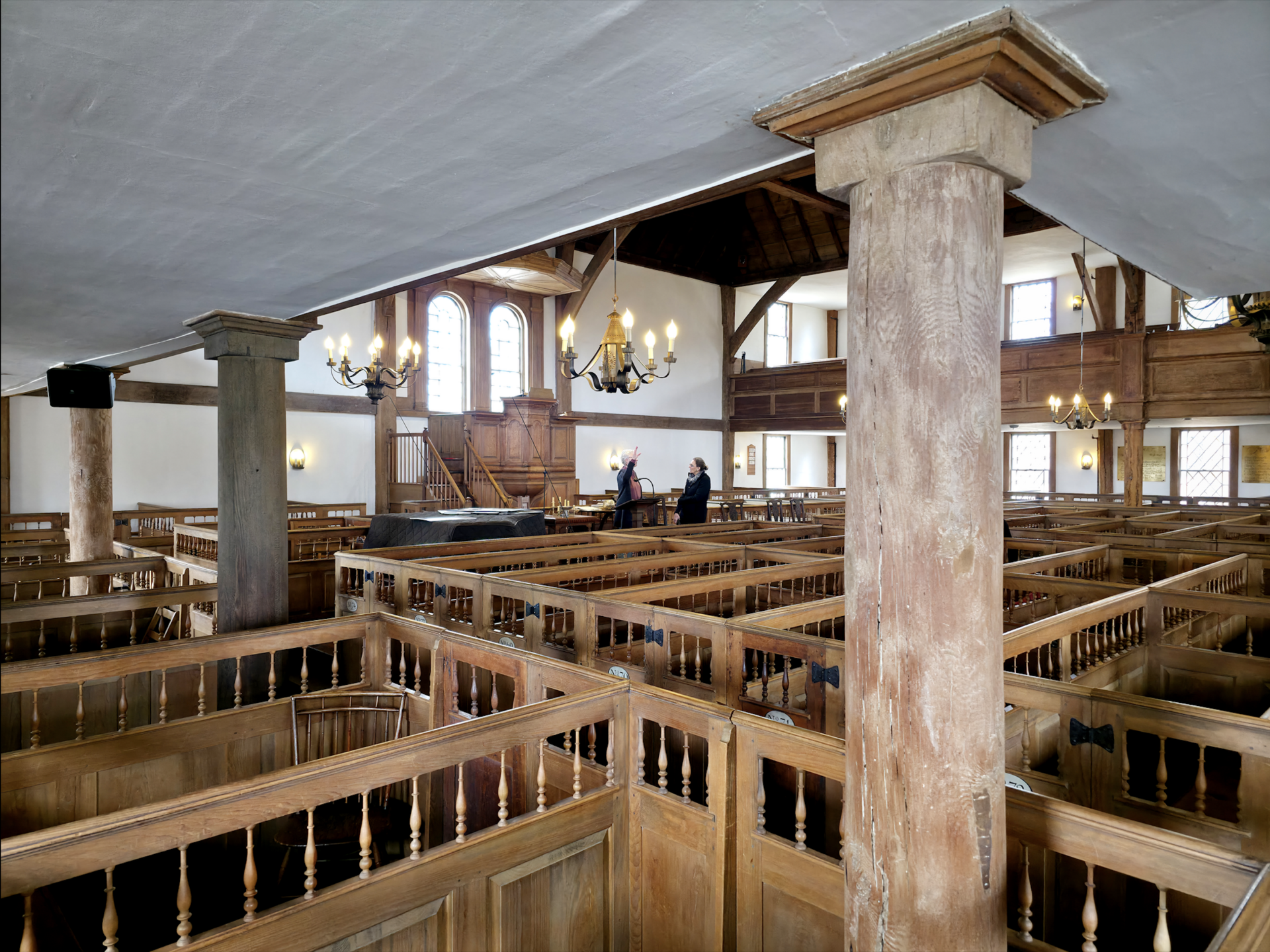
New England congregations did not call their buildings churches. The church was the covenanted people; the building was a meetinghouse, owned by the town, used on weekdays for town meetings, and built without altar, cross, stained glass or organ. In the usual arrangement the pulpit stood at the center of a long wall, with the communion table below it and the congregation seated in pews assigned by rank. Worship was a long prayer, metrical psalms sung without instruments, and a sermon of an hour or more, in the morning and again in the afternoon on the Lord's Day. The Old Ship Meetinghouse in Hingham, which its present congregation says "has stood on Hingham's Main Street since 1681," is the one building of that century still standing.22

The Savoy Declaration, 1658
In England the Congregationalists (whom their opponents called Independents) gained power during the Civil War and the Commonwealth, when Oliver Cromwell's army included many of them. In 1658 their ministers and messengers met at the Savoy Palace in London to state their faith. Walker reports that the synod ended on "October 12, 1658, after a session of twelve working days," and that its result was presented to the new Lord Protector, Richard Cromwell, by Thomas Goodwin.23 The Savoy Declaration took over the Westminster Confession with changes, chiefly on church government and the power of magistrates, and added a short platform of polity. That platform begins: "BY the appointment of the Father all Power for the Calling, Institution, Order, or Government of the Church, is invested in a Supreme and Soveraign maner in the Lord Jesus Christ, as King and Head thereof." Its fourth article gives each particular church "all that Power and Authority, which is any way needfull for their carrying on that Order in Worship and Discipline, which he hath instituted for them to observe."23
Walker adds a note that the Savoy polity "was never adopted by American Congregationalists, their principles being better set forth in the Cambridge Platform."23 The Savoy confession of doctrine did cross the Atlantic, as the next section shows. In England the Restoration of Charles II in 1660 and the Act of Uniformity of 1662 pushed the Congregationalists out of the national church, and they became one of the Dissenting bodies, alongside the Presbyterians, Baptists and Quakers. The relationship between the Savoy Declaration and the Westminster standards is compared in lesson 02, and the 1689 Baptist confession that was built on both is in lesson 06.
The Half-Way Covenant, 1662
The problem of the second generation
The New England system had a built-in difficulty. Children of church members were baptized as infants and counted as members of the church. Many of them grew up, lived upright lives and professed the faith, but never gave the account of conversion needed for full membership. When they had children of their own, could those grandchildren be baptized? If not, a growing share of the population would stand outside the churches altogether, and in time the churches would shrink to a minority in the towns they were supposed to serve.
A ministerial assembly gave a first answer in 1657, and a synod of Massachusetts churches settled it in 1662. Walker prints the 1662 result, which the General Court on "the 8th of October, 1662" judged meet to commend to the churches.24 Its fifth proposition is the core of what opponents later nicknamed the Half-Way Covenant: "Church-members who were admitted in minority, understanding the Doctrine of Faith, and publickly professing their assent thereto; not scandalous in life, and solemnly owning the Covenant before the Church, wherein they give up themselves and their Children to the Lord, and subject themselves to the Government of Christ in the Church, their Children are to be Baptized."24 The 1657 result had already put the principle plainly: such persons have a duty, "when grown up to years of discretion, though not yet fit for the Lords Supper, to own the Covenant they made with their Parents."24
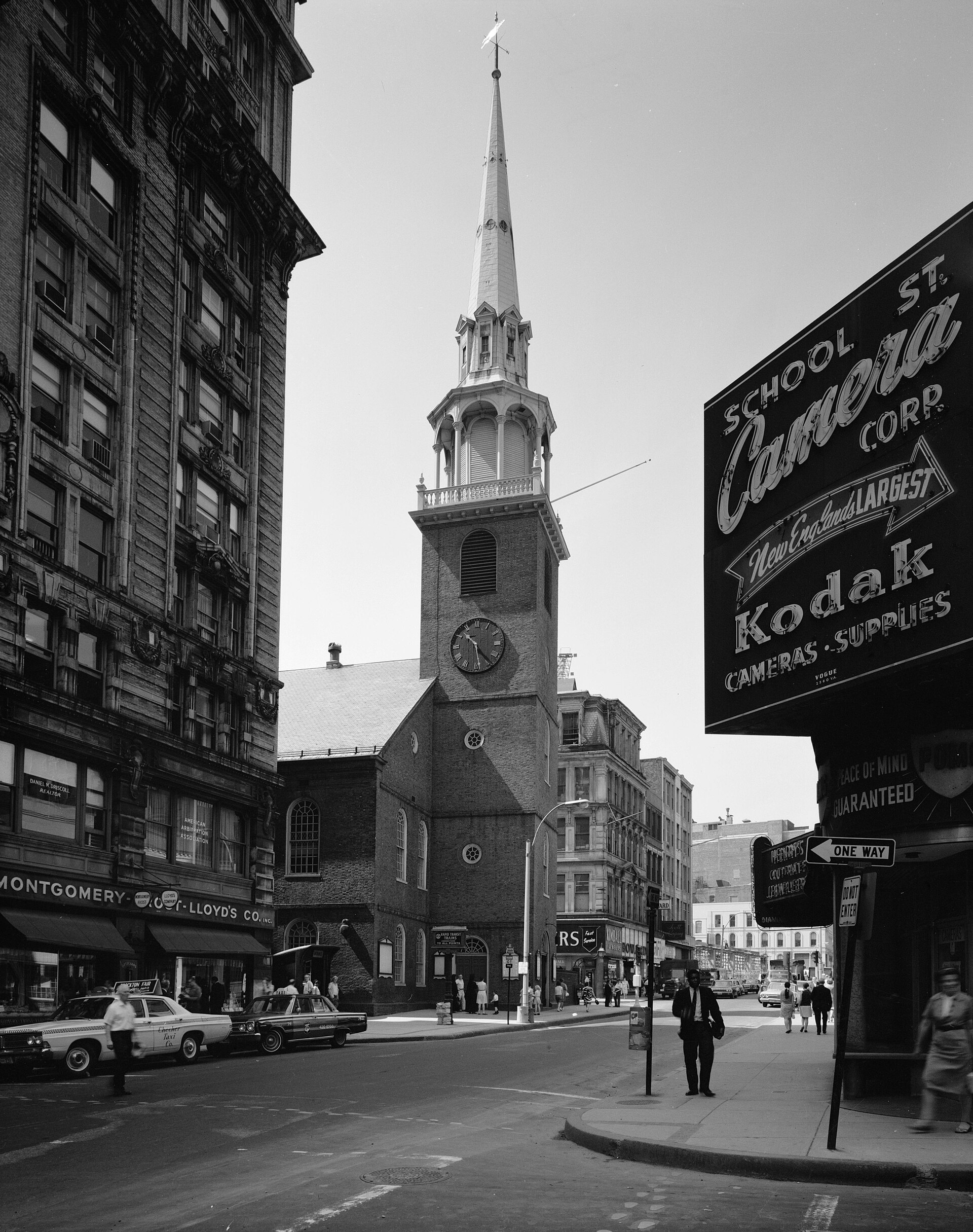
The arrangement created two classes of members. "Half-way" members could have their children baptized but could not take communion or vote in church affairs until they gave a conversion account. Many churches resisted it for years. In Boston the dispute is usually connected with the division in the First Church that produced the Third Church, later called Old South, in 1669. The Revolutionary Spaces organization, which keeps Old South Meeting House, dates that congregation's first wooden meeting house to 1669 and the present brick building to 1729.25

The Reforming Synod and the Saybrook Platform
Ministers in the 1670s preached what historians call jeremiads, sermons lamenting the decline of the founders' zeal, and after King Philip's War (1675 to 1676) the General Court called a synod to ask what sins had provoked God's judgments. This Reforming Synod met in September 1679 and again, Walker writes, "at Boston on May 12, 1680," when it adopted the Savoy Confession "in practically unchanged form" as the creed of the Massachusetts churches and reaffirmed the Cambridge Platform.26
Connecticut took a different path. Its churches adopted the Saybrook Platform in 1708, which created county consociations of churches with power to hear disputes and associations of ministers to examine candidates. Walker describes it as "an ecclesiastical constitution imposed by state authority at Saybrook in 1708."27 Connecticut Congregationalism after Saybrook stood closer to Presbyterian practice than Massachusetts did, which helps explain why Connecticut Congregationalists and Presbyterians cooperated so easily a century later. The Saybrook meeting was held at the town where the colony's new college had been chartered in 1701 as the Collegiate School, which Yale says was founded "to educate students for 'Publick employment both in Church and Civil State'" and which took the name Yale College in 1718.28
Salem, 1692
The witchcraft trials of 1692 took place inside this church order, in Salem Village and nearby towns, before a special court appointed by the governor. The Salem Witch Trials Documentary Archive at the University of Virginia summarizes the toll: "By late September 1692 ... Nineteen had been hanged, and Giles Cory had been tortured to death for refusing to enter a plea."29 Ministers were divided. Increase Mather's Cases of Conscience (1693) attacked the use of "spectral evidence," and the archive's summary of his argument is that "it would be better that ten witches go free than the blood of a single innocent be shed"; the same page notes that Mather also tried to excuse the judges.29 No one was burned. The archive dates the end of the trials to a directive from Governor William Phips at the end of October 1692.29

Jonathan Edwards and the Awakening
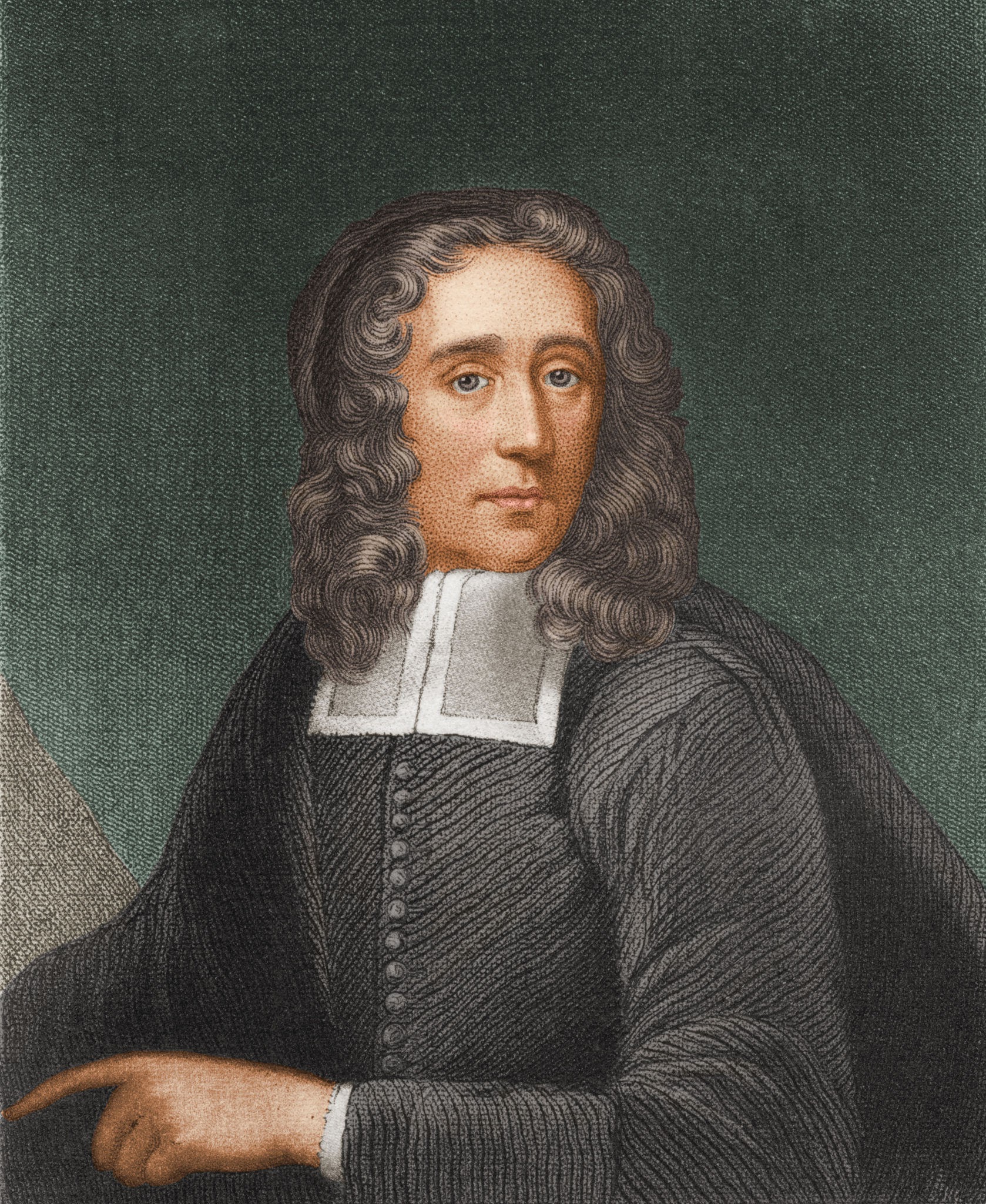
The religious revivals of the 1730s and 1740s, usually called the Great Awakening, will have their own module on this site. This lesson needs only the part that changed the Congregational churches. Jonathan Edwards (1703 to 1758), a Yale graduate, succeeded his grandfather Solomon Stoddard as minister at Northampton, Massachusetts.17 In A Faithful Narrative of the Surprising Work of God, a letter to the Boston minister Benjamin Colman first printed in London with a preface by Isaac Watts and John Guyse, Edwards dated the start of the Northampton revival to the winter of 1734 to 1735: "in the latter part of December, that the Spirit of God began extraordinarily to set in, and wonderfully to work amongst us." By the following spring and summer, he wrote, "the town seemed to be full of the presence of God: it never was so full of love, nor of joy, and yet so full of distress, as it was then."30 He estimated "that more than 300 souls were savingly brought home to Christ, in this town, in the space of half a year."30
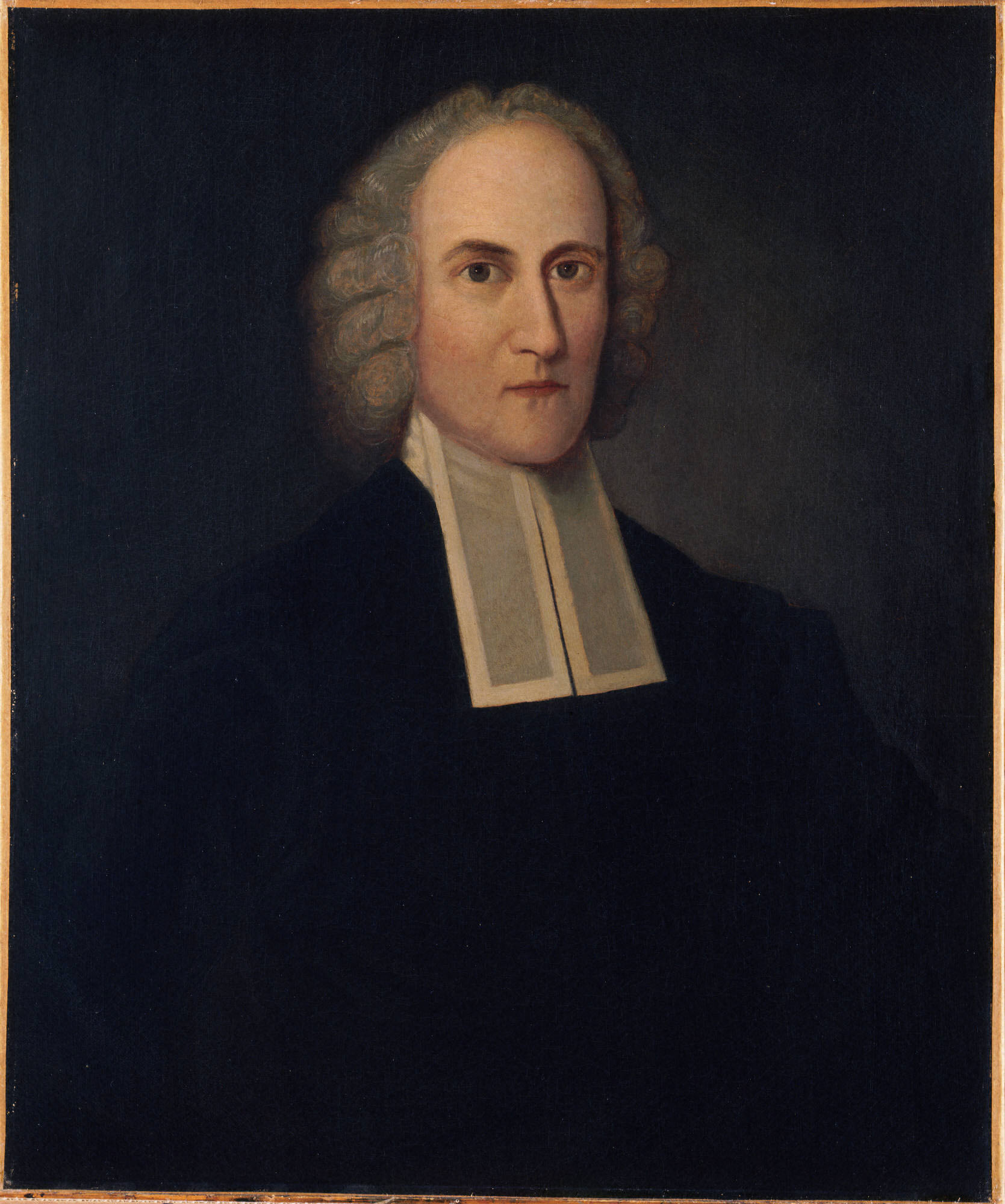
The same letter records a fact about Northampton's church order. Edwards received about a hundred new communicants before one sacrament day and wrote that he had "very sufficient evidence of the conversion of their souls," although "it is not the custom here, as it is in many other churches in this country, to make a credible relation of their inward experiences the ground of admission to the Lord's supper."30 Under Stoddard, Northampton had opened the Lord's Supper wider than the Cambridge Platform intended. Edwards came to reject that practice. In 1749 he published An Humble Inquiry into the Rules of the Word of God, concerning the Qualifications Requisite to a Complete Standing and Full Communion in the Visible Christian Church, which argued the question, as his nineteenth century editor put it, "Whether any persons ought to be admitted to full communion in the christian church, but such as, in the eye of a reasonable judgment, are truly Christians?"31 The congregation would not accept his position, and the United Church of Christ's own history notes that "In 1750, Edwards was dismissed from the Northampton church," over church discipline and his rejection of the Half-Way standard "as too lax a standard of church membership."17
The Awakening divided New England Congregationalists into New Lights, who welcomed the revivals, and Old Lights, who distrusted their emotion and disorder. Some New Light congregations separated from the established churches entirely (several of these Separate congregations later became Baptist, a story picked up in lesson 06). In eastern Massachusetts a third party of "rational" ministers opposed both the revivals and strict Calvinism, and the UCC history traces the Unitarian movement to them: "the path they took would lead in the next century to the Unitarian separation from Congregationalism."17 Edwards's followers, often called the New Divinity or Edwardseans, shaped Congregational theology for a century and supplied the theology of the missionary movement. The broader meaning of "evangelical" that grew from these revivals is defined in Church History, Part C, lesson 03.

The Standing Order and disestablishment
How establishment worked
For almost two centuries the Congregational churches of Massachusetts, Connecticut and New Hampshire were the "Standing Order." Each town or parish was required to support a minister by taxes, and in practice that minister was a Congregationalist. Dissenters (Anglicans, Baptists and Quakers) won exemptions over the eighteenth century, often after long petitioning, but the system remained. The first Massachusetts constitution of 1780 wrote it into the Declaration of Rights. Article III, still printed in the Massachusetts General Court's text of the constitution, begins: "As the happiness of a people, and the good order and preservation of civil government, essentially depend upon piety, religion and morality," and it empowered the legislature to require towns to provide "for the institution of the public worship of God."32 The United States Constitution's First Amendment (1791) bound only the federal government, so the New England establishments were untouched by it.
Connecticut, 1818
Connecticut had governed itself under its royal charter until a convention wrote a constitution in 1818. The Connecticut Secretary of the State's Register and Manual records that it "was submitted to the people, and approved by a vote of thirteen thousand nine hundred and eighteen in its favor and twelve thousand three hundred and sixty-four against its ratification," and that on "the twelfth of October, 1818," Governor Oliver Wolcott proclaimed it adopted.33 Article Seventh, "Of Religion," reads in part: "no person shall by law be compelled to join or support, nor be classed with, or associated to, any congregation, church or religious association." Churches could still tax their own members, "by a tax on the members of any such society only," and every person could leave a society by filing a written notice.33 The Standing Order's tax base was gone. The margin (13,918 to 12,364) shows how divided the state was.
Massachusetts, 1833
Massachusetts held on longest. The eleventh Article of Amendment replaced Article III. The General Court's text states that it "was approved and ratified by the people November 11th, 1833."32 It keeps the old premise ("the public worship of God and instructions in piety, religion and morality, promote the happiness and prosperity of a people") but turns support into a voluntary matter for each religious society, provides that members may leave by filing "a written notice, declaring the dissolution of their membership," and ends: "all religious sects and denominations, demeaning themselves peaceably, and as good citizens of the commonwealth, shall be equally under the protection of the law; and no subordination of any one sect or denomination to another shall ever be established by law."32 Massachusetts was the last state to end tax support of churches. Historians of the period commonly point out that by 1833 many orthodox Congregationalists had stopped defending the old system, because under Massachusetts law many of the tax-supported parishes were now Unitarian.
The Unitarian departure
Harvard, Andover and Baltimore
Through the 1700s a number of Boston-area ministers moved away from Calvinism toward a stress on human freedom, reason and moral character, and some quietly doubted the doctrine of the Trinity. The break became public in 1805, when Henry Ware, a liberal, was elected to the Hollis Professorship of Divinity at Harvard. The Unitarian Universalist Association's history curriculum says that with "Ware's election in 1805 to head Harvard College, the liberals had taken control of the seminary which was the primary training ground of New England's ministers. This caused great dismay among those of more orthodox beliefs."34 (Ware held the divinity chair; the UUA text's wording "to head Harvard College" is loose.) The orthodox answered by founding Andover Theological Seminary in 1808, which the UCC history calls "a bulwark of Calvinist orthodoxy."17
The liberals accepted the name "Unitarian" in 1819. At the ordination of Jared Sparks in Baltimore on May 5, 1819, the Boston minister William Ellery Channing preached a sermon later published as "Unitarian Christianity." Its first doctrinal statement is: "In the first place, we believe in the doctrine of God's UNITY, or that there is one God and one only." Channing explained: "We understand by it that there is one being, one mind, one person, one intelligent agent, and one only, to whom underived and infinite perfection and dominion belong."35 The same sermon rejects the Trinity as "unfavorable to devotion, by dividing and distracting the mind in its communion with God."35 The orthodox replied that this was a departure from the faith of the founders, the Cambridge Platform and the ancient creeds. Both sides claimed the Puritan inheritance.
The Dedham case
Who owned the churches? In Massachusetts law each town or parish (all the taxpayers) had a role in calling the minister, and the church (the covenanted communicants) had another. In Dedham in 1818 the parish called a liberal minister, Alvan Lamson (spelled "Alvin" in the UUA account), over the objection of most of the church members. The UUA account summarizes what followed: the church majority left, "taking the church records, the communion silver, and the financial assets with them"; a deacon of the members who stayed with the parish sued a deacon of the departing majority to recover them; a jury found that the parish owned the assets and had the right to call the minister; and the decision, reported as Baker v. Fales (1820), held; in the UUA's words, "when all the appeals were finally over in 1821, the ruling stood." The UUA account adds that the presiding judge, Isaac Parker, was himself a Unitarian, a point the orthodox side raised at the time.36 The result, the same account says, was that "a quarter of Massachusetts Standing Order Congregational churches" became Unitarian within the next twenty years.36 Orthodox members in many towns left their meetinghouses and built new ones, which is why many New England towns still have a "First Parish" (Unitarian Universalist) and a "First Congregational Church" (often UCC) a block apart.
Examples are easy to find. The Boston church that formed in 1630 under Winthrop is Boston's First Church, which Walker in 1893 already called "now Unitarian."15 The Hingham congregation in the Old Ship Meetinghouse calls itself "a liberal Unitarian Universalist community."22 The Unitarians organized the American Unitarian Association in 1825. Their later history, including the consolidation with the Universalists in 1961 that formed the Unitarian Universalist Association, lies outside this lesson.
Congregationalists in the nineteenth century
Westward with the Presbyterians
As New Englanders moved into New York and the Old Northwest, Congregationalists and Presbyterians agreed not to compete. The UCC history describes the arrangement: "Under the Plan of Union (1801) and the Accommodation Plan (1808), the theologically compatible Congregational and Presbyterian churches cooperated in their missionary efforts in the West. A minister of either denomination might be chosen by a congregation."17 In practice many of the churches founded under the Plan became Presbyterian, because presbyteries were organized on the frontier and Congregational associations were not. Old School Presbyterians ended the Plan on their side in 1837, an episode told from the Presbyterian side in lesson 02. Walker prints the text of the Plan of Union in his collection.27
Missions and the American Board
The missionary movement grew out of the New Divinity colleges and Andover Seminary. The UCC history tells the story of the students who sheltered under a haystack in a thunderstorm and resolved "to evangelize the world," and records that "On September 5, 1810, the American Board of Commissioners for Foreign Missions was born." The first missionaries were ordained in the Salem Tabernacle Church on February 6, 1812, the date printed on Leonard Woods's ordination sermon (the UCC history gives February 8), and, the UCC history says, "Within two weeks, they set sail for India."1748 One of them, Adoniram Judson, later became a Baptist, a turn told from the Baptist side in lesson 06. The UCC history also follows American Board missionaries to the Hawaiian Islands and to Native nations in North America. Congregationalists also founded colleges and seminaries across the country; the UCC history lists Congregational seminaries at Bangor (1814), Hartford (1834), Chicago (1855) and Berkeley (1866) in addition to Andover.17
Slavery, the Amistad and the American Missionary Association
Congregationalists were divided on slavery, as were all Northern churches, but they produced several of the early opponents of it. The UCC's own list of "firsts" credits Samuel Sewall's pamphlet The Selling of Joseph (1700) as "the first anti-slavery pamphlet in America," and states that in 1785 "Lemuel Haynes is the first African American ordained by a Protestant denomination."37 (The same page says Haynes enlisted as a soldier in the Revolution and in 1776 wrote "Liberty, Further Extended," a defense of freedom for enslaved Africans. The claim of being first is the UCC's own.) After the Africans who had seized the schooner Amistad in 1839 won their freedom before the United States Supreme Court, the UCC list says, "In 1846 Lewis Tappan, one of the Amistad organizers, organizes the American Missionary Association," which it describes as "the first anti-slavery society in the U.S. with multiracial leadership."37 After the Civil War the AMA founded schools for freed people across the South; the UCC history mentions "six colleges established in the South after the Civil War."17
Antoinette Brown, 1853
Antoinette Brown studied theology at Oberlin, in Ohio, but was refused the degree she had earned. The UCC history writes that she "sought for three years a call to pastor a church. A call finally came from the Congregational Church in Butler, New York. There she was ordained in 1853, an ordination recognized only by the local church."17 That last clause is the Congregational principle at work: because each church ordains its own minister, a single congregation could ordain a woman without the permission of any wider body, and no wider body could undo it. The same principle meant that other Congregational churches were free not to recognize her. The UCC's "firsts" page states the claim more broadly, calling her "the first woman since New Testament times ordained as a Christian minister."37 That claim is rated in "Claims checked" below.
National statements: Burial Hill (1865) and Oberlin (1871)
Congregationalists outside New England felt the need for national cooperation after the Civil War. In 1865 a national council of Congregational churches adopted the "Burial Hill" Declaration of Faith, named for the hill in Plymouth, and a Statement of Principles of Polity. Walker prints the Burial Hill Declaration, which joins doctrine and civic hope in sentences like this: "It was the faith of our fathers that gave us this free land in which we dwell. It is by this faith only that we can transmit to our children a free and happy, because a Christian, commonwealth."38 In 1871 the churches organized a permanent National Council at Oberlin, Ohio, and Walker prints its constitution and the "Oberlin Declaration."38 The National Council was, in Congregational theory, a fellowship of autonomous churches that could advise but not command. That theory would be tested in court in the 1950s.
The road to the United Church of Christ
The Christian Connection and the 1931 merger
The first of the twentieth century unions joined the Congregationalists to a much younger body, the Christian Church, sometimes called the Christian Connection. The UCC history gives its origins in three revivals. In Virginia in 1794, James O'Kelly (the UCC page spells it O'Kelley) led Methodists who objected to bishops out of the Methodist Episcopal Church: "They declared that the Bible was their only guide and adopted as their new name, the Christian Church." At Lyndon, Vermont, in 1801, Abner Jones and his followers, who "objected to Calvinist Baptist views," organized "the First Free Christian Church, in which Christian character would be the only requirement for membership." In Kentucky in 1803, Barton W. Stone's followers left the Presbyterian Synod of Kentucky and also took the name Christian.17 Most of Stone's movement later joined Alexander Campbell's Disciples (their story is lesson 10); the eastern Christians stayed separate. Their 1820 general conference, the UCC page records, affirmed six principles, beginning "Christ, the only head of the Church" and "The Bible, sufficient rule of faith and practice," and including "Christian character, the only measurement for membership."17
Both bodies valued local autonomy and distrusted creeds. The UCC history says they "were concerned for freedom of religious expression and local autonomy and united on June 17, 1931 to become the Congregational Christian Churches."17 The national assembly of the merged body was its General Council.
The Evangelical and Reformed Church, 1934
The other partner in 1957 came from German immigrant churches. The Reformed Church in the United States began with German Reformed congregations in Pennsylvania and neighboring colonies in the early eighteenth century, which, the UCC history says, "unified in a Coetus in 1793 to become a Synod." The Evangelical Synod of North America was "a 19th-century German-American church of the frontier Mississippi Valley." The UCC history calls the parent churches "conscientious carriers of the Reformed and Lutheran traditions of the Reformation." The two "united to form the Evangelical and Reformed Church on June 26, 1934."17 It was governed by synods, and the UCC history says that its union with the Congregational Christians "forced accommodation between congregational and presbyterial forms." Its best known theologians were H. Richard Niebuhr, whom the UCC history describes as educated at Elmhurst College and Eden Seminary (both Evangelical Synod schools) and Yale Divinity School, and his older brother Reinhold Niebuhr.17 The Lutheran side of that German heritage is in lesson 01, and the Reformed side in lesson 02.
The Basis of Union and the lawsuits
Negotiations for a union of the Congregational Christian Churches and the Evangelical and Reformed Church produced a document called the Basis of Union. The merger joined a body of autonomous congregations to a body governed by synods, and that difference produced the bitterest fight in Congregational history. The UCC history is frank about it: "By far the rockier road to union confronted the Congregational Christian Churches. From before the postponed Uniting General Synod of 1950 until 1957, thousands of hours and dollars were spent on court litigation of suits brought against the General Council by autonomous bodies and individuals of the Congregational Christian Churches."17
Each side stated its case. The opponents, in the UCC history's summary, defined "the General Council as 'a representative body' accountable to the churches" and "maintained that the Council had no power to undertake a union involving the churches." Merger leaders "defined the General Council as accountable to itself, 'a gathering of Christians under the Lordship of Christ.'" Douglas Horton, the Council's minister, "suggested that the General Council was 'a kind of Congregation,' and that neither it nor the local church was subordinate to the other."17 The most famous suit was brought by the Cadman Memorial Congregational Church in Brooklyn against Helen Kenyon, moderator of the General Council. The UCC history says the litigants were "sustained by a court ruling in 1949," that the ruling was reversed on appeal, and that the reversal was "sustained in 1953."17 The UCC history quotes Judge Archie O. Dawson of the United States District Court for the Southern District of New York: "It is unfortunate that ministers and church members, who purport to abide by Christian principles should engage in this long, expensive litigation."17
The opponents' own account appears on the websites of the bodies they formed. The National Association of Congregational Christian Churches says the churches that founded it "opposed merging with the Evangelical and Reformed Church," and that "Those against the merger feared that it would establish a church hierarchy and that the local congregation would lose its independence and ability to self-govern."39 The Conservative Congregational Christian Conference adds a theological reason: conservative Congregationalists feared that "their freedom would be lost in a more tightly structured denomination dominated by liberal theology."40
Cleveland, June 25, 1957
The Uniting General Synod met in Cleveland. Its joint resolution, quoted in the UCC history, begins: "Delegates of the Evangelical and Reformed Church and the General Council of the Congregational Christian Churches, in joint session assembled this day in the city of Cleveland, Ohio, do hereby declare that The Basis of Union ..." is in effect, and that until a constitution was adopted, "The Basis of Union shall regulate the business and affairs of the United Church of Christ."17 The UCC dates its birth to "June 25, 1957."17 The Second General Synod at Oberlin in 1959 approved a Statement of Faith, and the Third General Synod at Philadelphia in 1961 "adopted the Constitution and By-Laws."17
The cost in congregations is visible in the UCC's own statistics. Its Summary Statistics note that losses between 1960 and 1965 "result from decisions of 1,000 Congregational Christian Churches not to unite with the United Church of Christ."41 The UCC counted 8,184 congregations in 1960 and 6,952 in 1965.41
The United Church of Christ today
In its own words
The UCC describes itself as "a united and uniting church," born "out of a combination of four groups."17 It has no binding creed. Its 1959 Statement of Faith is offered as a testimony, written as a series of things God has done. The version printed in the UCC's history begins: "We believe in God, the Eternal Spirit, Father of our Lord Jesus Christ and our Father, and to his deeds we testify." It speaks of Christ as "the man of Nazareth, our crucified and risen Lord," of the Holy Spirit "creating and renewing the church of Jesus Christ, binding in covenant faithful people of all ages, tongues, and races," and of God calling the church "to accept the cost and joy of discipleship," "to share in Christ's baptism and eat at his table," and to "resist the powers of evil."17 The language of covenant, inherited from Salem and Scrooby, is still at its center.
The UCC keeps a mixed polity, which can be summarized as follows (this paragraph is a general description, not drawn from a single UCC document). Local churches own their property, call their ministers and adopt their own statements of faith. Associations (regional groups of churches) hold ministerial standing and ordain, conferences provide oversight and placement, and a General Synod meets every two years and speaks "to" the churches rather than "for" them. Two sacraments are observed, baptism (including infant baptism) and the Lord's Supper.
The UCC's own list of "firsts" names the positions it is best known for. In 1972, it says, "The UCC's Golden Gate Association ordains the first openly gay person as a minister in an historic Protestant denomination: the Rev. William R. Johnson." In 2005, "On July 4, the General Synod overwhelmingly passes a resolution supporting same-gender marriage equality." In 2023 the General Synod elected the Rev. Dr. Karen Georgia A. Thompson, whom the page calls "the first woman and first woman of African descent to serve as leader of the denomination."37 Because General Synod resolutions do not bind local churches, individual congregations vote on whether to declare themselves "Open and Affirming," and some UCC congregations have declined to do so. The Synod actions on sexuality are compared with other bodies' votes in lesson 11, and the wider history of liberal Protestant theology is in Liberty 58, lesson 14.
The numbers
The UCC publishes its membership every year from congregational reports gathered for its yearbook. Its 2024 Statistical Profile reports: "At the end of 2023, there were 4,485 congregations in the United Church of Christ with a total of 683,936 members." The same profile gives average in-person worship attendance of 53 per congregation, with a median of 39.42 The UCC's Summary Statistics table, which runs from 1955 to 2024, gives 4,431 congregations and 666,073 members for 2024, and 2,193,593 members in 8,283 congregations for 1957, the year of the union ("Pre-1961 figures are combined for the Congregational Christian Churches and the Evangelical and Reformed Church," the table notes).41 The table also notes two changes in how members were counted: "Effective 1992, the membership numbers of churches coded as inactive are no longer included in the total membership figures," and "Effective 2022, churches marked inactive for two years or more are removed from records."41 Part of the drop in those years is a change of bookkeeping rather than people leaving.
The continuing Congregational bodies
The National Association of Congregational Christian Churches, 1955
In 1955, two years before the union took effect, churches that refused it formed a national fellowship of their own. Erwin A. Britton, the association's executive secretary, wrote the founding story in a short history about twenty-six years later: "Gathering at the Fort Shelby Hotel in Detroit, Michigan, ... official representatives and visitors from 102 churches, widely differing in geographical location, size, theological positions and resources came together with one basic, over-riding desire; viz, to offer to each other and to those who might be encouraged later to join the movement a viable alternative to membership in the United Church of Christ."43 The association began, he wrote, "with no funds, no staff and no organization." Its offices moved to Milwaukee after 1959 and to Oak Creek, Wisconsin, in 1973.43
The NACCC lists its guiding principles on its website: "Christ alone is the head of the church. All church members are spiritually equal and called to the work of ministry. Every local church is autonomous and complete. Each local church is called into wider associations of fellowship. Believers are bound to one another in a voluntary covenant. Every Christian possesses full liberty of conscience in interpreting the Gospel. The Bible is fully sufficient as our guide in matters of faith and practice."5 It adds that "There is a wide variety of thought and practice among our member churches," and that "each church, using Scripture as its foundation and guided by the Holy Spirit, determines its faithful forms of worship, governance, and belief."5 The NACCC has no statement of faith binding its members, which places it theologically between the UCC and the CCCC: its churches range widely.
The Conservative Congregational Christian Conference
The CCCC's own history traces it to a meeting in Chicago in February 1945, where "the Conservative Congregational Christian Fellowship was born," at first as a fellowship inside the General Council. When the merger went forward, "A call went out under the auspices of the Conservative Congregational Christian Fellowship to all Bible believing Congregational Christian Churches to a meeting October 19-22, 1948 in Chicago. At this meeting the Conservative Congregational Christian Conference was born."40 It describes itself as "a theologically conservative denomination believing strongly in the autonomy of each local church under the headship of Christ," with member churches "who are Congregational, Christian, Evangelical and Reformed in their background, as well as independent Community churches."44 Unlike the NACCC, it has a statement of faith. Its first article reads: "We believe the Bible consisting of the Old and New Testament, to be the only inspired, inerrant, infallible, authoritative Word of God written." Others affirm the Trinity, "the deity of Christ, in His virgin birth," his "vicarious and atoning death through His shed blood," his "bodily resurrection," and that "regeneration by the Holy Spirit is absolutely essential."44 The CCCC lists the National Association of Evangelicals among its links, and the meaning of that alignment is taken up in Part C, lesson 03.
How many?
Neither the NACCC nor the CCCC posts a current total of churches and members on the pages consulted for this lesson. Secondary reference works give roughly three hundred churches for each body in the early 2020s, but those figures could not be checked against a report from either body and are listed as unverified. The UCC's own count is the only one in this lesson that comes directly from a denomination's published statistics. Other small Congregational fellowships also exist; they are not covered here because their own records were not located.
How others have seen Congregationalism
Presbyterians in the 1640s
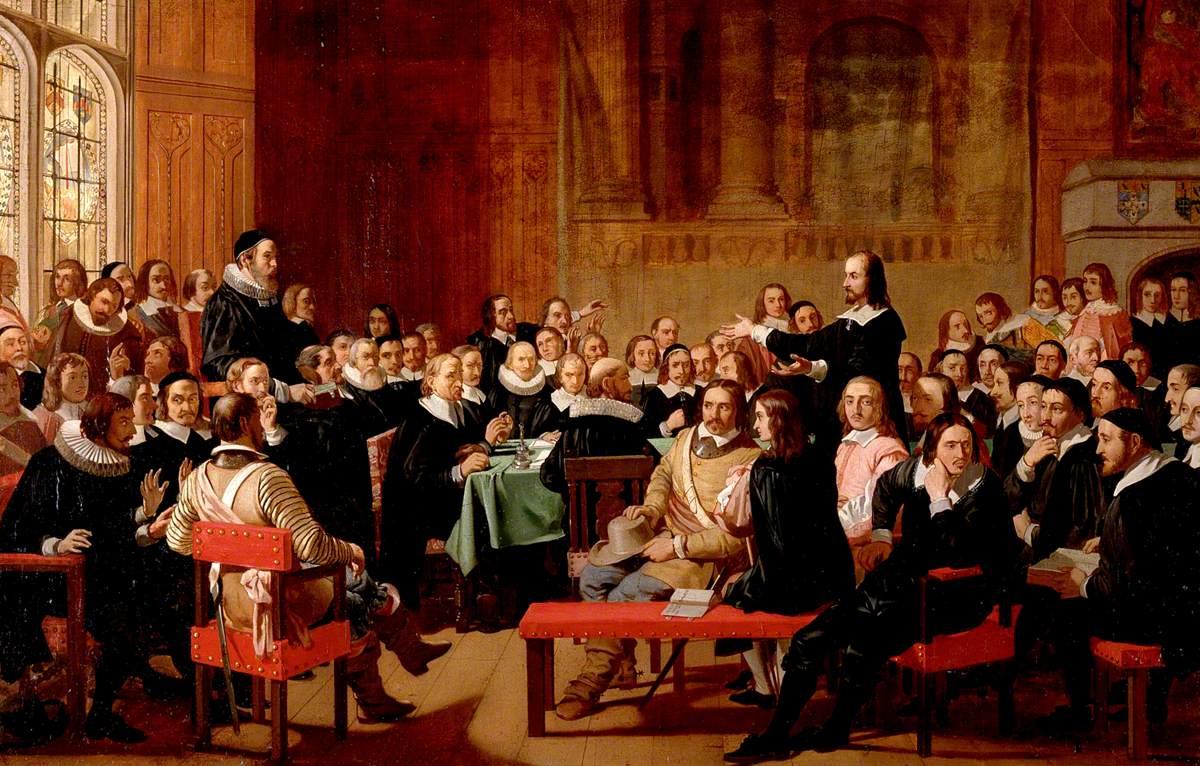
The first sustained critics of Congregational order were fellow Calvinists. At the Westminster Assembly a small group of Congregational ministers argued their case against the Presbyterian majority. Walker reports that as early as December 30, 1643, "Thomas Goodwin, Philip Nye, Sidrach Simpson, Jeremiah Burroughes, and William Bridge" published An Apologeticall Narration, in which "they declare their entire agreement in points of doctrine with the Presbyterian wing of the Assembly, but desire permission to exercise a degree of liberty in matters of church-government." They were, he writes, "on the whole, treated with much respect, though outvoted at all points."45 The New England leaders John Cotton, John Davenport and Thomas Hooker were invited to the Assembly and declined to go. The Scottish theologian Samuel Rutherford answered the New England polity in The Due Right of Presbyteries (1644), which, in Walker's words, "opposed, in kindly spirit and with much learning, the New England view."45 The Presbyterian argument, then and later, was that the New Testament shows churches bound together under elders and synods (the council of Acts 15), and that a single congregation cannot be the final court of appeal. The Congregational answer was that synods may counsel but not command. Both positions are still held.

Historians
Walker himself, a Congregationalist, judged the Half-Way Covenant harshly: it "demanded no personal sense of a change of heart. It was an illogical and inconsistent position; and as such could not long be maintained." He adds that it was "Greatly modified early in the eighteenth century" and "wholly abandoned in the nineteenth."24 Perry Miller of Harvard, in Errand into the Wilderness (1956) and the two volumes of The New England Mind, treated the Puritans as serious intellectuals and read their history as a slow change from a community with a mission to a provincial society uncertain of its purpose; this is a summary of his argument, not a quotation.46 Edmund S. Morgan's Visible Saints (1963), noted above, located the Puritan idea of a church of the converted at the center of that story.19 Sydney Ahlstrom, in A Religious History of the American People (1972), gave the Puritan inheritance a central place in his account of American religion as a whole, while also describing how its institutions declined in the nineteenth and twentieth centuries (a summary, not a quotation).47
The disputes over the twentieth century union are still told in two ways. The UCC's history presents the 1957 union as the fulfillment of an ecumenical calling and the lawsuits as a painful obstacle. The NACCC and the CCCC present their founding as faithfulness to the autonomy of the local church and, for the CCCC, to historic doctrine. The UCC history even quotes the title of a 1962 lecture by Fred Hoskins, one of the union's leaders, that states the question both sides asked: Congregationalism Betrayed or Fulfilled.17
What the record shows and what it does not
- Documented fact: the Mayflower Compact's text and date (November 11, 1620, Old Style); the Salem covenant of 1629; the Cambridge Platform's text (1648); the Savoy Synod's close on October 12, 1658; the 1662 synod's propositions on baptism, commended by the General Court on October 8, 1662; Connecticut's 1818 constitution (13,918 to 12,364) and its Article Seventh; Massachusetts Amendment Article XI, ratified November 11, 1833; the UCC's formation on June 25, 1957; the UCC's reported 666,073 members for 2024.
- A church's own claim or tradition: the UCC's list of "firsts" (Haynes in 1785 as the first African American ordained by a Protestant denomination; Antoinette Brown as the first woman ordained since New Testament times); the NACCC's self-description as heir of the "Church of the Pilgrims"; the CCCC's claim to preserve "historic Congregationalism."
- Scholarly reading: Morgan on conversion narratives as a New England innovation; Miller on the "errand" and its decline; Walker's judgment of the Half-Way Covenant as "illogical and inconsistent."
- Open questions: exactly where and when Winthrop delivered "A Modell of Christian Charity"; how uniformly conversion narratives were required in the 1630s and 1640s; current church and member totals for the NACCC and the CCCC, which were not found in either body's published reports.
Claims checked
| Claim | Rating | Evidence |
|---|---|---|
| "The Pilgrims came to America for religious freedom." | Partly supported | They had freedom of worship in Leiden. Bradford's own list of reasons for leaving puts hardship, aging, the danger to their children and the hope of spreading the gospel first; the wish to keep their church together under English rule runs through all of them.6 |
| "The Pilgrims and the Puritans were the same people." | Partly supported | Both were Puritans in the broad sense and Calvinist in doctrine. Plymouth's founders were Separatists; Massachusetts Bay's were Non-Separatists, and Roger Williams refused to serve the Boston church as "an unseparated people."15 |
| "The Mayflower Compact was America's first constitution and founded democracy." | Partly supported | It is a covenant by consent to "enact, constitute, and frame" laws, signed by 41 men.9 It created no offices, defined no powers and was written because the ship was outside its patent and some passengers' loyalty was in doubt.8 It is an early American example of government by compact, not a constitution in the later sense. |
| "The Puritans of New England wanted religious liberty for everyone." | Refuted | The Cambridge Platform says heresy and "corrupt & pernicious opinions" are "to be restrayned, & punished by civil authority."21 Hutchinson and Wheelwright were banished in 1637.12 |
| "The Puritans burned witches at Salem." | Refuted | Nineteen people were hanged and Giles Corey was pressed to death in 1692; no one was burned.29 |
| "The Puritans banned Christmas." | Partly supported | Bradford records that in 1621 he stopped public Christmas games at Plymouth, while allowing private devotion in houses.11 A later Massachusetts law against keeping Christmas is widely cited, but its text was not checked for this lesson. |
| "Winthrop preached 'a city upon a hill' aboard the Arbella." | Unresolved | The 1838 printing heads the text "Written on board the Arbella."13 Whether it was preached, and whether on board or before sailing, is not settled by that heading. |
| "The Pilgrims landed on Plymouth Rock." | Unresolved | Bradford's narrative of the landing does not mention a landing rock.10 The rock appears in the 1909 editor's introduction to the same volume, which shows the tradition but is not evidence for the event. |
| "Congregationalists founded Harvard and Yale." | Supported | Harvard was founded on October 28, 1636, by the Massachusetts colony; Yale began as the Collegiate School chartered by the Connecticut legislature in 1701 to educate students for "Publick employment both in Church and Civil State."1828 Both colonies' churches were Congregational. |
| "The Unitarians stole the Congregational churches." | Partly supported | In Dedham and elsewhere, courts awarded meetinghouses and property to the parishes, which were often liberal, while orthodox church majorities who left lost them.36 The orthodox called this theft; the liberals called it the law. About a quarter of the Standing Order churches of Massachusetts became Unitarian within twenty years.36 |
| "Antoinette Brown was the first woman ordained since New Testament times." | Unresolved | This is the UCC's claim.37 The UCC's own history adds that her 1853 ordination was "recognized only by the local church."17 Women preached among the Quakers two centuries earlier (lesson 09), though Quakers do not ordain; a universal "first" is hard to prove. |
| "Lemuel Haynes was the first African American ordained by a Protestant denomination." | Unresolved | This is the UCC's claim for 1785.37 It was not checked against other denominations' records for this lesson. |
| "The UCC is the Pilgrims' church." | Partly supported | Most Congregational Christian churches entered the UCC in 1957 (about 1,000 stayed out), and the UCC claims the Congregational heritage.4117 The NACCC also calls Congregational churches the "Church of the Pilgrims,"5 and many of the first churches of Massachusetts are now Unitarian Universalist. Several bodies share the inheritance. |
Hard questions and answers
If each church is independent, how did Congregationalists keep any common doctrine?
For two centuries they kept it by agreement and by the state. The Cambridge Synod accepted Westminster doctrine, the 1680 synod adopted the Savoy Confession, the colonial laws punished heresy, and Harvard and Yale trained nearly every minister.2026 Once disestablishment and the Unitarian controversy removed those supports, the only remaining bonds were voluntary. The results are visible today: a UCC with a testimony instead of a creed, an NACCC with guiding principles and no statement of faith, and a CCCC with a short evangelical statement of faith. Each is a different answer to the same problem.
Did the Half-Way Covenant weaken the churches?
Its supporters in 1662 argued that it kept the children of the covenant inside the church and under its discipline. Its opponents, including Charles Chauncy and a group Walker calls the "Dissenting Brethren," argued that it lowered the standard of a church of visible saints.24 Walker's own verdict was that it was "illogical and inconsistent."24 Edwards fought the looser practice of his grandfather's church and lost his pulpit over it.17 Whether the churches would have kept more members with a strict standard, or fewer, is a judgment about what might have happened, and the record does not settle it.
Was the Unitarian break a departure from Congregationalism or a development of it?
Both sides claimed the founders. The orthodox pointed to the Westminster and Savoy doctrine that the founders had adopted. The liberals pointed to the founders' refusal of binding creeds and to the Plymouth pledge to follow light "made known, or to be made known." Channing argued from Scripture, beginning his sermon with "Prove all things; hold fast that which is good."35 In doctrine, Unitarianism rejected the Trinity, which every founding Congregational confession affirmed. In polity, it kept the congregational form. A reader can grant both facts.
Was the 1957 merger legitimate under Congregational principles?
In the Cadman litigation a court ruling (dated 1949 in the UCC history) favored the opponents, but it was reversed on appeal, and the reversal was sustained in 1953, which allowed the merger to proceed.17 The legal question was settled; the principled question was not. Merger leaders argued that the General Council, like a local church, was a gathering under Christ that could act for itself. Opponents argued that it was a representative body with no power to commit the churches. The test the merger leaders accepted was that no local church could be forced in, and about 1,000 Congregational Christian churches stayed out.41
Why has the UCC lost so many members?
The UCC's own figures show a fall from 2,246,610 members in 1960 to 666,073 in 2024.41 Part of that is the departure of about 1,000 churches after the union and changes in counting in 1992 and 2022.41 The rest belongs to the larger decline of the older Protestant bodies, which scholars explain in different ways: lower birth rates, weaker transmission of faith to children, theological change, and the movement of Americans out of organized religion. Those explanations, with their authors and evidence, are compared across several denominations in lesson 11.
Is congregational polity biblical?
Congregationalists point to Matthew 18:20, which the NACCC quotes ("For where two or three are gathered in my name, I am there among them"), and to the local churches addressed in the New Testament letters.5 Presbyterians point to Acts 15 and to elders who govern several congregations; Anglicans, Orthodox and Catholics point to bishops in succession from the apostles. The Cambridge Platform lists its proof texts in the margin of every article, and the Westminster and Anglican positions are set out in lesson 02 and lesson 04. The evidence the sides cite is the same set of texts read differently, and this lesson does not decide between them.
Related lessons
- Church History, Part A, lesson 12: Zwingli, Calvin and the Wider Reformation (the English Reformation and Calvin's Geneva)
- Lesson 02: The Reformed and Presbyterians (Westminster, the Plan of Union from the Presbyterian side)
- Lesson 03: Calvinism in Detail (the doctrine the Puritans held)
- Lesson 04: Anglicans and Episcopalians (the church the Puritans tried to reform)
- Lesson 06: Baptists (Roger Williams, Providence and the Separate Baptists)
- Lesson 09: Quakers and the Radical Tradition (Mary Dyer and the Boston hangings)
- Lesson 10: The Restoration Movement (Barton Stone and the Christian name)
- Lesson 11: Mainline and Evangelical (the UCC among the mainline bodies)
- Lesson 14: Review and Chart of the Denominations
- Church History, Part C, lesson 03: Evangelicalism Defined
- Liberty 56, lesson 08: Culture and Law in American History (Puritan law and the founding)
Learn more
- Williston Walker, The Creeds and Platforms of Congregationalism (1893): Every Congregational document of this lesson from Browne to the 1883 creed, with Walker's histories of each; the standard collection and free to read.
- Bradford's History of the Plymouth Settlement (Paget, 1909): The governor's own account of Scrooby, Leiden, the voyage and the colony, in modernized English.
- UCC, A Short Course in the History of the United Church of Christ: The UCC's own long history of all four of its parent traditions, including its account of the 1950s lawsuits.
- UCC Summary Statistics 1955-2024: Year-by-year congregations and members from the denomination's yearbooks, with notes on counting changes.
- NACCC, The Art and Practice of the Congregational Way: The NACCC's own handbook for members of continuing Congregational churches.
- Jonathan Edwards, A Faithful Narrative (CCEL): Edwards's first-hand account of the Northampton revival of 1734 and 1735.
Still being checked (15 items)
These points could not be confirmed against a primary source when this lesson was written and fact checked in October 2026. The text above states each one as uncertain.
- Current church and member totals for the NACCC and the CCCC were not found in either body's own published reports; secondary reference works give roughly 300 churches each (CCCC: 42,296 members in 2010, cited to its 2015-16 yearbook, which could not be fully read).
- Whether and where Winthrop delivered 'A Modell of Christian Charity' (aboard the Arbella or before sailing); only the 1838 printing's heading was checked.
- The Massachusetts law against keeping Christmas (commonly dated 1659 to 1681) was not checked against the statute text.
- The link between the Half-Way Covenant dispute and the 1669 founding of Boston's Third Church (Old South) is the usual account but was not confirmed from a primary source in this research.
- The founding of the American Unitarian Association in 1825 and the 1961 Unitarian Universalist consolidation were not confirmed from a source opened for this lesson.
- The statement that Massachusetts was the last state to end tax support of churches was not confirmed from a source opened for this lesson.
- The general description of UCC polity (associations hold ministerial standing, General Synod meets every two years and speaks to, not for, the churches) was not drawn from a UCC document opened for this lesson; also the statement that some UCC congregations have declined to become Open and Affirming.
- The 1972 ordination of William R. Johnson as the first openly gay minister in a historic Protestant denomination, Haynes as first African American ordained by a Protestant denomination (1785) and Antoinette Brown as first woman ordained since New Testament times are the UCC's own claims and were not checked against other bodies' records.
- The usual description of New England meetinghouse arrangement and worship (pulpit on the long wall, seating by rank, unaccompanied psalm singing, two Lord's Day services) is general and not footnoted to a single source.
- The scholarly summaries of Morgan, Miller and Ahlstrom are paraphrases from general knowledge; the books were not opened for this lesson.
- Freemanship in Massachusetts Bay tied to church membership (1631 law) was not checked against the colony records.
- The date of King Philip's War is not given in the lesson; the Reforming Synod's September 1679 session is from Walker's narrative only.
- The painting date of Ferris's Mayflower Compact is not stated on Wikimedia Commons and is not given in the caption.
- Robert Browne's rule on the election of officers: the exact wording formerly quoted ("The consent of the people must be gathered by the Elders or guides, and testifyed by voyce") was not found in four scanned copies of Walker (1893) checked by the fact checker, so the text now paraphrases it.
- The Cadman v. Kenyon lower-court ruling is dated 1949 by the UCC history; reported New York decisions are often cited to 1950 (lower court), 1951 (Appellate Division) and 1953 (Court of Appeals). Not checked against the law reports.
Notes
- Williston Walker, The Creeds and Platforms of Congregationalism (New York: Charles Scribner's Sons, 1893), Preface. Public domain; Cornell University Library copy digitized at the Internet Archive (retrieved Oct. 28, 2026). Read it online. ↩
- Walker, Creeds and Platforms (1893), chapters on Browne's Congregationalism (1582), the Confession of 1589 and the Confession of 1596: Coppin and Thacker hanged in 1583, Browne's death between June 1631 and November 1633, Browne's rule on the consent of the people, and Barrow's execution on April 6, 1593. Read it online. ↩
- Walker, Creeds and Platforms (1893), note on Henry Jacob, founder in 1616 of the Southwark congregation, quoting Jacob's Divine Beginning and Institution of Christs True Visible or Ministeriall Church (Leyden, 1610), p. [18]. Read it online. ↩
- William Bradford, Bradford's History of the Plymouth Settlement, 1608-1650, rendered into modern English by Harold Paget (New York: E. P. Dutton, 1909), Book I, chapter I. Project Gutenberg eBook 69871 (retrieved Oct. 28, 2026). Read it online. ↩
- National Association of Congregational Christian Churches, "About Congregationalism: Understanding the Congregational Way" (guiding principles; Matthew 18:20 quoted from the NRSV) (retrieved Oct. 28, 2026). Read it online. ↩
- Bradford, History of the Plymouth Settlement, ed. Paget (1909), Book I, chapter IV, "Reasons which led the Congregation at Leyden to Decide upon Settlement in America." Read it online. ↩
- Bradford, History of the Plymouth Settlement, ed. Paget (1909), Book I, chapter on the departure from Leyden by way of Delfthaven. Read it online. ↩
- Walker, Creeds and Platforms (1893), chapter on the Mayflower Church, about pp. 81 to 92: Brewster's election as elder at Leyden, Robinson's death in March 1625, and the compact of November 11 made because the colonists were outside their patent. Read it online. ↩
- "Mayflower Compact: 1620," Avalon Project, Lillian Goldman Law Library, Yale Law School, from Francis Newton Thorpe, ed., The Federal and State Constitutions, Colonial Charters, and Other Organic Laws (Washington: Government Printing Office, 1909) (retrieved Oct. 28, 2026). Read it online. ↩
- Bradford, History of the Plymouth Settlement, ed. Paget (1909), last chapter of Book I (landing at Cape Cod and New Plymouth) and Book II, chapter I heading ("Death of half their number"); the phrase "the landing on the rock" appears only in the editor's introduction. Read it online. ↩
- Bradford, History of the Plymouth Settlement, ed. Paget (1909), Book II, chapter II (1621), the Christmas Day episode. Read it online. ↩
- Walker, Creeds and Platforms (1893), chapters on the Puritan settlements and Hooker's Congregationalism, about pp. 93 to 148: the Massachusetts Bay charter of March 4, 1629, and the sentence of November 2, 1637, banishing Wheelwright and Hutchinson (p. 134). Read it online. ↩
- John Winthrop, "A Modell of Christian Charity" (1630), from Collections of the Massachusetts Historical Society (Boston, 1838), 3rd series, 7:31-48, Hanover Historical Texts Collection, Hanover College (retrieved Oct. 28, 2026). Read it online. ↩
- Walker, Creeds and Platforms (1893), "The Salem Symbols": texts of the Covenants of 1629 and 1636, pp. 116 to 118. Read it online. ↩
- Walker, Creeds and Platforms (1893), "The Covenant of the Charlestown-Boston Church, 1630," pp. 123 to 131, including Walker's note quoting Roger Williams's letter to John Cotton the younger. Read it online. ↩
- Walker, Creeds and Platforms (1893), list of the churches of the four confederate colonies with their dates of organization, in the chapter on the Cambridge Synod. Read it online. ↩
- United Church of Christ, "History" (A Short Course in the History of the United Church of Christ), ucc.org: Hooker, Hutchinson, Edwards, Andover, the Plan of Union, the American Board, Antoinette Brown, the Christian Churches, the 1931 and 1934 unions, the litigation, the Uniting General Synod, the 1959 Statement of Faith and the 1961 Constitution (retrieved Oct. 28, 2026). Read it online. ↩
- Harvard University, "History" ("When was Harvard founded?") (retrieved Oct. 28, 2026). Read it online. ↩
- Edmund S. Morgan, Visible Saints: The History of a Puritan Idea (New York: New York University Press, 1963). Summarized, not quoted; the book was not opened for this lesson. Read it online. ↩
- Walker, Creeds and Platforms (1893), "The Cambridge Synod and Platform, 1646-1648," narrative pp. 157 to 193 (sessions of September 1646 and June 1647; action of the General Court in May 1651, p. 187). Read it online. ↩
- The Cambridge Platform (1648), chapters II, III and XVII, text in Walker, Creeds and Platforms (1893), pp. 194 to 237. Read it online. ↩
- First Parish in Hingham (Old Ship Church), Unitarian Universalist, home page and "Friends of the Old Ship Meeting House" (retrieved Oct. 28, 2026). Read it online. ↩
- Walker, Creeds and Platforms (1893), "The Savoy Declaration, 1658," pp. 340 to 408 (close of the synod, p. 350; "Of the Institution of Churches," p. 403, with Walker's note). Read it online. ↩
- Walker, Creeds and Platforms (1893), "The Half-Way Covenant Decisions of 1657 and 1662," pp. 238 to 339 (Walker's assessment, pp. 249 to 250; Result of 1657, pp. 288 to 300; Propositions of 1662 and the General Court order of October 8, 1662, pp. 301 to 339). Read it online. ↩
- Revolutionary Spaces, "Old South Meeting House" (historic moments 1669 and 1729) (retrieved Oct. 28, 2026). Read it online. ↩
- Walker, Creeds and Platforms (1893), "The Reforming Synod of 1679-1680, and its Confession of Faith," pp. 409 to 439. Read it online. ↩
- Walker, Creeds and Platforms (1893), p. 275 (on the Saybrook constitution of 1708), and chapters XV and XVI, pp. 463 to 541 (Massachusetts Proposals of 1705, Saybrook Platform of 1708, Plan of Union of 1801). Read it online. ↩
- Yale University, "Traditions and History" (founding of 1701 and renaming of 1718) (retrieved Oct. 28, 2026). Read it online. ↩
- Salem Witch Trials Documentary Archive and Transcription Project, University of Virginia, "Increase Mather" (retrieved Oct. 28, 2026). Read it online. ↩
- Jonathan Edwards, A Faithful Narrative of the Surprising Work of God in the Conversion of Many Hundred Souls in Northampton, letter to the Rev. Benjamin Colman of Boston, with the preface of Isaac Watts and John Guyse, in The Works of Jonathan Edwards, vol. 1, as posted by the Christian Classics Ethereal Library (retrieved Oct. 28, 2026). Read it online. ↩
- Jonathan Edwards, An Humble Inquiry into the Rules of the Word of God, concerning the Qualifications Requisite to a Complete Standing and Full Communion in the Visible Christian Church (1749), and the memoir of Edwards, both in The Works of Jonathan Edwards, vol. 1, Christian Classics Ethereal Library. Read it online. ↩
- Constitution of the Commonwealth of Massachusetts (1780), Declaration of Rights, Article III, and Articles of Amendment, Article XI, "approved and ratified by the people November 11th, 1833," text of the Massachusetts General Court (retrieved Oct. 28, 2026). Read it online. ↩
- Connecticut Secretary of the State, Register and Manual, "1818 Constitution of the State of Connecticut," introductory note and Article Seventh, "Of Religion" (retrieved Oct. 28, 2026). Read it online. ↩
- Unitarian Universalist Association, adult curriculum Faith Like a River, Workshop 9, "The Baltimore Sermon" (retrieved Oct. 28, 2026). Read it online. ↩
- William Ellery Channing, "Unitarian Christianity," discourse at the ordination of the Rev. Jared Sparks, Baltimore, May 5, 1819, text at Voices of Democracy, University of Maryland (retrieved Oct. 28, 2026). Read it online. ↩
- Unitarian Universalist Association, adult curriculum Faith Like a River, Workshop 9, "The Dedham Case" (retrieved Oct. 28, 2026). Read it online. ↩
- United Church of Christ, "UCC Firsts" (1700, 1785, 1846, 1853, 1972, 2005, 2023 entries) (retrieved Oct. 28, 2026). Read it online. ↩
- Walker, Creeds and Platforms (1893), chapters XVIII and XIX: the "Burial Hill" Declaration of Faith and the Statement of Principles of Polity, 1865, pp. 553 to 569, and the Constitution of the National Council and Oberlin Declaration, 1871, pp. 570 to 576. Read it online. ↩
- National Association of Congregational Christian Churches, "About the NACCC" (Our History) (retrieved Oct. 28, 2026). Read it online. ↩
- Conservative Congregational Christian Conference, "Birth of the Conservative Congregational Christian Conference," Foresee (February 2023), drawn from Wesley D. Blood, "The Birth of a Conference," in Modern Day Pilgrims (retrieved Oct. 28, 2026). Read it online. ↩
- United Church of Christ, Center for Analytics, Research and Development, and Data (CARDD), "Summary Statistics 1955-2024" (2025), with its notes on 1960 to 1965, 1992 and 2022 (retrieved Oct. 28, 2026). Read it online. ↩
- United Church of Christ, CARDD, 2024 United Church of Christ Statistical Profile (figures for the end of 2023) (retrieved Oct. 28, 2026). Read it online. ↩
- Erwin A. Britton, "A Brief Sketch of the National Association of Congregational Christian Churches" (about 1981), formerly posted at naccc.org; Internet Archive Wayback Machine copy (retrieved Oct. 28, 2026). Read it online. ↩
- Conservative Congregational Christian Conference, "About Us" and "The CCCC Statement of Faith" (retrieved Oct. 28, 2026). Read it online. ↩
- Walker, Creeds and Platforms (1893), notes on the Congregational members of the Westminster Assembly, An Apologeticall Narration (London, 1643), the New England ministers' refusal of election to the Assembly, and Samuel Rutherford's Due Right of Presbyteries (London, 1644), in the chapters on Hooker's Congregationalism and the Cambridge Synod. Read it online. ↩
- Perry Miller, Errand into the Wilderness (Cambridge, Mass.: Harvard University Press, 1956), and The New England Mind (2 vols., 1939 and 1953). Summarized, not quoted; not opened for this lesson. Read it online. ↩
- Sydney E. Ahlstrom, A Religious History of the American People (New Haven: Yale University Press, 1972). Summarized, not quoted; not opened for this lesson. Read it online. ↩
- Leonard Woods, A Sermon Delivered at the Tabernacle in Salem, Feb. 6, 1812, on Occasion of the Ordination of the Rev. Messrs. Samuel Newell, A. M., Adoniram Judson, A. M., Samuel Nott, A. M., Gordon Hall, A. M., and Luther Rice, A. B., Missionaries to the Heathen in Asia (Boston, 1812), catalogue record, HathiTrust Digital Library (retrieved Oct. 28, 2026). Read it online. ↩
Check yourself
1. What separated the Plymouth founders from the founders of Massachusetts Bay?
Both groups were Reformed Puritans. The Scrooby and Leiden congregation had separated from the Church of England; the Massachusetts Bay leaders kept communion with it, which is why Roger Williams refused to serve the Boston church as 'an unseparated people.'
2. According to Bradford, which of these was NOT among the reasons the Leiden congregation decided to leave the Netherlands?
They had freedom of worship in Leiden. Bradford lists hardship, age, the danger to their children and the hope of spreading the gospel.
3. The Cambridge Platform (1648) defines a Congregational church as a company of 'Saints by calling' united into one body by what?
Chapter II says a Congregational church consists of 'a company of Saints by calling, united into one body, by a holy covenant.'
4. What did the Half-Way Covenant of 1662 allow?
Proposition 5 of the 1662 synod held that children of such members 'are to be Baptized,' though their parents were not admitted to the Lord's Supper.
5. Why was Jonathan Edwards dismissed from Northampton in 1750?
Edwards rejected the looser admission practice of his grandfather Solomon Stoddard, argued his case in An Humble Inquiry (1749), and lost his pulpit.
6. Which state was the last to end tax support for its established churches, and when?
Massachusetts Amendment Article XI was ratified by the people on November 11, 1833. Connecticut's constitution of 1818 had ended the system there.
7. What did the Dedham case (Baker v. Fales, 1820) decide?
A jury found that the parish owned the assets and had the right to call the minister, and the ruling stood when appeals ended in 1821. Many liberal parishes kept their meetinghouses as a result.
8. Which two bodies united on June 25, 1957, to form the United Church of Christ?
The Evangelical and Reformed Church (1934) and the Congregational Christian Churches (1931) united at the Uniting General Synod in Cleveland. The NACCC and CCCC are bodies that stayed out.
Terms in this lesson
- Puritan
- An English Protestant of the late 1500s and 1600s who wanted the Church of England purified of practices seen as leftovers of Rome. Most Puritans stayed in the national church.
- Separatist
- A Puritan who concluded that the Church of England was not a true church and left it to form gathered congregations, as the Scrooby, Leiden and Plymouth church did.
- Non-Separatist
- A Puritan who organized congregations on covenant principles while refusing to renounce the Church of England, as the founders of Massachusetts Bay did.
- Church covenant
- The promise by which believers bind themselves to God and one another to form a church, such as the Salem covenant of 1629.
- Visible saints
- Church members who, in the judgment of the congregation, gave credible evidence of saving faith; in early New England this usually meant giving an account of conversion.
- Cambridge Platform
- The 1648 statement of church government adopted by the New England synod at Cambridge, Massachusetts, which defined the Congregational church and accepted Westminster doctrine for its substance.
- Savoy Declaration
- The 1658 confession of the English Congregationalists, adapted from the Westminster Confession, with a short platform of church polity.
- Half-Way Covenant
- The 1662 decision that baptized members who owned the covenant, though not admitted to the Lord's Supper, could have their children baptized.
- Standing Order
- The tax-supported Congregational establishment of Massachusetts, Connecticut and New Hampshire, ended in Connecticut in 1818 and Massachusetts in 1833.
- Parish and church
- In Massachusetts law, the parish was the body of taxpayers that supported the minister and the church was the body of covenanted communicants; the Dedham case turned on which owned the property.
- Christian Connection
- The loose fellowship of Christian Churches formed from the movements of James O'Kelly (1794), Abner Jones (1801) and others, which united with the Congregationalists in 1931.
- Basis of Union
- The agreement under which the Congregational Christian Churches and the Evangelical and Reformed Church united in 1957; it governed the UCC until the 1961 constitution.
- Open and Affirming
- The term a UCC congregation uses when it votes to declare itself welcoming of gay, lesbian, bisexual and transgender people; each congregation decides for itself.
Sources
- Williston Walker, The Creeds and Platforms of Congregationalism (1893) (1893) checked 2026-10
- William Bradford, Bradford's History of the Plymouth Settlement, ed. Harold Paget (1909) (1909 (written 1630 to 1650)) checked 2026-10
- Mayflower Compact: 1620 (Avalon Project, from Thorpe 1909) (1620-11-11 (Old Style)) checked 2026-10
- John Winthrop, A Modell of Christian Charity (Hanover Historical Texts) (1630) checked 2026-10
- The Works of Jonathan Edwards, vol. 1 (A Faithful Narrative; An Humble Inquiry; memoir), CCEL (1737; 1749) checked 2026-10
- Constitution of the Commonwealth of Massachusetts, Declaration of Rights Art. III and Amendment Art. XI (1780; 1833) checked 2026-10
- 1818 Constitution of the State of Connecticut (Register and Manual) (1818) checked 2026-10
- William Ellery Channing, Unitarian Christianity (Voices of Democracy text) (1819-05-05) checked 2026-10
- UUA, Faith Like a River: The Baltimore Sermon (undated) checked 2026-10
- UUA, Faith Like a River: The Dedham Case (undated) checked 2026-10
- United Church of Christ, History (undated (2019 statistics cited)) checked 2026-10
- United Church of Christ, UCC Firsts (undated) checked 2026-10
- UCC CARDD, Summary Statistics 1955-2024 (2025) checked 2026-10
- UCC CARDD, 2024 United Church of Christ Statistical Profile (2024 edition (2023 data)) checked 2026-10
- UCC, Statistics and Reports page (2026) checked 2026-10
- NACCC, About Congregationalism (undated) checked 2026-10
- NACCC, About the NACCC (undated) checked 2026-10
- Erwin A. Britton, A Brief Sketch of the NACCC (Wayback copy) (about 1981) checked 2026-10
- CCCC, Birth of the Conservative Congregational Christian Conference (2023-02) checked 2026-10
- CCCC, About Us (2026) checked 2026-10
- CCCC, Statement of Faith (undated) checked 2026-10
- First Parish in Hingham, Old Ship Church (2026) checked 2026-10
- Revolutionary Spaces, Old South Meeting House (2026) checked 2026-10
- Harvard University, History (2026) checked 2026-10
- Yale University, Traditions and History (2026) checked 2026-10
- Salem Witch Trials Documentary Archive, Increase Mather (undated) checked 2026-10
- Edmund S. Morgan, Visible Saints: The History of a Puritan Idea (1963) checked 2026-10
- Perry Miller, Errand into the Wilderness (1956) checked 2026-10
- Sydney E. Ahlstrom, A Religious History of the American People (1972) checked 2026-10
- Leonard Woods, A Sermon Delivered at the Tabernacle in Salem, Feb. 6, 1812 (HathiTrust record) (1812-02-06) checked 2026-10