Lesson 8 of 9 · about 27 minutes
Culture and Law in American History
You'll be able to
- Explain John Adams's claim that the Revolution happened in the minds and hearts of the people before the war began
- Describe how the revivals, temperance and antislavery movements and Uncle Tom's Cabin changed public opinion before the law changed
- Use Prohibition and repeal to show what happens when law runs ahead of culture
- Describe the role of churches, songs and television in the civil rights movement
- Read the data on school desegregation, interracial marriage, seat belts and smoking as cases where law moved first
In February 1818, forty-two years after independence, John Adams sat down to answer a question from the Baltimore editor Hezekiah Niles about what the American Revolution had really been. Adams thought most people had it wrong. "The Revolution was effected before the War commenced," he wrote. "The Revolution was in the Minds and Hearts of the People. A Change in their Religious Sentiments of their Duties and Obligations." The fighting that began at Lexington was only the end of the process. "This radical Change in the Principles, Opinions Sentiments and Affection of the People, was the real American Revolution."1
Adams was making the claim this module is about, and he was making it about the founding itself. American history offers a long run of test cases. In some, culture moved first and law followed. In others, law moved first and dragged a reluctant culture behind it. A few show what happens when law moves and culture refuses to come along.
The Great Awakening before the Revolution
In 1739 a young Anglican preacher named George Whitefield arrived in Philadelphia, and the city's churches were soon too small for his crowds. One evening he preached from the top of the courthouse steps in the middle of Market Street, and both Market and Second Streets filled with listeners. Benjamin Franklin, who was no evangelical, stood at the back and did something only Franklin would do. He walked backward down the street toward the river until other noise drowned the voice, then worked out the area of a half circle with that radius:2
"Imagining then a semicircle, of which my distance should be the radius, and that it were fill'd with auditors, to each of whom I allow'd two square feet, I computed that he might well be heard by more than thirty thousand."
Benjamin Franklin, Autobiography, written 1771-1790. 2
What impressed Franklin more than the voice was what came after it. "It was wonderful to see the change soon made in the manners of our inhabitants," he wrote. "From being thoughtless or indifferent about religion, it seem'd as if all the world were growing religious, so that one could not walk thro' the town in an evening without hearing psalms sung in different families of every street."2
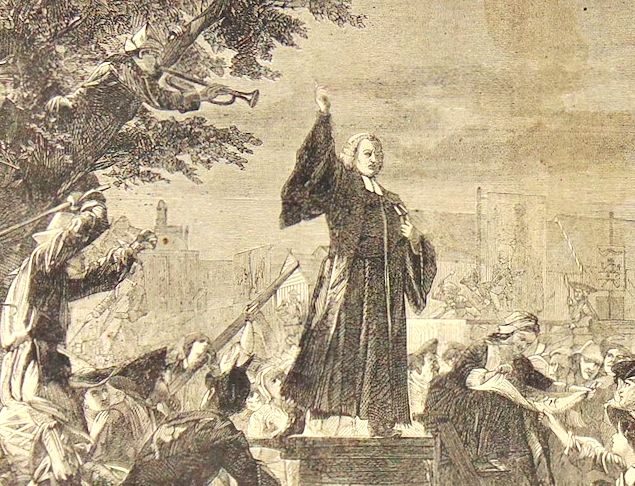
The Library of Congress describes the Great Awakening of the 1730s and 1740s as a revival that "swept the English-speaking world" and split the Congregational and Presbyterian churches into supporters and opponents, the New Lights and the Old Lights.3 That split mattered. Ordinary church members chose sides against their own ministers, left established churches and founded new ones, and learned to judge authority by their own reading of Scripture. Thirty years later many of the same congregations heard sermons justifying resistance to the king. In the words of a historian quoted by the Library of Congress, "by turning colonial resistance into a righteous cause, and by crying the message to all ranks in all parts of the colonies, ministers did the work of secular radicalism and did it better."4
Historians disagree about the link
How direct was the line from revival to revolution? Alan Heimert's Religion and the American Mind: From the Great Awakening to the Revolution (Harvard University Press, 1966) argued that evangelical preaching shaped the Revolution's popular energy. Jon Butler answered in a 1982 article in the Journal of American History that historians had made the Great Awakening into an "interpretative fiction," a single event that was really a scattered set of local revivals with no clear political result.5 The safest reading takes something from each. The revivals did not cause the Revolution. They did teach a large share of colonists to talk about liberty, conscience and authority in religious terms, which is what Adams said in 1818.
The Second Great Awakening, temperance and abolition
A second wave of revival began around 1800. In August 1801 a camp meeting at Cane Ridge in Bourbon County, Kentucky, drew a crowd usually estimated at 10,000 to 20,000 over the week; one reference work judges that no more than 10,000 could have been there at any one time.6 Out of these revivals came a network of voluntary organizations. The Library of Congress lists the six largest benevolent societies of 1826 and 1827, among them the American Bible Society, the American Sunday-School Union and the American Tract Society, founded in 1825, which "flooded the nation with evangelical pamphlets, aimed at converting their recipients and eradicating social vices like alcoholism and gambling."7
Temperance
Alcohol was the first great target. In the 1820s the Connecticut minister Lyman Beecher preached a series of sermons on intemperance that were printed and read across the country and in Britain. "Intemperance is the sin of our land," he told his congregation, "and, with our boundless prosperity, is coming in upon us like a flood."8 The historian W. J. Rorabaugh estimated in The Alcoholic Republic (1979) that Americans drank about five gallons of hard liquor per person a year around 1830, the peak in the nation's history, and that consumption then fell steeply to between one and two gallons.9 The early drop came from persuasion: sermons, tracts, pledges and temperance taverns that would not serve liquor. State prohibition laws, starting with Maine's in 1851, came after the habit had already changed.10
Uncle Tom's Cabin
Beecher's daughter wrote the most influential American novel of the century. Harriet Beecher Stowe's Uncle Tom's Cabin first ran as a weekly serial in the antislavery paper The National Era, beginning June 5, 1851. When it came out as a two-volume book on March 20, 1852, about 10,000 copies sold in the United States in one week, and 300,000 within a year. It sold a million copies in Great Britain in its first year and more than two million worldwide by 1857.11 It was the first American novel to sell more than a million copies.11 Many of those copies were read aloud to whole households.
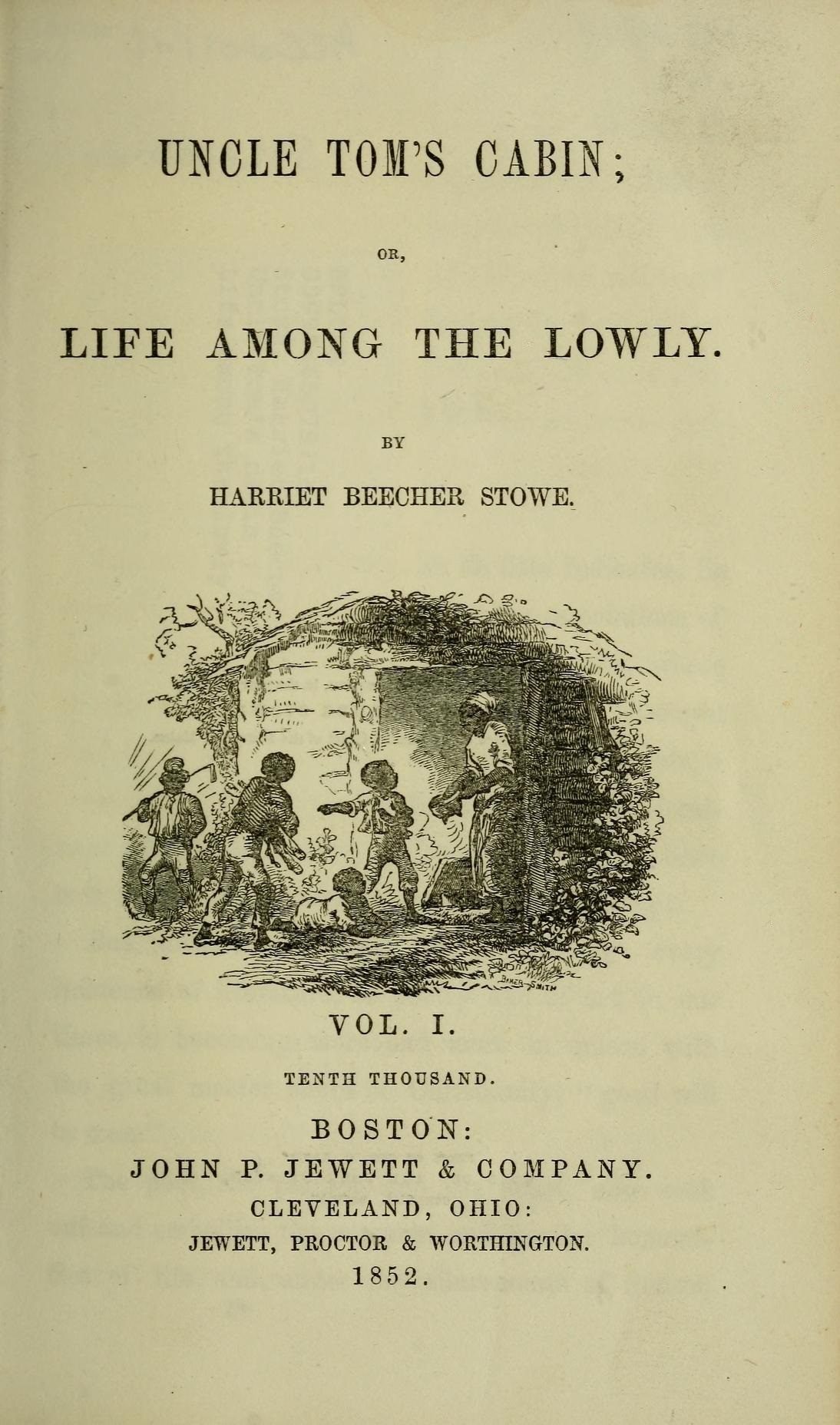
Stowe wrote in answer to a law. In Cincinnati, on the Ohio River, she had come to know people who had escaped slavery and the bounty hunters who chased them. In August 1850 she published a short piece in The National Era opposing the pending Fugitive Slave Act, which President Millard Fillmore signed on September 18, 1850, and urging Northerners to help people escaping slavery. The editor, Gamaliel Bailey, asked her to keep writing, and the novel followed.11 The act required Northern officials and citizens to help return fugitives. The novel made millions of readers imagine themselves in a fugitive mother's place, and it made the act much harder to defend in Northern towns. Southern writers answered with novels of their own. Both sides understood that the fight over slavery was being fought in parlors before it was fought in Congress.
Myth: Lincoln greeted Stowe as "the little woman who wrote the book that made this great war"
Stowe did visit the White House in 1862. But neither Lincoln nor Stowe left any written record of the greeting. The story was first published by her son Charles Edward Stowe and her grandson Lyman Beecher Stowe in a family biography in 1911, and the scholar Daniel R. Vollaro argued in the Journal of the Abraham Lincoln Association in 2009 that the family invented it.12 The book's influence is well documented without it.
Prohibition and repeal: when law outran culture
By the early 1900s the temperance movement had grown into a political machine. The Anti-Saloon League built pressure that few politicians dared to defy. Congress proposed the Eighteenth Amendment in December 1917, the states ratified it on January 16, 1919, and at 12:01 a.m. on January 17, 1920, national prohibition took effect.1314
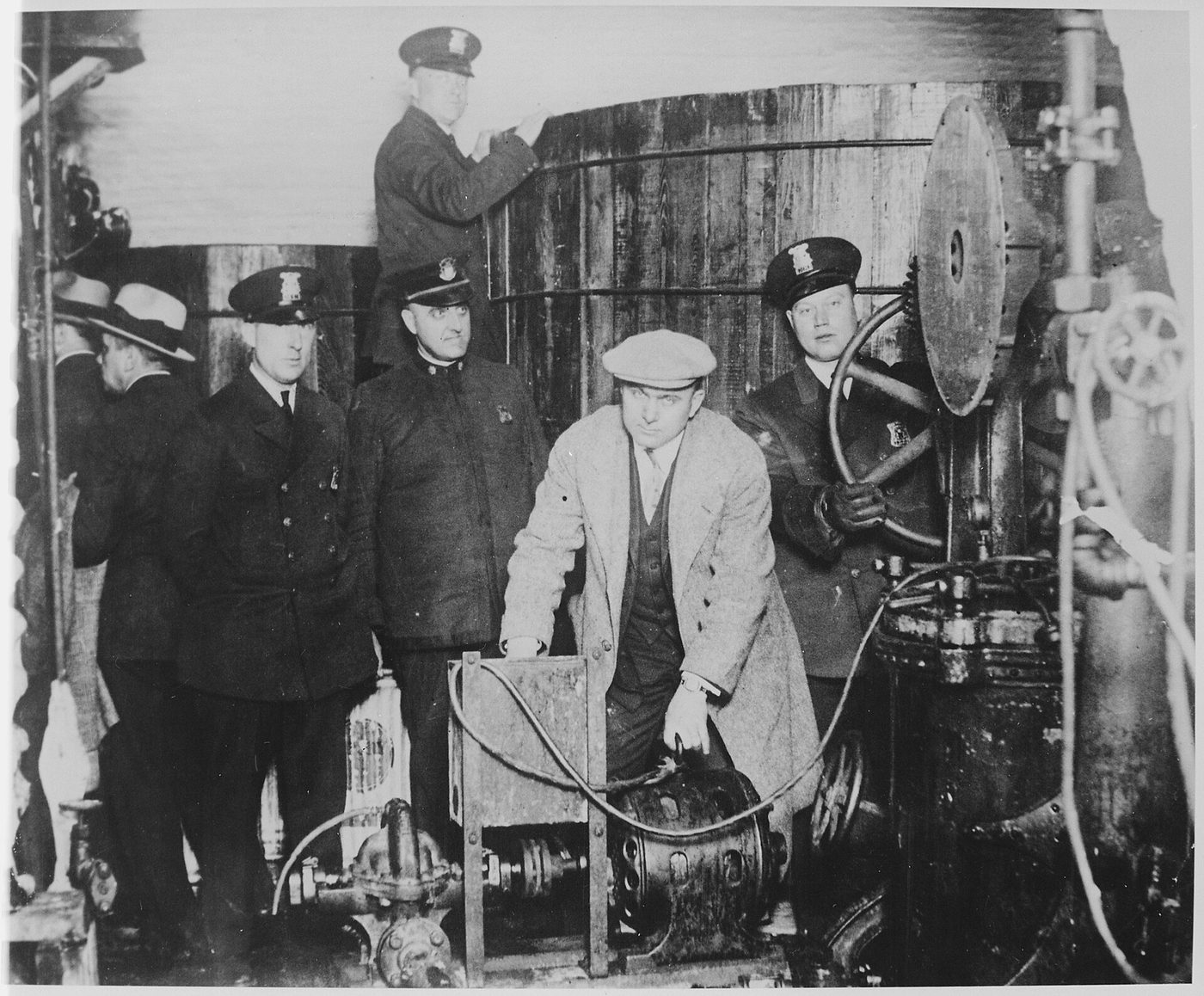
Did it work? The best estimate comes from the economists Jeffrey Miron and Jeffrey Zwiebel, who used death rates from cirrhosis and alcoholism, arrests for drunkenness and other indirect measures. They found that "alcohol consumption fell sharply at the beginning of Prohibition, to approximately 30 percent of its pre-Prohibition level. During the next several years, however, alcohol consumption increased sharply, to about 60-70 percent of its pre-Prohibition level."15 Drinking went down and stayed lower. But a large minority of Americans never accepted the law, and a trade in illegal liquor grew up to serve them, with the corruption and violence that came with it.
The Twenty-first Amendment repealed national prohibition on December 5, 1933.14 It is the only amendment in the Constitution that repeals another.16 The fairest reading is that the temperance movement won the law before it had won enough of the country. A century of persuasion had cut American drinking sharply. Then the movement tried to finish the job by command, and a culture that had not been persuaded found ways around the command.
The civil rights movement: churches and songs
The Montgomery bus boycott began on December 5, 1955, four days after Rosa Parks was arrested for refusing to give up her seat. That evening several thousand people packed Holt Street Baptist Church for a mass meeting, and a 26-year-old minister named Martin Luther King Jr. told them:
"If we are wrong, the Supreme Court of this nation is wrong. If we are wrong, the Constitution of the United States is wrong. If we are wrong, God Almighty is wrong."
Martin Luther King Jr., address at Holt Street Baptist Church, Montgomery, December 5, 1955. 17
Look at the order of authorities: the Court, the Constitution, God. King appealed to law and to the law above it in the same breath. The boycott ran on church networks. Congregations organized car pools, raised money and held weekly mass meetings for more than a year. A federal court ruled bus segregation unconstitutional in Browder v. Gayle on June 5, 1956, the Supreme Court affirmed in November, and on December 20, 1956, when the order arrived in Montgomery, the boycott ended.17 Culture and law moved together here. The churches built the will to sustain the protest. The courts turned the protest into a ruling.
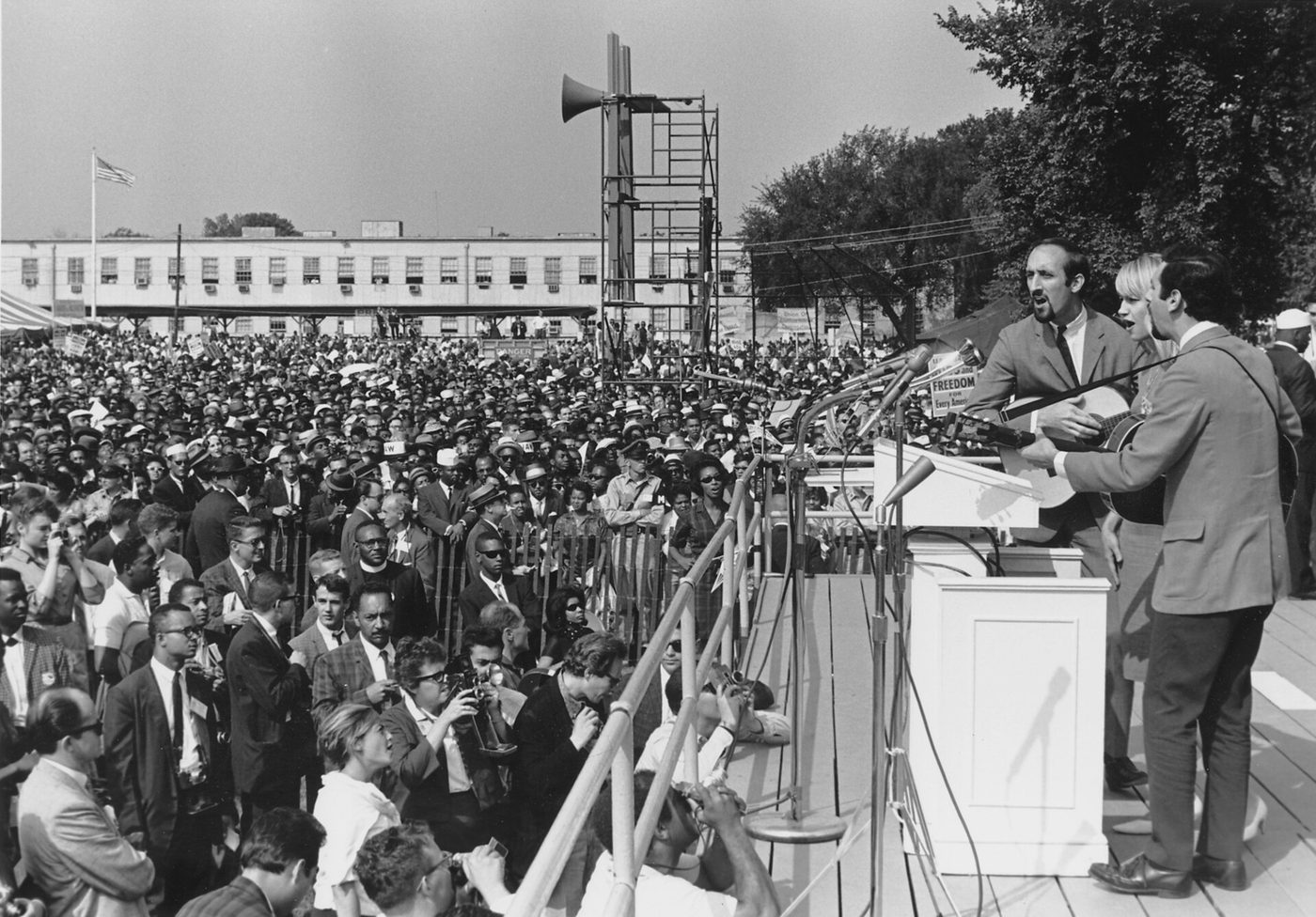
The movement's songs came out of the same churches. "We Shall Overcome" traces back to "I'll Overcome Some Day," written by the Reverend Charles Tindley in 1903, and to an older gospel song. Zilphia Horton of the Highlander Folk School in Tennessee heard striking tobacco workers in Charleston, South Carolina, sing it in 1946. A picketer named Lucille Simmons is credited with changing "I" to "We." Horton taught it to Pete Seeger the next year, and it spread from there through the movement.18 On March 15, 1965, President Lyndon Johnson went before Congress to ask for a voting rights law and ended a key passage with the movement's own words: "And we shall overcome."19
The screen: film and television
Mass media could push culture in either direction. In 1915 D. W. Griffith's film The Birth of a Nation portrayed the Ku Klux Klan of Reconstruction as heroes. The film's source author, Thomas Dixon Jr., persuaded President Woodrow Wilson to screen it in the White House. A remark attributed to Wilson, that it was "like writing history with lightning," is often quoted, but its authenticity has been disputed. Ten days before the film opened in Atlanta in December 1915, William Joseph Simmons led a group up Stone Mountain and burned a cross to found a new Klan.20 A movie did not pass any law. It helped build the constituency for some very bad ones.
Fifty years later the screen worked the other way. On Sunday, March 7, 1965, Alabama state troopers and mounted deputies attacked about 600 people marching from Selma toward Montgomery to demand the right to vote.21 That night ABC was showing the television premiere of Judgment at Nuremberg, a film about the guilt of those who went along with Nazi crimes, to an estimated 48 million viewers. Shortly after the movie started, ABC broke in with film of the beatings.22 Eight days later Johnson addressed Congress. On August 6, 1965, he signed the Voting Rights Act.23 The march had set out from Brown Chapel AME Church, and years of organizing in Black churches had prepared it.21 Television made the rest of the country watch it.
When law moved first
Not every case runs from culture to law. Sometimes the law moved first, and the culture followed slowly.
From Plessy to Brown
In 1896 the Supreme Court upheld Louisiana's law requiring separate railroad cars in Plessy v. Ferguson. The Court's reasoning was an explicit appeal to culture. A legislature, it said, "is at liberty to act with reference to the established usages, customs, and traditions of the people," and "legislation is powerless to eradicate racial instincts."24 Custom was offered as the reason law could not change.
On May 17, 1954, in Brown v. Board of Education, the Court rejected that reasoning and held that "in the field of public education the doctrine of 'separate but equal' has no place."25 But a ruling is not the same as a change. Ten years later, almost nothing had moved in Southern schools. In the great majority of several thousand Southern districts, according to the Civil Rights Project, "nothing had been done." Then Congress passed the Civil Rights Act of 1964. Faced with losing federal funds and with Justice Department lawsuits, "almost all the districts began to desegregate." In 1968 the Court's decision in Green v. County School Board required districts to dismantle dual systems "root and branch."26 The numbers changed fast after that.
This is the clearest case in American history of law changing behavior that culture had refused to change. Brown declared a principle. The enforcement machinery of 1964 and 1968 made districts act on it. When the courts relaxed that machinery after 1991, the share fell back by 2011 to below where it stood in 1968.26 Law moved the schools. It did not, on its own, change where families chose to live.
Attitudes after the law: marriage, seat belts and smoking
Some of the best evidence that law can move culture comes from public opinion measured over decades.
| Question | Before | The law or official action | After |
|---|---|---|---|
| Do you approve of marriage between Black and White people? (Gallup) | 4% approved in 1958 | Loving v. Virginia, June 12, 1967, struck down bans on interracial marriage | 20% in 1968; 64% in 1997; 94% in 2021 |
| Front-seat seat belt use | About 15% of motorists in 1984 | New York's mandatory use law, the nation's first, took effect December 1, 1984; other states followed | 91.2% in 2024 (NHTSA observation survey) |
| Adult cigarette smoking | 42.4% in 1965 | Surgeon General's report, January 11, 1964; required warning labels, 1965; ban on radio and television cigarette ads | 11.6% in 2022 |
Sources: Gallup; Christian Science Monitor; NHTSA; National Library of Medicine; CDC, as reported by the American Hospital Association.2728293031
Each row needs a caution. Gallup calls the shift on interracial marriage "one of the largest transformations in public opinion in Gallup's history," and only one American in five approved a year after Loving; the Court ran far ahead of opinion, and opinion took thirty years to reach a majority.27 Seat belt laws worked alongside safety campaigns, new cars with better belts and, in many states, primary enforcement. NHTSA still finds higher use in states where police can stop a driver for not buckling up.29 And the 1964 smoking report was an act of persuasion. It "hit the country like a bombshell," the Surgeon General recalled, before Congress acted.30 In smoking, science and culture moved first, and law came in behind to speed things up.
- 1739 Whitefield preaches in Philadelphia; Franklin estimates he could be heard by more than 30,000.
- 1775-1783 The War of Independence, after what Adams called the real revolution "in the Minds and Hearts of the People."
- 1801 Cane Ridge camp meeting in Kentucky.
- 1825 American Tract Society founded.
- 1851 Maine passes the first state prohibition law; Uncle Tom's Cabin begins as a serial.
- 1852 Uncle Tom's Cabin published as a book; 300,000 copies sold in a year.
- 1896 Plessy v. Ferguson cites "established usages, customs, and traditions."
- 1915 The Birth of a Nation; a new Klan founded at Stone Mountain.
- 1920 National prohibition takes effect January 17.
- 1933 Twenty-first Amendment ratified December 5.
- 1954 Brown v. Board of Education.
- 1955-1956 Montgomery bus boycott.
- 1964 Surgeon General's report on smoking; Civil Rights Act.
- 1965 Bloody Sunday on television, March 7; Voting Rights Act, August 6.
- 1967 Loving v. Virginia.
- 1968 Green v. County School Board.
- 1984 New York passes the first mandatory seat belt law.
Learn more
- John Adams to Hezekiah Niles, 1818: the letter that says the real revolution happened before the war.
- Franklin's Autobiography: his account of hearing Whitefield is a few pages and one of the best scenes in the book.
- Library of Congress, Religion and the New Republic: camp meetings, benevolent societies and the African American church in the early republic.
- Census Bureau, Harriet Beecher Stowe: a short history of the novel's publication and sales.
- Jeffrey Miron, "Alcohol Prohibition" (EH.Net): an economist's clear summary of what Prohibition did and did not achieve.
- King Institute, Montgomery Bus Boycott: the boycott day by day, with links to King's papers.
- Tracing the long journey of "We Shall Overcome": the Library of Congress on how a hymn became an anthem.
- Brown at 60: the Civil Rights Project's data on sixty years of school desegregation.
- Gallup on interracial marriage: sixty-three years of a single poll question.
Notes
- John Adams to Hezekiah Niles, February 13, 1818, Founders Online, National Archives. Read it online. ↩
- Benjamin Franklin, Autobiography of Benjamin Franklin, account of George Whitefield's preaching in Philadelphia, 1739-1740. Read it online. ↩
- Library of Congress, Religion and the Founding of the American Republic, "Religion in Eighteenth-Century America," section on the Great Awakening. Read it online. ↩
- Library of Congress, Religion and the Founding of the American Republic, "Religion and the American Revolution." Read it online. ↩
- Alan Heimert, Religion and the American Mind: From the Great Awakening to the Revolution (Cambridge, MA: Harvard University Press, 1966); Jon Butler, "Enthusiasm Described and Decried: The Great Awakening as Interpretative Fiction," Journal of American History 69, no. 2 (September 1982): 305-325. ↩
- "Cane Ridge Revival," Wikipedia, on the meeting of August 6-13, 1801, citing The Encyclopedia of the Stone-Campbell Movement on attendance. Read it online. ↩
- Library of Congress, Religion and the Founding of the American Republic, "Religion and the New Republic." Read it online. ↩
- "Give Hope for the West: The Life and Mission of Lyman Beecher," ConnecticutHistory.org, July 26, 2020, quoting Beecher's Six Sermons on the Nature, Occasions, Signs, Evils, and Remedy of Intemperance. Read it online. ↩
- W. J. Rorabaugh, The Alcoholic Republic: An American Tradition (New York: Oxford University Press, 1979), as summarized in John Walker's review, Fourmilog, November 2012. Read it online. ↩
- "Maine Law," Wikipedia disambiguation, on the Maine Liquor Law of 1851. Read it online; on temperance taverns in Connecticut, see ConnecticutHistory.org (note 8). ↩
- U.S. Census Bureau, "History and the Census: Harriet Beecher Stowe," June 2026. Read it online. ↩
- Harriet Beecher Stowe House, Cincinnati, "What Did Lincoln Say to Mrs. Stowe?" citing Charles Edward Stowe and Lyman Beecher Stowe, Harriet Beecher Stowe: The Story of Her Life (1911), and Daniel R. Vollaro, Journal of the Abraham Lincoln Association (2009). Read it online. ↩
- "Roots of Prohibition," Prohibition, a film by Ken Burns and Lynn Novick, PBS. Read it online. ↩
- "Eighteenth Amendment to the United States Constitution," Wikipedia, on proposal (December 18, 1917), ratification (January 16, 1919) and repeal (December 5, 1933). Read it online. ↩
- Jeffrey A. Miron and Jeffrey Zwiebel, "Alcohol Consumption During Prohibition," NBER Working Paper 3675 (1991), abstract; published in American Economic Review 81, no. 2 (May 1991): 242-247. Read it online. ↩
- "Twenty-first Amendment to the United States Constitution," Wikipedia, on ratification on December 5, 1933, and its standing as the only amendment to repeal another. Read it online. ↩
- "Montgomery Bus Boycott," Martin Luther King, Jr. Research and Education Institute, Stanford University, quoting King's address of December 5, 1955, in The Papers of Martin Luther King, Jr., vol. 3, p. 73. Read it online. ↩
- Kate Stewart, "Tracing the Long Journey of 'We Shall Overcome,'" Folklife Today, Library of Congress, February 6, 2014. Read it online. ↩
- Lyndon B. Johnson, "Special Message to the Congress: The American Promise," March 15, 1965, American Presidency Project. Read it online. ↩
- Alexis Clark, "How 'The Birth of a Nation' Revived the Ku Klux Klan," History.com, August 14, 2018, citing historian Maxim Simcovitch. Read it online. ↩
- National Park Service, Teaching with Historic Places, "Selma-to-Montgomery March" lesson plan. Read it online. ↩
- Aniko Bodroghkozy, "How the Images of John Lewis Being Beaten During 'Bloody Sunday' Went Viral," The Conversation, July 23, 2020. Read it online. ↩
- "Voting Rights Act of 1965," Wikipedia, signed by President Johnson on August 6, 1965. Read it online. ↩
- Plessy v. Ferguson, 163 U.S. 537, 550-551 (1896). Read it online. ↩
- Brown v. Board of Education, 347 U.S. 483, 495 (1954). Read it online. ↩
- Gary Orfield and Erica Frankenberg, with Jongyeon Ee and John Kuscera, Brown at 60: Great Progress, a Long Retreat and an Uncertain Future (Los Angeles: Civil Rights Project, UCLA, May 15, 2014), pp. 9-10 and Table 3, drawing on Office for Civil Rights data and the Common Core of Data. Read it online. ↩
- Justin McCarthy, "U.S. Approval of Interracial Marriage at New High of 94%," Gallup, September 10, 2021; Loving v. Virginia, 388 U.S. 1 (1967). Read it online. ↩
- George B. Merry, "States Moving to Require Use of Auto Seat Belts," Christian Science Monitor, November 29, 1984. Read it online. ↩
- National Highway Traffic Safety Administration, "Seat Belt Use in 2024: Overall Results," Traffic Safety Facts Research Note, DOT HS 813 682 (revised October 2025). Read it online. ↩
- National Library of Medicine, "The 1964 Report on Smoking and Health," Profiles in Science: The Reports of the Surgeon General. Read it online. ↩
- American Hospital Association, "CDC: Adult Smoking Hits 60-Year Low," March 6, 2025. Read it online. ↩
Terms in this lesson
- Great Awakening
- The wave of revivals that swept the English-speaking world in the 1730s and 1740s, led in America by preachers such as George Whitefield and Jonathan Edwards.
- Second Great Awakening
- The revivals that began around 1800, including camp meetings like Cane Ridge in 1801, which fed the reform movements of the next half century.
- Benevolent societies
- Voluntary associations of the early 1800s, such as the American Bible Society and American Tract Society, that spread religious literature and pushed moral reform.
- Temperance
- The movement against heavy drinking, which began with calls for moderation and later sought legal prohibition.
- Prohibition
- The national ban on making, selling and transporting alcohol under the Eighteenth Amendment, in force from January 1920 until repeal in December 1933.
- Mass meeting
- In the civil rights movement, a large evening gathering in a church, with preaching, prayer, songs and plans for the next day's action.
- Desegregation order
- A court order or federal requirement that a school district end separation by race, often enforced by threat of losing federal funds.
Sources
- John Adams to Hezekiah Niles, 13 February 1818 (Founders Online) checked 2026-10
- Benjamin Franklin, Autobiography (Project Gutenberg) checked 2026-10
- Religion and the Founding of the American Republic (Library of Congress) checked 2026-10
- History and the Census: Harriet Beecher Stowe (U.S. Census Bureau) checked 2026-10
- Jeffrey A. Miron and Jeffrey Zwiebel, Alcohol Consumption During Prohibition (NBER Working Paper 3675) checked 2026-10
- Montgomery Bus Boycott (Martin Luther King, Jr. Research and Education Institute, Stanford) checked 2026-10
- Tracing the Long Journey of We Shall Overcome (Library of Congress, Folklife Today) checked 2026-10
- Aniko Bodroghkozy, How the images of John Lewis being beaten during Bloody Sunday went viral (The Conversation) checked 2026-10
- Gary Orfield and Erica Frankenberg, Brown at 60 (Civil Rights Project, UCLA, 2014) checked 2026-10
- U.S. Approval of Interracial Marriage at New High of 94% (Gallup, 2021) checked 2026-10
- Seat Belt Use in 2024: Overall Results (NHTSA) checked 2026-10
- The 1964 Report on Smoking and Health (National Library of Medicine) checked 2026-10