Lesson 1 of 9 · about 20 minutes
Culture Before Politics: The Idea and Its Roots
You'll be able to
- Say accurately what Andrew Breitbart said about politics and culture, where he said it, and who used the phrase before him
- Explain the older forms of the idea in Plato's Republic, Andrew Fletcher's 1703 letter, Tocqueville and Moynihan
- Separate what the claim means from three common misreadings of it
- Weigh real evidence that culture moves law, and real evidence that law moves culture
In the spring of 2011 a writer named R. J. Carter interviewed Andrew Breitbart for a website called The Trades. Breitbart had a new book out and a habit of talking in bursts. Somewhere in the conversation he tossed off the line that would outlive him: "the cliche that I trot out there in speeches is that politics is downstream from culture."1 Less than a year later, on March 1, 2012, Breitbart was dead of heart failure in Los Angeles at 43.2 The phrase did not die with him. It has been repeated in thousands of columns, speeches and podcasts since, usually with his name attached.
Notice what he called it, though. A cliche. Something he trotted out. He did not claim to have invented it, and he had not. The idea that a people's songs, stories, faith and habits run ahead of its laws is one of the oldest ideas in political thought. Plato wrote it down in the fourth century before Christ. A Scottish patriot put it in a memorable sentence in 1703. Tocqueville built a whole book around it in 1835. This module follows that idea through one of its most influential modern teachers, Francis Schaeffer, and back through the roots of Western culture. It starts here, with the phrase itself and the question of whether it is true.
Andrew Breitbart and the phrase
Andrew Breitbart was born in Los Angeles on February 1, 1969, and adopted at three weeks old. He worked with Matt Drudge on the Drudge Report starting in the mid-1990s, helped launch the Huffington Post, and later founded the sites that became Breitbart News.2 His 2011 memoir was titled Righteous Indignation: Excuse Me While I Save the World!, published by Grand Central Publishing on April 15, 2011.3
His argument went like this. Movies, television, music and comedy shape what ordinary people think is normal, admirable or ridiculous long before any of them walk into a voting booth. A political movement that ignores the entertainment business, he believed, will keep winning arguments and losing elections. The journalist Byron York, writing the day Breitbart died, summed up his teaching in a reversed form: "culture is upstream from politics."4 Breitbart called himself an "accidental culture warrior."4 After his death the idea picked up a name, the "Breitbart Doctrine," which Wikipedia defines as the view "that 'politics is downstream from culture' and that to change politics one must first change culture."2
Where the exact words can be found
Here a reader should be careful. Many websites quote Breitbart as saying "politics is downstream of culture" or "politics is downstream from culture" and give no source at all. Two articles checked for this lesson, one in the Daily Signal in 2025 and one on Legal Insurrection in 2018, both use the line with no book, page, speech or date.5 The earliest dated Breitbart source found is the April 29, 2011, Trades interview quoted above, as documented by the word historian Barry Popik.1 A Breitbart.com column by Lawrence Meyers on August 22, 2011, carried the headline "Politics Really Is Downstream from Culture."1
Many writers say the line appears in Righteous Indignation. That may well be true, since the book argues the same point at length. But the exact sentence could not be confirmed against the text of the book for this lesson, so it is not quoted from the book here. If you cite Breitbart, cite the 2011 interview, or say that he "often said" it, which his own words support.
Myth: Breitbart coined "politics is downstream from culture"
He popularized it. Popik's dated citations show the metaphor in print more than a decade earlier. In the May/June 2000 issue of Liberty magazine, Don Eberly described a view of public life that "views politics as 'downstream' from culture, more reflecting it than shaping it." The same month Bruce Chapman of the Discovery Institute was quoted saying "Public policy is downstream from culture." Eberly's 2001 book Building a Healthy Culture (Eerdmans) said on page 77 that "politics is downstream from the culture," and in 2006 the pastor Rick Warren was quoted in a Knight Ridder story saying "Politics is always downstream from culture."1 Breitbart himself called it a cliche.
Plato: when the modes of music change
Go back about 2,400 years. In Plato's Republic, Socrates and his friends spend ten books designing an ideal city in words. When they come to the education of the city's guardians, Socrates says something that sounds strange to modern ears. The city must be careful about new kinds of music. Not new songs, but new kinds of song. He cites Damon, an Athenian teacher of music, as his authority:
"For any musical innovation is full of danger to the whole State, and ought to be prohibited. So Damon tells me, and I can quite believe him; he says that when modes of music change, the fundamental laws of the State always change with them."
Plato, The Republic, Book IV, trans. Benjamin Jowett. 6
Adeimantus agrees, and then adds the part that matters most. Lawlessness, he says, "too easily steals in." Socrates answers that it comes "in the form of amusement; and at first sight it appears harmless." Then Adeimantus describes how it spreads: "little by little this spirit of license, finding a home, imperceptibly penetrates into manners and customs; whence, issuing with greater force, it invades contracts between man and man, and from contracts goes on to laws and constitutions, in utter recklessness, ending at last, Socrates, by an overthrow of all rights, private as well as public."6
Read that sequence slowly. Amusement first. Then manners and customs. Then private dealings between neighbors. Then laws. Then constitutions. That is the downstream claim in its oldest written form, and it is more precise than the modern slogan. Plato names the order in which a people's character changes, and he puts the law last.
Plato's own answer was a censor. His guardians would control the music of the city, and later in the Republic he banishes most of the poets. Few people who quote the downstream idea today want that. Francis Schaeffer, whose work fills most of this module, told a 1982 audience that Plato's Republic shows the Greek city-states "never had any concept of the freedoms that we have."7 So the first lesson from Plato cuts two ways. He saw clearly that songs shape law. He then drew a conclusion that free people must reject.
Andrew Fletcher and the ballads, 1703
The most famous English version of the idea comes from Scotland in the last years before the Union of 1707. Andrew Fletcher of Saltoun sat in the Scottish Parliament and fought, in the session of 1703, to limit the power of the Crown and its English-linked court over Scottish offices and pensions.8 In 1703 he wrote a long letter, framed as a record of a conversation in London, addressed to the Marquess of Montrose and the Earls of Rothes, Roxburgh and Haddington. Its title was An Account of a Conversation concerning a Right Regulation of Governments for the Common Good of Mankind, and it is dated from London on December 1, 1703.9
In it Fletcher recalls a friend's opinion about the songs sold in the streets. The friend, he wrote, "believed if a man were permitted to make all the ballads, he need not care who should make the laws of a nation."10 Fletcher introduced the remark by tying it to Sir Christopher Musgrave, a member of the English Parliament: "I knew a very wise man of Sir Christopher Musgrave's sentiment."10 The point was not about melody. Broadside ballads in Fletcher's day were the cheap press of the poor. They carried news, gossip, insults and political opinion to people who would never read a pamphlet. Whoever wrote them shaped what the common people thought before any law was debated.
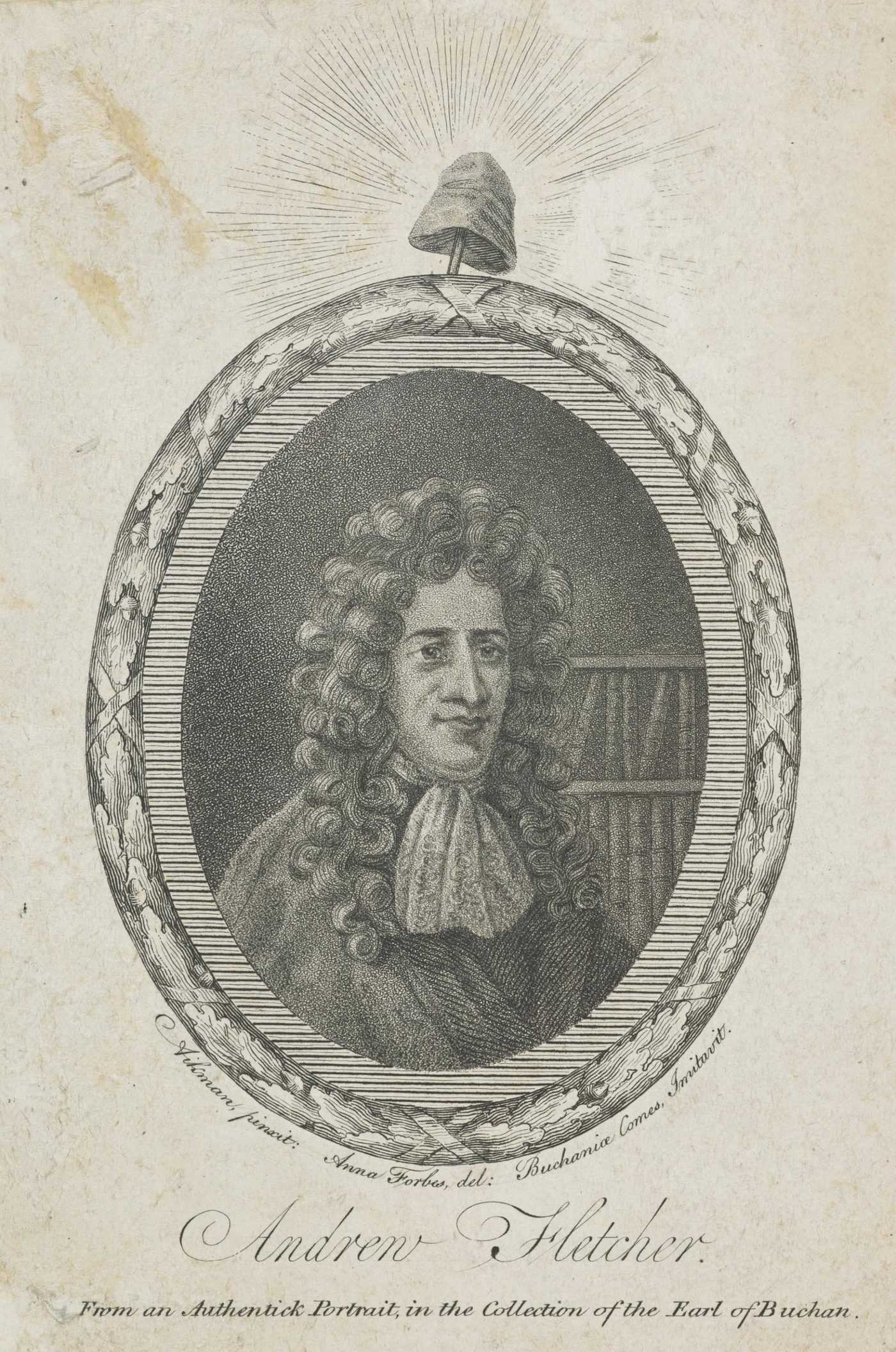
Two things happened to Fletcher's sentence over the next three centuries. It got shorter, and it got a new author. Later writers boiled it down to "Let me make the songs of a nation, and I care not who makes its laws," and many credited it to Plato.9 Plato never wrote it. Wikiquote traces the error to an ambiguous sentence in Donald J. Grout's A History of Western Music (1973, page 8), a widely used college textbook.9 Plato had the idea. Fletcher, or Fletcher's wise friend, had the line.
Tocqueville and the mores of Americans
The French writer Alexis de Tocqueville traveled the United States in 1831 and 1832 and published the first volume of Democracy in America in 1835. Lesson 7 of this module treats him at length (see Writers Who Put Culture First). For now, one sentence is enough. Ranking the causes that kept the American republic alive, he concluded that "the physical circumstances are less efficient than the laws, and the laws very subordinate to the manners of the people."11 By manners he meant mores: habits of the heart and mind, and above all religion. Mexico, he noticed, had copied the federal Constitution of the United States and still could not keep a stable republic.11 Same law, different people, different result. That was Tocqueville's evidence that law floats on something deeper.
Moynihan's two truths
The most quoted modern version comes from an unexpected direction. Daniel Patrick Moynihan was a sociologist who served in the cabinet, worked as a diplomat and then sat four terms in the United States Senate for New York.12 On April 9, 1985, he gave Harvard's Godkin Lectures under the title "Family and Nation," later published as a book of the same name in 1986.13 The sentence attributed to that lecture runs:
"The central conservative truth is that it is culture, not politics, that determines the success of a society. The central liberal truth is that politics can change a culture and save it from itself."
Daniel Patrick Moynihan, Godkin Lectures, Harvard University, April 9, 1985, collected in Family and Nation (1986), chapter 3. 13
Moynihan used the political labels of his day, and they are his words, not this course's. What matters is the structure of the claim. He held both halves at once. Culture decides whether a society thrives. And law can still reach back upstream and change the culture. Anyone who repeats only the first half is quoting Moynihan selectively. One caution on the source: the wording and the 1985 date come from a careful quotation database that cites the lecture and the book's third chapter, and the same words appear across many reference works, but the page in Family and Nation was not checked for this lesson.13
- 4th c. B.C. Plato's Republic: when modes of music change, the laws of the state change with them.
- 1703 Andrew Fletcher's letter: make the ballads and you need not care who makes the laws.
- 1835 Tocqueville: the laws are "very subordinate to the manners of the people."
- 1985 Moynihan's Godkin Lectures: culture decides a society's success, and politics can change a culture.
- 2000 Don Eberly and Bruce Chapman use the "downstream" metaphor in print.
- 2006 Rick Warren: "Politics is always downstream from culture."
- 2011 Breitbart calls it the cliche he trots out in speeches.
- 2012 Breitbart dies; the "Breitbart Doctrine" is named after him.
What the claim means
Strip away the slogan and the claim is this: laws rest on what a people already loves, fears, believes and imagines. A law that runs against all of those will be ignored, evaded or repealed. A law that runs with them will barely need enforcing. So the most lasting way to change a nation's laws is to change what its people love, and the institutions that teach love are mostly not political. Families. Congregations. Schools. Songs, stories, films, jokes.
The river picture helps. Water carries whatever enters it upstream. A town downstream can build a filter plant, but it cannot make the river clean by ordinance. Plato's sequence fits the picture: amusement, then customs, then contracts, then laws. So does Fletcher's: the ballad-maker works upstream of the lawmaker. And so does the American founding. John Adams wrote in 1818 that the real revolution happened "in the minds and hearts of the people" before the first shot was fired, as Lesson 8 shows (see Culture and Law in American History).
For a Christian, the claim also carries a theological edge. Law reflects what a people worships. If a culture believes there is a God who made human beings in his image and gave them rights, its law will tend to protect those rights. If it believes human beings are accidents of matter, its law will drift toward whatever the powerful decide. That is the argument Francis Schaeffer spent the second half of his life making, and it is why he matters to this module. He would have put the river's source further up than Breitbart did. Hollywood was a tributary. The spring was a people's view of God.
What the claim does not mean
It does not mean politics is unimportant
The most common misreading takes "downstream" to mean "doesn't matter." If culture decides everything, the reasoning goes, why vote, testify at a county commission or run for school board? But a river has dams. Courts, legislatures and agencies can block or redirect the current for decades. The civil rights churches of the 1950s and 1960s sang, preached and marched, and they also filed lawsuits. Lesson 9 takes up this danger directly (see What Culture First Asks of Citizens).
It does not license capture of culture by force
Plato's own conclusion was censorship. The modern temptation is subtler: to treat schools, newsrooms and entertainment as territory to be seized and purged. That turns a claim about influence into a program of control, and it abandons the method that makes culture work in the first place, which is persuasion. Free people change culture by making better things and living better lives. Silencing the people who make worse ones is the method of a ruler.
It does not mean the flow runs only one way
Moynihan's second sentence is the reminder. Law teaches. A statute or a court ruling tells a people what its government thinks is right, and over time many people come to agree. A careful reader of the slogan holds both directions in mind.
The evidence for and against
Is the claim true? The honest answer is that it is true often, not always, and the cases are worth looking at one by one.
Evidence that culture moved first
The clearest recent American case is same-sex marriage. In 1996 Gallup found that 27 percent of Americans thought such marriages should be legally valid. Support passed 50 percent for the first time in 2011 and reached 60 percent in Gallup's May 2015 poll.14 The Supreme Court's nationwide ruling came the next month, in June 2015. Whatever one thinks of the ruling, the order of events is plain: opinion shifted over nineteen years, through television, film, friendships and family conversations, and the law followed. Lesson 8 adds older cases, from the revivals before the Revolution to Uncle Tom's Cabin before the Civil War.
Evidence that law moved first
Other cases run the opposite way. When the Supreme Court struck down bans on interracial marriage in 1967, only about one American in five approved of such marriages, and approval did not reach a majority for decades. Mandatory seat belt laws began in New York in 1984, when about 15 percent of motorists buckled up. Today more than 90 percent do. Lesson 8 gives the figures and their sources.
Political scientists have a name for this second pattern: policy feedback. Suzanne Mettler of Cornell University studied the veterans who used the G.I. Bill's education and training benefits after World War II. Compared with veterans who did not use those benefits, she found, users reported "involvements in 50 percent more civic associations."15 A law written in 1944 helped build a generation of joiners, volunteers and civic leaders. That is politics reaching upstream and changing culture, exactly as Moynihan's second truth said it could.
| Case | What moved first | What followed |
|---|---|---|
| Same-sex marriage, 1996 to 2015 | Public opinion: 27% support in 1996, 60% in May 2015 (Gallup) | Nationwide court ruling, June 2015 |
| Interracial marriage, 1958 to 1997 | Court ruling, 1967, when about 20% approved | Majority approval only in the 1990s |
| Seat belts, 1984 onward | State laws, starting with New York | Use rose from about 15% to over 90% |
| G.I. Bill, 1944 | Federal law funding education and training | Users joined 50% more civic groups (Mettler) |
Sources: Gallup; Mettler; Lesson 8 of this module for the marriage and seat belt figures.1415
Weighing the two
So which is it? Look closer at the cases where law moved first. The interracial marriage ruling and the seat belt laws did not appear from nowhere. Each followed years of argument by a determined minority who had already changed their own minds and were working on everyone else's. The law then sped up a change that culture had started. And the law that worked best, like the G.I. Bill, worked by giving people new habits. It changed the culture.
Where law runs far ahead of what people will accept, it often fails. Prohibition is the standard American example, and Lesson 8 tells the story. A national ban on alcohol went into force in January 1920 and was repealed in December 1933. The law could not hold against the habits of tens of millions of people.
The fairest reading of the evidence, then, is Moynihan's. Culture is the deeper current and usually the stronger one. Law can steer it, speed it and sometimes reverse it, but law that ignores it will not last. A citizen who believes in ordered liberty needs both halves: the duty to work on the culture through family, faith and community, and the duty to hold government accountable and support legitimate government through the political process. Neither one is a substitute for the other.
Francis Schaeffer would have added a third point. The question is never only which way the water flows. It is what is in the water at the source: what a people believes about God, about human beings and about truth. The next lesson introduces the man who spent forty years asking that question, first in a chalet in the Swiss Alps and then in front of auditoriums full of Americans.
Learn more
- Barry Popik, "Politics is downstream from culture": the dated paper trail of the phrase, from 2000 through Breitbart.
- Plato, Republic, Book IV (Jowett translation): read the full exchange about music, amusement and law in context.
- Brewer's Dictionary of Phrase and Fable, "Ballads": the Victorian reference entry that preserved Fletcher's wording.
- Andrew Fletcher on Wikiquote: the original sentence, its later variants, and how it got pinned on Plato.
- Tocqueville, Democracy in America, vol. 1: chapter 17 is the place to start on mores, religion and law.
- Gallup on same-sex marriage, 1996 to 2023: a clean example of opinion moving before law.
- Suzanne Mettler on the G.I. Bill: a two-page summary of how a law changed the civic habits of a generation.
- Moynihan's two truths: the quotation record with the 1985 lecture and 1986 book.
Notes
- Barry Popik, "Politics is downstream from culture," The Big Apple, listing dated citations: Andrew Breitbart, interview by R. J. Carter, The Trades, April 29, 2011 (republished March 1, 2012); Lawrence Meyers, "Politics Really Is Downstream from Culture," Breitbart.com, August 22, 2011; Don Eberly, "Disordered Liberty," Liberty, May/June 2000; Bruce Chapman, quoted May 9, 2000; Don E. Eberly, Building a Healthy Culture (Grand Rapids: Eerdmans, 2001), 77; Paul Nussbaum (Knight Ridder), quoting Rick Warren, The Post and Courier, January 15, 2006, 4E. Read it online. ↩
- "Andrew Breitbart," Wikipedia: born February 1, 1969, Los Angeles; adopted at three weeks; work with the Drudge Report and the Huffington Post; died March 1, 2012, at Ronald Reagan UCLA Medical Center, aged 43, of heart failure; section on the "Breitbart Doctrine." Read it online. ↩
- Andrew Breitbart, Righteous Indignation: Excuse Me While I Save the World! (New York: Grand Central Publishing, April 15, 2011), publisher's listing. Read it online. ↩
- Byron York, "In politics fight, Breitbart knew culture is key," Washington Examiner, March 1, 2012. Read it online. ↩
- "Andrew Breitbart, Mark Zuckerberg and the Two-Way Street of Politics and Culture," Daily Signal, January 11, 2025; William A. Jacobson, "Andrew Breitbart died 6 years ago," Legal Insurrection, March 1, 2018. Neither gives a source for the line. Read the first; read the second. ↩
- Plato, The Republic, Book IV (Stephanus 424c to 425a), trans. Benjamin Jowett, in The Complete Plato, page 1113 of the Austria-Forum web edition. Read it online. ↩
- Francis A. Schaeffer, "A Christian Manifesto," address at Coral Ridge Presbyterian Church, Fort Lauderdale, Florida, 1982, transcript, page 2. Read it online. ↩
- G. W. T. Omond, Fletcher of Saltoun, Famous Scots Series (Edinburgh and New York, preface dated March 1897), chapters on the Scottish Parliament of 1703 and the Limitations. Read it online. ↩
- "Andrew Fletcher," Wikiquote: Andrew Fletcher, An Account of a Conversation concerning a Right Regulation of Governments for the Common Good of Mankind, letter to the Marquess of Montrose and the Earls of Rothes, Roxburgh and Haddington, London, December 1, 1703; notes on the variants and on the misattribution to Plato, traced by Austin Matzko to Donald J. Grout, A History of Western Music (1973), 8. Read it online. ↩
- E. Cobham Brewer, Dictionary of Phrase and Fable (1898), "Ballads," quoting Fletcher's 1703 letter. Wording checked against Wikiquote's transcription in note 8. Read it online. ↩
- Alexis de Tocqueville, Democracy in America, vol. 1 (1835), trans. Henry Reeve, chapter 17, "The Laws Contribute More to the Maintenance of the Democratic Republic in the United States than the Physical Circumstances of the Country, and the Manners More than the Laws." Read it online. ↩
- "Daniel P. Moynihan," Contemporary Thinkers: 1927 to 2003, cabinet officer, diplomat and four-term United States senator. Read it online. ↩
- "Daniel Patrick Moynihan," WIST Quotations, citing the lecture "Family and Nation: Common Ground?", Godkin Lectures, Harvard University, April 9, 1985, collected in Daniel Patrick Moynihan, Family and Nation (1986), chapter 3. Read it online. ↩
- "U.S. Same-Sex Marriage Support Holds at 71% High," Gallup, June 5, 2023, with trend data from 1996 (27%), 2011 (first majority) and May 2015 (60%). Read it online. ↩
- Suzanne Mettler, "How the G.I. Bill Built the Middle Class and Enhanced Democracy," Scholars Strategy Network, January 2012, summarizing her Soldiers to Citizens: The G.I. Bill and the Making of the Greatest Generation (New York: Oxford University Press, 2005). Read it online. ↩
Terms in this lesson
- Culture
- The shared habits, loves, stories, songs, beliefs and institutions of a people, the things they pass on to their children without needing a statute to do it.
- Downstream
- The metaphor in the slogan: a river carries what enters it upstream, so whatever shapes culture will sooner or later shape politics and law.
- Mores
- A Latin word for a people's moral habits and customs. Tocqueville used it for 'the whole moral and intellectual condition of a people.'
- Broadside ballad
- A popular song printed on one side of a cheap sheet and sold in the streets. In Fletcher's time ballads carried news, jokes and political opinion.
- Breitbart Doctrine
- A later name for Andrew Breitbart's view that people who want to change politics should first change the culture, especially entertainment and media.
- Policy feedback
- The finding in political science that laws, once passed, change the habits and attitudes of the people who live under them.
Sources
- Barry Popik, "Politics is downstream from culture" (The Big Apple, dated citations) checked 2026-10
- Plato, The Republic, Book IV, trans. Benjamin Jowett, in The Complete Plato (Austria-Forum web book) checked 2026-10
- E. Cobham Brewer, Dictionary of Phrase and Fable, "Ballads" checked 2026-10
- Andrew Fletcher (Wikiquote), An Account of a Conversation concerning a Right Regulation of Governments, 1703 checked 2026-10
- Alexis de Tocqueville, Democracy in America, vol. 1, trans. Henry Reeve (Project Gutenberg) checked 2026-10
- Daniel Patrick Moynihan, Family and Nation (1986), quotation record (WIST Quotations) checked 2026-10
- Gallup, U.S. Same-Sex Marriage Support Holds at 71% High, June 5, 2023 checked 2026-10
- Suzanne Mettler, How the G.I. Bill Built the Middle Class and Enhanced Democracy (Scholars Strategy Network, 2012) checked 2026-10
- Andrew Breitbart (Wikipedia) checked 2026-10