Lesson 6 of 9 · about 24 minutes
Roots of Western Culture: Jerusalem, Athens and Rome
You'll be able to
- Explain how the Hebrew Scriptures set a written law above the king, and why that idea mattered to people who later resisted a king
- Describe what Greek philosophy and Roman law each gave to later ideas of government by law
- Trace the idea of a higher law through Aquinas, Bracton, Magna Carta, the Reformation and Locke
- Summarize Russell Kirk's argument in The Roots of American Order (1974)
- Read Donald Lutz's 1984 citation study accurately, including what it does not show
On May 8, 1825, Thomas Jefferson was 82 years old and tired of being asked where the Declaration of Independence came from. Henry Lee had written to him about it, and Jefferson answered with a short account of what he had been trying to do in June 1776. He had not set out to find new principles or to copy any one book. He meant the Declaration to be "an expression of the American mind." Then he named where that mind had been formed: "All its authority rests then on the harmonizing sentiments of the day, whether expressed in conversation, in letters, printed essays, or in the elementary books of public right, as Aristotle, Cicero, Locke, Sidney, &c."1
A Greek philosopher, a Roman senator and two Englishmen of the 1600s. Jefferson left the Bible off his short list, though the pulpits of his day quoted it more than all of those authors put together. Put the Bible back and you have the story this lesson tells. American government came out of a long inheritance of ideas about law and liberty, and the people who wrote the Declaration and the Constitution had absorbed most of it before they ever held office. That inheritance is what writers like Francis Schaeffer and Russell Kirk meant by Western culture, and it is why they argued that politics comes downstream from it.
Jerusalem: a law above the king
Most ancient kings were the law. Pharaoh was a god. The kings of Mesopotamia issued law codes, but the code came from the king. The Hebrew Scriptures did something stranger. They put the king under a law he did not write.
The passage is in Deuteronomy, chapter 17. Israel is told that it may someday want a king "like as all the nations that are about me." If it does, the king must be one of their own brethren. He must not pile up horses, wives, silver or gold. And he must copy out the law by hand:
"And it shall be, when he sitteth upon the throne of his kingdom, that he shall write him a copy of this law in a book out of that which is before the priests the Levites: And it shall be with him, and he shall read therein all the days of his life... That his heart be not lifted up above his brethren."
Deuteronomy 17:18-20, King James Version. 2
The king reads the law every day so that he will remember he is one of the people, under the same God. The same books keep returning to the point. When the elders of Israel asked Samuel for a king, Samuel warned them what a king would do: "He will take your sons," and your daughters, your fields, your vineyards and "the tenth of your sheep: and ye shall be his servants."3 When King David took another man's wife and arranged the man's death, the prophet Nathan walked into the palace, told David a story about a rich man who stole a poor man's lamb, and then said to the king's face, "Thou art the man."4
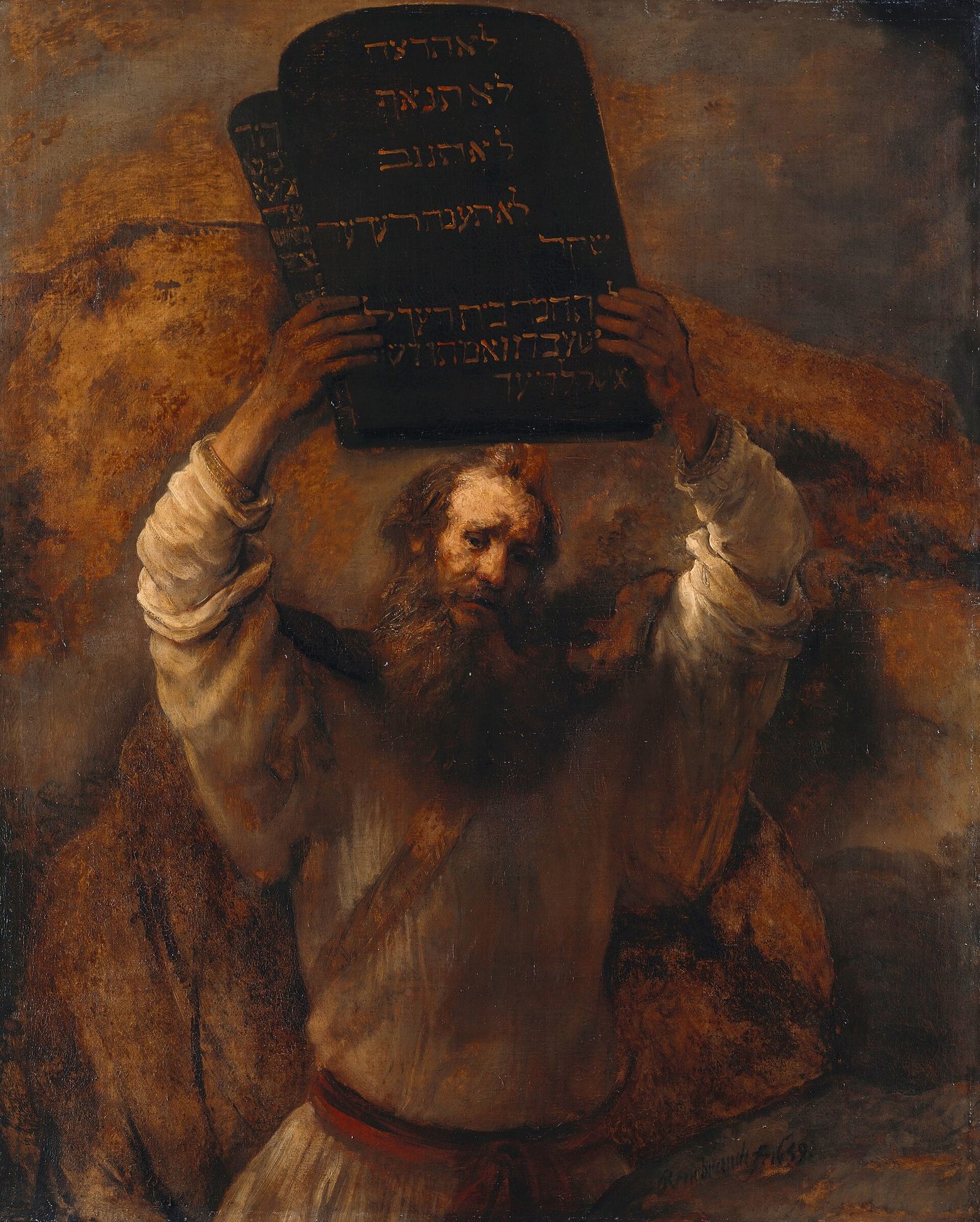
The New Testament added a second idea and a tension that Christians have argued about ever since. Paul told the church at Rome, "Let every soul be subject unto the higher powers. For there is no power but of God."5 Government has real authority, given by God. But when the authorities in Jerusalem ordered the apostles to stop preaching, Peter answered: "We ought to obey God rather than men."6 Both verses were preached from colonial pulpits in the 1770s. Romans 13 told a congregation to honor lawful rulers. Acts 5 told them where that duty stopped.
Jerusalem gave the West the idea that the ruler answers to a law above him, that the poor man's lamb matters as much as the king's palace, and that a prophet may speak to power in God's name. Those ideas were in the air the founders breathed. John Adams, looking back in 1818, said the colonists had once prayed for the king as one of the "Ministers ordained of God for their good," and switched their prayers to Congress only when they saw the king's ministers "renouncing all the Principles of Authority."7
Athens: philosophy and the polis
The Greeks gave the West a different gift: the habit of asking what justice is and expecting reason to find an answer. Socrates asked the question in the streets of Athens until the city put him to death in 399 B.C.8 His student Plato and Plato's student Aristotle turned the questions into books.
Aristotle's Politics begins with the household and the village and builds up to the polis, the self-governing city. His conclusion became one of the most quoted lines in political thought. In the Ellis translation, "a city is a natural production, and... man is naturally a political animal."9 People are made to live together under laws, and the man with no city, Aristotle says, is either a beast or a god.
Aristotle also asked whether a good man or good laws should rule. His answer reads like a warning to every officeholder since:
"He who would place the supreme power in mind, would place it in God and the laws; but he who entrusts man with it, gives it to a wild beast, for such his appetites sometimes make him; for passion influences those who are in power, even the very best of men: for which reason law is reason without desire."
Aristotle, Politics, Book III, chapter 16 (1287a), trans. William Ellis. 9
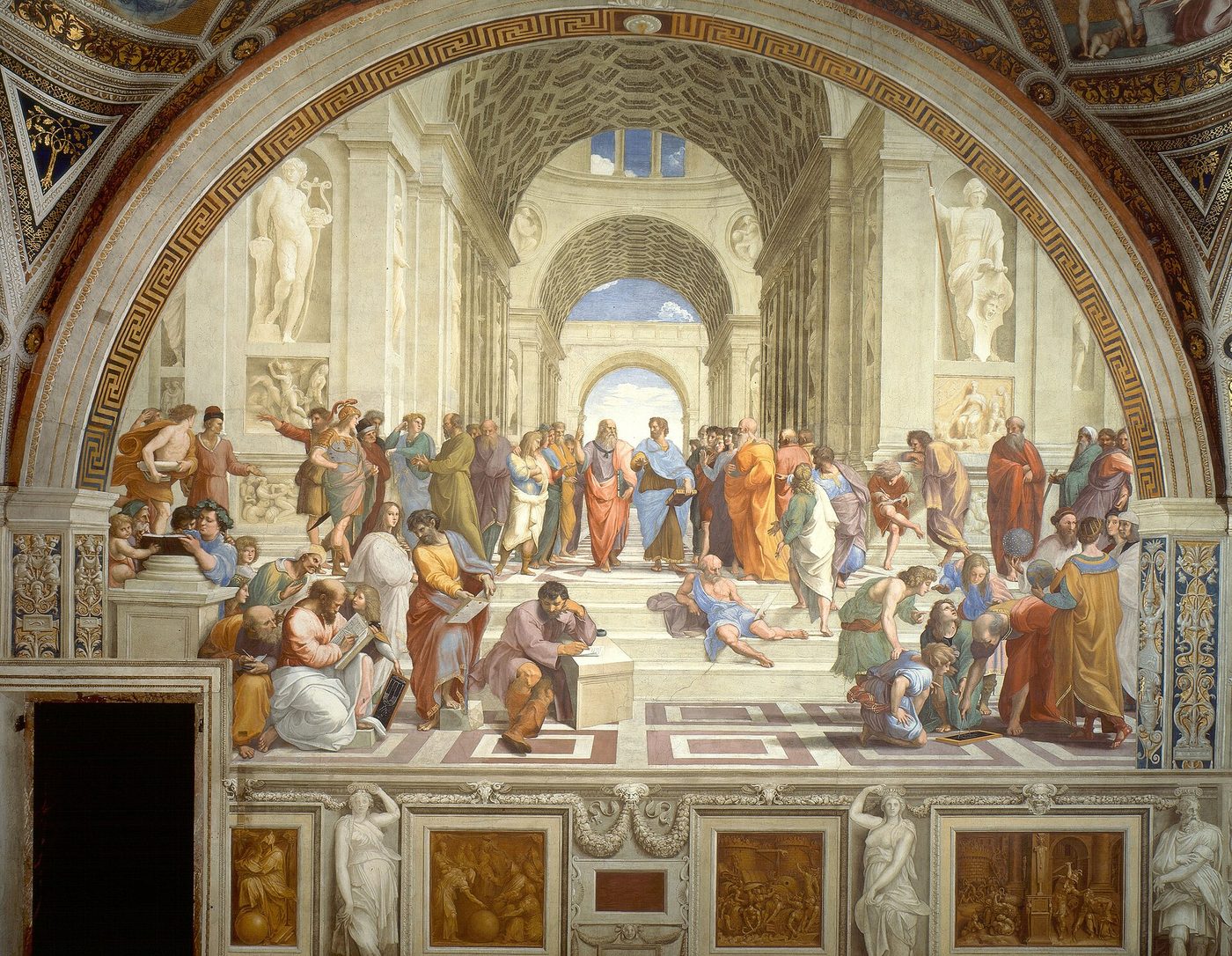
Athens and Jerusalem did not always get along. Around A.D. 200 the North African writer Tertullian, warning Christians away from pagan philosophy, asked a famous question: "What indeed has Athens to do with Jerusalem? What concord is there between the Academy and the Church?"10 But Paul himself had stood on Mars' Hill in Athens and begun his sermon by quoting the Athenians' own altar "TO THE UNKNOWN GOD."11 Over the next thousand years the church mostly took Paul's side of that argument and kept the Greek books.
Rome: written law and the republic
The Romans were less interested in defining justice than in doing it in an orderly way. Their first great act of public law was to write the law down. Roman tradition holds that a commission of ten and then twelve men drew up a code in 451 and 450 B.C., the Centuriate Assembly ratified it in 449 B.C., and it was engraved on twelve tablets and attached to the Rostra in the Forum.12 A law on a wall in the public square can be read by a farmer as well as a magistrate. It can also be quoted against a magistrate. The ten men who wrote it, the Decemviri, later tried to hold on to power, and John Locke, writing in 1689, used their "intolerable dominion" as an example of what tyranny looks like.13
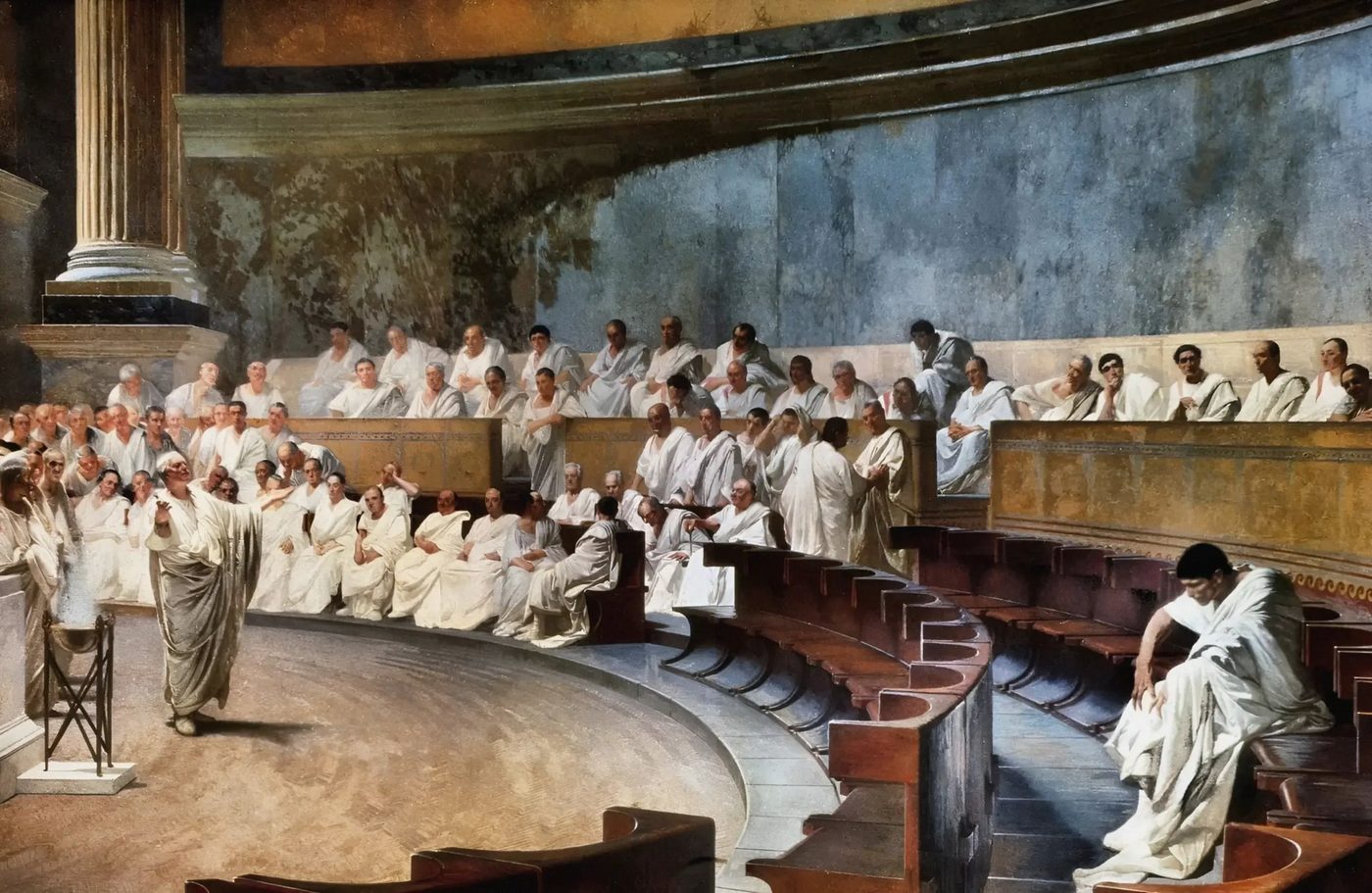
Rome also gave the founders the word republic, from res publica, the public thing, and the model of a mixed government in which consuls, Senate and popular assemblies checked each other. And Rome gave them Cicero, the lawyer and senator who defended the republic against Catiline in 63 B.C. and was killed on Mark Antony's orders in December 43 B.C.14 Cicero's book On the Republic survived only in pieces, but the most important passage was saved because a Christian writer, Lactantius, copied it out around A.D. 310 and called it a description of God's law spoken "almost with a divine voice":
"There is indeed a true law, right reason, agreeing with nature, diffused among all, unchanging, everlasting... Nor, truly, can we be released from this law, either by the senate or by the people... Nor will there be one law at Rome and another at Athens; one law at the present time, and another hereafter: but the same law, everlasting and unchangeable, will bind all nations at all times."
Cicero, On the Republic, Book III, as quoted in Lactantius, Divine Institutes, Book VI, chapter 8, trans. William Fletcher. 15
Neither the Senate nor the people can repeal it. That is the natural law in its Roman form: a law above the assembly as well as above the consul. It is a pagan text preserved by a Christian, which tells you something about how the West was put together.
The church and the medieval synthesis
After Rome fell in the West, the church kept the books. Monks copied Cicero and Aristotle along with the Scriptures, and when universities grew up in Bologna, Paris and Oxford in the 1100s and 1200s, scholars set out to fit the three inheritances together. The best known of them, Thomas Aquinas, wrote his definition of law in the Summa Theologiae in the 1260s and 1270s. Law, he concluded, "is nothing else than an ordinance of reason for the common good, made by him who has care of the community, and promulgated."16 Every part of that sentence limits the lawmaker. A rule that is unreasonable, serves only the ruler or is kept secret falls short of law.
Aquinas went further. A law made for a ruler's own "cupidity or vainglory," or beyond the power given him, or loaded unequally on the people, is among "acts of violence rather than laws," and he quoted Augustine: "a law that is not just, seems to be no law at all."17 Martin Luther King Jr. quoted the same line in his letter from the Birmingham jail in April 1963: "I would agree with St. Augustine that 'an unjust law is no law at all.'"18
English lawyers carried the idea into practice. A thirteenth-century treatise on English law, long credited to the judge Henry de Bracton, put it plainly: "The king must not be under man but under God and under the law, because law makes the king... for there is no rex where will rules rather than lex."19 And the barons who confronted King John at Runnymede in June 1215 wrote the principle into a charter he had to seal. Chapter 39 of Magna Carta reads, in the Avalon Project translation: "No freemen shall be taken or imprisoned or disseised or exiled or in any way destroyed, nor will we go upon him nor send upon him, except by the lawful judgment of his peers or by the law of the land."20 The Fifth Amendment's "due process of law" is a descendant of "the law of the land."
The Reformation
When Martin Luther posted his theses in 1517 and refused to recant before the Emperor Charles V at the Diet of Worms in April 1521, he made the individual conscience, bound by Scripture, a public force. His most famous words at Worms are a small puzzle in themselves. Some period transcripts include "Here I stand. I cannot do otherwise," and some do not, and scholars still disagree about whether he said them.21 Nobody disputes the rest of his answer, that his conscience was "captive to the Word of God."
The Reformation's political effect came mostly through its Reformed and Presbyterian branches. In 1644 the Scottish minister Samuel Rutherford published Lex, Rex, subtitled The Law and the Prince. The title says the argument: the law is king, and the king is under the law. Rutherford defended limited government and the people's right to resist a tyrant.22 After the Stuart monarchy was restored in 1660, the authorities cited Rutherford for high treason, and he died before the charge could be tried. The book was burned in Edinburgh and St. Andrews.22 Schaeffer leaned on Rutherford heavily in A Christian Manifesto, which the previous lesson covers.
Revival came out of the same Protestant world. The Library of Congress's exhibition on religion and the founding describes the Great Awakening of the 1730s and 1740s as the arrival of an "encompassing evangelicalism," and notes that its supporters, the Presbyterians, Baptists and Methodists, "became the largest American Protestant denominations by the first decades of the nineteenth century."23 Those congregations governed themselves, chose their own ministers and argued about their own budgets. Lesson 8 follows them into the Revolution.
The Enlightenment
The last stream is the one most textbooks start with. John Locke's Second Treatise of Government, published in 1689, argued that people form governments to protect their lives, liberties and estates, and that a ruler who breaks that trust loses his claim on them. "Where-ever law ends, tyranny begins," Locke wrote, "if the law be transgressed to another's harm."13 Montesquieu's The Spirit of the Laws (1748) taught the founders that liberty depends on separating legislative, executive and judicial power. In Federalist No. 47 Madison called him "the oracle who is always consulted and cited on this subject."24 William Blackstone's Commentaries on the Laws of England (1765 to 1769) taught a generation of American lawyers the common law, and it opens by setting that law under a higher one. The law of nature, Blackstone wrote, "being co-eval with mankind and dictated by God himself, is of course superior in obligation to any other."25
It is easy to set the Enlightenment against the older streams, as if the founders traded the Bible for reason. A few of them did lean that way. But the most cited lawyer of the age put God's law at the top of his first chapter, and Locke's First Treatise argues from Scripture page after page. To most Americans in 1776 the streams were allies.
Russell Kirk's The Roots of American Order
In 1974 Russell Kirk, a Michigan writer who had made his name in 1953 with a book called The Conservative Mind,26 published The Roots of American Order with Open Court. It is the fullest American telling of this story for general readers. Kirk organized it around five cities. Jerusalem gave the Hebrew understanding of "a purposeful moral existence under God." Athens gave philosophy and the confidence that the mind can know. Rome gave law and the habits of public administration. London gave the common law, representative government and the long English experiment that ran from Magna Carta to the settlement of 1689. Philadelphia gathered all of it into the Declaration and the Constitution.27
Kirk's thesis was that American freedom rests on an order that came before it. Without moral order in the soul and in the community, written constitutions do not hold. The book has been kept in print by later publishers, including an ISI Books edition in 2003.28 Kirk was not neutral about the streams. Lee Edwards, writing for the Kirk Center, notes that Kirk respected Locke's influence while judging that "Utility, not love," was "the motive of Locke's individualism."27 Readers who weight Locke more heavily, and there are many among historians, will find Kirk's account tilted toward Jerusalem and London. That tilt is the argument of the book.
Kirk's phrase for what the founders built was ordered liberty. This course uses the phrase in its own sense: liberty that recognizes a shared duty of holding government accountable and supporting legitimate government. The two meanings overlap more than they differ. Both say that freedom without duty does not last.
What the founders read
Arguments like Kirk's are hard to test. So in the 1970s two political scientists, Charles Hyneman and Donald Lutz, tried counting. They sifted an estimated 15,000 items of American political writing published between 1760 and 1805 and read closely some 2,200 with explicitly political content. From those they built a sample of 916 items and recorded every citation of a European or ancient source, meaning any footnote, direct quote, attributed paraphrase or use of a name to illustrate a point. The sample held 3,154 references to 224 different people.29 Lutz published the results in the American Political Science Review in March 1984.30
The Bible was the largest single source, at about 34 percent of all citations. Among individual writers Montesquieu led at 8.3 percent and Blackstone followed at 7.9. Locke, the name most textbooks put first, came in at 2.9 percent.31 Lutz's own conclusion, stated in his abstract, was that "there was no one European writer, or one tradition of writers, that dominated American political thought."30
What the count does not show
The numbers need care, and Lutz gave the warnings himself. Reprinted sermons made up at least 10 percent of the pamphlets in the sample and accounted for almost three-fourths of the biblical citations. Outside the sermons, the Bible was cited about as often as the classical or common law writers. And in the writing produced during the ratification fight of 1787 and 1788, the Bible's prominence disappears. The Federalist side cited it not at all, and the Antifederalists only now and then.29 A citation count also measures what writers named, not what they believed. Locke's ideas could be everywhere in a pamphlet that never mentions him.
Myth: "34 percent of the founders' quotations came from the Bible, mostly Deuteronomy, so the Constitution is a biblical document"
Lutz did find that the Bible was the most cited source in his sample and that Deuteronomy was the most cited book within it. But the figure counts citations in 916 pamphlets, sermons and essays over 45 years, not words in the Constitution, and most of the biblical citations came from sermons. During the ratification debates of 1787 and 1788 the Bible almost vanished from the citations. The study shows that Scripture was a large part of the culture the founders lived in. It does not show that the Constitution was drafted from it.32
Read carefully, the study supports the picture Kirk painted with a broader brush. The founders were formed by Jerusalem, Athens, Rome and London all at once, and the mixture varied by writer, by year and by audience. A minister preaching an election sermon in Boston reached for Deuteronomy. A lawyer drafting a state constitution reached for Montesquieu and Blackstone. Both believed there was a law above the government. That shared belief was a cultural fact long before it was a constitutional one.
- c. 1000 B.C. Nathan confronts King David: "Thou art the man."
- 451-449 B.C. Rome's Twelve Tables drawn up and posted in the Forum.
- c. 330 B.C. Aristotle's Politics: law is "reason without desire."
- c. 51 B.C. Cicero writes On the Republic, with its "true law, right reason."
- 1215 Magna Carta sealed at Runnymede.
- 1265-1274 Aquinas writes the Summa Theologiae.
- 1521 Luther before the Diet of Worms.
- 1644 Rutherford's Lex, Rex.
- 1689 Locke's Second Treatise.
- 1748 Montesquieu's The Spirit of the Laws.
- 1776 The Declaration, "an expression of the American mind."
- 1974 Kirk's The Roots of American Order.
- 1984 Lutz's citation study in the American Political Science Review.
The next lesson turns to the writers who took this inheritance and argued, from many different directions, that culture shapes law more than law shapes culture.
Learn more
- Jefferson to Henry Lee, May 8, 1825: the short letter in which Jefferson says where the Declaration came from.
- Lee Edwards, "The Many Roots of American Order": a clear summary of Kirk's five cities by a historian who knew him.
- Donald Lutz, "The Relative Influence of European Writers" (1984): the citation study itself, with its tables and caveats.
- Warren Throckmorton on how the Lutz study gets misused: quotes Lutz at length on what his numbers do and do not mean.
- Aristotle, Politics: the free Ellis translation; Book III on the rule of law is short and readable.
- Aquinas on the essence of law: four short articles that end in one of the most important definitions in Western law.
- Bracton Online, vol. 2, p. 33: the page where the king is put "under God and under the law."
- Library of Congress, Religion in Eighteenth-Century America: images and short essays on the Great Awakening and colonial churches.
- Locke, Second Treatise of Government: read chapter 18, "Of Tyranny," and see how much of the Declaration is there.
Notes
- Thomas Jefferson to Henry Lee, May 8, 1825, in Founders Online, National Archives; text as reproduced by Teaching American History. Read it online. ↩
- Deuteronomy 17:14-20 (King James Version). Read it online. ↩
- 1 Samuel 8:11-18 (King James Version). Read it online. ↩
- 2 Samuel 12:1-7 (King James Version). Read it online. ↩
- Romans 13:1 (King James Version). Read it online. ↩
- Acts 5:29 (King James Version). Read it online. ↩
- John Adams to Hezekiah Niles, February 13, 1818, Founders Online, National Archives. Read it online. ↩
- "Socrates," Wikipedia, on his trial and death in 399 B.C. Read it online. ↩
- Aristotle, Politics: A Treatise on Government, trans. William Ellis (London: J. M. Dent, Everyman's Library, 1912), Book I, chapter 2 (1253a) and Book III, chapter 16 (1287a). Read it online. ↩
- Tertullian, The Prescription Against Heretics, chapter 7, trans. Peter Holmes, in Ante-Nicene Fathers, vol. 3 (Buffalo: Christian Literature Publishing, 1885). Read it online. ↩
- Acts 17:22-23 (King James Version). Read it online. ↩
- "The Twelve Tables," introduction, Avalon Project, Lillian Goldman Law Library, Yale Law School. Read it online. ↩
- John Locke, Second Treatise of Government (1689), chapter 18, "Of Tyranny," sections 201-202. Read it online. ↩
- "Cicero," Wikipedia, on his consulship in 63 B.C. and his death at Formiae on December 7, 43 B.C., by order of Mark Antony. Read it online. ↩
- Lactantius, The Divine Institutes, Book VI, chapter 8, trans. William Fletcher, in Ante-Nicene Fathers, vol. 7 (Buffalo: Christian Literature Publishing, 1886), quoting Cicero, De Re Publica, Book III. Read it online. ↩
- Thomas Aquinas, Summa Theologiae, I-II, question 90, article 4, trans. Fathers of the English Dominican Province (1920). Read it online. ↩
- Aquinas, Summa Theologiae, I-II, question 96, article 4. Read it online. ↩
- Martin Luther King Jr., "Letter from Birmingham Jail," April 16, 1963, as reprinted in the Online Library of Liberty Reading Room. Read it online. ↩
- Bracton, De Legibus et Consuetudinibus Angliae (On the Laws and Customs of England), trans. Samuel E. Thorne, vol. 2 (Cambridge, MA: Belknap Press of Harvard University Press, 1968), p. 33. Read it online. ↩
- Magna Carta (1215), chapter 39, Avalon Project translation. Read it online. ↩
- Paul McCain, "Did Luther Really Say, 'Here I Stand'?" Concordia Publishing House blog, which reviews the period transcripts and concludes that he did; on the doubts, see Christianity Today, "What Luther Said." Read it online. ↩
- "Lex, Rex," Wikipedia, summarizing Samuel Rutherford, Lex, Rex, or The Law and the Prince (London, 1644). Read it online. ↩
- Library of Congress, Religion and the Founding of the American Republic, "Religion in Eighteenth-Century America." Read it online. ↩
- James Madison, The Federalist No. 47, February 1, 1788, Avalon Project. Read it online. ↩
- William Blackstone, Commentaries on the Laws of England, vol. 1 (Oxford: Clarendon Press, 1765), Introduction, section 2, Avalon Project (spelling modernized from the long s). Read it online. ↩
- "Russell Kirk," Wikipedia, on The Conservative Mind (1953) and his life in Mecosta, Michigan. Read it online. ↩
- Lee Edwards, "The Many Roots of American Order," Russell Kirk Center for Cultural Renewal, summarizing Russell Kirk, The Roots of American Order (LaSalle, IL: Open Court, 1974). Read it online. ↩
- "The Roots of American Order," Wikipedia, on the 1974 Open Court edition and the 2003 ISI Books reprint. Read it online. ↩
- Warren Throckmorton, "Institute on the Constitution Misrepresents Study of Founding Era," September 24, 2013, quoting Lutz's 1984 article and his The Origins of American Constitutionalism (Baton Rouge: Louisiana State University Press, 1988) on the sample, the definition of a citation, the sermons and the 1787-1788 writings. Read it online. ↩
- Donald S. Lutz, "The Relative Influence of European Writers on Late Eighteenth-Century American Political Thought," American Political Science Review 78, no. 1 (March 1984): 189-197, abstract. Read it online. ↩
- Category shares (Bible 34, Enlightenment 22, Whig 18, common law 11 percent) as reported from Lutz in Chris Rodda's summary, "Was the Constitution Really Based on the Bible?" and, for the common law figure, in Hill Faith, "Faith of the Founders," drawing on Archie P. Jones's summary of the same study; individual shares from the frequency table reproduced by Constitution Society, "European and Biblical Contributions," citing Lutz (1984). The "classical and other" bar is the remainder. Read it online. ↩
- Chris Rodda, "Was the Constitution Really Based on the Bible?" The Original Source (Substack), quoting Lutz on Deuteronomy, sermons and the disappearance of biblical citations in 1787-1788. Read it online. ↩
Terms in this lesson
- Higher law
- A law above any ruler or legislature, such as God's law or the natural law, by which human laws can be judged.
- Polis
- The Greek city-state, a small self-governing community of citizens. Aristotle wrote his Politics about it.
- Natural law
- A moral law that human reason can know, binding on all people and all governments, which Cicero and Aquinas both described.
- Twelve Tables
- The first written code of Roman law, drawn up in 451 and 450 B.C. and posted in the Forum so that citizens could read it.
- Medieval synthesis
- The joining of Christian faith with Greek philosophy and Roman law in the universities and law books of the Middle Ages, best known in Thomas Aquinas.
- Mixed government
- A constitution that blends rule by one, by the few and by the many so that each checks the others. The founders found it in Aristotle, Polybius, Cicero and the English constitution.
- Citation study
- A count of which authors are quoted or named in a body of writing, used as rough evidence of influence.
Sources
- Thomas Jefferson to Henry Lee, 8 May 1825 (Teaching American History, from Founders Online) checked 2026-10
- Donald S. Lutz, The Relative Influence of European Writers on Late Eighteenth-Century American Political Thought, American Political Science Review 78, no. 1 (1984) checked 2026-10
- Lee Edwards, The Many Roots of American Order (Russell Kirk Center) checked 2026-10
- Aristotle, Politics, trans. William Ellis (Project Gutenberg) checked 2026-10
- Lactantius, Divine Institutes, Book VI, quoting Cicero's Republic (New Advent) checked 2026-10
- The Twelve Tables (Avalon Project) checked 2026-10
- Thomas Aquinas, Summa Theologiae I-II, Question 90 (New Advent) checked 2026-10
- Bracton, On the Laws and Customs of England, trans. Samuel E. Thorne, vol. 2, p. 33 (Harvard Law School Library) checked 2026-10
- Magna Carta, 1215 (Avalon Project) checked 2026-10
- John Locke, Second Treatise of Government (Project Gutenberg) checked 2026-10
- Religion and the Founding of the American Republic (Library of Congress exhibition) checked 2026-10