Lesson 9 of 14 · about 55 minutes · Updated October 28, 2026
Quakers and the Radical Tradition
You'll be able to
- Explain in Friends' own words what they meant by the Light of Christ within, and why they set aside creeds, a paid clergy and the outward sacraments.
- Date and describe the key events of early Quaker history: Fox's preaching (1647 to 1652), the name 'Quaker' (1650), the peace Declaration (January 1661), the Boston executions (1659 to 1661), the Toleration Act (1689) and the Pennsylvania charter (1681).
- Trace how Friends turned against slaveholding, from the Germantown protest of 1688 to John Woolman and Philadelphia Yearly Meeting in the 1750s to 1770s.
- Give each side's stated reasons in the Hicksite and Orthodox separation (1827 to 1828) and the Gurneyite and Wilburite separations (1845, 1854).
- Distinguish the four main branches today (FGC, FUM, EFCI, Conservative) by worship, doctrine and size, with the year and source of each count.
- Separate the documented record from tradition in common claims about Quakers, Penn, Mary Dyer and the Shakers.
Start here: the short version
The Religious Society of Friends, called Quakers, began in the north of England in the late 1640s and early 1650s around George Fox (1624 to 1691), a shoemaker's apprentice turned itinerant preacher who taught that Christ himself, present as an inward Light in every person, could teach his people directly without priests, liturgy, creeds or outward sacraments. Friends met in silence and spoke only when they believed the Spirit moved them, refused oaths, hat honor and titles, and from 1661 declared publicly that they denied "all outward wars and strife, and fightings with outward weapons." They were jailed by the thousands in England and hanged in Boston, then founded Pennsylvania under William Penn's charter of 1681. In the eighteenth century John Woolman and others turned the Society against slaveholding. In the nineteenth century American Friends divided several times: the Hicksite and Orthodox separation of 1827 to 1828, and the Gurneyite and Wilburite separations of the 1840s and 1850s. Those divisions produced the branches that exist today: Friends General Conference (mostly unprogrammed, silent worship), Friends United Meeting (mostly pastoral and Christ-centered), Evangelical Friends Church International (evangelical churches with pastors) and the small Conservative yearly meetings. Most of the world's roughly 380,000 Friends (FWCC, 2017) now live in Africa and Latin America and worship in programmed churches with pastors and hymns. This lesson also covers, briefly, the other radicals of the English Revolution (Seekers, Ranters, Levellers, Diggers) and the Shakers, who began as "Shaking Quakers" in Manchester and now number three people at Sabbathday Lake, Maine.
Part A of this course ended with the sixteenth century: Luther in lesson 11, and Zwingli, Calvin, the first Anabaptists and the English Reformation in lesson 12. The Anabaptist descendants are in lesson 08 of this module. The Quakers are a second, separate radical tradition, born a century later in England, out of the Puritan movement described in lesson 05 and alongside the Baptists of lesson 06. Like the Anabaptists, Friends refused oaths and the sword and gathered a church of the committed. Unlike them, Friends also set aside water baptism and the Lord's Supper as outward forms, and grounded everything in the direct teaching of Christ within. This lesson describes the Society first in its own words (Fox's Journal, Robert Barclay's Apology, the 1661 Declaration, the Richmond Declaration of 1887 and the bodies' current websites), then the record, then the readings of named historians.
England in the 1640s: the world the Quakers came from
The civil wars of 1642 to 1651 broke the Church of England's monopoly. Bishops were abolished by Parliament, the Prayer Book was banned, and the Westminster Assembly (the subject of lesson 02) drafted a Presbyterian replacement that never fully took hold in England. In the gap, the army and the towns filled with independent congregations, Baptists, and seekers after a purer church. The historian Christopher Hill, in The World Turned Upside Down (1972), described this period as a time when ordinary people, briefly free of censorship and church courts, published radical ideas about religion, property and authority, and he argued that many of the first Quakers came out of this ferment.1 Hugh Barbour, in The Quakers in Puritan England (1964), read the first Friends instead as Puritans who pressed the Puritan demand for inward holiness further than the Puritans themselves would go.2 Rufus M. Jones, the Haverford philosopher and Quaker historian, had earlier placed the Quakers in a line of mystical "spiritual reformers" running back to the continental spiritualists of the sixteenth century.3 The three readings are not exclusive, and Quaker historians still debate how much weight each deserves.
Seekers, Ranters, Levellers and Diggers
Four groups of the period are usually named alongside the early Quakers. They are covered here only briefly, because none of them survived as a church.
- Seekers were not an organized body. The name was given to scattered people who had left every existing church and waited for God to restore a true apostolic ministry. William Penn's preface to Fox's Journal says such people were "called Seekers by some, and the Family of Love by others," and many of those Fox met in Westmorland in 1652 became Friends.4
- Ranters were accused of teaching that the redeemed could not sin, whatever they did. How many real Ranters there were, and how far the pamphlets against them exaggerated, is disputed among historians. Early Friends were sometimes confused with them, and Fox's Journal records his efforts to separate Friends from what he called Ranter behavior.
- Levellers were a political movement in London and the New Model Army (1645 to 1649) that pressed for a written constitution, wider suffrage and religious toleration. They were suppressed after the army mutinies of 1649.
- Diggers, who called themselves "True Levellers," were led by Gerrard Winstanley. In early April 1649 a small group began to dig and plant the common land on St. George's Hill in Surrey. A complaint forwarded to the Council of State, dated April 16, 1649, reported that they "sowed the ground with parsnips, carrots, and beans."5 Winstanley's pamphlets argued that "the Earth was made by the Lord to be a Common Treasury for all, not a particular treasury for some."5 The colonies were broken up by local landowners within about a year.
Quakers shared some language with these groups (the Light, the Spirit, the end of a paid clergy), and some individuals moved from one to another. The Society that Fox gathered differed in three ways that mattered for its survival: it was disciplined, it kept written records of its meetings and sufferings, and it set its face against both violence and moral license.
George Fox and the gathering of the first Friends
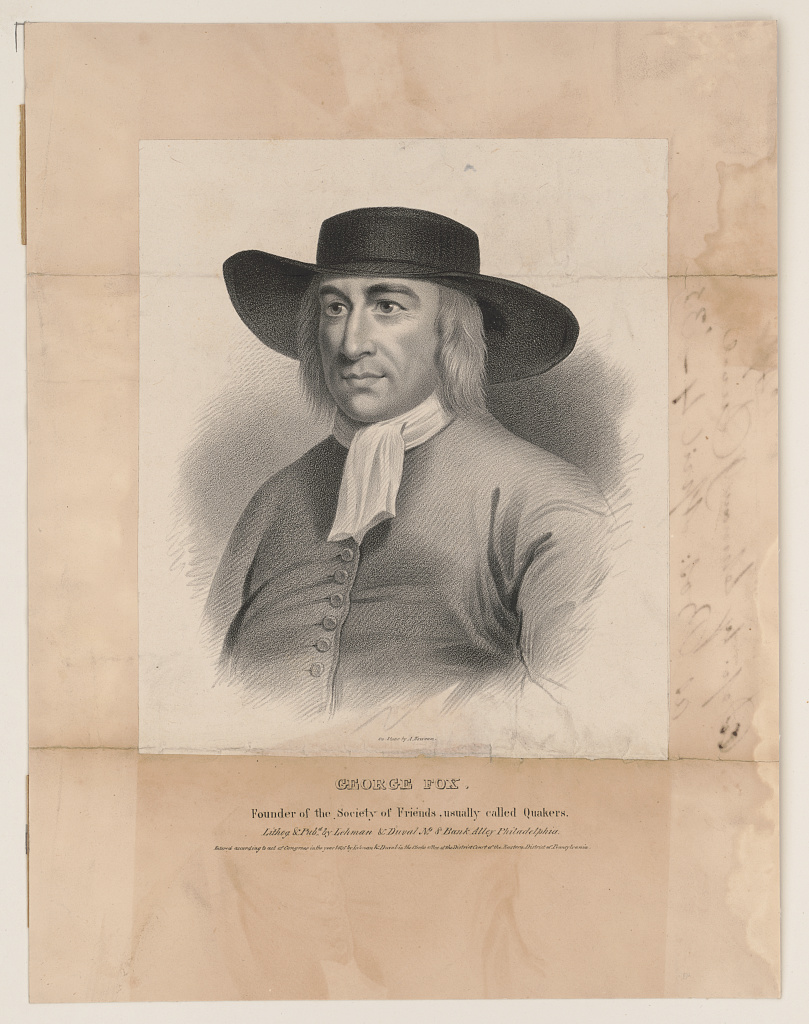

Fox was born in 1624 at Drayton-in-the-Clay (now Fenny Drayton), Leicestershire, the son of a weaver, and was apprenticed to a shoemaker who also dealt in wool and cattle. His Journal, dictated late in life and first published in 1694 with a long preface by William Penn, is the main source for his early years. The edition used in this lesson is the two-volume text edited by Norman Penney for the Friends' Tract Association (London, 1901), which follows the traditional text of the Journal.
In his early twenties Fox left home and wandered for several years in spiritual distress, consulting clergy and "separate preachers" without relief. The Journal places the turning point in 1647:
"When all my hopes in them and in all men were gone, so that I had nothing outwardly to help me, nor could I tell what to do; then, O! then I heard a voice which said, 'There is one, even Christ Jesus, that can speak to thy condition;' and when I heard it, my heart did leap for joy."6
From 1648 he began to preach in the Midlands. He described his commission in the Journal this way: "I was glad that I was commanded to turn people to that inward light, Spirit, and grace, by which all might know their salvation, and their way to God."7 The same chapter explains the habits that marked Friends for the next two centuries: "he forbade me to put off my hat to any, high or low; and I was required to Thee and Thou all men and women, without any respect to rich or poor, great or small."7 In the seventeenth century "you" was the polite plural used to superiors and "thou" the familiar singular, so Fox's refusal to say "you" to a magistrate, or to remove his hat before him, was heard as an insult to rank. The Journal calls parish churches "steeple-houses," because Fox held that the church is the people, not the building.
How Friends got the name "Quakers"
In 1650 Fox was jailed at Derby under the Blasphemy Act for saying that he was free of sin through Christ. The Journal explains the nickname that stuck: "This was Justice Bennet of Derby, who was the first that called us Quakers, because I bid them tremble at the word of the Lord. This was in the year 1650."8 Isaac Sharpless, president of Haverford College, writing the article on the Society of Friends in the New Schaff-Herzog Encyclopedia of Religious Knowledge (volume IV, 1909), gave the date as October 30, 1650.9 Opponents also used the name for the trembling and shaking that sometimes came over Friends in their meetings, and Friends at first disliked it. Their own names for themselves were "Children of the Light," "Friends of Truth" and finally "the Religious Society of Friends."
Fox spent about six months in the Derby house of correction. When the commissioners raising troops for Parliament against Charles Stuart offered to release him and make him a captain, he refused. The Journal's words are the earliest statement of what became the Quaker peace testimony: "I told them, I knew from whence all wars arose, even from the lust, according to James's doctrine; and that I lived in the virtue of that life and power that took away the occasion of all wars."10 He was returned to prison for refusing.
Pendle Hill, Firbank Fell and Swarthmoor, 1652
Friends date the beginning of the Society as a movement to 1652. In the spring Fox climbed Pendle Hill in Lancashire. "From the top of this hill the Lord let me see in what places he had a great people to be gathered," the Journal says.11 A few weeks later he preached for hours from a rock near Firbank Chapel in Westmorland to a crowd the Journal's chapter summary puts at about a thousand people, many of them Seekers, and a group of their preachers (Francis Howgill and John Audland among them) joined him. Sharpless's article notes that Howgill and Audland had been clergymen.9
That summer Fox came to Swarthmoor Hall near Ulverston, the house of Thomas Fell, a judge and member of Parliament, and his wife Margaret. The Journal records that "the Lord's power came upon Margaret Fell and her daughter Sarah, and several others."12 Judge Fell never joined the Friends but protected them, and Swarthmoor became the movement's headquarters, its post office and its treasury. After Thomas Fell's death, Margaret Fell married George Fox at Bristol; the date recorded in the Bristol register of Friends is "27th of 8th Month, 1669" (October 27, 1669, in the Quaker numbering of months explained below). She died at Swarthmoor in 1702, "being near the eighty-eighth year of her age."13
How to read Quaker dates
Early Friends refused the pagan names of months and days and numbered them instead: First-day for Sunday, and First Month, Second Month and so on. Until England adopted the Gregorian calendar in 1752, the legal year began on March 25, so in Quaker records written before 1752 the "First Month" is March and the "Eleventh Month" is January. A document dated "the 21st day of the 11th Month, 1660" therefore means January 21, 1661 in modern reckoning. Many popular dates for early Quaker events, including the famous "1660" peace declaration, come from this difference.
From the north the movement spread south quickly. A band of itinerant preachers, later called the "Valiant Sixty," went out in pairs from 1654. Sharpless wrote that for four years Fox was the only minister of the Society, that the second preacher was Elizabeth Hooton, that there were twenty-five preachers in the fifth year, and that in the seventh there were "upward of sixty."9 He also gave a figure, without stating its source, that "in 1680 the number of Friends in Great Britain was not less than 66,000."9 Modern estimates differ, and the number should be read as an estimate, not a count.
What early Friends believed, in their own words
Friends wrote no creed in the sense of a confession that members had to sign, and early Friends distrusted creeds as "notions" that could be held without the life they described. They did, however, publish many explanations of their faith. Three are used here: Fox's own statements, William Penn's preface to the Journal (1694) and Robert Barclay's Apology for the True Christian Divinity (Latin 1676, English 1678), which became the standard systematic statement of Quaker theology.
The Light within
Penn's preface named the center of the movement plainly: Friends' "fundamental principle," their "main distinguishing point or principle," was "the Light of Christ within, as God's gift for man's salvation."4 The image comes from the Gospel of John: "That was the true Light, which lighteth every man that cometh into the world" (John 1:9, KJV). Friends taught that this Light is not human reason or conscience in the ordinary sense but Christ himself, shining in every person, showing sin, calling to repentance, and giving power to obey. A person who turned to the Light and submitted to it was "convinced" (the Quaker word for converted).
The phrase "Inner Light," which many textbooks use, is a later coinage. Fox and Penn wrote "the Light," "the Light of Christ within," "the inward light," "the Seed" and "that of God in every one." The last phrase comes from a letter Fox wrote in 1656, while he was in Launceston jail in Cornwall, urging Friends to "be patterns, be examples in all countries, places, islands, nations, wherever you come; that your carriage and life may preach among all sorts of people, and to them; then you will come to walk cheerfully over the world, answering that of God in every one."14 In the twentieth century "that of God in every one" was often read as a general statement of human worth. Historians such as H. Larry Ingle, in his biography of Fox, First Among Friends (1994), have pointed out that in Fox's letter the phrase is a call to preach, addressed to the witness of God in the hearer's conscience.15
Scripture and the Spirit
Opponents accused Friends of setting the Bible aside. Barclay's third proposition answered that the Scriptures are a faithful record, given by the Spirit, but that because "they are only a Declaration of the Fountain, and not the Fountain itself, therefore they are not to be esteemed the principal Ground of all Truth and Knowledge, nor yet the adequate primary Rule of Faith and Manners." They "are and may be esteemed a secondary Rule, subordinate to the Spirit, from which they have all their Excellency and Certainty."16 Barclay also held, as Sharpless quoted him, "as a positive certain maxim, that whatsoever any do, pretending to the Spirit, which is contrary to the Scriptures, should be accounted and reckoned a delusion of the Devil."9 The Spirit is primary, in other words, but the Spirit never contradicts the Scriptures it inspired. This is the point on which Quakers differ most sharply from the Reformation principle of sola scriptura taught in Part A, lesson 11, and it is also the point on which Friends themselves later divided.
When Fox visited Barbados in 1671 and Friends there were accused of denying Christ, he and his companions drew up a paper for the governor and assembly. It reads, in part: "we own and believe in Jesus Christ, his beloved and only begotten Son, in whom he is well pleased; who was conceived by the Holy Ghost, and born of the Virgin Mary; in whom we have redemption through his blood, even the forgiveness of sins."17 The letter goes on to affirm the crucifixion, burial, resurrection on the third day and ascension. The Five Years Meeting of American Friends later printed this letter, with the Richmond Declaration of 1887, in its Authorized Declaration of Faith, editions of which Friends United Meeting says were published in 1912, 1922 and 1974.18
Baptism and the Lord's Supper
Friends practice neither water baptism nor the outward Lord's Supper. They teach that the baptism of the New Covenant is the baptism of the Spirit that John the Baptist promised (Matthew 3:11), and that communion is a direct, inward feeding on Christ, so that the outward rites were shadows that ended when the substance came. Sharpless summarized the position: Friends "fully believe in the necessity of spiritual baptism, and the privilege of spiritual communion with the Father and the Son, through the Holy Spirit," while they "do not find, in the texts ordinarily understood as establishing these rites, any indication of such intention."9 The Richmond Declaration of 1887, the most widely used statement of the pastoral branch, says of baptism: "This is not an outward baptism with water, but a spiritual experience," and of the Supper: "The eating of His body and the drinking of His blood cannot be an outward act."19 Every other body in this module, including the Anabaptists, baptizes with water. The Salvation Army (see lesson 07) is the other well-known Protestant body that does not practice the two sacraments.
Worship on the basis of silence
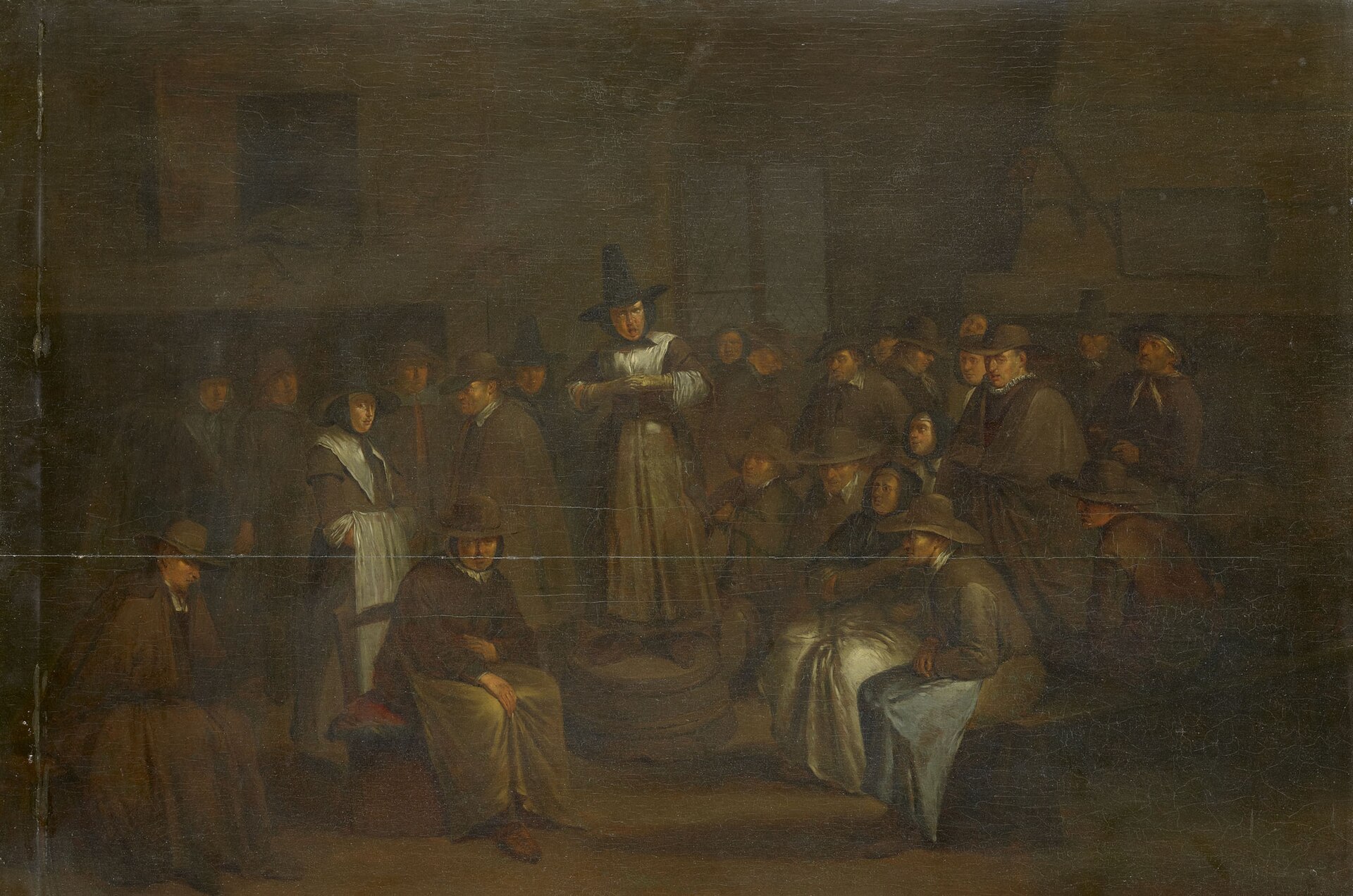

Penn's preface described the Seekers of the north, before Fox came among them, as people who "waited together in silence, and as anything rose" in any of them that they believed came from God, they spoke it.4 Friends' meetings for worship took the same form. There was no order of service, no hymn, no appointed preacher and no sermon prepared in advance. Anyone, man or woman, who felt moved by the Spirit could rise and speak, pray or sing. Sharpless explained the reasoning: "Believing that every act of divine service should proceed from an immediate impression of duty, prompted by the Holy Spirit, many meetings of the Society for worship are held in silence, unless some one feels called upon to preach or teach."9 This "unprogrammed" meeting is still the form of worship of Friends General Conference, the Conservative yearly meetings and Britain Yearly Meeting. The "programmed" meeting with a pastor came later, in the nineteenth century, and is described below.
Friends did recognize ministers. A person whose speaking in meeting was found over time to carry a divine call was "recorded" as a minister and sat on the raised "facing benches" at the front. Ministers received no salary. Elders were appointed to care for the ministry, and overseers to care for the members. Friends refused to pay tithes to support the parish clergy, which was the most common cause of their prosecutions in England, because they held that the ministry of the gospel must be free, as Christ's disciples had received it freely.
Business meetings and the sense of the meeting
Fox organized Friends in the 1660s into a pyramid of meetings: local meetings for worship, monthly meetings (which held membership and discipline), quarterly meetings and a yearly meeting. London Yearly Meeting (since 1995 called Britain Yearly Meeting) dates its regular sessions from 1668. Each American colony or region formed its own yearly meeting, and each yearly meeting remains independent, which is why Quaker divisions are always described meeting by meeting. Business is done without votes. The clerk listens for the "sense of the meeting" and writes a minute, which the meeting approves or amends. Sharpless described the rule: "Decisions are not made by votes and majorities, but are recorded by the clerk, in accordance with what appears to be 'the weight' of either side; or, if there is not a general spirit of acquiescence, action is postponed."9
The testimonies
Friends call their characteristic practices "testimonies," because they understood them as bearing witness to the truth they had received. The early testimonies were concrete: no oaths (Matthew 5:34 to 37 and James 5:12), because an oath implies that a person's ordinary word is less than true; no hat honor or flattering titles; plain speech and plain dress; fixed prices in trade instead of haggling; no tithes; no war; and marriage by the couple's own declaration before the meeting, without a priest. Modern Friends often summarize the testimonies with the acronym SPICES (simplicity, peace, integrity, community, equality, stewardship). That list is a twentieth-century teaching device, not an early Quaker document, and it is used mainly by unprogrammed meetings in North America.
Margaret Fell and women in the ministry
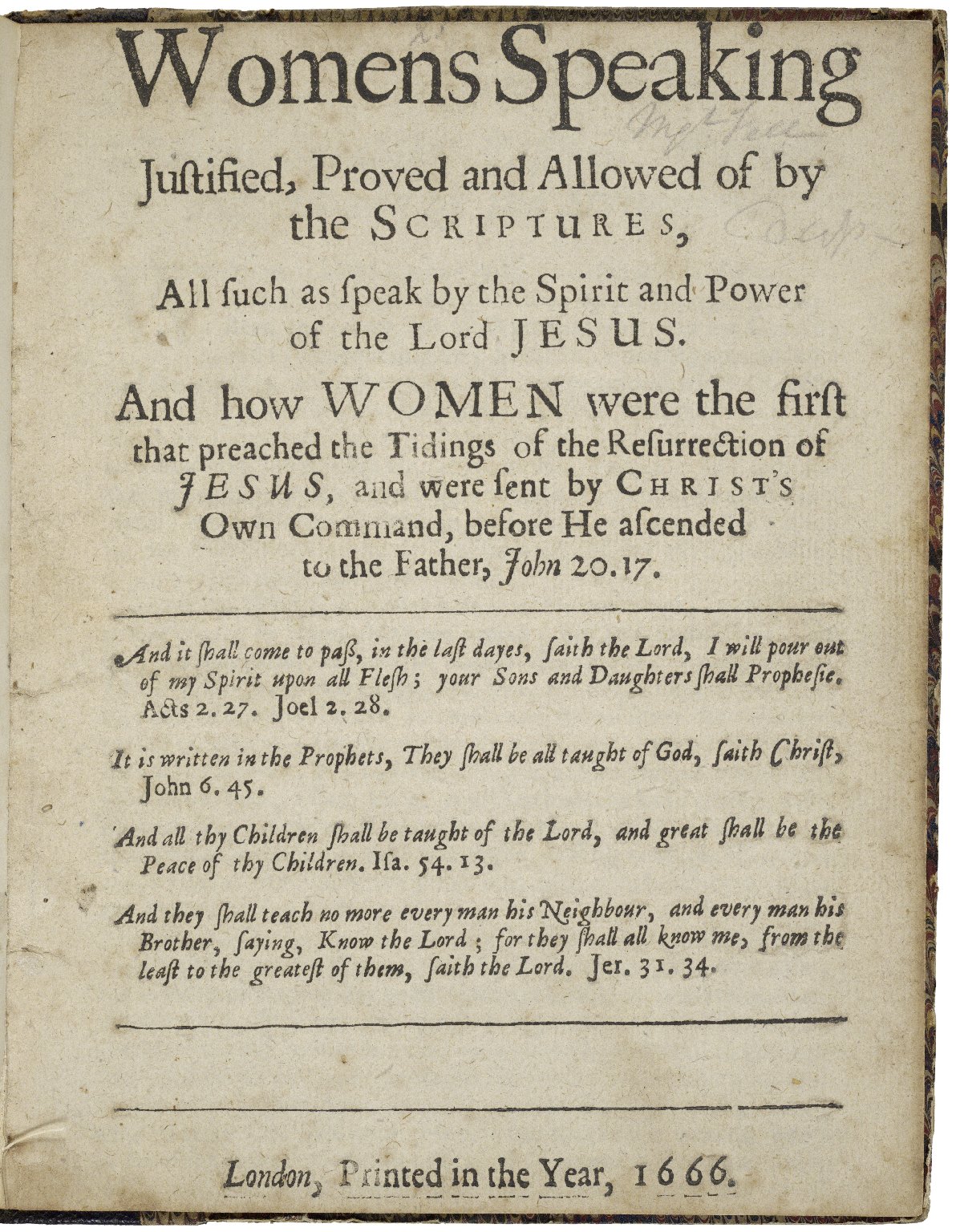

From the start, women preached among Friends. Elizabeth Hooton, a Nottinghamshire Baptist who joined Fox in the late 1640s, is usually counted as the first Quaker minister after Fox himself.9 Women made up a large share of the first traveling ministers, including the two who first carried the message to Massachusetts in 1656. Margaret Fell's pamphlet of 1666 argued from Scripture that the Spirit was poured out on "sons and daughters" alike (Joel 2:28 and Acts 2:17) and that Paul's instruction for women to keep silent (1 Corinthians 14:34) applied to disorderly speech, not to women moved by the Spirit. Fox also set up separate women's meetings for business, which handled the care of the poor and the approval of marriages. The Journal's chapter summaries refer to "the establishment of men's and women's meetings."20 Some Friends resisted the women's meetings, and their authority was one cause of a small separation in the 1670s led by John Wilkinson and John Story. The equal standing of women in Quaker ministry, two centuries before most Protestant bodies ordained women, is one of the facts about the Society that historians of every school agree on.
The case of James Nayler, 1656
The Society's first great crisis showed both how far Friends trusted the Spirit and where they drew a line. James Nayler, a former army quartermaster and one of the most gifted of the early preachers, rode into Bristol in October 1656 with a small band of followers in a deliberate imitation of Christ's entry into Jerusalem. William Sewel, the Dutch Quaker whose History of the Rise, Increase, and Progress of the Christian People Called Quakers was first published in Dutch in 1717 and in his own English translation in 1722, described the scene: as they passed through the suburbs "one of the women led his horse," some "spread their scarfs and handkerchiefs before him, and the company sung, 'Holy, holy, holy, is the Lord God of hosts.'"21 (Sewel places the ride "in the beginning of November"; most modern accounts give October 24, 1656.) Parliament debated for days whether to put Nayler to death for blasphemy, and in the end sentenced him to be pilloried, whipped, branded on the forehead with a B, bored through the tongue and imprisoned. Fox and the leading Friends repudiated the Bristol ride, and Nayler later wrote statements of repentance before his death in 1660. The episode convinced Friends that the leadings of individuals must be tested by the gathered meeting, and it hastened the system of meetings and discipline Fox built in the 1660s.
Persecution, the peace testimony and toleration, 1660 to 1689
The return of Charles II in May 1660 put Friends in danger. Many of them had served in the parliamentary army, they were suspected of sympathy with the republic, and in January 1661 a rising in London by the Fifth Monarchy Men, a different radical sect that expected the imminent reign of Christ and did take up arms, led to the arrest of thousands of dissenters. Friends responded with a public statement drawn up by Fox, Richard Hubberthorne and others. The Journal prints it under the heading "A Declaration from the harmless and innocent people of God, called Quakers, against all sedition, plotters, and fighters in the world," with the note "Presented to the King upon the 21st day of the 11th Month, 1660," that is, January 21, 1661. Its central passage is the classic text of the Quaker peace testimony:
"Our principle is, and our practices have always been, to seek peace and ensue it; to follow after righteousness and the knowledge of God; seeking the good and welfare, and doing that which tends to the peace of all. We know that wars and fightings proceed from the lusts of men, as James iv. 1-3, out of which the Lord hath redeemed us, and so out of the occasion of war. ... All bloody principles and practices, as to our own particulars, we utterly deny; with all outward wars and strife, and fightings with outward weapons, for any end, or under any pretence whatsoever; this is our testimony to the whole world."22
The Declaration then answered the objection that Friends would change their minds "if the Spirit move you": "the Spirit of Christ, which leads us into all truth, will never move us to fight and war against any man with outward weapons." (The Journal text continues the argument with Christ's command to Peter, "Put up thy sword.") The words "as to our own particulars" are important. They are in the Journal text used here. The extract printed by Britain Yearly Meeting in Quaker faith and practice (24.04), headed "Declaration to Charles II, 1660," reads instead "All bloody principles and practices we do utterly deny," without that phrase, so the two printed forms differ at this point; this lesson did not open the 1661 printing itself.51 The Declaration renounced fighting by Friends themselves; it did not claim that magistrates had no right to use force, and Friends later disagreed about how far the testimony reached into government, a question that came to a head in Pennsylvania.
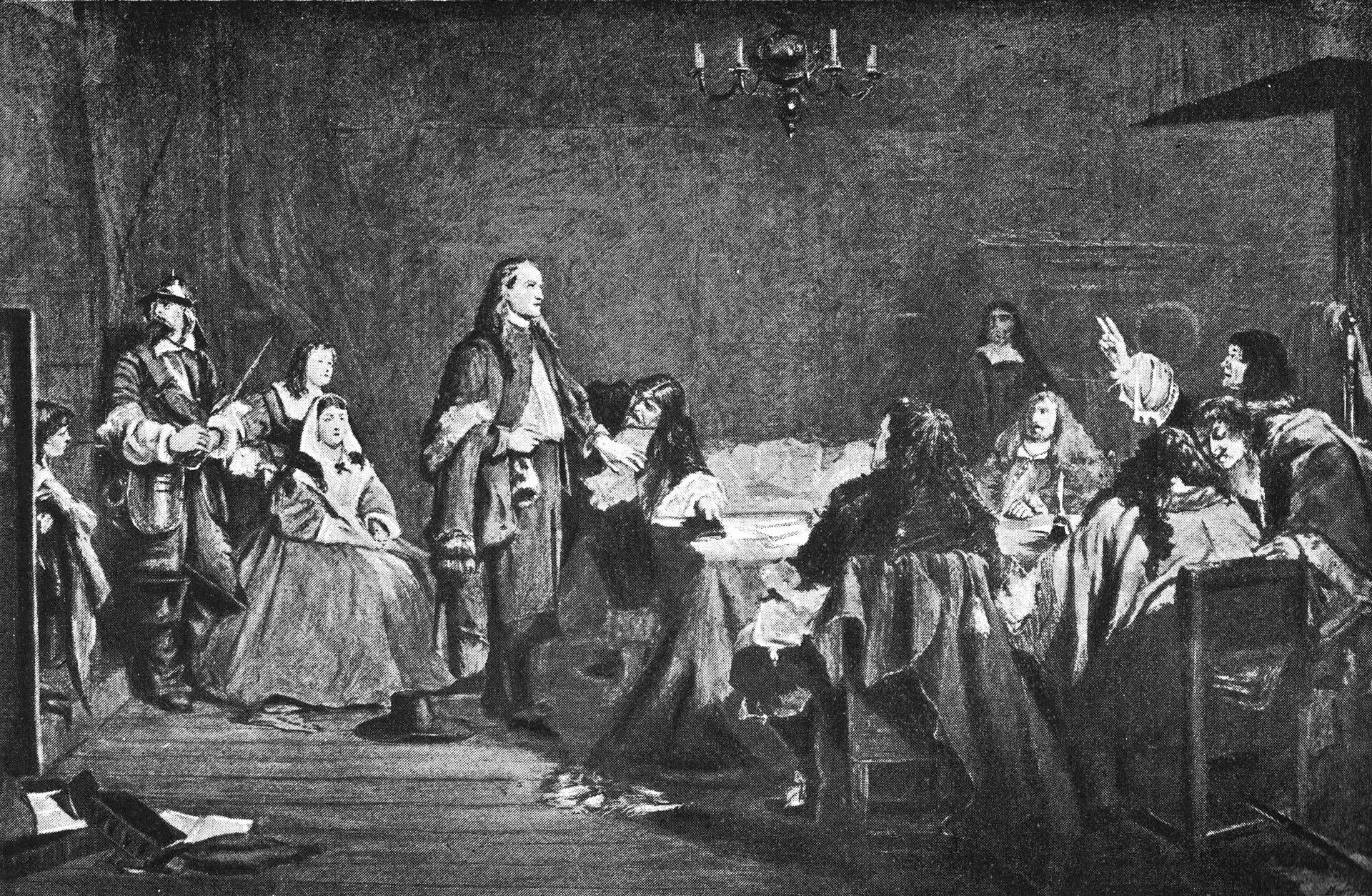

The Restoration Parliament passed a series of laws aimed at dissent. The Quaker Act of 1662 made it an offense to refuse a lawful oath or to meet in groups of five or more for worship not allowed by law, with transportation for a third offense. The Conventicle Acts of 1664 and 1670 extended the ban on unauthorized worship to all dissenters. Friends were caught by every one of these laws and by older ones as well: they refused tithes, refused to take off their hats in court, refused to swear (so that any magistrate who wished to jail a Quaker could simply tender the oath of allegiance), and refused to stop meeting. Their meetings, unlike those of many other dissenters, continued openly; when the adults were in prison, the children sometimes kept the meeting.
Fox himself was examined at Holker Hall in 1663 when the oath was tendered and he would not swear, and he spent most of the years 1664 to 1666 in Lancaster and Scarborough castles.23 In 1670 William Penn and William Mead were tried at the Old Bailey for preaching in the street after their meeting house was locked. The jury refused to convict despite being kept without food and fined, and the case that followed (Bushel's Case) established that English jurors could not be punished for their verdict. Sharpless quoted an older writer's judgment that the trials of Friends, "and especially that of John Crook in 1662, and that of William Penn and William Mead in 1670, at the Old Bailey, will forever remain as noble monuments of their resistance to the arbitrary proceedings of the courts of judicature at that time."9
Friends kept careful records of these sufferings, which Joseph Besse later compiled in his Collection of the Sufferings of the People Called Quakers. Sharpless gave the totals that Quaker historians of his day drew from those records: "Between 1650 and 1689 14,000 of them were fined and imprisoned; and 369, including the majority of the first preachers, died in jail."9 Other writers have given different totals, and the figures are best read as the Society's own count of recorded cases.
The Toleration Act of 1689
After the Revolution of 1688 Parliament passed "An Act for exempting their Majestyes Protestant Subjects dissenting from the Church of England from the Penalties of certaine Lawes," usually called the Toleration Act (1 William and Mary, chapter 18, given the royal assent in May 1689). It allowed dissenters who took the oaths of allegiance to worship in registered meeting houses. A special section dealt with Friends without naming them: "whereas there are certaine other persons Dissenters from the Church of England who scruple the takeing of any Oath," such persons could instead make a declaration of fidelity ("I A B doe sincerely promise and solemnely declare before God and the World that I will be true and faithfull" to King William and Queen Mary) and subscribe a profession of Christian belief: "I A B professe Faith in God the Father and in Jesus Christ his Eternall Sonne the true God and in the Holy Spirit one God blessed for evermore And doe acknowledge the Holy Scriptures of the Old and New Testament to be given by Divine Inspiration."24 The Act did not admit dissenters to the universities or to public office, and Friends still faced prosecution for refusing tithes for more than a century, but the era of mass imprisonment for worship was over. George Fox died in London on "the 13th of 11th Month, 1690," that is, January 13, 1691.25
Friends in the American colonies
Boston and the hanging of Mary Dyer
The first Friends to reach New England were two women, Mary Fisher and Ann Austin, who arrived in Boston from Barbados in July 1656. Sharpless recorded that the magistrates charged them with holding "very dangerous, heretical, and blasphemous opinions," kept them confined first on the ship and then in jail, had their books burned, searched their bodies for signs of witchcraft, and sent them back to Barbados.9 Eight more Friends arrived from London two days after the first pair left and were jailed and deported in their turn. Massachusetts Bay was a Puritan commonwealth whose founders had crossed the ocean to build a church according to their reading of Scripture (see lesson 05), and its magistrates regarded Friends as heretics who denied the authority of Scripture and as disturbers of public order, since Friends did interrupt church services to testify. The General Court passed a series of escalating laws, and on October 19, 1658, by a vote of 12 to 11, it authorized banishment of Quakers "upon pain of death."26
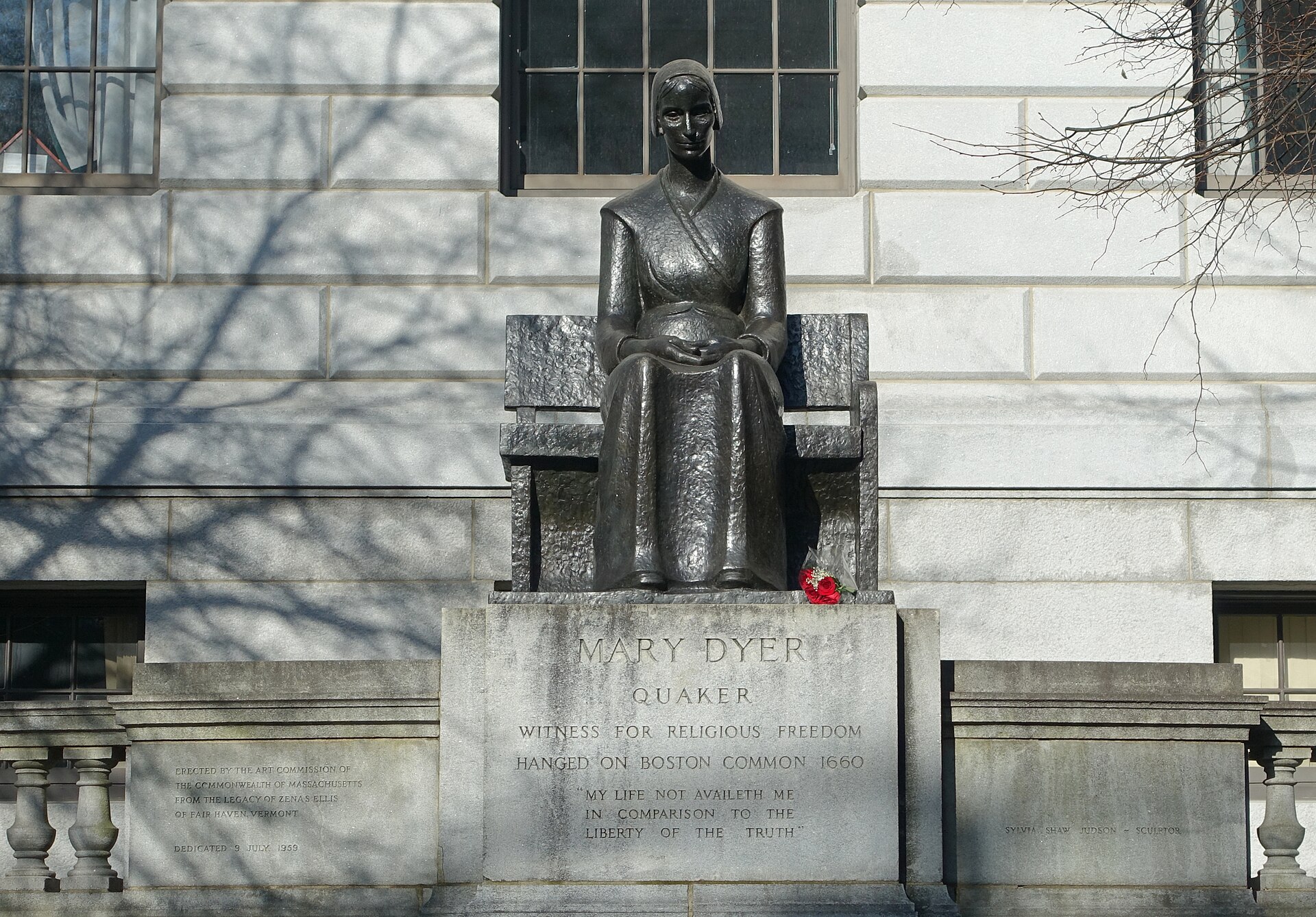

Mary Dyer had come to Boston with her husband William in the 1630s and had followed Anne Hutchinson into exile in Rhode Island during the Antinomian controversy of 1637 to 1638. She became a Friend in England in the 1650s and returned to New England to protest the laws against Quakers. With William Robinson and Marmaduke Stevenson she was sentenced to death in October 1659. On October 27, 1659, Robinson and Stevenson were hanged on Boston Common; Dyer stood on the ladder with the rope on her neck when a reprieve was announced, and she was banished. She went back to Boston the next spring, appeared before the General Court on May 31, 1660, and was hanged on June 1, 1660.26 Douglas O. Linder's chronology, compiled from the court records and contemporary accounts, gives her last recorded words as: "Yea, I have been in Paradise several days and now I am about to enter eternal happiness."26 A fourth Friend, William Leddra, was hanged in 1661.9 On September 9, 1661, Charles II sent a letter ordering Massachusetts to stop the corporal and capital punishment of Quakers and send accused Friends to England for trial, which ended the executions.26
Elsewhere in the colonies Friends found more room. Rhode Island, founded on liberty of conscience by Roger Williams (see lesson 06), refused to expel them, although Williams himself debated Friends sharply in 1672. Sharpless noted that monthly meetings existed in New England before 1660, "and in 1661 a yearly meeting in Rhode Island, which has been continued regularly to the present date"; that is the origin of New England Yearly Meeting, the oldest continuing yearly meeting in the world.9 Friends also gathered in Long Island, New Jersey, Maryland, Virginia and North Carolina, and Fox traveled through the colonies from 1671 to 1673.
William Penn and the founding of Pennsylvania
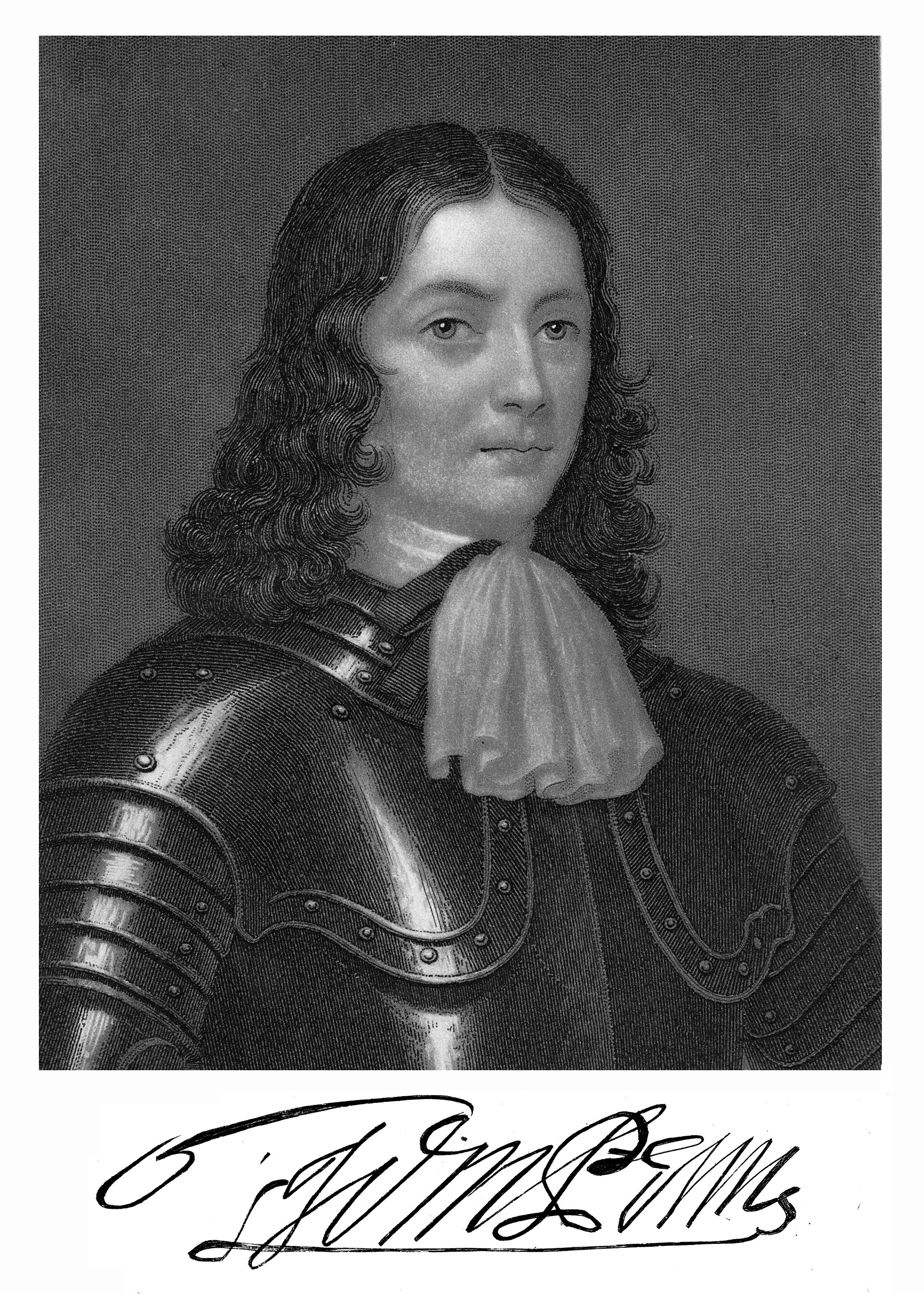

William Penn was the son of Admiral Sir William Penn, a naval commander who served both Cromwell and Charles II. The younger Penn was expelled from Oxford for nonconformity, served briefly in Ireland (the period of the armor portrait), and joined the Friends about 1667. He was imprisoned in the Tower of London in 1668 to 1669 for a pamphlet that questioned the conventional statement of the Trinity, and wrote there No Cross, No Crown, still one of the most widely read Quaker books. He became the Society's chief defender at court and its most important colonial organizer, first as a trustee of West New Jersey in the 1670s and then as proprietor of Pennsylvania.
The royal charter that created Pennsylvania opens: "WHEREAS Our Trustie and wellbeloved Subject WILLIAM PENN, Esquire, Sonne and heire of Sir WILLIAM PENN deceased, out of a commendable Desire to enlarge our English Empire" and promote trade and the conversion of the native peoples, had asked for a grant of land; the king made it, "haveing Regard to the Memorie and Meritts of his late Father in divers Services." The text in the Avalon Project (from Francis Newton Thorpe's 1909 edition of the colonial charters) is dated at Westminster "the Eight and Twentieth day of February in the Three and Thirtyeth Yeare of Our Reigne," which is 1681 by modern reckoning; the Pennsylvania state government and most histories give March 4, 1681 as the date the charter was signed.27 Penn's own Frame of Government of 1682 recites the king's letters patent as "bearing date the fourth day of March in the Thirty and Third Year of the King."28 The common statement that the colony repaid a royal debt owed to Penn's father appears in Thorpe's editorial footnote, not in the charter.
Penn is usually quoted as calling his colony a "holy experiment," a phrase from his correspondence that this lesson did not open. His Frame of Government of April 25, 1682, with the "Laws Agreed Upon in England" of May 5, 1682, set out his political theory in the preface: "Any government is free to the people under it (whatever be the frame) where the laws rule, and the people are a party to those laws, and more than this is tyranny, oligarchy, or confusion."28 Article XXXV of the Laws guaranteed that all persons "who confess and acknowledge the one Almighty and eternal God" and lived peaceably "shall, in no ways, be molested or prejudiced for their religious persuasion."28 Office-holding was limited to those who professed faith in Jesus Christ, so the liberty was wide but not unlimited. Penn arrived in October 1682, laid out Philadelphia, and made treaties with the Lenape. The colony drew Friends from England, Wales, Ireland and the Rhineland, along with Mennonites, Brethren and other German sectarians described in lesson 08. Sharpless estimated that by 1690 there were at least 10,000 Friends in the American colonies, and in 1702 about 20,000 in Pennsylvania and New Jersey.9
Governing a colony tested the peace testimony. The Quaker-dominated Assembly repeatedly voted money "for the King's use" rather than for arms, and Friends argued among themselves about whether such grants were consistent with their principles. In 1756, during the Seven Years' War, most Friends withdrew from the Assembly rather than vote for war measures, and the Society's direct control of Pennsylvania government ended. Historians differ over whether this was a failure of the holy experiment or a principled choice to keep the testimony intact. The colony also produced the first Quaker schism in America: in 1692 George Keith, a Scottish Friend and schoolmaster, accused Philadelphia Friends of neglecting the historical Christ and Scripture, and he and his followers (the "Christian Quakers") separated. Keith later became an Anglican priest and missionary.9
Friends and slavery: from Germantown to Woolman
Friends owned slaves. Quaker merchants in Barbados, Rhode Island and Philadelphia took part in the trade, and Fox's own advice to Barbados Friends in 1671 was to treat slaves kindly and free them after a term of years, not to end slavery.17 The Society's turn against slaveholding took about ninety years.
The first written protest against slavery in the English colonies came from Germantown, the settlement of Dutch and German Friends and Mennonites north of Philadelphia. On "the 18 of the 2 month, 1688" (April 18, 1688), Garret Hendericks, Derick op de Graeff, Francis Daniel Pastorius and Abraham op de Graeff addressed their monthly meeting. The National Park Service transcript gives their argument from the Golden Rule in their own spelling: "There is a saying that we shall doe to all men licke as we will be done ourselves," and they added that the trade "mackes an ill report in all those Countries of Europe."29 The monthly meeting at Dublin found the matter "so weighty" that it was not "Expedient for us to meddle with it" and passed it to the quarterly meeting, which found it "a thing of too great a weight for this meeting to determine," and the yearly meeting at Burlington declined to rule.29 The document was lost, published by Nathan Kite in The Friend in 1844, lost again and rediscovered at the Arch Street Meeting House in 2005; the original is now at Haverford College.30 In 1696 Philadelphia Yearly Meeting advised "that Friends be careful not to encourage the bringing in of any more Negroes."30
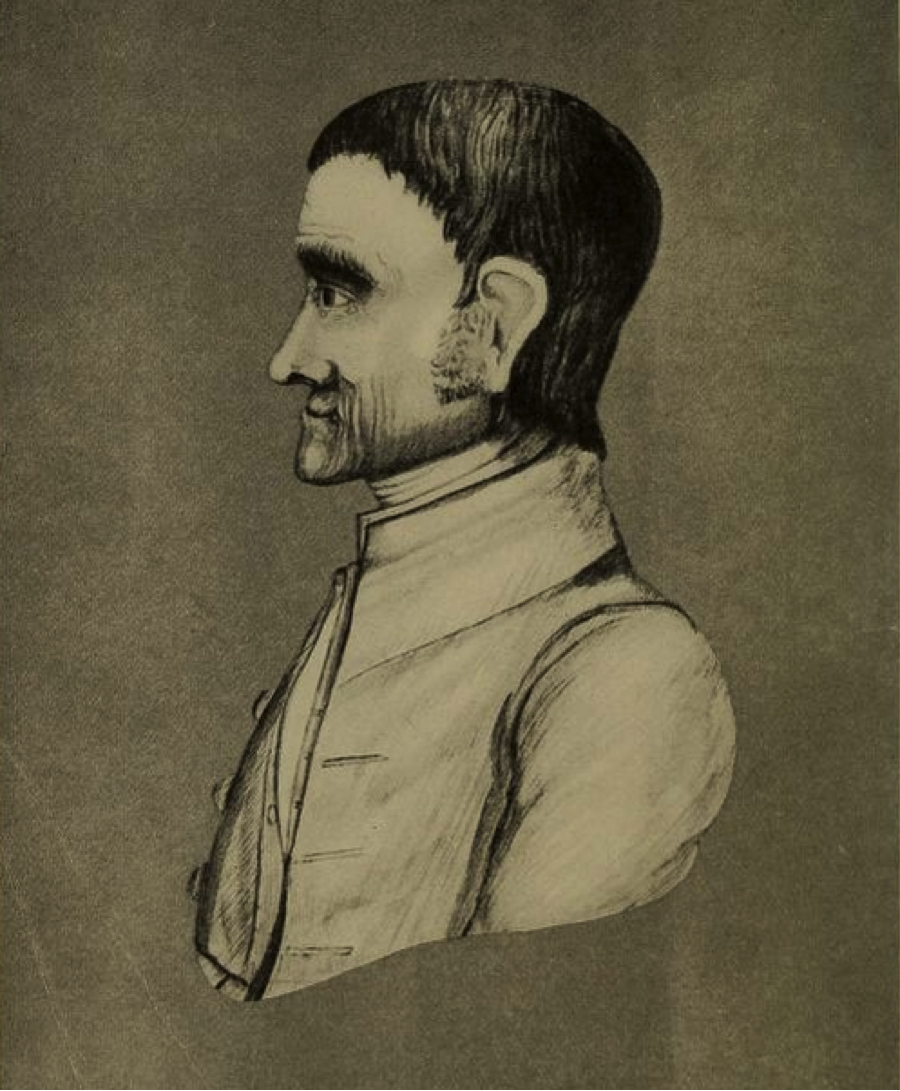

John Woolman of Mount Holly, New Jersey, a tailor and shopkeeper, made the issue his life's work. His Journal, published in 1774 after his death, records the moment it began, when his employer sold an enslaved woman and told the young clerk to write the bill of sale: "though the Thoughts of writing an Instrument of Slavery for one of my Fellow-creatures felt uneasy, yet I remembered I was hired by the Year, that it was my Master who directed me to do it, and that it was an elderly Man, a Member of our Society, who bought her; so, through Weakness, I gave way, and wrote; but, at the executing it, I was so afflicted in my Mind, that I said, before my Master and the Friend, that I believed Slave-keeping to be a Practice inconsistent with the Christian Religion."31 (The capital letters are those of the Everyman edition used here.) Woolman published Some Considerations on the Keeping of Negroes in two parts (1754 and 1762), traveled through the slaveholding colonies visiting Friends one by one, refused to accept hospitality paid for by slave labor, and in later life wore undyed clothing because dyes were produced by slaves.
At Philadelphia Yearly Meeting in 1758 Woolman spoke on the question in words he recorded himself: "Many Slaves on this Continent are oppressed, and their Cries have reached the Ears of the Most High. Such are the Purity and Certainty of his Judgments, that he cannot be partial in our Favour. In infinite Love and Goodness, he hath opened our Understandings, from one Time to another, concerning our Duty towards this People; and it is not a Time for Delay."31 Woolman recorded the outcome: many Friends said "they believed Liberty was the Negroes Right," no opposition was made publicly, and "A Minute was made more full on that Subject than any heretofore," with Friends named to visit those who kept slaves.31 In 1776 it directed monthly meetings to disown members who refused to free the people they held; the Tri-College Libraries' Quakers and Slavery project dates the Society's official repudiation of slavery to eighty-eight years after the Germantown protest.30 Other yearly meetings followed by the 1780s. Woolman died of smallpox at York, England, on "the seventh Day of the tenth Month, 1772" (October 7, 1772).31
Friends went on to play a large part in the British and American antislavery movements: British Friends were among the founders of the London committee against the slave trade in 1787, and Friends such as Levi Coffin, Lucretia Mott and Thomas Garrett were active in abolition and the Underground Railroad. The record is mixed. Many meetings were slow to admit Black members, kept separate seating for them in some places, and disowned members who joined the wider abolition societies or married outside the Society. The historians in the "Claims checked" section below treat both sides of that record as documented.
The American separations, 1827 to 1904
By 1800 Friends in Britain and America had become what historians call "quietist": inward-looking, plain in dress and speech, wary of "creaturely activity" (human effort that ran ahead of divine leading), and kept small by a strict discipline. Sharpless wrote that disownment for "marrying a person not a member of the society" and an "exaggerated asceticism in certain directions" helped "to keep it numerically small," and that birthright membership, introduced in the eighteenth century, had "created a non-convinced element."9 At the same time, the evangelical revival that produced Methodism (see Part C, lesson 01) was reaching Friends, especially in England. The question that divided them in the nineteenth century was the old one: the relation between the Light within and the Christ of history and Scripture.
Hicksite and Orthodox, 1827 to 1828
Elias Hicks (born at Hempstead, Long Island, March 19, 1748; died at Jericho, Long Island, February 27, 1830) was a farmer and a widely traveled minister.32 He preached that the inward Light was sufficient for salvation, that a religion resting on historical facts or doctrines without inward experience was empty, and he questioned the doctrines of substitutionary atonement and the full authority of Scripture as they were taught by evangelical Friends. In his own Journal (New York, 1832) he described a sermon in which he urged hearers "that we did not place any confidence in a mere traditional or historical belief, without coming to a real experimental knowledge of God and Christ," and another in which he taught that "any creeds or forms of religion, however specious in their appearance, without the immediate aid of this inspiring spirit, would, in the end, leave the soul in utter disappointment."33 He was also an early advocate of refusing goods produced by slave labor and published Observations on Slavery in 1811.32
The elders of Philadelphia, influenced by English evangelical ministers who toured America in the 1820s, regarded Hicks's preaching as a denial of the deity of Christ and the atonement. Hicks's supporters saw the elders as imposing a creed and concentrating power in a few wealthy city Friends, against the tradition of the Spirit's freedom. Both sides claimed to be the true heirs of Fox and Barclay. Sharpless, himself an Orthodox Friend, summarized the result: "The formal separation began in Philadelphia in 1827 and extended to the yearly meetings of New York, Baltimore, Ohio and Indiana. In the three eastern yearly meetings the Hicksites were a large majority. In London, Dublin, New England, and North Carolina, the whole meeting went with the Orthodox body."9 He added that neither side "formally adopted the title" by which the other called it, and that the Hicksite body "contained many Unitarians, but their basis was the non-necessity of the beliefs commonly known as Orthodox."9 The finding aid for the Philadelphia Yearly Meeting records at Swarthmore and Haverford states: "The great Separation among Philadelphia Friends occurred at the Yearly Meeting of 1827. From that year, there were two official Philadelphia Yearly Meetings."34 The Hicksites were long known as "Race Street" Friends after their meeting house, and the Orthodox as "Arch Street" Friends.
The separation was not only doctrinal. Thomas D. Hamm, in The Transformation of American Quakerism: Orthodox Friends, 1800 to 1907 (1988), and other historians have shown that the divisions also followed lines of wealth, region and attitude toward the new evangelical societies (Bible, tract and temperance societies), with rural Friends more often Hicksite and city merchants more often Orthodox.35 Property disputes over meeting houses and schools went to the state courts. In New Jersey the case of Shotwell v. Hendrickson (decided 1833) turned on which body held the true Quaker doctrine, and the court found for the Orthodox, which is one of the rare American cases in which judges ruled on a question of church doctrine.
Gurneyites and Wilburites, 1845 and 1854
The Orthodox body then divided again. Joseph John Gurney (born at Earlham Hall near Norwich, August 2, 1788; died there January 4, 1847) was a banker, a recorded minister from 1818, the brother of the prison reformer Elizabeth Fry and an associate of Wilberforce and Buxton in the campaign against the slave trade.32 He taught an evangelical Quakerism: the authority of Scripture, the atoning work of Christ, justification by faith, and Bible study and Sunday schools. He preached in the United States and the West Indies from 1837 to 1840, and Sharpless wrote that he "led an orthodox movement both in England and America which profoundly affected his branch of the Society."32
John Wilbur (born at Hopkinton, Rhode Island, July 17, 1774; died there May 1, 1856), a New England minister, opposed Gurney as a man who, in the words of the New Schaff-Herzog article on Wilbur, he "claimed" was "exalting the letter of the Bible as against the inward light."36 Wilbur's own monthly meeting sustained him, but New England Yearly Meeting joined it to another monthly meeting that had a majority against him, and in that way he was disowned.36 In 1845 his supporters in New England Yearly Meeting withdrew to form a separate yearly meeting. A similar division in Ohio Yearly Meeting followed in 1854, and smaller ones elsewhere. Sharpless described the issues as "the relative authority of the Spirit and the Scriptures, the historic and the living Christ, and their places in the plan of salvation," and noted that the Wilburite bodies were "generally few in number, though Philadelphia as a whole sympathized with them."9 Philadelphia's Orthodox yearly meeting avoided a formal split by ceasing to correspond with other yearly meetings. The Wilburite yearly meetings are the ancestors of today's Conservative Friends, who use the word in its original sense of conserving the older practice.
Revival and the pastoral system
In the Midwest the Gurneyite movement took a turn neither Gurney nor Wilbur foresaw. From the 1860s, Gurneyite Friends in Indiana, Ohio, Iowa and Kansas held revival meetings in the style of the Holiness movement, with altar calls, hymns and preaching on entire sanctification. Thousands of new members, many from Methodist or no church background, joined meetings that had no experience of silent worship, and meetings began to hire pastors to teach them. Sharpless described the result from the Orthodox side: "In the West the Gurneyite movement swept on with a great revivalistic agitation on Methodist lines, bringing great numbers into membership, but for a time almost destroying the landmarks of Quakerism."9 By the 1880s most western Orthodox meetings were "programmed" churches with a paid pastor, a sermon, hymns and an order of service, usually still including a period of "open worship" in silence. Some of the revival preachers taught that water baptism was permitted, a question that the Richmond conference addressed.
In September 1887 a conference of ninety-five delegates appointed by twelve Orthodox yearly meetings met at Richmond, Indiana, and issued a "Declaration of Faith." Its sixteen sections run from "Of God" and "The Lord Jesus Christ" to "Peace," "Oaths" and "The First Day of the Week." On Scripture it states: "The Scriptures are the only divinely authorized record of the doctrines which we are bound, as Christians, to accept."19 London Yearly Meeting declined to adopt it. The Declaration became the basis of the Five Years Meeting, a body of Orthodox yearly meetings organized in 1902, which Sharpless in 1909 thought "bids fair to become a permanent national organization of great consequence."9 Some evangelical yearly meetings, including Ohio (Gurneyite, the Damascus body), Kansas and Oregon, stayed out of the Five Years Meeting or left it in the following decades over its acceptance of the higher criticism of the Bible and its ties with unprogrammed Friends. Those yearly meetings formed the Evangelical Friends Alliance in 1965, which grew into Evangelical Friends Church International.
The Hicksite yearly meetings, for their part, drew together in a series of conferences and organized Friends General Conference in 1900.37 Over the twentieth century the Hicksite and Orthodox meetings of the East reunited, beginning with joint committees and service work. Philadelphia's two yearly meetings held occasional joint business sessions from 1937, formed a joint Philadelphia General Meeting in 1946, and reunited in 1955, when "a reunited PYM, the present organization, was created."34 New York and Canadian Friends also reunited in 1955, and Baltimore in 1968. Most of the reunited eastern yearly meetings belong to both FGC and Friends United Meeting.
The branches of Friends today, each in its own words
There is no single Quaker church. Friends are organized in independent yearly meetings, and most yearly meetings affiliate with one (or two) of the wider associations below. Friends World Committee for Consultation (FWCC), founded in 1937, links all branches for consultation but has no authority over any of them.
Friends General Conference
FGC describes itself as "an association of local and regional Quaker organizations primarily in the United States and Canada," "founded in 1900," and "a coalition of sixteen yearly meetings and twelve directly affiliated monthly meetings." Its Minute of Purpose says that FGC, "with Divine guidance, nurtures the spiritual vitality of the Religious Society of Friends (Quakers)," and its goals speak of helping Friends "experience the Light, the living presence of God."37 Its meetings worship in silence without pastors. It publishes no statement of faith, and its member meetings include Friends who describe their faith in explicitly Christian terms, universalists who find the Light in many religions, and some who call themselves nontheist. FGC's annual Gathering is the largest regular gathering of unprogrammed Friends in North America.
Friends United Meeting
Friends United Meeting, the successor of the Five Years Meeting, has its office at 101 Quaker Hill Drive, Richmond, Indiana, and describes itself as including "thirty-seven Yearly Meetings and Associations," with "thousands of local gatherings and hundreds of thousands of individuals."18 Its purpose statement begins: "Friends United Meeting commits itself to energize and equip Friends through the power of the Holy Spirit," and continues by speaking of gathering people into fellowships where Jesus Christ is known, loved and obeyed as Teacher and Lord.38 Its page "About Friends" teaches that "The Light of Christ is within each of us," that "there is that of God in each person," and that because "the Light of Christ has been given to all people," God's grace is available to all.39 FUM's yearly meetings in the United States are mostly programmed; its largest constituency is in East Africa, where Friends missions began in western Kenya in 1902 (the usual date, not stated on the pages opened for this lesson). Its 2023 Triennial, held jointly with Quaker Men International and the United Society of Friends Women International, gathered "over 600 Friends" on the Kabarak University campus in Nakuru, Kenya.52
Evangelical Friends Church International
EFCI's website states that it "exists to help local Friends churches around the world meet the spiritual needs of their communities," and that "over 1,100 Evangelical Friends churches representing more than 140,000 Friends in 24 countries are actively carrying out this critical mission."40 (The figures appear on a page that also carries 2012 and 2013 material, so the year of the count is uncertain.) Evangelical Friends churches have pastors, sermons, hymns and evangelistic programs, hold the authority of Scripture in terms close to those of other evangelical bodies, and most of their North American regions belong to the National Association of Evangelicals (on which see Part C, lesson 03). Some EFCI churches allow water baptism and the Lord's Supper for those who request them, which most other Friends do not. George Fox University in Oregon and Malone University in Ohio are among the colleges connected with this branch.
Conservative Friends
Three small yearly meetings (Ohio, Iowa and North Carolina, each with "Conservative" in its name) continue the Wilburite line. Ohio Yearly Meeting, based at Barnesville, Ohio, says on its website that "Conservative" has no connection to the politics of the world, that its members "work to conserve the True Christianity re-discovered by our 17th Century spiritual forebears in England," and that "The Light is Christ, who reveals our darkest secrets and then turns us away from them and to Himself." Its tagline is "Clothing changes; Truth doesn't."41 Conservative Friends worship in silence, without pastors, and keep a Christ-centered faith and, in some families, plain dress and plain speech.
How many Friends are there?
Friends World Committee for Consultation publishes a world map of Quaker numbers every few years, compiled from yearly meeting reports. Its 2012 map, as reproduced by QuakerInfo, counted 377,055 Friends worldwide: 196,800 in Africa (52 percent), 132,990 in the Americas, 24,020 in Europe and the Middle East and 23,245 in Asia and the West Pacific. The largest national totals were Kenya (146,300), the United States (76,360), Burundi (35,000), Bolivia (22,300), Guatemala (19,620) and the United Kingdom (15,800). FWCC itself cautioned that "for some countries statistics may be old or estimated."42 The 2017 map gave "a Quaker population worldwide of approximately 380,000," as reported by Friends Journal.43 Using FWCC data, the Quaker writer Martin Kelley compiled totals for the United States and Canada together: 114,924 in 1937, 122,780 in 1967, 109,732 in 1987, 92,786 in 2002, 77,660 in 2012 and 81,392 in 2017.44 In 2022 FWCC's Section of the Americas reported a census of United States Friends that found "a 12% decline in individual members and attenders" and "a decline of 24% in the number of Friends meetings and churches" between 2010 and 2020, while warning that some congregations may have been missed.45
Britain Yearly Meeting, which has published a "tabular statement" of its membership every year since 1861, reported for the end of 2025 a membership of 10,539 (down from 10,764 in 2024), with 7,684 recorded attenders, for a total of 18,223 members and attenders.46 For comparison, Sharpless's article of 1909 gave 21,890 Friends in the British Isles in 1904, 92,285 Orthodox Friends in America in 1904, 21,358 Hicksites in 1900 and 4,561 Wilburites in 1890.9 These figures come from different methods (FWCC's include attenders in some countries and members only in others), so they show direction and scale, not exact change.
The center of the Quaker world has moved south. American and British missionaries founded Friends churches in western Kenya (from 1902), Burundi, Bolivia, Guatemala, Peru, Taiwan and elsewhere, and those churches, which are programmed and mostly evangelical, now far outnumber the unprogrammed meetings that most English speakers picture when they hear the word "Quaker." Kenya alone has more Friends than the United States and Britain together.42
Service and the Nobel Prize of 1947
The peace testimony took new forms in the twentieth century. During the First World War, British Friends formed the Friends War Victims Relief Committee and American Friends founded the American Friends Service Committee (1917), largely to give conscientious objectors alternative service in relief work. After the war both bodies fed children in Germany and famine victims in Russia, and in the Second World War they worked with refugees. In 1947 the Nobel Peace Prize was awarded jointly to the Friends Service Council (London) and the American Friends Service Committee for their "pioneering work in the international peace movement" and their work to relieve suffering.47
The Shakers: a radical offshoot
The United Society of Believers in Christ's Second Appearing, called Shakers, is often listed with the Quakers, and the two are easily confused. The Sabbathday Lake community's own history says: "The United Society of Believers, commonly called Shakers, was founded in 1747 in Manchester, England." It adds that they were called "Shaking Quakers" in derision because of the ecstatic shaking and dancing in their worship.48 The group's first leaders, James and Jane Wardley, are usually described as former Friends influenced by the French Camisard prophets, but the Shakers never belonged to the Society of Friends and taught doctrines Friends rejected.
Ann Lee (1736 to 1784), a Manchester textile worker, became the leader about 1770 after imprisonment and a series of visions; her followers called her Mother Ann and came to believe that the second appearing of Christ had taken place in her. In 1774 she and eight followers sailed from Liverpool on the Mariah and landed in New York on August 6; some settled at Niskayuna near Albany and began community life in 1776.48 The Shakers held all property in common, practiced strict celibacy (so that new members came only by conversion and by taking in orphans), confessed their sins to elders, gave women and men equal authority in a dual leadership of elders and eldresses, and worshiped in ordered dances. Their furniture, songs (including "Simple Gifts," 1848) and inventions became famous. The first organized community was at New Lebanon, New York; eighteen communities were eventually founded from Maine to Florida, and membership reached "some five thousand souls" in the decade before the Civil War.48
Celibacy, the decline of rural communal life and the end of the orphan system brought the communities down one by one. Sabbathday Lake in New Gloucester, Maine, founded in 1783, describes itself as "the only active Shaker Community."48 Maine Public reported on August 22, 2025, that the community had three members: Sister June Carpenter (87), Brother Arnold Hadd (68) and a novice, Sister April Baxter (59), who had decided that spring to move into the Dwelling House; after her novice year she would have to remain another four years to be considered for full membership.49
What the record shows and what it does not
- Documented fact: Fox began preaching in 1647 to 1648; the name "Quaker" was given at Derby in 1650; the peace Declaration was presented on January 21, 1661 (dated "1660" in the old style); Mary Dyer was hanged on June 1, 1660, after being reprieved on October 27, 1659; the Toleration Act of 1689 provided a declaration in place of an oath for those who "scruple the takeing of any Oath"; the Germantown protest was dated April 18, 1688; Philadelphia Yearly Meeting separated in 1827 and reunited in 1955; Britain Yearly Meeting reported 10,539 members at the end of 2025.
- The Society's own claim or tradition: that the Light of Christ is in every person and can teach directly; that the outward sacraments ended with the coming of the substance; that "the Spirit of Christ ... will never move us to fight and war against any man with outward weapons." These are statements of faith, reported here as Friends state them.
- Scholarly reading: how far early Quakerism grew out of the radical sects (Christopher Hill), out of Puritanism (Hugh Barbour) or out of a mystical tradition (Rufus Jones); how far the 1827 separation was about doctrine and how far about class and authority (Thomas Hamm and others).
- Open questions: how many Friends there were in 1660 or 1680 (estimates differ); how many died in prison (Sharpless's 369 is the Society's count of recorded cases); the exact present-day size of the American branches, which publish counts of meetings more often than counts of members.
Claims checked
"Quakers got their name because they shook in worship." Partly supported.
Fox's Journal says Justice Bennet of Derby first called them Quakers in 1650 "because I bid them tremble at the word of the Lord."8 Opponents also applied the name to the shaking that came over some Friends in meeting. Both explanations are old; Fox's is the only first-hand account of who first used the word.
"Quakers do not believe in Christ or the Bible." Refuted for the founders and the majority today; varies in some meetings.
Fox's 1671 letter to the governor of Barbados affirms the virgin birth, atonement, resurrection and ascension of Christ.17 Barclay called Scripture a "secondary Rule, subordinate to the Spirit," not a rule to be ignored.16 The Richmond Declaration (1887), used by the pastoral and evangelical branches that include most of the world's Friends, calls the Scriptures "the only divinely authorized record of the doctrines which we are bound, as Christians, to accept."19 Some liberal unprogrammed meetings in Britain and North America today include members who do not describe themselves as Christian; FGC publishes no statement of faith.37
"The Quaker peace testimony was adopted in 1660." Partly supported.
The Declaration is dated in the Journal "the 21st day of the 11th Month, 1660," which is January 21, 1661 in modern dating.22 Fox had already refused a commission in the army in 1651 on the ground that he "lived in the virtue of that life and power that took away the occasion of all wars."10 The testimony was neither new in 1661 nor a formal vote; it was a public statement drawn up in a crisis, which later Friends treated as foundational.
"Mary Dyer walked to the gallows and died with Robinson, Stevenson and Leddra." Refuted as a single event.
A note by the editor of the 1901 edition of Fox's Journal narrates the four executions together and describes the condemned walking "hand in hand to the place where they were to suffer."50 The record shows three separate events: Robinson and Stevenson were hanged on October 27, 1659, with Dyer reprieved on the ladder; Dyer was hanged on June 1, 1660; Leddra in 1661.269 The editor's account appears to combine the procession of October 1659, when Dyer went to the gallows with Robinson and Stevenson, with the later hangings.
"Quakers always opposed slavery." Refuted.
Fox in 1671 advised Barbados Friends to treat their slaves mildly and free them "after certain years of servitude," which assumes Friends owned them.17 The Germantown protest of 1688 was referred upward and set aside.29 Philadelphia Friends ended slaveholding among themselves only in the 1770s, after Woolman's decades of work.31 Friends were early and important opponents of slavery among the churches, which is a different and supported claim.
"Charles II gave Penn Pennsylvania to pay off a debt to his father." Partly supported.
The charter itself cites "the Memorie and Meritts of his late Father in divers Services" and Penn's own "commendable Desire to enlarge our English Empire"; it says nothing of a debt.27 The debt explanation comes from later histories and appears in the editor's footnote in Thorpe's edition. Penn's father was owed money by the Crown, and historians generally accept that the grant settled the claim, but that is an inference from other records, not the charter's stated reason.
"William Penn founded the Quakers." Refuted.
Penn joined Friends about 1667, some twenty years after Fox began preaching; Sharpless wrote that Penn and Barclay "joined the society about twenty years after its formation."9 Penn founded Pennsylvania, not the Society.
"The Shakers were a kind of Quaker." Refuted, with a kernel of truth.
The nickname "Shaking Quakers" was given in derision in Manchester, and the group's first leaders may have had Quaker backgrounds.48 The Shakers were never part of the Society of Friends and held distinctive doctrines (celibacy, community of goods, the second appearing of Christ in Ann Lee) that Friends do not share.
"'Inner Light' is George Fox's term." Unsupported.
Fox wrote of "that inward light, Spirit, and grace" and "that of God in every one"; Penn wrote of "the Light of Christ within."7 The phrase "Inner Light" does not appear in the passages of Fox's Journal checked for this lesson and became common in later Quaker writing. Many Friends today prefer "Inward Light" or "Light of Christ" for that reason.
Hard questions and answers
Are Quakers Protestants?
Historically, yes: the Society arose in Protestant England out of the Puritan movement, and the Toleration Act treated Friends as Protestant dissenters who professed the Trinity and the inspiration of Scripture.24 Friends themselves often said they were neither Catholic nor Protestant but a revival of "primitive Christianity," and Sharpless called that phrase "the best definition of their work."9 On the two points that defined the Reformation (Scripture alone and justification by faith) early Friends differed from Luther and Calvin, placing the Spirit before Scripture and stressing inward transformation over imputed righteousness. Evangelical Friends today stand much nearer the Protestant mainstream than unprogrammed Friends do.
Christ said "baptizing them" and "this do in remembrance of me." How can Friends drop both?
Friends answer that the baptism Christ commanded is the baptism with the Holy Spirit and fire (Matthew 3:11, Acts 1:5), and that the true Supper is the inward feeding on Christ (John 6:53 to 63), so that the water and the bread were temporary signs. Sharpless reported that Friends "do not find, in the texts ordinarily understood as establishing these rites, any indication of such intention."9 Catholic, Orthodox, Lutheran, Reformed, Anglican and Baptist churches all read the same texts as commands to perform the outward rites, and the early church writers they cite practiced both. The disagreement is over interpretation, and the texts themselves are not in dispute.
If the Light speaks to everyone, what keeps it from becoming private opinion?
Early Friends gave two checks. The first was Scripture: Barclay held that whatever anyone did "pretending to the Spirit, which is contrary to the Scriptures," should be "reckoned a delusion of the Devil."9 The second was the gathered meeting: after the Nayler affair of 1656, Friends built a system of elders, monthly meetings and discipline to test individual leadings.21 The nineteenth-century separations show that Friends did not always agree on how to apply either check, and the question is still debated among the branches.
Can a people who refuse all war govern a state?
Pennsylvania tested the question for seventy years. The 1661 Declaration renounced fighting "as to our own particulars," leaving magistrates' use of force an open question.22 Quaker legislators voted money "for the King's use" and then, in 1756, most withdrew from the Assembly rather than vote war measures. Supporters see that withdrawal as faithfulness; others, including some Friends at the time, saw it as an admission that the testimony could not be kept by those responsible for public defense. Both readings rest on the same record.
Why did a church without a creed split over doctrine?
Because the absence of a creed meant there was no agreed text to settle disputes. When Hicks preached that a "mere traditional or historical belief" was worthless without inward experience, his opponents heard a denial of the historical Christ, and his supporters heard the old Quaker suspicion of "notions."33 Each yearly meeting decided for itself, which is why the separations of 1827 to 1828 and 1845 to 1854 ran meeting by meeting. The Richmond Declaration of 1887 was an attempt by one branch to supply the missing standard.19
Why are most Quakers now in Africa and Latin America, in churches with pastors?
Because the branch that sent missionaries was the evangelical, pastoral branch that came out of the Gurneyite revivals, and the churches it founded followed its pattern. FWCC's 2012 figures put 52 percent of the world's Friends in Africa, with Kenya the largest single country.42 Unprogrammed Friends, who did little missionary work in the twentieth century, are concentrated in Britain, Europe, Australia and the coasts of North America, and their numbers have declined.46
Related lessons
- The sixteenth-century radicals and the Reformation background: Part A, lesson 12; the course page for Church History, Part A.
- Pietism, the Wesleys and the Holiness movement that reshaped Gurneyite Friends: Part C, lesson 01.
- Other bodies in this module with closely related histories: 05, Congregationalists and Puritans; 06, Baptists; 07, Methodists and the Holiness lines; 08, Anabaptists today; 11, Mainline and evangelical; and the review chart in lesson 14.
Learn more
- The Journal of George Fox, vol. 1 (Project Gutenberg): The founder's own account, with Penn's preface on the rise of the Friends; read chapters I to IV for the years 1647 to 1652.
- John Woolman, Journal (Project Gutenberg): A classic of American spiritual writing and the best first-hand record of how Friends turned against slavery.
- Robert Barclay, Apology for the True Christian Divinity (Project Gutenberg): The standard systematic statement of early Quaker theology; Propositions I to III on revelation and Scripture are short.
- Richmond Declaration of Faith (1887): The doctrinal statement of the pastoral and evangelical branches, in sixteen short sections.
- Britain Yearly Meeting, Patterns of Membership 2026: A model of a church's own annual count, with ten-year trends.
- National Park Service, Germantown Protest of 1688: Transcript and history of the first written protest against slavery in the English colonies.
Still being checked (19 items)
These points could not be confirmed against a primary source when this lesson was written and fact checked in October 2026. The text above states each one as uncertain.
- Scholarly interpretations attributed to Christopher Hill, Hugh Barbour, Rufus M. Jones, H. Larry Ingle and Thomas D. Hamm are summarized from the standard reading of their books; no copy of those books was opened for this lesson, and no words are quoted from them.
- The phrase 'Inner Light' was not found in the passages of Fox's Journal searched; the statement that it is a later coinage is the common view of Quaker historians but its first use was not traced.
- Penn's details (expulsion from Oxford, convincement about 1667, Tower imprisonment 1668 to 1669, arrival October 1682, the 'holy experiment' phrase) and the 1756 withdrawal of Friends from the Pennsylvania Assembly were not checked against a primary source in this session.
- Fisher and Austin's arrival in Boston given as July 1656 (Linder's chronology dates the next group of eight to August 9, 1656); the 1672 Williams debate, Fox's 1671 to 1673 American journey dates (from Sharpless) and Leddra's execution month (March 1661) were not checked against court records.
- James Nayler's ride into Bristol: Sewel says 'the beginning of November'; the October 24, 1656 date common in modern accounts was not verified.
- London Yearly Meeting dated from 1668, the Quaker Act of 1662 and the Conventicle Acts of 1664 and 1670 were stated from standard knowledge and not checked against the statutes.
- Elizabeth Hooton's Baptist background, the Wilkinson-Story separation of the 1670s, the 'Valiant Sixty' label and the Firbank crowd figure (from the Journal's chapter summary) are traditional details not further checked.
- The 1758 Philadelphia Yearly Meeting decision is described from Woolman's own account; the 1776 directive to disown slaveholders is dated from the Tri-College statement that the Society denounced slavery 88 years after 1688; the exact minute wording was not opened. Woolman's refusal of hospitality paid for by slave labor and the Quaker share among the founders of the 1787 London committee were not verified.
- Shotwell v. Hendrickson (New Jersey, decided about 1833) is stated from memory and not checked.
- FUM's renaming from Five Years Meeting in 1965, the founding of the Evangelical Friends Alliance in 1965, the yearly meetings that left the Five Years Meeting (Ohio, Kansas, Oregon), the New York and Canadian reunions of 1955 and the Baltimore reunion of 1968, and London's decision not to adopt the Richmond Declaration were not confirmed from a body's own page.
- EFCI's figure of 1,100 churches and 140,000 Friends in 24 countries appears on an undated page with 2012 to 2013 material. EFCI regions' NAE membership, the practice of allowing water baptism in some EFCI churches, and the colleges named were not checked.
- FWCC founded 1937, Friends missions in western Kenya from 1902, AFSC founded 1917 and the postwar relief work were not checked against the bodies' own pages.
- Shaker details beyond the Sabbathday Lake page (the Wardleys, the Camisard influence, belief in Christ's second appearing in Ann Lee, 'Simple Gifts' 1848) are standard but were not checked against a primary source in this session.
- No current count of United States Friends by branch was found; the ARDA and 2020 U.S. Religion Census figures could not be read in this session.
- The SPICES acronym's origin as a twentieth-century teaching device was not traced to a first use.
- Quotations from the CCEL scan of the New Schaff-Herzog articles correct obvious scanning errors ('Hootoa' for Hooton, 'beat' for best).
- Pennsylvania charter date: the Avalon charter text is dated February 28 in the 33rd year of Charles II; the March 4, 1681 date is confirmed by Penn's Frame of Government (1682), which recites letters patent "bearing date the fourth day of March," but the reason for the difference was not traced.
- The 1661 Declaration: the Journal text has "as to our own particulars"; the Quaker faith and practice 24.04 extract lacks the phrase. The original 1661 printing was not opened to settle which reading it has.
- That no portrait of George Fox is firmly established as from life, and that the armor portrait is the only one of Penn from his youth, are standard statements not checked against an art-historical source.
Notes
- Christopher Hill, The World Turned Upside Down: Radical Ideas during the English Revolution (London: Temple Smith, 1972). Interpretation summarized, not quoted. Read it online. ↩
- Hugh Barbour, The Quakers in Puritan England (New Haven: Yale University Press, 1964). Interpretation summarized, not quoted. Read it online. ↩
- Rufus M. Jones, Spiritual Reformers in the 16th and 17th Centuries (London: Macmillan, 1914). Interpretation summarized, not quoted. Read it online. ↩
- William Penn, preface ('The Rise and Progress of the People Called Quakers') to George Fox, The Journal of George Fox, ed. Norman Penney, vol. 1 (London: Friends' Tract Association, 1901), Project Gutenberg eBook 75559 (retrieved Oct. 28, 2026). Read it online. ↩
- Lewis Henry Berens, The Digger Movement in the Days of the Commonwealth (London: Simpkin, Marshall, 1906), quoting the complaint forwarded to the Council of State (April 16, 1649) and Gerrard Winstanley's writings; Project Gutenberg eBook 17480 (retrieved Oct. 28, 2026). Read it online. ↩
- George Fox, Journal, ed. Penney, vol. 1 (1901), chapter I (1624 to 1647). Read it online. ↩
- Fox, Journal, ed. Penney, vol. 1, chapter II (1648 to 1649): his commission 'to turn people to that inward light, Spirit, and grace,' and the refusal of hat honor and 'you' to superiors. Read it online. ↩
- Fox, Journal, ed. Penney, vol. 1, the Derby imprisonment of 1650 (Justice Bennet). Read it online. ↩
- Isaac Sharpless, 'Friends, Society of,' in The New Schaff-Herzog Encyclopedia of Religious Knowledge, ed. Samuel Macauley Jackson, vol. IV (New York: Funk and Wagnalls, 1909), pp. 393 to 396, Christian Classics Ethereal Library (retrieved Oct. 28, 2026). Quotations follow the CCEL text with obvious scanning errors corrected. Read it online. ↩
- Fox, Journal, ed. Penney, vol. 1, 1651: the offer of a captaincy at Derby. Read it online. ↩
- Fox, Journal, ed. Penney, vol. 1, 1652: Pendle Hill and Firbank Chapel. Read it online. ↩
- Fox, Journal, ed. Penney, vol. 1, 1652: Swarthmoor and the convincement of Margaret Fell. Read it online. ↩
- Fox, Journal, ed. Penney, vol. 2 (1901), editor's footnote on the marriage of George Fox and Margaret Fell (Bristol register, 27th of 8th Month, 1669) and her death in 1702; Project Gutenberg eBook 75590 (retrieved Oct. 28, 2026). Read it online. ↩
- Fox, Journal, ed. Penney, vol. 1, chapter X (1656 to 1657): letter to Friends from Launceston. Read it online. ↩
- H. Larry Ingle, First Among Friends: George Fox and the Creation of Quakerism (New York: Oxford University Press, 1994). Interpretation summarized, not quoted. Read it online. ↩
- Robert Barclay, An Apology for the True Christian Divinity, 8th English edition (Birmingham: John Baskerville, 1765), Proposition III, 'Concerning the Scriptures'; Project Gutenberg eBook 56487 (retrieved Oct. 28, 2026). First published in Latin 1676, in English 1678. Read it online. ↩
- Fox, Journal, ed. Penney, vol. 2, 1671: the paper 'For the Governor of Barbadoes, with his Council and Assembly' and Fox's advice to Barbados Friends about their slaves. Read it online. ↩
- Friends United Meeting, 'About FUM' (retrieved Oct. 28, 2026). Read it online. ↩
- Declaration of Faith issued by the Richmond Conference in 1887, text at QuakerInfo.com (retrieved Oct. 28, 2026). Read it online. ↩
- Fox, Journal, ed. Penney, vol. 2, table of contents (chapter summary on the establishment of men's and women's meetings). Read it online. ↩
- William Sewel, The History of the Rise, Increase, and Progress of the Christian People Called Quakers, new edition, vol. 1 (Philadelphia: Uriah Hunt, 1832), on James Nayler, 1656 (Bristol, the parliamentary sentence and his death in 1660); Project Gutenberg eBook 57241 (retrieved Oct. 28, 2026). Read it online. ↩
- 'A Declaration from the harmless and innocent people of God, called Quakers, against all sedition, plotters, and fighters in the world,' presented to Charles II 'upon the 21st day of the 11th Month, 1660' (January 21, 1661), as printed in Fox, Journal, ed. Penney, vol. 1. Read it online. ↩
- Fox, Journal, ed. Penney, vol. 2, chapter I (1663 to 1666): Holker Hall, Lancaster and Scarborough. Read it online. ↩
- 'An Act for exempting their Majestyes Protestant Subjects dissenting from the Church of England from the Penalties of certaine Lawes' (1 William and Mary c. 18, 1689), section X, in John Raithby, ed., Statutes of the Realm, vol. 6 (1819), pp. 74 to 76, as transcribed by Encyclopedia Virginia (retrieved Oct. 28, 2026). Read it online. ↩
- Fox, Journal, ed. Penney, vol. 2, account of his death in London 'the 13th of 11th Month, 1690.' Read it online. ↩
- Douglas O. Linder, 'The Life, Trials, and Execution of Mary Dyer: A Chronology,' Famous Trials (University of Missouri-Kansas City) (retrieved Oct. 28, 2026). Read it online. ↩
- Charter for the Province of Pennsylvania (1681), from Francis Newton Thorpe, ed., The Federal and State Constitutions, Colonial Charters, and Other Organic Laws (1909), Avalon Project, Yale Law School (retrieved Oct. 28, 2026). Read it online. ↩
- William Penn, Frame of Government of Pennsylvania (April 25, 1682) and Laws Agreed Upon in England (May 5, 1682), Avalon Project (retrieved Oct. 28, 2026). Read it online. ↩
- National Park Service, Independence National Historical Park, 'Germantown Friends' First Protest Against Slavery, 1688,' with transcript (last updated March 19, 2025; retrieved Oct. 28, 2026). Read it online. ↩
- Tri-College Libraries (Bryn Mawr, Haverford, Swarthmore), Quakers and Slavery, 'Early Protests' commentary, with the 1688 and 1696 Philadelphia Yearly Meeting minutes (retrieved Oct. 28, 2026). Read it online. ↩
- John Woolman, The Journal, with Other Writings of John Woolman, introduction by Vida D. Scudder (Everyman's Library; London: J. M. Dent), Project Gutenberg eBook 37311 (retrieved Oct. 28, 2026); Journal first published 1774. Read it online. ↩
- Isaac Sharpless, 'Gurney, Joseph John' and 'Hicks, Elias,' in The New Schaff-Herzog Encyclopedia of Religious Knowledge, vol. V (1909), CCEL (retrieved Oct. 28, 2026); Gurney article also at https://ccel.org/s/schaff/encyc/encyc05/htm/v.iii.htm . Read it online. ↩
- Elias Hicks, Journal of the Life and Religious Labours of Elias Hicks, Written by Himself (New York: Isaac T. Hopper, 1832), Project Gutenberg eBook 61777 (retrieved Oct. 28, 2026). Read it online. ↩
- 'Short History of Philadelphia Yearly Meeting,' in Records of Philadelphia Yearly Meeting: A Finding Aid for the Records of its Annual Sessions, Friends Historical Library of Swarthmore College and Haverford College Quaker Collection (retrieved Oct. 28, 2026). Read it online. ↩
- Thomas D. Hamm, The Transformation of American Quakerism: Orthodox Friends, 1800 to 1907 (Bloomington: Indiana University Press, 1988). Interpretation summarized, not quoted. Read it online. ↩
- 'Wilbur, John,' in The New Schaff-Herzog Encyclopedia of Religious Knowledge, vol. XII (1912), CCEL (retrieved Oct. 28, 2026). Read it online. ↩
- Friends General Conference, 'About FGC' (retrieved Oct. 28, 2026). Read it online. ↩
- Friends United Meeting, home page, purpose statement and 2023 Triennial notice (retrieved Oct. 28, 2026). Read it online. ↩
- Friends United Meeting, 'About Friends' (retrieved Oct. 28, 2026). Read it online. ↩
- Evangelical Friends Church International, home page (retrieved Oct. 28, 2026; the page carries 2012 and 2013 material and gives no date for its membership figure). Read it online. ↩
- Ohio Yearly Meeting of the Religious Society of Friends (Conservative), home page (retrieved Oct. 28, 2026). Read it online. ↩
- Friends World Committee for Consultation, world membership map (2012), as reproduced by QuakerInfo.com, 'Quakers Around the World 2012' (retrieved Oct. 28, 2026). Read it online. ↩
- 'New Worldwide Quaker Map Released,' Friends Journal, September 13, 2017 (retrieved Oct. 28, 2026). Read it online. ↩
- Martin Kelley, 'North American Quaker statistics 1937 to 2017,' Quaker Ranter, September 17, 2018, page last modified June 25, 2024, compiled from FWCC data, Herbert Hadley, Quakers World Wide (1991) and Earlham School of Religion (1995) (retrieved Oct. 28, 2026). Read it online. ↩
- FWCC Section of the Americas, 'FWCC Census of Friends Shows Declines, but More Research is Needed,' September 7, 2022 (retrieved Oct. 28, 2026). Read it online. ↩
- Britain Yearly Meeting, Patterns of Membership, including the 2025 tabular statement, compiled for Yearly Meeting, May 1 to 4, 2026 (retrieved Oct. 28, 2026). Read it online. ↩
- The Nobel Prize, 'The Nobel Peace Prize 1947' (retrieved Oct. 28, 2026). Read it online. ↩
- Sabbathday Lake Shaker Village, 'Shaker Historical Background' and home page (retrieved Oct. 28, 2026). Read it online. ↩
- Madi Smith, 'The number of Shakers in the U.S. rises to 3,' Maine Public, August 22, 2025 (retrieved Oct. 28, 2026). Read it online. ↩
- Editor's note on the Boston executions in Fox, Journal, ed. Penney, vol. 1 (1901). Read it online. ↩
- Britain Yearly Meeting, Quaker faith and practice, 5th ed., passage 24.04, "The corporate testimony" (extract headed "Declaration to Charles II, 1660") (retrieved Oct. 28, 2026). Read it online. ↩
- Friends United Meeting, "2023 Joint Triennial Opens in Nakuru, Kenya," FUM News, July 3, 2023 (retrieved Oct. 28, 2026). Read it online. ↩
Check yourself
1. According to Fox's Journal, why did Justice Bennet of Derby first call Friends 'Quakers' in 1650?
Fox wrote that Bennet 'was the first that called us Quakers, because I bid them tremble at the word of the Lord. This was in the year 1650.'
2. The famous Quaker peace Declaration is dated 'the 21st day of the 11th Month, 1660.' What is that date in modern reckoning?
Before 1752 the English year began on March 25, so the Eleventh Month was January and the year was still 1660 by the old count; in modern dating it is January 21, 1661.
3. How did Robert Barclay describe the authority of the Scriptures in his Apology?
Barclay wrote that the Scriptures 'are and may be esteemed a secondary Rule, subordinate to the Spirit,' while also holding that nothing contrary to Scripture can come from the Spirit.
4. What happened to Mary Dyer on October 27, 1659?
Robinson and Stevenson were hanged that day; Dyer was reprieved and banished, returned in 1660 and was hanged on June 1, 1660.
5. What was the Germantown protest of April 18, 1688?
Four Germantown Friends argued from the Golden Rule against slaveholding; the monthly, quarterly and yearly meetings each passed it on or declined to rule.
6. Which phrase did Elias Hicks use to warn against religion without inward experience?
Hicks urged hearers not to 'place any confidence in a mere traditional or historical belief, without coming to a real experimental knowledge of God and Christ.' The phrase about 'the letter of the Bible' describes Wilbur's charge against Gurney.
7. Which branch of Friends descends from the Wilburite separations of 1845 and 1854?
The Wilburites, who resisted Gurney's evangelical emphasis, are the ancestors of today's Conservative Friends; FGC descends from the Hicksites and FUM and EFCI from the Gurneyites.
8. According to FWCC's 2012 figures, which country had the most Friends?
FWCC's 2012 map counted 146,300 Friends in Kenya, against 76,360 in the United States and 15,800 in the United Kingdom.
Terms in this lesson
- Inward Light (Light of Christ within)
- The early Friends' teaching that Christ himself shines in every person, showing sin and giving power to obey; 'Inner Light' is a later phrase.
- Convincement
- The Quaker word for conversion: coming to know and submit to the Light.
- Unprogrammed worship
- A meeting for worship held on the basis of silence, with no pastor or order of service, in which anyone may speak as moved by the Spirit.
- Programmed worship
- A Friends church service with a pastor, hymns, Scripture reading and a sermon, usually with a period of open worship; it arose from the nineteenth-century revivals.
- Yearly meeting
- The independent regional body of Friends, made up of quarterly and monthly meetings; Quaker divisions and reunions are counted yearly meeting by yearly meeting.
- Sense of the meeting
- The decision a clerk records in a business meeting after hearing the weight of those present, without a vote.
- Testimonies
- The practices by which Friends bear witness to truth, such as refusing oaths, war, tithes, hat honor and flattering titles.
- Peace testimony
- The Friends' refusal of 'all outward wars and strife, and fightings with outward weapons,' stated publicly in the Declaration of January 1661.
- Recorded minister
- A Friend whose gift of ministry has been recognized by the monthly meeting; in early practice unpaid.
- Hicksite
- The branch that separated from the Orthodox in 1827 to 1828, named for Elias Hicks; its yearly meetings formed Friends General Conference in 1900.
- Gurneyite
- Orthodox Friends who followed Joseph John Gurney's evangelical teaching on Scripture and the atonement; ancestors of FUM and EFCI.
- Wilburite
- Orthodox Friends who followed John Wilbur in resisting Gurney's influence; ancestors of the Conservative yearly meetings.
- Richmond Declaration of Faith
- The 1887 statement issued at Richmond, Indiana, by delegates of twelve Orthodox yearly meetings; the doctrinal basis of the Five Years Meeting and its successors.
- Shakers
- The United Society of Believers in Christ's Second Appearing, begun in Manchester in 1747 and led by Ann Lee; celibate and communal, and never part of the Society of Friends.
Sources
- George Fox, The Journal of George Fox, ed. Norman Penney, vol. 1 (1901) (1694 (text); 1901 (edition)) checked 2026-10
- George Fox, The Journal of George Fox, ed. Norman Penney, vol. 2 (1901) (1694 (text); 1901 (edition)) checked 2026-10
- Robert Barclay, An Apology for the True Christian Divinity, 8th ed. (1765) (1676 (Latin), 1678 (English); 1765 edition) checked 2026-10
- William Sewel, History of the Rise, Increase, and Progress of the Christian People Called Quakers (1832 ed.) (1722 (English); 1832 edition) checked 2026-10
- John Woolman, The Journal, with Other Writings (Everyman) (1774 (Journal)) checked 2026-10
- Elias Hicks, Journal of the Life and Religious Labours (1832) (1832) checked 2026-10
- Lewis H. Berens, The Digger Movement in the Days of the Commonwealth (1906) (1906) checked 2026-10
- Isaac Sharpless, 'Friends, Society of,' New Schaff-Herzog Encyclopedia, vol. IV (1909) checked 2026-10
- New Schaff-Herzog Encyclopedia, vol. V: 'Gurney, Joseph John' (1909) checked 2026-10
- New Schaff-Herzog Encyclopedia, vol. V: 'Hicks, Elias' (1909) checked 2026-10
- New Schaff-Herzog Encyclopedia, vol. XII: 'Wilbur, John' (1912) checked 2026-10
- Toleration Act, 1 William and Mary c. 18 (Encyclopedia Virginia transcription of Statutes of the Realm) (1689) checked 2026-10
- Charter for the Province of Pennsylvania (Avalon Project) (1681) checked 2026-10
- Frame of Government of Pennsylvania (Avalon Project) (1682) checked 2026-10
- National Park Service, Germantown Friends' Protest Against Slavery 1688 (1688 (document); 2025 (page)) checked 2026-10
- Tri-College Libraries, Quakers and Slavery: Early Protests (accessed 2026) checked 2026-10
- Philadelphia Yearly Meeting records finding aid, Short History (accessed 2026) checked 2026-10
- Douglas O. Linder, Mary Dyer chronology, Famous Trials (accessed 2026) checked 2026-10
- Richmond Declaration of Faith (QuakerInfo.com) (1887) checked 2026-10
- Friends United Meeting, About FUM (accessed 2026) checked 2026-10
- Friends United Meeting, home page (accessed 2026) checked 2026-10
- Friends United Meeting, About Friends (accessed 2026) checked 2026-10
- Friends General Conference, About FGC (accessed 2026) checked 2026-10
- Evangelical Friends Church International, home page (undated (2012 to 2013 material)) checked 2026-10
- Ohio Yearly Meeting (Conservative), home page (accessed 2026) checked 2026-10
- FWCC 2012 membership figures (QuakerInfo.com) (2012) checked 2026-10
- Friends Journal, New Worldwide Quaker Map Released (2017-09-13) checked 2026-10
- Martin Kelley, North American Quaker statistics 1937 to 2017 (2018, updated 2023) checked 2026-10
- FWCC Americas, Census of Friends Shows Declines (2022-09-07) checked 2026-10
- Britain Yearly Meeting, Patterns of Membership including the 2025 tabular statement (2026) checked 2026-10
- Nobel Peace Prize 1947 (1947) checked 2026-10
- Sabbathday Lake Shaker Village, Shaker Historical Background (accessed 2026) checked 2026-10
- Maine Public, The number of Shakers in the U.S. rises to 3 (2025-08-22) checked 2026-10
- Christopher Hill, The World Turned Upside Down (1972) (1972) checked 2026-10
- Hugh Barbour, The Quakers in Puritan England (1964) (1964) checked 2026-10
- Rufus M. Jones, Spiritual Reformers in the 16th and 17th Centuries (1914) (1914) checked 2026-10
- H. Larry Ingle, First Among Friends (1994) (1994) checked 2026-10
- Thomas D. Hamm, The Transformation of American Quakerism (1988) (1988) checked 2026-10
- Britain Yearly Meeting, Quaker faith and practice 24.04 (5th ed.) checked 2026-10
- Friends United Meeting, 2023 Joint Triennial Opens in Nakuru, Kenya (July 3, 2023) checked 2026-10