Lesson 5 of 14 · about 55 minutes · Updated November 12, 2026
Adoniram and Ann Judson: Burma, the Haystack Prayer Meeting and the American Board
You'll be able to
- Trace the documented steps from the Haystack meeting (1806) and the Brethren (1808) to the Bradford petition and the founding of the American Board (1810 to 1812).
- Explain why the Judsons became Baptists in Calcutta in 1812 and how that led to the Triennial Convention of 1814.
- Describe the Rangoon years, the first Burmese convert, the 1820 petition to the king and the imprisonment at Ava and Oung-pen-la, using Ann's and Adoniram's own words.
- Account for the Karen response, beginning with Ko Thah-byu, and the completion of the Burmese Bible (1834) and dictionary (1849).
- Separate the missionaries' own records from later legends, and weigh the mission's ties to British power from more than one side.
Start here: the short version
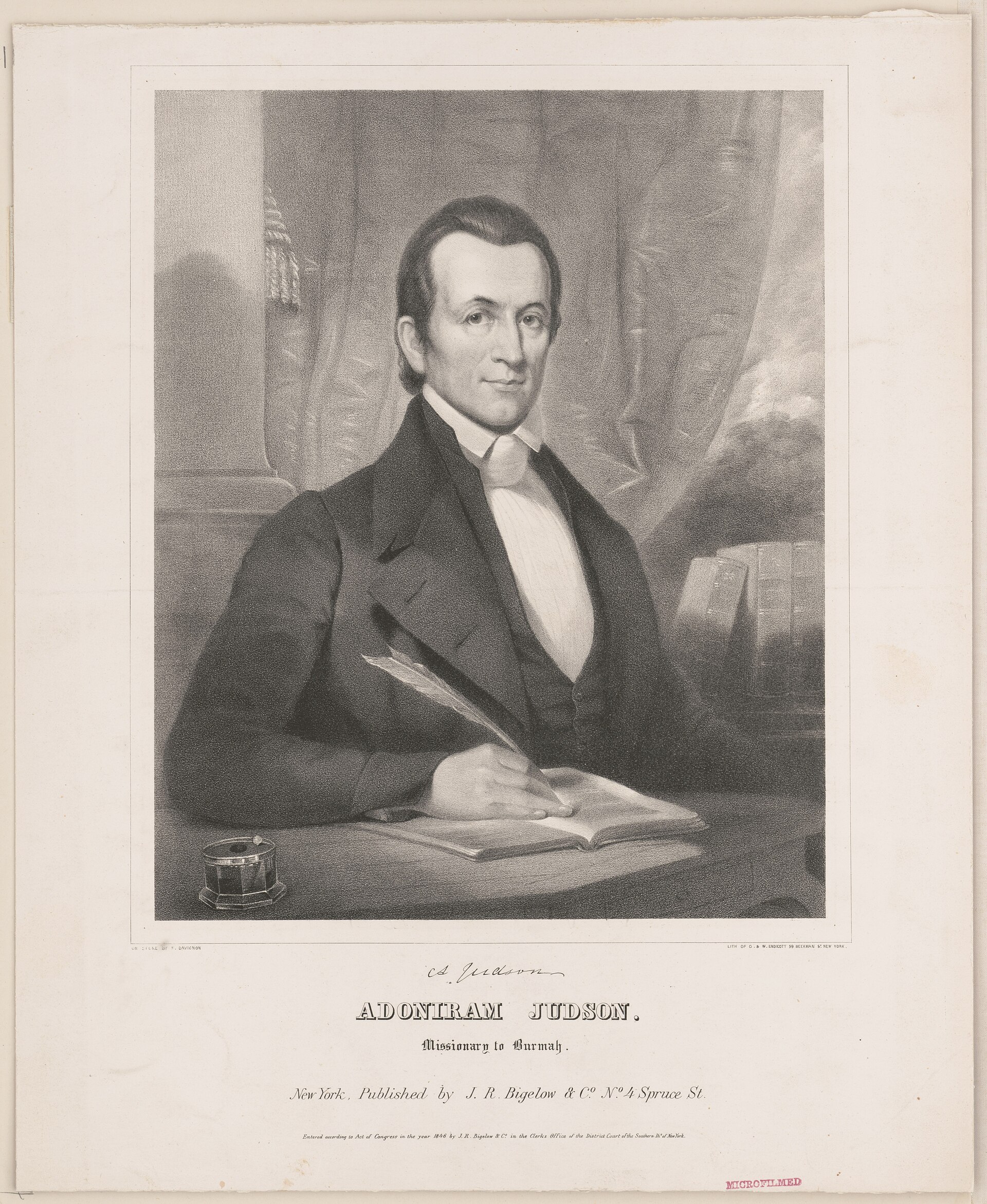
In August 1806 five students at Williams College in Massachusetts prayed beside a haystack during a thunderstorm and talked about sending the gospel to Asia. Four years later, a group of students at Andover Seminary, among them Adoniram Judson and Samuel J. Mills, asked the Congregational ministers of Massachusetts whether they ought to go as missionaries. The ministers answered by creating the American Board of Commissioners for Foreign Missions (June 1810). In February 1812 Adoniram Judson married Ann Hasseltine, was ordained at Salem with four other men, and sailed for India. On the voyage the Judsons changed their minds about baptism, were immersed in Calcutta (September 6, 1812) and so lost the support of the board that sent them. American Baptists formed a national convention in 1814 to support them instead. The Judsons reached Rangoon in July 1813, waited six years for a first Burmese convert (Maung Nau, June 1819), lived through the first Anglo-Burmese War, during which Adoniram spent about 21 months in prison at Ava and Oung-pen-la while Ann kept him alive, and buried Ann in 1826. Judson finished his Burmese Bible in 1834, married twice more (Sarah Boardman, then Emily Chubbuck), and died at sea on April 12, 1850. The largest response came from the Karen people, beginning with Ko Thah-byu, baptized in 1828. This lesson follows that story in the words of Ann's and Adoniram's own letters and journals, as printed in James D. Knowles's Memoir of Mrs. Ann H. Judson (1829) and Francis Wayland's Memoir of Adoniram Judson (1853), and it sets out what the record shows, what later tellings added, and how Burmese, Karen and American readers have weighed the mission since.
Where this lesson fits
Lesson 04 of this module, William Carey, the Enquiry of 1792 and the Modern Missions Era, followed the English Baptists to Bengal. Lesson 03, The Great Awakening and the First Mission Societies, listed the societies founded between 1649 and 1820, including the American Board. This lesson tells how the first Americans sent overseas by an American board came to be sent, and what happened to the two best known of them. The revivals that moved the students are told in module 105, The Second Great Awakening, and the Baptist side of the story, including the Southern Baptist Convention that grew out of the 1845 split, in module 80, Baptists. Those pages are not retold here.
Two books carry most of the primary material. Knowles, a Boston Baptist pastor, printed Ann Judson's diary entries and letters in 1829, three years after her death, from papers lent by her family; his book is public domain.1 Wayland, president of Brown University, printed Adoniram Judson's letters and journals in two volumes in 1853, three years after Judson's death, working with Judson's widow Emily, who added recollections of what Judson told her in conversation.2 Both books were written by admirers, for readers who supported the mission. Their value lies in the documents they reprint; their comments are those of friends, and this lesson keeps the two apart.
The haystack at Williams College, 1806
A revival at a small college
Williams College in Williamstown, in the northwest corner of Massachusetts, was a small Congregational college in 1806. The centennial booklet the college town published in 1906 says that a revival had begun among the students in 1805 and was "profoundly stirring men's souls" by the summer of 1806, with groups of students meeting to pray on Wednesdays under willow trees south of West College and on Saturdays under maple trees in "Sloan's meadow" north of the college buildings.3 Samuel J. Mills had entered the college that spring.3
The storm and the five students
The 1906 booklet gives the account that has been repeated ever since: "It was on a sultry afternoon in August, 1806, that five men met for prayer beneath the trees in Sloan's meadow." The five were "Samuel J. Mills, James Richards, Francis L. Robbins, Harvey Loomis, and Byram Green." A thunderstorm drove them to shelter beside "a large haystack which stood on the spot now marked by the Missionary Monument." There, the booklet says, they talked about Asia and the East India Company's trade there, Mills proposed that the gospel be sent to the peoples of Asia, and Loomis objected "that the East must first be civilized before the work of the missionary could begin." The booklet quotes Mills as saying, "Come, let us make it a subject of prayer under the haystack, while the dark clouds are going and the clear sky is coming," and quotes his prayer against anyone who would oppose "a herald of the cross."3
Two cautions apply to this account. The booklet was printed a full century after the event, and its exact date is given only as "August, 1806": no surviving diary from that afternoon fixes the day. The words put in Mills's mouth come from the recollections of the survivors, written down long afterward, and the 1906 booklet does not say which survivor supplied which line. The meeting itself, the five names and the haystack are attested by the men's own later testimony and by the monument their college raised while some of them were still remembered; the speeches should be read as remembered speech.
The Brethren
The firmest early document is a constitution. Two years after the haystack meeting the Williams students formed a secret society, which Mills named simply "the Brethren." Wayland printed its articles: "The object of this society shall be to effect, in the persons of its members, a mission or missions to the heathen." Another article bound each member to "keep himself absolutely free from every engagement" that would stop him going, "and shall hold himself in readiness to go on a mission when and where duty may call." Wayland gives the date of signing as September 7, 1808.4 The 1906 booklet, quoting "Mr. T. C. Richards in his recent life of Mills," adds that "the constitution, the records, and the signatures were all written in cipher," a precaution the students took because such plans were thought rash.5 When several of the Brethren moved on to the new Andover Theological Seminary in 1809 and 1810, the society moved with them.4

The monument of 1867
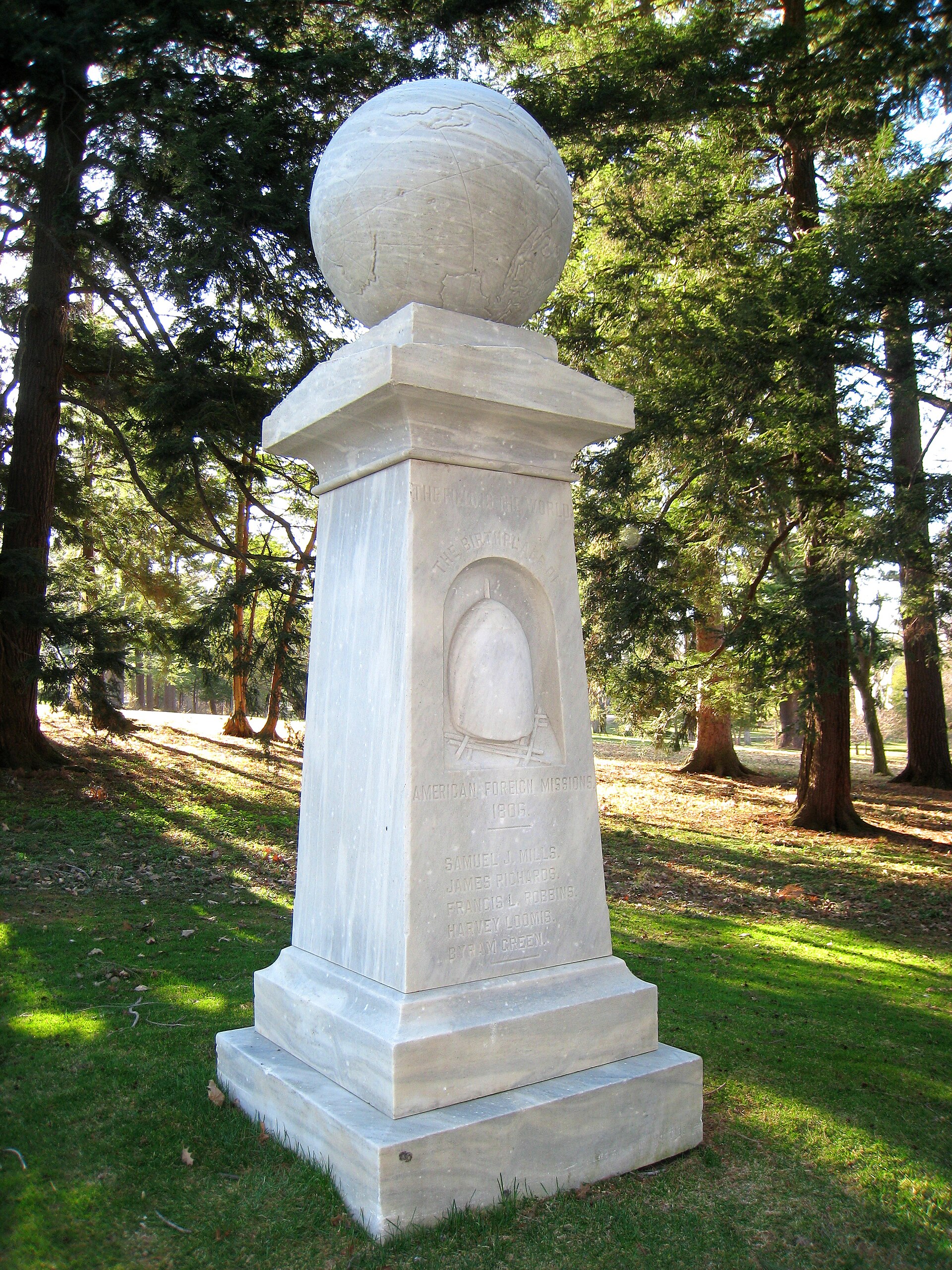
In 1867 the college set up a marble monument on the spot. The Williams College Special Collections timeline records that President Mark Hopkins dedicated it on July 28, 1867, and that it was paid for by a gift from Harvey Rice, a graduate of the class of 1824.6 The front face, as it appears in a 2008 photograph, carries the words "THE FIELD IS THE WORLD" at the top, then "THE BIRTHPLACE OF" above a carved haystack, then "AMERICAN FOREIGN MISSIONS / 1806," and below them the names "SAMUEL J. MILLS. / JAMES RICHARDS. / FRANCIS L. ROBBINS. / HARVEY LOOMIS. / BYRAM GREEN."7 A marble globe sits on top. The first line is a phrase from Jesus' explanation of the parable of the wheat and the tares in the King James Version, Matthew 13:38: "The field is the world; the good seed are the children of the kingdom."8 The other faces of the monument were not checked for this lesson.
The phrase "birthplace of American foreign missions" is a claim, and it is weighed in the Claims checked section below. Missions to Native Americans had been running in New England since the 1640s (lesson 02 of this module), and at least one American, the formerly enslaved Baptist preacher George Liele, had already gone abroad on his own in the 1780s. What began at Williams and Andover was something narrower: an American board, raised and paid for in America, sending ordained men across the ocean to Asia.
Andover, Bradford and the American Board, 1808 to 1812
Adoniram Judson before Andover
Adoniram Judson was born in Malden, Massachusetts, on August 9, 1788, the eldest son of the Congregational minister Adoniram Judson and his wife Abigail.9 He graduated from Brown University (then Rhode Island College), went through a period of religious doubt that Wayland describes at length, and entered the new Andover Seminary in the autumn of 1808 while still unsettled in his faith. Wayland records that on May 17, 1810, he was licensed to preach, on September 5, 1810, he received the Master of Arts from Brown, and on September 24, 1810, he finished the course at Andover.10
Judson himself named the book that turned him toward missions. In a letter to Luther Rice dated July 13, 1836, which, as Judson wrote in 1837, could not have reached Rice before Rice's death that year, he wrote: "Mine were occasioned by reading Buchanan's 'Star in the East,' in the year 1809, at the Andover Theological Seminary." Claudius Buchanan's sermon The Star in the East, which Judson read in 1809, described Christianity and the missions in India. Judson added that "for some days I was unable to attend to the studies of my class."11 Wayland reports that it was Colonel Symes's account of his 1795 embassy to Ava, the Burmese capital, "which first turned his thoughts to Burmah."12
Mills and the question of East or West
Wayland argued against an idea already current in 1853: that the Williams men had thought only of the Native Americans until Judson pointed them to Asia. He printed a letter from Mills to Gordon Hall dated December 20, 1809, about Henry Obookiah (Opukahaia), a young Hawaiian Mills had met at New Haven: "Shall not we consider these southern islands a proper place for the establishment of a mission? Not that I would give up the heathen tribes to the westward." In the same letter Mills objected to Judson's idea of serving under the London Missionary Society: "What! is England to support her own missionaries and ours likewise? O, for shame!"13 The letter shows that the wish for an American society, paid for by Americans, came from the students themselves.
The petition of June 1810
In June 1810 the General Association of Massachusetts Proper, the statewide body of Congregational ministers, met at Bradford. Judson wrote out a petition, "at the instance of Dr. Spring and Mr. Worcester," and four students signed it. Wayland and the American Board's own collected reports print the same text. It reads in part:
"They beg leave to state that their minds have been long impressed with the duty and importance of personally attempting a mission to the heathen; that the impressions on their minds have induced a serious, and, as they trust, a prayerful consideration of the subject in its various attitudes, particularly in relation to the probable success and the difficulties attending such an attempt; and that, after examining all the information which they can obtain, they consider themselves as devoted to this work for life, whenever God, in his providence, shall open the way.
"They now offer the following inquiries, on which they solicit the opinion and advice of this association: Whether, with their present views and feelings, they ought to renounce the object of missions, as either visionary or impracticable; if not, whether they ought to direct their attention to the eastern or the western world; whether they may expect patronage and support from a missionary society in this country, or must commit themselves to the direction of a European society; and what preparatory measures they ought to take, previous to actual engagement."
It was signed by Adoniram Judson Jr., Samuel Nott Jr., Samuel J. Mills and Samuel Newell.14 Judson later told Rice that the paper had first carried six names, including Rice's and James Richards's, but that "at the suggestion of Dr. Spring, your name and Richards's, which happened to stand last, were struck off, for fear of alarming the association with too large a number."15
The vote at Bradford
The minutes printed in the board's First Ten Annual Reports date the Association's session at Bradford to June 27, 1810. A committee of Samuel Spring, Samuel Worcester and a Mr. Hale reported that the students "ought not to renounce the object of missions, but sacredly to cherish their present views," and cited the command "Go ye into all the world, and preach the gospel to every creature" (Mark 16:15 in the King James Version).16 The Association then voted:
"Therefore, Voted, That there be instituted by this General Association, a Board of Commissioners for Foreign Missions, for the purpose of devising ways and means, and adopting and prosecuting measures, for promoting the spread of the gospel in heathen lands."16
The board was to have nine members, all chosen at first by the Massachusetts association and afterward, each year, five by that body and four by the General Association of Connecticut. Its first meeting was held at Farmington, Connecticut, on September 5, 1810, with Governor John Treadwell of Connecticut, Joseph Lyman, Samuel Spring, Samuel Worcester and Calvin Chapin present.16 Judson's own report of the Bradford day, in a letter Wayland printed, adds a plain detail: "After the paper was read, we presented ourselves, and severally made a statement of our motives and intentions."14 In the same letter he wrote that the students' "chief object in laying the business before the association, was to excite a general attention to the subject in this country, hardly expecting that such measures will be seasonably taken as shall preclude our soliciting British aid."14
A voyage to England and a French privateer
The new board had no money and no experience, and it first looked to London. In January 1811 the Prudential Committee sent Judson to England "to have a full and distinct understanding with the directors of the London Missionary Society," with a letter of introduction to George Burder, the society's secretary.17 His ship, the Packet, was taken by a French privateer, L'Invincible Napoleon, and Judson was marched as a prisoner through the streets of Bayonne, where, by Wayland's account drawn from Judson's own conversation, an American from Philadelphia heard him protesting in English and promised help. Released, he crossed to England, landed at Dartmouth on May 3, 1811, and on May 6 presented his credentials to the directors in London, who appointed him and his colleagues missionaries in the London society's service.17 Back home, the American Board decided to send and support its own men. Wayland devotes several pages to a "reprimand said to have been administered to Mr. Judson" at the board's meeting at Worcester on September 19, 1811, over his dealings with London, and argues that the story was exaggerated.18 The board kept the four men as its own missionaries.18
Incorporation and the first money
The Massachusetts legislature passed "An Act to incorporate the American Board of Commissioners for Foreign Missions," approved by Governor Caleb Strong on June 20, 1812. The act describes the board's purpose as "propagating the Gospel in heathen lands, by supporting Missionaries and diffusing a knowledge of the Holy Scriptures."19 The treasurer's account in the same volume shows how small and how sudden the first funding was: between the annual meeting of September 1811 and June 20, 1812, the board received $12,587.36 in donations and paid out $9,327.04 in expenses, with a further $12.33 lost "by counterfeit money received in donations."19 Harvard's Houghton Library, which holds the board's archive, describes it as "the first organized missionary society in the United States" and records that by its hundredth year, in 1910, it ran 102 mission stations with about 600 missionaries.20
Ann Hasseltine of Bradford
The letter to John Hasseltine
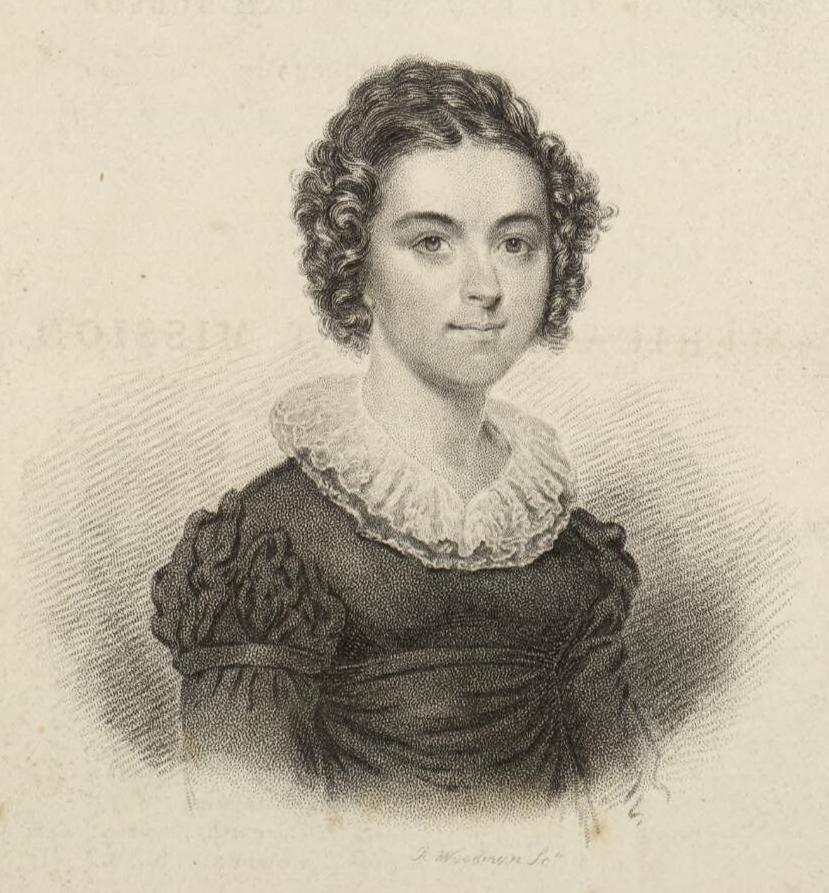
Ann Hasseltine was born at Bradford, Massachusetts, on December 22, 1789, the daughter of John and Rebecca Hasseltine.21 Wayland's informant, her sister Mary, recalled that the family first met Judson in the summer of 1810, when the General Association met at Bradford and the missionary candidates came before it.22 Within months Judson asked her father for her hand. Knowles printed the central part of the letter, and it is the plainest statement anywhere of what the first American missionary wives were being asked to accept:
"I have now to ask, whether you can consent to part with your daughter early next spring, to see her no more in this world; whether you can consent to her departure for a heathen land, and her subjection to the hardships and sufferings of a missionary life; whether you can consent to her exposure to the dangers of the ocean; to the fatal influence of the southern climate of India; to every kind of want and distress; to degradation, insult, persecution, and perhaps a violent death. Can you consent to all this, for the sake of him who left his heavenly home, and died for her and for you; for the sake of perishing, immortal souls; for the sake of Zion, and the glory of God?"23
Ann Hasseltine decides
Ann's diary shows that she treated the proposal as a question about her own calling, separate from the question of marriage. Her entry for October 28, 1810, reads:
"I have, at length, come to the conclusion, that if nothing in providence appears to prevent, I must spend my days in a heathen land. I am a creature of God, and he has an undoubted right to do with me, as seemeth good in his sight. ... Were it not for these considerations, I should, with my present prospects, sink down in despair, especially as no female has, to my knowledge, ever left the shores of America, to spend her life among the heathen; nor do I yet know, that I shall have a single female companion. But God is my witness, that I have not dared to decline the offer, that has been made me, though so many are ready to call it a 'wild, romantic undertaking.'"24
To her friend Lydia Kimball she wrote: "I feel willing, and expect, if nothing in providence prevents, to spend my days in this world in heathen lands." She added that her decision was "not hasty," nor "formed in consequence of an attachment to an earthly object; but with a sense of my obligations to God, and with a full conviction of its being a call in providence, and consequently my duty."25 These pages matter for the history of women in missions (lesson 09 of this module, Women and Missions): the board sent wives as companions and paid them nothing in their own names, yet Ann described the call as her own, and she went on to teach, translate and write as a missionary in every sense but the board's.

Ordination at Salem and the voyage out, February to June 1812
Ships to the East Indies were few, and the party waited through the winter. Wayland lays out the week in which the waiting ended: "On the 3d of February, Mr. Judson took a final leave of his parents at Plymouth. On the 5th, he was married to Ann Hasseltine. On the 6th, he was ordained at Salem, in company with Messrs. Nott, Newell, Hall, and Rice."26 He then reprinted the account of the ordination from the Panoplist, the Boston Congregational monthly, for February 1812:
"Ordained, on Thursday, the 6th instant, at the Tabernacle in Salem, the Rev. Messrs. Samuel Newell, Adoniram Judson, Samuel Nott, Gordon Hall, and Luther Rice, to the work of the gospel ministry, as missionaries to the heathen in Asia."26
Dr. Woods, professor at Andover, preached from Psalm 67, whose opening verses in the King James Version ask "That thy way may be known upon earth, thy saving health among all nations."27 The Panoplist added that the sermon, charge and right hand of fellowship were printed, that "a very large impression is struck off, and the profits will be applied to the support of this mission," and that the day "may justly be considered as forming a new and important era in the annals of the American churches, the era of foreign missions."26 (The Panoplist used a dash before the last phrase; it is given here with a comma.)
The party went in two ships. "Messrs. Newell and Judson, with their wives, sailed from Salem in the brig Caravan, Captain Heard, on Wednesday, the 19th instant." Nott, Hall and Rice, with Nott's wife, sailed from Philadelphia in the ship Harmony on February 18.26 The Caravan reached Calcutta on June 17, 1812; Wayland says the Harmony arrived on "the 8th of the following month."28
Calcutta, 1812: the change on baptism
The letters of August and September 1812
Judson knew he would meet William Carey's English Baptists at Serampore, and he studied the question of baptism on the voyage so as to defend the Congregational practice of baptizing infants. He came out of the study persuaded of the opposite. On August 27, 1812, he wrote to Carey, Joshua Marshman and William Ward:
"It is now about four months since I took the subject into serious and prayerful consideration. My inquiries commenced during my passage from America, and after much laborious research and painful trial, which I shall not now detail, have issued in entire conviction, that the immersion of a professing believer is the only Christian baptism. In these exercises I have not been alone. Mrs. Judson has been engaged in a similar examination, and has come to the same conclusion."29
On September 1 he wrote to Samuel Worcester, the American Board's secretary, that his change "is considered by my missionary brethren as incompatible with my continuing their fellow-laborer," and that the board would "undoubtedly, feel as unwilling to support a Baptist missionary as I feel to comply with their instructions, which particularly direct us to baptize 'credible believers with their households.'" The same day he wrote to Dr. Bolles, a Baptist pastor in Salem: "Alone, in this foreign heathen land, I make my appeal to those whom, with their permission, I will call my Baptist brethren in the United States."29
The Serampore missionaries were as surprised as anyone. Marshman wrote to Dr. Baldwin, a Baptist pastor in Boston, on September 1, 1812, that Judson's note to Carey "has occasioned much reflection among us," and that the change "began when no Baptist was near, (on board ship,)" and that Judson had so "carefully" concealed it "that he scarcely gave us a hint respecting them before he sent this note to brother Carey." Marshman added that the Serampore men made it "a point to guard against obtruding on missionary brethren of different sentiments."29
Ann's letter home gives the date and the cost: "We knew it would wound and grieve our dear Christian friends in America, that we should lose their approbation and esteem. ... We felt we had no home in this world, and no friend, but each other. ... We were baptized on the 6th of September, in the Baptist chapel in Calcutta." Luther Rice, she added, "was baptized several weeks after we were."30 (Ann wrote with a dash in the first sentence; a comma stands in for it here.)
Expelled by the East India Company
The second blow came from the government. As lesson 04 explained, the East India Company did not admit missionaries to its Indian territories before the Charter Act of 1813. Wayland records that the newcomers were ordered to leave the country and return to America, "were prohibited from settling in any part of the company's territory," and were then given "a peremptory order to proceed to England in one of the company's ships."31 The Newells left first for the French-held Isle of France (Mauritius). On November 30, 1812, the Judsons and Rice, "fleeing from the intolerance of the East India Company," boarded the Belle Creole for Port Louis, arriving on January 17, 1813. By Wayland's account they had first slipped aboard her without a pass, were put off when a government dispatch overtook the ship in the river, and then, with a magistrate's pass sent by a friend they never identified, chased her downriver for a day and caught her at anchor. There they learned that Harriet Newell, Ann's friend from Bradford, had died on November 30, the very day they had sailed. Wayland says the news taught them "that here they had no continuing city."31
Rice goes home, and the Judsons reach Rangoon
Rice, ill with a liver complaint, sailed for New York on March 15, 1813, to rouse the American Baptists. The Judsons, still hoping for Penang, could only get a ship to Madras, where they arrived on June 4, 1813. Facing a fresh order of deportation, they took the only ship available, the old Georgiana, bound for Rangoon, on June 22. The nurse engaged for the pregnant Ann died on deck a few hours out, and Ann became very ill on the stormy passage. "They arrived at Rangoon on the 13th of July, 1813, and made their first home in Burmah in the Baptist mission house, occupied by Felix Carey," William Carey's son.31 Judson's own letter explains the choice: "A mission to Rangoon we had been accustomed to regard with feelings of horror," but there was no other ship, and Madras meant arrest.31
Luther Rice and the Triennial Convention, 1814
Back in America, Rice found Baptists ready to answer Judson's appeal. Wayland describes what followed: Rice was "immediately requested to visit the various parts of the country, organize societies, and promote the formation of a general association," and "societies in aid of the cause were formed almost at his bidding."32 Delegates met "on the 18th of May, 1814, in the First Baptist Church" in Philadelphia, and "there formed the 'General Missionary Convention of the Baptist Denomination in the United States of America for Foreign Missions.'" Because it met every three years it was usually called the Triennial Convention. Wayland notes that it kept that name until 1845, when "the brethren in the Southern States" withdrew to form "a Southern Convention," and the northern body reorganized in New York on November 20, 1845, as the American Baptist Missionary Union.32 The Southern Baptist Convention and its Foreign Mission Board (today the International Mission Board) thus trace their foreign mission work back, through the Triennial Convention, to the Judsons' change of views in Calcutta. The reasons for the 1845 division, which centered on whether slaveholders could be appointed as missionaries, are taught in module 80, Baptists.
Wayland, a Baptist writing in 1853, saw the hand of God in the episode: the change of two young people's views "was made the means of arousing to a conviction of their duty a large denomination of Christians." He also wrote that "the momentary irritation which the change occasioned rapidly passed away," and that when Judson visited America after 33 years away, "the officers of the 'American Board' especially delighted to greet him as a 'brother beloved.'"32 That is the judgment of a Baptist friend. The Congregational side of the record shows the board losing two of its first five missionaries, and money it had spent on them, within a year.
Rangoon, 1813 to 1823: language, loss and a first convert
Learning Burmese
Burma in 1813 was ruled by a king whose court sat on the upper Irrawaddy River, at Amarapura and then, from the early 1820s, at nearby Ava, as Ann Judson later explained in a letter; Rangoon was the kingdom's chief port.33 Theravada Buddhism was the religion of the Burman majority and of the court. The Judsons spent their first years on the language, with a teacher and no grammar or dictionary adequate for the purpose. Judson's letters in Wayland describe drawing up a vocabulary "for daily reference, correction, and enlargement" before turning his "whole time again to the Burman."34 On September 11, 1815, Ann gave birth to a son, "whom, in honor of the apostle of religious liberty, they named Roger Williams." He died on May 4, 1816.34
The zayat and Maung Nau
In April 1819 Judson opened a zayat, a roadside shelter of the kind Burmese Buddhists used for rest and religious talk, as a place for public teaching.35 Knowles records that "the 30th April, 1819, is a memorable day in the history of this Mission. On that day, Moung Nau, the first convert, made his first visit to the zayat." Judson's journal for June 27, 1819, a Sunday, describes the first baptism:
"There were several strangers present at worship. After the usual course, I called Moung Nau before me, read and commented on an appropriate portion of Scripture, asked him several questions concerning his faith, hope, and love, and made the baptismal prayer, having concluded to have all the preparatory exercises done in the zayat. We then proceeded to a large pond, in the vicinity, the bank of which is graced with an enormous image of Gaudama, and there administered baptism to the first Burman convert."36
A week later, on July 4, Judson recorded sitting down "for the first time, at the Lord's table, with a converted Burman," and administering the Lord's Supper "in two languages."36 The baptism came almost six years after the Judsons landed. Burmese spelling of the time used "Moung" for the honorific now usually written "Maung"; the lesson uses Maung Nau in its own text and keeps the older spelling inside quotations.
The petition at Amarapura, 1820
To win protection for Burmans who wished to become Christians, Judson and his colleague Colman decided to ask the king himself for toleration. In January 1820 they went up the Irrawaddy to the capital, then at Amarapura, which Judson's journal calls "New Ava, or Amarapoora." Judson's journal records the petition, read before the king by a court official, Moung Zah: that "royal permission be given, that we, taking refuge in the royal power, may preach our religion in these dominions, and that those who are pleased with our preaching, and wish to listen to and be guided by it, whether foreigners or Burmans, may be exempt from government molestation."37 The king read the petition and then looked at a tract:
"He held the tract long enough to read the first two sentences, which assert that there is one eternal God, who is independent of the incidents of mortality, and that beside him, there is no God; and then, with an air of indifference, perhaps disdain, he dashed it down to the ground."37
Moung Zah then gave the king's answer, and it is worth reading as the Burmese court's own position: "Why do you ask for such permission? Have not the Portuguese, the English, the Mussulmans, and people of all other religions, full liberty to practise and worship according to their own customs? In regard to the objects of your petition, his majesty gives no order. In regard to your sacred books, his majesty has no use for them: take them away."37 Foreigners could keep their own religions; what the court would not grant was protection for Burmans who left Buddhism. Judson's journal calls the scene the moment when the king "dashed to the ground the first intelligence that he had ever received of the eternal God"; the king's reply, as Judson himself recorded it, frames the matter as one of order among his own subjects.
Ann Judson's own work
Ann ran a Wednesday meeting for women, wrote a catechism in Burmese, and learned Siamese from a teacher in Rangoon. In a letter Knowles printed she wrote: "There are several thousands of Siamese who live in Rangoon, and who speak and write the pure language of Siam. With the assistance of the teacher, I have made a translation of the Burman catechism, tract, and Matthew."38 In poor health, she embarked for Bengal on August 21, 1821, on the way to England and America, and spent much of 1822 and early 1823 in England and then in Philadelphia and Baltimore. There she wrote an account of the mission, begun on the voyage as "a 'Series of Letters addressed to Mr. Butterworth,'" her host in England, meant to give "an account of the American Baptist Mission to Burmah, its origin, progress and success."39 She returned to Massachusetts in the spring of 1823, sailed again, and arrived at Rangoon with the new missionaries Mr. and Mrs. Wade on December 5, 1823. Judson, who had already been to Ava with the medical missionary Dr. Price, took her up the river to the capital, where they planned to build a house and open a school.40
War and the prisons at Ava and Oung-pen-la, 1824 to 1826
The first Anglo-Burmese War begins
Border clashes between Burma and British India over Arakan, Manipur and Assam led to war in 1824. Ann's long letter to Adoniram's brother Elnathan, dated Rangoon, May 26, 1826, is the main eyewitness source for what followed, and Knowles printed it whole. She wrote that she had kept a journal "of every thing that had transpired from our arrival at Ava, but destroyed it at the commencement of our difficulties."33 News that the British had taken Rangoon reached Ava on May 23, 1824. Suspicion fell on every foreigner. Ann explained why the missionaries, though Americans, fell under it: in the accounts of the English merchant Henry Gouger "it was found that Mr. Judson and Dr. Price had taken money of him to a considerable amount. Ignorant as were the Burmese of our mode of receiving money by orders on Bengal, this circumstance, to their suspicious minds, was a sufficient evidence, that the Missionaries were in the pay of the English, and very probably spies."33
The arrest of June 8, 1824
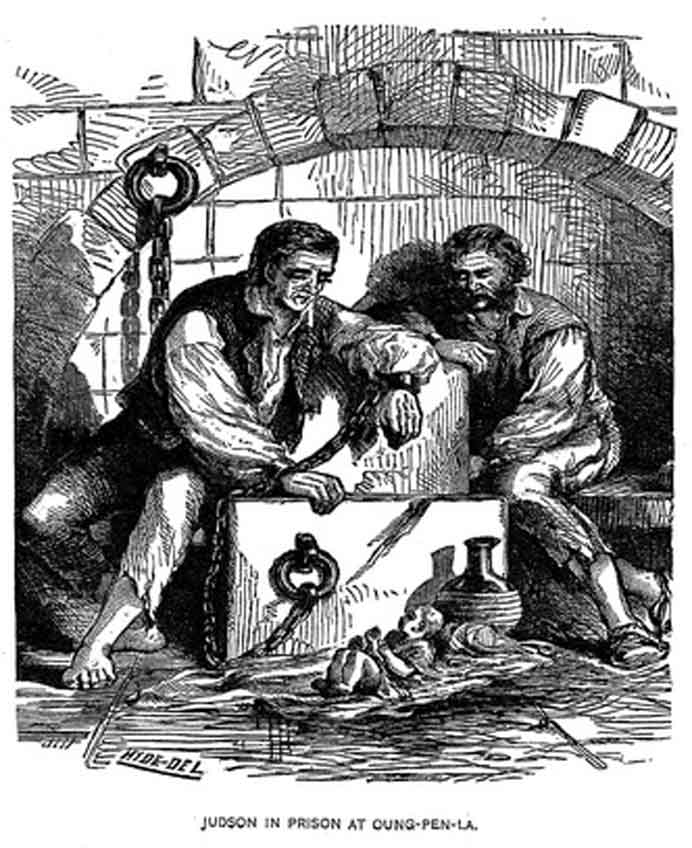
"On the 8th of June, just as we were preparing for dinner, in rushed an officer holding a black book, with a dozen Burmans, accompanied by one, who, from his spotted face, we knew to be an executioner, and a 'son of the prison.' 'Where is the teacher?' was the first inquiry. Mr. Judson presented himself. 'You are called by the king,' said the officer; a form of speech always used when about to arrest a criminal. The spotted man instantly seized Mr. Judson, threw him on the floor, and produced the small cord, the instrument of torture."33
Ann offered money and was refused. That night, she wrote, "I destroyed all my letters, journals, and writings of every kind, lest they should disclose the fact, that we had correspondents in England." The next morning the Burmese Christian Moung Ing, whom she sent to the prison, brought word that "Mr. Judson, and all the white foreigners, were confined in the death prison, with three pairs of iron fetters each, and fastened to a long pole to prevent their moving!"33

Twenty-one months
For the rest of 1824 and into 1825, Ann, pregnant and then nursing a newborn daughter, Maria, went daily between the government officers, members of the royal family and the prison gate, bribing jailers, bringing food, and petitioning for her husband and the others. Wayland, summing up from her letters and Judson's later talk, wrote that imprisonment was endured "for twenty-one months by a student of retired habits, unaccustomed to physical hardship."41 In 1825, when Maria was, in Ann's words, "only three months old," the prisoners were suddenly led out and driven to Oung-pen-la, a village near Amarapura, a few miles from Ava; Ann followed with the baby. She wrote that they found "an old shed" and that the prisoners had not "even a mat or pillow, or any thing to cover them."33 As the British army advanced up the river, an order came for Judson's release from Oung-pen-la, and the Burmese government sent him to its army headquarters at Maloun to serve as a translator. After further detention at Ava, he and Ann were at last allowed to go down the river to the British commander, General Sir Archibald Campbell, encamped at Yandabo, where the peace treaty was signed in 1826. Ann wrote that Campbell treated them "with the kindness of a father."42
Judson's own later summary, recorded by Emily Judson and printed by Wayland, gives his view of the ordeal: "What do you think of floating down the Irrawadi, on a cool, moonlight evening, with your wife by your side, and your baby in your arms, free, all free? But you cannot understand it, either; it needs a twenty-one months' qualification; and I can never regret my twenty-one months of misery, when I recall that one delicious thrill."43 (Wayland's text has a dash before "all free"; a comma stands in here.)
The manuscript in the pillow
The best known detail of the imprisonment is the Burmese New Testament sewn into a pillow. Wayland's account, drawn from Judson's conversations with Emily, says that after the arrest the manuscript was first buried under the house, but the rains threatened it, and "the final conclusion was to sew the manuscript up in a pillow, so mean in its appearance, and so hard and uncomfortable withal, that even the avarice of a Burman would not covet it." When the prisoners were driven to Oung-pen-la, a guard threw away the "apparently worthless roll of hard cotton." Moung Ing picked it up as a keepsake, "and, several months from that time, the manuscript which now makes a part of the Burmese Bible was found within, uninjured."44 Ann's 1826 letter, written soon after the events, does not tell the pillow story; the details come from Judson's memory as recorded more than twenty years later. The story is rated in Claims checked.
Yandabo and the British annexation
By the Treaty of Yandabo (1826) Burma ceded to Britain the coastal provinces of Arakan in the west and Tenasserim in the south. Wayland's description: "the Burmans ceded to Great Britain the larger part of their territory lying upon the sea coast."45 Judson took part in the negotiations as a translator, and later in 1826 he agreed, at the request of the British envoy John Crawfurd, to go back up to Ava with the embassy that was to negotiate a commercial treaty. Wayland explains why he agreed: "Mr. Crawfurd promised to use every effort to procure the insertion of an article in the treaty which should guaranty to all the subjects of the king the right of religious liberty." Ann, Wayland adds, "decidedly favored it."46 No such article was obtained. The episode is the clearest point at which the mission and British power touched, and it is discussed in the section on the record below.
Amherst and the death of Ann Judson, 1826 to 1827
The British laid out a new town, Amherst, on the Tenasserim coast, and the Judsons moved there on July 2, 1826, expecting it to become the capital of the new province. Judson left soon afterward with Crawfurd's embassy. He was at Ava when the news reached him, on November 24, 1826.47 On December 7 he wrote to his sister:
"Weep with me, my dear sister and parents, for my beloved wife is no more. She died at Amherst, the 24th of October last, of remittent fever, and is buried near the spot where she first landed; and 'they have put up a small, rude fence around the grave, to protect it from incautious intrusion.' There lies, enclosed in a coffin, the form of her I so much loved, the wife of my youth, the source and centre of my domestic happiness."47
(Wayland prints a dash before "the wife of my youth"; it is given here with a comma.) Ann was 36. Their daughter Maria, cared for by the missionary wife Mrs. Wade, died on April 24, 1827.48 The British made Moulmein (Maulmain), not Amherst, their headquarters, and the mission followed; Judson's journal for November 14, 1827, records the move.48
The hermitage
The years after Ann's death were the darkest of Judson's life by his own and his friends' accounts. Wayland, drawing on what Judson told Emily, lists what he did: he gave his inherited money to the board; he burned his letters and "a letter of thanks for his services from the governor general of India"; he built a bamboo house at the edge of the jungle, "which he called the 'hermitage,' where he lived upon rice for weeks together"; and, to master his dread of bodily decay, "he had a grave dug, and would sit by the verge of it, and look into it."49 In May 1828 he asked his correspondents, through the Baptist magazine, "no longer to apply to my name the title" of Doctor of Divinity that Brown University had conferred on him in 1823. Later evangelical biographies sometimes tell these years as a spiritual triumph and sometimes as a breakdown; the documents show grief, guilt and an ascetic discipline that Wayland himself described as excessive.
The Karen and Ko Thah-byu
A people the mission had not planned for
The Judsons had come for the Burmans, the Buddhist majority. The largest response came from the Karen, hill and delta peoples who spoke languages of their own, were mostly not Buddhist, and had long lived under Burman rule. Wayland's narrative says that Judson in Rangoon noticed "small parties of strange, wild-looking men" and was told "that they were called Karens" and that they "shrunk from association with other men." A Burmese convert, "finding, during the war, a poor Karen bond servant in Rangoon, paid his debt, and thus became, according to the custom of the country, his temporary master," and brought him to the missionaries.50 That man was Ko Thah-byu (now usually written Ko Tha Byu).
The missionary Francis Mason published a memoir of him, The Karen Apostle, in 1843. Mason wrote that Ko Thah-byu "was born about the year 1778," left home at fifteen, "became a robber and a murderer," and, in the words of a fellow missionary whom Mason quotes, had killed "more than thirty, without doubt, according to his own confession," either "as principal or accessary."51 He was baptized at Tavoy by George Dana Boardman, who wrote in his journal for May 16, 1828: "Repaired early in the morning to a neighboring tank, and administered Christian baptism to Ko Thah-byu, the Karen Christian who accompanied us from Maulmain. ... Perhaps God has a work for him to do among his countrymen."51 Ko Thah-byu spent the rest of his life traveling among Karen villages as an evangelist.
Why the Karen listened
Wayland's narrative gives the reasons the missionaries saw: the Karen "had no long-cherished prejudices and time-honored customs to fetter them; and their traditions taught them to look for the arrival of white-faced foreigners from the West, who would make them acquainted with the true God." He added that, apart from one division, the Karen "have never adopted Boodhism; the oppressive treatment which they have received at the hands of their Burmese rulers probably contributing to increase their aversion to idolatry."50 Mason's book records Karen sayings about a lost book that would one day return to them.51 The missionaries Wade and Mason learned Karen, and Wade, in Wayland's words, "conferred an inestimable blessing on the race by reducing it to writing."50 Two cautions apply. The "traditions" were written down by missionaries who were looking for signs of preparation for the gospel, and the sources opened for this lesson cannot settle how old or how widespread those sayings were. And the missionary documents record the religious side of the Karen response; apart from Ko Thah-byu's reported confession, they do not give the Karen converts' own reasons in their own words. Wayland's remark about Burman rule is a missionary's judgment. How far long Burman rule over the Karen, and the British government that took the Tenasserim coast in 1826, shaped the Karen response is a question for historians that this lesson leaves open and lists as unverified.
The numbers to 1833
Judson's report of January 1834 included a table of "Persons baptized in Burmah previous to the Year 1833." Its totals were 128 Burmans, 257 Karens and 131 foreigners, 516 in all.52 The chart in the Pictures section below redraws those totals. Twenty years after the Judsons reached Rangoon, Karen converts already outnumbered Burman converts two to one.
The Burmese Bible and the dictionary
January 31, 1834
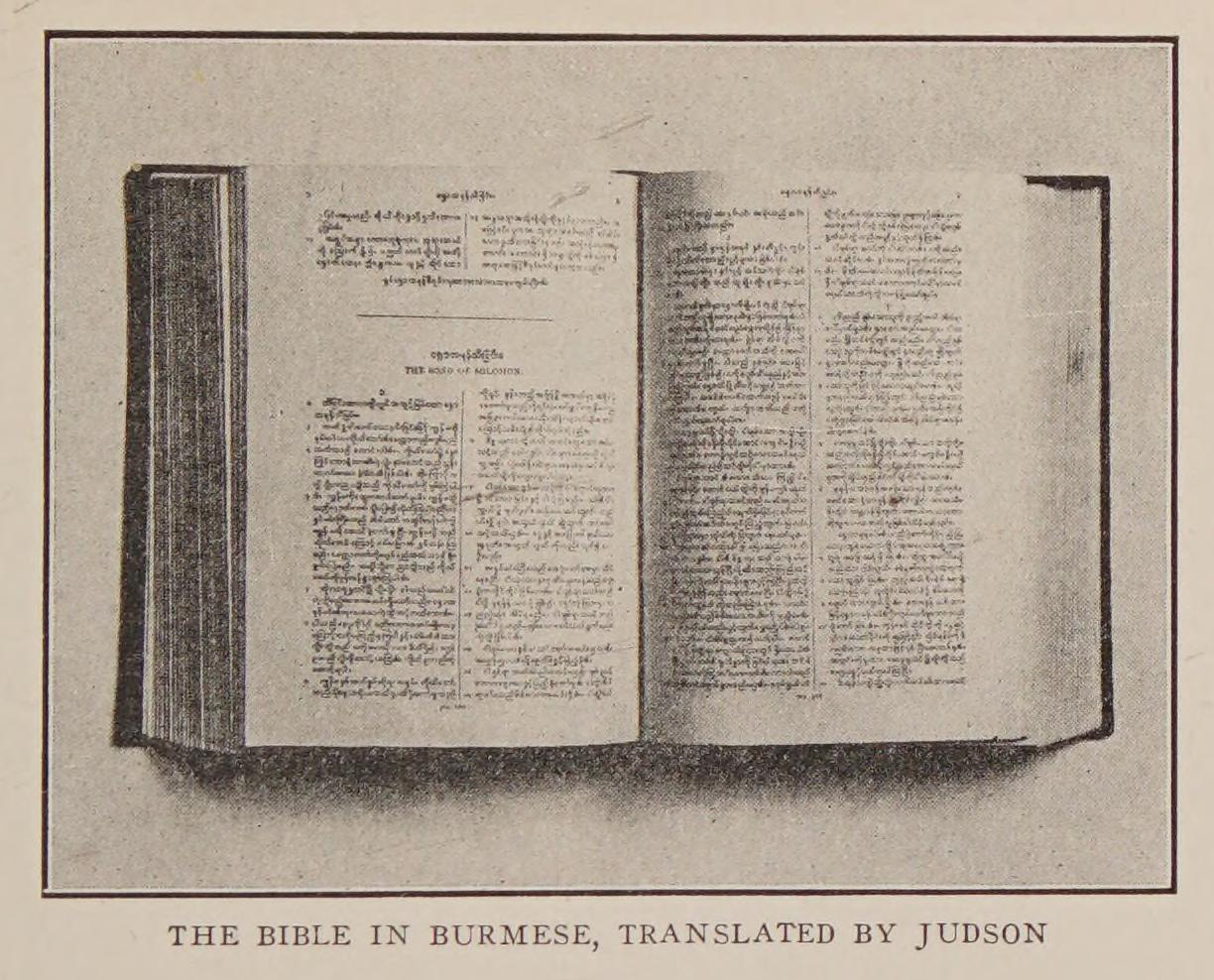
Judson finished the New Testament in Burmese in 1823 and the Old Testament ten years later. The postscript to his report closes the work in his own words:
"P. S. January 31, 1834. Thanks be to God, I can now say I have attained. I have knelt down before him, with the last leaf in my hand, and imploring his forgiveness for all the sins which have polluted my labors in this department, and his aid in future efforts to remove the errors and imperfections which necessarily cleave to the work, I have commended it to his mercy and grace; I have dedicated it to his glory. May he make his own inspired word, now complete in the Burman tongue, the grand instrument of filling all Burmah with songs of praise to our great God and Saviour Jesus Christ. Amen."52
He went straight on to revision. Wayland gives the dates: "On the 26th of September, 1835, Dr. Judson finished the revision of the Old Testament; on the 22d of March, 1837, he sent to the press the last sheet of the revised edition of the New Testament; and on the 24th of October, 1840, he completed the revision of the quarto edition of the Burmese Bible."53 Judson's letter of December 28, 1840, describes that edition as "about twelve hundred pages, quarto," and explains a change of method: "In the first edition of the Old Testament, I paid too much regard to the critical emendations of Lowth, Horsley, and others. In the present edition, I have adhered more strictly to the Hebrew text." For the New Testament he had at first "followed Griesbach, as all the world did then," and had since come "to distrust his authority."53 (On Griesbach and the textual criticism of the New Testament, see module 103, The King James Version of 1611, and the later lessons of that module.)
Wayland adds that Burmese readers "considered it pure Burman, and perfectly intelligible."53 That is a missionary's report of Burmese opinion. The Judson translation, revised in later generations, remained the standard Protestant Bible in Burmese through the twentieth century; the module 103 lessons on translation method (The NIV and Dynamic Equivalence) explain how later mission translators changed their approach.

The dictionary
Judson had resolved, he said, never to make a dictionary, then gave in to the board and his colleagues because "the one printed in 1826" was "exceedingly imperfect." He planned "a double work, in two parts, the first English and Burmese, the second Burmese and English," and hoped to finish by the end of 1845, adding: "Not, indeed, that I count on living so long."54 In a letter dated Maulmain, January 22, 1849, he reported that "the English and Burmese part of my dictionary is done, and is now printing in a small edition of three hundred. It will make a volume of about six hundred pages quarto."55 He did not live to finish the Burmese and English part; it was completed by other missionaries after his death.
Sarah Boardman Judson and Emily Chubbuck Judson
Sarah Hall Boardman Judson
The obituary notice Judson wrote for his second wife, printed by Wayland, gives the facts. Sarah Hall was born at Alstead, New Hampshire, on November 4, 1803, grew up in Salem, and married George Dana Boardman on July 4, 1825, sailing with him that month. They settled at Tavoy on April 1, 1828. Boardman died on February 11, 1831. She "was married again to Adoniram Judson, of Maulmain, April 10, 1834," and at Maulmain "became the mother of eight children, of whom five survive her." In 1845, seriously ill, she sailed with Judson for America and "departed this life on shipboard, in the port of St. Helena, September 1, 1845."56 In her years in Burma she worked among the Karen and translated into Burmese. Judson's notice says: "Her translation of the Pilgrim's Progress, part first, into Burmese, is one of the best pieces of composition which we have yet published."56
The visit home, 1845 to 1846
Judson arrived in Boston on October 15, 1845, after 33 years away. His voice had failed, and Wayland records that he addressed public meetings "almost in a whisper" while another man standing beside him repeated his words to the audience. It was on this visit that, Wayland reports, "the late venerable James Loring asked him, 'Do you think the prospects bright for the speedy conversion of the heathen?' 'As bright,' was his prompt reply, 'as the promises of God.'"57 At the farewell service at the Baldwin Place church in Boston, held at the end of June 1846, the Rev. Mr. Stow summed up the work of the Baptist board since 1814: "More than two hundred and fifty missionaries and assistants, besides native preachers, had been appointed," "upwards of nine hundred thousand dollars had been contributed and expended," the Bible had been translated into Burmese, and "at least eight thousand pagans had been converted to Christianity."58 These were the board's own figures for all its missions, not only Burma.
Emily Chubbuck Judson
"On the 2d of June, 1846, he was married, at Hamilton, New York, to Miss Emily Chubbuck, a native of Eaton, in the same state." Emily Chubbuck was a popular writer under the pen name Fanny Forester. They sailed from Boston on the Faneuil Hall on July 11, 1846, and reached Maulmain on November 30.59 Her Memoir of Sarah B. Judson appeared in 1848. After Judson's death she returned to America, worked with Wayland on his memoir, and died in 1854. The pen name and the dates of her later life are standard in reference works but were not checked against a primary source for this lesson.
Death at sea, April 12, 1850
Judson worked on the dictionary until November 1849, when, Wayland says, he "took a violent cold" while helping Emily nurse a sick child, followed by "an attack of the fever of the country" worse than any before. A trip down the coast and a stay at Amherst did not help, and a long sea voyage was urged as the last hope. He resisted, "more especially because it was impossible for Mrs. Judson to accompany him," then took passage on a French ship, the Aristide Marie, bound for the Isle of France, embarking on April 3, 1850, with a member of the Maulmain mission as companion. Wayland's account: "The pilot left the vessel on Monday, April 8. Baffling winds and sultry weather supervened, and the distress of the sufferer became intense. The scene was closed by death on Friday, the 12th of April; and on the same day all that was mortal of Dr. Judson was committed to the deep."60 He was 61.
How the mission was paid for
The first American foreign missions ran on many small gifts gathered through a new kind of voluntary society. The documents in this lesson show several of the methods described in lesson 03 of this module:
- Direct donations to the board. The American Board took in $12,587.36 in the nine months before its incorporation in June 1812.19
- Printed sermons. The Salem ordination sermon and charge were printed in "a very large impression," with the profits "applied to the support of this mission."26
- Women's "cent societies." In a June 1810 letter Judson urged that the Panoplist be taken in Plymouth and added that "the treasurer of the Cent Society ought to undertake the business."14
- Local societies joined into a national body. Rice's tour of 1813 and 1814 formed local Baptist mission societies, which sent delegates to Philadelphia to form the Triennial Convention.32
- Missionary books. Knowles's Memoir of Ann Judson was published by the Baptist convention's treasurer, Heman Lincoln, who registered the copyright "in behalf of said Convention."1 Wayland's memoir announced "twenty-fifth thousand" on its title page.2 The Judsons' story was itself a means of raising support.
The money ran through a home board, which paid the missionaries a salary. That model, a denominational board funded by congregations, is the ancestor of the pooled funding described in lesson 12 of this module, The Large Mission Agencies and How They Are Funded.
How the Judson story has been read
The Burmese court
The earliest Burmese response on record is the king's answer of 1820, quoted above: foreigners already had "full liberty to practise and worship according to their own customs," the king gave "no order" on protection for converts, and he had "no use" for the missionaries' books.37 Read from the court's side, the missionaries were asking a Buddhist king to shield his own subjects from the consequences of leaving the religion that bound the kingdom together. In 1824 the court went further and treated the missionaries as possible spies, on the evidence of the money they drew through an English merchant.33 Ann Judson's letter shows that the Burmese officers had a reason for the suspicion, even though she denied that it was true: the missionaries had British connections, British money orders and correspondents in England. No Burmese account of the imprisonment written by a Burmese official was found for this lesson.
The mission and British power
The Judsons came as Americans, and the East India Company twice tried to expel them from British India. In Burma, however, the mission's fortunes rose with British arms. Judson served the British as a translator at Yandabo and joined Crawfurd's embassy to Ava in 1826 in the hope of a treaty article on religious liberty.46 The mission then moved to Amherst and Moulmein, towns under British rule after the treaty, and the Karen mission grew mainly in British-held Tenasserim. Judson burned the governor general's letter of thanks for his services, as noted above, but the services had been given.49 Writers who see the mission as part of the colonial expansion of Britain into Burma point to these facts. Writers who reject that reading point to the Judsons' American citizenship, the Company's hostility to them, the prison at Ava, and the fact that the Burmese Bible and the Karen churches outlasted British rule, which ended in 1948. Both sets of facts are documented; how to weigh them is a matter of judgment.
American memory
In the United States the Judsons became heroes of print. Knowles's memoir of Ann, published three years after her death, went through many editions,1 and the title page of Wayland's 1853 volumes announces the "twenty-fifth thousand."2 The historian Joan Jacobs Brumberg studied that process in Mission for Life: The Story of the Family of Adoniram Judson, the Dramatic Events of the First American Foreign Mission, and the Course of Evangelical Religion in the Nineteenth Century (Free Press, 1980), which treats the Judson family's story as a window on evangelical culture in nineteenth-century America and on the way missionary biography shaped it.61 Baptist writers have kept the story at the center of their denomination's identity: Wayland himself saw in the change at Calcutta the "hand of omniscient wisdom."32 Readers outside the Baptist tradition can read the same documents as a record of courage and of cost: of the Judsons' children, Roger Williams died in Rangoon in 1816 and Maria at Amherst in 1827, and Ann herself was dead at 36.
Burma today
The churches that came out of the mission are now large. The Myanmar Baptist Convention, whose web address still carries the year 1813, is listed by the Baptist World Alliance with 5,494 churches and 1,723,500 members.62 Myanmar's 2014 census, whose religion figures were released in July 2016, counted 6.2 percent of the population as Christian (of all churches) and 87.9 percent as Buddhist.63 Most Christians in Myanmar belong to minority peoples such as the Karen, Kachin and Chin, a pattern that began with Ko Thah-byu.
Who was first?
Judson and his colleagues are often called the first American foreign missionaries. They were the first sent by an American foreign mission board. Earlier Americans had gone abroad on their own. One was George Liele, a formerly enslaved Black Baptist preacher from Georgia, who, according to a history first published by the Southern Baptists' International Mission Board, "landed in Kingston, Jamaica, in 1782" and preached there for years.64 Liele was not sent or paid by any board, which is why older histories left him out and why many recent Baptist writers call him the first American Baptist missionary.
What the record shows and what it does not
- Documented fact: the Bradford petition and vote (June 1810), the board's incorporation (June 20, 1812), the Salem ordination (February 6, 1812), the sailing of the Caravan (February 19, 1812), the Calcutta baptism (September 6, 1812), the arrival at Rangoon (July 13, 1813), the first Burmese baptism (June 27, 1819), the arrest (June 8, 1824), Ann's death (October 24, 1826), Ko Thah-byu's baptism (May 16, 1828), the completion of the Bible (January 31, 1834), Judson's death at sea (April 12, 1850). Each rests on contemporary letters, journals or official minutes printed in Knowles, Wayland, Mason and the board's reports.
- The missionaries' own words: Ann's diary and letters (in Knowles, 1829), Adoniram's letters and journals (in Wayland, 1853), Boardman's journal (in Mason, 1843). These are first-hand but were selected and edited by admirers for a supporting public, and Ann destroyed her own journal at Ava in 1824.
- What the Burmese and Karen record: the king's reply of 1820 survives only as Judson translated and recorded it. Ko Thah-byu's life survives in a missionary's memoir. The present Myanmar Baptist Convention and the 2014 census are the main modern Burmese sources used here.
- Later memory and legend: the speeches at the haystack (written down long after 1806), the pillow story (from Judson's recollections, printed in 1853), and the popular wording "The future is as bright as the promises of God" (see Claims checked).
- Scholarly reading: Brumberg on the Judsons in American evangelical culture; the debate over missions and British rule in Burma.
- Open questions: the exact date and words of the haystack meeting; how old the Karen "lost book" sayings were; how far political motives shaped the Karen response; Burmese official accounts of the war-time imprisonment, if any survive.
Pictures, Numbers and Infographics
The table gathers the lesson's main dates and numbers with their sources. The timeline and the chart that follow redraw the same record.
| Item | Date or figure | Source |
|---|---|---|
| Haystack prayer meeting, Williams College | August 1806 (day not recorded); 5 students | 3 |
| Constitution of the Brethren signed | September 7, 1808 | 4 |
| Adoniram Judson born, Malden, Massachusetts | August 9, 1788 | 9 |
| Ann Hasseltine born, Bradford, Massachusetts | December 22, 1789 | 21 |
| General Association at Bradford creates the board | June 27, 1810; 9 commissioners; 4 signers of the petition (6 before 2 names were struck) | 16 15 |
| First meeting of the board, Farmington, Connecticut | September 5, 1810; 5 members present | 16 |
| Donations to the board, Sept. 1811 to June 20, 1812 | $12,587.36 received; $9,327.04 spent on the board's objects | 19 |
| Board incorporated by Massachusetts | June 20, 1812 | 19 |
| Marriage; ordination of 5 missionaries at Salem | February 5 and 6, 1812 | 26 |
| Caravan sails from Salem; reaches Calcutta | February 19, 1812; June 17, 1812 | 26 28 |
| Judsons baptized by immersion, Calcutta | September 6, 1812 | 30 |
| Arrival at Rangoon | July 13, 1813 | 31 |
| Triennial Convention formed, Philadelphia | May 18, 1814 | 32 |
| First Burmese convert baptized (Maung Nau) | June 27, 1819, almost 6 years after arrival | 36 |
| Arrest at Ava; length of imprisonment | June 8, 1824; about 21 months by Wayland's count | 33 41 |
| Ann Judson dies at Amherst | October 24, 1826, aged 36 | 47 |
| Ko Thah-byu baptized at Tavoy | May 16, 1828 | 51 |
| Persons baptized in Burma before 1833 | 516: 128 Burmans, 257 Karens, 131 foreigners | 52 |
| Burmese Bible translation finished; revised quarto edition | January 31, 1834; October 24, 1840, about 1,200 quarto pages | 52 53 |
| English and Burmese dictionary printing | 1849; edition of 300 copies; about 600 quarto pages | 55 |
| Baptist board's totals reported in Boston, 1846 | 250+ missionaries and assistants; over $900,000 spent; at least 8,000 converts | 58 |
| Adoniram Judson dies at sea | April 12, 1850, aged 61 | 60 |
| American Board in its centennial year | 1910: 102 stations, about 600 missionaries | 20 |
| Myanmar Baptist Convention today | 5,494 churches; 1,723,500 members (Baptist World Alliance listing) | 62 |
| Christians in Myanmar, 2014 census | 6.2 percent (Buddhists 87.9 percent) | 63 |

Claims checked
"The Haystack prayer meeting was the birthplace of American foreign missions."
Partly supported. The meeting happened, the five names are on record, and a direct line of documents runs from the Williams students (the Brethren constitution of 1808) to the Andover petition and the founding of the American Board in 1810.4 16 The monument's wording, carved in 1867, compresses that line into one afternoon.7 Other strands fed the same result: Judson's own impulse came from reading Buchanan at Andover in 1809, with no link to the haystack,11 and Samuel Nott had thought of the East independently in 1808.13 Americans had also gone abroad as missionaries before 1806 without a board (see George Liele above).
"Mills said: Come, let us make it a subject of prayer under the haystack."
Unresolved. The words are printed in the 1906 centennial booklet as Mills's.3 No document from 1806 records them. They come from recollections of the surviving participants written down decades later, and this lesson did not locate the earliest written form.
"Judson said: The future is as bright as the promises of God."
Partly supported. The earliest printed source found is Wayland (1853), who reports a short exchange during Judson's 1845 to 1846 visit to Boston: James Loring asked, "Do you think the prospects bright for the speedy conversion of the heathen?" and Judson replied, "As bright as the promises of God."57 The popular form, "The future is as bright as the promises of God," is a later smoothing of that reply. The idea is Judson's; the sentence as usually quoted is not his wording.
"Judson's Burmese New Testament survived the war sewn inside his prison pillow."
Supported, from one later source. Wayland's account, drawn from Judson's own conversations with Emily Judson, gives the details: the manuscript was sewn into a hard pillow, thrown away by a guard when the prisoners were moved to Oung-pen-la, picked up by Moung Ing, and found intact months later.44 Ann's 1826 letter does not mention it.33 The story rests on Judson's own memory more than twenty years after the event; there is no contrary evidence.
"The Judsons became Baptists because Carey's men at Serampore persuaded them."
Refuted by the documents. Judson wrote that his study "commenced during my passage from America," and Marshman wrote that the change "began when no Baptist was near, (on board ship,)" and that the Serampore missionaries made it "a point to guard against obtruding" their views on missionaries of other churches.29 Ann's letter says Serampore was "extremely surprised" by their request.30 No document opened for this lesson supports the claim.
"Judson worked six years in Burma before he saw a single convert."
Supported, with a small correction. The Judsons landed on July 13, 1813, and Maung Nau was baptized on June 27, 1819, about two weeks short of six years.31 36 Much of the first five years went to learning the language; public teaching at the zayat began only in April 1819.35
"Ann Judson was the first American woman to go overseas as a missionary."
Partly supported. Ann wrote in October 1810 that "no female has, to my knowledge, ever left the shores of America, to spend her life among the heathen."24 She sailed on the same ship as Harriet Newell, and Mrs. Nott sailed the day before on the Harmony from Philadelphia,26 so she was one of three American women sent by the board in February 1812. Ann outlived Harriet Newell by fourteen years, did far more mission work, and became the best known of them through Knowles's memoir.
"The missionaries were British spies."
Unsupported for 1824; the later British connection is documented. The Burmese charge in 1824 rested on money the missionaries had drawn through an English merchant's accounts by orders on Bengal, which Ann explained as an ordinary banking arrangement.33 No evidence opened for this lesson shows that Judson or Price passed military information before the war. After their release Judson did serve the British as a translator at Yandabo and on Crawfurd's embassy.46
"Judson was the first American foreign missionary."
Partly supported. He was one of the first five ordained and sent by an American foreign mission board, all ordained on the same day,26 and the first sent to Burma. Others went abroad before him on their own, among them George Liele, who reached Jamaica in 1782.64
"After Ann's death Judson dug his own grave and sat beside it."
Supported. Wayland, drawing on Judson's account to Emily, writes that "he had a grave dug, and would sit by the verge of it, and look into it," as a discipline against his dread of bodily decay.49 Wayland does not say the grave was meant for Judson himself, and he links it to Judson's fear of death, not to grief for Ann alone.
Hard questions and answers
A Burmese Buddhist reader asks: why should the king have protected people who left the religion of the kingdom?
The documents let the king's side be read in his own court's words. His answer in 1820 was that foreigners of every religion already worshipped freely, and that he would give "no order" on the missionaries' request.37 The missionaries asked for something more: protection for Burmans who converted. In the Burma of 1820, as in most of the world then, religion and royal order were bound together. Judson's own journal records the king's refusal and also records his own reaction; the two can be read side by side. The Burmese kingdom did not grant that protection, and it was British rule, beginning on the coast in 1826, that changed the conditions. That sequence is the strongest evidence for those who connect the mission with colonial power, and it is a fact both sides accept.
A Congregational or mainline reader asks: was it fair to the American Board for the Judsons to change churches within months of sailing at the board's expense?
Judson saw the problem at once. On September 1, 1812, he wrote to the board's secretary that the board would "feel as unwilling to support a Baptist missionary as I feel to comply with their instructions," called the separation "the most distressing events which have ever befallen me," and asked his friends to "pity me and pray for me."29 He resigned instead of asking the board to keep paying him. The board lost the money it had spent; the record does not show that the Judsons tried to keep it.
An evangelical reader asks: do the memoirs make the Judsons into saints?
The memoirs are admiring, and Knowles and Wayland comment in the language of providence. The documents they print are rougher. Judson said of a post offered him in Calcutta that "it would suit my ambitious feelings, but I would by no means indulge them,"22 Ann writes that others called her plan "a wild, romantic undertaking," and Wayland records Judson's hermitage and grave as signs of a man struggling with pride and fear of death.24 49 Reading the letters themselves, and not the frames around them, gives a more human picture than most later sermons do.
A Karen Christian asks: is the story of Ko Thah-byu told only by missionaries?
For the first generation, yes, as far as the sources opened for this lesson go. Ko Thah-byu's life is known chiefly from Francis Mason's memoir of 1843 and from Boardman's journal printed in it, including the striking statement that he had confessed to more than thirty killings before his conversion.51 The Karen Baptist churches have kept their own memory of him, and readers who want a Karen telling should look for it in the publications of the Karen Baptist Convention and its schools, which this lesson did not consult.
A skeptic asks: after forty years, what did the mission actually produce?
By Judson's own count, 516 people had been baptized in Burma before 1833, and Karens outnumbered Burmans two to one.52 He finished a complete Bible in 1834 and an English and Burmese dictionary in 1849.52 55 The Buddhist majority did not convert; today about 6 percent of Myanmar's people are Christians of all churches.63 The Baptist churches that trace their origin to the mission report more than 1.7 million members.62 By the missionaries' own stated goal, "filling all Burmah with songs of praise," the result fell short; by the measure of a lasting church among minority peoples and a Bible still in use, it did not.
A reader interested in women's history asks: was Ann Judson a missionary or a missionary's wife?
The board ordained the men and sent the women as wives. Ann's own diary describes a calling she accepted for herself before she agreed to marry,24 and her work in Burma (teaching women, writing a catechism, translating into Siamese, writing the first account of the mission, and keeping the prisoners at Ava alive) was the work of a missionary.38 39 33 Lesson 09 of this module follows the women's boards that grew up later in the century partly to give women like her a standing of their own.
Where to go next
Lesson 06, Hudson Taylor, the China Inland Mission and Lottie Moon, carries the story to China and to the Southern Baptist women who took up the Judsons' place in Baptist imagination. The missionary martyrs of later generations are in module 102, The Missionary Martyrs. For the revivals that formed Mills and his friends, see module 105, The Second Great Awakening, and for the Baptist churches the Judsons joined, module 80, Baptists.
Learn more
- Knowles, Memoir of Mrs. Ann H. Judson (1829), full text: Ann Judson's diary and letters, including the full letter of May 26, 1826, on the imprisonment at Ava.
- Wayland, Memoir of Adoniram Judson, vol. 1 (1853): Judson's letters and journals from Andover to the death of Ann, with Emily Judson's recollections.
- Wayland, Memoir of Adoniram Judson, vol. 2 (1853): The Bible translation, the dictionary, Sarah and Emily Judson, the 1845 to 1846 visit home and Judson's death.
- Mason, The Karen Apostle (1843): The life of Ko Thah-byu and the beginning of the Karen mission, by a missionary who knew him.
- First Ten Annual Reports of the American Board (1834): The Bradford minutes, the act of incorporation and the board's first accounts.
- The Haystack Prayer Meeting centennial booklet (1906): The traditional account of the 1806 meeting and the Brethren, with a list of Williams missionaries.
- Harvard Library: ABCFM Archives: Where the American Board's correspondence and records are kept, and what they contain.
Still being checked (14 items)
These points could not be confirmed against a primary source when this lesson was written and fact checked in October 2026. The text above states each one as uncertain.
- The exact day of the Haystack prayer meeting in August 1806 is not recorded; the words attributed to Samuel J. Mills come from the 1906 centennial booklet, and the earliest written source for them was not located.
- Only the front face of the Haystack Monument was checked (from a 2008 photograph); the other faces were not read.
- The Treaty of Yandabo is dated here only to 1826; Knowles (p. 226) dates the Judsons' reception at the British camp to February 24, 1826, the day usually given for the treaty, but the treaty text itself was not opened.
- The exact day in 1825 when the prisoners were moved to Oung-pen-la was not found; Ann's letter places it when Maria (born at Ava, January 26, 1825) was 'only three months old,' that is, about late April or May 1825.
- The printed title of Ann Judson's 1823 book (usually given as An Account of the American Baptist Mission to the Burman Empire, London, 1823) was not checked against a title page.
- Emily Chubbuck's pen name Fanny Forester and her death in 1854 are from general knowledge, not a primary source opened for this lesson.
- The completion of the Burmese and English part of Judson's dictionary by other missionaries after his death was not checked against a primary source.
- The statement that most Christians in Myanmar belong to minority peoples such as the Karen, Kachin and Chin is not footnoted to a source opened for this lesson.
- Whether, and how far, political motives (Burman rule over the Karen, British rule after 1826) shaped the Karen response is left open; Wayland (1853, p. 540) thought Burman oppression increased the Karen's 'aversion to idolatry,' but no named modern historian on the question was consulted.
- The summary of Joan Jacobs Brumberg's Mission for Life rests on the book's subtitle and catalog listing; the book itself was not read for this lesson.
- George Liele's arrival in Jamaica in 1782 rests on a secondary history (International Mission Board); no primary text by Liele was opened.
- The station rows of Judson's 1833 baptism table are hard to read in the scanned text; only the totals (128, 257, 131, 516) were used.
- The Baptist World Alliance listing does not state the date of the Myanmar Baptist Convention's membership figures.
- No Burmese official account of the 1824 to 1826 imprisonment was found.
Notes
- James D. Knowles, Memoir of Mrs. Ann H. Judson, Late Missionary to Burmah, Including a History of the American Baptist Mission in the Burman Empire (Boston: Lincoln and Edmands, 1829), title page and copyright notice (registered by Heman Lincoln, treasurer of the Baptist General Convention, "in behalf of said Convention"); archive.org lists editions of 1829, 1831, 1832, 1835, 1846 and 1856 (retrieved Nov. 12, 2026). Read it online. ↩
- Francis Wayland, A Memoir of the Life and Labors of the Rev. Adoniram Judson, D.D., vol. 1 (Boston: Phillips, Sampson, and Company, 1853) and vol. 2, title pages ("Twenty-fifth thousand"); vol. 1, p. 330, on the use of Emily C. Judson's conversations with Judson (retrieved Nov. 12, 2026). Read it online. ↩
- Haystack Prayer Meeting: An Account of Its Origin and Spirit; the Haystack Centennial Celebration at Williamstown and North Adams, Massachusetts, October, MCMVI (Published for the Haystack Centennial, 1906), pp. 15 to 17. Read it online. ↩
- Francis Wayland, A Memoir of the Life and Labors of the Rev. Adoniram Judson, D.D., vol. 1 (Boston: Phillips, Sampson, and Company, 1853), pp. 39 to 41. Read it online. ↩
- Haystack Prayer Meeting: An Account of Its Origin and Spirit; the Haystack Centennial Celebration at Williamstown and North Adams, Massachusetts, October, MCMVI (Published for the Haystack Centennial, 1906), p. 23. Read it online. ↩
- Williams College Special Collections, History Timeline, 19th Century, entry for July 28, 1867 (dedication of the Haystack Monument by President Mark Hopkins; gift of Harvey Rice) (retrieved Nov. 12, 2026). Read it online. ↩
- Daderot, photograph "Williams College - Haystack Monument," April 17, 2008, Wikimedia Commons, public domain; the front-face inscription was transcribed from this photograph for this lesson (retrieved Nov. 12, 2026). Read it online. ↩
- The Holy Bible, King James Version (public domain), Project Gutenberg eBook no. 10, Matthew 13:38. Read it online. ↩
- Francis Wayland, A Memoir of the Life and Labors of the Rev. Adoniram Judson, D.D., vol. 1 (Boston: Phillips, Sampson, and Company, 1853), chapter 1 (birth at Malden, August 9, 1788, and family). Read it online. ↩
- Francis Wayland, A Memoir of the Life and Labors of the Rev. Adoniram Judson, D.D., vol. 1 (Boston: Phillips, Sampson, and Company, 1853), p. 51. Read it online. ↩
- Francis Wayland, A Memoir of the Life and Labors of the Rev. Adoniram Judson, D.D., vol. 1 (Boston: Phillips, Sampson, and Company, 1853), pp. 51 to 52 (Judson to Dr. Chapin, Maulmain, December 18, 1837, transcribing his letter to Luther Rice of July 13, 1836). Read it online. ↩
- Francis Wayland, A Memoir of the Life and Labors of the Rev. Adoniram Judson, D.D., vol. 1 (Boston: Phillips, Sampson, and Company, 1853), p. 37. Read it online. ↩
- Francis Wayland, A Memoir of the Life and Labors of the Rev. Adoniram Judson, D.D., vol. 1 (Boston: Phillips, Sampson, and Company, 1853), pp. 42 to 43 (Samuel J. Mills to Gordon Hall, December 20, 1809). Read it online. ↩
- Francis Wayland, A Memoir of the Life and Labors of the Rev. Adoniram Judson, D.D., vol. 1 (Boston: Phillips, Sampson, and Company, 1853), pp. 55 to 57 (the Bradford petition and Judson's letter describing the meeting). Read it online. ↩
- Francis Wayland, A Memoir of the Life and Labors of the Rev. Adoniram Judson, D.D., vol. 1 (Boston: Phillips, Sampson, and Company, 1853), p. 53. Read it online. ↩
- American Board of Commissioners for Foreign Missions, First Ten Annual Reports of the American Board of Commissioners for Foreign Missions, with Other Documents of the Board (1834), pp. 9 to 11 (minutes of the General Association at Bradford, June 27, 1810, and of the first meeting of the board at Farmington, September 5, 1810). Read it online. ↩
- Francis Wayland, A Memoir of the Life and Labors of the Rev. Adoniram Judson, D.D., vol. 1 (Boston: Phillips, Sampson, and Company, 1853), pp. 64 to 74 (instructions of the Prudential Committee; capture by L'Invincible Napoleon; Bayonne; arrival in England). Read it online. ↩
- Francis Wayland, A Memoir of the Life and Labors of the Rev. Adoniram Judson, D.D., vol. 1 (Boston: Phillips, Sampson, and Company, 1853), p. 81 and following (the meeting at Worcester, September 19, 1811). Read it online. ↩
- American Board of Commissioners for Foreign Missions, First Ten Annual Reports of the American Board of Commissioners for Foreign Missions, with Other Documents of the Board (1834), pp. 42 to 44 (treasurer's account to June 20, 1812, and the Act of Incorporation approved June 20, 1812). Read it online. ↩
- Harvard Library, "American Board of Commissioners for Foreign Missions Archives" (Houghton Library collection description) (retrieved Nov. 12, 2026). Read it online. ↩
- James D. Knowles, Memoir of Mrs. Ann H. Judson, Late Missionary to Burmah, Including a History of the American Baptist Mission in the Burman Empire (Boston: Lincoln and Edmands, 1829), p. 10. Read it online. ↩
- Francis Wayland, A Memoir of the Life and Labors of the Rev. Adoniram Judson, D.D., vol. 1 (Boston: Phillips, Sampson, and Company, 1853), pp. 30 to 31 (recollections of Mary Hasseltine; Judson's remark about "ambitious feelings"). Read it online. ↩
- James D. Knowles, Memoir of Mrs. Ann H. Judson, Late Missionary to Burmah, Including a History of the American Baptist Mission in the Burman Empire (Boston: Lincoln and Edmands, 1829), p. 42 (Adoniram Judson to John Hasseltine, 1810). Read it online. ↩
- James D. Knowles, Memoir of Mrs. Ann H. Judson, Late Missionary to Burmah, Including a History of the American Baptist Mission in the Burman Empire (Boston: Lincoln and Edmands, 1829), pp. 38 to 39 (Ann Hasseltine's diary, October 28, 1810). Read it online. ↩
- James D. Knowles, Memoir of Mrs. Ann H. Judson, Late Missionary to Burmah, Including a History of the American Baptist Mission in the Burman Empire (Boston: Lincoln and Edmands, 1829), p. 43 (Ann Hasseltine to Lydia Kimball). Read it online. ↩
- Francis Wayland, A Memoir of the Life and Labors of the Rev. Adoniram Judson, D.D., vol. 1 (Boston: Phillips, Sampson, and Company, 1853), pp. 79 to 81, reprinting the Panoplist for February 1812. Read it online. ↩
- The Holy Bible, King James Version (public domain), Project Gutenberg eBook no. 10, Psalm 67:1 to 2. Read it online. ↩
- Francis Wayland, A Memoir of the Life and Labors of the Rev. Adoniram Judson, D.D., vol. 1 (Boston: Phillips, Sampson, and Company, 1853), p. 92. Read it online. ↩
- Francis Wayland, A Memoir of the Life and Labors of the Rev. Adoniram Judson, D.D., vol. 1 (Boston: Phillips, Sampson, and Company, 1853), pp. 109 to 112 (Judson to Carey, Marshman and Ward, August 27, 1812; Judson to Samuel Worcester and to Dr. Bolles, September 1, 1812; Joshua Marshman to Dr. Baldwin, September 1, 1812). Read it online. ↩
- James D. Knowles, Memoir of Mrs. Ann H. Judson, Late Missionary to Burmah, Including a History of the American Baptist Mission in the Burman Empire (Boston: Lincoln and Edmands, 1829), p. 70 (Ann Judson's letter on the baptism of September 6, 1812). Read it online. ↩
- Francis Wayland, A Memoir of the Life and Labors of the Rev. Adoniram Judson, D.D., vol. 1 (Boston: Phillips, Sampson, and Company, 1853), pp. 114 to 120 (expulsion orders, the escape on the Creole, Isle of France, death of Harriet Newell, Rice's departure, Madras, arrival at Rangoon July 13, 1813). Read it online. ↩
- Francis Wayland, A Memoir of the Life and Labors of the Rev. Adoniram Judson, D.D., vol. 1 (Boston: Phillips, Sampson, and Company, 1853), pp. 125 to 127 (formation of the General Missionary Convention, May 18, 1814, and its reorganization in 1845). Read it online. ↩
- James D. Knowles, Memoir of Mrs. Ann H. Judson, Late Missionary to Burmah, Including a History of the American Baptist Mission in the Burman Empire (Boston: Lincoln and Edmands, 1829), pp. 227 to 232 and 245 to 247 (Ann Judson to Elnathan Judson, Rangoon, May 26, 1826). Read it online. ↩
- Francis Wayland, A Memoir of the Life and Labors of the Rev. Adoniram Judson, D.D., vol. 1 (Boston: Phillips, Sampson, and Company, 1853), p. 175. Read it online. ↩
- Francis Wayland, A Memoir of the Life and Labors of the Rev. Adoniram Judson, D.D., vol. 1 (Boston: Phillips, Sampson, and Company, 1853), p. 211 (chronology for 1819). Read it online. ↩
- James D. Knowles, Memoir of Mrs. Ann H. Judson, Late Missionary to Burmah, Including a History of the American Baptist Mission in the Burman Empire (Boston: Lincoln and Edmands, 1829), pp. 148 to 152 (Judson's journal, April to July 1819). Read it online. ↩
- Francis Wayland, A Memoir of the Life and Labors of the Rev. Adoniram Judson, D.D., vol. 1 (Boston: Phillips, Sampson, and Company, 1853), pp. 252 to 256 (Judson's journal of the visit to the capital, "New Ava, or Amarapoora," January 1820). Read it online. ↩
- James D. Knowles, Memoir of Mrs. Ann H. Judson, Late Missionary to Burmah, Including a History of the American Baptist Mission in the Burman Empire (Boston: Lincoln and Edmands, 1829), pp. 147 to 148. Read it online. ↩
- James D. Knowles, Memoir of Mrs. Ann H. Judson, Late Missionary to Burmah, Including a History of the American Baptist Mission in the Burman Empire (Boston: Lincoln and Edmands, 1829), pp. 190 and 197 (Ann Judson's letters of 1822 and 1823). Read it online. ↩
- James D. Knowles, Memoir of Mrs. Ann H. Judson, Late Missionary to Burmah, Including a History of the American Baptist Mission in the Burman Empire (Boston: Lincoln and Edmands, 1829), p. 213 (return to Rangoon, December 5, 1823), and pp. 227 to 228. Read it online. ↩
- Francis Wayland, A Memoir of the Life and Labors of the Rev. Adoniram Judson, D.D., vol. 1 (Boston: Phillips, Sampson, and Company, 1853), p. 329. Read it online. ↩
- Francis Wayland, A Memoir of the Life and Labors of the Rev. Adoniram Judson, D.D., vol. 1 (Boston: Phillips, Sampson, and Company, 1853), pp. 362 to 371 (release from Oung-pen-la, Maloun, Yandabo). Read it online. ↩
- Francis Wayland, A Memoir of the Life and Labors of the Rev. Adoniram Judson, D.D., vol. 1 (Boston: Phillips, Sampson, and Company, 1853), p. 395 (recollection recorded by Emily C. Judson). Read it online. ↩
- Francis Wayland, A Memoir of the Life and Labors of the Rev. Adoniram Judson, D.D., vol. 1 (Boston: Phillips, Sampson, and Company, 1853), pp. 377 and 388 (the manuscript in the pillow). Read it online. ↩
- Francis Wayland, A Memoir of the Life and Labors of the Rev. Adoniram Judson, D.D., vol. 1 (Boston: Phillips, Sampson, and Company, 1853), p. 127 (terms of the Treaty of Yandabo). Read it online. ↩
- Francis Wayland, A Memoir of the Life and Labors of the Rev. Adoniram Judson, D.D., vol. 1 (Boston: Phillips, Sampson, and Company, 1853), pp. 405 to 406 (Judson and Crawfurd's embassy). Read it online. ↩
- Francis Wayland, A Memoir of the Life and Labors of the Rev. Adoniram Judson, D.D., vol. 1 (Boston: Phillips, Sampson, and Company, 1853), pp. 402 to 403 and 414 (Amherst; Judson to his sister, Ava, December 7, 1826). Read it online. ↩
- Francis Wayland, A Memoir of the Life and Labors of the Rev. Adoniram Judson, D.D., vol. 1 (Boston: Phillips, Sampson, and Company, 1853), pp. 421, 428 and 439 (Maria in Mrs. Wade's care; her death on April 24, 1827; removal to Maulmain, November 14, 1827). Read it online. ↩
- Francis Wayland, A Memoir of the Life and Labors of the Rev. Adoniram Judson, D.D., vol. 1 (Boston: Phillips, Sampson, and Company, 1853), pp. 324 to 325 (the Doctor of Divinity title, letter of May 1828) and pp. 536 to 537 (the austerities). Read it online. ↩
- Francis Wayland, A Memoir of the Life and Labors of the Rev. Adoniram Judson, D.D., vol. 1 (Boston: Phillips, Sampson, and Company, 1853), pp. 540 to 541 (the Karen, Burman rule, the Karen mission and Ko Thah-byu). Read it online. ↩
- Francis Mason, The Karen Apostle: or, Memoir of Ko Thah-byu, the First Karen Convert (1843), pp. 10 to 13 (birth, the confession as reported by a fellow missionary, George Dana Boardman's journal for May 16, 1828) and pp. 24 to 25 (Karen sayings about books). Read it online. ↩
- Francis Wayland, A Memoir of the Life and Labors of the Rev. Adoniram Judson, D.D., vol. 2 (Boston: Phillips, Sampson, and Company, 1853), pp. 75 to 76 (postscript of January 31, 1834, and the table of persons baptized in Burma before 1833). Read it online. ↩
- Francis Wayland, A Memoir of the Life and Labors of the Rev. Adoniram Judson, D.D., vol. 2 (Boston: Phillips, Sampson, and Company, 1853), pp. 161 to 163 (Judson to the corresponding secretary, Maulmain, December 28, 1840, and the revision dates). Read it online. ↩
- Francis Wayland, A Memoir of the Life and Labors of the Rev. Adoniram Judson, D.D., vol. 2 (Boston: Phillips, Sampson, and Company, 1853), pp. 191 to 192. Read it online. ↩
- Francis Wayland, A Memoir of the Life and Labors of the Rev. Adoniram Judson, D.D., vol. 2 (Boston: Phillips, Sampson, and Company, 1853), p. 316 (Judson to his sister, Maulmain, January 22, 1849). Read it online. ↩
- Francis Wayland, A Memoir of the Life and Labors of the Rev. Adoniram Judson, D.D., vol. 2 (Boston: Phillips, Sampson, and Company, 1853), pp. 204 to 206 (Judson's obituary notice of Sarah B. Judson, including her translation of Pilgrim's Progress). Read it online. ↩
- Francis Wayland, A Memoir of the Life and Labors of the Rev. Adoniram Judson, D.D., vol. 2 (Boston: Phillips, Sampson, and Company, 1853), pp. 213 to 215 (arrival in Boston, October 15, 1845; public addresses) and p. 381 (James Loring's question). Read it online. ↩
- Francis Wayland, A Memoir of the Life and Labors of the Rev. Adoniram Judson, D.D., vol. 2 (Boston: Phillips, Sampson, and Company, 1853), pp. 251 to 252 (farewell service at Baldwin Place, Boston, reported in the Christian Reflector). Read it online. ↩
- Francis Wayland, A Memoir of the Life and Labors of the Rev. Adoniram Judson, D.D., vol. 2 (Boston: Phillips, Sampson, and Company, 1853), pp. 248 to 249. Read it online. ↩
- Francis Wayland, A Memoir of the Life and Labors of the Rev. Adoniram Judson, D.D., vol. 2 (Boston: Phillips, Sampson, and Company, 1853), pp. 330 to 331. Read it online. ↩
- Joan Jacobs Brumberg, Mission for Life: The Story of the Family of Adoniram Judson, the Dramatic Events of the First American Foreign Mission, and the Course of Evangelical Religion in the Nineteenth Century (New York: Free Press, 1980); bibliographic details from the book review listing in Church History (Cambridge University Press) (retrieved Nov. 12, 2026). Read it online. ↩
- Baptist World Alliance, "Member Unions," entry for the Myanmar Baptist Convention (Yangon; website mbc-1813.org): 5,494 churches, 1,723,500 members (retrieved Nov. 12, 2026). Read it online. ↩
- Associated Press, "Census shows proportion of Myanmar Muslims unchanged," The Jakarta Post, July 21, 2016 (2014 Myanmar Population and Housing Census religion data: 87.9 percent Buddhist, 6.2 percent Christian) (retrieved Nov. 12, 2026). Read it online. ↩
- "George Liele," history article first published on the International Mission Board website, reproduced at the Baptist History Homepage (retrieved Nov. 12, 2026). Read it online. ↩
Check yourself
1. Which of these men was NOT one of the five students named on the Haystack Monument?
The monument names Mills, Richards, Robbins, Loomis and Green. Judson was at Brown and Andover and came to the cause separately, through reading Buchanan's Star in the East in 1809.
2. What did the students' petition to the General Association at Bradford in June 1810 ask?
The petition asked whether to renounce the object of missions, whether to go to the eastern or western world, whether to expect support from a society in this country or a European one, and what preparation to make.
3. Where and when were Adoniram and Ann Judson baptized by immersion?
Ann's letter in Knowles's memoir: 'We were baptized on the 6th of September, in the Baptist chapel in Calcutta.'
4. What body did American Baptists form in Philadelphia on May 18, 1814, to support the Judsons?
Wayland gives the full name of the convention, usually called the Triennial Convention; it became the American Baptist Missionary Union in 1845.
5. Who was the first Burmese convert baptized by Judson, and when?
Judson's journal for June 27, 1819, records the baptism of Moung Nau in a pond near an image of the Buddha. Ko Thah-byu was the first Karen convert, baptized by Boardman in 1828.
6. According to Ann Judson's 1826 letter, why did Burmese officials suspect the missionaries of spying in 1824?
Ann wrote that the money taken through Mr. Gouger's accounts was, 'to their suspicious minds,' evidence that the missionaries were in the pay of the English.
7. In Judson's table of persons baptized in Burma before 1833, which group was largest?
The totals were 128 Burmans, 257 Karens and 131 foreigners, 516 in all.
8. How should the popular quotation 'The future is as bright as the promises of God' be rated?
The earliest source found, Wayland (1853), gives a reply to a question about the prospects for missions during the 1845 to 1846 visit; the popular sentence smooths that reply.
Terms in this lesson
- Haystack Prayer Meeting
- A prayer meeting of five Williams College students in August 1806, held beside a haystack during a thunderstorm, remembered as the start of the American foreign missions movement; marked by a monument dedicated in 1867.
- The Brethren
- A secret missionary society formed by Williams College students in 1808, whose members pledged to keep themselves free to go as missionaries; it moved to Andover Seminary.
- American Board of Commissioners for Foreign Missions (ABCFM)
- The mission board created by the Congregational General Association of Massachusetts at Bradford in June 1810 and incorporated in 1812; it sent the Judsons in 1812.
- General Association of Massachusetts Proper
- The statewide association of Congregational ministers that received the students' petition at Bradford on June 27, 1810.
- Panoplist
- A Boston Congregational monthly that printed missionary news, including the account of the Salem ordination of February 6, 1812.
- Triennial Convention
- Common name of the General Missionary Convention of the Baptist Denomination in the United States of America for Foreign Missions, formed May 18, 1814, which met every three years and took up the Judsons' support.
- American Baptist Missionary Union
- The name taken by the northern Baptist mission body in November 1845, after Baptists in the Southern states withdrew to form their own convention.
- Believer's baptism by immersion
- The Baptist practice, adopted by the Judsons in 1812, of baptizing only those who profess faith, by immersing them in water.
- Zayat
- A Burmese roadside shelter used for rest and religious conversation; Judson opened one in Rangoon in April 1819 for public teaching.
- Oung-pen-la
- A village near Amarapura and Ava where Judson and the other foreign prisoners were held in 1825 during the first Anglo-Burmese War.
- Treaty of Yandabo
- The 1826 peace treaty ending the first Anglo-Burmese War, by which Burma ceded Arakan and the Tenasserim coast to Britain; Judson served as a translator.
- Karen
- A group of peoples of Burma with their own languages, largely outside Burman Buddhism, among whom the mission found its largest response after 1828.
- Ko Thah-byu
- The first Karen convert, baptized by George Dana Boardman at Tavoy on May 16, 1828, who became an evangelist among the Karen.
Sources
- James D. Knowles, Memoir of Mrs. Ann H. Judson, Late Missionary to Burmah, Including a History of the American Baptist Mission in the Burman Empire (Boston: Lincoln and Edmands, 1829) (1829) checked 2026-10
- Francis Wayland, A Memoir of the Life and Labors of the Rev. Adoniram Judson, D.D., vol. 1 (Boston: Phillips, Sampson, and Company, 1853) (1853) checked 2026-10
- Francis Wayland, A Memoir of the Life and Labors of the Rev. Adoniram Judson, D.D., vol. 2 (Boston: Phillips, Sampson, and Company, 1853) (1853) checked 2026-10
- American Board of Commissioners for Foreign Missions, First Ten Annual Reports of the American Board of Commissioners for Foreign Missions, with Other Documents of the Board (1834) (1834) checked 2026-10
- Haystack Prayer Meeting: An Account of Its Origin and Spirit; the Haystack Centennial Celebration at Williamstown and North Adams, Massachusetts, October, MCMVI (Published for the Haystack Centennial, 1906) (1906) checked 2026-10
- Francis Mason, The Karen Apostle: or, Memoir of Ko Thah-byu, the First Karen Convert (1843) (1843) checked 2026-10
- The Holy Bible, King James Version (Project Gutenberg eBook no. 10) (1611) checked 2026-10
- Williams College Special Collections, History Timeline, 19th Century (retrieved 2026-11-12) checked 2026-10
- Harvard Library, American Board of Commissioners for Foreign Missions Archives (retrieved 2026-11-12) checked 2026-10
- Wikimedia Commons, Williams College - Haystack Monument (photograph by Daderot, 2008) (2008-04-17) checked 2026-10
- Baptist World Alliance, Member Unions (retrieved 2026-11-12) checked 2026-10
- Associated Press in The Jakarta Post, Census shows proportion of Myanmar Muslims unchanged (2016-07-21) checked 2026-10
- Joan Jacobs Brumberg, Mission for Life (Free Press, 1980), review listing in Church History (1980) checked 2026-10
- George Liele (International Mission Board history, reproduced at Baptist History Homepage) (retrieved 2026-11-12) checked 2026-10