Lesson 7 of 16 · about 50 minutes · Updated October 28, 2026
The King James Version of 1611: Hampton Court, the Translators, the Rules and the 1769 Text
You'll be able to
- Explain how the request for a new translation arose at the Hampton Court Conference of 1604 and what the Millenary Petition did and did not ask for.
- Describe the fifteen rules, the six companies and the stages of review, and explain why counts of the translators range from 47 to 54.
- Quote and interpret the translators' own statements of purpose and method in "The Translators to the Reader" and the dedication to King James.
- Describe the 1611 book: its title page, Apocrypha, marginal notes, supplied words in small roman type, and the He and She editions.
- Trace the main revisions of the text from 1611 through the Cambridge editions, Paris (1762) and Blayney (1769), with examples of what changed.
- Rate common claims about the King James Version (translated from Latin, written by King James, authorized by Parliament, never revised) against the record.
Start here: the short version
The King James Version of 1611 was a revision of an English Bible, made by a large team of scholars working from the Hebrew and Greek, under rules set down in 1604 and with the earlier English versions open on the table. It began at a meeting at Hampton Court Palace in January 1604, when John Rainolds, President of Corpus Christi College, Oxford, and a spokesman for the Puritan party in the Church of England, asked King James I for a new translation. The King agreed, partly because he disliked the notes in the Geneva Bible, the most popular English Bible of the day.
The work was divided among six companies, two each at Westminster, Cambridge and Oxford. The surviving lists name about fifty men, and no single list has more than forty-seven. Fifteen rules governed the work: the Bishops' Bible was to be the base, "as little altered as the Truth of the original will permit," the old church words were to be kept, and there were to be no marginal notes except to explain Hebrew or Greek words. A review board went over the whole text in London in about nine months, two men gave it its final touches, and Robert Barker, the King's Printer, published it in 1611 in a large folio with a dedication to the King and a long preface, "The Translators to the Reader."
Three popular beliefs about it fail the record. It was not translated from the Latin. King James did not translate it. It was never authorized by an Act of Parliament, and no order of the King or Privy Council authorizing it has ever been found, although the title page says "Appointed to be read in Churches." The text also changed after 1611: misprints were corrected and new ones made, Cambridge editors revised it in 1629 and 1638, Thomas Paris in 1762, and Benjamin Blayney at Oxford in 1769. The King James Bible in most readers' hands today is, in spelling, punctuation and many small details, the 1769 text. This lesson tells that history from the documents.
The English Bible in 1603
When Queen Elizabeth died in March 1603 and James VI of Scotland became James I of England, English Protestants had two Bibles in common use, and they were different books. The Bishops' Bible (1568, revised 1572) was the Bible read aloud in parish churches. The Geneva Bible (New Testament 1557, complete Bible 1560), made by English exiles in Geneva during the reign of Mary, was the Bible most people owned and read at home. It was printed in handy sizes, in clear Roman type, with verse numbers and many study notes. The story of both, and of Tyndale, Coverdale, the Matthew Bible and the Great Bible before them, is told in lesson 06.
The difference mattered to the church authorities. Alfred W. Pollard, the British Museum bibliographer who edited the standard collection of documents on the English Bible in 1911, put it this way: "throughout the reign of Elizabeth, the production of editions of the Bible was always a controlled production," and "The lack of agreement between the Bible which men read in their houses and that which they heard in church must have caused annoyance to both parties."1 The Geneva notes, written by Reformed Protestants in exile, explained the text in ways some bishops disliked. The Bishops' Bible, for its part, had never won the affection of readers. A new king offered a chance to settle the matter.
The Millenary Petition of 1603
On his journey south from Edinburgh to London in April 1603, James was handed a petition from ministers of the Church of England who wanted further reform of its worship and discipline. It is called the Millenary Petition because it claimed to speak for about a thousand ministers. No original copy is known to exist; the text survives in Thomas Fuller's Church History (1655), from which Henry Gee and William John Hardy printed it in their Documents Illustrative of English Church History (1896). The petitioners wrote that "we, to the number of more than a thousand of your majesty's subjects and ministers, all groaning as under a common burden of human rites and ceremonies, do with one joint consent humble ourselves at your majesty's feet, to be eased and relieved in this behalf."2
The petition asked for many changes: that "the cross in baptism" and other ceremonies "be taken away," that "the cap and surplice" not be required, that ministers be "able and sufficient men" who would "preach diligently," and that bishops give up holding several church livings at once. On the Bible itself it asked one thing: "that the canonical Scriptures only be read in the Church."2 That was an objection to the readings from the Apocrypha in the church calendar, not a request for a new translation. The Millenary Petition did not ask for a new Bible. The request came at the conference the petition led to.
The Hampton Court Conference, January 1604
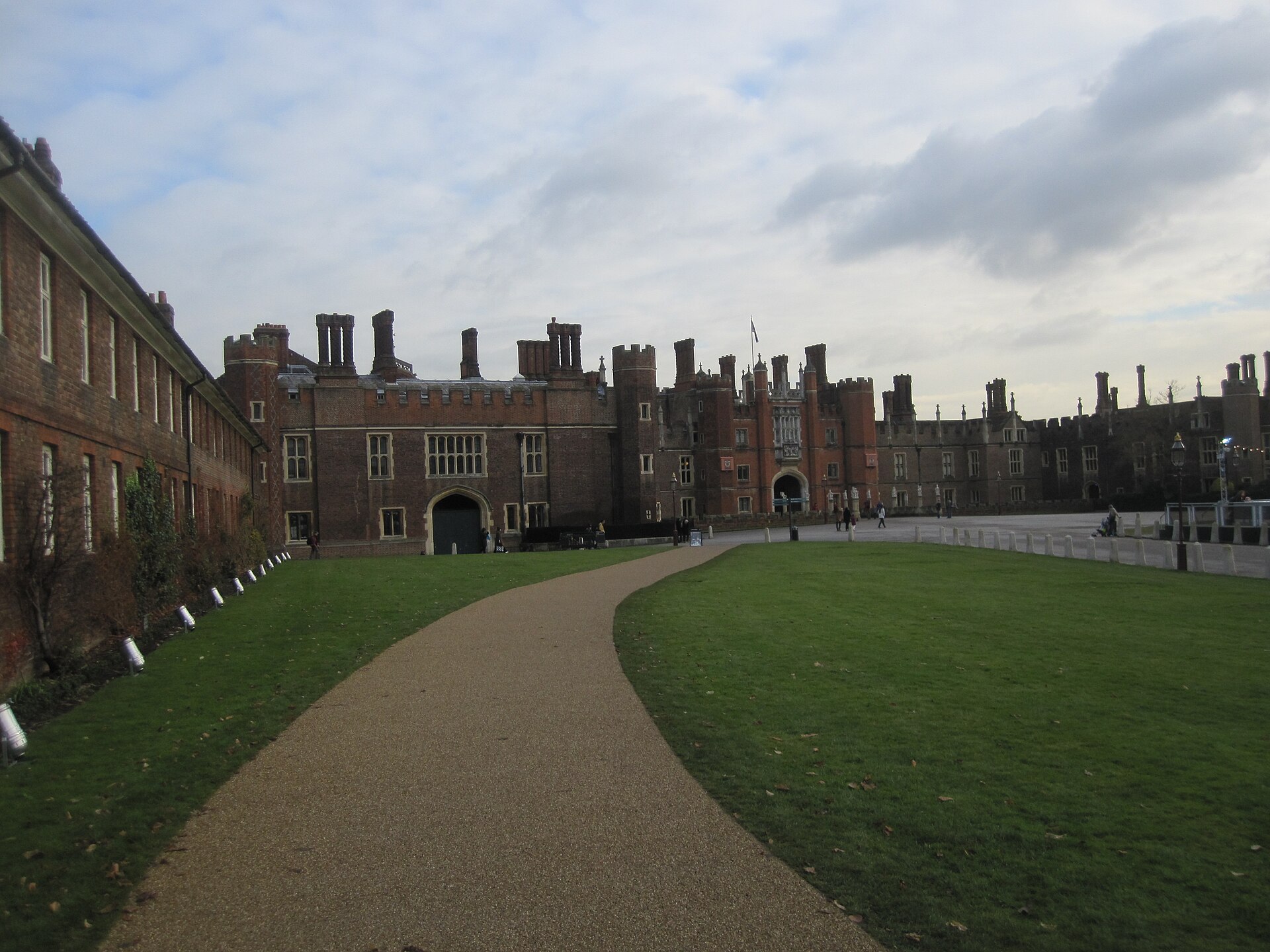
James answered the petition by calling bishops and a few leaders of the reforming party to meet him at Hampton Court Palace, west of London. Pollard describes it as a conference "which James I called together (quite informally) in January 1604 to ascertain how far the Puritan complaints could be met."1 The fullest account was written by William Barlow, Dean of Chester, and printed in 1604 as The Summe and Substance of the Conference. Its title page dates the meeting "January 14, 1603," because the English civil year then began on March 25, so that a January day fell in the year that modern reckoning numbers one higher.3

Rainolds asks for a new translation
The spokesman for the reforming side was Dr. John Rainolds (the name is also spelled Reynolds), President of Corpus Christi College, Oxford. According to Barlow, after raising questions about the Catechism and other matters, Rainolds turned to the Bible. Barlow's words, in the spelling of the 1604 print as Pollard reproduced it, are these:
After that, he moued his Maiestie, that there might bee a newe translation of the Bible, because, those which were allowed in the raignes of Henrie the eight, and Edward the sixt, were corrupt and not aunswerable to the truth of the Originall. For example, first, Galathians, 4, 25, the Greeke word ... is not well translated, as nowe it is, Bordreth, neither expressing the force of the worde, nor the Apostles sense, nor the situation of the place. Secondly, Psalme, 105, 28, they were not obedient; the Originall beeing, They were not disobedient. Thirdly, Psalme, 106, verse 30. Then stood up Phinees and prayed, the Hebrew hath Executed iudgement.3
(The Greek word in Galatians 4:25, printed in Greek letters in the original, is systoichei, "stands in the same row with" or "corresponds to.")
Barlow goes on: "To which motion, there was, at the present, no gainsaying, the obiections beeing triuiall and old, and alreadie, in print, often aunswered; onely, my Lord of London well added, that if euery mans humour should be followed, there would be no ende of translating."3 "My Lord of London" was Richard Bancroft, then Bishop of London, who would organize the work.
The three examples were real. All three renderings appeared in the Great Bible tradition, and, as Pollard pointed out, "The renderings to which he objected are found also in the Bishops' Bible."1 The finished King James Version changed all three. In the Oxford text of 1769, which is the King James text sold today, they read:
| Verse | Older English rendering Rainolds objected to (as Barlow reports it) | King James Version (Oxford 1769 text) |
|---|---|---|
| Galatians 4:25 | Agar "bordreth" on Jerusalem | "For this Agar is mount Sinai in Arabia, and answereth to Jerusalem which now is, and is in bondage with her children." |
| Psalm 105:28 | "they were not obedient" | "He sent darkness, and made it dark; and they rebelled not against his word." |
| Psalm 106:30 | "Then stood up Phinees and prayed" | "Then stood up Phinehas, and executed judgment: and so the plague was stayed." |
The KJV wording is quoted from the King James Version text at Bible Gateway.4 Rainolds won every one of his three points.
The King answers
Barlow then reports the King's reply, which became the charter of the whole project:
Whereupon his Highnesse wished that some especiall paines should be taken in that behalfe for one vniforme translation (professing that hee could neuer yet, see a Bible well translated in English; but the worst of all, his Maiestie thought the Geneua to bee) and this to bee done by the best learned in both the Vniuersities, after them to be reuiewed by the Bishops, and the chiefe learned of the Church; from them to bee presented to the Priuie-Councell; and lastly to bee ratified by his Royall authoritie; and so this whole Church to be bound vnto it, and none other.3
James added a condition. Barlow writes that "hee gaue this caueat (vpon a word cast out by my Lord of London) that no marginall notes should be added, hauing found in them which are annexed to the Geneua translation (which he sawe in a Bible giuen him by an English Lady) some notes very partiall, vntrue, seditious, and sauouring too much of daungerous, and trayterous conceites." His two examples were the Geneva note on Exodus 1:19, which in his reading "alloweth disobedience to Kings" (the Hebrew midwives who disobeyed Pharaoh), and the note on 2 Chronicles 15:16, which "taxeth Asa for deposing his mother, onely, and not killing her."3
Two cautions apply to this account. First, Barlow was a bishop's man writing against the Puritans. Pollard judged that "It is evident from every page in the narrative that the writer of it, William Barlow, had no love for the Puritans, and that his report is highly prejudiced."1 Second, the plan James sketched (review by the bishops, presentation to the Privy Council, ratification by royal authority, the whole Church "bound vnto it, and none other") describes an intention. Whether every step was carried out is a separate question, taken up below under authorization.
The translators' own preface of 1611 tells the story with a different turn. It says that "vpon the importunate petitions of the Puritanes, at his Maiesties comming to this Crowne, the Conference at Hampton Court hauing bene appointed for hearing their complaints: when by force of reason they were put from all other grounds, they had recourse at the last, to this shift, that they could not with good conscience subscribe to the Communion booke, since it maintained the Bible as it was there translated, which was as they said, a most corrupted translation." The preface calls this "a very poore and emptie shift," and then adds: "yet euen hereupon did his Maiestie beginne to bethinke himselfe of the good that might ensue by a new translation, and presently after gaue order for this Translation which is now presented vnto thee."5 Both accounts agree on the main fact: the proposal came from the Puritan side, and the King took it up.

Organizing the work in 1604
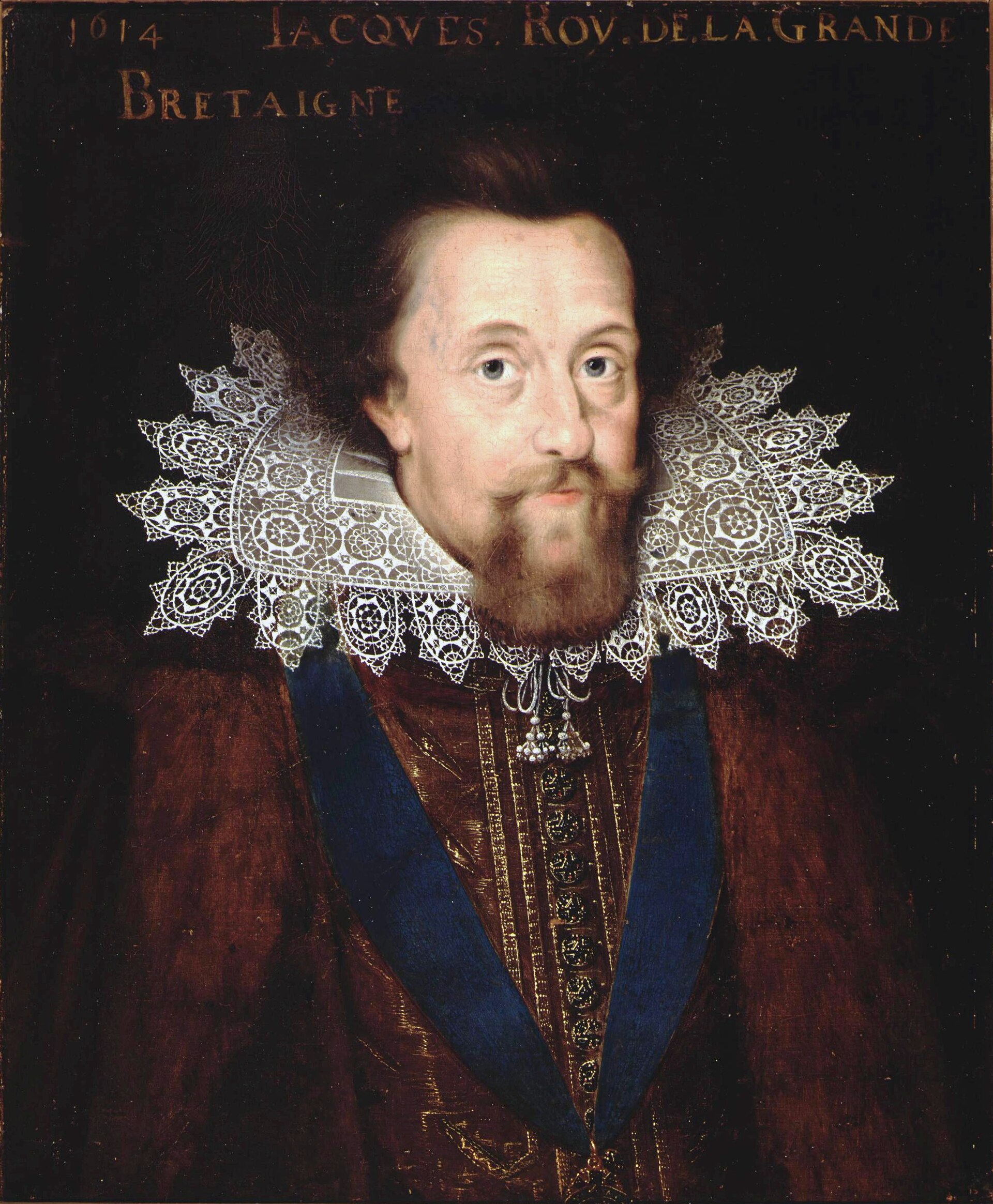
The King moved quickly. By June 30, 1604, Bancroft, with whom the King dealt while the see of Canterbury was vacant, could write to one of the universities (the letter refers to Mr. Lively, the Cambridge Hebrew professor) that "His Majesty being made acquainted with the choice of all them to be employed in the translating of the Bible ... doth greatly approve of the said choice," and that "his pleasure is, you should with all possible speed meet together in your University and begin the same."6
On July 22, 1604, James wrote to Bancroft from Westminster. The letter, which Bancroft copied out to the other bishops on July 31, begins: "Whereas we have appointed certain learned men, to the number of four and fifty, for the translating of the Bible, and that in this number, divers of them have either no ecclesiastical preferment at all, or else so very small, as the same is far unmeet for men of their deserts." The King asked every bishop to hold back the next vacant church living worth at least twenty pounds a year so that he could recommend "some such of the learned men, as we shall think fit to be preferred unto it." He also told the bishops to find scholars in their dioceses "having especiall skill in the Hebrew and Greek tongues" and to have them send their observations on "any difficulties or mistakings in the former English translation, which we have now commanded to be thoroughly viewed and amended," to "Mr. Lively, our Hebrew reader in Cambridge, or to Dr. Harding, our Hebrew reader in Oxford, or to Dr. Andrews, dean of Westminster."6
The King's own words describe the work as a revision: the "former English translation" was to be "thoroughly viewed and amended." Money was the problem. In a second circular of the same day, Bancroft explained that the King had been "very ready" to bear the charges, "but some of my lords, as things now go, did hold it inconvenient," so the bishops and cathedral chapters were asked to contribute. "I do not think that a thousand marks will finish the work," Bancroft wrote, and he asked to be told "what shall be expected from you."6 Pollard's judgment of the result: "The response to the first of these circulars seems to have been very slight; that to the second nil."1
The fifteen rules
The translators worked under written rules, usually credited to Bancroft. The most trusted text is the one Bishop Gilbert Burnet printed in his History of the Reformation from a manuscript of Edmund Borlase, which Pollard reprinted in 1911 under its heading "The Rules to be observed in the Translation of the Bible." Pollard adds that similar manuscript lists of the translators in the British Museum date the arrangements to 1604.7 The rules in full, as Burnet printed them:
- The ordinary Bible read in the Church, commonly called the Bishops Bible, to be followed, and as little altered as the Truth of the original will permit.
- The Names of the Prophets, and the Holy Writers, with the other Names of the Text, to be retained, as nigh as may be, accordingly as they were vulgarly used.
- The old Ecclesiastical Words to be kept, viz. the Word Church not to be translated Congregation &c.
- When a Word hath divers Significations, that to be kept which hath been most commonly used by the most of the Ancient Fathers, being agreeable to the Propriety of the Place and the Analogy of the Faith.
- The Division of the Chapters to be altered, either not at all, or as little as may be, if Necessity so require.
- No Marginal Notes at all to be affixed, but only for the Explanation of the Hebrew or Greek Words, which cannot without some circumlocution, so briefly and fitly be express'd in the Text.
- Such Quotations of Places to be marginally set down as shall serve for the fit Reference of one Scripture to another.
- Every particular Man of each Company, to take the same Chapter, or Chapters, and having translated or amended them severally by himself, where he thinketh good, all to meet together, confer what they have done, and agree for their Parts what shall stand.
- As any one Company hath dispatched any one Book in this Manner they shall send it to the rest, to be consider'd of seriously and judiciously, for His Majesty is very careful in this Point.
- If any Company, upon the Review of the Book so sent, doubt or differ upon any Place, to send them Word thereof; note the Place, and withal send the Reasons, to which if they consent not, the Difference to be compounded at the General Meeting, which is to be of the chief Persons of each Company, at the end of the Work.
- When any Place of special Obscurity is doubted of, Letters to be directed, by Authority, to send to any Learned Man in the Land, for his Judgement of such a Place.
- Letters to be sent from every Bishop to the rest of his Clergy, admonishing them of this Translation in hand; and to move and charge as many as being skilful in the Tongues; and having taken Pains in that kind, to send his particular Observations to the Company, either at Westminster, Cambridge or Oxford.
- The Directors in each Company, to be the Deans of Westminster and Chester for that Place; and the King's Professors in the Hebrew or Greek in either University.
- These translations to be used when they agree better with the Text than the Bishops Bible: Tindoll's, Matthews, Coverdale's, Whitchurch's, Geneva.
- Besides the said Directors before mentioned, three or four of the most Ancient and Grave Divines, in either of the Universities, not employed in Translating, to be assigned by the Vice-Chancellor, upon Conference with the rest of the Heads, to be Overseers of the Translations as well Hebrew as Greek, for the better Observation of the 4th Rule above specified.8
(In rule 14, "Whitchurch's" means the Great Bible, which Edward Whitchurch printed with Richard Grafton.)
What the rules required
Read as a whole, the rules describe a revision with a conservative aim. Rule 1 made the Bishops' Bible the starting text and allowed change only where "the Truth of the original" required it. Rule 14 named the five earlier English versions to be used "when they agree better with the Text": Tyndale's, Matthew's, Coverdale's, the Great Bible and the Geneva. The word "Text" here means the original Hebrew and Greek. The earlier English versions were tools for matching the original, and the original was the standard by which every rendering was judged.
Rules 2, 3 and 5 kept familiar things familiar: the usual forms of names, the traditional church vocabulary and the chapter divisions. Rule 3 named one disputed word. Tyndale had translated the Greek ekklesia as "congregation," and the Bishops' Bible tradition used "church." The rule settled the matter for "church," and the King James Version reads, for example, "upon this rock I will build my church" (Matthew 16:18, KJV).4
Rule 6 carried out the King's wish at Hampton Court: no explanatory or doctrinal notes in the margin, only notes giving the literal sense of a Hebrew or Greek word or another possible rendering. Rule 7 allowed cross references. Rules 8 to 12 set out a system of checking in which each man translated alone, his company compared the results, each finished book went to the other companies for review, disputed places went to a general meeting at the end, and learned men outside the companies could be consulted. Rules 13 and 15 named the directors and added overseers to make sure rule 4 (follow the sense most used by the ancient Fathers) was kept.
The six companies and the translators
Burnet's list, headed "An Order set down for the Translating of the Bible," divides the Bible among six companies. Pollard reprinted it with short biographical notes and judged it "the most trustworthy" of the surviving lists.7 The infographic below sets out the companies, the books each received and the number of names in Burnet's list, and the flow of the work from the companies to the printer.
Why the count of translators varies
Books and sermons give the number of translators as 47, 50 or 54, and all three figures have a source. The King's letter of July 22, 1604, speaks of "learned men, to the number of four and fifty."6 Burnet's list contains 47 names. Pollard explained the difference in a footnote: "Only about fifty names in all have come down to us, and only forty-seven in any one list. It may have been intended at first that there should be nine revisers on each board."1 Nine men on each of six boards would make 54. The lists also differ because men died or were replaced. Pollard's notes record that Edward Lively, the Cambridge Hebrew professor, died in May 1605, "a great blow to the work"; that Richard Edes, Dean of Worcester, named for the second Oxford company, died on November 19, 1604; that John Rainolds himself died in 1607; and that other lists put "J. Aglionby, Principal of St. Edmund Hall" in place of the Dean of Worcester and "L. Hutten, Canon of Christ Church" in place of an otherwise unknown "Dr. Ravens."7 The 1618 report to the Synod of Dort, written by English delegates who included one of the translators, said that "seven or eight" men were named to each section.9 The honest answer is that about fifty men are known by name and the exact roster changed during the work.
Who the translators were
Pollard's notes, drawn from Edward Cardwell and the Dictionary of National Biography, show who these men were. Most were university fellows, heads of colleges, cathedral clergy and London parish ministers. Among them:
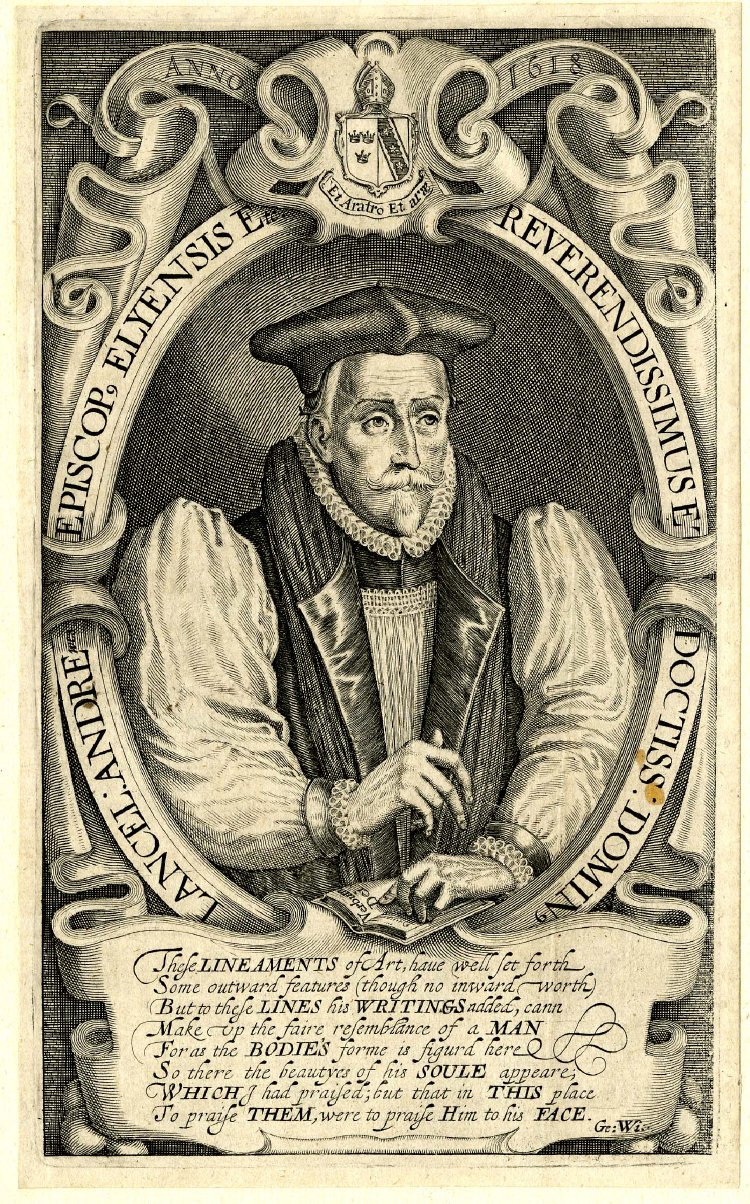
- Lancelot Andrewes, Dean of Westminster, first named in the first Westminster company (Genesis to 2 Kings), "made Bishop of Chichester in 1605."
- John Overall, Dean of St. Paul's, in the same company.
- Hadrian Saravia, "born at Hesdin in Artois in 1531," formerly Professor of Divinity at Leiden.
- William Bedwell, an "Arabic Scholar," rector of St. Ethelburga's, Bishopsgate.
- Laurence Chaderton, Master of Emmanuel College, Cambridge, who "Took part as a Puritan in the Hampton Court Conference."
- John Rainolds, President of Corpus Christi College, Oxford, who had proposed the translation, in the first Oxford company (Isaiah to Malachi).
- Miles Smith, of Brasenose, "a noted Orientalist, one of the two final revisers of the version of 1611, and the writer of the preface; made Bishop of Gloucester, 1612."
- George Abbot, Dean of Winchester, in the second Oxford company (the Gospels, Acts and Revelation), who became Archbishop of Canterbury in 1611.
- Sir Henry Savile, Warden of Merton and Provost of Eton, who edited the works of Chrysostom.
- Andrew Downes, Regius Professor of Greek at Cambridge, and John Bois, a Cambridge Greek scholar, both in the Apocrypha company.
- William Barlow, Dean of Chester, the author of the Hampton Court account, first named in the second Westminster company (the Epistles).7
Pollard concluded that "The choice of the revisers seems to have been determined solely by their fitness, and both parties in the Church were represented by some of their best men."7 Men who wanted further reform, such as Rainolds and Chaderton, sat beside men of the episcopal party such as Andrewes, Overall and Barlow. The Puritans and their opponents in the Church of England are described in Module 80, Anglicans and Episcopalians.

How the work was done, 1604 to 1610
Almost no working papers of the companies survive, so the method has to be pieced together from a few documents. Pollard summarized the usual reconstruction: the sessions of the six companies "are usually supposed to have begun (although doubtless there were preliminary meetings) in 1607, the years 1605, 1606 being thus allotted to private research, 1607-9 to the work of the six boards, part of 1610 to that of the twelve revisers at Stationers' Hall, and the rest of 1610 and part of 1611 to printing."10 That timetable is a scholar's estimate, not a dated record, and the preface gives only a total: the work "hath cost the workemen, as light as it seemeth, the paines of twise seuen times seuentie two dayes and more." Two times seven times seventy-two is 1,008 days, about two years and nine months of working time.5
Anthony Walker's account of John Bois
The only near-contemporary account by someone who knew a translator is the life of John Bois written by Anthony Walker of St. John's College, Cambridge, and printed in Francis Peck's Desiderata Curiosa. Pollard called it "the only nearly contemporary account of the experiences of one of the revisers which has come down to us." Walker wrote that Bois was chosen for the Cambridge company and that "part of the Apocrypha was alotted to him (for he hath shewed me the very copy he translated by), but to my grief I know not which part." During the work Bois lodged at St. John's College all week and went home on Saturday night to his parish at Boxworth.11
Walker then described the last stage:
Four years were spent in this first service; at the end whereof the whole work being finished, & three copies of the whole Bible sent from Cambridge, Oxford & Westminster, to London; a new choice was to be made of six in all, two out of every company, to review the whole work; & extract one [copy] out of all three, to be committed to the presse. For the dispatch of which business Mr. Downes & Mr. Bois were sent for up to London. Where meeting (though Mr. Downes would not go till he was either fetcht or threatned with a pursivant) their four fellow labourers, they went dayly to Stationers Hall, & in three quarters of a year, finished their task.11
Walker added that the reviewers were paid thirty shillings each a week by the Company of Stationers, "tho' they had nothing before but the self-rewarding, ingenious industry," and that Bois alone "took notes of their proceedings: which notes he kept till his dying day."11 Pollard corrected one detail: since there were six companies, two men from each would make twelve reviewers, and the English report to the Synod of Dort confirms twelve.10
The report to the Synod of Dort, 1618
In November 1618 the British theologians at the Synod of Dort in the Netherlands gave the synod a written account, in Latin, of how "the very accurate English version" had been made. Pollard printed the Latin with an English translation. It says the Bible "was distributed into six sections, and to the translation of each section there were nominated seven or eight men of distinction, skilled in languages," that "Two sections were assigned to certain London theologians; the four remaining sections were equally divided among the theologians of the two Universities," and that "After each section had finished its task twelve delegates, chosen from them all, met together and reviewed and revised the whole work." Finally, "the very Reverend the Bishop of Winchester Bilson, together with Dr. Smith, now Bishop of Gloucester, a distinguished man, who had been deeply occupied in the whole work from the beginning, after all things had been maturely weighed and examined, put the finishing touch to this version."9
The same report summarizes the rules in eight points, and two of them answer questions readers still ask. The fifth reads: "in the translation of Tobit and Judith, when any great discrepancy is found between the Greek text and the old vulgate Latin they followed the Greek text by preference." The sixth reads: "words which it was anywhere necessary to insert into the text to complete the meaning were to be distinguished by another type, small roman."9 The first is direct evidence that even in the Apocrypha the translators preferred the Greek to the Latin. The second is the origin of the italic words in later King James Bibles.
Two other notes on the final stage come from later sources. Pollard records that "another Bishop, Bancroft of London, is said to have insisted on fourteen alterations," a report that rests on hearsay and cannot now be checked. And John Selden, in his Table-Talk, described what seems to be the meeting of the review board: "That part of the Bible was given to him who was most excellent in such a tongue (as the Apocrypha to Andrew Downs) and then they met together, and one read the translation, the rest holding in their hands some Bible, either of the learned tongues, or French, Spanish, Italian, etc. If they found any fault they spoke; if not, he read on."10
The papers that survive
For three centuries it was believed that nothing of the working papers survived. That has changed twice. First, John Bois's notes on the final review were found to survive in a copy made by the antiquarian William Fulman, whose papers went to Corpus Christi College, Oxford, after his death in 1688. Ward Allen published them in 1969 as Translating for King James (Vanderbilt University Press), with a photographic copy beside each page; the notes cover the review of Romans to Revelation.12 Walker's account says Bois alone took notes of the review's proceedings, so these are the only such notes known.
Second, in 2015 Jeffrey Alan Miller, then an assistant professor of English at Montclair State University, reported that a 70-page notebook in the archives of Sidney Sussex College, Cambridge, kept by Samuel Ward (later Master of the college, and a member of the Apocrypha company), contains a draft of 1 Esdras and part of the Wisdom of Solomon, written between 1604 and 1608. The notebook had been catalogued in 1985 only as a "verse by verse Biblical study." Miller told the Church Times that "No other hand besides Ward's appears in the draft" and that it shows Ward "making mistakes and changing his mind." Some of Ward's choices appear unchanged in the printed text of 1611, and others were rejected or survive only as marginal notes.13 The draft confirms what rule 8 required: each man first worked alone on his share, and the company then compared and settled the text.
What the translators worked from
The preface states the base texts plainly: "If you aske what they had before them, truely it was the Hebrew text of the Olde Testament, the Greeke of the New. These are the two golden pipes, or rather conduits, where through the oliue branches emptie themselues into the golde." It then gives the reason: "If trueth be to be tried by these tongues, then whence should a Translation be made, but out of them? These tongues therefore, the Scriptures wee say in those tongues, wee set before vs to translate, being the tongues wherein God was pleased to speake to his Church by his Prophets and Apostles."5
The translators also say they used every help they could find: "Neither did wee thinke much to consult the Translators or Commentators, Chaldee, Hebrewe, Syrian, Greeke, or Latine, no nor the Spanish, French, Italian, or Dutch; neither did we disdaine to reuise that which we had done, and to bring backe to the anuill that which we had hammered."5 Pollard identified several of those helps from the text itself: the Latin Old Testament of Arias Montanus in the Antwerp Polyglot, the Latin Bible of Tremellius and his son-in-law Franciscus Junius, the French Geneva version of 1587 to 1588, Diodati's Italian Bible of 1607 and Cipriano de Valera's Spanish Bible of 1602. He also judged that the translators "took from" the Catholic Rheims New Testament of 1582 "much that was good, though with no other acknowledgement than a gibe."10
The Greek New Testament before them was the printed text descended from Erasmus through the editions of Robert Estienne (Stephanus) and Theodore Beza, the family later called the Textus Receptus. That history, and F. H. A. Scrivener's 1881 reconstruction of the Greek the translators followed, belong to lesson 05. The Hebrew before them was the printed Masoretic text described in lesson 01. The question of whether that Greek text was the best one is the subject of lesson 08.
"The Translators to the Reader": the preface of 1611
The 1611 Bible opens with a long preface headed "The Translators to the Reader," which Pollard and most later writers attribute to Miles Smith, one of the two final revisers.7 Most modern printings of the King James Version leave it out, which is a loss, because it is the translators' own statement of what they were doing and why. The quotations below follow the spelling of the 1611 text as Pollard reprinted it, with the old long s printed as a modern s.
It begins with a complaint that anyone who improves an old thing is suspected: "Zeale to promote the common good, whether it be by deuising any thing our selues, or reuising that which hath bene laboured by others, deserueth certainly much respect and esteeme, but yet findeth but cold intertainment in the world."5 It then praises Scripture and argues that it must be translated if ordinary people are to read it. Its best known lines are these:
Translation it is that openeth the window, to let in the light; that breaketh the shell, that we may eat the kernel; that putteth aside the curtaine, that we may looke into the most Holy place; that remooueth the couer of the well, that wee may come by the water.5
"To make a good one better"
The preface states the aim of the work in one sentence that answers anyone who thinks the King James Version was meant as a fresh start:
Truly (good Christian Reader) wee neuer thought from the beginning, that we should neede to make a new Translation, nor yet to make of a bad one a good one, ... but to make a good one better, or out of many good ones, one principall good one, not iustly to be excepted against; that hath bene our indeauour, that our marke.5
The translators also defended the earlier English Bibles against Catholic critics. "Now to the later we answere; that wee doe not deny, nay wee affirme and auow, that the very meanest translation of the Bible in English, set foorth by men of our profession (for wee haue seene none of theirs of the whole Bible as yet) containeth the word of God, nay, is the word of God." Their comparison was the King's own speeches: "As the Kings Speech which hee vttered in Parliament, being translated into French, Dutch, Italian and Latine, is still the Kings Speech, though it be not interpreted by euery Translator with the like grace, nor peraduenture so fitly for phrase, nor so expresly for sence, euery where."5 The phrase "for wee haue seene none of theirs of the whole Bible as yet" refers to the Catholic English Bible: the Rheims New Testament had appeared in 1582 and the Douai Old Testament in 1609 to 1610, as told in lesson 06.
The margin and the variety of senses
The preface explains why the margin gives other possible renderings. "Some peraduenture would haue no varietie of sences to be set in the margine, lest the authoritie of the Scriptures for deciding of controuersies by that shew of vncertaintie, should somewhat be shaken. But we hold their iudgmet not to be so sound in this point." The translators held that what is necessary for salvation is plain in Scripture, but that many words occur only once, and that the Hebrew names of "certaine birds, beastes and precious stones" are uncertain. "Now in such a case, doth not a margine do well to admonish the Reader to seeke further, and not to conclude or dogmatize vpon this or that peremptorily?" They quoted Augustine that "varietie of Translations is profitable for the finding out of the sense of the Scriptures," and concluded that "diuersitie of signification and sense in the margine, where the text is not so cleare, must needes doe good, yea, is necessary, as we are perswaded."5
No "vniformitie of phrasing"
The preface admits openly that the translators did not always render one Hebrew or Greek word by the same English word:
An other thing we thinke good to admonish thee of (gentle Reader) that wee haue not tyed our selues to an vniformitie of phrasing, or to an identitie of words, as some peraduenture would wish that we had done, because they obserue, that some learned men some where, haue beene as exact as they could that way.5
They gave examples: "if we translate the Hebrew or Greeke word once by Purpose, neuer to call it Intent; if one where Iourneying, neuer Traueiling; if one where Thinke, neuer Suppose; if one where Paine, neuer Ache; if one where Ioy, neuer Gladnesse, &c. Thus to minse the matter, wee thought to sauour more of curiositie then wisedome." They asked, "For is the kingdome of God become words or syllables? why should wee be in bondage to them if we may be free, vse one precisely when wee may vse another no lesse fit, as commodiously?"5 This is a point of method that later debates about "word for word" translation (lessons 10 and 12) should keep in mind: the King James translators were close translators, but they did not hold to one English word for one Greek or Hebrew word.
Between "the Puritanes" and "the Papists"
The preface ends its account of method by placing the translation between two kinds of vocabulary it rejected:
Lastly, wee haue on the one side auoided the scrupulositie of the Puritanes, who leaue the olde Ecclesiasticall words, and betake them to other, as when they put washing for Baptisme, and Congregation in stead of Church: as also on the other side we haue shunned the obscuritie of the Papists, in their Azimes, Tunike, Rational, Holocausts, Praepuce, Pasche, and a number of such like, whereof their late Translation is full, and that of purpose to darken the sence ... But we desire that the Scripture may speake like it selfe, as in the language of Canaan, that it may bee vnderstood euen of the very vulgar.5
"The very vulgar" means the common people. The words named as "Papist" (Azimes for unleavened bread, Pasche for Passover, Holocausts for burnt offerings, Praepuce for foreskin) come from the Rheims and Douai translation, which kept many Latin terms. The preface is a polemical document, written by Church of England clergy who regarded both the Puritans and the Catholics as opponents, and it should be read as their own statement of their case.
The dedication to King James
Before the preface stands the dedication, "To the most high and mightie Prince, Iames by the grace of God King of Great Britaine, France and Ireland, Defender of the Faith, &c.," from "The Translators of the Bible." It is the part of the front matter that most modern King James Bibles still print. It praises the King's arrival in England after the death of Elizabeth, "that bright Occidentall Starre," describing "the appearance of your Maiestie, as of the Sunne in his strength."14
The dedication credits James with the project: "For when your Highnesse had once out of deepe iudgment apprehended, how conuenient it was, That out of the Originall sacred tongues, together with comparing of the labours, both in our owne and other forreigne Languages, of many worthy men who went before vs, there should be one more exact Translation of the holy Scriptures into the English tongue; your Maiestie did neuer desist, to vrge and to excite those to whom it was commended, that the worke might be hastened." The translators offered the work to James "not onely as to our King and Soueraigne, but as to the principall moouer and Author of the Worke."14 "Author" here means the one who caused it to be made. The same sentence names the "Originall sacred tongues" as the source and the earlier translations as aids to comparison.
The dedication also expected attack from two sides: "if on the one side we shall be traduced by Popish persons at home or abroad, who therefore will maligne vs, because we are poore Instruments to make Gods holy Trueth to be yet more and more knowen vnto the people, whom they desire still to keepe in ignorance and darknesse: or if on the other side, we shall be maligned by selfe-conceited brethren, who runne their owne wayes, and giue liking vnto nothing but what is framed by themselues, and hammered on their Anuile; we may rest secure."14
The book of 1611
The first edition was a large folio printed in London by Robert Barker, Printer to the King. Pollard described it as "a handsome, well-printed book, set up apparently with newly cast type yielding a clean and sharp impression, and on excellent paper." Because it was a revision of an existing Bible, it "was not entered on the Stationers' Registers, nor have we any information as to the month in which it was issued."15 No document gives a day of publication.
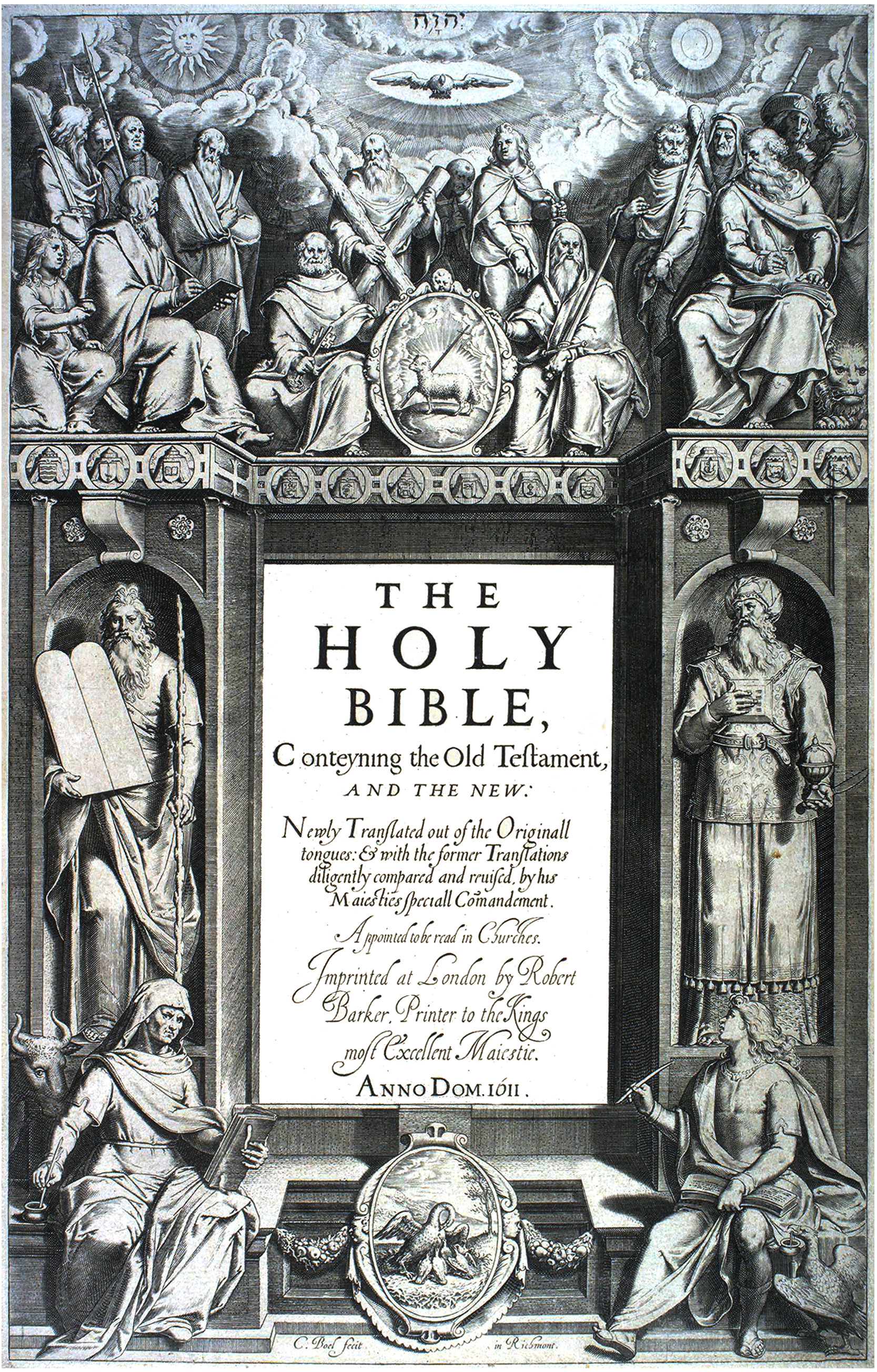

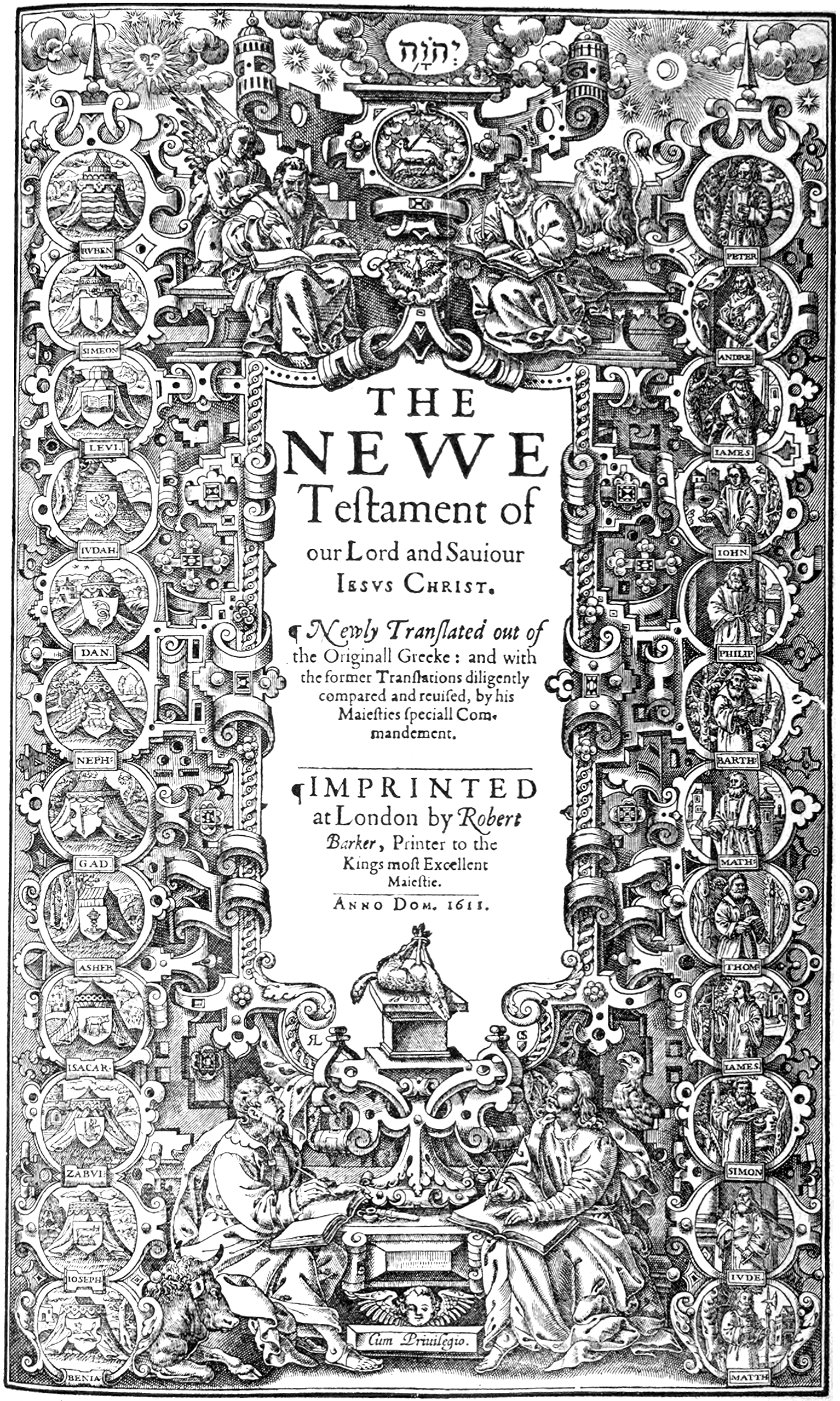
The title page states the method in its own words: "Newly Translated out of the Originall tongues: & with the former Translations diligently compared and reuised." Pollard describes the engraving: "On the two sides of the title stand Moses and Aaron in niches. At the foot are seated SS. Luke and John, while between them is another oval frame containing a picture of a pelican feeding her young."15
After the title come the dedication, the preface, a calendar, "An Almanacke for xxxix. yeeres" (1603 to 1641), directions "To finde Easter for euer," tables of the psalms and lessons for morning and evening prayer, and a list of the books. Bound in at the binder's choice were usually eighteen leaves of genealogies and a map of Canaan. John Speed had obtained a royal privilege in October 1610 to have his genealogies bound into every edition of the Scriptures for ten years, which, in Pollard's words, "needlessly increased" the cost of each copy "by from sixpence to two shillings."15 The New Testament has its own title page, cut in wood and reused from editions of the Bishops' Bible.

Black letter and the "italic" words
The text of 1611 was printed in black letter, the heavy Gothic type of English church Bibles. Pollard explains: "The text of the Bible is printed in black-letter with the inserted words (now printed in italics) in small roman, and roman type is also used for the summaries at the head of each chapter, for the subject headlines at the top of each page, and for the references to parallel passages in the margin; the alternative renderings in the margins are in italics."15 The words that modern King James Bibles print in italics are the ones the translators supplied to make English sense, which in 1611 stood out as a lighter roman type against the black letter. The Dort report gives the rule: inserted words "were to be distinguished by another type, small roman."9 Later editors, as shown below, added many more.
The marginal notes
Rule 6 banned doctrinal notes, but the 1611 margins are full. F. H. A. Scrivener, who studied the text for the Cambridge Paragraph Bible of 1873 and published The Authorized Edition of the English Bible (1611) in 1884, counted them. In the Old Testament, "the marginal notes in our standard Bibles of 1611 amount to 6637, whereof 4111 express the more literal meaning of the original Hebrew or Chaldee ... 2156 give alternative renderings." In the New Testament they "amount to 767, so that together with the 6637 in the Old Testament, and the 1018 in the Apocrypha, the number in the whole Bible is no less than 8422." Of the New Testament notes, "37 relate to various readings," that is, to differences among Greek manuscripts or editions; 112 give a more literal rendering; 582 are alternative translations; and 35 are short explanations.16
The 37 notes on various readings matter for the textual debate in lesson 08. They show that the translators knew the printed Greek editions disagreed in places and chose to tell the reader so.
The Apocrypha in 1611
The first edition contained the Apocrypha, printed between the Old and New Testaments, as the Bishops' and Geneva Bibles had done. It had its own company, the second Cambridge company, whose assignment in Burnet's list reads "The Prayer of Manasses and the rest of the Apocrypha."7 The Church of England read lessons from these books in its calendar, which the Millenary Petition had objected to. Article VI of the Thirty-Nine Articles, quoted in lesson 03, held that the church reads them "for example of life and instruction of manners" but does not use them to establish doctrine.17 Many later printings of the King James Version leave the Apocrypha out. Its absence from a modern copy is a publisher's choice, not a feature of the 1611 book.
What the 1611 text looks like
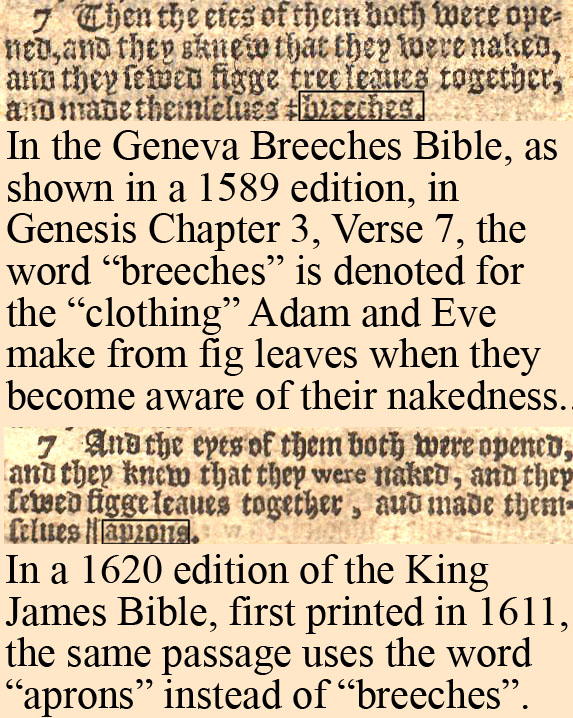
A reader who opens a facsimile of 1611 finds the same words as a modern King James Bible in most verses, but in a different dress: older spelling, u and v used by position in the word rather than by sound, i for j, the long s, different punctuation and capitals, and marginal notes beside the text. The comparison below sets the opening of Genesis and Genesis 3:7 as printed in 1611 (from the Wikisource transcription of a 1611 facsimile, with the long s printed as s and the margin notes left out) beside the same verses in the Oxford text of 1769 as printed today.184
| Verse | First edition, 1611 | Oxford 1769 text, as printed today |
|---|---|---|
| Genesis 1:1 | In the beginning God created the Heauen, and the Earth. | In the beginning God created the heaven and the earth. |
| Genesis 1:2 | And the earth was without forme, and voyd; and darkenesse was vpon the face of the deepe: and the Spirit of God mooued vpon the face of the waters. | And the earth was without form, and void; and darkness was upon the face of the deep. And the Spirit of God moved upon the face of the waters. |
| Genesis 1:3 | And God said, Let there be light: and there was light. | And God said, Let there be light: and there was light. |
| Genesis 3:7 | And the eyes of them both were opened, & they knew that they were naked, and they sewed figge leaues together, and made themselues aprons. (margin: "Or, things to gird about.") | And the eyes of them both were opened, and they knew that they were naked; and they sewed fig leaves together, and made themselves aprons. |
The words are the same; the spelling, capitals and punctuation are not. In Genesis 1:2 the 1769 text even changes a colon to a full stop and begins a new sentence with "And." Changes of this kind, made quietly by printers and editors over a century and a half, are why the text in modern hands is properly called the 1769 text.

The "He" and "She" Bibles
Two folio editions are dated 1611, and collectors and scholars long argued over which came first. They are distinguished by a single word in Ruth 3:15. Pollard explains: "the first edition of the new translation is frequently called the He-Bible and the second the She-Bible, from the fact that in Ruth iii. 15 the former reads 'He went into the city', and the latter 'She'."19 The modern King James text reads "she": "And when she held it, he measured six measures of barley, and laid it on her: and she went into the city" (Ruth 3:15, KJV).4 Later King James editions follow the second edition's "she."
Pollard showed that the "She" Bible was a second edition, set up again from the first, and not a second issue printed at the same time. Its title page is usually dated 1613, though a few copies carry 1611; its New Testament title page is dated 1611 in all copies. His evidence includes a famous blunder in the first edition: in Exodus 14:10 three lines are printed twice, and "In the second edition we can see the printer, who could not ignore this particular error, bringing a couple of words on to another line, and leaving extra space at the head of chapter xv, in order to fill the gap created by omitting the three repeated lines."19 Scrivener, who had argued the opposite order, gave a handy test for any copy: one group "have 'Judas' instead of 'Jesus' in Matt. xxvi. 36," while the other repeats the three lines of Exodus 14:10.20 Pollard's order, in which the "Judas" misprint belongs to the second edition, was by his account of 1911 "now generally recognized." The correct text of Matthew 26:36 reads "Then cometh Jesus with them unto a place called Gethsemane" (KJV).4
Pollard disliked the nicknames: "All such nicknames for editions of the Bible are objectionable, and this, which suggests that the two editions form a pair, is mischievous." He also corrected an older belief that 20,000 copies had been printed at once to supply every parish: "the demand for 20,000 copies and the double issue are equally imaginary." He estimated, as a guess from the spacing of the later folio editions (1613, 1617, 1634, 1640), that the editions "may have been of as many as 5,000 copies apiece."19 No printing figure for 1611 survives.
Was it ever "authorized"?
In Britain the King James Version is usually called the Authorized Version. The name is old and convenient, but the record behind it is thin. Pollard stated the position in 1911: "As is well known no authority has ever been discovered for the words 'Appointed to be read in Churches' which appear on the title-page of all editions, nor for the phrase, the 'Authorized Version', by which the Bible is usually known."21
King James had proposed at Hampton Court that the new translation be reviewed by the bishops, presented to the Privy Council and "ratified by his Royall authoritie." Whether that was done cannot be shown. When the question came up during the Revised Version debate of 1881, the Lord Chancellor, Lord Selborne, wrote to The Times that if the version was appointed to be read in churches at its first publication, "nothing is more probable than that this may have been done by Order in Council," and that the record would now be lost "because all the Council books and registers from the year 1600 to 1613 inclusive were destroyed by a fire at Whitehall, on the 12th of January, 1618 (O.S.)."21
Pollard disagreed. He pointed out that the Bishops' Bible editions of 1585 to 1602 had carried the stronger words "Authorised and Appointed to be read in Churches" without, so far as anyone knew, any Order in Council behind them, and that the 1611 wording was weaker: "There is indeed negative evidence that there was no such order, for the word 'Appointed', is considerably weaker than the 'Authorised and Appointed' which it replaced. By itself 'Appointed' means little more than 'assigned' or 'provided'." In his reading, the words "literally expressed the facts that this Bible was printed by the King's printer with the approval of the King and the Bishops for use in churches, and that no competing edition 'of the largest volume' was allowed to be published."21
The church records show the new Bible coming in slowly. Pollard quotes a study of bishops' visitation articles between 1612 and 1641: some bishops asked parishes for "a Bible of the latest edition" or "of the last translation," while others asked only for "a Bible of the largest volume," the older form. Archbishop George Abbot, himself one of the translators, asked in 1616 only for "the whole Bible of the largest volume," but in a visitation of 1619 referred to "the Bible of the New Translation, lately set forth by His Majesty's authority."21 No Act of Parliament ever authorized it, and none is claimed in any document of the time. The version came to be used in every parish because, as old church Bibles wore out, the King's Printer offered no other large folio Bible to replace them.
How it displaced the Geneva Bible
The new version did not drive out the Geneva Bible at once. Pollard counted Geneva editions printed in England after 1611: "a folio and quarto had been printed in 1611, we find another folio published in 1612, three quartos in 1614, two more quartos in 1615, and a folio in 1616." After that, "although for another fifteen or twenty years eminent ecclesiastics, ordained before 1611, continued to take into the pulpit their old Geneva pocket editions, ... the king's printers were encouraged to print no more Geneva Bibles, and the production of them was thus driven underground."22
The underground trade left a trace in false title pages. Pollard noted at least six different editions of the Geneva Bible that claim on their title pages to have been printed in London by the deputies of Christopher Barker in 1599, one of which is also found with the true imprint of John Fredericksz Stam of Amsterdam, 1633. He concluded that the end of English printing of the Geneva Bible after 1616, together with these disguised Dutch editions, "is fair proof that the Geneva Bible was now again subjected to the silent boycott." Meanwhile the King James Bible was printed in every size. Pollard counted fourteen or more quarto and octavo editions between 1612 and 1614 alone.22 The Geneva Bible's last English printing and the King James Version's victory came by control of the press and by supply, not by any command that the old version be abandoned.
Printers, misprints and the "Wicked Bible"
The right to print the Bible in England belonged to the holder of the royal patent, and that was Robert Barker. A statement printed in 1651, quoted by Pollard, said that Barker "paid for the amended or corrected Translation of the Bible £3,500: by reason whereof the translated copy did of right belong to him and his assignes." Pollard noted that "we have really no sound basis even for guessing how the £3,500 was paid."10 Barker's business was badly run. Pollard records that about 1616 to 1618 he owed more than £200 to booksellers "as compensation for having supplied imperfect books," and that he ended his days in a debtor's prison.19 Pollard's rule of thumb for the period was harsh: "for every error corrected in a seventeenth-century reprint, at least two are introduced."19
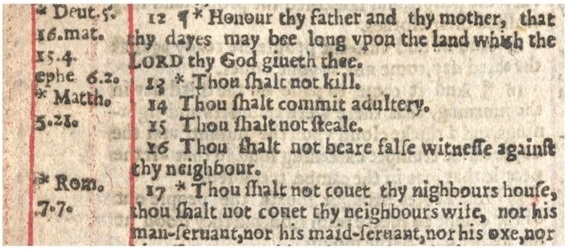
The most famous misprint came from the King's printers in 1631. Pollard writes that the firm "was fined £300 for omitting the word not in the seventh commandment," so that Exodus 20:14 read "Thou shalt commit adultery" instead of "Thou shalt not commit adultery" (Exodus 20:14, KJV).224 Scrivener quotes William Kilburne, writing in 1659, who remembered that "for the omission in one impression of the Negative word [not] in the seventh Commandment, the Printer was fined £2000 or £3000 in the late King's time, as I have heard." Scrivener's own note gives the publishers as Robert Barker and Martin Lucas, dates the printing 1632, and states that "the real fine was £300, to be expended on a fount of fair Greek type," imposed in the Court of High Commission by William Laud (then Bishop of London; Archbishop of Canterbury from 1633).23 Kilburne's larger figure is hearsay; the £300 figure is the one both Pollard and Scrivener accepted.

Other nicknamed editions followed. Pollard mentions the Oxford folio printed by John Baskett in 1716 to 1717, "with its 'basketfull' of errors," called "the so-called Vinegar Bible, from the misprint Vinegar for Vineyard in the headline to Luke xx."22 Scrivener also quotes Kilburne's report that during the Civil War, with the King's printers absent from London, "many erroneous English Bibles were printed in and imported from Holland," which the Westminster Assembly of Divines reported to Parliament in 1643 as "corrupt and dangerous to Religion."23
Revisions from 1612 to 1769
It is sometimes said that the King James Version has never been revised. The printing history shows otherwise. No copy of 1611 was ever sealed as an official standard. Pollard noted that "no copy of the version of 1611 had been 'sealed' as a standard, as was done in the case of the Prayer-book."22 Each printer set type from an earlier printing, and editors corrected what they judged to be errors.
The Cambridge editions of 1629 and 1638
In 1629 Cambridge University Press used its right to print a Bible for the first time. Pollard describes that small folio as "exceptionally well printed" and "bearing marks of careful revision, carried still further in an edition of 1638." Quoting Scrivener, he says the 1638 edition improved the text "by inserting words or clauses, especially in the Old Testament, overlooked by the editors of 1611; by amending manifest errors; by rendering the italic notation at once more self-consistent, and more agreeable to the design of the original translators." According to a contemporary note, the revisers were Dr. Goad, Dr. Joseph Mede, "Dean Boys" and Dr. Samuel Ward of Sidney Sussex, "of whom the last two were survivors of the original Cambridge board."22
Thomas Paris, 1762, and Benjamin Blayney, 1769
Scrivener called these "the last two considerable efforts to improve and correct our ordinary editions of Holy Scripture, made in 1762 by Dr Paris, Fellow of Trinity College, Cambridge ... and by Dr Blayney, whose labours were published in 1769, both anonymously." Paris's edition "had no real circulation, partly because it was so soon superseded by Blayney's, chiefly by reason of a large portion of the impression having been destroyed by fire in Dod's the publisher's warehouse."24
Benjamin Blayney of Hertford College, Oxford, later Regius Professor of Hebrew, reported on his work to the Vice-Chancellor and Delegates of the Clarendon Press in a letter dated October 25, 1769, which the Gentleman's Magazine printed. He wrote that "the folio edition of 1611, that of 1701, published under the direction of Bishop Lloyd, and two Cambridge editions of a late date ... have been carefully collated, whereby many errors that were found in former editions have been corrected, and the text reformed to such a standard of purity, as, it is presumed, is not to be met with in any other edition hitherto extant." He added: "The punctuation has been carefully attended to, not only with a view to preserve the true sense, but also to uniformity, as far as was possible. Frequent recourse has been had to the Hebrew and Greek Originals; and as on other occasions, so with a special regard to the words not expressed in the Original Language, but which our Translators have thought fit to insert in Italics."25
Blayney's report lists the other parts of his work: "Considerable alterations have been made in the Heads or Contents prefixed to the Chapters"; the meanings of many proper names were "supplied in the margin"; "Some obvious and material errors in the chronology have been considered and rectified"; and every marginal reference was checked and many new ones added, following a suggestion of the late Archbishop of Canterbury, Thomas Secker. He thought the folio edition "the more perfect of the two, and therefore more fit to be recommended for a standard Copy."25
Scrivener, a careful editor himself, judged the result harshly. He wrote that "On the whole, Dr Paris, who has been kept so utterly out of sight, performed his task with more diligence, exactness, and moderation than his Oxford successor," and that the quarto of 1769 was "conspicuously deficient" in typographical correctness, so that "the commonly estimated number of 116 such errata would seem below the truth." He gave an example: in Revelation 18:22 Blayney's edition (both the quarto and the folio, Scrivener notes) dropped a whole clause, "And no craftsman, of whatsoever craft he be, shall be found any more in thee."24 (Modern printings have the clause: "and no craftsman, of whatsoever craft he be, shall be found any more in thee" (Revelation 18:22, KJV).4) Scrivener also credited Blayney with some good corrections, among them restoring the 1611 reading "fleshy" in 2 Corinthians 3:3 in place of "fleshly," which "had held its ground since 1613."24 The modern text reads "fleshy tables of the heart" (2 Corinthians 3:3, KJV).4
The two editors also added to the margins. Scrivener counted 368 Old Testament marginal notes added after 1611, of which "As many as 269 are due to Dr Paris (1762), and 66 to Dr Blayney (1769), who is usually credited with them all," and in the New Testament "the Bible of 1762 added 96, that of 1769 no more than nine."26
After 1769: the standard text
Scrivener wrote that for many years after 1769, "the King's Printer and the two English Universities continued to reproduce what was in substance Dr Blayney's work." In 1831 Thomas Curtis of Islington complained in a pamphlet that modern printings departed widely from 1611. The dispute was settled, in Pollard's words, when "the Oxford University Press producing, in 1833, a line for line reprint of the editio princeps, the extraordinary accuracy of which has been everywhere acknowledged," allowed any reader to compare the two.2422 The King James text printed by the major Bible publishers today descends from Blayney's Oxford edition of 1769, with small later corrections; that is the sense in which it is called "the 1769 text."
Its place in English and American life
Once the King James Version had replaced the Bishops' Bible in the churches and the Geneva Bible in the homes, it became, for about three centuries, the Bible of nearly all English-speaking Protestants. Its phrases passed into common speech, and its rhythms shaped preaching, hymn writing and literature. Pollard, who spent years on its printing history, closed his account of the translators' work with a judgment about its language: "All that is certain is that the rhythm and the strength and the melody are there." He added that whether this "should be attributed to the dexterity with which ... either the board of twelve or the two final revisers put their touches to the work, or whether, as seems more likely, the rhythm, first called into being by Tyndale and Coverdale, reasserted itself after every change ... none can tell."10 Tyndale's share in that wording is traced in lesson 06.
In America the King James Version came with the colonists and was printed in quantity after independence. The first complete English Bible printed in America was a King James Version, a small, inexpensive edition printed in Philadelphia by Robert Aitken in 1781 to 1782. On September 12, 1782, the Congress of the Confederation, as recorded in its Journal, voted to "recommend this edition of the Bible to the inhabitants of the United States," and allowed Aitken to publish the recommendation as he saw fit.27 The resolution praised one printer's edition; it did not choose a translation for the nation.
The King James Version also has an unusual legal position. Outside the United Kingdom it is in the public domain. Inside the United Kingdom, rights in it remain with the Crown and are exercised under royal letters patent. A Cambridge University Press edition states: "Rights in the Authorized (King James) Version of the Bible are administered in the United Kingdom by the Crown's patentee, Cambridge University Press."28 The eBible.org project, which distributes the text, summarizes the situation: "Letters patent issued by King James with no expiration date means that to print this translation in the United Kingdom or import printed copies into the UK, you need permission," and "This royal decree has no effect outside of the UK, where this work is firmly in the Public Domain."29 In the United States anyone may print and quote it freely, which is one reason this course quotes it at length.
The King James Version kept its place in most English-speaking churches until the twentieth century. Its first official revision, the Revised Version of 1881 to 1885, and its American counterpart of 1901 are the subject of lesson 09. The textual questions raised by its Greek base are taken up in lesson 08, and the New King James Version, which keeps its Greek text while modernizing its English, in lesson 11.
What the record shows and what it does not
- Documented fact: The proposal for a new translation was made by John Rainolds at Hampton Court in January 1604 and accepted by James I (Barlow's account, 1604, and the 1611 preface). The King's letter of July 22, 1604, speaks of 54 appointed men. Burnet's list names 47 men in six companies. Fifteen rules made the Bishops' Bible the base and required checking against the Hebrew and Greek. The 1611 title page says "Newly Translated out of the Originall tongues." The 1611 preface says the translators had "the Hebrew text of the Olde Testament, the Greeke of the New" before them. Robert Barker printed it in 1611. The first edition included the Apocrypha and about 8,422 marginal notes (Scrivener's count). Cambridge editions of 1629 and 1638, Paris's of 1762 and Blayney's of 1769 changed spelling, punctuation, italics and many small readings.
- The translators' own claims: That they meant "to make a good one better" and not a new translation; that the King was "the principall moouer and Author of the Worke"; that the Puritans' complaint at Hampton Court was "a very poore and emptie shift." These are their statements and should be read as such.
- Scholarly reading: Pollard's estimate that the companies worked mainly in 1607 to 1609; his judgment that the title page words "Appointed to be read in Churches" reflect practice rather than a formal order; his guess of up to 5,000 copies per folio edition; Scrivener's and Pollard's judgment of Blayney's accuracy.
- Open questions: Whether any Order in Council approved the version (the Council registers for 1600 to 1613 burned in 1618); the month and day of first publication; the exact roster of translators at each stage; which part of the Apocrypha John Bois translated; the truth of the report that Bancroft insisted on fourteen changes.
Claims checked
"The King James Version was translated from the Latin." Refuted.
The title page says "Newly Translated out of the Originall tongues." The preface says the translators had before them "the Hebrew text of the Olde Testament, the Greeke of the New" and asks, "If trueth be to be tried by these tongues, then whence should a Translation be made, but out of them?"5 Rule 1 required that the Bishops' Bible be altered only as "the Truth of the original" required, and rule 14 judged the earlier English versions by whether they "agree better with the Text."8 The 1618 report to the Synod of Dort says that even for Tobit and Judith in the Apocrypha, "when any great discrepancy is found between the Greek text and the old vulgate Latin they followed the Greek text by preference."9 Latin translations were among the helps consulted, as the preface openly says, and Pollard identified two of them: the Latin Old Testament of Arias Montanus and the Latin Bible of Tremellius and Junius. Those were new Latin versions of the sixteenth century, not the Latin Vulgate (translated about 382 to 405 at the request of Pope Damasus I), and they served as aids, not as the base text. Some confuse the King James Version with the Wycliffite Bible of the 1380s, which was translated from the Latin; that story is in lesson 04.
"King James wrote or translated the Bible." Refuted.
No document names James as a translator. He approved the project at Hampton Court, approved the list of translators, wrote letters about their pay, and accepted the dedication, which calls him "the principall moouer and Author of the Worke," meaning the one who caused it to be made.14 The translators are named in Burnet's list, and the final touches are credited by the British delegates at Dort to Thomas Bilson and Miles Smith.79 James did write and publish books, and he did take a personal interest in the work, but the translation is the work of about fifty scholars.
"The King James Version was authorized by an Act of Parliament." Refuted.
No Act of Parliament authorizing it exists, and no document of the time claims one. The title page says only "Appointed to be read in Churches." Pollard wrote that "no authority has ever been discovered" for those words or for the name "Authorized Version."21 The idea may come from confusing the King's Privy Council with Parliament, or from the later habit of calling it the Authorized Version.
"It was authorized by a royal proclamation or Order in Council." Unresolved, with the evidence against it.
King James intended at Hampton Court that the new version be "presented to the Priuie-Councell" and "ratified by his Royall authoritie."3 No such order or proclamation has been found. Lord Selborne argued in 1881 that an Order in Council was likely and that its record perished in the Whitehall fire of January 1618 (Old Style), which destroyed the Council registers for 1600 to 1613. Pollard replied that the Bishops' Bible had carried even stronger words on its title pages without any known order, and that "the word 'Appointed', is considerably weaker than the 'Authorised and Appointed' which it replaced."21 The question cannot be settled from the surviving record.
"The King James Version has never been revised." Refuted.
The text was corrected and revised many times between 1611 and 1769: the second folio edition of 1611 to 1613 differs from the first in a number of places (Ruth 3:15 among them), Cambridge editors revised it in 1629 and 1638, Thomas Paris revised it in 1762, and Benjamin Blayney revised it in 1769, changing spelling, punctuation, italics, chapter headings, marginal notes and references.2225 What is true is that the translation itself was never replaced by a new committee translation bearing the same name, and that most of these changes are small. The first full revision by a new committee was the Revised Version of 1881 to 1885 (lesson 09).
"The King James Bible on my shelf is the 1611 text." Partly supported.
The wording is substantially that of 1611; the spelling, punctuation, italics, many chapter summaries and a number of small readings come from later editions, above all Blayney's of 1769. The table of Genesis 1:1 to 3 and 3:7 in this lesson shows the kind of difference involved. Most modern printings also omit the preface, the Apocrypha and most of the 1611 marginal notes.1824
"There were exactly forty-seven translators." Partly supported.
Forty-seven is the number of names in Burnet's list, the most trusted surviving list. The King's letter of July 1604 says 54 men were appointed. Pollard wrote that "Only about fifty names in all have come down to us, and only forty-seven in any one list."16 Deaths and replacements during the work mean that no single figure is exact.
"The translators started from scratch." Refuted.
Rule 1 made the Bishops' Bible the base, rule 14 named five earlier English versions to be used, the King's letter spoke of the "former English translation" to be "thoroughly viewed and amended," and the preface says, "wee neuer thought from the beginning, that we should neede to make a new Translation ... but to make a good one better."865 The title page's "Newly Translated" sits beside "with the former Translations diligently compared and reuised."
"The Puritans asked for the King James Version." Supported.
Both Barlow's hostile account and the translators' preface agree that the request came from the Puritan side at Hampton Court, through John Rainolds.35 The Millenary Petition that led to the conference did not itself ask for a new translation.2
"The printers of the Wicked Bible were fined thousands of pounds." Partly supported.
The misprint is real, and the printers were fined. William Kilburne wrote in 1659 that the fine was "£2000 or £3000 ... as I have heard," but Scrivener stated that "the real fine was £300," and Pollard gives £300.2322
"The King James Bible was published on a known date in May 1611." Unsupported.
Popular histories sometimes give a day of publication. Pollard, after examining the records, wrote that the book "was not entered on the Stationers' Registers, nor have we any information as to the month in which it was issued."15 No dated record of its first sale or delivery is cited in the sources used here.
"The 1611 Bible had no notes, by the King's order." Partly supported.
The King forbade marginal notes of the Geneva kind, and rule 6 banned notes except "for the Explanation of the Hebrew or Greek Words."38 But the first edition had, by Scrivener's count, 8,422 marginal notes of that permitted kind, including 37 New Testament notes on variant readings, plus cross references, chapter summaries and page headings.16
Hard questions and answers
A King James Only reader asks: if the translators said they were not inspired and called their own work a revision, does that weaken the case for the KJV?
The translators made no claim to inspiration. They wrote that they wanted "to make a good one better," that they had not "tyed our selues to an vniformitie of phrasing," that the margin should "admonish the Reader to seeke further" where the Hebrew or Greek was uncertain, and that "the very meanest translation of the Bible in English ... containeth the word of God, nay, is the word of God."5 On their own terms, a translation can be the word of God and still be improved. Readers who hold that the King James Version is the best English Bible can base that judgment on its Greek and Hebrew base, its method and its language (the arguments of lesson 08 and lesson 13). The claim that the 1611 wording is itself beyond correction cannot be drawn from the translators, who corrected their own and others' work and expected further correction.
A Catholic reader asks: was the King James Version made partly to answer the Rheims New Testament?
The documents point that way. The preface spends many pages answering Catholic objections to English Bibles, attacks "the obscuritie of the Papists" in "their late Translation," and the dedication expects to be "traduced by Popish persons at home or abroad."514 Pollard judged that the translators were also concerned "to meet the objections which had been urged in the preface and notes to the Rheims New Testament," and that they "took from that version much that was good, though with no other acknowledgement than a gibe."10 The King James Version answered the Rheims New Testament and also borrowed from it.
A skeptic asks: if the text kept changing until 1769, how can anyone know what the translators wrote?
Because the first edition survives in many copies, in facsimile and in the Oxford line for line reprint of 1833, every later change can be checked against it.22 Scrivener's 1884 study lists such changes reading by reading. The changes after 1611 are mostly in spelling, punctuation, italics and misprints; a smaller number alter wording, such as "He" and "she" in Ruth 3:15 or "fleshy" and "fleshly" in 2 Corinthians 3:3.1924 The question of what the biblical authors wrote, as distinct from what the 1611 translators wrote, belongs to the manuscripts discussed in lesson 02 and lesson 08.
A Puritan of 1611 would have asked: why replace the Geneva Bible, whose notes helped ordinary readers?
The King's objection to the Geneva notes was political as well as theological: he found some of them "seditious," citing the notes on Exodus 1:19 and 2 Chronicles 15:16.3 The translators' answer was that the margin should explain the language of the original, not argue doctrine. Many readers kept their Geneva Bibles for years, and preachers ordained before 1611 still took them into the pulpit, until English printing of the Geneva Bible stopped after 1616 and the remaining supply came only through disguised Dutch editions.22
A critical-text scholar asks: does the King James Version's margin show that its translators would have welcomed later manuscript discoveries?
The translators could only use the printed Greek editions and Hebrew texts of their day. Their 37 New Testament notes on variant readings, and their statement that a second meaning should be put in the margin "where a different reading was found in good copies" (the Dort report), show that they knew the editions differed and thought readers should be told.169 How they would have judged manuscripts found later, such as Codex Sinaiticus, is a matter of speculation. The evidence on both sides of that debate is set out in lesson 08.
Related lessons and modules
- Lesson 05: Erasmus, the Textus Receptus and the First Printed Greek New Testaments, for the Greek text behind the King James New Testament.
- Lesson 06: Tyndale, Coverdale, Matthew, the Great Bible and the Geneva Bible, for the English versions named in rule 14.
- Lesson 08: The Textual Debate and lesson 09: The Revised Version and the American Standard Version, for what came after.
- Lesson 11: The New King James Version, for the modern update that keeps the King James Version's Greek base.
- Module 79, Zwingli, Calvin and the Wider Reformation, for the Reformed churches of Geneva behind the Geneva Bible.
- Module 80, Anglicans and Episcopalians, for the Church of England in which the King James Version was made.
- Module 102, The Reformation Protestant martyrs, for John Rogers of the Matthew Bible and Thomas Cranmer of the Great Bible.
- Languages 101, Intro to Classical Hebrew, and Languages 78, Intro to Classical Greek, for readers who want to check the King James renderings against the originals.
Learn more
- Pollard, Records of the English Bible (1911), full text: The documents themselves: Barlow's account, the King's letters, Burnet's list, the rules, Walker's life of Bois, the Dort report and the full 1611 preface, with Pollard's introduction on printing and authorization.
- Scrivener, The Authorized Edition of the English Bible (1611) (1884), full text: The classic study of every later change to the text, with Blayney's 1769 report and lists of readings.
- The 1611 King James Bible on Wikisource: A page-by-page transcription of a 1611 facsimile, with marginal notes, for comparing with a modern printing.
- Church Times report on Samuel Ward's draft (2015): The earliest known draft of part of the King James Version and what it shows about how one translator worked.
- Gee and Hardy, Documents Illustrative of English Church History (1896): Full text of the Millenary Petition and other documents of the English Reformation.
Still being checked (10 items)
These points could not be confirmed against a primary source when this lesson was written and fact checked in October 2026. The text above states each one as uncertain.
- Page numbers for Pollard (1911) and Scrivener (1884) were taken from the running heads in the archive.org OCR text; a page break may be off by one in places.
- The month and day of first publication in 1611 are not known from any record used here (Pollard says no information survives).
- The report that Bancroft insisted on fourteen alterations is hearsay, given by Pollard only as "is said"; not confirmed.
- The statement that the King James Bibles printed today descend from Blayney's 1769 text with small later corrections rests on Scrivener's account through the 1830s; current publishers' statements were not checked.
- The Aitken Bible resolution wording is quoted from the Bridwell Library exhibit, not directly from the Journals of the Continental Congress.
- The alt text and caption of the Wicked Bible image and the Geneva and KJV Genesis 3:7 image follow the Commons descriptions; the images were not examined line by line.
- Only the first day of the Hampton Court Conference (January 14, per Barlow's title) was confirmed; the other days of the meeting were not checked.
- The KJV quotations of the 1611 preface follow Pollard's 1911 reprint (OCR corrected by hand); a few spellings may differ slightly from a 1611 facsimile.
- Burnet's list names "Mr. Boyes" in the Apocrypha company, and Pollard (1911, p. 55) identifies Walker's subject with John Boys, later Dean of Canterbury; Walker himself and the Ward Allen edition of the notes (per the WTJ review) name John Bois of St. John's College and Boxworth. The lesson follows Walker; the conflation in Pollard was not examined further.
- The Wicked Bible is dated 1631 by Pollard and the Commons file, while Scrivener's note says it was published by Barker and Lucas in 1632; the lesson gives both. The exact date of the High Commission fine was not checked in court records.
Notes
- Alfred W. Pollard, ed., Records of the English Bible: The Documents Relating to the Translation and Publication of the Bible in English, 1525-1611 (London: Henry Frowde, Oxford University Press, 1911), Introduction, pp. 45 to 49 (the Hampton Court Conference, the controlled production of Bibles, Pollard's judgment of Barlow's account, the response to Bancroft's circulars, and the note on the number of translators). Public domain; archive.org scan (retrieved Oct. 28, 2026). Read it online. ↩
- "The Millenary Petition, A.D. 1603," in Henry Gee and William John Hardy, eds., Documents Illustrative of English Church History (London: Macmillan, 1896), no. LXXXVIII, pp. 508 to 511, transcribed from Thomas Fuller, Church History (1655), book X, p. 21. Public domain; archive.org scan (retrieved Oct. 28, 2026). Read it online. ↩
- William Barlow, The Summe and Substance of the Conference ... at Hampton Court, January 14, 1603 (London: John Windet for Matthew Law, 1604), as quoted with its title in Pollard, Records of the English Bible (1911), Introduction, pp. 46 to 47. Spelling as printed there. (retrieved Oct. 28, 2026) Read it online. ↩
- The Holy Bible, King James Version (Oxford text of 1769 as commonly printed), Genesis 1:1 to 3 and 3:7, Ruth 3:15, Exodus 20:14, Galatians 4:25, Psalm 105:28, Psalm 106:30, Matthew 16:18, Matthew 26:36, 2 Corinthians 3:3 and Revelation 18:22, Bible Gateway. Public domain (retrieved Oct. 28, 2026). Read it online. ↩
- "The Translators to the Reader," preface to the 1611 King James Bible (attributed to Miles Smith), as reprinted in Pollard, Records of the English Bible (1911), no. LXIII, pp. 340 to 377. Spelling as printed there, long s modernized. (retrieved Oct. 28, 2026) Read it online. ↩
- King James I to Richard Bancroft, Bishop of London, July 22, 1604, and Bancroft's two circular letters to the bishops, Fulham, July 31, 1604, printed from Strype in Pollard, Records of the English Bible (1911), no. LX, pp. 331 to 334; Bancroft's letter of June 30, 1604, quoted in the Introduction, p. 48. (retrieved Oct. 28, 2026) Read it online. ↩
- "An Order set down for the Translating of the Bible," Burnet's list of the six companies, with Pollard's biographical notes (based on Cardwell and the Dictionary of National Biography) and his note on the British Museum lists, in Pollard, Records of the English Bible (1911), Introduction, pp. 49 to 53. (retrieved Oct. 28, 2026) Read it online. ↩
- "The Rules to be observed in the Translation of the Bible," from Gilbert Burnet, The History of the Reformation of the Church of England, 4th ed. (London, 1715), Part II, Collection of Records, p. 333 ff., as printed in Pollard, Records of the English Bible (1911), pp. 53 to 55. (retrieved Oct. 28, 2026) Read it online. ↩
- "Report on the Making of the Version of 1611 Presented to the Synod of Dort," session 7, November 1618, Latin text with English translation, in Pollard, Records of the English Bible (1911), no. LXII, pp. 336 to 339. (retrieved Oct. 28, 2026) Read it online. ↩
- Pollard, Records of the English Bible (1911), Introduction, pp. 56 to 61 (the twelve reviewers, Barker's payment of 3,500 pounds as stated in William Ball's treatise of 1651, the estimated timetable, Bilson and Smith, the report of Bancroft's fourteen alterations, the foreign and Latin versions used, the Rheims New Testament, and John Selden's Table-Talk). (retrieved Oct. 28, 2026) Read it online. ↩
- Anthony Walker, "The life of that famous Grecian, Mr. John Bois," from Francis Peck, Desiderata Curiosa, new ed. (1779), part VIII, p. 325 ff., as printed in Pollard, Records of the English Bible (1911), Introduction, pp. 55 to 56. (retrieved Oct. 28, 2026) Read it online. ↩
- Review of Ward Allen, Translating for King James: Notes Made by a Translator of King James's Bible (Nashville: Vanderbilt University Press, 1969), Westminster Theological Journal 33:2, via Galaxie Software (retrieved Oct. 28, 2026). Read it online. ↩
- "Scholar discovers first draft of King James Bible," Church Times, October 23, 2015 (on Jeffrey Alan Miller's identification of Samuel Ward's draft of 1 Esdras and the Wisdom of Solomon at Sidney Sussex College, Cambridge) (retrieved Oct. 28, 2026). Read it online. ↩
- "To the most high and mightie Prince, Iames ... The Translators of the Bible," the Epistle Dedicatorie of the 1611 King James Bible, Wikisource transcription of a 1611 facsimile, Bible (King James Version, 1611)/Epistle Dedicatorie. Long s modernized in quotations (retrieved Oct. 28, 2026). Read it online. ↩
- Pollard, Records of the English Bible (1911), Introduction, pp. 61 to 64 (description of the first edition: the Stationers' Registers, Boel's title page, the contents, Speed's genealogies, black letter and roman type). (retrieved Oct. 28, 2026) Read it online. ↩
- F. H. A. Scrivener, The Authorized Edition of the English Bible (1611), Its Subsequent Reprints and Modern Representatives (Cambridge: Cambridge University Press, 1884), section II, pp. 55 to 56 (counts of the 1611 marginal notes). Public domain; archive.org scan (retrieved Oct. 28, 2026). Read it online. ↩
- Articles of Religion (1571), Article VI, "Of the Sufficiency of the holy Scriptures for salvation," Book of Common Prayer, Church of England website (retrieved Oct. 28, 2026). Read it online. ↩
- The Holy Bible (King James Version, 1611), Genesis chapters 1 and 3, Wikisource transcription of a 1611 facsimile (BibleKJV1611 scans), Bible (King James Version, 1611)/Genesis. Long s modernized and marginal notes omitted in the lesson's table (retrieved Oct. 28, 2026). Read it online. ↩
- Pollard, Records of the English Bible (1911), Introduction, pp. 64 to 73 (the editions of 1611 to 1617, Barker's debts, the He and She Bibles, Ruth 3:15, Exodus 14:10, the 20,000 copies legend, and the quarto and octavo editions of 1612 to 1614). (retrieved Oct. 28, 2026) Read it online. ↩
- Scrivener, The Authorized Edition of the English Bible (1611) (1884), section I, p. 8 (the "Judas" misprint in Matthew 26:36 and the repeated lines in Exodus 14:10). (retrieved Oct. 28, 2026) Read it online. ↩
- Pollard, Records of the English Bible (1911), Introduction, pp. 58 to 60 and 65 to 66 (no authority found for "Appointed to be read in Churches" or "Authorized Version"; Lord Selborne's letter to The Times, June 3, 1881; the Bishops' Bible title pages; visitation articles of 1612 to 1641). (retrieved Oct. 28, 2026) Read it online. ↩
- Pollard, Records of the English Bible (1911), Introduction, pp. 73 to 76 (the Geneva Bible after 1611 and the false 1599 imprints, the Cambridge editions of 1629 and 1638, the 1631 fine, the Vinegar Bible, Paris and Blayney, Curtis, and the Oxford reprint of 1833). (retrieved Oct. 28, 2026) Read it online. ↩
- Scrivener, The Authorized Edition of the English Bible (1611) (1884), section I, pp. 24 to 25 with note (Barker and Lucas, 1632; Laud and the High Commission; William Kilburne, Dangerous Errors, 1659, on the fine for omitting "not" in the seventh commandment, and Scrivener's note that "the real fine was £300"). (retrieved Oct. 28, 2026) Read it online. ↩
- Scrivener, The Authorized Edition of the English Bible (1611) (1884), section I, pp. 28 to 35 (Paris's edition of 1762, Blayney's of 1769, Scrivener's judgment of both, Revelation 18:22, 2 Corinthians 3:3, and the reproduction of Blayney's text until the controversy of 1831). (retrieved Oct. 28, 2026) Read it online. ↩
- Benjamin Blayney, report to the Vice-Chancellor and Delegates of the Clarendon Press, Hertford College, October 25, 1769, reprinted from the Gentleman's Magazine 39 (1769), p. 517, in Scrivener, The Authorized Edition of the English Bible (1611) (1884), Appendix D, pp. 238 to 242. (retrieved Oct. 28, 2026) Read it online. ↩
- Scrivener, The Authorized Edition of the English Bible (1611) (1884), section II, pp. 45 and 56 (marginal notes added by later editors, including Paris and Blayney). (retrieved Oct. 28, 2026) Read it online. ↩
- Bridwell Library, Southern Methodist University, exhibit "First Complete English-language Bible Published in the Americas" (the Aitken Bible, Philadelphia, 1781 to 1782, and the resolution of Congress of September 12, 1782) (retrieved Oct. 28, 2026). Read it online. ↩
- Cambridge University Press, KJV Large Print Text Edition (ISBN 978-0-521-16334-7), copyright information page: "Rights in the Authorized (King James) Version of the Bible are vested in the Crown" (retrieved Oct. 28, 2026). Read it online. ↩
- eBible.org, "KJV Cambridge Paragraph Bible: copyright" statement (retrieved Oct. 28, 2026). Read it online. ↩
Check yourself
1. Who proposed a new translation of the Bible at the Hampton Court Conference in January 1604?
Barlow's account and the 1611 preface agree that the request came from the Puritan side through John Rainolds. Bancroft objected that there would be "no ende of translating"; Barlow wrote the account.
2. According to rule 1, which English Bible was to be followed and altered as little as the original permitted?
Rule 1: "The ordinary Bible read in the Church, commonly called the Bishops Bible, to be followed, and as little altered as the Truth of the original will permit." Rule 14 allowed the Geneva, Tyndale, Coverdale, Matthew and Great Bible renderings where they agreed better with the original.
3. How was the translation work divided?
Burnet's list and the 1618 report to the Synod of Dort both describe six sections: two in London (Westminster) and two each at Oxford and Cambridge.
4. The "He" Bible and the "She" Bible differ at which verse?
The first edition reads "he went into the city" in Ruth 3:15 and the second edition reads "she" (Pollard, 1911). Exodus 20:14 is the Wicked Bible error of 1631.
5. What did "The Translators to the Reader" say the translators had intended?
The preface: "wee neuer thought from the beginning, that we should neede to make a new Translation, nor yet to make of a bad one a good one ... but to make a good one better."
6. Who edited the Oxford edition of 1769 that became the standard modern King James text?
Benjamin Blayney of Hertford College reported on his edition to the Delegates of the Clarendon Press on October 25, 1769. Paris's Cambridge edition of 1762 came just before it; Scrivener studied both in 1884; Barker printed the first edition of 1611.
7. What document authorized the words "Appointed to be read in Churches" on the 1611 title page?
Pollard: "no authority has ever been discovered for the words 'Appointed to be read in Churches' ... nor for the phrase, the 'Authorized Version'." The Council registers for 1600 to 1613 were destroyed by fire in 1618.
8. What was the misprint in the 1631 "Wicked Bible"?
The 1631 edition omitted "not" in Exodus 20:14, and the King's printers were fined 300 pounds (Pollard; Scrivener). The other errors belong to the 1611 to 1613 editions and to Baskett's 1716 to 1717 Vinegar Bible.
Terms in this lesson
- Millenary Petition
- A petition presented to James I in April 1603 by ministers claiming to number more than a thousand, asking for reforms in the Church of England's worship and discipline. It asked that only the canonical Scriptures be read in church but did not ask for a new translation.
- Hampton Court Conference
- The meeting called by James I at Hampton Court Palace in January 1604 to hear the Puritan complaints, at which John Rainolds proposed a new translation of the Bible and the King agreed.
- Bishops' Bible
- The English Bible of 1568 (revised 1572) read in Church of England parishes before 1611, and the base text the King James translators were told to follow under rule 1.
- Geneva Bible
- The English Bible made by Protestant exiles in Geneva (complete 1560), popular for private reading and known for its study notes, which King James disliked.
- Company
- One of the six teams of translators (two each at Westminster, Cambridge and Oxford), each assigned a section of the Bible.
- The rules (Bancroft's rules)
- The fifteen instructions for the translators, preserved in Burnet's list, covering the base text, names, church words, notes, review procedure and the earlier versions to consult.
- The Translators to the Reader
- The long preface of the 1611 Bible, attributed to Miles Smith, explaining the translators' purposes and methods; it is omitted from most modern printings.
- Epistle Dedicatory
- The dedication of the 1611 Bible to King James, calling him "the principall moouer and Author of the Worke"; still printed in many modern editions.
- He Bible and She Bible
- Nicknames for the first (1611) and second (1611 to 1613) folio editions, from the readings "he" and "she" in Ruth 3:15.
- Supplied words (italics)
- Words added by the translators to make English sense, printed in 1611 in small roman type against the black letter and in later editions in italics.
- Wicked Bible
- A 1631 printing in which the word "not" was left out of the seventh commandment (Exodus 20:14); the King's printers were fined for it.
- The usual British name for the King James Version. No Act of Parliament, proclamation or Order in Council authorizing it has been found.
- The 1769 text
- The Oxford edition prepared by Benjamin Blayney in 1769, which standardized spelling, punctuation and italics and is the basis of most King James Bibles printed today.
Sources
- Alfred W. Pollard, ed., Records of the English Bible: The Documents Relating to the Translation and Publication of the Bible in English, 1525-1611 (Oxford University Press, 1911) (1911) checked 2026-10
- F. H. A. Scrivener, The Authorized Edition of the English Bible (1611), Its Subsequent Reprints and Modern Representatives (Cambridge University Press, 1884) (1884) checked 2026-10
- Henry Gee and William John Hardy, eds., Documents Illustrative of English Church History (1896), the Millenary Petition (1896 (petition 1603)) checked 2026-10
- The Holy Bible (King James Version, 1611), Genesis, Wikisource transcription of a 1611 facsimile (1611) checked 2026-10
- The Holy Bible (King James Version, 1611), Epistle Dedicatorie, Wikisource transcription (1611) checked 2026-10
- King James Version (1769 text), selected verses, Bible Gateway (1769 text) checked 2026-10
- Articles of Religion, Article VI, Book of Common Prayer (Church of England) (1571) checked 2026-10
- Church Times, "Scholar discovers first draft of King James Bible" (October 23, 2015) (2015-10-23) checked 2026-10
- Review of Ward Allen, Translating for King James (1969), Westminster Theological Journal 33:2 (1971) checked 2026-10
- Bridwell Library, SMU: First Complete English-language Bible Published in the Americas (Aitken Bible) (1782) checked 2026-10
- Cambridge University Press, KJV copyright information page (Crown rights and letters patent) (undated) checked 2026-10
- eBible.org, KJV Cambridge Paragraph Bible copyright statement (2026) checked 2026-10
- Wikimedia Commons file pages for the images in this lesson (title pages of 1611, James I, Hampton Court Palace, Lancelot Andrewes, Wicked Bible, Geneva and KJV Genesis 3:7) (various) checked 2026-10