Lesson 14 of 16 · about 55 minutes · Updated October 28, 2026
The Modern Rewrites: Paraphrases, Gender-Neutral Editions and Translation Versus Paraphrase
You'll be able to
- Define formal equivalence, dynamic (functional) equivalence and paraphrase, and place a version on that line from its own preface.
- Describe the origins, base texts and makers of the Phillips New Testament, the Amplified Bible, the Living Bible, the Good News Bible, The Message, the New Living Translation and the Passion Translation.
- Explain how the New Living Translation differs from the Living Bible it grew out of.
- Summarize what the NRSV (1989), the TNIV (2002 to 2005), the CEB (2011) and the NRSV Updated Edition (2021) changed in gender language, in their own words, and what the 1997 Colorado Springs Guidelines asked for.
- Rate common claims about paraphrases and inclusive editions against the documents, including the 'bloodless Bible' charge and the 2022 removal of the Passion Translation from Bible Gateway.
- Apply four questions (who made it, from what text, by what method, who owns it) to any Bible's preface.
Start here: the short version
After the Second World War, English Bibles split into two families. One family kept working from the Hebrew and Greek word by word, in the line of the King James Version, the Revised Version and the American Standard Version (lessons 09, 10 and 11). The other family set out to say what the text means in the plainest English its makers could find. At the far end of that second family stand the paraphrases: J. B. Phillips's letters for his church youth club (1947), Kenneth Taylor's Living Letters (1962) and Living Bible (1971), written first for his own children, and Eugene Peterson's The Message (1993 to 2002), written first for an adult class in his own congregation. In between stand the "thought-for-thought" translations made by committees, such as the Good News Bible of the American Bible Society (1966 to 1976) and the New Living Translation (1996), which began as a revision of the Living Bible and became a new translation by ninety scholars.
A second change ran alongside the first: the gender-inclusive editions. Beginning with the New Revised Standard Version of 1989, several committees decided that masculine words such as "man" and "brethren" should be rendered "people" and "brothers and sisters" where they judged the original meant both men and women. The NRSV, the TNIV (2002 to 2005), the Common English Bible (2011) and the NRSV Updated Edition (2021) followed that course to different degrees, and a 1997 set of guidelines signed in Colorado Springs opposed it. This lesson lets each version describe itself in its own words, shows short samples of each beside the King James Version, defines translation and paraphrase, rates the popular claims made for and against these Bibles, and ends with four questions any reader can put to any preface: who made it, from what text, by what method, and who owns it.
Translation and paraphrase defined
Every English Bible is a translation in the broad sense: none of the books was written in English. Within that broad sense, publishers, committees and scholars use three working terms, and the lesson needs all three before it can sort the modern versions.
Formal equivalence: word for word
A formal-equivalence translation tries to keep one English word, or a short phrase, for each word of the original, and to keep the original's order and grammar wherever English allows. The King James Version, the American Standard Version, the New American Standard Bible and the New King James Version all describe their method this way, as lessons 10 and 11 show from their prefaces. Formal equivalence still involves choices: Hebrew has no word for "is" in many clauses, Greek uses particles English lacks, and every translator must pick one English sense from a Greek word that may have several. What marks a formal translation is that it leaves interpretation to the reader where it can, and marks its own additions (the KJV and NASB print supplied words in italics).
Dynamic or functional equivalence: thought for thought
The second method was named by Eugene Nida of the American Bible Society, whose theory lesson 12 describes. The introduction to the first edition of the New Living Translation (1996) gives a clear statement of it from the side of a committee that used it. The aim, the translators wrote, is "to produce in the receptor language the closest natural equivalent of the message expressed by the original-language text--both in meaning and in style" and "A dynamic-equivalence translation can also be called a thought-for-thought translation, as contrasted with a formal-equivalence or word-for-word translation."1 (The source's dash is printed as a double hyphen in quotations on this site, which does not print dashes.) Because the translator must first decide what the thought is, the same introduction adds: "to translate the thought of the original language requires that the text be interpreted accurately and then be rendered in understandable idiom."1 Later writers prefer the name "functional equivalence" for the same approach.
Paraphrase: restating the meaning in new words
The third term is the oldest. A paraphrase restates a text in different words, usually more of them, and it may work from an English version instead of from the Hebrew and Greek. Kenneth Taylor's preface to Living Letters (1962) gives a definition from the man who made the most widely sold paraphrase of the twentieth century: "To paraphrase is to say something in different words than the author used. It is a restatement of an author's thoughts, using different words than he did."2 Taylor went on to name the cost in plain words: "There are dangers in paraphrases as well as values. For whenever the author's exact words are not translated from the Greek, there is a possibility that the translator, however honest, may be giving the English reader something that the original writer did not mean to say."2
Taylor also said what fills the gap when the Greek is unclear: "the theology of the translator is his guide," and "The theological lodestar in this book has been a rigid evangelical position."2 No other preface in this lesson states so openly that the maker's own theology guided the wording, and it is a fair test to put to every version below: when the original can be read more than one way, who decided, and on what grounds?
Why the labels slip
The three terms mark points on a line, not sealed boxes. A formal translation paraphrases an idiom now and then, and a thought-for-thought translation renders many verses word for word. The New Revised Standard Version's preface states the balance in a motto, "As literal as possible, as free as necessary," and then admits that "Paraphrastic renderings have been adopted only sparingly, and then chiefly to compensate for a deficiency in the English language--the lack of a common gender third person singular pronoun."3 Publishers also choose labels for their own reasons. Some of the versions in this lesson called themselves paraphrases from the start (the Living Bible); some accepted the word at first and then dropped it (Phillips); some reject it outright (the Passion Translation). For that reason the lesson places each version where its own publisher put it, quotes the claim, and then sets the record beside the claim. The spectrum chart later in the lesson does the same thing in one picture.
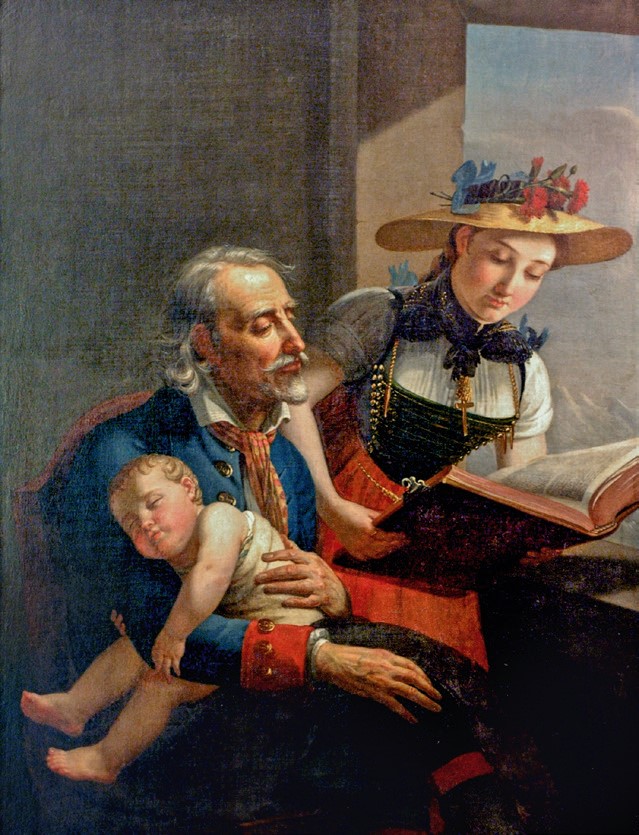

J. B. Phillips and the Letters to Young Churches
The first widely read modern-speech version of the postwar years came from a Church of England clergyman, John Bertram Phillips. He began with Paul's letters during the war, and he later explained why in the preface to the schools edition of his work (1959): "I wrote for the young people who belonged to my youth club, most of them not much above school-leaving age, and I undertook the work simply because I found that the Authorised Version was not intelligible to them."4 In the same account he dated the start of the work to 1941 and thanked C. S. Lewis, to whom he had sent his version of Colossians, for writing back with "great encouragement."4
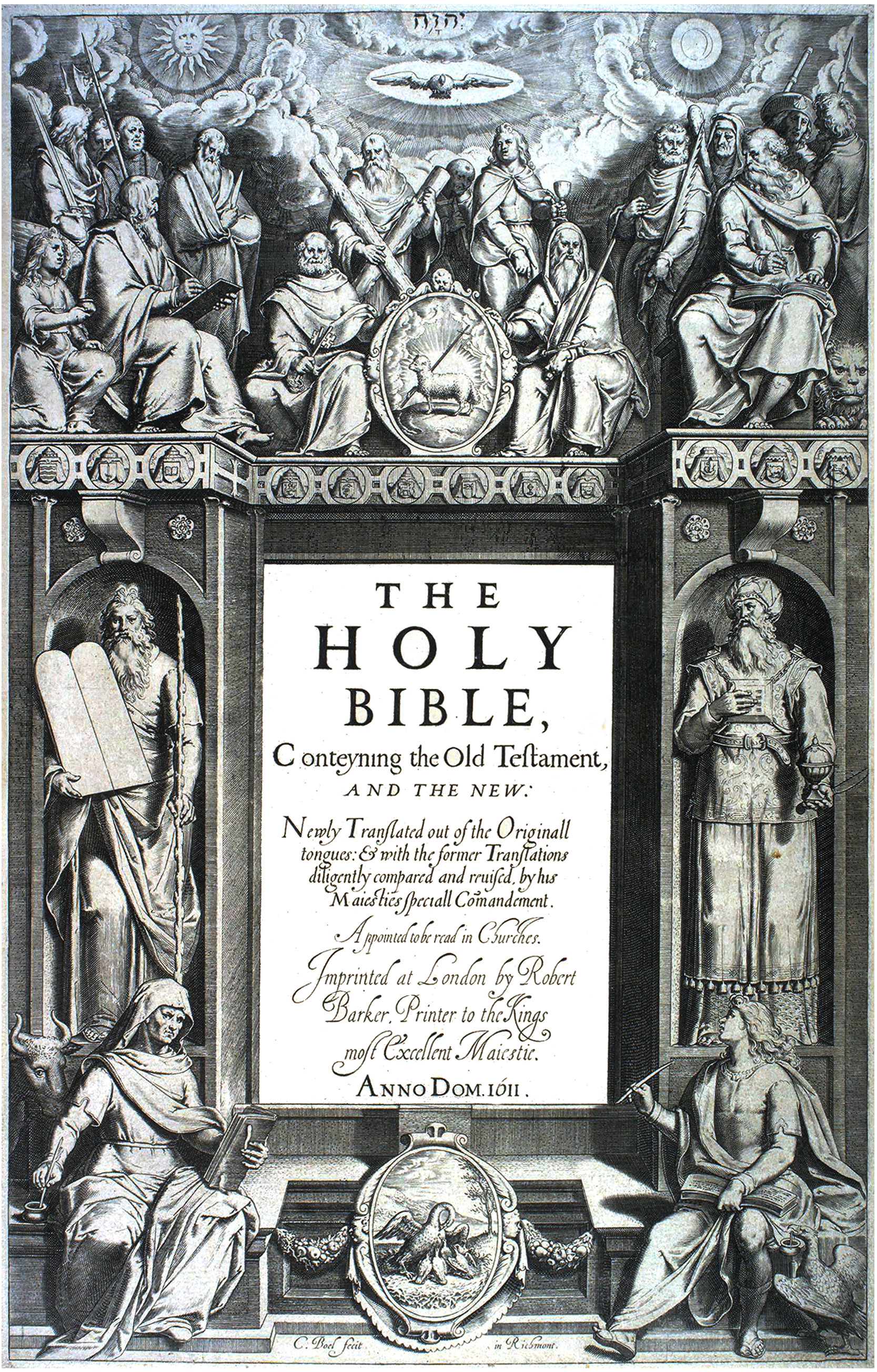
The letters appeared as Letters to Young Churches in 1947. The Gospels, Acts and Revelation followed in separate volumes, and the one-volume New Testament in Modern English came out in 1958, with a revised edition in 1961 and a further revision in 1972, according to the publication record compiled by Michael Marlowe on his Bible Research site.4 Phillips translated a few prophets in 1963 (Amos, Hosea, the first part of Isaiah and Micah) but never the whole Old Testament.4
Phillips in his own words
In the translator's preface of 1947, Phillips set out five working rules. One of them reads: "The translation (or in some cases, the paraphrase) should 'flow' and be easy to read." Another warned readers off using his version for close study: "For close meticulous study, existing modern versions should be consulted."4 On the Greek text, the 1947 preface said he had "worked from the Greek Text used in the 1881 revision," that is, the readings adopted by the Revised Version committee (lesson 09), and the 1972 revision said he had used "the latest and best Greek text published by the United Bible Societies in 1966."4 So Phillips, unlike Taylor after him, worked from Greek.
Marlowe's review notes that by the 1958 foreword Phillips no longer accepted "paraphrase" as a description of his renderings, and it quotes the American textual scholar Ernest C. Colwell objecting to F. F. Bruce's warm praise of Phillips: Bruce, Colwell wrote, "does not point out Phillips' own confession of paraphrase in the preface of his first work."4 The same review counts the words of Romans 5 and finds 482 in the Revised Standard Version against 786 in Phillips's 1947 text, a measure of how much his version expands the Greek.4
Phillips on the page
Two short samples show the method. The King James Version reads at Matthew 5:3, "Blessed are the poor in spirit: for theirs is the kingdom of heaven."5 Phillips renders it: "How happy are the humble-minded, for the kingdom of Heaven is theirs!" (PHILLIPS, copyright 1960, 1972 J. B. Phillips, administered by The Archbishops' Council of the Church of England).6 At John 1:1, where the King James Version has "In the beginning was the Word, and the Word was with God, and the Word was God,"5 Phillips writes: "At the beginning God expressed himself. That personal expression, that word, was with God, and was God, and he existed with God from the beginning." (PHILLIPS, copyright 1960, 1972 J. B. Phillips).6 The second sample keeps every element of the Greek sentence and adds an explanation of what "the Word" means. That is interpretation on the face of the text, which is what Phillips's first preface had admitted.
The Amplified Bible: more words on purpose
The Amplified Bible took the opposite path from a short, plain paraphrase. It adds words openly, inside brackets and parentheses, to show the range of meaning its editors saw in the Hebrew and Greek. Marlowe's account dates it as follows: the New Testament in 1958 and the Old Testament in two volumes in 1962 and 1964, all produced by Frances E. Siewert (1881 to 1967) with financial support from the Lockman Foundation beginning in 1952, then a one-volume edition revised by unnamed scholars for the Foundation and published by Zondervan in 1965, with a revision in 1987.7 The Lockman Foundation is the same body that later produced the NASB (lesson 10), and the version now on Bible Gateway carries the line "Copyright 2015 by The Lockman Foundation."8
Marlowe reports that Siewert took the American Standard Version as her base text and that the 1965 one-volume edition explained its signs this way: parentheses and dashes mark "additional phases of meaning included in the original word, phrase, or clause of the original language," and square brackets "contain justified clarifying words or comments not actually expressed in the immediate original text."7 The Lockman Foundation's current page advertises the edition under the heading "See the Full Meaning of Scripture--While You Read."9
The sample shows the method at once. Matthew 5:3: "Blessed [spiritually prosperous, happy, to be admired] are the poor in spirit [those devoid of spiritual arrogance, those who regard themselves as insignificant], for theirs is the kingdom of heaven [both now and forever]." (AMP, copyright 2015 The Lockman Foundation).8 Psalm 23:1: "The Lord is my Shepherd [to feed, to guide and to shield me], I shall not want." (AMP, copyright 2015 The Lockman Foundation).8 Take away the brackets and both verses read almost exactly like the King James Version. That is the Amplified Bible's defense and its limit: a reader can always see which words are added, but the added words are the editors' commentary printed inside the Bible text. Andrew Shead, whose review of the Passion Translation appears below, contrasts the two on exactly this point, describing the Amplified Bible as one "which clearly marked its amplifications as additions to the text, so that readers could distinguish Scripture from amplification."10
The Living Bible: one man's paraphrase
Kenneth N. Taylor (1917 to 2005) was born in Portland, Oregon, and worked in Christian publishing in the Chicago area. Tyndale House Publishers, the company he founded, tells the origin this way: Taylor began paraphrasing Scripture for his ten children, who struggled with the King James Version, and wrote much of the New Testament during his daily train commute, a task that took about seven years. Publishers turned the manuscript down.11 Marlowe's review adds that Taylor was a Baptist layman then employed by Moody Press, that he had some seminary training at Northern Baptist Theological Seminary, and that he "was not proficient in Hebrew and Greek."2 (Time magazine's 1972 account, quoted below, describes him differently on one point.)
Living Letters, 1962
Taylor finished the New Testament letters in 1962, and he and his wife Margaret published them themselves as Living Letters: The Paraphrased Epistles. Tyndale's own account says that "Paul Benson, president of Lithocolor Press, offered to print 2,000 copies," to be paid for as they sold, and that Taylor named the new firm after the sixteenth-century translator William Tyndale (lesson 06).11 The book found its audience through Billy Graham. In 1963, Graham offered it as a premium on his television crusade broadcasts, and Tyndale states that "Half a million copies were given away through the Graham crusades."112
The 1962 preface stated its purpose in words that later editions repeat for the whole Bible: "This book is a paraphrase of the New Testament letters. Its purpose is to say as exactly as possible what Paul, James, Peter, John, and Jude meant, and to say it simply."2 The same preface also admitted that the work was provisional: "none of those consulted feels entirely satisfied with the present result. This is therefore a tentative edition."2
The text behind the Living Bible
Taylor's paraphrase was made from English. The preface to The Living New Testament (1967), as reproduced by Marlowe, says so: "The basic text used for this paraphrase is the American Standard Version of 1901, generally accepted by Bible scholars everywhere as a masterful work."2 Marlowe adds that Taylor confirmed in a 1973 interview in Eternity magazine that the ASV was in front of him as he worked.2 The 1962 preface said that the work had been checked by "a team of Greek experts to check content, and of English critics for style," but it did not name them.2 In short, the Living Bible's ancestor is the American Standard Version of lesson 09, and through it the Revised Version's Greek text, restated in Taylor's own English.
From letters to the whole Bible, 1967 and 1971
The complete Living New Testament appeared in 1967; its preface reported that "Three million copies of Living Letters and Living Gospels have been printed since the first edition of 2,000 Living Letters was published in 1962."2 The complete Living Bible followed in 1971. Tyndale House says it was the best-selling book in the United States for three years and that it has sold more than 40 million copies.11 (The 40 million figure is the publisher's own; the 1996 note to readers of the New Living Translation gave the same figure, "40 million copies in print.")1 Bible Gateway, which still carries the Living Bible, gives the purpose statement of the full edition: "The Living Bible is a paraphrase of the Old and New Testaments. Its purpose is to say as exactly as possible what the writers of the Scriptures meant, and to say it simply, expanding where necessary for a clear understanding by the modern reader."12
The money from the paraphrase built a publishing house. Time magazine reported on July 24, 1972, that "all author's royalties from the Bible--$1,500,000 last year--go into the Tyndale House Foundation," and that the profits had enabled Taylor "to start and maintain a prosperous publishing firm, Tyndale House, which now produces some 40 titles a year."13 The same article quoted Taylor: "I'd like to emulate Tyndale in everything but his death."13 The same article called Taylor "An ordained minister who was then director of the fundamentalist Moody Press in Chicago," where Marlowe calls him a Baptist layman employed by Moody Press; the two accounts disagree on whether he was ordained.13 (Tyndale's arrest and execution are told in module 102, lesson 05.) The copyright today sits with the Tyndale House Foundation, as the Bible Gateway credit line shows.12
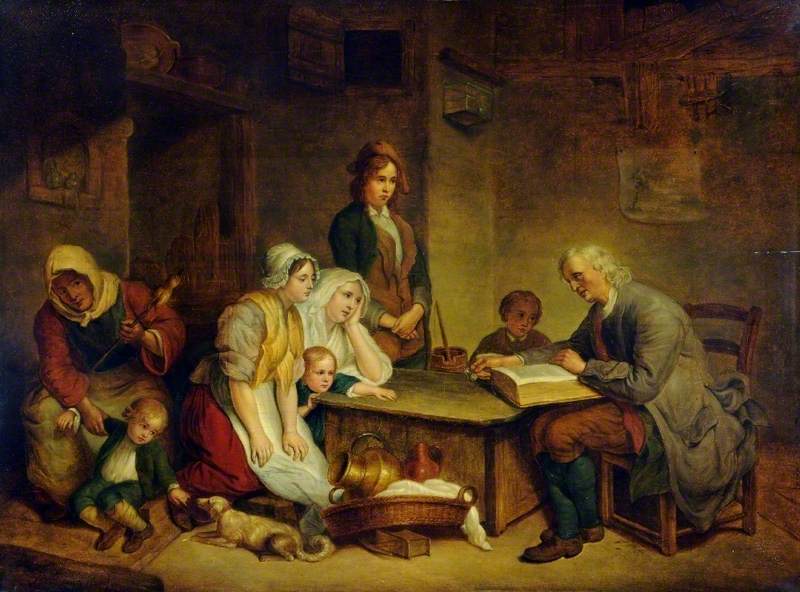

The Living Bible on the page
Three samples show how far a paraphrase moves from the wording while aiming at the meaning. Psalm 23:1, which the King James Version gives as "The LORD is my shepherd; I shall not want,"5 reads in the Living Bible: "Because the Lord is my Shepherd, I have everything I need!" (TLB, copyright 1971 Tyndale House Foundation).14 Matthew 5:3 reads: "'Humble men are very fortunate!' he told them, 'for the Kingdom of Heaven is given to them.'" (TLB, copyright 1971 Tyndale House Foundation).14 And John 1:1 to 2, which the King James Version renders with "the Word" three times, becomes: "Before anything else existed, there was Christ, with God. He has always been alive and is himself God." (TLB, copyright 1971 Tyndale House Foundation).14
The last sample shows both sides of the method. The paraphrase states the deity of Christ more bluntly than the Greek's own wording does, which pleased many evangelical readers; it also removes John's term "the Word" (logos) altogether, which a reader studying John's language would want to see.
A paraphrase that changed its mind: Romans 14:1
Marlowe's review prints one revision that shows how much a paraphrase depends on its maker's reading. The King James Version has: "Him that is weak in the faith receive ye, but not to doubtful disputations."5 In the first edition of Living Letters (1962), Taylor wrote: "Give a warm welcome to anyone who wants to join you as a member of the church, even if he scarce believes that Christ alone can save him." By the 1967 New Testament it had become "Give a warm welcome to any brother who wants to join you, even though his faith is weak," with a footnote giving the literal sense.2 The 1967 preface explained that "the revision committee has felt that a previous rendering, though valid, should conform to a more standard interpretation."2 A translation can be corrected too, but in a paraphrase the reader has no way to see, from the English alone, where the original ends and the interpreter's judgment begins.
The Way and the Jesus People
The Living Bible reached young readers in the years of the Jesus movement described in module 77, lesson 05. In January 1972 Tyndale House issued an illustrated edition titled The Way: The Living Bible Illustrated, credited with Campus Life magazine, according to bookseller listings of the first edition; its photographs of young people in the early 1970s made it a familiar book of that movement.15 (The photographs and the edition's link to the movement come from the listings and reader reviews, not from a publisher's statement, and are reported here as such.)
The response from scholars was mixed. Marlowe's 2005 review, written from a Reformed position, charges that in several places Taylor "wrests the scripture" toward Arminian readings of salvation, giving Acts 4:27 to 28 and other verses as examples.2 Time in 1972 judged that the paraphrase "is not very likely to distress believers with any newfangled doctrinal notions."13 Both judgments can be checked against the text, which is what the "Hard questions" section below asks readers to do.
Good News for Modern Man and the Good News Bible
The Good News Bible came from a Bible society, not from one man, though one man did most of its New Testament. Marlowe's publication record gives the dates: Good News for Modern Man: The New Testament in Today's English Version, American Bible Society, 1966 (second edition 1967, third edition 1971); the Good News Bible: The Bible in Today's English Version, 1976; a revision "with inclusive language" in 1992; and an edition with the deuterocanonical books (the Apocrypha, lesson 03).16 Bible Gateway's credit line names the current text "Good News Translation (Today's English Version, Second Edition)" with copyright 1992 American Bible Society.17
The New Testament was translated by Robert G. Bratcher, a scholar on the staff of the American Bible Society from 1957, "in consultation with a committee appointed by the American Bible Society," and he worked by the principles of Eugene Nida, who led the Society's translations department from 1946 and called his theory dynamic equivalence.16 So the Good News Bible is a translation from the original languages made by Nida's method, closer to the thought-for-thought translations than to the paraphrases, though its language is simpler than most. Marlowe reports that Bratcher said the version was first conceived as suitable for people who speak English as a second language.16

The Good News Bible on the page
Psalm 23:1 in the Good News Translation reads: "The Lord is my shepherd; I have everything I need." Matthew 5:3 reads: "Happy are those who know they are spiritually poor; the Kingdom of heaven belongs to them!" (GNT, copyright 1992 American Bible Society).17 The second sample shows the method plainly: the Greek idiom "poor in spirit" is turned into an explanation, "those who know they are spiritually poor," and the word usually rendered "blessed" becomes "happy," a choice Phillips had also made.
The "bloodless Bible" charge
The Good News Bible met strong resistance among theologically conservative Protestants. Marlowe's account records that "Some dubbed it the 'bloodless bible' because Bratcher had avoided using the phrase 'blood of Christ' in the New Testament. Instead of the literal 'blood of Christ' he used the phrase 'the death of Christ.'"16 Bratcher's defense, as Marlowe quotes it, was linguistic: in Greek, haima (blood) is "often used of the violent death of animals or men," while "In English, however, the word 'blood' does not mean death."16 Marlowe answers that English dictionaries list "the taking of life" as one sense of "blood," and that the word carries the sacrificial meaning of the temple offerings, which "death" alone does not.16
The current second edition reads differently from what the charge describes. At Romans 5:9 the Good News Translation now has "By his blood we are now put right with God," with a footnote "or By his sacrificial death," and at Colossians 1:20, "God made peace through his Son's blood on the cross," with the footnote "or his Son's sacrificial death" (GNT, copyright 1992 American Bible Society).17 The King James Version has "being now justified by his blood" and "having made peace through the blood of his cross" in the same two verses.5 So in these two verses the 1992 text restored "blood" to the text and moved "death" to the margin. This lesson could not open a copy of the 1966 or 1976 text to list exactly which verses had read "death," and that detail is marked unverified in the notes.
The Message: Eugene Peterson's reading Bible
Eugene H. Peterson earned a master's degree in Hebrew and then served for many years as a pastor in the Presbyterian Church (USA) before retiring to write, according to Marlowe's account of the version; he did most of the New Testament work in 1991 as writer in residence at Pittsburgh Theological Seminary.18 The Message came out of his teaching. Bible Gateway's version page quotes his account: the adults in his class "weren't feeling the vitality and directness that I sensed as I read and studied the New Testament in its original Greek. Writing straight from the original text, I began to attempt to bring into English the rhythms and idioms of the original language."19 He began with Galatians. Marlowe cites a Seattle Pacific University article of 2002 reporting that a NavPress editor had read Peterson's paraphrase of Galatians in his 1982 book Traveling Light and "wanted more."18
NavPress of Colorado Springs published The Message: The New Testament in Contemporary English in 1993. The Old Testament followed in parts (the wisdom books in 1998, the prophets in 2000, the Pentateuch in 2001, the historical books in 2002), and the complete Bible appeared in 2002.18 The copyright line on Bible Gateway reads "Copyright 1993, 2002, 2018 by Eugene H. Peterson," so The Message is held in its author's own name, which is unusual among Bibles of wide use.20
The Message in its own words
The publisher's description makes no claim to be a study Bible. Bible Gateway's version page says: "This is not a study Bible, but rather 'a reading Bible.' The verse numbers, which are not in the original documents, have been left out of the print version to facilitate easy and enjoyable reading."19 Peterson worked from Hebrew and Greek, so by the narrow test of source text The Message is a translation; by the test of method it is a free rendering that most reference works, and Marlowe, call a paraphrase. Marlowe also reports that Peterson told Christianity Today in 2002 that he did "take considerable liberties" with the text and that when pastors told him they used it in preaching, he warned that "they miss the connection with the past with this translation."18
The Message on the page
Psalm 23:1 in The Message reads: "God, my shepherd! I don't need a thing." (MSG, copyright 1993, 2002, 2018 Eugene H. Peterson).20 Matthew 5:3: "You're blessed when you're at the end of your rope. With less of you there is more of God and his rule." (MSG, copyright 1993, 2002, 2018 Eugene H. Peterson).20 John 1:1 to 2: "The Word was first, the Word present to God, God present to the Word. The Word was God, in readiness for God from day one." (MSG, copyright 1993, 2002, 2018 Eugene H. Peterson).20
Set beside the King James Version, the Matthew sample shows the paraphrase most clearly. "Poor in spirit" becomes an idiom of modern American speech, "at the end of your rope," and a second sentence explains the beatitude in words that are not in the Greek. The John sample, by contrast, keeps "the Word" and the claim "The Word was God," and adds the phrases "first" and "from day one" to carry the sense of "in the beginning."
The New Living Translation: from paraphrase to translation
By the late 1980s the Living Bible was twenty years old in its complete form, and Tyndale House set out to revise it. The note to readers in the first edition of the New Living Translation (1996) tells what happened: "With 40 million copies in print, The Living Bible has been meeting a great need in people's hearts for more than thirty years. But even good things can be improved, so ninety evangelical scholars from various theological backgrounds and denominations were commissioned in 1989 to begin revising The Living Bible. The end result of this seven-year process is the Holy Bible, New Living Translation."1
The result was a different kind of book from its parent. The Living Bible was made by one man from the American Standard Version. The New Living Translation was made by a committee from the Hebrew and Greek. Its introduction names the texts: "The translators of the Old Testament used the Masoretic Text of the Hebrew Bible as their standard text," in the edition Biblia Hebraica Stuttgartensia (1977), compared with the Dead Sea Scrolls, the Septuagint and other ancient versions, and the New Testament translators "used the two standard editions of the Greek New Testament," the United Bible Societies' and Nestle-Aland texts.1 That means the NLT stands on the critical text discussed in lesson 08, the same base as the NIV and NASB.
The introduction describes how the committee worked: "the Bible Translation Committee assigned each book of the Bible to three different scholars," a general reviewer summarized their suggestions and drafted a revision, and "the Bible Translation Committee jointly reviewed and approved every verse in the final translation."1 It also makes a strong claim for its method: "A thought-for-thought translation prepared by a group of capable scholars has the potential to represent the intended meaning of the original text even more accurately than a word-for-word translation."1 That is the claim lesson 13 disputes for the NIV, and readers can weigh it with the samples here.
The NLT has been revised since. The copyright line on Bible Gateway gives "copyright 1996, 2004, 2015 by Tyndale House Foundation," which marks the second edition of 2004 and the further revision of 2015.21
The NLT on the page
Psalm 23:1: "The Lord is my shepherd; I have all that I need." Matthew 5:3: "God blesses those who are poor and realize their need for him, for the Kingdom of Heaven is theirs." John 1:1: "In the beginning the Word already existed. The Word was with God, and the Word was God." (NLT, copyright 1996, 2004, 2015 Tyndale House Foundation).21 Compared with its parent, the NLT is much nearer the King James Version in all three: it restores "the Word" in John 1:1, and in Matthew 5:3 it keeps "poor" while explaining "in spirit" as "realize their need for him." The family line is still visible in the explanation, but the method has moved from paraphrase toward translation.
The Passion Translation and the dispute over a label
The newest version in this lesson is also the most disputed. The Passion Translation (TPT) is the work of Brian Simmons, a former missionary who, with his wife Candice, planted churches in Central America and assisted in the Paya-Kuna New Testament translation project for the Paya-Kuna people of Panama, according to the version's own website. It is published by BroadStreet Publishing Group, which released the full New Testament in 2017, and work on the Old Testament continues.22 Christianity Today reported that the TPT "First released as a New Testament in 2017" includes additions to the text, and that it was popular among charismatic readers.23
The Passion Translation in its own words
The publisher's answers to common questions reject the label "paraphrase" directly: "The Passion Translation is not a revision or paraphrase of another existing version of the Bible. It is an entirely new, fresh translation using the Hebrew, Greek, and Aramaic documents."22 On method, the same page says the version "follows in the tradition of mainstream functional, dynamic equivalent translations," and that "the essential meaning of a passage should take priority over the form of the original words."22 On sources, it names Biblia Hebraica Stuttgartensia (1977) and the Septuagint for the Old Testament and Nestle-Aland's Novum Testamentum Graece, "currently the twenty-eighth edition," as the Greek base text for the New Testament, "while incorporating insights from the Syriac (Aramaic) Peshitta."22 The publisher also states that the work has been "theologically reviewed by professionals," and the same page names several of them, among them Gary S. Greig and Jacqueline Grey.22
The scholarly criticism
The most cited criticism came from Andrew G. Shead, head of Old Testament and Hebrew at Moore Theological College in Sydney and a member of the NIV's Committee on Bible Translation, in a review of the TPT Psalms in the journal Themelios (volume 43, issue 1, 2018). His summary: Simmons "achieves this by abandoning all interest in textual accuracy, playing fast and loose with the original languages, and inserting so much new material into the text that it is at least 50% longer than the original."10 Shead names the technique he found most often, "double translation," in which one Hebrew word is rendered by two or three English words or images, and he gives examples from Psalm 18: "'Love' becomes 'passionately love' (v. 1); 'rock' becomes 'Bedrock beneath my feet' (v. 2)."10 On the claim to use Aramaic, he writes: "When it says 'Aramaic' it generally means Syriac," the language of the Peshitta, which he describes as a translation made from a Hebrew text "almost identical to ours."10 His conclusion is severe, and it is quoted here as his judgment: the result "is a strongly sectarian translation that no longer counts as Scripture."10
Others made the same point in milder words. Andrew Wilson, a pastor at King's Church London who writes from within the charismatic movement, told Christianity Today: "There are just too many additions to the text that have no basis in the original--which is fine (sort of) if it's self-consciously a paraphrase, but not if people think it's a translation."23 Simmons, for his part, told an interviewer quoted in the same article: "With The Passion Translation, we have a high goal to being accurate to the text, but accuracy involves the heart behind it."23
The TPT on the page
Christianity Today printed the TPT's Lord's Prayer from Luke 11 as an example. Its first lines read: "Our heavenly Father, may the glory of your name be the center on which our life turns. May your Holy Spirit come upon us and cleanse us." (TPT, copyright BroadStreet Publishing Group, as quoted by Christianity Today).23 The King James Version has: "Our Father which art in heaven, Hallowed be thy name. Thy kingdom come."5 A request for the Holy Spirit to "come upon us and cleanse us" in place of "Thy kingdom come" is known from a very small number of witnesses to Luke's Gospel and church writers; neither the Textus Receptus nor the Nestle-Aland text prints it, and both print "Thy kingdom come." The TPT's rendering of "hallowed be thy name" as "may the glory of your name be the center on which our life turns" is a paraphrase by any of the definitions above.
Removal from Bible Gateway, 2022
In early 2022 Bible Gateway, one of the most used online Bible sites, stopped offering the TPT. Christianity Today reported on February 9, 2022, that BroadStreet confirmed Bible Gateway "made the disappointing decision to discontinue their license for The Passion Translation" as of January 2022, and that "While no explanation was given, BroadStreet Publishing accepts that Bible Gateway has the right to make decisions as they see fit."23 Bible Gateway's parent company, HarperCollins Christian Publishing, told Christianity Today only that it periodically reviews its content "to align with our business goals" and declined to give further reasons, and the version remained available on YouVersion and in Logos Bible Software.23 Christian Today in London carried the same report on February 12, 2022.24 Christianity Today also reported that Simmons first answered the removal on social media with the words "Cancel culture is alive in the church world," in a post that was later taken down.23
In June 2026 a further charge was reported. Plagiarism Today, a site on copying and copyright, summarized allegations by David Fish, a minister at a Texas church, that the TPT copied wording from earlier translations, including the work of Victor Alexander, in "hundreds of examples," in both text and notes.25 The same article says the project began in 2011 and is not expected to be complete until 2029.25 These are allegations reported in June 2026; this lesson found no ruling on them and no published answer from the publisher, and they are listed as open in the "Claims checked" section.
The gender-inclusive editions
The second large change of these decades concerned words for men and women. Greek adelphoi, plural of the word for "brother," is used in Paul's letters for whole congregations of men and women; Hebrew 'adam and Greek anthropos often mean "human being" though older English rendered them "man." Beginning in the 1980s, several committees decided that English readers now heard "man," "men" and "brethren" as male only, and that faithful translation required "people," "human beings" or "brothers and sisters" where the original referred to both sexes. Others answered that the changes went beyond such cases and altered singular statements, titles and links between the Testaments. Lesson 13 sets out the case against the NIV's gender language in detail; this section describes each edition in its own words and lets the verses show what changed.
The New Revised Standard Version, 1989
The NRSV was the first major English Bible to adopt inclusive language as a committee policy. Its preface, "To the Reader," signed for the committee by Bruce M. Metzger, explains that in 1974 the Policies Committee of the Revised Standard Version, "a standing committee of the National Council of the Churches of Christ in the U.S.A., authorized the preparation of a revision of the entire RSV Bible."3 (The RSV's own history is in lesson 09, and the National Council of Churches' place in American church life is in module 80, lesson 11.) The preface then states the gender policy in plain terms:
"During the almost half a century since the publication of the RSV, many in the churches have become sensitive to the danger of linguistic sexism arising from the inherent bias of the English language towards the masculine gender, a bias that in the case of the Bible has often restricted or obscured the meaning of the original text. The mandates from the Division specified that, in references to men and women, masculine-oriented language should be eliminated as far as this can be done without altering passages that reflect the historical situation of ancient patriarchal culture."3
The preface admits the strain this placed on the committee: "more than once the Committee found that the several mandates stood in tension and even in conflict."3 It also states what was left alone: some legal texts in Leviticus and Deuteronomy kept masculine wording, and "in narrative and in parable no attempt was made to generalize the sex of individual persons."3 Most changes, it says, were made "by simple rephrasing or by introducing plural forms when this does not distort the meaning of the passage."3
The verses show the policy at work. Psalm 1:1, "Blessed is the man that walketh not in the counsel of the ungodly" in the King James Version,5 reads in the NRSV: "Happy are those who do not follow the advice of the wicked, or take the path that sinners tread, or sit in the seat of scoffers" (NRSV Anglicised, copyright 1989, 1995 National Council of the Churches of Christ in the USA).26 Jesus' words to the fishermen at Matthew 4:19, "I will make you fishers of men" in the King James Version, become "I will make you fish for people," and Romans 12:1, "I beseech you therefore, brethren," becomes "I appeal to you therefore, brothers and sisters" (NRSV Anglicised, copyright 1989, 1995 National Council of the Churches of Christ in the USA).265 (The NRSV samples here are from the Anglicised edition on Bible Gateway, which shares the 1989 text apart from British spelling and usage.)
Hebrews 2:6, a test case
One verse shows why the debate was sharp. Hebrews 2:6 quotes Psalm 8:4. The King James Version reads: "What is man, that thou art mindful of him? or the son of man that thou visitest him?"5 The NRSV reads: "What are human beings that you are mindful of them, or mortals, that you care for them?" (NRSV Anglicised, copyright 1989, 1995 National Council of the Churches of Christ in the USA).26 The Common English Bible reads: "What is humanity that you think about them? Or what are the human beings that you care about them?" (CEB, copyright 2011 Common English Bible).27 In Hebrews the next verses apply the psalm to Jesus ("But we see Jesus," 2:9). Readers who favor the traditional wording say that "son of man" in the singular is the link the writer of Hebrews builds on, and that the plural hides it; the NRSV committee's answer is that the psalm speaks of humanity as a whole, which the plural states clearly. The Greek of Hebrews 2:6 has the singular anthropos and huios anthropou. Each reader can judge from that fact which English rendering serves the passage better.
The NIV Inclusive Language Edition and the Colorado Springs Guidelines
The International Bible Society, owner of the NIV, published a gender-inclusive revision in Great Britain as The New International Version Inclusive Language Edition (dated 1995 by Marlowe).28 When plans to bring a similar revision to the American market became known in 1997, Marlowe reports, "strong opposition arose among evangelical leaders."28 On May 27, 1997, at a meeting convened by James Dobson in Colorado Springs, a group of evangelical leaders and representatives of the NIV's owners drew up the Colorado Springs Guidelines for Translation of Gender-Related Language in Scripture, revised and signed again on September 9, 1997.29 Among them: "The generic use of 'he, him, his, himself' should be employed to translate generic 3rd person masculine singular pronouns in Hebrew, Aramaic and Greek"; "'Man' should ordinarily be used to designate the human race"; "The phrase 'son of man' should ordinarily be preserved to retain intracanonical connections"; and "Masculine references to God should be retained."29 The guidelines also allowed some inclusive renderings, for example "no one" for Greek oudeis and "all people" or "everyone" for pas used as a noun.29
Today's New International Version, 2002 and 2005
Five years later the International Bible Society and Zondervan published Today's New International Version, a gender-inclusive revision of the NIV: the New Testament in 2002 and the complete Bible in February 2005, according to Marlowe.28 One sample shows the kind of change. At Matthew 18:15 the King James Version begins "if thy brother shall trespass against thee, go and tell him his fault between thee and him alone."5 The TNIV reads: "If a brother or sister sins, go and point out the fault, just between the two of you alone." (TNIV 2002, copyright International Bible Society, as reproduced by Marlowe).28 The TNIV had a short life. On September 1, 2009, Christianity Today reported that Biblica (the renamed International Bible Society) would produce an updated NIV for 2011 and that Zondervan's president said "we will discontinue putting out new products with the TNIV." Biblica's chief executive, Keith Danby, said of the earlier efforts: "We fell short of the trust that was placed in us."30 The NIV of 2011 that replaced both the 1984 NIV and the TNIV is described in lesson 12, and its gender language is examined in lesson 13.
The NLT and the Good News Bible on gender
Inclusive language was not only a feature of the NRSV line. The New Living Translation of 1996 adopted it from its first edition. Its introduction explains: adelphoi in the epistles was "usually translated" as "brothers and sisters" "in order to represent the historical situation more accurately," and "In many instances we have used plural pronouns (they, them) in place of the masculine singular (he, him)."1 The NLT at Psalm 1:1 has "Oh, the joys of those who do not follow the advice of the wicked," and at Matthew 4:19, "Come, follow me, and I will show you how to fish for people!" (NLT, copyright 1996, 2004, 2015 Tyndale House Foundation).21 The Good News Bible's second edition of 1992 was likewise "revised with inclusive language," in Marlowe's words.16
The Common English Bible, 2011
The Common English Bible (2011) was sponsored by a group of denominational publishers. Its description on Bible Gateway names the committee as publishers of the Disciples of Christ (Chalice Press), the Presbyterian Church (U.S.A.) (Westminster John Knox Press), the Episcopal Church (Church Publishing), the United Church of Christ (Pilgrim Press) and the United Methodist Church, and describes "the work of over 120 scholars--men and women from 24 faith traditions."31 It calls itself "more than a revision or update of an existing translation" and "an ambitious new translation designed to read smoothly and naturally without compromising the accuracy of the Bible text," and it adds that reading specialists worked "with 77 reading groups from more than a dozen denominations."31
The CEB went further than the NRSV in one notable place: the title of Jesus. At Mark 2:10 the King James Version has "that ye may know that the Son of man hath power on earth to forgive sins."5 The CEB reads: "But so you will know that the Human One has authority on the earth to forgive sins," with a footnote "Or Son of Man" (CEB, copyright 2011 Common English Bible).27 Its Psalm 1:1 begins "The truly happy person doesn't follow wicked advice," its Matthew 4:19 reads "I'll show you how to fish for people," and its Romans 12:1 begins "So, brothers and sisters" (CEB, copyright 2011 Common English Bible).27 The Colorado Springs Guidelines had asked that "son of man" be kept; the CEB chose otherwise in the text and kept the traditional title in a note.
The NRSV Updated Edition, 2021
The most recent edition in this line is the New Revised Standard Version Updated Edition (NRSVue), with copyright 2021 by the National Council of Churches. Its publisher's description on Bible Gateway says that "The National Council of Churches, which holds the copyright of the New Revised Standard Version, commissioned the Society of Biblical Literature to direct the NRSVue revision project," and that the update "extends the New Revised Standard Version's (NRSV) purpose to deliver an accurate, readable, up-to-date, and inclusive version of the Bible. It also continues the work of offering a version as free as possible from the gender bias inherent in the English language."32 It repeats the NRSV motto in a new form: the editorial committee aimed to present the text "as literally as possible and as freely as necessary."32
The samples show small but real changes from 1989. Matthew 4:19 now reads "I will make you fishers of people," returning to the KJV's "fishers" while keeping "people." Romans 12:1 now ends "which is your reasonable act of worship," closer to the KJV's "reasonable service" than the 1989 "spiritual worship." Hebrews 2:6 reads "What are humans that you are mindful of them or mortals that you care for them?" (NRSVue, copyright 2021 National Council of Churches of Christ in the USA).33
The debate in books
The argument produced two books that readers on each side still cite. D. A. Carson's The Inclusive-Language Debate: A Plea for Realism (Baker, 1998) argued that many inclusive renderings are defensible translation and asked both sides for care with the evidence.34 Vern S. Poythress and Wayne A. Grudem's The Gender-Neutral Bible Controversy: Muting the Masculinity of God's Words (Broadman and Holman, 2000) argued that the changes lose meaning the original carries, especially in singular statements and in the "son of man" passages.35 Lesson 13 quotes the Southern Baptist Convention's 2011 resolution and the defenders' replies; this lesson leaves the verdict there.
The timeline, 1947 to 2022
The chart below places the paraphrases and free renderings above the line and the gender-inclusive editions and the debate over them below it. Several versions belong in both groups: the NLT is a thought-for-thought translation that was inclusive from its first edition, and the 1992 Good News Translation was revised for inclusive language.
One verse across the versions
The table sets two verses side by side in every version discussed above that covers them, with the King James Version first as the reference point. Each copyrighted rendering is credited in the table and footnoted to the page where it was copied.
| Version (date, maker) | Psalm 23:1 | Matthew 5:3 |
|---|---|---|
| King James Version (1611; Oxford text 1769), public domain | The LORD is my shepherd; I shall not want. | Blessed are the poor in spirit: for theirs is the kingdom of heaven. |
| Amplified Bible (Lockman; 2015 text), copyright 2015 The Lockman Foundation | The Lord is my Shepherd [to feed, to guide and to shield me], I shall not want. | Blessed [spiritually prosperous, happy, to be admired] are the poor in spirit [...], for theirs is the kingdom of heaven [both now and forever]. |
| Phillips (1958; revised 1972), copyright 1960, 1972 J. B. Phillips | (New Testament only) | How happy are the humble-minded, for the kingdom of Heaven is theirs! |
| Living Bible (Taylor, 1971), copyright 1971 Tyndale House Foundation | Because the Lord is my Shepherd, I have everything I need! | Humble men are very fortunate! ... for the Kingdom of Heaven is given to them. |
| Good News Translation (ABS, 2nd ed. 1992), copyright 1992 American Bible Society | The Lord is my shepherd; I have everything I need. | Happy are those who know they are spiritually poor; the Kingdom of heaven belongs to them! |
| The Message (Peterson, 1993 to 2002), copyright 1993, 2002, 2018 Eugene H. Peterson | God, my shepherd! I don't need a thing. | You're blessed when you're at the end of your rope. With less of you there is more of God and his rule. |
| New Living Translation (1996; 2015 text), copyright 1996, 2004, 2015 Tyndale House Foundation | The Lord is my shepherd; I have all that I need. | God blesses those who are poor and realize their need for him, for the Kingdom of Heaven is theirs. |
| NRSV Updated Edition (2021), copyright 2021 National Council of Churches of Christ in the USA | The Lord is my shepherd; I shall not want. | (not sampled) |
| Common English Bible (2011), copyright 2011 Common English Bible | The Lord is my shepherd. I lack nothing. | (not sampled) |
Sources: KJV5; AMP8; PHILLIPS6; TLB14; GNT17; MSG20; NLT21; NRSVue33; CEB27. The ellipsis in the Amplified row stands for the bracketed note quoted in full above; the ellipsis in the Living Bible row stands for the words "he told them."
Read down the Psalm column and a pattern appears. The formal versions (KJV, Amplified apart from its brackets, NRSVue) keep "I shall not want," an English idiom that now sounds like "I shall not wish for anything." The Good News, Living Bible and NLT turn it into "I have everything I need" or "all that I need," which states the sense in current speech. The Message and the CEB compress it further. None of these renderings contradicts the Hebrew, which says literally "I shall not lack." The differences are of register and of how much the translator explains. The Matthew column shows larger differences, because "poor in spirit" is a Semitic idiom that each version had to explain or keep, and because the Greek makarioi can be rendered "blessed," "happy" or "fortunate."
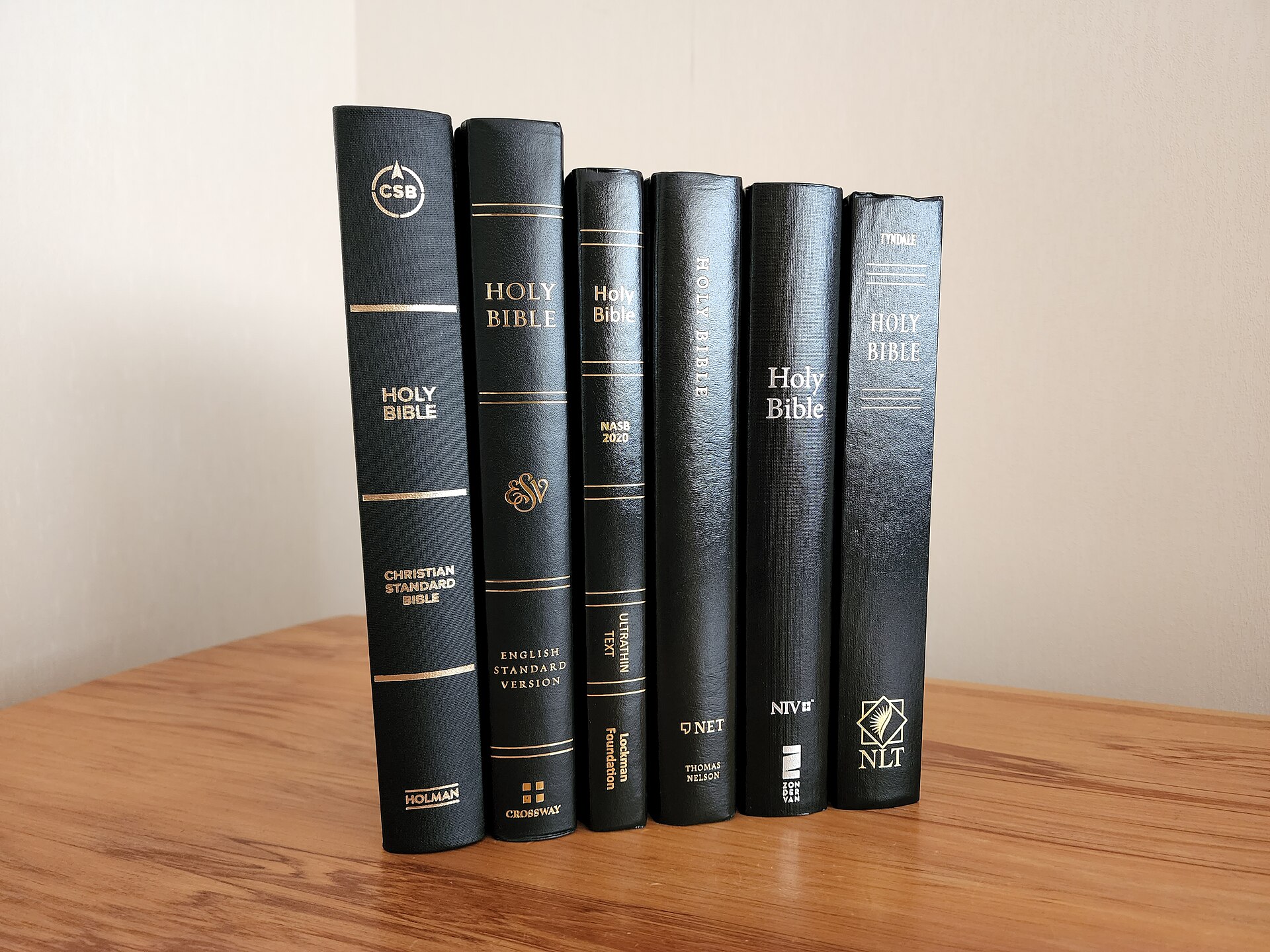

The spectrum, placed by each version's own words
Charts that rank Bibles from "literal" to "free" are common in Bible shops and on publishers' websites, and they rarely say who did the placing. The chart below places each version by its own publisher's or maker's description, quoted in short form beside it and footnoted in the text above. Where a named scholar's placement differs sharply from the publisher's, a hollow marker shows the critic's placement and names the critic. The formal versions at the left are placed by their prefaces as lessons 10 and 11 quote them.
How to read any version's preface
Every version in this lesson answered four questions somewhere in its front matter or on its publisher's website, and the answers decide most of what a reader needs to know before trusting it for a given use. Lesson 15 builds a full method on them; here they are applied to the versions above.
- Who made it? One person (Phillips, Taylor, Peterson, Simmons) or a named committee (the NRSV committee whose members Marlowe lists by name, the NLT's ninety, the CEB's 120)? Are the names printed? The Living Bible's 1967 preface named only an unnamed "Paraphrase Revision Committee."2
- From what text? Hebrew and Greek, and which editions (Biblia Hebraica Stuttgartensia, Nestle-Aland, the Textus Receptus)? Or an English Bible (the Living Bible from the ASV; the Amplified from the ASV, per Marlowe)?
- By what method? Does the preface say "literal," "complete equivalence," "thought-for-thought," "reading Bible" or "paraphrase"? Does it explain how it handles gender language? Does it mark added words?
- Who owns it? The copyright line names the holder: a foundation (Lockman; the Tyndale House Foundation), a Bible society (the American Bible Society; Biblica), a council of churches (the National Council of Churches), a consortium of denominational publishers (the CEB), a commercial publisher (BroadStreet), or the author himself (Peterson). The holder decides future revisions.
| Version | Who made it | From what text | Method in its own words | Copyright holder |
|---|---|---|---|---|
| Phillips NT | J. B. Phillips alone | Greek: the 1881 Revised Version text, then UBS 1966 | "(or in some cases, the paraphrase)" | J. B. Phillips; administered by the Archbishops' Council |
| Amplified Bible | Frances Siewert, then unnamed Lockman revisers | ASV as base text (per Marlowe), with Greek and Hebrew word studies | bracketed "additional phases of meaning" | The Lockman Foundation |
| Living Bible | Kenneth Taylor, with unnamed reviewers | American Standard Version (1901) | "a paraphrase" | Tyndale House Foundation |
| Good News Bible | Robert Bratcher (NT) with an ABS committee | Greek and Hebrew | dynamic equivalence (Nida) | American Bible Society |
| The Message | Eugene Peterson | Greek and Hebrew, in his account | "a reading Bible" | Eugene H. Peterson |
| New Living Translation | Ninety scholars, a committee | BHS (1977); UBS and Nestle-Aland Greek | "thought-for-thought" | Tyndale House Foundation |
| Passion Translation | Brian Simmons, with reviewers the publisher names | BHS and Septuagint; Nestle-Aland 28 with the Peshitta | "functional, dynamic equivalent" | BroadStreet Publishing Group |
| NRSV / NRSVue | NRSV committee (Metzger, chair); SBL for the update | BHS; UBS Greek; updated texts in 2021 | "As literal as possible, as free as necessary" | National Council of Churches |
| Common English Bible | Over 120 scholars | Greek and Hebrew (new translation) | "read smoothly and naturally" | Common English Bible |
Sources for the table: Phillips46; Amplified78; Living Bible212; Good News1617; The Message1920; NLT121; Passion Translation2223; NRSV and NRSVue332; CEB31.
A short test sorts most versions quickly. Open to the preface and look for the phrase that describes the method. Then turn to Psalm 23:1, Matthew 5:3 and Romans 12:1 and compare them with the King James Version or the American Standard Version, both in the public domain. If the version adds explanations without marking them, it is working toward paraphrase whatever its cover says; if it marks them (italics, brackets or footnotes), the reader can separate text from comment.

What the record shows and what it does not
- Documented fact: The Living Bible was made by Kenneth Taylor from the American Standard Version of 1901, as its own 1967 preface states; it calls itself a paraphrase; Living Letters appeared in 1962 and the complete Living Bible in 1971.
- Documented fact: The New Living Translation began in 1989 as a revision of the Living Bible by ninety scholars and was published in 1996 as a translation from the Hebrew (BHS) and the standard Greek editions, by its own introduction's account.
- Documented fact: The NRSV's 1989 preface states that its mandate was to eliminate "masculine-oriented language" in references to men and women where this could be done without altering passages reflecting ancient patriarchal culture.
- Documented fact: Bible Gateway stopped carrying the Passion Translation in January or February 2022; the publisher said no reason was given.
- Publisher's own claim: That a thought-for-thought translation by capable scholars can be "even more accurately" faithful than a word-for-word one (NLT, 1996); that the Passion Translation is "not a revision or paraphrase" (BroadStreet); that The Message is "a reading Bible" made from the original languages (NavPress, Peterson).
- Publisher's own figure: More than 40 million copies of the Living Bible (Tyndale House), not independently audited.
- Scholarly reading, attributed: Shead (2018) that the TPT Psalms are at least 50 percent longer than the Hebrew and rely on "double translation"; Marlowe that the Living Bible bends some verses toward Arminian readings and that Bratcher's "death" for "blood" muted the sacrificial sense; Colwell that Phillips repudiated his own early "confession of paraphrase."
- Open question: Whether inclusive renderings such as "brothers and sisters" for adelphoi and plurals for generic singulars represent the original more accurately or less. Committees and scholars who know the languages well answer both ways, and the answer depends partly on how English is used, which keeps changing.
- Open question: The plagiarism allegations against the Passion Translation reported in June 2026, on which no ruling or publisher reply was found.
Claims checked
"The Living Bible was translated from the Hebrew and Greek." Refuted.
The Living New Testament's own preface (1967) says: "The basic text used for this paraphrase is the American Standard Version of 1901," and Marlowe reports Taylor confirmed in 1973 that the ASV was in front of him as he worked.2 Taylor's work was checked by Greek and Hebrew advisers whom the prefaces do not name, but the base was English. The book never claimed otherwise; it called itself a paraphrase from the start.12
"The NLT is just the Living Bible updated." Partly supported.
The NLT did begin as a revision of the Living Bible, and its note to readers says so.1 But it was carried out by ninety scholars working from the Masoretic Text in Biblia Hebraica Stuttgartensia and the standard Greek editions, each book assigned to three scholars and every verse approved by a committee.1 The samples above show the result is much closer to the wording of the original than its parent: John 1:1 has "the Word" again, where the Living Bible had "Christ."1421 Family resemblance is real; identity is not.
"The Good News Bible took the blood of Christ out of the Bible." Partly supported.
Marlowe documents that Bratcher used "death of Christ" where the Greek says "blood of Christ" and quotes Bratcher's reasoning that in English "blood" does not mean death.16 That supports the charge for the earlier editions. The current second edition (1992) reads "By his blood" at Romans 5:9 and "his Son's blood on the cross" at Colossians 1:20, with "sacrificial death" in the footnotes.17 The charge therefore does not describe the text now printed in those verses, and a reader quoting it should name the edition.
"The Message is a translation from the original languages." Partly supported.
Peterson said he wrote "straight from the original text," and nothing in the record contradicts that he worked from Hebrew and Greek.19 But his own publisher calls it "a reading Bible," not a study Bible, and Peterson told an interviewer he took "considerable liberties" with the text.1918 By source it is a translation; by method, as the Matthew 5:3 sample shows, it is a paraphrase.
"The Passion Translation is translated from the Aramaic." Partly supported, and misleading as usually stated.
The publisher names Nestle-Aland's 28th edition as the Greek base text of the New Testament and says it incorporates "insights from the Syriac (Aramaic) Peshitta."22 The base text is Greek, then. Shead points out that the TPT's "Aramaic" generally means Syriac, a later translation, and that the Peshitta is "Only rarely" a witness to an earlier text.10
"Bible Gateway banned the Passion Translation for heresy." Unsupported.
Bible Gateway gave no public reason beyond its business goals, and the publisher said "no explanation was given."23 The removal followed years of published criticism of the TPT as a paraphrase presented as a translation, which Christianity Today described in the same report, but no statement from Bible Gateway connects the two.23
"The Passion Translation is plagiarized." Unresolved.
Allegations of copying from earlier translations, including Victor Alexander's, were reported in June 2026 by Plagiarism Today, which summarized a minister's documents claiming "hundreds of examples."25 As of October 2026 this lesson found no ruling and no published reply from the publisher. The claim is recorded as open.
"Gender-inclusive editions only change words about people, never the meaning." Partly supported.
The NRSV preface says most changes were made "by simple rephrasing or by introducing plural forms when this does not distort the meaning of the passage," and that "in narrative and in parable no attempt was made to generalize the sex of individual persons."3 Many changes, such as "brothers and sisters" in letters written to whole churches, fit that description, and the NLT's introduction argues they make the historical situation clearer.1 But the same NRSV preface admits that its mandates "stood in tension and even in conflict," and some changes do touch meaning: Hebrews 2:6 in the NRSV and CEB turns the singular "son of man," which Hebrews applies to Jesus, into plurals, and the CEB renders the title "Son of Man" as "the Human One."2627
"J. B. Phillips made his version for scholars." Refuted.
Phillips said he wrote "for the young people who belonged to my youth club," because the Authorised Version "was not intelligible to them," and his own preface advised that "For close meticulous study, existing modern versions should be consulted."4
"Taylor wrote the Living Bible on the train for his children." Supported.
Tyndale House's account of its founder says he began paraphrasing for his ten children and did the New Testament work on his commute over about seven years.11 Time in 1972 also described the family readings after dinner that started the work.13
"All modern versions are paraphrases." Refuted.
The modern versions differ by method, and their prefaces say so. The NASB and NKJV describe themselves as formal translations (lessons 10 and 11); the NRSV calls itself "essentially a literal translation";3 the NLT and Good News Bible describe a thought-for-thought method; only a few, such as the Living Bible, call themselves paraphrases. Whether a given thought-for-thought version paraphrases too often is a separate question, argued for the NIV in lesson 13.
Hard questions and answers
If a paraphrase gets people reading the Bible, why object to it?
The makers of the paraphrases made the same argument and also named the objection. Taylor's 1962 preface states that in a paraphrase "the theology of the translator is his guide" when the Greek is unclear, and warns of "dangers in paraphrases as well as values."2 Phillips sent readers to other versions "For close meticulous study."4 The Message's publisher calls it "a reading Bible."19 The record suggests a working rule the makers themselves would accept: a paraphrase can serve as a first reading or a commentary, and a translation is needed for study, teaching and settling questions of doctrine. The objection grows sharper when a paraphrase is presented as a translation, as Andrew Wilson said of the TPT.23
A King James Only reader asks: are these versions not all departures from the King James Bible, and therefore to be rejected together?
They are departures of very different kinds. The Living Bible was made from the American Standard Version, which itself followed the Revised Version's Greek text (lesson 09); the NLT, NRSV, CEB and TPT all use the critical Greek text (lesson 08). Those are textual questions, and they apply equally to formal versions like the NASB. The gender changes and the paraphrasing are questions of translation method, separate from the text question. A reader who prefers the King James Version can reject a version for its text, its method or both, and the evidence for each is different. Lessons 08, 11 and 13 set out those arguments.
Is "brothers and sisters" more accurate than "brethren," or less?
Both sides argue from accuracy. The NLT's introduction says the letters were "addressed to all the believers--male and female," so "brothers and sisters" represents "the historical situation more accurately."1 The Colorado Springs Guidelines accept some inclusive renderings ("no one," "everyone") but ask that singulars stay singular, that "man" designate the human race, and that "son of man" be kept.29 J. J. M. Roberts, himself listed among the NRSV translators, granted that "It is likely that Paul was using the Greek term 'brothers' in an inclusive sense," but argued that "expressing what Paul left unexpressed is to impose a twentieth century, western cultural agenda on a first century text," as Marlowe quotes him.36 The Greek facts are not in dispute: adelphoi is grammatically masculine plural, and Greek used it for mixed groups. The dispute is over what modern English readers hear in "brethren" and whether a translation should add a word to say what the Greek leaves to the context. A reader can check any verse by comparing an inclusive version with the KJV or ASV and with an interlinear (lesson 15).
A skeptic asks: if versions differ this much, how can anyone know what the Bible says?
The differences in this lesson are almost all differences of English, not of the underlying text. The NLT, NRSV, CEB, Good News and Passion Translation all name the same Hebrew edition (Biblia Hebraica Stuttgartensia) and the same Greek editions (Nestle-Aland and the United Bible Societies).1322 When "The LORD is my shepherd; I shall not want" becomes "I have everything I need," the Hebrew has not changed; the translator has decided how much to explain. The record of the manuscripts behind those editions is in lessons 01 and 02. The way to know what a verse says is to read it in a formal translation, compare two or three others, and check the original words with a lexicon, which lesson 15 shows step by step and the language modules teach (Greek, module 78; Hebrew, module 101).
Does it matter who owns a Bible translation?
It matters for revision and for quotation. The copyright holder decides when the text changes: the Tyndale House Foundation revised the NLT in 2004 and 2015; the National Council of Churches commissioned the NRSV Updated Edition; Biblica and Zondervan withdrew the TNIV.213230 The holder also limits how much may be quoted, which is why this lesson quotes only a verse or two of each modern version while it quotes the King James Version freely. Ownership by a single author (The Message) or a single commercial publisher (the TPT) means the text answers to no committee. Ownership by a council of churches or a group of denominational publishers (the NRSV, the CEB) means the sponsors' policies, such as the NRSV's 1980 mandates on gender language, shape the text.3 None of that settles whether a version is accurate, but it tells a reader where to look for the reasons behind its choices.
A Catholic or Orthodox reader asks: what about the deuterocanonical books?
Several of these versions were issued with them. Marlowe records a Good News Bible edition "with Deuterocanonicals/Apocrypha," and the NRSV preface describes the committee's work on "the Apocryphal/Deuterocanonical Books of the Old Testament," following the RSV's translation of them in 1957;3 the CEB's publisher lists Episcopal and other liturgical churches among its sponsors.1631 The Living Bible, The Message and the NLT were made by evangelical Protestant publishers for Protestant readers. Lesson 03 explains why the canons differ.
Learn more
- Bible Research: English versions of the 20th century (Michael Marlowe): Reproduces many prefaces in full and reviews each version; written from a stated Reformed, formal-equivalence viewpoint, so read the prefaces first and the reviews second.
- NRSV preface 'To the Reader' (1989): The clearest committee statement of an inclusive-language policy, including where the committee chose not to apply it.
- New Living Translation, first edition introduction (1996): A full explanation of thought-for-thought translation from a committee that used it, with the texts it worked from.
- Andrew G. Shead, review of the Passion Translation Psalms (Themelios, 2018): A line-by-line check of a modern version against the Hebrew; a model of how to test any translation's claims.
- Colorado Springs Guidelines (1997): The short text that set the terms of the evangelical debate over gender language.
- Module 77, lesson 05: The Jesus People and Costa Mesa: The movement in which the Living Bible and other modern renderings found many young readers.
Still being checked (12 items)
These points could not be confirmed against a primary source when this lesson was written and fact checked in October 2026. The text above states each one as uncertain.
- The exact verses in the Good News New Testament of 1966 and the Good News Bible of 1976 that read 'death' for 'blood' were not checked against a copy of those editions; the charge is reported from Michael Marlowe's account, and only the 1992 text of Romans 5:9 and Colossians 1:20 was checked.
- The statement that the Holy Spirit petition in the Passion Translation's Luke 11:2 matches a reading known from a very small number of witnesses was not checked against Metzger's Textual Commentary or an apparatus for this lesson.
- The details of The Way: The Living Bible Illustrated (January 1972, credited with Campus Life) come from bookseller listings and reader reviews, not from a publisher's record; its connection to the Jesus movement is reported as reader recollection.
- The NIV Inclusive Language Edition is dated 1995 following Marlowe's TNIV page, but the same page elsewhere speaks of the preface of the British edition prepared in 1996; the year is left as Marlowe's 1995.
- The NRSV samples are from the Anglicised edition (copyright 1989, 1995) on Bible Gateway; that its wording in these verses matches the 1989 American text was assumed, not checked against a printed 1989 copy.
- The figure of more than 40 million Living Bible copies is the publisher's own (Tyndale House; also the NLT's 1996 note to readers) and is not independently audited.
- The one-line summaries of D. A. Carson's The Inclusive-Language Debate (1998) and Poythress and Grudem's The Gender-Neutral Bible Controversy (2000) are drawn from their titles and their well-known positions, not from quotations taken from opened copies.
- Several statements by Phillips (1947 preface, 1959 schools edition preface), Taylor (1973 Eternity interview) and Peterson (2002 Christianity Today interview) are quoted as reproduced by Michael Marlowe, not from the original publications.
- The year 1963 for Billy Graham's use of Living Letters follows Marlowe ('In the following year' after 1962); Tyndale's own page gives no year.
- No published reply from BroadStreet Publishing to the June 2026 plagiarism allegations was found; the allegations remain unresolved as of Oct. 28, 2026.
- Image alt text for the Benoist and Greuze paintings and the modern-translations photograph is written from the Wikimedia Commons titles and descriptions; the images were not viewed for this lesson.
- Kenneth Taylor's status: Marlowe calls him a Baptist layman, Time (July 24, 1972) calls him an ordained minister; neither was checked against an ordination record, and the lesson reports both.
Notes
- Tyndale House Publishers, 'A Note to Readers' and The Bible Translation Committee, 'Introduction to the New Living Translation', Holy Bible, New Living Translation, first edition (Wheaton: Tyndale House, July 1996), as reproduced at Bible Research (retrieved Oct. 28, 2026). Read it online. ↩
- Michael Marlowe, 'The Living Bible (1971)', Bible Research (bible-researcher.com), July 2005, with the prefaces to Living Letters: The Paraphrased Epistles (Wheaton: Tyndale House, 1962) and The Living New Testament, Paraphrased (Wheaton: Tyndale House, 1967) reproduced on the same page (retrieved Oct. 28, 2026). Read it online. ↩
- Bruce M. Metzger for the Committee, 'To the Reader', preface to the New Revised Standard Version (1989), as reproduced at Bible Research (retrieved Oct. 28, 2026). Read it online. ↩
- Michael Marlowe, 'J. B. Phillips, The New Testament in Modern English', Bible Research, quoting Phillips's Translator's Preface to Letters to Young Churches (1947), the Preface to the Schools Edition (1959), the 1958 Foreword and the 1972 Introduction, and Ernest C. Colwell's comment on F. F. Bruce (retrieved Oct. 28, 2026). Read it online. ↩
- King James Version (public domain), Bible Gateway text: Psalm 1:1; Psalm 23:1; Matthew 4:19; Matthew 5:3; Matthew 18:15; Mark 2:10; Luke 11:2; John 1:1; Romans 5:9; Romans 12:1; Romans 14:1; Colossians 1:20; Hebrews 2:6; Hebrews 2:9 (retrieved Oct. 28, 2026). Read it online. ↩
- J. B. Phillips, The New Testament in Modern English (copyright 1960, 1972 J. B. Phillips, administered by The Archbishops' Council of the Church of England), Matthew 5:3 and John 1:1, Bible Gateway (retrieved Oct. 28, 2026). Read it online. ↩
- Michael Marlowe, 'The Amplified Bible', Bible Research, quoting the 1965 Publisher's Foreword and explanatory page (retrieved Oct. 28, 2026). Read it online. ↩
- Amplified Bible (copyright 2015 The Lockman Foundation), Psalm 23:1 and Matthew 5:3, Bible Gateway (retrieved Oct. 28, 2026). Read it online. ↩
- The Lockman Foundation, 'Amplified Bible' (publisher's page) (retrieved Oct. 28, 2026). Read it online. ↩
- Andrew G. Shead, 'Burning Scripture with Passion: A Review of The Psalms (The Passion Translation)', Themelios 43, no. 1 (2018), The Gospel Coalition (retrieved Oct. 28, 2026). Read it online. ↩
- Tyndale House Publishers, 'Our Founder: Kenneth N. Taylor' (retrieved Oct. 28, 2026). Read it online. ↩
- Bible Gateway, 'Living Bible (TLB)' version information and copyright line ('The Living Bible copyright 1971 by Tyndale House Foundation') (retrieved Oct. 28, 2026). Read it online. ↩
- 'Religion: A Plowman's Bible?', Time, July 24, 1972 (pages 1 and 2 of the online article; the URL is page 2, page 1 is https://content.time.com/time/subscriber/article/0,33009,906183,00.html) (retrieved Oct. 29, 2026). Read it online. ↩
- The Living Bible (copyright 1971 Tyndale House Foundation), Psalm 23:1; Matthew 5:3; John 1:1 to 2, Bible Gateway (retrieved Oct. 28, 2026). Read it online. ↩
- ThriftBooks, bookseller listing for The Way: The Living Bible Illustrated (Tyndale House, first edition January 1972, credited with Campus Life magazine), with reader reviews (retrieved Oct. 28, 2026). A bookseller listing, used only for the edition's date and credit. Read it online. ↩
- Michael Marlowe, 'Good News Bible (Today's English Version)', Bible Research, with quotations from Robert G. Bratcher (retrieved Oct. 28, 2026). Read it online. ↩
- Good News Translation (Today's English Version, Second Edition, copyright 1992 American Bible Society), Psalm 23:1; Matthew 5:3; Romans 5:9 with note; Colossians 1:20 with note, Bible Gateway (retrieved Oct. 28, 2026). Read it online. ↩
- Michael Marlowe, 'The Message', Bible Research, citing Hope McPherson in Seattle Pacific University's Response 25/3 (Summer 2002) and Doug LeBlanc, 'I Didn't Want to Be Cute', Christianity Today 46/11 (October 7, 2002) (retrieved Oct. 28, 2026). Read it online. ↩
- Bible Gateway, 'The Message (MSG)' version information, quoting Eugene H. Peterson (retrieved Oct. 28, 2026). Read it online. ↩
- The Message (copyright 1993, 2002, 2018 Eugene H. Peterson), Psalm 23:1 to 3; Matthew 5:3; John 1:1 to 2, Bible Gateway (retrieved Oct. 28, 2026). Read it online. ↩
- Holy Bible, New Living Translation (copyright 1996, 2004, 2015 Tyndale House Foundation), Psalm 1:1; Psalm 23:1; Matthew 4:19; Matthew 5:3; John 1:1, Bible Gateway (retrieved Oct. 28, 2026). Read it online. ↩
- BroadStreet Publishing Group, The Passion Translation, 'FAQs' page, including its answers on translation versus paraphrase, sources, reviewers and the lead translator (retrieved Oct. 29, 2026). Read it online. ↩
- Kate Shellnutt, 'Bible Gateway Removes The Passion Translation', Christianity Today, February 9, 2022 (retrieved Oct. 28, 2026). Read it online. ↩
- Jennifer Lee, 'Passion Translation removed from Bible Gateway', Christian Today, February 12, 2022 (retrieved Oct. 28, 2026). Read it online. ↩
- Jonathan Bailey, 'The Passion Translation Accused of Plagiarism', Plagiarism Today, June 18, 2026 (retrieved Oct. 28, 2026). Read it online. ↩
- New Revised Standard Version, Anglicised Edition (copyright 1989, 1995 Division of Christian Education of the National Council of the Churches of Christ in the USA), Psalm 1:1; Matthew 4:19; Romans 12:1; Hebrews 2:6, Bible Gateway (retrieved Oct. 28, 2026). Read it online. ↩
- Common English Bible (copyright 2011 Common English Bible), Psalm 1:1; Psalm 23:1; Matthew 4:19; Mark 2:10 with note; Romans 12:1; Hebrews 2:6, Bible Gateway (retrieved Oct. 28, 2026). Read it online. ↩
- Michael Marlowe, 'Today's New International Version', Bible Research, with the TNIV 2002 text of Matthew 18:15 (copyright International Bible Society) (retrieved Oct. 28, 2026). Read it online. ↩
- Colorado Springs Guidelines for Translation of Gender-Related Language in Scripture (May 27, 1997; revised September 9, 1997), text as reproduced at Bible Research (retrieved Oct. 28, 2026). Read it online. ↩
- 'Correcting Mistakes of TNIV and Inclusive NIV Translators', Christianity Today, September 1, 2009 (retrieved Oct. 28, 2026). Read it online. ↩
- Bible Gateway, 'Common English Bible (CEB)' version information (retrieved Oct. 28, 2026). Read it online. ↩
- Bible Gateway, 'New Revised Standard Version Updated Edition (NRSVue)' version information and publisher's statement (retrieved Oct. 28, 2026). Read it online. ↩
- New Revised Standard Version Updated Edition (copyright 2021 National Council of Churches of Christ in the USA), Psalm 23:1; Matthew 4:19; Romans 12:1; Hebrews 2:6, Bible Gateway (retrieved Oct. 28, 2026). Read it online. ↩
- D. A. Carson, The Inclusive-Language Debate: A Plea for Realism (Grand Rapids: Baker, 1998). Catalog record. Read it online. ↩
- Vern S. Poythress and Wayne A. Grudem, The Gender-Neutral Bible Controversy: Muting the Masculinity of God's Words (Nashville: Broadman and Holman, 2000). Catalog record. Read it online. ↩
- Michael Marlowe, 'New Revised Standard Version', Bible Research, quoting J. J. M. Roberts's evaluation of the NRSV (retrieved Oct. 28, 2026). Read it online. ↩
Check yourself
1. According to its own 1967 preface, what was the basic text Kenneth Taylor used for the Living Bible?
The preface to The Living New Testament (1967) states: 'The basic text used for this paraphrase is the American Standard Version of 1901.'
2. How did the New Living Translation (1996) come about?
The 1996 note to readers says ninety scholars were commissioned in 1989 to begin revising The Living Bible; the introduction names BHS and the standard Greek editions as its texts.
3. Which motto does the NRSV preface (1989) use for its method?
Bruce Metzger's preface 'To the Reader' says the committee followed the maxim 'As literal as possible, as free as necessary.'
4. What did J. B. Phillips say he wrote his letters for?
Phillips wrote that he 'wrote for the young people who belonged to my youth club' because the Authorised Version 'was not intelligible to them.'
5. How does the current Good News Translation (1992) render Romans 5:9?
The second edition reads 'By his blood' in the text, with the footnote 'or By his sacrificial death', so the 'bloodless Bible' charge does not describe that verse in the current text.
6. What did BroadStreet Publishing say about Bible Gateway's 2022 removal of the Passion Translation?
BroadStreet told Christianity Today: 'While no explanation was given, BroadStreet Publishing accepts that Bible Gateway has the right to make decisions as they see fit.'
7. How does the Common English Bible (2011) render 'the Son of man' at Mark 2:10?
The CEB reads 'the Human One' in the text with the footnote 'Or Son of Man.'
8. Which of these is one of the 1997 Colorado Springs Guidelines?
Guideline A.10 reads 'Masculine references to God should be retained'; others ask that 'man' designate the human race and that 'son of man' ordinarily be preserved.
Terms in this lesson
- Formal equivalence
- A method of translation that keeps close to the words, order and grammar of the original wherever English allows; often called word for word.
- Dynamic (functional) equivalence
- Eugene Nida's method of rendering the meaning of the original in the most natural equivalent of the receiving language; the NLT calls it thought-for-thought translation.
- Paraphrase
- In Kenneth Taylor's words, 'a restatement of an author's thoughts, using different words than he did'; it may be made from an English version rather than the original languages.
- Living Bible
- Kenneth N. Taylor's paraphrase (Living Letters 1962, New Testament 1967, complete 1971), made from the American Standard Version and published by Tyndale House.
- New Living Translation (NLT)
- A thought-for-thought translation (1996; revised 2004 and 2015) that began as a revision of the Living Bible by ninety scholars working from the Hebrew and Greek.
- Good News Bible (Today's English Version)
- The American Bible Society's dynamic-equivalence translation: New Testament as Good News for Modern Man (1966, chiefly by Robert G. Bratcher), complete Bible 1976, second edition 1992.
- The Message
- Eugene H. Peterson's free rendering (New Testament 1993, complete 2002, NavPress), described by its publisher as 'a reading Bible.'
- Amplified Bible
- A version (New Testament 1958, one volume 1965, current text 2015) that adds bracketed and parenthetical words to show shades of meaning, sponsored by the Lockman Foundation.
- Passion Translation (TPT)
- Brian Simmons's version (New Testament 2017, BroadStreet Publishing), which its publisher calls a translation and its critics call a paraphrase; removed from Bible Gateway in 2022.
- Inclusive (gender-neutral) language
- Renderings such as 'people' or 'brothers and sisters' for words grammatically masculine in the original where a committee judges both sexes are meant.
- Colorado Springs Guidelines
- Guidelines for translating gender-related language, drawn up on May 27, 1997, and revised September 9, 1997, that ask among other things that generic 'he' and 'son of man' be kept.
- TNIV
- Today's New International Version, a gender-inclusive revision of the NIV (New Testament 2002, Bible 2005), discontinued after the 2009 announcement of the NIV 2011.
- NRSV Updated Edition (NRSVue)
- The 2021 revision of the NRSV, directed by the Society of Biblical Literature for the National Council of Churches.
- Double translation
- Andrew Shead's name for rendering one original word with two or more English words or images, which he found to be the Passion Translation's chief technique.
Sources
- Prefaces to Living Letters (1962) and The Living New Testament (1967), with Michael Marlowe's review (1962, 1967; review July 2005) checked 2026-10
- New Living Translation, first edition: Note to Readers and Introduction (July 1996) checked 2026-10
- New Revised Standard Version, preface 'To the Reader' (Bruce M. Metzger) (1989) checked 2026-10
- Michael Marlowe, J. B. Phillips, The New Testament in Modern English (undated web page) checked 2026-10
- Michael Marlowe, The Amplified Bible (undated web page) checked 2026-10
- The Lockman Foundation, Amplified Bible (2026) checked 2026-10
- Tyndale House Publishers, Our Founder: Kenneth N. Taylor (undated web page) checked 2026-10
- Bible Gateway, Living Bible (TLB) version information (undated web page) checked 2026-10
- Time, 'Religion: A Plowman's Bible?' (July 24, 1972) checked 2026-10
- ThriftBooks listing, The Way: The Living Bible Illustrated (1972 edition) checked 2026-10
- Michael Marlowe, Good News Bible (Today's English Version) (undated web page) checked 2026-10
- Bible Gateway, The Message (MSG) version information (undated web page) checked 2026-10
- Michael Marlowe, The Message (undated web page) checked 2026-10
- The Passion Translation, FAQs (2026) checked 2026-10
- The Passion Translation, About the Lead Translator (2026) checked 2026-10
- Kate Shellnutt, 'Bible Gateway Removes The Passion Translation', Christianity Today (February 9, 2022) checked 2026-10
- Jennifer Lee, 'Passion Translation removed from Bible Gateway', Christian Today (February 12, 2022) checked 2026-10
- Andrew G. Shead, 'Burning Scripture with Passion', Themelios 43.1 (2018) checked 2026-10
- Jonathan Bailey, 'The Passion Translation Accused of Plagiarism', Plagiarism Today (June 18, 2026) checked 2026-10
- Michael Marlowe, Today's New International Version (undated web page) checked 2026-10
- Colorado Springs Guidelines for Translation of Gender-Related Language in Scripture (May 27 and September 9, 1997) checked 2026-10
- Christianity Today, 'Correcting Mistakes of TNIV and Inclusive NIV Translators' (September 1, 2009) checked 2026-10
- Bible Gateway, Common English Bible (CEB) version information (undated web page) checked 2026-10
- Bible Gateway, NRSV Updated Edition (NRSVue) version information (2021 edition) checked 2026-10
- Michael Marlowe, New Revised Standard Version (undated web page) checked 2026-10
- King James Version text, Bible Gateway (1611; Oxford 1769 text) checked 2026-10
- Bible Gateway passages: TLB, MSG, NLT, AMP, GNT, PHILLIPS, NRSVA, NRSVUE, CEB (short quotations, credited) (accessed Oct. 28, 2026) checked 2026-10
- D. A. Carson, The Inclusive-Language Debate: A Plea for Realism (Baker, 1998) (1998) checked 2026-10
- Vern S. Poythress and Wayne A. Grudem, The Gender-Neutral Bible Controversy (Broadman and Holman, 2000) (2000) checked 2026-10