Lesson 6 of 16 · about 55 minutes · Updated October 28, 2026
Tyndale, Coverdale, Matthew, the Great Bible and the Geneva Bible
You'll be able to
- Describe Tyndale's New Testament (Cologne 1525, Worms 1526, revised 1534), his Pentateuch (1530), what he translated from, and which copies survive and where.
- Explain how the Coverdale Bible (1535), the Matthew Bible (1537) and the Great Bible (1539) were made, from which sources, and with what royal standing.
- Identify what was new about the Geneva Bible (1557 and 1560) and why King James objected to its notes.
- Compare the purposes and source texts of the Bishops' Bible (1568) and the Rheims and Douai Bible (1582 and 1609), in their makers' own words.
- Trace a verse through Tyndale, Coverdale, Matthew, the Great Bible, Geneva, the Bishops' Bible, the Douay-Rheims and the King James Version, and say how much of the King James wording goes back to Tyndale.
- Rate common claims about these Bibles against the documentary record.
Start here: the short version
Between 1526 and 1611 the English Bible was made, remade and argued over in the space of one long lifetime. William Tyndale, an Oxford scholar who could find no patron in England, printed the first English New Testament at Worms in 1526, translated from Erasmus's Greek, and followed it with the Pentateuch from the Hebrew (1530) and a careful revision of the New Testament (1534). The church authorities burned his books, Thomas More attacked his word choices, and in 1536 he was put to death near Brussels. Within a year of his death, his work was circulating in England with the king's license under other men's names.
Miles Coverdale finished the first complete printed English Bible in 1535, working, as his own title page says, "out of Douche and Latyn," that is, from German and Latin versions with Tyndale's work as his base. John Rogers joined Tyndale's published and unpublished translations to Coverdale's in the "Matthew" Bible of 1537. Coverdale revised that into the Great Bible of 1539, which Thomas Cromwell ordered set up in every parish church. Protestant exiles in Geneva produced the Geneva Bible (New Testament 1557, whole Bible 1560): handy in size, printed in roman type, divided into numbered verses and filled with study notes. The bishops of the Church of England answered with the Bishops' Bible (1568), and English Catholic exiles answered both with the Rheims New Testament (1582) and the Douai Old Testament (1609 to 1610), translated from the Latin Vulgate. The King James translators were told to follow the Bishops' Bible and to use Tyndale, Matthew, Coverdale, the Great Bible and Geneva wherever these agreed better with the original. A sampling study by John Nielson and Royal Skousen (1998) estimated that nearly 84 percent of the King James New Testament keeps Tyndale's wording. This lesson tells the story translation by translation, in the translators' own words, and checks the popular claims made about them.
The English Bible before Tyndale
Tyndale was not the first to put the Bible into English. Portions had been rendered into Old English centuries before, and in the late fourteenth century the followers of John Wycliffe produced a complete English Bible in two versions, the Early Version (about 1382) and the Later Version (about 1388 to 1395). Those Bibles were translated from the Latin Vulgate, copied by hand, and after the Constitutions of Oxford (1407 and 1409) could be owned in England only with a bishop's license. That history is the subject of lesson 04, and the story of Wycliffe and the Lollards as reformers is told in Church History, Part A, lesson 10.
Three things had changed by the 1520s. Printing made it possible to produce thousands of identical copies of a book in a few months and to ship them across the Channel in bales of cloth. Erasmus had printed the Greek New Testament in 1516 and revised it in 1519 and 1522 (lesson 05), so a scholar who knew Greek could translate from the original instead of from the Latin. And Martin Luther had published his German New Testament in September 1522 (Church History, Part A, lesson 11), which showed what a vernacular Bible made from the Greek could be and also made any English translation look, to the authorities in England, like part of the Lutheran movement. Frederic Kenyon, the British Museum's director and a textual scholar, put the point plainly in 1909: it was Tyndale's "connection with Luther, rather than in anything to be found in the work itself," that explained "the secret of the official hostility to Tyndale's version."1
William Tyndale, the translator

From Gloucestershire to London
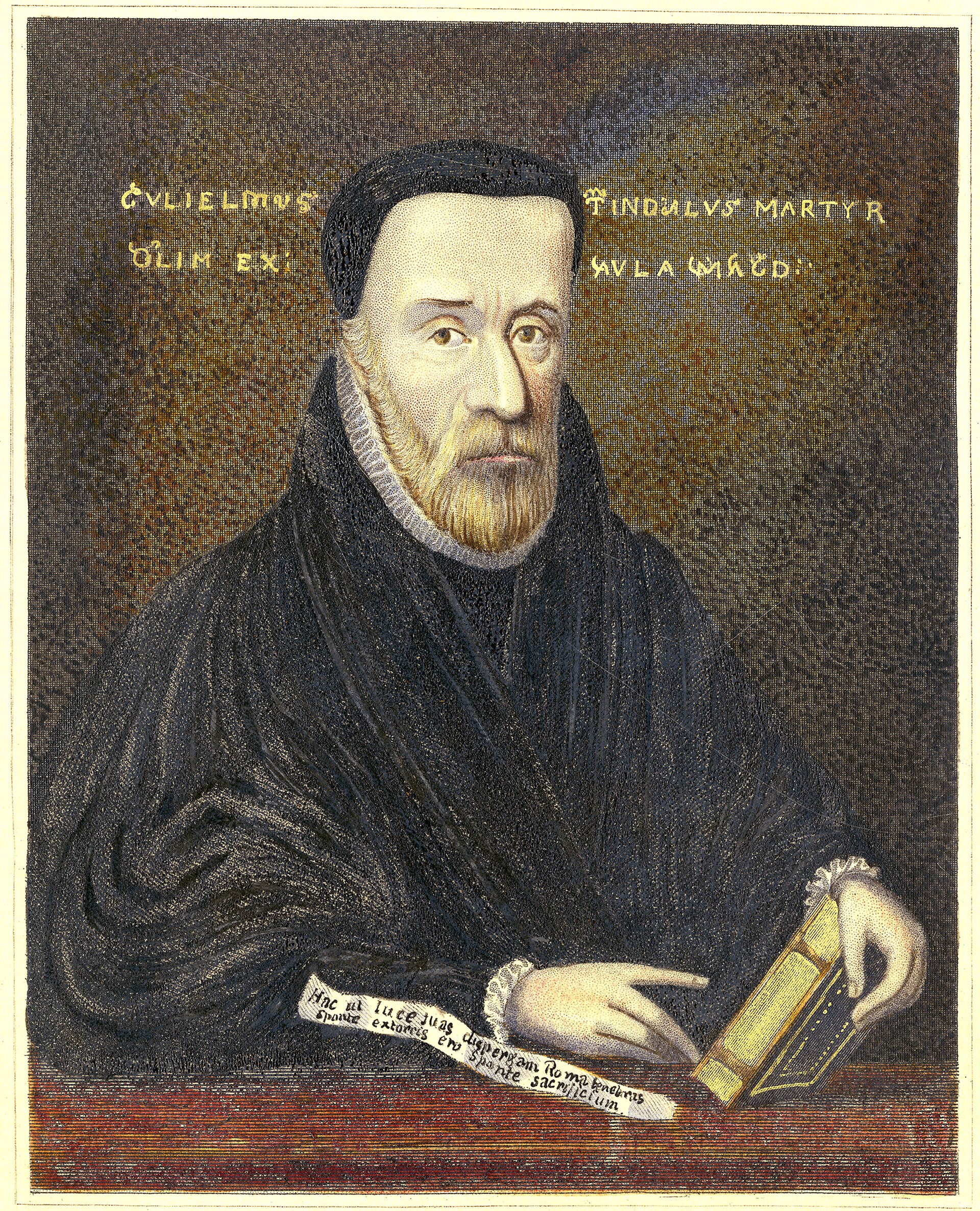
William Tyndale was born in Gloucestershire in the early 1490s; the exact year is not recorded. He studied at Magdalen Hall, Oxford, took his B.A. in 1512 and his M.A. in 1515, and is said by John Foxe to have spent time at Cambridge as well. About 1520 he became tutor to the children of Sir John Walsh at Little Sodbury Manor in Gloucestershire.1 There, by his own account, he quarrelled with the local clergy, was summoned before the diocesan chancellor, and decided that the remedy for what he saw as ignorance in religion was an English Scripture.
Tyndale explained his reasoning in the preface to his Pentateuch of 1530, "W.T. to the Reader." (The quotations from his prefaces below follow the modernized spelling of the transcription cited.) He wrote that he "had perceived by experience, how that it was impossible to stablish the lay people in any truth, except the scripture were plainly laid before their eyes in their mother tongue, that they might see the process, order, and meaning of the text."2 In 1523 he went to London hoping for the patronage of Cuthbert Tunstall, Bishop of London, a scholar whom Erasmus had praised. He carried with him a translation of an oration of Isocrates from the Greek to show his ability. Tunstall turned him away. In Tyndale's words: "my lord answered me, his house was full, he had more than he could well find, and advised me to seek in London, where he said I could not lack a service." After almost a year in London, living in the house of the merchant Humphrey Monmouth, he "understood at the last not only that there was no room in my lord of London's palace to translate the New Testament, but also that there was no place to do it in all England."2 In the spring of 1524 he left England for the Continent and never came back.1
The ploughboy remark and its source
The sentence most often quoted about Tyndale comes from John Foxe's Actes and Monuments (the "Book of Martyrs"). In the first edition of 1563, Foxe tells of a dispute at Little Sodbury in which a "learned man" said "we were better be without Gods lawe, then the Popes." Tyndale answered: "I defie the Pope and all his lawes, and sayde, if God spare my lyfe ere many yeares, I wyl cause a boye that dryveth the plough, shall knowe more of the scripture then thou doest."3
The story is famous, and its source needs weighing. Jan J. Martin, writing in the Religious Educator (2016), compared Foxe's editions and found that the wording shifted: in the 1570 edition the opponent becomes "a certayne Divine recounted for a learned man," and the promise is reported in the third person, that "he would cause a boy that driveth the plough to know more of the Scripture, then he did." Martin judged that the ploughboy story "does not have a definitive source," that Foxe's dialogue "may be partly or completely fictionalized and should be approached with caution," and that the image of the ploughing farmer had appeared earlier in Erasmus's Paraclesis (1516), where Erasmus wished that "the farmer sing some portion of them at the plow."3 Foxe wrote about four decades after the event and did not name his informant. The remark fits everything Tyndale wrote in his own prefaces, but its exact words rest on Foxe alone. It is rated in "Claims checked" below.
Cologne, 1525: the interrupted quarto
Tyndale spent about a year in Hamburg and finished a draft of the New Testament there. In 1525 he took it to Cologne, to the press of Peter Quentel, and printing began in quarto (a mid-sized book) with marginal notes. According to the account summarized by Kenyon, "Three thousand copies of the first ten sheets of it, in quarto, had been printed off when rumors of the work came to the ears of John Cochlaeus," a Catholic writer who was having his own books printed in the same shop. Cochlaeus learned the details from the printers, warned the authorities in England, and had the city authorities stop the work. Tyndale escaped to Worms with the printed sheets.1
A single incomplete copy of the Cologne printing survives. It contains Tyndale's prologue and the Gospel of Matthew from chapter 1 to chapter 22 (Kenyon describes it as "eight sheets," Matthew 1:1 to 22:12), and it is in the Grenville collection of the British Library (formerly the British Museum). Edward Arber published a photographic facsimile of it in 1871.14 Its marginal notes show Tyndale's dependence on Luther; Kenyon reported that "more than half the notes were taken directly from the German Bible, the rest being independent."1
Worms, 1526: the first printed English New Testament
At Worms, a city that had accepted the Lutheran reform, Tyndale had the New Testament set up again at the press of Peter Schoeffer the Younger. This time it was printed in octavo, a small book that could be carried in a pocket or hidden in a bale, and without the marginal notes. It appeared early in 1526. Kenyon gave the print run as 3,000 copies, a figure that comes from the reports of the time and cannot be checked against business records.1
Three copies of the Worms octavo are known today:
- The British Library copy. It lacks its title page. It once belonged to the Harley library and later to the Bristol Baptist College.1 The British Library later bought it from the college; Ralph Werrell, writing in the Tyndale Society's journal, gives the price as "one million pounds."5
- The Stuttgart copy. In the summer of 1996, the librarian Wiltrud Baumann of the Wurttemberg State Library (Wurttembergische Landesbibliothek) in Stuttgart identified an undated English New Testament in its collection as the 1526 Worms edition. A British Library specialist confirmed it. The Stuttgart library describes it as "the only complete copy of the 1526 New Testament," and it has the only known title page of the edition.6 The title reads, in part, "The newe Testament as it was written, and caused to be written, by them which herde yt." Tyndale's name does not appear.5
- The St Paul's Cathedral copy. An imperfect copy, missing many leaves, in the library of St Paul's Cathedral, London.1
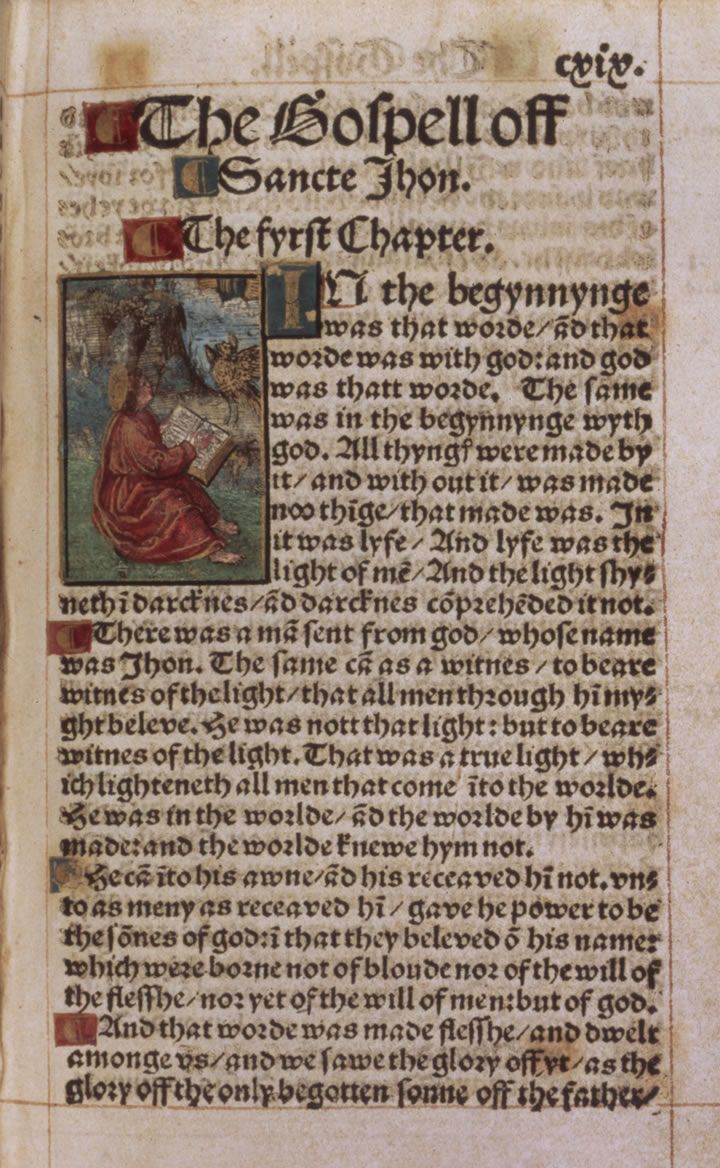
The Worms book was the first printed New Testament in English and the first English New Testament translated from the Greek. Its first page of John, reproduced below, reads (abbreviations expanded, spelling as printed): "In the begynnynge was that worde, and that worde was with god: and god was thatt worde." The online transcriptions of Tyndale's New Testament, which follow his revised text, read "the worde," the form the King James Version kept.7

What Tyndale translated from
Tyndale's New Testament was made from the Greek text printed by Erasmus. Kenyon summarized the evidence: it "was taken from the Greek, which he knew from the editions by Erasmus, published in 1516, 1519, and 1522. As subsidiary aids he employed the Latin version attached by Erasmus to his Greek text, Luther's German translation of 1522, and the Vulgate; but it has been made abundantly clear that he excercised independent judgment in the use of these materials, and was by no means a slavish copier of Luther."1 (The spelling "excercised" is in the transcription cited.) The Greek behind Tyndale is therefore the Erasmian text that later grew into the Textus Receptus, described in lesson 05. Readers who want to see that Greek for themselves can start with the reading aids taught in Intro to Classical Greek, lesson 20.
Tyndale argued that English was well suited to receive both biblical languages. In The Obedience of a Christian Man (1528) he answered those who said Scripture could not be put into English because the language was too rough: "They will say it cannot be translated into our tongue it is so rude. It is not so rude as they are false liars. For the Greek tongue agreeth more with the English than the Latin. And the properties of the Hebrew tongue agreeth a thousand times more with the English than with the Latin." (Spelling modernized here; the words were checked against the text of the 1548 London printing.)8
Tyndale on his own work
The Worms octavo closed with a short address "To the Reader" that shows how Tyndale regarded the book. He asked learned readers to be patient with "the rudeness of the work now at the first time," because "I had no man to counterfeit, neither was helped with English of any that had interpreted the same or such like things in the Scripture beforetime." He called the translation "a thing not having his full shape, but as it were born before his time, even as a thing begun rather than finished," and promised that "In time to come (if God have appointed us thereunto) we will give it his full shape, and put out if aught be added superfluously, and add to if aught be overseen through negligence."4
The same address told readers how to read: "Mark the plain and manifest places of the Scriptures, and in doubtful places see thou add no interpretation contrary to them." It also set out the distinction that ran through all Tyndale's theology: "Note the difference of the Law and of the Gospel. The one asketh and requireth, the other pardoneth and forgiveth."4 In the 1530 Pentateuch preface he insisted that Scripture "hath but one simple literal sense whose light the owls cannot abide," and offered to submit his work to correction by anyone who would first produce a better one: he would let it be "disallowed and also burnt, if it seem worthy when they have examined it with the Hebrew, so that they first put forth of their own translating another that is more correct."2
Burning and smuggling
Copies of the Worms New Testament reached England in 1526 and were condemned at once. Kenyon summarized the response: "Wolsey and the bishops, with Henry's assent, decreed that it should be burnt; and burnt it was at Paul's Cross, after a sermon from Bishop Tunstall." Agents tried to buy up copies abroad to destroy them, with the result, as the old story goes, that "the money expended in buying up copies for destruction serving to pay for the production of fresh editions." Kenyon added that "Six editions are said to have been issued between 1526 and 1530," some of them unauthorized reprints by Antwerp printers.1 Tyndale himself wrote of the burnings without surprise. Ray L. Huntington and W. Jeffrey Marsh quote him from the preface to The Parable of the Wicked Mammon: "in burning the New Testament they did none other thing than that I looked for."9
In 1530 an assembly called by Archbishop William Warham confirmed the condemnation of Tyndale's books and declared that it was not expedient at that time to publish Scripture in English, while announcing that the king would have the New Testament "faithfully translated by learned men" and published "as soon as he might see their manners and behavior meet, apt, and convenient to receive the same."1 That promise is the thread that leads, through Coverdale and Cromwell, to the Great Bible nine years later.
The word war with Thomas More
The sharpest attack on Tyndale's translation came from Sir Thomas More, the humanist scholar and later Lord Chancellor, in his Dialogue Concerning Heresies (1529). More's speaker claims that in Tyndale's New Testament "there were found and noted wrong and falsely translated above a thousand texts by tale," and then picks out "three words of great weight": "The one is ... this word 'priests'; the other, the 'church'; the third, 'charity.' For priests, wheresoever he speaketh of the priests of Christ's church, he never calleth them 'priests,' but always 'seniors'; the Church he calleth always the 'congregation'; and charity he calleth always 'love.'"10 More argued that Tyndale "had a mischievous mind in the change," because the new words loosened the link between the Greek text and the church's offices and sacraments.
Tyndale replied at length in An Answer unto Sir Thomas More's Dialogue, defending his words from the Greek, and More answered in turn with The Confutation of Tyndale's Answer.9 The words themselves are easy to check, because Tyndale's text survives. In Matthew 16:18 the online transcription of his New Testament (which follows his revised text) reads: "And I saye also vnto the yt thou arte Peter: and apon this rocke I wyll bylde my congregacion." In 1 Corinthians 13:13 it reads: "Now abideth fayth hope and love even these thre: but the chefe of these is love."7 The table shows how later English Bibles handled the same words. Spelling is given as transcribed in the online editions cited; "the" in "vnto the" is the old spelling of "thee."
| Greek word | Tyndale (revised text) | Coverdale 1535 | Great Bible 1539 | Geneva (1587 printing) | Bishops' 1568 | KJV 1611 |
|---|---|---|---|---|---|---|
| ekklesia (Matthew 16:18) | congregacion | cogregacion | congregacion | Church | congregation | church |
| agape (1 Corinthians 13:13) | love | loue | loue | loue | loue | charity |
| presbyteros (1 Peter 5:1) | "seniors" in 1526 (according to More); "elders" in the revised text | Elders | elders | elders | elders | elders |
Sources: Bible Hub and StudyBible.info parallel texts for Matthew 16:18, 1 Corinthians 13:13 and 1 Peter 5:1; Thomas More, Dialogue Concerning Heresies, for the 1526 reading "seniors."71110
The King James translators sided with More on "church" and "charity" and with Tyndale on "elder." The rules given to them in 1604 required: "The old ecclesiastical words to be kept, as the word church, not to be translated congregation."12 The quarrel over these words, which looked like a matter of vocabulary, was really a quarrel over what the church is. It continued in the prefaces of the Rheims New Testament (below) and of the King James Version itself (lesson 07).
The Pentateuch of 1530 and Jonah
Tyndale learned Hebrew on the Continent, at a time when few Englishmen knew it. His translation of the five books of Moses was printed in 1530. The colophon of Genesis is dated January 17, 1530, and names "Hans Luft" at "Malborow in the lande of Hesse," that is, Marburg. Kenyon accepted that imprint in 1909.1 Many later scholars regard the Hans Luft imprint as a cover and assign the printing to Antwerp; this lesson has not been able to confirm the printer from a primary source and leaves the question open. The books were set separately (Genesis and Numbers in black letter, Exodus, Leviticus and Deuteronomy in roman type), and Kenyon wrote that "The only perfect copy of this edition is in the British Museum."1
This was the first English translation of any part of the Old Testament made from the Hebrew.1 It came with a prologue to each book and with marginal notes, some of them pointed attacks on the papacy. Its English shows the same plain, spoken quality as the New Testament. In Genesis 3:4 the serpent says to the woman, in Tyndale's words, "tush ye shall not dye"; Coverdale (1535) kept "Tush, ye shall not dye the death," and the King James Version smoothed it to "Ye shall not surely die."7 Several English words and phrases are commonly credited to Tyndale's Pentateuch, among them "Passover," "scapegoat" and "mercy seat," and he used the form "Iehouah" (Jehovah) for the divine name in a few places. Credit for coining a word is hard to prove, since an older use may turn up later; Huntington and Marsh list "Jehovah," "Passover" and "scapegoat" among his contributions without giving the earlier evidence.9
In 1531 Tyndale published the Book of Jonah with a prologue. Only one copy is known, which came to light in 1861 and is in the British Library.1
The revised New Testament of 1534 and the "GH" edition of 1535
In 1534 George Joye, a former associate, issued at Antwerp a corrected reprint of Tyndale's New Testament that changed some of its wording without Tyndale's consent. Tyndale answered with his own thorough revision, printed at Antwerp (the imprint reads "Marten Emperowr," an English form of the name of the printer Martin de Keyser) and published in November 1534.113 It is a small, thick volume, about six inches tall.9 Nearly every book has a prologue (most adapted from Luther, except the prologue to Hebrews, where Tyndale defends the book's authority against Luther's doubts). It has new marginal notes, the church's lectionary readings marked, and an appendix of "The Epistles taken out of the Old Testament, which are read in the church after the use of Salisbury upon certain days of the year," which adds forty-two short Old Testament passages to the body of Tyndale's translation.1 One copy printed on vellum, with the name of Anne Boleyn on its edges, is in the British Library.1
The 1534 text is the one that mattered most for later English Bibles. A further edition "yet once again corrected," bearing the monogram of the publisher Godfried van der Haghen and known as the "GH" edition, appeared in 1535 with small changes; it was printed by Martin de Keyser, and only four copies survive, according to the bibliography cited.131 Those 1535 printings were the last Tyndale supervised.
Arrest and death
In May 1535 Tyndale was betrayed by an Englishman named Henry Phillips, arrested in Antwerp by officers of the Emperor Charles V, and imprisoned in the castle of Vilvoorde near Brussels.9 He was tried for heresy, condemned, strangled and burned in 1536; the traditional date of his execution is October 6, 1536.1 His arrest, his surviving letter from prison and the account of his last words are examined in Martyrs Briefs, lesson 05. This lesson keeps to his translations, which outlived him.
How much of Tyndale is in the King James Version?
Readers of the King James Version are reading a great deal of Tyndale, and the amount can be measured. In 1998 John Nielson and Royal Skousen published "How Much of the King James Bible Is William Tyndale's? An Estimation Based on Sampling" in the journal Reformation (volume 3). Comparing sample passages, they estimated that Tyndale's wording makes up "nearly 84 percent of the New Testament" and "close to 76 percent of the portions of the Old Testament" that Tyndale translated, as Huntington and Marsh report their results.9 The Old Testament figure applies only to the books Tyndale translated (the Pentateuch, Jonah and, if the attribution discussed below is right, Joshua to 2 Chronicles). The rest of the King James Old Testament descends through Coverdale, the Great Bible, Geneva and the Bishops' Bible, all of which also drew on Tyndale where they could.
A single verse shows the inheritance. Tyndale's John 3:16, in the online transcription of his New Testament, reads "For God so loveth the worlde yt he hath geven his only sonne that none that beleve in him shuld perisshe: but shuld have everlastinge lyfe." The King James Version of 1611 (in modern spelling) reads "For God so loved the world, that he gave his only begotten Son, that whosoever believeth in him should not perish, but have everlasting life."7 The structure and most of the words are Tyndale's; "only begotten" and "whosoever" entered through later revisions, as the comparison table further on shows.
Miles Coverdale and the first complete printed English Bible (1535)

Coverdale the man
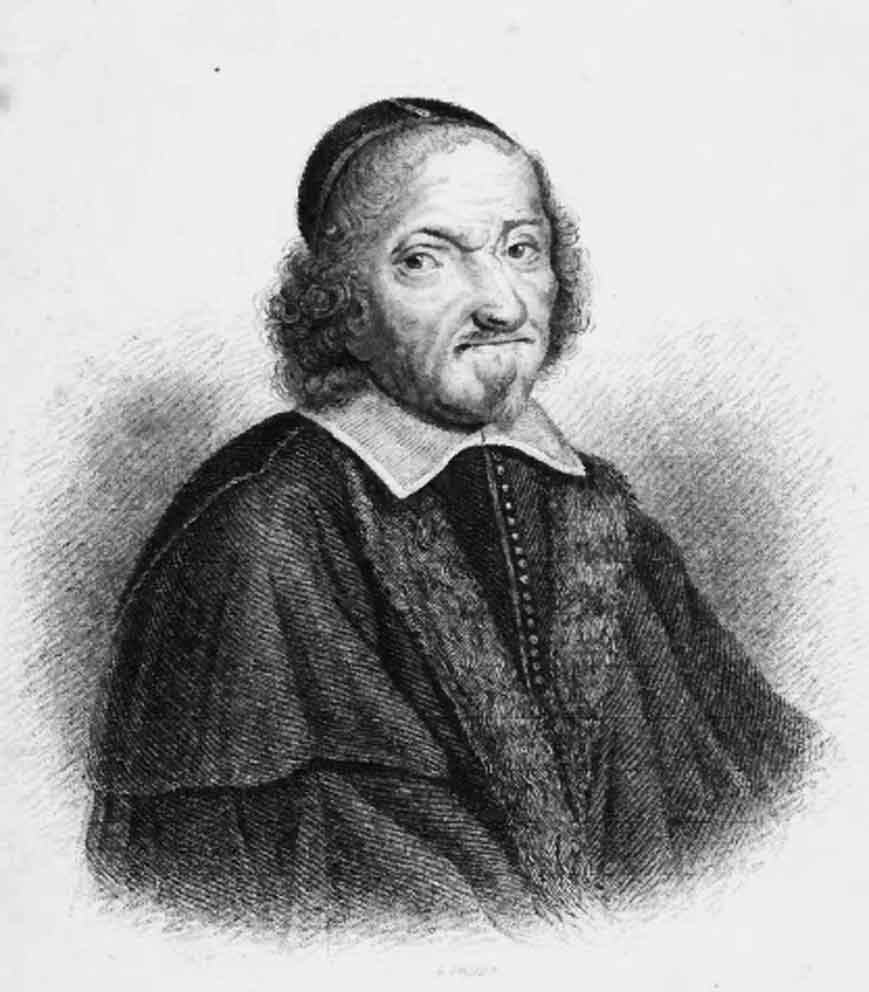
Miles Coverdale was later Bishop of Exeter (1551 to 1553). Kenyon wrote that "Coverdale met Tyndale abroad in 1529, and is said to have assisted him in the translation of the Pentateuch," and that his own Bible was produced "under the patronage of Cromwell," at a time when Convocation, "under Cranmer's leading, had petitioned in 1534" for an English Bible.14 Coverdale was a gifted writer of English prose and a modest scholar, and he said so himself. The prologue to his Bible begins: "CONSIDERING How excellent knowlege and learning an interpreter of scripture ought to have in the tongues, and pondering also mine own insufficiency therein, and how weak I am to perform the office of a translator, I was the more loath to meddle with this work."15
Printed in 1535
The colophon of Coverdale's Bible states that it was "Prynted in the yeare of our Lorde M.D.XXXV and fynished the fourth daye of October," that is, October 4, 1535.16 It does not name the place or printer. Kenyon in 1909 thought it "probably printed by Froschover at Zurich," while admitting this "has never been absolutely demonstrated."14 In the Tyndale Society's journal, the Belgian scholar Guido Latré argued from the woodcuts (whose captions use Dutch spellings, and six of whose blocks reappear in Matthew's Bible of 1537) and from the evidence for Antwerp collected by J. F. Mozley that "Antwerp can already be named as the most likely place of origin for the Coverdale Bible of 1535." He also cited a biographical sketch of the son of the Antwerp merchant Jacob van Meteren that recalls Jacob's zeal "in bearing the cost of the translating and printing of the English Bible at Antwerp."16 Later scholarship has named the Antwerp printer Merten de Keyser, the same man who printed Tyndale's 1534 New Testament; this lesson treats that identification as probable and has not confirmed it from a primary source.
"Out of Douche and Latyn"
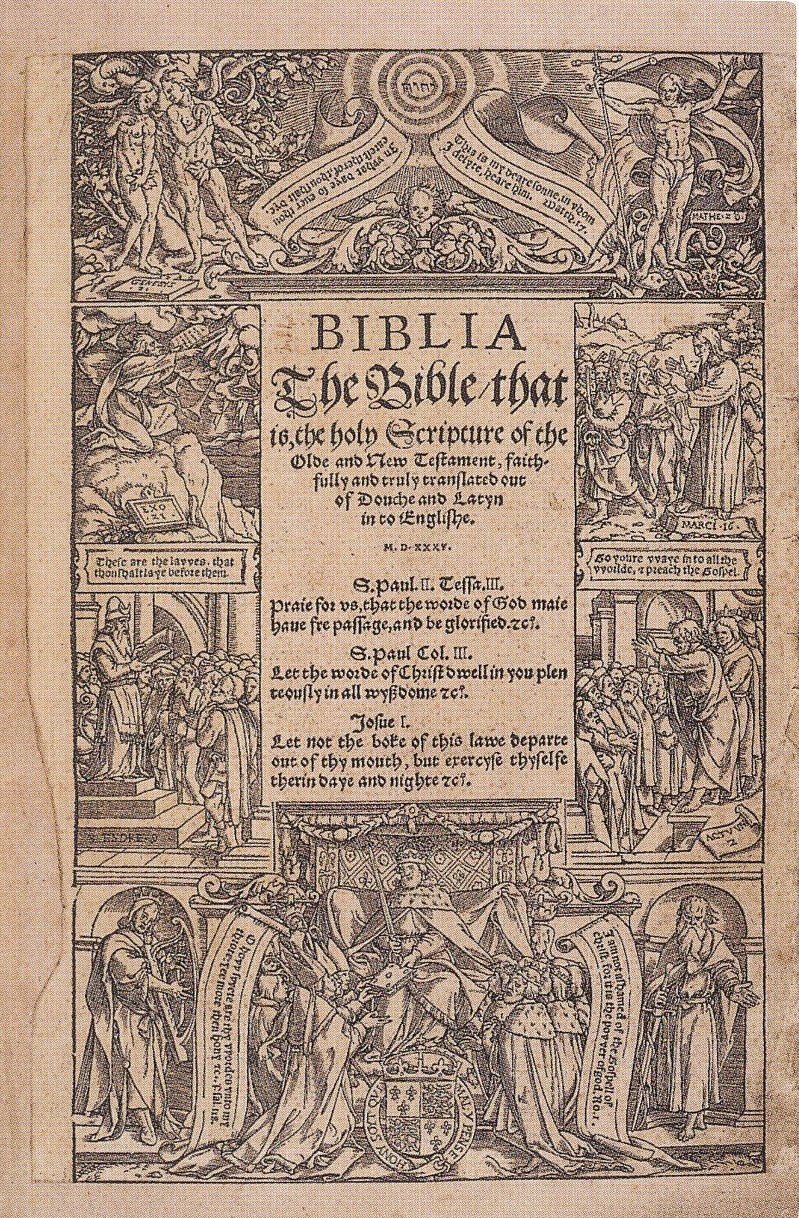
Coverdale's title page says plainly what the book is: "BIBLIA The Bible, that is, the holy Scripture of the Olde and New Testament, faythfully and truly translated out of Douche and Latyn in to Englishe. M.D.XXXV."17 "Douche" means German (the word "Dutch" then covered German as well as Netherlandish). In his dedication to Henry VIII, Coverdale protested that "I have never wrested nor altered so much as one word for the maintenance of any manner of sect: but have with a clear conscience purely and faithfully translated this out of five sundry interpreters, having only the manifest truth of the scripture before mine eyes."15 In the prologue he named the kinds of sources: "I have had sundry translations, not only in Latin, but also of the Dutch interpreters: whom (because of their singular gifts and special diligence in the Bible) I have been the more glad to follow for the most part."15
Coverdale did not name his five interpreters. Kenyon named the versions he can be shown to have used: Tyndale's work (the New Testament, the Pentateuch and Jonah), "the Zurich German Bible of Zwingli and others (1524-1529), a Latin version by Pagninus, the Vulgate, and Luther." He concluded that "there is no sign that he made any noticeable use of the Greek and Hebrew; but he used the available Latin, German, and English versions with judgment. In the parts of the Old Testament which Tyndale had not published he appears to have translated mainly from the Zurich Bible."14 Coverdale's Bible was thus a translation of translations for most of the Old Testament, and a revision of Tyndale for the rest. Coverdale did not hide this. He argued in the prologue that many translations help the church: "it was never better with the congregation of God, than when every church almost had the Bible of a sundry translation."15

The Apocrypha set apart
Coverdale's Bible was the first printed English Bible to gather the books now called the Apocrypha into a separate section. Following Luther's arrangement, by way of Tyndale's example as Kenyon judged, it was divided into six parts: the Pentateuch; Joshua to Esther; Job to "Solomon's Balettes" (the Song of Songs); the Prophets; the "Apocrypha, the books and treatises which among the fathers of old are not reckoned to be of like authority with the other books of the Bible, neither are they found in the canon of the Hebrew"; and the New Testament.14 Kenyon judged that "so far as concerns the English Bible, Coverdale's example was decisive."14 The history of the canon question, including the Council of Trent's decree of 1546 and Article VI of the Church of England, is told in lesson 03.
Licensed in 1537
The 1535 Bible carried a dedication to Henry VIII that also greeted his "most virtuous Princess, Queen Anne,"15 and was tolerated in England. When the next edition appeared in 1537, printed by Nycolson of Southwark, its title page bore the words (in Kenyon's modernized spelling) "Set forth with the King's most gracious license." Kenyon remarked that "In thus licensing Coverdale's translation, Henry probably did not know how far he was sanctioning the work of Tyndale, which he had previously condemned."14 Kenyon judged that Coverdale's second edition of 1537, rather than Taverner's Bible of 1539, was probably the first complete English Bible printed in England.18
Coverdale's English has outlived his scholarship. His Psalms, revised for the Great Bible, were kept in the Church of England's Book of Common Prayer when the other Scripture passages were changed to the King James wording in 1662. Kenyon wrote in 1909 that "Coverdale's version has held its place in the Book of Common Prayer to this day, and it is in his words that the Psalms have become the familiar household treasures of the English people."19 Some of his choices did not last. In Jeremiah 8:22 he wrote "there is no more Triacle at Galaad" (triacle, or treacle, was a medicinal compound); the Geneva Bible's "Is there no balme at Gilead?" is the phrase the King James Version kept.7
The Matthew Bible of 1537
In the same year as Coverdale's licensed edition, a second complete Bible appeared with "the king's most gracious license." Its title page reads: "The Byble, which is all the holy Scripture: In whych are contayned the Olde and Newe Testament truly and purely translated into Englysh by Thomas Matthew," with a verse from Isaiah 1 and the date "M,D,XXXVII."20 No translator named Thomas Matthew is known. Tradition, supported by the record of his later arrest, identifies the editor as John Rogers, "a friend and companion of Tyndale," in Kenyon's words. When Rogers was arrested in 1555, the record called him "John Rogers alias Matthew."21
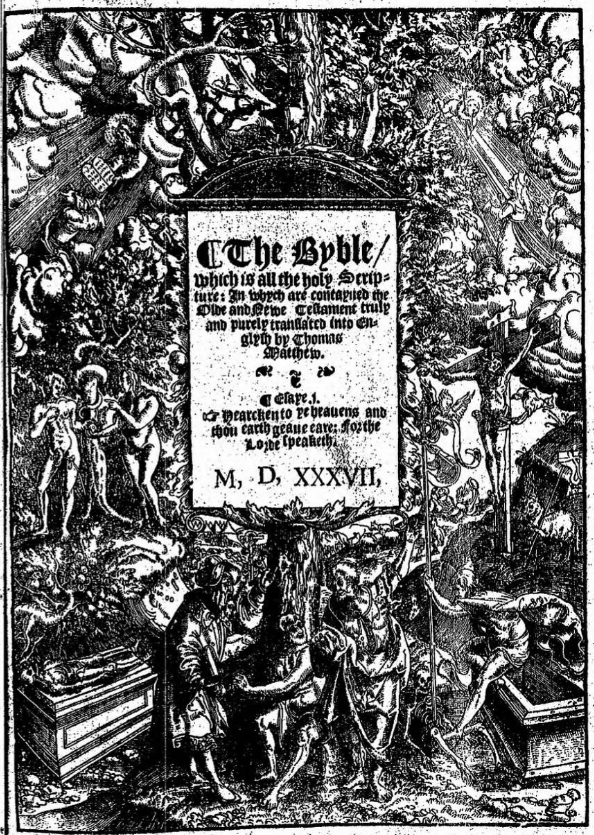

Kenyon described the contents. "The Pentateuch and New Testament are taken direct from Tyndale with little variation (the latter from the final 'GH' revision of 1535). The books of the Old Testament from Ezra to Malachi (including Jonah) are taken from Coverdale, as also is the Apocrypha. But the historical books of the Old Testament (Joshua through 2 Chronicles) are a new translation."21 That new translation is generally believed to be Tyndale's unpublished work, which Rogers had in his hands after Tyndale's arrest. The evidence is threefold: the style matches Tyndale's; the Old Testament "Epistles" in Tyndale's 1534 New Testament agree with the Matthew Bible in those books and not in the books taken from Coverdale; and Edward Hall's Chronicle, published by Richard Grafton, one of the Matthew Bible's own publishers, says that Tyndale translated "the v bookes of Moses, Josua, Judicum, Ruth, the bookes of the Kynges and the bookes of Paralipomenon [Chronicles], Nehemias or the fyrst of Esdras, the prophet Jonas, and no more of ye holy scripture."21 Large initials printed in blank spaces through the Old Testament include "I.R." (Ioannes Rogers) and "W.T." (William Tyndale), a quiet signature for a man who had been executed as a heretic the year before.21
The Matthew Bible was printed abroad at the cost of two London merchants, Richard Grafton and Edward Whitchurch. On August 4, 1537, Archbishop Thomas Cranmer sent a copy to Thomas Cromwell, praised the translation and asked Cromwell to obtain the king's license for it, which Cromwell did.21 So, about ten months after Tyndale's death, most of his translation was being sold in England with royal permission, under a false name. The Matthew Bible's notes were outspokenly Protestant, and it included Tyndale's prologue to Romans.21 John Rogers was burned at the stake under Mary I in 1555;19 his story is told in Martyrs Briefs, lesson 06.
Taverner's Bible (1539)
Richard Taverner, formerly a student of Cardinal College, Oxford, and "a good Greek scholar," revised the Matthew Bible in 1539 at the invitation of London printers. His changes in the Old Testament were stylistic; in the New Testament he made corrections from the Greek. Kenyon judged that it "had no influence on the general development of the English Bible," because the Great Bible appeared the same year and replaced it.18
The Great Bible of 1539
A Bible for every parish
The Matthew Bible solved one problem and created another. It gave England a licensed Bible, but its notes were controversial and its debt to Tyndale was obvious to anyone who looked. Kenyon observed that Cromwell and Cranmer "had, no doubt, been careful not to call Henry's attention to these circumstances; but they might at any time be brought to his notice, when their own position would become highly precarious."19 Cromwell therefore engaged Coverdale to revise the Matthew Bible into a version without controversial notes, fit to be placed in churches.
Before it was finished, Cromwell, as the king's vicegerent in church matters, issued his second set of royal injunctions to the clergy in 1538. The second injunction ordered "That ye shall provide on this side the feast of Easter next coming, one book of the whole Bible of the largest volume in English, and the same set up in some convenient place within the said church that you have cure of, whereas your parishioners may most commodiously resort to the same and read it, the charge of which book shall be ratably born between you the parson and the parishioners aforesaid, that is to say one half by you, and the other half by them." The third ordered that the clergy "shall discourage no man privily or apertly from the reading or hearing of the said Bible, but shall expressly provoke, stir, and exhort every person to read the same," while warning readers to avoid "contention" and to "refer the explanation of obscure places to men of higher judgement in Scripture."22
Printed in Paris and London
To get the best printing available, the work was begun in Paris at the press of Francois Regnault in 1538, with the French king's permission. The Inquisition intervened, stopped the printing and seized the sheets. Some sheets had already been sent to England; others were bought back; and, in Kenyon's account, "under Cromwell's direction, printers and presses were transported from Paris to London, and the work completed there by Grafton and Whitchurch."19 The first edition appeared in April 1539 under the title "The Byble in Englyshe," the words painted in gold in the copy shown below.23 Coverdale used Sebastian Munster's Latin translation from the Hebrew (1534 to 1535) for the Old Testament and Erasmus for the New, and Kenyon credited him with "scholarship enough to choose and follow the best authorities." But Coverdale also "introduced a considerable number of words and sentences from the Vulgate, which do not appear in the Hebrew or Greek."19
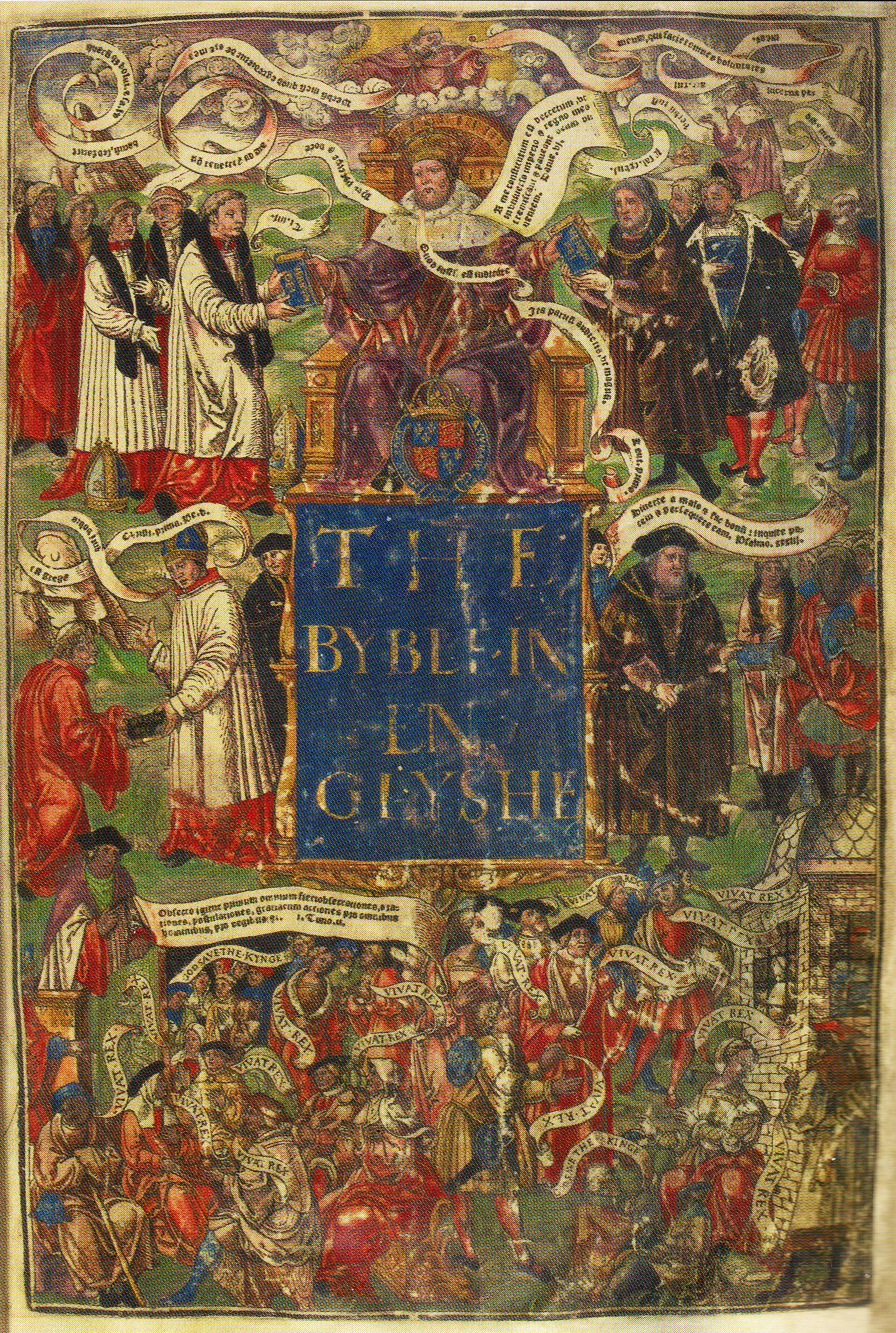

The title page, traditionally attributed to Hans Holbein, is itself a statement of royal policy. W. F. Moulton described it in 1878: "The king hands the word of God (Verbum Dei) to bishops and clergy on his right hand, to Cromwell and others of the laity on his left," and the people below respond with "the shouts of 'Vivat Rex,' and 'God save the king.'"24 In this picture the Bible reaches the people through the king, the archbishop and the king's minister, in that order.
Cranmer's preface of 1540
The first edition sold out within a year. The second edition, of April 1540, carried a prologue by Archbishop Cranmer and the words "This is the Bible appointed to the use of the churches" on its title page, which is why the Great Bible is sometimes called "Cranmer's Bible" even though Cranmer did not translate it.2519 Cranmer addressed two kinds of reader. "For truly some there are that be too slow and need the spur, some other seem too quick, and need more of the bridle." The slow were those "that refuse to read or to hear read the scripture in the vulgar tongue"; the quick were those who "by their inordinate reading, indiscrete speaking, contentious disputing, or otherwise by their licentious living, slander and hinder the word of God."25 Against the first group he appealed to history: "it is not much above one hundred years ago, since scripture hath not been accustomed to be read in the vulgar tongue within this realm. And many hundred years before that, it was translated and read in the Saxons' tongue."25 For his main argument he drew on the fourth century preacher John Chrysostom, who had urged that "every man should read by himself at home in the mean days and time, between sermon and sermon."25
Seven editions came out between 1539 and 1541, and none, Kenyon noted, "was a simple reprint."19 Cromwell fell from power and was executed in 1540; the fourth edition, of November 1540, appeared under the names of Bishops Tunstall and Heath, the same Tunstall who had preached at the burning of Tyndale's New Testament.19 Kenyon called it "the first (and only) English Bible formally authorized for public use."19
Reaction under Henry and Mary
Henry VIII grew more cautious in his last years. Kenyon wrote that "In 1543 a proclamation was issued against Tyndale's versions, and requiring the obliteration of all notes; in 1546 Coverdale's New Testament was likewise prohibited." Under Edward VI many editions of Tyndale, Coverdale, Matthew and the Great Bible were printed again. Under Mary I (1553 to 1558), English Bibles were no longer printed, Rogers and Cranmer were burned, and Coverdale was imprisoned, then released, and went into exile.19
The Geneva Bible
The exiles in Geneva
Many English Protestants left England in Mary's reign, and a group of them gathered in Geneva, where John Calvin led the church and Theodore Beza was at work on his Greek New Testament (see lesson 05). One of them, William Whittingham, a fellow of All Souls College, Oxford, and later Dean of Durham, published an English New Testament at Geneva in 1557. Kenyon called it "the handiest form in which the English Scriptures had yet been given to the world" and listed its firsts: "It was the first version to be printed in roman type, and the first in which the division of the text into numbered verses (originally made by Robert Stephanus for his Greaco-Latin Bible of 1551) was introduced." Calvin contributed a preface.26
A team then revised both Testaments. Kenyon named the principal workers, besides Whittingham, as "Thomas Sampson, formerly dean of Chichester, and afterwards dean of Christ Church, and A. Gilby, of Christ's College, Cambridge," while noting that "The details of the work are not recorded."26 The Encyclopaedia Britannica states instead that the work was done "under the general direction of Miles Coverdale and John Knox."27 The two accounts are not exclusive, and the surviving records do not settle the exact division of labor.
The Bible of 1560
The complete Bible was published at Geneva in 1560. Its title page reads: "THE BIBLE AND HOLY SCRIPTVRES CONTEYNED IN THE OLDE AND NEWE Testament. TRANSLATED ACCORding to the Ebrue and Greke, and conferred With the best translations in diuers langages. WITH MOSTE PROFITABLE ANNOTAtions vpon all the hard places, and other things of great importance as may appeare in the Epistle to the Reader." At the foot: "AT GENEVA. PRINTED BY ROULAND HALL. M.D.LX."28 The woodcut in the middle shows the Israelites at the Red Sea with Pharaoh's army behind them, under the text "Feare ye not, stand stil, and beholde the saluacion of the Lord" (Exodus 14:13).
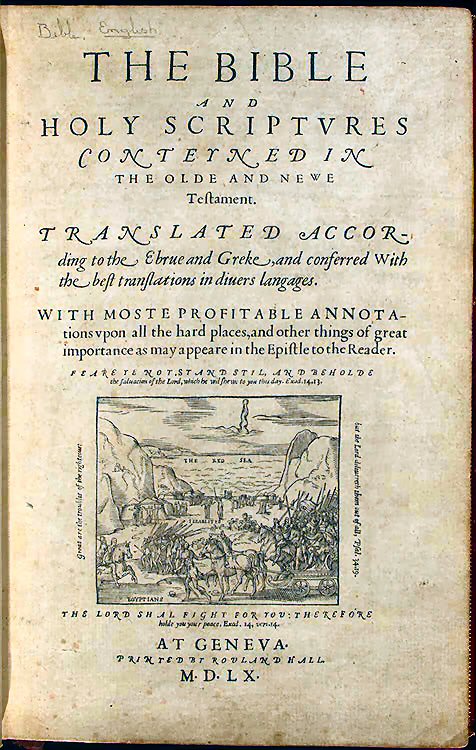

The translators explained their methods in an address dated "From Geneva, 10 April 1560" and directed "To our beloved in the Lord, the brethren of England, Scotland, Ireland, &c." (quoted here in modernized spelling). They said they had worked "for the space of two years and more day and night," and that they had "most reverently kept the propriety of the words," retaining Hebrew idioms even where "they may seem somewhat hard in their ears that are not well practiced." Words supplied to complete the English sense were set in a different typeface: "we have put it in the text with another kind of letter, that it may easily be discerned from the common letter." On verses they wrote: "As touching the division of the verses, we have followed the Hebrew examples, which have so even from the beginning distinct them." They added chapter summaries, a running head on each page, "brief annotations upon all the hard places," woodcut figures for difficult passages in Exodus, Kings and Ezekiel, "certain maps of cosmography," and two tables, one of Hebrew names and one of the chief matters of the whole Bible.29
Kenyon summed up the sources: "The Genevan revisers took the Great Bible as their basis in the Old Testament, and Matthew's Bible (i.e. Tyndale) in the New Testament," consulting the Latin Bibles of Leo Jud and Pagninus and, for the New Testament, Beza, "whose reputation stood highest among all the Biblical scholars of the age."26 The result was the most accurate English Bible yet made, in a moderate-sized quarto that ordinary households could afford. The large folio Bibles before it were church books; the Geneva Bible became the Bible people owned and read at home.26
The notes, and why a king disliked them
The Geneva notes made the book a study Bible, and they also made it a target. Kenyon described them as "predominantly horatory or monitory in character, but Calvinistic in general tone, and occasionally definitely polemical."26 Most notes explain a word, give a cross reference or draw a moral. A few touched the authority of rulers. At Exodus 1:19, where the Hebrew midwives disobey Pharaoh's order to kill the boys and then give him an evasive answer, the note (as given in a modernized transcription of the 1599 printing) reads: "Their disobedience in this was lawful, but their deception is evil."30 At 2 Chronicles 15:16, where King Asa removes his mother Maachah from her position as queen mother because of her idol, the note says Asa "lacked zeal," that she ought to have died under both the covenant and God's law, and that he showed "foolish pity" in only deposing her.31
At the Hampton Court Conference in January 1604, King James I singled out exactly these notes. William Barlow's official account, The Summe and Substance of the Conference, reports that the king said he "could never yet see a Bible well translated in English; but the worst of all, his Majesty thought the Geneva to be," and that he gave the caution that no marginal notes should be added to the new translation, "having found in them which are annexed to the Geneva translation ... some notes very partial, untrue, seditious, and savouring too much of dangerous, and traitorous conceits." As examples Barlow names "the first Chapter of Exodus and the nineteenth Verse, where the marginal Note alloweth Disobedience unto Kings," and the note on 2 Chronicles 15:16 that "taxeth Asa for deposing his mother, only, and not killing her." (Spelling modernized from the 1638 printing; the scanned text of that printing is imperfect, and the word read here as "partial" should be checked against a facsimile.)32 That conversation led to the King James Version and to its rule that "No marginal notes at all" be added except to explain Hebrew or Greek words, which is told in lesson 07.12
Editions and revisions
After years of import from abroad, the Geneva Bible was printed in England from 1576, and, in the words of the Britannica, it "quickly surpassed the Great Bible in public favour."27 Kenyon wrote that "Over 160 editions of it are said to have been issued"; the count depends on how New Testaments and reissues are counted.26 In 1576 Laurence Tomson published a revision of the New Testament that followed Beza even more closely, and it was often bound with the Geneva Old Testament in place of the 1560 New Testament.26 For a full century, Kenyon judged, it "continued to be the Bible of the people," and "it was upon this version, and not upon that of King James, that the Bible knowledge of the Puritans of the Civil War was built up."26
The Geneva Bible's best-known nickname comes from Genesis 3:7, where Adam and Eve "sewed figge tree leaues together, and made them selues breeches." Tyndale, Coverdale and the Great Bible had "apurns" or "aperns" (aprons), the Bishops' Bible "apernes," and the King James Version "aprons." Collectors call the Geneva Bible the "Breeches Bible."71127
Shakespeare and the Pilgrims
Two claims about the Geneva Bible are repeated often. The first is that it was Shakespeare's Bible. Tausha Hewlett's article in the Early Modern England Encyclopedia (University of Victoria) reports that "scholars have determined that Shakespeare relied mainly on language from the Geneva Bible," while noting that "the Bishop's Bible, first printed in 1568, was the bible people heard in church every week."33 Hewlett's sources include Naseeb Shaheen's Biblical References in Shakespeare's Plays, the standard study of which English version lies behind each of Shakespeare's allusions.
The second claim is that the Pilgrims brought the Geneva Bible to New England. Pilgrim Hall Museum in Plymouth, Massachusetts, states: "The Pilgrim Separatists used the 'Geneva Bible.'" It displays "The 1592 Geneva Bible that belonged to Pilgrim William Bradford," which, the museum says, "journeyed with Bradford from England to Holland and eventually to Plymouth." The same museum also holds a 1620 King James Bible that belonged to John Alden of the Mayflower company.34 Both versions were present in early Plymouth; the Geneva was the Separatists' own.
The Bishops' Bible of 1568
In the early years of Elizabeth I, the Great Bible remained the Bible of the parish churches, and the Geneva Bible was plainly better. Kenyon described the position: "the superiority of the Genevan to the Great Bible could not be contested," yet the Geneva notes and the Genevan connection made it unwelcome to the queen and most of the bishops.35 Archbishop Matthew Parker organized a revision of the Great Bible by a panel, most of whom were bishops, hence the name. Parts were assigned to different revisers under Parker's general supervision, and Kenyon found the results "naturally unequal": in the Old Testament "the alterations were mainly verbal," while the New Testament showed "a much higher level" of scholarship. The revisers made use of the Geneva Bible. Their notes were shorter than Geneva's and mostly explanatory.35
The Bishops' Bible appeared in 1568 from the press of Richard Jugge, a large folio slightly bigger than the Great Bible. Parker sought royal approval through William Cecil, but Kenyon found no evidence that it was granted. Convocation in 1571 required a copy in every archbishop's and bishop's house, in every cathedral and, as far as possible, in all churches. A second edition with many changes followed in 1569 and a third in 1572.35 The second edition's title page, printed on vellum and colored by hand in the British Library copy, shows Queen Elizabeth enthroned.36
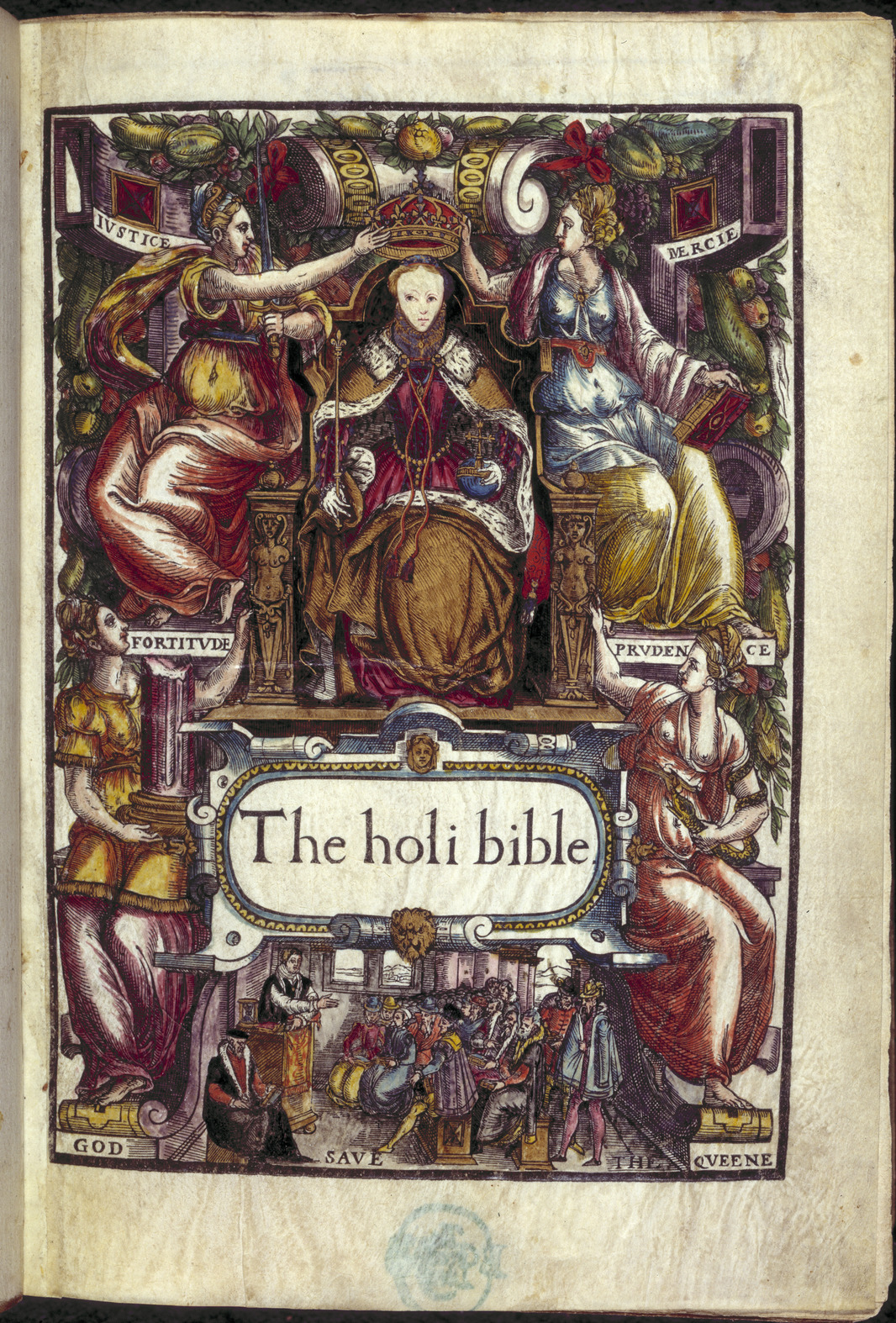

The Bishops' Bible never won the popularity of the Geneva Bible, but it won something more lasting: the first rule given to the King James translators in 1604 read, "The ordinary Bible read in the Church, commonly called the Bishops' Bible, to be followed, and as little altered as the original will permit."12 The King James Version is, formally, a revision of the Bishops' Bible.
The Rheims New Testament (1582) and the Douai Old Testament (1609 to 1610)
The English College and Gregory Martin
Catholic exiles from Elizabeth's England also made a Bible. William Allen, formerly of Queen's College, Oxford, and later a cardinal, founded an English College at Douai in 1568 to train priests for England. While the college was temporarily at Rheims in France, it published in 1582 an English New Testament, "the work mainly of Gregory Martin, formerly Fellow of St. John's College, Oxford, with the assistance of a small band of scholars from the same university."37 The Old Testament, the preface said, was ready at the same time, but for lack of money it was not printed until 1609 (its two volumes are usually dated 1609 and 1610), after the college had returned to Douai.3738
Why from the Latin
The Rheims preface is a long, careful document, and it is frank about its purpose. The translators wrote that they did not publish "upon erroneous opinion ... of necessity, that the holy Scriptures should always be in our mother tongue, or ... that they ought, or were ordained by God, to be read indifferently of all." They translated "upon special consideration of the present time, state, and condition of our country," because Protestant versions were circulating and "by their false translations" had, in their view, given readers "their own wicked writing and fantasies ... corrupting, both the letter and sense by false translation, adding, detracting, altering, transposing, pointing, and all other guileful means."38 (Quotations are from a modernized-spelling transcription.)
The translators then gave their reasons for following the Latin Vulgate (translated about 382 to 405 at the request of Pope Damasus I; see lesson 04). "We translate the old vulgar Latin text, not the common Greek text, for these causes. 1. It is so ancient, that it was used in the Church of God above 1300 years ago, as appeareth by the Fathers of those times." They went on to argue that the Latin was the text the church's fathers and councils had used and that the Greek manuscripts of their day were less reliable: "we do by no means grant it so corrupted as they say, though in comparison we know it less sincere & incorrupt than the vulgar Latin, and for that cause and others before alleged we prefer the said Latin, and have translated it."38 The textual questions raised by that choice are taken up in lesson 08.
The Rheims translators also defended keeping technical words untranslated. "These words then we thought it far better to keep in the text, and to tell their signification in the margent or in a table for that purpose, than to disgrace both the text & them with translating them. Such are also these words, The Pasch, The feast of Azymes, The bread of Proposition. Which they translate The Passover, The feast of sweet bread, The shew bread."38 The result was an English full of Latin forms. Kenyon quoted Ephesians 3:6 as an example: "The Gentils to be coheires and concorporat and comparticipant of his promis in Christ Jesus by the Gospel."37
Fulke's parallel edition and later influence
The Rheims New Testament was printed with extensive notes defending Catholic doctrine against the Protestant versions. Its widest circulation in England came by an unexpected route. The Protestant scholar William Fulke printed the Rheims text and its notes in parallel with the Bishops' Bible, with his own refutations, so that readers could compare them; Kenyon noted that "this work had a considerable vogue."37 Kenyon judged the Rheims and Douai Bible "of no importance" as scholarship, yet he added that the King James translators used it and that "of the Latin words used (and used effectively)" in the King James Version, "many were derived from the Bible of Rheims and Douai."37 That judgment is Kenyon's, a Protestant scholar's of 1909; Catholic readers have valued the Rheims translation for its fidelity to the Latin text it chose.
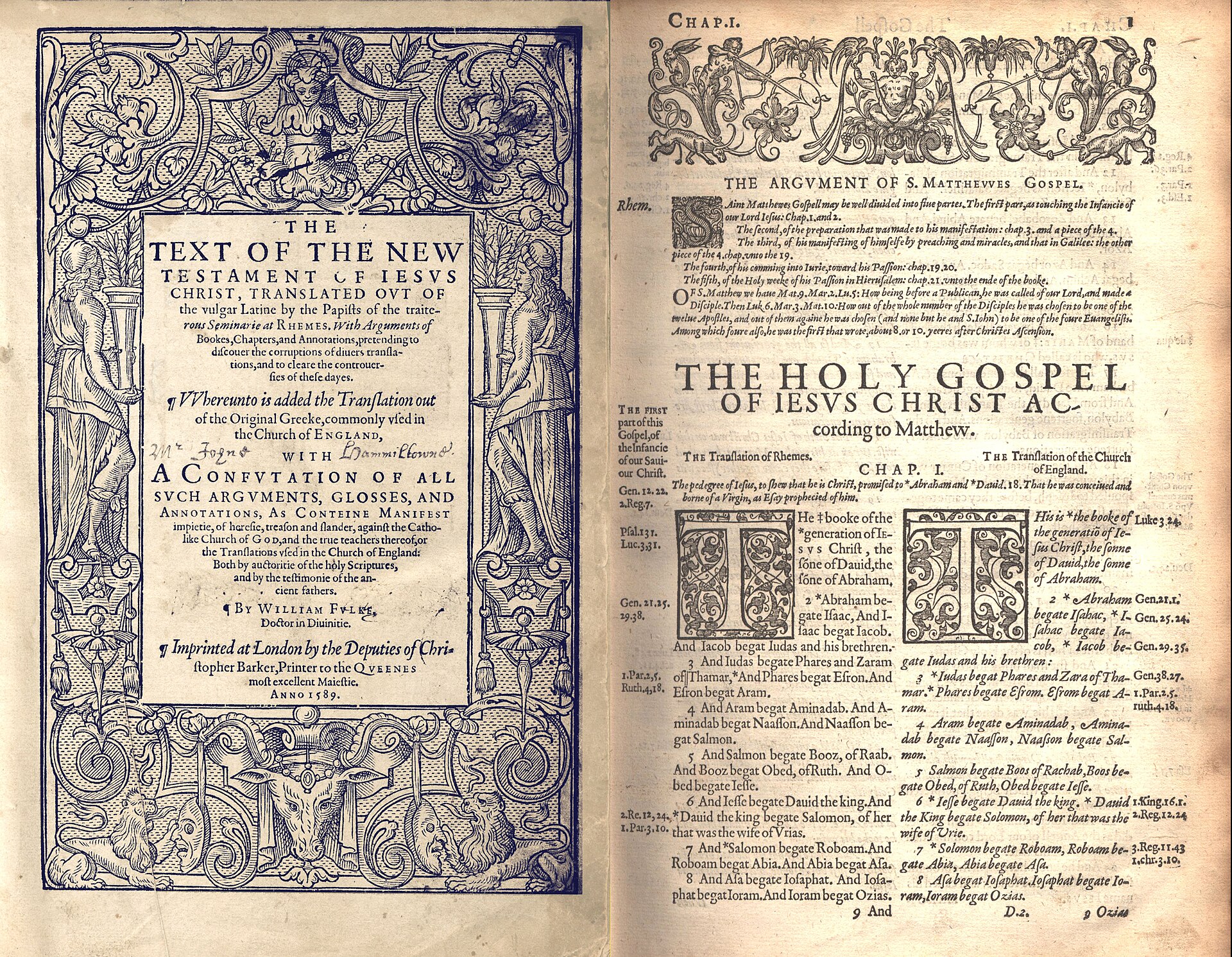

The Douay-Rheims Bible that most readers meet today is not the text of 1582 and 1609. Bishop Richard Challoner revised it extensively between 1749 and 1777, and his revision, which removed most of the polemical notes and brought the English closer to modern usage, became the standard English Catholic Bible until the twentieth century.39 Quotations of the "Douay-Rheims" in the table below are from the Challoner text.
One prayer and one verse through the versions
The quickest way to see how these Bibles relate is to read the same words in each. The table gives Matthew 6:9 to 10 (the opening of the Lord's Prayer) and John 3:16. All the texts are in the public domain. Spelling is given as transcribed in the online editions cited, which reproduce the old spelling (u for v, v for u, y for i in many words) and sometimes drop the printers' abbreviation marks (so "cogregacion" or "hi" stand for words printed with a mark over a letter). Three cautions apply: the online Tyndale text appears to follow his revised New Testament of 1534 and later; the Geneva text is the 1587 printing, which uses Tomson's revised New Testament; and the Douay-Rheims text is Challoner's eighteenth century revision, given in modern spelling. The King James Version is given in the standard modern-spelling text.711
| Version | Matthew 6:9 to 10 | John 3:16 |
|---|---|---|
| Tyndale (New Testament, revised text as transcribed online) | After thys maner therfore praye ye. O oure father which arte in heve halowed be thy name. Let thy kyngdome come. Thy wyll be fulfilled as well in erth as it ys in heven. | For God so loveth the worlde yt he hath geven his only sonne that none that beleve in him shuld perisshe: but shuld have everlastinge lyfe. |
| Coverdale 1535 | After thys maner therfore shall ye praye: O oure father which art in heauen, halowed be thy name. Thy kyngdome come. Thy wyll be fulfilled vpon earth as it is in heauen. | For God so loued the worlde, that he gaue his onely sonne, that who so euer beleueth in hi, shulde not perishe, but haue euerlastinge life. |
| Matthew Bible 1537 | after this manner therfore pray ye. Our father which art in heauen, halowed be thy name. Let thy kingdome come. Thy wyll be fulfylled, as well in earth, as it is in heauen. | For God so loueth the worlde, that he hath geuen his only sonne, that none that beleue in him, should perishe: but should haue euerlastinge lyfe. |
| Great Bible 1539 | after thys maner therfore praye ye. Oure father which art in heauen, halowed be thy name. Lett thy kyngdome come. Thy will be fulfylled, as well in earth, as it is in heauen. | For God so loue the worlde, that, he gaue is only begotten sonne, that whosoeuer beleueth in him, shulde not perisshe, but haue euerlastyng lyfe. (as transcribed) |
| Geneva (1587 printing) | After this maner therefore pray ye, Our father which art in heauen, halowed be thy name. Thy Kingdome come. Thy will be done euen in earth, as it is in heauen. | For God so loued the worlde, that hee hath giuen his onely begotten Sonne, that whosoeuer beleeueth in him, should not perish, but haue euerlasting life. |
| Bishops' Bible 1568 | After this maner therfore pray ye. O our father, which art in heauen, halowed be thy name. Let thy kyngdome come. Thy wyll be done, as well in earth, as it is in heauen. | For God so loued the worlde, that he gaue his only begotten sonne, that whosoeuer beleueth in hym, shoulde not perishe, but haue euerlastyng lyfe. |
| Douay-Rheims (Challoner revision) | Thus therefore shall you pray: Our Father who art in heaven, hallowed be thy name. Thy kingdom come. Thy will be done on earth as it is in heaven. | For God so loved the world, as to give his only begotten Son; that whosoever believeth in him, may not perish, but may have life everlasting. |
| King James Version (1611, standard modern-spelling text) | After this manner therefore pray ye: Our Father which art in heaven, Hallowed be thy name. Thy kingdom come. Thy will be done in earth, as it is in heaven. | For God so loved the world, that he gave his only begotten Son, that whosoever believeth in him should not perish, but have everlasting life. |
Several things can be read straight off the table. The frame of both passages is Tyndale's in every Protestant version. The Matthew Bible reproduces Tyndale almost word for word in John 3:16. "Only begotten" (for the Greek monogenes) appears in the Great Bible and stays through Geneva, the Bishops' Bible and the King James Version. "Who so euer" appears first in Coverdale, replacing Tyndale's "none that beleve in him shuld perisshe"; the Matthew Bible went back to Tyndale's words, and the Great Bible printed "whosoeuer." In the Lord's Prayer, "Thy will be done" comes from Geneva and the Bishops' Bible, replacing Tyndale's and Coverdale's "fulfilled." The King James translators kept the simple "Our Father which art in heaven" that Geneva had used, dropping the "O" of Tyndale and Coverdale.
The seven Bibles compared
The chart sets the seven translations of this lesson side by side by date, source, maker, size and standing. The sizes are those of the first editions as Kenyon describes them: an octavo is a pocket book, a quarto a desk book, a folio a large lectern book.
What the 1611 translators took from their predecessors
The King James Version was presented as a revision. Its New Testament title page says it was "Newly Translated out of the Originall Greeke: and with the former Translations diligently compared and reuised."40 The rules given to the translators in 1604 named the base and the helps. The first rule required the Bishops' Bible "to be followed, and as little altered as the original will permit." The fourteenth listed the others: "These translations to be used, when they agree better with the text than the Bishops' Bible: Tyndale's, Coverdale's, Matthew's [Rogers'], Whitchurch's [Cranmer's], Geneva." ("Whitchurch's" means the Great Bible, from its printer Edward Whitchurch.)12
The translators described their aim in their preface, "The Translators to the Reader": "Truly (good Christian Reader) we never thought from the beginning, that we should need to make a new Translation, nor yet to make of a bad one a good one, ... but to make a good one better, or out of many good ones, one principal good one, not justly to be excepted against; that hath been our endeavor, that our mark."41 They also defended the earlier English Bibles against their Catholic critics: "we do not deny, nay we affirm and avow, that the very meanest translation of the Bible in English, set forth by men of our profession, ... containeth the word of God, nay, is the word of God."41 In other words, the 1611 translators regarded Tyndale, Coverdale, the Great Bible, Geneva and the Bishops' Bible as the word of God in English, imperfectly rendered, and their own work as one more step in the same line. The making of the King James Version is the subject of lesson 07, and the Greek text behind all these Protestant versions is weighed in lesson 08.
What the record shows and what it does not
- Documented fact: Tyndale's New Testament was printed at Worms in 1526 (copies at the British Library, Stuttgart and St Paul's Cathedral); his Pentateuch in 1530; his revised New Testament in 1534. Coverdale's Bible was finished on October 4, 1535, and its title page says it was translated "out of Douche and Latyn." The Matthew Bible (1537) and Coverdale's second edition were licensed by the king. Cromwell's 1538 injunctions ordered a Bible "of the largest volume in English" in every parish. The Geneva title page of 1560 says "Translated according to the Ebrue and Greke." The Rheims preface of 1582 says "We translate the old vulgar Latin text, not the common Greek text."
- Testimony that rests on one source: the ploughboy remark (Foxe alone, in two different wordings); the Cologne print run of 3,000 (from reports of the time); the burning of Tyndale's New Testament at Paul's Cross (reported in the sources summarized by Kenyon).
- Scholarly reading: that Joshua to 2 Chronicles in the Matthew Bible is Tyndale's unpublished work (strong but circumstantial evidence); that Coverdale's 1535 Bible was printed in Antwerp (Latre); the estimate that about 84 percent of the King James New Testament is Tyndale's wording (Nielson and Skousen's sampling).
- Open questions: the true printer of the 1530 Pentateuch behind the "Hans Luft, Marburg" imprint; the division of labor among the Geneva translators; the exact words King James used at Hampton Court, which survive only in Barlow's account.
Claims checked
"Tyndale gave England its first English Bible."
Rating: Partly supported. The Wycliffite Bible, a complete English Bible translated from the Latin, existed in manuscript from the 1380s (lesson 04), and Cranmer's 1540 preface itself recalled that Scripture had once been "translated and read in the Saxons' tongue."25 What Tyndale produced was the first printed English New Testament and the first English New Testament and Pentateuch translated from the Greek and Hebrew. Kenyon called it "the first English Bible that was translated directly from the original language."1 Tyndale never completed a whole Bible; the first complete printed English Bible was Coverdale's of 1535.14
"Tyndale vowed that a ploughboy would know more Scripture than the clergy."
Rating: Unresolved. The only source is John Foxe, writing four decades later, and his 1563 and 1570 editions word the story differently; the opponent is a "learned man," described in 1570 as "a certayne Divine." Jan J. Martin concludes that the story "does not have a definitive source" and notes that the ploughing farmer already appears in Erasmus's Paraclesis.3 The sentiment matches Tyndale's own published words about laying Scripture "plainly ... before their eyes in their mother tongue,"2 but the remark itself cannot be confirmed.
"The King James Version is mostly Tyndale."
Rating: Supported for the New Testament; partly supported for the Old. Nielson and Skousen's 1998 sampling study estimated that nearly 84 percent of the King James New Testament, and about 76 percent of the Old Testament books Tyndale translated, keep his wording.9 Tyndale translated only part of the Old Testament (the Pentateuch, Jonah and probably Joshua to 2 Chronicles), so for books such as the Psalms and the Prophets the main English line runs through Coverdale, the Great Bible, Geneva and the Bishops' Bible.21
"Tyndale just translated Luther's German."
Rating: Refuted for the text; partly supported for the notes and prologues. Tyndale's text was made from Erasmus's Greek, with Luther, Erasmus's Latin and the Vulgate as aids; Kenyon wrote that he "was by no means a slavish copier of Luther." The notes of the 1525 Cologne quarto and most of the prologues of 1534 do depend heavily on Luther: "more than half the notes were taken directly from the German Bible."1
"Coverdale translated the whole Bible from the Hebrew and Greek."
Rating: Refuted. Coverdale's own title page says "translated out of Douche and Latyn," and his prologue says he followed "sundry translations, not only in Latin, but also of the Dutch interpreters." Where Tyndale's work existed, Coverdale revised it; elsewhere he worked mainly from the Zurich German Bible.171514
"Henry VIII, who burned Tyndale's books, later authorized Tyndale's Bible."
Rating: Supported, with a qualification. The Matthew Bible of 1537, licensed at Cranmer's and Cromwell's request, contained Tyndale's New Testament and Pentateuch almost unchanged and his probable translation of Joshua to 2 Chronicles, under the name "Thomas Matthew." The Great Bible ordered for every parish in 1538 was a revision of it. Kenyon judged that the origin of the Matthew Bible "certainly was not realized by Henry when he sanctioned it."2122 Henry licensed Tyndale's work without, it seems, knowing it was Tyndale's.
"The Great Bible was chained up to keep ordinary people from reading it."
Rating: Refuted as to purpose. The injunction that put it in the churches ordered it set up "in some convenient place ... whereas your parishioners may most commodiously resort to the same and read it," and told the clergy to "exhort every person to read the same."22 The chaining itself is not documented in the sources used for this lesson. Cranmer's preface did complain of readers who caused "contentious disputing," and Henry restricted Bible reading again in his last years, but the purpose of the church copy was public reading.2519
"The Geneva Bible was the first English Bible with numbered verses."
Rating: Supported. Whittingham's Geneva New Testament of 1557 was the first English New Testament divided into numbered verses, using the divisions Robert Estienne (Stephanus) had introduced in his Greek-Latin New Testament of 1551, and the Geneva Bible of 1560 was the first complete English Bible so divided. Its preface explains the choice. Kenyon and the Britannica agree.262927 The verse numbering itself is the subject of lesson 05.
"King James banned the Geneva Bible."
Rating: Unresolved. King James disliked the Geneva notes, as Barlow's account of Hampton Court shows.32 The Britannica states that the Geneva notes were "later deemed 'seditious' by King James when he banned the Geneva Bible in 1611."27 This lesson did not find the text of a royal proclamation or order to that effect, and Geneva Bibles continued to be printed and sold for decades after 1611.26 Until the order itself is produced, the claim should be stated with care.
"The Pilgrims brought the Geneva Bible on the Mayflower."
Rating: Supported, with a qualification. Pilgrim Hall Museum states that "The Pilgrim Separatists used the 'Geneva Bible'" and displays William Bradford's 1592 Geneva Bible, which it says went with him from England to Holland and then to Plymouth. The same museum holds John Alden's 1620 King James Bible, so both versions were in early Plymouth.34
"Shakespeare used the Geneva Bible."
Rating: Supported. The study of Shakespeare's biblical allusions by Naseeb Shaheen and others finds that his wording follows the Geneva Bible most often; Hewlett summarizes that "Shakespeare relied mainly on language from the Geneva Bible."33
"The Catholic Douay-Rheims was translated from the Latin, while the Protestant Bibles came from the Hebrew and Greek."
Rating: Partly supported. The Rheims preface states plainly, "We translate the old vulgar Latin text, not the common Greek text," and gives its reasons.38 On the Protestant side, Tyndale, Geneva and the Bishops' Bible worked from the Hebrew and Greek, but Coverdale's 1535 Bible was made largely from German and Latin, and the Great Bible added readings "from the Vulgate, which do not appear in the Hebrew or Greek."1719
Hard questions and answers
A Catholic reader asks: was Tyndale's translation slanted against the church?
Thomas More thought so, and he named his evidence: Tyndale rendered presbyteros as "senior," ekklesia as "congregation" and agape as "love," and More argued that the changes were made with "a mischievous mind."10 Each of Tyndale's words is a defensible rendering of the Greek, and "love" for agape at 1 Corinthians 13:13 was kept by Coverdale, the Great Bible, Geneva and the Bishops' Bible.11 The King James translators, on the other hand, were instructed to keep "the old ecclesiastical words," such as "church," and did so.12 The notes of the 1525 quarto and the 1530 Pentateuch were openly Protestant, and some were sharply polemical against the papacy.1 A fair answer separates the two: the text was a careful translation whose word choices reflected Tyndale's theology, and the notes and prologues were partisan, as the notes of the Rheims New Testament would later be on the other side.38
A King James reader asks: if the KJV is the standard, what were these earlier Bibles?
The King James translators answered the question themselves. They did not set out "to make of a bad one a good one; but to make a good one better," and they affirmed that "the very meanest translation of the Bible in English, set forth by men of our profession ... containeth the word of God, nay, is the word of God."41 They were required to start from the Bishops' Bible and to use Tyndale, Coverdale, Matthew, the Great Bible and Geneva wherever these were closer to the original.12 By their own account, the King James Version stands at the end of a line of revision that began with Tyndale. Readers who hold the King James Version in the highest regard are holding, in large part, Tyndale's wording.
A skeptic asks: did the translators shape doctrine through their notes?
Yes, openly, and each side said so of the other. The Geneva notes taught a Reformed reading of Scripture, and a few of them, as at Exodus 1:19 and 2 Chronicles 15:16, touched the duty owed to rulers, which is why King James objected to them.3032 The Rheims notes defended Catholic doctrine and accused the Protestant versions of "false translation."38 The Bishops' Bible's notes were shorter and mostly explanatory, and the King James rules forbade notes except to explain Hebrew and Greek words.3512 The safeguard for a reader is the one the translators themselves offered: the text and the notes are printed separately, so the notes can be weighed apart from the translation.
An Orthodox or Catholic reader asks: was the Rheims choice of the Latin text reasonable?
Given what was known in 1582, the Rheims translators had real arguments. The Latin Vulgate had been the Bible of the Western church for more than a thousand years, and the printed Greek New Testaments of the time rested on a small number of late manuscripts, as lesson 05 shows.38 The Rheims preface claimed that the Latin was "so ancient, that it was used in the Church of God above 1300 years ago." The weakness of the choice was the one Kenyon pointed to: a close rendering of a translation produced English that was at times barely English, as in "coheires and concorporat and comparticipant."37 Later manuscript discoveries changed the terms of this argument for every side, which is the subject of lesson 08.
A Protestant reader asks: does it matter that Coverdale worked from German and Latin?
It mattered to his successors. The Great Bible was revised with Munster's Latin from the Hebrew, and the Geneva translators went back to "the Ebrue and Greke," as their title page says, because they judged that earlier versions "required greatly to be perused and reformed" in light of better knowledge "of the tongues."2829 Coverdale himself never claimed more than he did: he wrote that he had "faithfully translated this out of five sundry interpreters" and hoped that God would send the Scripture "in a better shape, by the ministration of other."15 His lasting contribution was English style: his Psalms remained in the Book of Common Prayer for centuries, even after the rest of its Scripture passages were changed to the King James wording.19
Where to go next
The next lesson, lesson 07, follows the line from Hampton Court to the King James Version of 1611 and its later revisions. For the deaths of the translators named here, see Martyrs Briefs, lesson 05 (Tyndale) and lesson 06 (John Rogers and Thomas Cranmer). The wider Reformation in England is told in Church History, Part A, lesson 12 and Church History, Part B, lesson 04. The whole module is listed on the module page.
Learn more
- Kenyon, "English Versions" (1909), full article at Bible Research: A clear, detailed history of every English version from the Anglo-Saxon to the Revised Version, by a leading textual scholar.
- The Tyndale Society: Journal articles on Tyndale's printings, the Stuttgart copy and the place of printing of Coverdale's Bible.
- Jan J. Martin on the ploughboy story: A careful comparison of Foxe's editions that shows how a famous quotation grew.
- Thomas More, A Dialogue Concerning Heresies (modernized e-text): Read More's own case against Tyndale's translation, book 3, chapter 8.
- Geneva Bible preface (1560): The Geneva translators explain their verse numbers, italics, notes, maps and tables.
- Rheims New Testament preface (1582): The Catholic translators' own case for translating from the Latin Vulgate.
- Martyrs Briefs, lesson 05: Tyndale's arrest and death: The record of Tyndale's betrayal, imprisonment and execution.
Still being checked (17 items)
These points could not be confirmed against a primary source when this lesson was written and fact checked in October 2026. The text above states each one as uncertain.
- The British Library's purchase of the Bristol copy of the 1526 New Testament: the price (one million pounds) is from Werrell; the year (often given as 1994) was not confirmed and is not stated in the lesson.
- The 3,000-copy print runs for Cologne and Worms rest on reports summarized by Kenyon (1909), not on printers' records.
- The printer of the 1530 Pentateuch: the colophon names Hans Luft at Marburg; many scholars regard this as a false imprint and assign it to Antwerp. Not confirmed from a primary source.
- The identification of Merten de Keyser as printer of the 1535 Coverdale Bible: Latre's article (as read) argues for Antwerp without naming the printer. Stated in the lesson as probable.
- Tyndale's online New Testament texts (Bible Hub, StudyBible.info) appear to follow his revised text (they read "the worde" in John 1:1 and "elders" in 1 Peter 5:1, where the 1526 print reads "that worde" and, per More, "seniors"); the exact edition behind them was not confirmed.
- The Great Bible transcription of John 3:16 at StudyBible.info reads "loue" and "is" (probably "loued" and "his" with printers' abbreviations); quoted as transcribed and marked.
- The full printed title of the 1539 Great Bible was not checked against a facsimile; only the painted title "The Byble in Englyshe" visible in the copy shown is quoted.
- The Great Bible's popular name "the Chained Bible" and the practice of chaining it in churches were not documented in the sources used.
- Barlow's wording at Hampton Court is quoted from an imperfect scanned text of the 1638 printing; the word read as "partial" should be checked against a facsimile, and the page numbers are approximate.
- The Geneva notes on Exodus 1:19 and 2 Chronicles 15:16 are quoted from modernized transcriptions of the 1599 printing; the 1560 wording was not checked.
- The Britannica statement that King James "banned the Geneva Bible in 1611" (wording rechecked Oct. 29, 2026) was not confirmed by the text of any proclamation.
- The number of Geneva editions ("Over 160," Kenyon) and the last edition (often dated 1644) were not checked against Herbert's Historical Catalogue.
- The dates of the two volumes of the Douai Old Testament (1609 and 1610) rest on common report; Kenyon gives 1609.
- The Coverdale portrait's origin in a 1533 portrait is the Commons description and was not confirmed.
- The image of Fulke's 1589 edition (06-rheims-new-testament.jpg) was described from its Commons title; the writer could not view the image to confirm the layout given in the alt text.
- Barlow's 1638 text as scanned reads "very partially untrue" (OCR) where modern quotations read "very partial, untrue"; the lesson keeps "partial, untrue" pending a facsimile check.
- Latre's article (as read) bases the Antwerp case on the woodcuts, on Mozley's evidence that Coverdale worked for Merten de Keyser, and on Ruytinck's sketch of Emanuel van Meteren; the lesson's wording was adjusted to that.
Notes
- Frederic G. Kenyon, "English Versions," in James Hastings, ed., A Dictionary of the Bible (New York: Charles Scribner's Sons, 1909), section "Tyndale", transcribed at Bible Research (bible-researcher.com), ed. Michael D. Marlowe (retrieved Oct. 28, 2026). Read it online. ↩
- William Tyndale, "W.T. to the Reader," preface to the Pentateuch (1530), modernized spelling, from Dewey Beegle, God's Word into English (1964), Appendix B, transcribed at Bible Research (bible-researcher.com), ed. Michael D. Marlowe (retrieved Oct. 28, 2026). Read it online. ↩
- Jan J. Martin, "William Tyndale, John Foxe, and the 'Boy That Driveth the Plough,'" Religious Educator 17, no. 2 (2016), Religious Studies Center, Brigham Young University, quoting John Foxe, Actes and Monuments (London: John Day, 1563), p. 570, and (1570), p. 1264, and Erasmus, Paraclesis (1516), in the Olin translation (retrieved Oct. 28, 2026). Read it online. ↩
- William Tyndale, "To the Reader," epilogue to the New Testament (Worms, 1526), modernized spelling, from Edward Arber's introduction to The First Printed English New Testament (London, 1871), transcribed at Bible Research (bible-researcher.com), ed. Michael D. Marlowe (retrieved Oct. 28, 2026). Read it online. ↩
- Ralph Werrell, "Stuttgart Tyndale Bible," Tyndale Society Journal no. 7, Tyndale Society (retrieved Oct. 28, 2026). Read it online. ↩
- Wurttembergische Landesbibliothek Stuttgart, "Tyndale 1526 NT English" (account of the identification of the Stuttgart copy in 1996), PDF (retrieved Oct. 28, 2026). The online copy cited earlier returned page not found when checked on Oct. 28, 2026. ↩
- Bible Hub parallel pages (Tyndale, Coverdale 1535, Geneva 1587, Bishops' 1568, Douay-Rheims [Challoner], King James Version) for Matthew 6:9 and 6:10, 16:18, John 1:1 and 3:16, 1 Corinthians 13:13, 1 Peter 5:1, Genesis 1:3, 3:4 and 3:7, and Jeremiah 8:22, e.g. biblehub.com/parallel/john/3-16.htm; and, for the 1526 reading of John 1:1, the British Library page reproduced on Wikimedia Commons, File:Tyndale_Bible_-_Gospel_of_John.jpg (retrieved Oct. 28, 2026). Read it online. ↩
- William Tyndale, The Obedience of a Christian Man (first printed 1528), London printing of 1548, scanned text at the Internet Archive (Early English Books 1475 to 1640); spelling modernized for this lesson (retrieved Oct. 28, 2026). Read it online. ↩
- Ray L. Huntington and W. Jeffrey Marsh, "Revisiting William Tyndale, Father of the English Bible," Religious Educator 12, no. 2 (2011), Religious Studies Center, Brigham Young University; reports John Nielson and Royal Skousen, "How Much of the King James Bible Is William Tyndale's? An Estimation Based on Sampling," Reformation 3 (1998): 73, and quotes Tyndale's Parable of the Wicked Mammon (retrieved Oct. 28, 2026). Read it online. ↩
- Thomas More, A Dialogue Concerning Heresies (1529), book 3, chapter 8, modernized edition, Center for Thomas More Studies (2015 e-text), p. 286 (retrieved Oct. 28, 2026). Read it online. ↩
- StudyBible.info online texts of the Great Bible ("Great"), the Matthew Bible, Tyndale, Coverdale and Geneva for Matthew 6:9 and 6:10, 16:18, John 3:16, 1 Corinthians 13:13, 1 Peter 5:1 and Genesis 3:7, e.g. studybible.info/Great/John 3:16 (retrieved Oct. 28, 2026). Read it online. ↩
- "Instructions to the Translators" (1604), as printed in Isaac H. Hall, ed., The Revised New Testament and History of Revision (1881), chapter on the history of the King James Version, transcribed at Bible Research (bible-researcher.com), ed. Michael D. Marlowe (retrieved Oct. 28, 2026). Read it online. ↩
- "Tyndale Bibliography," Bible Research (bible-researcher.com): imprints of the 1534 New Testament ("Imprinted at Antwerp by Marten Emperowr") and the 1535 "GH" edition ("Printed in Antwerp by Martin de Keyser and published by Godfrey van der Haghen"; "only four copies survive") (retrieved Oct. 28, 2026). Read it online. ↩
- Frederic G. Kenyon, "English Versions," in James Hastings, ed., A Dictionary of the Bible (New York: Charles Scribner's Sons, 1909), section "Coverdale's Bible (1535)", transcribed at Bible Research (bible-researcher.com), ed. Michael D. Marlowe (retrieved Oct. 28, 2026). Read it online. ↩
- Miles Coverdale, dedication to Henry VIII and "Prologue to the Reader" in the Coverdale Bible (1535), modernized spelling from the Chadwyck-Healey Bible in English text, transcribed at Bible Research (bible-researcher.com), ed. Michael D. Marlowe (retrieved Oct. 28, 2026). Read it online. ↩
- Guido Latre, "The Place of Printing of the Coverdale Bible," Tyndale Society Journal no. 8, Tyndale Society (retrieved Oct. 28, 2026). Read it online. ↩
- Title page of the Coverdale Bible (1535), British Library copy, reproduced on Wikimedia Commons, File:Title_Page_of_Coverdale_Bible.jpg (source: Susan Foister, Holbein in England, Tate, 2006) (retrieved Oct. 28, 2026). Read it online. ↩
- Frederic G. Kenyon, "English Versions," in James Hastings, ed., A Dictionary of the Bible (New York: Charles Scribner's Sons, 1909), section "Taverner's Bible (1539)", transcribed at Bible Research (bible-researcher.com), ed. Michael D. Marlowe (retrieved Oct. 28, 2026). Read it online. ↩
- Frederic G. Kenyon, "English Versions," in James Hastings, ed., A Dictionary of the Bible (New York: Charles Scribner's Sons, 1909), section "The Great Bible (1539-1541)", transcribed at Bible Research (bible-researcher.com), ed. Michael D. Marlowe (retrieved Oct. 28, 2026). Read it online. ↩
- Title page of the Matthew Bible (1537), reproduced on Wikimedia Commons, File:Matthews_byble_1537.png, from the Internet Archive scan "1537 Matthews Bible" (retrieved Oct. 28, 2026). Read it online. ↩
- Frederic G. Kenyon, "English Versions," in James Hastings, ed., A Dictionary of the Bible (New York: Charles Scribner's Sons, 1909), section "Matthew's Bible (1537)", transcribed at Bible Research (bible-researcher.com), ed. Michael D. Marlowe (retrieved Oct. 28, 2026). Read it online. ↩
- The Second Royal Injunctions of Henry VIII (Cromwell's Injunctions), 1538, items 2 and 3, text at Henry VIII, the Reign (henryviiithereign.co.uk) (retrieved Oct. 28, 2026). Read it online. ↩
- Title page of the Great Bible (1539), hand-colored copy, reproduced on Wikimedia Commons, File:Great_Bible_1539.jpg (scan from David Starkey and Susan Doran, Henry VIII: Man and Monarch, exhibition catalogue, 2009, p. 204) (retrieved Oct. 28, 2026). Read it online. ↩
- W. F. Moulton, The History of the English Bible (London: Cassell Petter and Galpin, 1878), pp. 138 to 139, on the title page of the Great Bible, transcribed at Bible Research (bible-researcher.com), ed. Michael D. Marlowe (retrieved Oct. 28, 2026). Read it online. ↩
- Thomas Cranmer, "A prologue or preface" to the Great Bible (second edition, 1540), modernized spelling from the Chadwyck-Healey Bible in English text, transcribed at Bible Research (bible-researcher.com), ed. Michael D. Marlowe (retrieved Oct. 28, 2026). Read it online. ↩
- Frederic G. Kenyon, "English Versions," in James Hastings, ed., A Dictionary of the Bible (New York: Charles Scribner's Sons, 1909), section "The Geneva Bible (1557-1560)", transcribed at Bible Research (bible-researcher.com), ed. Michael D. Marlowe (retrieved Oct. 28, 2026). Read it online. ↩
- Encyclopaedia Britannica, "Geneva Bible" (retrieved Oct. 28, 2026). Read it online. ↩
- Title page of the Geneva Bible (Geneva: Rowland Hall, 1560), Library of Congress copy, reproduced on Wikimedia Commons, File:Geneva_Bible.jpg; wording read from the image (retrieved Oct. 28, 2026). Read it online. ↩
- Geneva Bible (1560), address "To our beloved in the Lord, the brethren of England, Scotland, Ireland, &c.," dated Geneva, April 10, 1560, modernized spelling, transcribed at Bible Research (bible-researcher.com), ed. Michael D. Marlowe (retrieved Oct. 28, 2026). Read it online. ↩
- Geneva Bible notes (1599 printing, modernized), note on Exodus 1:19, online at anaisarpi.com, comments/geneva_1599/Ex_1 (retrieved Oct. 28, 2026). Read it online. ↩
- Geneva Bible notes (1599 printing, modernized), note on 2 Chronicles 15:16, online at bible.armeniancathedral.org, comments/geneva_1599/2Chron_15 (retrieved Oct. 28, 2026). Read it online. ↩
- William Barlow, The Summe and Substance of the Conference ... at Hampton Court, Ianu. 14, 1603 [Old Style; January 1604 New Style] (London: John Norton, 1638 printing), scanned text at the Internet Archive; spelling modernized for this lesson (retrieved Oct. 28, 2026). Read it online. ↩
- Tausha Hewlett, "Shakespeare and the Bible," Early Modern England Encyclopedia, LEMDO, University of Victoria (its sources include Naseeb Shaheen, Biblical References in Shakespeare's Plays, 2011) (retrieved Oct. 28, 2026). Read it online. ↩
- Pilgrim Hall Museum, Plymouth, Massachusetts, "Religion & Worship" (retrieved Oct. 28, 2026). Read it online. ↩
- Frederic G. Kenyon, "English Versions," in James Hastings, ed., A Dictionary of the Bible (New York: Charles Scribner's Sons, 1909), section "The Bishops' Bible (1568)", transcribed at Bible Research (bible-researcher.com), ed. Michael D. Marlowe (retrieved Oct. 28, 2026). Read it online. ↩
- British Library, title page of the Bishops' Bible (London: Richard Jugge, 1569), shelfmark G.12188, reproduced on Wikimedia Commons with the Library's description (retrieved Oct. 28, 2026). Read it online. ↩
- Frederic G. Kenyon, "English Versions," in James Hastings, ed., A Dictionary of the Bible (New York: Charles Scribner's Sons, 1909), section "The Rheims and Douai Bible (1582-1609)", transcribed at Bible Research (bible-researcher.com), ed. Michael D. Marlowe (retrieved Oct. 28, 2026). Read it online. ↩
- "The Preface to the Reader," Rheims New Testament (1582), modernized-spelling transcription in the Original Douay-Rheims Reference (douayrheimsbible.pages.dev) (retrieved Oct. 28, 2026). Read it online. ↩
- "The Challoner Revision of the Douay Bible," Bible Research (bible-researcher.com), ed. Michael D. Marlowe (retrieved Oct. 28, 2026). Read it online. ↩
- New Testament title page of the King James Version (London: Robert Barker, 1611), reproduced on Wikimedia Commons, File:King-James-Version-Bible-first-edition-The_Newe_Testament_title-page-1611.png (long s printed as s here) (retrieved Oct. 28, 2026). Read it online. ↩
- "The Translators to the Reader," preface to the King James Version (1611), modernized spelling from the Oxford page-for-page reprint of 1833, transcribed at Bible Research (bible-researcher.com), ed. Michael D. Marlowe (retrieved Oct. 28, 2026). Read it online. ↩

Check yourself
1. Where and in what year was the first complete printed English New Testament, Tyndale's, published?
The Cologne quarto was stopped after Matthew 22. The complete octavo was printed at Worms by Peter Schoeffer in 1526; copies survive at the British Library, Stuttgart and St Paul's Cathedral.
2. According to its own title page, the Coverdale Bible of 1535 was translated from:
The title page reads "faythfully and truly translated out of Douche and Latyn in to Englishe," and Coverdale's dedication speaks of "five sundry interpreters."
3. Who was "Thomas Matthew," named as translator of the 1537 Matthew Bible?
No Thomas Matthew is known. The record of Rogers's arrest in 1555 calls him "John Rogers alias Matthew," and the book contains Tyndale's New Testament and Pentateuch with Coverdale's other books.
4. What did Cromwell's injunctions of 1538 order every parish to do?
The second injunction ordered the Bible set up "in some convenient place" where parishioners "may most commodiously resort to the same and read it," with the cost shared between parson and parish.
5. Which of these was first in an English New Testament with Whittingham's Geneva New Testament of 1557?
Kenyon notes it was "the first version to be printed in roman type, and the first in which the division of the text into numbered verses ... was introduced."
6. At Hampton Court in 1604, which Geneva note did King James give as an example of a seditious note, according to Barlow?
Barlow names the note on Exodus 1:19 and the note on 2 Chronicles 15:16 that "taxeth Asa for deposing his mother, only, and not killing her."
7. Which Bible did the first rule for the King James translators tell them to follow?
Rule 1: "The ordinary Bible read in the Church, commonly called the Bishops' Bible, to be followed, and as little altered as the original will permit." Rule 14 named Tyndale, Matthew, Coverdale, the Great Bible and Geneva as helps.
8. What reason did the Rheims New Testament of 1582 give first for translating the Latin Vulgate?
The preface: "We translate the old vulgar Latin text, not the common Greek text, for these causes. 1. It is so ancient, that it was used in the Church of God above 1300 years ago."
Terms in this lesson
- Octavo, quarto, folio
- Book sizes made by folding a printed sheet three, two or one time. Tyndale's 1526 New Testament was an octavo (pocket size); the Geneva Bible of 1560 a quarto; the Coverdale, Matthew, Great and Bishops' Bibles folios for church use.
- Colophon
- A note at the end of a printed book or section giving the date, place or printer. Coverdale's colophon dates his Bible to October 4, 1535.
- Imprint
- The statement of place, printer and date on a title page or colophon. Imprints could be false, as many scholars think the "Hans Luft, Marburg" imprint of Tyndale's Pentateuch was.
- Textus Receptus
- The printed Greek New Testament tradition that began with Erasmus (1516). Tyndale translated from Erasmus's editions; see lesson 05.
- Latin Vulgate
- The Latin Bible translated about 382 to 405 at the request of Pope Damasus I and used in the Western church for a thousand years. The Wycliffite Bible and the Rheims and Douai Bible were made from it.
- Apocrypha
- Books found in the Greek and Latin Old Testament but not in the Hebrew canon. Coverdale's 1535 Bible was the first printed English Bible to group them in a separate section.
- Injunctions
- Royal orders to the clergy. Cromwell's 1538 injunctions required every parish to set up an English Bible "of the largest volume."
- Marian exiles
- English Protestants who left England during the reign of Mary I (1553 to 1558). Those at Geneva produced the Geneva Bible.
- Study notes (annotations)
- Marginal comments printed beside the text. The Geneva and Rheims Bibles had extensive notes; the King James rules forbade notes except to explain Hebrew or Greek words.
- Breeches Bible
- A nickname for the Geneva Bible, from its rendering of Genesis 3:7, where Adam and Eve "made them selues breeches."
- Convocation
- The assembly of the clergy of the Church of England. In 1571 it required the Bishops' Bible in cathedrals and bishops' houses and, as far as possible, in all churches.
- Ecclesiastical words
- Traditional church terms such as "church," "priest" and "charity." Thomas More attacked Tyndale for replacing them with "congregation," "senior" and "love"; the King James rules required the old words to be kept.
Sources
- Frederic G. Kenyon, "English Versions," Hastings' Dictionary of the Bible (1909), sections on Tyndale, Coverdale, Matthew, Taverner, the Great Bible, Geneva, the Bishops' Bible and Rheims-Douai (Bible Research transcriptions) (1909) checked 2026-10
- William Tyndale, prefaces to the New Testament (1526) and Pentateuch (1530), modernized (1526 and 1530) checked 2026-10
- William Tyndale, The Obedience of a Christian Man, London printing of 1548 (Internet Archive) (1528 (this printing 1548)) checked 2026-10
- Wurttembergische Landesbibliothek Stuttgart, Tyndale 1526 New Testament (account of the Stuttgart copy) (undated web document) checked 2026-10
- Ralph Werrell, "Stuttgart Tyndale Bible," Tyndale Society Journal 7 (undated online) checked 2026-10
- Jan J. Martin, "William Tyndale, John Foxe, and the 'Boy That Driveth the Plough,'" Religious Educator 17, no. 2 (2016) checked 2026-10
- Ray L. Huntington and W. Jeffrey Marsh, "Revisiting William Tyndale, Father of the English Bible," Religious Educator 12, no. 2 (2011) checked 2026-10
- Thomas More, A Dialogue Concerning Heresies (1529), Center for Thomas More Studies modernized e-text (1529 (e-text 2015)) checked 2026-10
- Tyndale Bibliography, Bible Research (undated online) checked 2026-10
- Miles Coverdale, dedication and prologue to the Coverdale Bible (1535), modernized (1535) checked 2026-10
- Guido Latre, "The Place of Printing of the Coverdale Bible," Tyndale Society Journal 8 (undated online) checked 2026-10
- Title page of the Coverdale Bible (1535), Wikimedia Commons (1535) checked 2026-10
- Title page of the Matthew Bible (1537), Wikimedia Commons (1537) checked 2026-10
- The Second Royal Injunctions of Henry VIII (1538) (1538) checked 2026-10
- Title page of the Great Bible (1539), Wikimedia Commons (1539) checked 2026-10
- W. F. Moulton, The History of the English Bible (1878), on the Great Bible title page (1878) checked 2026-10
- Thomas Cranmer, preface to the Great Bible (1540), modernized (1540) checked 2026-10
- Geneva Bible (1560), address to the reader, modernized (1560) checked 2026-10
- Title page of the Geneva Bible (1560), Library of Congress copy, Wikimedia Commons (1560) checked 2026-10
- Geneva Bible notes, Exodus 1 (1599 printing, modernized) (1599) checked 2026-10
- Geneva Bible notes, 2 Chronicles 15 (1599 printing, modernized) (1599) checked 2026-10
- William Barlow, The Summe and Substance of the Conference at Hampton Court (1638 printing), Internet Archive (1604 (this printing 1638)) checked 2026-10
- Encyclopaedia Britannica, "Geneva Bible" (undated online) checked 2026-10
- Pilgrim Hall Museum, "Religion & Worship" (undated online) checked 2026-10
- Tausha Hewlett, "Shakespeare and the Bible," Early Modern England Encyclopedia (LEMDO) (undated online) checked 2026-10
- Title page of the Bishops' Bible (1569), British Library G.12188, Wikimedia Commons (1569) checked 2026-10
- Rheims New Testament (1582), "The Preface to the Reader," modernized transcription (1582) checked 2026-10
- The Challoner Revision of the Douay Bible, Bible Research (undated online) checked 2026-10
- Instructions to the Translators (1604), in Isaac H. Hall, History of the King James Version (1881) (1604 (printed 1881)) checked 2026-10
- The Translators to the Reader, preface to the King James Version (1611) (1611) checked 2026-10
- King James Version New Testament title page (1611), Wikimedia Commons (1611) checked 2026-10
- Bible Hub parallel texts (Tyndale, Coverdale, Geneva 1587, Bishops' 1568, Douay-Rheims, KJV), e.g. John 3:16 (texts 1526 to 1611) checked 2026-10
- StudyBible.info texts of the Great Bible, Matthew Bible and others, e.g. John 3:16 in the Great Bible (texts 1535 to 1587) checked 2026-10
- Tyndale's New Testament (1526), first page of John, British Library copy, Wikimedia Commons (1526) checked 2026-10