Lesson 5 of 10 · about 45 minutes · Updated October 28, 2026
Before the Reformation: Hus, Hieronymus of Prague, the Lollards, Savonarola and Tyndale
You'll be able to
- Explain how a church court and a secular ruler divided the work of a heresy execution between 1384 and 1536, using the Constance sentences and the English statute of 1401.
- State the charge, court, law and manner of death for each of the eight cases in this lesson.
- Name the earliest source for each death and say how close it stands to the event, including Mladonovice, Poggio, Foxe and the official records.
- Separate documented facts from later traditions such as the goose and swan saying, "O holy simplicity" and Tyndale's last words.
- Describe fairly how Catholic and Protestant writers have read Hus, Savonarola and Tyndale, in their own words.
Start here: the short version
Between the death of John Wycliffe in 1384 and the burning of William Tyndale in 1536, the Western church and the rulers allied with it put to death a series of men who called for reform of doctrine, preaching or morals. Every one of them was a baptized Catholic Christian, and every one was condemned by other Catholic Christians for heresy, sometimes joined to treason or disobedience. This lesson tells eight cases in brief: Wycliffe (who died in his bed and was dug up and burned 44 years later), the English Lollards William Sawtrey, John Badby and Sir John Oldcastle, the Czech priest Jan Hus and his friend Hieronymus of Prague (Jeroným Pražský), the Florentine friar Girolamo Savonarola, and the Bible translator William Tyndale. For each the lesson gives the charge, the court, the law, the record of the trial and the death, and then separates what later tradition added. The ideas these men taught belong to Church History, Part A, lesson 10. The rating key (Documented, Strong tradition, Late tradition, Legend) is explained in lesson 01.
Why reformers were killed between 1384 and 1536
The martyrs of the first three centuries (lesson 03) died at the hands of a pagan state that treated refusal to sacrifice as a crime. The martyrs in this lesson died at the hands of a Christian church and Christian princes who treated stubborn error about the faith as a crime. The legal machinery had been built over the twelfth and thirteenth centuries against the Cathars and the Waldensians (lesson 04). Its rule was simple. A church court judged whether a person held heresy. If the accused abjured (formally renounced the error), he was given penance. If he refused, or if he abjured and later returned to the error (a "relapse"), the church court declared that it could do nothing more and "relinquished" him to the secular power, which carried out the death penalty under its own law. The church did not itself put the torch to the wood. The secular ruler did, at the church's handing over. Both sides at the time understood this division of labour, and the condemned men pointed to it as clearly as their judges did.
The Council of Constance (1414 to 1418) used exactly this form. Its sentence on Jan Hus in July 1415 "relinquishes John Hus to the judgment of the secular authority and decrees that he is to be relinquished to the secular court."1 In England, Parliament in 1401 wrote the same procedure into statute law. The act known by its Latin name De haeretico comburendo ("on the burning of a heretic," 2 Henry IV, chapter 15) ordered the sheriff or mayor to receive any person whom a bishop had convicted and who refused to abjure or had relapsed, and "them, before the people, in a high place cause to be burnt, that such punishment may strike fear to the minds of others."2 Burning was chosen for its public effect, and the statute says so in plain words.
The numbers in England were small by later standards. A Catholic reference work of 1910 counted that "eleven heretics were recorded to have been burnt from 1401 to the accession of Henry VII in 1485," while others connected with Lollardy were executed as traitors after armed risings.3 On the continent the numbers were larger, and the Hussite wars that followed Hus's death killed many thousands on both sides, though those were battle deaths, outside the scope of martyr briefs. The men in this lesson are remembered out of proportion to their numbers because their deaths became arguments. Protestants after 1517 read them as forerunners; Catholic writers read them as rebels against lawful authority or, in Savonarola's case, as a faithful Catholic wrongly condemned. Each brief below separates the trial record from those later readings.
Two cautions apply to every case. First, the charge was not always heresy alone. Oldcastle was condemned as a traitor after an armed rising, Savonarola as a disobedient and schismatic friar after a political crisis in Florence, and Tyndale under an imperial decree aimed at the Lutheran movement. Second, the accounts most readers know come from writers who admired the condemned men: Peter of Mladonovice for Hus, Poggio Bracciolini (who did not share his views) for Hieronymus of Prague (Jeroným Pražský), and John Foxe for the English cases. Where the official record survives, it is given first.
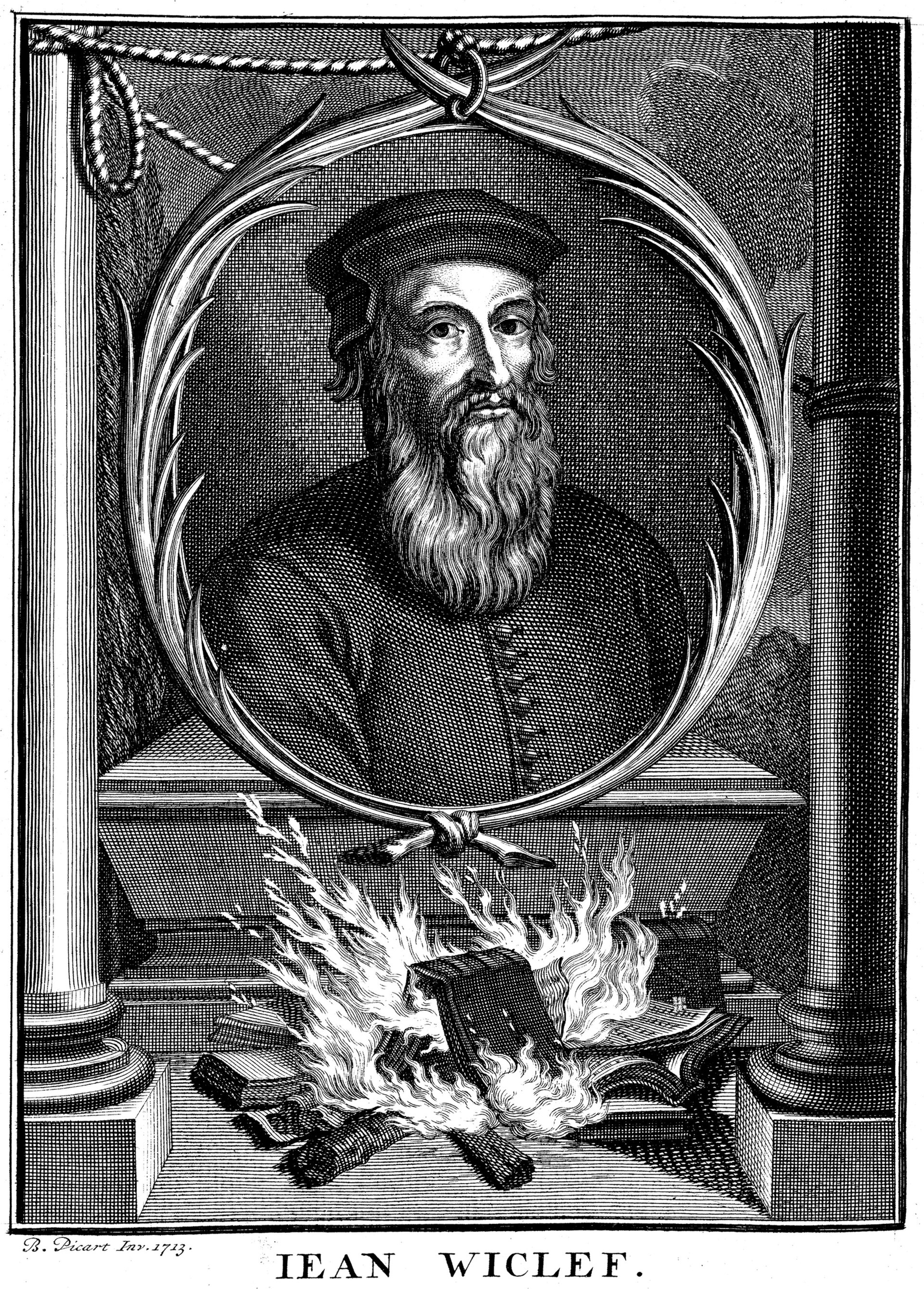
John Wycliffe (died 1384; bones burned 1428)
Died: December 31, 1384, of a stroke (a natural death); remains exhumed and burned 1428 · Place: Lutterworth, Leicestershire, England · Earliest source: Council of Constance, session 8, decree of May 4, 1415 (the condemnation and order to exhume); Thomas Fuller, Church History of Britain, 1655 (the burning of the bones) · Record strength: Documented (but Wycliffe was not killed)

What the record shows
Wycliffe belongs in a book of martyrs only by a technicality, and the record makes that plain. He was an Oxford theologian whose teaching on the Eucharist, on the authority of the pope and on the wealth of the clergy was condemned in his lifetime, but he was never imprisoned or tried to death. The 1912 Catholic Encyclopedia, a source unsympathetic to his teaching, reports that he suffered a stroke "while he was hearing Mass in his church" at Lutterworth, that "three days later he died," and gives the date as December 31, 1384.4 The same article records that an Oxford council condemned his Eucharistic teaching in 1381 and that, a year later, "an ecclesiastical court at Blackfriars gave sentence against a series of twenty-four Wyclifite propositions."4
Thirty years after his death, the Council of Constance took up his case. In its eighth session, on May 4, 1415, the council condemned 45 articles drawn from his writings and declared "that the said John Wyclif was a notorious and obstinate heretic who died in heresy." It ordered that his writings "are to be burnt in public" and that "his body and bones are to be exhumed, if they can be identified among the corpses of the faithful," and thrown out of consecrated ground.1 The order was carried out in 1428, as the Catholic Encyclopedia confirms in four words: "This was done in 1428."4
The fullest early English account of the exhumation comes from the Anglican historian Thomas Fuller, writing in 1655, more than two centuries later. Fuller names the bishop of the diocese, Richard Fleming of Lincoln, as the man who "sent his officers" to Lutterworth, where they "take what was left out of the grave, and burnt them to ashes, and cast them into Swift, a neighbouring brook running hard by."5 Fuller then wrote the sentence that has been quoted in sermons ever since: "Thus this brook hath conveyed his ashes into Avon, Avon into Severn, Severn into the narrow seas, they into the main ocean. And thus the ashes of Wickliffe are the emblem of his doctrine, which now is dispersed all the world over."5
Tradition and legend
Fuller's image of the ashes spreading from the Swift to the ocean is a preacher's figure of speech, and Fuller offers it as one. It is not a historical claim about the river. Fuller himself reports a second, cruder story and doubts it: "I know not whether the vulgar tradition be worth remembrance, that the brook into which Wickliffe's ashes were poured, never since overflowed the banks."5 This is legend, attested in Fuller in 1655 as a popular saying, and he says that some deny even the fact on which it rests.
A second tradition calls Wycliffe "the Morning Star of the Reformation." The phrase is a later Protestant title, not a contemporary one, and this lesson does not trace its first use. It is a judgment about his influence on Hus and, through Hus, on the sixteenth century. That influence is real (the Council of Constance tied Hus to Wycliffe by name, as the Hus brief below shows), but the title is an interpretation.
What the sources dispute
Three points are argued. First, the date and the exact hand behind the exhumation. Fuller ties it to the Constance decree and to Bishop Fleming; modern historians usually add that Pope Martin V renewed the order to Fleming in the late 1420s. That papal letter was not opened for this lesson, so the role of Martin V is reported here as the common modern account and listed among the unverified points. Second, how much of the "Wycliffe Bible" Wycliffe translated himself, as opposed to his Oxford followers; the 1910 Catholic Encyclopedia article on the Lollards says only that he urged people to read English translations.3 The theology of the translation belongs to Part A, lesson 10. Third, whether a man who died a natural death can be called a martyr at all. By the definition used in lesson 01, he cannot: he is included here because the posthumous burning was a judicial act against his teaching, and because the men who died after him were condemned partly as his followers.
William Sawtrey (1401)
Died: early March 1401 (the royal writ is dated February 26, 1401) · Place: London (Smithfield, by most accounts) · Earliest source: the royal writ on the Close Roll, 2 Henry IV, February 26, 1401 · Record strength: Documented
What the record shows
William Sawtrey (the name is also spelled Sautre or Sawtre) was a priest, described by Foxe as a parish priest, who had abjured Lollard opinions once and was accused of returning to them. He is the first Lollard known to have been burned for heresy in England. The official record is a royal writ copied onto the Close Roll and printed in English translation by Henry Gee and William John Hardy in 1896. Its editors note that while the bill that became De haeretico comburendo was still before Parliament, "and apparently before it became law, Convocation instituted proceedings against Sawtre. On February 24 he was degraded by that assembly, and on February 26 the following royal writ was issued for his execution."6
The writ, addressed to the mayor and sheriffs of London, recites the church's part first: Archbishop Thomas Arundel, in his provincial council, had declared Sawtrey, "formerly chaplain, who was condemned for heresy, and who aforetime abjured, in form of law, and has now relapsed unto the aforesaid heresy, to be a manifest heretic," had degraded him "from all his position and clerical privilege," and had left him to the secular court, so that "Holy Mother Church has nothing further to do in the premises." The king then orders that Sawtrey "be committed to the fire in any public and open place, within the liberty of the city aforesaid," and burned "in detestation of such crime, and to the manifest example of other Christians."6 The 1910 Catholic Encyclopedia calls him "a London priest" and the first victim of the new statute.3
The charge, then, was relapsed heresy. The court was the archbishop's provincial council (the Convocation of Canterbury). The law was the canon law on relapse, carried out by royal writ. The manner of death was burning. The surviving writ does not give the day of the burning, and this lesson does not give one.
Tradition and legend
John Foxe told Sawtrey's story in the first edition of the Acts and Monuments (1563) and every later edition, praising him as "a good man" and printing what he presented as the articles against him.7 Foxe's account is a Protestant reading, but on the core facts (relapse, degradation, writ, fire) it agrees with the official record. No legend of note has grown up around Sawtrey, partly because so little is known of him beyond the trial.
What the sources dispute
The open question is legal. Was Sawtrey burned under De haeretico comburendo or before it? Gee and Hardy, working from the dates of the writ and of the parliament, conclude that the proceedings began "apparently before it became law," which would mean that the king acted on his own authority under the older canon law, and that the statute followed the burning rather than authorizing it.6 The 1910 Catholic Encyclopedia puts it the other way: the act's passing was "immediately followed by the burning of the first victim, William Sawtrey."3 The writ itself appeals to "law divine and human, and the canonical institutes customary in that behalf," and does not cite the statute, which supports the reading of Gee and Hardy.6 The difference matters to legal historians because it bears on whether England had a death penalty for heresy before Parliament created one.
John Badby (1410)
Died: March 1410 (Foxe dates the trial "1409," counting the year from March 25) · Place: Smithfield, London · Earliest source: the bishops' register entries printed by John Foxe, Acts and Monuments, 1563 and later editions · Record strength: Documented
What the record shows
John Badby was a layman, a tailor (Foxe also calls him an artificer) from the diocese of Worcester. The record of his trial survives because Foxe copied it from the bishops' registers, "as by their own registers appeareth," and printed it.7 According to that record, Badby first appeared on January 2 before the bishop of Worcester (named in the record as "lord Thomas"), in a chapel near Worcester cathedral, accused of teaching that "the sacrament of the body of Christ, consecrated by the priest upon the altar, is not the true body of Christ," and that "the material bread doth remain upon the altar as in the beginning."7 He was then sent to London and examined "on Sunday, being the first day of March, in the afternoon," in the house of the Dominicans (the "preaching friars"), before Archbishop Thomas Arundel, the archbishop of York, a long list of bishops, and lay lords including Edmund, duke of York, and the chancellor, Thomas Beaufort.7
Badby held to his view and was condemned as a heretic and handed to the secular power. The register, as Foxe gives it, says that the bishops asked the lay lords present "that they would not put the same John Badby to death for that his offence." That request was the customary formula of the church courts, and Foxe mocks it in his margin. The king's writ followed the same afternoon, and Badby was burned at Smithfield.7 The law that governed the handing over was now the 1401 statute.2
Tradition and legend
The best known part of Badby's story is Foxe's account of the execution itself, and Foxe does not name an eyewitness for it. He writes that Badby was put in an empty barrel ("the pipe or tun") chained to a stake; that Henry, the king's eldest son (the future Henry V), was present and urged him to recant; that when Badby cried "Mercy!" in the fire, "the prince being moved, commanded them to take away the tun, and quench the fire," and offered him "a yearly stipend out of the king's treasury" if he would accept the church's teaching; and that when Badby refused, the prince had him put back in the barrel.7 The core of the scene is older than Foxe. The Dictionary of National Biography (1885) cites the St Albans chronicler Thomas Walsingham, writing within a few years of the event (Historia Anglicana, Rolls edition, p. 282), for the presence of Henry, Prince of Wales, "among the spectators" and for his offer of a pardon and a pension; Walsingham's text itself was not opened for this lesson.24 The barrel, the cry of "Mercy!" and the detailed dialogue are Foxe's narrative, printed in 1563, about 150 years after the event, and are marked here as tradition.
What the sources dispute
The dates are the first problem. Foxe heads the case "a.d. 1409" and the register he prints dates the Worcester hearing to the year 1409 "according to the course and computation of the church of England."7 Because the English church began its year on March 25, January and early March 1409 in that reckoning are January and March 1410 in ours. Most modern works therefore give 1410, which agrees with the 1910 Catholic Encyclopedia's statement that after Sawtrey "no fresh execution occurred till 1410."3 The second problem is Badby's own understanding. The register records his view of the sacrament in the words of his accusers. No writing of Badby's survives, so his belief is known only through hostile summary and through Foxe's sympathetic retelling.
Sir John Oldcastle, Lord Cobham (1417)
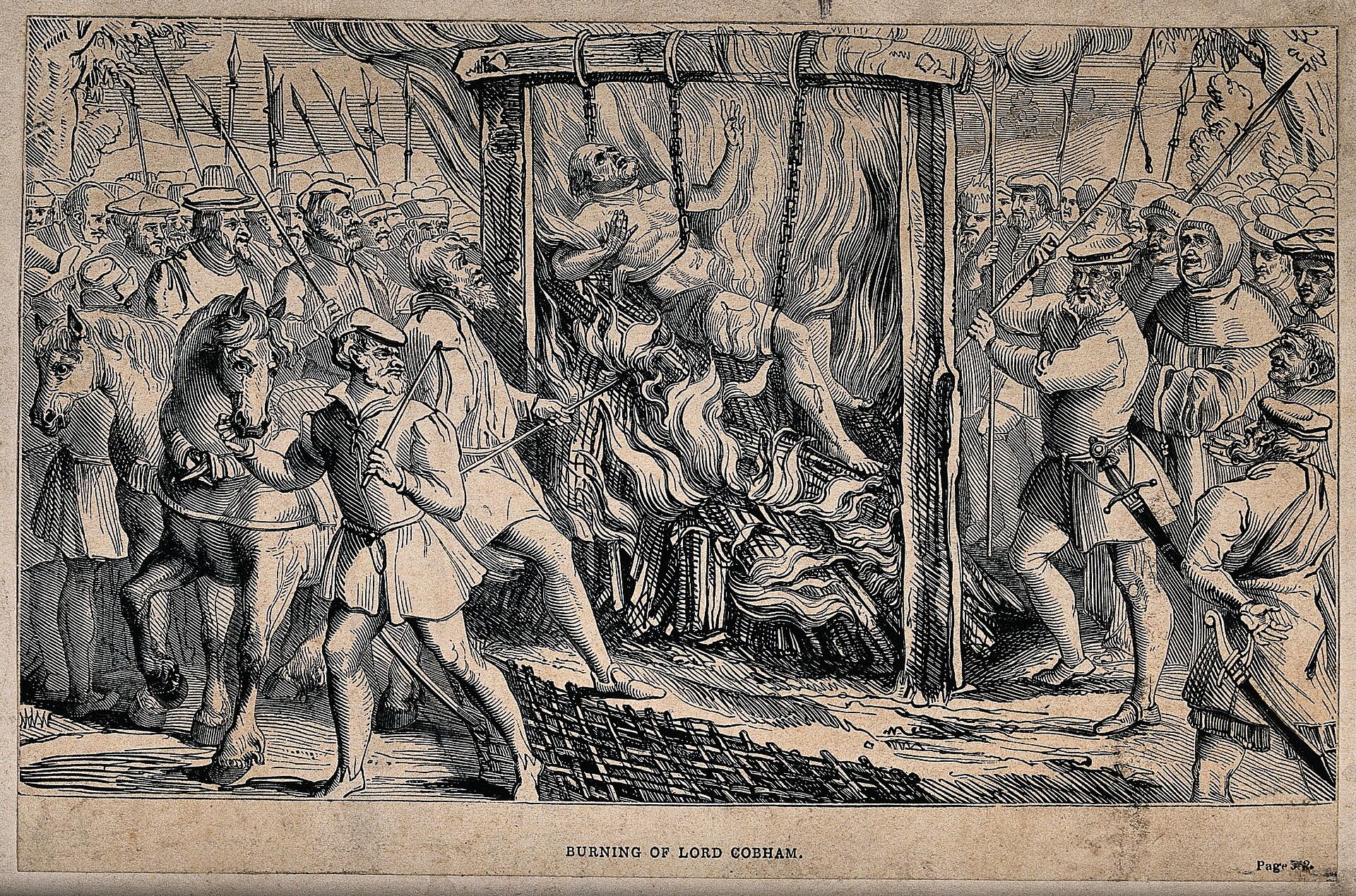
Died: December 14, 1417 (Foxe, 1563, says 1418) · Place: St Giles's Fields, London · Earliest source: the record of his condemnation in Parliament, December 14, 1417, as summarized in the Dictionary of National Biography (1895); Foxe, Acts and Monuments, 1563 · Record strength: Documented

What the record shows
Oldcastle is the hardest case in this lesson to classify, because he was condemned twice, once as a heretic and once as a traitor. He was a knight of the English court, known by his title Lord Cobham. In 1413 Archbishop Arundel declared him "a heretic, and handed over to the secular arm," and the king allowed him "a respite of forty days" in the hope that he would recant. Before the time ran out he escaped from the Tower of London. On Wednesday, January 10, 1414, Lollards were summoned to meet "in the fields near St. Giles's Hospital" outside London; the king closed the city gates and the gathering was broken up.8 The 1910 Catholic Encyclopedia says Oldcastle organized the rising "early in 1414," was later captured on the Welsh border, "condemned by Parliament, and executed in 1417."3
The Dictionary of National Biography of 1895, summarizing the parliamentary record, says that after his capture in Wales, where he "was only taken after a desperate resistance," he was brought "before parliament on 14 Dec, when he was summarily condemned as an outlawed traitor and convicted heretic." He was "drawn thence the same day on a hurdle to the new lollard gallows at St. Giles's Fields," where he was, in the words of a chronicle the article quotes, "hung and burnt hanging."8 The sentence combined the two punishments: hanging, the penalty for treason, and burning, the penalty for heresy.
Foxe printed the first long Protestant account in 1563. It reads: he was taken to "St. Giles's Field, where as they had set up a new pair of gallows," and "then was he hanged up there by the middle in chains of iron, and so consumed alive in the fire." Before he died he knelt and prayed, "desiring almighty God to forgive his enemies."9
Tradition and legend
Two traditions grew from Oldcastle's death, pulling in opposite directions. The Protestant one, fixed by Foxe, made him a "Christian knight" and martyr whose rising was exaggerated or invented by his enemies. The other, older one made him a byword for a hypocrite and rebel. William Shakespeare's comic knight in Henry IV was first named Oldcastle and renamed Falstaff after objections, a point argued over by scholars of the plays and outside the scope of this lesson. Neither the saint of Foxe nor the buffoon of the stage is the man of the record. The picture of him "suspended horizontally in chains" over the fire is the usual one, but the DNB warns that "the statements of the authorities" on the exact manner differ.8
What the sources dispute
The first dispute is the year. Foxe's 1563 text closes with "this was done in the year of our Lord 1418."9 The parliamentary record behind the DNB places the condemnation and execution on December 14 in the parliament of late 1417, and most modern works give December 14, 1417.8 The second, more serious dispute is the reason. The crown said it executed an armed rebel who had plotted against the king; the 1414 rising was real, and the court that condemned him in 1417 was Parliament, not a church synod. Foxe and his successors said the rising was a pretext and that Oldcastle died for his faith. The fair reading keeps both: he was a convicted heretic who refused to recant and an outlaw convicted of treason, and the penalty he received was built to punish both. Whether he deserves the title martyr depends on which of the two charges a reader thinks was the real one.
Jan Hus (1415)
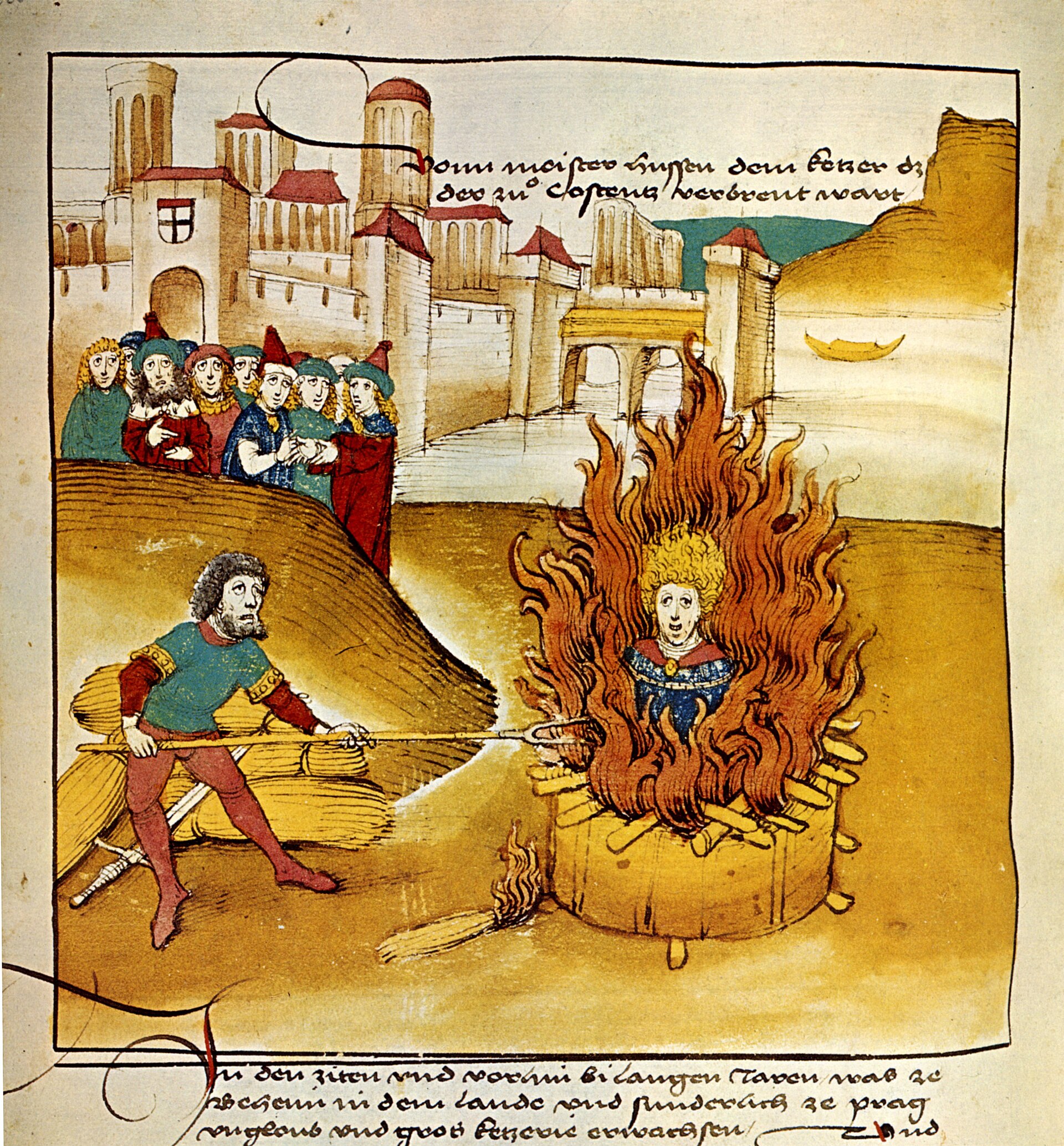
Died: July 6, 1415 · Place: Constance (Konstanz), at the city's execution ground outside the walls · Earliest source: Council of Constance, session 15, sentence of July 6, 1415; Peter of Mladonovice, Relatio (eyewitness account written soon after 1415) · Record strength: Documented

What the record shows
Jan Hus was a priest and master of the University of Prague and the preacher at Prague's Bethlehem Chapel, where he preached in Czech. His teaching and his long quarrel with the archbishop of Prague and the papal court are the subject of Part A, lesson 10. By 1412 he had been excommunicated and had left Prague for the countryside, from where he wrote letters to his congregation. In one of them he punned on his own name (in Czech hus means goose): "since the Goose, a tame creature and a domestic fowl with no power to reach great heights in his flight, hath yet broken through their nets, we may the more confidently expect that other birds, which by God's word and by their lives soar to high places, will break their traps in pieces." He added that God had sent to Prague, "in the place of one feeble, weakly Goose, falcons and eagles."10
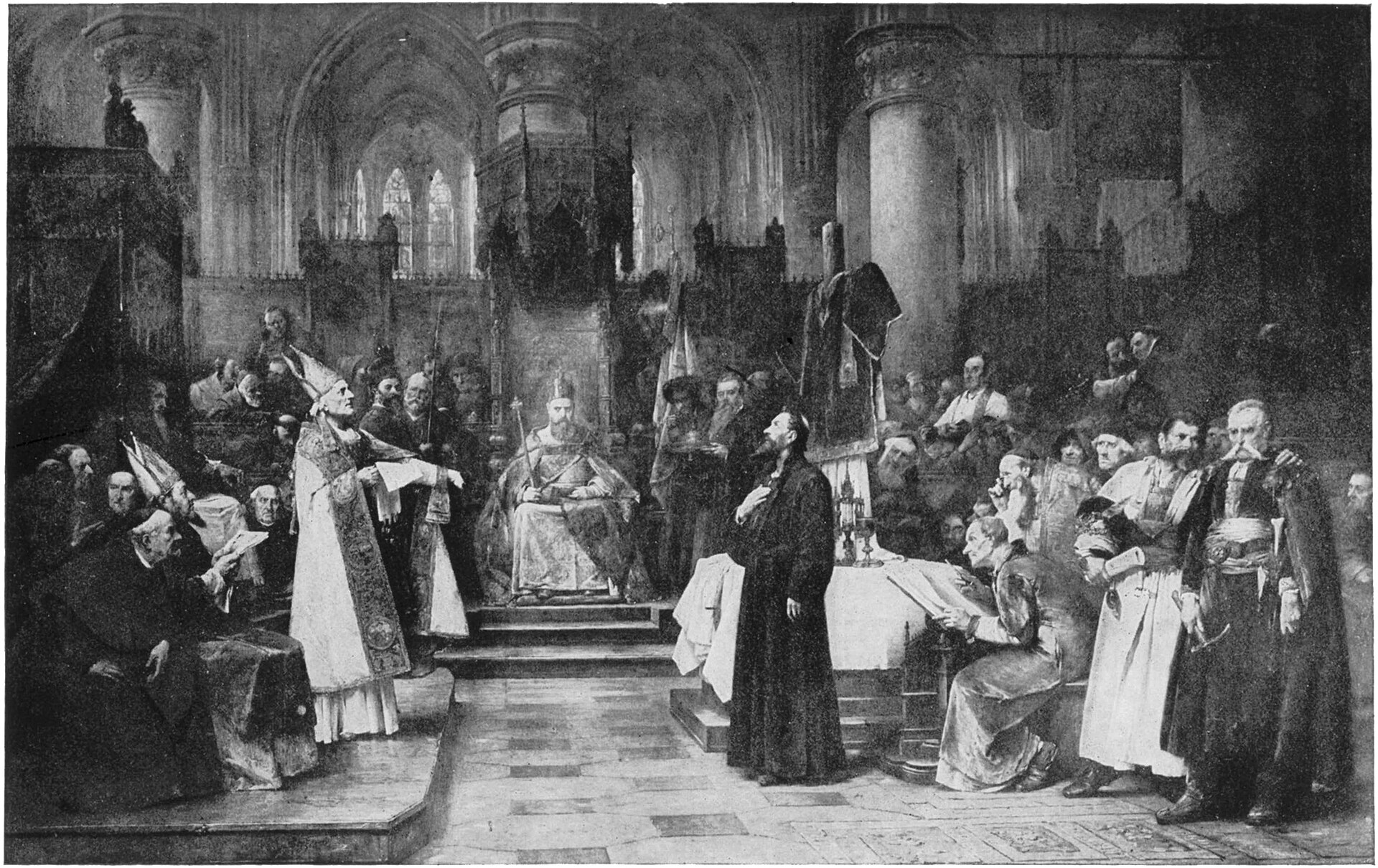
In 1414 King Sigismund, king of the Romans and heir to the Bohemian crown, urged Hus to go to the general council at Constance and promised him a safe-conduct. According to Herbert Workman and R. Martin Pope, the editors of Hus's letters in 1904, Hus received Sigismund's official promise of the safe-conduct, dated at Rothenburg on October 8, and set out on October 11, 1414, "leaving the formal document to overtake him as best it might."11 He entered Constance on November 3. On November 28 the cardinals invited him to a hearing and then held him; he was held in the Dominican friary and later, after the flight of Pope John XXIII, moved to the castle of Gottlieben.11 His public hearings before the council took place on June 5, 7 and 8, 1415. At the close of one of these hearings Sigismund said openly that he had given Hus a safe-conduct, but also that he would "not defend any heretic who is obstinately determined to stick to his heresy," and advised Hus to throw himself "wholly on the grace of the Council."11
The sentence was read in the cathedral of Constance in the council's fifteenth session, on July 6, 1415. It calls Hus "a disciple not of Christ but rather of the heresiarch John Wyclif," complains that he "has made appeal directly to our lord Jesus Christ, as to the supreme judge" over the pope's head, finds "that the said John Hus is obstinate and incorrigible," and "judges him to be considered and condemned as a heretic." It orders that he "is to be deposed and degraded from the order of the priesthood" and "relinquishes John Hus to the judgment of the secular authority."1 The charge was heresy. The court was a general council of the Western church, sitting with Sigismund present. The law was the canon law on obstinate heresy, executed by the king's officers.
The death is known from Peter of Mladonovice, a Czech scholar who attended the trial as secretary to Hus's protector, the knight John of Chlum, and wrote it up as a Relatio (report). The summary below follows Workman and Pope's English rendering of Mladonovice's text, and the modern English translation by Matthew Spinka (1965) is the standard scholarly edition. When the sentence was read, Hus knelt and prayed: "Lord Jesus, pardon all my enemies for Thy great mercy's sake." He was dressed in priest's vestments and then stripped of them one by one in the rite of degradation; a paper crown painted with demons and the word "Heresiarch" was put on his head. Led out of the city, he was tied to a stake. Asked one last time by the Count Palatine to recant, he answered "in a loud voice" that "the evidence given against me is false" and that "in the truth of the gospel I have written, taught, and preached to-day I will gladly die." When the fire was lit, Mladonovice wrote, "he sang twice, with a loud voice, 'Christ, Thou Son of the Living God, have mercy upon me.'" The ashes were afterward "tilted into the Rhine" so that nothing could be kept as a relic.11

Tradition and legend
Two famous sayings are tied to Hus's death, and both are later. The first is "O holy simplicity" (in Latin sancta simplicitas), said to have been spoken when an old peasant woman added wood to the fire. Martin Luther repeated it as Hus's in a preface he published in 1537 to an edition of Hus's letters. The French editor of those letters in 1846, Emile de Bonnechose, added a note that the expression "is erroneously attributed to John Huss; it fell from the lips" of Hieronymus of Prague (Jeroným Pražský).12 Neither attribution rests on Mladonovice's report, which does not contain the phrase. This is legend.
The second is the "goose and swan" prophecy: that Hus said, "Today you roast a goose, but in a hundred years a swan will come whom you will not be able to burn," which Lutherans read as a prediction of Luther (whose theses came 102 years later). No contemporary account of the trial or execution contains it. What does survive is Hus's own play on his name in his letters from exile, quoted above, with its "falcons and eagles" who would follow the goose.10 The swan saying is legend built on that genuine pun, and its first printed appearance was not traced for this lesson.
What the sources dispute
The great dispute is the safe-conduct. Hus's friends at the time, and Protestant historians after them, held that Sigismund broke his word, and Mladonovice reports that Hus reminded the king of the safe-conduct at the final session, at which (by a story Workman and Pope call "denied by some historians") Sigismund blushed.11 The council's position, as the editors' summary of its nineteenth session (September 23, 1415) gives it, was that "notwithstanding safe conducts of emperors and kings and others, a competent judge can inquire into heresy"; the edition used here prints only that summary, not the decree's full text.1 Workman and Pope, who admired Hus, still argued that "Sigismund's safe-conduct did not reach the spiritual sphere" and that only a papal safe-conduct "could alone have guaranteed his immunity."11 The record supports both sides in part: the document promised Hus safe travel and return, Sigismund protested the arrest at first and then accepted it, and the council held that no secular promise bound a church court.
The second dispute is how the Catholic Church now regards the sentence. The 1910 Catholic Encyclopedia treated his teaching as error and his condemnation as the end of a long conflict.13 On December 17, 1999, Pope John Paul II told a symposium on Hus in Rome that he felt "the need to express deep regret for the cruel death inflicted on John Hus," and praised "his moral courage in the face of adversity and death."14 On June 15, 2015, the 600th anniversary, Pope Francis received a Czech delegation including members of the Czechoslovak Hussite Church and the Evangelical Church of Czech Brethren and spoke of Hus as one who "died tragically."15 Neither statement reversed the council's doctrinal judgment, and neither claimed to. Czech Protestants honor Hus as a martyr, and Catholic statements since 1999 express regret for the manner of his death.

Hieronymus of Prague (Jeroným Pražský) (1416)
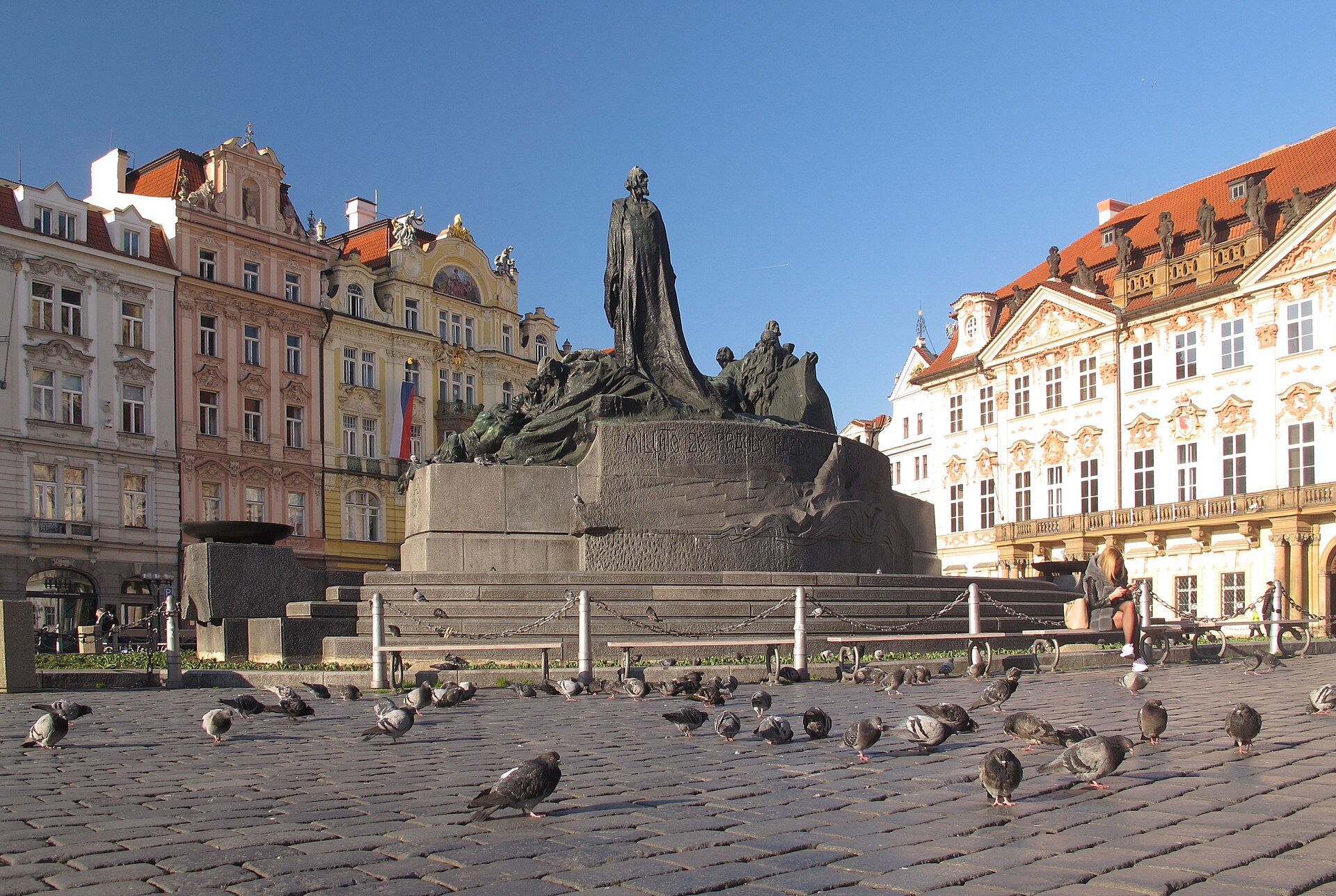
Died: May 30, 1416 · Place: Constance, on the same ground where Hus died · Earliest source: Council of Constance, session 21, sentence of May 30, 1416; Poggio Bracciolini, letter to Leonardo Bruni dated at Constance May 30, 1416 (an eyewitness) · Record strength: Documented
What the record shows
Hieronymus of Prague (Jeroným Pražský) was a layman, a master of arts of Prague who had studied at Oxford, and the best known carrier of Wycliffe's writings into Bohemia. Workman and Pope record that in the fall of 1401 he came back from Oxford "bringing with him copies of Wyclif's Dialogue and Trialogue," which he had "written out with his own hand." He was Hus's friend and ally in the university disputes at Prague, a more restless man than Hus and a more brilliant speaker.16
His road to Constance was the reverse of Hus's. Against Hus's wishes, he came to Constance in April 1415, on his own and without a safe-conduct. On April 4 he posted a notice on the city gates defending Hus's orthodoxy, then withdrew to Überlingen and asked the council for a safe-conduct. He returned and posted another notice on April 7 saying he had come of his own free will to answer any charge, and two days later fled toward Bohemia. At Hirsau, in the Black Forest, he was drawn into an argument, called the council "a synagogue of Satan," and was arrested on April 24. He was brought back to Constance in chains on May 23, 1415, and kept in a dungeon by the cemetery of St Paul's, "chained hand and foot to a bench too high to sit on," until Mladonovice found his prison and bribed the jailer to feed him. He fell seriously ill there, and by the time he recovered Hus was dead.16
Weakened by sickness and prison, Hieronymus of Prague (Jeroným Pražský) gave way. In September 1415 he read a recantation before the council. The summary of the council's nineteenth session (September 23, 1415) in Tanner's edition says that he "finally abjures his faith publicly and solemnly," and the sentence of May 1416 records that this abjuration included approving the condemnation of Wycliffe and Hus.1 Workman and Pope date an earlier reading of the recantation to September 11.16 He was not released. New accusers brought fresh articles against him, and in May 1416, at a public hearing, he withdrew the recantation and praised Hus. The council's sentence of May 30, 1416 (session 21) recalled that he had "approved and consented to" the condemnation of Wycliffe and Hus and had "professed acceptance of every condemnation of the aforesaid things," and declared him "a heretic who has relapsed into heresy and as an excommunicated and anathematised person."1 The charge was relapse. The court was the council. He was handed over to the city's officers and burned the same day.
The fullest eyewitness account comes from an unexpected source. Poggio Bracciolini, an Italian humanist working as a papal secretary at the council, wrote to his friend Leonardo Bruni (called Aretino) a letter dated "Constance, the third day before the Calends of June," which is May 30, 1416. In the English translation by Merrick Whitcomb (1900), Poggio says the accused "came so near the eloquence of the ancients" that he was astonished. He records that "for 340 days he lay in the bottom of a foul, dark tower," that "a space of two days was given him for repentance," and that in his last speech "he called him [Hus] a good man, just and holy." At the stake, "he went to his fate with joyful and willing countenance," and Poggio compared him to the Roman hero who burned his own hand to show his courage: "For not Mutius himself suffered his arm to burn with such high courage as did this man his whole body."17
Poggio was careful to say where he stood. "I praise not that which he advanced, if anything, against the institutions of the church," he wrote, and he regretted that "so noble and prominent a genius should be diverted to the interests of heresy."17 This is a Catholic eyewitness, a papal official, who admired the man's courage and learning without sharing his views, and his letter is the reason the death is so well known.
Tradition and legend
The saying "O holy simplicity" has been attached to both Hus and Hieronymus of Prague (Jeroným Pražský). As shown in the Hus brief, Luther gave it to Hus in 1537 and the French editor of Hus's letters in 1846 gave it to Hieronymus of Prague (Jeroným Pražský).12 It is not in Poggio's letter as translated by Whitcomb. It is legend, and it is unclear which man, if either, said it.
Two details often repeated in popular Protestant books, that he sang at the stake and that he told the executioner to light the fire in front of him rather than behind his back, are not later tradition: they come from Poggio's eyewitness letter. In Whitcomb's translation Poggio writes that "when the fire was brought he began to sing a hymn, which the smoke and fire scarcely interrupted," and that when the executioners wished to start the fire behind his back he said, "Come here, and light the fire in front of me."17 Later retellings that turn the one hymn into "hymns" go beyond the letter.
What the sources dispute
The date of the recantation differs between modern editors (September 11 in Workman and Pope, September 23 in the council's acts), which may reflect a first reading in a smaller meeting and a formal abjuration in full session. The deeper question is moral, and the sources leave it open. Workman and Pope, who admired Hus, judged that he "lacked the moral conviction which made Hus a martyr" when he first gave way, then added of the end, "in spite of lapse," that "in their death they were not divided."16 A reader can weigh the recantation, made by a sick and starving prisoner, against the withdrawal, made in public and at the cost of his life. The council weighed it as relapse, which under its law left no lesser penalty.
Girolamo Savonarola (1498)
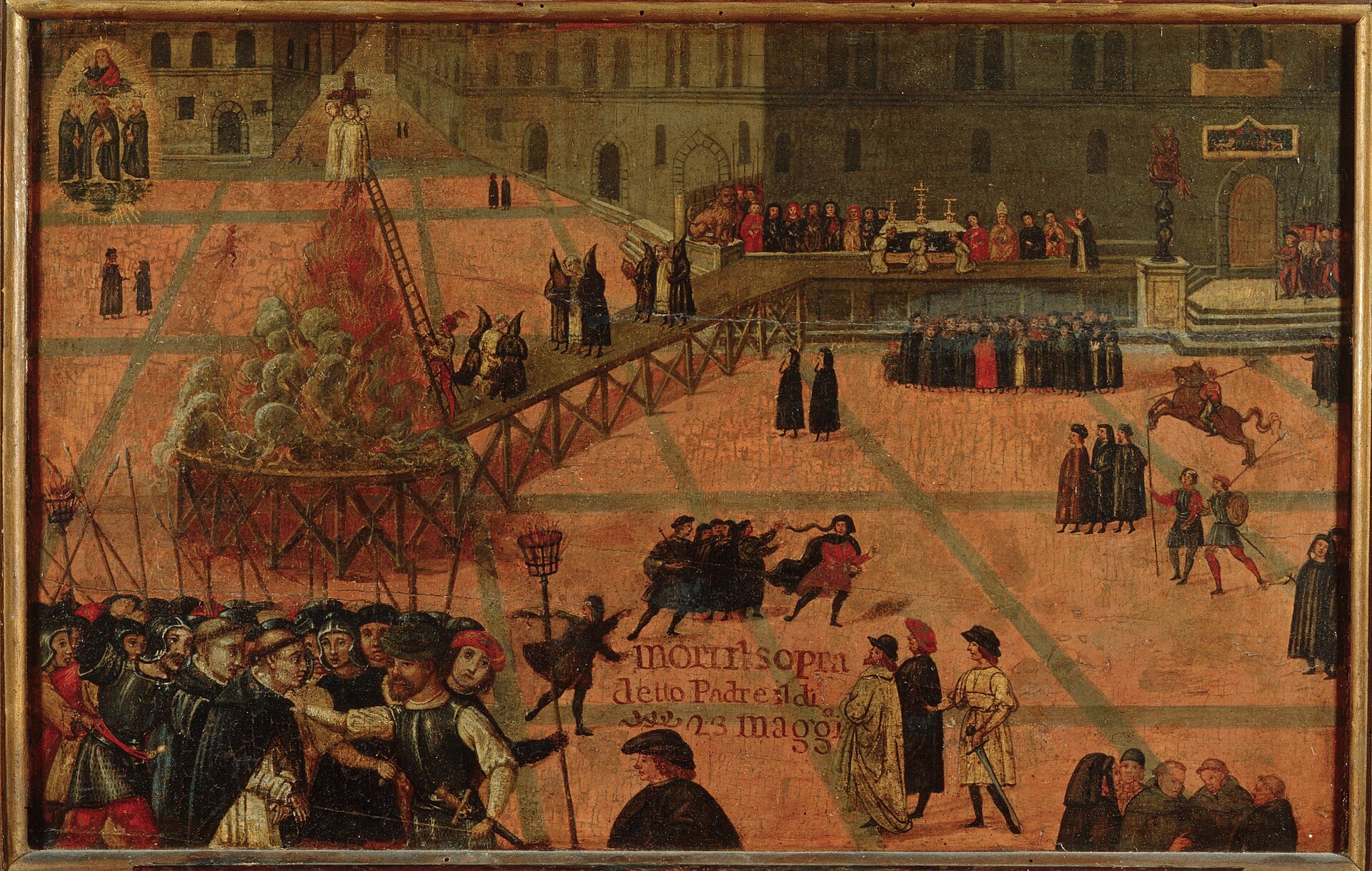
Died: May 23, 1498 · Place: Piazza della Signoria, Florence · Earliest source: sentence of the Otto di Guardia (the Florentine criminal magistracy), May 23, 1498, preserved in the Uffizi library and the State Archives of Florence · Record strength: Documented

What the record shows
Girolamo Savonarola was a Dominican friar, born at Ferrara on September 21, 1452, and prior of San Marco in Florence.18 After the Medici were driven from Florence in 1494, his preaching on repentance, judgment and the reform of the city and the church made him the most powerful voice in the republic. His public "bonfires of the vanities" and his attacks on the morals of the papal court under Pope Alexander VI brought him into open conflict with Rome. The 1912 Catholic Encyclopedia sets out the steps: a papal brief of July 25, 1495, summoned him to Rome; another, in September, forbade him to preach; and "on 12 May, 1497, he was excommunicated." He continued to preach and said the excommunication was invalid.18
The crisis came in the spring of 1498. A Franciscan challenged one of Savonarola's friars to an ordeal by fire to test his claims. The ordeal "was to take place on 7 April, 1498, before a large public gathering," but "it did not take place."18 The crowd turned on San Marco the next day. Savonarola and Fra Domenico da Pescia "were taken prisoners," and later Fra Silvestro Maruffi as well. The Catholic Encyclopedia states plainly that "the captured monks were tortured." Papal commissioners took part in the church trial, and the article adds that the official proceedings, "which were, however, falsified by the notary, still exist."18
Two sentences followed, as in every case in this lesson. The church commissioners condemned the three friars as heretics and schismatics, and the city's criminal magistracy, the Eight (Otto di Guardia e Balìa), then sentenced them to death. A copy of the Eight's minutes, Manuscript 348 in the library of the Uffizi Galleries, records that each was to be hanged and then burned, "so that their souls might be separated from their bodies," and that the vote was unanimous; the Uffizi notes that one member, Francesco Cini, was absent at the start of the decision and dissented.19 The executions took place on the morning of May 23, 1498. The Schaff-Herzog Encyclopedia (1911) says that "the ashes of the three monks were cast into the Arno," to prevent any cult of relics.20
The charge, then, was heresy, schism and disobedience to the pope, with an accusation of false prophecy drawn from the confessions made under torture. The courts were a church tribunal including papal commissioners and the city's criminal magistracy. The manner of death was hanging, with the bodies burned afterward.
Tradition and legend
The most quoted words from the execution belong to the degradation. As the Schaff-Herzog Encyclopedia gives them, the bishop of Vasona, pronouncing the sentence, said, "I separate thee from the Church triumphant and the Church militant," and Savonarola answered, "Not from the Church triumphant. That is not in thy power to do."20 The exchange is reported in early lives of Savonarola by his followers. The earliest of these was not opened for this lesson, so the words are rated here as strong tradition: very likely, widely reported, and not checked against an eyewitness text.
A second strand of tradition is the cult. Savonarola's followers (the Piagnoni, the "weepers") honored him as a saint and martyr for generations, and his memory was kept at San Marco. That devotion is a matter of record as devotion; the miracles claimed for him are not part of the trial record.
What the sources dispute
Savonarola is claimed by both Catholics and Protestants, and the record supports neither claim without qualification. Protestants, as the Schaff-Herzog Encyclopedia puts it, "are inclined to regard him as in a sense a precursor of the Reformation"; Luther wrote a preface in 1523 to an edition of Savonarola's prison meditations on Psalms 51 and 31, and Savonarola stands among the forerunners at the foot of the Luther Monument in Worms. The same article adds that in his Triumph of the Cross Savonarola accepted the seven sacraments and the other marks of the medieval church.20 The Catholic Encyclopedia of 1912 states that "he was not a heretic in matters of faith," and calls his place on the Worms monument as a "forerunner of the Reformation" "entirely unwarranted"; it faults him instead for "fanaticism, obstinacy, and disobedience."18 In Florence, Cardinal Silvano Piovanelli convened a historical commission in 1998, the 500th anniversary of the death, which the National Catholic Reporter in January 1999 said could open the way to an investigation by the Congregation for the Causes of Saints.21 The present status of any cause was not confirmed for this lesson. On the facts both camps agree: a Catholic friar, tortured, condemned by a church tribunal and a city court, hanged and burned. They disagree on whether his offense was heresy, disobedience or politics.
William Tyndale (1536)
Died: 1536, traditionally October 6 (Foxe gives only the year in the text) · Place: Vilvoorde (Filford), near Brussels, in the Habsburg Netherlands · Earliest source: John Hutton's dispatch to Thomas Cromwell, August 12, 1536 (the condemnation); John Foxe, Acts and Monuments, 1563 and later editions (the death) · Record strength: Documented

What the record shows
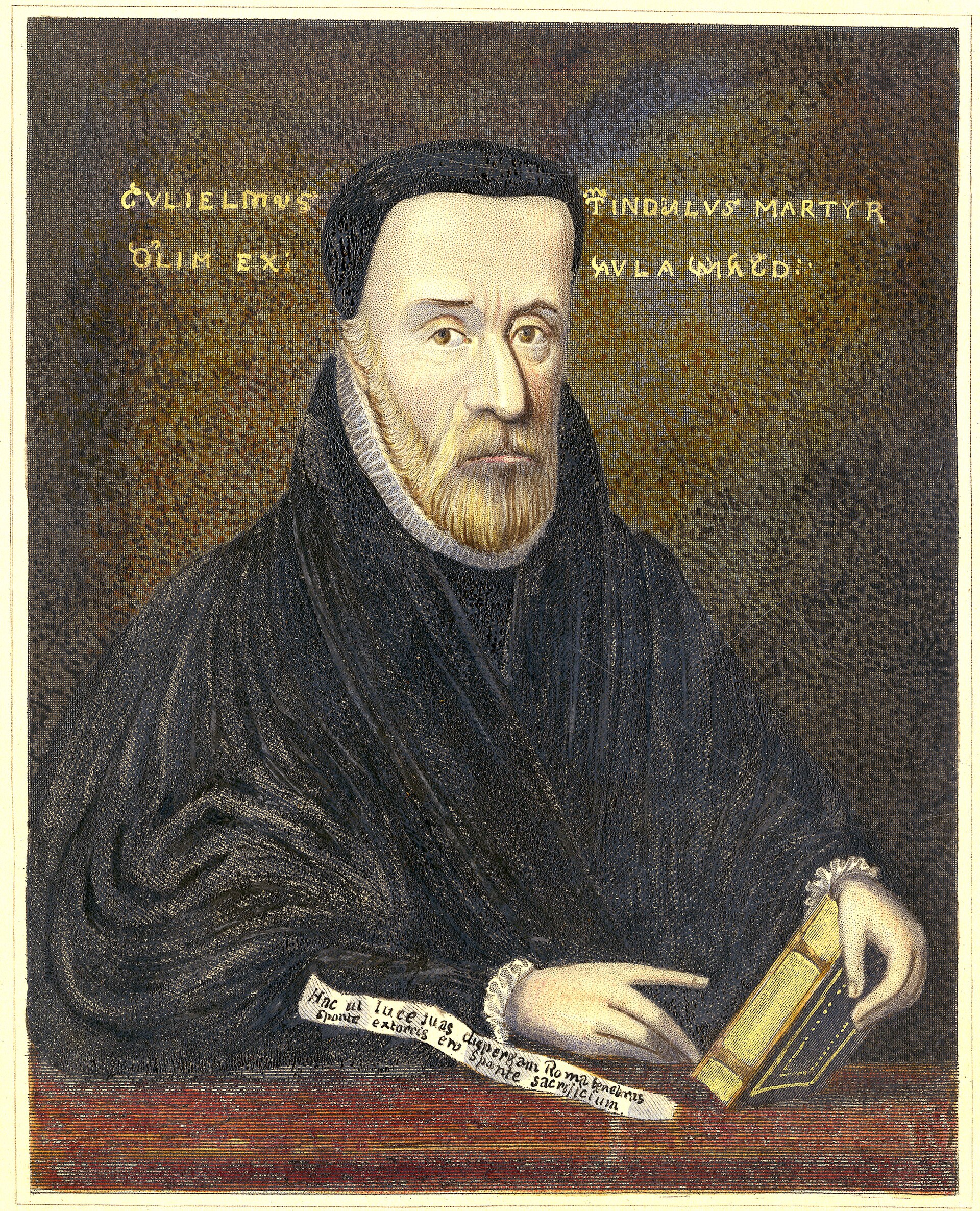
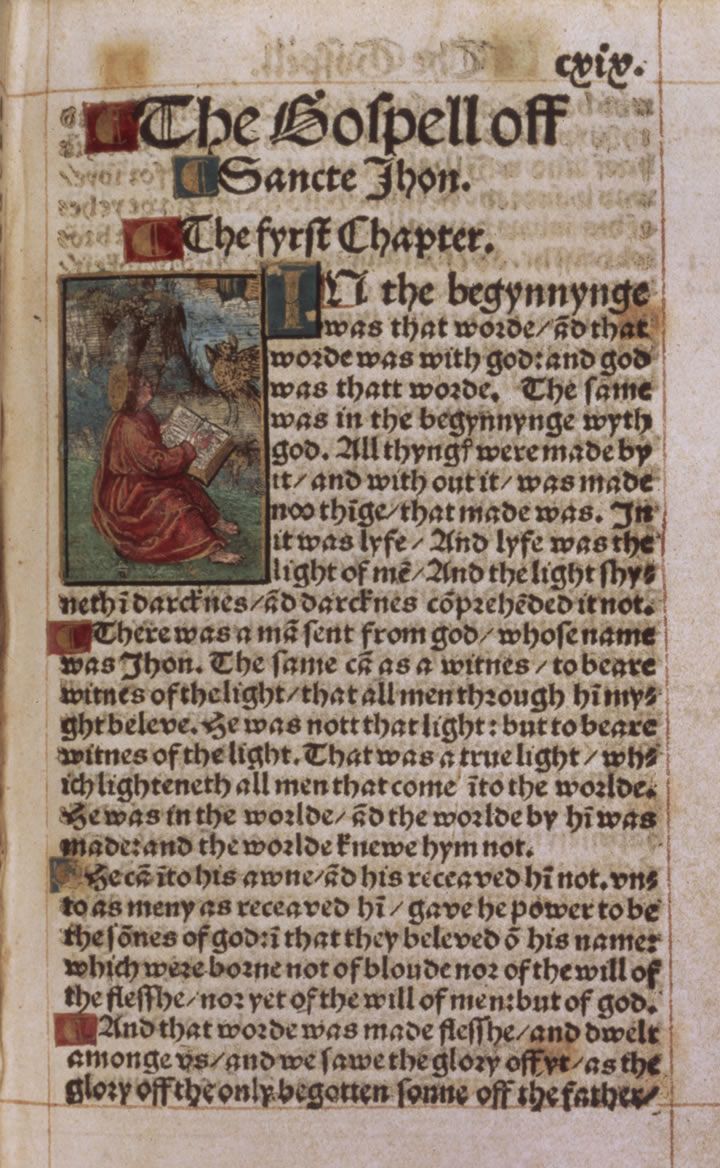
William Tyndale was an English priest and scholar who left England in 1524 to translate the New Testament from Greek, because no bishop would license an English translation. His first complete New Testament was printed at Worms in 1526 and smuggled into England, where church authorities bought up and burned copies. He went on to translate the Pentateuch and other books from Hebrew and to write in defense of the Reformation teaching on justification by faith. His work and ideas belong to Part A, lesson 11 and the history of the English Bible; this brief tells his arrest and death.
The arrest is told by Foxe, who drew on Thomas Poyntz, the English merchant in Antwerp in whose house Tyndale lived. An Englishman named Henry Phillips befriended Tyndale, borrowed forty shillings from him, and then led him out of Poyntz's house through "a long narrow entry" where officers from Brussels were waiting. "Philips pointed with his finger over Master Tyndale's head down to him, that the officers who sat at the door might see that it was he whom they should take." The officers later told Poyntz "that they pitied to see his simplicity when they took him." He was taken "to the castle of Filford, eighteen English miles from Antwerp, and there he remained until he was put to death."22 Robert Demaus, Tyndale's biographer, found in the Brussels archives the payment to the lieutenant of Vilvoorde castle for keeping Tyndale "a year and a hundred and thirty-five days," and from it dated the arrest to May 23 or 24, 1535.23
From the prison a single letter in Tyndale's own hand survives, written in Latin to an official of the castle (Demaus identifies the governor, the marquis of Bergen-op-Zoom). It asks, if he must stay through the winter, for "a warmer cap, for I suffer extremely from cold in the head," a warmer coat, cloth to patch his leggings, "a lamp in the evening, for it is wearisome to sit alone in the dark," and above all for "my Hebrew Bible, Hebrew Grammar, and Hebrew Dictionary, that I may spend my time in that study."23
The trial was a heresy process under the imperial law of the Low Countries, conducted largely in writing. The Council of Brabant was the court, and theologians of the University of Louvain, chief among them Jacobus Latomus, examined and answered his writings. Foxe says there was "much writing" and "great disputation" between Tyndale and the Louvain men.22 Demaus gives the articles as faith alone justifies, the forgiveness of sins received by believing the gospel is enough for salvation, human traditions cannot bind the conscience, the will is not free, there is no purgatory, and the Virgin and the saints neither pray for us in their own person nor should be invoked. He drew them partly from Latomus's surviving reply and partly from the pattern of the Louvain trials of the time, so the list is his reconstruction.23 On August 12, 1536, Cromwell's envoy John Hutton wrote from Antwerp that the procurator-general had told him "William Tyndale is degraded and condemned into the hands of the secular power, so that he is very like to suffer death this next week."23
Foxe's account of the end, in the Townsend edition, reads: "he was condemned by virtue of the emperor's decree, made in the assembly at Augsburgh," and "brought forth to the place of execution, was there tied to the stake, and then strangled first by the hangman, and afterwards with fire consumed in the morning, at the town of Filford, A.D. 1536."22 Strangling before burning was the usual mercy in the Low Countries for those who did not recant; Demaus states that under the emperor's laws only Anabaptists were burned alive.23 (For the Anabaptist martyrs of the same years, see lesson 06.) Foxe adds that the procurator-general said of him that he was "Homo doctus, pius, et bonus," "a learned, a good, and a godly man," and that during his imprisonment "it is said, he converted his keeper, the keeper's daughter, and others of his household."22

Tradition and legend
Tyndale's last words, as Foxe gives them, are among the most quoted in English church history: he died "crying thus at the stake with a fervent zeal, and a loud voice, 'Lord! open the king of England's eyes.'"22 Foxe names no witness for this, and Demaus, who searched the archives for every trace of Tyndale, wrote plainly: "No record of the martyrdom has been given by any eyewitness."23 The words are a strong tradition, printed within about thirty years and in keeping with what Tyndale wrote and prayed for, but they rest on Foxe's report alone.
The date October 6 is also tradition. Foxe's narrative gives the year only. Demaus accepted "Friday the 6th of October" as the day, citing Foxe as its authority elsewhere, and it is the date kept in the calendars of the Church of England and other churches.23 No document from the Vilvoorde process that names the day was found for this lesson.
A third tradition holds that while in prison Tyndale finished the translation of the Old Testament historical books through Chronicles and that the manuscript passed to his friend John Rogers, who printed it in the composite English Bible of 1537 published under the name "Thomas Matthew." Demaus calls this "the uniform tradition" and says that "direct proof cannot be given," though he judged the evidence strong enough to accept it.23 Rogers was himself the first man burned under Mary I, in 1555 (lesson 06).
What the sources dispute
The legal basis is the first question. Foxe names "the emperor's decree, made in the assembly at Augsburgh," meaning the imperial measures against the Lutheran teaching after the Diet of Augsburg of 1530; Demaus speaks of the Council of Brabant acting "as the law required."2223 The exact edict cited in the sentence was not seen for this lesson. The second question is the role of the English crown. Henry VIII had wanted Tyndale back in England as a heretic and a critic of his divorce, but Cromwell's agents in 1535 and 1536 also worked for his release, and Demaus argued that Cromwell sought to save him. Henry Phillips's motive and paymaster were never established. The third is the meaning of his death. Protestant writers from Foxe on have treated Tyndale as the martyr of the English Bible. Catholic writers of the period, Thomas More above all, treated him as a heretic whose translation carried Lutheran doctrine in its word choices. Both readings agree on what the court condemned: his teaching, as found in his books.
The eight cases side by side: charges, courts and laws
Set next to each other, the cases show a single legal pattern with local variations. In each, a church judge decided the question of doctrine and a secular authority carried out the death. In three (Oldcastle, Savonarola and Tyndale) a political or imperial charge ran alongside the religious one. In two (Sawtrey and Hieronymus of Prague (Jeroným Pražský)) the decisive word was "relapse": both had abjured once, and under canon law a relapsed heretic could not be admitted to penance a second time.
What the record shows and what it does not
- Documented fact: Wycliffe died naturally on December 31, 1384, and was condemned posthumously at Constance on May 4, 1415; his remains were exhumed and burned in 1428. Sawtrey was burned by royal writ of February 26, 1401. The statute De haeretico comburendo (1401) ordered relapsed or unrepentant heretics burned "before the people, in a high place." Hus was condemned and burned at Constance on July 6, 1415, and Hieronymus of Prague (Jeroným Pražský) on May 30, 1416. Oldcastle was condemned by Parliament as traitor and heretic and hanged and burned. Savonarola and two friars were hanged and burned in Florence on May 23, 1498. Tyndale was condemned by August 12, 1536, and strangled and burned at Vilvoorde later that year.
- A church's own claim or tradition: Czech Protestant churches honor Hus and Hieronymus of Prague (Jeroným Pražský) as martyrs; Anglican and other Protestant calendars keep Tyndale's day on October 6; Savonarola's Dominican followers honored him as a saint. The Catholic Church, through John Paul II in 1999, expressed "deep regret" for Hus's cruel death without reversing the doctrinal judgment.
- Scholarly reading: Gee and Hardy read the Sawtrey writ as earlier than the statute; Workman and Pope held that Sigismund's safe-conduct could not bind the church court; Demaus reconstructed the Tyndale articles and dated his arrest from archival payments; the 1912 Catholic Encyclopedia denied that Savonarola was a heretic in faith.
- Open question: the exact day of Sawtrey's and Tyndale's deaths; the first source for "O holy simplicity" and for the goose and swan saying; the eyewitness basis for Tyndale's last words; the role of Pope Martin V in Wycliffe's exhumation; the present status of any cause for Savonarola.
The era taken together
The eight cases share more than a period. Every man condemned was a Catholic Christian by baptism, and most were priests or masters trained in the church's own schools. Every one was condemned by fellow Catholics who believed, by the law of their day, that obstinate heresy was a danger to souls and to public order that the Christian ruler was bound to punish. The writs and sentences say so in their own words: Sawtrey's writ speaks of extirpating "such heresies and errors from our kingdom," and the 1401 statute of punishment that "may strike fear to the minds of others."62 The condemned men, in their own words, answered that they could not recant without lying before God. Hus's words that he feared to recant "lest I be a liar in the sight of God" and Tyndale's request for his Hebrew Bible in a cold cell stand on the other side of the same record.1123
The cases also show how memory took over from record. Foxe, writing in 1563, built the English Lollards into a line of witnesses running from Wycliffe to the Marian martyrs of lesson 06. Czech memory made Hus a national as well as a religious figure, and the Hussite movement that rose after his death outlasted the council that condemned him. Florence's memory of Savonarola split between his followers and his enemies. The record is narrower than any of these memories, and the sayings most often quoted (the swan, "holy simplicity," the king of England's eyes) are the parts least supported by eyewitness evidence. For the ideas that made these men dangerous to their judges, and for the reforms they called for, see Part A, lesson 10, Reform before Luther; for the Reformation that followed, see Part A, lesson 11. The Waldensians, condemned under the same procedures from the twelfth century on, are in lesson 04, and the Catholic martyrs killed by Protestant governments a generation later are in lesson 07.
Claims checked
"Wycliffe was burned at the stake for translating the Bible"
Refuted. Wycliffe died of a stroke at Lutterworth on December 31, 1384, after hearing Mass in his own church.4 His remains were dug up and burned in 1428 under the Constance decree, which condemned 45 articles of his teaching, not a translation as such.15
"Sigismund broke his promise of safe-conduct to Hus"
Partly supported. Sigismund promised Hus a safe-conduct and Hus was arrested and burned while it was in force. Sigismund admitted at the hearings that he had given it, and Hus reminded him of it at the end.11 The council held that a secular safe-conduct could not stop a church court from judging heresy, and Workman and Pope, though sympathetic to Hus, agreed that the document "did not reach the spiritual sphere."111 Whether that amounts to breaking a promise depends on what Hus was led to expect, which is the point the two sides have always argued.
"Hus prophesied at the stake that a swan would come in a hundred years"
Unsupported. The eyewitness report of Peter of Mladonovice, as given by Workman and Pope, records Hus's prayers and his last statement but no prophecy of a swan.11 Hus did pun on his name in letters written during his exile and spoke of "falcons and eagles" who would come after the goose.10 The swan saying appears to have grown from that pun; its first written source was not traced for this lesson.
"Hus said 'O holy simplicity' when an old woman added wood to his fire"
Unresolved. Luther's 1537 preface gives the words to Hus; the 1846 editor of Hus's letters gives them to Hieronymus of Prague (Jeroným Pražský).12 Neither the Mladonovice account nor Poggio's letter, as read for this lesson, contains the phrase.
"The church never executed anyone; only the state did"
Partly supported. In every case in this lesson the death sentence was carried out by a secular authority. But in every case the church court's judgment was the legal cause, and the law required the secular power to act on it: the 1401 statute ordered the sheriff to burn whomever the bishop handed over, and the Constance sentence "relinquishes John Hus to the judgment of the secular authority."21 The division of roles was real and was understood by both sides at the time; it did not make the outcome independent of the church court.
"Tyndale's last words were 'Lord, open the King of England's eyes'"
Partly supported. Foxe reports the words, but names no witness, and Demaus found that "no record of the martyrdom has been given by any eyewitness."2223 The report is early and plausible and fits Tyndale's known hopes; it is a strong tradition, not a documented quotation.
"Tyndale was burned alive"
Refuted. Foxe, the source most favorable to Tyndale, says he was "strangled first by the hangman, and afterwards with fire consumed."22
"Savonarola was a Protestant before the Reformation"
Refuted as stated. Savonarola accepted the seven sacraments and the medieval church's teaching, and his own works say so; even the Protestant Schaff-Herzog Encyclopedia calls him a precursor only "in a sense."20 His quarrel with Alexander VI was over obedience, morals and prophecy. Luther admired him and published his prison meditations, which is a fact about Luther.20
"Foxe invented the Lollard martyrs"
Refuted. For Sawtrey the royal writ survives on the Close Roll, independent of Foxe.6 For Badby, Foxe printed the bishops' own register entries.7 For Oldcastle the parliamentary record exists.8 What Foxe added was interpretation and narrative detail (the barrel and the prince's offer for Badby; the dates he sometimes gave in the old reckoning or got wrong, as with Oldcastle's "1418"), and those additions should be marked as his.9
"The Pope apologized for burning Hus and declared him innocent"
Partly supported. John Paul II in 1999 expressed "deep regret for the cruel death inflicted on John Hus" and praised his moral courage.14 He did not declare Hus's condemned teachings orthodox or annul the council's sentence, and Francis in 2015 spoke of reconciliation and of Hus having "died tragically."15
Hard questions and answers
Can men condemned by the church for heresy be called Christian martyrs?
By the definition in lesson 01, a martyr is a Christian who dies as a witness to the faith rather than deny it. Hus, Hieronymus of Prague (Jeroným Pražský), Badby and Tyndale each died rather than retract what they held to be Christian truth, and their judges agreed that this refusal was the reason for the sentence. Whether their beliefs were true is a theological question that this module does not settle. The Catholic Church does not list them as martyrs; Protestant churches do. The record shows they died for what they believed about Christ and the church, which is the historian's part of the answer.
If Savonarola was orthodox, why was he condemned as a heretic?
The record suggests the charge of heresy was attached to disobedience and to claims of prophecy obtained under torture. The 1912 Catholic Encyclopedia says plainly that "he was not a heretic in matters of faith," and the Uffizi notes that even the tortured proceedings left charges unproved.1819 In the law of the time, persistent defiance of a papal excommunication could itself be treated as schism and as suspicion of heresy. Florence's government, which had turned against him, had political reasons to want the trial to succeed.
Was there any law in England allowing a heretic to be burned before 1401?
The question is open. The Sawtrey writ appeals to "law divine and human, and the canonical institutes customary in that behalf," that is, to the church's law and the crown's power to enforce it, rather than to an English statute.6 Gee and Hardy's reading that Sawtrey's process began before the statute passed implies that the crown thought it already had the power. The statute then made the duty routine and placed it on the sheriffs.2
Why was relapse treated more harshly than first-time heresy?
In canon law a person who abjured was given penance and readmitted; a person who returned to the same error after abjuring was judged to have shown that the first abjuration was false, and was handed over without a second chance. The writ for Sawtrey and the sentence on Hieronymus of Prague (Jeroným Pražský) both rest on this rule: Sawtrey "aforetime abjured" and relapsed, and the council declared Hieronymus of Prague (Jeroným Pražský) "a heretic who has relapsed into heresy."61 The same rule appears in the Marian burnings of lesson 06.
Aren't all these accounts written by partisans?
Some are and some are not. The sentences of Constance, the Sawtrey writ, the 1401 statute and the Florentine magistrates' minutes are the records of the courts that condemned these men, and they confirm the deaths and the charges. Poggio, who disapproved of the teaching of Hieronymus of Prague (Jeroným Pražský), is the main eyewitness to his death. The partisan sources (Mladonovice for Hus, Foxe for the English cases) are most useful where the official record confirms them and least reliable for last words and private scenes. This lesson rates them accordingly.
Did these deaths change anything in their own time?
In Bohemia, yes: the burning of Hus led within a few years to the Hussite movement, which the council and later crusades failed to suppress. In England the Lollard statute stayed in force, was repealed under Henry VIII, revived under Mary I, and repealed again under Elizabeth I, as Gee and Hardy's introduction to the act records.2 In Florence, Savonarola's party survived him for decades. Tyndale's translation outlived him: within a year of his death an English Bible containing his work was printed under the name "Thomas Matthew," as Demaus describes.23
Learn more
- Church History, Part A, lesson 10: Reform before Luther: The teaching of Wycliffe, the Lollards and Hus, which this lesson does not reteach.
- Workman and Pope, The Letters of John Hus (1904): Hus in his own words from exile and prison, with a running narrative drawn from Mladonovice.
- The Foxe Project: Acts and Monuments online variorum: Compare what Foxe printed in 1563, 1570, 1576 and 1583 for each English case.
- Gee and Hardy, Documents Illustrative of English Church History (1896): The heresy statutes and writs in English translation, with their later repeals.
- Demaus, William Tyndale: A Biography (1886): The archival evidence for Tyndale's arrest, imprisonment and condemnation, including his letter from Vilvoorde.
Still being checked (15 items)
These points could not be confirmed against a primary source when this lesson was written and fact checked in October 2026. The text above states each one as uncertain.
- The role of Pope Martin V in ordering Bishop Richard Fleming to carry out Wycliffe's exhumation (Fuller, 1655, ties it only to the Constance decree and to Fleming); the papal letter was not opened.
- The exact day of William Sawtrey's burning and whether it took place at Smithfield; the writ is dated February 26, 1401, and names only a public place within the City of London.
- The exact day of Tyndale's execution: October 6, 1536, is the traditional date; Foxe's narrative gives only the year, and Demaus cites Foxe for the day.
- The specific imperial edict named in Tyndale's sentence (Foxe says the emperor's decree made at Augsburg).
- Demaus's list of the articles against Tyndale is partly a reconstruction from Latomus's reply and the pattern of other Louvain trials.
- The first written source of the goose and swan saying attributed to Hus.
- The first written source of "O holy simplicity" and whether Hus or Hieronymus of Prague (Jeroným Pražský) said it.
- Savonarola's reply at his degradation ("Not from the Church triumphant") was checked only in the Schaff-Herzog Encyclopedia (1911), not in an eyewitness text.
- The present status of any cause for Savonarola after the 1998 Florentine historical commission.
- The date of the recantation of Hieronymus of Prague (Jeroným Pražský): September 11, 1415 (Workman and Pope) or September 23, 1415 (session 19 of the council's acts).
- Oldcastle's year of death: 1417 in the parliamentary record as summarized by the DNB, 1418 in Foxe's 1563 text; the exact manner of hanging is reported differently by the authorities, per the DNB. His capture on the Welsh border is from the 1910 Catholic Encyclopedia.
- Mladonovice's Relatio was read in Workman and Pope's 1904 rendering; Matthew Spinka's 1965 translation was not opened.
- The attribution of the Savonarola execution painting to Filippo Dolciati, the 1485 date of the Spiezer Chronik image and Brozik's dates (1851 to 1901) follow the Wikimedia Commons file pages and general reference, not a museum record.
- The exact day of Badby's burning: the DNB (1885) gives March 1 (the day of the London examination in Foxe), while many modern works give March 5, 1410. Walsingham's Historia Anglicana, cited by the DNB for the prince's presence, was not opened.
- The safe-conduct: Workman and Pope date Sigismund's promise at Rothenburg on October 8, 1414; the formal document itself (often dated at Speyer, October 18) was not opened.
Notes
- Council of Constance (1414 to 1418), decrees and sentences: session 8 (May 4, 1415) on John Wyclif; session 15 (July 6, 1415), sentence against John Hus; session 19 (September 23, 1415); session 21 (May 30, 1416), sentence against Hieronymus of Prague (Jeroným Pražský). English translation as given at Papal Encyclicals Online, following Norman P. Tanner, ed., Decrees of the Ecumenical Councils (1990) (retrieved Oct. 28, 2026). Read it online. ↩
- "The Act De Haeretico Comburendo, A.D. 1401" (2 Henry IV, cap. 15), translated from Statutes of the Realm ii. 125, in Henry Gee and William John Hardy, eds., Documents Illustrative of English Church History (London: Macmillan, 1896), no. 42, pp. 133 to 137, with the editors' introduction on its later repeal and revival (retrieved Oct. 28, 2026). Read it online. ↩
- Francis Urquhart, "Lollards," The Catholic Encyclopedia, vol. 9 (New York: Robert Appleton Company, 1910); a 1910s Catholic source (retrieved Oct. 28, 2026). Read it online. ↩
- Francis Urquhart, "John Wyclif," The Catholic Encyclopedia, vol. 15 (New York: Robert Appleton Company, 1912); a 1910s Catholic source (retrieved Oct. 28, 2026). Read it online. ↩
- Thomas Fuller, The Church History of Britain (first published 1655), new edition by James Nichols, vol. 1 (London: William Tegg, 1868), book 4, fifteenth century, pp. 572 to 573, on the exhumation of Wycliffe, quoted in the spelling of that edition (retrieved Oct. 28, 2026). Read it online. ↩
- "The Royal Writ for the Burning of Sawtre, A.D. 1401," translated from the Close Roll, 2 Henry IV, pt. 1, m. 6, in Gee and Hardy, Documents Illustrative of English Church History (1896), no. 43, pp. 138 to 139, with the editors' headnote (retrieved Oct. 28, 2026). Read it online. ↩
- John Foxe, The Acts and Monuments of John Foxe, ed. Stephen Reed Cattley with a preliminary dissertation by George Townsend, vol. 3 (London: Seeley and Burnside, 1837), the stories of William Sautre and of John Badby (Badby at pp. 235 to 239, with the register entries Foxe printed); first published 1563 (retrieved Oct. 28, 2026). Read it online. ↩
- "Oldcastle, Sir John," Dictionary of National Biography, vol. 42 (London: Smith, Elder, 1895), pp. 90 to 91, as transcribed on Wikisource (retrieved Oct. 28, 2026). Read it online. ↩
- John Foxe, Acts and Monuments (1563), selection on Sir John Oldcastle in modern spelling, ed. Rosemary Gaby, Internet Shakespeare Editions (University of Victoria), from the 1563 facsimile (retrieved Oct. 28, 2026). Read it online. ↩
- Jan Hus, letter to his friends in Prague written during his exile (1412 to 1413), in Herbert B. Workman and R. Martin Pope, trans. and eds., The Letters of John Hus (London: Hodder and Stoughton, 1904), pp. 95 to 96 (retrieved Oct. 28, 2026). Read it online. ↩
- Herbert B. Workman and R. Martin Pope, The Letters of John Hus (1904), editors' narrative and notes drawing on Peter of Mladonovice's Relatio: the safe-conduct (pp. 145 and 160), the arrest (p. 167), Sigismund at the hearings (pp. 213 to 214), the final session, death and ashes (pp. 277 to 280). The modern standard translation, Matthew Spinka, John Hus at the Council of Constance (New York: Columbia University Press, 1965), was not opened for this lesson (retrieved Oct. 28, 2026). Read it online. ↩
- Martin Luther, preface (published 1537) to Hus's letters, with the editor's note, in Emile de Bonnechose, ed., Letters of John Huss, Written During His Exile and Imprisonment, trans. Campbell Mackenzie (Edinburgh: William Whyte, 1846), preface pp. 3 to 10; Project Gutenberg eBook 77359 (retrieved Oct. 28, 2026). Read it online. ↩
- Joseph Wilhelm, "John Hus," The Catholic Encyclopedia, vol. 7 (New York: Robert Appleton Company, 1910); a 1910s Catholic source (retrieved Oct. 28, 2026). Read it online. ↩
- Pope John Paul II, Address to an International Symposium on John Hus, December 17, 1999, sections 1 and 2, Holy See (retrieved Oct. 28, 2026). Read it online. ↩
- Pope Francis, Address to a delegation from the Czech Republic on the 600th anniversary of the death of Jan Hus, June 15, 2015, Holy See (retrieved Oct. 28, 2026). Read it online. ↩
- Workman and Pope, The Letters of John Hus (1904), editors' notes on Hieronymus of Prague (Jeroným Pražský): his return from Oxford in 1401 (p. 8), his arrival, flight, arrest and imprisonment at Constance (pp. 207 to 209), and his recantation, relapse and death (p. 265) (retrieved Oct. 28, 2026). Read it online. ↩
- Poggio Bracciolini, letter to Leonardo Bruni (Aretino), Constance, May 30, 1416, trans. Merrick Whitcomb, A Literary Source-Book of the Italian Renaissance (Philadelphia: University of Pennsylvania, 1900), pp. 40 to 47, as transcribed at elfinspell.com (retrieved Oct. 28, 2026). Read it online. ↩
- J. P. Kirsch, "Girolamo Savonarola," The Catholic Encyclopedia, vol. 13 (New York: Robert Appleton Company, 1912); a 1910s Catholic source (retrieved Oct. 28, 2026). Read it online. ↩
- Uffizi Galleries, "Manuscript 348: sentence of the Otto di Guardia of 23 May 1498," Biblioteca degli Uffizi, catalogue page (retrieved Oct. 28, 2026). Read it online. ↩
- Philip Schaff and D. S. Schaff, "Savonarola," The New Schaff-Herzog Encyclopedia of Religious Knowledge, vol. 10 (New York: Funk and Wagnalls, 1911), as given at the Christian Classics Ethereal Library (retrieved Oct. 28, 2026). Read it online. ↩
- National Catholic Reporter, report on the campaign for Savonarola's canonization and the historical commission convened by Cardinal Silvano Piovanelli, January 22, 1999 (retrieved Oct. 28, 2026). Read it online. ↩
- John Foxe, The Acts and Monuments of John Foxe, Townsend and Cattley edition, vol. 5 (London: Seeley and Burnside, 1838), "The Life of William Tyndale, Martyr," pp. 125 to 128 (arrest, imprisonment, condemnation and death); first published 1563 (retrieved Oct. 28, 2026). Read it online. ↩
- Robert Demaus, William Tyndale: A Biography, rev. Richard Lovett (London: Religious Tract Society, 1886), pp. 391 to 392 (date of arrest from the Brussels accounts), 422 to 423 (articles), 436 to 438 (Tyndale's Latin letter from Vilvoorde, with translation), 439 (Matthew's Bible), 440 to 442 (Hutton's dispatch of August 12, 1536, sentence and execution) (retrieved Oct. 28, 2026). Read it online. ↩
- "Badby, John," Dictionary of National Biography, vol. 2 (London: Smith, Elder, 1885), signed T. F. T., citing Thomas Walsingham, Historia Anglicana (Rolls edition), p. 282, as transcribed on Wikisource (retrieved Oct. 28, 2026). Read it online. ↩
Check yourself
1. How did John Wycliffe die?
Wycliffe died naturally; the Council of Constance condemned him in 1415 and his remains were dug up and burned in 1428.
2. What did the English statute De haeretico comburendo (1401) order?
The act placed the duty on sheriffs and mayors so that the punishment would "strike fear to the minds of others."
3. Which session of the Council of Constance sentenced Jan Hus, and when?
Session 15 condemned Hus as obstinate and incorrigible and relinquished him to the secular authority on July 6, 1415.
4. Who is the main eyewitness source for the trial and death of Hus?
Mladonovice, secretary to Hus's protector John of Chlum, wrote the Relatio; Workman and Pope and later Spinka translate from it.
5. Who wrote the eyewitness letter describing the death of Hieronymus of Prague (Jeroným Pražský)?
Poggio wrote to Leonardo Bruni on May 30, 1416, praising his eloquence and courage while rejecting what he taught against the church.
6. How were Savonarola and his two companions put to death?
The Otto di Guardia sentenced each to be hanged and then burned; the ashes were thrown into the Arno.
7. What is the source for Tyndale's words "Lord! open the king of England's eyes"?
Foxe reports the words; Demaus found that no eyewitness record of the execution survives.
8. Why could Sawtrey and Hieronymus of Prague (Jeroným Pražský) not be readmitted to penance?
Under canon law a relapsed heretic who had abjured before was handed to the secular power without a second chance.
Terms in this lesson
- Abjuration
- A formal, sworn renunciation of a teaching judged heretical, after which the person was given penance instead of being handed over for execution.
- Relapse
- Return to a heresy after abjuring it. Canon law handed a relapsed heretic to the secular power without allowing a second abjuration.
- Relinquishing to the secular arm
- The church court's declaration that it could do nothing more with a condemned heretic, followed by handing him to the secular authority, which carried out the death penalty.
- Degradation
- The rite by which a condemned cleric was stripped of his vestments and orders before being handed over, as with Sawtrey, Hus and Tyndale.
- Safe-conduct
- A ruler's written guarantee of safe travel. Sigismund's safe-conduct for Hus is the center of the dispute over his arrest.
- Lollards
- English followers of Wycliffe's teaching in the late fourteenth and fifteenth centuries; the name was used by their opponents.
- De haeretico comburendo
- The English statute of 1401 (2 Henry IV, chapter 15) ordering sheriffs and mayors to burn convicted heretics who refused to abjure or had relapsed.
- Council of Constance
- The general council of the Western church (1414 to 1418) that ended the papal schism and condemned Wycliffe, Hus and Hieronymus of Prague (Jeroným Pražský).
- Relatio
- Peter of Mladonovice's eyewitness report of Hus's trial and death, the main source for his last days.
- Convocation
- The assembly of the clergy of an English church province; the Canterbury provincial council under Archbishop Arundel condemned and degraded Sawtrey in 1401.
- Otto di Guardia
- The Eight of Ward, the criminal magistracy of Florence, which sentenced Savonarola and his companions to death on May 23, 1498.
- Procurator-general
- The emperor's chief law officer in the Low Countries, who arrested and prosecuted Tyndale.
Sources
- Council of Constance 1414 to 1418, decrees (Tanner translation) (1415 to 1416) checked 2026-10
- Gee and Hardy, Documents Illustrative of English Church History (1896): the statute of 1401 and the writ for Sawtre (1401 (documents); 1896 (edition)) checked 2026-10
- Catholic Encyclopedia, "Lollards" (1910) (1910) checked 2026-10
- Catholic Encyclopedia, "John Wyclif" (1912) (1912) checked 2026-10
- Thomas Fuller, The Church History of Britain (Nichols edition, 1868), vol. 1 (1655 (first edition)) checked 2026-10
- Foxe, Acts and Monuments, Townsend and Cattley edition, vol. 3 (1563 (first edition); 1837 (this edition)) checked 2026-10
- Foxe, Acts and Monuments, Townsend and Cattley edition, vol. 5 (1563 (first edition); 1838 (this edition)) checked 2026-10
- Foxe, Acts and Monuments (1563), Oldcastle selection, Internet Shakespeare Editions (1563) checked 2026-10
- Dictionary of National Biography, "Oldcastle, Sir John" (1895), Wikisource (1895) checked 2026-10
- Workman and Pope, The Letters of John Hus (1904) (1904) checked 2026-10
- Bonnechose, ed., Letters of John Huss, with Luther's preface of 1537 (1846), Project Gutenberg (1537 (preface); 1846 (translation)) checked 2026-10
- Catholic Encyclopedia, "John Hus" (1910) (1910) checked 2026-10
- John Paul II, Address to the International Symposium on John Hus (1999-12-17) checked 2026-10
- Francis, Address on the 600th anniversary of the death of Jan Hus (2015-06-15) checked 2026-10
- Poggio Bracciolini, letter to Leonardo Bruni on the death of Hieronymus of Prague (Jeroným Pražský), Whitcomb translation (1900) (1416-05-30) checked 2026-10
- Catholic Encyclopedia, "Girolamo Savonarola" (1912) (1912) checked 2026-10
- Uffizi Galleries, Manuscript 348, sentence of the Otto di Guardia (1498-05-23 (document)) checked 2026-10
- New Schaff-Herzog Encyclopedia, "Savonarola" (1911) (1911) checked 2026-10
- National Catholic Reporter on the Savonarola commission (1999-01-22) checked 2026-10
- Robert Demaus, William Tyndale: A Biography (1886) (1886) checked 2026-10
- Dictionary of National Biography, "Badby, John" (1885), Wikisource (1885) checked 2026-10