Lesson 4 of 10 · about 55 minutes · Updated October 28, 2026
From Constantine to the Middle Ages: Persia, Armenia, Alban, Boniface and the Waldensians
You'll be able to
- Explain why Christians were still killed after 313, and by whom, in Persia, Armenia, the mission lands and Christian Europe
- Give the earliest source for each martyr in the lesson and say how far it stands from the death
- Separate the documented core of the Alban, Boniface, Wenceslas and Becket stories from later tradition and legend
- Describe the origins of the Waldensians, the decree of Verona (1184) and the Piedmont Easter of 1655, stating each side's case in its own words
- Weigh popular claims, from the 'turbulent priest' to 'the Inquisition killed millions', against the evidence
Start here: the short version
After 313 the Roman government stopped putting Christians to death for the name of Christ, but Christians went on dying for their faith. In Persia, King Shapur II had the bishop Simeon bar Sabbae beheaded on a Good Friday in the 340s, and a church historian a century later counted sixteen thousand named Persian martyrs. In Armenia, Vardan Mamikonian and his companions fell at Avarayr in 451 resisting an order to give up Christianity, and the Armenian Church has kept them as saints ever since. On the mission frontier, the English bishop Boniface was killed by raiders in Frisia in 754. Inside Christian Europe, other Christians did the killing: Duke Wenceslas of Bohemia died at his brother's hands in 935, Archbishop Thomas Becket was cut down in his own cathedral by a Christian king's knights in 1170, and the Waldensians, a lay preaching movement condemned in 1184, were tried, burned and, at Easter 1655, massacred in the Alpine valleys of Piedmont. Alban of Britain, whose death probably came before 313, enters here because his story was first written down in this later age.
Each brief below applies the module's test: the earliest record and how far it stands from the event, what later tradition added (marked as tradition or legend), and what historians still dispute. The Record strength key is in lesson 01.
After 313: who killed Christians, and why
In 313 the emperors Constantine and Licinius agreed on a policy of toleration. The text of the order that Licinius published at Nicomedia in June 313, often called the Edict of Milan, survives in the Latin writer Lactantius, who wrote about two years later.1 The story of Constantine, the edict and the Council of Nicaea is told in Church History, Part A, lesson 04, and the persecutions before 313 in Part A, lesson 03 and in lesson 03 of this module. This lesson begins where those stop.
The end of Roman persecution did not end martyrdom. The deaths in this lesson fall into three groups, and each had its own kind of accuser.
Beyond the Roman frontier. The great rival of Rome in the east was the Sasanian Persian Empire. Its kings honoured the Zoroastrian religion, guarded by a priestly class the Greek and Latin writers called the Magi. Once the Roman emperor was a Christian, Christians inside Persia could be seen as a fifth column. Eusebius of Caesarea preserves a letter in which Constantine wrote to the Persian king about the Christians of his realm: "I commend these persons to your protection."2 When Persian persecution came under Shapur II (309 to 379), the charge against the bishop of the Persian capital, as the Greek church historian Sozomen reported it, was that he was "a friend of the Cæsar of the Romans" and passed Persian affairs to him.3 A century later Yazdegerd II (439 to 457) pressed the Armenian nobility to return to the old Iranian religion, and the Armenians rose in arms. In both cases religion and loyalty to the empire were bound together, and the sources on each side said so.
On the mission frontier. In northern and central Europe, missionaries pushed into lands where the old gods were still honoured. Some were killed by people who saw them as agents of a foreign power, some by robbers, some by rivals at court. The Frankish kings backed the missions with their armies, and the Frisians and Saxons knew it. A missionary's death in such a place was a mixture of faith, politics and plunder, and the earliest writers usually told it as pure faith.
Inside Christendom. The hardest cases in this lesson are deaths at Christian hands. A Christian duke was killed by his Christian brother. A Christian archbishop was killed by knights loyal to a Christian king in a quarrel over the rights of the church and the crown. A lay movement that preached the Gospel in the common tongue was condemned by a pope and a council: in November 1184, at Verona, the decree known as Ad abolendam placed the "Poor of Lyons" with other groups "under a perpetual anathema" and ordered that a lay person convicted and unrepentant be "left to the sentence of the secular judge."4 From that decree came the medieval procedure of inquisition and the burning of relapsed heretics by the civil power. The churchmen who wrote those laws believed heresy killed souls and broke the peace of Christian society. The people burned believed they were obeying God rather than men. This lesson lets each side speak in its own words.
No single law covers all these deaths. Persian kings acted under their own royal authority and the counsel of their priests. The Armenian war was a revolt against a royal decree. Frisian raiders acted under no law at all. Becket's killers claimed to act for the king. The Waldensians were tried under canon law and the decrees of popes and councils, then executed by the civil power under its own statutes, and in 1655 they were killed by soldiers enforcing a ducal edict. The variety is part of what this period teaches.
Simeon bar Sabbae and the Persian martyrs
Died: a Friday before Easter, 341 or 344 (the year is disputed) · Place: the Persian Empire, where Simeon was bishop of Seleucia-Ctesiphon on the Tigris · Earliest source: the Syriac Martyrdom and History of Simeon (fifth century, dates disputed); Sozomen, Ecclesiastical History 2.9 to 14, written in the 440s · Record strength: Strong tradition
What the record shows
Christianity reached Mesopotamia and Persia early, and by the fourth century there were bishops in the royal cities of the Sasanian kings. The fullest account in Greek comes from Sozomen, a lawyer of Constantinople who wrote his church history in the 440s, about a century after the events. He tells the story in the second book of his history, chapters 9 to 14, and says plainly that the persecution grew as the church grew: "When, in course of time, the Christians increased in number, and began to form churches, and appointed priests and deacons," the Magi, the official priests of the Persian religion, took offence.3 Sozomen also blames the Jews of Persia, in language that reflects the hostility of the church historians of his age; he offers no evidence for the charge, and modern readers should weigh it as part of his point of view.
According to Sozomen, the accusers went to Shapur II (Sozomen spells him Sapor) and charged Symeon, "who was then archbishop of Seleucia and Ctesiphon, royal cities of Persia," with being "a friend of the Cæsar of the Romans," and "communicating the affairs of the Persians to him."3 The king, he says, "at first, ground the Christians with excessive taxes," and then turned to arrests. Brought before the king, Symeon refused to worship the sun and is reported to have said, "I stand here in defense of godliness and of our opinion."
Sozomen tells of Usthazanes, "an aged eunuch," a man who had brought up the king from childhood and "superintendent of the palace," who had bowed to the sun under pressure, then repented when Symeon would not greet him, and was executed. Before he died he is said to have declared to the king, "I have been a betrayer of Christ, and a deceiver of you." Symeon himself was put to death on "the following day, which happened to be the sixth day of the week," the day "immediately preceding the festival of the resurrection," that is, Good Friday. The king "issued orders for the decapitation of Symeon," and "On the same day a hundred other prisoners were ordered to be slain." Two aged presbyters of his church, Abedechalaas and Anannias, died with him. Pusices, "the superintendent of the king's artisans," who encouraged Anannias at the execution, was killed for it.3
The persecution did not end with Symeon. Sozomen describes the arrest of Symeon's sister Tarbula, "a holy virgin," with her servant, on a charge that they had harmed the queen "by their enchantments," and their condemnation by the Magi. He tells of the bishop Acepsimas "and many of his clergy," and he lists the names of bishops killed "so far as I have been able to ascertain." He closes with a count: "the number of men and women whose names have been ascertained, and who were martyred at this period, have been computed to be sixteen thousand," and he adds that the unnamed dead were beyond counting.3
Sozomen then turns to Constantine. He says the emperor "was angry, and bore it ill when he heard of the sufferings to which the Christians were exposed" in Persia, and wrote to Shapur urging him to treat the religion kindly.3 Eusebius, writing soon after Constantine's death in 337, preserves a letter of that kind. In it Constantine tells the Persian king of the Christians in his lands, "I commend these persons to your protection" and "I commit them to your care."2 The letter shows how a Christian Roman emperor saw himself as the protector of Christians everywhere, which was the very suspicion the Persian court held against them.
Tradition and legend
The church of the East kept its own memory of these deaths in Syriac, the language of Christian Mesopotamia. Two Syriac works, known as the Martyrdom and the History of Simeon bar Sabbae, tell the story at greater length than Sozomen. They give Simeon long speeches, a dramatic dialogue with the king, and a demand that he collect a double tax from the Christians to pay for the war with Rome, which he refuses. This is tradition. The Syriac texts belong to the fifth century or later, and their speeches are the work of their authors. The collections of Persian martyr acts that grew up around Simeon's name also include many other figures, and some of these acts were written long after the events they describe.
The figure of sixteen thousand is also best treated as tradition. Sozomen says the number was "computed," and he wrote about a hundred years after the persecution. He does not say who counted, or how. The number may come from Syriac lists of names that circulated in his day, but no such list survives in a form that can be checked against it.
What the sources dispute
The year of Simeon's death is not settled. The Syriac tradition and modern scholars have argued for 341 and for 344, and Sozomen gives no year at all. The causes of the persecution are also debated. Kyle Smith, in Constantine and the Captive Christians of Persia (2016), argues that the familiar story, in which Constantine's letter and Rome's Christian empire provoked Shapur, was shaped by later Christian writers, both Roman and Syriac, and that the earliest evidence is thinner and more varied than the hagiography suggests.5 Smith also reads the tax story and the accusations against the Jews as literary themes of the acts rather than reliable reports.
Some points are firmer. Shapur II made war on Rome from the late 330s, and both Roman and Persian sources treat Christianity in Persia as a question of loyalty. A bishop of the capital and many others were put to death on royal orders in the 340s. Whether the king killed them for their faith, for suspected treason, or for refusing a tax is a question the sources answer differently, and the Christian sources, naturally, choose faith.
Vardan Mamikonian and the Armenians at Avarayr
Died: 2 June 451 (the date given by Encyclopaedia Iranica; the Armenian Church keeps the feast on a movable Thursday before Lent) · Place: the plain of Avarayr, southeast of Mount Ararat · Earliest source: Lazar of Parpi (Łazar P'arpec'i), History of the Armenians, about 500; Elishe, History of Vardan and the Armenian War, date disputed (fifth or sixth century) · Record strength: Documented
What the record shows
Armenia was the first kingdom to adopt Christianity as its official religion, in the early fourth century, and by the fifth century it had its own alphabet, Bible and liturgy. It sat between Rome and Persia, and in the fifth century most of it was under Persian rule. The Persian king Yazdegerd II, who reigned from 439 to 457, tried to bring the Armenian nobility back to the Iranian religion. The Encyclopaedia Iranica, a standard scholarly reference on Iran, states that his persecution of Armenian Christianity prompted a rebellion in 450.6 A parish of the Armenian Church in the United States summarizes the demand in the same terms that Armenian Christians have used for centuries: "The king of Persia ordered all Christians under his rule to abandon Christianity and embrace Zoroastrianism."7
The rising was led by Vardan Mamikonian, head of one of the great noble houses. The two Armenian histories of the war agree on its course. In the Encyclopaedia Iranica, Robert H. Hewsen writes that "The battle took place on the Feast of Pentecost, 2 June 451," and that the Armenian army of "60,000 men" faced "200,000 Persians," figures that come from the Armenian sources and should be read as the round numbers of ancient historians.8 The Armenians were defeated, and "Vardan and eight other generals were slain." The Persians, Hewsen notes, "suffered enormous losses as well." After the battle, nobles who survived were imprisoned, and leading clergy were put to death in Persia.6
The war did not end Armenian Christianity. Hewsen writes that "The Persians persecuted Christianity in Armenia again within two generations," and that the Armenians rose again under Vahan Mamikonian, Vardan's nephew, in 481 to 484.8 That second rising ended with a settlement that let the Armenians keep their church.
The Armenian Church has honoured Vardan and his companions as saints from early times. The Armenian diocese in Georgia, in a statement written for the 1,551st anniversary, describes "The Feast of St. Vartan the Captain and his 1036 Companions" and says they fought "for the freedom of conscience and religion for the Armenian Nation."9 The feast, called Vartanants, falls on a Thursday before Lent, and a speaker at the Eastern Diocese's St. Vartan Cathedral in New York, Dr. Roberta Ervine, said in 2017 that it "was chosen as the precursor to Lent."10
Tradition and legend
Most of what Armenians know about the war comes from the History of Vardan by Elishe (also spelled Yeghishe), a work of great literary power that has shaped Armenian identity for fifteen centuries. Elishe presents himself as an eyewitness and gives Vardan and his men long speeches about dying for Christ. In one, recorded on a parish page of the Armenian Church, Vardan calls Christ "the Commander-in-chief of all martyrs."7 These speeches are the historian's composition, as speeches in ancient histories usually were. This is tradition in the sense used in this module: it is old and honoured, but the words are the author's.
The number 1,036 for the companions who died with Vardan is the traditional count the Armenian Church uses in its feast. The earliest source of the figure could not be confirmed for this lesson; it appears in the church's own statements, and it should be read as a church tradition rather than a casualty list.
What the sources dispute
The first dispute is over the sources. Hewsen writes that Lazar of Parpi's "essential details were set down soon after," while Elishe's is "a more elaborate and probably somewhat fictionalized account."8 The Encyclopaedia Iranica article on Elishe goes further, calling his History "probably a sixth century rewriting of Łazar," and notes that "nothing is known about him" beyond later legends. It also reports the theory of N. Akinean that the surviving text rewrites an earlier history in the light of a later revolt of 572, a theory that "has not won general acceptance."6 Robert W. Thomson's translation, Elishe: History of Vardan and the Armenian War (Harvard, 1982), discusses these questions at length.
The second dispute is about the word martyr. Vardan died in battle, sword in hand. In the definitions set out in lesson 01, the classic martyr of the early church died unresisting, and most Western and Byzantine traditions did not count soldiers killed in battle as martyrs. The Armenian Church does, because it holds that Vardan and his men fought and died to keep the faith. Both views can be stated fairly: the Armenians were defending their religion against a royal order to abandon it, and they were also an army in revolt. A reader can accept the facts of the battle and still see why the Armenian Church and other churches use the word differently.
The date is a smaller question. Iranica gives 2 June 451, the feast of Pentecost. Other works give a date in late May, and the difference may come from different ways of reckoning the calendar. The year, 451, is not in doubt.
Alban of Verulamium
Died: 22 June (Bede), in a year disputed: about 209, about 251 to 259, or 303 to 305 · Place: Verulamium, the Roman town beside present-day St Albans, Hertfordshire · Earliest source: Constantius of Lyon, Life of Germanus, about 480 (on a visit to the shrine in 429); Gildas, On the Ruin of Britain, sixth century; Bede, Ecclesiastical History 1.7, finished 731 · Record strength: Late tradition (the cult is older than any surviving account of the death)
What the record shows
Alban is the first Christian martyr of Britain known by name. His death may well fall before 313, and if so it belongs in time with lesson 03. He is placed here because every account of him was written after 313, in the age this lesson covers, and the way his story grew is part of its history.
The oldest evidence is for a shrine, not a death. Constantius of Lyon, writing his Life of Bishop Germanus of Auxerre around 480, tells how Germanus and Bishop Lupus came to Britain in 429 to oppose the teaching of Pelagius and visited the tomb of the martyr Alban, where Germanus left relics and took away earth from the place of his death. The visit of Germanus to Britain in 429 is confirmed by the contemporary chronicle of Prosper of Aquitaine, though Prosper does not mention Alban.11 So by the early fifth century, Christians in Britain honoured a martyr called Alban at a known site.
The British monk Gildas, writing in the sixth century, names him in his complaint on the ruin of Britain. In J. A. Giles's public domain translation, Gildas places the British martyrs in "the nine years' persecution of the tyrant Diocletian" and says that God "kindled up among us bright luminaries of holy martyrs." He names them: "Such were St. Alban of Verulam, Aaron and Julius, citizens of Carlisle." Giles's footnote adds "Or Caerleon," the City of the Legions in south Wales, and Bede, followed by most scholars, calls Aaron and Julius "citizens of the City of Legions." Gildas adds that Alban, on his way to die, "opened a path across the noble river Thames, whose waters stood abrupt like precipices on either side."12
The fullest account is Bede's, in the seventh chapter of the first book of his Ecclesiastical History of the English People, finished in 731. Bede drew on a written Passion of Alban that is older than he is. In A. M. Sellar's revision of Giles's translation (1907), Bede says that Alban, "being yet a pagan," gave shelter to "a certain clerk, flying from his persecutors," was won to the faith by the man's prayers, and when soldiers came, put on the clerk's cloak and gave himself up in his place: he came forth "in the habit or long coat which he wore, and was bound and led before the judge."13 Before the judge he refused to sacrifice and declared, "I worship ever and adore the true and living God, Who created all things." Bede reports the execution in one line: "Here, therefore, the head of the undaunted martyr was struck off." He gives the date and place: "The blessed Alban suffered death on the twenty-second day of June, near the city of Verulam." Bede adds that a church was later built at the site and that miracles of healing were still reported there in his day, and he repeats Gildas on Aaron and Julius.13
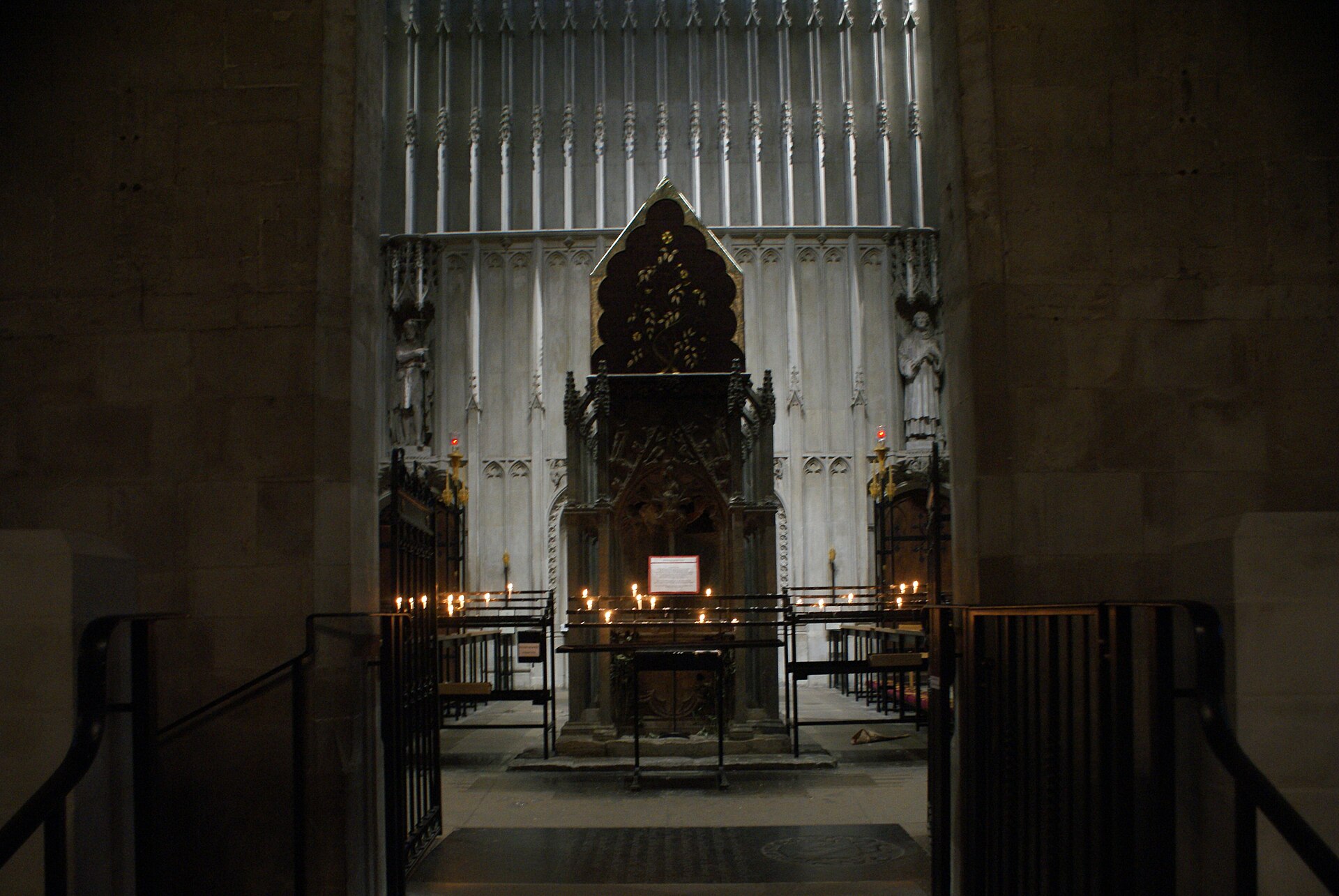
The town of Verulamium lay on the river Ver, and the abbey that grew up on the hill above it, where the medieval town of St Albans took its name from the martyr, has claimed his grave since the early Middle Ages. The shrine in St Albans Cathedral was rebuilt from fragments in modern times.

Tradition and legend
Much of the story is legend, and Bede tells the legend along with the core. Gildas's dry path across the Thames becomes in Bede a river that Alban crosses on his way to the hill of execution: "whereupon the channel was immediately dried up." Bede says the first executioner refused to strike and became a Christian himself, and that the man who did strike suffered at once: "his eyes dropped upon the ground at the same moment as the blessed martyr's head fell."13 This is legend: the details have no early support outside the Passion that Bede followed, and the geography is confused, since Verulamium stands on the Ver, a small stream, not the Thames.
The clerk whom Alban sheltered has no name in Gildas or Bede. He first receives the name Amphibalus in Geoffrey of Monmouth's History of the Kings of Britain, about 1136, and many historians think the name grew from the Latin word for a cloak, amphibalus, in an older text that told of the cloak Alban put on. Amphibalus later received his own cult and shrine at St Albans. This is late tradition, first attested some eight centuries after the event.
What the sources dispute
The date is the central dispute. Gildas and Bede place Alban in the persecution of Diocletian, from 303. But Lactantius, who lived through that persecution, says that Constantius, the caesar who ruled the western provinces including Britain, allowed churches to be pulled down but did not kill Christians, which makes a British martyrdom in 303 to 305 hard to fit.1 In 1968 the historian John Morris, in "The Date of Saint Alban" (Hertfordshire Archaeology), drew on an early version of the Passion preserved in a manuscript at Turin, which names the emperor Severus, and argued for about 209, when Septimius Severus and his son were in Britain. W. H. C. Frend and Charles Thomas preferred the persecutions of Decius or Valerian, 251 to 259. Richard Sharpe, in "The Late Antique Passion of St Alban" (2001), argued that the mention of Severus is a later insertion into a text that originally named only a judge.11
Some scholars have doubted more than the date. Robin Lane Fox, in Pagans and Christians (1986), questioned both the date and whether the story can be trusted at all. Ian Wood, in studies of 2009 and 2010, suggested that Germanus of Auxerre may have created or reshaped the cult of Alban for his own purposes, and Nicholas Higham (2014) disputed that reading.11 On the evidence available, the safest statement is this: a martyr named Alban was honoured at Verulamium by about 429; his death is not attested by any writer near the time; and the details of his story come from a Passion of uncertain date that Bede followed in 731.
Boniface of Mainz
Died: 5 June 754 (Willibald's text gives 755) · Place: on the river Bordne (Boorne), near Dokkum, Frisia, now in the Netherlands · Earliest source: Willibald, Life of Boniface, written about 763 to 768 at the request of Boniface's successor Lull and Bishop Megingoz of Wurzburg · Record strength: Documented
What the record shows
Boniface was born in Wessex in the late seventh century and named Wynfrith. He became a monk, left England as a missionary, and was consecrated a bishop in Rome in 722 with the name Boniface. For more than thirty years he organized the church in the lands east of the Rhine, founded monasteries (Fulda, founded in 744, was his favourite) and reformed the Frankish church under papal authority. His own letters, a large collection that survives, show a man of firm discipline and deep loyalty to Rome. His church-building work is outlined in Church History, Part A, lesson 09.
His first biographer was Willibald, a priest who wrote within about a dozen years of his death at the request of men who had known him. The Internet Medieval Sourcebook gives C. H. Talbot's translation (1954), quoted briefly here. Willibald tells how Boniface, in Hesse, tried to cut down "at a place called Gaesmere, a certain oak of extraordinary size called in the old tongue of the pagans the Oak of Jupiter," a tree sacred to the local god, and how the crowd that came to watch was won over when it fell.14
In old age Boniface returned to Frisia, where he had begun his mission as a young man. Willibald says he knew he would not come back. He asked Lull to put "in the chest, where my books are kept, a linen sheet in which my aged body may be wrapped." In Frisia, he "pitched a camp on the banks of the river Bordne," intending to confirm newly baptised Christians. Instead, at dawn, "A vast number of foes armed with spears and shields rushed into the camp brandishing their weapons." His attendants reached for arms, and Willibald gives Boniface's words: "Sons, cease fighting. Lay down your arms, for we are told in Scripture not to render evil for good but to overcome evil by good."14 Boniface and his companions were killed. Willibald names Eoban, his "fellow missionary and suffragan bishop," and ten others, priests, deacons and monks. The date he gives is "the fifth day of June."
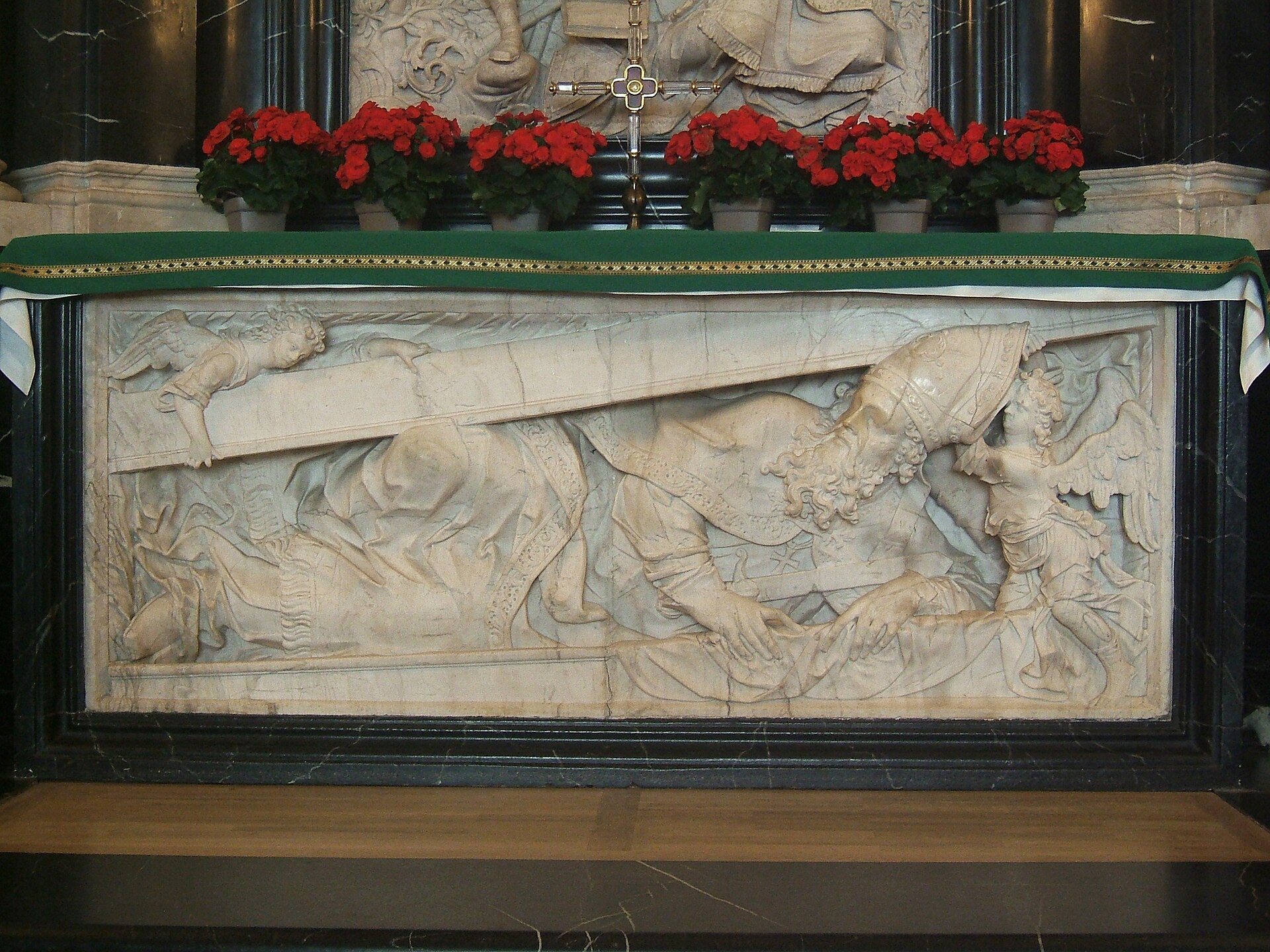
Willibald does not hide what the attackers wanted. They "stole the chests in which the books and relics were preserved," thinking they held gold, and found wine among the supplies: "Finding this goodly liquor, the pagans immediately began to slake their sottish appetites and to get drunk." He says they quarrelled over the plunder and that the books, scattered in the marshes, were later recovered.14 The bodies were taken first to Utrecht, then to Mainz, where "A new sarcophagus was made in the church and the body was laid in it," and finally, as Boniface had wished, "to the monastery built by him during his lifetime on the banks of the river Fulda." His tomb is still in Fulda Cathedral.

Tradition and legend
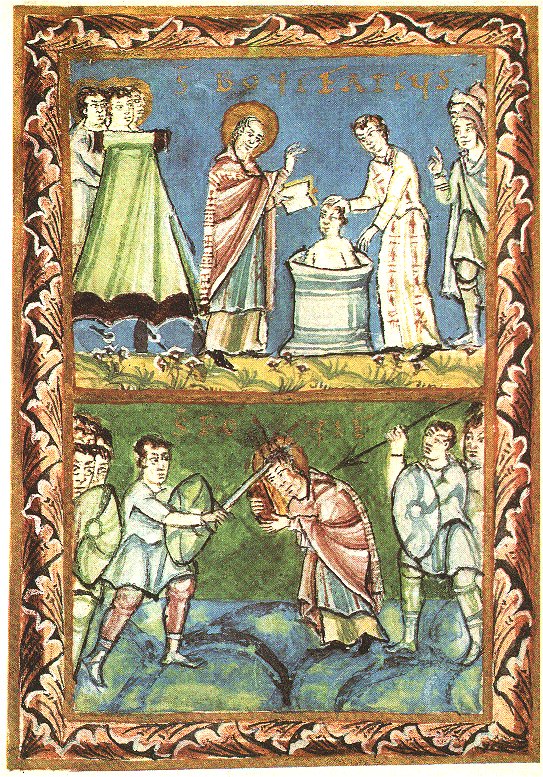
The best known detail of Boniface's death, that he raised a book over his head to shield himself, is not in Willibald. Michel Aaij, in "Boniface's Booklife" (The Heroic Age, 2007), traces it to a second Life of Boniface written in Utrecht in the first half of the ninth century and preserved in a revision connected with Bishop Radbod of Utrecht (900 to 917). That Life cites a witness, a woman who had been a young girl at the time, who said that Boniface held a Gospel book over his head.15 About 1063, Otloh of Saint Emmeram, writing at Fulda, connected this story to a book kept at Fulda, which came to be identified with the manuscript now called the Ragyndrudis Codex, a volume with cuts in its edge. Aaij points out that the codex is not a Gospel book, and that it has three cuts where Otloh described one, and he concludes that it "may not be the book the saint held up at his martyrdom," and that Boniface "may not have shielded himself at all."15 The book story is tradition, first written about a century after the death, and the link to the surviving codex is later still.
Two other popular stories are legend. The first says that Boniface, after felling the oak at Geismar, pointed to a fir tree as a Christian symbol and so began the Christmas tree. Willibald's account of the oak has no such episode, and no early source for it is known; the story appears in modern devotional writing. The second gives Boniface fifty-two companions at his death. Willibald names eleven and gives no total.
What the sources dispute
Willibald gives the year as 755, but his text is not consistent with itself on dates, and most modern historians, including Aaij, place the death on 5 June 754 on the evidence of Boniface's letters and the Frankish chronicles.15 A second question is whether the death counts as martyrdom in the strict sense. By Willibald's own account, the attackers came for loot and fell to quarrelling over it; there was no trial, no demand that Boniface deny Christ. Yet Boniface had gone to Frisia to preach, refused to let his men fight, and was killed as a Christian bishop among people who still honoured the old gods. The church named him a martyr at once, and Willibald wrote of "the palm of martyrdom." A third question is political: the mission to the Frisians and Saxons was backed by Frankish armies, and those who resisted the mission were often resisting the Franks. Historians differ on how far the raiders saw Boniface as a priest, a foreigner, or simply a rich traveller with chests.

Wenceslas of Bohemia
Died: 28 September 935 (some sources give 929) · Place: Stara Boleslav (in German, Alt-Bunzlau), Bohemia, now in the Czech Republic · Earliest source: Widukind of Corvey, Deeds of the Saxons, about 967 to 973; the First Old Church Slavonic Life of Wenceslas (tenth century, surviving in later copies); the Latin Life by Gumpold, bishop of Mantua (late tenth century) · Record strength: Documented
What the record shows
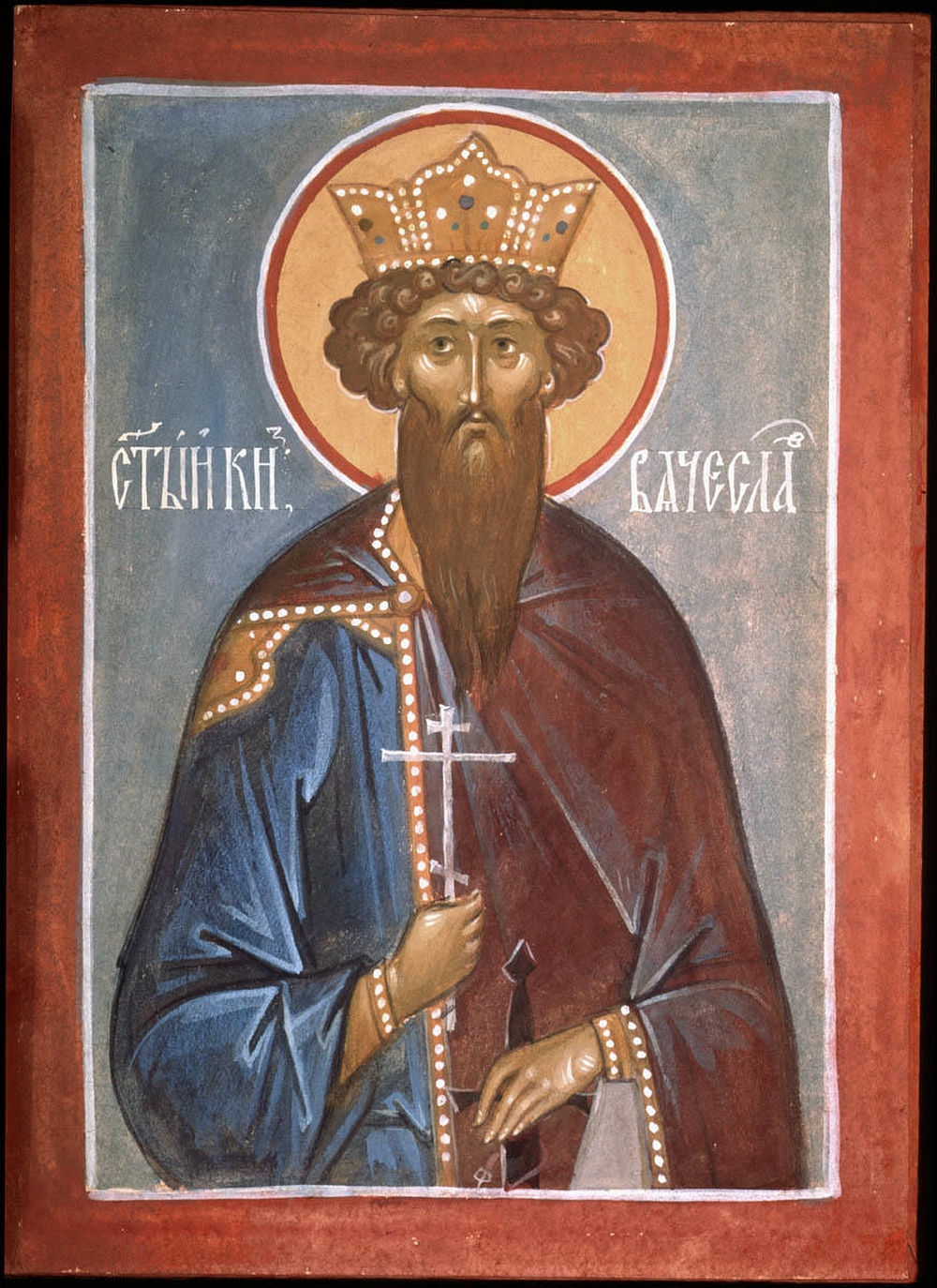
Wenceslas (in Czech, Vaclav) was duke of Bohemia, not a king, in the early tenth century, when the Czech lands were still being won to Christianity and stood under pressure from the German kingdom of Henry the Fowler. The Catholic Encyclopedia of 1912, a standard Catholic reference of the early twentieth century, says he received "a good Christian education from his grandmother (St. Ludmilla)," and names his parents as Duke Wratislaw and "Dragomir," who it says was a heathen.16 Ludmila herself was killed in a struggle at court; a Czech medieval history site summarizing the sources says Drahomira "had her murdered by her assistants Tunna and Gommon at the castle of Tetin."17 The Bohemian church honours Ludmila as its first martyr.
As duke, Wenceslas favoured the church, welcomed German priests, and kept peace with the German king, which meant paying tribute. The same Czech summary says that his support for Christian mission and incoming priests "aroused the opposition of some of the high-ranking Bohemian nobles," especially those close to his younger brother Boleslav, and that a conspiracy was organized against him.17 He was killed at Boleslav's seat, Stara Boleslav. The Catholic Encyclopedia gives the date as "28 September, 935" and says that he was "murdered by his brother Boleslaw," and that three years later Boleslav, perhaps in remorse, ordered the body's "translation to the Church of St. Vitus in Prague."16 The Czech summary names four companions of Boleslav, Hnevsa, Tira, Tuza and Cesta, as the likely killers.17
The killing is well attested by sources close to the time. The Saxon monk Widukind, writing a generation later, mentions it in his history of the Saxon kings. The Slavonic and Latin Lives, written in the tenth century, tell it at length. All agree that Wenceslas was killed by men of his brother's party, and all of the Christian sources treat him as a martyr from the start.

Tradition and legend
The Lives of Wenceslas describe the murder in detail: an invitation to a feast, an attack at dawn at the door of a church as Wenceslas went to morning prayer, and his last words forgiving his brother. These are the hagiographers' account. Their outline fits the shorter notices, but the dialogue and the scene at the church door cannot be checked against any independent record. They are best treated as strong tradition about a documented death.
The English-speaking world knows Wenceslas from the carol "Good King Wenceslas," which tells of a king who goes out on the feast of Stephen to bring food to a poor man. The words were written by the Anglican hymn writer John Mason Neale and published in 1853, more than nine centuries after Wenceslas died. The story in the carol is legend: no medieval source tells it, and Wenceslas was never a king in his lifetime. He became "king" in the memory of the Czech people as their patron saint, and the Holy Roman Emperor later granted the title of king to the rulers of Bohemia.
What the sources dispute
The year of death has long been debated. The 1912 Catholic Encyclopedia gives 935, while the New Advent site's own one-line description of that article says "c. 929," and older works often prefer 929.16 The Czech summary used here gives 28 September 935 and mentions 929 only as the year of Henry the Fowler's campaign into Bohemia.17 The dating of the sources is also disputed, above all the Latin Life known as the Legend of Christian, which claims to have been written for Bishop Adalbert of Prague in the 990s; some scholars accept that date and others think it much later.
The deeper question is whether Wenceslas was killed for his faith. A modern historian can describe his death as a dynastic murder, a younger brother seizing power from an elder. The medieval church saw it as martyrdom, because the duke was killed while promoting Christianity, by men who opposed his church policy, at the hour of prayer. Both readings use the same facts. The sources point both ways at once: the Czech summary describes nobles opposed to his support for incoming priests and a conspiracy against him, and the 1912 Catholic Encyclopedia says that he "placed his duchy under the protection of Germany" and "introduced German priests," so church policy and foreign policy were bound together.1716
Thomas Becket
Died: 29 December 1170 · Place: Canterbury Cathedral, Kent, England · Earliest source: Edward Grim, Life of Saint Thomas, written within about two years by a clerk who stood beside the archbishop and was wounded · Record strength: Documented
What the record shows
Thomas Becket rose from a London merchant family to become chancellor of England under Henry II and then, in 1162, archbishop of Canterbury. As archbishop he turned against the king's policy. The dispute centred on the Constitutions of Clarendon of 1164, in which the king set out what he called the customs of his grandfather's reign, among them the rule that clergy accused of crimes could be sentenced by royal courts after the church courts had judged them. Becket refused to accept them, fled into exile in France for six years, and returned in December 1170 after a fragile peace. Within weeks he had excommunicated bishops who had taken part in crowning the king's son without him.
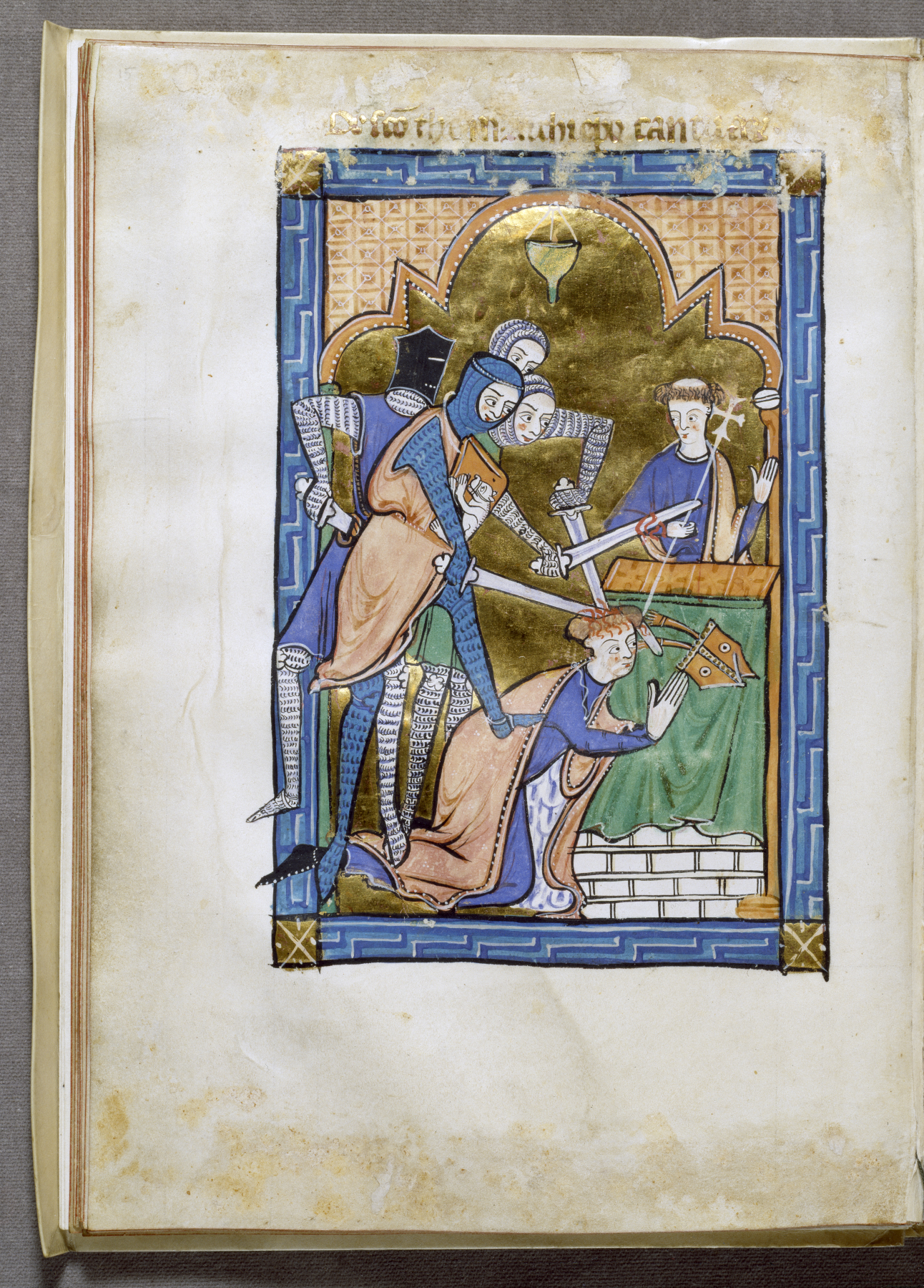
The fullest account of what followed comes from Edward Grim, a clerk from Cambridge who was in the cathedral that evening. The Internet Medieval Sourcebook gives a translation of his Life by Dawn Marie Hayes, from the Latin text in J. C. Robertson's Materials for the History of Thomas Becket (Rolls Series). Grim tells how four knights came from the king's court in Normandy and burst into the cathedral at the hour of vespers crying, "Where is Thomas Becket, traitor of the king and kingdom?"18 They demanded, "Absolve and restore to communion those you have excommunicated and return to office those who have been suspended." Becket answered, "No penance has been made, so I will not absolve them." When they moved to kill him he said, as Grim reports, "For the name of Jesus and the protection of the church I am ready to embrace death."
Grim tried to shield him. He writes of himself in the third person that "the lower arm of the writer was cut by the same blow." The knights struck the archbishop down before the altar, and a cleric who had come in with them gave the last blow; Grim had earlier named a subdeacon, Hugh the Evil-clerk, as going with the knights.18 Grim names one of the knights, "Rainaldus," Reginald FitzUrse, whom Becket addressed by name. Later sources name the other three as Hugh de Morville, William de Tracy and Richard le Breton.
The response across Europe was swift. Pope Alexander III canonized Becket in 1173, little more than two years after his death. In 1174 Henry II did public penance at Canterbury, walking barefoot to the tomb and submitting to scourging by the monks. Canterbury became the greatest shrine in England, the goal of the pilgrims in Chaucer's Canterbury Tales, until Henry VIII, who had broken with Rome, ordered the shrine destroyed and Becket's images removed in 1538.

Tradition and legend
The words most people know, "Will no one rid me of this turbulent priest?", are not in Grim's account. The contemporary biographers report that Henry, hearing of Becket's latest excommunications, burst out in anger at his court against the men who served him and let a priest insult him, but they give his words in different forms, and none of them uses the famous sentence. The modern line is a later paraphrase. Henry's anger is well attested; the exact words are not.
Within months of the murder, the monks of Canterbury were recording miracles at the tomb, and collections of hundreds of miracle stories were compiled by the monks William and Benedict of Canterbury. Some of these may reflect real experiences of pilgrims; as reports of miracles, they belong to the history of devotion and cannot be weighed by the methods of this module.
What the sources dispute
Historians do not dispute that Becket was killed, by whom, or where. They dispute what he died for. To Henry II's side, the issue was the king's lawful customs and the punishment of criminal clergy; to Becket's side, the "liberty of the church" from royal control, which Becket saw as the cause of God. The knights' cry of "traitor" states the royal view, and Becket's last words state his own. Frank Barlow, in Thomas Becket (1986), gave a critical portrait of a proud and stubborn man; Anne Duggan, in Thomas Becket (2004), gave more weight to Becket's principles.19 A second question is whether Henry intended the killing. The king denied it, and the papal legates who absolved him in 1172 accepted his oath that he had not ordered it.
Becket shows how this module's categories apply inside Christendom. He was killed by Christian knights, in a Christian church, in a quarrel between a Christian king and a Christian archbishop. He did not die for the faith against unbelief. The church named him a martyr because he died defending, as he saw it, the rights of the church and refused to yield under threat of death. A Protestant reader may weigh those rights differently; the record of the death itself is among the best documented of the Middle Ages.
Heresy law and the Albigensian Crusade, as context
The Waldensians, whose story closes this lesson, were not the only dissenters condemned in the twelfth century, and they are often confused with another group, the Cathars of southern France and northern Italy. The two movements were different. The Cathars taught a dualist faith, in which the material world was the work of an evil power, and had their own ministers, whom their followers called "good men." The Waldensians, by their own account and by the testimony of their opponents, held the ordinary Christian creed and differed from the Catholic Church over who might preach and over oaths, killing and, later, purgatory and prayers for the dead. The decree of Verona in 1184 condemned both together, naming "all Cathari, Paterines, and those who call themselves the Humbled, or Poor of Lyons, Passagines, Josephines, Arnoldists."4
In 1208 the papal legate Peter of Castelnau was murdered in Languedoc, and Pope Innocent III called a crusade against the Cathars and the lords who protected them. The crusade began in 1209, and its first great event was the sack of Beziers on 22 July 1209. The papal legate Arnaud Amaury, abbot of Citeaux, reported to the pope that the crusaders had put to the sword almost twenty thousand people, a round number in a victory letter that historians treat as an exaggeration.20 The war went on for twenty years, and the medieval inquisition, with its trained judges and written registers, grew out of the effort to finish what the crusade began. The surrender of the Cathar stronghold of Montsegur in 1244, followed by the burning of some two hundred Cathars who would not recant, is often taken as the end of organized Catharism in the region.
The crusade's supporters, in their own words, saw it as the defence of Christian souls and Christian order against a heresy that, as they understood it, denied the goodness of creation and the sacraments of the church, protected by lords who had sheltered a legate's killers. The Cathars, in the few texts of their own that survive, saw themselves as the true church of Christ, persecuted as the apostles were. Both views are recorded here so that the reader can see why the church of the time treated heresy as a capital matter and why the dissenters went to the fire. The Cathars are not profiled in this module, but the law and the procedures used against them were the same that touched the Waldensians.
The medieval inquisition is often imagined as a machine of mass killing. Its own records give a different scale. The inquisitor Bernard Gui, who worked at Toulouse in the early fourteenth century and left a register of his sentences, issued 916 judicial decisions involving "636 individuals or communities," according to a 2026 summary of Julien Thery's study of the register; "Only about 6% of decisions, covering 45 individuals, resulted in the death sentence by burning at the stake."21 Most sentences were penances, pilgrimages, the wearing of crosses, or prison. That record does not make the burnings less real to those who died in them; it does show that the numbers in popular accounts of the medieval inquisition are not drawn from its own registers.
The Waldensians, from Valdes to the stake
Died: many, over four centuries; burnings recorded from the early thirteenth century; massacres in Provence (1545) and Calabria (1561) · Place: Lyon and Languedoc, Lombardy, the Alpine valleys of Piedmont and Dauphine, German lands, Provence, Calabria · Earliest source: Walter Map, Courtiers' Trifles (about 1180s), on Waldensians at the Third Lateran Council of 1179; the decree of Verona, 1184; the Chronicle of the Anonymous of Laon, early thirteenth century · Record strength: Documented
What the record shows
The movement began with one man. Valdes (later called Peter Waldo, though the first name appears only later) was a rich citizen of Lyon. The Chronicle of the Anonymous of Laon, written in the early thirteenth century, says that in the 1170s, moved by hearing a minstrel's song about Saint Alexis, a saint who gave up everything for Christ, Valdes sought out a teacher of theology, had parts of the Bible translated into his own language, gave away his wealth and began to preach poverty and repentance.22 Others joined him, and they called themselves the Poor of Christ or the Poor of Lyon.
In 1179 some of them came to Rome, to the Third Lateran Council, seeking approval. The English courtier Walter Map, who was there, wrote a sardonic account in his Courtiers' Trifles: he questioned them on points of doctrine and found them simple and unlearned, though he noted their poverty, their going about two by two, barefoot and owning nothing. The pope approved their vow of poverty but forbade them to preach without the permission of the local clergy.22 In 1180 Valdes made a profession of orthodox faith at a synod in Lyon, which survives. But the group kept preaching, and the archbishop of Lyon expelled them. Their reply, as their opponents recorded it, was the words of the apostles in Acts 5:29: "We ought to obey God rather than men" (KJV).
The church's answer came at Verona in November 1184, in the decree Ad abolendam issued by Pope Lucius III with the emperor Frederick Barbarossa present. In the English translation available online, it places the "Poor of Lyons" with the Cathars and other groups "to lie under a perpetual anathema," and it orders that a lay person convicted of heresy who would not recant should be "left to the sentence of the secular judge," while convicted clergy who did not recant were to be "delivered up to the secular power."4 That decree did not yet prescribe burning, but it set the pattern by which church courts judged and civil rulers punished. Over the next century, rulers across Europe made burning the penalty for relapsed or obstinate heretics.
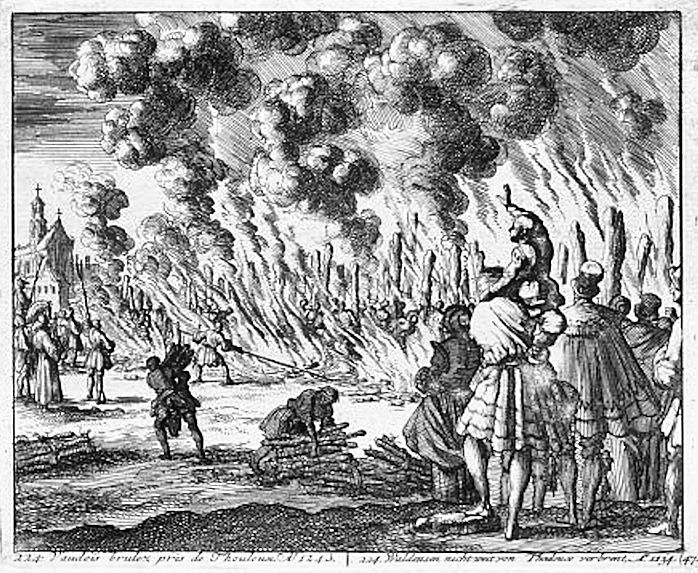
The Waldensians survived as an underground church of travelling preachers, called "barbes" (uncles) in the Alpine valleys, who visited households in secret. They were found in the Alps, in southern France, in Lombardy and Calabria, and in the German lands as far as Bohemia, Poland and the Baltic. Wherever inquisitors found them, the trials left records, and those records show what the Waldensians believed: that lay men and women might preach, that oaths were forbidden by Christ, that killing was wrong, and, as their teaching developed, that there was no purgatory and so no use in prayers or masses for the dead. Many were sentenced to penance; some, who refused to abjure or who relapsed, were burned.
In the sixteenth century the Waldensians of the Alps joined the Reformation. At a synod at Chanforan in the Angrogna valley in 1532, they agreed to align their teaching with the Reformed churches of Switzerland, and in 1535 they paid for the printing of a French Bible translated by Pierre Robert Olivetan. That decision made them Protestants in the eyes of Catholic rulers, and the violence that followed was on a larger scale. In April 1545, under a decree of the parlement of Provence first issued in 1540, troops destroyed the Waldensian villages of the Luberon, among them Merindol and Cabrieres; estimates of the dead run from several hundred to a few thousand, and hundreds more were sent to the galleys. In 1561, in Calabria, Waldensian communities that had lived there since the Middle Ages were crushed, with mass executions at Montalto. The numbers for both events vary widely in the sources, and none is given here as a firm count.

Tradition and legend
From the sixteenth century on, Waldensian and Protestant writers told a grander story of Waldensian origins. They claimed that the valleys of Piedmont had kept a pure faith since the apostles, or since the time of Pope Sylvester and Constantine, or since Claudius, a ninth-century bishop of Turin who opposed the veneration of images. The historian of the valleys Jean Leger, in his Histoire generale des Eglises evangeliques des vallees de Piemont (1669), and the Englishman Samuel Morland, in his History of the Evangelical Churches of the Valleys of Piemont (1658), both advanced versions of this claim. Milton's sonnet of 1655, discussed below, carries it into English poetry. This is tradition, and late tradition: no medieval source supports a Waldensian church before Valdes. Modern historians of the movement, among them Euan Cameron in The Waldenses: Rejections of Holy Church in Medieval Europe (2000) and Gabriel Audisio in The Waldensian Dissent (1999), trace the movement to Valdes of Lyon in the 1170s.22
What the sources dispute
Almost everything known about the medieval Waldensians comes from their opponents: inquisitors' manuals, trial records and polemical treatises. Those sources are hostile, but they are also detailed, and they often record what the accused said in their own words. Historians differ on how unified the movement was. Some, such as Audisio, stress a common identity over four centuries; others, such as Cameron, stress how much the scattered groups differed in belief and practice from one region to another.22 A second question is whether the Waldensians who joined the Reformation in 1532 kept their old identity or became a new church under an old name. The Waldensian Church in Italy today, which is Reformed in doctrine, sees itself as the heir of Valdes.
The church's case against them can be stated in its own terms. To the bishops and popes of the twelfth century, preaching was an office given by the church, and lay men and women who preached without a mission divided the church and spread error, however sincere they were. Disobedience to the church's authority was itself a sign of heresy. The Waldensians' case was that Christ had commanded the apostles to preach and that no bishop could forbid what Christ commanded. The two positions could not both be kept, and the law of the time gave the church's position the force of the sword.
The Piedmont Easter, 1655
Died: from 24 April 1655 (14 April by the old English calendar), over several days · Place: the Luserna (Pellice) valley and neighbouring Waldensian valleys of Piedmont, in the Duchy of Savoy, southwest of Turin · Earliest source: letters and reports of 1655 sent to Geneva, Switzerland and England; Samuel Morland, History of the Evangelical Churches of the Valleys of Piemont (1658); Jean Leger, Histoire generale (1669) · Record strength: Documented
What the record shows
By the seventeenth century the Waldensians of Piedmont were Reformed Protestants living under a Catholic ruler, the duke of Savoy. Earlier agreements, above all the Peace of Cavour of 1561, had allowed them to worship within certain valleys. In 1655 the duke was Charles Emmanuel II, still a young man, and his government was pressed by a council in Turin devoted to spreading the Catholic faith and ending heresy, founded in 1650.23
In January 1655, as John Hobbins summarizes it in Christian History (1989), "a judge ordered the Waldensians to abandon all they possessed beyond the territorial limits."24 The order, issued on 25 January 1655 by the ducal official Andrea Gastaldo, required Protestant families living in a list of towns on the plain, including Luserna, San Giovanni, Bibiana and La Torre, to leave within three days for the villages higher in the valleys where their worship was tolerated, or to become Catholic.23 Many left in the depth of winter. Others stayed. In April the government sent troops under the Marquis of Pianezza, including Savoyard soldiers and French and Irish units, to be quartered in the valleys.
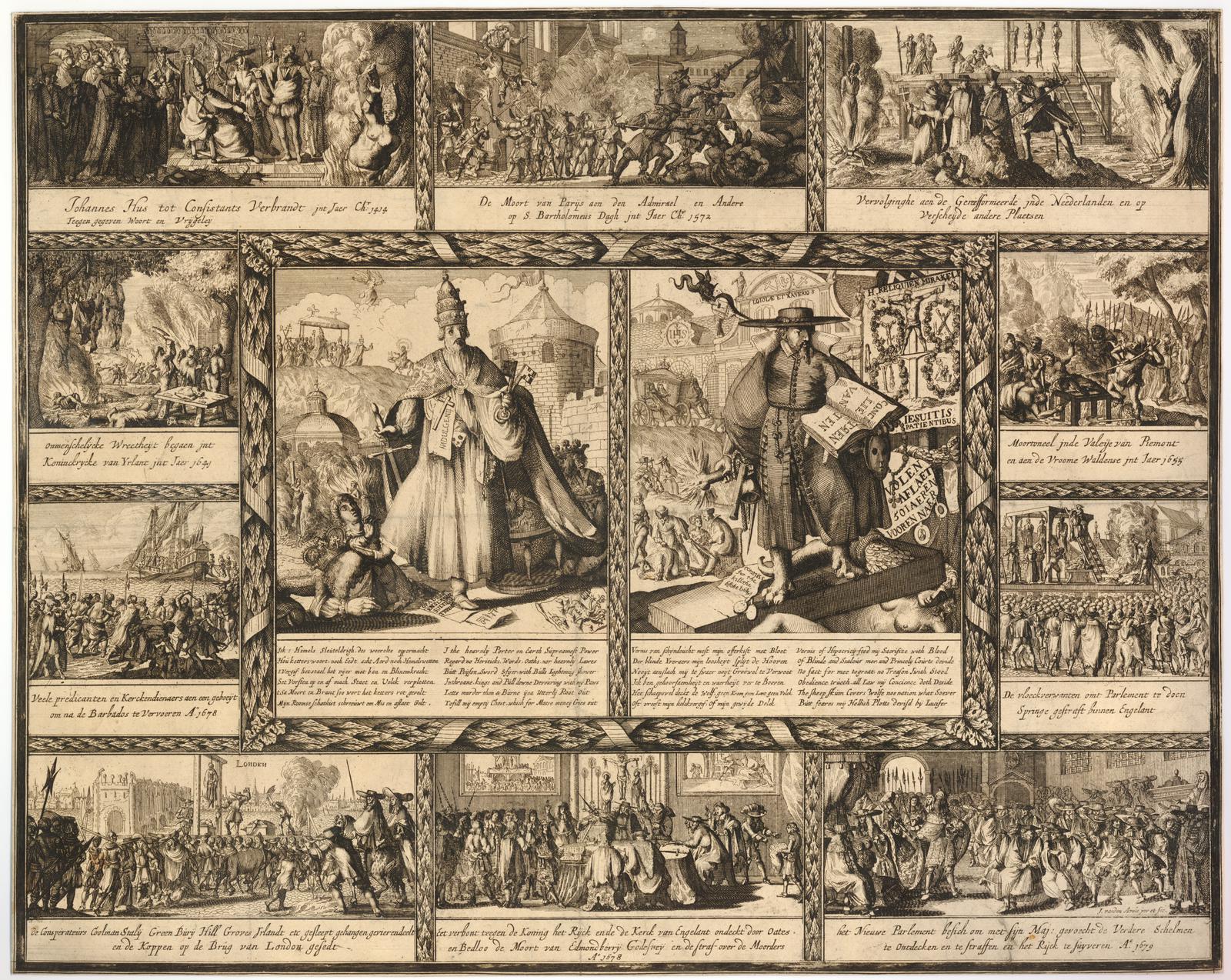
What followed came at Easter. The historian Vivienne Larminie, writing for the History of Parliament Trust, sums up the event: "On 24 April [14 April English style]" the troops "unleashed horrific and deadly violence" on the people of the valleys.25 Villages were burned, and men, women and children were killed. Some were killed where they stood, others driven from their homes into the mountains, where many died. This lesson does not repeat the detailed descriptions of the killings that the Protestant reports circulated; they were many and terrible, and they were meant to move readers to action. Larminie writes that "The lowest estimate of numbers who died is about 1,700."25 Hobbins writes that "1,712 souls breathed their last," without naming his source.24 Some modern historians, such as Barbro Lovisa (1994), give much higher figures of 4,000 to 6,000.23
The survivors fought back. Led by Joshua Janavel (Giosue Gianavello) and others, Waldensian militias held out in the high valleys. Hobbins writes that Janavel "led a popular militia of at least 2,000 combatants."24
The news caused outrage in Protestant Europe. In England, Oliver Cromwell, then Lord Protector, declared a national fast for 14 June 1655 and asked ministers to "stir up the People to a free and liberal collection for their relief." By 11 July, £10,000 was ready to send, and by 24 July, £15,000, "and it continued to rise."25 Cromwell sent Samuel Morland as envoy to the duke and pressed France, Savoy's powerful neighbour, to intervene. On 18 August 1655 the duke issued a settlement at Pinerolo, often called the Patents of Grace, that restored the Waldensians' limited rights in their valleys.23
John Milton, who served as Latin secretary to Cromwell's Council of State and drafted the government's letters on the massacre, wrote a sonnet that remains the best known English response. Its first lines, in the spelling of the 1673 printing given by the Dartmouth Milton Reading Room, are:
Avenge O Lord thy slaughter'd Saints, whose bones
Lie scatter'd on the Alpine mountains cold,
Later lines speak of those "Slayn by the bloody Piemontese that roll'd / Mother with Infant down the Rocks," and the poem ends with the hope that the martyrs' blood will win converts who "Early may fly the Babylonian wo."26 The sonnet is a source for how the massacre was received in England, as a crime of the Catholic powers against the faithful remnant of the true church. It is a prayer and a poem, not an inquiry, and it repeats the reports that had reached London.

Tradition and legend
The Waldensian memory of 1655 rests largely on the accounts collected by Jean Leger, a Waldensian pastor and leader in the valleys who gathered sworn testimonies, and on Morland's book of 1658, which printed many of them with engravings. Both men were participants and advocates. Their books are primary sources, written within a few years by people close to the events, and they are also partisan. Some details of individual atrocities are attested by several witnesses; others rest on a single report. The Savoyard government and Catholic writers at the time denied many of them, and called the operation a lawful enforcement of the duke's orders against disobedient subjects.
The story of the "Glorious Return" (la Glorieuse Rentree) belongs to the next chapter of the same history and is often told with it. In 1686, after France revoked the Edict of Nantes, Duke Victor Amadeus II banned Reformed worship in his lands; the Waldensians resisted, about 2,000 were killed in the war that followed, thousands were imprisoned, and the survivors went into exile in Switzerland. In 1689 about nine hundred exiles under the pastor Henri Arnaud marched back over the Alps to their valleys and held them.23 The Waldensians won full civil rights from King Charles Albert of Sardinia on 17 February 1848, a date the Waldensian Church still keeps.
What the sources dispute
The number of the dead is the first dispute, as shown above: from about 1,700 to as many as 6,000, depending on the source and on whether deaths from exposure and flight are counted. The second is responsibility. The Waldensian and English accounts blamed the duke, the Marquis of Pianezza and the council for the propagation of the faith in Turin. The nineteenth-century Waldensian historian Alexis Muston, in The Israel of the Alps (1852, English translation 1866), argued that neither the duke nor the Waldensians wanted war and that the pressure came from the council in Turin.23 The ducal government's position was that the Waldensians had settled outside the limits allowed them, had refused a lawful order and had armed themselves, so that troops were needed to restore obedience.
Whether 1655 should be called religious persecution or the suppression of a revolt is the third question. The order that began it was religious in its terms: Protestants could stay if they became Catholic. The violence fell on civilians, including women and children, who had not taken up arms. Most historians, including Diarmaid MacCulloch in Reformation: Europe's House Divided (2003), treat it as one of the great atrocities of the age of religious war.23 The Waldensian Church counts the dead as its martyrs.
The era in one view
Thirteen centuries separate the toleration order of 313 from the Piedmont Easter of 1655. The timeline below places the deaths and decisions of this lesson along that span, with the broad periods shown as coloured bands.
The second chart asks the question this module asks of every death: how long after it did someone write it down? The shorter the gap, the closer the source stands to the event.
What ties the era together
Several patterns run through these thirteen centuries. The first is that martyrdom after 313 moved to the edges: to the Persian and Armenian east, where Christianity was the religion of the rival empire, and to the northern mission field, where the church arrived with Frankish power. In those places, as in the Roman persecutions, the charge against Christians was often disloyalty as much as belief.
The second pattern is that, inside a Christian Europe, Christians became both the killers and the killed. A duke's brother, a king's knights, a pope's decree and a duke's soldiers all appear in this lesson. The people who did the killing usually gave reasons in the language of law and order: treason, disobedience, rebellion, heresy as a danger to souls and to society. The people who died usually gave reasons in the language of conscience and the Gospel. This module records both, because both are in the sources.
The third pattern is about evidence. The quality of the record varies enormously, from an eyewitness who was wounded at Becket's side to a shrine for Alban whose story was written down two centuries or more after his death. Later writers filled the gaps with speeches, miracles and heroic details: Alban's dried-up river, Boniface's book held over his head, Vardan's battlefield orations, the "turbulent priest." The briefs in this lesson have tried to keep those details in their place, as tradition, honoured but marked. The next lesson, lesson 05, carries the same questions into the trials of Hus, Hieronymus of Prague (Jeronym Prazsky), the Lollards, Savonarola and Tyndale, where the records are fuller and the courts kept transcripts.
What the record shows and what it does not
- Documented fact: Persian kings put Christian bishops and others to death in the 340s; an Armenian army fell at Avarayr in 451 resisting a royal religious policy; Boniface and his companions were killed in Frisia on 5 June (754 by most modern reckonings); Wenceslas was killed by his brother's party; Becket was killed in Canterbury Cathedral on 29 December 1170, with an eyewitness account; the Waldensians were condemned at Verona in 1184 and later tried and burned in many places; at least 1,700 people died in the Piedmont valleys in April 1655.
- A church's own claim or tradition: sixteen thousand named Persian martyrs (Sozomen's count); 1,036 companions of Vardan (the Armenian Church); the miracles at Alban's death (Bede's Passion); Boniface's book raised over his head (a ninth-century Utrecht Life); the apostolic origin of the Waldensian valleys (Leger, Morland, Milton).
- Scholarly reading: Alban's date (Morris, Frend, Thomas, Sharpe); the shaping of the Persian martyr story (Kyle Smith); Elishe as a later reworking of Lazar (Encyclopaedia Iranica); the motives of Becket and Henry II (Barlow, Duggan); the unity of the Waldensian movement (Cameron, Audisio); the death toll of 1655 (Larminie, Lovisa).
- Open question: the year of Simeon's death; the date and even the details of Alban's death; the exact year of Wenceslas's death; the number of the dead at Merindol, Calabria and the Piedmont valleys.
Claims checked
These claims appear in sermons, popular histories, websites, films and devotional books about the martyrs of this period. Each is rated by the evidence.
"Christians stopped dying for their faith when Constantine converted"
Refuted. The toleration order of 313 ended Roman persecution, apart from a brief revival of the old religion under the emperor Julian (361 to 363), but Christians in Persia were put to death in large numbers within a generation, as Sozomen records.3 Armenians died at Avarayr in 451, and missionaries were killed on the northern frontier for centuries.
"Shapur II killed sixteen thousand Christians"
Partly supported. Sozomen says that the number of martyrs "whose names have been ascertained" had "been computed to be sixteen thousand."3 He wrote about a century later, does not say who made the count, and no list of that length survives. The persecution was real and severe; the figure is a fifth-century church estimate.
"Alban was Britain's first martyr, killed in 304"
Unresolved. Alban is the earliest British martyr known by name, and his shrine was honoured by 429. But his date is disputed among 209, the 250s and 303 to 305, and Lactantius's statement that the western ruler Constantius did not kill Christians makes 304 hard to fit.111 Some scholars doubt the details of the story altogether.
"Boniface shielded himself with a Gospel book, which survives at Fulda with the sword cuts"
Unsupported. Willibald, writing within about fifteen years, says nothing of a book raised over the head. The story first appears in a Utrecht Life of the ninth century, and its connection with the Ragyndrudis Codex at Fulda dates from the eleventh. Michel Aaij notes that the codex is not a Gospel book and concludes that Boniface "may not have shielded himself at all."15
"Boniface invented the Christmas tree when he cut down Thor's oak"
Unsupported. Willibald's account calls the tree "the Oak of Jupiter" (the Roman name he used for the Germanic thunder god) and says that it "burst asunder into four parts" and that onlookers were converted.14 It says nothing of a fir tree or of any Christmas custom. The story of Boniface and the first Christmas tree has no known medieval source.
"Good King Wenceslas went out on the feast of Stephen to feed a poor man"
Refuted. Wenceslas was a duke, not a king, and the episode comes from a carol by John Mason Neale published in 1853, with no basis in the medieval Lives. The carol reflects his later reputation for charity, which the medieval Lives do report in general terms.16
"Henry II said, 'Will no one rid me of this turbulent priest?'"
Unsupported. In those words, at least. The sentence is not in Edward Grim's eyewitness account of the murder, and the twelfth-century biographers give the king's angry outburst in other words.18 Henry's anger is well attested; the famous phrasing is a later paraphrase.
"At Beziers the papal legate said, 'Kill them all, God will know his own'"
Unresolved. The only source is the Cistercian monk Caesarius of Heisterbach, who wrote between about 1219 and 1223, never visited Languedoc, and says only that the legate was reported to have said it (dixisse fertur). The legate's own letter to the pope reports the massacre but not the words.20 The killing at Beziers is documented; the saying is not.
"The medieval Inquisition burned millions of heretics"
Refuted. The surviving registers do not support numbers anywhere near that scale. The register of Bernard Gui at Toulouse, one of the fullest, records 45 people sentenced to burning out of 916 decisions.21 Burnings were real and many over several centuries and many countries, and massacres such as Beziers and Merindol were carried out by armies, not inquisitors, but no historian who has worked from the records gives totals in the millions.
"The Waldensians kept the pure apostolic faith in the Alps from the time of the apostles"
Unsupported. This claim was made by Waldensian and Protestant writers of the sixteenth and seventeenth centuries, including Leger and Morland, and echoed in Milton's sonnet. Medieval sources, friendly and hostile, place the movement's beginning with Valdes of Lyon in the 1170s.22
"The Piedmont Easter of 1655 killed thousands of Waldensians"
Supported. The size depends on the source. The lowest estimate cited by Larminie is about 1,700 dead; Hobbins gives 1,712; some modern historians give 4,000 to 6,000.242523 The higher figures may include deaths from flight and exposure.
Hard questions and answers
Can a soldier who dies in battle be a martyr, as the Armenian Church says of Vardan?
The answer depends on the church and its definition. The early church's martyrs died without resisting, and lesson 01 shows how the word came to mean someone who bore witness by accepting death. Most Western and Byzantine traditions did not honour soldiers who fell in battle as martyrs. The Armenian Church has honoured Vardan and his companions since the fifth century because they fought against a royal order to give up the faith, and their church still holds the feast of Vartanants.9 The historian's task is to record the facts of the battle and to report that churches use the word differently, without settling the theological question for them.
Was Becket a martyr for the faith or a casualty in a fight over clerical privilege?
Both descriptions use the same facts. Becket refused, under threat of death, to undo excommunications he believed were just, and Grim records him saying he was ready to die "For the name of Jesus and the protection of the church."18 To the king's side, the issue was the king's lawful customs and the trial of criminal clergy. The church's canonization in 1173 reflects its judgment that the cause of the church was the cause of Christ. A Protestant or a secular historian may judge the cause differently and still accept that Becket chose death over surrender.
Is it fair to the Catholic Church to tell the Waldensian story mainly from Waldensian and Protestant sources?
The medieval story is in fact told mostly from Catholic sources, because the inquisitors and chroniclers kept the records; the Waldensians left few writings of their own before the sixteenth century. For 1655 the reverse is true: the fullest accounts come from Leger and Morland, who were advocates. This lesson has stated the church's case in its own terms (that unauthorized preaching divided the church and that heresy endangered souls) and the ducal government's case (that the Waldensians had disobeyed a lawful order), and it has given the death tolls as ranges with their sources. Catholic historians today do not defend the massacre of 1655, and Pope Francis visited the Waldensian temple in Turin on 22 June 2015 and said, "On behalf of the Catholic Church I ask your forgiveness," and asked pardon for "unchristian-like and even inhuman attitudes and conduct" toward the Waldensians in the past.27
Was Boniface killed for his faith, or because he came with the Franks?
Willibald's account shows raiders who wanted loot, and it shows a bishop who forbade his men to fight. It does not show a trial or a demand to deny Christ. The Frisians had reason to see missionaries as agents of Frankish power, since the mission and the Frankish conquest moved together. Boniface was killed because he was in Frisia as a Christian missionary, and the church has always counted that as martyrdom, but the killers' motives, as the earliest source reports them, were mixed.14
If so much of Alban's story is legend, is anything left?
Yes. A shrine to a martyr named Alban existed at Verulamium by the early fifth century, as Constantius of Lyon reports; Gildas names him in the sixth; and Bede preserved an older Passion in 731.121311 That is good evidence that British Christians believed one of their own had died for the faith at that place, and the core of the story (a pagan who sheltered a Christian and took his place) is simple and plausible. The miracles, the speeches and the date are where the evidence runs thin.
Why does this lesson give ranges instead of a single death toll for 1655?
Because the sources disagree, and the module's rule is never to present an estimate as a count. The figure of about 1,700 is the lowest estimate; Hobbins gives 1,712; some historians give 4,000 to 6,000.242523 The difference depends on who counted, when, and whether people who died of cold and hunger in flight are included. Readers who see a single precise number in a popular account should ask where it came from.
Learn more
- Sozomen on the Persian martyrs (book 2, chapters 9 to 15): The fullest Greek account of Simeon, Usthazanes, Tarbula and the count of sixteen thousand.
- Bede, Ecclesiastical History, book 1: Read chapter 7 to see how Bede joins the core of Alban's story to the legends.
- Willibald's Life of Boniface: A near-contemporary Life; chapter 8 tells the death on the Bordne near Dokkum.
- Edward Grim on the murder of Becket: One of the best eyewitness accounts of any medieval death.
- Michel Aaij, Boniface's Booklife: A clear study of how a legend attached itself to a surviving manuscript.
- Larminie on the 1655 relief collection: How England responded to the Piedmont Easter, with Cromwell, Morland and Milton.
- Pope Francis at the Waldensian temple, 2015: The Catholic Church's request for forgiveness, in its own words.
Still being checked (11 items)
These points could not be confirmed against a primary source when this lesson was written and fact checked in October 2026. The text above states each one as uncertain.
- The year of Simeon bar Sabbae's death (341 or 344) and the place of execution are not given by Sozomen; the Syriac Martyrdom and History of Simeon were not read in translation, and their details (the double tax, the speeches) are reported from scholarly summaries. Kyle Smith's book (2016) was not opened.
- The earliest source of the Armenian figure of 1,036 companions of Vardan was not traced; it is given as the Armenian Church's number. The settlement of 484 ending the second rising (not in Hewsen's Iranica article), and the alternative late-May date for Avarayr, were not confirmed.
- The phrase 'the Commander-in-chief of all martyrs' is quoted from a parish page that gives it in quotation marks as Vardan's speech without naming a translation of Elishe; it was not checked against Thomson's translation.
- The Alban scholarship (Morris 1968, Frend, Thomas, Sharpe 2001, Wood 2009 and 2010, Higham 2014, Lane Fox 1986), the Life of Germanus and Prosper's chronicle are reported from summaries and were not opened. The Amphibalus attribution to Geoffrey of Monmouth is from general scholarship. The statement that the shrine was rebuilt from fragments in modern times is not on the image's Commons record.
- Boniface: the Christmas tree story's first appearance and the later figure of fifty-two companions were not traced.
- Wenceslas: the dates of Widukind (about 967 to 973), the First Old Church Slavonic Life and Gumpold's Life are disputed or unconfirmed; the church-door scene is from the Lives as generally summarized, not read in translation. Neale's carol date (1853) is from general knowledge.
- Becket: the names of the three knights other than FitzUrse, Henry II walking barefoot in 1174 (the 1912 Catholic Encyclopedia confirms the public penance and scourging on 12 July 1174), the absolution of 1172 and the miracle collections of William and Benedict were not checked against a primary source. When the phrase 'turbulent priest' first appeared was not established.
- Caesarius of Heisterbach's Beziers passage and Arnaud Amaury's letter were known through a reference summary; the Latin texts were not opened. Montsegur (1244, about two hundred burned) and the murder of Peter of Castelnau (1208) are from general knowledge.
- Waldensian origins (Anonymous of Laon, Walter Map, the 1180 profession of faith), the barbes, Chanforan (1532), the Olivetan Bible (1535), Merindol and Cabrieres (1545) and Calabria (1561) are summarized from Wakefield and Evans, Cameron and Audisio without opening those works; the 1545 and 1561 tolls are given only as ranges.
- 1655 and after: the Gastaldo order's details (25 January, the named towns, three days) come from Muston as reported in summaries; the Irish units, the name 'Patents of Grace' and its date (18 August 1655), the claim that Savoyard and Catholic writers denied many atrocity reports, the 1686 death figure and the 17 February 1848 emancipation date were not checked in a source opened for this lesson. MacCulloch's judgment and Lovisa's 4,000 to 6,000 were not checked in their books. The English translation of Ad abolendam used has no named translator.
- The source of John Hobbins's figure of 1,712 dead is not named in his article; the text no longer calls it 'the Waldensian count'.
Notes
- Lactantius, Of the Manner in Which the Persecutors Died (On the Deaths of the Persecutors), chapters 15 and 48, trans. William Fletcher, Ante-Nicene Fathers vol. 7 (Buffalo: Christian Literature Publishing, 1886), New Advent (retrieved Oct. 28, 2026). Read it online. ↩
- Eusebius, Life of Constantine 4.8 to 13 (Constantine's letter to the king of Persia), trans. Ernest Cushing Richardson, Nicene and Post-Nicene Fathers, series 2, vol. 1 (1890), New Advent (retrieved Oct. 28, 2026). Read it online. ↩
- Sozomen, Ecclesiastical History 2.9 to 15, trans. Chester D. Hartranft, Nicene and Post-Nicene Fathers, series 2, vol. 2 (1890), New Advent (retrieved Oct. 28, 2026). Read it online. ↩
- Synod of Verona, decree Ad abolendam of Pope Lucius III, 4 November 1184, older English translation (translator not named on the page), professor-moriarty.com (retrieved Oct. 28, 2026). Read it online. ↩
- Kyle Smith, Constantine and the Captive Christians of Persia: Martyrdom and Religious Identity in Late Antiquity (Oakland: University of California Press, 2016). Cited for the author's argument; not quoted. ↩
- "Elise" (Elishe), Encyclopaedia Iranica online (retrieved Oct. 28, 2026). Read it online. ↩
- St. John Armenian Church, "Vartan Mamigonian," parish web page, archived copy at the Internet Archive, captured June 14, 2025 (retrieved Oct. 28, 2026). Read it online. ↩
- Robert H. Hewsen, "Avarayr," Encyclopaedia Iranica online (retrieved Oct. 28, 2026). Read it online. ↩
- Armenian Apostolic Church, Diocese in Georgia, "Feast of St. Vartan the Captain and Companions," church web page (written for the 1,551st anniversary) (retrieved Oct. 28, 2026). Read it online. ↩
- Eastern Diocese of the Armenian Church of America, news report quoting Dr. Roberta Ervine, "Martyrs of Avarayr Remembered at St. Vartan Cathedral," March 2, 2017 (retrieved Oct. 28, 2026). Read it online. ↩
- Scholarship on Alban, as reported in published summaries and not opened for this lesson: Constantius of Lyon, Life of Germanus (about 480), and Prosper of Aquitaine, Chronicle, entry for 429, on Germanus's visit to Britain; John Morris, "The Date of Saint Alban," Hertfordshire Archaeology 1 (1968); W. H. C. Frend and Charles Thomas on a date of 251 to 259; Richard Sharpe, "The Late Antique Passion of St Alban" (2001); Ian Wood, "Germanus, Alban and Auxerre" (2009) and "Levison and St Alban" (2010); N. J. Higham, "Constantius, St Germanus and Fifth-Century Britain," Early Medieval Europe (2014); Robin Lane Fox, Pagans and Christians (1986). ↩
- Gildas, On the Ruin of Britain, sections 9 to 11, trans. J. A. Giles, Project Gutenberg eBook 1949 (retrieved Oct. 28, 2026). Giles's footnote to "Carlisle" reads "Or Caerleon." Read it online. ↩
- Bede, Ecclesiastical History of England, book 1, chapter 7, trans. A. M. Sellar (London: George Bell and Sons, 1907, revising J. A. Giles), Project Gutenberg eBook 38326 (retrieved Oct. 28, 2026). Book 1, chapter 7 also names Aaron and Julius as "citizens of the City of Legions" and reports the church built at the site. Read it online. ↩
- Willibald, Life of Saint Boniface, chapters 6 and 8, trans. C. H. Talbot, The Anglo-Saxon Missionaries in Germany (London and New York: Sheed and Ward, 1954), Internet Medieval Sourcebook, Fordham University (retrieved Oct. 28, 2026). Quoted briefly. Read it online. ↩
- Michel Aaij, "Boniface's Booklife: How the Ragyndrudis Codex Came to be a Vita Bonifatii," The Heroic Age 10 (May 2007) (retrieved Oct. 28, 2026). Read it online. ↩
- F. Mershman, "St. Wenceslaus," The Catholic Encyclopedia, vol. 15 (New York: Robert Appleton Company, 1912), New Advent (retrieved Oct. 28, 2026). Read it online. ↩
- "Saint Wenceslaus," e-stredovek.cz, a Czech medieval history site (byline Mirka Konickova) (retrieved Oct. 28, 2026). Read it online. ↩
- Edward Grim, Life of Saint Thomas (Vita S. Thomae), account of the murder, trans. Dawn Marie Hayes, Internet Medieval Sourcebook, Fordham University, from the Latin in J. C. Robertson, ed., Materials for the History of Thomas Becket, vol. 2 (Rolls Series) (retrieved Oct. 28, 2026). Read it online. ↩
- Frank Barlow, Thomas Becket (London: Weidenfeld and Nicolson, 1986); Anne Duggan, Thomas Becket (London: Arnold, 2004). Cited for their interpretations; not quoted. ↩
- Caesarius of Heisterbach, Dialogus miraculorum, written about 1219 to 1223 (dating of Jacques Berlioz), the Beziers passage with dixisse fertur; Arnaud Amaury's letter to Pope Innocent III, August 1209; the assessment of Laurence W. Marvin. Located through a reference summary; the Latin edition was not opened for this lesson. ↩
- Lorris Chevalier, "How many people did Bernard Gui burn?", Medievalists.net, August 10, 2026, reporting Julien Thery, Le Livre des sentences de l'inquisiteur Bernard Gui (Paris: CNRS Editions, 2010) (retrieved Oct. 28, 2026). Read it online. ↩
- Waldensian origins: the Chronicle of the Anonymous of Laon and Walter Map, De nugis curialium (Courtiers' Trifles) 1.31, both translated in Walter L. Wakefield and Austin P. Evans, Heresies of the High Middle Ages (New York: Columbia University Press, 1969); Euan Cameron, The Waldenses: Rejections of Holy Church in Medieval Europe (Oxford: Blackwell, 2000); Gabriel Audisio, The Waldensian Dissent: Persecution and Survival, c.1170 to c.1570 (Cambridge, 1999). Summarized, not quoted; not opened for this lesson. ↩
- Histories of the Waldensian valleys, as reported in published summaries and not opened for this lesson: Alexis Muston, The Israel of the Alps (1852; English trans. 1866), vol. 1, pp. 337 to 340; Barbro Lovisa, Italienische Waldenser und das protestantische Deutschland 1655 bis 1989 (1994), pp. 30 to 31; Geoffrey Symcox, Victor Amadeus II: Absolutism in the Savoyard State, 1675 to 1730 (1983); Diarmaid MacCulloch, Reformation: Europe's House Divided, 1490 to 1700 (2003). ↩
- John Hobbins, "A Time for Mourning, A Time for War," Christian History 22 (1989), Christian History Institute (retrieved Oct. 28, 2026). Read it online. ↩
- Vivienne Larminie, "Religion, relief and the 'slaughtered saints': foreign aid in the seventeenth century," History of Parliament Trust blog, July 8, 2021 (retrieved Oct. 28, 2026). Read it online. ↩
- John Milton, "On the late Massacher in Piemont" (written 1655; first printed in Poems, &c. upon Several Occasions, 1673), Dartmouth Milton Reading Room (retrieved Oct. 28, 2026). Read it online. ↩
- Pope Francis, "Visit to the Waldensian Temple," Turin, 22 June 2015, vatican.va (retrieved Oct. 28, 2026). Read it online. ↩
Check yourself
1. According to Sozomen, what charge was brought against Symeon (Simeon), bishop of Seleucia and Ctesiphon?
Sozomen says the accusers charged him with being "a friend of the Cæsar of the Romans" and communicating Persian affairs to him (Ecclesiastical History 2.9).
2. Why does the Armenian Church honour Vardan Mamikonian and his companions as martyrs, though they died in battle?
The Armenian Church holds that they fought "for the freedom of conscience and religion" against a royal order to give up Christianity; most other traditions did not count fallen soldiers as martyrs.
3. Which statement about the date of Alban's death is accurate?
John Morris argued for 209, Frend and Thomas for 251 to 259, and Gildas and Bede place it under Diocletian; no source near the time dates it.
4. What does Willibald, Boniface's earliest biographer, report Boniface saying when the raiders attacked?
In Talbot's translation, Boniface says, "Sons, cease fighting. Lay down your arms," citing Scripture against returning evil for good.
5. Where does the story of Boniface raising a Gospel book over his head first appear?
Michel Aaij traces it to a Utrecht Life of the first half of the ninth century; Willibald does not mention it.
6. What is the earliest source for the murder of Thomas Becket, and why is it strong?
Grim stood beside Becket and writes that "the lower arm of the writer was cut by the same blow"; he wrote within about two years.
7. What did the decree Ad abolendam (Verona, 1184) order for a lay person convicted of heresy who would not recant?
The decree placed the Poor of Lyons and others under anathema and ordered that an unrepentant lay heretic be "left to the sentence of the secular judge."
8. What is the lowest estimate of the dead in the Piedmont Easter of 1655 cited in this lesson?
Vivienne Larminie writes that "The lowest estimate of numbers who died is about 1,700"; John Hobbins gives 1,712 and some historians give 4,000 to 6,000.
Terms in this lesson
- Magi
- The priestly class of the Zoroastrian religion in the Persian Empire; in Sozomen's account they pressed the king to act against the Christians.
- Sasanian Empire
- The Persian empire ruled by the Sasanian dynasty from 224 to 651, Rome's chief rival in the east, whose kings Shapur II and Yazdegerd II persecuted Christians.
- Vartanants
- The Armenian Church's feast of Saint Vardan (Vartan) and his companions who fell at Avarayr in 451, kept on a Thursday before Lent.
- Passion (passio)
- A written account of a martyr's sufferings and death; Bede's account of Alban follows an older Passion of uncertain date.
- Vita (Life)
- A medieval biography of a saint, such as Willibald's Life of Boniface or Grim's Life of Becket; it may contain both reliable reports and later legend.
- Constitutions of Clarendon
- The 1164 statement by Henry II of the royal customs governing church and crown, including the treatment of clergy accused of crimes, which Becket refused to accept.
- Canonization
- The formal declaration by the church that a person is a saint; Becket was canonized by Pope Alexander III in 1173.
- Ad abolendam
- The decree of Pope Lucius III at Verona in 1184 that condemned the Cathars, the Poor of Lyons and others and handed unrepentant lay heretics to the secular judge.
- Waldensians (Poor of Lyon)
- The movement begun by Valdes of Lyon in the 1170s, devoted to poverty and lay preaching, condemned in 1184; its Alpine communities joined the Reformed churches in 1532.
- Barbes
- The travelling preachers of the medieval Waldensians in the Alpine valleys, who visited believers in secret.
- Cathars
- A dualist religious movement in southern France and northern Italy, distinct from the Waldensians, against whom the Albigensian Crusade was launched in 1209.
- Piedmont Easter
- The massacre of Waldensians in the valleys of Piedmont by troops of the duke of Savoy beginning on 24 April 1655.
- Glorious Return
- The armed return of about nine hundred Waldensian exiles under Henri Arnaud from Switzerland to their valleys in 1689.
Sources
- Sozomen, Ecclesiastical History, book 2 (NPNF2 vol. 2) (written 440s; trans. 1890) checked 2026-10
- Eusebius, Life of Constantine, book 4 (NPNF2 vol. 1) (about 337 to 339; trans. 1890) checked 2026-10
- Lactantius, On the Deaths of the Persecutors (ANF vol. 7) (about 315; trans. 1886) checked 2026-10
- Decree of the Synod of Verona (Ad abolendam), English translation (4 November 1184) checked 2026-10
- Encyclopaedia Iranica, Elise (Elishe) (online edition) checked 2026-10
- Encyclopaedia Iranica, Robert H. Hewsen, Avarayr (online edition) checked 2026-10
- Armenian Diocese in Georgia, Feast of St. Vartan the Captain and Companions (about 2002) checked 2026-10
- St. John Armenian Church, Vartan Mamigonian (Internet Archive copy) (2025) checked 2026-10
- Eastern Diocese of the Armenian Church of America, Martyrs of Avarayr Remembered at St. Vartan Cathedral (March 2, 2017) checked 2026-10
- Gildas, On the Ruin of Britain, trans. J. A. Giles (sixth century; trans. 19th century) checked 2026-10
- Bede, Ecclesiastical History of England, trans. A. M. Sellar (731; trans. 1907) checked 2026-10
- Willibald, Life of Saint Boniface, trans. C. H. Talbot (Internet Medieval Sourcebook) (about 763 to 768; trans. 1954) checked 2026-10
- Michel Aaij, Boniface's Booklife, The Heroic Age 10 (May 2007) checked 2026-10
- The Catholic Encyclopedia (1912), St. Wenceslaus (1912) checked 2026-10
- e-stredovek.cz, Saint Wenceslaus (undated web page) checked 2026-10
- Edward Grim, account of the murder of Thomas Becket, trans. Dawn Marie Hayes (about 1171 to 1172) checked 2026-10
- Medievalists.net, How many people did Bernard Gui burn? (August 10, 2026) checked 2026-10
- John Hobbins, A Time for Mourning, A Time for War, Christian History 22 (1989) checked 2026-10
- Vivienne Larminie, Religion, relief and the slaughtered saints, History of Parliament (July 8, 2021) checked 2026-10
- John Milton, On the late Massacher in Piemont (Dartmouth Milton Reading Room) (1655; printed 1673) checked 2026-10
- Pope Francis, Visit to the Waldensian Temple, Turin (22 June 2015) checked 2026-10
- Kyle Smith, Constantine and the Captive Christians of Persia (University of California Press) (2016) checked 2026-10
- Frank Barlow, Thomas Becket (1986); Anne Duggan, Thomas Becket (2004) (1986; 2004) checked 2026-10
- Euan Cameron, The Waldenses (2000); Gabriel Audisio, The Waldensian Dissent (1999); Wakefield and Evans, Heresies of the High Middle Ages (1969) (2000; 1999; 1969) checked 2026-10
- Muston, The Israel of the Alps (1866); Lovisa (1994); Symcox (1983); MacCulloch, Reformation (2003) (1866 to 2003) checked 2026-10