Lesson 1 of 10 · about 45 minutes · Updated October 28, 2026
What a Martyr Is, and How to Weigh the Sources
You'll be able to
- Explain what the Greek word martys meant and how it came to mean a person who died for the faith, with the New Testament verses and the Martyrdom of Polycarp as evidence.
- Tell a martyr from a confessor and a lapsed Christian, and explain Augustine's rule that the cause, not the punishment, makes the martyr.
- Describe the main kinds of martyr source (letters, trial records, passions, calendars, martyrologies and printed martyr books) and how close each stands to the events.
- Name the strengths and the known errors of Eusebius, the Roman Martyrology, the Acta Sanctorum, Foxe's Actes and Monuments, the Martyrs Mirror and Challoner's Memoirs.
- Apply the seven-question checklist and the four Record strength grades (Documented, Strong tradition, Late tradition, Legend) to any martyr story.
- Rate popular claims about martyrs, such as the Colosseum story and the claim that Foxe invented his martyrs, from the evidence.
Start here: the short version
The Greek word martys meant a witness: a person who tells what he has seen. In the New Testament it still means a witness, though two verses in Revelation already use it of believers who were killed. By the middle of the second century, in the letter now called the Martyrdom of Polycarp, the word had come to mean a person who died for the faith. Churches remembered their martyrs on the day of death, gathered their bones and kept lists. Those lists grew into calendars, collections of trial records and passion stories, and, much later, large printed books: the Roman Martyrology (1583), the Bollandists' Acta Sanctorum (from 1643), John Foxe's Actes and Monuments (1563), Thieleman van Braght's Martyrs Mirror (1660) and Richard Challoner's Memoirs of Missionary Priests (1741 to 1742). Each was made by a church with a case to make, and each mixes records with tradition. This lesson explains how to weigh them, sets out the Record strength key used in every brief of this module, and profiles the nine main kinds of source a reader will meet in lessons 02 to 10.
Why Christians were killed: an outline of two thousand years
This module tells the deaths of Christians from John the Baptist to the 21 men killed on a Libyan beach in 2015. The killers, the laws and the charges changed many times across those centuries, and a reader who wants to judge any single story needs the outline first.
In the first century the earliest deaths came from local conflict. Stephen was stoned in Jerusalem after a hearing before the Jewish council, James the son of Zebedee was killed by Herod Agrippa I, and James the brother of Jesus was stoned in 62 under a high priest who acted while the Roman governor's post was empty. Nero's punishment of Christians in Rome after the fire of 64 is the first known action by a Roman ruler against Christians as a group. Lesson 02 profiles these witnesses, and the policy history of the period is told in Church History, Part A, lesson 01.
From about 100 to 313 the charge was simply being a Christian, which Roman governors could test by asking the accused to offer incense or swear by the emperor's genius. Pliny the Younger's letter to Trajan (about 112) and Trajan's reply set the pattern: Christians were not to be hunted, but if accused and convicted they were punished, and those who sacrificed went free. Persecution was local and occasional until the empire-wide orders of Decius (250), Valerian (257 to 258) and the Great Persecution that began under Diocletian in 303. Lesson 03 profiles the martyrs of these years, and Church History, Part A, lesson 03 tells the policy history.
After Constantine's grant of toleration in 313, Christians inside the Roman world were rarely killed by the state for being Christians, but Christians in Persia died under Shapur II in the fourth century, Armenians fought and died at Avarayr in 451, and missionaries such as Boniface were killed on the edges of Christian Europe. Lesson 04 covers these.
From the late Middle Ages through the seventeenth century many of the dead were Christians killed by other Christians, under heresy laws, treason laws and the orders of church councils, kings and city councils. The Lollards, Jan Hus, Hieronymus of Prague (Jeroným Pražský), Savonarola and Tyndale (lesson 05), the Protestants burned under Mary I and the Anabaptists drowned and burned by both Catholic and Protestant governments (lesson 06), the Catholics executed in England under Henry VIII, Elizabeth I and their successors and the Christians killed in Japan (lesson 07), and the Huguenots, Covenanters and Boston Quakers (lesson 08) all fall here. In these cases the court that condemned the prisoner usually called the charge heresy, treason or sedition, and the prisoner's own church called the death martyrdom. This module gives both descriptions in each side's own words.
From the nineteenth century the dead included missionaries and local converts killed in China, Africa, Asia and the Americas, and Christians killed by totalitarian governments in the twentieth century (lessons 09 and 10). The modern counts, and the reasons they differ so widely, are set out in lesson 10.
The word: martys, a witness
A word from the law courts
In classical Greek a martys (plural martyres) is a witness, and the related verb martyreo means to bear witness or testify. The noun martyria is testimony, and martyrion is a piece of evidence or a proof. The words belonged first to the law courts and to ordinary speech about what someone had seen. The 1910 Catholic Encyclopedia article on the word, by the archaeologist Maurice Hassett, defines the starting sense as "a witness who testifies to a fact of which he has knowledge from personal observation."1 Readers who want to see the word in its grammar can follow Intro to Classical Greek (module 78).
Witness in the New Testament
Most New Testament uses keep the plain meaning. Before the ascension Jesus tells the apostles, in the words of the King James Version, "ye shall be witnesses unto me" in Jerusalem, Judaea, Samaria and "unto the uttermost part of the earth."2 When the apostles choose a replacement for Judas, Peter says (Acts 1:22, in the translation Hassett quotes) that "one of these must be made witness with us of his resurrection." Here a witness is someone who saw the risen Jesus and tells it, whatever happens to him afterward. Hassett's article makes the same point: the apostles were witnesses of the resurrection in the first sense of the word.1
A few passages lean toward the later meaning. Paul, recalling Stephen's death, says to the risen Christ: "when the blood of thy martyr Stephen was shed, I also was standing by."3 The Greek is martys, and the King James translators chose the English word "martyr" because the context speaks of blood. Revelation 2:13 praises the church at Pergamum for holding fast "even in those days wherein Antipas was my faithful martyr, who was slain among you."4 Revelation 17:6 speaks of a woman "drunken with the blood of the saints, and with the blood of the martyrs of Jesus."5 In each case the witness is a person who testified and was killed, but the word still carries its old sense of testimony. Many translators render it "witness" in these verses, and Revelation 1:5 calls Jesus himself "the faithful witness" with the same word. Hassett describes the shift as gradual and says the term "came to be exclusively applied to those who had died for the faith" in the first age of the church.1
The Martyrdom of Polycarp and the technical sense
The first text in which the word clearly means a Christian who died for the faith, and in which the death itself is called a "martyrdom," is the letter of the church of Smyrna to the church of Philomelium about the death of its bishop, Polycarp. It is usually dated to the 150s or 160s, close to the event (lesson 03 discusses the dating dispute). The letter opens, in the Roberts and Donaldson translation of the Ante-Nicene Fathers: "We have written to you, brethren, as to what relates to the martyrs, and especially to the blessed Polycarp." It begins its account with the sentence "All the martyrdoms, then, were blessed and noble which took place according to the will of God," and it calls Polycarp "a pre-eminent martyr, whose martyrdom all desire to imitate."6 Scholars generally treat this letter as the earliest surviving use of the word in the technical sense, though a few argue for an earlier or later date for the text, and some parts (such as the dove that came out of Polycarp's side in some copies) are widely regarded as later additions. The claim that it is the first such use is a scholarly judgment based on surviving texts, and a lost earlier text could change it.
The same letter also sets out a rule that later churches kept. It tells of a man named Quintus, a Phrygian who had urged himself and others to come forward and give themselves up. When he saw the wild beasts he lost his nerve and was persuaded to swear and offer sacrifice. The letter draws the lesson: "we do not commend those who give themselves up," because the Gospel does not teach this.6 A martyr, in this early view, was someone who was arrested and then held firm, not someone who sought death.
Confessors, martyrs and the lapsed
By the late second century churches separated two groups among those who suffered. A martyr had died. A confessor had confessed Christ before the authorities and suffered prison, torture, exile or forced labour, but had lived. The clearest early statement comes from the letter of the churches of Vienne and Lyon about the persecution of 177, which Eusebius copied into his Church History. The survivors, who had been tortured, refused the higher title. In the McGiffert translation (which renders martyres as "witnesses"), the letter says that "they did not proclaim themselves witnesses, nor did they suffer us to address them by this name," and that if anyone did so "they rebuked him sharply." They called themselves "lowly and humble confessors" and reserved the title for those already dead.7
A third group were the lapsed (in Latin, lapsi): Christians who sacrificed, bought certificates saying they had sacrificed, or handed over the Scriptures. Their readmission split the churches after the persecution of Decius in 250 and again after 311, and confessors often claimed the right to forgive them. That quarrel belongs to the church history told in Part A, lesson 03, but it matters here for one reason: the people who wrote down martyr stories were often taking sides in it. Hassett notes that in the third century Cyprian of Carthage still applied the word "martyr" to some living confessors, and that Cyprian held that "he cannot be a martyr who is not in the Church."1 That last rule, which denied the title to Christians of rival groups who died, came back many times, as later sections show.
The cause makes the martyr
Augustine of Hippo, preaching in North Africa in the decades around 400, faced Donatist Christians who honoured their own dead as martyrs. He answered with a phrase that became a rule in the Latin church: it is the cause, not the punishment, that makes a martyr (in the Latin of his Sermon 327, non facit martyrem poena, sed causa). The Cult of Saints in Late Antiquity database at Oxford lists one of the sermons where he makes this point, Sermon 327, as a sermon probably preached on a martyr's feast and probably before 411.8 The rule cuts both ways. It allowed a church to deny the title to rivals who died, and it also meant that suffering alone proved nothing: what counted was whether the person died for the truth. Every later church that kept martyr lists used some form of this test, and every one of them applied it to its own dead more generously than to others. Catholic, Protestant and Anabaptist martyrologies of the sixteenth century, studied side by side by the historian Brad Gregory in Salvation at Stake (1999), all claimed the true cause for their own dead and denied it to the others.
Other titles: passion-bearers, new martyrs and witnesses
The Orthodox churches use a further title, passion-bearer, for a believer who accepted an unjust death in a Christlike way, without the death being a direct demand to deny the faith. The Orthodox Church in America's life of the New Martyrs and Confessors of Russia uses the phrase "royal Passion Bearers" for Tsar Nicholas II and his family.9 The Orthodox also speak of new martyrs, those killed under Ottoman or Soviet rule, as distinct from the martyrs of the early church. Modern Catholic and ecumenical documents often use witnesses to the faith, returning to the oldest sense of the word, as in the ecumenical commemoration at the Colosseum on May 7, 2000.10 Some Protestant writers avoid formal titles and speak of those who "suffered for the gospel," while Anabaptist writers used the language of the "defenseless" or nonresistant Christians, as in the full Dutch title of the Martyrs Mirror.11
The seed of the church
Tertullian of Carthage, writing his Apology about 197, told the Roman governors that their punishments did not stop the growth of the church: "The oftener we are mown down by you, the more in number we grow; the blood of Christians is seed."12 The familiar form "the blood of the martyrs is the seed of the church" is a later paraphrase of this line (see Claims checked below). Tertullian's sentence is a claim of faith and of rhetoric in a defence written for outsiders, and it is the earliest statement of an idea that runs through every collection profiled below: that martyr stories should be told because they strengthen the living.
Martyr cults, feast days and the first lists
The day of death kept as a feast
The habit of remembering martyrs on a fixed day is as old as the technical use of the word. The Smyrna letter says that after Polycarp's body was burned the Christians "afterwards took up his bones," valued them above precious jewels, and laid them in a fitting place, where they hoped "the Lord shall grant us to celebrate the anniversary of his martyrdom."6 Its last chapter gives the day and hour of his death by the local calendar and names the proconsul, Statius Quadratus, so that the anniversary could be kept. (In the Roberts and Donaldson translation the date reads "the seventh day before the Kalends of May," while many scholars read the underlying date as February 23, a Saturday, in 155 or 16634; the year is disputed, as lesson 03 explains.) Latin Christians later called the day of a martyr's death the dies natalis, the birthday, meaning birth into heaven.
Three practices grew from this: gathering at the tomb on the anniversary, reading the account of the death aloud, and building a shrine or church over the grave. Each practice created a reason to preserve, copy and sometimes improve the story. A church that owned a martyr's tomb had an interest in the martyr's fame, and pilgrims wanted details. Much of what later tradition adds to the early record entered in this way, which is why the module separates the earliest record from what was read at the shrine centuries afterward.
The Depositio Martyrum of 354
The oldest surviving calendar of martyrs is a list from the city of Rome called the Depositio Martyrum ("burial of the martyrs"). It is one part of a book of tables made in 354 and usually called the Chronograph or Chronography of 354. The list gives the day of the year, the martyr's name and the cemetery where the martyr was buried or honoured. It opens, before any martyr, with the line "VIII kal. Ian. natus Christus in Betleem Iudeae" (on the eighth day before the Kalends of January, December 25, Christ was born in Bethlehem of Judaea), which is the earliest known record of Christmas kept on December 25.13 Then come the martyrs in order of their days, from Fabian, bishop of Rome (died 250), buried "in Callisti" (the cemetery of Callistus), onward.
Two entries show what such a list can and cannot do. On June 29 the list has "Petri in Catacumbas et Pauli Ostense, Tusco et Basso cons.": Peter was honoured at the Catacombs on the Appian Way and Paul on the road to Ostia, with the consuls of the year 258 named.13 The consular date marks the year in which the joint feast was set up at those sites, not the year of the apostles' deaths, and historians still argue about what happened in 258. Another entry, for September 14, reads "Cypriani, Africae. Romae celebratur in Callisti": Cyprian, an African martyr, was honoured in Rome at the cemetery of Callistus. The editor of the online text, following Theodor Mommsen's edition of 1892, notes that the Depositio lists martyrs from overseas and leaves out many Roman commemorations, so it is a selection.13 The list is a strong record of what the church of Rome celebrated in 354 and where. It is a weaker record of the deaths themselves, which in most cases lay a century or more before.
The timeline of this module
The strip below places the ten lessons of this module on one line, with a few anchor events and the dates when the major martyr collections were made. The scale is enlarged after 1400 so that the crowded centuries remain readable.
The Record strength key
Every brief in this module carries a one-line fact strip that ends with a rating called Record strength. The rating describes the evidence for the person and the death, not the holiness of the person or the justice of the cause. A saint may have a weak record, and a person no church honours may have a strong one. The four grades are these:
| Grade | Meaning | Example from this module |
|---|---|---|
| Documented | A contemporary or near-contemporary record (within about a generation) names the person and the death. | Polycarp of Smyrna (the Smyrna letter, written soon after his death); Jan Hus (eyewitness account by Peter of Mladonovice, 1415); Thomas Cranmer (records of his trial and many witnesses, 1556). |
| Strong tradition | Attested by early writers within about 150 years, but not by eyewitnesses. | The deaths of Peter and Paul in Rome under Nero (1 Clement about 96 and later second-century writers). |
| Late tradition | First attested centuries later. | Most of the stories of the deaths of the apostles outside Jerusalem and Rome, such as Thomas in India or Bartholomew in Armenia. |
| Legend | Details with no early support, or that contradict the early record. | The apostle John surviving a cauldron of boiling oil (lesson 02 rates it); the claim that the Colosseum was the main killing ground of the Roman martyrs (see Claims checked below). |
A single person can carry more than one grade. Lawrence of Rome, for example, is Documented as a deacon who died in 258, but the gridiron on which later tradition says he was roasted is a later tradition (lesson 03). In such cases the brief gives the grade for the death itself and marks the added details in the "Tradition and legend" part.
The same rule runs through every brief's fact strip. The strip names the earliest source and the date it was written, so a reader can see at once how far the record stands from the death. A brief written in this module's format looks like this:
Died: about 33 to 36 · Place: Jerusalem · Earliest source: Luke, Acts of the Apostles 6 to 7, written about 80 to 90 (date disputed) · Record strength: Documented (a borderline case)
That example is Stephen, given here only to show the format; lesson 02 gives his full brief, its own rating and the reasons for it, including the dispute over the date of Acts, which some scholars put in the 60s and others in the second century.
How to weigh a martyr source
Martyr texts come in many kinds, and the same name can stand behind a near-contemporary letter and a romance written five hundred years later. Historians have long sorted them into classes. The 1907 Catholic Encyclopedia article on the Acts of the Martyrs, by James Bridge, separates three classes of "more or less reliable" documents: "official reports of the interrogatories (acta, gesta)," such as the record of Cyprian's trial and the Acts of the Scillitan Martyrs; "non-official records made by eye-witnesses or at least by contemporaries recording the testimony of eye-witnesses," such as the Martyrdom of Polycarp, the Passion of Perpetua and Felicity (which contains notes written by Perpetua and Saturus themselves) and the letter of the churches of Vienne and Lyon; and documents of a later date built on those earlier ones. Bridge sets apart a fourth group of "romances," some of which, he writes, "have no facts at all for their foundation."14 The Bollandist Hippolyte Delehaye, whose Legends of the Saints first appeared in French in 1905 and in English in 1907, divided hagiographic texts into six classes in his fourth chapter, running from official records through eyewitness accounts and later reworkings to historical romances, imaginative romances and forgeries.15
From those classifications, and from the habits of modern historians, comes a working checklist. It applies equally to a second-century letter, a page of Foxe, an entry in the Martyrs Mirror or a modern news report.
A few practical rules follow from the checklist. Last words deserve special care, because they are the part of a story most often polished in the retelling: a reported speech that first appears decades after the event, in a book written to inspire, should be marked as reported and not treated as a transcript. Numbers deserve the same care. Ancient and early modern writers often gave round figures for effect, and modern writers sometimes repeat a figure without its source or method; lesson 10 shows how far apart honest modern estimates can be. A text that names a magistrate, a date by the local calendar, a place and the questions asked at a hearing is more likely to rest on a record than one that names only a wicked emperor and a crowd. And a story that agrees with an opponent's account, even in part, deserves more weight than a story told only by the martyr's own party.
None of these rules is a test of faith. A believer may hold that a person died a true martyr while granting that the account of the death was improved later, and a skeptic may grant that the core of a story is well documented while rejecting its miracles. This module grades the record and leaves the meaning to the reader.
The sources in brief
The briefs that follow profile the nine main kinds of source a reader of this module will meet, in roughly the order in which they were made. Because their subjects are books and lists, their fact strips give the date the source was written in place of a date of death, and the Record strength line rates the source's value as a record of deaths. Their three parts keep the module's labels: what the record shows (what the source contains and how close it stands to the events), tradition and legend (what it carried or added that cannot be checked), and what the sources dispute (the open questions and the scholars on each side).
Eusebius of Caesarea: the Church History and the Martyrs of Palestine
Written: Church History in stages, finished about 324 to 325 (dates of the stages disputed); Martyrs of Palestine soon after 311 · Place: Caesarea in Palestine · Earliest source: Eusebius himself, eyewitness for 303 to 311 · Record strength: Documented for his own time; for earlier martyrs, as strong as the documents he copied
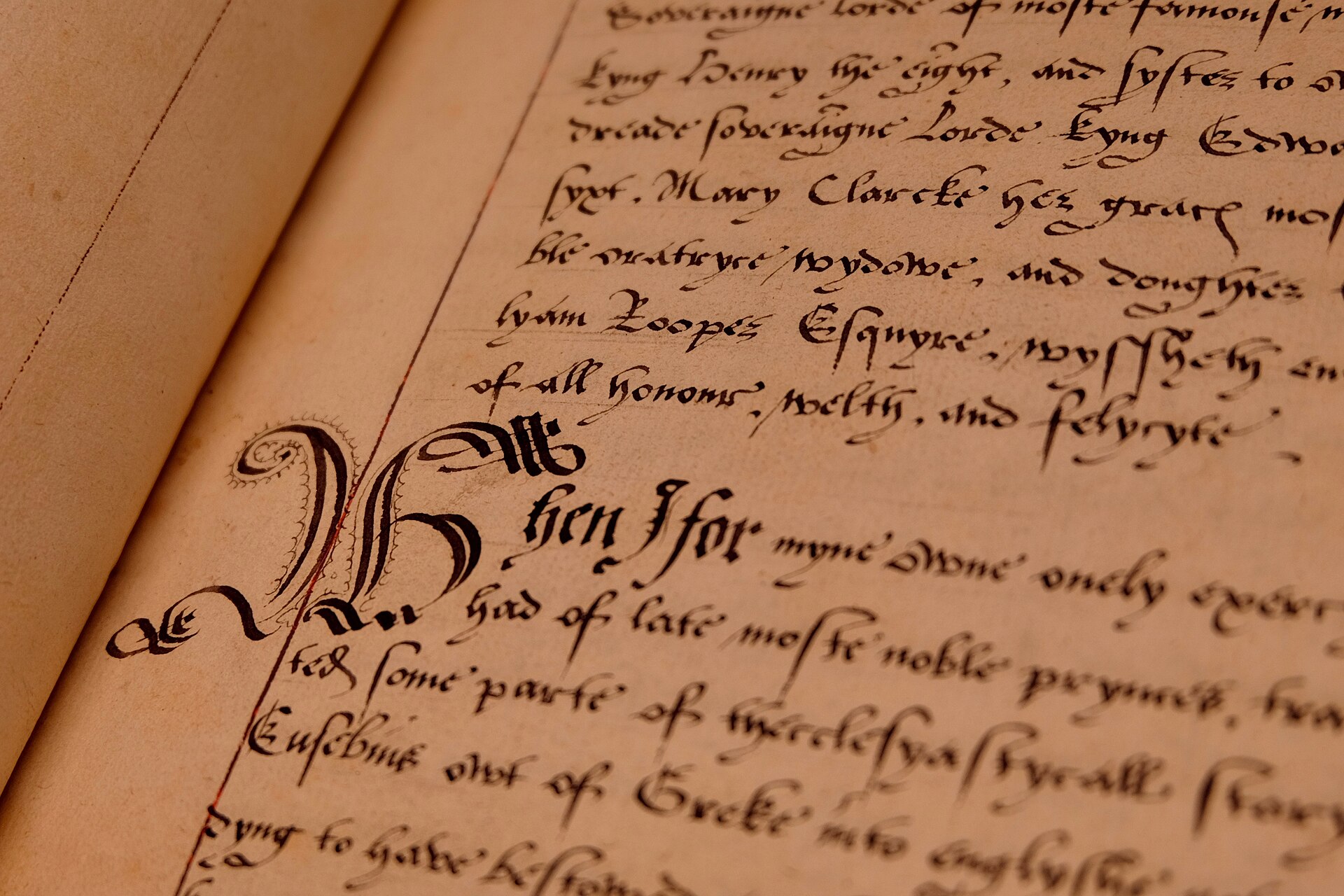

What the record shows
Eusebius, bishop of Caesarea from about 313, is the first Christian historian whose work survives in full, and nearly every early martyr story in lessons 02 and 03 passes through his hands. His Church History, in ten books, copies or summarizes older documents that are otherwise lost: the letter of the churches of Vienne and Lyon about the persecution of 177 (book 5, chapters 1 and 2), passages of Hegesippus on James the brother of Jesus, letters of Dionysius of Alexandria on the persecution of Decius, and parts of the Martyrdom of Polycarp.7 Where the older document also survives separately, as the Polycarp letter does, scholars can check his copying, and it is generally close.
For the Great Persecution of 303 to 311 Eusebius was an eyewitness. Book 8 dates its start: "It was in the nineteenth year of the reign of Diocletian" that "royal edicts were published everywhere, commanding that the churches be leveled to the ground" and the Scriptures burned.16 At the close of the account of the persecution in book 8, chapter 13, he promises a further work on the martyrs of his own province: "I will describe for posterity in another work those which I myself witnessed."16 That work, The Martyrs of Palestine, survives in a short Greek form usually attached to book 8 and a longer form preserved in Syriac. It names the martyrs of Caesarea and the surrounding region year by year, with places, governors and manner of death. For those years it is the closest thing in early Christian literature to a register of deaths kept by a local witness.
Tradition and legend
Eusebius is mostly free of the wonders that fill later passions, but he did not invent his sources and did not always test them. He repeats Hegesippus's long, dramatic account of the death of James the brother of Jesus beside the shorter and earlier report of Josephus (lesson 02 compares the two). He reports traditions about the apostles with phrases such as "it is said" and passes on Origen's notes about where each apostle preached; those statements are the root of several Late tradition ratings in lesson 02. The stories later attached to his martyrs of Palestine, in the medieval calendars and passions, add miracles that his own text does not contain. This is tradition: the additions first appear in Greek and Latin passions of the fifth century and later.
What the sources dispute
Eusebius told his readers what he would leave out. In book 8, chapter 2, he says that "we shall not mention those who were shaken by the persecution," and that he will include only those events "which may be useful first to ourselves and afterwards to posterity."16 Historians read this sentence in two ways. Edward Gibbon, in the eighteenth century, used it to charge Eusebius with suppressing what did not edify. Later historians, such as W. H. C. Frend in Martyrdom and Persecution in the Early Church (1965), took it as an honest statement of a selective purpose and still relied on the Martyrs of Palestine as an essentially accurate local record. The dates of the stages of the Church History, and whether book 8 was revised after Constantine's victory, remain disputed. His figures for the numbers who died in Egypt and elsewhere are treated as impressions, not counts; the 1910 Catholic Encyclopedia itself judged that "anything like a numerical estimate of the number of martyrs is impossible."1
The acts and passions of the early martyrs
Written: from about 155 (Smyrna letter) to the early fourth century for the oldest group; many more from the fifth century on · Place: Asia Minor, Gaul, North Africa, Rome, Egypt, Palestine · Earliest source: the Martyrdom of Polycarp, about 155 to 167 · Record strength: Documented for a small core; Late tradition or Legend for most of the rest
What the record shows
Two Latin words name the main kinds of early martyr text. Acta (acts, proceedings) were at first the records of a hearing before a Roman magistrate: the questions, the answers and the sentence. Passio (passion, suffering) was a narrative of a martyr's arrest, trial and death, often written for reading on the feast day. Greek texts of the second kind are often called martyria. In practice the categories blur, because Christian editors turned trial records into readings for worship and gave narratives the form of trial records.
The trial-record type is represented by the Acts of the Scillitan Martyrs, the record of a hearing at Carthage on July 17, 180, which is the oldest dated Christian document in Latin, and by the Acta Proconsularia of Cyprian (258). Both are brief, dry and specific. The narrative type is represented by the Martyrdom of Polycarp, the letter of the churches of Vienne and Lyon (177), and the Passion of Perpetua and Felicity (Carthage, 203), which contains, in the words of the 1907 Catholic Encyclopedia, "the autograph notes of Perpetua and Saturus."14 All of these are profiled in lesson 03.
The standard English collection is Herbert Musurillo's The Acts of the Christian Martyrs (Oxford, 1972), which gives the Greek or Latin text with a translation. In Jan Bremmer's description, Musurillo "accepted 28 texts regarding martyrs," those he judged the most reliable or, where they contain fictional elements, the most instructive.17 Bremmer, reviewing a newer collection by Eric Rebillard (Greek and Latin Narratives about the Ancient Martyrs, 2017), judges Musurillo's selection "too generous," which gives a sense of how far scholarly trust has narrowed.17
Tradition and legend
Outside that small core lies a very large body of later passions, written mostly from the fifth to the tenth centuries, for martyrs whose cult was real but whose history was unknown. Bridge's 1907 article lists examples of such "romances," among them the story of Felicitas and her seven sons, Genesius the comedian, and Barlaam and Josaphat, and says some of them have no factual foundation at all.14 These texts use stock scenes: a tyrant judge, long speeches by the martyr, failed tortures, miraculous healings, conversions of the executioners and a final beheading. This is legend in the module's sense, even where the martyr's name and burial place are real. Many of the passions of famous Roman martyrs, such as Agnes, Cecilia and Sebastian, belong to this class in the form we have them, while the martyr's existence rests on the calendars and the tomb.
What the sources dispute
Scholars disagree about how much even the core texts were edited. Candida Moss, in Ancient Christian Martyrdom (2012) and The Myth of Persecution (2013), argues that almost every early martyr account was reworked in later centuries and that none can be read as a plain record. Others, including many reviewers of her work, hold that a handful of texts (Polycarp, Lyon, Perpetua, the Scillitans, Cyprian) keep a recoverable core close to the events. The Martyrdom of Polycarp has been dated as early as about 155 and as late as the third century by different scholars, and its miraculous details (a voice from heaven, the fire forming an arch, the dove in some copies) are widely held to be additions or literary shaping. Perpetua's diary is accepted by most scholars as substantially her own words, though some question how much the editor shaped it. Lesson 03 sets out each case.
The martyrologies and the Roman Martyrology
Written: early lists from 354; general martyrologies from the fifth century; the Roman Martyrology first printed 1583 · Place: Rome, Italy, Gaul, England, and later the whole Latin church · Earliest source: the Depositio Martyrum of 354 · Record strength: a record of cult (who was honoured, where and on what day), not by itself a record of deaths

What the record shows
A martyrology, in the definition of Hippolyte Delehaye's 1910 article in the Catholic Encyclopedia, is "a catalogue of martyrs and saints arranged according to the order of their feasts."18 Local lists such as the Roman Depositio Martyrum (354) and calendars from Carthage and the Syriac-speaking churches were combined, in Italy probably in the second half of the fifth century, into a general martyrology that was later revised in Gaul, probably at Auxerre, around 600. That book was falsely attributed to the translator of the Latin Vulgate (translated about 382 to 405 at the request of Pope Damasus), and Delehaye judged its manuscripts to be in "inexplicable confusion," so that the original text cannot be fully restored.18
From the eighth and ninth centuries came the "historical martyrologies," which added a short account of each saint to the bare name and place: Bede's in England, then Florus of Lyon, Ado of Vienne and Usuard of Saint-Germain in the ninth century. Delehaye's article states that the Roman Martyrology descends directly from these and describes it as "the martyrology of Usuard completed by the 'Dialogues' of St. Gregory," with other additions.18 The first printed edition appeared in Rome in 1583 under Pope Gregory XIII, as part of the calendar reform, and a corrected edition of 1584 was imposed on the whole Latin church. Cesare Baronius revised it and republished it in 1586 with his notes, and Benedict XIV issued a further revision in 1748.18 A new edition was issued after the Second Vatican Council, in 2001, and revised in 2004.
Tradition and legend
The historical martyrologies took their short notices from whatever passions were available, including the late romances described in the previous brief. Their compilers also filled empty days, moved feasts and sometimes split one martyr into two or merged two into one. An entry in the Roman Martyrology therefore records that the church honoured a person on a given day; the details in the entry are only as good as the passion behind them. This is tradition, and in some entries legend, carried forward with the authority of a liturgical book.
What the sources dispute
The Roman Martyrology has been corrected many times, and each correction was disputed. Baronius's notes of 1586 already questioned some entries. The calendar reform of 1969 removed a number of saints from the general calendar of feasts because nothing reliable was known of them, while leaving most in the Martyrology for local veneration; the 2001 edition revised many notices again. Catholic scholars such as the Bollandists have been among the sharpest critics of weak entries, which shows that the critical reading of martyr texts did not begin with Protestant or secular historians. Protestant writers from the sixteenth century on, Foxe among them, attacked the Martyrology's legends while building martyrologies of their own.
The Bollandists and the Acta Sanctorum
Written: first two volumes (January) 1643; the series continued into the twentieth century · Place: Antwerp, later Brussels · Earliest source: Heribert Rosweyde's published plan, 1607 · Record strength: a critical edition of sources, with each text's reliability discussed
What the record shows
The Acta Sanctorum ("Acts of the Saints") is the largest critical collection of saints' lives ever made. According to the 1907 Catholic Encyclopedia article by the Bollandist Charles De Smedt, the idea "was first conceived by Heribert Rosweyde," a Jesuit of Antwerp (1569 to 1629), who published his plan in 1607. After Rosweyde's death the Jesuit Jean Bolland (1596 to 1665) took up the work, and the two volumes for January "appeared in the course of the same year, 1643."19 The saints are arranged by feast day, month by month, an order that De Smedt says "had been prescribed by his superiors" against Rosweyde's wish for a chronological order.19
Bolland's colleagues Godfrey Henschen (from 1635) and Daniel Papebroch (from 1659) set the critical method: gather every manuscript of a saint's life, print the best text, and add an introduction weighing its date and reliability. De Smedt writes that "the Bollandist work owes its final form to Henschen."19 By 1907, he reports, the collection numbered sixty-three folio volumes plus a supplementary volume of 1875; the series reached November before the work turned to other forms. In 1882 the Bollandists began the journal Analecta Bollandiana for new finds and studies, which still appears.19
Tradition and legend
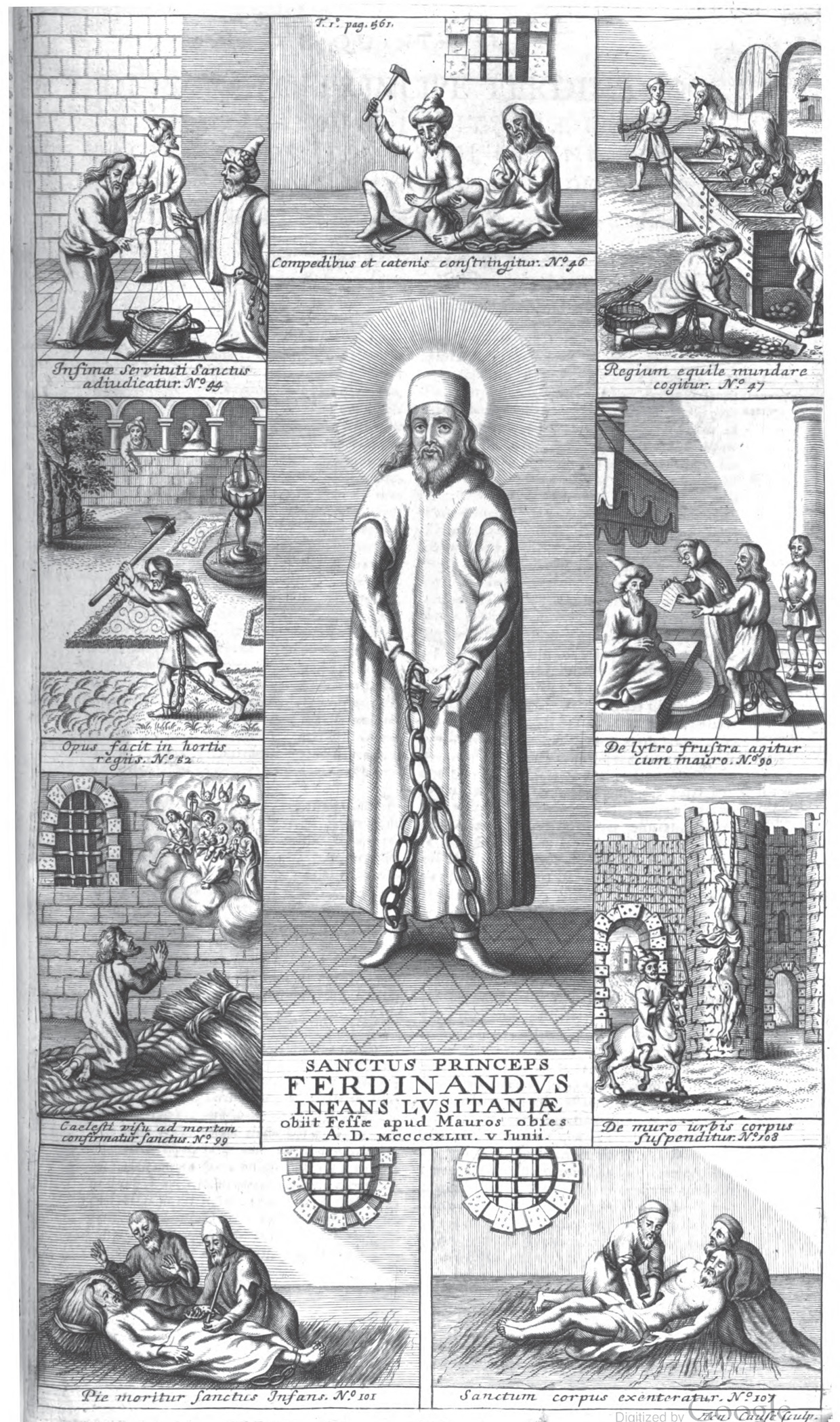
The Acta Sanctorum prints legends as well as records, because its purpose is to give every text the church used. A reader who finds a story in the Acta Sanctorum has found a text, not a verdict: the editors' introduction to each saint, often longer than the text itself, is where the verdict lies. Engravings such as the one shown above, made for the June volumes, illustrate the traditions told in the texts and are not evidence for them.
What the sources dispute
The Bollandists' critical work drew fierce opposition from within the Catholic Church. De Smedt reports that Papebroch's doubt about the Carmelite tradition that their order went back to the prophet Elias drew attacks from the Carmelites, and that in 1695 the Spanish Inquisition condemned the first fourteen volumes; the suppression of the Jesuits in 1773 brought "a crisis in which the work nearly foundered."19 Hippolyte Delehaye (1859 to 1941), the best known Bollandist of the twentieth century, wrote The Legends of the Saints to explain to general readers how saints' legends grow, and his classification of hagiographic texts is still used. Scholars today debate how far his confident separation of history from legend holds, but nearly all start from the Bollandist editions.
John Foxe and the Actes and Monuments
Written: Latin forerunners 1554 and 1559; English editions 1563, 1570, 1576 and 1583 · Place: Strasbourg and Basel, then London (printed by John Day) · Earliest source: Foxe's 1563 edition, issued March 20, 1563 · Record strength: Documented for many Marian martyrs, where Foxe printed trial records and letters; much weaker for earlier centuries and for some anecdotes

What the record shows
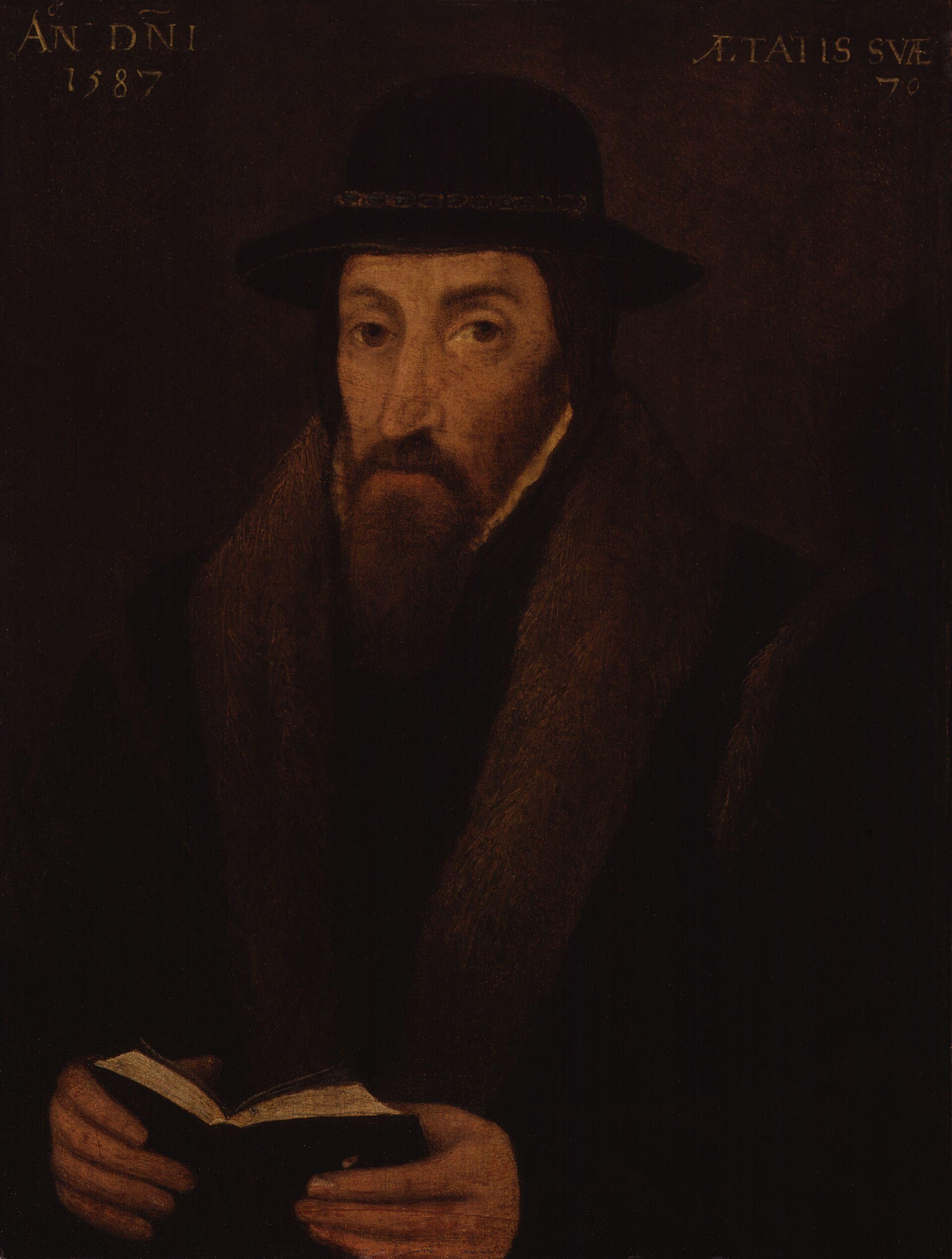
John Foxe, an English Protestant clergyman, went into exile on the Continent under Mary I and there began a history of the persecution of reformers. A short Latin book (the Commentarii) was printed at Strasbourg in 1554, and an enlarged Latin folio, Rerum in ecclesia gestarum, at Basel in 1559 by the printer Oporinus.20 Edmund Grindal, later archbishop, urged him on: on June 10, 1557, according to the Dictionary of National Biography, Grindal "urged Fox to complete at once his account of the persecution of reformers in England as far as the end of Henry VIII's reign."20
Back in England, Foxe and the printer John Day issued the first English edition. The Dictionary of National Biography (1889) records that "On 20 March 1562-3 Foxe's 'Actes and Monuments' issued from Day's press," and that its popular name was the "Book of Martyrs."21 Four editions appeared in Foxe's lifetime, "viz. in 1563, 1570, 1576, and 1583," each larger than the last; the 1570 edition was corrected and much expanded, and the Convocation of 1571 directed that copies be placed in cathedral churches.22 Foxe died in April 1587.22
The strength of Foxe for the Marian years (1555 to 1558) is that he printed documents: bishops' registers, examinations of prisoners, letters written from prison, and eyewitness reports he gathered from correspondents across England. For many of the nearly three hundred people burned under Mary, his book is the main or only record of name, place and date, and where diocesan records survive they generally confirm his core facts. The four editions, with their changes, are now edited together in The Unabridged Acts and Monuments Online, published in 2011 by the Digital Humanities Institute of the University of Sheffield under Mark Greengrass and David Loades, with Thomas S. Freeman as research officer.23 The online variorum lets a reader see exactly what Foxe printed in each edition and what he changed.

Tradition and legend
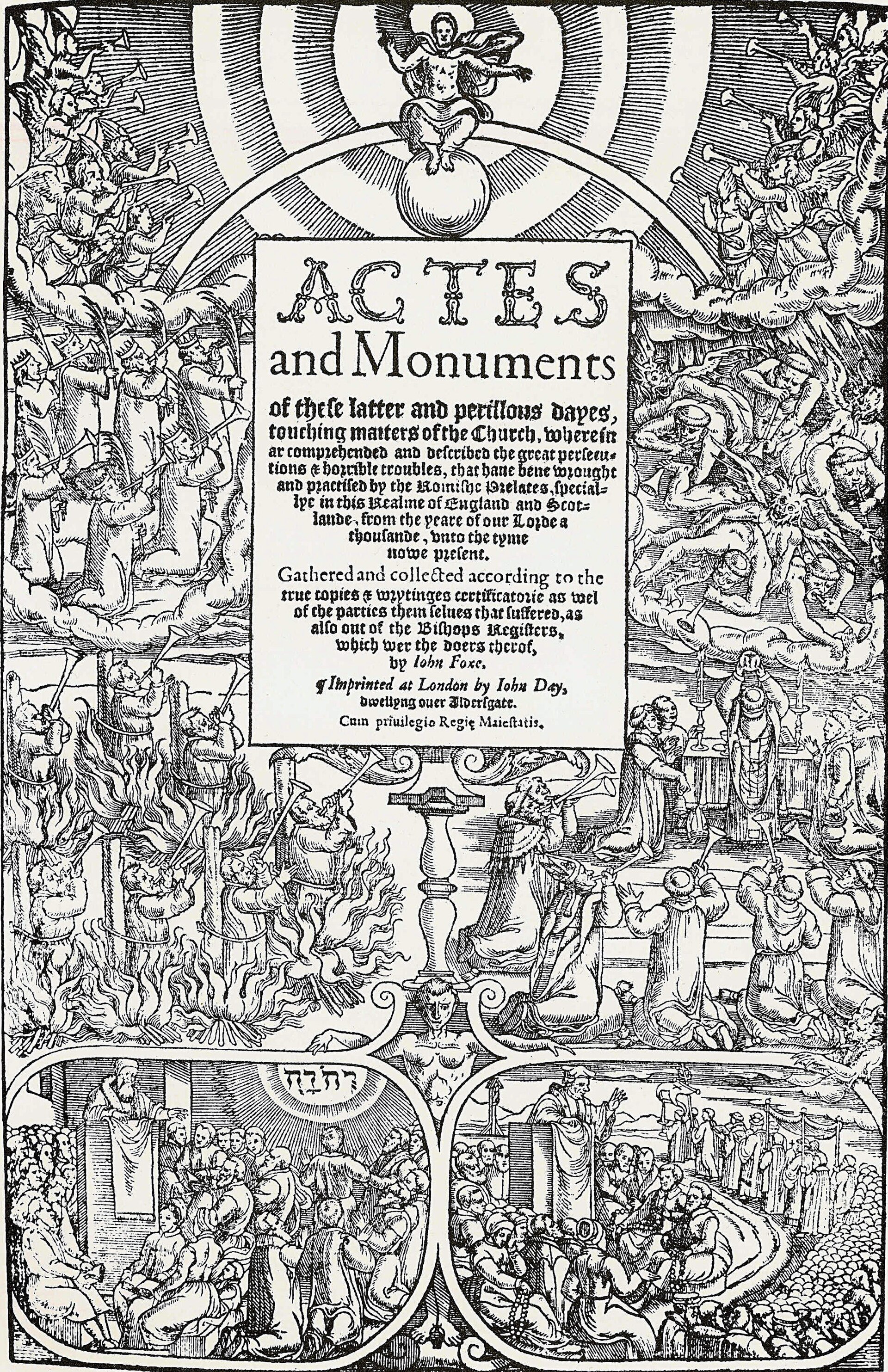
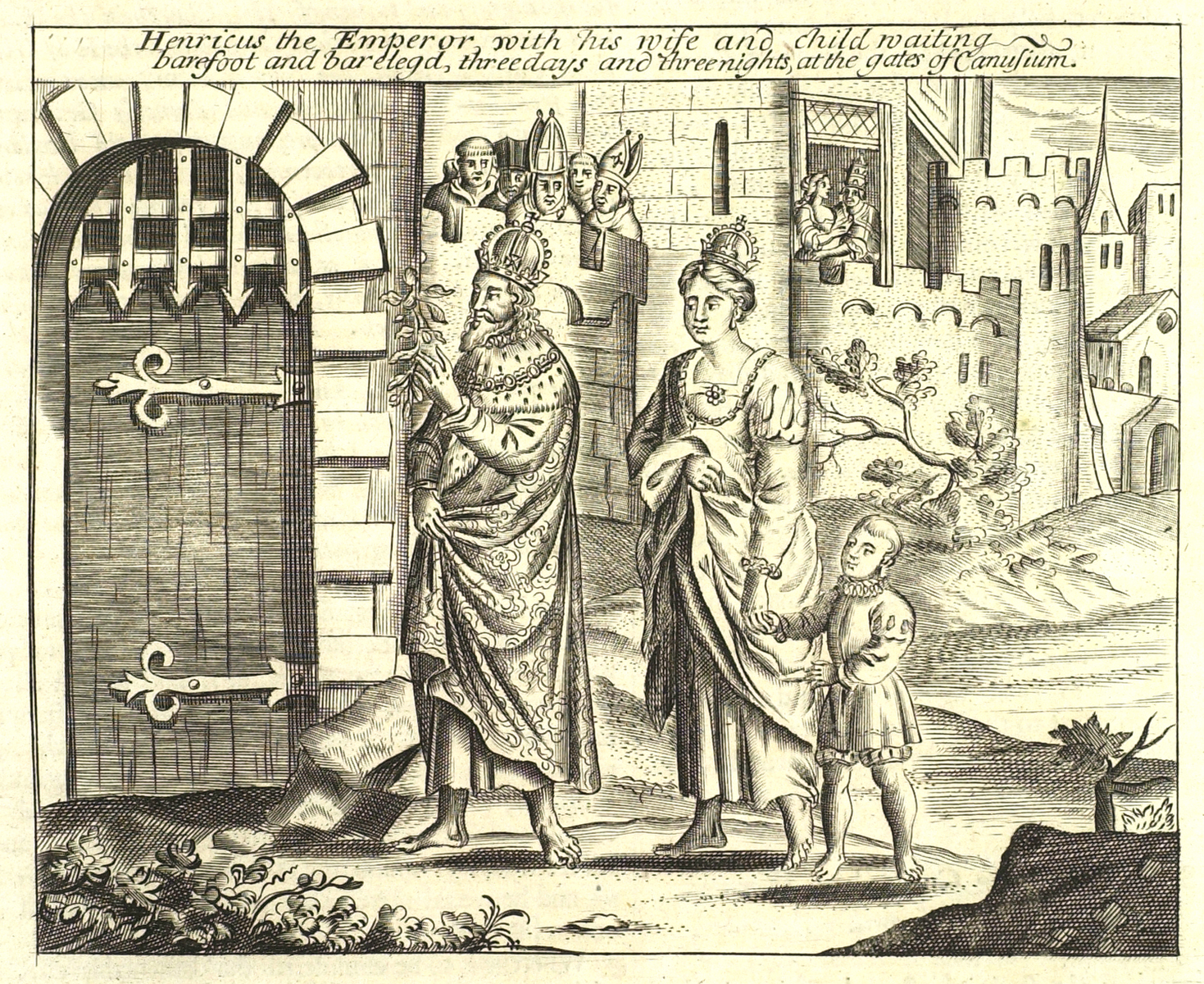
Foxe's history begins with the early church and runs through the Middle Ages, and for those centuries he relied on chronicles, earlier Protestant writers and the same legends he attacked when Catholics used them. Several famous scenes owe their wording to him alone, including the last words of Latimer to Ridley and of Tyndale (lessons 05 and 06 rate them). His woodcuts, such as the scenes shown in the 1684 ninth edition below, were made to teach and move readers and are not eyewitness pictures, though some early woodcuts were cut within a few years of the events. Later abridgements, from the seventeenth to the twenty-first century, cut, rewrote and sometimes added to Foxe; many popular "Foxe's Book of Martyrs" volumes sold today are much shortened versions with later material, and the original editions should be checked through the Foxe Project before any quotation is trusted.

What the sources dispute
Foxe has been attacked from the start. The Jesuit Robert Parsons, in the early 1600s, according to the Dictionary of National Biography, "condemned the work as a carefully concocted series of lies," and Archbishop William Laud later "refused to license a new edition for the press."24 The 1889 Dictionary article itself judged that "Foxe was too zealous a partisan to write with historical precision," that his mistakes sometimes came from "faulty and hasty copying of original documents," but "are more often the result of wilful exaggeration."24 The best known error is the case of a man named Greenwood or Grimwood of Hitcham in Suffolk. Foxe wrote that he had procured the death of a "martyr" named John Cooper on false evidence and then "died miserably soon afterwards." Foxe was told that Grimwood was alive, went to Ipswich to examine witnesses, but "never made any alteration in his account." Later, a clergyman named Prick repeated the story from the pulpit of Hitcham church with Grimwood present, and Grimwood sued him; the courts held that no malicious defamation was intended.25
Modern scholarship has moved Foxe's reputation in both directions. Thomas S. Freeman, the leading Foxe scholar, has shown in a long series of studies, including "Fate, Faction, and Fiction in Foxe's Book of Martyrs" (The Historical Journal, 2000), that Foxe generally printed his documents faithfully, corrected errors in later editions when he learned of them, and left out stories he could not check, while also shaping material to fit his case and repeating hostile anecdotes about persecutors. Catholic historians such as Eamon Duffy, in Fires of Faith (2009), accept the scale of the Marian burnings as Foxe reports it while rejecting his picture of the Marian church. The judgment of most historians today is that Foxe did not invent his Marian martyrs, but he did shape how they were told; Claims checked below rates the popular claim that he invented them.
Thieleman van Braght and the Martyrs Mirror
Written: preface signed July 23, 1659; first edition 1660 · Place: Dordrecht, the Netherlands · Earliest source: van Braght's 1660 edition, printed by Jacob Braat · Record strength: Documented for many sixteenth-century Dutch and Flemish Anabaptists, where it prints court sentences and prison letters; weak for the early and medieval sections
What the record shows
Thieleman Jansz van Braght, an elder of the Flemish Mennonite congregation at Dordrecht, published in 1660 a 1,290-page folio whose Dutch title begins "Het Bloedig Tooneel Der Doops-gesinde, En Weereloose Christenen" (The Bloody Theatre of the Baptism-minded and Defenseless Christians). According to the Global Anabaptist Mennonite Encyclopedia Online (GAMEO), his preface is signed at Dordrecht on July 23, 1659, and the first edition was printed by Jacob Braat.11 Van Braght built on an earlier Dutch Anabaptist martyr book, Het Offer des Heeren ("The Sacrifice of the Lord"), first printed in 1562 and called by GAMEO "the foundation of the later Dutch Mennonite martyrbooks,"33 and on court records and letters gathered by Mennonite congregations.
The book has two parts. Part I, about 450 pages, tells Christian martyrdom from Christ to 1500, treating as forerunners all who rejected infant baptism, and ends with a confession of faith in 33 articles. Part II, about 840 pages, gives the Anabaptist and Mennonite martyrs of the sixteenth and early seventeenth centuries. GAMEO counts 803 named martyrs, 613 of them executed in the Netherlands and Belgium and 190 elsewhere in Europe, with many more mentioned without names.11 Its strength for Part II is the same as Foxe's for the Marian years: it reprints sentences, interrogations and many letters written by prisoners to their families. Dirk Willems, Felix Manz and Michael Sattler, profiled in lesson 06, all appear in it; their place in Anabaptist history is told in Church History, Part B, lesson 08.
Tradition and legend
The second edition, published at Amsterdam in 1685 after van Braght's death in 1664, added 104 etchings by Jan Luyken (spelled Luiken in GAMEO), 49 in Part I and 55 in Part II, and it is in this edition that the words "Martyrs' mirror" first appear.11 Luyken's pictures, especially of Dirk Willems turning back to save his pursuer from the ice, fixed the popular image of Anabaptist martyrdom, but they were made more than a century after most of the events. Part I's claim that a line of baptizers who rejected infant baptism ran unbroken from the apostles to the sixteenth century is a theological reading of history, not a finding of the sources, and most historians, Mennonite historians included, reject it as history.
What the sources dispute
The book's translations show how its readers used it. A German translation was made and printed at the Ephrata Cloister in Pennsylvania in 1748 to 1749 (1,300 copies of 1,512 pages, translated by Peter Miller with fourteen helpers), and English translations followed at Lampeter Square, Pennsylvania, in 1837 (from the German) and at Elkhart, Indiana, in 1886 (by Joseph F. Sohm, from the Dutch of 1660).11 On accuracy, GAMEO states that the work "is neither complete nor without error," notes mistakes in names and dates and some martyrs counted twice, and reports that the Dutch Reformed writer Christian Schotanus accused van Braght of falsifying history while the Mennonite scholar Samuel Cramer concluded that he was, in general, reliable.11 Brad Gregory's Salvation at Stake treats the Martyrs Mirror as a source of the same kind as Foxe and the Catholic martyrologies and finds that all three record real deaths and real convictions, each shaped to prove its own church true.
Richard Challoner and the Memoirs of Missionary Priests
Written: two volumes, 1741 to 1742 · Place: London (printed without the author's name, at a time when Catholic books were illegal in England) · Earliest source: Challoner's first edition · Record strength: Documented for most entries, built on trial records, letters and earlier Catholic accounts; weaker where it repeats oral tradition
What the record shows
Richard Challoner (September 29, 1691 to January 12, 1781), a priest trained at the English College at Douai and later vicar apostolic of the London District, compiled the Catholic counterpart to Foxe for the English Reformation. The 1908 Catholic Encyclopedia article by Edwin Burton describes the Memoirs of Missionary Priests as accounts of the English martyrs "from 1577 to 1681," and says the work was "laboriously compiled from original records."26 Challoner drew on the records of the English colleges abroad, on accounts printed by Catholic exiles soon after each execution (such as those of William Allen and Richard Verstegan), on letters, and on the government's own trial records where he could find them. The book covers priests and lay Catholics executed under Elizabeth I, James I, Charles I, the Commonwealth and Charles II, ending with the deaths connected with the Popish Plot and Oliver Plunkett in 1681.
For many of the men and women profiled in lesson 07, such as Edmund Campion (1581) and Margaret Clitherow (1586), Challoner's account rests on earlier writings by people who knew them, which is why the module grades many of them Documented. His book was used, with the original records, in the causes that led to the beatification of English martyrs from 1886 on and to the canonization of the Forty Martyrs of England and Wales in 1970.
Tradition and legend
Challoner wrote to edify and to defend Catholics against the charge that their priests died as traitors. He repeats some edifying sayings and signs reported by Catholic witnesses that no other source confirms, and his tone toward the persecuting government is that of a member of a persecuted church. Where a saying or a wonder appears first in Challoner, more than a century after the event, this module marks it as late tradition.
What the sources dispute
The central dispute over Challoner's martyrs is the same as the dispute over the executions themselves. The government of Elizabeth I said it executed priests for treason, under the statute of 1585 that made it treason for a Jesuit or seminary priest ordained abroad to be in England, and pointed to the papal bull of 1570 that declared the queen deposed. The priests and their supporters said they died for the Catholic faith and for the priesthood, and many of them prayed for the queen on the scaffold. Challoner gives the Catholic reading, and the government's own statements (such as William Cecil's The Execution of Justice in England, 1583) give the other. Lesson 07 sets both out in their own words.
Modern martyrologies: Westminster Abbey, Rome and Moscow
Written: 1994 to 2000 for the main lists · Place: London, Rome and Moscow · Earliest source: the ten statues of Westminster Abbey, unveiled in July 1998; the Vatican list for the Jubilee of 2000; the Russian Orthodox Jubilee Council of 2000 · Record strength: mostly Documented, because the deaths are recent and recorded; the selection reflects each church's judgment

What the record shows
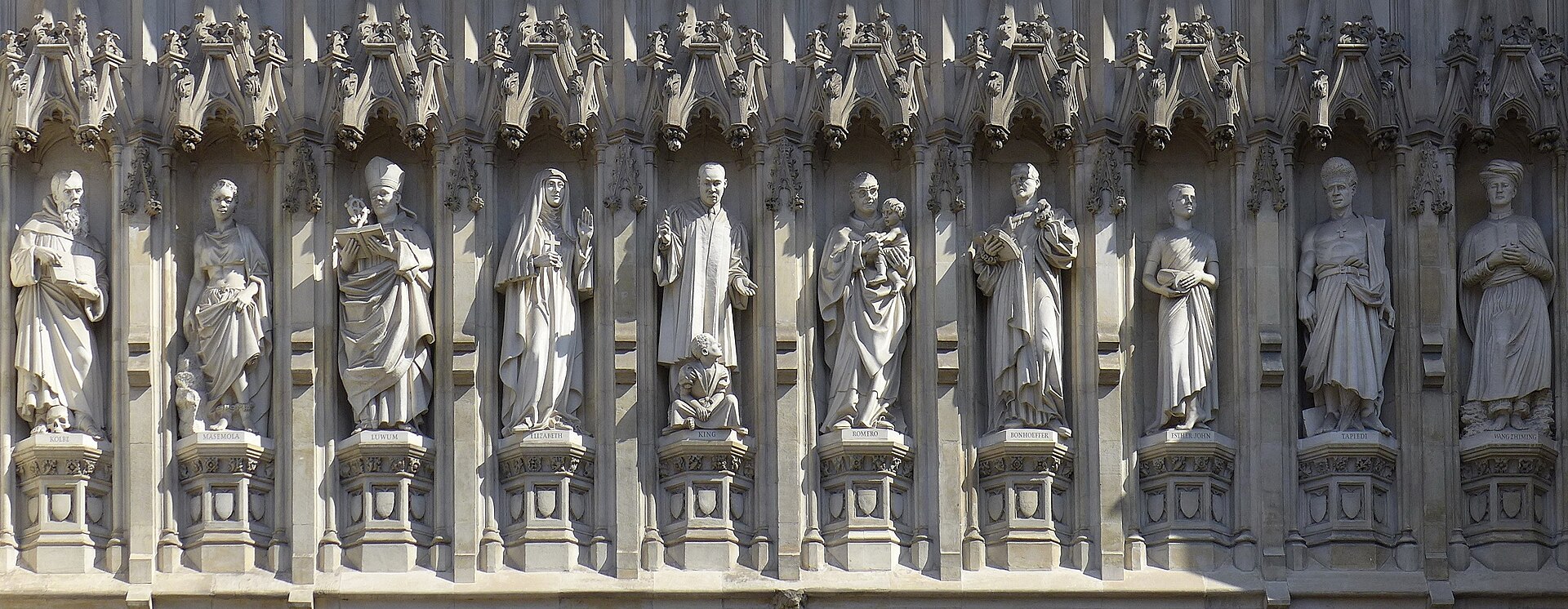
Three large efforts at the end of the twentieth century tried to record the Christian dead of that century. In London, Westminster Abbey filled ten empty niches on its west front with statues of modern martyrs from different churches and continents. The Abbey states that "The Martyrs were unveiled in 1998 above the west door of the Abbey," and dates the unveiling of the statue of Wang Zhiming, the Chinese pastor executed in 1973, to July 1998.27 The ten include Catholics, Anglicans, a Lutheran, an Orthodox nun and a Baptist minister.
In Rome, John Paul II wrote in 1994, in his letter Tertio Millennio Adveniente, that "At the end of the second millennium, the Church has once again become a Church of martyrs," that the witness of the martyrs "has become a common inheritance of Catholics, Orthodox, Anglicans and Protestants," and that "It will be the task of the Apostolic See, in preparation for the Year 2000, to update the martyrologies for the universal Church."28 A Vatican commission for the "new martyrs" gathered names and testimonies from dioceses and religious orders around the world, and on May 7, 2000, the Pope led an ecumenical commemoration of the "witnesses to the faith" of the twentieth century at the Colosseum, with representatives of other churches, grouping the dead in eight categories rather than naming them one by one.10 Christianity Today reported that the list compiled for the occasion held 12,692 names and had not been published, and that 19 churches and ecumenical bodies took part, including Orthodox churches, the Anglican Communion, the Lutheran World Federation, the World Methodist Council and the World Council of Churches, while some Reformed bodies did not attend.29
In Moscow, the Jubilee Council of Bishops of the Russian Orthodox Church in August 2000 glorified the New Martyrs and Confessors of Russia, those killed or imprisoned under Soviet rule. The Orthodox Church in America's account says that "more than one thousand New Martyrs were numbered among the saints" and that the feast falls on the Sunday closest to January 25, while millions of names have been lost.9 Lesson 10 profiles several of these modern martyrs and sets out the modern counts.
Tradition and legend
Modern martyrs are close to their records, but legend still gathers quickly. Last words are reported by single witnesses, numbers are repeated without sources, and stories pass from sermon to website without a citation. Books of the late twentieth and twenty-first centuries in the line of Foxe, written to rouse prayer and support for persecuted Christians, mix carefully sourced cases with unsourced ones. The same checklist applies: who first reported this, when, and how did that person know?
What the sources dispute
The modern lists raise the old question of the cause. Westminster Abbey included Martin Luther King Jr. and Oscar Romero, whose killers acted for reasons that mixed politics with hatred of their preaching; some critics argued that such deaths fall outside the classic definition, and others answered that the defence of justice taught by the gospel is itself witness to the faith. The Catholic Church took the second view when it declared Romero a martyr killed in hatred of the faith (beatified 2015, canonized 2018). The Russian Orthodox glorification of the imperial family as passion-bearers rather than martyrs reflected a long internal debate about whether they died for their faith or for their crown. Lesson 10 adds the larger dispute over how many Christians die each year and how a "faith-related" death should be defined.
What the record shows and what it does not
- Documented fact: The Greek martys meant a witness; the New Testament mostly uses it in that sense, with a few verses in Acts and Revelation applying it to believers who were killed. The Martyrdom of Polycarp (about 155 to 167) uses it in the later sense of a Christian who died for the faith. The Lyon confessors of 177 refused the title while alive. The Depositio Martyrum of 354, Eusebius's eyewitness account of 303 to 311, and the trial-based sections of Foxe, the Martyrs Mirror and Challoner are records close to the events they describe.
- A church's own claim or tradition: The feast days, relics, shrines and martyrologies of every church record who that church honours. The Roman Martyrology, the Orthodox synaxaria and the Protestant and Anabaptist martyr books each claim the true cause for their own dead. Many entries rest on passions written centuries after the deaths.
- Scholarly reading: Historians from Delehaye and the Bollandists to Frend, Musurillo, Gregory, Freeman and Moss agree that a small core of early accounts is close to the events and that most later passions are legendary. They disagree about how much even the core was edited (Moss and her critics), and about how far Foxe shaped his material (Freeman, Duffy, the Victorian critics).
- Open question: How many Christians died in any period before modern records is unknown; every figure for the Roman persecutions is an estimate, and the 1910 Catholic Encyclopedia judged a numerical estimate "impossible." The date of the shift in meaning of martys depends on the disputed date of the Martyrdom of Polycarp.
Claims checked
"The word martyr has always meant someone who dies for the faith."
Rating: Refuted. The Greek martys meant a witness, and most New Testament uses, such as Acts 1:8, keep that meaning.2 The sense of a witness who died appears in a few verses (Acts 22:20, Revelation 2:13 and 17:6) and becomes a technical term in the Martyrdom of Polycarp in the second century.6 Even then the Lyon confessors of 177 had to insist that the title belonged only to the dead.7
"Tertullian wrote: 'The blood of the martyrs is the seed of the church.'"
Rating: Partly supported. Tertullian's Apology, chapter 50, says in the Ante-Nicene Fathers translation: "The oftener we are mown down by you, the more in number we grow; the blood of Christians is seed."12 The familiar wording is a later paraphrase. The idea is his; the exact sentence is not.
"Millions of Christians died in the Colosseum."
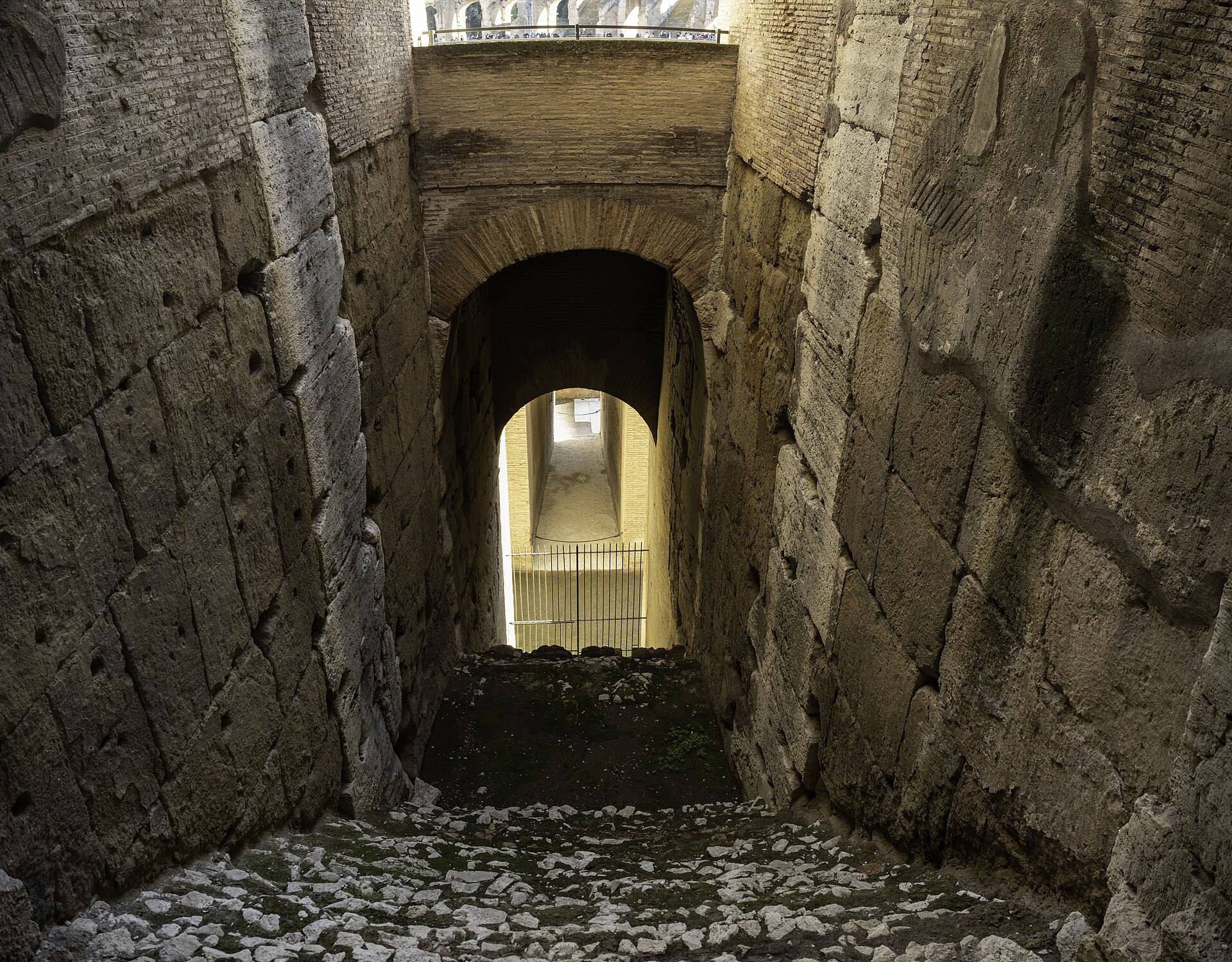
Rating: Unsupported. No ancient source gives a figure anywhere near this for the Colosseum or for the Roman persecutions as a whole. Maurice Hassett's 1908 Catholic Encyclopedia article on the Coliseum found the ancient evidence that Christians were martyred there weak: the Roman acts that mention the amphitheatre are "often merely pious legends" of the fifth century and later; even for Ignatius of Antioch "the evidence that he was martyred in the Coliseum is far from decisive"; and the Bollandist Hippolyte Delehaye, after examining the documents, concluded that there are "no historical grounds" for regarding the Colosseum as a place of martyrdom. Hassett adds that veneration of the Colosseum as a place of martyrdom grew in the seventeenth century, and that Benedict XIV (pope 1740 to 1758) set up the Stations of the Cross there.30 Christians may well have died in the arena, but it is not documented, and the numbers are pure invention. Lesson 03 discusses estimates for the whole period by named historians.

"Christians were persecuted without a break for three hundred years."
Rating: Refuted. Persecution before 250 was local and occasional, under the rule set out by Trajan that Christians were not to be sought out (see Church History, Part A, lesson 03). The 1910 Catholic Encyclopedia article on martyrs, by Hassett, reckoned that Christians suffered persecution in about 129 of the 249 years from 64 to 313, and its own count is generous.1 Empire-wide orders came only under Decius (250), Valerian (257 to 258) and in the Great Persecution (303 to 311 in the East). Long peaceful periods separated them.
"Early Christians invented the story of martyrdom."
Rating: Partly supported in a narrow sense; refuted in the broad sense. Candida Moss's The Myth of Persecution (2013), whose subtitle speaks of how early Christians "invented a story of martyrdom," argues that official persecution was brief and that most martyr stories were rewritten later. Greg Carey's review in The Christian Century summarizes her as finding suppression "on only a few occasions in ancient history, none of which continued for a long period of time."31 Her claim that most passions were reworked is shared by most scholars. Her broader framing was rejected by many reviewers: Collin Garbarino, in Themelios, called the book "a sensationalized political agenda masquerading as religious history."32 Roman writers hostile to Christians, among them Tacitus and Pliny, confirm that Christians were executed, and Moss herself does not deny that Christians died. What was "invented," in her account, is the story of constant persecution, not the deaths.
"Foxe invented his martyrs."
Rating: Refuted for the Marian martyrs; partly supported for some anecdotes. The Marian burnings are confirmed by bishops' registers, government records and Catholic writers of the time, and Catholic historians such as Eamon Duffy accept the scale Foxe reports. Thomas Freeman's work on Foxe's sources shows that he generally printed his documents faithfully. Foxe did, however, print some stories that were false, the best known being his account of Grimwood of Hitcham, who was alive when Foxe reported his miserable death and who later sued a clergyman for repeating it.25 The Victorian judgment that Foxe was "too zealous a partisan to write with historical precision" still has defenders.24 The variorum at the Foxe Project lets any reader check a given story.23
"Everyone in the Roman Martyrology is a verified historical martyr."
Rating: Refuted. The Martyrology is a liturgical calendar that records whom the church honours on each day. Its notices descend from the historical martyrologies of Bede, Florus, Ado and Usuard, which took their details from passions of every quality.18 Its own editors, from Baronius in 1586 to the revisers of 2001, corrected entries, and the Bollandists, themselves Jesuits, published sharp criticism of legendary entries; the Spanish Inquisition condemned their first fourteen volumes in 1695 partly for that criticism.19
"The Martyrs Mirror is a list of Anabaptists only."
Rating: Refuted. Part I, about 450 pages, tells Christian martyrdom from Christ to 1500, claiming as forerunners those who rejected infant baptism; Part II tells the Anabaptist and Mennonite martyrs. GAMEO notes that Part II itself begins with Hans Koch and Leonhard Meyster, who were not Anabaptists.11
"More Christians died for their faith in the twentieth century than in all earlier centuries combined," and "100,000 Christians are killed every year."
Rating: Unresolved (first claim); the second is an estimate under a very broad definition, not a count. Both figures come from the estimates of the Center for the Study of Global Christianity and its predecessors, which count as a martyr anyone who died prematurely in what it calls situations of witness, including deaths in wars and mass killings. Other organizations, such as Open Doors, use narrower definitions and report much lower yearly figures. Lesson 10 sets out each source, its year and its method.
Hard questions and answers
Can a person killed by other Christians be a martyr?
Every church has said yes for its own dead and has often said no for others. Cyprian's rule that "he cannot be a martyr who is not in the Church" and Augustine's teaching that the cause, not the punishment, makes the martyr were used against Donatists in the fourth century, and the same reasoning was used in the sixteenth century by Catholics against Protestants, by Protestants against Catholics and Anabaptists, and by Anabaptists in reply.18 In recent decades several churches have widened their view: John Paul II wrote in 1994 that the witness of martyrs "has become a common inheritance of Catholics, Orthodox, Anglicans and Protestants."28 This module calls a person a martyr when his or her own church does, says which church that is, and gives the charge and the court in the words of the court.
Does dying for a belief prove it true?
Martyr books have often argued as if it did, and Tertullian's line about seed was an argument of that kind.12 The record shows people of many faiths, and Christians of rival churches, dying for convictions that contradict one another, so the willingness to die cannot by itself prove a belief true. What a well-documented martyrdom can show is narrower: that the person believed what he or she said, at great cost. That is why the early church gave such weight to the apostles as witnesses of what they claimed to have seen, and why lesson 02 asks carefully what is known of their deaths.
If every martyr book was written by a partisan, why trust any of them?
Because partisanship affects some parts of a source more than others. Names, dates, places, the text of sentences and letters written from prison are hard to invent when readers can check them, and opponents of the time often confirm them. Speeches, miracles, last words and judgments of motive are easy to shape. The checklist above separates these. Foxe on the Marian burnings, the Martyrs Mirror on the Dutch executions and Challoner on the Elizabethan priests are each strong for the first kind of detail and need care for the second.
If so many early passions are legends, did the early martyrs exist at all?
For a core of them the evidence is good: Roman writers such as Tacitus and Pliny confirm executions of Christians, the Smyrna letter, the Lyon letter, the Scillitan acts, Perpetua's diary and Cyprian's acta stand close to the events, and Eusebius saw the Great Persecution himself.16 For many saints known only from late passions, the cult (a tomb, a calendar entry, a church) is real and old, while the story is not. The fair conclusion is that many early Christians died for their faith and that the details of most of their deaths are lost.
How many Christian martyrs have there been?
No one knows. For the Roman period the 1910 Catholic Encyclopedia concluded that "anything like a numerical estimate of the number of martyrs is impossible."1 For the Reformation era there are solid counts for some places (the Marian burnings in England, the Anabaptists named in the Martyrs Mirror) and none for others. For the modern period the estimates differ by a factor of ten or more depending on the definition used. Each lesson of this module gives the numbers it can, with the source and the method, and labels every estimate as an estimate.
Tying it together: reading the briefs that follow
Across nineteen centuries the record of Christian martyrdom was kept by the same few means: letters written soon after a death, trial records, lists for the feast day, and, from the sixteenth century, large printed books made by churches in conflict. The early church moved the word martys from the witness stand to the place of execution and drew a line between the martyr who died and the confessor who survived. Feast days and tombs kept names alive, and also drew legends to them. The medieval martyrologies carried those legends forward, the Bollandists began sorting them in 1643, and the Protestant, Anabaptist and Catholic martyrologists of the sixteenth to eighteenth centuries each recorded their own dead with care while writing against the others. Modern churches have returned to the language of witness and have, for the first time, honoured each other's dead together.
The briefs in lessons 02 to 10 apply one standard to all of them: the earliest source first, with its date and its distance from the death; then what later writers added, marked as tradition or legend; then the open questions, with the scholars on each side named. The Record strength grade at the top of each brief summarizes the evidence, and the reader can test it with the seven questions above.
Learn more
- The Unabridged Acts and Monuments Online: All four lifetime editions of Foxe side by side, with notes by the Foxe Project; the place to check any story attributed to Foxe.
- GAMEO: Martyrs' Mirror: The history, editions, translations and accuracy of van Braght's book, with links to entries on individual Anabaptist martyrs.
- The Chronography of 354 (Roger Pearse's edition): The Latin list of Roman martyr feasts of 354, the oldest surviving Christian calendar of martyrs.
- Hippolyte Delehaye, The Legends of the Saints: A Bollandist's classic explanation of how saints' legends grew and how to sort the texts.
- Bryn Mawr Classical Review 2019.02.37 (Bremmer on Rebillard): A short account of how scholars now judge which early martyr acts are reliable, and why Musurillo's list is thought too generous.
- Church History, Part A, lesson 03: Persecution and the Apologists: The Roman laws and policies behind the persecutions to 313.
Still being checked (10 items)
These points could not be confirmed against a primary source when this lesson was written and fact checked in October 2026. The text above states each one as uncertain.
- That the Martyrdom of Polycarp is the first surviving text to use martys in the technical sense is the standard scholarly judgment; it was not checked against a lexicon in this task (the Perseus LSJ page could not be fetched), and it depends on the disputed date of the letter.
- The characterization of Thomas S. Freeman's findings on Foxe (faithful printing of documents, corrections in later editions) and of Eamon Duffy's Fires of Faith (2009) is a summary of their published work, not checked against their texts in this task.
- Challoner's Memoirs: the 1741 to 1742 dates and anonymous printing are from standard references; the 1908 Catholic Encyclopedia confirms only that it appeared between 1740 and 1745 and covered 1577 to 1681. The use of Allen and Verstegan as sources and its use in the beatification causes from 1886 were not checked.
- The Roman Martyrology's 2001 edition and 2004 revision, and the 1969 calendar reform's removals, are from general knowledge and were not opened in this task.
- The founding date and exact name of the Vatican commission for the new martyrs before the Jubilee of 2000 were not confirmed; the vatican.va presentation opened does not mention it.
- The Acta Sanctorum's final volumes (the series reaching November, with later supplements) are stated generally; the 1907 article gives sixty-three volumes plus a supplement as of 1907.
- The Russian Orthodox glorification in August 2000 is confirmed as 'the Jubilee Council of 2000' by the OCA; the month August was not confirmed in the page opened.
- Romero's beatification in 2015 as a martyr in hatred of the faith and canonization in 2018 were not checked against vatican.va in this task.
- The Center for the Study of Global Christianity's definition (deaths 'in situations of witness') is paraphrased from general knowledge; lesson 10 should verify it against the International Bulletin of Mission Research.
- Brad Gregory's comparison in Salvation at Stake (1999) and W. H. C. Frend's view of Eusebius are summarized from general knowledge of those books.
Notes
- Maurice M. Hassett, "Martyr," The Catholic Encyclopedia, vol. 9 (New York: Robert Appleton Company, 1910), a 1910s Catholic source, via New Advent (retrieved Oct. 28, 2026). Read it online. ↩
- The Holy Bible, King James Version (1611), Acts 1:8, via Bible Gateway (retrieved Oct. 28, 2026). Read it online. ↩
- The Holy Bible, King James Version (1611), Acts 22:20, via Bible Gateway (retrieved Oct. 28, 2026). Read it online. ↩
- The Holy Bible, King James Version (1611), Revelation 2:13, via Bible Gateway (retrieved Oct. 28, 2026). Read it online. ↩
- The Holy Bible, King James Version (1611), Revelation 17:6, via Bible Gateway (retrieved Oct. 28, 2026). Read it online. ↩
- The Martyrdom of Polycarp (The Encyclical Epistle of the Church at Smyrna), chapters 1, 2, 4, 18, 19 and 21, trans. Alexander Roberts and James Donaldson, Ante-Nicene Fathers, vol. 1 (Buffalo: Christian Literature Publishing Co., 1885), rev. Kevin Knight for New Advent (retrieved Oct. 28, 2026). Read it online. ↩
- Eusebius of Caesarea, Church History, book 5, chapters 1 and 2 (the letter of the churches of Vienne and Lyon), trans. Arthur Cushman McGiffert, Nicene and Post-Nicene Fathers, second series, vol. 1 (1890), via New Advent (retrieved Oct. 28, 2026). Read it online. ↩
- The Cult of Saints in Late Antiquity database, University of Oxford, record E04167: Augustine of Hippo, Sermon 327, a Latin sermon probably on a feast of martyrs, stressing that the cause, not the suffering, makes a martyr; preached possibly at Hippo, probably before 411 (retrieved Oct. 28, 2026). Read it online. ↩
- Orthodox Church in America, "New Martyrs and Confessors of Russia," Lives of the Saints (retrieved Oct. 28, 2026). Read it online. ↩
- Office for the Liturgical Celebrations of the Supreme Pontiff, "Ecumenical Commemoration of the Witnesses to the Faith in the Twentieth Century: Presentation," Colosseum, Rome, May 7, 2000, Holy See (retrieved Oct. 28, 2026). Read it online. ↩
- "Martyrs' Mirror," Global Anabaptist Mennonite Encyclopedia Online (GAMEO) (retrieved Oct. 28, 2026). Read it online. ↩
- Tertullian, Apology, chapter 50, trans. S. Thelwall, Ante-Nicene Fathers, vol. 3 (1885), via the Christian Classics Ethereal Library (retrieved Oct. 28, 2026). Read it online. ↩
- The Chronography of 354, part 12: Depositio Martyrum, Latin text from Theodor Mommsen, ed., Monumenta Germaniae Historica, Chronica Minora I (1892), pp. 71 to 72, transcribed by Roger Pearse (2006), tertullian.org (retrieved Oct. 28, 2026). Read it online. ↩
- James Bridge, "Acts of the Martyrs," The Catholic Encyclopedia, vol. 1 (New York: Robert Appleton Company, 1907), a 1910s Catholic source, via Catholic Answers (retrieved Oct. 28, 2026). Read it online. ↩
- Hippolyte Delehaye, The Legends of the Saints: An Introduction to Hagiography, trans. V. M. Crawford (1907; French original 1905), table of contents and chapter 4, "The Classification of Hagiographic Texts," via the Internet History Sourcebooks, Fordham University (retrieved Oct. 28, 2026). Read it online. ↩
- Eusebius of Caesarea, Church History, book 8, chapters 2 and 13, trans. Arthur Cushman McGiffert, Nicene and Post-Nicene Fathers, second series, vol. 1 (1890), via New Advent (retrieved Oct. 28, 2026). Read it online. ↩
- Jan N. Bremmer, review of Eric Rebillard, Greek and Latin Narratives about the Ancient Martyrs (Oxford: Oxford University Press, 2017), Bryn Mawr Classical Review 2019.02.37 (retrieved Oct. 28, 2026). Read it online. ↩
- Hippolyte Delehaye, "Martyrology," The Catholic Encyclopedia, vol. 9 (New York: Robert Appleton Company, 1910), a 1910s Catholic source, via New Advent (retrieved Oct. 28, 2026). Read it online. ↩
- Charles De Smedt, "Bollandists," The Catholic Encyclopedia, vol. 2 (New York: Robert Appleton Company, 1907), a 1910s Catholic source, via New Advent (retrieved Oct. 28, 2026). Read it online. ↩
- "Foxe, John," Dictionary of National Biography, vol. 20 (London: Smith, Elder and Co., 1889), scanned pages 149 and 150 of the Wikisource transcription, en.wikisource.org (on the Strasbourg Commentarii of 1554, printed by Wendelin Richelius, the Basel volume of 1559, Oporinus, and Grindal's letter of June 10, 1557) (retrieved Oct. 28, 2026). Read it online. ↩
- "Foxe, John," Dictionary of National Biography, vol. 20 (1889), scanned page 151 of the Wikisource transcription, en.wikisource.org (the first English edition, March 20, 1563, from John Day's press) (retrieved Oct. 28, 2026). Read it online. ↩
- "Foxe, John," Dictionary of National Biography, vol. 20 (1889), scanned page 153 of the Wikisource transcription, en.wikisource.org (the four lifetime editions, the Convocation order for cathedral churches, Foxe's death in April 1587) (retrieved Oct. 28, 2026). Read it online. ↩
- John Foxe, The Unabridged Acts and Monuments Online (TAMO), editions of 1563, 1570, 1576 and 1583, project directors Mark Greengrass and David Loades, research officer Thomas S. Freeman (Sheffield: Digital Humanities Institute, University of Sheffield, 2011) (retrieved Oct. 28, 2026). Read it online. ↩
- "Foxe, John," Dictionary of National Biography, vol. 20 (1889), scanned page 154 of the Wikisource transcription, en.wikisource.org (judgments on Foxe's accuracy, Parsons, Laud) (retrieved Oct. 28, 2026). Read it online. ↩
- "Foxe, John," Dictionary of National Biography, vol. 20 (1889), scanned page 155 of the Wikisource transcription, en.wikisource.org (the Greenwood or Grimwood case) (retrieved Oct. 28, 2026). Read it online. ↩
- Edwin Burton, "Richard Challoner," The Catholic Encyclopedia, vol. 3 (New York: Robert Appleton Company, 1908), a 1910s Catholic source, via New Advent (retrieved Oct. 28, 2026). Read it online. ↩
- Westminster Abbey, "Wang Zhiming," Abbey commemorations (the ten modern martyrs above the west door, unveiled in 1998) (retrieved Oct. 28, 2026). Read it online. ↩
- John Paul II, Apostolic Letter Tertio Millennio Adveniente (November 10, 1994), section 37, Holy See (retrieved Oct. 28, 2026). Read it online. ↩
- "Pope Honors 12,000 Modern Witnesses to Christianity," Christianity Today, May 2000 (retrieved Oct. 28, 2026). Read it online. ↩
- Maurice M. Hassett, "The Coliseum," The Catholic Encyclopedia, vol. 4 (New York: Robert Appleton Company, 1908), a 1910s Catholic source, via Catholic Answers (retrieved Oct. 28, 2026). Read it online. ↩
- Greg Carey, review of Candida Moss, The Myth of Persecution: How Early Christians Invented a Story of Martyrdom (HarperOne, 2013), The Christian Century, May 1, 2013 (retrieved Oct. 28, 2026). Read it online. ↩
- Collin Garbarino, review of Candida Moss, The Myth of Persecution (HarperOne, 2013), Themelios 38, no. 2 (2013), The Gospel Coalition (retrieved Oct. 28, 2026). Read it online. ↩
- "Offer des Heeren, Het," Global Anabaptist Mennonite Encyclopedia Online (GAMEO) (first printed 1562; "the foundation of the later Dutch Mennonite martyrbooks, including van Braght's Martyrs' Mirror") (retrieved Oct. 28, 2026). Read it online. ↩
- John Chapman, "St. Polycarp," The Catholic Encyclopedia, vol. 12 (New York: Robert Appleton Company, 1911), a 1910s Catholic source (the martyrdom "took place on a Saturday which fell on 23 February"; the two possible years are 155 and 166), via New Advent (retrieved Oct. 28, 2026). Read it online. ↩
Check yourself
1. What did the Greek word martys mean in its first, ordinary sense?
Martys is a witness. The 1910 Catholic Encyclopedia defines the starting sense as a witness who testifies to a fact known from personal observation; the meaning 'one who dies for the faith' came later.
2. Which text is generally treated as the earliest surviving use of 'martyr' and 'martyrdom' in the technical sense of dying for the faith?
The letter of the church of Smyrna on Polycarp's death (about 155 to 167) calls Polycarp 'a pre-eminent martyr' and speaks of 'all the martyrdoms.' The claim rests on surviving texts and on the disputed date of the letter.
3. The survivors of the persecution at Lyon in 177 refused to be called martyrs. What did they call themselves?
The letter preserved by Eusebius (Church History 5.2) says they rebuked anyone who called them martyrs and called themselves 'lowly and humble confessors,' keeping the title for those who had died.
4. What principle did Augustine set against the Donatists' honoring of their own dead?
Augustine taught that suffering alone proves nothing; what makes a martyr is dying for the true cause. Sermon 327 is one place he makes the point.
5. What does the Depositio Martyrum of 354 record most reliably?
It is a calendar of feasts with burial places. It is a strong record of Roman cult in 354 and a weaker record of deaths that mostly lay a century or more earlier. It also has the earliest record of Christmas on December 25.
6. In what year did the first two volumes (for January) of the Bollandists' Acta Sanctorum appear?
The 1907 Catholic Encyclopedia article by Charles De Smedt says the two January volumes appeared in 1643. The plan was Heribert Rosweyde's (1607); Jean Bolland carried it out.
7. Which statement about Foxe's Actes and Monuments is best supported by the evidence?
Four editions appeared in Foxe's lifetime (1563, 1570, 1576, 1583). His Marian accounts rest largely on documents, but the Grimwood of Hitcham story was false and Foxe never corrected it, according to the Dictionary of National Biography.
8. In this module's Record strength key, what does 'Strong tradition' mean?
Documented needs a record within about a generation; Strong tradition is early but not eyewitness; Late tradition appears centuries later; Legend has no early support or contradicts the early record.
Terms in this lesson
- Martys
- Greek for a witness, one who testifies to what he has seen. By the second century Christians used it for a believer who died for the faith.
- Confessor
- A Christian who confessed the faith before the authorities and suffered prison, torture or exile but survived. The Lyon survivors of 177 used the title for themselves.
- Lapsed (lapsi)
- Christians who sacrificed, obtained certificates of sacrifice or handed over the Scriptures during persecution. Their readmission divided the churches after 250 and after 311.
- Passion-bearer
- An Orthodox title for a believer who accepted an unjust death in a Christlike way, used for example of Tsar Nicholas II and his family.
- Dies natalis
- Latin for 'birthday': the day of a martyr's death, kept as the martyr's feast as the day of birth into heaven.
- Acta
- Latin for proceedings: at first the record of a hearing before a magistrate, later any account of a martyr's trial and death.
- Passio
- Latin for suffering: a narrative of a martyr's arrest, trial and death, usually written to be read on the feast day. Many later passions are legendary.
- Martyrology
- A catalogue of martyrs and saints arranged by the days of their feasts, from local lists such as the Depositio Martyrum to the printed Roman Martyrology (1583).
- Depositio Martyrum
- The list of Roman martyrs' feast days and burial places in the Chronograph of 354, the oldest surviving Christian calendar of martyrs.
- Bollandists
- The Jesuit scholars, beginning with Jean Bolland, who from 1643 published the Acta Sanctorum, a critical edition of saints' lives arranged by feast day, and from 1882 the journal Analecta Bollandiana.
- Actes and Monuments
- John Foxe's English Protestant martyrology, first printed by John Day in 1563, enlarged in 1570, 1576 and 1583; popularly called the Book of Martyrs.
- Martyrs Mirror
- Thieleman van Braght's Dutch Mennonite martyrology of 1660, with a part on martyrs to 1500 and a larger part on the Anabaptist martyrs; illustrated by Jan Luyken in 1685.
- Record strength
- This module's four-grade rating of the evidence for a death: Documented, Strong tradition, Late tradition or Legend.
Sources
- The Holy Bible, King James Version: Acts 1:8, Acts 22:20, Revelation 2:13, Revelation 17:6 (1611) checked 2026-10
- The Martyrdom of Polycarp, trans. Roberts and Donaldson (ANF vol. 1) (about 155 to 167 (translation 1885)) checked 2026-10
- Eusebius, Church History, book 5 (letter of the churches of Vienne and Lyon), trans. McGiffert (about 324 to 325 (translation 1890)) checked 2026-10
- Eusebius, Church History, book 8, trans. McGiffert (about 324 to 325 (translation 1890)) checked 2026-10
- Tertullian, Apology, chapter 50, trans. Thelwall (ANF vol. 3) (about 197 (translation 1885)) checked 2026-10
- The Chronography of 354, part 12: Depositio Martyrum (354 (Mommsen edition 1892)) checked 2026-10
- Cult of Saints in Late Antiquity database, record E04167: Augustine, Sermon 327 (sermon probably before 411) checked 2026-10
- Maurice M. Hassett, "Martyr," Catholic Encyclopedia vol. 9 (1910) checked 2026-10
- Maurice M. Hassett, "The Coliseum," Catholic Encyclopedia vol. 4 (1908) checked 2026-10
- James Bridge, "Acts of the Martyrs," Catholic Encyclopedia vol. 1 (1907) checked 2026-10
- Hippolyte Delehaye, "Martyrology," Catholic Encyclopedia vol. 9 (1910) checked 2026-10
- Charles De Smedt, "Bollandists," Catholic Encyclopedia vol. 2 (1907) checked 2026-10
- Edwin Burton, "Richard Challoner," Catholic Encyclopedia vol. 3 (1908) checked 2026-10
- Hippolyte Delehaye, The Legends of the Saints, trans. V. M. Crawford (1907) checked 2026-10
- Jan N. Bremmer, review of Rebillard, Greek and Latin Narratives about the Ancient Martyrs, BMCR 2019.02.37 (2019) checked 2026-10
- "Foxe, John," Dictionary of National Biography vol. 20 (scanned pages 150 to 155) (1889) checked 2026-10
- The Unabridged Acts and Monuments Online (TAMO), University of Sheffield (2011 (editions of 1563 to 1583)) checked 2026-10
- "Martyrs' Mirror," Global Anabaptist Mennonite Encyclopedia Online (online encyclopedia article) checked 2026-10
- Westminster Abbey, "Wang Zhiming" (the ten modern martyrs) (statues unveiled 1998) checked 2026-10
- John Paul II, Tertio Millennio Adveniente (November 10, 1994) checked 2026-10
- Ecumenical Commemoration of the Witnesses to the Faith in the Twentieth Century: Presentation (May 7, 2000) checked 2026-10
- "Pope Honors 12,000 Modern Witnesses to Christianity," Christianity Today (May 2000) checked 2026-10
- Orthodox Church in America, "New Martyrs and Confessors of Russia" (glorified 2000) checked 2026-10
- Greg Carey, review of Moss, The Myth of Persecution, Christian Century (May 1, 2013) checked 2026-10
- Collin Garbarino, review of Moss, The Myth of Persecution, Themelios 38.2 (2013) checked 2026-10
- Herbert Musurillo, The Acts of the Christian Martyrs (Oxford: Clarendon Press, 1972) (1972) checked 2026-10
- "Offer des Heeren, Het," Global Anabaptist Mennonite Encyclopedia Online (online encyclopedia article) checked 2026-10
- John Chapman, "St. Polycarp," Catholic Encyclopedia vol. 12 (1911) checked 2026-10