Lesson 8 of 10 · about 55 minutes · Updated October 28, 2026
Covenanters, Huguenots and Early America: Saint Bartholomew's Day, the Killing Time and Mary Dyer
You'll be able to
- You'll be able to give the date, place, charge and earliest source for each death profiled, from Coligny (1572) to Renwick (1688) and Mary Dyer (1660).
- You'll be able to explain why estimates of the Saint Bartholomew's Day dead run from 2,000 to 300,000, and which figures modern historians use and why.
- You'll be able to summarize what the Edict of Fontainebleau (1685) ordered, in its own words, and what happened to those who refused it.
- You'll be able to weigh the evidence in the Wigtown martyrs dispute, from the 1703 pamphlet and the 1711 kirk session minutes to Napier (1863) and MacRobert (2010).
- You'll be able to state the legal charge under which the Boston Quakers were hanged and the arguments of both the colony and the Quakers.
- You'll be able to explain why the Salem dead of 1692 were not executed for their faith, what the record shows about their refusals to confess, and who has called them martyrs.
Start here: the short version
Between 1572 and 1692, Christians in France, Scotland and New England were killed by governments and crowds that also called themselves Christian. In Paris, from August 24, 1572, Catholic soldiers and townspeople killed about 3,000 Protestants (Huguenots) in a few days, and the killing spread to a dozen provincial towns into October. After Louis XIV revoked the Edict of Nantes in October 1685, French Protestants who would not convert were sent to the galleys or to prison, and their preachers were hanged. In Scotland, Presbyterians who refused the king's authority over the church (the Covenanters) were hanged, shot in the fields or, in the case of two women at Wigtown on May 11, 1685, tied to stakes in a tidal river and drowned. In Boston, four Quakers, among them Mary Dyer on June 1, 1660, were hanged under a law that banished Quakers on pain of death. This lesson gives each of these deaths a brief: who, where, when, what the record shows, what later tradition added, and what historians still dispute. It ends with the Salem witch trials of 1692, which are handled differently: the twenty people put to death at Salem were executed for witchcraft, not for their Christian faith, though many of them were church members who died rather than confess to something they said was false. Who calls them martyrs, and why, is set out plainly. The record strength scale (Documented, Strong tradition, Late tradition, Legend) is defined in lesson 01.
The era: Christians killed by Christians, 1572 to 1692
The Reformation split Western Christianity into churches that each claimed to be the true one, and in the sixteenth and seventeenth centuries almost every European government held that a kingdom could have only one public religion. Dissent in worship was treated as dissent from the ruler. That is the common ground of every case in this lesson. The people who died were not killed by pagans or by a state hostile to Christianity. They were killed by Catholic, Anglican-episcopal or Puritan authorities who believed they were defending true religion and public order, and the victims believed they were defending the same things. Lessons 06 and 07 tell the earlier half of the story, the Marian fires and the English Catholic martyrs; this lesson carries it to the end of the seventeenth century and across the Atlantic. For the church history behind these groups, see module 79, lesson 12 on the Reformed churches, module 80, lesson 02 on the Scottish Covenants, and module 80, lesson 09 on the Quakers.
France: heresy, rebellion and the Wars of Religion
French Protestants, called Huguenots, followed the Reformed teaching of John Calvin. From 1562 France fought a series of civil wars between Catholic and Protestant noble parties, broken by short peaces. To the Catholic majority and to the crown, Protestant worship was both heresy and the banner of an armed party; to the Huguenots, the crown's Catholic advisers were persecutors whom it was lawful to resist. The Saint Bartholomew's Day killings of 1572 happened in a city where both fears were at their height, a few days after a royal wedding meant to seal a peace. A century later, Louis XIV took the opposite road to the same goal of one religion. He did not let crowds kill Protestants; he used the law. The Edict of Fontainebleau (October 1685) ordered Protestant churches pulled down, forbade Protestant worship, gave ministers a fortnight to leave the kingdom, and threatened men who tried to emigrate with the galleys.1 The charge against those who resisted was disobedience to the king's edicts; the penalties were the galleys, prison and, for preachers, death.
Scotland: the crown, the bishops and the Covenants
In Scotland the quarrel was among Protestants. After Charles II was restored in 1660, the crown restored bishops in the Church of Scotland and claimed royal supremacy over it. A minority of Presbyterians held that the National Covenant of 1638 and the Solemn League and Covenant of 1643 bound the nation to a church governed by presbyteries, with Christ alone as its head. They met in the open air in forbidden services called field conventicles. The government answered with fines, quartering of soldiers, banishment and, by the 1680s, death. On May 8, 1685, the Scottish Parliament passed an act ordering that those present "as Hearers at Field Conventicles, shall be punished by Death, and Confiscation of their Goods."2 The charge against the Covenanters who died was usually treason: refusing to disown the declarations in which the most radical of them had renounced allegiance to the king, or refusing an oath of abjuration. Covenanter writers later called the worst years, from the summer of 1684, the "killing time."3
New England: a holy commonwealth and its dissenters
Massachusetts Bay was founded by Puritans who wanted a commonwealth ordered by Scripture. Its magistrates did not offer freedom of worship to people they judged dangerous to it. When Quaker missionaries arrived from England in the 1650s, the General Court passed laws of increasing severity, and on October 19, 1658, by a vote of 12 to 11, it ordered that Quakers who returned after banishment should die.4 Four were hanged under that law between 1659 and 1661. The Salem trials of 1692, at the end of this lesson, came from a different law (the felony of witchcraft) and a different fear (the Devil at work among the faithful), but they took place in the same colony, and many of the accused were members of its churches.5
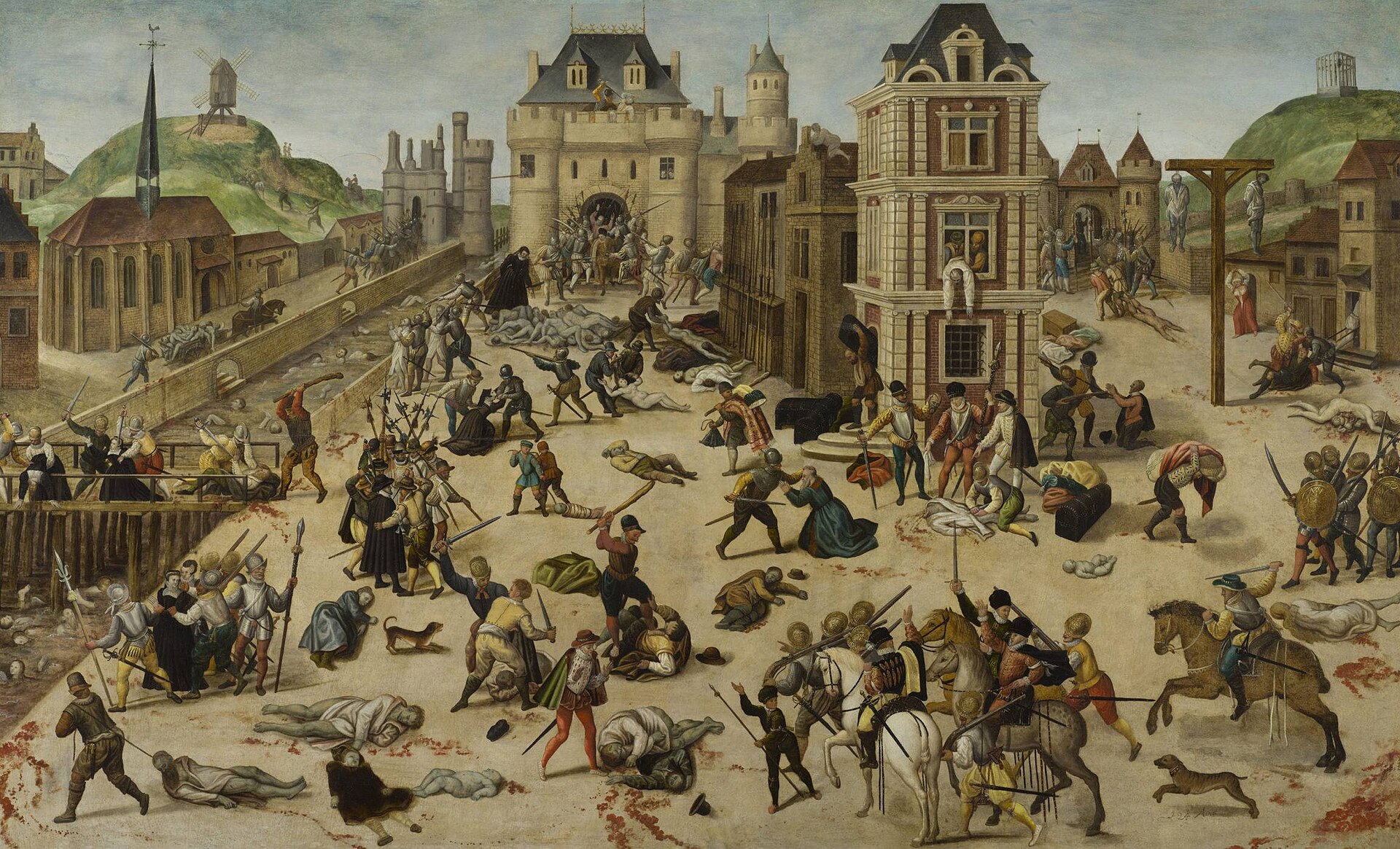

Gaspard de Coligny and the Huguenots of Paris
Died: August 24, 1572 (Coligny); the Paris killings ran from the night of August 23 to 24 to about August 29 · Place: Paris · Earliest source: the crown's own statements of late August 1572 (Charles IX took responsibility before the Parlement of Paris), Huguenot memoirs and martyrologies printed 1573 to 1581 · Record strength: Documented
Gaspard de Coligny, admiral of France, was the leading Huguenot noble at court in 1572. The peace of 1570 had brought him into the king's council, and the marriage of the king's sister, Margaret of Valois, to the Protestant Henry of Navarre was meant to bind the two religious parties together. The other dead of Paris were mostly ordinary Huguenots: craftsmen, merchants, lawyers, their wives and children, and the Protestant nobles who had come to the city for the wedding.
What the record shows
The wedding took place on August 18, 1572. On about August 22, someone fired at Coligny from a window as he walked in the street and wounded him. Shortly before dawn on August 24, the feast of Saint Bartholomew, the killing began.6 Coligny was killed in his lodging by soldiers of the Catholic Guise party, and the killing spread from the Protestant nobles at the Louvre to the Protestant households of the city. A royal order of August 25 told the city to stop, but bloodshed went on after it.6 David El Kenz, a historian of the French wars of religion, summarizes the modern count: "nearly 3,000 Protestants were slain" in Paris between the night of August 23 to 24 and August 29.7 He adds that the massacre "took place in the royal capital, at the government's initiative," and that "Charles IX took responsibility for the massacre as a whole, but immediately demanded that the mass killings be stopped."7
One piece of evidence on the scale comes from the city's own accounts. The Catholic Encyclopedia's article on the massacre, written by the French Catholic historian Georges Goyau and published in 1912, reports that 35 livres were paid for the burial of 1,100 corpses, while noting that many bodies were thrown into the Seine and never buried at all.8 The same article sets out the response in Rome without softening it. When the news arrived, Pope Gregory XIII told a consistory that "God had been pleased to be merciful," attended a Te Deum, ordered a thanksgiving procession (held on September 8), joined the massacre and the naval victory of Lepanto in one jubilee, had Giorgio Vasari paint the two events side by side in the Vatican, and struck a medal showing an avenging angel with the Latin words for the "slaughter of the Huguenots."8 The 1912 article also records that the pope refused in October 1572 to receive Maurevel, the man thought to have shot Coligny, calling him "an assassin."8 The papal court had been told, as the French court was telling the courts of Europe, that the king had forestalled a Protestant plot against his life; the celebration in Rome was for that story.
The charge, as the crown stated it in the days after the killings, was conspiracy: that Coligny and his party had planned to seize the king. The Huguenots denied any plot, and no evidence of one has been found. Henry of Navarre and the young Prince of Condé, spared because they were royal blood, were made to attend Mass and abjure within weeks.
Tradition and legend
Several details in popular retellings are traditions whose first appearance comes later than the event. The best known is that the signal for the killing was the bell of the church of Saint-Germain-l'Auxerrois, the parish church of the Louvre. This is tradition. Accounts disagree on which bell rang first, and the description that goes with Dubois's painting on Wikimedia Commons names the Grands-Augustins instead. Another story, repeated in many nineteenth century histories, has Charles IX firing on fleeing Protestants from a window of the Louvre; it rests on memoirs written long after 1572 and is best treated as legend unless an early witness is found. Huguenot writers from 1573 onward told the death of Coligny as a martyr's death, with the admiral praying as his killers broke in. These are pious narratives by his own party, written within a few years: they belong with the record of how Huguenots remembered him, not with the record of what was said in the room.
What the sources dispute
Historians still argue over who decided on the killings and when. The 1912 Catholic Encyclopedia concluded that the attempt on Coligny of August 22 was premeditated by Catherine de' Medici, the queen mother, but that the general massacre followed from a sudden decision taken under the threat of Huguenot revenge.8 El Kenz reports that "the most recent historiographical studies consider the royal family responsible for the killing," with the court acting from fear of a Protestant uprising after the attempt on Coligny and from a wish to keep the peace of 1570 by removing the Huguenot war leaders before they struck.7 The works he cites include N. M. Sutherland (1973), Janine Garrisson (1987), Robert Kingdon (1988), Barbara Diefendorf, Beneath the Cross (1991), and Denis Crouzet, La Nuit de la Saint-Barthélemy (1994). Most of these writers agree that the royal council ordered the deaths of the Protestant leaders, and that the Paris crowd, in a city where Catholic preachers had warned for years against heresy, turned that order into a general slaughter. Whether the dead of Paris died for their faith or as members of a rebel party is the hardest question here. The killers made no distinction: men, women and children were killed for being Huguenots, and Protestants who went to Mass in the weeks that followed were generally spared.
The number is disputed most of all. The chart below sets out the estimates with the person who made each one and what it counted.
The provincial massacres of 1572: Orléans, Lyon, Rouen, Bordeaux and Toulouse
Died: late August to early October 1572 · Place: about a dozen French towns, among them Meaux, Orléans, Troyes, Bourges, Lyon, Rouen, Toulouse and Bordeaux · Earliest source: town and parlement records of 1572 and Huguenot martyrologies of the 1570s and 1581 · Record strength: Documented
News of the Paris killings, and rumors that the king wanted the same done everywhere, reached the provinces within days. In town after town the Protestant minority was rounded up, often for its own "protection," and then killed in the prisons or the streets. The victims were Huguenot townspeople whose names survive, where they survive at all, in Protestant martyrologies and local registers.
What the record shows
The provincial killings ran from late August to the beginning of October.6 Historians who have worked on the town records give figures of very different sizes. At Orléans, where killing began about August 27 and lasted some four days, Robert Knecht gives about 1,000 dead in a town of about 50,000.9 At Lyon, between August 30 and September 2, the nineteenth century historian Henry Baird put the dead at 500 to 1,000.10 At Rouen, from September 17 to 21, Philip Benedict counted 300 to 400, and Mack Holt gives about 300.1112 At Bordeaux on October 3, the Parlement's own list compiled 264 dead, and at Toulouse in early October 200 to 300 were killed, both as reported by Baird.10 At Troyes, where killing began on September 4, Penny Roberts counted 43.13 Benedict's town-by-town work led him to estimate about 7,000 provincial dead, the figure El Kenz uses.7
The deaths were only part of the loss. Benedict found that Rouen's Protestant community fell from about 16,500 before the massacre to about 3,000 after it, mostly through abjuration and flight rather than death.11 In many towns the threat of death produced mass conversions. That fact matters for how the dead are judged: those who were killed were, in many places, those who had not yet recanted, or who were killed before they had a chance to choose.
Tradition and legend
Protestant and Catholic memory both kept stories of officials who refused to kill. The best known is a letter said to have been written to the king by the governor of Bayonne, declaring that his soldiers were good soldiers but not executioners. This is legend in the sense of the scale in lesson 01: it is first printed decades later, and historians doubt that the letter was written as quoted. Catholic tradition likewise honours bishops who sheltered Protestants in their palaces, such as the bishop of Lisieux; the details of those stories also come from later writers. Both kinds of story may preserve something true (some governors and bishops did protect Protestants), but the words put in their mouths are later work.
What the sources dispute
The central question is whether the court ordered the provincial killings. Royal letters of late August told governors to keep the peace and to protect the edicts, while messengers and rumor carried word that the king wanted the Huguenots dealt with. Benedict's article "The Saint Bartholomew's Day Massacres in the Provinces" (The Historical Journal, 1978) argued that local leaders, town militias and confraternities did most of the work, often after hearing that Paris had acted on the king's order.11 The total is disputed with it: modern figures of about 3,000 to 7,000 for the provinces rest on counts of named victims and burial records in towns that kept them, and on extrapolation for those that did not.
Pierre and Marie Durand, and the Huguenots after the Revocation
Died: Pierre Durand hanged April 22, 1732 (Marie Durand survived 38 years in prison and died in 1776) · Place: Montpellier (Pierre); the Tower of Constance, Aigues-Mortes (Marie) · Earliest source: the Edict of Fontainebleau (October 1685); Marie Durand's own letters from prison (1730s to 1760s); court records of the intendancy of Languedoc · Record strength: Documented
The Edict of Nantes (1598) had given French Protestants legal worship in named places. From 1661 Louis XIV narrowed it step by step. In 1681 soldiers began to be billeted on Protestant households in Poitou to force conversions, a method called the dragonnades, and in May 1685 the dragonnades spread to Béarn, Languedoc, Dauphiné and the west.14 In October 1685 the king signed the Edict of Fontainebleau, revoking Nantes. Pierre Durand, born in the Vivarais on September 12, 1700, was one of the preachers of the "Church of the Desert" who held forbidden services in the hills in the next generation. His sister Marie was imprisoned in his place.15
What the record shows
The edict's preamble gives the crown's own reason: the Edict of Nantes was no longer needed "inasmuch as the better and the greater part of our subjects of the said R.P.R. have embraced the Catholic faith" (R.P.R. stands for "religion prétendue réformée," the so-called reformed religion, the crown's legal name for Protestantism).1 The articles followed from that claim. Article I ordered that all Protestant temples "shall be demolished without delay." Article II forbade Protestants "to meet any more for the exercise of the said religion." Article IV ordered ministers who would not convert to leave the kingdom "within a fortnight." Article VIII ordered children baptized "by the parish priests." Article X repeated the "most express prohibition" on leaving the kingdom, with the galleys for men and prison and confiscation for women. Article XII allowed Protestants to remain "pending the time when it shall please God to enlighten them," on condition of not practicing their religion.1 The Musée protestant, the online museum of French Protestant history, states that the edict forced "several hundreds of thousands" to convert.14
Those who would not obey met the penalties the edict named. The Musée protestant counts roughly 550 Protestant men sent to the galleys for refusing to renounce their faith, some for as long as thirty years; men caught trying to flee were also sent to the galleys, while women and children too young to row were imprisoned.16 Under Louis XV, a declaration of May 14, 1724, made preaching at Protestant assemblies a capital crime and set the galleys for life for those who helped. The historian James Breck Perkins, writing in 1897, reported that the Protestant leader Antoine Court counted eight ministers executed in that period, and that almost 2,000 men and women were imprisoned or sent to the galleys for religious offences in the forty years after 1724.17
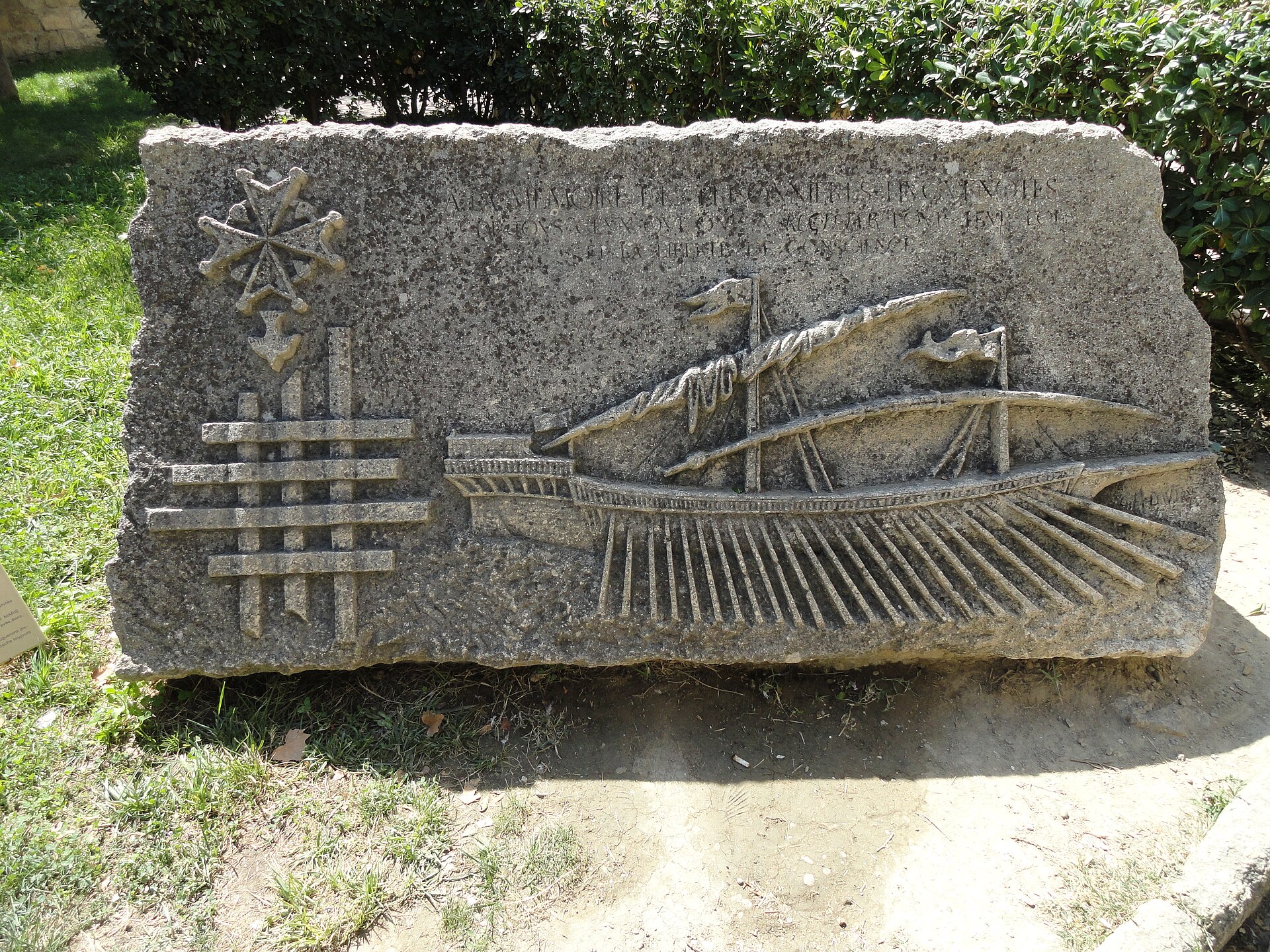
Pierre Durand was arrested on February 12, 1732, at a ford near the château of Vaussèche after a denunciation, judged at Montpellier, and hanged on April 22, 1732.15 Two years earlier, when the authorities could not catch him, they had arrested his father and his sister Marie, then fifteen by the birth year of 1715 given in local histories, or about eighteen by the Musée protestant, which dates her birth to 1711 or 1712.38 Marie Durand entered the Tower of Constance at Aigues-Mortes on August 15, 1730.15 After 1707 the tower held Protestant women sentenced to prison for life for their worship; the number of inmates ranged from 17 to 34. Marie Durand was held for 38 years, until the last women were released through the efforts of the Prince of Beauvau, governor of Languedoc, in 1767 and 1768.18 She would have been freed at any time by abjuring. She did not, and her letters from the tower, kept by Protestant families, are among the main sources for the prisoners' life there.17 French Protestants received legal toleration from the Edict of Versailles in 1787, more than a century after the revocation.17

Tradition and legend
One word carries Marie Durand's memory: "register," cut into the stone curb of the well in the Tower of Constance and read as "resist." Tradition says she carved it. This is tradition: the inscription is real and can be seen, but no prison record or letter of hers says who cut it or when, and the local history pages that tell the story say only that it is "attributed" to her.15 The language of the word is also described differently, as Latin by some writers and as the Occitan speech of the region by others. The fact that is documented is larger than the tradition: she refused, for 38 years, the one-word recantation that would have set her free.
What the sources dispute
The numbers are the main point of dispute. Counts of Protestant galley slaves differ according to the dates covered and whether the count includes men sent for trying to emigrate or only those sentenced for worship; the Musée protestant's figure of about 550 covers those who refused to renounce their faith.16 Estimates of the Protestants who fled France after 1685 (the "Refuge," to the Netherlands, Prussia, Switzerland, England and the English colonies) commonly run into the low hundreds of thousands, but they are estimates drawn from refugee records and church registers in the receiving countries, and the Musée protestant gives no single figure.14 The crown's case is also part of the record and should be stated in its own terms: Louis XIV and his ministers believed that a kingdom with one faith was stronger and more pleasing to God, that the conversions had made Nantes unnecessary, and that Protestant assemblies were seditious. The armed rising of the Camisards in the Cévennes, which began in 1702, confirmed that fear in the crown's eyes, and the Camisards killed priests and burned churches as well as suffering executions. Huguenots who died for preaching or worship are documented martyrs in their own church's memory; those who died in arms are remembered by both sides as combatants.
Richard Cameron and Donald Cargill
Died: Cameron killed July 22, 1680; Cargill hanged July 27, 1681 · Place: Airds Moss, Ayrshire (Cameron); the Cross of Edinburgh (Cargill) · Earliest source: government proclamations and court records of 1680 and 1681; the sufferers' own testimonies, collected by their followers from 1686 and printed in A Cloud of Witnesses (1714) · Record strength: Documented
Richard Cameron and Donald Cargill were field preachers who would not accept the restored bishops or the "indulgences" by which the government licensed some Presbyterian ministers under conditions. Their followers, later called Cameronians and then the Society People, were the smallest and most uncompromising wing of the Covenanters. They are the clearest test case in this lesson of the line between martyr and rebel, because they openly renounced the king.
What the record shows
On June 22, 1680, about twenty men rode into the burgh of Sanquhar, read a declaration at the market cross and left a copy fixed to it. The editor of the 1871 edition of A Cloud of Witnesses, John Thomson, calls it "the first public statement in which allegiance to Charles II. was renounced, because of the supremacy he claimed over the Church."19 The government answered with a proclamation calling it "a most treasonable and unparallelled paper" and set rewards: 5,000 merks for Richard Cameron, 3,000 for Cargill and others.19 On July 22, 1680, government dragoons caught Cameron's small armed party at Airds Moss in Ayrshire, and Cameron was killed in the fight.19 Cameron died in arms. His followers counted him a martyr; the government counted him a rebel killed in the field, and both descriptions fit the facts.
Cargill, a minister who had been wounded and captured at Bothwell Bridge on June 22, 1679, and released by his captors, went on preaching. In September 1680, before a large gathering at the Torwood near Stirling, he pronounced a sentence of excommunication on Charles II, the Duke of York and several of the king's ministers.19 He was captured in 1681, tried on July 26 together with James Boig, Walter Smith, William Cuthill and one other man, and hanged at the Cross of Edinburgh on July 27, 1681.19 One of the men condemned with him, asked if he would say "God save the king" to save his life, answered, as the Cloud of Witnesses reports, that "he will not beg his life at so dear a rate as to commit any sin."19
The questions put to Covenanter prisoners show what the government was trying to establish. One question was always about the murder of James Sharp, Archbishop of St Andrews, who was dragged from his coach and killed by a band of Covenanters at Magus Muir in May 1679. The Cloud of Witnesses itself records that the council asked, "Was the Bishop's death murder?" and that "some answered directly that it was a just and lawful execution of God's law upon him," while others refused to answer.20 The government took such answers as proof of "assassinating and bloody principles"; the prisoners held that they were being tried for their consciences. Both claims stand in the record, in each side's own words.
Tradition and legend
Cameron is remembered in Covenanter tradition as the "Lion of the Covenant," and the Cameronian regiment of the British army, raised in 1689 from his followers, carried his name. Prophecies credited to Cargill and Cameron (that particular persecutors would die in particular ways) were collected by Patrick Walker in the 1720s, more than forty years after the deaths. This is tradition, written down long after by a partisan collector. Patrick Walker was a Society man himself, and his lives are treated by historians as evidence of how the Society People remembered their leaders, valuable for that and to be used with care for the words they report.
What the sources dispute
The dispute is over category. Historians of every view agree on the dates, the declarations and the deaths. The Society People said they suffered for the "crown rights of Christ" over his church; the government said it was punishing men who had disowned the king and approved the killing of an archbishop. A historian can say that both statements are accurate and that each side described the same events in its own terms. The Covenanters' own Apologetic Declaration of October 28, 1684, written by James Renwick, shows why the government feared them: it disowned "that hellish principle of killing all who differ in judgment or persuasion from us," but warned that informers and soldiers who shed their blood would be "punished as such according to our power."21 After that declaration, the government began to require an oath abjuring it, and refusing the oath could be punished with death on the spot.
Margaret Wilson and Margaret McLachlan, the Wigtown martyrs
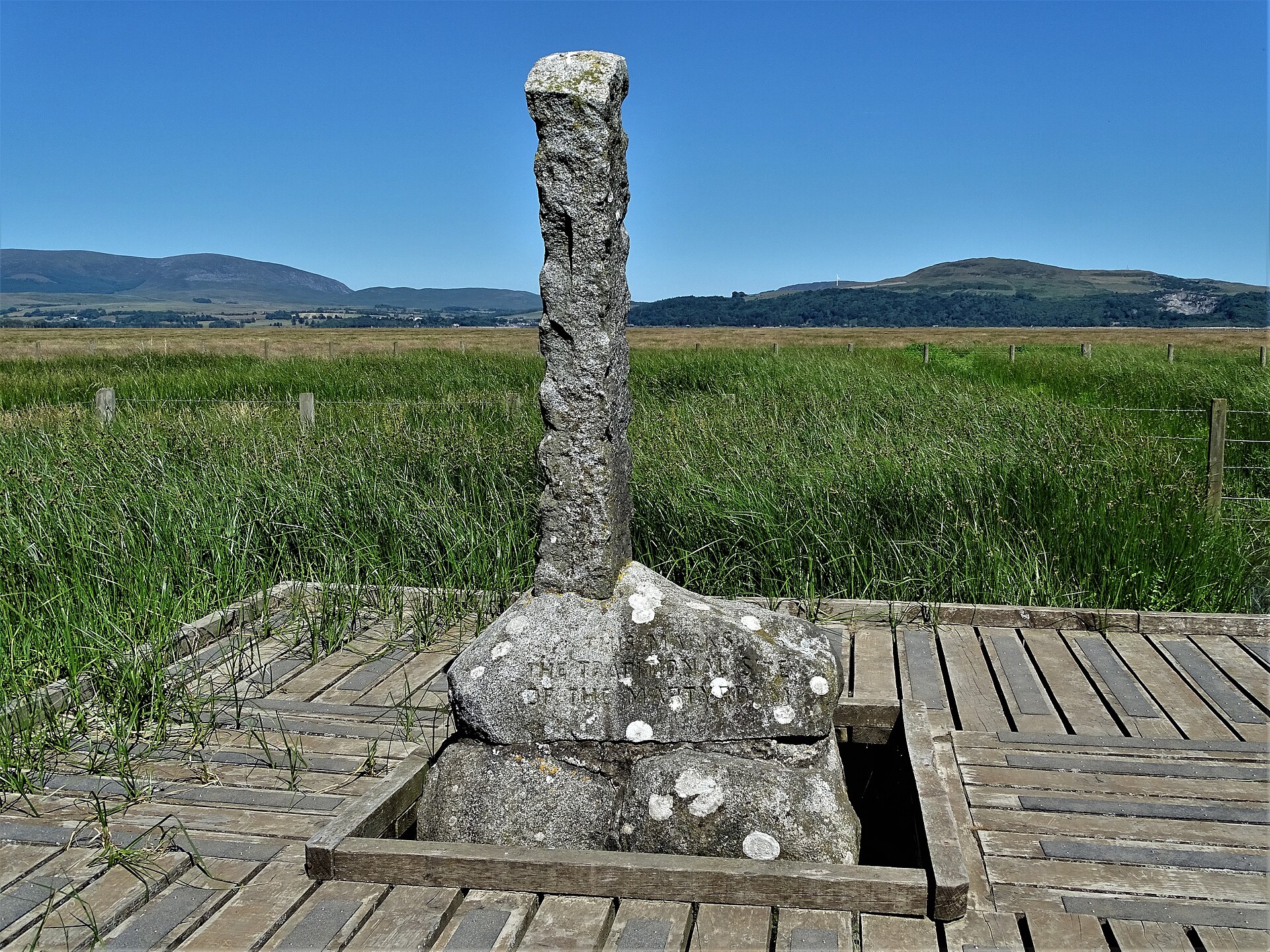
Died: May 11, 1685 · Place: the tidal channel of the River Bladnoch below Wigtown, Galloway · Earliest source: a pamphlet of 1703 by Matthias Symson, son of the Episcopalian minister of Kirkinner, accepting that the drowning took place; the kirk session minutes of Penninghame (February 19, 1711) and Kirkinner (April 15, 1711); A Cloud of Witnesses (1714) · Record strength: Documented (the drowning was challenged in the 1860s; see below)
Margaret McLachlan (spelled Lachlison, Lauchlane and Maclauchlan in the sources) was a widow of Kirkinner parish. Margaret Wilson was the eighteen year old daughter of Gilbert Wilson, a farmer of Glenvernock in Penninghame parish, who conformed to the established church; his children did not. The two women were tied to stakes within the flood mark of the Bladnoch and left for the tide.
What the record shows
The fullest early account is the minute of the kirk session of Penninghame, written on February 19, 1711, when the Synod of Galloway had asked parishes to record the sufferings of the late persecution. It says that in February 1685 Margaret Wilson, eighteen, and her sister Agnes, thirteen, went secretly to Wigtown, were discovered and imprisoned, and were held with Margaret McLachlan, "a woman of sixty-three years of age." David Graham the sheriff, the Laird of Lagg (Sir Robert Grierson), Major Winram and Captain Strachan "called an assize" and charged the three women with being at the rebellion of Bothwell Bridge, at Airds Moss, at twenty field conventicles and twenty house conventicles. The minute objects that "none of these women ever were within twenty miles of Bothwell or Airsmoss," and that Agnes had been eight at the time of Airds Moss. The assize found them guilty, and the judges sentenced them "to be tied to palisades fixed in the sand, within the flood mark, and there to stand till the flood overflowed them and drowned them."22 Their father obtained Agnes's release on a bond of a hundred pounds sterling. Margaret Wilson was pressed in prison to take the oath of abjuration and to hear the curates (the ministers of the established church), and refused.22
The minute continues: "Upon the eleventh day of May 1685, these two women, Margaret Maclauchlan and Margaret Wilson, were brought forth to execution. They did put the old woman first into the water." It reports that Margaret Wilson, asked what she thought of the older woman, answered: "What do I see but Christ wrestling there? Think ye that we are sufferers? No, it is Christ in us." It says that she sang from Psalm 25, read Romans 8 and prayed; that she was pulled up before she died and asked to pray for the king; that she "wished the salvation of all men, but the damnation of none"; and that, when Major Winram offered the oath of abjuration a last time, she refused, "saying, 'I will not; I am one of Christ's children; let me go.'"22 The Kirkinner minute of April 15, 1711, adds that Margaret McLachlan was sentenced by Grierson of Lagg "for conventicle keeping and alleged rebellion" and was held under the water until she died.22
The earliest witness is not a Covenanter. In 1703 a pamphlet written by Matthias Symson, son of Andrew Symson, the Episcopalian minister of Kirkinner at the time, corrected a Presbyterian writer's account of the drowning in its details while accepting the fact, and stated: "They were judicially condemned after the usual solemnities of procedure," naming David Graham among the judges and adding that the foreman of the jury and the clerk of the court were "yet alive."22

Tradition and legend
The words given to Margaret Wilson are tradition in a precise sense: they are first written down in 1711, twenty-six years after the event, by a kirk session collecting testimony from neighbours and family, among them her brother Thomas, who "lives to certify the truth of these things."22 That is good evidence for a remembered scene and weaker evidence for exact wording. A Cloud of Witnesses (1714) tells the story with different details: it makes Margaret Wilson "scarce twenty-three years of age" and her sister fifteen, and says the women were made to "wrestle long with the waves" before they died.23 The Kirkinner minute makes Margaret McLachlan "aged about eighty," while Penninghame says sixty-three.22 Later Victorian ballads and paintings, such as John Everett Millais's drawing of Margaret Wilson for the magazine Once a Week, added the tearful crowd and the rising sea of popular memory.23
What the sources dispute
In the 1850s and 1860s Sheriff Mark Napier, a historian, defending John Graham of Claverhouse against Lord Macaulay's History of England, argued that the Wigtown drowning never happened. His evidence was a reprieve granted by the Privy Council in Edinburgh after a petition in Margaret McLachlan's name, dated in the council records to the end of April 1685, and the absence of any official record of the execution. He published The Case for the Crown in re the Wigtown Martyrs Proved to Be Myths (1863) and, after a reply, History Rescued (1870).3 Archibald Stewart, minister of Glasserton, answered in History Vindicated in the Case of the Wigtown Martyrs (second edition 1869), setting out the 1703 pamphlet, the 1711 session minutes, the council's instructions to its commissioners that women who would not disown the Apologetic Declaration were "to be drowned," and the gravestones.22 The Victorian historian John Hill Burton, an Episcopalian, judged that Napier's reply revealed no new discovery.22 In 2010, A. E. MacRobert reviewed the whole controversy for the Dumfriesshire and Galloway Natural History and Antiquarian Society and concluded that the women were drowned, while noting that "there remain several mysteries including what happened to a reprieve from the Privy Council."24 The present weight of the evidence is that the drowning took place and the reprieve did not reach Wigtown in time or was not obeyed; exactly which is unknown.
A second dispute is about the law. The capital act against hearers at field conventicles was passed on May 8, 1685, three days before the drowning and weeks after the women were sentenced.2 The women were tried as rebels under the older treason laws and the council's commissions, and the charges of being at Bothwell Bridge and Airds Moss were, on the Penninghame minute's own evidence, impossible. Their refusal of the abjuration oath is what the sources agree turned a sentence into a death.
James Renwick
Died: February 17, 1688 · Place: the Grassmarket, Edinburgh · Earliest source: his own "Last Speech and Testimony," written the day before his death, and his letters, printed by his followers; the indictment and trial record of the High Court of Justiciary, February 1688 · Record strength: Documented
James Renwick was a young minister of the Society People. He had watched the execution of Donald Cargill in 1681 and, as his biographer in A Cloud of Witnesses reports, was so moved by it that "he determined to adopt the martyrs' testimony, and to cast in his lot with the persecuted."25 The Societies sent him to the Netherlands at the end of 1682 to complete his studies and be ordained, and after his return he became their field preacher.
What the record shows
Renwick wrote the Apologetic Declaration of October 1684. In December 1686 a reward of a hundred pounds sterling was offered for him "dead or alive."25 In 1687 King James VII issued proclamations allowing Presbyterians to worship in private houses while field meetings stayed forbidden; many Presbyterian ministers accepted the toleration, and Renwick wrote a reply refusing it, since it came from the king's claimed power to dispense with the law and was meant, in his followers' view, to open the way for Catholic worship.25 He preached for the last time at Borrowstounness on January 29, 1688, returned to Edinburgh on January 31, and was taken the next morning at a house on the Castle Hill after an excise officer heard family prayer and recognized his voice. He fired a pistol to clear the door, was struck down as he ran, and was caught in the street.25 He received his indictment on February 3, was tried on February 8 and sentenced to die; without his knowledge the execution was put off a week, and his captors tried to bring him to petition for a reprieve.25
In his last testimony Renwick set out the charges in his own words. His sentence of death, he wrote, was drawn "upon these three heads": "Because I could not own James VII. to be my lawful sovereign"; "Because I taught the unlawfulness of paying the cess, expressly exacted for suppressing the faithful and free preaching of the Gospel"; and "Because I taught it was people's duty to carry arms at the preaching of the Gospel, now that it is persecuted, for defending of themselves, and resisting unjust violence."26 On the morning of his death he wrote to his friend Sir Robert Hamilton: "Death to me is as a bed to the weary."25 He was hanged in the Grassmarket on February 17, 1688, and buried in Greyfriars kirkyard.25
Tradition and legend
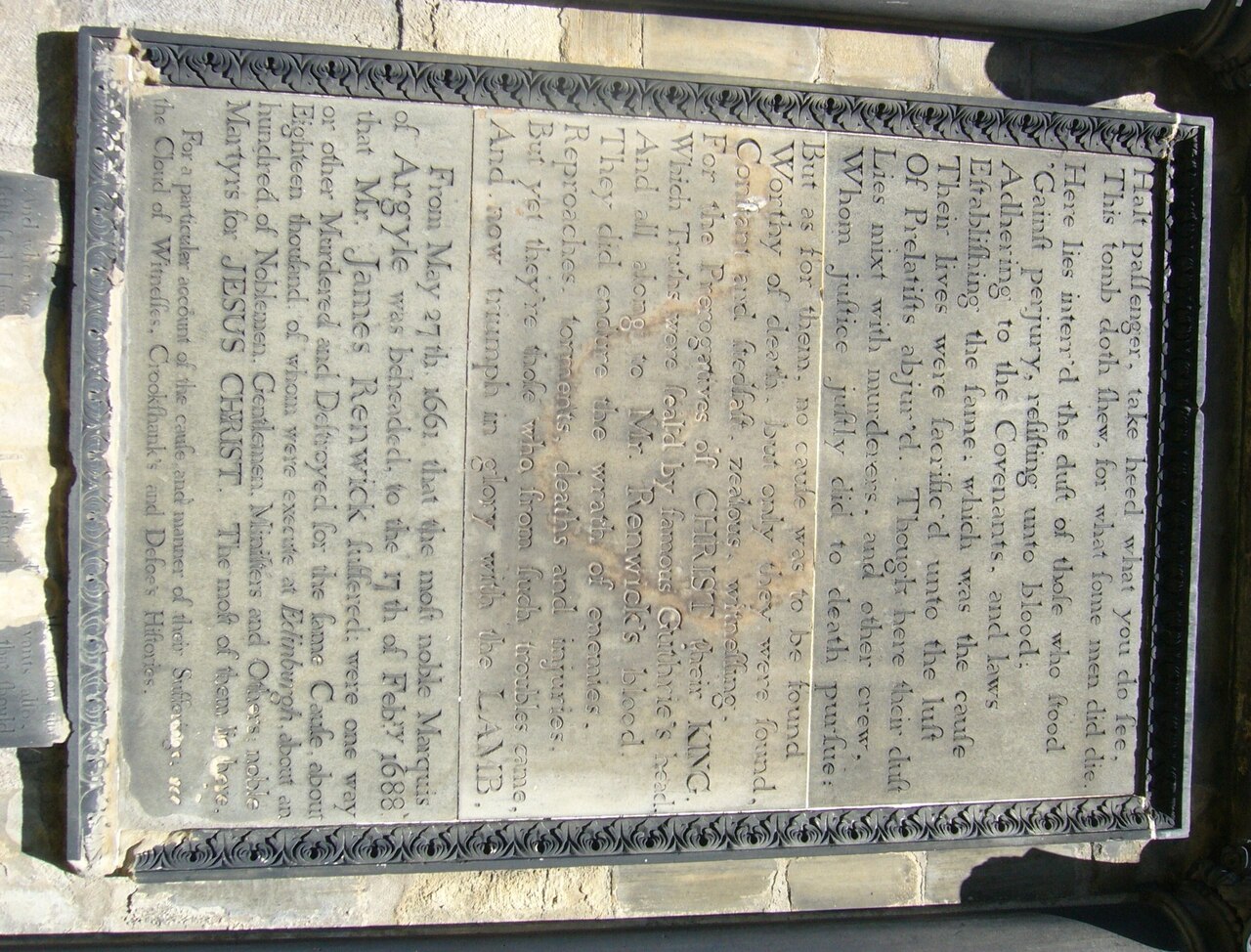
Renwick is remembered as "the last of the Scottish martyrs," and the Martyrs' Monument in Greyfriars kirkyard ends its span with him. The monument's verse begins "Halt, passenger, take heed what you do see," and it dates the persecution from the beheading of the Marquis of Argyll on May 27, 1661, to Renwick's death on February 17, 1688, stating that about eighteen thousand were in that time "one way or other" killed or destroyed for the same cause.27 The monument replaced an earlier stone of 1706 with a similar inscription, and a replica plaque was set up in 2005.27 The figure of eighteen thousand is a memorial figure. It counts everyone who suffered "one way or other": the banished, the imprisoned, those sold to the plantations, those killed in battle and those executed. It is not a count of deaths (see Claims checked below). The title "last martyr" is a claim of tradition: Renwick is usually described as the last Covenanter executed in public for the cause, a description that depends on how narrowly the cause is defined.

What the sources dispute
No one disputes the trial or the death. The disagreement is over what Renwick was. To the government of James VII, a man who refused to own the king, taught people not to pay a lawful tax and told congregations to come armed was guilty of treason whatever his theology. To the Society People and the long Covenanter tradition, he died for Christ's sole headship of the church, and his refusal to own James was a refusal to grant a Catholic king supremacy over a Reformed church. Renwick's own words support both readings: he died for refusing to own the king, and he refused because of what he believed about the church. Within months of his death, the Revolution of 1688 to 1689 removed James VII, and in 1690 the Church of Scotland was re-established as Presbyterian. Even then the Society People would not join it, because the new settlement did not renew the Covenants; their heirs formed the Reformed Presbyterian Church.
William Robinson, Marmaduke Stephenson and William Leddra, the Boston Quakers
Died: October 27, 1659 (Robinson and Stephenson); March 14, 1661 (Leddra) · Place: Boston Common, Massachusetts Bay Colony · Earliest source: the records of the General Court of Massachusetts; Edward Burrough, A Declaration of the Sad and Great Persecution and Martyrdom of the People of God, called Quakers, in New-England (London, 1661); George Bishop, New England Judged (London, 1661) · Record strength: Documented
William Robinson, a London merchant, and Marmaduke Stephenson (also spelled Stevenson), a Yorkshire farmer, were Quaker missionaries who came to New England knowing the law against them. William Leddra was a Quaker from Barbados. With Mary Dyer they are the four Quakers hanged at Boston, called by Friends the Boston martyrs.
What the record shows
Massachusetts first answered the Quakers with whipping, imprisonment and banishment. In the autumn of 1657 the General Court passed a harsher law allowing ear cropping. On October 19, 1658, by a vote of 12 to 11, it ordered banishment "upon pain of death" for Quakers.4 Robinson and Stephenson were banished under that law and returned. On October 20, 1659, Governor John Endecott sentenced Robinson, Stephenson and Mary Dyer to death. On October 27, 1659, Robinson and Stephenson were hanged on Boston Common; Dyer, already on the ladder, was reprieved.4
Leddra had been arrested in Massachusetts in April 1659 and released, and in the autumn of 1660 he was imprisoned again in Boston and kept through the winter chained in an open cell. On January 9, 1661, he was brought before Endecott and the Court of Assistants and told that he had incurred the penalty of death. The Dictionary of National Biography (1892), drawing on Bishop and the Quaker historians William Sewel and Joseph Besse, reports his question to the court: "Will you then hang me for speaking English, and for not putting off my clothes?"28 He meant that the offences he could see in the charge were Quaker ways of speech (the plain "thee" and "thou") and of dress (refusing to remove his hat before magistrates). He was hanged on Boston Common in March 1661; the date usually given is March 14, 1661, though the 1892 DNB text reads "14 Jan."28
On September 9, 1661, Charles II ordered the Massachusetts General Court to stop proceeding against Quakers under its capital law and to send any charged persons to England. In November 1661 Endecott declared that the king's command would be obeyed, and no more Quakers were hanged.4 Whipping, banishment and imprisonment went on for some years after.
Tradition and legend
The Quaker accounts of the executions were written by Friends in London from letters sent by Friends in New England, and printed within two years as part of a campaign to stop the persecution. Burrough's Declaration and Bishop's New England Judged are partisan documents, written to move the king, and the speeches they give the martyrs are reported speech, not court records. A story told later in Quaker circles has Edward Burrough himself carrying the news of the executions to Charles II and obtaining the king's letter. This is tradition, first set down by Quaker historians after the event; the king's letter itself is documented, but the scene at court is not recorded by a witness outside the Quaker account.
What the sources dispute
The colony's defenders, from the magistrates of 1659 to some later New England historians, argued that the Quakers were not hanged for their beliefs but for defying a sentence of banishment: they had been warned, sent away and told that return meant death, and they came back to bear witness against the colony. The Quakers answered that the law against them was a law against their religion, and that obeying God rather than men required them to return. The two arguments are both accurate descriptions of the same law: it made the act of returning a capital crime, and it applied only to Quakers. The vote of 12 to 11 on the death law shows that the colony's own magistrates and deputies were divided.4
Mary Dyer
Died: June 1, 1660 · Place: Boston Common · Earliest source: the records of the General Court of Massachusetts (May 31, 1660); her letters to the court of 1659; Edward Burrough, A Declaration of the Sad and Great Persecution (1661) · Record strength: Documented
Mary Dyer was born in England about 1610 or 1611, came to Boston with her husband William in the 1630s, and was a follower of Anne Hutchinson, the lay teacher banished from Massachusetts in 1638. In October 1637 Hutchinson attended her when she was delivered of a stillborn, badly deformed child; the colony's leaders later used the birth as a sign of God's judgment on her opinions.4 In England in the 1650s she became a Quaker, and she returned to New England as one. The church history of the Quakers and Dyer's place in it are told in module 80, lesson 09; this brief covers the evidence for her death.
What the record shows
Dyer was jailed in Boston early in 1657, banished, and arrested again on her return. Sentenced to death with Robinson and Stephenson on October 20, 1659, she was led to the gallows with them on October 27, and after they were hanged she was reprieved on the ladder, on the petition of her son. Professor Douglas Linder's chronology of her case records that Endecott insisted she be taken to the gallows first.4 She was sent out of the colony, spent the winter on Shelter Island and in Rhode Island, and in the spring of 1660 went back to Boston deliberately. On May 27, 1660, her husband wrote from Portsmouth begging for her life. On May 31 she appeared before the General Court, and Endecott told her she would be hanged at nine the next morning.4
Edward Burrough's account of June 1, 1660, printed in London in 1661, reports that she was offered her life if she would return home, and answered: "Nay, I cannot, for in obedience to the Will of the Lord God I came; and in his Will I abide faithful to the Death." When the minister John Wilson urged her to repent, she replied: "Nay, man, I am not now to Repent." Asked whether an elder should pray for her, she said: "Nay, first a Child, then a young man, then a strong man, before an Elder of Christ Jesus." Her last words, as Linder gives them from the Quaker sources, were: "Yea, I have been in Paradise several days and now I am about to enter eternal happiness."294 She was then hanged.
A letter in her name to the General Court, dated October 26, 1659, says: "Whereas I am by many charged with the Guiltiness of my own Blood," and answers, "I am therein clear, and justified by the Lord, in whose Will I came."30 It ends with a warning to the magistrates: "God will not be mocked, but what you sow, that shall you reap from him."30

Tradition and legend
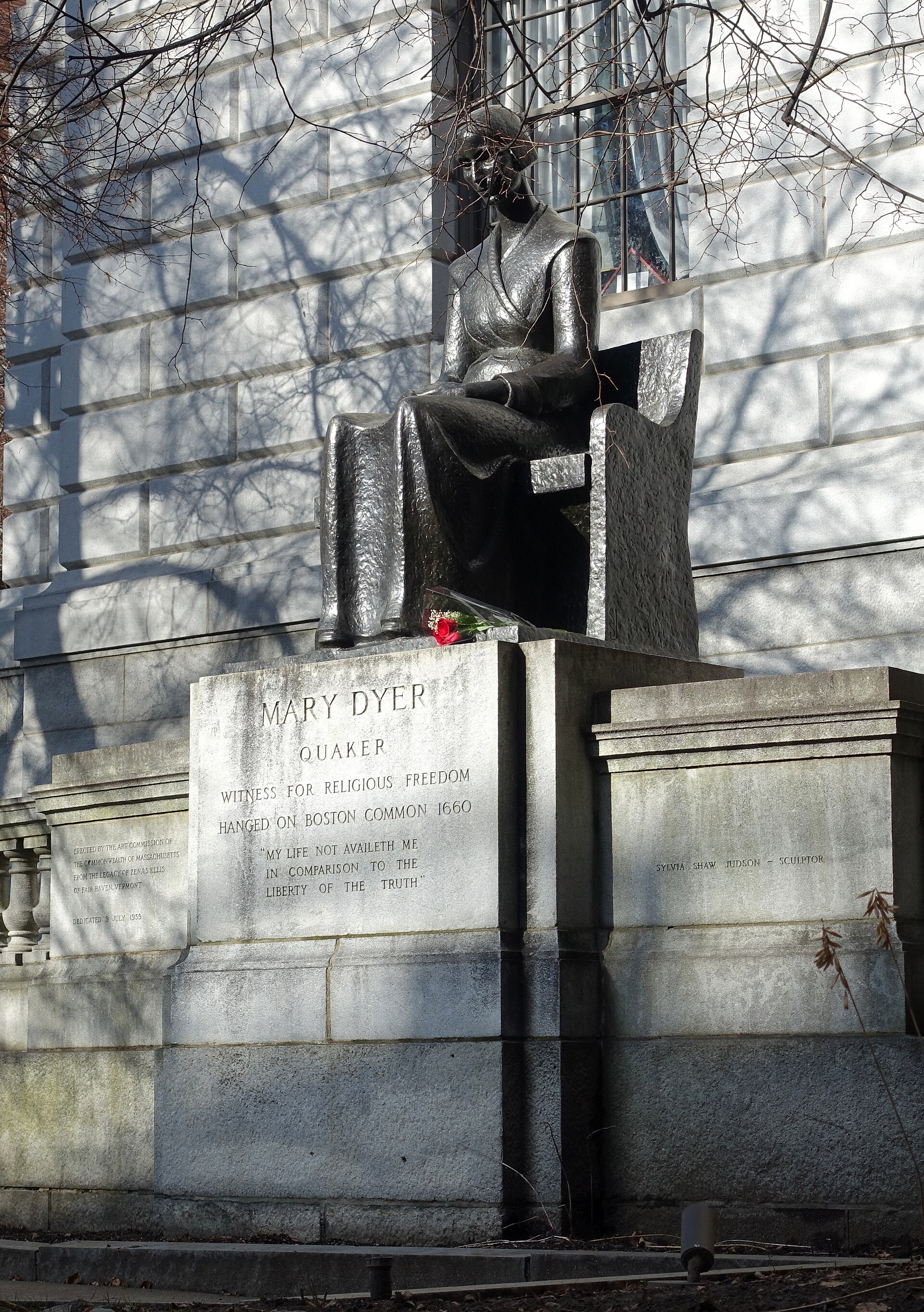
The scene at the gallows comes from Quaker sources written to win sympathy, and the words in them are as reported by Friends, not by a court clerk. That does not make them invented: the dialogue with Captain John Webb, who told her she was guilty of her own blood, and with John Wilson, Boston's senior minister, fits what is known of both men, and the hostile colony never published a different account. A remark attributed to a member of the court after the hanging, that she "did hang as a flag for others to take example by," circulates widely and is often quoted as if from the court record; no early source for it was located for this lesson, and it should be treated as unverified. The Commonwealth of Massachusetts set up her statue at the State House in 1959, three centuries after the colony hanged her there.
What the sources dispute
The letter of October 26, 1659, is the main documentary dispute. It was printed by Burrough as Dyer's own. Its style and spelling differ from a fragment in Dyer's apparent handwriting held in the Massachusetts Archives, which spells her name "Marie Dire." The novelist and researcher Christy Robinson has suggested that Burrough rewrote Dyer's letter and printed it under her name to give it more weight; Linder presents this as a likely explanation, not a settled fact.30 The second dispute is the old one already set out above: whether Dyer died for her faith or for defying banishment. By Burrough's report she told Captain Webb on the scaffold that she had come to keep blood-guiltiness from the magistrates, that is, to move them to give up the law before it cost more lives. She chose to return knowing the penalty, and her death was the result of that choice and of a law that made the choice a capital act.
Salem, 1692: Rebecca Nurse, George Burroughs and Mary Easty
Died: nineteen hanged June 10 to September 22, 1692; Giles Corey pressed to death September 19, 1692; others died in jail · Place: Salem, Massachusetts Bay Colony · Earliest source: the examinations, depositions and petitions of 1692 (the court papers); Robert Calef, More Wonders of the Invisible World (London, 1700) · Record strength: Documented (for the deaths; calling them martyrs is a later judgment, set out below)
This brief is different from the others in this lesson and should be read differently. The people put to death at Salem were not executed for their Christian faith. They were tried for witchcraft, a felony punishable by death under the law of the colony and of England, before a special Court of Oyer and Terminer that Governor William Phips created on May 27, 1692.31 The court, the ministers who advised it and the accusers all believed they were defending the church against the Devil. The accused, almost all of whom professed the same Puritan faith, denied that they were witches. What links Salem to this lesson is narrower and precise: many of those hanged were church members, and the record shows that they could have saved their lives by confessing to witchcraft, and refused because, in their own words, they would not lie.
What the record shows
Between June 10 and September 22, 1692, nineteen people were hanged at Salem: Bridget Bishop on June 10; Rebecca Nurse, Sarah Good, Susannah Martin, Elizabeth Howe and Sarah Wildes on July 19; George Burroughs, Martha Carrier, John Willard, George Jacobs Sr. and John Proctor on August 19; and Martha Corey, Mary Easty, Ann Pudeator, Alice Parker, Mary Parker, Wilmot Redd, Margaret Scott and Samuel Wardwell on September 22. Giles Corey, who refused to plead, was pressed to death under heavy stones from September 19; at least four others, among them Sarah Osborne, Roger Toothaker and Lydia Dustin, died in prison, and the total of prison deaths is uncertain.32 Robert Calef, a Boston merchant who opposed the trials and collected their documents, gives September 16 for the pressing of Giles Corey; the date of September 19 in modern chronologies comes from other records.3331
Calef records that early in the accusations the afflicted girls named "Goodwife Cory, and Goodwife Nurse, Members of Churches at the Village, and at Salem."5 Rebecca Nurse, about seventy-one, was a member of the church in Salem town. At her trial the jury first brought in a verdict of not guilty. Calef reports that the accusers then "made an hideous out-cry," that one of the judges said she should be indicted anew, and that the chief judge pointed the jury to a remark of hers about two confessed witnesses, "she is one of us," or words to that effect. The jury went out again and returned a verdict of guilty. The foreman, Thomas Fisk, wrote on July 4, 1692, that her silence when asked to explain the words became "a principal Evidence against her." Nurse answered in writing that she had meant only that the two women were prisoners with her, and that "being something hard of hearing, and full of grief," no one had told her how the court took her words.34 After her condemnation, Calef records, "she was by one of the Ministers of Salem excommunicated"; the governor granted a reprieve, withdrew it under pressure from "some Salem Gentleman," and she was hanged on July 19.34
George Burroughs, a Harvard-trained former minister of Salem Village and of Wells in Maine, was hanged on August 19. Calef's account of his death is the most quoted passage of the Salem record: "when he was upon the Ladder, he made a Speech for the clearing of his Innocency, with such Solemn and Serious Expressions, as were to the Admiration of all present; his Prayer (which he concluded by repeating the Lord's Prayer,) was so well worded, and uttered with such composedness, and such (at least seeming) fervency of Spirit, as was very affecting, and drew Tears from many."35 The Lord's Prayer mattered because popular belief held that a witch could not say it without stumbling, and saying it was one of the tests Calef condemned as superstition. The accusers said "the black Man stood and dictated to him," and Cotton Mather, on horseback, told the crowd that Burroughs was not an ordained minister and that "the Devil has often been transformed into an Angel of Light"; the execution went on.35
Mary Easty, Rebecca Nurse's sister, wrote a petition to the judges and ministers before her death on September 22. "I Petition to your Honours not for my own Life, for I know I must die, and my appointed time is set," she wrote, "but the Lord he knows it is, if it be possible, that no more Innocent Blood be shed." Of the confession the court wanted, she said: "They say, myself and others have made a league with the Devil, we cannot confess ... I know not the least thing of Witchcraft, therefore I cannot, I durst not belye my own Soul."33 Martha Corey, Calef writes, "protesting her Innocency, concluded her Life with an Eminent Prayer upon the Ladder."33 John Proctor asked the minister Nicholas Noyes to pray with him, "but it was wholly denied, because he would not own himself to be a Witch."35 Margaret Jacobs, who had confessed and accused her own grandfather and Burroughs, took her confession back and wrote to her father from prison that she had "confessed several things contrary to my Conscience and Knowledge"; Calef reports that Burroughs forgave her and prayed with her the day before he died.35 The pattern in these documents is consistent: those who confessed were spared to testify, and those who were hanged were those who would not confess. Dorcas Hoar, condemned in September, escaped execution by confessing.31
On October 29, 1692, Phips dissolved the Court of Oyer and Terminer. On January 14, 1697, the General Court held a day of fasting for the tragedy, and Samuel Sewall, one of the judges, publicly confessed his guilt. In 1706 Ann Putnam Jr., one of the chief accusers, made a public apology in the Salem Village church. In 1711 the colony reversed the attainders of many of the condemned and granted their heirs 600 pounds in restitution; in 1957 the Commonwealth of Massachusetts formally apologized.31

Tradition and legend: who calls them martyrs
The word martyr was attached to the Salem dead by later writers, not by the courts or the churches of 1692. Calef, writing in 1700, gave the testimonials to Rebecca Nurse's "Christian behaviour, both in the course of her Life, and at her Death," but did not call her a martyr.34 The clearest example of the later usage is the monument her descendants dedicated on July 13, 1885, which carries lines by the poet John Greenleaf Whittier: "O Christian Martyr who for Truth could die / When all about thee owned the hideous lie!"3637 Whittier, a Quaker, used the word in its old sense of one who dies rather than deny the truth: here, the truth about herself. That is a defensible use of the word, and it is a judgment made in 1885 by a poet and a family. No church has formally numbered the Salem dead among its martyrs, and they do not appear in the Catholic or Protestant martyrologies discussed in lesson 01.
Several popular stories about Salem are legend. No one was burned at Salem; the condemned were hanged, and Giles Corey was pressed. The words "More weight," said to be Giles Corey's last, are first found in later retellings and are not in Calef's account, which reports only that "in pressing his Tongue being prest out of his Mouth, the Sheriff with his Cane forced it in again."33 Arthur Miller's 1953 play about the trials changes ages, relationships and events for drama and is not a source for what happened.
What the sources dispute
Historians dispute the causes of the Salem outbreak (village quarrels, war on the Maine frontier, the theology of spectral evidence, the role of the minister Samuel Parris), and those debates belong to colonial history rather than to a lesson on martyrs. For the question asked here, the disagreement is about category. One reading holds that the Salem dead were victims of a judicial error and a panic, not martyrs, because no one asked them to deny Christ: the court wanted them to confess to serving the Devil, and their persecutors shared their faith. Another reading, Whittier's, holds that dying rather than "belye my own Soul," in Mary Easty's words, is a form of witness to truth, and that church members who prayed on the ladder and forgave their accusers died as Christians even though they did not die for a doctrine. A third observation belongs to the record itself: the court refused prayer to John Proctor because he would not confess, and a minister excommunicated Rebecca Nurse after her conviction, so her own church cast her out before her death.34 This lesson records the deaths, the charge, the refusals to confess and the later uses of the word, and leaves the label where its users placed it.
The century at a glance
The timeline below sets the three persecutions of this lesson, and the Salem trials that close it, on one scale, and the box after it sorts the lesson's statements by the kind of evidence behind them.
What the record shows and what it does not
- Documented fact: about 3,000 Protestants were killed in Paris from August 24, 1572, and thousands more in provincial towns into October; the crown took responsibility; Gregory XIII celebrated the news with a Te Deum and a medal. The Edict of Fontainebleau (October 1685) outlawed Protestant worship and set the galleys for men who tried to emigrate. Pierre Durand was hanged on April 22, 1732; Marie Durand spent 38 years in the Tower of Constance. Cargill was hanged on July 27, 1681, and Renwick on February 17, 1688, on charges they described in their own words. Robinson, Stephenson, Dyer and Leddra were hanged at Boston between 1659 and 1661 under a law of 1658. Nineteen people were hanged at Salem in 1692 for witchcraft, and Giles Corey was pressed to death.
- A church's own claim or tradition: that Coligny died praying as a martyr; that Marie Durand carved "register" on the well curb; Margaret Wilson's last words (first written down in 1711); Renwick as "the last martyr"; the Greyfriars figure of about eighteen thousand who suffered "one way or other"; Rebecca Nurse as a "Christian Martyr" (Whittier, 1885).
- Scholarly reading: that the Paris massacre was decided by the royal council and carried out by the city's crowd (El Kenz and the works he cites); that provincial deaths came to about 7,000 (Benedict); that the Wigtown women were drowned despite a Privy Council reprieve (Stewart, 1869; MacRobert, 2010).
- Open questions: exactly who ordered the killings of August 24, 1572; the total number of dead in 1572; what happened to the Wigtown reprieve; whether the October 1659 letter printed under Mary Dyer's name is her own; how many died in the Salem jails.
Claims checked
Each claim below is common in sermons, popular histories, websites or films. The ratings use the scale Supported, Partly supported, Unsupported, Refuted, Unresolved.
"The pope celebrated the Saint Bartholomew's Day massacre." Supported.
The 1912 Catholic Encyclopedia itself records that Gregory XIII attended a Te Deum, ordered a thanksgiving procession, had Vasari paint the event in the Vatican and struck a medal for the "slaughter of the Huguenots."8 The same source adds the context that Rome had been told the king had escaped a Protestant plot, and that the pope refused to receive Coligny's would-be assassin. The celebration happened; what the pope believed he was celebrating is part of the record too.
"100,000 Huguenots (or 70,000, or more) were killed on Saint Bartholomew's Day." Unsupported.
The highest figures come from the Huguenot Duke of Sully (70,000) and later polemic (up to 300,000), and the Catholic Encyclopedia reports a range running as high as 100,000 without endorsing it.678 The only contemporary attempt at a list, the Martyrologe des Huguenots of 1581, reached 15,138 and named 786.8 Modern historians put the Paris dead near 3,000 and the provincial dead near 7,000, about 10,000 in all.7
"Only about 2,000 died, so the massacre has been exaggerated." Refuted.
The figure of about 2,000 comes from a Catholic apologist of the time and from nineteenth century estimates for Paris alone.68 It leaves out the provincial killings, which by modern counts were at least as large as those in Paris.7
"Catherine de' Medici planned the massacre long in advance." Unresolved.
The Catholic Encyclopedia (1912) judged the attack on Coligny premeditated and the general massacre a sudden decision.8 Most modern historians hold the royal family responsible for ordering the deaths of the Huguenot leaders after the failed shooting, without evidence of a plan made months before.7 Long premeditation, a favourite theme of Protestant writers since the 1570s, has not been shown from the documents.
"The Wigtown martyrs were never drowned; the story is a Presbyterian myth." Refuted.
Mark Napier made the case in 1863. Against it stand a 1703 pamphlet by the son of the Episcopalian minister of Kirkinner, who accepted the drowning and named a judge, two kirk session minutes of 1711 recording witnesses, a brother who survived to "certify the truth," and the gravestones.22 MacRobert's review of 2010 concludes that the women were drowned, while the fate of the reprieve remains a mystery.24
"Eighteen thousand Covenanters were killed." Unsupported as a count of deaths.
The figure comes from the Martyrs' Monument in Greyfriars kirkyard, which says that about eighteen thousand were "one way or other" destroyed for the cause between 1661 and 1688.27 That phrase covers banishment, imprisonment, transportation, fines and death in battle as well as execution. No count of named Covenanters executed or killed in the field comes near eighteen thousand.
"Mary Dyer was hanged simply for being a Quaker." Partly supported.
The law of October 19, 1658, applied only to Quakers, so her religion was the reason the law reached her.4 But the legal charge was returning to Massachusetts after banishment, and she was offered her life on the scaffold if she would leave.29 She was hanged for an act her faith required of her, under a law aimed at her faith.
"The Puritans came to New England to give everyone religious freedom." Refuted.
The founders of Massachusetts Bay sought freedom to worship as they believed right and built a commonwealth with one public church. They banished dissenters such as Anne Hutchinson and hanged four Quakers under a law passed for that purpose.4 The hangings stopped only after the king's letter of September 1661.4
"Witches were burned at Salem." Refuted.
Nineteen were hanged, one man was pressed to death and others died in jail.32 Burning was the penalty for witchcraft in parts of continental Europe and in Scotland, not in English law or in Massachusetts.
"The Salem victims were Christian martyrs." Unresolved; depends on the definition used.
They were tried for witchcraft, not for Christianity, by judges who shared their faith. Many were church members who refused to confess falsely and died praying, and Whittier's 1885 lines call Rebecca Nurse a "Christian Martyr."36 Under the narrow definition of lesson 01 (killed for the faith by those hostile to it), they do not qualify; under the older sense of martyr as witness to the truth, some writers include them. The label is a judgment, and it should be given with the name of the person making it.
"George Burroughs recited the Lord's Prayer perfectly on the gallows, which witches were thought unable to do." Supported.
Calef, who was hostile to the trials, reports that Burroughs concluded his prayer "by repeating the Lord's Prayer," that it drew tears, and that Cotton Mather addressed the crowd to keep the execution going.35 Calef elsewhere names the test of "saying the Lord's Prayer" as one of the superstitious proofs used against suspects.5 Calef was not an eyewitness to every detail, but he wrote within eight years, from the testimony of people present.
"Marie Durand carved the word 'register' (resist) on the well in the Tower of Constance." Unresolved.
The inscription exists. The attribution to Marie Durand is tradition, not a record.15 Her 38 years of refusal are documented.18
"Margaret Wilson said, 'What do I see but Christ wrestling there?'" Partly supported.
The words are in the Penninghame kirk session minute of February 19, 1711, gathered from witnesses and family twenty-six years after the drowning.22 The drowning is well attested; the exact wording is remembered speech.
Hard questions and answers
If Cameron took up arms and the Society People renounced the king, why call any of them martyrs?
The record supports separating the cases. Cameron died fighting at Airds Moss; his own followers called him a martyr, but by any standard used in this module he died as a combatant.19 Margaret Wilson, an eighteen year old charged with being at battles she could not have attended, died because she refused an oath; on the Penninghame record her death was offered to her as the price of refusing to swear.22 Renwick stands between: he was unarmed when tried, but the charges he himself listed included teaching that people should come armed to worship.26 The honest course is to give each case its own facts rather than one label for all.
A Catholic reader asks: is it fair to set Saint Bartholomew's Day beside the Protestant killings of Catholics?
Yes, and the module does so. Lesson 07 tells the deaths of Catholics under English Protestant law, and the Camisards and Covenanters in this lesson also killed priests and an archbishop. The 1912 Catholic Encyclopedia did not hide Gregory XIII's celebration, and modern Catholic historians write about 1572 as plainly as Protestant ones.8 What differs in 1572 is scale: no single event of the period killed so many people for their religion in so few days.7
A Protestant reader asks: were the Boston magistrates not simply enforcing order against people who disrupted churches?
Quakers in the 1650s did interrupt services and denounce ministers, and the colony treated that as disorder. The death law, though, punished a Quaker for returning, not for any disruption, and Leddra's question to the court, whether he was to hang "for speaking English, and for not putting off my clothes," names the kind of offence the court had before it.28 The colony's own division over the law (12 to 11) and the end of the hangings after the king intervened show that many in Massachusetts thought the law went too far.4
A skeptic asks: if the numbers range from 2,000 to 300,000, how can anyone know anything?
By asking what each number counted and how. The low figures count Paris only; the high ones are polemic; the best modern figures come from town records, burial payments and named lists, and they agree within a range (about 3,000 in Paris, about 7,000 in the provinces).7 The same method applies to the eighteen thousand of the Greyfriars monument and to the uncertain count of deaths in the Salem jails: read the definition before the number.
An Anabaptist or Quaker reader asks: is there anything in common among all these deaths?
In every case the victims refused something the authorities required as a sign of loyalty: to go to Mass (France), to swear an oath and hear the curates (Scotland), to stay away when banished (Boston), or to confess (Salem). The authorities in every case believed that a single public faith held society together. The traditions that suffered most, Huguenots, Covenanters and Quakers, became in later centuries strong defenders of liberty of conscience, a link drawn by their own historians and by the memorials that now stand in Aigues-Mortes, Edinburgh and Boston. For the Anabaptist experience of the same century, see lesson 06 and module 80, lesson 08.
The era in one view
From 1572 to 1692 the killing of Christians by Christians changed form. In 1572 a royal council's order became a city's slaughter, and the dead were counted afterward, badly. By 1685 the French crown had turned persecution into administration: edicts, galleys and prisons, with death kept for preachers, and the result was conversion on paper for hundreds of thousands and exile for many others. In Scotland a Protestant government and a Protestant minority fought over who governed the church, and the dead included armed men, preachers who disowned the king and women charged with crimes they could not have committed. In New England a Puritan colony hanged four Quakers under a law its own magistrates had passed by one vote, and stopped when the king told it to. Salem, at the end of the century, was a different kind of tragedy, and the honest way to include it in a lesson on martyrs is to say exactly how it differs.
The sources follow the same pattern as in lessons 06 and 07. Each side kept its own martyrology: Huguenot martyrologies after 1572, A Cloud of Witnesses in Scotland (1714), Burrough and Bishop for the Quakers (1661). Each was written to move readers, and each contains documents that later historians have tested and largely confirmed, along with remembered speech that cannot be tested. Lesson 09 moves to the missionary martyrs of the nineteenth and twentieth centuries, where the killers are no longer fellow Christians and the records come from newspapers, mission archives and, at last, photographs.
Learn more
- A Cloud of Witnesses (1871 edition, full text): The Covenanters' own martyrology, with the 1711 kirk session minutes on Wigtown and Renwick's last testimony; read it as a partisan collection with valuable documents.
- Robert Calef, More Wonders of the Invisible World (Drake edition, vol. 3): The fullest contemporary account of the Salem executions, by a Boston merchant who opposed the trials.
- Famous Trials: the Mary Dyer case: Douglas Linder's chronology and documents, including Burrough's account and the letters.
- Hanover Historical Texts: the Revocation of the Edict of Nantes: The whole Edict of Fontainebleau in a short public domain translation.
- El Kenz, Massacres during the Wars of Religion: A short scholarly survey of the French massacres, with numbers and bibliography.
- Module 80, lesson 09: Quakers and the radical tradition: The church history of the Quakers and the context of the Boston hangings.
- Module 80, lesson 02: Reformed and Presbyterian: The National Covenant, the Solemn League and Covenant and the Presbyterian church order the Covenanters defended.
Still being checked (24 items)
These points could not be confirmed against a primary source when this lesson was written and fact checked in October 2026. The text above states each one as uncertain.
- Saint Bartholomew's Day: the burial payment of 35 livres for 1,100 corpses is reported as the 1912 Catholic Encyclopedia gives it (at the Cemetery of the Innocents); other accounts place the burials downstream on the Seine. The city accounts were not opened.
- The forced attendance at Mass and abjuration of Henry of Navarre and the Prince of Condé 'within weeks', the crown's circulation of the plot story to European courts, and the statement that Protestants who went to Mass were generally spared are stated from general knowledge, not from a source opened for this lesson.
- Coligny killed in his lodging by soldiers of the Guise party: standard account, not checked against a primary source here.
- The Charles IX at the Louvre window story and the Bayonne governor's letter ('soldiers, not executioners') are treated as legend; the first printing of each (Brantome, d'Aubigne) was not checked. The bishop of Lisieux story likewise.
- Provincial town death tolls (Knecht, Baird, Benedict, Holt, Roberts) are taken as these scholars are cited in the literature; their books were not opened. Benedict's figure of about 7,000 is as reported by El Kenz (2007).
- The Musee protestant figure of about 550 Protestant galley slaves 'for refusing to renounce their faith' is lower than other published counts (often cited at about 1,500 for the whole period); the difference in definitions was not resolved.
- Estimates of the number of Huguenot emigrants after 1685 ('low hundreds of thousands') are stated generally; no single source was opened for a figure.
- Perkins (France under Louis XV, 1897) is cited as reported in secondary summaries (the 1724 declaration, eight ministers executed per Antoine Court, about 2,000 imprisoned or sent to the galleys); the volume and pages were not opened.
- Prince of Beauvau described as governor of Languedoc: title not confirmed; the release date is given variously as 1767 and 1768.
- The language of the 'register' inscription (Latin or Occitan) is reported differently by different writers; not resolved.
- Camisard rising began 1702 (Musee protestant link titles); the statement that Camisards killed priests and burned churches is from general knowledge and was not checked against a primary source here.
- The Privy Council reprieve for the Wigtown women: its date (usually given as April 30, 1685) and that the petition was in Margaret McLachlan's name were not checked in the Register of the Privy Council.
- The Cameronian regiment's origin among Cameron's followers (1689), Patrick Walker's collection of prophecies in the 1720s, and the nickname 'Lion of the Covenant' are stated from general knowledge.
- The Sharp assassination at Magus Muir is dated 'May 1679' from general knowledge; A Cloud of Witnesses confirms the death and the question put to prisoners but its date was not checked.
- The re-establishment of the Church of Scotland as Presbyterian in 1690 and the Society People's refusal to join it are stated from general knowledge.
- William Leddra's execution date: March 14, 1661 is the date usually given; the 1892 DNB text (opened on Wikisource, vol. 32, pp. 337 to 338) reads '14 Jan.' and dates his court appearance to 9 Jan. 1661. The court record was not opened.
- The tradition that Edward Burrough carried the news to Charles II and obtained the king's letter was not traced to its first source.
- The remark that Mary Dyer 'did hang as a flag' is often attributed to Humphrey Atherton; no early source was located.
- George Burroughs as 'Harvard-trained' is from general knowledge, not from Calef.
- That Giles Corey's last words 'More weight' first appear in later retellings is stated from general knowledge; it is confirmed only that Calef does not record them.
- Rebecca Nurse's age (about 71) is derived from the 1885 monument's birth year of 1621; the excommunication's reversal in 1712 is not stated in this lesson because it was not verified.
- The number who died in the Salem jails is uncertain; Linder names four and says as many as thirteen may have died.
- Commons pages for the images could not be fetched; captions rely on the IMAGES.md data (creator, license, date fields).
- Marie Durand's birth year is given as 1715 by medarus.org and as 1711 or 1712 by the Musée protestant, so her age at arrest (15 or about 18) is unresolved; the Musée protestant gives 1768 for the release, medarus 1767.
Notes
- Louis XIV, Edict of Fontainebleau (Revocation of the Edict of Nantes), Fontainebleau, October 1685, preamble and articles I, II, IV, VIII, X and XII, translated in James Harvey Robinson, ed., Readings in European History, vol. 2 (Boston: Ginn, 1906), pp. 287 to 291; Hanover Historical Texts Project (retrieved Oct. 28, 2026). Read it online. ↩
- Parliament of Scotland, "An Act against Preachers at Conventicles, and these present at Field Conventicles," Edinburgh, May 8, 1685, printed broadside (Early English Books Online text A58544, Oxford Text Archive) (retrieved Oct. 28, 2026). Read it online. ↩
- John H. Thomson, ed., A Cloud of Witnesses for the Royal Prerogatives of Jesus Christ (first published 1714; Edinburgh: Oliphant, Anderson and Ferrier, 1871 edition), editor's introduction and notes, including the use of the phrase "killing time" (in the epitaph of John Grierson) (notes on the testimonies of 1684 and 1685) and the account of Mark Napier's challenge and its answers (pp. 435 to 440). Read it online. ↩
- Douglas O. Linder, "The Life, Trials, and Execution of Mary Dyer: A Chronology," Famous Trials, University of Missouri-Kansas City School of Law (retrieved Oct. 28, 2026). Read it online. ↩
- Robert Calef, More Wonders of the Invisible World (London, 1700), in Samuel G. Drake, ed., The Witchcraft Delusion in New England, vols. 2 and 3 (Roxbury, Mass.: W. Elliot Woodward, 1866): part V, early 1692 accusations ("Members of Churches"), and the parts on the tests of "saying the Lords Prayer"; Project Gutenberg ebooks 52027 and 53412. Read it online. ↩
- Encyclopaedia Britannica, "Massacre of Saint Bartholomew's Day" (online edition, retrieved Oct. 28, 2026). Read it online. ↩
- David El Kenz, "Massacres during the Wars of Religion," Online Encyclopedia of Mass Violence, Sciences Po, published November 3, 2007 (retrieved Oct. 28, 2026). Read it online. ↩
- Georges Goyau, "Saint Bartholomew's Day," The Catholic Encyclopedia, vol. 13 (New York: Robert Appleton Company, 1912), a 1910s Catholic source; New Advent online edition (retrieved Oct. 28, 2026). Read it online. ↩
- Robert J. Knecht, The French Wars of Religion, 1559 to 1598, 3rd ed. (London: Routledge, 2010), p. 51 (Orléans), as cited in the scholarly literature on the provincial massacres; not opened directly for this lesson. Read it online. ↩
- Henry M. Baird, History of the Rise of the Huguenots of France, vol. 2 (New York: Scribner, 1879; London: Hodder and Stoughton, 1880), pp. 514 to 523 (Lyon, Bordeaux, Toulouse), as cited in the scholarly literature; public domain. Read it online. ↩
- Philip Benedict, Rouen during the Wars of Religion (Cambridge University Press, 1981), p. 128, and "The Saint Bartholomew's Massacres in the Provinces," The Historical Journal 21, no. 2 (1978), as cited by El Kenz (2007) and in the literature on the provincial massacres. Read it online. ↩
- Mack P. Holt, The French Wars of Religion, 1562 to 1629 (Cambridge University Press, 1995), p. 95 (Rouen), as cited in the literature on the provincial massacres. Read it online. ↩
- Penny Roberts, A City in Conflict: Troyes during the French Wars of Religion (Manchester University Press, 1996), p. 147, as cited in the literature on the provincial massacres. Read it online. ↩
- Musée protestant (online museum of French Protestantism), "The Edict of Fontainebleau or the Revocation (1685)" (retrieved Oct. 28, 2026). Read it online. ↩
- "Marie Durand" and "Pierre Durand," Portraits d'ardéchois, medarus.org (Pierre Durand's arrest February 12, 1732, and hanging April 22, 1732; Marie Durand's entry to the Tower of Constance August 15, 1730; the "register" inscription as attributed) (retrieved Oct. 28, 2026). Read it online. ↩
- Musée protestant, "The sentences imposed" (on the penalties after 1685, including the galleys) (retrieved Oct. 28, 2026). Read it online. ↩
- James Breck Perkins, France under Louis XV, 2 vols. (Boston: Houghton Mifflin, 1897), chapter on the Protestants, pp. 65 to 78 of the cited volume (the declaration of May 14, 1724; Antoine Court's count of eight ministers executed; about 2,000 imprisoned or sent to the galleys after 1724; Marie Durand's letters; the release of 1767; the Edict of Versailles, 1787), as cited in the literature; public domain. Read it online. ↩
- Musée protestant, "The prison sentence" (on the Tower of Constance and its women prisoners) (retrieved Oct. 28, 2026). Read it online. ↩
- Thomson, ed., A Cloud of Witnesses (1871 edition), editor's notes on Donald Cargill (Bothwell Bridge, June 22, 1679; Airds Moss, July 22, 1680; the Torwood excommunication, September 1680), on the Sanquhar Declaration of June 22, 1680, and the government's proclamation, and on the trial of July 26 and executions of July 27, 1681. Read it online. ↩
- A Cloud of Witnesses, original preface (1714) as printed in the 1871 edition, p. 4, on the question put to prisoners, "Was the Bishop's death murder?" Read it online. ↩
- James Renwick and the United Societies, The Apologetic Declaration and Admonitory Vindication of the True Presbyterians of the Church of Scotland, published October 28, 1684, as quoted in A Cloud of Witnesses (1871 edition), editor's notes. Read it online. ↩
- Thomson, ed., A Cloud of Witnesses (1871 edition), pp. 436 to 439: Archibald Stewart's evidence in History Vindicated in the Case of the Wigtown Martyrs (2nd ed., 1869), quoting Matthias Symson's pamphlet of 1703, the minute of the kirk session of Kirkinner (April 15, 1711) and of Penninghame (February 19, 1711), and John Hill Burton's judgment of Napier's reply. Read it online. ↩
- A Cloud of Witnesses (1714 text as printed in the 1871 edition), pp. 440 to 441, "Margaret Lauchlane and Margaret Wilson," with the editor's notes on the misprinted year and on Millais's drawing. Read it online. ↩
- A. E. MacRobert, "Were the Wigtown Martyrs Drowned? A Reappraisal," Transactions of the Dumfriesshire and Galloway Natural History and Antiquarian Society, series III, vol. 84 (2010), pp. 121 and following (abstract consulted) (retrieved Oct. 28, 2026). Read it online. ↩
- Thomson, ed., A Cloud of Witnesses (1871 edition), editor's life of James Renwick, pp. 473 to 481 (Cargill's execution, the reward of 1686, the proclamations of 1687, the arrest, indictment of February 3 and trial of February 8, 1688, the letter to Sir Robert Hamilton, burial in Greyfriars). Read it online. ↩
- James Renwick, "The Last Speech and Testimony of the Reverend Mr James Renwick," written February 16, 1688, in A Cloud of Witnesses (1871 edition), following p. 481. Read it online. ↩
- Scottish Covenanter Memorials Association, "Greyfriars Martyrs' Memorial," covenanter.org.uk (inscription; earlier monument of 1706; replica plaque of 2005) (retrieved Oct. 28, 2026). Read it online. ↩
- "Leddra, William," Dictionary of National Biography, vol. 32 (London: Smith, Elder, 1892), signed C. F. S., citing George Bishop, New England Judged (1661), Joseph Besse, Sufferings, vol. 2, pp. 213 to 219, and William Sewel, History, vol. 2, pp. 472 to 477; public domain. Read it online. ↩
- Edward Burrough, A Declaration of the Sad and Great Persecution and Martyrdom of the People of God, called Quakers, in New-England (London, 1661), account of the execution of Mary Dyer, as given at Famous Trials, "The Execution of Mary Dyer: Edward Burrough's Account" (retrieved Oct. 28, 2026). Read it online. ↩
- Mary Dyer, letter to the General Court of Massachusetts, dated October 26, 1659, as printed in 1659 and 1661, with the editor's note on its authorship, Famous Trials, "Mary Dyer's October 1659 Letter to the General Court: The Controversy" (retrieved Oct. 28, 2026). Read it online. ↩
- Douglas O. Linder, "Chronology of Events Relating to the Salem Witchcraft Trials," Famous Trials (retrieved Oct. 28, 2026). Read it online. ↩
- Douglas O. Linder, "The Dead," Salem Witchcraft Trials, Famous Trials (retrieved Oct. 28, 2026). Read it online. ↩
- Calef, More Wonders of the Invisible World (1700), part V, pp. 106 to 108 of the 1700 text (the sentences of September 1692, Giles Corey, Martha Corey, Samuel Wardwell, and Mary Easty's petition), in Drake, ed., vol. 3; Project Gutenberg ebook 53412. Read it online. ↩
- Calef, More Wonders of the Invisible World (1700), part V, pp. 101 to 103 of the 1700 text (the trial and execution of Rebecca Nurse, Thomas Fisk's statement of July 4, 1692, Nurse's declaration, her excommunication and the recalled reprieve), in Drake, ed., The Witchcraft Delusion in New England, vol. 3 (1866); Project Gutenberg ebook 53412. Read it online. ↩
- Calef, More Wonders of the Invisible World (1700), part V, pp. 103 to 106 of the 1700 text (the executions of August 19, 1692, George Burroughs, John Proctor, and Margaret Jacobs's letter of August 20, 1692), in Drake, ed., vol. 3; Project Gutenberg ebook 53412. Read it online. ↩
- Salem Witch Trials Documentary Archive and Transcription Project, University of Virginia, "Rebecca Nurse" (images and notes on the 1885 memorial and John Greenleaf Whittier's lines) (retrieved Oct. 28, 2026). Read it online. ↩
- "Rebecca Nurse Monument in Danvers, Massachusetts," History of Massachusetts Blog (inscriptions; dedication July 13, 1885) (retrieved Oct. 28, 2026). Read it online. ↩
- Musée protestant, "Marie Durand (1711 to 1776)" (birth in 1711 or 1712 at Bouschet de Pranles; arrest in 1730; release in 1768; death in 1776; "Nobody really knows" who carved the word "Resist") (retrieved Oct. 28, 2026). Read it online. ↩
Check yourself
1. About how many Protestants do modern historians estimate were killed in Paris in the Saint Bartholomew's Day massacre of 1572?
El Kenz (2007) and Britannica give about 3,000 for Paris; 70,000 is Sully's figure and 300,000 a polemical claim.
2. What did the Edict of Fontainebleau (October 1685) order for Protestant men caught trying to leave France?
Article X set the galleys for men, and prison and confiscation for women.
3. How long was Marie Durand held in the Tower of Constance?
She entered the tower in August 1730 and was released in 1767 to 1768, after 38 years; she could have left at any time by abjuring.
4. What is the earliest source for the drowning of the Wigtown martyrs, written by someone outside the Covenanter party?
The 1703 pamphlet corrected a Presbyterian account but accepted that the women were judicially condemned and drowned.
5. In his last testimony, which of these did James Renwick list among the three heads of his sentence?
Renwick's three heads were refusing to own James VII, teaching that the cess was unlawful, and teaching that people should carry arms to persecuted preaching.
6. Under what legal charge was Mary Dyer hanged on June 1, 1660?
The law of October 19, 1658, passed 12 to 11, made return after banishment a capital crime for Quakers.
7. What does Robert Calef report George Burroughs did on the ladder on August 19, 1692?
Calef wrote that his prayer, which he concluded by repeating the Lord's Prayer, drew tears from many.
8. Why does this lesson not simply list the Salem dead as martyrs?
The charge was witchcraft; many were church members who refused to confess falsely, and the word martyr was applied later, for example on Rebecca Nurse's 1885 monument.
Terms in this lesson
- Huguenots
- French Protestants of the Reformed (Calvinist) tradition, from the sixteenth century on.
- R.P.R.
- Religion prétendue réformée, the so-called reformed religion: the French crown's legal name for Protestantism in the Edict of Fontainebleau.
- Dragonnades
- The billeting of soldiers on Protestant households to force conversions, begun in Poitou in 1681 and spread across France in 1685.
- Edict of Fontainebleau
- Louis XIV's edict of October 1685 revoking the Edict of Nantes, ordering Protestant churches demolished and Protestant worship ended.
- Galleys
- Oared warships of the French Mediterranean fleet; sentence to row in them was the penalty for Protestant men who tried to emigrate or worshipped after 1685.
- Church of the Desert
- The underground French Protestant church of the eighteenth century, which met in the hills and wild places in defiance of the law.
- Covenanters
- Scottish Presbyterians who held that the National Covenant (1638) and the Solemn League and Covenant (1643) bound Scotland to Presbyterian church government under Christ alone.
- Conventicle
- A religious meeting outside the established church; a field conventicle met in the open air and became a capital offence for hearers in May 1685.
- Killing Time
- The name Covenanter writers gave to the years of severest persecution in Scotland, from 1684 to the Revolution of 1688 to 1689.
- Oath of abjuration
- The oath required in Scotland from late 1684 renouncing the Covenanters' Apologetic Declaration; refusing it could bring death.
- Society People (Cameronians)
- The followers of Richard Cameron, Donald Cargill and James Renwick, organized in praying societies, who renounced allegiance to Charles II and James VII.
- Quakers (Society of Friends)
- A movement founded in England in the 1650s, teaching the inner light of Christ and rejecting oaths, hat honour and paid clergy; four Quakers were hanged at Boston, 1659 to 1661.
- Court of Oyer and Terminer
- The special court created by Governor Phips on May 27, 1692, to try the Salem witchcraft cases; dissolved October 29, 1692.
- Spectral evidence
- Testimony that an accused person's spirit or specter had appeared to and harmed the witness, accepted at Salem in 1692 and later repudiated.
Sources
- Edict of Fontainebleau (Revocation of the Edict of Nantes), October 1685, Robinson translation (1685 (translation 1906)) checked 2026-10
- An Act against Preachers at Conventicles, and these present at Field Conventicles (Edinburgh, May 8, 1685) (1685-05-08) checked 2026-10
- A Cloud of Witnesses for the Royal Prerogatives of Jesus Christ, ed. John H. Thomson (1714 (1871 edition)) checked 2026-10
- Robert Calef, More Wonders of the Invisible World (1700), in Drake, The Witchcraft Delusion in New England, vol. 3 (1700 (1866 edition)) checked 2026-10
- Robert Calef, More Wonders of the Invisible World (1700), in Drake, The Witchcraft Delusion in New England, vol. 2 (1700 (1866 edition)) checked 2026-10
- Edward Burrough's account of the execution of Mary Dyer (1661), Famous Trials (1661) checked 2026-10
- Mary Dyer's October 1659 letter to the General Court and the controversy, Famous Trials (1659) checked 2026-10
- Douglas O. Linder, The Life, Trials, and Execution of Mary Dyer: A Chronology (accessed 2026) checked 2026-10
- Douglas O. Linder, Chronology of Events Relating to the Salem Witchcraft Trials (accessed 2026) checked 2026-10
- Douglas O. Linder, The Dead (Salem, 1692) (accessed 2026) checked 2026-10
- Dictionary of National Biography, "Leddra, William" (1892) checked 2026-10
- Georges Goyau, "Saint Bartholomew's Day," Catholic Encyclopedia (1912) (1912) checked 2026-10
- David El Kenz, Massacres during the Wars of Religion (Sciences Po Mass Violence encyclopedia) (2007-11-03) checked 2026-10
- Encyclopaedia Britannica, Massacre of Saint Bartholomew's Day (accessed 2026) checked 2026-10
- Musée protestant, The Edict of Fontainebleau or the Revocation (1685) (accessed 2026) checked 2026-10
- Musée protestant, The sentences imposed (accessed 2026) checked 2026-10
- Musée protestant, The prison sentence (accessed 2026) checked 2026-10
- Portraits d'ardéchois: Marie and Pierre Durand (medarus.org) (accessed 2026) checked 2026-10
- A. E. MacRobert, Were the Wigtown Martyrs Drowned? A Reappraisal (TDGNHAS, 2010) (2010) checked 2026-10
- Scottish Covenanter Memorials Association, Greyfriars Martyrs' Memorial (accessed 2026) checked 2026-10
- University of Virginia, Salem Witch Trials Documentary Archive, Rebecca Nurse (accessed 2026) checked 2026-10
- History of Massachusetts Blog, Rebecca Nurse Monument in Danvers (accessed 2026) checked 2026-10
- Philip Benedict, Rouen during the Wars of Religion (1981) and The Saint Bartholomew's Massacres in the Provinces (1978) (1978, 1981) checked 2026-10
- Mack P. Holt, The French Wars of Religion, 1562 to 1629 (1995) (1995) checked 2026-10
- Robert J. Knecht, The French Wars of Religion, 1559 to 1598 (2010) (2010) checked 2026-10
- Henry M. Baird, History of the Rise of the Huguenots of France, vol. 2 (1879) checked 2026-10
- Penny Roberts, A City in Conflict: Troyes during the French Wars of Religion (1996) (1996) checked 2026-10
- James Breck Perkins, France under Louis XV (1897) (1897) checked 2026-10
- Musée protestant, Marie Durand (1711 to 1776) (accessed 2026) checked 2026-10