Lesson 3 of 10 · about 55 minutes · Updated October 28, 2026
The Persecutions to 313: Ignatius, Polycarp, Justin, Lyon, Perpetua, Cyprian and Lawrence
You'll be able to
- You'll be able to explain the legal charge Christians faced between Trajan and Diocletian and why most trials began with a local accusation.
- You'll be able to give the earliest source, its date and its distance from the event for Ignatius, Polycarp, Justin, the Lyon martyrs, the Scillitans, Perpetua, Cyprian, Lawrence and Agnes.
- You'll be able to separate what the records show from later tradition and legend, for example Lawrence's gridiron and the Colosseum stories.
- You'll be able to describe the main scholarly disputes: the date of Ignatius, the date and editing of the Martyrdom of Polycarp, and the authorship of the frame of Perpetua's Passion.
- You'll be able to compare the estimates of how many Christians died before 313 and say who made each and how.
- You'll be able to rate common claims about the early martyrs against the evidence.
Start here: the short version
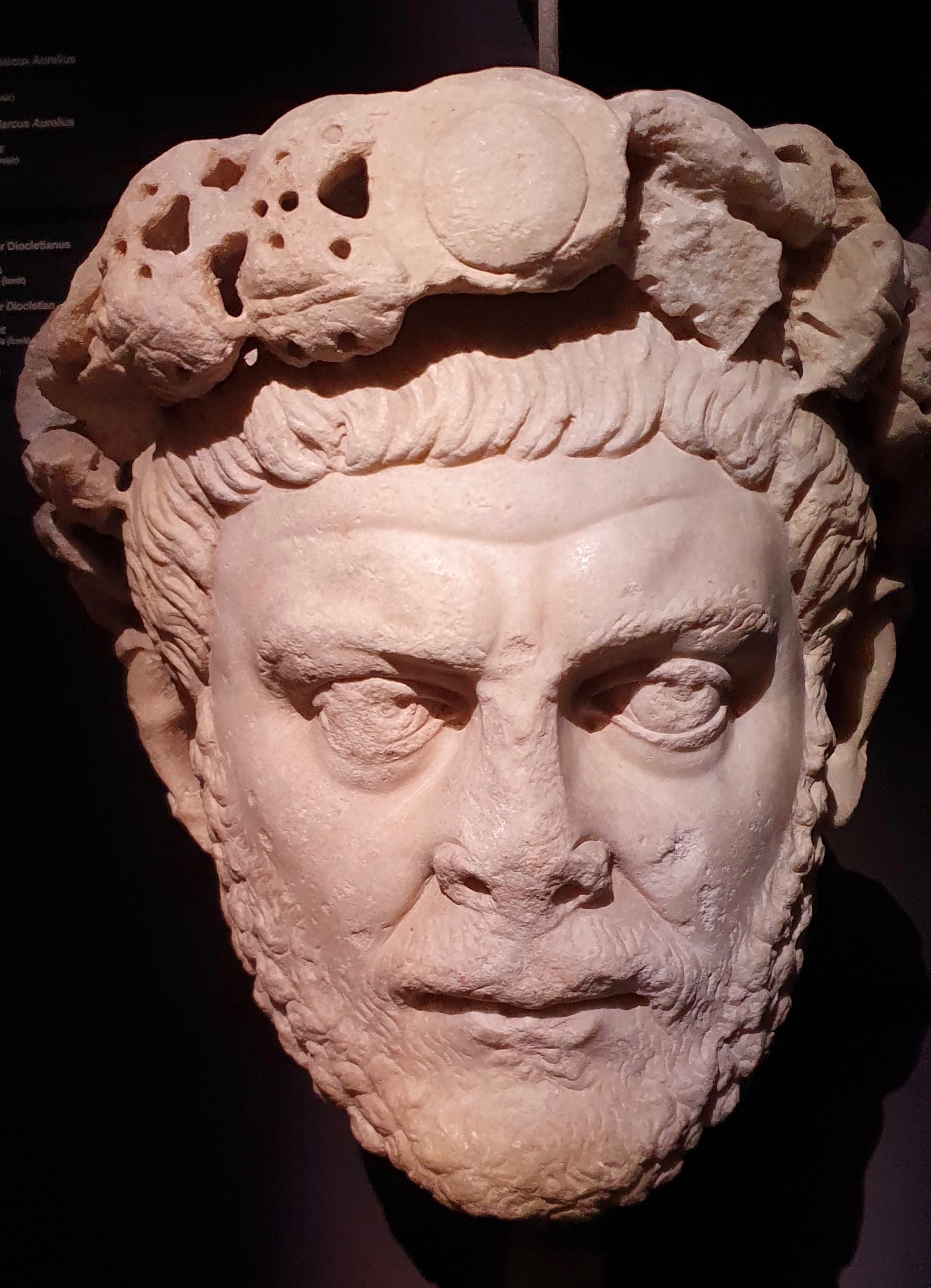
Between about 100 and 313, Christians in the Roman Empire could be put to death for being Christians. For most of that time there was no standing order to hunt them down. A governor acted when someone brought a charge, and the test was simple: offer sacrifice to the gods and the emperor, or refuse and die. Empire-wide drives came late and short, under Decius (250 to 251), Valerian (257 to 260) and the Great Persecution that began under Diocletian in 303 and ended in the East only in 311 to 313.
This lesson profiles nine of the best-recorded martyrs and groups of martyrs from that age: Ignatius of Antioch, Polycarp of Smyrna, Justin and his companions at Rome, the martyrs of Lyon and Vienne (Blandina, Pothinus and the rest), the twelve Scillitan martyrs of North Africa, Perpetua and Felicity at Carthage, Cyprian of Carthage, Lawrence the deacon of Rome, and Agnes of Rome with the martyrs of the Great Persecution. Several of these deaths rest on records unusually close to the events: letters written by the condemned man himself, a letter from the church that watched, court transcripts, and a young mother's prison diary. Others rest on later traditions, and a few famous details (Lawrence on the gridiron, Christians thrown to lions in the Colosseum) have weak or no early support. Each brief keeps the record and the tradition apart. The policy history of the persecutions, from Pliny and Trajan to Diocletian, is taught in Module 79, lesson 03 and is only summarized here.
Why Christians died, 100 to 313
The earliest Roman action against Christians as a group is Nero's punishment of them at Rome after the fire of 64, reported by Tacitus about fifty years later. That event, and the deaths of Peter and Paul, belong to lesson 02 and to Module 79, lesson 01. This lesson begins about a generation later, when Christians had become a known group in the cities of the eastern provinces and the question of what to do with them reached a provincial governor's desk.
The charge was the name
About 111 to 113 Pliny the Younger, governor of Bithynia and Pontus on the Black Sea coast of modern Turkey, wrote to the emperor Trajan asking how to handle people accused of being Christians. He asked whether the name itself was to be punished, even without any crime attached to it, and he described his own practice: he asked the accused three times whether they were Christians, released those who denied it and proved it by offering incense and wine to the emperor's image and cursing Christ, and executed those who persisted. Trajan's reply set the pattern for the next century and a half. Christians were not to be sought out by officials, anonymous accusations were not to be accepted, and a person who denied being a Christian and worshipped the gods was to be pardoned. A person properly accused who refused was to be punished.1 The full text and its meaning are taught in Module 79, lesson 03.
Three features of that rule shape almost every brief below. First, the offence was the name "Christian" and the refusal to sacrifice. No martyr in this lesson was tried for a theft, a riot or a plot, and the trial records show the judges asking only two questions: are you a Christian, and will you sacrifice? Second, there had to be an accuser. That meant that local feeling mattered more than imperial policy. A riot in Smyrna, a mob in Lyon or a famine in Africa could bring Christians before a governor, while in quieter years and places they were left alone. Third, the governor had wide discretion. Some governors pressed hard, some tried to talk the accused out of it, and a few looked for ways to let them go.
Tertullian of Carthage, writing his Apology about 197, described how popular blame worked: "If the Tiber rises as high as the city walls, if the Nile does not send its waters up over the fields, if the heavens give no rain, if there is an earthquake, if there is famine or pestilence, straightway the cry is, 'Away with the Christians to the lion!'"2 In the same work he wrote the sentence that later preachers would shorten to "the blood of the martyrs is the seed of the church." His own words were: "The oftener we are mown down by you, the more in number we grow; the blood of Christians is seed."3
What the Romans thought they were doing
From the Roman side, the issue was the peace between the city and its gods. Public sacrifice was how a community kept the gods favourable, and a group that refused it, met privately and was rumoured to hold secret meals could look like a danger to everyone. The slaves of Christians at Lyon, under pressure, accused their masters of "Thyestean banquets and Oedipodean intercourse," that is, of eating human flesh and of incest, the standard slanders against the group.4 The historian G. E. M. de Ste. Croix, in a 1963 article that is still the usual starting point, argued that the real offence in Roman eyes was the Christians' refusal to take part in the worship of the gods, an "obstinacy" that magistrates found intolerable once it was brought before them.5 W. H. C. Frend's Martyrdom and Persecution in the Early Church (1965) set the story against the Jewish experience of martyrdom under the Maccabees and showed how much depended on local conditions.6
The three empire-wide drives
The pattern changed three times. In 249 to 250 the emperor Decius ordered every inhabitant of the empire to sacrifice and to obtain a certificate (a libellus) proving it. The order did not name Christians, but it caught them, and many lapsed while some died. In 257 and 258 Valerian aimed directly at the church's leaders and property. Cyprian of Carthage reported the terms of Valerian's second rescript in 258: "bishops and presbyters and deacons should immediately be punished," while "senators, and men of importance, and Roman knights, should lose their dignity" and their property, and "matrons should be deprived of their property, and sent into banishment."7 Cyprian, Pope Xystus II and the deacon Lawrence all died under this order.
The last and longest drive began in 303. Eusebius of Caesarea, who lived through it, dated it to "the nineteenth year of the reign of Diocletian," in the month "called March by the Romans, when the feast of the Saviour's passion was near at hand," when "royal edicts were published everywhere, commanding that the churches be leveled to the ground and the Scriptures be destroyed by fire," that those "who held places of honor be degraded," and that household servants who persisted "be deprived of freedom." Later edicts ordered that "all the rulers of the churches in every place be first thrown into prison, and afterwards by every artifice be compelled to sacrifice."8 Lactantius, a Christian teacher of rhetoric who was in Nicomedia at the time, wrote that the day chosen to start was the festival of the god Terminus (February 23, 303), when soldiers "in a few hours levelled that very lofty edifice with the ground," the church of Nicomedia. When the edict was posted, "a certain person tore down this edict, and cut it in pieces," and he was "not only tortured, but burnt alive."9
In the West the persecution faded after 305. In the East it ran on under Galerius and Maximinus Daia until Galerius, dying, issued an edict in April 311 that permitted Christians "again to be Christians," and until the agreement of Constantine and Licinius, published by Licinius at Nicomedia in June 313 and known as the Edict of Milan, granted Christians and all others freedom to follow the religion each chose.9 What followed is the subject of Module 79, lesson 04 and of lesson 04 of this module.
The record-strength ratings in the fact strips below use the key set out in lesson 01: Documented, Strong tradition, Late tradition, Legend.
Ignatius of Antioch
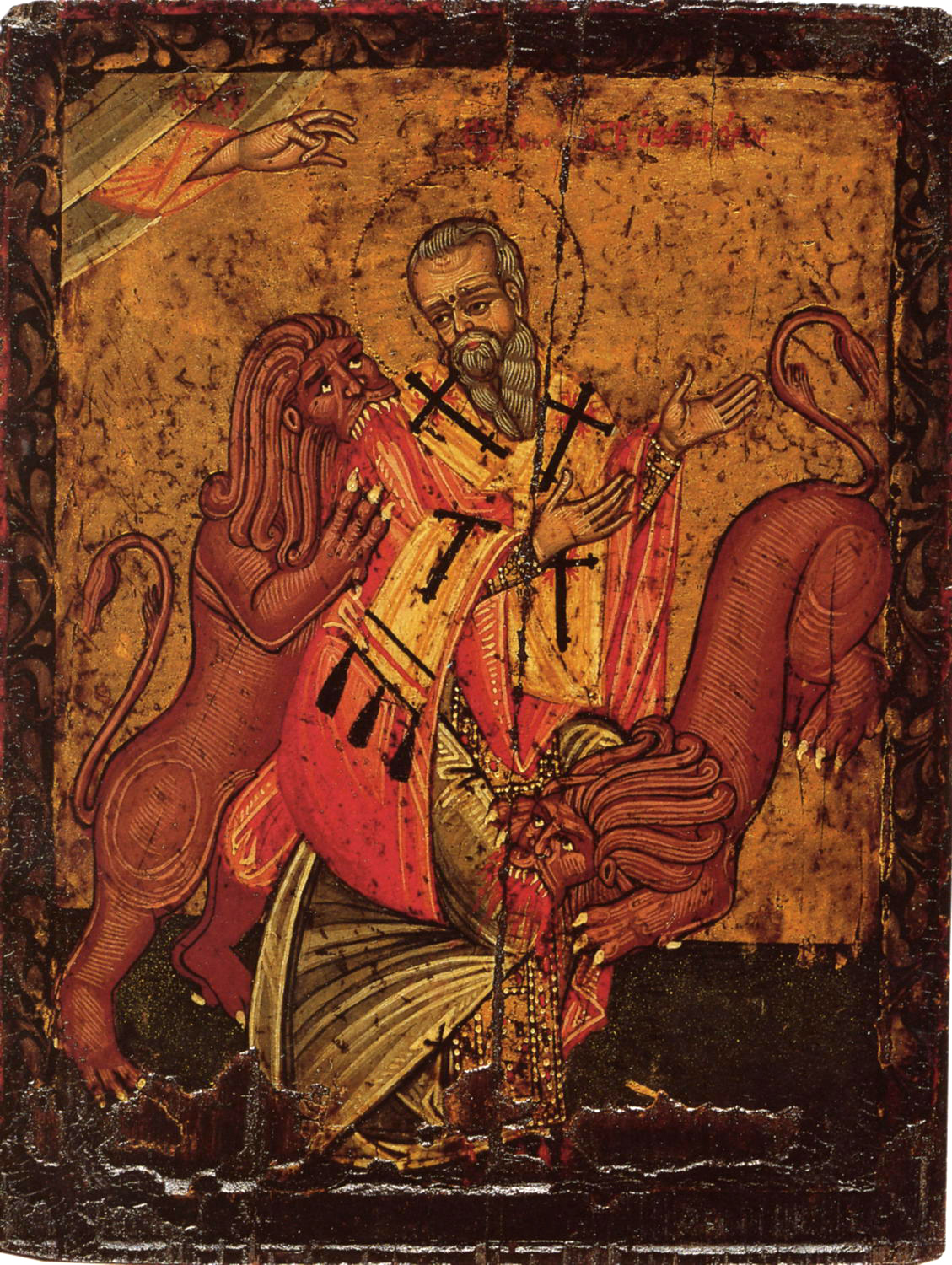
Died: traditionally under Trajan, about 107 to 117 (disputed) · Place: Rome (by tradition) · Earliest source: Ignatius, seven letters written on the road to Rome, and Polycarp, Letter to the Philippians, both about the same time · Record strength: Documented (the sentence and the journey); the death in Rome is Strong tradition

What the record shows
Ignatius was bishop of Antioch in Syria, the city where, according to Acts 11:26, the disciples were first called Christians. Almost everything known about his death comes from his own pen. Under arrest and guarded by soldiers, he was taken overland through the province of Asia toward Rome, and on the way he wrote letters to churches that sent people to meet him: to Ephesus, Magnesia, Tralles and Rome from Smyrna, and to Philadelphia, Smyrna and Polycarp further along the road. The collection of these seven letters (the "middle recension") is the text most scholars accept as genuine.
The letter to the Romans is the one that made him the model of a willing martyr. He begged the Roman Christians not to use their influence to save him: "Suffer me to become food for the wild beasts," and "I am the wheat of God, and let me be ground by the teeth of the wild beasts, that I may be found the pure bread of Christ." He described his guards in the same terms: "From Syria even unto Rome I fight with beasts, both by land and sea, both by night and day, being bound to ten leopards," meaning ten soldiers. He closed the letter with a date, written from Smyrna "on the twenty-third day of August," though he gave no year.10
A second witness stands close to the events. Polycarp, bishop of Smyrna, who had met Ignatius on the road, wrote to the church at Philippi and urged them to follow the endurance seen "not only in the case of the blessed Ignatius, and Zosimus, and Rufus," but in others. At the end of the same letter he sent the Philippians copies of "the Epistles of Ignatius written by him to us," and asked for "any more certain information you may have obtained respecting both Ignatius himself, and those that were with him."11 This is the nearest thing to a report of the outcome, and it is not a report of the death itself.
Eusebius, writing in the early 300s, placed Ignatius under Trajan (emperor 98 to 117) and was careful about his evidence: "Report says that he was sent from Syria to Rome, and became food for wild beasts on account of his testimony to Christ." He also quoted Irenaeus of Lyon (about 180), who cited the wheat sentence of a man "condemned to the beasts on account of his testimony unto God."12 So within about seventy years of the letters, a bishop in Gaul knew the words and knew the sentence.
Tradition and legend
This is tradition: that Ignatius died in the arena at Rome, killed by beasts, in the reign of Trajan. It is a strong tradition, attested by Irenaeus and Eusebius, and it fits the sentence Ignatius himself expected, but no surviving witness describes the death. Two later "acts" of Ignatius (the Antiochene and the Roman martyrdoms) give a trial scene before Trajan in person and a date, and say his bones were carried back to Antioch. These are late compositions, generally dated to the 4th century or after, and their details are legend. The idea that he died in the Colosseum is later still. The 1908 Catholic Encyclopedia article on the Colosseum, written by Maurice Hassett, said plainly that "the evidence that he was martyred in the Coliseum is far from decisive."13 His feast is kept on October 17 in the Roman calendar and on December 20 in the Byzantine calendar.
What the sources dispute
Three questions stay open. The first is the date. The "about 107" or "about 110" of many textbooks comes from Eusebius's placing of him under Trajan, and Eusebius had no document giving the year. The historian Timothy D. Barnes argued in 2008 that the letters fit better in the 140s, in part because they seem to answer teachers of the mid-2nd century.14 Most scholars still place him under Trajan or Hadrian, but the case for any single year is weak. The second is authenticity. The letters circulated in three forms: a short Syriac abridgement of three letters, the middle recension of seven, and a long recension of thirteen with heavy additions. J. B. Lightfoot and Theodor Zahn in the 19th century made the case for the seven, and that case still holds the field, though a minority of scholars have argued that even the seven were composed or edited later. The third is the connection between Polycarp's ninth and thirteenth chapters. In chapter 9 Ignatius seems to be dead already; in chapter 13 Polycarp is still asking for news. Some scholars, following P. N. Harrison (1936), have suggested that Polycarp's letter is two letters joined together. The question bears on how soon the church in Asia learned of the death, and it is unresolved.
Polycarp of Smyrna
Died: about 155 to 167 (disputed; most scholars favour 155 or 156) · Place: Smyrna (modern Izmir, Turkey) · Earliest source: the church of Smyrna, Martyrdom of Polycarp, a letter written within about a year of the death · Record strength: Documented
What the record shows
The Martyrdom of Polycarp is a letter from "the Church of God which sojourns at Smyrna, to the Church of God sojourning in Philomelium," a town further inland, written because the church there had asked for an account. Its writer names himself as Evarestus, and the letter was carried by "our brother Marcus." It is the oldest surviving Christian account of a martyrdom outside the New Testament, and it presents the bishop's death as "a martyrdom becoming the Gospel," that is, following the pattern of Christ's own arrest and death.15
The letter describes a festival crowd in the stadium at Smyrna, where several Christians had already been killed by beasts. Among them, "the most noble Germanicus strengthened the timidity of others by his own patience." The crowd then demanded the bishop. Polycarp, an old man, left the city on the urging of his people, was found at a farm, and was brought back. The proconsul tried to persuade him: "Swear by the fortune of Caesar," and "repent, and say, Away with the Atheists," turning the crowd's slogan against the Christians back on the crowd. When the proconsul pressed, "Swear, and I will set thee at liberty, reproach Christ," Polycarp answered: "Eighty and six years have I served Him, and He never did me any injury." When the herald announced that Polycarp had confessed himself a Christian, the crowd cried: "This is the teacher of Asia, the father of the Christians, and the overthrower of our gods." He was burned. The letter reports that when the flames did not touch him, an executioner stabbed him, and there came out "a great quantity of blood, so that the fire was extinguished."15
Two later chapters matter for the history of martyr cults. The church gathered his bones, "as being more precious than the most exquisite jewels, and more purified than gold," and planned to meet each year "to celebrate the anniversary of his martyrdom." This is the earliest clear evidence of Christians keeping the day of a martyr's death as a feast, a practice explained in lesson 01. The letter's closing chapter gives a date: "the second day of the month Xanthicus just begun," on "the great Sabbath, at the eighth hour," when "Statius Quadratus" was proconsul and "Philip the Trallian" was high priest. The Ante-Nicene Fathers translation, following its Greek text, gives the Roman date as "the seventh day before the Kalends of May"; most editions and modern scholars read "of March," which gives February 23. J. B. Lightfoot's translation (1891) reads "on the seventh before the calends of March."1532
Tradition and legend
Some details inside the letter itself are miracle accounts told by the eyewitnesses or their editors: a voice from heaven saying "Be strong, and show thyself a man, O Polycarp!", the fire "shaping itself into the form of an arch, like the sail of a ship when filled with the wind," and "such a sweet odour" "as if frankincense or some such precious spices had been smoking there."15 The eyewitnesses believed what they reported; a reader today may take these as the community's way of describing the event. This lesson marks them as claims made by the account. The best-known textual addition is the dove. The Ante-Nicene translation reads that at the stabbing "there came forth a dove, and a great quantity of blood." Eusebius, who quoted the letter at length around 300, does not have the dove, and many scholars treat the word as a copyist's error or a later addition. This is legend, or at best an uncertain reading. The tradition that Polycarp had been taught by the apostle John comes from Irenaeus, who wrote that he had heard Polycarp as a boy; that is a strong tradition, separate from the death.
What the sources dispute
The date is the main dispute. Eusebius placed the death under Marcus Aurelius, and his Chronicle seems to put it in 166 or 167. In 1867 the French scholar W. H. Waddington, working from the career of the orator Aelius Aristides, fixed the years when Statius Quadratus held the proconsulship and argued for 155. The translator's note in the standard English edition of Eusebius (Arthur Cushman McGiffert, 1890) calls a date "between 154 and 156 (probably in 155)" "now almost universally accepted."16 That consensus has loosened since: some scholars favour 156, a few still 161 to 167. A larger question concerns the text. Candida Moss has argued that the Martyrdom as we have it was edited or even composed well after the event, perhaps in the 3rd century, pointing to its close imitation of the Gospel passion stories.17 Most specialists continue to treat the core of the letter as an account from the 150s or 160s, with later additions (the closing chapters on the copying of the text are certainly later). Polycarp's death itself is not in doubt.
Justin and his companions
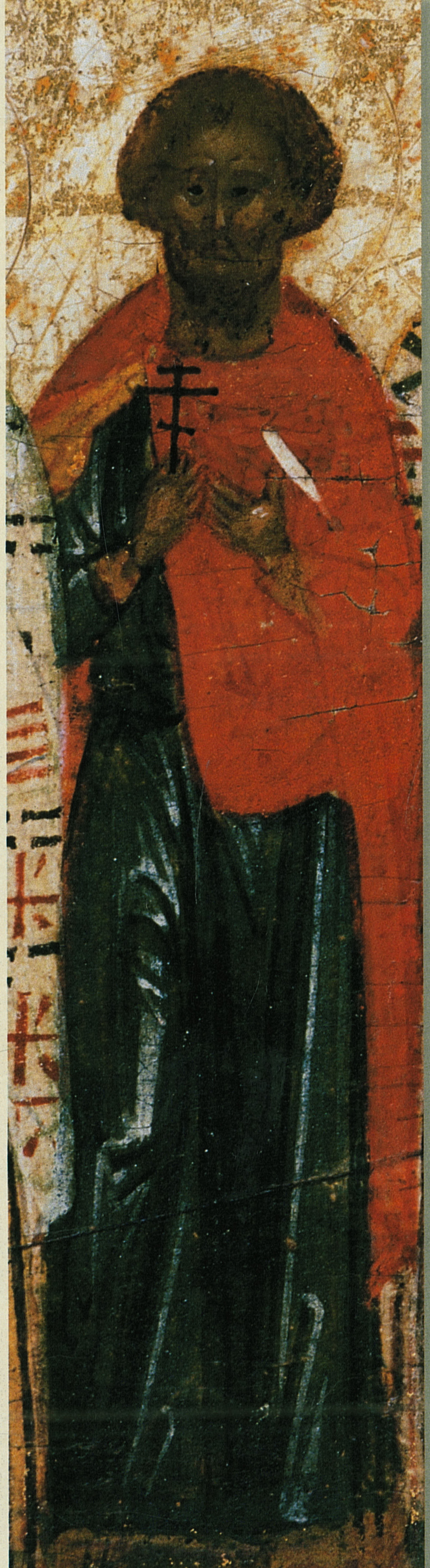
Died: about 165 · Place: Rome · Earliest source: the Acts of Justin and Companions (shortest recension), a trial record probably edited from court notes not long after · Record strength: Documented

What the record shows
Justin was a philosopher from Flavia Neapolis in Samaria who became a Christian and taught in Rome. His First Apology, addressed to the emperor Antoninus Pius, and his Dialogue with Trypho are the subject of Module 79, lesson 03. Here the concern is his death.
The Acts survive in three recensions; the shortest, called recension A by Herbert Musurillo in The Acts of the Christian Martyrs (1972), reads most like an official record.18 The quotations below come from the Ante-Nicene Fathers translation by Marcus Dods (1885), which follows a longer recension than A, so its wording differs in places from the shortest text. The record sets the trial before "the prefect of Rome, Rusticus by name," that is, Quintus Junius Rusticus, the Stoic philosopher who had taught Marcus Aurelius and who was city prefect in the 160s. That fixes the date to about 162 to 168. Justin was asked where the Christians met and gave a plain answer: "I live above one Martinus, at the Timiotinian Bath." He described his teaching as "the true doctrines, those namely of the Christians."
Six others stood trial with him, and the record gives each a voice. Euelpistus, "a servant of Caesar," that is, a slave of the imperial household, said: "I too am a Christian, having been freed by Christ," and said his parents were "In Cappadocia." Hierax said: "Yes, I am a Christian, for I revere and worship the same God," and gave Iconium in Phrygia as his home. Rusticus asked Justin, "Do you suppose, then, that you will ascend into heaven to receive some recompense?" and Justin replied, "I do not suppose it, but I know and am fully persuaded of it." The sentence followed: "Let those who have refused to sacrifice to the gods and to yield to the command of the emperor be scourged," and led away. They "were beheaded, and perfected their testimony in the confession of the Saviour."19
Tradition and legend
The two longer recensions of the Acts add speeches and pious expansions; they are later literary versions and add nothing reliable. Eusebius, writing about 300, believed that Justin had been denounced through the plotting of a Cynic philosopher named Crescens, whom Justin had attacked in his Second Apology, where Justin said he expected Crescens to plot against him. That Crescens actually brought about the arrest is tradition, an inference by Eusebius from Justin's own prediction. Later calendars named Justin "Martyr" as if it were a surname; the title is the church's, the death is documented.
What the sources dispute
The year is uncertain within Rusticus's term as prefect, and scholars give dates between 162 and 168; "about 165" is the usual compromise. The question of how close recension A stands to the actual court record is open. Musurillo and most specialists regard it as an edited version of a real proceeding: the brisk question and answer, the legal formula of the sentence and the absence of miracle all fit. The trial is also a window on Roman procedure in the age of Marcus Aurelius: there was no new edict, only a prefect applying the old rule to people who had been reported to him.
The martyrs of Lyon and Vienne: Blandina, Pothinus and their companions
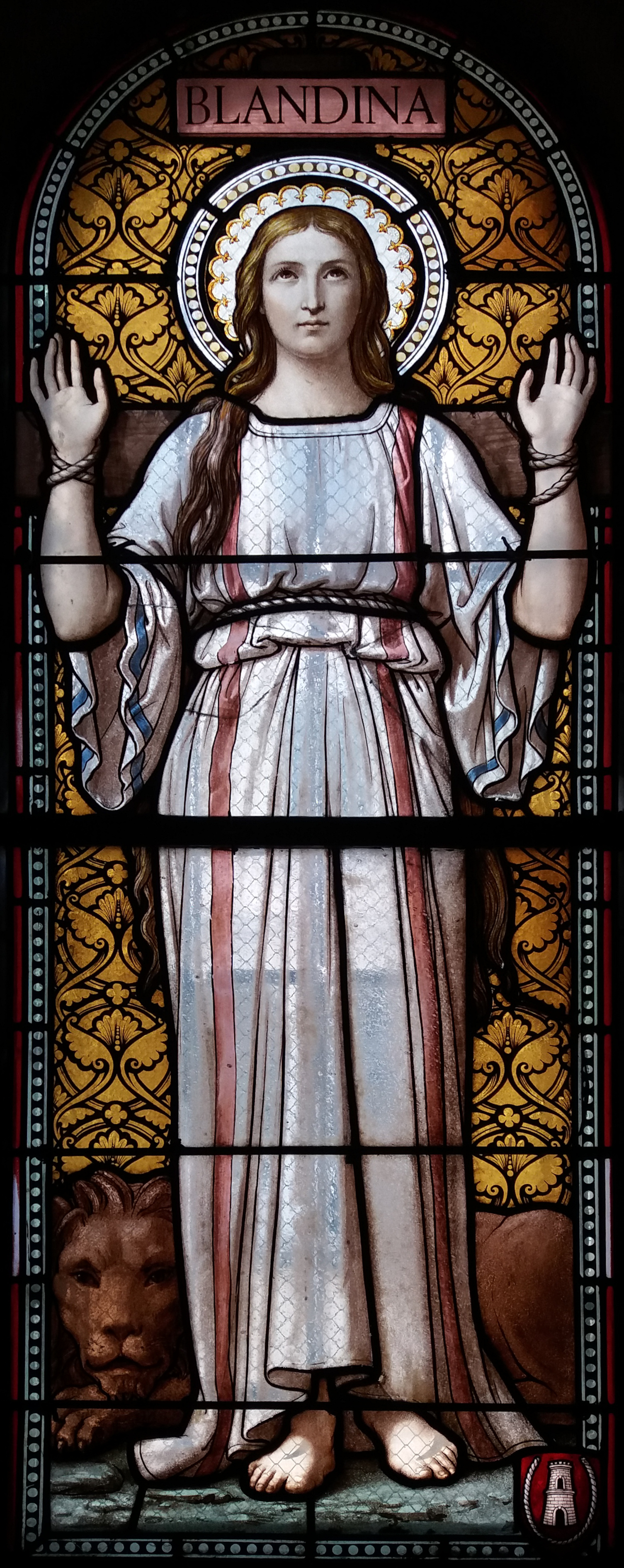
Died: 177 · Place: Lyon (Lugdunum), Gaul · Earliest source: letter of the churches of Vienne and Lyon to the churches of Asia and Phrygia, written soon after 177, preserved in Eusebius, Church History 5.1 (about 300 to 325) · Record strength: Documented

What the record shows
Eusebius copied a long letter into the fifth book of his Church History. It opens: "The servants of Christ residing at Vienne and Lyons, in Gaul, to the brethren through out Asia and Phrygia." Eusebius dated the events to "the seventeenth year of the Emperor Antoninus Verus," meaning Marcus Aurelius, which is 177, and he introduced the letter by saying the persecution had been "rekindled more fiercely in certain districts on account of an insurrection of the masses in the cities."20 Lyon was the leading city of the three Gallic provinces, and many of its Christians had come from Asia Minor, which explains why the letter went east.
The letter describes a slide from social exclusion to mob violence to trial. Christians were barred from the baths and the market, then attacked in the streets, then arrested and questioned before the governor. A young man of standing, Vettius Epagathus, asked to speak in their defence and was himself arrested, "being called the Advocate of the Christians." Under pressure, pagan slaves of Christian households "accused us falsely of Thyestean banquets and Oedipodean intercourse." The aged bishop Pothinus, "more than ninety years of age," was asked by the governor who the Christians' God was and replied, "If thou art worthy, thou shalt know." He was beaten, "cast into prison and died after two days."4
The letter gives most space to a slave woman, Blandina, whose mistress was also among the accused. Under repeated torture she said only: "I am a Christian, and there is nothing vile done by us." The deacon Sanctus answered every question with the same words: "I am a Christian." Maturus, Sanctus, Blandina and Attalus "were led to the amphitheater to be exposed to the wild beasts." When the governor learned that Attalus "was a Roman," he sent him back to prison and wrote to the emperor. The answer came back: "For Caesar commanded that they should be put to death, but that any who might deny should be set free." The governor then "beheaded those who appeared to possess Roman citizenship, but he sent the others to the wild beasts." The last to die were Blandina and "Ponticus, a boy about fifteen years old." Blandina was "finally enclosed in a net, and thrown before a bull," and killed, and even the crowd "confessed that never among them had a woman endured so many and such terrible tortures." The bodies were left unburied for days and then "burned and reduced to ashes, and swept into the Rhone."4
The letter is restrained about one point that later accounts were not. Some of the arrested Christians denied the faith at first, and the letter reports that several of them later recovered their courage and confessed, and it describes this as the dead being brought back to life (a paraphrase of the letter). It is an account written by a community that knew some of its own members had failed, and it said so.
Tradition and legend
The letter does not give a total. The number forty-eight, and a list of names, appear in later sources: early medieval martyrologies and Gregory of Tours (late 6th century). This is tradition, first written down some four hundred years after the event. The site of the deaths is traditionally the amphitheatre of the Three Gauls on the slope of the Croix-Rousse in Lyon, whose remains were excavated in the 20th century, and that identification is reasonable but not stated in the letter, which says only "the amphitheater." The tradition that Irenaeus, who carried a letter from the Lyon confessors to Rome and succeeded Pothinus as bishop, himself died a martyr appears only in later writers and is weak.
What the sources dispute
Historians have asked what set off the violence in 177. One theory, argued by James H. Oliver and Robert E. A. Palmer in 1955, links it to a senatorial decree of about 177 that let provincial priests buy condemned criminals cheaply to fight as gladiators, which would have made condemned Christians a bargain for the games at Lyon. Other historians, including Frend, place the weight on local hostility and on the Asian origins of the community. The authorship of the letter is not given; the suggestion that Irenaeus wrote it is a modern guess. The exact text is known only through Eusebius, who quoted much of it but not all, and summarized some passages in his own words.
The Scillitan martyrs
Died: July 17, 180 · Place: Carthage (the martyrs came from Scilli, a town in Africa Proconsularis whose site is not known) · Earliest source: Passion of the Scillitan Martyrs, a trial record in Latin, 180 or soon after · Record strength: Documented
What the record shows
The Passion of the Scillitan Martyrs is the oldest dated document of Latin-speaking Christianity, and one of the shortest martyr texts. In J. Armitage Robinson's translation it opens with a precise date and court: "WHEN Praesens, for the second time, and Claudianus were the consuls, on the seventeenth day of July, at Carthage," with "Saturninus the proconsul" presiding. That consular year is 180, the first year of the emperor Commodus. The first accused named are "Speratus, Nartzalus, Cittinus, Donata, Secunda and Vestia."21
The exchange is quiet. Saturninus offered them the emperor's pardon if they would come to their senses and swear by the emperor's genius (a paraphrase). Speratus answered: "The empire of this world I know not; but rather I serve that God, whom no man hath seen, nor with these eyes can see." He added that he was no criminal: "I have committed no theft; but if I have bought anything I pay the tax." The proconsul offered thirty days to think it over, and they refused. Asked what was in the case they carried, Speratus said: "Books and epistles of Paul, a just man." That line is one of the earliest pieces of evidence for Paul's letters circulating in Latin-speaking Africa.21
The sentence was read from a tablet: since "Speratus, Nartzalus, Cittinus, Donata, Vestia, Secunda and the rest having confessed that they live according to the Christian rite" and refused the offer, "it is determined that they be put to the sword." Their answer was "Thanks be to God." The herald's proclamation gives twelve names in all: "Speratus, Nartzalus, Cittinus, Veturius, Felix, Aquilinus, Laetantius, Januaria, Generosa, Vestia, Donata and Secunda." They were beheaded the same day.21
Tradition and legend
Little legend grew around the Scillitans, perhaps because their record left little room for it. Later Greek and Latin versions expanded the dialogue. Their feast on July 17 was kept in the African church, and later calendars carried it to the West; these are witnesses to a cult, and they add no new facts about the trial.
What the sources dispute
The text is short and plain, and scholars largely agree it rests on the court protocol. The open questions are small: the location of Scilli itself; whether some names in the herald's list were added in transmission; and how the "books and epistles of Paul" were bound or whether the phrase means the Gospels plus Paul. The record also shows the limits of Roman cruelty in this case: no torture, an offer of delay, and a sentence by the sword, the death given to free provincials of some standing. The contrast with Lyon, three years earlier, is a reminder that the treatment of Christians depended heavily on the governor and the crowd.
Perpetua and Felicity
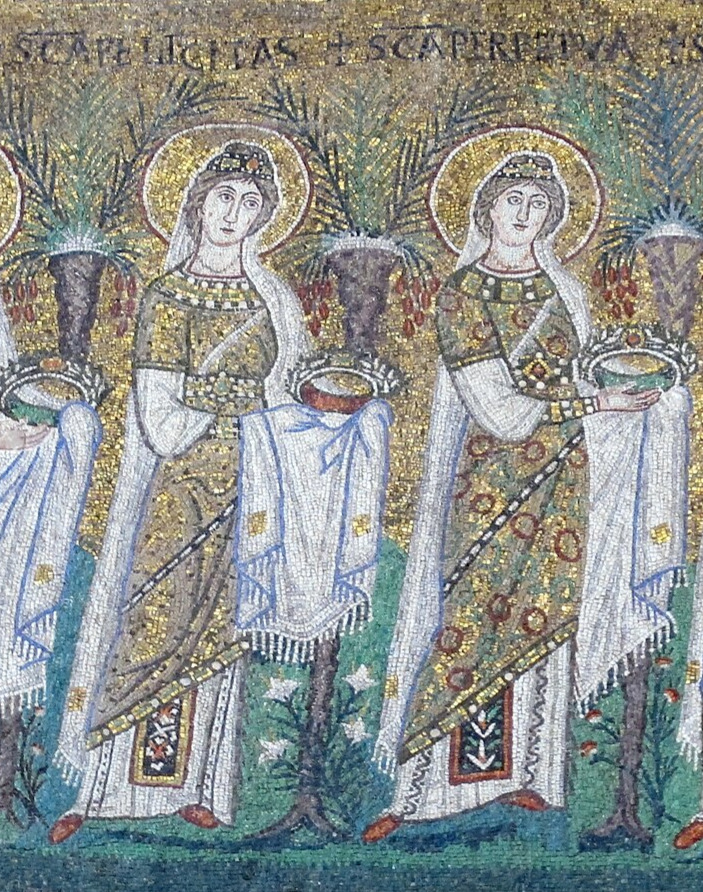
Died: March 7, 203 · Place: Carthage, in the amphitheatre · Earliest source: The Passion of Perpetua and Felicity, built around Perpetua's own prison diary and Saturus's account of his vision, edited within a few years · Record strength: Documented

What the record shows
No other martyr text of the ancient church contains so much of the martyr's own voice. An unnamed editor introduces the group: "The young catechumens, Revocatus and his fellow-servant Felicitas, Saturninus and Secundulus, were apprehended." With them was Vibia Perpetua (the translation used here spells it "Vivia"), a young woman of good family, married, with an infant son at the breast. "She herself was about twenty-two years of age." The editor then hands over: "From this point onward she shall herself narrate the whole course of her martyrdom, as she left it described by her own hand and with her own mind."22
Perpetua's section is written in the first person. Her pagan father came to the prison and begged her to give up. She pointed to a water pitcher and asked if it could be called by any other name than what it was; he said no; and she answered, "Neither can I call myself anything else than what I am, a Christian." The hearing took place before "Hilarianus the procurator, who had just received the power of life and death," because the proconsul had died. Her father appeared again, holding her baby, and Hilarianus urged her to spare him and to sacrifice for the emperors' welfare. She refused. "The procurator then delivers judgment on all of us, and condemns us to the wild beasts." She also recorded four dreams or visions, including a ladder to heaven guarded by a serpent and a fight in which she became a man and defeated an Egyptian gladiator, which she took to mean she would fight the devil and win.22
The catechist Saturus, who had given himself up to share their fate, also wrote down a vision, "which he himself committed to writing." The editor then tells the end. Felicity, a slave, was pregnant when arrested, "when she had already gone eight months with child," and Roman law did not allow a pregnant woman to be executed; she gave birth to a daughter in prison shortly before the games, and the child was taken by a Christian woman to raise. The games were held for the birthday of the young Caesar Geta: "Then was the birthday of Geta Caesar." In the arena the men faced a leopard, a bear and a boar; the women were exposed to a wild cow. Those still alive were then killed by the sword in front of the crowd. Perpetua's executioner, an inexperienced gladiator, struck badly, and "she herself placed the wavering right hand of the youthful gladiator to her throat."22
The date is supported from two sides. The games for Geta, who was made Caesar in 198, fit the reign of Septimius Severus, and the Roman calendar of martyrs in the Chronograph of 354 lists the feast on the nones of March, March 7: "Perpetuae et Felicitatis, Africae."23 The year 203 rests on the editor's references to Geta and the procurator; it is the year most scholars accept.
Tradition and legend
The visions are dreams reported by the dreamer, and the reader may judge them as such. Later versions added more. A shorter set of Acts of Perpetua, probably 4th or 5th century, rewrites the story, gives the husband a role (he is absent in the original), and adds dialogue; these additions are late tradition. Augustine preached on their feast day, and in another work he cautioned that the Passion was not part of canonical Scripture, a warning that shows how highly it was valued in North Africa. The idea that Perpetua's husband had abandoned her, or had died, is a modern guess from his absence in the text.
What the sources dispute
Three questions are debated. The first is authorship of the frame. Some scholars since the 19th century have proposed Tertullian as the editor because of the style and the date and place; others reject the attribution, and it remains unproved. The second is the editor's religious stance. The preface defends new prophecies and visions in terms that some scholars read as sympathy with the New Prophecy (Montanism), which Tertullian later joined; others see ordinary African Christianity of 200. The third is how much of the "diary" is truly Perpetua's. Most historians, including Brent Shaw and Joyce Salisbury in their studies of the text, treat the first-person section as genuinely hers, which would make it among the earliest surviving writing by a Christian woman. Others argue that the editor shaped it. The basic facts of the arrest, the trial and the death are not in question.
Cyprian of Carthage
Died: September 14, 258 · Place: Carthage, at the villa of Sextus outside the city · Earliest source: the Acta Proconsularia (proconsular acts) of Cyprian, from the court record, and Pontius the Deacon, Life and Passion of Cyprian, both written within a few years · Record strength: Documented

What the record shows
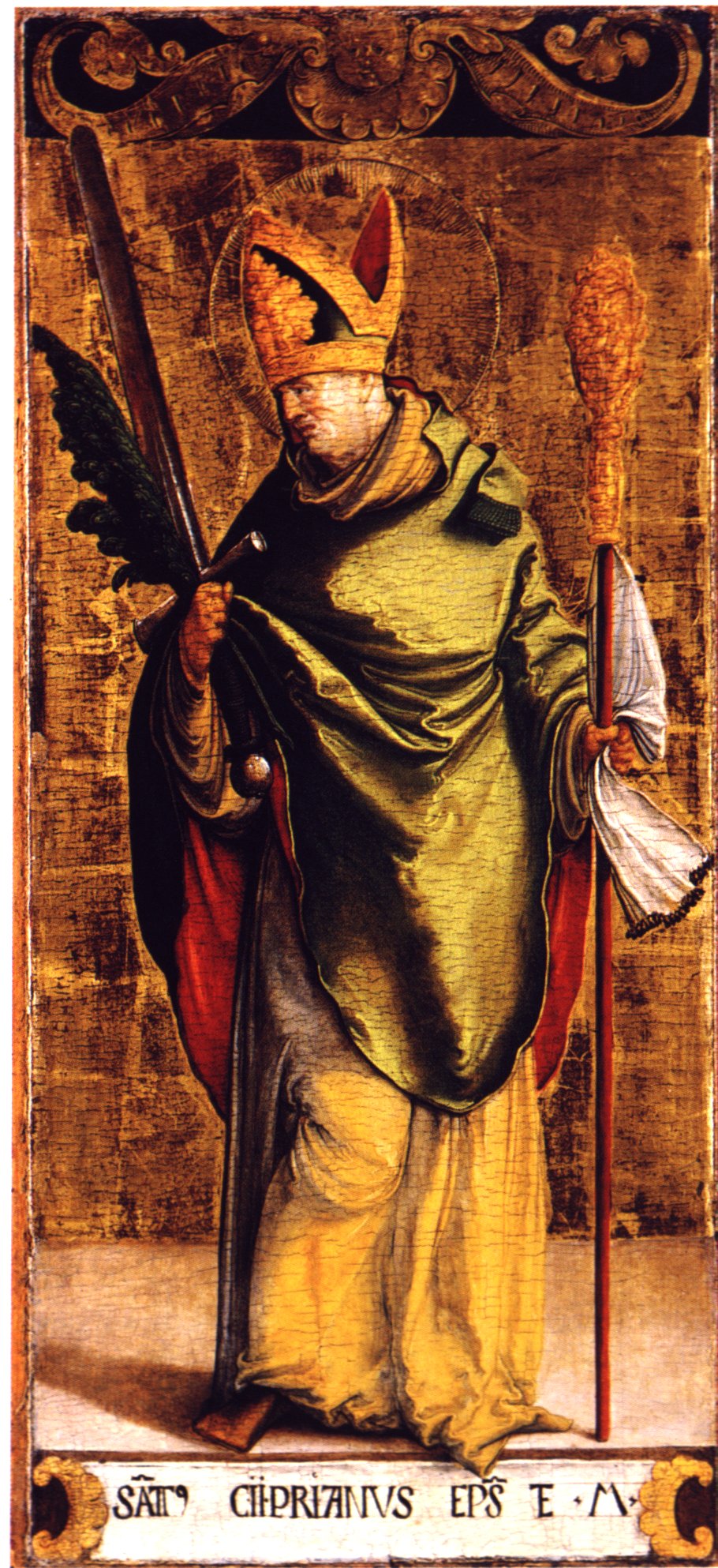
Thascius Caecilius Cyprianus was a wealthy and educated man of Carthage who became a Christian in middle age and was made bishop about 248 or 249, within a few years of his baptism. In the Decian persecution of 250 he left the city and governed the church by letter from hiding, a choice his critics held against him; the arguments over the "lapsed," those who had sacrificed or bought certificates, are taught in Module 79, lesson 03. In 257, under Valerian's first edict, he was tried before the proconsul Aspasius Paternus and exiled to Curubis, a small coastal town. His deacon Pontius went with him and later wrote: "Curubis possessed not only an exile, but a martyr too."24
In August 258 Cyprian wrote to a fellow bishop, Successus, with the terms of Valerian's second rescript, quoted above in the era introduction, and with news from Rome: "But know that Xistus was martyred in the cemetery on the eighth day of the Ides of August, and with him four deacons."7 He knew what was coming. Recalled to Carthage and held for a night in the house of an officer, he was brought before the new proconsul, Galerius Maximus, on September 14.
The Acta Proconsularia record the hearing as a short exchange. As the text is given in Herbert Musurillo's edition (paraphrased here), the proconsul asked whether he was Thascius Cyprian and whether he was the "pope" (bishop) of these people; Cyprian said he was. The proconsul told him the emperors had ordered him to perform the Roman rites; Cyprian refused. The proconsul consulted his advisers and read the sentence from a tablet: Thascius Cyprian was to be executed by the sword. Cyprian answered, "Thanks be to God" (Deo gratias), the same words the Scillitans had used at Carthage seventy-eight years earlier.18 The account says he was led out to the field of Sextus, that a large crowd of Christians followed, that he told his people to give the executioner twenty-five gold pieces, that he covered his own eyes, and that he was beheaded. His body was buried that night by the Christians with torches.
Pontius's Life, written soon after, agrees on the substance. He reports that the proconsul called Cyprian "a standard-bearer of the sect, and an enemy of the gods," that crowds climbed trees to watch, and that the executioner's office was "to wield the sword," though his hand trembled. Pontius regretted that he had not been allowed to die with his bishop: "would that he could also have chosen me to share his passion!"24 The Roman calendar in the Chronograph of 354 lists Cyprian on September 14, "Cypriani, Africae," and notes that at Rome he was honoured in the cemetery of Callistus.23
Tradition and legend
Cyprian's death carries little legend; the record is plain. Later tradition confused him with a different Cyprian, the "Cyprian of Antioch," a magician said to have been converted by a virgin named Justina and martyred under Diocletian. That second Cyprian is legend, and the Roman Church removed his feast from the general calendar in 1969 because his story lacked historical basis. Gibbon, writing in 1776, said Cyprian "was the first who was esteemed worthy to obtain the crown of martyrdom" among the bishops of Africa; Gibbon's own note admits that the French historian Tillemont was "not pleased with so positive an exclusion of any former martyr of the episcopal rank," and an editor's note in the standard edition adds that Cyprian himself wrote of fellow bishops who had already been put to death.25
What the sources dispute
The facts of the death are secure. The debates concern Cyprian's conduct in 250 (whether his flight was prudence or failure, a debate that began in his own lifetime), the relation between the court record and the edited Acta that survive (the text combines the hearing of 257 and the hearing of 258 with a short narrative), and how far Pontius shaped his Life to answer critics of the bishop's flight. Catholic, Orthodox and Protestant writers have all claimed Cyprian: for his teaching on the unity of the church and the bishop, for his resistance to the bishop of Rome over rebaptism, and for his insistence on Scripture. He was honoured as a martyr by all sides from the start.
Lawrence of Rome, with Xystus II
Died: August 10, 258 (Xystus II on August 6) · Place: Rome; buried on the Via Tiburtina · Earliest source: Cyprian, Epistle 81 (August 258) for Xystus; the Chronograph of 354 for Lawrence's day and grave; Ambrose, On the Duties of the Clergy (about 388) for the story · Record strength: Strong tradition (the death, the day and the grave, in a Roman list of 354, about a century later); the gridiron is Legend (first written about 130 years after the death, with no earlier support)

What the record shows
Valerian's rescript of 258 ordered bishops, presbyters and deacons to be punished at once. At Rome the bishop Xystus II (also spelled Sixtus) was caught holding a service in a cemetery. Cyprian's letter, written within weeks, says he "was martyred in the cemetery on the eighth day of the Ides of August, and with him four deacons," that is, on August 6.7 The Roman list of martyrs' feasts in the Chronograph of 354, compiled less than a century later, gives the same day: "VIII idus Aug. Xysti in Callisti," with the deacons Agapitus and Felicissimus in the cemetery of Praetextatus.23
Lawrence (Laurentius) was one of the seven deacons of Rome and, by later accounts, the one responsible for the church's funds and care of the poor. The same Roman list gives his day and his grave four days after Xystus: "IIII idus Aug. Laurenti in Tiburtina," August 10, on the Via Tiburtina.23 His cult grew fast. Kirsch, in the 1910 Catholic Encyclopedia, wrote that "Constantine the Great was the first to erect a little oratory over his burial-place," and later popes enlarged it into the present Basilica of San Lorenzo fuori le Mura.26 These are the facts the early records support: a Roman deacon named Lawrence died in Valerian's persecution, four days after his bishop, and was buried on the Via Tiburtina, where he was honoured from the 4th century.
Tradition and legend
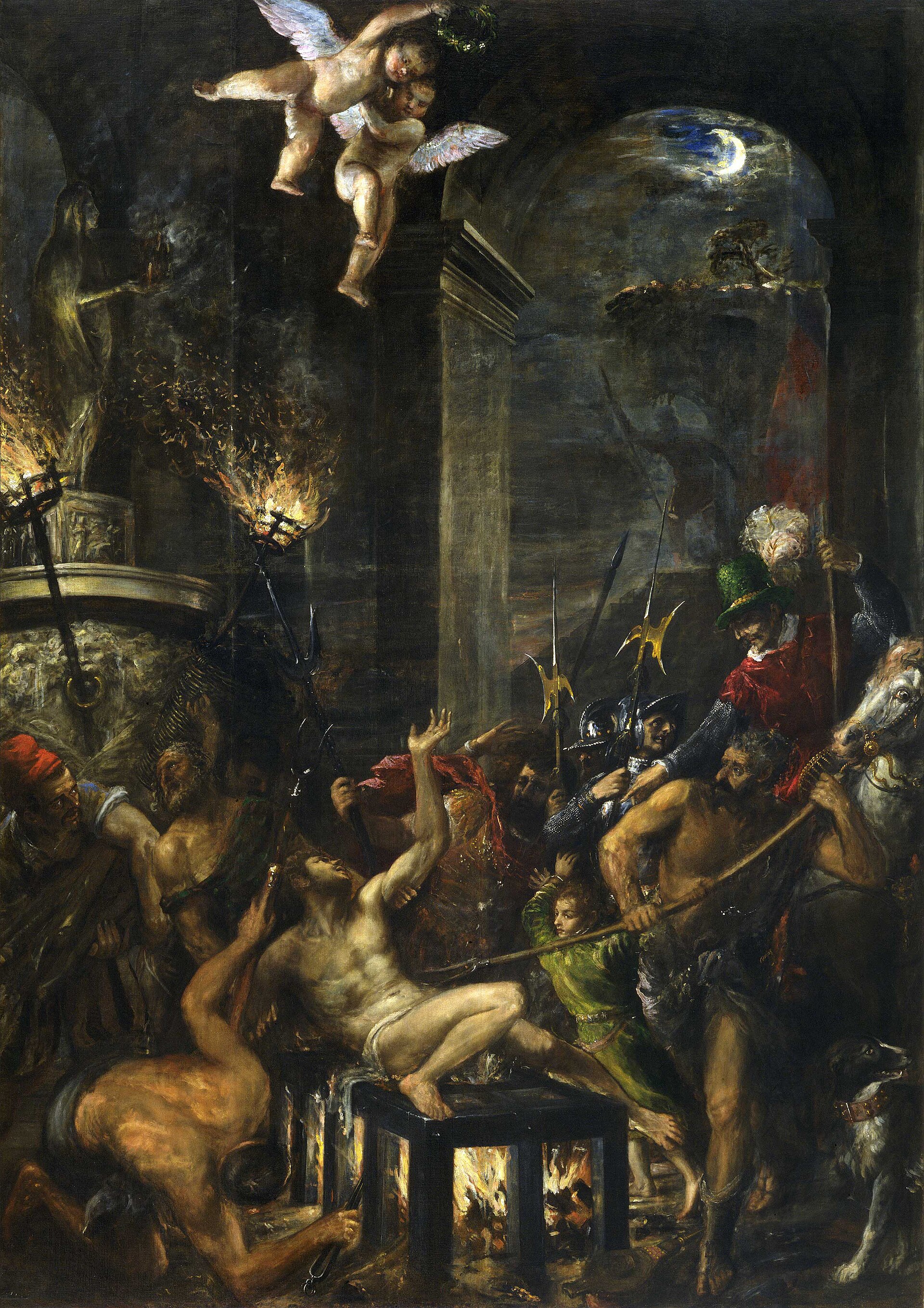
The famous story is written down first by Ambrose of Milan in On the Duties of the Clergy, about 388, some one hundred and thirty years after the event. Ambrose has Lawrence weep as Xystus is led away: "Whither, father, goest thou without thy son? Whither, holy priest, art thou hastening without thy deacon?" Xystus answers: "Cease weeping; after three days thou shalt follow me." Then, says Ambrose, Lawrence was burned on a gridiron and said: "The flesh is roasted, turn it and eat."27 In another chapter Ambrose tells how the prefect demanded the church's treasures and Lawrence brought the poor, saying: "These are the treasures of the Church."28 The poet Prudentius, about 400, told the gridiron story at length in his hymn on Lawrence. This is tradition: the meeting with Xystus, the treasure scene and the gridiron are first attested in the late 4th century.
The gridiron has the weakest support. Valerian's rescript, as Cyprian reports it, ordered clergy to be "punished" at once, and Xystus and his deacons were executed, by all accounts by the sword. Roasting would have been an unusual sentence for a deacon under that order. J. P. Kirsch, writing the 1910 Catholic Encyclopedia article on Lawrence, said that "The manner of his execution, burning on a red-hot gridiron, also gives rise to grave doubts," and that "the narrations of Ambrose and Prudentius are founded rather on oral tradition than on written accounts."26 Some historians, following Pio Franchi de' Cavalieri, have suggested that the gridiron story grew from a copying error, the Latin passus est ("he suffered") misread as assus est ("he was roasted"). That explanation is itself a conjecture. Most likely, Lawrence was beheaded like his bishop; that, too, is an inference, since no early source states the manner of death.
What the sources dispute
The day and the place are not in doubt. The disputes are three: the manner of death (gridiron or sword); whether Lawrence was killed with the four deacons and the record of his feast reflects a different burial day, or killed separately four days later as Ambrose has it (Kirsch noted that the story of the meeting "is not compatible with the contemporaneous reports" of Valerian's persecution); and whether the treasure story has any historical core. Lawrence became one of the most honoured martyrs of Rome, and the Catholic, Orthodox and Anglican calendars all keep August 10.
Agnes of Rome and the martyrs of the Great Persecution
Died: traditionally about 304 (Agnes); 303 to 311 for the Great Persecution · Place: Rome, buried on the Via Nomentana; Nicomedia, Palestine, Egypt and elsewhere · Earliest source: the Chronograph of 354 (Agnes's day and grave); Ambrose, On Virgins (377); Eusebius, Church History 8 and Martyrs of Palestine (about 311 to 325, an eyewitness) · Record strength: Strong tradition (Agnes); Documented (Eusebius's Palestinian martyrs)

What the record shows
Agnes is the best known of the Roman martyrs of the last persecution, and the earliest records of her are a feast day and a grave. The Chronograph of 354 lists "XII kal. Feb. Agnetis in Nomentana," January 21, on the Via Nomentana.23 In the 4th century Constantine's daughter Constantina built a basilica over her grave (the 1907 Catholic Encyclopedia places it in Constantine's reign), and the church that Pope Honorius I (625 to 638) rebuilt there, Sant'Agnese fuori le Mura, stands today.33 In 377 Ambrose, in his treatise On Virgins, wrote: "She is said to have suffered martyrdom when twelve years old," and described her "offering her whole body to the sword of the raging soldier."29 Ambrose's "is said" shows that he was repeating what was told in Rome.
For the Great Persecution as a whole, the record is much fuller, because a historian lived through it. Eusebius of Caesarea watched trials and executions in Palestine and wrote a separate book, The Martyrs of Palestine, naming the dead one by one, with the year and often the day. He also reported mass killings in Egypt and the Thebaid that he said he had seen, and the burning of a whole town in Phrygia with its people. Lactantius described the start at Nicomedia, quoted above. Edward Gibbon, reading Eusebius's Palestinian list in 1776, counted it and wrote "that no more than ninety-two Christians were entitled to that honorable appellation" in that province.30 Eusebius did not claim his list covered every death even in Palestine, and the persecution was harsher in Egypt than in Palestine, but the list gives the scale of what one well-placed observer could document.
Tradition and legend
Agnes's story grew fast. Pope Damasus I (366 to 384) placed a verse inscription at her tomb, and the poet Prudentius wrote a hymn on her about 400; the two disagree on the manner of death, with the inscription speaking of fire and Prudentius and Ambrose of the sword. A 5th century Passion of Agnes adds the story of a prefect's son who wanted to marry her, a brothel scene in which her hair grew to cover her, and a miracle in which a young man who tried to touch her was struck dead and then raised by her prayers. These are legend. Her name, which resembles both the Greek word for "pure" and the Latin word for "lamb," shaped her symbol, and on her feast two lambs are blessed in Rome whose wool is used to weave the pallium worn by archbishops. The year 304 comes from the assumption that she died under Diocletian; some scholars have argued for the persecution of Valerian or even Decius.
What the sources dispute
For Agnes, the open questions are the date (Valerian, Decius or Diocletian), the manner of death (fire or sword) and her age (Ambrose's twelve, which he gives as hearsay). For the Great Persecution, the main dispute is the total number of dead. That question has its own section below.
Where they died
The martyrs of this lesson died in five cities spread across the Roman Mediterranean, and the spread itself is evidence. By the late 2nd century Christianity had communities in Syria, the province of Asia, Rome, the Rhone valley and Africa, and the letters that carried news of each death travelled the same roads and sea routes as trade. The church of Smyrna wrote to Philomelium; the churches of Lyon wrote to Asia and Phrygia; Cyprian in Carthage heard within weeks of the death of the bishop of Rome.
How close is the record to the death?
The single most useful question to ask of any martyr story is how many years separate the death from the earliest surviving text that reports it. For the martyrs of this lesson the answer runs from zero (the condemned writing in their own hand) to well over a century (the gridiron). The chart below sets them side by side.
How many died?
No ancient writer gave a total, and none could have. The surviving sources name a few hundred martyrs from the whole period 64 to 313, and they describe other deaths without numbers. Every total is an estimate, and each one below is labelled with its author and method.
- Eusebius (about 300 to 325). Of the persecution of 177 he wrote that "myriads suffered martyrdom throughout the world."20 "Myriads" (tens of thousands) is rhetoric, unsupported by any count. For Palestine in 303 to 311, where he was an eyewitness, his own list is short and specific.
- Edward Gibbon (1776). Gibbon counted the names in Eusebius's Martyrs of Palestine (ninety-two, by his count), multiplied by an estimate of Palestine's share of the empire, and concluded that the total for the Great Persecution "will be reduced to somewhat less than two thousand persons."30 His method is crude and his purpose (to answer what he saw as inflated church claims) is plain, but later historians have kept his figure as a starting point for argument.
- W. H. C. Frend (1965). Frend's study of the period treated the Great Persecution as far heavier in Egypt and the East than Gibbon allowed. A modern estimate of about 3,000 to 3,500 deaths for 303 to 313 is widely repeated in reference works and is often credited to Frend; the page has not been confirmed for this lesson, and any such figure is an informed guess.6
- Candida Moss (2013). In The Myth of Persecution, Moss argued that Roman action aimed specifically at Christians was limited to a few short periods, adding up to fewer than about ten years in nearly three centuries, that many martyr stories were written or rewritten long after the events, and that the image of constant persecution was shaped by later Christian writers. Her critics, among them reviewers in academic journals and church historians, have argued that she understates the danger Christians lived with even in quiet years, when a single accusation could end in death, and that her treatment of some texts is too sceptical. The New Testament scholar N. Clayton Croy, reviewing the book in 2013, disputed her figure of "fewer than ten years" of executions resulting from imperial initiatives and argued that Christians lived under a threat of lethal prejudice throughout the three centuries.3134
What can be said firmly: the number of Christians executed by Roman authority between 64 and 313 was in the thousands, and no evidence supports a figure in the millions; the deaths were concentrated in short periods and in particular places; and most Christians in most years were never brought to trial. What cannot be said firmly is any single total.

What the record shows and what it does not
- Documented fact: Ignatius was condemned and taken to Rome under guard and wrote seven letters on the way; Polycarp was burned at Smyrna in the 150s or 160s; Justin and six companions were beheaded at Rome under the prefect Rusticus; Christians were killed at Lyon in 177 after mob violence and an imperial ruling; twelve Christians from Scilli were beheaded at Carthage on July 17, 180; Perpetua, Felicity and their companions died in the arena at Carthage in 203; Cyprian was beheaded near Carthage on September 14, 258; Xystus II died on August 6 and Lawrence on August 10, 258, at Rome; edicts against churches, Scriptures and clergy were issued from 303.
- A church's own claim or tradition: that Ignatius died in the arena at Rome (strong tradition); that Lawrence was roasted on a gridiron (late tradition, doubted even by the 1910 Catholic Encyclopedia); the treasure story and the meeting of Lawrence and Xystus; Agnes's age of twelve (Ambrose, "is said"); the later legends of Agnes's trial.
- Scholarly reading: the date of Ignatius (Trajan or the 140s, Barnes); the date and editing of the Martyrdom of Polycarp (155 to 156 by most; later composition argued by Moss); Tertullian's role in editing Perpetua's Passion; the total number of martyrs (Gibbon, Frend, Moss).
- Open questions: the year of Ignatius's death; whether Polycarp's letter to Philippi is one letter or two; the trigger for the Lyon persecution; the site of Scilli; Lawrence's manner of death; the date and manner of Agnes's death; any total of deaths.
Claims checked
"Millions of Christians were thrown to the lions in the Colosseum"
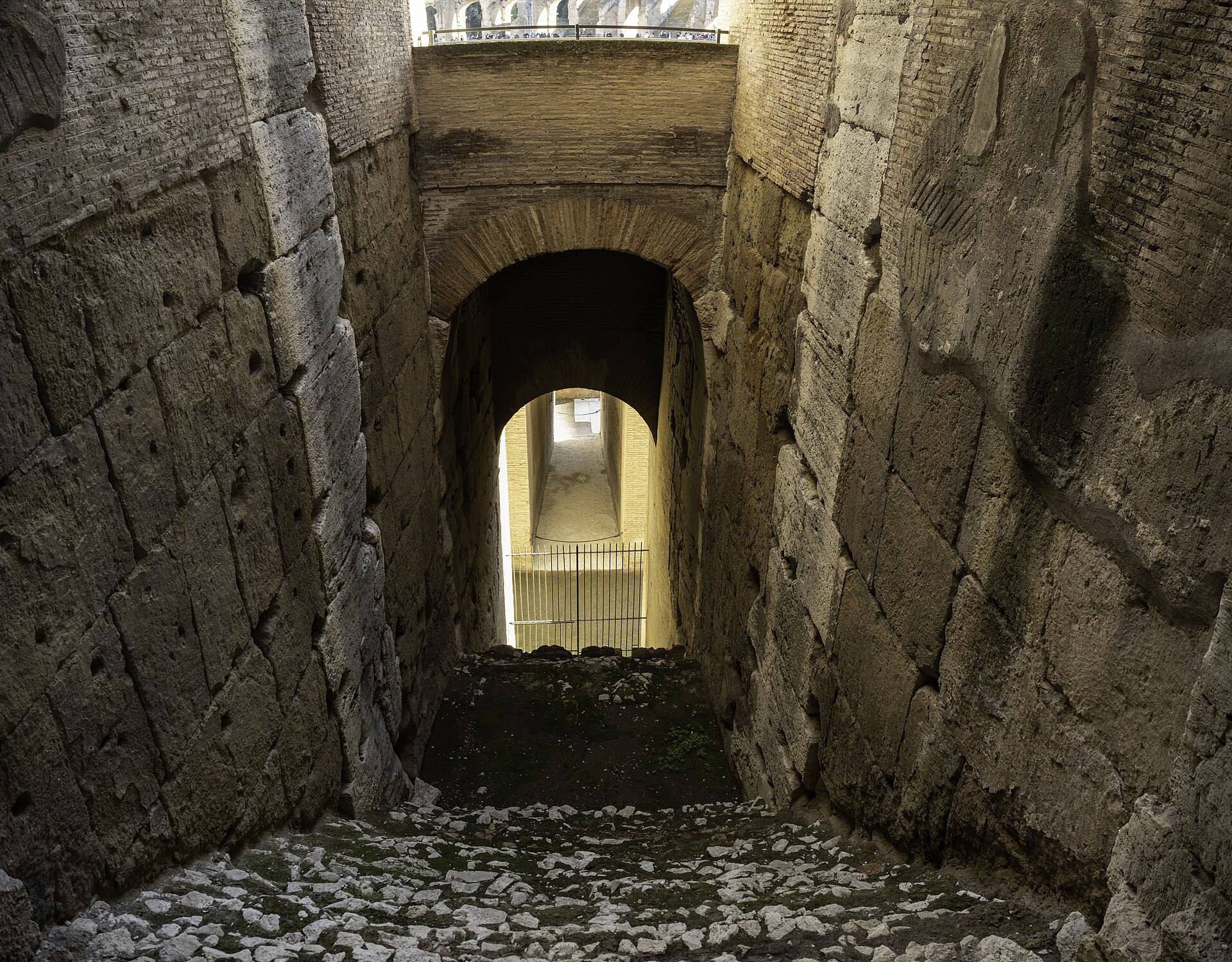
Rating: Refuted (the number); Unsupported (the place). No ancient writer gives a figure in the millions, and the estimates of historians who have tried to count, from Gibbon's "somewhat less than two thousand" for the Great Persecution to Frend's few thousand, are far lower.30 The Colosseum is never named in any early martyr text. The 1908 Catholic Encyclopedia reported that in the Middle Ages "no tradition existed in Rome which associated the martyrs in any way with the Coliseum," and summed up the view of the Bollandist scholar Hippolyte Delehaye: he did not deny that martyrs may have died there, "but we know nothing on the subject one way or the other." The building's link to the martyrs grew in the early modern period; Pope Benedict XIV (1740 to 1758) erected Stations of the Cross inside it.13 Christians certainly died in arenas, at Smyrna, Lyon and Carthage, and probably at Rome; the Colosseum in particular is not attested.
"Lawrence was roasted on a gridiron and told his executioners to turn him over"
Rating: Unsupported. Lawrence's death in 258 and his grave on the Via Tiburtina are documented. The gridiron and the saying ("The flesh is roasted, turn it and eat") first appear in Ambrose about 388, some 130 years later.27 The 1910 Catholic Encyclopedia said the manner of execution "gives rise to grave doubts."26 Death by the sword, as for his bishop, is more likely, though no early source says so.
"Christians were persecuted without a break for three hundred years"
Rating: Partly supported. From Trajan's time a Christian who was accused and refused to sacrifice could be executed, so the legal danger lasted from at least the early 2nd century to 311 to 313.1 But actual trials were local and occasional, and empire-wide drives covered only 250 to 251, 257 to 260 and 303 to 311 or 313. In long stretches, such as the decades before 303, the church grew openly, built large churches (Lactantius describes the "very lofty edifice" at Nicomedia) and had members in the imperial household.9
"Tertullian said, 'The blood of the martyrs is the seed of the church'"
Rating: Partly supported. The idea is Tertullian's, the wording is a later polish. His Apology (about 197) reads: "The oftener we are mown down by you, the more in number we grow; the blood of Christians is seed."3
"Polycarp told the governor he had served Christ for eighty-six years"
Rating: Supported. The Smyrna letter, written within about a year, gives the words: "Eighty and six years have I served Him, and He never did me any injury."15 Whether "eighty-six years" means his age or his years since baptism is debated.
"Ignatius was eaten by lions in the Colosseum"
Rating: Unsupported. Ignatius expected to die by wild beasts at Rome, and Irenaeus and Eusebius say he did.12 No early source names the place or the kind of animal. The Colosseum location is a later belief, and the 1908 Catholic Encyclopedia called the evidence for it "far from decisive."13
"Christians hid from persecution in the catacombs"
Rating: Unsupported. The catacombs were burial grounds, owned and used openly by the church in the 3rd century, and their locations were known to the authorities. Valerian's first edict of 257 banned Christians from entering their cemeteries; at Alexandria the prefect told Bishop Dionysius that "it shall by no means be permitted you or any others, either to hold assemblies, or to enter into the so called cemeteries,"36 and Xystus II was arrested and killed precisely because he was found in one: he "was martyred in the cemetery."7 A cemetery was among the worst places to hide.
"There were ten great persecutions"
Rating: Unsupported. The count of ten is a scheme from writers of the late 4th and 5th centuries, such as the historian Orosius, who matched the persecutions to the ten plagues of Egypt. Augustine reported the same scheme in The City of God 18.52, listing "the first that made by Nero" through "the tenth by Diocletian and Maximian," and said he did not think the number was fixed by prophecy.35 The list (Nero, Domitian, Trajan, Marcus Aurelius, Septimius Severus, Maximinus, Decius, Valerian, Aurelian, Diocletian) mixes real empire-wide drives with local or doubtful episodes. Foxe's Actes and Monuments kept the scheme in the 16th century.
"The persecution of the early Christians is a myth"
Rating: Refuted (in the strong form). The deaths in this lesson rest on letters, court records and a diary written at the time, and Roman sources (Pliny, the edicts reported by Eusebius and Lactantius) confirm the policy. Candida Moss, whose book title is often quoted in this form, does not deny that Christians were executed; she argues that the persecution was shorter and more limited than later Christian memory made it, and that many martyr texts were edited or invented later.31 That narrower argument is a scholarly position open to debate; the strong slogan is not supported by the evidence.
Hard questions and answers
Did the martyrs want to die?
Some did, and the early church argued about it. Ignatius begged the Roman Christians not to save him: "do not hinder me from living," by which he meant dying for Christ.10 But the Martyrdom of Polycarp deliberately sets its hero against a Phrygian named Quintus, who gave himself up and then lost his nerve and sacrificed; the letter says that the church does not praise those who come forward of their own accord, since the Gospel does not teach this (a paraphrase of chapter 4). Polycarp himself left the city, and Cyprian hid during the Decian persecution. The mainstream view, already in the 2nd and 3rd centuries, was that a Christian should not seek arrest but must not deny Christ when arrested. Those who volunteered were a minority, and the church's own texts criticized them.
Were the Roman officials persecutors, or magistrates enforcing the law?
Both descriptions fit the records, and the records themselves show both. The trials of Justin, the Scillitans and Cyprian are orderly: questions, an offer of pardon, a delay offered at Scilli, a sentence read from a tablet, death by the sword. The officials were applying a rule they believed protected the community's peace with its gods. At the same time, the law punished people for a name and a refusal, with no other crime charged, and in Lyon and Carthage it allowed torture and public killing by animals for the entertainment of crowds. A fair account gives the officials' reasons in their own terms (sacrifice for the emperor's safety, the gods' favour) and states plainly what was done to the accused.
Why trust records written by the martyrs' own communities?
For the same reasons historians trust any interested source when it passes certain tests. Several of these texts are close to the events (letters and a diary from before the deaths; a church letter within a year; court records). They name officials who can be checked from other evidence: Statius Quadratus at Smyrna, Rusticus at Rome, Saturninus at Carthage, Galerius Maximus in 258. Some record the community's own failures, such as the lapses at Lyon and the volunteer Quintus at Smyrna. And they agree with Roman sources (Pliny's letter, the edicts) on how the trials worked. Where the texts add miracles, or where they were written long after, they are weaker, and this lesson marks those parts as tradition or legend.
Do Catholics, Orthodox and Protestants read these martyrs differently?
They honour the same people and differ on what follows from it. The Smyrna letter's care for Polycarp's bones and the yearly feast are the earliest evidence for the cult of martyrs and relics, which Catholic and Orthodox churches see as continuous with their practice of venerating saints and asking their prayers. Protestant readers have generally valued the same texts as examples of faithful witness and have objected to later devotional practices that grew from them. John Foxe began his Actes and Monuments with the persecutions of the early church, setting the Protestant martyrs of his own day in the same line, while Catholic writers have pointed out that the early martyrs were bishops and members of a church with bishops, a liturgy and a calendar of saints. Both claims rest on true features of the record; neither church owns these martyrs. Their place in Foxe is treated in lesson 01.
Why are so many of the best-recorded martyrs women and slaves?
Partly because the sources chose to tell their stories. Blandina was a slave; Felicity was a slave; Perpetua was a young mother; Agnes was, by tradition, a girl. The early texts present their endurance as proof that the faith gave strength to people Roman society counted as weak, and the Lyon letter says so outright about Blandina. The texts also preserve a rare thing: Perpetua's diary is among the very few surviving writings by any woman of the Roman Empire describing her own life. That the stories served a purpose does not make the deaths less real; it does mean readers should notice what the editors chose to stress.
Did persecution make the church grow, as Tertullian claimed?
The church did grow through the persecutions, and the martyrs' deaths were public events that drew attention. But the evidence does not show that the persecutions caused the growth. The fastest growth seems to have come in the quiet decades of the later 3rd century, and the Decian persecution produced mass lapses as well as heroes. Tertullian was arguing with his opponents, and he offered no statistics: his point was that killing Christians would not stop them.3 The historian can say that persecution failed to stop the church; whether it helped is a matter of judgment that no source settles.
The age of the martyrs in one view
The martyrs from Ignatius to Agnes died under a single legal question asked over and over: are you a Christian, and will you sacrifice? The answers recorded at Smyrna, Rome, Lyon and Carthage are often the same few words, "I am a Christian" and "Thanks be to God." The records of this age are among the best of any period in this module: for seven of the nine briefs, the earliest text was written by the martyr, by eyewitnesses or by the court within a few years. Around those records, later centuries built traditions, some faithful to the record and some not: the gridiron, the Colosseum, Agnes's miracles, the ten persecutions. The task of reading these stories well is to keep the two apart without discarding either, because the traditions are themselves evidence of how the church remembered its dead.
The persecutions ended in 311 to 313 with Galerius's edict and the Edict of Milan, and within a generation Christians held power in the empire. Lesson 04 follows the martyrs beyond the Roman frontier, to Persia and Armenia, and into the Christian Middle Ages, where for the first time Christians would also be the ones carrying out the sentences. The policy history behind this lesson is in Module 79, lesson 03, and the change under Constantine in Module 79, lesson 04.
Learn more
- Module 79, lesson 03: Persecution and the Apologists: The policy history behind this lesson: Pliny and Trajan, Decius and the lapsed, Valerian, Diocletian, and the apologists.
- Module 79, lesson 04: Constantine and Nicaea: How the persecutions ended and what changed for the church after 313.
- The Martyrdom of Polycarp (ANF vol. 1): Read the whole letter from Smyrna; it is short and is the oldest Christian martyr account outside the New Testament.
- The Passion of Perpetua and Felicitas (ANF vol. 3): Read Perpetua's own section and the editor's frame side by side.
- Eusebius, Church History 5.1: the martyrs of Lyon and Vienne: The full letter from Lyon, including the lapses and returns the community recorded.
- Lesson 01: What a Martyr Is, and How to Weigh the Sources: The record strength key and how martyr lists, acta and passions were kept.
Still being checked (10 items)
These points could not be confirmed against a primary source when this lesson was written and fact checked in October 2026. The text above states each one as uncertain.
- The years of Ignatius's death (traditionally about 107 to 117) and of Polycarp's death (155 to 167) are disputed; no source gives the year directly.
- P. N. Harrison's 1936 two-letter theory of Polycarp's Philippians, the Oliver and Palmer (1955) theory linking the Lyon persecution to a senatorial decree on gladiator prices, and the Franchi de' Cavalieri passus/assus theory for Lawrence are summarized from general scholarly knowledge; the original works were not opened.
- The estimate of about 3,000 to 3,500 deaths in the Great Persecution, often credited to Frend, was not confirmed in Frend (1965) or any other work by page; the text now says so.
- Barnes (2008) on the date of Ignatius and Moss (2010) on the dating of the Martyrdom of Polycarp are cited from bibliographic knowledge; the articles were not opened.
- The Acta Proconsularia of Cyprian are paraphrased (not quoted) because no public domain English text could be opened; details (twenty-five gold pieces, field of Sextus, "Thanks be to God") agree in two secondary web versions, and Pontius's Life (opened) agrees on the sword, the bandaged eyes and the trees.
- The attribution of the ten-persecutions scheme to Orosius and its use by Foxe were not checked in those texts; Augustine's report of the scheme (City of God 18.52) was checked.
- Prudentius's dates (about 400), the 1969 removal of Cyprian of Antioch and Justina from the Roman general calendar, the Ignatius feast days (October 17 Roman, December 20 Byzantine) and the 48 names of the Lyon martyrs in Gregory of Tours were not checked against a source.
- The suggestion that Tertullian edited the Passion of Perpetua, and the readings of Brent Shaw and Joyce Salisbury, are summarized without opening their works.
- Augustine's sermons on the feast of Perpetua and Felicity and his caution that the Passion is not canonical Scripture (in his work on the soul and its origin) were not opened.
- That the Ante-Nicene translation of the Acts of Justin follows Musurillo's recension B (a longer form than A) is from the 1885 date of the translation and general knowledge of the manuscript history; Musurillo's edition was not opened.
Notes
- Pliny the Younger, Letters 10.96 (Pliny to Trajan) and 10.97 (Trajan to Pliny), written about 111 to 113, in Letters of Pliny, trans. William Melmoth, rev. F. C. T. Bosanquet, Project Gutenberg ebook 2811 (retrieved Oct. 28, 2026). Read it online. ↩
- Tertullian, Apology 40 (about 197), trans. S. Thelwall, Ante-Nicene Fathers vol. 3 (Buffalo: Christian Literature Publishing, 1885), Christian Classics Ethereal Library (retrieved Oct. 28, 2026). Read it online. ↩
- Tertullian, Apology 50, trans. S. Thelwall, Ante-Nicene Fathers vol. 3 (1885), Christian Classics Ethereal Library (retrieved Oct. 28, 2026). Read it online. ↩
- Eusebius, Church History 5.1 (the letter of the churches of Vienne and Lyon, 177), trans. Arthur Cushman McGiffert, Nicene and Post-Nicene Fathers, 2nd series, vol. 1 (1890), sections 3, 10, 14, 19, 20, 29, 31, 37, 38, 44, 47, 53, 56 and 62, Christian Classics Ethereal Library (retrieved Oct. 28, 2026). Read it online. ↩
- G. E. M. de Ste. Croix, "Why Were the Early Christians Persecuted?" Past and Present 26 (1963), pp. 6 to 38 (reprinted in his Christian Persecution, Martyrdom, and Orthodoxy, Oxford University Press, 2006). ↩
- W. H. C. Frend, Martyrdom and Persecution in the Early Church: A Study of a Conflict from the Maccabees to Donatus (Oxford: Basil Blackwell, 1965). ↩
- Cyprian of Carthage, Epistle 81 (numbered 80 in modern editions), to Successus, August 258, trans. Ernest Wallis, Ante-Nicene Fathers vol. 5 (1886), New Advent (retrieved Oct. 28, 2026). Read it online. ↩
- Eusebius, Church History 8.2.4 to 8.2.5, trans. Arthur Cushman McGiffert, Nicene and Post-Nicene Fathers, 2nd series, vol. 1 (1890), Christian Classics Ethereal Library (retrieved Oct. 28, 2026). Read it online. ↩
- Lactantius, Of the Manner in Which the Persecutors Died 12, 13, 34, 35 and 48 (written about 314 to 316), trans. William Fletcher, Ante-Nicene Fathers vol. 7 (1886), New Advent (retrieved Oct. 28, 2026). Read it online. ↩
- Ignatius of Antioch, Epistle to the Romans 4, 5, 6 and 10, trans. Alexander Roberts and James Donaldson, Ante-Nicene Fathers vol. 1 (1885), New Advent (retrieved Oct. 28, 2026). Quotations follow the 1885 printed wording (the New Advent page modernizes some archaic words, such as "Suffer" and "thee"); the same text is in the CCEL edition of the volume. Read it online. ↩
- Polycarp of Smyrna, Epistle to the Philippians 9 and 13, trans. Alexander Roberts and James Donaldson, Ante-Nicene Fathers vol. 1 (1885), New Advent (retrieved Oct. 28, 2026). Read it online. ↩
- Eusebius, Church History 3.36.3 to 3.36.12 (quoting Irenaeus, Against Heresies 5.28.4), trans. Arthur Cushman McGiffert, Nicene and Post-Nicene Fathers, 2nd series, vol. 1 (1890), Christian Classics Ethereal Library (retrieved Oct. 28, 2026). Read it online. ↩
- Maurice M. Hassett, "The Coliseum," The Catholic Encyclopedia vol. 4 (New York: Robert Appleton Company, 1908), a 1900s Catholic reference work, New Advent (retrieved Oct. 28, 2026). Read it online. ↩
- Timothy D. Barnes, "The Date of Ignatius," The Expository Times 120, no. 3 (2008), pp. 119 to 130. ↩
- The Martyrdom of Polycarp (The Encyclical Epistle of the Church at Smyrna), greeting and chapters 1, 3, 9, 10, 12, 15, 16, 18, 20 and 21, trans. Alexander Roberts and James Donaldson, Ante-Nicene Fathers vol. 1 (1885), New Advent (retrieved Oct. 28, 2026). Quotations follow the 1885 printed wording (the New Advent page modernizes "thee" and "thyself"); checked against the CCEL edition of the volume. For "we do not commend those who give themselves up [to suffering], seeing the Gospel does not teach so to do," see chapter 4. Read it online. ↩
- Eusebius, Church History 4.15, with the translator's notes on the date of Polycarp's death, trans. Arthur Cushman McGiffert, Nicene and Post-Nicene Fathers, 2nd series, vol. 1 (1890), Christian Classics Ethereal Library (retrieved Oct. 28, 2026). Read it online. ↩
- Candida R. Moss, "On the Dating of Polycarp: Rethinking the Place of the Martyrdom of Polycarp in the History of Christianity," Early Christianity 1 (2010), pp. 539 to 574. ↩
- Herbert Musurillo, ed. and trans., The Acts of the Christian Martyrs (Oxford: Clarendon Press, 1972), introduction; Acts of Justin and Companions (recensions A, B and C); Acts of Cyprian (Acta Proconsularia). ↩
- The Martyrdom of Justin (The Martyrdom of the Holy Martyrs Justin, Chariton, Charites, Paeon and Liberianus), trans. Marcus Dods, Ante-Nicene Fathers vol. 1 (1885), New Advent (retrieved Oct. 28, 2026). Read it online. ↩
- Eusebius, Church History 5, introduction (5.pref.1 to 2), trans. Arthur Cushman McGiffert, Nicene and Post-Nicene Fathers, 2nd series, vol. 1 (1890), Christian Classics Ethereal Library (retrieved Oct. 28, 2026). Read it online. ↩
- The Passion of the Scillitan Martyrs (July 17, 180), trans. J. Armitage Robinson, Ante-Nicene Fathers vol. 9 (1896), text at Early Christian Writings (retrieved Oct. 28, 2026). Read it online. ↩
- The Passion of the Holy Martyrs Perpetua and Felicitas (203), trans. R. E. Wallis, Ante-Nicene Fathers vol. 3 (1885), New Advent (retrieved Oct. 28, 2026). Read it online. ↩
- The Chronography of 354, part 12, Depositio Martyrum (the Roman list of martyrs' feast days and burial places), Latin text, ed. Roger Pearse, tertullian.org (retrieved Oct. 28, 2026). Read it online. ↩
- Pontius the Deacon, The Life and Passion of Cyprian, Bishop and Martyr 11 to 19 (written soon after 258), trans. Ernest Wallis, Ante-Nicene Fathers vol. 5 (1886), Christian Classics Ethereal Library (retrieved Oct. 28, 2026). Read it online. ↩
- Edward Gibbon, The History of the Decline and Fall of the Roman Empire, vol. 1 (1776), chapter 16, part 4, with editorial notes, Christian Classics Ethereal Library (retrieved Oct. 28, 2026). Read it online. ↩
- Johann Peter Kirsch, "St. Lawrence," The Catholic Encyclopedia vol. 9 (New York: Robert Appleton Company, 1910), a 1910s Catholic reference work, New Advent (retrieved Oct. 28, 2026). Read it online. ↩
- Ambrose of Milan, On the Duties of the Clergy 1.41.214 to 216 (about 388), trans. H. de Romestin, Nicene and Post-Nicene Fathers, 2nd series, vol. 10 (1896), Christian Classics Ethereal Library (retrieved Oct. 28, 2026). Read it online. ↩
- Ambrose of Milan, On the Duties of the Clergy 2.28.140, trans. H. de Romestin, Nicene and Post-Nicene Fathers, 2nd series, vol. 10 (1896), Christian Classics Ethereal Library (retrieved Oct. 28, 2026). Read it online. ↩
- Ambrose of Milan, Concerning Virgins 1.2.7 (377), trans. H. de Romestin, Nicene and Post-Nicene Fathers, 2nd series, vol. 10 (1896), New Advent (retrieved Oct. 28, 2026). Read it online. ↩
- Edward Gibbon, The History of the Decline and Fall of the Roman Empire, vol. 1 (1776), chapter 16, part 8 (his estimate of the number of martyrs), Christian Classics Ethereal Library (retrieved Oct. 28, 2026). Read it online. ↩
- Candida Moss, The Myth of Persecution: How Early Christians Invented a Story of Martyrdom (New York: HarperOne, 2013). ↩
- The Martyrdom of Polycarp 21, trans. J. B. Lightfoot, The Apostolic Fathers (London: Macmillan, 1891), text at Early Christian Writings (retrieved Oct. 28, 2026). Read it online. ↩
- Johann Peter Kirsch, "St. Agnes of Rome," The Catholic Encyclopedia vol. 1 (New York: Robert Appleton Company, 1907), a 1900s Catholic reference work, on Damasus's inscription ("the martyrdom of fire"), Constantina's basilica, Pope Honorius's rebuilding and the blessing of the lambs, New Advent (retrieved Oct. 28, 2026). Read it online. ↩
- N. Clayton Croy, review of Candida Moss, The Myth of Persecution, Review of Biblical Literature (Society of Biblical Literature, 2013), quoting Moss, p. 129, reprinted at MercatorNet (retrieved Oct. 28, 2026). Read it online. ↩
- Augustine, The City of God 18.52 (written about 413 to 426), trans. Marcus Dods, Nicene and Post-Nicene Fathers, 1st series, vol. 2 (1887), New Advent (retrieved Oct. 28, 2026). Read it online. ↩
- Eusebius, Church History 7.11.10 (Dionysius of Alexandria quoting the prefect Aemilianus, 257), trans. Arthur Cushman McGiffert, Nicene and Post-Nicene Fathers, 2nd series, vol. 1 (1890), New Advent (retrieved Oct. 28, 2026). Read it online. ↩
Check yourself
1. Under the rule Trajan set out in his reply to Pliny, what was to happen to a Christian who was properly accused but denied being a Christian and worshipped the gods?
Trajan wrote that Christians were not to be sought out, anonymous accusations were not to be accepted, and anyone who denied it and proved it by worshipping the gods was to be pardoned (Pliny, Letters 10.97).
2. What is the earliest source for the condemnation of Ignatius of Antioch?
Ignatius wrote seven letters while under guard, including the letter to the Romans asking them not to prevent his death. The trial before Trajan is a later legend.
3. Which date for Polycarp's death did the translator's notes in the standard English Eusebius call almost universally accepted?
Building on Waddington's study of the proconsul Statius Quadratus, the McGiffert notes give 154 to 156, probably 155. Eusebius had placed it under Marcus Aurelius.
4. What did Speratus say was in the case the Scillitan martyrs carried?
The Passion of the Scillitan Martyrs records Speratus's answer: "Books and epistles of Paul, a just man," early evidence for Paul's letters in Latin Africa.
5. Why is the Passion of Perpetua and Felicity unusual among martyr texts?
The editor says that Perpetua will narrate her martyrdom "as she left it described by her own hand and with her own mind."
6. When is the gridiron story of Lawrence first attested?
Cyprian reports only Xystus's death; the Chronograph gives Lawrence's day and grave; Ambrose, about 130 years after the death, is the first to tell the gridiron story.
7. How did Edward Gibbon estimate the number of martyrs in the Great Persecution?
Gibbon counted ninety-two martyrs in Eusebius's Martyrs of Palestine and extrapolated to the empire, concluding the total would be "somewhat less than two thousand persons."
8. Why does the claim that Christians hid in the catacombs fail?
The catacombs were church burial grounds whose sites were known; Valerian barred Christians from them, and Cyprian reports that Xystus "was martyred in the cemetery."
Terms in this lesson
- Acta (acts)
- Martyr texts presented as the record of a trial, usually question and answer before a magistrate followed by the sentence. The Acts of Justin and of the Scillitans are examples.
- Passio (passion)
- A narrative account of a martyr's arrest, suffering and death, often with an editor's frame, such as the Passion of Perpetua and Felicity.
- Libellus
- A certificate issued in the Decian persecution of 250 confirming that its holder had sacrificed to the gods.
- Lapsed (lapsi)
- Christians who sacrificed, bought a certificate or otherwise denied the faith under persecution. Their readmission divided the church after 251.
- Confessor
- A Christian who confessed the faith before a magistrate and suffered for it but did not die.
- Proconsul
- The governor of a senatorial province such as Asia or Africa, with power to judge capital cases.
- Procurator
- An imperial official; at Carthage in 203 the procurator Hilarianus held the power of life and death because the proconsul had died.
- Rescript
- An emperor's written answer to an official's question, which then had the force of law, such as Trajan's reply to Pliny or Valerian's rescript of 258.
- Middle recension
- The collection of seven letters of Ignatius that most scholars accept as genuine, distinct from a shorter Syriac version and a longer expanded one.
- Depositio Martyrum
- The list of Roman martyrs' feast days and burial places in the Chronograph of 354, the oldest Roman calendar of martyrs.
- Great Persecution
- The persecution begun by edicts of Diocletian and his colleagues in 303, ending in the West after 305 and in the East with Galerius's edict of 311 and the Edict of Milan in 313.
- Damnatio ad bestias
- Condemnation to the beasts: execution by exposure to wild animals in an arena, a penalty for people without Roman citizenship.
Sources
- Ignatius of Antioch, Epistle to the Romans (ANF vol. 1, trans. Roberts and Donaldson) (early 2nd century) checked 2026-10
- Polycarp, Epistle to the Philippians (ANF vol. 1) (early 2nd century) checked 2026-10
- The Martyrdom of Polycarp (ANF vol. 1) (about 155 to 167) checked 2026-10
- The Martyrdom of Justin (ANF vol. 1, trans. Marcus Dods) (about 165) checked 2026-10
- Eusebius, Church History 3.36 (NPNF 2nd series vol. 1) (about 300 to 325) checked 2026-10
- Eusebius, Church History 4.15 (NPNF 2nd series vol. 1) (about 300 to 325) checked 2026-10
- Eusebius, Church History 5, introduction (NPNF 2nd series vol. 1) (about 300 to 325) checked 2026-10
- Eusebius, Church History 5.1, the letter of the churches of Vienne and Lyon (NPNF 2nd series vol. 1) (177, preserved about 300 to 325) checked 2026-10
- Eusebius, Church History 8.2 (NPNF 2nd series vol. 1) (about 311 to 325) checked 2026-10
- The Passion of the Scillitan Martyrs (ANF vol. 9, trans. J. Armitage Robinson) (180) checked 2026-10
- The Passion of Perpetua and Felicitas (ANF vol. 3, trans. R. E. Wallis) (203) checked 2026-10
- Tertullian, Apology 40 (ANF vol. 3) (about 197) checked 2026-10
- Tertullian, Apology 50 (ANF vol. 3) (about 197) checked 2026-10
- Cyprian, Epistle 81 to Successus (ANF vol. 5) (258) checked 2026-10
- Pontius the Deacon, Life and Passion of Cyprian (ANF vol. 5) (about 258 to 260) checked 2026-10
- Lactantius, Of the Manner in Which the Persecutors Died (ANF vol. 7) (about 314 to 316) checked 2026-10
- The Chronography of 354, Depositio Martyrum (Latin text, ed. Roger Pearse) (354) checked 2026-10
- Ambrose, On the Duties of the Clergy 1.41 (NPNF 2nd series vol. 10) (about 388) checked 2026-10
- Ambrose, On the Duties of the Clergy 2.28 (NPNF 2nd series vol. 10) (about 388) checked 2026-10
- Ambrose, Concerning Virgins (NPNF 2nd series vol. 10) (377) checked 2026-10
- Pliny the Younger, Letters (trans. Melmoth, rev. Bosanquet), Project Gutenberg (about 111 to 113) checked 2026-10
- Edward Gibbon, Decline and Fall of the Roman Empire, chapter 16, part 4 (1776) checked 2026-10
- Edward Gibbon, Decline and Fall of the Roman Empire, chapter 16, part 8 (1776) checked 2026-10
- Catholic Encyclopedia (1908), "The Coliseum," by Maurice M. Hassett (1908) checked 2026-10
- Catholic Encyclopedia (1910), "St. Lawrence," by Johann Peter Kirsch (1910) checked 2026-10
- Herbert Musurillo, The Acts of the Christian Martyrs (Oxford: Clarendon Press) (1972) checked 2026-10
- W. H. C. Frend, Martyrdom and Persecution in the Early Church (Oxford: Blackwell) (1965) checked 2026-10
- G. E. M. de Ste. Croix, "Why Were the Early Christians Persecuted?" Past and Present 26 (1963) checked 2026-10
- Timothy D. Barnes, "The Date of Ignatius," The Expository Times 120 (2008) checked 2026-10
- Candida R. Moss, "On the Dating of Polycarp," Early Christianity 1 (2010) checked 2026-10
- Candida Moss, The Myth of Persecution (New York: HarperOne) (2013) checked 2026-10
- The Martyrdom of Polycarp, trans. J. B. Lightfoot (1891) (about 155 to 167) checked 2026-10
- Catholic Encyclopedia (1907), "St. Agnes of Rome," by Johann Peter Kirsch (1907) checked 2026-10
- N. Clayton Croy, review of Moss, The Myth of Persecution (Review of Biblical Literature, reprinted at MercatorNet) (2013) checked 2026-10
- Augustine, The City of God 18.52 (NPNF 1st series vol. 2) (about 413 to 426) checked 2026-10
- Eusebius, Church History 7 (NPNF 2nd series vol. 1) (about 300 to 325) checked 2026-10