Lesson 6 of 10 · about 55 minutes · Updated October 28, 2026
The Reformation, Protestant Martyrs: The Marian Fires, Cranmer, Anne Askew, Manz and Sattler
You'll be able to
- You'll be able to explain the heresy laws and procedures under which Catholic and Protestant authorities executed Protestants and Anabaptists between 1523 and 1569.
- You'll be able to give the date, place, charge and earliest source for each of the eight deaths profiled, and rate each on the record strength scale from lesson 01.
- You'll be able to separate what John Foxe and the Martyrs Mirror documented from what they reported or added, including the Latimer candle words and the Dirk Willems rescue.
- You'll be able to state the main counts of the Marian burnings, who made them, and why they differ.
- You'll be able to summarize Brad Gregory's comparison of Protestant, Catholic and Anabaptist martyrdom and describe who executed whom in this era.
- You'll be able to describe each side's stated reasons in its own words, using the Zurich mandate, the Marian sentences and the martyrs' own statements.
Start here: the short version
Between 1523 and 1569 thousands of Christians in Europe were put to death by other Christians for what they believed about the Mass, baptism, the pope and the Bible. Brad Gregory, the historian who has compared the martyrs of every side, puts the toll of judicial killings for religion in this era at some 5,000.1 This lesson profiles eight of those deaths on the Protestant and Anabaptist side: two Lutheran friars burned in Brussels (1523), the Anabaptist Felix Manz drowned by the Reformed council of Zurich (1527), Michael Sattler burned by Catholic Habsburg officials at Rottenburg (1527), Anne Askew burned under Henry VIII (1546), and four from the burnings under Queen Mary I of England (1555 to 1558): John Rogers, Hugh Latimer and Nicholas Ridley, and Thomas Cranmer, with the Dutch Anabaptist Dirk Willems (1569) to close. The records here are unusually rich: court sentences, the victims' own written examinations, printed recantations, and John Foxe's huge Actes and Monuments (1563 and later editions), which has to be read with care because it was also a work of Protestant persuasion. Lesson 07 tells the Catholic martyrs of the same decades under the same rules of evidence.
The era in brief: why Christians burned and drowned Christians
Every government in sixteenth century Europe, Catholic or Protestant, assumed that one realm should hold one true faith, and that a ruler who let heresy spread was failing in a duty to God and to the souls of subjects. Heresy, in the law inherited from the medieval church, was the stubborn holding of a belief the church had condemned. The church's court examined the accused, tried to persuade him or her to recant, and if the person refused, declared the heresy proved and handed the prisoner to the secular authority, which carried out the penalty. In most of Catholic Europe and in England the penalty for an unrepentant or relapsed heretic was burning. The Reformed city of Zurich chose drowning for rebaptizers. Anabaptists in Catholic lands were often beheaded (men) or drowned (women) as well as burned.
The deaths in this lesson fall into three groups by who did the killing.
- Catholic authorities killing Protestants. The Habsburg government of the Low Countries burned the first two Lutheran martyrs in 1523. Queen Mary I's government in England, after Parliament restored the old heresy statutes, burned about 280 to 290 people between February 1555 and November 1558 (the counts are set out below).
- Catholic and Protestant authorities killing Anabaptists. The Anabaptists ("rebaptizers") baptized adults who confessed faith and refused to baptize infants, swear oaths or bear the sword. Catholic courts treated them as heretics; the Reformed council of Zurich made rebaptism a drowning offence in March 1526.2 Gregory counts nearly 500 known or probable executions of Anabaptists in central Europe within a decade of 1525.1
- A crown at odds with both sides. Henry VIII of England broke with Rome but kept the Catholic doctrine of the Mass. On a single day in July 1540 his government burned three evangelical preachers as heretics and hanged three Catholic priests as traitors at Smithfield in London.3 Anne Askew died under the same king in 1546.
The courts stated their purpose plainly. The sentence that Stephen Gardiner, bishop of Winchester and Lord Chancellor, read against John Rogers in January 1555 asked that the punishment serve "to the salvation of thy soul, to the extirpation, terror, and conversion of the heretics, to the unity of the catholic faith."4 The Zurich council's mandate of March 7, 1526 warned that whoever rebaptized another would be drowned "on alle gnad" (without any mercy), so that "no one give cause for his own death."2 Each side, in its own words, saw itself as protecting the church and the common peace. The victims, in theirs, saw themselves as witnesses to the truth of Scripture against human tradition. This lesson gives both.
The policy history (the English Reformation under Henry VIII and Edward VI, the Anabaptists, the Council of Trent) is told in Church History Part A, lesson 11, Luther and the Reformation, and lesson 12, Zwingli, Calvin and the Wider Reformation. The Anabaptist churches and their martyr book are taught in Church History Part B, lesson 08, Anabaptists, and the Church of England in lesson 04. The record strength key used below (Documented, Strong tradition, Late tradition, Legend) is explained in lesson 01, and the pre-Reformation deaths of Hus, the Lollards and William Tyndale are in lesson 05.
How these deaths are known
Almost every death in this lesson rates "Documented" on the lesson 01 scale, because the sixteenth century left paper behind. The kinds of evidence differ, and each has its own strengths and dangers.
Court and council records
The Zurich council's mandates and its sentence on Felix Manz survive in the city archives and were printed by Emil Egli in 1879 in his Actensammlung zur Geschichte der Zürcher Reformation, a collection of the city's Reformation documents that is now public domain.5 The sentences on Michael Sattler and Dirk Willems survive in the copies printed by the Anabaptist martyrologies.67 In England, bishops' registers, Privy Council minutes and sheriffs' accounts record many of the Marian trials and burnings; the historian M. J. Leppard, comparing these for Sussex, found that the Privy Council ordered on June 12, 1555 that condemned heretics should suffer "in thre severall places of the shire."8
The martyrs' own writings
Anne Askew wrote an account of her own examinations, smuggled out and printed abroad by the reformer John Bale in 1546 and 1547. John Rogers wrote an account of his hearings before Gardiner, which Foxe printed. Cranmer's six submissions and recantations were printed by the Queen's printer, John Cawood, in 1556, from what the title page calls "the originalles, wrytten and subscribed with his owne hande."9 The Anabaptist Felix Manz left a hymn and a written defense. These texts are as close as historians can get to the person, but most of them passed through an editor's hands before they reached print.
John Foxe's Actes and Monuments
John Foxe, an English Protestant exile under Mary, published his Actes and Monuments in English in 1563 and expanded it in 1570, 1576 and 1583. It is the main source for most English deaths in this lesson. Foxe printed trial documents, letters and eyewitness reports, and modern work on his text (the Acts and Monuments Online variorum, built by a team that included Thomas Freeman, at dhi.ac.uk/foxe) has found that he rarely invented a martyr and often reproduced documents faithfully. He also selected, arranged and commented with a purpose, added material between editions, and sometimes repeated stories he could not check. Leppard's Sussex study gives an example of the danger in later hands: the earliest list of the Sussex martyrs, Thomas Brice's Compendious Register of 1559, puts the first three Sussex burnings under July 12, 1555 without naming a place, and Foxe's 1563 edition gives them without day or place, but later editors of Foxe, unaware of Brice, supplied separate days and places that Leppard concludes they "seem to have concocted."8 This lesson marks every report that rests on Foxe alone as Foxe's report, and names the edition where that matters. The online text quoted here is a nineteenth century edition of Foxe's later, expanded text.4
The Anabaptist martyrologies
The Dutch Mennonites collected their martyrs' letters, songs and sentences from the 1560s on. Thieleman van Braght's Het Bloedig Tooneel, known in English as the Martyrs Mirror (1660, illustrated edition 1685), gathered these collections with new material. Like Foxe, it reprints documents (the sentence on Dirk Willems is printed word for word, with the editor's note "we have come into possession of the sentence"), and like Foxe it was written to strengthen a persecuted church.7 Lesson 01 explains how both books are weighed.
Songs
The first Lutheran martyrs are known in part through a song. Martin Luther's ballad on their burning, printed in the Erfurt Enchiridion of 1524 under the title "A new song of the two martyrs of Christ, burned at Brussels by the sophists of Louvain," is both a source and a piece of advocacy.10
Hendrik Voes and Johann van Esschen
Died: July 1, 1523 (June 30 in some accounts) · Place: Brussels, the market square · Earliest source: Martin Luther, "Eyn new lied von den zween Merterern Christi," printed in the Erfurt Enchiridion, 1524, with reports and letters of 1523 · Record strength: Documented
What the record shows
Hendrik Voes and Johann van Esschen were young friars of the Augustinian house at Antwerp, the same order to which Martin Luther belonged. The Antwerp Augustinians had become known for preaching Luther's teaching on justification by faith, and in 1522 the government of the Habsburg Netherlands, acting for the Emperor Charles V, closed the house and arrested its friars. Most recanted. Voes and van Esschen did not. John Julian's Dictionary of Hymnology (1907), summarizing the German sources, says that "after examination by the Cologne Inquisitor, Jacob von Hogstraten, and at the instigation of the Louvain professors," the two were "condemned to death and burnt at the stake in Brussels."11 A third friar, usually named as Lambert Thorn, asked for time to study and was kept in prison, where he died some years later.
The death became known across Germany within weeks. Luther wrote a ballad on it, his first known hymn, printed in 1524: ten stanzas of nine lines in the Erfurt Enchiridion, and twelve once two more were added in a Wittenberg hymnal the same year. It names the two, "Der erst recht wol Johannes heyst" (the first is rightly called Johannes) and "Seynn bruder Henrich" (his brother Henrich), and calls them "Mertrer" (martyrs) who "fur seyn wort synd gestorben" (died for his word).10 It describes the steps of the process as a Lutheran heard of them: the friars were stripped of their habits and their priestly orders ("Sie raubten yhn das kloster kleyd / die weyh sye yhn auch namen"), given a written list of their errors to read, and burned in "Zwey grosse fewr" (two great fires), singing and praising God.10 The charge, as Luther summed it up with irony, was that they taught "Man mus allein got glauben" (one must believe God alone) and that human teachers lie.
Voes and van Esschen died as Lutherans at the hands of a Catholic government. The charge was heresy under the edicts Charles V had issued against Luther's teaching after the Diet of Worms in 1521, enforced in the Netherlands by the Emperor's officials and an inquisitor appointed for the purpose.
Tradition and legend
The best known lines associated with these two are not in Luther's first printing. The stanza English-language hymnals sing as "Flung to the heedless winds / Or on the waters cast," which tells that the martyrs' ashes were scattered but cannot be silenced, is a nineteenth century English paraphrase of a stanza that Julian says was "added in the Geystliche gesangk Buchleyn, Wittenberg, 1524."11 It is Luther's verse in a later form, and it is poetry about the meaning of the deaths. Lutheran calendars remember the two as the first martyrs of the Lutheran Reformation. This is a church's commemoration resting on a documented death.
What the sources dispute
The date is given as July 1, 1523 by most modern writers and as June 30 by Julian.11 The sharper dispute is about how the two men died. Luther's own song records that the other side was saying they had recanted at the last moment: "Sie sagen yn der letzten not / die knaben noch auff erden / sych sollen han vmbkeret" (they say that in the last extremity, while still on earth, the boys turned back).10 Luther dismissed this as a lie meant to cover the killing. No independent record that has been printed in an accessible source settles the question, so the dispute is open as far as the documents opened for this lesson go. What both sides agree on is the burning itself.
Felix Manz
Died: January 5, 1527 · Place: Zurich, drowned in the River Limmat · Earliest source: Sentence of the Zurich council, January 5, 1527 (city archives; printed in Egli, Actensammlung, 1879, no. 1109) · Record strength: Documented
What the record shows
Felix Manz was a Zurich man, educated in the biblical languages, who had followed Huldrych Zwingli's preaching from about 1519. With Conrad Grebel and others he came to believe that the Bible gave no warrant for baptizing infants and that the church should be a gathered body of confessing believers, separate from the city's government. After a public disputation in January 1525 the council ordered infants baptized; days later the group baptized one another as adults, and the Anabaptist movement began. Manz was arrested several times. On March 7, 1526 the council sentenced him, Grebel, George Blaurock and a group of men and women (among them Anna Manz) to prison on bread and water "until they die" and published the mandate already quoted: whoever rebaptized would be drowned.2
Manz escaped, preached and baptized again, and was taken once more in December 1526.12 The sentence of January 5, 1527, issued in the name of the imperial reeve, the burgomaster Roist, the councils and the citizens, survives. It states the city's case in the city's own words. Manz had entered into rebaptism "wider christenlich Ordnung und bruch" (against Christian order and custom) and was "ein rechter houptsächer und anfänger der dingen" (a true ringleader and beginner of these things). He had been shown from the Old and New Testaments that infant baptism was right, and had been warned "zum höchsten und brüederlich" (most earnestly and in brotherly fashion). He had nevertheless baptized a woman at Embrach within fourteen days of breaking out of prison, and he taught that "no Christian may be a ruler, nor judge another with the sword, nor kill or punish anyone." The council held that these teachings led to "embörung und ufruoren wider christenlich oberkeit" (rebellion and uprisings against Christian government) and to the breaking of the common peace.5 The quotations are from the sixteenth century Swiss German as Egli printed it; the English renderings were made for this lesson.
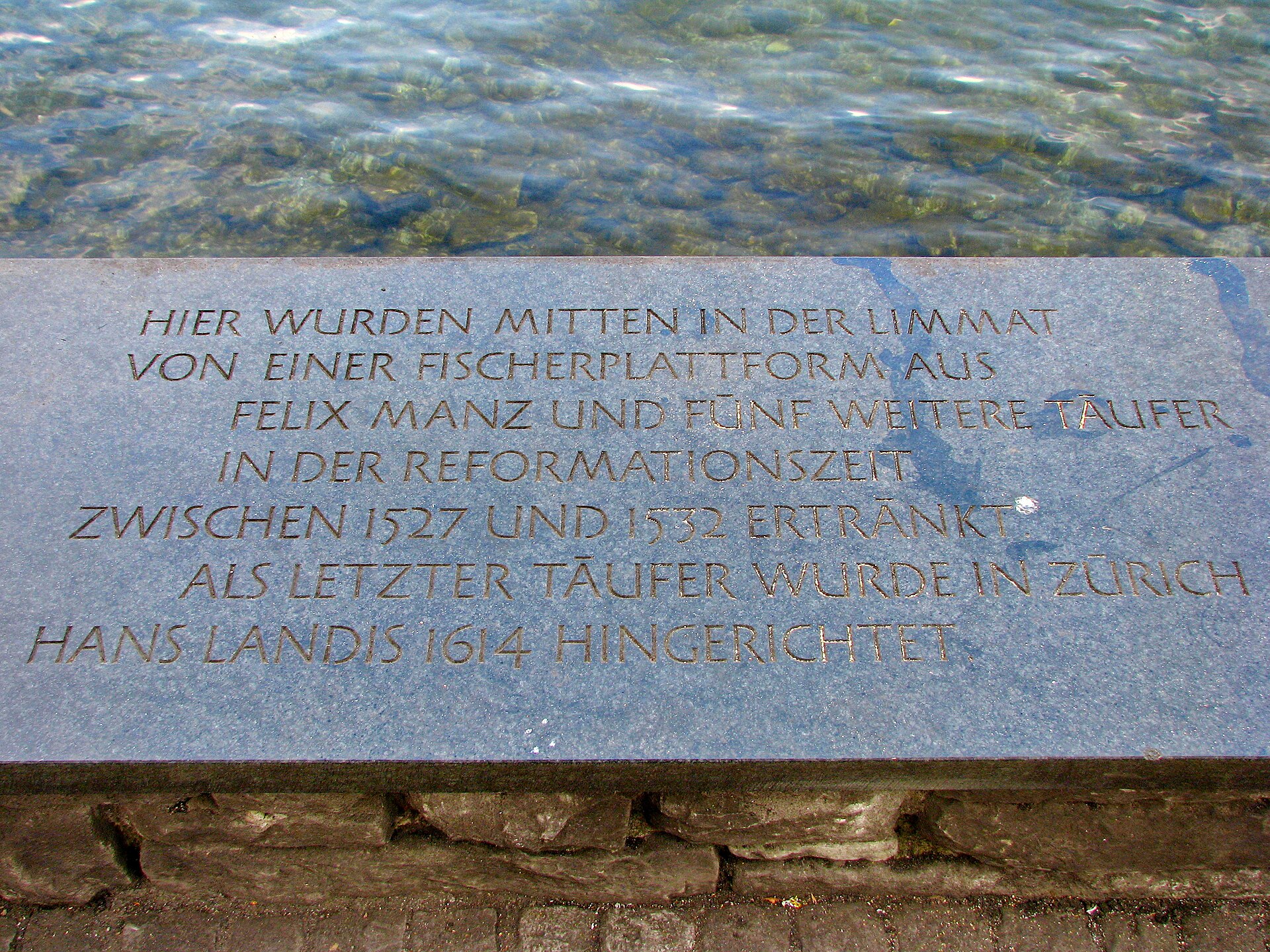
The sentence then prescribes the death: the executioner was to bind his hands, put him in a boat, take him to the lower fishing hut, bind his hands over his knees with a stick pushed between arms and legs, "und in also gebunden in das wasser werfen" (and throw him so bound into the water), there to die. His goods were forfeit to the council.5 He was the first Anabaptist put to death by a Protestant government. A plaque set into the river wall at the Schipfe in Zurich in 2004 states that Manz and five other Anabaptists were drowned there between 1527 and 1532, and that the last Anabaptist executed in Zurich was Hans Landis in 1614.13

Tradition and legend
Anabaptist tradition, carried by the martyrologies and by modern Mennonite retellings, adds that Manz's mother and brother stood on the bank and urged him to stay faithful, that he sang or prayed on the way to the boat, and that his last words were "Into thy hands, O God, I commend my spirit." These details are the movement's memory of the scene. They are not in the council's sentence, and the earliest written form of them was not traced for this lesson, so they are marked here as tradition. An eighteen stanza hymn ascribed to Manz, beginning "Mit Lust so will ich singen" (With joy I will sing), is preserved in the Ausbund, the Swiss Brethren hymnal still used by the Amish; the nineteenth century German biographer Ludwig Keller listed the song and a letter among his surviving writings.12
What the sources dispute
The chief disagreement is over the charge. The council's sentence treats Manz's offence as sedition as much as heresy: rebaptism, in its words, divided the Christian community, taught people to disobey their rulers and opened the way to "todschlag und alles Übels" (manslaughter and every evil).5 Anabaptist writers from the sixteenth century on have answered that Manz taught nonresistance and harmed no one, and that he died for baptism. No record charges Manz with any act of violence, and the sentence's own list of his deeds is of baptizing and teaching. The council was acting in the year after the Peasants' War of 1525, when unrest in the countryside had made magistrates fear any movement that told subjects the ruler's sword had no place among Christians. Zwingli's role is debated: he was not a judge, but the sentence says that Manz had been instructed by the city's "prädicanten" (preachers), and Zwingli wrote against the Anabaptists in these years. The descendants of both sides have since addressed the history together, as the 2004 plaque shows.13
Michael Sattler
Died: May 20 or 21, 1527 · Place: Rottenburg am Neckar, then under Habsburg Austrian rule · Earliest source: an account of the trial and sentence printed within months of the death (author uncertain), reprinted in the Dutch martyrologies and in van Braght, Martyrs Mirror, 1660 · Record strength: Documented
What the record shows
Michael Sattler had been a Benedictine monk, probably prior, at the abbey of Saint Peter in the Black Forest. He left the monastery during the upheavals of 1525, married a former Beguine named Margaretha, joined the Swiss Brethren, and in February 1527 presided over a meeting at Schleitheim near Schaffhausen that agreed on seven articles. The Schleitheim articles, dated "on Matthias' [Day], Anno MDXXVII" (February 24, 1527), state that baptism "shall be given to all those who have learned repentance and amendment of life," that "the sword is ordained of God outside the perfection of Christ," and that believers should not swear oaths.14 They became the founding statement of the Swiss Brethren.
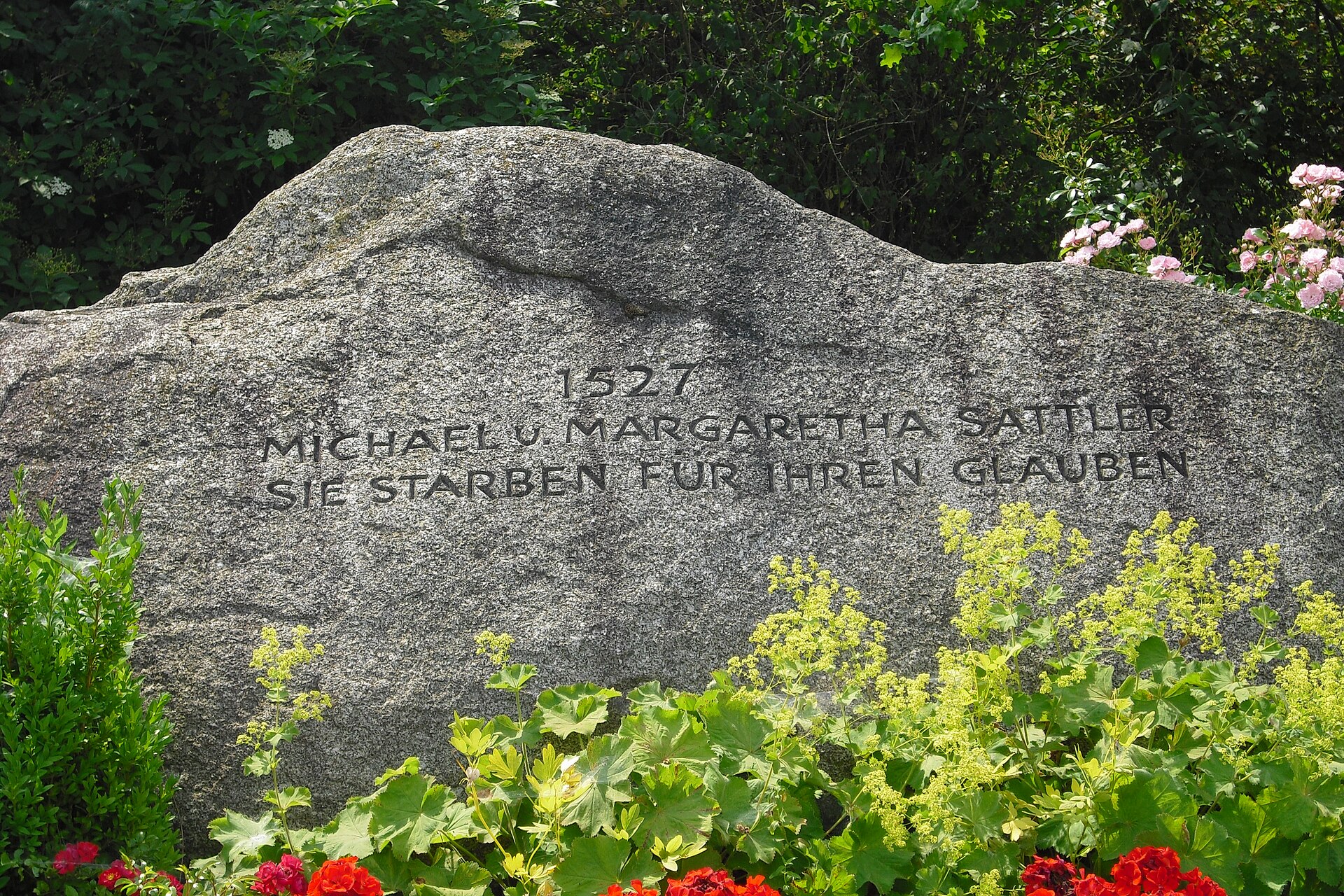
Within weeks Sattler, his wife and others were arrested by the officials of the Habsburg government of Further Austria and tried at Rottenburg. The account of the trial printed in the Martyrs Mirror (in the 1886 English translation of Joseph F. Sohm) lists the articles against him: that he and his followers had acted against the imperial mandate; that he taught that the body and blood of Christ were not present in the sacrament; that infant baptism did not help salvation; that he rejected extreme unction; that he despised the Mother of God and the saints; that he said one should not swear before the authorities; that he had introduced a new way of keeping the Lord's Supper, with the bread and wine laid on a plate; that he had left his order and married; and that he had said that if the Turks invaded, "we ought not to resist them."6 To that last article he answered that if war were right he would rather fight "the so-called Christians" who persecuted believers, since "The Turk is a true Turk, knows nothing of the Christian faith."6
The sentence, as the same account gives it, ordered that Sattler "shall be delivered to the executioner, who shall lead him to the place of execution, and cut out his tongue," tear his body twice with red hot tongs in the town and five times more outside the gate, and then burn him as an arch-heretic. The account dates the sentence "the 21st day of May, A. D. 1527." It adds that "His fellow brethren were executed with the sword, and the sisters drowned," and that his wife, after being "subjected to many entreaties, admonitions and threats," was drowned a few days afterward.6 Sattler was killed by Catholic authorities under imperial law against rebaptism and heresy.

Tradition and legend
Mennonite retellings add that Sattler prayed for his judges and that, when the ropes on his hands burned through, he raised two fingers as a sign agreed beforehand with his brethren that he remained steadfast. The finger signal belongs to later retelling and is not in the sentence; it is marked here as tradition. The Strasbourg reformers Martin Bucer and Wolfgang Capito, who had argued with Sattler shortly before, wrote of him with respect after his death even though they rejected his views; their letters are cited by historians, but their exact words were not verified for this lesson.
What the sources dispute
The date is given as May 20 by many modern writers, including the memorial at Rottenburg, and the account in the Martyrs Mirror dates the sentence May 21. The authorship of the trial account is uncertain: it has been described as the record of a sympathetic witness, a description that has been challenged.15 Nothing in the surviving record contradicts its list of charges or its sentence, but no official court record of the trial was traced for this lesson, so the exact wording rests on the printed account. The severity of the sentence (tongue, tongs, fire) marks Sattler as the leader: the court treated him as an arch-heretic, while his companions were beheaded or drowned.
Anne Askew
Died: July 16, 1546 · Place: Smithfield, London · Earliest source: her own Examinations, printed by John Bale, 1546 and 1547; reprinted by Foxe, 1563 · Record strength: Documented
What the record shows
Anne Askew was the daughter of Sir William Askew, a Lincolnshire knight, and had been married to Thomas Kyme, who turned her out of his house for her Protestant views. She came to London, read and quoted the Bible freely, and was examined for heresy in March 1545. Her own account of the first examination, in the text Foxe printed, records the questions put to her, beginning with whether she believed "that the sacrament hanging over the altar was the very body of Christ really."16 She answered with questions of her own and with Scripture, and when asked about a woman's report that she had said God was not in temples made with hands, she pointed to "chapters vii. and xvii. of the Acts of the Apostles; what Stephen and Paul had said therein."16 She was released, examined again in 1546 and condemned for denying the bodily presence of Christ in the Mass, which the Act of Six Articles of 1539 made a burning offence even for those who renounced Rome.
Her second narrative is the most unusual document in this lesson. After her condemnation she was taken to the Tower of London and questioned about which ladies at court shared her opinions. In her own words: "Then they did put me on the rack, because I confessed no ladies or gentlewomen to be of my opinion, and thereon they kept me a long time; and because I lay still, and did not cry, my lord chancellor and Master Rich took pains to rack me with their own hands, till I was nigh dead."16 The Lord Chancellor was Thomas Wriothesley and Master Rich was Sir Richard Rich, both members of the king's council. Racking a condemned woman of gentle birth was irregular even by the standards of the day.
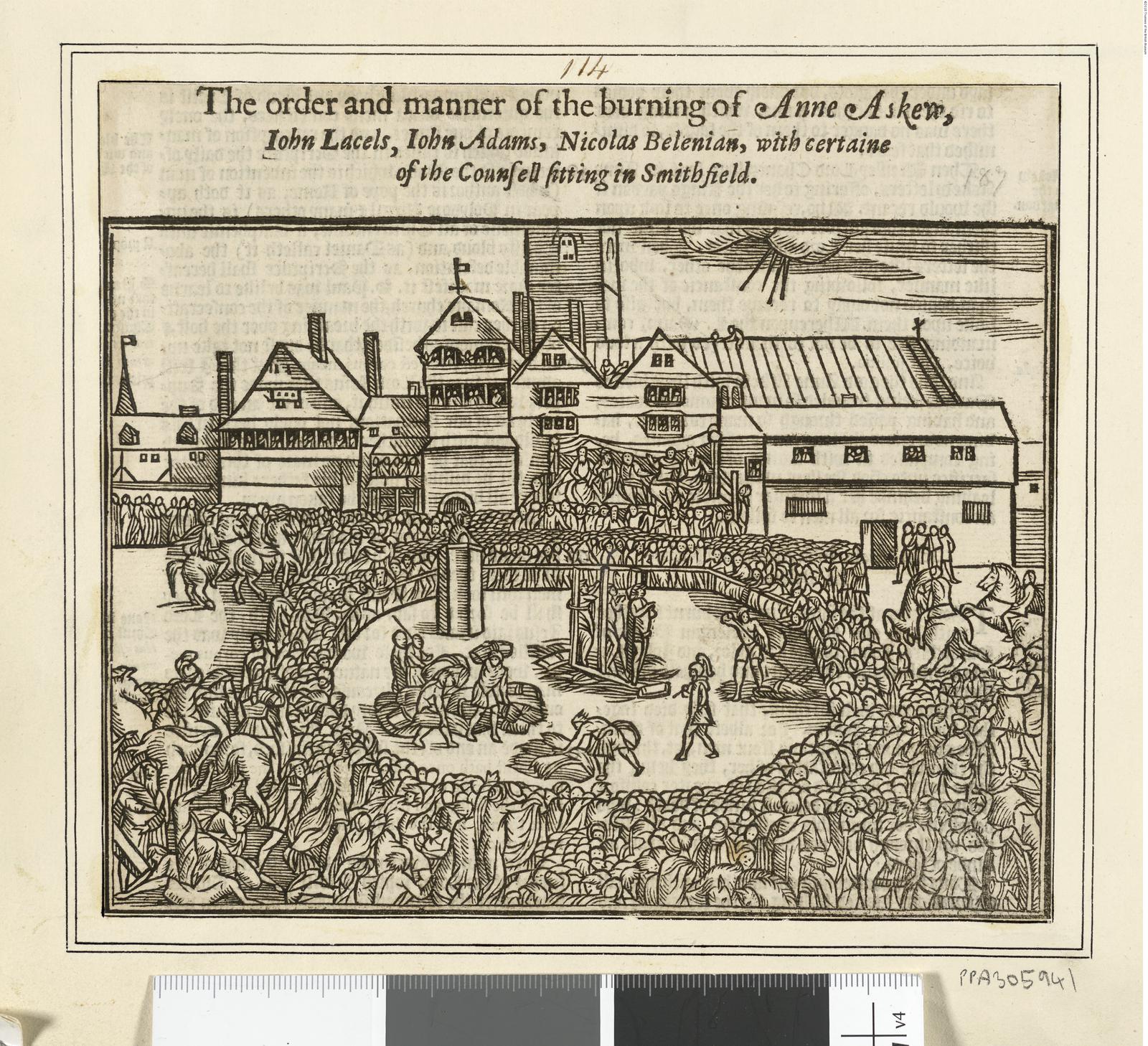
Foxe adds his own narrative, from informants he does not name, of how the Lieutenant of the Tower, Sir Anthony Knevet (Knyvett), refused to rack her further and hurried by boat to the king to excuse himself.16 On the day of execution she was carried to Smithfield "in a chair, because she could not go on her feet, by means of her great torments," and burned with three men (the court gentleman John Lascelles, Nicholas Belenian and John Adams). Foxe reports that Wriothesley sent letters offering the king's pardon if she would recant, and that she refused to look at them, saying "that she came not thither to deny her Lord and Master."16

Tradition and legend
Askew became a Protestant heroine almost at once, and later retellings built on Foxe's additions more than on her own text. Foxe reports that gunpowder was hung about the bodies "to rid them out of their pain," and that the earl of Bedford calmed an official on the bench who feared it would scatter the burning faggots; bags of gunpowder appear again at the Oxford burnings of 1555.16 Retellings in which Henry VIII personally stops the racking go beyond Foxe, who says only that the Lieutenant went to the king to ask pardon for refusing to continue. The portrait of her as a learned, witty woman answering bishops with Scripture comes from her own pages and is well grounded.
What the sources dispute
Askew's text did not reach print untouched. John Bale published it with his own long commentary, and Foxe in 1563 dropped Bale's commentary but added his own notes and the Knevet story. Literary historians, notably Elaine Beilin in her edition The Examinations of Anne Askew (1996), have studied how each editor shaped her voice; Thomas Freeman and Sarah Elizabeth Wall have examined how Foxe built his account of the racking from sources he did not name. The racking itself rests on Askew's first person statement, which no contemporary on the government side denied in any surviving record; the conversation between Knevet and the king rests on Foxe alone. Why the council pressed her so hard is also debated: many historians connect the questioning about court ladies to the struggle between religious conservatives and evangelicals around Queen Katherine Parr in 1546, a reading that fits the questions Askew recorded but goes beyond them.
The Marian burnings, 1555 to 1558
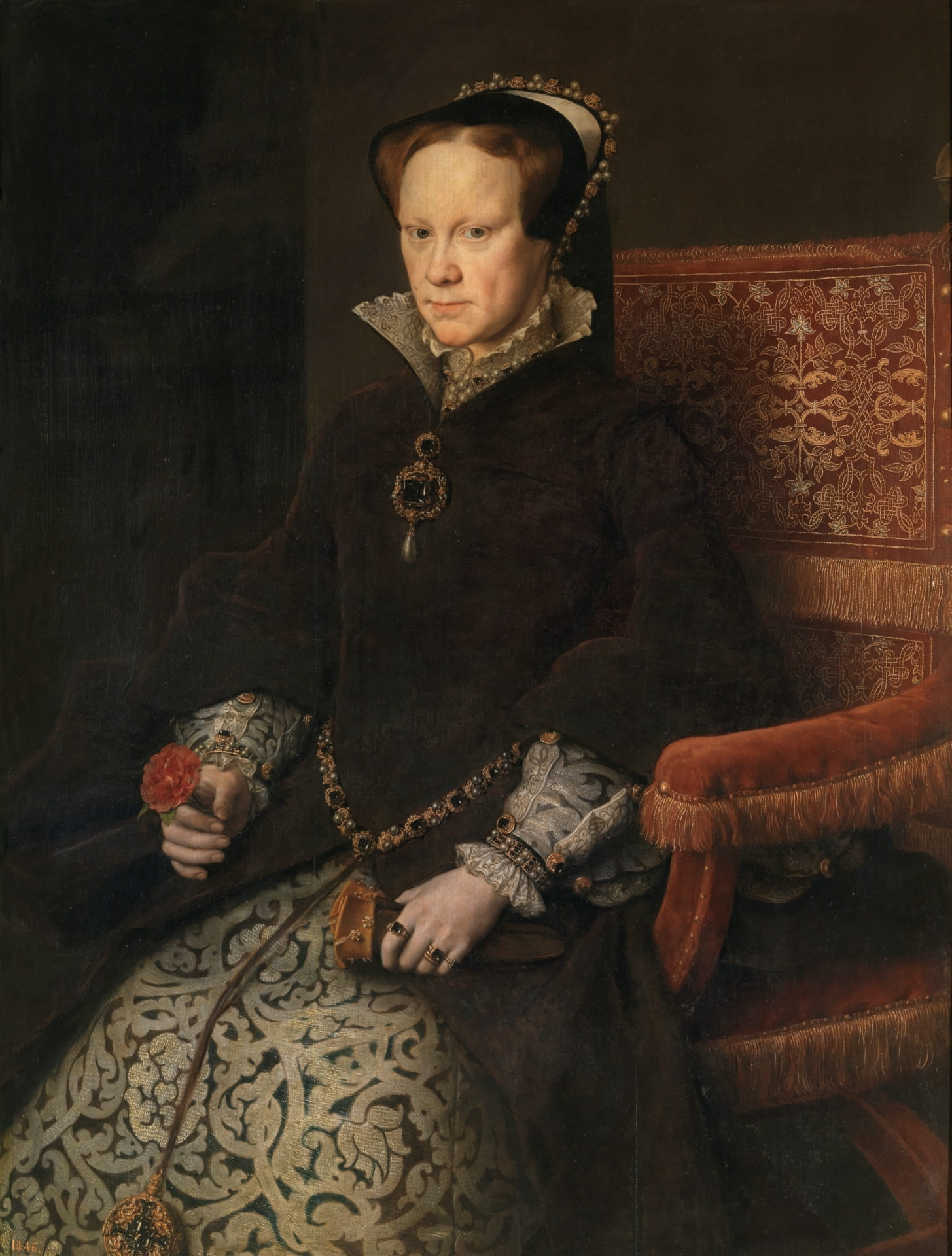
Mary I, daughter of Henry VIII and Catherine of Aragon, came to the throne in July 1553 after the death of her half brother Edward VI, under whom the Church of England had become Protestant in worship and doctrine. Mary restored the Mass and, with her husband Philip of Spain and the papal legate Cardinal Reginald Pole, reconciled England to Rome at the end of 1554. Parliament revived the medieval heresy statutes, and Eamon Duffy dates their coming into force to January 20, 1555.17 The first burning followed on February 4.

How many died, and who counts them
No official register of the Marian burnings survives as a single list. Every count is built from Foxe, from Thomas Brice's verse Compendious Register of 1559, from bishops' and sheriffs' records, and from local studies. The totals in recent scholarship cluster closely.
- Eamon Duffy, Fires of Faith: Catholic England under Mary Tudor (2009), works with a figure of about 284 burned, and notes about thirty more who died in prison.17 A review of Duffy's book in First Things gives the number as "some 284 Protestants in four years."18
- Kenneth O. Morgan's Oxford Illustrated History of Britain speaks of "a minimum of 287 persons after February 1555."19
- Foxe's own lists, which add those who died in prison and a few who were hanged, give larger figures, around 300; they were not meant as a statistical count.
The burnings were concentrated in London and the south east. A rough count by diocese, printed by the Protestant Reformation history site thereformation.info as an extract from W. H. Beckett's The English Reformation (1890), gives 112 in the diocese of London under Bishop Edmund Bonner, 52 in Canterbury, 32 in Norwich and 27 in Chichester, with single figures in the other dioceses and none in Winchester while Stephen Gardiner was its bishop.20 The Chichester figure matches Leppard's independent count of "at least 27 people" burned in Sussex, which was the diocese of Chichester.8 The diocesan figures should be read as approximate. They are shown below with that warning.
Who died
The martyrs of the Marian years were mostly ordinary people: weavers, husbandmen, servants, apprentices and their wives. Five bishops died (Hooper, Ferrar, Ridley, Latimer and Cranmer) along with some twenty other clergy, and about fifty-five were women.2019 Many had never held office in the church and were condemned after answering a bishop's questions about the Mass. Many were burned in their own county, as the Privy Council directed for Sussex in 1555, so that the punishment would be seen where the heresy had spread.8 The four briefs that follow profile the first, the most famous pair, and the most senior of these deaths. John Hooper (Gloucester, February 9, 1555), Rowland Taylor (Hadleigh, February 9, 1555) and the many lay men and women of Essex, Kent and Sussex are told at length in Foxe; their briefs would follow the same pattern.
How the Marian church saw the burnings
To Mary, Pole and their bishops the burnings were the last step of a pastoral process. The Marian church published sermons, homilies and a catechism, restored the Mass and the parish year, and treated heresy as a contagion that killed souls. The sentence on John Rogers asked that the punishment be "moderated, that the rigour thereof be not too extreme, nor yet the gentleness too much mitigated," for "the salvation of thy soul" and "the extirpation, terror, and conversion of the heretics."4 At the burning of Latimer and Ridley the preacher, Dr. Richard Smith, took as his text "If I yield my body to the fire to be burnt, and have not charity, I shall gain nothing thereby," and argued, as Foxe reports, that "the goodness of the cause, and not the order of death, maketh the holiness of the person."21 Duffy has argued that the campaign was more coherent and more effective than Protestant tradition allowed, and that it was cut short by Mary's death rather than failing on its own terms.17 Protestant historians since Foxe's own day have judged the opposite, that the burnings did lasting harm to the Catholic cause in England because Foxe's book made them the founding story of English Protestant identity.
John Rogers
Died: February 4, 1555 · Place: Smithfield, London · Earliest source: his own account of his examinations (January 1555) and Foxe, Actes and Monuments, 1563 · Record strength: Documented
What the record shows
John Rogers was a Cambridge man who served as chaplain to the English merchants at Antwerp, where, Foxe says, he met William Tyndale and joined in "that painful and most profitable labour of translating the Bible into the English tongue, which is entitled, The Translation of Thomas Matthewe."4 The so called Matthew Bible of 1537 was in large part Tyndale's work, completed and edited by Rogers under that pen name (Tyndale's own death is told in lesson 05). Rogers married, worked at Wittenberg, and returned to England under Edward VI as a preacher at Saint Paul's.
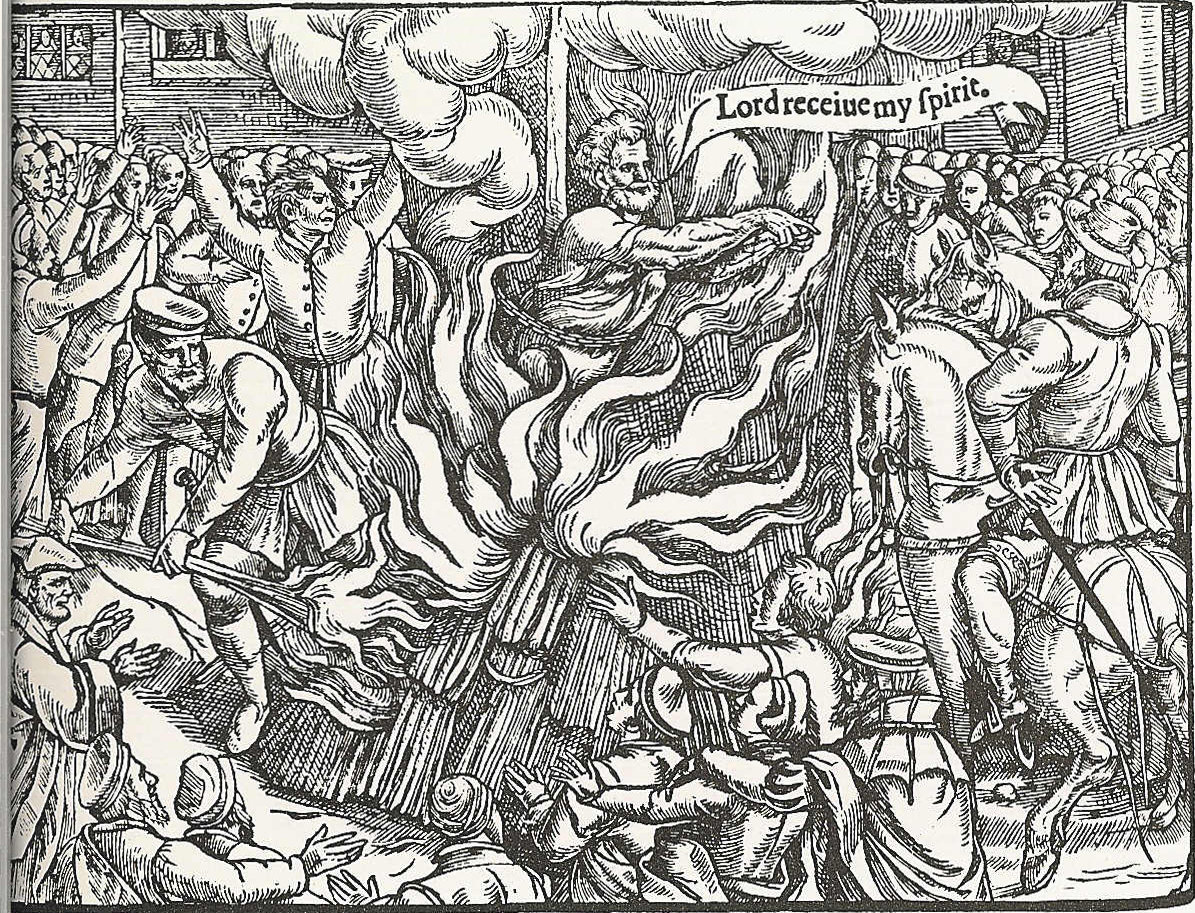
When Mary came to the throne he preached against the restored religion, was confined to his house, and was later moved to Newgate prison. He wrote his own account of his examinations before the Lord Chancellor, Gardiner, on January 22, 28 and 29, 1555, which Foxe printed. In it Gardiner asks whether he will "come into one church with the bishops and the whole realm, as now was concluded by parliament," and Rogers refuses the mercy offered as "a mercy of the antichristian Church of Rome."4 Asked whether he believed the sacrament to be "the very body and blood of our Saviour Christ... really and substantially," he gave the Reformed answer and was condemned with John Hooper.4 He asked one favor of Bishop Bonner before he died, "that I might talk a few words with my wife before my burning," and it was refused.4
On Monday, February 4, he was taken to Smithfield "saying the psalm Miserere by the way." Foxe reports that a pardon was brought if he would recant, "but he utterly refused," and that "His wife and children, being eleven in number, and ten able to go, and one sucking on her breast, met him by the way."4 He was the first Protestant burned under Mary, the "protomartyr" in Foxe's word.

Tradition and legend
Foxe says that in the fire Rogers "washed his hands in the flame, as though it had been in cold water."4 This is Foxe's report of what onlookers saw or said they saw; later sermons repeated it as a sign of supernatural strength. The story of the eleven children meeting him on the road is also Foxe's. Rogers's own account of his examination of January 28 speaks of "my poor wife and my ten children," so Foxe's eleven, with "one sucking on her breast," would include a child born after that; the children's names and ages are not otherwise recorded.
What the sources dispute
The most uncomfortable detail about Rogers comes from the Protestant side. Duffy, drawing on Foxe, notes that under Edward VI Rogers had refused Foxe's plea to help save Joan Bocher, a woman burned in 1550 for denying Christ's human flesh, and had defended burning as a sufficiently mild death for heresy.17 The exchange is reported by Foxe, who opposed burning for any heresy; Rogers's side of it does not survive. Historians also differ on how much of the Matthew Bible's notes and prefaces Rogers himself wrote. His death date and place are not disputed.
Hugh Latimer and Nicholas Ridley
Died: October 16, 1555 · Place: Oxford, in the town ditch outside Balliol College (now Broad Street) · Earliest source: Foxe, Actes and Monuments, 1563, with the records of the Oxford disputations of 1554 and the 1555 commission · Record strength: Documented
What the record shows
Hugh Latimer, about seventy,22 had been bishop of Worcester under Henry VIII until he resigned in 1539 rather than accept the Six Articles, and was the most famous preacher of Edward VI's reign. Nicholas Ridley, in his early fifties, had been bishop of London under Edward and was the leading Protestant theologian among the bishops after Cranmer. Both were imprisoned at Mary's accession and taken to Oxford with Cranmer in 1554 to dispute with Catholic theologians on the Mass. A first sentence against them was pronounced after the disputations. Because England had not yet been reconciled to Rome when that sentence was given, a new commission came from Rome in 1555; Foxe explains that the earlier sentence "was void in law, (for at that time the authority of the pope was not yet received into the land)."23 Under the new commission, headed by James Brooks, bishop of Gloucester, they were condemned again in the autumn of 1555.
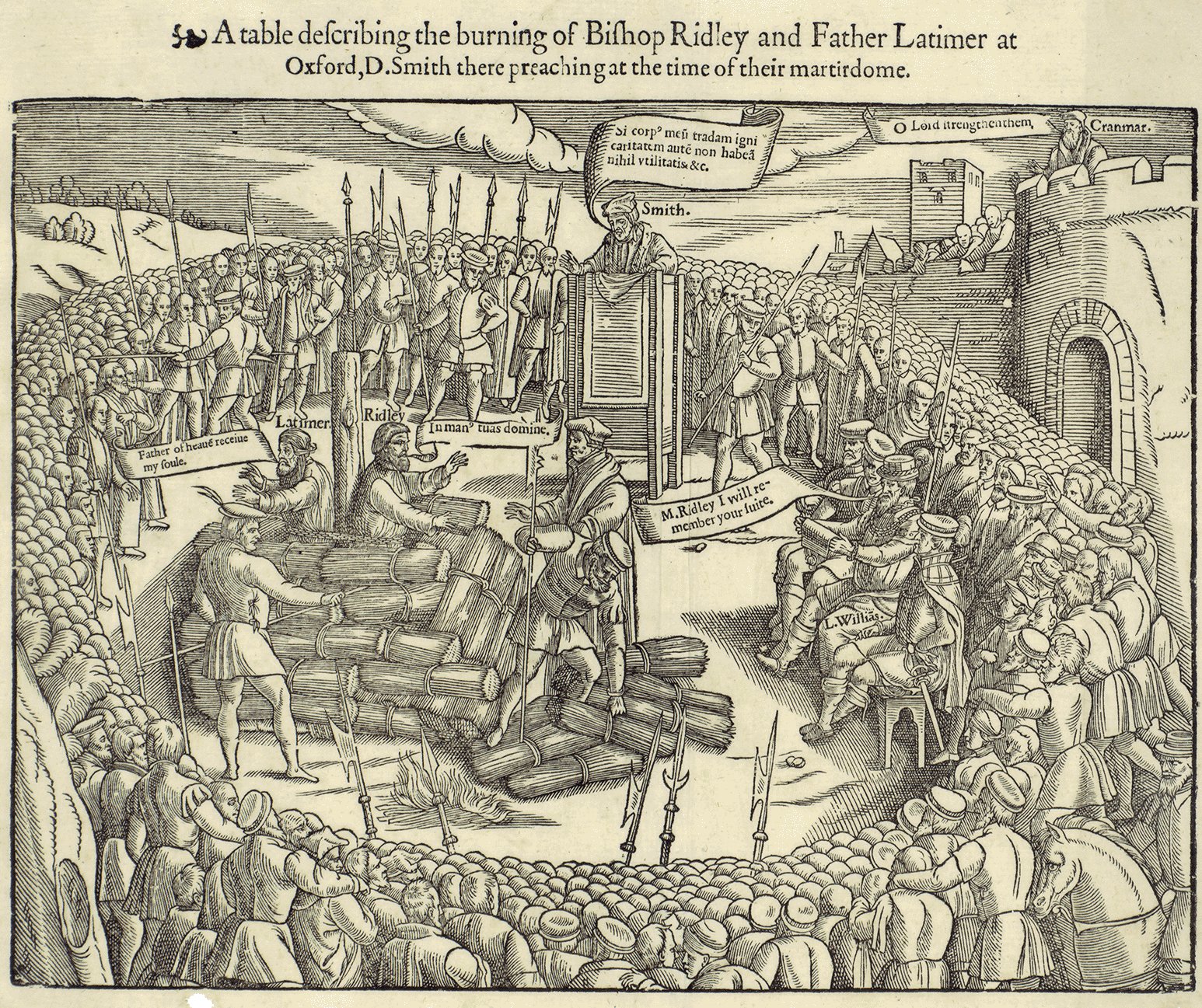
Foxe's account of the day of execution is long and detailed. The place was "Upon the north side of the town, in the ditch over against Balliol college," and Lord Williams of Thame was ordered by the queen's letters to attend "for fear of any tumult."21 Ridley came in his bishop's furred gown; Latimer came "in a poor Bristol frieze frock all worn." Ridley embraced Latimer at the stake, saying, as those standing near reported, "Be of good heart, brother, for God will either assuage the fury of the flame or else strengthen us to abide it." When Ridley asked leave to speak, the vice chancellor told him he could speak only to recant, and Ridley answered, "so long as the breath is in my body, I will never deny my Lord Christ, and his known truth: God's will be done in me!"21 Ridley's brother in law brought bags of gunpowder for both men. Latimer, Foxe writes, "received the flame as it were embracing of it" and died quickly; Ridley's fire burned badly, and he suffered long, crying that he could not burn, until the flame reached the gunpowder.21

Tradition and legend: the candle
The most quoted words of the English Reformation are Latimer's, as later editions of Foxe give them, spoken as the fire was laid at Ridley's feet: "Be of good comfort, Master Ridley, and play the man. We shall this day light such a candle, by God's grace, in England, as I trust shall never be put out."21 The words are not in Foxe's first edition of 1563. They appear in the later, expanded editions; a note in History Today places them in the 1583 text and observes that they echo an early Christian martyr account.22 The echo is close. In the Martyrdom of Polycarp (second century), as Polycarp entered the stadium "there came to him a voice from heaven, saying, Be strong, and show yourself a man, O Polycarp!"24 Eusebius's version, in the standard nineteenth century translation, reads "Be strong, Polycarp, and play the man."25 Foxe and his readers knew Eusebius well.
The candle saying is rated in this lesson as a strong tradition with an open question: it was printed by Foxe within about fifteen to thirty years of the event, apparently from someone who claimed to have heard it, but it was not in his first account, and its wording borrows from an ancient model. Foxe himself says of the two men's private talk at the stake, "What they said I can learn of no man," which shows that he knew the limits of his witnesses on some points.21
What the sources dispute
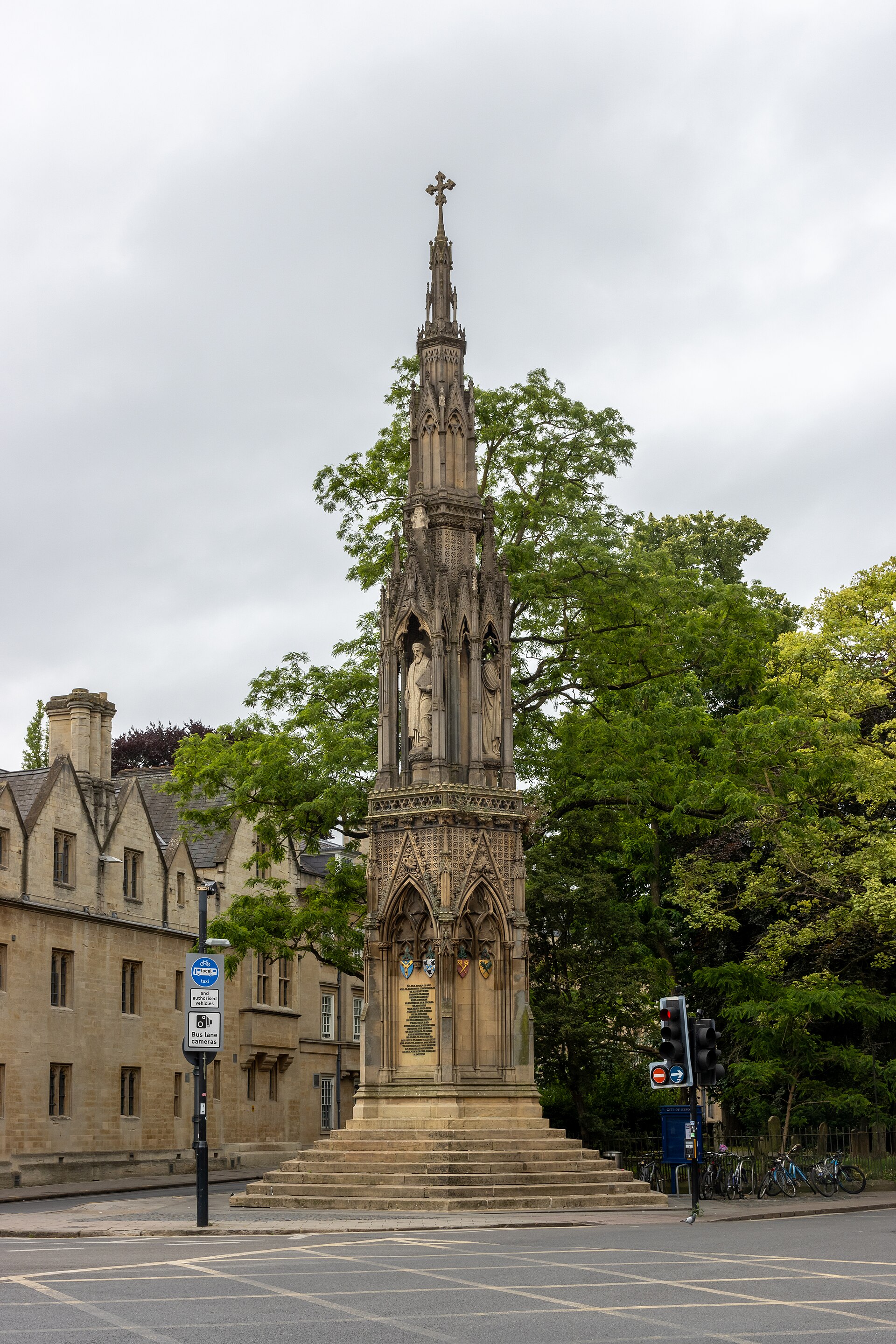
Beyond the candle words, the main open question is the legal one Foxe raised: whether the condemnations of 1554 and 1555 followed the church's own procedure. Foxe argued they did not. Catholic writers answered that the heresy was plain and the men had been heard at length in public disputation. The facts of the burning (date, place, the gunpowder, Ridley's slow death) are not disputed by any surviving source. The site is marked by a cross set in the roadway of Broad Street,22 and the Victorian Martyrs' Memorial stands nearby in Saint Giles.

Thomas Cranmer
Died: March 21, 1556 · Place: Oxford, the same ditch outside Balliol College · Earliest source: All the submyssyons and recantations of Thomas Cranmer (London: John Cawood, 1556); Foxe, Actes and Monuments, 1563 · Record strength: Documented
What the record shows
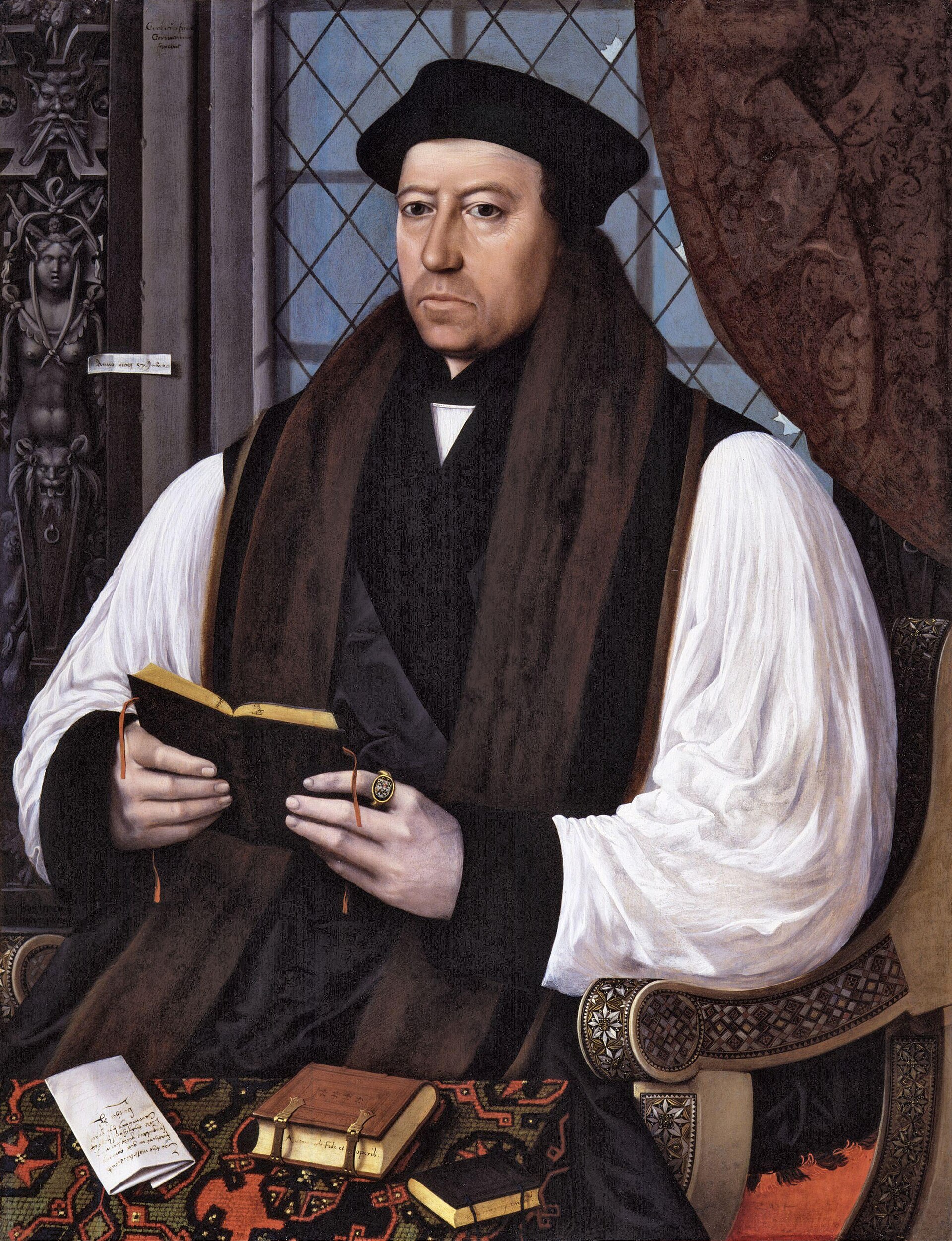
Thomas Cranmer was archbishop of Canterbury from 1533. He annulled Henry VIII's marriage to Catherine of Aragon, Mary's mother, and under Edward VI he wrote the Books of Common Prayer of 1549 and 1552 and shaped the Forty-Two Articles (his work as reformer is in Church History Part A, lesson 12). Under Mary he was convicted of treason for supporting Lady Jane Grey in 1553, then tried for heresy at Oxford with Latimer and Ridley. As archbishop he could be judged only by the pope; Rome condemned him, and Bishops Thirlby and Bonner came to Oxford with a commission to degrade him from his orders.23
In prison after his degradation Cranmer signed a series of submissions. The government printed them in 1556 as All the submyssyons, and recantations of Thomas Cranmer, late Archebyshop of Canterburye, "truely set forth both in Latyn and Englysh, agreable to the originalles, wrytten and subscribed with his owne hande," with Bishop Bonner's approval on the title page.9 The book's contents list six documents and a final prayer: a first submission, which it says Cranmer later cancelled, a second, two Latin writings, a fifth written in the presence of Henry Syddall and a friar, and a sixth.9 Encyclopaedia Britannica summarizes the sequence as five recantations followed by an "abject recantation (the sixth)."26 A heretic who recanted for the first time was ordinarily reconciled to the church rather than burned; Cranmer was not, and the government planned for him to read a final recantation in public before his burning.
On March 21, 1556, a "foul and rainy day," he was brought to Saint Mary's church in Oxford to hear a sermon by Dr. Henry Cole and to make his public statement.23 Foxe prints what he said. He began as expected and then turned: "And now I come to the great thing, which so much troubleth my conscience, more than any thing that ever I did or said in my whole life, and that is the setting abroad of a writing contrary to the truth: which now here I renounce and refuse, as things written with my hand, contrary to the truth which I thought in my heart, and written for fear of death." He went on: "And forasmuch as my hand offended, writing contrary to my heart, my hand shall first be punished therefor; for, may I come to the fire, it shall be first burned. And as for the pope, I refuse him, as Christ's enemy, and antichrist, with all his false doctrine."23 He was pulled down and taken to the stake. Foxe reports that "stretching out his arm, he put his right hand into the flame, which he held so stedfast and immovable... that all men might see his hand burned before his body was touched," and that he repeated "his unworthy right hand" and the words of Stephen, "Lord Jesus, receive my spirit."23

Tradition and legend
The hand in the fire is not a later legend. It is in Foxe's first edition and, according to Cranmer's modern biographer Diarmaid MacCulloch (Thomas Cranmer: A Life, 1996), it is also described in a letter by a Catholic eyewitness who disapproved of Cranmer, which makes it one of the best attested details of any Marian burning; the eyewitness letter was not opened for this lesson. Later tellings sometimes give Cranmer a single crisp sentence ("This hand hath offended"); Foxe's fuller wording, quoted above, is the earliest printed form. Foxe also reports that a Spanish friar at the stake claimed Cranmer died "in great desperation," and that Lord Williams only smiled.23 That exchange rests on Foxe's informant alone.
What the sources dispute
Cranmer's recantations have been argued over since the day he withdrew them. Catholic writers from the 1550s on treated them as proof that he would say anything to live, and his final reversal as the act of a man who knew he would die anyway. Protestant writers treated the recantations as the failure of a frightened old man under pressure and the final act as true repentance. MacCulloch reads the whole sequence as the struggle of a man who had believed all his life in obedience to the Crown, faced with a Crown that commanded him to deny what he believed. The printed recantations themselves raise a question of their own: the government published them to discredit him, Cranmer said at the end that he had written "for fear of death," and the cancelled first submission shows he was already wavering between positions before the last day. What is not disputed is that the government burned a man who had recanted, and that his last public words withdrew the recantations.
Dirk Willems
Died: May 16, 1569 · Place: Asperen, in Holland near Leerdam · Earliest source: the sentence of May 16, 1569, printed with an account of his arrest and death in the Dutch Mennonite martyrologies and in van Braght, Martyrs Mirror, 1660 · Record strength: Documented (the death and sentence); the rescue on the ice rests on the martyrology's narrative
What the record shows
Dirk Willems was an Anabaptist of Asperen, in the territory then ruled by Philip II of Spain as lord of the Netherlands, in the years when the Duke of Alba was enforcing the heresy laws with new severity. The sentence printed in the Martyrs Mirror states that Willems "confessed that at the age of fifteen, eighteen or twenty years, he was rebaptized in Rotterdam," that he had allowed meetings and further baptisms in his house, and that he persisted in these views. It orders that, "persisting obstinately in his opinion, that he shall be executed with fire, until death ensues," and declares "all his property confiscated, for the benefit of his royal majesty." It is dated "this 16th of May," 1569.7 The editor introduces it with the words "As we have come into possession of the sentence which these rulers of darkness passed upon this friend of God," which shows both that he was copying a document and how he regarded the judges.7
The narrative that goes with the sentence tells the story for which Willems is remembered. He escaped from his prison and fled across ice, "and as there had been some frost, said Dirk Willems ran before over the ice, getting across with considerable peril." His pursuer broke through. Willems turned back and pulled him out. The pursuer wanted to let him go, but "the burgomaster, very sternly called to him to consider his oath," and Willems was taken back. At the burning "a strong east wind blowing that day, the kindled fire was much driven away from the upper part of his body," so that his death was slow; the account says that "in the town of Leerdam, towards which the wind was blowing, he was heard to exclaim over seventy times, 'O my Lord; my God,'" and that the bailiff, moved, told the executioner to "Dispatch the man with a quick death."7
Tradition and legend
The rescue on the ice became the best known image in Anabaptist history through Jan Luyken's etching for the 1685 edition of the Martyrs Mirror, and it is retold in Mennonite and Amish schools and sermons as a picture of love of enemies. The name of the pond (the Hondegat) and other details in modern retellings come from local tradition at Asperen. The church history of the Mennonites and the place of the Martyrs Mirror in it are taught in Church History Part B, lesson 08.
What the sources dispute
The sentence and the death are documented by the text the martyrologist copied. The rescue story rests on the narrative that surrounds the sentence, and the sentence does not mention it, as one would not expect it to. No source contradicts it, and its details (the frost, the burgomaster and the oath, the officer's pity) are of the kind a local witness would remember; it is rated here as credible but supported by the Mennonite account alone. Historians also note that van Braght's 1660 compilation drew on earlier Dutch martyr books going back to the 1560s, and that the earlier collections should be checked where they survive.
Three kinds of martyr: Brad Gregory's comparison
For centuries each tradition told its own martyrs' stories and ignored or denied the others'. Foxe did not count Anabaptists or Catholics as martyrs; the Martyrs Mirror did not count Lutherans or Reformed; Catholic martyrologies did not count Protestants. Brad Gregory's Salvation at Stake: Christian Martyrdom in Early Modern Europe (Harvard University Press, 1999) was the first large study to put Protestant, Anabaptist and Catholic martyrs side by side. A reviewer, P. Linwood Urban, summarized its subject as "thousands of Protestants, Anabaptists, and Roman Catholics" executed for religion, studied through "pamphlets, hymns, sermons, woodcuts, and engravings, as well as martyrologies," and other writings.27
Gregory's argument, as he restated it in his chapter "Persecutions and martyrdom" in the Cambridge History of Christianity (2007), runs along these lines. Authorities and martyrs on every side shared the same assumptions: that doctrine mattered for salvation, that truth was one, and that dying for it was the highest witness. That shared ground made both the killing and the willingness to die make sense to the people involved. The targets shifted over time, from Anabaptists in the 1520s and 1530s, to Reformed Protestants in the 1540s and 1550s, to Catholics in England and in the mission fields after about 1580.1 Most of the deaths, he notes, happened in the Low Countries, France and England, and the total for the period was "some 5,000."1 Gregory also argued that historians should take the martyrs' convictions seriously as religious convictions, rather than reducing them to politics or psychology, and that a historian can describe each tradition's martyrs fairly without deciding which of them died for the truth. The old principle that "the cause, not the punishment, makes the martyr," voiced at Oxford by the Catholic preacher Richard Smith in 1555 in the form Foxe reports, is the reason each side refused the others' martyrs.21
The chart shows the pattern Gregory describes. Catholic authorities killed the largest numbers in these decades, in the Netherlands, France and Marian England. Protestant authorities killed Anabaptists, and Henry VIII's Church of England, which was neither Roman nor fully Protestant, killed both evangelicals and loyal Catholics. The Catholic martyrs of the later sixteenth century, killed by the Protestant English state as traitors for their priesthood or their loyalty to Rome, are the subject of lesson 07; the Huguenots of France and the Scottish Covenanters follow in lesson 08.
The era together
Three things join these deaths across the confessional lines. First, they were legal killings: every one followed a sentence by a court or council acting under a written law, and the sentences survive or were printed. Second, the charges were about the same few doctrines: the presence of Christ in the Mass, the baptism of infants, the authority of the pope, and the right of the civil ruler to command in matters of faith. Third, each side's victims were remembered by their own church through books written to keep the memory alive, and those books (Foxe, the Martyrs Mirror, Luther's song) are both the best sources and the places where memory turned into legend.
The magistrates who passed these sentences believed they were defending God's truth and the peace of the commonwealth. The men and women they killed believed they were obeying God rather than men. The surviving documents let a reader hear both: the Zurich council warning that "no one give cause for his own death," the Marian court praying for "the conversion of the heretics," and Cranmer, Ridley, Askew, Manz and Willems answering in their own words. By the end of the century, the experience of being persecuted had shaped every one of these churches, and none of them yet accepted that a state could tolerate more than one.
What the record shows and what it does not
- Documented fact: the deaths, dates and places of Voes and van Esschen (1523, with the one day dispute), Manz (January 5, 1527), Sattler (May 1527), Askew (July 16, 1546), Rogers (February 4, 1555), Latimer and Ridley (October 16, 1555), Cranmer (March 21, 1556) and Willems (May 16, 1569). The Zurich mandate of March 7, 1526 and the sentence on Manz survive in the city's records. Cranmer's submissions were printed by the government in 1556. Askew's account of her racking is in her own words.
- A church's own claim or tradition: Manz's last words and his mother's encouragement; Sattler's finger signal; the details of the Asperen pond; the honor given to each of these people as martyrs by Lutheran, Anglican, Reformed and Mennonite churches.
- Foxe's report, not independently confirmed: Latimer's candle words (absent from the 1563 edition); Rogers washing his hands in the flame; the Lieutenant of the Tower's visit to Henry VIII about Askew; the Spanish friar's remark at Cranmer's death. The hand in the fire is Foxe's report with independent Catholic support, according to MacCulloch.
- Scholarly reading: Gregory's comparison of the three traditions; Duffy's view of the Marian campaign as coherent; the reading of the Askew interrogation as part of court politics in 1546; the diocesan counts, which are approximate.
- Open question: whether Voes and van Esschen wavered at the end, as their opponents claimed; who wrote the trial account of Sattler; exactly how many died in the Marian years, given deaths in prison and gaps in the records.
Claims checked
"Latimer's last words were 'We shall this day light such a candle...'"
Partly supported. The words are printed in later editions of Foxe's Actes and Monuments as spoken at the stake on October 16, 1555.21 They are not in the 1563 edition, and they echo the Martyrdom of Polycarp's "show yourself a man" and Eusebius's "play the man."222425 They may record something Latimer said, perhaps shaped by a reporter who knew the ancient story; they cannot be confirmed from any independent witness. They were not his last words in any case: Foxe gives those as "O Father of heaven, receive my soul!"21
"Foxe invented his martyrs."
Refuted. The English deaths in this lesson are confirmed by court sentences, Privy Council orders, the printed recantations and local records, and Leppard's study of Sussex shows the same first victims named in Brice's register of 1559, in Foxe, and in an independent list arranged by the sheriffs of the county (now at the Folger Library).8 What Foxe did do was shape his material, add speeches and stories in later editions, comment freely, and repeat reports he could not check. "Foxe invented his martyrs" is false; "everything in Foxe is fact" is also false.
"Mary I burned more people for religion than any other English monarch."
Supported, with context. About 284 to 287 people were burned in under four years, far more than under any other English ruler for heresy.1719 Henry VIII executed large numbers for treason, including many Catholics and some Protestants, and Elizabeth I executed Catholics as traitors over a much longer reign (lesson 07 gives the counts with sources). The comparison depends on whether one counts executions for heresy only, or all executions connected with religion.
"Protestants did not persecute; only Catholics did."
Refuted. The Reformed council of Zurich drowned Felix Manz in 1527 under its own mandate, and the Zurich plaque records five more drownings to 1532 and a last Anabaptist execution in 1614.513 Henry VIII's government burned evangelicals and hanged Catholics on the same day in 1540.3 Lesson 07 covers the Catholics executed by Protestant England.
"The Anabaptists were executed as rebels, so they were not martyrs."
Partly supported. The Zurich sentence on Manz does describe his teaching as leading to rebellion, and the Sattler sentence cites his remarks on the Turks.56 But the acts actually charged were religious: rebaptizing, teaching against infant baptism and the Mass, refusing oaths. Neither Manz nor Sattler took up arms, and the Schleitheim articles forbade believers to use the sword.14 Whether to call them martyrs is a judgment each church makes; by the sixteenth century meaning (death for a confession of faith), the documents fit.
"Cranmer was a coward who recanted to save his life."
Unresolved as a judgment; the facts are clear. He signed six submissions and recantations, which the government printed, and then withdrew them publicly and put his hand first into the fire.923 Whether the recantations were cowardice, confusion, sincere wavering, or a man's obedience to a Crown he had always obeyed is a matter of interpretation on which Catholic and Protestant writers, and modern biographers, still differ.
"Dirk Willems turned back to save the man chasing him and was burned for it."
Supported, with one qualification. The sentence and burning are documented by the copy van Braght printed; the rescue story comes from the narrative printed with it.7 He was burned for rebaptism and for holding meetings, as the sentence says, and the rescue led to his recapture.
"Voes and van Esschen were the first Protestant martyrs."
Supported for the Lutheran Reformation. They are the first people known to have been executed for Luther's teaching, and Luther's song treats them so.1011 Earlier dissenters (the Lollards, Hus, the Waldensians, in lessons 04 and 05) died before there was a Protestant movement.
Hard questions and answers
A Catholic reader asks: were the Marian bishops simply cruel?
The documents show something more complicated. The sentences ask for conversion and the salvation of souls, the courts repeatedly offered pardon (Rogers, Askew under Henry, Ridley at the stake), and the preachers argued from Scripture and the Fathers.421 The bishops shared the view, held by the Protestant magistrates of Zurich and Geneva as well, that a heretic endangered other souls. Duffy and others have shown that the Marian church was building a serious program of renewal.17 The historian's task is to describe that program and its burnings together. The moral judgment on burning people alive for belief has since changed in every one of these churches.
A Protestant reader asks: does Foxe's bias make him useless?
No. Foxe is indispensable because he printed so many documents (examinations, letters, sentences) that would otherwise be lost, and checks against archives usually confirm his facts. His bias shows in his comments, his choices, and the growth of some stories between editions, which is why this lesson separates what he printed from what he reported.822
An Anabaptist reader asks: why do Protestant martyr books leave out Anabaptists?
Because Foxe, like the Catholic and Reformed churches, regarded Anabaptist teaching as heresy, and a martyr in his sense died for true doctrine. The Anabaptists answered by keeping their own records. Gregory's comparative work was in part a correction of this exclusion.27 The Zurich plaque of 2004, set up with the Reformed church's participation, is a later act of acknowledgment.13
A skeptic asks: were these really religious killings, or politics in religious dress?
Both, in the sixteenth century sense, because religion and political order were not separable. The documents themselves name religious offences (the Mass, baptism, the pope) and political dangers (sedition, rebellion, the Turks) together.564 Gregory argues that reducing the martyrs to politics misses what they said they were dying for, and the sources support taking their words at face value as their reasons.1
An Orthodox reader asks: do the Orthodox churches count any of these people as martyrs?
No. These were disputes within the Western church. The Orthodox churches did not take part in them and do not commemorate either side's dead as saints. Their own calendars of martyrs are covered in lessons 04, 09 and 10.
Why are the numbers uncertain if the records are so good?
Because the good records are scattered. Bishops' registers are incomplete, some burnings appear only in Foxe or Brice, others only in sheriffs' accounts, and people who died in prison before trial were counted by some and not by others. Leppard found that the first Sussex burnings were dated differently by different sources and that later editors filled gaps with invented dates.8 The totals of about 284 to 287 for the Marian years are close enough to be trusted as an order of magnitude; the diocesan breakdown is less firm.
Related lessons and modules
- Lesson 01: the record strength key, Foxe's editions and the Martyrs Mirror.
- Lesson 05: Hus, the Lollards and Tyndale.
- Lesson 07: More, Fisher, the English Catholic martyrs and Nagasaki.
- Lesson 08: Saint Bartholomew's Day, the Covenanters and Mary Dyer.
- Church History Part A: Luther and the Reformation and Zwingli, Calvin and the Wider Reformation.
- Church History Part B: Anabaptists and Anglicans and Episcopalians.
Learn more
- The Acts and Monuments Online (TAMO), the Foxe variorum: Compare the four editions Foxe published (1563, 1570, 1576, 1583) side by side, with commentary on his sources.
- Egli's Actensammlung at archive.org: The Zurich council's own records of the Anabaptist trials, mandates and sentences in the original Swiss German.
- Leppard, Heretics and martyrs in Marian Sussex (2016): A model of checking Foxe against Brice, the sheriffs' lists and Privy Council records for one county.
- Luther's song on the Brussels martyrs (1524) at Wikisource: The earliest Lutheran martyr song, in its first printed form.
- Cranmer's printed submissions and recantations (1556), EEBO-TCP: Read the documents the government printed to discredit Cranmer, in their original spelling.
Still being checked (15 items)
These points could not be confirmed against a primary source when this lesson was written and fact checked in October 2026. The text above states each one as uncertain.
- The diocesan counts (London 112, Canterbury 52, Norwich 32, Chichester 27) come from a web page that gives them as an extract from W. H. Beckett, The English Reformation (1890), a book not opened; only the Chichester (Sussex) figure was checked, against Leppard (2016). The 'all other dioceses' bar is a computed remainder.
- Duffy's figures (about 284 burned, about 30 deaths in prison, heresy laws in force from January 20, 1555, the Rogers and Joan Bocher exchange) and Morgan's 'minimum of 287' are taken from published citations and a review; neither book was opened.
- Foxe was read in a nineteenth century edition of his later, expanded text (exclassics.com); the Acts and Monuments Online variorum (dhi.ac.uk/foxe) was behind an access gate, so the edition in which the Latimer candle words first appear (1570 or 1583) was not checked directly. History Today places them in the 1583 text and says they are absent from 1563.
- The date of the Smithfield executions of 1540 is given in the lesson only as July 1540; the commonly cited day (July 30) was not confirmed from the Foxe text opened.
- The date of the Brussels burning: July 1, 1523 in most modern accounts, June 30 in Julian (1907); the third friar Lambert Thorn's later death in prison was not confirmed from a primary source.
- The authorship and first printing of the Sattler trial account (traditionally a 1527 pamphlet) were not confirmed; the date of execution (May 20 or 21, 1527) differs between sources. Bucer's and Capito's letters about Sattler were not opened.
- Manz's last words, his mother's and brother's presence, and Sattler's finger signal are traditions whose earliest written form was not traced.
- MacCulloch's report of a Catholic eyewitness letter confirming Cranmer's hand in the fire, and his reading of Cranmer's recantations, are summarized from general knowledge of his biography (1996), which was not opened.
- The scholarly work on Askew's text by Elaine Beilin (1996) and by Thomas Freeman and Sarah Elizabeth Wall was not opened; their views are summarized in general terms only. The general statement that modern checking has found Foxe rarely invented martyrs is a summary of the Foxe Project's reputation, not a quotation.
- Gregory's methodological argument (taking martyrs' convictions seriously) is summarized from the chapter abstract and a review, not from the book's text; his 'some 5,000' total period was read from the chapter summary.
- The breakdown of Marian victims (five bishops, some twenty other clergy, about fifty-five women) rests on thereformation.info (unattributed) and Morgan's '56 women' as cited; not checked against Foxe's own tallies.
- Cranmer's conviction for treason in 1553 for supporting Lady Jane Grey is standard but was not footnoted to a primary source here.
- The eighteen stanzas and the incipit "Mit Lust so will ich singen" of the hymn ascribed to Manz were not checked in the Ausbund; Keller (ADB) cites only one song (Wackernagel III, 514) and one letter.
- The first edition in which Foxe printed Latimer's candle words (1570 or 1583) remains unchecked; History Today says only that they are in 1583 and not in 1563.
- The date of Anne Askew's first examination: her text says March 1545, and Bonner's record of her confession is dated March 20, 1545 "after the computation of the Church of England," which in modern reckoning could be 1546; the lesson keeps March 1545.
Notes
- Brad S. Gregory, "Persecutions and martyrdom," in R. Po-chia Hsia, ed., The Cambridge History of Christianity, vol. 6, Reformation and Expansion, 1500 to 1660 (Cambridge: Cambridge University Press, 2007), ch. 15, pp. 261 to 282; figures as given in the chapter summary on the publisher's site (retrieved Oct. 28, 2026). Read it online. ↩
- Emil Egli, ed., Actensammlung zur Geschichte der Zürcher Reformation in den Jahren 1519 bis 1533 (Zurich, 1879), nos. 934 to 937, the council's sentence and mandates of March 7, 1526, pp. 444 to 445 (public domain scan, archive.org, retrieved Oct. 28, 2026). English renderings made for this lesson. Read it online. ↩
- John Foxe, Actes and Monuments, later expanded text, the account of the three Catholics (Powell, Featherstone and Abel) executed at Smithfield on the same day as the evangelical preachers Robert Barnes and Thomas Garret and a third preacher in 1540; nineteenth century edition as transcribed at exclassics.com, section 198 (retrieved Oct. 28, 2026). Read it online. ↩
- John Foxe, Actes and Monuments, later expanded text, account of John Rogers: his examinations of January 22, 28 and 29, 1555, the sentence, and his burning at Smithfield on February 4, 1555; nineteenth century edition as transcribed at exclassics.com, section 264 (retrieved Oct. 28, 2026). Read it online. ↩
- Egli, Actensammlung (1879), no. 1109, sentence of the Zurich council on Felix Manz, January 5, 1527, pp. 529 to 530 (archive.org, retrieved Oct. 28, 2026). Quotations are from the sixteenth century Swiss German as printed; English renderings made for this lesson. Read it online. ↩
- Thieleman J. van Braght, Martyrs Mirror (1660), English translation (Herald Press printing, 1987, pp. 416 to 418), the account of the trial and death of Michael Sattler, 1527, as given at anabaptists.org (retrieved Oct. 28, 2026). Read it online. ↩
- Van Braght, Martyrs Mirror, English translation, "Dirk Willems, A.D. 1569," account and sentence of May 16, 1569 (book 2, p. 387 of the scanned edition), as given at homecomers.org (retrieved Oct. 28, 2026). Read it online. ↩
- M. J. Leppard, "Heretics and martyrs in Marian Sussex: networks and locations," Sussex Archaeological Collections 154 (2016), pp. 209 to 226, comparing Thomas Brice's Compendious Register (1559), Foxe (1563 and later), the sheriffs' list in the Folger manuscript, and Privy Council records (Archaeology Data Service PDF, retrieved Oct. 28, 2026). Read it online. ↩
- All the submyssyons, and recantations of Thomas Cranmer, late Archebyshop of Canterburye (London: John Cawood, printer to the Queen, 1556), title page and contents; Early English Books Online text A19561, University of Michigan (retrieved Oct. 28, 2026). Read it online. ↩
- Martin Luther, "Eyn new lied von den zween Merterern Christi / zu Brussel von den Sophisten zu Löuen verbrant," in Eyn Enchiridion oder Handbuchlein (Erfurt, 1524), fols. 41 to 43; transcription at German Wikisource from the scans on Wikimedia Commons (retrieved Oct. 28, 2026). English renderings made for this lesson. Read it online. ↩
- John Julian, ed., A Dictionary of Hymnology, revised edition (London: John Murray, 1907), article "Ein neues Lied wir heben an" (public domain, archive.org, retrieved Oct. 28, 2026). Read it online. ↩
- Ludwig Keller, "Manz, Felix," Allgemeine Deutsche Biographie, vol. 20 (Leipzig, 1884), at deutsche-biographie.de (retrieved Oct. 28, 2026). Read it online. ↩
- Wikimedia Commons, file description of the photograph "Zürich - Schipfe IMG 1969.JPG" by Roland zh (April 10, 2010), transcribing the memorial plaque on the Limmat unveiled July 7, 2004 (retrieved Oct. 28, 2026). Read it online. ↩
- The Schleitheim Confession (Brotherly Union of a Number of Children of God Concerning Seven Articles), dated Matthias' Day (February 24), 1527, trans. J. C. Wenger, at reformedreader.org (retrieved Oct. 28, 2026). Read it online. ↩
- Joshua J. Mark, "The Trial and Martyrdom of Michael Sattler," World History Encyclopedia, July 21, 2022 (secondary; quotes the translation in Denis R. Janz, ed., A Reformation Reader, 2008), retrieved Oct. 28, 2026. Read it online. ↩
- John Foxe, Actes and Monuments, later expanded text, "Anne Askew": her first and later examinations in her own words (first printed by John Bale, 1546 and 1547) and Foxe's narrative of her racking and burning, A.D. 1546; nineteenth century edition as transcribed at exclassics.com, section 209 (retrieved Oct. 28, 2026). Read it online. ↩
- Eamon Duffy, Fires of Faith: Catholic England under Mary Tudor (New Haven: Yale University Press, 2009), esp. pp. 79 (deaths in prison), 87 (Rogers and Joan Bocher) and 91 (the heresy laws in force from January 20, 1555). Page references as cited in published lists of the Marian martyrs; the book itself was not opened for this lesson. Read it online. ↩
- Robert S. Miola, review of Eamon Duffy, Fires of Faith (Yale, 2009), First Things, January 1, 2010, retrieved Oct. 28, 2026. Read it online. ↩
- Kenneth O. Morgan, ed., The Oxford Illustrated History of Britain (Oxford: Oxford University Press, 2009 printing), p. 259: "burning a minimum of 287 persons after February 1555" (quoted from the published citation; the book was not opened for this lesson). ↩
- "Marian Martyrs," thereformation.info, a Protestant Reformation history site (page dated July 18, 2011); rough count by diocese given as an extract from W. H. Beckett, The English Reformation (1890), and a breakdown of at least 277 burned by rank and sex; page author not named (retrieved Oct. 28, 2026). Read it online. ↩
- John Foxe, Actes and Monuments, later expanded text, "The Execution of Ridley and Latimer," October 16, 1555, including Dr. Smith's sermon; nineteenth century edition as transcribed at exclassics.com, section 321 (retrieved Oct. 28, 2026). Read it online. ↩
- "Latimer and Ridley Burned at the Stake," History Today, Months Past series (on the candle words' absence from the 1563 edition and their likeness to the Polycarp account; the ages of the two men; the cross in Broad Street), retrieved Oct. 28, 2026. Read it online. ↩
- John Foxe, Actes and Monuments, later expanded text, "Thomas Cranmer": the second Oxford commission of 1555, the degradation, and the events of March 21, 1556; nineteenth century edition as transcribed at exclassics.com, section 331 (retrieved Oct. 28, 2026). Read it online. ↩
- The Martyrdom of Polycarp, ch. 9, trans. Alexander Roberts and James Donaldson, Ante-Nicene Fathers, vol. 1 (1885), revised for New Advent by Kevin Knight (retrieved Oct. 28, 2026). Read it online. ↩
- Eusebius, Church History 4.15.17, trans. Arthur Cushman McGiffert, Nicene and Post-Nicene Fathers, series 2, vol. 1 (1890), at New Advent (retrieved Oct. 28, 2026). Read it online. ↩
- "Thomas Cranmer: Martyrdom," Encyclopaedia Britannica online (retrieved Oct. 28, 2026). Read it online. ↩
- Brad S. Gregory, Salvation at Stake: Christian Martyrdom in Early Modern Europe (Cambridge, Mass.: Harvard University Press, 1999); summary quoted from P. Linwood Urban, review, Choice 37, no. 11 (July 1, 2000), at works.swarthmore.edu (retrieved Oct. 28, 2026). Read it online. ↩
Check yourself
1. Which authority drowned Felix Manz in January 1527?
The sentence of January 5, 1527 was issued by the Zurich council under its own mandate of March 7, 1526, which made rebaptism punishable by drowning (Egli nos. 936 and 1109).
2. What is the earliest printed source for the words 'We shall this day light such a candle'?
The words are not in the 1563 edition; they appear in Foxe's later editions and echo the 'play the man' of the Polycarp account.
3. How did Thomas Cranmer end his last public statement on March 21, 1556?
Foxe prints his words: 'forasmuch as my hand offended, writing contrary to my heart, my hand shall first be punished therefor.'
4. Whose own written words describe being racked in the Tower by the Lord Chancellor and Sir Richard Rich?
Askew's own account, printed by Bale and by Foxe, says 'my lord chancellor and Master Rich took pains to rack me with their own hands, till I was nigh dead.'
5. About how many people were burned for heresy in England under Mary I, by recent scholarly counts?
Duffy works with about 284 and Morgan gives a minimum of 287; about 30 more died in prison.
6. What did Luther's 1524 song report that the opponents of Voes and van Esschen were saying?
Luther's song says 'they say that in the last extremity, while still on earth, the boys turned back,' and calls it a lie; the question remains open.
7. On what evidence does the story of Dirk Willems rescuing his pursuer rest?
The sentence documents the burning and the charges; the rescue story comes from the narrative printed with it in the Martyrs Mirror.
8. What was the central argument of Brad Gregory's Salvation at Stake (1999)?
Gregory compared all three traditions and argued that shared convictions about truth and salvation explain both sides' behavior.
Terms in this lesson
- Heresy
- The stubborn holding of a belief condemned by the church. In sixteenth century law it was judged by church courts and punished by the secular power.
- Relapse
- Returning to a heresy after recanting it. A relapsed heretic was ordinarily handed over for execution without a second chance.
- Anabaptists
- 'Rebaptizers': the radical reformers who baptized adult believers, rejected infant baptism, and in the Swiss Brethren form refused oaths and the sword. They called themselves brethren.
- Swiss Brethren
- The Anabaptist church that began in Zurich in January 1525 with Conrad Grebel, Felix Manz and George Blaurock, and adopted the Schleitheim articles in 1527.
- Schleitheim Confession
- Seven articles agreed by Swiss Brethren at Schleitheim on February 24, 1527, under Michael Sattler's leadership, on baptism, the ban, the Supper, separation, pastors, the sword and the oath.
- Marian persecution
- The burnings of Protestants under Mary I of England, from February 1555 to November 1558, after Parliament revived the medieval heresy laws.
- Actes and Monuments
- John Foxe's history of the church and its martyrs, known as Foxe's Book of Martyrs, first published in English in 1563 and enlarged in 1570, 1576 and 1583.
- Martyrs Mirror
- Thieleman van Braght's Dutch Mennonite martyrology of 1660 (illustrated 1685), which gathers Anabaptist martyrs' letters, songs and sentences.
- Act of Six Articles
- Henry VIII's statute of 1539 reaffirming Catholic doctrine on the Mass and related points, under which denying the bodily presence of Christ in the sacrament was punishable by burning.
- Degradation
- The formal ceremony by which a church court stripped a condemned cleric of his orders before handing him to the secular power.
- Recantation
- A formal withdrawal of a belief judged heretical, usually signed and often read in public.
- Smithfield
- The open ground outside the walls of the City of London where many heresy burnings took place, including those of Anne Askew in 1546 and John Rogers in 1555.
Sources
- John Foxe, Actes and Monuments (19th century edition of the later text): John Rogers (1563 to 1583 (text); 19th century edition) checked 2026-10
- John Foxe, Actes and Monuments: Anne Askew (1546 to 1583 (text)) checked 2026-10
- John Foxe, Actes and Monuments: the execution of Ridley and Latimer (1563 to 1583 (text)) checked 2026-10
- John Foxe, Actes and Monuments: Thomas Cranmer (1563 to 1583 (text)) checked 2026-10
- John Foxe, Actes and Monuments: Catholics executed at Smithfield, 1540 (1563 to 1583 (text)) checked 2026-10
- Emil Egli, Actensammlung zur Geschichte der Zürcher Reformation (1879) (1879 (documents of 1519 to 1533)) checked 2026-10
- Martin Luther, Eyn new lied von den zween Merterern Christi (Erfurt Enchiridion, 1524) (1524) checked 2026-10
- All the submyssyons, and recantations of Thomas Cranmer (Cawood, 1556), EEBO-TCP (1556) checked 2026-10
- Martyrs Mirror: Michael Sattler (1527 (events); 1660 (compilation)) checked 2026-10
- Martyrs Mirror: Dirk Willems, A.D. 1569 (1569 (sentence); 1660 (compilation)) checked 2026-10
- The Schleitheim Confession, trans. J. C. Wenger (February 24, 1527) checked 2026-10
- The Martyrdom of Polycarp, ANF vol. 1 (2nd century (text); 1885 (translation)) checked 2026-10
- Eusebius, Church History, book 4 (NPNF 2.1) (early 4th century; 1890 translation) checked 2026-10
- John Julian, A Dictionary of Hymnology (1907) (1907) checked 2026-10
- Ludwig Keller, Manz, Felix, Allgemeine Deutsche Biographie 20 (1884) (1884) checked 2026-10
- M. J. Leppard, Heretics and martyrs in Marian Sussex (Sussex Archaeological Collections 154) (2016) checked 2026-10
- Brad S. Gregory, Persecutions and martyrdom, Cambridge History of Christianity vol. 6 (2007) checked 2026-10
- P. Linwood Urban, review of Gregory, Salvation at Stake (Choice, 2000) (July 2000) checked 2026-10
- Eamon Duffy, Fires of Faith (Yale, 2009), as reviewed by Robert S. Miola in First Things (2010) (2009) checked 2026-10
- Kenneth O. Morgan, ed., The Oxford Illustrated History of Britain (2009 printing) checked 2026-10
- Marian Martyrs, thereformation.info (undated web page) checked 2026-10
- Latimer and Ridley Burned at the Stake, History Today (undated (Months Past series)) checked 2026-10
- Joshua J. Mark, The Trial and Martyrdom of Michael Sattler, World History Encyclopedia (July 21, 2022) checked 2026-10
- Encyclopaedia Britannica, Thomas Cranmer: Martyrdom (online, current) checked 2026-10
- Wikimedia Commons, Zurich Schipfe Anabaptist memorial plaque (photo and transcription) (2004 (plaque); 2010 (photo)) checked 2026-10