Lesson 10 of 10 · about 55 minutes · Updated October 28, 2026
From 1950 to Now: Behind the Iron Curtain, China, Africa, Latin America, the 21 in Libya, and the Counts
You'll be able to
- You'll be able to tell the documented facts of nine modern cases of imprisonment or killing apart from the traditions that have grown around them.
- You'll be able to explain why a confessor such as Richard Wurmbrand is a different case from a martyr.
- You'll be able to state what the UN Commission on the Truth for El Salvador found about the killings of Oscar Romero and the Jesuits of the UCA.
- You'll be able to quote the Open Doors and CSGC figures correctly, each with its source, period, definition and method.
- You'll be able to explain why Open Doors, the CSGC, Pew and ACN produce such different pictures of persecution, and rate common claims about the numbers.
- You'll be able to weigh how churches decide whether a person killed in a political conflict, or by fellow Christians, is a martyr.
Start here: the short version
After 1950 Christians were killed or imprisoned in three main settings: states that made atheism or one party's control of religion official policy (the Soviet Union, Romania, Poland's security services, China in the Cultural Revolution), states run by armed rulers who treated church leaders as political enemies (Idi Amin's Uganda, El Salvador in its civil war), and armed groups or mobs acting in the name of religion (the Pakistani Taliban, the Islamic State in Libya, the armed groups of northern and central Nigeria). This lesson gives nine briefs: Richard Wurmbrand, who survived fourteen years in Romanian prisons; Jerzy Popieluszko of Poland; Wang Zhiming and Watchman Nee of China; Archbishop Janani Luwum of Uganda; Archbishop Oscar Romero and the six Jesuits of the Central American University in El Salvador; Shahbaz Bhatti of Pakistan; and the 21 men killed on the coast of Libya in 2015. Every one of these deaths is documented by records made at the time. The hard part of this era is the numbers. Open Doors counted 4,849 Christians killed for faith-related reasons in the twelve months to September 30, 2025, and says that figure is a minimum. The Center for the Study of Global Christianity estimates about 900,000 Christian martyrs in the last ten years, roughly 90,000 a year, under a much broader definition. Both numbers are honest about their methods, and they measure different things. The last third of the lesson sets the counts side by side and explains why they differ.
The era in brief: why Christians were killed after 1950
The earlier lessons of this module dealt with deaths ordered by Roman magistrates, medieval and Reformation courts, and the regimes of the Second World War (see lesson 09). The period from 1950 to the present is different in two ways. The record is far fuller: newspapers, wire services, court files, police archives opened after 1989, United Nations commissions and church statements exist for almost every death in this lesson. And the killers are more varied. In the Roman and Reformation cases a single legal authority usually stood behind each execution. After 1950 Christians died at the hands of governments, of armies in civil wars, of secret police acting without a court, and of armed groups that answered to no state at all.
The first setting was the Communist world. The Soviet state treated religion as a remnant to be removed, and the worst killing of Russian clergy and believers came before 1950, in the years after 1917 and in the purges of the late 1930s. The Russian Orthodox Church's Jubilee Council of 2000 glorified (that is, formally recognized as saints) what the Orthodox Church in America describes as "more than one thousand New Martyrs," among them the last Tsar and his family, and set their common feast "On the Sunday closest to January 25."1 The OCA also names Grand Duchess Elizabeth and Patriarch Tikhon among the New Martyrs and Confessors commemorated that day; Tikhon had already been glorified by the Russian Church's Council of Bishops in 1989.37 That canonization stands at the start of this lesson because it was made after the Soviet Union fell, by a church able at last to name its dead. After 1945 the Soviet model spread to Eastern Europe. Romania, Poland, Czechoslovakia, Hungary, Bulgaria and Albania each brought their churches under police control in different ways and at different speeds. Few Christians in postwar Eastern Europe were formally executed for their faith. Many more were imprisoned, and some were killed outside the law by the security services, as the Popieluszko brief below shows.
The second setting was China. After 1949 the new government expelled foreign missionaries, organized Protestant churches into the Three-Self Patriotic Movement and Catholics into a state-approved association, and arrested leaders who refused. In the Cultural Revolution (1966 to 1976) all public worship stopped. Wang Zhiming and Watchman Nee, the two Chinese Christians profiled here, both died in custody in that decade.
The third setting was the post-colonial state ruled by force. Uganda under Idi Amin and El Salvador in its civil war (1980 to 1992) killed church leaders who spoke publicly about killings by the security forces. In these cases governments and their agents killed men who were themselves Christians and whose killers were, for the most part, baptized Christians too. Whether such a death counts as martyrdom is a question the churches have answered case by case, and the lesson sets out how.
The fourth setting, growing since the 1980s, is killing by armed groups that claim a religious motive, and by mobs. Pakistan's blasphemy laws, the civil war in Sudan, the Islamic State in Iraq, Syria and Libya, and the armed groups of the Sahel and Nigeria belong here. The Pew Research Center, which scores 198 countries and territories each year, found in its sixteenth report (June 2026, covering 2023) that 58 countries had "high" or "very high" government restrictions on religion and 55 had high or very high social hostilities involving religion.2 Pew also found that Christians were harassed, by governments or by social groups, in 165 countries in 2023, more than any other group it tracks, while warning that the figure should not be read as "determining which religious group faced the most persecution."3 Open Doors, a Christian mission that publishes a yearly World Watch List, reports that 4,491 of the 4,849 faith-related killings of Christians it counted in its latest reporting year took place in sub-Saharan Africa.45
The record strength key used in every brief is the one set out in lesson 01. Every brief in this lesson is rated Documented, because a contemporary record names the person and the manner of death. The open questions are of another kind: who gave the order, what the killers meant, and whether "martyr" is the right word.
Richard Wurmbrand (1909 to 2001): the confessor who survived
Died: not killed; imprisoned 1948 to 1956 and 1959 to 1964, released 1964 · Place: Romanian prisons, Bucharest and elsewhere · Earliest source: Richard Wurmbrand, Tortured for Christ, 1967, his own account written weeks after reaching the West · Record strength: Documented (for the imprisonment)
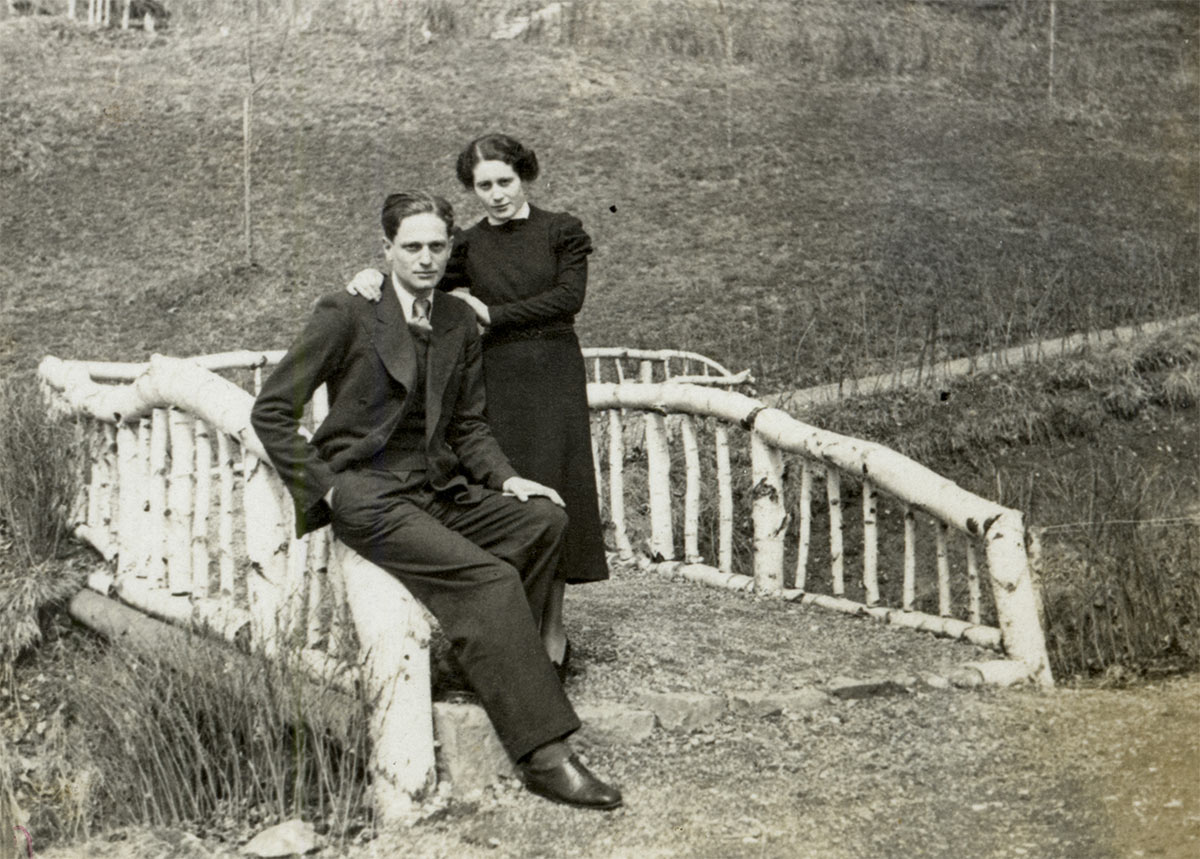
Wurmbrand is in this module because his story shaped how Western Christians imagined persecution behind the Iron Curtain, and because he is the clearest modern example of the old distinction between a martyr and a confessor (see lesson 01). A confessor suffers for the faith and lives. Wurmbrand was never executed. He spent fourteen years in Romanian prisons and died in exile decades later.

What the record shows
The mission Wurmbrand helped found gives the outline of his life. He was born in Bucharest in 1909 into a Jewish family and grew up an atheist. In 1938 he and his wife Sabina came to faith through a German carpenter, and he was later ordained, first as an Anglican and then as a Lutheran pastor. When the Communist government came to power in 1945 it began bringing the churches under state control. In 1948 he refused to pledge loyalty to the state and was arrested. He was released in 1956 "after eight-and-a-half years," returned to unofficial preaching, was imprisoned again in 1959 for "a further five-and-a-half years," and was freed in 1964 when Western Christians paid for his release. Tortured for Christ appeared in 1967 and, by the mission's count, has been translated into more than 65 languages.6
A popular account published by Christianity.com gives the date of the arrest as February 29, 1948: he "set out on foot for church" and "never arrived." The same account says he had earlier spoken at a government-organized "Congress of Cults," where he told some 4,000 delegates that a Christian's duty was to glorify God and Christ alone, and that in prison he was held in solitary confinement as "Prisoner Number 1."7 Those details come from Wurmbrand's own books and talks. The prison terms and the release payment are confirmed by the mission and by every later account. The details of what happened inside the cells rest almost entirely on what Wurmbrand and fellow prisoners later wrote.
Tradition and legend
Wurmbrand's story was retold in sermons, tracts and films from the late 1960s on, and some retellings added detail. The Christianity.com account says he testified before the United States Senate and "displayed eighteen holes cut in his body."7 That he testified to a Senate committee is part of every account; the number of scars and the scene in the hearing room are details this lesson could not check against the published hearing record, so they are reported here as tradition from his supporters. The same source reports that "ex-prisoners" told Sabina Wurmbrand they had witnessed her husband's funeral while he was in fact still alive, and that she suspected they might be government stooges, a reminder that false stories circulated during the Cold War.
What the sources dispute
No source disputes the imprisonment itself. The open questions concern detail. The exact sum paid for his release in 1964 and the names of the bodies that paid it differ between accounts; the mission says only that "Western Christians" paid. The torture he described cannot be checked against independent witnesses for most episodes, and historians of Communist Romania read his books as testimony: valuable, first-hand, and written by a man with a mission to raise support. The files of Romania's former secret police, opened to researchers after the fall of the regime, are the place where such claims can be tested, and this lesson found no published study of Wurmbrand's file to cite. His exact date of death (2001, in the United States) is given by standard reference works and is not confirmed here from a primary source.
Jerzy Popieluszko (1947 to 1984)
Died: October 19, 1984 · Place: abducted at Gorsk, near Torun, Poland; body found in a reservoir near Wloclawek · Earliest source: Polish Ministry of Internal Affairs statement printed in Trybuna Ludu, October 31, 1984 · Record strength: Documented
What the record shows
Poland's Institute of National Remembrance (IPN), the state body that holds the Communist-era police archives, gives the outline. He was born on September 14, 1947, at Okopy near Suchowola in Podlasie, and was born Alfons. As a Warsaw priest he joined the Primate's Committee for People Deprived of Freedom and their Families and organized help for persecuted members of the Solidarity trade union. After martial law was imposed on December 13, 1981, he "preached numerous sermons and celebrated Masses for the Homeland," regular services in Warsaw that made him widely known.8
On October 19, 1984, after a Mass in Bydgoszcz (at the church of the Holy Polish Brothers Martyrs, which the IPN's English page calls "All Saints Parish run by the Martyr Brothers")38, he and his driver Waldemar Chrostowski were stopped in the village of Gorsk on their way back to Warsaw. Three officers of the Security Service, Grzegorz Piotrowski, Leszek Pekala and Waldemar Chmielewski, abducted them. The officers belonged to a unit the IPN describes as the "D" (disintegration) group of Department IV of the Ministry of Internal Affairs, the department that watched the churches. On October 31 the Communist party daily Trybuna Ludu printed a ministry statement that the priest's body had been found on October 30 in a water reservoir near Wloclawek, during a search that included police divers.9 The state that killed him thus published the finding of his body, under pressure of public anger.
The Catholic Church beatified him on June 6, 2010, at a Mass in Pilsudski Square in Warsaw celebrated by Archbishop Angelo Amato as the delegate of Pope Benedict XVI. The IPN quotes a line from his preaching: "Violence is not a sign of strength but of weakness."8 In 2018 the Polish parliament made October 19 a National Day of Remembrance for Steadfast Clergy.9
Tradition and legend
Polish devotion to Popieluszko grew quickly after his death, and his grave in Warsaw became a place of pilgrimage. Two further points are part of the record. His driver, Waldemar Chrostowski, managed to jump from the moving car and escape, though the Polish history portal dzieje.pl notes that his account of the jump still raises questions. At the trial in Torun (1984 to 1985), Piotrowski and his superior Adam Pietruszka, deputy head of Department IV, were sentenced to 25 years in prison, Pekala to 15 and Chmielewski to 14; all four were released before their sentences ended.38 Popular devotion has also attached miracle stories to his grave. Those belong to the process for canonization, which is still open, and are not part of the historical record of his death.
What the sources dispute
No one disputes who carried out the abduction. The dispute, pursued by Polish prosecutors and journalists since 1989, is about who gave the order and how far up the ministry knowledge reached. A second question is the old one of motive: the government's own position in 1984 was that the officers had acted on their own, while the Church's beatification treats him as killed out of hatred of the faith. The Church's reasoning is that he was killed for what he preached from the altar. A secular historian can say with confidence that he was killed by the state's police for his public role as a priest, and leave the theological judgment to the churches.
Wang Zhiming (about 1907 to 1973)
Died: December 29, 1973 · Place: Wuding County, Yunnan, China · Earliest source: the memorial erected in Wuding County in 1981, and church and family testimony collected after his rehabilitation in 1980 · Record strength: Documented

What the record shows
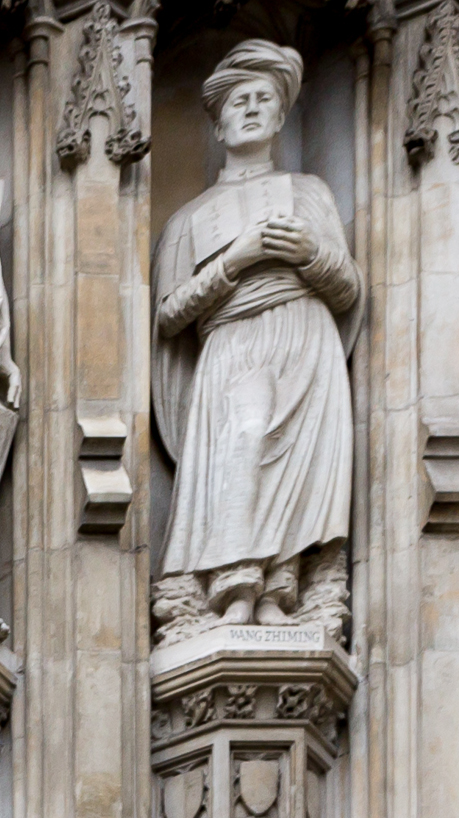
Westminster Abbey, which placed his statue among its ten modern martyrs, gives the fullest public account in English. Wang was a pastor in Wuding County in Yunnan, in China's far southwest. He taught at a mission school for ten years, was elected chairman of the Sapushan Church Council in 1944, and was ordained in 1951, two years after the Communist victory. In May 1969, during the Cultural Revolution, he was arrested with other members of his family. About four years later, at the age of sixty-six, he was condemned to death, and he was executed on December 29, 1973, at a mass rally of more than 10,000 people. The Abbey adds: "Immediately afterwards the crowd broke into confusion," and Christians attacked the prosecuting official. His wife was imprisoned for three years and two of his sons for nine; a third son reportedly took his own life in detention.10
In October 1980 party officials rehabilitated him, which in Chinese practice meant the state withdrew the verdict, and his family was offered compensation. A memorial was erected in Wuding County in 1981. The Abbey describes it as the only known monument to a Christian killed in the Cultural Revolution, and gives its inscription: "They will rest from their labours for their deeds follow them." His statue at Westminster, by the sculptor Neil Simmons, was unveiled on July 1, 1998.10
Tradition and legend
Little legend has gathered around Wang, partly because he was almost unknown outside southwest China until the Westminster statue of 1998. The memorial's inscription echoes Revelation 14:13, "they may rest from their labours; and their works do follow them" (KJV),11 and so places him in the line of witnesses that runs back to the book of Revelation (see lesson 02). Retellings in mission literature sometimes add scenes from his prison years; none was found in the Abbey's account, and none is repeated here.
What the sources dispute
The exact charges against him are not given in the Abbey's account, and the court records of the Cultural Revolution in Yunnan have not been published. The state's own act of rehabilitation in 1980 shows that the government later judged the verdict wrong, but it does not say on what grounds he was condemned. The ethnic identity of his congregations (the Abbey says only "Wuding County") and the number of Christians in the county are given differently in different mission sources, and this lesson leaves both out for that reason.
Watchman Nee (Ni Tuosheng, 1903 to 1972)
Died: May 30, 1972, in custody · Place: a labour camp prison in northern Anhui Province, China · Earliest source: a note found among his belongings by his niece, smuggled out of China in the mid-1970s; reports of his death reaching the West in 1972 · Record strength: Documented (for imprisonment and death in custody)
What the record shows
Watchman Nee was the best-known Chinese Protestant writer of the 20th century and the leader of a network of independent congregations often called the Little Flock. The most careful recent study of his death is by the historian Joseph Tse-Hei Lee, published in the journal of the Macau Ricci Institute in 2020. Lee gives the sequence plainly: "In 1952, Nee was put in a detention centre." In 1956 "he was given a fifteen-year sentence" and taken to Shanghai's Tilanqiao Prison. In late 1969 he was sent to a labour camp in northern Anhui Province. His health declined; he suffered from a heart ailment and a chronic stomach disorder. He "died alone in his cell on May 30, 1972, at the age of sixty-nine."12
Lee reports that a note was found among Nee's belongings by his niece. It opens "Christ is the Son of God who died for the redemption of sinners" and ends "I die because of my belief in Christ." According to Lee, the note was smuggled out of China in the mid-1970s and published some thirty years after that.12 Nee was not executed. He died in prison after twenty years in custody, and the note is the main evidence that he understood his own death as a death for Christ.
Tradition and legend
Lee's study is about how Nee's death became a martyr story. Overseas Chinese and British Christians translated his writings after his death was reported in 1972, and Angus Kinnear's biography of 1973 shaped his memory in the English-speaking world. The most detailed account of his last years comes from a cellmate, Wu Youqi, which Lee says "must be used with great caution" because of its hagiography, that is, writing meant to honor a saint: it presents Nee as refusing every compromise with the authorities.12 Readers of Nee's own books, which remain in print, often meet the martyr story first and the record second. This is tradition built on a real death in custody, and the cellmate's details are tradition until other evidence confirms them.
What the sources dispute
The charges against Nee are the main open question. Lee's article does not list them. The Chinese government's case against him in 1956, as reported by his followers and by later biographers, joined political accusations with personal and financial ones, and his followers have always rejected the personal charges. The court record has not been published, so this lesson does not repeat any of the charges as fact. A second question is whether "martyr" fits a man who died of illness in prison. The churches that honor him answer that he was imprisoned for his faith and never released, and Lee's study shows that the note was read from the start as a martyr's testimony. A historian can say that he died in state custody after twenty years of imprisonment that began with the campaign against independent churches, and that he wrote that he died because of his belief in Christ.
Janani Luwum (about 1922 to 1977)
Died: the night of February 16, 1977 (Westminster Abbey gives February 17) · Place: Kampala, Uganda · Earliest source: the Ugandan government's statement of February 17, 1977, and the reports of church leaders and journalists in the days after · Record strength: Documented
What the record shows
Westminster Abbey's account gives his church career. Luwum came to faith on January 6, 1948, in his village in Acholi in northern Uganda. He was ordained deacon on December 21, 1955, and priest a year later, consecrated Bishop of Northern Uganda on January 25, 1969, and elected Archbishop of the Church of Uganda (Anglican) in 1974. At his consecration Idi Amin was army chief of staff; Amin later took power in a coup against Milton Obote and ruled, in the Abbey's words, through intimidation, violence and corruption. On February 12, 1977, Luwum delivered a protest to Amin against violence by the security services. Shortly before his death he told Bishop Festo Kivengere: "They are going to kill me. I am not afraid." He was then "taken away and murdered."13
The fullest narrative of the last days comes from Olara Otunnu, a former Ugandan foreign minister, in a book of 2015 adapted for the Daily Monitor of Kampala. Otunnu writes that the security forces raided the archbishop's residence at Namirembe on February 5, claiming to search for weapons, and found none. The bishops met and wrote to Amin on February 8. Luwum was then brought to a gathering at the Nile Mansions hotel that functioned as a show trial, where he was accused of attempting to overthrow the government. That night, February 16, he was killed together with two cabinet ministers, Erinayo Oryema and Oboth Ofumbi. On the morning of February 17 the government announced that the three men had died in a car accident, "the official lie," Otunnu writes. Luwum was buried at Wigweng, in Mucwini, Kitgum District, on February 19, 1977.14

Tradition and legend
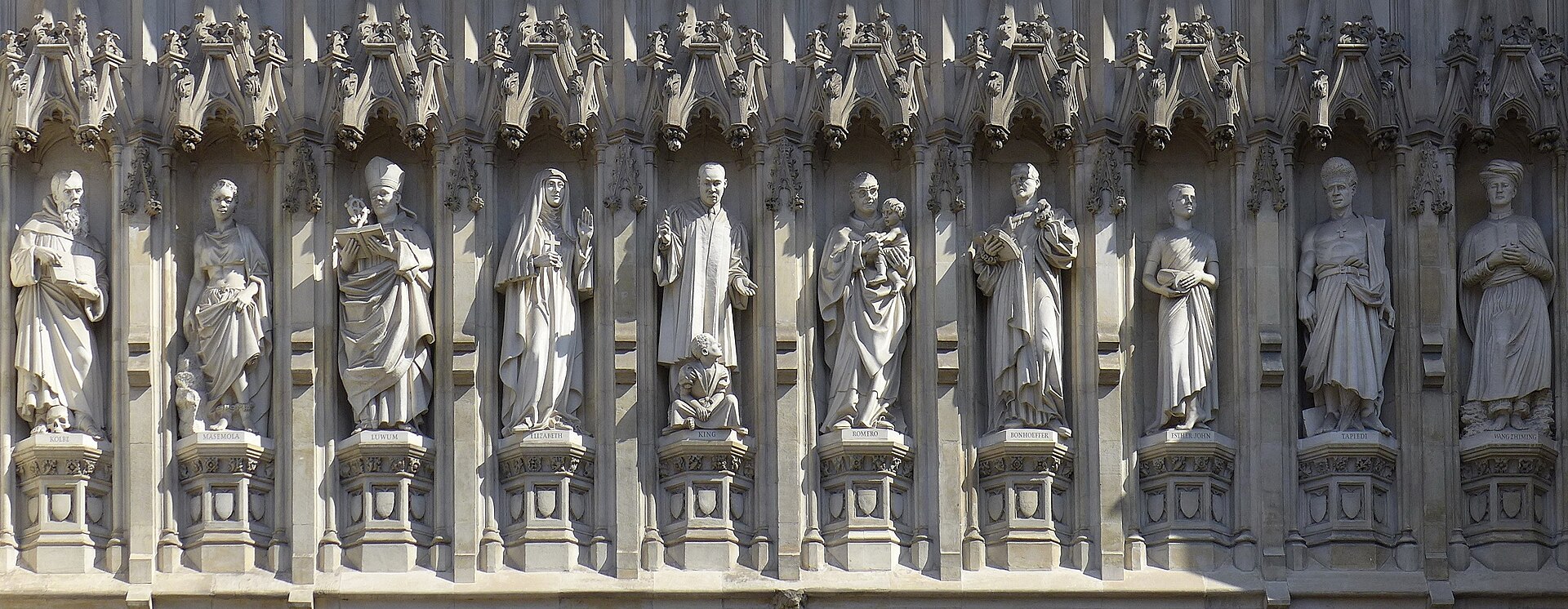
Westminster Abbey held a memorial service for Luwum on March 30, 1977, six weeks after his death, and his statue by Corin Johnson was among the ten unveiled in July 1998.13 In Uganda St. Janani Luwum Day is kept on February 16, with national commemoration at Wigweng since 2015.14 The tradition that Amin shot the archbishop with his own hand is reported by Otunnu, who writes that Amin shot him at about nine in the evening at the State Research Bureau in Nakasero.14 No court has ruled on that claim, and it rests on testimony gathered after the fall of Amin's government in 1979. It is reported here as Otunnu's account.
What the sources dispute
The date is the plainest difference: February 16 in Ugandan sources and in Otunnu, February 17 in the Abbey's record, which follows the day of the government's announcement. The dates of the bishops' letter (February 8 in Otunnu) and of Luwum's protest delivered to Amin (February 12 in the Abbey's account) may describe two different documents or the same protest dated differently. The manner of death and the identity of the killer remain matters of testimony, since no autopsy was allowed and the body was released only for burial. On the central fact there is no dispute: the government's car-accident story was false, and the archbishop was killed in state custody after publicly protesting killings by the security forces.
Oscar Romero (1917 to 1980)
Died: March 24, 1980 · Place: chapel of the Hospital de la Divina Providencia, San Salvador, El Salvador · Earliest source: press and church reports of March 24 to 25, 1980; the UN Commission on the Truth for El Salvador, report of March 15, 1993 · Record strength: Documented

What the record shows
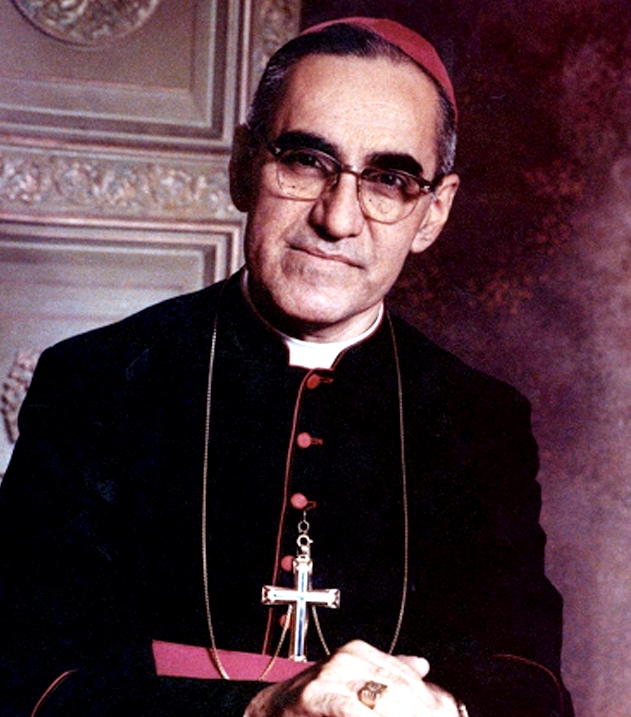
Oscar Arnulfo Romero was Archbishop of San Salvador in the years when the country moved into civil war. His Sunday sermons, which reached a national audience, named victims of killings by the army and by armed groups linked to it, and the Truth Commission's chronology places his death within the wave of death-squad killings of 1980. The chronology of the UN Commission on the Truth for El Salvador, delivered to the Security Council in March 1993, records his death in one line: on March 24, 1980, "Monsignor Oscar Arnulfo Romero was shot dead by a sniper as he celebrated mass in the Chapel of the Hospital de la Divina Providencia." The same chronology records that on May 7, 1980, Major Roberto D'Aubuisson was arrested and that the raid found documents "implicating the group in the organization and financing of death squads allegedly involved in Archbishop Romero's murder"; he was then released.15
The Commission's conclusion on the case was direct: "The Commission finds that Major Roberto D'Aubuisson ordered the assassination of the Archbishop and that Army Capt. Eduardo Avila and former Capt. Alvaro Saravia, as well as Fernando Sagrera played an active role in the assassination." It also found that "the Supreme Court of El Salvador played an active role in impeding the extradition" of Saravia from the United States.16 The Commission named the men responsible; it was not a court, and its findings were not a criminal judgment.
The Catholic Church's process was slow. The Archbishop Romero Trust, a British charity devoted to his memory, states that the cause was launched in 1990, on the tenth anniversary of his death, and was "paralysed" until Pope Francis "unblocked" it in 2013.17 On February 3, 2015, Pope Francis approved a decree that Romero was killed "in hatred of the faith," and Catholic News Service reported that the cause had been delayed for years "as the Congregation for the Doctrine of the Faith studied his writings," amid debate over whether he was killed for his faith or for his political positions.18 He was beatified in San Salvador on May 23, 2015, and canonized in St. Peter's Square on October 14, 2018, on the same day as Pope Paul VI.17
Tradition and legend
Romero is honored well beyond the Catholic Church. His statue stands among the ten at Westminster Abbey, and his feast day in the Catholic calendar is March 24, the day of his death.17 One saying often printed on posters, that if he were killed he would rise again in the Salvadoran people, was first published after his death in a journalist's account of an interview; some of his biographers question whether he said it in those words. It is tradition, and this lesson does not quote it as his.
What the sources dispute
The facts of the killing are settled by the Truth Commission. The dispute is over meaning. For years some bishops and officials in Rome were reluctant to call him a martyr, because he was killed by men who called themselves Catholics, in a political war, after sermons that dealt with land, wages and the army. The 2015 decree answered that he was killed in hatred of the faith, because his preaching of the Church's teaching on human dignity was the reason his enemies wanted him dead. Others, including many in El Salvador who opposed the guerrillas, saw his preaching as taking a side in the war. The killing of a bishop at the altar by men acting for a political faction has precedents in this module: Thomas Becket in 1170 (see lesson 04). The Catholic Church has reached its decision; historians record that the decision was contested for thirty years and why.
The Jesuits of the UCA, Elba Ramos and Celina Ramos (November 16, 1989)
Died: early hours of November 16, 1989 · Place: the Pastoral Centre of the Jose Simeon Canas Central American University (UCA), San Salvador · Earliest source: press reports of November 16, 1989; the Salvadoran trial of 1991; the UN Commission on the Truth for El Salvador, 1993 · Record strength: Documented
What the record shows
The Truth Commission's case study opens: "In the early hours on 16 November 1989, six Jesuit priests, a cook and her 16-year-old daughter were shot and killed" at the Pastoral Centre of the Central American University in San Salvador. The priests were Ignacio Ellacuria, the university's rector; Ignacio Martin-Baro, its vice-rector; Segundo Montes, director of its Human Rights Institute; Amando Lopez; Joaquin Lopez y Lopez; and Juan Ramon Moreno. The two women were Julia Elba Ramos, who cooked for the community, and her daughter Celina Mariceth Ramos.19
The Commission found "substantial evidence that on the night of 15 November 1989, then Colonel Rene Emilio Ponce" gave Colonel Guillermo Alfredo Benavides "the order to kill Father Ignacio Ellacuria and to leave no witnesses." It named other senior officers present (General Juan Rafael Bustillo and Colonels Juan Orlando Zepeda, Inocente Orlando Montano and Francisco Elena Fuentes) and found that the killing was "carried out by a group of soldiers from the Atlacatl Battalion," an army battalion. Several officers, including Benavides, then "took steps to conceal the truth." In September 1991 a Salvadoran jury found Colonel Benavides and Lieutenant Yusshy Rene Mendoza Vallecillos guilty of murder, and the judge imposed "the maximum sentence, 30 years in prison." Three other officers (Espinoza, Guevara Cerritos and Hernandez Barahona) received three-year sentences on other charges.19 The Commission also recommended that a request made by the Jesuits themselves, for a pardon for Benavides and Mendoza, be granted.19
The order to "leave no witnesses" is, on the Commission's finding, the reason the two women died. Popular accounts add that they had stayed the night at the residence because it seemed safer than their own home during fighting in the city; that detail was not found in the Commission text opened for this lesson.
Tradition and legend
Catholic writers routinely call all eight "the martyrs of the UCA." That is a church usage and a widespread one; whether the Catholic Church will formally declare them martyrs, as it did Romero, is a separate question for its own procedures.
What the sources dispute
The Commission found that officers worked to conceal the truth, and the trial of 1991 and the Commission's report of 1993 placed responsibility on the army. What remains disputed is less the facts than their classification. The order, as the Commission records it, named Ellacuria, a priest and the head of a university, as the target. The killers did not ask the priests to renounce Christianity. The case for calling them martyrs, made by their church and their order, is that they were killed for work they did as priests and teachers. Later proceedings against officers in other countries, reported in the press after 2010, are outside the scope of this brief and were not checked for it.
Shahbaz Bhatti (1968 to 2011)
Died: March 2, 2011 · Place: Islamabad, Pakistan · Earliest source: Associated Press and other wire reports of March 2, 2011, and the leaflets left at the scene · Record strength: Documented
What the record shows
Shahbaz Bhatti was Pakistan's federal minister for minorities. The Associated Press reported on the day of his death that he was a "42-year-old Roman Catholic." Gunmen fired on his car outside his mother's home in Islamabad. A witness, Gulam Rahim, told the AP that two men "tried to pull Mr. Bhatti out" while a third "fired his Kalashnikov rifle repeatedly into the dark-colored Toyota." Leaflets left at the scene said that al Qaeda and "the Pakistani Taliban Movement in Punjab province" were responsible. The note called him an "infidel Christian," blamed the government for putting him in charge of a committee to review the blasphemy laws (the government denied that such a committee existed), and warned: "With the blessing of Allah, the mujahedeen will send each of you to hell."20
The AP placed the killing in a sequence. Bhatti was the second public opponent of Pakistan's blasphemy laws killed in two months: in January 2011 a bodyguard had killed Salman Taseer, governor of Punjab province, who had also spoken against the laws. Bhatti had recorded a video statement for use if he were killed, in which he said, "I will die to defend their rights," and "These threats and these warnings cannot change my opinions and principles."20
Tradition and legend
Bhatti's video statement has been quoted in sermons and church publications across the world, often with added sentences about his faith in Christ. The words quoted above are those the AP reported on the day of his death. Longer versions circulate; readers should check any longer quotation against the full recording before repeating it. Catholic groups in Pakistan and abroad have promoted his recognition as a martyr, and a diocesan process has been reported; its current stage was not confirmed for this lesson.
What the sources dispute
The killers' own note joins two motives: his Christian faith ("infidel Christian") and his public work against the blasphemy laws. That is why his death is classified differently by different bodies. A human rights report counts it as the political killing of a minister. Christian advocacy groups count it as a killing for faith. Both are describing the same record. The leaflet's claim of responsibility, and later claims by other militant groups, have not been settled by a published court verdict that this lesson could find.
The 21 killed near Sirte, Libya (2015)
Died: February 2015 (the video was released on February 15, 2015; the exact day of the killings is not established) · Place: a beach near Sirte, Libya · Earliest source: the Islamic State's video of February 15, 2015, and the news reports and church statements that followed · Record strength: Documented
What the record shows
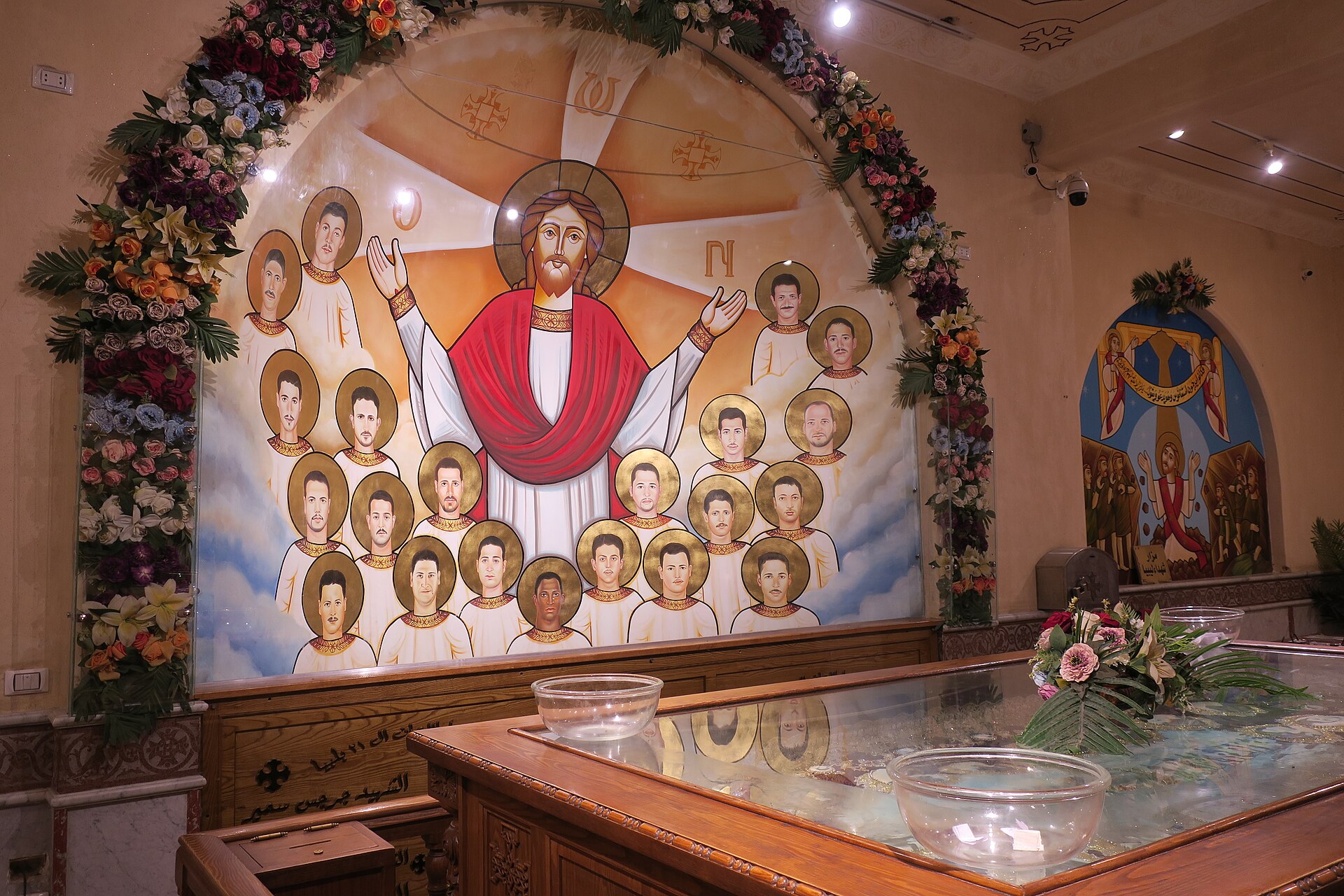
Twenty Egyptian Coptic Christians, most of them construction workers, were kidnapped in Sirte in two separate attacks, on December 27, 2014, and in January 2015. Photographs of the captives appeared in the Islamic State's magazine Dabiq on February 12, 2015, and a five-minute video showing their deaths was published on February 15, 2015. Its caption called the captives "People of the Cross, followers of the hostile Egyptian Church." Thirteen of the men came from the village of al-Our in Minya province.21 A twenty-first man, Matthew Ayariga, killed with them, was later identified as a migrant worker from Ghana; EWTN News describes him as "Originally from Ghana" and the only Black African among the 21.22
The Coptic Orthodox Church moved quickly. On February 21, 2015, a week after the video appeared, Pope Tawadros II of Alexandria declared the 21 saints, with their feast on 8 Amshir in the Coptic calendar, which falls on February 15.2139 On May 11, 2023, during a visit to Rome by Pope Tawadros, Pope Francis announced that "these 21 martyrs will be included in the Roman Martyrology," saying they had been baptized "in blood, blood that is a seed of unity for all followers of Christ."23 Aid to the Church in Need noted that they are the first saints honored by both churches since the two divided after the Council of Chalcedon in 451. In the same report ACN wrote that twenty of the men were known to be Orthodox Copts, and that the religious affiliation of the twenty-first man, Matthew, "has never been ascertained," though his name "indicates he was probably raised as a Christian."23 The remains of the twenty Egyptians were returned to Egypt on May 15, 2018, and a church dedicated to them was built in their home village.21

Tradition and legend
The best-known tradition concerns Matthew Ayariga. When his captors asked about his faith, EWTN reports, he "reportedly replied" with the words "Their God is my God."22 The source of that report is not named, and the video does not establish it. It is tradition, widely repeated in Catholic and Orthodox preaching since 2015. Other devotional accounts describe the last words of the men. No one outside the killers heard what was said, and such accounts are tradition.
What the sources dispute
The record of the killings is not in doubt; the killers published it. Three questions remain. The first is the date: the feast is kept on February 15, the day the video appeared, and the exact day of death is not fixed by any independent source. The second is Matthew Ayariga's identity and church: ACN says his church affiliation was never established, and the spelling of his name and details of his background vary in reports. The third is whether the men were offered the chance to renounce their faith. The video's caption names them by their religion, which is the strongest evidence of motive. The claim, often made in sermons, that each was asked to deny Christ and refused, is not shown by the published record.
Sudan, South Sudan and Nigeria: deaths counted in the hundreds and the millions
The briefs above are of named people. Most Christians killed since 1950 have no brief, because they died in wars and massacres where names were never collected. Two African cases show the problem, and the brief for this module asks that they be given with sourced numbers.
Sudan, 1983 to 2005
In September 1983 Sudan's president Jaafar Nimeiri announced that traditional Islamic punishments drawn from sharia would be written into the penal code, and the war between the government in Khartoum and the southern rebel movement resumed in the same year. The parties formally signed a peace agreement on January 9, 2005.24 The United States Commission on International Religious Freedom (USCIRF), a federal advisory body, wrote in its 2010 annual report that "The civilian victims of the conflict, two million dead and four million driven from their homes," were "overwhelmingly Southern Christians and followers of traditional African religions."25 The two million figure is an estimate of deaths from all causes, including famine and disease brought on by the war, and it covers followers of traditional religions as well as Christians. It is not a count of people killed for their faith. The war had religious, ethnic and economic causes at once, and South Sudan, which became independent in 2011, later suffered its own civil war between factions whose leaders were themselves Christians. The Sudan case shows why a broad definition of martyrdom, which counts Christians who die "in situations of witness" in such wars, produces numbers many times higher than a definition limited to killings for faith.
Nigeria, 2024 to 2025
Nigeria now accounts for most of the killings of Christians that Open Doors counts. In its 2026 list Open Doors recorded 3,490 Christians killed in Nigeria for faith-related reasons in the year to September 30, 2025, up from 3,100 the year before, out of 4,849 worldwide.4 The killings occur mainly in the north and the Middle Belt, at the hands of jihadist groups (Boko Haram and the Islamic State West Africa Province) and of armed herders and bandits whose motives are debated.
Other counts are far higher. Intersociety, a Nigerian civil society organization led by Emeka Umeagbalasi, reported in August 2025 that "at least 7,087 Christians were massacred across Nigeria in the first 220 days of 2025," and that some 125,009 Christians had been killed in Nigeria since 2009.26 Its latest report as of October 2026, released in September 2026, said that "no fewer than 3,083 Christians were killed and 3,193 abducted" in Nigeria from January to August 2026, and Umeagbalasi gave a cumulative figure of 130,783 Christians killed since 2009.40 Those figures were widely repeated by politicians and advocacy groups in 2025 and 2026. They have also been questioned. Religion Watch, a newsletter published at Baylor University, summarized in May 2026 the argument of Dennis Petri, a researcher on religious freedom, that Intersociety's figures cannot be checked because they rest on "untraceable aggregate death tolls," and that its description of the violence as genocide goes beyond what the legal definition supports. Petri contrasts Intersociety with the Observatory of Religious Freedom in Africa (ORFA), which records incidents one by one, and argues that ORFA's data show attacks on churches at rates well above Christians' share of the population, evidence that Christians are targeted. Petri also faults the opposite camp: some writers, he says, wrongly conclude that there is no religious targeting at all and treat the violence only as a contest over land and water.27
The reader therefore meets, for one country, an incident-based minimum (Open Doors, 3,490 in twelve months), a much higher aggregate figure from a local advocacy group (Intersociety, 7,087 in about seven months of 2025 and 3,083 in the first eight months of 2026), and a scholarly argument that the truth is serious, targeted and hard to measure. None of these is a count of every death. All three should be cited with their source and period.
The counts: how many Christians are killed each year?
Numbers about martyrdom travel fast and lose their labels on the way. A figure produced by one method for one purpose is quoted in a sermon, a news story or a politician's speech as if it were a body count. This section sets out the main sources as of October 2026, with the year each covers, the definition each uses and the method behind it.
Open Doors, World Watch List 2026
Open Doors, an international Christian mission, publishes a World Watch List each January ranking the 50 countries where it judges Christians face the most persecution. It defines persecution as "any hostility experienced as a result of one's identification with Christ," and scores each country in six areas: private life, family life, community life, national life, church life and violence.28 The 2026 list states: "The WWL 2026 reporting period was 1 October 2024 - 30 September 2025." Its count of Christians killed answers a single question in its research questionnaire: "How many Christians have been killed for faith-related reasons (including state sanctioned executions)?" For that period the total was 4,849.4
Open Doors describes its own figure as a floor. Its documentation says the data are "based wherever possible on direct counting," that where counting was impossible "the World Watch Research team has always estimated conservatively," using "symbolic round numbers" such as 10, 100 or 1,000, and that "what has been counted is very often the absolute minimum." Its conclusion: "the numbers presented are (much) lower than in reality."4 In the 2026 list the Central African Republic and Cameroon each appear with 100 killed, which are symbolic round numbers of this kind. The same report counted 3,632 churches or other public Christian properties attacked, 3,414 Christians detained without trial, arrested, sentenced or imprisoned, and 3,302 abducted, and estimated that "More than 388 million Christians face high levels of persecution and discrimination for their faith" in the countries scoring 41 points or more.4 Open Doors US adds that 4,491 of the deaths, 93 percent, took place in sub-Saharan Africa, and that Nigeria "is responsible for more than 70% of global deaths for faith-related reasons."5
Open Doors' killed figures for earlier lists, as given in the 2026 documentation, were 3,066 (WWL 2018), 4,305 (2019), 2,983 (2020), 4,761 (2021), 5,898 (2022), 5,621 (2023), 4,998 (2024) and 4,476 (2025).4 Each list's reporting year runs from October to the following September, so the WWL 2025 figure of 4,476 covers October 2023 to September 2024.
Center for the Study of Global Christianity: an estimate per decade
The Center for the Study of Global Christianity (CSGC) at Gordon-Conwell Theological Seminary, directed by Todd M. Johnson and Gina A. Zurlo, publishes each January a one-page table, the Status of Global Christianity, in the International Bulletin of Mission Research. In the 2025 table, row 46 is "Christian martyrs per 10-years," with these values: 344,000 for 1900, 3,770,000 for 1970, 1,600,000 for 2000, 900,000 for 2025, and a projection of 1,000,000 for 2050. The table's note explains that each figure is a "Ten-year total for decade ending in the given year," and gives as the source of the row David B. Barrett and Todd M. Johnson, World Christian Trends (2001), part 4, "Martyrology." The table is drawn from the World Christian Database (Brill) and accompanies Gina A. Zurlo, Todd M. Johnson and Peter F. Crossing, "World Christianity 2025: Regional Perspectives," International Bulletin of Mission Research 49, no. 1 (January 2025).29 Reporting on the 2026 edition in April 2026, Christian Today wrote that "around 900,000 Christians are estimated to have died for their faith in the last 10 years," and that the long-term number had fallen compared with earlier decades.30 Divided by ten, 900,000 a decade is an average of about 90,000 a year.
The CSGC's definition is the source of the difference. As reported by Christianity Today in 2020, martyrs are "believers in Christ who have lost their lives prematurely, in situations of witness, as a result of human hostility."31 When the Center announced its figure of 900,000 martyrs for 2005 to 2015, "an average of 90,000 per year," the Christian Post reported that "'Witness' in this definition is not restricted to public testimony concerning belief in Jesus," and that about 70 percent of the 90,000 were killed in "tribal conflicts in Africa."32 The CSGC's own quick-facts page states that "there have been over 70 million Christians martyred in history," more than half of them in the 20th century under fascist and Communist governments, and that about 100,000 a year were killed on average in 2000 to 2010.33 These are demographic estimates, built by applying the definition to whole conflicts and populations. The Center says so, and it publishes them as estimates.
The critique of the high estimate
The CSGC figures have been criticized from within the Christian research world. In 2011 Thomas Schirrmacher, a German theologian and religious freedom researcher, wrote in the International Journal for Religious Freedom that the yearly martyr number "is quoted by various institutions but only produced by one institution," that it was then most often quoted by Aid to the Church in Need, and that ACN reported 130,000 to 170,000 martyrs a year but "does not conduct any of its own investigations."34 Christianity Today reported in 2020 that a researcher with the International Society for Human Rights "estimated the number is about 10,000 annually," and quoted Judd Birdsall, a former United States diplomat, warning that a definition producing something like 100,000 martyrs a year "greatly cheapens the term." Todd Johnson answered in the same article: "I don't think we're overestimating."31
The most quoted version of the high figure is a slogan. In June 2011 the Italian sociologist Massimo Introvigne told an interfaith conference organized by the Hungarian presidency of the European Union at Godollo that "a Christian is killed for his faith in the world every five minutes." He derived this from his own projection that "the figure for 2011 will be 105,000," based on Barrett and Johnson's estimate of 100,000 for 2010.35 "Every five minutes" is arithmetic on an estimate; it was never a count of incidents.
Pew Research Center and Aid to the Church in Need: no yearly death count
The Pew Research Center does not count martyrs. Its yearly study scores 198 countries and territories on a Government Restrictions Index and a Social Hostilities Index, each from 0 to 10, from reports by the U.S. State Department, USCIRF, the United Nations and non-governmental groups. For 2023, the latest year in its June 2026 report, the global median was 3.0 on the government index and 1.6 on the social index.2 Pew also records in how many countries each religious group was harassed. In 2023 Christians were harassed "in 165 countries," Muslims in 143 and Jews in 98. Pew's harassment measure includes "damage to property, detentions, assaults, displacements and killings," but it "does not assess the severity of the harassment," and Pew states that it "cannot claim to count every incident."3
Aid to the Church in Need, a Catholic charity, has published a Religious Freedom in the World report since 1999. The 2025 edition, released in October 2025, covers January 1, 2023, to December 31, 2024. It placed 24 countries in its category of persecution and 38 in its category of discrimination, and reported that 64.7 percent of the world's population, "almost 5.4 billion," live in countries with serious or very serious violations of religious freedom. Its summary gives no total of Christians killed.36 The report concerns the freedom of all religions, not only Christians.
Why the counts differ
The gap between about 4,800 and about 90,000 a year comes mainly from the different questions the two figures answer.
Definition. Open Doors counts Christians killed "for faith-related reasons," a judgment its researchers make incident by incident. The CSGC counts believers who die prematurely "in situations of witness, as a result of human hostility," a definition that, by the Center's own account as reported in 2017, takes in Christians killed in civil wars and ethnic conflicts whether or not their faith was the reason for the killing.32 A Congolese villager killed by a militia that kills everyone in the village is counted by the second definition and usually not by the first.
Method. Open Doors starts from reported incidents and adds them up, filling gaps with deliberately low round numbers. The CSGC starts from the size of Christian populations in conflicts and estimates the share who died, then averages over ten years. The first method misses deaths no one reports; Open Doors says so. The second method depends on estimates of total deaths in wars, which are themselves disputed, and on a judgment about what share of Christian deaths are "in situations of witness."
Time. Open Doors reports a single twelve-month period. The CSGC reports a ten-year total. A single year with a large massacre swings the first figure; the second smooths it out, and also carries forward the effect of very large wars inside the decade.
Purpose. Both organizations are Christian bodies that want churches to pray for and help persecuted Christians, and both say so. Open Doors' ranking is used in advocacy with governments, where defensible minimum counts matter. The CSGC's figures belong to a demographic database of world Christianity and are meant to be read alongside its estimates of church membership, which favors a single consistent long-run definition. Neither figure is a census of martyrs, and neither organization presents it as one. Trouble begins when a writer quotes the CSGC estimate with Open Doors' definition attached, or quotes Open Doors' minimum as if it were the full number.
The era as a whole
Three things set this era apart from the earlier ones in this module. The first is the quality of the record. Romero's killing was investigated by a United Nations commission; Popieluszko's body was found by police divers whose search was announced in the party newspaper; the 21 in Libya were filmed by their killers. For almost every named death in this lesson the facts of who died, where and when are settled. The disputes move to the questions historians of earlier periods could rarely answer: who gave the order, and why.
The second is the variety of killers. Roman magistrates, medieval inquisitors and Reformation courts all claimed to act under law. After 1950 Christians were killed by courts (Wang Zhiming), in custody without a fresh sentence (Watchman Nee), by secret police acting outside the law (Popieluszko, and on Otunnu's account Luwum), by army officers who ordered a killing and then covered it up (the Jesuits), by a death squad (Romero), by militants who left a leaflet (Bhatti) and by a group that wanted the world to watch (the 21). The accusation, where one is known, ranged from plotting a coup (Luwum, on Otunnu's account) to serving on a committee on the blasphemy laws (in the leaflet left beside Bhatti's car), and in Libya there was no charge beyond the label "People of the Cross."
The third is the question of whom to count. Many of the killers in this lesson were baptized Christians, and several of the victims were killed for public positions that their churches regarded as part of their Christian witness and their enemies regarded as politics. The churches' answers have differed: the Catholic Church took 35 years to declare Romero a martyr, the Coptic Church declared the 21 saints within a week, and the Russian Orthodox Church waited until the Soviet Union had ended to glorify its New Martyrs. The counting organizations face the same question at scale. A reader who knows the definitions behind the numbers, and the record behind each name, can use both without overstating either.
What the record shows and what it does not
- Documented fact: the deaths of Wang Zhiming (December 29, 1973), Watchman Nee (May 30, 1972, in custody), Janani Luwum (February 1977), Oscar Romero (March 24, 1980), Jerzy Popieluszko (October 1984), the six Jesuits, Elba Ramos and Celina Ramos (November 16, 1989), Shahbaz Bhatti (March 2, 2011) and the 21 in Libya (video released February 15, 2015); Richard Wurmbrand's imprisonments of 1948 to 1964 and his release.
- Documented by an official inquiry: the UN Truth Commission's findings that Roberto D'Aubuisson ordered Romero's killing and that Colonel Rene Emilio Ponce gave the order to kill Ellacuria "and to leave no witnesses."
- A church's own claim or decision: that Romero was killed "in hatred of the faith" (Catholic decree, 2015); that the 21 are saints (Coptic Church, 2015) and martyrs (Roman Martyrology, 2023); that the New Martyrs of Russia are saints (Jubilee Council, 2000).
- Tradition: Matthew Ayariga's words "Their God is my God"; the detailed prison stories of Wurmbrand and of Nee's cellmate; the claim that Amin shot Luwum himself (Otunnu's account).
- Counts: Open Doors' 4,849 Christians killed for faith-related reasons, October 2024 to September 2025, a stated minimum.
- Estimates: the CSGC's 900,000 Christian martyrs per decade (about 90,000 a year) under a broad definition; Intersociety's Nigeria figures; the "every five minutes" slogan.
- Open questions: the chain of command behind Popieluszko's killing; the charges against Nee and Wang; the exact day of the Libya killings; how many Christians die each year for their faith under any single agreed definition.
Claims checked
"100,000 Christians are killed for their faith every year." Rating: Unsupported as a count
The figure comes from the CSGC's estimate of about 100,000 a year for 2000 to 2010, which the Center itself has since lowered to about 90,000 a year (900,000 per decade ending 2025, repeated for the 2026 edition).3329 It is an estimate under a definition that includes Christians killed in civil wars "in situations of witness." The only incident-based yearly count, Open Doors', is 4,849 for October 2024 to September 2025, and Open Doors calls that a minimum.4 Quoted as an estimate with its definition, the CSGC figure is a real scholarly claim. Quoted as a count of people killed because they are Christians, it is unsupported.
"A Christian is killed for the faith every five minutes." Rating: Unsupported
The phrase comes from Massimo Introvigne's speech of June 2011, where he derived it from his own projection of 105,000 deaths for 2011.35 It is arithmetic on an estimate. On Open Doors' count for 2024 to 2025 the interval would be closer to one death every 108 minutes (525,600 minutes in a year divided by 4,849), and that count is a minimum. Neither figure supports the slogan as a statement of fact.
"More Christians died for their faith in the 20th century than in all earlier centuries combined." Rating: Unresolved
The claim rests on one dataset: the CSGC's estimate that "over 70 million Christians" have been martyred in history, with more than half in the 20th century under fascist and Communist governments.33 No independent estimate checks it, the definition is the broad one described above, and the figures for earlier centuries are especially uncertain. For the Roman persecutions, historians estimate deaths in the thousands, not millions (see lesson 03 and Church History, Part A, lesson 03). The 20th century has the best-recorded mass killings of Christians by states. Whether its total exceeds all previous centuries cannot be shown from sources that count rather than estimate.
"Christians are the most persecuted religious group in the world." Rating: Partly supported
Pew's data show that Christians were harassed in more countries than any other group in 2023 (165 of 198), but Pew warns that its numbers "should not be interpreted as determining which religious group faced the most persecution," because the measure counts countries, not victims, and does not assess severity.3 Christians are the world's largest religious group and live in more countries than any other, which raises the count of countries where they are harassed. The claim is supported for breadth of harassment across countries. It is not established for intensity or per-person risk.
"Richard Wurmbrand was martyred by the Communists." Rating: Refuted
Wurmbrand survived fourteen years of imprisonment, was released in 1964, and lived and worked in the West for decades.6 In the older vocabulary of the church he was a confessor. The confusion comes from the name of the mission he helped found and from his books about martyrs.
"Romero was killed for politics, not for his faith." Rating: Unresolved
The Truth Commission established who ordered and carried out the killing, and placed it among the death-squad killings of the civil war.16 The Catholic Church's decree of 2015 holds that he was killed "in hatred of the faith," and Catholic News Service reported that the delay of his cause reflected exactly this debate.18 The killers left no statement of motive. The record supports both a political motive and the fact that the target was an archbishop killed at the altar for his preaching. Which description is primary is a theological judgment the record cannot settle.
"The 21 were each asked to deny Christ and refused." Rating: Unsupported
The video's caption names the men as "People of the Cross," which is clear evidence that they were killed as Christians.21 The published record does not show that they were each offered release in exchange for renouncing their faith. Matthew Ayariga's reported words, "Their God is my God," are attributed to an unnamed source.22 The claim about a refusal to deny Christ is a devotional reading; the claim that they died because they were Christians is supported.
"There is a genocide of Christians in Nigeria." Rating: Unresolved
Open Doors' minimum count of 3,490 Christians killed in Nigeria in a year, and incident data from ORFA showing churches attacked out of proportion to Christians' share of the population, show serious and targeted violence.427 Genocide is a legal term requiring intent to destroy a group as such, and the researcher Dennis Petri argues that this threshold "has not been met" on the published evidence, while also rejecting the view that the violence has no religious dimension.27 The highest figures in circulation, Intersociety's, have not been shown to rest on traceable incident data.26
"Archbishop Luwum died in a car accident." Rating: Refuted
This was the Ugandan government's announcement of February 17, 1977. Westminster Abbey's record says he was "taken away and murdered," and Olara Otunnu's reconstruction calls the accident story "the official lie."1314 No source outside Amin's government has supported it.
Hard questions and answers
Can a person killed by fellow Christians be a martyr?
Every church in this module has said yes in some case. Earlier lessons treat Protestants burned by Catholics, Catholics hanged by Protestants and Anabaptists drowned by Reformed magistrates (see lesson 06 and lesson 07). In this lesson, Romero, the Jesuits and Luwum were killed by men who were for the most part baptized Christians. The churches' test has been the reason for the killing; the religion of the killer has not decided the question. The Catholic decree on Romero, for example, rests on the claim that he was killed for preaching the Church's teaching. A skeptic can accept every fact in these briefs and still decline the theological judgment; the record and the judgment are separate questions.
Why would the Catholic Church add Coptic Orthodox Christians to its martyrology?
Pope Francis presented it as a recognition that the 21 were baptized "in blood," and ACN noted that they are the first saints shared by the two churches since their division after 451.23 The decision follows a long Catholic practice of honoring martyrs from before the divisions, and extends it to Christians of a church not in communion with Rome who died in the 21st century. Catholic and Orthodox readers may weigh the theology differently. Historically, it is a new step, and the record of the 21's deaths is the same whichever church honors them.
Should anyone trust numbers produced by groups that campaign for persecuted Christians?
Judge the method first. Open Doors publishes its question, its reporting period and its warnings about round numbers and minimums.4 The CSGC publishes its definition and labels its figure a ten-year estimate.29 Pew, which does not campaign, measures something different and says so.3 The safest practice is the one used throughout this lesson: give the number, its source, its period and its definition together, and never let an estimate stand in for a count. Where a group publishes a striking number without its sources, as Petri argues Intersociety has done, the number should be reported as that group's claim.27
Why do China and North Korea, where persecution is severe, contribute so few deaths to the counts?
Open Doors' table of killings for 2024 to 2025 is led by Nigeria, the Democratic Republic of the Congo and Burkina Faso, with countries such as Myanmar and Mexico further down.4 States that imprison rather than kill, and states that allow no outside reporting, produce few countable deaths. Open Doors' ranking scores pressure on private, family, community, national and church life as well as violence, which is why a country can rank high on persecution with a low count of killings.28 The briefs of Wang Zhiming and Watchman Nee are a reminder that deaths in closed states may become known years later or never.
Why include a man who was not killed?
The first Christian writers distinguished martyrs, who died, from confessors, who suffered and survived (see lesson 01). Wurmbrand is the modern confessor most often mistaken for a martyr, and his books shaped how millions of readers pictured persecution under Communism. Including him with the correct label keeps the categories clear. The same distinction applies to the hundreds of millions in Open Doors' "high levels of persecution" estimate: most of them are under pressure, and very few are killed.
Related lessons and modules
- Lesson 01: What a Martyr Is, and How to Weigh the Sources (the record strength key, confessors, Westminster Abbey's ten modern martyrs)
- Lesson 09: Missionary Martyrs and the World Wars (Bonhoeffer and Kolbe, two of the ten statues at Westminster, and the deaths before 1950)
- Lesson 04: From Constantine to the Middle Ages (Thomas Becket, the earlier archbishop killed in his church)
- Church History, Part A, lesson 03 (the Roman persecutions, for comparison of numbers)
- Church History, Part C (the wider church history of the modern period)
Learn more
- Open Doors, WWL 2026 compilation of main documents: Read the method notes on minimum counts and symbolic round numbers before quoting any World Watch List figure.
- Status of Global Christianity, 2025: The one-page CSGC table; row 46 and its note show exactly what the martyr estimate is.
- Pew Research Center, Harassment of religious groups around the world in 2023: The clearest explanation of what Pew's country counts do and do not measure.
- Report of the Commission on the Truth for El Salvador (UN S/25500): The primary record for the killings of Romero and the Jesuits, with the Commission's chronology of the war.
- Joseph Tse-Hei Lee on Watchman Nee: A careful study of how a death in custody became a martyr story, and of which sources to trust.
- Westminster Abbey, Wang Zhiming: The Abbey's account of the one Chinese martyr among its ten statues, with his memorial in Yunnan.
Still being checked (17 items)
These points could not be confirmed against a primary source when this lesson was written and fact checked in October 2026. The text above states each one as uncertain.
- Richard Wurmbrand's date of death (2001, in the United States) is from standard reference works and was not confirmed from an opened primary source; the scar count in his Senate testimony and the sum paid for his release in 1964 were not checked against primary records.
- Popieluszko: the chain of command behind the killing remains an open question; the exact dates of the Torun trial (usually given as December 27, 1984, to February 7, 1985) were not confirmed from an opened source.
- Wang Zhiming's birth year (about 1907) is inferred from Westminster Abbey's statement that he was sixty-six when condemned; the charges against him are not published.
- The charges against Watchman Nee in 1956 were not confirmed from an opened source and are not stated as fact in the lesson.
- Janani Luwum's birth year (about 1922) was not confirmed from an opened source; the date of death differs (February 16 in Otunnu and Ugandan observance, February 17 in Westminster Abbey's record); Otunnu's account that Amin shot him personally is testimony, not a court finding.
- Oscar Romero's birth year (1917) was not confirmed from an opened source; the origin of the saying that he would rise again in the Salvadoran people was not checked.
- The detail that Elba and Celina Ramos stayed at the Jesuit residence for safety was not found in the Truth Commission text opened; later foreign trials of officers in the Jesuit case were not checked.
- Shahbaz Bhatti: the status of any diocesan cause for beatification and any court verdict on his killers were not confirmed.
- The 21 in Libya: the kidnapping dates (December 27, 2014, and January 2015), the Dabiq date (February 12, 2015), and the return of remains on May 15, 2018, come from OrthodoxWiki and were not confirmed from a Coptic Church statement or wire service (the Coptic declaration of February 21, 2015, is now confirmed by Vatican Radio); the exact day of the killings is not established.
- Sudan: the figure of two million dead is USCIRF's statement; the underlying estimate was not opened. South Sudan's independence (2011) and later civil war are stated without a footnote.
- Nigeria: the description of the perpetrators (Boko Haram, Islamic State West Africa Province, armed herders and bandits) is general and not footnoted.
- The Status of Global Christianity 2026 table itself was not opened; its decade figure is taken from Christian Today's report of April 26, 2026.
- Open Doors' October to September reporting year is stated in the WWL 2026 documents for that list; the same pattern for earlier lists is assumed from Open Doors' standard practice.
- China after 1949 (Three-Self Patriotic Movement, Cultural Revolution dates 1966 to 1976) is stated without a footnote.
- The Wikimedia Commons pages for the five images could not be opened during this task (fetch failed); captions, creators and licenses follow IMAGES.md, and alt text was written from those descriptions without viewing the images.
- Westminster Abbey's pages give July 1, 1998, for the unveiling of the statues; some other accounts date the dedication service to July 9, 1998. The lesson follows the Abbey.
- Intersociety's report of September 2026 was read only as reported by Catholic World Report; Intersociety's own document was not opened, and CWR notes that its cumulative figures (128,750 to March 2026 in the reports, 130,783 in the interview) are not reconciled.
Notes
- Orthodox Church in America, "New Martyrs and Confessors of Russia," Lives of the Saints, oca.org (retrieved Oct. 28, 2026). Read it online. ↩
- Pew Research Center, report on social hostilities and government restrictions involving religion in 2023 (cited by URL), June 15, 2026, the Center's 16th annual report on restrictions on religion (retrieved Oct. 28, 2026). Read it online. ↩
- Pew Research Center, "Harassment of religious groups around the world in 2023," June 15, 2026 (retrieved Oct. 28, 2026). Read it online. ↩
- Open Doors International, World Watch Research, "WWL 2026: Compilation of main documents," January 2026, PDF: reporting period, question 6.1 on Christians killed, notes on minimum figures and symbolic round numbers, country tables and the series of earlier totals (retrieved Oct. 28, 2026). Read it online. ↩
- Open Doors US, "5 things you need to know about Open Doors' 2026 World Watch List," January 2026 (retrieved Oct. 28, 2026). Read it online. ↩
- Voice of Persecuted Christians (formerly Release International, the British mission founded with the Wurmbrands), "Richard and Sabina's story" (retrieved Oct. 28, 2026). Read it online. ↩
- Christianity.com, "Prisoner Number One: Richard Wurmbrandt," church history timeline article, drawing on Wurmbrand's own books (retrieved Oct. 28, 2026). Read it online. ↩
- Institute of National Remembrance (IPN), Poland, "The 10th anniversary of the beatification of Father Jerzy Popieluszko," 2020 (retrieved Oct. 28, 2026). Read it online. ↩
- Institute of National Remembrance (IPN), Poland, "The National Day of Remembrance for Steadfast Clergy, 19 October," citing the Ministry of Internal Affairs statement in Trybuna Ludu, October 31, 1984 (retrieved Oct. 28, 2026). Read it online. ↩
- Westminster Abbey, "Wang Zhiming," Abbey commemorations (retrieved Oct. 28, 2026). Read it online. ↩
- Revelation 14:13, King James Version (1611), public domain, as given at Bible Gateway (retrieved Oct. 28, 2026). Read it online. ↩
- Joseph Tse-Hei Lee, "Dying For Faith, Transforming Memories: Chinese Christian Martyr Watchman Nee (1903 to 1972)," Macau Ricci Institute Journal, issue 6, Contemplation, Mission and Martyrdom, September 2020 (retrieved Oct. 28, 2026). Read it online. ↩
- Westminster Abbey, "Janani Luwum," Abbey commemorations (retrieved Oct. 28, 2026). Read it online. ↩
- Olara Otunnu, "Tracing the final journey of Archbishop Janani Luwum," Daily Monitor (Kampala), adapted from his book Archbishop Janani Luwum: The Life and Witness of a 20th Century Martyr (Fountain Publishers, 2015) (retrieved Oct. 28, 2026). Read it online. ↩
- United Nations Security Council, document S/25500, transmitting From Madness to Hope: The 12-Year War in El Salvador, Report of the Commission on the Truth for El Salvador, 1993: chronology entries for March 24 and May 7, 1980, and recommendations (retrieved Oct. 28, 2026). Read it online. ↩
- Commission on the Truth for El Salvador, report of March 15, 1993, summary of conclusions on the assassination of Archbishop Romero, as reproduced by Creighton University's Collaborative Ministry Office, archived copy at the Internet Archive, captured Jan. 11, 2025 (retrieved Oct. 28, 2026). Read it online. ↩
- Archbishop Romero Trust, "Cause for canonisation" (retrieved Oct. 28, 2026). Read it online. ↩
- Catholic News Service, "Pope recognizes martyrdom of Archbishop Romero," The Catholic Sun, February 3, 2015 (retrieved Oct. 28, 2026). Read it online. ↩
- Commission on the Truth for El Salvador, From Madness to Hope (1993), section IV.B.1, "Illustrative case: the murders of the Jesuit priests," as transmitted to the Security Council in United Nations document S/25500 (April 1, 1993), official UN PDF; the section begins on page 45 of the PDF (retrieved Oct. 28, 2026). Read it online. ↩
- Associated Press, "Gunmen kill Christian Cabinet minister in Pakistan," March 2, 2011, as printed in The Washington Times (retrieved Oct. 28, 2026). Read it online. ↩
- OrthodoxWiki, "Twenty-One Coptic Martyrs of Lybia" [sic], citing the Coptic Synaxarion and Vatican News; used for dates not found in other opened sources and flagged in the unverified list (retrieved Oct. 28, 2026). Read it online. ↩
- EWTN News, "Texas parish first in world named after Ghanaian martyr St. Matthew Ayariga," September 1, 2026 (retrieved Oct. 28, 2026). Read it online. ↩
- Aid to the Church in Need Ireland, "Coptic Martyrs of Libya added to the Roman Martyrology of the Catholic Church," May 16, 2023 (retrieved Oct. 28, 2026). Read it online. ↩
- GlobalSecurity.org, "Sudan: Second Civil War, 1983 to 2004," on the September 1983 penal code changes and the signing of the peace agreement on January 9, 2005 (retrieved Oct. 28, 2026). Read it online. ↩
- United States Commission on International Religious Freedom, Annual Report 2010 (May 2010), chapter on Sudan, pp. 139 to 157 (the quotation is on p. 140) (retrieved Oct. 28, 2026). Read it online. ↩
- Catholic World Report, "Report states an average of 30 Christians murdered each day in Nigeria in 2025," August 12, 2025, on the Intersociety report of August 10, 2025 (retrieved Oct. 28, 2026). Read it online. ↩
- Religion Watch (Baylor University), "Data wars over anti-Christian violence in Nigeria," May 27, 2026, summarizing Dennis Petri, Five4Faith newsletter, April 17, 2026 (retrieved Oct. 28, 2026). Read it online. ↩
- Open Doors US, "World Watch List methodology" (retrieved Oct. 28, 2026). Read it online. ↩
- Gina A. Zurlo and Todd M. Johnson, Status of Global Christianity, 2025, in the Context of 1900 to 2050, table accompanying Zurlo, Johnson and Peter F. Crossing, "World Christianity 2025: Regional Perspectives," International Bulletin of Mission Research 49, no. 1 (January 2025): 62 to 74; row 46, "Christian martyrs per 10-years," and its note (copy retrieved Oct. 28, 2026). Read it online. ↩
- Obianuju Mbah, "Global Christianity faces major challenges in 2026 despite signs of growth, new report finds," Christian Today, April 26, 2026, on the Status of Global Christianity 2026 (retrieved Oct. 28, 2026). Read it online. ↩
- Megan Fowler, "Christian Martyrs: Numbers Down by Half in Decade, or Are They?" Christianity Today, February 2020 (retrieved Oct. 28, 2026). Read it online. ↩
- Samuel Smith, "Over 900,000 Christians Martyred for Their Faith in Last 10 Years: Report," Christian Post, January 16, 2017 (retrieved Oct. 28, 2026). Read it online. ↩
- Center for the Study of Global Christianity, Gordon-Conwell Theological Seminary, "Quick Facts" (retrieved Oct. 28, 2026). Read it online. ↩
- Thomas Schirrmacher, "A response to the high counts of Christian martyrs per year," International Journal for Religious Freedom 4, no. 2 (2011): 9 to 13, abstract (retrieved Oct. 28, 2026). Read it online. ↩
- Massimo Introvigne, address to the Conference on Christian-Jewish-Muslim Interfaith Dialogue, Hungarian Presidency of the European Union, Godollo, June 2 to 3, 2011, CESNUR (retrieved Oct. 28, 2026). Read it online. ↩
- Vatican News, "ACN religious freedom report: more than 5 billion face persecution," October 21, 2025, on Aid to the Church in Need, Religious Freedom in the World Report 2025 (retrieved Oct. 28, 2026). Read it online. ↩
- Orthodox Church in America, North American saints series, PDF on Patriarch Tikhon of Moscow: "In 1989, Patriarch Tikhon was glorified by the Council of Bishops of the Russian Orthodox Church" (retrieved Oct. 28, 2026). Read it online. ↩
- Dzieje.pl (Polish history portal), "38 lat temu zamordowano ks. Jerzego Popieluszke," October 2022: the Mass at the church of the Holy Polish Brothers Martyrs in Bydgoszcz, Chrostowski's escape from the moving car, and the sentences of the Torun trial (retrieved Oct. 28, 2026). Read it online. ↩
- Vatican Radio, "Coptic Church recognizes martyrdom of 21 Coptic Christians," February 21, 2015: Pope Tawadros II ordered the names added to the Coptic Synaxarium, commemorated on 8 Amshir (February 15) (retrieved Oct. 28, 2026). Read it online. ↩
- Ngala Killian Chimtom, "New report says over 3,000 Christians killed in Nigeria in just eight months in 2026," Catholic World Report, September 8, 2026, on Intersociety's report for January to August 2026 and an interview with Emeka Umeagbalasi (retrieved Oct. 28, 2026). Read it online. ↩
Check yourself
1. What figure did Open Doors give for Christians killed for faith-related reasons in its World Watch List 2026, and for what period?
The WWL 2026 documentation gives 4,849 for October 1, 2024, to September 30, 2025, and says its counts are very often the absolute minimum. 4,476 was the WWL 2025 figure; 7,087 is Intersociety's figure for Nigeria alone.
2. How does the Center for the Study of Global Christianity define a martyr?
This broad definition, reported by Christianity Today in 2020, counts Christians killed in conflicts such as civil wars, which is the main reason the CSGC estimate is far above Open Doors' count.
3. Whom did the UN Commission on the Truth for El Salvador find had ordered the assassination of Archbishop Oscar Romero?
The Commission found that Major Roberto D'Aubuisson ordered the assassination and that Captains Eduardo Avila and Alvaro Saravia and Fernando Sagrera played an active role. Ponce was named in the Jesuit case.
4. Why is Richard Wurmbrand described in this lesson as a confessor?
In the early church's vocabulary a martyr died and a confessor suffered and survived. Wurmbrand was imprisoned from 1948 to 1956 and 1959 to 1964 and was released in 1964.
5. According to Joseph Tse-Hei Lee's study, how did Watchman Nee die?
Lee writes that Nee was detained in 1952, sentenced to fifteen years in 1956, moved to a labour camp in northern Anhui in 1969, and died alone in his cell on May 30, 1972. The rally in Yunnan describes Wang Zhiming's execution.
6. When did Pope Francis announce that the 21 men killed in Libya would be included in the Roman Martyrology?
Pope Francis made the announcement on May 11, 2023. February 21, 2015, is the date given for the Coptic Church's declaration; the 2015 and 2018 dates belong to Romero's cause.
7. What does Pew Research Center's figure of 165 countries for Christians in 2023 measure?
Pew counts countries where a group faced harassment of any kind, including killings, and says the measure does not assess severity and should not be read as ranking which group is most persecuted.
8. Where does the claim that 'a Christian is killed for the faith every five minutes' come from?
Introvigne derived it in June 2011 from his projection of 105,000 deaths for 2011, itself based on Barrett and Johnson's estimate of 100,000 for 2010. It is arithmetic on an estimate.
Terms in this lesson
- Confessor
- In early Christian usage, a believer who suffered for the faith, by prison or torture, and survived. Distinguished from a martyr, who died.
- New Martyrs and Confessors of Russia
- The Christians killed or persecuted under Soviet rule whom the Russian Orthodox Church glorified as saints at its Jubilee Council of 2000, more than one thousand in number, kept on the Sunday closest to January 25.
- Rehabilitation (China)
- The Chinese Communist Party's formal withdrawal of an earlier verdict against a person, as in Wang Zhiming's case in October 1980.
- World Watch List
- Open Doors' yearly ranking of the 50 countries where it judges Christians face the most persecution, published each January for a reporting year running from October to September.
- Open Doors' test for counting a death, in its question: 'How many Christians have been killed for faith-related reasons (including state sanctioned executions)?' Its totals are stated minimums.
- Situations of witness
- The phrase in the CSGC's definition of martyrdom. It is not restricted to public testimony about Jesus and takes in Christians killed in conflicts such as civil wars.
- Symbolic round number
- Open Doors' practice of entering a conservative figure such as 10, 100 or 1,000 when an exact count of deaths cannot be verified.
- Government Restrictions Index
- Pew Research Center's 0 to 10 measure of government laws, policies and actions restricting religion in 198 countries and territories; the global median was 3.0 in 2023.
- Pew Research Center's 0 to 10 measure of hostile acts involving religion by private individuals and groups; the global median was 1.6 in 2023.
- In odium fidei
- Latin for 'in hatred of the faith,' the Catholic Church's test for declaring a person a martyr. Pope Francis approved such a decree for Oscar Romero on February 3, 2015.
- Roman Martyrology
- The Catholic Church's official list of saints and martyrs by feast day. The 21 killed in Libya were added in 2023.
- Commission on the Truth for El Salvador
- The UN-sponsored commission that investigated serious acts of violence in El Salvador's civil war and reported in March 1993 (From Madness to Hope), including the killings of Romero and the Jesuits.
- Blasphemy laws (Pakistan)
- Sections of Pakistan's penal code punishing insults to religion. Opposition to them was cited in the leaflet left at Shahbaz Bhatti's killing, two months after the killing of Governor Salman Taseer.
Sources
- Open Doors International, WWL 2026: Compilation of main documents (January 2026) checked 2026-10
- Open Doors US, 5 things you need to know about Open Doors' 2026 World Watch List (January 2026) checked 2026-10
- Open Doors US, World Watch List methodology (2026) checked 2026-10
- Zurlo and Johnson, Status of Global Christianity, 2025 (IBMR table) (January 2025) checked 2026-10
- Christian Today, Global Christianity faces major challenges in 2026 (April 26, 2026) checked 2026-10
- Center for the Study of Global Christianity, Quick Facts (accessed October 2026) checked 2026-10
- Christian Post, Over 900,000 Christians Martyred for Their Faith in Last 10 Years (January 16, 2017) checked 2026-10
- Christianity Today, Christian Martyrs: Numbers Down by Half in Decade, or Are They? (February 2020) checked 2026-10
- Massimo Introvigne, address at Godollo (CESNUR) (June 2011) checked 2026-10
- Thomas Schirrmacher, A response to the high counts of Christian martyrs per year (IJRF) (2011) checked 2026-10
- Pew Research Center, 16th annual report on restrictions on religion, data for 2023 (cited by URL) (June 15, 2026) checked 2026-10
- Pew Research Center, Harassment of religious groups around the world in 2023 (June 15, 2026) checked 2026-10
- Vatican News on ACN's Religious Freedom in the World Report 2025 (October 21, 2025) checked 2026-10
- Orthodox Church in America, New Martyrs and Confessors of Russia (accessed October 2026) checked 2026-10
- Voice of Persecuted Christians, Richard and Sabina's story (accessed October 2026) checked 2026-10
- Christianity.com, Prisoner Number One: Richard Wurmbrandt (accessed October 2026) checked 2026-10
- IPN, The 10th anniversary of the beatification of Father Jerzy Popieluszko (2020) checked 2026-10
- IPN, The National Day of Remembrance for Steadfast Clergy, 19 October (accessed October 2026) checked 2026-10
- Westminster Abbey, Wang Zhiming (accessed October 2026) checked 2026-10
- Westminster Abbey, Janani Luwum (accessed October 2026) checked 2026-10
- King James Version, Revelation 14:13 (Bible Gateway) (1611) checked 2026-10
- Joseph Tse-Hei Lee, Dying For Faith, Transforming Memories: Watchman Nee (MRI Journal) (September 2020) checked 2026-10
- Olara Otunnu, Tracing the final journey of Archbishop Janani Luwum (Daily Monitor) (adapted from a 2015 book) checked 2026-10
- UN Security Council S/25500, Report of the Commission on the Truth for El Salvador (March 1993) checked 2026-10
- The Truth Commission Report to the United Nations (Creighton University summary, Internet Archive copy) (March 15, 1993) checked 2026-10
- From Madness to Hope, section IV.B.1, the murders of the Jesuit priests (UN document S/25500) (1993) checked 2026-10
- Catholic News Service, Pope recognizes martyrdom of Archbishop Romero (Catholic Sun) (February 3, 2015) checked 2026-10
- Archbishop Romero Trust, Cause for canonisation (accessed October 2026) checked 2026-10
- Associated Press, Gunmen kill Christian Cabinet minister in Pakistan (Washington Times) (March 2, 2011) checked 2026-10
- OrthodoxWiki, Twenty-One Coptic Martyrs (accessed October 2026) checked 2026-10
- ACN Ireland, Coptic Martyrs of Libya added to the Roman Martyrology (May 16, 2023) checked 2026-10
- EWTN News, Texas parish first in world named after Ghanaian martyr St. Matthew Ayariga (September 1, 2026) checked 2026-10
- USCIRF Annual Report 2010, Sudan chapter (May 2010) checked 2026-10
- GlobalSecurity.org, Sudan Second Civil War (accessed October 2026) checked 2026-10
- Catholic World Report, Report states an average of 30 Christians murdered each day in Nigeria in 2025 (August 12, 2025) checked 2026-10
- Religion Watch, Data wars over anti-Christian violence in Nigeria (May 27, 2026) checked 2026-10
- Orthodox Church in America, PDF on Patriarch Tikhon of Moscow (accessed October 2026) checked 2026-10
- Dzieje.pl, 38 lat temu zamordowano ks. Jerzego Popieluszke (2022-10) checked 2026-10
- Vatican Radio, Coptic Church recognizes martyrdom of 21 Coptic Christians (2015-02-21) checked 2026-10
- Catholic World Report, New report says over 3,000 Christians killed in Nigeria in just eight months in 2026 (2026-09-08) checked 2026-10