Lesson 9 of 16 · about 55 minutes · Updated October 28, 2026
The Revised Version (1881) and the American Standard Version (1901)
You'll be able to
- Explain why the Convocation of Canterbury began a revision of the King James Version in 1870, using the resolutions and rules in their own words.
- Describe how the English companies and the American Committee worked together, and what the agreement of 1877 and the fourteen-year Appendix required.
- Identify the main textual and English changes the Revised Version made, with specific verses such as Mark 16:9, Acts 8:37, 1 John 5:7 and 1 Timothy 3:16.
- Summarize the reception of the Revised Version, including Burgon's case against its Greek text and Spurgeon's verdict on its English.
- Explain what the American Standard Version changed, including 'Jehovah' and 'Sheol,' and why it was copyrighted.
- Trace the ASV's descendants (RSV, NRSV, ESV, NASB, LSB, WEB) from each version's own preface.
Start here: the short version
In February 1870 the bishops of the Church of England's southern province, meeting as the Convocation of Canterbury, voted to look into revising the King James Version. By May they had resolved that a revision "be undertaken," with a strict limit: no "new translation of the Bible," and changes to the language only where "the most competent scholars" judged them necessary. Two companies of scholars, one for each Testament, began work on June 22, 1870, in Westminster Abbey. A committee of American scholars, led by the church historian Philip Schaff, joined by correspondence from 1872.
The Revised Version New Testament was published on May 17, 1881. Its makers changed the Greek text behind the King James Version in thousands of places, mostly toward the readings of the oldest manuscripts, and noted the changes in the margin. More than a million copies were ordered before the day of sale, and by its American promoters' own estimates about three million were sold within a year. The Old Testament followed in 1885 and the Apocrypha in the mid 1890s. The work met sharp criticism, above all from Dean John William Burgon, who attacked its Greek text, and from readers such as Charles Spurgeon, who judged its English weaker than the old version's.
The Americans had agreed to let their own preferences sit in an appendix for fourteen years. When the term was over, they issued their own edition: the New Testament in 1900 and the whole Bible in 1901, published by Thomas Nelson and Sons as the American Standard Version, with "Jehovah" for the divine name in the Old Testament. The ASV became the parent of two lines of later translations: the Revised Standard Version (1946 and 1952) and its descendants the NRSV and the ESV, and the New American Standard Bible and its offshoot the Legacy Standard Bible. This lesson tells the story from the 1870 resolution to 1901, quotes the committees in their own prefaces, sets out what they changed and why, and checks the claims still made about both versions.
Why a revision in 1870
By 1870 the King James Version had been the English Bible of the Church of England and of most English-speaking Protestants for more than two and a half centuries. Its history, from the Hampton Court Conference of 1604 to Benjamin Blayney's Oxford text of 1769, is the subject of lesson 07. It had been corrected many times in spelling and printing, but its wording had never been revised by any body with authority to do so. The men who began the revision of 1870 did not think the old version poor. They thought it was magnificent, and said so. In the preface to their New Testament they wrote that "the longer we have been engaged upon it the more we have learned to admire its simplicity, its dignity, its power, its happy turns of expression, its general accuracy, and we must not fail to add, the music of its cadences, and the felicities of its rhythm."1
They gave two reasons why it nevertheless needed revising. The first was the Greek text from which it had been made. The revisers' preface describes the King James translators as "choosing amongst readings contained in the principal editions of the Greek Text that had appeared in the sixteenth century," with "their chief guides" being "the later editions of Stephanus and of Beza, and also, to a certain extent, the Complutensian Polyglott." Those printed editions, the preface continues, "were founded for the most part on manuscripts of late date, few in number, and used with little critical skill. But in those days it could hardly have been otherwise." The revisers then explained what had changed since 1611: "Nearly all the more ancient of the documentary authorities have become known only within the last two centuries; some of the most important of them, indeed, within the last few years."1 The printed Greek editions of Erasmus, Stephanus and Beza are described in lesson 05, and the great manuscripts that came to light after 1611, including Codex Sinaiticus (published by Constantin von Tischendorf in the 1860s) and Codex Vaticanus, in lesson 02.
The second reason was the English. The preface charged the 1611 translators with a habit of varying their English for the same Greek word: "the studied avoidance of uniformity in the rendering of the same words, even when occurring in the same context, is one of the blemishes in their work." It quoted the King James translators' own preface, "The Translators to the Reader," in which they feared being "charged (by scoffers) with some unequal dealing towards a great number of good English words." The revisers judged that they "carried this liberty too far."1 Words had also changed their meaning since 1611. Two examples, "charity" in 1 Corinthians 13 and "Easter" in Acts 12:4, appear later in this lesson.
Charles John Ellicott, Bishop of Gloucester and Bristol, who chaired the New Testament company, traced the roots of the movement further back. In addresses he gave to his clergy in 1901, he wrote that "the true, though remote fountain-head of revision, and, more particularly, of the revision of the New Testament, must be regarded as the grammar written by a young academic teacher, George Benedict Winer, as far back as 1822," a grammar of New Testament Greek that he called "a vigorous protest against the arbitrary, and indeed monstrous licence of interpretation" in the commentaries of the eighteenth and nineteenth centuries.2 In other words, by Ellicott's account the revision grew out of fifty years of closer study of Greek grammar as well as out of new manuscripts.
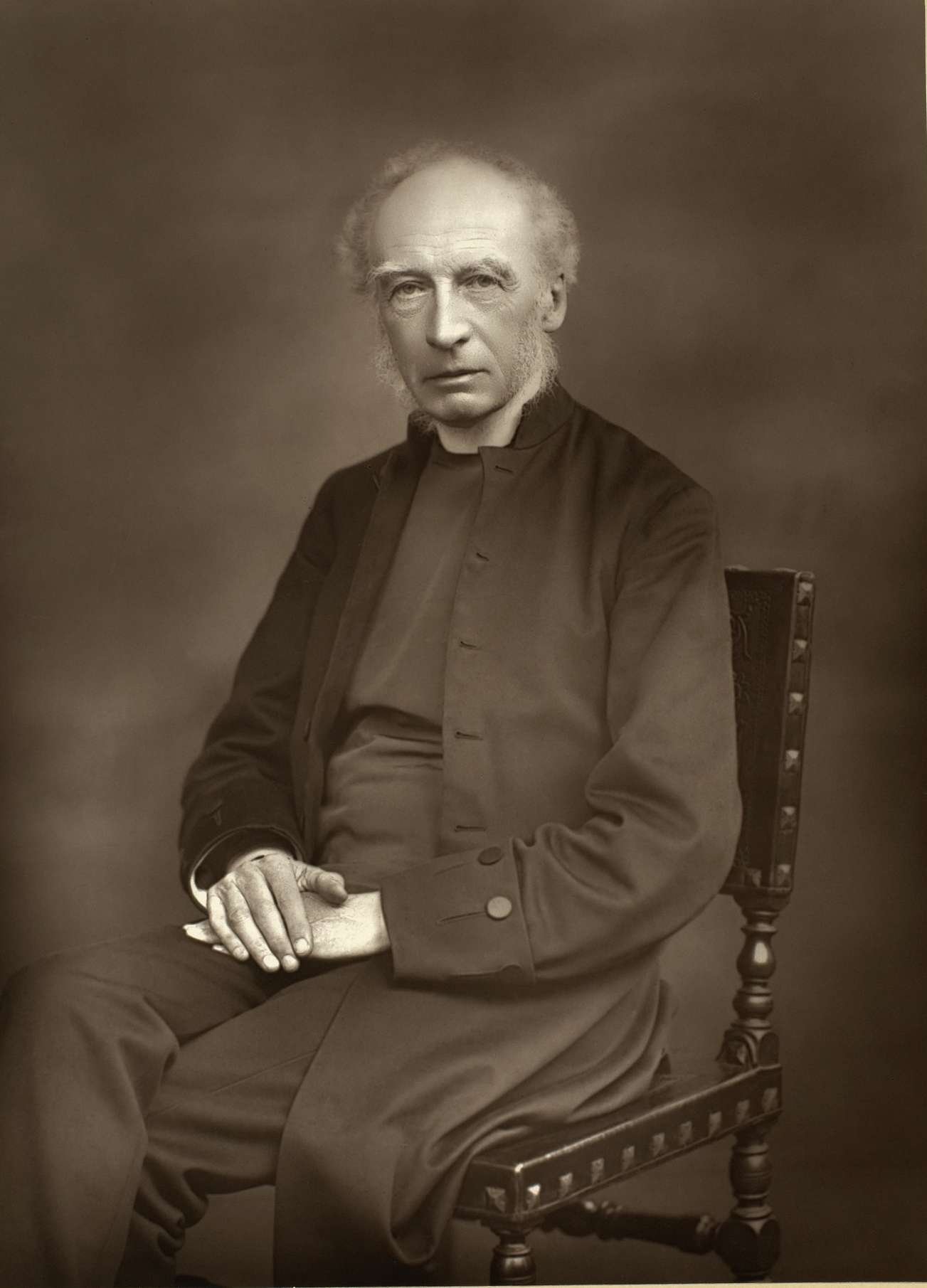

The Convocation of Canterbury, 1870
The resolution of February 10, 1870
The Church of England has two provinces, Canterbury in the south and York in the north, and each has a Convocation of clergy with an Upper House of bishops and a Lower House of other clergy. (The structure of the Church of England is described in module 80, lesson 04.) Ellicott, who was present, dated the formal start of the revision exactly: "The initial step was taken on February 10, 1870, in the Upper House of the Convocation of Canterbury." In his words, "The Bishop of Oxford, seconded by the Bishop of Gloucester, proposed the subjoined resolution"; the seconder was Ellicott himself. Ellicott printed its exact words:
That a committee of both Houses be appointed, with power to confer with any committee that may be appointed by the Convocation of the Northern Province, to report upon the desirableness of a revision of the Authorised Version of the New Testament, whether by marginal notes or otherwise, in those passages where plain and clear errors, whether in the Hebrew or Greek text originally adopted by the translators, or in the translations made from the same, shall on due investigation be found to exist.2
During the debate the words "Old and" were added, so that the inquiry covered both Testaments. Thus amended, Ellicott reports, the resolution "was unanimously accepted by the Upper House, and at once sent down to the Lower House," which also accepted it.2 (Ellicott gives only the title. Schaff, writing in 1883, names the mover as "the late Dr. S. Wilberforce, bishop first of Oxford, then of Winchester": Samuel Wilberforce, whom Ellicott lists as Bishop of Winchester among the committee members.6)
The northern province declined to take part. Ellicott quotes the reply from the Convocation of York, that "The Authorised Version of the English Bible is accepted, not only by the Established Church, but also by the Dissenters and by the whole of the English-speaking people of the world, as their standard of faith," and that "although blemishes existed in its text," it "would deplore any recasting of its text." York therefore did not appoint a committee, "though favourable to the errors being rectified."2 The Revised Version was thus the work of one province of one church, though it drew its scholars from many churches.
The five resolutions of May 1870
The committee reported in May. On May 3 and 5, 1870, the two Houses adopted five resolutions that governed the whole work. The Revised Version's own preface prints them, and they are worth reading in full because nearly every later argument about the version turns on them:
1. That it is desirable that a revision of the Authorised Version of the Holy Scriptures be undertaken.
2. That the revision be so conducted as to comprise both marginal renderings and such emendations as it may be found necessary to insert in the text of the Authorised Version.
3. That in the above resolutions we do not contemplate any new translation of the Bible, or any alteration of the language, except where in the judgement of the most competent scholars such change is necessary.
4. That in such necessary changes, the style of the language employed in the existing version be closely followed.
5. That it is desirable that Convocation should nominate a body of its own members to undertake the work of revision, who shall be at liberty to invite the co-operation of any eminent for scholarship, to whatever nation or religious body they may belong.1
Ellicott reports that these resolutions "were accepted unanimously by the Upper House, and by large majorities in the Lower House."2 The third resolution, which ruled out a "new translation," became the measure by which the finished work was judged. Thirty years later Ellicott was still answering the charge, made by a bishop he quotes, that the revisers had "largely exceeded their instructions, and did not adhere to the principles they were commissioned to follow." His answer was that the resolutions referred every change to the judgment of "the most competent scholars," meaning the men chosen for the work, so the charge really amounted to a disagreement about how much faithfulness required.2
The eight rules of May 25, 1870
A smaller committee of Convocation then drew up working rules, adopted on May 25, 1870. The preface prints all eight. The first four set the character of the version:
1. To introduce as few alterations as possible into the Text of the Authorised Version consistently with faithfulness.
2. To limit, as far as possible, the expression of such alterations to the language of the Authorised and earlier English versions.
3. Each Company to go twice over the portion to be revised, once provisionally, the second time finally, and on principles of voting as hereinafter is provided.
4. That the Text to be adopted be that for which the evidence is decidedly preponderating; and that when the Text so adopted differs from that from which the Authorised Version was made, the alteration be indicated in the margin.1
The fifth rule set the voting: on the first revision a simple majority decided, but on the second and final revision no change could be made or kept "except two thirds of those present approve of the same." The sixth allowed one third of those present to postpone a contested vote to the next meeting. The seventh asked the companies to revise "the headings of chapters and pages, paragraphs, italics, and punctuation," and the eighth allowed them to consult "Divines, Scholars, and Literary Men, whether at home or abroad."1
Two of these rules shaped everything that followed. Rule 4 made the revisers judges of the Greek and Hebrew text itself as well as of the English. The New Testament company later explained that this rule "was in effect an instruction to follow the authority of documentary evidence without deference to any printed text of modern times." Rule 5 meant that a change in the final text needed a two-thirds majority. The same rule worked in both directions: on the second revision, "a majority of two thirds was required to retain or introduce a reading at variance with the reading presumed to underlie the Authorised Version."1 So the King James reading kept its place unless two thirds of the company voted to replace it.
The companies kept the rules with one exception that they stated openly. They revised paragraphs, italics and punctuation as Rule 7 required, "But the revision of the headings of chapters and pages would have involved so much of indirect, and indeed frequently of direct interpretation, that we judged it best to omit them altogether."1 The Revised Version therefore appeared without the chapter summaries that King James Bibles printed at the head of each chapter.
The English companies
Who was invited
The fifth resolution allowed Convocation to invite scholars "to whatever nation or religious body they may belong," and the committee used that freedom. Ellicott, who acted as an informal secretary at this stage, gives the names. The bishops and clergy of Convocation were divided between the two companies, and outside scholars were invited to join them. For the Old Testament the invitations went to, among others, A. B. Davidson, Frederick Field, J. J. S. Perowne, E. H. Plumptre, William Wright of the British Museum and W. A. Wright of Cambridge, "the active and valuable secretary of the Company"; Edward Pusey and Canon F. C. Cook declined. For the New Testament the invitations went to Joseph Angus, David Brown, Archbishop Richard Chenevix Trench of Dublin, John Eadie, F. J. A. Hort, Bishop J. B. Lightfoot, William Milligan, William Fiddian Moulton, John Henry Newman, Alexander Roberts, G. Vance Smith, F. H. A. Scrivener, Samuel Prideaux Tregelles, Charles Vaughan, B. F. Westcott and others. "Of these Dr. J. H. Newman declined, and Dr. Tregelles, from feeble health and preoccupation on his great work, the critical edition of the New Testament, was unable to attend."2
The list mixed churches. Ellicott counted that, taking each company at about twenty-five members at any time, the members who were not of the Church of England "will be found to have been not less than sixteen, viz. seven Presbyterians, four Independents or Congregationalists, two Baptists, two Wesleyans, and one Unitarian."2 Newman, by 1870 a Roman Catholic priest, was invited and declined. The one Unitarian, George Vance Smith, accepted, and his presence became the most bitterly argued fact about the revision (see below).
The New Testament company also contained the three men whose names dominate the textual history of the period. Brooke Foss Westcott and Fenton John Anthony Hort, both Cambridge scholars, had been working since the 1850s on a new critical edition of the Greek New Testament. Frederick Henry Ambrose Scrivener, also of Cambridge, was the leading English collator of manuscripts and a defender of a more cautious approach to change. Their part in the work is taken up in the section on the Greek text below, and their editions are described in lesson 08.
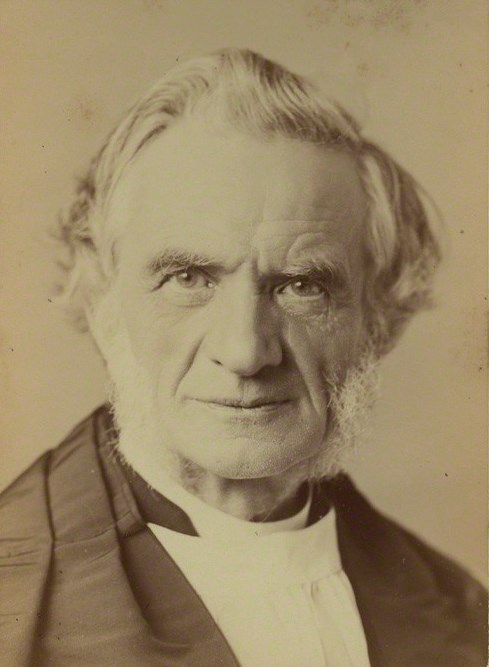

The first meeting and the communion of June 22, 1870
Both companies began work on the same day. Ellicott records: "On June 22, 1870, both Companies, after a celebration of the Holy Communion, previously announced by Dean Stanley as intended to be administered by him in Westminster Abbey, in the Chapel of Henry VII, commenced the long-looked-for revision of the Authorised Version of God's Holy Word. The Old Testament Company commenced their work in the Chapter Library; the New Testament Company in the Jerusalem Chamber."2 The Jerusalem Chamber is a room of Westminster Abbey. Both of the Revised Version's prefaces end with the place name "Jerusalem Chamber, Westminster Abbey."
That opening communion became a scandal. Arthur Penrhyn Stanley, Dean of Westminster, had invited all the revisers, and Vance Smith received the sacrament with the others. Burgon, writing in 1883, described what followed: Smith "did accordingly, on the 22nd of June, 1870, receive the Holy Communion, in Henry VII.'s Chapel, at the hands of Dean Stanley: declaring, next day, that he received the Sacrament on this occasion without 'joining in reciting the Nicene Creed' and without 'compromise' (as he expressed it,) of his principles as an 'Unitarian.'" Burgon added that "So conspicuous a sacrilege led to a public Protest signed by some thousands of the Clergy," and that at the next session of Convocation the Upper House passed a resolution "whereby the Upper House cleared itself of complicity in the scandal."3 Burgon's numbers and characterizations are his own; the fact that a Unitarian sat on the New Testament company is not in dispute, since Ellicott lists him by name.
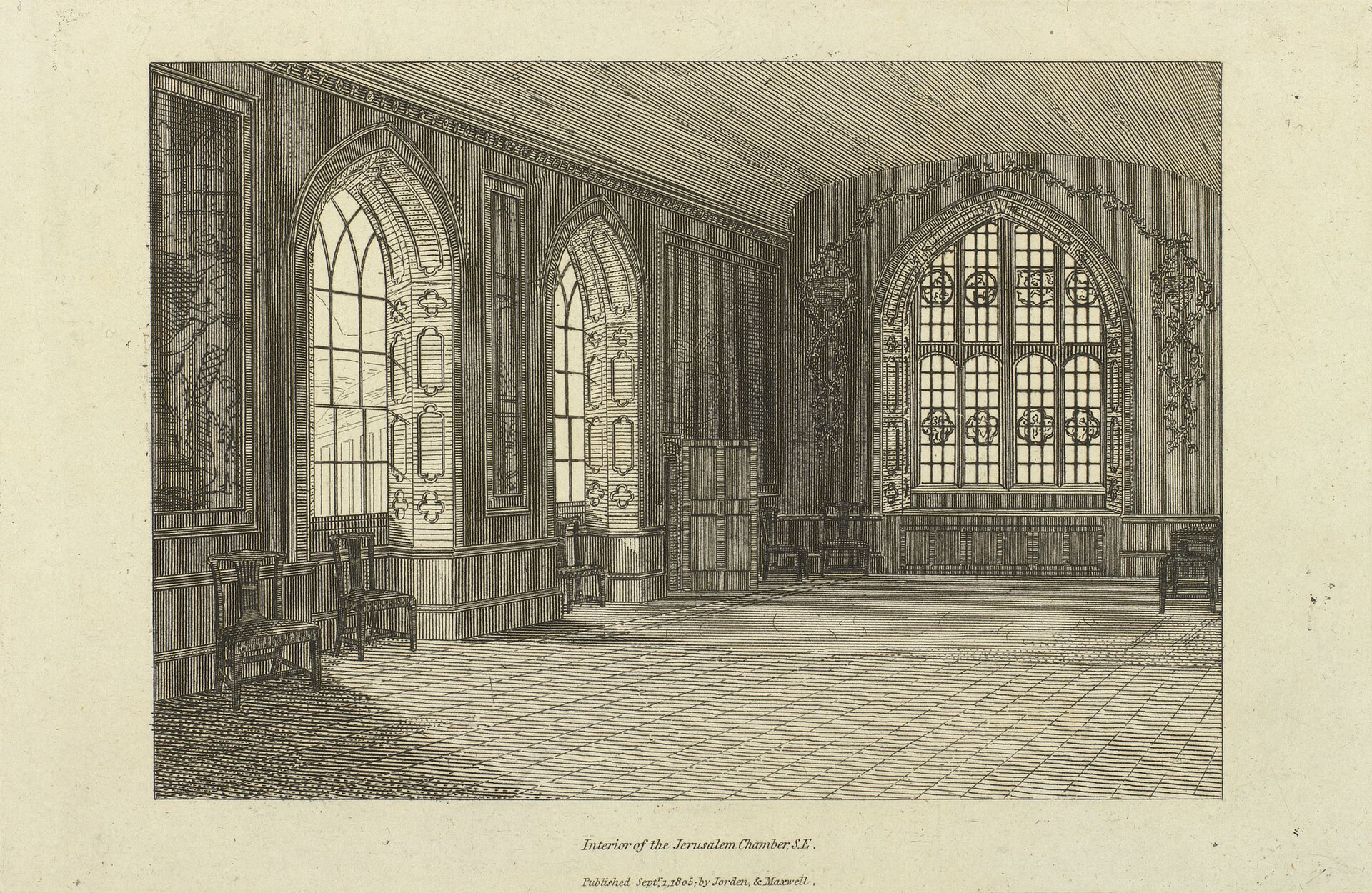

How the companies worked
The New Testament company's preface gives its own figures. "The whole time devoted to the work has been ten years and a half. The First Revision occupied about six years; the Second, about two years and a half. The remaining time has been spent in the consideration of the suggestions from America on the Second Revision, and of many details and reserved questions." The company met in "a session of four days" each month except August and September, and "The average attendance for the whole time has been sixteen each day; the whole Company consisting at first of twenty-seven, but for the greater part of the time of twenty-four members." Four members died during the work.1 Ellicott later added the total: "The number of sessions was 101 of four days each, and one of three days, making a total of 407 days in all."2
The Old Testament company took longer. Its preface, dated "Jerusalem Chamber, Westminster Abbey, 10 July, 1884," reports that "The Revision was completed in eighty-five sessions, ending on 20th June, 1884; and it occupied 792 days. The greater part of the sessions were for ten days each, and each day the Company generally sat for six hours."4 Ellicott, writing in 1901, gives the same eighty-five sessions but "794 days," a small discrepancy between the two accounts; the preface written at the time is the better witness.2 The same preface records that of the original members "only fifteen now remain," ten having died and two having resigned, and that "since October 1875 no new members have been added."4 Ellicott summed up: "More than 1,200 days were thus devoted to the work of the revision of the Authorised Versions of both Testaments."2
The revisers were not paid for translating, and the costs had to be met somehow. The New Testament preface explains the arrangement: "At an early stage in our labours, we entered into an agreement with the Universities of Oxford and Cambridge for the conveyance to them of our copyright in the work. This arrangement provided for the necessary expenses of the undertaking; and procured for the Revised Version the advantage of being published by Bodies long connected with the publication of the Authorised Version."1 The two University Presses thus owned the Revised Version, a fact that later shaped the American story.
The American Committee
Schaff and the invitation
The idea of including American scholars came early. Matthew Brown Riddle, one of the American revisers, wrote in 1908 that the Convocation of Canterbury voted on July 7, 1870, "to invite the co-operation of some American divines."5 Ellicott writes that he opened the correspondence in a letter of July 20, 1870, to Joseph Angus, a Baptist member of the New Testament company who was about to visit the United States, and that Angus worked "especially by communication with Dr. Philip Schaff of the Bible House at New York, who, from the first, had taken the deepest interest in the movement."2
Philip Schaff was, in Ellicott's description, "Professor of Sacred Literature in the Union Theological Seminary, New York." Ellicott calls him "This active and enterprising scholar." Citing Schaff's own account, Ellicott reports that "a committee of about thirty members was formally organized Dec. 7, 1871, and entered upon active work on Oct. 4, 1872, after the first revision of the Synoptical Gospels had been forwarded by the New Testament Company."2
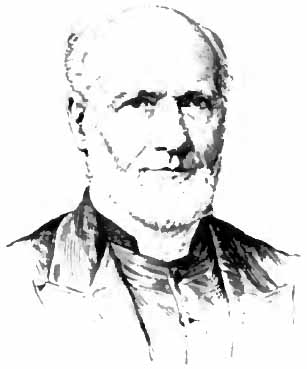

Members and meetings
The American Committee had two companies, like the English one. Ellicott describes them: "The Old Testament Company consisted of fifteen members, Dr. Green, Professor in Princeton, being Chairman: the New Testament Committee consisted of sixteen members." Theodore Dwight Woolsey, former president of Yale College, chaired the New Testament company, and Schaff "was President of the whole undertaking, Dr. George Day of Yale College, a member of the Old Testament Company, being the general secretary." The two companies "met every month (except July and August) in two rooms in the Bible House, New York, but without any connexion with the Bible Society, which, as in England, could only circulate the Authorised Version."2
Riddle's count of the New Testament company differs from Ellicott's, and the difference shows how such numbers arise. Riddle wrote that "Nineteen names are included in the published list of members of the New Testament Company of American Revisers. But only fifteen ever engaged in the work, and two of these for a very brief period."5 The membership was broad in church terms. Ellicott, again following Schaff, says the Committee "included representatives of nine different denominations, viz. Episcopalians, Presbyterians, Congregationalists, Baptists, Methodists and, to the extent of one member, Lutherans, Unitarians, and Society of Friends." The American Episcopal Church, invited by Bishop Wilberforce to take part as a church, declined, though some Episcopalians served as individuals.2
The Americans paid their own way. Riddle recorded that "No compensation has ever been received by any of the members during the twenty-nine years, from 1872 to 1901," and that travel and other expenses "were met by contributions from friends of the movement," amounting during the period of co-operation to "nearly $50,000."5
How the two committees worked together
The method was correspondence across the Atlantic. The English New Testament company described it in its preface: "We transmitted to them from time to time each several portion of our First Revision, and received from them in return their criticisms and suggestions. These we considered with much care and attention during the time we were engaged on our Second Revision. We then sent over to them the various portions of the Second Revision as they were completed, and received further suggestions, which, like the former, were closely and carefully considered. Last of all, we forwarded to them the Revised Version in its final form; and a list of those passages in which they desire to place on record their preference of other readings and renderings will be found at the end of the volume." The English company thanked the Americans for "their care, vigilance, and accuracy."1
The drafts were confidential. Riddle recalled that at the first American session the New Testament company "received copies of the Synoptical Gospels, all marked 'private and confidential,' with a written statement from Bishop Ellicott upon each, designating the person for whom the copy was intended, and the confidential use to be made of it."5
The agreement of 1877 and the fourteen years
Working together raised a hard question: who decided when the two sides disagreed? The answer was set down in an agreement dated August 3, 1877, which Schaff quoted in 1883. Its fourth article reads: "If any differences shall still remain, the American Committee will yield its preferences for the sake of harmony; provided that such differences of reading and rendering as the American Committee may represent to the English Companies to be of special importance, be distinctly stated either in the Preface to the Revised Version, or in an Appendix to the volume, during a term of fourteen years from the date of publication, unless the American Churches shall sooner pronounce a deliberate opinion upon the Revised Version with the view of its being taken for public use."6
The American Standard Version's preface of 1901 describes the same bargain from the American side: "it was agreed that, respecting all points of ultimate difference, the English Companies, who had had the initiative in the work of revision, should have the decisive vote. But as an offset to this, it was proposed on the British side that the American preferences should be published as an Appendix in every copy of the Revised Bible during a term of fourteen years. The American Committee on their part pledged themselves to give, for the same limited period, no sanction to the publication of any other editions of the Revised Version than those issued by the University Presses of England."7
Many differences were settled by give and take before publication. Schaff wrote that the material for the Appendix "was gradually reduced, by honorable and liberal concessions of both parties. The Americans yielded at least six hundred and eighty preferences (according to Bishop Lee's calculation)."6 What remained was printed at the back of the English editions under the heading "List of readings and renderings preferred by the American Committee." The English New Testament company called it "a list of those passages in which they desire to place on record their preference of other readings and renderings."1
Publication day, May 17, 1881
The presentation to Convocation
The New Testament company dated its preface "Jerusalem Chamber, Westminster Abbey. 11th November 1880."1 Printing took the following winter and spring. Ellicott presented the finished book to the body that had commissioned it: he wrote in 1901 of "the appearance of the Revised Version of the New Testament, and the presentation of it by the writer of these pages to the Convocation of Canterbury on May 17, 1881."2 The same day it went on sale in Britain and the United States.
The rush to buy
The demand was enormous, and the figures come from the version's own promoters, so they should be read as their estimates. Schaff wrote in 1883: "More than a million of copies were ordered from the British University presses before the day of publication (May 17, 1881), and more than twenty reprints of different sizes and prices appeared in the United States before the close of the year, so that within a few months nearly three millions of copies were sold."6 Riddle, in 1908, was a little more careful: "In May, 1881, the Revised New Testament was placed on sale, in both England and America, and within a year probably three million copies were sold."5 Neither man gives an audited sales record, and the American reprints Schaff mentions were not authorized by the American Committee. Riddle notes that "Some American reprints appeared, but for these the American Company had no responsibility, the authorized English editions containing a voucher from Drs. Schaff and Day."5
Newspapers joined in. A correspondent quoted in the Daily Telegraph of Napier, New Zealand, on August 11, 1881, wrote: "I have before me a copy of the Chicago Times of May 22nd, 1881." He described it as containing "the entire New Testament (the revised version, of course), word for word," sent by telegraph from New York to Chicago between 5 and 11:30 in the evening, with "nineteen wires being used up to 9 o'clock, and twenty-one after that hour," and he gave "The number of words" as "83,715."8 That word count is well under half the length of the New Testament, so the correspondent's figure probably refers to the part sent by wire, with the rest set from printed copies; the exact division could not be confirmed for this lesson. The story is still good evidence of how much attention the new version drew in its first week.
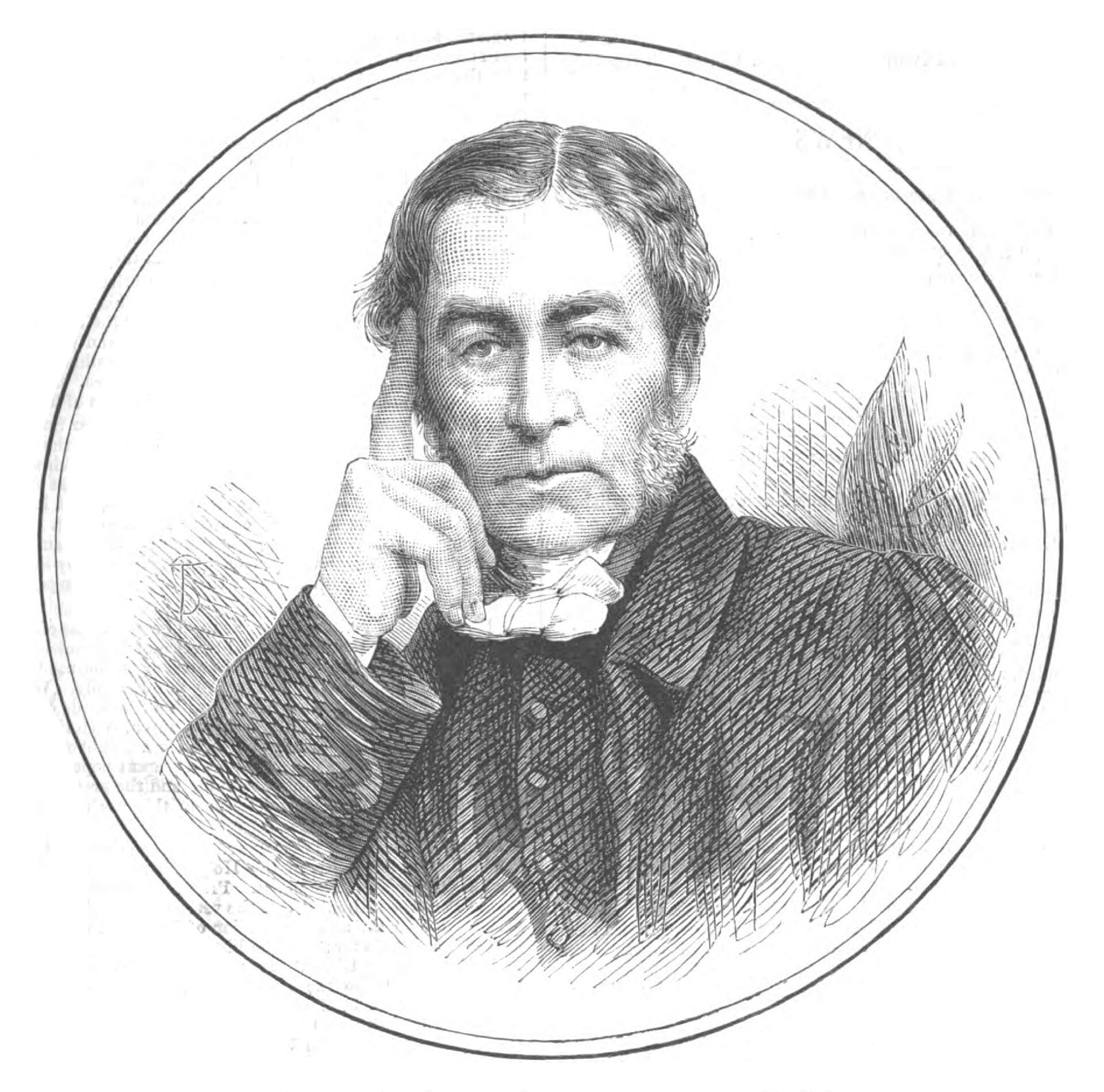

The Greek text behind the Revised Version
What the revisers said they did
The New Testament preface is direct about the text. "A revision of the Greek text was the necessary foundation of our work; but it did not fall within our province to construct a continuous and complete Greek text." In many places the English would be the same whichever Greek reading was right, "and then the question of the text was usually not raised." Where the reading did affect the English, the company voted: "In the early part of the work every various reading requiring consideration was discussed and voted on by the Company. After a time the precedents thus established enabled the process to be safely shortened; but it was still at the option of every one to raise a full discussion on any particular reading, and the option was freely used."1
The preface also admitted that the company was divided: "Textual criticism, as applied to the Greek New Testament, forms a special study of much intricacy and difficulty, and even now leaves room for considerable variety of opinion among competent critics. Different schools of criticism have been represented among us, and have together contributed to the final result."1 Where they could not be sure, they used the margin, with fixed phrases: "In the introductory formula, the phrases 'many ancient authorities,' 'some ancient authorities,' are used with some latitude to denote a greater or lesser proportion of those authorities which have a distinctive right to be called ancient. These ancient authorities comprise not only Greek manuscripts, some of which were written in the fourth and fifth centuries, but versions of a still earlier date in different languages, and also quotations by Christian writers of the second and following centuries."1 These marginal formulas are the ancestors of the footnotes found in most modern English Bibles.
The revisers did not print their Greek text in the English volume. The preface explains that recording every change in the margin "proved inconvenient," and that instead "the University Presses have undertaken to print them in connexion with complete Greek texts of the New Testament."1 Greek editions showing the readings the revisers had adopted, set against the text presumed to underlie the King James Version, were accordingly published.
Westcott, Hort and Scrivener in the company
Westcott and Hort's own edition, The New Testament in the Original Greek, was published in May 1881, a few days before the Revised Version. Burgon put it pointedly: their edition "was published within five days of the 'Revised Authorized Version' itself; a 'confidential' copy of their work having been already entrusted to every member of the New Test. company of Revisionists to guide them in their labours," given, he added, "under pledge that they should neither show nor communicate its contents to any one else."3 Riddle, an American reviser, confirms the fact without Burgon's suspicion: "The Greek Testament of the latter had not been published when the work of revision began, but copies of the Gospels were printed and placed in the hands of the English Company. A copy sent to America was entrusted to the present writer, who collated the readings and added notices of them to the footnotes in Scrivener's edition."5
Riddle also describes how the debates went: "In England Dr. Scrivener was the main advocate on one side, and Drs. Westcott and Hort on the other."5 Under the two-thirds rule, a reading that departed from the King James text needed broad support to stand in the final text. In practice the company's text came out much closer to the new critical editions of Lachmann, Tischendorf, Tregelles and Westcott and Hort than to the Textus Receptus.
How many changes did the revisers make to the Greek? Schaff, writing in 1883, admitted he had "not seen an authentic estimate of the whole number of textual changes," but gave samples: in the Sermon on the Mount (Matthew 5 to 7, 111 verses) "the Revisers have made 44 changes of text, in 38 of which they agree with Lachmann, Tischendorf, and Tregelles," and in 1 Timothy 48 changes, "of which 41 had been previously adopted by the three eminent critics named." He then reported the total given by two critics of the work: "According to Dr. Scrivener and Canon Cook the whole number of textual changes is 5788." He also quoted Burgon's claim in the Quarterly Review of October 1881 that "the textus receptus has been departed from (by the Revisers) far more than 5000 times, almost invariably for the worse."6 Most of these changes are small (a word order, a particle, a spelling of a name) and do not change the English. The larger ones are the subject of lesson 08.
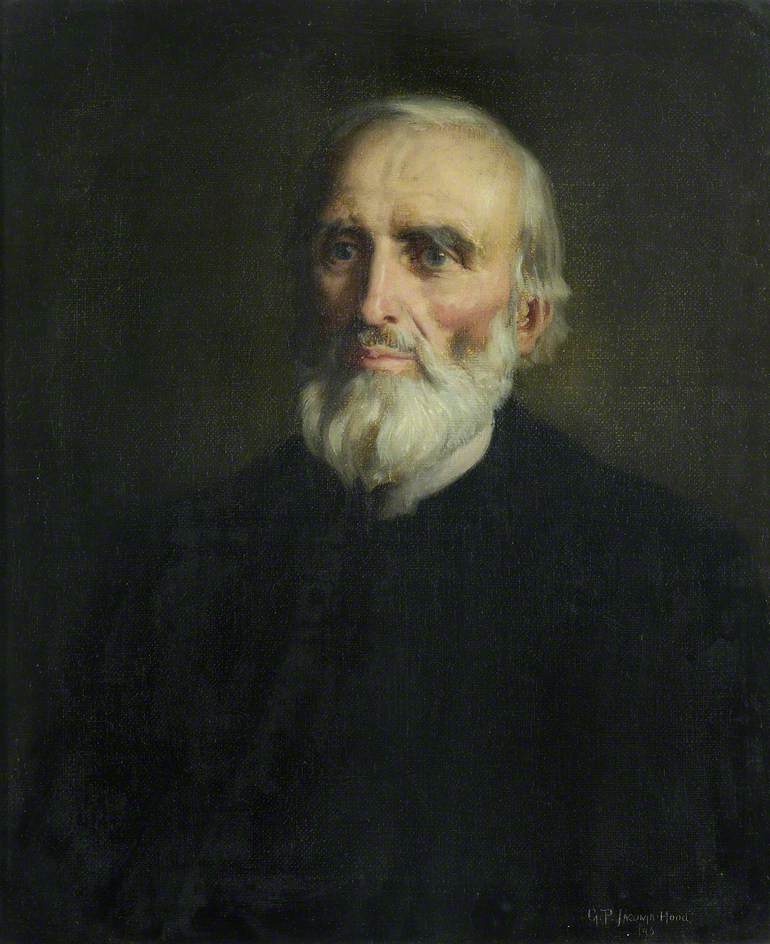

The passages readers noticed
The table below sets the King James Version beside the American Standard Version, which keeps the Revised Version's text and margins in these places (the RV of 1881 was checked in a scanned Cambridge copy for each row marked with an asterisk). The wording is copied from Bible Gateway's public domain KJV and ASV texts and, for the RV, from the 1881 printing.9101
| Passage | King James Version (1769 text) | Revised Version 1881 and ASV 1901 |
|---|---|---|
| Mark 16:9 to 20 * | Printed as part of the text with no note. | Printed in the text, with the margin: "The two oldest Greek manuscripts, and some other authorities, omit from ver. 9 to the end. Some other authorities have a different ending to the Gospel." (RV 1881; the ASV says "verse 9") |
| John 7:53 to 8:11 * | Printed as part of the text with no note. | Printed in brackets, with the note (RV 1881 and ASV): "Most of the ancient authorities omit" the passage, and "Those which contain it vary much from each other." |
| Acts 8:37 * | "And Philip said, If thou believest with all thine heart, thou mayest. And he answered and said, I believe that Jesus Christ is the Son of God." | Omitted from the text. Margin: "Some ancient authorities insert, wholly or in part, ver. 37 And Philip said, If thou believest with all thy heart, thou mayest..." |
| 1 John 5:7 to 8 | "For there are three that bear record in heaven, the Father, the Word, and the Holy Ghost: and these three are one." | The words about the three in heaven are absent, with no note. The ASV reads: "For there are three who bear witness, the Spirit, and the water, and the blood: and the three agree in one." |
| 1 Timothy 3:16 * | "God was manifest in the flesh" | "He who was manifested in the flesh." ASV margin: "The word God, in place of He who, rests on no sufficient ancient evidence. Some ancient authorities read which." |
| Luke 2:14 * | "on earth peace, good will toward men." | "on earth peace among men in whom he is well pleased." ASV margin: "Many ancient authorities read peace, good pleasure among men." |
| Matthew 6:13 | "but deliver us from evil: For thine is the kingdom, and the power, and the glory, for ever. Amen." | "but deliver us from the evil one." ASV margins: "Or, evil" and "Many authorities, some ancient, but with variations, add For thine is the kingdom, and the power, and the glory, for ever. Amen." |
| Luke 11:2 to 4 | "Our Father which art in heaven... Thy will be done, as in heaven, so in earth... but deliver us from evil." | "Father, Hallowed be thy name. Thy kingdom come... And bring us not into temptation." The longer words are given in the margin as added by "Many ancient authorities." |
| Romans 8:1 | "...which are in Christ Jesus, who walk not after the flesh, but after the Spirit." | "There is therefore now no condemnation to them that are in Christ Jesus." |
| 1 John 3:1 * | "that we should be called the sons of God: therefore the world knoweth us not" | "that we should be called children of God: and such we are. For this cause the world knoweth us not" |
Two points stand out. The revisers did not delete the long ending of Mark or the story of the woman taken in adultery; they printed both, with notes on the manuscripts. They did remove from the text the words in 1 John 5:7 about the three that bear record in heaven, the most famous of the Textus Receptus readings (its history is told in lesson 05). And in at least one place the change added words that the King James Version lacked: "and such we are" in 1 John 3:1, which the great preacher Charles Spurgeon welcomed in a sermon of 1885 (see below).
What changed in the English
The five classes of alteration
The New Testament preface sorted its changes to the English into five groups: "First, alterations positively required by change of reading in the Greek Text. Secondly, alterations made where the Authorised Version appeared either to be incorrect, or to have chosen the less probable of two possible renderings. Thirdly, alterations of obscure or ambiguous renderings into such as are clear and express in their import." Fourthly came changes where the old version "was inconsistent with itself in the rendering of two or more passages confessedly alike or parallel," and fifthly "alterations rendered necessary by consequence, that is, arising out of changes already made."1
The fourth and fifth classes produced many of the changes ordinary readers noticed and disliked. The preface gave an example from Mark's Gospel, where one Greek word "may be translated either 'straightway,' 'forthwith,' or 'immediately.'" If the revisers chose "straightway" throughout Mark, and a sentence of Mark appeared word for word in Matthew or Luke where the King James Version had "forthwith," then "That rendering must be changed," even though the change "would not have been made but for this concurrence of two sound principles."1 Faithfulness to the Greek, in the revisers' sense, meant translating the same Greek the same way wherever it could be done. The 1611 translators had deliberately done the opposite.
The revisers also gave much attention to Greek tenses, above all the aorist, a past tense that does not have an exact English equivalent. The preface says that "perhaps the most important" point of detail was "the rendering of the Greek aorist."1 Changes of this kind were the revisers' idea of precision, and they account for many small differences from the King James wording that a reader notices only when the two versions are set side by side.
The language rule
On the language itself, the preface claimed restraint: "We have never removed any archaisms, whether in structure or in words, except where we were persuaded either that the meaning of the words was not generally understood, or that the nature of the expression led to some misconception of the true sense of the passage." Where they had to add new words, they "usually satisfied ourselves that such words were employed by standard writers of nearly the same date" as the old version.1 The result kept "thee" and "thou," "hath" and "doth." It is the King James Version's English, adjusted, and nobody mistook it for modern speech.
Examples from the New Testament
A few verses show the kinds of change, with the KJV first and the 1881 Revised Version second (checked in the 1881 Cambridge printing), and the ASV where it differs:1910
- 1 Corinthians 13:13. KJV: "And now abideth faith, hope, charity, these three; but the greatest of these is charity." RV: "But now abideth faith, hope, love, these three; and the greatest of these is love."
- Matthew 16:18. KJV: "the gates of hell shall not prevail against it." RV: "the gates of Hades shall not prevail against it," with margins giving the Greek Petros and petra for "Peter" and "rock."
- Acts 12:4. KJV: "intending after Easter to bring him forth to the people." RV: "intending after the Passover to bring him forth to the people." The Greek word is pascha, the word for Passover.
- 2 Timothy 3:16. KJV: "All scripture is given by inspiration of God, and is profitable for doctrine." RV and ASV: "Every scripture inspired of God is also profitable for teaching," with the ASV margin: "Or, Every scripture is inspired of God, and profitable." The revisers' margin shows they knew the Greek could be read either way and chose one reading for the text.
- Acts 17:22. KJV: "I perceive that in all things ye are too superstitious." RV 1881: "in all things I perceive that ye are somewhat superstitious." The American Committee asked for "very religious" instead and recorded the request in the Appendix: "For 'somewhat superstitious' read 'very religious' and put the present text in the marg." The ASV of 1901 adopted it: "Ye men of Athens, in all things I perceive that ye are very religious," with the margin "Or, somewhat superstitious."19
The American Appendix of 1881
The Appendix at the back of the 1881 New Testament carries the heading "List of readings and renderings preferred by the American Committee, recorded at their desire. See Preface, page xi." It opens with fourteen "Classes of Passages," changes the Americans wanted made throughout, and then lists individual verses book by book.1 Among the classes:
- "Strike out 'S.' (i.e. Saint) from the title of the Gospels and from the heading of the pages."
- "For 'Holy Ghost' adopt uniformly the rendering 'Holy Spirit.'"
- "Substitute modern forms of speech for the following archaisms, viz. 'who' or 'that' for 'which' when used of persons; 'are' for 'be' in the present indicative; 'know' 'knew' for 'wot' 'wist'; 'drag' or 'drag away' for 'hale.'"
- "Substitute for 'devil' ('devils') the word 'demon' ('demons') wherever the latter word is given in the margin."
- "Let the word 'testament' be everywhere changed to 'covenant' (without an alternate in the margin), except in Heb. ix. 15-17."1
Schaff predicted in 1883 that the English church would not take these changes up: "The Church of England is not likely to surrender her love for the archaic forms of language, as 'which' for 'who,' 'be' for 'are,' 'Ghost' for 'Spirit,' 'devils' for 'demons,' 'wot' and 'wist' for 'know' and 'knew.'"6 He was right. The English editions never absorbed the Appendix, and that is why the American Standard Version exists.
The Old Testament of 1885 and the Apocrypha
The Hebrew text
The Old Testament company faced a different problem. Its preface explains that "The Received, or, as it is commonly called, the Massoretic Text of the Old Testament Scriptures has come down to us in manuscripts which are of no very great antiquity, and which all belong to the same family or recension." Other forms of the text had once existed, as the ancient translations show, "But as the state of knowledge on the subject is not at present such as to justify any attempt at an entire reconstruction of the text on the authority of the Versions, the Revisers have thought it most prudent to adopt the Massoretic Text as the basis of their work, and to depart from it, as the Authorised Translators had done, only in exceptional cases."4 In a few hard places they followed the ancient versions and noted the departure in the margin. (The Masoretic text and its manuscripts, including the Leningrad and Aleppo codices, are the subject of lesson 01; the Dead Sea Scrolls, which were not yet known in 1885, are described there too.)
The divine name in the Revised Version
On the divine name, the English Old Testament company kept to the King James practice. Its preface says: "It has been thought advisable in regard to the word 'Jehovah' to follow the usage of the Authorised Version, and not to insert it uniformly in place of 'Lord' or 'God', which when printed in small capitals represent the words substituted by Jewish custom for the ineffable Name according to the vowel points by which it is distinguished. It will be found therefore that in this respect the Authorised Version has been departed from only in a few passages, in which the introduction of a proper name seemed to be required."4 The American company disagreed, and this became the most visible difference between the RV and the ASV.
Publication in 1885
The Old Testament company finished on June 20, 1884, and signed its preface on July 10, 1884.4 Ellicott records that "on April 30, 1885, the Revised Version of the Old Testament was laid before the same venerable body by the then Bishop of Winchester (Bp. Harold Browne), and, similarly to the Revised Version of the New Testament, was published simultaneously in this country and America."2 The complete Revised Bible was now available, with the American Appendix for the Old Testament printed at the end as the agreement required.
The Apocrypha
The revision of the Apocrypha came last and drew least attention. Its preface explains that it "forms the last portion of the Revision of the Authorised Version of 1611" and that it "has been somewhat long delayed," because it "was of necessity intrusted to small Committees formed out of the two Companies of Revisers."11 Ellicott, who said the revisers "were pledged to the University Presses to complete" it, describes how the books were divided among committees and admits the result was finished "though perhaps not in a manner that can be considered as completely satisfactory."2 The title page of a New York printing by Thomas Nelson and Sons reads "revised A.D. 1894," and copies were in print by 1895; Ellicott records that he laid the revised Apocrypha before Convocation on February 12, 1896.112 The American Standard Version of 1901 contains only "the Old and New Testaments," as its title page says.7 (The place of the Apocrypha in different churches' Bibles is the subject of lesson 03.)
The reception
Burgon and The Revision Revised
The most sustained attack came from John William Burgon, a scholar of the manuscripts and of the early church writers, who became Dean of Chichester in 1876. He wrote articles in the Quarterly Review in 1881 and 1882 and reprinted three of them in 1883, with "A Reply to Bishop Ellicott's Pamphlet in Defence of the Revisers," as The Revision Revised. His case was mainly against the Greek text. He wrote that he had "traced the mischief home to its true authors," naming "Drs. Westcott and Hort," and that the revisers "had, in an evil hour, surrendered themselves to Dr. Hort's guidance: had preferred his counsels to those of Prebendary Scrivener, (an infinitely more trustworthy guide)."3
Burgon's charge against the oldest manuscripts was stated in the strongest terms he could find. Of Codex Sinaiticus, Codex Vaticanus and Codex Bezae (the manuscripts scholars call Aleph, B and D) he wrote: "We venture to assure him, without a particle of hesitation, that א B D are three of the most scandalously corrupt copies extant," the depositories, in his words, of "fabricated readings, ancient blunders, and intentional perversions of Truth."3 On 1 Timothy 3:16 he argued that "God was manifested in the flesh" was the true reading and counted manuscripts to show it: "out of two hundred and fifty-four copies of S. Paul's Epistles no less than two hundred and fifty-two are discovered to have preserved that expression."3 His count is his own, and the evidence on that verse is weighed in lesson 08. Burgon also objected to the inclusion of a Unitarian among the revisers, as quoted above, and predicted that the revision would fail: "The Revision was a foredoomed thing."3
Burgon's arguments are still read, and the modern defenders of the Textus Receptus and the Majority Text (described in lesson 08) draw on them. The revisers' defenders answered him in his own lifetime: Ellicott wrote a pamphlet in defence of the revisers and their Greek text, and Burgon's book includes his long reply to it.
Spurgeon: "strong in Greek, but weak in English"
Charles Haddon Spurgeon, the London Baptist preacher, gave a verdict in his magazine The Sword and the Trowel in 1881 that is often quoted. As reproduced by Michael Marlowe's Bible Research site, it reads: "It is a valuable addition to our versions, but it will need much revision before it will be fit for public use. To translate well, the knowledge of two languages is needed: the men of the New Testament company are strong in Greek, but weak in English. Comparing the two, in our judgment the old version is the better."12 The original magazine page was not available to check for this lesson, so the wording is given as Marlowe quotes it.
Spurgeon's objection was to the English. Some of the textual changes he welcomed. Elijah Hixson, writing for the Spurgeon Library, shows that Spurgeon at times preferred the Revised Version's text. In July 1885 Spurgeon preached a sermon titled "'And We Are': A Jewel from the Revised Version" on 1 John 3:1, beginning: "A genuine fragment of inspired Scripture has been dropped by our older translators, and it is far too precious to be lost." On Luke 4:18, where the Revised Version lacks a phrase found in the King James Version, he said: "I intended to have preached from these words in Luke 4:18, but when I looked at the Revised Version and found that the words were not there at all I was somewhat startled."13
Did the Church of England adopt it?
The Revised Version was commissioned by a Convocation, but it was never made the required Bible of the Church of England. Schaff noted in 1883 that "In England an Act of Parliament or Order of Council may be necessary in addition to the votes of the Convocation of Canterbury and York before it can be used in public worship."6 No such act followed. The furthest step was a resolution passed unanimously by the Upper House of the Convocation of Canterbury on February 10, 1899, which Ellicott quoted: "That in the opinion of this House the use of the Revised Version at the lectern in the public service of the Church, where this is desired by clergy and people, is not open to any well-founded objection, and will tend to promote a more intelligent knowledge of Holy Scripture."2 That permitted the RV for the Bible readings; it did not replace the King James Version, which remained the Bible of the Prayer Book and of most congregations. In Britain the RV found its lasting place among students and preachers, as Schaff had foreseen when he wrote that even if rejected it would "remain a most important help for the private use of ministers and Bible readers."6
The American Standard Version of 1901
The waiting years, 1881 to 1901
The American Committee did not disband in 1885. The ASV preface says: "The American Revision Committee, after the publication of the Revised Version in 1885, resolved to continue their organization, and have regarded it as a possibility that an American recension of the English Revision might eventually be called for. Accordingly they have been engaged more or less diligently, ever since 1885, and especially since the year 1897, in making ready for such a publication."7
The fourteen years could be counted two ways. Schaff expected the Appendix to be printed "till the expiration of the term of fourteen years, i.e., till May, 1895."6 Riddle explained in 1908 why the Americans waited longer: the agreement "Strictly interpreted, it would have permitted the American Company to publish the New Testament in 1895. But as the Revised Old Testament did not appear until 1885, it was felt that it would be more honorable to wait until fourteen years after that date." He dated the start of the final work from the contract with the publisher: "As the agreement with Messrs. Thomas Nelson and Sons, the publishers of the American Standard Revised Version, was made June 24, 1897, that date may be regarded as beginning the final preparation of the American Revised Version."5 Meanwhile, unauthorized American printers had issued editions that put the Appendix readings into the text themselves. Riddle wrote that "Some unauthorized publications in America had attempted to substitute the preferences of the Appendix in the text, but the results were misleading and sometimes erroneous."5
The Americans also had grievances about the Appendix itself. Their preface of 1901 says it "had been prepared under circumstances which rendered fulness and accuracy almost impossible," because "the University Presses deemed that the impatient demand of the British public for the speedy publication of the Revision must be respected; and they insisted on a prompt transmission of the Appendix. Prepared under such pressure and in such haste, it was obviously inevitable that it should be marked by grave imperfections."7 They had also cut it short on purpose, "reducing the number of the points of difference to the lowest limit," in the hope the English presses might adopt it. The English Companies disbanded after 1885, and "there has been no indication of an intention on the part of the Presses to amalgamate the readings of the Appendix, either wholly or in part, with the text of the English editions."7
The New Covenant of 1900
The New Testament came first. Its title page, in the 1901 Nelson volume, reads "The New Covenant commonly called the New Testament of our Lord and Saviour Jesus Christ," "Newly edited by the New Testament members of the American Revision Committee A.D. 1900," "Standard Edition."14 Riddle names its three editors: "Three of these, the youngest in years, became the editors of the American Standard Revised New Testament: Drs. Dwight, Thayer and Riddle." J. Henry Thayer "lived to see the published volume, but died a few months afterward (Nov. 26, 1901)."5
The New Testament preface explains that the edition gathered the Appendix readings and also others that had been left out: the Appendix "was not only hastily compiled under pressure from the University Presses, but its necessarily limited compass compelled... the exclusion of many suggestions that the American Company held to be of interest and importance. These, amounting in the aggregate to a considerable number, have been incorporated in the present edition." At the same time "the survivors of the New Testament Company have not felt at liberty to make new changes of moment which were not favorably passed upon by their associates at one stage or another of the original preparation of the work."14 It changed the coin names (the Greek denarius became "shilling" in thirteen places), removed some archaisms ("how that," "for to," "the which," "howbeit"), added cross references and page headings, and shortened the book titles, dropping "Saint" before the Evangelists' names. On the language it promised restraint: "the American editors have not forgotten that they were dealing with a venerable monument of English usage, and have been careful not to obliterate the traces of its historic origin and descent."14
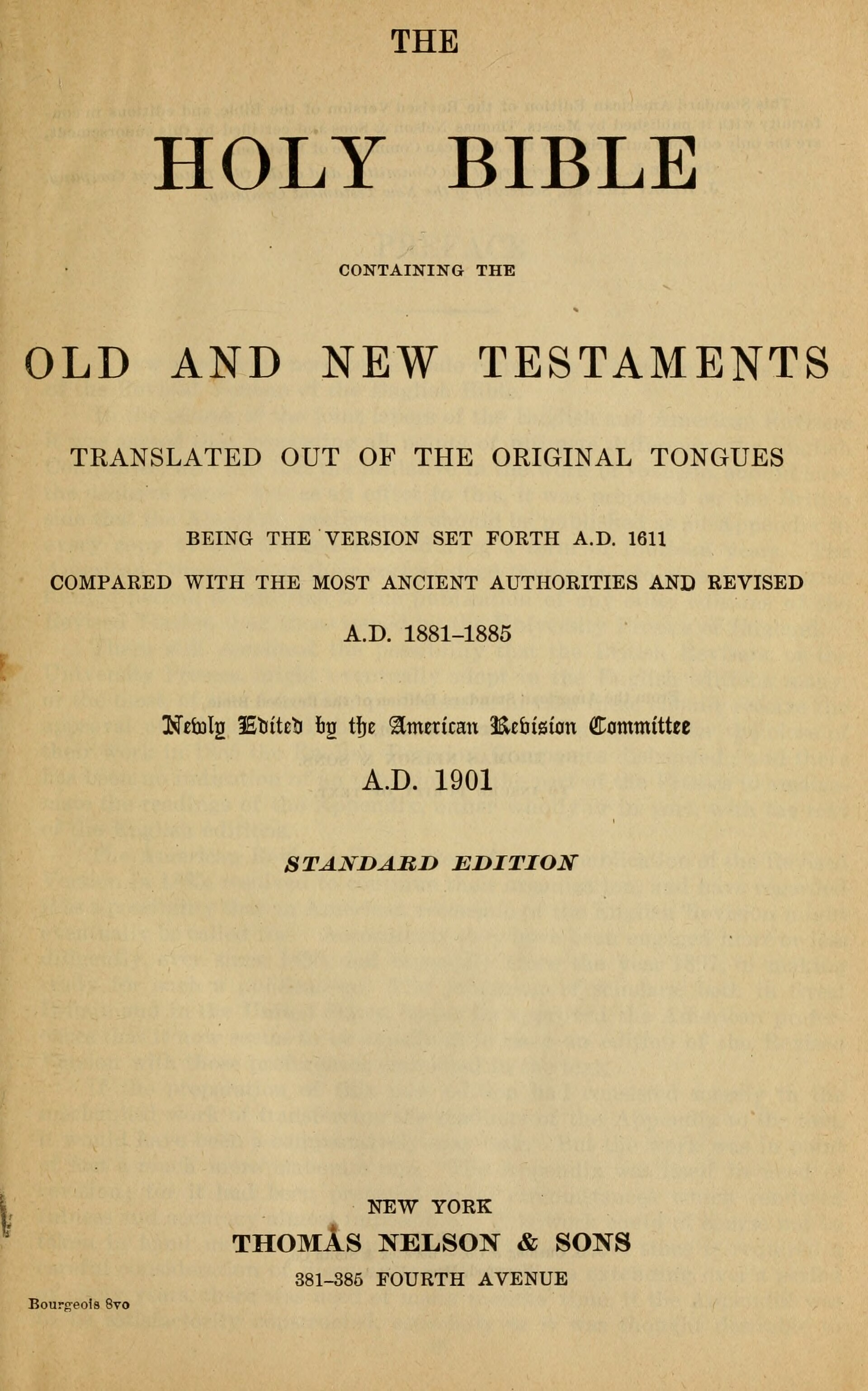

The Standard Edition of 1901
The complete Bible followed in 1901. Riddle records that "The American Standard Edition of the Revised Version of the Bible was placed on sale August 26, 1901."5 Its title page reads: "The Holy Bible containing the Old and New Testaments translated out of the original tongues being the version set forth A.D. 1611 compared with the most ancient authorities and revised A.D. 1881 to 1885, newly edited by the American Revision Committee A.D. 1901, Standard Edition," New York, Thomas Nelson and Sons. (The title page prints the range as "1881-1885.") Facing it is a certificate signed by George E. Day, secretary of the Committee and of the Old Testament company, and J. Henry Thayer, secretary of the New Testament company: "This Standard American Edition of the Revised Version of the Bible, and editions in conformity with it published by Messrs. Thomas Nelson & Sons and certified by this endorsement, are the only editions authorized by the American Committee of Revision." Beneath it stands the copyright line: "From the American Standard Edition of the Revised Bible, Copyright, 1901, By Thomas Nelson & Sons. To insure purity of text."7
That copyright was a deliberate choice. Riddle explains that the American revisers would have preferred an uncopyrighted edition paid for by subscription, but "this plan would have left the edition unprotected by copyright, and would have opened the way for unauthorized and incorrect issues, as in 1881," and "few publishing houses would undertake the publication unless protected by copyright."5 The New Testament preface adds that the publishers "agreed to protect the version in its integrity, and to sell the book at a price not exceeding a fair profit on its cost."14 The phrase "Standard Edition" on the title page gave the version its common name, the American Standard Version. The text is now in the public domain.
"Jehovah," "Sheol" and the other Old Testament changes
The Old Testament preface of 1901 opens its list of changes with the divine name. It is worth quoting at length because it is the clearest statement of the ASV's best known feature:
The change first proposed in the Appendix, that which substitutes "Jehovah" for "Lord" and "God" (printed in small capitals), is one which will be unwelcome to many, because of the frequency and familiarity of the terms displaced. But the American Revisers, after a careful consideration, were brought to the unanimous conviction that a Jewish superstition, which regarded the Divine Name as too sacred to be uttered, ought no longer to dominate in the English or any other version of the Old Testament, as it fortunately does not in the numerous versions made by modern missionaries. This Memorial Name, explained in Ex. iii. 14, 15, and emphasized as such over and over in the original text of the Old Testament, designates God as the personal God, as the covenant God, the God of revelation, the Deliverer, the Friend of his people.7
(The original printing sets off the first clause with dashes, which are replaced by commas here.) The result can be seen in two familiar verses. In Exodus 3:15 the KJV has "the LORD God of your fathers," and the ASV "Jehovah, the God of your fathers." In Psalm 23:1 the KJV has "The LORD is my shepherd; I shall not want," and the ASV "Jehovah is my shepherd; I shall not want."910 The preface's word "superstition" for the Jewish custom of not pronouncing the Name is the committee's own and reads harshly today. Fifty years later the Revised Standard Version reversed the choice, as described below.
The same preface lists other systematic changes. "The uniform substitution of 'Sheol' for 'the grave,' 'the pit,' and 'hell,' in places where these terms have been retained by the English Revision, has little need of justification. The English Revisers use 'Sheol' twenty-nine times out of the sixty-four in which it occurs in the original."7 The Americans also replaced "which" with "who" for persons, modernized spelling, put "ordinance" for "judgment" where the Hebrew means a law, and replaced "reins" with "heart" when the word is used of the inner person, because, they wrote, "if the synonymous word 'kidneys' had been used in these passages, there would be an earnest and unanimous protest. In favor of the continued use of 'reins,' therefore, one can only urge the poor reason that most readers attach to it no meaning whatever."7 They also removed the "dragon" and an "arrowsnake" from the Old Testament, the latter "an animal unknown to zoology, the term having obviously been adopted through a too literal translation of the German word 'Pfeilschlange.'"7
The American committee did not simply modernize. The preface records that some changes were "a return to the readings of the Authorized Version," because in the English Revision the older readings "have been abandoned needlessly, and sometimes to the injury of the sense and the sound," and it lists examples, including "Ex. xx. 4, 13" (verses of the Ten Commandments) and "Ps. xlviii. 1."7 It also cut most of the English Revision's marginal references to the ancient versions, keeping "a little more than one-sixth" of them, on the ground that "one can never get beyond plausible conjecture in attempting to correct the Hebrew text by means of them."7 On style, the Americans wrote that they were "not insensible to the justly lauded beauty and vigor of the style of the Authorized Version," but that "it would be extravagant to hold that it cannot be bettered in any of its details."7
Isaiah 7:14 in the RV and ASV
One verse matters for the next part of this story. In Isaiah 7:14 the ASV reads: "Therefore the Lord himself will give you a sign: behold, a virgin shall conceive, and bear a son, and shall call his name Immanuel." Its margins give alternatives: "Or, the" for "a," "Or, maiden" for "virgin," and "Or, is with child, and beareth" for "shall conceive, and bear."9 The ASV kept "virgin" in the text and put "maiden" in the margin. In Matthew 1:23, which quotes the verse, the ASV reads "Behold, the virgin shall be with child, and shall bring forth a son."9
The heirs of the ASV
The Revised Standard Version (1946 and 1952)
In 1928 its copyright passed to a body of the American churches. The preface to the Revised Standard Version of 1952 tells the story: "Because of unhappy experience with unauthorized publications in the two decades between 1881 and 1901, which tampered with the text of the English Revised Version in the supposed interest of the American public, the American Standard Version was copyrighted, to protect the text from unauthorized changes. In 1928 this copyright was acquired by the International Council of Religious Education, and thus passed into the ownership of the churches of the United States and Canada which were associated in this Council through their boards of education and publication."15
The Council appointed a committee, which decided after two years that a "thorough revision of the version of 1901" was needed, one that "will stay as close to the Tyndale-King James tradition as it can." The revision was authorized in 1937. The RSV preface states that "Thirty-two scholars have served as members of the Committee," that "The Revised Standard Version of the New Testament was published in 1946," and that publication of the whole Bible "was authorized by vote of the National Council of the Churches of Christ in the U.S.A. in 1951."15 The complete RSV appeared in 1952, copyright the National Council of Churches.16 (The National Council of Churches and the split between its member churches and the evangelical bodies that later sponsored the NIV are described in module 80, lesson 11.) The RSV opens by calling itself "an authorized revision of the American Standard Version, published in 1901, which was a revision of the King James Version published in 1611."15
The RSV reversed the ASV on the divine name. Its preface says: "A major departure from the practice of the American Standard Version is the rendering of the Divine Name, the 'Tetragrammaton.'" It gave two reasons for returning to "LORD": "(1) the word 'Jehovah' does not accurately represent any form of the Name ever used in Hebrew; and (2) the use of any proper name for the one and only God, as though there were other gods from whom He had to be distinguished, was discontinued in Judaism before the Christian era and is entirely inappropriate for the universal faith of the Christian Church." It noted that the King James Version itself "had employed this in four places."15
The Isaiah 7:14 controversy and the 1952 burning
The RSV's rendering of Isaiah 7:14 caused the loudest protest: "Behold, a young woman shall conceive and bear a son, and shall call his name Imman′u-el" (RSV, copyright 1946, 1952 and 1971 the Division of Christian Education of the National Council of the Churches of Christ in the U.S.A.), with the footnote "Or virgin." In Matthew 1:23 the same version reads "Behold, a virgin shall conceive and bear a son" (RSV, same copyright).16 The RSV thus changed the Old Testament verse while keeping "virgin" in Matthew's quotation of it; the ASV had already put "maiden" in its margin at Isaiah 7:14. Some readers took the change as an attack on the virgin birth. In late 1952 a minister in Rocky Mount, North Carolina, burned a copy at a Sunday service. A column in the University of North Carolina's student paper, the Daily Tar Heel, on December 3, 1952, reported that the minister, whom it named as Hux, had said "I object to the attempt to eliminate the doctrine of the virgin birth," and had added, in its report, "there is a Jew on the committee," and that he then "burned a copy of the newly translated Bible at Sunday services held in his church."17 The paper's column mocked the burning; the quotation is given here for what it shows about the objections raised.
The NRSV and the ESV
The RSV was itself revised twice. The New Revised Standard Version of 1989 describes its own descent "in a single sentence": it "is an authorized revision of the Revised Standard Version, published in 1952, which was a revision of the American Standard Version, published in 1901, which, in turn, embodied earlier revision of the King James Version, published in 1611."18 The English Standard Version, published by Crossway (its online preface carries a copyright beginning in 2001), took the RSV of 1971 as its base. Its preface places itself in a line that runs through "the English Revised Version of 1885 (RV), the American Standard Version of 1901 (ASV), and the Revised Standard Version of 1952 and 1971 (RSV)," and says that "the 1971 RSV text" provided "the starting point for our work."19 Lessons 12 and 14 take up the later editions and the gender language questions they raised.
The NASB and the LSB
The second line of descent came from a different quarter. The Lockman Foundation of La Habra, California, wanted to keep the ASV's literal method while updating its English and its textual base. The preface to the New American Standard Bible (1995 edition) explains: "The ASV, a product of both British and American scholarship, has been highly regarded for its scholarship and accuracy. Recognizing the values of the American Standard Version, the Lockman Foundation felt an urgency to preserve these and other lasting values of the ASV by incorporating recent discoveries of Hebrew and Greek textual sources and by rendering it into more current English. Therefore, in 1959 a new and original translation project was launched."20 The Foundation's website dates the NASB's "completion in 1971" and lists updates "in 1977, 1995, and most recently in 2020."21 The Legacy Standard Bible, by a team from The Master's Seminary and University, describes itself as "a direct update of the NASB 1995 edition."22 Like the ASV, the LSB uses a personal name for God in the Old Testament, though it uses "Yahweh," where the ASV used "Jehovah." Its publisher's site explains: "In the LSB, God's covenant name is rendered as Yahweh, as opposed to LORD."22 The NASB is the subject of lesson 10.
The World English Bible
Because the ASV is in the public domain, it also served as the base of a free modern version. The World English Bible's website states that it "is based on the American Standard Version of the Holy Bible first published in 1901," with the Biblia Hebraica Stuttgartensia for the Old Testament and, for the New, "a combination of the original ASV source text choices and the Greek Majority Text."23
What the record shows and what it does not
- Documented fact. The revision began with a resolution of the Upper House of the Convocation of Canterbury on February 10, 1870; its rules were adopted on May 3, 5 and 25, 1870; work began on June 22, 1870; the New Testament was presented and published on May 17, 1881, and the Old Testament on April 30, 1885. The companies' own prefaces and Ellicott's addresses give these dates. The American agreement of August 3, 1877, and its fourteen-year Appendix are documented in Schaff's text of the agreement and in the ASV preface. The ASV New Testament is dated 1900 and the Bible 1901, copyright Thomas Nelson and Sons.
- The committees' own claims. That they made "as few alterations as possible ... consistently with faithfulness"; that they followed evidence "decidedly preponderating"; that they removed archaisms only where meaning was lost. These are statements of intent, and readers of every school have disputed how well they were kept.
- Estimates by interested parties. The sales figures (more than a million ordered before publication, about three million within a year) come from Schaff and Riddle, both American revisers. The figure of 5,788 changes to the Greek comes from Scrivener and Cook, as reported by Schaff. None of these is an audited count.
- Scholarly reading. That the RV's Greek text stood close to the critical editions of its day, including Westcott and Hort's, is shown by Schaff's samples and is the common judgment of later scholars; Burgon called this the version's chief fault, while its defenders called it its chief merit. Lesson 08 weighs the evidence.
- Open questions. How much of the Chicago newspaper text of May 22, 1881, came by telegraph; the exact wording of Spurgeon's 1881 notice in the original magazine; and how far the RV and ASV shaped preaching in ordinary congregations, which the sources used here do not measure.
Claims checked
"The Church of England authorized the Revised Version to replace the King James Version."
Rating: Partly supported. The Convocation of Canterbury began and directed the revision, so it was "authorized" in the sense of being commissioned. It was never ordered for use. The Convocation of York refused to take part. Schaff noted in 1883 that an Act of Parliament or Order of Council might be needed before use in public worship, and none followed. The strongest official word was the Upper House's resolution of February 10, 1899, that use "at the lectern ... where this is desired by clergy and people, is not open to any well-founded objection."26
"The Revised New Testament sold three million copies in its first year."
Rating: Partly supported. The figure comes from the version's own American revisers. Schaff wrote of "nearly three millions of copies" sold "within a few months," and Riddle of "probably three million copies" within a year. They agree, but neither cites sales records, and the total includes American reprints the Committee did not authorize.65
"Chicago newspapers printed the whole Revised New Testament, sent by telegraph, days after publication."
Rating: Partly supported. A correspondent quoted in a New Zealand paper in August 1881 had a copy of the Chicago Times of May 22, 1881, which he said contained the entire revised New Testament "word for word," telegraphed from New York over nineteen to twenty-one wires. But the word count he gave, 83,715, is far short of the whole New Testament, so not all of it can have come by wire in that one transmission. The paper did print the new version; the claim that the whole of it was telegraphed is not established by this source.8
"The Revised Version was translated from Westcott and Hort's Greek text."
Rating: Partly supported. The revisers said they did not construct a continuous Greek text and voted on readings one by one, under a rule that kept the King James reading unless two thirds voted to change it. Westcott and Hort's unpublished text was given to the company in confidence, and Riddle says that "Dr. Scrivener was the main advocate on one side, and Drs. Westcott and Hort on the other." Schaff's samples show the company's choices agreeing with the critical editions of Lachmann, Tischendorf and Tregelles in most places. So the RV's text was close to the critical texts of the time, including Westcott and Hort's, without being a copy of any one of them.1653
"A Unitarian who denied the deity of Christ helped make the Revised New Testament."
Rating: Supported. George Vance Smith, a Unitarian minister of York, was a member of the New Testament company; Ellicott lists him among those invited and counts "one Unitarian" among the non-Anglican members. Burgon's protest and the controversy over his communion at the abbey on June 22, 1870, are documented in Burgon's book. What the record does not show is that one member in a company of about twenty-four, under a two-thirds rule, determined any reading or rendering; that would have to be shown verse by verse.23
"The Revised Version removed the end of Mark and the woman taken in adultery."
Rating: Refuted. Both passages are printed in the RV and ASV, with marginal notes about the manuscripts. The verse the revisers did take out of the text is 1 John 5:7 (the words about the three that bear record in heaven), and Acts 8:37 was moved to the margin.19
"The American Standard Version was the first English Bible to use the name Jehovah."
Rating: Refuted. The RSV preface notes that the King James Version used "Jehovah" in four places, and the RV Old Testament preface says the English revisers departed from "Lord" "only in a few passages, in which the introduction of a proper name seemed to be required." What was new in the ASV was using "Jehovah" throughout the Old Testament in place of "LORD" and "GOD" in small capitals.1547
"The ASV is a separate translation from the RV."
Rating: Unsupported as stated. The ASV calls itself an "edition of the Revised Version," "newly edited by the American Revision Committee." It is the RV with the American preferences, including many that had been left out of the 1881 and 1885 Appendix, written into the text, plus new cross references, headings and some further changes. It shares the RV's Greek text and most of its wording.714
"Spurgeon rejected the Revised Version and was King James Only."
Rating: Refuted. Spurgeon judged the RV's English inferior in 1881 ("the men of the New Testament company are strong in Greek, but weak in English," as quoted by Marlowe), but in 1885 he preached on 1 John 3:1 from the RV's added words "and such we are," calling them "A genuine fragment of inspired Scripture."1213
"The Revised Standard Version removed the virgin birth from the Bible."
Rating: Refuted as stated. The RSV put "young woman" in the text of Isaiah 7:14 with the footnote "Or virgin," but it kept "a virgin shall conceive" in Matthew 1:23, and the birth narratives of Matthew and Luke stand in it. The ASV, half a century earlier, had already printed "maiden" as a marginal alternative at Isaiah 7:14. The argument over Isaiah 7:14 is real; the claim that the doctrine was removed is not.169
Hard questions and answers
A King James reader asks: did the revisers break the rules Convocation gave them?
The charge is old. Ellicott quoted a bishop who said the revisers "largely exceeded their instructions," and Burgon's book argues the same at length. The rules said "as few alterations as possible ... consistently with faithfulness," and left the judgment of necessity to "the most competent scholars." The revisers read "faithfulness" strictly: the same Greek word rendered the same way, the Greek tenses rendered exactly, and the Greek text corrected wherever the evidence was "decidedly preponderating." On their reading, thousands of changes followed from the rules. On their critics' reading, the third resolution ("we do not contemplate any new translation") and the fourth ("the style of the language employed in the existing version be closely followed") were meant to limit change to plain errors, as the February resolution had said ("plain and clear errors"). The record supports this much: the February resolution spoke of "plain and clear errors," while the May rules gave the companies wider room, and the revisers used that room fully. Whether they used it too fully is a judgment, and both sides can cite the same documents.12
A historian asks: if three million copies sold, why did the RV fail to replace the King James Version?
The sources point to several causes. The first was the English: even friendly readers such as Spurgeon found it stiff, and the revisers' rule of rendering the same Greek word the same way produced changes in familiar verses that few readers thought were improvements. The second was the textual changes, which drew Burgon's sustained attack and alarmed readers who found familiar verses moved to the margin. The third was official: the Church of England never ordered its use, and the most it said, in 1899, was that its use at the lectern was "not open to any well-founded objection." In the United States, the American Committee itself withheld support from any edition but the English one for fourteen years, and then put out a rival edition. Large first sales measured curiosity; they did not change what was read in churches.2612
A Hebrew reader asks: was "Jehovah" a sound rendering of the divine name?
The ASV committee thought a personal name should stand in the text and that the custom of not pronouncing it should not govern an English Bible. The RSV committee, fifty years later, answered that "the word 'Jehovah' does not accurately represent any form of the Name ever used in Hebrew," because it combines the consonants YHWH with the vowels of a different word, and that "it is almost if not quite certain that the Name was originally pronounced 'Yahweh.'" The LSB, from the NASB line, now prints "Yahweh." So the ASV's principle (a personal name in the text) has modern supporters, while its form of the name has few. The underlying Hebrew and the Masoretic vowel points are explained in Classical Hebrew, lesson 02.71522
A critic of the critical text asks: was the Westcott and Hort text slipped into the revision in secret?
The text was confidential, and both sides say so: Burgon complains that it was given to every member "under pledge that they should neither show nor communicate its contents to any one else," and Riddle confirms that "copies of the Gospels were printed and placed in the hands of the English Company." Draft revisions sent to America were also marked "private and confidential." Confidential circulation of drafts was the company's normal practice for its own work as well. It was not hidden from the company: Scrivener, who opposed many of Westcott and Hort's readings, sat in the same room and argued against them, and the two-thirds rule meant no reading could displace the King James reading without broad agreement. The fair statement is that Westcott and Hort's text was influential and was argued over openly inside the company, but was not shown to the public until it was published in May 1881.53
A student asks: is there any reason to read the ASV or RV today?
Three reasons come from the record. Both are in the public domain and can be quoted and copied freely, which is why the ASV became the base of the World English Bible. Both are close, word-for-word revisions that show in English where the Greek and Hebrew repeat the same word, which was the revisers' stated aim. And their margins show plainly where the manuscripts differ, in the phrases "many ancient authorities" and "some ancient authorities," a practice later versions took up in their footnotes. The Lockman Foundation said in its NASB preface that it set out to preserve "these and other lasting values of the ASV." Their weaknesses are also on record: archaic English kept by rule, word order that follows the Greek at the cost of English rhythm, and a textual base that later discoveries (including the papyri described in lesson 02) have refined. For comparing versions with these tools, see lesson 15.12023
A reader of both asks: what exactly did the Americans want that the English refused?
The Appendix of 1881 shows it. The Americans wanted "Holy Spirit" for "Holy Ghost" throughout; "demon" for "devil" where the Greek has daimonion; "who" for "which" of persons, "are" for "be," and "know" for "wot"; "covenant" for "testament" except in Hebrews 9:15 to 17; "Saint" dropped from the Gospel titles; and many individual renderings such as "very religious" in Acts 17:22. In the Old Testament they wanted "Jehovah" and "Sheol." Most of these were matters of English usage rather than of the Greek or Hebrew text, which is why Schaff could describe the Church of England's attachment to "archaic forms of language" as the main obstacle. The ASV of 1901 put all of them into the text.167
Where this lesson connects
The manuscripts the revisers relied on are described in lesson 02, and the printed Greek texts behind the King James Version in lesson 05. The King James Version itself is the subject of lesson 07, and the textual debate that the RV opened, including Burgon's case and the defenders of the Majority Text, of lesson 08. The ASV's two lines of heirs continue in lesson 10 (the NASB) and, for the RSV line and the later debates over method, lesson 12 and lesson 14. To read the Greek of the passages in the table above, start with Introduction to Classical Greek and its lesson on using a lexicon and reading aids.
Learn more
- The 1881 Revised New Testament (scan): Read the preface in full and turn to the American Appendix at the end to see exactly what the Americans asked for.
- Ellicott, Addresses on the Revised Version (Project Gutenberg): The New Testament company's chairman tells the history from the inside, with the resolutions, rules and membership lists.
- Burgon, The Revision Revised (Project Gutenberg): The strongest contemporary case against the Revised Version's Greek text, still the starting point for defenders of the Textus Receptus.
- Riddle, The Story of the Revised New Testament, American Standard Edition: A short account by one of the three editors of the ASV New Testament.
- The 1901 American Standard Version (scan): The title pages, the copyright notice and both prefaces as first printed.
Still being checked (10 items)
These points could not be confirmed against a primary source when this lesson was written and fact checked in October 2026. The text above states each one as uncertain.
- How much of the Chicago Times of May 22, 1881, came by telegraph: the correspondent says the whole New Testament but gives a word count (83,715) well under the length of the New Testament.
- The exact wording of Spurgeon's 1881 notice in The Sword and the Trowel; it is quoted from Michael Marlowe's Bible Research site, not from the original magazine.
- The sales figures (more than a million ordered before publication; about three million within a year) come from Schaff and Riddle, American revisers, and are not audited counts.
- The figure of 5,788 changes to the Greek text is Scrivener and Cook's count as reported by Schaff; it was not checked against Scrivener's own publication.
- The Old Testament company's working days: its 1884 preface says 792 days, Ellicott in 1901 says 794.
- The exact publication date (month and day) of the ASV New Testament of 1900 was not found; Riddle gives August 26, 1901, as the day the complete ASV went on sale.
- The date of the Jerusalem Chamber photograph: the Commons file page gives 1798, which cannot be right for a photograph, so no date is given.
- The 1952 burning: the Daily Tar Heel's text (as scanned) gives the minister's name as 'M. Duther Hux,' an apparent scanning error; the full name and exact date of the burning, and details often repeated elsewhere (such as a blowtorch), were not confirmed.
- The ESV's first publication year is inferred from the copyright line '2001' on Crossway's preface page; the LSB's publication date is not stated on the publisher pages consulted.
- The years of the Oxford and Cambridge Greek editions showing the revisers' readings (usually given as 1881 for both) were not confirmed from the editions themselves.
Notes
- The New Testament of Our Lord and Saviour Jesus Christ, Translated out of the Greek: Being the Version Set Forth A.D. 1611, Compared with the Most Ancient Authorities and Revised A.D. 1881 (Cambridge: University Press, 1881), Preface (signed Jerusalem Chamber, Westminster Abbey, 11 November 1880), pp. v to xxi; text and margins of Mark 16, John 7 to 8, Luke 2, Acts 8, Acts 12, Acts 17, 1 Corinthians 13, 1 Timothy 3, 2 Timothy 3 and 1 John 3; and the closing 'List of readings and renderings preferred by the American Committee, recorded at their desire.' Scanned copy at the Internet Archive (retrieved Oct. 28, 2026). Read it online. ↩
- Charles John Ellicott, Addresses on the Revised Version of Holy Scripture (London: Society for Promoting Christian Knowledge, 1901), Address I, Address II ('Later History of Revision') and footnote 6 (the Upper House resolution of February 10, 1899). Project Gutenberg eBook 25412, transcribed from the 1901 edition (retrieved Oct. 28, 2026). Read it online. ↩
- John William Burgon, The Revision Revised: Three Articles Reprinted from the Quarterly Review ... to Which Is Added a Reply to Bishop Ellicott's Pamphlet in Defence of the Revisers and Their Greek Text of the New Testament (1883; reprint New York: Dover, 1971), Preface, Article I, Article III and the Letter to Bishop Ellicott. Project Gutenberg eBook 36722 (retrieved Oct. 28, 2026). Read it online. ↩
- The Holy Bible ... Revised (Cambridge: University Press, 1895 printing of the Revised Version), Preface to the Old Testament, signed Jerusalem Chamber, Westminster Abbey, 10 July 1884. Internet Archive scan (retrieved Oct. 28, 2026). Read it online. ↩
- Matthew Brown Riddle, The Story of the Revised New Testament, American Standard Edition (Philadelphia: The Sunday School Times Company, 1908), sections I to VII (the sale date of the complete ASV, August 26, 1901, is in section VII). Riddle was one of the American revisers and one of the three editors of the ASV New Testament. Internet Archive scan (retrieved Oct. 28, 2026). Read it online. ↩
- Philip Schaff, A Companion to the Greek Testament and the English Version (New York: Harper and Brothers, 1883), p. 19 (sales), pp. 381 to 382 (the resolution of February 10, 1870, moved by Wilberforce), pp. 283 to 284, note 1 (number of textual changes), pp. 482 to 483 (the American Appendix and the agreement of August 3, 1877), pp. 490 to 492 ('The Public Verdict'). Internet Archive scan (retrieved Oct. 28, 2026). Read it online. ↩
- The Holy Bible Containing the Old and New Testaments ... Revised A.D. 1881-1885, Newly Edited by the American Revision Committee A.D. 1901, Standard Edition (New York: Thomas Nelson and Sons, 1901), title page, certificate of George E. Day and J. Henry Thayer, copyright notice, and Preface (to the Old Testament). Internet Archive scan; wording checked against the transcription at BibleVersion.org (https://bibleversion.org/?p=1810) (retrieved Oct. 28, 2026). Read it online. ↩
- Daily Telegraph (Napier, New Zealand), issue 3158, 11 August 1881, p. 4, a correspondent describing the Chicago Times of May 22, 1881; Papers Past, National Library of New Zealand (retrieved Oct. 28, 2026). Read it online. ↩
- American Standard Version (1901), public domain, at Bible Gateway: Mark 16:8 to 9; John 7:53; Acts 8:36 to 38; 1 John 5:7 to 8; 1 Timothy 3:16; Luke 2:14; Matthew 6:13; Luke 11:2 to 4; Romans 8:1; 1 John 3:1; 1 Corinthians 13:13; Matthew 16:18; Acts 12:4; Acts 17:22; 2 Timothy 3:16; Exodus 3:15; Psalm 23:1; Isaiah 7:14; Matthew 1:23 (retrieved Oct. 28, 2026). Read it online. ↩
- King James Version (Oxford 1769 text as printed by Bible Gateway), public domain: the same passages as the previous note (retrieved Oct. 28, 2026). Read it online. ↩
- The Apocrypha, Translated out of the Greek and Latin Tongues: Being the Version Set Forth A.D. 1611 Compared with the Most Ancient Authorities and Revised A.D. 1894 (New York: Thomas Nelson and Sons; library copy catalogued 1895), title page and Preface. Internet Archive scan (retrieved Oct. 28, 2026). Read it online. ↩
- C. H. Spurgeon, notice of the Revised New Testament in The Sword and the Trowel (1881), as quoted by Michael D. Marlowe, 'English Revised Version (1881-1895),' Bible Research, with Marlowe's note 3 citing The Sword and the Trowel, 1881. The original magazine page was not checked (retrieved Oct. 28, 2026). Read it online. ↩
- Elijah Hixson, 'Was Spurgeon King James Only?' The Spurgeon Library blog, January 18, 2018, quoting Spurgeon's sermon of July 1885 on 1 John 3:1 and his remarks on Luke 4:18 (retrieved Oct. 28, 2026). Read it online. ↩
- The New Covenant Commonly Called the New Testament ... Revised A.D. 1881, Newly Edited by the New Testament Members of the American Revision Committee A.D. 1900, Standard Edition (New York: Thomas Nelson and Sons), title page and Preface, as bound in the 1901 Nelson volume cited in the previous note. Internet Archive scan (retrieved Oct. 28, 2026). Read it online. ↩
- Revised Standard Version, Preface to the Bible (1952), copyright the National Council of the Churches of Christ in the U.S.A.; short quotations from the transcription at BibleVersion.org (retrieved Oct. 28, 2026). Read it online. ↩
- Revised Standard Version, Isaiah 7:14 and Matthew 1:23, at Bible Gateway. Revised Standard Version of the Bible, copyright 1946, 1952 and 1971 the Division of Christian Education of the National Council of the Churches of Christ in the United States of America; quoted for comparison (retrieved Oct. 28, 2026). Read it online. ↩
- The Daily Tar Heel (Chapel Hill, N.C.), Wednesday, December 3, 1952, p. 2, column headed 'Hoax by Hux,' DigitalNC (North Carolina Digital Heritage Center) (retrieved Oct. 28, 2026). Read it online. ↩
- New Revised Standard Version, 'To the Reader' (1989), copyright 1989 the Division of Christian Education of the National Council of the Churches of Christ in the U.S.A.; short quotation from a transcription of the NRSV front matter (retrieved Oct. 28, 2026). Read it online. ↩
- English Standard Version, Preface, 'Translation Legacy,' Crossway, esv.org; short quotations (retrieved Oct. 28, 2026). Read it online. ↩
- New American Standard Bible (1995 edition), Preface, The Lockman Foundation, as published by Blue Letter Bible; short quotation (retrieved Oct. 28, 2026). Read it online. ↩
- The Lockman Foundation, 'New American Standard Bible (NASB)' (retrieved Oct. 28, 2026). Read it online. ↩
- The Lockman Foundation, 'Legacy Standard Bible (LSB)' (for 'a direct update of the NASB 1995 edition'), and LSBible.org, 'Why does the LSB use Yahweh instead of LORD?' (https://lsbible.org/) (retrieved Oct. 28, 2026). Read it online. ↩
- World English Bible, home page, worldenglish.bible (retrieved Oct. 28, 2026). Read it online. ↩
Check yourself
1. Which body began the revision that produced the Revised Version?
The Upper House of the Convocation of Canterbury moved the first resolution on February 10, 1870, and both Houses adopted the five governing resolutions on May 3 and 5, 1870. The Convocation of York declined to take part, and no Act of Parliament was involved.
2. Under the rules of May 25, 1870, what was needed on the second, final revision to put into the text a reading that differed from the one behind the King James Version?
Rule 5 required two thirds of those present for any change on the final revision; the preface says this applied 'to retain or introduce a reading at variance with the reading presumed to underlie the Authorised Version.'
3. What did the agreement of August 3, 1877, provide for the American Committee's preferences that the English companies would not accept?
The Americans agreed to yield, provided their preferences of special importance were stated in the preface or an appendix 'during a term of fourteen years from the date of publication.' In return they supported only the University Presses' editions during that term.
4. How does the Revised Version of 1881 treat Mark 16:9 to 20?
The RV prints the long ending with the margin: 'The two oldest Greek manuscripts, and some other authorities, omit from ver. 9 to the end. Some other authorities have a different ending to the Gospel.'
5. Who wrote The Revision Revised (1883), attacking the Revised Version's Greek text?
Burgon, Dean of Chichester, reprinted his Quarterly Review articles with a reply to Bishop Ellicott as The Revision Revised in 1883.
6. What rendering of the divine name did the American Standard Version use in the Old Testament?
The ASV preface explains the substitution of 'Jehovah' for 'Lord' and 'God' in small capitals. The RSV of 1952 returned to 'LORD,' and the Legacy Standard Bible uses 'Yahweh.'
7. According to the RSV's own preface, how did the ASV copyright pass to the churches that later produced the RSV?
The RSV preface says that in 1928 the copyright 'was acquired by the International Council of Religious Education,' which appointed the committee whose work became the RSV.
8. Which statement about the RSV and the virgin birth is accurate?
Bible Gateway's RSV text shows 'a young woman' with the footnote 'Or virgin' at Isaiah 7:14 and 'a virgin shall conceive' at Matthew 1:23.
Terms in this lesson
- Convocation of Canterbury
- The assembly of the clergy of the Church of England's southern province, with an Upper House of bishops and a Lower House of other clergy. It began and directed the revision of 1870 to 1885.
- Revised Version (RV)
- The British revision of the King James Version: New Testament 1881, Old Testament 1885, Apocrypha revised 1894. Also called the English Revised Version.
- American Standard Version (ASV)
- The American Revision Committee's edition of the Revised Version with its preferences in the text, New Testament 1900 and Bible 1901, published by Thomas Nelson and Sons. Now in the public domain.
- American Appendix
- The list of 'readings and renderings preferred by the American Committee' printed at the end of English copies of the Revised Version for fourteen years under the agreement of 1877.
- New Testament company
- The English committee of about two dozen scholars, chaired by Bishop Charles Ellicott, that revised the New Testament in the Jerusalem Chamber of Westminster Abbey from 1870 to 1880.
- Two-thirds rule
- Rule 5 of 1870: on the final revision no change could be made or retained in the text unless two thirds of those present approved.
- Textus Receptus
- The printed Greek text of the sixteenth and seventeenth centuries (Erasmus, Stephanus, Beza, Elzevir) behind the King James Version. See lesson 05.
- Critical text
- A Greek text built by weighing all known manuscripts, versions and quotations, usually giving most weight to the oldest; the editions of Lachmann, Tischendorf, Tregelles and Westcott and Hort are examples.
- The RV and ASV margin's term for the Greek manuscripts, early translations and early Christian quotations; 'many' and 'some' ancient authorities mark how much support a reading has.
- Tetragrammaton
- The four Hebrew consonants YHWH of the divine name, rendered 'LORD' in the KJV, RV and RSV, 'Jehovah' in the ASV and 'Yahweh' in the LSB.
- Sheol
- The Hebrew word for the place of the dead, which the ASV kept as 'Sheol' throughout instead of 'the grave,' 'the pit' or 'hell.'
- Aorist
- A Greek verb tense for simple past action; the RV preface called its rendering perhaps the most important point of detail in the revision.
- Revised Standard Version (RSV)
- The revision of the ASV authorized in 1937 by the International Council of Religious Education: New Testament 1946, Bible 1952, copyright the National Council of Churches.
Sources
- The New Testament ... Revised A.D. 1881 (Cambridge University Press), with Preface and American Appendix (1881) checked 2026-10
- Charles John Ellicott, Addresses on the Revised Version of Holy Scripture (SPCK) (1901) checked 2026-10
- Philip Schaff, A Companion to the Greek Testament and the English Version (1883) checked 2026-10
- Matthew Brown Riddle, The Story of the Revised New Testament, American Standard Edition (1908) checked 2026-10
- The Holy Bible, American Standard Edition (Thomas Nelson and Sons), with prefaces to the Old and New Testaments (1901) checked 2026-10
- American Standard Version 1901 Preface (transcription) (1901) checked 2026-10
- The Holy Bible, Revised Version (Cambridge), with the Old Testament preface of 1884 (1895 printing) checked 2026-10
- The Apocrypha, Revised A.D. 1894 (Thomas Nelson and Sons) (1894 to 1895) checked 2026-10
- John William Burgon, The Revision Revised (1883) checked 2026-10
- American Standard Version at Bible Gateway (1901) checked 2026-10
- King James Version at Bible Gateway (1611 (1769 text)) checked 2026-10
- Michael D. Marlowe, English Revised Version (1881-1895), Bible Research (undated web page) checked 2026-10
- Elijah Hixson, Was Spurgeon King James Only? (The Spurgeon Library) (2018-01-18) checked 2026-10
- Daily Telegraph (Napier), 11 August 1881, p. 4 (Papers Past) (1881-08-11) checked 2026-10
- Revised Standard Version, Preface (1952), transcription (1952) checked 2026-10
- Revised Standard Version, Isaiah 7:14 and Matthew 1:23 at Bible Gateway (1952) checked 2026-10
- The Daily Tar Heel, December 3, 1952, p. 2 (DigitalNC) (1952-12-03) checked 2026-10
- New Revised Standard Version, To the Reader (1989), transcription (1989) checked 2026-10
- English Standard Version, Preface (Crossway) (2001 onward) checked 2026-10
- New American Standard Bible 1995, Preface (Blue Letter Bible) (1995) checked 2026-10
- The Lockman Foundation, New American Standard Bible (NASB) (web page, 2026) checked 2026-10
- The Lockman Foundation, Legacy Standard Bible (LSB) (web page, 2026) checked 2026-10
- LSBible.org (Three Sixteen Publishing) (web page, 2026) checked 2026-10
- World English Bible home page (web page, 2026) checked 2026-10