Lesson 2 of 16 · about 50 minutes · Updated October 28, 2026
The New Testament Manuscripts: Papyri, the Great Codices, Minuscules and What the Count Proves
You'll be able to
- Name the four categories of Greek New Testament manuscripts and explain how the Gregory-Aland numbers work.
- Describe P52, P46, P66 and P75, where each is held, and why their dates are ranges based on handwriting.
- Tell the history of Codex Sinaiticus from Tischendorf's visits to its sale in 1933, and describe Vaticanus, Alexandrinus and Bezae.
- Explain the value and the limits of the early versions and of the church fathers' quotations as evidence.
- Give the current count of Greek manuscripts with its source and date, and state what the count shows and what it does not.
Start here: the short version
No original letter of Paul and no first copy of any gospel survives. What survives is a large body of handwritten copies in Greek, the language in which the New Testament books were written, plus early translations into other languages and quotations in the writings of early Christian authors. The Institute for New Testament Textual Research (INTF) in Munster, Germany, keeps the official register of Greek New Testament manuscripts, called the Kurzgefasste Liste. As of September 2023 the register held 5,700 entries, or 5,541 once manuscripts known to be destroyed or missing are set aside. They fall into four groups: papyri, majuscules (written in capital letters), minuscules (written in a smaller joined hand) and lectionaries (books of readings for church services).
The oldest witnesses are papyrus fragments and books from Egypt. The small John Rylands fragment of John 18 (P52) is often called the oldest of all, though its date rests on handwriting alone and is now debated. The Chester Beatty papyrus of Paul's letters (P46) and the Bodmer papyri of John and Luke (P66 and P75) are commonly dated to about AD 200 or the early 200s. Then come the great parchment codices of the 300s and 400s: Sinaiticus, found by Constantin Tischendorf at Saint Catherine's Monastery and now mostly in the British Library; Vaticanus, in the Vatican Library since at least the late 1400s; Alexandrinus, sent to England in the 1620s; and Bezae, given to Cambridge University in 1581. Most surviving manuscripts, though, are minuscules and lectionaries copied between the 800s and the 1500s.
This lesson describes each kind of witness, names the best known with their sigla, dates and libraries, and then asks what the count proves. The count shows that the New Testament has far more and far earlier manuscript evidence than any other book of the ancient world. It does not show, by itself, which reading is right where manuscripts differ, because most copies are late, many are fragments, and they were not copied independently of one another. The arguments over how to weigh them are taken up in lesson 08.
From letters to copies
The books of the New Testament were written in Greek in the first century AD. Several of them show how they were made. Paul often dictated his letters to a secretary and then added a greeting in his own hand. One secretary signs his name: "I Tertius, who wrote this epistle, salute you in the Lord" (Romans 16:22, KJV). Paul himself tells the Thessalonians how to recognize a genuine letter from him: "The salutation of Paul with mine own hand, which is the token in every epistle: so I write" (2 Thessalonians 3:17, KJV). To the Galatians he writes, "Ye see how large a letter I have written unto you with mine own hand" (Galatians 6:11, KJV).1
Copying began early because the letters were meant to travel. Paul told the church at Colossae: "And when this epistle is read among you, cause that it be read also in the church of the Laodiceans; and that ye likewise read the epistle from Laodicea" (Colossians 4:16, KJV). The second letter of Peter already speaks of a group of Paul's letters known to its readers: "As also in all his epistles, speaking in them of these things; in which are some things hard to be understood" (2 Peter 3:16, KJV). Paul's own request to Timothy shows that writing materials were valued possessions: "The cloke that I left at Troas with Carpus, when thou comest, bring with thee, and the books, but especially the parchments" (2 Timothy 4:13, KJV).2
Scholars call the first written form of each book its autograph. None survives, which is the normal state of affairs for ancient literature: no autograph of Plato, Caesar, Josephus or Tacitus survives either. What reaches a modern reader of any ancient text is the end of a chain of copies. The question for the New Testament, as for any ancient book, is how many links of the chain survive, how early they are, and how closely they agree. The Old Testament has its own chain of copies, told in lesson 01. This lesson tells the New Testament's.
Materials, scripts and the codex
Papyrus and parchment
Two writing materials carry almost the whole manuscript record. Papyrus was made in Egypt from strips of the pith of the papyrus reed, laid crosswise and pressed into sheets. It was cheap and common, but it becomes brittle and decays in damp air, so nearly all surviving New Testament papyri come from the dry sands and rubbish heaps of Egypt. Parchment (also called vellum when it is fine calfskin) is animal skin scraped and stretched. It is far tougher than papyrus, and from the fourth century onward it became the normal material for books. The great codices described below are parchment. Paper, brought west from the Islamic world, appears in Greek manuscripts in the later Middle Ages.
Scroll and codex
The usual book of the Greek and Roman world was the scroll (roll): sheets glued end to end and wound on a rod. Christians, from the time of the oldest surviving fragments, overwhelmingly used the codex, the form of the modern book, made of folded sheets stacked and sewn at the spine. A codex could hold more text than a roll of handy size, could be written on both sides, and let a reader find a passage quickly. Almost every early Christian biblical manuscript found in Egypt is a codex, which is why the John Rylands fragment of John is written on both sides: its front (recto) has John 18:31 to 33 and its back (verso) John 18:37 to 38. The codex form made it possible, by the fourth century, to bind the whole Greek Bible into one volume, as in Codex Sinaiticus.
Majuscule and minuscule hands
Early Greek books were written in majuscule letters (also called uncials), separate capital forms like modern printed Greek capitals, usually with no spaces between words (scholars call this scriptio continua), few or no accents, and little punctuation. Sacred names such as "God," "Lord," "Jesus" and "Christ" were regularly shortened to two or three letters with a line above them, a scribal habit scholars call the nomina sacra ("sacred names"). In the ninth century a smaller, faster and more compact minuscule script came into use for books. The oldest dated Greek manuscript written in minuscule is a book of the four Gospels now in Saint Petersburg, the Uspensky Gospels: its scribe, in the words of a Vatican Library guide to Greek handwriting by T. Janz, was "an otherwise unknown monk named Nikolaos," who "subscribed and dated it in the year of the world 6343, i.e. 835 CE."3 Within two centuries the new hand had largely replaced the old for Greek books. A reader who wants to see the letter forms side by side can begin with lesson 01 of the Greek module, The Alphabet and Handwriting.
How manuscripts are named and counted
Each Greek New Testament manuscript is known by a number in the Gregory-Aland system, named for Caspar Rene Gregory, who organized the modern list at the beginning of the twentieth century, and Kurt Aland, who carried it on in Munster. The INTF describes the register plainly: "The Liste is a brief catalogue of all known Greek New Testament manuscripts." It also explains the system's four groups: "Gregory separated manuscripts into four categories: papyri, majuscules, minuscules, and lectionaries." The Institute's account adds that Kurt Aland published a full printed catalogue of Greek New Testament manuscripts in 1963.4
The four categories are named and numbered this way:
- Papyri are numbered with a P (often printed as a Gothic letter), as P52, P46, P66, P75. The category is defined by the material: papyrus.
- Majuscules on parchment are numbered with a leading zero: 01, 02, 03 and so on. The oldest and best known also keep the letters given to them before the modern system: Sinaiticus is 01 or the Hebrew letter aleph, Alexandrinus is A (02), Vaticanus is B (03), Ephraemi Rescriptus is C (04), Bezae is D (05).
- Minuscules are numbered with plain numbers: 1, 2, 3, up past 3,000.
- Lectionaries are numbered with a lowercase letter l before the number, as l 1 or l 2555. A lectionary does not give a book in order; it gives the passages appointed to be read in church on each day of the year, arranged by the calendar.
The system mixes two different ideas. Papyri are grouped by material, majuscules and minuscules by handwriting, and lectionaries by contents. A lectionary may be written in majuscule or minuscule letters, and a papyrus is written in majuscule. The numbers also do not equal physical books. As two INTF researchers, Katie Leggett and Greg Paulson, wrote in 2023, "one GA number doesn't necessarily correspond to one physical manuscript or a single shelf number at a holding institution." Leaves of one book scattered among several libraries may carry one number, and some numbers were later found to belong to the same manuscript as another.5 These facts matter when the count is used as an argument, and they return in the section on what the count shows below.
The papyri: the oldest witnesses
The papyri are few in number and small in total bulk, but they include the oldest surviving copies of New Testament books. Nearly all come from Egypt. Most were bought from dealers in the twentieth century, so their exact find spots are often unknown. Their dates are assigned almost entirely by comparing their handwriting with dated documents, a method called palaeography, and that method gives ranges, not years.
P52: the John Rylands fragment of John 18
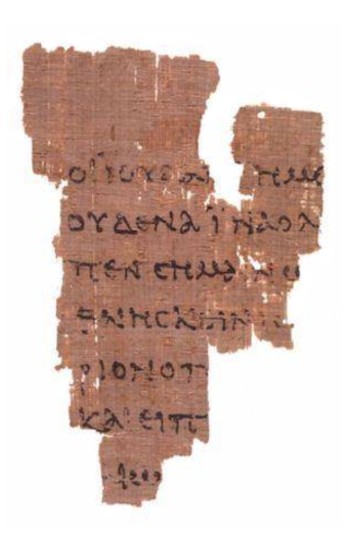

P52 is a scrap of papyrus about the size of a credit card, a little under 9 centimeters tall at its widest point, kept in the John Rylands Library of the University of Manchester as Papyrus Rylands Greek 457. Bernard Grenfell bought it in Egypt in 1920 among other fragments, and it was identified and published in 1935 by Colin H. Roberts in An Unpublished Fragment of the Fourth Gospel in the John Rylands Library.6 It comes from a codex, since it is written on both sides. The front preserves pieces of the exchange between Pilate and the Jewish leaders, which in the King James Version reads in part: "Then said Pilate unto them, Take ye him, and judge him according to your law. The Jews therefore said unto him, It is not lawful for us to put any man to death" (John 18:31, KJV). The back preserves pieces of Jesus' answer to Pilate and Pilate's reply, "What is truth?" (John 18:37 to 38, KJV).7 Only about a hundred Greek letters survive, many of them partial.
Roberts dated the hand to the first half of the second century, that is, AD 100 to 150, by comparing it with dated papyri, and several leading papyrologists of the day agreed. On that basis P52 has long been called the oldest surviving manuscript of any part of the New Testament, and its date was used to argue that the Gospel of John was written and circulating in Egypt by the early second century.6
That date has been challenged. In 2005 Brent Nongbri, then a graduate student and now a historian of early Christian books, published "The Use and Abuse of P52: Papyrological Pitfalls in the Dating of the Fourth Gospel" in the Harvard Theological Review. Its opening sentence states its aim: "The thesis of this paper is simple: we as critical readers of the New Testament often use John Rylands Greek Papyrus 3.457" to support a precise date it cannot bear.8 He showed that handwriting closely comparable to P52 appears in documents dated well into the later second and early third centuries. In a second article in New Testament Studies in 2020 he restated the point in its abstract: "the date generally assigned to the fragment ('about 125 ad') is based entirely on palaeography," which "cannot provide such a precise date," and he "argues that the range of possible palaeographic dates for P52 extends into the third century."9 Other specialists have proposed their own ranges. Pasquale Orsini and Willy Clarysse, in a 2012 study of early New Testament papyri, placed P52 at about 125 to 175.10
The fair summary is that P52 is a second or early third century copy of John, one of the oldest New Testament fragments known, and that no one can honestly give it a single year. It shows that the Gospel of John was being copied in Egypt within, at the most, a century or a century and a half of its writing. That is the limit of what it can show, and it contains no reading that changes the meaning of the passage.
P46: the Chester Beatty papyrus of Paul's letters
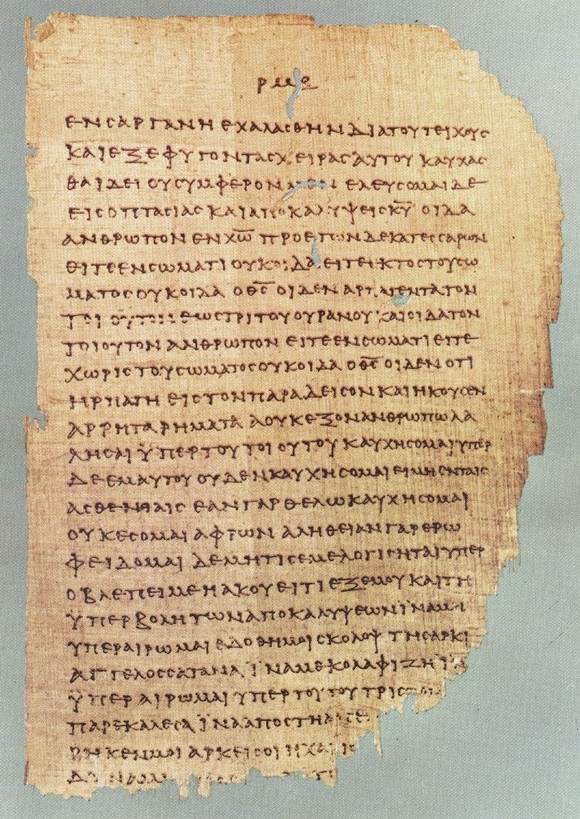

P46 is the oldest substantial copy of the letters of Paul. It is a single-quire papyrus codex, written in one column of 23 to 26 lines a page. Its surviving leaves were bought in the 1930s and are divided between two collections: 56 leaves in the Chester Beatty Library in Dublin (shelfmark CBL BP II) and 30 leaves in the University of Michigan Library in Ann Arbor (inventory 6238). The two institutions' records, as gathered by the Center for the Study of New Testament Manuscripts, date it to the "Late second century or early third century (c. 200)."11
The order of the letters in P46 is one of its most discussed features. The surviving leaves run: the end of Romans, then Hebrews, then 1 and 2 Corinthians, Ephesians, Galatians, Philippians, Colossians and 1 Thessalonians. Hebrews, which does not name its author, stands among Paul's letters right after Romans. The beginning and end of the codex are lost, so whether it ever held 2 Thessalonians, Philemon and the letters to Timothy and Titus is disputed. Frederic Kenyon, who first published it, calculated that the missing final leaves were too few to hold the letters to Timothy and Titus; other scholars, among them Brent Nongbri, argue that the original contents cannot be known.11 Dates proposed for P46 range from the late second to the third century. A proposal by Young Kyu Kim in 1988 to date it to about AD 80 has not won acceptance among papyrologists. These scholarly readings are reported here as such.
P66 and P75: the Bodmer papyri of John and Luke
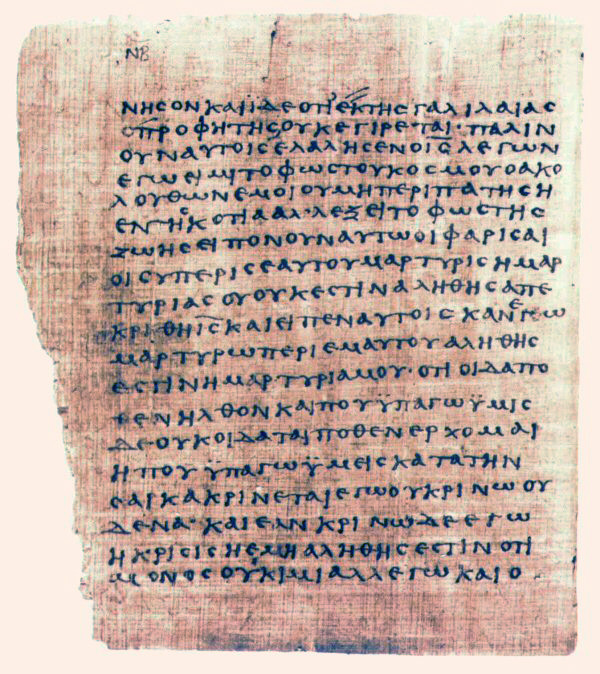

In the 1950s the Swiss collector Martin Bodmer acquired a group of papyrus books from Egypt. Two of them are among the most important New Testament manuscripts known. P66 (Papyrus Bodmer II) is a nearly complete codex of the Gospel of John up to chapter 14, with fragments of the later chapters. It was published by Victor Martin in 1956, who dated it to about AD 200 from its handwriting; Herbert Hunger later argued for an earlier date in the second century, and Brent Nongbri in 2014 argued that its format and construction fit the fourth century better. The scribe of P66 made many corrections, and scholars disagree whether a second hand or the first scribe made most of them.12
P75 (Papyrus Bodmer XIV and XV) contains most of Luke from chapter 3 and John up to chapter 15, with Luke ending and John beginning on the same page. In January 2007 it left Switzerland. The Vatican Apostolic Library, which received it as a gift and now calls it the Hanna Papyrus 1 (Mater Verbi), describes it this way: it was "Copied in the early third century A.D."; "It originally contained the complete Gospels according to Luke and John, in that order"; and it was "previously kept at the Bibliotheca Bodmeriana in Cologny, Switzerland." The Library thanks "the Hanna family and to the Solidarity Association for its donation to the Library, in January 2007," and calls the papyrus "one of the most important sources for the reconstruction of the text of the Gospels," noting that it includes "the Lukan version of the Lord's Prayer (Lk 11,1-4)."13
P75 matters to the history of the text for one reason above all. Its text is very close to that of Codex Vaticanus (B), copied a century or more later on parchment. Studies by Gordon Fee and others measured the agreement at above ninety percent in Luke and John. Before P75 was published, some scholars thought the text of Vaticanus was the product of a fourth-century revision. P75 showed that a text very like it already existed in the third century, unless P75 itself is later than usually thought, which is what Nongbri argued in 2016 when he proposed that the fourth century cannot be ruled out for P75 either.14 P75 also has small surprises. In the story of the rich man and Lazarus, where the King James Version reads "There was a certain rich man, which was clothed in purple and fine linen, and fared sumptuously every day" (Luke 16:19, KJV), P75 gives the rich man a name, read by its editors as Nineues (part of the word is damaged; it is often given in English as Neves). The Byzantine manuscripts give him no name.214 Neither P66 nor P75 contains the story of the woman taken in adultery (John 7:53 to 8:11), which is discussed in lesson 08.
Together, the papyri give samples of most New Testament books from before the time of Constantine. They are often fragmentary, and Revelation, for instance, is thinly represented. As of the September 2023 count the highest papyrus number in the register was P141, and once numbers withdrawn or merged are removed, about 135 papyri remain.15
The great codices of the fourth and fifth centuries
After the persecution under Diocletian ended and Constantine came to power in the early fourth century, churches could commission large, costly books openly. The oldest complete or nearly complete Greek Bibles come from this period. They are parchment codices written in a careful majuscule hand, usually in several columns to a page. Four of them, known by the letters aleph, A, B and D, appear in the notes of nearly every modern edition of the Greek New Testament. (The church setting under Constantine is told in Church History, Part A, lesson 04.)
Codex Sinaiticus (aleph, 01)
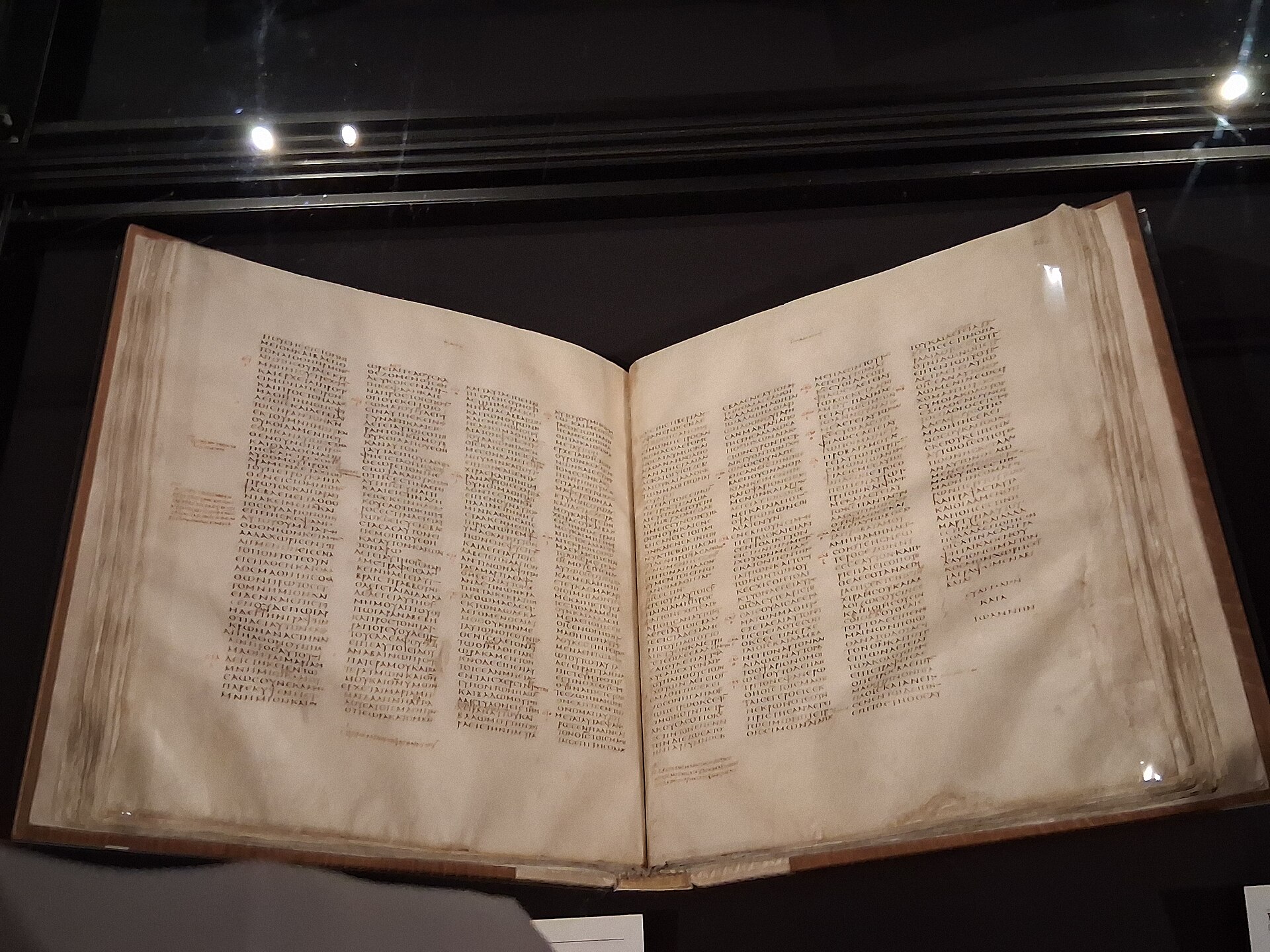

The Codex Sinaiticus Project, the joint work of the four institutions that hold its leaves, introduces the manuscript in these words: "Codex Sinaiticus is one of the most important books in the world. Handwritten well over 1600 years ago, the manuscript contains the Christian Bible in Greek, including the oldest complete copy of the New Testament."16 What survives is "just over 400 large leaves of prepared animal skin," each measuring "380mm high by 345mm wide." The leaves hold "around half of the Old Testament and Apocrypha (the Septuagint)" and "the whole of the New Testament," and also "two early Christian texts not found in modern Bibles": "an Epistle by an unknown writer claiming to be the Apostle Barnabas" and "'The Shepherd', written by the early second-century Roman writer, Hermas."17 Scholars date it to the fourth century, usually to the middle of the century, by its handwriting and format; the British Library's shelfmark for its portion is Add. MS 43725.18
Tischendorf at Saint Catherine's
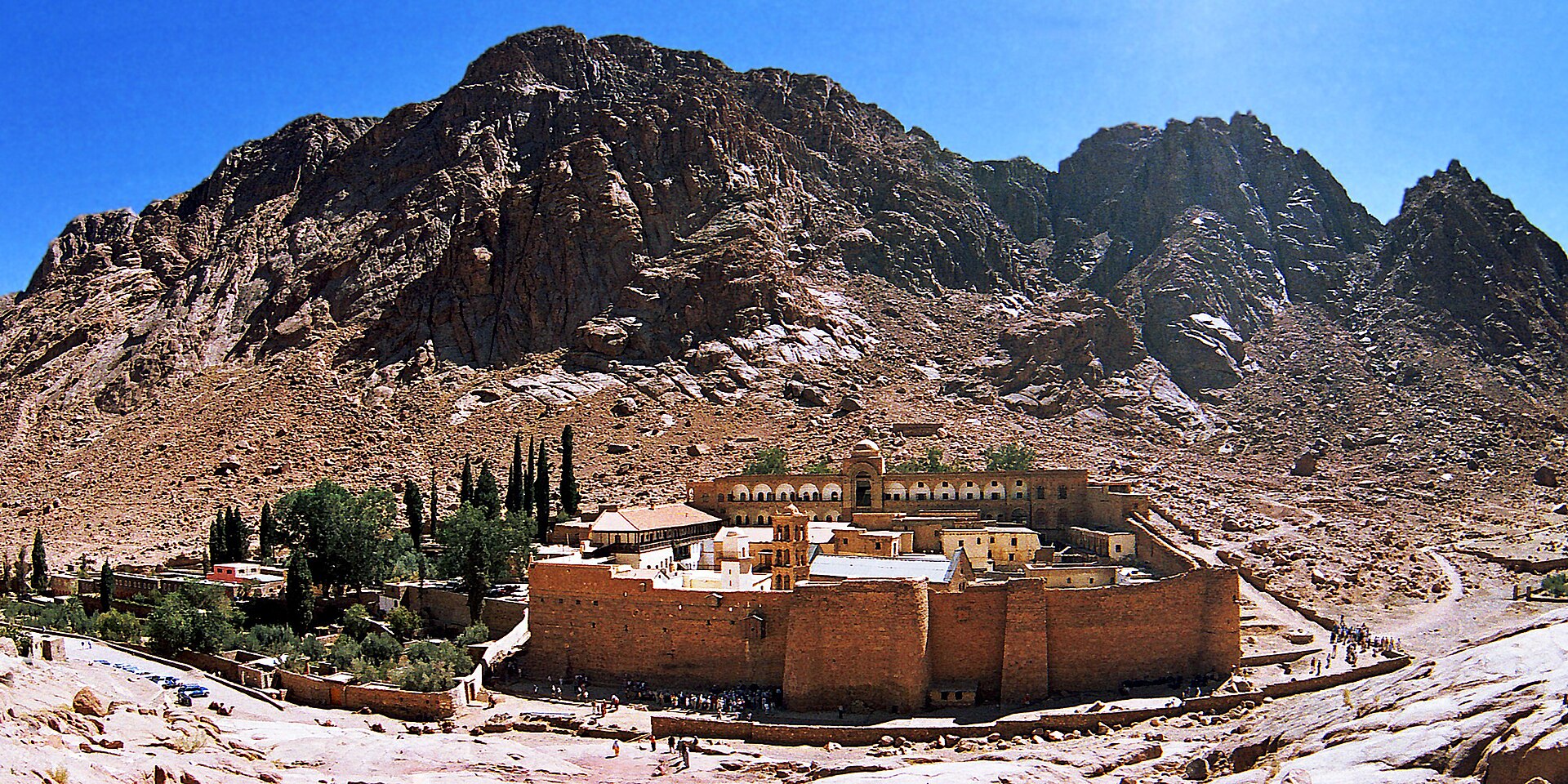

The modern history of the codex begins with the German scholar Constantin von Tischendorf. On his first visit to Saint Catherine's Monastery, in 1844, he saw a quantity of old leaves. His own account, published in English in 1866 as When Were Our Gospels Written?, tells it this way: "I perceived in the middle of the great hall a large and wide basket full of old parchments." He was told that "two heaps of papers like these, mouldered by time, had been already committed to the flames," and the monks "allowed me to possess myself of a third of these parchments, or about forty-three sheets."19 The Codex Sinaiticus Project, drawing on the monastery's records, states the outcome more plainly: "Tischendorf then obtained 43 of these leaves from the Monastery." Those 43 leaves went to Leipzig, where they remain in the University Library.17 The record of the transfer is not in dispute. The story of the basket and the fire rests on Tischendorf's own account, and no independent record of it is known.
Tischendorf returned in 1853 and again in 1859, the last time under the patronage of the Russian Tsar Alexander II. On the evening of his 1859 visit, by his account, the steward of the monastery "took down from the corner of the room a bulky kind of volume, wrapped up in a red cloth, and laid it before me." He wrote, "I knew that I held in my hand the most precious Biblical treasure in existence."19 In September 1859, in Cairo, he signed a receipt for the loan of the leaves. The Codex Sinaiticus Project summarizes it: "he signed a receipt for the loan of the 347 leaves," and "He promised to return the Codex to the Monastery intact and as soon as it was requested."17 Tischendorf published a lavish facsimile in 1862 for the Tsar.
The codex was not returned. Ten years later, "an act of donation of the Codex to the Tsar was signed first, on 13/25 November" 1869, and the manuscript went into the Imperial Library in Saint Petersburg. Whether a gift had been intended from the start is disputed. The Project says that "conflicting evidence has emerged as to whether a donation to the Tsar was part of the original intention." The monastery's later protest, described below, shows that it did not regard the matter as settled.17
From Saint Petersburg to London, and the 1975 find
After the Russian Revolution the Soviet government, short of foreign currency, sold the codex to the British Museum through the London booksellers Maggs Brothers. The British government agreed to "support a payment of £100,000 upon delivery of the Codex to London," of which £93,000 came from the Treasury and £7,000 from the Museum. "The Codex itself arrived in London on 26 December 1933." The monastery protested at once: in a telegram of 1934, "Archbishop Porphyrios of Sinai asserted the Monastery's claim to be the 'sole rightful owner'" of the manuscript.17 The codex passed with the Museum's library to the British Library, founded in 1973.
One more chapter followed. "Over forty years later, in 1975, the Monastery uncovered further, previously unknown parts of the Codex," in a room beneath the Chapel of Saint George, among a store of damaged manuscripts.17 Today the surviving leaves are divided among four institutions: 347 leaves in the British Library, 43 in Leipzig University Library, parts of six leaves in the National Library of Russia in Saint Petersburg, and at least eighteen leaves and fragments at Saint Catherine's. The Codex Sinaiticus Project has put photographs and a transcription of every surviving page online, reuniting the book on the screen.1617
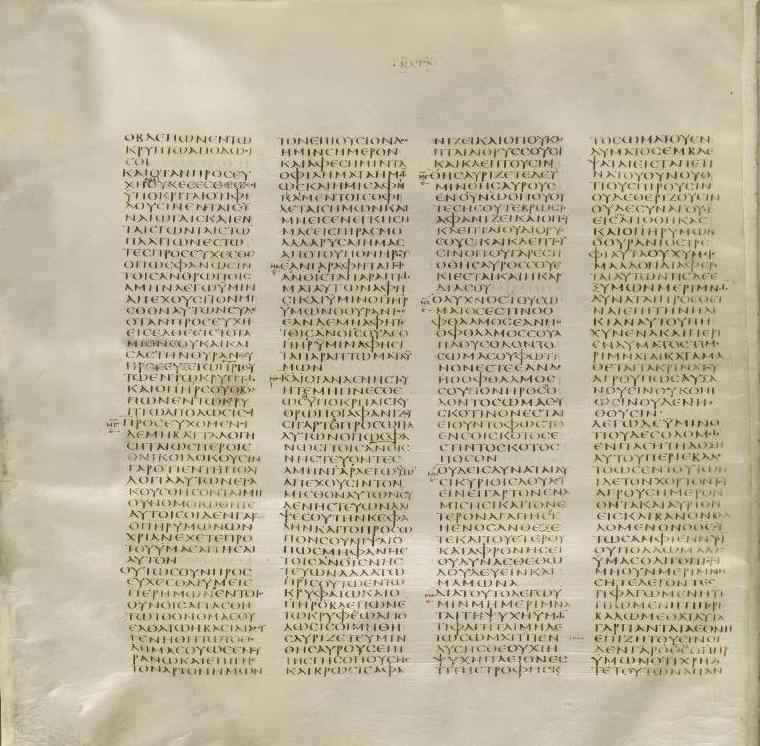

Sinaiticus is also one of the most heavily corrected manuscripts known. Several ancient and later hands went over it, adding missing words, changing readings and sometimes changing them back, and the Project's transcription records each layer. Its text agrees most often with Vaticanus, though the two differ in many places. Sinaiticus ends the Gospel of Mark at 16:8, with no verses 9 to 20, and does not contain John 7:53 to 8:11. Those passages are treated in lesson 08.
Codex Vaticanus (B, 03)
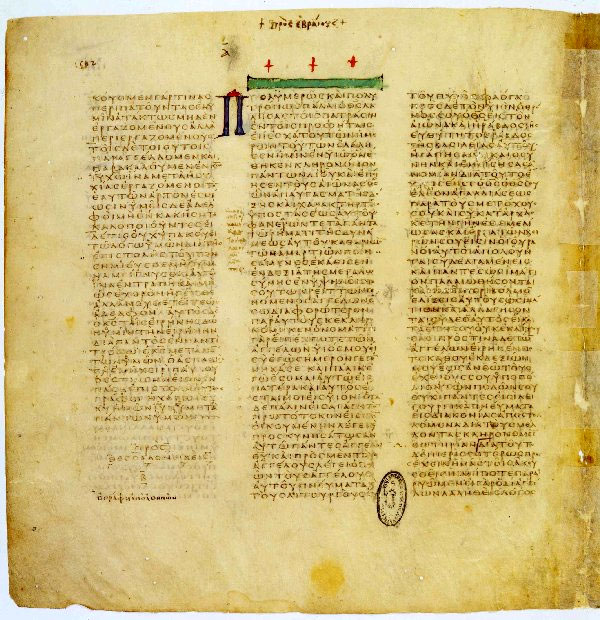

Codex Vaticanus is the other great fourth-century Bible. It is in the Vatican Library under the shelfmark Vat. gr. 1209, a parchment codex written three columns to a page, with 42 lines to a column in the New Testament.20 Its origin and its route to Rome are unknown. The Catholic Encyclopedia of 1913, a public domain reference, says that "Old catalogues show that it was there in the fifteenth century" and that it was "written in the first half of the fourth century."21 Modern scholars commonly report that it may appear in the Library's first inventory of 1475 and is clearly listed in that of 1481 as a Bible in three columns on parchment.22
Vaticanus has lost parts at both ends. In the words of the 1913 encyclopedia, the Old Testament lacks "Genesis 1-46:28," and the New Testament lacks "Hebrews 9:14-13:25, the Pastoral Letters, Epistle to Philemon; also the Apocalypse."21 The Center for the Study of New Testament Manuscripts records the original New Testament portion as running from Matthew through Hebrews 9:13, and says that after that point the text is "written in much later minuscule hand."20 Because the leaves after Hebrews 9:13 are lost, no one knows whether Vaticanus once held the letters to Timothy, Titus and Philemon, or Revelation.
The codex left the Vatican once. "Napoleon I had the codex brought to Paris (where Hug was enabled to study it), but it was afterwards returned to the Holy See," as the 1913 encyclopedia puts it.21 For centuries the Library allowed only limited study of it. Erasmus, preparing his Greek New Testament in the sixteenth century, had readings of it sent to him by correspondents in Rome, a story told in lesson 05. An edition under the names of Angelo Mai and Carlo Vercellone appeared in 1858 and a second in 1859; a third Roman edition, under the names of Vercellone and Giuseppe Cozza-Luzi, appeared in 1868 to 1881; and a photographic reproduction of the whole codex was published at Milan in 1904 to 1906. The Vatican Library has since made colour images of the whole manuscript available online.21
The text of Vaticanus is closely related to that of P75, as noted above, and it is the manuscript on which Brooke Foss Westcott and Fenton John Anthony Hort leaned most heavily in their Greek New Testament of 1881. Its margins also carry about eight hundred pairs of small dots, which the scholar Philip Payne has argued, since 1995, mark lines where the scribe or a later reader knew of a different reading. That reading of the dots is a scholarly proposal and is still debated.22
Codex Alexandrinus (A, 02)
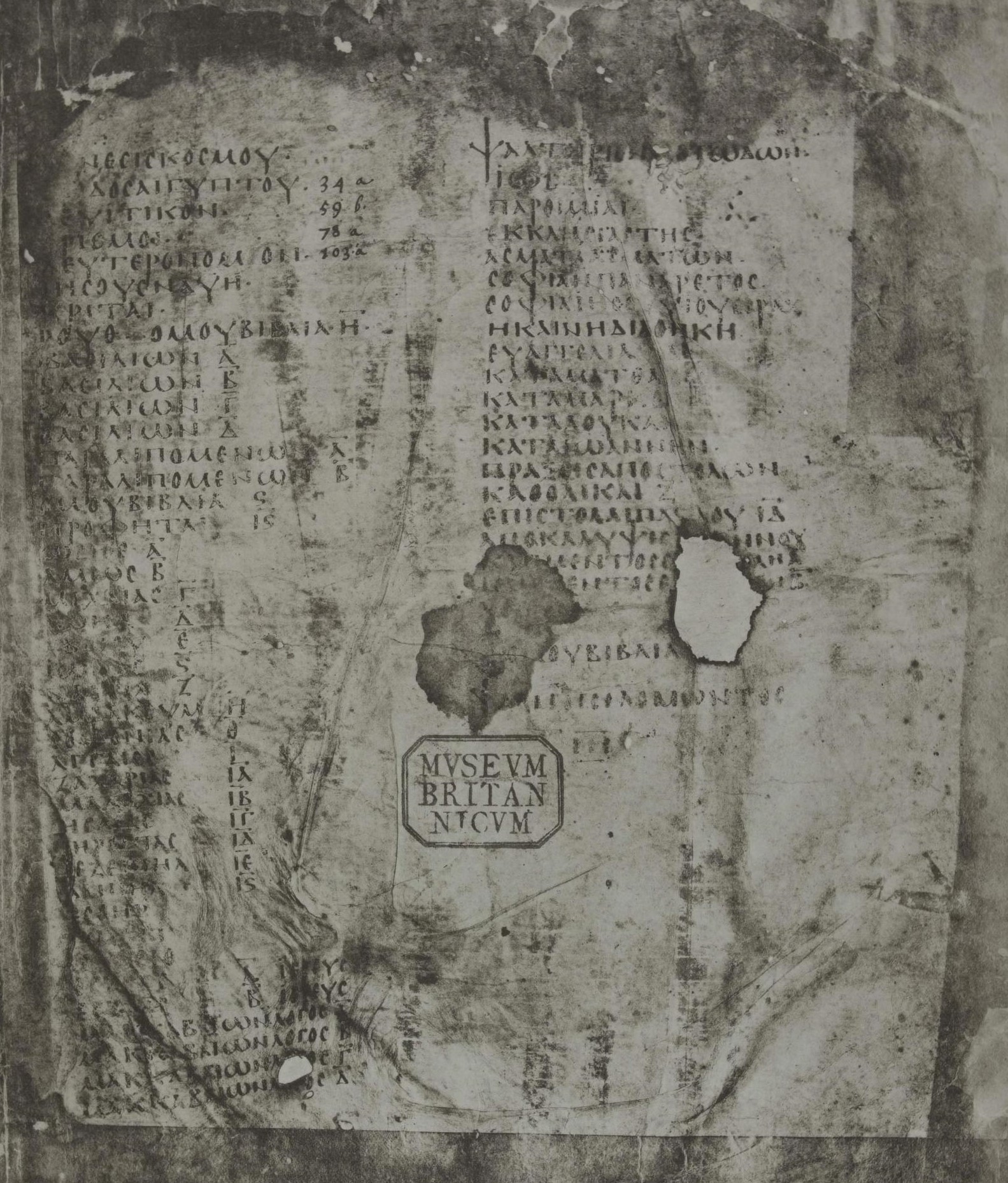

Codex Alexandrinus is a fifth-century parchment Bible in Greek, held by the British Library as Royal MS 1 D. VIII (the shelfmark of its New Testament volume).23 It was the first of the great codices to become known to scholars in western Europe. Cyril Lucaris, Patriarch of Alexandria and then of Constantinople, offered it to King James I through the English ambassador Sir Thomas Roe; James died in 1625, and the codex reached his son Charles I. Most accounts give the year as 1627. Eberhard Nestle, in his Introduction to the Textual Criticism of the Greek New Testament (English translation 1901), gives 1628: the codex was "sent by Cyril Lucar, Patriarch of Constantinople, to Charles I. of England in 1628."24 The difference may be between the year the gift was made and the year it arrived. Its readings were soon printed at the foot of the Greek text in Brian Walton's London Polyglot Bible (1657), which gave it the letter A.24 It survived the fire at Ashburnham House, Westminster, on October 23, 1731, where the Cotton manuscripts and the royal library were then kept; History Today's account says that the scholar Richard Bentley, "dressed only in wig and nightgown, rescued the fifth-century Codex Alexandrinus."36
Alexandrinus holds the Greek Old Testament, including books such as 3 and 4 Maccabees and Psalm 151, and the New Testament, followed by the two letters known as 1 and 2 Clement. Its list of contents names the Psalms of Solomon as well, though those leaves are lost. Much of Matthew (to chapter 25), two leaves of John (6:50 to 8:52) and three leaves of 2 Corinthians are missing. Its date in the fifth century rests on handwriting and on its contents: it includes a letter of Athanasius, who died in 373, so it cannot be older than his lifetime.23
Scholars such as Bruce Metzger describe the text of Alexandrinus as not of one kind throughout. In the Gospels it stands close to the Byzantine text found in most later manuscripts, the oldest substantial witness of that kind. In Acts, the letters and Revelation it is closer to Sinaiticus and Vaticanus, and in Revelation it is often counted the best single witness. Alexandrinus contains Mark 16:9 to 20.
Codex Bezae (D, 05)
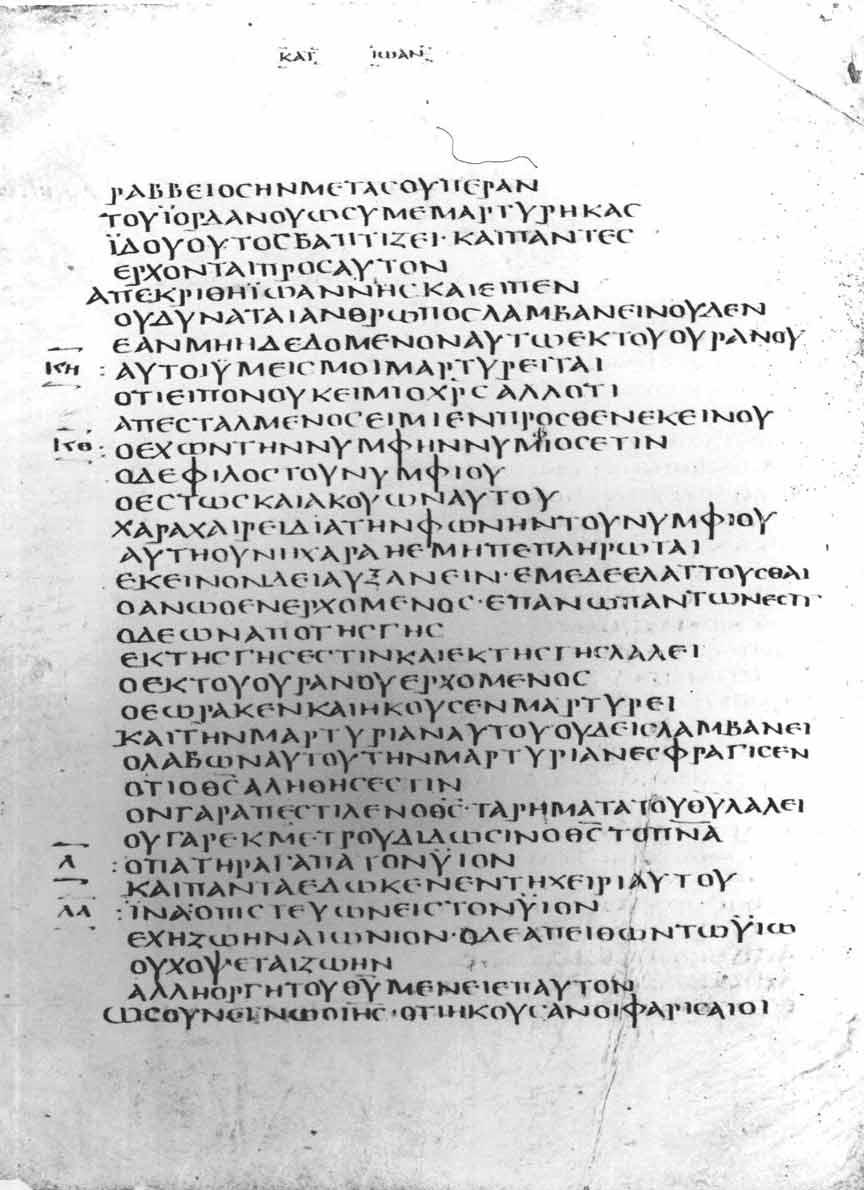

Codex Bezae is a bilingual manuscript of the Gospels and Acts, Greek on the left-hand page and Latin on the right. It is in Cambridge University Library as MS Nn. 2.41, with 415 surviving leaves written in a single column of 33 lines.25 David Parker, the scholar who wrote the Cambridge Digital Library's description of it, gives its date in these words: "The manuscript is best dated to the end of the fourth or the beginning of the fifth century." Its contents now are "the Gospels of Matthew, John, Luke and Mark," in that order, with "a single page of the last verses of 3 John (in Latin only) and the Acts of the Apostles." Its later history is partly known: "It is probable that the Codex Bezae remained there, in the Monastery of St Irenaeus," at Lyons, "until the sixteenth century." "It was apparently taken over the Alps to the Council of Trent in 1546." Then it passed to the Reformed scholar Theodore Beza in Geneva: "In 1581, Beza presented the manuscript to Cambridge University."26 Nestle's 1901 Introduction gives the same year, saying Beza "presented to the University of Cambridge in 1581" this manuscript, which Nestle called "the now so famous Codex Bezae."24
Bezae is famous for being different. Parker writes that "it provides a strikingly different form of text to that preserved in almost every other manuscript." In Acts its text is considerably longer than that of Vaticanus, and Parker describes it as showing "a free restyling of the text," and in Luke "The genealogy of Jesus in Luke's Gospel is arranged in reverse order so as to conform more closely with that in Matthew." Where it was written is not known; Parker himself writes, "I have proposed Berytus (Beirut)," as one possibility among several that scholars have offered.26 Bezae is the chief Greek witness of the form of text scholars call "Western," which is also found in the Old Latin translation and in some second-century writers. It contains John 7:53 to 8:11.
Other majuscules
Besides the four great codices, the register lists a few hundred other majuscule manuscripts, most of them fragments. Among the better known are Codex Ephraemi Rescriptus (C, 04) in the National Library of France (Gr. 9), a fifth-century manuscript of the New Testament that was later scraped and written over with works of Ephraem the Syrian, so that the biblical text must be read underneath (a manuscript reused in this way is called a palimpsest); and Codex Washingtonianus (W, 032), a fourth or fifth century manuscript of the Gospels in the Smithsonian Institution's Freer Gallery of Art in Washington.23 The September 2023 figures reported by Peter Gurry give 326 as the highest majuscule number and 43 numbers withdrawn or merged, which leaves about 283.15
Minuscules and lectionaries: the bulk of the record
The minuscules
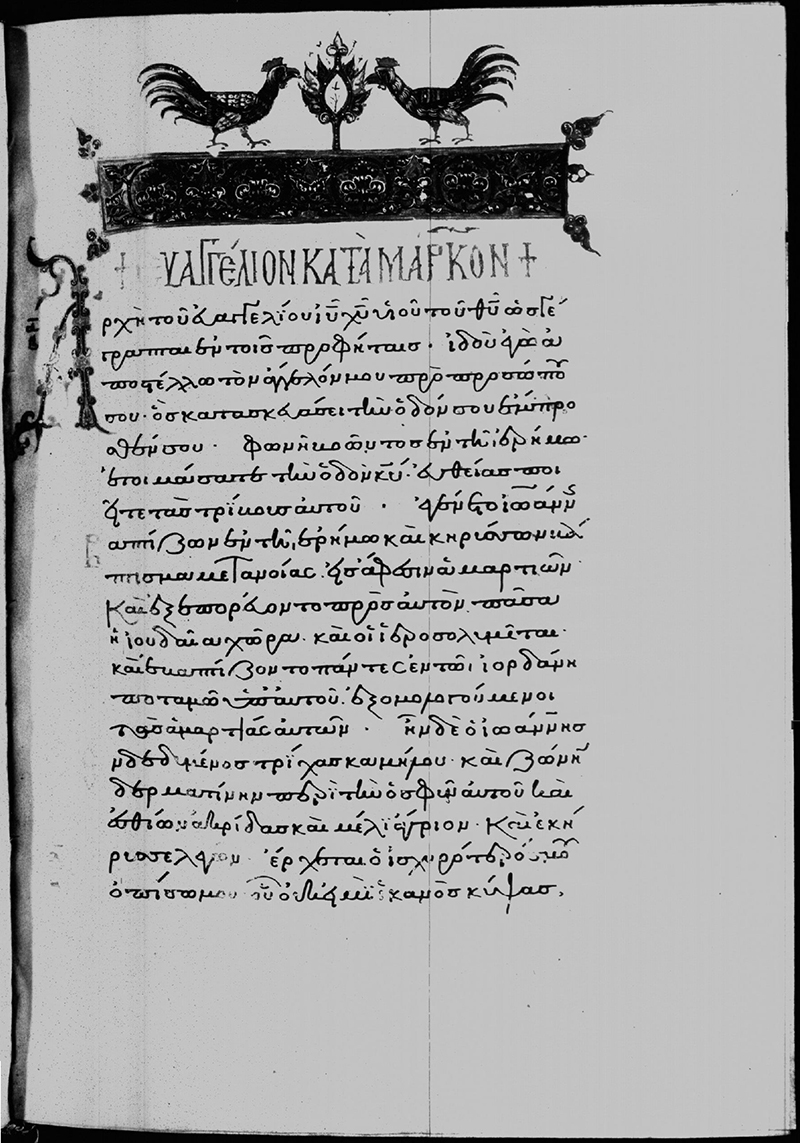

Once the minuscule hand took over in the ninth and tenth centuries, Greek scribes used it for nearly all new copies of the New Testament. Most surviving Greek New Testament manuscripts are therefore minuscules, written between the ninth century and the age of printing, and many of them later still, since scribes went on copying by hand in the Greek world long after 1500. A typical example is minuscule 3, a twelfth-century parchment book of 451 leaves with the Gospels, Acts and the letters, written in a single column of 24 lines, now in Vienna.27 The minuscules were copied mainly in the Byzantine Empire, in monasteries and in Constantinople, and most of them carry the form of text that scholars call Byzantine, or the Majority Text, because it is found in the majority of manuscripts. The printed Greek text of the sixteenth century, the Textus Receptus, was built from a handful of late minuscules of this kind, as lesson 05 explains.
Some minuscules are much more than late copies. A minuscule written in the twelfth century may have been copied from a majuscule of the fifth, and a few minuscules carry texts close to the oldest witnesses. Scholars group related minuscules into families, such as Family 1 and Family 13, named after a leading manuscript in each. The date of a copy and the age of its text are separate questions, and both matter. As of the 2023 figures, the highest minuscule number was 3019, and with 159 numbers withdrawn or merged about 2,860 remain registered.15
The lectionaries
A lectionary gives the New Testament in the order in which it was read in Greek churches across the year, beginning at Easter, with a second section for the fixed feasts of the calendar. Lectionaries are numerous: the 2023 register's highest lectionary number was l 2555, with 133 numbers withdrawn or merged, leaving about 2,422.15 Many are short. The INTF's own review of the register in 2023 found that about 27 percent of lectionaries and 10 percent of minuscules have 50 folios (leaves) or fewer.5 Most lectionaries are late, and they repeat the Gospel and Epistle passages read in church far more often than other parts of the New Testament. They are important evidence for the text that Greek churches used in worship, but for long stretches of the New Testament, and for books seldom read in the liturgy, such as Revelation (which the Greek lectionary did not include), they add little.
The early versions: Latin, Syriac, Coptic and others
The New Testament was translated from Greek into other languages within a few generations. A translation made from a Greek manuscript is indirect evidence for what that Greek manuscript read, and some translations are older than any surviving Greek copy of the passages they contain. Scholars call them the versions. Nestle's 1901 Introduction states the rule for using them: "Manifestly, the value for our purpose of these versions depends on their age and accuracy."24 A translation cannot show every detail of the Greek, since word order, the Greek article and some verb forms have no equivalent in Latin or Syriac, but it can show whether a verse or phrase was present.
Latin
Latin translations circulated in North Africa and Italy by the late second century. These early translations are called the Old Latin (Vetus Latina), and they survive in a few dozen manuscripts and in the quotations of Latin writers. Codex Bezae's Latin pages are one of them.28 At the end of the fourth century the Latin Vulgate (translated about 382 to 405 at the request of Pope Damasus I) revised the Latin New Testament against Greek manuscripts and became, over centuries, the standard Bible of the western church. Thousands of Vulgate manuscripts survive. The Latin story, and its continuation in Old English and in Wycliffe's Bible, is told in lesson 04.
Syriac
Syriac, a dialect of Aramaic, was the language of the churches of Edessa and Mesopotamia. Around the 170s the Christian writer Tatian composed a single continuous gospel story woven from the four Gospels, called the Diatessaron (Greek for "through four"), which was widely read in Syriac. Eusebius of Caesarea reports it in his Church History (4.29).29 No complete copy survives; it is known through quotations, a commentary by Ephraem the Syrian, and later translations. Separate Gospels in Old Syriac survive in two manuscripts. One of them, the Sinaitic Syriac, was found at Saint Catherine's Monastery in February 1892 by Agnes Smith Lewis, a Scottish scholar who worked with her twin sister Margaret Dunlop Gibson. It is a palimpsest: its Gospel text, generally dated to the late fourth or early fifth century, was later washed off and overwritten with lives of women saints, the upper text being dated to 697. It lacks the last twelve verses of Mark. It is still kept at the monastery.28 The standard Syriac version, the Peshitta, was in wide use by the fifth century and is still the Bible of the Syriac churches.28
Coptic, Gothic and others
In Egypt the New Testament was translated into the Coptic language, written in Greek letters with some added signs, in several dialects: Sahidic in the south, from about the third century, and Bohairic in the north, which became the language of the Coptic Church's worship.28 Gothic, the language of the Goths, received a Bible in the fourth century. Uppsala University Library, which holds its most famous copy, says: "The translation from Greek to Gothic was done in the fourth century by the Gothic Bishop Wulfila," who also devised the Gothic alphabet. That copy, the Codex Argenteus or Silver Bible, was "probably copied in Ravenna in the period under the Ostrogoths," early in the sixth century. It "originally had at least 336 leaves," and "Of these 187 are in Uppsala," with one more in Speyer, Germany. Magnus Gabriel De la Gardie "presented it to Uppsala University in 1669."30 Later versions include Armenian, Georgian, Ethiopic, Old Church Slavonic and Arabic. Each has its own history of copying and revision, and the oldest of them are valued as witnesses to the Greek text from which they were made.
The church fathers' quotations
A third body of evidence is the quotations of the New Testament in early Christian writers, often called the fathers. Irenaeus of Lyons, writing about 180, quotes many passages. In Against Heresies 3.10.5 he quotes the ending of Mark: "So then, after the Lord Jesus had spoken to them, He was received up into heaven, and sits on the right hand of God" (translated by Alexander Roberts and William Rambaut, Ante-Nicene Fathers, vol. 1). That sentence corresponds to Mark 16:19, and it shows that the longer ending of Mark was known in Gaul in the second century, earlier than any surviving Greek manuscript that contains it or omits it.31 The bearing of that quotation on the debate over Mark 16:9 to 20 belongs to lesson 08.
Quotations have one great strength: many can be dated and placed, since the writer's life is known. Nestle notes that they let scholars locate forms of the text "even more exactly" than the versions do. They also have weaknesses, which Nestle sets out in the same book. A writer may have quoted from memory, so "we must make sure that our author has quoted accurately and not loosely from memory." And copyists of the fathers' own works sometimes changed the quotations to match the Bible text of their own day: quotations could be "accommodated to the current text of their time by later copyists or even by editors of printed editions."24 A father's quotation is therefore best used where the edition of his work is critical and the quotation is exact or is the subject of his comment.
The count: how many Greek manuscripts are there?
The 2023 figures from Munster
The number of Greek New Testament manuscripts is often quoted in sermons, apologetics books and websites, usually as "over 5,000" or "over 5,800." The number changes as manuscripts are found and as old entries are corrected, so any count needs a source and a date. The most authoritative recent count came from the INTF itself in September 2023. Katie Leggett and Greg Paulson wrote that "the current number of entries in the Kurzgefasste Liste, 5,700, is only a snapshot in time," and that "Just since 2019, an additional 167 Gregory-Aland numbers have been added." Of the 5,700, 56 are marked as destroyed and 105 as having an unknown location, and the authors give 5,541 as the number once destroyed and presumed missing manuscripts are removed. They add a caution: "While the Liste aims to offer a census of available witnesses of the Greek New Testament, it is far from exhaustive."5
Peter Gurry of Phoenix Seminary, a co-editor of Myths and Mistakes in New Testament Textual Criticism (2019), adopted the figure a month later on the Evangelical Textual Criticism blog: "This is the number I will now be giving to people when they ask and it's the number I would encourage you to use." He also warned that the manuscripts "are not all created equal!" and that "the number is not stable given new discoveries, the movement of manuscripts" and similar changes.32 In a follow-up post on November 2, 2023, Gurry set out the INTF figures by category: the highest number in each category and how many numbers had been removed because they were duplicates, parts of other manuscripts or otherwise not separate manuscripts. Subtracting the removed numbers from the highest numbers gives the breakdown in the chart below, which adds up exactly to 5,700. The same post compared an earlier estimate by Jacob Peterson in Myths and Mistakes of about 5,100 to 5,300, which, Gurry wrote, "undershot the total by hundreds," because Peterson had applied the high rate of removals among majuscules (13 percent) to all four categories, while minuscules and lectionaries had a much lower rate (about 5 percent).15
Other counts a reader will meet
Older books give other figures, and each was right for its date and method. Kurt and Barbara Aland's The Text of the New Testament (English editions 1987 and 1989) gave the count as it stood in the late 1980s. Bruce Metzger and Bart Ehrman's fourth edition of The Text of the New Testament (2005) gave a figure close to 5,700 for its time. The figure "over 5,800," common in apologetics in the 2010s, runs higher because it counts catalogue numbers assigned, not manuscripts: Gurry's November 2023 post notes that Jacob Peterson began from "a total of 5885 numbers in the Liste," and many numbers have since been withdrawn or merged.15 The differences between these figures come mainly from counting method. A careful writer gives a number with its source and date, as in "5,700 registered entries in the INTF Liste as of September 2023," and notes that the number of distinct surviving manuscripts is somewhat lower.
How many differences among the manuscripts?
The same abundance that gives the New Testament so many witnesses also gives it many differences among them, called variants or variant readings. The first editor to print a large collection of them was John Mill, whose Greek New Testament of 1707 was estimated to list some 30,000. In 2016 Peter Gurry published "The Number of Variants in the Greek New Testament: A Proposed Estimate" in New Testament Studies. His abstract notes that "Since the publication of John Mill's Greek New Testament in 1707, scholars have shown repeated interest" in the number, but that "Past estimates, however, have failed to tell who estimated, how the estimate was derived, or even what was being estimated." Working from the fullest collation data available, he estimated about 500,000 variants, not counting differences of spelling. "The result is a higher number than almost all previous estimates," he wrote, and he added a point about what the number means: "Proper use shows that the number reflects the frequency with which scribes copied more than their infidelity in doing so."33
Both numbers, the count of manuscripts and the count of variants, grow together. Each new manuscript adds witnesses and adds variants, since no two hand copies of a long text are exactly alike. Most variants are differences of spelling, word order, the presence or absence of the Greek article, or plain slips. Westcott and Hort, in the introduction to their 1881 Greek New Testament, estimated that the variations of real substance amount to a very small fraction of the whole text, on the order of a thousandth part. That is their estimate, made by the standards of their day; the passages where variants do affect meaning, such as the ending of Mark, the story of the woman taken in adultery and 1 John 5:7, are the subject of lesson 08.34
Compared with other ancient books
The New Testament's manuscript record is unlike that of any other ancient book, in both number and age. A useful comparison is the Roman historian Tacitus, who wrote in the early second century, within a few decades of most New Testament books. His Annals are the chief Roman source for the reign of Nero, and the passage on Nero's punishment of the Christians is often quoted. Roger Pearse's guide to the manuscripts of Tacitus explains that the first six books of the Annals survive in a single manuscript, the first Medicean, now in the Laurentian Library in Florence: "This MS was written around 850AD in Germany," probably at the abbey of Fulda, and was later at Corvey in Saxony. Books 11 to 16 of the Annals and the surviving books of the Histories depend on a second manuscript, which "was written at Monte Cassino, perhaps during the abbacy of Richer (1038-55AD)," in "the difficult Beneventan hand."35 For those parts of Tacitus, then, the text rests on one manuscript each, copied some 750 and 900 years after the author wrote. No one doubts that modern editions of Tacitus are substantially what he wrote. The New Testament, by contrast, has papyri copied within one to two centuries of its writing, complete Bibles from within about three centuries, and thousands of later copies made in many places.
The comparison is fair as far as it goes, and it is often pushed further than the evidence allows. Popular charts that rank ancient books by their numbers of manuscripts often use outdated or unsourced figures for the classical authors, and they count New Testament manuscripts, including late lectionaries and small fragments, against the complete or nearly complete manuscripts of classical works. The safe statement is the one above: for no other book of antiquity do so many manuscripts survive from so close to the time of writing.
What the count shows, and what it does not
What the count shows
The count and the dates, taken together, establish several things.
First, the New Testament was copied widely and early. Manuscripts survive from Egypt, from Sinai, from the Latin west, from Syria and from the Byzantine world, and their texts, for all their differences, are recognizably the same books. Second, the gap between the writing of the books and the oldest surviving copies is short by ancient standards: a century or two for the papyri, about three centuries for complete Bibles. Third, the witnesses are of several independent kinds. Greek manuscripts, early translations into Latin, Syriac, Coptic and Gothic, and quotations in writers from Gaul to Mesopotamia can be checked against each other, and a reading that appears in all of them, in widely separated places, is very unlikely to be a late invention. Fourth, the sheer number makes it very hard for a large change to enter the text unnoticed. No single editor or council controlled all the copies, so a change made in one place left the older reading alive somewhere else.
What the count does not show
The count does not by itself settle which reading is right where the manuscripts differ, for four reasons.
First, most manuscripts are late. The thousands of minuscules and lectionaries were copied between the ninth and the sixteenth centuries, and the great majority carry one form of text, the Byzantine. Five hundred late copies of one exemplar are not five hundred independent witnesses. Second, many manuscripts are small. The papyri are mostly fragments, and the 2023 INTF review found that about a quarter of lectionaries and a tenth of minuscules have 50 leaves or fewer.5 For a given verse, the number of manuscripts that actually contain it may be far smaller than the total. Third, a manuscript's number says nothing about its quality. Gurry's warning that they "are not all created equal" applies here.32 Fourth, the oldest witnesses are not all in agreement with one another, and the question whether an older manuscript or the reading of the majority should be preferred is the central question of the textual debate. Scholars who build their editions mainly on the oldest witnesses (the critical text), those who give weight to the majority of manuscripts (the Majority or Byzantine text), and those who defend the printed Textus Receptus all accept the same count. They differ on how to weigh it. That debate is the subject of lesson 08, and its effect on modern translations comes up again in lesson 13.
What the record shows and what it does not
- Documented fact: the INTF register held 5,700 entries in September 2023, 5,541 without manuscripts known to be destroyed or presumed missing; Codex Sinaiticus is divided among the British Library (347 leaves), Leipzig (43 leaves), Saint Petersburg (parts of six) and Saint Catherine's (at least eighteen); the British Museum agreed to pay £100,000 for it, and it reached London on December 26, 1933; P75 went to the Vatican Library in January 2007; Beza gave his codex to Cambridge in 1581; the Uspensky Gospels are dated by their scribe to 835.
- Owner's or participant's account: Tischendorf's story of the basket of parchments bound for the fire in 1844 and of the volume in red cloth in 1859 comes from his own published narrative; Saint Catherine's Monastery has claimed since 1934 that it is the rightful owner of the codex.
- Scholarly reading: every date except a scribe's own dated note is a range from handwriting and format: P52 from the early second into the third century, P46 about 200, P66 and P75 from about 200 to the fourth century by different scholars, Sinaiticus and Vaticanus in the fourth century, Bezae about 400, Alexandrinus in the fifth. Gurry's estimate of about 500,000 non-spelling variants is a scholarly estimate from collation data.
- Open question: the exact date of P52; whether P46 ever held the letters to Timothy and Titus; whether the leaves taken from Sinai were a loan or a gift; how many registered numbers will be merged or withdrawn as the INTF review continues.
Claims checked
"There are over 5,800 Greek manuscripts, so the text is certain." Partly supported.
The number is out of date and the conclusion goes beyond it. The INTF's own count in September 2023 was 5,700 registered entries, or 5,541 without destroyed and missing manuscripts, and the number of distinct physical manuscripts is somewhat lower still, since some numbers belong to the same book.5 The size of the record does make the text secure in most places, because a reading found in early and widely separated witnesses of different kinds is very unlikely to be a late change. But numbers alone do not decide the places where manuscripts differ, since most copies are late and closely related. A sound version of the claim is that the New Testament text is better attested than that of any other ancient book, and that the places where its wording is uncertain are known and printed in the notes of every critical edition.
"P52 was copied about AD 125, within a generation of John's Gospel." Unresolved.
The date "about 125" goes back to Roberts's 1935 publication and rests on handwriting alone. Nongbri's articles of 2005 and 2020 argue that the possible range "extends into the third century," and Orsini and Clarysse proposed 125 to 175.8910 P52 is certainly among the oldest New Testament fragments, but no one can show that it was copied in 125 rather than 175 or 225.
"Tischendorf saved Codex Sinaiticus from being burned by the monks." Unresolved.
The story comes from Tischendorf's own narrative, in which he saw "a large and wide basket full of old parchments" and was told that two heaps "had been already committed to the flames."19 There is no independent record of the burning. The leaves he took in 1844 were 43 Old Testament leaves; the bulk of the codex, including the whole New Testament, was kept apart from the basket and brought out by the steward in 1859, wrapped in cloth, which suggests the monks kept it with care. The codex was also known at the monastery before Tischendorf: in 1761 the Italian naturalist Vitaliano Donati recorded seeing there "a Bible comprising leaves of handsome, large, delicate, and square-shaped parchment, written in a round and handsome script," in the words quoted by the Codex Sinaiticus Project.17
"Tischendorf stole Codex Sinaiticus." Partly supported.
The leaves were taken from the monastery in 1859 under a signed receipt for a loan, with a promise "to return the Codex to the Monastery intact and as soon as it was requested." It was not returned. In 1869 an act of donation to the Tsar was signed, and the Codex Sinaiticus Project reports "conflicting evidence" on whether a gift was intended from the start.17 The record shows a loan that became a disputed gift under pressure from a powerful patron. It does not show a theft in the simple sense, and the monastery's 1934 claim of ownership shows that the dispute is real.
"Codex Sinaiticus is a nineteenth-century forgery." Refuted.
The claim goes back to a nineteenth-century Greek manuscript dealer, Constantine Simonides, who said that he had written the codex himself, and it still circulates online. The evidence is against it: the manuscript was described at Sinai by Donati in 1761; its 43 Leipzig leaves were in Germany from 1844; it contains corrections by many hands of different periods; it agrees in detail with other fourth-century witnesses and the papyri; and its leaves, found in 1975 in a storeroom beneath the monastery's Chapel of Saint George, belong to the same book.17 No scholar who has worked on the manuscript accepts a modern date.
"The Vatican keeps Codex Vaticanus hidden." Refuted.
Access was restricted for centuries. But a printed edition appeared in 1858, a photographic facsimile was published at Milan in 1904 to 1906, and the Vatican Library now offers images of the whole codex online.21 In 2007 the Library also received P75 and published a description of it.13
"The oldest manuscripts are the best manuscripts." Unresolved.
This is a principle of method; it is not a matter of record. An old manuscript is closer in time to the original, but it may be carelessly copied, and a late manuscript may be copied from an excellent old one. The discovery of P75 showed that a text very close to Vaticanus existed earlier than Vaticanus, which strengthened the case of those who favor the oldest witnesses.14 Defenders of the Majority Text and the Textus Receptus answer that the oldest manuscripts survived because they were in dry Egypt, not because they were the most used or the most accurate, and that the many later Byzantine manuscripts preserve a text read across the Greek church for centuries. Both sides are set out in lesson 08.
"With hundreds of thousands of variants, no one can know what the New Testament said." Unsupported.
Gurry's estimate of about 500,000 non-spelling variants is the best recent figure, and it is large. But, as Gurry himself puts it, the number "reflects the frequency with which scribes copied more than their infidelity in doing so."33 The number rises with every manuscript copied, and most variants are slips, spelling, word order and other differences that do not change the sense or that are easily recognized as errors. The passages where meaning is at stake are relatively few, well known, and marked in editions and in the notes of most modern translations.
"The New Testament has more and earlier manuscripts than any other ancient book." Supported.
No other book of antiquity survives in thousands of manuscripts with copies from within one or two centuries of its writing. The Annals of Tacitus, written in the second century, depend for books 1 to 6 on one ninth-century manuscript and for books 11 to 16 on one eleventh-century manuscript.35 Charts that list exact figures for many classical authors should be checked against a dated source before they are repeated, since many circulate without one.
Hard questions and answers
If the oldest manuscripts lack some verses found in the King James Version, does that mean those verses were added?
Not by that fact alone. Codex Sinaiticus and Codex Vaticanus, for example, end Mark at 16:8, while Alexandrinus and most later manuscripts include verses 9 to 20, and Irenaeus quoted verse 19 about 180, before either great codex was copied.31 A verse may be absent from old manuscripts because it was added later, or because it was dropped in one line of copying. Each passage has to be weighed on its own evidence: which manuscripts, of which age and region, which versions and which fathers support it. That weighing, passage by passage, is done in lesson 08, which states the evidence on both sides without deciding between the King James Version's text and the modern critical text in advance.
Codex Vaticanus is in the Pope's library. Does the modern Greek text depend on Rome?
No. Vaticanus is one witness among thousands, and it is available in images to anyone. Its readings are checked against P75 (now also in the Vatican, but copied in Egypt), Sinaiticus (bought by the British Museum from the Soviet government), Alexandrinus (given by an Orthodox patriarch to an English king), Bezae (given to Cambridge by a Reformed theologian) and the papyri in Dublin, Michigan, Manchester and Cologny. The holders of the main witnesses include Catholic, Orthodox, Protestant and secular institutions, and the texts were copied long before any of them owned them.
Should Codex Sinaiticus go back to Saint Catherine's?
That is a question of law and ethics, and the record does not settle it. The record shows that the monastery lent the leaves in 1859 under a receipt promising their return on request, that a deed of donation followed in 1869, that the Soviet government sold the codex in 1933, and that the monastery asserted ownership in 1934.17 The four holding institutions have since cooperated in the Codex Sinaiticus Project, which puts the whole manuscript online, so that the book can be studied as one even while its leaves remain in four places.16
Why should Protestants, who hold to Scripture alone, care what the church fathers quoted?
Because in textual study the fathers serve as witnesses to wording. When Irenaeus quotes Mark 16:19 in Gaul about 180, his book shows which words stood in a manuscript of Mark that he used, whatever weight a reader gives his opinions.31 Nestle's warning applies: a quotation counts only when it is exact and has not been "accommodated to the current text" by later copyists.24 Used with that care, the fathers are among the best-dated evidence available.
If P52 was copied in the third century, does that make the Gospel of John late?
No. A later date for one copy says nothing directly about when the book was first written; it only removes one piece of evidence that was once used to fix the latest possible date. Other early witnesses to John remain, such as P66 and P75, and quotations and allusions in second-century writers. Nongbri's argument is about the limits of handwriting as a dating tool, and he applies it equally to other early manuscripts.9
Going further
A reader who wants to read these manuscripts in Greek can begin with the letters and handwriting in lesson 01 of Intro to Classical Greek, The Alphabet and Handwriting, and with the tools in lesson 20, Using a Lexicon and Reading Aids. Within this module, lesson 01 tells the parallel story of the Hebrew text, lesson 03 explains how the church settled which books belong in the New Testament (a separate question from how their wording was copied), lesson 05 follows the move from manuscripts to print, and lesson 08 weighs the evidence on the disputed passages. Lesson 15 shows how to look at manuscript images online with free tools, including the Codex Sinaiticus Project and the INTF's New Testament Virtual Manuscript Room.
Learn more
- Codex Sinaiticus Project: Photographs and transcription of every surviving leaf, reunited online from four libraries.
- INTF New Testament Virtual Manuscript Room: The official register of Greek manuscripts, with images of many of them.
- Center for the Study of New Testament Manuscripts: Free high-resolution images and records of hundreds of Greek manuscripts.
- Cambridge Digital Library: Codex Bezae: The whole manuscript in images, with David Parker's description.
- Brent Nongbri on P52 (New Testament Studies, 2020): The fullest recent case on why handwriting cannot date P52 precisely.
Still being checked (13 items)
These points could not be confirmed against a primary source when this lesson was written and fact checked in October 2026. The text above states each one as uncertain.
- Roberts's 1935 publication, Orsini and Clarysse (2012), Martin (1956), Hunger (1961), Nongbri (2014 on P66, 2016 on P75), Fee on P75 and Vaticanus, Kim (1988) on P46, and Payne on the Vaticanus marginal dots are reported from summaries of scholarship; the works themselves were not opened.
- The split of P46 leaves (56 Dublin, 30 Michigan), Kenyon's argument about the missing leaves, and the order of letters were taken from secondary summaries consistent with the CSNTM records; no Chester Beatty or Michigan page was opened (the Michigan site was rate-limited).
- The P75 reading of the rich man's name at Luke 16:19 (Nineues, often given as Neves) is from a secondary summary; not checked against the editio princeps.
- The listing of Codex Vaticanus in the Vatican inventories of 1475 (possible) and 1481 (definite) is reported from the Oxford Dictionary of the Christian Church as cited secondarily; the primary catalogue was not seen. The Catholic Encyclopedia confirms only 'the fifteenth century'.
- Codex Alexandrinus: the year it reached Charles I is given as 1627 in most accounts and 1628 by Nestle (1901); its contents and lacunae are from standard secondary descriptions, not a British Library page. Walton's use of the siglum A is confirmed by Nestle and the 1731 fire by History Today.
- Codex Sinaiticus: the mid-fourth-century date is the usual scholarly reading; the Project's own pages opened for this lesson say only 'well over 1600 years ago'. The statement that the Project has put every surviving page online is from the Project's purpose; no date for the launch was checked.
- Constantine Simonides's claim to have written Codex Sinaiticus is reported from general knowledge; no primary source for it was opened.
- Facts about the Old Latin, the Peshitta, the Coptic dialects and the Diatessaron are standard (Metzger, Early Versions, 1977) but that book was not opened; the Eusebius 4.29 page was truncated in fetching, so his wording on Tatian was not quoted.
- The Sinaitic Syriac details (February 1892, Agnes Smith Lewis, upper text dated 697, Sinai Syr. 30) are from secondary summaries citing Gibson (1893) and Lewis (1894).
- Westcott and Hort's estimate of substantial variation (about a thousandth part of the text) is paraphrased; the exact wording of their 1881 Introduction was not checked.
- The statement that Codex Sinaiticus is among the most heavily corrected manuscripts known is a common scholarly description not checked against a specific page.
- The statement that Metzger and Ehrman (2005) gave a figure close to 5,700 manuscripts was not checked against the book.
- The Codex Sinaiticus Project home page was checked by a summarizing fetch only; its opening sentence is confirmed word for word, the rest of the quoted paragraph ('Handwritten well over 1600 years ago...') was confirmed in substance.
Notes
- The Holy Bible, King James Version (Oxford 1769 text), Romans 16:22, 2 Thessalonians 3:17 and Galatians 6:11, as given at Bible Gateway (retrieved Oct. 28, 2026). Read it online. ↩
- The Holy Bible, King James Version (Oxford 1769 text), Colossians 4:16, 2 Peter 3:15 to 16, 2 Timothy 4:13 and Luke 16:19, as given at Bible Gateway (retrieved Oct. 28, 2026). Read it online. ↩
- T. Janz, "Old Round Minuscule," in Greek Paleography from Antiquity to the Renaissance, online exhibition, Vatican Apostolic Library, on the Uspensky Gospels (National Library of Russia, Gr. 219), dated by the scribe Nikolaos to 835 (retrieved Oct. 28, 2026). Read it online. ↩
- Institute for New Testament Textual Research (INTF), Munster, "What is the Kurzgefasste Liste?", INTF blog, New Testament Virtual Manuscript Room (retrieved Oct. 28, 2026). Read it online. ↩
- Katie Leggett and Greg Paulson, "How Many Greek New Testament Manuscripts Are There REALLY? The Latest Numbers," INTF blog, Sept. 29, 2023 (5,700 entries; 5,541 without destroyed and presumed missing; 56 destroyed; 105 location unknown; 167 numbers added since 2019; share of lectionaries and minuscules with 50 folios or fewer) (retrieved Oct. 28, 2026). Read it online. ↩
- P52 (P. Ryl. Gr. 457), John Rylands Library, Manchester: acquired by Bernard Grenfell in Egypt in 1920; first published by C. H. Roberts, An Unpublished Fragment of the Fourth Gospel in the John Rylands Library (Manchester University Press, 1935), who dated it to the first half of the second century. Details as summarized in Nongbri (2005, 2020; notes 8 and 9); Roberts's book was not opened for this lesson. Read it online. ↩
- The Holy Bible, King James Version (Oxford 1769 text), John 18:31 to 33 and 18:37 to 38, as given at Bible Gateway (retrieved Oct. 28, 2026). Read it online. ↩
- Brent Nongbri, "The Use and Abuse of P52: Papyrological Pitfalls in the Dating of the Fourth Gospel," Harvard Theological Review 98, no. 1 (January 2005): 23 to 48, opening sentence quoted from the publisher's page (retrieved Oct. 28, 2026). Read it online. ↩
- Brent Nongbri, "Palaeography, Precision and Publicity: Further Thoughts on P.Ryl.iii.457 (P52)," New Testament Studies 66, no. 4 (October 2020): 471 to 499, abstract (retrieved Oct. 28, 2026). Read it online. ↩
- Pasquale Orsini and Willy Clarysse, "Early New Testament Manuscripts and Their Dates: A Critique of Theological Palaeography," Ephemerides Theologicae Lovanienses 88, no. 4 (2012): 443 to 474 (date range for P52 of 125 to 175 as reported in secondary summaries; the article itself was not opened for this lesson). ↩
- Center for the Study of New Testament Manuscripts (CSNTM), manuscript records for P46: Chester Beatty Library, Dublin, CBL BP II, and University of Michigan Library, Inv. 6238 ("Late second century or early third century (c. 200)"; 86 leaves in all, single column of 23 to 26 lines). Division of leaves (56 Dublin, 30 Michigan), the order of the letters, Kenyon's calculation and Kim's 1988 proposal as reported in standard summaries of scholarship (retrieved Oct. 28, 2026). The online copy cited earlier returned page not found when checked on Oct. 28, 2026. ↩
- On P66 (Papyrus Bodmer II, Bibliotheca Bodmeriana, Cologny): Victor Martin, Papyrus Bodmer II: Evangile de Jean, chap. 1 to 14 (Cologny-Geneve: Bibliotheca Bodmeriana, 1956); Herbert Hunger, "Zur Datierung des Papyrus Bodmer II (P66)," 1961; Brent Nongbri, "The Limits of Palaeographic Dating of Literary Papyri: Some Observations on the Date and Provenance of P.Bodmer II (P66)," Museum Helveticum 71 (2014). Positions as reported in summaries of scholarship; these works were not opened for this lesson. ↩
- Vatican Apostolic Library, "The Hanna Papyrus 1 (Mater Verbi)" (P75, formerly Papyrus Bodmer XIV and XV), description of the papyrus donated in January 2007 (retrieved Oct. 28, 2026). Read it online. ↩
- On the relation of P75 to Codex Vaticanus: Gordon D. Fee, "P75, P66, and Origen: The Myth of Early Textual Recension in Alexandria" (1974, reprinted 1993), and later studies giving agreement of about 92 percent in John and 94 percent in Luke; Brent Nongbri, "Reconsidering the Place of Papyrus Bodmer XIV and XV (P75) in the Textual Criticism of the New Testament," Journal of Biblical Literature 135, no. 2 (2016): 405 to 437. Reading at Luke 16:19 as reported in the standard apparatus. Figures as reported in summaries of scholarship; these works were not opened for this lesson. ↩
- Peter J. Gurry, "Explaining the Discrepancy in the Number of Greek New Testament Manuscripts," Evangelical Textual Criticism blog, Nov. 2, 2023 (INTF figures by category: highest numbers P141, 0326, 3019, l2555; numbers removed 6, 43, 159, 133; comparison with Jacob Peterson's estimate in Myths and Mistakes in New Testament Textual Criticism, 2019) (retrieved Oct. 28, 2026). Read it online. ↩
- Codex Sinaiticus Project (British Library, Leipzig University Library, National Library of Russia, Saint Catherine's Monastery), home page (retrieved Oct. 28, 2026). Read it online. ↩
- Codex Sinaiticus Project, "History of Codex Sinaiticus" and "Content of Codex Sinaiticus" pages (Donati 1761; Tischendorf 1844, 1853, 1859; the 1859 receipt; the 1869 act of donation; the 1933 sale and arrival in London on Dec. 26, 1933; the 1934 telegram of Archbishop Porphyrios; the 1975 discovery; the four holding institutions and their leaves; leaf size and contents) (retrieved Oct. 28, 2026). Read it online. ↩
- CSNTM, manuscript record GA 01 (Codex Sinaiticus), British Library Add. 43725, "4th Century"; contents including the Epistle of Barnabas and the Shepherd of Hermas (retrieved Oct. 28, 2026). Read it online. ↩
- Constantine Tischendorf, When Were Our Gospels Written? An Argument by Constantine Tischendorf. With a Narrative of the Discovery of the Sinaitic Manuscript (New York: American Tract Society, 1866), narrative of the discovery, extract (retrieved Oct. 28, 2026). Read it online. ↩
- CSNTM, manuscript record GA 03 (Codex Vaticanus), Vatican Library, Vat. gr. 1209; 4th century; parchment, three columns, 42 lines; New Testament text to Hebrews 9:13, the rest "written in much later minuscule hand" (retrieved Oct. 28, 2026). Read it online. ↩
- The Catholic Encyclopedia (New York: Robert Appleton, 1913), "Codex Vaticanus," public domain, as given at StudyLight (retrieved Oct. 28, 2026). Read it online. ↩
- On the Vatican Library inventories of 1475 and 1481: F. L. Cross and E. A. Livingstone, eds., The Oxford Dictionary of the Christian Church, 3rd rev. ed. (Oxford, 2005), p. 375, as reported; on the marginal double dots (distigmai): Philip B. Payne, "Fuldensis, Sigla for Variants in Vaticanus, and 1 Cor 14.34-5," New Testament Studies 41 (1995), and Payne and Paul Canart (2000, 2004), as reported. Not opened for this lesson. ↩
- CSNTM, manuscript records GA 02 (Codex Alexandrinus, British Library, Royal 1 D. VIII, 5th century), GA 04 (Codex Ephraemi Rescriptus, Bibliotheque Nationale, Paris, Gr. 9, "a fifth century palimpsest manuscript") and GA 032 (Codex Washingtonianus, Smithsonian Institution, Freer Gallery of Art, 06.274, 4th to 5th century). Contents and lacunae of Alexandrinus and its route to England as reported in standard descriptions (Kenyon; Metzger and Ehrman, 2005) (retrieved Oct. 28, 2026). Read it online. ↩
- Eberhard Nestle, Introduction to the Textual Criticism of the Greek New Testament, trans. William Edie from the 2nd German edition, ed. Allan Menzies (London: Williams and Norgate, 1901), public domain, Project Gutenberg eBook 76224; Nestle's description of Codex A reads "The Codex was sent by Cyril Lucar, Patriarch of Constantinople, to Charles I. of England in 1628" (retrieved Oct. 29, 2026). Read it online. ↩
- CSNTM, manuscript record GA 05 (Codex Bezae), Cambridge University Library, Nn. 2.41; 415 leaves; single column of 33 lines; Greek and Latin (retrieved Oct. 28, 2026). Read it online. ↩
- David Parker, description of Codex Bezae (MS Nn. 2.41), Cambridge Digital Library, Cambridge University Library, March 2012 (retrieved Oct. 28, 2026). Read it online. ↩
- CSNTM, manuscript record GA 3, Vienna, Austrian National Library, Suppl. gr. 52; 12th century; 451 leaves; single column, 24 lines (retrieved Oct. 28, 2026). Read it online. ↩
- Bruce M. Metzger, The Early Versions of the New Testament: Their Origin, Transmission, and Limitations (Oxford: Clarendon Press, 1977), the standard survey of the Latin, Syriac, Coptic and other versions; on the Sinaitic Syriac palimpsest (Sinai, Syr. 30): Margaret Dunlop Gibson, How the Codex Was Found (1893), and Agnes Smith Lewis, A Translation of the Four Gospels from the Syriac of the Sinaitic Palimpsest (1894). Facts as reported in standard summaries; these works were not opened for this lesson. ↩
- Eusebius of Caesarea, Church History 4.29, trans. Arthur Cushman McGiffert, Nicene and Post-Nicene Fathers, 2nd series, vol. 1 (1890), as given at New Advent (retrieved Oct. 28, 2026). Read it online. ↩
- Uppsala University Library, "The history of Codex argenteus" (retrieved Oct. 28, 2026). Read it online. ↩
- Irenaeus, Against Heresies 3.10.5, trans. Alexander Roberts and William Rambaut, Ante-Nicene Fathers, vol. 1 (Buffalo: Christian Literature Publishing Co., 1885), as given at New Advent (retrieved Oct. 28, 2026). Read it online. ↩
- Peter J. Gurry, "How Many Greek NT Manuscripts Are There?", Evangelical Textual Criticism blog, Oct. 25, 2023 (retrieved Oct. 28, 2026). Read it online. ↩
- Peter J. Gurry, "The Number of Variants in the Greek New Testament: A Proposed Estimate," New Testament Studies 62, no. 1 (2016), published online Nov. 20, 2015, abstract; the estimate of about 500,000 non-spelling variants is given in the article (retrieved Oct. 28, 2026). Read it online. ↩
- B. F. Westcott and F. J. A. Hort, The New Testament in the Original Greek, vol. 2, Introduction and Appendix (Cambridge and London: Macmillan, 1881; 2nd ed. 1896), p. 2, on the proportion of substantial variation (paraphrased; the exact wording was not checked for this lesson). ↩
- Roger Pearse, "Tacitus and his manuscripts," online since April 26, 2000, updated May 11, 2017 (retrieved Oct. 28, 2026). Read it online. ↩
- "The Burning of a British Library," History Today, Months Past series, on the fire at Ashburnham House, Westminster, on October 23, 1731 (retrieved Oct. 29, 2026). Read it online. ↩
Check yourself
1. According to the INTF's September 2023 figures, how many entries did the Kurzgefasste Liste of Greek New Testament manuscripts hold?
Leggett and Paulson of the INTF gave 5,700 registered entries, or 5,541 once destroyed and presumed missing manuscripts are removed.
2. What is the main basis for the date of P52, the John Rylands fragment of John 18?
Roberts dated it by handwriting in 1935; Nongbri has argued that handwriting cannot fix a date as precise as about 125 and that the range extends into the third century.
3. Which papyrus, now in the Vatican Library since 2007, has a text very close to Codex Vaticanus?
P75 (formerly Papyrus Bodmer XIV and XV, now the Hanna Papyrus 1) contains Luke and John and agrees closely with Vaticanus.
4. How many leaves of Codex Sinaiticus did Tischendorf obtain on his first visit to Saint Catherine's in 1844?
He obtained 43 Old Testament leaves, which went to Leipzig. The 347 leaves now in London left the monastery in 1859.
5. From whom did the British Museum buy Codex Sinaiticus in 1933?
The Soviet government sold it through Maggs Brothers for 100,000 pounds; it reached London on December 26, 1933.
6. Which codex did Theodore Beza present to Cambridge University in 1581?
Codex Bezae (D, 05), a Greek and Latin manuscript of the Gospels and Acts, was given to Cambridge by Beza in 1581.
7. What is the oldest dated Greek manuscript written in minuscule script?
Its scribe, the monk Nikolaos, dated it to the year of the world 6343, AD 835.
8. Which statement about the manuscript count is accurate?
The record is the richest of any ancient book, but weighing readings requires attention to age, kind and relationship of the witnesses (lesson 08).
Terms in this lesson
- Autograph
- The first written form of a book as its author or secretary produced it. No New Testament autograph survives.
- Papyrus
- A writing material made in Egypt from the pith of the papyrus reed. In the Gregory-Aland system, papyrus manuscripts are numbered with P (P52, P46).
- Parchment
- Animal skin prepared for writing, tougher than papyrus; the material of the great codices. Fine calfskin is called vellum.
- Codex
- A book made of folded sheets sewn at the spine, the form of the modern book, used by early Christians in place of the scroll.
- Majuscule (uncial)
- A Greek hand of separate capital letters, used for books until the ninth and tenth centuries; manuscripts in it are numbered with a leading zero (01, 02, 03).
- Minuscule
- A smaller, joined Greek hand that replaced the majuscule for books from the ninth century; the oldest dated example is from 835.
- Lectionary
- A book giving the New Testament passages read in church, arranged by the calendar; numbered with l (l 2555).
- Gregory-Aland number
- The registration number of a Greek New Testament manuscript in the INTF's Kurzgefasste Liste, named for Caspar Rene Gregory and Kurt Aland.
- Kurzgefasste Liste
- The official register of Greek New Testament manuscripts kept by the Institute for New Testament Textual Research in Munster; 5,700 entries as of September 2023.
- Siglum
- The letter or number used to name a manuscript in editions and notes, such as aleph or 01 for Sinaiticus and B or 03 for Vaticanus.
- Palaeography
- The study of old handwriting; used to date manuscripts that carry no date, giving a range of decades or centuries.
- Palimpsest
- A manuscript whose first text was scraped or washed off and written over, such as Codex Ephraemi Rescriptus or the Sinaitic Syriac.
- Version
- An early translation of the New Testament from Greek into another language, such as Latin, Syriac, Coptic or Gothic, used as indirect evidence for the Greek.
- Variant
- A place where manuscripts differ in wording; Peter Gurry estimated about 500,000 non-spelling variants in 2016.
Sources
- INTF blog: How Many Greek New Testament Manuscripts Are There REALLY? The Latest Numbers (Leggett and Paulson) (2023-09-29) checked 2026-10
- INTF blog: What is the Kurzgefasste Liste? (undated) checked 2026-10
- Peter Gurry, How Many Greek NT Manuscripts Are There? (Evangelical Textual Criticism) (2023-10-25) checked 2026-10
- Peter Gurry, Explaining the Discrepancy in the Number of Greek NT Manuscripts (Evangelical Textual Criticism) (2023-11-02) checked 2026-10
- Peter J. Gurry, The Number of Variants in the Greek New Testament: A Proposed Estimate (New Testament Studies) (2015-11-20) checked 2026-10
- Brent Nongbri, The Use and Abuse of P52 (Harvard Theological Review 98.1) (2005-01) checked 2026-10
- Brent Nongbri, Palaeography, Precision and Publicity: Further Thoughts on P.Ryl.iii.457 (P52) (New Testament Studies 66.4) (2020-10) checked 2026-10
- Vatican Apostolic Library: The Hanna Papyrus 1 (Mater Verbi), P75 (2007) checked 2026-10
- Codex Sinaiticus Project, home page (accessed 2026-10-28) checked 2026-10
- Codex Sinaiticus Project, History of Codex Sinaiticus (accessed 2026-10-28) checked 2026-10
- Codex Sinaiticus Project, Content of Codex Sinaiticus (accessed 2026-10-28) checked 2026-10
- Tischendorf, When Were Our Gospels Written? (1866), narrative of the discovery (extract) (1866) checked 2026-10
- Catholic Encyclopedia (1913), Codex Vaticanus (1913) checked 2026-10
- Cambridge Digital Library: Codex Bezae (MS Nn. 2.41), description by David Parker (2012-03) checked 2026-10
- Eberhard Nestle, Introduction to the Textual Criticism of the Greek New Testament, trans. William Edie (1901) (1901) checked 2026-10
- CSNTM manuscript records: GA 01, 02, 03, 04, 05, 032, 3 and P46 (accessed 2026-10-28) checked 2026-10
- Vatican Library, Greek Paleography from Antiquity to the Renaissance: Old Round Minuscule (T. Janz) (accessed 2026-10-28) checked 2026-10
- Uppsala University Library: The history of Codex argenteus (accessed 2026-10-28) checked 2026-10
- Irenaeus, Against Heresies 3.10 (ANF vol. 1) (c. 180; trans. 1885) checked 2026-10
- Eusebius, Church History Book 4 (NPNF 2nd series vol. 1) (c. 325; trans. 1890) checked 2026-10
- Roger Pearse, Tacitus and his manuscripts (2000, updated 2017) checked 2026-10
- King James Version passages cited (Bible Gateway) (1769 text) checked 2026-10
- The Burning of a British Library, History Today (undated web article) checked 2026-10