Lesson 10 of 14 · about 55 minutes · Updated November 12, 2026
The 20th Century: Cameron Townsend and Wycliffe, Jim Elliot, Nate Saint and Elisabeth Elliot
You'll be able to
- Trace Cameron Townsend's path from Bible seller in Guatemala (1917) to the founding of Camp Wycliffe (1934), Wycliffe Bible Translators (1942) and JAARS.
- Explain why SIL and Wycliffe were set up as two organizations and how SIL worked through agreements with governments.
- State the main criticisms made of SIL in Latin America in the 1970s and 1980s, with the events in Colombia and Ecuador in 1981, and SIL's answers.
- Read the 2025 Bible translation figures correctly, including what they count and what they leave out, and judge whether Vision 2025 was met.
- Describe Operation Auca and its aftermath, separating the documented record from later story-telling, and give the Waorani's own differing accounts.
- Trace Jim Elliot's "no fool" sentence to his journal of October 28, 1949 and to Philip Henry's earlier saying.
Start here: the short version
In September 1917 a 21-year-old Californian named William Cameron Townsend sailed for Guatemala to sell and give out Spanish Bibles. Many of the people he met spoke Kaqchikel (older spelling Cakchiquel), and a Kaqchikel man named Francisco Diaz helped him see that a Spanish Bible did not reach them.1 Townsend and his first wife, Elvira, translated the New Testament into Kaqchikel (dedicated in 1929), and in 1934 he opened a seven-week summer course in an empty Arkansas farmhouse that grew into the Summer Institute of Linguistics (SIL). Wycliffe Bible Translators was incorporated in 1942 to support it, and the aviation and radio arm JAARS followed.12 SIL's close agreements with Latin American governments brought heavy criticism from anthropologists, Indigenous federations and nationalist movements in the 1970s and 1980s, and Ecuador ordered SIL out in 1981.3 In August 2025 the Wycliffe Global Alliance counted 776 languages with a full Bible, 1,798 with a New Testament and 1,433 with portions, out of 7,396 living languages.45
The second half of the lesson follows five young American missionaries in Ecuador, Jim Elliot, Pete Fleming, Ed McCully, Nate Saint and Roger Youderian, who tried to contact the Waorani in January 1956 and were speared on January 8 (the account of their deaths is in module 102, lesson 09). Life magazine's ten-page story of January 30, 1956 and Elisabeth Elliot's book Through Gates of Splendor (1957) made them the best known missionaries of the century.6 In 1958 Elisabeth Elliot and Nate Saint's sister Rachel went to live among the Waorani.7 What came next is still argued over: Waorani elders who credited the gospel with ending a cycle of spearing, and Waorani leaders today who say missionaries frightened and divided their people. This lesson sets out both, in their own words.
The question of language
Every lesson in this module so far has met the same problem in a different place: John Eliot learning Massachusett with Cockenoe and John Sassamon (lesson 02), William Carey and the Serampore translators (lesson 04), Adoniram Judson's Burmese Bible (lesson 05), Henry Spalding's Nez Perce primer at Lapwai (lesson 08). In the 20th century one American organization made the translation of Scripture into small, unwritten languages its whole purpose, and it grew into the largest body of its kind in the world.
The Bible texts that Bible translators quote most often are about language. In the account of Pentecost the crowd in Jerusalem asks, in the King James Version, "And how hear we every man in our own tongue, wherein we were born?" (Acts 2:8).8 Paul asks in Romans 10:14 (KJV): "How then shall they call on him in whom they have not believed? and how shall they believe in him of whom they have not heard? and how shall they hear without a preacher?"8 And the vision of Revelation 7:9 (KJV) describes "a great multitude, which no man could number, of all nations, and kindreds, and people, and tongues, stood before the throne, and before the Lamb."8 Wycliffe Bible Translators USA still points to that verse in its own history page.9
Whether the translation of Scripture into a people's language respects that people or changes them against their will is the main dispute of this lesson, and it is set out below with the words of the translators, their critics and the people concerned. The theory of translation that grew out of this work, Eugene Nida's "dynamic equivalence", is taught in module 103, lesson 12, and is not repeated here.
Cameron Townsend: from California to Guatemala

Early life and the Bible House, 1896 to 1917
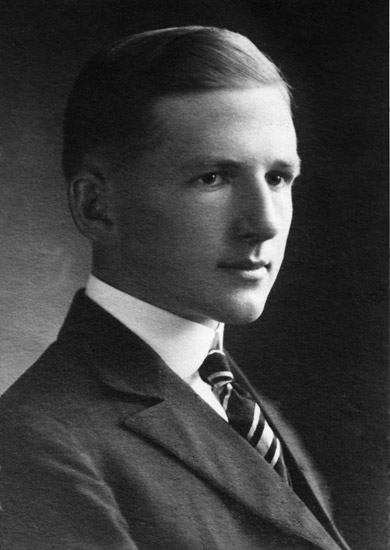
William Cameron Townsend, called "Cam" all his life and "Uncle Cam" by his workers in later years, was born on July 9, 1896, in a one-room farmhouse in Eastvale, California.10 His parents had moved from the East Coast to California in 1893, and he was one of six children.1 He attended Occidental College, a school with Presbyterian roots, from 1914 to 1917.101 At Occidental he came under the influence of the Student Volunteer Movement, the student mission movement of the time, and in September 1917, at 21 and with one year of college left, he sailed for Guatemala.1
He went as a colporteur, a seller and distributor of Scripture, for the Bible House of Los Angeles, which the Wycliffe Global Alliance's history describes as "a publisher of Spanish-language Bible portions and gospel tracts."12 Missionaries of the Central American Mission looked after him.1 TIME magazine, profiling him in 1963, put it this way: he first learned an Indian language in 1917 while selling Bibles in Guatemala.11 The Wycliffe USA history says he went "to give out Spanish Bibles" and "was surprised when he met a man who didn't understand the language."9
Francisco Diaz and the Kaqchikel, 1917 to 1921
The Kaqchikel are a Maya people of the Guatemalan highlands. The Encyclopedia of Arkansas entry on Townsend, written by two Wycliffe staff members, says "many of the people he met spoke Cakchiquel rather than Spanish."10 The Wycliffe Global Alliance's history of the movement gives the main credit for what followed to one man. Francisco Diaz, a Kaqchikel man of about 35, was paired with Townsend on his travels, and "Diaz helped Townsend see that the needs of the indigenous Cakchiquel were very different to that of the Latinos." The same history concludes: "This and the influence of Diaz shaped his vision that every language group should have the Scriptures in their own language."1 Together they started a school. Diaz died of malaria in 1920, according to the Alliance's history (a later timeline puts his death in 1919).12
In July 1919 Townsend married Elvira Malmstrom, a Presbyterian missionary already in Guatemala.12 SIL's own history dates the start of his "cross-cultural work with the Kaqchikel people" to that same year, 1919.13 In January 1921 he and eleven other missionaries met at a General Indian Conference in Chichicastenango, a group later nicknamed the "Chichicastenango Twelve", to plan work among the Indigenous peoples rather than only among Spanish speakers.1
A 2016 essay by the Billy Graham Center Archives at Wheaton College, "'One Thousand Tribes Untouched': Elvira Malmstrom Townsend and the Founding of Wycliffe Bible Translators," describes her part in the founding; the couple left Guatemala for the United States in 1932 "because of William's ill health", and Elvira died on Christmas Eve 1944.12 Two years later Townsend married Elaine Mielke, and the two of them led a party of 20 recruits into the Amazon forest of eastern Peru.1
The Kaqchikel New Testament: 1929 or 1931?
Cam and Elvira Townsend translated the New Testament into Kaqchikel over about ten years. The Wycliffe Global Alliance's history gives a precise date for its completion: "It was dedicated on 10 October 1929 at the First Presbyterian Church of Santa Ana, California." It adds that Spanish speaking (Ladino) missionaries reacted badly to the idea.1 Many popular histories, and the scope of this lesson, give 1931 instead. A timeline printed by Desiring God reconciles the two: the New Testament was completed in 1929, and in 1931 it was dedicated and a Kaqchikel and Spanish diglot (two languages side by side) was published.2 SIL's timeline says only that by 1929 Townsend's vision had widened to other peoples who needed their languages written.13 The safest statement is that the translation was finished and first dedicated in 1929, with a further dedication and a two-language edition in 1931.
The book was the first of its kind for the Townsends, and it set the pattern that SIL later followed: learn a language that had little or no writing, design an alphabet for it, teach people to read it, and translate the New Testament into it. Townsend said in 1963 that "Of over 3,000 languages in the world, we know nothing about 2,000."11
The question story
The best known story about Townsend's call is a question that a Kaqchikel man is supposed to have asked him while he was selling Spanish Bibles. Wycliffe South Africa prints it as: "If your God is so mighty, why doesn't He speak my language?"14 Desiring God, citing that page, gives the same wording.2 Other retellings use "great" or "smart" in place of "mighty". The longer history published by the Wycliffe Global Alliance does not tell the question story at all; it gives Francisco Diaz's influence as the source of Townsend's conviction.1 The earliest printed version of the question could not be found for this lesson, and its rating is in "Claims checked" below.
Camp Wycliffe and the two organizations
Sulphur Springs, Arkansas, 1934 and 1935
Back in the United States, Townsend tried to start work in Mexico. He and L. L. Legters, an evangelist who shared his interest in Indigenous peoples, were then turned back at the Texas border by officials who told them Protestant missionaries were not welcome in Mexico; the Alliance history gives no year, and a later timeline dates Townsend's turn toward Mexico to 1933.12 Legters and Townsend then planned a school to train young missionaries in phonetics and the analysis of unwritten languages. The first session, in the summer of 1934, was a seven-week course held in an unfurnished farmhouse near Sulphur Springs, in Benton County, Arkansas. It was named Camp Wycliffe, in the words of the Encyclopedia of Arkansas, "in honor of the first scholar to translate the entire Bible into English, John Wycliffe."110
The sources do not agree on the size of the first class. The Wycliffe Global Alliance history says "Three students sat under the instruction of Townsend, assisted by Cakchiquel speaker José Chicol."1 SIL's history says the program began "with two students," and the Encyclopedia of Arkansas says "Only two students graduated from the first session."1310 (The two counts can both be true if three attended and two finished.) In 1935 there were five students, and one of them was Kenneth L. Pike, who began work on the Mixtec language of Oaxaca, Mexico and later served as SIL's first president.113 The camp "was held annually from 1934 to 1941," and in 1941 the program became part of SIL.10
Mexico and Lázaro Cárdenas
After the 1935 course Townsend, Elvira and several students went to an Aztec (Nahuatl speaking) village near Mexico City, Tetelcingo, and won the support of Mexican government officials.113 TIME's 1963 profile summed it up: "In 1935, at the invitation of the Mexican government, he launched the institute's first research and teaching mission."11 By 1940 there were 36 language workers studying 18 Mexican languages, and by 1941 there were 49 in 19 places, the year SIL held its first conference, at Tetelcingo.13
The president of Mexico in those years was Lázaro Cárdenas (in office 1934 to 1940). Standard accounts say Cárdenas visited Townsend at Tetelcingo and backed SIL's work as part of his government's own program of rural and Indigenous education, and that Townsend later wrote an admiring biography of him. The relationship between SIL and the Mexican government is the subject of the historian Todd Hartch's book Missionaries of the State: The Summer Institute of Linguistics, State Formation, and Indigenous Mexico, 1935 to 1985 (2006).15 The details of the Cárdenas visit and the title and date of Townsend's biography of Cárdenas (usually given as Lázaro Cárdenas, Mexican Democrat, 1952) are from standard accounts and were not checked against the books themselves for this lesson.
The Mexican pattern became SIL's method everywhere: a formal agreement with a national government (usually a ministry of education), under which SIL linguists would study Indigenous languages, write grammars and dictionaries, prepare school primers and translate Scripture. SIL presented itself to governments as a scientific and educational body, and to churches in the United States as a mission. That double face is what its later critics attacked most.
Why two names: SIL and Wycliffe Bible Translators, 1942
Through the late 1930s the work had a U.S. sponsor, the Pioneer Mission Agency of Philadelphia, after Townsend's relationship with the Central American Mission broke down. When that sponsorship ended, Townsend set up two separate organizations.1 "In 1942 Wycliffe Bible Translators Inc. was formed," the Alliance's history says, with its first office in a garage apartment owned by a Southern California businessman, Bill Nyman, who served as secretary-treasurer of both bodies from 1943 to 1960. The office kept five percent of incoming funds.1 Kenneth Pike became SIL's first president in 1942 and served until 1979.13
The Alliance's history explains Townsend's reasoning: in his view "both organizations had unique roles to fill and were interdependent with each other," and "Wycliffe, according to Townsend, represented the needs (people, prayer and finances) of this vision to the Christian public."1 In practice SIL signed the contracts with governments and universities and did the field work, while Wycliffe raised money and recruited in the churches. Most workers belonged to both. Wycliffe USA's present history page sums up the result: "Wycliffe Bible Translators officially became an organization in 1942."9 The funding of Wycliffe and SIL today, and how they compare with other agencies, is in lesson 12.
Peru, JAARS and the airplane, 1945 to 1948
In 1945 SIL signed an agreement with Peru's Minister of Education to work among the country's Indigenous language communities.13 The next year Townsend and Elaine took the first party of recruits into the Peruvian Amazon, which had at least 40 Indigenous groups with unwritten languages.1 TIME reported in 1963 that Peru had given Townsend its Order of Merit.11
Rivers and forest made the Amazon work slow and dangerous, and Townsend turned to aircraft and two-way radio. The Jungle Aviation and Radio Service, JAARS, was founded "to support and mobilize his Bible translation organizations," in its own words, because Townsend had seen remote terrain stop the work.16 Desiring God's timeline dates the founding to 1948, and JAARS in recent years has spoken of "75 years" of service, which fits that date.216 JAARS later settled at Waxhaw, North Carolina. Mission Aviation Fellowship, Nate Saint's agency, was a separate body with the same idea, as the second half of this lesson shows.
Growth, 1950 to 1982
From Latin America the work spread in the 1950s to the Philippines (where SIL signed a formal agreement with the Department of Education in 1953) and Vietnam, and in 1961 to Ghana, SIL's first program in Africa.139 Wycliffe divisions were organized in Canada, Australia and Britain in the late 1950s and early 1960s, in New Zealand in 1965, and in Germany, Switzerland, the Netherlands, France and Finland in the 1970s.1 TIME counted "460 linguists at work inventing written forms for 175 of the 590 tribal tongues" in its 1963 story, with an annual budget of $3,000,000.11 Wycliffe had an exhibit at the 1964 to 1965 New York World's Fair, dedicated its 50th New Testament in July 1975 and passed 100 completed New Testaments by 1979.9
Townsend died on April 23, 1982, at 85.1310 The Alliance's own history records one limit of his outlook. In a March 1977 speech he encouraged the use of "tribesmen" as translators but said they would not become Wycliffe members in the foreseeable future, and the history says he resisted national Christians leading their own translation organizations as long as he lived.1 After a 1973 international conference, "National Bible Translation Organizations" began to form anyway, among them the Nigeria Bible Translation Trust and the Papua New Guinea Bible Translation Association, and over about 15 years similar bodies appeared in Ghana, Burkina Faso, Cameroon, Kenya, India, the Philippines, Indonesia and Brazil.1 That shift toward translators from the Global South is part of the story told in lesson 13.
The criticism of SIL in Latin America
The charges
By the 1970s SIL was working under government agreements across Latin America, including Mexico, Peru, Ecuador, Bolivia, Colombia and Brazil, with its own bases (such as Limoncocha in Ecuador), aircraft and radio.17137 Its size and its closeness to governments drew three kinds of critics: anthropologists who saw evangelism as a threat to Indigenous cultures, Indigenous federations that wanted control of their own schools and lands, and nationalists and armed revolutionary movements who saw an American organization with planes and radios in border regions as a tool of the United States.
The fullest academic statement of the case came in two books. Is God an American? An Anthropological Perspective on the Missionary Work of the Summer Institute of Linguistics, edited by Søren Hvalkof and Peter Aaby, was published in 1981 by the International Work Group for Indigenous Affairs (Copenhagen) and Survival International (London). A March 1982 review in the Multinational Monitor by Douglas Stone summarized its findings: that SIL's linguists "have exploited the situation to advance their own goals rather than improve the position of the Indians," and that its "singleminded dedication to a 'divine mission'" stood in the way of Indigenous self-determination. The review lists the book's specific charges: that SIL created village elites through selective literacy, used local unrest in Peru and Mexico to grow its membership, obstructed reforms and Indigenous defenses against exploitation, and published little ethnographic research.17 The second book was the anthropologist David Stoll's Fishers of Men or Founders of Empire? The Wycliffe Bible Translators in Latin America (Zed Press and Cultural Survival, 1982; some catalogs give 1983), a long study of SIL's relations with governments, oil companies and the U.S. government. Its contents are described here from its title and from reviews, not from a reading of the full text.18
The most serious charge, that SIL was a front for the Central Intelligence Agency, was made repeatedly in Latin American newspapers and by guerrilla groups. Townsend wrote to U.S. officials in the 1970s denying any link with the CIA, and SIL and New Tribes Mission both adopted policies against cooperating with intelligence agencies, according to a 2005 report in Christianity Today.3 In that report the Wheaton College missions professor Scott Moreau gave his view that the myth of missionary cooperation with the CIA would last as long as the United States remained a major power.3 No document showing SIL working for the CIA was found in the sources checked for this lesson.
Colombia and Chet Bitterman, 1981
In early 1981 guerrillas in Colombia kidnapped Chester (Chet) Bitterman, an SIL translator, and demanded that SIL leave Colombia. He was shot after 48 days in captivity. The Christian Science Monitor reported on March 9, 1981 that the kidnappers had held him to demand that the Summer Institute of Linguistics, "the US-based missionary group he worked for," leave the country, and that Colombia's interior minister, Germán Zea, condemned the killing and said the government would not cancel its contract with the institute.19 Christianity Today later wrote that the guerrillas were the M-19 movement and that public sympathy after Bitterman's death helped SIL stay in Colombia.3 Christian deaths after 1950 are surveyed in module 102, lesson 10.
Ecuador, 1981 to 1992
By the 1950s SIL was at work in Ecuador, with a base at Limoncocha in the Amazon region.720 In 1981 the government of President Jaime Roldós asked SIL to leave: Executive Decree No. 1159 of May 22, 1981 ended the government's agreement with the institute, as the linguist Ruth Moya recorded in a 1987 study of bilingual education in Ecuador.42 Christianity Today reported in 2005 that by 1982 Indigenous groups had marched in support of the mission, the government asked SIL to stay, and SIL continued on a smaller scale until 1992; its Ecuador work had included medical clinics, schools and an agronomy program.3
Not all Indigenous organizations wanted SIL back. In the fall of 1986 the newsletter of the South and Meso American Indian Information Center reported that the Ecuadorian government had "authorized the return of the Summer Institute of Linguistics," which it called "an evangelical group that was expelled by a previous government," and printed the position of CONFENIAE, the confederation of the Indigenous nations of the Ecuadorian Amazon: "SIL works to undermine Indian cultures, impose capitalist values, destroy Indian organizations, and co-opt Indians." CONFENIAE also charged that SIL trained Indians "as technicians and then contribute to the destruction of the Amazon environment."21 Both pictures, the marches in support and the federation's opposition, are part of the documented record, and they show that the Amazon peoples of Ecuador did not speak with one voice.
The Waorani New Testament, in Wao tededo, was dedicated in June 1992, the same year SIL's work in Ecuador came to an end.73
Mexico, Peru and Brazil
Christianity Today also reported that the governments of Ecuador, Peru and Mexico moved against SIL in the late 1970s and early 1980s.3 In Mexico, where SIL worked as the Instituto Lingüístico de Verano, the federal education ministry ended its formal agreement with SIL in 1979 after Mexican anthropologists denounced the institute's evangelism; Todd Hartch's history treats the whole Mexican relationship from 1935 to 1985.15 Peru announced in the 1970s that it would phase out SIL's agreement and later let the work continue, and in Brazil the federal Indian agency, FUNAI, restricted SIL's access to Indigenous areas at several points. The dates and terms for Mexico, Peru and Brazil come from the secondary literature (Stoll and Hartch) and were not checked against government documents for this lesson.1815
SIL's answers
SIL and its supporters answered in several ways. First, they pointed to the record of language work: grammars, dictionaries, alphabets and school primers for hundreds of languages, many of which had never been written. Rachel Saint, defending SIL against charges of "culture wrecking" in a 1980 Christianity Today interview, said: "I don't know of any better method of preserving the culture than putting the language in written form."22 Second, they pointed to health and development work, such as the clinics, schools and agronomy program in Ecuador.3 Third, they argued that Indigenous peoples were going to meet the outside world in any case, through oil companies, settlers, rubber traders and soldiers, and that literacy and bilingual schooling gave them tools to defend themselves. The 1980 Christianity Today report on the Waorani made this argument explicitly, saying it was better for Christian workers than for "exploitative oil companies" to be the first to bring Western culture.22 Fourth, they denied any intelligence role.3
The organization also changed. The rise of national Bible translation organizations from 1973 on, the turn to training Indigenous translators, and the reorganization of Wycliffe International into the Wycliffe Global Alliance in 2011 moved the work away from the model of foreign linguists living in a village for twenty years.12 Whether those changes answered the critics, or simply moved the same work into local hands, is a question readers can weigh from the sources.
Bible translation figures today
What the 2025 numbers say
The figures for the state of Bible translation come from one shared database. ProgressBible (progress.bible), a database whose contact address is at SIL (progress-bible@sil.org), gathers reports on each language from the translation agencies, and the Wycliffe Global Alliance publishes a summary each year.5 The 2025 summary, a ProgressBible snapshot from August 2025, gives these counts of languages:4
- Full Bible: 776 languages.
- New Testament (but not the full Bible): 1,798 languages.
- Portions only (at least one book): 1,433 languages.
- Total with at least some Scripture: 4,007 languages, spoken by 7.7 billion people, described as "up to 99% of all people."
The statistics page puts these against a total of 7,396 living languages (counting sign languages) and gives the trend in one sentence: "As of 1 August, 2025," just 544 of the world's 7,396 living languages "remain on the waiting list for Bible translation to begin."5 Those 544 languages are spoken by about 36.8 million people. The waiting list stood at 985 a year earlier, at more than 2,000 in 2020, and at more than 5,000 in 1999.5 The page also reports that 4,457 languages have Bible translation "work in progress," of which 1,712 have no verses translated yet, and it adds a caution in its own words: "Though 4,457 languages have Bible translation 'work in progress', that doesn't always mean people have Scripture access yet."5 Of 392 sign languages, 93 came off the waiting list in that year.5
Subtraction gives one figure the Alliance does not print as a headline: 7,396 minus 4,007 leaves 3,389 living languages with no published Scripture at all as of August 2025. Most of them are now in the "work in progress" group, and most are small; the Alliance's 99 percent figure counts people, not languages, and many speakers of those 3,389 languages also speak a larger language that has a Bible.54
For comparison, the 2024 report (data as of September 1, 2024) counted active translation in 3,526 languages in 173 countries, affecting 1.26 billion people, and said Alliance organizations had worked with at least 1,895 language communities that now have a New Testament or Bible, plus Scripture portions in 871 more.5 The 2023 report (data as of September 1, 2023) counted 7,394 languages in the world and translation under way in 3,283 languages in 167 countries.23
Vision 2025
In 1999 Wycliffe International (the body that became the Wycliffe Global Alliance) and SIL International adopted a joint goal, known as Vision 2025. Its central sentence reads: "We embrace the vision that by the year 2025 a Bible translation project will be in progress for every people group that needs it."24 The same statement opens: "Motivated by the pressing need for all peoples to have access to the Word of God in a language that speaks to their hearts," and calls on member organizations to form new partnerships and change their ways of working, since the goal could not be met by working harder alone.24
By the agencies' own count the goal was not fully reached on time: on August 1, 2025, 544 languages were still waiting for a project to begin.5 It changed the work all the same. In 1999 more than 5,000 languages were waiting; since then, the Alliance says, translation has begun in more than 4,600 languages that had no Scripture access before.5 Desiring God's timeline notes the speed-up in another way: it took from 1934 to 2001 for Wycliffe-related work to reach its first 500 languages, and from 2002 to 2018 to reach the second 500, and in 2018 Wycliffe celebrated its thousandth New Testament.2
How the numbers are counted, and what they leave out
Three cautions apply to every figure in this section. First, the count of languages depends on the Ethnologue, the catalog of the world's languages that SIL itself began; its first edition covered only "forty-six languages or groups of languages."13 Deciding where one language ends and a dialect begins is a judgment, and the total moves from year to year (7,394 in 2023, 7,396 in 2024 and 2025).235 Second, "access" counts the people who speak a language that has some Scripture, whether or not they can read it, own it or have heard it; the Alliance's own statement about work in progress makes that point.5 Third, the figures come from the agencies doing the work, and no independent body audits them. They are the only worldwide figures there are, and they are published with dates and a stated method, but they are the agencies' own count.
From foreign linguists to national translators
The old picture of Bible translation, a missionary couple from North America spending twenty or thirty years in one village, no longer describes most of the work. The Wycliffe Global Alliance history traces the change to the 1973 conference that opened the way for national translation organizations, and it gives the reasons as church growth in the Global South and East, nationalism (especially in Africa), and a decline in Western resources.1 The same history says that some fifty years after its founding, as the church grew in the Global South and East and Western resources declined, Wycliffe began redefining its role and its relationship with SIL.1 The large agencies and their budgets are compared in lesson 12.
The Ecuador five and Operation Auca
The Waorani before 1956
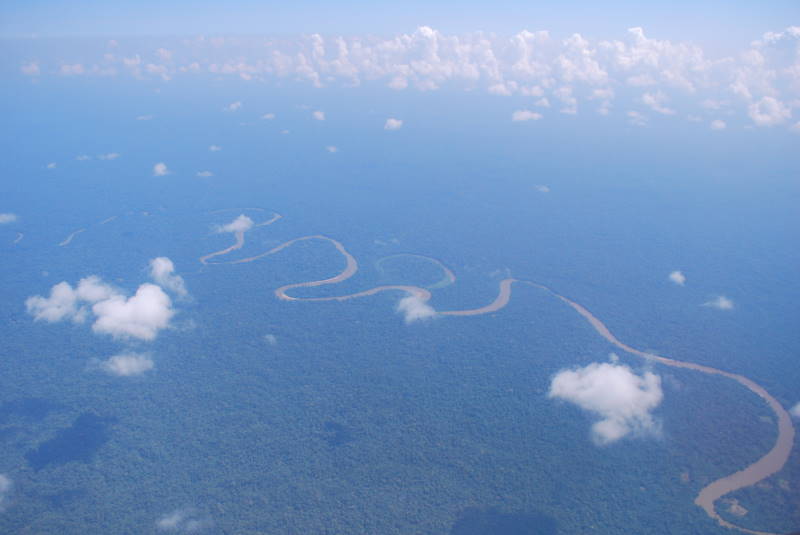
The Waorani (also written Huaorani; the singular is Wao, and their language is Wao tededo) are a people of the Ecuadorian Amazon. The Wheaton College Archives exhibit "To Carry the Light Further", prepared for the 70th anniversary of the events of 1956, describes them in the mid-20th century as numbering between 500 and 1,000, living in small, nomadic kin-based communities across roughly 8,000 square miles between the Napo and Curaray Rivers, in four regional groups that shared one language.25 Genealogies collected in the 1970s and 1980s found that over the five previous generations, violence between Waorani groups caused about 40 percent of adult deaths, and raids from outside about 20 percent.25 Outsiders, including rubber and oil prospectors, had been killed on Waorani land, and Waorani had been killed by outsiders. Their Quichua neighbors called them "Aucas," a Quichua word for "savages" that the Waorani reject; the missionaries used it, which is why the 1956 effort is still known as Operation Auca.2522
One Waorani woman, Dayuma, had left. She was born around 1930, and when she was about 13 her father was killed by another Waorani spearman; she fled and lived for years in what the Wheaton exhibit calls "de-facto slavery" at Hacienda Ila, on the edge of the forest.26 In February 1955 she met Rachel Saint, a Wycliffe translator and the sister of the pilot Nate Saint, and began helping her learn Wao tededo.2620
The five men
The five Americans were young, college educated, and from conservative evangelical churches. Elliot, Fleming and McCully worked alongside Wilfred Tidmarsh, a missionary of the Plymouth Brethren's Christian Missions in Many Lands; Nate Saint flew for Mission Aviation Fellowship; Roger Youderian served with the Gospel Missionary Union.2527
- Jim Elliot (Philip James Elliot), born October 8, 1927, in Portland, Oregon; Wheaton College 1945 to 1949; went to Ecuador in 1952 to assist the Brethren missionary Wilfred Tidmarsh among the Quichua at Shandia; married Elisabeth Howard in Quito on October 5, 1953.2829
- Pete Fleming, born November 22, 1928, in Seattle; master's degree in philosophy from the University of Washington, 1951; sailed to Ecuador with Elliot in February 1952; married Olive Ainsley in June 1954.30
- Ed McCully, born June 1, 1927; Wheaton College; left Marquette University Law School in 1950 for missions; studied missionary medicine at the Bible Institute of Los Angeles with his wife, Marilou, in 1952; worked among the Quichua at Shandia and Arajuno.31
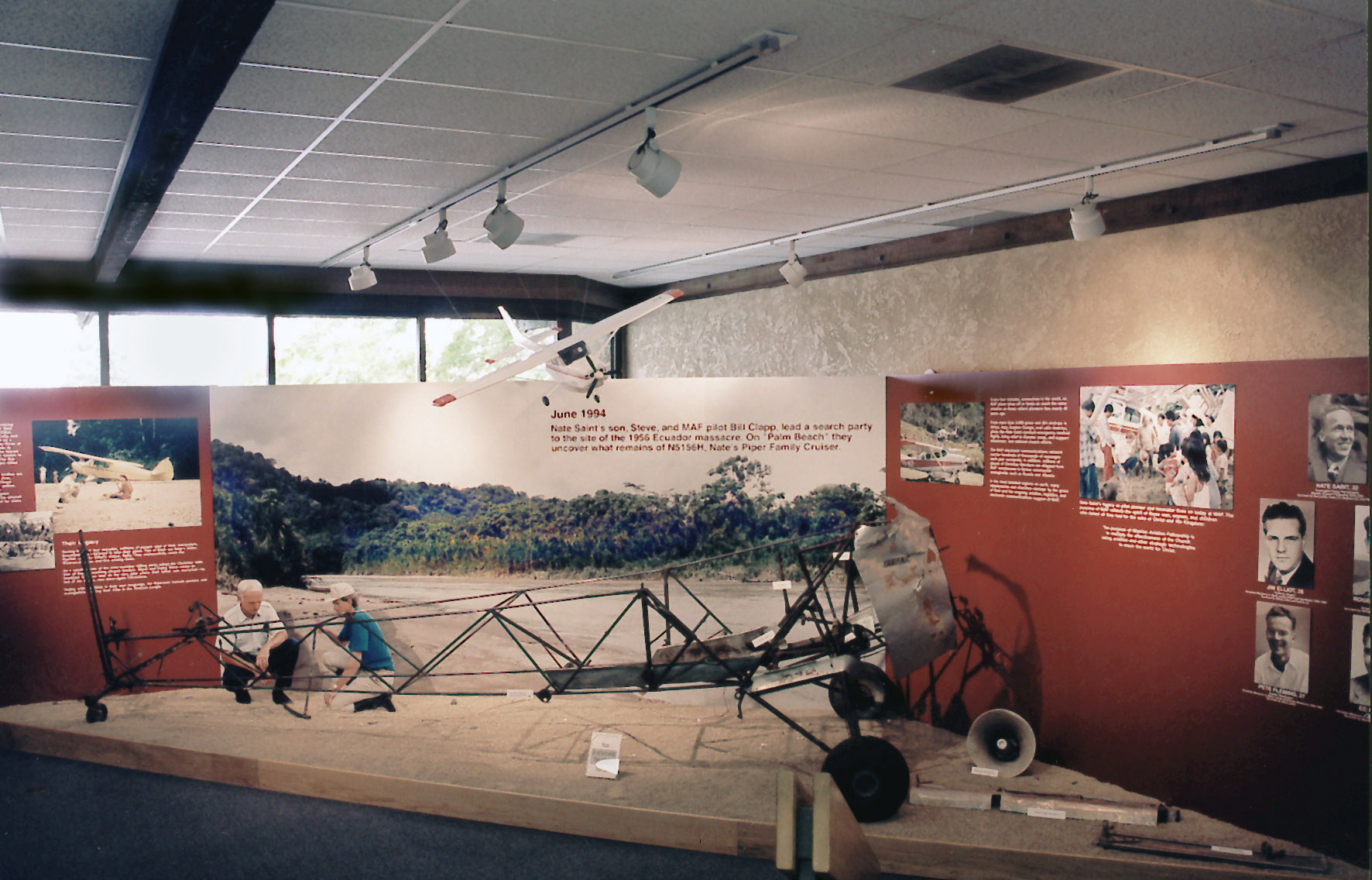
- Nate Saint, born August 30, 1923; applied in January 1945 to the Christian Airmen's Missionary Fellowship, which became Mission Aviation Fellowship (MAF); married Marjorie on Valentine's Day 1948 and went to Ecuador with MAF that September; based at Shell Mera, where he flew supplies to the jungle stations and devised the "bucket drop," a way of lowering a bucket on a long line from a circling plane to people on the ground.3225
- Roger Youderian, born January 21, 1924, in Sumatra, Montana; an Army paratrooper in World War II who fought in the Battle of the Bulge; posted by the Gospel Missionary Union to Macuma, among the Shuar, in 1953.27

Operation Auca, September 1955 to January 1956
Through the fall of 1955 the missionaries made 12 flights over a Waorani clearing, lowering gifts by Nate Saint's bucket method and calling out phrases in Wao tededo learned from Dayuma.25 The phrases did not work well: Dayuma had not spoken her language for more than a decade and had forgotten much of it, so what the men called out was largely unintelligible.25 Pete Fleming, newly married, had doubts about the plan before he joined it.25
"On January 3, 1956, five American missionaries" landed on a sandbar on the Curaray River that they called Palm Beach, the Wheaton exhibit records.33 On January 6 the men met three Waorani at their camp; an exhibit photograph shows one of them, a man named Naenkiwi, inspecting a model airplane.3332 On January 8, 1956, all five men were speared by a party of Waorani men.3332 Newspaper headlines preserved in the Wheaton exhibit follow the search and the burial, and Nate Saint's watch had stopped at "twelve minutes past three."6 The fuller account of the deaths and of the search is in module 102, lesson 09, and is not retold here.

The making of a story: radio, Life and Through Gates of Splendor
The story reached the world fast. The missionary radio station HCJB in Quito, founded in 1931 by Clarence Jones and Reuben Larson, made the first public announcement that the men were missing in its broadcast of January 9, 1956, and its memorial programs drew "hundreds of letters, cables, and telephone calls."6 Newspapers from the Panama Star and Herald and the Chicago American (January 11) to the New York Herald Tribune and Quito's Diario del Ecuador (January 15) carried it; one Chicago paper wrongly mixed up the Waorani with the head-hunting practices of the Shuar.6 Headlines preserved in the Wheaton exhibit run from "Five US Missionaries Believed Seized by Savages" and "Pilots Scan Jungle for 5 Missionaries" to "4 Missionaries Found Slain" and "Five Missionaries Buried Close to Plane Wreckage."6
Life magazine published the story on January 30, 1956, under the headline "Go Ye and Preach the Gospel: Five Do and Die," a ten-page spread with photographs by the photojournalist Cornell Capa and entries from the missionaries' diaries.6 Capa later photographed Rachel Saint and Elisabeth Elliot among the Waorani for further Life essays.6 A condensed account appeared in Reader's Digest in August 1956, rewritten by Clarence Hall under the name of Abe Van Der Puy, before Elisabeth Elliot took over the book after meeting with Harper and Brothers that fall.6 Through Gates of Splendor came out in May 1957 and was, in the exhibit's words, "An immediate bestseller," translated into German, Portuguese, Russian, Turkish, Spanish and Japanese.6 Filmstrips (Mid-Century Martyrs, 1956), a film of Through Gates of Splendor (1961), a comic book (1974) and later books followed: Elisabeth Elliot's Shadow of the Almighty (1958) about Jim, The Savage My Kinsman (1961), Russell Hitt's Jungle Pilot (1959) about Nate Saint, Ethel Emily Wallis's The Dayuma Story (1960), and Olive Fleming Liefeld's Unfolding Destinies (1998).634
The Wheaton exhibit, written by the archive that holds most of the papers, makes an observation of its own: the narrative of sacrifice and redemption "often obscured difficult questions about the complex realities of cross-cultural missions."7 It also notes that many evangelical missionaries have said the five men's example led them into mission work.6
"He is no fool": Jim Elliot's journal
The best known words connected with the five are a sentence from Jim Elliot's journal: "He is no fool who gives what he cannot keep to gain that which he cannot lose." The Billy Graham Center Archives at Wheaton, which holds the original journal (Collection 277, Box 1, Folder 8), dates the entry October 28, 1949, when Elliot was a 22-year-old Wheaton graduate. Elisabeth Elliot printed it in Shadow of the Almighty (1958) and in The Journals of Jim Elliot (1978).35 It is often quoted in a shorter form, "to gain what he cannot lose."
The thought was not new. The Puritan minister Philip Henry (1631 to 1696), father of the Bible commentator Matthew Henry, used a very similar saying, which his son recorded in his life of his father, first published in London in 1698 (the Billy Graham Center Archives says apparently 1699, but the first edition, printed for Thomas Parkhurst and John Lawrence, is dated 1698 and already contains the saying, introduced by the same words about works of charity).3543 In the American Tract Society edition of 1853 the passage reads: "To encourage himself and others to works of charity, he would say, 'He is no fool who parts with that which he cannot keep, when he is sure to be recompensed with that which he cannot lose.'"36 An 1840 abridgment by the Presbyterian Board of Publication prints the last phrase as "recompensed by that which he cannot lose."37 Henry spoke of giving money to the poor; Elliot applied the words to a whole life. Both echo the words of Jesus in Luke 9:24 (KJV): "For whosoever will save his life shall lose it: but whosoever will lose his life for my sake, the same shall save it."8 Whether Elliot had read Philip Henry is not known; the archive notes only the similarity.35
Elisabeth Elliot, Rachel Saint and the Waorani after 1956
Dayuma and the return, 1957 and 1958
In 1957 two Waorani women, Mintaka and Mankamo, left their group to look for news of their niece Dayuma; Elisabeth Elliot made contact with them in November 1957.267 Dayuma had meanwhile gone to the United States with Rachel Saint; in April 1958 she was baptized at the Evangelical Free Church of Wheaton, Illinois, an event reported in the press as "Auca Indian Dayuma Baptized into Christian Faith at Wheaton Church."26 "After Dayuma and Rachel Saint returned to Ecuador in June 1958," the exhibit records, Elisabeth Elliot arranged a meeting between Dayuma and her aunts at the SIL base at Limoncocha. Dayuma and her aunts went back to their people in September 1958 and about two months later invited Elisabeth Elliot and Rachel Saint to come and live with them.720
Tiwaeno, 1958 to 1961
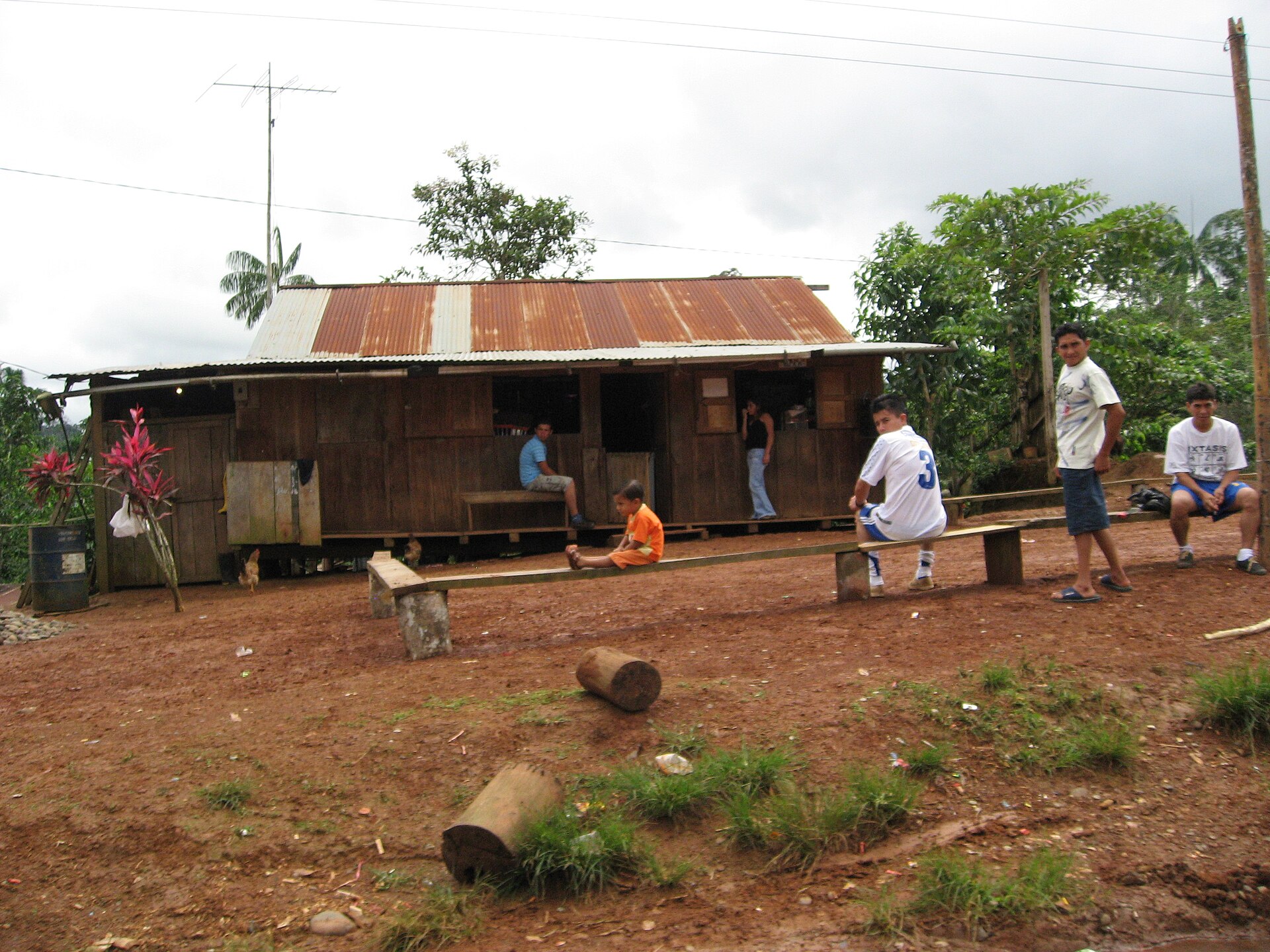
In the fall of 1958 Elisabeth Elliot, with her young daughter Valerie, and Rachel Saint went to live at a new Waorani settlement called Tiwaeno (the exhibit spells it Tewæno), on the Tiwaeno River. Among the people there were men who had taken part in the attack of 1956, Mincaye among them.7343839 In 1961, the exhibit reports, "several Waorani men confessed faith in Christ, including Yowe."7 The two women did not work well together. The exhibit records persistent conflicts between them over methods, and Elisabeth Elliot "quietly left Tewæno with Valerie in 1961"; her photograph caption dates her leaving to December 1961.734

Elisabeth Elliot's later work
Elisabeth Howard Elliot was born in 1926 in Belgium to missionary parents and grew up near Philadelphia.34 She later married the theologian Addison Leitch (who died in 1973) and then Lars Gren in 1977, and wrote many books, among them the novel No Graven Image (1966), These Strange Ashes (1975) and Passion and Purity (1984).34 For thirteen years she opened her daily radio program, Gateway to Joy, with the words "You are loved with an everlasting love, that's what the Bible says, and underneath are the everlasting arms."39 She wrote: "The deepest things that I have learned in my own life have come from the deepest suffering."39 She died in 2015.34
The Wheaton exhibit describes her books as exploring the discernment of God's will, the endurance of suffering "and the complexities of missionary service."34 Her books remain under copyright and are quoted here only by title.
Rachel Saint's later years
Rachel Saint (1914 to 1994) was born in Wyncote, Pennsylvania, studied at the Philadelphia School of the Bible, worked at the Keswick Colony of Mercy with people struggling with addiction, trained with SIL in her mid-thirties and served first among the Shapra people of Peru before moving to Ecuador in 1955.20 Through the 1960s she worked with Dayuma on the Gospel of Mark in Wao tededo; a 1980 report says the two completed Mark in 1965.2022 In the 1970s other SIL missionaries and anthropologists complained about her difficulty in working with others, her methods of evangelism and her possessiveness toward the Waorani. Wycliffe asked her to return to the United States; she refused to leave Ecuador and retired from SIL in 1981. She spent the rest of her life among the Waorani at Toñampade, a village founded in 1977 by Dayuma and her son Sam Padilla, and was buried there in 1994.20 Dayuma died on March 1, 2014, in Puyo and was buried at Toñampade.26
Mincaye, Steve Saint and End of the Spear
Mincaye (also written Minkaye), a half-brother of Dayuma, took part in the attack at Palm Beach. He became a Christian after Dayuma returned to her people. In the 1990s and 2000s he traveled on speaking tours with Steve Saint, Nate Saint's son, "recounting how the tragic attack on Palm Beach led to the spiritual transformation of the Waorani people." He played a large part in Steve Saint's film End of the Spear, released in 2006 (some lists date it 2005), and he died in 2021.386 A documentary, Beyond Gates of Splendor (as the exhibit lists it), appeared in 2002.6
The debate about the mission's effects on the Waorani
What changed after 1958
The record on the years after 1958 is mixed, and the people who lived through it disagree. A 1980 Christianity Today report by John Maust, written 24 years after the killings, gave the evangelical account of the period: Christianity "for the most part has stopped the killings," the last reported spearings had been of oil company workers in 1977, and two of the men who killed the missionaries were local church leaders.22 It counted about 600 Waorani, of whom 150 to 200 had been baptized, with about 80 "downriver" Waorani living east of the reserve who had mostly not heard the gospel.22 Most Waorani then lived in what Maust called a "620-square-mile protectorate (akin to an American Indian reservation)," gathered around the mission settlements.22 The same report admitted problems: some Waorani had come to believe that Christianity would bring material wealth.22
Gathering many Waorani groups into one area around Tiwaeno, on a fraction of the land they had used, is the center of the later criticism. Concentration brought epidemics (a polio outbreak in 1969 is described in later histories), dependence on outside goods, and conflict among groups that had been enemies, while it opened the remaining Waorani land to oil exploration. These points are made in the secondary literature (among others, Joe Kane's Savages, 1995, and the historian Kathryn Long's God in the Rainforest, 2019) and were not checked against those books for this lesson.
Jim Yost and the anthropologists
SIL itself brought in an anthropologist. James (Jim) Yost lived at Tiwaeno off and on from 1974; in 1980 he described himself as an "applied anthropologist" helping the Waorani keep their identity and self-esteem, and his three-year study of the Waorani was required by the Ecuadorian government under its contract with SIL.22 Yost hoped that anthropological insight would help the Waorani rely less on outsiders like himself.22 In 1975 he recorded the reflections of Geuquita (Gikita), the oldest man of one kin group, in Wao tededo.7 The 1970s complaints about Rachel Saint came from SIL colleagues and anthropologists together.20
Anthropologists outside SIL went further. The general charge, reported by Christianity Today in 2005, was that missionaries commit "ethnocide," the destruction of a people's culture without killing the people, by imposing their own culture; the magazine summed up the attitude it was answering in one sentence: "Anthropologists and others, however, have long resented missionaries' presence among tribal peoples."3
Waorani accounts
The Waorani have spoken for themselves, and they have not said one thing. Geuquita told Yost in 1975: "Before the kowode [outsiders] came and taught us about God we lived spearing," and of his own kin: "Had I not believed, they would all be dead now."7 Mincaye spent years telling audiences in the United States that the attack led to his people's transformation.38
A younger generation tells it differently. Nemonte Nenquimo, a Waorani leader who won the Goldman Environmental Prize for South and Central America in 2020, as lead plaintiff in a case that Ecuador's courts decided for the Waorani in 2019, protecting about 500,000 acres of their forest from oil extraction,44 told the reporter Astrid Arellano of Mongabay in 2024: "My people, my village, my grandparents, my father were all contacted by evangelical missionaries [from the United States]." She went on: "They, too, spoke about salvation and hell, and everyone was scared," and: "My grandparents and my people were right."40 In her memoir We Will Be Jaguars (2024, with Mitch Anderson) she describes Rachel Saint's years among the Waorani. A review in the Canadian evangelical magazine Faith Today by Marianne Jones (May 2025) summed up the memoir's account as saying that "Saint held an authoritarian grip over the community through a combination of threats and bribes," and that she used an oil company connection to win consent for forest clearing and pipeline building over elders' objections; the reviewer, writing for evangelical readers, concluded that "too many missionaries have colluded with governments and business."41 Rachel Saint's own defense of her work, from 1980, is quoted above; she is not alive to answer the memoir.2220
What the record shows and what it does not
- Documented fact: Townsend sailed for Guatemala in September 1917; Camp Wycliffe opened in 1934; Wycliffe Bible Translators Inc. was formed in 1942; Townsend died April 23, 1982.113 The five missionaries died on January 8, 1956; Life published its story on January 30, 1956.336 The 2025 translation figures are the agencies' own published count, dated August 2025.4
- The missionaries' own words: Jim Elliot's journal entry of October 28, 1949, held at Wheaton; Townsend's 1963 remark to TIME; Rachel Saint's 1980 defense of SIL.351122
- What the people the missionaries came to record: Geuquita's 1975 words recorded by Yost; Mincaye's tours with Steve Saint; Nemonte Nenquimo's 2024 interview and memoir; CONFENIAE's 1986 statement against SIL's return to Ecuador; the Indigenous marches in support of SIL in Ecuador after 1981.73840213
- Later story-telling: the Kaqchikel man's question to Townsend, told in several wordings, with no early printed source found; the popular image of a sudden mass conversion of the Waorani after 1956 (the record shows conversions over years, from 1958 on, and conflict among the missionaries).147
- Scholarly reading: Hvalkof and Aaby (1981) and Stoll (1982) on SIL as an arm of states and of American influence; Hartch (2006) on SIL and the Mexican state; the Wheaton exhibit's own judgment that the sacrifice narrative "often obscured difficult questions."1718157
- Open questions: the date of the Kaqchikel New Testament's first dedication (1929 or 1931); the exact terms of Ecuador's 1981 order and of Mexico's 1979 decision; how far the Waorani were harmed or helped by concentration around the mission settlements; whether the 99 percent "access" figure means what readers assume.
Pictures, Numbers and Infographics
The table gathers the lesson's main numbers, each with its source. Figures from the agencies are their own counts, as dated.
| Item | Figure | Source |
|---|---|---|
| Townsend born | July 9, 1896, Eastvale, California | Encyclopedia of Arkansas10 |
| Townsend sails for Guatemala | September 1917, age 21 | Wycliffe Global Alliance1 |
| Kaqchikel New Testament dedicated | October 10, 1929 (Santa Ana, California); 1931 in other accounts | Wycliffe Global Alliance; Desiring God12 |
| First Camp Wycliffe students | 2 (SIL) or 3 (Wycliffe Global Alliance), 1934; 5 in 1935 | SIL; Wycliffe Global Alliance131 |
| SIL language workers in Mexico | 36 workers, 18 languages (1940); 49 in 19 places (1941) | SIL13 |
| Wycliffe office's share of incoming funds, 1940s | 5 percent | Wycliffe Global Alliance1 |
| SIL linguists and languages, 1963 | 460 linguists in 175 of 590 languages; budget $3,000,000 | TIME, Sept. 27, 196311 |
| Wycliffe New Testaments | 50th (July 1975); more than 100 (1979); 1,000th (2018) | Wycliffe USA; Desiring God92 |
| Chet Bitterman held captive | 48 days (killed March 1981) | Christian Science Monitor19 |
| SIL work in Ecuador | Ordered out 1981; continued at reduced scale to 1992 | Christianity Today, 20053 |
| Townsend died | April 23, 1982, age 85 | SIL13 |
| Living languages | 7,394 (2023); 7,396 (2024 and 2025) | Wycliffe Global Alliance235 |
| Languages with full Bible / New Testament / portions | 776 / 1,798 / 1,433 (August 2025); total 4,007 | Wycliffe Global Alliance4 |
| Languages with translation in progress | 4,457 (1,712 with no verses yet), 2025; 3,526 in 173 countries, 2024; 3,283 in 167 countries, 2023 | Wycliffe Global Alliance523 |
| Languages waiting for translation to start | More than 5,000 (1999); more than 2,000 (2020); 985 (2024); 544 (August 1, 2025) | Wycliffe Global Alliance5 |
| Waorani population, mid-20th century | 500 to 1,000; about 600 (1980) | Wheaton Archives; Christianity Today, 19802522 |
| Share of Waorani adult deaths from violence (five generations before contact) | About 40 percent between groups, 20 percent from outside raids | Wheaton Archives25 |
| Operation Auca gift flights | 12 flights, fall 1955 | Wheaton Archives25 |
| The five missionaries killed | January 8, 1956; five widows, nine children | Wheaton Archives336 |
| Life magazine story | January 30, 1956; ten pages; photographs by Cornell Capa | Wheaton Archives6 |
| Waorani baptized by 1980 | 150 to 200 of about 600 | Christianity Today, 198022 |
| Wao tededo New Testament dedicated | June 1992 | Wheaton Archives7 |
Claims checked
"A Kaqchikel man asked Townsend: If your God is so great, why doesn't he speak my language?"
Rating: Unresolved. The story is told by Wycliffe organizations themselves, in the wording "If your God is so mighty, why doesn't He speak my language?" on Wycliffe South Africa's history page, which Desiring God cites as its source.142 Other tellings use "great" or "smart". Wycliffe USA's own history says only that Townsend "was surprised when he met a man who didn't understand the language," and the Wycliffe Global Alliance's longer history gives the credit for Townsend's conviction to his Kaqchikel co-worker Francisco Diaz and tells no question story.91 No printed source from Townsend's lifetime giving the question was found for this lesson. Townsend may well have heard such a question, but the exact words, the speaker and the date are not documented in the sources checked.
"Jim Elliot wrote: He is no fool who gives what he cannot keep to gain what he cannot lose."
Rating: Supported, with two corrections. The journal entry is dated October 28, 1949, and is held in the Billy Graham Center Archives; its wording is "to gain that which he cannot lose."35 The thought, in nearly the same form, was a saying of Philip Henry (1631 to 1696), printed in Matthew Henry's life of his father (first edition 1698): "He is no fool who parts with that which he cannot keep, when he is sure to be recompensed with that which he cannot lose."3643 Elliot wrote it at 22, a few months after he graduated from Wheaton College and six years before he died; it was not a last word.
"SIL and Wycliffe were a front for the CIA."
Rating: Unsupported. The charge was made by guerrilla movements, in the Latin American press and by some critics in the 1970s and 1980s. Townsend denied it in letters to U.S. officials, and SIL adopted a policy against cooperation with intelligence agencies.3 The scholarly critics, such as the contributors to Is God an American?, argued that SIL served American and state interests by its methods, which is a different claim from secret employment by an intelligence service.17 No document showing SIL working for the CIA was found in the sources checked.
"Ecuador expelled SIL in 1981."
Rating: Partly supported. The government of Jaime Roldós ordered SIL to leave in 1981 (Executive Decree No. 1159, May 22, 1981),42 but after Indigenous marches in support, SIL was allowed to continue at a reduced scale until 1992; other Indigenous organizations, such as CONFENIAE, opposed its return.321
"Vision 2025 was achieved: every language that needs a Bible translation has one under way."
Rating: Refuted, by the agencies' own figures. On August 1, 2025, 544 languages were still on the waiting list. The fall from more than 5,000 in 1999 is large, and the agencies present it as the fruit of the vision, but the stated goal was not fully met by 2025.524
"More than 99 percent of the world has the Bible in their language."
Rating: Partly supported. The Alliance's figure is that more than 99 percent of the world's population has access to at least some Scripture in a language they use; only 776 languages have the full Bible, and access by language is not the same as owning a Bible or being able to read it.54
"The men who killed the missionaries became Christians."
Rating: Supported for several of them. The Wheaton archive records that in 1961 "several Waorani men confessed faith in Christ, including Yowe," and that Mincaye, one of the attackers, became a Christian and later traveled with Nate Saint's son. A 1980 report said two of the killers were then local church leaders.73822 The claim that the whole Waorani people converted is not supported: about 150 to 200 of some 600 had been baptized by 1980.22
"Wycliffe Bible Translators began in 1934."
Rating: Partly supported. Camp Wycliffe, the training course from which SIL grew, began in 1934; Wycliffe Bible Translators Inc. was formed as a separate organization in 1942.19
"Rachel Saint ruled the Waorani and opened their land to the oil companies."
Rating: Unresolved. SIL colleagues and anthropologists complained in the 1970s about her possessiveness toward the Waorani, and Wycliffe asked her to leave, which she refused.20 Nemonte Nenquimo's 2024 memoir, as summarized in an evangelical review, charges her with threats, bribes and help to an oil company.41 Saint's defenders, and Saint herself in 1980, presented her work as protecting the Waorani from outsiders.22 The memoir has not been tested against documents in this lesson.
Hard questions and answers
Does putting a people's language into writing protect their culture or change it against their will?
Both things are on the record. Rachel Saint's view in 1980 was that writing a language down is the best way to preserve a culture.22 The CONFENIAE federation in Ecuador said in 1986 that SIL undermined Indian cultures and organizations.21 The Is God an American? contributors charged that selective literacy created village elites who carried the mission's values.17 The facts not in dispute are that SIL produced alphabets, primers and dictionaries for languages that had none, and that its purpose in doing so, by its own statements, was the translation of Scripture and the conversion of readers. A Catholic, mainline or secular reader may judge the same primer differently from an evangelical one; what the record allows is to separate the linguistic work, which is documented and still used, from the question of whether the evangelism that came with it was welcome, which the Indigenous peoples concerned have answered in different ways.
Was SIL's practice of working through government contracts honest?
SIL signed formal agreements with ministries of education in Mexico, Peru, the Philippines and other countries, and presented itself to them as a linguistic and educational body, while Wycliffe raised support in churches as a Bible translation mission.131 Townsend explained the two names as two roles, with Wycliffe representing the work's needs "(people, prayer and finances)" to the Christian public.1 Critics such as Stoll and the authors of Is God an American? saw a double identity that hid the mission from governments and the government ties from donors.1817 Supporters answer that the governments knew SIL's members were evangelical missionaries; TIME's admiring 1963 profile, for instance, was no secret.11 The governments of Mexico, Peru, Ecuador and Colombia each renewed, limited or ended the agreements at different times, which suggests they knew whom they were dealing with and made their own choices.319
Were the five men reckless?
The record shows preparation: months of gift flights and phrases learned from a Waorani speaker.25 It also shows real limits. The phrases were largely unintelligible because Dayuma had forgotten much of her language, and one of them, Pete Fleming, had doubts before he joined.25 Readers inside and outside the missionaries' tradition weigh the decision differently. Both readings rest on the same documented facts.
What did the Waorani themselves want?
No single answer exists, because the Waorani were never one voice. The killings at Palm Beach were themselves a Waorani answer in 1956. Dayuma and her aunts invited the two women missionaries in 1958; Geuquita credited the gospel with ending the spearing; Mincaye spent decades telling the story as one of transformation.738 Nemonte Nenquimo, of a later generation, says the missionaries frightened her people with talk of hell and that her grandparents "were right."40 Honest history records all of these and lets none stand for the whole people.
Why do the translation numbers keep changing, and can they be trusted?
The totals move because new languages are identified, dialects are reclassified, translations are finished and projects begin. The figures are compiled by the agencies doing the work, through ProgressBible, and are not audited by an outside body.5 They are dated and published with a stated basis, and the agencies themselves warn that "work in progress" does not mean people have Scripture yet.5 A careful reader uses them as the agencies' own count, with the year, and does not round them into claims such as "the Bible is now in every language."
Why did five deaths in Ecuador become the most famous mission story of the century?
Partly because of how it was told. The men were young and college educated, and several were newly married; the story was carried by missionary radio within a day, by Life magazine within three weeks, and by a best-selling book within about sixteen months.6 Many missionaries of the next generation said the story sent them into the work.6 The Wheaton archive's own summary is that the sacrifice narrative "often obscured difficult questions."7 Other missionary deaths of the same decades are surveyed in module 102, lesson 09.
Related lessons
- Module 102, lesson 09: the missionary martyrs, for the account of the deaths of the five in Ecuador.
- Module 102, lesson 10: from 1950 to now, for Christian deaths after 1950.
- Module 103, lesson 12: the NIV and dynamic equivalence, for Eugene Nida and the theory of translation that grew from mission work.
- Lesson 09: women and missions, for the earlier women missionaries whose pattern Elisabeth Elliot and Rachel Saint followed.
- Lesson 11: Youth With A Mission, for the short-term mission model that grew alongside the long-term translation model.
- Lesson 12: the large mission agencies, for Wycliffe and SIL's size and money today.
- Lesson 13: missions today and the Global South, for national mission and translation organizations.
Learn more
- To Carry the Light Further (Wheaton College Archives exhibit, 2026): The 70th anniversary exhibit on Operation Auca, with letters, press clippings, biographies of the missionaries and of Waorani participants, and Waorani testimony.
- Wycliffe Global Alliance statistics: The yearly Scripture access figures, with dates and a statement of what they count.
- Beginning of a Movement (Wycliffe Global Alliance): The Alliance's own frank history of Townsend, Camp Wycliffe and the two organizations, including the limits of his outlook.
- Memoir of the Rev. Philip Henry (1853, HathiTrust): The public domain life of Philip Henry by his son, with the saying that Jim Elliot's journal echoes.
- Is God an American? (review, Multinational Monitor, 1982): A contemporary summary of the anthropological case against SIL.
- Interview with Nemonte Nenquimo (Mongabay, 2024): A Waorani leader of today on the missionaries who contacted her family.
Still being checked (18 items)
These points could not be confirmed against a primary source when this lesson was written and fact checked in October 2026. The text above states each one as uncertain.
- The first dedication of the Kaqchikel New Testament: October 10, 1929 at Santa Ana, California (Wycliffe Global Alliance) against 1931 (Desiring God timeline and many popular histories, which give 1931 for a further dedication and the Kaqchikel and Spanish diglot). Both are given in the lesson.
- The size of the first Camp Wycliffe class in 1934: two students (SIL; the Encyclopedia of Arkansas says two graduated) or three (Wycliffe Global Alliance).
- Francisco Diaz's death year: 1920 (Wycliffe Global Alliance) or 1919 (Desiring God timeline).
- Lazaro Cardenas's visit to Townsend at Tetelcingo, his support for SIL, and the title and date of Townsend's biography of him (usually Lazaro Cardenas, Mexican Democrat, 1952): from standard accounts; no primary source was opened.
- JAARS founding year 1948: from the Desiring God timeline and JAARS's own mention of 75 years of service; the JAARS page gives no year.
- Mexico's ending of its agreement with SIL in 1979, Peru's phase-out announcement in the 1970s, and FUNAI restrictions in Brazil: from the secondary literature (Hartch, Stoll), not checked against government documents.
- Chet Bitterman: the kidnapping date (early 1981, about seven weeks before his death reported on March 9, 1981) and the M-19 attribution (Christianity Today, 2005) were not checked against Colombian records.
- The question story ("If your God is so mighty/great, why doesn't He speak my language?"): no printed source from Townsend's lifetime was found; the wording varies.
- David Stoll's book: publication year 1982 (some catalogs 1983); neither Stoll's nor Hartch's book was opened, and their content is described only from titles and a review.
- The 1969 polio outbreak among the Waorani and the arguments of Joe Kane (Savages, 1995) and Kathryn Long (God in the Rainforest, 2019) were not checked against those books.
- End of the Spear: the Wheaton exhibit gives both 2005 and 2006; U.S. theatrical release is usually dated January 2006.
- Elisabeth Elliot's exact birth date (often given as December 21, 1926, Brussels) and exact death date in 2015 were not confirmed; the sources opened give 1926, Belgium, and 2015, and the lesson gives only these.
- The 2025 infographic also lists 6.2 billion, 887 million and 508 million (probably speakers of languages with a full Bible, New Testament and portions), but the layout does not tie each figure to a label, so they are not used.
- The SVG map of the Operation Auca places is schematic; positions show only rough relative directions.
- Ecuador's 1981 order: the decree number and date (No. 1159, May 22, 1981) are now confirmed from Ruth Moya (1987), but the decree text itself was not opened, and the date SIL actually reduced its work is known only from Christianity Today (2005).
- The content of Nemonte Nenquimo's memoir We Will Be Jaguars (2024) is given from an evangelical review, not from the memoir itself.
- JAARS's later home at Waxhaw, North Carolina, is not stated on the JAARS About page cited; it is from standard accounts.
- The year of the 1933 border refusal is not given by the Wycliffe Global Alliance history; the Desiring God timeline dates Townsend's turn toward Mexico to 1933.
Notes
- Wycliffe Global Alliance, "Article 2: Beginning of a Movement," in the series The Wycliffe Global Alliance and Bible Translation Movements, wycliffe.net, undated; cites the Townsend biographers William Svelmoe and Hugh Steven (retrieved Nov. 12, 2026). Read it online. ↩
- "Does God Speak My Language?", Desiring God (desiringgod.org), guest contributor, with a timeline of Townsend and Wycliffe from 1917 to 2018 (retrieved Nov. 12, 2026). Read it online. ↩
- Christianity Today, web-only article, October 2005, on Venezuela's order against New Tribes Mission and the earlier moves against SIL in Colombia, Ecuador, Peru and Mexico (headline and byline not shown on the archived page) (retrieved Nov. 12, 2026). Read it online. ↩
- Wycliffe Global Alliance, 2025 Scripture access infographic, ProgressBible snapshot, August 2025 (PDF) (retrieved Nov. 12, 2026). Read it online. ↩
- Wycliffe Global Alliance, "Statistics": 2025 report (data as of Aug. 1, 2025) and 2024 report (data as of Sept. 1, 2024), with links to ProgressBible (retrieved Nov. 12, 2026). Read it online. ↩
- Wheaton College Archives and Special Collections (Billy Graham Center Archives), online exhibit "To Carry the Light Further" (2026), section "The Aftermath: Five Widows and An International Media Sensation" (retrieved Nov. 12, 2026). Read it online. ↩
- Wheaton College Archives and Special Collections (Billy Graham Center Archives), online exhibit "To Carry the Light Further" (2026), section "New Marching Orders: Long-Term Impacts and Continuing Work" (retrieved Nov. 12, 2026). Read it online. ↩
- The Holy Bible, King James Version (1611), Project Gutenberg eBook no. 10: Acts 2:8; Romans 10:14; Revelation 7:9; Luke 9:24 (retrieved Nov. 12, 2026). Read it online. ↩
- Wycliffe Bible Translators USA, "A Brief History of Wycliffe Bible Translators" (Our Story) (retrieved Nov. 12, 2026). Read it online. ↩
- Matt Petersen and Borghy Holm, entry on William Cameron "Uncle Cam" Townsend, Encyclopedia of Arkansas (Central Arkansas Library System), last updated Sept. 7, 2023 (retrieved Nov. 12, 2026). Read it online. ↩
- "The Americas: Apostle of the Alphabet," TIME, Sept. 27, 1963 (TIME archive) (retrieved Nov. 12, 2026). Read it online. ↩
- Billy Graham Center Archives, Wheaton College, Archives Bulletin Board, June 2016: "'One Thousand Tribes Untouched': Elvira Malmstrom Townsend and the Founding of Wycliffe Bible Translators" (last revised June 1, 2016) (retrieved Nov. 12, 2026). Read it online. ↩
- SIL, "History" (sil.org), timeline from 1919 to 2013 with the lifespan of William Cameron Townsend, 1896 to 1982 (retrieved Nov. 12, 2026). Read it online. ↩
- Wycliffe South Africa, "Our Story" (wycliffe.org.za) (retrieved Nov. 12, 2026). Read it online. ↩
- Todd Hartch, Missionaries of the State: The Summer Institute of Linguistics, State Formation, and Indigenous Mexico, 1935 to 1985 (Tuscaloosa: University of Alabama Press, 2006). Cited by title and subject; the book was not opened for this lesson, and the statements attributed to the secondary literature are marked as unverified. Read it online. ↩
- JAARS (Jungle Aviation and Radio Service), "About" page (jaars.org) (retrieved Nov. 12, 2026). Read it online. ↩
- Douglas Stone, review of Soren Hvalkof and Peter Aaby, eds., Is God an American? An Anthropological Perspective on the Missionary Work of the Summer Institute of Linguistics (Copenhagen: IWGIA; London: Survival International, 1981), Multinational Monitor, vol. 3, no. 3, March 1982 (retrieved Nov. 12, 2026). Read it online. ↩
- David Stoll, Fishers of Men or Founders of Empire? The Wycliffe Bible Translators in Latin America (London: Zed Press; Cambridge, Mass.: Cultural Survival, 1982; some catalogs give 1983). Cited by title and subject; the book was not opened for this lesson. Read it online. ↩
- "Slain missionary buried after simple ceremonies," Christian Science Monitor, March 9, 1981 (retrieved Nov. 12, 2026). Read it online. ↩
- Wheaton College Archives and Special Collections (Billy Graham Center Archives), online exhibit "To Carry the Light Further" (2026), biography "Rachel Saint, 1914 to 1994" (retrieved Nov. 12, 2026). Read it online. ↩
- "Ecuador: Roads, Multinationals Rule Land," SAIIC Newsletter (South and Meso American Indian Information Center), vol. 3, no. 1, Fall 1986, Abya Yala News archive (PDF) (retrieved Nov. 12, 2026). Read it online. ↩
- John Maust, "Jungle Identity Crisis: Auca Country Revisited," Christianity Today, January 1980 (retrieved Nov. 12, 2026). Read it online. ↩
- Wycliffe Global Alliance, "2023 Global Scripture Access" (data as of Sept. 1, 2023) (retrieved Nov. 12, 2026). Read it online. ↩
- Wycliffe Global Alliance, "Vision 2025," adopted in 1999 by Wycliffe International and SIL International (retrieved Nov. 12, 2026). Read it online. ↩
- Wheaton College Archives and Special Collections (Billy Graham Center Archives), online exhibit "To Carry the Light Further" (2026), section "Pioneer Territory: People, Places, and Early Preparation" (retrieved Nov. 12, 2026). Read it online. ↩
- Wheaton College Archives and Special Collections (Billy Graham Center Archives), online exhibit "To Carry the Light Further" (2026), biography "Dayuma" (retrieved Nov. 12, 2026). Read it online. ↩
- Wheaton College Archives and Special Collections (Billy Graham Center Archives), online exhibit "To Carry the Light Further" (2026), biography "Roger Youderian" (retrieved Nov. 12, 2026). Read it online. ↩
- Billy Graham Center Archives, Wheaton College, earlier online exhibit on Ecuador 1956, page "Jim Elliot" (birth, education, marriage in Quito on Oct. 5, 1953) (Internet Archive copy of April 5, 2025; the old exhibit no longer loads at wheaton.edu) (retrieved Nov. 12, 2026). Read it online. ↩
- Wheaton College Archives and Special Collections (Billy Graham Center Archives), online exhibit "To Carry the Light Further" (2026), biography "Jim Elliot, 1927 to 1956" (retrieved Nov. 12, 2026). Read it online. ↩
- Wheaton College Archives and Special Collections (Billy Graham Center Archives), online exhibit "To Carry the Light Further" (2026), biography "Peter Fleming" (retrieved Nov. 12, 2026). Read it online. ↩
- Wheaton College Archives and Special Collections (Billy Graham Center Archives), online exhibit "To Carry the Light Further" (2026), biography "Ed McCully" (retrieved Nov. 12, 2026). Read it online. ↩
- Wheaton College Archives and Special Collections (Billy Graham Center Archives), online exhibit "To Carry the Light Further" (2026), biography "Nate Saint" (retrieved Nov. 12, 2026). Read it online. ↩
- Wheaton College Archives and Special Collections (Billy Graham Center Archives), online exhibit "To Carry the Light Further" (2026), introduction page (Operation Auca, January 3 to 8, 1956) (retrieved Nov. 12, 2026). Read it online. ↩
- Wheaton College Archives and Special Collections (Billy Graham Center Archives), online exhibit "To Carry the Light Further" (2026), biography "Elisabeth Elliot" (retrieved Nov. 12, 2026). Read it online. ↩
- Billy Graham Center Archives, Wheaton College, frequently asked question on the source of Jim Elliot's "no fool" quotation (journal entry of Oct. 28, 1949, Collection 277, Box 1, Folder 8; and the Philip Henry parallel) (retrieved Nov. 12, 2026). Read it online. ↩
- Matthew Henry, Memoir of the Rev. Philip Henry, abridged from the standard edition by J. B. Williams (New York: American Tract Society, copyright entry 1853), passage on his charity; public domain scan via HathiTrust (retrieved Nov. 12, 2026). Read it online. ↩
- Matthew Henry, The Life of the Rev. Philip Henry, abridged for the Board (Philadelphia: Presbyterian Board of Publication, 1840), passage on his charity; public domain scan from Princeton Theological Seminary Library via the Internet Archive (retrieved Nov. 12, 2026). Read it online. ↩
- Wheaton College Archives and Special Collections (Billy Graham Center Archives), online exhibit "To Carry the Light Further" (2026), biography "Mincaye (Minkaye)" (retrieved Nov. 12, 2026). Read it online. ↩
- Elisabeth Elliot Foundation, "About" page (elisabethelliot.org) (retrieved Nov. 12, 2026). Read it online. ↩
- Astrid Arellano, "'Indigenous women in the Amazon must be empowered': Interview with Nemonte Nenquimo," Mongabay, Oct. 7, 2024 (first published by Mongabay Latam, Sept. 5, 2024) (retrieved Nov. 12, 2026). Read it online. ↩
- Marianne Jones, review of Nemonte Nenquimo, We Will Be Jaguars: A Memoir of My People, Faith Today (Evangelical Fellowship of Canada), May 5, 2025 (retrieved Nov. 12, 2026). Read it online. ↩
- Ruth Moya, "Educacion bilingue en el Ecuador: retos y alternativas," Indiana (Ibero-Amerikanisches Institut, Berlin) 11 (1987): 387 to 406, at p. 397, citing Executive Decree No. 1159 of May 22, 1981, which ended the bilateral agreement between the government of Ecuador and the Instituto Linguistico de Verano (SIL) (retrieved Nov. 12, 2026). Read it online. ↩
- [Matthew Henry], An Account of the Life and Death of Mr. Philip Henry, Minister of the Gospel near Whitchurch in Shropshire, who Dyed June 24, 1696 (London: printed for Tho. Parkhurst and John Lawrence, 1698), first edition, passage on works of charity; scan via the Internet Archive (retrieved Nov. 12, 2026). Read it online. ↩
- Goldman Environmental Prize, "Nemonte Nenquimo, 2020 Goldman Prize Recipient, South and Central America" (goldmanprize.org): lead plaintiff in the Waorani lawsuit decided in April 2019 and upheld on appeal in July 2019, protecting about 500,000 acres from oil extraction (retrieved Nov. 12, 2026). Read it online. ↩
Check yourself
1. When did William Cameron Townsend sail for Guatemala as a seller and distributor of Spanish Scripture?
The Wycliffe Global Alliance history says he boarded a ship for Guatemala in September 1917, at 21, with one year of college left.
2. According to the Wycliffe Global Alliance history, whose influence shaped Townsend's conviction that every language group should have Scripture in its own language?
The history credits Francisco Diaz, who helped Townsend see that Kaqchikel needs differed from those of Spanish speakers; it tells no question story.
3. Where and when was the first Camp Wycliffe held?
The first seven-week course met in an unfurnished farmhouse near Sulphur Springs, Benton County, Arkansas, in 1934, with two or three students depending on the source.
4. Why did Townsend create Wycliffe Bible Translators in 1942 as a body separate from SIL?
The Alliance history gives Townsend's view that the two had different roles and depended on each other, with Wycliffe raising people, prayer and money.
5. What happened to SIL in Ecuador after the government ordered it to leave in 1981?
Christianity Today reported in 2005 that Indigenous groups marched in support, the government asked SIL to stay, and the work continued on a smaller scale until 1992; the CONFENIAE federation opposed its return.
6. In the August 2025 ProgressBible snapshot, how many languages had a full Bible?
776 languages had a full Bible, 1,798 a New Testament and 1,433 portions, a total of 4,007 out of 7,396 living languages.
7. What is the documented source of Jim Elliot's "He is no fool" sentence?
The Billy Graham Center Archives dates the journal entry to October 28, 1949, and notes Philip Henry's earlier saying, printed in Matthew Henry's life of his father.
8. Who went to live among the Waorani at Tiwaeno in the fall of 1958?
Dayuma and her aunts invited Elisabeth Elliot and Rachel Saint, who lived at Tiwaeno; Elliot left in 1961.
Terms in this lesson
- Kaqchikel (Cakchiquel)
- A Maya people and language of the Guatemalan highlands. The Townsends' Kaqchikel New Testament was dedicated in 1929, with a further dedication and diglot in 1931 in some accounts.
- Colporteur
- A traveling seller or distributor of Bibles and religious tracts. Townsend went to Guatemala in 1917 as a colporteur for the Bible House of Los Angeles.
- Camp Wycliffe
- The summer linguistics course Townsend began in 1934 near Sulphur Springs, Arkansas, named in honor of John Wycliffe; it became the Summer Institute of Linguistics.
- SIL (Summer Institute of Linguistics)
- The linguistic and field organization that grew from Camp Wycliffe, working under agreements with governments to study languages, prepare literacy materials and translate Scripture.
- Wycliffe Bible Translators
- The organization formed in 1942 to recruit and raise support in the churches for the work of SIL; today part of the Wycliffe Global Alliance.
- JAARS
- The Jungle Aviation and Radio Service, founded by Townsend (1948 by the usual dating) to provide aircraft, radio and technical support to translators in remote areas.
- Mission Aviation Fellowship (MAF)
- A mission flying agency, first called the Christian Airmen's Missionary Fellowship, for which Nate Saint flew in Ecuador from 1948.
- Diglot
- A book printed in two languages side by side, such as a Kaqchikel and Spanish New Testament.
- ProgressBible
- The shared database of the Bible translation agencies from which the Wycliffe Global Alliance publishes its yearly figures on Scripture access.
- Vision 2025
- The goal adopted in 1999 by Wycliffe International and SIL that a Bible translation project would be in progress for every people group needing one by 2025; 544 languages were still waiting in August 2025.
- Ethnologue
- The catalog of the world's languages begun by SIL, on which the count of living languages (7,396 in 2025) depends.
- Waorani (Wao tededo)
- An Amazonian people of Ecuador, numbering 500 to 1,000 in the mid-20th century; Wao tededo is their language. Neighbors called them Auca, a derogatory word.
- Operation Auca
- The 1955 to 1956 effort by five American missionaries to contact the Waorani, ending with their deaths on January 8, 1956.
- CONFENIAE
- The confederation of the Indigenous nations of the Ecuadorian Amazon, which in 1986 opposed the return of SIL to Ecuador.
Sources
- Wycliffe Global Alliance, Beginning of a Movement (undated) checked 2026-10
- Wycliffe Global Alliance, Statistics (2025 and 2024 reports) (2025) checked 2026-10
- Wycliffe Global Alliance, 2025 Scripture access infographic (August 2025) checked 2026-10
- Wycliffe Global Alliance, 2023 Global Scripture Access (2023) checked 2026-10
- Wycliffe Global Alliance, Vision 2025 (1999) checked 2026-10
- Wycliffe Bible Translators USA, A Brief History (current) checked 2026-10
- Wycliffe South Africa, Our Story (current) checked 2026-10
- SIL, History (current) checked 2026-10
- JAARS, About (current) checked 2026-10
- Encyclopedia of Arkansas, William Cameron Townsend (2023-09-07) checked 2026-10
- Billy Graham Center Archives, Elvira Malmstrom Townsend bulletin (2016-06) checked 2026-10
- Desiring God, Does God Speak My Language? (undated) checked 2026-10
- TIME, The Americas: Apostle of the Alphabet (1963-09-27) checked 2026-10
- Christian Science Monitor, Slain missionary buried after simple ceremonies (1981-03-09) checked 2026-10
- Christianity Today, web-only article on NTM, Venezuela and SIL (2005-10) checked 2026-10
- Christianity Today, John Maust, Jungle Identity Crisis: Auca Country Revisited (1980-01) checked 2026-10
- Multinational Monitor, review of Is God an American? (1982-03) checked 2026-10
- SAIIC Newsletter, Ecuador: Roads, Multinationals Rule Land (Fall 1986) checked 2026-10
- Wheaton College Archives, To Carry the Light Further (exhibit sections and biographies) (2026) checked 2026-10
- Billy Graham Center Archives, Jim Elliot page (Ecuador 1956 exhibit) (undated) checked 2026-10
- Billy Graham Center Archives, FAQ on the Jim Elliot quotation (undated) checked 2026-10
- Matthew Henry, Memoir of the Rev. Philip Henry (American Tract Society) (1853) checked 2026-10
- Matthew Henry, The Life of the Rev. Philip Henry (Presbyterian Board of Publication) (1840) checked 2026-10
- The Holy Bible, King James Version (Project Gutenberg) (1611) checked 2026-10
- Elisabeth Elliot Foundation, About (current) checked 2026-10
- Mongabay, interview with Nemonte Nenquimo (2024-10-07) checked 2026-10
- Faith Today, review of We Will Be Jaguars (2025-05-05) checked 2026-10
- Todd Hartch, Missionaries of the State (2006) (2006) checked 2026-10
- David Stoll, Fishers of Men or Founders of Empire? (1982) (1982) checked 2026-10
- Ruth Moya, Educacion bilingue en el Ecuador (Indiana 11, 1987) (1987) checked 2026-10
- Matthew Henry, An Account of the Life and Death of Mr. Philip Henry (first edition, 1698) (1698) checked 2026-10
- Goldman Environmental Prize, Nemonte Nenquimo (2020) checked 2026-10