Lesson 3 of 14 · about 55 minutes · Updated October 28, 2026
George Whitefield: The Traveling Preacher, the Crowds and Benjamin Franklin's Account
You'll be able to
- Trace Whitefield's life from Gloucester and Oxford to his death at Newburyport, and name his seven American visits.
- Follow the route and dated stops of the 1739 to 1741 tour and explain why it connected the colonial revivals.
- Quote and interpret Franklin's account of the New Building, the collection plate and the crowd calculation, and explain what Franklin's 30,000 does and does not measure.
- State Whitefield's record on slavery from his 1740 and 1751 letters and his will, and weigh how historians judge it.
- Explain the predestination dispute between Whitefield and John Wesley in each man's own words.
- Compare the readings of Whitefield by Harry Stout, Frank Lambert and Thomas Kidd.
Start here: the short version
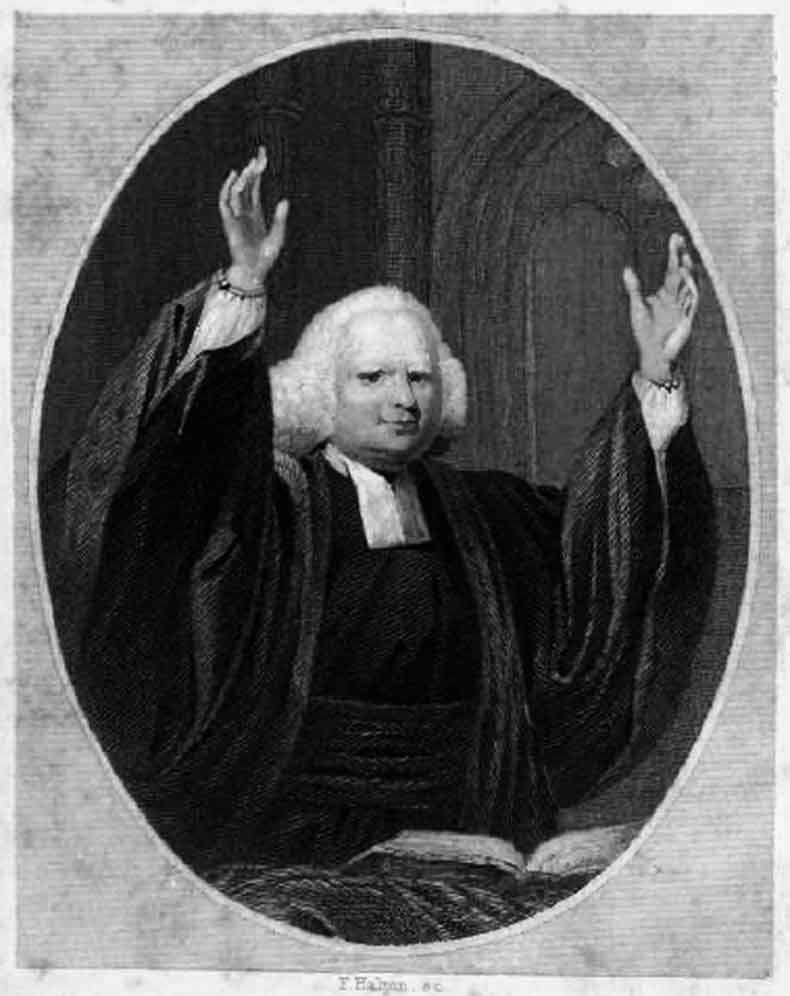
George Whitefield (1714 to 1770) was a Church of England clergyman from Gloucester who became the best known preacher in the English-speaking world of his century. At Oxford he joined the circle around John and Charles Wesley that its critics called the Holy Club, and in 1735 he passed through the experience he called the new birth. Ordained deacon in 1736 and priest in January 1739, he found many parish pulpits closed to him, and on February 17, 1739 he preached in the open air to coal miners at Kingswood, near Bristol. Field preaching made him famous. He crossed the Atlantic thirteen times and made seven visits to the American colonies. On the second (October 1739 to January 1741) he preached from Georgia to New Hampshire, in Anglican, Presbyterian, Congregational and Baptist settings and in streets and fields, and the revivals of 1740 and 1741 grew around his tour. Benjamin Franklin, who printed his sermons and journals but never shared his faith, left the most famous account of him: the new hall built for him in Philadelphia, the collection that emptied Franklin's pocket, and Franklin's own calculation that more than thirty thousand people could have heard his voice at once. Whitefield founded an orphan house, Bethesda, near Savannah. In 1740 he publicly rebuked southern planters for their cruelty to the people they held as slaves, but he did not condemn slavery itself, and from the late 1740s he argued for bringing slavery into Georgia, held enslaved people on a South Carolina plantation and at Bethesda, and left "negroes" to the Countess of Huntingdon in his will. He split with John Wesley in 1740 and 1741 over predestination and became the leader of the Calvinistic Methodists, though the two men were reconciled. He died at Newburyport, Massachusetts, on September 30, 1770, the morning after his last sermon, and was buried beneath the pulpit of the Presbyterian church there. This lesson tells his story from his own Journals and letters, Franklin's Autobiography, his first biographers and the historians who have argued over what kind of preacher he was.
Lesson 02 of this module followed the Northampton revival of 1734 and 1735 and the sermon Jonathan Edwards preached at Enfield in July 1741. Between those two events a young English clergyman crossed the colonies and turned scattered local revivals into something that contemporaries on both sides of the Atlantic began to describe as one great work. Edwards wrote theology. Whitefield traveled, preached, printed and collected money. His career explains why the revival of the 1740s reached so many places at once, and it also explains much of the opposition to it, which is the subject of lesson 04. The doctrinal side of his quarrel with John Wesley (the five points of Calvinism, the Synod of Dort and the Arminian reply) is taught in Module 80, lesson 03, and the Wesleyan movement itself in Module 80, lesson 07. This lesson does not repeat those overviews. It stays with Whitefield: his own words, the records of his travels and money, what he wrote and did about slavery, and how historians read him.
The making of a preacher
Gloucester and the Bell Inn
Whitefield was born at the Bell Inn in Gloucester on December 16, 1714 (Old Style), the youngest of seven children of Thomas Whitefield, the innkeeper, and Elizabeth Edwards.12 His father died when George was a small child, and the boy grew up working in the inn, drawing beer and cleaning rooms, while attending the grammar school of St. Mary de Crypt.2 His first biographer recorded that the boys at the school were fond of acting plays, that the master encouraged them, and that Whitefield once acted a woman's part in a play performed before the city corporation.1 He later looked back on his love of plays with regret, but historians have treated the episode as a clue to his preaching. Harry Stout built his biography, The Divine Dramatist (1991), around the argument that Whitefield carried the methods of the eighteenth century stage into the pulpit.3
Oxford, the Holy Club and the new birth
Whitefield could not afford Oxford as a gentleman commoner. He entered Pembroke College on November 7, 1732 as a servitor, a poor student who paid his way by waiting on wealthier students.2 According to Gillies's Memoirs, his mother first heard of the arrangement from a servitor of Pembroke who told her that after all his college expenses for the quarter were discharged he had received a penny, and she cried out, "this will do for my son."1
At Oxford Whitefield came to know Charles Wesley and joined the small society of students led by John and Charles Wesley that other undergraduates mocked as the Holy Club or the Methodists, because of their rule of life: fixed hours of prayer, weekly communion, fasting, and visits to prisoners and the poor.12 The Memoirs record that a treatise, Henry Scougal's The Life of God in the Soul of Man, persuaded him that true religion is "a union of the soul with God or Christ, formed within us," and that he then tried to reach peace with God by severe self-discipline.1 He fasted through Lent so strictly that he fell ill for several weeks. At the end of that illness, in the spring of 1735, he passed through the experience that shaped every later sermon. In his own account, quoted by Gillies:
"For, about the end of the seventh week, after having undergone innumerable buffetings of Satan, and many months inexpressible trials, by night and by day, under the spirit of bondage, God was pleased at length to remove the heavy load, to enable me to lay hold on his dear Son by a living faith, and, by giving me the spirit of adoption, to seal me, as I humbly hope, even to the day of everlasting redemption."1
Whitefield's conversion came three years before John Wesley's experience at Aldersgate Street (May 24, 1738), and it gave him the subject of his preaching for the rest of his life: the new birth, the inward change by which, in his view, a baptized and churchgoing person who did not know Christ became a true Christian. When the Wesleys sailed for Georgia in October 1735, Whitefield became the leader of the Oxford group.2
Ordination and the first voyage to Georgia
Martin Benson, bishop of Gloucester, noticed the young man and, although he had resolved not to ordain anyone under twenty-three, told Whitefield that he would ordain him whenever he applied.1 Whitefield was ordained deacon in 1736, in the same year that he took his Bachelor of Arts degree.2 He wrote of the service: "I can call heaven and earth to witness, that when the bishop laid his hand upon me, I gave myself up to be a martyr for Him who hung upon the cross for me."1 The date usually given for the ordination is Trinity Sunday, June 20, 1736.
Within a year his sermons in Bristol and London were drawing crowds that the churches could not hold. The Wesleys had invited him to join them in Georgia, the colony founded in 1733 by trustees led by James Oglethorpe. He sailed early in 1738 and landed at Savannah on May 7, 1738.12 By the time he arrived John Wesley had already left the colony. Whitefield spent about four months in Georgia, was named minister of Savannah by the trustees, and saw the condition of the colony's orphaned children. He embarked at Charleston for England on September 6, 1738, to receive priest's orders and to raise money for an orphan house.12
Priest's orders and closed pulpits
In January 1739 Whitefield went to Oxford, where Bishop Benson ordained him priest on the Sunday after January 11, that is, on January 14, 1739.12 In London and Bristol that winter he preached as often as he could, collected for Georgia, and found that his message and his style divided the clergy. He preached the new birth to congregations who had been baptized as infants and who considered themselves Christians, and he spoke sharply of ministers whom he judged unconverted. At Bristol the chancellor of the diocese asked by what authority he preached there without a license and threatened first to suspend and then to excommunicate him if he continued.1 One Sunday at Bermondsey, he later wrote, nearly a thousand people stood in the churchyard because they could not get in, "This," he says, "put me first upon thinking of preaching without doors."1
Field preaching
Kingswood, February 1739
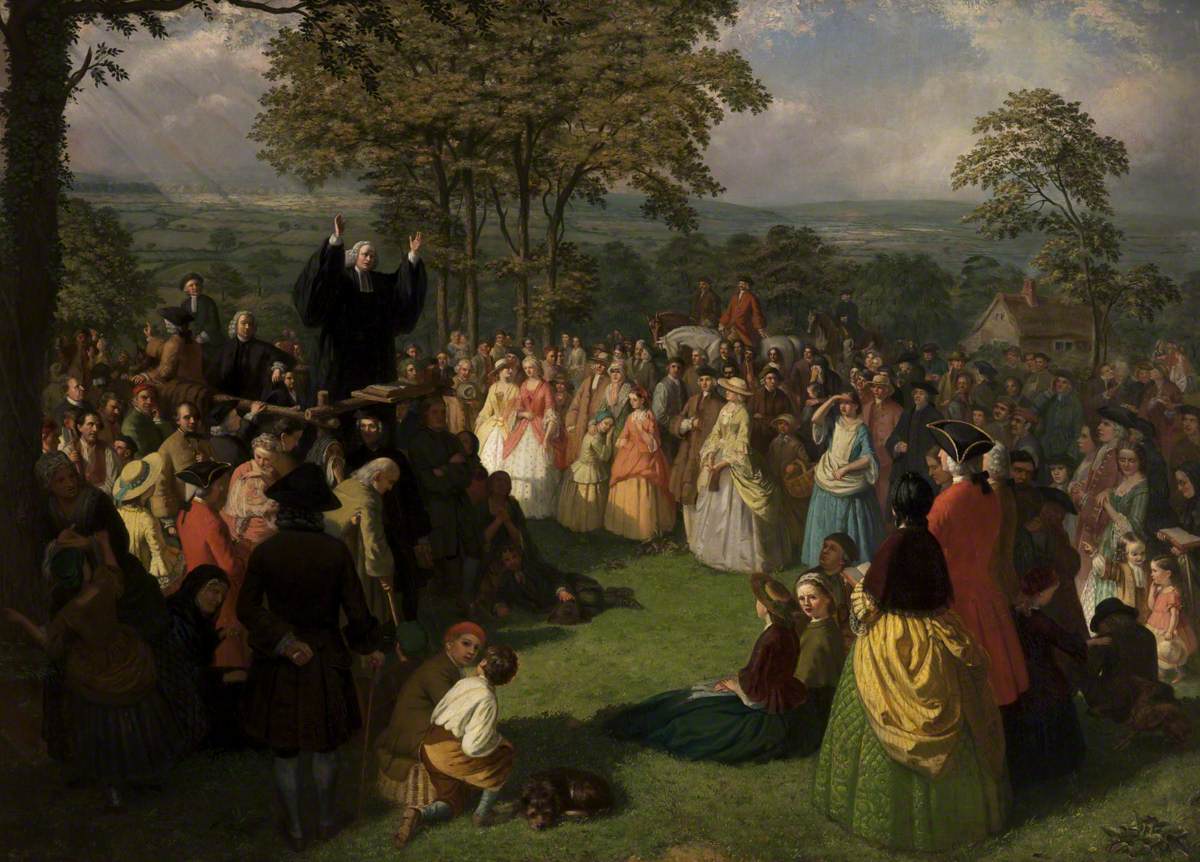
Kingswood was a former royal forest east of Bristol where coal miners lived without a parish church of their own. When Whitefield had spoken of going abroad to preach to the Indians, friends in Bristol had told him that there were "colliers enough in Kingswood."1 On the afternoon of Saturday, February 17, 1739, he stood on a mound at a place called Rose Green and preached to the miners. Gillies quotes his reasoning: "I thought it might be doing the service of my Creator, who had a mountain for his pulpit, and the heavens for a sounding board; and who, when his gospel was refused by the Jews, sent his servants into the highways and hedges."1 The first audience was small, "not more than two hundred persons," because no notice had been given.1 Whitefield wrote in his Journal: "Blessed be God, that the ice is now broke, and I have now taken the field. Some may censure me; but is there not a cause? Pulpits are denied and the poor colliers ready to perish for lack of knowledge."1
The crowds grew quickly. The Memoirs report that "at the second and third time the numbers greatly increased, till the congregation, at a moderate computation, amounted to near twenty thousand."1 Whitefield's own description became one of the most quoted passages of the revival: "The first discovery of their being affected, was, to see the white gutters made by their tears, which plentifully fell down their black cheeks, as they came out of their coal pits."1 He also admitted his fear: "Sometimes, when twenty thousand people were before me, I had not in my own apprehension, a word to say, either to God or to them."1 The figure of twenty thousand is his and his biographer's, and it is an estimate made without any method of counting that can now be checked. Before he sailed again for America he turned the Kingswood work over to John Wesley, who began his own field preaching at Bristol that spring.1
Moorfields, Kennington and Blackheath
In London Whitefield took the same step. When churches were closed to him he preached in Moorfields, an open area north of the city walls used for walking, markets and entertainments, and the same evening at Kennington Common south of the Thames.1 The Memoirs state that "for several months after this, Moorfields, Kennington common, and Blackheath, were the chief scenes of action. At a moderate computation, the auditories often consisted of above twenty thousand. It is said, their singing could be heard two miles off, and his voice near a mile."1 Whitefield and his supporters reported even larger numbers for single occasions in London (figures as high as fifty thousand at Kennington and eighty thousand at Mayfair appear in the reports that later scholars tested).4 These are the numbers a modern reader should handle with the most caution, and the section on Franklin below sets out how they have been tested.
Field preaching was not new in Christian history, but it was irregular in the Church of England, whose canons assumed that a clergyman preached in a consecrated church within a parish to which he had been licensed. Whitefield answered that the church was where the people were. Collecting for his orphan house in the fields, he wrote, was humbling, "But the willingness with which the people gave, and the prayers which they put up upon throwing in their mites, were very encouraging."1

The American tours
Seven visits in thirty-two years
Whitefield made seven visits to the American colonies between 1738 and 1770, and since he died in Massachusetts on the last of them, that meant thirteen crossings of the Atlantic.2 The first visit (May to September 1738) was confined to Georgia. The second (October 1739 to January 1741) was the tour that made him a public figure in every colony. The later visits (usually dated 1744 to 1748, 1751 to 1752, 1754 to 1755, 1763 to 1765, and 1769 to 1770) took him again along the coast from Georgia to New England, with a long stay in Bermuda in 1748.1 Between them he preached across England and Wales, made repeated tours of Scotland, and visited Ireland, landing at Dublin on May 24, 1751.1 His English base from 1741 was a large wooden Tabernacle at Moorfields, and from 1749 he served as a chaplain to Selina Hastings, Countess of Huntingdon, whose chapels became the home of one branch of the Calvinistic Methodists.2
The tour of 1739 to 1741
Whitefield sailed from England in August 1739 and landed at Lewes, at the mouth of Delaware Bay, on October 30, 1739. On November 2 he rode, by his own account, "near 60 Miles without Fatigue, and reached Philadelphia before 11 at Night."5 The Journal he kept on this tour, which was printed in installments on both sides of the Atlantic while he was still traveling, is the main source for his route. The version cited here is the revised edition he published himself in 1756, which shortened and corrected the first printings.5
From November 1739 to January 1741 he made, in effect, three circuits:
- Autumn 1739 to January 1740. Philadelphia and its neighborhood (Germantown, Abington, Neshaminy), a trip to New York and back through New Jersey, and then an overland ride south through Maryland, Virginia (Williamsburg, December 14), North Carolina (Edenton, Bath, New Bern and the Cape Fear River) and South Carolina to Savannah, where on January 11, 1740 he went to inspect the 500 acre tract chosen for the orphan house.5
- Spring 1740. A voyage north again to the Delaware, preaching at Philadelphia, Neshaminy, New Brunswick and New York in April and May, a voyage back to Savannah from Lewes (leaving May 24 and arriving June 5), and in July a visit to Charleston.5
- Autumn 1740. A voyage from Charleston to Newport, Rhode Island (arriving September 14), six weeks in Boston and the towns of Massachusetts and New Hampshire, a ride west to Northampton (October 17 to 19), south through Connecticut to New Haven (October 23 to 26) and New York (October 30 and 31), Philadelphia (November 9), and a return to Georgia by sea from the Delaware. His long letter to John Wesley is dated "Bethesda in Georgia, Dec. 24, 1740."56 He sailed for England in January 1741 and was back by March.2
Philadelphia in November 1739
Philadelphia was the largest town in the colonies that Whitefield reached first, and the one where his reception was best recorded. He read prayers and preached in the Anglican church, preached in the evenings from the steps of the courthouse on Market Street, and went out to the meetinghouses of the Presbyterians and to German congregations nearby.5 On one evening, after preaching from "the Court-house Stairs," he wrote that "the People seemed so unwilling to go away, that I began to pray afresh."5 At Germantown on November 27, 1739, he preached "from a Balcony, to above 6000 People," and at Neshaminy on November 22 he found "above 3000 People gather'd together in the Meeting-house Yard."5 At Neshaminy he met William Tennent, the elderly Presbyterian minister who kept a school there (the "Log College" of lesson 04), and in New York he heard Tennent's son Gilbert preach: "never before heard I such a searching Sermon. He went to the Bottom indeed, and did not daub with untempered Mortar."5
He also noticed the printing trade. In the same weeks he wrote that one of the Philadelphia printers "has told me he has taken above two hundred Subscriptions for printing my Sermons and Journals. Another Printer told me he might have sold a thousand Sermons if he had them."5 One of those printers was Benjamin Franklin.
Overland to Georgia and the founding of Bethesda
The ride south in December 1739 took Whitefield through the tobacco and rice colonies where most of the population was enslaved. He stopped at Williamsburg on December 14 and visited James Blair, the Church of England commissary and founder of the College of William and Mary.75 What he saw on the plantations produced the letter to the southern colonies discussed below. He reached Savannah in January 1740, received what the New Georgia Encyclopedia calls "a hero's welcome," and on January 11 went to view the 500 acre tract, "about ten Miles off Savannah," that had been chosen for the orphan house.25 The building, which he named Bethesda after the pool in Jerusalem where Jesus healed a lame man (John 5:2 to 9), was begun that spring.8
Charleston and Commissary Garden
Not every clergyman welcomed him. Alexander Garden, the bishop of London's commissary at Charleston, objected to Whitefield's preaching in dissenting meetinghouses, his extempore prayer and his attacks on Anglican clergy, and in the summer of 1740 he tried to suspend him through a church court. The New Georgia Encyclopedia records that the effort "to suppress Whitefield's irregularities failed."2 The dispute showed the unusual position Whitefield occupied: a priest of the established Church of England, loyal in his own view to its Articles and Homilies, who preached most often to Presbyterians, Congregationalists and Baptists and in the open air.
New England in the autumn of 1740
In New England the established churches were Congregational, and their ministers had been praying for revival since the Northampton awakening of 1734 and 1735. Whitefield landed at Newport on September 14, 1740 and was in Boston by September 19.5 His Journal gives the crowds on Boston Common in round numbers: "about 8000" on one day, "about 15000" on another, and on Sunday, October 12, his farewell sermon "to, as was computed, near 20,000 People. A Sight I have not seen since I left Blackheath."5 On one occasion he wrote that he "collected upwards of 200 l. of New-England Currency for the Orphans."5
From Boston he rode west to Northampton, where he preached in Jonathan Edwards's pulpit on October 17 to 19. He described Edwards as "a solid, excellent Christian, but at present weak in Body," and recorded that on Sunday, October 19, "good Mr. Edwards wept during the whole Time of Exercise."5 He also recommended Solomon Stoddard's books to his readers (Stoddard is the subject of part of lesson 01). Edwards's own judgment of the visit and his later caution about some of its effects belong to lesson 02 and lesson 05. In New Jersey on his way south, Whitefield and the Tennents agreed that Gilbert Tennent should go to Boston "in order to help in carrying on the Work of God in New-England," and Tennent's preaching tour there in the winter of 1740 to 1741 carried the revival forward after Whitefield left.5
Benjamin Franklin's account
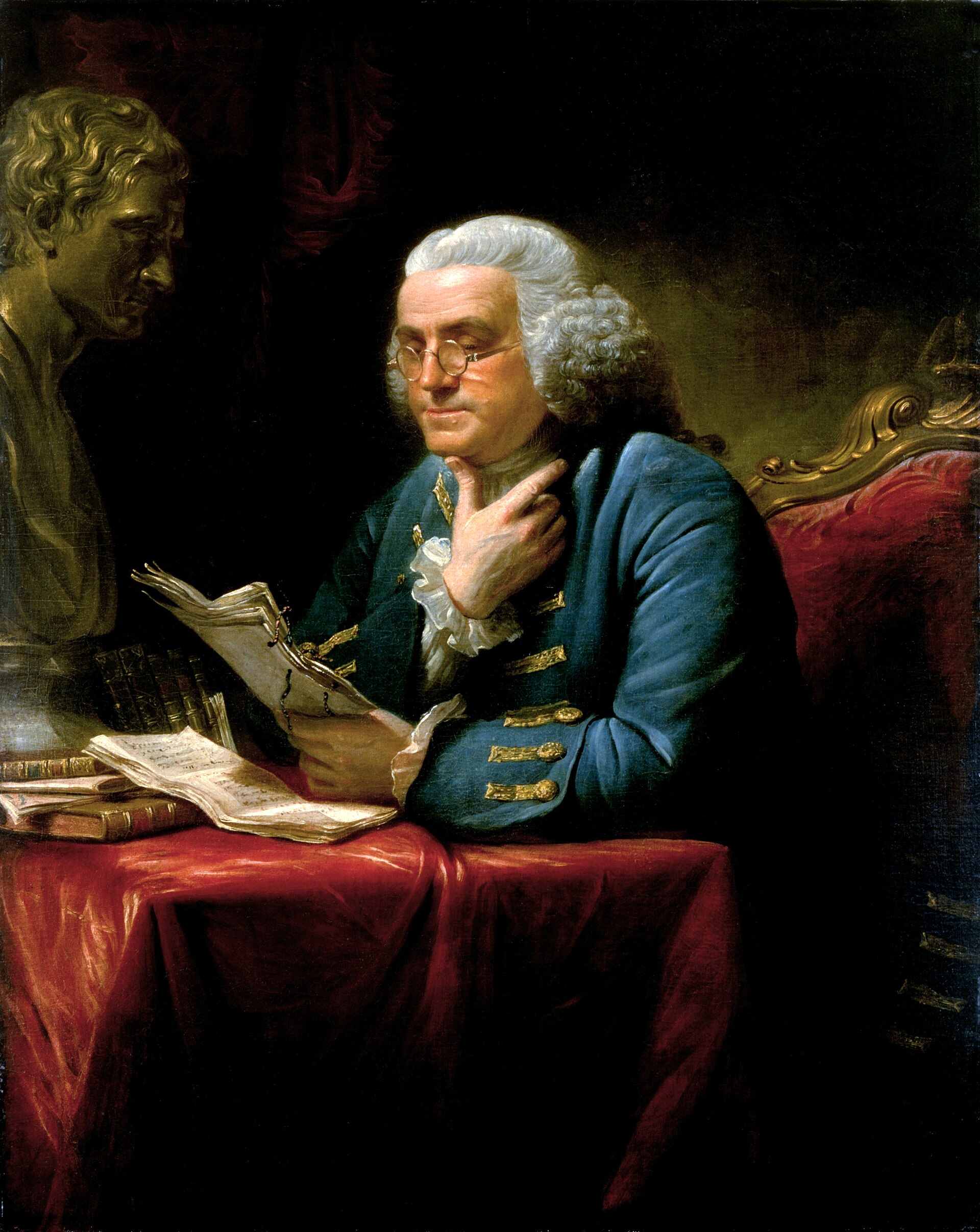
Franklin wrote the part of his Autobiography that deals with Whitefield in the 1780s, more than forty years after the events and long after Whitefield's death. It is the best known description of the preacher, and it is valuable because Franklin was a printer who did business with him, a neighbor who heard him often, and a skeptic who never accepted his message. It is also a memoir written by a man looking back, and in at least one detail it is wrong: Franklin wrote that Whitefield arrived in 1739 "from Ireland," when the Journal shows he had sailed from England.95 The passages below are quoted from the text of the Autobiography published by Project Gutenberg.
The arrival and the New Building
Franklin began with the change in the town:
"In 1739 arrived among us from Ireland the Reverend Mr. Whitefield, who had made himself remarkable there as an itinerant preacher. He was at first permitted to preach in some of our churches; but the clergy, taking a dislike to him, soon refus'd him their pulpits, and he was oblig'd to preach in the fields. The multitudes of all sects and denominations that attended his sermons were enormous, and it was matter of speculation to me, who was one of the number, to observe the extraordinary influence of his oratory on his hearers, and how much they admir'd and respected him, notwithstanding his common abuse of them, by assuring them they were naturally half beasts and half devils. It was wonderful to see the change soon made in the manners of our inhabitants. From being thoughtless or indifferent about religion, it seem'd as if all the world were growing religious, so that one could not walk thro' the town in an evening without hearing psalms sung in different families of every street."9
Because preaching in the open air was "inconvenient," Franklin continued, contributions were raised "to procure the ground and erect the building, which was one hundred feet long and seventy broad, about the size of Westminster Hall." The trustees held it "expressly for the use of any preacher of any religious persuasion who might desire to say something to the people at Philadelphia; the design in building not being to accommodate any particular sect, but the inhabitants in general; so that even if the Mufti of Constantinople were to send a missionary to preach Mohammedanism to us, he would find a pulpit at his service."9 Gillies records that when Whitefield came back to Philadelphia on November 8, 1740, he preached the next day "to several thousands in a house built for that purpose since his last departure."1 The building, at Fourth and Arch Streets, later became the first home of the Academy and College of Philadelphia, from which the University of Pennsylvania traces its descent.10
The collection plate
Franklin disagreed with Whitefield about the orphan house. He thought it should have been built in Philadelphia, where materials and workmen were, with the children brought north, and "as Georgia was then destitute of materials and workmen," he refused to contribute when Whitefield rejected his advice. Then he went to hear him:
"I happened soon after to attend one of his sermons, in the course of which I perceived he intended to finish with a collection, and I silently resolved he should get nothing from me. I had in my pocket a handful of copper money, three or four silver dollars, and five pistoles in gold. As he proceeded I began to soften, and concluded to give the coppers. Another stroke of his oratory made me asham'd of that, and determin'd me to give the silver; and he finish'd so admirably, that I empty'd my pocket wholly into the collector's dish, gold and all."9
He added the story of a member of his club who, expecting a collection, had emptied his pockets before he came, but who by the end of the sermon "felt a strong desire to give, and apply'd to a neighbour who stood near him, to borrow some money for the purpose." The neighbor, "perhaps the only man in the company who had the firmness not to be affected by the preacher," answered: "At any other time, Friend Hopkinson, I would lend to thee freely; but not now, for thee seems to be out of thy right senses."9
Franklin also answered the charge, made by Whitefield's opponents, that he kept the money: "I, who was intimately acquainted with him (being employed in printing his Sermons and Journals, etc.), never had the least suspicion of his integrity, but am to this day decidedly of opinion that he was in all his conduct a perfectly honest man; and methinks my testimony in his favour ought to have the more weight, as we had no religious connection."9
The crowd calculation
The passage most often cited in arguments about crowd sizes reads in full:
"He had a loud and clear voice, and articulated his words and sentences so perfectly, that he might be heard and understood at a great distance, especially as his auditories, however numerous, observ'd the most exact silence. He preach'd one evening from the top of the Courthouse steps, which are in the middle of Market-street, and on the west side of Second-street, which crosses it at right angles. Both streets were fill'd with his hearers to a considerable distance. Being among the hindmost in Market-street, I had the curiosity to learn how far he could be heard, by retiring backwards down the street towards the river; and I found his voice distinct till I came near Front-street, when some noise in that street obscur'd it. Imagining then a semicircle, of which my distance should be the radius, and that it were fill'd with auditors, to each of whom I allow'd two square feet, I computed that he might well be heard by more than thirty thousand. This reconcil'd me to the newspaper accounts of his having preach'd to twenty-five thousand people in the fields, and to the ancient histories of generals haranguing whole armies, of which I had sometimes doubted."9
Three things about this passage are easy to miss. First, Franklin did not count a crowd. He measured how far one voice carried on one evening and calculated how many people could have stood within that distance. His figure is a ceiling on audibility, not a head count of the people present. Second, Franklin does not give the date, and Whitefield preached from the courthouse steps on several evenings in November 1739 and again in 1740, so the occasion cannot be fixed with certainty.5 Third, the calculation's two key assumptions (a full semicircle of listeners, and two square feet per person) can be tested.
They have been. In 2013 the acoustician Braxton Boren and Agnieszka Roginska of New York University reconstructed the Philadelphia streets and the London sites in a computer model and presented their results to the Acoustical Society of America. They reported that Franklin's method was "fairly accurate," but that he "based his calculations on an overly dense crowd"; for a solid crowd they assumed about half a square meter per person (roughly five square feet). Of the reported London crowds, they concluded that the eighty thousand claimed at Mayfair and the sixty thousand at Moorfields could not have heard him even under optimistic conditions, while a crowd of fifty thousand at Kennington Common could have done so "under optimal conditions." The researchers' own summary was: "Without a time machine, we will never know these crowd sizes exactly."4 The result supports the claim that Whitefield could be heard by tens of thousands in open ground, and it weakens the largest reported figures.
Printer and preacher
Franklin printed Whitefield's sermons and journals and reported his movements in the Pennsylvania Gazette. The arrangement suited both men. Whitefield gained a printer who could sell his works up and down the coast, and Franklin gained the best selling author of the moment. The historian Frank Lambert, in "Pedlar in Divinity": George Whitefield and the Transatlantic Revivals (1994), argued that Whitefield and his helpers used the new commercial methods of the eighteenth century (advance notices, newspaper reports of crowds, subscription sales of sermons and journals) to advertise the revival, and that this publicity helped make separate local awakenings appear to the public as one transatlantic event.11 Lambert later developed the argument in Inventing the "Great Awakening" (1999), a book whose case is weighed in lesson 06.
Franklin thought the printing did Whitefield as much harm as good. "His writing and printing from time to time gave great advantage to his enemies," he wrote; "unguarded expressions, and even erroneous opinions, delivered in preaching, might have been afterwards explain'd or qualifi'd by supposing others that might have accompani'd them, or they might have been deny'd; but litera scripta manet" (the written letter remains).9 He judged that "if he had never written anything, he would have left behind him a much more numerous and important sect."9
The friendship lasted. When Whitefield wrote that he did not know where he would lodge in Philadelphia, Franklin answered: "You know my house; if you can make shift with its scanty accommodations, you will be most heartily welcome." Whitefield replied that if Franklin made the offer for Christ's sake he would not miss a reward, and Franklin returned: "Don't let me be mistaken; it was not for Christ's sake, but for your sake."9 On religion the two never met: "He us'd, indeed, sometimes to pray for my conversion, but never had the satisfaction of believing that his prayers were heard. Ours was a mere civil friendship, sincere on both sides, and lasted to his death."9 The last time Franklin saw him, in London, Whitefield consulted him "about his Orphan House concern, and his purpose of appropriating it to the establishment of a college."9

How Whitefield preached
The message: the new birth and the method of grace
Whitefield's theology was that of the Thirty-nine Articles read in a Calvinist sense, and of the Puritan and Reformed writers he admired: human beings are fallen and guilty, they cannot save themselves, Christ's righteousness is imputed to the believer, and God's grace both begins and completes salvation. What gave his preaching its force was the application. He told congregations of baptized, churchgoing people that outward religion was not enough, and that they must be born again (John 3:3, 7).8 One of his sermons printed in the collected editions, "The Method of Grace," takes its text from Jeremiah 6:14, "They have healed also the hurt of the daughter of my people slightly, saying, Peace, peace; when there is no peace," and opens with a warning aimed at the clergy:8
"As God can send a nation or people no greater blessing, than to give them faithful, sincere, and upright ministers; so the greatest curse that God can possibly send upon a people in this world, is to give them over to blind, unregenerate, carnal, lukewarm, and unskillful guides."12
Sentences like this one, aimed at "unregenerate" ministers, did more than anything else to divide the clergy. Gilbert Tennent preached the same theme at Nottingham, Pennsylvania, in March 1740 ("The Danger of an Unconverted Ministry"), and the reaction to both men is the subject of lesson 04. Franklin's phrase about Whitefield telling his hearers they were "naturally half beasts and half devils" is Franklin's summary of the doctrine of original sin as he heard it, not a quotation from a printed sermon.9
The last text Whitefield preached on, at Exeter in 1770, was 2 Corinthians 13:5: "Examine yourselves, whether ye be in the faith; prove your own selves. Know ye not your own selves, how that Jesus Christ is in you, except ye be reprobates?"18 It was a fitting last text for a preacher whose whole message was that a person could be in the church without being in the faith.
Voice, memory and repetition
Whitefield preached extempore, from memory and outline rather than from a full manuscript, which was itself a departure from the custom of most Anglican and many Congregational ministers. Franklin noticed what itinerancy did to the sermons:
"By hearing him often, I came to distinguish easily between sermons newly compos'd, and those which he had often preach'd in the course of his travels. His delivery of the latter was so improv'd by frequent repetitions that every accent, every emphasis, every modulation of voice, was so perfectly well turn'd and well plac'd, that, without being interested in the subject, one could not help being pleas'd with the discourse; a pleasure of much the same kind with that receiv'd from an excellent piece of musick. This is an advantage itinerant preachers have over those who are stationary, as the latter cannot well improve their delivery of a sermon by so many rehearsals."9
Whitefield's own account of preaching to the colliers stresses something else: his sense of dependence. "I was never totally deserted," he wrote, "and frequently (for to deny it would be lying against God) so assisted, that I knew by happy experience what our Lord meant by saying, 'Out of his belly shall flow rivers of living water.'"1
How historians read him
Modern historians agree on the facts of Whitefield's career far more than on their meaning. Three readings are most often cited.
- Harry S. Stout, The Divine Dramatist: George Whitefield and the Rise of Modern Evangelicalism (1991). Stout argued that Whitefield joined the techniques of the eighteenth century theater (impersonation of biblical characters, gesture, tears, a voice trained by repetition) to the Puritan sermon, and that in doing so he created a new kind of religious celebrity whose authority came from the crowd and the press rather than from a parish or a denomination. In Stout's reading Whitefield is a founder of modern mass evangelicalism, with both its strengths and its dangers.3
- Frank Lambert, "Pedlar in Divinity" (1994). Lambert stressed the marketplace: Whitefield and his associates as skilled users of the commercial print culture of the British Atlantic, whose newspaper notices and publications helped create the public sense of a single "great awakening."11
- Thomas S. Kidd, George Whitefield: America's Spiritual Founding Father (2014). Kidd, writing as an evangelical historian, accepted much of the evidence of showmanship and publicity but placed more weight on Whitefield's Calvinist convictions, his prayer and his consistent message of the new birth, and argued that he was the first figure known throughout all the colonies, a shared American reference point a generation before the Revolution. Kidd also set out Whitefield's record on slavery without softening it.137
These readings are not simple opposites. Stout does not deny that Whitefield believed what he preached, and Kidd does not deny that he was a master of publicity. They differ over which explanation carries the most weight. Readers from different traditions also read him differently. Many Reformed and Baptist Christians treat him as a model evangelist of the doctrines of grace. Wesleyans honor him as a co-founder of Methodism while rejecting his predestinarian theology. Anglican critics in his own day, and some since, regarded his disregard of parish order as a source of division. Historians who doubt that there was one "Great Awakening" at all (Jon Butler most famously, in 1982) treat Whitefield's tours as the clearest case of a revival made to look larger and more unified by its publicists; that argument is weighed in lesson 06.

Bethesda, the orphan house
Founding and funding
The orphan house was the cause for which Whitefield collected on every tour. Georgia's early settlers had died in large numbers, and Franklin's Autobiography describes the colony as settled with "families of broken shop-keepers and other insolvent debtors" who, "being set down in the woods, unqualified for clearing land, and unable to endure the hardships of a new settlement, perished in numbers, leaving many helpless children unprovided for. The sight of their miserable situation inspir'd the benevolent heart of Mr. Whitefield with the idea of building an Orphan House there."9 Franklin's picture of the settlers is his own and is unkind to them; the Georgia trustees had in fact selected settlers of several kinds. But the need for an orphanage was real.
The Georgia trustees granted Whitefield 500 acres. On January 11, 1740 he went to see the tract, "about ten Miles off Savannah," and the building was begun that spring.51 The New Georgia Encyclopedia states that "Whitefield had provided approximately $2,539 toward the cost of constructing Bethesda Orphan House."2 The house took in orphans and other poor children, and Whitefield wrote of its health record and its farm in letters of the 1740s.1 It was always in debt. In 1741, back in England, Whitefield was "above a thousand pounds in debt upon that score, and he himself not worth twenty," according to the Memoirs.1
The academy and the college plan
In his last decade Whitefield hoped to turn Bethesda into a college for Georgia and the southern colonies, and he sought support for the plan in England. The New Georgia Encyclopedia notes that an academy was eventually built, but that the college plan "was thwarted in England, despite backing from Georgia's governor, council, and assembly."2 His will, made in 1770, still spoke of "the intended Orphan-house Bethesda college."14 The institution survived him and continues in Savannah as Bethesda Academy.
Whitefield and slavery
The fairness rules of this module require that what each figure did and wrote about slavery be stated plainly from his own words and records. In Whitefield's case the record falls into three parts: the letter of 1740, the argument for slavery in Georgia from the late 1740s, and his ownership of enslaved people.
The letter of 1740 to the southern colonies
Riding south in December 1739, Whitefield saw plantation slavery at close range for the first time. On January 23, 1740, at Savannah, he wrote an open letter "To the Inhabitants of Maryland, Virginia, North and South-Carolina." Franklin printed it in Philadelphia in 1740 in Three Letters from the Reverend Mr. G. Whitefield.7 The text below follows the collected Works of 1771 (modern "s" for the long "s").15
"As I lately passed through your provinces, in my way hither, I was sensibly touched with a fellow-feeling of the miseries of the poor negroes. ... I must inform you, in the meekness and gentleness of Christ, that I think God has a quarrel with you, for your abuse of and cruelty to the poor negroes. Whether it be lawful for christians to buy slaves, and thereby encourage the nations from whence they are brought to be at perpetual war with each other, I shall not take upon me to determine; but sure I am it is sinful, when bought, to use them as bad as, nay worse than brutes."15
He went on: "your slaves, I believe, work as hard, if not harder, than the horses whereon you ride," and "Your dogs are caressed and fondled at your tables; but your slaves, who are frequently stiled dogs or beasts, have not an equal privilege."15 He described slaves who had been "cut with knives, and have had forks thrown into their flesh," and others whose masters "by their unrelenting scourges have ploughed upon their backs, and made long furrows."15 He wrote that he had wondered "that we have not more instances of self-murder among the negroes, or that they have not more frequently risen up in arms against their owners," and that if such a rising were permitted by providence, "all good men must acknowledge the judgment would be just."15
The main charge of the letter, however, was spiritual neglect. "I have great reason to believe, that most of you on purpose keep your negroes ignorant of christianity," he wrote, and he answered the planters' fear that Christian teaching would make slaves "proud, and consequently unwilling to submit to slavery." His answer was that the gospel commands servants "to be subject in all lawful things to their masters," and: "I challenge the world to produce a single instance of a negroe's being made a thorough christian, and thereby made a worse servant; it cannot be." He added: "Blacks are just as much, and no more, conceived and born in sin, as white men are: both, if born and bred up here, I am persuaded are naturally capable of the same improvement." In the same paragraph he wrote, in a sentence that shows the limits of his sympathy, that the masters' "present and past bad usage of them, however ill-designed, may thus far do them good, as to break their wills, increase the sense of their natural misery, and consequently better dispose their minds to accept the redemption wrought out for them by the death and obedience of Jesus Christ."15
The letter therefore did two things at once. It condemned cruelty, deprivation of food and clothing, and the refusal to teach the enslaved the Christian faith, in some of the sharpest language any colonial clergyman had used. And it left the lawfulness of slavery explicitly undecided, while promising masters that Christian slaves would be better servants. Thomas Kidd's summary is that Whitefield "taught that African Americans were the spiritual equals of whites, and that masters should not abuse their slaves. But he also taught that converting to Christianity would not lead to the slaves' freedom."7 Kidd notes that the letter's criticisms "touched a raw nerve among many white southerners."7 Stephen J. Stein's study of Whitefield and slavery, discussed below, sets it beside his later writings.16
The argument for slavery in Georgia
Georgia was founded without slavery. The historian Betty Wood writes that "between 1735 and 1750 Georgia was the only British American colony to attempt to prohibit Black slavery as a matter of public policy," and that in 1735 the House of Commons passed legislation prohibiting slavery there.17 Many settlers campaigned against the ban from the start, arguing that the colony could not prosper without enslaved labor. By the late 1740s Whitefield had joined them. Bethesda's finances were poor, and he wrote to the trustees on December 6, 1748, in a sentence quoted by Mark Galli in Christian History: "Had Negroes been allowed, I should now have had a sufficiency to support a great many orphans."1824 In a letter of 1747, quoted in the same article, he wrote of friends in South Carolina who had helped him acquire a plantation to support the orphan house: "One Negro has been given me. Some more I purpose to purchase this week."1824 Kidd writes that Whitefield "came to own a plantation and slaves in South Carolina by way of planters there who had converted under his preaching."7
The trustees gave way. They asked Parliament to replace the act of 1735 "with one that would permit slavery in Georgia as of January 1, 1751," and the legislation was adopted.17 Wood records that Georgia's enslaved population grew "from less than 500 to approximately 18,000 people" between 1750 and 1775.17
Whitefield's most explicit statement came in a letter of March 22, 1751, printed in the second volume of his collected Works as a letter to "Mr. B":
"I think now is the season for us to exert our utmost for the good of the poor Ethiopians. ... As for the lawfulness of keeping slaves, I have no doubt, since I hear of some that were bought with Abraham's money, and some that were born in his house. And I cannot help thinking, that some of those servants mentioned by the Apostles in their epistles, were or had been slaves. It is plain, that the Gibeonites were doomed to perpetual slavery, and though liberty is a sweet thing to such as are born free, yet to those who never knew the sweets of it, slavery perhaps may not be so irksome. However this be, it is plain to a demonstration, that hot countries cannot be cultivated without negroes. What a flourishing country might Georgia have been, had the use of them been permitted years ago? How many white people have been destroyed for want of them, and how many thousands of pounds spent to no purpose at all?"19
He continued that although the slaves "are brought in a wrong way from their own country, and it is a trade not to be approved of, yet as it will be carried on whether we will or not; I should think myself highly favoured if I could purchase a good number of them, in order to make their lives comfortable, and lay a foundation for breeding up their posterity in the nurture and admonition of the Lord." He insisted that he had "no hand in bringing them into Georgia" and "would not have a negro upon my plantation, till the use of them was publicly allowed in the colony," and he rejoiced "to hear that one of my poor negroes in Carolina was made a brother in Christ."19
In eleven years, then, Whitefield moved from leaving the lawfulness of slavery undecided (1740) to affirming it from Scripture and arguing that Georgia needed it (1751). He never abandoned his insistence that enslaved people had souls equal to their masters' and should be taught the gospel, and he did not, in any surviving text, call for the end of slavery.
Slaveholding at Bethesda and the will
By the time of his death Whitefield owned enslaved people at Bethesda. His will, dated at the Orphan House academy and proved after his death, left to the Countess of Huntingdon "that building, commonly called the Orphan-house, at Bethesda, in the province of Georgia, together with all the other buildings lately erected thereon; and likewise all other buildings, lands, negroes, books, furniture, and every other thing whatsoever, which I now stand possessed of in the province of Georgia."14 If the countess died first, "all the buildings, lands, negroes, and every thing before mentioned" were to go to James Habersham, president of the Georgia council.14 The number of people held at Bethesda in 1770 is usually given as about fifty; the Penn and Slavery Project states that his will passed "4,000 acres of land in Georgia and 50 slaves" to the countess, but it does not cite a source for the figures, and the will itself names no number.10
These facts have consequences in later memory. In 1919 a statue of Whitefield was dedicated at the University of Pennsylvania, whose first building had been the hall raised for his preaching; in 2020 the university announced plans to remove it.10
How historians weigh his record
Stephen J. Stein's article "George Whitefield on Slavery: Some New Evidence" (Church History, 1973) is the standard scholarly study of the subject and is the first item Kidd lists for further reading.167 Mark Galli concluded in Christian History (1993): "Lamentably, his views on slavery were conventional and unremarkable."18 Kidd judges that Whitefield's "moderate approach to slavery became typical of white southern evangelicals: he believed that slaves needed salvation, and he argued against their maltreatment," but, in Kidd's words, he would not in the end "challenge the institution of slavery itself."7 Other readers stress what was not conventional: the 1740 letter's charge that God "has a quarrel" with slaveholders, its claim that Black and white people are alike in sin and in capacity, and Whitefield's preaching to enslaved people, which drew many Black hearers to evangelical Christianity. Phillis Wheatley's elegy, quoted below, shows that at least one African American Christian in Boston heard him as an "Impartial Saviour's" preacher to Africans. Both readings rest on the same documents.
A comparison within this module may help. Jonathan Edwards also owned enslaved people and defended ministers who did (lesson 05), while his students Samuel Hopkins and Jonathan Edwards Jr. later turned against the slave trade and slavery (lesson 07). Within a generation of Whitefield's death, revival preaching was producing both slaveholding evangelicals and evangelical abolitionists.
The split with John Wesley
Wesley's sermon "Free Grace"
Whitefield and John Wesley had been friends since Oxford, and Wesley took over the Bristol field preaching when Whitefield left Bristol in the spring of 1739. But they disagreed about predestination. Wesley held that Christ died for all and that God's grace is offered to all, and that the Calvinist doctrine of unconditional election made God the author of damnation. In 1739 he preached and then published a sermon called "Free Grace" (Romans 8:32), which states his case in his own words:
"The grace or love of God, whence cometh our salvation, is FREE IN ALL, and FREE FOR ALL."20
Wesley argued that the doctrine of election, whatever it was called, implied reprobation: "Call it therefore by whatever name you please, election, preterition, predestination, or reprobation, it comes in the end to the same thing."20 And he went further: "This is the blasphemy clearly contained in the horrible decree of predestination! And here I fix my foot. On this I join issue with every assertor of it. You represent God as worse than the devil; more false, more cruel, more unjust."20 The phrase echoes Calvin, who wrote in the Institutes of the decree by which the fall of Adam involved his posterity in death: "The decree, I admit, is, dreadful" (decretum horribile, in Henry Beveridge's translation of book 3, chapter 23, section 7).21 Wesley turned the phrase against the Calvinists.
Whitefield's answer of December 1740
Wesley had written to Whitefield in August 1740 that "there are bigots both for predestination and against it," and that "for a time you are suffered to be of one opinion, and I of another."6 Whitefield answered publicly in A Letter to the Reverend Mr. John Wesley: In Answer to His Sermon, Entituled, Free-Grace, dated "Bethesda in Georgia, Dec. 24, 1740." It begins with reluctance:
"God only knows, what unspeakable sorrow of heart I have felt on your account, since I left England last. Whether it be my infirmity or not, I frankly confess, that Jonah could not go with more reluctance against Nineveh, than I now take pen in hand to write against you. Was nature to speak, I had rather die than do it; and yet if I am faithful to God, and to my own and other's souls, I must not stand neuter any longer."6
Whitefield defended unconditional election and the perseverance of the saints, and charged Wesley with inconsistency: if Wesley held the doctrine of original sin, he must grant that God "might justly have passed by all." He ended with an appeal:
"Dear, dear Sir, O be not offended! For Christ's sake be not rash! Give yourself to reading. Study the covenant of grace. Down with your carnal reasoning. Be a little child; and then, instead of pawning your salvation, as you have done in a late hymn book, if the doctrine of universal redemption be not true; instead of talking of sinless perfection, as you have done in the preface to that hymn book, and making man's salvation to depend on his own free-will, as you have in this sermon; you will compose an hymn in praise of sovereign distinguishing love."6
He also accused Wesley of censuring the Anglican clergy for not keeping to their Articles while himself denying "the 9th, 10th, and 17th" (on original sin, free will, and predestination and election).6 Each side, in short, claimed the Church of England's own formularies.
Two Methodisms, and a reconciliation
The breach divided the revival in England. Whitefield's supporters built the Moorfields Tabernacle in 1741, and on January 5, 1743 Whitefield called a conference that organized the Calvinistic Methodists, closely tied to the Welsh Calvinistic Methodists of Howell Harris and Daniel Rowland.2 Wesley's societies became the Wesleyan Methodist connection described in Module 80, lesson 07. The New Georgia Encyclopedia sums up the doctrinal difference: both parties held original sin, justification by faith, the substitutionary atonement and sanctification, but "they differed in their understanding of the human role in the process of salvation."2
The two men were reconciled personally within a few years. Whitefield never founded a denomination of his own; in America his converts joined existing Presbyterian, Congregational and Baptist churches. When he died, Wesley preached his funeral sermon in London on Sunday, November 18, 1770, at the Tottenham Court Road chapel and at the Tabernacle, on Numbers 23:10.22 Wesley asked: "Have we read or heard of any person since the apostles, who testified the gospel of the grace of God, through so widely extended a space, through so large a part of the habitable world? Have we read, or heard of any person, who called so many thousands, so many myriads of sinners to repentance?"22
The last tour and death at Newburyport
The seventh visit
Whitefield's health was poor for most of his last decade. He suffered from what his contemporaries called asthma and often preached while ill.1 In 1769 he sailed for America for the seventh time, partly to settle the affairs of Bethesda. In the summer of 1770 he went north again. Gillies's Memoirs record that "from the 17th to the 20th of September" he preached every day in Boston, that he left Boston on September 21 although "at that time indisposed," and that he preached daily at Portsmouth, New Hampshire, from September 23 to 29, with single sermons at Kittery and York.1
Exeter, September 29, 1770
On Saturday morning, September 29, 1770, Whitefield set out for Boston, intending to preach at Newburyport the next day, but on the way he was "importuned to preach by the way, at Exeter." According to the Memoirs, he preached there in the open air, because no house could hold the people, for "nearly two hours, by which he was greatly fatigued."1 Richard Smith, who traveled with him on his last American journey, later told the story that before the sermon a Mr. Clarkson, seeing him unwell, said, "Sir, you are more fit to go to bed than to preach," and that Whitefield, after agreeing, prayed: "Lord Jesus, I am weary in thy work, but not of thy work. If I have not yet finished my course, let me go and speak for thee once more in the fields, seal thy truth, and come home and die."1 The text of the Exeter sermon, Smith wrote, was 2 Corinthians 13:5.1 The prayer is reported by a companion after the fact and is best treated as his recollection.
Newburyport, September 30, 1770
That afternoon Whitefield rode to Newburyport and stayed at the house of Jonathan Parsons, minister of the Presbyterian church there. Smith found him at supper and later in his room reading the Bible "with Dr. Watts' Psalms lying open before him."1 Gillies's account reports that "his rest was much broken, and he awoke many times in the night, and complained very much of an oppression at his lungs, breathing with much difficulty. And at length, about six o'clock on the Lord's day morning, he departed this life, in a fit of the asthma."1 The date was Sunday, September 30, 1770.2 He was fifty-five.
The burial
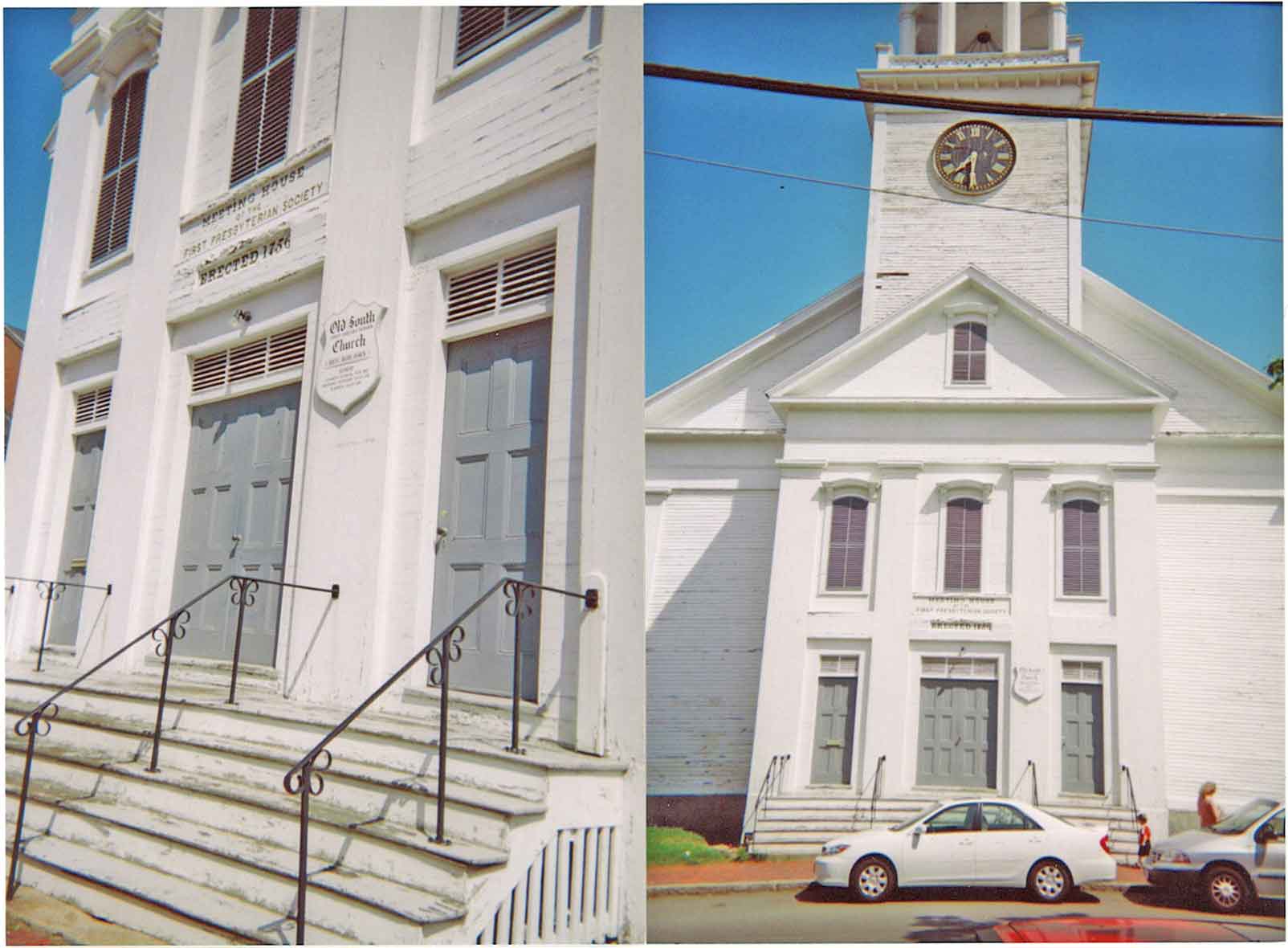
Offers came at once to bury him elsewhere. A Portsmouth gentleman offered his own new tomb, and men from Boston asked for the body. Parsons refused both, because, as the Memoirs explain, "Whitefield had repeatedly desired that he might be buried before Mr. Parsons' pulpit, if he died at Newburyport."1 On October 2, 1770, after the bells of the town had tolled and the ships in the harbor had flown their signals of mourning, he was buried in a vault beneath the pulpit of the Presbyterian church, now known as the Old South Presbyterian Church.12 His will had asked that his body be "buried in the most plain and decent manner."14

Phillis Wheatley's elegy
Among the many elegies printed in 1770 was one by a young enslaved woman in Boston, Phillis Wheatley, then about seventeen, who belonged to the household of John Wheatley. It made her name known in America and in Britain. Her life and her later volume, Poems on Various Subjects, Religious and Moral (London, 1773), are the subject of Liberty module 54, lesson 21. The version printed in that 1773 volume, "On the Death of the Rev. Mr. George Whitefield. 1770," begins:
"Hail, happy saint, on thine immortal throne,
Possest of glory, life, and bliss unknown;
We hear no more the music of thy tongue,
Thy wonted auditories cease to throng."23
In the poem's central passage Wheatley gives Whitefield a direct invitation to her own people:
"Take him, ye wretched, for your only good,
Take him ye starving sinners, for your food;
Ye thirsty, come to this life-giving stream,
Ye preachers, take him for your joyful theme;
Take him my dear Americans, he said,
Be your complaints on his kind bosom laid:
Take him, ye Africans, he longs for you,
Impartial Saviour is his title due:
Wash'd in the fountain of redeeming blood,
You shall be sons, and kings, and priests to God."23
The poem also addresses the "Great Countess," the Countess of Huntingdon, "to whom Mr. Whitefield was Chaplain," and mourns that "the Orphans mourn, / Their more than father will no more return."23 It is a Christian woman held in slavery praising, as the gospel's message to Africans, the preaching of a man who held slaves and had argued for slavery in Georgia. Wheatley's poem is evidence of how Whitefield's preaching was heard by Black Christians; it is also evidence that his record cannot be summed up in one sentence.
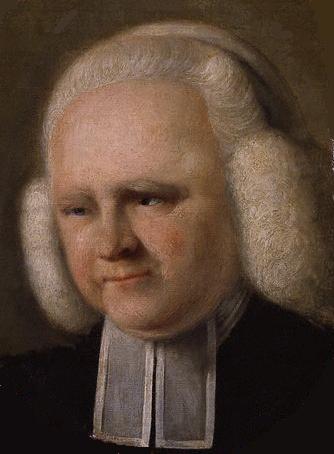

Whitefield and the revival as a whole
Whitefield did not start the colonial revivals. Northampton's awakening came five years before his arrival, and the Tennents' preaching in New Jersey and Pennsylvania was already producing revivals in the 1730s. What he added was connection. His tours linked Presbyterians in the Middle Colonies with Congregationalists in New England and with Anglicans and dissenters in the South; his Journals and the newspapers that reported them let readers in one colony follow the revival in another; and his collections for Bethesda made giving to a distant cause a habit for many colonists. He also gave the revival's critics their main target, because his attacks on unconverted ministers, his itinerancy across parish lines and the emotion of his meetings were exactly what the Old Lights and Old Side objected to (lesson 04).
Whether his career was the high point of one "Great Awakening" or the most visible part of a series of local revivals later joined into one story by their promoters is the question Frank Lambert and Jon Butler put to the older histories, and Thomas Kidd answered. That argument, and the further question whether the revival had anything to do with the Revolution, are taken up in lesson 06.
What the record shows and what it does not
- Documented fact: Whitefield was born at Gloucester in December 1714, was ordained deacon in 1736 and priest in January 1739, began field preaching at Kingswood on February 17, 1739, made seven visits to America, founded Bethesda near Savannah in 1740, and died at Newburyport on September 30, 1770.21
- Documented fact: his letter of January 23, 1740 condemned planters' cruelty but declined to judge whether buying slaves was lawful; his letter of March 22, 1751 affirmed the lawfulness of slavery and argued that Georgia needed it; his will left "negroes" at Bethesda to the Countess of Huntingdon.151914
- Documented fact: Franklin printed his works, heard him often, gave to his collection against his own intention, calculated that more than thirty thousand could hear him on Market Street, and never accepted his faith.9
- The preacher's own claim: crowd figures of "near twenty thousand" at Kingswood and Boston and above twenty thousand in London are Whitefield's or his biographer's estimates, not counts.15
- Later recollection: the prayer "weary in thy work, but not of thy work" before the Exeter sermon is reported by his traveling companion Richard Smith after Whitefield's death.1
- Scholarly reading: Stout's "divine dramatist," Lambert's "pedlar in divinity" and Kidd's "spiritual founding father" are interpretations of the same records, each attributed by name.31113
- Open question: how many people actually stood in his largest crowds, and how many lasting conversions followed, cannot be known; the 2013 acoustic study sets limits but not numbers.4
Claims checked
"Whitefield could be heard by 30,000 people at once."
Rating: Partly supported. The figure is Franklin's, and Franklin says exactly what it is: a calculation that "he might well be heard by more than thirty thousand," made by walking backward down Market Street and assuming a semicircle of listeners at two square feet each.9 It is a statement about how far a voice carried, not a count of a crowd. The 2013 acoustic reconstruction by Boren and Roginska found Franklin's method "fairly accurate" but his crowd "overly dense," and concluded that some reported London crowds (sixty and eighty thousand) were too large to have heard him, while fifty thousand at Kennington was possible "under optimal conditions."4 A crowd of tens of thousands could hear him in open ground; that any particular crowd numbered thirty thousand is not shown.
"Twenty thousand people heard his farewell sermon on Boston Common."
Rating: Unresolved. Whitefield's Journal says he preached on October 12, 1740 to "as was computed, near 20,000 People."5 No one recorded who computed it or how. The number is an eyewitness estimate by an interested party. Boston itself is usually estimated to have had only about sixteen or seventeen thousand inhabitants in the early 1740s (a figure not checked against a primary census for this lesson), so a crowd of that size would have needed many people from the surrounding towns, or the estimate is high. Both may be true.
"Benjamin Franklin was converted by Whitefield's preaching."
Rating: Refuted. Franklin wrote that Whitefield "us'd, indeed, sometimes to pray for my conversion, but never had the satisfaction of believing that his prayers were heard. Ours was a mere civil friendship."9 Franklin was moved to give money, admired Whitefield's honesty and voice, and printed his works. He did not profess the faith Whitefield preached.
"Whitefield was an early opponent of slavery."
Rating: Refuted. His 1740 letter condemned cruelty and neglect but said of the lawfulness of buying slaves, "I shall not take upon me to determine."15 By 1751 he wrote, "As for the lawfulness of keeping slaves, I have no doubt," argued that "hot countries cannot be cultivated without negroes," and wished to "purchase a good number of them."19 He held enslaved people on a South Carolina plantation and at Bethesda, and his will left "negroes" with the orphan house.1814 What is true is that he insisted on their spiritual equality and their right to be taught the gospel, and denounced their abuse in strong terms.
"Whitefield brought slavery to Georgia."
Rating: Partly supported. The decision belonged to the Georgia trustees and Parliament, which permitted slavery from January 1, 1751 after years of pressure from settlers.17 Whitefield was one of the most prominent advocates of that change, wrote that he "was strongly importuned" to use slaves before it was lawful but refused "till the use of them was publicly allowed," and then acquired enslaved workers for Bethesda.1918 He helped bring it about; he did not do it alone.
"Whitefield could make an audience weep by saying the word 'Mesopotamia.'"
Rating: Unsupported. The saying is usually attributed to the actor David Garrick, as praise of Whitefield's voice. No contemporary document opened for this lesson records Garrick saying it, and it appears in later collections of anecdotes. It may reflect a real opinion of Whitefield's delivery, which Franklin compared to "an excellent piece of musick," but the anecdote itself is unverified.9
"The University of Pennsylvania began with Whitefield."
Rating: Partly supported. The hall built for Whitefield's preaching in 1740, held in trust for any preacher, became the first home of the Academy and College of Philadelphia, and the university's own reckoning of its founding date (1740) rests on that trust.910 Whitefield did not found the academy; Franklin and the academy's trustees did, in the 1750s, using the building.
"Whitefield and Wesley became enemies over predestination."
Rating: Refuted. Their public dispute of 1740 and 1741 was sharp, and it produced two Methodist movements.62 But the two men were reconciled, and Wesley preached Whitefield's funeral sermon in London on November 18, 1770, asking whether anyone since the apostles had "called so many thousands, so many myriads of sinners to repentance."22
"Whitefield's last prayer was 'Lord Jesus, I am weary in thy work, but not of thy work.'"
Rating: Partly supported. The words are reported by Richard Smith, his traveling companion, in the account printed in the Memoirs, as spoken before the Exeter sermon on September 29, 1770, the day before he died.1 They are a companion's recollection, not something Whitefield wrote, and they were not his last words.
"Whitefield founded the Methodist Church in America."
Rating: Refuted. American Methodism came from Wesley's preachers, organized in 1784 under Francis Asbury and Thomas Coke (Module 80, lesson 07). Whitefield organized the Calvinistic Methodists in Britain in 1743, but in America his converts joined existing Presbyterian, Congregational, Baptist and Anglican churches.2
Hard questions and answers
A Wesleyan asks: how could a Calvinist who believed in unconditional election urge everyone to repent?
Whitefield's answer, in his letter to Wesley, was that the doctrine of election does not tell a preacher who the elect are, so the gospel must be offered to all, and God uses that preaching to call his own. He held that the offer is sincere because God commands all to repent, and that the result belongs to God's "sovereign distinguishing love."6 Wesley's reply, in "Free Grace," was that if the decree is fixed then preaching cannot change anyone's state, and that a doctrine which makes God will the damnation of some makes him "more false, more cruel, more unjust" than the devil.20 Each side found the other's position self-contradictory, and the dispute is laid out more fully in Module 80, lesson 03. In practice both men preached to everyone in the field, and both called for immediate repentance.
A skeptic asks: was Whitefield simply a brilliant performer and marketer?
The evidence for performance and publicity is strong: a boyhood in school plays, a voice trained by repetition that Franklin compared to music, advance notices and newspaper reports, and subscription sales of sermons and journals.1911 Stout and Lambert built their books on that evidence.311 But the same records show a man who lived in debt for an orphan house, whose honesty with money Franklin, a skeptic, defended in print, and who wrote privately of his conversion and his fears in the same terms he used in public.91 Kidd's reading, that the methods served convictions he really held, is consistent with those private sources.13 A historian can show his methods; whether his hearers were converted by God or by technique is a theological question the records cannot settle.
An Anglican asks: was Whitefield a loyal clergyman of the Church of England?
He remained an ordained priest of the Church of England all his life, appealed constantly to its Articles and Homilies, and accused Wesley of denying the ninth, tenth and seventeenth Articles.6 But he preached in other men's parishes without leave, in dissenting meetinghouses and in the fields, and he told congregations that many of their clergy were unconverted.112 Commissary Garden at Charleston and the chancellor of Bristol both treated that as a breach of church order.21 The fair answer is that Whitefield was loyal to the Church's doctrine as he read it and disregarded much of its discipline.
A reader asks: is it fair to judge an eighteenth century preacher by later standards on slavery?
The question can be answered from Whitefield's own century. In 1740 he himself wrote that God "has a quarrel" with the planters and that Black and white people are "just as much, and no more, conceived and born in sin."15 Quakers in Pennsylvania were already arguing that slaveholding was itself a sin, and Whitefield's own letter of 1751 called the slave trade "a trade not to be approved of" while defending slavery.1819 Within a generation, Samuel Hopkins and other New Divinity preachers who had been formed in the same revival condemned slavery outright (lesson 07). So the standard by which his record is measured was available to him and to his contemporaries. This lesson states what he wrote and did and leaves the verdict to the reader.
An Old Light asks: were the crowds evidence of a work of God or of mass excitement?
Whitefield's opponents in 1740s Boston, above all Charles Chauncy, argued that the outcries and faintings at revival meetings were the effects of the passions and of an itinerant's influence, not of the Spirit (lesson 04). Whitefield's Journal answers by pointing to changed lives, such as the Kingswood colliers and the people who came to him after sermons "under deep Convictions."15 Franklin, who was neither a revivalist nor an Old Light, recorded a visible change in Philadelphia's manners in 1739 and 1740.9 Jonathan Edwards's attempt to state tests for telling the two apart is the subject of lesson 02 (The Distinguishing Marks, 1741) and lesson 05 (Religious Affections, 1746).
A reader asks: why did Black Americans respond to a preacher who defended slavery?
Wheatley's elegy gives one answer in her own words: she heard in Whitefield's preaching an "Impartial Saviour" who "longs for you," and the promise that Africans washed in Christ's blood "shall be sons, and kings, and priests to God."23 His 1740 letter, which told masters that their slaves were their spiritual equals and must be taught, was itself unusual for its time.15 The gospel he preached gave enslaved hearers a standing before God that no master could take away, even though Whitefield did not apply it to their legal condition. Later Black Christians, from the Methodist and Baptist churches of the revolutionary era to Richard Allen's African Methodist Episcopal Church (lesson 08), drew conclusions from that gospel that Whitefield himself did not draw.
Where to go next
- Lesson 02: Edwards at Northampton and the revival of 1740 to 1742.
- Lesson 04: Gilbert Tennent, the Old Lights and New Lights, Old Side and New Side.
- Lesson 06: The Awakening and the Revolution: the case for and against a link.
- Module 80, lesson 03: Calvinism and Arminianism, for the doctrines behind the Whitefield and Wesley split.
- Module 80, lesson 07: Methodists and the Holiness lines.
- Module 77, lesson 03: Evangelicalism defined, for Bebbington's definition, which many historians test against Whitefield's career.
- Liberty module 54, lesson 21: Phillis Wheatley.
Learn more
- Franklin's Autobiography, the Whitefield chapter: Read the whole passage on Whitefield, including the parts on his writings and the lodging exchange, in Franklin's own words.
- Whitefield's Journals (1756 revised edition): His own day-by-day record of the 1739 to 1741 American tour, with his crowd figures.
- Whitefield's letter to the southern colonies (Works, vol. 4): The full 1740 letter on the treatment of enslaved people, and the letter to Wesley on predestination, in the same volume.
- Wesley, Free Grace: The sermon that began the public dispute, to read beside Whitefield's answer.
- Kidd on Whitefield's 1740 letter (Encyclopedia Virginia): A short scholarly account of the letter and of Whitefield's later slaveholding.
- Gates Cambridge on the acoustic study of Whitefield's crowds: How modern acoustics tested Franklin's calculation and the London crowd reports.
Still being checked (12 items)
These points could not be confirmed against a primary source when this lesson was written and fact checked in October 2026. The text above states each one as uncertain.
- The date of Whitefield's ordination as deacon is given in the text as the traditional Trinity Sunday, June 20, 1736; the sources opened (Gillies; New Georgia Encyclopedia) confirm only 1736.
- The years of the third to fifth American visits (1744 to 1748, 1751 to 1752, 1754 to 1755) follow the usual chronology of his biographers; Gillies confirms the end of the third (Bermuda 1748, London July 1748) and of the sixth (landed in England July 5, 1765), but the exact start dates were not checked.
- The crowd figure 'upwards of 10,000' at Philadelphia in April 1740 is read from a damaged OCR scan of the 1756 Journal ('iccoo').
- The date of Franklin's Market Street measurement is not given by Franklin; it is not known which courthouse-steps sermon he measured.
- Boston's population in the early 1740s (about sixteen to seventeen thousand) is a common estimate not checked against a primary census for this lesson.
- The number of enslaved people at Bethesda in 1770 (about fifty) comes from the Penn and Slavery Project, which cites no source; the will names no number.
- The interpretations of Stout (1991), Lambert (1994) and Kidd (2014) are summarized from the general argument of the books, which were not reopened for this lesson; no sentence from them is quoted.
- Stephen J. Stein's 1973 article was cited through Kidd's Encyclopedia Virginia entry and was not opened.
- The 'Mesopotamia' anecdote attributed to David Garrick was not traced to a contemporary source and is rated Unsupported.
- That the university's 1740 founding date rests on the trust for the New Building is stated from general knowledge of Penn's reckoning; the Penn and Slavery page confirms only that the building became the college's first campus.
- Phillis Wheatley's elegy was first printed as a broadside in Boston in 1770; the text quoted is the revised 1773 version, and the broadside wording was not compared.
- The place from which the March 22, 1751 letter to "Mr. B" was written is garbled in the OCR of the Works and is not stated in the text.
Notes
- John Gillies, Memoirs of Rev. George Whitefield, revised and corrected with large additions and improvements (Middletown, Conn.: Hunt and Co., 1841; this revision copyrighted 1834; Gillies's first edition London, 1772), chapters 1 to 5 (birth, Oxford, conversion, ordination, Kingswood, London field preaching, pp. 11 to 42) and pp. 209 to 211, 234 to 235 (the last journey, death and burial), Internet Archive copy from Columbia University Libraries (retrieved Oct. 28, 2026). Read it online. ↩
- Frederick V. Mills, "George Whitefield (1714 to 1770)," New Georgia Encyclopedia (Georgia Humanities), originally published Jan. 20, 2006, last edited June 6, 2017 (retrieved Oct. 28, 2026). Read it online. ↩
- Harry S. Stout, The Divine Dramatist: George Whitefield and the Rise of Modern Evangelicalism (Grand Rapids: Eerdmans, 1991). Interpretation summarized and attributed; book not quoted. Read it online. ↩
- Gates Cambridge, "Talking to the multitude," news item of Dec. 20, 2013, reporting the acoustic study of Whitefield's crowds by Braxton Boren and Agnieszka Roginska (New York University) presented to the Acoustical Society of America, San Francisco, December 2013 (retrieved Oct. 28, 2026). Read it online. ↩
- George Whitefield, The Two First Parts of His Life, with His Journals, Revised, Corrected, and Abridged (London, 1756), journal entries for Oct. 30, 1739 to Dec. 1740 (Philadelphia, Neshaminy, Germantown, the southern journey, Savannah Jan. 11, 1740, Boston Sept. and Oct. 1740, Northampton Oct. 17 to 19, 1740), Internet Archive scan (retrieved Oct. 28, 2026). Read it online. ↩
- George Whitefield, A Letter to the Reverend Mr. John Wesley: In Answer to His Sermon, Entituled, Free-Grace, dated Bethesda in Georgia, Dec. 24, 1740, with Wesley's letter to Whitefield of London, Aug. 9, 1740 printed in its preface, in The Works of the Reverend George Whitefield, vol. 4 (London: Edward and Charles Dilly, 1771), pp. 51 ff., Internet Archive scan (retrieved Oct. 28, 2026). Read it online. ↩
- Thomas S. Kidd, "'Letter to the Inhabitants of Maryland, Virginia, North and South Carolina' (1740)," Encyclopedia Virginia (Virginia Humanities), Dec. 7, 2020, with its further reading list (Kidd, The Great Awakening, 2007; Stephen J. Stein, 1973; Harry S. Stout, 1991) (retrieved Oct. 28, 2026). Read it online. ↩
- The Holy Bible, King James Version (1611; public domain): John 3:3 and 3:7; John 5:2 to 9; Jeremiah 6:14; 2 Corinthians 13:5. Project Gutenberg text (retrieved Oct. 28, 2026). Read it online. ↩
- Benjamin Franklin, The Autobiography of Benjamin Franklin (written 1771 to 1790), annotated edition, Project Gutenberg eBook no. 20203, the section beginning "In 1739 arrived among us from Ireland the Reverend Mr. Whitefield" through the remarks on his writings (retrieved Oct. 28, 2026). Read it online. ↩
- University of Pennsylvania Archives, Penn and Slavery Project, "George Whitefield," July 10, 2025 (on the building at Fourth and Arch Streets, Whitefield's slaveholding and will, the 1919 statue and the 2020 decision to remove it) (retrieved Oct. 28, 2026). Read it online. ↩
- Frank Lambert, "Pedlar in Divinity": George Whitefield and the Transatlantic Revivals, 1737 to 1770 (Princeton: Princeton University Press, 1994); see also Lambert, Inventing the "Great Awakening" (Princeton University Press, 1999). Interpretation summarized and attributed; books not quoted. Read it online. ↩
- George Whitefield, "The Method of Grace," sermon on Jeremiah 6:14, printed as Sermon XIV in the appendix of sermons to Gillies, Memoirs of Rev. George Whitefield (Middletown, 1841), p. 454, Internet Archive scan (retrieved Oct. 28, 2026). Read it online. ↩
- Thomas S. Kidd, George Whitefield: America's Spiritual Founding Father (New Haven: Yale University Press, 2014). Interpretation summarized and attributed; book not quoted. Read it online. ↩
- Last will and testament of George Whitefield, made at the Orphan House academy, Georgia, and proved after his death; copy certified at Savannah, Dec. 10, 1770, by Gov. James Wright and Deputy Secretary Thomas Moodie, printed in the appendix to Gillies, Memoirs of Rev. George Whitefield (Middletown, 1841), pp. 289 to 291, Internet Archive scan (retrieved Oct. 28, 2026). Read it online. ↩
- George Whitefield, "A Letter to the Inhabitants of Maryland, Virginia, North and South-Carolina," dated Savannah, Jan. 23, 1740, in The Works of the Reverend George Whitefield, vol. 4 (London: Edward and Charles Dilly, 1771), pp. 35 to 41; first printed in Three Letters from the Reverend Mr. G. Whitefield (Philadelphia: B. Franklin, 1740). Quoted from the Internet Archive scan of the 1771 Works, long s modernized (retrieved Oct. 28, 2026). Read it online. ↩
- Stephen J. Stein, "George Whitefield on Slavery: Some New Evidence," Church History 42, no. 2 (June 1973): 243 to 256, as cited by Kidd in Encyclopedia Virginia. Not opened for this lesson. Read it online. ↩
- Betty Wood, "Slavery in Colonial Georgia," New Georgia Encyclopedia (Georgia Humanities), originally published Sept. 19, 2002, last edited July 27, 2021 (retrieved Oct. 28, 2026). Read it online. ↩
- Mark Galli, "Slaveholding Evangelist," Christian History, issue 38 (George Whitefield), 1993, Christian History Institute (quoting Whitefield's letters of the 1740s) (retrieved Oct. 28, 2026). Read it online. ↩
- George Whitefield to "Mr. B," March 22, 1751, letter DCCCLXXXVII, in The Works of the Reverend George Whitefield, vol. 2 (London: Edward and Charles Dilly, 1771), pp. 404 to 405, Internet Archive scan, long s modernized (retrieved Oct. 28, 2026). Read it online. ↩
- John Wesley, Sermon 128, "Free Grace" (Romans 8:32; preached and published 1739), text of Thomas Jackson's 1872 edition, Wesley Center Online, Northwest Nazarene University (retrieved Oct. 28, 2026). Read it online. ↩
- John Calvin, Institutes of the Christian Religion, trans. Henry Beveridge (Edinburgh: Calvin Translation Society, 1845), book 3, chapter 23, section 7, Christian Classics Ethereal Library (retrieved Oct. 28, 2026). Read it online. ↩
- Gillies, Memoirs of Rev. George Whitefield (Middletown, 1841), pp. 234 to 235 (Wesley's funeral sermon of Sunday, Nov. 18, 1770 at the Tottenham Court Road chapel and the Tabernacle, on Numbers 23:10) and p. 271 (the passage of the sermon quoted), Internet Archive scan (retrieved Oct. 28, 2026). Read it online. ↩
- Phillis Wheatley, "On the Death of the Rev. Mr. George Whitefield. 1770," in Poems on Various Subjects, Religious and Moral (London, 1773), Project Gutenberg eBook no. 409 (retrieved Oct. 28, 2026). Read it online. ↩
- George Whitefield to the Trustees of Georgia, Gloucester, Dec. 6, 1748 (letter DCCXIV), and to "a generous Benefactor unknown," Charleston, March 15, 1747 (letter DLXXXII), in The Works of the Reverend George Whitefield, vol. 2 (London: Edward and Charles Dilly, 1771), Internet Archive scan (retrieved Oct. 28, 2026). The 1771 text reads "had a negroe been allowed" and "One negroe has been given me"; Galli modernizes the spelling. Read it online. ↩
Check yourself
1. Where and when did Whitefield first preach in the open air, according to Gillies's Memoirs?
The Memoirs date his first field sermon to the afternoon of Saturday, February 17, 1739, on a mound at Rose Green, Kingswood, to the coal miners.
2. What did Franklin's figure of 'more than thirty thousand' actually measure?
Franklin walked backward until the voice faded near Front Street, imagined a semicircle of that radius filled at two square feet per person, and computed that more than thirty thousand could hear.
3. In his 1740 letter to the southern colonies, what did Whitefield say about whether it was lawful for Christians to buy slaves?
He wrote, "I shall not take upon me to determine" the lawfulness of buying slaves, but "sure I am it is sinful, when bought, to use them as bad as, nay worse than brutes." The Abraham argument came in his 1751 letter.
4. From what date did Parliament permit slavery in Georgia, at the trustees' request?
Betty Wood records that the trustees asked the House of Commons to replace the act of 1735 with one permitting slavery from January 1, 1751.
5. What did Franklin end up giving to Whitefield's collection for the orphan house?
He resolved to give nothing, softened to the coppers, then the silver, and "empty'd my pocket wholly into the collector's dish, gold and all."
6. Which sermon of John Wesley did Whitefield answer in his letter dated Bethesda, December 24, 1740?
Whitefield's letter was an answer to Wesley's sermon Free Grace, which argued that God's grace is "FREE IN ALL, and FREE FOR ALL."
7. Where is Whitefield buried?
He had asked to be buried before Jonathan Parsons's pulpit if he died at Newburyport, and he was buried there on October 2, 1770.
8. Which historian's book called Whitefield 'The Divine Dramatist' and stressed his use of theatrical technique?
Harry S. Stout's The Divine Dramatist (1991) argued that Whitefield joined stage technique to the Puritan sermon; Lambert stressed marketing, and Kidd his convictions.
Terms in this lesson
- Field preaching
- Preaching in the open air, outside a consecrated church. Irregular in the Church of England, it became Whitefield's method after February 1739 at Kingswood.
- Itinerancy
- Traveling from place to place to preach, without being the settled minister of a parish. Critics saw it as an invasion of other ministers' parishes.
- New birth
- Regeneration: the inward change by which, in evangelical preaching, a person becomes a true Christian (John 3:3). Whitefield's central theme.
- Holy Club
- The nickname given at Oxford to the small society around John and Charles Wesley, which Whitefield joined; its members were also mocked as Methodists.
- Servitor
- A poor Oxford student who paid for his education by waiting on wealthier students. Whitefield entered Pembroke College as a servitor in 1732.
- Bethesda
- Whitefield's orphan house near Savannah, Georgia, begun in 1740 on a 500 acre grant, later an academy; it continues as Bethesda Academy.
- The New Building
- The hall 100 by 70 feet built in Philadelphia in 1740 for Whitefield's preaching and held in trust for any preacher; later the first home of the Academy and College of Philadelphia.
- Calvinistic Methodists
- The branch of the evangelical revival in Britain led by Whitefield (and in Wales by Howell Harris and Daniel Rowland), which held Calvinist doctrines of election, organized at a conference on January 5, 1743.
- Free grace
- In Wesley's sermon of 1739, the teaching that God's grace is "free in all, and free for all"; Wesley used it against unconditional election.
- Unconditional election
- The Calvinist teaching that God chose some for salvation from eternity, not on the basis of foreseen faith or works. Whitefield defended it against Wesley.
- Commissary
- A clergyman acting for the bishop of London in a colony, such as Alexander Garden at Charleston, who tried to discipline Whitefield in 1740.
- Crowd estimate
- A figure for an audience given by an eyewitness or a reporter without a count. All reported figures for Whitefield's crowds are estimates.
Sources
- Benjamin Franklin, The Autobiography of Benjamin Franklin (Project Gutenberg 20203) (written 1771 to 1790) checked 2026-10
- George Whitefield, The Two First Parts of His Life, with His Journals, Revised (1756) (1756) checked 2026-10
- The Works of the Reverend George Whitefield, vol. 2 (letters) (1771) checked 2026-10
- The Works of the Reverend George Whitefield, vol. 4 (tracts: letter to the southern colonies, letter to Wesley) (1771) checked 2026-10
- John Gillies, Memoirs of Rev. George Whitefield, revised edition, with his will and sermons (1834 (1841 printing)) checked 2026-10
- John Wesley, Sermon 128, Free Grace (Wesley Center Online) (1739 (1872 edition)) checked 2026-10
- Phillis Wheatley, Poems on Various Subjects, Religious and Moral (Project Gutenberg 409) (1773) checked 2026-10
- John Calvin, Institutes of the Christian Religion, trans. Beveridge, book 3, chapter 23 (CCEL) (1559 (trans. 1845)) checked 2026-10
- The Holy Bible, King James Version (Project Gutenberg 10) (1611) checked 2026-10
- Frederick V. Mills, George Whitefield, New Georgia Encyclopedia (2006, edited 2017) checked 2026-10
- Betty Wood, Slavery in Colonial Georgia, New Georgia Encyclopedia (2002, edited 2021) checked 2026-10
- Thomas S. Kidd, Letter to the Inhabitants of Maryland, Virginia, North and South Carolina (1740), Encyclopedia Virginia (2020) checked 2026-10
- Mark Galli, Slaveholding Evangelist, Christian History 38 (1993) checked 2026-10
- Penn and Slavery Project, George Whitefield (2025) checked 2026-10
- Gates Cambridge, Talking to the multitude (Boren and Roginska acoustic study) (2013-12-20) checked 2026-10
- Harry S. Stout, The Divine Dramatist (Eerdmans, 1991) (1991) checked 2026-10
- Frank Lambert, Pedlar in Divinity (Princeton, 1994) (1994) checked 2026-10
- Thomas S. Kidd, George Whitefield: America's Spiritual Founding Father (Yale, 2014) (2014) checked 2026-10