Lesson 6 of 14 · about 50 minutes · Updated October 28, 2026
The Great Awakening and the Revolution: The Case For and Against a Link, Isaac Backus and John Leland
You'll be able to
- State the case for a link between the Great Awakening and the Revolution in the words or close paraphrase of Heimert, Bonomi and McLoughlin, and the case against in those of Butler, Lambert, Wood, Hatch and Noll.
- Explain Thomas Kidd's middle position and why most recent historians reject a causal claim while accepting a link through religious liberty.
- Quote Isaac Backus's Appeal (1773) on "two kinds of government" and on taxation without representation, and describe the Carpenters' Hall conference of October 14, 1774 from both Adams's and Backus's records.
- Trace Virginia's path from the jailing of Baptist preachers to Madison's Memorial and Remonstrance (1785) and the Statute for Religious Freedom (1786), and separate the documented facts from the tradition of the 1788 Madison and Leland meeting.
- Read the Danbury Baptists' letter and Jefferson's reply of January 1, 1802 in their own words, with Hutson's findings about the draft.
- Date the end of the state establishments from North Carolina (1776) to Massachusetts (1833) and explain why the First Amendment did not end them.
Start here: the short version
Did the Great Awakening of the 1740s help bring on the American Revolution of the 1770s? Historians have argued the question for sixty years. Alan Heimert (Religion and the American Mind, 1966) argued that the revival's preachers taught colonists a language and a set of habits that fed directly into the patriot cause. Patricia Bonomi (Under the Cope of Heaven, 1986) argued that the Awakening's church quarrels trained ordinary people to challenge authority. Jon Butler (1982) answered that the "Great Awakening" was a later historians' construction, too scattered and too short to carry such weight, and Frank Lambert (1999) showed how the revivalists themselves built the idea of one great event through print. Gordon Wood and Nathan Hatch turned the arrow around: the Revolution, they argued, did more to shape American religion than the reverse. Thomas Kidd (God of Liberty, 2010) took a middle position: evangelicals did not cause the Revolution, but they shared its language of liberty and joined with deists such as Thomas Jefferson to win religious freedom. On one point the evidence is direct. The evangelical Baptists, many of them converts of the Awakening and its aftermath, led the campaign to end tax-supported churches. In Massachusetts, Isaac Backus wrote An Appeal to the Public for Religious Liberty (1773) and confronted the Massachusetts delegates to the Continental Congress in Philadelphia in October 1774. In Virginia, John Leland preached, was courted by James Madison in 1788, carried a 1,230 pound cheese to President Jefferson on January 1, 1802, and saw the Danbury Baptists' letter answered the same day with Jefferson's "wall of separation." The state establishments ended one by one, from North Carolina in 1776 to Massachusetts in 1833. This lesson sets out the case for a link, the case against, and the middle, and then follows the Baptists' fight for disestablishment in their own words.
The first five lessons of this module followed the revival itself: the colonial churches before 1730 (lesson 01), Edwards at Northampton (lesson 02), Whitefield's tours (lesson 03), the Old Light and New Light quarrels (lesson 04) and Edwards the thinker (lesson 05). This lesson asks what the revival had to do with the political upheaval that followed a generation later. It is a question where popular history and academic history often part company. Sermons, films and websites sometimes state as fact that the Great Awakening "caused" or "prepared the way for" the Revolution. Professional historians disagree sharply over whether the revival should even be called one event. The lesson gives each position in its authors' words or close paraphrase, with the evidence each relies on, and then turns to the one place where revival religion and revolutionary politics plainly met: the Baptist campaign against the established churches.
The constitutional story of the founding is taught in the Liberty modules: colonial self-government in Module 53, lesson 01, the Bill of Rights in Module 53, lesson 08, Madison in Module 55, lesson 01, and faith and self-government in Module 50, lesson 10. The Baptists as a denomination are introduced in Module 80, lesson 06. This lesson does not repeat those overviews. It reads the documents the Baptists and their opponents wrote.
The question and why it is hard
What a link would have to show
The revivals that historians group as the First Great Awakening were at their height in New England and the Middle Colonies between about 1739 and 1745. The Library of Congress exhibition on religion and the founding summarizes the standard view: the Awakening "had spent its force in New England by the mid-1740s," it split the Congregational and Presbyterian churches into New Lights and New Side on one hand and Old Lights and Old Side on the other, and "many New England New Lights became Separate Baptists," who with New Side Presbyterians "carried the Great Awakening into the southern colonies, igniting a series of the revivals that lasted well into the nineteenth century."1 The first shots of the Revolutionary War were fired at Lexington and Concord in April 1775, three decades after the New England revival had cooled. Any claim that the revival shaped the Revolution has to cross those thirty years.
A claim of influence could take several forms, and they should be kept apart. The strongest form says the revival caused the Revolution: without it, there would have been no independence. A weaker form says the revival supplied ideas (the equality of souls before God, the right of a congregation to choose its own minister, the duty to resist ungodly authority) that patriots later applied to politics. Another form says the revival supplied habits: itinerant preaching across colony lines, voluntary associations, mass meetings, and the experience of defying a parish minister or a colonial assembly. A fourth form says the revival supplied people: the generation converted in the 1740s and the Baptist and Separate churches it formed became, by the 1770s, a body of dissenters with grievances against the established churches and the governments that kept them. A fifth form looks at language: whether patriot preaching of the 1770s used the vocabulary of the revival (new birth, covenant, the millennium, Antichrist, the judgment of God on a sinful people). Each form needs different evidence. A sermon is evidence for language. A church record is evidence for people. A diary is evidence for habits. Only a careful comparison of who supported the Revolution and who did not could test the claim of cause.
The religious makeup of the patriot leadership complicates every form. The men most often named as leaders of the Revolution included Congregationalists of the old established churches (John and Samuel Adams), Anglicans (George Washington, Patrick Henry), a Presbyterian minister (John Witherspoon) and men whose personal beliefs drew on deism or rational religion (Thomas Jefferson, Benjamin Franklin). The Library of Congress exhibition notes that deism "found advocates among upper-class Americans," that "Conspicuous among them were Thomas Jefferson and John Adams," and that deists were "never more than 'a minority within a minority.'"1 The evangelical Baptists, who had the clearest grievances, were mostly people of small property who held few public offices before 1776.
What contemporaries said
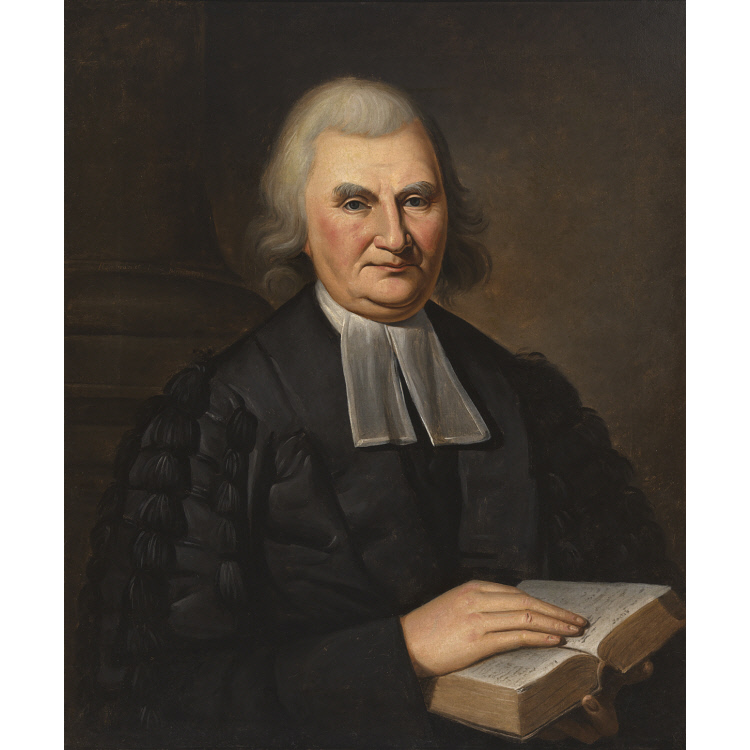
The idea of a religious cause for the Revolution is older than modern scholarship. Some Loyalists blamed the rebellion on religion. Joseph Galloway, a former speaker of the Pennsylvania Assembly who opposed independence and left for England in 1778, wrote in his Historical and Political Reflections on the Rise and Progress of the American Rebellion (London, 1780) that the conflict had been driven by Presbyterians and Congregationalists whose "principles of religion and polity [were] equally averse to those of the established Church and Government."2 Galloway named denominations, not the revival, and the denominations he named included the Old Light Congregationalists who had opposed the revival.
John Adams, looking back in a letter to the Baltimore editor Hezekiah Niles on February 13, 1818, gave the most quoted patriot statement on the question: "But what do We mean by the American Revolution? Do We mean the American War? The Revolution was effected before the War commenced. The Revolution was in the Minds and Hearts of the People. A Change in their Religious Sentiments of their Duties and Obligations."3 Adams's letter is often cited as testimony that religion was at the center of the Revolution. Read in its setting, it says that the colonists' sense of their duties changed, and Adams goes on in the same letter to describe how they stopped praying for the king and began praying for the Continental Congress, and a change in their "habitual Affection for England as their Mother-Country." He was a Congregationalist of the established church of Massachusetts, a church that Backus and the Baptists were fighting, and he did not name the revival.
Patriot ministers themselves preached the war as a religious cause. The Library of Congress exhibition quotes Abraham Keteltas's sermon God Arising and Pleading His People's Cause (Newburyport, 1777), which called the American cause "the cause of heaven against hell," and notes that some ministers believed America might become "the principal Seat of the glorious Kingdom which Christ shall erect upon Earth in the latter Days."2 Such millennial language had appeared in the revival preaching of the 1740s, and Jonathan Edwards had speculated in Some Thoughts Concerning the Present Revival (1742) that the latter-day glory might begin in America (see lesson 02). Whether the patriot preachers learned the language from the revival or from the older Puritan tradition both drew on is one of the questions historians dispute.

The case for a link
Alan Heimert: Religion and the American Mind (1966)
The modern case for a strong link was made by Alan Heimert of Harvard in Religion and the American Mind: From the Great Awakening to the Revolution (Harvard University Press, 1966).4 Heimert divided colonial ministers into two camps, the Calvinist evangelicals who supported the revival (Edwards and his New Light heirs) and the rationalist "liberals" who opposed it (Charles Chauncy and Jonathan Mayhew of Boston). Against the older view that the rational, Enlightenment-minded clergy had led the colonies toward independence, Heimert argued that the evangelical Calvinists had been the more radical and the more democratic party. Their preaching, he argued, carried a vision of a united people under God, a hope for the millennium, and a confidence in the judgment of ordinary converted people over the claims of learned and established elites, and this vision flowed into the patriot movement of the 1760s and 1770s. Heimert read evangelical sermons as political texts, often finding political meaning in what looked like purely religious language.
The book was criticized at once. Edmund S. Morgan, reviewing it in the William and Mary Quarterly (1967), objected that Heimert read hidden political meanings into sermons that did not state them, and other reviewers noted that Chauncy and Mayhew, the anti-revival ministers, were among the most outspoken patriots in Boston.4 Mayhew's Discourse Concerning Unlimited Submission (1750), which the Library of Congress exhibition calls "one of the most influential in American history," argued that resistance to a tyrant could be a Christian duty, and Mayhew was an opponent of the revival and of Calvinist orthodoxy.2 Heimert's defenders reply that he was tracing a broad cast of mind and not claiming that each revivalist became a patriot. His book remains the starting point for every later discussion.
Patricia Bonomi and the habits of dissent
Patricia Bonomi, in Under the Cope of Heaven: Religion, Society, and Politics in Colonial America (Oxford University Press, 1986), argued from church records and local quarrels more than from sermons.5 Her case was that the colonies were more religious in the eighteenth century than the older picture of "declension" allowed, that church life was the chief public life most colonists knew, and that the Awakening's disputes taught ordinary people to question and resist authority. When a congregation's New Light majority refused to hear an Old Light minister, or a group of Separates walked out of a parish church and formed their own, or a lay exhorter preached without a license, they were practicing on a small scale the kind of challenge to constituted authority that the Revolution would require on a large scale. The Library of Congress exhibition reflects this research in its summary that "scholars now identify a high level of religious energy in colonies after 1700," and quotes the estimate that "Between 1700 and 1740, an estimated 75 to 80 percent of the population attended churches."1 That attendance figure is a scholarly estimate from church and population records and should be read as an estimate.
Other historians have pointed to the voluntary associations that the revival created. Revival converts formed new churches by covenant, sent money to Whitefield's orphanage in Georgia, subscribed to the Christian History magazine, and organized concerts of prayer across colony lines. The Separate and Baptist churches that came out of the revival were voluntary societies supported by their members' gifts. The argument is that such experience made the idea of a government resting on the consent of its members easier to accept.
William McLoughlin and the Baptists
The historian who did most to connect the Awakening with the struggle for religious liberty was William G. McLoughlin of Brown University, who edited Backus's pamphlets and diary and wrote Isaac Backus and the American Pietistic Tradition (1967) and New England Dissent, 1630 to 1833: The Baptists and the Separation of Church and State (two volumes, Harvard University Press, 1971).6 McLoughlin argued that the Baptist case for separation came from the revival's pietism, the conviction that true religion is a matter of the converted heart, which no government can create or compel, and that it differed in its roots from the Enlightenment case made by Jefferson. In the words quoted in the Liberty Fund edition of Backus's Appeal, McLoughlin judged that Backus "was the most forceful and effective writer America produced on behalf of the pietistic or evangelical theory of separation of church and state."7 McLoughlin's work supports a narrow form of the link. The Awakening produced the Separates and Baptists; the Baptists produced the most persistent campaign against establishment; and that campaign shaped the religious settlement of the new states. It does not support the claim that the Awakening caused the war.
McLoughlin also wrote more broadly. In Revivals, Awakenings, and Reform (University of Chicago Press, 1978) he described American history as a series of "great awakenings," periods of cultural revitalization, and treated the First Great Awakening as a prelude to the Revolution. That broad scheme has been criticized as too neat, and its critics are taken up in lesson 14.6
The case against a link
Jon Butler: "The Great Awakening as Interpretative Fiction" (1982)
The sharpest challenge came from Jon Butler, later of Yale University, in an article in the Journal of American History for September 1982 titled "Enthusiasm Described and Decried: The Great Awakening as Interpretative Fiction."8 Butler did not deny that revivals happened. His argument was that historians had joined scattered, local and short-lived revivals in different colonies and different decades into a single "Great Awakening" that contemporaries did not experience as one event. The label itself, he pointed out, became standard only after Joseph Tracy published The Great Awakening in 1842, a century after the events, as part of a nineteenth century evangelical effort to give American revivalism a heroic past. Butler argued that the revivals were strongest in New England and parts of the Middle Colonies, weak or absent in much of the South before the 1760s, and over in most places by the mid-1740s. On those grounds he judged that the revival could not bear the weight historians had put on it as a cause of the Revolution, and that a link between them was, in his view, unproven and probably false. D. G. Hart, reviewing Kidd's book of 2007, summarized Butler's target as the way "nineteenth-century" pastors built a narrative of "great" awakenings led by Edwards and Whitefield.9
Butler extended the argument in Awash in a Sea of Faith: Christianizing the American People (Harvard University Press, 1990), which described the colonial period as one of steady church building by denominations and of widespread popular belief in magic and the occult, with religious energy that grew most rapidly after the Revolution. Christopher Grasso, a historian at the College of William and Mary, remarked at a 2013 conference in Butler's honor that the article had at least forced his students to put "the Great Awakening" in quotation marks.9
Frank Lambert: Inventing the "Great Awakening" (1999)
Frank Lambert of Purdue University, in Inventing the "Great Awakening" (Princeton University Press, 1999), took Butler's point in a different direction.10 Lambert agreed that the idea of a single great revival was constructed, but he argued that the revivalists of the 1740s constructed it themselves. Whitefield's managers advertised his tours in newspapers before he arrived. Thomas Prince Jr. of Boston published The Christian History (1743 to 1745), a weekly magazine of revival reports from New England, Scotland and England. Edwards's Faithful Narrative and his later defenses of the revival described a single "work of God" spreading from place to place. The revival's promoters, Lambert argued, used print to "invent" a great and general awakening, and in doing so they built a network of readers and correspondents across colony lines. Lambert's book cuts two ways. It supports Butler's skepticism about the label, and it supports the claim that the revival created new habits of communication that patriots later used.
Gordon Wood and Nathan Hatch: the reversed arrow
Gordon S. Wood, whose Creation of the American Republic (1969) and The Radicalism of the American Revolution (Alfred A. Knopf, 1992) are the standard accounts of revolutionary political thought, has been cautious about religious explanations of the Revolution's causes.11 Wood's work traces the patriots' ideas mainly to English opposition writers, classical republicanism and the Enlightenment, and it treats most of the revolutionary leaders as men of rational and moderate religion. At the same time Wood argued that the Revolution unleashed a democratic and popular culture that the leaders had not intended, and in the last part of The Radicalism of the American Revolution he describes the explosive growth of the Methodists and Baptists after 1790 as one of its results. On this reading the arrow of influence points mainly from the Revolution to religion.
Nathan O. Hatch made the same argument at length in The Democratization of American Christianity (Yale University Press, 1989).12 Hatch argued that the Revolution's language of equality and popular sovereignty was taken up after 1790 by preachers of new and rapidly growing movements (the Methodists, the Baptists, the Christian movement of Barton Stone and Alexander Campbell, the Black churches, and the Latter-day Saints), who rejected learned clergy and inherited creeds and appealed directly to ordinary people. Hatch's thesis connects the Revolution to the Second Great Awakening (lesson 08) more than it connects the First Awakening to the Revolution.
Mark Noll, in America's God: From Jonathan Edwards to Abraham Lincoln (Oxford University Press, 2002), argued that the evangelical Protestantism of the early republic was a new synthesis of three things that had not been combined before the Revolution: evangelical religion, republican political ideas, and the "common sense" moral reasoning of the Scottish Enlightenment.13 In Noll's account, the evangelical clergy of the 1770s took over republican language more than they supplied it, and the union of evangelical faith and republican politics was mostly a product of the decades after 1776. Scottish common sense philosophy is taught in Module 58, lesson 03.
The middle position: Thomas Kidd
Thomas S. Kidd of Baylor University (later of Midwestern Baptist Theological Seminary) answered Butler in The Great Awakening: The Roots of Evangelical Christianity in Colonial America (Yale University Press, 2007).14 Kidd argued that the revivals were real, widespread and connected, and that they deserve the name "great" because they produced the evangelical movement. He treated the Awakening as a long event running from the 1730s through the 1780s, so that the Separate Baptist revivals in Virginia and the Carolinas in the 1760s and 1770s belong to it. In D. G. Hart's summary, Kidd held that the revival "can be acknowledged as 'great' because it produced the evangelical movement," and his chapter on the Revolution argued that evangelicals "shared important affinities with the language and rhetoric of liberty," while lining up on both sides of the war.9
In God of Liberty: A Religious History of the American Revolution (Basic Books, 2010) Kidd developed the point.15 He argued that "public spirituality united revolutionary America," and identified a set of religious ideas that patriots of very different beliefs held in common: that the state churches should be disestablished, that a creator God was the source of basic human rights, that human sinfulness made unchecked power dangerous, that a republic required virtue, and that Providence acted in the affairs of nations. Carol Sue Humphrey, reviewing the book, noted that Kidd called the Great Awakening "the first American Revolution" because of its broad social effects and that he presented Jefferson and John Leland as allies whose different motives together made America "both intensely religious and religiously free."15 Kidd's position does not claim that the revival caused the war. It claims that the revival created the evangelical Protestants who, with the deists and rational Christians, wrote religious liberty into the new state and federal constitutions.
Most historians writing since 2000 take some version of this middle position. They treat the revival as real and important for American Protestantism, doubt that it can be shown to have caused the Revolution, and find its clearest political effect in the long fight for religious liberty that the Baptists and other dissenters carried on from the 1760s to the 1830s.
Where the evidence is direct: the Baptists
Whatever one concludes about causes of the war, one line from the revival to the new republic can be traced document by document. The revival produced Separate congregations in New England that left the established parish churches; many Separates became Baptists; Separate Baptist preachers from New England carried the revival to Virginia and the Carolinas; and the Baptists, who held that a church is a company of believers baptized on profession of faith and that no government may tax anyone to support a minister, became the most persistent enemies of the established churches. The Library of Congress exhibition states that the denominations that supported the Awakening and its evangelical emphasis, "Presbyterians, Baptists and Methodists," "became the largest American Protestant denominations by the first decades of the nineteenth century," while the opponents of the Awakening or those split by it, "Anglicans, Quakers, and Congregationalists," "were left behind."1 The two Baptists who did most in the campaign for religious liberty were Isaac Backus in New England and John Leland in Virginia and later Massachusetts. Their stories occupy the rest of this lesson.
Isaac Backus and New England
From New Light convert to Baptist pastor
Isaac Backus (1724 to 1806) was a child of the Awakening. Born in Norwich, Connecticut, he was converted in 1741 under the revival preaching associated with Eleazar Wheelock, joined the New Light Separates who left the established parish churches, and for about a decade was a Separate Congregationalist preacher. In 1756 he became pastor of a Baptist church at Middleborough, Massachusetts, and remained its pastor until his death fifty years later.7 The editors of the Liberty Fund collection that reprints his Appeal record that he calculated that between 1748 and 1802 he had made 918 journeys of more than ten miles each and traveled a total of 68,600 miles, mostly on horseback, a figure that comes from his own count.7 He also wrote a three volume History of New-England with Particular Reference to the Denomination of Christians Called Baptists (1777 to 1796), which remains a primary source for the period.
Backus's path from New Light to Baptist was common. The Separates held that a church should admit only those who could give evidence of conversion; once they had rejected the parish system on those grounds, many of them came to doubt infant baptism, which brought into the church children who had made no profession of faith. To the established Congregational ministers this was schism twice over. To Backus it was obedience. His theology remained Calvinist. He held the doctrines of grace as firmly as Edwards did, and the Baptists of his association were Calvinistic (often called Regular or Particular) Baptists.
The Warren Association and its grievance committee
In 1767 several Baptist churches formed the Warren Association, named for the town of Warren, Rhode Island, where Rhode Island College (later Brown University) was then located. Backus was chosen clerk of the first meeting and wrote its minutes, which open: "Whereas there hath of late years been a great increase of Baptist churches in New England, which yet have not such an acquaintance with each other and orderly union together as ought to be, it has been thought by many that a general meeting or association might be a likely means to remove this evil and to promote the general good of the churches." The meeting was held "at Warren in Rhode Island colony, on September 8, 1767."16 Alvah Hovey's Memoir of Backus (1858) records that the founding was "chiefly, it is said, by the efforts of James Manning," the college's president, and that eleven churches were represented at the first meeting.16
By 1769 the association was receiving complaints from member churches of "grievous oppressions and persecutions from the standing order; especially the one from Ashfield, where religious tyranny had been carried to great lengths," and it appointed a committee to draw up petitions to the legislatures of Massachusetts and Connecticut and to collect accounts of "well-attested grievances."16 The Liberty Fund editors note that Backus served from 1771 as the association's agent, "looking after all Baptist interests, somewhat like a modern lobbyist."7
What the Baptists were fighting: the certificate system
Massachusetts law required every town or parish to support a "learned orthodox" minister by tax. From the late 1720s the colony allowed Baptists, Quakers and Anglicans to be exempted from the ministerial tax if they filed certificates showing that they attended and supported a church of their own, an arrangement McLoughlin traces in detail in New England Dissent.6 In practice the exemption depended on local officials, who could reject a certificate, and on the wording the law required. Backus's Appeal states the Baptists' objection in a single sentence: "Their laws require us annually to certify to them, what our belief is concerning the conscience of every person that assembles with us, as the condition of their being exempted from taxes to other's worship." He reports that because the Baptists of Bellingham left out the clause about conscience, members of their society living at Mendon "were taxed, and lately suffered the spoiling of their goods to uphold pedobaptist worship."7 "Pedobaptist" meant a church that baptized infants, which in Massachusetts meant the established Congregational churches.
The case Backus pressed hardest was Ashfield, in western Massachusetts. In the Appeal he explains that the plantation (first called Huntstown) had been granted on condition that its proprietors settle a "learned orthodox minister" and build a meeting-house, that in 1761 "full two thirds of the inhabitants called and settled a minister," but that the minister and most of the settlers were Baptists. The colony's General Court passed a law that let the non-resident proprietors tax all lands for the Congregational meeting-house and minister, and Baptist land was sold for unpaid taxes. A committee of the General Court reported in 1771 that "in the sale of those lands there was no unfairness, but every thing was quite fair, quite neighbourly, and quite legal," and the House of Representatives voted to repeal the law but the Council refused; the law was overturned only when the king in council disallowed it.7 The Ashfield Baptists thus won their relief from the Crown against the colonial legislature, a fact that made the patriot leaders of Massachusetts uneasy when Backus later raised it in Philadelphia.
An Appeal to the Public for Religious Liberty (1773)
In 1773 Backus published An Appeal to the Public for Religious Liberty, Against the Oppressions of the Present Day, written for the Warren Association.7 Library catalogues describe its title page as carrying three lines from the Epistle to the Galatians, the letter in which Paul defends Christian liberty against those who would impose the ceremonies of the law of Moses on Gentile converts.17 It opens with a short essay on liberty and government: "Inasmuch as there appears to us a real need of such an appeal, we would previously offer a few thoughts concerning the general nature of liberty and government, and then shew wherein it appears to us, that our religious rights are encroached upon in this land."7
The heart of the Appeal is its account of two governments:
"God has appointed two kinds of government in the world, which are distinct in their nature, and ought never to be confounded together; one of which is called civil, the other ecclesiastical government."7
Backus then states the boundary between them: "the church is armed with light and truth, to pull down the strong holds of iniquity, and to gain souls to Christ, and into his church, to be governed by his rules therein; and again to exclude such from their communion, who will not be so governed; while the state is armed with the sword to guard the peace, and the civil rights of all persons and societies, and to punish those who violate the same." Where the two are kept apart, "the effects are happy, and they do not at all interfere with each other: but where they have been confounded together, no tongue nor pen can fully describe the mischiefs that have ensued."7 The argument is biblical and theological. Backus appeals to Christ's kingship and to the apostles, and he argues that support of ministers is an offering to God, which no legislature can command: "what government on earth ever had, or ever can have any power to make or execute any laws to appoint and enforce sacrifices to God!"7
Backus then turned the patriots' own slogan against them. The General Court's committee had answered an earlier Baptist petition by saying, as Backus quotes it, "There is an essential difference between persons being taxed where they are not represented, therefore against their wills, and being taxed when represented."7 Backus agreed, and drew the opposite conclusion: "We agree with the committee of our honored legislature in saying, there is an essential difference between persons being taxed where they are represented, and being taxed where they are not so; therefore the whole matter very much turns upon this point, viz. Whether our civil legislature are in truth our representatives in religious affairs, or not?"7 He then addressed his fellow colonists directly:
"You tell us you cannot, because you are taxed where you are not represented; and is it not really so with us? You do not deny the right of the British parliament to impose taxes within her own realm; only complain that she extends her taxing power beyond her proper limits; and have we not as good right to say you do the same thing? and so that wherein you judge others you condemn your selves? Can three thousand miles possibly fix such limits to taxing power, as the difference between civil and sacred matters has already done?"7
The certificate itself, Backus argued, was a tax: "as the present contest between Great-Britain and America, is not so much about the greatness of the taxes already laid, as about a submission to their taxing power; so (though what we have already suffered is far from being a trifle, yet) our greatest difficulty at present concerns the submitting to a taxing power in ecclesiastical affairs." The paper and the writing were the price of submission: "this tax we must pay every year, as a token of submission to their power."7 And the Baptists' case, unlike the colonists' quarrel over tea and stamps, "affects the conscience, as their's does not."7
The Appeal closes with an appeal to union: "And now our dear countrymen, we beseech you seriously to consider of these things. The great importance of a general union through this country, in order to the preservation of our liberties, has often been pleaded for with propriety; but how can such a union be expected so long as that dearest of all rights, equal liberty of conscience is not allowed?"7
Two features of the Appeal bear on the debate over the Awakening and the Revolution. The first is that Backus's starting point is the revival's doctrine of the church as a body of converted believers, joined to the Reformed teaching that Christ alone is king of the church. His reasons are Scripture and conscience, with the colonists' political slogans used as an argument from their own premises. The Liberty Fund editors observe that in 1773 he had "not yet reconciled" Lockean natural rights with the view of human depravity he held as a Calvinist.7 The second is that Backus wrote as a patriot. He did not ask the Crown to protect the Baptists against Massachusetts. He asked Massachusetts to be consistent.

Philadelphia, October 14, 1774
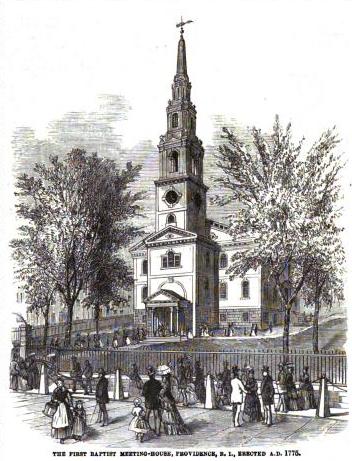
When the First Continental Congress met in Philadelphia in the autumn of 1774, the Warren Association sent Backus and James Manning to seek relief for the Baptists of Massachusetts. With the help of the Philadelphia Baptist Association and some Philadelphia Quakers, they arranged a meeting with the Massachusetts delegates at Carpenters' Hall on the evening of Friday, October 14. John Adams's diary entry for that day is brief:
"In the Evening We were invited to an Interview at Carpenters Hall, with the Quakers and Anabaptists. Mr. Bacchus is come here from Middleborough, with a design to apply to the Congress, for a Redress of the Grievances of the Antipaedobaptists in our Province. The Cases from Chelmsford, the Case of Mr. White of Haverhill, the Case of Ashfield and Warwick, were mentioned by Mr. Bacchus. Old Israel Pemberton was quite rude, and his Rudeness was resented. But the Conference which held till 11 O Clock, I hope will produce good."18
The editors of the Adams Papers note that "the fullest account" of the meeting is Backus's diary, as printed in Hovey's Memoir, and they summarize it: "The discussion was warm and lasted four hours"; and the editors suggest that "conservative Quakers, who were not disinclined to embarrass the radical Massachusetts delegates," had encouraged the Baptists to ask for the meeting.18 Backus's own account, as Hovey prints it, names the Massachusetts delegates present (Thomas Cushing, Samuel Adams, John Adams and Robert Treat Paine) and records that John and Samuel Adams both said, "There is, indeed, an ecclesiastical establishment in our province; but a very slender one, hardly to be called an establishment," and that Paine said, "There was nothing of conscience in the matter; it was only a contending about paying a little money."16 Backus answered:
"I told them they might call it enthusiasm or what they pleased; but I freely own, before all these gentlemen, that it is absolutely a point of conscience with me; for I cannot give in the certificates they require, without implicitly acknowledging that power in man which I believe belongs only to God. This shocked them; and Cushing said: 'It quite altered the case; for if it were a point of conscience, he had nothing to say to that.'"16
The conference closed "with their promising to do what they could for our relief," but Backus added that "John Adams, at one time, said we might as well expect a change in the solar system, as to expect they would give up their establishment."16 The remark comes from Backus's diary, not from Adams, and it is the testimony of one side of a heated meeting. Adams, writing his autobiography many years later, described the conference at greater length from memory.18 The Philadelphia Baptist committee recorded the next evening that "it did appear that the delegates from Boston were determined to support the claim the Legislature make to a right to make penal laws in matters of religion."16 The Adams Papers editors add that Paine told Ezra Stiles of the meeting on his way home, and that Stiles concluded that the Baptists, and Manning in particular, were allied with the Anglicans and hostile to the patriot cause.18 The suspicion that dissenters who appealed outside the colony were disloyal followed the Baptists through the war.
"Not the pence but the power" (1778)
The war did not end the Massachusetts establishment. In 1778 Backus read to the Warren Association another paper on religious liberty, published that year as Government and Liberty Described; and Ecclesiastical Tyranny Exposed (Boston: Powars and Willis, 1778), a reply in part to Phillips Payson's election sermon of May 27, 1778, which had warned the legislature against loosening the "restraints of religion."19 Backus quoted Charles Chauncy, the leading Old Light critic of the revival, who had argued in 1768 against a tax for Anglican bishops that "If the country might be taxed four pence in one hundred pounds, it might for the same reason and with as much justice ... be taxed four shillings, or four pounds." Backus agreed with Chauncy's logic and applied it to Chauncy's own church:
"True, doctor; there lies the difficulty. It is not the PENCE but the POWER, that alarms us."16
The phrase "not the pence but the power" became the summary of the Baptist position. In the same pamphlet Backus explained that the legislature had recently voted "to continue a tax of four pence a year upon the Baptists in every parish where they live, as an acknowledgment of the power" it claimed in religious affairs. The sum was small. The objection was to the claim of authority it represented.16

Massachusetts, 1780: Article III
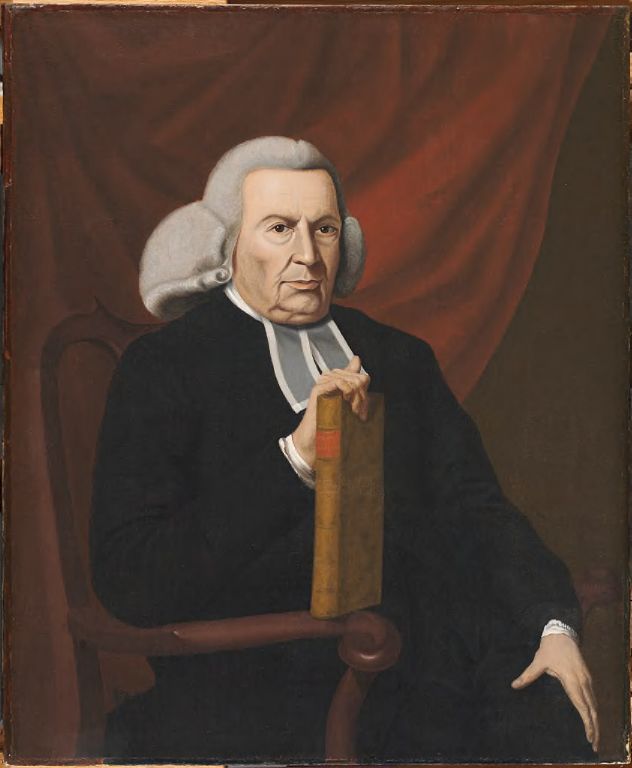
Massachusetts voters rejected a draft constitution in 1778, and a convention met in 1779 and 1780 to write another. Its Declaration of Rights included the article that the Baptists fought for the next fifty years. Article III began:
"As the happiness of a people, and the good order and preservation of civil government, essentially depend upon piety, religion and morality; and as these cannot be generally diffused through a community, but by the institution of the public worship of God, and of public instructions in piety, religion and morality: Therefore, to promote their happiness and to secure the good order and preservation of their government, the people of this commonwealth have a right to invest their legislature with power to authorize and require, and the legislature shall, from time to time, authorize and require, the several towns, parishes, precincts, and other bodies politic, or religious societies, to make suitable provision, at their own expense, for the institution of the public worship of God, and for the support and maintenance of public Protestant teachers of piety, religion and morality, in all cases where such provision shall not be made voluntarily."20
The article also allowed the legislature to "enjoin upon all the subjects an attendance upon the instructions of the public teachers aforesaid," gave each town and society "the exclusive right of electing their public teachers," and provided that a taxpayer's money "shall, if he require it, be uniformly applied to the support of the public teacher or teachers of his own religious sect or denomination, provided there be any on whose instructions he attends." It closed: "every denomination of Christians, demeaning themselves peaceably, and as good subjects of the commonwealth, shall be equally under the protection of the law: and no subordination of any one sect or denomination to another shall ever be established by law."20
Defenders of Article III, most of them Congregational ministers, said that it established no church: every Protestant denomination could receive its members' taxes, and none was placed above another. The Library of Congress exhibition calls it a "general religious tax to be directed to the church of a taxpayers' choice."19 Backus and the Baptists answered that the Congregational churches were the parish churches by default, that a dissenter's tax went to the parish minister unless he could prove he attended another, and that the principle of a tax for religion was the evil whatever church received it. The exhibition records that the convention declared the constitution adopted in 1780 "despite substantial doubt that Article Three had been approved by the required two thirds of the voters."19
The system lasted another half century. Leland, who returned to Massachusetts in 1791 and was elected to the legislature from Cheshire, took part in the campaign that produced the Religious Freedom Act of 1811, after a ruling by Chief Justice Theophilus Parsons that, as the 1845 editor of Leland's Writings put it, "no society, not incorporated by law, could claim even the pitiful privilege of drawing back money."21 Article III was finally replaced in 1833 by Article XI of the Amendments, which reads in part: "the several religious societies of this commonwealth, whether corporate or unincorporate, at any meeting legally warned and holden for that purpose, shall ever have the right to elect their pastors or religious teachers, to contract with them for their support," and "all persons belonging to any religious society shall be taken and held to be members, until they shall file with the clerk of such society, a written notice, declaring the dissolution of their membership." The amendment ended the obligation of towns to support public worship and kept the promise that "all religious sects and denominations, demeaning themselves peaceably, and as good citizens of the commonwealth, shall be equally under the protection of the law."20 By 1833 the pressure for disestablishment in Massachusetts came as much from Unitarians, who had won control of many old parish churches and their property under the old system, and from the orthodox Congregationalists who had lost those churches, as from the Baptists. Backus had died in 1806.
Connecticut, 1818, and Lyman Beecher's verdict
Connecticut kept its Congregational establishment, confirmed by the Saybrook Platform of 1708 (see lesson 01), until a new constitution in 1818. Baptists, Methodists, Episcopalians and the political party of Jefferson joined forces against the "Standing Order." The Danbury Baptist Association's letter to Jefferson in 1801 (below) came out of this campaign. The constitution of 1818 declared in its first article: "The exercise and enjoyment of religious profession and worship, without discrimination, shall forever be free to all persons in this state," and "No preference shall be given by law to any christian sect or mode of worship."22 Its seventh article, "Of Religion," began: "It being the duty of all men to worship the Supreme Being, the great Creator and Preserver of the Universe, and their right to render that worship, in the mode most consistent with the dictates of their consciences; no person shall by law be compelled to join or support, nor be classed with, or associated to, any congregation, church or religious association." Each society of Christians was to support its ministers "by a tax on the members of any such society only," and anyone could leave a society by "a written notice thereof with the clerk."22
Lyman Beecher, then minister at Litchfield and the leading defender of the Standing Order, described his reaction in his Autobiography: "It was as dark a day as ever I saw. The odium thrown upon the ministry was inconceivable. The injury done to the cause of Christ, as we then supposed, was irreparable." He then gave his later judgment that disestablishment was "the best thing that ever happened to the State of Connecticut. It cut the churches loose from dependence on state support. It threw them wholly on their own resources and on God." He added: "They say ministers have lost their influence; the fact is, they have gained. By voluntary efforts, societies, missions, and revivals, they exert a deeper influence than ever they could by queues, and shoe-buckles, and cocked hats, and gold-headed canes."23 Beecher's verdict is often quoted as evidence that disestablishment strengthened American churches. It is the judgment of one participant, recorded decades later, and his own revival work (taken up in lesson 08 and lesson 09) was the kind of "voluntary effort" he was praising.
Virginia: the Baptists and the Anglican establishment
The Separate Baptists in Virginia
Virginia's established church was the Church of England, supported by parish taxes and governed by vestries of local gentlemen. Dissenters could obtain licenses to preach at named meeting-houses under the English Act of Toleration, but itinerant preaching without a license was illegal. The Baptists arrived in numbers in the 1760s. John Leland's history of the Virginia Baptists, The Virginia Chronicle (1790), records that "There were a few Baptists in Virginia, before the year, 1760, but they did not spread, so as to be taken notice of by the people, much less by the rulers, till after that date," and that "From 1764, to 1774, the Baptists spread over the greatest part of the state that was peopled."24 Preachers came from the north (the "Regular" Baptists, who held the Philadelphia Confession of 1742) and from the south (the "Separate" Baptists, revival preachers from New England by way of North Carolina, who held "none but the Bible"), and the two met, in Leland's phrase, "like the two seas, in St. Paul's shipwreck, in Orange county, 1767."24 The Separates were the direct heirs of the New England revival, and their preaching, with weeping, falling and loud crying out, struck Virginia's gentry as disorderly and dangerous.
Persecution and prison
Leland describes what followed: "Magistrates began to issue their warrants, and sheriffs had their orders to take up the disturbers of the peace. The county of Spottsylvania took the lead, and others soon followed their example. Preaching, teaching, or exhorting, was what disturbed the peace."24 Preachers could avoid jail by posting bond not to preach in the county for a year, "but most of them preferred the dungeon to such bonds." In jail they "used to preach to the people through the grates," and opponents built walls, beat drums, and burned "matches and pepper-pods" at the prison door. Leland's count is that "About thirty of the preachers were honored with a dungeon, and a few others beside. Some of them were imprisoned as often as four times." He added: "Virginia soil has never been stained with vital blood for conscience sake."24 The figure of about thirty is Leland's estimate, written in 1790 from his own knowledge; it should be read as an estimate.
The Library of Congress exhibition gives an eyewitness account of the treatment of the preacher John ("Swearin Jack") Waller in 1771, as Waller described it: "The Parson of the Parish [accompanied by the local sheriff] would keep running the end of his horsewhip in [Waller's] mouth, laying his whip across the hymn book, etc. When done singing [Waller] proceeded to prayer. In it he was violently jerked off the stage; they caught him by the back part of his neck, beat his head against the ground," after which the sheriff "gave him . . . twenty lashes with his horsewhip."19 The exhibition also shows a 1772 summons to Nathaniel Saunders, minister of the Mountain Run Baptist Church in Orange County, for "unlawfull Preaching."19
The young James Madison, a graduate of the College of New Jersey under Witherspoon, wrote from Orange County to his college friend William Bradford on January 24, 1774: "That diabolical Hell conceived principle of persecution rages among some," and reported that there were "not less than 5 or 6 well meaning men in close Goal" (jail) in the neighboring county for publishing their religious sentiments, which were in the main "very orthodox."25 Madison's letter is the clearest evidence that the jailing of Baptist preachers shaped the views of the man who would draft the federal Bill of Rights.
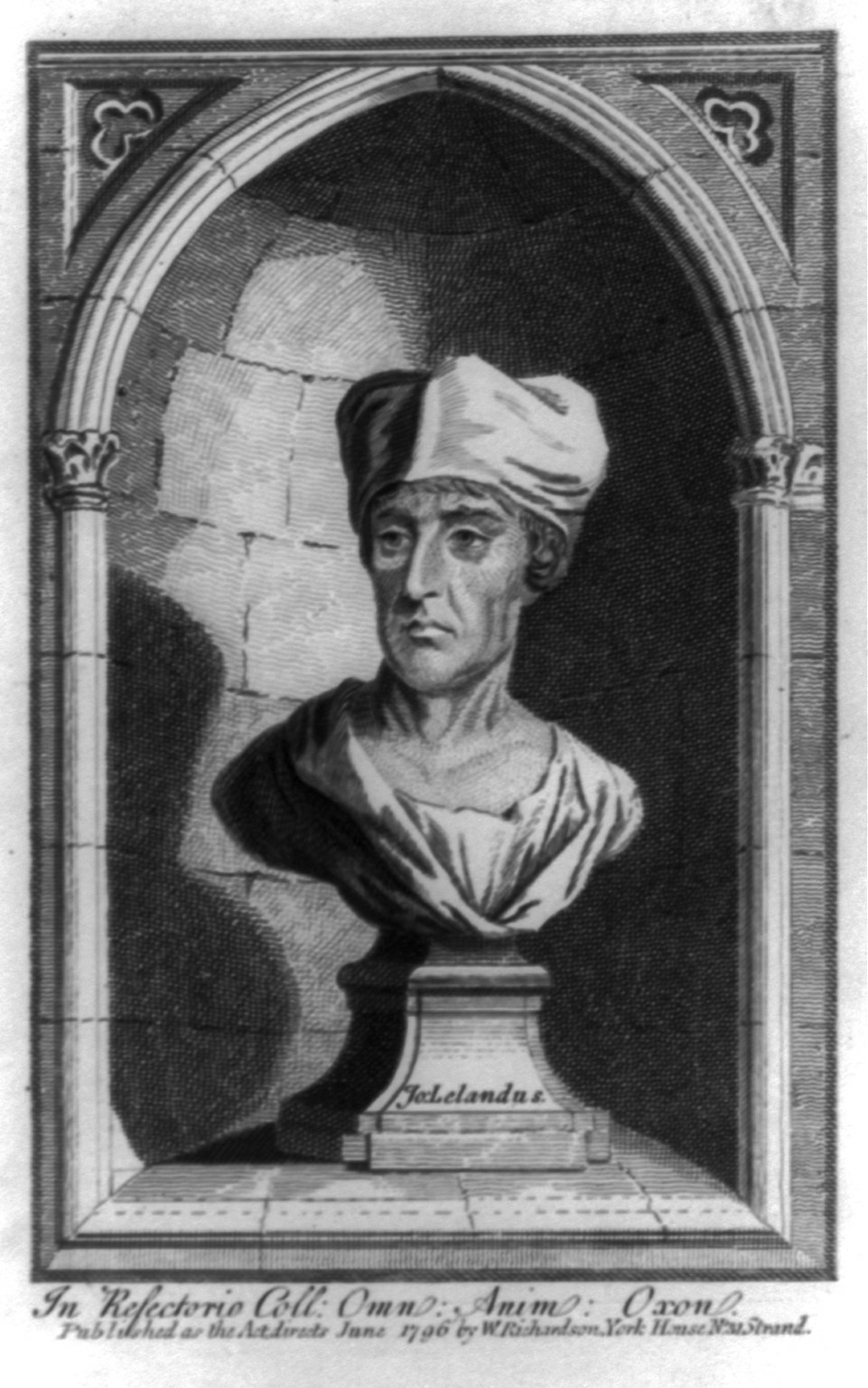
John Leland
From Grafton to Orange County
John Leland was born, as he wrote in his short autobiography, "in Grafton, about 40 miles west of Boston, in the year of our Lord 1754, on the 14th of May."28 He was converted and began preaching in New England as a young man, made a first journey to Virginia in 1775, and on September 30, 1776, married Sally Devine of Hopkinton and "immediately started with her to Virginia." He joined the Baptist church at Mount Poney in Culpeper County, was ordained by the choice of that church "without the imposition of the hands of a Presbytery," and soon moved to Orange County, Madison's home county, "where I continued all the time of my stay in Virginia."28 He was an itinerant in the revival tradition. In the Virginia revival of 1787 to 1789 he reported a "continual fall of heavenly rain from October, 1787, until March, 1789, during which time I baptized about 400. Precisely 300 of them were baptized in 1788," which he called "more than I have ever baptized in any other year." When he left Virginia in 1791 he had, by his own count, baptized "precisely seven hundred while I lived there," leaving two churches of three hundred and two hundred members.28 These are Leland's own counts of baptisms he performed, which are more reliable than crowd estimates because a baptism was a single recorded act, but they come from his memory and notes and were not checked against church books.

The general assessment and the Memorial and Remonstrance (1784 to 1785)
Independence weakened Virginia's establishment at once. Leland's Virginia Chronicle records that "In 1776, the salaries of the Episcopal clergymen were suspended, which was so confirmed in 1779, that no legal force has ever been used since to support any preachers in the state."24 The Baptists, he wrote, "so heartily and uniformly engaged in the cause of the country against the king" because "The change suited their political principles, promised religious liberty, and a freedom from ministerial tax."24 Leland's statement is a Baptist's description of his own people; it is also consistent with the Virginia Baptists' address to Washington in 1789 and Washington's reply (below).
The Anglicans and their allies tried to recover public support in a new form. In 1784 Patrick Henry sponsored "A Bill Establishing a Provision for Teachers of the Christian Religion," a general assessment that would tax all citizens for the support of Christian teachers while letting each taxpayer name the church to receive his share.19 The Library of Congress exhibition notes that supporters argued from "Principles of Public Utility" that Christianity offered the "best means of promoting Virtue, Peace, and Prosperity," that Richard Henry Lee supported the bill, and that George Washington wrote to George Mason on October 3, 1785, that he did not in principle oppose "making people pay towards the support of that which they profess" but considered the bill "impolitic."19 Henry's opponents had him elected governor, which removed him from the House, and consideration of the bill was postponed to the fall of 1785.
In the interval Madison wrote, anonymously, A Memorial and Remonstrance against Religious Assessments (June 20, 1785). Its first article quotes the Virginia Declaration of Rights:
"Because we hold it for a fundamental and undeniable truth, 'that Religion or the duty which we owe to our Creator and the manner of discharging it, can be directed only by reason and conviction, not by force or violence.' The Religion then of every man must be left to the conviction and conscience of every man; and it is the right of every man to exercise it as these may dictate. This right is in its nature an unalienable right."29
Madison grounded the right in a duty to God: "It is the duty of every man to render to the Creator such homage and such only as he believes to be acceptable to him. This duty is precedent, both in order of time and in degree of obligation, to the claims of Civil Society. Before any man can be considered as a member of Civil Society, he must be considered as a subject of the Governour of the Universe."29 In its third article he warned: "Who does not see that the same authority which can establish Christianity, in exclusion of all other Religions, may establish with the same ease any particular sect of Christians, in exclusion of all other Sects? that the same authority which can force a citizen to contribute three pence only of his property for the support of any one establishment, may force him to conform to any other establishment in all cases whatsoever?"29 Madison's "three pence" and Backus's "four pence" make the same argument in nearly the same words, from different starting points. Backus argued from the kingship of Christ over his church. Madison argued from the duty of each person to the Creator and from the limits of a government founded on consent.
The debate produced what the Library of Congress exhibition calls "an unprecedented outpouring of petitions to the General Assembly," and the opponents were led, in its words, "by Baptists, supported by Presbyterians (some of whom vacillated on the issue)."19 Leland's Chronicle summarizes the result in a single sentence: "when the time came, the Presbyterians, Baptists, Quakers, Methodists, Deists, and covetous, made such an effort against the bill, that it fell through."24 The phrase "and covetous" is Leland's dry acknowledgment that some opponents simply did not want to pay. In a footnote he added that the Methodists had at first petitioned "for a continuation of the established religion of the state; but being organized a distinct church, they vigorously opposed the assessment."24 The Library of Congress exhibition calls the winning side "an incongruous coalition of Baptists and theological liberals."19
The Virginia Statute for Religious Freedom (1786)
In place of Henry's bill, Madison brought forward the bill Jefferson had drafted in 1779, and the Assembly passed it in January 1786 as the Act for Establishing Religious Freedom.19 Its preamble begins: "Whereas Almighty God hath created the mind free; that all attempts to influence it by temporal punishments or burthens, or by civil incapacitations, tend only to beget habits of hypocrisy and meanness, and are a departure from the plan of the Holy author of our religion, who being Lord both of body and mind, yet chose not to propagate it by coercions on either, as was in his Almighty power to do."30 It declares "that to compel a man to furnish contributions of money for the propagation of opinions which he disbelieves, is sinful and tyrannical," and "that our civil rights have no dependence on our religious opinions, any more than our opinions in physics or geometry." The enacting clause reads:
"Be it enacted by the General Assembly, That no man shall be compelled to frequent or support any religious worship, place, or ministry whatsoever, nor shall be enforced restrained, molested, or burthened in his body or goods, nor shall otherwise suffer on account of his religious opinions or belief; but that all men shall be free to profess, and by argument to maintain, their opinion in matters of religion, and that the same shall in no wise diminish, enlarge, or affect their civil capacities."30
The Statute's language is that of the Enlightenment ("truth is great and will prevail if left to herself"), and its author was, in the Library of Congress exhibition's account, among the upper-class Americans drawn to deism, which "rejected the orthodox Christian view of the divinity of Christ."1 The votes that passed it were gathered by Madison, and the petitions that defeated the assessment came largely from evangelical dissenters. Both facts are true, and the argument over whose victory it was (the deists' or the Baptists') is one of the clearest tests of the positions described above. Esbeck and Den Hartog's state-by-state study (2019) concluded that Virginia was in some ways an exception and that disestablishment elsewhere came mainly through the pressure of dissenting Protestants, and its editors write that this origin should "depress claims that disestablishment was forged out of government indifference to religion, or even hostility to it."27
Leland and Madison, 1788: what the record shows
When the federal Constitution was sent to the states in 1787, many Virginia Baptists opposed it because it lacked a bill of rights and a guarantee of religious liberty. In Orange County, the election of delegates to the Virginia ratifying convention was set for March 24, 1788. Madison, who was in New York, was urged to come home. A letter to him dated February 28, 1788, signed by Joseph Spencer of Orange County (the editors of the Madison Papers note that the writer's identity is not certain), reported that the Baptist preachers feared that "Relegious liberty is not Sufficiently secur'd," named "Mr. Leeland & Mr. Bledsoe and Sanders" as "the most publick men of that Society in Orange," and advised: "as Mr. Leeland Lyes in your Way home from Fredricksburg to Orange would advise you'l call on him" and "Spend a few Howers in his Company."31 The letter enclosed a list of Leland's objections to the Constitution, which the editors of the Madison Papers describe as centered on the lack of a bill of rights and of a specific guarantee of religious liberty; the list is printed in the Documentary History of the Constitution (volume 4, pages 526 to 529).31
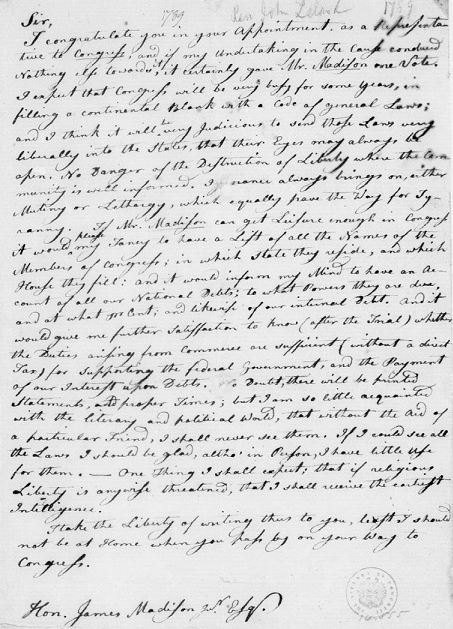
What happened next is a matter of tradition. The editors of the Madison Papers write that Madison "arrived in Orange on 23 Mar." and that "Although accounts of JM's famous meeting with Leland are fanciful," "the tradition is strong that such a meeting did in fact occur, probably on 22 Mar."31 In the tradition, retold in many later books (some versions place the two men under an oak tree), Madison promised to work for amendments protecting religious liberty, and Leland withdrew as a candidate and gave Madison his support. The documented facts are narrower: Spencer urged a meeting; Madison reached Orange on March 23 and was elected on March 24, with Francis Taylor recording 202 votes for Madison and 187 for Gordon, the two men elected, against 56 for Barbour and 34 for Porter; and Madison then argued for ratification at the convention and, in the first Congress, proposed the amendments that became the Bill of Rights.31 Whether Leland was ever a candidate, what was said, and where the two men met (if they did) cannot be settled from contemporary documents. The claim is rated in "Claims checked" below.

The Virginia Baptists and Washington, 1789
After Washington's inauguration, the General Committee of the United Baptist Churches of Virginia, meeting at Richmond on May 8 to 10, 1789, sent him an address (the 1845 printing heads it "8th August, 1789"; the Washington Papers give the May dates from the address itself).39 The 1845 editor of Leland's Writings prints it in full in his memoir of Leland, as an example of the Baptists' views. It explained the Baptists' fears: "When the Constitution first made its appearance in Virginia, we, as a society, had unusual strugglings of mind, fearing that the liberty of conscience, dearer to us than property or life, was not sufficiently secured. Perhaps our jealousies were heightened, by the usage we received in Virginia, under the regal government, when mobs, fines, bonds and prisons were our frequent repast."21 Washington's reply assured them: "If I could have entertained the slightest apprehension that the Constitution framed by the Convention where I had the honor to preside, might possibly endanger the religious rights of any ecclesiastical society, certainly I would never have placed my signature to it." He added that "any man, conducting himself as a good citizen, and being accountable to God alone for his religious opinions, ought to be protected in worshiping the Deity according to the dictates of his own conscience," and that the Baptists had been "throughout America, uniformly, and almost unanimously the firm friends to civil liberty, and the persevering promoters of our glorious revolution."21 Washington's statement is the testimony of the commander in chief that the Baptists had supported the Revolution. It is a public reply to a friendly address, and its praise is general.
Leland on slavery, 1789
The same General Committee in 1789 passed a resolution that the editor of Leland's Writings says was offered by Leland. After the word "Resolved" it reads: "That slavery is a violent deprivation of the rights of nature, and inconstent with a republican government; and we, therefore, recommend it to our brethren, to make use of every legal measure to extirpate this horrid evil from the land, and pray Almighty God that our honorable legislature may have it in their power to proclaim the great Jubilee, consistent with the principles of good policy."21 (The misspelling "inconstent" is in the 1845 printing.) The editor adds that "during his fourteen years' residence in Virginia he never owned a slave."21 In The Virginia Chronicle Leland wrote that "Liberty of conscience, in matters of religion, is the right of slaves, beyond contradiction; and yet, many masters and overseers will whip and torture the poor creatures for going to meeting, even at night, when the labor of the day is over."24 The resolution was advice and did not bind the churches, many of whose members held slaves. Historians of the Virginia Baptists report that the General Committee drew back from the question in the 1790s as it divided their members. The record of what the Baptists did about slavery after 1790 belongs to a later story.
The Rights of Conscience Inalienable (1791)
Leland moved back to New England in 1791. At New London, Connecticut, he published a pamphlet aimed at the Connecticut establishment, The Rights of Conscience Inalienable, and Therefore Religious Opinions Not Cognizable by Law (1791).32 He put the question plainly: "Are the rights of conscience alienable, or inalienable?" and asked, "Does a man, upon entering into social compact, surrender his conscience to that society, to be controlled by the laws thereof; or can he, in justice, assist in making laws to bind his children's consciences before they are born?" His first answer was theological: "Every man must give an account of himself to God, and therefore every man ought to be at liberty to serve God in a way that he can best reconcile to his conscience. If government can answer for individuals at the day of judgment, let men be controlled by it in religious matters; otherwise, let men be free."32
The pamphlet's most quoted passage follows:
"Is uniformity of sentiments, in matter of religion, essential to the happiness of civil government? Not at all. Government has no more to do with the religious opinions of men, than it has with the principles of mathematics. Let every man speak freely without fear, maintain the principles that he believes, worship according to his own faith, either one God, three Gods, no God, or twenty Gods; and let government protect him in so doing, i. e., see that he meets with no personal abuse, or loss of property, for his religious opinions."32
The passage is often quoted without its context and read as indifference to religion. Leland was an evangelical preacher who spent his life calling people to conversion. His argument was that a faith compelled by law is no faith, and that the gospel neither needs nor permits the magistrate's sword. In The Virginia Chronicle he had already written: "The liberty I contend for, is more than toleration. The very idea of toleration, is despicable; it supposes that some have a pre-eminence above the rest, to grant indulgence; whereas, all should be equally free, Jews, Turks, Pagans and Christians." He added that "A general assessment, (forcing all to pay some preacher,) amounts to an establishment; if government says I must pay somebody, it must next describe that somebody, his doctrine and place of abode."24 Of the Virginia constitution he wrote approvingly that a man who merits his neighbors' confidence could hold office there whether he "worship one God, twenty God's, or no God."24
Leland settled at Cheshire, in the Berkshire hills of western Massachusetts, in 1792 and preached there and in the surrounding towns for most of the rest of his life. He served in the Massachusetts legislature during the 1811 campaign described above and kept writing against the certificate laws until Article III was replaced in 1833.21 He died on January 14, 1841, and the epitaph he wrote for himself reads: "Here lies the body of the Rev. John Leland, of Cheshire, who labored 67 years to promote piety and vindicate the civil and religious rights of all men."21
The Danbury Baptists and the "wall of separation"
The Danbury Baptist Association's letter (October 1801)
The Danbury Baptist Association of Connecticut, meeting at Colebrook on October 7 and 8, 1801, sent an address to President Jefferson congratulating him on his election.33 The surviving copy, in the hand of Nehemiah Dodge and signed by the committee, is in the Library of Congress. It states the Baptists' principles. "Our Sentiments are uniformly on the side of Religious Liberty," the committee wrote, and it listed them: "That Religion is at all times and places a Matter between God and Individuals," "That no man aught to suffer in Name, person or effects on account of his religious Opinions," and "That the legetimate Power of civil Goverment extends no further than to punish the man who works ill to his neighbour."33 And it describes their position under Connecticut's laws: "what religious privileges we enjoy (as a minor part of the State) we enjoy as favors granted, and not as inalienable rights."33
The Baptists' phrase "a Matter between God and Individuals" is nearly Backus's own. The Liberty Fund editors of the Appeal note that Backus's chief idea was that "religion is ever a matter between God and individuals," as he stated it in 1783.7
Jefferson's reply (January 1, 1802)
The address did not reach Jefferson until December 30, 1801. He answered on New Year's Day, 1802:
"Believing with you that religion is a matter which lies solely between Man & his God, that he owes account to none other for his faith or his worship, that the legitimate powers of government reach actions only, & not opinions, I contemplate with sovereign reverence that act of the whole American people which declared that their legislature should 'make no law respecting an establishment of religion, or prohibiting the free exercise thereof,' thus building a wall of separation between Church & State. Adhering to this expression of the supreme will of the nation in behalf of the rights of conscience, I shall see with sincere satisfaction the progress of those sentiments which tend to restore to man all his natural rights, convinced he has no natural right in opposition to his social duties."34
Jefferson closed: "I reciprocate your kind prayers for the protection & blessing of the common father and creator of man, and tender you for yourselves & your religious association, assurances of my high respect & esteem."34
James Hutson, chief of the Library of Congress Manuscript Division, examined Jefferson's draft for the Library's 1998 exhibition with the help of the FBI laboratory, which recovered the words Jefferson had inked out.35 Hutson reported that "nearly 30 percent of the draft -- seven of 25 lines -- was deleted by the president prior to publication," that Jefferson showed the draft to two New England members of his cabinet, Postmaster General Gideon Granger and Attorney General Levi Lincoln, and that Jefferson told Lincoln the letter was meant to explain "why I do not proclaim fastings & thanksgivings, as my predecessors did" and to issue a "condemnation of the alliance between church and state."35 On Lincoln's advice Jefferson removed the passage about fast and thanksgiving days. Hutson concluded that Jefferson "regarded his reply to the Danbury Baptists as a political letter, not as a dispassionate theoretical pronouncement on the relations between government and religion," and that the draft shows he "labored over its composition," far from dashing off "a 'short note of courtesy,' as some have called it."35 Hutson also traced the phrase's later career: the letter was published in a Massachusetts newspaper a month after Jefferson wrote it, was largely forgotten for half a century, was reprinted in an 1853 edition of Jefferson's writings, and was taken up by the Supreme Court in Reynolds v. United States (1878) and in decisions of 1947 and 1948, including McCollum v. Board of Education.35
Two points about the letter bear on this lesson. First, Jefferson's "wall" described the federal First Amendment, which in 1802 bound only Congress. Connecticut's own establishment, which the Danbury Baptists were writing about, lasted until 1818, and Massachusetts's until 1833. Second, the Baptists and Jefferson agreed on the result and differed on the reasons. The Baptists grounded religious liberty in God's sole lordship over conscience; Jefferson, in this letter, grounded it in the limits of government and the natural rights of man. Both appear in the same exchange, and later readers have chosen between them according to their own convictions.
The "mammoth cheese" (January 1, 1802)
On the same New Year's Day, Jefferson received a gift from Leland's congregation at Cheshire. In the summer of 1801 the women of the town had made a cheese from the milk of the town's cows as a tribute to Jefferson's victory and his support for religious liberty. Jefferson wrote to his son-in-law Thomas Mann Randolph that it "weighed in August 1230. lb." A Republican newspaper in Rhode Island reported that August that it bore the motto "Rebellion to tyrants is obedience to God," which was also the motto on Jefferson's personal seal.36 Leland, in his autobiography, recorded the errand briefly: "In November, 1801, I journeyed to the south, as far as Washington, in charge of a cheese, sent to President Jefferson. Notwithstanding my trust, I preached all the way there and on my return. I had large congregations; led in part by curiosity to hear the Mammoth Priest, as I was called."28 According to the Thomas Jefferson Foundation's account, the cheese traveled by sleigh or wagon to the Hudson River, by sloop to New York and Baltimore, and by wagon to Washington, arriving December 29, 1801; it was presented at the President's House on January 1, 1802; and Jefferson, who did not accept gifts while in office, paid Leland $200 on January 4. Reports of what finally became of it are unverified.36 Hutson adds that Leland "had accepted an invitation to preach in the House of Representatives on Sunday, Jan. 3," and that Jefferson, "contrary to all former practice," attended that service, two days after writing of "a wall of separation"; for the rest of his presidency, Hutson writes, he attended the services in the House "constantly." Hutson suggests that Jefferson reasoned that if Leland "found nothing objectionable about officiating at worship on public property," the president could not be criticized for attending.35
What the record shows and what it does not
- Documented fact: Backus published An Appeal to the Public for Religious Liberty in 1773 and met the Massachusetts delegates at Carpenters' Hall on October 14, 1774 (Adams's diary confirms the meeting). Massachusetts Article III (1780) required towns to support "public Protestant teachers" and was replaced in 1833. Connecticut's constitution of 1818 ended compulsory support. Virginia passed the Act for Establishing Religious Freedom in January 1786 after Madison's Memorial and Remonstrance (1785). The Danbury Baptists wrote to Jefferson in October 1801, and he replied on January 1, 1802, the day Leland presented the Cheshire cheese.
- A participant's own claim: John Adams's remark that the Baptists "might as well expect a change in the solar system" comes from Backus's diary, not from Adams. Leland's count of "about thirty" jailed preachers and his 700 baptisms in Virginia are his own figures. Washington's praise of the Baptists as "persevering promoters of our glorious revolution" is a public reply to a friendly address.
- Later tradition: The meeting of Madison and Leland before the Orange County election of March 24, 1788, its setting and the bargain struck there. The Madison Papers editors call the accounts "fanciful" but the tradition of a meeting "strong."
- Scholarly reading: That the Awakening shaped the Revolution through ideas (Heimert), habits (Bonomi), people (McLoughlin) or shared language (Kidd); that the "Great Awakening" was a later construction (Butler) or a self-promotion by the revivalists (Lambert); that the Revolution shaped the churches more than the reverse (Wood, Hatch, Noll).
- Open question: Whether evangelical converts of the 1740s, as a group, were more likely than other colonists to become patriots in the 1770s. No study has settled it, and the evidence (church records, militia rolls, Loyalist claims) is scattered.
Claims checked
"The Great Awakening caused the American Revolution."
Rating: Unsupported. No historian cited in this lesson argues that the revival by itself caused the war, and the strongest defenders of a link (Heimert, Bonomi) argue for influence on ideas and habits. The thirty-year gap between the height of the New England revival and 1775, the presence of anti-revival ministers such as Chauncy and Mayhew among the leading patriots, and the evangelicals who were Loyalists or neutral (many Methodists, some Baptists) all count against a causal claim. Kidd's middle position, that evangelicals shared the language of liberty and joined in winning religious freedom, is well supported.148
"John Adams said the Revolution was a change in religious sentiments."
Rating: Supported, with context. Adams wrote to Hezekiah Niles on February 13, 1818, that the Revolution "was in the Minds and Hearts of the People" and was "A Change in their Religious Sentiments of their Duties and Obligations."3 He wrote forty years after the events, he meant chiefly the colonists' sense of their religious duty toward the king and toward England, and he did not mention the revival.
"Madison met Leland under an oak in 1788 and won Baptist support by promising a bill of rights."
Rating: Unresolved. A letter of February 28, 1788, urged Madison to "Spend a few Howers" with Leland, and the Madison Papers editors judge that "the tradition is strong that such a meeting did in fact occur, probably on 22 Mar." They also call the accounts of the meeting "fanciful."31 Madison was elected, supported amendments, and introduced the Bill of Rights in Congress in 1789, but no contemporary document records what he and Leland said, where, or whether a bargain was made.
"Jefferson's 'wall of separation' was a courtesy note that set out a settled theory of keeping religion out of public life."
Rating: Refuted in its first part, disputed in its second. Hutson's study of the draft shows that Jefferson revised it carefully, consulted two cabinet members, and wrote it partly to explain why he would not proclaim fasts and thanksgivings; Hutson concluded that Jefferson meant it as "a political letter."35 Two days after writing it, Jefferson attended worship in the House of Representatives where Leland preached.35 How far the metaphor should govern the meaning of the First Amendment is a question of constitutional interpretation on which justices and scholars disagree, and it is not settled by the history in this lesson.
"The First Amendment ended the established churches in 1791."
Rating: Refuted. The First Amendment restrained Congress. Connecticut kept its establishment until 1818, New Hampshire until 1819, and Massachusetts until 1833.202226 Esbeck and Den Hartog's editors write that "Neither the U.S. Constitution of 1787-88 nor the First Amendment of 1789-91 contributed to the disestablishment process" in the states.27
"Disestablishment was the work of skeptics who wanted religion out of public life."
Rating: Refuted as a general claim. The most persistent campaigners were evangelical Baptists who argued from Scripture and the kingship of Christ (Backus's "two kinds of government," Leland's "Every man must give an account of himself to God"). In Virginia they were joined by Jefferson and Madison, whose reasons were partly Enlightenment reasons, and the Library of Congress calls the alliance "an incongruous coalition of Baptists and theological liberals."71932
"After 1780 Massachusetts had no established church, only a fair tax every church could share."
Rating: Partly supported. Article III named no church and promised that no sect would be subordinated to another. It also required towns to support "public Protestant teachers," allowed compulsory attendance, and left dissenters to prove their membership elsewhere to redirect their taxes; Baptists and the Library of Congress exhibition treat it as a general assessment, and Backus's diary shows John and Samuel Adams themselves calling the earlier system "a very slender" establishment, not none.2016
"Leland's mammoth cheese weighed 1,235 pounds."
Rating: Partly supported. Hutson gives 1,235 pounds; Jefferson wrote that it "weighed in August 1230. lb."3536 The difference is small, and a cheese weighed in August would have lost some weight by January. The figure is approximately 1,230 pounds.
"Baptist preachers were jailed in colonial Virginia for preaching."
Rating: Supported. Madison's letter of January 24, 1774, Leland's Virginia Chronicle, Waller's account of 1771 and the 1772 summons to Nathaniel Saunders all document it.252419 Leland's figure of about thirty preachers jailed is his estimate.
Hard questions and answers
A Calvinist asks: Backus held Reformed doctrine. How could he reject the civil magistrate's duty to the church taught by the Westminster Confession?
Backus's Calvinism concerned salvation: election, human inability, effectual grace and perseverance. On the church he was a Baptist, holding that the church is a gathered body of believers baptized on profession of faith, and on the magistrate he followed the line of English Baptists and of Roger Williams, which distinguished "two kinds of government" in the words of his Appeal.7 The Westminster Confession of 1646 gave the magistrate a duty to preserve the church's unity and suppress blasphemy and heresy. American Presbyterians themselves revised that chapter when they adopted the Confession in 1788; the Library of Congress exhibition notes that in the revised text the image of rulers as "nursing fathers" of the church moved from a footnote into the body of the chapter, where it was joined, in the American text, to a duty to protect the church "without giving the preference to any denomination of Christians above the rest."1938 The Calvinists of the new republic thus divided: New England Congregationalists defended tax support until 1818 and 1833, while Calvinistic Baptists and many Presbyterians opposed it. Both sides claimed Scripture. Each side's case is stated in this lesson in its own words.
A Wesleyan asks: Where were the Methodists in all this?
The Methodists were still a society within the Church of England when the war began, and John Wesley opposed American independence. The Library of Congress exhibition notes that the Methodists, although "handicapped by Wesley's opposition to the American Revolution," made "remarkable progress in the young American republic" under Francis Asbury.1 Leland's Virginia Chronicle records that the Methodists at first "petitioned for a continuation of the established religion of the state; but being organized a distinct church, they vigorously opposed the assessment; and at the same time petitioned the legislature for a general liberation of the slaves."24 The Methodist Episcopal Church was organized at the Christmas Conference in Baltimore in 1784, and its growth belongs to the Second Great Awakening (lesson 08; see also Module 80, lesson 07). The Arminian Methodists and the Calvinist Baptists, opponents in theology, ended on the same side of the Virginia assessment vote.
A skeptic asks: Did the Baptists want liberty for everyone, or only relief for Baptists?
The evidence differs by writer. Backus's Appeal argues mostly from the Baptists' own grievances and from Christ's kingship over his church. Hutson notes that by 1802 Jefferson had come close to the view of "New England Baptist leaders such as Isaac Backus and Caleb Blood," who held that the state, within its limits, could give "friendly aids" to the churches, such as the use of public buildings for worship.35 Leland went further than most. He wrote that "all should be equally free, Jews, Turks, Pagans and Christians," that a man might worship "one God, three Gods, no God, or twenty Gods," and, of Massachusetts, that under Article III "Protestant Christianity is the established religion of the state. Pagans, Turks, Jews, and Papists, are minor departments."243237 He also complained that under that constitution "Jews, Turks, Pagans and Deists, are not to be protected by law, and no kind of Christian teachers can have legal provision made for them, except they are protestants."37 On the narrower question of the enslaved, Leland's 1789 resolution and his statement that liberty of conscience "is the right of slaves, beyond contradiction" show that he applied the principle to them, while the churches he served did not act on the resolution.
A Catholic asks: What did these settlements mean for Catholics and Jews?
Massachusetts Article III provided public support only for "Protestant teachers," and the protection of the law in its last sentence was promised to "every denomination of Christians."20 Several state constitutions of the period required officeholders to be Protestants or Christians. Leland's objections quoted above were made on behalf of Catholics, Jews and others who were not Protestants, by a Baptist who opposed Catholic doctrine but held that no government should prefer one faith. The 1833 amendment in Massachusetts extended equal protection to "all religious sects and denominations."20 Virginia's Statute of 1786 protected all "religious opinions or belief" without naming any church.30 The fuller story of religious tests for office and of Catholic and Jewish civil rights in the states runs past 1833 and is outside this lesson.
If the Revolution was a religious cause, why did the Baptists report a decline in religion during the war?
Leland's Virginia Chronicle is frank about it. After the Baptists gained freedom from the ministerial tax, "the cares of war, the spirit of trade, and moving to the western waters, seemed to bring on a general declension. The ways of Zion mourned. They obtained their hearts' desire, (freedom,) but had leanness in their souls." Revival returned, by his account, only "In the summer of that year," 1785, when "the glorious work of God broke out, on the banks of James River."24 Leland's testimony fits the arguments of Butler, Wood and Hatch that the great growth of evangelical religion came after the war, and it fits Kidd's view that the evangelical movement born in the 1740s carried on through the revolutionary era. It does not fit a picture of the war years as a time of revival.
Was disestablishment good or bad for the churches?
The participants disagreed, and some changed their minds. Payson in 1778 warned that if "the restraints of religion once be broken down," no human power could preserve order.19 Lyman Beecher called 1818 "as dark a day as ever I saw" and later called it "the best thing that ever happened to the State of Connecticut."23 Backus and Leland held from the start that a church supported by force was corrupted by it. The growth of the voluntary churches after 1790 (taken up in lesson 08) is often cited for Beecher's later view. Historians note that the growth had many causes, including migration west and the new denominations' methods, so that disestablishment was one condition of it among several. The question of whether the churches gained or lost in faithfulness, as distinct from numbers, is a theological judgment that each tradition answers from its own standards.
Further reading in this site: the Bill of Rights and the first government in Module 53, lesson 08; Madison in Module 55, lesson 01; Samuel Adams in Module 54, lesson 52; the founders on natural rights in Module 50, lesson 08; culture and law in Module 56, lesson 08; and the Baptists in Module 80, lesson 06. The next lesson, lesson 07, turns to the theologians of the same generation: Hopkins, Bellamy, Dwight and Witherspoon.
Learn more
- Backus, An Appeal to the Public for Religious Liberty (1773): The full pamphlet; read the "two kinds of government" section and the address to his "dear countrymen."
- The Writings of the Late Elder John Leland (1845): Leland's autobiography, The Virginia Chronicle and The Rights of Conscience Inalienable in one volume.
- Library of Congress, Religion and the Founding of the American Republic: Documents and images on the Massachusetts and Virginia church-state debates, with the persecution of Virginia Baptists.
- James Hutson on Jefferson's Danbury draft: How the FBI recovered Jefferson's deleted words and what they show about the purpose of the letter.
- The Founders' Constitution, Amendment I (Religion): Madison's Memorial, the Virginia Statute and dozens of related documents.
- Adams Papers, diary entry of October 14, 1774, with the editors' note: Adams's own short account of the Carpenters' Hall conference and the editors' summary of Backus's longer one.
Still being checked (15 items)
These points could not be confirmed against a primary source when this lesson was written and fact checked in October 2026. The text above states each one as uncertain.
- Jon Butler's 1982 article was not opened; its argument (including the role of Joseph Tracy's 1842 book in fixing the label) is summarized from the article's title and the secondary literature, and the phrase "interpretative fiction" is quoted from its title.
- The positions of Heimert, Bonomi, Lambert, Wood, Hatch, Noll and McLoughlin (including Revivals, Awakenings, and Reform, 1978) are summarized from general knowledge of these books, which were not reopened during this task; Edmund Morgan's 1967 review of Heimert is described, not quoted.
- Kidd's treatment of the Awakening as running into the 1780s is summarized from memory of The Great Awakening (2007), supported only in part by D. G. Hart's review.
- The start of the Massachusetts certificate exemptions in the late 1720s is stated from general knowledge and attributed to McLoughlin without a page reference.
- The month of Massachusetts's ratification of Amendment XI (1833) is not given; only the year was confirmed from the official text.
- The exact day in January 1786 when the Virginia Statute passed is not stated; the Library of Congress gives January 1786.
- Leland's 1788 list of objections to the Constitution was not opened; it is described from the Madison Papers editors' note. The first names of the Orange County candidates Gordon and Porter are not given in the note and are omitted.
- The claim that the Virginia Baptist General Committee drew back from its 1789 antislavery resolution in the 1790s is from general knowledge of Virginia Baptist history and was not checked against a source during this task.
- The image 06-leland-letter-to-madison.jpg is captioned from its Wikimedia Commons description (dated 1789); its text was not read. The date 1796 for the Leland engraving is from its Commons catalogue record.
- Christopher Grasso's remark about quotation marks is taken from a blog report of a 2013 conference, not from his own text.
- Disestablishment dates in the infographic follow the Bill of Rights Institute map; scholars date some states differently (for example, by counting the end of religious tests for office), and Vermont and Maine are omitted.
- The Methodist Christmas Conference of 1784 is stated from general knowledge without a footnote.
- Joseph Spencer's letter of February 28, 1788 was checked once, against Founders Online (Madison Papers 10:540-542); no second edition was opened.
- The date of the Virginia Baptists' address to Washington: the 1845 Leland Writings head it 8 August 1789; the Washington Papers give May 8 to 10, 1789, from the address itself. The lesson now gives May. The 1789 antislavery resolution's month was not checked.
- Washington's reply is quoted from the 1845 Leland Writings; the letterbook text in Founders Online differs slightly in wording and punctuation (for example 'framed in the Convention,' and 'worshipping').
Notes
- Library of Congress, Religion and the Founding of the American Republic (exhibition, 1998), section II, "Religion in Eighteenth-Century America" (retrieved Oct. 28, 2026). Read it online. ↩
- Library of Congress, Religion and the Founding of the American Republic, section III, "Religion and the American Revolution" (Galloway, Historical and Political Reflections, London, 1780, p. 54; Keteltas, God Arising and Pleading His People's Cause, Newburyport, 1777; Mayhew, Discourse Concerning Unlimited Submission, Boston, 1750) (retrieved Oct. 28, 2026). Read it online. ↩
- John Adams to Hezekiah Niles, 13 February 1818, Founders Online, National Archives (retrieved Oct. 28, 2026). Read it online. ↩
- Alan Heimert, Religion and the American Mind: From the Great Awakening to the Revolution (Cambridge, Mass.: Harvard University Press, 1966); Edmund S. Morgan, review, William and Mary Quarterly, 3rd series, 24 (1967). Summarized, not quoted. Read it online. ↩
- Patricia U. Bonomi, Under the Cope of Heaven: Religion, Society, and Politics in Colonial America (New York: Oxford University Press, 1986). Summarized, not quoted. Read it online. ↩
- William G. McLoughlin, Isaac Backus and the American Pietistic Tradition (Boston: Little, Brown, 1967); New England Dissent, 1630-1833: The Baptists and the Separation of Church and State, 2 vols. (Cambridge, Mass.: Harvard University Press, 1971); Revivals, Awakenings, and Reform (Chicago: University of Chicago Press, 1978). Summarized, not quoted. Read it online. ↩
- Isaac Backus, An Appeal to the Public for Religious Liberty, Against the Oppressions of the Present Day (Boston, 1773), text and editor's headnote as printed in Ellis Sandoz, ed., Political Sermons of the American Founding Era, 1730-1805 (Indianapolis: Liberty Fund), reproduced by ConSource; the headnote quotes McLoughlin, Isaac Backus on Church, State, and Calvinism (1968), p. 1 (retrieved Oct. 28, 2026). Read it online. ↩
- Jon Butler, "Enthusiasm Described and Decried: The Great Awakening as Interpretative Fiction," Journal of American History 69, no. 2 (September 1982): 305-325; Jon Butler, Awash in a Sea of Faith: Christianizing the American People (Cambridge, Mass.: Harvard University Press, 1990). The article's argument is summarized from its title and the scholarly literature; its text was not opened for this lesson. Read it online. ↩
- D. G. Hart, review of Thomas S. Kidd, The Great Awakening, Modern Reformation (January/February 2011, posted December 17, 2010); Ben Park, report on the 2013 conference honoring Jon Butler, The Way of Improvement Leads Home (blog), April 13, 2013 (retrieved Oct. 28, 2026). Read it online. ↩
- Frank Lambert, Inventing the "Great Awakening" (Princeton: Princeton University Press, 1999). Summarized, not quoted. Read it online. ↩
- Gordon S. Wood, The Creation of the American Republic, 1776-1787 (Chapel Hill: University of North Carolina Press, 1969); The Radicalism of the American Revolution (New York: Alfred A. Knopf, 1992). Summarized, not quoted. Read it online. ↩
- Nathan O. Hatch, The Democratization of American Christianity (New Haven: Yale University Press, 1989). Summarized, not quoted. Read it online. ↩
- Mark A. Noll, America's God: From Jonathan Edwards to Abraham Lincoln (New York: Oxford University Press, 2002). Summarized, not quoted. Read it online. ↩
- Thomas S. Kidd, The Great Awakening: The Roots of Evangelical Christianity in Colonial America (New Haven: Yale University Press, 2007), as summarized in D. G. Hart's review (note 9). Read it online. ↩
- Thomas S. Kidd, God of Liberty: A Religious History of the American Revolution (New York: Basic Books, 2010); Carol Sue Humphrey, review, Christian Scholar's Review 40, no. 4 (2011): 473-475, quoting pp. 10 and 55 (retrieved Oct. 28, 2026). Read it online. ↩
- Alvah Hovey, A Memoir of the Life and Times of the Rev. Isaac Backus, A.M. (Boston: Gould and Lincoln, 1858), pp. 155 (Warren Association, 1767), 173-174 (grievances, 1769), 210-212 (Backus's diary on the conference of October 14, 1774), 233-237 (Government and Liberty Described, 1778) (retrieved Oct. 28, 2026). Read it online. ↩
- Catalogue record for Isaac Backus, An Appeal to the Public for Religious Liberty (Boston, 1773), Wellcome Collection, noting "[Three lines from Galatians]" on the title page (retrieved Oct. 28, 2026). Read it online. ↩
- Diary of John Adams, entry for Friday, October 14, 1774, with editorial note 3, Adams Papers Digital Edition, Massachusetts Historical Society (Diary and Autobiography of John Adams, vol. 2, pp. 152-154) (retrieved Oct. 28, 2026). Read it online. ↩
- Library of Congress, Religion and the Founding of the American Republic, section V, "Religion and the State Governments" (Massachusetts Article III; Payson's election sermon, 1778; Backus, Government and Liberty Described, 1778; Patrick Henry's assessment bill, 1784; Washington to Mason, October 3, 1785; persecution in Virginia; Westminster Confession revised 1788) (retrieved Oct. 28, 2026). Read it online. ↩
- Constitution of the Commonwealth of Massachusetts (1780), Part the First, Article III, and Articles of Amendment, Article XI (1833), General Court of Massachusetts (retrieved Oct. 28, 2026). Read it online. ↩
- The Writings of the Late Elder John Leland, ed. L. F. Greene (New York: G. W. Wood, 1845), editor's memoir, pp. 50-56 (epitaph, slavery resolution of 1789, address of the Virginia Baptists to Washington and his reply, the 1811 Massachusetts campaign) (retrieved Oct. 28, 2026). Read it online. ↩
- Constitution of the State of Connecticut (1818), Article First, sections 3 and 4, and Article Seventh, "Of Religion," Connecticut General Assembly (retrieved Oct. 28, 2026). Read it online. ↩
- Lyman Beecher, Autobiography, Correspondence, Etc., of Lyman Beecher, D.D., ed. Charles Beecher, vol. 1 (New York: Harper and Brothers, 1864), p. 344 (retrieved Oct. 28, 2026). Read it online. ↩
- John Leland, The Virginia Chronicle (1790), in The Writings of the Late Elder John Leland (1845), pp. 91-124, at pp. 95, 105-107, 112-114, 118 (retrieved Oct. 28, 2026). Read it online. ↩
- James Madison to William Bradford, 24 January 1774, Founders Online, National Archives (Papers of James Madison, vol. 1) (retrieved Oct. 28, 2026). Read it online. ↩
- Bill of Rights Institute, "Handout C: Map of Disestablishment in the United States" (retrieved Oct. 28, 2026). Read it online. ↩
- Carl H. Esbeck and Jonathan J. Den Hartog, eds., Disestablishment and Religious Dissent: Church-State Relations in the New American States, 1776-1833 (Columbia: University of Missouri Press, 2019), pp. 9, 12, 17, as quoted in John R. Vile's review for the Free Speech Center, Middle Tennessee State University (retrieved Oct. 28, 2026). Read it online. ↩
- John Leland, "Some Events in the Life of John Leland, Written by Himself," in The Writings of the Late Elder John Leland (1845), pp. 9-35, at pp. 9, 18-19, 27-29, 32 (retrieved Oct. 28, 2026). Read it online. ↩
- James Madison, Memorial and Remonstrance against Religious Assessments, 20 June 1785, in The Founders' Constitution, Amendment I (Religion), document 43 (Papers of James Madison 8:298-304), University of Chicago Press (retrieved Oct. 28, 2026). Read it online. ↩
- Virginia, An Act for Establishing Religious Freedom (introduced 31 October 1785, passed January 1786), in The Founders' Constitution, Amendment I (Religion), document 44 (Madison Papers 8:399-401) (retrieved Oct. 28, 2026). Read it online. ↩
- Joseph Spencer to James Madison, 28 February 1788, with editorial notes, Founders Online, National Archives (Papers of James Madison, vol. 10); Leland's enclosed objections are printed in Documentary History of the Constitution, 4:526-529 (retrieved Oct. 28, 2026). Read it online. ↩
- John Leland, The Rights of Conscience Inalienable, and Therefore Religious Opinions Not Cognizable by Law (New London, 1791), in The Writings of the Late Elder John Leland (1845), pp. 179-192, at pp. 181 and 184 (retrieved Oct. 28, 2026). Read it online. ↩
- To Thomas Jefferson from the Danbury Baptist Association, [after 7 October 1801], Founders Online, National Archives (Papers of Thomas Jefferson, vol. 35) (retrieved Oct. 28, 2026). Read it online. ↩
- Thomas Jefferson to Nehemiah Dodge, Ephraim Robbins and Stephen S. Nelson, a committee of the Danbury Baptist Association, January 1, 1802, final letter as sent, Library of Congress Information Bulletin 57, no. 6 (June 1998) (retrieved Oct. 28, 2026). Read it online. ↩
- James Hutson, "'A Wall of Separation': FBI Helps Restore Jefferson's Obliterated Draft," Library of Congress Information Bulletin 57, no. 6 (June 1998) (retrieved Oct. 28, 2026). Read it online. ↩
- Thomas Jefferson Foundation, Thomas Jefferson Encyclopedia, "Mammoth Cheese," citing Jefferson to Thomas Mann Randolph, January 1, 1802 (retrieved Oct. 28, 2026). Read it online. ↩
- John Leland, essays on the Massachusetts constitution, in The Writings of the Late Elder John Leland (1845), pp. 253-254 and 279 (retrieved Oct. 28, 2026). Read it online. ↩
- Westminster Confession of Faith, chapter 23, section 3, in the American text (revision of 1788 as maintained by the Orthodox Presbyterian Church) (retrieved Oct. 28, 2026). Read it online. ↩
- George Washington to the United Baptist Churches of Virginia, [New York, May 1789], letterbook copy, with editorial note quoting the "Address of the General Committee representing the United Baptist Churches in Virginia, assembled in the City of Richmond, May 8th, 9th, 10th 1789," Founders Online, National Archives (Papers of George Washington, Presidential Series, vol. 2) (retrieved Oct. 28, 2026). Read it online. ↩
Check yourself
1. Which historian argued in 1966 that the evangelical Calvinists of the revival, more than the rationalist clergy, carried a popular vision into the patriot cause?
Alan Heimert's Religion and the American Mind (1966) made the modern case for a strong link between the Awakening and the Revolution.
2. What did Jon Butler's 1982 article argue?
Butler's article, subtitled "The Great Awakening as Interpretative Fiction," argued that the single event was a later construction and too weak a cause for 1776.
3. In his Appeal of 1773, how did Isaac Backus turn the patriots' slogan against the Massachusetts establishment?
Backus agreed that there is "an essential difference between persons being taxed where they are represented, and being taxed where they are not so" and asked whether the legislature was in truth the Baptists' representative in religious affairs.
4. Who recorded that John Adams said the Baptists "might as well expect a change in the solar system" as an end to the Massachusetts establishment?
The remark comes from Backus's diary account of the October 14, 1774 conference; Adams's own diary entry is brief and does not record it.
5. When did Massachusetts replace Article III of its 1780 Declaration of Rights, ending the last state religious tax among the original states?
Article XI of the Amendments replaced Article III in 1833. Connecticut's change came in 1818.
6. What do the editors of the Madison Papers say about the famous 1788 meeting of Madison and John Leland?
The editorial note to Spencer's letter of February 28, 1788 calls the accounts fanciful and the tradition strong.
7. What did John Leland carry to President Jefferson, presented on January 1, 1802?
Leland's Cheshire congregation made the "mammoth cheese"; Jefferson wrote that it weighed 1230 pounds in August, and Hutson gives 1,235.
8. According to James Hutson's study of the draft, what was one purpose of Jefferson's reply to the Danbury Baptists?
Jefferson told Levi Lincoln the letter was a way of "saying why I do not proclaim fastings & thanksgivings, as my predecessors did," though he cut that passage on Lincoln's advice.
Terms in this lesson
- Establishment
- A church or churches given legal privileges and public tax support by a government. In the colonies, the Church of England in Virginia and the South and the Congregational churches in most of New England.
- Disestablishment
- The ending of legal and tax support for a church. In the American states it came one state at a time, from North Carolina (1776) to Massachusetts (1833).
- General assessment
- A religious tax laid on all citizens, with each taxpayer allowed to name the church to receive his share. Proposed in Virginia by Patrick Henry in 1784 and defeated in 1785.
- Certificate system
- The New England practice of exempting Baptists, Quakers and Anglicans from the parish ministerial tax if they filed certificates proving membership in their own church. Backus called the yearly certificate a token of submission.
- Separates
- New Light converts of the Great Awakening who left the established parish churches to form churches of converted members; many became Separate Baptists.
- Separate Baptists and Regular Baptists
- In Virginia, the revival-born Baptists from the south who held "none but the Bible" (Separates) and the northern Baptists who held the Philadelphia Confession of 1742 (Regulars). They united in 1787 as the United Baptist Churches.
- Warren Association
- The association of New England Baptist churches formed at Warren, Rhode Island, on September 8, 1767, which made Isaac Backus its agent for grievances.
- Article III (Massachusetts, 1780)
- The article of the Massachusetts Declaration of Rights requiring towns to support "public Protestant teachers of piety, religion and morality," replaced in 1833.
- Memorial and Remonstrance
- James Madison's petition of June 20, 1785, against Virginia's general assessment, arguing that religion "can be directed only by reason and conviction, not by force or violence."
- Virginia Statute for Religious Freedom
- The act drafted by Jefferson in 1779 and passed in January 1786, providing that "no man shall be compelled to frequent or support any religious worship, place, or ministry whatsoever."
- Wall of separation
- Jefferson's phrase in his reply to the Danbury Baptist Association, January 1, 1802, describing the effect of the First Amendment's religion clauses.
- Mammoth cheese
- The cheese of about 1,230 pounds made at Cheshire, Massachusetts, and presented by John Leland to Jefferson on January 1, 1802.
- Interpretative fiction
- Jon Butler's description (1982) of "the Great Awakening" as a single event, a label he argued historians had imposed on scattered local revivals.
Sources
- Isaac Backus, An Appeal to the Public for Religious Liberty (1773), Liberty Fund text via ConSource (1773) checked 2026-10
- Alvah Hovey, A Memoir of the Life and Times of the Rev. Isaac Backus (1858) (1858) checked 2026-10
- The Writings of the Late Elder John Leland (1845) (1845) checked 2026-10
- Diary of John Adams, October 14, 1774, Adams Papers Digital Edition (1774) checked 2026-10
- John Adams to Hezekiah Niles, 13 February 1818 (1818-02-13) checked 2026-10
- Massachusetts Constitution of 1780, Article III and Amendment XI (1780; 1833) checked 2026-10
- Connecticut Constitution of 1818 (1818) checked 2026-10
- James Madison, Memorial and Remonstrance against Religious Assessments (1785), The Founders' Constitution (1785-06-20) checked 2026-10
- Virginia Act for Establishing Religious Freedom (1786), The Founders' Constitution (1786) checked 2026-10
- James Madison to William Bradford, 24 January 1774 (1774-01-24) checked 2026-10
- Joseph Spencer to James Madison, 28 February 1788, with editorial notes (1788-02-28) checked 2026-10
- Danbury Baptist Association to Thomas Jefferson, October 1801 (1801-10) checked 2026-10
- Thomas Jefferson to the Danbury Baptist Association, January 1, 1802 (Library of Congress) (1802-01-01) checked 2026-10
- James Hutson, "A Wall of Separation": FBI Helps Restore Jefferson's Obliterated Draft (1998) (1998-06) checked 2026-10
- Library of Congress, Religion and the Founding of the American Republic (exhibition) (1998) checked 2026-10
- Lyman Beecher, Autobiography, Correspondence, Etc., vol. 1 (1864) (1864) checked 2026-10
- Thomas Jefferson Encyclopedia, "Mammoth Cheese" (n.d.) checked 2026-10
- Bill of Rights Institute, Map of Disestablishment in the United States (n.d.) checked 2026-10
- John R. Vile, review of Esbeck and Den Hartog, Disestablishment and Religious Dissent (2019) (2019) checked 2026-10
- D. G. Hart, review of Kidd, The Great Awakening, Modern Reformation (2010-12-17) checked 2026-10
- Carol Sue Humphrey, review of Kidd, God of Liberty, Christian Scholar's Review (2011) checked 2026-10
- Westminster Confession of Faith, American text (OPC) (1646; American revision 1788) checked 2026-10
- Wellcome Collection catalogue record, Backus, Appeal (1773) (1773) checked 2026-10
- Jon Butler, "Enthusiasm Described and Decried: The Great Awakening as Interpretative Fiction," Journal of American History (1982) (1982-09) checked 2026-10
- Alan Heimert, Religion and the American Mind (1966); Patricia Bonomi, Under the Cope of Heaven (1986); Frank Lambert, Inventing the "Great Awakening" (1999); Thomas S. Kidd, The Great Awakening (2007) and God of Liberty (2010); Gordon S. Wood, The Radicalism of the American Revolution (1992); Nathan O. Hatch, The Democratization of American Christianity (1989); Mark A. Noll, America's God (2002); William G. McLoughlin, New England Dissent (1971) (1966 to 2010) checked 2026-10