Lesson 8 of 9 · about 22 minutes
The Bill of Rights and the First Government
You'll be able to
- Describe the opening of the first Congress and Washington's inauguration on April 30, 1789
- Explain what the Judiciary Act of 1789 created and who wrote it
- Follow the Bill of Rights from Madison's June 8, 1789 speech through the twelve amendments sent on September 25 to the ten ratified on December 15, 1791
- Compare Jefferson's and Hamilton's 1791 opinions on the national bank and state the question about implied powers they argued over
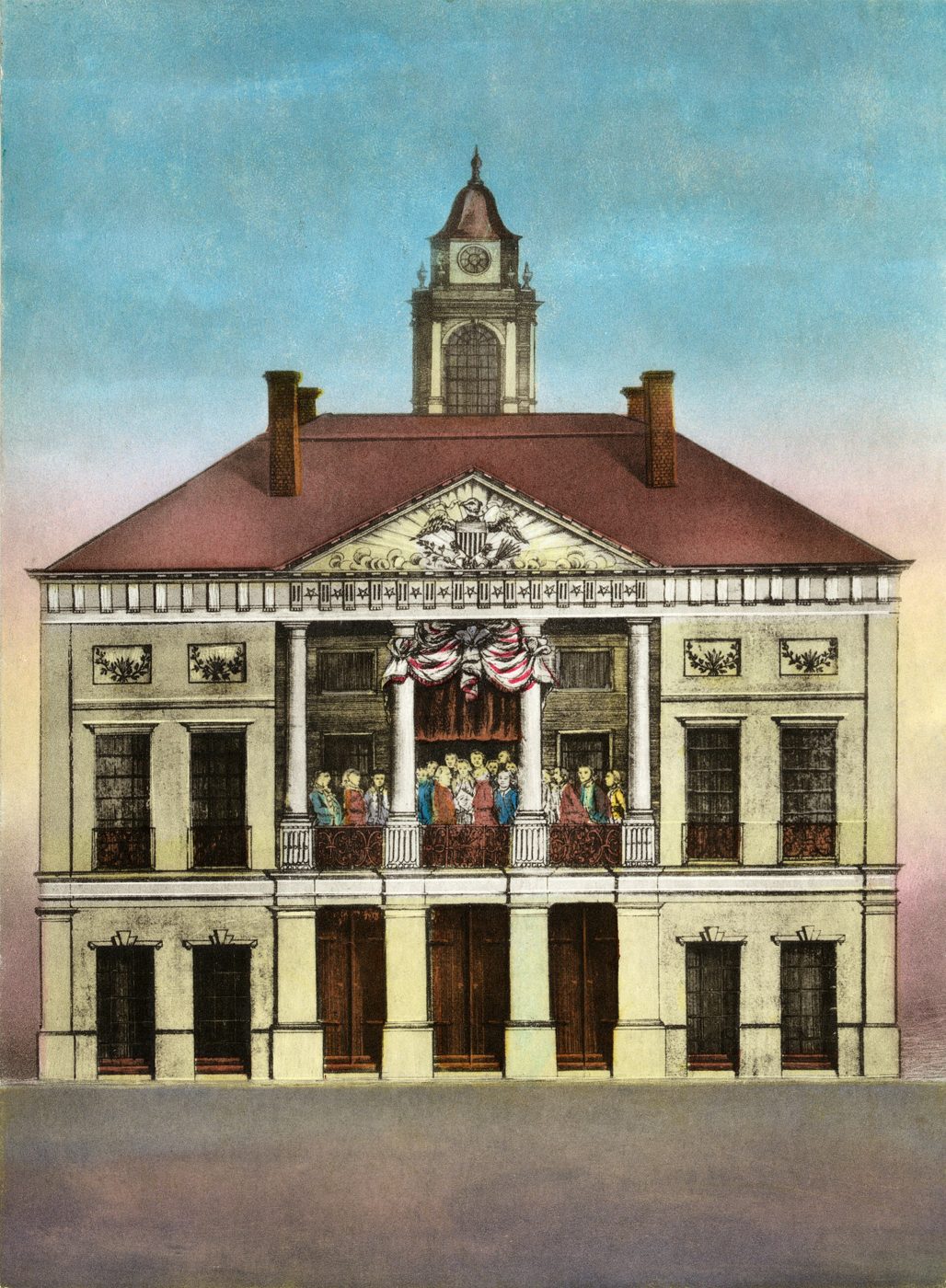
On April 30, 1789, George Washington stepped out onto the second-floor balcony of Federal Hall in New York City, above a crowd filling the streets, and took the oath of office from Robert R. Livingston, the Chancellor of New York.1 Then he went inside to the Senate chamber and delivered the first inaugural address. By the Senate's own history, the day was not smooth. Someone had forgotten to send out the committee that was supposed to escort the president-elect, so the members waited another hour. Vice President John Adams, who had been sworn in nine days earlier, on April 21, fumbled the greeting. Washington took the oath and gave his address "in a halting and nervous manner."2
A Government With No Rulebook
Congress was supposed to meet on March 4. The weather in early 1789 was cold and snowy, and members were slow to reach New York. Neither house had a quorum, and no official business could be done.1 The House elected Frederick Augustus Muhlenberg of Pennsylvania as its first Speaker on April 1.3 The electoral ballots were not counted until April 6. Washington won unanimously, with 69 electoral votes.1
The House had 65 members.3 They had a very large job. The Constitution had outlined a government, and left the executive departments, the lower courts and the revenue system for Congress to build. The House's own history says the first Congress "finished what the Founders started," filling in the skeleton, creating a revenue system, the first executive departments and the judiciary, and writing the amendments that became the Bill of Rights.3
Washington's Address
Washington's address was short and plain. It did not announce a program. It set a tone, and the tone was religious and sober. "The propitious smiles of Heaven," he said, "can never be expected on a nation that disregards the eternal rules of order and right which Heaven itself has ordained." He added that "the preservation of the sacred fire of liberty and the destiny of the republican model of government are justly considered, perhaps, as deeply, as finally, staked on the experiment entrusted to the hands of the American people."4
Later he turned to the objections that had come out of the ratification fight. It would be for Congress, he said, to decide "how far an exercise of the occasional power delegated by the fifth article of the Constitution is rendered expedient at the present juncture by the nature of objections which have been urged against the system."4 That was a polite way of pointing at amendments, and he made no recommendation of his own, leaving the question to the members. They were already thinking about it. In Virginia, New York, Massachusetts and New Hampshire the ratifying conventions had asked for them (see Lesson 7).
The Federal Courts
The Constitution says "The judicial Power of the United States, shall be vested in one supreme Court, and in such inferior Courts as the Congress may from time to time ordain and establish."5 Congress did the ordaining in the Judiciary Act of 1789, dated September 24.6 The act created a Supreme Court of a Chief Justice and five associate justices, a district court in each state, and a middle tier of circuit courts, which served as the principal trial courts. Two Supreme Court justices and the district judge sat on each circuit court, and the justices were assigned to ride to those meeting places, the practice called circuit riding.6
Senators Oliver Ellsworth of Connecticut and William Paterson of New Jersey were the principal authors.6 Both had been delegates in Philadelphia, and both have lessons in Module 55: Ellsworth and Paterson. They wrote with the ratification fight in their ears. Many citizens had feared that independent federal courts might threaten state courts and civil liberties, so the act let state courts share jurisdiction over many federal questions, told federal courts to pick juries by the methods of the state in which they sat, and guaranteed trial in the district where the defendant lived.6 It was a deliberate compromise. The Federal Judicial Center describes it as a settlement between those who wanted the courts to use the full jurisdiction the Constitution allowed and those who wanted no lower federal courts or only admiralty courts.6
One provision proved the most controversial. Section 25 gave the Supreme Court jurisdiction to hear appeals from the highest courts of the states when those decisions involved the constitutionality of state or federal laws.6 The structure of federal courts alongside state courts, in three tiers, survives today.
Madison Takes Up the Amendments
Under the leadership of James Madison, the House took up amendments in its first session.3 On June 8, 1789, he rose to say that the House was "bound by every motive of prudence, not to let the first session pass over without proposing to the state legislatures some things to be incorporated into the constitution, as will render it as acceptable to the whole people of the United States, as it has been found acceptable to a majority of them."7 He wanted friends of the Constitution to "have the opportunity of proving to those who were opposed to it, that they were as sincerely devoted to liberty and a republican government, as those who charged them with wishing the adoption of this constitution in order to lay the foundation of an aristocracy or despotism."7 And he went on: "It will be a desirable thing to extinguish from the bosom of every member of the community any apprehensions, that there are those among his countrymen who wish to deprive them of the liberty for which they valiantly fought and honorably bled."7
Madison laid out his proposals. They included provisions on religion and conscience, speech and the press, assembly and petition, and arms. In his draft, "The people shall not be deprived or abridged of their right to speak, to write, or to publish their sentiments; and the freedom of the press, as one of the great bulwarks of liberty, shall be inviolable."7 He also proposed that "No state shall violate the equal rights of conscience, or the freedom of the press, or the trial by jury in criminal cases," a limit on the states that did not make it into the amendments Congress sent out.78
Why Write Rights Down?
Madison faced the objection that a written declaration would be useless. He took it up directly: "It may be thought all paper barriers against the power of the community, are too weak to be worthy of attention." He conceded they are "not so strong as to satisfy gentlemen of every description who have seen and examined thoroughly the texture of such a defence." But such barriers have "a tendency to impress some degree of respect for them, to establish the public opinion in their favor, and rouse the attention of the whole community."7 And the danger, he argued, was not only from government: "in a government modified like this of the United States, the great danger lies rather in the abuse of the community than in the legislative body," and it comes from "the body of the people, operating by the majority against the minority."7
Then he gave a practical reason. If the rights were written into the Constitution, "independent tribunals of justice will consider themselves in a peculiar manner the guardians of those rights; they will be an impenetrable bulwark against every assumption of power in the legislative or executive."7 A written list did not guard itself. It put a job in the hands of the courts and a standard in the hands of citizens.
Twelve Amendments Sent, Ten Ratified
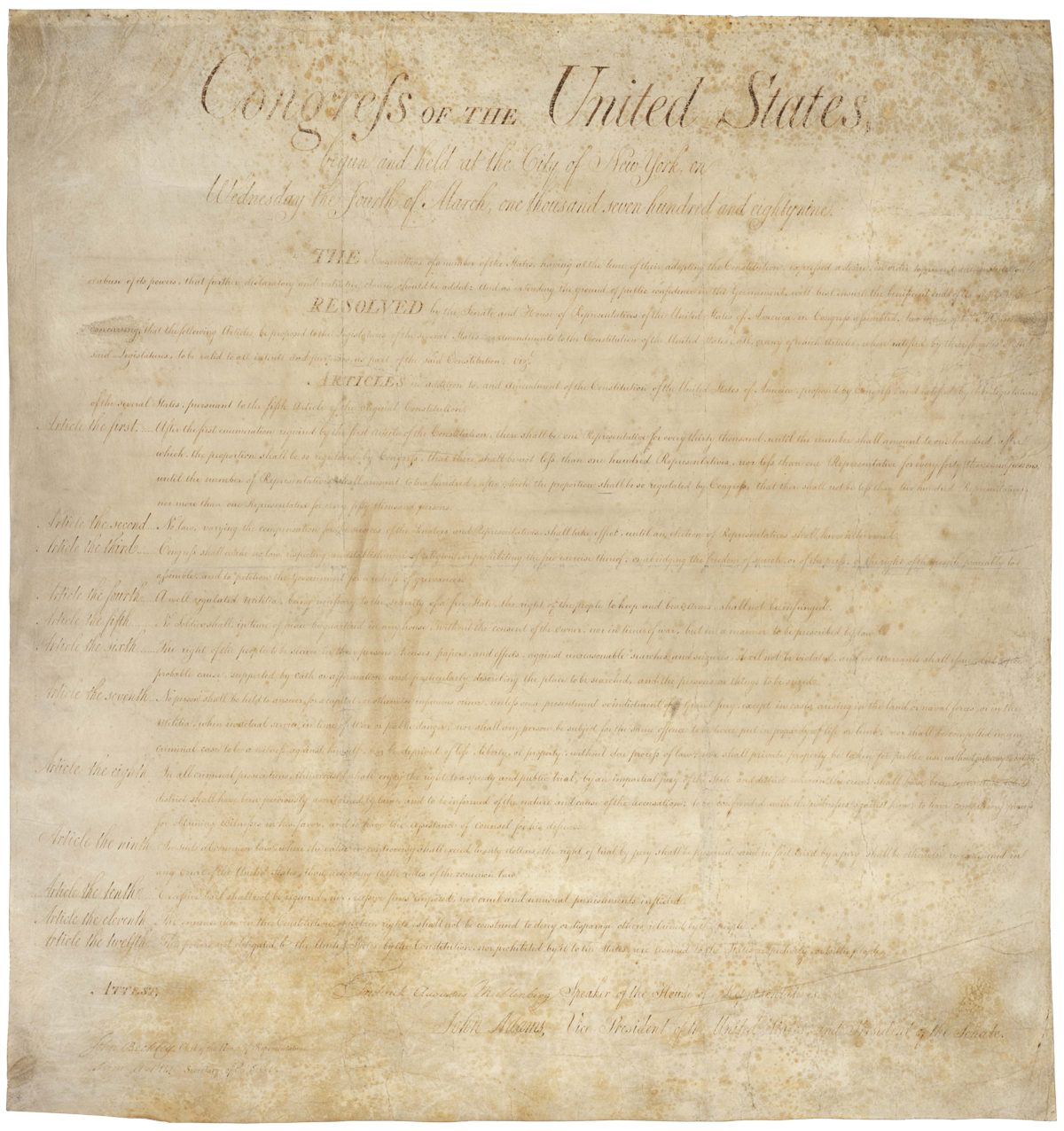
Congress worked on the proposals through the summer. On September 25, 1789, it sent twelve amendments to the states.8 The enrolled resolution opens by saying that the conventions of several states, when adopting the Constitution, had expressed a desire "in order to prevent misconstruction or abuse of its powers, that further declaratory and restrictive clauses should be added."8 Three fourths of the states had to approve. Ten of the twelve did, on December 15, 1791.8
The first of the twelve concerned the size of the House and was never ratified. The second said that "No law, varying the compensation for the services of the Senators and Representatives, shall take effect, until an election of Representatives shall have intervened." It sat in the pipeline for more than two centuries and became the 27th Amendment, ratified May 7, 1992.89 Articles three through twelve became the first ten amendments. The third reads: "Congress shall make no law respecting an establishment of religion, or prohibiting the free exercise thereof; or abridging the freedom of speech, or of the press; or the right of the people peaceably to assemble, and to petition the Government for a redress of grievances."8 It is the First Amendment now. The last two became the Ninth and Tenth: "The enumeration in the Constitution, of certain rights, shall not be construed to deny or disparage others retained by the people," and "The powers not delegated to the United States by the Constitution, nor prohibited by it to the States, are reserved to the States respectively, or to the people."8
Look at those last two together. Hamilton had warned in Federalist No. 84 that a list of rights would hand a would-be usurper a pretext to claim powers. The Ninth says the list does not deny other rights the people keep. The Tenth says what was not delegated stays with the states or the people.
| Proposed Sept. 25, 1789 | Subject | Fate |
|---|---|---|
| Article the first | Size of House of Representatives | Never ratified |
| Article the second | Congressional pay | Ratified May 7, 1992 as the 27th Amendment |
| Articles three to twelve | Religion, speech, press, assembly, arms, searches, trials, punishments, and reserved powers | Ratified December 15, 1791 as Amendments I to X |
The First Cabinet
While Congress argued about amendments, Washington was building an executive branch from nothing. The first Congress created the departments, and Washington filled them. Alexander Hamilton became Secretary of the Treasury on September 11, 1789, and Henry Knox became Secretary of War the next day. Edmund Randolph took office as Attorney General in February 1790. Thomas Jefferson, returning from France, became Secretary of State on March 22, 1790. John Jay had held the foreign affairs post at the start and served as Secretary of State from September 26, 1789 until Jefferson took over.10
The Constitution says the president "may require the Opinion, in writing, of the principal Officer in each of the executive Departments" and mentions no "cabinet."5 Mount Vernon says the group came to be called the cabinet from a reference by Madison, and that Washington held his first full cabinet meeting on November 26, 1791, with Jefferson, Hamilton, Knox and Randolph present.10
Hamilton's Plan for the Debt
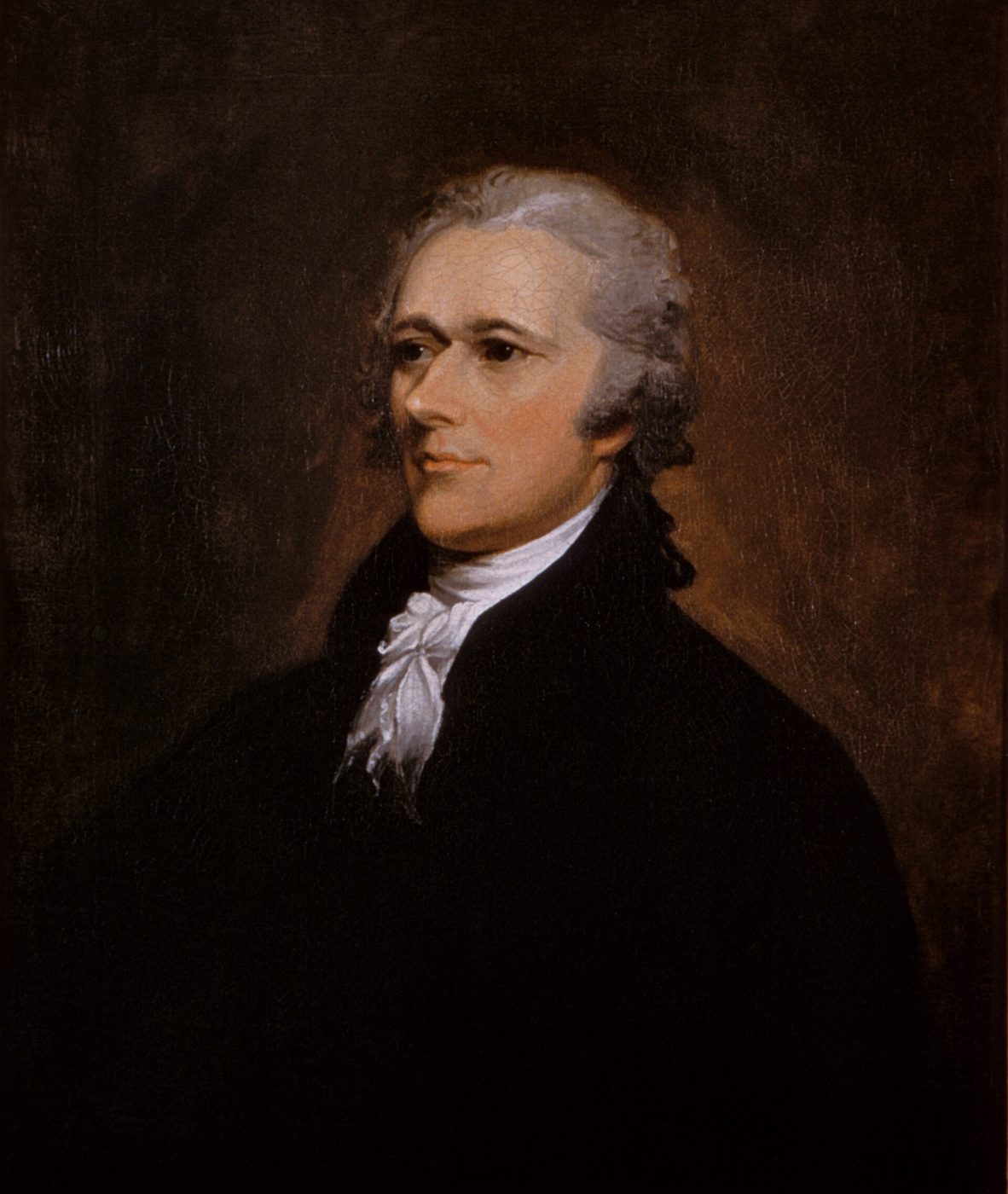
The new government inherited debts from the war. Hamilton laid out his plan in the First Report on Public Credit, delivered to Congress on January 9, 1790. By his figures, the foreign debt came to roughly $11.7 million and the domestic debt to roughly $40 million, with state debts that could "safely" be put at $25 million.11 He called the debt "the price of liberty" and argued that it should be paid in full on "the immutable principles of moral obligation."12 He wanted the federal government to assume the state debts too and to fund the whole through an excise tax.12
Madison, now a member of the House, was among those who objected, and the objections were not trivial. Some states, including Maryland and Madison's Virginia, had already paid down much of their war debts, so a federal tax meant paying for the others. Madison and other supporters of state authority also feared the plan would centralize power, and many Southerners disliked the idea that northern speculators would profit.12 The House rejected the plan in April 1790.12
The Dinner and the Potomac
At the same time, Congress was fighting over where to put the capital. Jefferson recalled meeting Hamilton on the street in New York in June 1790 and finding him "somber, haggard, and dejected beyond description." He invited Hamilton and Madison to dinner the next day. According to Jefferson, Madison agreed to stop fighting assumption and help deliver votes for it, if Hamilton would help move the capital to the Potomac.12 On July 16, 1790, Congress passed the Residence Act, creating "a district of territory, not exceeding ten miles square, to be located as hereafter directed on the river Potomac." A few weeks later it approved Hamilton's Funding Act.12
Jefferson came to regret the bargain. He later concluded that assumption "was unjust, in itself oppressive to the states, and was acquiesced in merely from a fear of disunion, while our government was still in its most infant state."12 Jefferson's account, as the Richmond Fed relays it, shows a founder who accepted a bargain he later thought a mistake.
The Bank and the Meaning of "Necessary"
In December 1790 Hamilton sent Congress a plan for a national bank modeled on the Bank of England.13 The bill chartered the Bank of the United States for twenty years with $10 million in capital, $2 million of it owned by the government and $8 million by private investors.13 Hamilton called such a bank "a political machine, of the greatest importance to the state."14 But the Constitution does not say Congress may charter a bank, and that created the first big argument about implied powers.
Madison and Jefferson Object
Madison told the House on February 2, 1791 that the necessary-and-proper clause had to be read narrowly. According to the report of the debate, he said that "The essential characteristic of the government, as composed of limited and enumerated powers, would be destroyed" if any means could be used that might be "conceived to be conducive to the successful conducting of the finances." And he asked what would stop Congress from incorporating companies, giving monopolies and paying bounties, if it could create the means of lending by virtue of its power to borrow.15
Jefferson, as Secretary of State, gave Washington his written opinion on February 15. He rested his case on the principle of reserved powers. He quoted the language of the proposed amendment that would become the Tenth, still awaiting ratification, as the foundation of the Constitution: "all powers not delegated to the United States, by the Constitution, nor prohibited by it to the States, are reserved to the States or to the people." And then: "To take a single step beyond the boundaries thus specially drawn around the powers of Congress, is to take possession of a boundless field of power, no longer susceptible of any definition."16 He read "necessary" strictly. A power was necessary only if the listed powers could not be carried out without it.
Hamilton Replies
Hamilton's answer, on February 23, began with a principle: "every power vested in a government is in its nature sovereign, and includes, by force of the term, a right to employ all the means requisite and fairly applicable to the attainment of the ends of such power, and which are not precluded by restrictions and exceptions specified in the Constitution, or not immoral, or not contrary to the essential ends of political society."17 On the word "necessary," he said it "often means no more than needful, requisite, incidental, useful, or conducive to."17 A bank, he argued, bore on the collection of taxes and the regulation of trade, so it was a fitting means for powers Congress plainly held.
The two readings of the necessary-and-proper clause are still the working ones. Jefferson asks whether a power is indispensable to a listed power. Hamilton asks whether it is a fair means to a listed end. Madison, in the House, stood with Jefferson.14 A second Bank of the United States was chartered in 1816, and it too was allowed to expire.14 The argument outlived both banks.
The House passed the bank bill, 39 to 20, on February 8, and Washington signed it on February 25, 1791.14 The bank opened for business in Philadelphia on December 12, 1791, with a twenty-year charter. When the twenty years ended, Congress let the charter lapse.1314
The First Congress at a Glance
- Mar 4, 1789 First Congress due to meet in New York. No quorum.
- Apr 1, 1789 Muhlenberg elected first Speaker of the House.
- Apr 6, 1789 Electoral votes counted. Washington wins 69 to 0.
- Apr 30, 1789 Washington takes the oath at Federal Hall.
- Jun 8, 1789 Madison proposes amendments to the House.
- Sep 24, 1789 Judiciary Act signed.
- Sep 25, 1789 Congress sends twelve amendments to the states.
- Jan 9, 1790 Hamilton delivers the First Report on Public Credit.
- Jul 16, 1790 Residence Act sets the capital on the Potomac.
- Feb 25, 1791 Washington signs the bank bill.
- Dec 15, 1791 Ten amendments ratified. Bill of Rights in force.
Learn more
- Washington's First Inaugural Address: the full text, with the passage on the fifth article.
- Madison's June 8, 1789 speech: the proposals, and his case for a written declaration of rights.
- The Bill of Rights, National Archives: the 1789 resolution proposing twelve amendments, with a transcript.
- Judiciary Act of 1789, Federal Judicial Center: the historical note and statute text.
- Jefferson on the bank: the strict reading of "necessary and proper."
- Hamilton on the bank: the implied powers argument in his own words.
- A Capital Compromise: how debt assumption and the capital site were tied together.
Notes
- National Archives, Center for Legislative Archives, "George Washington's Inauguration." Read it online. ↩
- U.S. Senate, "Washington's Inauguration," Senate Historical Office. Read it online. ↩
- U.S. House of Representatives, History, Art & Archives, "1st Congress (1789-1791)." Read it online. ↩
- George Washington, First Inaugural Address, April 30, 1789, Avalon Project, Yale Law School. Read it online. ↩
- The Constitution of the United States, transcript, National Archives. Read it online. ↩
- Federal Judicial Center, "Landmark Legislation: Judiciary Act of 1789" (1 Stat. 73, September 24, 1789). Read it online. ↩
- James Madison, "Rights," speech to the House of Representatives, June 8, 1789, in The Founders' Constitution, vol. 1, ch. 14, doc. 50, University of Chicago Press. Read it online. ↩
- Joint Resolution of Congress proposing the Bill of Rights, September 25, 1789, transcript, National Archives. Read it online. ↩
- National Archives, "Amendments 11-27" (Amendment XXVII: "Originally proposed Sept. 25, 1789. Ratified May 7, 1992"). Read it online. ↩
- Mount Vernon, "Cabinet Members," Digital Encyclopedia. Read it online. ↩
- Alexander Hamilton, Report Relative to a Provision for the Support of Public Credit, January 9, 1790, Founders Online, National Archives. Read it online. ↩
- Federal Reserve Bank of Richmond, "A Capital Compromise," Econ Focus, first quarter 2019. Read it online. ↩
- Federal Reserve History, "The First Bank of the United States." Read it online. ↩
- U.S. House of Representatives, History, Art & Archives, "The First Bank of the United States," February 8, 1791. Read it online. ↩
- James Madison, speech on the bank bill, House of Representatives, February 2, 1791 (report of the debate), in The Founders' Constitution, Art. 1, Sec. 8, Cl. 18, doc. 9. Read it online. ↩
- Thomas Jefferson, Opinion on the Constitutionality of the Bill for Establishing a National Bank, February 15, 1791, Avalon Project. Read it online. ↩
- Alexander Hamilton, Opinion on the Constitutionality of an Act to Establish a Bank, February 23, 1791, Avalon Project. Read it online. ↩
Terms in this lesson
- Bill of Rights
- The first ten amendments to the Constitution, ratified December 15, 1791.
- Implied powers
- Powers Congress may use because they are needed to carry out a power the Constitution lists, though the Constitution does not list them by name.
- Necessary and proper clause
- Article I, Section 8, last clause: Congress may make all laws necessary and proper for carrying the listed powers into execution.
- Assumption
- The federal government taking over the unpaid Revolutionary War debts of the states, as Hamilton proposed in 1790.
- Excise
- A tax on the making or sale of a particular good, such as distilled spirits.
- Recommendatory amendments
- Amendments suggested by a state convention for the first Congress to consider.
- Circuit riding
- The early practice of having Supreme Court justices travel to hear cases in assigned regions.
Sources
- Washington's First Inaugural Address (Avalon Project) checked 2026-10
- George Washington's Inauguration (National Archives) checked 2026-10
- Judiciary Act of 1789 (Federal Judicial Center) checked 2026-10
- Madison, speech of June 8, 1789 (The Founders' Constitution) checked 2026-10
- The Bill of Rights, transcript (National Archives) checked 2026-10
- A Capital Compromise (Federal Reserve Bank of Richmond) checked 2026-10
- The First Bank of the United States (Federal Reserve History) checked 2026-10
- Jefferson's opinion on the bank (Avalon Project) checked 2026-10
- Hamilton's opinion on the bank (Avalon Project) checked 2026-10
- Cabinet Members (Mount Vernon) checked 2026-10