Lesson 8 of 15 · about 8 minutes
William Paterson: The New Jersey Plan
You'll be able to
- Place Paterson's life in order, from Ireland in 1745 to Albany in 1806
- State what the New Jersey Plan proposed and what it shared with the Virginia Plan
- Explain Paterson's argument that the Convention had no authority to abandon the Articles
- See how an idea from his plan, a supreme law of the land, ended up in the Constitution
On June 15, 1787, William Paterson of New Jersey laid a set of nine resolutions before the Convention. They were meant to take the place of the Virginia Plan, and they came from a group of delegations that thought Virginia's plan had gone too far.1 The first resolution said the Articles of Confederation "ought to be so revised, corrected & enlarged, as to render the federal Constitution adequate to the exigencies of Government, & the preservation of the Union."1 It was a plan to mend the old house. On June 19 the Committee of the Whole postponed its first proposition, with only New York and New Jersey voting no, and the delegates went on to write a new one.2
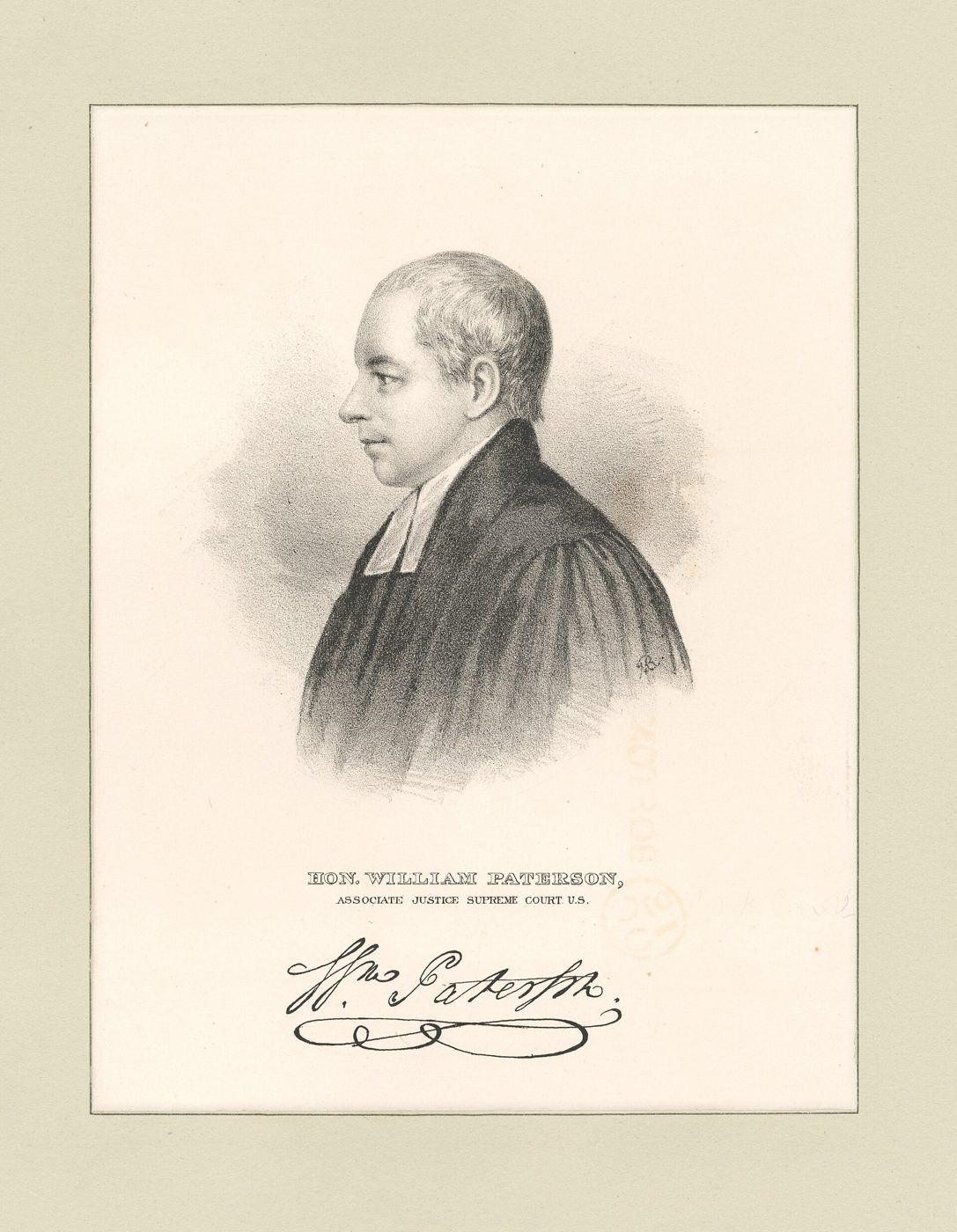
An Immigrant's Son at Princeton
Paterson was born in Ireland in 1745. His family emigrated to America before he was two, and in 1750 his father, a tinware maker, settled them in Princeton, New Jersey. William took a bachelor's and a master's degree at the College of New Jersey, left in 1766, and was practicing law by 1770.3 He was New Jersey's first attorney general when the Declaration was signed.3 By 1787 he was one of the state's leading lawyers, chosen with Jonathan Dayton, David Brearley and Governor William Livingston.3
What the New Jersey Plan Proposed
Paterson's plan kept Congress as one house with an equal vote for each state, as under the Articles. It added powers. Congress could levy duties on imports, impose stamp duties and a postage fee, and regulate trade at home and abroad. It could order requisitions on the states by a rule counting "three fifths of all other persons," and could direct collection in states that refused to pay. The plan also called for a federal executive of several persons, removable by Congress when a majority of the state executives asked, and for a supreme tribunal whose judges the executive would appoint.1
It had a sharp edge too. Resolution 6 said that Acts of Congress and treaties "shall be the supreme law of the respective States" and that state judges "shall be bound thereby in their decisions, any thing in the respective laws of the Individual States to the contrary notwithstanding." The federal executive could call out the force of the confederated states to compel obedience.1 That is close to what Article VI later says about "the supreme Law of the Land."4 So the small states' plan was not a plan for a weak government.
The Argument About Authority
Paterson's strongest argument was about power, not policy. On June 9 he reminded the delegates that the Convention had been formed under an act of Congress, and that the commissions of several states, including Massachusetts, spoke of amending the Confederation. The articles were therefore "the proper basis of all the proceedings." If the Convention went beyond them, he warned, "we should be charged by our Constituents with usurpation."5 Proportional representation, he said, was a proposition "striking at the existence of the lesser States."5
He also had an argument about fairness. If a rich citizen held forty times the property of a poor one, Paterson asked on June 9, would anyone say the rich man should have forty times the votes? Such a principle, he said, would put the poor man "entirely at the mercy" of the rich one. The same reasoning applied to a large state beside a small one: give the large states influence in proportion to their size, and "their ambition will be proportionally increased, and the small States will have every thing to fear." He pointed to colonial history, recalling a proposal that America be represented in Parliament by about a third of the seats and be bound by its laws, and asked whether American rights would have been safe under that arrangement.4
On June 16, defending his plan, he put it in plain terms:
"I came here not to speak my own sentiments, but the sentiments of those who sent me. Our object is not such a Governmt. as may be best in itself, but such a one as our Constituents have authorized us to prepare, and as they will approve."
William Paterson, as recorded by James Madison, June 16, 1787. 6
He pressed the point that the Articles, by their own terms, could only be changed by unanimous consent: "What is unanimously done, must be unanimously undone."6 On June 9 he had added a blunt reading of the public mind: "We must follow the people; the people will not follow us."5
Wilson answered that all authority comes from the people, so equal numbers of people ought to have equal representation.7 The Convention sided with Wilson on the first branch and later with Paterson's side on the second. Both men had a point, and the Constitution has both of them in it.
Leaving, and Coming Back
When the Convention adopted the compromise of July 16, Paterson was satisfied that the small states were safe, and he stopped attending. Madison's Notes last record him acting on July 23, when he seconded a motion to send the Constitution to state legislatures for ratification.8 On August 21 his colleague David Brearley pleaded with him to "come down and assist us." Paterson did not return until September, when he signed.3
Senator, Governor, Justice
Paterson won a seat in the first Senate, where he and Oliver Ellsworth were the principal authors of the Judiciary Act of 1789. The act answered fears that federal courts would threaten state courts: it let state courts share jurisdiction over many federal questions and required federal courts to pick juries by the procedures of the district's state courts.9 In 1790 he was elected governor of New Jersey, and from 1793 to 1806 he served as an associate justice of the Supreme Court.3
In 1803, while riding circuit, he was thrown in a coach accident. His health failed afterward. In September 1806, at sixty, he set out for a spa in New York hoping to be cured, and he died on the way at his daughter's house in Albany.3 The New Jersey Plan has a reputation as the plan that lost. Its authors still got what they came for: an equal vote in the Senate.
Paterson's Life at a Glance
- 1745 Born in Ireland; family emigrates before his second birthday.
- 1750 Family settles in Princeton, New Jersey.
- 1766 Leaves the College of New Jersey; practicing law by 1770.
- 1776 Serving as New Jersey's first attorney general.
- 1787 Presents the New Jersey Plan June 15; leaves after July; returns to sign in September.
- 1789 Co-authors the Judiciary Act in the Senate.
- 1790 Elected governor of New Jersey.
- 1793 Joins the Supreme Court.
- 1806 Dies in Albany, New York.
Learn more
- Madison Debates, June 15: the nine resolutions of the New Jersey Plan, in full.
- Madison Debates, June 16: Paterson's speech in favor of his plan.
- Madison Debates, June 9: Paterson on the limits of the Convention's authority.
- The Judiciary Act of 1789: the text, and a note on Paterson and Ellsworth as authors.
- National Constitution Center biography: a short life of Paterson by historian Carol Berkin.
Notes
- James Madison, Notes of Debates in the Federal Convention of 1787, June 15, 1787, "The propositions from N. Jersey," Avalon Project, Yale Law School. Read it online. ↩
- Madison, Notes of Debates, June 19, 1787, Avalon Project. Read it online. ↩
- Carol Berkin, "William Paterson," Signers' Biographies, National Constitution Center. Read it online. ↩
- U.S. Constitution, Article VI, Clause 2, National Archives transcript. Read it online. ↩
- Madison, Notes of Debates, June 9, 1787, Avalon Project. Read it online. ↩
- Madison, Notes of Debates, June 16, 1787, Avalon Project. Read it online. ↩
- Madison, Notes of Debates, June 9, 1787, Wilson's reply to Paterson, Avalon Project. Read it online. ↩
- Madison, Notes of Debates, July 23, 1787, Avalon Project. Read it online. ↩
- Federal Judicial Center, "Judiciary Act of 1789." Read it online. ↩
Terms in this lesson
- New Jersey Plan
- The plan Paterson presented on June 15, 1787, to amend the Articles of Confederation, keep one legislative house with an equal vote for each state, and add some new federal powers.
- Unicameral
- Having one legislative house rather than two. The Articles Congress was unicameral.
- Supremacy clause
- Article VI, Clause 2, which makes the Constitution and federal laws and treaties the supreme law of the land. Resolution 6 of Paterson's plan said something similar.
- Sovereignty
- Final authority to govern. Paterson argued that under the Articles each state held an equal share.
- Associate Justice
- A member of the Supreme Court other than the Chief Justice. Paterson served from 1793 to 1806.
Sources
- National Constitution Center, William Paterson, Signers' Biographies checked 2026-10
- Madison Debates, June 9, Avalon Project checked 2026-10
- Madison Debates, June 15, Avalon Project checked 2026-10
- Madison Debates, June 16, Avalon Project checked 2026-10
- Federal Judicial Center, Judiciary Act of 1789 checked 2026-10
- The Constitution of the United States, transcript, National Archives checked 2026-10