Lesson 3 of 15 · about 8 minutes
Roger Sherman: The Cobbler Who Made the Compromise
You'll be able to
- Place Sherman's life in order, from Newton, Massachusetts in 1721 to New Haven in 1793
- Explain the plan Sherman proposed on June 11, 1787, and the vote of July 16 that adopted it
- State his reasons for opposing a bill of rights on September 12 and for leaving the slave trade alone
- Describe how a conservative New England magistrate saw the role of the people in government
On June 11, 1787, a Connecticut judge of sixty-six stood in the Pennsylvania State House and offered a way out. The Convention was deep in the fight over how states should be represented in the new Congress. Roger Sherman, whom Madison spelled "Sharman" in his notes that day, proposed that in the first branch "the proportion of suffrage" be "according to the respective numbers of free inhabitants," and that in the second branch "each State should have one vote and no more."1 It carried on July 16, by five states to four, and it is why the Senate looks the way it does.
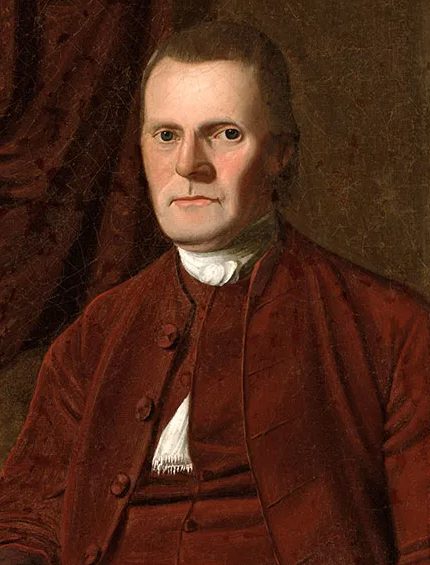
A Shoemaker's Son
Sherman was born in 1721 in Newton, Massachusetts, the second of seven children. His father was a small farmer who also made shoes, and Roger learned the trade. His schooling lasted only the winter terms, and his skill with mathematics was self-taught.2 In 1740 he moved to New Milford, Connecticut, to join his brother. His father died the next year without a will, and the court gave Roger 109 acres on condition that he pay his mother and siblings their shares. He began adult life in debt.2
He climbed out of it by surveying, selling goods, writing almanacs and studying law. By 1745 he was Surveyor of Lands for New Haven County, he was admitted to the Connecticut bar by 1754, and in 1766 he became a judge of the Superior Court. He married twice, first Elizabeth Hartwell in 1749, and after her death in 1760, Rebecca Prescott in 1763.2
Four Founding Papers
Sherman distrusted the Sons of Liberty in the Stamp Act years, and he asked whether those who resisted were "proceeding too far."2 By 1774 he was in the First Continental Congress, where he signed the agreement to stop trade with Britain. In 1776 he voted for Richard Henry Lee's resolution for independence and sat on the five-man committee that drafted the Declaration. He also served on the committee that wrote the Articles of Confederation. He and Robert Morris are the only two people to sign the Declaration, the Articles and the Constitution, and Sherman also signed the Continental Association of 1774.2
The Compromise
When Sherman reached Philadelphia he was not sure the Articles needed to go. He thought the Confederation lacked power to enforce its decisions, and that Congress could be given taxes and a trade power without scrapping the old structure. A fellow Connecticut politician, Jeremiah Wadsworth, warned Rufus King that Sherman was "cunning as the Devil."2 He proved useful all the same.
On June 11, as Madison recorded it, Sherman gave his reason for state equality in one sentence: since the states would keep certain rights of their own, "each State ought to be able to protect itself: otherwise a few large States will rule the rest." The House of Lords, he added, had an equal vote with the Commons so that it could defend its own rights.1 Later that same day he moved that the question be taken on one vote per state in the second branch, saying "Every thing he said depended on this."1
The argument ran for five more weeks. On July 16 the Convention agreed to a report that included the sentence "in the 2d. branch of the Legislature of the U. S. each State shall have an equal vote." Connecticut, New Jersey, Delaware, Maryland and North Carolina voted yes. Pennsylvania, Virginia, South Carolina and Georgia voted no. Massachusetts split.3 The same report said money bills must start in the first branch.3 It is still called the Connecticut Compromise, and Article I still gives each state two senators.4
The people and the executive
Sherman's compromise was a conservative one. On May 31, when the delegates talked about letting the people elect the lower house, Madison reported him saying the people "immediately should have as little to do as may be about the Government. They want information and are constantly liable to be misled."5 On June 1 he called the executive "nothing more than an institution for carrying the will of the Legislature into effect."6 The Convention went the other way on both points. The Constitution gave the people a direct vote for the House, and the president is no creature of Congress.
Slavery
Sherman is hard to pin down on slavery. In debate on the slave trade on August 22 he said he "disapproved of the slave trade," yet argued for leaving the clause alone because the states already had the right to import slaves and because "it was expedient to have as few objections as possible to the proposed scheme of Government."7 He objected to a tax on imported slaves because it "implied they were property."7 On August 8 he had called the trade "iniquitous" while declining to oppose the representation formula.8 He stated the moral objection and gave way to the bargain.
Against a Bill of Rights
When George Mason asked on September 12 for a committee on a bill of rights, Sherman answered for the majority. "The State Declarations of Rights are not repealed by this Constitution," he said, "and being in force are sufficient." And: "The Legislature may be safely trusted."9 No state voted yes. Ten voted no and Massachusetts abstained.9 Mason answered that national law would be paramount to state bills of rights. In ratification debates that response proved to be the better argument. Sherman, now in the First Congress, did not object when Madison proposed the Bill of Rights.2
Last Years
Connecticut sent Sherman to the House of Representatives in 1789 and to the Senate in 1791. In the summer of 1793 he took typhoid fever, and he died on July 23.2 The Yale president Ezra Stiles called him an "extraordinary man, a venerable uncorrupted Patriot."2 Under the original Article I, the state legislatures chose senators, which fit his view that the people should act through their states and their assemblies. That changed only with the Seventeenth Amendment in 1913.4
Sherman's Life at a Glance
- 1721 Born in Newton, Massachusetts.
- 1740 Moves to New Milford, Connecticut; his father dies the following year.
- 1754 Admitted to the Connecticut bar.
- 1766 Appointed judge of the Connecticut Superior Court.
- 1774 Signs the Continental Association.
- 1776 Sits on the committee to draft the Declaration of Independence.
- 1787 Proposes equal state votes in the Senate on June 11; compromise adopted July 16; signs the Constitution September 17.
- 1791 Elected to the U.S. Senate.
- 1793 Dies July 23 in New Haven.
Learn more
- Madison Debates, June 11: Sherman's plan, in Madison's report.
- Madison Debates, July 16: the day the compromise passed by one vote.
- Madison Debates, September 12: Sherman against a bill of rights.
- National Constitution Center biography: a life of Sherman by historian Carol Berkin.
- Madison at the Federal Convention: how the Papers of James Madison editors describe the compromise.
Notes
- James Madison, Notes of Debates in the Federal Convention of 1787, June 11, 1787, Avalon Project, Yale Law School. Read it online. ↩
- Carol Berkin, "Roger Sherman," Signers' Biographies, National Constitution Center. Read it online. ↩
- Madison, Notes of Debates, July 16, 1787, and footnote 1 giving the vote from the transcript, Avalon Project. Read it online. ↩
- U.S. Constitution, Article I, Section 3, National Archives transcript, and National Archives, "17th Amendment to the U.S. Constitution: Direct Election of U.S. Senators (1913)." Constitution; 17th Amendment. ↩
- Madison, Notes of Debates, May 31, 1787, Avalon Project. Read it online. ↩
- Madison, Notes of Debates, June 1, 1787, Avalon Project. Read it online. ↩
- Madison, Notes of Debates, August 22, 1787, Avalon Project. Read it online. ↩
- Madison, Notes of Debates, August 8, 1787, Avalon Project. Read it online. ↩
- Madison, Notes of Debates, September 12, 1787, Avalon Project. Read it online. ↩
Terms in this lesson
- Connecticut Compromise
- The agreement that the House of Representatives be apportioned by population and each state have an equal vote in the Senate. Also called the Great Compromise. The Convention adopted it by a vote of five states to four on July 16, 1787, with Massachusetts divided.
- Continental Association
- The 1774 agreement among the colonies to stop trading with Britain until Parliament repealed the Coercive Acts.
- Sine qua non
- Latin for a condition without which something will not happen.
- Superior Court
- Connecticut's high trial court. Sherman was a judge on it from 1766.
- Seventeenth Amendment
- Ratified April 8, 1913, it replaced the original method, in which state legislatures chose U.S. senators, with direct election by voters.
Sources
- National Constitution Center, Roger Sherman, Signers' Biographies checked 2026-10
- Madison Debates, May 31, Avalon Project checked 2026-10
- Madison Debates, June 11, Avalon Project checked 2026-10
- Madison Debates, July 16, Avalon Project checked 2026-10
- Madison Debates, August 22, Avalon Project checked 2026-10
- Madison Debates, September 12, Avalon Project checked 2026-10
- Madison at the Federal Convention, Founders Online checked 2026-10
- The Constitution of the United States, transcript, National Archives checked 2026-10
- 17th Amendment, Direct Election of U.S. Senators, National Archives checked 2026-10