Lesson 13 of 15 · about 8 minutes
Prince Hall: A Free Black Citizen Petitions the New Republic
You'll be able to
- Place Hall's life in order, from slavery in Boston to his death in 1807
- Read the 1777 petition and see how it argues from natural right and from Christian profession
- Compare the Massachusetts Constitution of 1780 with Article I, Section 9 of the federal Constitution
- Follow Hall's work in the 1780s: the Masonic charter, the offer in Shays's Rebellion, and the 1788 slave-trade law
- Read what Hall told his lodge in 1797 about patience, law and worship
On January 13, 1777, eight Black men in Boston signed a petition to the Massachusetts legislature. It was a short document and a bold one. It did not ask for a favor. It said the petitioners held, "in common with all other Men, a natural and unalienable right to that freedom, which the great Parent of the Universe hath bestowed equally on all Mankind."1 The fourth name on the list was Prince Hall. Over the next thirty years he kept making the same argument, patiently, in writing, to every body that would receive it.
From Leather Shop to Petition
Hall's birthplace and parentage are disputed. His death record gives his age as seventy-two, which points to about 1735. The earliest verifiable fact is that he was enslaved by William Hall, a Boston leather worker, and learned the trade. He gained his freedom in 1770 and opened a leather shop of his own.2 He was already writing to the legislature. In 1773 he and four others asked for one day a week in which Black workers could earn money to buy their freedom.2
The 1777 petition went further, and it chose its ground with care. It spoke of "a free & Christian Country" and "a People professing the mild Religion of Jesus." It said the petitioners had been taken "in Violation of the Laws of Nature & of Nation." And it turned the Revolution's own words on the lawmakers: "every principle from which America has acted in the course of her unhappy difficulties with Great-Britain, pleads stronger than a thousand arguments in favor of your Petitioners."1 They asked that they be "restored to the enjoyment of that freedom which is the natural right of all Men," and that their children not be held as slaves past twenty-one.1
Notice what kind of argument this is. It does not demand a new theory of society. It takes the claims the Patriots already made, that rights come from the Creator and not from the state, and asks that they be applied without exception. That is the natural-law tradition at its plainest. A right that comes from God cannot be taken away because a purchaser paid for it. The legislature drafted a bill to end slavery on June 9, 1777, and then let it die.3
Words in a Constitution
Three years later Massachusetts adopted a constitution. Its first article read: "All men are born free and equal, and have certain natural, essential, and unalienable rights."4 The language was close to what the petitioners had written. Enslaved people in the state began suing on it, and in 1783 the courts held that slavery could not stand under that constitution.3 The Massachusetts Historical Society documents this as the end of slavery under the 1780s constitution.5 The next lesson tells one of those stories.
The federal Constitution, drafted in 1787, was a different document on this point. It never used the word slavery. But Article I, Section 9, said that "The Migration or Importation of such Persons as any of the States now existing shall think proper to admit, shall not be prohibited by the Congress prior to the Year one thousand eight hundred and eight."6 The Convention had made a bargain, and Hall lived in the state that had just written a better sentence. That tension is the reason his life belongs in this course.
The African Lodge and the Hard 1780s
On March 6, 1775, Hall and fourteen other free Black men were initiated into a Masonic lodge attached to a British regiment in Boston. When the regiment left, they received a permit to meet, and African Lodge was organized in July 1776 with Hall as its leader.7 American Masons would not charter them. In 1784 Hall wrote to the Grand Lodge in London, and a charter came in the spring of 1787, making African Lodge No. 459 the first regular Black Masonic lodge.7 A lodge gave men a place to meet, to bury their dead with dignity, to care for the families they left, and to speak with one voice. It was an institution of ordered liberty, built from below.
Hall also tried to serve the state that would not free his people. During Shays's Rebellion in 1786 he offered to raise a company of Black volunteers to help put it down. Governor Bowdoin declined.7 In 1787 Hall petitioned about schools, pointing out that Black taxpayers were paying into a system their children could not use.8
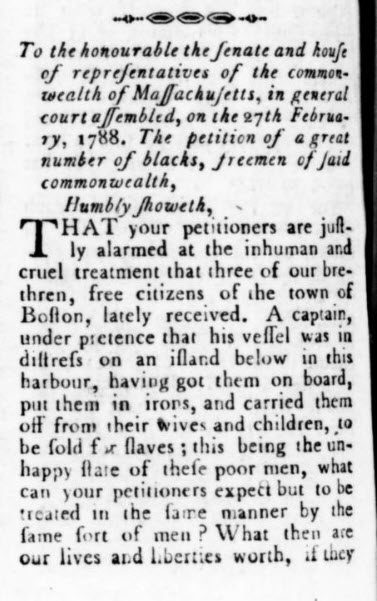
In early 1788 came a victory. Three free Black men were kidnapped in Boston and carried toward the West Indies. Hall drafted a petition, twenty-two lodge members signed, and Quakers and Boston clergy added their voices. In March the legislature banned the slave trade in Massachusetts, and the governor and the French consul worked to bring the men home.7 The printed petition of that year carries Hall's name.9 It was a small thing set against what remained. It was also proof that a petition, written in plain terms and aimed at a conscience, could work.
What Hall Told His Lodge
On June 24, 1797, Hall gave a Charge to the lodge at Menotomy, and the members had it printed. He spoke to men who were being abused in the streets. He told them they bore "the daily insults you meet with in the streets of Boston," and that "you may truly be said to carry your lives in your hands." Then he asked for patience, and gave a reason that was both moral and civic. The abuse came from a mob, and "we despise" the mob, "and had rather suffer wrong than to do wrong, to the disturbance of the community and the disgrace of our reputation: for every good citizen doth honor to the laws of the state here he resides."10
He was not asking for passivity. He told them to "pay all due respect to all whom God hath put in places of honor over us," to be faithful to employers, and still to "worship no man. Worship God, this much is your duty as Christians and as Masons."10 And he told them to give "the right hand of affection and fellowship to whom it justly belongs, let their colour and complexion be what it will."10 Respect for law, loyalty to God above every human ruler, and the equal dignity of every person: those three ideas are the center of his thought.
Hall died in Boston on December 4, 1807. His widow valued the estate at under fifty dollars. The ban on the Atlantic slave trade that Article I, Section 9 had allowed Congress to enact took effect on January 1, 1808, less than a month later.2
Hall's Life at a Glance
- c. 1735 Born; the place is disputed. Enslaved in Boston by William Hall.
- 1770 Gains his freedom and opens a leather shop.
- 1775 Initiated in a Masonic lodge attached to a British regiment, March 6.
- 1777 Signs the January 13 petition for freedom to the Massachusetts General Court.
- 1780 Massachusetts adopts a constitution declaring all men born free and equal.
- 1787 African Lodge No. 459 receives its English charter; Hall petitions on schools.
- 1788 Hall's petition helps bring a Massachusetts ban on the slave trade, in March.
- 1797 Delivers his Charge to the African Lodge, June 24.
- 1807 Dies in Boston on December 4.
Learn more
- The 1777 petition, full text: from the Library of America, with an editor's note on the document.
- Prince Hall, Encyclopedia of the American Revolution: a detailed life, including the lodge, the petitions and the 1788 law.
- A Charge Delivered to the African Lodge, 1797: Hall's printed address, in full.
- Massachusetts Constitution: the text of the 1780 Declaration of Rights.
- African Americans and the End of Slavery in Massachusetts: manuscripts and petitions from the Massachusetts Historical Society.
- The Constitution, National Archives transcript: Article I, Section 9, the 1808 clause.
Notes
- Petition of Lancaster Hill, Peter Bess, Brister Slenser, Prince Hall, et al., January 13, 1777, with the editor's headnote by James G. Basker, Library of America Story of the Week. Read it online. ↩
- "Hall, Prince," Encyclopedia of the American Revolution, via Encyclopedia.com. Read it online. ↩
- Headnote to the 1777 petition, Library of America Story of the Week: a bill to abolish slavery was drafted June 9, 1777, and allowed to die; the courts found slavery incompatible with the state constitution in 1783. Read it online. ↩
- Constitution of the Commonwealth of Massachusetts (1780), Part the First, Article I, Massachusetts Legislature. Read it online. ↩
- "African Americans and the End of Slavery in Massachusetts," Massachusetts Historical Society. Read it online. ↩
- U.S. Constitution, Article I, Section 9, National Archives transcript. Read it online. ↩
- "Prince Hall," Encyclopedia.com, entry on African Lodge No. 459, Shays's Rebellion and the 1788 petition. Read it online. ↩
- Hall's petition on education, October 1787, as summarized in "Hall, Prince," Encyclopedia of the American Revolution. Read it online. ↩
- "Petition of a Number of Blacks," The American Museum, or Universal Magazine, May 1788, p. 410, as described on the Wikimedia Commons file page. Read it online. ↩
- Prince Hall, A Charge Delivered to the African Lodge, June 24, 1797, at Menotomy, Mass., Open Anthology of Earlier American Literature. Read it online. ↩

Terms in this lesson
- Petition
- A written request to a legislature. Black Bostonians in the 1770s and 1780s used petitions because they could not vote their way out of slavery.
- General Court
- The name for the Massachusetts legislature, a Council and a House of Representatives.
- Natural right
- A right that comes from the Creator and from human nature, not from a government's grant. A government may protect it or violate it, but it did not give it.
- African Lodge
- The Masonic lodge Hall and fourteen other Black men founded in Boston. It received a charter from the Grand Lodge of England and became the first Black Masonic lodge.
- Charge
- A formal address to the members of a lodge. Hall's 1797 Charge was printed at the request of the members.
- Shays's Rebellion
- An armed protest by indebted Massachusetts farmers in 1786 and 1787 over taxes and debts.
Sources
- Petition of Lancaster Hill, Peter Bess, Brister Slenser, Prince Hall, et al., January 13, 1777, Library of America Story of the Week checked 2026-10
- Prince Hall, Encyclopedia of the American Revolution, via Encyclopedia.com checked 2026-10
- Constitution of the Commonwealth of Massachusetts, Part the First, Article I (1780), Massachusetts Legislature checked 2026-10
- A Charge Delivered to the African Lodge, June 24, 1797, Open Anthology of Earlier American Literature checked 2026-10
- The Constitution of the United States, transcript, National Archives checked 2026-10
- African Americans and the End of Slavery in Massachusetts, Massachusetts Historical Society checked 2026-10