Lesson 7 of 15 · about 8 minutes
Oliver Ellsworth: Partly National, Partly Federal
You'll be able to
- Place Ellsworth's life in order, from Windsor, Connecticut in 1745 to Windsor in 1807
- Read his June 29, 1787 speech asking for a middle ground between a national and a federal system
- Describe his argument on the slave trade and how it sat with Connecticut's own law
- Explain why he left the Convention early and how he helped build the federal courts anyway
On June 29, 1787, the Convention had just voted that the House of Representatives would be elected in proportion to population. Oliver Ellsworth, a delegate from Connecticut, said he was not sorry. "He was not sorry on the whole he said that the vote just passed, had determined against this rule in the first branch. He hoped it would become a ground of compromise with regard to the 2d. branch."1 He had just lost a vote, and he was already looking for the next one. That is how a compromise gets started.
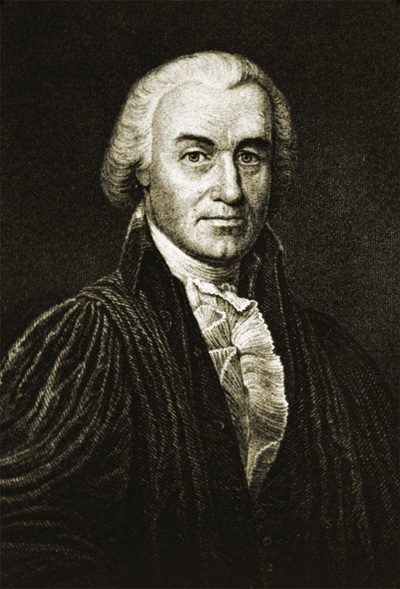
A Connecticut Lawyer
Ellsworth was born April 29, 1745, in Windsor, Connecticut. He started at Yale, transferred to the College of New Jersey, now Princeton, and graduated in 1766. He read law and was admitted to the bar in 1771.2 He sat in the state legislature from 1773, served in the Continental Congress from 1777 to 1784 with many committee assignments, and became a judge of the Connecticut Superior Court in 1784.23
The Middle Ground
The fight in the Convention was about whether the new Congress would count people or states. Large states wanted people. Small states wanted the equal vote they had under the Articles. On June 29 Ellsworth moved that in the second branch the rule of suffrage be the same as under the Articles, and he explained why in terms that ran through the rest of the summer:
"We were partly national; partly federal. The proportional representation in the first branch was conformable to the national principle & would secure the large States agst. the small. An equality of voices was conformable to the federal principle and was necessary to secure the Small States agst. the large. He trusted that on this middle ground a compromise would take place."
Oliver Ellsworth, as recorded by James Madison, June 29, 1787. 1
He was blunt about the alternative. If no compromise was reached, he said, "our meeting would not only be in vain but worse than in vain." And an attempt to deprive the states of an equal voice in both branches was "at once cutting the body of America in two."1 On July 16 the Convention adopted the resolution that each state would have an equal vote in the second branch.4 The Supreme Court Historical Society says Ellsworth helped formulate the Connecticut Compromise, and Roger Sherman had put the same idea forward on June 11.3
The equal vote became the one part of the Constitution that cannot be amended by the usual route. Article V closes with a proviso that "no State, without its Consent, shall be deprived of its equal Suffrage in the Senate."5 On September 15 Roger Sherman urged that very protection, fearing that three-fourths of the states could otherwise abolish a state or strip it of its equality in the Senate.6 The Ellsworth compromise was not just adopted. It was locked in.
States as the foundation
Ellsworth's views fit a pattern. On June 25 he argued that the Senate should be chosen by the state legislatures, because without the states' cooperation it would be impossible "to support a Republican Govt. over so great an extent of Country." He added that "The largest States are the worst Governed."7 On June 22 he said that if delegates told their states "we gave the Gen: Govt. such powers because we cd. not trust you," the states would not adopt it.8 He wanted a government the states would accept.
Slavery: "Let Every State Import What It Pleases"
Ellsworth's record on slavery is, at best, an argument for leaving the matter alone. On August 21, when the delegates debated the clause protecting the slave trade, he said, "let every State import what it pleases. The morality or wisdom of slavery are considerations belonging to the States themselves."9 The next day he added that he had never owned a slave and could not judge its effect on character. If the trade was a moral question, he said, "we ought to go farther and free those already in the Country." He predicted that slavery "in time will not be a speck in our Country," and noted that Connecticut already had provision for abolishing it and Massachusetts had abolished it.10
Anyone reading that today sees a man who named the moral problem and used it as a reason to do nothing. His prediction was wrong. Slavery was no speck. It was the central fight in the country for decades.
Gone Before the End
Madison's Notes record no speech from Ellsworth after August 23.11 He was not in Philadelphia when the delegates signed on September 17. The Connecticut signatures are those of William Samuel Johnson and Roger Sherman.5 Madison's Notes give no reason for his departure.
Senator, Judge, Diplomat
Connecticut's legislature sent him to the first U.S. Senate in 1789. There he and William Paterson of New Jersey were the principal authors of the Judiciary Act of 1789, which gave the country a Supreme Court of a chief justice and five associate justices, plus district and circuit courts.12 The act was signed September 24, 1789. The Constitution had said little about the lower courts; Ellsworth and his colleagues filled in the structure, and Section 25 let the Supreme Court review final judgments of the highest state courts that rejected a federal law or treaty.12
George Washington nominated Ellsworth Chief Justice on March 3, 1796, and the Senate confirmed him the next day. He served until December 15, 1800, when he resigned. In 1799 and 1800 he had also been the American minister plenipotentiary to France.2 He died in Windsor on November 26, 1807, at sixty-two.3
Ellsworth's Life at a Glance
- 1745 Born April 29 in Windsor, Connecticut.
- 1766 Graduates from the College of New Jersey.
- 1771 Admitted to the bar.
- 1777 Begins service in the Continental Congress.
- 1787 Moves the equal-suffrage rule for the Senate on June 29; last recorded in the Notes on August 23.
- 1789 Takes his Senate seat; helps write the Judiciary Act, signed September 24.
- 1796 Becomes Chief Justice of the United States.
- 1800 Resigns from the Court December 15.
- 1807 Dies in Windsor on November 26.
Learn more
- Madison Debates, June 29: Ellsworth's speech and the debate around it.
- The Judiciary Act of 1789: the Federal Judicial Center's account and the full text of the act.
- Federal Judicial Center: Oliver Ellsworth: the dates of his public service in one place.
- Supreme Court Historical Society: Ellsworth: a short biography of the third Chief Justice.
- Madison Debates, August 21: the slave-trade clause and Ellsworth's remarks.
Notes
- James Madison, Notes of Debates in the Federal Convention of 1787, June 29, 1787, Avalon Project, Yale Law School. Read it online. ↩
- Federal Judicial Center, "Ellsworth, Oliver," Biographical Directory of Article III Federal Judges. Read it online. ↩
- Supreme Court Historical Society, "Oliver Ellsworth, 1796-1800." Read it online. ↩
- Madison, Notes of Debates, July 16, 1787, Avalon Project. Read it online. ↩
- U.S. Constitution, Article V and signature page, National Archives transcript. Read it online. ↩
- Madison, Notes of Debates, September 15, 1787, Avalon Project. Read it online. ↩
- Madison, Notes of Debates, June 25, 1787, Avalon Project. Read it online. ↩
- Madison, Notes of Debates, June 22, 1787, Avalon Project. Read it online. ↩
- Madison, Notes of Debates, August 21, 1787, Avalon Project. Read it online. ↩
- Madison, Notes of Debates, August 22, 1787, Avalon Project. Read it online. ↩
- Madison, Notes of Debates, August 23, 1787, Avalon Project. Read it online. ↩
- Federal Judicial Center, "Judiciary Act of 1789," with the text of the act, approved September 24, 1789. Read it online. ↩
Terms in this lesson
- Federal principle
- The idea that states are equal political societies that join in a union and keep an equal voice in it. Ellsworth argued the Senate should reflect it.
- National principle
- The idea that a government should represent people according to their numbers. Ellsworth said the House should reflect it.
- Judiciary Act of 1789
- The statute that set up the federal court system: a Supreme Court of six justices, district courts and circuit courts. Ellsworth and William Paterson were its main authors.
- Chief Justice
- The head of the Supreme Court. Ellsworth held the post from 1796 to 1800.
- Minister plenipotentiary
- A diplomat with full authority to act for his government. Ellsworth went to France in 1799.
Sources
- Federal Judicial Center, Oliver Ellsworth checked 2026-10
- Supreme Court Historical Society, Oliver Ellsworth, 1796-1800 checked 2026-10
- Federal Judicial Center, Judiciary Act of 1789 checked 2026-10
- Madison Debates, June 29, Avalon Project checked 2026-10
- Madison Debates, August 21, Avalon Project checked 2026-10
- Madison Debates, August 22, Avalon Project checked 2026-10
- The Constitution of the United States, transcript, National Archives checked 2026-10