Lesson 6 of 9 · about 22 minutes
The Constitutional Convention of 1787
You'll be able to
- Describe who met in Philadelphia, under what rules, and why Madison's notes are our main record
- Compare the Virginia Plan, the New Jersey Plan and Hamilton's plan, and explain how the July 16 compromise settled the fight over representation
- State what the Convention did about the three-fifths rule, the slave trade and fugitives, using the delegates' own words
- Explain how the Committee of Style produced the final text, and what Franklin asked of the members on September 17
The delegates were supposed to meet on Monday, May 14, 1787. Only a small number had arrived. Delegates from seven states were finally in the room on Friday, May 25, and the first piece of business was an easy one.1 Robert Morris of Pennsylvania proposed George Washington for president of the Convention, and John Rutledge of South Carolina seconded. Washington was elected unanimously by ballot and led to the chair. From there, Madison records, he thanked the members, reminded them of "the novelty of the scene of business in which he was to act," lamented his want of better qualifications, and asked the House to forgive "the involuntary errors which his inexperience might occasion."1
Benjamin Franklin was supposed to make that nomination himself. The weather and his health kept him at home, so Morris did it for him.1 Washington would preside through the summer, almost never speak, and lend the whole business a weight that no other man in America could have given it.
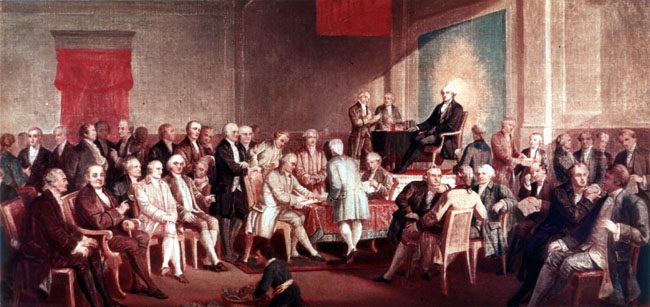
Fifty-Five Men in the State House
The states appointed seventy men. Fifty-five attended sessions, and thirty-nine signed. Rhode Island sent no one. The National Archives lists Richard Henry Lee, Patrick Henry, Samuel Adams and John Hancock among those who did not accept or could not attend.2 The ages ran from twenty-six (Jonathan Dayton of New Jersey) to eighty-one (Franklin, who was carried to the sessions in a sedan chair).2
These men had watched the Articles of Confederation fail, and Lesson 5 tells how. The question in Philadelphia was what to build in its place.
Some of the credentials carried a trap. Delaware's delegates were forbidden to agree to any change in the article of the Confederation that gave every state an equal vote.1 Much of what followed in the next two months, the shouting included, grew out of that one instruction.
The Rule of Secrecy
On May 29 the Convention adopted its working rules. One of them: "That nothing spoken in the House be printed, or otherwise published or communicated without leave of the House."3 The doors stayed shut. Members could change their minds without defending yesterday's position in a newspaper, and they could say hard things about each other that never reached the street.
Madison and His Notes
The fullest account of what the delegates said is the one James Madison kept. At the end of it he added a note that a few corrections in other hands were dictated by him and made in his presence by John C. Payne.4 It is a participant's record, and historians use it with that in mind. His biography is in Module 55, Lesson 1.
The Virginia Plan
On May 29 Edmund Randolph of Virginia opened the main business. The Convention had "originated from Virginia," he said, and his colleagues thought some proposition was expected from them, so they had given him the job.3 He listed what the Confederation could not do. It gave no security against foreign invasion. It could not check quarrels between states or put down a rebellion inside one. It could not defend itself against encroachments by the states, and it was not even paramount to the state constitutions.3 Then he read fifteen resolutions.
The first said the Articles ought to be "corrected & enlarged" to reach their own stated goals of "common defence, security of liberty and general welfare."3 The rest went much further than correction. The national legislature would have two branches, the first elected by the people of the states and the second chosen by the first. Representation would follow population or money contributed. The legislature could "legislate in all cases to which the separate States are incompetent," and could "negative all laws passed by the several States" that it judged contrary to the articles of union.3 A national executive and national courts would stand beside it, and a council of the executive and some judges could review every act of the legislature.3
It was a plan for a government that acted directly on citizens instead of asking the states for money. And its formula for representation favored the large states, which is why the small ones answered it.
The New Jersey Plan and Hamilton's Plan
Paterson Answers
The small states took more than two weeks to reply. On June 15 William Paterson of New Jersey laid out the plan that "several of the deputations wished to be substituted" for Randolph's.5 His first resolution said the Articles ought to be "so revised, corrected & enlarged, as to render the federal Constitution adequate to the exigencies of Government, & the preservation of the Union."5 Congress would keep a single house with one vote per state, but would gain power to raise money through import duties, stamps and postage and to regulate trade.5 Paterson's argument was about authority as much as policy: the delegates had been sent to revise the Articles. His full biography is in Module 55, Lesson 8.
Hamilton Speaks
Three days later Alexander Hamilton of New York, who by his own account had been silent so far out of respect for older and more experienced men, spoke at length. He declared himself "unfriendly to both plans."6 The New Jersey scheme could not work because it left the states in possession of their sovereignty. The Virginia scheme, in his judgment, did not go far enough. His own model borrowed freely from Britain: an Assembly elected for three years, a Senate and a Governor each serving "during good behaviour." "Let one branch of the Legislature hold their places for life or at least during good behaviour," he said. "Let the Executive also be for life."6
The Convention did not adopt it. Hamilton's plan marks the far edge of the argument. The delegates were willing to build a strong national government, and they were not willing to build that one. On June 19 the committee of the whole set the New Jersey proposals aside and, by seven states to three with Maryland divided, sent the Virginia resolutions back to the Convention.7
The Compromise That Saved the Convention
By late June the fight came down to one question: how many votes would each state have in the second branch of the legislature? On June 11 Roger Sherman of Connecticut had moved that each state get one. Everything, he said, depended on it.8 Neither side moved. On June 28, with the Convention stuck, the eighty-one-year-old Franklin asked the members to begin their mornings with prayer:
"I have lived, Sir, a long time, and the longer I live, the more convincing proofs I see of this truth- that God Governs in the affairs of men. And if a sparrow cannot fall to the ground without his notice, is it probable that an empire can rise without his aid?"
Benjamin Franklin, as recorded by James Madison, June 28, 1787. 9
Hamilton and several others worried that proposing prayers so late would tell the public the Convention was in trouble. Hugh Williamson of North Carolina observed that the true cause of the omission was that the Convention had no funds. After several attempts to postpone, the Convention adjourned without a vote on the motion.9
On July 2 the vote on equal representation in the second branch came out five states to five, with Georgia divided.10 A committee of eleven, one member from each state present, was chosen to find a way out. Franklin, Gerry, Ellsworth, Paterson and Mason were among them. The Convention adjourned until Thursday so the committee could work and the members could attend the celebrations of Independence Day.10
On July 16 the Convention voted to accept the committee's report, including the equal vote in the second branch. It also fixed the first branch at sixty-five members, apportioned by state: Virginia ten, Massachusetts and Pennsylvania eight each, Maryland and New York six, and so on down to one each for Rhode Island and Delaware.11 The count on the equal vote shows how narrow it was. Connecticut, New Jersey, Delaware, Maryland and North Carolina voted yes. Pennsylvania, Virginia, South Carolina and Georgia voted no. Massachusetts split, with Gerry and Strong voting yes and King and Gorham voting no.11 Five to four, with one state divided.
Rutledge put it bluntly that day: "The little States were fixt. They had repeatedly & solemnly declared themselves to be so."11 On the morning after the vote some members from the larger states met. Madison records that "The time was wasted in vague conversation on the subject, without any specific proposition or agreement." Some wanted to press on with a plan of their own. Others were inclined to accept what the Convention could agree on, however imperfect. Madison thought it probable that the result satisfied the smaller states they had "nothing to apprehend" from a union of the larger.11 The compromise held.
It is called the Connecticut Compromise or the Great Compromise, and its two Connecticut architects have lessons of their own: Roger Sherman and Oliver Ellsworth. Its legacy sits in the Senate, where Wyoming and California each send two members.
| Plan | Introduced | Legislature | Representation |
|---|---|---|---|
| Virginia Plan (Randolph) | May 29 | Two houses | Population or contributions in both |
| New Jersey Plan (Paterson) | June 15 | One house, as under the Articles | One vote per state |
| Hamilton's plan | June 18 | Assembly for three years, Senate during good behavior | Assembly elected by the people, Senate by electors |
| Connecticut Compromise | Adopted July 16 | Two houses | House by population, Senate equal by state |
One President or Three?
The delegates took up the executive on June 1. James Wilson of Pennsylvania moved that it consist of a single person, and Charles Pinckney seconded. Then, Madison writes, "A considerable pause ensuing," the chairman asked if he should put the question. Franklin asked the members to say what they thought first, since it was a point of great importance.12 It was a fair request. Nothing like this office existed in America.
Randolph "strenuously opposed a unity in the Executive magistracy" and regarded it as "the foetus of monarchy." He did not see why vigor, despatch and responsibility could not be found in three men as well as one.12 Wilson answered that a single executive would be "the best safeguard against tyranny."12 Rutledge said he favored one person, though not with the power of war and peace.12
How the executive would be chosen took most of the summer. On July 24 Madison's notes show Wilson floating a scheme to have a small number of legislators, drawn by lot, make the choice.13 The final text in Article II has each state appoint "a Number of Electors, equal to the whole Number of Senators and Representatives to which the State may be entitled in the Congress."14 It was one more compromise between the people and the states.
Slavery and the Convention
The Declaration of Independence had said "all men are created equal."15 The delegates were building a government in states where slavery was still lawful, and some of them said so aloud. Ellsworth noted on August 22 that Connecticut had made provision for abolishing slavery and that abolition "has already taken place in Massachusetts."16 The question reached the Convention three ways.
The Three-Fifths Clause
The first was how to count enslaved people when dividing seats and taxes. On June 11 Wilson, seconded by Charles Pinckney, proposed that representation follow "the whole number of white & other free Citizens & inhabitants of every age sex & condition including those bound to servitude for a term of years and three fifths of all other persons not comprehended in the foregoing description, except Indians not paying taxes." Madison's notes add that this was the rule "in the Act of Congress agreed to by eleven States, for apportioning quotas of revenue."8 Elbridge Gerry objected: "Why then shd. the blacks, who were property in the South, be in the rule of representation more than the Cattle & horses of the North."8 The proposal carried, nine states to two, with New Jersey and Delaware voting no.8
The fight came back on July 12. Gouverneur Morris moved that direct taxes follow representation. William Davie of North Carolina warned that his state "would never confederate on any terms that did not rate them at least as 3/5."17 On July 24 Morris said he hoped the committee would strike the clause tying taxation to representation, which he had only meant "as a bridge to assist us over a certain gulph."13 The bridge stayed. In the Constitution as signed, Article I, Section 2 apportions Representatives and direct taxes by adding "the whole Number of free Persons, including those bound to Service for a Term of Years, and excluding Indians not taxed, three fifths of all other Persons."14
The clause is a counting rule and a bargain. Slaveholding states wanted every person counted when seats were handed out. Delegates from states with few enslaved people wanted none counted. Three-fifths sat in between. Since enslaved people could not vote, the formula gave the slaveholding states more seats in the House than their free population alone would have earned.
The Slave Trade Clause
The second question, on August 22, was whether Congress could ever end the importation of slaves. George Mason of Virginia spoke with a force that surprises people who know him only as the man who would not sign. "This infernal trafic originated in the avarice of British Merchants," he said, and "Every master of slaves is born a petty tyrant." Then he turned from economics to judgment: "As nations can not be rewarded or punished in the next world they must be in this. By an inevitable chain of causes & effects providence punishes national sins, by national calamities."16
Oliver Ellsworth answered that if the question was moral, the Convention ought to "go farther and free those already in the Country." He did not propose that. "Let us not intermeddle," he said, and predicted that "Slavery in time will not be a speck in our Country."16 Charles Pinckney said that "If slavery be wrong, it is justified by the example of all the world," and warned that an attempt to take away the right of the southern states to import would "produce serious objections to the Constitution."16
On August 25 General Pinckney of South Carolina moved to change the year from "eighteen hundred" to "eighteen hundred and eight." Madison objected: "Twenty years will produce all the mischief that can be apprehended from the liberty to import slaves. So long a term will be more dishonorable to the National character than to say nothing about it in the Constitution." The motion passed seven states to four.18 Article I, Section 9 reads: "The Migration or Importation of such Persons as any of the States now existing shall think proper to admit, shall not be prohibited by the Congress prior to the Year one thousand eight hundred and eight."14 Article V then shielded that clause from amendment until 1808.14
Fugitives and the Missing Word
The third was the fugitive clause. Article IV, Section 2 says that "No Person held to Service or Labour in one State, under the Laws thereof, escaping into another," shall be "delivered up on Claim of the Party to whom such Service or Labour may be due."14 The word "slave" does not appear anywhere in the Constitution as signed.14 Madison's notes show members choosing words with care. On August 25 Morris wanted the slave-trade clause to name North Carolina, South Carolina and Georgia outright, saying the clause "was a compliance with those States." Mason answered that he did not object to the term "slaves" but did object to naming the three states, "lest it should give offence to the people of those States."18
The delegates knew what they were doing. Some called it a bargain to keep the Union together. Others, then and since, have called it a betrayal of the principles of the Declaration. Both judgments are in the record, and neither erases the other. A reader who wants to hold the founders to their own words could start with Mason's: a nation does not escape the judgment of providence by giving a sin a polite name.
Committee of Detail and Committee of Style
By late July the Convention had adopted a stack of resolutions. On July 24 it chose five men to turn them into a constitution: Rutledge, Randolph, Gorham, Ellsworth and Wilson, the Committee of Detail.13 They delivered a printed draft to every member on August 6. It began: "We the people of the States of New Hampshire, Massachussetts, Rhode-Island and Providence Plantations, Connecticut, New-York, New-Jersey, Pennsylvania, Delaware, Maryland, Virginia, North-Carolina, South-Carolina, and Georgia, do ordain, declare, and establish the following Constitution for the Government of Ourselves and our Posterity."19
On September 8 the Convention named a second committee "to revise the stile of and arrange the articles which had been agreed to by the House." Its members were William Samuel Johnson, Hamilton, Gouverneur Morris, Madison and Rufus King. It reported on September 12.2021 The preamble in the final text reads: "We the People of the United States, in Order to form a more perfect Union, establish Justice, insure domestic Tranquility, provide for the common defence, promote the general Welfare, and secure the Blessings of Liberty to ourselves and our Posterity, do ordain and establish this Constitution for the United States of America."14
The list of thirteen states was gone. Article VII would let the ratification of nine states bring the Constitution into force among them, and a list that began with Rhode Island, which sent no delegates, would have been an awkward thing to sign.14 Madison, writing in 1831, gave the credit for the final form: "The finish given to the style and arrangement of the Constitution, fairly belongs to the pen of Mr. Morris."22 Morris's biography is in Module 55, Lesson 5.
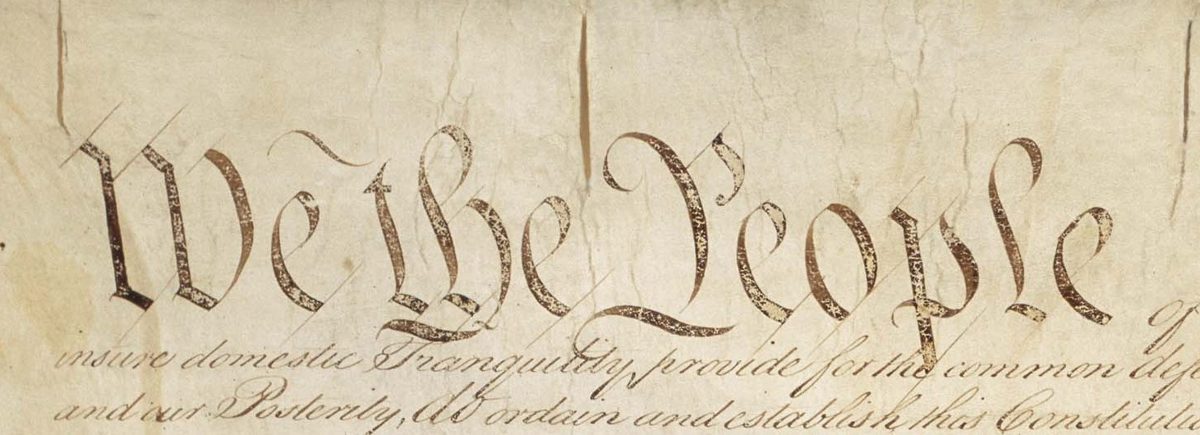
September 17, 1787
The engrossed Constitution was read aloud on Monday, September 17. Then Franklin rose with a speech in his hand, and James Wilson read it for him. It is short, and it may be the most honest speech of the summer:
"I confess that there are several parts of this constitution which I do not at present approve, but I am not sure I shall never approve them: For having lived long, I have experienced many instances of being obliged by better information, or fuller consideration, to change opinions even on important subjects, which I once thought right, but found to be otherwise."
Benjamin Franklin, speech read by James Wilson, September 17, 1787, as recorded by James Madison. 4
He asked for a vote of confidence in an imperfect thing. "I doubt too whether any other Convention we can obtain, may be able to make a better Constitution," he said, because any assembly brings with it "all their prejudices, their passions, their errors of opinion, their local interests, and their selfish views." And then the line that has outlived the rest: "I can not help expressing a wish that every member of the Convention who may still have objections to it, would with me, on this occasion doubt a little of his own infallibility, and to make manifest our unanimity, put his name to this instrument."4
Nathaniel Gorham asked for one last change. The draft said the House could have no more than one Representative for every forty thousand people. He wanted thirty thousand. Washington, who had said nothing in debate all summer, rose to support the change. Madison added a bracketed note: "This was the only occasion on which the President entered at all into the discussions of the Convention." No one opposed, and it passed unanimously.4
Not everyone would sign. Randolph refused, because he feared the choice put to the people, accept or reject the whole, would lead to trouble: "Nine States will fail to ratify the plan and confusion must ensue." He called refusing "a step which might be the most awful of his life."4 Gerry said he could not pledge himself to support the plan, and feared a civil war in Massachusetts.4 Mason did not sign either. His reasons come up in Lesson 7, and his biography is in Module 55, Lesson 2.
On Franklin's motion the Convention approved a form of signing, "Done in Convention by the unanimous consent of the States present." Every state present voted yes except South Carolina, which was divided.4 The members then signed. As the last were doing so, Franklin looked toward the president's chair, at the back of which a sun was painted, and spoke to the men near him. Madison wrote it down:
"I have said he, often and often in the course of the Session, and the vicisitudes of my hopes and fears as to its issue, looked at that behind the President without being able to tell whether it was rising or setting: But now at length I have the happiness to know that it is a rising and not a setting Sun."
Benjamin Franklin, as recorded by James Madison, September 17, 1787. 4
The Convention resolved that Washington should keep its journal and papers, subject to the order of the Congress "if ever formed under the Constitution." Madison closes the record: the Constitution "being signed by all the members except Mr. Randolph, Mr. Mason, and Mr. Gerry," the Convention "dissolved itself by an Adjournment sine die."4
Myth: "A republic, if you can keep it" was a speech to the Convention
The line is real. It is not from the Convention floor. The source is the journal of Maryland delegate James McHenry, who recorded on the page for September 18: "A lady asked Dr. Franklin Well Doctor what have we got a republic or a monarchy" and the answer, "A republic replied the Doctor if you can keep it." McHenry added that the lady was Mrs. Powel of Philadelphia. It rests on that one journal entry.23
The Convention at a Glance
- May 14 Scheduled opening day. Too few delegates arrive.
- May 25 Seven states present. Washington elected president of the Convention.
- May 29 Secrecy rule adopted. Randolph presents the Virginia Plan.
- June 15 Paterson presents the New Jersey Plan.
- June 18 Hamilton speaks against both plans.
- July 2 Vote on equal state votes in the second branch ties five to five.
- July 16 Connecticut Compromise adopted, five states to four, Massachusetts divided.
- July 24 Committee of Detail named.
- August 6 Committee of Detail reports a printed draft.
- August 25 Slave-trade clause set at 1808.
- September 8 Committee of Style named.
- September 12 Committee of Style reports.
- September 17 Constitution signed. Convention adjourns sine die.
Learn more
- Madison's Notes of Debates, Avalon Project: every day of the Convention, with Madison's later revisions marked.
- Madison Debates, July 16: the vote on the Connecticut Compromise and the next morning's meeting of the larger states.
- Madison Debates, August 22: the whole debate on the slave trade, with Mason, Ellsworth and the Pinckneys.
- Madison Debates, September 17: Franklin's speech, the refusals to sign, and the closing scene.
- The Constitution, National Archives transcript: the engrossed text as signed.
- A republic if you can keep it, Library of Congress: the McHenry journal entry and its history.
- James Madison: The Man Who Kept the Notes: the biography of the Convention's record keeper.
Notes
- James Madison, Notes of Debates in the Federal Convention of 1787, May 14 and May 25, 1787, Avalon Project, Yale Law School. Read it online. ↩
- National Archives, "Meet the Framers of the Constitution." Read it online. ↩
- James Madison, Notes of Debates in the Federal Convention of 1787, May 29, 1787 (additional rules; Randolph's speech and resolutions), Avalon Project, Yale Law School. Read it online. ↩
- James Madison, Notes of Debates in the Federal Convention of 1787, September 17, 1787, Avalon Project, Yale Law School. Read it online. ↩
- James Madison, Notes of Debates in the Federal Convention of 1787, June 15, 1787 (the New Jersey propositions), Avalon Project, Yale Law School. Read it online. ↩
- James Madison, Notes of Debates in the Federal Convention of 1787, June 18, 1787 (Hamilton's speech and plan), Avalon Project, Yale Law School. Read it online. ↩
- James Madison, Notes of Debates in the Federal Convention of 1787, June 19, 1787, Avalon Project, Yale Law School. Read it online. ↩
- James Madison, Notes of Debates in the Federal Convention of 1787, June 11, 1787, Avalon Project, Yale Law School. Read it online. ↩
- James Madison, Notes of Debates in the Federal Convention of 1787, June 28, 1787 (Franklin's motion for prayers), Avalon Project, Yale Law School. Read it online. ↩
- James Madison, Notes of Debates in the Federal Convention of 1787, July 2, 1787, Avalon Project, Yale Law School. Read it online. ↩
- James Madison, Notes of Debates in the Federal Convention of 1787, July 16, 1787, Avalon Project, Yale Law School. Read it online. ↩
- James Madison, Notes of Debates in the Federal Convention of 1787, June 1, 1787, Avalon Project, Yale Law School. Read it online. ↩
- James Madison, Notes of Debates in the Federal Convention of 1787, July 24, 1787, Avalon Project, Yale Law School. Read it online. ↩
- The Constitution of the United States, transcript, National Archives. Read it online. ↩
- The Declaration of Independence, July 4, 1776, Avalon Project, Yale Law School. Read it online. ↩
- James Madison, Notes of Debates in the Federal Convention of 1787, August 22, 1787, Avalon Project, Yale Law School. Read it online. ↩
- James Madison, Notes of Debates in the Federal Convention of 1787, July 12, 1787, Avalon Project, Yale Law School. Read it online. ↩
- James Madison, Notes of Debates in the Federal Convention of 1787, August 25, 1787, Avalon Project, Yale Law School. Read it online. ↩
- James Madison, Notes of Debates in the Federal Convention of 1787, August 6, 1787 (report of the Committee of Detail), Avalon Project, Yale Law School. Read it online. ↩
- James Madison, Notes of Debates in the Federal Convention of 1787, September 8, 1787 (appointment of the Committee of Style), Avalon Project, Yale Law School. Read it online. ↩
- James Madison, Notes of Debates in the Federal Convention of 1787, September 12, 1787 (report of the Committee of Style), Avalon Project, Yale Law School. Read it online. ↩
- James Madison to Jared Sparks, April 8, 1831, Founders Online, National Archives. Read it online. ↩
- Julie Miller, "'A republic if you can keep it': Elizabeth Willing Powel, Benjamin Franklin, and the James McHenry Journal," Unfolding History, Library of Congress Manuscripts blog, January 6, 2022. Read it online. ↩
Terms in this lesson
- Virginia Plan
- The fifteen resolutions Edmund Randolph offered on May 29, 1787, calling for a national government with a two-house legislature, an executive and a judiciary.
- New Jersey Plan
- William Paterson's June 15 proposal to amend the Articles of Confederation, keeping one house of Congress with an equal vote for each state.
- Great Compromise
- The July 16 decision to give states equal votes in the Senate while the House would count population. Also called the Connecticut Compromise.
- Committee of Detail
- The five-member committee, appointed July 24, that turned the Convention's resolutions into the first full draft of a constitution.
- Committee of Style
- The five-member committee, appointed September 8, that revised the wording and arrangement. Gouverneur Morris wrote most of the final text.
- Sine die
- Latin for 'without a day.' A body that adjourns sine die ends its session with no date to meet again.
- Engrossed
- Written out in final, formal form on parchment for signing.
Sources
- Madison's Notes of Debates, Avalon Project checked 2026-10
- Madison Debates, May 29, 1787 checked 2026-10
- Madison Debates, July 16, 1787 checked 2026-10
- Madison Debates, August 22, 1787 checked 2026-10
- Madison Debates, August 25, 1787 checked 2026-10
- Madison Debates, September 17, 1787 checked 2026-10
- The Constitution of the United States, transcript (National Archives) checked 2026-10
- Meet the Framers of the Constitution (National Archives) checked 2026-10
- Madison to Jared Sparks, April 8, 1831 (Founders Online) checked 2026-10
- A republic if you can keep it (Library of Congress) checked 2026-10